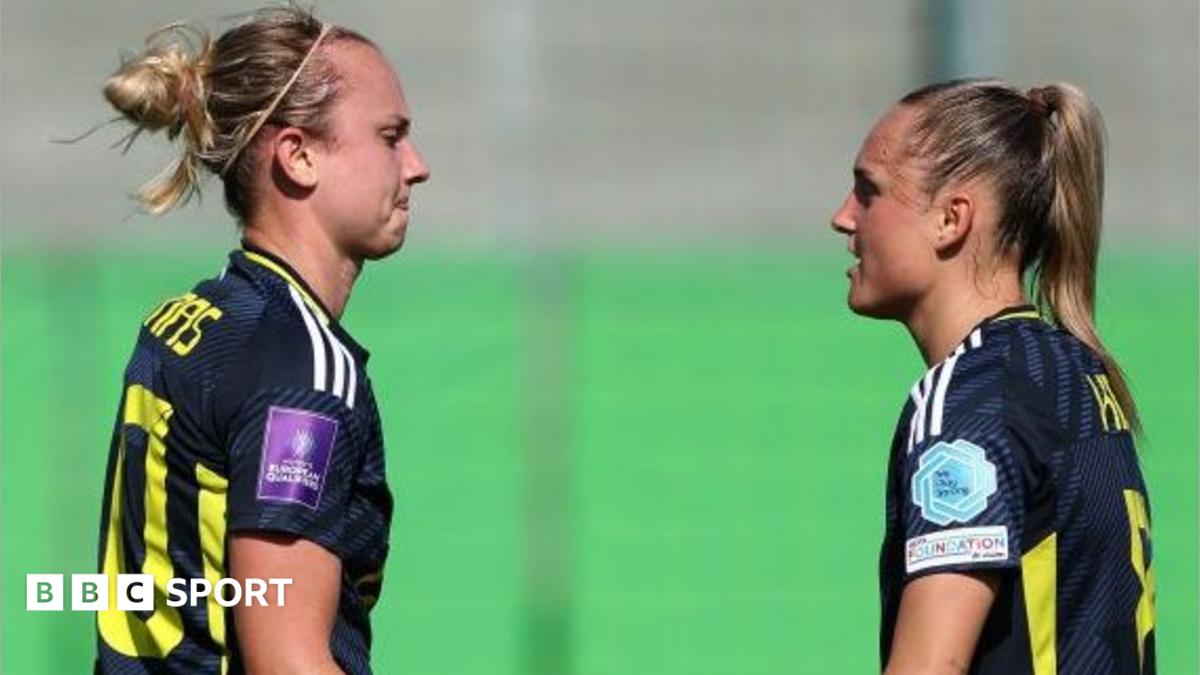
Defenders: Georgia Brown (Jacksonville), Jenna Clark (Liverpool), Nicola Docherty (Rangers), Sophie Howard (Como), Emma Lawton (Ipswich Town), Rachel McLauchlan (Newcastle United), Amy Muir (Glasgow City).
Midfielders: Chelsea Cornet (Birmingham City), Erin Cuthbert (Chelsea), Christy Grimshaw (AC Milan), Sam Kerr (Liverpool), Kirsty Maclean (Liverpool), Maria McAneny (Celtic), Miri Taylor (Aston Villa), Caroline Weir (Lyon).
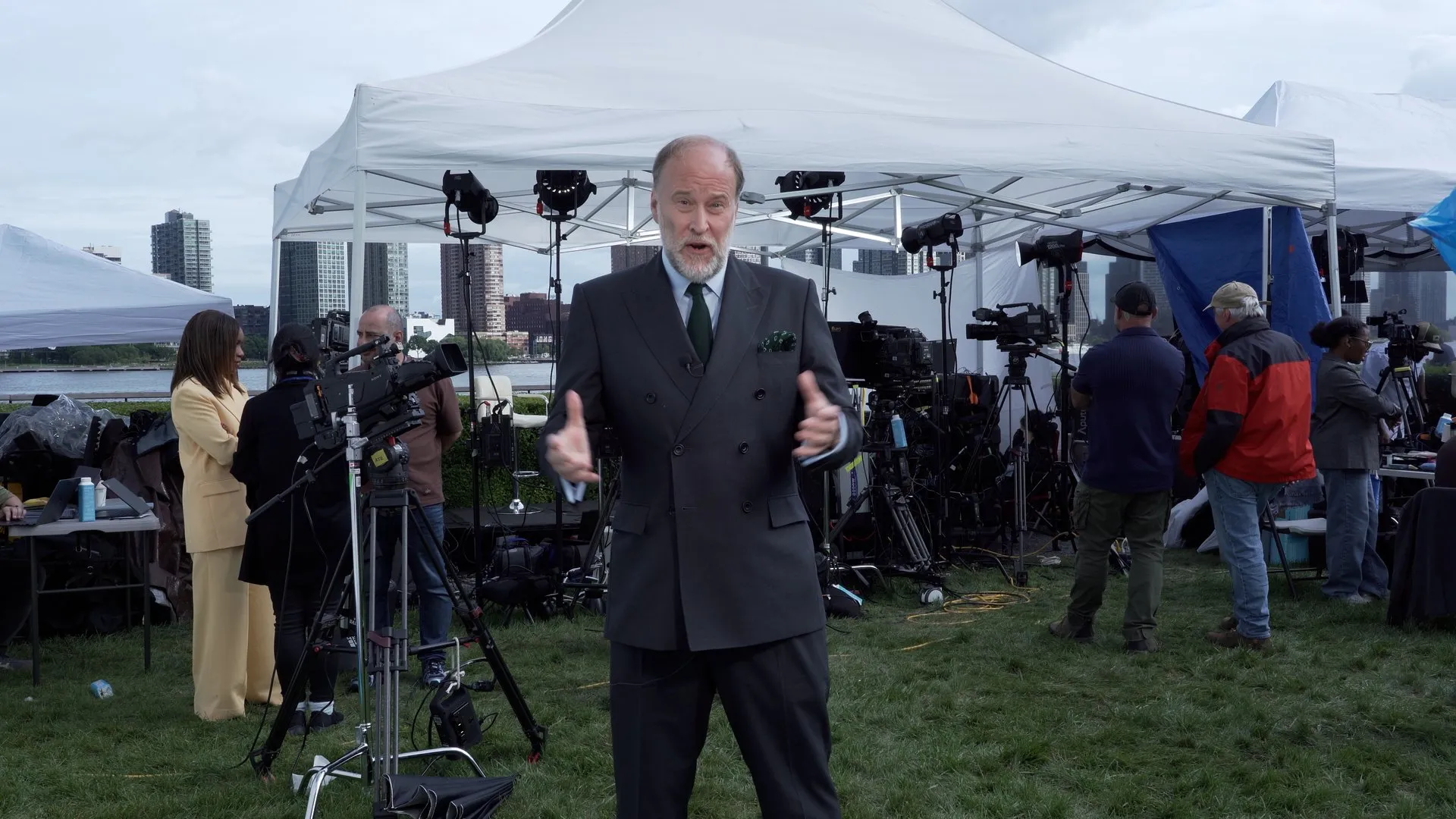
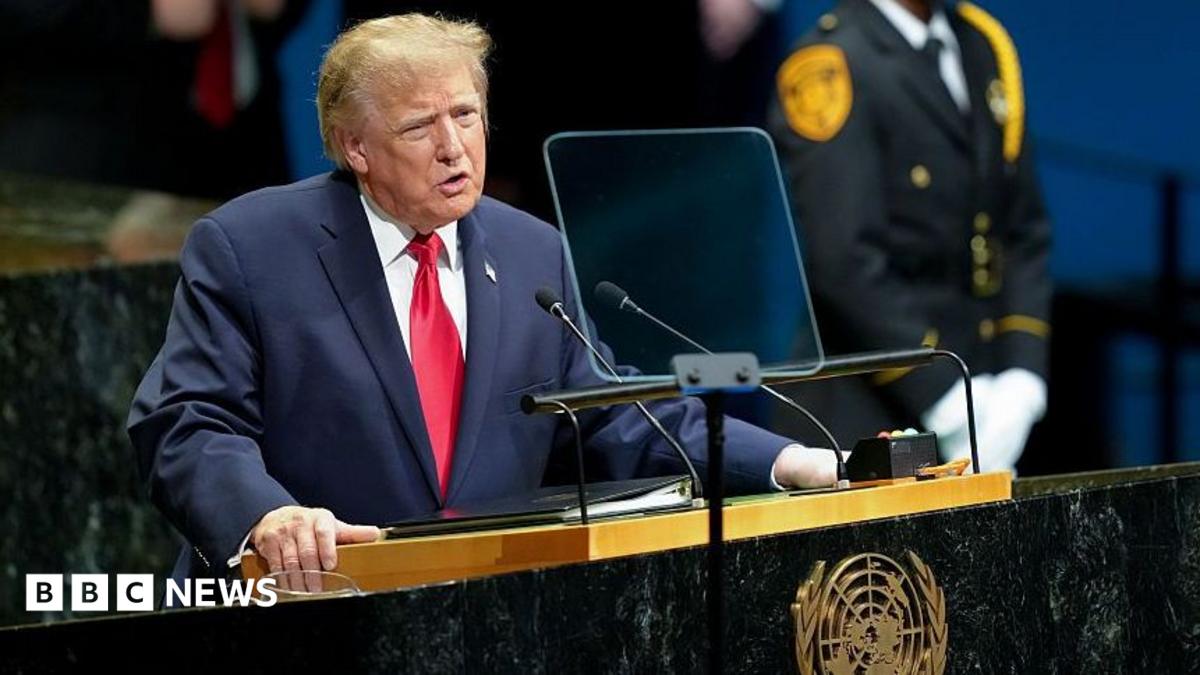
With world leaders at the UN General Assembly podium this week, play our quiz matching famous quotes to who said them.
Published On 23 Sep 202623 Sep 2026
This week, world leaders converge on New York for the annual United Nations General Assembly (UNGA), where representatives from the 193 UN member states are expected to take to the podium.
Over the decades, that same podium has hosted some of modern diplomacy’s most quoted moments, from Cold War warnings to wartime appeals.
Match each line to the leader who spoke it from the UNGA podium in the 10-question quiz below.
Armed men open fire at a house party in a Durban township, killing a pregnant woman and 10 others.
Published On 23 Sep 202623 Sep 2026
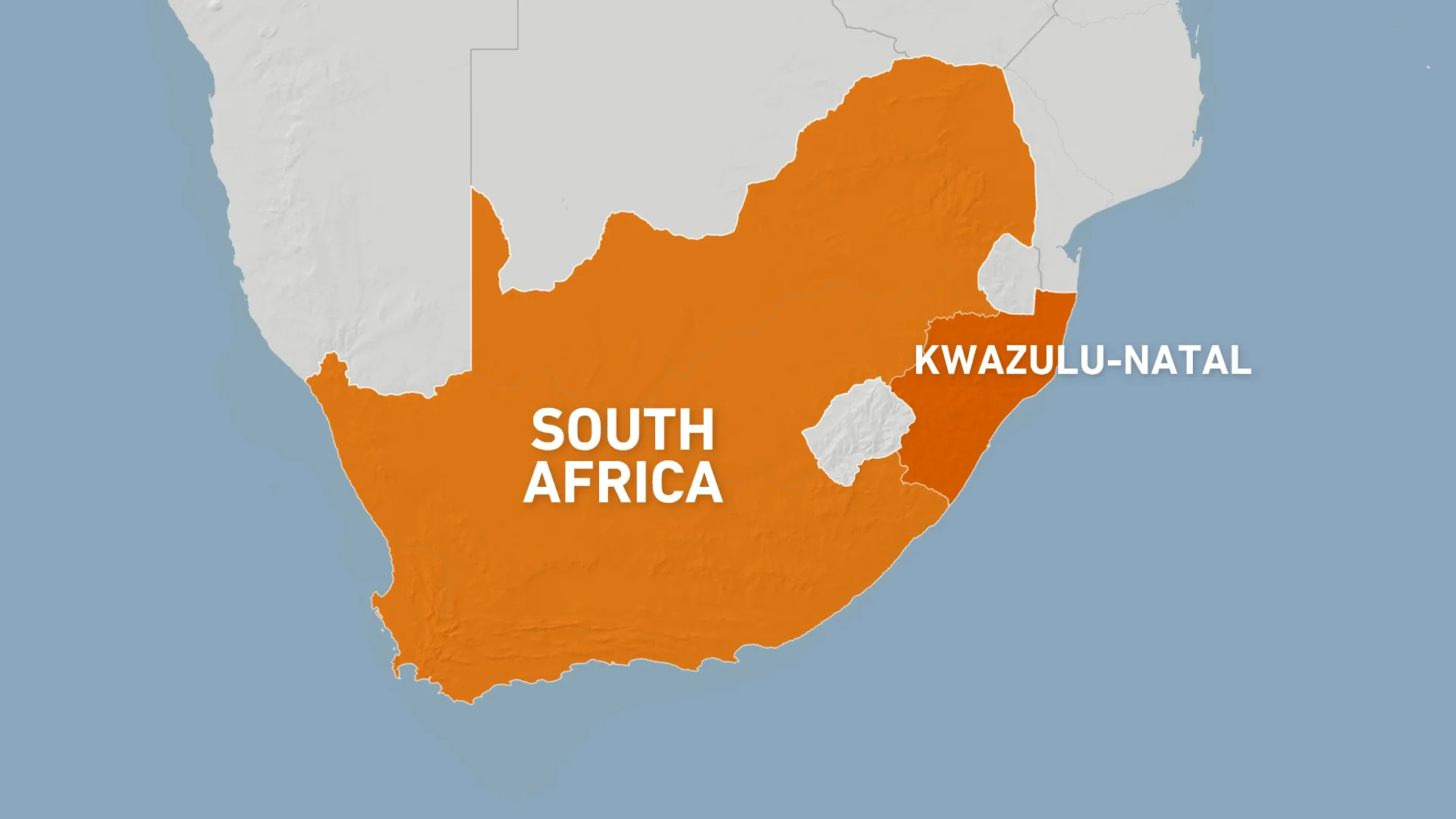
At least 11 people, including a pregnant woman, have been killed after armed men stormed a house in a township in the South African city of Durban.
The attack took place late on Tuesday, according to Thamsanqa Ntuli, the premier of KwaZulu-Natal province, of which Durban is the main city. Assailants entered the home shortly before 11pm (21:00 GMT) while the victims were gathered at a house party.
Recommended Stories
list of 3 itemsend of list
Two people survived the attack, Ntuli said, adding the motive behind the killings was not immediately clear.
“The incident has left the community in profound shock and grief,” he said.
Local broadcaster eNCA reported that the attackers forced everyone into a single room before opening fire. They also set fire to a car belonging to one of the victims.
“It’s shocking and sad. These are guys I grew up with. I can’t believe it. It’s like a movie,” a resident told the broadcaster.
“I’ve been staying here all my life, and I’ve never seen anything like this,” he added.
According to a police statement cited by eNCA, preliminary investigations indicated that some of those killed were on South Africa’s Crime Intelligence radar over suspected illegal activities, though the statement did not elaborate further.
“Although the motive for the shooting has not yet been confirmed, a feud between rival groupings cannot be ruled out,” the police said.
South Africa has one of the world’s highest murder rates, with an average of about 60 people killed daily in a population of roughly 62 million.
In March, soldiers were deployed alongside national police to violent hotspots to tackle rampant crime, an issue President Cyril Ramaphosa has described as one of the country’s biggest threats.
Islamabad, Pakistan – On September 16, a delegation from Powerus, a year-old United States drone company backed by two sons of President Donald Trump, was received by Pakistan’s military chief, Field Marshal Asim Munir, at military headquarters in Rawalpindi.
A day later, the company announced it had received a “limited procurement order” from Pakistan’s Ministry of Defence for unmanned aerial systems. It also said it had signed a separate memorandum of understanding (MoU) with senior Pakistani defence officials.
Recommended Stories
list of 4 itemsend of list
Neither the value of the order nor the systems involved have been disclosed. But for analysts studying Pakistan’s venture in drone technology, even bigger concerns have arisen from information that has since emerged.
Less than three months earlier, the same company had given an Indian defence manufacturer the exclusive right to make and sell its drone interceptor technology in India. And one of the cofounders of Powerus is an Israeli military veteran. Pakistan does not recognise Israel and accuses it of carrying out a genocide in Gaza.
Analysts are questioning why a country that already builds its own drones and buys others from China and Turkiye would turn to a company that was founded only last year – and has links to Israel and sells drones to India too.
“Pakistan technically already makes or is capable of making each of the drones shown by Powerus,” Bilal Khan, founder of the Quwa Group, a Toronto-based defence news and market intelligence platform, told Al Jazeera. “It’s unclear where Powerus fits in the long term [from Pakistan’s perspective].”
What did Pakistan sign?
In its statement on the meeting, Inter-Services Public Relations (ISPR), the Pakistani military’s media wing, said the two sides discussed cooperation in defence procurement, production and capacity building.
The statement did not mention the MoU.
But Powerus told Al Jazeera which institutions were involved. “The MoU was signed with the Pakistan army. The related procurement order was placed by Pakistan’s Ministry of Defence,” a company spokesperson said.
In its own statement, Powerus said the memorandum was not a definitive agreement, created no purchase obligation and would be subject to US laws and government approvals.
“We are proud to support Pakistan’s Ministry of Defence, and the memorandum gives both sides a strategic framework to build upon,” Brett Velicovich, the company’s cofounder, said in the statement.
According to media reports, Velicovich has also said the company is exploring ways to build technology in Pakistan.
The ISPR, the Ministry of Foreign Affairs and the Ministry of Information and Broadcasting did not respond to Al Jazeera’s requests for comment.
Founded in 2025 and based in Florida, Powerus is set to merge with Aureus Greenway Holdings, a Nasdaq-listed company that owns golf courses in the US state, in a deal expected to close in the final quarter of this year.
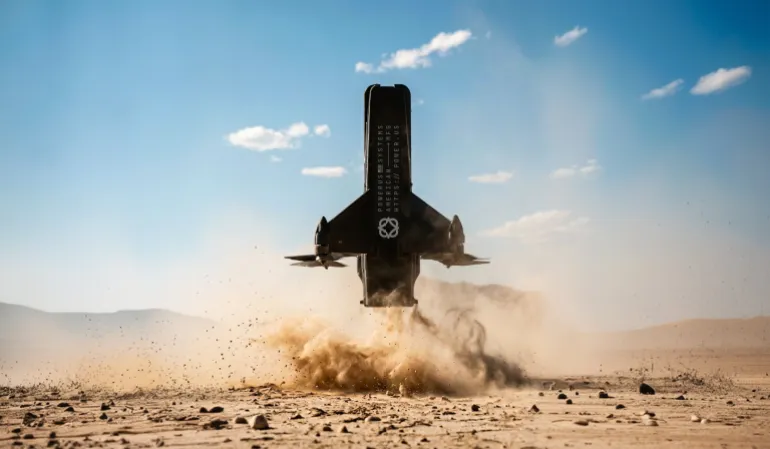
Powerus’s Guardian Interceptor is a drone interceptor [Handout/Powerus]
Donald Trump Jr and Eric Trump, President Trump’s oldest sons, are investors in Powerus through a vehicle called American Ventures, which is expected to hold a 9.9 percent beneficial stake in the combined company, according to US regulatory filings.
A spokesperson for Donald Trump Jr has told media outlets that he is a passive investor with no role in the company’s operations or contracts and had no prior knowledge of the Pakistan deals.
The White House has said there are no conflicts of interest.
The company makes about 3,000 interceptor drones a month, according to media reports, and last month won a US Air Force contract with a ceiling of up to $90m.
Asked how it addresses conflict of interest questions while pursuing government defence work in the US and abroad, Powerus said the Trump brothers played no part in its operations.
“Trump’s sons are not advisers to Powerus and have no involvement in how the company runs its business or structures its defence relationships, domestically or internationally. They hold no corporate-governance role. Our government relationships are pursued on their own merits,” the company told Al Jazeera.
The India question
Powerus’s first deal in South Asia, however, was not in Pakistan.
It was in India, Pakistan’s archrival, with which Pakistan fought a brief but intense conflict in May last year, one in which drones were used by both sides.
In a June 30 filing to India’s stock exchanges, Paras Defence and Space Technologies said Powerus had granted it an exclusive licence to manufacture and sell its Guardian-1 interceptor technology in India.
Mansoor Ahmed, an honorary lecturer at the Australian National University’s Strategic and Defence Studies Centre, said Washington has long armed rival states.
“The US has previously sold F-16s to Greece and Turkiye and Egypt and Israel and is now selling F-35s to Saudi Arabia, which Israel already operates,” he told Al Jazeera.
A former Pakistani government defence analyst who spoke on condition of anonymity said Pakistani planners had probably known about the Indian deal.
“Pakistan’s defence planners were likely aware of Powerus’s engagement with India,” he told Al Jazeera.
This isn’t the first time that Pakistan and India have ended up buying military equipment from the same company, the defence analyst pointed out. He cited the build-up to the conflict over the Siachen Glacier, where India launched Operation Meghdoot in April 1984 to take control of the heights.
“In 1983, Pakistan ordered high-altitude warfare gear from a London supplier, unaware that the same firm also provided gear to the Indian army, and subsequently, India learnt of it and planned Operation Meghdoot in 1984,” he said.
The analyst said the burden now lies with the company.
“In the present case, the challenge is more for Powerus than Pakistan or India as Powerus’s management must ensure it can manage and meet the requirements of two adversaries without jeopardising either side’s operational security.”
A retired Pakistan air force air marshal who spoke on condition of anonymity because he was not authorised to speak publicly said the arrangement carries risks for Pakistan.
“Two adversary countries procuring from the same source has its pitfalls, especially when one of the adversaries has taken the lead as well as has a larger financial capacity,” he told Al Jazeera.
An Israeli link
The company’s leadership also has links to Israel, a country Pakistan does not recognise.
Powerus’s website described one of its cofounders, Ziv Marom, as a veteran of the Israeli military and said he founded Kaizen Aerospace, now a Powerus subsidiary.
Another senior executive, Justin Gans, the company’s vice president for mergers and acquisitions and a former member of the US Navy SEAL special forces, served as a vice president at Elbit Systems of America, the US arm of the Israeli defence company Elbit Systems, from 2018 to 2019.
A retired three-star army Pakistani general who served in senior roles before retiring in 2019 and requested anonymity because of the sensitivity of the subject said such a background would normally draw attention during vetting.
“So under normal circumstances, a cofounder’s service in the Israeli military would be flagged as a sensitivity marker, even if the company itself is American,” he told Al Jazeera.
“In other words, for a serious acquisition, this background would be scrutinised carefully. For a political MoU, it may not have been a decisive factor.”
Quwa’s Khan, however, said Pakistan has long accepted Israeli components inside US or European systems.
“We can see that, generally, as long as there’s a country in the middle, Pakistan does not have qualms being in close proximity to Israel,” he said. “However, the two sides very, very rarely talk to each other.”
What drone technology does Pakistan already have?
Beyond questions over who else Powerus works with, analysts said the more fundamental issue is what Pakistan actually needs from the company.
Pakistan’s air force has publicly displayed Turkish-made Bayraktar TB2 and Akinci drones, Chinese-made Wing Loong II drones and the domestically developed Shahpar-II.
Shahpar drones, made by the Pakistani state-owned defence company Global Industrial & Defence Solutions, are displayed at the 2024 International Defence Exhibition and Seminar in Karachi, Pakistan [File Akhtar Soomro/Reuters]
China supplied 80 percent of Pakistan’s arms imports from 2021 to 2025, according to the Stockholm International Peace Research Institute.
This month, the Pakistan air force revealed in a video that it had incorporated into its forces China’s HQ-17AE air defence missile system and Turkiye’s Korkut anti-aircraft gun and Sahin counterdrone system, all built to take on drones and other low-flying threats.
Khan said the state-owned Heavy Industries Taxila was also working with private firms to develop interceptor drones.
“So as it stands, Pakistan is following all the right best practices to build its C-UAS posture,” he said, referring to counterdrone systems.
“For Pakistan, the challenge isn’t whether it can get the designs but whether it can produce or induct these in large enough numbers fast enough.”
An official at a private drone manufacturer in Rawalpindi who requested anonymity because he is not authorised to speak to the media said Pakistan’s drone market has grown well beyond state-run firms.
Dozens of private companies and more than half a dozen state-owned enterprises now make drones besides the army’s own production facilities, he said. According to him, Powerus would have to compete with all of them on the quality of its products.
The retired general offered a different reading of why Pakistan might be interested in a tie-up with a US firm.
“The gap is not drone manufacturing. It is electronics, integration and systems-level capability, which is where American firms traditionally dominate,” he said. “How far this particular company can help in this regard is a million-dollar question.”
Powerus’s Guardian interceptors are small, low-cost drones designed to knock down incoming drones. They are a weapon widely used by both sides in the war in Ukraine.
Hammad Waleed, a research associate at the Islamabad-based Strategic Vision Institute, said such systems fill a cost gap that conventional air defences cannot.
“Traditional air defences use costly missiles against incoming cheaper drones,” he told Al Jazeera. “Interceptor drones are way cheaper and easier to operate than traditional air defences.”
Capability or signalling?
The retired Pakistani general, who has experience with defence production, said a supplier of this kind would normally face financial, technical and security checks as well as a review of its track record.
“A company less than a year old, not yet listed and without a delivery record would not usually clear these checks for a strategic defence partnership,” he said.
“Such firms are typically considered too immature unless the MoU is political signalling rather than a procurement decision.”
Khan agreed that the process has been unusual.
“Yes, the way this deal came about is not generally in line with how the procurement heads of the tri-services typically operate,” he said, referring to the three branches of Pakistan’s military.
The Powerus agreements were made as Munir has built close ties with President Trump, who has called him “my favourite field marshal” and praised him on several occasions during the past 15 months.
In September last year, weeks after Pakistan signed a $500m critical minerals agreement with a US company, Munir and Prime Minister Shehbaz Sharif met President Trump at the White House, where the Pakistani leaders presented him with samples of Pakistani minerals.
In January, Pakistan also signed an MoU with an affiliate of World Liberty Financial, the Trump family’s main cryptocurrency business.
From left, US President Donald Trump examines a box of rare earth minerals and gemstones presented by Pakistani Prime Minister Shehbaz Sharif and Field Marshal Asim Munir in September last year at the White House [File: Handout/White House]
Khan said Pakistan’s security establishment needs to ask what it is getting in return for that closeness.
“There was a time when such gains were measured in F-16s and the billions in US financial assistance, yet today, we are seeing more photo ops and supposed pacts that obligate the armed forces, but are they helping the armed forces as a fighting force?”
He also offered what he called a “less cynical take”.
Pakistan has a growing number of drone start-ups that lack the capital to build production facilities, he said, and ties with Powerus could draw US investment into them.
“So there is an argument that building rapport with Powerus and its backers can lead to that capital,” Khan said.
Ahmed said Pakistan is looking beyond a single purchase.
“Pakistan’s primary interest appears to be the acquisition of state-of-the-art drone technologies that also allow for local production and indigenisation,” he said.
What about China and Turkiye?
The retired Pakistani general said bringing in a foreign private company could overlap with Pakistan’s existing Chinese and Turkish partnerships.
“It has the potential of being seen by Turkiye and China as Pakistan hedging politically,” he said.
Khan, however, disagreed.
“There’d be no issue with the Turks as they work with US companies all the time and the drones on offer by Powerus don’t overlap with the ones NASTP is designing with Turkiye,” he said, referring to Pakistan’s National Aerospace Science and Technology Park.
He added that any Powerus designs built cheaply in Pakistan would still rely on Chinese parts.
“With the Chinese, it’d be less of an issue because, ultimately, the only way to make these Powerus designs at a low enough cost for the Pakistani armed forces to induct is to literally import the upstream subassemblies from China.”
Drones are displayed during the International Defence Exhibition and Seminar in Karachi on November 21, 2024 [Akhtar Soomro/Reuters]
Waleed said the deal would not dent Pakistan’s defence ties with Beijing and Ankara.
“Pakistan is prioritising China and Turkiye for the sophisticated and modern combat systems in the drone and counterdrone domain. That relationship is not only unaffected and is going upwards in trajectory,” he said.
For now, Khan said, the real test of the Powerus deal would be what follows it.
“I would not pass judgement on the Powerus deal yet, but we can track whether it’s serious by seeing if the MoD [Ministry of Defence] signs similar deals with other foreign and local vendors in the coming months,” he said.
“Basically, will we see a consistent pattern moving forward, or will this be a one-off?”
The United States and Iran have engaged in hours of indirect talks through mediators on the sidelines of the United Nations General Assembly (UNGA) in New York, but accounts differed over whether officials from the two countries met directly.
US special envoy Steve Witkoff said mediators had “shuttled between” the American and Iranian delegations throughout Tuesday.
Recommended Stories
list of 4 itemsend of list
“Today, on the sidelines of the United Nations General Assembly, we engaged in lengthy talks with the Iranian delegation through the mediators, who shuttled between the two sides throughout the day,” Witkoff said in a post on X.
“They successfully completed a round of discussions that we hope will prove constructive and promising. The mediators will continue their work.”
US President Donald Trump gave a more direct account, saying Witkoff and Jared Kushner had held a three-hour meeting with Iranian officials.
“They had a very good meeting, a very productive meeting,” Trump told reporters at the UN, adding that he believed there was “a lot of momentum” towards an agreement. Trump later said talks were continuing and that he believed a settlement would eventually be reached.
Al Jazeera’s Kimberly Halkett, reporting from Washington, said Trump’s initial comments had created confusion over who had participated. She said the White House later clarified that Trump had not attended and that Witkoff and Kushner represented the US side.
Al Jazeera’s Tohid Asadi, reporting from Tehran, said state media had confirmed a meeting between Iranian Foreign Minister Abbas Araghchi and Witkoff after weeks without direct contact.
“This latest meeting was held at the request and insistence of the American side, and was aimed at conveying Iran’s messages and conditions, particularly around reopening the Strait of Hormuz,” Asadi reported.
Iranian state media said those conditions included lifting the US naval blockade, releasing frozen Iranian assets and ending the war on what Tehran describes as the “resistance” fronts.
Asadi also reported that an Iranian security source told Al Jazeera there could be room for further diplomatic engagement if Washington met Iran’s conditions and commitments.
The contacts came after a senior Iranian official told the Reuters news agency that Tehran’s delegation in New York had full authority to pursue diplomacy and described the UN gathering as a “golden opportunity” for Washington to return to negotiations.
The official said Iran had submitted its latest proposal to Washington through mediators on September 16 and that details of a possible agreement to end hostilities could be discussed in New York.
The official also said Iran could reopen Hormuz within seven days if the US eased military pressure and lifted its blockade of Iranian ports.
Regional powers push for de-escalation
The indirect talks have been accompanied by a broader diplomatic effort involving the Gulf and other regional states.
Qatar said it was working with Pakistan to reduce tensions between Washington and Tehran, safeguard freedom of navigation through the Strait of Hormuz and promote regional stability.
Qatar’s Prime Minister and Foreign Minister Sheikh Mohammed bin Abdulrahman bin Jassim Al Thani also met Araghchi in New York on Tuesday.
Qatar’s Ministry of Foreign Affairs said they discussed developments in the region, efforts to de-escalate tensions and ways of creating conditions for dialogue.
Oman has also been involved in maritime diplomacy over the waterway, having previously discussed maritime arrangements with Tehran aimed at facilitating navigation through the strait.
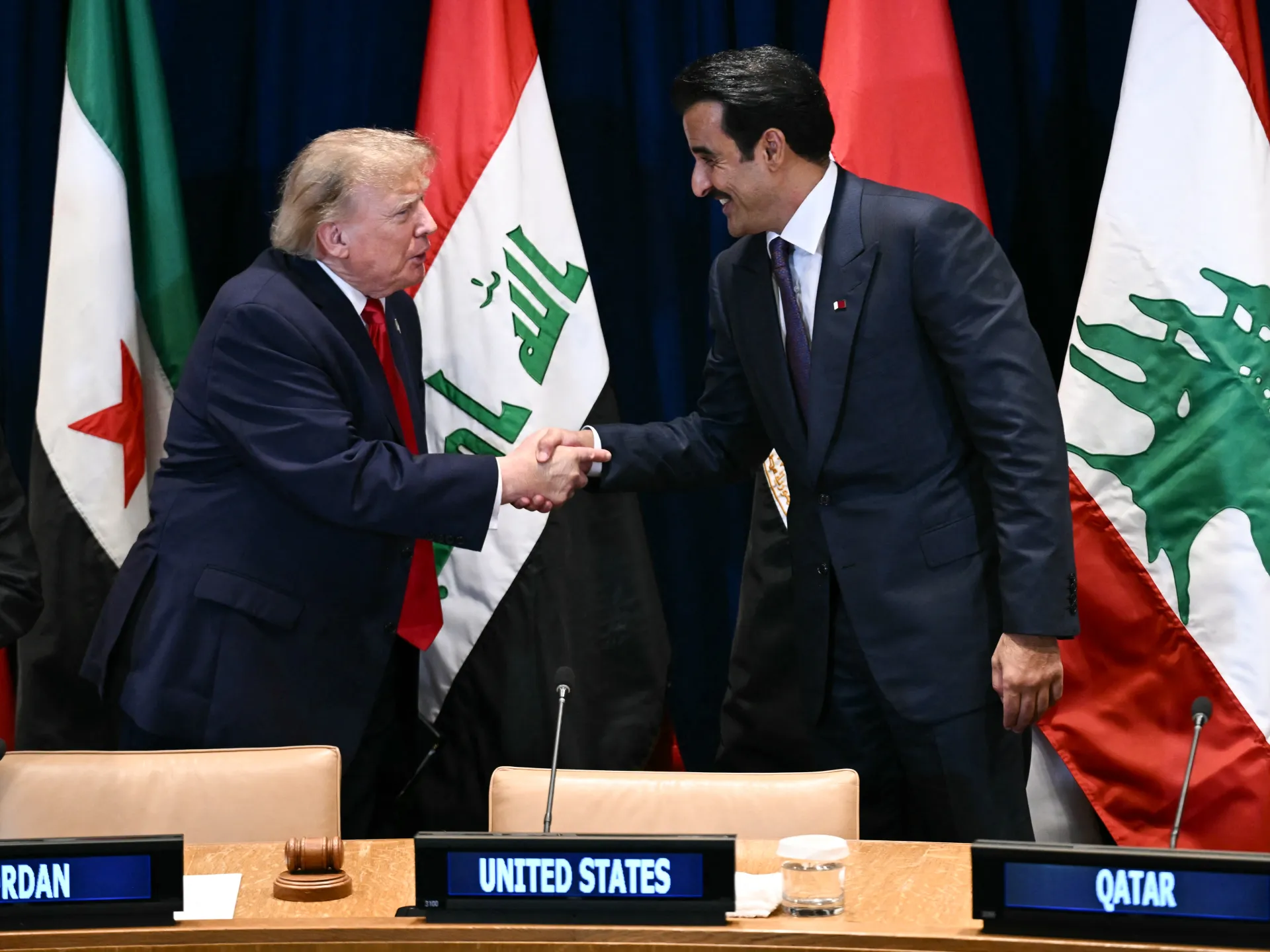
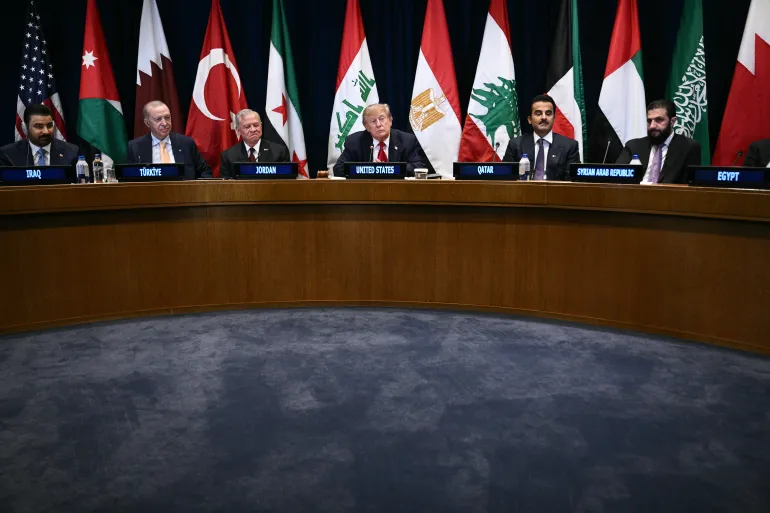
Trump also met leaders and senior officials from Gulf Cooperation Council states, Turkiye, Jordan, Syria and Iraq on Tuesday to discuss Iran and regional security.
Reuters reported that a Qatari proposal for a common security framework involving Iran and Gulf states was among the issues under consideration, with one regional source saying Tehran was reviewing it.
Qatar has not made the proposal public.
US President Donald Trump attends a multilateral meeting on the sidelines of the 81st UN General Assembly in New York with leaders and senior officials from Arab countries and Turkiye on September 22, 2026 [Brendan Smialowski/AFP]
Talks follow Trump’s warning
The indirect talks came hours after Trump used his UNGA address to combine the possibility of an agreement with another warning of military escalation.
Trump said he faced a “big decision” between reaching a deal that would allow Iran to rebuild and moving to “annihilate the Islamic Republic”. He also said Washington had previously offered Tehran “full economic cooperation” in return for ending its nuclear programme and what the US describes as Iranian support for terrorism.
Iran’s General Staff of the Armed Forces and Khatam al-Anbiya Central Headquarters responded in a statement carried by Iranian media, describing Trump’s threats as evidence of “strategic weakness” and saying Iran was ready to deliver “more severe, crushing, and unpredictable blows” in response to further attacks.
US officials have repeatedly suggested that negotiations were making progress following the collapse of the June memorandum of understanding. In early August, Trump said the sides had reached parameters for a possible agreement and later described talks over Hormuz as “moving along nicely”, although significant differences remained. Earlier this month, he again said he hoped the war was “towards the end”.
Tehran continues to condition the reopening of the Strait of Hormuz on the US easing military pressure and lifting its blockade of Iranian ports, while Witkoff said mediators would continue their efforts following Tuesday’s mediated exchanges.
Six-year-old Lian Yunzhi from China broke the women’s 3x3x3 Rubik’s Cube world record, and then broke her own record days later. She also became the only female cuber in the world to have an average time under 4.5 seconds.
US-led anti-cartel alliance backs sanctions against crime groups after Trump urges stronger action.
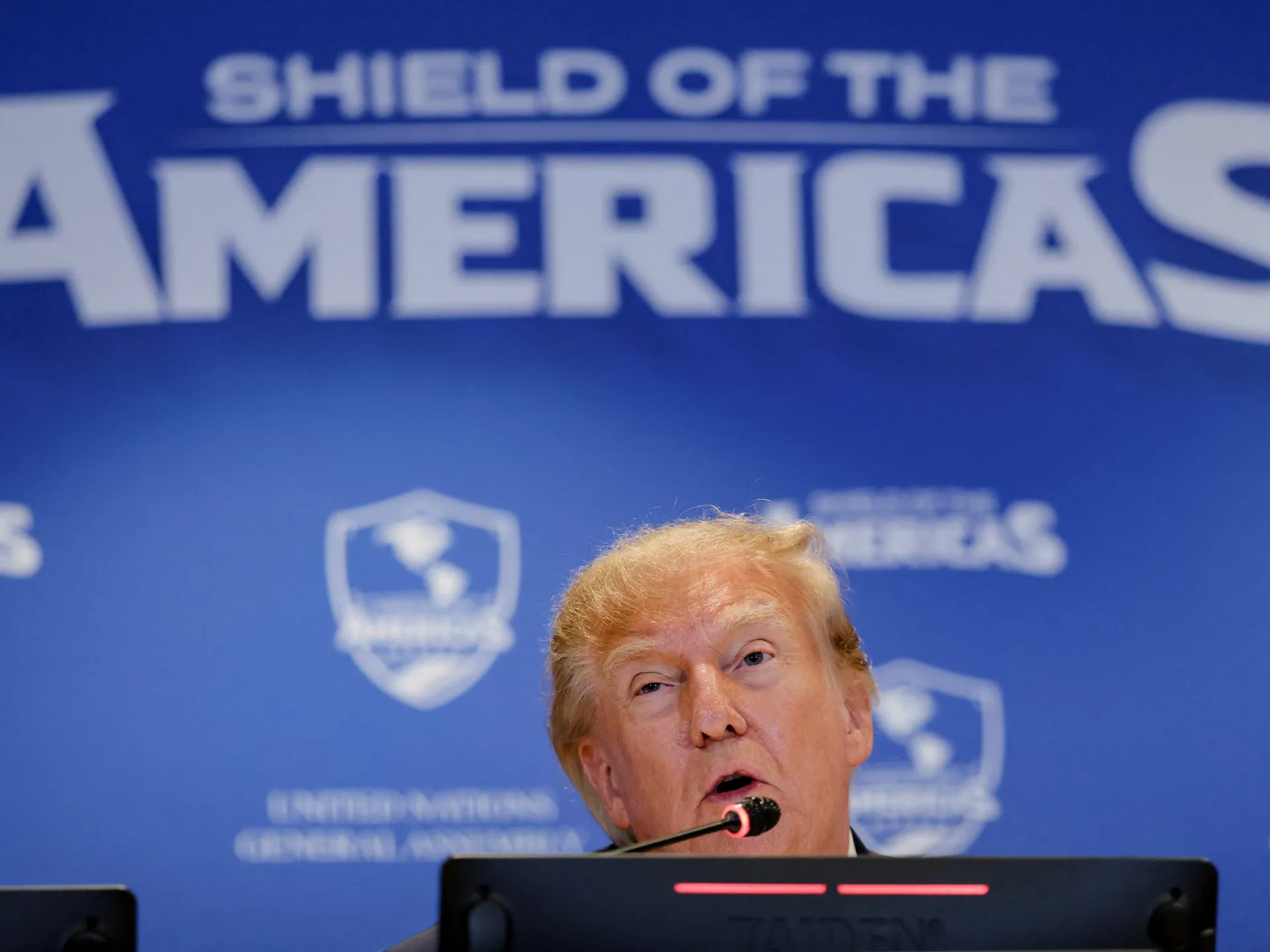
United States President Donald Trump has pledged to use “unmatched military might” against drug cartels in the Western Hemisphere during a meeting of the Washington-led Shield of the Americas coalition in New York City.
In a meeting with leaders and foreign ministers from the anti-cartel alliance, Trump on Tuesday urged member countries to join the US in targeting 24 criminal organisations, which he earlier described as the “ISIS of the Western Hemisphere”.
Recommended Stories
list of 3 itemsend of list
He said he was asking “all nations in the Shield of the Americas to formally designate narco-terrorists as common threats to stability and apply crushing sanctions” against all of the groups. The meeting took place on the sidelines of the annual United Nations General Assembly (UNGA) in New York City.
The coalition’s 15 governments later issued a joint statement saying they intended to impose asset freezes and visa restrictions on members and supporters of the groups and to pursue criminal charges against them.
At the top of the list are two groups that have been declared “terrorist” organisations by Washington: Mara Salvatrucha (MS-13) – one of Central America’s most powerful criminal gangs – and Tren de Aragua, a Venezuelan gang that is also active in Colombia, Peru and Chile.
The list also includes major Mexican cartels, Colombian armed groups such as the National Liberation Army, Brazil’s Primeiro Comando da Capital and Comando Vermelho groups, and Peru’s Shining Path.
Al Jazeera’s Alessandro Rampietti, reporting from Bogota, Colombia, said the statement was largely symbolic for now, because each country must follow its own legal procedures.
“For example, here in Colombia, it will require a law to pass in Congress. We understand that the government here has asked Congress to move forward in drafting such a law. So while the consequences may not be immediate, this is clearly an important step towards building what the US has been trying to do in Latin America [through] this alliance,” he added.
The coalition is made up of governments closely aligned with Trump, including Argentina, Ecuador and El Salvador, whose leaders he has praised or endorsed. Colombia and Peru joined after Trump-aligned presidents took office in recent months.
Brazil and Mexico have not joined.
US Secretary of State Marco Rubio, who also attended, praised “the emergence of strong leaders who are committed to the challenge of taking on transnational terrorism”.
The gathering was the administration’s latest effort to rally the region behind a more aggressive approach to drug trafficking. Since returning to office last year, Trump has designated cartels as foreign terrorist organisations and ordered dozens of strikes on boats in the Caribbean and eastern Pacific that US officials say were carrying narcotics bound for the US.
The strikes have killed more than 223 people, and UN experts say they violate international law and could amount to crimes against humanity.
The Trump administration’s National Security Strategy, released late last year, laid out plans for a revamped Monroe Doctrine, the 19th-century policy asserting US primacy in the hemisphere that critics associate with decades of US intervention.
Trump has also spoken of retaking the Panama Canal and annexing Greenland and Canada. On Tuesday, he signed an agreement on Greenland that stopped short of his demand that the island become US territory.
The focus on the hemisphere has raised concerns across the region.
Brazilian President Luiz Inacio Lula da Silva, in his UN speech, bristled at the approach, warning countries in Latin America and the Caribbean of “renewed hegemonic temptations”.
Debate opened at the UN General Assembly and leaders from across the world made their arguments for making the world a better place. International cooperation seems to be the central goal, but as Al Jazeera’s Emma Withrow explains, only a handful of countries hold the cards.
Fifteen people have been convicted over Sri Lanka’s 2019 Easter Sunday bombings, which killed 279 people at churches and luxury hotels. The verdict comes amid continued scrutiny over intelligence warnings received before the attacks and whether officials failed to act.
Investors shrug off AI safety concerns and Iran war, sending market to a new peak.
Published On 23 Sep 202623 Sep 2026
Wall Street’s Nasdaq stock exchange has hit an all-time high, shrugging off concerns about AI safety risks, sky-high tech valuations and the energy shock caused by the United States’ war on Iran.
The Nasdaq Composite index, which is dominated by US tech giants such as Nvidia, Apple and Microsoft, rose 0.45 percent on Tuesday, taking its gains to date this year to more than 17 percent.
Recommended Stories
list of 4 itemsend of list
The Nasdaq 100, a narrower index that tracks 100 top companies, jumped 0.82 percent.
The S&P 500, the most popular measure of the overall US stock market, closed essentially flat.
Monolithic Power Systems, a Florida-based manufacturer of power circuits, and Canadian e-commerce company Shopify led the gains, surging 8.1 percent and 7.1 percent, respectively.
Micron Technology, one of the world’s top three memory chip makers along with South Korea’s SK Hynix and Samsung Electronics, rose 5 percent.
Chip giant Nvidia, the world’s most valuable company, gained 0.7 percent, while Apple edged up 0.2 percent.
Meta Platforms, which soared 11.4 percent on Monday on excitement surrounding its new AI assistant Muse, dropped 0.63 percent.
Major Asian stock markets opened higher on Wednesday, with Japan’s benchmark Nikkei 225 and South Korea’s Kospi up about 1.4 percent and 0.1 percent, respectively, in morning trading.
Hong Kong’s Hang Seng Index opened lower, falling more than 0.7 percent during the morning trade.
Oil prices were largely flat on Tuesday, after falling more than 3 percent the previous day amid improving oil flows out of the Gulf and hopes of renewed diplomacy between Washington and Tehran.
Futures for Brent crude, the international benchmark, were trading at $99.18 a barrel as of 01:00 GMT.
US President Donald Trump on Tuesday told reporters that US officials held a “very good” meeting with their Iranian counterparts on the sidelines of the United Nations General Assembly in New York, hours after using his address to the session to warn that he could “annihilate” Iran if Tehran did not agree to a deal on the war.
Trump, whose war on Iran is nearing the seven-month mark, said US and Iranian officials would hold another round of talks in the “very near future”.
Jay Goldberg, a senior analyst at Seaport Research Partners in San Francisco, said signs of diplomatic progress between the US and Iran had refocused investor attention on the potential of AI to generate profits after years of multibillion-dollar investments.
“We have been searching for a clear consumer use case to justify the AI spend, and many see Muse as just that product,” Goldberg told Al Jazeera.
“Personally, I think Muse is just a step in the right direction; there will be better products – probably soon – but Muse is one of those things that are so useful they get investors excited about AI prospects again,” Goldberg said.
Podcaster and mental health activist Jennifer Eckhart, who sued ex-Fox News anchor Ed Henry for sexual assault in 2020, died by suicide on Saturday, according to authorities.
Eckhart was found in her Florida home on Saturday morning, according to an incident report issued by Martin County Sheriff’s Office, People reported. Her mother discovered her body inside a bathtub with a knife nearby, according to TMZ.
“This death has been ruled a suicide,” Christine Christofek, a spokesperson for the sheriff’s office, said in a statement to People.
Eckhart worked as an associate producer on Fox News Media’s Fox Business Network from 2013 to 2020. She sued Henry for sexual assault in 2020, and Fox News was named in the suit, accused of failing to take action against Henry for harassing women. The news division was later removed from the suit in March 2025.
“Fox News can … be held liable for Henry’s actions only if its management or supervisors knew or should have known about that purported misconduct yet failed to prevent Henry from harming Eckhart,” Judge Ronnie Abrams said in her March 2025 ruling. “On this record, the Court agrees that no reasonable jury could make that finding.”
Eckhart revealed that her lawyers were appealing Abrams’ decision in an October 2025 Instagram post.
“This case was never just about me,” she wrote. “It has always been about accountability and forcing corporations to answer for the cultures of abuse they protect, enable, and excuse behind power, money, and silence. For more than five years, my former employer Fox News has spent millions resisting accountability in my [rape] lawsuit. But what’s at stake is far bigger than me, one woman, one man or one company.”
The appellate court upheld Abrams’ decision, Eckhart’s lawyer Michael J. Willemin, a partner at Wigdor law firm, said.
“We were deeply saddened to learn of Ms. Eckhart’s passing, and our thoughts are with her family at this time,” Willemin told The Times.
Eckhart filed the harassment complaint against Henry after Fox News fired her in 2020. Following a subsequent sexual misconduct investigation, Fox News fired Henry that same year. The anchor, who now works at Newsmax, had previously taken time off in 2016 after a woman who claimed they had been having an affair while he was married released embarrassing correspondence between them, per People.
Suicide prevention and crisis counseling resources
If you or someone you know is struggling with suicidal thoughts, seek help from a professional or call 988. The nationwide three-digit mental health crisis hotline will connect callers with trained mental health counselors. Or text “HOME” to 741741 in the U.S. and Canada to reach the Crisis Text Line.
Born in Miami, Eckhart graduated from the University of Florida with a bachelor of science degree in telecommunications-news, according to her biography. She previously served as an ESPN Radio correspondent and an anchor for Gainesville, Fla., PBS affiliate WUFT-TV. In addition to her news and podcast experience, Eckhart also founded the Reinvented Project, which provided “support for trauma survivors through animal-assisted healing.”
Despite adversity, Eckhart was determined in her October 2025 post.
“I know the risks of speaking when silence would have been the safer, easier option. But I also know this: regardless of the outcome, history will not remember me as a woman who kept her mouth shut,” she wrote. “And I am completely at peace with that.”
Canada pledges 100 million Canadian dollars ($71m) in aid for Palestinians as the UK and France call for action against Israeli settlement expansion in the occupied West Bank.
Published On 23 Sep 202623 Sep 2026
Canadian Prime Minister Mark Carney has announced that Canada is pledging 100 million Canadian dollars ($71m) in international assistance for Palestinians in an effort to preserve “the possibility of a two-state solution”.
Speaking on the sidelines of the United Nations General Assembly (UNGA), Carney outlined that 80 percent of the funding will go towards direct humanitarian aid. The remaining 20 percent will be allocated to “support peace and security”, including Canada’s multiyear initiative to train Palestinian police in the occupied West Bank.
Recommended Stories
list of 3 itemsend of list
Carney prefaced the pledge by noting that Palestinians in Gaza continue to endure “immense human suffering”, while Israelis confront “existential threats from Hamas and from Iran and its proxies”.
The prime minister was also critical of Israel’s E1 settlement project, with the “intention to bring forward trade restrictions targeting goods produced in those illegal Israeli settlements”.
Canada is one of the 12 states that announced restrictions on trade in goods with settlements in the occupied territory.
Since the beginning of Israel’s genocidal war on Gaza, Ottawa has pledged more than 600 million Canadian dollars ($426m) in aid for Palestinian civilians.
‘Shame on all of us’
Carney was not the only Western leader to speak on Palestine. French President Emmanuel Macron also slammed world leaders for restrictions on aid in a UNGA speech on Tuesday.
“There are those who claim that peace has been achieved, but this has not opened the way for humanitarian aid deliveries. This sight is shameful. Shame on all of us,” he said.
“But what is our credibility worth if we remain inactive in the face of Gaza?” he added.
British Prime Minister Andy Burnham with French President Emmanuel Macron in London, UK [File: Leon Neal/Reuters]
British Prime Minister Andy Burnham said failure to deliver a two-state solution will “corrode trust” in politicians who have talked about the issue but not taken action.
Burnham told delegates from dozens of countries that the UK has also banned trade with illegal Israeli settlements in the West Bank because the E1 settlement expansion plan is “a deliberate attempt to block a two-state solution”.
“We all live in an era of low trust in politics. Many people in this room, many politicians around the world, have spoken for decades about a two-state solution. But if we fail to back those words with deeds, we will further corrode trust in the political, diplomatic and international process,” Burnham added.
President’s move clears hurdles to long delayed election and raises concern he can now wield unchecked power.
Published On 23 Sep 202623 Sep 2026
South Sudan’s President Salva Kiir has dissolved the country’s transitional unity government and appointed a caretaker administration as the country prepares for its first-ever national elections.
The decree on Tuesday ended a power-sharing arrangement set up under a 2018 peace deal that halted years of civil war, and raised concerns that Kiir could now wield unchecked power.
Recommended Stories
list of 3 itemsend of list
The decree, read out by the national broadcaster, said all vice-presidents, ministers and local administrators have been removed and that the national and state assemblies have been dissolved.
The judiciary and security institutions remain in place, while Kiir will stay in office “during the election period until the next elected president assumes office”, it said.
The decree came a day after the parliament approved changes to the National Elections Act that allowed Kiir to stay in power during the election period, while removing all vice presidents, who were appointed under the 2018 peace deal.
The changes mean that South Sudan can move towards elections scheduled for December 22, without first completing a permanent constitution or census – two processes that were previously tied to the transition.
The main opposition alliance has rejected the changes.
South Sudan’s suspended First Vice President Riek Machar inside a steel-caged dock before his trial on charges including treason and crimes against humanity, in Juba, South Sudan, on September 22, 2025 [File: Stringer/Reuters]
Elections were initially expected in 2022 but have been postponed twice.
Tasks still outstanding under the 2018 peace deal include drafting a permanent constitution, registering voters and unifying the armed forces loyal to rival parties.
That agreement followed five years of civil war that killed about 400,000 people and displaced millions, according to the United Nations.
Amnesty International, a prominent rights group, called Kiir’s decree a “decisive step” towards the country’s first-ever elections. But Tigere Chagutah, Amnesty International’s regional director for East and Southern Africa, urged the authorities to “ensure that a conducive environment exists for people to vote and stand in elections”.
Analysts meanwhile warned that the changes offered Kiir unfettered control.
“Kiir will be the only person in power, without vice-presidents, without the executive, without the parliament,” Michael Wani, a lawyer and former member of the constitution drafting committee, told the AFP news agency.
Independent analyst Machot Amuom told AFP there was a lot of “ambiguity” in the legal changes. “The new law gives the president full powers … He can decide even not to go for elections for another year or another two years,” Amuom told AFP.
Last week, Kiir also replaced the head of the elections commission without giving a reason. South Sudan Broadcasting Corporation (SSBC) said the new chief, Gabriel Bol Deng Majok, had been given a “fresh mandate” to oversee preparations for the polls.
The preparations come as Kiir’s longtime rival Riek Machar, who leads the opposition Sudan People’s Liberation Movement-in-Opposition (SPLM-IO), remains under house arrest. He is on trial on charges including treason and murder, which he denies.
The transition is also taking place under tight security.
AFP reported checkpoints and road closures around the government complex in the capital, Juba, while security personnel were ordered to remain on heightened alert for three days.
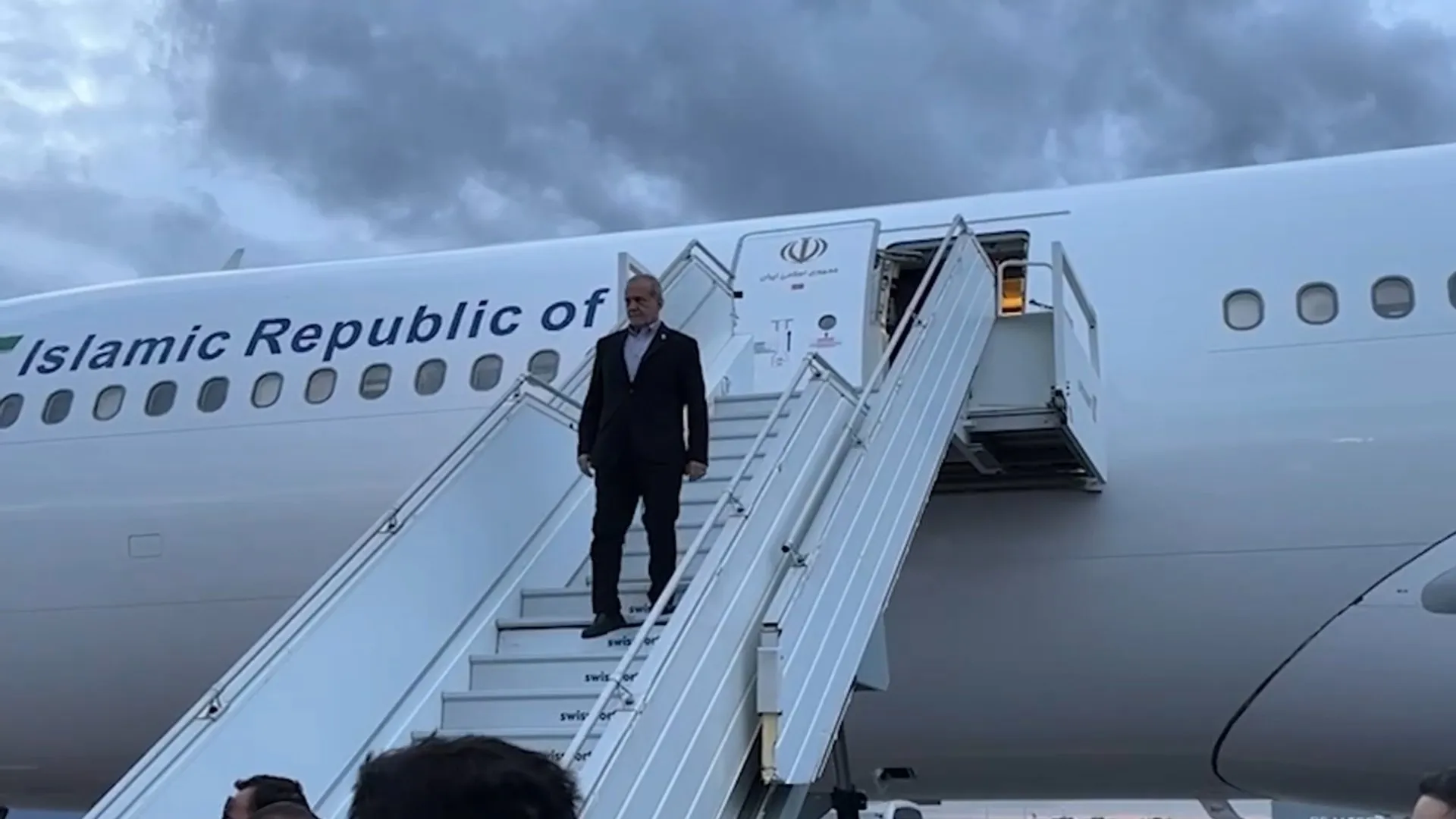
Iranian President Masoud Pezeshkian has arrived in New York as the US-Iran war continues. He’s due to address the UN General Assembly, where Iran is expected to press its case over the conflict and seek diplomacy aimed at easing tensions.
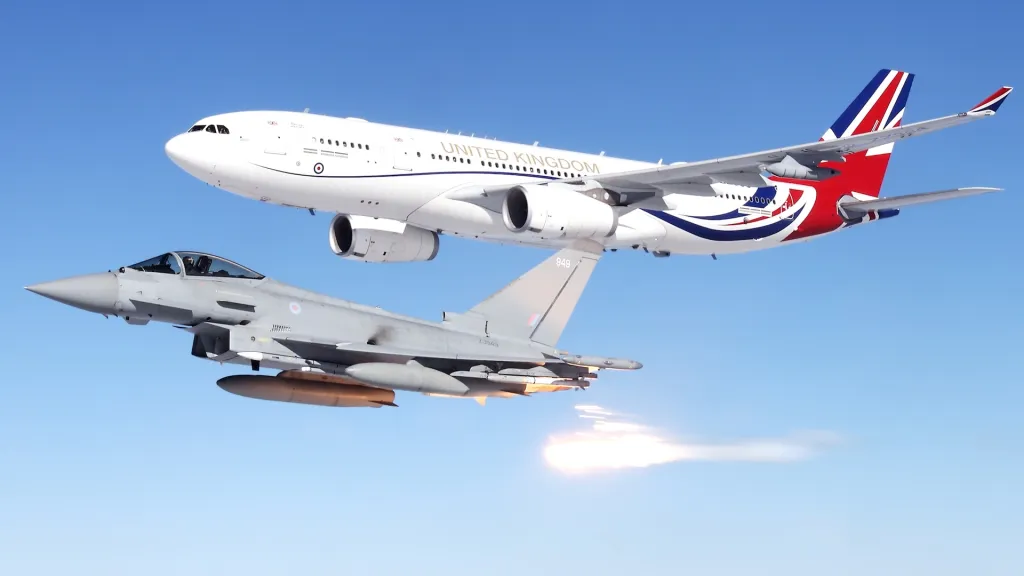
The Royal Air Force (RAF) is deploying one of its Voyager aerial refueling jets to help Saudi Arabia defend against ongoing attacks from the Iranian-backed Houthi rebels of Yemen. The decision marks the first publicly known international military assistance offered to Saudi Arabia specifically for its fight against the Houthis, which erupted over the summer. The move came hours before U.S. President Donald Trump told the United Nations General Assembly meeting that he believes a peace deal with Iran will be reached after the U.S. midterm elections in November.
The British action is significant because, while it involves just one tanker, other key Saudi allies have yet to heed the Kingdom’s request for military help specifically to battle the Houthis. Although it’s important to note some assets already deployed to defend against Iranian attacks could be helping with the Houthi threat now.
A Royal Air Force Typhoon FGR4 accompanies a Voyager tanker during a Quick Reaction Alert training scenario in March 2026. (Crown Copyright) Crown Copyright
Last week, Trump turned down a direct plea from Saudi Crown Prince Mohammed bin Salman, the kingdom’s de facto leader, to attack the Houthis. Meanwhile, Pakistan and Turkey, which signed the Mecca Joint Defense Agreement with Saudi Arabia, have yet to provide any direct military aid. The pact holds that an attack on one is considered an attack on all; however, it doesn’t stipulate exactly what actions should be taken.
At issue beyond protecting the Saudis is growing concern over the Bab al-Mandab Strait, a key chokepoint now largely controlled by the Houthis, who are preventing the Saudis from using it to ship oil.
Earlier this year, the Houthis imposed a blockade on the Strait, and began striking Saudi ships in the southern part of the Red Sea as well as critical energy terminals on that body of water. Iranian proxies have also struck the vital East-West pipeline that feeds oil to be transferred and shipped via the Red Sea in order to bypass the Strait of Hormuz, where Iran vastly curtailed shipping after the launch of Operation Epic Fury. The pipeline reportedly reopened today after being shut down following a long-range drone attack.
The stark reality is that if Saudi refineries are destroyed and the pipeline is shut down for months if not longer, the last major lifeline from the region, and especially to Europe, would be closed off, sparking a deeper energy crisis.
Concern over these factors spurred Britain to act, the Ministry of Defense (MoD) noted. It said it was acting on a request from Saudi Arabia and that the jet would “support Saudi Arabia’s defensive operations in aid of the legitimate Yemeni government.”
“Escalating tensions in the Gulf could have negative consequences here in the UK—such as rising prices, disruptions to energy supplies, and increased costs for British businesses,” the ministry explained. “The Houthis pose a threat to stability in the Middle East; therefore, it is in the UK’s national interest—economically and in terms of security—that they do not succeed in their aims.”
“We unequivocally condemn Houthi attacks on Saudi Arabia, and our position is clear: both Saudi Arabia and the Yemeni government have the right to self-defense,” the ministry added.
The jet will operate from a U.K. air base in Cyprus and will begin air-to-air refueling operations in the coming days, the BBC reported.
The MoD said the Voyager will fly only in support of missions to shoot down missiles and drones, though Saudi aircraft are also bombing Houthi ground positions in Yemen, in part to get at drone and missile launchers and storage sites. Houthi officials have accused the Saudis of killing civilians in some of these attacks.
It should be noted that, more than a decade ago, the U.S. was supporting the Saudi coalition’s previous bombing campaign against the Houthis by providing aerial refueling and intelligence. However, then-Defense Secretary James Mattis ended that in 2018 during the first Trump presidency after growing concerns over the large number of civilian casualties.
The Voyager can only refuel the Royal Saudi Air Force Eurofighter Typhoons, Panavia Tornados, and Italian Air Force Typhoons that have been in the Kingdom since before the fighting with the Houthis broke out, as well as any other similarly equipped allied aircraft. That’s because the tanker only has probe-and-drogue aerial refueling, not the boom required for gassing up other receptacle-equipped aircraft. You can read more about this in our story here.
The view from the cockpit of an A400M during air-to-air refueling with a Voyager KC3 using its probe and drogue system, via the fuselage refueling unit. Crown Copyright
The Voyager will not be the first British asset to be sent to help Saudi Arabia since the launch of Epic Fury. In March, the U.K. sent its Sky Sabre air defense system and troops to the Kingdom to help defend against attacks from Iran.
The British Army Sky Sabre state-of-the-art intermediate air defence system. (Corporal Adam J Wakefield) Corporal Adam J Wakefield
“This support builds upon the UK’s existing military contribution to Saudi air defense, which includes the deployment of an air defense system and British personnel to help protect against missile and drone attacks,” the MoD pointed out on Tuesday. “Saudi Arabia and Yemen are steadfast partners of the UK and play a vital role in regional stability. It is in the UK’s interest to safeguard regional stability, protect vital trade and energy supplies, and encourage a diplomatic resolution to the conflict in Yemen.”
The civil war in Yemen erupted in 2014 and expanded a year later when a Saudi-led coalition joined forces with the government ousted by the Houthis. The fighting between Saudi-led forces and the Houthis largely abated after a tenuous ceasefire was signed in 2022. The Saudis held off on getting involved in the recent Red Sea conflict which saw the U.S. and coalition warships duking it out with the Houthis, and eventually led to a U.S.-led air campaign over Yemen. The United Kingdom was the other significant player in that air campaign.
Tensions, as we noted earlier in this story, reignited in recent weeks after the Houthis joined the U.S.-Iran conflict on the side of their major supporter.
On Tuesday, Houthi spokesman Brig. Gen. Yahya Sare’e claimed that Saudi Arabia conducted 19 airstrikes across rebel-held territory in Yemen that involved the latest round of civilian casualties. The Saudis have not directly responded.
Brig. Gen. Yahya Sare’e. (Houthi Telegram)
As we stated earlier in this story, hours after the U.K. announced it was sending a Voyager tanker to Saudi Arabia, Trump addressed the ongoing conflict with Iran during his speech to the U.N. General Assembly in New York.
The American leader called for international isolation of Iran and repeated his stance that he was at an inflection point on deciding what course to take moving forward. The situation has settled into an uneasy pause interrupted by sporadic Iranian attacks on shipping in the Strait of Hormuz. It has been weeks since the U.S. last struck Iranian targets.
“Will a deal be made with Iran that lets them rebuild and create a far greater country than it ever was before?” Trump asked rhetorically. “Or do I annihilate the Islamic Republic and do it quickly, never giving them a chance to kill and destroy people and countries again?”
Trump added that he believes he will make a peace deal with Iran after the upcoming U.S. midterm elections, which could decide which party controls Congress. With gasoline and diesel price increases damaging the economy, the war and Trump’s handling of it have been very unpopular with voters.
In a CNN and SSRS poll, released Tuesday, 64% of those responding said the U.S. is not winning the war in Iran, while 36% disagreed. In addition, 78% of participants said Trump is not doing enough to end the conflict with Iran and 22% said he was.
“They want to talk to us,” he said. “They have been talking to us, even today they’ve been talking to us, and the relationship is developing. But we can’t let them – and they understand that – we can’t let them have a nuclear weapon.”
A U.S. negotiating team, including Steve Witkoff and Jared Kushner, met with Iranian officials on the sidelines of Tuesday’s U.N. meeting. That sideline session lasted about three hours and went well, according to Trump, who offered no details on the discussions.
Trump: US officials met with the Iranian delegation for three hours – “it was a good meeting”
For their part, the Iranians said they are willing to negotiate, but on their terms.
“A senior Iranian official said Iran could reopen the Strait of Hormuz to Gulf shipping within seven days if the U.S. fulfilled Tehran’s demands to ease military pressure and lift an American blockade on Iranian ports,” Reuters reported. “The official added that Tehran had conveyed its latest proposal to Washington via mediators last week.”
Iran’s aviation officials negotiate with Oman and Iraq as Secretary Bessent targets carriers seven months into the conflict.
Published On 22 Sep 202622 Sep 2026
Flights from Iran to Baghdad and Muscat will be cancelled starting at midnight ahead of new United States sanctions taking effect Wednesday, Tasnim News Agency reported.
A spokesman for Iran’s Civil Aviation Organization told the news agency on Tuesday that the agency is “negotiating so that flights whose destination is Baghdad can be redirected to [Iraq’s] Najaf Airport”.
Recommended Stories
list of 3 itemsend of list
Iran’s ISNA news agency reported that negotiations with Oman were likewise ongoing, adding that all remaining international flights, including those to Istanbul, will operate as scheduled.
US Treasury Secretary Scott Bessent said on Monday that all Iranian airlines would be shut down on September 23 through the threat of secondary sanctions on aviation service providers, seven months into the war between the US and Iran.
Bessent told CNBC that when Iranian carriers land at an airport, “you cannot provide them with fuel, you cannot provide them with landing services, you cannot sell them tickets, or you will be knocked out of the dollar system”.
The move marks the latest step in Washington’s expanding sanctions campaign against Tehran. Aviation analysts told Al Jazeera that although the US lacks authority to close foreign airspace, targeting local refuelling and ground-handling providers achieves a similar outcome by cutting off essential operational support.
Earlier this month, the US issued stricter measures administered by the Treasury Department’s Office of Foreign Assets Control (OFAC), placing restrictions on trade, energy and financial institutions.
The administration of President Donald Trump also expanded secondary sanctions in late August, warning that foreign firms doing business with Iran across shipping, technology, gold and digital assets face penalties of their own.
Tehran, however, signalled on Saturday that it remains open to talks mediated by Qatar to reach a long-term resolution, while maintaining a combative stance towards Washington.
“It is in Washington’s interest to accept these conditions,” Mohsen Rezaei, Iran’s security chief, told Al Jazeera in an interview last week. “Trump’s threats will not achieve any results. We are prepared for a decisive war.”
The former vice president joins Abdul El-Sayed on the campaign trail in Detroit to bolster Democratic unity in a key swing state.
Published On 22 Sep 202622 Sep 2026
Democratic Senate candidate for the US state of Michigan Abdul El-Sayed says he wants former Vice President Kamala Harris’s campaign stop in Detroit to unify Democrats in the key swing state ahead of the final sprint to lock down a victory in November’s midterm elections.
The visit comes as the Democratic Party works to bridge deep internal factions that were glaringly evident during a hotly contested primary last month between El-Sayed and four-term Democratic congresswoman Haley Stevens, who had overwhelming support from the Democratic Party establishment and pro-Israel political action committees.
Recommended Stories
list of 3 itemsend of list
“We’re building an electoral coalition here,” El-Sayed said on Tuesday, speaking about the economy hours ahead of a planned appearance with the former vice president. He added that her presence in Michigan, “speaking to communities that were really empowered by her voice throughout her political career”, will serve to further unite and strengthen the Democratic Party.
Black voters could prove especially paramount for El-Sayed, who faces pressure among white Jewish voters who typically back Democrats. The joint appearance targets Wayne County, the state’s largest Democratic stronghold and home to Detroit’s predominantly Black electorate, which El-Sayed failed to carry during the August Democratic primary.
The move follows Harris’s 2024 electoral defeat to US President Donald Trump in Michigan, a state heavily influenced by its critical Arab-American voting bloc. As a result of her pro-Israel policies, many Arab Americans in Michigan, who had voted reliably blue for years, ditched the party altogether, refusing to support Harris in her presidential bid.
El-Sayed also issued a call for solidarity ahead of the midterms, affirming that the 2024 presidential election “ended where it did because we could not find the places of agreement to be able to bring people together or move in the direction that we need to move”, emphasising that he and Harris both want to focus on helping voters who are struggling economically.
At the time, many advocates had argued that as long as Harris maintained her pledge to continue to arm Israel and refused to distance herself from former President Joe Biden’s unconditional support for the US ally, nothing would help her standing with Arab and Muslim voters.
All eyes are on November’s consequential race where El-Sayed will go head to head with former Representative Mike Rogers, the Trump-backed Republican Senate nominee, who ran unopposed in the Republican primary.
Rogers’ campaign framed Harris’s visit as a sign of weakness for both Democrats.
El-Sayed rejected the criticism at the Detroit event, emphasising that assembling a winning coalition requires confronting past differences directly rather than avoiding them.
“We don’t have to agree on everything to understand what is at stake,” El-Sayed said, urging voters to rally around shared economic priorities. “The only way forward is by doing the hard work of bringing people into the same room and moving together.”
The 81st UN General Assembly opened with US President Donald Trump threatening to ‘annihilate’ Iran. Despite the threat, US and Iranian officials met for three hours on the sidelines of UNGA. Al Jazeera’s Diplomatic Editor James Bays reports.
The settlement with 12 state attorneys general that cleared the way for Paramount to move forward with its $111-billion acquisition of Warner Bros. Discovery contained a surprise for CNN and CBS News.
The merged company will have an oversight board that will monitor adherence to editorial independence from its owners and shareholders. The editorial board is part of an agreement to end the states’ antitrust fight that threatened to delay the completion of the deal for months.
But the initial reaction among media observers and opponents of the merger was to question how much teeth editorial overseers will have as they will be appointees of Paramount’s board. The board is controlled by Paramount Chief Executive David Ellison’s family and RedBird Capital Partners.
“The so-called independence board appears to be sorely lacking in independence. It’s appointed by and answerable to the board of the combined Ellison-controlled entity, which can also remove the independence board members,” said Norm Eisen, founder of Democracy Defenders Action and one of the leaders of the Block the Merger group.
Agreements on editorial boards or ombudsmen are typically made to assuage regulatory concerns over a change in media ownership.
CBS News installed Kenneth R. Weinstein as an ombudsman ahead of Ellison’s acquisition of Paramount last year. But he has had a scant presence at the network, according to CBS News insiders.
When Rupert Murdoch’s News Corp. took over the Wall Street Journal in 2007, a five-member committee was created to ensure the editorial independence of the newspaper and Dow Jones’ other news services. The Journal has largely been successful in keeping its news-gathering operation separate from its right-leaning opinion pages reflecting the values of its owners.
The oversight board at Paramount adds a new layer of uncertainty as to how the two news divisions will operate in the merged company. CBS News has already seen significant upheaval since Ellison installed Bari Weiss as editor in chief.
Weiss, the founder of the heterodox digital news site the Free Press, has disrupted CBS News with major changes to its signature program “60 Minutes.” Her push to consider more conservative talking points and voices in stories led to accusations that she is tilting the program’s political bent to please President Trump, who has a friendly relationship with the Ellisons.
CNN insiders have been watching the discord at CBS News with concern. Trump and Larry Ellison, the tech mogul and father of David, have reportedly discussed personnel changes at CNN once the takeover of its parent, Warner Bros. Discovery, is complete.
Trump has never been happy with CNN’s coverage, but the hostility intensified last Friday when he banned the organization along with MS NOW and Politico from the White House grounds. The three news organizations are challenging Trump’s ban in federal courts on the grounds that it violates their 1st Amendment rights.
But amid all the turmoil, veteran news executives inside and outside the companies involved were scratching their heads over exactly how an editorial board would operate.
“This was formed up in haste, and the fact that it looks like it’s kind of half-baked is not surprising,” said Tom Bettag, a former network news producer and lecturer at the Philip Merrill College of Journalism at the University of Maryland. “But they were in a hurry to get this merger approved by hook or by crook.”
The agreement says the board will be in charge of “resolving any disputes between CBS News employees, CNN employees, and management of the combined entity regarding alleged reporting bias or failure to meet” agreed upon reporting standards.
Back in June, “60 Minutes” correspondent Scott Pelley angrily questioned Weiss’ decision to fire several of his colleagues. As a result, he was dismissed as well.
It’s unclear whether similar confrontations would be resolved by the new Paramount board and, if so, what that would mean for the authority of the top executives at CBS News and CNN.
Paramount did not respond to requests for comment.
The creation of the editorial board was a compromise brokered among the coalition of state attorneys general. The proposal came about in the final two days of negotiations, according to two people familiar with the matter who were not authorized to comment publicly.
William Tong, the Connecticut attorney general, said in an interview that he agreed to the editorial board after pushing for the divestiture of CNN and CBS News as a condition for approving the merger.
“I’m not going to sugarcoat it. This is ultimately not what I wanted,” Tong told The Times. “However, a week ago, they weren’t willing to do anything.”
He added: “Their view was, ‘We’re buying it. We get to control it.’ … And so, you know, by Friday we had broken them down, and they were willing to do this editorial independence board for both CBS News and CNN. That’s what we were able to secure and it has to be all journalists on this five-person board.”
No Paramount executives, including Weiss, can serve on the board.
A member of Donald Trump’s political party has issued a rare call for a congressional investigation into the foreign dealings of the United States president’s eldest son.
US Senator John Curtis, a Republican from the state of Utah, on Tuesday said “questions have arisen” about Donald Trump Jr’s relationships with foreign business figures and acceptance of “significant gifts”, alleging he may have personally benefited from his relationship with the president.
Recommended Stories
list of 3 itemsend of list
In a letter to the Republican and Democratic leaders of the US Senate Judiciary Committee, Curtis referenced a ProPublica report that found Trump Jr’s Bahamian wedding party in May was funded by a Russian oligarch.
“These reports raise legitimate questions about foreign access to members of a sitting president’s family and whether such relationships can create actual or perceived expectations of favorable treatment,” Curtis wrote. “They also may create expectations of a returned favor that would not be in the best interests of the American people or our allies, and could even create national security vulnerabilities.”
The letter comes as a small but slowly growing number of Republicans have spoken out against Trump, who has largely avoided criticism from members of his own party. But record-low approval ratings sparked by the war in Iran and concerns over the cost of living in the US have forced some Republicans to reconsider that support as they face growing prospects of major losses in the congressional midterm elections.
If Democrats retake one, or both, chambers of the US Congress in November, investigations into Trump, including his family’s dealings, are likely. But those probes are less likely under Republicans wary of the president’s wrath.
A spokesperson for the Senate Judiciary Committee, which is under Republican control, told the Associated Press that it had received Curtis’s letter but did not say whether there would be an investigation.
Trump vs Biden
Curtis, who isn’t up for re-election until 2030, also called on the chamber’s panel to subpoena Trump Jr, as well as the son of former US President Joe Biden, a Democrat.
“The country should not have to accept one standard for the family of a Republican president and another for the family of a Democratic president,” Curtis wrote, referencing the scrutiny and investigation Biden’s son Hunter faced from Republicans.
Hunter Biden responded to Curtis’s letter in a post on social media, calling for the Senate committee to “bring it on” as he vehemently denied any foreign business dealings while his father was president.
“I’ll sit next to Don Jr. and testify any time, any place,” Biden wrote on X as he called for the president’s youngest son, Eric, and son-in-law, Jared Kushner, who serves as a US envoy, to testify as well. “No need for a subpoena. Let’s all do it tomorrow.”
After the ProPublica report, Trump Jr and his wife, Bettina, released a joint statement on social media saying the Russian oligarch, Umar Kremlev, was a “dear friend” who “very generously hosted two incredible nights of celebrations for us AFTER our wedding”.
The president, who did not attend the wedding, said his son had reimbursed Kremlev.
“It’s totally allowed, and a lot of people give parties and things like that — but it’s totally allowed,” Trump said. “But as I understand it, he paid him back. He didn’t want it.”
US Senator Dick Durbin, the ranking member on the Senate Judiciary Committee, said that while Biden’s son “has already given a sworn deposition to Congress”, Trump Jr “has not”.
“For the committee to ignore this matter is to run the risk of being complicit in a coverup,” Durbin said. “I will join in supporting Senator Curtis’ request of the Senate Judiciary Committee.”
Curtis’s office did not immediately reply when asked by Al Jazeera what prompted the senator’s letter and whether any fellow Republicans have indicated if they would support an investigation into the president’s family.
Trump has also been meeting Ukrainian President Volodymyr Zelensky, British Prime Minister Andy Burnham and leaders from Saudi Arabia, the United Arab Emirates, Qatar, Kuwait, Bahrain and Oman.
Earlier, Guterres gave his farewell speech as UN secretary general, urging unnamed superpowers to recognise “that their power isn’t so super”.
“The fault lines in our world are widening,” Guterres said, citing geopolitical rivalries, wars, climate change and artificial intelligence.
By contrast, Trump criticised international institutions, accusing the UN of a “far-left agenda of globalist bureaucrats who nobody ever elected”.
The US president instead emphasised national sovereignty and “unmatched” American military power.
“There is no global government,” he said.
He also warned that the US would not allow threats to establish themselves anywhere in the Western hemisphere.
“If necessary, we will use our unmatched military might to secure the vital national interests of the United States,” he said.
Trump accused Cuba’s communist government of cultivating ties to left-wing groups in the US, including the Communist Party USA, Antifa and the Democratic Socialists of America.
The Cuban delegation also appeared to walk out of the assembly chamber as Trump turned his sights on them, referring to the island as a “failed state”.

![Powerus' Guardian Interceptor is a counter-drone interceptor. [Courtesy Powerus]](https://i0.wp.com/occasionaldigest.com/wp-content/uploads/2026/09/guardian-fieldhero-1790078758.jpg?w=640&ssl=1)

![US President Donald Trump examines a box of rare-earth mineral and gemstone samples presented by Pakistan's Chief of Army Staff Field Marshal Asim Munir (center), alongside Pakistani Prime Minister Shehbaz Sharif (left) last year in September at the White House. [Courtesy White House]](https://i0.wp.com/occasionaldigest.com/wp-content/uploads/2026/09/Pakisatn-Minerals-WH-1790079007.jpg?w=640&ssl=1)





![British Prime Minister Andy Burnham looks at French President Emmanuel Macron as they pose for photos ahead of a bilateral meeting at 10 Downing Street on September 3, 2026 in London, UK [Leon Neal/Reuters]](https://i0.wp.com/occasionaldigest.com/wp-content/uploads/2026/09/2026-09-03T133923Z_1327001305_RC2MBNAX5ATT_RTRMADP_3_BRITAIN-FRANCE-1788466043.jpg?w=640&ssl=1)