news

Israel’s F-35s Are Getting External Fuel Tanks

Israel is moving to enhance the capabilities of its F-35I Adir fighter, funding a new external fuel tank upgrade that will boost the Israeli Air Force’s potential for conducting long-range strikes. The announcement comes after the jets saw extensive action striking targets in Iran during the campaigns this year and last. In the process, the fleet ran at a tempo of operations that raised questions about Israel’s ability to provide adequate refueling support. The new modification for the F-35I will help address that.

The Israeli Ministry of Defense confirmed today that the development and integration of the external fuel tanks on the F-35I will be carried out by Elbit Systems’ Cyclone subsidiary. Elbit says the deal is valued at over $34 million and will involve tanks based on an existing Cyclone design originally developed for the F-16.

𝐄𝐱𝐭𝐞𝐧𝐝𝐢𝐧𝐠 𝐫𝐚𝐧𝐠𝐞 𝐟𝐨𝐫 𝐥𝐨𝐧𝐠-𝐫𝐚𝐧𝐠𝐞 𝐦𝐢𝐬𝐬𝐢𝐨𝐧𝐬.@Israel_MOD has signed a contract with Cyclone, a wholly owned subsidiary of Elbit Systems, to develop and integrate an extended-range capability for the F-35 “Adir” fighter aircraft, manufactured by… pic.twitter.com/cTRsjawIR9

— Elbit Systems (@ElbitSystemsLtd) May 14, 2026

“The new capability is expected to extend the aircraft’s operational range, reduce reliance on aerial refueling, and enhance operational flexibility across long-range missions,” the company added.

Based on the reference to the F-16, the announcement has been widely taken to refer to external drop tanks, but it remains possible, although improbable, that the F-35I is getting some kind of conformal, flush-mounted fuel tank. This could have a reduced impact on stealth and overall performance, but would likely also involve significant shape change and alterations to the airframe. Integrating and clearing tanks of this kind for operational service would be a complex and potentially very lengthy process, since they would disrupt the highly quantified low-observable moldline of the aircraft. However, Israel has experience in operating both F-15s and F-16s with conformal tanks.

An Israeli F-16I shows off its conformal fuel tanks, mounted above the wing roots. Alexandra Aksyutich/Israeli Air Force

Obviously, adding external fuel tanks of any kind to the stealthy F-35I will degrade its low-observable features. However, with the Israeli Air Force putting a premium on its ability to conduct long-range strikes, this is clearly seen as a worthwhile tradeoff. If the upgrade does involve drop tanks, they are also likely to be jettisonable, possibly together with their pylons, meaning they could be discarded before penetrating a hostile air defense system, for example. This would only be the case on extremely high-risk long-range missions, and could not be sustained for long campaigns. They could also be dropped when under threat, giving the F-35I back critical agility and providing a lower radar signature.

There are also means of mitigating the penalty that drop tanks impose on a stealth aircraft. This is best evidenced by the new fuel tanks for the U.S. Air Force F-22 Raptor, which are seen as a critical addition to ensure that the fighter is able to better cover the vast distances involved in a potential future conflict in the Indo-Pacific.

Stealthy drop tanks (fitted inboard) on an F-22 scale model seen at the Air & Space Forces Association’s annual Warfare Symposium earlier this year. Jamie Hunter

The new faceted, low-drag tanks for the F-22, like the older ones, can be jettisoned from the jet to restore the full scope of its performance and further reduce its radar cross-section. However, Lockheed Martin says it expects the Raptor to go into direct combat, at least in some scenarios, with the tanks fitted.

There have also been steady signals that some kind of range extension was in the works for the Israeli F-35I.

Back in 2021, a cryptic announcement from Lockheed Martin confirmed that the company was working with an unnamed foreign buyer to develop a modification of the F-35 to the tune of tens of millions of dollars in engineering support work. An Israeli fuel-carriage enhancement was a possibility, as you can read more about this here.

Then, in 2022, separate reports emerged suggesting that Israel had developed an unspecified means of extending the range of its F-35Is, allegedly providing them with enough reach to hit targets in Iran without needing aerial refueling. The 2022 reports might have involved a prototype version of the tanks mentioned in the announcement today, some other kind of external fuel carriage, or they might have been erroneous.

Israeli Air Force F-35I Adirs. Israeli Air Force Israeli F-35I Adirs. Israeli Air Force

More recently, just before the latest campaign against Iran, Israeli Ambassador to the United States Yechiel Leiter provided what was likely the first official confirmation that range-extending fuel tanks for the F-35I are already in service. In an interview in mid-February, he stated: “We developed fuel tanks that extend the aircraft’s range without compromising stealth.” Exactly how this was achieved was not revealed, but even small internal tanks may be a possibility, while also presenting a serious engineering challenge.

In the United States, range-extending external fuel tanks for the F-35 also re-emerged in 2025 as part of the ongoing Block 4 modernization effort for those aircraft, years after a requirement for streamlined drop tanks was eliminated. The Pentagon confirmed it will explore the feasibility of all forms of external fuel tanks, including underwing tanks, for all three variants of the F-35.

Overall, the idea of integrating external fuel tanks on the F-35 is far from new. Back in 2019, TWZ reported on how Lockheed Martin was looking at adding two 600-gallon drop tanks under the F-35’s wings as part of a larger range-extension study. This would have increased total fuel capacity by around 40 percent. Prior to that, studies had looked at adding smaller 480- and 460-gallon tanks.

Renderings of an early 480-gallon drop tank design for the F-35, at left, and the 460-gallon design that Lockheed Martin had originally planned to certify on the Joint Strike Fighter, at right. AIAA

Of these, the original 480-gallon drop tank was abandoned after aerodynamic and stores separation issues emerged. The subsequent 460-gallon design was also not ultimately pursued, and it was found that additional drag also eroded the range increase.

It is notable that Aviation Week previously reported that Israeli Aerospace Industries (IAI) and Cyclone had worked on both a conformal tank design for the F-35I and the 600-gallon drop tank.

As an Israeli-specific version of the conventional takeoff and landing F-35A, the Adir already incorporates some significant Israeli-developed systems. Many of these have been tested on a specially outfitted one-off version of the aircraft, which arrived in the country in 2020. Israeli additions include electronic warfare systems and also weaponry. The F-35I fleet is expected to be armed with the Rafael SPICE precision-guided bomb, but may eventually include air-to-air missiles and other weapons, too.

The test F-35I on the flight line, together with an F-15I. Amit Agronov/Israeli Air Force

At the same time, the F-35’s inboard stores hardpoints are still plumbed for the carriage of external fuel tanks, suggesting that introducing this capability, including on the Israeli-specific F-35I variant, might not be too complicated.

The Israeli requirement for the F-35I to be less reliant on aerial refueling is especially important. The Israeli Air Force currently operates a fleet of only around seven aging Boeing 707 tankers. The overreliance on these aging tankers for long-range missions has led to previous speculation that the Israeli Air Force has relied upon U.S. Air Force refueling support when it has gone into combat. The Pentagon denied this.

One of the Israeli Air Force’s Boeing 707-based tankers demonstrates the refueling of a trio of F-15s. Yonatan Zalk/Israeli Air Force

At the same time, a strike package that doesn’t require tanker support is in some ways more flexible and more survivable. Moreover, the survivability of traditional refueling jets in or near contested airspace is becoming a growing concern. Meanwhile, Israel is now starting to modernize its tanker fleet, with the first of its more modern KC-46s having begun flight trials earlier this month.

The first Israeli KC-46 refuels from a U.S. Air Force KC-46. Israeli Ministry of Defense

Israel has also previously shown that it is willing to degrade the stealth characteristics of the F-35I to increase its strike capacity. The type has been seen flying strike sorties with external ordnance, demonstrating the F-35’s so-called ‘beast mode,’ featuring loads on underwing pylons.

A photo published by the Israeli Air Force shows the unique instrumented F-35I assigned to the Flight Test Center carrying four external 2,000-pound-class GBU-31 JDAMs, plus AMRAAMs. Israeli Air Force via X

Israel has repeatedly used its F-35Is in strikes on targets both closer to Israel and much further afield. In 2018, it became the first operator to use the jet on offensive operations. Meanwhile, it has also recorded success in aerial combat against hostile drones.

Last year, the Adir was involved in strikes on Iran’s nuclear infrastructure. There were reports that Israeli fighters often landed on fumes after their initial sorties during this conflict. With these jets operating to the edge of their endurance, fuel starvation was a serious threat, and it is perhaps surprising that none were lost. External drop tanks were also found in multiple locations in eastern Iraq, pointing to their use to maximize long-range sortie rates early in the conflict.

The F-35I also played an important role in striking Iranian targets during the joint U.S.-Israeli campaign launched at the end of February this year.

The Israeli effort against Iran, Operation Lion’s Roar, also saw an Israeli Adir claim the first aerial victory for any F-35 against a crewed aircraft. On March 4, in an incident that you can read more about here, an F-35I brought down an Iranian Yak-130 Mitten combat trainer over Tehran.

Air Force Commander Tomer Bar congratulates F-35I “Adir” pilot who carried out the first-ever shoot-down of an Iranian fighter jet over Tehran pic.twitter.com/hBTisPSo0s

— i24NEWS English (@i24NEWS_EN) March 4, 2026

The importance of the F-35I to Israel has also been demonstrated by the country’s successively adding to its orders for the type.

Earlier this month, it was confirmed that the Israeli Air Force is set to receive a fourth F-35I squadron, bolstering its fighter inventory with another 25 of the aircraft.

In 2023, Israel opted to buy a third squadron of F-35Is, covering 25 more jets. This batch is scheduled to be delivered starting in 2028.

Once all four squadrons are stood up, Israel will have a total of 100 F-35Is.

Before long, we are likely to see at least some of these jets sporting the long-range upgrade announced today. At that point, the precise nature of these external fuel tanks will finally be revealed.

Contact the author: thomas@thewarzone.com

Thomas is a defense writer and editor with over 20 years of experience covering military aerospace topics and conflicts. He’s written a number of books, edited many more, and has contributed to many of the world’s leading aviation publications. Before joining The War Zone in 2020, he was the editor of AirForces Monthly.


Source link

Nuclear-Powered Trump Class Battleships Will Reverse One Of The Navy’s “Largest Mistakes”: Navy Boss

The U.S. Navy’s near-total abandonment of surface combatants with nuclear propulsion after the end of the Cold War is “one of the largest mistakes” it’s ever made, according to the service’s top officer. Chief of Naval Operations Adm. Daryl Caudle made this remark today while voicing support for the recently announced decision that the future Trump class battleships will be nuclear-powered. He also explicitly highlighted challenges the Navy has faced when it comes to fueling conventionally-powered ships taking part in operations against Iran, something TWZ recently reported on in detail.

Adm. Caudle, as well as Acting Secretary of the Navy Hung Cao and Commandant of the Marine Corps Gen. Eric Smith, testified before members of the House Armed Services Committee today. The focus of the hearing was on the Department of the Navy’s 2027 Fiscal Year budget request. The Navy disclosed that it had decided the Trump class warships will feature nuclear propulsion in its latest long-term shipbuilding plan, which was released on Monday.

Chief of Naval Operations Adm. Daryl Caudle, left, speaks at a separate budget-related hearing before members of the House Appropriations Committee on May 12, 2026. USN

“I know there have been many conversations and questions over the past few days regarding the news that the Trump class battleship will be nuclear powered. And, as you know, Virginia has a long history of nuclear shipbuilding. What specific design plans can you share at this point and can [you] speak to how nuclear power would enable this system to be successful?” Rep. John McGuire, a Virginia Republican and former U.S. Navy SEAL, asked Adm. Caudle directly.

A model of a Trump class battleship. Eric Tegler

“Sir, we walked away from surface nuclear power decades ago, and that was one of the largest mistakes the Navy ever did, and we’re bringing it back,” the Chief of Naval Operations said in response. “We need nuclear-powered surface ships to sustain combat operations with our nuclear-powered aircraft carriers.”

Though a major operator of nuclear-powered submarines, the Navy’s aircraft carriers are currently its only nuclear-powered surface ships. The service previously had a mixture of nuclear-powered surface combatants. This included three one-of-a-kind ships, the cruiser USS Long Beach, the destroyer USS Truxtun (later recategorized as a cruiser), and the frigate USS Bainbridge. There were also two California class and four Virginia class cruisers, the latter not to be confused with the subsequent Virginia class of attack submarines. All of these ships entered service in the 1960s and 1970s. Expensive and complex to operate compared to similar conventionally-powered ships, they were all retired in the 1990s as part of post-Cold War drawdowns across the U.S. military.

A trio of nuclear-powered Navy surface warships sail together in 1964. From left to right, the aircraft carrier USS Enterprise, the cruiser USS Long Beach, and the frigate USS Bainbridge. USN

As Caudle highlighted, the central benefit of nuclear propulsion is functionally unlimited range since naval reactors can operate for decades without needing to be refueled. In the context of modern ships packed with ever-more advanced weapons and other systems, it can also offer an important boost in onboard power generation. As noted, this does come at a cost. Today, Russia is the only country anywhere in the world with a nuclear-powered surface combatant, the Kirov class battlecruiser Admiral Nakhimov. In terms of nuclear-powered surface naval ships of any kind, the French aircraft carrier Charles de Gaulle is the only other example. Russia also has several nuclear-powered icebreakers, but these are operated by the state-run nuclear company Rosatom.

“Imagine what that would have looked like in the Arabian Gulf if I’d had a nuclear-powered battleship there to give the air and defense and fires [sic] power that it could sustain – rotate ships that roll, that need gasoline around it,” Caudle continued today in his response to Rep. McGuire’s question. “So the imperative for this is crucial to develop that level of payload capacity.”

Navy officials have already acknowledged that Iranian attacks on friendly countries in the Middle East in the course of recent operations significantly disrupted established logistics chains. In particular, this impacted how the service delivered fuel to conventionally-powered warships in the region, as you can read more about here.

Threats to fuel supplies would be something the Navy would have to take into account in any future conflict, especially a high-end fight against China across the broad expanses of the Pacific. There are other logistics requirements that nuclear ships do still have in common with their conventionally-powered counterparts, as well, such as food for the crew and fuel for any embarked aircraft. Even with nuclear propulsion, maintenance and other requirements mean that ships cannot stay at sea indefinitely.

One of the US Navy’s conventionally-powered Arleigh Burke class destroyers receives fuel during a replenishment-at-sea operation. USN

“We intend to, with all we can do, use pull-through technologies, [including] things from that we’ve worked on with DDG(X),” the Navy’s top officer added, speaking about the plans for the Trump class specifically. “It will have the SPY-6 radar. It will have the Baseline 10 Aegis combat system. It will pull through, of course, the A1B Ford class reactor plant and all the design that goes with that. The only thing inherently new to it will be the actual hull itself, and so most of the fixtures in it. And I would say the directed energy [weapons] and up gunning, that will also be new.”

Caudle had first shared the A1B reactor detail at another budget-related hearing earlier this week. It was previously known that the Trump class battleship program would leverage prior work done in relation to the now-defunct DDG(X) next-generation destroyer.

Multiple types of laser-directed energy weapons, as well as an electromagnetic railgun, are core elements of the planned armament package on the future Trump class warships. They are also set to be loaded with a mix of nuclear and conventional missiles, including hypersonic types, in several large vertical launch system (VLS) arrays, and have a pair of traditional 5-inch naval guns.

An annotated graphic highlighting various capabilities set to be found on the Trump class design. Note that the mention here of “28 Mk 41 VLS” cells appears to be a typo, as other official information from the US Navy says the ships will have 128 such cells. USN via USNI News

The Navy has previously stated that the battleships, now also referred to as BBGNs, will displace approximately 35,000 tons. This is very roughly three times that of the newest Flight III subvariant of the Arleigh Burke class destroyer. The Trump class vessels are expected to be between 840 and 880 feet long, have a beam (the widest point in the hull) between 105 and 115 feet, and be able to reach a top speed greater than 30 knots, as well.

It is worth noting here that Caudle’s comments today represent a huge change in tone from how he had previously talked about the prospect of nuclear propulsion for the Trump class. Speaking to the press at the Surface Navy Association’s (SNA) main annual symposium back in January, he had notably appeared to downplay the possibility.

“I think it’s a logical question to think, hey, here’s a big capital ship. It’s going to be carrying a lot of load, you know, in places that we don’t necessarily need a strike enforcement air wing as a large ship there that’s in command of a flotilla,” he said at that time. “Wouldn’t it be logical to be nuclear powered? And that brings a tail to the construction of that that [sic] just really fell outside the scope of what we want to do on the speed to get this thing in the water. And so what you trade off with, with persistency that only nuclear power can do, is you end up having, you know, the ability to go produce that — it pushes the battleship into a timeframe that just didn’t meet the operational need of the ship.”

A rendering of a future Trump class battleship. White House/USN

Just last month, former Secretary of the Navy John Phelan had also said making the Trump class ships nuclear-powered was unlikely, citing the need to balance cost and complexity against aggressive schedule demands. Phelan was fired unexpectedly just two days after making those comments. There have been reports that disagreements over plans for the battleships, specifically, as well as other friction within the Trump administration, factored into his dismissal.

“He’s a very good man. I really liked him, but he had some conflict with, not necessarily with [Secretary] Pete [Hegseth], but with some other[s],” President Trump said about Phelan while speaking to the press on April 23. “He’s a hard charger, and he had some conflicts with some other people, mostly as to building and buying new ships. I’m very aggressive in the new shipbuilding.”

BREAKING: President Trump speaks about the firing of Navy Secretary John Phelan:

“He’s a very good man. I really liked him, but he had some conflict, not necessarily with Pete. He’s a hard charger, and he had some conflicts with some other people, mostly as to building and… pic.twitter.com/xJOhYygka4

— Fox News (@FoxNews) April 23, 2026

As it stands now, the Navy still does not expect to order the first Trump class battleship until Fiscal Year 2028 and or see that ship enter service before Fiscal Year 2036. The first example, at least, currently has an estimated unit cost of around $17 billion, which is considerably more than the projected price tag of any of the next four Ford class aircraft carriers.

Even before the nuclear propulsion decision was announced, TWZ had raised numerous questions about the plans for these warships, including their exact operational utility, as well as the costs and risks involved. Caudle’s comments today about leveraging pull-through notwithstanding, nuclear-powered ships are inherently complex and expensive, which are the tradeoffs for the aforementioned boost in capability. A specialized workforce and supply chains are required to build such vessels. Newport News Shipbuilding in Virginia, a division of Huntington Ingalls Industries, is the only yard in the United States currently building surface ships with nuclear propulsion, in the form of new Ford class carriers, all of which have suffered delays.

Enterprise (CVN 80) Construction Update thumbnail

Enterprise (CVN 80) Construction Update


There are two more yards in the country that make nuclear-powered submarines, both of which are already under strain to meet Navy demands. There is a particular need to keep on schedule with the new Columbia class nuclear-powered ballistic missile submarines to avoid any gap in capacity when it comes to the sea leg of America’s nuclear deterrent triad. Additional plans now to supply Virginia class submarines to the Royal Australian Navy, which Adm. Caudle said today he vehemently supports, can only further add to that workload.

The U.S. naval shipbuilding industry, collectively, has other demands to keep churning out conventionally-powered warships like Arleigh Burke class destroyers, as well. This is an industry that has contracted to a worrisome degree, overall, since the end of the Cold War, especially when compared to the completely opposite trend that has been observed in China. Efforts to reinvigorate America’s shipyards, and the continued challenges the Navy is facing in doing so, were key points of discussion at today’s House Armed Services Committee hearing.

Adm. Caudle’s broad statement of support today for a nuclear-powered surface Navy raises the additional question now of whether the service might be interested in expanding this capability beyond the Trump class. Some of the Navy’s prior nuclear-powered surface combatants were derived from conventionally-powered designs. At the same time, any such decision would run up against the same shipbuilding capacity and other questions facing the new battleships.

Just when it comes to the Trump class, the plans for the ships could easily still evolve further, or even come to an end entirely. The timeline laid out now has the battleship program continuing well into the next presidential administration, where the fortunes of a new nuclear-powered surface navy could change dramatically.

Contact the author: joe@twz.com

Joseph has been a member of The War Zone team since early 2017. Prior to that, he was an Associate Editor at War Is Boring, and his byline has appeared in other publications, including Small Arms Review, Small Arms Defense Journal, Reuters, We Are the Mighty, and Task & Purpose.


Source link

Ducks season is over with loss to Vegas

Ducks lose to Golden Knights

From Kevin Baxter: The carriage has turned back into a pumpkin, the ballgown is once again just tattered clothing and all the horses have gone back to being mice.

The Ducks’ Cinderella run through the NHL playoffs came to an end Thursday in a 5-1 loss to the Vegas Golden Knights in Game 6 of their second-round Stanley Cup playoff series. And the end came well before midnight, with goals by Mitch Marner and Brett Howden in the first 8½ minutes giving Vegas a commanding lead before many in the late-arriving weeknight crowd had made it to their seats at the Honda Center.

The Golden Knights will move on to the Western Conference final with the Colorado Avalanche next week while the Ducks will move on to summer. But it’s the team’s latest start on the offseason since 2017, the last time the Ducks made it to the second round of the playoffs. So even if the glass slipper didn’t fit this time, the Ducks have reason to celebrate.

“I think our team, we learned, myself included, just how to play in those games,” said winger Troy Terry, the only remaining link to the Ducks’ last playoff team. “That’s kind of the difference in some of these games, a team like Vegas, learning how to manage those close games. It stings right now, but I think I speak for everyone that we’ll be hungry going into the summer.

“It was fun to play in this. It’s been a long time.”

Continue reading here

Ducks summary

NHL playoffs schedule

Go beyond the scoreboard

Get the latest on L.A.’s teams in the daily Sports Report newsletter.

Ducks playoffs schedule

Second round

at Vegas 3, Ducks 1 (summary)
Ducks 3, at Vegas 1 (summary)
Vegas 6, at Ducks 2 (summary)
at Ducks 4, Vegas 3 (summary)
at Vegas 3, Ducks 2 (OT) (summary)
Vegas 5, at Ducks 1 (summary)

Dodgers defeat the Giants

From Liana Handler: You better run. Those three words were the only thought racing through pinch-hitter Alex Call’s head when he laced a pitch from San Francisco Giants reliever Matt Gage into right field.

The two-run single, which gave the Dodgers the lead, sparked a three-run rally in the sixth inning that concluded when Miguel Rojas drove in Call on a single to center field.

“It felt like I hit it,” said Call, who initially hesitated to run after making contact. “But I guess I just didn’t quite see it off the bat, and I’m like looking for it, keep looking up, and then all of a sudden I hear the crowd get really loud.”

Call’s single helped the Dodgers beat the Giants 5-2 on Thursday night, reclaiming first in the National League West after San Diego lost to Milwaukee. The Dodgers also escaped a third straight series loss at home ahead of their weekend road series against the Angels.

Call wasn’t the only Dodger who thrived under pressure. Designated hitter Will Smith, whom Dodgers manager Dave Roberts described earlier in the day as “unflappable,” hit from the leadoff spot for the first time in his career and homered to right-center field in the first inning to set the tone for the series-splitting win.

“That was nice, huh?” Roberts said. “Like I said before the game, just to be able to plug him in, you feel confident that no matter what, he’s going to give you his best. And I didn’t expect a homer, but it was a good way to start.”

Continue reading here

Kiké Hernández ‘little bit shocked’ by reception in Albuquerque while on rehab assignment

Dodgers pitcher, horse racing jockeys linked to cockfighting in Puerto Rico

Dodgers box score

MLB standings

Rams schedule

From Gary Klein: The Rams will begin the season by traveling about 8,000 air miles to play against the San Francisco 49ers in Australia.

They aim to end the season playing in Super Bowl LXI on their home turf at SoFi Stadium.

The Sept. 10 opener — a Thursday night in the United States and the morning of Sept. 11 in Melbourne — is the first of 17 games on a schedule announced Thursday by the NFL.

With reigning NFL most valuable player Matthew Stafford and a roster fortified by the addition of All-Pro cornerback Trent McDuffie, the Rams are regarded as a Super Bowl favorite. And their marquee status is reflected in a schedule that includes the maximum six prime-time appearances, an increase of two over last season when the Rams finished 12-5 and advanced to the NFC championship game before losing to the eventual Super Bowl champion Seattle Seahawks.

Fans will have to wait nearly the entire season to see the Rams play the Seahawks. The first game between the NFC West rivals is Week 16 on Christmas night in Seattle. Two games later, on a date to be determined, they will play in the regular-season finale at SoFi Stadium.

Rams schedule

Sept. 10, San Francisco at Australia, 5:35 p.m. (Netflix)
Sept. 21, NY Giants, , 5:15 p.m. (ESPN)
Sept. 27, at Denver, 5:20 p.m., (NBC)
Oct. 4, at Philadelphia, 10 a.m. (Fox)
Oct. 12, Buffalo, 5:15 p.m. (ESPN)
Oct. 18, Arizona, 1:05 p.m., (Fox)
Oct. 25, at Las Vegas, 1:25 p.m. (Fox)
Nov. 1, chargers, 1:05 p.m. (Fox)
Nov. 8, at Washington, 10 a.m. (Fox)
Nov. 15, at Arizona, 1:05 p.m. (CBS)
Nov. 22, off week
Nov. 25, Green Bay, 5 p.m. (Netflix)
Dec. 3, Kansas City, 5:15 p.m. (Amazon Prime)
Dec. 13, at San Francisco, 1:25 p.m. (Fox)
Dec. 20, Dallas, 1:25 p.m. (CBS)
Dec. 25, at Seattle, 5:15 p.m. (Fox)
Week 17, at Tampa Bay, TBD
Week 18, Seattle, TBD

Continue reading here

Chargers schedule

From Sam Farmer: The Chargers essentially lived on an airplane last season, traveling more miles than any other NFL team.

This season, they will have a long runway followed by a dramatically sharp ascent.

They open against three first-time head coaches in succession, then face four Super Bowl-winning head coaches in a row.

Their first three games are against Arizona (Mike LaFleur), Las Vegas (Klint Kubiak) and Buffalo (Joe Brady), before squaring off against Seattle (Mike Macdonald), Denver (Sean Payton), Kansas City (Andy Reid) and — after a week off — the Rams (Sean McVay).

And it’s not as if the Chargers will be homebodies, as they have four coast-to-coast trips with road games at the Bills, Baltimore, Tampa Bay and Miami. So they will still be racking up the frequent-flier miles.

The NFL made an effort to put some space between those cross-country games for the Chargers.

“We’re always being sensitive, trying to make sure we’re not pingponging a team across the country with travel to the East Coast and back,” said Hans Schroeder, the NFL’s executive vice president of media distribution. “So we try to make sure those trips are broken up where we can, and we’re not doing too much of that back and forth.”

Chargers schedule

Sept. 13, Arizona, 1:25 p.m. (CBS)
Sept. 20, Las Vegas, 1:05 p.m. (CBS)
Sept. 27, at Buffalo, 10 a.m. (Fox)
Oct. 4, at Seattle, 1:25 p.m. (CBS)
Oct. 11, Denver, 1:05 p.m. (CBS)
Oct. 18, at Kansas City, 1:25 p.m. (CBS)
Oct. 25: Bye week
Nov. 1, at Rams, 1:05 p.m. (Fox)
Nov. 8, Houston, 1:05 p.m. (CBS)
Nov. 16, at Baltimore, 5:15 p.m. (ESPN)
Nov. 22, NY Jets, 1:05 p.m. (Fox)
Nov. 29, New England, 5:20 p.m. (NBC)
Dec. 6, at Tampa Bay, 10 a.m. (CBS)
Dec. 13, at Las Vegas, 1:05 p.m. (CBS)
Dec.17, San Francisco, 5:15 p.m. (Amazon Prime)
Dec. 27, at Miami, 10 a.m. (Fox)
Week 17, Kansas City, TBD
Week 18, at Denver, TBD

Continue reading here

Chargers couldn’t resist making references to Mike Vrabel, Dianna Russini in schedule video

Lisa Leslie to get a statue

From Marisa Ingemi: Hall of Famer Lisa Leslie didn’t expect to ever get a statue outside Crypto.com Arena. After all, it had been 15 years since her jersey retirement and no other Sparks player was featured among the Lakers and Kings heroes outside the area.

After years of hearing from fans that she deserve to be immortalized, Leslie learned she would join Sue Bird in Seattle as the second WNBA player to be honored with a statue at a franchise’s home arena.

“One thing I never had on my bucket list was a statue,” Leslie told The Times on Thursday. “I grew up seeing the statues of some of the amazing Lakers, so I’m just really grateful to be alive and to be one of the first, especially in the WNBA for L.A. Sparks. It means a lot to me, and I’m really hoping that our community will really rally around it.”

The Sparks announced Thursday morning that Leslie will receive a statue to be unveiled during a ceremony on Sept. 20 before a game against the Portland Fire

Continue reading here

This day in sports history

1937 — War Admiral, ridden by Charles Kurtsinger, battles Pompoon from the top of the stretch and wins the Preakness Stakes by a head.

1948 — Citation, ridden by Eddie Arcaro, wins the Preakness Stakes by 5½ lengths over Vulcan’s Forge.

1952 — Johnny Longden becomes second jockey to ride 4,000 winners.

1953 — In his first world heavyweight title defense, Rocky Marciano KOs former champion Jersey Joe Walcott in the 1st round at Chicago Stadium.

1963 — Tottenham Hotspur of England win 3rd European Cup winner’s Cup against Atlético Madrid of Spain 5-1 at Rotterdam.

1971 — Canonero II, ridden by Gustavo Avila, captures the Preakness Stakes by 1½ lengths over Eastern Fleet.

1985 — Everton of England wins 25th European Cup Winner’s Cup against Rapid Wien of Austria 3-1 in Rotterdam.

1990 — Petr Klima scores at 15:13 of the third overtime to end the longest game in Stanley Cup Final history for the Edmonton Oilers — a 3-2 series-opening victory over the Boston Bruins in a game delayed 25 minutes because of a lighting problem.

1991 — Manchester United of England win 31th European Cup Winner’s Cup against FC Barcelona 2-1 in Rotterdam.

1994 — LPGA Championship Women’s Golf, DuPont CC: Laura Davies of England wins her second major title, three strokes ahead of runner-up Alice Ritzman.

1998 — Notah Begay III joins Al Geiberger and Chip Beck as the only players to shoot a 59 on a U.S. pro tour. He does it at the Nike Old Dominion Open.

1999 — Charismatic wins the Preakness and a chance to become the 12th Triple Crown champion, finishing 1½ lengths ahead of Menifee. It’s the 12th Triple Crown race victory for trainer D. Wayne Lukas.

2002 — 10th UEFA Champions League Final: Real Madrid beats Bayer Leverkusen 2-1 at Glasgow.

2003 — The three-year championship reign of the Lakers ends. Tim Duncan has 37 points and 16 rebounds, and Tony Parker adds 27 points to help the San Antonio Spurs overpower the Lakers 110-82 to win the Western Conference semifinal series 4-2.

2004 — With one breathtaking surge, Smarty Jones posts a record 11½-length victory in the Preakness. Rock Hard Ten, in his fourth start, finishes strong for second ahead of Eddington.

2005 — Annika Sorenstam cruises to a 10-stroke win in the Chick-fil-A Charity Championship, finishing with a 23-under 265 total, matching the biggest 72-hole win of her career.

2010 — English FA Cup Final, Wembley Stadium, London (88,335): Chelsea beats Portsmouth,1-0; Didier Drogba scores 59′ winner; Blues’ 6th title.

2011 — Finland scores five late goals to beat Sweden 6-1 and claim its second title at the hockey world championships. The Finns also beat rival Sweden in the 1995 final.

2011 — English FA Cup Final, Wembley Stadium, London (88,335): Chelsea beats Portsmouth,1-0; Didier Drogba scores 59′ winner; Blues’ 6th title.

2015 — Stephen Curry scores 32 points, including a 62-footer to end the third quarter, and Golden State advances to its first Western Conference finals since 1976 by beating Memphis 108-95. The Warriors the first team since 1985 to hit 14 or more threes in three consecutive playoff games.

2016 — PGA Players Championship, TPC at Sawgrass: World #1 and reigning PGA Champion Jason Day of Australia leads wire-to-wire to win by four strokes ahead of Kevin Chappell.

Compiled by the Associated Press

This day in baseball history

1918 — Washington’s Walter Johnson pitched a 1-0, 18-inning victory over Lefty Williams of the Chicago White Sox, who also went the distance.

1919 — After 12 scoreless innings, Cincinnati scored 10 runs off Al Mamaux in the 13th to beat the Brooklyn Dodgers 10-0.

1933 — The major leagues advance the cut-down date a month, limiting rosters to 23 players today instead of June 15th.

1935 — Lou Gehrig steals home in a 4-0 Yankee win over the Tigers. It is his 15th and last steal of home, all of which were double steals.

1941 — Joe DiMaggio began his 56-game hitting streak against Chicago’s Eddie Smith, going 1-for-4 with one RBI.

1944 — Clyde Shoun of the Reds tossed a no-hitter against the Boston Braves for a 1-0 victory in Cincinnati. Chuck Aleno’s only home run of the year was the difference.

1951 — At Fenway Park, the Red Sox celebrate the 50th anniversary of their first American League game in Boston.

1952 — Detroit’s Virgil Trucks pitched the first of his two no-hitters for the season, beating the Washington Senators 1-0. Vic Wertz’s two-out homer in the ninth off Bob Porterfield won the game.

1960 — Don Cardwell became the first pitcher to throw a no-hitter in his first start after being traded. The Chicago Cubs beat the St. Louis Cardinals 4-0 at Wrigley Field.

1973 — Nolan Ryan of the Angels pitched the first of a record seven no-hitters, beating the Kansas City Royals 3-0. Ryan tossed his second gem two months later.

1978 — His 7th-inning, two-run homer moves Willie Stargell past the late Roberto Clemente into sole possession of second place on Pittsburgh’s all-time RBI list, his total of 1,307 now trailing only Honus Wagner’s 1,475.

1981 — Len Barker of Cleveland pitched the first perfect game in 13 years as the Indians beat the Toronto Blue Jays 3-0 at Municipal Stadium.

1993 — The Montreal Expos retired their first number, No. 10 for Rusty Staub.

1996 — Chicago outfielder Tony Phillips went into the stands to confront a heckling fan during the White Sox’s 20-8 victory at Milwaukee. Phillips, who already had changed into street clothes after being taken out of the game in the sixth inning, went after a 23-year-old fan in the left-field bleachers.

2005 — Morgan Ensberg hit three home runs and finished 4-for-4 with five RBIs in Houston’s 9-0 victory over San Francisco.

2005 — New York’s Tino Martinez hit two homers and drove in three runs in the Yankees’ 6-4 win over Oakland. The two homers gave Martinez eight homers in his last eight games.

2018 — Two days after being sidelined by a broken bone in his hand, 2B Robinson Cano of the Mariners is suspended for 80 days for testing positive for a banned substance in violation of Major League Baseball’s Joint Drug Prevention and Treatment Program.

2019 — Pitcher Edwin Jackson makes history by playing for his 14th team when he starts today’s game for the Blue Jays against the Giants.

Compiled by the Associated Press

Until next time…

That concludes today’s newsletter. If you have any feedback, ideas for improvement or things you’d like to see, email me at houston.mitchell@latimes.com. To get this newsletter in your inbox, click here.

Source link

Finland ends drone alert amid regional fears of Ukraine war spillover | Russia-Ukraine war News

Finnish authorities scramble fighter jets; defence chief says false alarm but warns of potential repeats while Russian war persists.

Finland has stood down its defence forces after sounding an alarm over suspected drone activities in its airspace.

The authorities said on Friday that suspected drone activity above the Helsinki region no longer posed a threat and that the situation was ⁠returning to normal hours after launching an emergency response, including the launch of fighter jets and closure of the capital’s airport.

Recommended Stories

list of 4 itemsend of list

The alarm illustrates the tension stalking the region as Finland and the Baltic states eye Russian aggression and daily missile and drone attacks amid Moscow’s continued war on Ukraine.

The Helsinki City Rescue Department had warned the nearly 2 million inhabitants of Finland’s Uusimaa region to stay indoors starting about 4am local time (1:00 GMT), as fighter jets were scrambled. Helsinki’s airport was also closed for about three hours.

Later, President Alexander Stubb wrote on X that authorities had “demonstrated their readiness and capacity to react”, adding that the country was now facing “no direct military threat”.

Kimmo Kohvakka, director general for rescue services at the Ministry of the Interior, called the response a “precautionary measure” and said “daily life can continue.”

The incident arose amid growing concerns about regional spillover from the Ukraine war.

The Baltic states of ‌Estonia, Latvia and Lithuania have reported a series of suspected Ukrainian drones headed for Russia entering their airspace, prompting domestic criticism over their ability to respond to military threats.

The situation has led to a full-blown government crisis in Latvia. Prime Minister Evika Silina resigned on Thursday after a coalition partner pulled support. The move followed the ousting of the defence minister after a drone crashed at a fuel storage facility.

In March, two drones crossed into Finnish territory and crashed after flying low over the sea and southeastern Finland.

Finnish authorities did not indicate the source of Friday’s drone activity.

However, defence forces operations chief Kari Nisula suggested that Finland had received information from Ukraine about drones potentially straying into the country, according to the Reuters news agency.

The military head added that there was no evidence that drones had entered Finland, but that such situations could happen again as long as Russia continues its war on Ukraine.

Prisoner swap

The incident in Finnish airspace unfolded as Ukraine maintained its drone attacks on Russian oil and energy infrastructure, and Kyiv continued counting the costs of a huge strike that killed two dozen people.

Russia’s Ministry of Defence said on Friday that its air defence systems shot down 355 Ukrainian drones targeting Moscow overnight, as well as the border regions of Belgorod, Bryansk and Kursk.

Among the targets was an oil refinery ⁠in the central city ⁠of Ryazan, about 200km (125 miles) southeast of Moscow, according to the commander of Ukraine’s drone forces.

Fire and a plume of smoke rise in the vicinity of the Ryazan oil refinery, May 15, 2026. [Supplied via Reuters]
Fire and a plume of smoke rise in the vicinity of the Ryazan oil refinery, May 15, 2026 [Reuters]

The attack killed three people ⁠and wounded 12, regional Governor Pavel Malkov wrote on Telegram. Two high-rise apartment buildings were struck, he said, while debris fell on the grounds of an industrial enterprise.

Meanwhile in Kyiv, the death toll from a Russian barrage on an apartment building on Thursday rose to at least 24 people, including three children, Ukrainian President Volodymyr Zelenskyy said. Forty-eight people were wounded.

Amid the ongoing violence, Russia and Ukraine have moved ahead with a prisoner swap that saw 205 POWs repatriated on each side ⁠on Friday. It was the first step of a swap that is planned to ultimately see 1,000 people on each side return home.

The two sides also conducted an exchange of those killed in the fighting, with Russia handing 526 bodies to Ukraine and receiving 41 in return. Both Kyiv and Moscow thanked the United Arab Emirates for mediating the swap.

Zelenskyy wrote on social media that most of the prisoners returned to Ukraine had been in Russian captivity since 2022.

“We will continue to fight for every single person who remains in captivity,” he said.

Source link

Premier League and FPL team news: All your injury and Fantasy Premier League info in one place

Gabriel Gudmundsson could return for Leeds after a two-match absence with a thigh injury.

Pascal Struijk is a doubt after hobbling off during Monday’s 1‑1 draw at Spurs.

Full Leeds’ team news will be provided by the manager, Daniel Farke, in his press conference later on Friday.

Kaoru Mitoma is set to miss the final two games for Brighton, as well as the World Cup, after suffering a hamstring injury.

Diego Gomez is back in contention, while Mats Wieffer could also feature.

Players out: Leeds – Okafor, Gruev, Bogle Brighton – Mitoma, Tzimas, Webster

Doubts: Leeds – Gudmundsson, Struijk Brighton – Wieffer

Key FPL notes:

  • Dominic Calvert-Lewin (£5.8m) of Leeds scored from the penalty spot in Gameweek 36 to record his 13th goal of the season, the fifth-most of any forward.

  • Anton Stach’s (£4.8m) 54 shots and 62 chances created are both among Leeds’ top two players this season.

  • Playing in a more advanced role, Brighton’s Jack Hinshelwood (£5.1m) has scored in three straight matches. In the last four Gameweeks, no midfielder has had as many big chances as his six.

Source link

Trump and Xi move towards business-first relationship after Beijing summit | Xi Jinping News

Early signs point to the United States and China moving towards a relationship focused on pragmatic areas of common interest following US President Donald Trump’s trip to China, according to analysts, setting aside the turmoil that marked 2025.

Trump was in Beijing for three days this week to meet with Chinese President Xi Jinping, accompanied by a delegation of American CEOs, including the heads of Apple, Nvidia, BlackRock and Goldman Sachs.

Recommended Stories

list of 4 itemsend of list

The meeting between the two leaders came just over six months after they agreed to pause the US-China trade war for a year on the sidelines of a multilateral summit in South Korea. While a frequent critic of China’s economic policies at home, Trump appeared to get along with Xi in person throughout his trip and lavished praise on the Chinese leader.

“It’s an honour to be with you, it’s an honour to be your friend, and the relationship between China and the USA is going to be better than ever before,” Trump told Xi on Thursday.

The White House readout of the Trump-Xi meeting on Thursday stressed areas of common ground, stating that the leaders had “discussed ways to enhance economic cooperation between our two countries” by “expanding market access for American businesses into China and increasing Chinese investment into our industries”.

Notably absent from the statement was any mention of China’s export controls on rare earths, critical materials used across the tech, defence and energy sectors. China controls nearly the entire industry, and it has moved to restrict US access.

William Yang, senior Northeast Asia analyst at the Crisis Group, told Al Jazeera that Trump’s remarks showed he would likely try to compartmentalise US-China relations into areas where the two sides can work together without being overshadowed by geopolitical concerns.

Xi, while less effusive, also spoke of his desire to move towards a new US-China framework based on “constructive strategic stability”, meaning that the US and China should try to “minimise competition, manage differences and allow stability to be the foundation of the bilateral relationship”, according to Yang.

Both leaders appear to have sidestepped other controversial issues, such as the status of Taiwan, a 23 million-person democracy claimed by Beijing but unofficially backed by Washington.

Xi told Trump during their meeting that Taiwan was the “most important issue” in the US-China relationship, and that mishandling it could lead to “clashes and even conflicts” between the two sides. Beijing objects to Washington’s ongoing military support of Taiwan and has pressed the US to take a more explicit line on Taiwan’s political status.

Although the US does not recognise the government in Taipei, it maintains a deliberately vague policy on China’s territorial claims. Despite the controversy, neither the Chinese nor the US readout mentioned whether Trump discussed Taiwan or the future of arms sales – suggesting he either disagreed with Xi or avoided the topic.

Analysts like Yang say it is still too soon to know whether Trump will heed Xi’s remarks by blocking or delaying a $14bn arms deal reportedly in the works for Taiwan. The deal would need Trump’s sign-off to move forward, according to US legislators.

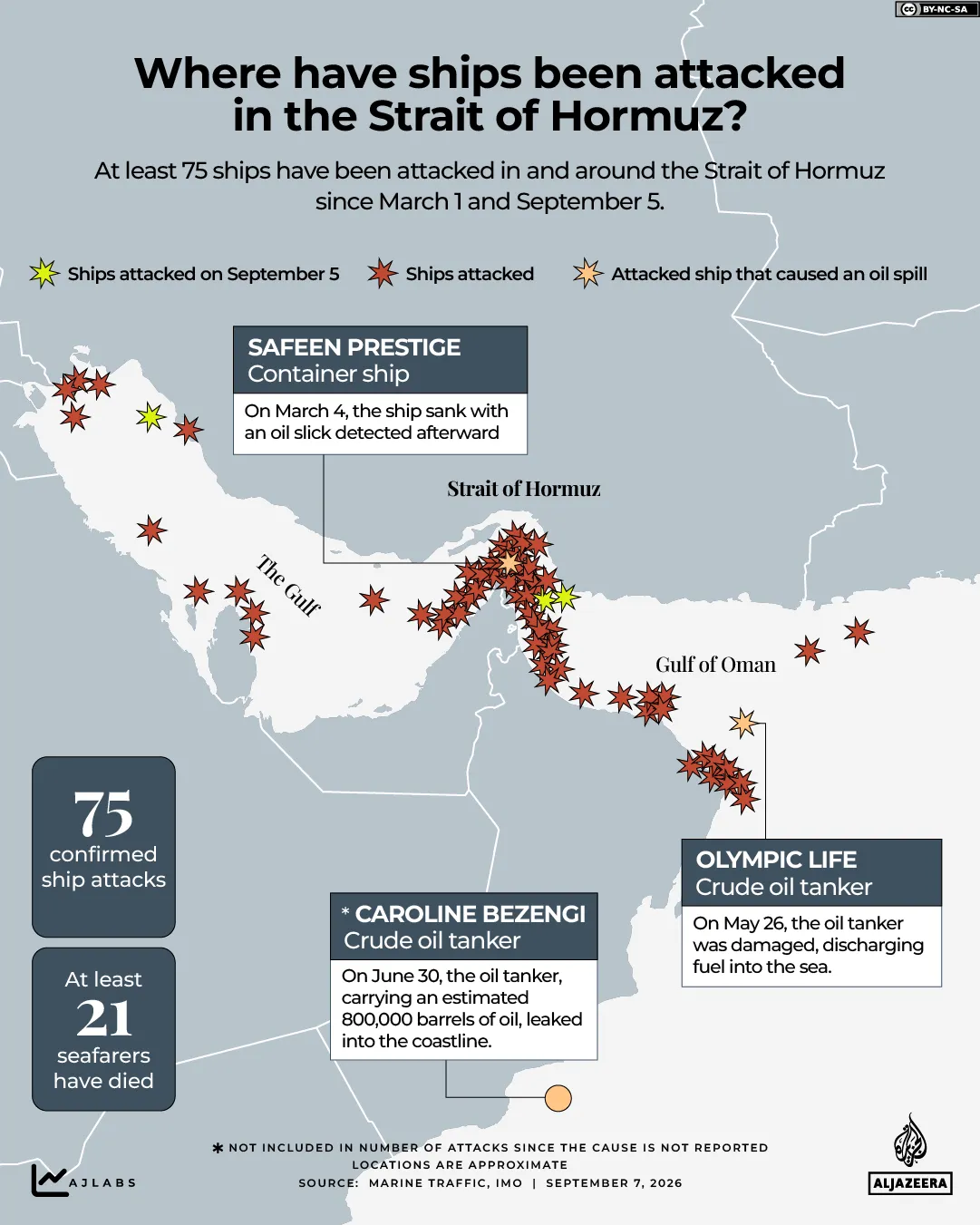
Xi was equally circumspect on Iran and the Strait of Hormuz, which has been shuttered since the US and Israel launched a war on Iran on February 28.

Trump has previously pushed China to encourage Iran to reopen the strait, through which a fifth of the world’s oil and gas passed each year before the war, because of its close relationship with Tehran. China and Iran signed a 25-year “strategic partnership” in 2021, and Beijing buys 80 to 90 percent of Iran’s oil annually.

Trump raised the points again in his meeting with Xi in Beijing, according to the US readout, which said the two leaders “agreed that the Strait of Hormuz must remain open to support the free flow of energy”.

“President Xi also made clear China’s opposition to the militarisation of the Strait and any effort to charge a toll for its use, and he expressed interest in purchasing more American oil to reduce China’s dependence on the Strait in the future. Both countries agreed that Iran can never have a nuclear weapon,” the readout said.

The Chinese readout of their meeting on Thursday did not include mention of Iran or its nuclear programme.

Chucheng Feng, founding partner of Hutong Research based in Beijing, told Al Jazeera that the omissions reflect that Xi and Trump still disagree on key issues, including Iran, but that the overall message from the summit was a desire to move forward.

“For Beijing, the most important thing is to find a floor for the relationship, to set up and enhance guardrails so that no surprises or uncontrolled escalations suddenly emerge. For that, item-by-item disagreements are largely secondary,” he said.

Source link

Zelenskiy Condemns Russia After Deadly Missile Strike on Kyiv Apartment Building

Ukrainian President Volodymyr Zelenskiy strongly condemned Russia after a missile strike on a residential apartment building in Kyiv killed at least 24 people, including three children.

The attack occurred during one of the heaviest aerial bombardments on the Ukrainian capital this year and further intensified international concern over the continuing war between Russia and Ukraine. Rescue operations continued for more than a full day before emergency workers completed searches through the destroyed structure in Kyiv’s Darnytskyi district.

The strike formed part of a broader wave of Russian drone and missile attacks across Ukraine that officials say targeted multiple regions over consecutive days.

Zelenskiy Visits the Site of the Attack

Zelenskiy visited the destroyed apartment building on Friday, laying red roses at the site and meeting rescue workers who had spent more than twenty eight hours searching for survivors beneath the rubble.

In remarks shared through social media, the Ukrainian president praised emergency responders for their continuous efforts and accused Russia of deliberately destroying civilian lives.

According to Zelenskiy, the missile strike effectively destroyed an entire section of the residential building. Ukrainian officials stated that initial analysis suggested the attack involved a recently manufactured Russian Kh 101 cruise missile.

The Ukrainian leader once again appealed to international allies for stronger air defence support and increased pressure on Moscow.

Heavy Civilian Casualties

Kyiv authorities declared Friday a day of mourning in memory of the victims. Flags across the capital were lowered to half mast, and public entertainment events were cancelled or postponed.

The Interior Ministry reported that rescue teams removed approximately 3,000 cubic meters of rubble during the operation. Hundreds of emergency personnel participated in the search efforts.

Officials confirmed that 24 bodies were recovered from the site, while approximately 30 people were rescued alive. Nearly 50 individuals were injured, and hundreds required psychological support following the attack.

The deaths of children among the victims further intensified public grief and anger across Ukraine.

Russia Intensifies Air Campaign

Ukrainian authorities stated that Russia launched more than 1,500 drones along with dozens of missiles during attacks carried out over two consecutive days this week.

The strikes extended beyond Kyiv and affected western regions of Ukraine located far from active frontline combat zones. Officials reported that six people were killed during attacks in western Ukraine on Wednesday.

The scale of the aerial assault highlights Russia’s continuing ability to conduct large coordinated attacks despite prolonged international sanctions and battlefield losses.

Moscow did not immediately comment specifically on the apartment building strike. Russia consistently denies deliberately targeting civilians, although residential buildings, hospitals, schools, and energy infrastructure have repeatedly been damaged throughout the conflict.

Ukraine Also Conducts Cross Border Attacks

The conflict has increasingly involved reciprocal long range attacks by both sides.

Russian regional officials stated that Ukrainian drone strikes killed four people, including a child, in the Russian city of Ryazan. Authorities reported damage to apartment buildings and an industrial facility during the incident.

Ukraine has expanded drone operations against targets inside Russia over the course of the war, aiming to disrupt military infrastructure, industrial production, and logistical operations linked to Moscow’s military campaign.

These developments reflect the increasingly transnational nature of the conflict, with civilian populations on both sides facing growing security risks.

The Continuing Humanitarian Crisis

The attack on Kyiv underscores the severe humanitarian consequences of the war, which began with Russia’s full scale invasion of Ukraine in February 2022.

Millions of Ukrainians have been displaced since the start of the conflict, while repeated strikes on civilian infrastructure have damaged homes, hospitals, schools, transportation systems, and energy networks across the country.

International organizations and human rights groups have repeatedly raised concerns about civilian casualties and the destruction of non military targets during the war.

At the same time, the prolonged conflict has placed enormous economic and psychological pressure on Ukrainian society as cities continue to face the threat of missile and drone attacks.

Analysis

The deadly strike on Kyiv demonstrates how the war between Russia and Ukraine continues to evolve into a prolonged campaign involving large scale aerial warfare and attacks far beyond frontline battle zones.

For Ukraine, the attack reinforces the urgent need for stronger air defence systems capable of intercepting missiles and drones before they reach urban areas. Zelenskiy’s renewed appeals to allies reflect growing concerns that Ukraine’s defensive capabilities remain under intense strain as Russia increases the scale and frequency of aerial assaults.

For Russia, sustained missile and drone attacks appear aimed at weakening Ukrainian morale, exhausting defence systems, and increasing pressure on the government through continued civilian disruption.

However, such attacks also carry significant international consequences. Civilian casualties, especially involving children and residential buildings, strengthen global criticism of Moscow and may encourage additional military and financial support for Ukraine from Western allies.

The conflict additionally illustrates the changing character of modern warfare, where advanced missiles, drones, and long range strikes allow both sides to target infrastructure and urban centers far from traditional battlefields.

Despite ongoing diplomatic discussions in various international forums, there remains little indication of a near term political settlement. Instead, the war increasingly appears locked in a prolonged phase of escalation, attrition, and humanitarian suffering.

The strike on Kyiv therefore stands not only as a tragic individual event but also as a broader symbol of the continuing devastation caused by one of the most consequential conflicts in modern Europe.

With information from Reuters.

Source link

Trump and Xi Focus on Trade Stability While China Raises Iran and Taiwan Concerns

United States President Donald Trump concluded his final round of discussions with Chinese President Xi Jinping in Beijing while attempting to present the visit as a major economic success. The summit came at a sensitive moment for both countries as tensions over trade, Taiwan, artificial intelligence technology, and the Iran conflict continue to shape relations between the world’s two largest economies.

Trump emphasized trade agreements and commercial cooperation during the visit, hoping to strengthen his political standing ahead of important midterm elections in the United States. China, however, used the occasion to deliver clear warnings regarding Taiwan and to criticize the ongoing Iran conflict, signaling that major strategic disagreements remain unresolved despite the positive diplomatic atmosphere.

Trump Highlights Economic Progress

During meetings at the Zhongnanhai leadership compound in Beijing, Trump promoted what he described as successful trade negotiations between Washington and Beijing. He stated that both sides had reached agreements that would benefit their economies and help stabilize commercial relations after years of tariff disputes and economic uncertainty.

The United States announced several proposed agreements involving agricultural exports, beef, and energy sales to China. Officials also discussed mechanisms to manage future trade disputes and identified billions of dollars in potential goods trade between the two countries.

One of the most closely watched announcements involved aircraft manufacturer Boeing. Trump claimed China had agreed to purchase 200 Boeing aircraft, marking China’s first major order of American commercial planes in nearly ten years. However, investors reacted negatively because markets had anticipated a significantly larger agreement. Boeing shares declined after the announcement, reflecting disappointment over the scale of the deal.

The summit also failed to produce a breakthrough regarding advanced artificial intelligence technology exports. Expectations had been growing that restrictions on the sale of advanced AI chips from NVIDIA to China might ease, especially after company chief executive Jensen Huang joined the trip. No major agreement emerged on that issue.

China Pushes Back on Iran Conflict

While Trump focused publicly on economic achievements, China used the summit to voice frustration over the war involving Iran. Beijing stated that the conflict should never have started and called for diplomatic efforts to restore peace.

The Iran crisis has become a major international concern because of its impact on global energy markets. Rising instability in the Middle East has pushed oil prices upward and increased fears about disruptions to energy supplies traveling through the Strait of Hormuz, one of the world’s most critical shipping routes.

China’s position reflects both economic and strategic interests. Beijing relies heavily on stable energy imports and also views Iran as an important geopolitical partner that can balance American influence in the Middle East. Analysts believe China is unlikely to pressure Tehran aggressively because maintaining strong relations with Iran supports Beijing’s broader strategic goals.

Although Trump stated that he and Xi shared similar views on Iran, Chinese officials avoided publicly endorsing Washington’s approach. This difference highlighted the continuing gap between the two powers on international security issues.

Taiwan Remains the Most Sensitive Issue

Despite the friendly diplomatic setting, Taiwan emerged as one of the summit’s most serious areas of tension. Xi warned that mishandling the Taiwan issue could lead to conflict, reinforcing Beijing’s longstanding position that the island is part of China.

Taiwan remains one of the most dangerous flashpoints in global politics. China has repeatedly stated that it does not rule out the use of military force to bring Taiwan under its control, while the United States continues to support Taiwan’s defensive capabilities under American law.

American officials maintained that United States policy toward Taiwan had not changed. Secretary of State Marco Rubio emphasized that Washington continues to support regional stability while maintaining its established position on Taiwan.

The issue remains highly sensitive because any military escalation involving Taiwan could severely disrupt global trade, semiconductor production, and international security across the Indo Pacific region.

A Fragile Trade Truce Continues

One of the summit’s most important outcomes may simply be the continuation of the fragile trade truce reached during earlier talks between the two leaders. Previous negotiations had temporarily paused extremely high tariffs and reduced tensions over rare earth mineral exports that are essential for modern technology manufacturing.

However, uncertainty remains about whether the current trade arrangements will continue beyond the end of the year. American officials indicated that no final decision had been made regarding the future of tariff suspensions and broader economic cooperation.

This uncertainty reflects the deeper structural rivalry between the United States and China. While both countries benefit economically from stable trade relations, they remain competitors in technology, military influence, and geopolitical leadership.

Human Rights Concerns Surface

Human rights issues also appeared during the summit. Trump reportedly raised the case of Hong Kong media businessman and democracy advocate Jimmy Lai, who was sentenced to prison under Hong Kong’s national security law.

American officials expressed hope that Lai could eventually be released, while China maintained that Hong Kong affairs are internal matters and rejected foreign criticism.

The discussion demonstrated that human rights disputes continue to complicate relations between Washington and Beijing even during periods of economic cooperation.

Analysis

The Trump Xi summit demonstrated the increasingly complex nature of United States China relations. Both sides attempted to project stability and cooperation, particularly on trade and economic matters, yet major disagreements remained visible beneath the surface.

Trump sought to frame the visit as proof of economic leadership and diplomatic success. However, the relatively modest scale of announced agreements and the lack of major breakthroughs on technology exports limited market enthusiasm.

China, meanwhile, used the summit to reinforce its strategic priorities. Beijing signaled that Taiwan remains a non negotiable issue, defended its relationship with Iran, and resisted external pressure on human rights matters.

The summit ultimately reflected a broader reality in global politics. The United States and China are deeply interconnected economically, but they are also strategic rivals competing for influence across multiple regions and industries. Cooperation may continue in trade and commerce, but tensions over security, technology, and global power are unlikely to disappear soon.

With information from Reuters.

Source link

Iran war day 77: Trump, Xi discuss Hormuz as Tehran rallies BRICS | US-Israel war on Iran News

The US and Chinese leaders agreed during talks in Beijing that the Strait of Hormuz should remain open to ensure global energy supplies.

United States President Donald Trump and Chinese President Xi Jinping discussed the Strait of Hormuz during talks in Beijing, with the White House saying Xi agreed the strategic waterway “must remain open to support the free flow of energy” as tensions over the Iran war continue to roil global markets.

Meanwhile, Iran’s Foreign Minister Abbas Araghchi urged fellow BRICS nations at a meeting in New Delhi, India, to condemn the US-Israel war on Iran as a violation of international law, insisting Tehran would “never bow to any pressure”.

At the same time, a third round of direct talks between Lebanese and Israeli negotiators is under way in Washington, DC, aimed at ending hostilities, even as Israeli attacks continue across towns and villages in southern Lebanon.

Here is what we know:

In Iran

  • Iran urges BRICS to condemn US and Israel: Araghchi told the BRICS+ bloc that Iran was a “victim of illegal expansionism and warmongering” and called on member states to oppose “Western hegemony” by condemning the actions of the US and Israel.
  • Iran accuses UAE over war: Araghchi also accused the United Arab Emirates of playing an active role in the war against Iran, saying during the BRICS summit in India that the UAE was “directly involved in the aggression against my country”.
  • Iran signals new Hormuz strategy: Iranian media reported that more than 30 ships, including some linked to Chinese companies, were allowed to transit the Strait of Hormuz overnight as Tehran signalled the waterway was “open to all commercial ships” that cooperate with Iranian naval forces.

War diplomacy

  • Xi offers help on Hormuz: Trump said Xi Jinping had offered China’s help to open the Strait of Hormuz and pledged not to send military equipment to aid Iran in its war against the US and Israel.
  • Trump-Xi summit held amid ‘promise fatigue’: Analyst Drew Thompson said Washington and Beijing remain deeply distrustful after years of unmet expectations, with both sides accusing the other of breaking promises. He described the summit as “carefully managed” and focused on preventing further deterioration in ties.
  • US says Israel-Lebanon talks ‘positive’: A US official said talks in Washington on Thursday between Israel and Lebanon about an expiring ceasefire were “positive” and will take place as planned for a second day.

In the US

  • Trump wants Iran’s uranium for ‘public relations’: The US president suggested that hunting down Iran’s enriched uranium was primarily for political optics, after Israel demanded it as a goal in the war. “I just feel better if I got it, actually, but it’s – I think, it’s more for public relations than it is for anything else,” Trump told Fox News.
  • Trump says Iran must make deal: In the same interview, Trump told Sean Hannity he was running out of patience to reach a truce with Iran as peace talks have stalled. “I’m not going to be much more patient… They should make a deal. Any sane person would make a deal, but they might be crazy,” Trump said.

In Israel

  • NYT lawsuit: Israel says it will sue The New York Times after the newspaper published an article by columnist Nicholas Kristof detailing rape allegations by Palestinian detainees against Israeli forces. The Israeli Prime Minister’s Office announced the legal move three days after the report, which was based on accounts from 14 male and female Palestinian victims.

In Lebanon and Syria

  • Hezbollah claims attacks on Israeli forces: The group said it launched rockets, drones and artillery attacks on Israeli troops and military vehicles in southern Lebanon, and claimed to have downed Israeli drones.
  • Israel-Lebanon talks face uncertainty: According to Al Jazeera’s Manuel Rapalo, Israel is seeking stronger security guarantees and Hezbollah’s disarmament, while Lebanon wants a permanent ceasefire and Israeli troop withdrawal from the south. Rapalo says Hezbollah’s refusal to commit to any future agreement adds significant uncertainty, although diplomats still view the talks as a breakthrough.
  • Amnesty urges Israel to conduct Syria war crimes probe: The rights group called for investigations into Israeli raids and shelling in southern Syria, which residents say have destroyed homes and farmland and led to detentions. Israel has also seized additional territory beyond the occupied Golan Heights, in violation of the 1974 disengagement agreement.

Source link

How David Ben-Gurion got the Palestinians wrong in 1948 | Israel-Palestine conflict

When European Jewish settlers embarked on brutal ethnic cleansing to establish Israel in 1948, they thought the Palestinian population would be the least of their problems. In fact, Zionist leaders like David Ben-Gurion believed that “the refugee problem would resolve itself”.

There was deep-seated conviction among Zionists that the Palestinians lacked an identity, and they would just flee to neighbouring Arab countries and assimilate. They would not come back to claim their stolen land.

But what happened was the exact opposite.

Decade after decade, the Palestinian national cause grew stronger. Today, few survivors of the Nakba of 1948 remain, but the national commitment to Palestinian rights and historical justice is as strong as ever. That is because the older generations did not teach the younger ones to forget the trauma and move on; they taught them to remember and to keep the keys to their ancestral homes in their minds.

The “refugee problem” did not “resolve itself” not just because of Palestinian determination and resilience, but also because the Israeli policies of violence and dispossession backfired.

Israel’s theft of land and resources and violent displacement of Palestinians was the starting point for every Palestinian generation to reject and resist occupation.

As Israel succeeded in usurping more and more Palestinian land, it failed miserably in controlling the Palestinian consciousness.

Despite continuous Israeli efforts to turn refugee camps into isolated enclaves, recruit agents and collaborators to undermine unity, and introduce international bodies to redefine the refugee issue as a purely humanitarian one, it failed to dismantle the Palestinian national cause.

Those who were dispossessed and violated – the Palestinian refugees – became the most ardent carriers of the idea of resistance. Refugee camps became the centres of peaceful and armed struggle. These camps gave birth to prominent Palestinian thinkers, doctors, educators and leaders, who spread one message: the rejection of the Israeli occupation and the insistence on Palestinian rights.

Palestinian refugees were the drivers of the first Intifada of 1987 and the second Intifada of 2000. They were at the centre of any subsequent mobilisation to resist the Israeli occupation.

The colonial project saw no option but to ratchet up its brutality. Repeated massacres, mass imprisonment and relentless efforts to uproot communities did not achieve subjugation. This approach failed and the Gaza Strip – where 80 percent of the population are refugees – stands as the clearest evidence of that failure.

After the launch of its genocidal assault on Gaza in October 2023, the Israeli government repeatedly described the war as “existential”. If Israel itself acknowledges today that the fourth generation of Palestinians, the descendants of the survivors of the Nakba, represent a threat to its existence, then this is in itself an admission of the collapse of Ben-Gurion’s prediction and the strategic failure of the Israeli project to eliminate the Palestinian people.

But Israel has not just failed, it has also become trapped. It is stuck in the paradox of the futility of its own brutal power. The more violence, mass killings and displacement it carries out and the more it reproduces the Nakba, the more determined the Palestinian people become to resist. Repression is not uprooting Palestine, it is helping it take deeper root.

The Gaza genocide is perhaps the best illustration of this deadly paradox. More than 72,000 Palestinians have been massacred, more than 170,000 injured, and 1.9 million displaced. Most homes have been damaged or destroyed.

What is the result of all this? When a Palestinian child is born today in a tent and grows up without most of his family, without a school, a playground, proper healthcare, or a home, he or she won’t need a complex historical narrative to understand who is responsible for this and what needs to be done to achieve justice.

But the self-defeating impact of Israeli brutality is not limited to Palestine alone. Israel’s genocide has backfired on a global scale. It has allowed the Palestinian cause to grow beyond the confines of a marginal, left-wing issue into one that increasingly attracts attention across the political spectrum in the West but also elsewhere in the world.

Activists and ordinary citizens of different political convictions now stand in solidarity with the Palestinian cause. Many do so, despite facing retribution, arrest and prosecution for their support of Palestinian rights.

The Palestinian cause has also become an influential factor in local elections in many countries, including the United States and United Kingdom, where support for the Israeli occupation and genocide can cost candidates an electoral win.

As a result, the Palestinian issue has grown beyond a regional struggle to become a defining moral question for people across the world.

This has left the occupation locked in a permanent confrontation with what cannot be defeated: memory. The more it tries to erase the Palestinian cause, the more it is etched in the Palestinian and global consciousness.

If he had been alive today, Ben-Gurion would have been dismayed to learn that Zionism secured its own defeat the moment it embarked on the Nakba.

The views expressed in this article are the author’s own and do not necessarily reflect Al Jazeera’s editorial stance.

Source link

After Trump’s pledge to ‘open up’ China, low expectations for trade deal | Business and Economy News

Before arriving for his high-stakes summit with Chinese leader Xi Jinping, United States President Donald Trump aimed to set expectations high.

He said he would urge Xi to “open up” China’s economy and announced a delegation of top business executives, including Tesla’s Elon Musk, Apple’s Tim Cook and Nvidia’s Jensen Huang, to accompany him.

Recommended Stories

list of 4 itemsend of list

As Trump and Xi prepare to wrap up two days of meetings on Friday, the expectations for their summit’s outcome among observers generally are modest at best.

While Trump and Xi are anticipated to extend the one-year pause in their trade war agreed to in South Korea in October, the expectations are for a stabilisation – not revitalisation – in ties between the world’s two largest economies, which are locked in a rivalry that spans everything from trade and artificial intelligence to the status of Taiwan.

“It is important to be clear-eyed about the state of relations here,” Claire E Reade, a senior counsel at Arnold & Porter who previously worked on China at the Office of the US Trade Representative (USTR), told Al Jazeera.

“China does not trust the US, and China wants to beat the US in what it sees as long-term global competition,” Reade said.

“This limits what can be agreed.”

While Trump and Xi have yet to announce the final contours of any trade agreement, the US side has flagged various business deals in the pipeline.

In a pre-recorded interview with Fox News that aired on Thursday, Trump said that China would invest “hundreds of billions of dollars” in companies run by the CEOs in his delegation, without providing further details.

Trump also said that Beijing had agreed to purchase US oil and 200 Boeing aircraft.

Trump administration officials have said that the sides are also discussing the establishment of a “Board of Investment” to manage investments between the countries.

“A realistic ‘opening up’ of the Chinese market would likely focus first on sectors where the economic complementarity is most obvious,” Taiyi Sun, an associate professor of political science at Christopher Newport University in Newport News, Virginia, told Al Jazeera.

“Agricultural goods such as soybeans and beef, as well as high-value-added manufacturing products like Boeing aircraft, are natural areas for expansion because they match existing Chinese demand with American export strengths.”

Sun said a “gradual” opening for US firms in sectors such as financial services could also be possible.

“But those areas are politically and institutionally more sensitive inside China, so progress would likely be incremental rather than immediate,” he said.

Gabriel Wildau, a senior vice president at global business advisory firm Teneo, said both sides will be seeking to address supply-chain vulnerabilities exposed by their trade war.

“The Iran war has likely increased the US’s vulnerability to export controls on rare earths, given the need to rebuild the munition stocks depleted in that war,” Wildau told Al Jazeera.

“Washington will therefore be willing to offer tariff relief – or at least assurances not to impose new tariffs – in exchange for Beijing’s commitment to keep rare earth exports flowing.”

While Trump and Xi agreed to roll back some trade barriers at their summit in South Korea, US-Chinese business and trade remain severely constrained after a decade of tit-for-tat economic salvoes between the sides.

The average US tariff on Chinese goods stood at 47.5 percent after the South Korea summit, up from 3.1 percent before Trump’s first term, according to the Peterson Institute for International Economics.

China’s average tariff on US goods stood at 31.9 percent, up from 8.4 percent in 2018, according to the think tank.

Two-way goods trade amounted to about $415bn in 2025, down sharply from its 2022 peak of $690bn.

Carsten Holz, an expert on the Chinese economy at the Hong Kong University of Science and Technology, said China has less incentive to make concessions to the US than before, amid the rise of its domestic industries.

“Across many industrial sectors, PRC [People’s Republic of China] firms hold leading or controlling positions,” Holz told Al Jazeera.

“As a result, the PRC economy has little to gain from opening further to the US and is likely to only offer largely symbolic gestures.”

Deborah Elms, head of trade policy at the Hinrich Foundation in Singapore, voiced similar sentiments about the limits of US leverage.

“Basically, Trump expects China to buy more stuff from America and let US companies operate more freely in China,” Elms told Al Jazeera.

“What is he offering?” Elms said. “Very little, largely because Trump sees the bilateral relationship as one where the US has been fair and China has not.”

Reade, the former USTR official, said Xi would not agree to any measures that “harm Chinese interests in any way.”

“Instead, China will potentially give the US no-cost ‘gifts,’” Reade said, suggesting such measures could include the removal of trade barriers it placed on US beef.

“It may buy US goods it needs,” Reade said.

“If it allows purchases of US tech products, it will only be because it needs them right now,” she added, “But this does not interfere with China’s strategic plans to eliminate dependence on US technology over the longer term.”

Source link

Israel-Lebanon talks held in Washington as expiration of ceasefire nears | Israel attacks Lebanon News

NewsFeed

Al Jazeera’s Manuel Rapalo reports from Washington, where the first of two days of US-mediated ambassador-level talks between Israel and Lebanon concluded on Thursday. A ceasefire between them expires on Sunday, though Israel has killed 512 Lebanese since its implementation on April 17.

Source link

CENTCOM Commander Dismisses Reports That Iran Retains Most Of Its Missile And Drone Arsenal (Updated)

Testifying before the Senate Armed Services Committee on Thursday, the admiral in charge of U.S. military operations in the Middle East pushed back against claims that Iran still possesses a large number of missiles and launchers. He spoke as the White House said U.S. President Donald Trump and his Chinese counterpart Xi Jinping discussed the ongoing Iranian closure of the Strait of Hormuz and hours after Iran seized another ship. 

Iran can “no longer threaten regional partners, or the United States, in ways that they were able to do before, across every domain,” the commander of U.S. Central Command, Admiral Brad Cooper, explained.

On Wednesday, The New York Times reported that the “Trump administration’s public portrayal of a shattered Iranian military is sharply at odds with what U.S. intelligence agencies are telling policymakers behind closed doors.”

The newspaper cited “classified assessments from early this month that show Iran has regained access to most of its missile sites, launchers and underground facilities.”

“Most alarming to some senior officials is evidence that Iran has restored operational access to 30 of the 33 missile sites it maintains along the Strait of Hormuz, which could threaten American warships and oil tankers transiting the narrow waterway,” the Times added. “Iran still fields about 70 percent of its mobile launchers across the country and has retained roughly 70 percent of its prewar missile stockpile, according to the assessments. That stockpile encompasses both ballistic missiles, which can target other nations in the region, and a smaller supply of cruise missiles, which can be used against shorter-range targets on land or at sea.”

The Washington Post offered a similar assessment last week.

WaPo last week: “Iran retains about 75 percent of its prewar inventories of mobile launchers and about 70 percent of its prewar stockpiles of missiles” https://t.co/FpAhZQKPlG

— John Hudson (@John_Hudson) May 12, 2026

Cooper took issue with those figures when asked about them.

“I think it’s appropriate in this forum not to discuss specific intelligence assessments,” he responded. “What I would say, from my perspective, is the numbers that I’ve seen in open source are not accurate. I think what also is not taken into consideration, it’s more than just the numbers. It’s the command and control that’s been shattered. It’s a significant degradation and capability, and it’s the lack of any ability to then produce any missiles…on the back end.”

Cooper was further pressed on Iran’s ability to threaten shipping in the Strait of Hormuz because it still has missiles and fast boats and other assets.

“In each of those cases, their capabilities have been significantly degraded,” the admiral posited. “If I just use my own professional experience and 100 transits through the Strait of Hormuz, you would typically see 20 to 40 fast boats, and lately we’ve seen two or three. So the degradation means it’s been significant, but some residual capability does exist with respect to the threat that remains.”

CENTCOM forces recently sank about a half-dozen Iranian fast boats threatening ships in the Strait.

.@CENTCOM Commander Adm. Brad Cooper: “[Iran’s] capability has been significantly degraded. If I just use my own professional experience, in 100 transits through the Strait of Hormuz, you would typically see 20-40 fast-boats; lately, we’ve seen two or three.” @centcomcdr pic.twitter.com/8pWaMFpKQ9

— Rapid Response 47 (@RapidResponse47) May 14, 2026

Though Cooper downplayed Iran’s current capabilities, he said Tehran posed significant new threats with its modern drones.

“The days of $35,000 drones that we saw in the last couple of years, particularly in the fight against the Houthis in Yemen, those days are behind us,” Cooper proffered. “Today we face an increased threat from drones that are highly sophisticated. They’re jet-powered. They have high-end sensors. They have electronic warfare…signals intelligence. So those days of using high value defenses to shoot down cheap targets are behind us.”

“Quite the contrary, what we have been doing lately is using our own low-cost one way attack drones, [to attack] Iran, making them use higher and more expensive weapons. So I can confidently tell you, we have flipped the cost curve in many ways. Always work to be done, but I like where we are in this regard.”

CENTCOM commander Adm. Brad Cooper says the U.S. has “flipped the cost curve” in drone warfare against Iran.

“The days of using high-value defenses to shoot down cheap targets are behind us.” pic.twitter.com/7iK4JKpL9N

— Kassy Akiva (@KassyAkiva) May 14, 2026

Cooper didn’t elaborate, but earlier in his testimony, he talked about the Low-Cost Uncrewed Combat Attack System (LUCAS) kamikaze drones that TWZ has written frequently about. CENTCOM first began using these weapons, reverse-engineered from Iranian Shahed-136 drones, to strike targets in Iran.

The War Zone has advocated for the procurement of this exact class of drone by the American military and today, Cooper once again backed up that assessment.

The LUCAS drones are “an additional capability that we’ve now employed against an adversary very effectively,” Cooper commented. He declined to provide further details. 

“Vis a vis Iran, I think I would just like to keep that in the classified setting,” he noted.

LUCAS kamikaze drones. (CENTCOM)

Cooper provided additional statistics about Epic Fury to the committee.

  • “We destroyed or buried much of Iran’s ballistic missiles, launcher vehicles, and long-range attack drones with more than 450 strikes on ballistic missile storage and systems and roughly 800 strikes on Iran’s drone-launching units and storage. In the air domain, Iran’s air and air defense forces are functionally and operationally irrelevant.” 
  • “Before OEF, the Iranian Air Force flew between 30 and 100 sorties each day. Today that number is zero. We destroyed or rendered non-mission-capable Iran’s fixed-wing airfields, hangars, fuel storage, and munitions stockpiles, and we knocked out 82 percent of its air defense missile systems along with the radar and command architecture that tied them together.”
  • “At sea, we destroyed 161 vessels in total across 16 classes of warships, effectively crippling the regime’s ability to operate.”

SASC @CENTCOM Posture Hearing

Admiral Cooper:
“At sea, we destroyed 161 vessels in total across 16 classes of warships, effectively crippling the regime’s ability to operate. We eliminated more than 90 percent of Iran’s once-massive inventory of over 8,000 naval mines, with more… pic.twitter.com/VmBwR8KIlM

— Charlie B (@supbrow) May 14, 2026

  • “We eliminated more than 90 percent of Iran’s once-massive inventory of over 8,000 naval mines, with more than 700 airstrikes on Iranian naval mine targets. In sum, Iran’s navy can no longer claim to be a maritime power, and it cannot project into the Gulf of Oman or the Indian Ocean. Iran retains nuisance capability – harassment, low-end drone and rocket attacks, and residual proxy support – but it no longer possesses the means to threaten major regional operations or to deter U.S. freedom of action in the air or maritime domains.”
  • “The second-order effects of OEF are significant. More than 2,000 strikes against Iran’s command-and-control structures created leadership vacuums, paralysis, and internal confusion.” 
  • “We have seen reporting of desertions, personnel shortages, and signs of regime desperation in their attempts to compel discipline through arrest and execution. Most importantly for the region’s future: Iran will be highly challenged to proliferate advanced weapons to Lebanese Hezbollah, the Houthis, Hamas, or the Iraqi militia groups. The supply chain from Tehran to the proxies has been broken.”

While Iran has clearly been battered by attacks from the U.S. and Israel, recent events show it can still inflict damage on its neighbors and shipping. As we previously reported, Tehran has repeatedly struck the United Arab Emirates (UAE) before and after the April 7 ceasefire. In previous coverage, we have pointed out how Iran has also attacked U.S. warships and commercial vessels they were helping guide through the Strait of Hormuz during the short-lived Project Freedom operation.

Hours before Cooper testified, “the Islamic Revolutionary Guard Corps (IRGC) Navy seized the Honduras-flagged fishery research vessel Hui Chuan,” a maritime security official told us. “The Company Security Officer (CSO) reported that the vessel was taken by Iranian personnel while at anchor approximately 38nm northeast of Fujairah, UAE, at 05:45 UTC.”

The Hui Chuan was operating as a “floating armory” storing weapons for Chinese security firms who protect ships at sea from attack by pirates, the official told us. The ship is now “bound for Iranian territorial waters,” the UK’s Maritime Trade Operations (UKMTO) organization said.

The Honduras-flagged fishing research vessel Hui Chuan (IMO: 8316895), anchored off the UAE’s east coast, is believed to have been seized by the IRGC Navy.

The ship is reportedly operated by the Chinese private security company Sinoguards as a floating armory. pic.twitter.com/VlHpmkqFYw

— Egypt’s Intel Observer (@EGYOSINT) May 14, 2026

UPDATE: 8:06 PM EDT –

During an interview with NBC News, Rubio was asked what Trump asked Xi when it comes to Iran.

“He didn’t ask him for anything,” the secretary noted. “We’re not asking for China’s help. We don’t need their help… Our position is very clear: Iran cannot have a nuclear weapon.”

NBC: “What exactly did President Trump ask President Xi for when it comes to Iran?”@SecRubio: “He didn’t ask him for anything. We’re not asking for China’s help. We don’t need their help… Our position is very clear: Iran cannot have a nuclear weapon.” pic.twitter.com/Hn7f3aqiUp

— Rapid Response 47 (@RapidResponse47) May 14, 2026

In a post on his social media platform responding to Xi’s remarks that the U.S. is essentially a declining power, Trump responded that the Chinese leader was referring to America under Biden and that things are much better now.

More interesting, however, is a hint Trump dropped about the future with Iran.

Among the accomplishments he claimed on Truth Social was “the military decimation of Iran (to be continued!).” 

The House voted for a third time against acting as a check on President Trump’s military powers in Iran, even as a growing number of Republicans express concern about the prolonged conflict, CBS News reported

Thursday’s vote on a Democratic resolution to rein in Trump’s authority was 212-212, falling just short of a majority. Originally introduced on March 4, the measure as written would have directed the president to remove U.S. forces from hostilities within 30 days of the start of the war, which began on Feb. 28.

The U.S. House voted 212-212 on a War Powers Resolution to restrict military action against Iran. The measure failed, needing a majority to pass. pic.twitter.com/NcRDvUIFyA

— Open Source Intel (@Osint613) May 14, 2026

UPDATES

In a readout of the meeting in Beijing between Trump and Xi, the White House noted that the topic of the Strait of Hormuz came up in discussions between the two leaders.

“The two sides agreed that the Strait of Hormuz must remain open to support the free flow of energy,” the White House posted on X. “President Xi also made clear China’s opposition to militarization of the Strait and any effort to charge a toll for its use, and he expressed interest in purchasing more American oil to reduce China’s reliance on the Strait in the future.”

U.S. Secretary of State Marco Rubio, who was among those accompanying Trump, highlighted Xi’s opposition to allowing Iran to impose tolls on ships transiting the Strait. 

“President Trump raised the issue of Iran with China and it was important,” said Rubio. “The Chinese side said they are not in favor of militarizing the Strait of Hormuz and are not in favor of a tolling system, and that’s our position.”

SECRETARY RUBIO: President Trump raised the issue of Iran with China and it was important.

The Chinese side said they are not in favor of militarizing the Strait of Hormuz and are not in favor of a tolling system, and that’s our position. pic.twitter.com/9JYpbvztd8

— Department of State (@StateDept) May 14, 2026

The much-longer Chinese readout of the meeting mentioned improving trade and a warning that the U.S. “must exercise the utmost prudence in handling the Taiwan question.”

However, there was no mention of Iran or the Strait of Hormuz.

While that doesn’t mean these issues weren’t discussed, readouts are messaging and this reflected the emphasis Beijing places on the paused war and its aftermath.

“The two heads of state exchanged views on major international and regional issues, including the situation in the Middle East, the Ukraine crisis, and the Korean Peninsula,” was about as close as the statement from the Chinese Foreign Ministry came to addressing Iran.

Despite the Trump administration’s stance that China opposes allowing Iran to impose tolls on shipping, Beijing is paying for transits, the Guardian claims.

Tehran “says it has reached a deal with China that has already allowed a large number of oil tankers bound for China to go through the strait of Hormuz since Wednesday night, and this has been made possible by China agreeing to limited charging, undercutting US opposition to such moves,” the outlet reported. “The development suggests China has accepted Iran’s assertion that the shipping rules in the strait have changed, with reports suggesting the cost will be in the region of $1 per barrel.”

We cannot independently verify that and have reached out to the White House for details.

🇮🇷 🇨🇳 Iranian media reported on Thursday that naval forces had allowed a group of Chinese ships to pass through the strategic Strait of Hormuz since the night before. Iran has largely blocked shipping through the strait since the outbreak of war with the US and Israel ➡️… pic.twitter.com/PVjGJ0TY7t

— AFP News Agency (@AFP) May 14, 2026

Trump pushed back on claims that China is working to arm Iran.

“We discussed it,” he told Fox News host Sean Hannity. “I mean, when you say ‘support,’ they’re not fighting a war with us or anything. He said he’s not gonna give military equipment. That’s a big statement. He said that strongly. But at the same time he said they buy a lot of their oil there, and they’d like to keep doing that.”

HANNITY: Did you discuss China’s support for Iran with Xi?

TRUMP: We discussed it. Uhhhh. I mean, when you say ‘support,’ they’re not fighting a war with us or anything. He said he’s not gonna give military equipment. That’s a big statement. But at the same time he said they buy… pic.twitter.com/Lq677uoCfG

— Aaron Rupar (@atrupar) May 14, 2026

Trump’s claim that China told him it won’t give weapons to Iran followed The New York Times report that Beijing was working to ship arms to Tehran.

“Chinese companies have been discussing arms sales with Iran, plotting to send the weapons through other countries to mask the origins of the military aid,” the publication stated, citing U.S. officials.

The United States “has gathered intelligence that Chinese companies and Iranian officials have discussed the arms transfers,” the newspaper added. “It is not clear how many, if any, arms have been shipped or to what degree Chinese officials have approved the sales.”

Officials briefed on the intelligence “have reached different conclusions on whether the arms have already been sent to the third countries,” according to the Times. “But no Chinese weapons appear to have been used on the battlefield against U.S. or Israeli forces since they began their war against Iran in late February.”

The newspaper reported last month that U.S. intelligence agencies had obtained information showing that China may have transferred shoulder-fired man portable air defense systems (MANPADS) to Iran. Intelligence also showed that China was considering other shipments of the weaponry.

The United Arab Emirates (UAE) on Wednesday pushed back on claims that Israeli Prime Minister Benjamin Netanyahu and the heads of Mossad and Shin Bet visited the country during the now-paused war with Iran. The denial is a strong public rebuke amid a growing relationship between the two nations that has seen Israel supply the UAE with Iron Dome air defense batteries to protect against Iranian attacks.

“The United Arab Emirates denies reports circulating regarding an alleged visit by Israeli Prime Minister Benjamin Netanyahu to the UAE or receiving any Israeli military delegations in the country,” the UAE Foreign Affairs Ministry posted on X Wednesday afternoon EDT. “The UAE reaffirms that its relations with Israel are public and conducted within the framework of the well-known and officially declared Abraham Accords, and are not based on non-transparent or unofficial arrangements. Accordingly, any claims regarding unannounced visits or undisclosed arrangements are entirely unfounded unless officially announced by the relevant authorities in the UAE.”

The ministry added that the “UAE calls on media outlets to exercise accuracy and professionalism, and to refrain from circulating unverified information or promoting misleading political narratives.”

UAE Denies Reports Regarding Visit by Israeli Prime Minister or Receiving Any Israeli Military Delegation pic.twitter.com/TRX9y5ZoVN

— MoFA وزارة الخارجية (@mofauae) May 13, 2026

Hours before the UAE announcement, Netanyahu’s office claimed the Israeli leader did travel to the Gulf Arab nation, confirming a CBS News report about the visit.

“In the midst of Operation ‘Roar of the Lion,’ Prime Minister Benjamin Netanyahu made a secret visit to the United Arab Emirates and met with the President of the United Arab Emirates, Sheikh Mohammed bin Zayed,” the office posted on X. “This visit led to a historic breakthrough in relations between Israel and the United Arab Emirates.”

לשכת ראש הממשלה מאשרת כעת:

בעיצומו של מבצע ״שאגת הארי״, ראש הממשלה בנימין נתניהו ביקר בחשאי באיחוד האמירויות ונפגש עם נשיא איחוד האמירויות, השייח׳ מוחמד בן זאיד.

ביקור זה הביא לפריצת דרך היסטורית ביחסים בין ישראל לאיחוד האמירויות.

— ראש ממשלת ישראל (@IsraeliPM_heb) May 13, 2026

Israel’s N12 News chief political correspondent Amit Segal noted a “few striking details regarding the news of Netanyahu’s visit to the UAE.”

“A covert flight reportedly took place while Israeli airspace was fully shut—without leaks or detection,” he noted on X. “Sources suggest a deal was reached on an Iron Dome shipment” and “UAE President Mohammed bin Zayed Al Nahyan has publicly hosted Israeli leaders like Naftali Bennett and Yair Lapid—but not Benjamin Netanyahu. Until now, their contacts stayed behind closed doors.”

Bennet and Lapid visited the UAE in 2021, as Prime Minister and Foreign Minister respectively.

A few striking details regarding the new of Netanyahu’s visit to the UAE:

1. A covert flight reportedly took place while Israeli airspace was fully shut—without leaks or detection.

2. Sources suggest a deal was reached on an Iron Dome shipment.

3. UAE President Mohammed bin… https://t.co/An2kbqJrNC

— Amit Segal (@AmitSegal) May 13, 2026

The announcement from Netanyahu’s office followed media reports on Tuesday about the visit to the UAE of two other high-level Israeli officials.

The Wall Street Journal reported that Mossad chief David Barnea visited the UAE at least twice during Operation Roaring Lion to coordinate war efforts. Barnea reportedly flew to the UAE in March and April. In addition, Israeli media reported that Shin Bet chief David Zini also visited the UAE to coordinate security efforts.

Certainly not surprising given the Abraham Accords and the more recent Iron Dome battery and miltary deployment to UAE by Israel. But 2 back to back visits by a Mossad chief amid a war speaks volumes. Important read by @AnatPeled1 & @summer_said in @WSJ.https://t.co/i9BmyHNZ3p

— Behnam Ben Taleblu بهنام بن طالب لو (@therealBehnamBT) May 13, 2026

The back and forth over the potentially unprecedented wartime visit by three top Israeli officials to the UAE comes a day after U.S. Ambassador to Israel Mike Huckabee publicly confirmed that Israel sent the UAE an unspecified number of Iron Dome air defense batteries and troops to operate them. News of the deployment was first reported by Axios last month. Such an acknowledgement of direct Israeli military aid to an Arab nation is unusual in its own right.

🚨 WATCH: US Ambassador to Israel Mike Huckabee officially confirms: Israel sent the United Arab Emirates an Iron Dome system and a team to operate it. This happened because there are exceptional relations between Israel and the United Arab Emirates, based on the Abraham Accords. pic.twitter.com/BgCkESt4Yl

— Raylan Givens (@JewishWarrior13) May 12, 2026

TWZ cannot independently verify any of the travel claims. However, Israel has historically been viewed as an enemy by the Arab world and direct cooperation in the form of a visit by its head of state could be considered controversial to say the least. At the same time, things have changed dramatically in the region over the last decade or so, with Arab countries warming to relations with Israel. This has been spurred by the major economic development the region has seen as well as, at least to a degree, a common foe — Iran.

Perhaps the UAE is trying to appeal to a domestic audience or, as Israel’s I24 News senior Middle East correspondent Ariel Oseran suggested on X, UAE is trying to distance itself from Netanyahu and his coalition, not Israel writ large. Maybe Netanyahu, for his own reasons, is trying to claim a level of relationship that doesn’t exist, however that seems unlikely.

We may never find out for sure.

It is highly unlikely that Israel’s PMO would issue a fake statement regarding Netanyahu visiting the UAE at such a sensitive time.

What is more likely is that Abu Dhabi is trying to publicly distance itself from Netanyahu on a personal level, a sentiment that I have personally… https://t.co/8laUSjOAc7

— Ariel Oseran أريئل أوسيران (@ariel_oseran) May 13, 2026

The Senate on Wednesday blocked the seventh Democratic attempt to prevent Trump from waging war on Iran. However, it was by the slimmest margin yet, indicating a growing unease in the legislature about the now-paused conflict.

The vote failed by a 49-50 margin, with all Democrats but John Fetterman of Pennsylvania supporting the measure. For the first time, Senator Lisa Murkowski of Alaska joined fellow Republican Senators Susan Collins of Maine and Rand Paul of Kentucky in breaking with Trump and voting with Democrats. 

This was the first vote on the War Powers Resolution since Trump bypassed the 60-day deadline to seek congressional authorization for Operation Epic Fury last month. You can read more about that effort in our story about it here.

Meanwhile, as we noted yesterday, NBC News reported that the administration is considering changing the name of the operation to Sledgehammer should hostilities resume.

Contact the author: howard@twz.com

Howard is a Senior Staff Writer for The War Zone, and a former Senior Managing Editor for Military Times. Prior to this, he covered military affairs for the Tampa Bay Times as a Senior Writer. Howard’s work has appeared in various publications including Yahoo News, RealClearDefense, and Air Force Times.


Source link

Explosions heard as mining groups stage antigovernment protest in Bolivia | Protests News

Protesters have demanded the resignation of President Rodrigo Paz, who was elected on a platform of economic reform.

Demonstrators, led by mining groups and rural unions, have clashed with law enforcement in Bolivia as tensions simmer over the country’s economic crisis, the worst in decades.

On Thursday, small explosions were heard in the midst of the protest in La Paz, credited to miners setting off small sticks of dynamite. Some protesters were reported as attempting to breach the presidential palace.

Recommended Stories

list of 3 itemsend of list

The unrest follows weeks of road blockades, as miners, farmers, teachers and rural workers express frustration over the country’s ongoing economic turmoil.

Bolivia used to be a major exporter of natural gas, but in recent years, its reserves began to shrivel, and its production has plummeted. Now, rather than being a fuel exporter, it has become a net importer, reliant on oil and natural gas from abroad.

The collapse of the natural gas industry has been coupled with dwindling supplies of foreign currency in the country. The result has been soaring inflation, supply shortages and higher prices.

Bolivians have experienced long lines for fuel, and hospitals have reported a lack of basic supplies like oxygen and medication.

Demonstrators from mining unions take part in a protest against President Rodrigo Paz's government amid an ongoing economic and fuel crisis, in La Paz, Bolivia, May 14, 2026. REUTERS/Claudia Morales
Demonstrators from mining unions take part in a protest against President Rodrigo Paz’s government in La Paz, Bolivia, on May 14 [Claudia Morales/Reuters]

Centre-right leader Rodrigo Paz was elected in October last year in part on a promise to address the economic tailspin.

His victory marked a political sea change in Bolivia. For much of the past two decades, except for a brief period in 2019, the country has been governed by the Movement Towards Socialism (MAS).

The decline of MAS has been credited, in part, to the uproar over the economy.

But on Thursday, Paz likewise faced calls from protesters for his resignation, just as his MAS predecessor, Luis Arce, had.

Earlier in the day, a group of 20 miners were invited to the presidential palace to meet with Paz and discuss their demands, according to the Reuters news agency.

Ahead of the meeting, Economy Minister Jose Gabriel Espinoza said his government was “open to dialogue”.

Among the issues reportedly discussed were fuel subsidies, welfare benefits and changes to an agrarian reform measure, Law 1720, that was repealed on Wednesday after outcry.

Still, officials have refused demands that Paz step down. “The president is not going to resign,” Mauricio Zamora, the minister of public works, services and housing, said earlier this month.

Some of Paz’s allies have blamed the unrest on former President Evo Morales, a former trade union leader who continues to draw popular support in Bolivia’s rural areas.

Morales, who led Bolivia from 2006 to 2019, previously supported protests against Paz’s predecessor Arce, after splitting from MAS.

He is also the subject of an arrest warrant: Morales has been accused of statutory rape and was held in contempt of court for failing to show up to a hearing last week.

A prolific social media user, Morales posted multiple times on Thursday about the protests, accusing the government of using him as a scapegoat. He also echoed calls for officials to address the shortages of food, fuel and other basic supplies.

“They believe that the thousands of Bolivians currently protesting — in the streets and on the roads — are merely obeying a single individual,” Morales wrote in one post.

“The outraged are driven by their social conscience and their fury against a government that, from day one, betrayed its constituents and the nation.”

Source link

Cautious optimism in Lebanon as direct talks with Israel progress | Israel attacks Lebanon News

A third round of direct talks between Israel and Lebanon has kicked off in Washington, DC, days before the expiration of a “ceasefire” that hardly halted Israeli attacks and Hezbollah’s response to them.

The talks, which began on Thursday, represent a step towards more serious negotiations, with higher-level envoys from Lebanon and Israel taking part after the initial preparatory sessions were headed by the ambassadors of the two countries to Washington.

Recommended Stories

list of 3 itemsend of list

Lebanese officials are hoping that the two-day negotiations will yield a new ceasefire deal and pave the way for tackling a series of thorny issues, including the withdrawal of Israeli forces from southern Lebanon and the disarmament of Hezbollah.

US Secretary of State Marco Rubio, who attended the first Israel-Lebanon meetings in Washington in April, was with US President Donald Trump on a visit to China and did not attend Thursday’s session.

Lebanon’s envoy heading up Thursday’s talks, Simon Karam, is an attorney and well-connected former Lebanese ambassador to the United States who recently represented Lebanon in indirect talks with Israel over implementation of the ceasefire that preceded the latest outbreak of war between Israel and Hezbollah.

On the Israeli side, Deputy National Security Adviser Yossi Draznin was set to attend.

“We do not want to downplay the significance of these talks, but they are ambassador-level talks, excluding top leadership from Israel, Lebanon and the US,” said Al Jazeera’s Manuel Rapalo, reporting from Washington, DC, adding that there is no diplomatic relationship between Lebanon and Israel.

Trump has publicly called for a meeting between Lebanese President Joseph Aoun and Israeli Prime Minister Benjamin Netanyahu, while Aoun has declined to meet or speak directly with Netanyahu at this stage – a move that would likely generate blowback in Lebanon.

Hezbollah, meanwhile, is not part of the talks and has been vocally opposed to Lebanon engaging in direct negotiations with Israel.

A lawmaker from the Iran-backed group, Ali Ammar, on Thursday reiterated his group’s rejection of the direct talks, saying they amounted to “free concessions” to Israel.

Still, “there is optimism”, said Al Jazeera’s Rapalo.

“The cessation of hostilities agreement is due to expire on Sunday, so there is an expectation that this will be front and centre in discussions,” he said.

“Of course, the immediate objective is to prevent the situation along the border from escalating into a broader regional conflict.”

Cautious optimism

The United Nations earlier on Thursday expressed hope for the new round of direct negotiations.

“We hope that the latest round of direct talks between Lebanon and Israel in Washington, planned for today and tomorrow, will contribute to an effective and durable ceasefire and open a path towards lasting peace,” deputy spokesman Farhan Haq told the reporters.

Haq said the UN Interim Force in Lebanon (UNIFIL) continues to observe “significant” aerial and military activity across its area of operations, including multiple air strikes on Wednesday by Israel.

“We reiterate our call on all the parties to exercise maximum restraint, ensure the protection of civilians and humanitarian personnel and fully respect their obligations under international humanitarian law,” he added.

In Lebanon, people also hope for an end to violence as the diplomatic efforts continue.

“I think people here in southern Lebanon are cautiously optimistic about the possible results from these meetings,” said Al Jazeera’s Obaida Hitto, reporting from Tyre, Lebanon.

“Everyone understands that Lebanon is not ready for normalisation, legally speaking. There is a part of the constitution that prevents Lebanon from actually having normalisation with Israel. People realise this might be a huge obstacle to move forward and find a way to live in peace with Israel.”

Still, the Lebanese population wants the violence to stop, said Hitto.

“It’s been more than two months of ongoing Israeli strikes, artillery strikes, air strikes, drone strikes, coordinated, systematic demolitions of entire towns and villages,” he said.

The Israeli army continues daily strikes in Lebanon despite a ceasefire that was announced on April 17 and later extended until May 17.

Three people were killed in Israeli strikes in southern Lebanon on Thursday, Lebanese media reported.

Since March 2, Israeli attacks in Lebanon have killed at least 2,896 people, injured over 8,824, and displaced more than 1.6 million, about one-fifth of the country’s population, according to Lebanese officials. In that time, at least 200 children in Lebanon have been killed in Israeli attacks, the UN Children’s Fund (UNICEF) said on Thursday.

Source link

Venezuela to Restructure Debt with Western Creditors

Venezuela’s liabilities include defaulted bonds and loans as well as international arbitration awards. (Archive)

Caracas, May 14, 2026 (venezuelanalysis.com) – The Venezuelan acting government announced the formal launch of a restructuring process of the country’s sizable foreign debt.

In a statement published on Wednesday, Caracas promised “comprehensive and orderly” proceedings to renegotiate liabilities owed by the country and state oil company PDVSA.

“This decision has the goal of putting the economy at the service of the Venezuelan people and freeing the country of the burden of accumulated debt,” the communique read. “This is a responsible, nationalist, and social decision.”

Venezuelan authorities added that the country’s resources should prioritize the people’s well-being over “unsustainable financial obligations” and that they seek a “substantial reduction” of the total debt.

Venezuela defaulted on a range of bonds and loans beginning in 2017 as US sanctions severely exacerbated the country’s economic crisis and shut it out of financial markets, making payments impossible. The Nicolás Maduro government had prioritized debt service in previous years as the country’s economy entered a tailspin in hopes of retaining access to international credit.

The sum total of defaulted debts and loans, on top of international arbitration awards, is estimated to be as high as US $170 billion with accrued interest. Liabilities likewise include unpaid loans to China. The restructuring process may be one of the largest in history, surpassing Russia (1998) and Argentina (2001).

According to Business Wire, the government led by Acting President Delcy Rodríguez plans to present its “macroeconomic framework and public debt sustainability analysis” to the international financial community in June. Caracas has reportedly hired Centerview Partners as a financial advisor.

On May 5, the US Treasury Department issued a license allowing the provision of financial and advisory services related to Venezuelan debt restructuring. The sanctions waiver does not allow creditors to transfer or settle debt, nor directly engage with Venezuelan authorities. 

Market analyst S&P Global argued that Venezuela’s debt renegotiation process could face obstacles if some creditors hold out and reject restructuring proposals.

Financial analyst Elías Ferrer Breda called Wednesday’s announcement an expected “formality” and added that the next step will be assessing the actual size of Venezuela’s foreign debt. For his part, political commentator Luis Vicente León argued that the restructuring process will be drawn out but may “restore credibility” before financial markets.

Pramol Dhawan, head of Pacific Investment Management Company LLC (PIMCO) emerging markets team, welcomed Caracas’ “willingness to engage with bondholders.”

“Any durable resolution ​will need to be ​comprehensive and anchored by ⁠a credible macroeconomic framework to give creditors confidence in Venezuela’s capacity to service restructured obligations,” he told Reuters

Venezuelan bonds rose again following the latest announcement, continuing a recent upward trend as investors eye windfall returns. Creditors have also met with Trump officials in recent weeks.

Since the January 3 US military strikes and kidnapping of President Nicolás Maduro, the acting authorities led by Delcy Rodríguez have fast-tracked a rapprochement with Washington. The Venezuelan National Assembly has approved pro-business reforms to its energy and mining sectors while the government has struck agreements with multiple Western multinational corporations.

Following the White House’s recognition of Rodríguez as the South American country’s “sole leader,” Caracas reestablished ties with the World Bank and the International Monetary Fund. Venezuelan officials have expressed hopes of accessing around $5 billion in Special Drawing Rights and stated that there are “no plans” to contract IMF loans.

For her part, IMF Managing Director Kristalina Georgieva stated that the Washington-based institution is willing to support a loan program for Venezuela but requires clarity on economic data and external debt.

In April, Rodríguez established a commission tasked with assessing the “strategic” value of Venezuelan state assets and their possible privatization, with private sector conglomerates already raising funds ahead of potential sell-offs.

Edited by Lucas Koerner in Caracas.

Source link

Iran, Taiwan, and trade: Trump’s high‑stakes return to Beijing | News

As Trump meets Xi in Beijing for the first time in nine years, can trade war, Taiwan and Iran tensions be contained?

US President Donald Trump returns to Beijing after nine years to meet Chinese President Xi Jinping. The trade war, conflict in Iran, and rising fears over Taiwan shape the talks. With global tensions mounting, can the two leaders find common ground, or will rivalry push the world further into crisis?

In this episode: 

Episode credits:

This episode was produced by Marcos Bartolomé and Sarí el-Khalili with Spencer Cline, Catherine Nouhan, Tuleen Barakat, Alexandra Locke, and our guest host, Kevin Hirten. It was edited by Tamara Khandaker. 

Our sound designer is Alex Roldan. Our video editors are Hisham Abu Salah and Mohannad al-Melhem. Alexandra Locke is The Take’s executive producer. 

Connect with us:

@AJEPodcasts on XInstagramFacebook, and YouTube


Source link

MSF’s New Report Examines Surging Malnutrition Crisis in Northern Nigeria

Médecins Sans Frontières (MSF), an international humanitarian organisation, has released its 2025 activity report for Nigeria, and the findings are sobering. The medical emergency organisation, also known as Doctors Without Borders, unveiled the report during an event in Abuja, North Central Nigeria, on Wednesday, May 13, documenting the disturbing rise in malnutrition cases in the country’s northern region.

With more than 3,500 workers delivering essential healthcare services across ten states, MSF reported treating over 440,000 children for malnutrition, more than 300,000 individuals for malaria, and assisting with over 33,500 deliveries in 2025.

This surge, according to the humanitarian organisation, underscores the fragility of Nigeria’s health system and the growing vulnerability of women and children in conflict-affected regions.

The 2025 report shows that MSF recorded more than 600,000 outpatient consultations, 48,000 inpatient admissions, and treated 341,239 patients for malaria, 38,753 children for measles, 6,123 patients for diphtheria, and 985 others for meningitis across its facilities in the region.

These findings are specific to the ten Nigerian states where MSF has been operating since 1996, including Jigawa, Kano, Katsina, Kebbi, Sokoto, Zamfara, and Cross River. The organisation says it has provided a wide range of essential medical services, including paediatric and maternal health care, treating children with malnutrition, responding to disease outbreaks, caring for survivors of sexual violence, offering mental health support, and performing life‑saving surgical interventions. 

The MSF country representative, Ahmed Aldikhari, revealed that in 2025, the organisation observed a pattern consistent with that of previous years, starting in 2022. Aldikhari stated that malnutrition is one of the year’s greatest challenges, linking it to the region’s fragile conditions, which are severely affected by insecurity that has worsened food security.

Four people in a room during the MSF Nigeria Activity Report Presentation. A banner and posters are visible in the background.
Representatives of MSF unveiling the 2025 report, which revealed the rise in cases of malnutrition in Nigeria. Photo: Isah Ismaila/HumAngle.

“We are seeing a vicious cycle where malnutrition is both a cause and a consequence of diseases such as measles, malaria, and diphtheria, among others, which continue to affect vulnerable communities, especially when healthcare is delayed or inaccessible,” he said, suggesting that Nigeria might soon experience the peak of the malnutrition crisis. 

“That is why we are consistently working side-by-side with the ministries of health, humanitarian affairs, budget and planning at the state and federal levels, and also, with our Nigerian colleagues to ensure that efficient services are provided, but they are not enough.”

HumAngle has previously reported on the broader impact of the crisis, stressing how displacements, insecurity, and climate change, among other natural and human-induced disasters, have compounded the problem. In July 2025, MSF, in collaboration with the Katsina State government, mobilised state and non-state actors to address the escalating malnutrition crisis in the northwestern region. 

During the 2024 MSF conference in Abuja, organised in collaboration with the North West Governors’ Forum and the Katsina State Government, stakeholders emphasised that malnutrition in the northwestern region is no longer a seasonal emergency but rather a structural crisis that requires urgent mobilisation. The governors acknowledged that insecurity and climate pressures were eroding food systems, but MSF urged greater investment in therapeutic feeding centres and preventive programmes.

Four people are seated in front of a Médecins Sans Frontières banner at a presentation event.
Representatives of the humanitarian organisation address journalists on malnutrition, disease outbreaks, and maternal health in Nigeria. Photo: Isah Ismaila/HumAngle.

Northern Nigeria continues to face a critical malnutrition crisis, with Katsina particularly affected, according to MSF’s 2025 activity report. Findings reveal that since 2021, MSF has been present in the state, with the organisation’s leadership revealing that they have witnessed a sharp rise in the number of malnourished children since responding to the growing crisis in recent years.

In 2025, MSF reported treating the highest number of malnourished children in Katsina. With the support of the state Ministry of Health, the organisation focused on preventing illness and malnutrition to reduce mortality and morbidity among children suffering from acute malnutrition.

“Katsina State has faced a chronic malnutrition crisis for over a decade, driven by insecurity, climate shocks, limited primary healthcare services, and high birth rates,” the report revealed. “Throughout 2025, MSF admitted 26,445 patients for inpatient care, provided treatment to 146,301 children through its outpatient centres, and conducted 15,387 outpatient consultations for malaria.”

In response to this, MSF established a new Ambulatory Therapeutic Feeding Centre (ATFC) in Mashi and a second inpatient therapeutic feeding centre at the Turai Yar’aduwa Hospital to handle the increased patient load during peak seasons.

Beyond nutrition in Kebbi, the report states that MSF responded to multiple infectious disease surges and outbreaks by tackling the increase in meningitis cases from February to May, while supporting the Ministry of Health facilities in Jega, Gwandu, and Aliero with logistics, medical supplies, staff training, and facility rehabilitation.

Following the escalating insecurity in neighbouring Zamfara and Niger that led to mass displacement to the Danko-Wasugu areas of Kebbi State as of June, the humanitarian organisation provided basic healthcare and distributed non-food relief kits to vulnerable households.

In Zamfara alone, MSF admitted 47,164 children to inpatient therapeutic feeding centres and provided 14,167 outpatient consultations in 2024, with numbers continuing to rise in 2025. According to Aldikhari, this increase in admissions is due to multiple overlapping crises, including conflict and insecurity in the northwestern and northeastern regions, which have displaced thousands of families, cutting them off from farmlands. 

While the 2025 activity report warns that malnutrition is no longer a seasonal emergency but a permanent feature of Nigeria’s humanitarian landscape, it also highlights the fact that the sheer scale of admissions suggests the crisis is outpacing the humanitarian response. 

Médecins Sans Frontières (MSF) released its 2025 activity report for Nigeria, highlighting a troubling surge in malnutrition, especially in the northern region.

MSF treated over 440,000 malnourished children, more than 300,000 malaria patients, and assisted with 33,500 deliveries, illustrating the fragility of Nigeria’s health system amid growing challenges in conflict-affected areas. The report details their operations across ten states since 1996, offering a range of essential medical services and responding to disease outbreaks and the chronic malnutrition crisis, particularly in conflict-driven regions like Katsina and Zamfara.

The report emphasizes the cyclical nature of malnutrition being both a cause and consequence of diseases, exacerbated by insecurity and climate pressures. Collaboration with local government and NGOs is ongoing, yet MSF warns that the crisis has transformed into a structural issue requiring significant investments in therapeutic feeding centers and preventive programs. Despite increased efforts, the scale of malnutrition and related health crises like measles, diphtheria, and meningitis, is outpacing humanitarian response, marking malnutrition as an enduring element of Nigeria’s humanitarian landscape.

Source link

China’s Complex Relationship With Elon Musk: Hero or Villain?

In China, Elon Musk has gained both admiration and criticism. While he is seen as a visionary, he has faced scrutiny from regulators and the public due to issues with customer complaints. The success of Musk’s SpaceX and its Starlink satellite service has also led to concerns from the People’s Liberation Army, especially as Tesla faces growing competition from Chinese electric vehicle (EV) manufacturers, which threatens Musk’s standing in the market.

Musk recently attended a summit in Beijing with U. S. President Donald Trump, alongside other CEOs like Tim Cook and Jensen Huang, focusing on resolving business issues with China. After a formal welcome, Musk expressed his desire to achieve “many good things” in the country. At the same event, Xiaomi’s CEO Lei Jun, an admirer of Musk, took a selfie with him, which became popular on social media, showcasing the public’s interest in Musk.

Despite facing competition on technology and pricing from local companies, Musk and Tesla remain influential in China. Experts note that Musk’s business goals align with China’s technological priorities, including electric vehicles, AI, and advanced robotics, making Tesla’s self-driving technology the standard in the industry. In 2018, Tesla became the first foreign automaker permitted to operate in China without a local partner, and its sales in the country reached about 626,000 vehicles last year, contributing significantly to its revenue.

Other Chinese carmakers, like Chery, draw inspiration from Tesla’s focus on innovation, blending it with Toyota’s emphasis on quality. However, Musk’s other ventures, particularly SpaceX, provoke concern among Chinese military and government officials due to its dominance in satellite communications, especially in light of geopolitical tensions, hinting at efforts to develop domestic alternatives.

Though Musk’s social media platform, X, is banned in China, he has a significant following on Weibo and has been celebrated as a global icon in the country. His recent visit pertains to an attempt to purchase $2.9 billion in solar manufacturing equipment from Chinese suppliers, although this may be affected by China’s potential export restrictions on advanced technologies to the U. S.

Musk’s company is also seeking regulatory approval for more advanced self-driving technology. However, his relationship with China has been delicate, particularly when Tesla faced backlash in 2021 over its handling of customer complaints, highlighted by a public protest at an auto show. Additionally, Teslas were previously banned from military areas due to security concerns.

Looking ahead, organizations believe that Tesla’s standing might challenge Musk’s popularity in China as local companies continue to progress. However, he is likely to remain an influential figure in China’s tech scene for his achievements in the automotive and technology industries.

With information from Reuters

Source link