news

US judge upholds decision to toss subpoenas into Fed Chair Jerome Powell | Donald Trump News

A United States federal judge has once again batted down a pair of subpoenas from the administration of President Donald Trump seeking information about Jerome Powell, the chairman of the Federal Reserve, the country’s central bank.

In a brief, six-page opinion published on Friday, Judge James Boasberg rejected the Department of Justice’s motion to reconsider his earlier ruling rejecting the subpoenas.

Recommended Stories

list of 3 itemsend of list

“The Government’s arguments do not come close to convincing the Court that a different outcome is warranted,” Boasberg wrote.

On March 13, Boasberg, a judge for the federal court in the District of Columbia, nullified the subpoenas on the basis that they were issued for an “improper purpose”: to pressure Powell into compliance with the president’s demands.

Trump and Powell — an appointee from the president’s first term — have been at loggerheads since the Republican leader returned to the White House in January 2025.

Although the Federal Reserve is an independent government agency, not subject to political demands, Trump has repeatedly called on the bank to slash interest rates, and he has denounced Powell as “incompetent”, “crooked” and a “fool” for not following suit.

For months, pressure had been building from the Trump White House to investigate Powell and push him prematurely from his job as Federal Reserve chair. Powell’s term is slated to expire in May.

Much of the Trump administration’s focus has fallen on renovations to the Federal Reserve’s historic 1930s buildings in Washington, DC, which have gone over budget.

The administration has pointed to the cost overruns as evidence of malfeasance.

Last July, for instance, Trump appointee William Pulte called on Congress to investigate Powell for “political bias” and “deceptive” testimony related to the renovation project.

The following month, Trump posted on his platform Truth Social that he was considering “a major lawsuit against Powell” in response to “horrible, and grossly incompetent” work on the renovations.

The pressure reached a climax on January 11, when Powell made a rare statement announcing he was under a Justice Department investigation over the renovation project. He dismissed the probe as a “pretext” to undermine the Federal Reserve’s leadership over monetary policy.

“The threat of criminal charges is a consequence of the Federal Reserve setting interest rates based on our best assessment of what will serve the public, rather than following the preferences of the president,” Powell said.

The Federal Reserve has since sought to have the subpoenas into Powell’s behaviour tossed.

Boasberg sided with the central bank in his initial ruling, and in Friday’s opinion, he called the Trump administration’s efforts to change his mind insufficient.

The Justice Department had argued that it does not need to produce evidence of a crime to seek a grand jury subpoena.

Boasberg agreed with that point, but he said subpoenas were also subject to a legal standard that bars them from being issued for “improper” purposes.

“The subpoena power ‘is not unlimited’ and may not be abused,” Boasberg wrote, citing court precedent.

He therefore ruled that the lack of evidence overall against Powell was relevant to the legality of the subpoenas.

“The controlling legal question is what these ‘subpoena[s’] dominant purpose’ is: pressuring Powell to lower rates or resign, or pursuing a legitimate investigation opened because the facts suggested wrongdoing,” Boasberg said.

“Resolving that question requires probing whether the Government’s asserted basis for the subpoenas — suspicions of fraud and lying to Congress — is colorable or tenuous. That inquiry, in turn, means asking how much evidence there is to back up the Government’s assertions.”

Boasberg underscored that he has seen no suggestion that Powell committed criminal wrongdoing and pointed to the long list of statements Trump has made attacking the Federal Reserve chair, suggesting an ulterior motive.

“The Government’s fundamental problem is that it has presented no evidence whatsoever of fraud,” he concluded.

Friday’s ruling is likely to set the stage for the Trump administration to appeal. US Attorney Jeanine Pirro has previously denied any political motivation for the investigation.

She has also asserted that Boasberg is “without legal authority” to nullify the subpoenas.

Source link

Palestine 36: A film about a revolt that nearly changed history | News

Director Annemarie Jacir on how Palestine 36 traces today’s crisis back to British colonial rule.

Before Israeli occupation, there was British colonialism. We speak to director Annemarie Jacir about Palestine 36, her epic film about the 1936 Palestinian revolt that almost succeeded, the often-forgotten roots of today’s crisis, and why this history still feels painfully present.

In this episode: 

Episode credits:

This episode was produced by David Enders, Sonia Bhagat, and Sarí el-Khalili with Spencer Cline, Chloe K. Li, Catherine Nouhan, Tuleen Barakat and our host, Malika Bilal. It was edited by Tamara Khandaker. 

Our sound designer is Alex Roldan. Our video editors are Hisham Abu Salah and Mohannad al-Melhem. Alexandra Locke is The Take’s executive producer. 

Connect with us:

@AJEPodcasts on X, Instagram, Facebook, and YouTube


Source link

French-owned container ship transits Hormuz Strait in first since Iran war | News

It was ​not ⁠immediately clear how the vessel, which Marine Traffic tracking data shows is sailing south along the coast of Oman, secured safe passage.

A container ship belonging to French shipping giant CMA CGM has crossed ⁠⁠through the Strait of Hormuz, the first such passage by a Western vessel since Iran effectively closed the waterway, the Marine Traffic vessel website shows.

The Malta-flagged Kribi, owned by CMA CGM, crossed the Strait on April 2 and is the first French-owned vessel to ‌‌make it through the channel since the US-Israeli war on Iran began on February 28.

Recommended Stories

list of 4 itemsend of list

It was not ⁠⁠immediately clear how the vessel, which the data shows is sailing south along the coast of Oman, secured safe passage.

There was no immediate comment from CMA CGM.

However, LSEG ⁠⁠shipping data showed the vessel on Thursday changed its destination to “Owner France”, ⁠⁠signalling to Iranian authorities the nationality ⁠⁠of its owner, before crossing the strait’s Iranian territorial waters.

INTERACTIVE - Strait of Hormuz - March 2, 2026-1772714221
[Al Jazeera]

The ship had originally been bound for Pointe-Noire in the Republic of ‌‌the Congo.

Only about 150 vessels, including tankers and container ships, have transited the strait since March 1, according to data firm Lloyd’s List Intelligence. Most were linked to Iran and countries including China, India and Pakistan.

Beijing expressed “gratitude” on Tuesday after three of its ships passed through the strait, including two container ships on Monday belonging to state-owned shipping giant Cosco.

Energy crisis

Until the war led to the effective blocking of the Strait, it was the route for about a fifth of global oil and ⁠⁠liquefied natural gas supplies. As a result, fuel prices have skyrocketed worldwide.

On Wednesday, US President Donald Trump insisted that petrol prices would fall quickly once the war concluded, but offered no solution for reopening the Strait of Hormuz. Instead, he invited sceptical US allies to do it themselves. He insisted that the war would be worth it.

French President Emmanuel Macron said on Thursday it would ⁠⁠be unrealistic to launch a military operation to open the strait, and ⁠⁠that only diplomatic efforts would work.

Macron has worked with European and other ⁠⁠allies to build a coalition to guarantee free passage through the strait once hostilities have stopped.

Meanwhile, writing in the US journal Foreign Affairs, Iran’s former top diplomat said that Tehran should make a deal with the United States to end the war by offering to curb its nuclear programme and reopen the Strait of Hormuz in exchange for sanctions relief.

Tehran could “declare victory and make a deal that both ends this conflict and prevents the next one,” wrote Mohammad Javad Zarif, foreign minister from 2013 to 2021.

Source link

How the US and Israel are waging war on Iran’s medicines, vaccines | US-Israel war on Iran News

The United States and Israel have carried out multiple attacks on medical facilities in the course of their war on Iran.

On Thursday, Iranian President Masoud Pezeshkian appealed to international health organisations to respond to attacks on medical facilities in Iran, including the Pasteur Institute in capital Tehran, a key centre that Iranian officials said had been targeted that day.

At least 2,076 people have been killed and 26,500 have been wounded in Iran since the US and Israel first launched strikes on the country on February 28.

Here is a closer look at how the US and Israel have hit healthcare facilities in Iran.

What has the Iranian president said about attacks on healthcare?

On Thursday, Pezeshkian wrote in an X post: “What message does attacking hospitals, pharmaceutical companies and the Pasteur Institute as a medical research center in Iran convey?”

The Iranian president, 71, a heart surgeon by profession, continued: “As a specialist physician, I urge WHO [the World Health Organization], the Red Cross, Doctors Without Borders and physicians worldwide to respond to this crime against humanity.”

What is the Pasteur Institute, which has been targeted?

On Thursday, Iranian Foreign Ministry spokesman Esmaeil Baghaei wrote in an X post: “The American-Israeli aggressors have attacked the Pasteur Institute of Iran – the oldest and most prestigious research and public health centre in Iran and the entire Middle East, founded in 1920 through an agreement between the Pasteur Institute of Paris and the Iranian government.”

Baghaei deemed the attack “heartbreaking, cruel, despicable, and utterly outrageous”.

He did not specify whether there were casualties from the attack.

The institute was founded more than 100 years ago in collaboration with the Institut Pasteur in Paris, an internationally renowned centre for biomedical research, which itself was founded in 1887.

The institute in Iran conducts research on infectious diseases, produces vaccines and biological products and provides advanced diagnostics.

The centre has played a central role in fighting endemic diseases such as smallpox and cholera. It also supports Iran’s national immunisation programme by developing and producing vaccines and related biologicals – including those used against diseases such as tetanus, hepatitis B and measles.

Tedros Adhanom Ghebreyesus, the director general of the WHO, wrote in an X post on Friday that two departments of the Pasteur Institute of Iran have also been working closely with the WHO.

“The conflict in Iran, and the region, is impacting the delivery of health services and the safety of health workers, patients, and civilians present at health facilities,” Ghebreyesus wrote.

Which other healthcare facilities have been hit in Iran?

“Since 1 March, WHO has verified over 20 attacks on health care in Iran, resulting in at least nine deaths, including that of an infectious diseases health worker and a member of the Iranian Red Crescent Society,” Ghebreyesus wrote in his X post.

Some of the facilities hit include:

Red Crescent warehouse

On Friday morning, a drone strike hit a Red Crescent relief warehouse in Iran’s Bushehr province.

While no casualties were reported, the attack destroyed two relief containers, two buses and emergency vehicles, Fars news agency reported.

Tofigh Daru

On March 31, Israeli-US strikes hit one of Iran’s largest pharmaceutical companies in Tehran, the Iranian government said in a post on X.

The company was later identified as Tofigh Daru Research and Engineering Company, which is owned by the Social Security Investment Company, a state-run holding firm. On LinkedIn, Tofigh Daru states that it develops and produces active pharmaceutical ingredients “in the anticancer, narcotics, cardiovascular to immunomodulatory segments”.

No confirmed casualty numbers were reported from that strike.

Delaram Sina Psychiatric Hospital

This newly constructed hospital in Tehran was significantly damaged during an attack on the capital on March 29, according to the state-run Islamic Republic News Agency (IRNA).

About 30 patients were in the hospital at the time of the strike late on Monday, the hospital’s director told IRNA. No specific casualty figures for the hospital have been reported.

Ali Hospital

The hospital in Andimeshk in Iran’s Khuzestan province sustained damage from an explosion on March 21, according to the Mehr and Fars news agencies.

In his post on Friday, Ghebreyesus confirmed this attack and said the facility had been forced to evacuate staff and cease services.

Reports about the attack do not mention casualties at the hospital.

Gandhi Hospital

On March 2, Gandhi Hospital in Tehran was damaged during attacks on a television communications tower nearby.

No confirmed casualty figures were reported for the hospital itself.

What does international law say about attacks on healthcare?

International humanitarian law states that health establishments and units, including hospitals, should not be attacked, according to the International Committee of the Red Cross.

These protections also apply to the sick and wounded, to medical staff and to means of transport such as ambulances.

In 2016, the United Nations Security Council resolution 2286 was adopted unanimously. This condemns attacks on healthcare and calls on nations to respect international law.

However, last year record attacks on healthcare during armed conflict were recorded, according to the WHO’s Surveillance System for Attacks on Health Care (SSA).

The SSA said that in armed conflicts worldwide, 1,348 attacks on medical facilities resulted in the killing of 1,981 people. The majority of these deaths were in Sudan, where 1,620 people were killed, followed by Myanmar, where 148 people were killed.

This was a sharp uptick from 2024, when 944 patients and medical personnel were killed in armed conflict.

Where else has Israel targeted medical staff and facilities?

Lebanon

Besides Iran, Israeli attacks have also targeted healthcare facilities in Lebanon.

A month into its latest bombardment of Lebanon, Israel has killed 53 medical workers, destroyed 87 ambulances or medical centres, and forced the closure of five hospitals, according to Lebanon’s Ministry of Public Health.

“Israeli strikes and blanket evacuation orders are cutting people off from care and shrinking the space for health services to function,” Luna Hammad, the Lebanon medical coordinator for Doctors Without Borders (MSF), told Al Jazeera, adding that MSF has seen “a documented pattern of attacks affecting healthcare”.

Gaza

Throughout its genocidal war in Gaza, Israel has also attacked healthcare facilities in the Palestinian enclave.

In October 2023, hundreds of people sheltering in the car park of Gaza’s al-Ahli Hospital were killed in an Israeli attack, according to Palestinian health officials.

Israel attributed the explosion at the facility to a misfired rocket launched by the Palestinian Islamic Jihad, an allegation denied by the armed group.

In March 2024, the Israeli military said it killed 90 people in its raid on al-Shifa Hospital during a siege, as displaced Palestinians sheltering in the facility described long detentions and abuse.

In December 2024, the Israeli army arrested Dr Hussam Abu Safia, the director of Kamal Adwan Hospital, after refusing to follow orders to abandon one of the last functioning hospitals in northern Gaza. His arrest came a day after the military killed approximately 20 Palestinians and apprehended about 240 in a raid inside the hospital, which was one of the “largest operations” conducted in the territory until that time.

In March 2025, Israeli forces reportedly shot dead 15 Palestinian medics for the Palestine Red Crescent Society and inside clearly identifiable PRCS ambulances, during a rescue mission in Rafah’s Tal as-Sultan neighbourhood.

Source link

Real Madrid coach insists Spain ‘not racist’ despite Islamophobic chant | Football News

Barcelona forward Lamine Yamal speaks out against Islamophobic chants during Spain’s match with Egypt.

Real Madrid coach Alvaro Arbeloa says Spain is a tolerant country and not racist despite Islamophobic chanting during a national team match this week.

Sections of the crowd at Spain’s friendly against Egypt on Tuesday sang, “Whoever doesn’t jump is Muslim,” at Espanyol’s RCDE Stadium in Cornella.

Recommended Stories

list of 4 itemsend of list

Spain and Barcelona forward Lamine Yamal, who is Muslim, criticised those chanting as “ignorant and racist”.

Arbeloa defended Spain on Friday while insisting racist attitudes should be eliminated.

“I think Spain is not a racist country. If it was, we would have a problem every weekend at all of the stadiums,” the Spaniard told reporters.

“I keep thinking we have to eradicate any racist attitude at stadiums and in society. … Spain as a country has to keep fighting to get rid of these attitudes.

“[However,] I think we’re a great country, very tolerant, and with these kinds of situations, we shouldn’t generalise.”

Real Madrid striker Vinicius Jr has been racially abused at several stadiums across the country in high-profile incidents in recent years.

In January 2023, Atletico Madrid fans hung an effigy of the Brazilian forward from a bridge near Real Madrid’s training ground.

Four months later, Vinicius squared off with fans abusing him at Valencia’s Mestalla stadium in an incident that gained him worldwide support in his battle against racism.

In 2025, five Real Valladolid fans who racially abused Vinicius in a 2022 match, were found guilty of committing a hate crime – the first such ruling in Spain regarding insults at a football stadium.

Barcelona coach Hansi Flick praised teenager Yamal for making a “great statement” by condemning those responsible for the abuse.

“We stand for inclusion. … It’s frustrating that a small number of idiots don’t understand this,” Flick said.

“We all want to be respected. It doesn’t matter about your colour, your religion, your region. It’s time to change these thoughts.”

Atletico coach Diego Simeone said the problem was related to a lack of respect in the world.

“It’s a social problem on a world level, not about Spain or Argentina or Brazil or anywhere,” the coach said.

“Respect that was lost many years ago – respect for parents, schoolteachers, police, club directors, coaches, presidents – … today it’s been lost. and we don’t have it.”

Catalonia’s regional police said they were investigating the chants, and Spanish Prime Minister Pedro Sanchez called the incident “unacceptable”.

“We cannot allow an uncivil minority to tarnish the reality of Spain, a diverse and tolerant country,” he said.

Source link

Gattuso out as Italy’s coach after failure to qualify for 2026 World Cup | World Cup 2026 News

The Azzurri’s failure to reach a third consecutive World Cup continues to send shockwaves through Italian football.

Italy coach Gennaro Gattuso has left his role “by mutual consent”, three days after the national team failed to qualify for a third consecutive World Cup.

The Italian football federation announced the news in a statement on Friday, thanking Gattuso “for the dedication and passion” during his nine months in charge.

Recommended Stories

list of 4 itemsend of list

Italy’s chances of reaching this year’s tournament in North America ended on Tuesday after a penalty shootout loss to Bosnia and Herzegovina in a qualifying playoff.

“With a heavy ‌heart, having failed to achieve the goal we had set ourselves, I consider my time in charge of the national team to be over,” Gattuso said in a statement.

“The Azzurri shirt is the most precious asset in football, which is why it is right to facilitate future technical assessments with immediate effect.

“It has been an honour to lead the ⁠national team, and to do so with a group ⁠of lads who have shown commitment and loyalty to the shirt.”

Gattuso was appointed in June on a one-year contract, replacing Luciano Spalletti who was sacked following Italy’s 3-0 defeat by Norway ⁠in their opening group game, although he remained in place for the 2-0 win over Moldova the next ⁠day.

Italy won their next five group games under ⁠Gattuso, but given Norway’s far superior goal difference, they were resigned to another World Cup playoff before the final group game, which Norway won 4-1 at the San Siro.

Italy had lost at ‌the playoff stage for the last two World Cups to Sweden and North Macedonia, respectively, but looked on course to make it this time after a 2-0 win over Northern Ireland ‌in ‌the semifinal, before it all fell apart in Bosnia.

Gattuso’s 10-man team let slip a 1-0 lead and crumbled in the penalty shootout.

His departure comes a day after Italy’s football federation president Gabriele Gravina resigned, along with Gianluigi Buffon, who was the national team’s delegation chief.

Source link

Luka Doncic’s hamstring injury adds to a brutal night for Lakers

From Thuc Nhi Nguyen: The score wasn’t the only thing that made this the Lakers’ worst loss of the season.

Even more concerning than the Lakers’ 139-96 blowout loss to the Oklahoma City Thunder on Thursday was watching superstar guard Luka Doncic hobble off the court with a left hamstring injury in the third quarter.

The 27-year-old guard was held to just 12 points and seven assists, and he committed six turnovers before he pulled up on a drive with 7:39 left in the third quarter. He grabbed at the back of his left leg and limped to the baseline, where he lowered himself to the court, rolled onto his back and covered his face. Concerned teammates surrounded him. Coach JJ Redick offered one hand to pull him to his feet.

Go beyond the scoreboard

Get the latest on L.A.’s teams in the daily Sports Report newsletter.

Doncic will undergo an MRI scan Friday, Redick said, before the Lakers (50-27) play Doncic’s former team, the Dallas Mavericks, on Sunday. In a subdued locker room, the Lakers were left to wrestle with their largest margin of defeat since Nov. 27, 2023 amid the possibility of having to finish the regular season without the NBA’s leading scorer.

“At this juncture of the season, it’s the last thing you want to see,” said LeBron James, who had 13 points, six rebounds and two assists. “Especially — anybody on our team — but when you have an MVP candidate on your team, the last thing you want to see is somebody go down with a hamstring injury. … I don’t know obviously what the case may be, so pray for the best for sure and a speedy recovery.”

Guard Austin Reaves shook off his own injury scare to finish with 15 points, one assist and four turnovers after grabbing at his left lower back for most of the first quarter. He said he overextended himself chasing a loose ball. He turned the ball over trying to connect with Deandre Ayton on the next possession, reaching immediately for his lower back after the pass went awry.

Continue reading here

Lakers-Thunder box score

NBA scores

NBA standings

UCLA women know it’s all or nothing

UCLA center Lauren Betts celebrates during a win over Duke in the Elite Eight.

UCLA center Lauren Betts celebrates during a win over Duke in the Elite Eight of the NCAA women’s basketball tournament on March 29.

(Eric Thayer / Los Angeles Times)

From Marisa Ingemi: You’d be forgiven if you thought this year’s Final Four was just a case of déjà vu.

On paper, that seems true — four No. 1 seeds who have dominated every round of the NCAA tournament arrived in Phoenix this week and they are the same four teams who reached the Final Four last year in Tampa, Fla.

Sustaining that level of success during the modern college basketball era, the four teams insist, isn’t as easy.

Connecticut doesn’t have Paige Bueckers; South Carolina doesn’t have Kamilla Cardoso; and UCLA coach Cori Close and the Bruins have a much different lineup.

“Getting here,” UConn coach Geno Auriemma said, “is the hard part.”

Continue reading here

NCAA women’s basketball tournament bracket

UCLA gymnastics focused on staying calm, confident

UCLA gymnast Mika Webster-Longin competes on the balance beam during the Big Four Gymnastics competition.

UCLA gymnast Mika Webster-Longin competes on the balance beam during the Big Four Gymnastics competition at Pauley Pavilion on Feb. 27.

(Etienne Laurent / For The Times)

From Anthony Solorzano: The UCLA women’s gymnastics team enters the NCAA regionals on Friday in Corvallis, Ore., focused on three principles — calm, confidence and commitment to one another. The Bruins started leaning on the mantra to help them stay dialed in as they took home the Big Ten tournament title, Mika Webster-Longin said.

Now, they will use it as they to push to reach the NCAA championship.

“The Big Ten win really feels good and helps our confidence going [into NCAA regionals],” she said. “It felt great to put everything together because I feel like we really built off of one another and showed what we can do to not only the Big Ten competition, but to everyone.”

“It gives us just the right amount of confidence going into regionals and then seeing where it takes us,” Tiana Sumanasekera said.

Continue reading here

Kawhi Leonard and Clippers fall to Spurs

Clippers star Kawhi Leonard and coach Tyronn Lue react during the second half of a 118-99 loss to the San Antonio Spurs.

Clippers star Kawhi Leonard, right, and coach Tyronn Lue react during the second half of a 118-99 loss to the San Antonio Spurs on Thursday.

(Allen J. Schaben / Los Angeles Times)

From the Associated Press: De’Aaron Fox scored 22 points on nine-of-13 shooting, and the San Antonio Spurs beat the Clippers 118-99 on Thursday night without Victor Wembanyama in the lineup to win their 11th in a row.

Wembanyama was rested on the second night of a back-to-back. He had 41 points and 18 rebounds in a 127-113 win at the Golden State Warriors on Wednesday.

The Spurs (59-18) had six players in double figures, including Stephon Castle with 20 points and Dylan Harper with 19 off the bench.

Continue reading here

Clippers-Spurs box score

Kings lose to Predators in eight-round shootout

Nashville Predators forward Luke Evangelista scores the winning goal past Kings goaltender Darcy Kuemper.

Nashville Predators forward Luke Evangelista scores the winning goal past Kings goaltender Darcy Kuemper in a shootout to secure a 5-4 win Thursday at Crypto.com Arena.

(Jayne Kamin-Oncea / Associated Press)

From the Associated Press: Luke Evangelista scored the only goal of the shootout in the eighth round, and the Nashville Predators tightened the Western Conference playoff race with a 5-4 win over the Kings on Thursday night.

Nashville, the Kings and San José are now even with 79 points apiece for the second wild-card playoff spot in the West, but the Sharks — who beat Toronto 4-1 earlier Thursday — have a game in hand.

Steven Stamkos scored his 37th goal and Jonathan Marchessault ended his 14-game goal drought for the Predators, who snapped their three-game skid despite blowing a three-goal lead. Filip Forsberg and Zachary L’Heureux also scored.

Continue reading here

Kings-Predators box score

NHL scores

NHL standings

Bob Chesney grading Bruins on effort

UCLA coach Bob Chesney leads the Bruins through their first spring football practice at Spaulding Field on Thursday.

UCLA coach Bob Chesney leads the Bruins through their first spring football practice at Spaulding Field on Thursday.

(Robert Gauthier / Los Angeles Times)

From Anthony Solorzano: UCLA football coach Bob Chesney wasn’t looking for star performances during the Bruins’ first spring practice on Thursday — instead, he wanted his players to focus on holding themselves accountable for putting in their best effort.

“We talk about the mirror test. Don’t worry about what your coach says, don’t worry about what your other teammates say,” Chesney said. “Go look at yourself in the mirror. That’s really the only guy that’s gonna know, right?”

There was excitement and intensity but perfection wasn’t expected. For the new head coach, it was about whether the fundamentals UCLA worked on throughout the winter carried over, he said.

“While I watch it out here, the things that don’t take skill, the things that don’t take great genetics, were the things I wanted to focus on today more than anything — the effort,” Chesney said.

Continue reading here

Trevor Bauer set to pitch for Long Island Ducks

A man in an all-red baseball uniform winds up to pitch

Diablos Rojos’ Trevor Bauer pitches against New York Yankees during an exhibition game March 24, 2024, at Alfredo Harp Helu Stadium in Mexico City.

(Fernando Llano / Associated Press)

From Chuck Schilken: Former Dodgers pitcher Trevor Bauer will pitch for a U.S. team for the first time since 2021 when he serves as the opening day starter for the Long Island Ducks of the independent Atlantic League later this month.

Since his last MLB start, on June 28, 2021, Bauer has been accused of sexual assault by four women. He denies all the allegations and has never been charged with a crime.

After Bauer served a 194-game suspension for violating the league’s sexual assault and domestic violence policy, the Dodgers severed ties with the 2020 National League Cy Young Award winner on Jan. 6, 2023, less than two years after signing him to a three-year, $102-million contract.

Continue reading here

Rams weigh future with Puka Nacua

Puka Nacua stands on the field during a win over the Detroit Lions at SoFi Stadium in December.

Puka Nacua stands on the field during a win over the Detroit Lions at SoFi Stadium in December. Nacua’s attorney announced Wednesday that the Rams wide receiver entered rehab last month.

(Eric Thayer / Los Angeles Times)

From Los Angeles Times staff: Puka Nacua shattered Rams rookie records after the wide receiver was selected in the fifth round of the 2023 NFL draft.

Nacua became known for his infectious enthusiasm and ability to catch almost anything Rams MVP quarterback Matthew Stafford threw his way.

Now Nacua, 24, finds himself at a crossroads, with his NFL production suggesting he’s in line to sign a massive contract extension but his off-field issues raising questions about whether the Rams would be better off trading him. His attorney confirmed on Wednesday that Nacua began receiving treatment at a rehabilitation care facility in March.

Continue reading here

More details from Tiger Woods’ arrest

Tiger Woods is strapped into a police vehicle following a car crash in Jupiter Island, Fla., on March 27.

In this image from video provided by the Martin County, Fla., Sheriff’s Office, golfer Tiger Woods is strapped into a police vehicle following a car crash in Jupiter Island, Fla., on March 27.

(Associated Press)

From the Associated Press: After crashing his SUV last week in Florida, Tiger Woods took out his phone and told a deputy, “I was just talking to the president,” according to body camera footage released Thursday showing Woods’ arrest on a DUI charge.

The phone conversation was not captured on video, but Woods could be heard saying, “Thank you so much,” as he hung up and the deputy approached. It wasn’t clear if Woods was referring to President Trump, whose former daughter-in-law, Vanessa Trump, is dating Woods.

Shortly after the golfer’s March 27 arrest, Trump was asked about Woods and told reporters: “I feel so badly. He’s got some difficulty. Very close friend of mine. He’s an amazing person. Amazing man. But, some difficulty.”

Continue reading here

This day in sports history

1923 — “Black Sox” sue White Sox (unsuccessfully) for back salary.

1930 — The Montreal Canadiens win the NHL Stanley Cup with a two-game sweep of the Boston Bruins.

1933 — Ken Doraty’s overtime goal gives the Toronto Maple Leafs and 1-0 victory over the Boston Bruins in semifinals of the Stanley Cup playoffs. The goal comes at one hour, 44 minutes and 46 seconds of the overtime beyond the one-hour regulation game.

1966 — P Tom Seaver signs with the NY Mets.

1975 — Bobby Fischer stripped of world chess title for refusing to defend it, title awarded to Russian Anatoly Karpov.

1977 — Jean Ratelle of the Boston Bruins scores his 1,000th point with an assist in a 7-4 triumph over the Toronto Maple Leafs.

1982 — Buffalo’s Gil Perrault scores his 1,000th point with an assist in a 5-4 victory over the Montreal Canadiens.

1983 — 2nd NCAA Women’s Basketball Championship: USC beats Louisiana Tech, 69-67.

1987 — Chicago Cubs trade Dennis Eckersley to Oakland A’s.

1988 — Louisiana Tech wins the NCAA women’s basketball championship with a 56-54 come-from-behind victory over Auburn.

1988 — Amy Alcott shoots a 1-under 71 to win the Dinah Shore by two shots over Colleen Walker.

1988 — Mario Lemieux wins NHL scoring title, stopping Gretzky’s 7 year streak.

1989 — Michigan beats Seton Hall 80-79 in overtime to win the NCAA basketball championship. Rumeal Robinson hits two free throws with three seconds left for the Wolverines. It’s the first time that a first-year coach, Steve Fisher, wins the national title.

1991 — Bo Jackson signs 1-year contract with Chicago White Sox.

1993 — For the first time in its 157-year history, the Grand National steeplechase is declared void because of a false start. Esha Ness crosses the line first, but most of the jockeys are unaware a false start is called and the majority of the 39-horse field continue the 4½-mile race around the Aintree course even though nine stay behind at the start line.

1994 — Charlotte Smith’s 3-pointer at the buzzer gives North Carolina a 60-59 victory over Louisiana Tech in the NCAA women’s basketball championship game.

1995 — UCLA wins its first national basketball championship in 20 years and record 11th NCAA title, keeping Arkansas from repeating with an 89-78 victory.

1996 — St Francis Fighting Saints scores college baseball run record with 71.

2000 — 62nd NCAA Men’s Basketball Championship: Michigan State beats Florida, 89-76.

2004 — St. Louis clinches its 25th consecutive NHL playoff berth, the longest in major league sports, with a 4-1 win over Nashville.

2006 — Joakim Noah dominates UCLA with 16 points, nine rebounds and a record seven blocks to key a 73-57 blowout for Florida’s first national title in men’s basketball.

2006 — Steve Yzerman scores his final NHL goal (#692).

2007 — After a nine-year title drought, Tennessee and coach Pat Summitt are NCAA champions. The Lady Vols capture an elusive seventh national title, beating Rutgers 59-46.

2010 — Bernard Hopkins wins a brutal unanimous decision over Roy Jones Jr. in their long-delayed rematch, emphatically avenging his loss in the famed champions’ first fight nearly 17 years earlier.

2012 — Brittney Griner scores 26 points and grabs 13 rebounds to help Baylor finish off an undefeated season with an 80-61 win over Notre Dame in the women’s national championship game. Baylor becomes the first team in NCAA history to win 40 games.

2017 — Justin Jackson delivers the go-ahead three-point play and North Carolina scores the last eight points for a 71-65 win over Gonzaga and an NCAA title that heartbreakingly eluded the Tar Heels last year. It’s an ugly game, filled with 44 fouls and 52 free throws. Carolina was down 2 with 1:40 left when Jackson took a pass under the bucket from Theo Pinson, made a layup and got fouled. The free throw made it 66-65, and after a Gonzaga miss on the other end, Isaiah Hicks made a shot to help North Carolina start pulling away to the school’s sixth title.

2019 — San Antonio coach Gregg Popovich is ejected after an NBA record low 63 seconds in the Spurs 113-85 loss in Denver; receives 2 technical fouls in a verbal confrontation with a referee.

Compiled by the Associated Press.

Until next time…

That concludes today’s newsletter. If you have any feedback, ideas for improvement or things you’d like to see, email me at houston.mitchell@latimes.com. To get this newsletter in your inbox, click here.

Source link

Ten years since Panama Papers: What did they reveal, did anything change? | Panama Papers News

The Panama Papers, one of the biggest ever data leaks, revealed the vast scale of offshore financial networks used by the global elite.

On April 3, 2016, the International Consortium of Investigative Journalists (ICIJ) and the German newspaper Suddeutsche Zeitung released more than 11.5 million documents from the Panama-based law firm Mossack Fonseca. It exposed a network of offshore shell companies linked to the global financial elite, including current and former government leaders.

More than 350 journalists from over 80 countries worked in secrecy for more than a year to analyse 2.6 terabytes of leaked data then published their findings.

Here’s what we know about the Panama Papers ten years on, and whether the leak led to any changes.

What was the Panama Papers scandal about?

The 2016 Panama Papers scandal was about the leak of 11.5 million confidential documents including emails, contracts and banking statements from the law firm Mossack Fonseca.

The papers revealed a massive global network of offshore shell companies linked to some of the world’s richest people including politicians, business leaders and public figures, spanning countries from the United Kingdom to Russia, Australia to Brazil. They were using companies based in tax havens such as the British Virgin Islands, the Bahamas and Panama to move and store wealth away from the scrutiny of tax authorities.

About 214,000 entities were linked to individuals and companies in over 200 countries and territories. The documents covered from the 1970s up to 2016.

Who leaked the Panama Papers?

The Panama Papers were leaked by an anonymous whistleblower using the pseudonym John Doe, who initially shared the documents with Suddeutsche Zeitung, which then collaborated with journalists worldwide on reporting and releasing the findings.

P Vaidyanathan Iyer, managing editor at The Indian Express and one of the hundreds of journalists who worked on the Panama Papers, said that the process of identifying the information was like “looking for a needle in a haystack”.

“We were continuously, for about six to eight months, just reading data,” he told Al Jazeera.

“My team of three and I had a small cubicle to ourselves in the office, and we were cut off from the rest. Day and night, we were going through data, downloading documents onto our laptops and computers, which were all very secure, with restricted access. It was arduous work,” he added.

Who was exposed?

Hundreds of people, including more than 140 politicians, were identified as directors, shareholders or beneficiaries of offshore shell companies revealed in the Panama Papers. Among them were Mauricio Macri, then president of Argentina, and Petro Poroshenko, who was Ukraine’s fifth president from 2014 to 2019.

Other leaders, including former Pakistani Prime Minister Nawaz Sharif and former Icelandic Prime Minister Sigmundur Gunnlaugsson, were also named – all linked to ownership of shell companies in offshore tax havens.

What are offshore shell companies?

Offshore companies are legal entities incorporated in a jurisdiction outside the owner’s country of residence.

Shell companies, on the other hand, are entities that have “no real substantial business or operations in its place of incorporation or registered office,” Kehinde Olaoye, a professor of commercial law and business law associations at Hamad bin Khalifa University in Qatar, told Al Jazeera.

Shell companies are often used to create legal paperwork to cover for fraudulent or dodgy financial transactions. If they’re based in a country other than the owner’s, they’re offshore shell companies.

Are offshore shell companies illegal?

No. Offshore shell companies are not automatically illegal. The purpose of such companies is to create trusts, which then can be used to protect wealth or create estate planning.

However, “there is always a thin line between legitimate and illegitimate purposes” in using offshore shell companies, Olaoye noted.

“Usually, individuals and companies receive advice from financial advisers and legal advisers on how they can structure their business to take advantage of ‘favourable’ tax benefits,” she said.

Did anyone get in trouble for the Panama Papers?

A month after the Panama Papers were leaked, Iceland’s Gunnlaugsson resigned as prime minister following mass protests. According to the leaked documents, Gunnlaugsson and his wife allegedly established a company, Wintris, in the British Virgin Islands with the assistance of the Panamanian law firm. His resignation led to the fall of the Icelandic government at the time.

In 2017, Pakistan’s Supreme Court also disqualified then prime minister Sharif from office following the leaks, despite an earlier ruling that found insufficient evidence of corruption. The Panama Papers revealed that his children held several companies in the British Virgin Islands. In 2018, Sharif was banned from politics for life.

Mossack Fonseca, which had over 40 offices worldwide, also faced significant operational impacts following the leaks, including staff reductions, and ultimately shut down in 2018. Its co-founders, Jurgen Mossack and the late Ramon Fonseca, were acquitted by a Panamanian court, along with 26 others accused of setting up shell companies implicated in scandals in Brazil and Germany.

How much tax revenue has been recovered since 2016?

Between 2016 and 2026, governments worldwide recovered around $2bn in taxes, penalties and levies, according to the ICIJ. Countries such as the UK, Sweden and France each recovered between $200-250m, while others, including Japan, Mexico and Denmark, recovered around $30m each.

However, the amount that remains unaccounted for is significantly higher.

In India alone, the government brought forward close to 425 tax cases, according to Iyer.

“But the amount realised in taxes, which the government got back into its treasury was just about 150 crore rupees, which is around $16m. Whereas the total tax which was brought under investigation was about $1.5bn,” he noted.

Other countries, including Austria, Slovenia and New Zealand recovered between $1m and $8m.

Panama, the country where the leak was revealed, recovered about $14.1m.

Since the release of the Panama Papers, governments have taken steps to curb the misuse of shell companies by introducing new laws and regulations. They include the Corporate Transparency Act in the US, which requires the disclosure of “beneficial owners”—individuals who ultimately profit from offshore entities — as well as measures to improve information sharing between tax authorities.

The United Nations is also considering draft proposals for a Convention on Taxation. In addition, several nations have signed bilateral double-taxation treaties to reduce tax avoidance and prevent income from being taxed in multiple jurisdictions.

But gaps remain in the global tax system. There’s no one overarching international taxation principle that everyone needs to follow — and often there are overlapping treaties and agreements that allow those with the shrewdest financial advisors to choose, or shop, from among those pacts, based on whatever works best for them.

“The main challenge in international tax law is that there is no multilateral tax convention, which creates problems of tax competition and ‘treaty shopping’,” Olaoye said.

Source link

Storm Dave set to approach UK bringing Easter weekend wind, rain and snow

There is a risk of significant travel disruption during what is predicted to be the busiest Easter weekend in four years for drivers.

Bridges could close and ferry services may be cancelled, with possible delays to planes, trains and buses.

Rough seas and large waves will bring dangerous conditions around the coasts.

Parts of north-west Scotland are also covered by a Met Office yellow warning for rain and snow.

At low levels, especially in the Western Isles and Skye, up to 50mm (2in) of rain could fall with the potential for flooding.

Meanwhile hills and mountains above 200m (650ft) are likely to see snow, with 5-10cm (2-4in) expected to accumulate, and a small chance of 20cm (8in) in a few places.

Coupled with the strong winds this could give blizzards, snowdrifts and very poor visibility on the roads.

Source link

RC-135 Rivet Joint Surveillance Jet Caught ‘In The Nude’ In Texas

A photographer on a flight over Greenville, Texas, captured an especially good look at one of the U.S. Air Force’s RC-135V/W Rivet Joint aircraft with its usual paint scheme completely stripped off. Instead, much of its skin is seen covered with a green-colored protective coating. The airliner-sized, C-135-based Rivet Joints are powerful multi-purpose intelligence, surveillance, and reconnaissance (ISR) aircraft that can scoop up details about an opponent’s air defenses and other assets from their electronic emissions, as well as intercept communications chatter.

Dylan Phelps took the picture of the ‘naked’ Rivet Joint, seen at the top of this story, while flying over Greenville Municipal Airport, also known as Majors Field, at the tail end of a recent trip across the middle of the United States. Phelps flew in a Cessna 182 piloted by Curt Lewis.

L3Harris has a facility at the airport in Greenville where the Air Force’s Rivet Joints and other RC-135 variants routinely go to receive upgrades, as well as undergo higher-level maintenance. L3Harris performs similar work there on a variety of other large U.S. military special mission and VIP planes. This kind of work also often involves stripping and repainting the aircraft.

A stock picture of a Rivet Joint wearing its standard paint scheme. USAF/Staff Sgt. William Rosado

Rivet Joints are “perhaps the most sophisticated airborne surveillance and reconnaissance platform in the world,” Jon Rambeau, President of L3Harris Integrated Mission Systems, told reporters at the Royal International Air Tattoo (RIAT) in the United Kingdom last July, according to FlightGlobal. “The aircraft gets a full tip-to-tail refresh every four years – that’s the airframe as well as all the technology that resides inside it.”

With its paint stripped off, the sheer volume of antennas that dot the top of the Rivet Joint’s fuselage really stands out. Not visible from this particular viewpoint are the arrays of additional antennas underneath the aircraft. The RC-135V/Ws also carry additional systems in their elongated noses and “chipmunk cheeks” on either side of the forward fuselage. The Automatic Electronic Emitter Locating System (AEELS) is one of the things that has been contained inside the cheek fairings, at least in the past.

Another stock picture of an RC-135V/W, offering a view of the additional antennas that line the bottom of the fuselage. USAF

The Air Force’s current fleet of 17 Rivet Joints are the latest iterations of RC-135 variants that first entered service in the early 1960s. The United Kingdom is currently the only other operator of the Rivet Joint, with the Royal Air Force (RAF) flying three of these aircraft. The image from Greenville underscores how, despite the age of these assets, they continue to get new capabilities, as exemplified by the multiple high-bandwidth satellite communications terminals now seen on their spines.

Specific details about their capabilities are classified, but the RC-135V/Ws are known to be able to detect, geolocate, categorize, and monitor a variety of different signals and whatever is transmitting them. As such, the aircraft can gather valuable intelligence about the capabilities of those emitters, which can include air defense radars and command and control nodes, as well as just map out their locations. In this way, the jets provide information that is invaluable for creating so-called “electronic orders of battle” detailing an opponent’s force posture during peacetime, as well as in the lead-up to a major campaign. Rivet Joints can then continue to provide that kind of support during combat operations, helping keep tabs on changes in an enemy’s disposition on the battlefield.

As noted, Rivet Joints can also intercept communications chatter. In addition to onboard signals and electronic warfare specialists, the crews of the jets typically include linguists to allow for immediate analysis of those intercepts, as well as signals data. The RC-135V/Ws also have extensive communications and data-sharing suites so they can send intelligence collected to other nodes for further exploitation in near real time. The jets are also capable of passing information directly to forces engaged in tactical operations.

An unclassified US Air Force briefing slide giving a general overview of the roles and responsibilities of the members of a typical Rivet Joint crew. USAF

With their complete standoff surveillance suite, Air Force RC-135V/Ws serve as the backbone of U.S. airborne electronic intelligence collection capabilities, and are in consistently high demand as a result. Rivet Joints are currently among the array of ISR assets supporting ongoing operations against Iran. The aircraft also played a key role in the lead-up to the capture of Venezuelan dictator Nicolas Maduro in January, as well as the execution of that operation.

The Rivet Joint’s capabilities continue to evolve, as underscored by the pairing of an RC-135V/W with one of the Air Force’s new EA-37B Compass Call electronic warfare jets. You can read more about the EA-37B, which is also now taking part in operations against Iran, here.

“The synergistic integration of Rivet Joint’s intelligence gathering with Compass Call’s electronic warfare capabilities has proven to be a game-changer on the modern battlefield. We’re not simply flying sorties; we’re creating a new paradigm,” Air Force Capt. Jasmine Harris, a member of the 38th Reconnaissance Squadron, said in a statement at the time. “By refining tactics, techniques, and procedures, we’re ensuring our forces maintain a decisive advantage in the electromagnetic spectrum.”

“This level of sustained, continuous integration has never been conducted before by these two assets,” Air Force Capt. Wesley Ballinger, also from the 38th, said, as well. “Both assets complete specific actions in the kill-chain, and now the kill-chain is being refined into a faster, robust, and more lethal tool.”

USAF

As it stands now, there is no firm plan for a replacement for the Rivet Joints, at least that is publicly known. The Air Force has said in the past that it expects the RC-135V/Ws to continue flying at least through 2050.

Overall, “the RC-135 is an unmatched capability,” L3Harris’ Rambeau also said at RIAT last year, per FlightGlobal. “While some of the Rivet Joint capability could be integrated on a business jet-size platform, there are some things related to physics and the distance between point A and point B that have to be on a larger aircraft.”

At the same time, the Cold War-era aircraft are aging, and the Air Force has faced challenges in sustaining them in the past. Questions have also been raised about their survivability in future conflicts, especially in a potential high-end fight in the Pacific against China.

Regardless, the RC-135V/W fleet looks to have decades more service ahead of it, and the aircraft will continue to make trips to Greenville for upgrades in maintenance.

Special thanks again to Dylan Phelps for sharing the picture of the Rivet Joint stripped of its paint with us.

Contact the author: joe@twz.com

Joseph has been a member of The War Zone team since early 2017. Prior to that, he was an Associate Editor at War Is Boring, and his byline has appeared in other publications, including Small Arms Review, Small Arms Defense Journal, Reuters, We Are the Mighty, and Task & Purpose.


Howard is a Senior Staff Writer for The War Zone, and a former Senior Managing Editor for Military Times. Prior to this, he covered military affairs for the Tampa Bay Times as a Senior Writer. Howard’s work has appeared in various publications including Yahoo News, RealClearDefense, and Air Force Times.


Source link

Tony Pulis column: What Roberto de Zerbi needs to do to turn Tottenham around

Around 40% of clubs in England’s top four divisions of men’s football have changed their manager this season, and one in four of those teams have made more than one change.

With those stats still so high, I am sure people outside the game must be wondering about the process of appointing a manager.

In my day, I never once put on a presentation in front of a chairman or board of directors as part of any interview process.

Usually it was your management record, and your relative success with the respective budgets you’d been given, that would seal the deal.

Today, that has all changed. Many managers and coaches, I’m told, pay to have these presentations professionally prepared for them.

Before you get to that stage, however, club owners and chairmen will rely on their sporting director and chief executive to compile a list of names.

As I’ve mentioned in previous columns about the lack of opportunities now for British managers, with so many foreign owners in our game, there are lots of foreign sporting directors too, so it is not surprising they appoint managers and coaches they know.

Also, the agents who have assisted the owners when they purchased the club, will often have a big say on who the sporting director is too.

Players will also flow into some clubs in a similar fashion, I’m sure, and I’m afraid all of this impinges on managers and coaches from this country, who are not part of that network.

Academy coaches from the top clubs are finding a way through the system, as I am sure their contacts with clubs’ young players is part of their appeal.

It is definitely a route into management that is worth following but I am sure any ex-professionals who have followed it will have quickly been exposed to the key difference between managing at academy level and being in charge of a club’s first team.

Unlike academy football, which is about development, first-team football is about winning.

Every week you will be judged on your result and, no matter what philosophy you employ, the fanbase and the people above you will react accordingly.

Source link

How war on Iran turned Pakistan’s LNG surplus into a looming shortage | US-Israel war on Iran News

Islamabad, Pakistan – At the start of this year, Pakistan had more imported liquefied natural gas (LNG) than it could use. Demand had been falling for three straight years, from a peak of 8.2 million tonnes in 2021 to 6.1 million tonnes by late 2025, as cheap solar panels flooded the market and factories cut back.

The government quietly sold excess gas shipments to other countries and shut down domestic gas wells to prevent pipelines from bursting under the pressure of oversupply. Gas that could not be diverted would be pushed into household networks at a financial loss, adding billions to an already crippling debt pile in the energy sector.

Recommended Stories

list of 4 itemsend of list

Then the war came. On February 28, the United States and Israel launched hundreds of strikes against Iran in an operation named Epic Fury. The strikes targeted Iranian missiles, air defences, military infrastructure and leadership. Supreme Leader Ali Khamenei was killed in the opening assault.

Iran retaliated by firing hundreds of missiles and drones across the region, and as a result, traffic passing the Strait of Hormuz, the narrow waterway through which roughly a fifth of the world’s oil and gas passes, almost came to a halt.

The energy consequences were immediate. As a part of its retaliation against US-Israeli attacks, on March 2, Iranian drones hit Qatar’s gas facilities at Ras Laffan Industrial City, the world’s largest LNG export complex.

Qatar, the world’s second-largest LNG exporter after the United States, halted all production and declared force majeure, a legal term meaning it was released from delivery obligations due to circumstances beyond its control.

The conflict escalated further on March 18, when Israel struck Iran’s South Pars gas field, the largest in the world, off Iran’s southern coast.

Gasfield

South Pars and Qatar’s North Field sit above the same underground reservoir, meaning the attack threatened both countries’ gas production simultaneously. Iran struck Ras Laffan again in retaliation.

QatarEnergy said that the hit had forced it to cut LNG production by 17 percent, with repairs expected to take up to five years.

Brent crude, the industry benchmark, was priced at more than $109 a barrel on Thursday,

Oil prices on Thursday climbed to $109 a barrel, while European gas prices jumped 6 percent in a single trading session.

For Pakistan, which secures nearly all its imported gas from Qatar and the United Arab Emirates, and holds no emergency reserves, the shift from surplus to shortage happened almost overnight.

A system built on imports

Pakistan meets its daily gas needs from three main sources. The bulk, about 2,700 million cubic feet per day, comes from domestic gas fields that have been in slow decline for years.

The rest comes from imported LNG, supplied by Qatar under long-term contracts, adding roughly 600 million cubic feet per day when shipments flow normally.

The third source is bottled LPG, used mainly by households in rural areas not connected to the pipeline network. Pakistan gets more than 60 percent of its LPG from Iran, a supply also disrupted by the conflict.

Pakistan began importing LNG in 2015 when domestic production could no longer meet demand. Today, imported LNG powers roughly a quarter of the country’s electricity, with the power sector its largest consumer.

Qatar and the UAE together account for 99 percent of Pakistan’s LNG imports, according to energy analytics firm Kpler.

Of that, Pakistan’s LNG supply is dominated by two long-term government-to-government agreements with Qatar, one spanning 15 years and the other 10. Together, they cover nine shipments a month.

QatarEnergy's liquefied natural gas (LNG) production facilities, amid the U.S.-Israeli conflict with Iran, in Ras Laffan Industrial City, Qatar March 2, 2026. REUTERS/Stringer TPX IMAGES OF THE DAY
QatarEnergy’s liquefied natural gas (LNG) production facilities, amid the US-Israeli conflict with Iran, in Ras Laffan Industrial City, Qatar March 2, 2026. [Stringer/Rueters]

From glut to scarcity

Monthly cargo data from Pakistan’s energy regulator, OGRA, reflects the impact of the war. The country received between eight and 12 LNG shipments a month through 2025 and into early 2026, with 12 arriving in January alone. In March, the month the war began, only two shipments arrived.

Prices have been affected too. According to data compiled by researcher Manzoor Ahmed of the Policy Research Institute for Equitable Development (PRIED), on February 13, state-owned entities Pakistan State Oil and Pakistan LNG Limited procured eight combined cargoes at an average cost of $10.47 per MMBtu, totalling $257.1m.

MMBtu is the standard international unit used to measure and price natural gas and LNG.

By March 12, the two cargoes that did arrive cost $12.49 per MMBtu, a 19 percent increase in a month, reflecting tightening global conditions even before the war’s full impact.

Pakistan had already been consuming less gas. Its share of Asian LNG markets fell from roughly 30 percent in 2020 to about 18 percent in 2025, driven largely by the rapid expansion of solar power. Millions of Pakistanis, frustrated by high electricity costs and frequent blackouts, have installed rooftop panels in recent years.

By 2025, the country had 34 gigawatts of solar capacity, with an estimated 25 gigawatts feeding into the national grid. Overall electricity demand from the grid fell nearly 11 percent between 2022 and 2025.

Gas-fired power plants built to run on imported LNG were left underutilised, especially during daylight hours.

“Of course, solarisation helps manage daytime demand, reducing the need for running thermal power plants,” said Haneea Isaad, an energy analyst at the Institute for Energy Economics and Financial Analysis (IEEFA), who has tracked Pakistan’s gas sector for years.

But the contracts with overseas gas suppliers still needed to be adhered to — so Pakistan kept buying and paying, she told Al Jazeera.

Ahmed of PRIED pointed to two compounding challenges. First, the nature of Pakistan’s gas supply contracts were such that the government had to “buy LNG even when demand collapsed,” he told Al Jazeera.

Second, “rapid solar growth and suppressed grid demand were underestimated, and their effect on overall planning was not accounted for,” the Islamabad-based analyst added.

LNG consumption dropped by 1.21 million tonnes in 2025 alone. With no large storage capacity, surplus gas was pushed into domestic pipelines at a loss.

The resulting circular debt in the gas sector now stands at 3.3 trillion rupees, approximately $11bn. By January, Islamabad was negotiating to offload 177 unwanted gas shipments projected through 2031, a liability of $5.6bn.

Isaad of IEEFA said the surplus was predictable.

“Pakistan’s energy planning has mostly been bound by long-term contracts with very little flexibility,” she said. Once considered necessary for energy security, these rigid contracts, she added, have become a financial albatross in a market increasingly prioritising flexibility and low-cost generation.

She described the government’s pre-war response, diverting excess cargoes, as “reactive crisis management” that prioritised short-term fixes over better forecasting and procurement flexibility.

Supply shock

Qatar’s LNG shipments to Pakistan have stopped almost completely since March 2. Of the eight shipments scheduled that month, only two arrived. The six expected in April are unlikely to reach the country.

At a public hearing of the National Electric Power Regulatory Authority, Central Power Purchasing Agency chief executive Rehan Akhtar said LNG supplies were under force majeure, though coal imports from South Africa and Indonesia remained unaffected.

Officials have warned of near-zero LNG availability in the coming months, even if the war ends quickly. LNG accounts for more than 21 percent of Pakistan’s power generation.

“With Pakistan’s LNG supply completely halted after Qatar’s declaration of force majeure, LNG plants are effectively out of the running order,” Isaad said.

The government has responded by restoring domestic gas production that had been deliberately curtailed during the surplus period.

Isaad said Pakistan had been holding back roughly 350 to 400 million cubic feet per day of domestic gas to accommodate LNG imports.

“There will also be the option to rely on other power generation sources such as imported coal and hydropower,” she added. But, she warned, “even with hydropower, imported coal and restored domestic gas production covering some of the gaps left by LNG, there might still be an energy shortage.”

For now, mild weather and increased solar output have provided temporary relief.

“So far, Pakistan has somehow miraculously survived any prolonged energy shortages in the power sector through a combination of mild weather and a pre-existing reduced reliance on imported LNG,” Isaad said. “But peak summer months may be a different story.”

Men load solar panels on a rickshaw (tuk tuk) at a market, in Karachi, Pakistan March 26, 2025. REUTERS/Akhtar Soomro
Men load solar panels on a rickshaw (tuk tuk) at a market, in Karachi, Pakistan March 26, 2025. [File photo: Akhtar Soomro/Reuters]

Summer pressure

With an energy crisis looming, Pakistan is bracing for a few hours of daily planned power cuts this summer, alongside other energy conservation measures and higher electricity costs.

According to the National Electric Power Regulatory Authority’s State of Industry Report 2025, peak electricity demand last summer exceeded 33,000 megawatts.

Winter demand currently stands at about 15,000 megawatts, partly because solar panels now generate between 9,000 and 10,000 megawatts daily, reducing reliance on the grid.

Furnace oil, the main backup fuel, now costs 35 rupees per unit, about $0.12, and its price has more than doubled since the Strait of Hormuz disruption.

Analysts say the burden will fall unevenly. Consumers reliant on grid electricity will face both higher bills and outages, while industries dependent on gas will see production disruptions. Those with rooftop solar and battery storage will be best insulated.

Isaad is blunt about the options before Pakistan. “Returning to the spot market might not be feasible, given the dire financial consequences,” she said. “Even if it does, competition with wealthier nations may once again price Pakistan out. Furnace oil could be another option, but that will be prohibitively expensive to run.

“The only option the government may be left with is load-shedding [planned power blackouts], probably around two to three hours daily.”

Source link

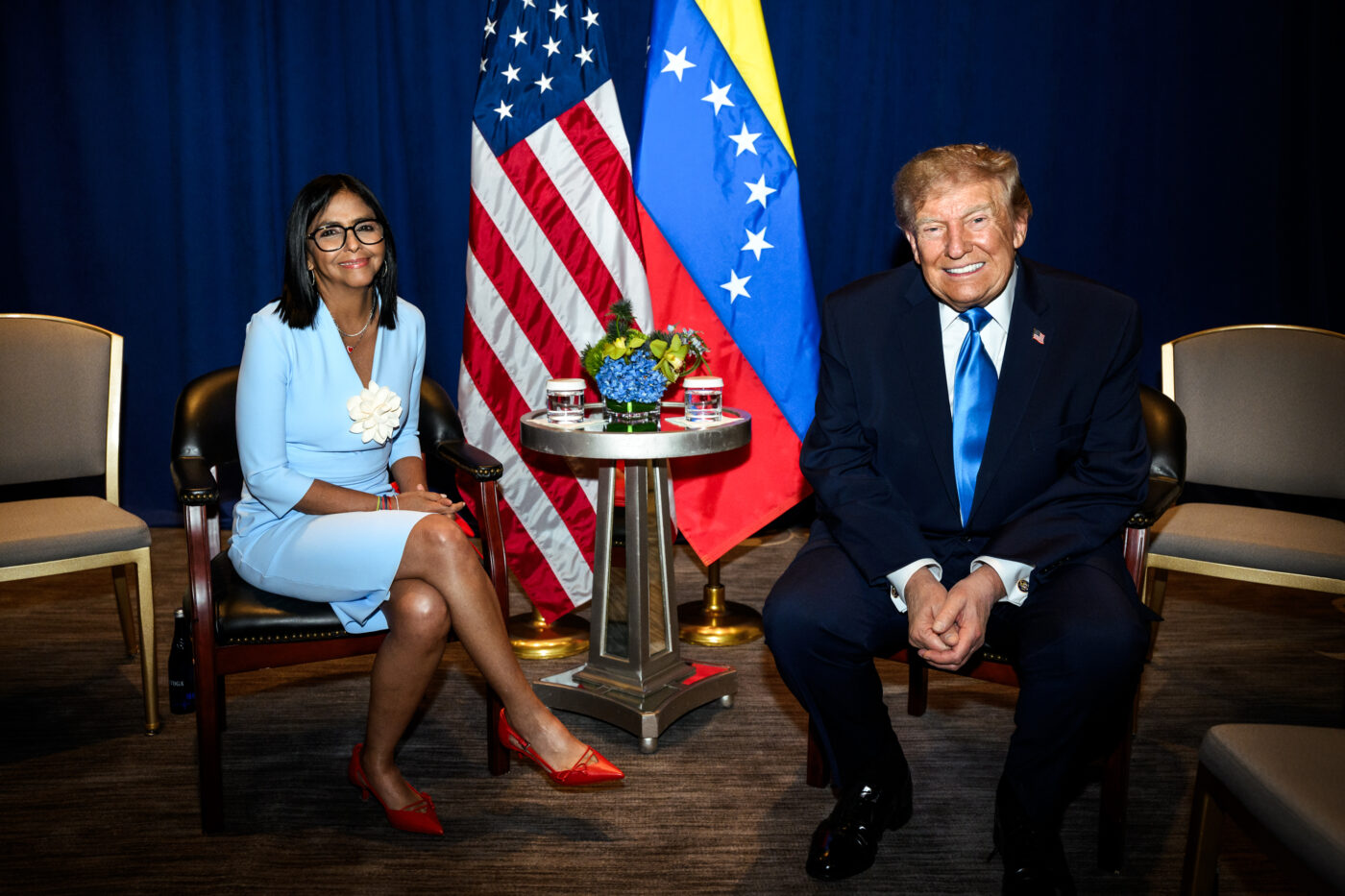
Venezuela: Trump Administration Lifts Sanctions on Acting President Rodríguez

The Venezuelan acting leader called the decision “a step for the normalization” of bilateral relations. (RTVE)

Caracas, April 2, 2026 (venezuelanalysis.com) – The US Treasury Department removed Venezuelan Acting President Delcy Rodríguez from the Office of Foreign Assets Control (OFAC) “Specially Designated Nationals” list on Wednesday, April 1.

Rodríguez had been on the list since 2018. The sanctioned individuals are barred from any sort of economic or financial relationship with US entities and have any US-based assets frozen.

The Venezuelan acting head of state reacted to the decision with a message on her X account, calling it “a step in the direction of normalizing and strengthening relations between our countries.”

Rodríguez added that she is confident this step will lead to the lifting of all sanctions currently in place against Venezuela “in order to guarantee an effective binational cooperation agenda” that benefits both Washington and Caracas. In recent weeks, the Trump administration has issued licenses allowing Western corporations to engage with the Venezuelan energy and mining sectors, but wide-reaching coercive measures remain in place.

The US government targeted Rodríguez in September 2018, Trump’s first presidential term, alleging that the then–vice president was part of a group that contributed “to the destruction of democracy.” The same round of sanctions targeted First Lady and Deputy Cilia Flores, as well as Vladimir Padrino López and Jorge Rodríguez, who respectively served as defense and communications ministers at the time.

Delcy Rodríguez denounced the 2018 measures as “illegal” and “unjust,” arguing that they were part of an “economic blockade” that undermined her country’s right to food, health, and sovereignty.

The Venezuelan leader’s sanctions removal opens the door for direct engagement with US entities and multilateral organizations such as the IMF. Creditors have likewise expressed intentions to launch renegotiation efforts surrounding Venezuela’s sizable foreign debt.

The Trump administration’s move comes on the heels of a fast-tracked rapprochement with Washington that Rodríguez has spearheaded since the January 3 attacks and kidnapping of President Nicolás Maduro. Rodríguez, who took over the acting presidency, has hosted a number of high‑ranking US officials, among them Trump Energy Secretary Chris Wright.

Similarly, last week Rodríguez took part via videoconference in a business gathering in Miami organized by Saudi Arabia’s Future Investment Initiative Institute. During her address, she touted the country’s recent pro-business reforms and urged investors to come to Venezuela.

Caracas and Washington formally reestablished diplomatic ties on March 5, with the Trump administration recognizing the acting president as Venezuela’s “sole” leader days later.

Regaining control of CITGO

The lifting of coercive measures against the Venezuelan acting president raised the possibility of the Rodríguez acting government retaking control of US-based assets that had been frozen and placed under the control of the hardline opposition. According to Reuters, Venezuelan authorities are preparing to take control of the boards of directors of the US subsidiaries of state oil company PDVSA, including refiner CITGO. However, the US State Department must also sign off on the appointments.

This past March, PDVSA’s board ratified Asdrúbal Chávez, cousin of the late Venezuelan President Hugo Chávez, as director of all its US subsidiaries. Nonetheless, Chávez, who was previously denied a US visa to run Houston-based CITGO, has been unable to manage the companies for more than seven years.

CITGO has been administered since 2019 by boards of directors appointed by a defunct Venezuelan opposition‑led National Assembly whose term expired in January 2021. The company, which is Venezuela’s most valuable foreign asset, underwent a long and protracted court-mandated auction to satisfy creditor demands which concluded with a winning bid from vulture fund Elliott Management.

The CITGO sale requires a US Treasury license in order to conclude. The Trump administration has not publicly disclosed whether it will greenlight or halt the ownership transfer.

Edited by Ricardo Vaz in Caracas.

Source link

9-year-old boy recounts airstrike in Lebanon that killed whole family | Israel attacks Lebanon

NewsFeed

9-year-old Karim Al-Haj Hussein survived an Israeli strike on his home in Lebanon’s Baalbek that killed his mother, father and other family members. Karim managed to crawl from the rubble of his home, despite being injured himself.

Source link

Rights groups, Milwaukee leaders slam ICE’s arrest of Palestinian advocate | Donald Trump News

Ten Muslim civil rights groups have issued a joint letter denouncing the arrest of a Palestinian American community leader in Wisconsin, Salah Sarsour.

The president of the Islamic Society of Milwaukee and a vocal Palestinian advocate, Sarsour was reportedly pulled over by 10 federal agents from Immigration and Customs Enforcement (ICE) while driving on March 30.

Recommended Stories

list of 3 itemsend of list

The joint letter explains that Sarsour was transferred to a detention facility in Illinois, then to Indiana, leaving his family “scrambling to determine his whereabouts”.

A lawful permanent resident, he had lived in the US for 32 years, according to the letter, and his wife and children are all US citizens. Sarsour has been in immigration detention ever since his arrest.

“We must be clear that Salah is being targeted on the basis of his Palestinian and Muslim background,” the letter, issued Thursday, said.

It was co-signed by organisations including the Council on American-Islamic Relations (CAIR), the Muslim Legal Fund of America, and the US Council of Muslim Organizations.

The groups noted that, under President Donald Trump, a number of immigrant activists, scholars and foreign students had been targeted for deportation based on their pro-Palestinian solidarity.

“His detention reflects a troubling trend we’ve seen with Mahmoud Khalil, Leqaa Kordia, Mohsen Mahdawi and other voices critical of Israeli oppression,” the groups wrote.

“This administration is weaponizing the U.S. justice system to advance the interests of a foreign state, Israel, at a time when it is carrying out a genocide in Gaza.”

The groups have launched an online campaign for Sarsour’s legal defence. By Thursday afternoon, it had earned over $35,500 in donations.

While the Trump administration has yet to issue a statement about Sarsour’s arrest, it has taken a hardline approach to pro-Palestinian activism.

When running for re-election in 2024, Trump pledged to crack down on protesters denouncing human rights abuses during Israel’s genocidal war on Gaza.

According to statements obtained by the Washington Post in May 2024, Trump reportedly called the protest movement a “radical revolution” and said that, if he were elected, he planned “to set that movement back 25 or 30 years”.

Within months of taking office in January 2025, Trump proceeded to take action.

Starting in March 2025, his administration moved to strip hundreds of millions of dollars in federal funds from universities that saw protests unfold on their campuses, citing claims of anti-Semitism.

Federal agents also arrested legal permanent residents like Mahmoud Khalil, a Palestinian student leader, stripping him of his green card.

One scholar, Rumeysa Ozturk of Turkiye, saw her student visa revoked for co-signing a pro-Palestinian opinion piece in her school’s student newspaper.

The arrests and subsequent efforts to rapidly deport the activists and scholars have prompted widespread condemnation as a violation of the Constitution’s First Amendment right to free speech and protest.

Officials in Wisconsin have been among the leaders to denounce Sarsour’s arrest as the latest in a series of efforts to stifle free speech. Two local alderpersons, JoCasta Zamarripa and Alex Bower, called the situation a “nightmare”.

“This is an illegal detention of a longtime permanent U.S. resident, as Mr Sarsour is a Milwaukeean who is lawfully present in our community,” they wrote in a joint statement on Thursday.

“The unacceptable activities by ICE — and especially illegally detaining citizens without due process — must stop immediately. How dare federal ICE agents come into our community and unlawfully detain a grandfather, a faith leader, a Wisconsinite!”

State Senator Chris Larson, meanwhile, underscored that the federal government has yet to offer any reasons publicly for Sarsour’s arrest.

“We have already seen numerous Muslim activists unfairly and unlawfully targeted by the Trump Administration for their beliefs and their speech,” Larson wrote.

“These Unconstitutional assaults on our freedoms should alarm all of us. When any individual or group is targeted by the government for their speech, all of our freedoms are threatened.”

Source link

Trump unveils 100 percent tariff on drugs to push for pharmaceutical deals | Donald Trump News

US president has said that he will use tariffs to bring down costly pharmaceutical drugs, but the impact remains uncertain.

United States President Donald Trump has signed an executive order that could slap long-threatened tariffs of up to 100 percent on some patented drugs if pharmaceutical companies don’t reach deals with his administration in the coming months.

Under Thursday’s executive order, companies that have signed a “most favoured nation” pricing deal and are actively building facilities in the US will have a zero-percent tariff.

Recommended Stories

list of 3 itemsend of list

For those that don’t have a pricing deal but are building such projects in the US, a 20 percent tariff will apply, but it will increase to 100 percent in four years.

A senior administration official told reporters on a press call that companies still have months to negotiate before the 100 percent tariffs kick in. Bigger companies will have 120 days, and 180 days are offered for everyone else.

The official, speaking on condition of anonymity to preview the executive order before it was issued, did not identify any companies or drugs that were in jeopardy of getting hit with the increased tariffs.

But the source noted the administration had already reached 17 pricing deals with major drugmakers, 13 of which have signed.

In Thursday’s executive order, Trump wrote that he deemed the tariffs necessary “to address the threatened impairment of the national security posed by imports of pharmaceuticals and pharmaceutical ingredients”.

The order arrived on the first anniversary of Trump’s so-called Liberation Day, when the president unveiled sweeping new import taxes on nearly every country in the world, sending the stock market reeling. Those “Liberation Day” tariffs were among the duties the Supreme Court overturned in February.

Critics, pharmaceutical leaders and medical groups warned of the consequences the new tariffs could bring.

Stephen J Ubl, the CEO of the pharmaceutical company trade group PhRMA, said taxes “on cutting-edge medicines will increase costs and could jeopardize billions in US investments”.

He pointed to America’s already large footprint in biopharmaceutical manufacturing and noted medicines sourced from other countries “overwhelmingly come from reliable US allies”.

Trump has launched a barrage of new import taxes on US trading partners since the start of his second term and repeatedly pledged sky-high levies on foreign-made drugs.

But the administration has also used the threat of new levies to strike deals with major companies — like Pfizer, Eli Lilly and Bristol Myers Squibb — over the last year, with promises of lower prices for new drugs.

Beyond company-specific rates, a handful of countries have reached trade frameworks with the US to further cap tariffs on drugs sent to the US.

The European Union, Japan, Korea and Switzerland will see a 15 percent US tariff on patented pharmaceuticals, matching previously agreed rates for most goods.

Meanwhile, the United Kingdom will get 10 percent, which Thursday’s order noted would “then reduce to zero” under future trade agreements.

The UK previously said it secured a zero-percent tariff rate for all British medicines exported to the US for at least three years.

Source link