Washington, DC – Democrats have the momentum; Republicans are surging in defence and cash.
That narrative has emerged ahead of the United States midterm elections in November, as races across the country enter their final stretch.
Recommended Stories
list of 3 itemsend of list
With control of the US House of Representatives and the US Senate at stake, Democrats begin October with a surprisingly rosy outlook as more congressional seats are seen as in play.
Republicans, meanwhile, appear to be in damage control, pouring millions of dollars into races once seen as secure victories while injecting more funding into a handful of marquee showdowns.
The party’s standard bearer, President Donald Trump, who has embraced the notion of the election being a referendum on his leadership, enters the final month with staggeringly low approval ratings.
The most recent Associated Press-NORC polling, released on Thursday, showed Trump with 31 percent approval, the lowest during either of his two terms. Only 26 percent of respondents approved Trump’s handling of the economy, dipping two points below his predecessor, former President Joe Biden’s lowest rating on the topic.
Surveys continue to show voters rank the economy as their top issue, with topics like gas prices, made higher by the US-Israel war with Iran, dominating their concerns. Immigration and corruption have also regularly ranked high.
“The broad stroke is that Americans are disappointed, bordering on angry that President Trump hasn’t delivered on the core promises he made when he won re-election,” according to Henry Olsen, a senior fellow at the conservative Ethics and Public Policy Center in Washington, DC.
House looking solid for Dems
Political trackers have long projected Democrats will take control of the US House of Representatives in the November 3 vote.
Winning a majority in the 435-member chamber from Republicans would give the party renewed legislative power to assert leverage over Trump, while launching investigations into his administration’s dealings. Top Democrats have already signalled that probes into Trump’s family business dealings would be top priorities.
Two election non-partisan prediction authorities, the Cook Political Report and the University of Virginia’s Sabato’s Crystal Ball, have recently assessed that the likelihood of Democrats taking the House has only increased.
The Cook Political Report recently shifted 15 House races in the direction of Democrats, moving some considered “toss-ups” to “leans Democrat” and some previously considered “lean Republican” to “toss-ups”.
One such shift was for a Texas border district represented by Republican Monica De La Cruz. Her district was emblematic of a wider Latino shift towards Trump in 2024. Once seen as holding the advantage over her challenger, Democrat Bobby Pulido, Cook now rates her race as a “toss-up”.
All told, the political analysis clearinghouse now predicts Democrats are on track to win 5 to 15 House seats.
Senate in play
With 30 days left to go, “there’s much more drama in the Senate than the House races”, according to Kyle Kondik, the managing editor at Sabato’s Crystal Ball.
Once considered a pipe dream for Democrats, who need a net gain of at least four seats to win a slim majority, the 100-member chamber has moved within a more comfortable striking distance.
Unlike in the House, where every seat is up for re-election, only 35 Senate seats are up for grabs in this cycle, creating a far narrower pathway to control.
“The trajectory of the polling since Labor Day (September 7) has generally been that a bad Republican environment is just getting worse,” Kondik said, adding that “the Senate just seems to get more and more competitive as the cycle has gone on”.
To be sure, the quality of polling can vary across the country, with Kondik cautioning that gauging the political temperature of the Midwest has been particularly challenging for pollsters.
Still, in North Carolina, former Democratic Governor Roy Cooper is expected to trounce former Republican National Committee chairman Michael Whatley in the race for a Senate seat currently held by Republicans. Top conservative donors have already begun to divert funds from the contest.
Surveys have consistently shown Democrats leading in three other races for seats currently held by Republicans: Democrat James Talarico against Republican Ken Paxton in Texas; Democratic challenger Sherrod Brown against Republican incumbent Senator John Husted in Ohio; and Democratic Mary Peltola against Republican Dan Sullivan in Alaska.
Races for Republican held seats in Iowa, between Republican Ashley Hinson and Democrat Josh Turek, and in Maine, between Republican incumbent Susan Collins and Democratic challenger Troy Jackson, remain separated by less than one point, according to Real Clear Politics polling averages.
Democrats, meanwhile, have consistently led in polling in Senate races in Georgia, New Hampshire and Michigan for seats the party currently holds.
Big money in the race
For Republicans, salvation could be in the spending, with this year’s race continuing a US phenomenon of small fortunes poured into politics.
All told, at least $4bn had been spent on gubernatorial and congressional midterm advertising buys as of September 17, putting the race on track to become “perhaps the most expensive midterm on record”, according to Michael Franz, co-director of the Wesleyan Media Project.
Republicans entered September with a considerable funding edge. The Republican National Committee had $125.6m on hand, with the Democratic National Committee trailing far behind with $16.9m and $17.6m in debt.
When accounting for the three major committees associated with both groups, the Republican Party had $233.4m in cash, according to a CNBC analysis, while the Democratic Party had $130.4m.
Trip Yang, a Democrat strategist based in New York City, told Al Jazeera such spending can be deployed to help boost a candidate’s name recognition or to tear down a competitor.
According to AdImpact, Republicans and their allies were set to spend $888m on advertising from mid-September to election day, with Democrats and their supporters set to spend $666m.
The firm found pro-Republican ad spending would be particularly pronounced in the key Senate races in Ohio, Texas and Michigan, outpacing Democratic spending by at least $24m in each state.
Trump’s unpopularity, Yang said, means “Republicans spending millions or hundreds of millions of dollars improving their candidates’ images by itself may not be enough”.
“If you’re a little bit handicapped because your president is so toxic, you try to spend your hundreds of millions of dollars attacking the Democrats to make it more of a food fight,” he said.
A New York Times analysis estimated by the end of August at least $1bn in so-called “dark money” had been poured into the midterms. The term refers to spending where the donor’s identity is shielded, typically through nonprofit and shell-company donations to Super PACs.
Industry groups, including those supporting Crypto, AI and online betting firms, are expected to be top spenders in key races, although their support tends to cut across partisan lines.
Trump, meanwhile, has pledged to spend between $400m and $500m from his MAGA Inc Super PAC, though it has so far spent about $15m to support Paxton’s Senate bid in Texas.
Pro-Paxton ad reservations far outpaced Talarico in September, according to AdImpact data analysed by NPR, with $94m spent compared with $30m to support the Democrat.
The Trump factor
Trump has pledged to spend the final days before the election in non-stop campaign mode, after urging supporters during his Republican Midterm Convention in Dallas, Texas, to “vote like I’m on the ballot”.
His plan to criss-cross the country for rallies underscores a “base turnout” strategy meant to energise voters already loyal to the party, according to conservative analyst Olsen.
“But the Republican problem is a persuasion problem with people in the middle,” Olsen said. “[Trump’s campaigning] might help with some turnout … but their real problem is persuasion, and it’s not something that’s going to help with that in the slightest.”
Polls have spelt trouble for Republicans when it comes to swaying independents, with a PBS News, NPR and Marist poll from September 23 showing unaffiliated voters breaking for Democrats at 57 percent compared with 32 moving towards Republicans.
US President Donald Trump participates in a midterm election rally for Oklahoma Republican gubernatorial candidate Mike Mazzei at the Choctaw Event Center in Durant, Oklahoma, US, October 1, 2026. [Nick Oxford/Reuters]
The scenario has created a dilemma for some top Republican candidates over whether to break from the president on his most controversial actions, according to Lee Miringoff, the director of the Marist University Institute for Public Opinion.
Senate candidates Ashley Hinson in Iowa, Jon Husted in Ohio and Mike Rogers in Michigan all recently put daylight between themselves and Trump on the war with Iran.
One Republican House candidate, Representative Maria Elvira Salazar, has criticised Trump’s aggressive immigration enforcement policies as she seeks to rally Latino voters in South Florida.
Trump, in turn, reposted a social media message calling Salazar a “backstabber”.
“You need to have, you know, something else going for you other than endorsement of Trump,” said Miringoff. “Some Republicans are starting to have self-preservation kick in because they’re concerned.”
What can change?
Achieving a wide-scale shift in public opinion remains a tall order for Republicans in the final stretch of the race.
Many of the defining issues are unlikely to change before November, with Trump signalling a possible escalation with Iran following the vote as he has downplayed the prospect of short-term affordability relief.
At the same time, the US president has also not ruled out actions that rights groups say could upend voter turnout. Most recently, he refused to commit to not invoking the Insurrection Act or declaring a state of emergency surrounding the vote during an interview with Time magazine.
Miringoff said he believed that the “potential for more than just a marginal shift is there”, as he assessed some Democratic candidates have struggled to present clear visions beyond opposition to Trump.
“The result isn’t formed in concrete,” he said, “to the degree that there’s going to be a lot of money still spent.”
Analyst Olsen saw less remaining wiggle room for the party.
“Republicans have the time and the resources to change the outcome with respect to a few close Senate races,” Olsen said. “But to change direction, they would need something that would be apocal.”
The multi-vehicle crash occurred in the Salama area, 90km southeast of Nairobi, killing mostly Catholic pilgrims.
Published On 3 Oct 20263 Oct 2026
At least 17 people, most of them Catholic pilgrims on the way to a prayer site, have been killed in a crash involving multiple vehicles on the highway to the Kenyan coastal city of Mombasa.
The crash in the Salama area, about 90 kilometres (about 55 miles) southeast of the capital Nairobi, happened after midnight, police said on Saturday.
The crash occurred when a truck driver tried and failed to overtake another truck; that caused a collision with vehicles including a van carrying pilgrims, police said.
Kenyan media reported that the pilgrims were travelling in a 14-seater minibus.
The van’s driver and 16 passengers, most of them women, died at the scene, police said.
The pilgrims were going to a prayer site in Nakuru County, west of Nairobi, said Martin Kivuva, archbishop of the Catholic Archdiocese of Mombasa.
The archbishop said in a statement that he and others were “saddened with lots of grief” over the deaths.
President William Ruto offered condolences to the families, friends, parishioners and the entire Catholic community “who are mourning this painful loss”.
Kenya’s National Transport and Safety Authority (NTSA) launched an investigation into the crash.
The NTSA said it dispatched investigators “to establish the full circumstances leading to the collision”.
But it noted that the stretch of road where the crash occurred is a known “black spot” and that “recommendations have been made to address safety concerns” regarding the route.
Road accidents are a problem across Africa. In Kenya and elsewhere in the region, the accidents are often blamed on poorly maintained vehicles, excess speed and poor road conditions.
Kenya recorded 5,009 road traffic deaths last year, while 2,150 deaths were reported in the first six months of 2026, local media reported, citing numbers from the NTSA.
For the second election in a row, Brazilian voters face a choice between left-wing candidate Luiz Inacio Lula da Silva and a right-wing candidate from the Bolsonaro family.
The country’s fractious election is set to take place during a wave of successful far-right candidates across Latin America and a sensitive time in Brazil’s modern political history.
Recommended Stories
list of 3 itemsend of list
Former right-wing President Jair Bolsonaro is serving a 27-year prison sentence over his role in a coup plot following his loss to Lula in 2022. The conviction of Jair Bolsonaro and several military officers raised questions about the resilience of Brazilian democracy, revived several decades ago following a period of rule by a United States-backed military dictatorship.
An explosive corruption scandal has implicated prominent figures and institutions across the political spectrum, and observers have expressed concern about possible US intervention.
Polls suggest Lula, the current president seeking a fourth non-consecutive term, and Bolsonaro’s eldest son, Senator Flavio Bolsonaro, are in a virtual tie in a simulated run-off.
Who are the candidates, what issues have been front and centre, and what could the election mean for Brazil? Here’s what you need to know about Brazil’s 2026 presidential elections.
When is the election?
The first round of voting in the Brazilian presidential election will take place on October 4 from 8am to 5pm Brasilia time (11:00 to 20:00 GMT).
If no candidate wins the first round outright, the top two candidates will proceed to a run-off vote on October 25.
Who is Lula?
Luiz Inacio Lula da Silva, better known simply as Lula, is the country’s current president and the candidate for the Workers’ Party, or the PT.
The 80-year-old has been a central figure in Brazilian politics for decades, serving two four-year presidential terms between 2003 and 2011, and his current term, which began in 2023.
His time in office has been defined by an effort to pair political democracy, restored after a US-backed military dictatorship that ruled the country for several decades until the 1980s, with material improvement for the country’s poor through a series of social programmes meant to address inequality.
Lula has also sought to forge ties between developing, non-Western countries on the global stage.
“He has come to embody the institutionalisation and consolidation of Brazilian democracy since the end of the dictatorship,” Andre Pagliarini, an assistant professor of history and international studies at Louisiana State University and the author of a book on Lula, told Al Jazeera in a phone call.
Who is Flavio Bolsonaro?
Flavio Bolsonaro has emerged as the heir to his father’s status as leader of Brazil’s political right and Lula’s main challenger in the 2026 election. Bolsonaro is running as the candidate of the right-wing Liberal Party.
The 45-year-old is the eldest son of former President Jair Bolsonaro.
Flavio has pledged a hard stance on crime and insecurity and close collaboration with the administration of US President Donald Trump, which has designated several criminal groups in Brazil as “terrorist organisations”.
He has also promised to rein in inflation and government spending, with an adviser stating that he would implement a debt ceiling if elected.
Flavio Bolsonaro has also sought to turn his father’s conviction into a story of political persecution, denouncing his trial as illegitimate and seeking his release from prison.
“I ask God for the opportunity to walk up the ramp of Planalto Palace next year alongside President Jair Messias Bolsonaro, so that he may place the presidential sash across my chest,” he said at a campaign event in September.
“The Bolsonaro family’s pitch is that the institutions that Brazilian democracy has erected since the end of dictatorship are either rotten and unresponsive, and that we need a sharp turn away from this status quo,” said Pagliarini.
“The stakes of this election are incredibly stark because the candidates stand for such opposing visions about what Brazil’s recent history means,” he added.
What issues have defined the race?
As with many recent elections across the region, crime, insecurity and cost of living issues have dominated the Brazilian election. Corruption and concerns about US intervention in the country’s domestic affairs have also loomed over the campaign.
A Quaest survey from September 7 found that 31 percent of respondents cited violence as their biggest concern, followed by 20 percent who said corruption, 19 percent who said the economy, and 12 percent who said health.
While Brazil has seen decent economic growth and low unemployment and inflation during Lula’s third term, those mild gains have been paired with explosive levels of household debt and concerns about the rising cost of living.
A report from the Center for Economic and Policy Research, a left-leaning US-based think tank focused on economic issues, found that extreme poverty in Brazil fell by about 40 percent between 2022 and 2024, unemployment dropped to historic lows, and the country’s economic growth significantly outpaced that of most of its neighbours. But the analysis also found that households were strained by a sharp uptick in the cost of servicing debt. All in all, analysts say they amount to a view of the economy that is neither catastrophic nor particularly satisfying.
Pagliarini says that both candidates have tried to steer the election onto more favourable terrain for their issues of choice, with Lula portraying Flavio Bolsonaro as a willing accomplice in US efforts to undermine Brazilian sovereignty, and Flavio Bolsonaro accusing Lula of being corrupt and weak on crime.
What do the polls say?
Analysts say that polls reflect the state of Brazilian politics: deeply polarised but unenthusiastic.
“The general vibe is that this is a very downbeat campaign,” said Pagliarini. “There’s not a lot of enthusiasm either way, and it’s hard to tell at this stage who that favours.”
Most surveys show a close race, with Lula holding a marginal advantage over Flavio Bolsonaro that tightens further in a hypothetical run-off.
A Quaest survey from September shows Lula with 37 percent of voter intention against Flavio Bolsonaro’s 33 percent, while an AtlasIntel survey from the same period showed Lula winning 46 percent to Flavio Bolsonaro’s 43 percent.
A Datafolha poll found Lula with 40 percent and Flavio Bolsonaro with 36 percent.
Polls also show Flavio Bolsonaro favoured over Lula on issues of inflation, combating corruption, and crime and drug trafficking, while Lula is seen more favourably on issues of poverty and inequality, foreign affairs and health.
What challenges has each campaign faced?
An explosive corruption scandal, focused on disgraced banker Daniel Vorcaro, has raised questions for both campaigns and implicated members of the country’s political and economic elite across the political spectrum.
Reports found that Flavio Bolsonaro had solicited substantial funds from Vorcaro, ostensibly to finance a documentary – The Dark Horse (or O Azarao) – about his father.
Lula’s former finance minister, Guido Mantega, has also said he helped arrange a meeting with Vorcaro, Lula and the head of Brazil’s central bank to discuss banking policy. Lula has said he told Vorcaro there would be no political interference in his bank’s case, only a “technical investigation conducted by the central bank”. The Reuters news agency confirmed the meeting.
The scandal has also embroiled the country’s Supreme Court, with Alexandre de Moraes, whose central role in Bolsonaro’s coup trial turned him into a subject of ire for the political right, facing questions about his own links to the banker.
De Moraes has in turn accused a justice appointed by Bolsonaro of wrongdoing, with the court considering probes into the conduct of both justices.
What are the concerns about US intervention?
Concerns that the Trump administration could intervene or seek to influence the outcome on behalf of Bolsonaro have also loomed over the election.
The US president has frequently threatened to cut off economic assistance to Latin American countries if his preferred candidate fails to win. Trump had also used sanctions to target members of the Brazilian judiciary involved in the case against the elder Bolsonaro, which he portrayed as a “witch-hunt”. Trump also placed heavy tariffs on Brazil in a bid to have the case thrown out.
The country’s government denied visas to two US officials who sought to travel to Brazil, saying they planned to cast doubt on the integrity of Brazilian elections. Lula’s government has warned the US against meddling in the country’s domestic affairs.
Trump has himself used false claims of rampant fraud to justify efforts to remain in office despite his election loss in 2020.
A group of 31 Democratic US Congress members recently sent a letter to US Secretary of State Marco Rubio criticising “an apparent effort to interfere with, and potentially undermine” Brazilian elections.
The Reuters reported that Brazilian intelligence officials also briefed a French and German delegation in September about possible interference in the election by outside powers such as the US and Russia. The officials said that US interference ranged “from lawfare to interference that is openly acknowledged”.
The American Israel Public Affairs Committee (AIPAC) is set to spend $233 million to defeat candidates in this fall’s congressional midterm elections who speak out against the government of Israeli Prime Minister Benjamin Netanyahu, warned US Senator Bernie Sanders, Anadolu reports.
The top pro-Israel lobbying firm in the US “plans to spend $233 million to defeat candidates who dare to speak out against Netanyahu’s extremist government,” Sanders said on US social media platform X on Friday.
“They spent $33 million to defeat Abdul El-Sayed in the Michigan primary. They lost. They are going to keep losing,” he said.
El-Sayed, the Democratic candidate in this year’s senatorial race in the state of Michigan, strongly opposes unconditional US military aid for Israel and has criticized the Netanyahu government’s policies in both Gaza and the occupied West Bank.
Sanders added: “NO MORE U.S. MILITARY AID FOR ISRAEL.”
In the Nov. 3 US congressional midterms, polls show Democrats broadly favored to win the House of Representatives and possibly the Senate.
As the US electorate’s view of Israel has soured, especially in light of the genocide in Gaza, many Democrats running for office this year have taken a harder line against the policies of the Netanyahu government and what many see as its efforts to displace Palestinians and frustrate any hope for peace in the Middle East.
After the Pivdennyi Bridge was attacked, passengers described how dust from a blast wave entered their carriage through the ventilation system.
Ukrainian President Volodymyr Zelensky said Putin had decided that there were “no rules now” when attacking Ukraine.
In an interview with the Financial Times, he said: “The Russians have failed to occupy us. So now they are carrying out massive attacks and mass killings.”
He added: “They want to destroy our bridges… our data centres, the internet, mobile networks, hospitals, kindergartens, schools, universities – everything. They want people to flee their cities.”
Putin on Thursday insisted that Russia’s attacks on Ukrainian economic targets were a direct response to Ukraine’s strikes on Russia’s oil refineries and its ships in the Black Sea.
“Now from every direction we’re receiving calls ‘let’s stop’. But they started it,” Putin said after a wide-ranging speech at the Valdai foreign policy forum.
The Kremlin leader admitted Kyiv had “got some results” from its refinery attacks and Russia had lost about 1% of its GDP. Ukraine maintains it began attacking Russian oil infrastructure because it helps the Kremlin finance the war.
Russia has targeted Ukrainian energy infrastructure, ramping up attacks every winter since Putin launched a full-scale invasion in February 2022.
The rebels are seen leaving the capital of the northern Tigray region, according to local sources.
Ethiopia’s federal army and pro-government fighters have recaptured the main airport in the capital of the northern Tigray region, with the rebels seen leaving the city, according to multiple unnamed sources.
The Ethiopian National Defence Forces regained control of Alula Aba Nega Airport in Mekelle, one source with knowledge of events in the city and a humanitarian source told Reuters news agency on Saturday.
Recommended Stories
list of 3 itemsend of list
The airport, which is about 10km (6 miles) from the centre of Mekelle, was one of three airfields in the region that were seized by the rebel forces at the start of the fighting on September 23.
The fighters, as well as the leaders of the Tigray People’s Liberation Front (TPLF), were seen retreating from the city, a local journalist and residents told the AFP news agency.
The journalist added that federal forces had not yet been seen inside Mekelle.
“I am concerned that government and public property could be exposed to looting because there are no security forces in the city,” a resident told AFP.
“I am worried that lawlessness could spread in the city, and I am also afraid for my life. I want us to quickly return to law and order,” added another resident.
Al Jazeera could not independently confirm these claims. Media access is currently heavily restricted in Ethiopia, and there have been significant communications blackouts.
Last month, rebels announced the formation of a seven-party rebel coalition led by the TPLF, the same armed group that fought in the 2020-2022 civil war against federal forces from Addis Ababa. The new coalition includes rebel groups of varying sizes from across the country.
Later that month, the coalition started an offensive, seizing three airports around the contested Tigray state and engaging in fighting on the borders with Amhara and Afar states.
The government is now engaged in a counteroffensive, pushing into Tigrayan territory along three axes towards Mekelle, according to the Critical Threats Project, part of the American Enterprise Institute think tank.
Fighting has so far been concentrated in Tigray. However, rebels have reportedly carried out drone attacks on Addis Ababa.
The TPLF and government have not commented on developments on the ground.
The fighting has seen drone attacks, intensified forced conscription, and attacks on civilian infrastructure, according to Amnesty International, a global rights group.
The renewed conflict has not yet reached the heights of the Tigray war, which lasted from 2020 to 2022 and saw hundreds of thousands of deaths, but it is quickly taking on an international dimension.
Risk of conflict spreading
The government of Prime Minister Abiy Ahmed has accused Eritrea, Sudan and Egypt of backing the opposition coalition. Khartoum and Cairo have denied involvement.
Eritrea has severed diplomatic ties with Ethiopia over the accusations.
On Thursday, Eritrea also denied involvement in the Tigray conflict, and accused Addis Ababa of “pursuing an agenda of incessant hostility”. It also said Ethiopia, which is landlocked, was planning to invade Eritrea to secure sovereign access to the Red Sea coast.
The TPLF’s leader, Debretsion Gebremichael, said in a video published on Thursday that “the war is regional and it is a war to control the Red Sea”.
Germany is moving ahead with plans to give its unusually large F125 frigates a medium-range air-defense capability, helping address one of the most conspicuous weaknesses of a four-ship class that has long attracted attention for having relatively little combat power for its size.
Diehl Defense and Germany’s Federal Office of Bundeswehr Equipment, Information Technology and In-Service Support (BAAINBw) have signed a contract to adapt and develop the IRIS-T SLM surface-to-air missile system for operational use aboard the German Navy’s F125 frigates. Under the agreement, Diehl will build prototypes and conduct comprehensive test firings intended to validate the system’s integration and performance within the existing F125 architecture. Each frigate will be fitted with two new launchers, each capable of holding 16 missiles, for a total of 32.
A rendering showing the location of the 32-cell IRIS-T SLM launchers on an F125 frigate. Diehl Defense
“The aim is to make the system mission-capable on the German Navy’s F125 frigates,” Diehl said in today’s announcement. The company described the prototype construction and test-firing phase as necessary to ensure “the seamless integration and maximum performance” of IRIS-T SLM within the frigate’s existing architecture.
The program has moved notably quickly, reflecting the urgency of the requirement.
Germany began examining the feasibility of integrating IRIS-T SLM with the F125 in 2024, with BAAINBw and Diehl studying the technical risks and requirements of adapting the normally land-based system for shipboard use. That effort led to the development of a navalized demonstrator in 2025. In October of that year, the F125 frigate Baden-Württemberg took part in a German Navy Maritime Firing Exercise off Andøya, Norway, carrying an experimental anti-air warfare module based on IRIS-T SLM. Diehl says the module went from concept to firing in less than 10 months and met all established test and evaluation objectives.
The IRIS-T SLM launcher on the frigate Baden-Württemberg. Bundeswehr
The Bundeswehr subsequently reported that Baden-Württemberg fired three live IRIS-T SLM missiles during the exercise. The ship’s radar supplied target data to the missile system, demonstrating the basic integration between the F125’s sensors and the navalized air defense architecture.
The exercise established that the concept could work at sea; the contract signed now is intended to turn that demonstration into a qualified fleet capability.
A night-time test of the IRIS-T SLM air defense missile system during the Maritime Firing Exercise 2025 in Andøya. Diehl Defense
The German parliament’s Budget Committee approved the adaptation effort on September 23, with the German Defense Ministry describing it as a means of expanding the F125’s self-defense capabilities in response to the current air threat. The ministry also pointed to IRIS-T SLM’s combat experience in Ukraine.
The effort needs to be seen in the context of why the F125 has been such a controversial warship in the first place.
As TWZexamined in 2017, the F125 is a roughly 7,200-ton, 490-foot warship with an unusually small core crew and a concept of operations centered on long-duration deployments, stabilization missions, crisis management, conflict prevention, and international intervention rather than high-end fleet combat. The class was designed to spend long periods away from Germany and operate with relatively modest manpower requirements.
German Navy frigate Baden-Württemberg sails in formation off the coast of Hawaii during Exercise Rim of the Pacific (RIMPAC) 2024. U.S. Navy photo by Mass Communication Specialist 1st Class John Bellino
But its armament does not remotely match the size and sophistication of the hull. A completed, the ships were equipped with eight RGM-84 Harpoon anti-ship missiles, a 127mm gun, remotely operated guns and, for close-quarters air defense, two RIM-116 Rolling Airframe Missile launchers. The F125 has no medium- or long-range surface-to-air missile capability and no organic sonar or dedicated anti-submarine warfare weapon system.
At the same time, the TRS-4D/NR radar and other sensors can see far beyond the engagement envelope of the close-in air-defense weapons, but there is little the ship itself can do with that information against an aircraft or incoming missile at medium range.
Nearly a decade later, IRIS-T SLM is emerging as an answer to at least part of that problem.
Even with IRIS-T SLM, the F125 is well short of being an air warfare destroyer. It also still lacks an organic anti-submarine warfare capability or the kind of large vertical-launch missile battery found on Germany’s F124 frigates.
However, it does fill a gap between the F125’s originl short-range defenses and the capabilities of other ships or aircraft operating around it.
IRIS-T SLM is designed as a medium-range surface-to-air system, with an engagement range of around 25 miles and an altitude envelope of approximately 65,000 feet. As shown in the 2025 demonstration, the F125’s radar can feed information directly into the missile system, exploiting the ship’s existing sensor capabilities.
IRIS-T SLM (Medium Range Ground-Based Air Defence)
Rather than rely heavily on escorts for protection against airborne threats outside the short range of RAM, an IRIS-T-equipped F125 could at least contribute to its own medium-range air defense. Recent operations in the Middle East hve underscored the importance of this in contested maritime environments.
It also gives the ships a more useful role in a task group. The threat environment has changed substantially since the F125’s original concept was drafted. Cruise missiles, drones, loitering munitions, and increasingly sophisticated aircraft mean that even ships operating away from a major naval war can face threats well beyond the range of their existing close-in defenses.
German Navy frigate Baden-Württemberg. U.S. Navy
In November 2024, Germany confirmed that the F125 frigate Baden-Württemberg, returning from an Indo-Pacific deployment, would avoid the Red Sea and sail around Africa because of the Houthi missile and drone threat. The German Defense Ministry explicitly cited the ship’s limited air defense capability and its inability to provide an effective air-defense umbrella for itself or its accompanying replenishment ship.
Ironically, the F125’s large hull, extensive electrical power, sophisticated radar, substantial aviation facilities, long endurance and relatively spacious mission areas were always supposed to provide room for a flexible approach to future missions. Yet the class’s original weight and integration constraints made adding major weapons difficult, a concern TWZ also highlighted in 2017.
IRIS-T SLM offers Germany a way to add a meaningful capability without undertaking the much more invasive redesign associated with installing a conventional vertical-launch system. The 2025 demonstration used an AAW module mounted on the ship’s deck rather than a conventional VLS installation, and today’s program is focused on adapting the system to the F125 architecture.
Once IRIS-T SLM is installed, the F125 will still be an unusual frigate. It is enormous by the standards of its mission, optimized for endurance, and lacks some of the weapons traditionally associated with a high-end surface combatant. But it will bring more to a contested fight.
The program should give the class a credible medium-range air-defense role, and provide Germany with a way to get considerably more utility out of four ships whose original design philosophy was always somewhat controversial.
A Flydubai co-pilot accused of attacking the captain of a flight bound for Israel has been identified as an Omani national previously barred from flying in his home country over concerns about alleged extremist views, according to media reports.
There has been no official confirmation of the pilot’s identity or his beliefs.
Recommended Stories
list of 3 itemsend of list
The United Arab Emirates on Saturday described Wednesday’s incident on board Flight FZ1073 as an attempted “terrorist operation”, saying the co-pilot attacked Captain Smit Machchhar, an Indian national, with an emergency axe and attempted to take control of the aircraft.
But investigators are still working to establish the motive and whether anyone else was connected to the attack, which has raised concerns about pilot vetting and aviation security.
Here is what we know:
What do we know about the accused pilot?
The co-pilot suspected of attacking the captain of the Dubai-Tel Aviv flight carrying 174 people has been identified as Hamam al-Hammami, an Omani national, three people with knowledge of the situation, including a Gulf diplomat and a Western diplomat, told AP news agency.
All spoke on condition of anonymity because they were not authorised to speak to the media. The Gulf diplomat said investigations are under way to establish whether he acted as a “lone wolf or had any connection with any extremist groups”.
US media outlet CNN, quoting a source and an Israeli official, reported that al-Hammami is an Omani citizen who was born in the UAE to a Syrian mother and spent several years in the Emirates.
Questions have emerged about his previous aviation career and whether warning signs had been raised before he joined the Dubai-based low-cost carrier.
The Wall Street Journal, quoting unnamed sources, reported on Friday that Omani authorities had previously barred the accused co-pilot from flying in the country because of concerns that he had held extremist views.
Nevertheless, it remains unclear what those alleged views were or whether Oman informed other countries or airlines about its concerns.
CNN separately quoted a regional diplomatic source as saying that al-Hammami had been removed from flight training over similar concerns and was subsequently reassigned to another position.
The US-based network also reported that a LinkedIn profile bearing al-Hammami’s name said he had spent seven years at Oman Air before leaving in February 2025. The profile said he joined Royal Air Maroc in June 2025 and left in January 2026.
What happened on flight FZ1073?
At 7:05am (03:05 GMT) on Wednesday, Flight FZ1073 departed Dubai for Tel Aviv, climbing to 34,000ft (more than 10,000 metres), according to Flightradar24. A little more than two hours later, it suddenly began to descend, plunging before rising and then descending again.
Flight-tracking data showed the plane plunging more than 17,000 feet in about two minutes, before climbing and descending again.
Meanwhile, a fight had begun in the cockpit between the two pilots. The co-pilot had attacked the Indian captain of the plane, Smit Machchhar, by stabbing him.
Machchhar later described finding himself seriously wounded on the cockpit floor as the aircraft descended.
“When I was down, I could feel that the aircraft was plummeting, and I knew this is the last chance to do something,” he told Indian Prime Minister Narendra Modi from a hospital in Abu Dhabi.
“I knew that the aircraft was going down … I had fallen to the ground. I told myself that the door is right there, just open it. I managed to do it and people entered,” he said.
Passengers and crew members entered the cabin and overpowered the co-pilot. The aircraft eventually levelled out at about 15,000 feet. Its transponder was subsequently switched to code 7500, signalling unlawful interference.
Two reserve pilots who were on board took control of the jet and landed it in Tabuk, northwestern Saudi Arabia. The plane landed safely at 9:45am (06:45 GMT) local time. Saudi authorities said both pilots were taken to hospital. They were later transferred to Abu Dhabi after being medically cleared.
What has the UAE said about the attack?
UAE Attorney General Hamad Saif al-Shamsi said on Saturday that investigators had determined that the co-pilot had begun carrying out what he described as a “terrorist act”.
According to al-Shamsi, the co-pilot attacked the captain inside the cockpit using the aircraft’s emergency crash axe and “attempted to take control of the aircraft’s controls”.
A crash axe is a tool kept in a cockpit to help pilots cut through the plane in emergencies.
On Thursday, al-Shamsi had ordered investigators to determine whether the incident was connected to “terrorist activity or intent” or involved prior planning or direction.
The UAE has not yet publicly established a motive or announced whether investigators believe al-Hammami acted alone.
UAE presidential adviser Anwar Gargash on Saturday said that the latest ‘terrorist’ attack is new warning that region’s fight against extremism is not over.
“This underscores the importance of the UAE’s early and firm stance: no tolerance for extremism and no leniency towards its rhetoric. Security begins with confronting hatred and drying up the sources of extremism,” he posted on X
What is the latest in the investigation?
Abu Dhabi is now leading the investigation, with prosecutors examining the circumstances of the attack, its motive and any possible connections to others.
Previously, al-Shamsi said UAE judicial authorities have jurisdiction over the incident because the aircraft is registered in the UAE and flies under its flag, adding that UAE law applies to crimes committed on board “even if they occur outside the country’s territory”.
On Saturday, al-Shamsi said investigators are working “to uncover all the circumstances of the incident, its motives, and related connections, in addition to completing technical examinations and examining physical and digital evidence”.
The final results will be announced as soon as the necessary procedures are completed, he said.
Meanwhile, Flydubai flights to Israel remain suspended amid the investigations.
The Group of Seven countries has agreed to release 100 billion barrels of crude oil and diesel from emergency reserves over several months in an effort to reduce soaring energy prices after pressure from US President Donald Trump.
The US and Israel’s war on Iran, as well as Russia’s war on Ukraine, have triggered a spike in global oil and diesel prices.
Recommended Stories
list of 3 itemsend of list
Oil prices jumped on Thursday and settled up more than $4 a barrel. Global diesel prices also hit a record high last Friday with the average price for a gallon (3.79 litres) of diesel at $6.50, up from $5.61 a month earlier, according to the American Automobile Association (AAA).
In a statement on Thursday, G7, which includes the US, UK, Canada, Japan, Germany, Italy and France, with the EU also represented, said there will also be a “substantial diesel release within the first 20 days” and discussions over “additional diesel releases as necessary” will be held in the coming days.
Will the G7’s energy release stabilise the global energy market?
Here’s what we know:
What has the G7 announced?
After a video conference of G7 leaders chaired by French President Emmanuel Macron on Friday, the group said in a joint statement: “Taking into account commitments that have already been fulfilled, we will implement our commitments with a coordinated release through the IEA of 100 million barrels.”
Earlier this week, the International Energy Agency’s (IEA) Executive Director Fatih Birol said that members had released about two-thirds of the 400-million-barrel agreement.
The G7 energy release will begin immediately and last for four months and will include a substantial diesel release for 20 days. It is not clear how many oil and diesel stocks each member of the group will release.
“We will convene in the context of the IEA in the coming days to discuss the possibility of additional diesel releases as necessary,” the statement said.
“We will coordinate maintenance schedules across G7 refineries to prevent simultaneous capacity shutdowns and temporarily increase utilization rates where feasible,” it added.
The G7 also urged member countries to refrain from imposing export restrictions on energy products among themselves.
Earlier this week, the Trump administration had threatened to impose a ban on US diesel exports and also pressured Europe to release its emergency diesel stocks to help ease soaring diesel prices.
Why are oil and diesel prices so high?
Global energy prices have been soaring due to the US and Israel’s war on Iran, which has disrupted energy exports from the Gulf. Meanwhile, the Ukraine attacks on Russian energy installations have also disrupted global energy supplies.
Former head of the International Energy Agency’s Oil Industry and Markets Division Neil Atkinson told Al Jazeera that there are three key factors contributing to the decline in global diesel supply.
First, “there isn’t diesel coming out of the Middle East to Europe, and Europe took quite a lot of diesel from Saudi Arabia and from Kuwait.”
Second, “Russia has now ceased to export diesel at all” due to “the attacks by Ukraine on Russian refineries”.
“And China is no longer exporting diesel,” he added.
“We’re in a situation where demand remains relatively high and is likely to stay high because of the agricultural harvesting season.”
According to data from the Joint Organizations Data Initiative (JODI) and the Organization of Petroleum Exporting Countries (OPEC), the United States is the world’s largest producer and exporter of diesel. It produces around 240.5 million tons and exports around 1.26 million barrels of diesel per day.
Russia is the world’s second-largest exporter of diesel, supplying 783.4 thousand barrels per day to the global market. Saudi Arabia is the world’s second-largest producer of diesel at 58.4 million tons, but it consumes large portion of its diesel domestically.
Will the G7 energy release bring prices down?
After the G7 announcement, French President Macron, who had co-chaired the meeting, said the group’s move to release the oil will “bring down the prices of petroleum products, particularly diesel.”
The price of Brent crude oil, the international benchmark, briefly dropped below $100 a barrel after the G7 announcement, but rose to around $102 in the evening.
Naeem Aslam, Chief investment Officer at Zaye Capital Markets, told Al Jazeera that the G7 energy release was “very much needed”, but the group’s announcement was just to ease off the pressure on the energy market.
“The actual structure changes about who is going to release [the energy stocks] and what and where the bans will be lifted, remains an important component in terms of the market,” he said.
Aslam added that by Sunday night especially before the markets open, the added pressure on energy prices will come off. “But going into Monday morning…we could potentially see the reversal in the market,” he added.
Atkinson, the energy expert, said the G7’s fuel release is welcome but “doesn’t deal with the fundamental problem that the global supply remains lower than normal”.
Atkinson told Al Jazeera that “seven months after this war started in the Middle East, we are still in a situation where the global supply of crude oil or products remains significantly below pre-war levels.”
“We are now in a situation where the focus is on end use of products, mainly diesel, which is what we’re talking about here,” he added.
What has Trump said?
Soaring diesel prices have been a source of tension for the Trump administration and Republicans who fear this will cost them votes in the upcoming November midterm elections.
Last week, Trump pressured Ukraine to stop attacking Russian diesel facilities amid the war.
Then, on Thursday this week, the US president told reporters that his administration “may” ask European countries to release diesel stocks, shortly after Treasury Secretary Scott Bessent urged Europe to “immediately” tap its reserves.
Trump also threatened to impose a ban on US diesel exports if Europe did not release emergency diesel stocks.
But on Friday, Trump told reporters at the White House that Washington would not impose a diesel export ban. He said the plan was never really on the table.
“Europe has a lot of diesel, and they’re going to be making a major world contribution, and so are we. And we’re not going to be doing the export ban. We’re going to be doing what we’re supposed to do,” Trump said.
“Trump is scared by diesel prices above $6, which is a price jump of 70 percent compared to before he started the war. This is likely to get worse with US diesel inventories at their lowest seasonal level since records began in 1982. So if there is not enough diesel being produced because of the US-Israeli war on Iran, and diesel reserves have been used up, the only way to bring more diesel to the US market is by exporting less,” Frederic Schneider, a nonresident senior fellow at the Middle East Council on Global Affairs, told Al Jazeera on Friday.
After the G7 announcement, Trump wrote on his Truth Social platform: “Europe has just agreed to release a massive amount of their heavily stocked Diesel Oil. The process will begin immediately.”
The White House is also reportedly preparing an executive order to tackle record-high US diesel prices that could be unveiled as early as next week, two people familiar with the process told the Reuters news agency.
Schneider noted that countries are also concerned about high energy prices since diesel and gasoline are important for economies and fulfil different roles.
“While gasoline fuels cars, diesel fuels anything from trucks, freight trains, ships, tractors, harvesters, construction machinery, mining equipment and backup generators. This means gasoline is used more by consumers while diesel is mostly used by producers, meaning a diesel price shock spreads into the price of almost everything else, most prominently food, building materials and anything delivered by truck,” he added.
Farmers are hit twice because diesel prices are rising at the same time as fertiliser prices, both of which have been pushed up by the closure of the Strait of Hormuz.
“A higher diesel price therefore acts like a tax on production and logistics, while higher gasoline prices act like a tax on consumers directly. Like higher gasoline prices, higher diesel prices risk stagflation by pushing up inflation while simultaneously squeezing margins in transport and agriculture, meaning central banks find [themselves] in a dilemma between cutting rates [helping producers] and raising rates [cutting inflation],” he said.
Government forces close a key crossing connecting Houthi-held al-Houban to government-held Taiz city.
Published On 3 Oct 20263 Oct 2026
Yemen’s internationally recognised government forces have carried out nearly 500 military operations, killing or wounding 1,540 Houthi rebels in the past 24 hours, according to the army.
Warplanes, drones, artillery, missiles and rocket launchers were used to target Houthi positions in various parts of Yemen, military spokesman Colonel Majed Abdullah al-Nazili said on Friday evening.
Recommended Stories
list of 3 itemsend of list
Most of the casualties came in the governorate of Taiz where the operations halted the Houthi advance, al-Nazili said. The government-held city of Taiz has become a focal point of the renewed fighting.
The army spokesman did not mention any casualties among government forces.
Key border crossing closed
On Saturday, the army’s media official Ammar al-Sami’i told Al Jazeera that the government had closed the al-Houban crossing in Taiz.
The crossing had previously been closed for nine years and was later reopened to civilians in 2024 for “humanitarian reasons”, Sami’i said, as the road is one of Yemen’s most important connections between territory held by the opposing sides. It connects Houthi-held al-Houban to government-held Taiz city.
Sami’i said security reasons are behind the closure, following an attempt by the Houthis to infiltrate Taiz via the road, attacks in the vicinity and a general military buildup.
A fragile truce struck between the government and the Houthis in 2022 collapsed in July this year, and fighting in Yemen has escalated significantly since then.
In mid-September, the Houthis swept across parts of western Yemen, seizing the port city of Mocha and key strategic islands in the Bab al-Mandeb strait.
Since then, anti-Houthi forces have largely stabilised the front lines.
Yemen has been embroiled in civil war since the Houthis seized the capital of Sanaa in 2014, forcing the internationally recognised government to retreat to Aden.
Latvia is not expected to shift its pro-Europe and pro-Ukraine trajectory, but coalition negotiations could be complex.
Published On 3 Oct 20263 Oct 2026
Polls have opened in Latvia for an election taking place against the backdrop of perceived security threats from Russia and a nationwide cost-of-living squeeze.
Saturday’s vote is the first electoral test for Prime Minister Andris Kulbergs after coming to power in May this year when his predecessor resigned due to a backlash from stray drone incursions from Ukraine.
Recommended Stories
list of 3 itemsend of list
Kulbergs, whose right-wing United List party is currently polling at about 20 percent, is expected to hold onto his position, but the decline of two allies in his current coalition means he is set for a complicated negotiation over the makeup of any future government.
Polls opened at 05:00 GMT and will close at 17:00 GMT. The results are not expected to change Latvia’s pro-European and pro-Ukrainian course.
A woman holds an election campaign leaflet of the Latvia First party with a picture of the party’s leader, Ainars Slesers, before the general election [File: Ints Kalnins/Reuters]
About 1.5 million people are eligible to vote in the country’s 11th parliamentary election since independence from the Soviet Union in 1991.
Latvian politics are highly fragmented, with parties rarely seeing above 20 percent vote share and coalitions being the norm.
This year, 14 electoral lists are contesting the election, but polls indicate only seven are likely to enter parliament, with the rest expected to fail to meet the minimum 5 percent vote threshold.
Rising living costs, low wages, strains on the healthcare system and long-term population decline have all featured prominently in campaign debates.
Fragmented political parties
Most parties in Latvia are pro-Ukraine; however, the populist Sovereign Power party – which says it wants Ukraine to win but argues money spent supporting Kyiv would be better spent at home – looks likely to become the country’s second-biggest party, with more than 9 percent of the vote. Most other parties have ruled out forming a coalition with Sovereign Power.
Latvia First, a pro-Ukraine and populist nationalist party currently polling at about 9 percent, could be a potential coalition partner for PM Kulbergs.
The Progressives, a pro-European social democratic party, are polling at 6 percent.
Ethnic Russians make up roughly one in four Latvian citizens, but their vote, which has traditionally been cast along identity-based lines, looks set to be made according to economic and social issues.
Latvia is the poorest of the Baltic states, and it has sharply increased its defence spending since Russia invaded Ukraine, now allocating nearly 5 percent of its gross domestic product (GDP) to defence.
Portadown, Northern Ireland – When the summer holidays arrived, Chris Nelson worried about his mother.
At night, he lay awake waiting for her to return. During the day, he rang family members to ask if she was safe. There were threats and letters through the door.
Recommended Stories
list of 4 itemsend of list
“I was afraid to leave the house,” he told Al Jazeera.
His mother, Rosemary Nelson, was a lawyer representing the Catholic residents opposing the Protestant Orange Order parade along Portadown’s Garvaghy Road in Northern Ireland in the late 1990s.
Every July, as marching season approached, there was a standoff.
Orangemen sought to return from Drumcree church along what they regarded as their traditional route. Residents opposed the passage of the anti-Catholic organisation through a majority Catholic street. In some years, police forced the parade through. In later years, it was blocked.
Rosemary would spend summer evenings alongside the residents on Garvaghy Road. Before leaving home each evening, she told her son that she was going to look after families and make sure their children were okay. She compared them to his friends at primary school.
“She was a big believer in helping the underdog,” said Chris, now 39. “She did a lot of work for free.”
His mother helped people from both sides of the community. When work allowed, the family went to Bundoran, across the border, and for a day the fear would pass.
But one night, during a standoff in 1997 when the state police force, the Royal Ulster Constabulary (RUC), used batons to clear Catholic locals from the road, “she was beaten by the police”, said Chris. “She was spat on”, bruised and bloodied.
“That was very traumatic. I was always thinking something was going to happen to my mum.”
On a Monday in March 1999, nearly a year after the Good Friday Agreement brought an end to the conflict, Rosemary drove away from her home in Lurgan.
As she braked at a nearby junction, a bomb beneath her car exploded. Her eight-year-old daughter, Sarah, was at primary school nearby and heard the blast. The family had spent the previous weekend in Bundoran together.
Chris, 11 at the time, and his older brother were away on a school ski trip when they received a phone call with the news of her death.
“That was hard”, he said, his voice tailing off.
A legacy of loss
Nearly three decades later, another standoff has recast these childhood memories into fears for the next generation, with a renewed attempt by the Protestant Orange Order to march through the Catholic neighbourhood, threatening to unravel a fragile peace.
The Troubles began in the late 1960s as protests by Catholics against discrimination were met by repression and violence. Republican paramilitaries fought for a united Ireland as loyalists and the army battled to preserve British rule, in a conflict that killed more than 3,500 people.
The 1998 Good Friday Agreement established a framework for peace and power-sharing.
Under the agreement, the people of Portadown have lived in relative peace for the past 28 years.
But this was suddenly unsettled by a last-minute decision by the High Court to allow the march. In response, Catholic residents blocked the road. Many camped out as Orange men gathered at the top of the road, awaiting police permission to pass – an image of division that never truly left.
Portadown Orangemen march from Drumcree Church to start their march towards Garvaghy Road, which was stopped a short distance later by police, in Portadown, Northern Ireland on September 27, 2026 [AFP]
Many of the Garvaghy Road residents are now parents, and fear what their children might inherit from a dispute they hoped had been left behind.
Paul O’Connor, of the Pat Finucane Centre human rights group in Northern Ireland, said Rosemary Nelson is among 21 people whose deaths were linked to the Drumcree dispute.
Many are still being investigated, with families continuing to seek justice and pressing for public inquiries amid concerns about collusion between the British state and loyalist paramilitaries, many of which were members of the Orange Order.
“These murders encompass LVF (Loyal Volunteer Force) killings at that time, and are all linked to the Drumcree disputes. They were responsible for many of the killings around the Mid Ulster area at that time. They were trying to destabilise the peace process, with many riots spreading around, including into Derry,” O’Connor told Al Jazeera.
He worked with Rosemary Nelson and is now seeking a public inquiry into the murder of Sean Brown, another Drumcree-linked case, he believes. The 61-year-old father of six from Bellaghy, County Derry, was abducted and murdered in May 1997.
The following year, the three Quinn brothers – Richard, 10, Mark, nine, and Jason, eight – died after loyalists petrol-bombed their home in Ballymoney, County Antrim, as they slept. Their deaths, during the unrest surrounding Drumcree, brought widespread calls for the Orange Order to end its standoff.
Protesters block the Garvaghy Road in Portadown, Northern Ireland on September 27, 2026, preventing a parade of marchers from the Orange Order using the route through the mainly nationalist area of the town [AFP]
Fear and loathing in Mid Ulster
In Portadown town centre, a Union flag flies among plinths dedicated to the Ulster Defence Regiment, a locally recruited unit of the British army and the Ulster Covenant – a document signed when nearly 500,000 people opposed a form of self-government for Ireland in 1912.
Around the corner, in the Edgarstown housing estate, Ulster Volunteer Force (UVF) flags hang from lampposts, and the kerbs are painted red, white and blue, alongside a mural of a Rangers FC badge.
The area is one of the heartlands of unionism. The Orange Order was founded in 1795 in the village of Loughgall, a few miles from Drumcree.
The Orangemen say they have marched the route through Garvaghy Road since 1807. The parade has been blocked from Garvaghy Road since 1998, but the Orangemen have continued submitting requests to march.
The latest Parades Commission decision permitted 35 men to walk without music. Since then, Orangemen have repeatedly approached the police line before returning to the church.
UVF flags fly alongside UK flags in the Edgarstown estate, Portadown, Northern Ireland, on October 1, 2026 [Caolán Magee]
Irish nationalists have criticised the police assessment underpinning the decision to allow the march, while unionists have denounced police for failing to forcibly remove protesters blocking the route.
Al Jazeera contacted the three main unionist parties – the Democratic Unionist Party (DUP), the Traditional Unionist Voice (TUV) and the Ulster Unionist Party (UUP) – for comment but received no response.
Addressing around 200 supporters in Portadown, loyalist activist Jamie Bryson described protesters as “an unlawful snarling mob”.
He has called for the First Minister, Sinn Fein’s Michelle O’Neill, and police Chief Constable Jon Boutcher to resign, and demands that the Orange men must be allowed to walk the Garvaghy Road.
O’Neill has faced criticism for standing beside the protesters.
At Drumcree Church, the Orangemen were not marching, but sitting down drinking tea and eating crisps. Around six men, one wearing his sash, huddled under a gazebo in the cold.
“We are waiting patiently for the chief constable to apply the law of the land,” Nigel Dawson, the Portadown Orange Order district master, told Al Jazeera.
“Portadown District has never in its history stopped a parade down the road to have a confrontation with its neighbours, ever. So I don’t know where the fear and trepidation comes from.”
Another Orangeman, who requested anonymity, added: “We are determined to get home after Sunday service … We just want to go home.”
Orange Order members sit outside Drumcree church as they await passage along Garvaghy Road in Portadown, Northern Ireland, on October 1, 2026 [Caolán Magee]
Around a mile further down the Garvaghy Road, Irish folk band the Mary Wallopers performed to hundreds of residents and supporters.
Children danced and slid down the embankment, as parents watched from above. Palestine and Ireland flags flew in the wind.
Linda O’Neill, 51, a Garvaghy Road resident, told Al Jazeera the scene would have been unimaginable 30 years ago.
“It was horrendous growing up as a teenager. We stayed in our own community. We didn’t access the town centre … This community was a ghetto. And that was deliberate.”
Another resident, Ciaran O Ferghail, remembered summers spent surrounded by British forces.
“This community was turned into a war zone. There were tanks and British Army everywhere, thousands of RUC. This community was completely under siege every summer, by the Orange Order, the British military, the RUC and loyalist paramilitaries. We were surrounded on every road and in every direction.”
O’Neill said the confrontation changed as residents began asserting their rights.
In 1995, hundreds sat down on Garvaghy Road to block the parade. The ensuing violent standoff between security forces and Orangemen and their loyalist supporters ended in a compromise allowing the march through. Residents say they understood it would be the last.
But the following summer, the parade returned. Police initially blocked it, then reversed course after five days of widespread loyalist attacks. Officers forced residents off the road and beat them, sparking riots in Catholic communities.
In 1997, security forces sealed off the Catholic neighbourhood before dawn and allowed the parade through at midday amid loyalist threats to kill Catholics if it was stopped. Nationalist protests and violence followed. From 1998, the march was banned from Garvaghy Road. But for residents, summers remained marked by the army’s steel barricades until 2000.
Children play on the embankment as music rings out along Garvaghy Road in Portadown, Northern Ireland, on October 1, 2026 [Caolán Magee]
Lessons from the past
Chris Nelson, almost 40, is around the same age his mother was when she was killed.
The Garvaghy Road protests mark the first time he has chosen to speak publicly about his mother.
He went on to study law at university, but says his life would have followed a different trajectory if she were still here.
The public inquiry into his mother’s death found no evidence that state security agencies had “directly facilitated” her murder, but it “could not exclude the possibility” that individual members of those agencies had helped the perpetrators.
The inquiry brought the past back repeatedly as he tried to get on with his life. But seeing photographs of families linking arms on Garvaghy Road brought back unavoidable memories of his mother.
“If she were here, that’s where she would be,” he said, “standing with the people of the Garvaghy Road”.
While there has been no violence in Portadown, in Derry’s Waterside, two recent nights of disorder saw petrol bombs and masonry thrown at police. Officers described the crowd on the second night as mostly young people.
The renewed attempt to bring the Orange Order parade through Garvaghy Road risks leaving its mark on children on both sides. With some schools closed, Chris Nelson worries about parents having to explain to their kids what is happening.
“Children don’t forget things“, he said. “They absorb everything.”
He remembers how it felt waiting for his mother each night, and how that worry followed him through the summer holidays. He wants something different for the children growing up now.
“Children shouldn’t grow up knowing the difference between Catholic and Protestant.
“It isn’t something that should be brought into the mind of a child.”
A ‘Garvaghy Road says no’ sign with an Irish tricolour in the background in Portadown, Northern Ireland, on October 1, 2026 [Caolán Magee]
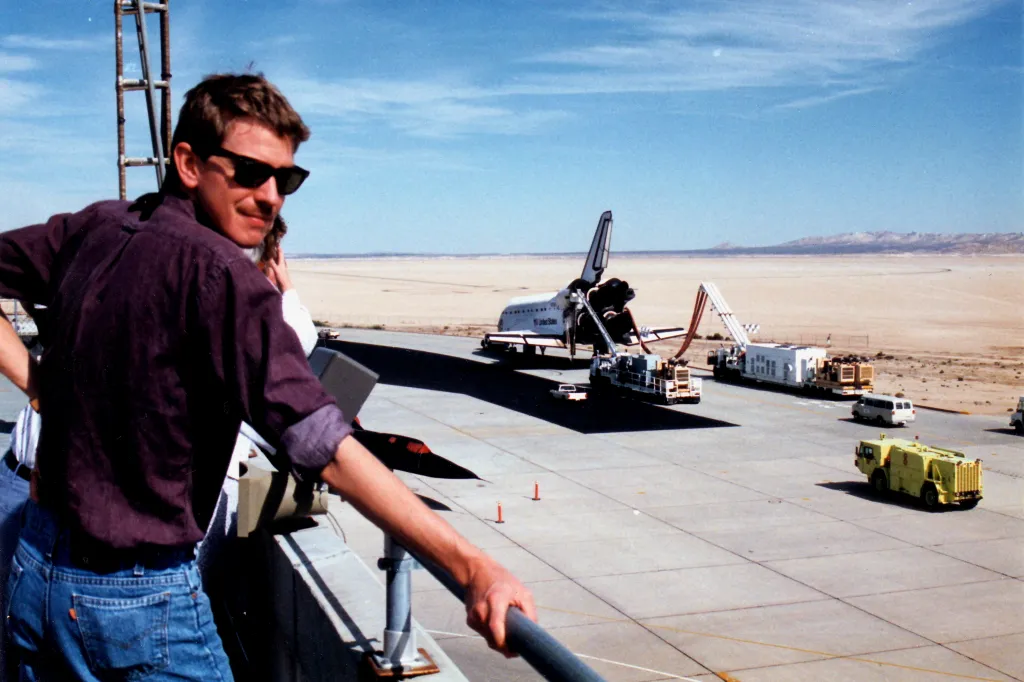
When it comes to the future of Tail 844, the SR-71 Blackbird that mysteriously disappeared from NASA’s Armstrong Flight Research Center, few people have more insights than Tim Conners. When he worked at NASA in the 1990s, Conners was the lead propulsion engineer for the agency’s Blackbird program. He worked extensively on 844 and has an intimate knowledge of what made the iconic aircraft tick. Now, he brings an insider perspective on NASA’s secretive work to get the Blackbird back in the air and speculates on what it would take to do so, as well as the famed jet’s possible flight test role for the agency after 27 years of dormancy.
In an exclusive interview with TWZ, Conners, now technical director for advanced weapons systems at Tiberius Aerospace, gave us his take on NASA’s Blackbird revelations and insights into what NASA is working on and how far along they are in the process.
Some of the questions and answers have been slightly edited for clarity.
Tim Conners
Q: Tell me about your background with the SR-71 program. How did it begin? How long did it last? And what did you do?
A: So that basically fell in my lap when I was an engineer at NASA’s Dryden [Flight Research Center] back in the early ’90s when NASA took delivery of three of the airframes when the Air Force was retiring the fleet. So NASA got two A models and a trainer. Obviously, tail number 844, which is NASA’s designation, is the one that’s getting all of the attention right now. But those came to Dryden in the early ’90s.
By luck of the draw, I was in the propulsion group. We were short-staffed for a number of reasons, and they needed an engineer on Blackbird. And I had been with NASA for about three or four years at that point, and I got tapped to prepare the NASA side of the mission for the upcoming research flights. So I had a few years to get familiar. That was a part-time job, by the way. I also owned the F-15 fleet at NASA as a propulsion engineer, and that was occupying a lot of my time, but it did give me an adequate amount of time to get familiar with the way that the airplane operated, at least from the propulsion standpoint. And then we began doing research missions in ’96. I left NASA in ’98, but I was able to support the program through two years of flight testing and all the years of preparation for those two years.
Q: Tell me more about your role with the Blackbirds.
A: I was lead propulsion engineer on the NASA side. So what NASA would do is they would assign disciplinary leads across from their industry and government counterparts. So Dryden’s disciplinary leads, their job was basically to make sure that any experimental packages were integrated safely with the airframe, and that we could execute the proposed test missions safely and successfully. I owned propulsion and I also owned performance. So if you recall the Lockheed Linear Aerospike rocket engine activity, that package weighed 20,000 to 25,000 pounds and was mounted externally on the back of the SR-71. That was a drag issue, obviously. So part of my role was to make sure that we could actually accelerate through the transonic drag rise with that package and get out to the target test conditions.
SR-71 tail number 844 during its service with NASA. This picture was taken on October 31, 1997, during a flight in support of the NASA/Rocketdyne/Lockheed Martin Linear Aerospike SR-71 Experiment (LASRE). NASA
Q: There is a tremendous amount of interest in seeing the Blackbird fly again. The biggest question seems to be why? What kinds of experiments or research would an SR-71 provide that couldn’t be done more effectively with a modern aircraft, rocket or unmanned vehicle? Can you walk us through some of the reasons NASA would like to see it in the skies again?
A: Yeah, that’s a question that everybody’s been asking. Why? I’m speculating, although I do have a good feel for where this is going. So bear with me.
They probably are not going to do this for — or trying to do this — for aerodynamic reasons. You can do CFD [computational fluid dynamics]-based modeling in this speed regime all day long and very accurately in this day and age. It does not take a lot of time or money to do that. What you cannot do is an accurate representation of a new type of engine integrated into a high-speed airframe. You can do the conceptual modeling of it. Of course, it’s difficult to get the final installed answer, especially if it involves an engine that operates at long duration. That is where I think they’re going with this. I believe that they’re developing basically a high-speed engine test bed. That would make the most sense to me.
Q: That’s something you couldn’t do with a more modern aircraft or rocket or unmanned vehicle?
A: That’s a good question. But you know, probably two-thirds of that battle is just developing the airframe. It does depend on the size of the engine that you’re after.
Obviously, if this were a Williams engine or that size class, you could get by with probably a bespoke drone to do your testing. That wouldn’t be that expensive. If your goal is to test something that’s man-rated or very large, like a J58-size engine, what better way to do it than use an airframe that’s already proven to fly at that speed?
SR-71 Blackbird. (Courtesy photo via USAF)
Q: Were you asked to join a team at NASA tasked with getting a jet back in the air? Who else was asked, and what kind of team were they building?
A: I did not receive an offer. There was a tongue-in-cheek text that I got earlier in the year that said, ‘Hey, Conners, how would you like to help get the Blackbirds flying again?’ And that was from somebody who was positioned with inside information. That is where I first heard of this. This was back in spring, but nobody formally reached out to me.
I believe that the only one that’s been tagged so far, as far as a retiree, was Mike Relja. Mike was a crew chief on the Blackbird, and that makes sense that they would potentially want to pull on him. But there was no formal offer, and I tell you what: If somebody approached me to work it, I don’t think I could turn them down.
Q: Do you know where the idea for this project came from and who is in charge?
A: I don’t have an answer. I’d love to know as well.
Q: What can you tell me about this effort? What are the latest developments in this project that you know of?
A: So what I’m hearing is that they’re looking at doing power-on testing fairly soon. That’s pretty big. So of course that’s not engine power on. That’s external power applied to the airframe, seeing which systems still live, which ones don’t, and then moving from there. So that would be an expected first step.
It’s an encouraging step. That means NASA would have gotten beyond cracking open all the bays, inspecting the interior, making sure that the thing at least passes visual inspection for airworthiness from that standpoint.
Q: Have they actually gotten any systems working?
A: No, they’ve done the visual inspection, actually, putting electrons on the airframe. [To get systems working] would be the next step, but it is forthcoming, from what I understand.
(NASA) Courtesy Photo
Q: What is the timeline?
A: That’s supposed to happen within the next couple weeks.
Q: Really? Where is this work taking place?
A: That I do not know for sure. Although I assume it’s happening at [NASA’s] Armstrong [Flight Research Center].
Q: So what is going to happen?
A: That’s a good question. Let me tell you about what I heard more recently, and then you can begin to connect the dots. JP-7. People ask about the fuel. I think it’s pretty well known that NASA had a huge amount of JP-7 stockpiled that they received from the Air Force back in the early ’90s. So much that it was in a dedicated tank, like one of the giant jet fuel tanks at Edwards Air Force Base. You know, the tanks up on the ridge.
From what I understand, that supply unfortunately was discarded about 20 years ago, and JP-7 is a unique fuel. Obviously, low volatility. When I poked at what might be the way forward there, it didn’t sound like that was a showstopper. I got the impression that there’s been dialogue underway with refineries for a replacement or a surrogate that would work. So I went from being deflated, hearing that the fuel was gone, to being encouraged that potentially there was a surrogate workaround.
A statically mounted Pratt & Whitney J58 engine with full afterburner on disposing the last of the SR-71 JP-7 fuel prior to the program’s termination. (NASA)
But that led to the question regarding the engines themselves, so the feedback there was more discouraging in that it looks like the engines are indeed unserviceable. I don’t believe that is based on an actual attempt to run them. It is based on inspection. Probably no surprise. They’ve sat idle, you know, for 27 years. That is what led to questions going back and forth regarding how the airframe would be powered. And that’s what led into where, if you connect the dots, that’s where the airframe would be used as an engine test bed.
So different engines, they would have to be high-Mach bypass systems. We can speculate on which engine company might be developing those systems, but yeah, I don’t want to give it too much away because I don’t want us to lose the inside information that we got.
Q: Are they working on a completely different engine to power Blackbird?
A: I don’t know that for sure. I think if the J58s are not an option for powering the Blackbird, you either button it back up and walk away from it, or you go bring in engines that are already under development that we’re not privy to at this point in time. But there’s no other option. So what are we going to use? It’s not like we can slap in F100s or F110s. They’re not going to cut it.
The Pratt & Whitney J58 – The Engine of the SR-71 Blackbird
Q: Obviously, restoring an aircraft sitting out in the elements for years into one able to withstand the rigors of Mach 3 flight is one hell of an undertaking. In your mind, what are the biggest hurdles to this endeavor?
A: Number one would be the engines for sure. Number two would be anything that’s made of elastomerics. Plastics, wiring. Covering connectors. All that stuff degrades and oxidizes with time. You can imagine what frayed wiring and broken wiring insulation – what kind of havoc that would create. What Blackbird has going for it is that all those casings and connectors were built for the rigor of sustained Mach 3.2 flight for an hour, an hour plus, so they are not going to deteriorate quickly. The question is: Have they deteriorated in 27 years? So, if the answer is not a significant amount, then we’ve probably addressed one of the biggest questions – other than the engines – regarding reviving the airplane.
Q: Do you think NASA is going to attempt to just fly Tail 844 largely in its original configuration, or will they deeply modify it or build something new based on it?
A: Completely unknown. They definitely have the ability to modify the airframe, right? They did it before in the ’90s to carry the Linear Aerospike package. That was a huge undertaking on the airframe itself. They did it successfully. Armstrong still has a pretty deep bench in that area, so if they wanted to take on modifying the titanium structure, I think they could do it.
View of the Linear Aerospike SR Experiment (LASRE) pod on NASA SR-71, tail number 844. (Photo by Heritage Space/Heritage Images via Getty Images) NASA
But it’s a good question. Again, that would probably point to aerodynamic studies, and if it were me and my dollar as a taxpayer, I would lean on computational studies to get those answers. That’s what I tend to do in my day job is forego testing in lieu of computational when it involves external aero, but it’s when you do the integrated propulsion in this speed regime, that’s really when you need test data from the actual operating conditions.
Q: As opposed to digital modeling?
A: Yes. For instance, say the aerodynamic databases for Blackbird are gone, which they might be. I know there are simple aerodynamic models that still exist, but like a true high-fidelity model that would go into a piloted simulator, that could probably be regenerated fairly quickly. Probably on the order of months computationally in this day and age. So I think simulation capability could be stood up in fairly short order. That, of course, will be foundational for the pilot training task.
Q: We’ll talk more about pilot training later, but first I want to ask about modernization. If NASA were to inject modernized features into the SR-71, what would you like to see? And what makes the most sense in terms of material science, avionics, propulsion and so on?
A: I’m not a materials expert. I think it would be really interesting to see how the airframe could be optimized using adaptive flight control capabilities. So, if the flight control system could be digitized, I think that would lead to some very interesting in-flight experiments. I doubt that that would be. I could be wrong, but if the goal is to get the airframe back up as a propulsion test bed, you don’t need to cut out the hydromechanical flight control system and replace it with a digital one.
A left-side view of an SR-71 aircraft from the 9th Strategic Reconnaissance Wing landing. The aircraft is silhouetted against the sunset. (U.S. Air Force) U.S. AIR FORCE
That all said, what I would like to see is what we talked about a few minutes ago, and that’s basically modern high-speed engine technology. So what could be done? The J58s were low operating pressure ratio systems. What could be done with a modern, digitally controlled, multistream, high-Mach engine, I think, would be truly trailblazing.
One of the reasons why there’s interest in this speed regime, it was neglected for a number of years. The focus was on hypersonics. If you proposed anything going back, say, 15 years in the Mach 3.5 speed regime, it was ignored. The glitz and glamor was on hypersonics. Hypersonics is great tactically for certain scenarios, but the weaknesses of hypersonics are now becoming apparent.
And as far as countermeasures, hypersonics still has a place. Don’t get me wrong, but every system cannot be hypersonic from an affordability standpoint. So, now you’ve seen it over the last, say, five years. A lot of systems are coming back on the scene that operate in the Mach 2 to Mach 4 regime, and there’s a reason they’re all fitting in there, right? You stay below the speed limit that requires more exotic metallics. You stay in the titanium regime. You can fly, of course, up to [Mach] 3.5 with brief excursions up to about [Mach] 4, so that is tactically relevant against a lot of military targets and defensive systems. So here it is. You know we now have a potential flying test bed that can carry engines in the J58 size class.
The Mighty J58 – The SR-71’s Secret Powerhouse
Q: How much could a project like this cost, and is it really economically feasible? How long do you think it could take?
A: I’ve been thinking that over, and I think it depends on who does it. I don’t want to disparage my former government brethren. I had great respect for the folks at NASA when I worked with them, but one of the reasons why I left the agency is because it was becoming so risk-averse. That was adding bloat to everything. And what we used to do quickly, we no longer could do quickly or cheaply at what was Dryden Flight Research Center, so that is what concerns me.
If NASA could operate with the agility that it had, if Dryden/Armstrong could operate with the agility it had 30 years ago, they could do this work in probably a few years. I would say again, it would depend on what exactly they need to do to the airframe. If it’s to resurrect the airframe and bolt in new engines using existing interface hardpoints, that would go much, much more quickly than doing extensive airframe modifications.
Q: Given that 844 has been sitting idle since 1999, what would be the very first thing you would want to inspect or test before even considering putting it back in the air?
A: Exactly what I’m hearing the rumor is that they’re doing this. What is the condition of all the components in the airplane that are flowing electrons? Because if the entire airframe is shorted out, you know how it is.
If you have a car where you’ve hooked up the battery cables backwards – I had a car once where somebody jumped in and did that. It ruined the car because I was chasing shorts constantly, constantly breaking down in the months that followed because the wiring was compromised, melted, bubbled all over the vehicle. And then it would get wet. You get shorts. That, I believe, is what one of the objectives of power-on testing is. To make sure continuity still exists, reliable continuity throughout the airframe. So that’s exactly the first step.
I would say the second would be hydraulics. That vehicle is hydromechanical. So what is the state of the actuators and whatnot?
Q: And you said that work is taking place now?
A: It’s certainly being inspected. That was one of the reasons why they pulled it off of the display pad at Armstrong. But that work has been going on for a couple of months, and it certainly seems that there was at least reason to be encouraged and to go forward with this next step. Otherwise, they would have just towed it back to the parking spot.
The SR-71 Blackbird, Tail 844, when it was on display at NASA’s Armstrong Flight Research Center (Google Earth)
Q: And the next step is testing the systems?
A: That is correct.
Q: We touched on this a little before, but how realistic is it to get an SR-71’s J58 engines operational again after nearly three decades of inactivity? What would worry you most about those engines? How many are left?
A: Well, that’s a good point. As far as [engines] that are readily available, there are several that are at the [Air Force Flight Test (AFFT) Museum at Edwards AFB]. I believe they’ve been stored outside. But if you consider all the museums around the world with Blackbirds on display, almost all of them have installed J58s, and there’s usually one sitting alongside the airframe on display, so there are plenty of engines. Whether or not they’re serviceable, that of course is the question.
But probably the biggest problem with an engine – well, there are several with a gas turbine that sits unmoved for decades – it’s going to be that you’re going to flatten the bearings. Probably not visible to the eye, but rotating turbo machinery doesn’t like flats on the bearings. So for obvious vibration reasons, you got that. And you’ve got the seals. Seals are going to crack. Trapped fuel is going to turn to gunk and clog up lines. That engine was all hydromechanical, of course, or no digital controls on that because of the heat involved. So fuel hydraulics played a big role in that engine.
There is likely a lot of goo in those lines. I believe that’s why they’ve essentially been written off as unserviceable. I was discouraged because one of the questions I asked that I didn’t get an answer to was: Did anybody try to run the engines or pull them apart? But I don’t even know if the instructions exist to unstack a J58 at this point. I’m sure it could be figured out with the right people, but you know how it is. Pulling something apart is a lot easier than putting it back together.
Q: So there’s no manual for that anymore?
A: I don’t know if there’s a manual specific to that. Like I told Steve [Trimble] at Aviation Week, there certainly are operating manuals. You’ve probably seen the pilot’s manual for the SR-71A. It’s a beauty. There are a lot of copies online. You can get PDFs of those. They are very well-written, huge manuals. I know prints exist for the airplane. Those were in the keeping of the Edwards Museum. I believe those have been handed back over to NASA. So, it’s not like there’s a complete dearth of information.
SR-71 Blackbird 844 basks in the evening moonlight at Edwards Air Force Base, California. (Air Force photo by Todd Schannuth) Todd Schannuth
When I was at NASA, I was the person who received everything that Pratt & Whitney had left on the J58s when the Air Force decommissioned the program, and that information was in two or three smallish boxes and consisted of hard copy code printout or printout of numerical data, along with some magnetic reels of code. It was not much. And I was told at the time the only reason I received that information was somebody missed it when the Air Force gave the destruct notice. It was under somebody’s desk, so it was not much in the way of knowledge transfer, unfortunately.
Q: What did you do with all that?
A: I left it behind in 1998 when I left NASA.
Q: What happened to it?
A: I have no idea. Hopefully, somebody scanned it. But again, that was J58 info, right? So if they’re going with a new engine, they’ll have the full digital models for those new systems. And I do believe that recreating the aerodynamic database, including inlet performance, that kind of data can all be regenerated fairly quickly with computational tools.
Q: We touched on this a little bit before, but how difficult would it be to reproduce the JP-7 fuel that powered the Blackbird? It would need designated tankers too, correct?
A: So that was one of the questions I asked is whether or not that formulation exists still. The answer I got back was that essentially a refinery should be able to recreate a suitable surrogate. If you think about it, JP-7 was unique in that it had a very low volatility characteristic.
What I’ve learned about Jet A from some of the ramjet work that I’ve been doing is that it has a ridiculously low volatility too, of course, by design. So I don’t know that JP-7 is that far apart from the chemical characteristics of a Jet A-class fuel, JP-8-type fuel. JP-8 was a significant change from JP-4, so the Air Force was using JP-4 in their fleet, and then moved to JP-8 to be consistent in the ’90s with the Navy with their formulations. That’s a lower volatility fuel, and at NASA we had to recharacterize the flight performance of all of our jets with JP-8, but it worked fine.
We were concerned about operability – that we were going to have flameouts and engine relight and flight relay problems. Those did not materialize, so I don’t want to oversimplify it, but I am thinking that you might be able to take an existing Jet A and with the right additives knock down the volatility to a level that’s safe for flying in the Blackbird.
Airman 1st Class James Douds, a fuels specialist with the 386th Expeditionary Logistics Readiness Squadron, offloading JP-8 jet fuel. (U.S. Air Force photo by Tech. Sgt. Jonathan Hehnly) Senior Master Sgt. Jonathan Hehnly
Q: What would need to happen to have aerial refueling jets be able to handle fuel for the Blackbird?
A: There were dedicated JP-7 tankers for the Blackbird. I don’t know if they can take an existing system and flush it. It would depend on the formulation, right? JP-7 was notorious for its unseemly characteristics. It was toxic.
I had a shirt that got dripped on when I was standing under the wing of the Blackbird once, and I had to throw it out. I could not get the stink out of that shirt from the JP-7. It was a weird fuel. So if you can get one that’s more aligned with the fuels used in the service, then I don’t believe that’s going to be a showstopper as far as tanker support, but you do know tanker support is going to be required for that airplane.
Q: You said the JP-7 fuel stank. What did it smell like?
A: I just remember it turning my stomach. Like I kept smelling something as the day went on, and I reached over and saw a stain on my shoulder. I don’t recall what happened the rest of the day, but I just remember being repulsed by the odor and then not being able to get it out when I washed the shirt.
Q: Beyond the fuel, the SR-71 depended on a huge ecosystem of specialized equipment, fluids, personnel and procedures. Which parts of that infrastructure would be hardest to recreate today?
A: That was something that Mike Relja pointed out when he talked to Steve Trimble. That’s a good one. You probably heard that the J58s were started with a start cart that was basically a bank of Buick 12-cylinder engines, all next to each other. It’s a beautiful-sounding system, but very unique. But what is starting, you know, other than you’re either doing a power takeoff via shaft, or you’re using compressed air. It depends on what the engine demands. So I think the start cart development would be fairly straightforward.
But there is a lot of specialized equipment, like Mike pointed out, the wings when they’re split up, they are held in place by a specific scaffolding. The way the engines were craned out of the wing required special equipment. Pulling the inlet spike off that required a special cradle. Those are not insurmountable, but you don’t want to wait till the last minute to realize you need unique equipment. So it’s all got to be taken into consideration.
This engine starter cart was developed specifically for the SR-71 family of aircraft. It used two Buick V-8 racing car engines, linked together through a common gear box, to deliver power to the starter drive shaft of the aircraft engine. More than 600 hp from the two V-8 engines was required to “spool up” the J58 to about 3,200 rpm for starting. (U.S. Air Force photo)
Q: Could existing SR-71s in museums realistically be used as sources of spare parts for 844, or would cannibalizing those aircraft create more problems than it solves? Were those airframes left structurally intact?
A: I believe that was the agreement with the Blackbirds. If a museum were to put one on display, there was a certain expectation regarding care and maintenance. Not so much maintenance, but care and preservation. If you think about it, many of them are under [a] roof in climate-controlled facilities. I know several of them that are preserved like that, including one here in Tucson. That, of course, is the best place for preserving anything with elastomerics and plastic. So I think it’s encouraging that so many of them have been so well cared for. Again, it’s going to come down to which components, regardless of whether or not they’re indoor or outdoor, which components are going to fail first, and I believe that’s the exercise NASA is looking at.
Then you’ve got to start beating down, chasing supply chain sources for some of this, and you know the nightmare that’s out there with supply chain and aerospace. So it’s not going to be an easy task. I don’t want to act like it is. I don’t think it’s insurmountable though.
Q: So these aircraft can be used as sources of spare parts?
A: Sure, absolutely.
Q: Is anyone with a Blackbird already contributing parts?
A: I know that the Edwards Air Museum is contributing what they can as far as spares and prints. I don’t know who else, although I believe the second NASA SR-71A went to the Evergreen Aviation & Space Museum in Oregon. I would expect them to be in the loop.
(TWZ reached out to the Evergreen to find out what, if anything, it is contributing to this effort.)
An extremely well preserved Blackbird on display inside at the North American Aerospace Museum in Oregon (formally the Evergreen Airventure Museum). (NAAM) Stephanie Tassone
Q: How difficult will it be for modern test pilots to fly Tail 844, or whatever aircraft is created from this project? What would actually be the hardest part of training a pilot to fly the aircraft today? Do you think they will convert it into an unmanned configuration?
A: Well, that would be a difficult airplane to convert to unmanned, unless it went with a digital backbone, and like I said, I think that would be an enormous undertaking. It’s not unheard of. NASA, along with McDonnell Douglas, converted a couple of F-15s to all-digital backbones before the F-15E program began. It can be done. It’s just expensive. It’s not easy.
But the piloting task starts with a good simulator, right? The piloting task is absolutely a big deal. I saw it firsthand at Dryden. That said, it took a couple years, probably two. I would say that’s about right for the Dryden pilots, who are pretty good at what they do, to learn to fly the Blackbird safely, and that was with the use of the two-seat trainer, which we’re not going to have this time.
So I think the key to this happening is getting a digital sim together very quickly, and it wouldn’t surprise me if NASA has begun this process already. Getting that together, plus getting the former pilots who are still with us in the seat to make sure that it aligns with what they recall as far as the unique features of the airplane.
I have 100 hours of stick time on the Air Force Blackbird simulator. I’m not a pilot, but I used to pre-fly the maneuvers for the pilots and NASA on the high-drag missions, so I’m familiar with the way the airplane flies up and away, and it is a bear to fly. It is not easy. So training is not insurmountable. Like I said, it takes a good, high-fidelity sim. NASA is expert at building those kinds of simulators, modular simulators quickly. In this day and age, we should be able to put a high-fidelity sim together fairly quickly for training.
If you recall, the cockpit is an analog nightmare on a Blackbird. Breakers everywhere. Dials everywhere. I doubt that somebody suggested that we go with an all-digital cockpit. That would be so much work to do. But if we go for it with just a pure analog cockpit that we used previously, that’s going to require a lot of familiarity. I do believe that the training systems might still exist for that. It would just be for that airplane. It would just be getting them all cobbled back together.
SR-71 Cockpit Checkout
Q: What made the Blackbird so difficult to fly?
A: It’s a low-G airframe, so you got to baby it. It’s easy to get an angle of attack out of range. And then with those chined surfaces, it’s easy to get a pitch-up with the airplane. That’s how I always managed to wreck it in the sim. I would let alpha get away from me.
Q: Do you know if any of the pilots have been recalled for this effort to get this thing flying again?
A: No, I don’t know.
Q: It has been close to 70 years since the A-12 Oxcart first flew. There had to have been other high-speed aircraft that at least came and went in the classified test environment. Considering all the work in hypersonics today, it isn’t hard to believe new platforms exist. Why would the SR-71 still have relevance here, and why not use one of those aircraft instead, if they exist? If they do, is it because the SR-71 is declassified?
A: Yeah, that could very well be what we’re looking at here. I’ve had friends ask that question this week. We were talking about the SR-72. Where is that at? I don’t know. I know people who went to work on it years ago. I’ve never heard anything since. So it could be that that’s so deep black that there’s no way that platform could be used as a test asset. So I think it’s precisely what you said. The Blackbird’s no longer classified, and that it’s possible that the engines that might be used in Blackbird wouldn’t be classified either.
A rendering of the proposed SR-72. Lockheed Martin
Q: Would any of those engines be applicable for this SR-71 reboot?
A: Certainly.
Q: Do you know if they exist anywhere?
A: No. But from what was leaked or hinted at regarding the size of the vehicle, it would seem that whatever was the power plant for that aircraft, it would be about the right size.
Q: What do you think generally about the renaissance of sorts in high-speed aerospace capabilities in recent years?
A: I worked on HAWC [Hypersonic Airbreathing Weapon Concept] at Raytheon, which became HACM [Hypersonic Attack Cruise Missile]. One of the systems that I helped design was the inlet isolator used on HACM, which is not operational yet, but it will be. But it’s an air breather by Raytheon. That gave me a lot of exposure to the level of exquisite technology that’s required to field a system like that.
It is expensive. It’s difficult. Supply chain is a challenge. There’s a reason why they cost what they do per unit. So you see the push to develop lower-cost hypersonic systems like Castelion’s Blackbeard [lower-cost hypersonic missile]. It’s not an air breather. So I think it’s an easier problem than what we dealt with at Raytheon with an air breather. But nevertheless, it’s impressive that they’ve gotten a price point down to what they’ve gotten, so you see that happening in hypersonics.
You’re kind of stuck in the same block of speed, but the price is dropping. And then meanwhile, you’ve got this massive group of munitions that are setting up camp in a Mach 2 to Mach 4 speed regime for reasons I mentioned. Those are running much cheaper per shot and per effect, which is why that’s happening. So that you give up something on survivability by pulling down into that speed range, but the price point allows you to volley at such a level that you overwhelm the defensive systems.
To date, this is the only picture the US Air Force has released showing an actual air-breathing hypersonic cruise missile test article related to the Hypersonic Attack Cruise Missile (HACM) program and/or the Defense Advanced Research Projects Agency’s preceding Hypersonic Airbreathing Weapon Concept (HAWC) effort. (USAF)
Q: If an SR-71 took to the skies again, would it not be one of the highest-profile aviation moments in a generation? It would certainly capture the imagination of many young and old. What do you think about the social aspect of all this?
A: I have yet to find anybody who isn’t excited by the prospect. Certainly, everybody within aviation thinks it’s cool. Some of my family who don’t know much about airplanes – they all think it’s cool. Everybody thinks it’s just super. That said, everybody also wonders why we’re doing it. But what’s funny is everybody still says, ‘Let’s do it anyway because it’s such an iconic airplane, beautiful airplane, an inspiration.’ Hopefully, there would be a good reason to spend the money. But I think even if it’s a bad reason, everybody wants it to take to the skies again.
Q: If you were a betting man, Tim, what would you say are the odds of this thing flying again?
The prosecutor general of the United Arab Emirates has said a Flydubai co-pilot “attempted to carry out a terrorist act” during a flight earlier this week, using a crash axe against the pilot inside the cockpit.
State news agency WAM quoted Hamad Saif al-Shamsi as saying on Saturday that the attacker of Wednesday’s flight FZ1073 tried to take control of the aircraft’s flight controls.
He said the investigation is under way “to uncover all the circumstances of the incident, its motives, and related connections, in addition to completing technical examinations and examining physical and digital evidence”.
The final results will be announced as soon as the necessary procedures are completed, Al Shamsi said.
A crash axe is a tool kept in a cockpit to help pilots cut through the plane in emergencies.
The volume of munitions expended in the course of U.S. operations against Iran this year has been and continues to be a hot topic of discussion, and there has been relatively little official data provided on this front. However, now we know that the F/A-18F Super Hornets of the U.S. Navy’s Strike Fighter Squadron 41 (VFA-41), the “Black Aces,” launched 421 missiles and bombs during their time supporting Operation Epic Fury.
This new insight into VFA-41’s role in the conflict with Iran comes from a photo of a large board listing the squadron’s weapons expenditures during Epic Fury, via Jeff Rojas, who goes by the handle @jro_photography on Instagram. Rojas also shared pictures recently taken of VFA-41’s Super Hornets. The Black Aces were one of the squadrons assigned to the Nimitz class aircraft carrier USS Abraham Lincoln, which has been on a marathon deploymentsince last year. The carrier only left the Middle East region last month and is now set to formally return home to San Diego, California, within days. Per the Pentagon’s official timeline, Operation Epic Fury began on February 28 and concluded on May 5, though U.S. forces have continued to conduct strikes on Iran, on and off, since then.
One of VFA-41’s F/A-18F Super Hornets spotted recently. Jeff Rojas Jeffrey Rojas
The complete tally of munitions employed as shown on the board, broken down by type, from greatest to fewest, is as follows:
The total cost of all of these munitions, using available data from U.S. military budget documents, is very roughly $43,646,000, at least. Unit costs fluctuate regularly due to a variety of factors. Furthermore, the exact price tag for different JDAMs can be somewhat difficult to calculate given how the individual components are budgeted.
The JDAM is really a family of kits that turn standard unguided ‘iron bombs,’ which can vary significantly in the kinds of effects they are designed to produce, into warheads for precision-guided munitions. This is exemplified by the (V)2 and (V)4 subvariants of the GBU-31/B mentioned here, which are built using standard high-explosive and bunker-buster bombs, respectively. No specific subvariants of the GBU-32, GBU-38, or GBU-54 were mentioned in the information provided. Standard JDAMs can also only be employed against static target coordinates. The LJDAM kits add a laser guidance component (akin to what is found on Paveway-series bombs) that enables strikes against moving targets.
A JDAM, as well as a pair of AIM-9Xs, seen under the wing of a VFA-41 Super Hornet in August. NAVCENT
No specific version of AGM-154 is mentioned, either, but the C and C-1 types, which have multi-stage bunker-busting warheads, are the only ones understood to be in service today. Remaining A variants, which were loaded with 145 small bomblets, were removed from U.S. service in 2008 as a result of new guidelines on cluster munitions issued under President George W. Bush. A planned AGM-154B, which would have contained six “smart” Sensor Fuzed Munition bomblets, was never produced. You can read more about the full JSOW family here.
We do not know exactly what targets any of these munitions were employed against. However, a picture that Jeff Rojas grabbed of one of VFA-41’s Super Hornets, seen toward the top of this story and in part below, shows a very interesting broken submarine kill marking, with the added text “Sub Buster.” The jet also has a number of more typical bomb-shaped kill marks.
A close-up look at the broken submarine and other kill marks on one of VFA-41’s Super Hornets. Jeff Rojas Jeffrey Rojas
The video montage in the social media post below includes a clip, starting at 0:13 in the runtime, of a Hellfire missile hitting what looks to be a Ghadir class diesel-electric midget submarine in port.
U.S. forces are degrading the Iranian regime’s ability to project power at sea and harass international shipping. For years, Iranian forces have threatened freedom of navigation in waters essential to American, regional and global security and prosperity. pic.twitter.com/gIBN02mowh
It is extremely likely that the AIM-9Xs and AIM-120s were fired at Iranian drones, though they could have been launched at incoming cruise missiles, as well. At the time of writing, there are no known or reported instances of U.S. military jets engaging crewed Iranian aircraft in the course of the conflict to date. In 2024, the Navy carried out a crash program that increased the total number of AIM-9Xs that F/A-18E/Fs could carry per sortie, specifically in response to Houthi drone threats. Super Hornets loaded with nine air-to-air missiles are now referred to as “Murder Hornets.”
It is also important to remember that this is a discussion of the munitions expended by just one Navy strike fighter squadron. Lincoln‘s air wing includes four strike squadrons, three with Super Hornets and one with F-35Cs, as well as units flying other types of aircraft and helicopters. The carrier was just one part of a much larger array of air, naval, and ground forces that participated in Operation Epic Fury and subsequent operations against Iran. For additional context, consider that the entire Eisenhower Carrier Strike Group, including its entire air wing and escorting ships, fired off 770 munitions in total, by the official count, during very active combat operations in and around the Red Sea between November 2023 and June 2024.
VFA-41 Super Hornets seen flying together recently. Jeff Rojas
As such, the tally of munitions launched from VFA-41 Super Hornets offers a very interesting view into that squadron’s contributions to Operation Epic Fury, as well as the full scale and scope of the conflict with Iran.
Special thanks again to Jeff Rojas for sharing the details about VFA-41’s participation in Operation Epic Fury and his pictures with us.
India’s Cockroach Janta Party has launched a new protest demanding change after millions of voters were allegedly improperly removed from electoral rolls. Other protest movements joined the rallies, which led to scuffles and arrests in the capital.
Welcome to Bunker Talk. This is a weekend open discussion post for the best commenting crew on the net, in which we can chat about all the stuff that went on this week that we didn’t cover. We can also talk about the stuff we did or whatever else grabs your interest. In other words, it’s an off-topic thread.
This week’s caption reads:
NANTWICH, ENGLAND – MAY 24: The BBC broadcasting studio inside the former RAF Hack Green secret nuclear bunker on May 24, 2023 in Nantwich, England. Hack Green played a central role in the defence of Britain for almost sixty years. It was chosen during WW2 to protect the land between Birmingham and Liverpool from hostile attack and as a location for the new RADAR equipment. The bunker went on to be used for shelter and protection during the Cold War. As relations between East and West thawed many of the UK’s nuclear bunkers were sold off. The Secret Bunker is now privately owned by the Siebert family and is run as a museum trust. (Photo by Christopher Furlong/Getty Images)
PRIME DIRECTIVES:
If you want to talk politics, do so respectfully and know that there’s always somebody that isn’t going to agree with you.
If you have political differences, hash it out respectfully, stick to the facts, and no childish name-calling or personal attacks of any kind. If you can’t handle yourself in that manner, then please, discuss virtually anything else.
No drive-by garbage political memes. No conspiracy theory rants. Links to crackpot sites will be axed, too. Trolling and shitposting will not be tolerated. No obsessive behavior about other users. Just don’t interact with folks you don’t like.
Do not be a sucker and feed trolls! That’s as much on you as on them. Use the mute button if you don’t like what you see.
So unless you have something of quality to say, know how to treat people with respect, understand that everyone isn’t going to subscribe to your exact same worldview, and have come to terms with the reality that there is no perfect solution when it comes to moderation of a community like this, it’s probably best to just move on.
Finally, as always, report offenders, please. This doesn’t mean reporting people who don’t share your political views, but we really need your help in this regard.
No warning given before Israeli deadly strike hit Rimal area, one of Gaza City’s most densely populated neighborhoods.
Published On 3 Oct 20263 Oct 2026
An Israeli air attack on a residential apartment in western Gaza City has killed at least five people and severely wounded at least six others, according to medical staff at al-Shifa Hospital.
The strike hit the al-Asala building in the Remal neighbourhood early on Saturday without prior warning, according to Al Jazeera’s Hani al-Shaer, reporting from Khan Younis.
Recommended Stories
list of 3 itemsend of list
Remal is one of Gaza City’s most crowded residential areas, home to thousands of displaced people sheltering in makeshift camps across the neighbourhood.
Al-Shaer said the attack came in the middle of the night, when residents were asleep.
“We heard fighter jets getting louder, then three strikes followed, hitting the apartment and killing those inside,” he said.
The strike penetrated the targeted apartment and tore through the floors below, causing further destruction throughout the multi-storey building.
Fires burned for at least an hour before Palestinian Civil Defence crews managed to put them out.
Al-Shaer described the scene as “horrific”, with people buried under the rubble as they slept.
Civil defence crews were still searching the site for missing people and bodies, he said, as Israeli drones continued flying over the area and fighter jets were heard flying low across the Strip.
Al-Shifa Hospital said the dead included four women, among them an elderly Christian woman and her daughter.
The six wounded were taken to al-Shifa Hospital for treatment.
In-depth study also says the royal house made huge profits from the Dutch colonial policies in past centuries.
Published On 2 Oct 20262 Oct 2026
A historical study has found that the Dutch royal house benefited from the country’s colonial policies in past centuries and helped the slave trade to survive.
The in-depth study, commissioned by King Willem-Alexander and conducted by Leiden University, showed the House of Orange-Nassau “actively supported Dutch colonialism for centuries, but only rarely determined colonial policy”, according to the university’s statement, published on Friday.
Recommended Stories
list of 3 itemsend of list
“The involvement of the House of Orange-Nassau was wholehearted and without any real reservations,” Dutch historians and human rights experts concluded after a three-year study looking at the period from 1600 to the present.
“The research leaves us in no doubt that the House of Orange shares responsibility for the survival over the centuries of the Dutch slave trade and slavery,” the study said, noting that most of the rulers showed no objections to slavery.
King Willem-Alexander said on Friday he was personally affected by the “explicit” conclusions of the study.
“It is a painful and confronting conclusion. A conclusion that affects me, even though I am three generations removed,” Willem-Alexander said in a speech at the presentation of the research.
“We know the effects of colonialism and slavery are still being felt today. Discrimination and economic exploitation unfortunately happen every day,” he added.
The study also showed that the royal family at times profited substantially from the colonial system, mostly from trade in the Dutch East Indies, modern-day Indonesia.
In the 19th century, for instance, profits accumulated to about $650m in modern terms, the researchers said.
On the other hand, the royal family earned “almost nothing” from the slave trade, the research showed.
Apologies without reparations
The Dutch monarch, who in 2023 apologised for his ancestors’ lack of action against slavery, highlighted their lack of “counter-current leadership” in the face of colonialism.
Dutch historian Gert Oostindie, right, presents a volume of an independent study into the role of the House of Orange-Nassau in Dutch colonial history to King Willem-Alexander in Leiden, the Netherlands, on October 2, 2026 [Piroschka van de Wouw/Reuters]
The House of Orange has ruled the Netherlands since the late 16th century, first as “stadtholders” who presided over the republic, and later as the royal house when the Netherlands became a monarchy.
For most of this time, the Dutch ruled over vast colonies in Southeast Asia and the Caribbean, including what is now Indonesia and Suriname.
The findings could stir up the debate around reparations in the Netherlands. The Dutch government apologised in 2022 after acknowledging the Dutch state bore responsibility for transatlantic slavery. King Willem-Alexander apologised the following year.
The government at the time ruled out reparations, instead creating a 200 million euro ($238m) fund for social initiatives, which anti-racism campaigners have dismissed as insufficient.
The National Institute for the Dutch Slavery Past and Heritage (NiNsee) lauded the king for commissioning the study but said it should lead to a next phase.
“Research impacts society when the new insights into the past contribute to awareness, dialogue, corrections and additions to our national history in the school curriculum and the conversation about responsibility and reparatory justice,” NiNsee director Bianca Groen Gallant said.
The Dutch played a major role in the global slave trade from the 17th century until the Netherlands abolished slavery in the second half of the 19th century.
Security threats prompt US and Australia to suspend diplomatic operations in Brazil before pivotal election day.
Published On 3 Oct 20263 Oct 2026
The United States has suspended consular services in Brazil, prompting Australia to close its embassy in the Brazilian capital, two days before Brazil’s presidential election on Sunday.
In a statement released on Thursday, the US embassy said it would suspend consular services starting on Friday and advised American citizens seeking assistance not to visit its embassy, consulates or other diplomatic facilities.
Recommended Stories
list of 3 itemsend of list
The statement cited security concerns but gave no further detail on the nature of the threat or any link to the election.
The US State Department said it was working closely with Brazilian counterparts to address the security concerns, adding that embassies and consulates routinely issue alerts about local threats and developments.
Australia’s ambassador to Brazil, Sophie Davies, said on social media that the Australian embassy would also close on Friday, citing the US alert, and advised Australians to avoid US diplomatic facilities.
Brazil’s federal police said they carried out preventive search and seizure warrants in Sao Paulo and the Federal District, the administrative region surrounding the capital, Brasilia, as part of an investigation into suspected plans that could threaten US diplomatic facilities.
Police said the operation followed cooperation with foreign intelligence agencies, but that investigators had found no evidence corroborating the initially reported threat, nor identified any suspects linked to criminal organisations.
An investigation was continuing after the seizure of communications equipment, according to the police.
The closures came two days before the Brazilian presidential election, which pits incumbent Luiz Inacio Lula da Silva, who is seeking re-election, against Senator Flavio Bolsonaro, son of former President Jair Bolsonaro. Jair Bolsonaro is serving a 27-year sentence for attempting a coup.
If neither candidate wins more than 50 percent of the vote on Sunday, a runoff will be held on October 25.
Edinho Silva, president of Lula’s Workers’ Party, called the closures “unprecedented”, saying: “It makes no sense at all. It’s one of Trump’s ways of trying to influence Brazilian public opinion.”
Lula’s allies have pointed to US tariffs and an effort by Washington to send officials to Brazil to “discuss electoral integrity” as evidence of foreign interference.
Brazilian intelligence officials briefed French and German delegations in Brasilia this month on what they described as US and Russian interference in the race.
US President Donald Trump has publicly praised Flavio Bolsonaro, a close ally, without formally endorsing him, saying he is “watching that election very closely”.
A ballistic missile is fired from the North Korean port city of Wonsan, South Korean military says.
Published On 2 Oct 20262 Oct 2026
South Korea’s military says North Korea has fired at least one ballistic missile towards the sea off its east coast.
South Korea’s Joint Chiefs of Staff said on Saturday morning that its northern neighbour fired a ballistic missile from the port city of Wonsan on the eastern shore of the Korean Peninsula.
Recommended Stories
list of 3 itemsend of list
The South Korean military raised an alert for further launches.
Japan issued an emergency alert on Saturday, saying: “North Korea has launched a suspected ballistic missile.”
The launch came a day after Kim Yo Jong, the powerful sister of North Korean leader Kim Jong Un, ridiculed South Korean demands for the North to apologise over landmine blasts that South Korea and the US-led United Nations Command said were caused by North Korean mines planted south of the Military Demarcation Line.
The blasts seriously injured three South Korean soldiers on a reconnaissance mission inside the 4km-wide (2.5-mile) border zone that stretches across the Korean Peninsula.
South Korea has also called on the North to halt recent efforts to fortify its border, including the installation of mines and anti-tank barriers.
Kim Yo Jong dismissed Seoul’s demands as “utterly pathetic”, saying the North intends to permanently cut ties with the South.
Saturday’s launch was the latest in a series of North Korean military displays in recent weeks, including tests of a purported hypersonic missile system, live-fire exercises and the commissioning of a new warship.


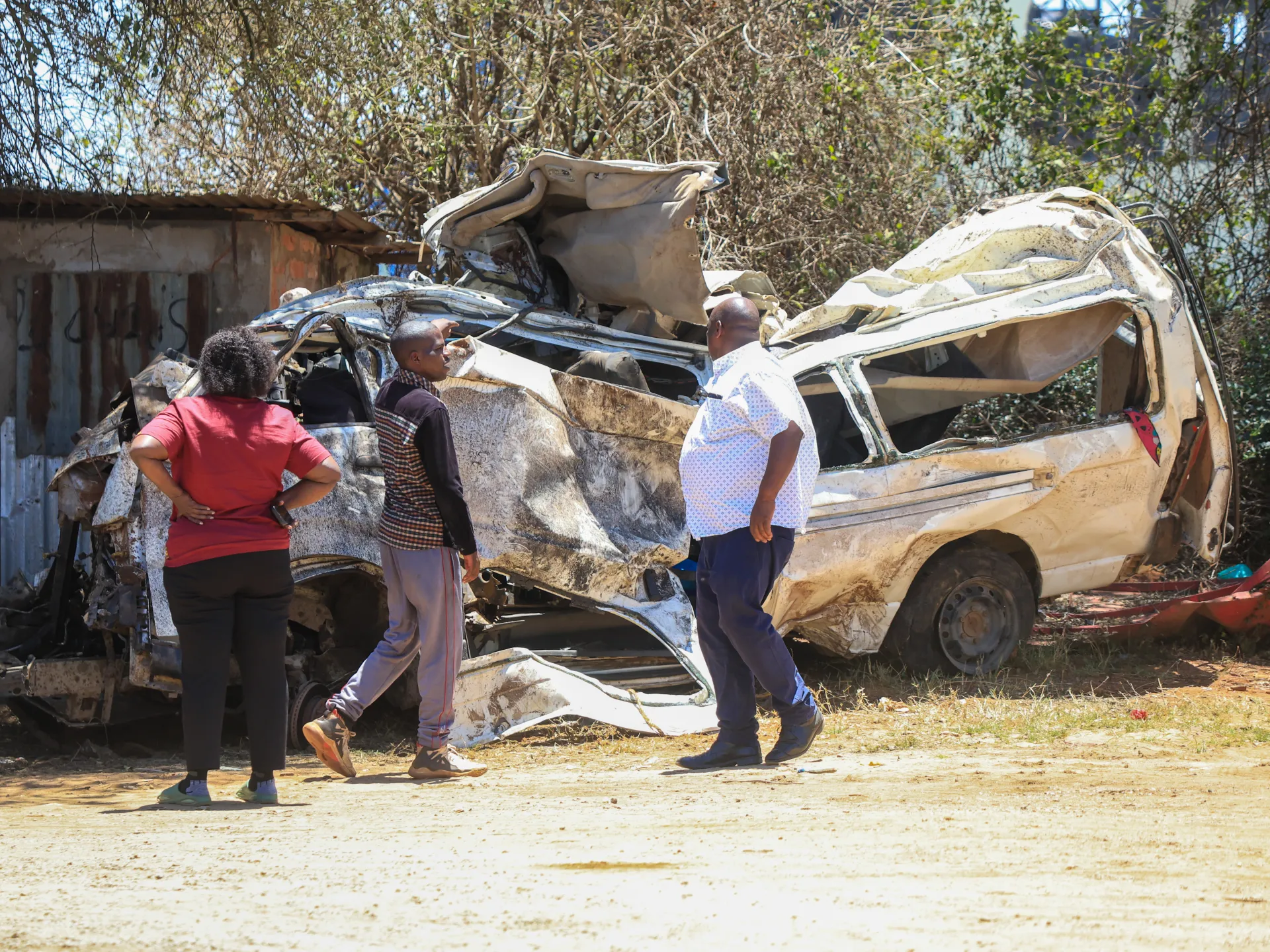



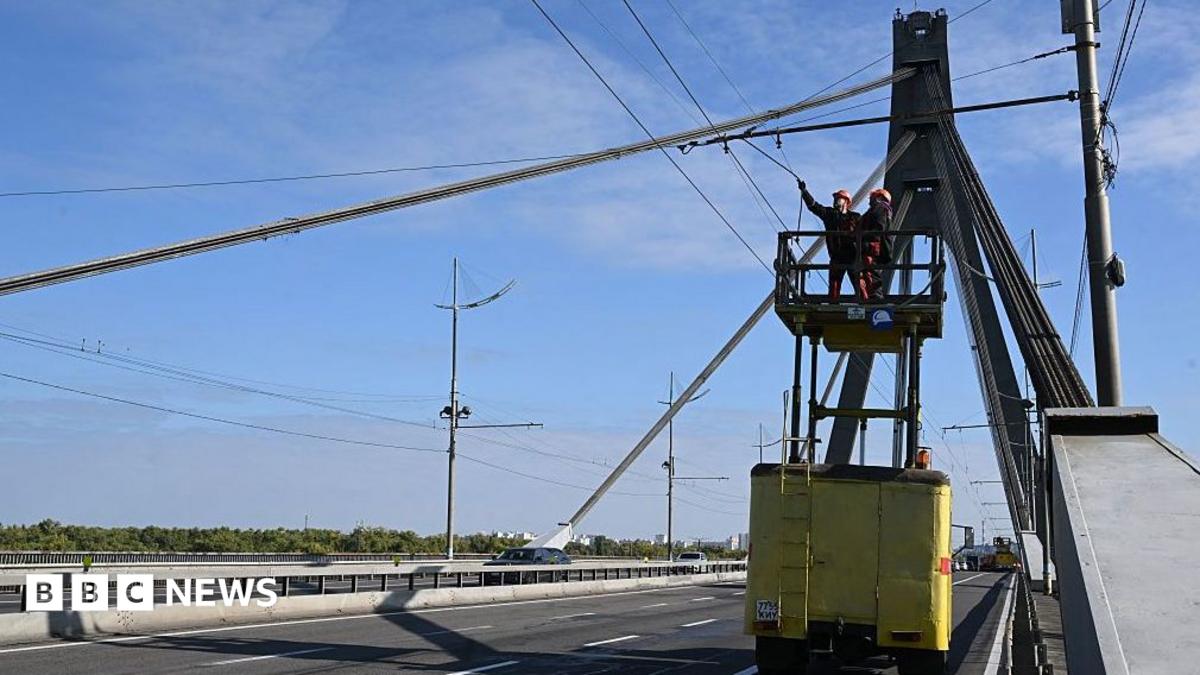
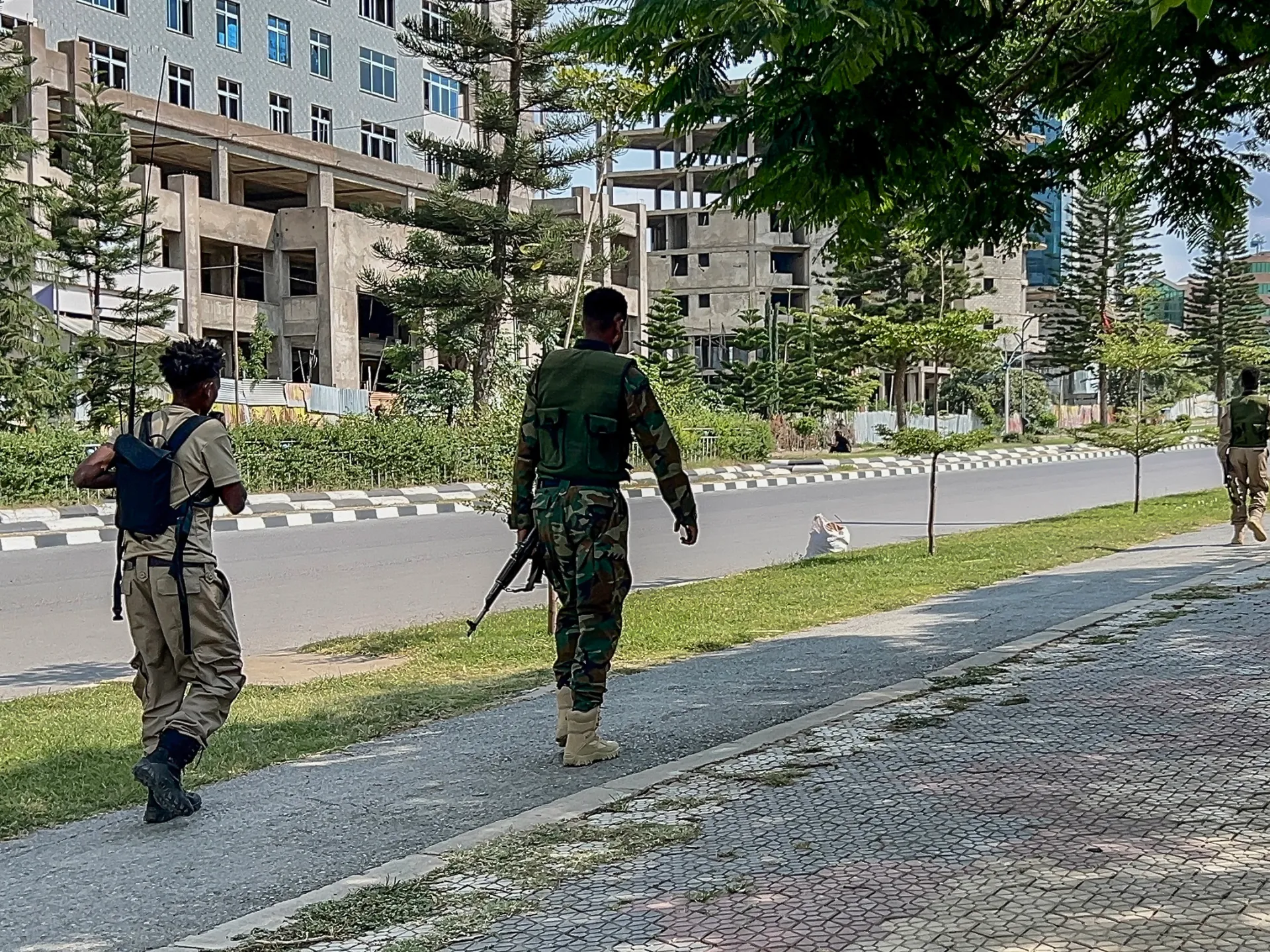



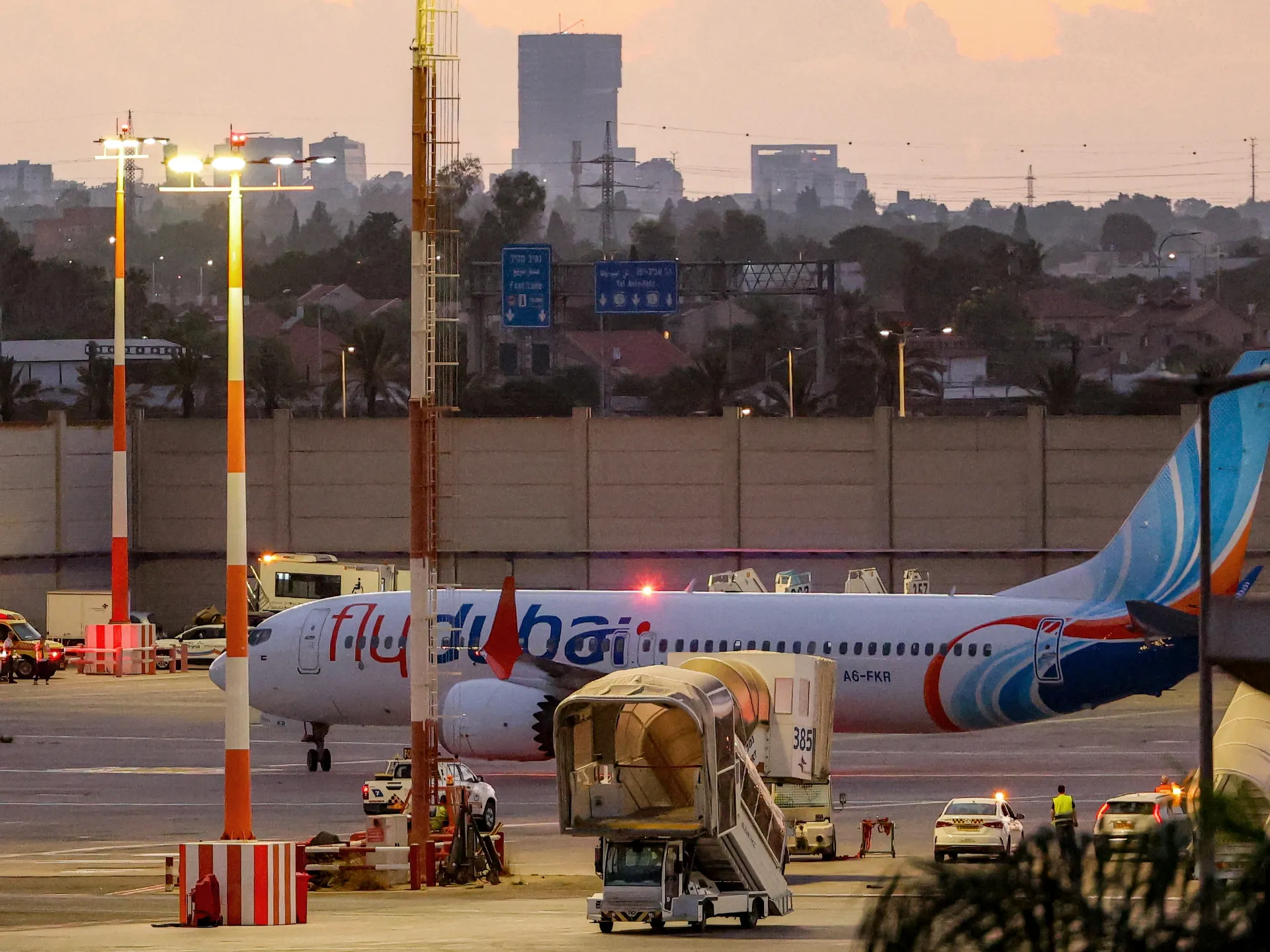




![Portadown Orangemen march from Drumcree Church to start their march towards Garvaghy Road, which was stopped a short distance later by police, in Portadown, Northern Ireland on September 27, 2026 [AFP]](https://i0.wp.com/www.aljazeera.com/wp-content/uploads/2026/10/afp_6abfeb6d30a8-1790962541.jpg?w=640&ssl=1)

![UVF flags fly alongside UK flags in the Edgarstown estate, Portadown, Northern Ireland, on October 1, 2026 [Caolán Magee]](https://i0.wp.com/www.aljazeera.com/wp-content/uploads/2026/10/DSC00033-1790961495.jpg?w=640&ssl=1)
![Orange Order members sit outside Drumcree church as they await passage along Garvaghy Road in Portadown, Northern Ireland, on October 1, 2026 [Caolán Magee]](https://i0.wp.com/www.aljazeera.com/wp-content/uploads/2026/10/DSC00113-1790961532.jpg?w=640&ssl=1)
![Children play on the embankment as music rings out along Garvaghy Road in Portadown, Northern Ireland, on October 1, 2026 [Caolán Magee]](https://i0.wp.com/www.aljazeera.com/wp-content/uploads/2026/10/DSC00134-1790961539.jpg?w=640&ssl=1)
![A ‘Garvaghy Road says no’ sign with an Irish tricolour in the background in Portadown, Northern Ireland, on October 1, 2026 [Caolán Magee]](https://i0.wp.com/www.aljazeera.com/wp-content/uploads/2026/10/DSC00064-1790961515.jpg?w=640&ssl=1)