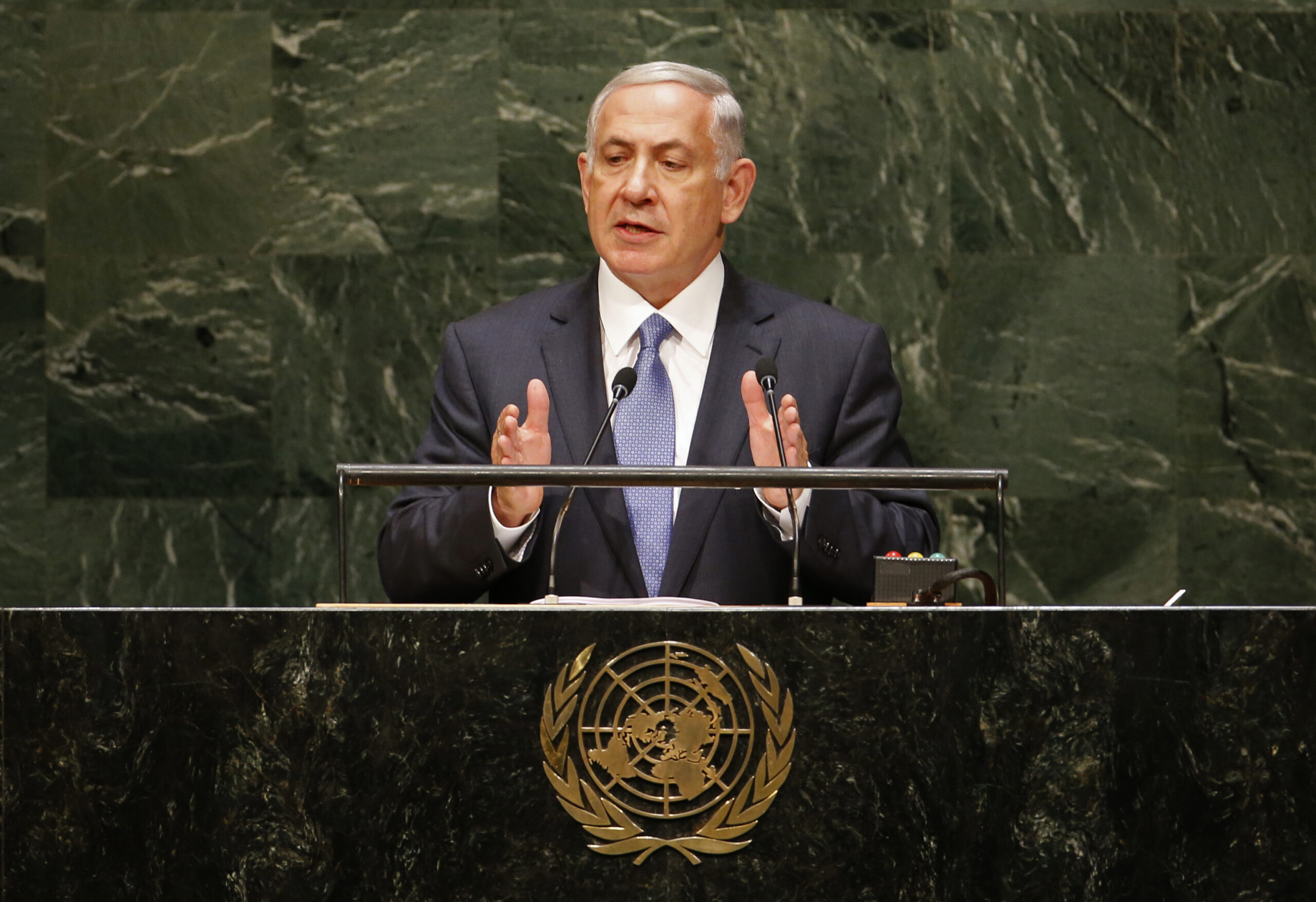
Netanyahu

Bolsonaro’s son begins Brazil presidential bid with Netanyahu, Milei kudos | Elections News

Right-wing candidate Flavio Bolsonaro attracts foreign support, but struggles in polls ahead of matchup with President Lula.

Flavio Bolsonaro has inaugurated the official beginning of his Brazilian presidential campaign, touting support from right-wing figures such as Argentinian President Javier Milei and Israeli Prime Minister Benjamin Netanyahu.

Bolsonaro, son of former president Jair Bolsonaro and long considered the presumptive candidate of Brazil’s political right, launched his formal bid challenging President Luiz Inacio Lula da Silva on Saturday.

Recommended Stories

list of 3 itemsend of list

“This is more than a party convention,” Bolsonaro said in remarks to his father’s Liberal Party.

“This is the beginning of the toughest battles of our life. A fight between good and evil.”

Recent polls have shown Bolsonaro trailing the left-wing Lula, as his bid for the presidency struggles to right itself after a number of setbacks and scandals.

While Saturday’s event included endorsement remarks from right-wing heavyweights such as Milei and Netanyahu, few prominent Brazilian politicians were in attendance.

Centre-right parties have largely kept their distance, and Flavio’s father – currently serving a 27-year prison sentence for a coup attempt following his loss to Lula in 2022 – was present at the convention only in the form of a video made with AI.

Milei delivered ‌a fiery speech criticising Lula and declaring that Bolsonaro can “save” Brazil from socialism.

The Argentinian president flew to Brazil the night before the event and met on Saturday with Sao Paulo Governor Tarcisio de Freitas.

“We will continue offering our testimony everywhere against the lies of socialism,” Milei said.

Netanyahu offered support via a short video message.

“Flavio, my friend, I want to congratulate you on the official launching of your campaign,” Netanyahu said in the recording, according to the Brazilian outlet Metropoles. “You’re a great champion of Brazil, you’re a great champion of the friendship between our peoples.”

Lula’s Workers Party is set to hold its own convention on August 2, confirming the 80-year-old president’s re-election bid.

Bolsonaro and his allies have also suffered from criticisms that they have tried to use their ties to the administration of US President Donald Trump to boost his campaign, inviting US intervention in a variety of issues that many Brazilians see as a form of foreign meddling.

Like his father, Flavio has also raised alarm by repeating false claims about the reliability of Brazil’s election infrastructure, seen as a pretext for possible efforts to deny the legitimacy of the voting process in the event of a loss to Lula.

The AFP news agency reported on Saturday that Brazil had denied visas to a pair of Trump administration officials who sought to meet with the country’s election authorities to discuss “freedom of expression related to the elections”.

Source link

How Netanyahu gov’t media reforms risk deepening Israeli press bias | Media News

Media freedom organisations and opposition lawmakers have criticised sweeping media reforms pushed through by Israel’s right-wing coalition as part of a legislative blitz before the parliament’s dissolution in advance of elections later this year.

The parliament, or Knesset, last week approved the bill that could give the government a far greater say in Israel’s news and broadcast sectors. The controversial measure strips away traditional oversight safeguards, eliminates requirements for minimum journalism standards and lifts longstanding limits on cross-ownership, among others.

Recommended Stories

list of 4 itemsend of list

Following the July 17 vote, watchdog groups, including the Union of Journalists in Israel, along with opposition parties, successfully petitioned the High Court of Justice to freeze parts of the legislation. They warned that some provisions that were set to take effect immediately, including the removal of limits on ownership of multiple media outlets and the stripping away of newsroom standards, could permanently distort the media landscape before the October 27 election, potentially influencing its outcome.

The government has until Sunday to respond, after which the court will decide whether to keep the freeze, widen it, or allow the provisions to take effect. Other, less contentious and immediate sections of the law were left to stand.

Israel’s Prime Minister Benjamin Netanyahu did not vote on the measure. He is currently bound by a 2020 conflict-of-interest agreement that bars him from participating in government decisions that could affect his ongoing corruption trial, where, among other charges, he stands accused of using his position to unduly influence media coverage of his administration.

Nevertheless, Communications Minister Shlomo Karhi thanked Netanyahu directly, saying: “Mr prime minister, I want to thank you and tell you that the mission you gave me four years ago – to deliver right-wing reform of the media – was today successfully completed.”

Israeli media reported that such a directive by Netanyahu could be a violation of his agreement. Neither the Prime Minister’s Office nor the Communications Ministry responded to Al Jazeera’s queries over whether Netanyahu’s role in the legislation’s passage represented a conflict of interest. However, Karhi subsequently claimed that he had secured a legal opinion determining that the prime minister was not in breach of the conflict-of-interest agreement.

“Prime Minister Benjamin Netanyahu and Communications Minister Shlomo Karhi have proven repeatedly that they are enemies of independent journalism in Israel,” Martin Roux, of the Reporters Without Borders media monitor, told Al Jazeera.

“This means they’re attacking every Israeli citizen’s right to reliable information from diverse sources. This has been true for years, and it is becoming more obvious every day as the legislative elections, set for the end of October, approach. It’s all about controlling the narrative,” he said.

In a social media post, Karhi claimed the new legislation would bring “more right-wing coverage and less regulation”.

“After a determined struggle against every possible element from the deep state, tycoons, attorneys, officials and fearmongering networks – we managed to pass the right-wing media reform.”

‘Boosting propaganda channels’

However, for many observers, there was little new in overhauling media that had grown used to toeing the government line, with critical coverage of the multiple wars that Israel has engaged in and the international outrage that many have caused typically relegated to the sidelines of the national conversation.

“The reforms are part of Netanyahu’s ongoing media overhaul – undermining the remains of critical reporting and journalistic independence in the country, while boosting Netanyahu’s propaganda channels,” London-based Israeli academic and media analyst Ayala Panievsky told Al Jazeera.

DAVOS, SWITZERLAND - JANUARY 22: U.S. President Donald Trump speaks after presenting the “Board of Peace” at the World Economic Forum (WEF) on January 22, 2026 in Davos, Switzerland. The annual meeting of political and business leaders comes amid rising tensions between the United States and Europe over a range of issues, including Trump's vow to acquire Greenland, a semi-autonomous Danish territory. (Photo by Chip Somodevilla/Getty Images)
Israel’s Channel 14 has consistently pushed the ‘big lie’, that Trump won the 2020 US elections, leading some to wonder if the channel would be prepared to do the same again in Israel later this year [Chip Somodevilla/Getty Images]

She cited the far-right Channel 14, which she said emboldened Israel’s war crimes and offered unflagging support to what she described as the most right-wing government in Israel’s history.

“In 2020, they amplified ‘the Big Lie’ in the US elections, claiming Trump won the election – they might therefore act similarly following the Israeli general elections in October, if Netanyahu’s coalition indeed loses,” said Panievsky, echoing similar concerns among academics and legal analysts sparked by accusations from lawmakers within Netanyahu’s Likud party that the acting head of the Central Elections Committee, Dean Livne, was “clearly politically biased”.

Analysts and observers from across Israel have long pointed to the strongly nationalist undertone of much of Israel’s current affairs coverage and the absence of space given to Palestinians and Palestinian suffering.

When the United Nations’ Independent International Commission of Inquiry concluded in September 2025 that Israel had committed genocide in Gaza, Israel’s Foreign Ministry dismissed the findings as “distorted and false“, a framing echoed across domestic outlets rather than scrutinised.

A subsequent Molad report found only 3 percent of Channel 12’s early war coverage referenced Gaza’s humanitarian crisis, with just two of 206 visuals showing Palestinian civilian casualties. Elsewhere, allegations of Israeli war crimes, including sexual abuse, are either omitted or given pro-government framing, observers told Al Jazeera.

Thick smoke rises following an Israeli airstrike on a residential area in the Al-Jalaa neighborhood despite the ceasefire in Gaza City, Gaza, Palestine, on July 23, 2026. Photojournalist:Saeed M. M. T. Jaras
Thick smoke rises following an Israeli air strike on a residential area in the Al-Jalaa neighbourhood despite the ‘ceasefire’ [Saeed MMT Jaras/Anadolu]

“The Israeli media just doesn’t feature Gaza. It’s not there,” political analyst Ori Goldberg said from outside Tel Aviv. “There’s no sense of solidarity with the journalists killed there, or those they don’t let in. They’re just not mentioned.”

Similarly, discussion panels on the various wars that the Netanyahu administration had embarked upon were typically staffed by ex-generals, who had no question with the need for war, only differences over its prosecution, said Goldberg.

However, even this relative compliance was not enough for a prime minister fighting an election that had come to rely on the appearance of forward momentum and paper enemies to sustain his political project.

“Netanyahu always needs to be seen to be pushing the envelope,” Goldberg added. “He needs a media that will give barely critical coverage of his every word, but one that he can still present as the enemy within.”

Source link

Mamdani: Netanyahu is a war criminal, but New York cannot arrest him | Benjamin Netanyahu

NewsFeed

New York City Mayor Zohran Mamdani releases a video statement calling for Israeli Prime Minister Benjamin Netanyahu to face trial for war crimes, citing the ICC’s arrest warrant. But, after days of speculation, Mamdani says New York does not have the power to arrest Netanyahu.

Source link

NYC Mayor Mandani reviews options to arrest Netanyahu over war crimes

July 18 (UPI) — New York City Mayor Zohran Mandani on Saturday said his government is reviewing whether it could legally arrest Israeli Prime Minister Benjamin Netanyahu over accusations of war crimes.

Netanyahu is expected to visit the city for the United Nations General Assembly in September.

In 2024, the International Criminal Court issued a warrant for the prime minister’s arrest over alleged war crimes and crimes against humanity in Gaza, including starvation and attacking a civilian population.

“I believe that Prime Minister Netanyahu belongs in The Hague,” Mamdani told The New York Times. “He’s a war criminal who has been charged by the International Criminal Court, and what you will find is that is an opinion that is held by many, purely because of what his actions have wrought over these past many years.”

Mandani said his legal team is reviewing the city’s options.

“We’re not talking about a personal assessment of Benjamin Netanyahu,” the mayor told The Times. “We’re talking about the International Criminal Court and the fact that they have a warrant out for this prime minister’s arrest, and I think it’s important to talk about the weight that that has as a charge and that also, as the mayor of New York City, I’ll be following the laws of New York City.”

Netanyahu has denied the ICC charges and disputes the court’s jurisdiction.

In a previous interview, the prime minister claimed without evidence that Mandani is a Hamas supporter.

“He is with the terror actors,” he told WABC. “I think, secretly, he hates America.”

Michael Waltz, the U.S. ambassador to the U.N., called Mandani’s comments “pure political theater.”

“The U.S. is not party to the Rome Statute that underlies the ICC,” he wrote on X, adding, “The U.N. Headquarters Agreement grants diplomatic protections to visiting heads of government.”

Source link

New York’s Mamdani says looking into Netanyahu arrest during city visit | Benjamin Netanyahu News

Mamdani had pledged to arrest Netanyahu during campaign for mayor and says he is consulting city’s legal advisers.

New York City Mayor Zohran Mamdani has said that he is consulting with city authorities over the possibility of arresting Israeli Prime Minister Benjamin Netanyahu if he visits the city for the United Nations General Assembly (UNGA) in September.

In an interview with The New York Times (NYT) released on Saturday, Mamdani reiterated his view that Netanyahu, who is the subject of an ICC arrest warrant for possible crimes against humanity in Gaza, must be brought to justice for the Israeli military’s actions in Gaza.

Recommended Stories

list of 3 itemsend of list

“I believe that Prime Minister Netanyahu belongs in the Hague,” Mamdani told The Interview, a show produced by the NYT.

“He’s a war criminal who has been charged by the International Criminal Court,” he added. “And what you will find is that is an opinion that is held by many, purely because of what his actions have wrought over these last many years.”

Mamdani, a democratic socialist who has emerged as an outspoken supporter of the Palestinian cause, pledged to arrest Netanyahu if he came to New York City during his mayoral campaign. Some questioned the feasibility of that promise.

The mayor said that he was in “active conversation” with the city’s law department about whether he has the authority to have Netanyahu arrested, should he travel to New York.

“Whatever the law allows me to do in New York City, that’s what we will do, but we won’t be writing our own laws to that end,” he said.

Asked about Mamdani’s call to have him arrested, Netanyahu told radio personality Sid Rosenberg that he thinks Mamdani secretly “hates America”.

Israel’s ambassador to the United Nations, Danny Danon, also insisted that Netanyahu will be at the UNGA meeting in New York this September, despite the threats of arrest.

During his campaign for mayor, Mamdani was the target of frequent Islamophobic vitriol and insults. Rosenberg referred to the New York mayor hopeful as a “cockroach”, before later apologising.

Mamdani’s election to mayor and his continued calls for accountability regarding Netanyahu point to a dramatic swing among Democratic voters away from Israel.

A poll in May found that nearly three-quarters of Democratic voters oppose US aid to Israel, up from 45 percent three years ago.

Nearly half of those surveyed said that their party was too supportive of Israel, whose war on Gaza has been termed a genocide by a growing number of human rights organisations, international officials, and scholars.

While that shift has yet to translate into concrete policy change at the top of the party, which includes stalwart supporters of Israel, many Democratic politicians have slowly begun to adjust their positions.

Nearly half of the Democratic members of the US House of Representatives voted to end US aid to Israel earlier this week, a measure of the shifting politics around the issue that commentators believe would have been unthinkable just several years ago.

Source link

Israeli Knesset passes laws favoring Netanyahu allies ahead of October elections

July 17 (UPI) — Israel’s parliament, the Knesset, voted to dissolve on Friday after pushing through controversial legislation favorable to Prime Minister Benjamin Netanyahu‘s supporters.

The Knesset is expected to be in recess until the Oct. 27 election in which Netanyahu is seeking re-election.

Analysts told CNN most of the legislation passed in the government’s closing days was meant to appease Netanyahu’s far-right and ultra-Orthodox — or Haredi — allies, thus ensuring his success in October’s election.

The motion to disband parliament was tacked on to a financing bill that increases public funding for political parties during elections, The Times of Israel reported. Opposition leader Avigdor Liberman said the legislation was an abuse of taxpayer money, calling it a “contemptible attempt to tie the end of the session to increasing funding.”

The Knesset voted 62-0 in favor.

Political analyst Nadav Eyal said Netanyahu is trying to show his ultra-Orthodox allies that he’s the only leader who will support their issues.

“Netanyahu is fighting for his political survival, and the Haredi parties are essential to it,” Eyal wrote.

If he stays in power until the October election, Netanyahu will be the first Israeli prime minister to complete a full term in office since 1988.

Among the legislation pushed through in the final days of the 25th Knesset were laws reducing the powers of the attorney general, easing actions against Haredi draft dodgers and increasing government oversight of media companies.

Astronaut Buzz Aldrin walks on the surface of the Moon during the Apollo 11 mission on July 20, 1969. Photo by NASA/UPI | License Photo

Source link

Netanyahu says his ties with Trump are ‘fine’, takes aim at Turkiye | Benjamin Netanyahu News

In Fox News interview, Israeli prime minister lauds US alliance and argues that Ankara should not receive F-35 jets.

Israeli Prime Minister Benjamin Netanyahu says his ties with US President Donald Trump are “fine”, dismissing reports of rifts between the two leaders over the ceasefire with Iran and Israel’s attacks in Lebanon.

In an interview with Fox News on Monday, Netanyahu heaped praise on the United States and Trump.

Recommended Stories

list of 3 itemsend of list

“America has been a tremendous force for good, and without America, there won’t be any democracy in the world, and there won’t be any freedom in the world,” he said.

The Israeli prime minister added that he and Trump see eye to eye on “just about everything”.

His comments come amid criticism by some members of the Israeli cabinet of the memorandum of understanding between the US and Iran that calls for a regional ceasefire, including in Lebanon.

Israel has refused to withdraw from Lebanon, insisting that it has the right to bomb the country at any time to respond to “threats”. An Israeli strike in southern Lebanon on Monday killed four civilians, including a teacher.

Netanyahu said there can be differences between the US and Israel, but the two countries are “model allies”.

“My relationship with the president is fine, and we have a way of ironing out our differences as allies who respect each other,” he said.

The prime minister confirmed he will soon visit the US again, but said no date has been set for the trip.

Asked about his agenda during the visit, Netanyahu took aim at Turkiye, saying that he will lobby against the transfer of F-35 jets to Ankara.

“I don’t think they should be given F-35s or the engines for their fighter jets because that’ll upset the power balance in the Middle East, which is ultimately guaranteed by Israeli air superiority, and also by, I think, by America’s posture in the Middle East,” he said.

Turkiye, a NATO ally of the US, has been an outspoken critic of Israel’s genocidal war on Gaza.

Trump is set to visit Ankara later this week for a NATO summit.

Netanyahu attempted to draw a contrast between Israel and Turkiye.

“They didn’t lift a finger to help you in Iran. We did,” he told Fox News, a conservative US media network mostly watched by Trump voters. “We’re the model ally that fought next to your great soldiers.”

Netanyahu has called for the US to attack Iran for decades, leading to the US-Israel war on Iran that broke out on February 28, which proved to be overwhelmingly unpopular with American voters.

Some Israeli commentators and politicians have been escalating rhetoric against Turkiye, suggesting that the country is the next regional rival and target after Iran.

Turkiye’s President Recep Tayyip Erdogan warned on Saturday against Israel’s efforts to undermine the US-Iran agreement.

“We are closely following the Israeli administration’s attempts to dynamite the deal,” he said. “The current war-addicted Israeli government must not be allowed to drown our geography in the smell of gunpowder and blood again.”

Source link

Netanyahu: ‘We will remain in Lebanon, Syria, and Gaza as long as required’ | Israel attacks Lebanon

Netanyahu: ‘We will remain in Lebanon, Syria, and Gaza as long as required’

NewsFeed

Israeli Prime Minister Benjamin Netanyahu stated that Israeli forces will maintain a presence in southern Lebanon, Syria, and Gaza for “as long as required” at a graduation for combat officers in southern Israel.

Source link

Trump warns Netanyahu: ‘You’ll be on your own’ if attacks on Iran continue | US-Israel war on Iran News

United States President Donald Trump has warned Israeli Prime Minister Benjamin Netanyahu that he might find himself fighting on his own if Israel returns to war with Iran.

The warning on Monday came as Israel and Iran said they would pause attacks following their most serious escalation since a ceasefire took effect in April.

Recommended Stories

list of 3 itemsend of list

Trump, who has reportedly grown increasingly exasperated with Netanyahu, demanded that both sides stop “shooting” in a post on his Truth Social platform and said that “final negotiations” towards peace would proceed “subject to ignorance or stupidity getting in its way”.

He also called Netanyahu and told him to stop the strikes, according to media reports.

In an interview with Axios, Trump said he had warned Netanyahu about the consequences of continuing the war.

“I said, ‘Bibi, you better be careful, or you will be on your own very soon’,” Trump said.

The flare-up began on Sunday, triggered by Israel’s deadly bombardment of Lebanon’s capital, Beirut. Iran – which has long said any peace deal with the US depends in part on an end to the fighting in Lebanon – responded with a wave of missiles at northern Israel.

Trump reportedly called Netanyahu on Sunday evening and asked him not to retaliate, but Israel launched attacks on Iran early on Monday.

Israeli forces struck Iranian air defence systems and a petrochemical plant, while Iran retaliated by hitting a similar facility in Haifa and targeting two Israeli airbases. Many of the missiles were intercepted over the occupied West Bank.

No deaths were reported on either side.

Israel plays down tensions

The exchanges complicated Trump’s push to end a war that the US and Israel launched on February 28. A ceasefire announced on April 8 paused all-out warfare. But flare-ups in the Gulf have continued.

For his part, Netanyahu said in a televised statement that he had told Trump that “Israel has a full right to self-defence, and we are exercising it as required”.

“Right now, the fire at the front is contained, because after we hit the terrorist regime in Tehran, it stopped attacking us,” he said.

Netanyahu also warned that should Iran “make the mistake of resuming attacks against us, we will respond with full force”.

Israel’s ambassador to Washington, Yechiel Leiter, downplayed reports of tension between the US and Israeli leaders, telling Fox News that “sometimes, lovers have a spat”.

He said that while Netanyahu had “decided” to “lower the temperature” at Trump’s request, the US president understands “full well” that Israel cannot “absorb ballistic missiles into our country without responding.”

Iran’s Ministry of Foreign Affairs spokesperson, Esmaeil Baghaei, blamed Washington for the escalation.

“The US is directly responsible,” he said. “They are party to the ceasefire negotiations. Therefore, any act in violation of the ceasefire, be it through the interception of vessels [in the Strait of Hormuz], the targeting of southern Lebanon by Israel, or any other event, will cause the United States to be directly responsible for the escalation in the region.”

Iran’s First Vice President Mohammad Reza Aref said the operation against Israel, dubbed “Nasr” or victory, showcased “a new level of deterrence from mighty Iran” and that Israel had been “forced to beg once again” for a ceasefire.

Behind the scenes, diplomatic efforts continue.

Iranian President Masoud Pezeshkian posted on X that Tehran was still “at the negotiating table”, while Iran’s ambassador to the United Nations, Amir Saeid Iravani, said that Washington and Tehran, through Pakistan as an intermediary, are “presenting and exchanging views” towards an agreement.

Iravani told The Associated Press news agency he was hopeful that “very soon” the two sides would reach “a conclusion”.

Pakistan’s Prime Minister Shehbaz Sharif said efforts for a peaceful diplomatic solution was ongoing “earnestly and painstakingly” and called for restraint, “especially when the final objective is just about to be achieved”.

He also said Israel and Iran’s exchange of fire was a “reminder of the dangers associated with a tenuous ceasefire and the unbearable consequences it may lead to”.

Attacks on Lebanon continue

The escalation on Monday also drew in Yemen’s Houthi rebels.

The group fired missiles at Israel early in the morning and declared a complete ban on Israeli maritime navigation in the Red Sea, warning that all Israeli movements would be considered “legitimate military targets”.

Later on Monday, air raid sirens sounded in the Israeli port city of Eilat, with the military saying a suspected aerial target was launched from Yemen.

Violence has also continued in southern Lebanon.

An Israeli strike killed five people in the city of Tyre, while another, in the Nabatieh district, left seven dead. A third strike in Marwanieh killed two people, the Lebanese Ministry of Health said.

Phyllis Bennis, a fellow at the Institute for Policy Studies, said Trump was trying to give an impression that he was tougher on Israel than he actually is.

“The words could be significant if they were matched by actions,” she told Al Jazeera.

“As long as they’re sending billions of dollars directly to the Israeli military, and as long as they’re protecting Israel from being held accountable in the International Court of Justice or the International Criminal Court, as long as those actions don’t change, the words just don’t mean very much,” she added.

Source link