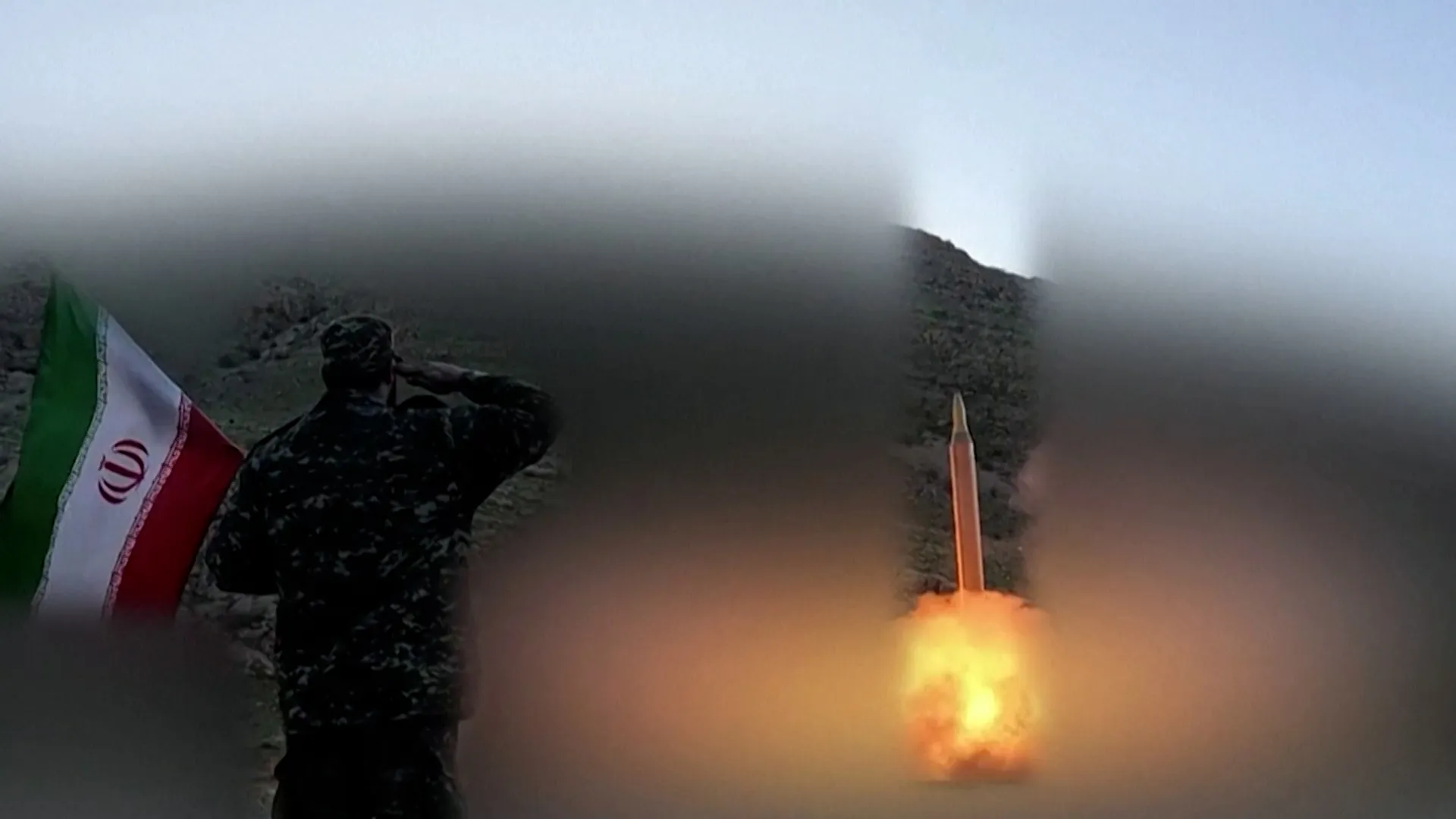
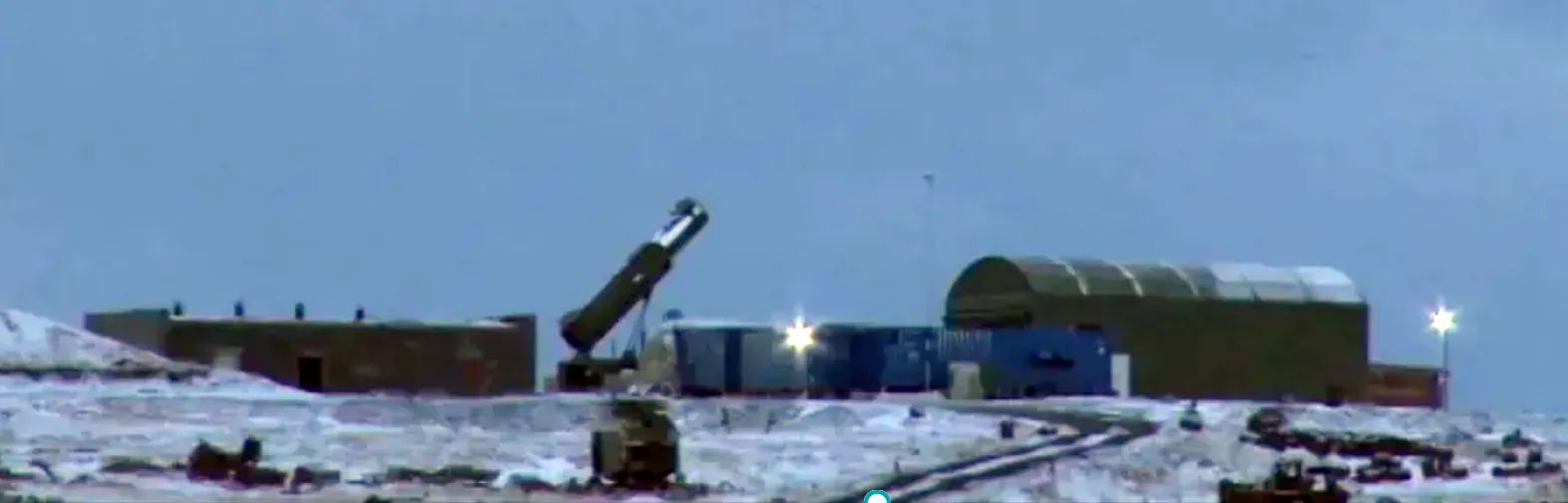
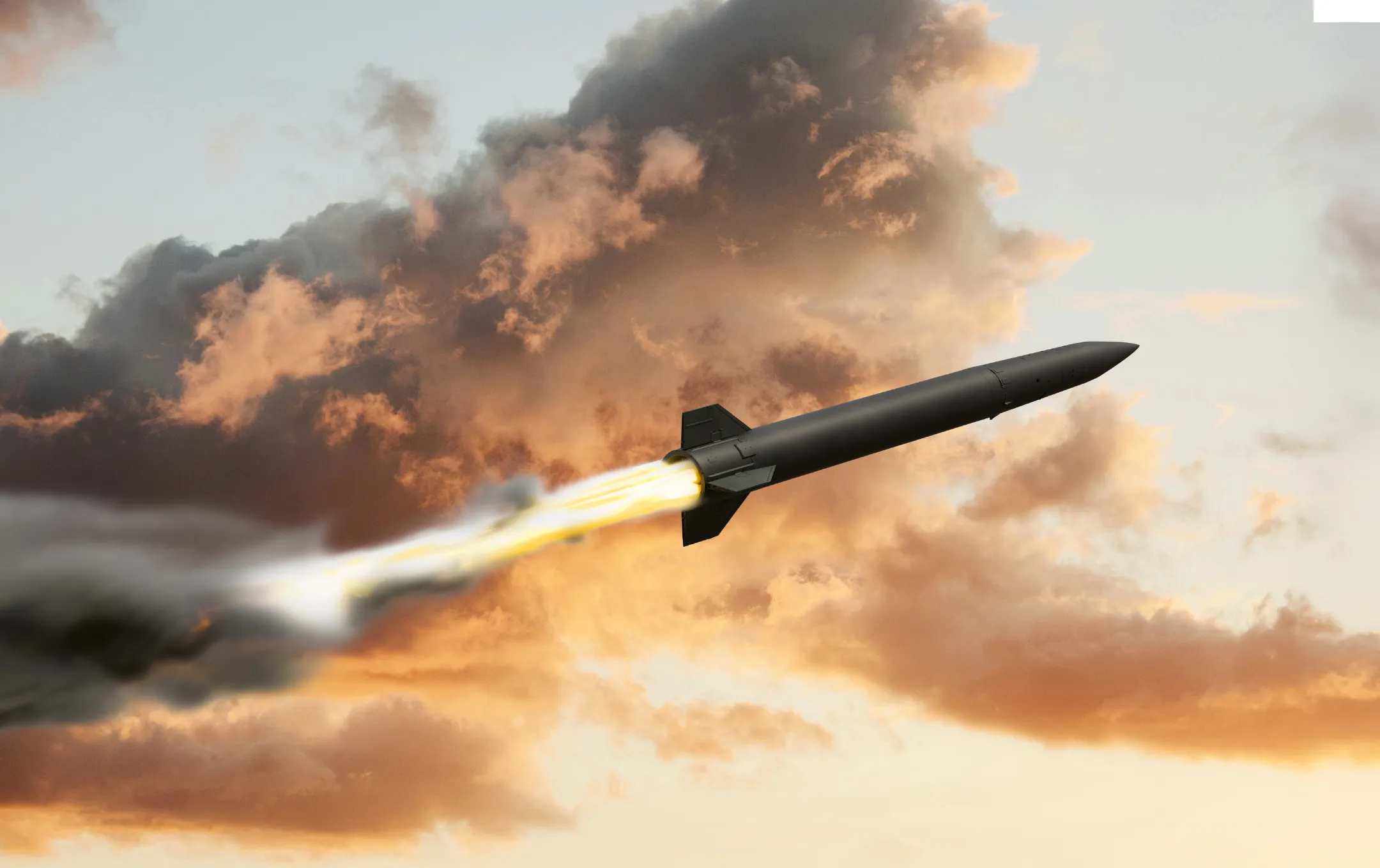
Iran’s Revolutionary Guard Corps released a video of what they say were missiles launched by their naval forces in retaliation of US strikes. US-Iran tensions have been escalating in the Strait of Hormuz leading to its closure and exchange of strikes between US and Iran.
China’s successful submarine-launched ballistic missile test into the southern Pacific this week was more than a routine military exercise. It provided Beijing with a rare opportunity to validate one of the most sensitive aspects of its nuclear deterrent its ability to command, communicate with and potentially deploy nuclear-armed submarines while remaining undetected.
The test, carried out on Monday, involved a ballistic missile launched from a strategic nuclear-powered submarine and has drawn close scrutiny from regional governments and defence analysts. While Chinese officials described it as a standard military drill conducted in accordance with international law, experts say it marks another step in China’s effort to build a more credible and survivable nuclear force.
Why submarine missile tests matter
Unlike land-based nuclear missiles, submarine-launched ballistic missiles (SLBMs) are designed to ensure a country can retaliate even if its territory comes under nuclear attack. This “second-strike capability” forms one of the central pillars of nuclear deterrence.
Analysts say the test was not solely about assessing missile performance. It also allowed Chinese military leaders to evaluate the complex command-and-control systems needed to operate nuclear submarines while they remain hidden beneath the ocean.
Stay ahead of the geopolitical week.
MD Briefing delivers expert analysis across five global fronts — the Indo-Pacific, energy, geoeconomics, European security, and the Middle East — every Monday morning. Free.
Maintaining secure communications with submarines without revealing their position is among the most technically demanding aspects of any nuclear arsenal.
Collin Koh, a security expert at Singapore’s S. Rajaratnam School of International Studies, said Beijing would likely have been evaluating communications, operational procedures and submarine performance alongside the missile itself.
A key part of China’s nuclear modernization
Regional defence experts believe the missile was launched from one of China’s Type-094 nuclear-powered ballistic missile submarines (SSBNs), although Beijing has not officially identified the vessel.
China has steadily expanded its nuclear capabilities over the past decade, developing what military planners describe as a complete “nuclear triad”—the ability to launch nuclear weapons from land, sea and air.
The submarine component is viewed as increasingly important because it offers a survivable retaliatory force if China’s land-based missile sites were destroyed during a conflict.
According to previous U.S. defence assessments, China has already begun near-continuous deterrence patrols using its SSBN fleet, joining the United States, Russia, Britain and France in maintaining an at-sea nuclear capability.
Challenges remain
Despite the progress, experts note that China’s submarine force still faces significant operational hurdles.
To threaten the continental United States with its most advanced JL-3 submarine-launched missile, Chinese submarines would likely need to leave the relative protection of the South China Sea and enter the wider Pacific Ocean, where they could be tracked by U.S. and allied anti-submarine forces.
Military analysts say American and allied navies closely monitor Chinese submarines using surveillance aircraft, underwater sensor networks and naval patrols.
China is also developing a quieter next-generation ballistic missile submarine that could improve its ability to operate undetected.
Regional reaction
The launch prompted criticism from several regional governments.
The United States said China had provided only limited advance notification before the launch and expressed concern over Beijing’s rapidly expanding nuclear arsenal. Japan, Australia, New Zealand and Taiwan also voiced concern following the test.
China rejected the criticism, insisting the exercise complied with international law and was intended solely to safeguard national security and strategic stability.
Beijing has repeatedly argued that its nuclear modernization remains defensive and consistent with its longstanding policy of not being the first to use nuclear weapons.
Analysis: A signal beyond the missile
The importance of this test extends beyond the missile itself. It demonstrates Beijing’s growing confidence in the sea-based leg of its nuclear deterrent, an area traditionally dominated by the United States and Russia.
The exercise also reflects China’s broader military modernization strategy under President Xi Jinping, which prioritizes survivable nuclear forces capable of guaranteeing retaliation under any scenario. Even if operational challenges remain—particularly the ability of Chinese submarines to evade increasingly sophisticated Western tracking systems—the test suggests China is moving closer to a fully credible second-strike capability.
Strategically, the launch sends multiple messages. Domestically, it showcases advances in China’s military technology. Regionally, it reinforces Beijing’s determination to protect its security interests. Internationally, it signals that China’s nuclear forces are becoming more sophisticated, mobile and resilient, adding another layer of complexity to strategic competition with the United States and its allies in the Indo-Pacific.
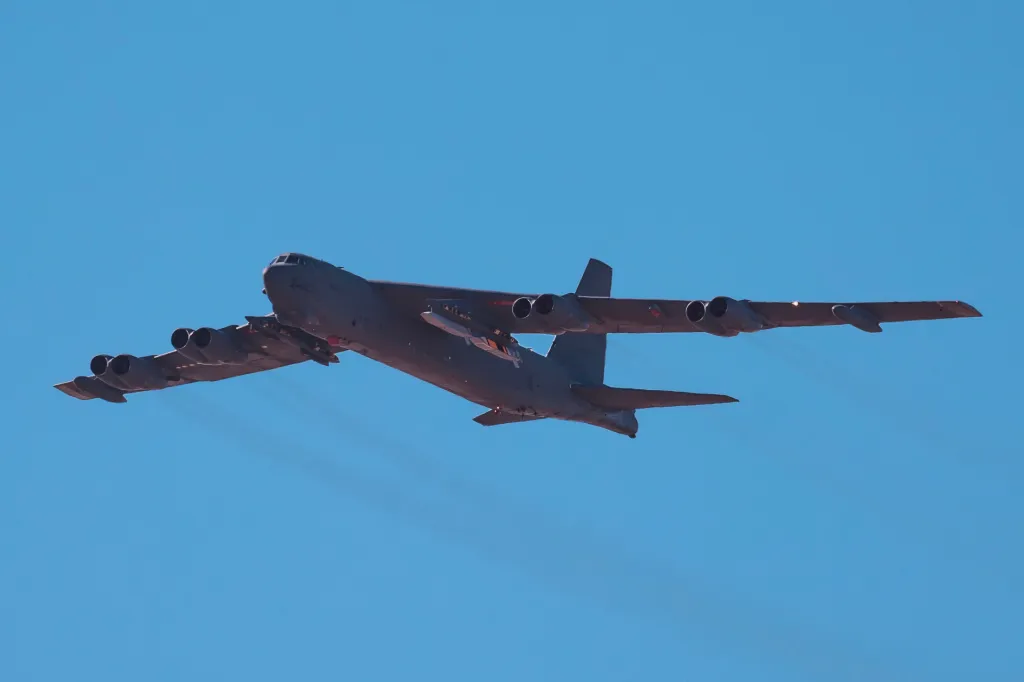
GAO, a Congressional watchdog, provided new details about flight testing plans and other aspects of the LRSO program in an annual report published last week. The AGM-181A has been in active development since 2020, when the Air Force chose Raytheon to be the prime contractor.
A B-52 bomber seen carrying LRSO prototypes, or relevant test articles, earlier this year. Jarod Hamilton
“LRSO reported unfavorable cost and schedule changes over the past year,” GAO reported. “For example, flight testing challenges, largely due to the poor readiness rates of legacy aircraft supporting LRSO testing, resulted in a 4-month delay to its initial capability.”
The Air Force is now aiming to reach initial operational capability with the AGM-181 in November 2030.
GAO says that there have been nine LRSO test flights since October 2024. That is when developmental testing of the missile began. Six of those flight tests, along with seven ground test events, occurred last year. In a report dated December 2022, the Pentagon had previously disclosed nine more test flights as part of earlier phases of the program. Whether additional test flights occurred between December 2022 and October 2024 is unclear.
“Since our last assessment, program officials realigned the test schedule, leaving less time to complete the 27 remaining test flights before operational testing starts in September 2027,” the report GAO put out last week also notes. “However, they noted that some re-testing can still be accommodated.”
As noted, the B-52 is the only aircraft known to be involved in LRSO flight testing, and certainly meets the definition of a “legacy” platform. The last of these bombers rolled off Boeing’s production line in 1962, though the remaining examples have been upgraded repeatedly since then. The sighting last year of a B-52 carrying a pair of AGM-181s, or relevant test articles, on a pylon under its right wing offered the first public glimpse of the missile. Spotters have caught these bombers supporting LRSO tests on several other occasions since then.
A close-up look at the LRSO prototypes, or relevant test articles, seen under the wing of a B-52 bomber earlier this year. Jarod Hamilton
The Air Force currently has 75 B-52H bombers in service, in total. The entire fleet is never available at any one time for taskings of any kind, due to routine maintenance and other factors. The mission-capable rate for the bombers has been hovering between 50 and 55 percent in recent years.
Last month, the Air Force also lost one of its B-52s in a fatal crash at Edwards Air Force Base in California, which tragically killed all eight individuals onboard at the time. The aircraft in question was headed out on a flight test in support of a critical radar modernization program for the bombers when it went down, as you can read more about here.
The radar modernization effort is part of a slew of major upgrades for the B-52 fleet, which also includes all-new engines, improved communication suites, and more. The upgrades are so substantial that the bombers’ designations will change from B-52H to B-52J in the process. They are also in line to see their arsenals grow, including with the addition of the LRSO. The future B-52Js are set to continue serving through at least 2050.
B-52 Future Stratofortress: The Upgrades That Will Transform The B-52H Into The B-52J
Other aspects of the B-52 modernization plan have also been beset by cost growth and delays. Air Force officials have said this has been compounded by the total size of the fleet and operational demands placed on it.
“The challenge with B-52 that I think everybody forgets, it’s such a small fleet that has such a tremendous requirement in terms of readiness,” Air Force Gen. Dale White, the service’s Direct Reporting Portfolio Manager for Critical Major Weapon Systems, told TWZ and others at the Air & Space Forces Association’s (AFA) annual Warfare Symposium in February. “You’ve got to have a certain number on the ramp. That’s a requirement.”
The question becomes “how do you get these through the depot while at the same time meeting the operational requirements?” Gen. White further explained at that time. “That choreography, I think, is going to be tough.”
It’s worth pointing out here that both the war with Iran and the crash at Edwards came after the cutoff date for GAO’s report, and further impacts on the LRSO flight test schedule would not have been recorded therein. There has also been a broader surge in demand across the U.S. military for flight test assets. This is being driven by the needs of modernization efforts for several aircraft beyond the B-52, including the F-22 Raptor, as well as next-generation developments, like the F-47 sixth-generation fighter.
Going back to LRSO, GAO’s latest assessment also highlights other challenges that the program has been facing that are unrelated to flight testing.
An official rendering of the AGM-181A LRSO. USAF
“Program officials stated that 12 of 14 software releases are delivered, with the final delivery planned for March 2026. According to program officials, nuclear certification of LRSO software continues to be a risk that they expect to fully address by November 2026. As we reported last year, the program risks delays if additional LRSO software development is needed to satisfy this certification requirement,” per the report. “LRSO cybersecurity testing continues with some delays reported during the past year. Program officials stated these delays did not bring about any cost or schedule changes, with the final cybersecurity assessment still planned for September 2027.”
“The missile’s technology maturity has advanced since our last assessment, with only two out of the six critical technologies still approaching maturity. They are both expected to be fully mature in fiscal year 2026, about 5 years after development start. DOE [Department of Energy] also identified critical technologies for the warhead, of which 80 percent are considered mature, more than double the percentage reported last year,” the report adds. “However, DOE may not mature all the remaining warhead technologies until the fourth quarter of fiscal year 2026. As we previously reported, both the missile and warhead started development with immature technologies, requiring parallel technology and design maturity efforts. This method falls short of the best practice to start with mature technologies and would have minimized the risks of future cost increases and schedule delays associated with concurrency during system development.”
There is also cost growth, as well as cost discrepancies.
“Program costs increased by $347 million after Air Force leadership directed a 1-year extension to LRSO production due to near-term budget constraints,” according to GAO.
“As we previously reported, Office of the Secretary of Defense and Air Force officials continue to work together to resolve a $1.9 billion difference between their production cost estimates for future LRSO production,” the report also says. “While a fully updated estimate is not expected until later in 2026, program officials now agree that OSD’s higher cost estimate provides an appropriate basis for the program’s fiscal year 2027 budget request and future year procurement funding needs.”
Buoyed in part by the successful flight testing it has conducted to date, GAO says the Air Force remains confident that it can meet its goal of starting low-rate initial production of the LRSO next year. Hitting that milestone will be key to staying on schedule to start fielding the missiles in 2030.
July 8 (UPI) — NATO countries in Europe, plus Canada, agreed Wednesday to jointly spend $50 billion over the coming decade on developing new ground-based “deep precision strike capabilities,” including an advanced missile with a 1,250 mile range to defend the continent and beyond.
Launched by British Prime Minister Keir Starmer at the NATO Summit in Ankara, the project brings together Britain, France, Italy, Denmark, Sweden, Norway, Finland, Greece, Czechia, Slovakia, Turkey and Canada, Downing Street said in a news release.
The initiative was, Britain said, proof that allies were taking action to strengthen Europe’s ability to defend by “radically boosting NATO’s defense and deterrence capabilities” and ensuring a “more European NATO.”
“We must step up to deliver a stronger, more European NATO. The U.K.is already working with partners to develop exquisite capability that will give our Armed Forces the ability to defend and deter thousands of kilometres from the front line, but this U.K.-led initiative will allow us to step up our cooperation, bringing European Allies together to ensure NATO remains safe and secure for years to come,” said Starmer.
NATO said in a statement that the breakthrough came after NATO allies “made progress on providing innovative and cost-effective solutions for munitions and deep strike systems, delivering them faster and at greater scale.”
The costs and complexity involved in developing and making advanced strike capabilities, together with recurring compatibility and interchangeability problems and the rapidly evolving threat of long-range strikes requiring a nimble response, meant it made sense for allies to work together, NATO said.
Leveraging multinational projects and shared defense purchasing would spread the cost, realize economies of scale and deliver field capabilities much faster than working individually, it added.
Britain, France, Italy, Denmark, Norway and Turkey will work together on developing the proposed long-range missile deterrent and other “novel deep precision strike capabilities,” including new missiles and launchers.
The remainder of the countries — plus Denmark, Norway and Turkey — agreed to work together to address issues created by the array of different weapons systems used by NATO member states by developing a prototype generic NATO artillery round, aimed at establishing standards for a “future fully interchangeable, interoperable NATO 155mm munition.”
Speaking in Ankara, British Foreign Secretary Yvette Cooper said the new deep precision strike capability would deter would-be aggressors by enabling NATO to target high-value military assets and “the logistical engines that drive armies.
“At Ankara we are sending a clear message to President Putin; NATO is stronger, more European and ready to defend our citizens against the long-term threat posed by him and the Russian state,” said Cooper.
Britain is already working on a multi-billion-dollar project to jointly develop long-range stealth and hypersonic missiles with Germany as part of an enhanced defense cooperation pact between the countries signed in summer 2024.
It is also working with France and Italy on Stratus, a new family of long-range cruise and anti-ship weapon, to replace the Storm Shadow cruise missile and Harpoon and Exocet anti-ship weapons used by the militaries of the three countries.
Stratus is being developed by the pan-European defense contractor MBDA Missile Systems.
Wednesday’s developments came amid a summit at which the administration of U.S. President Donald Trump has been doubling down on its burden-sharing message that Europe must shoulder more responsibility for its own defense and for member states to meet pledges made in The Hague in 2025 to up core military spending to 3.5% of GDP, or 5% total defense and security-related spending.
Astronaut Buzz Aldrin walks on the surface of the Moon during the Apollo 11 mission on July 20, 1969. Photo by NASA/UPI | License Photo
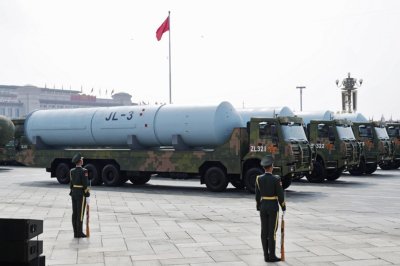
JL-3 intercontinental-range submarine-launched ballistic missiles are seen during a military parade in Beijing, China. Photo by ANDRES MARTINEZ CASARES / EPA
July 6 (Asia Today) — China launched a strategic missile into international waters in the Pacific on Monday, prompting concern from Japan and other regional powers as a U.S. nuclear and missile expert said the weapon was likely a JL-3 submarine-launched ballistic missile.
The People’s Liberation Army Navy said on social media that one strategic nuclear submarine successfully fired a submarine-launched strategic missile carrying a dummy warhead toward the Pacific at 12:01 p.m. local time.
The Chinese military said the missile landed accurately in the target sea area but did not disclose the missile type or the exact impact location.
Wang Xuemeng, a spokesperson for the Chinese navy, said the launch was part of annual military training and that relevant countries were notified in advance.
“The launch complied with international law and international practice,” Wang said. “It was not aimed at any specific country or target.”
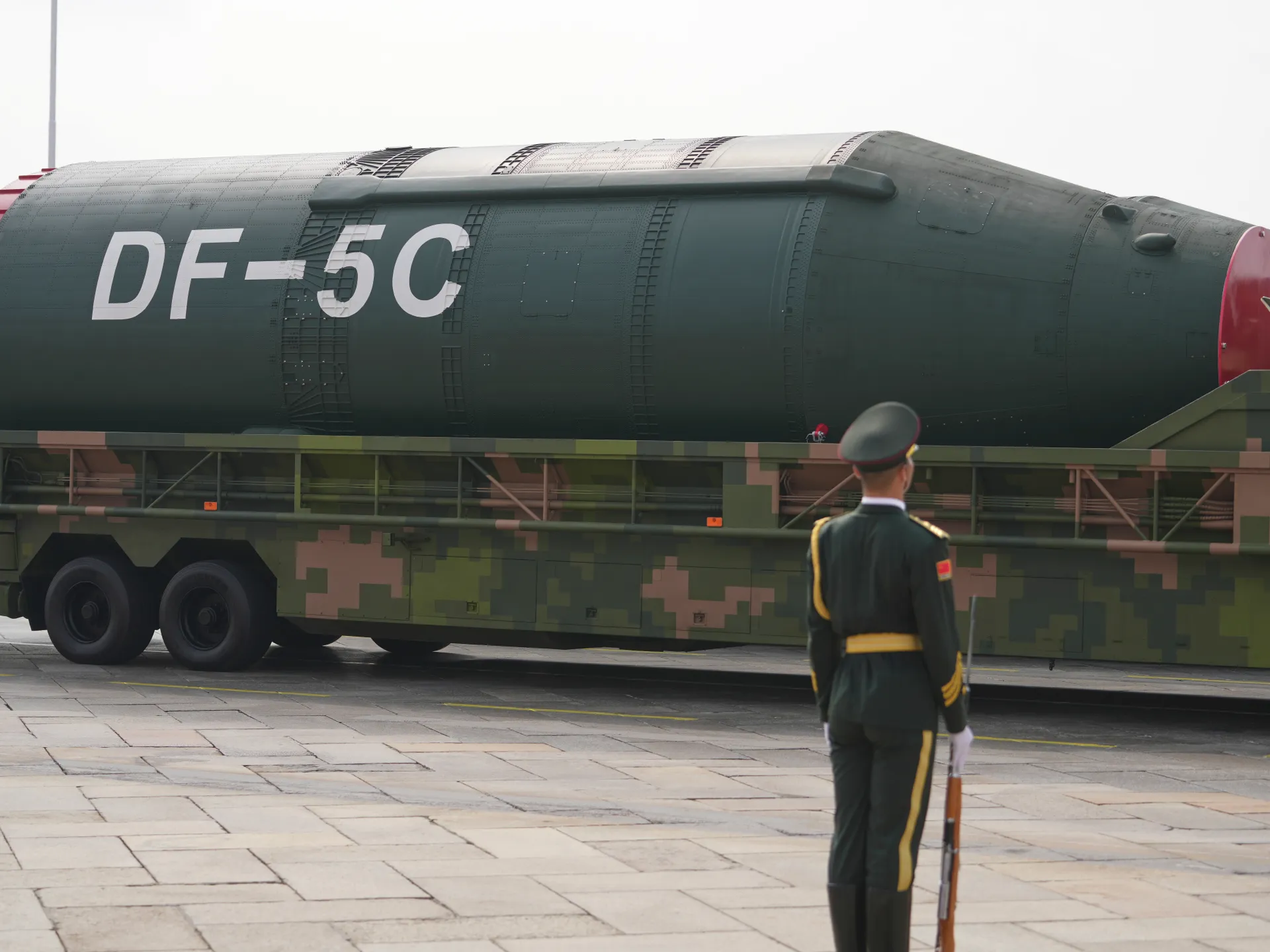
China also launched an intercontinental ballistic missile into international waters in the Pacific in September 2024. That test was China’s first ICBM launch toward the Pacific since a Dongfeng-5 launch in 1980. Based on photos later released, analysts assessed the 2024 missile as likely a Dongfeng-31AG, a road-mobile missile capable of reaching the U.S. mainland.
Monday’s launch was China’s first Pacific-oriented strategic missile test in about one year and 10 months.
The Japanese government expressed serious concern over the launch. China notified Japan of the plan in advance and designated areas near Shionomisaki, south of Wakayama Prefecture, as possible falling zones for space debris, Japanese media reported. Japan asked China to reconsider so the launch would not threaten Japanese safety.
The Japanese government said some of the projected debris zones included Japan’s exclusive economic zone, but the missile appeared to have landed outside the zone. It also said there were no confirmed reports that the missile passed over Japanese territory or the exclusive economic zone or that aircraft or ships were damaged.
Chief Cabinet Secretary Minoru Kihara, the Japanese government’s top spokesperson, said China’s military activities are a serious concern because of Beijing’s lack of transparency.
“China’s military trends lack transparency and have become a grave concern for Japan and the international community,” Kihara said.
China’s Foreign Ministry rejected international criticism, saying the launch was a routine military training activity conducted under safety standards and professional procedures.
“We hope relevant countries will not overinterpret the matter,” the ministry said.
In the United States, analysts said the missile used in the test may have been China’s newest submarine-launched ballistic missile, the JL-3.
Jeffrey Lewis, director of the East Asia Nonproliferation Program at the Middlebury Institute of International Studies at Monterey, told The New York Times that the Chinese military most likely tested the JL-3.
The JL-3 is China’s third-generation submarine-launched ballistic missile. It is believed to have a range of more than 10,000 kilometers, or about 6,200 miles, putting most of the world, including the U.S. mainland, within reach.
Submarine-launched ballistic missiles are considered a key part of nuclear deterrence because they are harder to detect than land-based missiles once deployed at sea. China publicly displayed the JL-3 during a military parade in Beijing in September 2025.
Lewis said the test signals that China’s nuclear force modernization has entered a new stage.
“Historically, China has conducted fewer ICBM tests than other countries,” Lewis said. “The reason was political, but the political dynamics have changed, and they seem to be adopting an approach of testing more frequently.”
Lewis said China may conduct more frequent tests of long-range missiles capable of carrying nuclear warheads in the future.
Countries raise concerns after Chinese military test-launches ballistic missile from submarine in the Pacific Ocean.
Published On 6 Jul 20266 Jul 2026
China has test-fired a missile from a nuclear submarine that landed in “designated waters” in the Pacific Ocean, state news agency Xinhua reports, drawing criticism and concerns from Japan, Australia and New Zealand.
The Chinese navy test-launched the long-range ballistic missile at 12:01pm (04:01 GMT) on Monday from one of its nuclear-powered submarines in the South Pacific, Xinhua reported.
Recommended Stories
list of 3 itemsend of list
Xinhua said the test was a “routine arrangement” of China’s annual military training and was not directed at any specific target.
Australian Foreign Minister Penny Wong confirmed that China had notified the government of plans to conduct a sea-based missile test into the Pacific but said the action was “destabilising” to the region.
“Australia has been clear that this proposed test is in the context of a rapid military build-up by China, which is lacking in the transparency and reassurance as to intent that the region expects,” Wong told reporters at a news conference in the Fijian capital, Suva.
Japan’s government said it was notified of the missile launch and had urged China to reconsider.
“We expressed our grave concern over the Chinese military’s increased activity,” the government said, adding that Japan’s coastguard had been notified on Sunday by Chinese authorities about falling space debris that could fall within Japan’s exclusive economic zone.
The New Zealand government said it was informed of the planned launch within hours of it taking place.
“New Zealand considers this an unwelcome and concerning development. We, like our neighbours in other Pacific countries, have no interest in China using the South Pacific as a testing site for missile capability,” Foreign Minister Winston Peters said in a statement.
Weekly insights and analysis on the latest developments in military technology, strategy, and foreign policy.
The U.S. Navy has now made it clear it is at least exploring an alternative to the still-in-development AGM-88G Advanced Anti-Radiation Guided Missile-Extended Range (AARGM-ER). When the Advanced Emission Suppression Missile (AESM) effort first emerged earlier this year, the stated requirements did sound curiously similar to what the service wants from the AGM-88G. There was also mention of an all-new need to be able to engage radio frequency-emitting targets in the air, as well as on the surface, but this is no longer being emphasized, at least publicly.
The new contracting notice raises questions about the future of the AARGM-ER program, which the Navy told TWZ in April was still on track to be fielded later this year. The service had also previously announced a “strategic pause” in purchases of AGM-88Gs, but only for the 2027 Fiscal Year. The AARGM-ER is a direct evolution of the existing AGM-88E Advanced Anti-Radiation Guided Missile (AARGM).
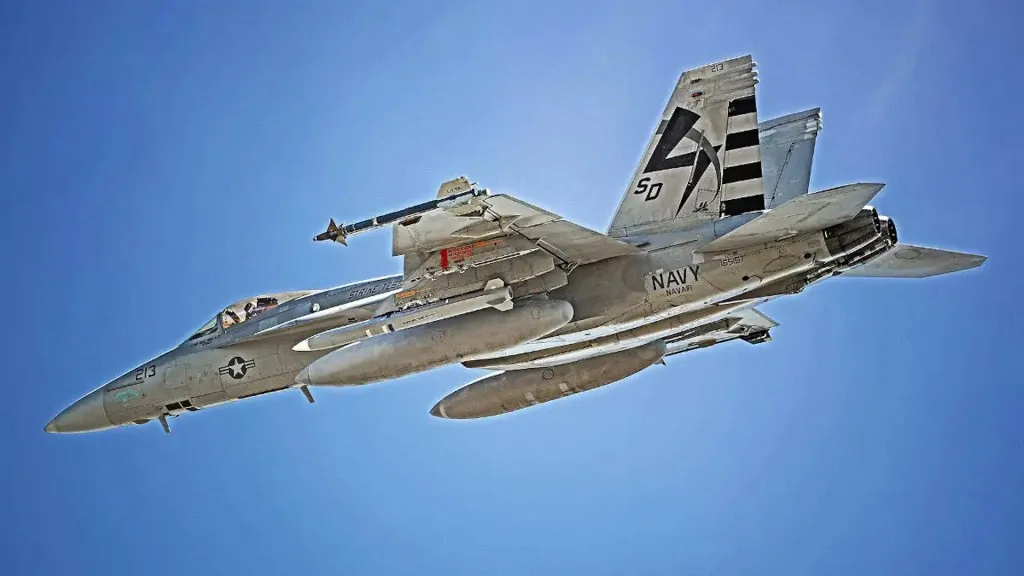
An AGM-88G AARGM-ER seen under the wing of an F/A-18E Super Hornet during a test. USN
Naval Air Systems Command (NAVAIR) issued a new AESM request for information (RFI) yesterday. NAVAIR had previously put out a contract notice regarding this new missile back in February, but subsequently took it down.
NAVAIR is now looking “to conduct market research to identify potential sources capable of providing an AARGM-ER equivalent missile system,” according to the new RFI. This “consists of the All-Up-Round (AUR) missile to include hardware and software, as well as any unique logistics elements, trainers, AARGM-ER equivalent flyout model, and all system verification elements.”
“The purpose of this RFI is to conduct market research to identify potential sources capable of providing a mature design (TRL >6) missile system which consists of the All-Up-Round (AUR) missile to include hardware and software, as well as any unique logistics elements, trainers, flyout model, and all system verification elements,” the notice adds. “This AUR must be compatible with existing launch platforms.”
TRL here refers to the U.S. government’s Technology Readiness Level (TRL) scale, which is used to categorize the maturity of munitions and other systems. TRL 6 is defined as an effort that has produced a “representative model or prototype system” that has been “tested in a relevant environment.” The “relevant environment” here can include high-fidelity laboratory conditions or be otherwise simulated.
The latest desired requirements for AESM are very broad and fully in line with what the Navy has said for years that it expects to gain from the fielding of the AGM-88G.
A NAVAIR graphic offering a very general overview of the AGM-88G’s capabilities as compared to the previous AGM-88E AARGM. USN
AESM needs to have “extended range,” allowing it to be “capable of engaging targets at significant standoff distances.” It has to include an “advanced anti-radiation seeker with broad frequency coverage” and the “ability to target modern and advanced radar systems.” In terms of “lethality,” the goal is to achieve a “high probability of kill against a wide range of targets.”
Like the AARGM-ER, AESM needs to be suitable for internal and external carriage on at least certain variants of the F-35 Joint Strike Fighter. F/A-18E/F Super Hornet fighters and EA-18G Growler electronic warfare jets are also listed as threshold launch platforms.
A picture showing a fit check to demonstrate the ability of the AARGM-ER test article to fit inside F-35A/C internal bays. Orbital ATK
The original AESM RFI in February had laid out more specific requirements, which are absent in the new contracting notice. This includes an explicit call for prospective vendors to describe their proposed missile’s “ability to engage air-to-air and air-to-ground targets.”
There has been no mention in the past about an air-to-air engagement capability for the AGM-88G. It’s unclear whether this is still an area of interest for AESM. TWZ has reached out to the Navy for more information about the current state of AESM and how that factors into plans for AARGM-ER.
A US Navy F/A-18F Super Hornet fires an AGM-88G AARGM-ER over the Point Mugu Sea Range during an earlier test. Northrop Grumman
With added air-to-air engagement capability, AESM would open the door to new operational possibilities and could be more complementary to AARGM-ER. As we previously wrote after the first RFI was released:
“U.S. military interest in very-long-range air-to-air capable anti-radiation missiles traces all the way back to the Cold War, primarily as a means for engaging enemy airborne early warning and control (AEW&C) planes. Anti-air weapons designed around this role are often colloquially referred to as ‘AWACS killers,’ a reference to the U.S. E-3 Sentry Airborne Warning and Control System (AWACS) aircraft. A very-long-range air-to-air missile could be used against other aerial targets, as well.”
…
“All that being said, the value of an ‘AWACS killer’ missile is clear-cut. AEW&C are critical surveillance and battle management assets. Shooting them down deprives an opponent of those capabilities, inherently reducing their ability to effectively maneuver air assets and share important information, including with other nodes on the ground or at sea, as well as in the air. Knocking out these flying radar stations, which can be especially well-suited to spotting lower flying threats from their high perches, just hampers an enemy’s overall situational awareness.“
“The issue, of course, is that AEW&C planes typically orbit well behind the front edges of a conflict, creating additional challenges for targeting them. This is where something like AESM could come into play. A weapon of this type could engage other aerial targets by zeroing in on the radiofrequency emissions they pump out. This could include electronic warfare aircraft, and potentially other aerial targets. AESM might be able to take on a more general anti-air role with the addition of an active radar and/or imaging infrared seeker, as well as datalinks allowing for the use of networked targeting data. AARGM and AARGM-ER both feature an active millimeter-wave radar seeker to enable them to hit fleeing ground targets, but a similar concept could be adapted for air-to-air use.”
AESM would also still have the ability to be employed in an air-to-surface mode like the AGM-88G and its predecessors. Having a single missile with hybrid anti-air/anti-radiation capabilities would offer very useful added flexibility, especially for addressing threats that might suddenly appear during a sortie. This would also offer magazine depth benefits, since a launch aircraft loaded with AESMs would inherently have more engagement opportunities against a wider target set than one carrying a mixture of AARGM-ERs and traditional air-to-air missiles.
AARGM F-18
This could slot in well with the rest of the Navy’s planned future air-launched missile ecosystem, which at least currently includes the AGM-88G, as well as the AIM-174B air-launched version of the multi-purpose Standard Missile-6 (SM-6) and the AIM-260 advanced air-to-air missile. These missiles fit into ever-expanding ‘kill web’ architectures made up of deeply integrated networks of sensors and other assets from across the services, spread across the air, land, sea, space, and even cyberspace domains. TWZ previously explored all of this in a detailed feature you can find here.
How The Navy’s New Very Long-Range AIM-174 Will Pierce China’s Anti-Access Bubble
It’s also worth remembering that the U.S. Air Force has worked with the Navy on similar hybrid anti-air/anti-radiation missile efforts in the past. The Air Force also just recently put out its own call for information about a prospective common missile with a range of at least 1,000 miles, that could come in air-to-air and air-to-surface versions. AESM might further emerge as a joint-service effort and/or one that involves foreign participation.
At the same time, the downplaying of more specific capabilities in the rebooted AESM RFI can only prompt questions about the future of the AGM-88G. The Navy has been actively pursuing AARGM-ER since 2018. The missile’s increased speed and range are viewed as vital for future conflicts, especially when it comes to ensuring survivability and effectiveness of non-stealthy launch platforms as adversary anti-access and area denial (A2/AD) bubbles continue to expand in scale and scope.
However, the AARGM-ER program has encountered technical issues in development and suffered significant delays. The original goal was for the missile to reach initial operational capability (IOC) on the F/A-18E/F and EA-18G in 2023. The Navy is now aiming to hit that milestone by September of this year. There are foreign customers also still in line to receive AARGM-ERs, and Italy is notably a full partner in the missile’s development. The Air Force is pursuing a derivative, called the Stand-in Attack Weapon (SiAW) and reportedly designated the AGM-88J, intended to provide a more general strike capability.
“U.S. procurements for the AARGM-ER program are planned to resume once the system has successfully completed all necessary testing and software updates. Our immediate priority is ensuring the weapon passes these rigorous testing milestones to achieve Initial Operational Capability (IOC) in September 2026,” a Navy spokesperson told TWZ back in February about the status of the program and the aforementioned strategic pause. “After validating the software and testing, the plan would be to ramp up production to clear a backlog of over 150 missiles, with U.S. procurements officially restarting in FY28 [Fiscal year 2028]. In the interim, FY27 production will be allocated to Foreign Military Sales to fulfill our commitments to five signed international cases.”
Another look at an AARGM-ER under the wing of a Navy F/A-18 during a test. USN
It is worth noting here that the Navy seeking a functional equivalent to the AGM-88G does not automatically mean it is considering supplanting that missile entirely. Diversification of the supply chains, especially by leveraging new and non-traditional vendors, has become a top priority across the U.S. military in recent years. Efforts to broaden the defense industrial base, with an explicit emphasis on less reliance on traditional prime contractors, have surged further since President Donald Trump started his second term. More industrial base diversity offers benefits for scaling up production of subcomponents and complete systems. Another key aspect of these initiatives has been avoiding getting locked into a single vendor for key programs, helping to foster competition that can drive down costs.
Having an alternative source of missiles that are even just roughly similar to the AARGM-ER capability-wise could be very valuable for bolstering stockpiles now and ensuring they can be replenished in the future, especially in the midst of a sustained high-end fight. The lead time for the acquisition of exquisite munitions is often measured in months, if not years. Concerns about the sufficiency of U.S. stockpiles of key missiles have already been growing in recent years due to a succession of global crises, something TWZ has regularly called attention to. This has become an even more pressing topic given the expenditures of critical munitions during the latest conflict with Iran. The Pentagon has signed several new deals with various companies in the past year or so to expand and accelerate production of existing and new missiles, underscoring just how significant the demand signal has become. Still, it will take time for those contracts to bear fruit, reinforcing the value of having additional streams of relevant munitions.
Much remains to be learned about the Navy’s exact intentions with AESM and how it fits in with the current plans for AARGM-ER. What we do know now is that the service is actively looking at options for a new missile that offers at least equivalent capability to the AGM-88G.
Update: 4:30 PM ET –
An annual assessment of multiple high-profile U.S. military procurement programs that the Government Accountability Office (GAO) released today provides some additional context about the AARGM-ER program.
“The AARGM-ER program continued to experience significant delays due to software problems discovered during testing. Software development challenges were also a main driver of prior delays. According to the program, a February 2025 flight test failed due to a software issue, which it attributed to a lack of rigor in the contractor’s software development and testing process,” per GAO’s report. “The program did not use a modern approach to software, and the program office did not have visibility into software metrics, which could have provided insights into issues sooner. Program officials stated that the contractor updated its software development processes, and the program instituted additional software reviews for future flight tests.”
“The program is conducting four flight tests in fiscal year 2026 before fielding an initial operational capability,” the report adds. “According to program officials, the December flight test was successful. The program expected to reach initial operational capability in July 2024, but officials now expect to do so over 2 years later in September 2026.”
The Congressional watchdog’s assessment also speaks to continued challenges with production.
“The AARGM-ER program continues to experience production delays. The program reported that the delays were related to missile qualification, hardware capability, and software problems discovered during testing. Program officials expect initial missile deliveries to start in mid-2026,” the report explains. “Initial missile deliveries were originally planned for late 2023. According to program officials, they withheld certain payments to the contractor due to the delays. The program also told the contractor it will not accept missile deliveries until qualification and flight tests verify the missile is safe to employ and performs as expected. The program expects to complete missile qualification in June 2026. We found that starting production before demonstrating a system will work as intended—which the Navy did—increases the risk of discovering deficiencies that require costly, time-intensive rework.”
It is worth noting here that the AESM RFI released yesterday also calls for lower-cost designs that could be produced at a rate of 600 missiles per year. This is twice the production scale outlined back in February.
Weekly insights and analysis on the latest developments in military technology, strategy, and foreign policy.
Imagery has recently appeared showing a Russian Sukhoi Su-57 Felon fighter with an unusual external weapons load of short-range air-to-air missiles, as well as what looks like a previously unseen type of targeting pod. While we cannot say for sure, we may just have gotten our first close look at a Su-57 equipped to counter the Ukrainian kamikaze drones and cruise missiles that are now a regular menace to air defenses increasingly deep inside Russia.
Two photos, the original source of which is unclear, show a Su-57 configured with a pair of R-73/R-74 (AA-11 Archer) series short-range air-to-air missiles on pylons under the wings. One of those photos further shows the mysterious targeting pod below the left engine nacelle.
This rear view of a Su-57 reveals the two missiles underwing as well as the targeting pod below the left engine nacelle. via X
Both show a Su-57 seen from the rear inside a large shelter. One photo apparently surfaced on the TikTok social media platform. Somewhat surprisingly, it is one of a pair that also show apparent teenagers posing alongside the Felon — one of them inside the fighter’s cockpit — suggesting some kind of unofficial tour of the base.
The photos have been reposted on Russian social media, with military bloggers identifying them as showing Su-57s configured to hunt and shoot down Ukrainian drones.
A civilian, apparently a teenager, sits in the cockpit of a Su-57. via X
While this certainly seems likely, we should not rule out some other possibilities, including a Felon involved in some kind of weapons trials. On the other hand, it is unusual to see Su-57s, in operational service or otherwise, carrying short-range air-to-air missiles externally. After all, the jet has internal bays specifically for this purpose, something we have described in detail in the past.
A pre-production Su-57. The triangular, canoe-like wing-root weapons bays are visible outboard of the aircraft’s engine intakes. Vitaly Kuzmin
At the very least, this would appear to be a load-out optimized for close-range engagements, of the kind that would be required for hunting Ukrainian long-range one-way attack drones and, increasingly, cruise missiles.
It is also worth noting the large shelter in which the Su-57 is parked. This looks to be of the same type that has been installed at the airfield at Akhtubinsk in the Astrakhan region of the Russian Federation, located more than 350 miles from the front line. In June of 2024, Akhtubinsk was itself hit by Ukrainian drones, which appear to have severely damaged, if not destroyed, a Felon parked in the open.
‼️ Вперше уражено Су-57
💥 8 червня 2024 року на території аеродрому «ахтубінск» в астраханській області рф, розташованому за 589 кілометрів від лінії бойового зіткнення, уражено багатоцільовий винищувач держави-агресора Су-57.
— Defence Intelligence of Ukraine (@DI_Ukraine) June 9, 2024
Russian military bloggers complained bitterly about the lack of protection from drone attacks at Akhtubinsk.
This reflected wider questions about the ability of Russia’s widely dispersed and heavily targeted air defenses to counter Ukrainian drone incursions and the ability to protect its own aircraft. Almost all of these assets, at the start of the conflict, sat in the open without any sort of shelters, let alone hardened ones. This is an area that Russia has since begun to address, even extending this to its long-range bomber fleet.
The Su-57 is very much a prized, ‘silver bullet’ asset of the Russian Aerospace Forces (VKS). But it is also notably well-equipped for countering drones and cruise missiles, as we will come onto later.
The scope of the Su-57’s contribution to Russia’s conflict in Ukraine is hard to quantify.
The U.K. Ministry of Defense has stated that Su-57s have been used in Ukraine since “at least June 2022.”
Prior to that statement, there had been on-and-off claims of the Felon being used to launch standoff strikes, mirroring tactics for other Russian jets involved in similar missions, in which they avoid the highly contested airspace over Ukraine itself.
For this purpose, the Felon can be armed with the Kh-69 stealthy cruise missile, intended to destroy small, hardened targets at distances of over 180 miles. It also carries the Kh-58UShK anti-radiation missile (including in its internal weapons bays) with a maximum range of around 150 miles, depending on launch parameters.
Meanwhile, the Su-57 has very impressive air-to-air capabilities.
Most impressively, it is armed with the 124-mile-range R-37M (AA-13 Axehead) air-to-air missile, complemented by the R-77-1 (AA-12 Adder) air-to-air missile, with a range of 68 miles, which are also capable of engaging Ukrainian aircraft ‘across the border’ in some scenarios.
Using high-end, fifth-generation, or equivalent fighter jets to tackle hostile drones and cruise missiles would not be unique to Russia. The U.S. military, as well as Israel and the United Kingdom, have called upon their F-35 fleets to deal with lower-end threats like these in the Middle East.
The Su-57 is the only operational Russian fighter available in any kind of meaningful numbers with an active electronically scanned array (AESA) radar.
The N036 radar, which has five separate AESA arrays, is part of a broader, integrated fire-control system that includes the 101KS electro-optical suite, the N036Sh identification friend or foe (IFF) system, and the L402 electronic countermeasures suite.
You can clearly see one of the supplemental side radar apertures below the ‘chine line’ under the aerial refueling probe. Russian Embassy
AESA radars are, in general, much better able to deal with drone and cruise missile threats.
Overall, any kind of AESA radar provides a significant boost to modern combat aircraft. In comparison with traditional mechanically scanned array technology, an AESA can find and track a target at a much greater range, more quickly, and with a greater degree of accuracy. This also applies to smaller threats, including those with limited radar signatures, or flying at very low levels, such as drones and cruise missiles.
The passive 101KS electro-optical suite should also be very useful against the same kinds of threats. It comprises an infrared search-and-track (IRST) sensor ahead of the cockpit, four ultraviolet missile-approach warning sensors, two directional infrared countermeasures turrets, and one imaging infrared sensor for low-level flying. Using the IRST, in particular, for counter-drone and cruise missile work, would reflect U.S. fighters’ employment of podded infrared sensors for the same. These sensors allow for long-range detection of low-radar-signature targets, including drones and cruise missiles. They can work collaboratively with the radar and other sensors to detect, classify, and engage these kinds of hard-to-spot targets at long distances.
The Su-57’s 101KS-V IRST is mounted where it is found traditionally on Russian fighters and is not the best spot for low observability. UAC Russia
Furthermore, unlike previous Russian tactical fighters, the Su-57 has a navigation and targeting pod, the 101KS-N, developed for it from the outset. Again, these kinds of stores have begun to be employed much more widely in efforts to counter drones and cruise missiles.
While targeting pods were first fielded for air-to-ground applications, they can also be used for air-to-air engagement, being highly important for visual ID at range. The laser designator can also be employed to illuminate, or ‘laze,’ a target, although that does not come into play with the Felon, since the aircraft has no laser-guided air-to-air weapons that we know of.
Most likely this is the 101KS-N Atoll from UOMZ. If that’s the case, that’s actually very good—UOMZ usually produces some pretty low-quality stuff. https://t.co/54laFDZ6gcpic.twitter.com/6cqMFyYIzw
— 𝔗𝔥𝔢 𝕯𝔢𝔞𝔡 𝕯𝔦𝔰𝔱𝔯𝔦𝔠𝔱△ 🇬🇪🇺🇦🇺🇲🇬🇷 (@TheDeadDistrict) May 18, 2026
Interestingly, the pod seen in the accompanying image has a different rear end from the standard 101KS-N. It is unclear if it represents a new version of the pod, or even one that is optimized for air-to-air engagements, but that is a possibility. We also should not rule out that this is another type of store entirely, although its position on the nacelle makes that less likely.
Meanwhile, despite claims that Russia is developing laser-guided rockets that can be used for air-to-air engagements, like the U.S. developments of the 70mm Advanced Precision Kill Weapon System II (APKWS II) rocket as a lower-cost way to down drones, there is no evidence that these have yet been fielded. This leaves the R-73/R-74 series short-range air-to-air missiles as the cheapest option for bringing down these kinds of threats.
When the R-73 first emerged in the early 1980s, it soon established itself as a very capable short-range air-to-air missile. Its combination of an all-aspect infrared seeker, high off-boresight capability, thrust-vectoring controls, and the fact it could be cued by the pilot’s helmet-mounted sight was unusual for the time, but is now much more commonplace. It has also been proven as a drone-killer, as seen in the video below, of a Russian MiG-29 Fulcrum shooting down one of Georgia’s Israeli-made Hermes 450 drones over Abkhazia in March 2008.
The successor to the R-73 is the R-74M, which looks almost identical but has a new two-band infrared seeker. This provides an increased seeker range and an expanded off-boresight capability, reducing the possibility of the enemy aircraft escaping it in a tight-turning dogfight.
RVV-MD is the export name used for the Vympel R-74M. The abbreviation denotes “short-range air-to-air missile” in Russian. Rosoboronexport
However, since critical parts of the R-74M were sourced from Ukraine, Russia then moved to the R-74M2, which is optimized for internal carriage by the Su-57. This uses a Russian-made seeker and a rocket motor with increased burn time, for longer range. The weapon can also be fired in lock-on-after-launch mode, which is typically required when launched from an internal bay, the missile beginning its flight under inertial control before achieving an in-flight lock-on.
This sequence may or may not show the launch of an R-74M2 from one of the Su-57’s two small wing-root weapons bays. Russian Ministry of Defense capture
It’s unclear which of these weapons are carried under the wings of the Su-57 in these images. However, with plentiful stocks of older R-73s still available, it would make good sense to carry these externally, since they cannot be accommodated in the internal weapons bays.
Another key counter-drone and cruise missile weapon could be the Su-57’s 30mm single-barrel cannon within the starboard wing root and provided with 150 rounds of ammunition. You can see it in action here. On the other hand, downing slow and low drones with the gun is very challenging from a fighter and can be outright dangerous. The 30mm gun on the Felon also has a notably limited magazine size.
All in all, there is some circumstantial evidence that Su-57s are now being used — whether routinely, or as part of combat trials — for air defense against Ukrainian drones and cruise missiles.
Clearly, this is a growing problem for Russia, underscored very publicly by the large-scale daylight raid on Moscow last month. In what was one of the biggest attacks on the Russian capital in the conflict, multiple Ukrainian drones and cruise missiles hit several locations across the city.
In response, Russia is calling upon a wide variety of assets to help defend against the drones and cruise missiles.
Although many key assets are deployed closer to the front lines in Ukraine, there is now an array of additional layered air defenses deployed in and around key potential targets. Defensive systems extend from S-400 long-range surface-to-air missile batteries to attack helicopters tasked with gunning down drones in midair. Most prominently, Pantsir short-range air defense batteries have been positioned on rooftops and elevated towers.
The ruSSians are using a Mi-26 heavy-lift helicopter to deliver a Pantsir-SMD-E air defense system onto the roof of the Nordstar Tower business center in downtown Moscow.
Well thanks, now everyone knows where the next Ukrainian drone is going to hit 🎯 👍 pic.twitter.com/hgeIPJUwSq
— 𝔗𝔥𝔢 𝕯𝔢𝔞𝔡 𝕯𝔦𝔰𝔱𝔯𝔦𝔠𝔱△ 🇬🇪🇺🇦🇺🇲🇬🇷 (@TheDeadDistrict) May 28, 2026
Ukraine has demonstrated it can now strike targets over vast expanses of Russian territory. With its ground-based air defenses already stretched extremely thin, robustly protecting a growing landmass from potential strikes with those systems alone just isn’t possible. With Ukraine increasingly using long-range cruise missiles capable of delivering very heavy warheads, the stakes are further increased. Even if fighter aircraft were just focused on defensing key targets from the heavy cruise missile threat, it would make sense as these missiles can do huge amounts of damage and are easier to spot using both infrared and radar sensors.
New, incredibly clear footage of a Ukrainian Flamingo cruise missile slamming into Russia’s Titan-Barrikady missile plant last week. pic.twitter.com/Su30R6qRXI
In addition, we know fighters are part of the overall response equation already. For instance, they have been forward-stationed on alert at the bomber base at Engels for some time now.
These kinds of fighter activities are less visible, and the Russian authorities are unlikely to publicize them much, since the fact they are doing this work paints a less-than-impressive picture of the state of Russian air defenses, and further underlines expanding Ukrainian capabilities. This is especially true of the prized Su-57s, which may well now be involved in these lower-end defensive efforts.
Weekly insights and analysis on the latest developments in military technology, strategy, and foreign policy.
The U.S. Air Force is set to hold a classified meeting with defense contractors to share its requirements for a new air-to-air missile with a maximum range of at least 1,000 nautical miles. This is roughly 10 times the reach afforded today by the latest versions of the AIM-120 Advanced Medium Range Air-to-Air Missile (AMRAAM). An anti-air missile with this kind of extreme range would be especially well-suited for attacks on critical airborne early warning and control planes, as well as tankers and other high-value aerial assets operating in rear areas. The Air Force is also already interested in an air-to-surface version of this new weapon, which it has dubbed the Air Force Long Range Weapon (AFLRW).
The Air Force Life Cycle Management Center’s (AFLCMC) Armament Directorate (EB) issued a notice yesterday regarding the planned AFLRW industry day gathering. The two-day meeting is currently scheduled to take place at the Guided Weapons Evaluation Facility (GWEF) at Eglin Air Force Base in Florida on August 25 and 26. The Air Force says the event will be held at the Secret classification level and that all attendees have to have appropriate security clearances.
“The AFLRW is aimed at addressing the next generation of Air-Launched Standoff Weapon variants in line with Department of War priorities,” according to the industry day notice. “AFLRW may select multiple vendors for both the Air-to-Air (A/A) and Air-to-Surface (A/S) variants with a focus on A/A solutions for Initial Operational Capability.”
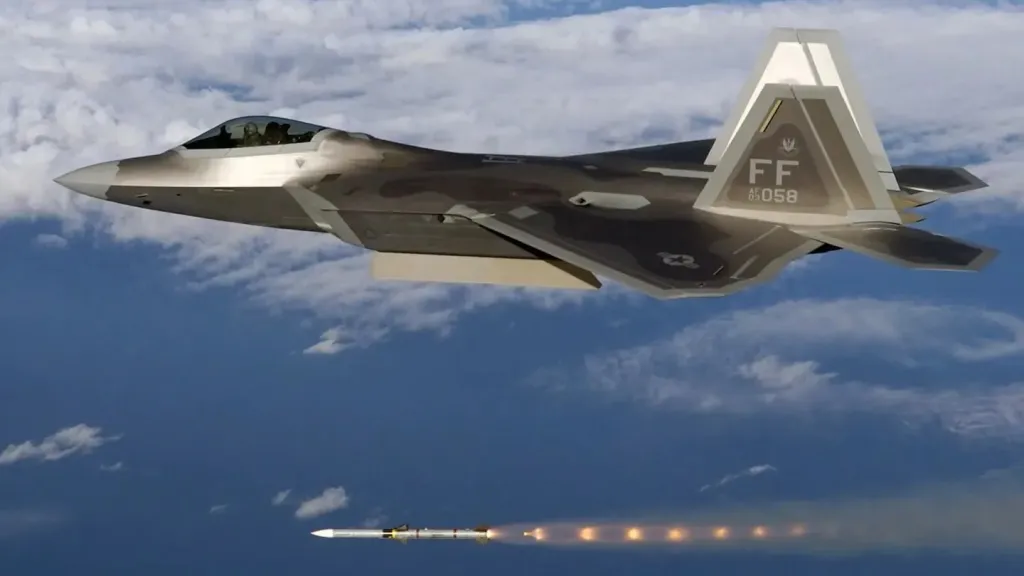
A stock picture of a US Air Force F-22 Raptor firing an AIM-120 AMRAAM. USAF
“Both [AFLRW] variants will have a threshold minimum range of 1,000 NM [nautical miles] and be capable of striking respective A/A and A/S targets in Defense Planning Scenario 2.1 and 7.1 environments in a responsive manner,” the notice adds. It does not elaborate on what those specific scenarios entail.
The notice also puts particular emphasis on modular components and open-architecture systems, and finding a “Master Integrator” to combine the various elements into a complete missile, or all-up-round.
“Industry should expect a quick-turn Whitepaper Request for Information following the event focused on the 2 solution types above for both variants,” per the notice. “AFLCMC is seeking the next generation of Air-Launched Long-Range Weapon variants that expand the United States’ ability to hit priority air, land, and sea targets far and fast!”
Beyond the range threshold, the notice does not include any other details about requirements the Air Force may have now for the AFLRW. That being said, a desire for an anti-air missile able to hit targets at least 1,000 nautical miles away is very notable by itself.
Though the exact figures are classified, the AIM-120D-3 version of the AMRAAM, the latest model in widespread U.S. service, is generally understood to have a maximum reach of around 100 miles (close to 87 nautical miles). There have been hints that it may be able to fly out further than that, at least against targets in certain envelopes. Longer-range versions of the AIM-120 may now be in development. A known key requirement for the new AIM-260A Joint Advanced Tactical Missile (JATM) has also been extended reach over the AMRAAM. Still, even the JATM, which the U.S. Navy and Air Force are developing together, is not expected to have anywhere near the range required for the AFLRW.
An annotated image showing a US Navy F/A-18F Super Hornet carrying an AIM-260. Jonathan Tweedy/ @flightline_visuals
It is worth noting here that the Air Force almost adopted a very long-range, high-speed missile designed to engage both air and surface targets during the Cold War. However, the maximum range of that Advanced Strategic Air-Launched Missile (ASALM) was still only expected to be 300 miles (260 nautical miles).
An artist’s depiction of an ASALM after launch from a B-52 bomber. McDonnell Douglas
Starting in the mid-2000s, the Air Force and the Navy also worked together on a Joint Dual-Role Air Dominance Missile (JDRADM), intended as a single weapon to supplant the AIM-120 and variants of the AGM-88 anti-radiation missile. This evolved into the Next Generation Missile (NGM), which came to a close, at least publicly, in 2013, ostensibly over rising costs. A more secretive Triple Target Terminator (T-3) program, which had initially been conducted in parallel with JDRADM/NGM, continued afterward for at least some period of time. In 2017, a possible successor to T-3, the Long Range Engagement Weapon (LREW), but the fate of that effort is unclear.
In February, the Navy put out its own new call for a long-range anti-radiation missile capable of engaging air and surface targets, dubbed the Advanced Emission Suppression Missile (AESM). However, the service did not say what its desired range for this weapon might be at that time. The Navy has already started fielding an air-launched version of the multi-purpose Standard Missile-6 (SM-6), designated the AIM-174B. TWZ has previously assessed the AIM-174B to likely be in the same range category, broadly speaking, as the Cold War-era ASALM. We have previously explored in detail how the AIM-174B slots into the Navy’s long-range kill chains.
How The Navy’s New Very Long-Range AIM-174 Will Pierce China’s Anti-Access Bubble
Nothing approaching a range of 1,000 nautical miles appears to have ever been discussed, at least openly, in relation to any of these programs. Interestingly, the Air Force did publicly talk about the prospect of anti-air missiles with ranges of up to 1,000 miles in a report to Congress in December 2024. However, the report mentioned them as part of a projected threat ecosystem the service envisions taking shape by 2050.
“Counterair weapons with ranges out to over 1,000 miles and supported by space-based sensors will place aircraft, such as tankers, that have traditionally operated with impunity, at risk,” the Air Force’s 2024 report said. This offers a hint at the kinds of capabilities it is looking to add to its own arsenal through the AFLRW effort.
After the Navy put out its AESM contracting notice, TWZ also highlighted the value of such a missile for targeting vital airborne early warning and control assets. This is often referred to as the ‘AWACS killer’ role, which references the E-3 Sentry Airborne Warning and Control System (AWACS) aircraft. As we previously wrote:
“All that being said, the value of an ‘AWACS killer’ missile is clear-cut. AEW&C are critical surveillance and battle management assets. Shooting them down deprives an opponent of those capabilities, inherently reducing their ability to effectively maneuver air assets and share important information, including with other nodes on the ground or at sea, as well as in the air. Knocking out these flying radar stations, which can be especially well-suited to spotting lower flying threats from their high perches, just hampers an enemy’s overall situational awareness.”
“The issue, of course, is that AEW&C planes typically orbit well behind the front edges of a conflict, creating additional challenges for targeting them. This is where something like AESM could come into play. A weapon of this type could engage other aerial targets by zeroing in on the radiofrequency emissions they pump out. This could include electronic warfare aircraft, and potentially other aerial targets. AESM might be able to take on a more general anti-air role with the addition of an active radar and/or imaging infrared seeker, as well as datalinks allowing for the use of networked targeting data. [The AGM-88E] AARGM and [AGM-88G] AARGM-ER both feature an active millimeter-wave radar seeker to enable them to hit fleeing ground targets, but a similar concept could be adapted for air-to-air use.“
The KJ-500 seen here is just one example of the multitude of different airborne early warning and control aircraft currently in Chinese service. Taiwan Ministry of National Defense
In that piece, we also touched on the potential for the AIM-174B to help meet U.S. military needs for an ‘AWACS killer’ missile. With the ability to hit targets in the air, as well as down below, out to at least 1,000 nautical miles, AFRLW would be a dramatic step above even the AIM-174B in capability.
The Pacific region offers a host of practical examples to give a better sense of what this kind of reach means. The distance between U.S. bases on the Japanese island of Okinawa and Taiwan is roughly 390 nautical miles. The distance between Andersen Air Force Base on Guam and Taiwan is around 1,500 nautical miles. AFLRW-armed aircraft flying over the East China Sea or the northern end of the South China Sea would conceivably be able to engage targets with hundreds of missiles inside the Chinese mainland, as long as suitable targeting data was available. The AFLRW’s range would be relevant on other potential hotspots globally, as well.
AFLRW would give the Air Force a way to pick off airborne early warning and control aircraft, as well as tankers, bombers, other kinds of surveillance and reconnaissance aircraft, and potentially even unsuspecting tactical jets. The missiles would be able to do so without necessarily alerting them to the fact that they are being targeted at all, at least till it’s too late to escape. Having air-to-air missiles that can go after targets at such great ranges means the need to project tactical airpower and support aircraft far forward and deep into harm’s way for the counter-air mission would be less critical, at least during the first opening stages of a conflict. By eliminating key force multiplying aircraft with long-range weaponry, conditions would be better for the survivability of traditional counter-air packages.
A US Air Force B-2 bomber flies over a part of the Pacific Ocean together with a quartet of Japanese F-35A Joint Strike Fighters. USAF
On top of offering a new way to hold higher-value targets in rear areas at risk, AFLRW would give Air Force aircraft added flexibility to engage targets closer to the tactical edge, but not necessarily near where they might be flying at any one time. In the aforementioned Pacific scenario, areas of active combat in the air and on the surface could easily be dotted across a broader zone spanning thousands of square miles.
As mentioned, the Air Force also sees anti-air threats being able to reach further and further out. This means stand-off munitions, in general, will need greater reach to help reduce the risk to launch platforms. The AFLRW’s range recommendation is a tacit admission that the U.S. military will face growing challenges piercing adversary anti-access and area denial (A2/AD) bubbles, especially the ones that China has established and is continuing to expand on. It also highlights the increasing risks to friendly airborne early warning and control aircraft, tankers, and other supporting aerial assets needed for sustained air combat operations. Chinese air-to-air missiles are already outreaching their American counterparts, and the U.S. is working to change that now with AIM-174, AIM-260 and other programs.
There are still questions about what it might take to develop a feasible AFLRW with at least a 1,000 nautical mile range, and what might be able to carry a missile with that kind of reach. It is worth remembering here that the Air Force has openly talked about the possibility of the B-21 Raider bomber taking on a greater role in air-to-air combat in the future, which might include acting as a ‘weapons truck’ loaded with anti-air missiles. The aforementioned ASALM was also intended primarily for employment from bombers. For bombers like the B-21, the AFLRW would also just offer a valuable organic way to address threats in the air and down below, potentially hours ahead of arriving over the target area.
A pre-production B-21 Raider bomber seen during aerial refueling testing. USAF
The AFLRW will also have to cover the very long distances it flies at least relatively quickly, especially to be relevant for attacking time-sensitive or otherwise fleeting targets. This might require a multi-stage or air-launched ballistic missile-like design or even something more exotic.
There is also the question of targeting at such extreme distances. These weapons will not rely on the sensors and targeting information generated by the platforms they are launched from. Above all else, the AFLRW will, by default, have to be tied into a deeply networked ‘kill web’ that brings together tertiary sensors and other supporting elements across vast networking layers. That ‘web’ would be spread across the air, land, sea, space, and even cyberspace domains, and incorporate assets from other branches of the U.S. military beyond the Air Force.
Above all else, the space-based aircraft tracking layer will be very important when it comes to enabling this weapon. The Air Force’s 2024 report on future threats confirmed this. The U.S. military itself is actively working to field new distributed satellite constellations to provide potentially game-changing persistent air and ground moving-target indicator (AMTI/GMTI) capability globally, with exactly these kinds of long-range kill chains in mind, as you can read more about here. Very stealthy aircraft working farther forward that are in line-of-sight of potential targets are another way these weapons can be employed. The USAF also has just such a platform.
Much remains to be learned about the Air Force’s plans for the air-to-air and air-to-surface versions of the AFRLW, and what other requirements the service has for those missiles. The industry day gathering scheduled for August will provide the service with additional information about what options might be available and on what timeframe.
Regardless, the Air Force has now made clear publicly that it wants a solution that can kill planes a thousand miles away from the launch aircraft. This matches all the signals that the Pentagon has been sending indicating it is very concerned about its ability to pierce an enemy’s protective bubble in the years ahead. Above all else, it points to a new era of net-centric warfare where the kill web is truly king.
Several Russian regions are facing fuel shortages because of Ukrainian attacks.
Published On 23 Jun 202623 Jun 2026
A Russian missile attack on the central Ukrainian city of Kryvyi Rih has killed at least three people, as Moscow struggles with the economic strain of the four-and-a-half-year Russia-Ukraine war.
Oleksandr Vilkul, the head of the Kryvyi Rih defence council, said in a post on Telegram on Tuesday that 25 people had been wounded in the attack, which he said used a cluster munition warhead.
Recommended Stories
list of 3 itemsend of list
“People died within 200 metres [660 feet] of each other because of this barbaric weapon,” Vilkul said, adding that a day of mourning would be marked on Wednesday.
Kyiv has previously accused Moscow of using cluster munitions, which scatter into smaller explosives when dropped.
Reacting to the attack, Ukraine’s President Volodymyr Zelenskyy called for more international pressure on Moscow to end the war and for quicker supplies of air defence systems.
“Every delay in implementing air defence agreements, every delay in supplies to protect Ukraine and Ukrainians is in effect a loss of life,” he wrote on Telegram.
Ukraine announced on Tuesday that its forces had targeted a railway bridge, a power plant and other key infrastructure in Russian-occupied Crimea.
Weakened rouble
Over the past few months, Russia and Ukraine have significantly ramped up attacks. As Moscow launches barrages of strikes on Ukraine, Kyiv in turn has targeted Russian refineries and infrastructure with its own drones.
Ukraine’s drone attacks have led to fuel shortages in Russia. Many regions across the country have reported restrictions on fuel sales and rising prices for oil products, creating concerns about the stability of Russia’s economy.
On Monday, the Moscow Exchange stock index fell by five percent before it rebounded slightly. It is still around its lowest level since March 2023, while the rouble weakened past the 75-mark against the US dollar for the first time since May 6.
The Kremlin dismissed concerns about the rouble’s weakness.
“The stability of the Russian economy, macroeconomic stability, is absolutely ensured,” government spokesperson Dmitry Peskov said on Tuesday.
Meanwhile, efforts to end the war have remained effectively frozen as United States President Donald Trump has shifted his focus to Iran.
Russian Foreign Minister Sergey Lavrov told foreign envoys in Moscow on Tuesday that the Americans seemed to be “abandoning any claim to the role of an objective mediator and are instead pursuing a course of escalating sanctions pressure on Russia”.
Weekly insights and analysis on the latest developments in military technology, strategy, and foreign policy.
The very first P-8A Poseidon aircraft is now assigned to Air Test and Evaluation Squadron 30 (VX-30), the “Bloodhounds.” TWZ was first to report last year that VX-30 was in line to get two P-8As to support long-range missile and other testing efforts. The aircraft will help the squadron address the increasing difficulties it is facing with its aging P-3 Orion aircraft. Only a handful of P-3s remain in service anywhere in the Navy, and are becoming increasingly challenging to operate and maintain.
VX-30 shared pictures of the P-8A arriving at its home base in Point Mugu, California, on its Facebook page last week. Naval Air Station Point Mugu, part of Naval Base Ventura County, sits right on the southern California coast with direct access to the expansive Point Mugu Sea Range. The Navy and other branches of the U.S. military, as well as defense contractors, regularly use the offshore ranges for missile and other tests, which the Bloodhounds support. Aircraft from VX-30 also often deploy to other locations around the world to support test and evaluation activities, including in other U.S. military range complexes in the Pacific Ocean around Hawaii and in the Atlantic Ocean off the coast of Florida.
Members of VX-30 pose in front of the squadron’s ‘new’ P-8A. USN
As noted, the P-8A now assigned to VX-30 is actually the very first Poseidon ever built and is also known as T-1. The aircraft, which made its maiden flight in 2009, was used for years to support the Poseidon program. The Bloodhounds are also in line to get the second test P-8A, which is also still referred to as T-2. We will come back to this in a moment.
VX-30 already operates a variety of planes specially configured to support test missions, including the aforementioned P-3s. The unit also has KC-130T Hercules tanker/transports, as well as its one-of-a-kind NC-20G and NC-37B jets. The NC-37B was specifically acquired to replace one of the squadron’s NP-3D Orions, a variant nicknamed the “Billboard” because of its heavily modified tail. The NC-20G and the NC-37B reflect a larger push to revamp the Bloodhounds’ fleets in recent years.
Collectively, VX-30’s aircraft are equipped with a mix of radars, cameras, and other equipment to collect imagery, telemetry, and other data during tests. They have communications and data-sharing suites to be able to pass information along to test facilities on land to aid with live monitoring and for deeper analysis.
Some of VX-30’s existing aircraft (from left to right: the NC-37B, a P-3C, and a KC-130T). Katie Archibald/USN
Aircraft assigned to VX-30 are also used for what is called range surveillance and clearance missions to keep unwanted visitors and errant bystanders out of the way in the air and down below during tests. This is where the P-8As will come in, at least initially.
“Both aircraft will perform the Range Surveillance & Clearance mission as well as dedicated testing for Naval Air Systems Command programs supported by P-3 today,” a NAVAIR spokesperson told TWZ last year. “T-1, the airworthiness P-8 aircraft, will have a radar modification to integrate an APY-10 in the airframe, as one does not currently exist. This will provide T-1 with a supportable radar configuration and capability that mirrors the baseline P-8 fleet. T-2 will be unmodified.”
Raytheon’s AN/APY-10 is the standard maritime search radar used on the P-8A, and is primarily designed to spot and track vessels on the surface, as well as masts belonging to submerged submarines protruding above the waves. It also has a synthetic aperture radar (SAR) mode that allows it to capture still images, even through cloud cover, smoke, and dust, and at night. The SAR mode is one of several capabilities of the P-8As that allows it to be used for surveillance in coastal environments and over land, as well as while flying over open bodies of water.
Standard Poseidon aircraft also have a sensor turret with electro-optical and infrared full-motion video cameras, as well as signals intelligence capabilities, as you can read more about here.
A typical US Navy P-8A Poseidon. USN
The P-8A’s core capabilities are well suited to the range surveillance and clearance mission. In an unmodified form, the Poseidon’s other sensors might be capable of gathering additional visual and other data during testing, as well.
NAVAIR has also left the door open to potentially modify VX-30’s ‘new’ P-8As in the future to take on an expanded role with the squadron. The Poseidon is based on the Boeing 737 airliner, and offers swap space that could accommodate additional systems down the line. The Navy already operates several more deeply modified P-8s with additional intelligence-gathering capabilities. Those aircraft are notably capable of carrying the AN/APS-154 Advanced Airborne Sensor (AAS), a large podded active electronically scanned array (AESA) radar, under their fuselages, as you can learn more about here. Boeing has developed other add-on sensor packages for the P-8A over the years, as well.
A US Navy P-8A carrying the AN/APS-154 Advanced Airborne Sensor. USN
Unlike the P-3, the P-8A also has the ability to refuel in mid-air via boom-equipped tankers. That is another capability VX-30 might be able to leverage to enable longer-duration flights, whether in support of range surveillance and clearance or other missions.
Overall, the “P-8 will go a long way to enabling range support operations and will provide new opportunities for future developmental programs,” the NAVAIR spokesperson told us last year.
On top of the P-8A’s inherent capabilities, even the older test jets are just younger and more modern, in general, than the P-3s that make up the core of VX-30’s fleet today. The Navy took delivery of its last new-production P-3C variant in 1990, and Lockheed (now Lockheed Martin) shuttered the line afterward. This means the very youngest Orion is 36 years old now. As noted, the Navy has been steadily withdrawing Orions from service in recent years.
One of VX-30’s P-3 Orions. USN
Several Navy test squadrons do continue to operate P-3s, but that’s becoming an increasingly more complex proposition. This is not just because of the maintenance demands of aging aircraft that are no longer in widespread U.S. service, but also the availability of trained aircrews. As part of the transition of active and reserve Navy maritime patrol squadrons from the P-3 to the P-8, the service no longer has a Fleet Replacement Squadron (FRS) for the Orion. FRSs are the Navy’s ‘school houses’ that provide training specific to particular aircraft types to aviators and ground personnel before they are sent to operational units. VX-30 now has to do that training in-house.
“The two P-8s will reduce sustainment costs and increase availability over the four P-3 aircraft VX-30 currently flies. P-8s also help alleviate P-3 manning challenges now that the FRS and operational squadrons have all transitioned to P-8 or decommissioned,” the NAVAIR spokesperson told us last year. “P-3 aircraft require a Flight Engineer crew position, and as the P-3 model manager, the return on time invested to train incoming pilots or qualify Flight Engineers in the P-3 is rapidly diminishing for VX-30’s primary missions.”
It remains to be seen whether the configurations of T-1 and T-2 might evolve in the coming years to expand their ability to support testing over the Point Muge Sea Range or elsewhere globally.
In the meantime, T-1’s arrival already marks a new chapter for VX-30 and the Navy’s oldest P-8A Poseidon.
Ukraine says facility a ‘critical component’ in defence production as local Russian authorities confirm attack.
Published On 22 Jun 202622 Jun 2026
Ukraine’s military has said it struck a plant producing electronics for missiles in Russia’s Voronezh region, as well as the Dubna satellite communications centre in the Moscow region.
In a statement on Telegram on Monday, the Ukrainian General Staff said it had used air-launched cruise missiles to hit the plant in Voronezh, which it described as a “critical component” in Russia’s defence production.
Recommended Stories
list of 4 itemsend of list
Alexander Gusev, the Voronezh governor, said a production plant was damaged and three people were injured in the attack, without specifying the nature of the facilities.
Gusev said in a post on Telegram that air defence forces had destroyed several high-speed targets in the skies over Voronezh and warned residents of the danger of missile attacks.
The Ukrainian military also said it struck Russia’s Dubna satellite communications centre in the Moscow region, adding that heavy smoke was observed at the site and the extent of the damage was being assessed.
Eighty-four drones headed for Moscow were downed in the past 24 hours, the city’s Mayor Sergei Sobyanin said on Telegram.
He said emergency services had been dispatched to the areas where drones were downed, but gave no further information.
The airports of Sheremetyevo, Domodedovo and Vnukovo, as well as Zhukovskiy near the Russian capital, had temporarily suspended flights, the aviation watchdog said separately.
In total, Russian defence systems downed 301 drones overnight, local news agencies said, citing the Ministry of Defence. That tally included Russian-occupied areas of Ukraine.
The latest raids follow a drone attack that hit Moscow’s sole oil refinery last week, in one of the biggest air attacks on the city since Russia’s full-scale invasion of Ukraine in 2022.
Teenager killed in Ukraine
In Ukraine, authorities said a Russian drone attack early on Monday in the Sumy region killed a 13-year-old boy, his 36-year-old father, and his 73-year-old grandmother.
Regional governor Oleh Hryhorov said the 73-year-old was the mother of the man’s roommate.
Russian drone attacks in the southeastern Ukrainian city of Zaporizhzhia overnight and early on Monday killed two people and injured a further seven, Ukraine’s emergency services said.
Russia also hit the southern Odesa region with an Iskander ballistic missile on Sunday evening, killing one and injuring three people, regional governor Oleh Kiper said on Telegram. Vehicles and fuel storage tanks caught fire after the strike hit an agricultural facility, he said.
Elsewhere, the city of Sevastopol in Russian-annexed Crimea cancelled all open-air public events on Monday and will keep streetlights switched off, its governor, Mikhail Razvozhayev said, as he called on people to curb electricity usage.
Russian drones hit a Turkish dry cargo vessel, the Victress, which was sailing under the Panamanian flag, Ukraine’s navy said.
Deputy Prime Minister Oleksii Kuleba said a 58-year-old Egyptian cook was killed and eight other crew members, including Turkish and Indian nationals, had to evacuate on a lifeboat.
The leaders of Europe’s top military powers will meet on Wednesday in Berlin to discuss the Ukraine conflict and an upcoming NATO summit.
Chancellor Friedrich Merz plans to host the leaders of France, Britain, Italy and Poland, a spokesman said Monday, adding that the resignation announcement of British Prime Minister Keir Starmer had not changed those plans.
Weekly insights and analysis on the latest developments in military technology, strategy, and foreign policy.
Russia’s mysterious Burevestnik (also known to NATO as SSC-X-9 Skyfall) cruise missile likely leaves a trail of radioactive material in its wake, making the weapon even more alarming than was first thought. This is the conclusion of two scientists from the Massachusetts Institute of Technology (MIT), who have recently published a detailed analysis of one of the so-called ‘super weapons’ revealed by Russian President Vladimir Putin back in 2018.
The report, from Jake Hecla, an MIT professor who covers aerospace and nuclear science and engineering, and co-author R. Scott Kemp, provides the most compelling analysis so far on how the Burevestnik is actually powered. Uncertainty around this has led to previous questions about whether Russia’s claims of nuclear propulsion for the weapon even stack up.
A view of the Burevestnik test site at Pankovo, on Yuzhny Island in the Novaya Zemlya archipelago, with a missile launcher in the raised position. via X
First, it’s worth recalling what we know about the Burevestnik program’s development milestones, which appear to have been punctuated by accidents.
It is also worth noting that there have been previous efforts to create nuclear-powered aircraft and missiles.
During the 1950s, both the Soviet Union and the United States tested airborne nuclear reactors aboard strategic bombers, the B-36 Peacemaker and the Tu-95 Bear, respectively. Neither of these trials actually saw the reactors drive the aircraft’s engines.
Under Project Pluto, the United States studied a nuclear-powered cruise missile and got as far as testing a reactor on the ground in 1964, before the idea was abandoned. The Pluto concept of operation was somewhat different to the Burevestnik, with the missile intended to fly at treetop level at Mach 3.5 and dispense nuclear weapons at different points along its flight path by performing “pop-up” maneuvers.
Soon after Putin’s 2018 announcement, the Norwegian-based environmental group Bellona suggested that a radiation spike in the Arctic that same winter may have been caused by a test of the missile.
Later in 2018, a U.S. intelligence report described the loss at sea of a Russian nuclear-powered missile during a 2017 test. The report added that Russia was expected to embark on a search and recovery mission to try to lift the missile’s wreckage from the seabed.
Then, in 2019, an explosion occurred aboard a barge in the White Sea, outside Nenoksa, killing five Rosatom scientists. It also led to a radiation spike in the Russian city of Severodvinsk, as you can read more about here. The explosion has been blamed on a reactor from a Burevestnik recovered from the sea, likely the one that was lost in 2017.
Last October, Russia’s Chief of the General Staff, Valery Gerasimov, announced that a successful test of the Burevestnik had been carried out, high above the Arctic Circle. Gerasimov said that the 15-hour flight “is not the [maximum] limit” for the missile. This appears to have been the first long-endurance test of the missile.
Hecla and Kemp agree that the October 2025 test was a success and that, moreover, it marks the first time a true nuclear-powered aircraft has ever flown for a sustained period.
This leads to the question of how the Burevestnik actually converts energy from its nuclear reactor into propulsive power to keep it in the air.
Hecla and Kemp may well have provided the answer.
Based on data that the researchers gathered, the size, shape, and performance of the Burevestnik indicate a different kind of propulsion system than envisaged for Project Pluto. The U.S. concept involved a ramjet, required to ensure supersonic performance in the atmosphere.
In the 1960s, the U.S. Air Force explored this idea with its Supersonic Low Altitude Missile, or SLAM. This weapon employed a nuclear-powered ramjet along with conventional rocket boosters to kickstart the system. Once at the appropriate speed, the engine would blow air over the reactor, which could have enough fuel to operate for weeks or months on end, and then force it out of an exhaust nozzle to produce thrust.
The Tory II-C nuclear ramjet engine was tested in 1964 and helped inform the abortive Supersonic Low Altitude Missile, or SLAM, program. Public Domain
The Burevestnik is “very obviously a subsonic system,” Hecla told NPR.
By comparing open-source imagery of the Burevestnik, the researchers calculated that the missile is approximately 31 feet (9.5 meters) in overall length, with a wingspan of approximately 18 feet (5.6 meters). It likely flies at a speed of around Mach 0.75.
A size comparison from the report includes the Burevestnik alongside the Russian Kh-101/102 air-launched cruise missiles and the BGM-109A Tomahawk. Modeling the Performance of the Burevestnik Nuclear-Powered Cruise Missile, Jake J. Hecla and R. Scott Kemp.
They conclude that the Burevestnik is “almost certain” to use a direct-cycle air-breathing nuclear propulsion system, which probably drives a turbojet.
In a direct-cycle system, air is drawn from the atmosphere and passes directly through the reactor core. A compressor forces the air through thousands of narrow, tube-like channels surrounding the nuclear fuel, where the heat generated by nuclear fission raises the air’s temperature. As the heated air expands, it exits the rear of the engine to produce thrust.
A grainy screengrab, released in 2018, that may show the nuclear-powered cruise missile during a test flight. via Channel One Russia
This approach differs fundamentally from most nuclear reactors, which use an indirect, closed-loop design. In those systems, a sealed coolant — typically water or another heat-transfer fluid — circulates through the reactor to carry heat away while keeping radioactive materials contained and minimizing radiation exposure.
Comparison of a direct-cycle nuclear turbojet and an indirect-cycle equivalent. Modeling the Performance of the Burevestnik Nuclear-Powered Cruise Missile, Jake J. Hecla and R. Scott Kemp.
While some kind of indirect loop design is not impossible, the researchers consider that it’s highly unlikely, due to the simple fact that these systems are considerably larger, heavier, and more complex and couldn’t be accommodated in what is by no means a huge missile.
This means that the Burevestnik is likely propelled using heated air that is drawn directly through the reactor core.
The resulting powerplant is simpler and more compact, but it comes with a serious drawback: “The direct cycle is very likely to result in a large quantity of radioactive material in the exhaust,” Hecla contends.
Essentially, as clean atmospheric air passes through the tiny tubes in the reactor, it gets irradiated and infused with fission decay products from the nuclear fuel.
The hot air that passes out of the end of the turbojet would be filled with radioactive isotopes of argon, krypton, and carbon, all of which would be scattered in its wake.
A notional Burevestnik concept of operations consists of launch using a kicker, then transitioning to solid rocket booster power. This then allows a slow spool-up to nuclear cruise at high-subsonic speeds. Alternatively, the boosters may be for testing purposes only, and the nuclear engine system may instead use hydrocarbon fuels to slowly taper from conventional power to nuclear power. Modeling the Performance of the Burevestnik Nuclear-Powered Cruise Missile, Jake J. Hecla and R. Scott Kemp.
The longer the missile flies, the more of this harmful waste it would pump into the atmosphere, and onto the surface below.
The researchers highlight another problem, too.
Namely, any kind of prolonged flight is likely to result in corrosion of the reactor core, through a combination of heat and compressed air. This would create yet more radioactive particles.
Based on previous evidence, it seems that Russia might already be battling with the problems inherent in handling, loading, and testing a missile with this kind of propulsion system.
The Russian Ministry of Defense released the video below in 2018, saying that it showed an earlier Burevestnik test launch, as well as examples of the missiles themselves.
Крылатая ракета с ядерным двигателем «Буревестник»
The MIT researchers consider that the fatal 2019 explosion in the White Sea was likely a failed attempt to recover a prototype Burevestnik reactor. The reactor is presumed to have restarted as it was being raised from the seabed, leading to an explosion.
Bearing all this in mind raises the question of why Russia set about developing the Burevestnik, especially when it has so many other ‘novel’ weapons in the works or already fielded.
Ultimately, the major advantage of the Burevestnik is almost unlimited range, something that we have discussed in the past:
“The missile can be launched preemptively and approach its target from any vector long after launch. For example, it could be launched from the Arctic, stay aloft for many hours, and then attack the United States from the south. Once launched, its flight path is entirely unpredictable, and it could exploit holes in defenses and weaker spots in early warning capabilities. It provides another reason why space-based tracking layers, including those that can spot low-flying aircraft, are currently very much on trend.”
Conclusions:
1. Burevestnik is not a strategic game-changer, and does not provide decisive warfighting advantages beyond existing nuclear forces.
2. It is likely a hedge against missile defenses with a niche capability complicating warning, tracking, and defense planning. 3/5 pic.twitter.com/nYzbZquthK
On the other hand, the Burevestnik doesn’t appear to be very fast or difficult to intercept once detected.
There is also its inherent inflexibility, since Russia has said it is only envisaged as being used with a nuclear warhead. While this could change, the size and weight of a conventional warhead would be more limited, and it’s questionable if Russia would risk employing such a complex missile to deliver a relatively modest conventional charge, especially since it would leave a potentially lethal radioactive footprint regardless.
“It leaks radiation, making it easy to track; it’s slow and un-stealthy, making it easy to shoot down; and the inside of the missile degrades during reactor operation, calling into question its ‘unlimited’ range,” William Alberque, a former director of strategy, technology and arms control at the International Institute for Strategic Studies (IISS), told TWZ.
“There are so many reasons everyone abandoned this concept in the Cold War,” Alberque added.
Conclusions (con’t):
5. It is 9.5m long with a reactor core diameter of 50 cm and requires regular boosters for launch and terminal phases.
6. In short, Burevestnik is a costly and hazardous symbol system with the potential to kick off a broader nuclear-propulsion race. 5/5 pic.twitter.com/NOdZ1lz6ZG
Hecla and Kemp assess that Russia’s reason for embarking on the Burevestnik is likely more to do with proving technologies for more ambitious and advanced programs further down the line. These could include nuclear-powered surveillance drones or space-based nuclear systems that would have considerably more military value.
People are asking what’s the purpose of Burevestnik and why develop a system that is very much useless as a weapon. The answer has always been right there, in the 1 March 2018 address. Russian president has always wanted to say these words. The rest doesn’t matter really. pic.twitter.com/0Q7JUGBqo3
Another possibility is that this is a ‘pet project’ of Putin himself, the Russian leader having been wooed by the idea of a missile with near-limitless range, regardless of the practical utility.
On the one hand, the latest analysis does suggest that the test last October means that the Burevestnik is the first aircraft ever built and flown in a sustained manner using nuclear power.
That is a landmark, but it’s one that’s tempered by very significant questions about the safety of anyone in its vicinity, and the environment at large, not to mention its somewhat limited military value.
Weekly insights and analysis on the latest developments in military technology, strategy, and foreign policy.
Ukraine is increasingly emerging as a potential player in Europe’s race to build-up its long-range conventional strike capabilities. New partnerships centered on the Ukrainian Flamingo and Neptune cruise missiles underscore how the European defense industry is moving from supplying Kyiv to co-developing and manufacturing combat-proven Ukrainian missile technology for NATO’s own future arsenal.
Diehl Defense recently confirmed that it plans to launch production of Ukraine’s Flamingo cruise missile in Germany. Diehl’s chief executive, Helmut Rauch, said that his company was planning talks in the coming weeks with Fire Point, the manufacturer of the Flamingo. Previously, Diehl had signed a technology agreement with Fire Point but had not disclosed any details.
Visitors at the stand of Ukrainian defense technology company Fire Point during the Eurosatory defense and security trade fair, at the Paris-Nord Villepinte Exhibition Center in Villepinte, north of Paris on June 15, 2026. Photo by Guillaume BAPTISTE / AFP
Meanwhile, another European missile manufacturer, MBDA, the largest company of its kind in Europe, has signed a memorandum of understanding (MoU) with the Ukrainian defense firm Luch to expand collaboration on deep-strike capabilities by focusing on the Neptune family of cruise missiles. Under the agreement, MBDA and Luch will work together on the so-called Neptune 2 missile, via what the European missile house describes as a process of “disruptive innovation.”
Reflecting this broader trend, during a visit to Kyiv last month, German Minister of Defense Boris Pistorius noted Ukraine’s “remarkable” wartime technological advances and said that Berlin was looking at joint ventures that included long-range drones, air defenses, and electronic warfare.
German Defense Minister Boris Pistorius visits the command post of a Ukrainian Army combat and reconnaissance drone unit in Dnipro during a visit to Ukraine last month. Photo by Kay Nietfeld/picture alliance via Getty Images
Looking at these Ukrainian cruise missiles in more detail, Luch’s Neptune first emerged as an anti-ship missile, based on the Soviet-era Kh-35, known to NATO as the SS-N-25 Switchblade in its surface-launched form. The Neptune came to prominence when it was used to sink the Russian Navy’s Slava class cruiser Moskva in 2022.
The original configuration of the Neptune missile. Office of the President of Ukraine Volodymyr Zelensky
Ukraine reportedly began work on a new land-attack version of the Neptune in 2023. A Ukrainian defense official told TWZ that this version has a range of up to 225 miles (360 kilometers). This compares to a reported maximum range of around 190 miles (300 kilometers) for the anti-ship version.
Subsequently, Ukraine introduced the extended-range Long Neptune, which Ukrainian President Volodymyr Zelensky has stated has a range in the region of 620 miles (1,000 kilometers). The Long Neptune features an extended body to accommodate additional fuel for its turbofan engine. It has reportedly been used against dozens of targets inside Russia.
Ukrainian “Long Neptunes.” We’re producing more 🇺🇦 ____
— Volodymyr Zelenskyy / Володимир Зеленський (@ZelenskyyUa) November 14, 2025
The land-attack versions of the Neptune reportedly use a GPS-assisted inertial navigation system (INS) and an imaging infrared sensor in place of the anti-ship missile’s active radar seeker.
At least one more version of the Neptune has also been developed, this one apparently featuring fuel tank ‘bulges’ for increased range. As you can read about here, this model appears to be something like an intermediate-range version, falling between the original land-attack Neptune and the Long Neptune.
An official photo of the Long Neptune cruise missile. Government of UkraineThe ‘bulged’ Neptune variant. Denys Shmyhal/Ukrainian Ministry of Defense
Turning to the Flamingo, also known as the FP-5, this was designed from the ground up to hit targets deep within Russia, the missile having a reported range of 1,864 miles (3,000 kilometers). The Flamingo is significantly bigger than the Neptune series, being launched from rails mounted on a trailer, rather than from canisters on the flatbed of a truck.
Launch of a Flamingo long-range cruise missile. via Ukrainska Pravda
The Flamingo also features a notably larger warhead, reportedly weighing around 2,205 pounds (1,000 kilograms).
A video of the Flamingo cruise missile in action:
Випробувальний пуск ракети “Фламінго”
In terms of guidance, the Flamingo is said to use a combination of methods, including various types of satellite navigation. An underlying inertial navigation system is likely to be present. The missile is powered by an AI-25 turbofan engine, a type produced in Ukraine for military and civilian aircraft, including the L-39 Albatros trainer and the Yak-40 feederliner.
Ukraine’s development of increasingly long-range land-attack cruise missiles is driven by the requirement to strike targets deeper inside Russia. Kyiv has received standoff missiles from its allies, including the air-launched Storm Shadow and SCALP-EG from the United Kingdom and France, respectively, as well as the U.S.-supplied Army Tactical Missile System (ATACMS) short-range ballistic missile. However, these are not available in large numbers and are limited by restrictions imposed upon their use. Additionally, none of them have the kind of range or warhead capacity offered by the Flamingo.
Kyiv has long been campaigning to receive Tomahawk cruise missiles from the United States, but so far, Washington has refused these requests, with U.S. President Donald Trump saying he is “not looking to see an escalation” in the conflict. These highly accurate missiles would be able to hit targets roughly 1,000 miles (1,600 kilometers) from Ukraine’s borders.
As well as cruise missiles, Ukraine has also developed a huge variety of long-range one-way-attack drones, and other designs that blur the line between long-range kamikaze drones and cruise missiles, including Palianytsia, Peklo, and Trembita.
Ukrainian Peklo ‘missile-drones.’ Ukrinform/NurPhoto via Getty Images
Kyiv has also been working on developing new ballistic missiles. However, the longest-range one of these, as far as is known, is the Hrim-2, which can hit targets at 174 miles (280 kilometers) or possibly up to 310 miles (500 kilometers).
An artist’s rendition of the Hrim-2 TEL, as offered for export by Ukraine, back in 2015. Ukroboronexport
Meanwhile, Fire Point has developed the FP-7 ballistic missile, a weapon with a stated range of around 124 miles (200 kilometers), and a warhead of approximately 331 pounds (150 kilograms).
A rendering of the FP-7 surface-to-surface ballistic missile. Fire Point
In both cases, however, these ballistic missiles lack true strategic reach. This would be partially addressed by the FP-9, which Fire Point aims to start testing this summer, and which is expected to have a range of 530 miles (855 kilometers).
Ukraine’s efforts to develop new and more destructive missiles, and to build them at scale, come as Europe’s NATO members also increasingly look to field weapons in this class.
The scale factor is an important one, since Ukrainian wartime weapons development stresses equipment that can be produced rapidly, in large numbers, and at a lower cost point. Fire Point has said that it aims to increase Flamingo production to a daily rate of at least seven missiles by October of this year. This would translate to 2,555 built annually. It remains questionable whether this is a realistic target, but the prospect of additional production lines elsewhere in Europe would change things.
Additional details have been released about Ukraine’s new domestically-produced long-range cruise missile, dubbed the FP-5 “Flamingo” which is manufactured by Fire Point. According to an interview with Chief Technical Officer Iryna Terekh, the “Flamingo” has entered serial… pic.twitter.com/2D5GisrmFP
At the same time, it should be noted that the Flamingo and Neptune cruise missiles, for all their capabilities, are not especially sophisticated. They both fly at subsonic speed and do not appear to have any attempts at signature control. While they are certainly destructive, they are far from immune to interception.
Their effectiveness can be increased by using them in missile barrages and combined with drones and potentially decoys, to overwhelm air defenses. Here, too, is an area in which Ukrainian experience could help, creating a mix of high-end missile capabilities with combat mass from lower-end drones.
With this in mind, it is perhaps not surprising that Diehl is already looking at how it can improve the Flamingo.
Diehl’s Helmut Rauch has said that his company could outfit the Flamingo with a much more advanced seeker, leveraging the German firm’s experience in this area.
An unverified video that appears to show a Flamingo cruise missile strike on a military factory in Cheboksary in western Russia:
Similarly, MBDA’s expertise in missile development and production could potentially be incorporated in future versions of the Neptune.
Either way, Ukraine would benefit from advanced technologies that otherwise might not be immediately accessible.
What is clear is that European NATO allies are increasingly looking to address their lack of land-based long-range strike capabilities. As well as facing an increasingly belligerent Russia equipped with an expanding arsenal of long-range missiles, Europe is also confronting the prospect of its U.S. ally being unwilling to provide the same kinds of capabilities.
Ukraine is not alone in being unable to secure U.S.-made Tomahawk cruise missiles.
Berlin, in particular, is looking for alternatives to the U.S. Army long-range fires battalion equipped with various conventionally armed standoff missiles — including Tomahawk — that was expected to be deployed in Germany on a rotational basis, starting this year. The U.S. move was an apparent response to disagreements with Germany over the Iran war as well as ongoing tariff tensions.
U.S. personnel unload a trailer-based launcher associated with the Typhon weapon system from a C-17A transport aircraft in the Philippines in 2024. The Typhon was to be deployed in Germany as part of a U.S. Army long-range fires battalion, the 2nd Multi-Domain Task Force (2MDTF). U.S. Army
While Europe does have new long-range strike programs underway, they are not expected to bring new systems into service until the 2030s. At the same time, efforts like the European Long-Range Strike Approach (ELSA), which involves France, Germany, Italy, Poland, Sweden, and the United Kingdom, still have to agree on common requirements, provided that is even possible.
Separately, Germany and the United Kingdom have unveiled plans to jointly produce a “deep precision strike” weapon with a range of over 1,240 miles (2,000 kilometers). At this point, however, no industrial framework has been agreed on. Potentially, an advanced version of the Flamingo could meet that requirement, even if only as an interim measure before a more bespoke solution can be developed.
For Europe, Ukrainian missile developers like Luchs and Fire Point bring the valuable experience of wartime innovation, while established defense firms like MBDA and Diehl provide additional industrial capacity and advanced technologies. If either of these projects succeeds, they could not only help Ukraine field more advanced and capable cruise missiles, but also help address one of NATO’s most pressing capability gaps.
Weekly insights and analysis on the latest developments in military technology, strategy, and foreign policy.
Norwegian missile-maker Kongsberg has finalized its acquisition of a majority stake in Zone 5 Technologies, bringing under its umbrella the U.S. start-up’s Rusty Dagger low-cost cruise missile, among others. With both those weapons already moving into large-scale production, the two companies are making the case for combining Kongsberg’s stealthy Joint Strike Missile (JSM) cruise missiles in operational scenarios. Zone 5 has also now confirmed that the Rusty Dagger, which is already being supplied to Ukraine, is now cleared for use on four different types of fighter aircraft, including the F-16.
At the ILA Berlin airshow yesterday, where TWZ was in attendance, officials from the two companies announced that Kongsberg has now formally acquired a 90 percent stake in Zone 5. California-based Zone 5 will continue to operate as an independent subsidiary under the Norwegian contractor. As well as discussing the industrial acquisition, the officials provided details of how the Rusty Dagger fits into the new-look portfolio, and updates on how that program is progressing.
Zone 5 Technologies – Rusty Dagger
Founded in 2011, Zone 5 is one of an emerging class of defense companies gaining prominence for developing low-cost, rapidly deployable capabilities. In many ways, they represent the inverse of traditional defense contractors, favoring speed, scalability, and cost efficiency over highly customized, high-priced systems.
Kongsberg first announced the acquisition in December, with executives noting that buying a stake in Zone 5 offered the fastest path to offering lower-cost missiles that still deliver meaningful combat capability, especially in terms of bringing these to the European market.
“What we’re doing here is that we’re combining Kongsberg’s niche, exquisite technologies with a company very capable of designing for cost efficiency and mass production,” explained Thomas Akers, founder and CEO of Kongsberg.
As to why Kongsberg didn’t choose to develop its own equivalent to the Rusty Dagger, Harald Aarø, Kongsberg’s executive vice president for business development and strategy, provided the following answer:
“Technically, could we be capable of doing it? Yes, but we are not as capable, as we will probably spend a longer time, and perhaps not strike as smart solutions,” Aarø said. “That doesn’t mean that our engineers aren’t just as smart. Our engineers are just as smart, but on a different sports field, so to speak.”
A briefing slide with various details about the JSM’s capabilities. Kongsberg
Aarø also described how the specific combination of the Rusty Dagger and the JSM makes for “a very effective future strike solution.” Namely, the Rusty Dagger provides cost-effective but still highly capable standoff strike, while the more exquisite JSM comes with a heftier price tag but offers a greater chance of making it through to even heavily defended targets, on account of its sophisticated guidance and low-observable characteristics.
According to Tom Kanewske, Zone 5’s chief strategy officer: “What’s interesting about our missile is that the same base, light cruise missile is field retrofittable for all employment modes, and that puts us in a very unique space, in that a country and their [armed] services are able to purchase the same munition and field retrofit for that to be surface launched, whether from land or the deck of a ship, or pylon launched from a fighter aircraft, or palletized.”
Since larger numbers of Rusty Daggers can be launched in any given scenario, they can overwhelm enemy air defenses and improve the chances of success.
According to Kanewske, Rusty Dagger and JSM “offer a weapon pairing that truly no other missiles in the world do.”
While the JSM can be carried internally in the F-35, the same is not currently the case for the Rusty Dagger, although Kanewske said that this is “something that is of keen interest to the [U.S. military] services and several of our international partners.”
A mock-up of a JSM in one of the internal weapons bays of an F-35. Kongsberg
When it comes to utilizing the Rusty Dagger and JSM together in a combat scenario, Kanewske noted the possibility of integrating capabilities that would allow the Rusty Dagger to offer “cooperative behaviors” with the JSM. This reflects a growing trend toward leveraging artificial intelligence to help make all munitions more effective and survivable, something that has been demonstrated via Golden Horde and follow-on programs.
Both missiles fly at high-subsonic speeds, the Rusty Dagger being able to strike targets at a range of 250 miles, according to Zone 5, while the JSM has a range of more than 215 miles.
In one highlighted scenario, F-35s could penetrate closer to the target, with their JSMs carried internally to preserve their low-observable features. Meanwhile, much larger numbers of Rusty Daggers could be pylon-launched from fighters, and dropped in palletized form out of the cargo holds of transports, from outside of the range of hostile air defenses.
Three views of a Rusty Dagger live-fire test on January 22, 2025, at Eglin Air Force Base, Florida. via U.S. Air Force
Kanewske confirmed that, this year, its first year of production, “well above 1,000 units for Rusty Dagger” will be completed, including for the U.S. Air Force, as the AGM-188, under the Family of Affordable Mass Missiles (FAMM) program. The Air Force’s proposed budget for the 2027 Fiscal Year laid out plans to buy nearly 28,000 FAMM munitions over the next five years.
Last month, the Pentagon laid out plans to acquire at least 10,000 lower-cost cruise missiles over the next three years, as part of a broader strategy to dramatically bolster its stockpiles of standoff strike munitions and prepare the industrial base to sustain those inventories going forward. This is seen as especially critical for supporting the demands of future high-end fights, such as one in the Pacific against China, and doing so in a cost-effective manner.
The Rusty Dagger has so far been cleared for use from four different types of fighter aircraft, Kanewske said. One of these is the F-16, which used the weapon in end-to-end live-fire trials at the Eglin Test and Training Range in Florida earlier this year. Another platform may be the A-4, with a contractor-operated example of the attack jet having been used in company trials. Then there is the Ukrainian Air Force, which is using the Rusty Dagger, under the Extended Range Attack Munition (ERAM) program, although the specific platforms have not been disclosed. Any of the MiG-29 Fulcrum, Su-25 Frogfoot, and Su-27 Flanker are likely candidates — as well as its own F-16s.
A series of unverified photos, first published by Russian sources, showing purported parts of Rusty Dagger missiles retrieved after being used by Ukraine:
It appears that the AGM-188A “Rusty Dagger” cruise missile has undergone field testing in Ukraine.
Russian sources are publishing photos of an unknown 8-element CRPA antenna. On the back side of the unit there is a circuit board with a large heatsink, which carries the CAGE code… pic.twitter.com/phZeOJfHJ0
— 𝔗𝔥𝔢 𝕯𝔢𝔞𝔡 𝕯𝔦𝔰𝔱𝔯𝔦𝔠𝔱△ 🇬🇪🇺🇦🇺🇲🇬🇷 (@TheDeadDistrict) June 7, 2026
In the case of the F-16, Kanewske said that only 72 hours were required to integrate the Rusty Dagger on the jet during the trials at Eglin.
A U.S. Air Force F-16 flies over the Gulf of America carrying a pair of Rusty Dagger Family of Affordable Mass Munitions (FAMM) weapons. U.S. Air Force U.S. Air Force photo by Staff Sgt. Blake Wiles
“We’re the only affordable mass munition that is currently on contract with an export international customer, and we are actively involved with them at this time,” Kanewske said, clearly referring to Ukraine.
Zone 5 is currently under U.S. Air Force contract for both FAMM and ERAM, and is also under contract with the U.S. Army for its Low-Cost Containerized Missile (LCCM) program, and for the U.S. Navy as part of its Coalition Heterogeneous Affordable Offensive Strike (CHAOS) program, which seeks a low-cost anti-ship cruise missile to provide to partner countries. Both LCCM and CHAOS involve surface-launched missiles.
As well as the ability to rapidly scale up production and a relatively low unit cost, the Rusty Dagger brings with it an open-architecture concept, applying to both software and hardware. This means new, sovereign features and capabilities can be introduced at short notice by customers. In the past, an operator might have to wait up to five years for unique subcomponents to be integrated in a similar weapon, Kanewske contended. With the Rusty Dagger, Zone 5 has demonstrated that this can be achieved in under 12 months.
Then, when it comes to producing the missile at mass, rather than having to “make that factory bigger and bigger,” Kanewske explained that the company offers a franchise model “that allows us to roughly parachute in the design, the equipment, the tooling, the fixtures, the quality control, so that countries can drop in their own subsystem capabilities, and we can achieve manufacturing at pace and at scale.”
A U.S. Air Force F-16 releases a Rusty Dagger over the Gulf of America. U.S. Air Force photo by Staff Sgt. Blake Wiles
Speaking in Berlin yesterday, Kongsberg’s Harald Aarø confirmed that Germany is a particular target for this franchise model, including for the Rusty Dagger. He identified Germany as having “probably the best manufacturing capabilities on this planet,” making it an obvious choice for a European manufacturing footprint.
Reflecting on the changing security situation on the continent since Russia’s full-scale invasion of Ukraine, Aarø said that now is “a natural time to start looking at a production site in Europe,” providing nations there with national sovereign capabilities based on the Kongsberg/Zone 5 joint portfolio.
Kongsberg’s acquisition of a majority stake in Zone 5 evidences a broader shift in Western defense planning toward affordable, mass-produced precision weapons that can be fielded at scale alongside more sophisticated strike systems.
The war in Ukraine has exposed the harsh reality that Europe needs far more standoff weapons than it currently possesses, and it needs them at a price point that allows stockpiles to be measured in the thousands rather than the dozens. Rusty Dagger is very much indicative of a new generation of systems designed around that requirement, prioritizing low-cost mass production over the exquisite but scarce munitions that have traditionally dominated Western arsenals.
As conflicts in Ukraine and the Middle East continue to highlight the operational value of low-cost, long-range munitions, demand for capabilities such as the Rusty Dagger is likely to grow. In an increasingly crowded marketplace, Kongsberg and Zone 5 will hope they can leverage their partnership, the Rusty Dagger’s combat use in Ukraine, and the potential to harness its capabilities in combination with the JSM, to build on the missile’s success.
At the same time, Kongsberg’s interest in establishing European production reflects a wider recognition across the continent that long-range strike capacity, industrial resilience, and the ability to sustain missile inventories are becoming increasingly important elements of national and collective defense.
Weekly insights and analysis on the latest developments in military technology, strategy, and foreign policy.
A novel kind of drone-based air defense system has been shown for the first time by German weapon manufacturer Diehl Defence. The Cobra 600, which has not previously been seen in public, combines a jet-powered drone platform with a missile rail armed with one of the company’s IRIS-T missiles, a weapon already used in short-range air defense systems and air-to-air applications. The new system immediately recalls recent Russian developments, which add short-range air defense missiles to its versions of the Shahed-136 long-range one-way attack drone, known locally as the Geran.
A rendering of the Cobra 600 in four-engine configuration. Polaris Raumflugzeuge
Cobra 600 is being presented at the ILA Berlin airshow, taking place this week in the German capital. The Cobra 600 is also known as the Airborne Launching and Attack System (AirLAS), and the program was launched last year.
The concept behind the Cobra 600 is that of a ‘missile taxi,’ in which the drone platform carries the IRIS-T missile over a considerable distance. All the while, the drone is meshed with a ground-based air defense system. Typically, this would be one of Diehl’s IRIS-T SLM or IRIS-T SLS systems. Of these, the IRIS-T SLS employs the same missile as the air-to-air variant — and therefore the same missile as the Cobra 600. The physical interface between the drone and the missile is a standard pylon as used on the Eurofighter jet.
A ground-based IRIS-T SLS system. Diehl DefenseAn IRIS-T air defense missile. Diehl Defense
As for the drone platform, this is provided by another German firm, the Polaris Raumflugzeuge aerospace start-up. It has a similar kind of efficient delta planform as the Shahed-136, with a modified flying-wing-like design. On the wingtips are mounted endplate vertical stabilizers. As displayed, the drone is powered by a pair of JetCat-P1000-PRO micro turbojet engines, each of which provides a maximum thrust of 20 pounds. However, the drone has intake ports for another two engines. It’s not clear if these are only intended to be fitted if heavier payloads are being carried, but it’s certainly a possibility. Concept artwork released by Polaris, as seen at the top of this story, shows a four-engine configuration, with the turbojets buried in the airframe and fed by much longer intakes, helping to shield them from detection.
The two JetCat-P1000-PRO micro turbojet engines on the Cobra 600. Thomas Newdick
Polaris Raumflugzeuge has already built a variety of drones in the same configuration, and the company eventually aims to scale this up to produce a spaceplane.
The MIRA II, an experimental drone powered by four turbojets and designed to test an aerospike rocket engine. The landing gear configuration may well point to that used on the Cobra 600. Polaris Raumflugzeuge
Drawing on its design heritage, the Cobra 600 drone has retractable wheeled tricycle landing gear, meaning that it can be reused in some scenarios. The drone therefore takes off and lands from runways, although it is also able to operate from suitable shorter airstrips, such as stretches of highway. It’s also intended to be cheap enough that commanders will also be willing to risk losing it in combat, or after it runs out of fuel.
The concept of operations has the Cobra 600 serving as an adjunct to a ground-based air defense system, extending its range considerably.
With the missile fitted, the Cobra 600 has a range of around 250 miles. This compares to around 25 miles for the ground-launched missile used in the IRIS-T SLM, or approximately eight miles for the missile used in the IRIS-T SLS.
An IRIS-T SLM system deployed. The radar vehicle is seen in the background. Diehl Defense
As such, the Cobra 600 has the potential to turn the ground-based IRIS-T into something a little closer to a long-range surface-to-air missile, in terms of the distance it can cover. Of course, this is only true in terms of absolute range, with the speed and maneuverability of the drone being far inferior to a long-range missile. Unless the target is nearby, or the Cobra 600 has been pre-positioned based on known target vectors, the reaction time it offers is strictly limited. The missile itself is also able to tackle a more limited range of potential targets than a dedicated long-range surface-to-air missile, some of which offer an anti-ballistic missile capability, for example.
On the other hand, the Cobra 600 offers the distinct advantage of being able to loiter in a given area, waiting for threats to emerge, or to perform combat air patrols to screen certain sectors. It is best viewed as a forward-positioned additional launcher for the ground-based IRIS-T, and is also entirely reliant upon that system (or a similar one) for its effectiveness. At the same time, leveraging existing ground-based air defense systems as a force multiplier is a clear advantage. Another possible operational scenario would involve setting the Cobra 600s up as interceptors on a runway, sitting ready for launch on a runway to defend against lower-end threats.
A close-up of the IRIS-T on the Cobra 600 drone. Thomas Newdick
In its current form, the Cobra 600 has no onboard sensors to detect targets other than the imaging infrared seeker head that’s integral to the standard IRIS-T missile.
In an operational scenario, a target for the Cobra 600 would be detected and identified by the ground-based air defense system to which it is ‘tethered.’ Connected via datalink, the ground-based system would vector the drone to the appropriate location. Using its own seeker, the IRIS-T would lock onto the target and be commanded to launch by the operator of the ground-based system. Of course, this presupposes that the datalink is not compromised by hostile interference or due to line-of-sight limitations, although SATCOM capability, like Starlink, would help keep redundant control over the drone beyond line-of-sight.
At this point, the mode of engagement is not dissimilar to the ground-based IRIS-T SLS, which features a lock-on-after-launch (LOAL) capability. This means it can fire missiles without first establishing the weapon’s lock on the target. After receiving target information in the form of three-dimensional coordinates, the missile uses inertial guidance during the initial stage of flight. Upon reaching the designated engagement altitude, its imaging infrared seeker activates and begins searching the predicted target area.
Another conceivable option would be to add some kind of sensor, such as an infrared camera, to the Cobra 600 drone platform, meaning that a ‘person in the loop’ could establish that the missile had locked onto the correct target.
A further option could be to ‘uncage’ the missile seeker and let it search across its field of view only when the Cobra 600 is in a designated ‘kill box,’ within which it would have authority to engage any target it acquires, reactively, and autonomously. Issues such as this clearly need to be addressed, based on combat requirements and ethical concerns.
As well as operating the Cobra 600 in conjunction with the IRIS-T SLM/SLS, it could also be integrated with other ground-based air defenses. According to Polaris, it could also be embedded with aircraft or in a maritime environment.
A rendering of the Cobra 600 in a maritime environment. Polaris Raumflugzeuge
The Cobra 600 has already completed its first flight tests, with a dummy IRIS-T missile fitted. Currently, the development effort is mainly funded by the company, but there has also been investment from at least one interested nation.
With the IRIS-T SLM/SLS combat-proven in Ukraine, experiences from this conflict have almost certainly helped inform the development of the Cobra 600.
The war in Ukraine also provides an interesting parallel to the Cobra 600, in Russia’s missile-armed adaptations of its Shahed/Geran drones.
According to Ukrainian accounts, as well as the rail-mounted missile on the top, these drones are equipped with a camera and a radio-frequency modem.
Russian forces are mounting Igla MANPADS on Shahed drones to target Ukrainian helicopters that intercept them. The drones carry a camera and radio modem, and the missile is launched remotely by an operator in Russian territory. pic.twitter.com/T5TKPHyhVu
However, the concept of operations for the missile-armed Russian drones is very different. While it gives the drones a means to engage Ukrainian fixed-wing aircraft and helicopters, it works more as a deterrent than as a genuinely useful tactical application. As we have noted in the past, the difficulty in obtaining a high degree of situational awareness and the limited agility of the drone raises questions about the effectiveness of these solutions. On the other hand, Russia has been working on a man-in-the-loop (MITL) control capability for the Shahed/Geran, which could potentially be used to operate the missile.
Considerably larger than the Shahed-136 design, the Cobra 600 will provide a higher performance delta overall. It is also jet-powered, and, with up to four engines, this would give more impressive response times and maneuverability than the Russian system.
Dogfight between MQ-1 Predator drone and Mig-25 Foxbat.mp4
The fast pace of development of the Cobra 600 reflects a growing need for ground-based air defenses more generally, after decades of neglect. There is also a need for less-expensive, less-exquisite solutions in this area, something that the Cobra 600 also addresses, with a price point that is significantly lower than a long-range surface-to-air missile (although with the various disadvantages outlined above). At the same time, the Cobra 600 may well end up being used against even lower-cost drones, for which the IRIS-T is still a very expensive solution.
The Cobra 600 reflects a broader shift in air defense thinking driven by the lessons of recent conflicts, particularly in Ukraine and the Middle East, where persistent drone threats, as well as cruise missiles, have exposed the limitations of traditional ground-based air defense architectures.
By combining the endurance and flexibility of a drone with the proven, off-the-shelf IRIS-T interceptor, the Cobra 600 offers a potentially cost-effective way to extend defensive coverage over greater distances and to put ‘shooters’ into contested areas that crewed systems would not be able to venture. While some questions remain about how the Cobra 600 would be integrated with existing operational doctrine, the concept highlights the growing demand for innovative, layered, and resilient air defenses as militaries seek to counter increasingly varied and numerous aerial threats.
Weekly insights and analysis on the latest developments in military technology, strategy, and foreign policy.
Iran has launched a new barrage of missiles at Israel, according to the Israeli Defense Forces. Iranian officials say the attack, the first such strike since the April 8 ceasefire, was in response to Israel bombing Beirut a few hours ago. With Israel under direct attack from Iran, how much longer the ceasefire will hold is an open question.
“A short while ago, the IDF identified missiles launched from Iran toward the territory of the State of Israel,” the IDF stated on Telegram. “Defensive systems are operating to intercept the threat.”
🚨 Sirens were sounded in several areas across the country following the identification of missiles launched from Iran toward Israel. https://t.co/BtjlfxOegW
— IRIB (Islamic Republic of Iran Broadcasting) (@iribnews_irib) June 7, 2026
Videos emerged on social media showing Israeli air defenses working to intercept the missiles.
A third round of sirens sound in northern Israel, after the IDF intercepted several Iranian ballistic missiles. No initial reports of injuries or damages.
A senior Israeli official tells Israeli media: “There will be a forceful response.” pic.twitter.com/BixzsXOrhs
— Ariel Oseran أريئل أوسيران (@ariel_oseran) June 7, 2026
Additional video purported to show the Iranian missile launches.
Visuals of Iranian Ballistic Missiles fired towards of State of Israel which were later intercepted and neutralised. pic.twitter.com/Xnfaiy1XZD
Earlier on Sunday, Israel attacked what it said was a Hezbollah command center in the Dahieh section of Beirut. Israel claimed it was in response to Hezbollah rocket attacks on northern Israel.
⭕STRUCK: A Hezbollah command center in the Dahieh area, following Hezbollah’s rocket attacks on northern Israeli communities.
The targeted command center was used by Hezbollah terrorists to advance terror attacks against Israeli civilians and IDF soldiers operating in southern…
BREAKING: In what appears to be a declaration of war by Iran against Israel, a third wave of missile alerts has been activated across Israel within minutes
President Donald Trump spoke with several media outlets in the wake of the Iranian attack. He is urging restraint between the Israel and Iran.
He told Fox News that the attack wasn’t helping negotiations and said he would suggest to Iran that “you shot your missiles, that’s enough, get back to the table and make a deal.”
On Israel striking Beirut earlier today: “I’m not happy about it,” President Trump said.
As I was speaking with President Trump, I could see incoming Iranian missiles out the window soaring toward northern Israel.
“It’s certainly not going to help negotiations,” President Trump told Fox News.
The president told Axios reporter Barak Ravid that he was going to call Israeli Prime Minister Benjamin Netanyahu and tell him to hold his fire.
“I’m about to call Bibi right now and tell him not to respond,” Trump told the outlet. “Both of them have already done their part. Israel had its strike and Iran had its strike. We don’t need another one.”
“The Iranian missile fire didn’t hit anyone. I hope Israel doesn’t respond. If Bibi attacks them back, it’ll just drag on like it has for the past 47 years, or the past 3,000 years,” Trump told Ravid. “We’re very close to a final deal with Iran. It’ll be a good deal. I don’t want it to blow up because of what’s happening now.”
🚨🚨ציטוטים נוספים משיחת הטלפון שלי עם הנשיא טראמפ: “ירי הטילים האיראני לא פגע באף אחד. אני מקווה שישראל לא תגיב. אם ביבי יתקוף אותם בחזרה, זה פשוט יימשך כמו ב־47 השנים האחרונות, או ב־3,000 השנים האחרונות.” 🚨🚨טראמפ הוסיף:”אנחנו מאוד קרובים להסכם סופי עם איראן. זה יהיה הסכם טוב.… https://t.co/g7pshIL497
Iran has issued a notice that it has closed airspace.
The IDF said Iran made “a grave mistake” by attacking, said its operations against Hezbollah will continue and warned Israelis that more attacks could be launched.
Iranian media released an image it claims shows a message inscribed on the missiles fired at Israel.
The text that was written on the Iranian missiles fired at Israel tonight. https://t.co/rIQ7jaH5E8
— IRIB (Islamic Republic of Iran Broadcasting) (@iribnews_irib) June 7, 2026
UPDATE: 6:51 PM EDT –
Iran fired 11 missiles at Israel, according to Israel’s C14 News outlet.
הירי מאיראן: סה”כ כ-11 שיגורים מאיראן לצפון, חלקם יורטו; אין נפגעים
Trump told Financial Times that Netanyahu will have no choice but to accept any deal the US negotiates with Iran, because he “calls the shots.”
“He won’t have any choice,” Trump told the outlet in a telephone interview. “I call the shots. I call all the shots. He [Netanyahu] doesn’t call the shots.”
Trump added that Iran’s strikes had not changed his desire to conclude US-Iran negotiations. “It’s not going to have any impact on the deal,” he told the FT.
“We’ll see how it ends up,” Trump continued. “But they [the missile strikes on Israel] were attacks that did not kick at all. It’s one of those things that’s been going for 3,000 years, or 47 years, depending on how you count.”
BREAKING: President Trump says Israeli Prime Minister Netanyahu will have “no choice” but to accept a US deal with Iran, because he “calls the shots,” per FT.
Details include:
1. “I call the shots. I call all the shots. He [Netanyahu] doesn’t call the shots,” Trump said
2.…
— The Kobeissi Letter (@KobeissiLetter) June 7, 2026
UPDATE: 9:50 PM EDT-
As we suggested would likely happen, Israel has retaliated against Iran.
“A short while ago, the Israeli Air Force struck military targets belonging to the Iranian terror regime in western and central Iran,” the IDF stated on Telegram.
UPDATE: 9:56 PM EDT –
Iranian media reported that “explosion sounds were heard in areas of Tehran, Isfahan, and Tabriz.”
Video and images have emerged on social media claiming to show the aftermath of the Israeli attacks.
UPDATE: 10:58 PM EDT –
In a post on X, the Israeli Air Force (IAF) says it has “identified the launch of a missile from Yemen toward Israeli territory, aerial defense systems are operating to intercept the threat.” “The public is requested to follow the Home Front Command’s defensive guidelines,” the IAF added.
צה״ל זיהה כי שוגר טיל מכיוון תימן לשטח ישראל, מערכות ההגנה פועלות ליירט את האיום. יש לפעול לפי הנחיות פיקוד העורף.
A video showing a test launch of an FP-7.X missile was published yesterday by its manufacturer, Fire Point, also responsible for the FP-5 Flamingo cruise missile and a series of long-range one-way attack drones. Fire Point’s chief technology officer Iryna Terekh described the depicted test as a “fully controlled maneuvering flight” conducted “just the other day.” The pink-painted missile recalls the early Flamingoes, and now seems to have been adopted as something of a company trademark.
Держави програють війни на полі бою значно рідше, ніж вони програють їх у інститутах, лабораторіях та на виробництві за десять років до їх початку.
Коли країна роками недофінансовує інженерну освіту, скорочує дослідження, втрачає виробничі компетенції або звикає покладатися на… pic.twitter.com/Ti1Ayn4INf
The FP-7.X missile is planned as the stepping-stone toward the productionized Freyja missile, which is primarily intended to provide Ukraine with its first homegrown anti-ballistic missile defense system. While ballistic missile threats are being prioritized here, the system would be equally able to defend against a variety of crewed aircraft threats, as well as drones and cruise missiles.
“No matter how unrealistic and ambitious this goal may sound today, we are exerting all possible and impossible efforts to make it a reality as soon as possible, so that Ukraine can close its skies on its own,” Terekh wrote.
Back in April, Fire Point’s co-founder and chief designer Denys Shtilierman toldReuters that the company was aiming to develop an anti-ballistic missile with a unit cost of less than $1 million.
A rendering of the FP-7 surface-to-surface ballistic missile on which the FP-7.X missile is based. Fire Point
“If we can decrease it to less than $1 million, it will be … a game changer in air defense solutions,” Shtilierman said. “We plan to intercept the first ballistic missile at the end of 2027,” he added, apparently referring to the aim to field the Freyja system by that date.
This compares to a unit price of approximately $5.3 million for each example of the most modern and highly capable PAC-3 MSE variant, which is one of the types provided to Ukraine. This figure comes from the Army’s latest proposed budget for the 2027 Fiscal Year. This is up from a historical average of around $4 million for each one of these missiles. These munitions also take years of lead time to produce, meaning that managing limited stocks is a big challenge.
Fire Point has developed the FP-7.X missile on the basis of the previous FP-7 surface-to-surface ballistic missile, a weapon with a range of around 124 miles, and a warhead of approximately 331 pounds. Deriving an anti-ballistic missile from a ballistic missile is an unusual move, but Fire Point will hope that the commonality should accelerate the process.
As it stands, Ukraine’s anti-ballistic missile capabilities are strictly limited. It relies heavily upon the Patriot, batteries and components of which have been provided by Germany, the Netherlands, and the United States.
When the Patriot began to arrive in 2023, it provided Ukraine with an enhanced long-range, high-altitude engagement capability that was previously only offered, to a lesser degree, by Ukraine’s S-300s, with their depleting stocks of missiles. Importantly, the Patriot also brought an anti-ballistic missile capability, something that was previously only provided by the small number of Ukrainian S-300V1 systems, and even those don’t come anywhere close to the Patriot in this regard.
And another S-300V engagement, released as part of the same video.
From what I have seen, these are the third and fourth Ukrainian S-300V engagement videos released since the start of the war. pic.twitter.com/wPHnYbCQKP
Providing somewhat similar capabilities to the Patriot is the SAMP/T, a joint Franco-Italian SAM system, which has also been supplied to Ukraine, but only in limited numbers. Overall, the SAMP/T is limited simply by the fact that it is produced in relatively small numbers.
As for the Patriot, this has claimed notable successes and high-profile victims in Ukrainian hands. However, as Russia has adapted its ballistic missiles, specifically adding enhanced maneuvering capabilities, the effectiveness of the U.S.-made system has been reduced.
A screen capture of a Ukrainian Air Force video shows images of three Russian helicopters and two Russian fighters painted on the side of a Patriot air defense battery. Defense Industry of Ukraine image
According to Shtilierman, the Patriot system often requires two or three air defence missiles, each costing several million dollars, to bring down a ballistic projectile. This is a mismatch that Fire Point also hopes to address with the Freyja.
It is notable that the U.S. Army is currently also pressing defense contractors to come up with proposals for a new interceptor for the Patriot system with a unit cost under $1 million, as you can read more about here. Whether by design or coincidence, U.S. Army Maj. Gen. Frank Lozano, the Army’s Portfolio Acquisition Executive for Fires (PAE Fires), included a rendering of the FP-7.X in a recent LinkedIn post, as seen below, to illustrate a notional low-cost interceptor.
The latest development comes as Ukraine’s political and military leaders continue to warn about critical shortcomings in the country’s air defense capabilities. As well as expending the missiles it already has, the United States has reportedly suspended further Patriot deliveries to Ukraine because of concerns over the state of its own stockpile.
Ukrainian President Volodymyr Zelensky has repeatedly urged U.S. President Donald Trump and members of Congress to provide additional missiles for its Patriot systems, warning that Ukraine faces a severe air defense shortfall.
We were receiving PAC-3 missiles from our partners in certain quantities, but later that monthly volume was cut several times over. It wasn’t due to a lack of funding, but because of the war in the Middle East. This affected different types of weapons. Whatever we could, we… pic.twitter.com/qwPFydwAzC
— Volodymyr Zelenskyy / Володимир Зеленський (@ZelenskyyUa) June 3, 2026
Yesterday, Zelensky said that Ukrainian officials have one week to finalize outstanding legal, financial, and technical issues related to the purchase of additional Patriot systems.
Zelensky said that a political agreement to buy the systems has already been reached, but the process has stalled.
Ukraine’s ambassador to the United States, Olha Stefanishyna, added that Kyiv is prepared to finance additional Patriot systems and interceptor missiles if Washington agrees to deliver them.
Ukrainian personnel remove camouflage netting from a Patriot launcher, which is loaded with missile canisters associated with older interceptors like the PAC-2-series. Ukrainian Air Force
Commander-in-Chief of the Armed Forces of Ukraine Oleksandr Syrsky also recently pointed to Ukraine’s lack of sufficient modern air defense systems and interceptor missiles.
Clearly, continued Russian missile and drone strikes are putting a heavy strain on Ukraine’s air defenses.
Plugging the gaps with the Freyja system would make a lot of sense, providing a locally developed and manufactured solution to the problem, provided that the technical hurdles can be overcome.
Even so, the deadline of the end of 2027 is very ambitious for such a project.
With that in mind, Ukraine is also looking to foreign support for the Freyja program.
Earlier this year, Fire Point confirmed it was in talks to get European and Middle Eastern companies onboard the program. With various nations struggling to meet their air defense needs amid the demands of the conflicts in Ukraine and the Middle East, investing here could also bring dividends.
Parts of long-range drones stored in a workshop of the Fire Point company at an undisclosed location in Ukraine on January 29, 2026. Photo by Serhii Okunev / AFP SERHII OKUNEV
Shtilierman told Reuters in April that he was awaiting government approval for an investment in Fire Point by a Middle Eastern conglomerate, which would provide a major boost to Freyja and other programs, including longer-reaching ballistic missiles.
In terms of European companies, Shtilierman mentioned his interest in collaborating on radar, missile target-seeking, and communications systems. He named Hensoldt, Saab, and Thales as potential suppliers of radar solutions, an area where Fire Point lacks expertise.
Fire Point has also previously described the Freyja interceptor being fitted with an infrared imaging seeker for the terminal phase, as well as a semi-active radar homing seeker from Diehl Defence of Germany.
Few details are available about the launch system, other than reports of a lightweight, mobile launcher of domestic origin.
Globally, there is a clear demand for alternatives to the increasingly hard-to-source Patriot, especially for anti-ballistic missile defense.
A video shows a PAC-2 in a test against a Lance ballistic missile:
MIM-104C Patriot PAC-2 vs. Lance TBM
Ukraine’s combination of battlefield experience, rapid innovation, and low-cost defense technologies could put it in a good position to fill the gap. Even if the Freyja ends up with a significantly lower kill rate per missile than the Patriot, if it is far cheaper, that would be less of a problem.
At the same time, it remains unclear if Fire Point is able to fulfil the promises it has made in terms of output. In the past, the company has said it aims to build at least seven of its Flamingo cruise missiles per day, for a total of 2,555 built annually. To reach this target, the firm might need to call upon foreign partnerships to help expand its production capacity. The same would likely be the case for Freyja. By way of comparison, in 2024, Lockheed Martin produced more than 500 PAC-3 MSEs, with a plan to increase this to 600 in 2025.
A video of the Flamingo cruise missile in action:
Випробувальний пуск ракети “Фламінго”
One unknown factor in this is the possibility that Ukraine and/or NATO allies in Europe might obtain additional licenses for local production of Patriot missiles. Zelensky wants Patriot production in Ukraine and has said he has been discussing it with the United States. Still, while these might address the production capacity issues for the weapons, it would still be a more expensive solution than what Fire Point is proposing and it would take years to realize any output.
For now, the FP-7.X appears to be an early-stage technology demonstrator, and turning it into the operational Freyja interceptor by 2027 will require overcoming massive technical and logistical hurdles — as well as holding off Russian air attacks in the meantime.
However, the program reflects a broader trend in Ukraine’s wartime defense sector: rapidly developing indigenous capabilities to fill critical gaps left by limited and/or unreliable foreign supplies. If Fire Point can translate its ambitions into a viable anti-ballistic missile system, Ukraine could gain not only a more sustainable means of defending its skies, but also a potentially attractive export alternative in a global market increasingly hungry for affordable air defense solutions.
Kuwait and Bahrain have condemned an Iranian missile and drone attack, which Tehran says targeted US military facilities in the Gulf. A strike hit Kuwait’s airport, causing at least one death, dozens of injuries and flight suspensions. Tehran says the strikes are retaliation for US attacks on Iran.