Weekly insights and analysis on the latest developments in military technology, strategy, and foreign policy.
From recent satellite imagery, the Russian Navy now looks to be using nets to protect submarines from drone attacks at a highly strategic base on the country’s far eastern Kamchatka Peninsula. There are also signs that Russian forces have been taking new steps at a separate base along the Black Sea to shield submarines against uncrewed aerial threats. The appearance of the nets over the submarines at the base in Kamchatka point to how Russia’s concerns about drone threats have extended to critical facilities far removed from the battlefields of Ukraine.
Russian forces at Rybachiy look to have started using these nets back in May based on additional imagery from Vantor. The imagery from May and August show crane barges being used to help erect the nets around submarines at their moorings.
As an aside, floating booms are also seen strung around the piers at Rybachiy. This is something else that is now commonplace at naval bases across Russia, and can help provide an additional barrier to certain threats on or near the surface, particularly explosive-laden kamikaze drone boats.
On Tuesday, the Ministry of Defense in the United Kingdom also published additional imagery from Vantor of the Russian Navy’s base in Novorossiysk along the Black Sea taken back on June 13. The images show several Kilo class attack submarines partially submerged in port. Three of the boats also appear to have anti-drone armor screens installed over their conning towers. A cursory review of additional satellite imagery in Planet Labs’ archive suggests screens were a relatively new additional at that time.
An annotated satellite image of Kilo class attack submarines in port at Novorossiysk on June 13, 2026. Vantor via UK Ministry of Defense
“The Russian Black Sea Fleet has equipped three of its four Kilo class submarines with counter-UAS [uncrewed aerial systems] cages covering the vessels’ conning towers. This was applied as a preventive measure in response to Ukraine’s increased ability to strike targets further from the front line,” according to an accompanying assessment from British authorities earlier this week. “Analysis of commercial satellite imagery dated 13 June 2026 identified that three of the submarines had loosened their moorings and had submerged within the basin. Whilst the majority of the hull was below the surface, their conning towers remained above the waterline, explaining the need for the counter-UAS cage.”
“The fourth submarine, which had not been fitted with a counter-UAS cage, had slipped its mooring lines, manoeuvred away from nearby surface vessels and submerged within the harbour, its conning tower visible above the waterline,” the British government’s assessment continued. “The lack of a counter-UAS cage likely signifies this vessel has been de-prioritised compared to the other three.”
TWZ has also now obtained the June 13 image of Novorossiysk directly from Vantor, as well as another one taken on June 17, which shows the submarines surfaced and at their moorings as usual. This, in turn raises questions about whether or not the boats were submerged in response an attack or indications that one might be imminent. There could be another explanation for why the submarines were temporarily submerged in port, including a force protection readiness exercise in preparation for such an incident.
Also in 2024, what looked to be additional overhead protection against drone attacks appeared on the Delta-IV class nuclear ballistic missile submarine Tula at the Russian Navy’s base in Gadzhiyevo in the country’s far northern Murmansk region. What was seen fitted to Tula at that time very rudimentary compared to what has now been seen erected over submarines at Novorossiysk and Rybachiy, which offers far greater and more elaborate coverage . More extensive counter-drone screens have also now appeared on other types of Russian naval vessels.
A view of Tula in 2024 with the apparent counter-drone armor screen installed on top of its conning tower. Russia-24
As noted, the appearance of the nets at Rybachiy, which sits thousands of miles from Ukraine, speaks to how much further the threat of drone attacks has expanded. This goes beyond long-range strikes, as well. Ukraine’s unprecedented Operation Spiderweb attacks on Russian airbases last year highlighted the dangers posed by near-field attacks launched from deep inside hostile territory closer to their actual targets. Bases in Russia’s far eastern regions were among those targeted in the clandestine operation. Ukrainian forces have also launched attacks on Russian-linked ships in the Mediterranean Sea.
СБУ показала унікальні кадри спецоперації «Павутина», у результаті якої уражено 41 військовий літак стратегічної авіації рф
The russian terrorist state no longer has the ability to produce Tu-95s or any kind of strategic bomber. This is a tremendous victory for Ukraine. pic.twitter.com/SVeQE78v0h
It also worth mentioning here that just this week, a small quadcopter drone equipped with explosive payload was discovered at next to Ukrainian An-124 cargo plane at an airport in Germany. CNN reported today that U.S. authorities have now assessed that uncrewed aerial system to have belonged to a Russian intelligence service. This follows year now of concerning drone incursions over military bases and other critical infrastructure across Western Europe.
Just this week, the US assessed that an explosive-laden drone discovered at an airport in Germany overnight on Wednesday belonged to a Russian intelligence service, a US defense official in Europe told CNN — https://t.co/axn5uQRTiG
Altogether, the expansion of counter-drone defenses around submarines at the Russian Navy’s bases at Rybachiy and Novorossiysk reflect very immediate threats emanating from Ukraine, but are also a sign of larger trends globally. Similar force protection measures could well continue to emerge elsewhere, and not just in Russia.
Weekly insights and analysis on the latest developments in military technology, strategy, and foreign policy.
Australia will become the first nation outside the United States to field the AIM-260 Joint Advanced Tactical Missile (JATM), following the announcement of a nearly A$736 million (approximately $480 million) procurement that will significantly expand the Royal Australian Air Force’s air combat capabilities. The acquisition comes as Australia, like the United States, is increasingly focused on maintaining an edge in beyond-visual-range air combat against China’s rapidly advancing airpower, including long-reaching air-to-air missiles.
The acquisition was announced by Australia’s Deputy Prime Minister and Defense Minister Richard Marles during Exercise Pitch Black in Darwin, the country’s premier multinational air combat exercise. The missiles will be acquired through the U.S. Foreign Military Sales (FMS) program.
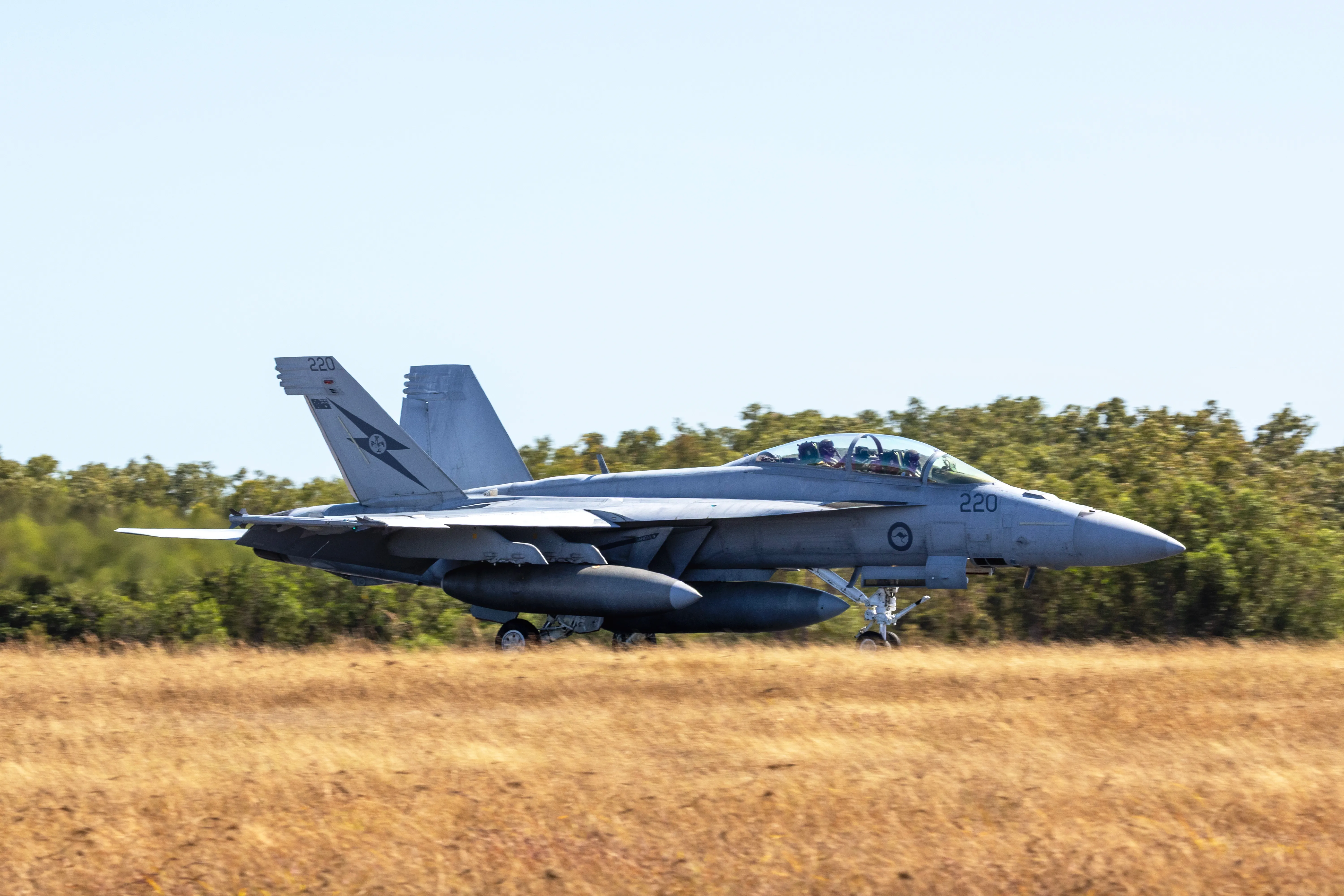
A Royal Australian Air Force F/A-18F Super Hornet, piloted by Chief of Air Force, Air Marshal Stephen Chappell, lands at RAAF Base Darwin, during Exercise Pitch Black 2026. The F/A-18F will be the first RAAF type to receive JATM. Australian Department of Defense LACW Nell Bradbury
“This announcement is the latest milestone in the delivery of long-range, high‑tech capabilities for our Defense Force,” Marles said. “The Albanese government continues to deliver critical capabilities that will allow the ADF to strike at a longer range, deter any adversary and protect our national interests. It is fitting to make this announcement at Exercise Pitch Black, which is an important demonstration of Australia’s commitment to the peace, stability and security of our region.”
The integration of the AIM-260 on the EA-18G appears to be a new announcement; previously, the priority U.S. platforms to receive the missile were the F/A-18E/F and the F-22. However, considering the commonality between the Super Hornet and the Growler, integration should be straight-forward.
A rendering released in the past depicting an F-22 firing a JATM. U.S. Air Force via Gen. Mark Kelly
“JATM missiles are some of the most sophisticated air-to-air weapons in the world, and Australia will be the first country to operate them outside the United States,” added Australian Minister for Defense Industry, Pat Conroy. “This investment will deliver the most advanced capability for our ADF to detect and counter threats, and keep Australians safe. This is made possible thanks to the Albanese government’s record investment in Defense, including up to A$36 billion [approximately US$23.4 billion] over the next decade for Guided Weapons and Explosive Ordnance.”
The AIM-260 has been under development for years, but its capabilities remain highly classified. It is intended to succeed the AMRAAM, offering substantially greater range and improved performance against advanced threats while remaining compatible with existing fighter aircraft launchers and weapons bays restrictions. The AMRAAM is currently the primary beyond-visual-range air combat weapon currently used by the RAAF’s F/A-18Fs and F-35As.
As you can read about here, the first picture of the AIM-260 emerged in May of this year, involving an F/A-18F from Air Test and Evaluation Squadron 31 (VX-31) carrying the weapon on the fuselage station outboard of its right engine intake. Flight testing of the JATM is known to have started years earlier, however.
A close-up look at the AIM-260. Jonathan Tweedy/@flightline_visuals
Although official specifications have never been released, the AIM-260 is reportedly designed to hit targets out to at least 120 miles, if not substantially further. It was designed in response to China’s long-range PL-15 air-to-air missile, restoring the U.S. and allied advantage in beyond-visual-range aerial combat. Being developed by the U.S. Navy in cooperation with the Air Force, the missile is expected to combine a compact form factor similar to the AIM-120 with significantly greater engagement range, allowing aircraft to carry the same number of weapons without sacrificing performance. It is also designed for internal carriage.
“An advanced rocket motor with highly loaded propellant has long been seen as a likely route to give the AIM-260A significantly greater range, as well as speed, over the AIM-120 without making the new missile larger. A core known requirement for the JATM is that it has to have the same general form factor as the AMRAAM, in large part to ensure that it can fit inside the internal bays on stealth fighters like the F-22 and the F-35 Joint Strike Fighter. In addition to crewed aircraft, AIM-260As are expected to arm future stealthy drones like the ones under development under the Air Force’s Collaborative Combat Aircraft (CCA) program.”
…
“The AIM-260A’s rocket motor is also likely to be a dual-pulse design that retains energy across the flight envelope to further extend range and help dramatically with endgame maneuverability. Thrust vectoring capability would also be a requisite to give the missile sufficient agility in the absence of additional control surfaces.”
…
“An active electronically scanned array radar (AESA) seeker is likely. Multi-mode seeker capability, potentially with imaging infrared and passive radiofrequency (RF) guidance capabilities, could be extremely valuable in the face of an ever-expanding countermeasure ecosystem, although we have no idea if this is a feature now or not. It’s also possible it could be introduced in later variants. Advanced networking capabilities would be a key feature, allowing the missile to get additional targeting information from an array of third-party sources. This is especially important for engaging targets beyond the reach of the launch platform’s own sensors, and it can allow the aircraft firing the missile, especially a stealthy one, to avoid having to switch on its radar and increase its vulnerability to detection as a result. Multiple networked JATMs might even be able to prosecute engagements cooperatively.”
U.S. Air Force officials have publicly acknowledged that the PL-15 was a key driver behind the AIM-260 program. According to the Royal United Services Institute (RUSI), the Chinese missile “out-ranges the U.S.-made AIM-120C/D AMRAAM series and has a comparable maximum range to the Meteor.”
Close-up of a J-20 fighter carrying four inert examples of the original PL-15 in its main ventral bays. viaChinese internet
The PL-15 is already widely fielded, while China has also developed even longer-range air-to-air missiles, including the much larger PL-17. This weapon is widely believed to be optimized for engaging high-value support aircraft, such as aerial refueling tankers and airborne early warning and control (AEW&C) platforms, at extreme distances. We have previously taken a closer look at the still largely mysterious PL-17 here.
A 2016 image where the PL-17 first appeared. viaChinese internet
Those two Chinese missiles are also expected to be joined by a new weapon currently referred to as the PL-16. The missile appears to have been developed to allow the J-20 to carry six long-range air-to-air missiles internally, rather than the four PL-15s it currently accommodates. While expected to retain a broadly similar overall design to the PL-15, the PL-16 is believed to use a compressed-carriage configuration, reducing its size to maximize the J-20’s internal missile load. In that respect, the PL-16 appears conceptually similar to the AIM-260, in its emphasis on internal carriage capacity.
The air-to-air threat in the Indo-Pacific is only set to increase, with the potential for the carriage of larger numbers of even bigger and further-reaching air-to-air missiles in the capacious weapons bays of new-generation Chinese combat aircraft.
As TWZ has reported in the past, the U.S. Air Force envisions a future in which counter-air missiles could engage targets at ranges of up to 1,000 miles by 2050. While such capabilities remain decades away and far exceed the reach of today’s longest-range air defense missiles, the projection underscores the trajectory of long-range aerial warfare and the growing emphasis on extending engagement distances.
Another U.S. response to China’s growing long-range air-to-air missile capability is the AIM-174B, currently carried by U.S. Navy F/A-18E/Fs. Derived from the SM-6 surface-to-air missile family, it is substantially larger and heavier than the AIM-260, trading compact size for dramatically greater engagement range.
How The Navy’s New Very Long-Range AIM-174 Will Pierce China’s Anti-Access Bubble
RAAF officials have previously indicated that Australia has no plans to acquire the AIM-174B, according to FlightGlobal.
Australia’s decision to procure the missile aligns with its broader effort to modernize the Australian Defence Force’s long-range strike and air defense capabilities amid an increasingly contested Indo-Pacific security environment, in which the threat posed by China’s rapidly expanding military capabilities is paramount. Canberra’s recently released 2026 National Defence Strategy emphasizes the importance of a layered air and missile defense architecture capable of countering advanced regional threats.
The government says the AIM-260 will provide the RAAF with a more credible deterrent against hostile aircraft while complementing existing air-to-air missiles and the Australian Defence Force’s expanding inventory of ground-based air defense systems. The acquisition will also improve interoperability with U.S. forces, particularly as both countries increasingly operate together in the Indo-Pacific.
While the government has not disclosed delivery schedules or the number of missiles to be acquired, Australia is now set to become the AIM-260’s first export customer, giving the RAAF access to one of the world’s most advanced beyond-visual-range air-to-air missiles once it enters operational service.
Andrii Cherniak of Ukraine’s Main Directorate of Intelligence (GUR) told Reuters that the deployment will involve approximately 90 North Korean personnel stationed in Russia’s Voronezh region — which borders Ukraine — alongside the Russian military’s 112th Guards Missile Brigade. Ukrainian intelligence assesses the unit could ultimately field six launchers and as many as 120 KN-23 and KN-24 short-range ballistic missiles (SRBMs), although the final composition is expected to be determined during senior-level talks next month.
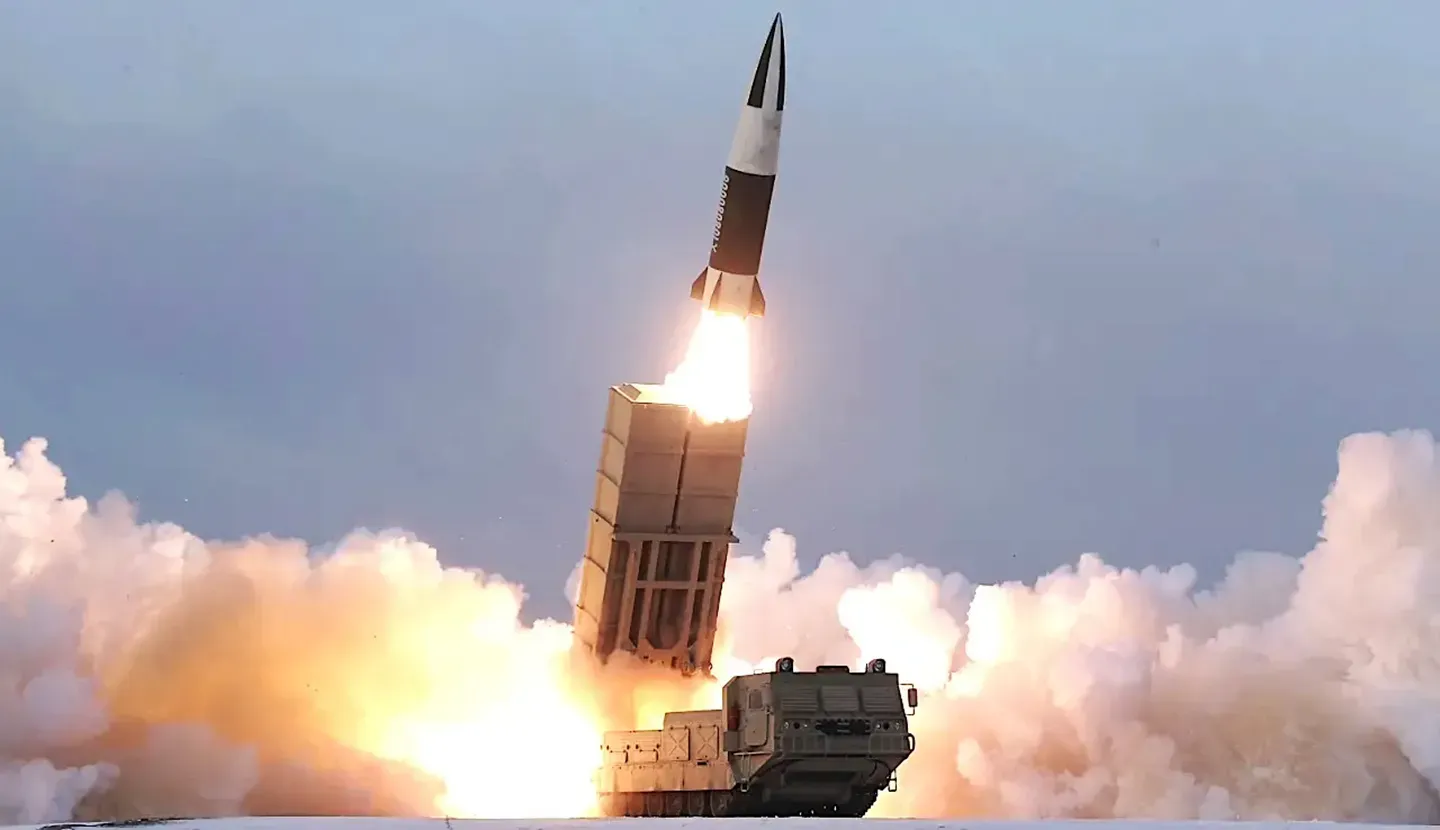
A North Korean KN-24 short-range ballistic missile. North Korean State Media
The Ukrainian intelligence assessment has not been independently verified.
If confirmed, the deployment would represent a further deepening of North Korean support for Russia, after supplying Russia with ammunition, smaller numbers of ballistic missiles, and troops.
The Ukrainian Air Force today said Russia launched another major overnight strike combining drones with ballistic missiles. Preliminary figures showed Ukrainian air defenses shot down 98 of the 115 drones launched, but failed to intercept a single ballistic missile. As well as the inherent difficulty of intercepting these threats, this statistic also points to the exhaustion of its Patriot interceptor stockpiles.
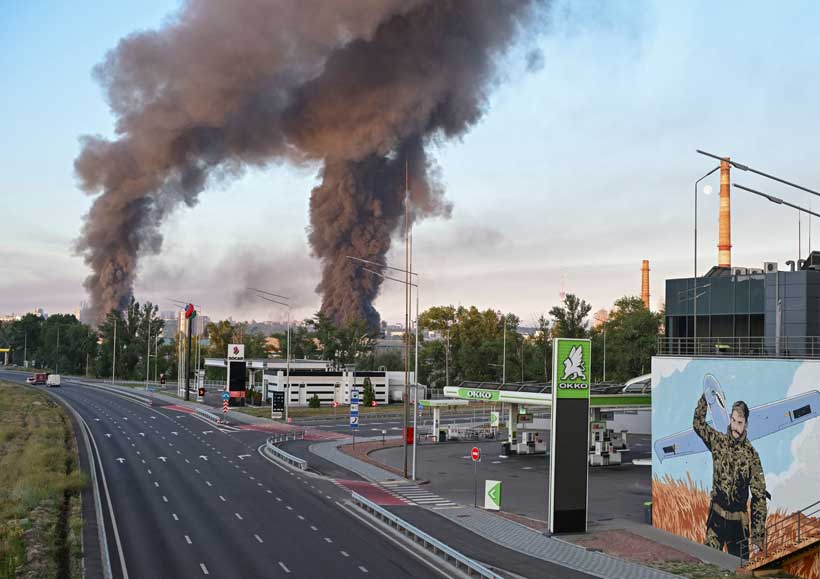
Overnight, Russia attacked Kyiv and the surrounding region with more than two dozen ballistic missiles, killing at least 17 people and injuring more than four dozens.
Russian strikes take no summer vacation; support for Ukraine and pressure on the aggressor must not pause… pic.twitter.com/GLc0YUgUgG
The attack killed at least 17 people and injured dozens more after strikes hit multiple locations across Kyiv.
President Volodymyr Zelensky directly linked the casualties to continued shortages of advanced air-defense systems.
“Ballistic missile interceptors could have saved the lives of those killed today,” Zelensky wrote on social media. “It is very important that our partners understand that delays in supplying them, or an unwillingness to provide anti-ballistic systems, lead directly to such horrific casualties and destruction.”
As of now, 44 people have been reported injured in the massive Russian strike on Kyiv and the Kyiv region. Another 17 people, tragically, were killed. My condolences to their families and loved ones. It was a heavy strike – 24 ballistic missiles, 4 Zircon/Oniks missiles, and… pic.twitter.com/4LoHXXkt8R
— Volodymyr Zelenskyy / Володимир Зеленський (@ZelenskyyUa) August 5, 2026
Ukraine has spent months urging Western partners to provide additional Patriot batteries and interceptor missiles, which remain among the few systems capable of defeating ballistic missile threats such as Russia’s Iskander and North Korea’s KN-23 and KN-24. While Ukrainian forces routinely claim to intercept the majority of incoming drones and many cruise missiles, ballistic missiles continue to present one of the most difficult threats to defend against.
Last month, U.S. President Donald Trump suggested Washington might grant Ukraine a license to manufacture Patriot interceptors domestically before later appearing to back away from the proposal, saying the technology was “a hard thing to give away.”
Trump on Ukraine and Patriots:
We have to be very careful about letting somebody build our advanced weapons.
It’s a hard thing to give away that kind of technology.
Those people whom you give technology can also turn on you. That’s possible.
According to Ukraine’s military administration, seven sites across Kyiv were struck during the latest attack, which began shortly after midnight. Zelensky said the primary targets included civilian industrial facilities, among them a brewing company and warehouses storing construction materials.
“Partners who are not yet ready to play a more active role in supplying interceptors can help by implementing new sanctions. A significant share of Russia’s ballistic missile production is still not under sanctions,” Zelensky wrote on X. “Even now. New steps are needed — from the G7, the European Union, and everyone who supports the protection of life. Thank you to those who are willing to help in this way.”
Kyiv Mayor Vitali Klitschko said rescue operations continued throughout the day.
“There may still be people under the rubble,” he said.
Emergency crews rescued two survivors from a destroyed warehouse near the city center. Klitschko said 24 people were injured, including an ambulance driver, while four remained in critical condition. The strikes also ignited multiple fires at warehouses and industrial sites, while Ukrainian authorities reported an ammonia leak triggered by one of the impacts.
The latest attack coincides with what Ukrainian intelligence says was Russia’s first use of North Korean ballistic missiles since August 2025.
Cherniak told Reuters that Pyongyang recently delivered another batch of 40 KN-23 and KN-24 missiles to Russia, along with additional personnel. He said Russia ultimately expects to receive 120 North Korean ballistic missiles and six launchers.
A North Korean KN-23 short-range ballistic missile. North Korean State Media
According to Ukrainian authorities, one of the newly delivered North Korean missiles struck the central Ukrainian village of Radushne last week, flattening a residential home and killing at least five members of the same family.
In the strike on Radushne, for the first time in a while, the Russians used a North Korean missile, according to preliminary data. Of course, more examinations will follow, and everything will be verified, but as of now – it is a North Korean ballistic missile. The alliance… pic.twitter.com/UtTTNGwBUb
— Volodymyr Zelenskyy / Володимир Зеленський (@ZelenskyyUa) July 30, 2026
Clearly, any increase in Russia’s ballistic missile inventory poses a serious challenge for Ukraine’s already strained air defenses. The situation is likely to become more difficult heading into the coming winter, when Russia normally steps up its strikes against Ukraine’s electrical grid.
The KN-23, known in North Korea as the Hwasong-11A, is a traditional SRBM that can reach out to around 800 kilometers (497 miles) and has a 500-kilogram (1,102-pound) class unitary high-explosive warhead. It offers greater range than Russia’s 9M723 Iskander SRBM, which carries a similarly sized warhead but has a range of 500 kilometers (311 miles). This weapon has also been fired from adapted railcars, a concept you can read more about here.
A North Korean KN-23 test. North Korean State Media
As for the KN-24, or Hwasong-11B, this has a range of approximately 410 kilometers (255 miles), making it more of a battlefield support SRBM, but still sufficient for Russia to strike many targets within Ukraine. It is often considered a North Korean analog of the U.S.-made Army Tactical Missile System (ATACMS).
KN-24 being test-launched. North Korean State Media
However, the North Korean SRBMs are considered less accurate than their Russian-made counterparts and have been associated with strikes causing significant civilian casualties.
According to a report from Ukrainian state prosecutors, around half of the KN-23s that had been launched by Russia between late December 2023 and late February 2024 not only deviated from their trajectory but also exploded in midair.
An investigation by Conflict Armament Research (CAR) into the wreckage of a KN-23/KN-24 missile used by Russia in Ukraine found that the missile contained more than 290 foreign-made electronic components, with approximately 75 percent linked to U.S. companies, 16 percent to European firms, and the remainder to Asian manufacturers. This suggests that North Korea continues to obtain critical Western technology despite longstanding international sanctions and points to continued limitations in Pyongyang’s high-technology production capabilities.
🚨 🇺🇦🇷🇺🇰🇵 Analysis of the debris from one of the North Korean ballistic missiles fired by Russia at Ukraine found it was constructed with more than 290 non-domestic electronic components. Many of them were produced by US companies in the last 3 years.
North Korea first began supplying KN-23 and KN-24 missiles to Russia in late 2023. Cherniak said Pyongyang delivered approximately 150 ballistic missiles between late 2023 and August 2025. Ukraine also says North Korea has supplied millions of much-needed artillery projectiles and deployed around 14,000 troops to Russia’s Kursk region under the countries’ 2024 mutual defense agreement.
A graphic shown at a White House press conference in January 2024 provides details about Russian use of North Korean ballistic missiles. NSC/White House
Cherniak said roughly 9,500 North Korean troops remain in Kursk but are not currently engaged in combat operations against Ukraine. Zelensky said last month that Russia is seeking an additional 30,000 North Korean troops and is preparing facilities in the Voronezh region to receive them.
Overall, North Korean-supplied missiles make up only a very small fraction of the weapons used in Russian strikes on Ukraine, but there has long been concern about the direction the burgeoning military relationship between Moscow and Pyongyang could take. There have been particular concerns that Russian expertise in the development of ballistic missiles and nuclear weapons — as well as other weapons and technologies — could be provided to North Korea.
North Korea: Kim Jong-un shows unseen nuclear weapons to Russia’s defence minister
The reported new deployment comes as Russia appears to be increasing its reliance on ballistic missiles to exploit one of Ukraine’s most significant military vulnerabilities. With few signs that Russia has been able to further ramp up production of its own Iskander missiles, an increased supply of North Korean ballistic missiles would take advantage of a gap in Ukrainian air defenses and further threaten its cities, energy infrastructure, and other targets. The bigger concern is not simply another shipment of missiles, but the prospect of Russia tapping into an expanding North Korean production base financed by Moscow, allowing it to sustain high-volume ballistic missile attacks for far longer than it otherwise could.
Ukraine’s ability to defeat ballistic missiles of any origin has become increasingly constrained by the availability of interceptor missiles. Patriot remains the primary system capable of reliably engaging Iskander, KN-23, and KN-24 ballistic missiles, but the U.S.-made interceptors are expensive, produced in relatively modest numbers, and are also needed to meet U.S. and allied needs around the world. European-supplied SAMP/T batteries also provide a limited anti-ballistic capability, but have been provided in only limited numbers so far.
Ukrainian personnel remove camouflage netting from a Patriot launcher. Ukrainian Air Force
Global demand for Patriot interceptors has surged amid conflicts in Europe and the Middle East, straining U.S. and allied inventories and production capacity. Those constraints have become significant enough that Congress has questioned whether the Pentagon can sustain higher transfer rates to Ukraine even as Kyiv presses for more interceptors. Meanwhile, although the United States continues discussing licensed Patriot production with Ukraine, any domestic manufacturing effort would take many months—if not years—to produce missiles in meaningful numbers, leaving Kyiv dependent on allied deliveries for the foreseeable future.
Whether or not the reported North Korean missile unit deployment materializes, the operational trend is becoming increasingly clear. Russia is continuing to expand the scale and complexity of its long-range strike campaigns, pairing mass drone attacks with growing numbers of ballistic missiles specifically intended to exploit one of Ukraine’s most difficult defensive challenges. As Kyiv’s leadership continues to press for additional Patriot batteries and interceptor missiles, the consequences of those shortages are becoming increasingly evident with every large-scale strike.
Weekly insights and analysis on the latest developments in military technology, strategy, and foreign policy.
China’s ballistic missile arsenal has undergone a dramatic transformation over the past two decades. Once centered on a relatively small force of nuclear missiles designed primarily for deterrence, which we discussed in the first part of this series, the People’s Liberation Army Rocket Force (PLARF) now fields the world’s largest — and one of the most diverse — conventional and nuclear-armed ballistic missile forces. Among its increasingly advanced regional ballistic missiles are several types that are capable of carrying either conventional or nuclear warheads, further complicating crisis stability.
Ranging from short-range systems optimized for a Taiwan contingency to intermediate-range weapons capable of striking Guam and threatening U.S. naval forces deep into the Western Pacific, these regional missiles have become the backbone of Beijing’s anti-access/area-denial (A2/AD) strategy. The land-based examples are road-mobile, solid-fueled, and increasingly precise. Some are fitted with hypersonic or maneuvering warheads to further complicate the work of an adversary’s air defenses. As of last year, the Pentagon assessed that China fielded 600 missiles in the ‘boosted hypersonic’ category, which includes systems carrying hypersonic glide vehicles (HGVs) as well as air-launched ballistic missiles, also covered in this article.
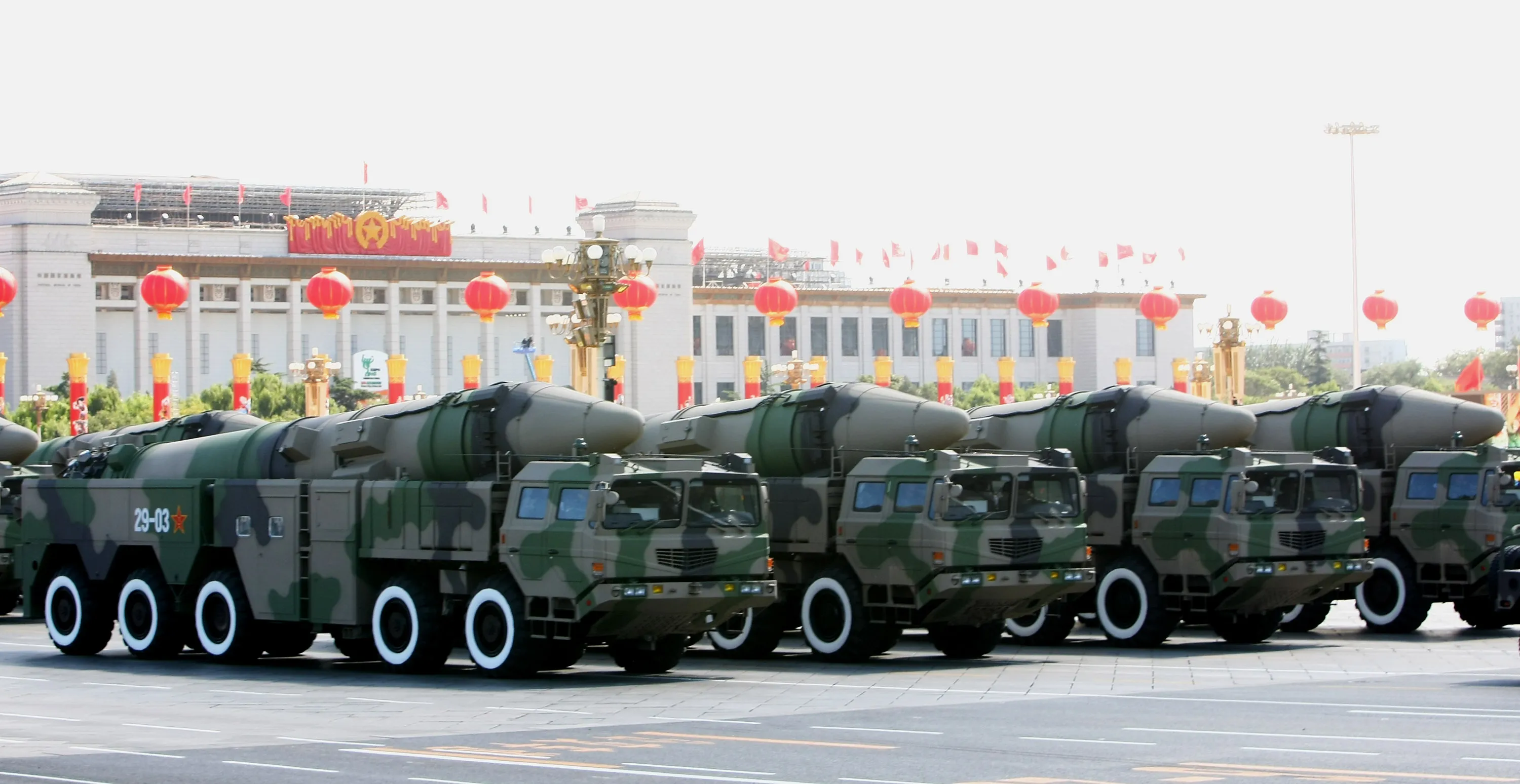
DF-21 missiles on parade on October 1, 2009, in Beijing, China. Since then, Chinese ballistic missile development has moved swiftly. Getty Images
This guide examines China’s principal short-, medium-, and intermediate-range ballistic missile systems, how they evolved, and the roles they are expected to play in any future conflict in the Indo-Pacific.
In this context, a short-range ballistic missile (SRBM) refers to a ballistic missile with a range of up to 1,000 kilometers (621 miles), typically intended for battlefield or nearby regional targets; a medium-range ballistic missile (MRBM) covers ranges of 1,000-3,000 kilometers (621-1,864 miles) and is designed to strike targets across a broader region; and an intermediate-range ballistic missile (IRBM) has a range of 3,000-5,500 kilometers (1,864-3,418 miles), enabling it to reach distant regional targets.
This article also discusses multiple missiles that carry either a hypersonic glide vehicle (HGV) or a maneuverable reentry vehicle (MaRV). These weapon types can potentially be adapted to hit moving vessels. A MaRV follows a roughly ballistic path to its impact point, maneuvering to improve terminal accuracy and defeat missile defenses. If paired with a seeker, among other alterations, they can potentially be used to strike ships. Meanwhile, unlike a traditional ballistic reentry vehicle, an HGV is designed to be boosted to high speed and released before proceeding along a relatively shallow, atmospheric flight path to its target. It remains maneuverable throughout much of its flight, allowing it to change course and vary its altitude. That combination of sustained hypersonic speed and unpredictable flight profile makes it far more difficult to successfully engage, while also reducing the time air defenses have to defend against it — provided they even have weapons that can successfully do so.
Short-range ballistic missiles
The PLARF fields multiple variants of the DF-11, DF-15, and DF-16 SRBM families. Among their most important roles is to hold Taiwan and the southern reaches of the Japanese archipelago at risk. Ongoing modernization efforts to improve accuracy, survivability, and operational flexibility underscore the continued importance of these systems, particularly for a cross-Strait campaign. Just as significant is their sheer quantity, which would enable sustained strikes against the many military and infrastructure targets that would need to be engaged in a major conflict.
DF-11A (CSS-7 Mod 2)
The origins of the DF-11 can be traced back to 1985, and work on a new single-stage solid-fuel ballistic missile. The initial requirement called for a 300-kilometer (186-mile) range, matching that of the widely used Soviet Scud-B, using a similar road-mobile transporter-erector-launcher (TEL). However, development trailed the DF-15, culminating in a successful flight test in mid-1990.
The DF-11 entered PLARF service in 1992, but work on an improved version reportedly began almost immediately. Development of the DF-11A started as early as 1993 and focused primarily on extending the missile’s reach to approximately 600 kilometers (373 miles), effectively doubling the range of the original design. Following its maiden flight in 1997, the program was publicly acknowledged the following year, and the DF-11A formally entered Chinese service in 1999.
China also developed a specialized bunker-busting variant known as the DF-11AZT, reportedly entering service in 2013. Believed to use the DF-11A airframe, the missile replaces the standard high-explosive payload with a penetrator warhead optimized for attacking hardened and fortified targets. Images of the system surfaced in Chinese media in 2016, followed by the release of footage showing a 2013 test launch the following year.
A lineup of DF-11 variants, with a DF-11AZT reportedly on the far right. via Chinese internet
Although rumors have periodically claimed the DF-11 family can carry a nuclear warhead, the available evidence does not support that assessment. Today, it appears that only one brigade still operates the system.
A PLARF DF-11A combat launch drill from a highway in the Eastern Theater Command. via Chinese internet
DF-15 (CSS-6)
China began developing a new generation of conventionally armed, mobile SRBMs during the 1980s, mainly with export customers in mind. The DF-15 has evolved through several iterations, although publicly available information on the missile family remains fragmented and, in some cases, contradictory. The first major upgrade, the DF-15A, reportedly entered service in 1996 and has occasionally been described as being capable of carrying a nuclear payload. However, the only PLARF brigade still believed to operate the variant is consistently identified in open-source assessments as a conventional missile unit. Estimates of its maximum range are equally inconsistent, with figures ranging from the original 600 kilometers (373 miles) to as much as 900 kilometers (559 miles).
A more substantial redesign followed with the DF-15B (CSS-6 Mod 3), which reportedly entered operational service around 2006 before making its public debut during China’s military parade in 2009. The most obvious external change is its triconic reentry vehicle fitted with control fins, a configuration widely interpreted as incorporating a MaRV warhead.
Around 2013, another variant, the DF-15C (CSS-6 Mod 2), reportedly entered service. Based on the shape of its warhead, the missile is widely believed to be optimized for attacks against hardened and deeply buried targets, much like the previous DF-11AZT.
The DF-15 remains in service with only a small number of PLARF brigades and appears to be steadily giving way to the newer, longer-ranged, and more capable DF-16.
A screencap from an official PLA video showing the launch of a DF-15 missile, purportedly from the Taiwan-focused exercise in August 2022. PLA
In 2022, the PLARF fired multiple DF-15s into the waters around Taiwan during live-fire drills following then-U.S. House Speaker Nancy Pelosi’s visit to Taiwan. This reflects the fact that missiles in this category remain central to any contingency involving the island.
DF-16 (CSS-11)
Another conventionally armed mobile SRBM, the DF-16 has steadily replaced the DF-15. Although it made its public debut during China’s 2015 military parade, the missile is widely believed to have entered PLARF service several years earlier, around 2011 or 2012. Nevertheless, Much about the DF-16 remains unclear.
The DF-16 closely resembles the older DF-15, but lacks the prominent aerodynamic fins found on its predecessor. This suggests the missile relies on a more advanced guidance and flight-control system capable of maintaining stability without the need for large external control surfaces. There is also some uncertainty about its range: this could potentially surpass 1,000 kilometers (621 miles), a threshold that would place it in the MRBM category.
Stills from a video showing a test of a DF-16 with a submunitions warhead:
DF-16 from mid 2010s, with a submunition warhead.
Employment of submunition warheads against land based targets is well established, but for the PLA, their use for large and medium naval targets from AShBMs are more interesting especially from a mission kill pov. pic.twitter.com/m6S4QFAgDS
A version equipped with what appears to be a MaRV, commonly identified as the DF-16A (CSS-11 Mod 2), was spotted in footage of a Chinese military exercise released in early 2017, indicating it was already operational by that point. Chinese state media later revealed another DF-16 warhead configuration in 2018, widely interpreted as evidence of a further variant, the DF-16B (CSS-11 Mod 3?). Despite the emergence of multiple versions, open-source reporting consistently indicates that the DF-16 family is intended exclusively for conventional strike missions.
PLARF crews training with the DF-16. via Chinese internet
Medium-range ballistic missiles
Over the past decade, Beijing has invested heavily in modernizing both the quality and quantity of its medium-range ballistic missile forces. Today, it fields a diverse mix of MRBMs, backed up by long-range land-attack cruise missiles, capable of executing both conventional and nuclear missions across the Indo-Pacific. All of these MRBMs are road-mobile, carried on wheeled TELs, and powered by solid-fuel rocket motors, allowing them to disperse rapidly, launch with minimal preparation, and complicate efforts to destroy them either before or after firing.
DF-17 (CSS-22)
One of the PLARF’s most significant recent additions is the DF-17, the world’s first operational ballistic missile designed from the outset to deliver an HGV. Publicly unveiled during China’s 70th anniversary military parade in 2019, the system is estimated to have entered service shortly beforehand.
With an estimated range of 1,800-2,200 kilometers (1,118-1,367 miles), the DF-17 can reach targets across Taiwan, South Korea, and most of Japan, as well as U.S. military facilities throughout the First Island Chain. Traveling at speeds reportedly approaching Mach 10, the DF-17 could cover its maximum range in roughly a dozen minutes, representing a far more difficult target for existing air and missile defense systems.
A closer look at the (here mocked-up) hypersonic glide vehicle that sits on the top of the DF-17. CCTV capture
The PLARF would likely employ the DF-17 during the opening stages of a conflict to neutralize high-value assets, including integrated air and missile defense sites, long-range radars, command-and-control nodes, and other time-sensitive targets, thereby improving the effectiveness of follow-on strikes by less advanced missile systems.
Although Beijing maintains that the DF-17 is conventionally armed, Chinese media and senior U.S. military officials have suggested the missile may also possess a nuclear capability. If confirmed, it would join several other PLARF missile systems believed to be dual-capable, further complicating an adversary’s ability to distinguish between conventional and nuclear strikes during a crisis, and potentially increasing the risk of miscalculation.
Reports have also periodically pointed to the development of an anti-ship variant, which would further expand the DF-17’s role within China’s growing long-range precision strike arsenal.
DF-17 missiles are reviewed during the V-Day military parade on September 3, 2025, in Beijing, China. Photo by VCG/VCG via Getty Images
DF-21
The origins of the DF-21 can be traced back to the late 1970s, when China began working in earnest on solid-fuel ballistic missiles. Following successful tests of a large-diameter solid rocket motor in 1978, development of the road-mobile DF-21 accelerated (as did work on a larger solid-fueled missile that would eventually evolve into the DF-31 intercontinental ballistic missile and its submarine-launched counterpart, the JL-2, both described in the first part of this feature).
The DF-21 completed its maiden successful test in 1985 and rapidly entered operational service with the PLA. The original DF-21 carried a single nuclear warhead and formed the backbone of China’s first generation of solid-fuel strategic missile forces. Its range is estimated at more than 1,750 kilometers (1,087 miles).
Even before the original DF-21 entered widespread service, work had begun on an improved version. Approved in 1986, the DF-21A (CSS-5 Mod 2) focused on reducing structural weight while increasing propellant capacity, extending the missile’s range and improving overall performance. Flight testing began in 1991, and by the mid-1990s the PLA had begun replacing the original DF-21 with the upgraded variant.
A rare view of a DF-21A with its missile canister cap removed for launch. via Chinese internet
The DF-21 subsequently evolved from a purely nuclear deterrent into a remarkably versatile missile family. Around 2004, the PLA fielded the DF-21C (CSS-5 Mod 4), widely believed to be the first conventionally armed member of the series. Designed for precision land attack, the missile introduced an entirely new mission for the DF-21 but also highlighted a growing escalation risk. The DF-21C appears to have been retired, with surviving units reportedly having transitioned to newer missile systems.
Public information on a supposed DF-21B remains sparse. The designation may have referred to an intermediate development fitted with a MaRV before that technology matured into the much better-known DF-21D.
It was the DF-21D (CSS-5 Mod 5) that really brought the missile family into the spotlight, as one of China’s most closely watched strategic weapons. Public attention surged in 2010 after a senior U.S. Navy officer stated that the missile had reached initial operational capability. Equipped with a MaRV and designed specifically to attack moving warships, the conventionally armed DF-21D became the world’s first operational anti-ship ballistic missile (ASBM) and quickly earned the nickname “carrier killer” (since applied to several other weapon systems). Western sources attribute the DF-21D with a range of more than 1,500 kilometers (932 miles).
The concept reflected Beijing’s broader A2/AD strategy, which seeks to hold U.S. carrier strike groups at risk and complicate U.S. military intervention inside the First Island Chain. U.S. defense reports had been tracking the program since the mid-2000s, and subsequent reports indicate the DF-21D has been tested against both land-based carrier mockups and actual targets at sea, underscoring China’s continued investment in long-range precision strike capabilities.
DF-21D missile TELs drive past the Tiananmen Gate during a military parade to mark the 70th anniversary of the end of World War Two on September 3, 2015 in Beijing, China. Photo by Andy Wong – Pool /Getty Images
While both the DF-21C and DF-21D are conventionally armed, there is also a more modern nuclear-armed addition to the family. First reported in 2016, information about this missile is scarce. Some sources refer to this variant as the DF-21E, though this designation has not been seen in an authoritative context in China, and the Western reporting name CSS-5 Mod 6 has meanwhile been applied.
For years, the medium-range DF-21 formed the backbone of China’s regional ballistic missile force, with different variants providing conventional land-attack, anti-ship, and nuclear strike capabilities. That role is increasingly being assumed by the longer-ranged DF-26 IRBM, which significantly expands the PLARF’s reach by bringing Guam, and its concentration of critical U.S. military facilities, within range. The in-development DF-27 looks set to push that range even further, blurring the boundary between an IRBM and an ICBM.
DF-26 (CSS-18)
Increasingly the centerpiece of the PLARF’s regional strike force is the DF-26, which appears to be a substantially enlarged and more capable evolution of the DF-21. Development is believed to have begun before 2010, with the first images emerging from Chinese sources around 2012 before U.S. intelligence publicly acknowledged the missile’s existence in 2014. Mounted on a highly mobile six-axle TEL, the two-stage, solid-fueled DF-26 made its public debut during China’s 2015 military parade and entered operational service the following year.
The DF-26 combines significantly greater range with exceptional mission flexibility. Unlike many earlier PLARF missiles, it is believed to be genuinely dual-capable, able to carry either conventional or nuclear warheads that can reportedly be exchanged relatively quickly depending on operational requirements.
The DF-26 is thought to have a range of more than 3,000 kilometers (1,864 miles).
Just as significant as the DF-26’s capabilities is the pace at which it has been fielded. The missile has become one of the fastest-growing elements of the PLARF’s inventory, reflecting Beijing’s increasing emphasis on longer-range conventional strike options. The U.S. Department of Defense estimated that China possessed more than 200 DF-26 launchers by 2020, a figure that had grown to around 250 just two years later. Combined with its ability to strike targets as far away as Guam while performing both conventional and nuclear missions, the DF-26 is poised to remain one of the PLARF’s most important regional strike weapons for the foreseeable future.
DF-26D missiles attend the military parade in Beijing, capital of China, September 3, 2015. Photo by VCG/VCG via Getty Images
DF-27 (CSS-X-24)
A next-generation system, the DF-27, represents the PLARF’s continued modernization. The Pentagon’s 2023 assessment described the DF-27 as still being under development, but a tranche of leaked U.S. intelligence documents earlier that year suggested at least a limited number had already entered service. If accurate, the DF-27 would represent another significant leap in China’s long-range precision strike capabilities. The Pentagon has stated that the missile could have a range of 5,000-8,000 kilometers (3,107-4,971 miles), pushing into the intercontinental-range category. Even at the lower end of this assessment, it could strike targets far beyond the Second Island Chain, including parts of Alaska and Australia, depending on launch location. At the higher end, it would be sufficient to reach Hawaii and potentially parts of the U.S. West Coast from some launch locations.
One missile I was hoping to see in yesterday’s PLA parade was the DF-27—a new long-range hypersonic missile that’s been discussed in the annual DoD China Military Power Report for the last few years.
Available reports indicate the missile is designed to carry an HGV and will likely be fielded in both land-attack and anti-ship variants. That combination could substantially expand the PLARF’s ability to threaten high-value targets across the Western Pacific, extending the reach of China’s A2/AD network farther into areas where U.S. carrier strike groups have traditionally operated under reduced threat.
The missile’s payload remains undisclosed, but given the PLARF’s growing inventory of dual-capable ballistic missiles, it would not be surprising if the DF-27 were ultimately able to carry either conventional or nuclear warheads.
Air-launched ballistic missiles
Falling into an interesting category is the air-launched ballistic missile (ALBM). The ALBM concept is far from new, with designs dating back to the Cold War, although they are currently seeing something of a comeback, with multiple nations around the globe now pursuing their capabilities. China is among them, and the best-known of these weapons, the JL-1, is today considered to constitute the airborne arm of the Chinese nuclear triad.
JL-1
The JL-1 ALBM can be launched by the modernized H-6N missile carrier aircraft of the People’s Liberation Army Air Force (PLAAF). These aircraft feature a modified fuselage that allows for the external carriage of these large weapons, as well as an in-flight refueling probe, extending their range.
One of the past images showing an H-6N carrying a missile that looks very similar to the JL-1. via Chinese internet
The JL-1 ALBM is assumed to be the same missile that has been referred to in the past in the West as the CH-AS-X-13, and which is understood to have been in development since at least the mid-2010s. This missile is reported to be an adapted, air-launched version of the DF-21 MRBM and similarly equipped with a MaRV. The possible relationship with the DF-21, and the DF-21D specifically, has prompted previous speculation about the H-6N having an anti-ship role, particularly against U.S. carrier strike groups, as well as being able to hit land targets.
China released first in-flight footage of an H-6N bomber carrying the JL-1 nuclear-capable air-launched ballistic missile, escorted by two J-20 stealth fighters.
JL-1: Nuclear-capable ALBM, ~8,000 km range, hypersonic reentry, also usable for anti-ship/land-attack. pic.twitter.com/e9uokWFnvz
China has said the JL-1 (presumably coupled with the H-6N) has a range of approximately 8,000 kilometers (4,971 miles), although this is very much unconfirmed.
JL-1 missiles during the military parade marking the 80th anniversary of victory over Japan and the end of World War II, in Beijing’s Tiananmen Square on September 3, 2025. Photo by Pedro Pardo / AFP PEDRO PARDO
The latest Pentagon report on Chinese military capabilities refers to the H-6N as a “nuclear weapons-capable bomber,” and that its JL-1 ALBM is a “highly precise theater weapon that would be well suited for delivering a low-yield nuclear weapon.” However, it may also have the option of a conventional warhead.
Imagery has also emerged in the past, as seen below, which has contributed to discussions about the possibility of a second variation on the Chinese ALBM concept, with what may be a wedge-shaped unpowered HGV on top. As with the JL-1, this weapon could also be anti-ship capable.
The possible second variation on the CH-AS-X-13, or another different missile, with an apparent HGV on top. via Chinese internet
KD-21
Finally, the H-6K variant can carry the smaller KD-21 ALBM on its center-wing pylons. This designation indicates an anti-ship missile, but it may well have the capability to strike ground targets, too.
An inert KD-21 missile under the right wing of an H-6K at Zhuhai in 2022. via Chinese internet
In terms of its appearance, the weapon is very similar to the Russian Kinzhal(known in the West as the AS-24 Killjoy), a missile that is launched from adapted MiG-31 Foxhound interceptors and which has been employed in the war in Ukraine, apparently with only mixed success. Like the Kinzhal, which is an air-launched development of the Iskander SRBM, the KD-21 may be derived from a land-based weapon. In particular, the Chinese missile bears a close resemblance to the CM-401 land-based anti-ship ballistic missile (ASBM), a weapon offered for export. The truck- or ship-launched CM-401 is also capable of hitting static land targets and is said to have a terminal speed of between Mach 4 and 6 and a range of up to 290 kilometers (180 miles).
A mockup of a CM-401 on display at the Zhuhai Airshow in 2018. In the background is the truck-based launcher. via Chinese internet
Missile numbers
Estimating the size of the PLARF’s missile arsenal remains challenging, and, understandably, publicly available figures differ depending on whether they refer to launchers or missiles.
Recent Pentagon assessments estimate the PLARF operates roughly 200 SRBM launchers backed by around 1,000 missiles, approximately 300 MRBM launchers with some 1,300 missiles, and another 300 IRBM launchers fielding roughly 550 DF-26-class missiles.
While the number of Chinese SRBM launchers used for the DF-15 and DF-16 missiles, both of which are conventionally armed, has remained static in recent years according to Western estimates, Beijing has prioritized the development and deployment of land-based MRBMs and IRBMs, such as the dual-capable DF-21 and DF-26. From 2018 to 2019, for example, the Pentagon noted that the number of Chinese IRBM launchers and missiles had at least roughly tripled from roughly 30 to 80. In its 2020 report, the Pentagon noted that the PLARF had further increased this number to approximately 200 launchers.
Models of the DF-17 and DF-21C medium-range ballistic missiles, DF-26 intermediate-range ballistic missile, DF-41 intercontinental ballistic nuclear missile, and other missiles, exhibited at Beihang University in Hangzhou, Zhejiang Province, China. CFOTO/Future Publishing via Getty Images CFOTO
These figures are informed estimates, and they vary noticeably across successive Pentagon reports as intelligence assessments evolve. Even so, they underscore the extraordinary scale of China’s regional strike force and, perhaps more importantly, its substantial magazine depth. This would allow the PLARF to conduct repeated waves of missile strikes in a high-intensity campaign. Current conflicts, especially between Iran and the United States/Israel, as well as in Ukraine, have shown just how critical these weapons are, and underscore that they can be a deterrent just by existing in huge numbers. The cost of air defense is also very high for the one being targeted. These lessons learned will likely accelerate China’s acquisition of more missiles and improved designs.
Taken together, the missile families detailed here illustrate how dramatically the PLARF has evolved from a relatively small strategic force into one of the world’s most capable missile services. Older systems such as the DF-11, DF-15, and DF-21 continue to provide valuable magazine depth, while newer designs including the DF-16, DF-17, DF-26, and emerging DF-27 emphasize greater range, improved accuracy, enhanced survivability, and increased operational flexibility.
Just as importantly, Beijing has increasingly blurred the line between conventional and nuclear deterrence by fielding a growing number of dual-capable missile systems, complicating an adversary’s ability to determine China’s intentions during a crisis.
Coupled with expanding production, continued technological refinement, and the proliferation of hypersonic and anti-ship capabilities, the PLARF’s regional missile arsenal has become a central pillar of China’s military modernization and one of the most consequential strike forces in the Indo-Pacific. Any future conflict involving Taiwan, the First Island Chain, or U.S. forces in the Western Pacific is certain to feature these missiles prominently from its opening hours.
Russia launched another large-scale overnight missile and drone attack on the Kyiv region, killing at least 14 people, injuring dozens, and damaging warehouses and civilian infrastructure. The assault highlights Moscow’s continued focus on overwhelming Ukraine’s air defenses while intensifying pressure on the capital.
Heavy Strike Targets Kyiv Region
Emergency officials said Russian strikes killed 14 people and injured 27 across the Kyiv region, while authorities in the capital reported one death and 24 injuries. Warehouses, storage facilities, and industrial sites were among the locations hit, with rescue teams continuing to search through collapsed buildings for survivors.
The attack also triggered fires and an ammonia leak, adding to the challenges facing emergency responders.
Missile Barrage Tests Ukraine’s Air Defenses
According to Ukraine’s Air Force, Russia launched four Zircon hypersonic missiles, 24 Iskander-M ballistic missiles, and 115 drones overnight.
Stay ahead of the geopolitical week.
MD Briefing delivers expert analysis across five global fronts — the Indo-Pacific, energy, geoeconomics, European security, and the Middle East — every Monday morning. Free.
While Ukrainian air defenses intercepted or suppressed 98 drones, officials said no missiles were successfully destroyed, underscoring the growing challenge posed by Russia’s expanding use of advanced ballistic weapons.
Patriot Missile Debate Gains Urgency
The latest assault comes as Kyiv continues urging Washington to provide additional PAC-3 Patriot interceptor missiles, one of the few systems capable of intercepting advanced ballistic missiles.
At the same time, discussions continue between the United States and Ukraine over potential domestic production of Patriot missiles, despite uncertainty surrounding the Trump administration’s long-term support for the initiative.
Escalation Continues on Both Sides
Russia said it targeted logistics hubs and supply facilities it claims support Ukraine’s military operations.
Meanwhile, Ukraine continued its campaign against Russian logistics infrastructure, reportedly striking another logistics hub linked to Russian retailer Wildberries, reflecting Kyiv’s broader effort to disrupt Russian supply chains far from the front lines.
Russia Is Increasing Pressure on Ukraine’s Air Defense Network
The latest strike suggests Russia is shifting toward saturation attacks that combine ballistic missiles, hypersonic weapons, and large drone swarms to exhaust Ukraine’s increasingly strained air defense systems. While drones can often be intercepted, advanced missiles such as the Iskander-M and Zircon remain significantly harder to stop, increasing pressure on Kyiv to secure additional Patriot interceptors. At the same time, Ukraine’s retaliatory strikes on Russian logistics networks indicate that both sides are increasingly targeting the infrastructure that sustains military operations rather than relying solely on battlefield gains. As missile stockpiles, interceptor availability, and industrial production become central to the conflict, the war is evolving into a contest of endurance in which logistics and defense manufacturing may prove as decisive as frontline combat.
The Navy currently plans to acquire 19 VPM-equipped Virginia class SSGNs, according to a press release the service put out today. The first boat in this class to feature the VPM will be the future USS Arizona, which is actually the second Block V subvariant being built. The first Block V version, the future USS Oklahoma, will lack a VPM, but the other 10 boats in this batch are expected to have this feature.
【P1】 The submarine currently under construction appears to be USS Arizona (SSN-803), the second Block V Virginia-class attack submarine. 【P2】 is likely the Virginia Payload Module (VPM), a key feature of the Block V variant.
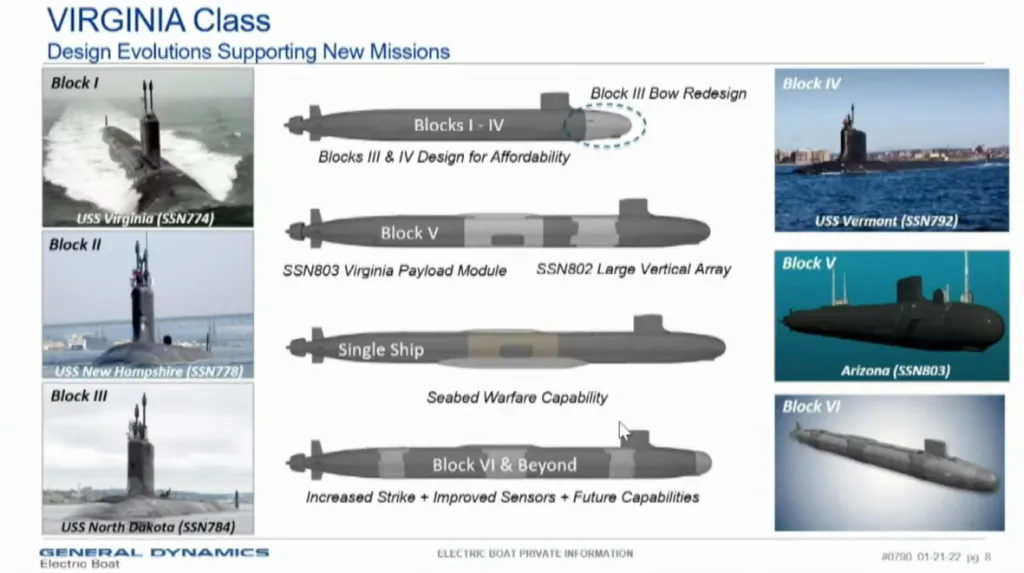
Block VI Virginia class submarines are also expected to have VPMs, as well as other upgraded capabilities. However, last week, the Navy announced a new monster $76.6 billion contract award for nine Block VI boats, as well as five additional Columbia class nuclear ballistic missile submarines, or SSBNs. This creates a discrepancy of one submarine (11 Block Vs together with nine Block VIs, for a total of 20, not 19) when it comes to the stated SSGN plans. One possible explanation might be that the outlier is a planned one-of-a-kind seabed espionage subvariant. TWZ has reached out to the Navy for clarification.
A graphic from a General Dynamics Electric Boat presentation in 2022 showing the planned evolution of the Virginia class beyond the Block V subvariant, including the planned one-of-a-kind seabed espionage boat. General Dynamics Electric Boat
Regardless, the decision to formally recategorize Virginia class submarines with VPMs as SSGNs is significant.
“This reclassification is a clear acknowledgment of the increased lethality VPM brings to the undersea fight,” Navy Vice Adm. Rob Gaucher, Director of Submarine Programs, said in a statement. “These VPM-equipped SSGNs will ensure the Navy continues to dominate the undersea domain for decades to come. By integrating this additional payload capacity, we will have the ability to surge strike power to assure our allies, deter aggression, outmatch any adversary, and give our Fleet commanders an incredibly versatile, hard-hitting instrument of national power.”
A briefing slide offering a general look at the Virginia Payload Module (VPM) that will be incorporated in Block V Virginia class submarines. USN
“Reclassifying Virginia Payload Module-equipped submarines as SSGNs accurately reflects the extraordinary strike capacity, operational flexibility, and global reach these platforms bring to the Fleet,” Navy Adm. Daryl Caudle, Chief of Naval Operations (CNO), the service’s top office, also said in his own statement. “These submarines will provide our Nation with a powerful and persistent deterrent, expand options for our combatant commanders, and ensure the Navy remains ready to fight and win whenever and wherever called upon.”
Virginia class submarines with VPMs do have significantly greater magazine depth than their predecessor. Block I and II boats had vertical launch system (VLS) arrays capable of firing a dozen Tomahawks. Block III and IV versions have a pair of Virginia Payload Tubes (VPT) in place of the earlier VLS configuration, but with the same number of tubes (12) for Tomahawks.
The Block III Virginia class submarine USS John Warner seen at its commissioning ceremony with one of its two Virginia Payload Tubes open. USN
VPM-equipped types will be able to carry 28 more Tomahawks for a total load of 40. Using different inserts, future Virginia class SSGNs will be able to carry other munitions in those tubes. This includes the aforementioned IRCPS hypersonic missiles. The Navy is also now looking to acquire a surface-to-air missile designed to be fired vertically from these submarines, which you can read more about here.
A slide from a 2021 Navy briefing providing a visual overview of the IRCPS program, including the Advanced Payload Module (APM) insert that will allow those missiles to be fired from the VPM’s tubes. The Navy is also working to arm its Zumwalt class destroyers with IRCPS missiles. The Navy’s program also shares a common missile and other elements with the U.S. Army’s ground-based Dark Eagle weapon system. USN
It should be noted here that all Virginia class submarines have four 21-inch torpedo tubes, which also offer another option for launching Tomahawks. They can also be used to fire Harpoon anti-ship cruise missiles, as well as launch and recover uncrewed underwater vehicles (UUV). It’s also possible, if not highly probable, that the VPMs will be capable of launching (and potentially recovering) other payloads, including additional uncrewed platforms.
Some existing Virginia class submarines can be fitted with Dry Deck Shelters (DDS) on top of their hulls for deploying special operations forces, swimmer delivery vehicles (SDVs), and other assets, as well. That is a capability that could be carried over to the enlarged SSGNs.
All of this brings us to the matter of the Ohio SSGNs. These boats are best known for being able to carry up to 154 Tomahawks at once, though they more typically deploy with loads of around 100 of those missiles. However, these submarines, which were converted from Ohio class SSBNs, are really multi-mission platforms. Beyond their ability to launch barrages of dozens of Tomahawks, they can act as motherships for special operations forces and uncrewed platforms, as well as serve as underwater intelligence fusion nodes and command centers. You can read more about their capabilities in this past War Zone feature.
A graphic offering a very general overview of the full breadth of features found on Ohio class SSGNs. USN
“This transition [in categorization from SSN to SSGN] comes at an important moment as USS Georgia, one of the Navy’s four Ohio class guided-missile submarines, begins the inactivation process after more than four decades of exceptional service,” CNO Caudle also said in his statement today. “Georgia and her sister ships proved the enduring value of combining undersea stealth with unmatched clandestine strike capability. The next generation of Virginia class SSGNs builds on that legacy with greater survivability, adaptability, and sustained combat power.”
USS Georgia returned home from its final scheduled operational patrol last month. It is now scheduled to be formally inactivated next year.
At the same time, as TWZ has noted for years, the VPM-equipped Virginia class boats will not be a one-for-one replacement for the Ohio class SSGNs, at least based on what is publicly known about the former’s expected capabilities. Just in terms of missile launch capacity, each one of the converted Ohios is equal to roughly four Block V/VI Virginias. This means the Navy will need to field 16 new Virginia SSGNs before it fills the gap left by the retirement of USS Georgia and its three sisters, and can then start adding capacity with three additional boats. The Navy is facing a broader deficit in VLS capacity across its surface and subsurface fleets in the coming years, due also in part to the impending retirement of the last of its Ticonderoga class cruisers.
USS Georgia seen after its final return to Naval Submarine Base Kings Bay in Georgia in July 2026. USN/Petty Officer 1st Class Travis Alston
It is unclear what other capabilities the Block V and VI Virginia class submarines might have that will help make up for the loss of the specialized intelligence gathering and command and control tasks currently performed by the Ohio class SSGNs. As noted, some existing Virginia class submarines also perform the special operations support mission, but on a more limited level.
“By putting high-volume, long-range precision strike capabilities directly into the hands of the Fleet, these SSGNs will serve as a vital cornerstone for Distributed Maritime Operations and high-end warfighting,” the Navy’s press release today says. “Once operational, these highly survivable platforms will be dynamically employed across crucial global theaters – providing persistent forward presence, reinforcing robust alliance deterrence, and standing ready to project decisive combat power at a moment’s notice.”
On top of all this, the Navy does not expect the full fleet of 19 Virginia SSGNs to be in service until Fiscal Year 2038, at the earliest. This will be nearly a decade after the last Ohio SSGNs sail into mothballs. Concerns are regularly voiced now about the ability of General Dynamics Electric Boat and Newport News Shipbuilding (a division of Huntington Ingalls Industries) to keep up with demand for submarines in this class. There is even more pressure on the program with the addition of plans to sell some of those boats to Australia as part of the trilateral Australia-United Kingdom-United States (AUKUS) defense pact. The Navy is hoping to see the Virginia class production rate eventually rise to two per year, but is not expecting that to come until sometime in the 2030s.
If nothing else, the Navy has at least outlined more of a formal plan to supplant the Ohio class SSGNs with what it has now dubbed Virginia class SSGNs.
“We’re going to beat the fucking shit out of them,” Fox News reporter Troy Yingst says the president told him this morning, referring to Iran. “We’ll be hitting them hard. They’re going to get a beating.”
Yingst also said Trump told him that “U.S. forces had just minutes to shoot down these incoming Iranian ballistic missiles. The president says he has reviewed video of the shootdown, and it was U.S. forces conducting this operation to defend that area. He said it was real time; they were calling out coordinates and ensuring that none of this incoming Iranian fire got through.”
“In terms of possible talks with the Iranian regime, the president says ‘we’re going to let them keep talking,’” Yingst added. “…those talks are taking place as we speak behind the scenes.”
“We’re going to beat the fuc*ing sh*t out of them,” President Trump told Fox News after Iran launched a surprise attack against U.S. forces. “We’ll be hitting them hard.”
The President says U.S. strikes overnight against Iran-backed militias in Iraq were coordinated with the… pic.twitter.com/AeLbEGFCFi
On Tuesday, the Islamic Revolutionary Guard Corps (IRGC) “launched multiple ballistic missiles from Iran in an attempted surprise attack on U.S. forces based in the Middle East,” U.S. Central Command stated on X. “All Iranian missiles were successfully intercepted. U.S. forces remain vigilant and at a high state of readiness.”
The attack began at 5:45 p.m. ET, according to CENTCOM.
At 5:45 p.m. ET today, Islamic Revolutionary Guard Corps forces launched multiple ballistic missiles from Iran in an attempted surprise attack on U.S. forces based in the Middle East. All Iranian missiles were successfully intercepted. U.S. forces remain vigilant and at a high…
Trump also addressed the combined U.S.-Saudi strike on Iraqi militias linked to the Islamic Revolutionary Guard Corps (IRGC). The action appears to marke the first publicly known instance of the U.S. and Saudi Arabia joining forces to carry out attacks in this conflict.
The president “says those strikes were coordinated with the Iraqi government,” Yingst explained. “He called these Iran-backed militias a cancer on the world, and says he is considering additional warnings against Iranian proxies and their link to the Iranian regime.”
Hours before Trump spoke with Yingst, Iraqi militia groups condemned the action.
Harakat al-Nujaba (HaN), an armed group in the Popular Mobilization Forces (PMF), said those would be avenged, Al Jazeera reported. The PMF said at least 20 of its members were killed and 32 wounded in the U.S.-Saudi airstrikes, which took place across Iraq.
In a statement, HaN demanded the expulsion of U.S. forces from the country, saying their continued presence “has become an imminent threat to the country’s security and stability,” the outlet added. The group also called for an end to cooperation with Saudi Arabia and for the deployment of advanced air defense systems and threatened retaliatory attacks against U.S. and Saudi interests.
Prominent Iran-backed Iraqi Shia militia Al-Nujaba says it will not allow the U.S. and Saudi Arabia “to defile Iraqi soil without exacting a heavy price from them,” following joint U.S.-Saudi strikes on Iran-backed militias in Iraq overnight. https://t.co/r9euaiH60u
— Ariel Oseran أريئل أوسيران (@ariel_oseran) July 29, 2026
Meanwhile, influential Iraqi cleric Muqtada al-Sadr urged the IRGC and allied armed groups to stop launching attacks from Iraq.
“Since this holy land was not a launching point for bombing the Islamic Republic, then our brothers in the Revolutionary Guard must not bomb our independent and holy lands,” al-Sadr posted on X. “Likewise, the rogue militias must not give our brothers in the Gulf Arab states a pretext to target our holy land.”
“Everyone must embrace the spirit of brotherhood and peace and not be drawn into the schemes of the Zionist-American enemy to drag brothers into fighting and conflict,” the cleric added. “While I condemn the targeting of the holy Iraqi lands by all countries and parties, and I condemn the shameless actions of the militias to drag Iraq into a pointless war, I call upon the Iraqi government to establish security, enforce sovereignty, and work diligently for the safety of the Iraqi people and their holy sites, and not to be drawn into the abhorrent sectarian myths.”
CENTCOM on Tuesday said its forces, along with the Saudi Arabian Armed Forces, “conducted precision strikes in Iraq, July 28, against Iran-aligned terrorists that the Islamic Revolutionary Guard Corps (IRGC) directed to attack U.S. forces and Saudi energy infrastructure.”
“U.S. and Saudi fighter aircraft struck multiple terrorist logistics and weapons sites across eastern Iraq in a strong response to over 30 IRGC-directed aerial drone attacks in the last 72 hours. The unwarranted attacks against U.S. forces were not successful,” CENTCOM added. “From February through April 2026, there were more than 600 attempted attacks on U.S. citizens and facilities by Iran-aligned terrorist militias in Iraq. The IRGC and its terrorist proxies must cease these attacks to avoid further U.S. military response.”
A U.S. official told TWZ Tuesday night that the combined U.S.-Saudi attacks came after the Iranian barrage.
“To be clear, the IRGC-directed attacks at our forces and our Saudi partners since over the weekend came without any provocation,” the official added. “This is a clear message that we will not let those attempts go unanswered.”
An A-10 Thunderbolt II close attack jet depicted on CENTCOM’s X announcement of joint U.S.-Saudi strikes on IRGC-connected groups in Iraq. (CENTCOM)
U.S. troops are adding to the danger they face by posting cellphone videos of attacks online, CENTCOM commander Adm. Cooper warned, according to Reuters. The command is also considering having some personnel surrender their phones, the outlet added.
Cooper, in a previously unreported letter, “said Iran was benefiting from being able to see the success or failure of its strikes in near real-time by searching news reports or online posts by journalists referencing ‘reactions, photos, and footage from the cellphones of our troops,’” Reuters stated.
The CENTCOM commander appeared to reference the following video in his letter, Reuters suggested.
“The direct, unavoidable cost of this open-source intelligence could be measured in the lives of American service members and civilian residents in targeted Gulf countries,” Cooper wrote in his July 28 letter, a copy of which was obtained by Reuters.
He called on troops to “redouble our focus on operational security,” without prescribing specific steps in the memo,” the news organization further noted.
“Admiral Cooper’s top priority is the well-being and protection of over 50,000 American service members operating in the Middle East,” CENTCOM spokesman Navy Capt. Tim Hawkins told TWZ in response to our questions about the letter. “His guidance to troops about operational security reinforces this priority.”
Cooper’s letter follows moves by U.S. satellite companies like Vantor and Planet Labs to delay posting imagery from the region out of similar concerns about operational security.
Cooper’s memo underscores the mounting tensions between real-time news reporting on the war, often aided by satellite imagery and first-person accounts, and the desire by the U.S. military to restrict any information that could aid Iran as it tries to kill and wound U.S.… https://t.co/0OBN2o1rtg
“The Houthis were looking into imposing fees on most traffic through the narrow Bab el-Mandeb [BAM] gateway,” Reuters noted, citing sources. The narrow waterway, between Yemen and Djibouti, links the Red Sea to the Gulf of Aden. “No timeframe was given at this stage for implementation,” the sources added.
The Houthis’ media office did not respond to a request for comment.
July 29 (Reuters) – Yemen’s Houthi group is considering imposing fees on commercial ships sailing through the southern Red Sea, a week after declaring a naval blockade on Saudi Arabia, regional sources with knowledge of the matter told Reuters.
As we have frequently detailed, Houthi actions in the BAM threaten to add far greater pressure on oil exports from the Middle East, already drastically affected by the Iranian closure of the Strait of Hormuz and the resumption of the U.S. blockade on Iranian ports. The Yemeni rebel group has already expanded its target set, hitting oil terminals and infrastructure Saudi Arabia is using to pump supplies to tankers in the Red Sea. The kingdom has diverted millions of barrels of oil per day through pipelines to its Yanbu port on the Red Sea in an effort to minimize the energy shortages due to the hostilities in the Persian Gulf. Even with the BAM closed, oil exports could still head to the West, via the Suez Canal. But if the infrastructure used to convey these energy products is put out of action, the consequences could be even more severe, with far less or even no energy supplies from Saudi Arabia moving out of the Red Sea. The closing of the BAM, and the possible imposition of tolls, also raises the specter of the U.S. having to get as involved as it did during the previous Houthi campaign against shipping that ended last September, which could pull resources away from Iranian-focused operations.
Bab al-Mandeb Strait. (Google Earth)
Despite the increased risks, transits through both straits are trending upward, according to the Kpler risk management firm.
“Daily monitoring shows stronger transit volumes across the Strait of Hormuz and Bab el-Mandeb, with 12 and 41 confirmed crossings respectively on 28 July,” Kpler noted on X. “Yet higher traffic should not be mistaken for lower risk. Hormuz routing remains concentrated outside traditional traffic separation patterns, while Bab el-Mandeb continues to present elevated operational and compliance challenges through dark transits, sanctioned vessels and shadow fleet movements.”
“With 62 confirmed maritime security incidents recorded by the IMO as of 27 July and geopolitical tensions still unresolved, vessel behavior remains a more meaningful indicator than crossing volumes alone,” Kpler added. “For operators and markets alike, transparency, routing choices and emerging disruptions remain the key signals to watch over the coming days.”
Traffic rises, risks persist
Daily monitoring shows stronger transit volumes across the Strait of Hormuz and Bab el-Mandeb, with 12 and 41 confirmed crossings respectively on 28 July. Yet higher traffic should not be mistaken for lower risk. Hormuz routing remains concentrated… pic.twitter.com/fwUxZyUaf8
In the wake of new fighting in the region and threat of Houthi tolls on the BAM, oil prices are once again trending upward. The per barrel price of Brent Crude has risen to nearly $90, according to OilPrice.com. It had fallen to just over $83 per barrel yesterday when the pause in hostilities was still holding.
As we have previously noted, the U.S. and Iran had stopped firing at each other late last week, leading to a pause after 13 straight days of continuous tit-for-tat operations. U.S. President Donald Trump hadn’t ordered a U.S. strike on Iranian territory since last Thursday. This was ostensibly to give another round of diplomacy a chance. However, lingering concerns over the supply of munitions, especially air defense interceptors, reportedly played a role in Trump’s thinking.
The U.S. has burned through hundreds of Terminal High Altitude Area Defense (THAAD) and Patriot interceptors since a shaky ceasefire went into effect on April 8, according to the Center for Strategic and International Studies (CSIS) latest assessment. CSIS was updating a previous analysis of munitions expenditures during Epic Fury that you can read more about here.
According to CSIS, the U.S. had about 2,300 Patriot interceptors in its inventories before Epic Fury, 1,030 by the time the ceasefire was agreed to and between 759 and 827 as of July 27.
As for THAADs, there were 452 interceptors in the U.S. inventory before Epic Fury, between 232 and 262 on the date of the ceasefire and between 234 and 278 as of July 27.
The report authors noted that “[e]stimated inventories today account for additional interceptor use and new deliveries since the April 8 ceasefire. THAAD deliveries during the ceasefire outpaced estimated use over the same period, resulting in higher inventories today than in April. Patriot calculations include the latest MSE variant and PAC-3s. Several hundred PAC-2s, not represented in the chart, are estimated to remain in the U.S. inventory.”
New estimates of American Patriot PAC-3 and THAAD anti-ballistic missile interceptor stockpiles in American inventory from CSIS.
The lack of sufficient magazine depth is an issue that TWZ has raised frequently for years, and especially in regard to America’s air and missile defenses, in particular. In fact, we laid out in detail these exact concerns and how they would be a major issue in war with Iran just prior to the conflict starting in a feature you can read in full here.
Given Trump’s threat against Iran today, those concerns may be set aside out of a need to respond to the ballistic missile attack. The coming hours should give us a better picture of how all this will develop.
One of the ships was a U.S.-owned and operated, Marshall Islands-flagged liquefied natural gas (LNG) floating storage facility and the other was a Greek-owned and operated, Bermuda-flagged LNG tanker, Ambrey stated.
“Reportedly, the incident occurred during LNG discharge operations, with the strike causing a fire on board” the floating LNG storage facility, Ambrey said in an alert. “Ambrey was aware that a second vessel reportedly experienced a fire in connection with the incident. AIS data indicated that the vessel was subsequently towed by two tugs to a position 2.9 NM northeast of the port, accompanied by a fire-fighting vessel.”
The security firm added that it “was aware that the crew had been evacuated and that the fire had subsequently been brought under control. At the time of writing, no party had claimed responsibility. No casualties, damage to port infrastructure or pollution had been reported in connection with the incident.”
After being struck by a drone and experiencing a fire, the Greek-owned and operated Bermuda-flagged LNG tanker “departed and anchored in a position approximately 10.2 NM northwest of the port,” Ambrey noted.
A maritime security specialist told us that the U.S.-owned and operated, Marshall Islands-flagged floating gas storage facility was the Energos Winter while the other ship was the Gaslog Salem.
Fire involving two LNG vessels disrupts Damietta terminal
A fire involving the Energos Winter floating storage and regasification unit and the LNG carrier GasLog Salem has disrupted activity at Egypt’s Damietta LNG terminal. Following the incident, both vessels were moved… pic.twitter.com/3weeuJ4YvS
TWZ cannot confirm claims about the drone attacks, however, NASA FIRMS shows two thermal anomalies within the port limits near the vessels’ berths.
NASA FIRMS
Video emerging from the scene shows what is purported to be smoke wafting from the Energos Winter after the attack.
A drone struck the U.S.-owned floating gas storage tanker Energos Winter while it was unloading cargo at Egypt’s Damietta Port, sparking a fire that spread to a second vessel, GasLog Salem. The crews were evacuated, the fire was brought under control, and no injuries were… pic.twitter.com/JwyNSywv8t
Asked during a press conference whether Iran was behind the drone attack on Egyptian port, Trump said “it’s a little more of the same, but it’s going to be straightening out, it’s going to be straightening out. But in the meantime, we are going to be hitting them very hard, because it is our turn to hit ’em. They know it’s coming, they are asking us not to do it.”
“We’re going to hit them very hard.”
President Trump warns adversaries that the U.S. is prepared to respond forcefully following a drone attack on an LNG tanker off the coast of Egypt.
Trump signaled that retaliation is imminent despite requests from adversaries to hold back.… pic.twitter.com/SMOUuj5qGT
As promised by Trump, the U.S. is hitting Iran tonight.
“U.S. forces began launching strikes against Iran at 8 p.m. ET today,” CENTCOM announced on X. “The strikes are a powerful response to yesterday’s attempted Iranian attacks on U.S. forces based in the Middle East.”
U.S. forces began launching strikes against Iran at 8 p.m. ET today. The strikes are a powerful response to yesterday’s attempted Iranian attacks on U.S. forces based in the Middle East.
In a post on X, CENTCOM announced that at 10 PM ET, its “forces successfully completed a heavy wave of strikes against Iran in response to yesterday’s attempted missile attacks on U.S. forces.”
“CENTCOM assets struck dozens of Islamic Revolutionary Guard Corps (IRGC) targets in Iran, including military command centers, missile and drone facilities, coastal surveillance and defense sites, and maritime capabilities,” the command stated. “The strikes aimed to further diminish threats posed by Iran and its proxies to American forces, commercial shipping, and neighboring Gulf countries.”
CENTCOM says it struck dozens of targets in a “heavy wave” of airstrikes on Iran overnight in response to yesterday’s Iranian missile attacks on U.S. forces.
Weekly insights and analysis on the latest developments in military technology, strategy, and foreign policy.
The Japan Maritime Self-Defense Force (JMSDF) has fired a Tomahawk land-attack cruise missile from one of its warships for the first time, marking a significant development in Tokyo’s efforts to field a long-range conventional strike capability at sea. The launch, conducted by the Kongō class Aegis destroyer Chōkai in the Pacific Ocean with support from the U.S. Navy, is the result of years of work to integrate the U.S.-made cruise missile into Japan’s surface fleet and significantly expands the country’s standoff attack options.
Japan becomes the third country outside the United States to fire a Tomahawk from a surface combatant, with Australia and the Netherlands having previously done so. The other operator of the missile, the United Kingdom, has only fired Tomahawks from submarines.
Launch of the first Tomahawk missile from Chōkai at an undisclosed location in the Pacific. Japan Ministry of Defense
Japan’s Ministry of Defense announced that Chōkai, which has been deployed to the United States since late last year for modifications and crew training, carried out the live-fire event on July 29 Japan Standard Time (July 28 Pacific Daylight Time). According to the ministry, the test confirmed not only the ship’s ability to launch the missile but also the proficiency of its crew in operating the weapon, clearing another major hurdle toward operational service.
The firing represents the culmination of a process that began in October 2025, when Chōkai arrived in the United States. In March, Japan announced that the destroyer had successfully completed the structural upgrades, software integration, and crew instruction required to employ the Tomahawk, making it the first Japanese warship capable of launching the missile. At the time, officials said a live-fire demonstration would follow before the capability entered operational service.
The destroyer Chōkai arrives at Naval Base San Diego, October 15, 2025. U.S. Navy photo by Gunner’s Mate 2nd Class Timothy Weber Petty Officer 2nd Class Timothy Weber
“This live-fire test demonstrates steady progress in the Tomahawk project, and the Ministry of Defense will continue to work towards the early establishment of stand-off defense capabilities,” the ministry said in a statement.
Chōkaiis expected to return to Japan around September 2026.
For decades, Japan’s Aegis destroyers have been optimized almost exclusively for fleet air defense and ballistic missile defense missions. Integrating the Tomahawk fundamentally changes this by giving the ships the ability to strike fixed targets hundreds of miles inland, and potentially other ships at sea over great distances, extending the reach of the JMSDF far beyond traditional maritime operations.
The destroyer Chōkai steams during the Rim of the Pacific 2016 exercise. U.S. Navy Combat Camera photo by Mass Communication Specialist 1st Class Ace Rheaume/Released Senior Chief Petty Officer Ace Rheaume
The Tomahawk acquisition forms part of Japan’s broader effort to build what Tokyo describes as “standoff defense capabilities” in response to an increasingly challenging regional security environment. Under Japan’s revised National Security Strategy, the country has embraced a limited counterstrike capability intended to hold hostile missile launchers, command nodes, and other military targets at risk if Japan comes under attack. Officials have repeatedly stressed that these weapons remain consistent with Japan’s exclusively defense-oriented security policy and are intended to strengthen deterrence rather than enable offensive military operations.
Japan is purchasing up to 400 Tomahawk missiles from the United States, including both Block IV and newer Block V variants, at a cost of around $1 billion. The Block IV Tomahawk can hit targets nearly 1,000 miles away with a 1,000-pound unitary warhead. It is capable of rerouting mid-flight and can loiter over an area to hit targets as they emerge, featuring an imaging infrared seeker capability. The Block V variant is an improved version with survivability upgrades that can be used to also hit moving targets, especially in the long-range anti-ship missile role.
A Block V Tomahawk seen with its distinctive ‘chined’ nose cone. U.S. Navy
Tomahawk is seen as a bridge capability while indigenous long-range weapons — including Upgraded Type 12 anti-ship missiles and other domestically developed standoff systems — enter service. Tomahawk deliveries have already begun, and additional Aegis destroyers are expected to receive the modifications needed to employ the weapon over the coming years.
Japan’s four Kongō class destroyers already feature the Mk 41 vertical launching system (VLS) and an Aegis combat system closely aligned with U.S. Navy architecture, requiring modifications rather than wholesale redesign to operate Tomahawk. Future installations are expected across the remainder of Japan’s Aegis destroyer fleet, including the two Atago and two Maya class ships.
Tokyo has already allocated funds of close to $700 million for the appropriate modifications to four more Aegis destroyers: Kirishima, Haguro, Myoko, and Atago.
The Kongō class destroyer Kirishima underway in the Philippine Sea. Tomahawk modification work on Kirishima began during fiscal year 2025. U.S. Navy/Photo by Juahn Gaskins Military Sealift Command Far Eas
Japan’s future Tomahawk fleet is likely to extend beyond its existing destroyers.
Japan is also getting the highly- lexible Joint Strike Missile, which is air-launched and can hit land targets and vessels, as well, albeit over far shorter ranges than Tomahawk. The longer-range JASSM has also been cleared for sale to Japan, but that has not moved forward as far as we know. Beyond that, however, Japan plans to rely on domestically developed long-range missiles to ensure its standoff strike capability. As well as the aforementioned Upgraded Type 12 anti-ship missile, which adds a new land-attack capability, Japan is working on a ground-based Hyper Velocity Gliding Projectile (HVGP), a combination of ballistic missile and hypersonic glide vehicle, a project which you can read more about here.
The successful Tomahawk launch also underscores the deepening operational integration between the U.S. Navy and the JMSDF. Beyond the missile sale itself, the United States has supported the ship’s modernization, crew certification, and now its first live firing, highlighting the increasingly close cooperation between the two allies as they seek to deter their regional opponents, primarily China and North Korea.
With the successful test now complete, Japan has taken another important step in establishing its new-look defense posture, transforming the JMSDF’s premier Aegis destroyers from platforms focused primarily on air and missile defense into warships capable of delivering precision strikes against land targets far beyond the horizon.
Weekly insights and analysis on the latest developments in military technology, strategy, and foreign policy.
A pair of previously unseen missiles slung beneath the wings of a Japan Air Self-Defense Force (JASDF) Mitsubishi F-2 fighter underscores the progress Tokyo is making on expanding its long-range strike arsenal, to which the Tomahawk land-attack cruise missile was recently added. While the weapon has not been officially identified, its size, configuration, and timing strongly suggest it could be the air-launched version of Japan’s new Type 25 Surface-to-Ship Guided Missile (25SSM).
Photographer @bibabibabibary on X was one of many to capture the new missiles during what was apparently the first test flight from Gifu Air Base today. The aircraft carrying them was the two-seat F-2B serial 68-8101, one of the F-2 prototypes now operated by the JASDF’s Air Development and Test Wing (ADTW). The first F-2A prototype, 68-8101, served as a ‘chase plane’ for the sortie.
— シン・ばらさん(垢乗っ取りされました) (@bibabibabibary) July 30, 2026
Carried on the inboard wing pylons, the missiles are notably large — bigger than the familiar ASM-2 or even the newer, ramjet-powered ASM-3 anti-ship missiles already associated with the F-2 fleet. The new, gray-painted weapons have a long, fairly slender fuselage, folding wings in the upper part of the body, and four cruciform tailfins. The boxier cross-section has ‘chines’ reminiscent of those on other low-observable missiles. Its stealth features should enhance its survivability and lethality against increasingly capable naval integrated air defense systems. An underslung engine intake, with a protective cap, is located below the rear part of the body. There is no obvious optical window, suggesting that the missile relies on GPS/INS navigation and a radar seeker for the terminal phase.
A Mitsubishi F-2 carrying ASM-2 anti-ship missiles under the wings. Japan Ministry of DefenseA Mitsubishi F-2 launches an ASM-3 anti-ship missile. Japan Ministry of Defense
Overall, the weapon has the look of a subsonic, radar-evading cruise missile optimized for long-endurance flight rather than high-speed dash performance.
Significantly, the new missile has a lot of similarities with what we have seen of the Upgraded Type 12/Type 25 family of weapons, suggesting that this is an air-launched derivative.
The Upgraded Type 12/Type 25 is a heavily upgraded evolution of Japan’s legacy Type 12 anti-ship missile, with its range reportedly increased to around 1,000 kilometers (around 620 miles).
The legacy Type 12 anti-ship missile, as used by the Japan Ground Self-Defense Force. Japan Ministry of Defense
Once in service, it will substantially increase Japan’s maritime-strike reach. The original Type 12 used by the Japan Ground Self-Defense Force (JGSDF) has a range of 200 kilometers (124 miles), while the JASDF’s ASM-2 can strike targets at 180 kilometers (112 miles).
While the original Type 12 was conceived as a coastal defense weapon to attack enemy shipping, the new missile family is a multirole strike system capable of engaging maritime as well as land targets, including enemy missile launch sites and other fixed infrastructure, hundreds of miles from the home islands, as part of Japan’s evolving ‘counterstrike’ posture.
Japan’s pursuit of increasingly capable standoff weapons is being driven largely by the deteriorating security environment in the Indo-Pacific, particularly China’s rapid military expansion and growing arsenal of long-range precision missiles. The People’s Liberation Army fields extensive anti-access/area-denial (A2/AD) networks designed to keep U.S. and allied forces at arm’s length, while China’s navy continues its rapid expansion. At the same time, North Korea’s advancing ballistic missile and nuclear programs have reinforced Tokyo’s view that it needs the ability not only to defend its territory, but also to hold hostile missile launchers, command nodes, and naval forces at risk before they can strike.
At the end of March of this year, the JGSDF announced the deployment of the Upgraded Type 12, and, at the same time, officially redesignated it as the Type 25 Surface-to-Ship Guided Missile (25SSM) — the “25” reflects fiscal year 2025, when the coastal defense weapon was formally inducted to service.
A Japan Ground Self-Defense Force (JGSDF) Type 25 Surface-to-Ship Guided Missile during a live-fire exercise at the East Fuji Maneuver Area in June 2026, in Gotemba, Shizuoka Prefecture, Japan. Photo by Tomohiro Ohsumi/Getty Images Tomohiro Ohsumi
The Japan Ministry of Defense also says it plans to deploy ship- and air-launched variants of the 25SSM on Japan Maritime Self-Defense Force (JMSDF) destroyers and JASDF fighters in fiscal year 2027.
With that in mind, it would make sense that the weapons seen on the F-2 today are the air-launched variants of the 25SSM. We cannot be certain of that, however, and the official designation of such a missile is also unknown (ASM-4 has been suggested).
At this point, we don’t know the status of the new air-launched missile. However, Japan is currently testing a variety of new missiles.
The F-2 is also being used to test an improved version of the ASM-3 high-speed anti-ship missile, the ASM-3 Kai.
Japan is meanwhile working on the New Surface-to-Ship Missile. Earlier this year, an official video was released showing a flight test of the missile in which it executed a series of manoeuvres, including barrel rolls, intended to defeat defenses in the terminal phase of the attack. The New Surface-to-Ship Missile is powered by an efficient turbofan engine and is expected to have a greater range than the Upgraded Type 12. It is similarly intended for launch from ground, maritime, and air platforms. You can read more about it here.
The demonstration of the New SSM’s barrel roll capability can be seen in the video starting at around 0:49 in the runtime.
P-31-1_島嶼防衛用新対艦誘導弾の要素技術の研究
As we reported earlier today, the JMSDF recently fired a U.S.-made Tomahawk land-attack cruise missile from one of its warships for the first time, the Aegis destroyer Chōkai, marking another significant expansion of the country’s standoff attack options.
An air-launched Type 25 would fit well into Japan’s broader shift toward long-range ‘counterstrike’ capabilities, and add another string to the bow of the F-2. Alongside ground-launched Type 25 missiles, new hypersonic weapons, and Tomahawks, Tokyo is assembling a layered standoff strike arsenal designed to hold hostile ships and land targets at risk from far greater distances than ever before.
Weekly insights and analysis on the latest developments in military technology, strategy, and foreign policy.
The U.S. Navy has shared details about its vision for a new family of modular surface-to-air missiles that is expected to include a version that will arm future variants of the Virginia class submarine. This would be an all-new capability for the service, at least as far as we know. All of the members of the Naval Modular Missile (NMM) are set to be based around a common Terminal Stage Interceptor (TSI), creating a range of capabilities in very different form factors. This, in turn, opens a door to new options for larger and/or mixed loadouts in vertical launch systems on surface warships and submarines.
New information about the Navy’s NMM concept is contained in a draft request for solutions contracting notice recently posted online, which Aviation Week was first to report on. Naval Sea Systems Command (NAVSEA) hosted an NMM Industry Day event earlier this year to get feedback from prospective vendors. The NMM effort traces its roots back to at least 2021, but the Navy has only released limited details about its plans for these new missiles in the past.
“The United States Navy (USN) is seeking a new, modular interceptor to serve as the basis for the Naval Modular Missile (NMM) program, a next-generation initiative designed to revolutionize surface naval capabilities through multi-mission utility, enhanced capacity, and a modular open architecture,” according to the recent draft request for solutions notice. “The NMM TSI is a modular, highly capable multi-mission interceptor that leverages state-of-the-art technology to provide effectiveness across the entire mission space.”
A graphic depicting a notional common Terminal Stage Interceptor (TSI) for use across all variations of the Naval Modular Missile (NMM). USN
“The TSI is ten inches in diameter and consists of five modules,” which are “the Seeker Assembly Module (SAM), Lethality Module (LM), Command Module (CM), Terminal-Stage Rocket Motor (TSRM), and Control Actuation Module (CAM),” the notice adds. “This TSI will be integrated with multiple booster stacks and canisters to achieve a robust family of multi-mission and multi-platform variants.”
To start with, the contracting document describes the desired TSI as “highly agile” and “multi-mission capable,” but does not lay out any hard performance or capability requirements.
When it comes to the TSI’s seeker, there are certainly multiple options for prosecuting an aerial intercept, including active radars, imaging infrared sensors, and passive radiofrequency (RF) capabilities. Though we do not know yet what the Navy’s requirements here might be, a multi-mode seeker system could also be extremely valuable as the countermeasure ecosystem continues to expand.
An interceptor with a high degree of agility would also be required for any NMM variants intended to address high-supersonic and/or hypersonic targets, especially ones with their own ability to maneuver significantly during mid-course and/or terminal phases of flight. The Navy has made clear in the past that addressing the threats posed by ever more advanced supersonic and hypersonic anti-ship missiles, including air-breathing types, as well as ballistic and hypersonic designs, is a top priority. This has only been underscored by lessons learned from recent conflicts in and around the Middle East, as well as observations from the war in Ukraine. Those threats are only expected to be magnified in any future high-end fight against an adversary like China or Russia. Both of those countries have been investing heavily in the development and fielding of new high-speed anti-ship missile capabilities.
All this being said, the TSI element is perhaps the least interesting part of the overall NMM concept the Navy has now outlined. The service envisions at least four distinct NMM “All-Up-Rounds,” or AURs, topped with the common interceptor. As described now, the missiles are very different in form and function.
A graphic laying out the Navy’s current vision for the different members of the NMM family. USN
There is a Long-Range (LR) version that “brings multi-mission, hypersonic capability to the Mk 41 Vertical Launching System (VLS), leveraging existing USN investments in a 21” rocket motor and fully integrating with future Long-Range Fires kill chains,” according to the recent notice. A single LR NMM will be able to fit inside a Mk 41 Vertical Launch System (VLS) cell.
A 21-inch rocket motor is a key component of the Standard Missile-3 Block IIA anti-ballistic missile interceptors in Navy inventory today. A similarly sized rocket motor is also a central feature of the still-in-development supersized Block IB version of the Standard Missile-6 (SM-6). Existing variants of the SM-6 are multi-purpose missiles that can be employed as anti-interceptors, including against certain hypersonic threats, as well as surface targets. The rendering the Navy has shown now of the LR version of the NMM is very much in line with the overall designs of the SM-3 Block IIA and SM-6 Block IB.
A side-by-side look at renderings of, left to right, the LR NMM, the SM-3 Block IIA, and the SM-6 Block IB. USN/Raytheon
In addition, the Navy wants slimmer extended and medium-range NMMs that can be dual- and quad-packed into a single Mk 41 VLS cell, respectively. These are called the DP-ER and QP-MR versions. It’s worth noting here that the service uses similar extended and medium-range terminology today to describe different variants of the Standard Missile-2 (SM-2). Those missiles are primarily employed as surface-to-air interceptors, but have a limited secondary surface-to-surface capability, as well. However, SM-2s can only be loaded singly in Mk 41 VLS cells. The Navy is now in the process of integrating the Patriot PAC-3 Missile Segment Enhancement (MSE) interceptor into the Mk 41, offering another alternative to SM-2, but those missiles will also be loaded one per cell, at least initially.
An SM-2 Block IIIB missile seen at the moment of launch. The IIB version has a fairing with an additional infrared seeker on the right side of the missile’s forward body. USN
The last and most notable version of the NMM that the Navy has outlined now is an extended-range version intended to be launched from future subvariants of the Virginia class nuclear-powered attack submarine equipped with the Virginia Payload Module (VPM). The VPM consists of four large vertical launch tubes and is set to be integrated first on Block V Virginia class boats. The so-called ER-S member of the NMM family would be loaded into those tubes via a seven-cell Multiple All-Up-Round Canister (MAC) adapter, first used on Ohio class guided missile systems.
【P1】 The submarine currently under construction appears to be USS Arizona (SSN-803), the second Block V Virginia-class attack submarine. 【P2】 is likely the Virginia Payload Module (VPM), a key feature of the Block V variant.
The Navy does not currently have an operational submarine-launched surface-to-air capability at all, at least that we know about. This is something that has been explored by navies globally to varying degrees for decades, as you can read about more in this past TWZ feature. We will come back to this later on.
The NMM concept presents clear potential benefits operationally. The Navy’s 2027 Fiscal Year budget request indicates the service is aiming to eventually supplant all of its existing Standard missiles with NMM types. The new modular missile family could conceivably replace other munitions. With a new common TSI interceptor, even shorter-range NMM versions could offer expanded capability against an array of aerial threats in different envelopes. The Navy’s description of the LR type, at least, as a multi-mission weapon, also points to new capability against surface targets.
It’s also important to point out that the Navy says the LR and ER-S versions will be capable themselves of traveling at hypersonic speeds, helping to close any kill chain faster, even at extended ranges. This would be especially important for engaging incoming hypersonic threats, something the Navy can only currently do with versions of SM-6, to at least some degree. Depending on the full scope of capabilities the Navy has planned for NMM, this could open the door to new options for strikes on time-sensitive or otherwise fleeting surface targets.
An SM-6 missile seen being launched. USN
The DP-ER and QP-MR versions would bring valuable additional magazine depth. Currently, the lower-end Evolved Sea Sparrow Missile (ESSM) is the only surface-to-air interceptor in Navy inventory that can be multi-packed into VLS cells on its surface ships. Greater magazine depth means more engagement opportunities before having to reload, a process that currently requires Navy warships to leave their stations and head to a friendly port. During those transits, they may also be more vulnerable due to limited remaining ordnance. Especially in the face of growing threats to established port facilities, the Navy is also pursuing new at-sea reloading capabilities to create additional operational flexibility and reduce vulnerability. These issues have also been highlighted by recent U.S. operations in and around the Middle East.
ESSM Blk 2 GTV 1 Firing
The NMM plan would present benefits logistically and when it comes to production, too. Multiple contractors could be brought on to produce TSIs and the different rocket motors, creating opportunities for competition and cost savings, as a result. It could also help with ramping up production at scale. The recent NMM contracting notice says the Navy could leverage multiple vendors just to produce the modular components of the TSIs, and that the service is aiming for a production rate of 1,000 interceptors per year within five years of a contract award.
These are all considerations that are top of mind for the U.S. military at present when it comes to anti-air interceptors, as well as other munitions. Higher-end surface-to-air missiles have historically been very long-lead-time items with the delivery timelines measured in months, if not years. This has already created serious issues for sustaining stockpiles that have been exacerbated by a succession of crises in the Middle East, as well as the need to support allies and partners, especially Ukraine.
Overall, NMM “will provide the US Navy, Joint Force, Allies and Partners with advanced defensive and offensive capability to out-pace the threat. As the effective range, capability and capacity of adversary anti-access/area denial (A2/AD) systems have increased, the US Navy and Joint and Allied forces are at increased risk,” the Navy’s budget documents explain. “Additionally, adversary capacity and expected large raid engagement tactics will demand US and Allied forces increase their platforms’ defensive capacity (depth of magazine) or be forced to resupply frequently in the midst of combat operations. The adversary’s increased capacity comes with increased capability in the form of highly-maneuverable, complex threats that will stress the current U.S. weapon systems capabilities.”
Then there is the additional matter of the submarine-launched capability. As stressed from the start, the explicit inclusion of the ER-S version in the NMM plan is especially significant since this is not something the Navy is known to have access to at all right now. TWZ has previously explored in detail the potential benefits, as well as drawbacks, of arming submarines with anti-air interceptors.
Historically, the most immediate use case for a submarine-launched anti-air missile capability has been localized defense against anti-submarine aircraft and helicopters, as seen in the video below. The threat of a submarine shooting back could have a deterrent effect, too. Still, a submarine could have to get close to the surface and otherwise expose its position to prosecute such an engagement. A submarine launching anti-air interceptors is not automatically guaranteed to achieve a kill, either. This all raises a question of the value proposition compared to simply trying to evade detection and escape pursuers. There are rules of engagement and other questions to be answered, as well, as you can read more about here.
DCNS A3SM submarine launched MICA surface to air missile
However, the extended-range nature of the ER-S NMM variant raises the possibility of a different concept of operations involving a deep integrated and fully networked kill web, which is an area the Navy has already been investing in heavily. In this context, submarines might offer broader additional anti-air engagement capacity as part of a larger defensive posture around carrier strike groups, other surface action groups, and even potentially friendly assets on island outposts or along other coastlines, although this is unlikely to be the primary use of this capability set.
Submarines offer inherent survivability benefits and can operate discreetly across broad areas for extended periods of time. This, in turn, could create additional challenges for opponents who would have to account for the potential of additional surface-to-air capabilities to be hiding underneath the waves. Similarly, ER-S-armed submarines could be used proactively to take out enemy aircraft in areas far forward of any other friendly forces, and without opponents knowing they are there to begin with. This could be an especially valuable tool for targeting airborne early warning and control planes and other prized strategic force multiplying platforms. Targeting data could come from many sources, including future air moving target indicator space sensing layers, but also from warships equipped with the Aegis combat system or aircraft, including future sixth-generation F/A-XX fighters operating beyond the reach of their weapons capabilities. Acting as forward remote ‘shooter’ nodes, submarines would be very unpredictable and dangerous counter-air assets. Ukraine, for instance, has leveraged remote forward ‘shooter’ concepts in a similar manner, albeit on land, to great success.
Tied in with offboard sensor networks, submarines loaded with ER-S missiles might be able to conduct more general anti-missile defense missions, as well. For instance, a submarine would offer a new and different way to position such a capability closer to enemy territory, and potentially without their knowledge, from where boost-phase intercepts might be attempted. Missiles, especially larger ballistic types, are particularly vulnerable in the boost phase after launch. However, taking advantage of that has historically been complicated by the fact that the launch points are generally expected to be in more heavily defended areas.
If ER-S can also be employed as a hypersonic surface-to-air missile, it would give submarines armed with them additional operational flexibility. A VPM-equipped Virginia class submarine could also carry ER-Ss as just one part of a mixed ordnance load. VPM tubes are designed to accommodate a variety of munitions, including Tomahawk land-attack cruise missiles and Intermediate-Range Conventional Prompt Strike (IRCPS) hypersonic missiles.
A rendering of a Block V Virginia class submarine firing Tomahawk missiles from its VPM, as well as Virginia Payload Tubes (VPT) at the bow. General Dynamics Electric Boat
In the missile defense context, the submarine with mid-course ballistic missile and/or hypersonic missile interceptors onboard could provide a more forward launch point for midcourse interception of these weapons. This would provide another layer of defense, especially in anti-access combat scenarios, allowing for the traditional missile defense layer, farther to the rear, to deal with whatever breaks through.
This all sounds great, but there is one problem with actually using this kind of capability in a sustained operational context. Firing off a larger interceptor from a submarine gives off a huge signature — infrared, radar, and acoustic. This is exactly what submarines operating forward try to avoid at nearly all costs. So how exactly this would be mitigated is unclear at this time. Clearly, there is a risk-reward calculus to all operations, but having a hugely valuable asset loaded with sensitive technologies and lives give away its position deep in enemy territory to shoot down a plane or missile would be a choice that would have to be made very carefully. The submarine could have a long way to run to safer territory if its presence were detected.
If nothing else, ER-S would create a submarine-based anti-air capability, and its very presence would impact adversary anti-submarine warfare playbooks. When it comes to chasing down U.S. submarines from the air, the hunted could now shoot back.
The Navy does still appear to be relatively early on in the process of outlining the NMM concept, let alone moving down a path that could lead to an operational capability. The requirements for NMM, including the submarine-launched capability, could well evolve further down the line, or even be truncated to focus first on a lower-risk spiral. As it stands now, the Navy is asking for $311 million to support NMM development in Fiscal Year 2027, which it says is a “new start” effort.
“The Department [of the Navy] is implementing diverse procurement strategies to enable rapid acquisition,” the service’s budget documents also note. “These will include the use of Other Transaction Authorities, ‘Marketplace’ acquisition platforms, and alternative concepts to increase supply and suppliers in addition to traditional FAR-based procurement strategies.”
Still, the NMM plan that the Navy has outlined now shows that it is pursuing a significant leap in anti-air capability that will be employed across its fleets, including on certain Virginia class submarines.
Warsaw asserts missile recently made, illustrating Russia’s nightly barrage against Ukraine is draining arsenal.
Published On 31 Jul 202631 Jul 2026
Poland has summoned the Russian ambassador in protest over a missile incursion into one of its eastern regions.
Polish Prime Minister Donald Tusk announced on Friday that the ambassador had been summoned after Warsaw confirmed that the projectile, which landed in the village of Tarnawa Kolonia in the Lublin region on Thursday, was a Russian Kh-101 missile. No casualties or injuries have been reported.
Recommended Stories
list of 3 itemsend of list
An investigation into the incident suggested that Russia’s weapon stockpiles may be running low as it continues to launch nightly barrages of drones and missiles at Ukraine while its more than four-year war drags on.
“The ambassador was informed of our unequivocal condemnation of hostile actions directed against the security of a sovereign state and its citizens,” Maciej Wewior, spokesman for Poland’s Ministry of Foreign Affairs, told journalists.
“We emphasised that any escalation at the border of the European Union and the North Atlantic alliance [NATO] is unacceptable,” he added, underlining that the root of the incident was “the invasion of Ukraine by the Russian Federation”.
The incident marked the latest in a series of incursions on NATO’s eastern flank. Drones and missiles intruding on the territory and airspace of Poland, Romania and the Baltic states have fuelled fears that the war in Ukraine may spill over the alliance’s borders.
NATO and European leaders have been swift to support Poland and condemn Russia for the missile.
Depleted stockpiles
Poland has identified the missile as part of an attack that killed at least eight civilians in Ukraine and injured more than 50.
Defence Minister Wladyslaw Kosiniak-Kamysz reported that Warsaw had established that the missile was produced near Moscow in the second quarter of this year.
“This means that Russia is using newly produced missiles to strike Ukraine,” he wrote on social media. “It confirms reports that Russian wartime stockpiles have been depleted.”
An expert from Ukraine who arrived at the scene “did not have the slightest doubt” about the origins or model of the missile, Marcin Kozak, spokesman for the prosecutor’s office in Lublin, said.
“I will point out that this type of missile is used exclusively by Russian strategic aviation,” Wewior noted.
Weekly insights and analysis on the latest developments in military technology, strategy, and foreign policy.
Evidence has emerged indicating that China’s YJ-20 hypersonic anti-ship missile is now also being fielded aboard the People’s Liberation Army Navy’s (PLAN) Type 052D class destroyers. These warships are far more numerous than the Type 055 ‘super destroyers,’ from which the missile was previously seen being fired, as we reported at the time. The new development suggests that the PLAN intends to distribute the weapon across a much broader portion of its surface fleet rather than reserving it exclusively for its largest combatants.
The first footage of Chinese YJ-20 hypersonic anti-ship ballistic missile being launched from a Type 052D destroyer.
The YJ-20 is estimated to fly at Mach 6+ with terminal speeds up to Mach 10 and a range of 1,000–1,500 km, designed to threaten large surface combatants like US… pic.twitter.com/NW7mbKd4Ow
A new video apparently originating from the PLAN shows the launch of a YJ-20 from the cold-launch vertical launch system (VLS) on the foredeck of an unidentified Type 052D destroyer, known in the West as the Luyang III class. After being ejected from the launcher, the missile’s solid rocket motor ignites before it accelerates rapidly away. No target engagement is shown.
Typically, the Type 052D’s VLS would be loaded with variants of the HHQ-9 surface-to-air missile, YJ-18 subsonic anti-ship cruise missile, CJ-10 land-attack cruise missile, and CY-5 anti-submarine missile.
The 7,500-ton Type 052D has 64 VLS cells, 32 forward and 32 aft. It’s unclear whether each of these is able to accommodate the big YJ-20 missile.
A view of the foredeck of the Yinchuan, a Type 052D destroyer of China’s People’s Liberation Army Navy, reveals 32 of the 64 VLS cells. TENGKU BAHAR/AFP via Getty Images AFP Contributor
This compares to the Type 055’s 112-cell VLS system, which makes it the PLAN’s premier surface strike platform. However, only 10 of these ships are currently in operational service, with additional vessels still under construction. By contrast, approximately 35 Type 052D destroyers have entered PLAN service, with production continuing.
Putting the YJ-20 on the Type 052Ds would significantly expand the number of Chinese warships capable of launching hypersonic anti-ship strikes, further strengthening Beijing’s growing anti-access/area-denial (A2/AD) posture across the western Pacific. On the other hand, it remains possible — although less likely — that the launch depicted is some kind of trial or experimental effort that might not lead to large-scale fielding on these hulls.
The new video follows the release of official Chinese military footage showing what the PLAN described as a “finalization test” of the YJ-20 launched from the Type 055 destroyer Wuxi, late last year. That video appeared to confirm the missile’s integration with China’s largest surface combatant, a warship design that you can read more about here.
That test from the Wuxi provided the first official acknowledgement of the ship-launched YJ-20. The missile itself had previously been unveiled publicly during China’s military parade commemorating the 80th anniversary of victory over Japan in World War II, although speculation surrounding the weapon stretches back several years before that.
A missile first observed during what appeared to be a Type 055 launch in 2022 was widely referred to as the YJ-21. Subsequent official Chinese designations now strongly suggest that weapon was actually the YJ-20, or an earlier developmental version of it.
The YJ-20 is understood to be a hypersonic anti-ship weapon employing either an aero-ballistic flight profile or potentially a boost-glide vehicle: different Chinese sources have described both concepts at various times. In either case, the missile is optimized for extremely high terminal speed combined with unpredictable maneuvering designed to defeat modern naval air defenses.
YJ-20 hypersonic anti-ship missiles, or mockups thereof, are reviewed during the V-Day military parade on September 3, 2025, in Beijing, China. Photo by VCG/VCG via Getty Images VCG
Unlike a traditional ballistic missile that follows a predictable parabolic arc, an aero-ballistic missile can execute quasi-ballistic maneuvers — including skip-glide or ‘porpoising’ trajectories — as it descends toward its target. These abrupt changes in altitude and direction make interception significantly more challenging.
Chinese state media have also described the missile as employing a conical boost-glide vehicle, which would use a rocket booster to accelerate to high altitude before gliding toward its target while conducting sustained maneuvering throughout the terminal phase.
Although many details remain murky, it is generally considered that the missile achieves speeds well above Mach 6 during cruise and may approach Mach 9 during its terminal attack. Estimated range is generally assessed at more than 620 miles.
Guidance is believed to combine satellite navigation and mid-course updates before transitioning to an active radar and/or infrared seeker during the final approach.
A graphic showing, in a very basic way, the difference in trajectories between a traditional ballistic missile and a hypersonic boost-glide vehicle, as well as that of a quasi- or aero-ballistic missile and an air-breathing hypersonic cruise missile. GAO
Weapons with these characteristics are particularly well suited to engaging high-value naval targets including aircraft carriers, amphibious assault ships, cruisers, and other major surface combatants. The missile likely also possesses a secondary land-attack capability against fixed targets.
With their combination of extreme speed and maneuverability, hypersonic weapons can dramatically compress an opponent’s decision-making timeline while reducing opportunities for interception, making them especially valuable against time-sensitive targets. They also require very high-end interceptors, if they can be intercepted at all.
The apparent expansion of the missile to the Type 052D is arguably an even more significant milestone than the Type 055 test itself.
For China, fielding the YJ-20 aboard both the Type 055 and the much more numerous Type 052D dramatically increases the number of PLAN hulls capable of conducting long-range hypersonic anti-ship attacks. Such a move represents another step in expanding the reach of its layered A2/AD strategy. Rather than concentrating hypersonic capability in a small number of flagship destroyers, the PLAN appears to be distributing it across a much larger force capable of operating throughout the First Island Chain and increasingly beyond it.
The estimated ranges of selected Chinese conventional strike weapons, as depicted by the Pentagon. U.S. Department of Defense
Clearly, a larger force of PLAN destroyers armed with hypersonic anti-ship missiles would complicate U.S. and allied naval operations across the western Pacific by increasing the number of launch platforms capable of threatening high-value warships from long stand-off ranges.
At the same time, it is unclear if the YJ-20 has formally entered full operational service. However, official test footage, public appearances during military parades, and, above all, launches from two separate destroyer classes all point toward the missile transitioning from a developmental program to a broader capability.
The development underscores two major issues for the U.S. military as it gears up to face the prospect of a potential conflict with China in the Indo-Pacific. On the one hand, the PLAN is growing at an alarming rate, and Chinese shipyards are churning out increasingly capable warship designs, not to mention submarines and other naval weapons.
The Yinchuan, a Type 052D destroyer of China’s People’s Liberation Army Navy, provides an escort ahead of the aircraft carrier Liaoning as it arrives in Hong Kong territorial waters in 2017. ANTHONY WALLACE/AFP via Getty Images AFP Contributor
The latest annual Pentagon report to Congress on China’s military, released at the end of 2025, stated that “China has the world’s leading hypersonic missile arsenal and continued to advance the development of conventional and nuclear-armed hypersonic missile technologies during the past year.”
With that in mind, the case study of the YJ-20 further underscores the fact that China is investing heavily in the development of hypersonic missiles and is now apparently scaling that capability across a larger proportion of its surface fleet, something that will have a significant effect on the regional naval balance.
Returning from the US, Zelenskyy says Ukrainians’ safety depends on allies’ willingness to provide anti-missile defences.
Published On 30 Jul 202630 Jul 2026
Kyiv Mayor Vitali Klitschko says some non-residential sites in the city caught fire as Russia struck the Ukrainian capital with ballistic missiles.
Multiple explosions were heard in the city at 1:18am on Thursday (22:18 GMT Wednesday), according to Kyiv Independent reporters on the ground. Klitschko instructed people to seek shelter.
Recommended Stories
list of 4 itemsend of list
Ukrainian President Volodymyr Zelenskyy had warned on Wednesday that a massive Russian attack on Ukraine was likely and the safety of Ukrainians depended on the willingness of allies to provide anti-missile defences.
He was returning from the United States, where he said President Donald Trump had agreed to give Ukraine licences to make Patriot missiles.
Zelenskyy also repeated his request to Ukraine’s allies to supply Kyiv with the missiles its air defence system lacks in an X post.
In early July, Trump had expressed his intention to allow Ukraine to make the surface-to-air missiles at a time when Russia had stepped up its ballistic missile strikes.
Only US Patriot systems are capable of shooting down Russian missiles, but Ukraine is short of PAC-3 interceptor missiles.
This shortage has worsened since the war on Iran launched by the US and Israel in February.
In Washington, DC, Zelenskyy held what he called a “good meeting” with Trump, as he underscored Russian President Vladimir Putin’s loss of initiative on the war front due to heavy losses.
Zelenskyy spent just over an hour with Trump at the White House, in talks that came as Kyiv and Moscow intensified long-range strikes, as US-led diplomatic efforts to end the war stalled.
After the meeting, Trump posted photos to social media with a note that said: “Many things were discussed. The meeting went very well!”
Relations between Zelenskyy and Trump have warmed since the start of the US president’s second term, with Trump suggesting earlier this month that Ukrainian strikes inside Russia “could help” end the war.
Weekly insights and analysis on the latest developments in military technology, strategy, and foreign policy.
China fields the largest and most sophisticated ballistic missile arsenal in Asia, supported by what the U.S. Department of Defense has described as “the world’s most active and diverse missile development program.” In the first of this series, TWZ provides an overview of the country’s intercontinental and submarine-launched ballistic missiles (ICBMs and SLBMs), representing the leading edge of Beijing’s nuclear deterrent forces.
China has rapidly expanded and modernized the arsenal of its People’s Liberation Army Rocket Force (PLARF), fielding a growing number of ballistic missiles capable of delivering either conventional or nuclear warheads. The backbone of the force now consists of road-mobile, solid-fuel medium-, intermediate-, and intercontinental-range missiles. However, legacy liquid-fueled systems such as the Dong Feng-5 (CSS-4) remain in service, and a new silo-building program will change the balance yet again.
A woman takes a selfie in front of a DF-41 intercontinental ballistic missile on display at the Beijing Exhibition Center, ahead of the 20th Communist Party Congress meeting in Beijing on October 12, 2022. Photo by NOEL CELIS/AFP via Getty Images
The expansion shows no signs of slowing. According to one report, by the start of this decade, the number of Chinese ballistic missile brigades had grown by more than 35 percent in just three years, with most new formations operating medium- and intermediate-range ballistic missiles (MRBMs and IRBMs) alongside ground-launched cruise missiles (GLCMs).
Perhaps most dramatically, China has embarked on a rapid expansion of its ICBM silos. In 2021, open-source researchers observed the construction of several hundred new missile silos. These are located near Yumen (120 silos), Hami (110 silos), and Ordos (around 90), and they raise big questions about how many ICBMs China aims to deploy. The analysts responsible for locating the new solos described it as “the most significant expansion of the Chinese nuclear arsenal ever,” but its full significance remains to be seen.
A graphic showing the extent of ICBM silo construction at the Hami missile field. Kristensen/Korda/FAS 2021
Leaving some of the new silos empty might be an option, revisiting the ‘shell game’ that was planned for the U.S. Peacekeeper ICBM in the late 1970s. However, the U.S. State Department has said that the U.S. intelligence community believes every silo will have a missile ‘loaded.’ You can read our previous assessment of this development here.
At the same time, Beijing is improving the survivability and effectiveness of its strategic arsenal through the deployment of multiple independent re-entry vehicles (MIRVs) and penetration aids, while advancing new sea- and air-based nuclear delivery systems. These include the Type 096 ballistic missile submarine (SSBN) and its JL-3 submarine-launched ballistic missile (SLBM), as well as the nuclear-capable H-20 stealth bomber currently under development, further strengthening China’s emergence as a fully fledged nuclear triad power.
As for the nuclear warheads that arm the ICBMs and SLBMs discussed below, the numbers available are a closely guarded secret. However, the Pentagon has estimated that China had surpassed 600 operational nuclear warheads in its stockpile as of mid-2024 and will have over 1,000 operational warheads by 2030, much of which will be deployed at higher readiness levels.
DF-5 (CSS-4)
Range: 12,000+ kilometers
With the DF-4, a ‘limited-range ICBM,’ having been retired from service around 2023, the DF-5, China’s first true ICBM, is now the oldest in the inventory.
On account of its size, the two-stage, liquid-fueled DF-5 was always intended for silo deployment.
Although tested as early as 1971, the missile wasn’t successfully flown over longer ranges until 1980. It appears that China had particular challenges getting the powerful new engines to work, and other new developments over the DF-4 included using nitrogen tetroxide as an oxidizer and steering via gimballed engines and vernier engines rather than jet vanes.
As tensions with the Soviet Union increased, China accelerated the program, placing the missiles in experimental silos by December 1980, a month after the handover of the first DF-5.
As early as 1983, work began on the improved DF-5A, known in the West as the CSS-4 Mod 2, four units of which were reportedly operational by 1992. Deployed DF-5 units were gradually replaced with the DF-5A. The DF-5 and DF-5A both featured a multi-megaton warhead.
In 2015, the further-improved DF-5B (CSS-4 Mod 2) variant was unveiled. In a first for China, this version is understood to differ from its predecessors in carrying multiple warheads, reportedly four re-entry vehicles per missile. The delay in fielding a missile with nuclear-armed multiple independent re-entry vehicles (MIRVs) may seem surprising, but reflects the major technological challenges, which saw China lag behind the Soviet Union (later Russia) and the United States for many years.
DF-5B missiles are presented during a military parade in Tiananmen Square in Beijing on September 3, 2015. Photo by ROLEX DELA PENA / POOL / AFP
At the same time, it appears that, instead of attempting to boost penetrative power against enemy defenses by adopting MIRVs, China instead focused more on rapid launch sequences and hardened silos for its ICBMs.
It should be noted that the DF-5 also served as the basis for China’s important Long March 2 series of space launch vehicles and its successors.
The latest version of the missile is the DF-5C (CSS-4 Mod 4). This features an enlarged final stage section, which the Pentagon has suggested carries a multi-megaton-sized warhead. This would indicate a counter-value rather than a counter-force system, i.e., expected to target enemy population centers and economic assets, rather than its military capabilities like missile silos and command bases.
The new DF-5C missiles are seen on trucks as the system debuted at a military parade marking the 80th anniversary of victory over Japan and the end of World War II, in Tiananmen Square on September 3, 2025, in Beijing, China. Photo by Kevin Frayer/Getty Images
The DF-5 and its improved variants remain in service as China’s last liquid-fueled ballistic missiles. According to Western estimates, there are 20 known DF-5 silos, although China is building additional silos which may well also be used to house these weapons, as well as more modern missiles.
DF-31 and DF-31A (CSS-10 Mod 1 and CSS-10 Mod 2)
Range: DF-31 (CSS-10 Mod 1) 7,000+ km; DF-31A (CSS-10 Mod 2) 11,000+ km
With Sino-Soviet relations hitting a low in the early 1970s, China launched the development of a solid-fuel ICBM (and a submarine-launched counterpart) as part of a major overhaul of its strategic forces.
Initial work on what became the DF-31 began in 1974, but the program made little progress until 1978. Successful tests of a new solid-fuel motor in 1983 spurred these efforts and led Beijing to scrap work on a new liquid-fuel ICBM. In 1984, an official directive called for a shift from liquid to solid propellants, as well as a focus on tactical rather than strategic missile systems.
Solid-fueled missiles, when combined with mobile launchers, can leave cover and launch far more quickly, eliminating the lengthy fueling process required while the missile is erected. As a result, they are significantly less vulnerable to preemptive strikes. The shorter launch timeline also drastically improves the ability to respond to a crisis.
From 1985, China embarked on its ‘second-generation strategic missile’ program, spearheaded by the DF-31 and the submarine-launched JL-2.
In 1999, the three-stage DF-31 was publicly unveiled for the first time during a parade. However, the missile didn’t enter service until 2006, reportedly due to difficulties related to the guidance systems.
DF-31A missiles drive past the Tiananmen Gate during a military parade to mark the 70th anniversary of the end of World War II on September 3, 2015 in Beijing, China. Photo by Jason Lee – Pool/Getty Images
As a mobile solid-fuel ICBM, the closest match to the DF-31 is perhaps Russia’s Topol. The U.S. Minuteman III is similar in terms of size and configuration but is exclusively silo-based and has significantly better performance.
The DF-31 is an important part of Beijing’s strategic force. Most significantly, perhaps, it reflects a shift from a Chinese ICBM force dominated by heavy, liquid-fuel missiles to one fielding a larger number of smaller, mobile solid-fuel missiles.
As well as the original DF-31 (CSS-10 Mod 1), of which around eight launchers are understood to be deployed, China operates around 24 launchers armed with the DF-31A (CSS-10 Mod 2). The DF-31A reportedly first flew in 1999 and has a longer range thanks to a lighter guidance system and other improvements. Both types carry a single warhead.
There is also a silo-based version of the missile, which Beijing is now presumed to have installed in many of the silos in its missile fields. This is designated as the DF-31BJ, but few details about it are known.
The DF-31BJ also debuted at the V-Day military parade on September 3, 2025, in Beijing, China. Photo by VCG/VCG via Getty Images
DF-31AG (CSS-10 Mod 3)
Range: unknown
In 2017, China publicly displayed a new variant of the DF-31, the DF-31AG. Mounted on a new transporter-erector-launcher (TEL), the new missile system has a distinctly unique appearance and likely has certain different capabilities, perhaps including multiple warheads. Based on commercial satellite imagery, it appears that China is converting at least some of its existing DF-31A brigades to this new variant.
DF-31AG missiles participate in a military parade at Tiananmen Square in Beijing on October 1, 2019, to mark the 70th anniversary of the founding of the People’s Republic of China. GREG BAKER/AFP via Getty Images
Compared to the tractor-trailer configuration of the MEL used on the DF-31/DF-31A, that for the DF-31AG is highly mobile and much more suitable for off-road operations, suggesting a different employment concept. Around 30 launchers are understood to be deployed.
DF-41 (CSS-20)
Range: 12,000+ km
While the DF-31 series marked a step change for China’s strategic forces, these ‘second-generation strategic missiles’ were just a part of the process of modernizing the deterrent.
By 1986, China was working on an even more ambitious three-stage solid-fuel missile, the DF-41. This was intended to fully replace the liquid-fuel DF-5 by no later than 2010, although this goal was not achieved.
Like the DF-31, the new ICBM would be mobile, and, in parallel with its development, China made efforts to make portions of its highway network more suitable for handling the heavy mobile launchers.
The DF-41 was revealed to the public during a parade in 2019. At the time, it was announced that two brigades were already equipped with this system.
DF-41 missiles in a military parade at Tiananmen Square in Beijing on October 1, 2019. Photo by GREG BAKER/AFP via Getty Images
In contrast to the DF-31, the DF-41 is thought to be equipped with multiple warheads, although sources disagree on how many. Published figures range from three to 10 MIRVs, although it’s probable that a range of different numbers and yields can be accommodated. One Pentagon assessment said that “the system is likely intended to carry no more than three warheads per missile and has improved range and accuracy over DF-31 class ICBMs.”
In addition to the road-mobile version, the U.S. Department of Defense has assessed that both silo-based and rail-based variants are under development. Potentially, the newly built silos could accommodate other ICBMs, like the DF-31 and DF-5, but the more modern DF-41 appears a more likely candidate.
Models of the DF-17 medium-range ballistic missile, DF-21C medium-range ballistic missile, DF-26 intermediate-range ballistic missile, and DF-41 ICBM exhibited at the Hangzhou Innovation Research Institute of Beihang University in Zhejiang province, China on May 10, 2026. CFOTO/Future Publishing via Getty Images
Looking at the road-mobile type only, a total of 18 launchers for the DF-41 are understood to be deployed.
DF-61
Range: unknown
The latest Chinese ICBM to have been revealed is the DF-61, shown publicly for the first time during the parade celebrating the 80th anniversary of victory in World War II, in September 2025. There have been suggestions that the missile could be the launcher for one or more intercontinental-range nuclear-armed HGVs. (It is unclear what happened to the ‘missing’ DF-51 designation, which only ever appears to have been used speculatively).
DF-61s attend the V-Day military parade at Tiananmen Square on September 3, 2025, in Beijing, China. Photo by VCG/VCG via Getty Images
U.S. intelligence considers that there is a Chinese counterpart to Russia’s Avangard, namely, an intercontinental-range hypersonic glide vehicle (HGV), which may be carried atop the DF-61. Designed to fly at high speeds and low altitudes, it would seriously complicate an adversary’s ability to provide precise warning. It is likely the same gliding re-entry vehicle that China tested in 2021 as a fractional orbital bombardment system (FOBS) capable of defeating U.S. missile defences.
Chinese officials have hinted at such a capability in the past. In 2024, then-Principal Assistant Deputy Secretary of Defense for Space Policy, Dr. Vipin Narang, described a ‘strategic hypersonic glide missile that can carry nuclear warheads’ in Beijing’s arsenal. Such a missile would provide a long-range, strategic complement to the theater-range, conventionally armed DF-17 hypersonic boost glide vehicle.
JL-2 (CSS-N-14)
Range: 7,000 km
Soon after embarking on its nuclear program, China began looking at launching a ballistic missile from a nuclear-powered submarine. The ambition was long delayed, since the People’s Liberation Army Navy (PLAN) did not commission its first nuclear-powered ballistic missile submarines (SSBN) until 1984. The goal was further thwarted when it deprioritized its SSBN program, and only a single Type 092 class boat was ever fielded.
Ultimately, China did not possess a true sea-based deterrent until the mid-2010s. The PLAN deployed its first Type 094 Jin class SSBN in 2007 and commissioned its sixth example in 2021.
Each Jin class submarine carries 12 JL-2 (CSS-N-14) submarine-launched ballistic missiles (SLBMs), which are derived from the DF-31 ICBM. The three-stage solid-fuel missile was reportedly tested for the first time in 2004. British and U.S. intelligence reports on the status of the JL-2 were generally circumspect, and they only started to list the missile as operational around 2015.
A photo taken on July 6, 2026 shows the launch of an undisclosed type of SLBM by a Chinese SSBN during a test. Photo by Li Xiangchao/Xinhua via Getty Images
The limited range of the JL-2 means that the Type 094 submarines would need to operate in areas north and east of Hawaii if China wanted to strike targets on the U.S. east coast. This puts a serious dent in the credibility of China’s sea-based deterrent, and this is exacerbated by the fact that only a portion of what is already a small SSBN force will be on patrol at any given time.
Most Western sources consider that the JL-2 is armed with a single warhead, although there have been rumors of a multiple-warhead configuration with three to eight MIRVs.
A Type 094 Jin class SSBN participates in a naval parade to commemorate the 70th anniversary of the founding of the PLA Navy in the sea near Qingdao, in the eastern Shandong province on April 23, 2019. Photo by Mark Schiefelbein / POOL / AFP
JL-3
Range: 10,000 km (estimated)
China is developing a follow-on to the JL-2, the JL-3, which would allow it to target portions of the continental United States from its own territorial waters. This missile is expected to be deployed on the new Type 096 submarine, which China likely began constructing in the early 2020s. These new SSBNs are expected to enter service in the 2030s and will provide China with a much more credible sea-based deterrent. The Pentagon has also reported that some of the older Type 094 submarines may have been equipped to carry the JL-3 as well as the older JL-2.
Trucks carrying JL-3s pass through Tiananmen Square during the V-Day military parade on September 3, 2025, in Beijing, China. It is followed by DF-61 ICBMs. Photo by VCG/VCG via Getty Images
The JL-3 is presumed to be a three-stage, solid-fuel weapon carrying multiple warheads.
“Over the next decade, the PRC [People’s Republic of China] probably will continue to modernize, diversify, and expand its nuclear forces rapidly,” the Pentagon had noted in the unclassified version of an annual report on Chinese military developments that it sent to Congress in December 2024.
“The PLARF is advancing its long-term modernization plans to enhance its ‘strategic deterrence’ capabilities,” the report added.
The development of new ICBMs and SLBMs is an important part of this, and one that will significantly improve its nuclear-capable missile forces. However, these weapons are just one part of the picture. China is busy working on fielding a larger and more diverse missile force, both nuclear and conventional. China’s bewildering array of intermediate-, medium-, and short-range ballistic missiles will be discussed in a forthcoming article.
Weekly insights and analysis on the latest developments in military technology, strategy, and foreign policy.
After more than 42 years of service as one of America’s most potent power-projection platforms, the nuclear-powered submarine USS Georgia has returned home from operations for the final time ahead of its retirement. The boat is one of four Ohio class nuclear-powered guided missile submarines, or SSGNs. The SSGNs are some of the most capable and in-demand submarines in the U.S. Navy’s inventory today, but all are set to leave service before the end of the decade.
USS Georgia seen returning to its homeport of Naval Submarine Base Kings Bay, Georgia, on July 27, 2026. USN/Petty Officer 1st Class Travis Alston
The USS Georgiareturned to its homeport of Naval Submarine Base Kings Bay, Georgia, on Monday. The boat is scheduled to be officially inactivated on July 31, the first step on a long road through retirement that is set to end with it being recycled.
Another look at the USS Georgia after its recent return to Naval Submarine Base Kings Bay. USN/Petty Officer 1st Class Travis Alston
Georgia was first commissioned as an Ohio class nuclear ballistic missile submarine, or SSBN, in 1984. It was the last of the four Ohio class boats to be converted into a conventionally armed SSGN, returning to the fleet in its new form in 2008. However, it was used as the main testbed for proving out the concept initially, as you can read about in much more detail in this past TWZ feature.
The Ohio class SSGNs are most widely known for their ability to carry up to 154 Tomahawk land-attack cruise missiles. However, they typically only carry around 100 of these weapons – a still impressive amount – and are actually highly capable multi-mission platforms. These boats can be fitted with up to two dry deck shelters, for deploying special operators underwater, including in mini-submarines, as well as uncrewed platforms. They are also equipped to act as discreet underwater intelligence fusion nodes and command centers.
A graphic offering a very general overview of the key features of the Ohio class SSGN configuration. USN
Guided-missile submarine USS Georgia (SSGN 729) transits on the surface of the Arabian Gulf.#AmericasAwayTeam is always on watch – ensuring maritime stability & security in the critical waters of the Central Region. pic.twitter.com/fOGeBIXvsg
— U.S. Naval Forces Central Command/U.S. 5th Fleet (@US5thFleet) December 22, 2020
Iranian fast boats around USS Georgia in the Strait of Hormuz
The USS Georgia is also very likely to have been the submarine that fired more than two dozen Tomahawks at the Iranian nuclear facility at Isfahan as part of Operation Midnight Hammer in 2025. Whether or not it took part in subsequent strikes on Iran as part of Operation Epic Fury this year is unclear.
Despite what the Ohio class SSGNs continue to bring to the table, the Navy currently plans to inactivate all of them over the next three years. The plan had previously been to have all of these boats out of active service by 2028. This timeline has now been just slightly extended, with the USS Ohio, USS Florida, and USS Michigan set to follow Georgia into retirement in Fiscal Years 2027, 2028, and 2029, respectively. USS Ohio is also notably the lead boat in the class and, by extension, the oldest, having entered service in 1981.
As it stands now, there is no direct replacement for the Ohio SSGNs in the Navy’s shipbuilding pipeline. The service does have a number of Virginia class attack submarines capable of supporting special operations missions in service now and is planning to acquire enlarged Block V subvariants. Each Block V will feature what is known as the Virginia Payload Module (VPM), which gives the boat four additional larger vertical launch tubes, and will really make it more of an SSGN. Between the VPM and the existing launch tubes carried over from the Block IV design, these submarines will be able to carry up to 40 Tomahawk missiles at a time. The VPM tubes will also be able to accommodate the forthcoming Intermediate-Range Conventional Prompt Strike (IRCPS) hypersonic missile. However, no version of the Virginia class is expected to provide the same level of capability, at least in some regards, as is found on the Ohio SSGNs, based on what is publicly known. The first Block V Virginia class submarine with the VPM is not expected to enter service until 2028.
A briefing slide offering a general look at the Virginia Payload Module (VPM) that will be incorporated in Block V Virginia class submarines. USN
The Navy is also in the process of replacing its Ohio SSBNs with new Columbia class types. There has been talk in the past of acquiring new “Large Payload Submarines,” possibly based on the Columbia design, as a more direct replacement for the Ohio SSGNs. However, the Columbia class program has suffered delays and cost growth, and the priority remains on getting the new SSBNs into service. It is critical for those boats to be delivered on a tight schedule to ensure there is no gap in the ability of the maritime leg of America’s nuclear triad to meet operational requirements.
In the meantime, the USS Georgia is already heading toward retirement and, unless the Navy changes course, the last of these highly capable submarines will be out of active service by 2029.
The Houthis recently declared a naval blockade on Saudi Arabia in the Red Sea, targeting several tankers.
Published On 28 Jul 202628 Jul 2026
Yemen’s Iran-aligned Houthi group says it has fired ballistic missiles at a Saudi oil tanker, more than a week after imposing a naval blockade on Saudi vessels in the Red Sea.
In a post on X, Yahya Saree, the Houthi military spokesman, said the group had “carried out a military operation targeting the Saudi oil tanker (NCC GHAZAL) for violating the maritime navigation ban” that the group had imposed on Saudi vessels.
He added that the group had used several ballistic missiles and forced the vessel to retreat.
The UK Maritime Trade Operations (UKMTO), a maritime security monitor, said a tanker reported an explosion while transiting the Red Sea, adding that the crew is safe and no environmental damage was reported.
The Houthis seized the capital Sanaa in 2014 and have fought the internationally recognised Yemeni government, which Saudi Arabia backs, for more than a decade.
On July 20, the Houthis announced their maritime blockade, accusing Saudi leaders of imposing “an unjust and oppressive siege” on Yemen for nearly 12 years, “plundering our resources and imposing a comprehensive blockade”.
It went on to affirm “the right of our great people to respond to the blockade with a blockade”.
“We targeted two Saudi oil tankers, named Encelia and Layla, for their violation of the blockade decision issued by the armed forces,” Houthi military spokesperson Yahya Saree said on July 22.
The Saudi Press Agency reported that the Encelia had been hit, citing an official source at Saudi Arabia’s Transport General Authority who said all crew members were safe.
The Bab al-Mandeb chokepoint connecting the Red Sea to the Gulf of Aden is one of the world’s most important shipping routes, including for oil exports.
Between Yemen to the northeast and Djibouti and Eritrea in the Horn of Africa to the southwest, the strait is just 29km (18 miles) at its narrowest point, limiting traffic to two channels for inbound and outbound vessels heading to the Suez Canal.
In 2024, about 4.1 billion barrels of crude oil and refined petroleum products passed through the strait – about 5 percent of the global total.
Weekly insights and analysis on the latest developments in military technology, strategy, and foreign policy.
The U.S. Navy is pumping $70 million into the development of a ground-launched version of CoAspire’s Rapidly Adaptable Affordable Cruise Missile-Extended Range (RAACM-ER) cruise missile. RAACM-ER was unveiled just earlier this year. Continued work on the design will now be done under a program aimed primarily at giving U.S. allies and partners a new, lower-cost way to strike moving targets at sea and on land.
CoAspire announced today that it had received what is known as an Other Transactional Agreement (OTA) in support of the Navy’s Coalition Heterogenous Affordable Offensive Strike (CHAOS) program. The OTA process is a contracting mechanism that U.S. government agencies use to help speed up advanced research and development and prototype efforts.
“Under a $70m Prototype Other Transactional Agreement (OTA) with CMG Networks on behalf of Naval Aviation Systems Consortium, CoAspire will design, build, test, and deliver to Program Acquisition Executive for Munitions and its program office, PMX-201, an affordable, ground-launched, mid-range, cruise missile system that can attack both land-based and moving maritime targets,” according to a press release from CoAspire. “The end-use Foreign Military Sale (FMS) customers are allies and coalition partners needing an affordable yet highly effective maritime strike weapon that can be easily manufactured at scale.”
Another look at the RAACM-ER design, as seen at the Navy League’s annual Sea-Air-Space exhibition in April 2026. Jamie Hunter
Whether or not the Navy has also selected other companies to move ahead with their designs under CHAOS is unknown, and TWZ has reached out to the service for more information.
RAACM-ER is a turbojet-powered cruise missile. It has a body with a trapezoidal shape that is reminiscent, in very broad strokes, of Lockheed Martin’s stealthy AGM-158 Joint Air-to-Surface Standoff Missile (JASSM) and derivatives thereof.
“Physics is physics,” Doug Denneny, founder, CEO, and owner at CoAspire, told TWZ‘s Jamie Hunter at the Navy League’s annual Sea-Air-Space exhibition earlier this year. “When people look at shapes, they look similar, but just like an Airbus looks like a Boeing, but what they have different inside is really what matters, and that’s how we differ in many ways.”
CoAspire’s missile has a GPS-assisted navigation system and a long-wave infrared seeker in the nose. The guidance package allows for the engagement of moving targets, as well as static ones based on fixed target coordinates. Passive infrared seekers are immune to radiofrequency countermeasures, such as jammers or decoys. They also do not pump out signals that could alert a target to the incoming danger. All of this creates advantages over active radars for terminal homing.
When RAACM-ER made its public debut, the company said the design could be fired from ground-based launchers or ones on ships, as well as be employed by aircraft. However, an air-launched version was the only one on display. Surface launch requires the addition of a rocket booster to the tail of the missile, as seen on the model in the picture at the top of this story. That booster falls away after launch.
A side-by-side look at the RAACM (in front) and RAACM-ER designs. CoAspire
When designing RAACM-ER, “our engineers came to us and said, ‘Hey, if we’re going to make a bigger one, should we make it look just the same?’ I mentioned earlier that RAACM was made that shape just to ease integration,” Denneny also told Jamie Hunter at Sea-Air-Space. “We’re an engineering company, so we said, ‘Let’s optimize fuel volume, let’s optimize survivability features, let’s optimize physics so that this thing can go as far as possible and take the sensors needed. That’s why it’s in this slightly different shape.”
How far RAACM-ER, now described as a “mid-range” missile, can go in any of its configurations is unclear. When it was first unveiled, the missile looked to be well suited for the Family of Affordable Mass Missiles-Beyond Adversary’s Reach (FAMM-BAR) effort, which is seeking lower-cost designs with maximum ranges of 1,000 nautical miles or more. This is roughly the same reach as is offered today by variants of the surface-launched Tomahawk cruise missile.
A US Navy warship fires a Tomahawk cruise missile during the initial wave of strikes on Iran in February 2026. USN
However, at Sea-Air-Space, Denneny separately told Naval News that RAACM-ER had roughly twice the reach of the original RAACM, which would be around 485 nautical miles (900 kilometers) based on previously stated ERAM program requirements. This would put the design more in the category, at least range-wise, of the air-launched AGM-158B JASSM-Extended Range (JASSM-ER) land-attack cruise missile. An extended-range version of the JASSM’s Long-Range Anti-Ship Missile (LRASM) cousin that is now in development is expected to have similar reach.
A US Air Force F-15E Strike Eagle launches a JASSM missile during a test. USAF
“CoAspire hasn’t discussed range capabilities of our products, so any assumptions/estimations would be speculation,” a representative for the company told TWZ today when asked for further clarification.
A Harpoon anti-ship cruise missile seen being launched from a US Navy ship. USN A Harpoon anti-ship missile. USNA Naval Strike Missile seen just after launch. Kongsberg Defense
In more general terms, extended reach expands the total area that a single launch platform can hold at risk, while also keeping it further away from potential threats. Longer-range munitions also offer additional flexibility to respond to targets that might emerge suddenly or other changing developments in the battlespace.
How large a warhead RAACM-ER carries is unclear. Trading warhead weight and bulk for fuel, as well as reducing total payload weight, would help extend range. A smaller warhead would have impacts on the missile’s effectiveness. At the same time, certain targets would also not necessarily require something like the 1,000-pound-class warheads found on many Tomahawk variants to achieve the desired effect. When it comes to ships, especially, destroying or even just severely damaging key systems on a ship can achieve a mission kill that substantially reduces the vessel’s combat effectiveness or might even force it back into port for a protracted period of time.
See Tomahawk missile strike a ship
Providing increased capability at a cheaper price point is also a key aspect of the CHAOS program. It was also top of mind for CoAspire in the development of RAACM-ER, though an estimated unit price for the missile has yet to be released. Current-generation Harpoons can range in price from $1.4 to $2.25 million, depending on variant, based on publicly available cost data. NSMs are also in the roughly $2 million price range. The latest versions of the Tomahawk are even more expensive.
“The most important thing is affordable mass. [This] means keeping the cost down, so that the nation and our allies can purchase these at scale. That’s number one,” CoAspire’s Denneny told us at Sea-Air-Space. “Number two is to use as many commercial off-the-shelf parts, so that we are not locked into a single supplier for anything. The final thing is to have something that can survive enemy countermeasures, and also hit the target, whether it’s stationary or moving. Those are the main requirements.”
“An additive approach also allows for rapid modifications and a reduction in tooling and touch labor that results in cost reductions and program improvements without breaking a production line for re-tooling,” CoAspire’s press release today also notes. “It also allows for the development of new variants in months compared to years needed by other missile manufacturing methods.”
Providing new standoff strike weapons in mass to allies and partners would have knock-on benefits for the U.S. military in future coalition operations. This would distribute an additional tier of capability across more friendly forces, helping to reduce reliance on American forces and foreign militaries that field higher-end munitions.
All of this could make the ground-launched version of RAACM-ER, and any other missiles developed under the Navy’s CHAOS program, attractive to the U.S. military, as well. As already noted, the GHOST version of RAACM-ER is already under development now as part of the LCCM program, which is a U.S. Army effort.
A rendering of a truck-mounted launcher firing a GHOST missile. CoAspire
As TWZ regularly draws attention to, munitions expenditures in recent operations against Iran and other conflicts globally in the past few years have underscored the increasingly critical need for new designs that are both cheaper and easier to produce. This is vital for ensuring sufficient stockpiles of key munitions, including stand-off strike weapons, at the start of a conflict and making sure that the arsenal can be replenished as fighting continues. It is important to note that lower-cost types are not expected to supplant more expensive and exquisite capabilities now or in the future, but instead complement them.
Just in the past few months, the U.S. military has moved to lay the groundwork for the acquisition of tens of thousands of new, lower-cost stand-off munitions over the next three to five years. CoAspire is one of several companies to have received framework deals as part of these efforts. These agreements cover surface and air-launched designs being developed in support of the aforementioned LCCM and FAMM programs, respectively. It’s also worth noting here that the ERAM program, which was also foreign-focused at the outset, has already been feeding into FAMM.
A 2025 US Air Force briefing slide showing the parallel relationship between FAMM and ERAM, as well as other lower-cost munition efforts. USAF
With all this in mind, today’s announcement regarding CHAOS is another important win for CoAspire. This also underscores U.S. military-wide efforts to reduce reliance on traditional prime contractors and do more to leverage small and non-traditional firms for new major weapon system programs.
With the new vote of confidence from the Navy, along with the previous LCCM framework deal, CoAspire’s RAACM-ER continues to emerge as a particularly notable development for the U.S. military and its allies and partners.
Update: 2:25 PM ET –
The U.S. Navy has now provided TWZ with some additional details regarding today’s announcement about the CHAOS program.
The Navy awarded an Other Transaction Authority agreement to CoAspire for Phases 1 and 2 of the Coalition Heterogenous Affordable Offensive Strike (CHAOS) prototype effort, July 17, marking PAE Munitions’ direct investment in the emerging low-cost cruise missile market,” according to a Navy spokesperson. “The award is a significant milestone in developing an affordable maritime strike capability for security assistance partners while expanding the defense industrial base through competition and accelerating a new entrant into the Navy’s precision strike portfolio.”
“The Navy has requested appropriated funds to begin integration of this low-cost maritime capability on Navy platforms as part of the FY27 budget request,” they added. “PAE Munitions expect[s] at least one more industry agreement on CHAOS as part of its competitive strategy.”
Weekly insights and analysis on the latest developments in military technology, strategy, and foreign policy.
The U.S. Navy expects the stealthy destroyer USS Zumwalt, with its new launchers for Intermediate-Range Conventional Prompt Strike (IRCPS) hypersonic missiles, to be formally returned to service by September. Upgrade work on the ship, which started back in 2023, is some 10 months behind schedule. One contributing factor in the delay was the first full shutdown of the notoriously complex Integrated Power System (IPS) since the ship was delivered to the Navy six years ago. IPS is a power plant that provides massive amounts of electricity to propel the ship and run its advanced systems.
The Government Accountability Office (GAO), a congressional watchdog, provided new details on the hypersonic missile upgrades for USS Zumwalt, also known by its hull number DDG-1000, in a report released today. The four new launch tubes, each of which will be able to hold three IRCPS missiles, notably take the place of the destroyer’s original pair of 155mm Advanced Gun Systems (AGS).
A picture of one of the 155mm Advanced Gun System (AGS) turrets being removed from USS Zumwalt as part of the upgrade process. USN
Zumwalt has also been receiving other improvements, including expanded fuel capacity allowing for increased range and endurance, as well as undergoing routine maintenance, in parallel to the IRCPS integration. The Navy refers to all of this work, collectively, as the Build Yard Modernization Period (BYMP).
A graphic from GAO giving an overview of the full breadth of work being done as part of the Build Yard Modernization Period (BYMP). GAO
The Navy’s other two Zumwalt class destroyers – the USS Michael Monsoor (DDG-1001) and the future USS Lyndon B. Johnson (DDG-1002) – are set to receive the same complete slate of modifications. Work on the Lyndon B. Johnson is already underway as part of the larger process of delivering that ship, which is now scheduled for April 2027. The service also eventually plans to integrate IRCPS onto Block V Virginia class submarines.
The Navy’s IRCPS program is also being run in close cooperation with the U.S. Army. The missile at the core of IRCPS is the same one the Army is working to field in ground-based configuration, which it calls Dark Eagle.
A trailer-based launcher for the US Army’s Dark Eagle system. US Army
The weapon itself consists of a multi-stage ballistic missile-like rocket booster with an unpowered hypersonic boost-glide vehicle on top. The booster gets the vehicle to an optimal speed and altitude, after which it is released. After separating from the booster, the vehicle glides along a relatively shallow flight path within the Earth’s atmosphere to its target, maneuvering along the way, sometimes erratically. In general, hypersonic boost-glide vehicles offer a combination of speed, flight trajectory, and maneuverability that creates distinct challenges for enemy forces. The vehicles are difficult to spot and track, let alone intercept. Their speed limits the time an opponent has to react in other ways. The ability to pierce enemy air defenses and rapidly strike very high-value targets, even ones that may be fleeting, is what makes hypersonic weapons of this type attractive.
A graphic GAO has precisely released offering a general sense of how the flight path of a hypersonic boost-glide vehicle differs from that of a traditional ballistic missile, as well as a quasi or aeroballistic missile or an air-breathing hypersonic cruise missile. GAO
“Over the past year, the cost and schedule performance on the first ship to undergo this [IRCPS and other upgrade] work, the DDG 1000, has degraded,” according to GAO’s report. “Program officials reported that the primary cause of recent delays is unplanned work.”
As already noted, one “source of unplanned work and delays per program officials is that this is the first time that the Navy has shut down and restarted key DDG 1000 class ship systems,” per GAO. “For example, equipment failures in the ship’s complex electrical system, which is akin to a small power plant, contributed to delays.”
In addition, “the unplanned work addresses the need for more cabling than was anticipated in the initial project design, as the contractor cut and removed more cabling than planned from the forward part of the ship for CPS missile launch tube installation,” the report adds. “The additional cabling was needed to match changes to the ship configuration since new construction cables were installed as part of the BYMP.”
A briefing slide the Navy previously released showing work to integrate the IRCPS capability onto the USS Zumwalt. USN
Overall, “program officials noted that the Navy modified the BYMP contract with Huntington Ingalls in August 2025 to add 230,000 hours – at a cost of $20 million – for unplanned work,” according to GAO. “The program reported increasing its estimate to upgrade all three ships from $1.8 billion to at least $2 billion.”
GAO says the Navy also stressed that this is the first time it has ever integrated a hypersonic weapon onto one of its warships, and that it has been a learning experience. The service says it is working to ensure that useful lessons are being woven into ongoing work on Lyndon B. Johnson, as well as USS Michael Monsoor‘s future BYMP availability, which is slated to begin before the end of the year.
The timeline for delivery of the Lyndon B. Johnson and the upgrade schedule for Michael Monsoor are already delayed, as can be seen in the GAO graphic below. Delays have also pushed back the target date for a first live-fire at-sea IRCPS launch, a milestone now set to come next year.
GAO
The Navy and the Army have conducted several land-based launches as part of a test plan that has suffered its own setbacks in the past.
A ground-based test launch of the common missile for IRCPS and Dark Eagle. US Military
Challenges facing the Zumwalt class destroyers have been compounded by the prior decision to slash planned orders for these ships from 32 to just three. This has also made the ships extremely expensive to acquire, operate, and sustain. In a separate annual assessment of major U.S. military programs released earlier this month, GAO reported that the unit cost of each of the destroyers had risen to just over $10.6 billion (inclusive of research and development costs). The total acquisition cost of the DDG-1000 program is now nearly $32 billion. For comparison, the price tag on a new Flight III Arleigh Burke class destroyer is around $2.5 billion, according to data released last year by the Congressional Budget Office (CBO).
Broader questions have been raised about the roles and missions that the trio of Zumwalt class ships can be reasonably expected to perform. IRCPS will give the members of the Zumwalt class a new, very-long-range, high-value strategic strike role. The Navy sees this as a key capability for future high-end fights, such as one against China in the Pacific.
The Zumwalt class destroyer USS Michael Monsoor seen during a port call in Japan in August 2025. USN Petty Officer 1st Class Macadam Weissman
At the same time, GAO’s report today also highlights the small number of missiles the Navy and the Army are in the process of acquiring now for IRCPS and Dark Eagle. Prime contractor Lockheed Martin still has limited capacity to produce them, too.
“Navy data indicate that the contractor facility operations are not currently able to meet demand, making it difficult for Lockheed Martin to keep production commitments,” according to GAO. “Specifically, the facility is currently capable of producing a maximum of six to seven rounds a year out of the 12 rounds per year necessary to stabilize production.”
“Over the past 5 years, CPS costs estimates have fluctuated, driven by factors such as the Navy’s removal or addition of host platforms, revisions to total quantities, planned periodic capability insertions, and production time frames to date, among others,” per GAO’s report. “In fiscal year 2020, early in the MTA [middle tier acquisition] rapid prototyping phase, the Navy estimated it would cost about $31 billion in total lifecycle costs for a program that would deliver 262 missiles. In 2024, the Navy increased its estimate of the total cost to acquire CPS by about 30 percent while reducing the number of missiles to be procured – now $41 billion in total lifecycle costs for 224 missiles.”
Another picture of an IRCPS test, in this case using a land-based launcher meant to replicate the ones being integrated on the Zumwalt class destroyers. USN
“These missile quantities do not reflect a specific program requirement, according to CPS program officials, but rather modeling based on various inputs, including budget documents, analyses of industrial base capacity, and direct, ongoing collaboration with the U.S. Strategic Command and the requirements sponsor – OPNAV N97 [the Undersea Warfare Division within the Office of the Chief of Naval Operations],” the report also notes. “Additionally, the Army is planning to spend more than $10 billion to procure 48 missiles and associated ground support equipment.”
As of April 2026, the average estimated unit cost for each missile was pegged at approximately $67 million. GAO points out that “the exact unit cost will depend on the contractor’s efficiency in production, which is, in part, dependent on stable annual procurement funding for the missile.”
USS Zumwalt‘s formal return to the fleet as the Navy’s first vessel equipped to fire hypersonic missiles will be an important milestone. However, signs still very much point to IRCPS being a relatively limited and costly capability, likely to be held in reserve for very high-priority targets, at least in the near term.
Weekly insights and analysis on the latest developments in military technology, strategy, and foreign policy.
Anduril’s YFQ-44A Fury Collaborative Combat Aircraft (CCA) has live-fired a munition at a simulated target for the first time in a test conducted from Edwards Air Force Base in California. The launch of the AIM-120 Advanced Medium Range Air-to-Air Missile (AMRAAM) is also a first for any U.S. CCA-type drone. This is an important step forward in the development of Fury and for the U.S. Air Force’s CCA program.
New test footage: first missile shot from YFQ-44A.
YFQ-44A executed an end-to-end, beyond-line-of-sight strike against a simulated target.
The YFQ-44A is one of two drones in development as part of the first phase, or Increment 1, of the Air Force’s CCA program. The other is General Atomics’ YFQ-42A Dark Merlin. Last month, the service announced orders for production versions of both designs, which will form a mixed initial operational CCA fleet.
“The live-fire test was performed in coordination with the 412th Test Wing’s Air Dominance Combined Test Force, a team consisting of active-duty military, government civilians, and government contractors, who worked to refine and validate the models required for a safe live-fire execution,” according to a press release the Air Force put out today. “This latest milestone continues the rapid pace of developmental testing for safe and effective CCA operations.”
The Air Force’s release also says the AIM-120 missile was fired “in secluded airspace over the Mojave Desert” at what is described as a “digital target.” In its current configuration, the YFQ-44 carries stores externally on either of two hardpoints, one under each wing.
The YFQ-44A is seen flying somewhere over the Mojave Desert after the live-fire AIM-120 launch. USAF
“We executed the first weapons shot from YFQ-44A, an important milestone in turning CCA into an operational capability,” Mark Shushnar, Anduril’s Vice President of Autonomous Airpower, also said in a statement. “This was more than a simple weapons release test – it demonstrated an end-to-end, beyond-line-of-sight strike against a simulated target. YFQ-44A took off from Edwards Air Force Base, our Lattice software ingested a target track, an operator tasked the aircraft to engage the target, and YFQ-44A fired an AIM-120 as instructed.”
Lattice for Mission Autonomy: An Unfair Advantage for Unrivaled Deterrence
The Air Force had announced in February that the CCA program had entered the weapons integration and captive carry testing phase. A picture of a YFQ-44A carrying an inert AIM-120 was released at that time. To date, General Atomics YFQ-42A has not been seen carrying a munition, inert or live. The Air Force and General Atomics have said the YFQ-42A is on track to conduct a live-fire launch later this year, according to Breaking Defense.
“This [new live-fire] event is part of a deliberate, phased test progression that began with inert carriage evaluations earlier this year,” per the Air Force’s release today. “The initial inert weapons captive carry flights focused on collecting in-flight data to verify the aircraft’s handling. Subsequent evaluations validated the data link integration between the aircraft and the weapon system, ensuring operator commands were executed precisely by the platform in a simulated environment.”
The Air Force released this picture of a YFQ-44A carrying an inert AIM-120 in February. USAF
“Moving from inert carriage earlier in the year to this weapon release demonstrates program maturity, allowing us to validate our digital integration models with actual data,” Air Force Gen. Dale White, Direct Reporting Portfolio Manager for Critical Major Weapon Systems, also said in a statement. “These tests provide operational validation that Collaborative Combat Aircraft can execute the weapon employment sequence autonomously within pilot-defined parameters, accelerating capability delivery to the warfighter.”
The Air Force is not the first to conduct a live-fire munitions launch from a CCA-type drone. In December 2025, a Turkish Kizilelma drone launched a pair of domestically-produced Gökdoğan air-to-air missiles. One of those missiles was fired at a physical target drone. You can read more about the test here.
Bayraktar #KIZILELMA | GÖKDOĞAN Füzesi Atış Testi
Later in December 2025, the Royal Australian Air Force (RAAF), in cooperation with Boeing, test-fired an AMRAAM from an MQ-28 Ghost Bat drone, as you can read more about here. The missile successfully engaged an Australian-made Phoenix jet-powered target drone.
Uncrewed MQ-28 Ghost Bat showcases its combat capability
The U.S. Air Force has long said that air-to-air combat will be the main mission for its initial CCA fleet. The drones will also help increase the sensor reach of crewed fighters they’re teamed with. These drones, as well as other designs acquired through future iterative development cycles, could take on additional missions down the line. The Air Force sees CCAs, in general, as providing vital extra capacity, or ‘mass,’ during future operations, especially potential high-end fights against opponents such as China. By extension, they will also help reduce risk to crewed platforms and open up new tactical possibilities.
“This live-fire test is an important next step in the development of Collaborative Combat Aircraft,” Air Force Chief of Staff Gen. Ken Wilsbach said in a statement today. “We’re one step closer to delivering capabilities to the warfighter.”
With the Air Force aiming to begin fielding its first CCAs before the end of the decade, we can expect weapons and other testing to continue ramping up.
Footage shows firefighters extinguishing a massive fire after Russia launched a flurry of missile and drone strikes on Ukraine’s southern port city of Odesa early Wednesday morning. The strikes killed at least six people and wounded 20 others across the country, officials said.
Weekly insights and analysis on the latest developments in military technology, strategy, and foreign policy.
Satellite imagery shows China has built what looks to be a new pattern of hardened structures with retractable roofs at a key missile test and training base in Inner Mongolia. Since the late 2010s, this base has also played a key role in the Chinese People’s Liberation Army’s (PLA) dramatic expansion of its silo-based intercontinental ballistic missile (ICBM) capabilities. The more recent additions to the facility appear to be too small and shallow for this purpose. A new report posits they could be used to fire smaller ballistic and/or cruise missiles, and might point to plans for a new “conventional quick-strike capability.”
The China Aerospace Studies Institute (CASI), part of the U.S. Air Force’s Air University, first called attention to the two new structures yesterday. Though CASI published the report, it stressed that the “opinions, conclusions, and recommendations expressed or implied within are solely those of the author,” Eli Tirk, and “do not necessarily represent the views of the Air University, the Department of the Air Force, the Department of Defense, or any other U.S. government agency.” Tirk is a member of CASI’s staff.
“The People’s Liberation Army Rocket Force (PLARF) has constructed an unknown type of fixed launch system at the 1st Test and Training District in Jilantai that appears capable of launching multiple missiles,” Tirk writes. “Construction began sometime in late 2022, and, at least externally, appeared to be near completion by late 2023.”
A satellite image of the site in question, taken on December 5, 2022. Vantor via the China Aerospace Studies InstituteA close-up look at one of the new hardened structures with a retractable roof, as seen on January 28, 2026. Vantor via the China Aerospace Studies Institute
The report includes satellite images of the site taken in September and December 2022, as well as January of this year, as seen above and below.
“The excavation for the northern launcher … measures roughly 12.5 meters [40 feet] deep when the image was captured [in September 2022]. While it is possible that this foundation was dug deeper, it is not likely that it would have been significantly deeper, given the potential size of the finished interior of the launch system,” according to Tirk. “The limited imagery available of the finished structure prior to the installation of the launcher closure door restricts more accurate measurement, but this structure appears to be somewhere between 6.4 meters and 11.8 meters [21 to 38 feet] in depth.”
Another satellite image of the site while it was under construction, taken on September 10, 2022. Vantor via the China Aerospace Studies Institute
Additional satellite imagery TWZ has reviewed from PlanetLabs shows the rectangular retractable roofs to be approximately 65.5 feet (20 meters) long and just over 21 feet (6.5 meters) wide. The roofs also look to open by sliding sideways along three large rails.
There is at least one other large structure at the site, which could be used for various support functions. There may be additional infrastructure underground. It is also worth noting here that the area with the new hardened structures is connected by road to an earlier facility immediately to the northeast. The tertiary site has several additional large structures contained within a clearly visible perimeter wall.
The roof design, at least, has some broad similarities to the covers on silos associated with older DF-5-series ICBMs, which are also rectangular in shape. For further comparison, the cover on a known ICBM test silo at Wuzhai, some 350 miles to the East of Jilantai, is nearly 74 feet (22.5 meters) long and around 29.5 feet (9 meters) wide. It also slides open to one side along two large rails. Underneath is a tubular silo that would have to be at least around 131 feet (40 meters) deep based on the dimensions of DF-5.
A satellite image of the test silo in Wuzhai taken in October 2025. Google EarthAnother lower-quality satellite image of the silo in Wuzhai, taken in October 2009, which shows the cover retraced and the tubular silo underneath. Google Earth
Silos constructed at Jilantai and other sites in China since the late 2010s, associated with newer DF-31 and DF-41 ICBMs, have completely different lid designs.
The new structures appear “to have a shorter depth than silos intended for intercontinental ballistic missiles (ICBMs), suggesting that it may support short-range ballistic missiles (SRBMs), medium-range ballistic missiles (MRBMs), and cruise missiles,” per Tirk’s assessment. “Assuming the actual depth of the launch system is closer to the maximum range, these measurements suggest that these structures would likely be able to support up to an MRBM-class missile, assuming the roughly 10-meter length [nearly 33 feet] of a DF-21 or 11-meter length [approximately 36 feet] of a DF-17. It is also highly likely that this launch structure could easily accommodate SRBMs and cruise missiles.”
The DF-21 is a traditional MRBM design, and there is an anti-ship variant with a reentry vehicle capable of a certain degree of maneuvering in the terminal phase of flight. Though MRBM-sized, the DF-17 is topped with a hypersonic boost-glide vehicle and functions in a completely different manner from typical ballistic missiles. In general, hypersonic weapons of this type offer benefits when it comes to penetrating past enemy defenses and for prosecuting time-sensitive targets at long ranges, as you can learn more about here.
“While there may be space within this launch structure to store a small number of missiles horizontally that are erected vertically prior to launch, a more efficient configuration appears to be a vertical launch system,” Tirk adds. “A vertical launch system would enable the massing of fires for effect, reduce signatures, and maintain the flexibility to employ a variety of different munitions from a single launcher simultaneously, enabling these units to conduct rapid strikes against numerous target types.”
How missiles would be loaded into the launch system is unclear and would depend on its exact design. A specialized loading vehicle or at least a crane might be necessary. There is no indication that the structures allow for road-mobile transporter-erector-launchers to simply drive inside and fire through the open roof.
However, Tirk also notes that the base at Jilantai primarily serves the PLARF. This branch of the PLA is not known to have a major missile or air defense role. That responsibility largely falls to the PLA Air Force (PLAAF). There are no signs of radars or other features associated with these missions, either. As TWZ has previously reported on in detail, we have seen different types of hardened and unhardened structures with retractable roofs emerge near the border with India and on islands in the South China Sea that do look to be air defense sites.
A US military graphic detailing ICBM silo construction at three new sites China in recent years. US military
Overall, Tirk posits that the new structures at Jilantai might reflect “an intent to field a conventional quick-strike capability for a counter-intervention mission set, or possibly to conduct strikes against Taiwan, both of which would provide the PLA with additional capabilities to influence U.S. strategic decision-making.”
“A conventional quick strike capability, like that provided by a vertical launch system, could make PLA leadership more confident in their ability to compel Taiwan and U.S. behaviors during a crisis by threatening or conducting rapid preparatory strikes or counterintervention fires in the early stages of a conflict,” he adds. “Building out these launch systems in sufficient quantities could allow the PLA to rapidly escalate from a quarantine or blockade of Taiwan to conducting elements of a massive preparatory fires campaign against targets on Taiwan, U.S. bases in the first island chain, or U.S. Navy task groups if positioned along the coast.”
A graphic included in the Pentagon’s 2025 report on Chinese military developments showing the general ranges of various shorter-range ballistic missiles and surface-to-air missiles in relation to Taiwan. US military
“Fixed launching options, however, are difficult to conceal, protect with active defenses and – depending on their location – potentially of limited utility for continued use after their first launch. Expansive investment in this type of system may provide significant “use or lose” incentives to the PLA leadership in the event of an escalating crisis,” he also notes. “It is currently unclear how many of these systems the PLARF intends to construct, which PLARF Base they will be deployed under, and the specific mission set they are intended to support.”
There is still the possibility that these structures could serve another purpose, even just within the PLARF. In particular, if the foundation was dug deeper, this could fundamentally change the assessment. From the outside, the roofs do still look to be too narrow for there to be a traditional silo underneath for any of China’s known ICBMs. That being said, a deeper foundation could accommodate intermediate ballistic missiles (IRBM) or hypersonic types that use larger ballistic missile-type boosters, but that are still smaller than an ICBM. The DF-26 family of IRBMs, at least some variants of which are understood to be capable of carrying conventional or nuclear warheads, is a particularly key component of the PLARF’s arsenal, and might also benefit from a new fixed launch infrastructure. Like the DF-21, there is also an anti-ship version of the DF-26.
China tests DF-26 missile destroying Mock Aircraft Carrier
The hardened structures with retractable roofs could conceal other assets beyond launchers for any kind of missile. They could have a more specialized testing role, rather than one intended to lead to an operational capability, too. TWZ has previously highlighted other hangar-like structures with retractable roofs, some of which are camouflaged, in an area known as Korla East in the western end of the country. PLAN facilities in this region have been tied to work on missile defense, anti-satellite, directed energy weapon, and electromagnetic pulse technologies, as you can read more about here.
Regardless, the new structures at the base in Jilantai do reflect a broader trend when it comes to hardened military infrastructure in China, as well as elsewhere globally. As we wrote last year, after the emergence of the apparent new pattern of hardened air defense sites near China’s border with India:
“The shelters with retractable roofs at the sites in Gar County and near Pangong Lake also highlight a larger trend when it comes to physical hardening, or at least ‘enclosing,’ that has been observed at Chinese military facilities in recent years. There has been a particularly visible surge in the construction of new hardened aircraft shelters, as well as unhardened, but fully enclosed hangars, at air bases across China, including ones situated on the Tibetan Plateau.”
China has completed the construction of 36 hardened aircraft shelters,new administrative blocks& a new apron at its Lhunze airbase in Tibet. Gives China the option of forward-deploying fighter aircraft & drone systems in its arsenal & reduces the response time needed for the IAF pic.twitter.com/g3kRXpyuRg
PLA Air Force had 370 Hardened Air Shelters (HAS) and 1100 regular ones in 2010. This increased to 800+ and 2300+ respectively in 2024, according to Hudson Institute.
Storage tunnels dug up in mountains and hardened storage sites for missiles and other war supplies are extra. pic.twitter.com/DQeQbXnGN9
“Chinese construction of new hardened and unhardened aircraft shelters, in particular, is reflective of larger global trends, including in Russia, North Korea, and Iran, as well. It has also stood in notable contrast to the lack of such developments in the United States, something that has become a topic of heated debate, which TWZ has been tracking very closely.”
“Growing threats posed by long-range, one-way attack drones, which offer a relatively low-cost way to launch large volume strikes, especially against fixed targets like air bases and air defense sites, have become a particularly significant factor in the hardening debate. Ukraine’s Operation Spiderweb also underscored the threats that smaller, shorter-range drones can pose to aircraft and other assets out in the open, and in areas far away from active combat zones. Drones could also be layered in with the many other methods of attack that would be used against the same array of targets.”
Though questions remain about their exact purpose, and the concepts of operations behind them, the new hardened structures with retractable roofs in Jilantai might be a sign of things to come.
WASHINGTON — Sen. Lindsey Graham, one of President Trump’s closest allies in Congress who traveled the globe to advocate for a more aggressive U.S. foreign policy, has died after a “brief and sudden illness,” his office said. He was 71.
The statement posted on social media late Saturday did not provide any additional details about the South Carolina Republican, a former Air Force lawyer, and said his family “appreciates prayers at this time and asks for privacy during this incredibly difficult period.”
“Senator Lindsey Graham, one of the greatest people and Senators I have ever known, is dead!” Trump posted on social media early Sunday. “He was always working, and was a true American Patriot. Lindsey will be greatly missed!!! DETAILS AND ARRANGEMENTS TO FOLLOW. So sad!”
Senate Majority Leader John Thune (R-S.D.) said, “My heart is heavy this morning to learn of the passing of my friend and colleague.”
Thune described Graham as “a strong advocate for the United States and a strong ally to freedom-loving countries across the globe. He believed in the might of America to achieve good in the world and dedicated his life to advancing that cause.”
Graham was one of the most influential figures in Washington on foreign policy, and he advised Trump on matters such as Iran and Russia. The senator had just returned from Ukraine and announced an agreement Friday with the Trump administration to move forward on a package of Russia sanctions. He had been scheduled to appear Sunday morning on NBC’s “Meet the Press.”
As chairman of the Senate Budget Committee, Graham had a central role during Trump’s second term as Republicans pushed major legislation on party-line votes while holding a narrow 53-47 majority in the chamber.
Under South Carolina law, Republican Gov. Henry McMaster will appoint a temporary replacement for Graham, who was seeking a fifth term in November.
Graham was close with Trump
Graham, who was elected to the Senate in 2002 after serving in the House, long promoted a policy of robust U.S. military interventionism and strong national defense that in later years would put him at odds with the growing isolationist wing of the Republican Party.
More recently, Graham had become well-known for his close ties with Trump, whom the senator briefly ran against for the party’s presidential nomination in 2016.
Their relationship would begin on a rough note, with Graham calling the New York businessman and TV reality show figure “unfit for office.” Graham also used profanity to describe him after Trump made disparaging comments about Arizona Republican Sen. John McCain, Graham’s best friend in the Senate and a Vietnam War veteran. McCain and Graham, along with Sen. Joe Lieberman, a Democrat turned independent from Connecticut, were known as the “Three Amigos” and frequently traveled together to push their hawkish foreign policy views around the globe.
During a campaign rally in South Carolina, Trump read out Graham’s personal cellphone number and continued to belittle him throughout the 2016 campaign as Graham made it clear he would not support Trump even though he was the GOP nominee.
But Graham shifted significantly once Trump won the White House. He emerged as one of Trump’s top allies — speaking with him frequently and becoming a regular presence on the golf course alongside the president — even as McCain remained a critic and foe of Trump.
In a 2018 interview with the Associated Press, Graham explained his pivot by saying McCain taught him that the country must move forward after elections and that meant “you have an obligation” to help the president. McCain ran twice for the White House.
“And I’ve tried to be helpful where I could because I think he needs all the help he can get,” Graham said of Trump. “You can be a better critic when people understand that you’re trying to help them be successful.”
Graham appeared to break with Trump after the Jan. 6, 2021, attack on the Capitol, saying before the delayed congressional vote to certify Joe Biden’s election victory over Trump, “Count me out. Enough is enough.” But the senator returned to the fold and remained close with the president during his second term.
Foreign policy was a focus
Graham had been in Ukraine to meet with Ukrainian President Volodymyr Zelensky, who said that the senator visited his country 10 times during the years since Russia’s full-scale invasion.
“Lindsey was a true defender of freedom and the values that make our world safer,” Zelensky said.
Graham’s travels made him a familiar face to dozens of world leaders.
Israeli Prime Minister Benjamin Netanyahu mourned Graham’s death, calling him “a great friend of Israel” and “a cherished friend of mine.”
Netanyahu said Graham understood that the security of Israel and the United States was inseparable and devoted his life to defending America, strengthening the U.S.-Israel alliance and standing up for the free world.
“Israel has lost one of its greatest friends. America has lost a great patriot. I have lost a beloved friend,” Netanyahu said.
Chairman of key committees
As chairman of the Senate Budget Committee, Graham oversaw a process called reconciliation, a Senate procedure that allowed Republicans to pass significant policies such as last year’s tax law without the threat of a Democratic filibuster.
He had previously led the Judiciary Committee when Republicans confirmed Amy Coney Barrett to the Supreme Court in late 2020, and was in line to regain that gavel if the party kept control of the Senate after this year’s midterm elections.
“In 2027, I’ll be Chairman of the Senate Judiciary Committee once again,” Graham posted on X on June 30. “And I’ll wake up every single day with one goal: confirming as many conservative judges as possible.”
Graham was a key player in the Senate’s efforts to craft a massive immigration overhaul in 2013 as a member of a bipartisan group that wrote a sweeping measure that would have altered virtually every part of U.S. immigration law. It passed the Senate with 68 votes but was never taken up by the House, so it did not become law.
But Graham’s views on immigration, particularly an endorsement of a path to citizenship for people in the U.S. without legal status, put him at odds with some Republican factions.
He sometimes faced primary challenges in his home state of South Carolina, but he won the nomination outright in June.
The senator addressed the president in his victory speech last month, saying, “I’m going to help you change this world and change this country.”
Special election
Graham won 57% of the GOP vote in the primary and was up against Democrat Annie Andrews, a pediatrician, and several minor party and independent candidates in November.
After McMaster appoints a replacement, South Carolina law requires a special primary for voters to select a new nominee within weeks of a vacancy. The general election winner will take office January, beginning a full six-year term.
McMaster’s office did not immediately return messages seeking comment on who would take Graham’s seat or when the machinations for the primary would begin. State party officials said early Sunday they would release more information when they could.
The sparse statement by Graham’s office, which did not explain his death, comes during a stretch of concern about a lack of transparency about lawmakers’ health.
Rep. Tom Kean Jr. (R-N.J.) was absent without explanation for months before returning to Congress and disclosing that he had been diagnosed with depression.
Kentucky Sen. Mitch McConnell, the former longtime Republican leader, was hospitalized weeks ago for undisclosed health reasons.
McMaster said in a statement that Graham was “irreplaceable.”
“The fiercest of fighters for South Carolina and America — and a loyal and steadfast friend,” McMaster said. He added: “We shall not see his likes again.”
Graham was not married and did not have children. His closest living relative is sister Darline Graham Nordone, whom he helped raise after both their parents died.
Weissert writes for the Associated Press. AP writers Mary Clare Jalonick and Christopher Megerian in Washington, Meg Kinnard in Columbia, S.C., Brian P. D. Hannon in Bangkok and Geir Moulson in Berlin contributed to this report.