“Whatever we do, we do together, and as far as possible, in confidence.”
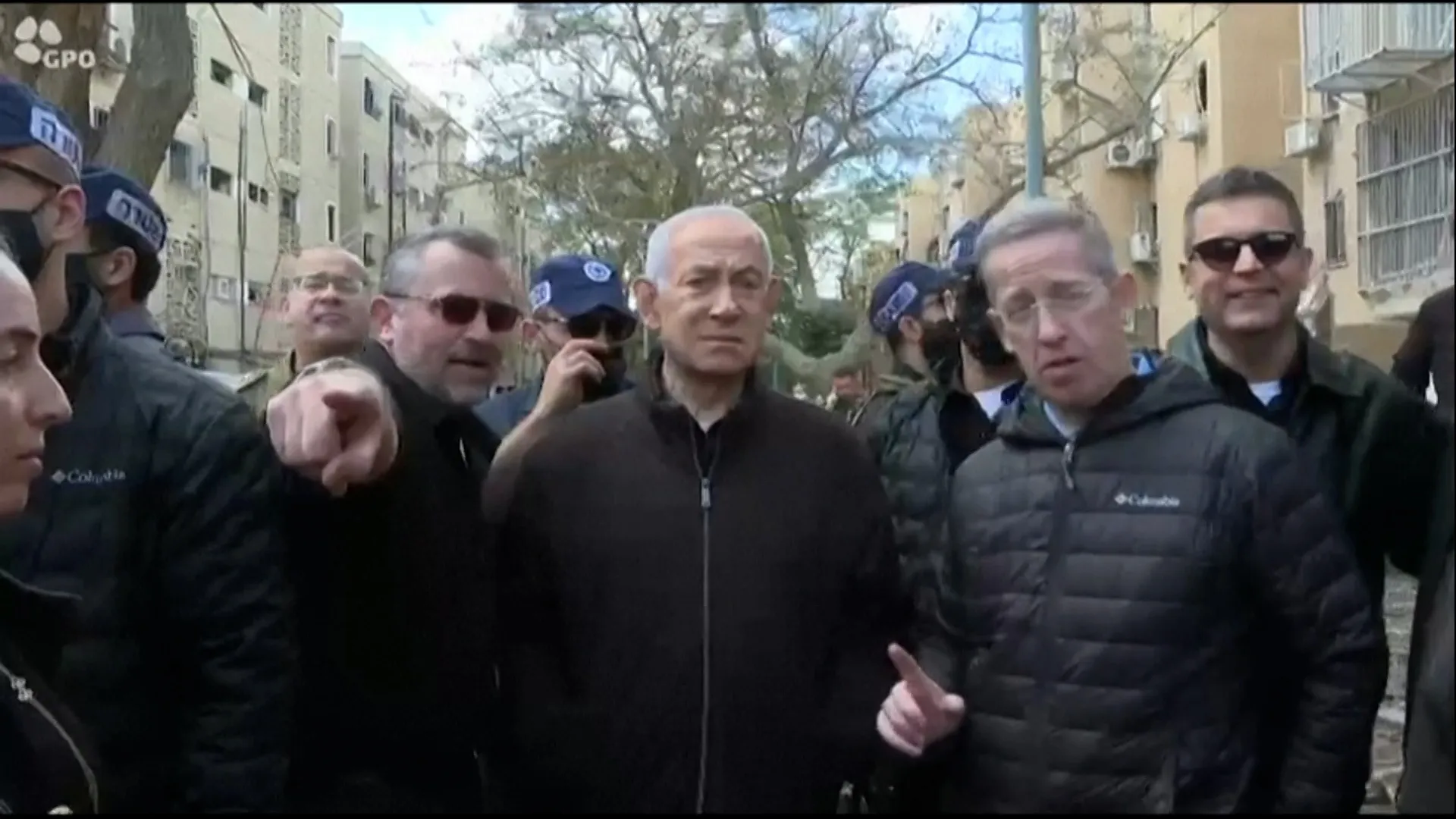
Israeli Prime Minister Benjamin Netanyahu has vowed to back US strikes on Iran’s power grid if Tehran does not reopen the Strait of Hormuz, as he visited the site of an Iranian strike in Arad. He urged world leaders to join the war effort as US-Israeli attacks on Iran have killed more than 1,500 people and injured thousands.
What role has the United Kingdom played in Israel’s war on Gaza? We meet those who say it’s complicit in atrocities committed there.
During the Gaza war, protesters have flooded the streets of major British cities, calling on their leaders to cut off the supply of weapons and other military hardware to Israel.
The United Kingdom’s relationship with its ally is under scrutiny. Jeremy Corbyn, a British MP, set up the Gaza Tribunal to examine whether the UK’s support for Israel amounts to complicity. Doctors and aid workers gave emotional accounts of the horrors they saw while working in the Gaza Strip, and journalists presented evidence of weapons shipments and spy flights allegedly operating from a nearby British air force base. All were making the case that the UK’s unwavering support for Israel is no longer legally or morally justifiable.
In its final report, published on March 16, the Gaza Tribunal said the UK has failed in its duty to prevent genocide and has been complicit in atrocities. It also recommended that the UK end all military cooperation with Israel.
The UK government has yet to comment on the allegations.
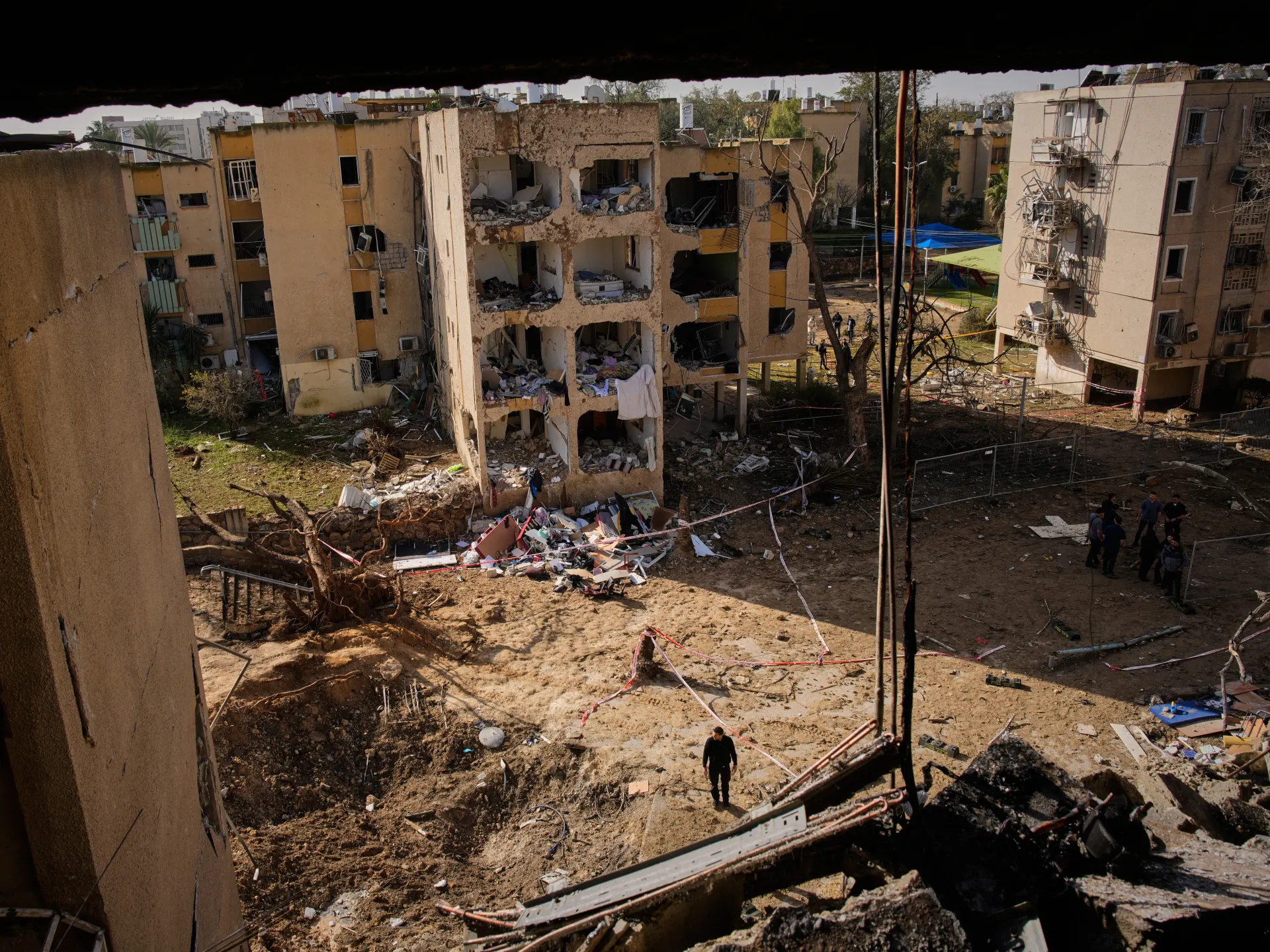
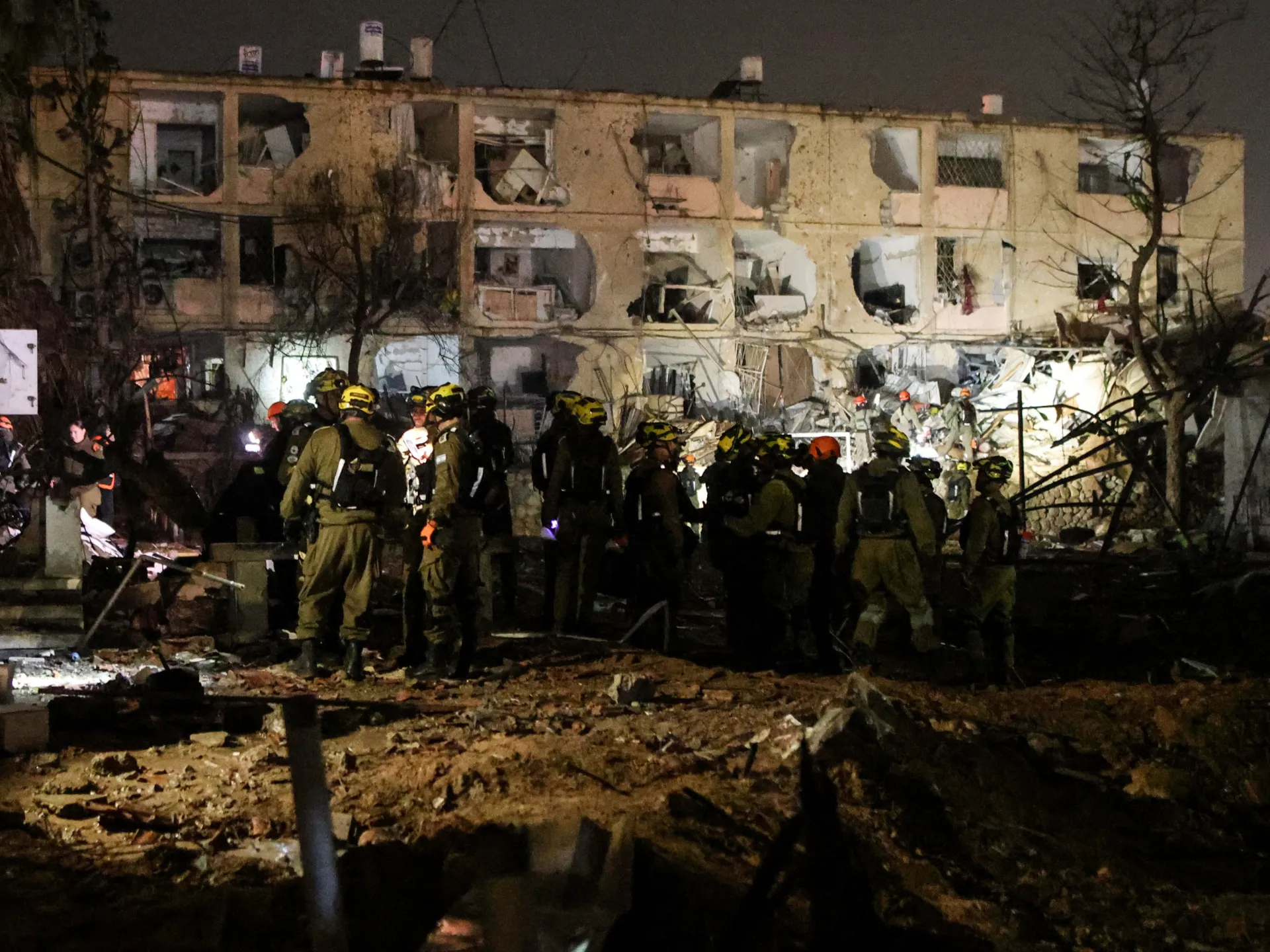
Iranian missiles have struck the towns of Arad and Dimona near an Israeli nuclear research centre in what Iran says was a response to an Israeli attack on its Natanz nuclear facility in Isfahan province.
At least 180 people were wounded in Saturday’s attack, and hundreds of people have been evacuated from the strategic towns as the Israeli-United States war on Iran is seemingly entering a new, more lethal phase of fighting.
Recommended Stories
list of 3 itemsend of list
Israeli Prime Minister Benjamin Netanyahu said his country had a “very difficult evening in the battle for our future”. There have been at least 4,564 people wounded in Israel, according to the Ministry of Health, since the start of the war on February 28.
Analysts said that while Israel has regularly waged military campaigns on Gaza, the occupied West Bank, Lebanon and elsewhere, it is rare for the Israeli public to feel the effects of war like it has over the past three weeks.
In Palestinian territory, including Gaza, Israeli forces have used disproportionate force against armed groups, who use rudimentary rockets to fire at Israel. Israel’s war on Gaza has been called a genocide by scholars and rights groups.
With Saturday’s high casualty count, the attacks in Arad and Dimona raise a question: Has Israel underestimated Iranian military capabilities?
What weapons is Iran using?
Defence analysts described Iran’s missile programme as the Middle East’s largest and most varied. Developed over decades, it contains ballistic and cruise missiles and is designed to give Tehran reach even despite its lack of a modern air force.
Iran has short- and medium-range missile systems and longer-range land-attack and antiship cruise missiles.
Iran’s short-range ballistic missiles have a range of roughly 150km to 800km (93 to 500 miles) and are built for nearby military targets and rapid regional strikes.
Their core systems include the Fateh variants: Zolfaghar, Qiam-1 and older Shahab-1/2 missiles. Their shorter range can be an advantage in a crisis. They can be launched in volleys, compressing warning times and making pre-emption harder.
Those medium-range systems include the Shahab-3, Emad, Ghadr-1, the Khorramshahr variants and Sejjil. They also have newer designs like Kheibar Shekan and Haj Qassem.
Iran’s land-attack and antiship cruise missiles include the Soumar, Ya-Ali and the Quds variants, Hoveyzeh, Paveh and Ra’ad.
The longest reaching ballistic missiles, the Soumar, have a range of 2,000km to 2,500km (1,243 to 1,553 miles). However, it was reported that two Iranian missiles were fired late on Thursday or early on Friday on Diego Garcia, the site of a joint US-United Kingdom military base in the Indian Ocean that is 4,000km (2,485 miles) from Iran. The UK said the attack failed, and an Iranian official denied firing the missile.
Former Iranian Supreme Leader Ali Khamenei had previously limited Iranian missile ranges to 2,200km (1,367 miles) but removed that limit after Israel’s 12-day war on Iran in June. The US joined Israel in that war as well, carrying out one day of attacks on Iran’s three main nuclear facilities.
“Iran has also used cluster munitions in its attacks on Israel. Each kind of warhead the Iranians have also uses a cluster warhead,” Uzi Rubin, founding director of Israel’s missile defence programme and a senior fellow at the Jerusalem Institute for Strategy and Security, told the US news agency Media Line.
What is a cluster munition or warhead?
Instead of a single explosive payload, a cluster warhead disperses multiple bomblets.
“The tip of the missile, instead of containing a big barrel of explosives, contains a mechanism which holds on to a lot of small bombs. And when the missile approaches the target, it opens its skin, it peels off and it spins around and the bomblets are released and released into space and fall on the ground,” Rubin told Media Line.
He added that Iranian cluster warheads may contain 20 to 30 bomblets or 70 to 80, depending on the missile.
These munitions are not new for Iran either. Iran reportedly also used cluster munitions in the 12-day war.
Amnesty International called Iran’s use of cluster munitions during that war a flagrant violation of international humanitarian law while Israel has also been accused of using cluster bombs in Lebanon.
Cluster munitions were banned in 2008 when the Convention on Cluster Munitions was adopted. Neither Iran nor Israel are signatories to the convention.
Why are they making an impact now?
An Israeli military spokesman said Israel’s air defence systems failed to intercept some of the Iranian missiles that hit Arad and Dimona despite being activated. He said Iran’s weaponry was not “special or unfamiliar” and an investigation was under way.
So why are these cluster munitions now making an impact? There are a few reasons.
For a ballistic missile equipped with cluster bomblets to be intercepted, it must happen before the payload opens and releases the submunitions. After the payload opens, the missile goes from a single point of attack to multiple points, making it difficult to stop.
On Thursday, The Times of Israel reported that the Israeli air force will start conserving interceptors. Military officials reportedly said at the time that Iranian cluster bombs are unlikely to cause significant harm if people have taken shelter and, therefore, may avoid shooting down some of them.
What is next?
In the next stage of the war, Iran, the US and Israel may continue to target important infrastructure.
The US and Israel struck Iran’s Natanz nuclear facility on Saturday, according to the Iranian Atomic Energy Organisation. This facility in central Iran is one of the country’s most important uranium enrichment sites, about 220km (135 miles) southeast of Tehran.
Israel previously struck fuel storage facilities in Tehran, leading to vast, toxic smoke over the Iranian capital. For its part, the US previously hit Kharg Island, Iran’s oil export hub, and threatened to do it again.
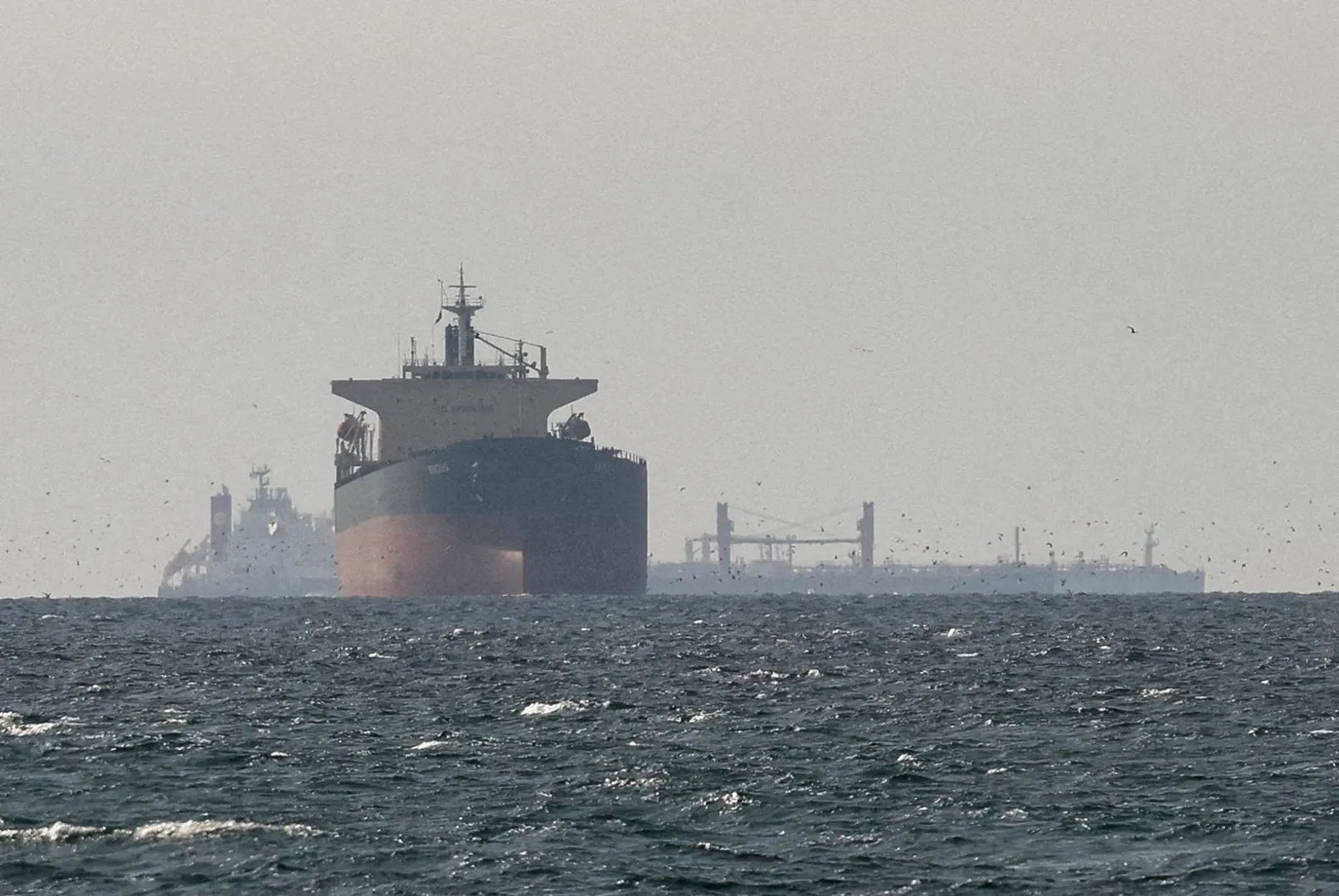
Iran has essentially closed the Strait of Hormuz, a vital chokepoint for global shipping and oil transport, and has targeted military bases and crucial energy infrastructure across Arab Gulf countries.
US President Donald Trump demanded the reopening of the strait and threatened to begin hitting energy infrastructure should Iran not comply.
“If Iran doesn’t FULLY OPEN, WITHOUT THREAT, the Strait of Hormuz, within 48 HOURS from this exact point in time, the United States of America will hit and obliterate their various POWER PLANTS, STARTING WITH THE BIGGEST ONE FIRST,” Trump wrote on Truth Social at 23:44 GMT on Saturday.
As the United States-Israeli war on Iran enters its fourth week, the conflict seems to have escalated beyond President Donald Trump’s control.
The Iranian government has been able to endure the killings of its top political and military leaders and has launched retaliatory attacks on Israel and Gulf countries despite weeks of air strikes.
Recommended Stories
list of 4 itemsend of list
Tehran has also been able to impose a de facto blockade of the Strait of Hormuz, a narrow waterway through which a fifth of the world’s oil and liquefied natural gas supplies pass, sending oil prices soaring. Analysts said the conflict risks unleashing a global recession. And that has put pressure on Trump, prompting his administration to allow the sale of sanctioned Russian oil to try to ease the energy crisis and pressure allies to police the strait, so far unsuccessfully.
Trump’s response in how to deal with the situation has been anything but coherent.
On Saturday, Trump upped the ante, issuing a threat to “obliterate” Iran’s power plants if Tehran does not reopen the Strait of Hormuz within 48 hours. This came a day after he said the US was “winding down” its military operations in Iran.
Analysts said Trump launched the war without a clear goal and misjudged how Tehran would respond. The conflict has expanded across the Middle East.
So is Trump looking to exit the war – or escalate it?
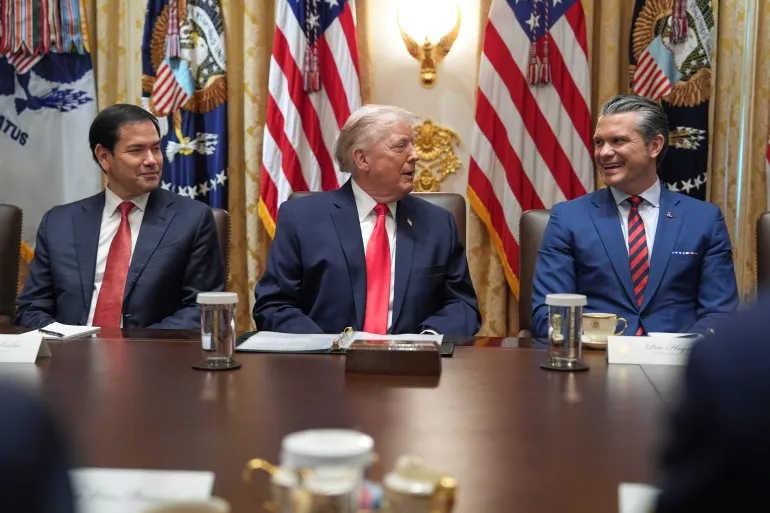
From left, US Secretary of State Marco Rubio, President Donald Trump and Defense Secretary Pete Hegseth attend a cabinet meeting at the White House [File: Evan Vucci/AP]
Trump’s mixed messaging on the Iran war
Here’s a brief look at the changing statements from Washington:
Is the war winding up or widening?
While one statement from Trump signalled that the US is considering “winding down” the war on Iran, another one indicated that the conflict would widen in the coming days.
On Saturday, Trump posted on his Truth Social platform that Washington was “very close to meeting our objectives as we consider winding down our great Military efforts in the Middle East with respect to the Terrorist Regime of Iran”.
Trump listed the goals of the war as: completely degrading Iran’s missile capability, destroying its defence industrial base, eliminating the Iranian navy and air force, never allowing Iran to get even close to having nuclear weapons, protecting Middle Eastern allies, and guarding and policing the Strait of Hormuz.
Both Trump and Israeli Prime Minister Benjamin Netanyahu have claimed repeatedly in the past few days that Iranian military capabilities have been “completely destroyed” even as Tehran continues to retaliate against Israel and strike countries in the region.
US military officials said they have carried out heavy bombardments of Iran’s coast, including with bunker buster bombs, but still have not been able to limit Tehran’s capacity to disrupt the Strait of Hormuz.
On Saturday, Trump said the US “has blown Iran off of the map” and insisted that he has “met my own goals … and weeks ahead of schedule!” He also reiterated that Iran’s “leadership is gone, their navy and air force are dead, they have absolutely no defense, and they want to make a deal”.
Iranian leaders have consistently denied reaching out to the US with a ceasefire offer.
Just an hour later, Trump returned to his Truth Social platform with a warning for Iran.
“If Iran doesn’t FULLY OPEN, WITHOUT THREAT, the Strait of Hormuz, within 48 HOURS from this exact point in time, the United States of America will hit and obliterate their various POWER PLANTS, STARTING WITH THE BIGGEST ONE FIRST!” Trump wrote.
Iran has since responded by saying it will hit energy sites across the Middle East if its power facilities are targeted. It has already fired hundreds of missiles and drones on Gulf countries, targeting US assets as well as energy facilities.
Between Trump’s claims to be “winding down” operations and upping the ante later, his administration announced it is sending three more warships to the Middle East with about 2,500 additional Marines.
The US military said about 50,000 military personnel are already deployed for the war against Iran.
(Al Jazeera)
When will the war on Iran end?
That has been among the foremost questions posed to US officials, including Trump, since the war on Iran was launched on February 28.
The next day, Trump told the Daily Mail that “it will be four weeks or so. It’s always been about a four-week process.” A day later, Trump said at the White House: “We projected four to five weeks, but we have capability to go far longer than that.”
On March 8, Defense Secretary Pete Hegseth told the CBS TV network’s 60 Minutes programme: “This is only just the beginning.” The next day, the US president told the same channel that he thinks “the war is very complete, pretty much.” And the US military operation was “way ahead of schedule”.
Then, on March 9, Trump said one could say the war is “both complete and just beginning”. Later the same day, the president said: “We’ve already won in many ways, but we haven’t won enough” and promised to go further and harsher against Iran.
On March 11, Trump said: “We don’t want to leave early, do we? We’ve got to finish the job.”
Why did US and Israel launch strikes on Iran?
Responses to this question are perhaps the most telling about US posturing in the war against Iran.
On March 2, Hegseth said the attacks were aimed at ending “47 long years” of war by “the expansionist and Islamist regime in Tehran” and were launched because Iran refused to negotiate with the US.
Hours later, Marco Rubio, the secretary of state, told reporters the US knew Israel was about to strike Iran, adding that the Trump administration believed the US needed to launch a pre-emptive strike before Iran’s retaliation potentially targeted US forces. “We went proactively in a defensive way to prevent them from inflicting higher damage,” he said.
This sparked a massive row in Washington with critics saying Israel had forced the US into war with Iran. Soon Trump rebutted his top diplomat, saying: “They [Iran] were going to attack. If we didn’t do it, they were going to attack first. … So if anything, I might have forced Israel’s hand.”
The next day, the White House press secretary, Karoline Leavitt, concluded that Trump just had a “good feeling” that Iran would strike so Washington attacked Tehran.
The launch of the war came as Washington and Tehran were scheduled to meet for another round of talks that were started late last year. Before the war, their Omani mediator said a deal was “within reach”.
The US and Israeli assertion that Tehran was on the verge of making a nuclear bomb has not been backed up by the United Nations nuclear watchdog. Last week, US Director of National Intelligence Tulsi Gabbard also told Congress that Iran was not in a position to make an atomic bomb.
Some analysts said the Trump administration was convinced to go to war by Netanyahu, who has been seeking US military intervention in Iran for decades. They said Trump was buoyed by a swift US military operation in Venezuela and did not think through Iran’s strengths before going into the war. In January, the US military abducted President Nicolas Maduro in a military operation in Caracas that took two and a half hours.
US President Donald Trump, left, greets Israeli Prime Minister Benjamin Netanyahu at the White House on September 29, 2025, on the fourth of his six visits to the US during Trump’s second term, which began in January 2025 [Alex Brandon/AP]
What does the conflicting messaging mean for US strategy?
Analysts said the moving goalposts in the Iran war show the policy limits of the current Trump administration as well as its strategy, to some extent, of keeping off-ramps available.
Zeidon Alkinani, a Middle East analyst at the Arab Perspectives Institute, told Al Jazeera that in the earlier days of the hostilities, there appeared to be clearer targets and limited objectives.
“There now seems to be a more chaotic reaction,” he said. He described the attacks as increasingly reciprocal, suggesting strikes on oil or energy facilities could prompt further escalation.
Last week, Iran attacked energy facilities in Qatar and caused “significant damage”, knocking out 17 percent of Qatar’s liquefied natural gas (LNG) export capacity. Qatar produces 20 percent of global LNG supplies. Iran said the attack was in retaliation for Israeli attacks on a gas plant.
Paolo von Schirach, president of the Global Policy Institute, told Al Jazeera that Trump changes his mind “very quickly” and it is hard to predict what his next step could be in the war on Iran.
The analyst said it was unclear to him what “tools” Trump has to end the war.
“We look at his message saying the war is winding down. OK, good. Things are quiet. Maybe there is an off-ramp somehow. But now he says that if the Iranians don’t open the Strait of Hormuz, then we [the US] are going to unleash hell and what have you,” von Schirach noted.
“It is not quite clear to me what he wants and what the tools are to accomplish this.”
Von Schirach added that it would be difficult to predict whether the US could force Iran into submission, given its size and population. Using as a reference Iraq, where 150,000 American soldiers were deployed during the Second Gulf War, the analyst predicted that the US might need as many as half a million soldiers if Trump “wants to take over Iran”.
Tehran, Iran – Military and political authorities in Iran are projecting a message that “victory” is near as war with the United States and Israel continues to escalate, and air strikes and assassination attempts are reported across the country.
Massive joint US-Israeli air raids were recorded in multiple areas of the capital Tehran overnight into Sunday, and in central Iran’s Isfahan city in the morning, a day after Dezful and Andimeshk in western Khuzestan and several other cities were hit.
Recommended Stories
list of 4 itemsend of list
Israeli warplanes also conducted two separate sets of precision strikes on privately-owned residential units located in small towns in the green provinces of Gilan and Mazandaran to the north on Saturday, which appeared to be assassination attempts on officials.
Local authorities confirmed that several people were killed, but did not elaborate. Israeli and US media said a senior drone commander is believed to have been killed.
Nevertheless, top officials in Tehran said they were unyielding and focused on retaliatory attacks.
Parliament speaker and former Islamic Revolutionary Guard Corps (IRGC) commander Mohammad Bagher Ghalibaf said the fact that Iranian missiles struck Israel’s Dimona overnight shows that a “new stage of battle” has started where “Israel’s skies are defenceless”.
Majid Mousavi, aerospace commander of the IRGC, echoed the same statement about control over Israeli skies in a post on X on Saturday night, which came in response to the US and Israel declaring dominance over Iranian airspace.
“Pinpoint precision Seyed Majid, hit Dimona again,” chanted flag-waving pro-establishment supporters shown on state television broadcasts, calling on Mousavi for action.
Israel said more than 180 people were injured in Dimona, a southern city where its key nuclear facilities are also located, in addition to nearby Arad.
Ahmad-Reza Radan – Iran’s hardline police chief, who has been cited by Israeli media as being a target for assassination along with Mousavi, Ghalibaf and others – was seen briefly addressing a group of supporters in Tehran on Saturday night.
“Trump first threatened the European Union, then begged. Today, he has said he will come take Greenland if the Europeans don’t come. I want to tell the European Union that if they can’t hold on to Greenland, then send a request and we will come preserve it,” he said, followed by chants of “Alla akbar” (God is greatest).
Defence Ministry spokesman Reza Talaei-Nik said in a statement that attacks across the region will continue “until the complete halt and surrender of the enemy”.
The taunts are in line with the state’s messaging in recent days, including a written statement attributed to Mojtaba Khamenei, who was selected as the supreme leader after his father Ayatollah Ali Khamenei was assassinated on the first day of the war, but who has not been seen or heard.
The message said Iran’s enemies were being “defeated” and there is “particular unity” among supporters of the theocratic establishment.
Over the past week, the country’s top security official, commanders of the paramilitary Basij force of the IRGC, the government’s intelligence minister, and a number of other military and security personnel have been among those killed.
The government reports that a large number of residential buildings, hospitals, schools and other civilian facilities have also been impacted during the war, as state supporters control the city streets, squares and mosques to counter potential anti-government protests.
‘Say goodbye to electricity!’
The Iranian rhetoric quickly escalated on Sunday after US President Donald Trump issued a 48-hour ultimatum for Tehran to reopen the strategic Strait of Hormuz, a key water route for global energy export, or face strikes on its power plants.
In response, Iranian politicians and armed forces said they would strike back harder against the region’s energy facilities.
The IRGC-affiliated Mehr news agency released a map with graphics that showed power plants across the region, including in the United Arab Emirates, Saudi Arabia, Qatar and Kuwait, that could be attacked if Iranian facilities are hit. An accompanying message read, “Say goodbye to electricity!”
On Saturday night, state and IRGC-affiliated media circulated a different map, showing Doha and also marking the central offices of Al Jazeera network as potential targets, and said all residents of the Qatari capital were advised to evacuate immediately.
State television quickly issued a retraction and cited unnamed sources as saying the map was not official, but no explanation was provided about who circulated the image and why.
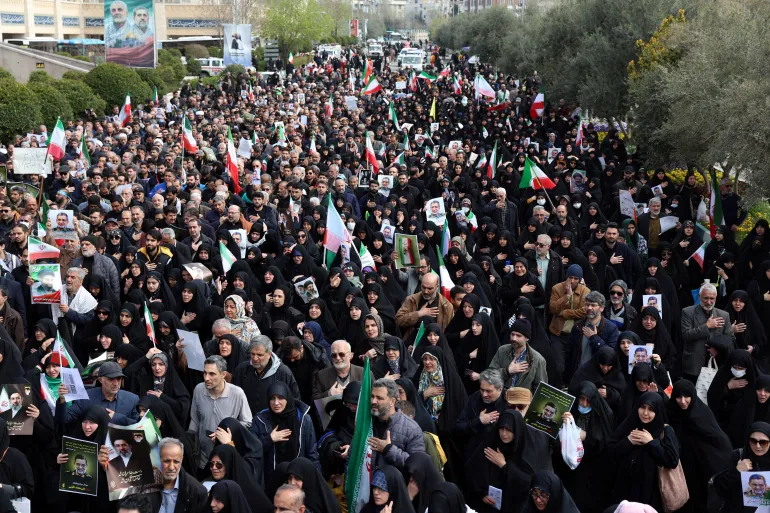
Iranians attend the funeral ceremony of Islamic Revolutionary Guard Corps (IRGC) spokesman Ali Mohammad Naini, who was killed in US-Israeli strikes, in Tehran on March 21, 2026 [AFP]
The all-around promises of escalation, particularly around bombing electricity facilities and other critical civilian infrastructure, have created additional concerns among many Iranians about the impact on daily lives and implications on the country’s future.
“If the main power plants are bombed, it’s not going to be just a brief disruption; it could stop the flow of everything from water to gas,” a Tehran resident told Al Jazeera, asking to remain anonymous due to security concerns. “It would be foolish to just punish the population like that.”
The US-Israeli forces have also struck natural gas facilities in southern Iran and bombed fuel reserves across Tehran, but authorities said fires and damage were contained quickly without creating major disruptions.
In an Instagram post to mark Nowruz, the Persian New Year, iconic footballer and nationally respected figure Ali Daei said this year’s celebrations were different because Iran is grieving for its people killed in the war.
“Wishing for a prosperous and free Iran, away from war and bloodshed, all about welfare and calm,” he wrote, drawing the ire of a number of state media, including the IRGC-affiliated Tasnim, which criticised Daei for not specifically condemning the US and Israel.
Proclamations, warnings under blackout
Meanwhile, the internet remains cut for more than 92 million Iranians for a 23rd day, becoming the longest shutdown in the country’s history, trailed only by a 20-day blackout imposed during the killing of thousands of anti-government protesters in January.
State media outlets continue to focus on successful IRGC attacks and present Iran as a country on the brink of being recognised as a world power, as they refrain from communicating details about the US and Israeli attacks or significant damage sustained.
Alaeddin Boroujerdi, a member of the national security committee of Iran’s parliament, told the state television on Sunday that the IRGC’s overnight attacks against Israel “opened a new page in shifting the balance of power and showed the victory of the Islamic Republic in this imposed war”.
The parliamentary committee’s spokesman, Ebrahim Rezaei, stretched the same line of thinking even further, and said in a post on X that Iran should demand to become a veto-yielding permanent member of the United Nations Security Council as a condition for ending the war. The lawmaker did not say how or when he expected that to happen.
Iran’s government has also demanded war reparations and guarantees against future aggression, but the US and Israel have been pushing to overthrow the Islamic Republic that came to power in a 1979 revolution.
Intelligence authorities advised the Iranian population on Saturday that even being a member of foreign-based news and war footage channels on Telegram and all other social media outlets banned by the state could violate national security laws.
The Iranian judiciary said that such channels are considered “terrorist” outlets and that sending any videos of impact sites or armed state checkpoints on the streets to them could carry maximum penalties like confiscation of assets and even execution.
State security authorities have emphasised that anyone who engages in anti-establishment protests will be treated as an “enemy”.
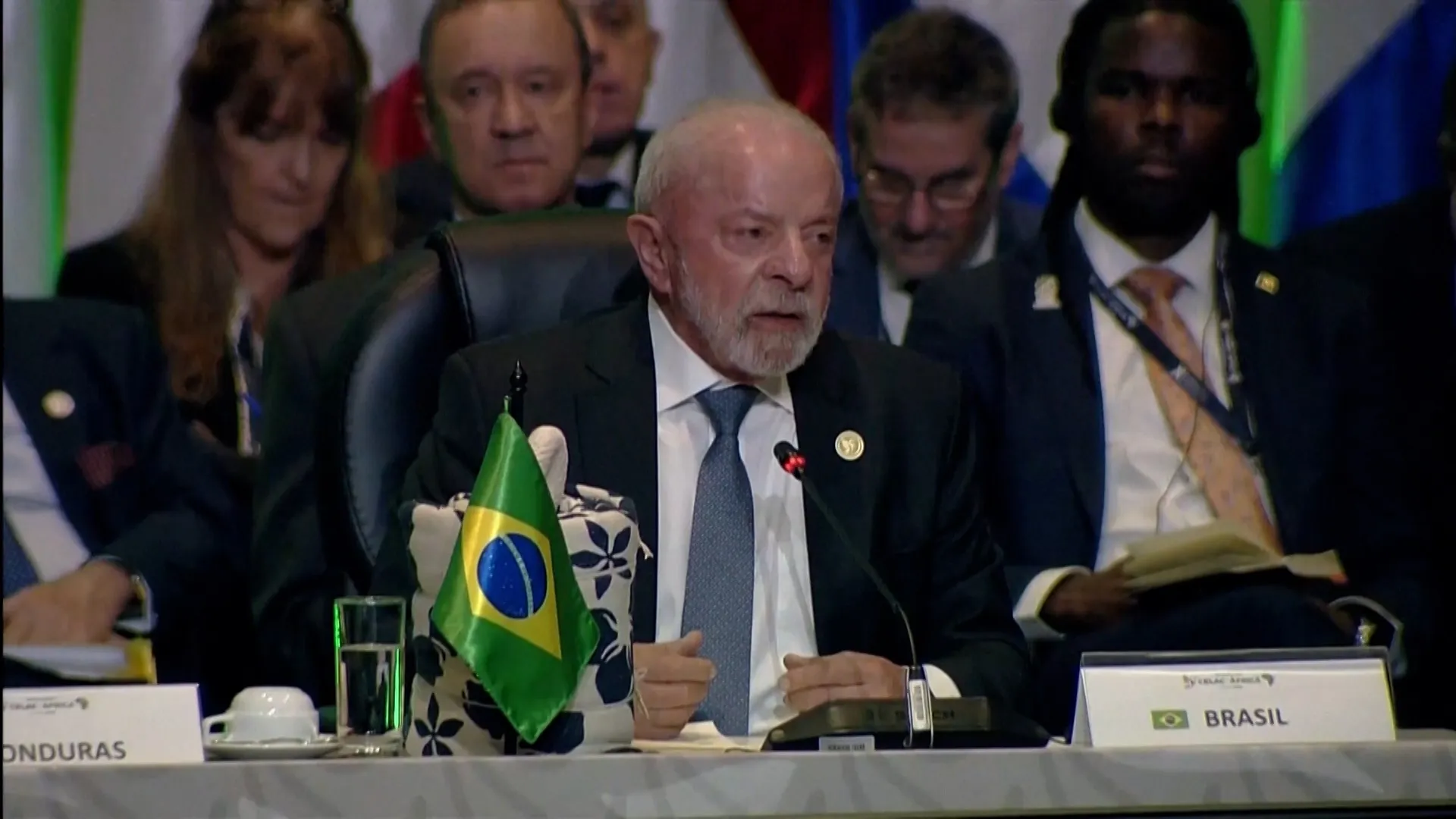
Latin American leaders met at the 10th Community of Latin American and Caribbean States (CELAC) Summit in Bogota on Saturday where Colombian President Gustavo Petro called for an immediate Middle East ceasefire to prevent a global economic crisis and ‘potential world war’.
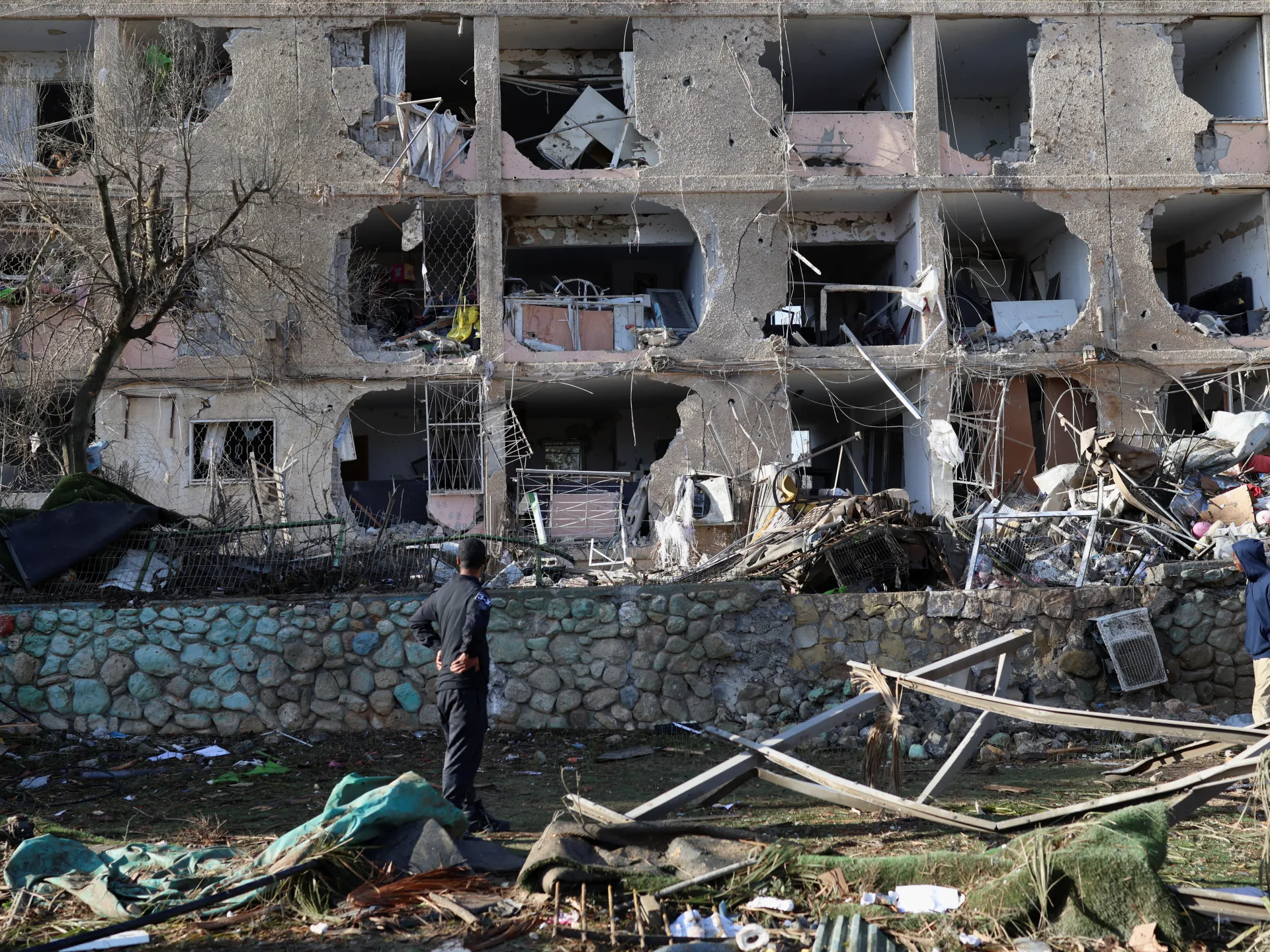
Iranian missiles struck two communities in southern Israel, leaving buildings shattered and dozens injured in dual attacks not far from Israel’s main nuclear research centre.
The Iranian strikes late on Saturday came after Tehran’s main nuclear enrichment facility at Natanz was hit earlier in the day. Israel denied responsibility for the strike on Natanz, nearly 220km (135 miles) southeast of Tehran.
The Pentagon declined to comment on the strike on Natanz, which was also hit during the first week of the war and the 12-day war last June. Russian Ministry of Foreign Affairs spokesperson Maria Zakharova said such strikes posed a “real risk of catastrophic disaster throughout the Middle East”.
Iran retaliated hours later.
Israel’s military said it was not able to intercept missiles that hit the southern cities of Dimona and Arad, the largest near the centre in Israel’s sparsely populated Negev desert. It was the first time Iranian missiles had penetrated Israel’s air defence systems in the area around the nuclear site.
The Israeli Ministry of Health said at least 180 people were wounded in the missile attacks on the southern city of Dimona and nearby Arad.
Dimona is about 20km (12 miles) west of the nuclear research centre, and Arad is around 35km (22 miles) to the north.
Israel is believed to be the only Middle East nation with nuclear weapons, though its leaders refuse to confirm or deny their existence. The UN nuclear watchdog said on X it had not received reports of damage to the Israeli centre or abnormal radiation levels.
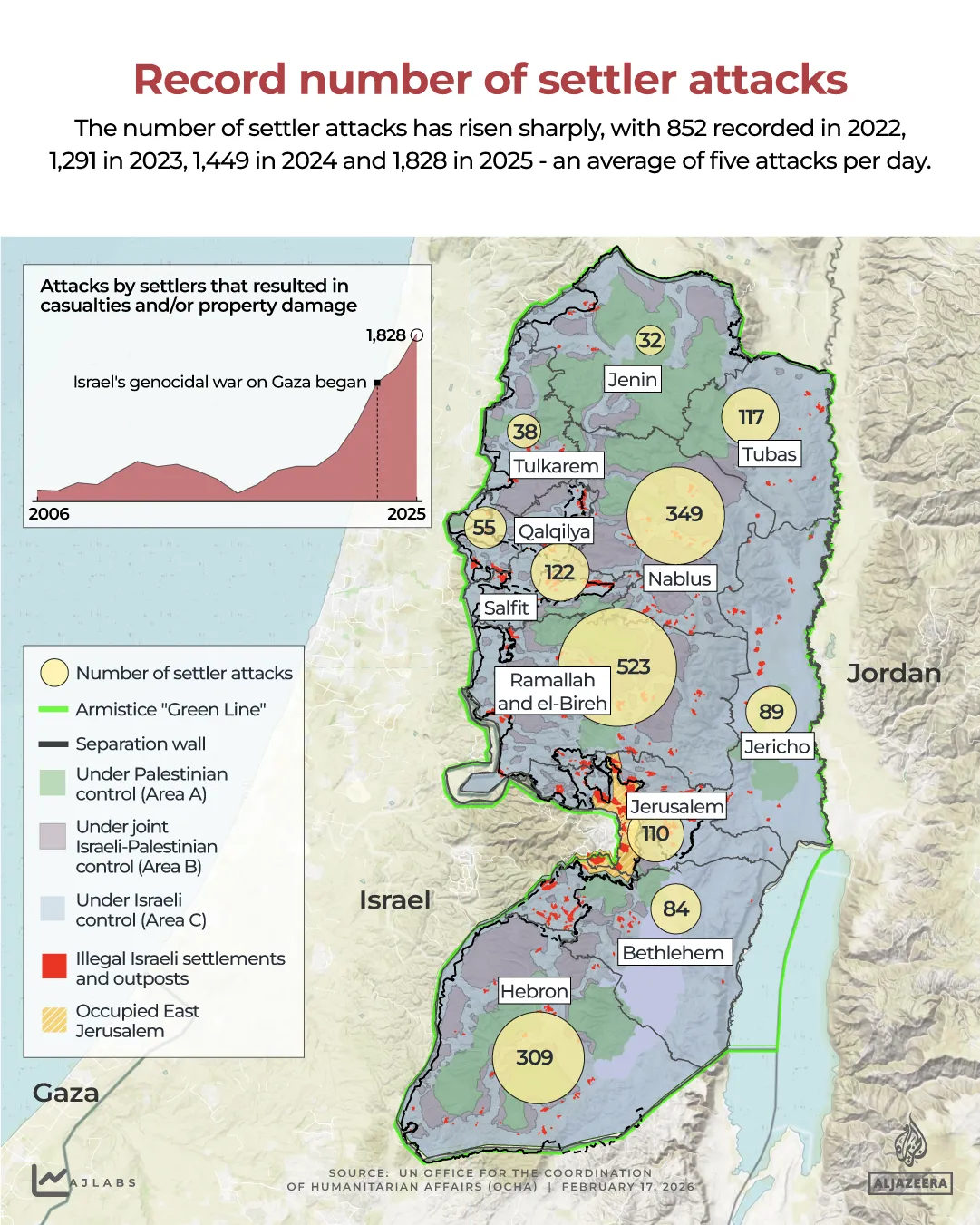
Israeli settlers set fire to homes and vehicles near Jenin amid reports of widespread violence across the occupied territory.
Published On 22 Mar 202622 Mar 2026
Israeli settlers have torched homes and vehicles in at least two areas of the occupied West Bank, wounding at least one person, amid reports of settler violence across the Palestinian territory.
The Palestinian Wafa news agency, citing local sources, said Israeli settlers stormed the village of al-Fandaqumiya and the town of Seilat al-Dahr, south of Jenin, late on Saturday.
Recommended Stories
list of 3 itemsend of list
In al-Fandaqumiya, Israeli settlers set “homes and vehicles ablaze and damaged additional houses by smashing windows” as Palestinians “attempted to confront them and put out the fires”, the agency reported.
In Seilat al-Dahr, the settlers targeted several homes, attempted to set them alight and physically assaulted a resident, leaving him wounded.
Footage verified by Al Jazeera showed large fires burning inside homes in Seilat al-Dahr, and another house engulfed in flames in al-Fandaqumiya as residents frantically tried to extinguish them.
There was also an attack on Masafer Yatta, south of Hebron, where settlers wounded two Palestinians. Three others were arrested as settlers stormed the area under the protection of Israeli forces, Wafa reported.
The attacks, which took place late on Saturday during Eid al-Fitr celebrations, are the latest in a wave of settler violence in the occupied territory that has previously resulted in killings.
Other images and videos shared by Palestinian authorities showed settler attacks on the villages of Qaryut and Jalud, south of Nablus. In Jalud, a four-wheel-drive vehicle was seen completely burned out following the attack.
Violence was reported elsewhere across the occupied West Bank.
Near the town of Haris, west of Salfit, settlers gathered on the main road and pelted Palestinian vehicles with stones, according to Wafa.
In Ramallah, settlers near Rawabi Square on the Ramallah-Nablus Road threw stones at passing Palestinian-registered vehicles, with no injuries reported.
Similar incidents were reported in Tuqu, southeast of Bethlehem.
Settler violence in the West Bank has intensified in the shadow of Israel’s genocidal war on nearby Gaza.
More than 1,000 Palestinians have been killed by Israeli troops and settlers in the West Bank since the Gaza war began in October 2023, according to the latest United Nations figures.
In late February, Israeli settlers defaced and set fire to a mosque near Nablus in the occupied West Bank during the Muslim holy month of Ramadan.
In February, the UN Human Rights Council warned in a new report (PDF) that Israeli policies in the occupied West Bank – including “the systematic unlawful use of force by Israeli security forces” and unlawful demolitions of Palestinian homes – aim to uproot Palestinian communities.
Human rights groups say Israeli authorities have allowed the settlers to operate with total impunity in their attacks against Palestinians.
Israeli organisation B’Tselem has also accused its government of actively aiding the settlers’ violence “as part of a strategy to cement the takeover of Palestinian land”.
Elsewhere in the occupied West Bank, two Palestinians were injured on Saturday night by live fire from Israeli forces south of Tulkarem.
The Palestine Red Crescent Society (PRCS) reported that at least two people were wounded after being shot by Israeli forces at the Jabara checkpoint.
US President Donald Trump has threatened to ‘obliterate’ Iran’s power plants if Tehran fails to open the Strait of Hormuz to all vessels within 48 hours. This major escalation comes as Trump faces pressure over skyrocketing domestic energy prices due to the now three-week-long war.
Jet2 boss Steve Heapy has issued an update to industry experts
Maria Ortega and Robert Rowlands Deputy editor, money and lifestyle, content hub
04:31, 22 Mar 2026
A Jet2 Boeing 737 lands at Newcastle Airport(Image: Getty)
Jet2’s boss has warned of a sharp drop in bookings to Cyprus and Turkey but said tourists could get special offers. CEO Steve Heapy said flights on these routes are becoming “empty” due to the uncertainty caused by the Middle East conflict.
The boss said demand is instead moving to destinations such as Spain and Italy. TTG reported that he spoke about the issue via video link at the airline’s annual conference in Cádiz in Spain.
He also warned hotel partners to not ‘get greedy’ in Spain and Italy and keep prices competitive. And he vowed to protect customers where that happened.
He said he expects holidays to Cyprus and Turkey to recover quickly once the war in Iran ends. “I think we should all be prepared for a fairly rapid end to the conflict and a fairly sharp recovery when that happens,” he said.
Heapy said: “Bookings to Cyprus and Turkey are drying up, cancellations are up and our aircraft are emptying.” He said Jet2 was working to cross-sell customers to western Mediterranean destinations where demand “seems to be OK”.
Heapy added that Cyprus remained a safe destination despite a drop in demand to the island, which has been targeted by Iran since America and Israel launched airstrikes on the Middle Eastern nation.
He said: “Cyprus is still far enough away that you can still travel. We’re doing what we can to understand what’s going on and how we can work our way through it.”
‘Special offers’ to lure more travellers to Cyprus and Turkey
He expects hotels in Cyprus and Turkey to introduce special offers in the weeks ahead to lure more tourists in. Speaking to travel agents at the conference, he said: “We’ll do what we can to work with you and fight to get through this the best we can,” he said. “Our job is to put our customers’ fears to one side and reassure them that these destinations are safe.
“We’re a very resilient industry. These events happen every couple of years, and I’ll do whatever I can to help all our of businesses navigate through this.”
TTG also reported that Phil Nuttall, CEO of Travel Village Group, said it is too early to offer a full assessment of the crisis’s impact. Yet he said possible price rises could create problems for many families.
Jet2’s head of overseas operations, Lee Davies, also said the operator was putting more resource into challenges arising from the conflict, TTG said. “We’ve had to adapt our service, especially across Turkey and Cyprus at the moment. We have our red team, we’ve increased our presence, we’re visiting hotels, reassuring customers.
“We’ve expanded our visiting times and ring-fenced our 24/7 team in the UK. We’re contingency planning in terms of disruption management, you always have to have a very solid plan behind the scenes ready to activate.”
He reportedly added: “You’ve got to understand why in their minds, wherever that destination is, that they possibly don’t want to travel.” He added that by helping customers now, even if they do not then travel, “they will come back”.
Tehran responds to Trump’s threat by saying all US energy infrastructure in the region will be targeted if Iran is attacked.
Published On 22 Mar 202622 Mar 2026
United States President Donald Trump has threatened to attack Iran’s power plants if freedom of navigation is not fully restored at the Strait of Hormuz within 48 hours, a dramatic escalation as the US-Israeli war on Iran continues for a fourth week.
The statement on Saturday came as Trump faces increasing pressure to secure the vital waterway that Iran has promised to keep closed to “enemy ships”, leading to soaring oil prices and plunging stock markets.
“If Iran doesn’t FULLY OPEN, WITHOUT THREAT, the Strait of Hormuz, within 48 HOURS from this exact point in time, the United States of America will hit and obliterate their various POWER PLANTS, STARTING WITH THE BIGGEST ONE FIRST,” Trump, who is in his Florida home for the weekend, wrote on Truth Social at 23:44 GMT.
He did not specify which plant he was referring to as the biggest.
Following Trump’s threat, the Iranian army said it would target all energy infrastructure belonging to the US in the region if Iran’s fuel and energy infrastructure were attacked.
Trump’s escalatory comments came barely a day after he talked about “winding down” the war that he launched alongside Israeli Prime Minister Benjamin Netanyahu on February 28, when the US and Iran were engaged in nuclear negotiations.
In a social media post on Friday, Trump said the US was “getting very close to meeting our objectives as we consider winding down our great Military efforts in the Middle East”.
Key waterway
Shipping traffic through the Strait of Hormuz, where a fifth of the world’s oil and gas passes through during peacetime, has virtually ground to a halt since the early days of the war.
Iran has said the Strait of Hormuz is open to all except the US and its allies, with Minister of Foreign Affairs Abbas Araghchi saying last week that he had been “approached by a number of countries” seeking safe passage for their vessels.
“This is up to our military to decide,” he told the US television network CBS, adding that a group of ships from “different countries” had been allowed to pass, without providing details.
The head of US Central Command, Admiral Brad Cooper, asserted on Saturday that Iran’s ability to attack vessels on the strait had been “degraded” after US fighter jets dropped 5,000-pound (about 2,300kg) bombs on an underground Iranian coastal facility storing antiship cruise missiles and mobile launchers earlier this week.
The strike also destroyed “intelligence support sites and missile radar relays” used to monitor ship movements, Cooper said.
Reporting from Washington, DC, Al Jazeera’s Manuel Rapalo said there seemed to be a “gap between what the White House appears to want in the Strait of Hormuz and what the US military says they have already accomplished”.
“It is interesting, to say at the very least, to hear Trump talking about a major escalation, given the fact that we’ve been hearing throughout the course of the day how much damage the US has done, supposedly, to Iran’s ability to target oil tankers and vessels navigating through the strait.”
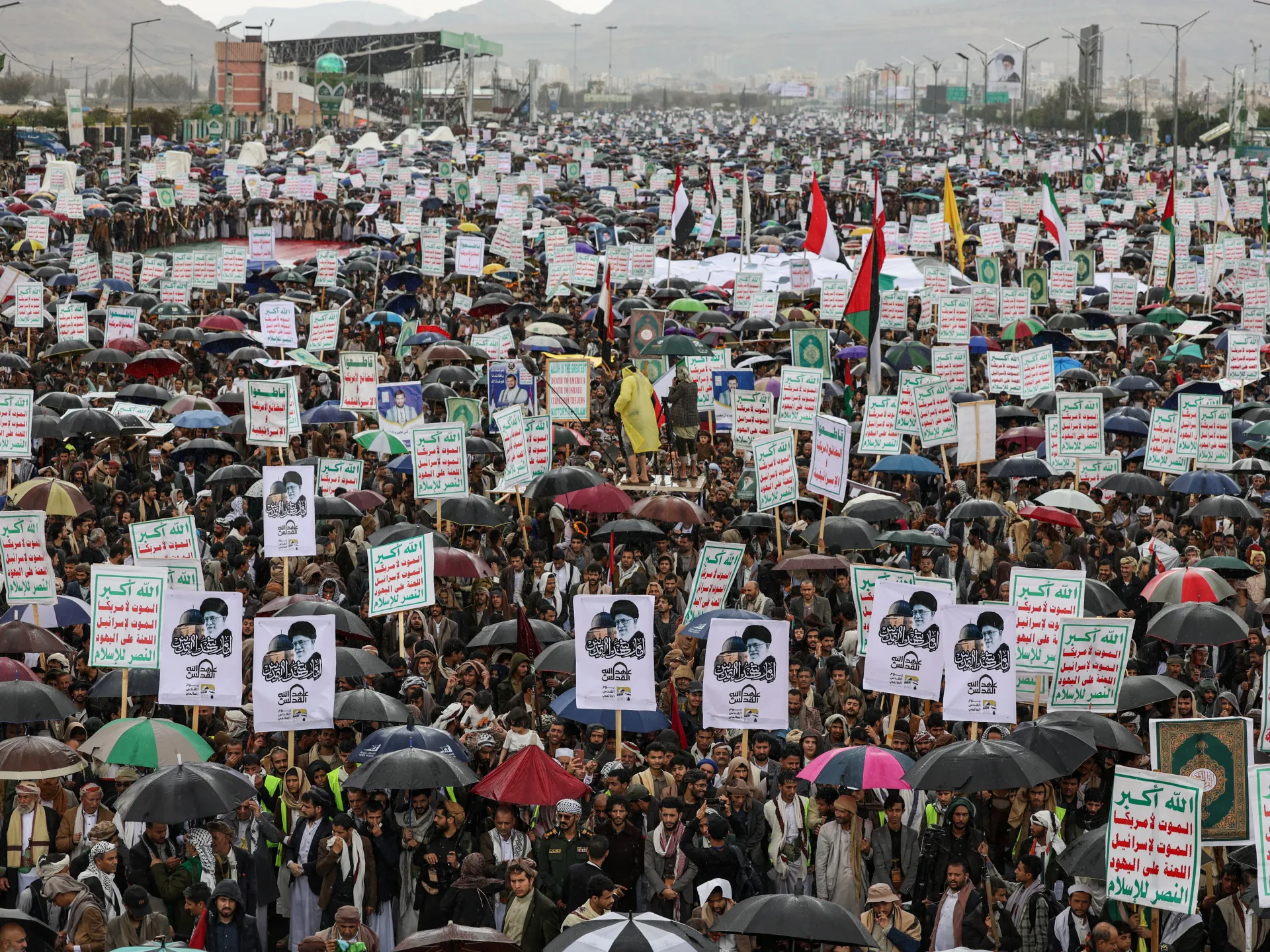
The Yemeni armed group says all options are on the table.
As the US-Israeli war against Iran drags on, Yemen’s Ansar Allah, or the Houthis, have stayed out of the conflict.
But that could change. They have said they consider themselves directly concerned and could take a position alongside Iran.
The armed group has attacked Israel and shipping in the Red Sea in recent years. If a new front opens up, global trade could be further disrupted in another maritime gateway. Shipping is already largely halted in the Strait of Hormuz, causing significant losses worldwide.
So, will the Houthis join the war? And what difference could that make for this volatile region?
Presenter: James Bays
Guests:
Farea al-Muslimi – research fellow in the Middle East and North Africa programme at Chatham House
Khaled Batarfi – political analyst who specialises in Saudi Arabian foreign policy
Rockford Weitz – director of the Fletcher Maritime Studies programme at Tufts University
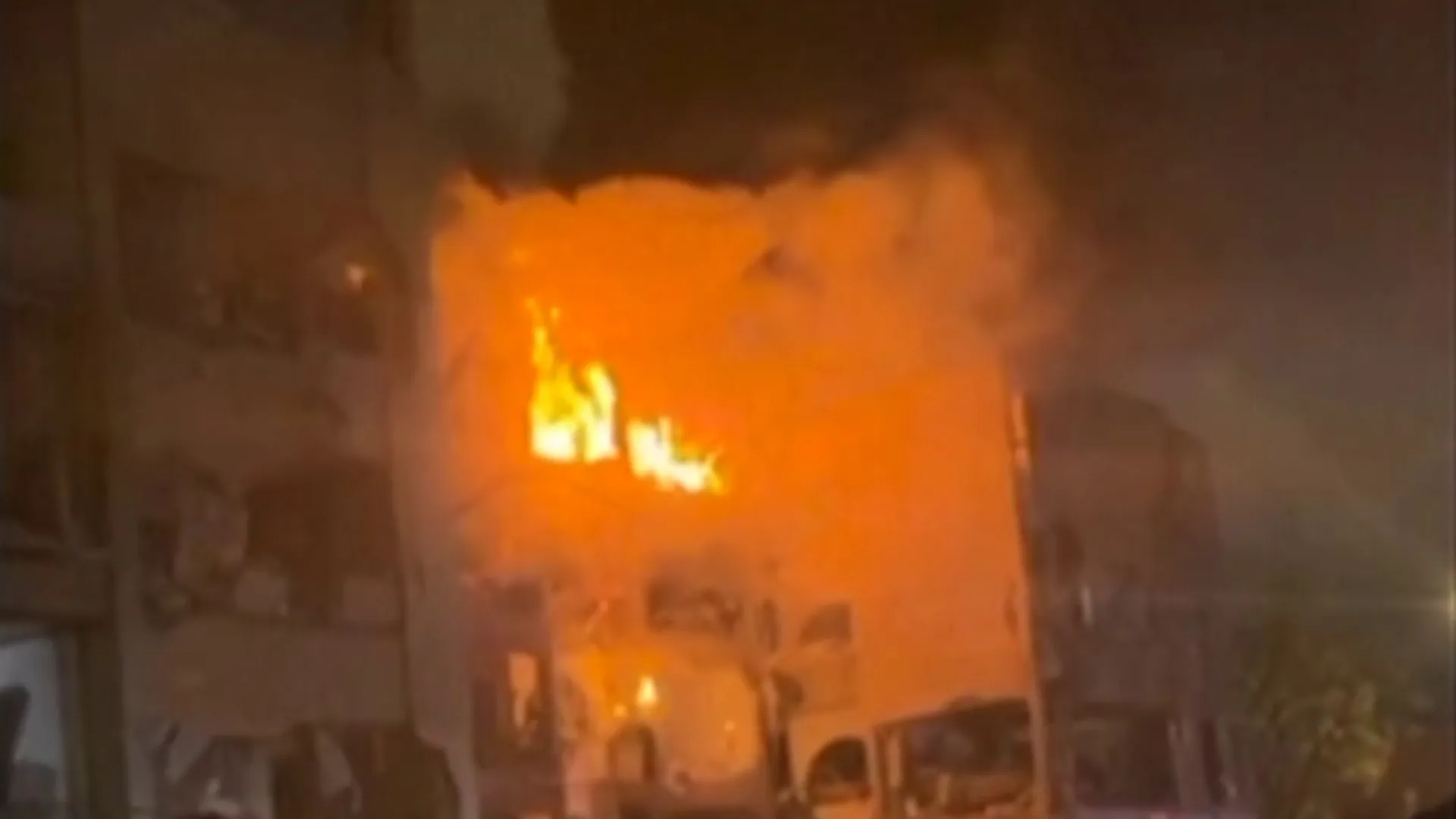
Israel’s air defence system failed to stop at least two Iranian missile strikes on southern Israel, in retaliation for an attack on Iran’s Natanz nuclear site. More than 100 Israelis have been injured in Arad and Dimona, with dozens of buildings destroyed. This is what we know.
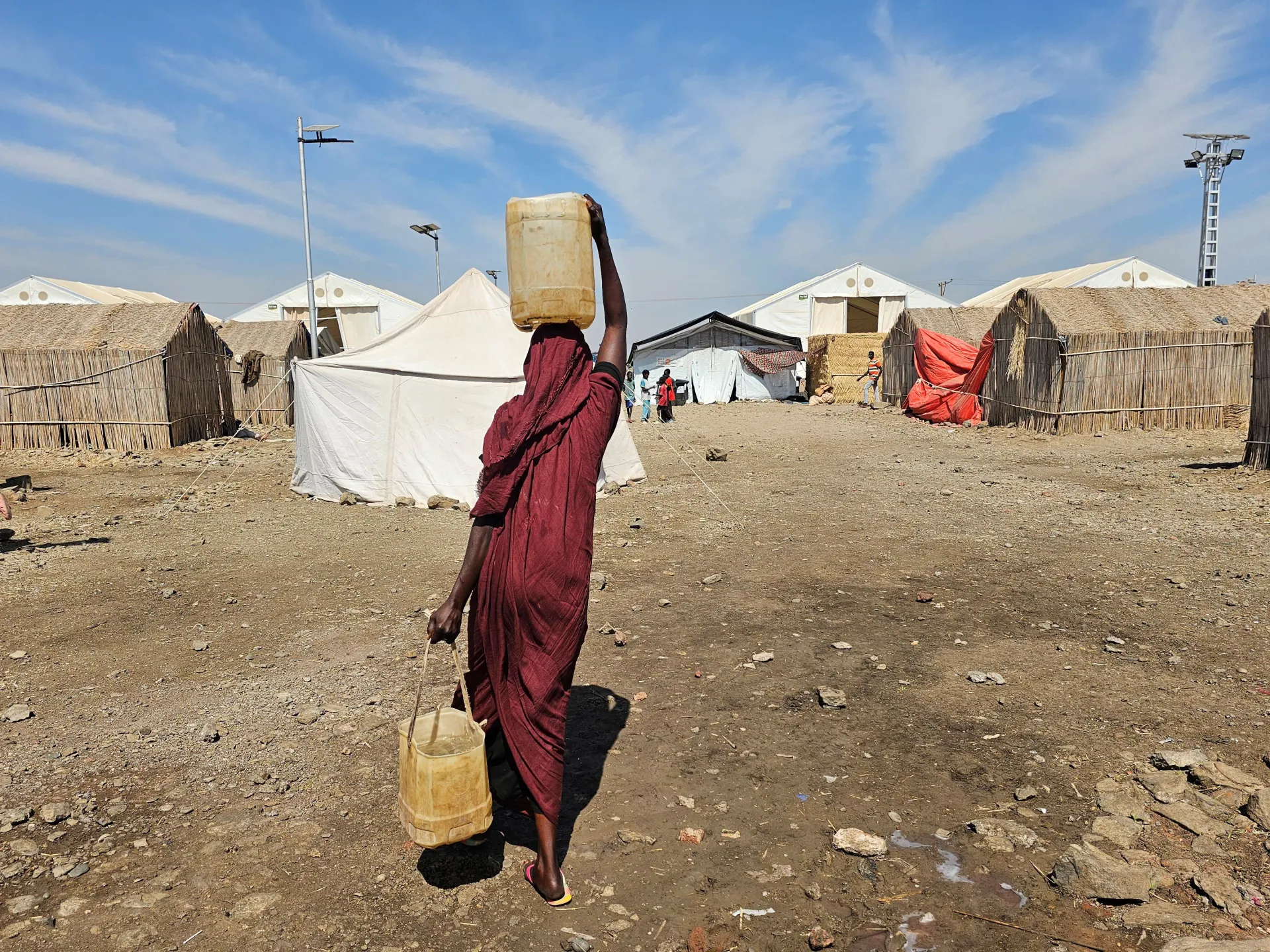
The attack on a teaching hospital in Al Deain, the capital of East Darfur state, has rendered the facility non-functional.
Published On 21 Mar 202621 Mar 2026
An attack on a hospital in Sudan’s Darfur region has killed at least 64 people, including 13 children, according to the head of the World Health Organization (WHO).
In a social media post, Tedros Adhanom Ghebreyesus said on Saturday that multiple patients, two female nurses and one male doctor were also among those killed in the attack on Al Deain Teaching Hospital in Al Deain, the capital of East Darfur state, on Friday night.
Another 89 people, including eight health staff, were wounded, he added.
The attack damaged the hospital’s paediatric, maternity, and emergency departments, rendering the facility non-functional and cutting off essential medical services in the city.
“As a result of this tragedy, the total number of fatalities linked to attacks on health facilities during Sudan’s war has now surpassed 2,000,” said Tedros, adding that over the nearly three-year conflict between Sudan’s army and the paramilitary Rapid Support Forces (RSF), the WHO had confirmed the killing of 2,036 people in 213 attacks on healthcare.
There was no immediate information about who was behind the attack.
The war between the army and the RSF erupted in mid-April 2023, unleashing a wave of violence that has led to one of the world’s fastest-growing man-made humanitarian crises, with tens of thousands of people killed and more than 12 million forced from their homes.
Both sides have been accused of war crimes and crimes against humanity, while the RSF has been implicated in atrocities in Darfur that United Nations experts say bear the hallmarks of genocide.
“Enough blood has been spilled. Enough suffering has been inflicted,” Tedros said. “The time has come to de-escalate the conflict in Sudan and ensure the protection of civilians, health workers, and humanitarians.”
An Iranian missile has struck the southern Israeli cities of Dimona, home to the country’s main nuclear facility, and nearby Arad, wounding dozens of people and causing significant damage, in one of the most dramatic escalations since the US-Israel war on Iran began.
Iranian state television quickly reframed Saturday’s strikes as a “response” to what it said was a strike on Iran’s Natanz nuclear enrichment complex earlier in the day, marking a stark new phase of tit-for-tat targeting in the conflict, now in its fourth week.
Recommended Stories
list of 2 itemsend of list
Nearly 100 people were wounded in the attacks, according to Israel’s emergency services, including a 10-year-old boy who paramedics said was in critical condition with multiple shrapnel wounds. Seven others are also in critical condition.
An Israeli military spokesman said Israel’s air defence systems activated during the attacks, but failed to intercept some of the missiles, even though they were not “special or unfamiliar”.
The country’s Prime Minister Benjamin Netanyahu, addressing the attacks which wounded nearly 100 people, called it a “difficult” evening for Israel, and again vowed to continue attacking Iran.
The International Atomic Energy Agency (IAEA) said it had received no indication of damage to the Shimon Peres Negev Nuclear Research Center at Dimona itself, and that no abnormal radiation levels had been detected in the area.
The nuclear watchdog said it was closely monitoring the situation, with Director General Rafael Grossi urging that “maximum military restraint should be observed, in particular in the vicinity of nuclear facilities”.
Al Jazeera’s Nour Odeh, reporting from Ramallah in the occupied West Bank, said that three separate impact sites had been identified across Dimona, with one three-storey building having completely collapsed and several fires breaking out.
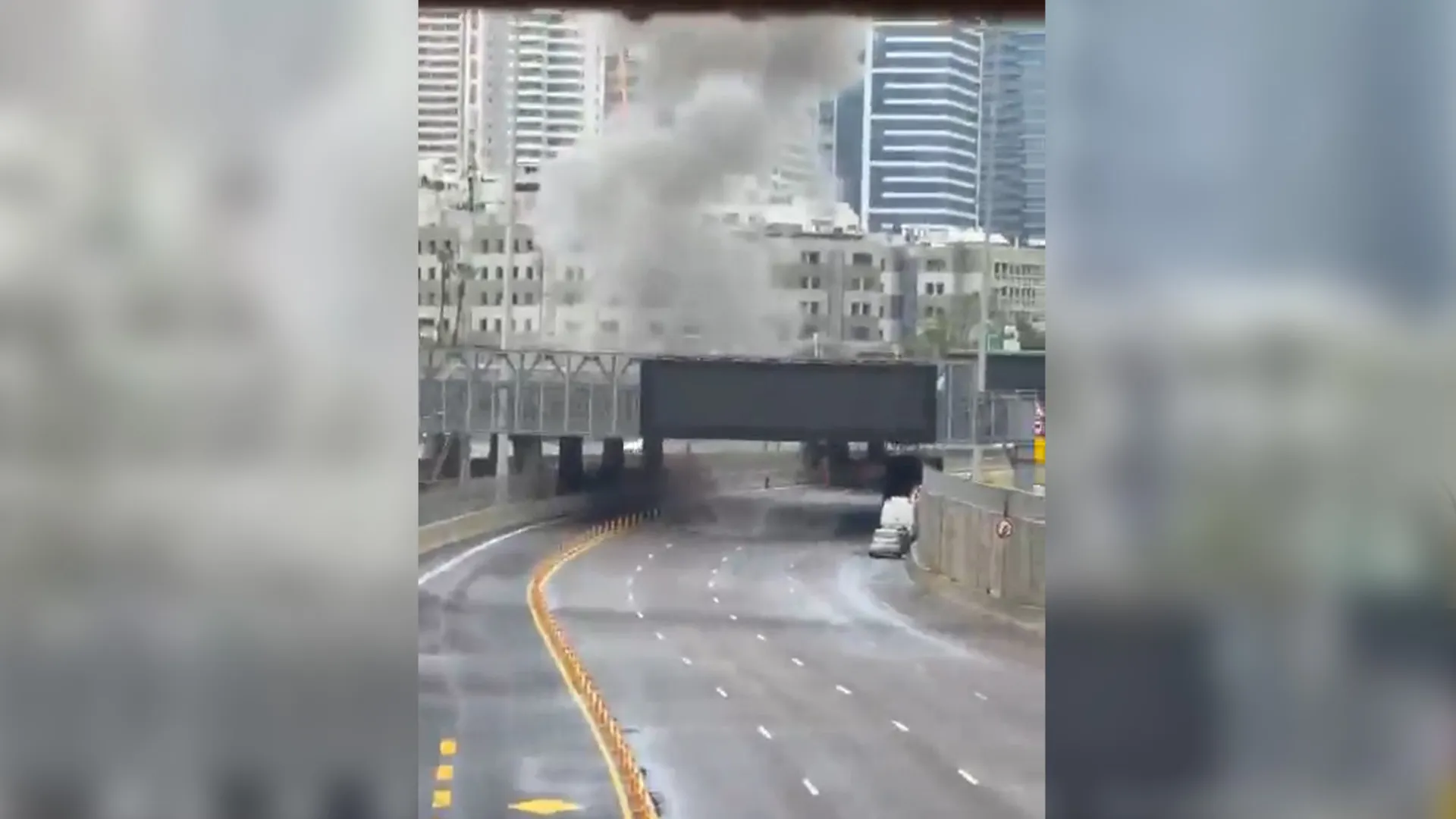
Witness footage verified by Al Jazeera, which is banned from operating inside Israel, showed a missile striking the city, followed by a large explosion.
Arad, another town near the nuclear facility, was also directly attacked, Israel’s firefighting service said in a statement, with extensive damage reported in the city centre.
“In both Dimona and Arad, interceptors were launched that failed to hit the threats, resulting in two direct hits by ballistic missiles with warheads weighing hundreds of kilograms”, firefighters said.
School in the surrounding Ramat Negev Regional Council was cancelled for the following day.
Earlier on Saturday, the Israeli military announced it had struck a research and development facility at Tehran’s Malek Ashtar University, which it said had been used to develop components for nuclear weapons and ballistic missiles.
The military said it “will not allow the Iranian regime to acquire nuclear weapons”.
Iran said that the US and Israel had targeted its Natanz enrichment complex that morning, though it reported no radioactive leakage.
An unnamed Israeli official, quoted by the Associated Press news agency, denied that Israel was responsible for the Natanz strike, but the Israeli army has not released a full statement on the matter.
Dimona has been at the heart of Israel’s nuclear programme since its research centre, built in secret with French assistance, opened there in 1958.
Eye-for-an-eye approach
Israel is believed to have developed nuclear weapons by the late 1960s. Its policy of deliberate ambiguity, neither confirming nor denying their existence, was part of a deal quietly struck with Washington, which judged that an open declaration would risk triggering a regional arms race.
Abas Aslani, a senior fellow at the Centre for Middle East Strategic Studies in Tehran, told Al Jazeera that Iran has been pursuing an eye-for-an-eye approach designed to re-establish deterrence.
“Tehran wants to reduce the gap between words and actions,” he said, adding that Iran’s goal was to make its threats credible enough to underpin a new long-term security arrangement, not to simply force a ceasefire, but establish deterrence.
The attacks came as the broader war grinds through its fourth week.
More than 1,400 people have been killed in Iran since the US and Israeli strikes began on February 28, including more than 200 children.
Iran has retaliated across the region, launching what it described as its 70th wave of attacks on Saturday, targeting Israeli and US military positions, as millions of Iranians marked the Persian New Year, Newroz, and Eid al-Fitr under the shadow of war.
The move follows a drone strike on the Red Sea port of Yanbu, Saudi Arabia’s main oil export outlet, after Iran blocked the Strait of Hormuz.
Published On 21 Mar 202621 Mar 2026
Saudi Arabia has given Iran’s military attache and embassy staff 24 hours to leave the kingdom due to “repeated Iranian attacks” on its territory.
The Saudi Ministry of Foreign Affairs said in a statement on Saturday that it had declared personae non gratae the “military attache of the Embassy of the Islamic Republic of Iran to the Kingdom, the assistant military attache and three members of the mission staff”.
Recommended Stories
list of 3 itemsend of list
The move comes amid the US-Israeli war on Iran, which has seen Tehran target Saudi Arabia and its Gulf neighbours hosting US military assets with increasingly damaging retaliatory attacks on civilian hubs and energy facilities, unleashing chaos across the region and roiling global energy markets.
Saudi Arabia, which holds the world’s second-largest proven crude oil reserves, has come under attack by hundreds of Iranian missiles and drones since the start of the war, the vast majority of which have been intercepted, authorities have said.
Among the attacks, energy facilities in the east of Saudi Arabia have been repeatedly targeted, as well as the capital, Riyadh, where the US Embassy was hit by two drones earlier this month.
On Thursday, oil loadings at the Red Sea port of Yanbu were disrupted after a drone fell on the nearby Aramco-Exxon refinery, SAMREF.
The port is the only export outlet for Saudi Arabia after Iran effectively blocked tanker traffic leaving the Gulf via the Strait of Hormuz.
Saturday’s statement came after Saudi Foreign Minister Prince Faisal bin Farhan Al Saud said earlier in the week that trust in Iran had been “shattered”, asserting his country’s right to defend itself.
The foreign minister said that Saudi Arabia and other Gulf states had “very significant capacities and capabilities that they could bring to bear should they choose to do so”.
Saudi Arabia’s relations with Iran have historically been rocky, but the two countries embarked on a Beijing-brokered rapprochement three years ago.
On Saturday, the Foreign Ministry said that continued Iranian attacks would lead to further escalation and have “significant consequences” for current and future relations.
The statement followed Qatar’s decision on Wednesday to declare the Iranian Embassy’s military and security attaches in Doha as personae non gratae, along with their staff.
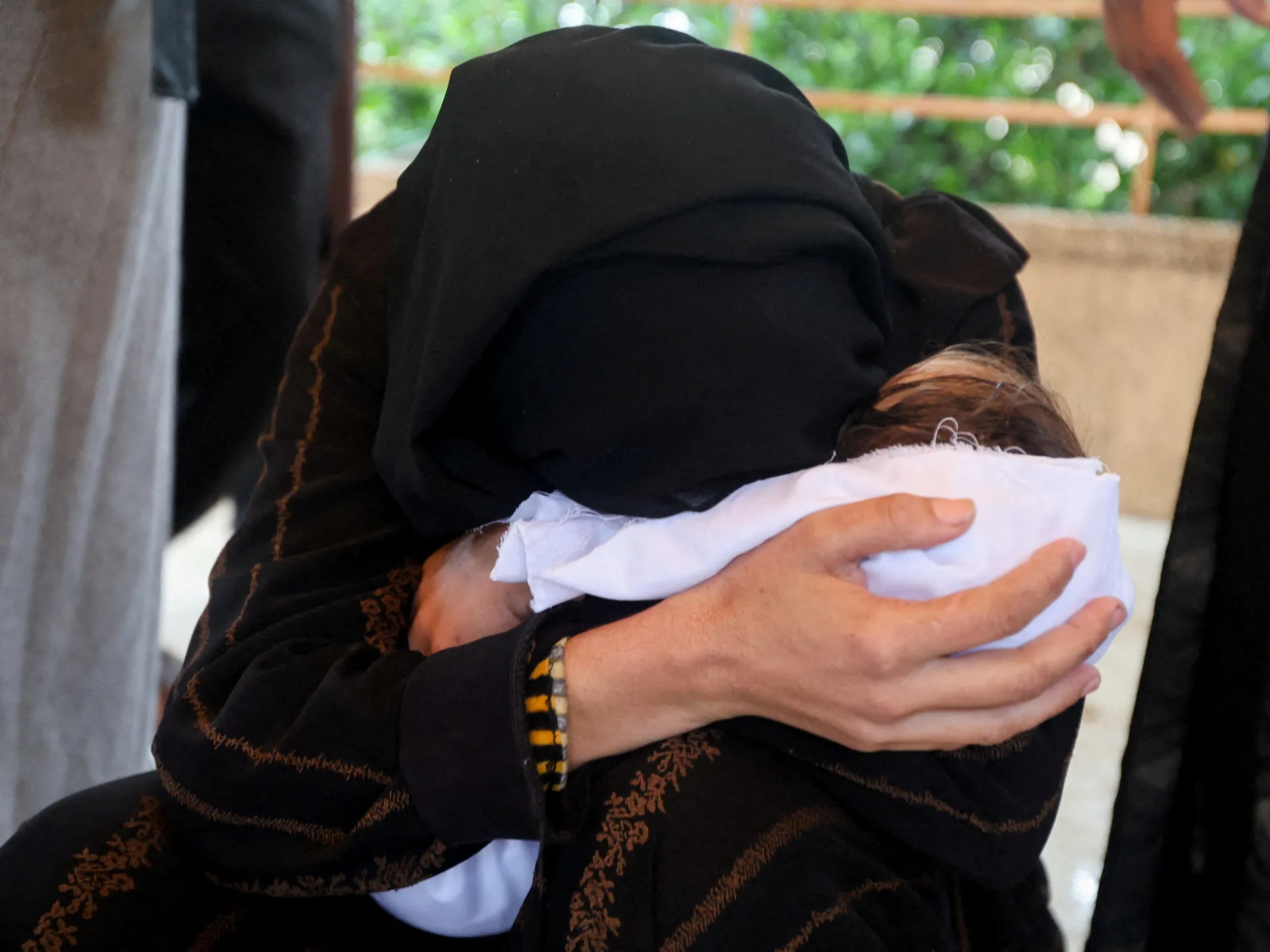
Day of intense hardship as mothers mourn children lost in war and children face day without their mothers.
While much of the Middle East celebrated Mother’s Day with flowers and gifts this weekend, in Gaza, the occasion served as a painful reminder of precious lives lost.
Sitting in her tent in Gaza City on Saturday, Em Rami Dawwas remembered the three sons she lost in Israeli attacks, two of whose bodies are still being withheld by the authorities.
Recommended Stories
list of 3 itemsend of list
“I miss my sons on Mother’s Day. They used to bring me gifts, flowers, sweets, and ask me about my needs. They were the light of my life,” she said, sitting among boxes filled with their clothes, which she cannot bring herself to throw away.
Palestinian children have borne the brunt of Israel’s genocidal war on Gaza that began in October 2023, with UNICEF estimating in October last year that 64,000 children have been killed and wounded in Israeli attacks.
Reporting from among the tents in Gaza City, Al Jazeera’s Hind Khoudary said Dawwas kept the photos of her sons under her pillow, looking at them every day, “as if holding on will keep their memory alive”.
Many mothers spend the day in graveyards, sitting in the only place they can feel close to their dead children, said Khoudary.
‘I just wanted to make her happy’
Maram Ahmed faced a second Mother’s Day without her mother, who she lost in an Israeli air attack that killed her entire family. Her mother was her closest friend, said Khoudary.
“On Mother’s Day, even if I didn’t have money, I would buy my mum a gift from my allowance, even if it was for less than a dollar. I just wanted to make her happy,” said the 14-year-old, sitting in her sparse tent.
“I feel so sad when I see other children with their mothers, but I don’t show it,” she said.
A report published by rights group Amnesty International this month highlighted the “brutal price” women and girls have paid during the war, which started in October 2023. Two years later, Israel and the Palestinian group Hamas agreed to a fragile “ceasefire” that the former has repeatedly violated.
“Amid Israel’s deliberate imposition of conditions of life calculated to bring about the physical destruction of Palestinians in Gaza, Palestinian women face compounded and life-threatening consequences,” said the report.
It cited ongoing mass displacement, the collapse of reproductive, maternal and neonatal healthcare, the interruption of treatment for chronic illness, heightened exposure to disease and unsafe and undignified living conditions faced by women, as well as “profound physical and mental harm”.
Since the October 2025 “ceasefire”, Israeli attacks have killed more than 650 Palestinians, many of them women and children, according to recent figures from the Ministry of Health.
Overall, Israeli attacks have killed more than 72,000 people since the start of the war.
The head of US Central Command says forces have struck Iranian coastal missile sites and infrastructure, degrading Tehran’s ability to threaten shipping in the Strait of Hormuz, as Washington vows to continue targeting its regional military capabilities.
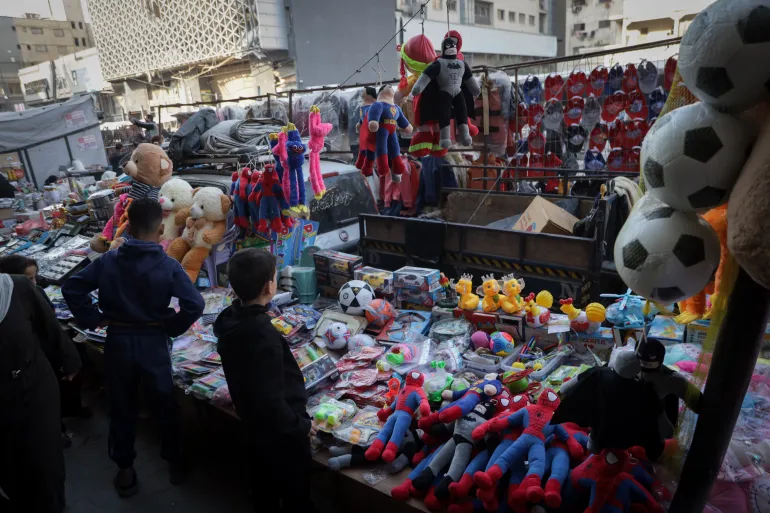
Gaza City – In front of a toy stall in Gaza City’s central al-Rimal market, Rania al-Saudi stands with her two young daughters, looking bewildered at the unusually high prices of toys.
Al-Saudi had promised her daughters she would buy them two dolls to celebrate Eid, but the exorbitant toy prices mean she simply can’t afford them.
Recommended Stories
list of 3 itemsend of list
Her elder daughter, six-year-old Razan, didn’t understand her mother’s worried expressions as Rania asked the vendor for the price of each toy. With every price, Rania gasped and said, “Oh my God, it’s so expensive… this used to be much cheaper.”
Faced with her daughter’s insistence, Rania pleaded with the vendor to lower the prices, but he apologised, saying he could not because getting hold of toys to sell was incredibly difficult, considering Israeli restrictions on importing items into Gaza.
Rania was not alone. Other parents and children repeatedly came to the vendor’s stall to ask about toys, but not one of them made a purchase. In Gaza’s current war-driven economic crisis, the prices are simply unaffordable.
Rania, 43, is originally from Shujayea in eastern Gaza, but has been displaced by the war to the west of the city. She told Al Jazeera that she came looking for toys in an attempt to put smiles on her daughters’ faces before the holiday, but her wish was not fulfilled.
“The prices are extremely high, and the vendors tell us that toys have not entered Gaza since the start of the war. But what did our children do to deserve this?”
Rania recalled the many toys her daughters had in their home before it was destroyed, and how she used to make sure they had toys for every occasion and every holiday.
“Eid holidays are for children’s joy, and children are happy with toys and entertainment. But our children are deprived of everything.”
While speaking to Al Jazeera, Rania tried to calm her daughter Lulwa, who had begun to cry after realising from her mother’s words that she would not get the doll she wanted.
“This doll used to cost no more than 15 shekels ($5) before the war; now it costs 60 shekels ($20),” she said to Al Jazeera, frustrated. “This is something I cannot afford. Everything is expensive and overpriced.”
Rania’s voice grew heavier as she explained that she was unable to even buy new Eid clothes for her daughters – a tradition across the Muslim world – due to the high prices.
“My daughters will not be happy this Eid. I wanted to compensate by getting them dolls, but even that is impossible.”
Toys have been in short supply during the war, which began in October 2023, with bombing and displacement meaning that most children either had their toys destroyed, lost, or left behind. Rania says that her children have been bored, and have had to develop their own ways of playing.
“All the children in the camp face the same situation, so they spend their time playing simple street games like hopscotch, hide-and-seek, or drawing in the sand,” she said.
“But my daughters always wished for a doll. I once tried to make one for them, but they didn’t like it.”
Israel restricts the entry of many non-essential goods into Gaza, including toys [Abdelhakim Abu Riash/Al Jazeera]
Rising prices and market impact
Toy sellers say they are not to blame for the high prices.
Anwar al-Huwaity has been in the business for 20 years. He told Al Jazeera that his stall is still operating despite Israel’s devastation of Gaza, but that business has become extremely difficult.
“Before the war, toys were widely available,” Anwar said. “Today, we go from one trader to another, searching. Sometimes we find toys with someone who had them stored, but they sell it at a very high price, up to three times its normal price.”
He added that most toys that now reach Gaza do not enter through official crossings, but in limited quantities via unofficial routes, making them very difficult to obtain.
The cost of bringing toys into Gaza has become extremely high. Anwar said some middlemen demand up to 12,000 shekels ($3,870) for a small shipment, and if it is confiscated or destroyed, the loss falls entirely on the trader.
“We buy merchandise at high prices, so we have to sell it at high prices as well,” Anwar said apologetically.
Anwar said that toys were now up to 300 percent more expensive compared to pre-war prices. The holiday season, the main income generator for toy sellers, used to bring in between $6,500 and $10,000, he explained. Now, he’d be lucky to sell $1,000 of stock – and most of that is bulk sales to other traders, rather than regular customers.
Anwar may be a businessman, but he shared that the hardest part of his job was seeing children ask for toys that their parents cannot afford.
“Many parents can’t buy toys due to the economic situation. People are barely able to secure food,” he said.
Anwar’s job has gone from providing children joy, to seeing them disappointed.
“I have started hating my workday because I know the prices are exorbitant, and when the children and families see the toys, they get upset, especially during the holidays.”
“People come to buy toys and beg me to lower the price,” he said. “They say, ‘This child is an orphan, that child is an orphan … his parents were killed in the war’. It feels like all children in Gaza have become orphans.”
Toy sellers say they are forced to pass on high prices to customers [Abdelhakim Abu Riash/Al Jazeera]
Restrictions on recreational goods during the Gaza war
Since the outbreak of the war on Gaza in October 2023, trade has been heavily restricted due to the closure of commercial crossings by Israel, especially Karem Abu Salem (Kerem Shalom), the main entry point for goods into Gaza from Israel.
Israel imposed a total blockade on Gaza in 2023, and again for several months in 2025, leading to the declaration of a famine in northern Gaza.
Conditions have improved since a “ceasefire” was declared in October, but Israel is continuing regular strikes – and continuing to heavily restrict the entry of non-essential commercial goods, including toys and recreational materials.
Although no official law or declaration explicitly bans toys from entering Gaza, administrative and security restrictions, combined with the prioritisation of humanitarian goods, have effectively made entry of these items almost impossible.
The United Nations has noted that restrictions on commercial goods, including toys, have affected the availability of both essential and non-essential goods in Gaza.
Near Anwar’s toy stall is another run by Ahmed Ziara. The 24-year-old has been selling toys for several years, but the war has forced him to periodically stop trading.
“Before the war, I worked in major toy exhibitions,” Ahmed explained. “Now toys rarely enter, and we often have to smuggle them, sometimes hidden inside clothes or other goods.”
Ahmed confirmed that most of the toys he acquires are old stock already in Gaza, sold at high prices due to scarcity.
He mentioned that popular Eid holiday toys, which were once inexpensive, now cost triple or even quadruple their previous prices: a small toy car that sold for 40 shekels ($13) last year now costs 150 shekels ($48), a small ball that once cost 3 shekels ($1) is now 30 shekels ($10), building blocks are nearly unavailable, and dolls cost more than 70 shekels ($22.50).
“Buying from traders is hard, and selling is hard due to the economic situation,” Ahmed told Al Jazeera.
“Sometimes I have to sell below the expected price just to clear stock, but most of the time we must raise prices due to high costs and difficulty obtaining toys.”
“If conditions improve and toys are allowed in normally, prices will return to normal, and children and families will be able to enjoy the holiday as before,” he said.
“This work is not easy,” he added, contemplating. “Sometimes I sit alone and tell myself what I am doing is unfair because prices are extremely high. But despite everything, we love to bring joy to children, even for a short time.”
War, which saw Iran attack Qatar facility, has caused ‘high, volatile’ gas prices that could hit EU storage projections.
Published On 21 Mar 202621 Mar 2026
The European Union has urged member states to start early on meeting next winter’s gas storage targets after Iranian attacks on Gulf energy facilities caused prices to surge on global markets.
Energy Commissioner Dan Jorgensen sent a letter Saturday urging the bloc’s members to get to work “as early as possible” in the coming months to “mitigate pressure on prices and avoid [an] end-of-summer rush”, asking them to consider cutting their so-called filling target by 10 percentage points to 80 percent.
Recommended Stories
list of 3 itemsend of list
The move came days after Iran attacked Qatar’s Ras Laffan Industrial City complex, which provides about 20 percent of global supplies of liquefied natural gas (LNG). The attack, which came amid the US-Israeli war on Iran, was in retaliation for an Israeli attack on the Iranian South Pars gasfield.
State-owned QatarEnergy said that Iran’s attack on Qatar, which has been targeted throughout the duration of the war, knocked out 17 percent of Doha’s export capacity and would affect exports for up to five years.
The slowdown will mainly harm Asian buyers, including China, Japan, and India, which buy some 80 percent of QatarEnergy’s LNG.
But Europe, which only sources around 9 percent of its LNG from Qatar, will nevertheless be exposed to increased competition, with tanker traffic leaving the Gulf via the Strait of Hormuz throttled by the war.
Natural gas prices in the EU have risen by more than 30 percent since the start of the war on February 28, spiking after Israel’s attack on Iran’s critical South Pars gasfield and subsequent Iranian attack on Qatar’s Ras Laffan.
Jorgensen said that the EU’s gas supply, which has mainly been furnished by the United States since the bloc weaned itself off Russian energy over the Ukraine war, remained “relatively protected at this stage”.
“But, as a net energy importer on global markets, the resulting high and volatile global prices may also impact the EU gas storage projections,” he cautioned.
Jorgensen warned that developments “threaten regional and global security”, urging member states to refill stores early over a longer period.
The EU requirement for member countries to maintain gas reserves at 90 percent of capacity to meet winter heating and power demand underpins the region’s energy security.
Having cut that target by 10 percent, the energy commissioner noted that, in case of “difficult conditions” and a commission assessment, the countries could deviate by up to 20 percent.
Oil prices have also soared since the start of the war by more than 50 percent.