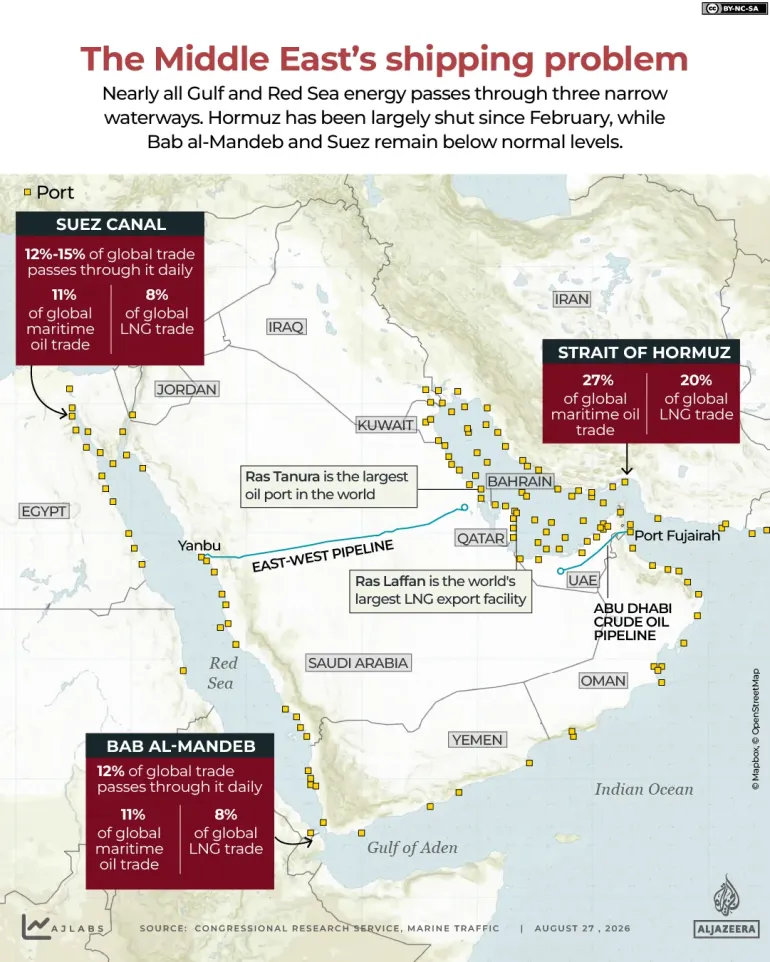
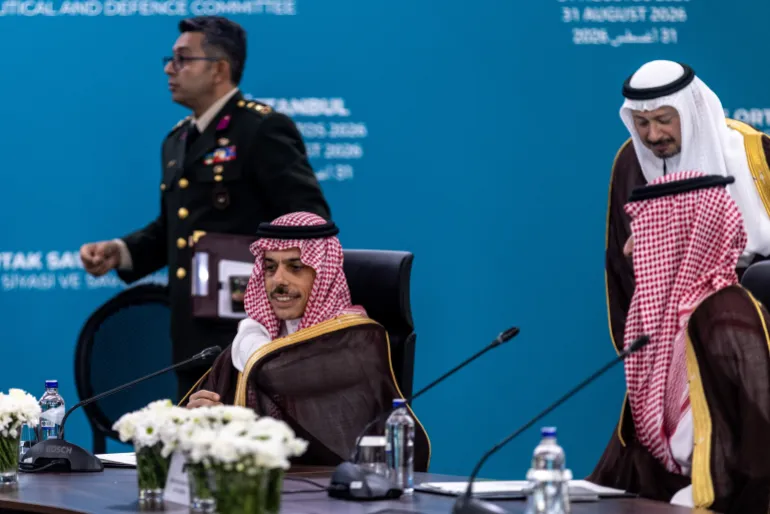
The UAE’s decision to quit OPEC to prioritise its ‘national interests’ deals a blow to the oil group already grappling with the challenge of shipping Gulf exports through the Strait of Hormuz. Here’s what we know about why it’s withdrawing and the impact it might have.
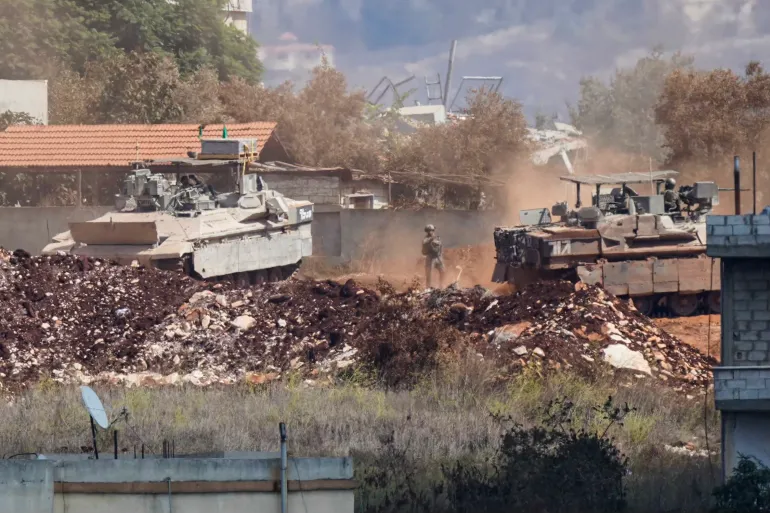
A video filmed by an Israeli soldier shows widespread destruction in northern Gaza. Before Israel’s genocidal war, the town of Beit Hanoon was home to 50,000 people. Despite a ceasefire, Israeli forces have bulldozed what was left of hundreds of homes.
On March 13, 2013, Fakhr al-Din al-Aryan, a judge at Idlib’s Civil Court of Appeal, publicly defected from the Syrian regime – an act that led him to be sentenced to death in absentia.
In December 2024, more than a decade later, Bashar al-Assad’s regime – the very one he had defected from – was overthrown, and al-Aryan was able to finally return to Syria’s judiciary.
Recommended Stories
list of 3 itemsend of list
In the latest step on al-Aryan’s journey from defection to exile to return, he was the presiding judge on Sunday at the opening of the trial of Atef Najib, a cousin of former President al-Assad and the former head of political security in the southern province of Deraa who faces charges of premeditated murder, torture leading to death and crimes against humanity.
Al-Assad and his brother Maher al-Assad, a former top military commander, are also being tried in absentia. Both men fled to Russia after their 2024 overthrow.
Fadel Abdulghany, the founder of the Syrian Network for Human Rights (SNHR), told Al Jazeera that the moment carries deep symbolic weight.
“A judge once sentenced to death by the Assad regime for defending the rule of law has returned to the bench to apply that same law to one of the regime’s most extensively documented perpetrators of violations,” Abdulghany explained. “This reversal of power dynamics reflects the promise of the rule of law so rarely fulfilled in post-authoritarian transitions. The significance of this moment lies not in spectacle but in its adherence to due process.”
Defection and return
Al-Aryan was a judicial adviser during the early years of Syria’s uprising, which began in March 2011, as protests intensified and the state increasingly relied on security-based rule.
By 2013, he decided that he had to break from the Syrian state and defected in a recorded statement that framed his decision as a matter of legal and moral responsibility.
“In light of the responsibility placed on the shoulders of judges, who are the guardians of justice and truth, and as a result of the massacres committed by the regime against civilians, children and women, … I announce my defection from the Ministry of Justice and my joining the Independent Syrian Judicial Council … to be a strong shield for justice and equality,” he said in the video.
After his defection, al-Aryan joined the judicial bodies of the then-Syrian Interim Government and became involved in building what was described as a parallel judicial track in opposition-held areas.
As part of that, he worked on establishing alternative courts, handling legal cases and documenting alleged crimes committed by the now former regime.
In response, the authorities sentenced al-Aryan to death in absentia and confiscated his property, including assets later sold at public auction.
After the fall of al-Assad’s regime, al-Aryan’s name re-emerged in June after a presidential decree reinstating dismissed judges. That process culminated in his appointment as head of the Fourth Criminal Court in Damascus, positioning him at the centre of the country’s first transitional judicial proceedings.
Najib’s links to repression of Syrian revolution
The transformation in al-Aryan’s life mirrors that of the man on trial in his courtroom on Sunday.
The position of the al-Assad family member as a top security official in Deraa in 2011 placed Najib at the centre of some of the first major confrontations between civilians and state security officers. Deraa is called the “cradle of the revolution” after government repression of protesters there inspired al-Assad’s opponents in other areas of the country to rise up.
One specific incident – the arrest and torture of schoolchildren detained after scrawling, “The people want the fall of the regime,” and the killing of one of them, 13-year-old Hamza al-Khateeb – is widely regarded as the spark for the country’s revolution.
Najib’s connection to that incident and the death of Hamza is one of the reasons why his trial is so significant in Syria.
The former official was arrested in January 2025 in the Latakia region, where some former regime loyalists had taken refuge.
Transitional justice
For the Syrian Network for Human Rights, the trial is significant because of how it is being conducted and not just who is being tried.
Abdulghany stressed that “this is neither a revolutionary court nor a victors’ court” but a case that has moved through formal legal stages, including arrest by the Ministry of Interior, investigation, prosecution and referral to a criminal court in Damascus.
The charges include premeditated murder and torture leading to death, classified as crimes against humanity under international law. This framing, Abdulghany said, is deliberate: It places domestic proceedings within the framework of international criminal standards, which is essential for the credibility of any verdict.
Abdulghany also highlighted the institutional message of the trial and in particular the inclusion of the former president and his brother as defendants despite their absence from the proceedings and from Syria.
“Physical absence does not amount to legal immunity,” he said.
Despite this, Abdulghany stressed that the trial was not the end of the transitional justice process in a country where hundreds of thousands of people died and disappeared during the war and the five-decade rule of al-Assad and his father, Hafez. There is still little information in many of the cases of the disappeared and imprisoned. The SNHR has documented at least 177,000 cases of enforced disappearances since 2011 with the vast majority attributed to the former government.
Abdulghany explained that accountability in Syria cannot be reduced to criminal trials alone and instead must include four interconnected pillars: criminal accountability, truth-seeking, reparations and institutional reform.
These, he argued, must function together under a unified structure rather than as separate or sequential processes.
Abdulghany placed particular emphasis on institutional reform, noting that Syria’s judiciary was previously used as a tool of repression rather than justice.
“Without these reforms, transitional justice trials risk being conducted through judicial institutions that have not themselves been transformed,” he said, pointing to the need to dismantle exceptional courts and rebuild judicial independence.
Truth-seeking, he added, is equally essential.
Families of victims have a right to know what happened to their relatives, and this right exists independently of criminal prosecutions, Abdulghany said.
“They deserve answers,” he said, adding that recognition of truth, justice and reparations must be unconditional if any durable reconciliation is to be achieved.
The Gulf state is the latest to quit the group, which was created to form a united front on oil pricing.
The United Arab Emirates has announced its withdrawal from OPEC and the wider OPEC+ framework, removing a core pillar of one of the most influential groups in the energy world.
The Gulf country, with a capacity of approximately 4.8 million barrels per day and significant room to increase output, announced on Tuesday that it would quit the organisation to focus on “national interests”.
Here’s a look the at the organisation’s history and role in the global economy:
When was OPEC established and why?
The Organization of the Petroleum Exporting Countries (OPEC) is a permanent, intergovernmental organisation based in Vienna, Austria, that has the objective of coordinating and unifying petroleum policies among member states.
It was originally created at the Baghdad Conference in September 1960 by five oil-producing founding states, Iran, Iraq, Kuwait, Saudi Arabia and Venezuela.
At that time, global oil markets were dominated by a group of powerful Western oil companies, known as the “Seven Sisters,” which controlled production and set prices.
The broader aim of the founding countries was to assert sovereignty over their natural resources and secure fair and stable prices for petroleum producers, as well as regular supplies to consuming nations.
OPEC currently has 12 members, including, aside from the UAE: Algeria, Republic of the Congo, Equatorial Guinea, Gabon, Iran, Iraq, Kuwait, Libya, Nigeria, Saudi Arabia, and Venezuela.
According to a statement issued on Tuesday, the UAE’s withdrawal will be effective on May 1, marking the exit of a member that had contributed to the organisation since 1967.
The organisation pursues price stability by setting agreed production quotas for the membership, which together controls about 30 percent of global supply.
Since 2016, OPEC has also cooperated with Russia, Azerbaijan, Kazakhstan, Bahrain, Brunei, Malaysia, Mexico, Oman, South Sudan, and Sudan through its OPEC+ framework, bringing its output to about 41 percent of global supply.
Why did the UAE leave OPEC and OPEC+?
Alongside Saudi Arabia, the UAE is one of the few OPEC members with meaningful spare capacity, which allows the organisation to respond to supply shocks.
However, nations with spare capacity may decide to cash out their reserves rather than use them to adjust the market.
The UAE’s assertive foreign policy approach has progressively isolated it from fellow OPEC members, especially Saudi Arabia, which disagrees with its positions on Yemen and elsewhere.
Abu Dhabi, meanwhile, has been carving out its own sphere of influence across the Middle East and Africa, and has doubled down on relations with the United States and Israel, with which it opened ties in the 2020 Abraham Accords.
It views relations with Israel as a critical lever for regional influence and a unique channel to Washington, especially after coming under attack during the Iran war.
The UAE is not the first country to leave the organisation. Others to have withdrawn in recent years include Indonesia, Qatar, Ecuador, Angola and Gabon, mainly due to disagreements over output quotas.
Qatar’s foreign ministry spokesman Majed al-Ansari told reporters at a weekly briefing that the Strait of Hormuz must not be used as a bargaining chip, as peace talks between the US and Iran continue to stall.
People planning holidays should check that their destionation has no new alerts or warnings
Some areas have a blanket warning, and others may have specific areas that should stay off-limits(Image: Craig Hastings via Getty)
The Foreign, Commonwealth and Development Office (FCDO) has significantly expanded its ‘red list’ in recent months due to regional escalations, particularly in the Middle East and Eastern Europe. It is important to be aware of which parts of the world pose a greater risk to tourists than others.
While it is not advisable to ignore the Foreign Office’s advice, doing so is likely to invalidate any insurance that travellers have obtained. In most cases, insurers will not cover people who knowingly go against FCDO advice and take risks. If you absolutely must travel to a high-risk area, you may need to look for specialised travel insurance companies that provide specific cover for such scenarios, according to ABTA.
As of April 28, 2026, the following list summarises the countries for which the Foreign Office has specific safety advice for travelling. In some cases, it issues a blanket alert urging people to reconsider visiting countries that are unsafe across all areas. Some areas have partial warnings in place. If people are visiting the area, check the Foreign Office website for the latest updates and warnings.
Countries where the Foreign Office currently advises against all travel:
Afghanistan
Belarus
Burkina Faso
Central African Republic (CAR)
Eritrea
Haiti
Iran
Iraq
Israel
Lebanon
Mali
Niger
Palestine (Occupied Palestinian Territories)
Russia
South Sudan
Sudan (most of the country)
Syria
Ukraine (most of the country)
Yemen
Countries where the Foreign Office advises against all but essential travel:
Bahrain
Cuba (entire island)
Ecuador (coastal provinces)
Egypt (significant parts: Western Desert, North South Sinai)
India (significant parts: Manipur, Pakistan border)
The United States is considering a new proposal from Iran to end the ongoing war amid a fragile ceasefire between the longtime adversaries.
The offer focuses on reopening the strategic Strait of Hormuz while postponing a deal on Iran’s nuclear programme, arguably the most contentious issue between Tehran and Washington.
Recommended Stories
list of 3 itemsend of list
According to US media outlets, the proposal has drawn scrutiny in Washington, and officials there have expressed scepticism.
Early indications from the Trump administration suggest the plan is unlikely to be accepted in its current form, potentially further delaying any prospect of permanently ending the currently paused US-Israel war on Iran, which has killed thousands and sent global energy prices soaring.
Here is what we know so far:
What’s in Iran’s latest proposal?
Iran’s latest proposal aims for de-escalation in the Gulf without immediately placing restraints on its nuclear programme, as the US has demanded. Tehran has offered to reopen the Strait of Hormuz on the condition that the US lifts its naval blockade on Iranian ports and agrees to end the war.
Iran has effectively closed the strait to shipping, creating global economic pressure by driving up energy prices and disrupting supply chains. In peacetime, one-fifth of the world’s oil and liquefied natural gas (LNG) supplies are shipped through the narrow passage, which links Gulf oil producers to the open ocean.
Days after the ceasefire began on April 8, Trump announced a blockade on Iranian ports and ships, restricting Tehran’s ability to export oil and cutting off a crucial source of its revenue.
Iranians walk past a huge billboard carrying a sentence reading in Persian ‘The Strait of Hormuz remains closed’ at Enghelab Square in Tehran, Iran, 28 April 2026 [Abedin Taherkenareh/EPA]
However, a central feature of Iran’s offer to reopen the Strait to all traffic is that discussions over Iran’s nuclear activities would be postponed until after the war ends.
The proposal was conveyed to Washington through Pakistan, which has been acting as a mediator.
“These messages concern some of the Islamic Republic of Iran’s red lines, including nuclear issues and the Strait of Hormuz,” Iranian state media Fars News Agency reported.
“Informed sources emphasise Mr Araghchi is acting entirely within the framework of the specified red lines and the diplomatic duties of the Ministry of Foreign Affairs.”
The news agency said the messages relayed were “unrelated to negotiations” and are “considered an initiative by Iran to clarify the regional situation”.
Iranian analyst Abas Aslani said Iran’s latest proposal is based on an “altered” approach.
Aslani, a senior research fellow at the Centre for Middle East Strategic Studies, told Al Jazeera that Tehran believes its previous model – which was based on making compromises on its nuclear programme in exchange for economic sanctions relief – is no longer a “viable path towards a potential accord”.
“Iran believes this can also function as a trust-building measure to compensate for the trust-deficit issue,” he added.
On Monday, Tehran’s envoy to the United Nations, Amir Saeid Iravani, said “lasting stability and security” in the Gulf and the wider region can only be achieved through a durable and permanent cessation of aggression against Iran.
How has the US responded so far?
US President Donald Trump met with top security advisers on Monday to discuss the Iranian proposal, the White House confirmed.
However, according to media reports, the US response has been largely dismissive. According to Reuters, an unnamed US official said President Trump was unhappy with the proposal because it did not include provisions for Iran’s nuclear programme. The official noted that “he doesn’t love the proposal”.
Citing two people familiar with the matter, US media outlet CNN reported that Trump was unlikely to accept the proposal. It said Washington lifting its blockade of Iranian ports without resolving questions over Tehran’s nuclear programme “could remove a key piece of American leverage in the talks”.
Secretary of State Marco Rubio told Fox News on Monday that the proposal was “better than what we thought they were going to submit”, but questioned Tehran’s intentions.
“They’re very good negotiators,” he said. “We have to ensure that any deal that is made, any agreement that is made, is one that definitively prevents them from sprinting towards a nuclear weapon at any point.”
Al Jazeera’s Mike Hanna, reporting from Washington, said, “There’s been a complete lid over what was discussed” during the meeting between Trump and his national security team.
“It was so tight that we do not know exactly who in his national security team was present at that meeting,” Hanna added.
“Normally, there is some form of readout or some form of more information giving, fleshing out the details of a meeting like this.”
What has been the response from other countries?
While the “US and Iran feel that time is on their side, the longer this goes on, the more difficult it’s going to be,” Mohamed Elmasry, an analyst for the Doha Institute of Graduate Studies, said.
“I really don’t think time is on anyone’s side. I really do think the Europeans are losing patience,” he told Al Jazeera.
On Monday, German Chancellor Merz stated that the “Iranians are negotiating very skilfully”, Elmasry noted. He said this shows that Trump is coming under increasing pressure from his allies, “who believe he [Trump] got them into this big mess and isn’t able to clean it up”.
“Trump isn’t going to be happy hearing that and the chancellor is hitting Trump where it hurts.”
Uranium starts as a rock in the ground, but through a series of chemical processes and high-speed centrifuges, it can become either a city’s power source or a weapon of mass destruction.
Al Jazeera’s Basel Ghazoghli (@baselgazi) breaks down how uranium is processed, enriched, and what it takes to turn it into a nuclear weapon.
A booking trick can help ensure you are covered as many UK airlines face chance of disruption or cancellation this summer due to Middle East conflict impacting air travel
Jet2, Ryanair and easyJet £100 flight booking warning(Image: Getty Images)
Due to ongoing conflict in the Middle East, Europe is facing a fuel crisis, causing concern about the likelihood of summer holidays going ahead.
The International Energy Agency has warned that supply issues could kick in in the next five to six weeks with the owner of British Airways commenting that flight tickets may increase in line with skyrocketing fuel costs.
The fuel crisis comes as the Strait of Hormuz has been blocked throughout the conflict, meaning energy is not able to be distributed at a normal rate.
The strait is the shipping passage for 20 per cent of the world’s fuel and has seen the costs of petrol rapidly increase since the outbreak of war.
For travel, this has caused disruption to many flights, with prices changing and traveller’s fearing cancellations.
According to EU energy commissioner Dan Jorgensen it’s “very likely that many people’s holidays will be affected, either by flight cancellations or very, very expensive tickets”.
If your flight is cancelled it is covered by UK law if it was set to depart or arrive at a UK airport on a UK or EU airline, or arrive at an EU airport on a UK or EU airline.
Popular UK airlines Jet2, Ryanair and easyJet are all covered by this rule.
If you are covered and your flight is cancelled, the airline you are travelling with must provide you with a refund or book you on an alternative flight.
The Civil Aviation Authority (CAA) says that you can get all of your money back for your tickets or for the parts you haven’t used.
With return flights, if outward travel is cancelled, you are entitled to a full refund.
The CAA added: “If you are a transfer passenger and you have already completed part of your journey, you are also entitled to a flight back to your original departure point when your connecting flight is cancelled and you decide not to continue your journey.”
Experts gave a £100 flight booking warning, advising to pay via credit card as this gives you Section 75 protection under the Consumer Credit Act, legally protecting you for purchases costing between £100 and £30,000.
The situation is currently so unpredictable that travellers should be aware of all the cover they are entitled to, as flights may be cut at any point.
Global aviation expert Geoffrey Thomas told the Daily Mail that flights could be cut at the last minute.
Thomas highlighted that Europe is particularly impacted, especially when it comes to long haul travel.
“Europe is more exposed at the moment than Asia is, which means trips from Australia are obviously a challenge.
“For airlines like Qantas, who operate the Perth to London service, at the moment, they have to fly additional distance to refuel in Singapore.
“Any airline that operates through the Middle East is also exposed if the conflict widens or the Iranians decide to resume random drone attacks.”
Amid the conflict, travel experts reiterated the importance of travel insurance.
“To not travel with insurance these days is pretty crazy,” Dr David Beirman told the Daily Mail.
“Most policies will cover cancellation or major changes to an itinerary from a number of causes.
“If your airline is being difficult about a changed flight, and they’re only prepared to give you a credit or something like that, the travel insurance company will usually come to the party and help financially.”
Rights groups have described the move as a “blatant abuse of power”.
Published On 27 Apr 202627 Apr 2026
Bahrain has stripped dozens of people of their citizenship for allegedly supporting Iranian attacks on the country.
Bahrain’s Ministry of Interior announced on Monday that it had revoked the citizenship of 69 people, some of whom were related, after accusing them of sympathising with Iran and “colluding with foreign entities”. The move comes after Tehran carried out strikes on facilities in Bahrain as part of the war launched against Iran by Israel and the United States.
Recommended Stories
list of 3 itemsend of list
The directive, issued by King Hamad bin Isa Al Khalifa, stated that all 69 people were “of non-Bahraini origin”. Under Bahraini law, a person can be stripped of citizenship if they are deemed to have caused harm to the country or shown disloyalty.
The London-based Bahrain Institute for Rights and Democracy described the move as “dangerous” and a clear violation of international law.
The organisation said the individuals had not been publicly identified, and it remained unclear whether they had been arrested, whether they were inside or outside Bahrain, and whether they held another nationality.
Iranian strikes
Tehran began striking its Gulf neighbours on February 28, shortly after Israel and the United States began the war by launching attacks on Iran.
Tehran accused the targeted countries of allowing the US to conduct its strikes from their territory. Iran’s retaliatory attacks reportedly caused significant damage to US military sites across the region, including a Navy base in Bahrain, which was hit by missiles and drones.
Iran ceased its attacks on Gulf neighbours on April 9, following the introduction of a ceasefire brokered by Pakistan. Negotiations to permanently end the war are ongoing three weeks later.
Bahrain’s Shia population has long accused authorities of marginalising them. During the Arab Spring in 2011, mass protests against the country’s leadership broke out. The Bahraini government has long blamed Iran for fomenting unrest against it.
US-Israel war on Iran drives up fuel and food costs, putting 32.5 million people at risk of poverty worldwide.
Fuel costs more. Food is harder to get or afford. Jobs are disappearing. Remittances are drying up.
These are the consequences of the United States-Israel war on Iran – felt not only in the Middle East but also in the fields and homes of Africa and Asia.
Countries in the Global South are particularly vulnerable to the economic fallout because of their dependence on imports from the Gulf.
The United Nations warned that the conflict could push as many as 32.5 million people globally back into poverty.
The war is weakening economies that were already fragile. Governments are scrambling, and international aid is becoming scarce.
The low-cost airline is cancelling flights in May and June due to soaring aviation fuel prices linked to the ongoing conflict in the Middle East
Robert Rowlands Deputy editor, money and lifestyle, content hub and Maria Ortega
16:19, 27 Apr 2026
The airline is cutting back flights due to pressures on jet fuel prices(Image: Sjo via Getty Images)
An airline that operates routes to and from the UK is axing flights in May and June because of surging fuel costs. Transavia, the budget airline owned by the Air France-KLM group, is scrapping scheduled services for May and June to cut expenses as aviation fuel prices soar due to the Middle East conflict.
The Air France-KLM group’s low-cost arm will change its timetable for May and June to streamline costs amid rocketing fuel prices linked to the Middle East war, a spokesperson confirmed to AFP. The airline operates from London Stansted to Rotterdam several times a week, and is used by tourists who fly to Schiphol airport in the Netherlands before going on to other European destinations with Transavia.
“Due to the current geopolitical situation in the Middle East and its impact on aviation fuel prices, Transavia France is adapting its flight schedule and is forced to cancel several flights scheduled for May and June 2026,” the carrier, which runs medium-distance routes, stated.
The cancellations represent “less than 2% of the flight schedule for the May-June period,” a spokesperson informed AFP. Transavia said “customers affected by a cancellation are notified individually by SMS and email.” Details of which routes are affected have not been disclosed so far.
They can then “benefit, according to their choice, from a free rescheduling, a voucher, or a full refund of their ticket.” Additionally, “for the majority of cancelled flights, a rescheduling solution within 24 hours is offered,” the airline states.
Europe normally gets half of its fuel from Gulf nations. However, since the start of the war between the United States and Iran in late February, the Strait of Hormuz has been shut down by Tehran.
In Brussels, European Commissioner Dan Jorgensen warned that the EU was “approaching very rapidly” a potential supply crisis, raising concerns about a summer characterised by “higher airfares and cancellations.” Airlines including Transavia have already begun raising ticket prices, with increases averaging approximately 10 euros per return journey, according to the carrier’s spokesperson speaking to AFP.
Chief Secretary to the Prime Minister Darren Jones warned on Sunday that the ongoing conflict is likely to push up costs for energy, food and flight tickets in the coming months, with potential disruptions to energy supplies affecting production rather than causing empty supermarket shelves.
“You’re going to see prices go up a bit as a consequence of what Donald Trump has done in the Middle East,” he told the BBC’s Sunday With Laura Kuenssberg programme. “That’s probably going to come online not just in the next few weeks, but the next few months. There’s going to be a long tail from this.”
When pressed on how long elevated prices could last, he indicated it would be roughly eight months after the Strait of Hormuz is reopened and tensions in the region begin to ease. “I think our best guess is eight-plus months from the point of resolution that you’ll see economic impacts coming through the system,” the minister said.
Last week, German airline Lufthansa said it would cut 20,000 European short-haul flights over the summer. It blamed the price of jet fuel.
An industry expert told travel journalist Simon Calder on his podcast last week that he expected more flights to be cut by airlines. Ted Wake, managing director of Kirker Holidays, said: “I think Lufthansa has got a very comprehensive schedule. Twenty thousand flights isn’t a drop in the ocean but it’s a relatively small number if you look at the overall picture.
“I think other airlines within the UK market will be doing something similar.”
German chancellor warns the US risks becoming bogged down in another quagmire similar to Iraq and Afghanistan.
Published On 27 Apr 202627 Apr 2026
German Chancellor Friedrich Merz says the United States is being “humiliated” in its war with Iran, warning that Washington lacks a clear path out of the conflict as Tehran gains the upper hand.
Speaking to students in the German town of Marsberg on Monday, Merz said the situation has exposed a deeper strategic problem for the US as he drew comparisons with past military debacles.
Recommended Stories
list of 3 itemsend of list
“The problem with conflicts like this is always you don’t just have to get in – you have to get out again. We saw that very painfully in Afghanistan for 20 years. We saw it in Iraq,” he said.
Merz said Iranian officials were “obviously negotiating very skilfully” and appeared “clearly stronger than one thought”, adding that “an entire nation is being humiliated by the Iranian leadership”, particularly by the Islamic Revolutionary Guard Corps.
Merz urged a rapid end to the war, warning that the fallout was already hitting Germany’s economy.
“It is, at the moment, a pretty tangled situation,” he said. “And it is costing us a great deal of money. This conflict, this war against Iran, has a direct impact on our economic output.”
The German leader said Berlin remains ready to deploy minesweepers to help secure shipping routes through the Strait of Hormuz, a vital artery for global petroleum supplies, but stressed that such steps depend on a cessation of hostilities.
Merz made the comments as concerns are growing across Europe over the wider impact of the conflict, including energy disruptions and economic instability.
Earlier, German Foreign Minister Johann Wadephul warned that nuclear threats continue to shape the security environment, even as Berlin reaffirmed its commitment to nonproliferation.
“As long as nuclear threats against us and our partners continue, we will need a credible deterrent,” he said before meetings at the United Nations on the Treaty on the Non-Proliferation of Nuclear Weapons.
France and Germany have recently moved to deepen cooperation on nuclear deterrence, reflecting mounting anxiety in Europe over both the Iran war and broader regional instability.
We explore why water infrastructure is increasingly being targeted in the midst of war and conflict.
Water sustains life, but what happens when it is weaponised? In the ongoing US-Israel war on Iran, desalination plants supplying millions in the Gulf have become targets. This reflects a growing pattern: water infrastructure is increasingly vulnerable as global scarcity intensifies. The United Nations warns of looming “water bankruptcy” driven by climate change and rising global demands, including AI data centres.
Presenter: Stefanie Dekker
Guests:
Kaveh Madani – Director, UNU Institute for Water, Environment & Health
Zeina Moneer – Environmental policy and climate programmes expert
Chinguetti, Mauritania – Bookkeeper Muhammad Gholam el-Habot gently pulled a pair of white gloves onto his slender hands and set about his routine in his high-ceilinged, cool library lined with steel bookshelves.
He opened a thick manuscript printed in Arabic. After leafing through its brown and frail pages, looking for damage, el-Habot closed the book with a satisfied thud, rubbed his fingers over the wrinkled leather cover, and carefully placed it in a white cardboard box.
Recommended Stories
list of 3 itemsend of list
“These books are very important to my family and me,” the librarian said, as the midday sunlight spilled in through open wooden doors. He spoke in Hassaniya Arabic, the dialect spoken in Mauritania, his voice low, his sentences halting and poetic. Fat flies buzzed around his long oval face as he worked.
“My relationship with them is like that of a father and his son,” he continued. “We must protect them until God takes the land and all the people who are on the land.”
The el-Habot family library is only one of a handful of its kind still operating in Chinguetti, a medieval fortress town or ksar in Mauritania’s northern Adrar region. Once a centre of commerce and Islamic learning between the 13th and 17th centuries, it is now largely abandoned as, over the decades, locals have sought opportunities in bigger cities.
A view of the old town of Chinguetti, which follows typical Moorish structures with a mosque at the centre [Shola Lawal/Al Jazeera]
Chinguetti is also at the mercy of a changing climate.
Mauritania, in northwest Africa, is 90 percent Sahara desert and has faced desertification for centuries. Now, human-induced climate change is an accelerant. Sand and flash storms occur more frequently, while extreme hot or cold seasons last longer than usual.
Those pressures are a “big deal” for precious books, said Andrew Bishop, a researcher at the University of Wyoming studying climate impacts on Saharan cultures.
“Extreme heat and less predictable rainfall patterns means that texts are increasingly damaged by water or heat, making many manuscripts beyond repair. More than that, the mud libraries themselves are not built for sudden rain and longer summer of over 40 degrees (Celsius, or 104 degrees Fahrenheit),” he told Al Jazeera.
Many of Chinguetti’s 4,500 residents now live in cement buildings outside the original confines of the abandoned ksar, built out of dry stone and red mudbrick. There are fears that the entire area, which is about 500 square kilometres (200 square miles) – about the size of Prague – is at risk of being buried by surrounding sand dunes in the long run, although there is not a clear timeline yet.
Rare manuscripts shown in one of Chinguetti’s last libraries [Logan Stayton/University of Wyoming]
Islam’s ‘seventh holiest city’
El-Habot did not always want to be a bookkeeper.
But when his father grew sick in 2002, he took over the approximately 1,400 manuscripts out of obligation. It was an honour in his culture to be selected, he said.
It would be out of the question now, the 50-year-old librarian said. He imagines that his two sons would reject the duty, as many of their peers have left to explore economic opportunities in the capital city, Nouakchott, or elsewhere.
“This is something that we have to do; it is a family obligation,” el-Habot said, with a bewildered expression. “This is not even a question to be asked.”
The family manuscripts are sacred because they are rare. The bookkeeper’s ancestor, Sidi Mohamed Ould Habot, was one of about two dozen Chinguetti scholars who travelled around the Muslim world between the 18th and 19th centuries, from Egypt to Andalusia, in search of knowledge.
Between them, the scholars amassed a vast fortune of about 6,000 scripts. They covered almost every topic: Islamic jurisprudence, the hadith or teachings of the Prophet Muhammad, mathematics, medicine, and poetry. Some of the works came from the scholars themselves, including the older el-Habot, who wrote about the science of poems.
The books were stored in about 30 libraries in Chinguetti, open to people from all over the world.
At the time, the town was famous because of its location at the crossroads of trans-Saharan trade routes linking the Sahel and the Maghreb. Camel caravans guided by nomadic Berber traders transporting goods – mostly salt and gold – between northern Africa and the southern empires used the city as a way station, transforming it into a commercial hub.
Muslim pilgrims on their way to Mecca on foot or camel would gather in Chinguetti and prepare themselves spiritually and mentally for their long, difficult journey before heading on to Cairo. Islamic and scientific texts were exchanged, bought and sold in the town.
In West African lore, Chinguetti was referred to as Islam’s seventh holiest city. Others nicknamed it the “Sorbonne of the Sahara”, according to UNESCO.
Some of the old texts stored in the el-Habot family library. The family has a total of about 1,400 books in its care [Logan Stayton/University of Wyoming]
Generation after generation managed the libraries. Over time, as the caravan trade declined due to new European sea routes, the old town emptied and several libraries closed.
“Chinguetti was the mother of all people,” el-Habot said, referring to the town’s old status as the main capital of the region. Indeed, the area now known as Mauritania was called “Bilad Shinqit” or Land of Chinguetti. In the local Soninke language, it translates to “spring of horses”.
“People had to go because they wanted to feed themselves, get education for their kids, and get better opportunities for themselves too,” el-Habot said, adding that there were no universities close by, and only a handful of primary and middle schools.
Some within his family have moved on, as well, the bookkeeper said. Those, like him, who stayed back, wanted to respect their ancestor’s three wishes.
“His wishes were that the library stay in Chinguetti, that it should be open to all seekers of knowledge, and that a male descendant of his who is religious and morally upright be the bookkeeper,” el-Habot explained. Not following those instructions, he said, could invite God’s anger.
Chinguetti’s decline is largely due to the lack of support for its traditional lifestyle, Bishop said. Annual rainfall in Mauritania has decreased by 35 percent since 1970, making it harder for herders to graze or for date palms to produce fruit.
In 1996, UNESCO granted Chinguetti and three other Mauritanian ksour World Heritage Status, cementing their rich legacy. The few people still living in the old town are allowed to renovate but only minimally, to keep its original stone architecture and the typical Moorish structuring where houses are lined up along narrow alleys that lead to a mosque with a square minaret.
Just outside Chinguetti are the excavated ruins of Abweir, a town of 25,000 believed to have been founded in 777 AD, and believed to be the “original” Chinguetti. Its residents moved from the settlement, locals believe, in 1264 – likely after a conflict. Over time, the area was completely swallowed by sand.
Bookkeeper el-Habot stands inside the family library on a recent weekday [Shola Lawal]
Saving the manuscripts
El-Habot’s job, while enjoyable much of the time, is also taxing, he admitted.
Preserving old books by reprinting or digitising the most worn-out manuscripts before they become unreadable is a costly process. He often needs chemicals to keep away book-eating insects and has to fund more suitable storage.
Then, there is the weather, which is out of his control. Mauritania swelters in the dry season between April and December, and is bitingly cold in the winter months that follow. Old pages are sensitive to both extremes and can become brittle, el-Habot said. Sometimes, when it is really hot, he places buckets of water around the library hall to spur humidity.
Flash floods, meanwhile, threaten water damage.
An excavated mosque of Abweir, just outside Chinguetti, stands next to a sand dune. The settlement was believed to be the ‘original’ Chinguetti before residents moved for unclear reasons [Shola Lawal/Al Jazeera]
Visitors to the library usually pay a small fee, but tourist numbers dropped drastically across Mauritania in the mid-2000s, when armed groups attacked foreigners. The COVID-19 pandemic also reduced the flow of travellers.
Mauritania has since clamped down on violence. Tourists are slowly coming back, el-Habot said, and some of the locals who left have also returned.
In 2024, a $100,000 UNESCO restoration project provided air-conditioning units, computers and printers, as well as shelving units and storage boxes to 13 family libraries to stimulate the sector. But most libraries remain closed, their texts scattered among members. The lack of capacity of young people who are not as interested in preserving Chinguetti’s culture will continue to pose a challenge, Bishop said.
A section of old Chinguetti shows the stone masonry used at the time [Shola Lawal/Al Jazeera]
Back in the library, el-Habot continued working, his thin frame bent over his manuscripts. He opened one book and pointed excitedly at its pages: They depicted the moon in its luteal phases, and an eclipse. A third page showed the holy cities of Mecca and Madina.
“I have to protect this heritage,” el-Habot said in his low voice. “As mine, and also for all of humanity.”
Major airlines cancelled 34 flights with 272 more delayed on Sunday, April 26, leaving hundreds of passengers stranded at several different airports
Flights across Australia and New Zealand were cancelled (Image: Bloomberg, Bloomberg via Getty Images)
Hundreds of passengers have been left stranded after 34 flights were cancelled and a further 272 delayed across the region.
Widespread disruption was recorded throughout aviation networks across Australia and New Zealand on Sunday,April 26.
Travellers were left stuck at major airports, including Sydney, Melbourne, Brisbane, Wellington, Auckland, and Christchurch.
Jetstar, Qantas and Virgin Australia were responsible for the bulk of the cancellations, though the knock-on effect was felt throughout the broader travel network.
New Zealand saw numerous flights fail to operate, while Australian passengers endured lengthy hold-ups, reports the Express.
Melbourne’s Tullamarine airport bore the brunt of the delays, with 84 flights failing to depart or arrive on time.
A further seven flights from the Victoria airport were also axed throughout the day, all of which belonged to either Virgin Australia or Jetstar.
As Australia’s busiest airport, Sydney recorded the highest number of cancellations, with 10 flights failing to take off and leaving scores of passengers stranded.
A further 69 flights at the airport also faced significant delays.
Brisbane was similarly affected, with 62 flights experiencing considerable hold-ups and lengthy waiting times.
Across New Zealand, Auckland was hit with eight cancelled flights and 44 delays, with the disruption particularly affecting long-haul connecting services from the country.
Wellington experienced fewer disruptions overall, though four flights were still cancelled.
The travel disruption comes amid mounting concerns surrounding air travel as a result of the ongoing Middle East conflict and rising fuel costs.
While this is not considered the cause of the current chaos, New Zealand airlines have spoken out about the impact that soaring energy prices are having on the industry.
On April 7, Air New Zealand announced that it would reduce flights throughout May and June and increase ticket prices, noting it had been amongst the first carriers to introduce widespread fare hikes when the conflict erupted.
Passengers affected by the travel disruption have been advised to get in touch with their airlines to discuss compensation.
Satellite images taken on April 16 reveal the massive scale of damage to the towns of al-Qozah and Beit Lif in south Lebanon, following the Israeli military’s ground invasion and sustained attacks on the south.
Israel has violated the so-called Gaza “ceasefire” more than 2,400 times in the more than six months since the agreement was reached. Al Jazeera’s Hala Al Shami gives an overview of the deteriorating situation.
Abbas Araghchi will speak with ‘senior officials’ in Moscow, Iran’s Foreign Ministry says.
By AFP and The Associated Press
Published On 26 Apr 202626 Apr 2026
Iran’s top diplomat, Abbas Araghchi, has left Islamabad for Moscow, the Iranian Ministry of Foreign Affairs said, as mediators hope to keep the prospect of more Tehran-Washington talks alive.
Araghchi sandwiched a trip to Muscat, Oman, in between visits to the Pakistani capital, leaving on Sunday to be in Moscow the following day. But there was no indication that direct talks between Iran and the United States would resume.
Recommended Stories
list of 4 itemsend of list
However, in a sign that indirect efforts were ongoing, the Fars news agency reported that Iran had transmitted “written messages” to the Americans via mediator Pakistan, which were “about some of the red lines of the Islamic Republic of Iran, including nuclear issues and the Strait of Hormuz”.
But the messages were not part of any negotiations, Fars said.
US President Donald Trump last week indefinitely extended the ceasefire that Washington and Tehran agreed to on April 7, which has largely halted the fighting that began with joint US-Israeli strikes on Iran on February 28.
But a permanent settlement remains elusive, and the economic shockwaves of the war continue to reverberate around the globe.
Iran has effectively blocked the vital Strait of Hormuz, cutting off vast quantities of oil, natural gas and fertiliser from the global market, and sending prices soaring. The US has imposed a blockade of Iranian ports in response.
There had been hopes for a new round of talks on Saturday, with US envoys Steve Witkoff and Jared Kushner due to visit Islamabad, but Trump later told Fox News he had scrapped the trip, saying there was no point “sitting around talking about nothing”.
On Sunday, Trump told the same channel: “I said, we’re not doing this any more. We have all the cards. If they want to talk, they can come to us, or they can call us. You know, there is a telephone. We have nice, secure lines”.
Asked earlier whether cancelling the trip meant a return to open hostilities, Trump said: “No, it doesn’t mean that.”
Shuttle diplomacy
On Saturday, Araghchi met Pakistan’s military chief, Asim Munir, a key mediator, Prime Minister Shehbaz Sharif and Minister of Foreign Affairs Ishaq Dar, before flying on to Muscat. He returned to Islamabad on Sunday.
In Russia, Iran’s Foreign Ministry said he would speak with “senior officials”.
Russia’s Ministry of Foreign Affairs confirmed that Araghchi would visit Moscow, but did not say if he would meet President Vladimir Putin.
Amid the flurry of meetings, Araghchi signalled scepticism over Washington’s intentions, saying he had “yet to see if the US is truly serious about diplomacy”.
An Israeli settler was filmed throwing rocks and trying to break into the home of Palestinian activist Issa Amro while an Israeli soldier watched. The settler was briefly arrested and then released.