Israeli bulldozers uprooted olive groves near Ramallah in the occupied West Bank weeks before the annual harvest.
Published On 24 Sep 202624 Sep 2026
Israeli army bulldozers have ploughed through rows of olive trees in a village near Ramallah in the occupied West Bank, just as Palestinian farmers were preparing to begin their annual harvest, residents told the Reuters news agency.
Palestinian farmer and landowner Abd Alfattah Tamimi said the army had destroyed the olive trees planted on his family’s land as well as his neighbours’.
Recommended Stories
list of 3 itemsend of list
The demolition in the village of Deir Nidham started on Monday and continued on Tuesday, the Palestinian news agency Wafa reported.
“They don’t care about anyone, but God is up there, and we are steadfast here with our souls,” he said. “They are uprooting, and we will plant again with the help of God,” he said.
Another farmer, Nather Tamimi, told Reuters the timing of the demolition was designed to inflict maximum damage ahead of harvest season, which traditionally begins in October.
He said that his family produced about 120 drums of olive oil from the land each year.
The Israeli army also “uprooted all kinds of trees even from between the houses”, Nather Tamimi said.
Israeli military machinery uproots olive trees near the Palestinian village of Deir Nidham near Ramallah, in the occupied West Bank, September 23, 2026 [Mohammed Torokman/Reuters]
Israel’s military said it was checking Reuters’ request for comment but had not responded by Wednesday evening.
In the past, Israel has cited the need to clear land of olive trees to prevent security threats or ambushes on troops.
Palestinian human rights groups reject this, saying the destruction in effect deprives Palestinian farmers of income from the sale of olives and olive oil, while uprooting trees they view as a symbol of their connection to the land.
The Palestinian Authority’s Colonization and Wall Resistance Commission said Israeli attacks on agricultural land in August affected 21,508 trees, including 19,375 olive trees.
They estimated this year’s olive production at 21,000 tonnes, compared with local demand of about 15,000 tonnes.
Excluding Ra’am and the Joint List leaves Palestinian citizens in Israel without major Knesset representation options.
Published On 24 Sep 202624 Sep 2026
Israel’s Central Elections Committee has voted to bar both main Arab electoral lists from next month’s election, putting the political representation of Palestinian citizens of Israel before the Supreme Court weeks before voters go to the polls.
The committee voted on Wednesday to disqualify the United Arab List, or Ra’am, led by Mansour Abbas, and the Joint List, an alliance of the Arab-led Hadash, Ta’al and Balad parties. It also voted separately to bar Hadash legislator Ofer Cassif and Balad leader Sami Abu Shehadeh. The election is scheduled for October 27.
Recommended Stories
list of 4 itemsend of list
The bans are not final. Decisions against individual candidates require Supreme Court approval, while lists can appeal their exclusion. Adalah, the legal centre representing the parties and candidates, says it will challenge the votes when the court hears the cases next week.
Ra’am called its exclusion “political and unacceptable”, saying the decision was intended to prevent it from influencing the balance of power and changing the government.
The Joint List said Israeli Prime Minister Benjamin Netanyahu and far-right National Security Minister Itamar Ben-Gvir were trying to discourage Arab citizens from voting “because they fear our ability to bring down the government of genocide and racism”. Its leader, Yousef Jabareen, questioned how the committee could bar parties representing more than 1.25 million voters.
Abu Shehadeh told Al Jazeera that his exclusion was an attempt to silence criticism of government policy and said the decisions would be challenged in court and through public protest. Rejecting the allegation that he supports violence, he told The Times of Israel: “I have never called for violence or terrorism. I oppose armed struggle.”
The petitions invoke Section 7A of Basic Law: The Knesset, which allows a list or candidate to be excluded for denying Israel’s existence as a “Jewish and democratic state”, inciting racism or supporting armed struggle against Israel by an enemy state or an organisation designated as terrorist.
Netanyahu’s Likud party sought to disqualify the Joint List and Cassif, and was among the groups that filed against Ra’am. Ben-Gvir’s Otzma Yehudit party also sought to bar Abu Shehadeh. Adalah disputes the allegations. It says the case against Ra’am presents no evidence that the party supports armed struggle, while the Joint List petition relies heavily on old material, including bills proposed in previous Knessets.
Israel’s Minister of National Security Itamar Ben-Gvir speaks with Prime Minister Benjamin Netanyahu during a session at the Knesset, Israel’s parliament, in Jerusalem, July 16, 2026 [File: Ronen Zvulun/Reuters]
Abu Shehadeh’s case has drawn a different response. Attorney General Gali Baharav-Miara found no legal basis to exclude the other targeted parties and candidates but said an article he published on October 8, 2023, which she said may constitute support for armed struggle, warranted serious examination. The committee voted 31-4 to bar him. Adalah says the article contains no such call.
The push to bar Abu Shehadeh drew support from parties outside Netanyahu’s coalition. According to The Times of Israel, opposition parties voted to disqualify him, as did Supreme Court Justice Noam Sohlberg, who chairs the elections committee. The vote broke with decades of precedent in which committee chairs abstained from disqualification votes. Abu Shehadeh’s exclusion still requires approval from the full Supreme Court.
Why the Arab vote matters
Ra’am joined the coalition government formed by Naftali Bennett and Yair Lapid in 2021, helping end Netanyahu’s 12 consecutive years in office in 2021, although Abbas had previously discussed cooperation with Netanyahu as well. Now Likud itself has filed petitions against Arab representation, while Ben-Gvir’s party has pursued separate exclusions.
A Channel 12 poll published on Tuesday projected seven seats for the Joint List and five for Ra’am, against 50 for Netanyahu’s current coalition bloc. The 12 projected Arab seats would not automatically back Netanyahu’s opponents, as mainstream opposition parties remain divided over whether to govern with Arab support. But removing both lists would change the possible routes to the 61-seat majority needed to form a government.
The Supreme Court has overturned previous committee bans on Arab lists and candidates, including Balad’s exclusion in 2022. It must now decide whether the evidence meets the legal threshold for barring the two principal lists seeking to represent Palestinian citizens of Israel. The ruling will determine who can appear on the October ballot.
Iraqi Prime Minister al-Zaidi and Turkish President Erdogan pledged deeper security cooperation at UNGA.
Published On 24 Sep 202624 Sep 2026
Turkiye and Iraq have agreed to a gradual transfer of Ankara’s military base in Bashiqa to Baghdad, according to a statement released by the Iraqi prime minister’s office.
The announcement followed a meeting on Wednesday between Iraqi Prime Minister Ali al-Zaidi and Turkiye’s President Recep Tayyip Erdogan on the sidelines of the United Nations General Assembly in New York.
Recommended Stories
list of 3 itemsend of list
“Within this framework, they reached an agreement on fully establishing state authority in Sinjar and ending the presence of outlawed foreign armed elements,” Iraq’s prime minister’s office announced, in an apparent reference to the Kurdistan Workers’ Party (PKK), which has maintained a presence in the mountainous Sinjar region of northern Iraq.
“The two sides also agreed to expand the volume of bilateral trade and investment, to implement signed agreements immediately, and to accelerate joint strategic projects, particularly the Development Road project,” the office added.
Turkiye’s President Recep Tayyip Erdogan at the United Nations General Assembly on September 22, 2026 [Julia Demaree Nikhinson/AP]
The decision to transfer the facility addresses a longstanding flashpoint between the two neighbours.
Turkiye first established the base in Bashiqa, northeast of Mosul, in December 2015 through an agreement with the autonomous Kurdistan Regional Government to train local forces fighting the ISIL (ISIS) group.
The deployment of up to 600 Turkish soldiers drew criticism from Baghdad, which viewed the presence as a violation of Iraqi sovereignty.
The Sinjar region has long been a focal point for Turkish military operations targeting fighters from the PKK.
Kurdistan Workers’ Party fighters, who reportedly withdrew from Turkiye with their weapons, stand at attention during a ceremony in the Qandil area of northern Iraq in 2025 [File: Rashid Yahya/AP]
Cross-border operations in Sinjar had eased following a landmark peace process between Ankara and the PKK in 2025, paving the way for federal authorities to assert control over the border zone.
Wednesday’s accord caps months of efforts by Baghdad to consolidate state authority over northern flashpoints, while aligning with Ankara on trade corridors and security coordination along their shared frontier.
Tehran, Iran – Travel is becoming increasingly difficult for Iranian civilians as United States sanctions shut domestic airlines out of much of the world’s airspace and international carriers continue to avoid the country.
The US Department of the Treasury designated 27 airlines on September 8, covering the remaining Iranian carriers that had not previously been sanctioned by Washington. Major names like Iran Air and Mahan are among those already heavily sanctioned, but have continued limited operations.
Recommended Stories
list of 3 itemsend of list
Recent designations have also targeted individuals and entities linked to aviation support and procurement in the United Arab Emirates, Turkiye, China, India, the United Kingdom, Malaysia and elsewhere.
Airports and companies that provide Iranian-operated aeroplanes with fuel, landing services, or ticket sales risk secondary US sanctions that could cut them off from the US financial system, Treasury Secretary Scott Bessent said on Monday. It is the latest attempt to squeeze Iran and force it to make concessions amid the US-Israel war on Iran.
Wednesday marked the expiry of a short wind-down period allowing countries to stop servicing Iranian carriers, leading to the cancellation of all but a handful of Iranian flights to Turkiye, UAE and China.
Aviation authorities in several neighbouring countries that had continued to allow Iranian airlines to use their airspace and airport services would no longer be providing them, including Oman, Azerbaijan, and Georgia. In Iraq, Baghdad Airport was declared off-limits to Iranian carriers, but flights to Najaf Airport were still operating on Wednesday.
Many flights between Iran and major transit hubs in Turkiye and the UAE had already been suspended because of the war and sanctions. International airlines have also largely stopped flying to Iran, with Turkish Airlines suspending flights until at least March 2027, and Qatar Airways, Emirates, and Lufthansa’s operations also suspended.
‘A new level’ of sanctions
Iran-based aviation and transit expert Mohammadreza Ebrahimpour said years of US sanctions had already forced Iranian airlines to rely on third countries and work with smaller firms to get fuel or services. Obtaining spare parts needed to keep Iran’s ageing aircraft flying has also become increasingly difficult.
But the decision by aviation authorities in neighbouring countries to formally refuse services to Iranian airlines constituted “a new level of sanctions in action” that could have longer-lasting consequences, he told Al Jazeera.
Ebrahimpour said the US had also effectively prohibited international airlines from flying through Iranian airspace by suspending authorisations for some US-origin aircraft to fly to Iran and limiting US-linked overflight payments.
“This is a big blow because payments for overflights were one of the most lucrative parts of [Iran’s] aviation industry, which could act as a support for developing infrastructure and the overall industry,” Ebrahimpour said, adding that Iran earned more than $300m a year from this.
Beyond the effect on civilian passengers and the import of some goods, the measures could put tens of thousands of jobs at risk across the aviation sector and related industries, including tourism and hospitality.
Ebrahimpour pointed out that the International Civil Aviation Agency and other organisations have failed to offer any tangible protection to Iran’s aviation industry during years of sanctions. Iranian authorities, he said, would likely consider China and Russia among the few countries potentially able to provide assistance.
The two countries have rejected US sanctions against Iran, although some of their more globally connected financial networks and companies have, at times, distanced themselves from Iran to avoid secondary sanctions.
Under pressure from all fronts
The flight cancellations have pushed thousands of travellers towards land crossings, particularly those with Turkiye and Armenia, where onward international flights remain available for Iranians. Heavy congestion has been reported in recent days at the Bazargan and Razi border crossings with Turkiye and along land routes to the Armenian capital Yerevan.
But everyday passenger travel overland into Azerbaijan remains restricted, with Azerbaijan’s government citing internal security and COVID-19 restrictions. As a result, Iranians cannot cross overland into Azerbaijan to catch a flight there.
The Shalamcheh and Chazabeh border crossings with Iraq were also temporarily closed earlier this month, leaving travellers stranded, before reopening to passengers on September 13.
For thousands of Iranians attempting to travel, the flight suspensions mean significantly longer journeys. Some members of the Iranian diaspora have expressed concern online that the lingering effects of war and sanctions could potentially prevent them from visiting parents and other family members in Iran.
Bus tickets from Iran to Turkiye have reportedly sold for quadruple their normal price on the black market amid surging demand.
Iranian academics have also expressed concern about growing isolation from the international academic community. Numerous universities across the globe, including in Norway, Australia, Singapore, Estonia and elsewhere, have in recent weeks rejected postgraduate and research applications from Iranians as a result of US education sanctions.
At the same time, many of Iran’s roughly 90 million people are currently unable to afford international travel – or even domestic flights – as the country’s economic conditions worsen.
The Trump administration has portrayed the war and sanctions as measures directed at the Iranian authorities.
The US Treasury has said its aviation restrictions are intended to disrupt the use of Iranian commercial aviation for weapons procurement and transportation, including activities linked to the Islamic Revolutionary Guard Corps (IRGC). But the designation of entire airlines under “Operation Economic Outcast”, after nearly seven months of war, has also had sweeping consequences for affected civilians.
Iran’s international aviation network was already badly damaged prior to the latest package of sanctions. Aviation analytics company Cirium reported that international capacity in August 2026 was 49 percent lower than in August 2025, despite a modest recovery from July.
The latest flight cancellations are also expected to further disrupt imports by air at a time when the US naval blockade of Iran’s southern ports in the Strait of Hormuz has constrained maritime trade routes, while war and sanctions have caused disruptions and delays to road and rail cargo routes.
Some of Iran’s medical imports enter the country by air, raising concerns that the latest aviation restrictions could place more pressure on an already struggling healthcare sector. A domestic pharmaceutical company executive told Al Jazeera earlier this month that the cost of some imported supplies, some of which arrived by air, had risen as much as 10-fold as a result of sanctions, wider economic pressure, and war damage.
Addressing the United Nations General Assembly in New York on Wednesday, Iranian President Masoud Pezeshkian accused the Trump administration of “bullying”.
“They have tested Iran’s resilience, and now they know full well that Iran cannot be forced to surrender through war,” Pezeshkian said.
In a defiant speech at the United Nations General Assembly, Iran’s President Masoud Pezeshkian has delivered a sharp rebuke to a threat by US President Donald Trump from the same rostrum the previous day to annihilate the country, but left the door open for diplomacy to end nearly seven months of war.
“The US president called us terrorists but we are the victims of terrorists,” Pezeshkian said on Wednesday.
During his speech, Pezeshkian held up a picture of former Supreme Leader Ayatollah Ali Khamenei – assassinated in a joint US-Israeli strike at the start of the war in February – as well as photos of schoolgirls killed in an alleged US air attack on their school in the southern city of Minab.
“They hit us, but we did not bow our heads or bend the knee,” Pezeshkian added.
As the Iranian president began his speech, an official from the US delegation walked out of the vast hall. The Israeli delegation also boycotted the address.
“[Trump] must know that the resistance of the Iranian people will only grow in the face of sanctions and increased pressure and bullying,” Pezeshkian said.
Iran’s President Masoud Pezeshkian holds up a picture of former Supreme Leader Ayatollah Ali Khamenei, who was assassinated in a US-Israeli attack in February, as he addresses the United Nations General Assembly on Wednesday [Caitlin Ochs/Reuters]
But Pezeshkian, a relative centrist in the Iranian ruling system, also left the door open for negotiations, saying, “Iran extends its hands towards the world.”
“We invite the world and call to it, not out of weakness, but out of a deep belief in our own power and steadfastness to cooperate and collaborate out of a deep understanding that no one in this region will have security alone,” he said.
‘Very good meeting’
On Tuesday, Trump said his son-in-law Jared Kushner and Steve Witkoff, who are both leading negotiations with Tehran, had held a three-hour meeting with Iranian officials.
“They had a very good meeting, a very productive meeting,” Trump told reporters at the UN, adding that he believed there was “a lot of momentum” towards an agreement. Trump later said talks were continuing and that he believed a settlement would eventually be reached.
The remarks came after Trump used his speech before UN delegates to again threaten Iran’s destruction.
“Will a deal be made with Iran that lets them rebuild and create a far greater country than it ever was before?” Trump said. “Or do I annihilate the Islamic Republic and do it quickly, never giving them a chance to kill and destroy people and countries again?”
Strait of Hormuz
Addressing the US naval blockade of Iran and Tehran’s campaign to choke off trade in the Strait of Hormuz, Pezeshkian said Iran would resist what he called US efforts to use the critical sea lane to expand its war on the country.
“In the Strait of Hormuz, we cannot have some free access and gain their independence from that waterway while at the same time use that waterway to impose their aggressions upon us and to impose insecurity upon us; to forbid us access to our own waterways,” he said.
Negar Mortazavi, a senior fellow at the US-based Center for International Policy, said the Iranian president’s speech showed usual flashes of defiance, but notably signalled an appetite for a diplomatic off-ramp.
“Iran wants a way out of this war. They’ve kept the door to diplomacy open,” she told Al Jazeera.
“Reading between the lines of the Iranian president’s speech, it seems Iran may even show some flexibility as far as a return to some sort of agreement that may not be exactly along the lines of the June Memorandum of Understanding that US President Trump doesn’t seem interested in returning to,” she said. The memorandum, which has expired, called for a halt to fighting, lifting the US naval blockade and opening the Strait of Hormuz to maritime traffic.
Compromise still a possibility
Drawing parallels between the US and Israel bombing of Iran and Israel’s attacks in Gaza, Pezeskhian said Israel’s genocide in Gaza “revealed the double standards to which Iran is held by the international community”.
“They kill and we are sanctioned and we are punished,” Pezeshkian added.
Joey Hood, a former US diplomat and ambassador to Tunisia, said the speech leaned heavily into familiar Iranian official rhetoric and represented a lost opportunity to seek compromise.
“Instead of coming to the United Nations with something new and bold, we heard the same things that we’ve heard before,” Hood said, adding that a concrete peace offer or proposal posed to the US in the speech might have focused Washington’s attention.
“That would actually put Donald Trump on the backfoot, and he would have to respond. The Iranian president didn’t do any of that,” Hood said.
Israeli forces have destroyed homes and infrastructure across occupied villages in southern Lebanon, leaving displaced residents questioning whether there will be anything left to return to.
Millions of voters went to polls in Morocco on Wednesday to determine the makeup of the House of Representatives, the parliament’s lower house.
Twenty-seven political parties are competing for 395 seats in the country’s 12th legislative election since independence in 1956.
Almost 16 million people are able to vote, with 55 percent residing in urban areas and 45 percent in rural regions, seeing a mix of concerns among voters.
Economic frustrations
While King Mohammed VI will maintain most executive powers, the new government will manage many public affairs for the coming years.
Once the votes are counted, the king will appoint the head of government from the leading party, but they will still need the support of 198 deputies – an absolute majority – to gain parliamentary confidence.
The election comes at a time of mounting challenges for the country, with the economic situation creating discontent and frustration, Mohammed Masbah, head of the Moroccan Institute for Policy Analysis, told Al Jazeera.
“The upcoming elections will have special importance because they come in a context tied to a social and economic crisis, especially high prices and the cost of living on one hand,” Masbah told Al Jazeera.
“On the other hand, there is a state of frustration among broad segments of society, especially the youth. The Gen Z protests last year, as well as the attempt to cross towards Ceuta a few weeks ago, demonstrate this crisis.”
The introduction of a new financial system designed to support candidates aged 35 could encourage more youth participation. But the nearly six million Moroccans residing overseas, many of them younger citizens, will have to appoint a proxy in Morocco to cast their vote.
There is also an upcoming key milestone for the country with the 2030 World Cup, which requires huge investments. What will remain in the minds of most voters is the state of the economy and inflation, which have impacted the living standards of many Moroccans.
“I believe the upcoming elections will produce a government majority whose primary function will be to address these imbalances, especially the economic ones related to the high cost of living in Morocco,” Masbah said.
“Regarding the issues that were raised and discussed by the majority of political parties, whether represented in the government or the opposition, they are the issue of employment and high prices.”
Two of the main parties competing in the election, the National Rally of Independents and the Authenticity and Modernity Party, have put these issues at the front of their campaigns in what has been a heated election.
“Of course, this is the main topic, but in the public debate, we also noticed conflicts, especially between the top two parties currently running the government,” Masbah said. “We noticed mudslinging and accusations of squandering funds and stealing candidates, which may increase voter alienation from voting today.”
A woman prepares to cast her ballot to vote in Morocco’s legislative elections at a polling station inside a school at the Udayas neighbourhood, Rabat, on September 23, 2026 [AFP]
Despite the tense conditions, Morocco’s Public Prosecution has recorded a significant drop in election-related complaints compared with the 2021 vote.
But legal amendments that criminalise digital offences for the first time – including the dissemination of fake news and false allegations intended to defame candidates or voters – have been introduced. The digital space became the primary arena for violations this year, accounting for 22 complaints.
Masbah said that despite a mood of frustration in Morocco over the government’s inability to manage key economic and social issues, turnout is expected to remain steady, as it has been over the past 20 years, due to structural factors.
“Electoral and voting behaviour in Morocco is not primarily linked to electoral programmes and promises [of parties], as much as it is linked to the stable bloc formed by Moroccan deserts and villages, which relies primarily on a network of notables who have influence and the ability to win voters’ voices through utilitarian voting,” Masbah said.
“I expect that if there is a decline in the voting rate – and this is likely – it will not be catastrophic or a sharp decline, given the consideration I mentioned earlier, which is the focus on notables and traditional elites in winning over voters.”
At the colloquium established shortly after the second world war to prevent future wars, United States President Donald Trump did just the inverse: He platformed his unceasing threats against Iran, suggesting almost casually on Tuesday that he could “annihilate” the country he has waged war against since February 28.
But behind closed doors on the sidelines of the United Nations General Assembly (UNGA), a flurry of diplomatic activity concerning the ongoing US-Iran war has also been unfolding, as world leaders gather in New York.
Recommended Stories
list of 4 itemsend of list
The US and Iran held indirect talks for three hours on Tuesday. US special envoys Steve Witkoff and Jared Kushner met Iranian Foreign Minister Abbas Araghchi, with Trump calling it a “very good” and “very productive” meeting. Trump also met Gulf Cooperation Council (GCC) leaders that day, with senior officials from the region mulling a Qatari proposal for a common security framework involving Iran and the Gulf states.
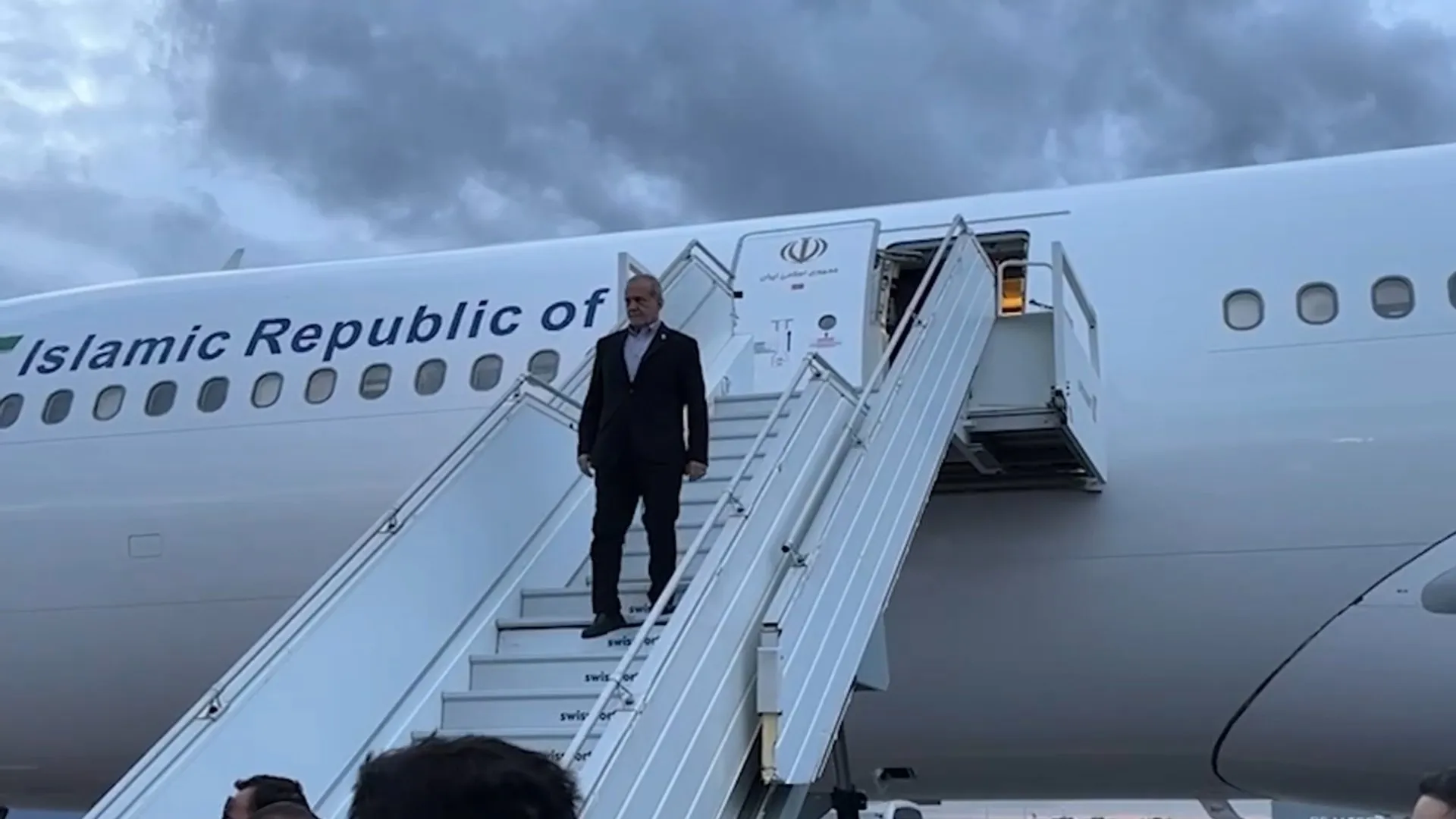
Meanwhile, Iranian President Masoud Pezeshkian arrived in New York early on Wednesday – the first time a leader whose country is at war with the US has set foot on US soil to address the gathering. And Chinese President Xi Jinping will skirt New York to instead meet Trump one-on-one in Washington, DC – his first state visit to the US in just less than a decade. Xi lands on Wednesday evening.
All these separate diplomatic initiatives, analysts tell Al Jazeera, are parts of a push to bring Iran and the US back to the negotiating table. According to Al Jazeera’s correspondent in Tehran, Tohid Asadi, Araghchi’s meeting with Witkoff and Kushner was to convey Tehran’s latest set of conditions to end the war, following the collapse of the June 60-day memorandum of understanding (MoU) finalised in Islamabad, Pakistan.
But analysts say expecting an actual deal to emerge this week from the diplomatic meetings in the US would be unrealistic. Multiple actors and mediators in the conflict are testing possible off-ramps, but core disagreements between Washington and Tehran remain unresolved.
“I am sceptical that a breakthrough deal can emerge this week, but a series of understandings can build confidence for renewed diplomacy,” Sanam Vakil, the director of the Middle East and North Africa Programme at Chatham House, told Al Jazeera.
Too early for a breakthrough
Vakil is hesitant to call the current moment ripe for a diplomatic breakthrough – it is far too early, and there is a history of negotiations failing, she said.
“Both sides have been negotiating for over two years and on two occasions, that ended with military conflict and these negotiations continue amid persistent military threats,” she said.
Iran has long pointed to its previous rounds of diplomatic talks with the US – in 2025 and again this year – as evidence that Washington can veer from negotiations to military action. It has cited the 12-day war last June, and the current conflict, which began with joint US-Israeli strikes on Tehran at a time Washington and Tehran were engaged in Oman-mediated dialogue.
Adel Abdel Ghafar, a senior fellow focusing on the Middle East at the Australian Strategic Policy Institute, said that there appears to be “genuine” movement towards reigniting negotiations – but also “a fair amount of posturing”. He referenced Trump’s praise for Tuesday’s indirect Iran-US talks and his pugnacious UNGA speech the same day.
A breakthrough hinges on whether Iran’s diplomats in New York can actually deliver, he said.
“Araghchi and Pezeshkian can negotiate, but any deal will need the consent of the [Islamic Revolutionary Guard Corps] and the hardliners in charge of the war back home,” Abdel Ghafar told Al Jazeera.
There are specific indicators to watch for another round of US-Iran contact, the analysts said.
“The signs to watch for are another confirmed round of US-Iran talks, agreement on sequencing or reciprocal steps, and language from both sides becoming more specific about implementation rather than simply repeating maximalist demands,” said Vakil.
Abdel Ghafar added that, against the backdrop of UNGA, signs could include Araghchi or Pezeshkian meeting directly with US officials, in addition to supportive statements from more hardline elements of the Iranian administration back home.
The appearance of such indicators could lead to a stronger push for such talks when Trump meets Xi, as well as an easing of fighting between the Iran-backed Houthi group and the Saudi-led coalition in Yemen, which has escalated in recent weeks, the analyst added.
The limits of Gulf and Chinese diplomacy
The analysts agreed that the Gulf states remain crucial in brokering a return to talks because they have channels to both warring sides, as well as a very strong interest in preventing further escalation, having absorbed the cost of the fighting since February. Qatar, Oman and other Gulf states have been involved in mediation efforts throughout the conflict.
“Qatar and Oman, in particular, can help translate broad political messages into workable arrangements on issues such as Hormuz and regional security,” said Vakil.
China, meanwhile, has less capacity or interest to mediate, she argued.
Beijing, however, could use its economic and political leverage with Tehran “to encourage compromise and give Iran greater confidence that any agreement will not leave it completely isolated”, said Vakil.
Abdel Ghafar pointed out that China remains Iran’s main customer for its oil, explaining why Beijing has pushed for a return to the June interim deal and the reopening of the Strait of Hormuz.
“Still, I think neither can impose a settlement – it ultimately comes down to Washington and Tehran,” he said.
Hostilities and Hormuz
The tit-for-tat rhetoric has resulted in continued deadlock in the conflict, with each side unwilling to relinquish to the other’s demands and appear to admit defeat.
On Tuesday, following Trump’s remarks on annihilating Iran, Iran’s military warned that it is ready to respond with “crushing” attacks more severe than earlier in the war.
“The main challenge is finding a formula that both governments can present domestically as a negotiated compromise rather than capitulation,” said Vakil.
The Strait of Hormuz remains a key obstacle.
“It’s Iran’s strongest card and the thing Washington most wants back, with oil prices high and midterms approaching,” said Abdel Ghafar.
“Tehran will be reluctant to give it up without firm guarantees in return.”
Still, he warned that even if Washington and Tehran de-escalate, that does not automatically extend to the Red Sea.
The wider landscape of regional instability and conflict has created new conditions for Yemen’s unresolved war to flare up once again. The Bab al-Mandeb, now under effective Houthi control, has gained greater significance amid Iran’s effective closure of the Strait of Hormuz, a vital artery for global oil and gas supplies.
“Calm in Hormuz won’t necessarily mean calm in Bab al-Mandab,” said Abdel Ghafar.
Syria’s President Ahmed al-Sharaa says Donald Trump should give New Jersey to Israel, instead of the Golan Heights. During an interview on the sidelines of UNGA, he criticised Israel’s policy of attacking and occupying Syria since October 7.
Islamabad, Pakistan – On September 16, a delegation from Powerus, a year-old United States drone company backed by two sons of President Donald Trump, was received by Pakistan’s military chief, Field Marshal Asim Munir, at military headquarters in Rawalpindi.
A day later, the company announced it had received a “limited procurement order” from Pakistan’s Ministry of Defence for unmanned aerial systems. It also said it had signed a separate memorandum of understanding (MoU) with senior Pakistani defence officials.
Recommended Stories
list of 4 itemsend of list
Neither the value of the order nor the systems involved have been disclosed. But for analysts studying Pakistan’s venture in drone technology, even bigger concerns have arisen from information that has since emerged.
Less than three months earlier, the same company had given an Indian defence manufacturer the exclusive right to make and sell its drone interceptor technology in India. And one of the cofounders of Powerus is an Israeli military veteran. Pakistan does not recognise Israel and accuses it of carrying out a genocide in Gaza.
Analysts are questioning why a country that already builds its own drones and buys others from China and Turkiye would turn to a company that was founded only last year – and has links to Israel and sells drones to India too.
“Pakistan technically already makes or is capable of making each of the drones shown by Powerus,” Bilal Khan, founder of the Quwa Group, a Toronto-based defence news and market intelligence platform, told Al Jazeera. “It’s unclear where Powerus fits in the long term [from Pakistan’s perspective].”
What did Pakistan sign?
In its statement on the meeting, Inter-Services Public Relations (ISPR), the Pakistani military’s media wing, said the two sides discussed cooperation in defence procurement, production and capacity building.
The statement did not mention the MoU.
But Powerus told Al Jazeera which institutions were involved. “The MoU was signed with the Pakistan army. The related procurement order was placed by Pakistan’s Ministry of Defence,” a company spokesperson said.
In its own statement, Powerus said the memorandum was not a definitive agreement, created no purchase obligation and would be subject to US laws and government approvals.
“We are proud to support Pakistan’s Ministry of Defence, and the memorandum gives both sides a strategic framework to build upon,” Brett Velicovich, the company’s cofounder, said in the statement.
According to media reports, Velicovich has also said the company is exploring ways to build technology in Pakistan.
The ISPR, the Ministry of Foreign Affairs and the Ministry of Information and Broadcasting did not respond to Al Jazeera’s requests for comment.
Founded in 2025 and based in Florida, Powerus is set to merge with Aureus Greenway Holdings, a Nasdaq-listed company that owns golf courses in the US state, in a deal expected to close in the final quarter of this year.
Powerus’s Guardian Interceptor is a drone interceptor [Handout/Powerus]
Donald Trump Jr and Eric Trump, President Trump’s oldest sons, are investors in Powerus through a vehicle called American Ventures, which is expected to hold a 9.9 percent beneficial stake in the combined company, according to US regulatory filings.
A spokesperson for Donald Trump Jr has told media outlets that he is a passive investor with no role in the company’s operations or contracts and had no prior knowledge of the Pakistan deals.
The White House has said there are no conflicts of interest.
The company makes about 3,000 interceptor drones a month, according to media reports, and last month won a US Air Force contract with a ceiling of up to $90m.
Asked how it addresses conflict of interest questions while pursuing government defence work in the US and abroad, Powerus said the Trump brothers played no part in its operations.
“Trump’s sons are not advisers to Powerus and have no involvement in how the company runs its business or structures its defence relationships, domestically or internationally. They hold no corporate-governance role. Our government relationships are pursued on their own merits,” the company told Al Jazeera.
The India question
Powerus’s first deal in South Asia, however, was not in Pakistan.
It was in India, Pakistan’s archrival, with which Pakistan fought a brief but intense conflict in May last year, one in which drones were used by both sides.
In a June 30 filing to India’s stock exchanges, Paras Defence and Space Technologies said Powerus had granted it an exclusive licence to manufacture and sell its Guardian-1 interceptor technology in India.
Mansoor Ahmed, an honorary lecturer at the Australian National University’s Strategic and Defence Studies Centre, said Washington has long armed rival states.
“The US has previously sold F-16s to Greece and Turkiye and Egypt and Israel and is now selling F-35s to Saudi Arabia, which Israel already operates,” he told Al Jazeera.
A former Pakistani government defence analyst who spoke on condition of anonymity said Pakistani planners had probably known about the Indian deal.
“Pakistan’s defence planners were likely aware of Powerus’s engagement with India,” he told Al Jazeera.
This isn’t the first time that Pakistan and India have ended up buying military equipment from the same company, the defence analyst pointed out. He cited the build-up to the conflict over the Siachen Glacier, where India launched Operation Meghdoot in April 1984 to take control of the heights.
“In 1983, Pakistan ordered high-altitude warfare gear from a London supplier, unaware that the same firm also provided gear to the Indian army, and subsequently, India learnt of it and planned Operation Meghdoot in 1984,” he said.
The analyst said the burden now lies with the company.
“In the present case, the challenge is more for Powerus than Pakistan or India as Powerus’s management must ensure it can manage and meet the requirements of two adversaries without jeopardising either side’s operational security.”
A retired Pakistan air force air marshal who spoke on condition of anonymity because he was not authorised to speak publicly said the arrangement carries risks for Pakistan.
“Two adversary countries procuring from the same source has its pitfalls, especially when one of the adversaries has taken the lead as well as has a larger financial capacity,” he told Al Jazeera.
An Israeli link
The company’s leadership also has links to Israel, a country Pakistan does not recognise.
Powerus’s website described one of its cofounders, Ziv Marom, as a veteran of the Israeli military and said he founded Kaizen Aerospace, now a Powerus subsidiary.
Another senior executive, Justin Gans, the company’s vice president for mergers and acquisitions and a former member of the US Navy SEAL special forces, served as a vice president at Elbit Systems of America, the US arm of the Israeli defence company Elbit Systems, from 2018 to 2019.
A retired three-star army Pakistani general who served in senior roles before retiring in 2019 and requested anonymity because of the sensitivity of the subject said such a background would normally draw attention during vetting.
“So under normal circumstances, a cofounder’s service in the Israeli military would be flagged as a sensitivity marker, even if the company itself is American,” he told Al Jazeera.
“In other words, for a serious acquisition, this background would be scrutinised carefully. For a political MoU, it may not have been a decisive factor.”
Quwa’s Khan, however, said Pakistan has long accepted Israeli components inside US or European systems.
“We can see that, generally, as long as there’s a country in the middle, Pakistan does not have qualms being in close proximity to Israel,” he said. “However, the two sides very, very rarely talk to each other.”
What drone technology does Pakistan already have?
Beyond questions over who else Powerus works with, analysts said the more fundamental issue is what Pakistan actually needs from the company.
Pakistan’s air force has publicly displayed Turkish-made Bayraktar TB2 and Akinci drones, Chinese-made Wing Loong II drones and the domestically developed Shahpar-II.
Shahpar drones, made by the Pakistani state-owned defence company Global Industrial & Defence Solutions, are displayed at the 2024 International Defence Exhibition and Seminar in Karachi, Pakistan [File Akhtar Soomro/Reuters]
China supplied 80 percent of Pakistan’s arms imports from 2021 to 2025, according to the Stockholm International Peace Research Institute.
This month, the Pakistan air force revealed in a video that it had incorporated into its forces China’s HQ-17AE air defence missile system and Turkiye’s Korkut anti-aircraft gun and Sahin counterdrone system, all built to take on drones and other low-flying threats.
Khan said the state-owned Heavy Industries Taxila was also working with private firms to develop interceptor drones.
“So as it stands, Pakistan is following all the right best practices to build its C-UAS posture,” he said, referring to counterdrone systems.
“For Pakistan, the challenge isn’t whether it can get the designs but whether it can produce or induct these in large enough numbers fast enough.”
An official at a private drone manufacturer in Rawalpindi who requested anonymity because he is not authorised to speak to the media said Pakistan’s drone market has grown well beyond state-run firms.
Dozens of private companies and more than half a dozen state-owned enterprises now make drones besides the army’s own production facilities, he said. According to him, Powerus would have to compete with all of them on the quality of its products.
The retired general offered a different reading of why Pakistan might be interested in a tie-up with a US firm.
“The gap is not drone manufacturing. It is electronics, integration and systems-level capability, which is where American firms traditionally dominate,” he said. “How far this particular company can help in this regard is a million-dollar question.”
Powerus’s Guardian interceptors are small, low-cost drones designed to knock down incoming drones. They are a weapon widely used by both sides in the war in Ukraine.
Hammad Waleed, a research associate at the Islamabad-based Strategic Vision Institute, said such systems fill a cost gap that conventional air defences cannot.
“Traditional air defences use costly missiles against incoming cheaper drones,” he told Al Jazeera. “Interceptor drones are way cheaper and easier to operate than traditional air defences.”
Capability or signalling?
The retired Pakistani general, who has experience with defence production, said a supplier of this kind would normally face financial, technical and security checks as well as a review of its track record.
“A company less than a year old, not yet listed and without a delivery record would not usually clear these checks for a strategic defence partnership,” he said.
“Such firms are typically considered too immature unless the MoU is political signalling rather than a procurement decision.”
Khan agreed that the process has been unusual.
“Yes, the way this deal came about is not generally in line with how the procurement heads of the tri-services typically operate,” he said, referring to the three branches of Pakistan’s military.
The Powerus agreements were made as Munir has built close ties with President Trump, who has called him “my favourite field marshal” and praised him on several occasions during the past 15 months.
In September last year, weeks after Pakistan signed a $500m critical minerals agreement with a US company, Munir and Prime Minister Shehbaz Sharif met President Trump at the White House, where the Pakistani leaders presented him with samples of Pakistani minerals.
In January, Pakistan also signed an MoU with an affiliate of World Liberty Financial, the Trump family’s main cryptocurrency business.
From left, US President Donald Trump examines a box of rare earth minerals and gemstones presented by Pakistani Prime Minister Shehbaz Sharif and Field Marshal Asim Munir in September last year at the White House [File: Handout/White House]
Khan said Pakistan’s security establishment needs to ask what it is getting in return for that closeness.
“There was a time when such gains were measured in F-16s and the billions in US financial assistance, yet today, we are seeing more photo ops and supposed pacts that obligate the armed forces, but are they helping the armed forces as a fighting force?”
He also offered what he called a “less cynical take”.
Pakistan has a growing number of drone start-ups that lack the capital to build production facilities, he said, and ties with Powerus could draw US investment into them.
“So there is an argument that building rapport with Powerus and its backers can lead to that capital,” Khan said.
Ahmed said Pakistan is looking beyond a single purchase.
“Pakistan’s primary interest appears to be the acquisition of state-of-the-art drone technologies that also allow for local production and indigenisation,” he said.
What about China and Turkiye?
The retired Pakistani general said bringing in a foreign private company could overlap with Pakistan’s existing Chinese and Turkish partnerships.
“It has the potential of being seen by Turkiye and China as Pakistan hedging politically,” he said.
Khan, however, disagreed.
“There’d be no issue with the Turks as they work with US companies all the time and the drones on offer by Powerus don’t overlap with the ones NASTP is designing with Turkiye,” he said, referring to Pakistan’s National Aerospace Science and Technology Park.
He added that any Powerus designs built cheaply in Pakistan would still rely on Chinese parts.
“With the Chinese, it’d be less of an issue because, ultimately, the only way to make these Powerus designs at a low enough cost for the Pakistani armed forces to induct is to literally import the upstream subassemblies from China.”
Drones are displayed during the International Defence Exhibition and Seminar in Karachi on November 21, 2024 [Akhtar Soomro/Reuters]
Waleed said the deal would not dent Pakistan’s defence ties with Beijing and Ankara.
“Pakistan is prioritising China and Turkiye for the sophisticated and modern combat systems in the drone and counterdrone domain. That relationship is not only unaffected and is going upwards in trajectory,” he said.
For now, Khan said, the real test of the Powerus deal would be what follows it.
“I would not pass judgement on the Powerus deal yet, but we can track whether it’s serious by seeing if the MoD [Ministry of Defence] signs similar deals with other foreign and local vendors in the coming months,” he said.
“Basically, will we see a consistent pattern moving forward, or will this be a one-off?”
The United States and Iran have engaged in hours of indirect talks through mediators on the sidelines of the United Nations General Assembly (UNGA) in New York, but accounts differed over whether officials from the two countries met directly.
US special envoy Steve Witkoff said mediators had “shuttled between” the American and Iranian delegations throughout Tuesday.
Recommended Stories
list of 4 itemsend of list
“Today, on the sidelines of the United Nations General Assembly, we engaged in lengthy talks with the Iranian delegation through the mediators, who shuttled between the two sides throughout the day,” Witkoff said in a post on X.
“They successfully completed a round of discussions that we hope will prove constructive and promising. The mediators will continue their work.”
US President Donald Trump gave a more direct account, saying Witkoff and Jared Kushner had held a three-hour meeting with Iranian officials.
“They had a very good meeting, a very productive meeting,” Trump told reporters at the UN, adding that he believed there was “a lot of momentum” towards an agreement. Trump later said talks were continuing and that he believed a settlement would eventually be reached.
Al Jazeera’s Kimberly Halkett, reporting from Washington, said Trump’s initial comments had created confusion over who had participated. She said the White House later clarified that Trump had not attended and that Witkoff and Kushner represented the US side.
Al Jazeera’s Tohid Asadi, reporting from Tehran, said state media had confirmed a meeting between Iranian Foreign Minister Abbas Araghchi and Witkoff after weeks without direct contact.
“This latest meeting was held at the request and insistence of the American side, and was aimed at conveying Iran’s messages and conditions, particularly around reopening the Strait of Hormuz,” Asadi reported.
Iranian state media said those conditions included lifting the US naval blockade, releasing frozen Iranian assets and ending the war on what Tehran describes as the “resistance” fronts.
Asadi also reported that an Iranian security source told Al Jazeera there could be room for further diplomatic engagement if Washington met Iran’s conditions and commitments.
The contacts came after a senior Iranian official told the Reuters news agency that Tehran’s delegation in New York had full authority to pursue diplomacy and described the UN gathering as a “golden opportunity” for Washington to return to negotiations.
The official said Iran had submitted its latest proposal to Washington through mediators on September 16 and that details of a possible agreement to end hostilities could be discussed in New York.
The official also said Iran could reopen Hormuz within seven days if the US eased military pressure and lifted its blockade of Iranian ports.
Regional powers push for de-escalation
The indirect talks have been accompanied by a broader diplomatic effort involving the Gulf and other regional states.
Qatar said it was working with Pakistan to reduce tensions between Washington and Tehran, safeguard freedom of navigation through the Strait of Hormuz and promote regional stability.
Qatar’s Prime Minister and Foreign Minister Sheikh Mohammed bin Abdulrahman bin Jassim Al Thani also met Araghchi in New York on Tuesday.
Qatar’s Ministry of Foreign Affairs said they discussed developments in the region, efforts to de-escalate tensions and ways of creating conditions for dialogue.
Oman has also been involved in maritime diplomacy over the waterway, having previously discussed maritime arrangements with Tehran aimed at facilitating navigation through the strait.
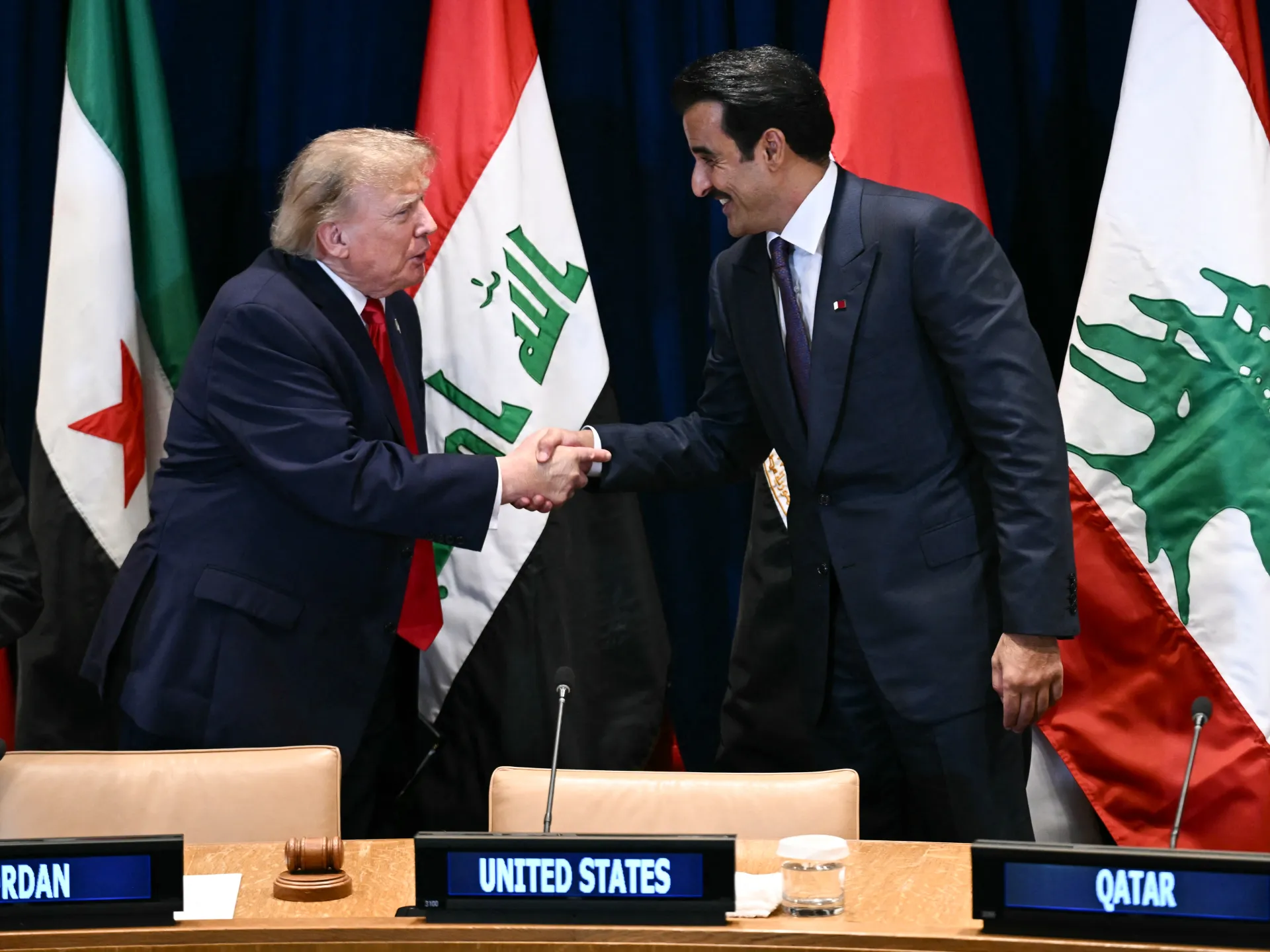
Trump also met leaders and senior officials from Gulf Cooperation Council states, Turkiye, Jordan, Syria and Iraq on Tuesday to discuss Iran and regional security.
Reuters reported that a Qatari proposal for a common security framework involving Iran and Gulf states was among the issues under consideration, with one regional source saying Tehran was reviewing it.
Qatar has not made the proposal public.
US President Donald Trump attends a multilateral meeting on the sidelines of the 81st UN General Assembly in New York with leaders and senior officials from Arab countries and Turkiye on September 22, 2026 [Brendan Smialowski/AFP]
Talks follow Trump’s warning
The indirect talks came hours after Trump used his UNGA address to combine the possibility of an agreement with another warning of military escalation.
Trump said he faced a “big decision” between reaching a deal that would allow Iran to rebuild and moving to “annihilate the Islamic Republic”. He also said Washington had previously offered Tehran “full economic cooperation” in return for ending its nuclear programme and what the US describes as Iranian support for terrorism.
Iran’s General Staff of the Armed Forces and Khatam al-Anbiya Central Headquarters responded in a statement carried by Iranian media, describing Trump’s threats as evidence of “strategic weakness” and saying Iran was ready to deliver “more severe, crushing, and unpredictable blows” in response to further attacks.
US officials have repeatedly suggested that negotiations were making progress following the collapse of the June memorandum of understanding. In early August, Trump said the sides had reached parameters for a possible agreement and later described talks over Hormuz as “moving along nicely”, although significant differences remained. Earlier this month, he again said he hoped the war was “towards the end”.
Tehran continues to condition the reopening of the Strait of Hormuz on the US easing military pressure and lifting its blockade of Iranian ports, while Witkoff said mediators would continue their efforts following Tuesday’s mediated exchanges.
Canada pledges 100 million Canadian dollars ($71m) in aid for Palestinians as the UK and France call for action against Israeli settlement expansion in the occupied West Bank.
Published On 23 Sep 202623 Sep 2026
Canadian Prime Minister Mark Carney has announced that Canada is pledging 100 million Canadian dollars ($71m) in international assistance for Palestinians in an effort to preserve “the possibility of a two-state solution”.
Speaking on the sidelines of the United Nations General Assembly (UNGA), Carney outlined that 80 percent of the funding will go towards direct humanitarian aid. The remaining 20 percent will be allocated to “support peace and security”, including Canada’s multiyear initiative to train Palestinian police in the occupied West Bank.
Recommended Stories
list of 3 itemsend of list
Carney prefaced the pledge by noting that Palestinians in Gaza continue to endure “immense human suffering”, while Israelis confront “existential threats from Hamas and from Iran and its proxies”.
The prime minister was also critical of Israel’s E1 settlement project, with the “intention to bring forward trade restrictions targeting goods produced in those illegal Israeli settlements”.
Canada is one of the 12 states that announced restrictions on trade in goods with settlements in the occupied territory.
Since the beginning of Israel’s genocidal war on Gaza, Ottawa has pledged more than 600 million Canadian dollars ($426m) in aid for Palestinian civilians.
‘Shame on all of us’
Carney was not the only Western leader to speak on Palestine. French President Emmanuel Macron also slammed world leaders for restrictions on aid in a UNGA speech on Tuesday.
“There are those who claim that peace has been achieved, but this has not opened the way for humanitarian aid deliveries. This sight is shameful. Shame on all of us,” he said.
“But what is our credibility worth if we remain inactive in the face of Gaza?” he added.
British Prime Minister Andy Burnham with French President Emmanuel Macron in London, UK [File: Leon Neal/Reuters]
British Prime Minister Andy Burnham said failure to deliver a two-state solution will “corrode trust” in politicians who have talked about the issue but not taken action.
Burnham told delegates from dozens of countries that the UK has also banned trade with illegal Israeli settlements in the West Bank because the E1 settlement expansion plan is “a deliberate attempt to block a two-state solution”.
“We all live in an era of low trust in politics. Many people in this room, many politicians around the world, have spoken for decades about a two-state solution. But if we fail to back those words with deeds, we will further corrode trust in the political, diplomatic and international process,” Burnham added.
Iranian President Masoud Pezeshkian has arrived in New York as the US-Iran war continues. He’s due to address the UN General Assembly, where Iran is expected to press its case over the conflict and seek diplomacy aimed at easing tensions.
Iran’s aviation officials negotiate with Oman and Iraq as Secretary Bessent targets carriers seven months into the conflict.
Published On 22 Sep 202622 Sep 2026
Flights from Iran to Baghdad and Muscat will be cancelled starting at midnight ahead of new United States sanctions taking effect Wednesday, Tasnim News Agency reported.
A spokesman for Iran’s Civil Aviation Organization told the news agency on Tuesday that the agency is “negotiating so that flights whose destination is Baghdad can be redirected to [Iraq’s] Najaf Airport”.
Recommended Stories
list of 3 itemsend of list
Iran’s ISNA news agency reported that negotiations with Oman were likewise ongoing, adding that all remaining international flights, including those to Istanbul, will operate as scheduled.
US Treasury Secretary Scott Bessent said on Monday that all Iranian airlines would be shut down on September 23 through the threat of secondary sanctions on aviation service providers, seven months into the war between the US and Iran.
Bessent told CNBC that when Iranian carriers land at an airport, “you cannot provide them with fuel, you cannot provide them with landing services, you cannot sell them tickets, or you will be knocked out of the dollar system”.
The move marks the latest step in Washington’s expanding sanctions campaign against Tehran. Aviation analysts told Al Jazeera that although the US lacks authority to close foreign airspace, targeting local refuelling and ground-handling providers achieves a similar outcome by cutting off essential operational support.
Earlier this month, the US issued stricter measures administered by the Treasury Department’s Office of Foreign Assets Control (OFAC), placing restrictions on trade, energy and financial institutions.
The administration of President Donald Trump also expanded secondary sanctions in late August, warning that foreign firms doing business with Iran across shipping, technology, gold and digital assets face penalties of their own.
Tehran, however, signalled on Saturday that it remains open to talks mediated by Qatar to reach a long-term resolution, while maintaining a combative stance towards Washington.
“It is in Washington’s interest to accept these conditions,” Mohsen Rezaei, Iran’s security chief, told Al Jazeera in an interview last week. “Trump’s threats will not achieve any results. We are prepared for a decisive war.”
Washington, DC – Palestinian Americans have held a day of advocacy at the United States Capitol under the spectre of a new $2.8bn arms transfer to Israel reportedly approved by the administration of US President Donald Trump.
The Americans for Justice in Palestine Action (AJP Action) group, which organised Tuesday’s event, said more than 300 constituents from across the country met with the offices of more than 100 US lawmakers. They advocated on behalf of a slate of legislative initiatives related to Israel’s genocidal war in Gaza, surging Israeli settler violence in the occupied West Bank, and efforts to use immigration law to stifle Palestinian advocacy in the US.
Recommended Stories
list of 3 itemsend of list
Jenna Escheik, a 19-year-old meeting with lawmakers and staffers from Virginia, including Democratic Senator Tim Kaine and Republican Representative Rob Wittman, said she was planning to speak with “some very challenging and interesting people”.
“I think the main point that we’re trying to get across to every single office is that we’re all proud to be American, and we all have our taxpayer dollars that we just don’t want to see going to wars,” said Eschiek, who is originally from outside of Ramallah in the West Bank.
Yaseen Shaikh, a 22-year-old who travelled with a delegation from Cleveland, Ohio, said he will be meeting with the offices of Republican Senator Jon Husted, who faces a competitive midterm race against former Democratic Senator Sherrod Brown, as well as the state’s other Republican Senator, Bernie Moreno.
Both Republican senators have consistently voted against legislative efforts to limit arms sales to Israel.
“As I stand among my peers here, among people who I stand on their shoulders, I can only feel hopeful and optimistic that we will make a difference and that change will come,” Shaikh told Al Jazeera.
“We just have to be vehicles for that,” he said.
Palestinian rights ‘catching up’ with lawmakers
Successive presidential administrations, as well as Congress, have for decades resisted calls to condition US military aid to Israel, including throughout Israel’s latest war in Gaza, which will reach its three-year mark early next month.
To date, nearly 74,000 Palestinians have been killed in Gaza since October 7, 2023, with nearly 1,400 killed since a “ceasefire” agreement went into effect in October 2025.
Last week, US media widely reported the Trump administration approved a US taxpayer-funded $2.8bn military package to Israel, which included 907kg (2,000-pound) MK-84 bombs known to have already caused widespread civilian devastation in the Palestinian enclave.
The package reportedly included 20,000 of those munitions, as well as 20,000 BLU-117s, a close variant.
Several Democrats have vowed to block the transfer, with the ranking member of the House Foreign Affairs Committee, Gregory Meeks, using his leverage last week to at least slow congressional clearance.
Osama Abu Irshaid, AJP Action’s executive director, said the new weapons package runs counter to public opinion polls, which have regularly found majority support for conditioning at least some weapons to Israel, as well as surging support for Palestinian rights.
Abu Irshaid said the polls underscore a new political reality for lawmakers.
“I think now we are functioning within this context, where what happens in Palestine, the genocide that took place and continues to take place, what the terrorist settlers are doing in the West Bank, what the US and Israel are doing in the Middle East is catching up with us here,” Irshaid said, “and we’re paying a price”.
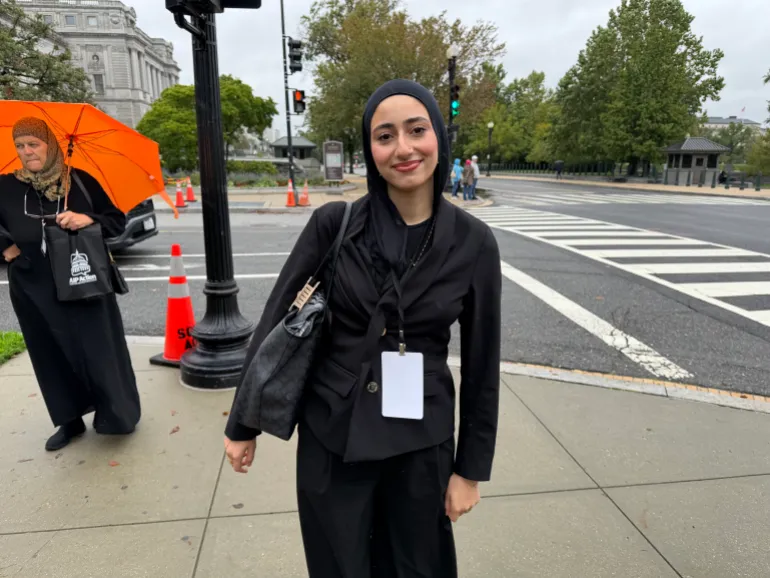
Jenna Escheik was among the Palestinian Americans meeting with US lawmakers in Washington, DC [Joseph Stepansky/Al Jazeera]
While entrenched support for arming Israel has persisted among some segments of the Democratic Party, advocates have hailed what they see as a historic shift in recent months.
In July of last year, 26 Democrats in the Senate voted to block some arms transfers to Israel, the first time in history a majority of Democratic lawmakers in the chamber did so. In April, similar resolutions gained a record 40 votes in the Senate, all Democrats, but ultimately failed to pass in the 100-member chamber.
The so-called Block the Bombs Act in the House, which calls for a partial arms embargo against Israel, reached 81 co-sponsors as of August.
Twenty-two Democratic senators also introduced a resolution last week to force the US Department of State to conduct an investigation into the violence committed by Israeli forces and settlers in the West Bank, in which at least nine US citizens have been killed in recent years.
Abu Irshaid was optimistic that headway could also be made among Republicans, who have been reckoning with an internal divide over US support for Israel, with exceedingly few members of the party currently willing to vote to limit aid.
A December poll by the IMEU Policy Project found a majority of Republicans under 45 said they would prefer to support a presidential candidate in 2028 who “supports reducing taxpayer-funded weapons to Israel”.
“I think what we’re seeing now is that the dam within the Republican Party is cracking,” Abu Irshaid said.
“But the question is, ‘What is after Donald Trump when Donald Trump no longer owns the Republican Party, owns the MAGA movement?’ I think that’s when you will see more cracks taking place.”
‘The same system’
Advocates on Tuesday also focused on what they called the Trump administration’s practice of using immigration law to stifle pro-Palestine advocacy.
Among their policy priorities, those meeting with lawmakers sought to reform language in the Immigration and Nationality Act of 1952, which the Trump administration has cited in efforts to deport individuals whose presence in the US the administration deems to have “adverse foreign policy consequences”.
Among those speaking at the US Capitol on Tuesday was Salah Sarsour, the president of the Islamic Society of Milwaukee, who was detained by ICE in April and released in June. His legal team has charged that the three-decade US resident was targeted based on a coerced confession when Sarsour was detained by Israeli forces as a young man.
Sarsour, who continues to face deportation proceedings, said the ICE detention reminded him of being held in Israeli detention.
“Those criminals that [detained me], they still exist,” he said. “The same criminals that destroy Gaza, they killed tens of [thousands] of children and women, and men and family members.”
Leqaa Kordia, who was among those targeted by immigration enforcement agents following a wave of pro-Palestine protests that swept US campuses in 2024, also recounted the “dehumanisation” of her 368 days in ICE detention.
“And then it hit me that…the same system that threw me in an ICE jail is the same system that funds and arms the military prisons in Israel,” said Kordia, who, like Sarsour, still faces deportation proceedings.
“The same dehumanisation logic that allowed a guard to humiliate me allows the Israeli soldier to kidnap Palestinians and throw them into the shadows,” she told those gathered.
“The same power that keeps my case in limbo is the same power that sends billions of US tax dollars in bombs and weapons to fuel the Palestinian genocide.”
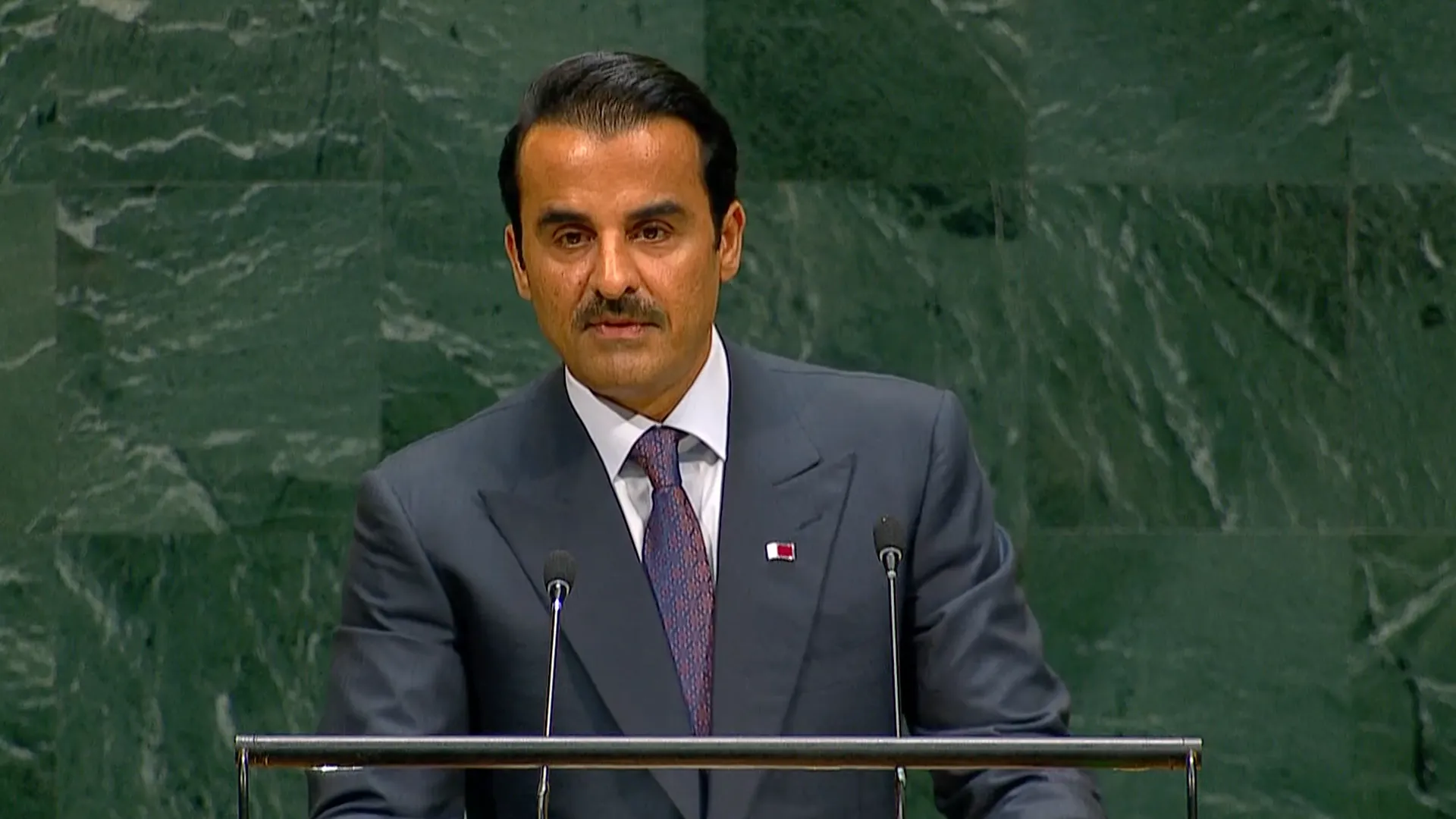
Qatari Emir Sheikh Tamim bin Hamad Al Thani has denounced Israeli aggression in neighbouring countries, saying Israel openly declares it will not abide by its agreements in Lebanon.
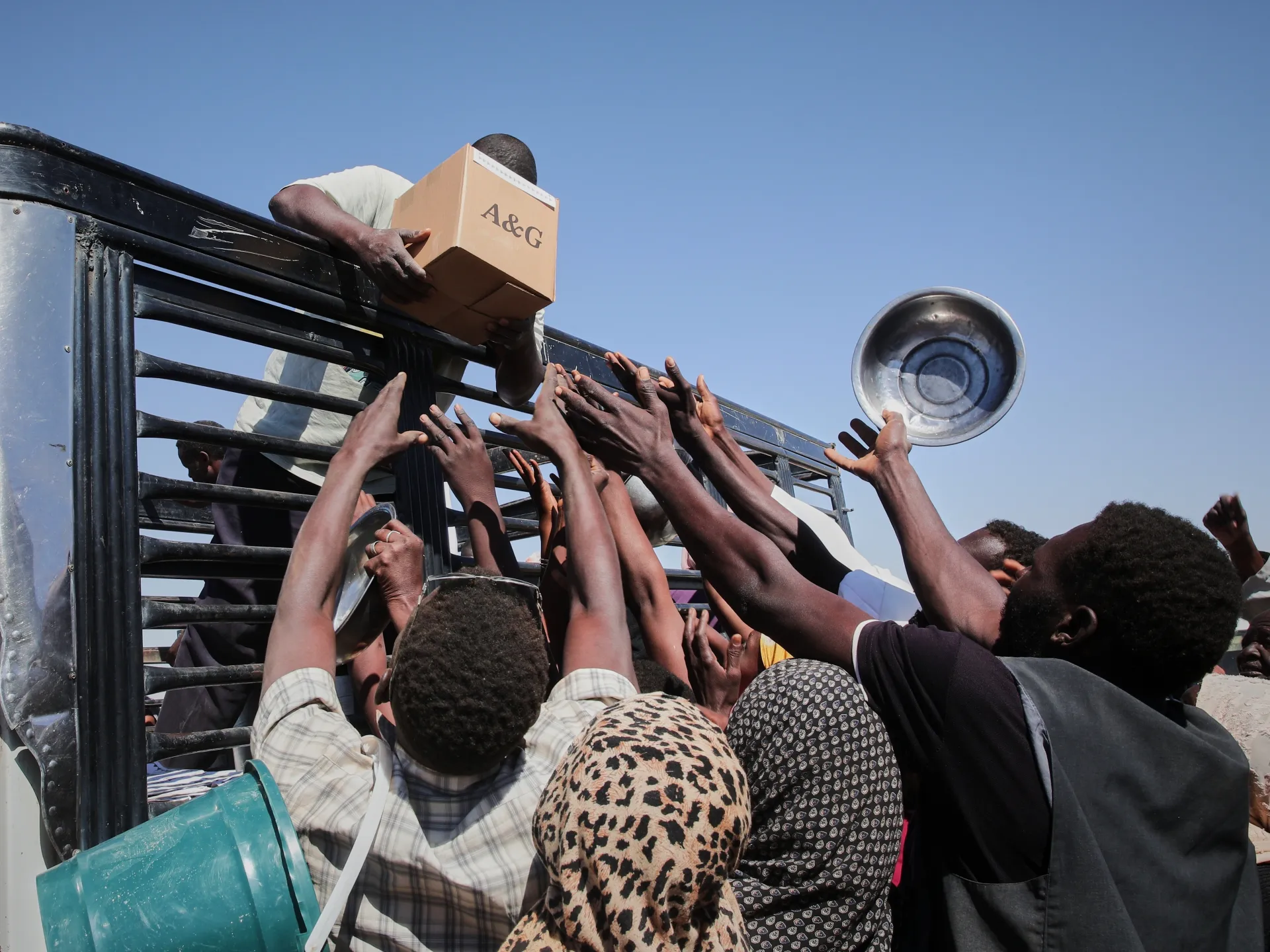
Sudan’s collective memory has long carried stories of famine-induced tragedies. Now, as war pushes the country deeper into a catastrophic food crisis, historians and humanitarian activists fear that some of those horrors are being repeated.
The ongoing war between the Sudanese army and the paramilitary Rapid Support Forces, which erupted in April 2023, has plunged the country into one of its worst modern food crises, with conditions deteriorating sharply since 2024.
Recommended Stories
list of 3 itemsend of list
Sudan has endured severe famines before, often triggered or made worse by drought and other environmental shocks. However, the current hunger crisis, which has triggered famines in Sudan in 2024 and 2025, has been brought on by a man-made factor: war.
Past starvation
One of the earliest recorded major food crises in what is now Sudan occurred in 1684, during the Funj Sultanate. The crisis, which lasted several years, brought severe grain shortages across central Sudan. Historical accounts describe people driven to desperation, and in some cases forced to eat dog meat. The hunger triggered mass displacement, as well as a deadly smallpox outbreak.
Similar climate-driven crises were recorded in 1750 and again between 1835 and 1838 during a period of Ottoman-Egyptian rule, exacerbated by severe drought and low water levels in the River Nile.
The famine most deeply embedded in Sudanese popular memory occurred between 1888 and 1889, during the rule of Khalifa Abdullahi al-Taashi.
Drought, locust infestations and conflict combined to cause widespread hunger and death. Some historical estimates put the death toll at more than one million people, although precise figures from the period are difficult to establish. The crisis was reported to have been so severe that some families shut themselves inside their homes to die rather than going out to beg for food.
Sudan experienced more periods of food shortages during the 20th century. Droughts and poor harvests during the colonial period of the first half of the century forced the authorities at times to import grain from abroad.
Then, in 1984, during the rule of President Jaafar Nimeiri, a devastating drought hit western Sudan, including Darfur and Kordofan, where there were widespread crop and livestock losses, displacing hundreds of thousands of people from rural areas to the capital, Khartoum.
Man-made catastrophe
Unlike many of those historical crises, the current famine is distinctly man-made.
War has disrupted agricultural production and trade, forced farmers to leave their land, and made it difficult to move food and humanitarian aid across the country.
Abdullah al-Tijani, a social historian and humanitarian activist, noted the unprecedented scale of the current disaster.
“Most previous famines were often confined to specific regions, as happened in 1984, or areas in southern Sudan before its secession in [2011], while the capital and major cities continued to have the necessities of life and services,” al-Tijani told Al Jazeera.
This time, he said, hunger and the collapse of basic services have spread across the entire country.
“A comprehensive food crisis has struck the heart of major urban and agricultural centres in the states of Khartoum, Gezira, Sennar, Darfur, and Kordofan, causing millions of citizens to be displaced inside and outside the country,” al-Tijani added.
He pointed to what he described as the “systematic destruction of infrastructure, disruption of large agricultural projects, and targeting of markets, bakeries, and crops, along with disrupting the banking system and communication networks, which isolated entire regions”.
Al-Tijani also cited the “restrictions on humanitarian access and delays in granting transit permits for relief workers”. He accused the warring parties of using control over food supplies as a tool of war, while warning that international funding has fallen short of the size of the crisis.
Lost agricultural potential
The scale of the crisis is stark because of Sudan’s agricultural potential. The country has immense resources, including roughly 200 million acres (81 million hectares) of arable land, abundant water from the Nile, and extensive livestock resources, but Sudan’s potential as a global breadbasket remains unfulfilled.
Mohammed Abdul Rahman, an economic researcher, explained that the current food security crisis reflects a clear development gap, and a longstanding weakness in Sudan’s agricultural sector compounded by war.
“Wars and armed conflicts are among the most influential factors on food production,” Abdul Rahman said, “along with the displacement of farmers from their lands, the absence of political stability and agricultural policies, weak funding and government guarantees, and reliance on traditional farming methods.”
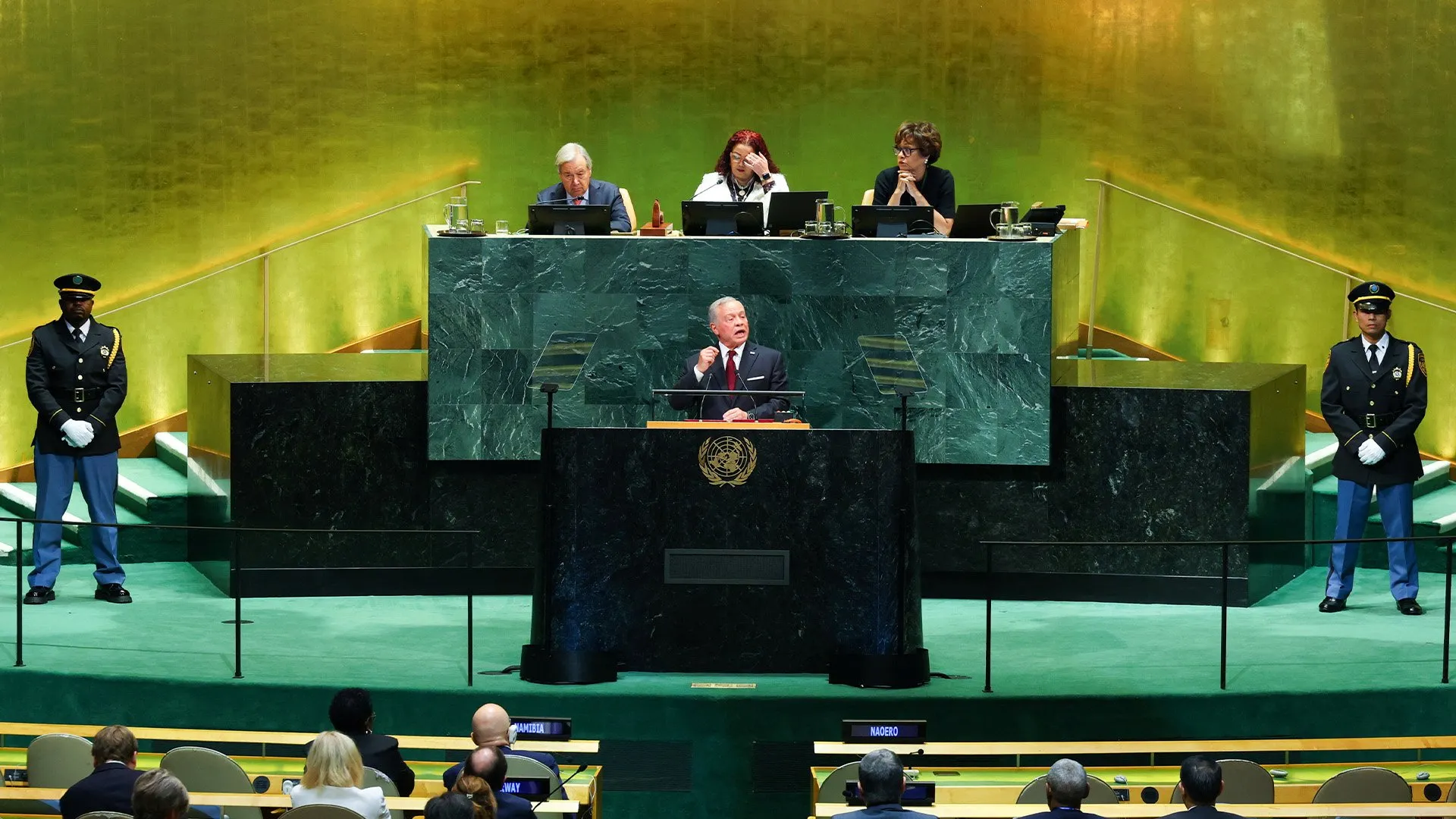
Jordan’s King Abdullah II decried Israeli settler incursions in the occupied West Bank as a strategy of ‘forced displacement’ that should be considered a war crime.
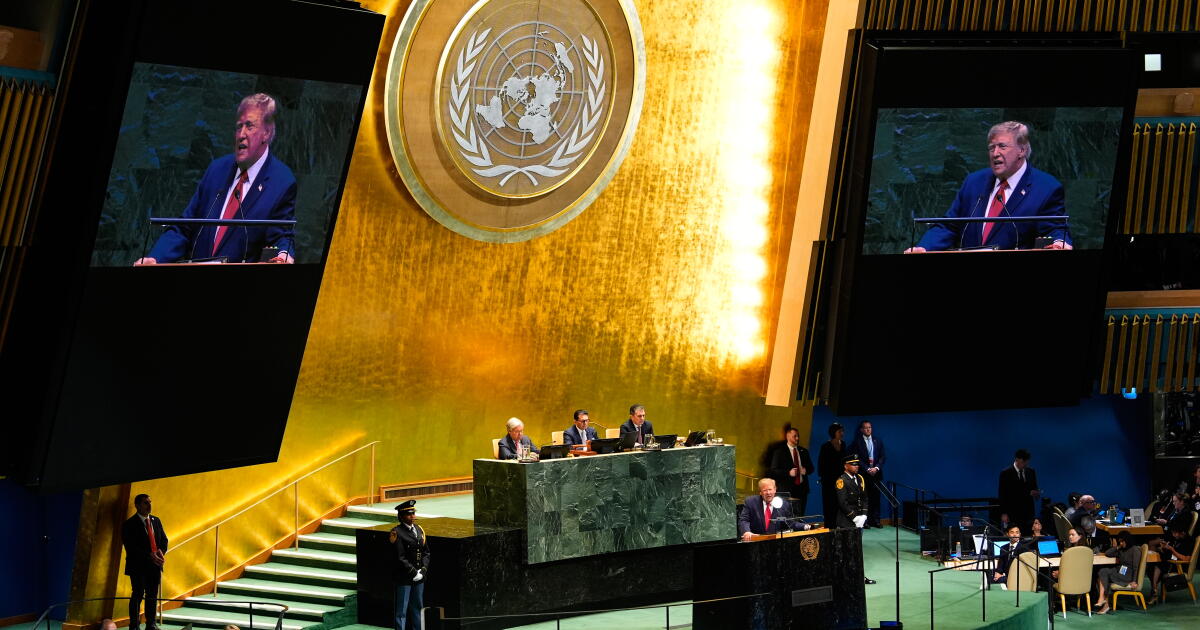
Speaking at the UN General Assembly, US President Donald Trump claimed he helped end the war in Gaza, bring home all remaining hostages, and settle eight wars since taking office. He said trade, tariffs and his relationships with world leaders were key to securing the settlements.
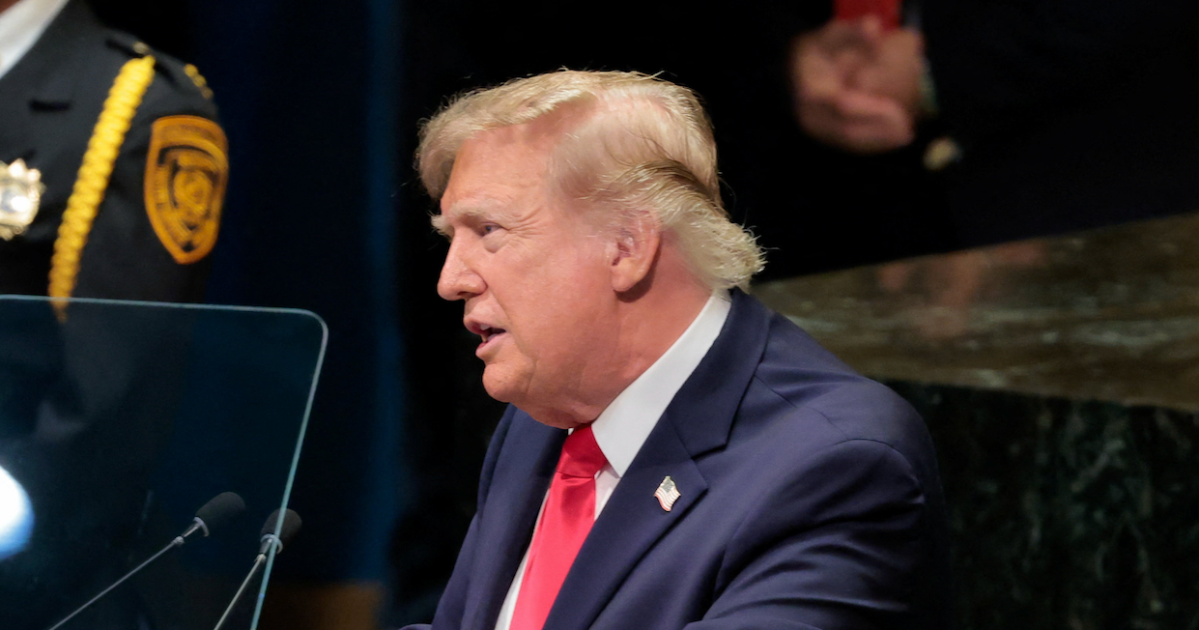
NEW YORK — President Trump threatened to escalate the war with Iran by “annihilating” the Islamic Republic if it fails to negotiate a deal over its nuclear program, delivering a defensive speech justifying the mission at the United Nations on Tuesday.
His remarks come more than six months into a war that has grown increasingly unpopular at home, with fewer than a third of Americans approving of the president’s handling of the conflict, according to recent polls.
“I have a big decision to make,” he told world leaders gathered at the U.N. General Assembly in New York, with Iranian diplomats in attendance.
“Will a deal be made with Iran that lets them rebuild and create a far greater country than it ever was before — maybe one of the greatest in the Middle East or even the world? Or do I annihilate the Islamic Republic, and do it quickly, never giving them a chance to kill and destroy again?
“Do I drive them into hell,” he continued, “with no chance of survival and no hope of future greatness?”
The war has carried steep political costs for the president and his party ahead of the U.S. midterm elections in November, increasing inflation and energy prices due to disruptions in commercial shipping traffic through key waterways in the Middle East.
Defense officials say the conflict has also placed a huge burden on U.S. munitions stockpiles, as Iran continues firing ballistic missiles and drones at American assets and bases throughout the region.
But Trump denied that the war has depleted U.S. stocks. “That’s not true,” he said.
“I believe we’ll make a deal right after the election,” Trump said. “We must be equally united in maintaining pressure.”
The rise in global gas prices has sparked protests around the world. But Trump’s vow to ensure Tehran never acquires a nuclear weapon — an issue that for decades united the international community — generated applause throughout the chamber.
Launching Operation Epic Fury in February, Trump projected the campaign would last roughly six weeks, with the stated objective of disabling Iran’s ballistic missile program, its navy and its nuclear infrastructure. He also vowed a day would soon come when the Iranian people could rise up against their government and reclaim their country.
More than six months later, the Islamic Republic stands. Iran’s ballistic missiles continue to test U.S. air defenses across the Middle East, shipping through the Strait of Hormuz remains depressed, and talks over the future of Iran’s nuclear program have collapsed.
Explaining his decision to start the war, Trump said that he decided not to let the problem of Iran’s nuclear work “fester,” and warned that its ballistic missile program was being designed as a shield to protect its nuclear program from foreign attack.
“Iran’s goal was to complete their mad dash to a nuclear bomb from behind this conventional nuclear shield,” Trump said. “They were the bully of the Middle East, but they’re the bully no more.”
The United States has repeatedly offered a deal with Iran that would open up economic cooperation between the two nations in exchange for an end to their nuclear work, he said.
“They absolutely refused,” he added. “That was a big mistake.”
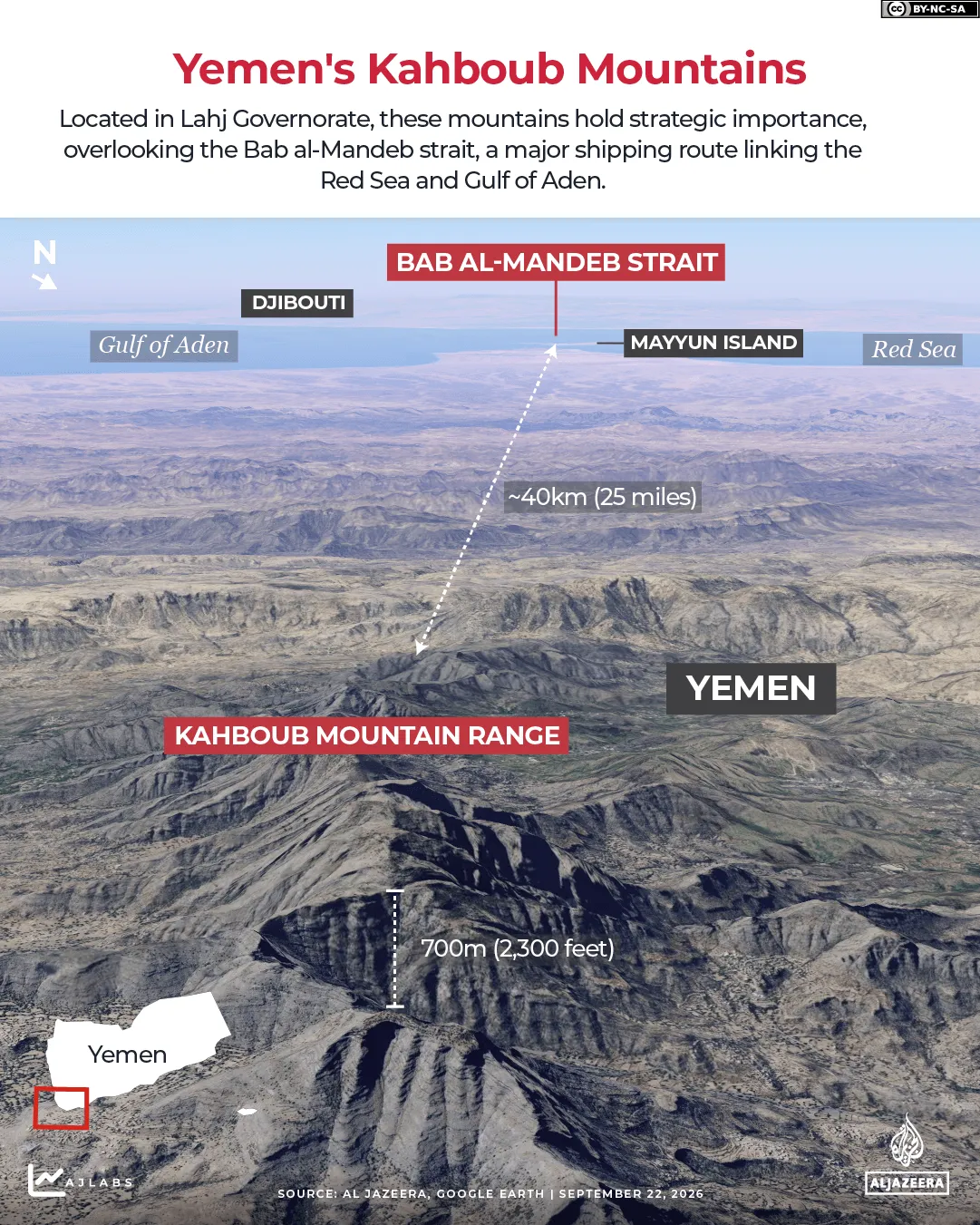
The Houthis are attempting to push into the Kahboub Mountains after seizing much of Yemen’s Red Sea coast in a lightning offensive this month – an advance that experts say could dramatically shift the balance of power in the country’s war if successful.
The renewed fighting in recent months with forces aligned with Yemen’s Saudi-backed, internationally recognised government has brought an end to the relative calm that had largely held since 2022. In recent days, the conflict has moved into the rugged highlands overlooking the approaches to Bab al-Mandeb, one of the world’s most important shipping routes.
Recommended Stories
list of 3 itemsend of list
The strait connects the Indian Ocean to the Red Sea and the Suez Canal, and its importance is only growing as shipping through the Strait of Hormuz remains disrupted by the Houthis’ main ally: Iran.
Experts said taking the high ground would help the Houthis defend the newly captured coastline and make it far harder for government forces to push them back. While the mountains may not necessarily be used as a launchpad for attacks on ships, controlling them would provide defensive depth and cover for Houthi positions closer to the coast, making missile and drone operations in the Red Sea easier to sustain and harder to disrupt.
The Houthis have said they do not intend to target United States shipping and attacks would be limited to vessels linked to Saudi Arabia. But the group has repeatedly attacked ships in the Red Sea in previous years, including vessels with no clear connection to its stated targets.
The Houthi advance has taken on added urgency after The New York Times reported that US President Donald Trump came close to ordering air attacks against the Houthis on Sunday, only to call them off at the last minute. Britain, meanwhile, said it will support Saudi Arabia with defensive refuelling.
Why is Kahboub strategically important?
Kahboub, a mountainous region spanning parts of the Lahj and Taiz governorates in southern Yemen, derives much of its strategic importance from its proximity to Bab al-Mandeb. Some of its heights lie about 40km (25 miles) from the waterway, providing commanding views across a stretch of the Red Sea, through which a significant share of global maritime trade and millions of barrels of oil pass each day.
While that vantage point has considerable military value, experts said the mountains are unlikely to serve directly as a launchpad for attacks in the Red Sea. Their more immediate importance for the Houthis lies in securing the territory the group has already captured.
“The mountains are the natural wall that protects the Houthis’ rear on the coast. Controlling them would cut the coast off from the government-held south and place direct pressure on Lahj and, in the longer term, Aden,” Faozi Al-Goidi, a visiting fellow at the Middle East Council on Global Affairs, told Al Jazeera.
Securing their rear would help the Houthis prevent government forces from attacking their coastal positions from behind or severing the routes connecting their newly captured territory. Until the high ground is secured, Houthi forces stationed along the Red Sea remain vulnerable to attacks from government-held areas to the south and east.
Capturing the elevated positions, therefore, would make Kahboub less important as a potential launchpad for maritime attacks than as a defensive shield for the Houthis’ military gains along the coast.
Ewa K Strzelecka, a visiting senior fellow at the London School of Economics, told Al Jazeera that controlling the coastline, Mayyun Island and the neighbouring highlands would give the Houthis “strategic resilience”.
(Al Jazeera)
“Holding the coastline, Mayyun and the adjacent highlands together would give the Houthis a much deeper and more defensible position around one of the world’s principal maritime chokepoints,” she said.
Those positions would allow the Houthis to move fighters, weapons and supplies along the coast with less risk of their routes being severed from behind.
“From the high ground, the Houthis could monitor movements along the coast, around Mayyun Island and towards the chokepoint while protecting missile, drone and potentially unmanned-boat infrastructure positioned farther inland,” Andreas Krieg, a senior lecturer at the School of Security Studies at King’s College London, told Al Jazeera.
The battle is already proving slower than the Houthis’ rapid advance across the coastal plains. Footage circulated on X by the Taiz Military Axis Command’s media centre appears to show intense fighting between forces aligned with the Yemeni government, local fighters and the Houthis on mountain fronts. The footage could not be independently verified by Al Jazeera.
“This is not an easy battle,” said Mohammed al-Basha, an analyst and a former spokesperson for Yemen’s embassy in Washington. “The fighting is taking place across some of Yemen’s most unforgiving terrain where control of a single hilltop or mountain peak can come at a heavy cost.”
Could the Houthis isolate Taiz by controlling Kahboub?
Control of Kahboub could also place greater pressure on Taiz, a symbolically and strategically important city, as the Taiz governorate forms a bridge between the Houthi-held north and the government-held south and the Red Sea coast. Whoever controls it gains the upper hand in the movement of weapons and supplies between the interior and the southern port city of Aden. Losing it, therefore, could deal a serious blow to the government.
Murad Al-Arefi, an editor at the Sana’a Center, told Al Jazeera that taking Kahboub would “increase pressure on the southern and western approaches to Taiz” although he cautioned that it should not yet be seen as evidence of a broader attempt to encircle the city.
The immediate threat to the Taiz-Aden connection is less direct because Kahboub does not itself sit across the route. “What matters is whether the Houthis can subsequently push farther east through Al-Wazi’iyah and towards the Al-Turbah-Lahj axis, which would place much greater pressure on the southern approaches to Taiz and potentially weaken its connection with Aden,” Strzelecka said.
A further advance, therefore, could leave government forces defending several mountain fronts simultaneously while relying on fewer secure routes to move troops, weapons and supplies, leaving Taiz increasingly exposed. One of Yemen’s largest population centres, Taiz became an important centre of resistance to the Houthis after they seized Sanaa in 2014, and was besieged by the rebel group for years. A major Houthi breakthrough there, therefore, would carry symbolic significance far beyond the territory captured.
What could it mean for Red Sea shipping?
Officially, the Houthis have said their current restrictions in Bab al-Mandeb would apply only to Saudi-linked shipping.
But during its previous Red Sea campaign, the group struck or endangered ships with no clear connection to Israel – their purported target during Israel’s genocidal war on Gaza – raising questions about how narrowly any new restrictions would be applied. Seizing the Kahboub Mountains would further strengthen the Houthis’ position by helping them secure the coastline overlooking Bab al-Mandeb and making it harder for their opponents to push them back.
Simon Mabon, a professor of international relations at Lancaster University, told Al Jazeera that the offensive showed the Houthis using their momentum to capture more territory, weaken their opponents and “dominate Yemen further”.
“This is the Houthis trying to seize more ground and diminish the capacity of their enemies while increasing their strategic ability to close Bab al-Mandeb,” Mabon said.
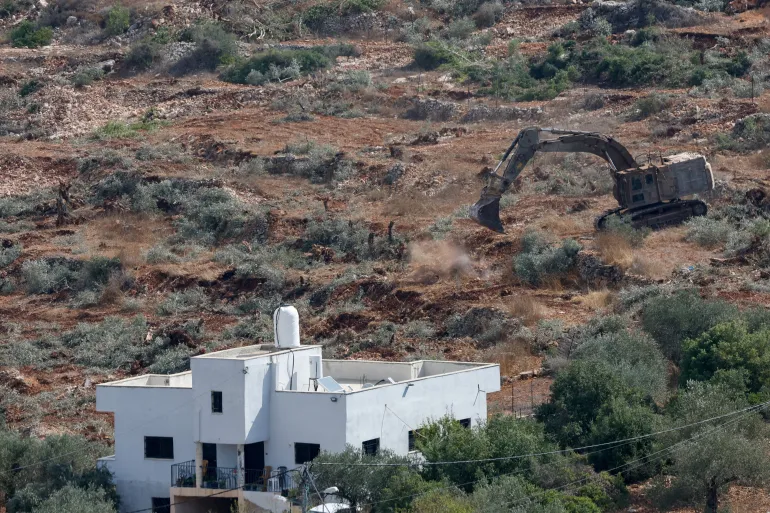
![Israeli military machinery uproots olive trees near the Palestinian village of Deir Nizam near Ramallah, in the occupied West Bank, September 23, 2026 [Mohammed Torokman/Reuters]](https://i0.wp.com/occasionaldigest.com/wp-content/uploads/2026/09/2026-09-23T080030Z_1529122039_RC2VONAGXX8I_RTRMADP_3_ISRAEL-PALESTINIANS-WEST-BANK-OLIVE-TREES-17902.webp?w=640&ssl=1)


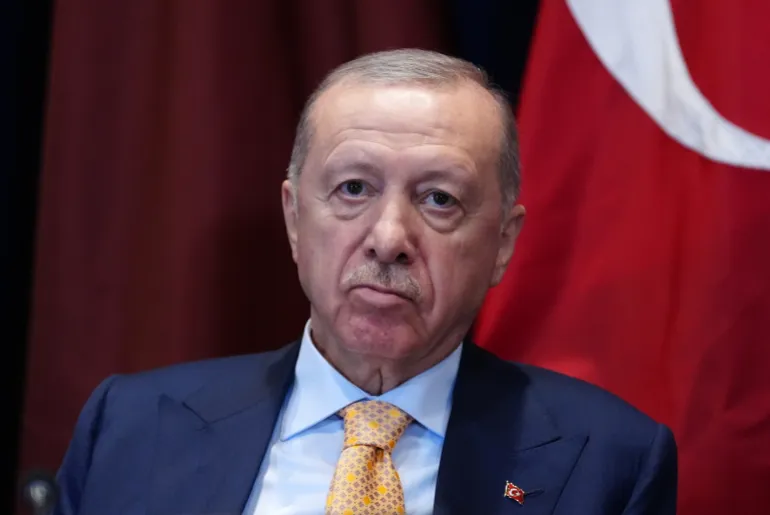


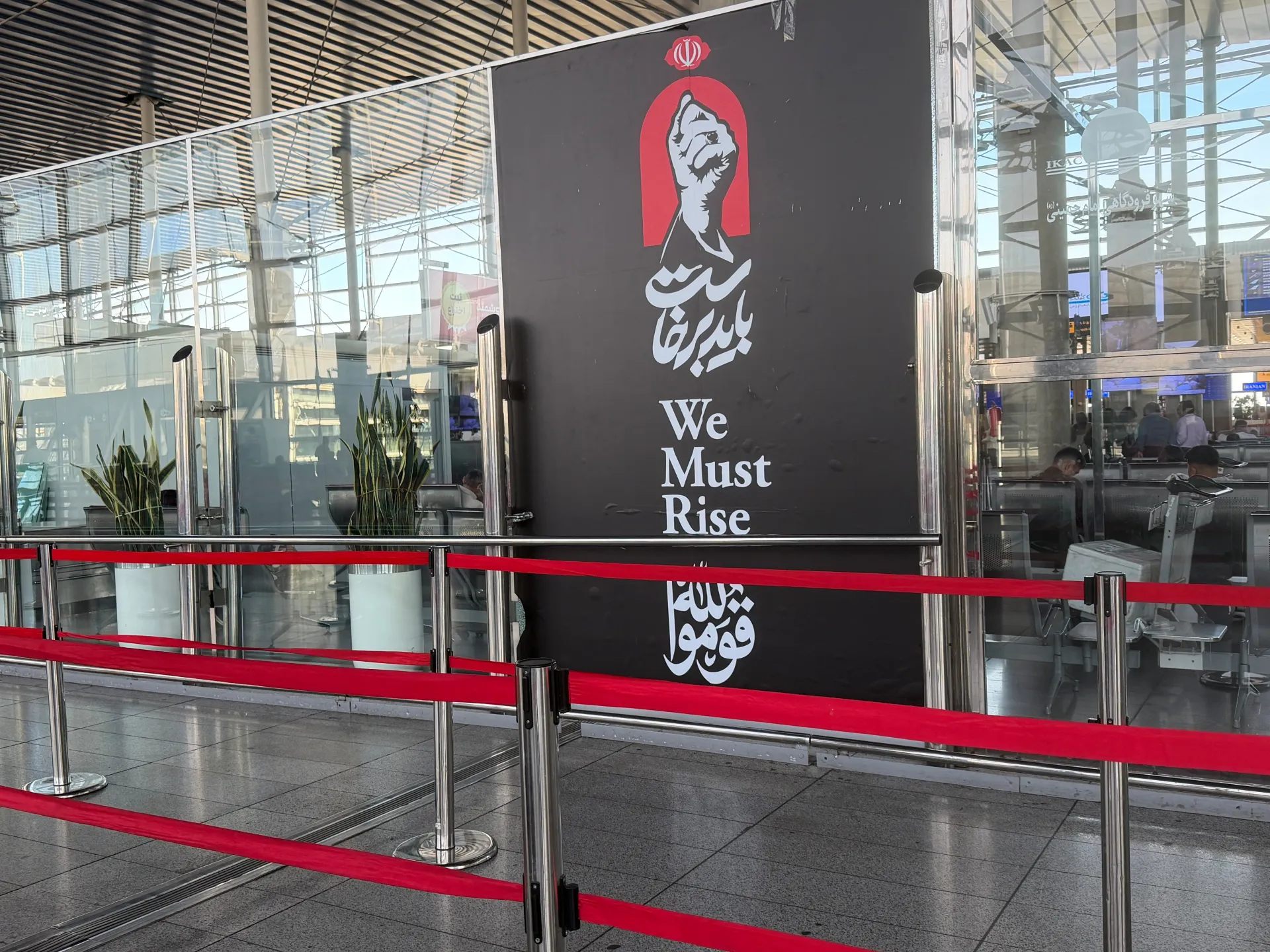
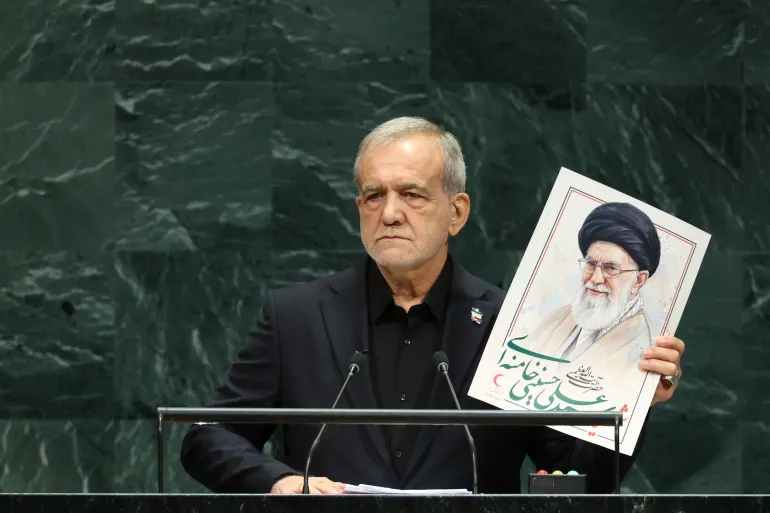

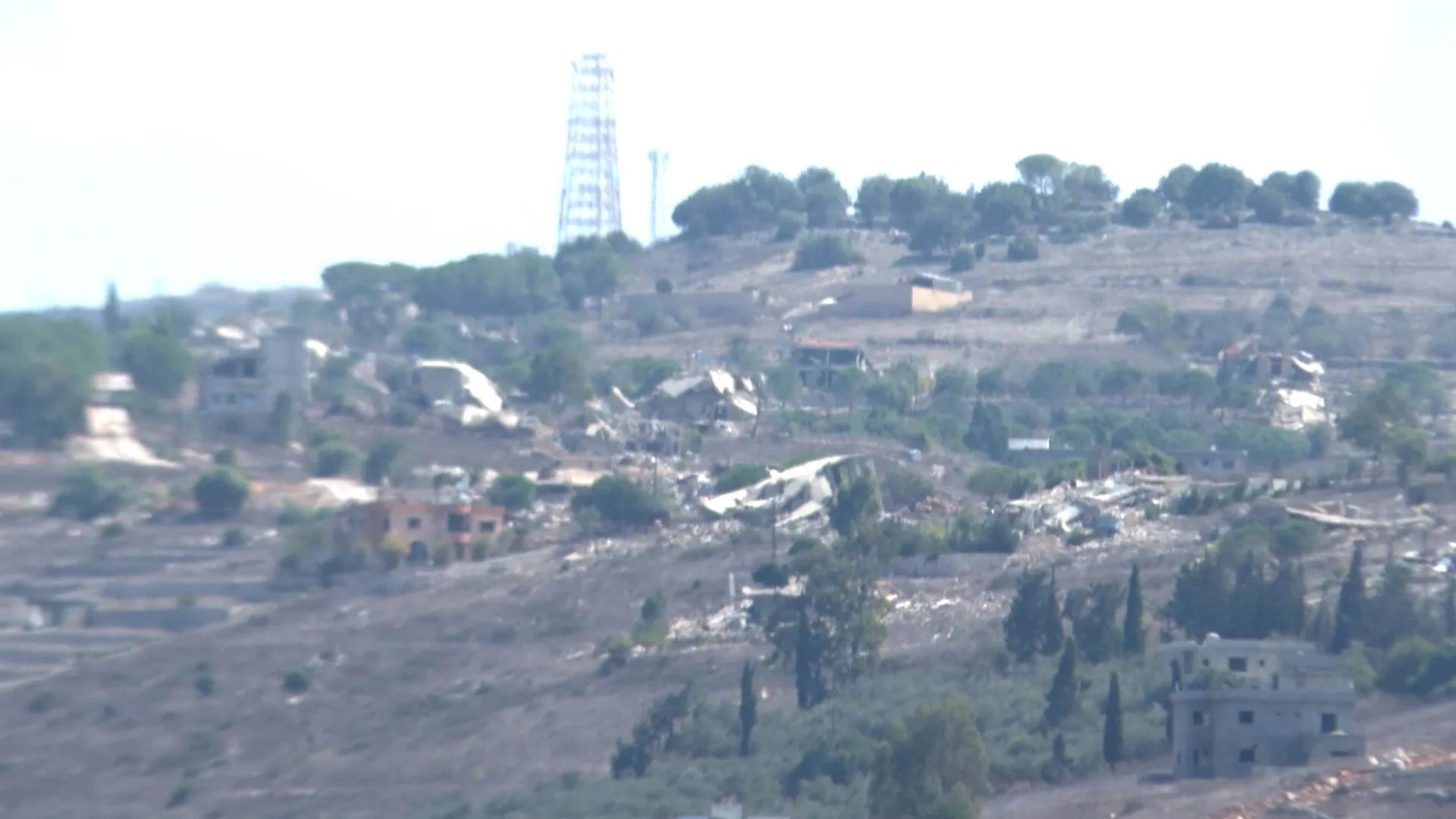
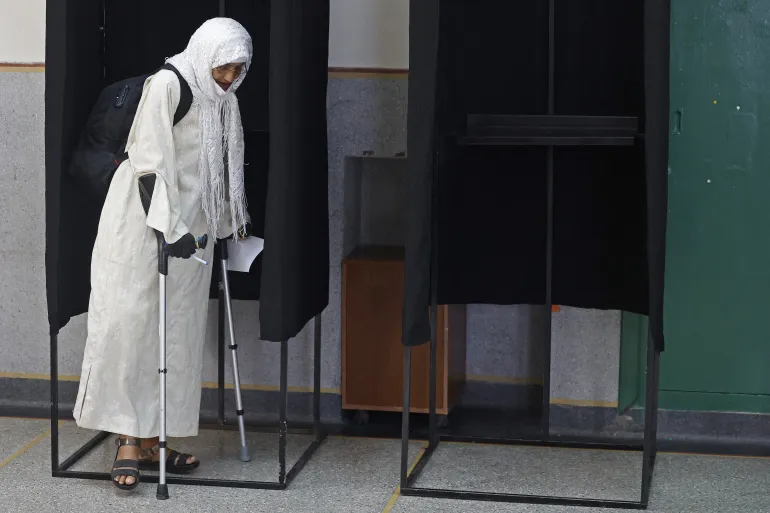
![A woman prepares to cast her ballot to vote in Morocco’s legislative elections at a polling station inside a school at the Udayas neighbourhood, Rabat, on September 23, 2026 [AFP]](https://i0.wp.com/www.aljazeera.com/wp-content/uploads/2026/09/afp_6ab3c71f1ac5-1790166815.jpg?w=640&ssl=1)
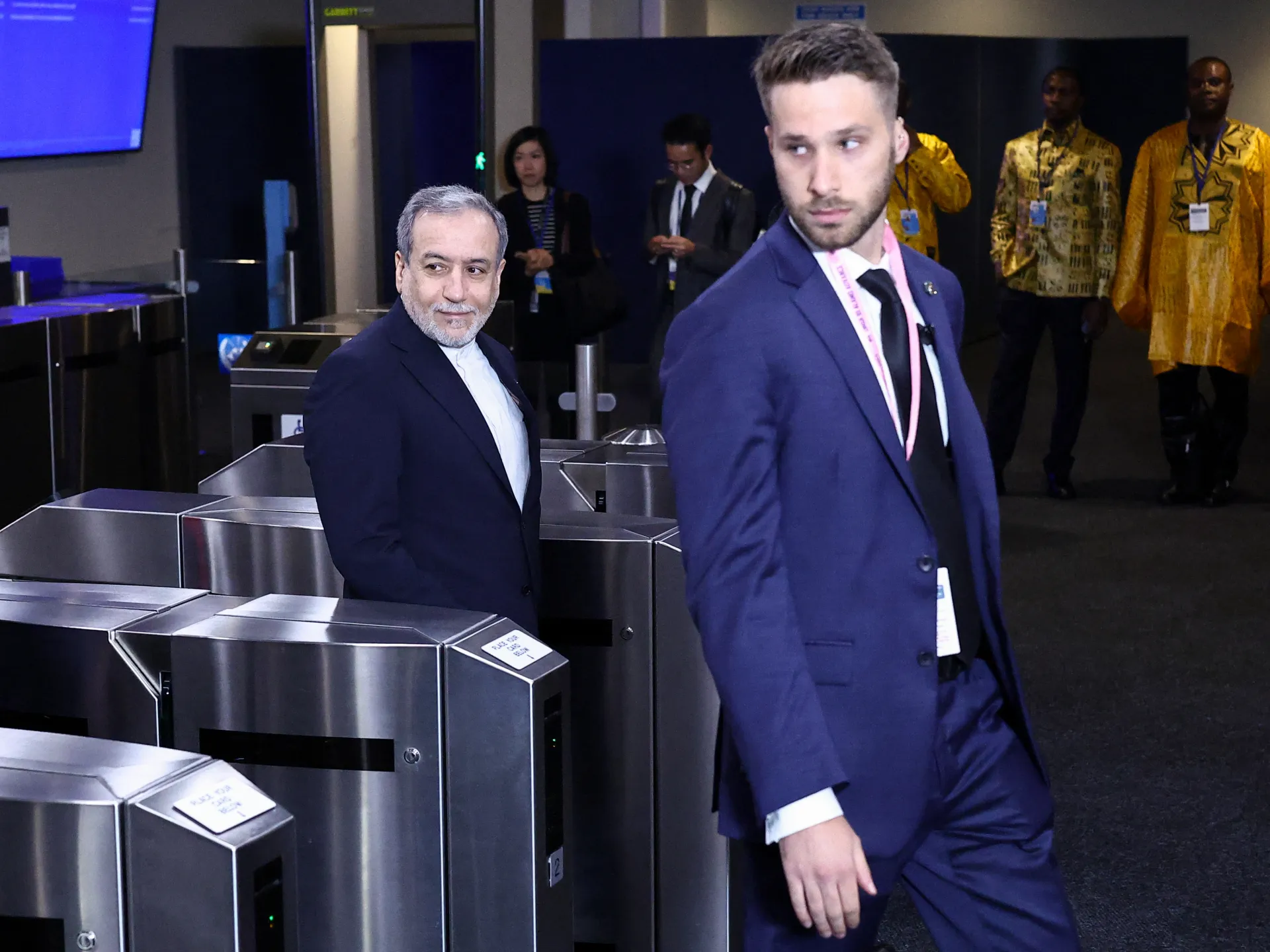
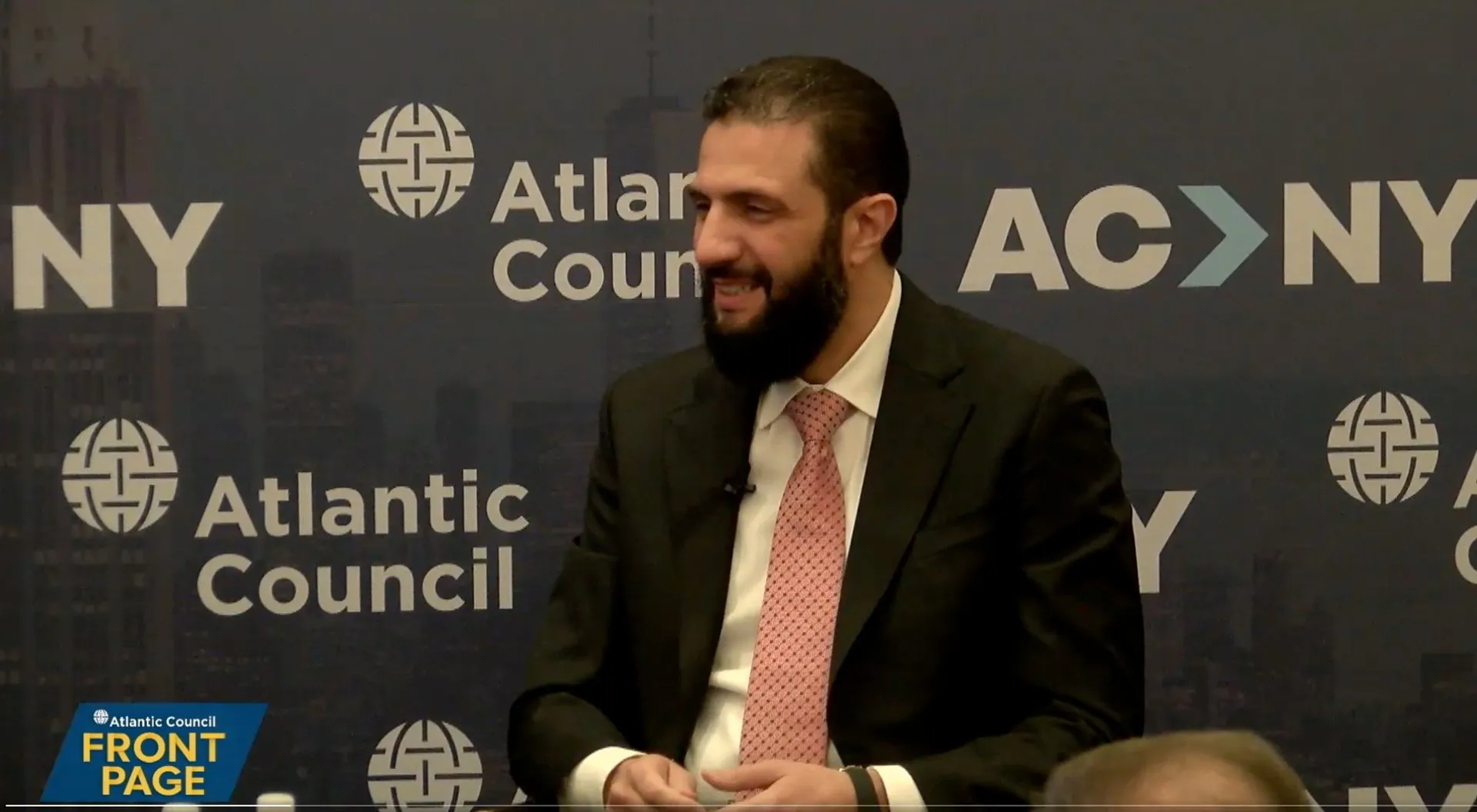
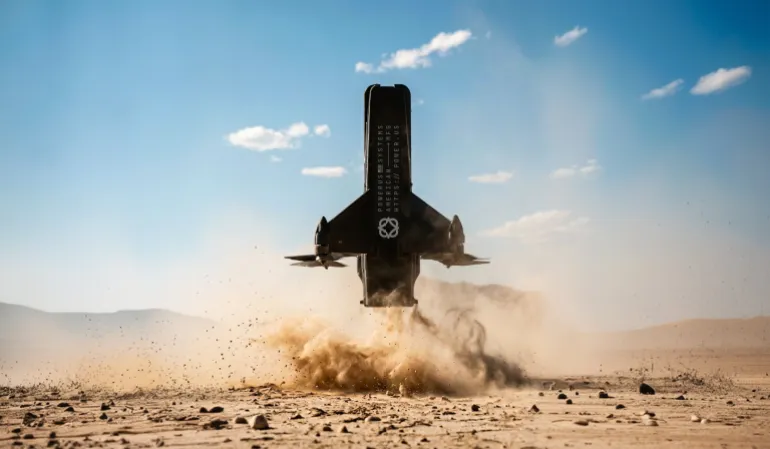
![Powerus' Guardian Interceptor is a counter-drone interceptor. [Courtesy Powerus]](https://i0.wp.com/occasionaldigest.com/wp-content/uploads/2026/09/guardian-fieldhero-1790078758.jpg?w=640&ssl=1)

![US President Donald Trump examines a box of rare-earth mineral and gemstone samples presented by Pakistan's Chief of Army Staff Field Marshal Asim Munir (center), alongside Pakistani Prime Minister Shehbaz Sharif (left) last year in September at the White House. [Courtesy White House]](https://i0.wp.com/occasionaldigest.com/wp-content/uploads/2026/09/Pakisatn-Minerals-WH-1790079007.jpg?w=640&ssl=1)

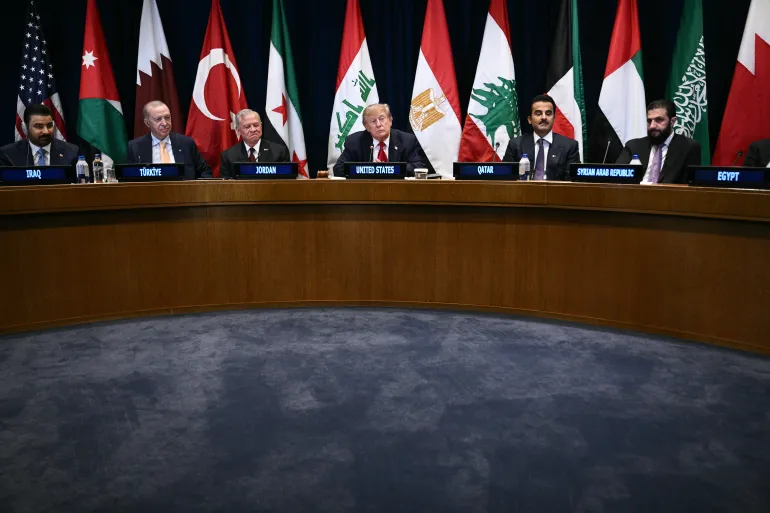

![British Prime Minister Andy Burnham looks at French President Emmanuel Macron as they pose for photos ahead of a bilateral meeting at 10 Downing Street on September 3, 2026 in London, UK [Leon Neal/Reuters]](https://i0.wp.com/occasionaldigest.com/wp-content/uploads/2026/09/2026-09-03T133923Z_1327001305_RC2MBNAX5ATT_RTRMADP_3_BRITAIN-FRANCE-1788466043.jpg?w=640&ssl=1)