This is widely seen as a throw-me-in-the-briar-patch gift from President Trump, coming as California’s governor edges ever closer toward a 2028 run for the White House. The presumed effort to cut down a political foe could instead boost Newsom’s chances of winning the Democratic nomination, or so it’s being suggested.
After all, look at how Trump’s verbal bludgeoning elevated former Rep. Adam Schiff. The House has typically been a dead end for lawmakers seeking statewide office in California. Today, the former Burbank congressman and Trump tormentor is a United States senator.
In truth, however, it’s far too early to say how the investigation of Newsom and his wife plays out politically, not least because it’s unclear whether there’s merit to the probe or if it’s merely a fruitless search-and-destroy mission by Trump’s Department of Retribution, Vengeance and Settling Old Scores
Beyond that, the first ballots of the 2028 campaign won’t be cast for roughly a year and a half. The Democratic National Convention, where the party will install its nominee, doesn’t begin for another 778 days.
Your friendly political columnist won’t resort to that hoariest of cliches about such-and-such duration being a lifetime in politics. But for some perspective, let’s go back 778 days.
President Joe Biden was running for reelection and about to challenge Trump to a pair of early debates. Trump was sequestered in a New York City courtroom being prosecuted on 34 felony counts.
A lot happened in the weeks and months that followed, including Biden’s self-immolation on the debate stage and Trump’s criminal conviction. A lot more will happen in the weeks and months to come. There’s no telling what. But it’s safe to say the fight for the 2028 Democratic presidential nomination will not be decided by anything that’s taken place in June 2026.
With his exquisitely tuned political antennae, the governor jumped out front of the president by announcing last week the feds were targeting him and his wife. (Naturally, Newsom’s revelation was accompanied by a rage-bait email — subject line: “Because I am thinking of running for president” — that denounced the “political witch hunt” and asked for money.)
“After calling for my arrest last year, Donald Trump directed his Department of Justice to investigate me,” Newsom said in a 4 ½-minute, direct-to-camera video that framed the investigation before prosecutors had the chance. “And just in the last week, I’ve learned his campaign has reached my own home: To get me, he’s coming after my wife, Jen.”
Share via
Newsom and his wife both adamantly denied any wrongdoing and, of course, they must be presumed innocent until and unless proven otherwise.
But there was something a bit disingenuous about the governor’s chivalrous defense. Siebel Newsom, a documentary filmmaker who calls herself California’s “First Partner,” is no mere housewife baking cookies and holding teas, in the famous words of Hillary Rodham Clinton. (Hold the outrage, folks, this is not some retrograde criticism of career-seeking women.)
Among her many public-facing activities, Siebel Newsom heads The Representation Project, a nonprofit focused on challenging gender stereotypes. The organization has faced criticism for accepting donations from companies that lobby the governor, so it’s not unreasonable to ask whether those interests have improperly sought to influence Newsom by giving money to Siebel Newsom’s causes.
My Times colleagues reported that an investigation related to Siebel Newsom has been underway for about a year and was launched by federal prosecutors in Sacramento based on whistle-blower information provided in California. It was not, their source said, the result of a directive out of Washington.
“This is a huge problem,” Randall Eliason, former chief of the Public Corruption Section of the U.S. Attorney’s Office in Washington, told Politico. “In any political corruption prosecution, the defense almost always claims it is a ‘political witch hunt,’ that prosecutors are targeting him or her for some political reason.
“The best defense to that has always been [the Justice Department’s] tradition of independence from politics and long track record of pursuing corruption cases based only on the facts and law, without regard to political considerations,” Eliason said. “The Trump administration has abandoned that independence without even trying to hide it.”
The probe of Newsom and his wife presents more questions than answers.
It’s grody, but not criminal on its face, for lobbyists to curry favor with the governor by throwing cash at his wife’s endeavors — if, in fact, that’s been the case. Special interests spending money to gain access and influence is about as common in Sacramento and other capitals as statues, domed buildings and manicured lawns.
So why then are the feds investigating Newsom? Why now? Is there any fire, or is it all a lot of smoke?
Perhaps most important, where can you turn to get an impartial answer?
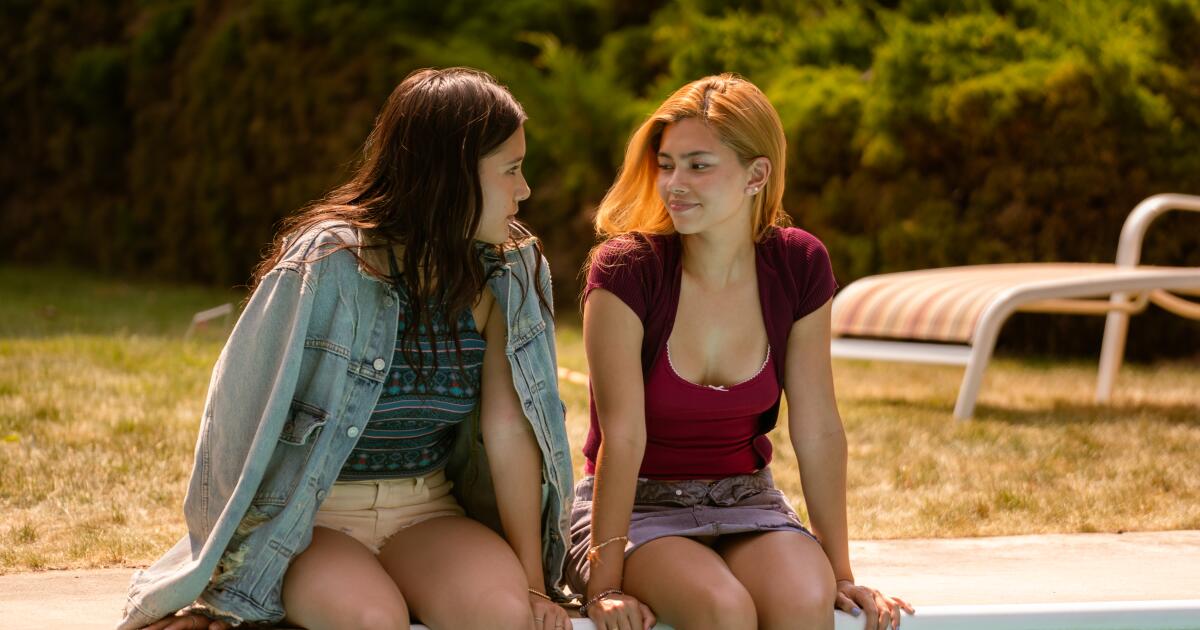
The blush of first love inside the glow of new friendship is where “Girls Like Girls” works its easygoing charms, but also an affecting sadness. You’d never mistake multihyphenate pop star Hayley Kiyoko’s directorial debut for a groundbreaking queer romance, but sometimes the best summer vibes require only a breezy intoxicant, something made of all the funny feelings, a few of the deeper ones and a lot of heart.
That also describes Kiyoko’s shepherding of her hit 2015 track “Girls Like Girls,” a hooky LGBTQ+ anthem that went from viral music video (which she co-directed) to bestselling YA novel and finally this feature adaptation, written with Chloe Okuno and Stefanie Scott (the original video’s star). “Girls Like Girls” may be conventionally imagined, but there’s an admirable focus on unadorned warmth in Kiyoko’s storytelling: She likes her girls and cares enough to want us to like them, too.
We’re dropped in picturesque rural Oregon, where we find bike-riding new kid in town Coley (appealing newcomer Maya da Costa), who happens upon an energetic crowd of peers at a local diner, then gets asked to join them for a lake excursion (“We don’t bite”) by confident and friendly Sonya (Myra Molloy). When Coley, a shy, watchful sort, gets thrown in the water by obnoxious Trenton (Levon Hawke), she tries to leave, but not before Sonya softens the blow by insisting on a “proper hang” and the exchange of AOL usernames. (Because, oh, yeah, it’s 2006, giving us a refreshingly nostalgic break from the tyranny of smartphones.)
Anyway, SonyeahXOXO and RollieColey87 take quickly to their obvious spark, initially sublimating that deeper attraction through scenes of laughter, teasing, the rush from shoplifted alcohol, bed-sharing and lots of deep gazing. But they also lean into a connection marked by honesty and vulnerability, particularly Coley’s grief over losing her mom and not feeling connected to her widowed dad (Zach Braff). With Sonja Tyspin’s cinematography imbuing an innocent, sensual curiosity, Kiyoko sweetly conveys the awkward thrill of fledgling emotions. One scene in particular, in which Coley explores Sonya’s room, touching everything, hums with the strange excitement of being a specially invited new confidante.
But the day after the pair’s unspoken attraction becomes physical — a scene deftly stretched to “Kiss already!” limits — a confusing tension enters the chat, triggering a tailspin of self-doubt in Coley. A lesser film might have pivoted toward assuring us of a happy makeup, but “Girls Like Girls,” which stays centered in Coley’s POV, understands that at the crux of her pain is an untended self-acceptance that must be addressed first. Da Costa realizes that journey with unforced naturalism, as if the camera just happened to be there to capture it. (Molloy betrays a more studied star wattage, but she’s nevertheless a solid other half.)
Mostly, “Girls Like Girls” wins us over with a singular type of first-film assuredness: a familiar story presented as the most personal reveal ever. If you can’t remember what it was like to try to tiptoe while swooning, your heart barely able to stay in your chest, you were never a teenager.
‘Girls Like Girls’
Rated: R, for teen alcohol and drug use, and some language
Netflix Inc. is under contract to buy Radford Studio Center, a historic Los Angeles movie studio space, for a fraction of its 2021 $1.85-billion sale price after lenders including Goldman Sachs Group Inc. repossessed the property.
The price is close to $400 million, according to two people with knowledge of the transaction, which is expected to close in the third quarter.
The one-time silent movie lot has been home to many popular TV series over the decades, including “Gunsmoke,” “Gilligan’s Island” and “Seinfeld.”
Netflix wants to consolidate its real estate footprint in one place and has been considering relocating from a group of Hollywood buildings it leases from Hudson Pacific Properties Inc. The Hudson Pacific leases expire in 2031.
Radford’s current owner, Hackman Capital Partners, defaulted on $1.1 billion of bondholder debt and turned the property over to lenders led by Goldman after it was unable to reach a refinancing deal last year. The sale will wipe out close to two-thirds of the debt.
The value of Los Angeles studio real estate has tumbled since interest rates climbed and production plummeted following strikes in 2023 by unions representing writers and actors. Landlords unaffiliated with studios, such as Hackman, have been hit particularly hard as production moved to space owned by the entertainment giants. Occupancy of L.A. soundstages fell to 62% in the first half of last year, according to FilmLA, a local permitting group.
Representatives of Goldman and Netflix declined to comment. A Hackman representative didn’t immediately provide a comment.
Netflix, which has historically leased rather than owned real estate, has stepped up investing in studio lots. It’s currently developing a $1-billion production center in Fort Monmouth, N.J. The streaming service reported $12.3 billion in cash and equivalents in its most recent quarter. Netflix was paid a $2.8-billion breakup fee by Paramount Skydance Corp., which won a bidding war for Warner Bros. Discovery Inc.
Before the recent slowdown, Hackman went on a buying spree of movie lots, banking on ever-growing demand for streaming TV production. In March, Deutsche Bank AG sued Hackman to foreclose on its Kaufman Astoria Studios in New York. Hackman-owned Television City in Los Angeles and Manhattan Beach Studios in nearby Manhattan Beach are both being marketed after lenders led by Deutsche Bank pushed for the sale, Bloomberg reported in May.
Brokerage Cushman & Wakefield Ltd. is selling the $240-million loan on the 22-acre Manhattan Beach property, which it describes in a marketing document as “one of the most strategically positioned opportunities in coastal Los Angeles, combining an institutional-quality operating asset with some of the most irreplaceable underlying land in the South Bay.”
The Radford Studio lot was only 71% leased as of March, according to mortgage filings.
In this week’s episode of The Envelope podcast, Rachel Sennott discusses finding the voice of “I Love L.A.” — and finding her footing as series creator — during a tumultuous time in her life.
Kelvin Washington: Welcome to The Envelope, Kelvin Washington alongside you know who, Yvonne Villarreal, Mark Olsen. Always great to have you two here and spend some time with you. We talked about it earlier, we had Emmy season — a few weeks ago we discussed it. But now Emmy nominations are on the way. Yvonne, I’ll start with you, just maybe someone, a show, a couple of things you’re looking at saying, “Hey, I would love to see this or that person nominated.”
Yvonne Villarreal: I wanna give some shout-outs to the women right now. I was really frustrated when Rhea Seehorn didn’t get love until the final season of “Better Call Saul,” and I’m hoping — and I do have a lot of hope — that she will be recognized for “Pluribus.” [I] was a really big fan of “The Comeback” this season. I would like to [see] Lisa Kudrow get in there. Show-wise, I would like to see “The Testaments” in there. I don’t know how much of a dark horse that one is, but that’s my pick for show.
Washington: You’ve been riding “The Testaments.” What about you, Mark?
Olsen: I’m sort of leapfrogging over nominations, and I’m just thinking about what would be exciting on the show. And last year, I remember Stephen Colbert won for talk show kind of right after his show had been canceled, and that seemed like a very exciting moment. And so this year, with Jimmy Kimmel, where this is the first Emmy cycle since he had his suspension last year, and really has been in the news, I just think if he were to be nominated and then to win, that just would be such an exciting moment at the show. What’s he gonna say? I just would really love to see that.
Washington: Yeah, he seems like he would have some things to say, right? Because just kind of the nature of who he is. We’ll have to wait and see. And just for me, a couple of people. Just a fan of this particular person, Janelle James is hilarious to me. She plays in “Abbott Elementary.” She plays that role great. And then this one is no real surprise, probably 50-plus-year career, but Martin Short. Every time I see him, he’s amazing, steals the scene. So those are folks that just jump off on the radar for me.
All right, I’ll get to you, Mark. You had a chance to sit down with Rachel Sennott of “I Love L.A.,” creator and star of it. Tell me a little bit more about that.
Olsen: She’s been kind of a real, like, bright light on the comedy scene for the last few years in films like “Shiva Baby,” “Bodies Bodies Bodies” and “Bottoms,” and, you know, she also was like a writer as well as a performer. And so with “I Love L.A.,” which is a look at sort of like the young creative class in Los Angeles, she is the star of the show, she created the show, she writes on the show, she’s executive producer, she actually made her directing debut with one of the episodes. And so it’s just exciting to see her sort of really like come into her voice and come into her own with this new show.
Washington: Kind of reminds me a little bit of, you know, now maybe a decade ago Issa Rae’s surge in L.A. and comedy creating, and then Riz Ahmed, who you spoke with last week — same thing creating and starring and stuff. Seems like that’s the energy [we’re] getting from a lot of the young talent. Well, here is Mark and Rachel now.
Rachel Sennott, creator and star of HBO’s “I Love L.A.”
(Evan Mulling / For The Times)
Mark Olsen: We’re here with Rachel Sennott, creator, executive producer, writer, star, and for the first time, director on the show “I Love L.A.,” as well as co-creator and writer on “Big Mistakes.” That’s a lot.
Rachel Sennott: When you say it like that, I’m like, “Oh, my God.” And I’m also a friend, daughter, let’s not forget girlfriend. Yeah, those are all things that I am doing. And I am so grateful and having so much fun doing that.
Olsen: Hopefully this isn’t something that just I get a kick out of, but we’re here at the L.A. Times offices in El Segundo, and the Randy Newman song “I Love L.A.,” one of the first lines in the song is “Rolling down the Imperial Highway.” And we are in fact on Imperial Highway.
Sennott: We’re here right now. We’re living it.
Olsen: Tell me about the title of the show, its relationship to the song and what was it that you liked about having the show called “I Love L.A.”
Sennott: We were between two titles for a while, “I Love L.A.” and “Climbers,” and the reason we went with “I Love L.A.” is because in the process of making the show, I moved here from New York and I had a hard time when I was first here. And in the process of filming the pilot, I really fell in love with L.A., and I think getting to make something here, I all of a sudden saw L.A. through this lens where everything was like a movie. I would go on my walks that I usually go on. I would walk through my neighborhood, I would go to my spots, and I just saw it through this different lens, and I was really falling in love with it in the process of making the show. And I think with “Climbers,” that title fell a little bit — it was a double meaning of like social climbers and then also, being the age that I am, where I feel like ever since I got to college, ever since I became an adult, there’s been this chaotic energy in the world and uncertain ground where things never felt expected. It was always unexpected events. Graduating into COVID and then there was a strike and everything. So I feel like Sisyphus, where you’re always pushing the rock up the hill and it’s never enough. But we were worried that “Climbers” would seem too negative … We didn’t want to set people up already judging the characters.
Olsen: And then what has it been like for you learning to be a showrunner in making “I Love L.A.”? It’s funny, your co-showrunner Emma Barrie, she mentioned how you were very organized, but she was struck that you had everything in a pink binder with horses on it. So it was you trying to learn this new thing while also holding on to your essence.
Sennott: I feel so grateful for everyone who works on the show with me. I learned a lot from Emma. I learned from Lorene [Scafaria], who inspired me so much as a director. Aida [Rodgers], our producer, Amy [Gravitt] and Allie [Wasserman] at HBO; Max [Silvestri], who’s one of our EPs and writers. Showrunning is a million different jobs, and some of the jobs I’d done before, some of them I hadn’t, and I felt like I got to see different people shine in certain things, people who are more talented or more skilled at structure than me, people who have directed before, people who understand shots and basically learn from everyone and see that everyone wants the show to be the best it can be. They’re bringing stuff to the table. And so I benefited from everyone else’s skills and talents and just being like, “If you know how to do this better than me, I’m gonna learn from you and watch you and hopefully take from that so I can do my job better.”
Olsen: In a lot of the press as you’ve been talking about the show, you’ve been talking a lot about the concept of the Saturn return and this sort of chaotic period people have in their late 20s. You yourself now are 30 —
Sennott: Yes, I made it. I literally just finished. I was relieved, but my Saturn return was the process, getting the show picked up and the first season of the show. That was my Saturn return.
Olsen: Can you already feel that something has settled or things are different somehow?
Sennott: Yes, a thousand percent. My Saturn return, the dates that it was the strongest were the month around when the show got picked up. Making the pilot was so amazing and I learned so much. And then I was in this moment where I had to pick — basically, I couldn’t take on acting jobs because I was gonna hopefully do the show, but I didn’t know if the show was picked up yet or not. And so I had to say no to certain things and kind of take this leap. At the same time I went through a breakup, and then I got arrested for having CBD in the Cayman Islands. And it was just a very chaotic month of my life where I was like in jail for six hours on a break with my boyfriend, so he, like, had no idea where I was, and I was like, I don’t even know if I have a show, I just said no to this other thing. I just felt like I didn’t know what was happening. I’m someone who it’s hard for me to take risks sometimes, and that was a big risk and leap into what I thought I should be doing. And then the rest of it was learning for the first season how to do a job I’d never done before. Obviously, I still have more to learn, but I think that was a big Saturn return for me, the roller coaster of it.
Olsen: It’s so interesting to hear you say that you think of yourself as a person who’s afraid of risk, because that’s not my impression of you.
Sennott: You’re like, “Stop taking risks. Chill on the risks, every second.” No, I think it’s more [that] I didn’t necessarily believe in myself as a creator on my own, and that was really scary for me. That was the risk, I think.
Olsen: Because especially in building up to making “I Love L.A.,” in your career, I feel like you’ve created this comedic persona for yourself. What is the biggest distinction between the Rachel I think I know and like the actual you?
Sennott: You mean the characters that I play? Or like the persona?
Olsen: These sort of hard-charging, very ambitious, but maybe not always understanding of themselves characters, and you. I’m just interested in how you see the distinction between that persona and the actual you.
Sennott: Well, I hope that the characters that I’ve played have been somewhat different from each other. I think “Shiva Baby,” that character, was a little bit more anxiety-inward. Alice in “Bodies” was way more outward and kind of no filter, said every inside thought. Maia on “I Love L.A.,” I think, is kind of bitter in the beginning of the first season and is pinning her failures, blaming them, on her friend. All of those characters, I always draw on some element of myself. I think all actors, you have to find some connection to the character. But I think I’m hopefully more grounded and balanced and mature than the character. I hope.
Olsen: You’ve talked about how “I Love L.A.” really explores the foibles and challenges that people have leading these very, like, online lives and the way that people nowadays are really sort of tethered to their phones all the time. Is that something that you feel like you grapple with yourself? Is it something you yourself have had to kind of get over?
Sennott: I would say I started my career on the internet, and I grew up on the internet, and basically, I created a different sort of persona on the internet that was based in truth of a time when I was in my early 20s in New York, and it was a lot more messy and a little chaotic, and I was just going through things in my life at that time [that inspired] — I say “writing,” but like the tweets, the jokes, the videos, whatever, that were coming out of me. And then I felt I changed, but I still wanted to kind of project that character. And so I actually ended up putting that character into Tallulah [played by Odessa A’zion]. And I think Maia was a little bit more the version of myself when I first moved to L.A. and I felt isolated and it was during COVID, and I felt I was kind of gripping onto my friends in a codependent way. And so I think the show is sort of dealing with, whether or not you’re an influencer or person online, anyone who’s grown up on the internet is projecting some sort of version of themselves. So I think it was that I was trying to explore.
Olsen: You mentioned that the character of Tallulah is this version of you that you used to be. So what was it like for you creating this character that was almost like your id unleashed?
Sennott: It felt like I was separating myself from her. At first, [it] maybe could have felt like a caricature. And then when we cast Odessa, who is so talented and just, as an actor, she has such depth and range, and I think she asked questions and brought so much to it. Then it actually made me sever myself from the character, and the character became its own thing that she brought to life.
Olsen: Your character, Maia, in some ways is the audience surrogate, she’s kind of the most “normal” character on the show. And considering that in “Bottoms” or “Bodies Bodies Bodies” you often were the outrageous character, what has it been like for you to play this character that’s a little more self-contained?
Sennott: It’s been fun. I think we sort of found her during the first season. I feel that Episodes 6 through 8 are really where the show finds its footing and where we find what’s the comedy of Maia. It takes a little for her to kind of crack open, what’s funny about her as a character, but also I think Tallulah is almost like an agent of change for her — Maia was set in her ways and sort of struggling and depressed, and I think Tallulah puts her on track, and she’s going through her Saturn return and all that stuff. And so I think we get to see at the end of the season and just having been writing Season 2, I think that we get see her do a lot more fun stuff.
Olsen: It’s funny, as viewers, a lot of times people say, “Oh, you know, there’s this show you should watch, it really gets going on like Episode 3” or whatever. And I don’t think I’ve ever heard a creator say before, like, “Oh, 6, 7, and 8, we figured it out.” Do you feel you knew that in the moment, or has that only come to you as you’ve been working on Season 2?
Sennott: I think as we were editing the first season. Tone is something that you can say, like, “We want it to be like, this needs this, and it’s that and that and the tone of that.” But tone is what you find in the edit. I think you shoot different versions of a line, of a scene, and then you piece it together. And I think for me, that’s when I felt like, “This is the tone of the show. This is the world of the show.” And in writing Season 2 as well, just living more in that world.
Olsen: You kind of touched on this, but the characters on the show, they kind of skirt this line between being endearing and annoying. What is it that you like about that?
Sennott: Because I think that’s how people are. I am not interested in seeing perfect people or people who are flawed in a way that’s not actually real. So I love all the characters. I think Alani [played by True Whitaker], for example, is someone where you could really easily be like, “Oh, a nepo baby, she’s so privileged, whatever.” I think she’s the character with the biggest heart. She’s the best friend out of the whole group. She cares for everyone. She’s so deeply sensitive. And she’s actually been through a lot of s— and she drops these little things, these clues where you’re like, “Gee, she went through something crazy but is choosing to look at life half-full,” and I think that’s fun. I like the characters who make you feel or expect something of them and then show you another side. Charlie [played by Jordan Firstman] I think does that as well, where you meet him and you think he’s a little acerbic, he’s a little judgmental, and then he goes through loss and grief when Lukas, spoilers, Lukas Landry dies, RIP Lukas. That’s really hard for him. I’ve been friends with Jordan for so long, and I love him so much. I think he’s so talented. But I think he showed a totally new side of himself with the character.
Olsen: I agree. I found those scenes very touching. There’s an emotion there that’s kind of unexpected. Another moment that I really like in the show is Odessa’s character, she wants to change a dinner reservation to five people at 8 o’clock. And then you have to spend hours trying to make that happen. And I really appreciated how it’s something that sounds like it should be simple, and for some people it’s no big deal. But then for other people, it’s the biggest hurdle imaginable. Did you like that the show explores this sort of proximity to ease? Sometimes you end up at this party in a big, big house, but it’s not your house. Was that something you wanted to explore about life in L.A.?
Sennott: Totally. There’s also something specific to L.A. and specific to the industry we’re exploring — which is the internet as opposed to Hollywood — that I would say is relatable to me, to anyone in their late 20s, early 30s. When you’re in your early 20s, everyone’s sort of grouped together or feels like they’re in the same bucket. It’s like, “Oh we’re all doing this same thing, we’re all roommates, we’re all in school together, we’re all whatever.” But people make decisions that you don’t even see. I feel like the first time I found out that one of my friends had a SEP IRA, I was like, “When did we all decide that we’re getting SEP IRAs?” And it was a friend who loves to party, and I was thrown. Now I’m panicking I didn’t do that. Or who’s getting in a serious relationship, whatever. People start making decisions in their late 20s, all of a sudden everyone’s off on different paths. It’s like, “Wait, you’re getting married, but you’re still partying the way that we did when we were in college.” This person is moving, this person is changing their career path. And so you all of a sudden feel a little bit betrayed or on your own, and it’s isolating, and that is something that, yes, we’re doing it through a specific lens of L.A. and this world and these characters, but I think it’s really relatable to people at that age.
Olsen: I’ve heard you describe yourself as a zillennial cusp.
Sennott: Yeah, I’m cusp, and I feel like I relate to a little bit of both.
Olsen: But do you feel a pressure for the show to feel like some sort of a generational statement, to capture these kind of big-picture things?
Sennott: No. Ayo [Edebiri] and I were texting each other because there’s always an article that’s like, “Turns out these b— are 30. Yeah. They’ve been lying the whole time. They said they’re Gen Z.” I’m like, “I didn’t say anything. I was born in ’95. I’m 30.” Call me what you want, but I was just writing to what I feel at the time. I think people who grew up on the internet in the way that I did will relate to it, but I think you can relate too if you’re older or you’re younger.
Olsen: As people are writing about the show, they very frequently are referencing “Girls,” “Insecure,” “Sex and the City.” But I’ve heard you reference “Entourage” quite a bit. Could you explain that?
Sennott: “Girls” and “Sex and the City” and “Insecure,” all of those shows, all HBO shows, are formative to me as an artist. I remember watching “Girls,” I was in high school and looking at colleges with my dad and we went and toured [New York University], and in the hotel room that night, he was like, “I heard so much about this new show, ‘Girls,’ we should watch it. And it was the episode with Patrick Wilson where they f— in his nice apartment the whole time, and we turned it on and my dad was like, “OK, you can watch this later on your own, this is for you.” And I remember going to bed being like, “I’ve gotta go to New York, like whoa, this is crazy.” I think naturally those were already gonna inspire me. “Entourage” and “Atlanta,” those were two references that I mentioned a lot when we were making the show. “Entourage” because I feel I got to come up in this industry with my friends, and when I’m with my friends I feel completely invincible, and so there was that aspect. It was like, “I wanna see ‘Entourage’ but from a different point of view and perspective and a slightly different industry.” And then “Atlanta,” there is already having a family relationship and friendship on top of managing. Like how [Earn] manages Paperboi. And then I think “Atlanta” did such a great job of capturing a city that has almost magical realism elements to it. And L.A., a lot of the time, there’s things that happen here that are crazy, that feel almost unreal, but they are real. So that was a big inspiration for the show as well. Like the opening of the show, sex during an earthquake. That’s happened to me, but it also feels a little ridiculous, but it happens in L.A.
Olsen: You mentioned earlier that in waiting for the show to come around, you felt you were having to turn things down or you were really having to sort of change your mindset in a way. Can you talk a little more about that? With the show “Big Mistakes” that you created with Dan Levy, is that one of the things that you had to step away from or readjust how you were gonna be involved because of the fact that you were going to have “I Love L.A.”?
Sennott: I was more talking about acting roles. When you step into a creator role, it’s a different mindset than acting jobs and you have to commit to a longer time period. When you’re just acting in things, you can pop in, pop out and you leave set and you’re like, “I love you guys so much. I’ll see you in a year at the premiere,” which is fabulous too — love doing that. But when you are creating something, you’re in it from beginning to end, and you really wanna give your all to it. So I think I was more talking about just, like, betting on myself as a creator, as opposed to just acting.
Olsen: And how has that felt now that you’re on the other side of it, with one season of “I Love L.A.” made? How do you feel about having made that decision, having bet on yourself like that?
Sennott: I think it’s changed me, in a way where I’m so happy I did it. And it’s sometimes harder and there’s more parts to it, but I feel more in myself creatively than I ever have before, I think.
Olsen: It changed you how?
Sennott: Just because you all of a sudden see all the different parts of the process of making something and all these different jobs that maybe I wasn’t as aware of before. And I think there’s also something beautiful about popping into something and acting and just being like, “I am present as my character. This is what I am thinking about. I’m thinking about what does the character want.” And that’s amazing too. But I feel so lucky to have been able to experience other parts of making something.
Olsen: What was it like learning how to switch hats, especially during production? I would imagine you have a producer brain, you have an actor brain, then for one episode you have a director brain.
Sennott: I had to like sort of take it day by day. There are days where it’s a lighter scene for me and I can be on the side approving locations, taking meetings during lunch. There was a day where I had two sex scenes, for Episodes 6 and 7. So we shot the end of 7, the fight scene with me and Josh [Hutcherson], and the sex scene where it’s Maia and Dylan but she’s fantasizing about Ben. It was a lot. And so I was like, to Emma and Max and Aida, “Let’s not do any other meetings today in the middle of the day,” and they were like, “Totally got you.” That day I was more focused. I really needed to be present in the scene and have this be my main focus. And then on a day where I’m shooting like, “you’re texting on your phone” and “you’re walking on your walking treadmill,” I can do other stuff. So I think it was just taking each day as it comes and having so much support from the rest of the team.
Olsen: It’s wild to think of just one day providing all this material for the show. Just a single day could be so pivotal.
Sennott: Yeah, totally. A lot can happen in a day and then other days you’re like, “I’m just opening doors.” You never know.
Olsen: How did you come to conceive of how you kind of wanted to depict the online world, how people text, whether they’re FaceTiming and things like that? The show obviously exists with that world, as part of it, but you didn’t spend a whole lot of time animating texts. How did you come to conceive of how to depict people’s online life?
Sennott: I wanted it to feel how it does in the real world, which is the internet is just a big part of everyone’s life, but people aren’t explaining it to each other all the time. So we wanted to have the internet feel like the real internet, but our own internet. We didn’t want to ever reference anything that would date us because the internet moves so fast. So, like, Coke Larry, for example, when Dylan gets made into a meme, whatever, that’s our own thing, but it moves the same way as the internet does. And we tried not to have too much phone screens, texting, whatever. Like for example you [just] see snippets of Tallulah making videos or posting or whatever. In “Entourage,” you don’t really see that much of Vince acting. You see all the stuff around it. So that was sort of our model for the show.
Olsen: You directed the final episode of the season. Do you expect to be directing more in Season 2?
Sennott: Yeah.
Olsen: And how did you find the experience? What did you like about it?
Sennott: I loved it. You’re just in every aspect of the process. You are thinking about everything, and it was so engaging and exciting, and afterwards I felt fried, and I like crawled onto the edit couch and I was like limp and it took a lot out of me. People describe it like giving birth. And then you’re like, “I gotta do it again.” So that’s kind of how I felt on the other end.
Olsen: Can you talk a little about that final episode? The show is called “I Love L.A.” You send the main characters to New York for the final episode, which has turned into kind of a controversial decision. A lot of people have talked about that. Can you talk just a little about deciding to end the season in New York?
Sennott: I think it was because it was sort of addressing the fact that these girls went to school in New York together. They lived in New York and they chose to move to L.A., and I think when you do that there’s always going to be the push and pull of the two cities, and going back to New York, it was almost like getting a chance to get back together with your ex and being like, “You know what, there’s a reason it didn’t work out.” And they end the episode with, “I miss L.A.” So I think that’s kind of what we were aiming to do.
Olsen: And then before we wrap up, I should be sure to ask, is there anything that you could tell us about Season 2? What can people look forward to?
Sennott: It’s sort of what we were talking about earlier, Episodes 6 through 8, I think, I just feel we’ve locked in to our tone, we get to see other sides of characters we haven’t before, we go deeper on certain characters. And I think there’s some fun stuff that we set up in the finale that we get to explore.
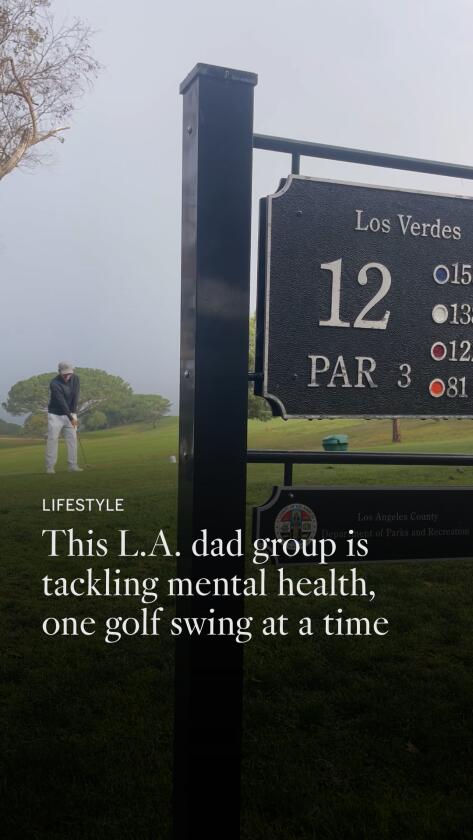
To understand the gravitational pull toward golf, consider the sport as a sequence of problems. Aaron Singleton, a skilled player in the Dads Link Golf Club, is playing particularly well today at Palos Verdes Golf Course, having just hit two back-to-back birdies. But even on the shots that fly into a grassy oblivion, he smiles.
Share via
“Golf is 18 different holes. 18 different chances to solve a problem,” he says. “Each hole presents a different problem. Each shot is a different problem.” According to Singleton, this wisdom that players inherit on the golf course — especially resilience and patience — translates to fatherhood.
Singleton, who has a 3-year-old son, is part of a growing group of fathers who participate in the Dads Link Golf Club. The club is part of the region’s golf boom; Southern California Golf Assn. is estimated to have one of the largest memberships in the country, with over 200,000 golfers.
Ian Davis, the founder of Dads Link and Golf Club, watches his drive.
Ian Davis is the founder of Los Angeles’ Dads Link Golf Club. Each month, he invites fathers to enjoy golf together to focus on fellowship, fatherhood and their well-being.
“This has grown in a way that I couldn’t have imagined,” says Davis, who works as a wellness coach with an emphasis in mindfulness and meditation. He started the club in 2023 on the East Coast before relocating it to Los Angeles in January 2024, where the club hosts an annual Father’s Day tournament and various golf clinics.
At the driving range, Davis leads the group through “a grounding practice” that involves stretching and deep breathing. Member Ose Akhile, a personal trainer, follows up with stretching and other warm-up exercises. For many of the men, golf has become a rediscovered hobby. Singleton returned to the sport after playing it as a teenager. “I’m looking forward to getting better,” he says.
Club member Darius Ingram, father of 3-year-old daughter, says that reconnecting with the game has allowed him to prioritize his own well-being.
“I used to play golf recreationally. Now, I do it for mental stability,” he says.
Ian Davis greets Ose Akhile as Darius Ingram stands nearby.
Ian Monteilh, who is new to the group and has two daughters ages 11 and 15, says the outing provides camaraderie that was missing from his life.
“It’s a community that I didn’t have. I’m blessed to be around like-minded men with no pressure,” he says. “Even if we’re having a rough day on a golf course, there’s camaraderie.”
Once considered a predominantly white sport, golf is now being reshaped by a new generation of Black players and other players of color, including many of the fathers in Dads Link Golf Club. In 2024, 25% of golfers across courses nationally were Black, Asian and Latino, marking the most diverse era in the sport’s history, according to the National Golf Foundation.
Darius Ingram reacts to barely missing a putt on the 18th green as Ian Davis watches.
Ingram partly attributes Black men’s interest in golf to renewed interest from other professional athletes. Star athletes like Michael Jordan and Steph Curry — who also happen to be dads — are skilled golfers.
“There are a lot of people who play their main sport, and they play golf when they retire,” says Ingram.
Ose Akhile smiles before teeing off.
Rappers like Schoolboy Q and DJ Khalid have also become interested in the sport, adding to its cachet.
The benefits of the groups are apparent, explains Akhile, who has three daughters, ages 6, 7 and 9.
“I’m outside — fresh air, sunshine, a break for my family. I get to decompress,” he says. Describing himself as a “Caribbean baby,” he explains that the ocean waves have a hypnotic effect on him. As the golfers move along the Palos Verdes course, the ocean stretches beyond them.
“Nature helps a lot with stress relief. There’s a lot of green grass and quiet out here. I love my child, but it’s hard to hear her yell, ‘Dad!’ every three seconds,” says Singleton. During the game, he stays calm while a squirrel approaches him. “Me and nature are one with each other,” he says. Behind him, a baby coyote prances into the fog.
Singleton adds that in the chaos of fatherhood, friendships occasionally fall to the wayside.
“There’s so much to do. Everyone separated. It’s beneficial to have a group text, a fellowship like this, where you can hear someone going through the same thing as you,” Singleton says.
Akhile agrees. “These are probably the only guys that understand the day-to-day stressors and pressures of my life,” he says.
Ose Akhile, Darius Ingram, Ian Monteilh, Ian Davis, Aaron Singleton and other Dads Link and Golf members have breakfast together.
After finishing nine holes, the men enjoy breakfast burritos. They joke that they will begin ranking the golf courses in the L.A. area by the quality of their breakfast burritos. Meanwhile, Davis leads the group through a conversation about fatherhood. Each month he chooses one dad to be the focus. This morning that’s Ingram. He speaks on being a father and how it relates to golf.
“I’m not as good as I want to be, so there’s frustration there,” Ingram says, referring to the challenges of parenting. He adds that to “right things” he doesn’t like about himself, he focuses on how his efforts could result in his daughter becoming a better version of him. The men offer encouragement as birds circle above. The sun pierces through the fog.
Monteilh looks up and jokes: “The only birdies I saw today were in the sky.”
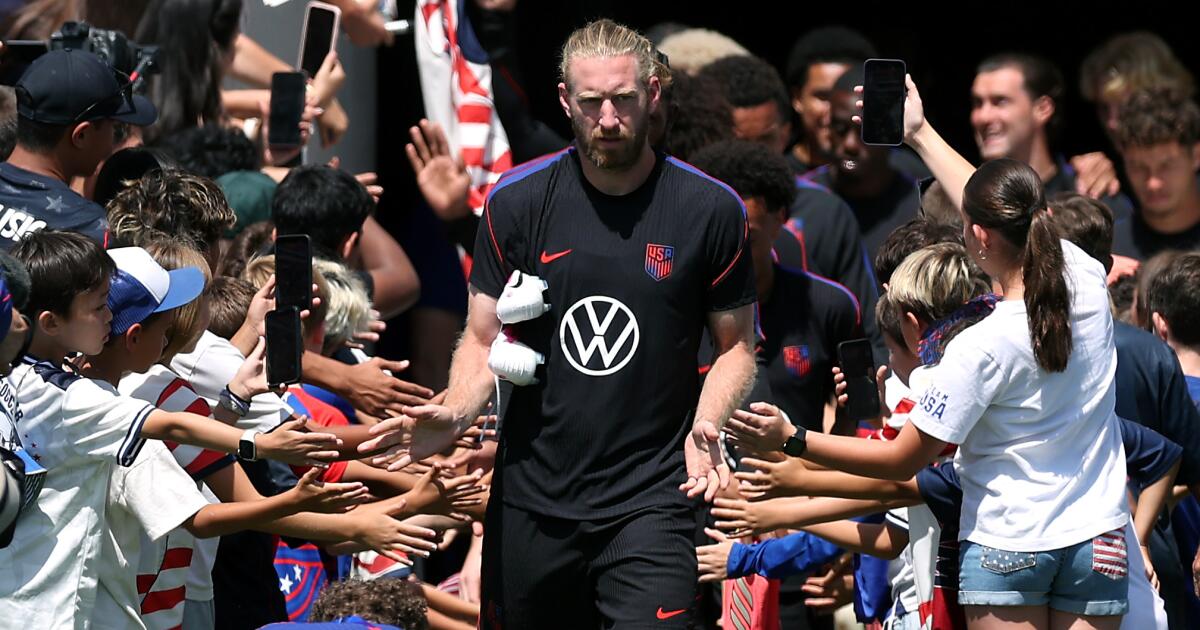
Tim Ream is the only player on the American World Cup team who was alive the last time the tournament was played in the U.S. But he was only 5, so the memories are kind of sketchy.
“I remember bits and pieces of 1994,” he said.
Still, it’s fallen on Ream, as both the captain and the oldest man on the roster, to prepare the team for what they’re about to experience when the U.S. opens play Friday at SoFi Stadium.
“I’ve tried to tell guys and tried to convey the message that this is a once-in-a-career [opportunity] and with that comes more expectation, more pressure,” he said. “But at the same time we have to enjoy it.
“It’s about just opening your eyes and taking everything in because this is unique, this is completely different from anything that any of us as players has experienced.”
Only 22 men in history have suited up for a home World Cup game on U.S. soil. Players including Alexi Lalas, Eric Wynalda, Cobi Jones and Marcelo Balboa parlayed that fame into broadcasting careers. Others have become coaches. Fifteen of them were inducted into the National Soccer Hall of Fame.
Ream, who played in the last World Cup in Qatar, said it’s difficult to compare the experience of that tournament with this one — especially since this one hasn’t started yet.
“It’s not our first rodeo, but it’s our first one on U.S. soil,” he said. “So it’s kind of our first rodeo in a way. It’s exciting.
“So take it in, enjoy it, embrace everything that it is. Because it’s so unique, it’s so special. And it’s not something that we will ever get to do again.”
Midfielder Cristian Roldan was also at the last World Cup, although he didn’t appear in a game. He says the energy is different this time around.
“You feel it when you’re there. You’re kind of isolated, you’re alone,” said Roldan, one of 13 players on this team who were also on the team in Qatar, half a world away. “But it’s different here. You see how many media members are here. You see how many people we’ve seen in training over the last few weeks. You feel that energy, you feel that support.
“Now it’s about translating that energy, that support, that pressure into something good.”
Goalkeeper Matt Turner agreed.
“This one, obviously, it’s a lot more tangible,” he told reporters Tuesday. “You guys are all here, right, real close to us. We have 5,000 fans for training yesterday. It’s very different. In Qatar, you’re in a lot more of a bubble.
“But us players, the ones that had the [World Cup] experiences, I think we’ve done a really good job of keeping that boundary.”
What’s lacking this time, Turner said, was the pressure of a qualifying campaign to bring the team together. Because the U.S. is one of the three host countries — alongside Mexico and Canada — it was assured a spot in 48-team field when it won the right to stage the tournament eight years ago. As a result it hasn’t played a competitive game in more than 11 months.
“The intensity of those games, the environments that you have to dip into and get results, you find out a lot about the players and find out a lot about the team,” he said. “This time around, it’s been different. We’ve had a lot of different looks, a lot of different players getting a chance to prove themselves and show themselves.
“It’s not anything bad or good. I just think it was a little bit different.”
Striker Folarin Balogun, one of 13 World Cup newbies on the U.S. team, said he doesn’t expect the gravity of the experience to hit him until he lines up for Friday’s opening game with Paraguay.
“It’s probably going to start to go more real to me when I’m preparing to go on to the pitch,” he said, sitting behind a table next to Ream. “I’m hearing the fans shouting and screaming, so I definitely think it’ll be real to me the closer I get.
“But you know, this is the first opportunity for me to play in the World Cup so I don’t really have any expectations.”
Balogun then looked over at a frowning Ream, who had just finished urging his teammates to be sure to stop and smell the flowers along this World Cup journey.
“Just trying to stay present, stay in the moment,” Balogun hastened to add. “You know, enjoying the experience. I think it can be a really memorable World Cup.”
Memorizing your lines seems like such a foundational part of an actor’s job that there wouldn’t be much to say about it. Yet when a group of performers recently got onto the topic during The Envelope’s Emmy Limited Series / TV Movie Roundtable, it turned out everyone had their own way of doing it. And all were eager for tips and tricks, whether it be an app, a line-drilling coach (“Can I have that number?”), writing down the first letter of each word or even writing a monologue backward.
“We have to share tools, guys,” said Camila Morrone, who plays a bride-to-be who learns her fiancé’s family dark secrets in the horror thriller “Something Very Bad Is Going to Happen.” “It’s funny that we all have such different methods.”
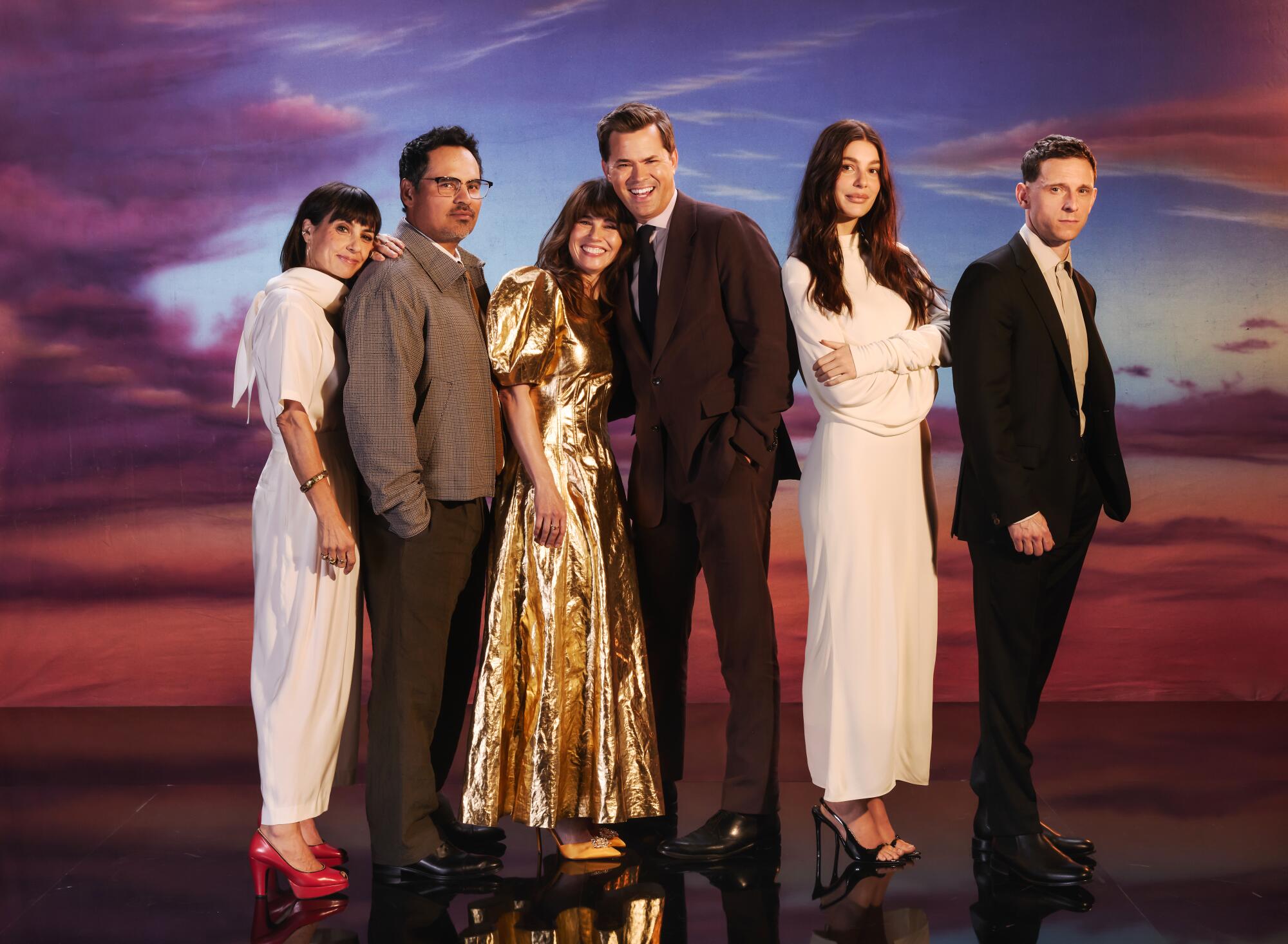
Joining Morrone were Jamie Bell, who stars in “Half Man,” about the extremely dysfunctional, toxic relationship between two stepbrothers; Linda Cardellini, who appears in “DTF St. Louis” as a dissatisfied woman caught in a dangerous love triangle; Michael Peña, who plays a detective assigned to the case of a missing child while his own boundaries are tested in “All Her Fault”; Andrew Rannells, who is a man coming to terms with his own life while helping to plan a funeral in “Miss You, Love You”; and Constance Zimmer, who channels the mother of Carolyn Bessette Kennedy in “Love Story: John F. Kennedy Jr. and Carolyn Bessette.” Read on for more excerpts from our conversation.
The Envelope’s 2026 Emmy Limited Series / TV Movie Roundtable: Constance Zimmer, left, Michael Peña, Linda Cardellini, Andrew Rannells, Camila Morrone and Jamie Bell.
How do you watch TV? A home theater screening room or a tablet on the go?
Morrone: When I see people on a plane watching on their phone, I’m like, “Do you know how many people worked on that?”
Zimmer: I can barely watch one on an iPad because I still feel guilty about not getting the full effect.
Cardellini: I can’t watch on my phone or an iPad. It starts to hurt my eyes. And I like to binge. I don’t like one at a time. I like to save it up, and I like a binge. I don’t have the patience.
Morrone: Oh, I love one at a time. I want to wait till Sunday night, order my favorite food, maybe have a friend come over … Guess our theories of what’s going to happen. I did that with “White Lotus” this year, and I was looking forward to every Sunday at 7 p.m.
Bell: I catch usually about 10 minutes of whatever my wife has fallen asleep to. And then I’ll get into that, and then I’ll watch a lot more episodes while she’s asleep. And then she’ll wake up, and we’ll be completely out of sync in terms of what we’re watching.
Jamie, “Half-Man” is such an emotionally intense show, and it seems like that would be a really hard head space to exist in. Are there things that you do for yourself to maintain your own sanity?
Bell: Me and Richard [Gadd], who wrote the show, are big soccer fans. So I brought a soccer ball to set a lot, and just whatever space we’re in, we just kick a ball to each other every now and then. So, a lot of that wasn’t even us really speaking to each other, but just passing a ball backwards and forwards, which was quite a nice way of just taking our minds off of whatever scene we were doing and still enjoy the space with each other and do something that was physical that didn’t really require us jumping [around] too much.
Camila, “Something Very Bad Is Going to Happen” is also a very intense show. It’s not so much a scream queen kind of horror; it’s this foreboding horror. Was that a difficult space for you to exist in?
Morrone: I think there’s an underappreciation for horror performances. I think some of the most incredible performances, especially by women, have been done in the horror genre. And I think it’s a really specific thing to do because if you’re playing only one level of horror throughout an eight-episode series, I think it’s incredibly boring. And I think I had this notion of like, “God, I don’t want to do these jump scares,” and kind of the cliches of what we imagine horror is like. But horror can be really deep and really internal, and I think there’s a lot of ways in which horror and fear manifest. And I think it was interesting to try and find levels to it and to have the audience come with you, but not dramatize or exaggerate an emotion.
Michael, in “All Her Fault” you are playing someone who could be a much more conventional detective character, but reveals more layers. Was there a moment in your career when you realized, whether it was going for certain roles or not going for certain roles, where you wanted to break out of feeling like a sidekick character or more stereotyped characters? Was there a moment where you made an effort to start going for a different kind of role?
Peña: Back when I started acting, the breakdowns for actors, it was like “Caucasian only,” “Caucasian only,” “Caucasian only,” and we weren’t allowed to audition for those. And it was only until the 14th part that it said, “Open to other ethnicities.” So there’s like a thousand of us going for the 14th place. Ten years of that, you kind of think, “I guess I’m meant to be a supporting character.” But then my mom, right before she died, what she said is, “If you’re going to do that, just make it real. What’s the best you can do with that part?” I said, “Make it a three-dimensional character.” She’s like, “Just do that.” And she’s like, “Nobody remembers your bank account.” And I was like, “Oh, these are two good pieces of advice, Moms,” and so that’s what I did. And with “Crash,” he was a gangster and I was like, “Screw it. I’m just going to do the work and try it out, and all the stuff that I was learning in acting class, I’m going to apply it to this particular role.” And I was happy with the work, so then I kept doing that.
For the rest of you, was there a moment where you had to make a decision about the kind of career that you wanted for yourself and the kind of roles you were going to go up for?
Zimmer: Sorry. It just makes me laugh because we have no control, as actors, over where they believe that we belong. I wish that we could say, “I’d like to try this now,” but it’s basically where they believe they would like us. And then you get put into an area, or a path, or a box, and you can’t get out until somebody else decides, “Hold on. We’re going to give you that shot to try this, even though it’s not necessarily what you normally do or are known for.” Then it takes that for everybody to go, “Oh, you can do this, too?” And it’s like, “Yeah, that’s my job.” My job is to do a lot of things, not just one role, or one type of role.
Rannells: You’d like to think that you’re more in control of those decisions, but sometimes things just happen.
Constance, as Ann Messina, Carolyn Bessette’s mother in “Love Story,” you have this speech that you give at their wedding dinner. It’s such an incredible scene, and I’m wondering, what was it like for you when you first read that in the script?
Zimmer: That monologue was actually my audition.
Peña: Oh, I love when that happens like that.
Zimmer: So I knew it very well, getting on the set with it. I think that I only saw two scripts out of nine episodes, and they were just the ones I was in. And I remember my team saying, “This might be it. We don’t know if there’s anything else that you’re going to do on the show.” And I said, “If this is the only thing I do, it’ll be worth it,” because it was so layered and it was so well-written by Connor Hines and Juli Weiner, I was kind of like, “This is all that matters anyway.” So, to be able to feel like I could pour the entire character into one moment in time, it allowed me to try and give her as much as possible because I was like, “This might be it.” So when I read it, I was like, “Oh, OK. That’s like those five-page monologues that you don’t get very often to do for one character in one episode.”
Linda, your character on “DTF St. Louis” has this habit of saying, “No way, José,” and it’s oddly catchy. And she also is always asking people to speak up. Is it difficult to take what seems, on the page, maybe like tics or weird habits and make them feel natural?
Cardellini: That was the great challenge of it, and it’s the beauty of [Steven Conrad’s] writing. Like we repeat “Jamba Juice,” or “Quality Inn,” or “Garden Suites,” all these little phrases, or “Snag it.” It’s so fun to find a way to make that seem like it is natural to you. I remember I had a long monologue audition, and in there I talk about, “No way, José.” I wasn’t sure what the tone was — it’s such a specific tone when you watch the show, and it’s very Steve Conrad. And I didn’t know what it was before I met him and before you could see the show in action. So getting through that and chewing through that in my audition, doing these versions of “No way, José” that I thought felt really, really natural to me, I was like, “This is how I would say it. This is how I’m going to do it. If my sense of humor matches his sense of humor, if our tones match, then I’ll get this role. And if they don’t, then somebody else will do it beautifully in that other way, whatever that is.” Luckily that was like a marriage of tone and thought, and then those things start to come naturally. And then you want to say them more often than they’re written. There’s not a lot of improv in the show, but we would all just joke around and say it to each other.
Andrew, so much of “Miss You, Love You” is just you and Allison Janney together —
Rannells: Just sitting in a house. Just talking.
What was the rehearsal process like? How did the two of you prepare for these very long dialogue scenes?
Rannells: We rehearsed it like a play, which was really fun, and I’ve never really … I mean, we did that, I guess, with “Boys in the Band” a little bit. We had done it on Broadway and then we all kind of still knew it from when we actually filmed it. But Allison and I rehearsed it like a play, and we would just run lines like little theater nerds. It was exciting because I’ve never — to get on set and to be able to say, like, “We can do the first 25 pages just because we’ve already memorized it.” And we did for Danny Moder, the [director of photography]; we did our little play for the crew one day. Which was really fun because you don’t normally get to work like that. It’s like in little segments. And [writer-director] Jim Rash just let us run it in a way that felt really satisfying to get to do. Because sometimes when you just do little pieces of things you’re like, “I can’t quite get the arc of this, and I don’t really know.” You’re doing inserts, and you’re like, “This doesn’t feel like acting.”
Zimmer: And you’re doing it out of order, so you’re like, “Wait, I’m playing the end before I’ve even played the beginning, but I don’t even know what my beginning is.”
Cardellini: It becomes detective work.
Rannells: Shout-out to Allison Janney. It turns out she’s good at acting.
Linda, what was it like working with an intimacy coordinator in shooting what certainly look like they could have been very awkward scenes in “DTF”?
Cardellini: I like an intimacy coordinator. I think it’s wonderful. I think they’re there if you would like to use them. Everybody I’ve ever worked with in that capacity has been so helpful and considerate, and I think it’s just a nice resource to have. And we had a great one on “DTF.” … One of the first scenes I ever shot was me where I have to, we call it “weight placement,” on Jason’s face. And we were scheduled to shoot that much later, but it came up the —
Rannells: That was your first day?
Cardellini: That was our first scene together, really placing your weight on somebody in a way where you just don’t want to hurt somebody’s face. I mean, you don’t want to suffocate somebody. There’s a lot of things that could happen. But it was handled so beautifully. And Jason, of course, is so wonderful, and we had such a great time doing the scenes because we just would laugh — they’re funny. The scenes, more than even being sexual, are so awkward and bizarre and filled with these strange little kinks that it becomes funny, in a way, although you treat it with dead seriousness. But Steve Conrad had a beautiful economy about what he was shooting, and he would storyboard. It was never just like, “Oh, be intimate and go for it, and we’ll see what we use.” It was, “This is the part of your body we’re going to use right here. This will be the shot. It’s this frame. We’re not going to do any more than that.” So you never felt like you were in the Wild West doing this passionate thing that felt uncomfortable. … Because, of course, going into something like that, reading the script, you’re thinking, “It’s a little nerve-racking. How am I going to do these things?” It was much easier than I could have ever imagined.
Constance, your character in “Love Story,” she embodies the other side of the glamour and the fame and the story that we all think we know. And in a lot of ways I can’t help but connect it to your character from “UnReal” in that it creates this really interesting perspective on fame. These roles, do they make you think about that, as well? Do you start to consider your own relationship to fame and your character’s relationship to fame?
Zimmer: Ann, [and] working on “Love Story” in general, really brought the price of fame to the forefront and how it can tear people apart and down and away from who they were before they became famous. And I think, in this particular story, Carolyn never set out to be famous. That was like the last thing she wanted. The scenes with me and Sarah Pidgeon, who plays Carolyn Bessette, were very much about, “How do I remind you that everything is going to change, and you are going to change?” So it made the mama bear really show up. And sadly, it’s hard to do the research about all of that and see how much media was to blame. I hate to say it, and it’s tough, especially for a woman: They really tore her apart. It definitely makes you look at things and go, “Wow, it’s so interesting what we all give up.” This is our craft. We do this as actors, yet when we step outside of our craft and our roles, we are judged on such a harsh level. We’re here for the work and to make and show these characters so that maybe you can see a little bit of yourself, or maybe it can help you with grief, or laughter, or whatever. But then, outside of our work, we are judged almost worse about how we’re aging, how we’re not aging, what we look like, what we don’t look like. It’s the hardest part, I think, of what we do.
Would the rest of you agree with that, that in some ways, it’s not the work that you’re doing, but it’s this other job that exists outside of your work, the fame aspect of it? Does that become a bigger challenge than you expect?
Rannells: So much of the promotion of things that you work on now hinges on your participation in like, “Post this picture” or “Do this video” or “Do this thing.” And that’s stuff that you just don’t think about when you say, “I want to be an actor.” You don’t think about, “Do I have to do a collab with the network?” I don’t want to do that. That’s not part of my job, but it is part of your job. That is part of it now. So that’s a tricky aspect of it that I didn’t expect.
Morrone: The other side of that coin is that there’s independent films that I’ve done, that nobody would have ever seen had I not been the poster child on social media, being like, “I love this film. Please, watch this film. This is how to watch this film.” So, then again, it can also be a really beneficial platform. And it’s such a complicated relationship because, I mean, I grew up with social media. I don’t ever remember not having a form of social media. And I wish I could be like the cool actors who aren’t on it. They’re much more mysterious.
Peña: Jamie’s not on it.
Bell: I mean, it’s not a conscious choice. I’m just not on it.
Jamie, both you and Linda have been acting since you were quite young and, in some ways, have grown up on camera. How do you know what of yourself to hold onto, what you allow the public to see? Is that something you , at some point in your career, had to make a decision about how much of yourself you were going to give away?
Bell: I’m quite a boring person. I’m a dad. When I’m not working, I’m just dad and school running and that kind of thing. And also, I enjoy working. So most of my time is spent either trying to get the next job, or thinking about the next job, or just really working hard on that because I enjoy that. So I really don’t think about any of that other stuff. And I’ve been quite fortunate in that no one is particularly interested in banging down that door anyway …which I’m quite relieved about, honestly, because I feel like I get to work in a space where I’m just coming and playing the part, and I’m going home. That’s all I’ve ever done is since I was like 12 or 13 years old, and I still enjoy that. I still enjoy that thrill of going to work and playing the character. And I have incredibly high expectations of myself and all those things. I self-flagellate a lot on the way home, like, “Why didn’t you do it like that?” I stress myself out about that kind of stuff, but I still go back the next day going like, “God, maybe I’ll get it today.” And that excitement still exists. And I think mostly that’s because I don’t have this other side of stuff that is distracting me from anything.
Cardellini: When I first started, I wondered if I would ever make a living at it. And to be able to have had it as my job and to have a job that I love and, like you said, show up and just be excited to do the work and be excited to be around other people who do the similar work or behind the camera… It’s such a beautiful community that I feel very grateful that I’ve been able to grow up doing what I love. I mean, I wouldn’t have guessed that it could have lasted this long. And people always said, like, “Oh, when you get to a certain age, it gets terrible for women.” And I still feel like I’m still learning and growing and doing new things, stuff I’ve never done before. So I just try to turn down my worry and just be so grateful in the moment, which is not always easy for me because I can live with a lot of anxiety. But thinking about it and listening to everybody here right now, I just am very grateful to have a seat at the table, literally and figuratively.
I’d imagine for all of you that you’re probably never quite sure what roles you do that are going to be the ones that hit in a certain way. Do you ever know what movies are going to land with audiences?
Peña: I think I’ve done OK in that department where if I read something and it really moves me, I just want to be a part of it. I mean, they had their own success, in a way. “Eastbound & Down” was so funny. When I read the character, I was like, “Oh, this is a really cool character.” And now the meme… There’s a fart meme. Man, I swear to God, we shot that 15 years ago, and literally I do a fart noise, and I say, “How long have you been with her?” It sucks now because I’m like, “That’s all they know me for. Not ‘Crash,’ not ‘World Trade Center,’ not all the movies that were nominated, this and that.” It’s the fart noise.
Rannells: Is that going to be your In Memoriam thing?
Peña: Can you imagine? Let’s watch a clip here of Michael —
As we talk about these past projects you’ve been a part of, it just leads to the question of how the business of being an actor, the nature of this as a job, has changed for you over the years.
Rannells: When I started, and I started in the ensemble of “Hairspray” on Broadway, I never expected that I would ever get a job on television. That just seemed very far away. So the fact that I get to do it and that I have a tiny bit of control over what I get to do is a real gift because it was very unexpected. My first TV job, I was a headless stripper on “Sex and the City.”
Morrone: What episode?
Rannells: It wasn’t a Halloween episode. They just didn’t shoot my face. But I remember filming it and being like, “I can’t imagine this will ever happen again, that I’ll be on a set, or doing a TV show,” So it’s still sort of a surprise anytime I get a job that I’m like, “Someone’s going to pay me to do that, to make faces.”
It seems like everyone in Hollywood right now is talking about artificial intelligence. For all of you, is that something that you are thinking about for yourself? Have you experimented with it at all?
Morrone: I really want to believe that people will always choose us and real emotion, and that the audience is really smart and they want to see real humans and real life experiences and raw emotion. And I pray that that’s the case. I have a lot of hope in humanity, in that case.
I don’t know what it means for us in the near future. I know that we have to protect ourselves. I actually was working with Patricia Arquette, she directed me in a film called “Gonzo Girl.” And she is so hyper-aware of all of this and looking into all her contracts. So was Jamie Lee Curtis. I got the opportunity to talk to her about AI. And they were so knowledgeable and like, “Go back and look at everything that you’ve done the last 10 years, and review everything, and make sure that they can’t use your likeness in the future.” I mean, it’s something that we really do have to be aware of.
Peña: I don’t think that it’s going to be a threat because it’s working off of a database and whatever has been uploaded onto that particular AI. So, just for s— and giggles, I was like, let me see if it can write some jokes. So, I’m like, “What would Peña say in this one?” I was like, “Lame.” All the jokes sucked, and they were recycled jokes. And I was like, “OK, cool. That gives me hope.”
With its World Cup opener just four days away, the U.S. team moved into its temporary home in Irvine on Monday, where the players found thousands of new Southern California neighbors waiting in line to watch them kick a ball.
After the U.S. announced that Orange County Great Park would be its base for at least the group stage of the tournament, the City of Irvine held a raffle for passes to see the team train in its only public workout.
Thirty-two thousand people applied and 5,500 received access on a warm Monday morning to watch the team rush through a light 45-minute practice that was notable primarily because it was the first in which injured center back Chris Richards was fully involved. Richards tore two ligaments in his left ankle playing for Crystal Palace, his English club team, on May 17 and hadn’t played or fully trained since. The team is rushing to get him ready in the hopes he can play at some point in the three-game group stage.
But the practice was also notable because it was the first at Championship Soccer Stadium, about 50 miles southeast of SoFi Stadium in Inglewood, where the U.S. will open its World Cup on Friday against Paraguay.
“[The] environment and facilities are crazy. It’s more than we expect,” U.S. coach Mauricio Pochettino said of the venue. “We are so grateful.”
Championship Soccer Stadium is owned and managed by the city, which has leased it to the Orange County Soccer Club of the second-tier USL Championship. But the club was temporarily evicted in late April to make space for the national team — which is just fine with them.
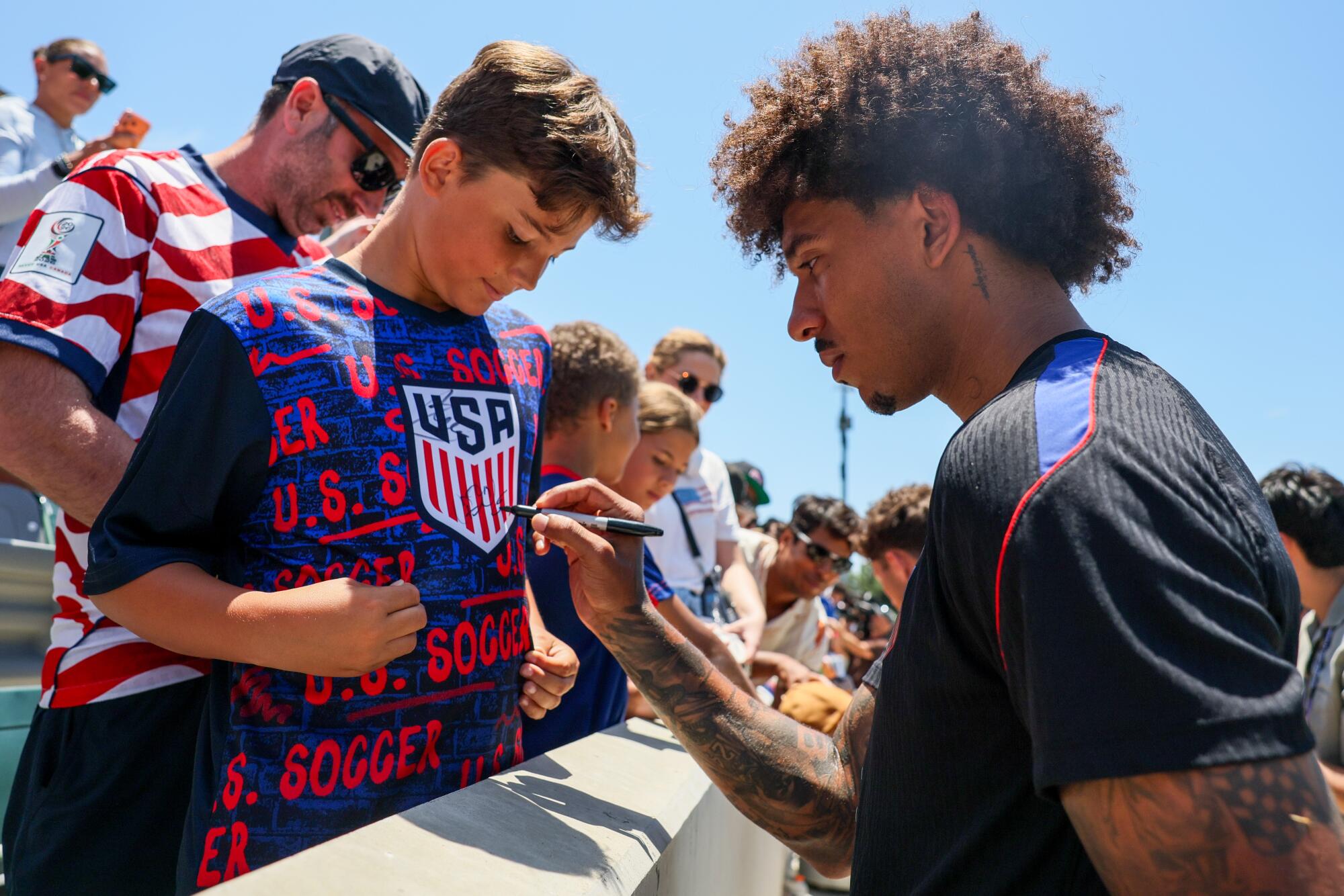
U.S. men’s soccer player Chris Richards autographs the shirt of a young fan during a team practice Monday.
(Ronaldo Bolaños / Los Angeles Times)
“How can you not be excited about the host nation training in your facility?” said Dan Rutstein, president of business operations of the Orange County club.
“We’re proud to be associated with the U.S. national team. We wouldn’t want to ever block anything, even if we could.”
(And they couldn’t, the city said.)
The Great Park is a sprawling 500-acre complex built on the site of the former Marine Corps Air Station El Toro, which closed in 1999 after 56 years training pilots for conflicts from World War II through the first Gulf War. In 2001, voters approved a proposal to convert the space into a public park and nature preserve, one which now includes, among other things, five sand volleyball courts, four basketball courts, 25 tennis courts, 12 softball and baseball fields, the ice arena where the Ducks practice and 25 soccer fields, including the pristine one FIFA just installed inside the 5,500-seat stadium.
“The idea was that this would be a quality facility, a great park that we hope will rival San Diego’s Balboa Park and other great parks across the country,” Irvine mayor Larry Agran said. “It took a lot of nurturing, a lot of time, a lot of work.”
Bringing the World Cup — or at least a World Cup team — to Irvine also took a lot of time and work. Agran said the city put out feelers about hosting a training base five years ago and made the first cut in 2024 when the Great Park was placed on a list of options distributed to tournament qualifiers.
Over the next two years, Rutstein said, about a dozen national teams sent representatives to have a look while Sam Zapatka, the operations manager of the USMNT, said he scouted 27 facilities from Seattle to San Diego. After his first visit to the Great Park, however, he said he stopped looking and in March, the team announced it would train in Irvine.
On Monday, when the players filed out of the stadium’s locker room, which FIFA expanded and upgraded, they were greeted by rhythmic clapping and chants of “USA! USA!”
1
2
3
4
1.U.S. men’s soccer player Weston McKennie takes part in a training session at Orange County Great Park.(Ronaldo Bolanos / Los Angeles Times)2.(Ronaldo Bolanos/Los Angeles Times)3.U.S. men’s national soccer team coach Mauricio Pochettino waves to fans attending practice on Monday.4.Pochettino speaks to players after drills at Orange County Great Park on Monday.(Ronaldo Bolanos / Los Angeles Times)
“I think we’ve all been, I wouldn’t say overwhelmed, but possibly surprised by the excitement and the buzz,” said captain Tim Ream, who led the team onto the field. “Pulling up here with 5,500 fans ready to watch a training session is incredible.
“We get to train in an actual stadium with a good pitch. The support, really, from all the kids out there is amazing. You want to feel like you have a good home base, right? So really, we’re looking forward to being here.”
Especially after 5,000 of your neighbors show up for the housewarming party.
Welcome back to the Times of Troy newsletter, where USC baseball’s charmed season came to a devastating end in the bottom of the ninth of a decisive Super Regional matchup with North Carolina on Sunday. But no matter how brutal it may have been in the moment — with black-stained tears streaming down Trojan cheeks in Chapel Hill — the fact that USC was in position to have its heart broken at all is a testament to what Andy Stankiewicz has built in his four seasons at the helm.
Fight on! Are you a true Trojans fan?
Get our Times of Troy newsletter for USC insights, news and much more.
By continuing, you agree to our Terms of Service, which include arbitration and a class action waiver. You agree that we and our third-party vendors may collect and use your information, including through cookies, pixels and similar technologies, for the purposes set forth in our Privacy Policy such as personalizing your experience and ads.
It was barely a year ago that I sat with Stankiewicz in an unfinished concrete dugout at new Dedeaux Field, discussing the importance of building a foundation for a program that had lacked one for so long. The metaphor wrote itself at the time. His team was on the cusp of clinching its first NCAA berth in a decade, just as its new stadium was finally rounding into form. But as triumphant as that tournament invite would be when it finally happened, Stankiewicz was already thinking bigger.
“We want to build this thing for the long haul,” he said then. “And to build a home, you have to build a strong foundation so it can withstand the weather. The same thing applies here. I want to be here for a long time. This is where I grew up. This is where I’d love to be.”
A year later, the foundation hasn’t just been built. The house is finished. The front door is open. All that’s left is for the Trojans to walk through it.
They had their chance Sunday in Chapel Hill. Andrew Johnson twirled another postseason gem. The Trojan bats, again, delivered in big moments, with clutch solo shots from Kevin Takeuchi and Andrew Lamb. Through 8.2 innings, USC had given up just a single run.
But the bullpen, which had been one of the Trojans’ few weak points all season, couldn’t finish the job. Sax Matson came in for just a single pitch and was pulled. Adam Troy faced three batters, walked one who scored and was pulled in the middle of a 3-0 count for another. Chase Herrell faced four batters after that, walked one and gave up two other hits, including the walk-off winner.
Just two outs stood between the Trojans and a trip to Omaha. At one point, all they had to do was catch a fouled pop fly to send the game to extras.
“That was a tough one,” Stankiewicz said after. “As best we can, we’re gonna move forward. But again, I got some disappointed young men in our dugout. As the head coach, you think, ‘Dang it, what could I have done differently?’”
Surely, the Trojans coach might be thinking all season about how close his team was to reaching that next rung as a program. The truth, though, is it’s a wonder they got here this fast in the first place. USC won 48 games, its most in a quarter century. It had to climb its way back from the loser’s bracket in its regional, then, on the road in Chapel Hill, it took one of the national title favorites to the brink.
Not only that, but USC rose to that level in a still-unfinished stadium, without anything resembling the NIL firepower that other college baseball teams, particularly in the SEC and ACC, are wielding. USC has tried to make up for that by funding more scholarships, but when other teams are handing kids hundreds of thousands more in NIL offers, it makes competing with the Joneses especially difficult.
Stankiewicz has managed to make it work, anyway. And as more talent rolls into Troy, there’s every reason to believe that we’ll look back on this moment, not as a devastating end, but the start of something particularly special for USC baseball.
“We got to the finals of the Regional last year. Now the finals of a Super Regional,” Stankiewicz said. “We’re not going away.”
Calling all questions …
With the summer here and college sports now on hold for the next two months, it’s a perfect time to answer any questions you have about the upcoming year at USC. So please send anything on your mind about Trojan sports to ryan.kartje@latimes.com. When the newsletter returns in a couple of weeks, I’ll answer the best ones in this space.
USC pitcher Andrew Johnson.
(Laura Wolff / For The Times)
—A standing ovation for Johnson, whose pitching performance through the postseason was nothing short of Herculean. Johnson spent most of the season as the Trojans’ forgotten No. 3 option in the rotation, with Mason Edwards and Grant Govel ranking among the best pitchers in the nation. But it was Johnson who came up the biggest in the postseason. Twice he pitched well in relief, only to throw seven-plus innings two days later. This felt like a breakthrough moment for Johnson, who should pair with Govel to give USC an outstanding 1-2 punch on Fridays and Saturdays next season.
—There’s been talk about alternate jerseys at USC over the last several years. The conversation about alternates actually dates back to before Jennifer Cohen took over as athletic director. But as was the case before, the conversation has been tabled for the time being. Athletic departments are always looking for added revenue these days, but the juice just hasn’t been worth the squeeze to date, considering the many fans that would surely be offended by changes to the Trojans’ classic uniforms.
Olympic sports spotlight
After going on a tear to close out the season, USC women’s golf was on the precipice of snagging the school’s second national title this year … before it ran into a buzzsaw in No. 1 Stanford.
But an NCAA runner-up finish is still a great result for a program that hasn’t won an NCAA title since 2013. The Trojans have now finished second six times in their past 38 seasons, which is to say they’ve been the runner-ups basically 15% of the time over the last four decades.
That’s a lot of years being the bridesmaid, not the bride. But there’s no reason to think that Justin Silverstein, the Big Ten’s Coach of the Year in 2026, shouldn’t have this program back in the mix as soon as next season.
What I’m Watching This Week
Matthew Rhys and Stephen Root in “Widow’s Bay.”
(Apple)
If you’re in the mood for something creepy, boy do I have the content for you. “Widow’s Bay” on Apple TV follows Mayor Tom Loftis, played by Matthew Rhys, who’s desperate to revive his struggling island community of Widow’s Bay. But the locals on the island are convinced the town is cursed, and don’t necessarily approve of bringing tourists into the mix.
As you might imagine, the locals appear to be right. And Loftis finds himself in some horrifying situations. Enough to convince me that maybe this isn’t the best show to be watching alone, late at night. But if that’s in your wheelhouse, then this is as good as it gets.
That concludes today’s newsletter. If you have any feedback, ideas for improvement or things you’d like to see, email me at ryan.kartje@latimes.com, and follow me on X at @Ryan_Kartje. To get this newsletter in your inbox, click here.
In this week’s episode of The Envelope podcast, “Love Story” stars Paul Anthony Kelly and Sarah Pidgeon open up about inhabiting John F. Kennedy Jr. and Carolyn Bessette — and creating a cultural moment of their own.
Kelvin Washington: Welcome to the next episode of The Envelope, Kelvin Washington alongside Yvonne Villarreal; we got Mark Olsen as usual. And so you, my friend, had a chance to speak with stars of “Love Story” — Ryan Murphy, of course, tackling love with this. So it got me thinking, give me some real-life love stories that you’d like to see portrayed, maybe next season. Some love stories you always found interesting.
Villarreal: This one doesn’t have a tragic ending, and that’s why I want it. And that is Ina and Jeffrey Garten. “Barefoot Contessa”!
Olsen: I didn’t know that there was a great romance in her life.
Villarreal: Mark. You’ve never heard of Jeffrey? You don’t know Ina and Jeffrey. OK, this is why we need it. That man adores Ina and anything that she makes. Chicken, anything. This is a love story I need to see get the full display. I’ve read it in her book, but I need —
Olsen: So like “Julie & Julia.” Julia Child and her husband.
Villarreal: But cuter, sweeter, more adoring.
Washington: Loving the food theme here.
Villarreal: She’ll make anything and he thinks it’s delicious, and she laughs at everything he says, and I just want more of it, and I’m very curious what a Ryan Murphy take on Ina and Jeffrey would be.
Olsen: But see, that’s the thing. A Ryan Murphy take on that would ruin it for you.
Washington: That would be dramatic and spicy. Salacious.
Villarreal: Nothing could ruin it for me.
Washington: You got one?
Villarreal: Yeah, what’s yours?
Olsen: Well, I have two. One is because the sort of the ’90s vibes of “Love Story.” So you would obviously do Kurt Cobain and Courtney Love. And that one would be very exciting and dramatic and very ’90s-ish. But I think for more of a torn-from-the-headlines [version], Taylor Swift and Travis Kelce.
Villarreal: It’s too current.
Olsen: That’s why though.
Villarreal: How about you?
Washington: So I’m gonna stay with your ’90s. Instead of the pop grunge. I’m going to go R&B pop. I’m going to go Bobby and Whitney.
Olsen: I mean, that’s gold right there.
Washington: I’m just saying. You got love, you got fame, you got tragedy. You’ve got stuff that we didn’t know about behind the scenes.
Villarreal: Maybe he could hire us as head writers for each of these seasons and we can all have our say.
Washington: We can all have our own season. So as I mentioned, Yvonne, you had a chance to sit down with Paul Anthony Kelly and Sarah Pidgeon of “Love Story.” How’d that chat go?
Villarreal: They play John F. Kennedy Jr. and Carolyn Bessette, respectively, and it sort of looks at this seven-year tumultuous relationship and what they both endured navigating the spotlight and what that did to them, how they each felt about it. So it was interesting to get the take from Paul and Sarah about how they’re also navigating the spotlight, because I feel like social media fame is quite different than what John and Carolyn were navigating back then. And I was curious to see what it was like for them. So yeah, it was an interesting conversation.
Washington: All right, let’s get into that conversation now.
Sarah Pidgeon and Paul Anthony Kelly, the breakout stars of FX’s “Love Story.”
(Jason Armond / Los Angeles Times)
Villarreal: I imagine doing this series has been a sort of singular experience. What do you want to remember about this moment that you’re in?
Kelly: All of it’s so fun, it’s exciting. It’s definitely, for me, a new muscle that I’m learning to use and explore and stretch and flex. And I get to hang out with her a little bit more. It was wonderful.
Pidgeon: I think it’s just really hard to contextualize what this [is] — [to Kelly] I don’t know if you feel this way too — because there hasn’t been a ton of space from even the show having all the episodes come out. I don’t think I totally understand how this fits into the story of my life. I recognize that we’re experiencing something very exciting. And I think I speak for both of us that we feel really grateful and so honored to have taken on these roles and that it’s resonated and has excited people. But being out and about in New York and someone stops you and says, like, “Are you that girl from that show?” … When you’re making something, it can feel so insular. I remember when I started, I had a freak out sort of midway through like, “Oh, this is actually going to come out. It’s not just about the making of it. People will see it.” I had a huge heat rash. [To Kelly] Remember when we were in Hyannis Port? I just haven’t totally had that perspective. It’s just been very full-on in the most exciting, lovely, happy way.
Kelly: It’s all unfolded in succession. There’s been no period of time to really process. I can’t believe I did it, still. It’s out and it’s exactly the same thing … people are like, “Hey, you’re the guy in that thing, right?” I’m like, “Yeah.”
Villarreal: Has it happened in an awkward way?
Kelly: No, no, it’s all been overwhelmingly positive. I guess that’s best-case scenario, but I still try to walk around with a mustache and glasses and a hat and they’re still like, “Hey …!”
Villarreal: You didn’t try to go to the [JFK Jr.] look-alike contest in New York?
Kelly: Oh, my gosh, no.
Pidgeon: He would have won. That wouldn’t have been fair.
Kelly: It’s too many people. I got the show, so I think I already won.
Villarreal: A big theme of the series is exploring the heavy ramifications of fame on privacy. And aside from the great opportunities that come with doing the press or other things that come along with this, what has it been like adjusting your life to this experience?
Pidgeon: That idea was on both of our minds when we were filming. And we were filming in New York, so apart from the scenes and subject material we were exploring, we actually experienced it in real life as well. You have even more characters in a scene when you’re shooting on the streets of Tribeca and people stop and watch. And there was a lot of interest from the public while we were filming. I’ve been marinating on that idea. Maybe not marinating, but meditating. [Or] a little bit of both. Through our characterization of Carolyn and John, I think we felt those extremes. I haven’t felt anywhere close to that. But I don’t know about you [Kelly], but I feel like I’ve been quite busy going different places, coming on podcasts and things like that where my downtime hasn’t really been spent walking the streets so much. It’s been kind of going home and taking a shower and going to sleep.
Kelly: Same. I haven’t really had much time to go out and just be in the public, which I think has been kind of a gift. I recently had a child, so I have no time between the show and being dad. It’s been really great to live within that little privacy bubble I have at the moment. I’m going to New York for the first time in a little while tomorrow.
Villarreal: Has living in their story made you more conscious of what types of boundaries you do want to set?
Kelly: Absolutely. That was a really great gift of the show. And exploring the exponential setting of what privacy means to people, certainly those two individuals. But now I’ve adopted that within my own life, and it’s like, “OK, yeah, I like to be a private person.”
Villarreal: What about you, Sarah?
Pidgeon: So much, at least for Carolyn, was she was constantly battling this sense of how she was being perceived. And I really admire her ability, whether or not she felt the pressure [to do so] — she never spoke on the record and never had to correct the record despite, in my mind, a lot of those allegations being false in the stories about her. That sense of sort of self-possession is quite admirable and, again, this is so new for the both of us. Being able to embody her, that approach and attitude towards it, is something that’s quite interesting to me. And I mean, it definitely has a lot of self-restraint attached to it, so who knows if I possess that as well.
Villarreal: The love story between John and Carolyn, as well as their fateful flight, generated a lot of media attention. And I know you, Sarah, were a toddler, at the time of their deaths; and you, Paul, were a young boy — and you’re a Canadian. What was your image of them in terms of the lore that surrounded them before making the series?
Kelly: Growing up in Canada, I was familiar with who he was. I became even more familiar with them after living in the States for a while. I was a model before, and I had been told I looked like him, so after being told that, you kind of do a little bit of research. Who is this guy? And I was like, “I don’t look anything like JFK.” But then I realized [they meant] JFK Jr. “OK, maybe; yeah, I do look like him a little bit.” So I became more aware of them after that. But growing up, it definitely wasn’t in my cultural zeitgeist, whatever you want to call it.
Pidgeon: I knew that Carolyn worked at Calvin Klein. I knew they were married. I knew their story. I was such a young child when they passed, but they remained so in the cultural conversation because, especially in 1999, they represented such hope in politics. And they’re such a modern couple, sort of breaking the rules of what those norms are, especially coming from such a storied family that has such legacy in the States.
Villarreal: There’s an overwhelming amount of source material from the Kennedy side, but less so on Carolyn. What proved to be most useful to you? What were the things that you turned to to study or figure out who she was?
Pidgeon: That was such a mystery. [I was] taking these still photographs, mainly paparazzi images — and now that I’ve had a few photos taken of myself, you hold yourself differently when you know someone’s taking a photo of you that you also don’t know. That plus videos of her, very few in which she was speaking. And some of the candid photos, mainly from when she was younger. I sort of laid those on top of each other and then used as many books that I could find and interviews that people would give who knew her. But there’s scarcity in terms of that information. That at times felt arresting, but at other times … there’s a lot of freedom in that. And I think that’s what was so interesting about playing this character that is so well known and yet very enigmatic. Finding her walk and thinking about how that changes over the course of nine episodes and six-and-a-half, seven years. How this woman with so much freedom and anonymity — 26 years old, living in New York City, barreling down these streets in the East Village — then changes when she’s the most photographed woman in America. How that perception changes you physically.
Villarreal: Her walk was very striking for me, because I’m like, I can’t move that way.
Pidgeon: Yes you can. You can get a pair of Manolos.
Villarreal: It won’t look as elegant as you, Sarah, but talk to me about finding that walk because, like you said, it shifts from when the onslaught happens. Did you work with a movement coach? Was that all you?
Pidgeon: Julia Crockett is so incredible. There’s not enough hours in the day to sing her praises. We started with a lot of what I just mentioned, the quotes that people said of how she moved. She spoke with her hands. She could be a fast walker — most people who live in New York are. If there was a video of what I was doing in these hotel rooms, they’d think I was absolutely crazy. Rolling around on the floor, isolating different parts of my body, making it as dramatic as possible, and working it into a circle of attention that felt real. And understanding we were both 5-10, which helps. I think tall women carry themselves in a certain way. But understanding that my body is still my body, and our production I don’t think was particularly interested in doing huge physical transformations in terms of prosthetics or things like that. But getting the shoes, walking around in my spare time in New York in heels, which Carolyn does in the show and Sarah Pidgeon does not. That really changes you and it changes how you feel. And just always having that through line of, “What were the touchstones of Carolyn as a young woman, and where did I want her to end up physically?” You can see it through so many different versions in these different photographs — her hair changes, how she dresses changes, the red lip. I [was] always remembering that there was a journey that I was going on: “How can the world close in on her? What does that feel like?” Also, not only putting it into my body first, but feeling it in my body, imagining that. And what are the images that come up? We thought about [her as a] mossy ball; very tactile, just rolling down these hallways in the Roosevelt Hotel in Hollywood.
Villarreal: Paul, you had about three weeks from when you got cast and when production started. And there’s ample stuff to sift through. How did you figure your way out through the noise? What was the thing that really helped you lock in to who he was?
Kelly: He narrates his father’s book, “Profiles in Courage,” and that for me was a great asset. I had to learn how to use my tongue in a different way than I’ve ever spoken before. His speech patterns are different. I worked with a dialect coach. I would listen to that all day, every day — amongst ’90s alt music, some Nine Inch Nails and stuff because that’s what John would do.
Villarreal: Was that what he was into?
Kelly: I think so. One of my favorite photos of him is a candid photo, and he’s wearing a Nine Inch Nails shirt. I’m like, “My guy! Here we go. I can relate.” I watched a lot of his interviews just to see how he kept his cool and composure. He was a very relaxed individual under extreme stress situations. The Larry King interview was a great one; I relied on [it] a lot. I also looked at a lot of images and saw how he moved through the world. I was a model before so I’m pretty good at understanding how my body moves and how to move it; I also worked with Julia pretty briefly, but she gave me some really great tips and I took those throughout the entire duration of filming and just ran with it.
Villarreal: Are you someone that takes bike as your transportation often?
Kelly: Oh yeah. Four wheels moves the body, two wheels moves the soul.
Villarreal: How is it doing it with the suit on?
Kelly: It’s hot.
Pidgeon: Yeah, you did a lot of that in July during a heat wave.
Kelly: Oh, my gosh, when we started filming, the first scene where John is introduced on the bicycle, we shot that on a Sunday and it was like 103 degrees outside and I’m in a ’90s wool suit. It was great … And a hat. And a backpack. There’s a photo where there’s several hands coming at me with fans and spritzer.
Villarreal: How about finding John and Carolyn together? What did that look like for the two of you, figuring out who they were as a couple?
Kelly: I feel like it happened organically. We had like this unspoken bond and trust with each other from the moment we met and it was just like, “OK, we both understand the assignment.” Then we get to step into these shoes and we understand what that was like, I guess, but just going through it together [helped]. It’s also so well written and it is easy to fall into that. It’s very easy to fall in love with this one every day and then fight.
Pidgeon: Oh, you flatter me.
Villarreal: Because you both were so young at the time that they were a couple, were there modern-day couples of your generation that you looked to in terms of how they dealt with the spotlight? Was there someone you were looking to, to help you understand it?
Pidgeon: I think they were pretty singular, especially considering so much of how we view them as a couple was the time in which they existed. I don’t think I can really point to a couple … obviously there’s a comparison with [Princess] Diana, but I can’t really I put my finger on a couple that had the same essence of John and Carolyn, or the same challenges and obstacles of being a couple in public life. [To Kelly] Can you think of anyone?
Kelly: Not really, no.
Pidgeon: It was also that we were coming in on this advent of paparazzi. Obviously coming from such an important family, there was — and I want to speak for you [Kelly] in terms of how you felt about your characterization of JFK Jr. — but there was so much investment in them as a couple because America, and really the world, had watched him grow up. So of course there is this heightened interest in who America’s son marries. And again, that hope that they were this modern couple, one that we’ve never seen before, and what will they become in this new millennium? In terms of finding them together, what was so wonderful about the writing of the show was they were — granted, it happened in about three or four episodes [for the show’s purposes] — but as we were getting to know each other, so were Carolyn and John. They were falling in love with each other and figuring out what that dynamic was and having those misfirings and miscommunications and moments of intensity and questioning. The amount of times I’ve used the word “meta” while talking about the experience of making this show, that sort of mirrored life in a way. I was able to just absolutely give over to Paul and trust him and be excited working with him every single day and be so curious about who John and Carolyn were that day on set. No one better than Paul Anthony Kelly.
Kelly: Oh, you flatter me.
Villarreal: There are a lot of scenes that are stuff that we’ll never know whether they actually happened. But then there are the moments that were played out in tabloids — one of them is the Bryant Park episode. What can you tell me about what that was like shooting on the streets of New York? What do you remember about that experience?
Kelly: What was it, the Nextdoor app called?
Pidgeon: Citizen.
Kelly: The Citizen app. They called it [a] “domestic dispute” … so we were obviously doing our job correctly. It was interesting. Shooting in New York is a very interesting experience because you have all these outliers just watching and gawking. Everyone’s got phones and cameras and what have you. And we’re so in it and doing it and then to have like this blowup argument over and over and again, take after take, angle after angle.
Pidgeon: I wonder if someone reported us just to be like, “Make it stop!”
Kelly: Yeah, exactly. Nobody tried to save you in the moment. Maybe that was them trying to save you [by posting it in the app].
Pidgeon: That was always something to contend with or accept, really, at a certain point. This is an expectation of working in the city. And what I really liked about that scene was that — considering there was such little videography of her, especially because that was a private moment that was unfortunately caught on tape — they both had less inhibitions. I found it [to be] a really amazing exercise as an actor to finally be able to really take something and mimic it exactly and find how the words that Connor [Hines] had written [aligned with it]; it felt like such a great sign when it felt the writing really matched what I physically knew to be true. Because our interest in the story is what happens behind closed doors, as you said. But in those few moments that we did re-create, the real-life [moments], it felt very reassuring as an actor to feel like the words that we were speaking matched the physical footage. I just found it such an exciting way to go about it, to have it really be this outside-in approach. You take this physicality and vocal pattern that I had developed as Carolyn, but then really have some proof for that to be the jumping-off point. I love that we had that scene; we had when they take their first photo after their wedding; we had, in Episode 9, the [Newman’s Own/George Awards] event. Remember that clip that we watched? We’re in the exact same outfits, and I think it’s the Newman’s Own event. I always appreciated those moments. It felt like a different way in to a character that I had really started to get to know at that point.
Villarreal: Whenever I watch something based on a true story or people that were like historical figures, I can’t help but Google to see if something really happened. Is there something you Googled in the process of making the show where you were like, “Did this really happen?”
Pidgeon: There’s a bit of speculation as to how they met. There’s a couple of different stories. Considering this couple was so well known, the fact that there’s still a mystery into how they even met for the first time I think is quite interesting.
Villarreal: I Googled — and I will say I clearly am not the only one that thought this because there was a whole story of it — “Did they really eat KFC chicken?”
Pidgeon: They did.
Kelly: Fine dining.
Pidgeon: You didn’t eat any chicken.
Kelly: Noooo. I got secondhand chicken. That chicken, oh my gosh.
Pidgeon: They did warm it up a bit, but it was pretty cold, you know.
Villarreal: We can’t talk about this show without talking about the wardrobe, the costumes. It’s such a key piece to the storytelling here. Tell me about that collaboration and what the clothes said to you about who Carolyn is and then who John is.
Pidgeon: Yes, clothes are incredibly important to the story and to how most of the public knows and remembers Carolyn. Working with Rudy Mance was so incredible. What he was able to source, while we’re not necessarily sure if they were pieces that Carolyn herself wore, they were the exact pieces of the exact same collection. The very few pieces we weren’t able to source, they were impeccably re-created. Just the attention to detail, I had never really experienced something like that. It was just really watching a master at work, and the rest of our crew as well; not a detail was ever overlooked. The mystery that we really tried to solve in the beginning was: Wow, there’s so many photos of her [from] ’95, ’96 and beyond; there are far fewer photos of what she looked like when she was working at Calvin Klein. And we’re in that space and that time for quite a while. From the photos that we do have of her living in this time in her life, and then how we know she will dress, what are the through lines? What are the pieces she repeats? I don’t think I wore much Prada in the first two, three episodes, which makes sense, because she was just starting out at Calvin Klein. We [had her wear] a lot of Calvin pieces. What was so insightful to playing her was her sartorial choices and her understanding of how, especially since she never spoke on the record, [and] what she can communicate through fashion and how in those initial fittings, even before I really spoke the words of those episodes, how it immediately changed how I held myself as Carolyn was growing and getting older. I keep referencing this quote about Yohji Yamamoto, a designer whom she wore frequently. He liked making the association with his clothing to armor. I just thought that was such a great way into her sort of mental state and how she approached clothing. It was very her, she wore the clothes. That was something that I had to remember, that if I was going to try and embody her, I had [to] feel like I was wearing the clothes because that’s what really stuck out. You always saw her first, despite her wearing some incredibly beautiful clothing. Carolyn was No. 1.
Kelly: John had such great style. Sometimes it was pretty kooky. I also loved that too because it just is such a sense of him. Working with Rudy was a dream. He and his team were incredible. They were able to source so many things. And if they couldn’t find it, it was a direct re-creation, like exact copy of what it was. I remember even just like those shorts with the Knicks logo that he wears playing football. I remember seeing a comment, “John would never wear those.” [Sighs.] “OK, sure.” There’s something about getting into those outfits that it just was this whole other transporting layer of becoming. You hold yourself differently in these things and it just made it feel more real and you’re like, “OK, cool,” and you just live in it and it feels good and you get slouchy and whatever. It was really nice.
Villarreal: How does your style compare? Did they influence your style now?
Kelly: Honestly, it’s a little different, but it’s not that far off. I feel pretty good in a suit. I like to wear suits a lot. I’m the suited heavy metal guy.
Pidgeon: You also have that cool factor about you too. I think there’s something in that with John. He looked great in a suit, he looked great in a tux, but then there was a bit of an edge to him. There was bit of a realness, I think, that you guys share.
Villarreal: Everyone’s trying to emulate it. So many TikToks of people trying to re-create it. Sarah, do you feel like you can never go back to brunette now? Like this is your thing now? You have to stick with it?
Pidgeon: The blond seems to be working. I like being a different hair color. I don’t think I’ll be blond forever. Simply too much time [involved]. It’s so much work. My colorist is amazing — Kari Hill. Cannot sing her praises enough. And Alex Pardoe, who does extensions. It’s been really interesting to find how I [am as a blond] — so much of my time being blond was embodying Carolyn. [Paul and I] would both sleep on the weekends. We wouldn’t do anything while we were shooting. So I didn’t really get a chance to take a walk in this new hair. And when I started dressing again, to go out, I would put on my favorite clothes from when I was brunette. It’s like, “Oh, it just doesn’t hit.” It’s been cool to see how I present and how color theory is crazy. But we’ll see, I guess it depends on how much time I have on my hands.
Villarreal: The series really grapples with the media invasion that swirled around them. What do you say to the critics that feel that a show like this either reignites that craze or contributes to it? What do you want the takeaway of a show like this to be?
Pidgeon: Thinking about one of the first questions you asked — how are we now dealing with with being potentially recognized — I think the intensity of interest in famous people, famous couples, celebrity, actors, musicians, you name it, artists, it’s changed shape, but it has never gone away. Our intention in making this show was, again, what we know about their lived reality, but what can we infer might have happened behind those closed doors. To the general public, [they were] sort of two-dimensional … I knew very little about Carolyn, but I ingested so many photos of her far before this project was ever on my radar. While I recognize this may have contributed to reigniting interest in them, I hope that that interest feels like there’s a more intimate understanding of these people; that they weren’t just figures, that they were people with very full lives, feelings, a profound sense of privacy, intense relation to each other, very, very human. I guess that would be my answer to that. I hope that this is also a bit of a lens or a mirror that, again, if that intensity hasn’t changed, how might we [change it] in the future?
Ron, a West L.A. resident, thinks he knows why former reality TV star and political newcomer Spencer Pratt won so much support in his run for mayor.
People are frustrated, frightened and angry about homelessness “and the crime associated with it,” Ron said in an email. He added that he voted for Mayor Karen Bass, but “almost everything Pratt said about the homeless resonated with me. … The homeless run wild here, without consequence.”
“Many of us support him not because we think he’s perfect,” said Kathy, “but because we are deeply dissatisfied with the direction of Los Angeles and feel that traditional politicians have not delivered the results we were promised.”
Bob, “a left-leaning Palisades resident,” said the issue is not Pratt’s lack of credentials, but the failures of incumbents. “There was a columnist … who documented in depth the situation at MacArthur Park,” Bob wrote in reference to me. “What was his name and what happened to him? Did he change his tune?”
These are all fair points, and if Pratt holds onto one of the top two spots and makes it to the Nov. 3 general election, or he’s overtaken by late-charging Councilmember Nithya Raman, we’re going to hear a lot more about homelessness in coming months.
So whether we’re looking at a Bass-Raman contest or a Bass-Pratt showdown, here are some random musings, and I’ll begin by responding to Bob’s question about whether I have changed my tune.
Not in the least.
The situation in MacArthur Park — targeted Thursday in a crackdown that involved multiple arrests — has long been a disgrace, and the same is true of many other places I’ve written about for the past quarter of a century. Last month, I visited a Hollywood neighborhood where one frustrated resident hired her housekeeper to document chronic problems related to homelessness, illegal dumping and criminal activity.
Residents have good reason to ask why they haven’t gotten better results after responding to politicians’ pleas for more money over the years.
It’s no surprise that Bass had high unfavorability ratings and why, despite leading in the primary vote count, she’ll fall far short of the 50% needed to avoid a second election phase. I still can’t believe that when I first asked her about the sad state of MacArthur Park, she told me she was fully aware, because she often drove through the area on her way to work.
Then why hadn’t she led the charge to address the problems and return the park to the community?
It shouldn’t take months, let alone years, to take back control of public spaces, and Pratt’s criticism is warranted, no doubt. And my main issue is not the hypocrisy of him saying God wants him to be mayor while calling his opponents demonic entities and villainizing homeless people he intends to shoo away to Seattle. It’s that his “fixes” demonstrate a lack of understanding.
Let me make a confession. From one angle or another, I’ve been writing about the intersection of homelessness, mental illness and addiction for a couple of decades, and I still have a lot to learn.
And on a personal note, I lost my son to a drug overdose. He had a job and wasn’t homeless, but like a lot of people who struggle with depression and other demons, he was resistant to help, and even to the idea that he needed help.
There are a lot more substance users like him, living out of public view, than there are on the street. We notice only those who don’t have the means to pay the rent or the mortgage as housing prices rise. So when Pratt says we don’t have a homelessness problem, but a drug problem, he’s missing a critical component in understanding why L.A. has tens of thousands of unsheltered people.
Pratt said on his website that his “treatment first” approach would direct resources into mental health and drug treatment care, which sounds good except that those responsibilities are primarily under county jurisdiction, not city control.
He and others have attacked harm reduction practices, such as distribution of needles and other paraphernalia. And I have to admit that it seems counterintuitive to enable further drug use. But the idea is to prevent death, engage clients and start a relationship that might lead to transformative care.
The county reports that in 2024, fentanyl-related deaths decreased by 37% and meth-related deaths by 20%. Harm reduction can be “absolutely invaluable,” addiction specialist Rick Rawson told me when I was working in MacArthur Park, but we need much more than that.
“When you have someone who becomes so incapacitated that they can’t stand up,” Rawson said, “to say that you’re just going to provide them with harm reduction and hope they don’t die, I think that falls short of the responsibility we have to each other and to the sickest people.”
I’ll add here that I firmly believe we should intervene more aggressively with people who are gravely ill, or are a threat to themselves or others. I recently profiled two San Diegans who are advocating for use of an existing law to allow for deeper evaluations and longer-term treatment plans for people with chronic drug and mental health issues.
It’s worth noting that drug and alcohol rehab is seldom a quick or surefire remedy. As for mental illness, it took me one year, along with the help of trained professionals, to convince my friend Nathaniel to seek help after he’d spent decades on the street following a diagnosis of schizophrenia.
What I’ve found over the years is that many of those living in tents and cars and alleys and parks are damaged in numerous ways.
I’m less inclined to judge people from a distance after having met a man on Skid Row who said he fell apart after his young daughter drowned. I’ve met women who are victims of domestic abuse or sexual assault. People in the grip of killer drugs like meth or fentanyl don’t think as clearly as we’d like them to, and they repeatedly sabotage their own self-interest.
To see people take over public spaces, openly sell or use drugs, lash out and scare those around them is disturbing and sometimes scary. But to say they choose to live on the street, as Pratt has, is to miss the point, to excuse our own complicity, to overlook historic policy failures, and to choose contempt over compassion.
Homelessness can cause mental illness, and mental illness can cause addiction, and vice versa. One condition alone can be difficult to address, but intertwined maladies further complicate matters.
I recently checked in with a guy I wrote about who had been addicted and homeless in Koreatown, and he said his recovery took more than half a year. He was in residential treatment for a few months, then in intensive outpatient treatment. There are no shortcuts, he said.
I’m not here to defend Bass, or Raman and the rest of the City Council, which shares responsibility for the current state of the city. Limited progress has been made in the last 3½ years, with a marginally lower number of homeless people.
But there’s a long way to go in moving people indoors and restoring a sense of order and public safety. The many needs include smarter enforcement of existing laws, faster development of low-cost interim and permanent housing, better coordination of outreach and follow-up services and more people willing to do all of this work.
Let’s hope that in the coming months we’ll get an honest conversation about what’s working, what isn’t, and how to do better.
“Dumbo” might not sound like the most flattering nickname, but In Gee Chun has embraced it.
Years ago, her coach in South Korea gave her the moniker because of her exceptionally keen hearing, the ability to hear someone clearing their throat or opening a soda two holes away. She leaned into it ever since. The Disney character adorns her golf bag and is her driver headcover, and her fans refer to themselves as the “Flying Dumbos.”
Many of the contenders were still on the course at press time, but Chun assured herself of a prime position heading into the weekend, in the hunt for her fourth major championship. She won the Open in 2015, Evian in 2016, and Women’s PGA in 2022.
Were Chun to win this tournament, she would be in rarefied air with bookend victories separated by 11 years. According to Elias Sports Bureau, among women with multiple U.S. Open titles, Meg Mallon had the longest gap (13 years apart), followed by Annika Sorenstam (10 years).
Of course, there’s a big difference between being at a logjam atop the leaderboard on Friday and lifting the Harton S. Semple Trophy on Sunday.
“Just stick to the game plan, nothing changes,” Chun said of her mindset heading into the weekend. “I don’t want to think about the future to put extra pressure on me.”
Speaking of extra pressure, Kupcho has an arrangement with her mom. They’ll talk before and after the tournament, but not during it.
“Me and my mom kind of have an understanding,” she said, “like, ‘Just don’t text me. I don’t want to hear from you if I play good. I don’t want to hear from you if I play bad. We’ll talk at the end of the tournament.’”
Jennifer Kupcho hits out of a fairway bunker on No. 9 during the second round of the 81st U.S. Women’s Open at Riviera Country Club on Friday.
(Gina Ferazzi / Los Angeles Times)
Kupcho, raised in Colorado, said she hasn’t banned her folks from attending, “But I don’t think they’re going to.”
Maybe she could have used some TLC on Friday. After leading outright Thursday with a 66, she came back to earth with a 73.
That was still enough to keep her squarely in the mix. The same could not be said for Michelle Wie West, who followed a 75 with a 74 — a deflating finish for the LPGA legend who came out of retirement to use her final year of exemption to play at Riviera.
“Obviously I would be lying to say I wasn’t disappointed. I would have loved to have made the cut today, granted all day,” Wie West said. “But I had a blast honestly, with playing here at Riv, such a special week to have played it, and to have family, friends, a lot of familiar faces coming out, it was a lot of fun.
“I hit some good shots, hit some good putts, and kind of felt that feeling again, which is awesome.”
Nelly Korda, ranked No. 1 in the world, was coming on strong Friday afternoon in the wake of a ho-hum 73 in the opening round. She had three birdies and six pars on the front nine in the second round.
Nelly Korda misses a birdie putt on No.3 during the second round of the U.S. Women’s Open on Friday.
(Gina Ferazzi / Los Angeles Times)
Likewise gathering momentum was Alison Lee who shot a 70 on Thursday, and Friday had four birdies through her first 12 holes. She grew up in Valencia and played at UCLA.
Lee had a son, Levi Todd Kidd, in April of last year and was back on the LPGA Tour within four months. She made her 2026 debut at the LET Saudi Ladies International in February and opened with a two-under 70 despite playing with rental clubs, as her regular set was stuck in Amsterdam.
Balancing a major championship and motherhood is no simple challenge.
“It’s been really tough trying to juggle everything,” she told reporters before the Open. “I feel like sometimes I’m drowning under water, but thankfully I have some great people and great help around me where I can get through it.”
She’s staying with her parents in Valencia so she won’t disrupt her son’s schedule, and has a backup room at Megan Khang’s nearby rental home for early tee times.
Recently, her baby had the kind of breakthrough every parent can appreciate.
“He’s sleeping a lot better,” she said. “Therefore, my life has been a lot easier. … I’ve been able to get a little more rest. I’ve been able to work out a little bit more and practice a little bit more.”
SARATOGA SPRINGS, N.Y. — The Belmont Stakes is less than 34 hours away, and Cherie DeVaux is feeling stressed.
Not about the race. DeVaux has done what she can do to prepare her 3-year-old colt, Golden Tempo, for Saturday’s third leg of the Triple Crown. Questions about post position, track bias, even the increasing threat of potentially severe thunderstorms before the evening post time (4:04 PDT, Fox) are brushed aside because, as she said, those are all out of a trainer’s control.
No, it’s her makeup bag.
She forgot to bring it with her to Saratoga Race Course and she has a Fox Sports TV interview scheduled right after she finishes speaking with a reporter inside her small office adjacent to Barn 83.
“I have to be on national TV, and I have not a stitch of makeup on right now, all the while having to try to make sure I enter my horses and not forget and mess that up too badly,” DeVaux said, smiling. “So it’s been a lot.”
Golden Tempo’s trainer Cherie DeVaux kisses a trophy after winning the Kentucky Derby.
(Michael Reaves / Getty Images)
The coolest?
“We won the Derby,” she said. “I don’t know if there’s anything cooler than that.
“There have been a lot of really neat opportunities,” she added. “A lot of different people have reached out. But you know, just the whole experience itself.”
Winning the Derby changes anyone’s life, but it’s magnified when you make history, as DeVaux did by becoming the first female trainer to win the world’s most famous horse race. It began a whirlwind that included more than 65 TV interviews and dozens upon dozens of text messages and phone calls.
And, truthfully, there was one experience that, for a college softball player and lifelong New York Yankees fan, exceeded the others.
“I did get to throw the first pitch out at a Yankees game, which I thought was amazing,” DeVaux said. “To stand on the field and look at the cheap seats [where I sat] when I was a kid. … And I’ve had much better seats in recent times, but to really sit there and have that dichotomy of that was where you started and this is where you are, was really a profound feeling.”
Kentucky Derby winning trainer Cherie DeVaux and jockey Jose Ortiz throw out the first pitch at Yankee Stadium on May 7.
(Ishika Samant / Getty Images)
Technically she’s back home for the Belmont, which is being run at Saratoga for the third and final year while Belmont Park is rebuilt. But she has few memories of Saratoga as a child; the family moved to Florida when she was 9 and she lived there until she was 19. Much of her family, including her parents and several siblings, live in the area, though, and DeVaux, who spends most of the year in Kentucky, said she’s been able to enjoy some time with them this week.
The big question is whether her large cheering section will be able to celebrate another victory. Handicappers are more than a bit pessimistic. Saturday’s Daily Racing Form has 1-2-3-4 selections by 19 experts, and not one selected Golden Tempo. Just two picked him second and five had him third. The consensus was he would not finish in the top four.
His chances in Kentucky were aided by a fast pace that tired out the front-runners, and on paper the Belmont figures to be run at a more moderate pace, which doesn’t always help a late-running horse. But he is a colt who relishes the distance and he has improved his Beyer Speed Figure with every start.
DeVaux is excited for the race, obviously, but she’s also eager for this “season” to end. She knows life will never be the same as it was before May 2, but she’d like to slow down a bit, in part, so she can enjoy the feeling of winning the Derby.
“I couldn’t prepare myself,” said DeVaux, who had never had a Derby starter. “I didn’t really think about winning the race. I thought Golden Tempo was going to run really well. I thought he would hit the board, … but I never allowed myself to think that he would win and what that would look like.
“And I’m one of those people I want to think about, you know, we win the race, what does that look like? But I was just so excited to be at the Derby and I wanted to just really be present, that it really didn’t cross my mind what would happen if we won the race.”
Golden Tempo’s trainer Cherie DeVaux holds her nephew while speaking to reporters after winning the Kentucky Derby on May 2.
(Andy Lyons / Getty Images)
Others weren’t prepared, either. DeVaux was carrying one of her nephews on her hip immediately after the Derby, and some people watching on TV immediately praised her for being a working mom. One problem: She doesn’t have children of her own (her husband has full custody of a teenage girl).
“Can I just not be a really good horse trainer that did something really profound and amazing in a short amount of time after I had to work my rear end off for it?” DeVaux said. “Like, why can’t that just be the story?”
Etc.
The Belmont is the 13th race on a 14-race card that begins at 8 a.m. PDT. The first seven races will be on FS2 before coverage shifts to Fox at noon (the Belmont show starts at 1). A separate handicapping-oriented show will air from 1-4:30 p.m. on FS1.
There are five Grade 1 races scheduled, including Bob Baffert’s Nysos against Michael McCarthy’s Journalism in the Met Mile (2:32 p.m.) and Baffert’s Crude Velocity against DeVaux’s Englishman in the Woody Stephens (1:52 p.m.). The Belmont is slated to start at about 4:10 p.m.
ABOARD AIR FORCE ONE — President Trump said Friday that he wants Bill Pulte, his new acting director of national intelligence, to cut the office, which has already been significantly scaled back during his second term.
Trump noted that the size of the office has been “way too high for way too long” and that “if he cut, I wouldn’t mind.”
“Bill Pulte is very good, he’s very talented,” Trump told reporters on Air Force One as he traveled to Wisconsin. The Republican president said in an earlier interview with the Wall Street Journal that he has asked Pulte to start the process of firing employees.
In the interview with the Journal, the president says he has already conveyed his view to Pulte, the incoming acting director of national intelligence, who has served as head of the Federal Housing Finance Agency but apparently has no national security expertise.
“I’d like to see it smaller. I think there are a lot of people in there that shouldn’t be there,” Trump said, which the Journal said was in reference to intelligence community officials who had served in the Democratic administrations of Presidents Biden and Obama.
Trump told the Journal that he wants Pulte to “start the process” of firing personnel and that the eventual permanent director of national intelligence should continue it. The president has indicated that he would not formally nominate Pulte for the position.
“Frankly, it might be good for him to shake it up before people come,” Trump said. “Because, if he [Pulte] reduced the size, in conjunction with me … and in conjunction with possibly the person coming in … he can do a lot of the hard work and we wouldn’t have to saddle somebody that goes in.”
Pulte was tapped by the president earlier this week in a surprising move that has been met with bipartisan resistance in the Senate, which confirms presidential nominations. The temporary appointment has now snarled the renewal of a critical national security surveillance program on Capitol Hill, with Democrats key to the vote pointing out that they did not trust Pulte — whose office oversees 18 intelligence agencies — to help administer the surveillance program.
Under Pulte’s successor, Tulsi Gabbard, the director of national intelligence’s office had already taken steps to scale back its size. In August, the Trump administration said that the office’s budget would be cut by more than $700 million per year, while slashing the size of its workforce.
At the time, Gabbard said the office had become “bloated and inefficient” while she announced the roughly 40% workforce reduction.
Gabbard resigned last month after revealing her husband’s cancer diagnosis.
Price and Kim write for the Associated Press. Kim reported from Washington.
When it comes to exploring Los Angeles, there are three things that actor and comedian Randall Park loves to do: shop, eat and run. Park, a native Angeleno, grew up on the Westside, attended UCLA, chose a career here and can’t imagine living anywhere else.
“I consider myself a small town person who happened to be born in the big city,” Park says. “I’ve traveled a lot for work, and have gotten a greater appreciation for L.A. There’s a little part of everywhere here. There’s so much good food in L.A., so many fun things to do and really great people here.”
In Sunday Funday, L.A. people give us a play-by-play of their ideal Sunday around town. Find ideas and inspiration on where to go, what to eat and how to enjoy life on the weekends.
The son of Korean immigrants, Park grew up in the South Robertson area, “a part of L.A. that was extremely diverse,” he says. “My friends, growing up and to this day, are all different backgrounds, races and religions. We were like a bunch of punk kids running around the city.”
Park is known for his roles as Agent Jimmy Woo in the Marvel Cinematic Universe, FBI Special Agent Edwin Park in the Netflix series “The Residence” and Taiwanese American patriarch Louis Huang in the ABC sitcom “Fresh Off the Boat.”
Recently, Park, his wife (actor Jae Suh Park) and their 13-year-old daughter Ruby left Studio City, where they had lived for 15 years, to move back to the Westside. When asked what his ideal Sunday would include, Park’s answer was jam-packed. It was so jam-packed that it would be impossible to fit it all in one day. So, take his schedule with a grain of salt. This is his magical Sunday where time bends, L.A. traffic doesn’t exist and bellies are never too full.
This interview has been lightly edited for length and clarity.
9 a.m.: Go for a run before a day of delicious eats
I’d sleep in, then go for a run to the beach and run around Venice. Sometimes my daughter’s up earlier. She’s on the autism spectrum, and really loves art and making stuff. We have a little art room that’s dedicated to her. She’s always painting, drawing, making little sculptures, just always creating.
10 a.m.: Breakfast and then pastries
Rae’s in Santa Monica is a very old-school diner, and we really love it there. They do these biscuits and gravy that are really good. They’re probably not that good for you, but I just ran, so it’s OK. There’s also a great bakery-cafe that we like to go to called Röckenwagner. So breakfast at Rae’s, then a coffee and pastry at Röckenwagner. We’ll be eating all day, which is why I ran in the morning.
11 a.m.: Stroll the farmers’ market
Next, we’d hit up the farmers’ market in Mar Vista. We’ll get fruits and vegetables for later in the week. There’s a hummus stand that I really love. There’s always a band playing, so we just soak it all in. It’s a really nice walk.
Noon: Shopping, with more eating along the way
Then I’d go shopping, and would either drag my family with me, or I’d go alone while they did their thing. First, there’s a small shop called General Quarters on La Brea. I know the owner there, Blair Lucio, and they always carry the coolest stuff. They specialize in California heritage-style clothing for men. Another store I love is Sid Mashburn in the Brentwood Country Mart. They do suits and really cool menswear. I discovered it in Atlanta when I was working on a job and loved it so much that every time I’d be in Atlanta, I’d go to it. Then I discovered they had one in L.A.
Or, I’d go to Sawtelle Boulevard. That whole street is fun with so many great stores. The Giant Robot store there has a lot of pop culture, Japanese and Asian pop culture, a lot of art, graphic novels. There’s also a great record store called We Share Records. It’s mostly vinyl and a lot of it is from Japan. They’ll even have American artists, but the Japanese editions of their records, so it’s really cool to see the Japanese versions of a Whitney Houston album. The last thing I bought there was a Hall & Oates record from Japan.
For lunch, I’ve been really into a place calledSun Nong Dan on Sawtelle. They have a few locations, but the newer one in Sawtelle is the only one that I go to since I’m on the Westside. I usually get either the Galbi-tang, which is a short rib soup, or the Tta Roh Guk Bap, which is a brisket and dried cabbage soup, or the Dduk Mandu Guk, which is a rice cake and dumpling soup. Very much Korean comfort food. Plus, they’re open 24 hours, which sometimes comes in handy.
If not there, I’d go to El Tepeyac Cafe in Boyle Heights, which is one of my all-time favorites as a kid that my dad would take me to. It’s very homestyle Mexican food, and I would get their Hollenbeck burrito, which is pretty epic.
6 p.m.: Baseball or dinner out
If there’s a Dodgers game, I’d go to the game. Growing up in L.A., there’s a lot of nostalgia with the Dodgers for me. I’ve always been a fan. My wife and I will go to the games and eat Dodger Dogs and nachos.
If not, we’d go to Musso & Frank Grill to get a shrimp cocktail and steak dinner. It’s very Old Hollywood, and you can feel the history in there. A lot of the leather booths have a story. I love when L.A. preserves its landmarks. Getting a sense of the history of the city through these restaurants is really fun.
For something more low-key, there’s this restaurant in Koreatown called Kobawoo House. They specialize in bosam, which are wraps with [fillings like] pork. They also specialize in Korean seafood pancakes that are so good.
If we’re going to go fancy, which we don’t often do, there’s a restaurant called Kato at the Row, near downtown. It’s a Michelin-starred Taiwanese omakase-style restaurant that’s so good. You don’t order. They just give you courses, and you can pair it with wine or just order cocktails. I usually just order an Old Fashioned, which is really good there. The food is just out of this world.
8 p.m.: A little night jazz
After dinner, we’d drive down to South Pasadena where there’s a bar and grill called the Barkley. My childhood friend Richie Glaser has a jazz band [the Richard Glaser Quartet] and they play at the Barkley every Sunday night. We’d get a cocktail, listen to the band and hang out.
9:30 p.m.: Winding down for bedtime
We’d come home, relax and watch TV, probably old episodes of “The Dick Van Dyke Show.” My daughter would go to bed before us, and would be asleep before we officially go to sleep. The end of the day is very low-key and quiet. Every Sunday is different, but my ideal Sunday would be one of food, family, friends and frolicking throughout the city.
Nelly Korda’s bid for a U.S. Women’s Open title began Thursday with a foot fault.
The No. 1-ranked player opened her round at Riviera wearing a pair of golf shoes provided to her by LeBron James, Nike Victory Pro 4s with white uppers, gold swooshes, red-and-navy details and an American flag pin on the laces.
Snazzy as they looked, the shoes were a little loose fitting for Korda, who swapped them for a more familiar pair after she played the first six holes at one over par. She never really found her groove and finished the opening round with a two-over-par 73.
“Just hit it really poorly off the tee,” said Korda, who immediately headed to the practice range after meeting with the media following her round. “Found myself in a lot of trouble on the wrong side of a lot of these pins. I just felt like I was kind of just grinding to make safe pars. It wasn’t a great day. I hit it really good Monday through Wednesday, so I have honestly no idea where this came from.”
For others, Riviera — playing host to the major championship for the first time — was as comfortable as an old shoe.
Korea’s Sei Young Kim worked her way to the top of the leaderboard with a 67, making back-to-back birdies on the 10th and 11th holes, then three in a row on Nos. 6, 7 and 8.
Sei Young Kim eyes her putting line on the ninth green during the first round of the U.S. Women’s Open at Riviera Country Club on Thursday.
(Gina Ferazzi / Los Angeles Times)
According to Elias Sports Bureau, Kim ended a personal streak of 43 consecutive major championship rounds shooting 70 or higher. It was the longest active streak of its kind entering this week.
“The U.S. Open is not regular — not the same as a regular tournament,” Kim said. “So you need to be really patient instead of attacking the pin. So I really try to follow what my caddie says.”
Some caddies have an even closer relationship with their players. On the bag for Michelle Wie West is her husband, Jonnie West, son of late NBA legend Jerry West. Wie West retired three years ago after the Open at Pebble Beach, but came out of retirement to use her last year of exemption to play on this iconic course, celebrating its centennial.
Wie West opened her round with a flourish, crushing her tee shot 293 yards down the left side. Although she missed the green on her approach, chipped up for a short birdie putt but missed it.
Wie West, once one of the biggest stars in the game, qualified for the USGA amateur championship at age 10, the youngest player to do so. She turned professional shortly before her 16th birthday and won five times on the LPGA Tour, with her only major victory coming at the U.S. Open in 2014.
Now a mother of two, Wie West said part of her motivation to return for this tournament was so her daughter, Makenna, who turned 6 this week, will have memories of her playing.
Michelle Wie West, right, and caddie Jonnie West, her husband, discuss an approach shot during a practic round Wednesday.
(Harry How / Getty Images)
“It’s everything,” Wie West said of that inspiration. “Being able to share this with her — even the last couple of months, just practicing. We talk a lot before she goes to bed, and I tell her what I do when she’s at school. ‘I had a tough day at practice. This is what I overcame.’”
Makenna is almost a sounding board.
“My daughter is like the best sports psychologist I’ve ever had, honestly. … I’m going to try to live by the words I tell my daughter. I always tell her before a game or tournament, ‘I don’t care about the results. All I care about is a good attitude and that you try your hardest.’ That’s my No. 1 goal this week.”
Still in search of her first major victory is Gaby López, whose 68 on Thursday put her just behind the leader. She grew up in Mexico City and said Riviera has a familiar and comfortable feel.
“It’s all high elevation [there] and flies way less here,” she said. “But the same kikuyu [grass] and the ball sits up, and you just have to be ready to hit some flier shots off the fairway.
“That rough, you can get lucky at times. … It’s so sticky it’s hard to get it out, especially when you’re going to have no spin. So you just have to be very specific where you’re going to miss it if you don’t hit the fairway.”
Lopez has started hot in the U.S. Open before, although she wasn’t pleased with those results. She was four under through her first nine holes in 2017 before going two over in her second nine. She shot a 70 that day and was tied for 13th after the opening round, but wound up missing the cut.
Her approach this year is simple and straightforward.
“Right now let’s be smart, let’s be focused on what you want to achieve,” she said, “and at the end of the day, let’s put yourself in a position that you can have a shot on the back nine on Sunday.”
Mindy Kaling was in her early 30s when the first TV series she created, “The Mindy Project,” made its debut and set in motion her attempt at forging an identity as a prolific multi-hyphenate after “The Office,” where she was a writer and cast member for eight seasons. But if you ask her to reflect on that time of her life, she says, it’s a bit of a blur.
As she explained recently, “I remember it, but not all that distinctly. It was such a grind — waking up at 6 a.m. to be on camera, wrapping late. And I did that for 117 episodes.”
But ask her about her 20s, when she was living in New York City and trying to figure out how she could break into the industry as a comedy writer? “I remember incredibly vividly,” she says. “I’m like, did I feel things more intensely back then? I’m not sure. But that period of time … there was just so many highs and lows. And it felt cinematic to me.”
So she made a TV show about it.
Premiering Tuesday with three episodes, “Not Suitable for Work” follows five ambitious 20-somethings living in Manhattan who are navigating the early stages of their careers while trying to have a semblance of a life and the heightened emotions they experience during this period. Kaling calls it the third chapter in her semi-autobiographical TV trilogy, which includes “Never Have I Ever,” about a first-generation Indian American teenager coping with her father’s death while trying to be popular (or at least not super uncool), and “The Sex Lives of College Girls,” about four young women who dorm together and boldly maneuver their new, uninhibited lives on campus.
In the new Hulu series, viewers are introduced to AJ Pascarelli (Ella Hunt), a hard-working and disciplined young woman who moves to town to start a high-pressure finance job, and her roommate Abhinaya “Abby” Chilukuri (Avantika), a savvy and fashion-obsessed assistant to a celebrity stylist. They live across the hall from Josh Teitelbaum (Jack Martin), an idealistic nepo baby of a media titan — he’ll lean into his privilege when it suits him while also trying to distance himself from it — with ambitions of making it in journalism. His two roommates are Kel Washington (Nicholas Duvernay), an insecure but earnest med student who would rather be acting, and Davis Beau Bradley Barrett III (Will Angus), a high-energy, bumbling financial analyst who works at the same corporate firm as AJ and is an undercover hopeless romantic. As one might expect, there are some messy entanglements within and outside the group.
1
2
1.Abby (Avantika), left, and AJ (Ella Hunt) move in together.2.Across the hall live Davis (Will Angus), left, Josh (Jack Martin) and Kel (Nicholas Duvernay).(Gwen Capistran / Disney)
“I hope that young people will respond to the show, “ Kaling says. “We did so much research in it because at a certain point it is funny — I’m in my 40s, and I am often like, ‘I wonder if young people are suspicious about why I’m so obsessed with writing shows about young people.’”
So, why is she?
“Because I find it almost impossible to reflect on the current time I’m in,” she says. “It would be too painful to be too introspective about the time that I’m in. I need a real sense of distance to look back on it, especially since having kids. Once you have kids, it triggers these memories of your own childhood.”
Over video call from New York City, Kaling reflected on the series and her early years of trying to make it. These are edited excerpts from the conversation.
How did you land on the professions that your characters would be pursuing and what did you want to say about ambition at this stage of life?
I love people who have big wants, and sometimes the audience is like, “Maybe you want the wrong thing” and they [the characters] don’t quite know that yet. I love writing about the underdog. And with their particular professions, they’re all things that I had some interest in researching. I’ve always been fascinated by investment bankers. I went to Dartmouth, so I have a lot of friends who went into that, and I swear I’ve had my friends explain their job so many times to me, and I still didn’t totally understand it. We were lucky; a very famous investment bank very generously offered to let me come for a day and meet with young bankers. I also … write about the children of immigrants. I’m very, very interested in that story, and so we got to research what it’s like being the child of Nigerian immigrants. But every single character has a journey, or there’s an aspect of them that I feel like I really relate to, and that is in almost all my shows.
What was it like observing young people in the investment banking world?
They were wary — because they’re smart — of someone from Hollywood coming in to document what they were doing and asking questions. It helped that a lot of the guys liked “The Office” and a lot of the women liked “The Mindy Project” and “Sex Lives of College Girls” because they’re all kind of young. I think that made them trust me a little bit more. For the AJ and Davis characters, so much of what I researched when I was there fed into their plot line … almost all the characters have a boss they fear and idolize, and the way that first-year bankers feel about their managing directors is not dissimilar to the way I felt about Greg Daniels when I started at “The Office.” And the hours are actually not dissimilar.
There’s a moment early on where Jay Ellis’ character, Bill, who is a managing director at this fictional investment banking firm, is asked about work-life balance. I’m curious how you thought about that at the start of your career versus now.
I didn’t care at all about anything except my job for 16 years. It was my entire personality and purpose. When I was in my 20s, the only thing that mattered was being a good comedy writer and succeeding, and one day maybe being able to create my own shows. There was no balance. I didn’t want balance. I wanted to live and breathe comedy writing for my entire life. I hated the weekends, actually. And who wouldn’t? I was a friendless transplant in Los Angeles and I just wanted to get back to working at “The Office.” Every year I was there, I got more ambitious and I wanted to go off and create my own show and have a bigger part as an actor and everything.
It wasn’t until after I did that on “The Mindy Project” … that I just felt like, “OK, I get this. I want to now try being a mom.” Once I had my daughter, Katherine [at 37], it wasn’t that the balance changed, it was my first real, legitimate interest outside of work — that I cared about more than work.
“When I was in my 20s, the only thing that mattered was being a good comedy writer and succeeding, and one day maybe being able to create my own shows,” Kaling says. “There was no balance. I didn’t want balance.”
(Ebru Yildiz / For The Times)
After college, you moved to Brooklyn with two Dartmouth friends to pursue a career in comedy. You eventually got a full-time job as a production assistant on “Crossing Over with John Edward,” a program where people would receive psychic readings. Tell me about that time in your life.
I remember feeling like I had no access and that I didn’t have any place to put my ambition. It was so far away from anything I wanted to do — scripted comedy and reality television could not be further apart. It was a fascinating time because there were such highs and lows. There was the excitement of new crushes and having fun in a new city with two friends, but there was also the crushing disappointment of feeling like I was never gonna make it. I didn’t even have a path forward to making it, but I was lucky, because I lived with my two best friends. We would go to open mic nights, and we would go to restaurant week and see how the rich people in Manhattan were living. We would take the subway uptown to Central Park and walk along Fifth Avenue and like look at these amazing homes and just dream what it was like to be like a wealthy New Yorker who could buy everything that they read about on DailyCandy — now I’m really dating myself here, back when DailyCandy was a thing. But that’s what it was like, I just I felt a lot of extreme emotions.
How did you approach that job?
My boss was a producer and would approach the families and get their information, and then we would have to do research on them, but it was mostly because they would do a little clip package on the different families. I had to get them to sign releases to be on the show and get photographs of their deceased [loved ones] and them. I actually thought it was pretty interesting work. It just had nothing to do with comedy writing, and that job was not clearly going to lead anywhere toward comedy writing, and I came to New York because of “Saturday Night Live.” When I was working there is when my friend Brenda [Withers] … and I started writing this play “Matt & Ben” [a satirical play that imagines the story of Matt Damon and Ben Affleck before “Good Will Hunting” made them famous] in the time we had off. We started writing it, then I got that job as a PA, then the show went up at the Fringe Festival, and then it was going to go off off Broadway, and when it went off-off-Broadway, and I had a steady income, that’s when I quit my job there. I was only at “Crossing Over” for three or so months.
Greg Daniels attended a performance of “Matt & Ben” and it’s what led to you getting on “The Office” at 24.What was that first meeting like?
Back then, because the internet was so different, when I looked up Greg, besides his credits, you couldn’t find a lot of biographical information about him, or even a photo. I don’t think I even knew what he looked like. When I met him, I don’t think I had seen the British “Office” yet; I wasn’t cool. At that time, I had put so much pressure on this job. I only had two interviews — it was this and there was a show that ended up getting canceled while I was waiting to meet the showrunner. It was a pilot called “Nevermind Nirvana,” about an Indian man who married a white woman, and Ajay Sahgal was the writer. I was like, “Oh my God, if anyone is going to get hired to work on the show, it has to be me.” I was pretty excited about that meeting, but when I was sitting in the waiting room at the production offices to meet with Ajay, they told them they weren’t going to pick up the pilot, so I never even got to meet him, and they just told me I could leave.
I’d only had that interview, and then I met with Greg. This is my memory: it was a high-rise building in Century City, in the offices of “King of the Hill,” so there was a lot of like “King of the Hill” cutouts and stuff there. And he’s just a very thoughtful, quiet guy who doesn’t push conversation … I’m someone who’s pathologically chatty, and so talking to Greg, who is completely fine with there being pauses in conversation, and is just a confident grown-up, it was incredibly intimidating. I was very stressed out in our meeting, but I also was blown away by him.
That first season, you were also the only female writer on staff and the youngest —
B.J.[Novak] is a month younger than me. I want to correct that because he’ll read this and go, “Hey … !”
How did that play into how you felt in the room?
I haven’t really ever had imposter syndrome. And this is my probably my personality defect — I felt that even if I hadn’t seen anyone like me in these roles, that I was just going to be the first one, and I was going to work really hard and prove it to them. The staff was super competitive, but they were smart feminist guys. It was hierarchical and stressful, but it was not because of my fellow writers, except that I wanted to impress them. I felt nervous because I wanted to be contributing, but I don’t know why — I just loved the pilot so much that Greg had made, and I loved these characters, and this world — I was like, I can’t possibly lose my job, I love it too much. Which is probably really stupid, I didn’t ever think there’s a possibility that I could get fired here.
Phyllis (Phyllis Smith), Kelly (Mindy Kaling), Dwight (Rainn Wilson) and Michael (Steve Carell) in a scene from Season 2 of “The Office.”
(Paul Drinkwater / NBCUniversal via Getty Images)
We see how AJ wants to impress the boss and takes on more than she can chew and screws up some data before a big presentation. What was that first big mistake or misstep that you made in those early years that you still think about?
I remember Season 2 — because I just wanted to prove to Greg and to the cast and to the director, the cinematographer, and everyone that I was super invested — we were shooting “The Dundies” [episode]. I was an actor on the show as well, but I wasn’t acting in this scene, but it was my episode [that I wrote], and in between takes, John [Krasinski, who played Jim Halpert] and Jenna [Fischer, who played Pam Beesly] were just on set, and I remember going up to them and being like, “Guys, that take was so great!” And I walked away. Greg came up to me and was like, “You know, we really should let just the director talk to the cast between takes.” Greg, he’s my mentor, but he definitely, over the course of the eight years I lived there, had corrected me many times, as he should have, but that was one of the first times. I remember I was so embarrassed, but I didn’t understand it’s not the role of a story editor to be giving feedback to the cast between takes on a show.
The bosses on the show all have different styles and expectations that may seem demanding or annoying on the surface. How do they reflect where you’re at now?
No one trains you on how to be a good boss. And bad bosses are so prevalent. The entire premise of “The Office” hinges on this funny concept that terrible bosses exist. It wasn’t until I was on “The Mindy Project” that I was the employer for the first time. Every single year of that show, it was a battle getting a new season. One of the challenges of being a good boss is being able to put aside those personal, professional battles you’re fighting … but then also realizing that you’re a mentor to other people, and you have to start thinking about things that you never thought you needed to — overtime, maternity leave, respect in the workplace, the things that make the workplace enjoyable for everyone else who’s there working for you. And it’s not like that comes naturally.
The double blessing of having a good boss, which I did in Greg Daniels and Howard Klein [an executive producer on “The Office”], is that they modeled that for me. Even though I could not be more different than Greg. Even to this day, I’m realizing I have all the unique challenges of being a single mom, being the creator of these shows with crews and casts, but then also being able to be empathetic for all the people that work for me and making sure I make time to listen to them when they want to talk to me about an issue that they’re having; it’s a continual challenge that I’m hoping I’m getting better and better at [managing].
When Bill is asked about work-life balance, he’s also asked if he has inspirational words to impart. It’s very much about overworking and being productive. How do you tackle the question today?
I used to say “you have to write your own part.” And everyone would get annoyed because they’re like, “I’m not a writer.” I’ve had to really think about the question so I could be helpful. We all want a linear path to success. And if my career has taught me anything, it’s that the linear path just was not how I got my job. You know when you go on Google Maps and it shows you all the different paths — the fastest, one path with the toll road and one path that’s going to take seven minutes longer. I’ve only ever taken the one that’s seven minutes longer, or the toll; it’s never been the easy way. The sooner I got used to that, the better.
Before I let you go, in the show, one of the celebrity clients Abby is dealing with is Austin Blanchett, Cate Blanchett’s fictional nephew. Was it always going to be Cate? What other celebs were in the running?
It was Cate Blanchett’s nephew before we had Harry Richardson. When I worked on “Ocean’s Eight,” one of the biggest surprises on it was that Cate Blanchett was incredibly funny and did not take herself seriously at all. I suspect if anyone was going to think it was funny that in this fictional world of the show she had this useless nepo nephew that she had to help get jobs, it would be Cate. I hope she doesn’t sue me. I think she would think it was funny.