Netflix on Thursday reported higher revenues and profit in the second quarter as it sought to assure investors about its growth prospects.
The streaming giant reported revenue of $12.6 billion in the second quarter, up 13% from a year ago. Net income during the period rose 9% to $3.4 billion.
Netflix said it expects revenue to grow 12% in the third quarter, but lowered its 2026 revenue forecast to $51 billion from $51.4 billion.
The results were roughly in line with what analysts had predicted and were driven by recent price increase and growth in advertising revenue. The latter is expected to reach $3 billion this year, the company said.
In a presentation with analysts, Netflix executives touted global expansion plans.
“We’re entertaining an audience approaching a billion people with still lots of room to grow into our addressable market on every measure,” said Spencer Neumann, Netflix’s chief financial officer, in the earnings presentation. “We believe we’ve got lots and lots of runway for solid growth ahead of us.”
Those comments appeared intended to assuage investors who’ve grown concerned that people could be spending less time on the streaming service as rivals like YouTube gain market share.
Netflix’s share of TV viewing time in the U.S. has steadily declined in recent months as rivals have gained market share, according to Nielsen data.
The streamer represented 7.8% of all TV viewing in the U.S. in April — the lowest percentage since May 2025. It was 7.5% in April 2025, Nielsen said.
By comparison, YouTube has seen its share of the streaming audience grow. YouTube’s TV viewing share in April rose to 13.4%, up from 12.4% a year earlier, Nielsen said.
Some investors fear that if viewership is down, subscribers could cancel the service, which would negatively affect the platform’s growing advertising business. It could also undercut Netflix’s ability to raise prices in the U.S. and other countries.
Those worries have caused Netflix’s stock price to plummet 41% in the last year. The stock closed on Thursday at $74.35 a share, up 1%. In after hours trading, the stock fell 8%.
“The engagement elephant continues to rear its head and investors are on edge that an earlier price hike in a seasonally tough period and lighter content slate could have driven more churn than usual,” wrote Morgan Stanley Research analysts in a research note.
On Thursday, Netflix said in a letter to shareholders it has a sophisticated understanding of its consumers and “we know not all hours are equal” and that engagement on its platform is “healthy.”
“The entertainment industry remains dynamic and competitive,” Netflix told shareholders. “We aim to stay ahead by executing against our three areas of focus: delivering more entertainment value, leveraging technology to improve every aspect of our service, and improving monetization.”
The Los Gatos-based company said it plans to allocate more than 5% of its content spend on live programming this year. Live content has been a key driver for subscriptions, accounting for six of the top 10 new member sign-up days over the last five years, the company said.
In the first half of 2026, Netflix said members watched more than 97 billion hours, up 2% from a year ago. Among the most popular shows: the crime thriller “I Will Find You,” which had 87 million views; and the romantic comedy film “Voicemails for Isabelle,” which garnered 71 million views.
Netflix has been adding new types of content to its platform, including video podcasts to help increase engagement with subscribers during the day.
As part of the diversification efforts, the platform has expanded its portfolio of live programming over the years, including adding NFL games and streaming Major League Baseball’s opening day game.
US President Donald Trump and Iraqi Prime Minister Ali al-Zaidi have met at the White House in Washington, DC, with both leaders pledging to deepen economic ties and boost Iraq’s oil output. The meeting comes as the US prepares to reduce its military presence in Iraq. Al Jazeera’s Tanya Noury has the latest.
The striker says FIFA’s decision to suspend his one-match ban led to ‘a lot of outside noise’ before USA’s knockout match.
Published On 15 Jul 202615 Jul 2026
US striker Folarin Balogun says he expected “a lot of controversy” after FIFA suspended his one-game ban at the World Cup following United States President Donald Trump’s request to review the decision.
Balogun was sent off during his team’s 2-0 win over Bosnia and Herzegovina in the last 32, but FIFA controversially suspended his ban for a one-year probationary period. The striker has spoken about the incident for the first time in an interview with CBS Mornings on Tuesday.
Recommended Stories
list of 4 itemsend of list
“My initial reaction was I was happy to be back in the team. But when I kind of started to reflect, I knew it was going to cause a lot of controversy,” he said.
“I could almost see within my teammates a bit of nerves because it was something that’s so unique.
“But the closer we got to the game, I tried to just focus as best as I could. But it was difficult – a lot of outside noise, and that’s hard to avoid.”
Balogun received the red card for stepping awkwardly on the right ankle of Bosnia’s Tarik Muharemovic in a 2-0 win for the USA in their round-of-32 match, triggering an automatic one-game suspension.
FIFA’s decision to suspend that ban – leading to Falogun playing in the game against Belgium – caused a furore in the football world, and accusations that the body bent its rules to please Trump.
The global football body announced that it had suspended the red card after the US president urged FIFA chief Gianni Infantino to review the case.
The decision prompted criticism from Belgium’s football association, Europe’s top football body, a former FIFA boss, multiple top former players, and many others. Critics argued that overturning a red card suspension after direct political intervention undermined the integrity of the tournament and set a dangerous precedent.
Balogun conceded that the saga led to a confusing few days for him. After the red card, he took on a supporting role in training to try to keep the team’s morale high before finding out he was cleared to play.
“We found out on the team bus. Everybody was like screaming and shouting,” Balogun said. “It was a pretty intense bus ride to the practice field.”
The US striker said it was not hard to separate “the emotion from the job at hand” ahead of the match against Belgium.
“We’re all professionals, so it’s not something I think was too difficult to be able to separate once we kind of got over the initial announcement that I’d be back in the team,” Balogun added.
The USA lost 1-4 to Belgium, with Balogun struggling to influence the game, following a fine overall tournament in which he scored three goals.
Folarin Balogun insists that the red card controversy surrounding him during the World Cup was not the reason the U.S. lost 4-1 to Belgium in the round of 16.
But, the breakout American star said Tuesday on NBC’s “Today” show, “it didn’t help.”
“As an athlete, you go into a game that’s already difficult enough with everything that goes on, the pressure,” Balogun said. “So to have more pressure, not just internally [but also] from almost the whole footballing world, was difficult. But it’s not an excuse. We were disappointed with the way it ended, but there’s still a lot to be proud of.”
Balogun, a birthright U.S. citizen whose Nigerian parents live in England, scored his third goal in four World Cup games during a 2-0 win over Bosnia and Herzegovina on July 1 in Santa Clara. But he also received a straight red card for stomping on the ankle of Bosnian center back Tarik Muharemović, meaning the top-scoring American player would have to miss the next game.
It was a controversial call, with some feeling the red card was unwarranted since Balogun’s action didn’t seem intentional.
The only other time a red-card suspension was overruled during a World Cup was in 1962, when Brazilian attacker Garrincha was allowed to play in the final after Brazil’s prime minister lobbied on his behalf.
“My initial reaction was, I was happy to be back in the team,” Balogun said Tuesday on “CBS Mornings.” “But when I kind of started to reflect, I knew it was going to cause a lot of controversy.”
He was correct about that. Although Infantino insisted that the FIFA Disciplinary Committee makes its decisions independently, the reversal caused outrage among many in the soccer world. Belgium submitted an appeal, but it was rejected hours before the game.
Amid all that, the U.S. had to prepare for Belgium — first without and then with Balogun in the mix. He told CBS the situation was “confusing” for all involved.
“I could almost see within my teammates a bit of nerves, because it’s something that is so unique,” Balogun said. “But the closer we got to the game, I tried to just focus as best as I could, but it was difficult. A lot of outside noise, and that’s hard to avoid.”
He added, though, that he and his teammates were “able to separate the emotion from the job at hand,” and the distractions didn’t contribute to the disappointing loss.
“We’re all professionals, so it’s not something I think was too difficult to be separate once we kind of got over the initial announcement that I’d be back in the team,” Balogun said. “I think you saw definitely it was a difficult game against Belgium, and that can kind of overshadow whether we were focused or not. … I know we had full concentration going into the game.”
Bestselling author Jessica Knoll’s protagonists mostly follow a specific pattern: They are women who have learned Not. To. Flinch.
On the Shelf
Helpless
By Jessica Knoll Scribner: 320 pages, $28
If you buy books linked on our site, The Times may earn a commission from Bookshop.org, whose fees support independent bookstores.
And, apparently, neither does Knoll. Talking over Zoom about her fourth novel, the erotic thriller “Helpless,” which is out this month, the author is blunt about the challenges it took to complete the book. “It takes a lot of skill to write good sex,” Knoll says. “I relied a lot on feedback from my editor and from my book agents saying ‘this is hot; this is not.’”
Knoll has written romantic scenes before, but “Helpless” needed to be enthralling and economic enough not to get her kicked off of Target’s bookshelves. In the end, the author says, “I went by what felt good and natural for these characters and maybe a little bit of the really unfiltered talk you have with your girlfriends after a couple martinis or are on a girls trip.”
Knoll’s successful career as a novelist rests on her knack for creating provocative page-turners that depict the absolute worst things one person could do to another — but in such a sensational, tongue-prickling-sour-candy kind of way that her books come off as devilishly evil beach reads. Since her debut bestseller, 2015’s “Luckiest Girl Alive,” — a master class in braided narration between a Machiavellian magazine editor and her younger self who endured so much emotional and physical trauma that it’s no wonder she grew up to be extremely calculating — to 2018’s reality TV-set “The Favorite Sister” and 2023’s “Bright Young Women,” a response to the public’s obsession with immortalizing serial killers while also not knowing the name of a single one of their victims. Knoll’s books are not only stories about women who do not care if you like them but also ones where disastrous results await the women who do follow our cultural conditioning to be agreeable to men.
Her “Helpless” heroine is not so different from a lot of her previous main characters: Type A overachievers with cutting inner monologues that let the reader know they’re always one step ahead in the social Darwinism that is female relationships. This time, she’s named Faye Heron, an Emmy-winning Hollywood multi-hyph who found cachet while working on one of those edgy premium dramedies that probably aired on HBO. Faye, and her husband/producing partner, have parlayed this notoriety into indie, cool-kid projects that are just commercial enough that some of the target audiences’ boomer parents may also watch.
When Faye’s beloved college professor dies suddenly and she’s asked to speak at a memorial ceremony, nostalgia and flattery make her drop everything and hightail it back to the leafy northeastern college town. The place is a time capsule with sketchy internet service, drunken frat boys, and — most crucially — Faye’s college boyfriend Henry, who is now married with two kids and still lives in the area. The clothing references and song choices are popcorn for those old enough to remember the aughts but young enough to party during them. The Elsa Peretti-designed Tiffany & Co. heart necklace that was the it-girl accessory of the time, and now is one that Gen Zers are fishing out of the bottoms of their parents’ jewelry boxes, factors significantly into the plot.
Although the story eventually spirals into other tropes of the Knoll-niverse — kidnappings, cover-ups, affairs, the laissez-faire security that only old money affords — Faye stands out because she wants to be told what to do. In a secure and mutually consenting relationship, of course. And preferably after she’s told her partner what she wants.
“Helpless” was influenced by the 1995 Susanna Moore thriller “In the Cut” as well as Sarah J. Maas’ currently uber-popular romantasy series “A Court of Thorns and Roses,” both of which discuss power imbalances and smart women who become enamored with dangerous lovers.
Knoll has always been open about creating work that’s commercial. She famously wrote a 2018 New York Times opinion piece, titled “I Want to Be Rich and I’m Not Sorry,” that discussed her need to rank in money with an almost Scrooge McDuck fervor: “Success, for me, is synonymous with making money,” she writes. “I want to write books, but I really want to sell books. I want advances that make my husband gasp and fat royalty checks twice a year. I want movie studios to pay me for option rights and I want the screenwriting comp to boot.”
(Evelyn Freja / For The Times)
During our Zoom, with the background carefully faded behind her wavy blond bob, she promises that she doesn’t just copy and paste her subjects and settings from what sells.
“I’m just always looking on what the spin is; like, what the timely take is on something that happens to capture my attention,” she continues, citing a habit she credits to her early career working in women’s magazines like Cosmopolitan and Self. She adds that “I just happen to be interested in, like, really dark s—.”
“Helpless,” Knoll stresses, is a work of fiction; even though fans may be looking to draw comparisons to her life since “Luckiest Girl” was heavily influenced by her own career and childhood. Like the book’s Faye, Knoll went to a private liberal arts college. She’s spent time in the Adirondacks with the wealthy families who vacation in bare-basics cabins on the land they own. And she has dealt with her share of studio executives. Unlike Faye, Knoll is happily married to her husband, financial technology executive Greg Cortese. They share a young daughter. Last year, the family moved back to New York after some time in Los Angeles.
She does relate to Faye’s wealth dynamics. Her “Helpless” heroine grew up middle class but now has reached the “made it” level of nervous cockiness that happens when you combine new money and fame; the dream of so many who move to L.A. Henry, Faye’s ex, and his family are so comfortable in their generational wealth that he was raised to wear the same, now-bleach-stained, chambray button-down he had in college than buy a new one because clothes aren’t sound investments.
Knoll says she doesn’t want “things to feel didactic,” but concedes that class divides offer a treasure trove of stories.
“I just find myself going back to, again and again, this idea of someone who is the outsider because they don’t have the pedigree of their peers, but however many years later they’ve accomplished something and they think that they’re on more equal footing with these people from their past,” Knoll says. “Then something happens that brings them back into this environment where maybe they felt less-than years ago. They think that they’re going to go back and be like, ‘well, I’ll show you now because I’ve made it’ and those feelings of inferiority are still there.”
As she’s grown older and her career has become more stable, Knoll says she doesn’t think about success and fame the same way she did when she wrote her viral opinion piece or gave interviews where she talked about money and her own financial security. She says now that her priority is “the longevity of the career.”
Like her heroines, no one tells Knoll what to do. Unless she gives the OK.
Friedlander is a pop culture and entertainment journalist based in Los Angeles who hates coffee but loves Coke Zero.
The White House visit will be on a day off in the middle of a nine-game East Coast trip.
“I’m sure a lot of guys are going to participate and be there, and this is an individual choice,” Roberts said. “But I do expect a lot of our guys to be there.”
Scheduling conflicts when the Dodgers played the Nationals in Washington on April 3-5 pushed back the trip.
“This took a long time to get both sides together, and, honestly, like I’ve always said, my company line, my personal line is I hope that we get this invitation every year,” Dodgers manager Roberts said. “Because that’s the goal: to win a championship, to get this invitation to the White House. And I’m not a politician, and I’m doing something that teams have done for decades. And so that’s where I stand, really. I’m a baseball coach. That’s what I do.”
Back in 2019, Roberts suggested that he might not accept an invitation to the White House with Trump in office. But he did attend last year when the Dodgers celebrated their 2024 title.
Roberts said the Dodgers found out earlier this week that the White House visit had been scheduled.
“There was a lot of unknown,” Roberts said. “It’s an off day, and then how could we work this out logistically?”
That set off “a lot of phone calls, texts, and communication internally.”
Hernández’s injury rehab has moved along more quickly than Roberts initially expected. He landed on the injury list in late May after playing in just two games following offseason surgery on his left elbow.
“He looks normal,” Roberts said last weekend. “I’m not saying miraculous, but I’m really in disbelief how well he responded, given the injury.”
The Warner Bros. Ranch in Burbank will serve as broadcast headquarters during the Los Angeles Olympics and Paralympic Games in two years.
LA28 and Warner Bros. Discovery on Thursday jointly announced that the 30-acre Hollywood Way campus would play a pivotal role in the Games. Constructing an efficient TV nerve center — the operational hub where feeds from events are produced, then distributed to hundreds of millions of viewers around the world — has long been a crucial component to staging such an ambitious television extravaganza.
Over the last few months, LA28 executives and the Olympic Broadcasting Services team narrowed their search to the Ranch. The facility, which recently underwent a $300 million transformation with new soundstages, has the capacity and technical requirements to support the international broadcast center.
The International Olympics Committee approved the selection at a recent meeting.
“The facilities are near-perfect for them, both in size and in access,” Simon Robinson, Warner Bros. Discovery’s president of global experiences and studio operations, said in an interview with The Times. “As we sat down and talked it through with them, we were able to reach what we think is a great deal for both of us.”
Warner Bros. and LA28 declined to provide financial details of the arrangement, which will span nearly two years.
For Warner Bros., the decision came down to whether the studio needed the space for its own TV and film productions or if it was advantageous to turn over the facility, which boasts 16 soundstages and a five-story creative office building, to LA28.
Work to prepare the campus for the Olympics will begin in January.
LA28 plans to use nearly all of the soundstages, which are equipped with dedicated set lighting power, high-capacity silent air conditioning, high-speed wired and wireless internet, and adjoining production suites. There’s also a mill — a 40,000-square foot workshop space — a cafe, plenty of parking and quick access to area freeways.
“We look forward to welcoming the global broadcast community to Los Angeles in 2028,” Shana Ferguson, LA28’s chief of sport and games delivery officer, said in a statement.
No Warner Bros. production will be displaced, Robinson said. Three shows that currently use the complex — the HBO productions “Rooster” and “I Love LA,” and “I Suck at Girls” for Netflix, will be wrapped by the time LA28 moves in next year.
“Everything fell into place nicely,” Robinson said.
The Ranch outpost is rich in Hollywood history — a go-to site to shoot old westerns. Columbia Pictures owned the lot for years, before bringing in Warner Bros. as a partner in the 1970s.
It was later used for filming such classic TV series as “Bewitched” and “I Dream of Jeannie” and the movie “Lethal Weapon.” Opening credits of Warner Bros.’ 1990s sitcom “Friends,” featured the then 20-something cast members frolicking in a fountain near the center of the lot. (The fountain was moved to the main Warner Bros. lot, where it has become a featured part of the studio tour.)
A thick early morning marine layer on Saturday in Huntington Beach left players, coaches and fans arriving for the Battle at the Beach seven-on-seven passing tournament feeling cool and energized. New Servite coach Rick Garretson later joked that back at his former home in Arizona, the temperature was over 100 degrees.
Ray Fenton, the new head coach at Orange Lutheran after earning coach of the year honors at Los Alamitos, didn’t have to wear a hat to cover his shaved head. Neither sun nor one of the most talent-laden group of teams in the tournament history could disrupt where Fenton appears to be taking the Lancers.
“Are we playing selflessly or selfishly? Are we good teammates or not?” Fenton said about what he wanted to learn in the Lancers’ only appearance this summer in a passing competition.
Let’s just say the progress is impressive. Fenton brought along his up-tempo, no-huddle offense from Los Alamitos, and quarterbacks Ezrah Brown and Reagan Toki were executing it in midseason form. Looking on in street clothes was 6-foot-5, 305-pound offensive tackle Lucas Rhoa, a Texas commit who can’t wait to throw his weight around when the pads come on. The Lancers won their first four matches, including an opening win over two-time defending champion Mission Viejo.
They made it to the semifinals until a roadblock sent the Lancers home. St. John Bosco came in as the tournament favorite, and from start to finish, the Braves looked better than each opponent. It was only a matter whether coach Jason Negro was going to use his backups to spread playing time.
The Braves knocked off Corona Centennial in the championship game. Tustin won the other division title.
Junior quarterback Koa Malau’ulu, in his third year as a St. John Bosco starter, has new bulging biceps from his many hours in the weight room. The hard work shows. The ball is coming out quicker from his hand. His priority this summer has been trying to build chemistry with a new group of receivers.
“They’re all coachable,” Malau’ulu said.
Junior DJ Tubbs, one of the few returnees, remains a go-to target. “He may not be big but plays big,” Malau’ulu said.
St. John Bosco has six top defensive backs, giving the Braves options for the coming season.
One of the best players in California and the nation, Cathedral Catholic’s Honor Fa’alave-Johnson, a USC commit, got to show off his speed.
Corona Centennial, which doesn’t usually perform well in passing competitions (the Huskies like to let their running game set up the pass), started the morning 4-0 and didn’t lose until its final game. Making the final means the Huskies could be very good this fall. The only other times they reached the Edison final was in 2015 when they won the Division 1 title and 2008 when they were undefeated state champs.
New quarterback Jaden Jefferson has lots of weapons at the receiver position, including his former Cathedral teammate Quentin Hale. Sophomore defensive back Koti Fultz had a big day on defense.
Hayden Koo of Tustin makes catch between two St. John Bosco defenders.
(Steve Galluzzo / For The Times)
Palos Verdes has a four-year starter at quarterback, Ryan Rakowski, and he’s going to cause many problems for defenses this fall with his knowledge and accuracy.
Long Beach Poly, making its debut under first-year coach Travon Patterson, will have lots of options on defense because of its standout cornerbacks in Donte Wright and JuJu Johnson.
Tustin is loaded with skill-position players.
San Clemente won the Ocean View tournament. Culver City took its own tournament championship.
Huey Lewis shared just how much his relationship to music has changed in a recent podcast interview.
“I’m basically deaf,” the former lead singer of Huey Lewis and the News said in an episode of the “Inside of You” podcast released Tuesday. “My life has changed immeasurably. I can’t hear music. Music is not part of my life anymore, which is a hard pill to swallow.”
Lewis explained that he uses a cochlear implant to help him hear and understand speech, but he is unable to distinguish pitch because of the way the device operates.
“My cochlear implant, it breaks everything down into digital bits so I can understand,” he said. “Speech is easier to listen to than music. Music occurs in all frequencies, with overtones and harmonics and everything. It comes at you in a lot of different frequencies, so it distorts for me … It makes pitch impossible to hear.”
”The Power of Love” singer explained that because of this, he can no longer enjoy music.
“When I cook or I have people over for dinner, I always used to play them music,” he said. “I have a great collection of old big band stuff and old New Orleans jazz and I don’t play it at all anymore. … It’s weird. I can hear the beat, I know what’s going on. But I can’t enjoy it.”
“Music used to be so much fun,” he added. But “it just ends up being frustrating for me when I can’t enjoy it. I can’t feel the warmth.”
Lewis previously discussed his struggles with hearing loss with The Times. The “Hip to Be Square” singer said his Meniere’s disease diagnosis in early 2018 was “brutal.”
“When it first happened, I thought I might as well kill myself,” Lewis said in the 2020 interview, which described him as being “surprisingly upbeat” for someone whose life was so deeply affected by the diagnosis. Meniere’s disease is a disorder of the inner ear that can cause severe dizziness, ringing in the ears, hearing loss and ears feeling congested, according to the NIH. Not much is known about its causes and there is not yet a cure.
While it’s clear that Lewis misses aspects of his musician life, he also appears to appreciate having time for his other passions since his life doesn’t revolve around being on the road performing 75 to 100 shows a year.
“I fish a lot,” Lewis said in the “Inside of You” podcast. “I love to fly fish and I love Mother Nature. I get out there by myself in a stream and I’m conducting nature with my fly rod and it’s just a wonderful thing. I love to do it, and hearing not required.”
CONCORD, N.H. — Two transgender girls who were the first to challenge President Trump’s executive order, “Keeping Men Out of Women’s Sports,” have withdrawn their lawsuit in New Hampshire based on a recent U.S. Supreme Court ruling that upheld state bans on transgender athletes in girls’ sports and their own personal hardships, their lawyer said.
“This case was always about two courageous young girls who simply wanted the same opportunities as their peers to participate in school life,” their lawyer, Chris Erchull of GLAD Law, said in a statement Thursday. “Their willingness to stand up to extraordinary hostility made clear the human cost of laws that target transgender youth.”
The teenagers, Parker Tirrell and Iris Turmelle, took on Trump’s executive order last year, amending their 2024 complaint against New Hampshire’s law on banning transgender girls from school sports. A federal judge had granted a court order allowing them to play as the case proceeded.
For Tirrell, it meant being able to keep playing on her high school girls’ soccer team. For Turmelle, it was having a chance to try out for different sports.
Both sides agreed to pause the case and wait for a ruling from the Supreme Court as it considered similar state laws barring transgender girls and women from playing on school and college athletic teams in Idaho and West Virginia. Last month, the court upheld the laws. It also said that barring transgender girls and women doesn’t run afoul of the federal law known as Title IX, which prohibits sex discrimination in education.
One teen and her family decided to move from New Hampshire
Turmelle and her family moved out of New Hampshire last summer following proposed legislation against transgender people. One measure signed into law by Republican Gov. Kelly Ayotte last year prohibits medical professionals from providing puberty blockers and hormone replacement therapy to new transgender patients under age 18.
“Though there may be a carve-out for people already receiving gender-affirming care, that is way too close a call for us to risk staying,” Turmelle’s mother, Amy Manzetti, wrote in an op-ed piece at the time. “Other New Hampshire laws also seek to erase her.”
Most Republican-controlled states in the past five years have adopted laws or policies limiting gender-affirming care for transgender minors and limiting which school bathrooms transgender people can use, as well as sports restrictions. The Williams Institute at UCLA estimates that about 3% of youth ages 13 to 17 identify as transgender.
“The challenges with relocation are significant and burdensome — this includes having to find new employment, buying and selling homes, packing and moving possessions, integrating kids with a new school system, losing access to longstanding family and friends, and potential loss of income,” Corinne Goodwin, the executive director of Eastern PA Trans Equality Project in Pennsylvania, said in an email.
“But these families do so because they love their kids and know that supporting them with the care and opportunities they need is critical to their long-term success and happiness.”
The other teen gave up playing soccer at high school
Tirrell, 17, began her junior year last fall on the girls’ junior varsity soccer team. Things were fine at first, and each time she scored a goal, she got a round of ice cream from her parents. But a few weeks into the season, she decided to stop playing.
“With all of the political stuff going on, soccer wasn’t just about the game anymore,” her mother, Sara Tirrell, told The Associated Press in an interview.
It became more about preparing for the possibility of conflict.
“Were there any local Facebook groups where they were sort of agitating about potential protests and how do we prepare, and what are we walking into, and we never kind of knew,” she said. “We were on a lot of pins and needles, especially after the previous season.”
She was referring to a controversy at an away game where two dads from an opposing team were banned from school grounds for wearing pink wristbands marked “XX” to represent female chromosomes. They sued the school district and a judge ruled against them. They have appealed their case.
Last fall, there was an increased presence of school administrators at the games and bus drivers pulled in closer to the field so the students weren’t in the parking lot, she said.
“Parker didn’t talk about it a lot, but I think she could see that stress for everybody — for her, for her teammates, for her coaches,” Sara Tirrell said. “She felt kind of bad about pulling them all into that circus again. And so she ultimately said, ‘This isn’t fun anymore and I don’t want to do it.’”
Parker’s father described the atmosphere as “palpable tension.”
Even playing on her own turf, “there would typically be a couple of police officers at the home games where there weren’t previously,” Zach Tirrell said.
In the past, Parker also played soccer in a recreation league and could still do so.
“But I think it all kind of still sort of weighs on her,” her mother said. “It’s the same group of kids that she plays with who, honestly, have been very supportive and love to have her on the team and have expressed that to her many times over. But I think she still has that worry in her brain around, ‘What are other people going to say and do if I show up at a game?’”
Parker’s parents hope she’ll return to playing soccer some day. In the meantime, “she plans to be around and use her voice to continue standing up to discrimination,” her mother said. “In some ways she’s had to grow up a lot faster than some of her peers.”
McCormack writes for the Associated Press. AP writer Geoff Mulvihill in Haddonfield, N.J., contributed to this report.
Mike Trout last played in an All-Star Game seven years ago. It’s crazy, really. The best player of the previous decade, the link that ties Barry Bonds and Albert Pujols to Aaron Judge and Shohei Ohtani, has not taken an All-Star at-bat this decade.
Injuries, mostly. And he turns 35 next month.
Next week’s All-Star Game takes place in Philadelphia, about 40 miles north of Trout’s hometown of Millville, N.J. Major League Baseball reserves a potential All-Star roster spot or two each summer for distinguished players: Bryce Harper and Justin Verlander this year, Clayton Kershaw last year, Pujols and Miguel Cabrera in past years.
That could have been Trout’s spot this summer: a worthy honor for a three-time most valuable player, a local hero feted on the national stage the Angels have failed to provide him.
“I wouldn’t have done it,” Trout said.
Not even at home?
“It’s an honor to get voted in and represent the American League,” he said. “For me, I don’t want any handouts.”
Trout is an All-Star for the 12th time, the old-fashioned way: He earned it.
Fans voted him into the starting lineup, with the most final-round votes of any AL outfielder. His peers voted him as one of the top three outfielders in the AL.
“It means a lot,” he said. “I’ve been through a lot of hurdles, a lot of adversity. I put some hard work in, and I did not let up. I could have easily got down on myself and not pushed through it and not come back.
“I know what I am capable of. I know I have the confidence to get back to the player I used to be.”
His .874 OPS entering play Thursday ranks second among AL outfielders, a career season for many players. In 11 of his 14 full seasons — all but the previous three — he has posted a higher OPS.
In April, in a four-game series against the New York Yankees, Trout hit five home runs and drove in nine runs.
“Everything was clicking,” he said. “When I first came up, that’s how I felt the whole season.
“Just to be able to get that feeling back, that little spark, to know it’s still in there, it makes you feel pretty good.”
For him, so does playing in Philadelphia. The first time he played there with the Angels, Millville basically closed down for the night, and just about everyone in town boarded a bus to the game. Then Trout had an exceptionally rare experience, a visiting player cheered at the home of the boo.
Mark Gubicza can testify to that. Gubicza, the two-time All-Star pitcher and now the Angels’ television analyst, grew up in Philadelphia.
“I don’t care if you were God himself, if you were wearing a different color uniform, I was still booing you,” Gubicza said. “But he was cheered.”
Still is. Trout is a diehard Philadelphia Eagles fan, with his season tickets not in some climate-controlled luxury suite but along the sideline.
“The players all walk by him and say ‘Trouty!’ ” Gubicza said. “Before they all go out to get their heads beat in, they’re all saying hi.
“He’s not one of those guys that comes there to be seen. He’s going there to root. That’s why they love him: He’s one of us.”
Said Trout: “I know how passionate I am about the Eagles. From my experience as an Eagles fan, it’s just different.
No one would begrudge Trout for living year-round along the Orange County coast. (OK, maybe Philadelphia fans would.)
Roy Hallenbeck, Trout’s high school coach, remembered visiting years ago on what he called “a perfect day” and asking Trout how he could ever get tired of all that sunshine.
“Yeah, coach, I couldn’t live here,” Trout told him. “‘I need my seasons.”
Trout built a family home near his boyhood home. He built his Trout National golf resort, with a course designed by Tiger Woods, in Millville.
He is as loyal to the Angels as he is to Millville. He appreciates the team that “took a chance on a kid from a little town in southern New Jersey” and signed him to two nine-figure contract extensions.
Trout was the last Angels player to take a postseason at-bat, in 2014. Even amid baseball’s longest playoff drought, he still considers Anaheim a special place, and always will.
“It’s where it all began,” Trout said. “I think the fuel of people doubting us kind of makes it more of a fire for me to try to get back to the playoffs. I think that’s the biggest key for me.
“Could I take the easy way out and just leave? Yeah. But I think — I said this last year around this time, but it’s the same feeling I’ve been having — I really haven’t sat down and talked to anybody about it specifically, but I know there’s a time where, if things change, who knows? I don’t know. But, for me, right now, my focus is on trying to get this club back in the playoffs.”
At the All-Star Game, Trout might well hear Phillies fans beseech him to come play for the home team. However, Hallenbeck said, the hometown folks no longer are as strident in that long-held wish.
“I think the overriding sentiment of most people I talk with, even Phillies fans, is we would all — as people that know him, love him and care for him — love to watch him play relevant baseball in August and September,” Hallenbeck said. “It doesn’t matter where. It doesn’t matter who. Just being relevant late in the season would be something we would all love to see.
“Hopefully, it’s with the Angels. They’ve been so good to him. We’d love to see it there.”
So would we. In the meantime, in the absence of a World Series, Trout deserves to enjoy his homecoming game.
Chunky platform sandals, fitted baby tees, butterfly clips on perfectly crimped hair, brightly patterned skirts and tons of sparkles. Pure Y2K-fueled nostalgia filled the Kia Forum on Wednesday night in celebration of all things Hilary Duff.
Share via
Duff graced the stage at the Inglewood venue as part of her Lucky Me tour, her first global headlining tour in nearly two decades. And her fans couldn’t have been more thrilled. The pop singer and actor, who released her sixth studio album “Luck… or Something” in February, performed two back-to-back sold-out shows.
Before the final L.A. show, we caught up with fans to talk about their outfits (many of which were inspired by Duff’s most famous roles such as Sam in “A Cinderella Story” and the title role in “The Lizzie McGuire Movie”), the memories her music brings up for them and why her work still resonates with them. Here’s what they had to say.
(Kayla Bartkowski/Los Angeles Times)
Tristan Hallam, 36, of Chicago
Tell us about your outfit.
This is my wedding dress that I had stuffed in a suitcase. She’s been in a suitcase for 10 years, and I still fit into her, which is nice. People ask me why I keep stuff and this is exactly why: You might get divorced and use it as a costume. My outfit is inspired by “A Cinderella Story.” It’s my favorite Hilary Duff movie. She plays diner girl Cinderella. She disguises herself with a mask and a L.A. Dodgers cap. I did have a tiara, but I didn’t bring it because I didn’t want to be too much. So I figured, you know what, why not buy an apron and a little black crop top, and rep L.A.
I have a tattoo of her signature. It’s a little faded because it’s like 10 years old, maybe older than that now. It was at a book signing at Barnes and Noble at like the Grove or something. I asked her if she would initial my wrist, and I got it tattooed the same night. I literally drove to the tattoo shop on Hollywood Boulevard with my arm out the window because I’m so clumsy and I didn’t want to smudge it. Then the next time I saw her, she asked me, what did your parents say? I said, “My mom asked me how long I kept the Sharpie on so long.”
How long have you been a fan?
I think I was like 8 or 9 years old when I saw “Casper Meets Wendy” for the first time. My grandma took me to like a K-Mart or something, and told me that I could get any movie that I wanted. Then I was into “Lizzie McGuire,” but as soon as Hilary started doing all her like movies and independent work, obviously the music is great. I used to live in L.A., so I went to a bunch of her book signings. I’ve done a lot of meet and greets for her concerts, and right now I’m traveling around. I’m going to 18, technically 19 shows now, and I’m gonna see her in New Zealand, Australia and some other places. I’m actually really excited because one of my friends, I met her in a Hilary Duff fan club chat room in 2005 on MSN Messenger, and we are still friends, so we are going to a ton of shows together.
Why does her work still resonate with you today?
The fact that we’re around the same age, there’s been a lot of relationship similarities. I don’t have any kids, but the struggles with family, with your dad, with your siblings. She’s got some songs that are more mature and relatable for people our age. People who have gone through ups and downs in relationships, struggles with family and figuring out who your real family is, not just by blood but who your chosen family is. I think that’s really important.
(Kayla Bartkowski / Los Angeles Times)
Leilanie Martinez, 30, of South Gate
Tell us about your outfit and the inspiration behind it?
It’s my quinceañera dress. It’s supposedly very traditional to wear a white dress, like young women coming of age. For mine, I wanted to wear something that I didn’t see a lot of people wearing and I was very firm that if I didn’t find the love of my life, I was going to wear a white dress and this was my moment. My quinceañera was such a precious time. It really was a labor of love, and I think it’s one those memories I hold very near and dear. I think it’s an ode to her history, her legacy.
How long have you been a fan?
I remember I was 5 and I was running around in my neighborhood, playing with Barbies and watching “Lizzie McGuire.” I’m here today with my neighborhood and childhood friends. We used to watch it together and now we’re reliving our nostalgia and childhood.
Thinking back on when you first fell in love with her work, why does it still resonate with you today?
There’s a lot of power in her being a woman and she’s going through so many milestones that a lot of people my age are going through like having children and growing her career. Sometimes I think people “wash out” and I think it’s wonderful how she’s combating that narrative in so many ways, and that people are out here supporting her. I think there’s a lot of beauty in being able to be together as young women and relive some of these memories, but also cheer her on as she continues developing further.
(Kayla Bartkowski / Los Angeles Times)
Crystal Chesher, 33, of Mar Vista and Isabella Sanchez, 33, of Culver City
Tell us about your outfit.
Sanchez: We’re channeling “The Lizzie McGuire Movie.” My actual name is Isabella. She gives more Lizzie vibes and I give more Isabella vibes. It’s funny because I’ve literally saved [looks] of Isabella and Lizzie on my Pinterest board and I’ve always wanted to dress up like this. It’s not 100% of what I wanted, but it’s giving what it’s supposed to.
How long have you been a fan?
Chesher: Since I was little. I remember watching “Lizzie McGuire” since the age of 10 at the very least so I’ve been growing up with her movies and shows. She’s definitely my idol.
Sanchez: Same. Growing up, I was bullied so she was a very big part of me being more positive about myself. I can relate to her and she really helped me. It just feels full circle to be able to see her at 33 when I wanted to see her when I was like 10.
Thinking back on when you first fell in love with her work, why does it still resonate with you today?
Chesher: She has a heavy influence in the LGBT community as well especially with the [anti-gay speech campaign]. I loved that. With her movies and her music, it’s all relatable and it resonates with you, the lyrics, the storyline and even her new album that just came out.
Sanchez: She’s just that girl. I’ve never even met her, but I feel like she’s so genuine and real and she’s always stayed consistent with who she is. She’s not like your typical celebrity. She’s just awesome. I’m literally probably going to tear up seeing her on stage.
(Kayla Bartkowski / Los Angeles Times)
Lucca Petrucci, 33, of Santa Monica
Tell us about your outfit.
This is a last-minute choice. It’s very like ’70s or retro. I feel like I’ve seen her wear something like this. I’m wearing wide-legged pants, Doc Martens, platform, new haircut, facial. The inspiration for this fit was elegant pop star like confidence, grounded, a baddie. I’m a baddie who knows my worth and that’s what I wanted to embrace. I feel like she’s like doing that. She has a lyric that’s like ‘I look in the mirror, like I’m a bad b—.”
How long have you been a fan?
Since third grade. I thought she was my crush, but I think I just wanted to be her. So many of my core childhood memories are with her.
Why was tonight a non-negotiable for you?
I wanted to experience with my bestie and her sister. I feel like as a kid I didn’t allow myself to fully embrace it because it would be too girly, too much, too gay. So I feel like as a 33-year-old, I’m reclaiming that experience. I’m so excited just to hear everybody in the Forum sing “So Yesterday” and “Come Clean.” She has always been my number one pop star, to this day, and I’ve never seen her perform.
Why does her work still resonate with you today?
I feel like, especially when she was on “Lizzie McGuire,” she was figuring out who she was, but was open to being her authentic self. So I think that just like hit me when I was like in third and fourth grade, like figuring out myself. I felt so seen by her, and her music just brings back like such good feelings. Younger version of me, life wasn’t always great, but, I don’t know, she made things better.
(Kayla Bartkowski/Los Angeles Times)
Liv Guardado, 8, Priscilla Cruz, 38, Ava Guardado, 10 and Jezelle Velasco of Costa Mesa
Tell us about your outfit.
Cruz: We went thrifting for the first time for this. I’m plus-size, so thrifting is not easy in my size, so we did what we could. We got some overalls from Goodwill. And then we got some cowboy boots because we just wanted to be comfy.
Velasco: I probably stressed the most. I ordered so many pieces and it just kind of came together. I think the nails took the longest. One of my friends did my nails. It took some time but we got it done.
How long have you been a fan?
Velasco: Probably since I was their age. I never got to go to a concert, so this is my first time seeing her live.
Cruz: I definitely got inspired around middle school. I had a friend who was like Lizzie, and I was the best friend, Miranda. People would always say I was Miranda. I was a little older than [my girls], but I definitely have kept tabs on her life, and we love her.
Why does her work still resonate with you today?
Cruz: It definitely feels like memories and home when you think of her music from back then. And now she’s obviously stepped into a different phase of her life, and it matches where we’re at in our phase too so it’s nice.
Velasco: It just brings back the nostalgia from back when we were younger and now being parents, and being able to relate to her and her new music.
(Kayla Bartkowski/Los Angeles Times)
Paige Beard, 34, and Tayler Nelson, 27, of Bakersfield
Tell us about your outfits.
Beard: I was supposed to be wearing purple and she was going to wear green, and we were going to do the Isabella and Lizzie look at the end of “The Lizzie McGuire Movie.” It turned out more pink, but we ran with it.
Nelson: I was all about that performance, so I was like green. Gotta go green. We’ve been planning for a while, like two months.
How long have you been a fan?
Beard: I’ve been a fan for a long, long time, probably since “Casper Meets Wendy.” I was also a really big “Lizzie McGuire” fan, so I got into her acting as well as her music.
Nelson: Same. I was all about the Cinderella movie though, so it’s probably been 10 years for me.
Why does her work still resonate with you today?
Beard: I was telling my sister that I really liked “Lizzie McGuire” because it was one of the first times I saw somebody’s inner dialogue acted out in cartoon form. It showed me that I’m not too much. She’s a little bit older than me and I see her crying on stage and I’m like “OK, it’s OK.”
Nelson: “The Lizzie McGuire Movie” was a big turning point for me. I just loved how she expressed herself with what she wore and how she acted. I feel like I understood her in different ways. I enjoyed the dancing and the singing for sure. She felt free and I’m like, “Dang, I want that.”
(Kayla Bartkowski/Los Angeles Times)
Freddy Lopez, 38, and Raymond Lockwood, 36, of San Bernardino
Tell us about your outfits.
Lopez: Just a ’90s vibe. I guess a little old-school.
Lockwood: The outfits are a little last-minute because we were like we should’ve done diner girl [from “A Cinderella Story”] or one of her other movies, but we chose the little cartoon character from the show.
How long have you been a fan?
Lopez: I’ve been a fan since “Lizzie McGuire” and her movies.
Lockwood: For the past 20 something years. We grew up watching “Lizzie McGuire” and got introduced to Hilary Duff when she started singing.
Why was tonight a non-negotiable for you?
Lopez: We don’t know if she’s going to come back after this, so you’ve gotta take every opportunity. There’s other artists who cannot come back to perform right now. So when she said I’m coming back, we had to.
Lockwood: We’re healing our inner child. As a kid, we didn’t know she was having tours or we couldn’t afford to come out. Now, we’re like we don’t have to ask our mom and dad for anything.
Why does her work still resonate with you today?
Lockwood: For me, it’s being a teenager, watching the “Lizzie McGuire” show and watching the movie and then learning her songs. My favorite song is from the movie, “What Dreams Are Made Of.” It’s just us getting to live back in the past and kind of understanding it a little bit more. As a kid, our dreams are not what they realistically are today. I ended up becoming a nurse. As a kid, I didn’t sit on the couch like “Oh, I’m going to be a nurse,” but that’s what my dream ended up being.
(Kayla Bartkowski/Los Angeles Times)
Stephanie Rodriguez, 32, High Desert
Tell us about your outfit.
If you ask my fiancé, I was hunting for outfits and last-minute I was like, “I’m just gonna order something on Amazon.” When I saw this, I was like, “That’s it.” Total nostalgia with “13 Going on 30.” We went shoe shopping at the South Coast Plaza over the weekend. The metallic is pulling it all together and the butterfly clips.
How long have you been a fan?
Probably since I was like 8 or younger, pretty much very much obsessed. All of my holiday gifts were Hilary Duff. I had her K-Mart home products. Any magazines she was in, I got. Any outfits that I could try and replicate, I would. My first Hilary show was either Wango Tango or a Jingle Ball with KIIS-FM, so it was just a festival with a bunch of different artists but I went specifically for her.
Why does her work still resonate with you today?
I think a lot of us feel like we grew up with Hilary, so all of her music resonated with us then, and now, now that we’re older, through relationships or divorces or motherhood. It’s pretty cool to see just how we’re all kind of growing up together. The first time I think I found out about her was at the Glendale Galleria. I was recently telling my fiancé that my dad had me on his shoulders because she did a meet and greet and the entire mall was packed.
(Kayla Bartkowski/Los Angeles Times)
Kelsie Wagner, 35, of Temecula and Tyler Walsh, 35, of Long Beach
Tell us about your outfit.
Wagner: I’m channeling Lizzie McGuire. My favorite part is the butterfly clips.
Walsh: This is from Company D, which is a discount store for Disneyland. I was like let me get the biggest shirt and make it into a dress, but I’m wearing shorts — it’s still appropriate. I have like six authentic Disney pins here. This is about $200 on my hat. I was like I have to do something that represents. It’s a big hobby, pin trading, that I picked up in 2023. Then I wore my Lisa Franks. I figured I would channel everything from the ’90s and 2000s.
How long have you been a fan?
Wagner: Whenever the “Lizzie McGuire” show came out.
Walsh: I remember going to sleepovers with all of my friends and we would do Lizzie nights. I was on a soccer team and on Saturday nights, we’d go watch the newest episode. It was just so fun because I feel like I had a little clan that loved Lizzie. We went to her concert at the Grove together and it was back when you paid $50 to get in. We were front row and we like smelled her. It was wonderful.
Why does her work still resonate with you today?
Wagner: For me, especially her new album, she talks about marriage, relationships, motherhood, so it’s still relatable in that sense of that stage of life that we’re in.
Walsh: For me, it’s just nostalgia, because I’m not married, I have no kids, like I’m that fun aunt. And I will say, like, because she goes to Disneyland a lot, so I luckily got to meet her too. I asked her for a picture, and she’s like “Yeah, of course, honey.” It’s the most embarrassing photo of me ever though.
Wagner: I told her she should get it printed and wear it to the concert.
John Slattery was jet-lagged in Budapest late one night after a day of shooting the 2025 drama “Nuremberg” when his old “Mad Men” co-star and friend Jon Hamm texted him with the kind of pitch that would send many actors sprinting in the opposite direction.
Would he be willing to play an out-of-work version of himself who hadn’t had a gig in a decade and was shamelessly coasting on his “Mad Men” fame?
Reading the script for “Gail Daughtry and the Celebrity Sex Pass” through the haze of fatigue, Slattery fixated on that one detail: “Hasn’t worked in 10 years, huh?” he recalls by phone from his home in New York. “I had to go: Wait a second. Let me IMDb myself.”
As it happens, the 63-year-old Slattery — best known for his four-time Emmy-nominated turn as the silver-haired ad executive Roger Sterling on “Mad Men” — has racked up some 30 film and TV credits since that show ended in 2015. Still, he says he was happy to detonate his cool, unflappable persona in the latest comedy from “Wet Hot American Summer” and “Role Models” filmmaker David Wain.
The gleefully unhinged “Gail Daughtry,” which premiered earlier this year at Sundance and opens Friday, casts Slattery as a washed-up version of himself who is enlisted by a Midwestern woman (Zoey Deutch) who flies to Los Angeles determined to cash in on a celebrity sex pass with Hamm after discovering her fiancé cheated on her with Jennifer Aniston.
For Slattery, what begins as an exercise in comic self-demolition gradually becomes the movie’s biggest surprise, with the actor turning a desperate, delusional version of himself into its most unexpectedly lovable character.
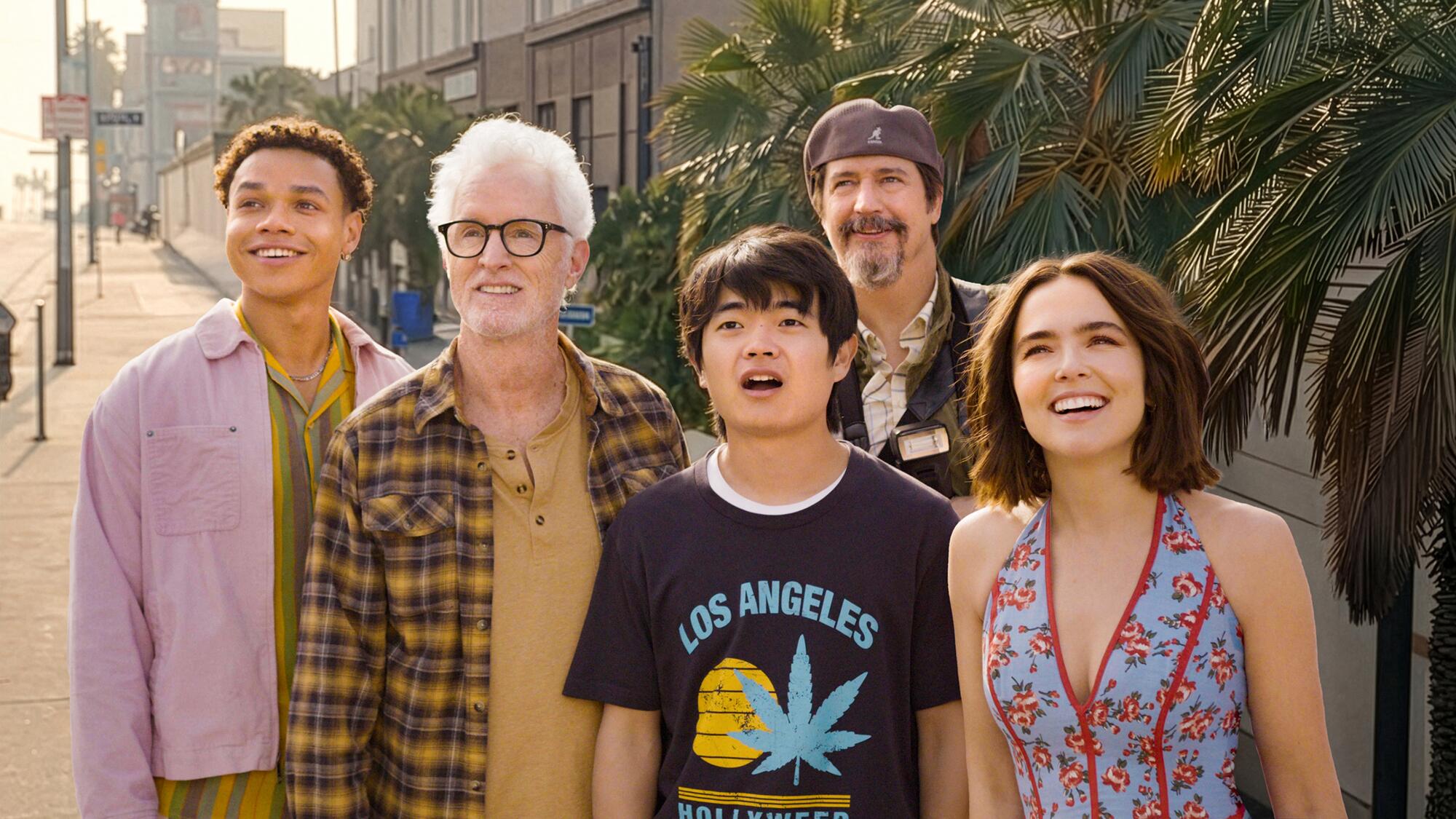
From left, Miles Gutierrez-Riley, John Slattery, Ben Wang, Ken Marino and Zoey Deutch in the movie “Gail Daughtry and the Celebrity Sex Pass.”
(Sundance Institute)
Speaking with The Times, Slattery reflected on cheerfully becoming the butt of the joke, why broad comedy is anything but easy and what it’s like navigating Hollywood at a moment when fading away feels a little less far-fetched than it once did.
Actors spend years building a certain cool image, but within seconds of appearing onscreen in this movie, you’re whining, farting and generally making an ass of yourself. What appealed to you about that?
I never considered it risky. Not that it was foolproof, but it was just such a silly idea and I was a fan of David Wain and those guys anyway. These kinds of comedies take skill and experience. I mean, you have to be really smart to make a movie this stupid.
You’re always looking for something that’s different and this was such a funny way to depart from myself — ironically, by playing myself. It seems like the wildest character I’ve played in a while, and it’s me. I thought: What kind of research am I supposed to do? Am I supposed to watch myself and imitate myself? But there was really nothing to do. You just learn the lines and show up.
Was there ever a moment where you thought: This is either going to be really funny or the end of my career?
I didn’t have that feeling on this. There’s nothing funnier to me than a confident moron. My favorite thing in the world to watch or try to do is somebody who has full confidence in their idiocy.
I’m not somebody who dives into the deep end right away. First I want to know I can trust the people in charge of what I’m about to deliver to them. If I do all this, whose hands am I leaving it in? With David, that wasn’t even a consideration. He’s just so good at what he does, and that gives you permission to just go all in.
Have you always been able to laugh at yourself or is that something that’s gotten easier as you’ve gotten older?
I come from a large family of piss-takers. They’re all really good at ball-breaking and really funny. My mother had six kids, and all her brothers had five or six kids. I had a million cousins, and they will shred you. Somebody would always knock your feet out from under you if you took yourself too seriously.
John Slattery and Jon Hamm in a scene from the AMC drama “Mad Men.”
(Frank Ockenfels / AMC)
Every successful actor probably has a nightmare that one day the phone stops ringing and you’re coasting on fading glory. Did you ever have that feeling after “Mad Men” ended?
After going through COVID and the strike and directing an independent movie [2023’s black comedy “Maggie Moore(s)”], which doesn’t pay very well, I hadn’t acted in a while. I was like: Oh, I wonder if this is going to continue. I don’t know.
The business has contracted. It seems like there’s an endless list of titles on every streaming menu, and yet they’re making less and people are struggling. So I’m glad to be working. I’ve had a pretty lucky run of late and I’m not taking it for granted.
At this point in your career, what makes you say yes to something?
Money. [laughs] No, it’s really the same as it’s always been. You always want a big, fat, juicy part, but sometimes it’s just a functioning part in a really good story.
You kind of roll with the punches. You do something, you have some success with it and then you get a lot of offers for things that are a lot like that. If that’s all that comes in, you pick the best one and keep going. People say, “Well, it’s not ‘Mad Men.’” And you go, “Well, what do I need to do that again for? I did that.”
This is a perfect example of something that’s every bit as interesting and fun in a completely different way. If they could all be like this one, I could die tomorrow. You want them all to be this fun, because they’re not. Sometimes you’re stuck in a courtroom all day and it’s pretty dry. This was anything but that.
Hollywood feels like a deeply anxious place right now. You’ve worked through a lot of different eras of this business. How does this moment compare?
I have a job coming up, so that’s always hopeful. Having just come off something, and knowing you’re about to do something else, gives you a sense of security. But there’s definitely a palpable anxiety. You hear it when people get jobs: “Thank God.” Or, “It’s about time.” Or, “I don’t care what it is, I’m going to do it.”
I was listening to Taylor Sheridan recently talking about how people who don’t tell stories are governing the telling of stories. That’s more than disconcerting. And now AI is the overlord of all that. It’s very strange.
It’s always been a youth-oriented business. There are definitely more movies about people who are 27 than people who are 63. Maybe it all kind of shakes out. I don’t know. Sometimes I wish it were 1943 and I was in a suit playing a detective.
I would watch that movie. Meanwhile, Hollywood doesn’t make many broad theatrical comedies like this anymore. Why do you think that is?
I don’t know why the studios have given up on comedies in movie theaters. They used to be the thing, right? Those big Will Ferrell movies were huge moneymakers.
Maybe this will turn the tide. When you think about the condition of the country right now, and how pissed off and divided everybody is, you roll out this silly, smart-but-stupid comedy, and it seems like the perfect amelioration of everybody’s anxiety. Go get some popcorn and laugh your ass off. You’ll feel better.
Welcome back to the Times of Troy newsletter, where we’re just one month out from fall camp and the start of Lincoln Riley’s fifth season at USC. Soon enough, we’ll have actual football to discuss and not just the existential crises surrounding it.
But while the college sports calendar remains dormant for the moment, summer basketball practice is in full swing at USC. The Times was there at Galen Center last week to get an idea of where the Trojans stand heading into a critical third season for Eric Musselman as coach. And I came away feeling like this is the most talented team the Trojans have had in quite some time.
Fight on! Are you a true Trojans fan?
Get our Times of Troy newsletter for USC insights, news and much more.
By continuing, you agree to our Terms of Service, which include arbitration and a class action waiver. You agree that we and our third-party vendors may collect and use your information, including through cookies, pixels and similar technologies, for the purposes set forth in our Privacy Policy such as personalizing your experience and ads.
What that will mean come March, I wouldn’t even attempt to speculate at this point. It’s June. This team has been together only a couple of weeks. Plans are bound to change. And injuries are bound to happen.*
*I do feel safe in assuming whatever ancient curse or voodoo hex was cast long ago on USC basketball can’t possibly derail another season like it did the last one.**
**OK, so transfer center Eric Reibe aggravating an injury in June and sitting out the summer isn’t … ideal. And sure, neither is the fact that transfer guard KJ Lewis won’t be cleared from the ankle injury he suffered in February until “hopefully mid-to-late September,” per Musselman. But still no freak car accidents, sudden cardiac incidents or bizarre player dismissals to date …
But Musselman has all the makings of a roster that should — read: must — make it to March.
The difference isn’t so much in what USC added to its roster, but rather in who Musselman and his staff managed to retain from the previous one. That was USC’s primary focus coming into the offseason.
Instead of having to rebuild an entire team from scratch like in Musselman’s first two seasons, which proved much more difficult than expected, the Trojans brought back their three top returning players: Rodney Rice, Alijah Arenas and Jacob Cofie.
“Those three are a great start for us,” Musselman said last week, and alluded to losing two transfers last year. “We learned with Wes [Yates] and [Desmond Claude], that hurt us.”
The continuity is significant. At least two of those returners will be starters, with a full year in Musselman’s system, and all three could be drafted next spring if they have strong seasons.
It starts with Rice, the guard who through six games last season looked like a bona fide rising star. His shoulder injury ended up totally changing the Trojans’ trajectory. His return should be equally impactful.
“I can play at a high level, an All-American level,” Rice said. “I have all the confidence in the world still.”
Musselman and his staff feel the same way. And all parties involved concur that the makeup of this roster will better maximize Rice’s skills. He’ll be able to play more off the ball, with other options like lightning-quick Colgate transfer Jalen Cox able to handle more of the load as a floor general.
Rice won’t return to full go until after summer practice, but that’s more of a precaution than anything. He could be on the brink of a big season, if all things break right.
I’m less confident in the spring emergence of Cofie, the forward who played his way into an NBA scouting combine invite in May. When he first signed with USC, Musselman told me he thought Cofie was a future first-round pick. But considering the expectations, I thought his first season as a Trojan was mostly underwhelming.
Musselman thought Cofie “didn’t really have a stamp on the roster” last season. But so far this year, “He’s kind of a different guy.”
Cofie has made a point to expand his game to the perimeter. Just 27% of Cofie’s shots last season came from behind the arc, and he made just 31% of them. But any added spacing would be welcomed on a roster with potential to get bogged down inside the arc.
“You’ll see me shoot a lot more threes,” Cofie said last week. We’ll see how that factors into the lineups that USC is able to deploy this fall.
The most intriguing of the Trojans’ trio of returners is Arenas, given the wide range of possible outcomes in front of the guard this season. After arriving last year as one of the most-hyped hoops prospects in school history, he returns with a chance to basically redo his ill-fated freshman year.
The challenge for him as a sophomore is to be a more efficient player, after shooting just 34% from the field and 21% from three-point range. Arenas also uncharacteristically struggled finishing at the rim and with his shot selection, two skills that previously were seen as strengths.
He has all the tools to bounce back. Arenas’ ability to create space and find his own shot, in particular, is special. The question is how those tools best fit USC with so many more options around him.
When he debuted in January last season after missing the start because of knee surgery, Arenas immediately shouldered the load and dominated the ball. It was too much to ask of a freshman in that situation. But that’s no longer necessary with Rice healthy and Cox able to handle the point. Arenas will benefit from being off the ball more often.
Adding three McDonald’s All-Americans should go a long way with this team as well, if only because there will be real talent at the back end of the rotation. And unlike last season, USC should be able to bring its freshmen along at their own pace.
The potential is obvious with Darius and Adonis Ratliff, but both presumably would benefit from that time. Christian Collins, on the other hand, looks primed to make an impact right away, if needed. Watching him knife through the lane on his way to the hoop last week, I found myself wondering if he might be a lottery pick by next spring.
“Christian has been very impressive,” Musselman said. “We knew the intangibles and the length and the reaction to loose balls, but he has scored the ball, you know, [really well] for a freshman at this early stage.”
It’s far too early to draw any conclusions about the upcoming season. But after watching just one practice, it’s not hard to see why Musselman and his staff are feeling especially sunny this summer.
New eligibility rules
Back in October 2024, days after two USC defenders announced they were sitting out the football season to preserve their eligibility, a frustrated Riley offered what he felt was a reasonable solution to a growing problem.
“Guys should have five years to do whatever you want,” Riley said. “I think it should be that plain and simple. Then nobody has to worry about any of this other crap like how many games you’ve played.”
Almost two years later, the NCAA is finally on board with the coach.
The Division 1 Cabinet voted last week to implement major changes to the NCAA’s eligibility rules, giving athletes five years of eligibility to play five seasons. That means no more redshirts, no more medical waivers, no more eligibility questions. All eligibility clocks start the academic year after an athlete’s 19th birthday, and the only exceptions, per the NCAA, are for pregnancy, active-duty military service and religious missions.
Any athlete who wants to state their case for an extra year of eligibility has until the end of next month. But after that, the word “redshirt” officially can be retired from the college football vocabulary.
USC pitching coach Sean Allen talks to Gavin Lauridsen during a Super Regional game last season.
(Kara Durrette / For The Times)
—Musselman has yet to have one of his USC players selected in the NBA draft. But that will change next season. I’d expect, by next spring, we will be talking about as many as three Trojans who could be selected in 2027. Collins and Arenas are five-star talents, and while Collins’ stock is higher at the moment, Arenas easily could return to draft darling status with a strong start to the season. Then there’s Cofie, who balled his way into a draft combine invite this spring, and Rice, whose name will be known in draft circles soon enough.
—Fourteen USC baseball players entered the transfer portal. That group includes two promising young pitchers in Diego Velazquez (who also plays infield) and Gavin Lauridsen. Both were highly touted prospects and looked slated for bigger roles next season. USC also lost its starting catcher to the portal again, with Isaac Cadena committing to Clemson. Losing the young pitchers is a blow, but without the backing to match the name, image and licensing offers of some ACC and SEC teams, this sort of exodus is just inevitable.
What I’m Watching This Week
Tatiana Maslany in “Maximum Pleasure Guaranteed.”
(Apple TV)
Apple has been on an absolute heater, and “Maximum Pleasure Guaranteed” is yet another unique and worthy entrant into its growing library of prestige TV. It stars Tatiana Maslany as Paula, a divorced mom and magazine fact-checker whose only solace is returning to a webcam boy who turns out to be scamming her. Her life is unraveling, but when she takes matters into her own hands, it only descends further into chaos.
“Maximum Pleasure Guaranteed” is an absolute thrill ride and one of the more surprising shows I’ve seen this year.
That concludes today’s newsletter. If you have any feedback, ideas for improvement or things you’d like to see, email me at ryan.kartje@latimes.com, and follow me on X at @Ryan_Kartje. To get this newsletter in your inbox, click here.
Herb Alpert walks up a long driveway at his rambling Malibu estate, wincing slightly after having woken up around 3 a.m. with a cramp in his left calf.
“It’s still kind of seizing,” the trumpeter says as he leads me past a garden lush with moist-looking tropical plants.
This, Alpert accepts, is the reality of life at 91. Yet the only reason he’s out here racking up steps by the hundreds on a recent morning is because he was tooling around in his sculpture studio before I arrived. And the only reason the sculpture studio is so far from his music studio — there’s also a studio devoted to his painting — is because of his huge success over the last 60 or so years.
“So I can’t really complain,” he says.
A Los Angeles native who got his start writing songs like Sam Cooke’s “Wonderful World,” Alpert has lived here in Malibu since 1972, a decade after he released “The Lonely Bull,” his debut album with the Tijuana Brass. The LP’s title track, inspired by a bullfight Alpert caught in Mexico, went to No. 6 on Billboard’s Hot 100; more than a dozen finger-snapping Top 40 hits followed, including “A Taste of Honey,” “Spanish Flea” (also heard as a theme song on TV’s “The Dating Game”) and “This Guy’s in Love With You,” which took a rare Alpert vocal turn all the way to No. 1.
Share via
What’s more, these inescapable tunes came out on Alpert’s own label, A&M Records, which he “formed on a handshake,” as he puts it, in 1962 with his business partner Jerry Moss. The label quickly became one of the biggest independent record companies in music, with acts such as Carole King, the Carpenters, the Police, Peter Frampton and Janet Jackson, as well as a beloved recording studio complex on La Brea Avenue. (Moss, who with Alpert sold A&M in 1989 for a reported $500 million, died in 2023.)
After years working on his own and with his wife, the singer Lani Hall, Alpert revived the Tijuana Brass name in 2024 and launched a tour that will stop Sunday night at the Hollywood Bowl. We sat down in his gear-stuffed music studio to talk about it and much more.
I’m sure you heard that John Mayer and McG bought the former A&M Studios last year. I wondered what your emotional investment is in the place at this point. I don’t have an emotional investment. Once I left the lot, I was out of there — I didn’t look back. I wanted to paint, I wanted to sculpt, I wanted to make music. I wasn’t thinking about the business.
What’s an A&M success story you took particular pride in? Cat Stevens. I heard this kid — he was a kid at the time — at the Troubadour, just him and a guitar, and I got goosebumps. It was so beautiful and so honest.
What was Karen Carpenter like? She was a doll. She didn’t know how great she was — didn’t think she was a great singer. One hell of a drummer too. Go onto YouTube and search Karen Carpenter’s solo on drums — it’ll knock your socks off. But she was innocent. She was lucky to have [her brother] Richard because Richard knew what to do with her in a very gentle way.
Even at the Carpenters’ smoothest, I hear deep sadness in Karen’s singing. I think that’s a standard ingredient to great artists. Listen closely to Miles Davis and you’ll hear the same thing.
Karen struggled with her mental health, which her fame didn’t help. Did you ever feel responsible for what she went through? I’ve gone over that question so many times in my head: If I hadn’t picked them out and signed them, would the same result have happened?
Where have you landed? I don’t have an answer.
In a recent documentary about you, you’re talking about “Wonderful World” and you say that nobody knows what a hit record sounds like. That’s your feeling now based on years of experience. But did you think you knew when you were young? I didn’t know then either. “Wonderful World” was a demo that Keen Records put on a shelf. When Sam started selling records on RCA Victor, they pulled it out as a lark, and it ended up one of the biggest-selling singles Sam ever had. I’ve told this story before, but at A&M a guy played a record for me — I said, “Man, this record stinks.” Well, I was turning down “Louie Louie.”
Why didn’t you understand “Louie Louie”? It was out of tune. It was too long. I didn’t know what the hell they were saying.
That’s why it’s great. Probably so. But did they have another hit record? Sam used to say, “Close your eyes when you listen to a new artist — don’t get swayed by whether they’re beautiful or they’re handsome or they can dance their ass off.”
OK, but you were like a heartthrob in the ’60s. What am I now — chopped liver?
I don’t think you can say your success had nothing to do with your looks. I don’t think it did. You know that sadness you were talking about? It’s in my horn.
I agree. But it didn’t hurt that you looked great. It didn’t hurt once I had a hit record. It wouldn’t have given me a hit record.
Jerry Moss, left, and Herb Alpert in 1974.
(Michael Putland / Getty Images)
Let’s talk about your song “Rise.” Got lucky with that.
In what way? My nephew Randy, who’s one of my managers, he wanted me to take some of the Tijuana Brass records and do a little disco number with them. So we go into the studio with a bunch of great musicians, start playing “Taste of Honey” at 120 beats per minute. I got nauseous — I said, “Man, I ain’t doing this.”
Nauseous? The record was big, and I didn’t want to tamper with it. But Randy had written this song called “Rise” with a friend of his. He wanted me to play that at 120 beats per minute too. I said, “Lookit, man — let’s slow this thing down and let people dance closer together.” We recorded it live in the studio. Julius Wechter was playing marimba — dear friend of mine. I said, “What do you think of this thing? Pretty cool, isn’t it?” He turns around and says, “I hate it. That beat — the four-on-the-floor is killing me.” I expected a different answer from him. But it didn’t matter.
What’d you make of the Notorious B.I.G.’s sampling “Rise” for his “Hypnotize”? How could you not like that record? These guys that take your bass line and make a record by pressing a button — I think that’s cheating a bit. But there’s 70 zillion streams on that song. Can’t deny it.
“Rise” was also sampled by the rapper Nas for his song “Power, Paper & P—.” I don’t know how to comment on that one.
A lot of musicians from your generation have been selling their catalogs lately. Have you considered it? There’s no reason to — I don’t need the money.
I wrote about Frankie Valli a few years ago, and he and Bob Gaudio seemed eager to have this company Primary Wave out there finding ways to — Monetize the catalog. I get it. But they don’t have to do that with us. I don’t know if you know what’s happening, but I’m in the heyday of my career right now.
Right now? It wasn’t my idea to get the Tijuana Brass back together again. My nephew, he’s a social media guy, and he went around the world to see what songs of mine were selling the most. Turned out there were about 18 songs. I started listening to the 18, and at the end, I felt happy, I felt joyous, I felt a smile was on my face. I thought, Man, let’s try this — this might be interesting. We started doing it, and we’ve been sold out 50 concerts in a row.
It strikes me that without the Tijuana Brass, you weren’t playing the Hollywood Bowl. Hell no, I wasn’t.
What’s that say to you? That the music is touching people. The times we’re living in, there’s a lot of doubt with what’s going on, and I think people are getting some positive energy from it.
You’re a lifelong Angeleno. Lots of well-to-do folks say that L.A. has gone to hell in a handbasket. What’s your take? I think it’s pretty much the same all over the country.
Which is? Gone to hell in a handbasket. People are confused about where they’re going, whether they’re gonna be able to have enough food on the table, whether they can afford gasoline. I’m not saying it’s all bad — it’s just hard to make sense of a lot of it for a lot of people, including the guy you’re talking to.
Your music has pulled from any number of cultures. Do you think it speaks of your Jewish identity? Most definitely. My father was born in a shtetl outside Kyiv — didn’t speak Russian, spoke Yiddish. He brought his mandolin with him when he was 16 years old on a boat by himself and landed at Ellis Island. He used to play songs for me on the mandolin. When his nostrils flared, I knew he was into it. That kind of got me.
Jewish meets Mexican feels very L.A. to me. I think we’re all a product of our surroundings. In high school I used to go see Gerry Mulligan and Chet Baker, and I was touched by them. Of course, they were loaded.
What kind of guy was Chet Baker? A troubled guy who was a brilliant musician. I gave him one of my horns, and he pawned it the next day. He was sweet but he didn’t have a hold on his emotions.
Not great for living, obviously. But good for music? Well, you’re opening up a whole can of worms. I mean, why did so many great jazz musicians get hooked on drugs? Maybe guys that were hung up on being a human being, they found that getting stoned helped them through the struggle. I recorded Stan Getz the first time he ever recorded without drugs. It was at A&M — he was wearing this red silk shirt that had sweat stains under both arms. He had like 75 reeds on the ground because he couldn’t pick out the right one. He finally found the right reed, got over the anxiety and started playing — same Stan Getz you heard throughout his career. These guys were under the assumption that being stoned would change what they played. I don’t think that holds any water.
Was there a time you thought it might be true? I did experiment with grass once. Turned on a recorder, took a puff, started playing some jazz. Took another puff, started playing some more jazz. I listened to that recording the next morning — it was terrible.
(Robert Gauthier / Los Angeles Times)
Can we do a little Herb Alpert trivia to finish? Do I have a choice?
“A Taste of Honey” won record of the year at the Grammys in 1966. You’re gonna ask why.
You beat the Beatles’ “Yesterday.” No kidding?
The year after “Taste of Honey,” you were nominated for record of the year again with “What Now My Love.” That one you lost. Remember what you lost to? Not “Louie, Louie.”
“Strangers in the Night.” That’s a real pop song. Love the guy, but not my favorite by him.
What’s your favorite Sinatra song? “Only the Lonely.”
“This Guy’s in Love With You” — great vocal performance. Why didn’t you do more? I’m not a singer.
Sure you are. I know it’s a great performance. But it was one take, man — I did that in one take.
This is what I’m saying. Look, I had an interesting guy in the sound booth who did the arrangements named Burt Bacharach.
I read that you talked with Burt a few times a week until he died. I did, and not about music. We talked about football, basketball, politics, you name it.
What’s your basketball team? Lakers.
Hard to be a Lakers fan these days. Easy to be a critic.
Corona High baseball coach Andy Wise has pulled off the most intriguing acquisition of the summer season.
Former Dodgers relief pitcher Joe Kelly, a Corona graduate, is joining the program as an assistant coach to help guide pitchers.
Known for his quirky personality and ability to thrive under pressure, Kelly has followed the program in recent years after retiring as a player and jumped at the chance to help the pitchers, Wise said.
“My conversations with him over the years have been incredible,” Wise said. “What an asset for the pitching staff and the whole program. He’s got the time and he’s got a lot of kids. He’s not going to be here six days a week. He’s excited.”
The plan came together after Wise went up to Northern California to speak with a group of players with Kelly.
“No stress, no pressure, anything you might help us with would be awesome,” Wise said he told him.
Wise said Kelly has been following the team in person and on GameChanger and offering ideas.
Just having around a 13-year former MLB pitcher should be inspiring to players next season.
“Joe is Joe and I expect him to be Joe,” Wise said.
Daryl Hall recently underwent a kidney transplant and he’s already feeling better.
The 79-year-old musician — formerly of the iconic rock duo Hall & Oates — took to social media Tuesday to share the news.
“I thought you should know that I recently received a kidney transplant from a very kind and generous living donor,” Hall wrote in an Instagram post. “It happened a couple of weeks ago, and I’m already starting to feel better. It was, according to my doctors, a complete success!”
The “Dreamtime” singer-songwriter added that he expects to be “back to normal in a few months” and promised “more music and lots of Daryl’s House shows” in the future. Hall has been hosting “Live from Daryl’s House,” a web series where he and his band perform with guest artists, on and off since 2007.
A living-donor kidney transplant is when a healthy living person donates their kidney. The recipient is usually experiencing kidney failure. According to the National Kidney Foundation, “kidneys from a living donor may last longer and are more likely to start working right away than a kidney from a deceased donor.”
Hall did not share any additional details regarding his kidney transplant.
The “Bring It On Home” singer has opened up about other health issues in the past. In 2005, Hall & Oates had to postpone a series of shows after Hall was diagnosed with Lyme disease.
Lyme disease is a bacterial infection that is spread through the bite of infected black-legged ticks — also known as deer ticks. Symptoms can include fever, rash, facial paralysis, an irregular heartbeat and arthritis, according to the CDC.
As La Cruz continues to break down barriers for the LGBTQ+ community in reggaeton, the rising Venezuelan star enjoys living out his gay fantasies in his music videos. Take the sultry video for his 2023 breakthrough single, “Quítate La Ropa,” which sees shirtless men perreando (twerking) before him in a locker room.
But at the same time, La Cruz has come to understand that his platform as a gay reggaeton artist coincides at a time when conservatism is sweeping the globe — and queer rights are receding.
“It fills me with happiness to represent a community that has been denigrated, treated badly and pushed into a corner for many years,” a bedheaded La Cruz says over Zoom from his New York City hotel room. (He had just performed at a Pride event the night before.)
“It’s a fact that [LGBTQ] rights are becoming progressive, but they’re rolled back even faster than they advance,” he adds. “This is very painful and concerning. This is happening in every country in different ways. During these difficult times, I’m going to keep putting my heart into my music more than ever.”
La Cruz is the stage name of Alfonso La Cruz. The native of La Guaira, a coastal city in Venezuela, pursued a music career after relocating to Spain in 2015. Following a brief stint on the singing competition “Operación Triunfo” three years later, La Cruz was closeted and found his momentum stifled. In 2022, he took the brave step of singing about his affection and lust for other men in his debut album, “Hawaira.”
Venezuelan reggaeton singer La Cruz released his new EP, “El Nene, Vol. 2,” on June 11.
(Maria Camila Pinzon)
Backed by the beats of reggaeton, a genre that had historically excluded the LGBTQ+ community, La Cruz found both his groove and his tribe with hits like “Te Conocí Bailando” and “Quítate La Ropa.” Early supporters included Colombian superstar Karol G, as well as Mexican American R&B singer Omar Apollo.
Alongside Puerto Rican provocateurs like Young Miko and Villano Antillano, La Cruz has continued to queer the heteronormative urbano space. He has also pushed his sound to broader horizons in his new EP, “El Nene, Vol. 2,” which includes “Sírveme,” a Brazilian funk banger with drag pop star Gloria Groove — and “Te Perdí,” a touching tribute to the victims and survivors of the 2016 Pulse nightclub shooting in Orlando, Fla.
La Cruz’s EP dropped on June 11, the day before the 10th anniversary of that tragedy, which largely impacted the queer Latino community. In an interview with The Times, he opened up about being a gay reggaetonero and “Te Perdi,” his tribute to the 49 people lost at Pulse.
It’s been three years since you first went viral with “Quítate La Ropa.” What have you learned about yourself during that time? There are songs that have brought me a lot of love and I’m thankful to my fans that consider that song to be a classic. It’s brought me a lot of blessings. At this moment, I feel like I have the best opportunities in my life. However, I feel like the industry is a bit uncomfortable with an artist that’s openly gay and wants to be a part of this. That hasn’t stopped me at all. It’s the gasoline in my motor. It’s what pushes me to keep working hard. My fans are what’s building my career and I won’t let them down. I’m sticking with this until the end.
You connected with Karol G early in your career. Did she give you any advice when you met her? I want to say publicly that I would love to open for her concerts on her Viajando Por El Mundo Tropitour. I’m very close to her. I love her so much. She has always treated me with so much love. I hope that something between me and her can happen sometime. I know everything happens in due time. I told her that I love the way she is and how she connects with her fans. When I see her singing and performing, I feel like she’s a sister to me. A big piece of advice that she gave me and that I’ll always carry with me is to never lose the humility and closeness that I have with my fans. The key to success is humility. I never want to be out of reach. I want people to see me and say, “I want to achieve my dreams like he has.”
How did your collaboration “Sírveme” with Gloria Groove come together? I love her so much! I’ve always been a big fan of hers. I’ve gotten close to a lot of artists in Brazil and Gloria has been one of them. We didn’t think twice about making this song. Gloria was coincidentally traveling to the amusement parks in Orlando. I told her: “Baby, let’s go! I’m ready for you in Miami.” She told me: “Baby, I’m going to Miami!” We met one afternoon to create this song. She paused her vacation to go to the studio with me. It was very beautiful. I love my Brazilian fans.
With “El Nene, Vol. 2,” why was it important for you to also shed a light on the 10th anniversary of the Pulse nightclub shooting? In 2016, when I recently arrived in Spain and my brother recently arrived in the U.S., we had a call with our family. My brother said, “There was a shooting close to where I live and it was in a gay club.” My family has supported me since I first told them about my sexuality. I thought that that could’ve happened to me.
I’m following up on this tragedy because it shaped my life. As the years go on, information about this attack has faded away. Each day people are talking less about it. It’s a tragedy that’s super important to remember, like 9/11 and the [2017] Las Vegas shooting, because it’s one of the worst attacks in U.S. history. Why are we not talking about it anymore? We have to keep talking about things so that they don’t happen again.
What inspiration did you pull from the Pulse tragedy for your song “Te Perdí”? On this path, I’ve gotten to know the stories of people that survived that shooting. For example, there was a boy with his mother that lost her life and he survived. There’s a lot of stories of love from that club that have [since] come out. When I went to the studio, I was inspired by loss, or a love that’s gone away, with respect and love for the community that supports me. It is my gift, to be a voice for this situation that should never be repeated. There are people that don’t know about this tragedy and I want to let the world know that this happened. I hope that the victims’ families and the people that survived are living lives of peace and calm.
At only 24, Samuel Kim Arredondo, better known as Samuel, has lived through nearly every iteration possible in a K-pop idol’s career.
As a child growing up in L.A.’s Koreatown, he attended Wilshire Park Elementary School — but by the fifth grade he had moved to South Korea with his mother, Kyung-ju, with dreams of K-pop stardom. There, he became a trainee under Pledis Entertainment.
Now a subsidiary label of Hybe — parent company of K-pop superstars BTS — Pledis was forming what became one of the most successful “third generation” K-pop groups of all time: Seventeen. Samuel, who was in the running to debut with the group, is even captured in early footage from their “Seventeen TV” variety show.
Though he didn’t make the cut, he remained close with the members and helped write lyrics for their 10-year anniversary album. Just last week, he filmed a dance challenge with singer-MC Mingyu for the reggaeton-infused pop number “Zigi Zigi Zigi” — the lead single off of his new EP, “Samuelito,” which dropped June 8.
After leaving Pledis, Samuel — who is fluent in both English and Korean — signed to a new agency, Brave Entertainment, then formed one half of a short-lived hip-hop duo, 1Punch. (He was Punch, the other kid was One.)
In 2017 he competed on the second season of Produce 101, a globally popular Korean competition franchise, where he made it to the penultimate episode before the debut of the group Wanna One. That same year, he released his first solo album, “Sixteen,” fully showcasing his outstanding dance ability, youthful swagger and velvety tenor.
Yet before he could finally make headway, he suffered a devastating loss.
Samuel’s father, José Arredondo, who came to the U.S. from Michoacán as a child, died tragically in a 2019 case that made national and local headlines. After having spent years apart from his father while living in Korea, Samuel spent quality time with him shortly before his death.
José was a pillar of his community; he rose from washing cars to owning his own car dealership, alongside other businesses in Bakersfield. A precocious young Samuel can still be found showing off his dance and Spanish skills in an old commercial for the dealership. (“Volkswagen me hace bailar,” he says before busting a move.)
The loss of his father was made more harrowing when the news went public, Samuel recalls over a Zoom interview from Seoul, where he is promoting his new album.
“The articles went out first,” he explains. “It was everywhere before I even wanted to talk about it, so I had no choice to keep it private … of course it’s definitely hard for me.”
In the aftermath, Samuel went under the radar — but after a year or two, he started to pave a way forward. After getting out of the contract with his former label, and with the support of his mother, he launched his own company, Samuel Music Group.
“If I kept on staying in the past, I think no one would like it — even my dad wouldn’t like it,” he says. “I learned a lot through that emotion as well. Always be grateful, always be thankful every time, and try to say ‘thank you’ always, especially to parents.”
Composed of three songs and one interlude, “Samuelito” takes its name from the childhood moniker some know him by today. As the follow-up to his 2024 EP, “Now,” it is his second record release since he became independent. It’s also his first record sung predominantly in Spanish — along with the occasional sprinkle of English and Korean. (Take the onomatopoeic “Ddook Ddak,” which is Korean slang for “just like that.”)
Singing in Spanish for the first time, he tells me, to music he created himself, made his “heart race.”
“Samuelito” is not so much an exploration of Mexican musical traditions, but of Latin-influenced rhythms and sounds filtered through his uniquely multicultural lens. In the future, he dreams of working with genre-spanning Latino pop artists who crossed over culturally, like Selena Gomez, Camila Cabello and Rauw Alejandro.
In an Instagram reel from earlier this year he described his efforts as “K-tone” — a Latin and reggaeton fusion, powered by K-pop discipline. The comments below were peppered with encouraging responses from fans in multiple languages.
Wrote Liz Zeledon, from Oceanside: “As a Korean-Nicaraguan who grew up with exposure to both cultures, I love hearing Latin influences in K-pop… Korean Latines are so underrepresented in the Korean music industry.”
Reached by phone, Zeledon is a K-pop fan who has kept tabs on Samuel since his Seventeen trainee days; she is also a child of immigrant parents.”Representation is so important, because existence and visibility are not the same thing,” she says.
In the lead-up to the album’s release, Samuel posted photos and videos of himself as a young child. In one, his dad holds him up as a baby, dressed in all-white with a tam hat. Though Samuel says the EP is not an on-the-nose tribute to the elder Arredondo, his spirit resonates through the lyrics of the poignant downtempo track, “Never Say Goodbye.”
“Gritos que yo sé/Que llegan hasta El Cielo/Gotitas en el suelo/Y se me cae el mundo entero,” he sings. (“Cries that I know/Reach all the way to Heaven/Little drops on the ground/And my whole world comes crashing down.”)
“I used to listen to a lot of Spanish music while I was growing up … I used to eat a lot of Mexican food too,” he says. “While I was in the studio last year, I had [this] big vision: [‘What if] I bring back my roots and just be the true me and call this album “Samuelito?”’ It just felt fresh.”
Samuel started songwriting and producing for himself in the making of “Now.” On his new album, only three writers are credited, including himself — which is somewhat of a rarity these days in K-pop. One of them is Canadian Mexican singer-songwriter Andrea Rocha.
From her new home in L.A., Rocha said the main goal was to seamlessly blend two distinct musical cultures. Although Samuel came to the studio with the structure for his songs already in place, they worked on melodies and writing in Spanish together, since this was his first time penning lyrics in the language.
Rocha says she was taken aback by Samuel’s professionalism. “I’d be like, ‘Oh, what about this melody?’ And then he would sing it perfectly,” she says. “I did ask him about his K-pop training, because it sounds really intense. I think it shows how hard he’s worked in those years because he’s got all the star qualities. Compared to a lot of newer artists that I work with, I’m like, ‘Ooh, they’ve [done] a lot of work to get to that level.’”
These days, Samuel splits his time between Seoul and Los Angeles — once again calling Koreatown his permanent home. He also continues to spend time with his dad’s side of the family in Bakersfield.
“I think the biggest thing that I am happy about is getting back to my roots, where I started,” says Samuel.
The Dodgers won the World Series last year, and the year before that. Their lead is the largest in any division this year. That success, and the money that nourishes it, has battalions of fans beyond Los Angeles all but marching outside ballparks with picket signs reading “SALARY CAP NOW.”
It’s a reasonable thought: The Dodgers can’t possibly keep winning if they can’t keep outspending the competition.
Or can they?
“There are a lot of little things that happen behind the scenes that people don’t see,” pitcher Will Klein said. “I understand where people are coming from. It’s easy to be a fan of a smaller team and get mad at other teams outspending you.
“But I think there’s a level of care here, and wanting to win, that exceeds other groups.”
The obvious disclaimer: Any team would be better with Shohei Ohtani and Freddie Freeman and Mookie Betts and Yoshinobu Yamamoto, at a combined price of $1.6 billion. The counter argument: The Angels had Ohtani and Mike Trout and, well, you know.
It takes a roster. In Klein and pitcher Eric Lauer, the Dodgers have done something they do well besides spend: develop valuable contributors out of players discarded by other teams.
The Dodgers grabbed Lauer last month, desperate to fill a hole in their starting rotation. The Toronto Blue Jays had cut him, and he would be joining his seventh major league organization. The logical thought: The Dodgers had found a healthy arm to eat up some innings until they could find someone better.
That still might happen. But Lauer, who is set to pitch Monday, has put up a 3.22 earned-run average in four starts with the Dodgers. Four starts is a small sample size, but in that time, Lauer is a career league-average pitcher performing 28% above league average.
“They got me immediately,” Lauer said. “They figured me out right away, and they knew exactly what was going to help me.”
For Lauer, the changes affected his delivery, but the specifics were not as important as finding a kindred spirit in Connor McGuiness, the Dodgers’ assistant pitching coach.
“I’ve always had a really hard time explaining myself and what I do, because I think a little differently,” Lauer said.
“When I was with the Brewers, it was running joke that it was ‘the language of Lauer,’ because I would describe things so differently and feel things so differently that, if you weren’t close to me and you didn’t know how I operate, it was very hard to understand what I was trying to do.
“Connor just immediately got it. It was like he’s been speaking it forever.”
At one point in his career, Lauer said, he struggled to explain the sensation of catching his heel on the mound as he completed his delivery toward home plate.
“I would describe it as, ‘I was falling backwards and I would catch myself,’ and it’s a really weird concept to think somebody was falling backwards when it doesn’t look like you’re falling at all,” he said. “It looks like you’re just moving forward.
“So they were like, ‘That’s not what you’re doing’ and I was like, ‘That’s what I’m feeling.’ We have to make the connection between the feel and the real so that we can understand each other.”
“I have a hard time saying anybody has done a better or faster job of helping me than the Dodgers.”
— Eric Lauer, Dodgers pitcher, on his development with the team
Klein, who joined his fourth organization when the Dodgers acquired him in a minor league trade last June, is in his first full major league season. He has a 2.37 ERA, and his 0.7 wins above replacement is better than any Dodgers reliever besides veteran closer Tanner Scott.
Klein said other teams had made suggestions on how to improve his game, and with the Dodgers, he has added a sweeper and dumped a slider. But what he needed to do most was throw more strikes, trusting that his lively fastball and curve were good enough to beat the best players in the world.
In the minors, Klein issued 6.9 walks per nine innings. This season, he has issued 3.6 walks per nine innings.
The credit, he said, should be shared with the Dodgers’ mental skills coaches.
“It’s easy to see the guys in the batter’s box — especially when you come up watching baseball and being fans of these guys, it’s easy to see them being above yourself,” Klein said.
“But you’re on the mound with them, so you have to see that too. There’s a lot on the mental side that’s helped me here.”
Dodgers pitcher Will Klein delivers against the Tampa Bay Rays at Dodger Stadium on June 16.
(Eric Thayer / Los Angeles Times)
The Dodgers did not include Klein on their postseason roster for the first three rounds last year, but he said coaches at all levels — in the majors, at triple-A and at the Arizona training complex — never stopped checking in on him, during the season and throughout October.
“When you’re down there, they don’t forget about you up here,” he said. “That kind of commitment and care was levels above what I had experienced.”
When the Dodgers added him to the World Series roster, Klein saved the season, with four scoreless innings to close out an 18-inning victory in Game 3.
Lauer called the communication in the Dodgers’ organization “miles ahead” of any other organization in which he has played.
“The training room, the weight room, the coaching staff, the players to each other,” he said. “Every form of communication is so seamless. Everybody knows what’s going on all the time. There’s no gray area.
“It’s all: ‘This is the plan, this is what we want to happen, this is how we’re going to make it happen,’ instead of: ‘This is the plan, this is what we want to happen, figure out a way to make it happen.’”
Klein raved about how the Dodgers treat player families, and about a high-tech pitching machine so lifelike that he could see what it would be like to bat against him. Lauer reflected on his experience as a first-round pick turned journeyman who went to South Korea to revive his career.
“I have a hard time saying anybody has done a better or faster job of helping me than the Dodgers,” Lauer said.
What Lauer and Klein say substantially echoes what Dodgers president of baseball operations Andrew Friedman said at last year’s World Series about turning the team into a preferred destination for players, and not just because the team wins and spends.
“Communication, being honest, having a really strong player development group in place at the major-league level, and how you treat families and treat the players,” Friedman said then, “I think matters a lot in that.”
To be clear: There is no indication the players’ union is willing to consider, let alone approve, a salary cap.
But, if that were to happen, Klein believes the Dodgers would be just fine.
“Our owners want to win, so they want to get the best product on the field, so they go and spend money,” he said, “and then everyone is mad that they want to win.
“I think they’ll find ways to win more if they can’t spend as much money. Friedman was with the Rays when they weren’t spending as much money and still had success there.
“I think they’re just better at wanting to win than some other people.”
Diego Cano-Lasso had been looking for an architectural project when he found two hillside lots with spectacular views for sale in Mt. Washington. With work scarce in 2012, the SCI-Arc graduate persuaded his family to invest in the property, and together they bought the two plots for $95,000.
“We are not developers,” he says, “but sometimes you have to jump.”
He didn’t realize the Mt. Washington project would take 12 years to complete, including a shutdown during the COVID-19 pandemic, or that he, his family and friends would end up doing much of the work themselves.
Diego Cano-Lasso stands in front of the hillside lots in 2012. (Hassan Ismail)The lots today.(Myung J. Chun / Los Angeles Times)
As a fan of Los Angeles’ Midcentury Modern architecture, he imagined designing and building a post-and-beam dream home next-door to a similar home by his aunt Lucia Cano and her husband, José Selgas, of the Madrid architecture firm SelgasCano, stretching over the hillside and connecting to the city below.
“It’s why I moved here,” Cano-Lasso says. “Midcentury design was like a dream to me, because it’s not just an architectural style; it’s a lifestyle.”
But his dream quickly hit a snag when the geotechnical engineer arrived in Mt. Washington to assess the site.
“He said the plots were unbuildable,” Cano-Lasso recalls. “He told me, ‘It is impossible. We cannot even do the soils report, because a big machine can’t fit up here on these narrow streets.’”
Eventually, Cano-Lasso found someone who visited the site and said, “No problem.”
La Canaria House by José Selgas and Lucia Cano features canary yellow aluminum tubes.
Cano-Lasso and his wife, Belén Rodero, in the open kitchen and living area of La Canaria House.
Then the city told him that he didn’t have the right to build on the property. To get permission, Cano-Lasso and his family would need to widen the narrow street, put in a sewer system and add a power pole.
Permits were just as difficult. According to Cano-Lasso, neighbors complained about the project, and the city bureaucracy dragged out the process for three years.
Eventually, he and his crew began digging into the hillside and moved more than 120 truckloads of soil through the steep, narrow streets of Mt. Washington. Without a general contractor, they managed construction themselves and hired different crews for each job.
When COVID-19 hit, construction on the project stopped, and Cano-Lasso returned to Spain. Construction did not restart until 2022, by which time the construction industry had changed and the project felt even more challenging to complete.
“Everything cost more, and there weren’t enough skilled workers,” Cano-Lasso says. As a result, Juan de Santiago, the master builder Cano-Lasso hired and calls “paramount to the project,” was too busy to finish the houses, which had windows and drywall but still needed finishing.
“The only way we could do it was by doing most of the work ourselves and with friends,” Cano-Lasso says.
With help from his brother Alejandro Cano, who is also known as Cato, and his wife, Belén Rodero, they handled everything from carpentry and metal work to lighting, wall finishes, flooring, painting, furniture, custom garage doors and landscaping.
“What I didn’t realize at the time — not even when hundreds of boxes of Moroccan tiles showed up at our door in Madrid — was that I was signing up for both a crash course and a career in tiling,” Cato says of designing murals for three of the Cano Home’s four walls. “I wasn’t expecting to lay a single tile, let alone take on the filing, sanding, rearrangement and all the care and attention required when most tiles come in odd sizes.”
Seven years and plenty of mishaps later, including the time a truck got stuck on the narrow, winding streets of Mt. Washington hauling 42-foot wooden beams, Cano-Lasso finally has a finished home that feels peaceful and warm.
With eye-catching details everywhere, the 2,250-square-foot homes feel relaxed and reflect the style of a Spanish designer inspired by Frank Lloyd Wright and Rudolph Schindler. (Cano-Lasso once lived in Schindler’s Sachs apartment in Silver Lake.) The open floor plan, designed by his father, Spanish architect Diego Cano Pintos, features warm oak floors, inexpensive radiata pine walls and ribbed wood ceilings.
“I am enjoying witnessing the house being lived in,” Cano-Lasso says of renting his house to music producer Jennifer Jimenez and interior designer Hanna Li, pictured right.
The rooms of the Cano House are filled with colorful art, accessories and custom furniture by Andrew Riiska and Cato. “Although we were working toward a deadline on a project that had already been under construction for several years, most pieces of furniture were designed and fabricated on site, with the conviction that we were building something special,” Cato says of setting up a furniture workshop in the garage.
Ceramic rain gutters from Ceramiques Est in Spain have been repurposed as wall-mounted light fixtures for indoor use. Door handles are made from stones found on the beach, and glass light fixtures by Luz Mixtura in Spain echo Robert Irwin’s disc installations. Large boulders from the excavation were brought inside to serve as furniture. Built-ins were made in Spain and shipped to Los Angeles in three containers. Outside, the house is covered in shou sugi ban charred-wood siding, which they installed themselves.
Both homes have similar structures and layouts with four bedrooms and four bathrooms, but La Canaria House features canary yellow powder-coated aluminum tubes inspired by California sunsets, while the Cano House is minimal and warm. “The homes are all about the beams,” Cano-Lasso says, which makes them look like they are floating above the city.
The neutral rooms feel warm and simple, with striking pops of yellow that reflect Southern California’s sunshine and decks that allow a smooth flow from indoors to outdoors.
Li, left, and Jimenez in their music room. The custom DJ workstation, designed by Li, is clad in ceramic tiles designed to look like plywood.
Behind the Cano House, Cano-Lasso created a narrow outdoor space with built-in banquette seating, a raised-bed herb garden and a water fountain. Now the house opens up to the outdoors, making it easy to entertain. “The garden is the coolest feature,” he says. “It really makes the house feel special.”
In some ways, the modern design has revived the midcentury ideal by using post-and-beam construction, an open floor plan, simple materials and easy indoor-outdoor access, all with Cano Lasso’s artistic touch.
But finishing the project also left Cano-Lasso with the large debt he took on — he estimates the project cost about $1 million, although he saved around 40% by acting as his own contractor.
Cano-Lasso and his wife divide their time between La Canaria House and a project in Venice, so he is renting out his dream house to interior designer Hannah Li and music producer Jennifer Jimenez, who grew up together in Pasadena.
Li descends the spiral staircase to the music room on the first floor.
Renting such a personal project might seem overwhelming for the tenants, since the rental included some of Cano-Lasso’s custom furnishings, but the two have made the house their own. They added a striking listening room on the first floor, with a turntable lined with ceramic tiles designed by Li to resemble plywood.
“We’re all artists in this house,” Jimenez says. “We’re always creating here, and other music producers often come over to make music and jam with us. It’s such an inspiring, creative space.”
“It’s a very comfortable house,” adds Li, who enjoys practicing archery on the terrace deck.
The friends’ rental is filled with treasures from their travels, along with pieces Li designed specifically for the home. Li turned one of the first-floor bedrooms into a cozy study by paneling the walls with wood and adding textiles she collected on her trips.
Recently, they hosted a birthday party with art-making stations, candle-making and even goats and they invited their landlord. “Mt. Washington has so many artists, so it’s wonderful to bring everyone together,” Li says.
Cano-Lasso, greets Jimenez, center, and Li on their side-by-side terraces.
When asked if he might consider tackling another hillside project, Cano-Lasso laughs.
“When I finished, I said, ‘I will never do that again,’” he says. “Now I’m starting to think there’s a plot of land for sale nearby. We installed a sewer line, so why not take advantage of it?”
Despite his debt, he isn’t planning to sell the house. “In a way, the project doesn’t finish with construction; I am enjoying witnessing the house being lived in,” he says. Even if he’s not the one living in it.