Israeli Prime Minister Benjamin Netanyahu stated that Israeli forces will maintain a presence in southern Lebanon, Syria, and Gaza for “as long as required” at a graduation for combat officers in southern Israel.
WHETHER you’re slogging it to Cornwall like writer Ellie O’Mahoney, or journeying to Scotland like Editor in Chief Sinead McIntyre, find a sleepover fit for a king en route.
Living in London, we dread the long drive back from my mum’s in Cornwall – on a bad day, it can take eight hours.
Sign up for the Travel newsletter
Thank you!
Bag a two-night family stay at The Crown, Chertsey – enter at Fabulous mag.co.uk.*Credit: Supplied by PRThere are thrills aplenty at nearby Thorpe Park – one of the UK’s best theme parksCredit: Supplied by PRFamily rooms at The Crown, Chertsey, cost from £150 B&BCredit: Supplied by PR
So, for a half-term treat, we check into historic pub The Crown, sitting on Chertsey high street in Surrey, not far from the M3.
Tucking into pea, wild garlic and ham soup with house focaccia, £8, and pork, honey and mustard sausages with mash and greens, £16.50, soon melts away memories of roadworks and brake lights.
As does a rhubarb rosé aperitif, £11, while the kids wolf down the pub’s signature cheeseburger and fries, £9.
Delicious sticky toffee and banana pud with salted caramel ice cream, £6, almost defeats us before we stroll over to the pub’s modern extension.
While the exterior has the air of a municipal building, our room is fab.
The bed is huge and the kids’ sofa beds are, according to my eight year old, the “comfiest in the world”.
A jar of insanely good brownies, Cadbury’s hot-choc sachets and the “borrow box” full of age-perfect reads, including Percy Jackson and Diary Of A Wimpy Kid, plus playing cards and mini Jenga, also go down a treat.
The kids even have their own TV!
The decor is anything but childish, though, with an air of 1950s university lounge, complete with a cream Roberts Radio.
The only thing to improve?
The skylight with no blind directly over the kids’ beds means we all wake up at sunrise.
French toast with mascarpone and raspberries, £10, soon hits the spot, however, and with Thorpe Park just five minutes’ drive away, there’s really no excuse not to drop in.
It’s just a good job my husband left some time after brekky before braving 80mph coaster Stealth!
Family rooms at The Crown, Chertsey, cost from £150 B&B (Crownchertsey.co.uk).
Entry to Thorpe Park for adults and kids over 1.2m costs from £32 (Thorpepark.com).
Lake District Layover: The King’s Arms, Cumbria
Half an hour off the M6, in the tranquil Lake District village of Hawkshead, this pub offers a top-notch reset on our way to Scotland.
The eight beautifully decorated bedrooms are all named after kings.
The Kings Arms, Hawkshead CumbriaCredit: SuppliedDouble rooms cost from £113 B&B (Kingsarmshawkshead.com)Credit: SuppliedThe food is absolutely delicious and leaves you wanting the whole menuCredit: Jenny Jones
Ours, the King Charles, has a super-king-size bed, window seat and ensuite, where a drench shower and local toiletries are a welcome refresh.
Across the hall, my 15-year-old twins sprawl out in the twin King William room, digging into home-made biscuits.
The pub is as traditional as they come, and we enjoy drinks and card games before dinner, which is royally good.
All ingredients are locally sourced, so the menu changes with the seasons.
We loved the smoked haddock scotch egg with curry alioli and puffed wild rice, £12, and king scallop with kashmiri sauce, £13, while the fisherman’s pie with spinach and asparagus, £24, makes for a delicious main, as does beef cheek with confit chateau potatoes, £27.50.
The beef suet sticky toffee pud with spiced whisky sauce, £12, is also a delight.
Come morning, yoghurt, muesli, mini pastries and an incredible full English leaves us stuffed all the way to Aviemore.
The overcrowding one of the most popular tourist islands in Europe has sparked comparisons to a ‘long toilet line’ – with large crowds gathering as early as 7am
Tourists taking pictures and selfies during sunset in the town of Oia with its limewashed houses and windmills(Image: Marcos del Mazo/LightRocket via Getty Images)
Holidaymakers have been warned a beautiful Greek island and one of the most popular sunshine resorts in Europe has descended into “one long toilet line”.
Travel content creator Mambo Italiano took to X to share footage of the scene recorded at 7am – with dozens of men, women and children tourists queuing into the streets at a photo spot. “Social media trends have turned the world’s most beautiful places into endless bathroom lines at a concert, where everyone waits for hours just to take the same photo to show to people who couldn’t care less,” she ranted in a caption.
“Nothing captures the shallow decay of our time better than this.”
Content cannot be displayed without consent
The clip in question was recorded in Oia on the island of Santorini, which is located in the southern Aegean Sea – around 120 miles from the Greek mainland.
Mambo Italiano’s video followed the queue around several corners to reach its end – a lookout point over the crystal-blue sea overlooking Santorini’s famous blue-domed Greek Orthodox churches from an excellent vantage point.
“Oia is an over touristed,” one X user exclaimed in response. “One of the worst places I’ve been. Other parts of Santorini are lovely.”
A second person concurred: “I have to agree – there are much better areas on the island. Oia is good for photos and that’s about it.”
While a third explained: “People are no longer visiting places to see and enjoy. They want to visit and photograph themselves on those places, so then they can post them social media for likes and attention, with the only intent of saying, ‘oh look at me, I was here and you not’ and ‘look how special I am’ etc etc etc.
“That’s the only reason for those long queues, it is not to see and enjoy, it’s only to show off.”
And a fourth X user agreed: “Everything has turned into an influencers Instagram photo shoot. Beautiful places are ruined by main character syndrome narcissists.
“Every new eatery has a grass wall outside the entrance, loud music and serves high priced s*** on a plate.”
According to Greek Trip Planner figures from INSETE and municipal data show approximately 3.4 million visitors reach Santorini through a combination of air arrivals, cruise ship tenders, and inter-island ferries each year.
“The 3.4 million annual visitors produce a ratio of approximately 220 tourists for every resident per year – or, expressed differently, 107.8 tourists per 100 inhabitants at any given time during peak season,” they added.
“This density figure, documented in a 2018 European Commission study, placed Santorini beyond the measurable limits of standard overtourism indicators.”
Weekly insights and analysis on the latest developments in military technology, strategy, and foreign policy.
More than three decades after decommissioning the USS Long Beach, the Navy is finally preparing to dispose of what’s left of the world’s first nuclear-powered surface combatant. The cruiser – which already had its distinctive boxy superstructure as well as its bow and stern sections removed – has been moored at Puget Sound Naval Shipyard and Intermediate Maintenance Facility since being decommissioned in 1995.
After a long process to determine what to do with Long Beach, the Navy on Wednesday put out a call for companies willing and able to perform the extremely complex and lengthy operation to transport, dismantle, de-militarize, and dispose of what was once a 721-foot-long ship that displaced 15,540 tons, including its two defueled reactor plants. Long Beach was launched in 1959 and commissioned two years later.
You can read more about the ship, its unique character, armaments and exploits in our two-part interview with a master chief who served on Long Beach here and here.
The USS Long Beach, world’s first nuclear-powered surface combatant, under construction. (USN)
This marks just the second time the Navy has opted to select a commercial yard to dismantle a nuclear-powered warship. The first was the ex-USS Enterprise, the world’s first nuclear-powered aircraft carrier from the same era as Long Beach. It is vastly more complex and expensive to dispose of nuclear-powered vessels than conventionally powered ones because of all the radiological concerns, even long after the reactors have been defueled.
We’ll get into more details about how difficult, time-consuming and costly a process this could be later in this story when we examine the pitfalls of the Enterprise situation, admittedly a much more complex undertaking for various reasons we will explain. However, first we need to understand how Long Beach got to this point.
USS Long Beach. (USN)
The decision to go forward with the Long Beach dismantling process came after a Naval Vessel Historical Evaluation (NVHE) in April determined that the ship was ineligible for listing in the National Register of Historic Places (NRHP) despite its history as the first surface combatant ever to have nuclear propulsion and combat service that ranged from the Vietnam War to Operation Desert Storm.
USS Long Beach (CGN-9)
“The ship was deactivated in 1994 and towed to Newport News Shipbuilding where the entire superstructure was removed and the reactors were defueled,” according to the NVHE. “After this work was completed in the winter of 1995, the hull was towed through the Panama Canal to Puget Sound where it has been waiting to be recycled.”
In 2012, the ship was sold for scrap.
“Long Beach had 10,000 tons of steel, 300 miles of electrical cable and 450 tons of aluminum, earning it the voice radio call sign ‘Alcoa’ after the aluminum maker of the same name,” Reuters reported at the time.
“More than a dozen scrap dealers have expressed interest in taking part in sealed online bidding for the hull, with more than 7.35 million pounds (3.33 million kg) of steel, aluminum and copper wiring, galley equipment, tables, chairs, lockers and bunks,” Government Liquidation president Tom Burton told the news outlet.
“It’s a two-year process but it could take 18 to 26 months,” Burton said. “What’s left is an inert hull.”
USS Long Beach CGN-9
It remains unclear what happened to that scrap sale. We reached out to the Navy for answers.
The Puget Sound Naval Shipyard subsequently completed a limited-scope hull preservation availability in 2015 that resulted in the removal of the bow and stern, according to the NVHE records. It was ultimately decided not to save the ship by placing it on the NRHP because “major alterations have been made in design that do not maintain the historic design of the vessel (loss of the superstructure and major hull elements),” the review found. “Character defining features of USN warship have been lost, such as main armament, superstructure, bow, and stern. Does not evoke the aesthetic of a 20th Century USN warship.”
What’s left of the USS Long Beach. (Google Earth)
Moreover, a 60-day period for stakeholders to comment expired earlier this month with no responses.
USN
With all the hurdles to ultimate destruction now out of the way, the Navy will host an Industry Day meeting on June 24 and 25 in Washington, D.C. for companies interested in learning more about what is involved in the final dismantling of the USS Long Beach.
Screenshot
Whoever gets the job will first have to transport it from Puget Sound to the shipbreaking yard by “dry transport via semi-submersible barge, deck barge, or semi-submersible heavy lift vessel” because the ship’s “current structural condition precludes an open ocean tow,” according to the RFI.
“Dismantling and disposing of ex-Long Beach is necessary in order to comply with Navy policy for inactive nuclear-powered ships stricken from the Naval Vessel Register, and Naval Nuclear Propulsion Program (NNPP) statutory responsibilities,” the RFI explains. “The requirement for disposal includes dismantling, demilitarizing, and recycling the remnant hull sections at an authorized commercial facility in accordance with applicable federal, state, and local laws, and removing and packaging the reactor plant components for transportation and disposal as low‑level radioactive waste (LLRW) at an authorized radioactive waste facility or facilities.”
There are no timelines or cost estimates associated with the RFI, nor is there any guarantee that a request for proposal will be issued. We’ve reached out to the Navy for more details.
Our past reporting offers some insights into the tremendous time and money it takes to dismantle a nuclear-powered warship, as evidenced by the saga of the aforementioned Enterprise. However, it should be noted that there are some big differences between that vessel and Long Beach. The carrier is far larger and more complex, had eight reactors compared to two, and had less prep work done in advance.
Tugs move the USS Enterprise into Newport News Shipbuilding’s yards in 2013. USN
In 2019, the Government Accountability Office found that it could cost the Navy more than $1.5 billion to fully dispose of Enterprise.
The GAO report also stated that a complete process could take more than 15 years to finish.
A trio of nuclear-powered Navy surface warships sail together in 1964. From left to right, the aircraft carrier USS Enterprise, the cruiser USS Long Beach, and the frigate USS Bainbridge. USN
From our previous story about the dismantling of the ship known as the Big E:
“The Navy officially decommissionedEnterprise, also known by its hull number CVN-65, in February 2017, after more thanfive decades of service. The ship had already effectively been in mothballs since 2012 and Newport News Shipbuilding completed a lengthy ‘inactivation’ process, which included removing nuclear fuel, mission systems, and other items from the ship,in April 2018.
‘At approximately 76,000 tons, CVN-65 will require an unprecedented level of work to dismantle and dispose of as compared to previous ships,’ GAO’s review, which the congressional officepublished on Aug. 2, 2018, said. ‘Regardless of the approach the Navy chooses, CVN-65 will set precedents for the processes, costs, and oversight that may be used to dismantle and dispose of nuclear-powered aircraft carriers in the future, such as the Nimitz-class carriers which the Navy will begin to retire in the mid-2020s.’”
An SH-60 Blackhawk helicopter assigned to Helicopter Anti-Submarine Squadron Seven (HS-7) hovers off the bow of the aircraft carrier USS Enterprise CVN 65. (DoD photo by Petty Officer 3rd Class Timothy Smith.) Cpl. Madisyn Paschal
The first of those, the USS Nimitz, the Navy’s oldest operational carrier, is scheduled to be inactivated in 2027, the Navy told us.
On March 13, the Navy signed a $95.7 million contract with Huntington Ingalls Inc. “for advance planning and long-lead-time material procurement to prepare and make ready for the accomplishment of the inactivation and defueling of USS Nimitz (CVN 68). Work will be performed in Newport News, Virginia, and is expected to be completed by March 2027.”
The aircraft carrier USS Nimitz underway. (USN)
Meanwhile, the Navy originally projected that it would cost somewhere between $500 and $750 million to scrap the Enterprise, but by 2013, this figure had grown to over $1 billion. The difficulties involved forced the service to push back the start of the process more than once.
The regulatory and logistical picture was equally tangled. The Navy and the NRC disagreed on what standards should apply if a private company did the work, and NRC only has direct authority in 13 states, potentially limiting where the job could even be done. Conducting the work at Puget Sound Naval Shipyard — the Navy’s proven approach — risked worsening an already serious maintenance backlog for active ships. The commercial route could be faster and cheaper, but no private yard had ever handled military nuclear reactors at this scale, and the highly classified nature of U.S. naval reactor design added another layer of complexity.
You can read more about the challenges involved with breaking up a nuclear behemoth in our deep dive into the problems with the Enterprise effort here.
The Decommissioning Of The USS Enterprise
The challenges of disposing of Enterprise, however, continued even after a final decision was made about what to do with the vessel.
On May 30, 2025, the Navy awarded a $536.7 million contract to dismantle the ship to NorthStar Maritime Dismantlement Services, LLC, of Vernon, Vermont, according to Pentagon records. The work was initially expected to be completed in November 2029.
“It was the first time a U.S. nuclear-powered warship will be dismantled through a commercial effort, representing a significant milestone in responsibly and safely closing out the legacy of one of the most iconic nuclear-powered warships,” the Navy noted at the time, according to USNI.
However, the effort unraveled over a legal battle over how the Navy handled final bid submissions, ultimately resulting in the service being “ordered to pause the project and reassess bids, while the appeal now puts the future of the contract back in question,” according to NBC15 News. “The Navy is expected to re-award the contract by June 2026.”
We have reached out to the Navy to find out the status of that contract as well.
USS Enterprise to be dismantled in Alabama
Even as the Navy is working to dispose of its first nuclear-powered surface combatant, it is planning for the newest one. The Navy says its proposed Trump class battleships will be nuclear-powered as well.
It remains to be seen how the complications the Navy has faced trying to dismantle Enterprise will affect the disposal of Long Beach and what lessons will be applied, if any. The answers to some of those questions should come into sharper focus next week when interested parties get to ask the Navy for themselves at the Industry Day.
WASHINGTON — The White House pushed back Thursday against growing bipartisan criticism of a negotiated settlement to the war with Iran, arguing its concessions to the Islamic Republic were contingent on its conduct and essential to securing peace.
The administration’s defensive posture came as details of the framework agreement, known as a memorandum of understanding, were finally shared with the public, revealing a raft of compromises with Tehran long opposed by Republicans.
Vice President JD Vance, who helped negotiate the deal, told reporters Thursday that the deal was structured to reward Iran for good behavior. But the text of the agreement suggests otherwise.
The Trump administration agreed to release billions of dollars in Iranian assets that were frozen and restricted by the United States “upon the implementation” of the memorandum — before any further actions are taken or additional negotiations begin. The president will issue sanctions waivers on Iranian oil, allowing Tehran to resume trading its most valuable export and breaking with decades of policy. And to facilitate that trade, boosting Tehran’s revenues, Trump agreed to immediately end a U.S. naval blockade of Iranian ports.
Still more concessions were offered to the Iranians, including a commitment by the U.S. administration to establish a fund of “at least $300 billion for the reconstruction and economic development of the Islamic Republic” — in effect providing reparations for the war Trump started.
“All required licenses, waivers and permissions needed for the relevant financial transactions will be granted by the United States of America,” the memorandum reads.
Taken together, the document reads as a stunning reversal of U.S. policy toward Iran after decades of concern across administrations in Washington — including throughout Trump’s two terms — that the Islamic Republic represents the nation’s greatest security threats as the world’s largest state sponsor of terrorism.
Criticism from Republican senators, in particular, has been sharp and swift.
Sen. Roger Wicker (R-Miss.), chairman of the Senate Armed Services Committee, said the $300-billion fund “would make Iran’s payoff under President Obama’s 2015 deal look like a pittance by comparison.” And Sen. Ted Cruz (R-Texas) accused the Trump administration of giving Iran money it would use to kill Americans.
“History demonstrates that giving billions of dollars to theocratic lunatics who want to murder us is an exceptionally bad idea, and I think, unfortunately, the president is receiving some really bad advice on this deal,” Cruz said. “I don’t want to see us send a penny to the ayatollah. And I hope that we don’t.”
The Obama-era deal, known as the Joint Comprehensive Plan of Action, included structured sanctions relief for Iran in exchange for concrete and verifiable steps by Tehran to dismantle much of its nuclear program — a framework that Republicans broadly criticized at the time.
By contrast, Trump’s agreement commits the United States to pursuing economic relief for Iran while providing no clarity about the future of Iran’s nuclear program — the very issue Trump cited as the rationale for launching the war.
The memorandum includes a pledge by Iran to never purchase or construct nuclear weapons — a vow the Islamic Republic has made multiple times before, including by signing the Nuclear Non-Proliferation Treaty, in a religious edict issued by the late supreme leader and in the Obama-era nuclear accord.
Vice President JD Vance speaks to reporters at the White House on June 18, 2026.
(Manuel Balce Ceneta / Associated Press)
Detailed negotiations over Iran’s nuclear program — including whether Tehran could continue domestic uranium enrichment, at what level, and under what monitoring regime — were left for another day.
For more than a decade, the U.S. intelligence community has assessed that Iran sought a threshold nuclear capability, securing the strategic advantages of a nuclear power without incurring the costs of openly pursuing a bomb.
The agreement does include a commitment by Iran to do its “best” to bring commercial shipping traffic through the Strait of Hormuz, a vital international waterway, back to prewar levels. But critics of the president said he had to make deep, historic concessions just to secure a status quo ante upended by the war he started. And in the document, Tehran agreed to refrain from imposing a toll on ships transiting the strait for only a 60-day period.
“Unless you were homeschooled by a day drinker, no one’s confident that Iran is going to do anything,” Sen. John Kennedy, a Republican from Louisiana, told reporters this week.
Sen. Bill Cassidy, Kennedy’s Republican counterpart from Louisiana, called the deal “the worst foreign policy blunder in decades” that would have President Reagan “rolling over in his grave.”
“Iran’s nuclear ambitions were not curbed, and they have learned that threatening the Strait of Hormuz works and will undoubtedly leverage it in the future. Now, Iran gets to build brand-new infrastructure under this deal,” Cassidy said.
“Before the war, the strait was open, Iran was being crushed by sanctions, and 13 service members were still alive,” he added. “Now, 13 Americans are dead, families have paid billions at the pump, sanctions will be lifted, and the bombing has stopped.”
Despite mounting criticism, Trump put his signature to the memorandum on Wednesday night while attending a dinner with the French president in Versailles, a palace infamous for hosting a treaty signing that disgraced Germany at the end of the First World War.
He defended the agreement while in Europe and suggested further concessions might be forthcoming, including recognition of Iran’s claimed right to enrich uranium and a new willingness to tolerate its continued ballistic missile development — another program that Trump had vowed to eliminate as a central war aim.
“He took America to war — killing 13 soldiers, thousands of Iranian civilians and costing taxpayers $60 billion — to get rid of Iran’s missile program. And now that he’s lost the war, he pretends like it’s no big deal,” said Sen. Chris Murphy, a Democrat from Connecticut.
“Just unforgivable,” he added. “What a charlatan.”
Justin Gaethje waited a long time to become an undisputed UFC champion.
Now the 37-year-old MMA star might have to wait another six months or so before fighting again.
Gaethje upset former two-weight champion Ilia Topuria with a technical knockout in a lightweight unification championship bout at the UFC Freedom 250 event Sunday on the White House South Lawn.
Topuria was a bloody and swollen mess by the time his corner stopped the fight between the fourth and fifth rounds. Gaethje executed a soaring back flip off the cage to celebrate his first undisputed belt, but it turns out that the former two-time interim champion also suffered significant injuries during the bout.
Both Gaethje and Topuria were among the five UFC Freedom 250 fighters who received 180-day medical suspensions from the Association of Boxing and Combative Sports Commissions, according to a list issued by the commissions and viewed by The Times.
Ilia Topuria suffered two broken orbital bones during his loss to Justin Gaethje at UFC Freedom 250 on June 14 in Washington.
(Chris Graythen / Getty Images)
Gaethje’s suspension can be shortened if he is cleared with negative MRIs for his right wrist and left knee. Topuria, who suffered two broken orbital bones, can return early if cleared by a an Oral and Maxillofacial Foundation specialist.
Both men also are required to serve mandatory rest days (45 for Gaethje, 60 for Topuria).
Alex Pereira, who lost his interim heavyweight title bout to Ciryl Gane by TKO, was medically suspended for 180 days or until he’s cleared with a negative maxillofacial CT scan. Undercard fighters Aiemann Zahabi and Steve Garcia also received 180-day medical suspensions.
Topuria won the UFC featherweight championship by knocking out Alexander Volkanovski in February 2024. He vacated that title a year later and in June 2025 defeated Charles Oliveira by knockout to claim lightweight belt.
In November, Topuria announced he was temporarily stepping away from fighting. Gaethje earned the interim lightweight title in January by defeating Paddy Pimblett by unanimous decision.
We took Atlantic all the way to the Pacific, traveling from the San Gabriel Valley to Long Beach on foot. On the last morning of May, a group of us set out at 7:45 a.m. from a barren In-N-Out parking lot in Alhambra, where Atlantic Boulevard begins. We kept walking until we reached the water, 12 hours and more than 55,000 steps later.
In all, our group passed eight freeways, two highways, and one river, twice. We walked through a dozen cities: Alhambra, Monterey Park, Commerce, Vernon, Maywood, Bell, Cudahy, South Gate, Lynwood, Compton, Long Beach and, of course, Los Angeles.
We spent only about 1.5 miles, a half-hour, in the city of Los Angeles itself, all in East L.A. We spent more time in Lynwood than Los Angeles. We spent far more time — more than a third of our day — in Long Beach.
Share via
To walk Atlantic was to connect the dots about how our region functions economically, from the port to the factories to the suburbs. It was also to realize just how expansive and multifaceted Long Beach is.
This is the sixth such walk of one lengthy street that, ending at the ocean, we’ve completed across Los Angeles. Our pursuit began in 2022 with Wilshire’s 16 miles, continued in 2023 withSunset’s 25, maxed out in 2024 withWestern’s 28-plus miles, and stepped back in 2025 withPico’s 15.5 miles. Earlier this year, roughly 30 of us strolled all of Santa Monica’s14.5 miles.
This time, we started with a group of 16, ranging in age from 20-something to sexagenarian, and finished with 12. Some walkers left and joined us along the way. Ten, including one Long Beach local, completed the street.
1
2
3
4
1.Pedro Moura, center, gives a pep talk before leading a group on a 25-mile walk the length of Atlantic Boulevard.(Scott Strazzante/For The Times)2.In so-L.A. fashion, a Tesla Cybertruck rolls past a pile of possessions flooding the sidewalk in front of an apartment building.3.Josiah Fields, 15, earns money by cleaning car windshields at the intersection of Atlantic and Alondra Boulevards.4.During the final mile of the their 25 mile walk, Chloe Stepney and Trevor O’Brien lead the way past Louis Burgers III on Atlantic Avenue.(Scott Strazzante/For The Times)
We’ve been playfully calling our annual jaunts the Big Walk. This one, we called the Bigger Walk. I suppose that makes Western the Biggest. We’ve come to believe the ideal distance for an all-day effort is about 20 miles. That seems long enough for it to feel like a real feat and short enough to include more interested folks and ample break time.
After a tranquil time on Santa Monica, I wrote that we expected Atlantic to be the opposite experience — “unwieldy, at times unwelcoming, and excessively industrial.” That was an overstatement at best and factually wrong at worst.
We did visit Vernon, the city that proudly promotes itself as “exclusively industrial.” But by one measure, Atlantic was literally the most welcoming street we’ve done yet. Many more people greeted us. The actual street was at least as pedestrian-friendly as Western or Sunset. At no point did we have to walk on the road or in a minuscule median.
We did, though, have to cross five crosswalks just to continue on Atlantic at one point, at an absurd intersection with Ferguson Drive, Goodrich Boulevard, Telegraph Road and Triggs Street. Railroad tracks and the famed old East L.A. Union Pacific Station stood to our left, and the 5 freeway to our right. Clearly, pedestrian convenience had not been front of mind during the area’s planning.
Oil might be the simplest way to illustrate how Atlantic differs from more famous L.A. streets. On Pico Boulevard, there are oil derricks hidden behind elaborate, towering facades. Along Atlantic, the derricks are just everywhere in plain sight for a while. We did walk atop both the Long Beach Oil Field, a mega giant field, and the Wilmington Oil Field,the third-largest oil field in the contiguous United States.
That’s Atlantic, lacking in pretense, not hiding anything, but exceeding our expectations. We saw more plants native to our region, including Cleveland sage and Sacred datura, than along Santa Monica. And we kept encountering vibrant pockets where we did not know they would be. Monterey Park was the first to impress us, with gorgeous Cascades Park tucked into a lush little valley.
A rose peeks through a fence at St. Rose of Lima Church on Atlantic Boulevard.
Lykayla Melendez poses in her quinceañera dress at Cascades Park along Atlantic Boulevard.
In East L.A., chilaquiles, tamales, tejuino and ribs were all available street-side, and one of our members noticed the newer location of the famed La Azteca Tortilleria in a strip mall near the Metro station. Azteca has been the No. 1 seed in Times columnist Gustavo Arellano’s tortilla tasting tournaments with KCRW; we picked up a couple dozen to go.
Farther south, Bell is best known locally as thehome of brazenly corrupt city officials earlier this century. When we passed through, the shade provided by a pocket park in the city center became a crucial respite for our lunch break. Across the street, a community market was just starting up for the afternoon. We caught a couple songs from a talented mariachi band.
Once we crossed the 105 overpass, we quickly encountered four sizable parks, each no more than two miles from the last. We saw one pump track, two tennis courts and skate parks, several sports fields, and an impressive number of food trucks, including Instagram-famous Kitchen’s Corner BBQ. At least another dozen food vendors seemed to be setting up for evening service as we marched by in the late afternoon.
By the third park we passed, we were in Long Beach, specifically North Long Beach. The fourth, Scherer Park, is a sprawling, 26-acre gem. Soon enough we were in Bixby Knolls, where, for more than a decade now, Long Beach officials have beeninvesting in improving bicycle and pedestrian access. It shows. We had a delightful happy hour on Ambitious Ales’ front patio overlooking Atlantic.
August Fagerstrom and Pedro Moura fist bump a well-wisher on Atlantic Avenue.
Official lists of the longest L.A.-area streets are almost impossible to find. Often, such lists are kept by cities. The longer the street, the less likely that all of it is within one city’s limits.
We can say this: There are not many stretches of a single street with the same name longer than Atlantic in the L.A. Basin. Western Avenue, definitely. Imperial Highway, depending on your perspective on what constitutes a street. Sunset is about the same length. And that’s about it.
Unless you want to be particularly persnickety and disqualify Atlantic on the grounds that it technically has two names. For its northern 10 miles, Atlantic is a boulevard. For its southern 15, it’s an avenue. Where Maywood becomes Bell, it switches. But it’s Atlantic all the same, and that was good enough for us.
At the end of their 25-mile walk, Chris Kirkham celebrates with fellow walkers at Atlantic Avenue and Ocean Boulevard.
Speaking of names: Our Alhambra is named after a Washington Irving book inspired by his visit to the 13th-century Islamic fortress of the same name in what is now Spain. You can walk to the actual Atlantic from that Alhambra in about 150 miles.
This was easier than that, at least. If you’re eager to explore the backbone of Los Angeles, curious for a challenge, you could do worse than attacking Atlantic. I promise you’ll see something new. We saw a street juggler. We saw a live chicken and a dead turkey. We saw a discarded box of Pacifico beer that had been cooking in the sun so long it turned from yellow to white.
Pedro Moura points out Chloe Stepney’s sock tan line as they celebrate the end of their 25-mile walk down Atlantic with a dip in the Pacific Ocean at Alamitos Beach.
After we rinsed our weary feet in the Pacific, some of us waddled back up to Downtown Long Beach and scarfed down Sonoratown burritos and chivichangas before heading home. It was a Sunday well spent.
TICK off a plethora of UNESCO stunners, feast on incredible street food and slurp the best coffee – all on this unforgettable tour, says writer Donna Smiley.
Hopping on to the back of the scooter, I slip my arms around the driver’s waist as we weave through the narrow streets of Hanoi’s Old Quarter – a dizzying rush of colour, noise and scent.
Sign up for the Travel newsletter
Thank you!
UNESCO site Ha Long Bay is simply unmissableCredit: Getty Images/iStockphotoHanoi’s Old Quarter is packed with surprisesCredit: Shutterstock / Parilov
I’ve only just arrived in Vietnam’schaotic capital, so a Grab taxi, £1.40 for 40 minutes, turns out to be a great way to loop this kilometre-square maze of 36 streets and get my bearings.
Every corner is packed with vendors selling everything from fresh fruit and steaming bowls of pho, to clothes, silver and stacks of cooking utensils.
The air is thick with the scent of broth and grilled pork drifting out from hidden alleys.
Down each passageway lies another surprise — an ancient temple, a bustling market, a tiny coffee house or a tucked-away shop.
Initially, crossing the road feels like a death-defying act as hundreds of scooters stream past without stopping.
But soon enough, I’ve stopped flinching and I’m ready to begin my G Adventures X National Geographic 13-day tour, which will whisk me from the country’s north to its south.
Later, we visit the mausoleum of Ho Chi Minh, one of the nation’s most influential political figures, and learn more about his life at the Presidential Palace, a grand French-colonial building.
That afternoon, it’s time to leave city life behind for Mai Châu, a valley just over two hours’ coach drive away, and one that is framed by verdant hills and dotted with traditional houses raised on stilts belonging to the White Thai ethnic communities.
Our home for the next couple of nights is the lush, peaceful Mai Châu Hideaway Lake Resort (Maichauhideaway.com).
On one guided walk, we spot workers planting rice seedlings, water buffaloes grazing lazily, and children playing along the paths. It’s nothing short of idyllic.
It may be another long bus ride to get to UNESCO site Ha Long Bay – four hours to be precise – but an overnight cruise here on a traditional wooden junk boat is simply unmissable.
Escape to lush Mai Châu Hideaway Lake ResortCredit: Mai Chau Hideaway/InstagramWake up to verdant mountain views at Mai ChâuCredit: Mai Chau Hideaway/Instagram
We stare in awe at the hundreds of towering limestone karsts, their rainforest-topped peaks rising dramatically from the emerald water, before bedding down in a cosy cabin.
The next morning, we take a small boat to explore Sung Sot Cave – it’s the bay’s largest, best-known cavern with vast, illuminated chambers, which we explore by foot.
We then set sail again to Thien Cung Cave, famous for its intricate, mythical-looking rock formations.
Once back in Hanoi, we fly to Vietnam’s former imperial capital, Hue, just over an hour away.
Hoai River gets a glow-upCredit: Getty ImagesThat’s a bit of bánh mìCredit: Getty Images
This UNESCO-listed city is where one of the Vietnam War’s most dramatic battles took place.
We tour Hue’s walled citadel, exploring its lavish palaces, serene gardens and courtyards, its shrines and colourful gates – some scarred by bullet holes from the fierce fighting – before entering the ruins of the Forbidden Purple City, once reserved for the imperial family.
Later, we stroll along the Perfume River to the magnificent tombs of Vietnam’s emperors close to the water.
That evening, craving one of the country’s most iconic street foods, bánh mì – a light, crispy baguette stuffed with meat, pickled veg, herbs and creamy spreads – I head to local favourite Bánh Mì Truong Tien O Tho on Tran Cao Vân for a pork roll. It’s utterly mouth-watering and costs just 25p!
Vietnam also has the best (and cheapest) coffee I’ve ever tasted.
As salt coffee is a Hue specialty, I seek out Cà Phê Muoi on Dang Thái Thân Street, to give the robust Vietnamese coffee made with condensed milk, £1, a try, and the lightly salted whipped cream delivers a delicious sweet-and-salty hit. I’m instantly addicted.
After an early-morning, four-hour drive, we arrive in Hoi An, another UNESCO spot.
The Old Town’s narrow streets decked in colourful silk lanterns that sway gently above the crowds are instantly enchanting, but as night falls, its riverfront is truly magical.
Bridges glow in vivid colours and hundreds of candle-lit lanterns drift along the Hoai River.
We hop on a boat to release a paper lotus lantern, a tradition symbolising peace and good fortune – as I light my lantern, I think of a loved one and watch the tiny flame float away.
Even surrounded by so many tourists doing the same, it is incredibly moving.
Our last stop is Ho Chi Minh City, formerly known as Saigon and home to 14 million people.
Alongside iconic sites, such as the Notre Dame Cathedral of Saigon and the ornate Central Post Office sit communist-era landmarks and futuristic skyscrapers, which light up at night and dominate District 1’s skyline.
The War Remnants Museum serves as a powerful reminder of the atrocities committed during the Vietnam War (Baotangchungtichchientranh.vn), as does Independence Palace – the site marking the end of the war (Dinhdoclap.gov.vn).
Come dusk, rooftop bars glow and I find myself back on a scooter for the Ho Chi Minh: Food Tasting & Sightseeing Tour, from £24 for four hours.
Zipping through the city, we venture into neighbourhoods I’d have struggled to find alone – stopping first for the delicate beef stew at Quán An Cô Liêng on Võ Van Tan Street, a humble spot in the Michelin Guide that’s packed with locals (Getyourguide.com).
From here, we cruise through the vibrant Ho Thi Ky flower market, filled with the scent of jasmine and marigolds, before stopping at a nearby food market to sample an array of delights, including Vietnamese pizza and chè chuoi – a warm, creamy dessert with bananas and rich coconut cream.
It’s safe to say this whole trip has certainly been one incredible ride.
FYI
The 13-day G Adventures X National Geographic Explore Vietnam tour costs from £1,949 (Gadventures.com).
Welcome back to the Times of Troy newsletter, where USC baseball’s charmed season came to a devastating end in the bottom of the ninth of a decisive Super Regional matchup with North Carolina on Sunday. But no matter how brutal it may have been in the moment — with black-stained tears streaming down Trojan cheeks in Chapel Hill — the fact that USC was in position to have its heart broken at all is a testament to what Andy Stankiewicz has built in his four seasons at the helm.
Fight on! Are you a true Trojans fan?
Get our Times of Troy newsletter for USC insights, news and much more.
By continuing, you agree to our Terms of Service, which include arbitration and a class action waiver. You agree that we and our third-party vendors may collect and use your information, including through cookies, pixels and similar technologies, for the purposes set forth in our Privacy Policy such as personalizing your experience and ads.
It was barely a year ago that I sat with Stankiewicz in an unfinished concrete dugout at new Dedeaux Field, discussing the importance of building a foundation for a program that had lacked one for so long. The metaphor wrote itself at the time. His team was on the cusp of clinching its first NCAA berth in a decade, just as its new stadium was finally rounding into form. But as triumphant as that tournament invite would be when it finally happened, Stankiewicz was already thinking bigger.
“We want to build this thing for the long haul,” he said then. “And to build a home, you have to build a strong foundation so it can withstand the weather. The same thing applies here. I want to be here for a long time. This is where I grew up. This is where I’d love to be.”
A year later, the foundation hasn’t just been built. The house is finished. The front door is open. All that’s left is for the Trojans to walk through it.
They had their chance Sunday in Chapel Hill. Andrew Johnson twirled another postseason gem. The Trojan bats, again, delivered in big moments, with clutch solo shots from Kevin Takeuchi and Andrew Lamb. Through 8.2 innings, USC had given up just a single run.
But the bullpen, which had been one of the Trojans’ few weak points all season, couldn’t finish the job. Sax Matson came in for just a single pitch and was pulled. Adam Troy faced three batters, walked one who scored and was pulled in the middle of a 3-0 count for another. Chase Herrell faced four batters after that, walked one and gave up two other hits, including the walk-off winner.
Just two outs stood between the Trojans and a trip to Omaha. At one point, all they had to do was catch a fouled pop fly to send the game to extras.
“That was a tough one,” Stankiewicz said after. “As best we can, we’re gonna move forward. But again, I got some disappointed young men in our dugout. As the head coach, you think, ‘Dang it, what could I have done differently?’”
Surely, the Trojans coach might be thinking all season about how close his team was to reaching that next rung as a program. The truth, though, is it’s a wonder they got here this fast in the first place. USC won 48 games, its most in a quarter century. It had to climb its way back from the loser’s bracket in its regional, then, on the road in Chapel Hill, it took one of the national title favorites to the brink.
Not only that, but USC rose to that level in a still-unfinished stadium, without anything resembling the NIL firepower that other college baseball teams, particularly in the SEC and ACC, are wielding. USC has tried to make up for that by funding more scholarships, but when other teams are handing kids hundreds of thousands more in NIL offers, it makes competing with the Joneses especially difficult.
Stankiewicz has managed to make it work, anyway. And as more talent rolls into Troy, there’s every reason to believe that we’ll look back on this moment, not as a devastating end, but the start of something particularly special for USC baseball.
“We got to the finals of the Regional last year. Now the finals of a Super Regional,” Stankiewicz said. “We’re not going away.”
Calling all questions …
With the summer here and college sports now on hold for the next two months, it’s a perfect time to answer any questions you have about the upcoming year at USC. So please send anything on your mind about Trojan sports to ryan.kartje@latimes.com. When the newsletter returns in a couple of weeks, I’ll answer the best ones in this space.
USC pitcher Andrew Johnson.
(Laura Wolff / For The Times)
—A standing ovation for Johnson, whose pitching performance through the postseason was nothing short of Herculean. Johnson spent most of the season as the Trojans’ forgotten No. 3 option in the rotation, with Mason Edwards and Grant Govel ranking among the best pitchers in the nation. But it was Johnson who came up the biggest in the postseason. Twice he pitched well in relief, only to throw seven-plus innings two days later. This felt like a breakthrough moment for Johnson, who should pair with Govel to give USC an outstanding 1-2 punch on Fridays and Saturdays next season.
—There’s been talk about alternate jerseys at USC over the last several years. The conversation about alternates actually dates back to before Jennifer Cohen took over as athletic director. But as was the case before, the conversation has been tabled for the time being. Athletic departments are always looking for added revenue these days, but the juice just hasn’t been worth the squeeze to date, considering the many fans that would surely be offended by changes to the Trojans’ classic uniforms.
Olympic sports spotlight
After going on a tear to close out the season, USC women’s golf was on the precipice of snagging the school’s second national title this year … before it ran into a buzzsaw in No. 1 Stanford.
But an NCAA runner-up finish is still a great result for a program that hasn’t won an NCAA title since 2013. The Trojans have now finished second six times in their past 38 seasons, which is to say they’ve been the runner-ups basically 15% of the time over the last four decades.
That’s a lot of years being the bridesmaid, not the bride. But there’s no reason to think that Justin Silverstein, the Big Ten’s Coach of the Year in 2026, shouldn’t have this program back in the mix as soon as next season.
What I’m Watching This Week
Matthew Rhys and Stephen Root in “Widow’s Bay.”
(Apple)
If you’re in the mood for something creepy, boy do I have the content for you. “Widow’s Bay” on Apple TV follows Mayor Tom Loftis, played by Matthew Rhys, who’s desperate to revive his struggling island community of Widow’s Bay. But the locals on the island are convinced the town is cursed, and don’t necessarily approve of bringing tourists into the mix.
As you might imagine, the locals appear to be right. And Loftis finds himself in some horrifying situations. Enough to convince me that maybe this isn’t the best show to be watching alone, late at night. But if that’s in your wheelhouse, then this is as good as it gets.
That concludes today’s newsletter. If you have any feedback, ideas for improvement or things you’d like to see, email me at ryan.kartje@latimes.com, and follow me on X at @Ryan_Kartje. To get this newsletter in your inbox, click here.
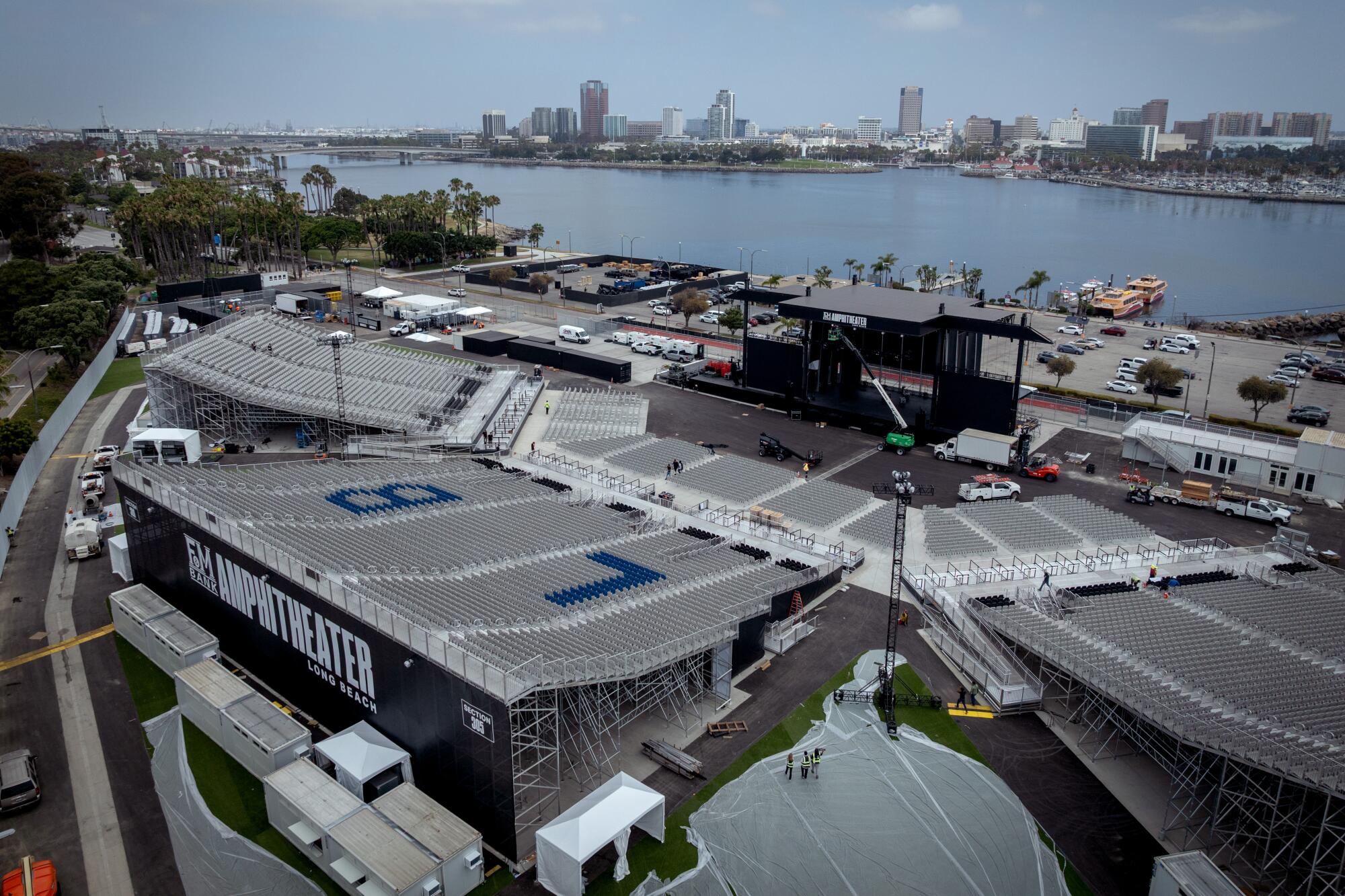
A waterfront amphitheater roughly twice the size of the Greek Theatre and two-thirds the size of the Hollywood Bowl is set to open this week in Long Beach — and there’s a lot riding on its success.
City leaders hope F&M Bank Amphitheater of Long Beach, located next to the famed Queen Mary, will supplant declining revenues from oil extraction and lead to an uptick in tourism. Concert promoters, meanwhile, see it as filling an important gap in Southern California’s music venue market.
The temporary amphitheater, which has a maximum capacity of 11,000, is meant to be a precursor to a permanent “Long Beach Bowl,” which is being pitched as the largest waterfront venue on the West Coast. The site opens June 6 with a performance by native son Snoop Dogg, and is expected to last for up to 10 years.
The new amphitheater represents a years-long dream of Mayor Rex Richardson, who began championing an outdoor performance venue on the waterfront in 2023. Soon after the closure of Irvine’s FivePoint Amphitheatre in October of that year, he accelerated those plans by proposing this facility. The general feeling was that Irvine’s loss could be Long Beach’s gain.
“This will be a place where memories are made, where music brings people together and where our city shows up on the big stage,” he said during a January groundbreaking. “The amphitheater represents direction to invest in our city’s future, to embrace our creative economy [and] to shape how people experience Long Beach for generations to come.”
Good vibes by the water is the driving energy behind the temporary venue.
(Eric Thayer / Los Angeles Times)
While Los Angeles and Orange County have no shortage of cavernous indoor arenas, the region has recently lacked a proper “summer shed” capable of hosting many national amphitheater tours, said Nick Storch, head of global artist development for booking agency Independent Artist Group. Those tours typically play venues larger than the Greek, Irvine’s Great Park Live or Costa Mesa’s fairgrounds-adjacent Pacific Amphitheatre, but smaller than the Hollywood Bowl.
Such tours, Storch said, are of “massive” importance to the concert industry. “With amphitheaters, it’s not just the music — it’s the experience of being outside and watching a concert, getting a bite to eat with your friends and all those kinds of things,” said Storch, whose agency’s clients Motley Crue and Five Finger Death Punch will perform at the F&M Bank Amphitheater in September.
“FivePoint was a great venue to help artists that are in that in-between stage, and not fully ready for arenas,” he said. “Long Beach having an amphitheater is going to grow the market again.”
Amphitheaters are also crucial to veteran artists with established fan bases. The long-running hard rock band Tesla — who also will perform at the F&M Bank Amphitheater in September — has not played a show in Los Angeles or Orange counties since the closure of FivePoint, which hosted the group twice.
Brian Wheat, the band’s bassist and manager, said he’s excited the new venue will help change that. “Sheds are great in the summertime, and outdoor summer gigs always create a great atmosphere for both bands and fans,” he said.
Much like the F&M Bank Amphitheater, FivePoint Amphitheatre was designed to serve as a temporary venue following the closure of Irvine Meadows Amphitheatre, which operated from 1981 to 2016. (From 2000 to 2014, it was known as Verizon Wireless Amphitheater.)
At 11,000 seats, the amphitheater is roughly two-thirds the size of the Hollywood Bowl. Its permanent replacement will be “architecturally iconic,” said Mayor Rex Richardson, while this temporary version is likened to a “summer shed.”
(Eric Thayer / Los Angeles Times)
From its opening in October 2017 until its closure, FivePoint hosted nearly 500 concerts, including artists such as KISS, Dave Matthews Band, Charlie Puth, Morgan Wallen and Luke Combs.
Venue operator Live Nation — which manages more than 300 facilities across the country — initially hoped to build a permanent amphitheater nearby, but scrapped those plans in 2023 after the Irvine City Council ended negotiations. Soon after, Live Nation announced the venue would shutter.
After learning of Live Nation’s fallout with Irvine, Richardson and members of his economic development team attended the final FivePoint concert, a performance by the Zac Brown Band, to “explore the feasibility if we were to do the same thing.”
Three months later, Richardson announced plans to build a temporary amphitheater in Long Beach to bridge the gap until a permanent facility — which he envisions as an “architecturally iconic and significant” waterfront venue akin to San Diego’s Rady Shell at Jacobs Park — can be permitted, financed and constructed.
The site’s location is central to its appeal, said Dan Hoffend, executive vice president of North American venues for Legends Global, the operator for F&M Bank Amphitheater. “If you sit in the very top row — what you would consider the worst seat in the house — it’s a spectacular view,” he said. “The Queen Mary is sitting there in all its glory. You’re looking across the harbor. What would be perceived as the worst seat is actually the best seat because you see it all.”
Long Beach Mayor Rex Richardson, left, and amphitheater general manager Tra Jones sit in the stands. Even from the nosebleeds, you still have a view of the waterfront at the F&M Bank Amphitheater.
(Eric Thayer / Los Angeles Times)
Tra Jones, general manager of the new amphitheater and a Long Beach native, said he’s striving to make it feel less stopgap and utilitarian than FivePoint.
“It doesn’t have a temporary feel at all,” he said. “We looked at all our surroundings and said, ‘What does this look like from a stylistic point of view?’ We leaned into the port/SteelCraft vibe — a very cool industrial look. When you walk in, you’re experiencing a vibe. That’s what we want to resonate with concertgoers coming here.”
The word “vibe” also pops up frequently in conversation with Richardson. Under his watch, Long Beach recently started branding itself as “Vibe City,” which he said is an attempt to encapsulate the charm of L.A. County’s second-largest city, and the state’s seventh-largest.
“Long Beach is special, but it’s hard to explain why if you haven’t been here,” he said. “Because you have to experience it for yourself, the best way to describe it is that it’s a vibe.”
Still, Richardson is aware that vibes can only go so far. During an April meeting with residents of downtown Long Beach, attendees were more interested in discussing homelessness and a recent uptick in traffic fatalities than how a new concert venue might add to the city’s cultural cachet. Some downtown residents have circulated a petition regarding noise-related concerns.
“The job of the mayor is to meet the needs of your residents today — keeping a roof over your head, making sure it’s safe to walk down the street, making sure you have access to amenities and services in your community — but also to think about the future,” he said.
That means finding a way to offset revenues from oil extraction, which currently finance many municipal services, and are projected to drop from more than $50 million annually to around $21 million by 2035. According to Richardson, the new amphitheater — managed by Legends Global, but owned by the city — will help cover that shortfall. The venue is projected to be profitable within five years and generate nearly $29 million in revenue by 2036.
Oil revenues, which pay for city services, are projected to drop by more than half. The amphitheater is being pitched as a budget gap solution.
(Eric Thayer / Los Angeles Times)
“We were fortunate that revenue from oil provided a lot of our services and built our beautiful waterfront, but as California moves away from oil production, we have to plan a more sustainable future by investing in what we know will be here in the long haul,” Richardson said. “In order to do that, we have to invest in arts and culture and tourism.”
Richardson is betting on music at a time when other cities — including Los Angeles — are doubling down on sports, warehousing or data centers. The amphitheater is also meant to remind the world of the city’s impact on pop culture.
From War to Warren G and Sublime to Snoop, Long Beach has a rich musical history. The city hosted the first concerts by the Beach Boys and No Doubt, while Rock & Roll Hall of Famers Elvis Presley, the Eagles and Iron Maiden all graced the stage of the Long Beach Arena.
While that venue currently holds more conventions than concerts, Long Beach has hosted notable outdoor music festivals in recent years, including Warped Tour, Day Trip and Dreamstate. Richardson believes the success of those events helped prove the city’s viability as a concert destination.
“This is the first step toward a legacy of leaving our city in a more economically resilient position,” Richardson said. “At every big turn in our city’s economy, we’ve leaned on arts as a way forward, and this is no different.”
Even the bleacher seats represent Long Beach pride at F&M Amphitheater.
The waits are so long that the UK Foreign, Commonwealth and Development Office (FCDO) has been forced to issue an official warning with the UK half term now in full swing
There have been long waits at Copenhagen Airport (Image: Getty)
Brits heading to a popular EU destination have been warned about long delays.
Long queues at arrivals have been plaguing Copenhagen Airport in Denmark in recent days. The waits are so long that the UK Foreign, Commonwealth and Development Office (FCDO) has been forced to issue an official warning.
“Travellers flying into and out of Copenhagen Airport from non-Schengen destinations (including the UK) are experiencing long delays at passport control. Embassy staff are in discussion with the relevant authorities on managing this pressure. Passengers with accessibility requirements, who need assistance (e.g. with very young children) or who have tight flight connections should make themselves known to airport staff in yellow vests who are monitoring the queue. For travellers departing from Copenhagen to the UK and non-Schengen destinations, we recommend giving yourself extra time to allow for queues at passport control,” the comment released on Sunday reads.
The long wait times come in the weeks after the EES border check system was fully implemented at Copenhagen Airport, after a partial rollout in October last year. The new system means that non-EU travellers arriving in the country from outside the Schengen Area, such as those with UK passports, will be fingerprinted at border control.
The scheme has been more than 12 years in development and has been delayed time and time again. Copenhagen Airport completed its rollout of the EU’s new Entry and Exit System (EES) last month.
The implementation of the EES system has caused issues across the whole of Europe, including in the UK. Long queues formed at Dover last week, before the new border checks were suspended amid concerns for drivers stuck in the sweltering bank holiday heat.
Holidaymakers faced hours-long waits on Friday at the Port of Dover and travellers on Saturday came up against similar disruption. In a bid to ease congestion, the French authorities suspended extra EU border checks under its EES, the port announced.
It also said anyone who has missed their ferry crossing because of queues can travel on the next available slot free of charge.
EES involves people from third-party countries such as the UK having their fingerprints registered and photograph taken to enter the Schengen Area, which consists of 29 European countries, mainly in the EU.
There have been delays at other European ports. Passengers in airports in countries such as France, Germany, Belgium, Italy, Spain and Greece were waiting several hours at border checks, the Airports Council International (ACI) body said last month.
Olivier Jankovec, the director of the ACI European division, told the Financial Times: “This situation, in the coming weeks and certainly over the peak summer months, is going to be simply unmanageable. We are seeing those queueing times now, at peak times, when traffic is just starting to build up.”
Last week, the boss of budget carrier easyJet urged European member states to be more flexible and avoid long airport queues caused by EES.
He said: “We are in correspondence with all the European member states, encouraging them to use the flexibility they have already been given by the EC, because it is unacceptable if customers are made to wait in border queues because, frankly, they have had since 2017 to prepare.
“It is really inexcusable. They have got the means to avoid allowing the queues to overrun by opening up the passport desks. It is completely in the gift of the European member states to smooth this through.”