L.A

Argentina’s Lucrecia Martel sticks close to home with first doc ‘Our Land’

On one of her previous visits to Los Angeles, Argentine filmmaker Lucrecia Martel found herself having a smoke on Hollywood Boulevard.

There, while she stepped over the famous concrete-embedded stars, an unhoused man struck up a conversation with her.

“He kept explaining to me that he was poorly dressed because he was currently living on the street after someone robbed him, but he had written a screenplay,” Martel, 59, recalls in Spanish over coffee on a morning in April at a West Hollywood hotel.

“He told me they had stolen a watch from him — not a Rolex but a known brand,” she continues. “The whole time he was trying to convince me he was a millionaire who just so happened to be on the street because of random circumstances.”

One of Latin America’s most indispensable storytellers, Martel is fascinated by how prevalent that dream still is in L.A. — that movies can change your life overnight.

“That particular fantasy is par for the course in this city,” she says, though she’s not above it. It’s the reason she’s back to promote her first documentary, “Our Land,” out Friday.

Unhurried when it comes to her output, Martel has only made four fiction features, among them 2001’s “La Cienaga” and 2008’s “The Headless Woman” (returning to theaters this month in a new 4K restoration). Her biting and formally audacious narratives examine class, politics and — a speciality — the interiority of women through enigmatic portraits of psychologically complex individuals.

“Our Land,” a piercing indictment of the enduring wounds of colonialism, chronicles the murder of Indigenous Argentine activist Javier Chocobar in 2009 and the prolonged trial of the perpetrators in 2018.

Chocobar was shot during a confrontation with armed men over land in the Tucumán province of Argentina where the Chuschagasta Indigenous community has lived for many generations. Martel explores the killing not as an isolated event in her country’s recent past but as part of a long history of dispossession.

“Racism is a foundational element,” she says of her homeland. “The only consistent thing in Argentina, from the country’s birth to the present day, is the rejection of Indigenous people.”

In Argentina, Martel explains, public education has indoctrinated the population into believing Indigenous people no longer exist. Yet many Argentines proudly claim a connection to the Europeans, Italians in particular, who arrived in the country in the late 1800s and early 1900s.

“When giving speeches, our presidents always say, ‘We are a country of immigrants,’ or ‘We came from the boats,’” says Martel. “They use metaphors like these because deep down Argentines feel much more indebted to European immigration than to our Indigenous population. But more than half of the people in Argentina have Indigenous ancestors.”

In 2020, Chocobar’s three convicted murderers appealed their guilty verdicts and were set free. “Our Land” premiered at the Venice Film Festival in September 2025, which brought renewed attention to the case. A month later, the sentence was upheld and two of the men returned to prison (one died in the interim).

Martel believes that outcome was a response to her film. “Communities wage the fight but cinema helps,” she says.

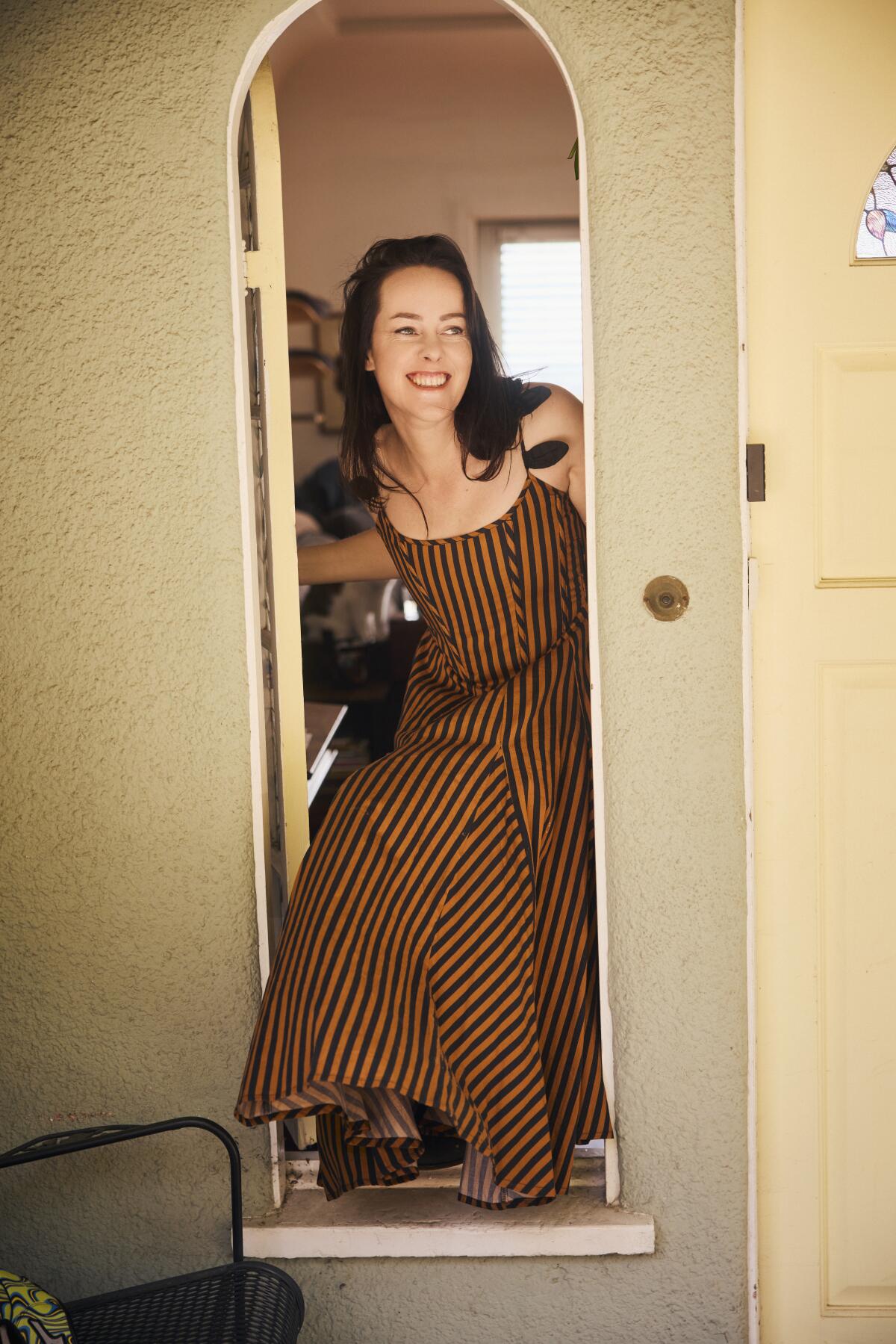
A woman with a cane leans against a leafy backdrop.

“I believe that we must use cinema for its enormous power to alter perception and not soothe the rich,” Martel says. “It’s not about delivering a message but rather about showing how an idea functions.”

(Jason Armond / Los Angeles Times)

For over 14 years, Martel worked on “Our Land” on and off. This time included periods when she focused on 2017’s “Zama,” her masterful period piece following a Spanish official in 18th century Argentina “who doesn’t want to be American,” she says, referring to the continent. In her mind, both “Zama” and “Our Land” come from the same impulse to dissect colonialism.

As part of her research process, Martel and her team created a detailed archive of documents related to the case that the Chuschagasta community now has at its disposal. Over the years, Delfín Cata, one of the Indigenous men present during the attack, would call Martel. He never asked about how her film was going, but the director sensed he was tacitly checking in on her progress, hoping that she was not losing faith.

“That was a confirmation that, beyond my own interest, there were people who needed this film,” she says. “I felt the immense satisfaction of knowing I was doing something that would be concretely useful.”

For Martel, the question of whether she was the right person to make this film (one she got in Venice) seems unfair. “It’s wrong to prevent a human being from speaking about their own history because they are not a woman, because they are not Black, or because they are not Indigenous,” she says. “It’s better to make mistakes trying to understand something than not to try at all. The chances of making a mistake are enormous in a film, no matter how good your intentions are.”

A key piece of evidence in the Chocobar case, prominent in the film, is a video that one of the attackers filmed, presumably expecting the Indigenous community to react violently, to justify firing his gun at them. The Chuschagasta men that faced them weren’t armed. As used by their aggressors, the camera functioned as a weapon.

Hollywood feels incompatible with Martel’s sophisticated, confrontational movies rooted in her country’s troubles. By Martel’s own admission, it doesn’t feel like a fit for her.

“I would have to force myself to create something outside my own country, outside my own language,” she says. “And that doesn’t really appeal to me.”

Still, Marvel Studios famously asked to meet with her when seeking a director for 2021’s “Black Widow.” Martel says she was among many directors they contacted, but she was curious to take the meeting even if she knew nothing would come of it.

“They wanted to do it over Zoom and I happened to be here in Los Angeles,” she remembers. “I told them I could come in, because I wanted to see what the whole process was like.”

Martel describes the month she spent in L.A. — an eye injury prevented her from flying home sooner — as a “lot of fun in the end,” even if no blockbuster emerged from it. More recently, another Hollywood offer did tempt her, but she ultimately passed.

“It was a good book suggested to me by an actress of undoubted talent,” Martel shares, careful to avoid names. “I considered it, but you very quickly have to picture yourself spending three years or at least a year and a half living in the United States making a movie. I have a thousand things in Argentina to worry about.”

Still, Hollywood, and its significance to moviemaking, has a singular, unnerving allure on her. Two of Martel’s favorite movies set in L.A. are David Lynch’s nightmarish “Mulholland Drive” and Robert Aldrich’s psychodrama “What Ever Happened to Baby Jane?”

“There is something ruthless and utterly devoid of sanity at the heart of this film industry, and I’ve never felt that darkness as clear as in ‘Mulholland Drive,’” she says. “How can an industry that handles so many millions [of dollars] and such impeccably dressed famous people be so full of lunatics? That film captures that perfectly.”

And occasionally, she thinks, a big production breaks the mold, such as Todd Phillips’ “Joker,” which won the Golden Lion at the Venice Film Festival in 2019 when Martel served as jury president — a controversial choice.

“It certainly had an impact on me,” says Martel. “I didn’t vote for it, though. I had another favorite, a Chinese film that stood no chance of winning.”

Phillips, she thinks, created a premonition for what was to come. “For me, the real killer clowns are Trump, Milei or Orbán,” Martel says, referring to polarizing leaders. “They expose themselves to ridicule and spout all sorts of nonsense. Those are clowns. And I think that movie captured that.”

Not one to mince words, Martel elaborates on the relation of Joaquin Phoenix’s social outcast turned supervillain and President Trump.

“The origin of the Joker is social resentment,” she says. “Trump holds no resentment toward society because the system gave him everything. But he has exploited the people who do harbor resentment. That is where you see the kind of clown he is, one who knows how to use people.”

Artificial intelligence, far-right ideologies, voracious capitalism — all of it makes Martel alarmed, seeing it as pushing us collectively to the brink of collapse. But there is hope, she thinks.

“What we have invented is very dangerous but we can dismantle it,” she says. “That is the only thing I’m betting on, that, at some point, a consensus will emerge and we’ll go, ‘Let’s not do this.’”

“I believe that we must use cinema for its enormous power to alter perception and not soothe the rich,” she says. “It’s not about delivering a message but rather about showing how an idea functions.”

She points to one of her subjects in “Our Land,” an Indigenous man who told her he loves the 1959 Charlton Heston epic “Ben-Hur,” a passion she does not share but understands.

“That’s a blow for all of us who make auteur cinema,” Martel says with a laugh. “That feeling that ‘Ben-Hur’ evoked gave him the strength to continue fighting for his community’s territory.”

The night before our interview, Martel rode around L.A. on a scooter holding onto a friend. These days she uses a cane to help her with mobility. “The city has great light,” she says, still open to being surprised by it.

Source link

Two winners, one loser in tonight’s L.A. mayor’s debate

Karen Bass, Spencer Pratt and Nithya Raman each came into tonight’s mayoral debate with goals for what may be their only time together on stage.

As the incumbent mayor, Bass had to weather blows from her challengers while trying to sell voters on her fitness for another term, despite a disastrous 2025.

As a reality TV star with no political experience, Pratt needed to show that he could offer substance instead of just AI fanboy videos and the name-calling — “Karen Basura” — he has indulged in on social media.

Raman’s task was perhaps the hardest. As a city councilmember whose two previous campaigns were backed by the local Democratic Socialists of America chapter, she needed to convince Pratt-curious voters that she’s more conservative than Bass. Yet for others, she needed to appear liberal enough to peel away support from the mayor and come out as a progressive lioness to excite Democrats in a year where GOP candidates like Pratt have to answer for the disaster that is President Trump’s second term.

Only one of the three failed.

At times, Raman was tongue-tied trying to answer simple questions. Moderators kept telling her she was going over her time. Answering a yes/no question about whether noncitizens should be allowed to vote in city elections, the councilmember went on and on, until the moderator cut her off.

While Raman offered some policy plans, she also played a card straight out of Trump’s arsenal. She claimed that Pratt and Bass were teaming up against her — an unlikely scenario that drew laughs from the audience. She got more and more frustrated, to the point that when Bass was allowed time for a rebuttal, she dejectedly proclaimed, “I haven’t been offered that in a lot of this debate.”

Raman, who had endorsed Bass’ reelection before throwing her hat in at the last minute, came off as inexperienced, touchy and unprepared.

The line of the night was Pratt dismissing Raman as a “random councilmember” — which is how the L.A. political world responded to her entry into the race. She was so upset about Pratt’s remark that she continued to whine about it to a KNBC reporter after the debate.

What’s shocking about Raman’s flop is that she should know how important it is to project well to a television audience, given that her husband is a screenwriter. Her tone was flat, when she needed to be passionate.

No one had to remind Pratt of that. He was parrying tough questions on a big stage for the first time, facing an audience who knew him only as the Angry L.A. White Guy he has reveled in playing.

He mostly succeeded.

At his best, Pratt came off as a boisterous bro with enough charm to call himself “humble” without coming off as obnoxious. He dominated the flow of conversation without coming off as commandeering, even interrupting Raman at times to let Bass speak. At one point, he even said “Sorry” when he had taken up too much time and the moderators cut him off.

He was light on specifics, other than saying he was going to do better than the others and that he would prioritize public safety above all. Instead, he was the one person on stage who used anecdotes to sell himself, citing conversations about abused animals, downtown workers too afraid to eat outside and film producers hiring local gang members to keep their shoots safe.

As a TV personality-turned-influencer, Pratt knows that storytelling is far more effective than drowning the audience in statistics, as Bass and Raman did.

But the bad Pratt flared up at times. He earned a reprimand from KNBC anchor and debate co-moderator Colleen Williams when he called the mayor an “incredible liar.” Affecting high-pitched voices to mock Bass and Raman came off as juvenile and possibly sexist. And when it came to last summer’s federal immigration raids that terrorized Southern California, Pratt appeared flummoxed when Bass pointed out that 70% of those arrested didn’t have criminal records — a use of stats that hit.

Bass was also who she had to be — measured, forceful and raring to defend her record, without coming off as defensive. She wasn’t exactly inspirational, but she didn’t have to be. The city’s powerful labor unions have backed her, along with much of the Democratic establishment.

Raman and Pratt are right in deeming Bass the old guard of a beat-up city — but the old guard didn’t get there without knowing how to win.

Source link

Asian American and Pacific Islander-owned restaurants to support in L.A.

Los Angeles is a city rich with regional specificity when considering the cuisines of Asia. When someone asks for a restaurant recommendation for “Korean food” or “dumplings” or “Thai,” I encourage them to be more specific. Are you in the mood for xiao long bao, mandu, gyoza or momos? You want to know where to get barbecue in Koreatown? Those sizzling grills crowded with galbi, while dependably righteous, only scratch the surface of the breadth and depth of Korean cuisine in what is home to the largest Korean diaspora outside of Korea.

There are omakase experiences for every price point. Cramped izakayas. A restaurant where the sole speciality is lamb prepared in the style of the Uyghur people of China’s Xinjiang province. Pho parlors and banh mi shops with pâté-smeared baguettes. Sunny Taiwanese breakfast restaurants slinging steaming bowls of congee and tightly wrapped fantuan.

AAPI-owned restaurants act as the vital centers of countless communities around the city. The San Gabriel Valley, Westminster, Little Bangladesh, Koreatown and so many more. These are places that are both hubs for thriving immigrant communities and sought-after dining destinations.

Here’s a list of 20 AAPI-owned standouts from our most recent guide to the 101 Best Restaurants in the city. — Jenn Harris

Source link

While ICE cracked down on L.A. protests, Marines were told to use force as ‘last resort’

Before being deployed to Los Angeles during anti-ICE protests last summer, U.S. Marines were given 12 rules for engaging with protesters, and Rule 1 was clear: Force “of any kind” was allowed only as a last resort.

If force were used, the rule stated, it “should be the minimum necessary to accomplish the mission.”

That detail is among 178 pages of federal documents released by the Marine Corps to the nonprofit watchdog group American Oversight through the Freedom of Information Act and shared exclusively with The Times.

The documents paint a thorough picture of how Marines prepared to deploy in Southern California, where they stood alongside National Guard members and agents with the Department of Homeland Security.

The documents also illuminate a glaring contrast between the training of Marines and that of immigration agents, who have been accused repeatedly of using unnecessary force against peaceful protesters, bystanders and immigrants during enforcement operations.

“Ironically, I would’ve felt much safer with Marine engagement than with DHS because of the depth of training,” said Ryan Schwank, a former instructor for Immigration and Customs Enforcement recruits at the ICE Academy within the Federal Law Enforcement Training Center in Georgia.

Schwank is a whistleblower who resigned in February after revealing that the Trump administration had slashed immigration officer training. After reviewing the documents obtained by American Oversight, he said the training given to Marines on crowd control was “significantly more in-depth and longer than training given to an ICE officer, even under the best of circumstances.”

A ICE agent walks through tear gas that was fired to push protesters back

An ICE agent walks through tear gas that was fired to push protesters back during a raid on Atlantic Boulevard in the city of Bell on June 20, 2025.

(Genaro Molina / Los Angeles Times)

The Department of Homeland Security did not respond to questions and instead pointed to a February news release that said training has not been cut back and that new hires receive additional training after leaving the academy.

“ICE law enforcement officers are trained to use the minimum amount of force necessary to resolve dangerous situations to prioritize the safety of the public and our officers,” said Lauren Bis, a department spokesperson. “Officers are highly trained in de-escalation tactics and regularly receive ongoing use of force training.”

Schwank noted that the Marines and ICE officers came to Southern California with different objectives: As protectors of people and property, the Marines had a more limited, reactive mission, while ICE officers were charged with making arrests, a confrontational role.

“We’re giving [ICE officers] less training on it and fewer refreshers than the Marines are getting and yet we’re putting them in a situation where they’re taking the more confrontational actions to where they’re more likely to have to make split-second decisions,” Schwank said.

For most of history, he added, ICE agents detained people who were already in the custody of another law enforcement agency. He said ICE was never meant to act as riot police.

“The real fundamental problem isn’t ICE agents using force,” Schwank said. “It’s ICE agents using force in an environment they are not trained for.”

The training of Marines, and the lead-up to their deployment, is outlined in the documents reviewed by The Times.

On June 6, a commanding general emailed other generals to say that “national-level leadership” had directed Marines to assume an “alert posture” and be ready to support the Los Angeles Police Department, Los Angeles County Sheriff’s Department and ICE officers who were already responding to civil unrest in downtown Los Angeles.

The Marines would safeguard federal facilities and thus “protect lives and property through the restoration of civil order,” the email said.

The Trump administration directed 4,200 California National Guard soldiers and 700 Marines to Southern California starting June 7.

Marines push back anti-ICE protesters in front of the Federal Building

Marines push back anti-ICE protesters in front of the Federal Building during a “No Kings Day” in downtown Los Angeles last June.

(Carlin Stiehl / Los Angeles Times)

First, though, they needed to be trained.

The five-day course reviewed use-of-force policies, less-lethal weapons and handling of civil disturbances.

Overall, the 12 rules emphasized safety, urging Marines to be reasonable, to de-escalate tensions and to avoid confrontations with individuals who posed no threat.

Marines could use non-deadly force, if necessary, to control a situation or protect themselves or other federal personnel, and deadly force “only when all lesser means have failed.”

“Exercise due regard for the safety of innocent bystanders when using any type of force,” the rules state.

Schwank said there is no equivalent to the Marines course at Homeland Security. When he left the academy in February, he said, “there was no crowd control training, period.”

Crowd control was briefly added to the curriculum in 2021 for experienced law enforcement officers, he said, but it was later removed. ICE recruits may also have gotten lessons on crowd control after leaving the academy and joining their respective field offices, he said.

When Schwank left the agency, a six-hour class called “Public Order Public Safety” was in development for the 2026 curriculum, according to documents he provided to Congress. Homeland Security did not respond when asked if the class had started.

“I wouldn’t assume that any of the ICE officers on scene in L.A. had received any sort of actual crowd control class,” Schwank said. “They might have gotten a one-to-two-hour PowerPoint slideshow, but that would’ve been it.”

Marine Col. Beth R. Smith confirmed that the entire 2nd Battalion 7th Marines received academic and practical training before deploying to Los Angeles.

Managing civil disturbances has been an issue for Homeland Security since at least 2021, according to an audit conducted by the agency’s internal watchdog review of a 2020 deployment to Portland, Ore.

That year, President Trump mobilized federal power against the protests that spilled into Portland streets after the murder of George Floyd by a Minneapolis police officer. Trump sent 755 Homeland Security agents to defend federal property in what would come to be seen as a dry run for much larger operations of his second term.

Two vehicles, one in flames

A protester damages a Waymo vehicle at Los Angeles Street and Arcadia Street in L.A. on June 8, 2025.

(Robert Gauthier / Los Angeles Times)

Nested on rooftops, agents launched chemical weapons against protesters. Ground forces fired less-lethal rounds at point-blank range and forced participants into unmarked vans without explanation.

The audit by the Homeland Security inspector general found that only seven of 63 officers reviewed had received any level of riot and crowd control training. Some officers told investigators that they needed additional training, and many “questioned their involvement in the operation” due to the lack of preparation.

”Without the necessary policies, training, and equipment, DHS will continue to face challenges securing Federal facilities during periods of civil disturbance that could result in injury, death, and liability,” the audit concluded.

As of spring 2025, Homeland Security records show, the department had not corrected the training failures flagged in the audit years earlier.

Schwank agreed that the concerns raised in the inspector general’s report were never addressed.

Liz Hempowicz, deputy executive director of American Oversight, said the Marine Corps’ emphasis on de-escalation and on using force only as a last resort stands in stark contrast to what happened on the ground in Los Angeles with immigration agents.

The practices outlined in the documents “differ from positions taken by senior DHS leadership, whose separate internal communications revealed a mindset that appeared far more encouraging of violence,” she said.

Internal Homeland Security emails also obtained by American Oversight revealed that the agency’s lead attorney said federal agents in Los Angeles should have “just started hitting the rioters and arresting everyone that couldn’t get away.”

“These records underscore that the difference between disciplined restraint and unnecessary harm can come down to the tone set at the top — and when that tone shifts toward hostility, the human cost can be devastating,” Hempowicz said.

Jennifer Kavanagh, director of military analysis at Defense Priorities, a military research group, said that for Homeland Security, the issue is partly a training deficiency and partly a cultural shift against agent accountability.

“Trump talks about ‘the enemy within’ — this is what he’s talking about,” she said. “To some at DHS, the enemy within is all immigrants, it’s cartels — it’s also groups that are protesting the government.”

Conversely, the Marines’ documents emphasized personal liability and responsibility. For example, one page said that “if you either use more force than is necessary, or respond with DEADLY-force to a NON-deadly threat — You will likely lose your right to self-defense, and you will be viewed, under the law, as the ‘Aggressor.’”

Marines were told to immediately report anyone violating the 12 rules of engagement.

The high level of training for Marines shows that command considered the optics of military personnel harming or even killing civilians, Kavanagh said. But just because the deployment worked out last year doesn’t make it a good idea in the long run, she said.

Kavanagh, alongside Gov. Gavin Newsom, Mayor Karen Bass, and LAPD Chief Jim McDonnell, opposed the military deployments to Los Angeles last year, maintaining that Marines are trained for foreign combat, not domestic crowd control.

“I see these deployments as a recipe for disaster,” she said.

Schwank said ICE’s training touches on personal liability but not in as much depth. Last fall, Stephen Miller, Trump’s deputy chief of staff, said ICE officers “have federal immunity in the conduct of your duties, and anybody who lays a hand on you or tries to stop you or tries to obstruct you is committing a felony.”

On the ground in Los Angeles, ICE agents and other local law enforcement fired a range of less-lethal weapons at protesters, such as pepper balls, hard foam rounds or canisters delivering flash-bang grenades and tear gas.

At a June 12 protest, a federal agent shoved freelance journalist Anna Sophia Moltke to the ground, causing sprains on her left arm and leg and deep scrapes to her hip and knee that have since scarred. She was carrying a camera, she said, and wore clear press credentials and a helmet that said “PRESS.”

“I remember distinctly there being no violence at all until police and ICE showed up,” she said. “We saw them firing rubber bullets into the crowd. People started running away. I was halfway turned around when they started rushing the crowd, and a tall, 6-foot-4 masked man used both hands to push me onto the concrete.”

Moltke said she recalled a large group of protesters gathered near the Marines stationed at the northern end of the detention center, just before police and ICE swept through and forced her to the ground. To her knowledge, she said the Marines remained at their post and didn’t participate in street skirmishes.

Source link

How I learned to stop worrying about noncitizens voting in L.A. elections

¿Qué en la fregada?

What the hell?

That’s what I muttered after learning that Los Angeles Councilmember Hugo Soto-Martínez wants to allow noncitizens to vote in city and school board elections.

Talk about a solution in search of a problem, considering everything Angelenos are facing right now.

While the specter of la migra continues to haunt the city, far more crushing are problems that affect everyone — affordability, housing, traffic, pollution. Maybe Soto-Martínez and his colleagues should double down on fixing those things first and sell their message better to voters instead of picking up a new issue?

I know the first-term council member comes from a good place. His parents were formerly undocumented, just like my dad, and he has been a fierce advocate for immigrants going back to his labor organizing days. I have friends without legal status and others in the DACA program for people who came to the U.S. illegally as children. I think giving them, as well as green card holders and others with papers, a chance to participate in elections is a righteous idea.

But to paraphrase the Book of Ecclesiastes, there’s a time and a place for everything. In 2026, Angelenos should be focused on electing people and approving initiatives that will improve the city for everyone, not a narrow plank benefiting a slice of the population.

So I called up Soto-Martínez and challenged him to convince this doubting Tomás.

He hopes his proposal will reach the City Council later this month for a vote on whether to place it on the November ballot. If voters pass the measure, it goes back to the council to decide when — if ever — to enfranchise the immigrants.

The proposal, already vilified in conservative media, isn’t as radical as it seems. Noncitizens are already prohibited from voting in federal elections, but there’s a well-established history of their participation in local ones, including in Vermont and Maryland. They can already vote in L.A. neighborhood council elections, and in San Francisco school board elections if they have a child in the district.

Besides, L.A. has long led the way in weaving undocumented immigrants into the fabric of civic life.

This is a sanctuary city where Mayor Karen Bass has stood up to President Trump’s xenophobia. Where eight of the 15 council members are immigrants or the children of immigrants. Where LAUSD Supt. Alberto Carvalho — himself formerly undocumented — has striven to make local schools as welcoming as possible (Carvalho is on paid leave after the FBI raided his home and office earlier this year). Even the LAPD learned decades ago that it’s better to embrace undocumented immigrants than castigate them for their lack of legal status.

“If you’re contributing to this economy, you should have the right to decide who represents you,” Soto-Martínez told me.

Fair point. But isn’t thumbing our noses at Trump asking for more of what he has already inflicted on L.A., making life even more miserable for undocumented immigrants? Could he use the noncitizen voter rolls as a list of whom to deport? Besides, doesn’t extending the franchise to noncitizens give fuel to his crazy conspiracies about stolen elections?

“You always hear, ‘Don’t poke the bear, don’t instigate them,’ but that’s not how you deal with a bully,” Soto-Martínez replied. “They’re coming at us already. While they’re removing people’s right to vote in the Supreme Court, we’re expanding it. … And it has nothing to do with Trump. It’s about fairness.”

Tell that to Trump.

I mentioned that Santa Ana — a city far more Latino than Los Angeles, though not as liberal — decisively rejected a similar measure in 2024. Soto-Martínez’s fellow Democratic Socialist council members, Ysabel Jurado and Eunisses Hernández, have voiced their support for his measure. But I wonder whether the full council will move it along to voters in a year when some members, including Soto-Martínez, are running for reelection.

I couldn’t get a comment from Bass. Councilmember Nithya Raman, who’s running against her, said in a statement that Soto-Martínez’s push “is worth taking seriously” but that it’s “critical to getting this right, and we must not make decisions lightly or quickly.”

“We’re going to have to organize,” Soto-Martínez acknowledged. “But we live in a political moment where it’s the right conversation to have about what this city stands for.”

Nilza Serrano is president of Avance Democratic Club

Avance Democratic Club President Nilza Serrano at Mariachi Plaza in Boyle Heights in 2022.

(Irfan Khan / Los Angeles Times)

He’s going to have to convince people like Nilza Serrano. She’s president of Avance, L.A. County’s largest Latino Democratic club, and heads the California Democratic Party’s Latino caucus. Serrano is no wokosa — she supported Rick Caruso in the last mayoral election and is now siding with Bass.

While Serrano thinks Soto-Martínez is on to something, she said that voting rights for noncitizens are a nonissue for the people she’s trying to get to the polls for the June primary and November general elections. The economy and Trump’s deportation deluge are more on their minds.

I asked if Soto-Martínez’s proposal would cheapen citizenship for people like her. Serrano and her family came here legally from Guatemala in the 1980s before becoming U.S. citizens, a process that took years.

“Not for me,” she replied. “But it’s hard to say for others. I’d have to do a little bit more research.”

So I continued with my own research, calling someone I was sure would have a fit about the idea: Los Angeles County Hispanic Republican Club President David Hernandez.

“Isn’t San Francisco already doing it?” the Navy veteran cracked.

I thought Hernandez would go on an anti-liberal rant, but.…

“I believe there’s a strong argument,” he said, “that if someone has established residency and is a member of the community and suffered the consequences of whatever local policies will be enacted, they should have a say in who gets elected.”

Did the ghost of Joaquin Murrieta, California’s original avenging Latino, suddenly possess Hernandez? To make sure I was hearing right, I asked again if noncitizens voting in L.A. elections is a good thing.

How could he support that, as a Trump-voting Republican?!

“We have to be pragmatic,” he replied. He approves of noncitizens voting in L.A. neighborhood council elections, because that’s true local control.

He understands that allowing them to vote in municipal elections might come off as an insult to the memory of civil rights activists who lost their lives fighting for that right for Black Americans. But U.S. citizens are already taking it for granted, he noted — turnout in the November 2022 L.A. mayoral election was a pitiful 44%.

“Maybe noncitizens will appreciate voting more than citizens,” he said.

I’m still not fully convinced that Soto-Martínez’s push is wise right now, but I like that he’s being careful.

“We need to get in the weeds of this,” he said of the City Council’s deliberations, which he characterized as attempting to ensure maximum benefit and minimum fallout.

Let’s see what they come up with in a few weeks.

Source link

L.A. unveils details about its 2026 World Cup fan zones

The Los Angeles Organizing Committee for the 2026 World Cup announced on Monday the details of the 10 official fan zones that will be set up at locations throughout the L.A. region during the 39-day tournament.

These venues will complement the start of the tournament following the opening of the FIFA Fan Festival Los Angeles, scheduled for June 11–14 at the Coliseum, which will serve as a central gathering point for fans.

The goal is to transform the city into an extended celebration of the World Cup, providing live broadcasts of the matches and various experiences designed to bring the tournament atmosphere to communities throughout L.A.

Match broadcasts in the fan zones will be available via Fox and Telemundo, allowing attendees to follow the tournament live throughout the competition. Each venue will have different programming, so fans are encouraged to check the schedule in advance to be sure they catch their preferred games.

The organizing committee urged fans to plan their travel in advance, highlighting the Metro public transit system as the most convenient option for getting to both FanFest and the various Fan Zones located throughout the region.

Here is the watch party schedule:

The Original Farmers Market: June 18–21

Ticket prices: $5 per day/$17 multi-day pass; free admission for children 3 and under.

It will feature a full lineup of group stage matches, including the United States vs. Australia and Mexico vs. South Korea.

The event will include soccer zones for the whole family, beer gardens, and international cuisine from more than 40 restaurants and specialty market shops.

City of Downey: June 20

Free community event with optional VIP packages available for purchase.

It will feature highlight matches from the group stage, such as Germany vs. Ivory Coast and Tunisia vs. Japan.

There will be an opening ceremony, a massive viewing area, entertainment, soccer exhibitions, an arts and crafts fair, interactive booths, and food and beverage vendors.

Union Station: June 25–28

A free multi-day event in the heart of downtown Los Angeles.

It will feature live broadcasts of key matches and international games, including the United States vs. Turkey.

It will include DJ performances, meet-and-greets with guests, interactive challenges, competitive activities, and immersive experiences.

Hansen Dam Lake: July 2–5

Ticketed outdoor event: $25 general admission, with VIP options available.

The event will feature round of 16 and quarterfinal matches in a festival-like atmosphere.

The event will feature a transformed lakeside area with DJs, international cuisine, beer gardens, an outdoor movie theater, muralists, games with prizes, and continuous entertainment.

Earvin Magic Johnson Park: July 4–5

Free community celebration.

Will include quarterfinal games.

It will feature activities, a community market, local resources, music, food trucks, drinks, and more.

Whittier Narrows Recreation Area: July 9–11

Free community celebration.

It will feature semifinal matches and other moments from the tournament.

It will include cultural activities, a community market and a variety of local dining options. After the matches, fans can tour the park and explore the San Gabriel Valley.

Venice Beach: July 10–11

Ticketed fan zone on the waterfront: general admission starting at $10, with VIP options available.

Will feature single-elimination matches at one of the city’s most iconic destinations.

There will be international food vendors, beverage areas, live music, DJs, cultural performances and additional family-friendly programming.

Fairplex: July 14–15 and 18–19

Ticketed event.

$10 for all four days through May 31; $20 after that date.

VIP options available.

Packages will include multiple matches, including the semifinals, third-place match, and final.

There will be interactive games, recreational activities, appearances by local mascots, educational exhibits on the “science of soccer” and a resident DJ.

San Pedro’s West Harbor: July 14–15 and 18–19

Waterfront experience with ticket: $5 per ticket, with VIP options available.

Will feature the tournament semifinals and final.

Will offer soccer-inspired activities, interactive experiences, food, drinks, and live DJ music.

Downtown Burbank: July 18–19

Ticketed event starting at $25.

The event will feature the tournament’s final matches, including the World Cup final.

The event will include live entertainment, family-friendly games, VIP experiences, and an adjacent free international fair showcasing cuisine and cultural expressions from around the world.

This article first appeared in Spanish via L.A. Times en Español.

Source link

L.A. city attorney challenger gains support of D.A., police union

Los Angeles County Dist. Atty. Nathan Hochman and the union that represents rank-and-file police officers offered a stinging rebuke of embattled City Atty. Hydee Feldstein Soto on Tuesday morning while endorsing one of her challengers in the upcoming election, county prosecutor John McKinney.

Hochman said he analyzed the field and decided the city attorney’s office “desperately needed” an experienced litigator like McKinney, who has been a prosecutor for 28 years and handled some of the city’s highest-profile trials.

“What we need in the L.A. city attorney’s office is someone who actually has courtroom experience, someone who understands how to win a trial,” Hochman said. “Someone who has actually not only talked the talk, but walked the walk.”

Hochman and leaders from the Los Angeles Police Protective League, the union which represents the majority of LAPD officers, stood shoulder to shoulder in endorsing McKinney. The league recently rescinded its endorsement of Feldstein Soto.

Feldstein Soto has been under fire for weeks, with her office accused of failing to properly inform other city officials about a hack of confidential files that saw 337,000 documents, videos and photographs leaked online. The documents amount to millions of pages, and appear to mostly come from civil lawsuits against the city that have been resolved in court. The files were not secured by a password, according to sources who spoke previously with The Times and requested anonymity because they were not authorized to discuss the ongoing investigation.

The city attorney’s office previously responded to questions from The Times by referring to a public report issued April 17, which said a preliminary investigation indicated that “the incident was contained to that third-party environment, and that no other City applications, systems, or department records were accessed or affected.”

While many of the documents dealt with relatively minor issues, others contained sensitive information about police officers. The Times used the leaked documents last month to reveal how the LAPD disciplined the officers who blew up a city block when they misjudged the weight of seized fireworks in South L.A. in 2021.

Sgt. Chris Wecker, vice president of the police union, said officers’ frustration with Feldstein Soto goes beyond the data breach. Wecker noted the city had paid out gargantuan sums in civil cases under Feldstein Soto’s administration, some of which the union believes she misplayed.

“Los Angeles has seen a dramatic rise in lawsuits, settlements and verdicts against the city costing taxpayers hundreds of millions of dollars,” he said. “The city attorney should not simply react to lawsuits after they’ve been filed. He must work proactively with city departments to identify legal risks before they turn into costly litigation.”

Feldstein Soto has also been accused of mismanaging her office and using the city’s prosecutorial powers for personal vendettas in multiple lawsuits, allegations she has repeatedly denied.

McKinney said he believes the city attorney’s office can do more work to reduce homelessness and criticized Feldstein Soto for her handling of an array of misdemeanor crimes including animal cruelty and trespassing. He said he is a proponent of “Broken Windows” policing — the idea that enforcing lesser laws will reduce felonies and deter criminals from committing worse crimes — and took a shot at Feldstein Soto’s handling of the data breach.

If such an incident happened under his watch, he said his “first call would be to the [Los Angeles Police] Department, the second to the FBI and the third to the people impacted.”

Feldstein Soto’s office has said senior LAPD officials and the city’s IT department were alerted as soon as the leak was discovered, and the FBI is investigating the matter.

Although it’s rare for the county district attorney to weigh in on the race for their city level counterpart — ex-Dist. Atty. George Gascón did not offer an endorsement in the 2022 contest which Feldstein Soto won — Hochman and McKinney are political allies who have aided each other before.

When Hochman emerged from a crowded 2024 primary field to challenge Gascón, McKinney endorsed him and functioned as a campaign surrogate.

A longtime trial prosecutor who oversaw a number of high-profile cases, including winning a conviction against the man who killed beloved L.A. rapper Nipsey Hussle, McKinney was promoted to oversee all special prosecutions in the office after Hochman’s election night victory.

Hochman said his endorsement was more about things McKinney had done right than anything the incumbent had done wrong.

Feldstein Soto still has the endorsements of U.S. Sen. Adam Schiff (D-Burbank) and Mayor Karen Bass, who is fighting her own difficult reelection battle.

Marissa Roy, a deputy attorney general with the California Department of Justice, is running to the left of the field and has the backing of the county’s Democratic party, the Democratic Socialists of America and her boss, California Atty. Gen. Rob Bonta. Roy has said she wants to turn the office into “the largest public interest law firm in the city,” targeting wage theft, tenant harassment and other issues impacting working-class Angelenos.

A call to Roy’s campaign was not immediately returned Tuesday.

Los Feliz attorney Aida Ashouri is also running.

The announcement from Hochman and the LAPD union could jump-start McKinney’s flagging campaign. He’s raised only $78,000 since entering the field, far less than either Roy or Feldstein Soto.

McKinney is relying on some of Hochman’s past campaign resources, hiring both the man who managed Hochman’s victory in the 2024 district attorney’s race and fundraiser Trey Kozacik, who operates the Pluvious Group.

The group was successful in helping Hochman build a massive war chest during his 2024 run for office, but its work helping organize fundraisers for President Trump in Los Angeles has drawn scrutiny before. The city has often found itself in litigation against the Trump administration in recent years, efforts McKinney would likely have to lead if elected.

McKinney, a registered Democrat, previously told The Times he would protect the city’s residents in court, “regardless of who’s in the White House.”

“I have been very, very disturbed by the activities of some federal law enforcement agencies that have come into Los Angeles and intentionally attempted to terrorize our people,” he said.

Times Staff Writers David Zahniser and Libor Jany contributed to this report.

Source link

What do Jeanie Buss, Colin Jost and Dave Winfield have in common? A stake in L.A. mayor’s race

The roster of campaign contributors to Los Angeles mayoral candidates has something in common with the courtside seats at Lakers games: Both are sprinkled with the rich and famous.

There’s Colin Jost, “Saturday Night Live’s” Weekend Update host, popping up as a donor to Councilmember Nithya Raman. Mayor Karen Bass, meanwhile, counts former Major League Baseball star Dave Winfield among her contributors.

Lakers governor and part-owner Jeanie Buss is there too, as a donor to reality TV personality Spencer Pratt. All three gave the maximum $1,800 contributions to their chosen candidates.

With Los Angeles at the center of the entertainment industry, big names like Jost, Winfield and Buss (none of whom responded to requests for comment) are par for the course in local elections. There might have been even more celebrity contributions were it not for the late-breaking entries of Pratt and Raman in the race, said political consultant Mike Trujillo.

“It’s a very short timeline that is not usual for a mayor’s race where you’re challenging an incumbent,” said Trujillo, who isn’t affiliated with any of the mayoral campaigns. “It takes a while to get these celebrities.”

Trujillo said he expects more big names will contribute if no candidate wins a majority in the June 2 primary, which would trigger a runoff in the Nov. 3 general election.

In 2022, “E.T.” director Steven Spielberg gave $1,500 to Bass’ first campaign for mayor as well as $125,000 to the independent expenditure group “Communities United for Bass for LA Mayor 2022.” J.J. Abrams, the director of “Star Wars: The Rise of Skywalker,” also gave $125,000 to the group.

Jeffrey Katzenberg, the co-founder of DreamWorks Animation, gave nearly $2 million to the pro-Bass group.

Winfield and Buss weren’t the only names associated with the sports world to wade into the mayoral maelstrom.

Brian McCourt, son of former Los Angeles Dodgers owner Frank McCourt, contributed the maximum $1,800 to Bass’ reelection campaign. He is the president of the McCourt Foundation, which runs the Los Angeles Marathon.

Magic Johnson’s son, Andre Johnson, who now runs Magic Johnson Enterprises, also gave the maximum to Bass.

Bass also collected donations from “Grey’s Anatomy” actor James Pickens Jr. and from Pauletta Washington, Denzel Washington’s wife. In 2025, Bass received $1,800 from Edythe Broad, the widow of billionaire developer Eli Broad and co-founder of the Eli and Edythe Broad Foundation.

Raman received dozens of contributions from successful Hollywood writers, producers and directors. She is married to Vali Chandrasekaran, a writer for hit TV shows including “30 Rock” and “Modern Family.” She took in maximum contributions from stand-up comedian Adam Conover as well as musician Joanna Newsom, the wife of Andy Samberg.

The most recent campaign contribution reports showed Pratt raising nearly $540,000 since Jan. 1, more than any other candidate. About $131,000 of his contributions were in so-called un-itemized contributions of under $100, significantly more than any other candidate.

Among the itemized contributions, Pratt reported getting $1,800 from Rick Salomon, the professional poker player who is known for a 2004 sex tape with Paris Hilton. Salomon’s daughter Tyson Salomon, a social media influencer, gave $1,250 to Pratt.

Two other mayoral candidates, tech entrepreneur Adam Miller and community organizer Rae Huang, also raised more than $200,000 each, though there were fewer household names in their contributions

Miller loaned his own campaign $2.5 million.

Source link

Kamala Harris endorses L.A. Mayor Karen Bass for reelection

Former Vice President Kamala Harris endorsed Los Angeles Mayor Karen Bass for reelection on Monday.

“Mayor Karen Bass is the leader Los Angeles needs right now. She has done what so many said couldn’t be done — the first ever two-year decline in homelessness, reducing crime to levels this city hasn’t seen since the 1960s, and refusing to back down when the federal government came after our neighbors,” Harris said in a statement. “She has my full support for re-election.”

The endorsement comes as ballots have begun arriving in Californians’ mailboxes at a critical moment in the race to lead the nation’s second-largest city. Although Bass leads in polls, she is viewed unfavorably by many Angelenos for her perceived lack of leadership in the aftermath of the devastating Palisades fire.

A quarter of voters supported Bass in a March poll by the UC Berkeley Institute of Governmental Studies that was co-sponsored by The Times. City Councilmember Nithya Raman had the backing of 17%, and conservative reality TV star Spencer Pratt had 14%. A quarter of voters were undecided.

Though Bass led the other prominent mayoral candidates, political strategists say the numbers are troubling for the incumbent because she is facing off against lesser-known rivals and because 56% viewed her unfavorably. And Pratt and Raman had raised more money than Bass this year through April 18, according to fundraising disclosures filed with the city’s Ethics Commission. However, Bass had nearly $2.3 million in the bank because she started fundraising for reelection two years ago.

Though Bass and Harris were rivals to be selected as presidential nominee Joe Biden’s running mate in 2020, the two Democrats have known each other for more than two decades and have a long shared history. Bass was sworn in by Harris as the 43rd mayor of Los Angeles in 2022. Two years later, at the Democratic National Convention where Harris became the party’s presidential nominee, Bass spoke about working with her more than a decade ago on youth homelessness and fixing the child welfare system when Bass led the California Assembly and Harris was a state prosecutor.

Harris also endorsed Rob Bonta for reelection as state attorney general, Malia Cohen for reelection as state controller and Lt. Gov. Eleni Kounalakis for state treasurer. Here’s a look at those races and the rest on the ballot.

Source link

Inside the elaborate, competitive L.A. book club taking immersion to the extreme

They call themselves the Booked Babes. Tonight, the women are gathered in Anna Sokol’s kitchen, surrounding an oven-roasted duck stuffed with apples. The dish is a Ukrainian delicacy from Sokol’s home country, where she was once a fashion designer and influencer. Now, she’s in Venice Beach. Sunlight bleeds in from the window where the sun is setting over the Venice Canals. At the women’s feet, a mini Bernedoodle, Zipper, paces nervously, barking at arriving guests. Screams echo from the upstairs bedrooms, where two husbands are in exile, watching a Green Bay Packers game with a newborn baby.

Tonight’s book club is Eastern European-themed, prompting the women to wear red cardigans and dresses. The book under discussion is “The New Rules” by Russian-born TikTok influencer Margarita Nazarenko, who prescribes gender roles that Sokol recognizes as distinctly Eastern European. Nazarenko is a best-selling author with more than 600,000 followers on Instagram, known for offering practical, blunt dating advice to women. “Her methodology feels very Eastern European in male and female relationships and dynamics,” Sokol explains as her guests pick at deviled eggs and brie cheese with manicured nails.

The guest list for the Booked Babes is small — only six women, with one of them commuting remotely from Miami; this time, she joins over FaceTime. The Booked Babes was founded more than two years ago at a holiday party as a New Year’s resolution to read more and forge new friendships. Since then, the women have become best friends, and the book club meetings they host have taken on a life of their own —becoming more spectacular and competitive with each meeting.

The Booked Babes journeyed to a gothic mansion in La Jolla and dressed as Marie Antoinette in extravagant rococo dresses.

The Booked Babes journeyed to a gothic mansion in La Jolla and dressed as Marie Antoinette in extravagant rococo dresses.

(Anna Sokol)

“It started off very normal in the beginning, very casual,” book club member Cassandra Leisz explains. “I don’t really know when the switch happened.”

With each passing month, the book club became more elaborate and more involved — including vacations in coastal towns, costuming, pickleball tournaments and monogrammed custom merch.

Take the historical literary fiction novel “Perfume: The Story of a Murderer” by Patrick Süskind, for example, set in the 18th century. The group journeyed to a gothic mansion in La Jolla and dressed as Marie Antoinette in extravagant rococo dresses. Eighteenth century activities included croquet and designing a custom perfume, all accompanied by fashion photography. Sokol chose the novel for its cult status in Ukraine: “Everyone read it, even though it’s a really weird book.”

For the book club members, the spectacle is part of the fun. “It gives us all a chance to be creative and come together. You get to make it whatever you want it to be. There’s the element of: how do I want to express myself in this time period?” says Leisz.

The "Booked Babes" book club

For the book club pick “Flawless” by Elsie Silver, Ashley Goldsmith planned a cowboy picnic in Franklin Canyon, complete with her mother’s vintage Chevy pickup truck.

(Anna Sokol)

For her turn hosting, Leisz rented a boat — not quite a yacht, she clarifies — in Marina del Rey, paired with lobster rolls and champagne. The novel was “The Wedding People” by Alison Espach, set in a hotel in Newport, R.I. Leisz leaned into the snobby, blue-blood aesthetic described in the book for her outing.

“It is a financial commitment. We put a lot of money into it between the decor, the gifts and the activity,” says Leisz.

Opinions and literary taste often vary among the women. The book club enjoys sparring over polarizing books, but the point is always friendship. “There are a lot of times I don’t like the book, but I love having an opportunity to spend time with girlfriends,” says Ashley Goldsmith.

The "Booked Babes" book club

Custom merch like personalized sweatshirts, elaborate gifting and travel have become a tradition for this book club.

(Anna Sokol)

For her book club on “Flawless” by Elsie Silver, Goldsmith planned a cowboy picnic in Franklin Canyon, complete with her mother’s vintage Chevy pickup truck for photo ops. The meal was followed by a mechanical bull-riding competition at Saddle Ranch. Goldsmith even hired a security guard to secure the public picnic bench beginning at 7 a.m.

The Booked Babes have attracted attention on the members’ social media with eager requests to join. The book club always politely declines, given its specific chemistry. “The second we started posting about this and talking about it, people were like, ‘Oh my God, how do I join?’” says Leisz. Since schedules are already tricky to maneuver, the club does not accept new members.

The Booked Babes raise their glasses.

The Booked Babes raise their glasses.

(Carlin Stiehl / For The Times)

In curating a book club, the members insist that diversity of opinion is key. “We’re all quite different from each other. We have very different backgrounds. Some of us come from different countries,” says Leisz. Illana O’Reiley, who joined over Facetime, immigrated from Dublin and is currently living in Miami.

At dinner, the book club sits down for the Ukrainian meal to discuss “The New Rules.” On the table are elaborate rose arrangements and settings draped in red ribbon. Amanda Ghaffari slyly streams the Green Bay Packers game on her iPhone. O’Reiley jokes via Facetime she is eating popcorn and watching the hit gay drama “Heated Rivalry.”

1

A flower arrangement is set for a themed book club.

2

A cheese plate.

3

Book club members wear red and pink dresses for their meeting.

1. A flower arrangement is set for a themed book club. 2. A cheese plate. 3. Book club members wear red and pink dresses for their meeting. (Carlin Stiehl / For The Times)

The conversation includes some light teasing about each other’s attachment styles — the intimate banter of close friends. Victoria Frenner, who is a therapist, expresses skepticism about the book’s punchy tone. “When someone is speaking on something with a lot of conviction, like, there always has to be some kind of caveat,” Frenner says.

“This is why I wanted you to read it. It’s very Eastern European-focused.” Sokol says. “American girls are a little more on the independent side. She doesn’t say ‘don’t be independent,’ but she talks a lot about femininity.” Sokol recounts the dizzying story of meeting her husband at a wedding in Moscow, which begins with her husband attending a nightclub in Dubai.

Ashley Goldsmith reads her individualized star chart.

Ashley Goldsmith reads her individualized star chart.

(Carlin Stiehl / For The Times)

For the activity planned, Sokol, who is eight months pregnant and wearing a dazzling candy-pink dress that matches the chosen book’s cover, presents the members with their own custom Slavic astrology reading, one she procured from a Ukrainian astrologer she visited when she was 19. Fortune telling and mysticism are common in Eastern Europe, she explains. The custom readings are bound in booklets, each featuring a spirit animal, such as a panda, and suggested habits.

“Avoid fast cars and motorcycles. Avoid countries with active war,” one of the booklets read.

Ghaffari explains that ever since she was 3 years old in Milwaukee, her mother has been in a decades-long book club. “She flies back for it, and she’ll recommend books that they just read,” Ghaffari says. Three weeks ago, Ghaffari had her first baby, who is in attendance, whom she jokes is the “book club heir.”

The Booked Babes fall quiet as they thumb through their astrology booklets, reading about destiny, transfixed by the mesmerizing promise of inevitable fate.

Connors is a writer living in Los Angeles. She hosts the literary reading event Unreliable Narrators at Nico’s Wines in Atwater Village every month.


Source link

A new photo exhibition shows the people behind the L.A. Metro D Line

In 1995, when the L.A. Metro system was in its most nascent stage, Ken Karagozian — then an amateur photographer in an Owens Valley, Calif., workshop — found his way underground to document the subterranean marriage between downtown L.A. and Westlake through Metro’s Red Line, now called the B Line.

From that came a feature in Life magazine, but more importantly, a driving principle: Karagozian believed that the construction workers, engineers and electricians who were subject to the whims of a city indecisive on the subway project were deserving of intimate documentation. The invisible many who built the pyramids and New York’s skyline never got that chance, he said, but the people who contributed to the historically controversial Metro D Line from Koreatown to Westwood would, if he had a say.

“When I did take photography workshops, they always said, ‘Do a project close to your home,’” Karagozian said on a call from his Agoura Hills residence. “I wrote a letter to [L.A. Metro], which said, ‘How can I get permission to photograph?’”

Days before the fires ravaged L.A. in 2025, Altadena-based historian and author India Mandelkern had a phone call with Karagozian, who was interested in collaborating on a project about the D Line. After publishing a book on the art and politics of street lighting in Los Angeles, Mandelkern worked on the L.A. Metro blog, soliciting interviews from Angelenos who seemed desperate for a line to the Westside.

A group of workers during the Section 2 breakthrough.

A Karagozian photo shows a group of workers during the Section 2 breakthrough during the underground construction of the Metro D Line.

(Ken Karagozian)

A photo by Karagozian shows sunlight filtering underground into the Wilshire/Fairfax site during construction.

A photo by Karagozian shows sunlight filtering underground into the Wilshire/Fairfax site during construction.

(Ken Karagozian)

After Mandelkern connected with Karagozian, their project had solid form: a photo book, titled “Wilshire Subway: The Making of the D Line Subway Extension,” about the history, conflict and people behind the scenes and underground ahead of the May 8 opening of the subway expansion along Wilshire Boulevard. (New stations will be added at Wilshire/La Brea, Wilshire/Fairfax and Wilshire/La Cienega. In the future, stations in Beverly Hills, Century City and Westwood will open.)

A related photo exhibition, “Wilshire Subway: Photographed by Ken Karagozian,” is on view through May 14 at the 1301PE art gallery on Wilshire Boulevard.

This week, we chatted more with Karagozian and Mandelkern about their project.

After writing a book about the social history of street lighting, what brought you underground?

Mandelkern: Well, a couple different reasons. First, I was very interested in Metro just because I had worked there as the blog editor, and in that role, I got to explore so many different stories. I thought Wilshire Boulevard was one of the most interesting places, the stories of this rail-building ambition that persisted for so many different years, and what that says about Angelenos. Second, I think that we talk about L.A. as a horizontal city, and that’s certainly true. If you go somewhere like Tokyo, you instantly see that this is what a vertical city is, but I wanted to bring a little bit of that to L.A. There is so much history buried beneath the ground that we seem to forget, and once you start tunneling, you realize that it’s always been there and it hasn’t disappeared. It’s just pushed beneath us.

India Mendelkern, left, and Ken Karagozian at the L.A. Times Festival of Books.

In support of their new project, writer India Mendelkern, left, and photographer Ken Karagozian appear at the Los Angeles Times Festival of Books in April.

(Ken Karagozian)

Of all the people you spoke to for this book, which one most influenced the way you understood what the D Line could provide for the city?

Karagozian: This was a joint venture between three contractors, and they each had their specialty. It was Skanska, Traylor [Bros.] and Shea. With Traylor, they were brothers and they were doing the tunneling. Richard McLane [chief mechanical engineer of Traylor Bros.] was very helpful in telling me a little bit about the history of Wilshire Boulevard and facts of tunneling. … All these different contractors impacted the project in some way.

Mandelkern: I always say Ken is one of the best construction photographers out there, but his specialty is really people. When I interviewed some of these individual workers, a whole different story came to light, and I realized that many of these workers came to L.A., started at the bottom of the totem pole, and through working on the subway have risen through the ranks, gotten promotions, become leaders, and their kids now work in construction. … It’s just so amazing that so many of these individuals are doing all this work behind the scenes that creates infrastructure that connects all of us.

1

Carpenter Jenna Dorough poses for a portrait by Karagozian during the underground construction of the Metro D Line.

2

A concrete supervisor photographed by Karagozian at the La Cienega Boulevard station.

1. Carpenter Jenna Dorough poses for a portrait by Karagozian during the underground construction of the Metro D Line. 2. A concrete supervisor photographed by Karagozian at the La Cienega Boulevard station. (Ken Karagozian)

There are many portraits in the book of the builders who created the D Line. India referred to the short lifespans of the workers compared to the marvelous structures they craft: Was it intentional that you documented most of the D Line’s visual history through the people who built it?

Karagozian: When I go down underground and after the stations are completed, to me, it’s the people that built it that should tell the story. I didn’t just want to get a shot of them from behind. I really like to photograph their faces. … When I photographed the workers from the Red Line, some of these workers from the middle ’90s are still working on the Purple Line. I’ve known them for years, and now their children are working in construction; it becomes a family issue. … Going down and photographing the tunnels with that lighting in that perspective, it’s always been so interesting.

Mandelkern: That just reminded me of one of the quotes in the book from John Yen, who is the VP of operations at Skanska. He said, “In construction, we work ourselves out of a job.” I always found it really interesting that, as we build, the whole point is to kind of disappear. It reminded me of one of my favorite quotes in the essay, when James [Rojas] writes [that] when the stations are open, they’ll be shiny and new, but that will kind of erase all the memories and all the work of the people who’ve been doing this for all this time. This book really became a way to sort of remember all of these different people that have been working on these projects for decades and decades, even if they’re not really remembered in the official record.

As the D Line prepares to open, does it somehow feel like the end of a journey?

Mandelkern: This just [started] so many other things for me. Afterwards, I decided I really want to learn about the geology of L.A., and I found an interest in paleontology, too. I hope with any book that it just gets people curious, and it gets them to start asking questions. I think that “Wilshire Subway” does accomplish that. L.A. is just this bowl with all these different salad layers, and as we penetrate down, we learn more and more about our history.

Karagozian: It does a little bit. With May 8 being the grand opening, and as the stations are complete and they’re testing the trains underground, it almost feels like it’s graduation time. Time to celebrate the journey of going through high school, college, whatever. I am still continuing to photograph the [Purple Line extension], which is Rodeo or Beverly [Hills] station … Now it’s just the accomplishment of celebrating all the work that I’ve put into this project and going down almost once a week and photographing the process for so many years.

Art exhibition

‘Wilshire Subway’ exhibition

“Wilshire Subway: Photographed by Ken Karagozian” is a new exhibition based on a new photo book by Karagozian and writer India Mandelkern.

Where: 1301PE art gallery, 6150 Wilshire Blvd., Los Angeles

When: Through May 14.

Hours: The gallery is open 10 a.m. to 6 p.m. Tuesday through Saturday. (There’s an opening reception and book signing from 4 to 7 p.m. Friday.)

Admission: Free


Source link

In L.A.’s local elections, the big campaign money is pouring in

Good morning, and welcome to L.A. on the Record — our City Hall newsletter. It’s David Zahniser, giving you the latest on city and county government.

We’ve got a month left before the June 2 primary election, with mail-in ballots already heading to voters’ mailboxes.

As if on cue, the big campaign money is pouring in from an array of well-funded interests: business groups, labor unions, hotels, taxicab companies and even one candidate’s mother.

To get around the city’s strict fundraising limits, those donors are putting much larger sums into “independent expenditure” campaigns that operate separately from their favored candidates.

Let’s take a look at some of the outsized spending to emerge in recent weeks.

Police union targets Raman

Things had been pretty sleepy in the L.A. mayor’s race, even with Mayor Karen Bass facing challenges from Councilmember Nithya Raman, reality TV personality Spencer Pratt and 11 other opponents.

That all changed after the Los Angeles Police Protective League, the union representing rank-and-file officers, dropped more than $400,000 on ads targeting Raman, who was elected to the council twice with support from Democratic Socialists of America, which isn’t endorsing in the mayoral primary.

You’re reading the L.A. on the Record newsletter

Sign up to make sense of the often unexplained world of L.A. politics.

Bass has been aligned with the union on a number of issues, supporting the hiring of more cops, signing off on higher police salaries and vetoing a ballot proposal to let Police Chief Jim McDonnell fire officers.

Raman, on the other hand, has been campaigning on her opposition to a package of police pay increases, saying the decision by Bass and the council to approve them was “politically motivated.”

Bass and others said the increases were needed to keep police from leaving a department that has lost 14% of its officers since 2020.

The league tried and failed to unseat Raman two years ago. This time around, the union is texting voters a campaign video highlighting her opposition to a city law barring homeless people from setting up encampments within 500 feet of a school.

The ad, which appears on YouTube, Hulu and other platforms, cites Raman’s recent vote against a new “no-camping” zone in Venice, in an area plagued by assaults and other crimes.

“Raman has voted over 75 times to allow homeless camps next to schools, daycares, parks and other sensitive locations, undermining public safety,” the ad’s narrator says.

Raman responded with her own campaign video saying Bass gave the union “more money than the city could even afford,” forcing city leaders to cut other services “to the bone.”

“This is what happens when a city governs for powerful interests rather than working people,” she said.

The league is planning to spend more than $1 million opposing Raman, and it’s already gotten some help. For example, office building owner Kilroy Realty Group has given $100,000 to the anti-Raman campaign.

A mother of a campaign

Real estate executive Zach Sokoloff has a not-so-secret weapon as he seeks to unseat City Controller Kenneth Mejia: his mom.

Sheryl Sokoloff is the spouse of Jonathan Sokoloff, managing partner of the Los Angeles-based private equity investment firm Leonard Green & Partners. She recently dropped $2.5 million into a committee promoting her son, which has produced digital ads accusing Mejia of performing too few audits.

“Zach Sokoloff will actually do the job as controller,” the ad’s narrator says in one 30-second spot.

Mejia, in an email, called the attacks “baseless” and accused Sokoloff’s family of “using their extraordinary wealth to try to buy the Controller’s position.”

“Unlike my opponent, I do not have any millionaire family members who can bankroll my campaign,” he said. “Just like last time we ran, we’re relying on small dollar donations from LA residents who are inspired by our record of providing unprecedented transparency and accountability on their tax dollars.”

Spending surge in the 11th

We already knew the race for the 11th District, which covers L.A.’s coastal neighborhoods, had gotten outrageously expensive.

Last week, Councilmember Traci Park reported raising nearly $1.3 million. Human rights attorney Faizah Malik, Park’s lone challenger, took in her own impressive haul of $454,000.

Turns out the independent expenditure campaigns in the race are nearly as costly.

Two city employee unions — the Police Protective League and United Firefighters of Los Angeles City Local 112 — have spent nearly $900,000 on efforts to get Park reelected. And they’re getting help.

The firefighters, a Park ally since her 2022 campaign, collected $150,000 for their pro-Park effort from Western States Regional Council of Carpenters, a construction trade union. The police union picked up $150,000 from restaurateur Jerry Greenberg and $200,000 from real estate company Douglas Emmett Properties, which gained notoriety for its push to evict tenants from West L.A.’s Barrington Plaza.

Malik, backed by Democratic Socialists of America, accused Park of doing the bidding of her donors at the expense of “everyday working Angelenos,” by supporting police raises and fighting stronger renter protections.

Hotel workers take aim at Park

Meanwhile, a different union is doing its own sizable spend.

Unite Here Local 11, which represents hotel workers, has put nearly $340,000 so far on efforts to promote Malik and tear down Park. The union’s leadership has been furious with Park, who voted against a hike in the minimum wage for tourism workers to $30 per hour.

Park said the wage hike would harm the city’s hospitality industry, costing hotel workers their jobs.

Like the police and the firefighters, Unite Here is not going it alone. The union picked up $50,000 from United Teachers Los Angeles and another $50,000 from Smart Justice California, a group focused on less punitive public safety strategies.

Unite Here has attempted to portray Park, a Democrat, as a Trump sympathizer, highlighting remarks she made to the president when he visited Pacific Palisades in the wake of the Palisades fire. The union also pointed out that she voted against making L.A. a sanctuary city for undocumented immigrants.

Park told news radio station KNX in 2024 that the state already has a sanctuary law, and that she considered the ordinance to be an act of “symbolic resistance” — one that would jeopardize federal funding.

On Thursday, Park accused Unite Here of using a picture of her with personnel from the Army Corps of Engineers to falsely imply that she was standing alongside ICE. The Army Corps removed debris from thousands of burned-out properties in the Palisades.

Park, in a statement, called the mail pieces “dishonest and disgusting.”

Unite Here didn’t directly address Park’s allegation, but told The Times that “Local 11 believes that our local elected officials should not collaborate with the Trump administration in any way.”

Speaking of the hotel wage

Unite Here isn’t the only player in the hotel wage fight to leap into this year’s council races.

Two L.A.-based hotels, working with the California Hotel and Lodging Assn., have put a combined $300,000 into a political action committee supporting Maria Lou Calanche, who is seeking to unseat Councilmember Eunisses Hernandez; political aide Jose Ugarte, who is running to replace Councilmember Curren Price; and Park in the 11th.

The group, which goes by the name Fix Los Angles PAC, doesn’t seem to be sweating all the details. Its phone script to voters, which was filed recently with the Ethics Commission, got Calanche’s name wrong, referring to her as Mary instead of Maria.

State of play

— EXPANDING THE VOTE: L.A. voters could be asked in November to take the first step toward giving noncitizens the right to vote in city and school board elections. City Councilmember Hugo Soto-Martínez, now running for reelection, wants voters to give the council the authority to let noncitizens vote in elections for mayor, council and other city offices, as well as the school board.

— HOME SHARING HOLDOUTS: Bass is looking to relax the city’s rules on home-sharing, by letting residents rent their second homes on a short-term basis through Airbnb and other platforms. Some council members were cool to the idea, saying this week that they fear such a move would shrink the city’s housing supply.

— EYE IN THE SKY: The LAPD deployed drones more than 3,000 times last year, using them mostly for emergency calls or officers’ requests for help, according to a report submitted to the Police Commission. The 3-foot-wide surveillance devices are being used by a department already known for its sizable fleet of helicopters.

— SEIZING CONTROL: Bass and Councilmembers Tim McOsker and Ysabel Jurado want the city of L.A. to obtain majority control over the embattled Los Angeles Homeless Services Authority, a city-county agency that delivers services to the region’s unhoused population. That proposal comes a year after the county’s Board of Supervisors voted to pull more than $300 million out of LAHSA.

— A GLOOMY OUTLOOK: L.A. voters lack confidence in the ability of city, county and state officials to make housing more affordable, according to a survey conducted by the Los Angeles Business Council.

— READY FOR OUR CLOSE-UP: L.A. plans to install 125 speed cameras by the end of July, in the hope of catching misbehaving drivers. But there are already some takeaways from San Francisco, where the technology is being credited with getting drivers to slow down.

QUICK HITS

  • Where is Inside Safe? The mayor’s signature program to combat homelessness returned to South Los Angeles, sending outreach workers to areas around 23rd and Broadway, Adams Boulevard at Main Street, and Washington Boulevard at Main Street.
  • On the docket next week: The major candidates for mayor are set to square off Wednesday at a forum sponsored by NBC4 and Telemundo 52, in partnership with Loyola Marymount University and the Skirball Cultural Center.

Stay in touch

That’s it for this week! Send your questions, comments and gossip to LAontheRecord@latimes.com. Did a friend forward you this email? Sign up here to get it in your inbox every Saturday morning.

Source link

L.A. city attorney election guide: Feldstein Soto vs. three challengers

p]:text-cms-story-body-color-text clearfix”>

The city attorney’s office is charged with prosecuting a wide array of misdemeanors, including drunk driving, public intoxication, petty theft, trespassing and other lower level crimes.

Roy, 34, has promised to place a heavy emphasis on the legal process known as diversion, which allows defendants to avoid incarceration and instead obtain court-supervised social services, such as anger management or addiction counseling. In cases involving nonviolent crimes, diversion is more likely than jail to keep people from becoming repeat offenders, she said.

“It makes not only the person whole, but the community safer,” she said.

Ashouri, 43, said she is the only candidate to work within the city attorney’s criminal branch, handling cases involving guns, drunk driving and domestic violence. During a one-year stint as a reserve deputy city attorney, she concluded that too many minor cases were heading to trial.

“We need to focus on cases that are harming people,” she said. “Los Angeles is the capital of hit-and-runs. The city doesn’t take vehicular crimes seriously.”

McKinney, 58, pointed to his lengthy history prosecuting felony offenses, many of them homicides. In an interview, he argued that the city is not properly prosecuting quality-of-life crimes, which has in turn left the city feeling less safe.

“It looks dirty. It looks dingy. It looks chaotic. It feels chaotic,” he said.

McKinney criticized Feldstein Soto for dismantling specialized units in her office, including those focused on domestic violence and gangs and guns.

Feldstein Soto, 67, cast those changes in a different light, saying she carried out “a strategic rebalancing” of the criminal branch that redistributed the office’s workload. She said the office’s gang unit “lost its primary mission” in 2021, because of a legal settlement that effectively ended enforcement of the city’s 46 gang injunctions.

On the campaign trail, Feldstein Soto has highlighted her work fighting sex trafficking on the city’s notorious Figueroa Corridor and, more recently, nearby Western Avenue. She said the city has shifted emphasis away from arresting sex workers and toward the prosecutions of the johns.

The city attorney said she also has worked to expand “restorative justice” programs, including one that holds outdoor court proceedings on Skid Row.

Source link

L.A. City Council District 3 voter guide: Gaspar vs. Girvan vs. Celona

p]:text-cms-story-body-color-text clearfix”>

The candidates are largely in sync on big-picture public safety issues. All three support Mayor Karen Bass’ long-term goal of restoring the Los Angeles Police Department to 9,500 officers. (Last month, it had 8,640.)

Gaspar, 44, thinks that goal doesn’t go far enough. He wants the department to have 10,000 officers, which it last had in 2020. He points to his own experience from a few years ago when his family’s home was burglarized.

“When I called 911, this is no exaggeration, I was on hold for 30 minutes before I got a person. Thirty full minutes,” he said. “That is something that points to the city being broken.”

Worth Girvan, 42, said she too wants the LAPD to return to 10,000 officers, a goal first accomplished in 2013 by former Mayor Antonio Villaraigosa, who was her boss for several years.

Celona, 46, was less specific about the number of officers needed but voiced general support for the mayor’s hiring goal.

All three also spoke in favor of the pay increases Bass negotiated with the city’s police union, which critics have derided as too expensive. Supporters say the pay hikes will keep officers, particularly new hires, from being lured away by other law enforcement agencies.

“I have met with many LAPD officers, and what they they tell me consistently is that they train here, but then we lose them,” Worth Girvan said.

Source link

L.A. City Council District 1 election voter guide: Five run in an Eastside district

p]:text-cms-story-body-color-text clearfix”>

The challengers say Hernandez has failed to making meaningful headway on homeless encampments in Chinatown, Lincoln Heights and other parts of the district.

“People feel they do not have safe and walkable streets,” Robledo said. “People are disappointed, and I am too.”

Robledo, 67, wants to shut down the Los Angeles Homeless Services Authority, the city-county agency that oversees social services at the city’s hotels, motels and other interim housing.

Hernandez touts a $6.3-million state grant she helped secure to house homeless people living in or near the Arroyo Seco riverbed. She’s bringing a new 65-bed interim housing facility to Cypress Park and has worked to beef up services near MacArthur Park.

“I’m not focused on what folks are saying about us not delivering the services,” Hernandez said. “I know in my district we’re doing the work.”

Hernandez supports Mayor Karen Bass’ Inside Safe program, which has cleared encampments across the city, but wants greater transparency on how its money is spent.

Grande and Robledo also favor Inside Safe but say it is too expensive and needs to be reworked. Claros is the only candidate in the race who outright opposes the program, saying he would vote against any additional funds to keep it going.

“When we look at it now and we just do the numbers, it’s been a failure,” Claros said. “We’ve got to completely course correct and get away from that.”

Calanche, 57, supports Inside Safe but believes it isn’t addressing the root causes of homelessness, particularly mental health and drug addiction. Those issues are the responsibility of county government, which has its own public health and mental health agencies, she said.

To make real progress on those issues, the city should create its own public health department, similar to those found in Long Beach and Pasadena, Calanche said.

“There needs to be a different vision to address this issue,” she said.

Calanche, Claros, Grande and Robledo support Municipal Code 41.18, which prohibits homeless encampments within 500 feet of schools and daycare centers. That law allows the council to create 41.18 zones around “sensitive use” locations, such as public libraries and freeway overpasses.

Hernandez is a longtime opponent of 41.18, calling it ineffective and inhumane. She has voted against dozens of 41.18 zones that were created by her colleagues in the San Fernando Valley, the Westside and South Los Angeles.

Source link

L.A. County’s proposed healthcare sales tax election voter guide

p]:text-cms-story-body-color-text clearfix”>

Supervisor Kathryn Barger was the only supervisor against it. She pointed to the fact that the tax was a “general” tax, meaning the money won’t be earmarked for healthcare costs. That means politicians have final say over how the money gets spent rather than voters, she said.

Some cities within L.A. County say they’re also rattled over the tax, unleashing a stream of opposition letters against the tax. The California Contract Cities Assn. argues a sales tax hike would “disproportionately burden the very residents the County seeks to protect.” Shoppers near the county line, they warn, likely would start crossing it to shop.

Some of these cities say they have the trust issues when it comes to county ballot measures. When voters approved Measure B in 2002 to fund the county’s trauma center network, an audit years later found the county couldn’t account for whether the money actually had been spent on emergency medical services. And some cities feel they never got their fair share of funds from Measure H, the homelessness services tax measure passed in 2017.

Source link

L.A. city controller election guide: Kenneth Mejia vs. Zach Sokoloff

p]:text-cms-story-body-color-text clearfix”>

Kenneth Mejia, 35, is a certified public accountant who lives in Westlake. In 2022, he won the most votes of any controller candidate in city history, despite lacking name recognition and running against a sitting city council member, Paul Koretz.

Mejia, who is of Filipino ancestry, became the first Asian American to hold citywide elected office in Los Angeles.

He’s well-known online, and his two corgis, Killa and Kirby, are a constant presence in his campaign as well as on the official controller’s website. He points to his audits of city spending on homelessness, police, housing and animal services.

“We said we were going to provide more financial transparency and accountability and oversight, and we’ve done that,” Mejia said in an interview.

The controller’s waste, fraud and abuse team began investigating a homeless service provider after receiving a phone call alleging fraud. Mejia said it became the catalyst for a federal investigation into Alexander Soofer, who in January was charged with wire fraud amid allegations that he took $23 million in public funds meant for homeless people.

“Because of the work that we do, it also forces agencies to better look at their internal controls, to hold service providers accountable,” Mejia said. “These events can lead to systemic change, and that’s what it did.”

Zach Sokoloff, 37, lives in Westwood with his wife, two kids and two rescue dogs. He was born and raised in the Westwood area. He graduated from Yale University, received a master’s in education policy and administration from Loyola Marymount University and an MBA from Harvard University before teaching algebra at a middle school in Boyle Heights and a high school in Watts.

Since joining Hackman in 2018, he has worked on multibillion projects transforming legacy studio lots. The company is considered one of Hollywood’s largest landlords.

Sokoloff points to his experience managing large-scale projects as key to navigating the city’s budget and bureaucracy. He said he would work collaboratively across different departments.

“Angelenos are tired of reports. They want results, and so my approach balances accountability and collaboration,” Sokoloff said.

Source link

Arrests of several L.A. Iranian families sow confusion in a polarized community

Sarina Hosseiny said she had never heard of Qassem Suleimani, an Iranian general assassinated by the U.S. in 2020.

That is, not until this year, when threatening comments cropped up on social media claiming that she and her mother were relatives of Suleimani and were terrorists who should be deported.

The 25-year-old, who studies fashion at Los Angeles Trade Technical College, now sits in an immigration detention facility in Texas, alongside her 47-year-old mother. And other L.A. Iranian Americans helped put her there.

A photo of a woman with dark hair in a jacket with a patch of a red Stop sign and another of a yellow shell outlined in red

Sarina Hosseiny, 25, shown in an undated photo, is a student at Los Angeles Trade Technical College now held at an immigration detention facility in Texas, alongside her 47-year-old mother.

(Courtesy of Hosseiny family)

“They were sending me death threats. Literally saying like, they were gonna find me and kill me and my mom and all this stuff,” Hosseiny said in a phone interview from the facility last week. “All I’ve ever posted is that I was against war and just innocent people dying.”

In recent weeks, as the war in Iran continues, the U.S. State Department has detained five L.A. area-based Iranian nationals, including Hosseiny and her mother — all of whom are green card holders — and moved to strip them of their residency.

The arrests have exposed a rift in the Iranian American community, which has grown increasingly polarized in recent years, leading to online smear campaigns and at times violence.

In L.A., home to the largest concentration of people of Iranian descent outside Iran, a vocal segment has joined forces with Trump-aligned far-right conservatives, including Laura Loomer, to wage campaigns against other Iranians they believe should not be allowed to live here.

Many in the local community fled Iran after the Islamic Revolution in 1979 and cheered the recent U.S. military attacks on their native country. Some have turned on Iranian Americans who have expressed antiwar opinions, interpreting that stance as support for the current government.

A poster in a store window shows a man in a suit and tie, and the words King Reza Pahlavi

A poster in support of Iran’s former crown prince, Reza Pahlavi, hangs in a window of the Gallery Eshgh, which sells artwork and clothing reflecting Iranian culture on Westwood Boulevard in Los Angeles in April 2026.

(Kayla Bartkowski / Los Angeles Times)

The tensions are interpersonal, with arguments at family gatherings and friendships strained or shattered. But much of the conflict also takes place online, as when a San Diego-based “mommy influencer” — who normally posts images of herself and her three young children in a luscious backyard shucking nuts, arranging tulips and peeling pomegranates — urged her Instagram followers to contact Loomer so that “the deportation of [the Islamic Republic’s] lackeys can be arranged.”

Anger at the Iranian government has been channeled toward family members of current or former officials, with online petitions describing them as living luxuriously in the States even as ordinary Iranians face repression from a brutal government back home.

Agoura Hills residents Seyed Eissa Hashemi and Maryam Tahmasebi, both psychology professors, were detained by immigration authorities in early April — as was their son, Seyed Mobin Hashemi. The elder Hashemi, the State Department said, is the son of Masoumeh Ebtekar, who gained fame as a spokeswoman for militants who stormed the U.S. Embassy in Tehran in 1979 and became a reformist politician pushing for environmental protections and women’s rights.

The petition that led to the family’s detention amassed more than 140,000 signatures, with many identifying themselves as members of the Iranian diaspora in the U.S., Australia or elsewhere. The creator of the petition on Change.org, a user who also published petitions targeting five other families, did not respond to a request for comment.

The Times was not able to reach Hashemi or the family’s attorney. U.S. Secretary of State Marco Rubio said on social media when announcing their detentions that the Obama administration had granted visas to the family members, who have been lawful permanent residents since June 2016.

The Department of Homeland Security declined to respond to questions about Hosseiny and her mother’s case. White House spokesperson Abigail Jackson also declined to comment. The State Department and Loomer did not respond to requests for comment.

Jamal Abdi, president of the National Iranian American Council, said that some of the sentiment comes from real grievances about corruption in Iran, such as the banker who embezzled millions before fleeing to Canada. But he said that rumors have been weaponized to muffle voices opposing U.S. and Israeli military aggression in Iran and exploited by the Trump administration to exercise a show of strength at home during a flailing war.

Two large green, white and red flags with a lion symbol are displayed inside a store

The flags of pre-revolution Iran are prominently displayed in the Jordan Market, a purveyor of Persian groceries on L.A.’s Westwood Boulevard, in April 2026.

(Kayla Bartkowski / Los Angeles Times)

“This witch hunt has become really pervasive, and it’s not new,” Abdi said. “What seems to be new is there’s an administration who is willing and eager to entertain this McCarthyism and actually punish people based on what the mob is calling for.”

In the section of Westwood known as “Tehrangeles,” support for Reza Pahlavi, the exiled crown prince and son of the late shah, is apparent. A campaign to install him as Iran’s leader intensified in January, as protests ripped through the country. Supreme Leader Ayatollah Ali Khamenei was killed in a U.S.-Israeli attack in February.

“Make Iran Great Again” signs and posters of a stern-faced Pahlavi are plastered on nearly every window. Iran’s flag before the 1979 revolution — green, white and red with a lion and a rising sun — flutters from many overhangs.

In early March, as the U.S. widened its assault on Iran, crowds from the diaspora rallied in the neighborhood, dancing and celebrating even as the death toll in Iran grew and reports said a missile strike had killed more than 100 schoolchildren.

In Westwood these days, many are more tepid in their support for the war than at the outset and are hesitant to speak openly, whether because of potential backlash here in the U.S. or repercussions for relatives in Iran.

Iranians who don’t back a return to a monarchy under Pahlavi or American and Israeli intervention have gotten “a hell of a lot of backlash,” said Narges Bajoghli, an associate professor of Middle East studies at John Hopkins University. Bajoghli cited a groupthink dynamic stoked by popular Persian-language media such as Iran International, as well as U.S.-funded counter-propaganda programs during Trump’s first term.

After Aida Ashouri, a human rights lawyer who is running for L.A. city attorney, posted a video explaining why she opposes the U.S. war in Iran, the comments came rolling in.

“Please deport this woman,” one user wrote, tagging Rubio and Immigration and Customs Enforcement. “She is constantly spreading suspicious anti war propaganda.”

A woman with dark hair, in a red shirt

Aida Ashouri, who is running for L.A. city attorney, poses for a picture at Astralab on April 24, 2026.

(Etienne Laurent / For The Times)

Ashouri, a U.S. citizen, spent her childhood frequenting businesses in Westwood, but she no longer feels comfortable there, fearing some sort of altercation. Some businesses removed her campaign posters from their windows after the war began, she said.

“It’s 100% impacting my campaign. It’s hard to connect with the Iranian community now, even though I’m Iranian,” she said.

The State Department has said it revoked the green cards of Iranians it targeted in recent weeks, including Hosseiny and her mother. Immigration experts said it’s not so simple, as a legal process has to play out, during which the green cards remain valid.

Even so, Muzaffar Chishti of the Migration Policy Institute said that the executive branch has vast discretion in immigration law, particularly when invoking national security justifications, and defense attorneys may face an uphill battle.

Aaron Reichlin-Melnick, a senior fellow at the American Immigration Council, said he is “personally troubled by the idea that we need to deport someone because of who their grandparent is.”

“The government doesn’t usually outsource its investigatory processes to external people,” he said, referring to Loomer and others. “There’s still a lot of questions about how these people are being found and targeted.”

After Hosseiny and her mother, Hamideh Soleimani Afshar, were arrested by U.S. Immigration and Customs Enforcement agents on April 3, the State Department asserted that they were the Iranian general’s grand-niece and niece. Afshar had denounced America as the “Great Satan” and shown “unflinching support for the Islamic Revolutionary Guard Corps” while “enjoying a lavish lifestyle in Los Angeles,” the State Department said.

Social media posts, showing Soleimani Afshar posing for glamour shots and photos of Hosseiny in a similar vein, were published by numerous news outlets.

Loomer took credit on April 4 for the two women’s arrests, writing on X that over several months she had “quietly been documenting” their social media activity and shared the information with the Department of Homeland Security and the State Department.

Within hours, however, Hosseiny and her mother’s connection to the slain general was disputed, with his daughter writing on social media that they had “no relation whatsoever” to her family. A review of family documents, as first reported by Dropsite News, shows that Afshar’s father had no brothers and that the general is from a different province than Afshar’s family.

Hosseiny said her mother has been sharply critical of the U.S. and Israel’s military assault in Iran. But Hosseiny “always thought that in America, people have freedom.”

She said that her mother’s health has deteriorated as she battles severe autoimmune-related anemia and that her mother’s home and car were broken into, amid the stream of online hate.

After four weeks in detention, Hosseiny said, she is “still in disbelief.” Her friends have been raising funds for her legal defense.

Times staff writer Cierra Morgan contributed to this report.


Source link

L.A. City Council District 15 election guide: Tim McOsker vs. Jordan Rivers

p]:text-cms-story-body-color-text clearfix”>

McOsker said Mayor Karen Bass’ Inside Safe program has been effective in clearing homeless encampments and moving the residents inside. He supports reducing costs by doubling people up in rooms and cutting underutilized contracts.

“It’s unsustainable as it is to spend this much, and I think everyone recognizes that,” he said.

McOsker said he supports “no encampment” zones, per Municipal Code 41.18, around places like schools, day care centers, libraries and homeless shelters.

It’s especially important to keep encampments away from shelters, he said, so people can get help without distractions nearby.

“We really need to make that break and give folks an opportunity to put their lives together,” he said.

Rivers equated the no-encampment zones to federal immigration operations in the city, arguing that they enable law enforcement to snatch people off the street without giving them a place to go.

“Just moving homelessness doesn’t all of a sudden solve it,” he said.

Instead, Rivers wants to establish “safe shelter” zones where people can get their needs met instead of being chased out.

Rivers believes that Inside Safe contractors should be audited and that there should be “full transparency” in the amount of money spent to house each person.

“We need to actually have a track record of where these funds are going to,” so it’s clear the money actually is helping to resolve homelessness, he said.

Source link

L.A. school board District 4 election guide: Melvoin vs. Patel

p]:text-cms-story-body-color-text clearfix”>

Three seats — two contested — are on the June 2 primary ballot for the seven-member Los Angeles Unified School District Board of Education.

The nation’s second-largest school system, with close to 400,000 students, faces evolving challenges and uncertainties that could alter the direction of the district for years.

In mid-April L.A. Unified officials barely averted a strike by agreeing to significant employee raises, rescinding about 200 layoffs and agreeing to hundreds of new hires of counselors, school psychologists and other student support staff. The contracts with three district unions, including teachers, will cost nearly $1.2 billion a year, and board members now must find a way to pay for them amid budget pressures.

Standardized test scores have trended upward since the nadir of the COVID-19 pandemic, recovering faster than the state average, but the pace remains too incremental for critics.

The future of L.A. schools Supt. Alberto Carvalho is uncertain. He’s on paid administrative leave following FBI raids of his San Pedro home and downtown office. At least part of the investigation centers on a failed chatbot project that was supposed to revolutionize and individualize education.

Carvalho said he’s done nothing wrong and would like to return to work. If he does not return — and cannot serve out his new four-year contract — board members would select a superintendent.

L.A. Unified also faces declining enrollment — which reduces state funding and increases pressure to save money by closing many campuses.

Heightened federal immigration enforcement also has affected enrollment and attendance while creating anxiety that spills over into the classroom. Officials responded by declaring L.A. Unified a sanctuary district — both for immigrants and for the LGBTQ+ community, which also has been a target of some conservative groups.

Carvalho’s central focus on improving test scores has led to increased tutoring, repeated diagnostic measures and phonics training. In addition, the district put a successful school bond on the ballot to continue renovations, worked to lower student absenteeism and emphasized greener campuses.

The board majority consists of candidates elected with the endorsement of the powerful teachers union — United Teachers Los Angeles. This election will not change that balance because five seats are held by union-friendly incumbents. But the outcome will determine whether UTLA can further strengthen its hand or whether other constituencies will gain a measure of power at the union’s expense.

UTLA is the most reliable funder of school board campaigns — and the union’s spending is not controlled by candidates.

Also exerting influence in recent elections is the district’s other largest union: Local 99 of Service Employees International Union. It represents some 30,000 bus drivers, teacher aides, custodians, gardeners, cafeteria workers and technical support staff. This union has yet to endorse candidates.

A potential but diminished source of election-funding firepower would be charter school advocates — who once routinely outspent the unions.
Retired businessman Bill Bloomfield — a charter school ally who makes his own calls about whom to support — has been a big spender in recent elections, typically as a counter to teachers-union-endorsed candidates. He has not committed to being involved in this school board election cycle.

The material below was assembled through reporting and surveys provided to candidates. Some responses are paraphrased for clarity or condensed for brevity.

Source link

L.A. Measure CB voter guide: taxing illegal cannabis businesses

p]:text-cms-story-body-color-text clearfix”>

A nonprofit advocacy group, Social Equity LA, organized with local cannabis business owners to oppose the measure in letters to Mayor Karen Bass.

Luis Rivera, executive director of the nonprofit, said Measure CB risks legitimizing the illegal cannabis industry while linking city finances to the tax revenue the businesses would generate. The measure also would undermine Proposition 64, the state law that requires cannabis businesses to be licensed, he said. And amid the city’s struggles to track and close illegal cannabis businesses, Rivera said it will be difficult to force them to pay up.

“There’s no guarantee or mechanism to assure that illegal operators will pay the taxes or fulfill their obligations,” Rivera said.

Even if they pay taxes, illegal operators could undercut legal businesses by selling unregulated products and avoiding requirements, such as code inspections and safety tests for merchandise, that legal businesses must fulfill to keep their licenses, he said. For an already struggling industry, the answer isn’t taxing more businesses, he said — it’s lowering taxes.

Source link

L.A. County District 3 supervisor’s election voter guide

p]:text-cms-story-body-color-text clearfix”>

Lindsey Horvath was a West Hollywood city councilmember in 2022 when she ran for L.A. County supervisor in a six-person primary that featured a pair of state senators, Bob Hertzberg (D-Van Nuys) and Henry Stern (D-Malibu).

Hertzberg and Horvath advanced to the general election, where she won by 29,000 votes.

As a supervisor, Horvath helped lead a historic push to remake county government. Measure G, passed by voters in 2024, will nearly double the size of the Board of Supervisors and create an elected chief executive position as well as an independent ethics commission. But the passage of Measure G had the unintended effect of wiping out Measure J, which funds anti-incarceration programs, leaving county officials scrambling for solutions.

Tonia Arey is a real estate agent who said she decided to “enter public service out of concern for the direction of Los Angeles County and a desire to bring stronger accountability to local government.”

She calls herself a “Jewish woman challenging the incumbent” and is centering her campaign on public safety, including law enforcement, fire and probation, emergency preparedness and confronting antisemitism.

Tomás Sidenfaden is a software developer and startup founder who has lived in Los Angeles for nearly three decades.

“Three generations of my family have called this region our home, and I’m tired of waiting around for other people to fix it,” he said.

Carmenlina Minasova is a San Fernando Valley reform advocate who did not respond to requests for comment.

Source link