The most important California stories and recommendations in your inbox every morning.
By continuing, you agree to our Terms of Service, which include arbitration and a class action waiver. You agree that we and our third-party vendors may collect and use your information, including through cookies, pixels and similar technologies, for the purposes set forth in our Privacy Policy such as personalizing your experience and ads.
The leading candidates for mayor fanned out across Los Angeles this weekend to make their final cases to voters ahead of Tuesday’s hotly contested primary election.
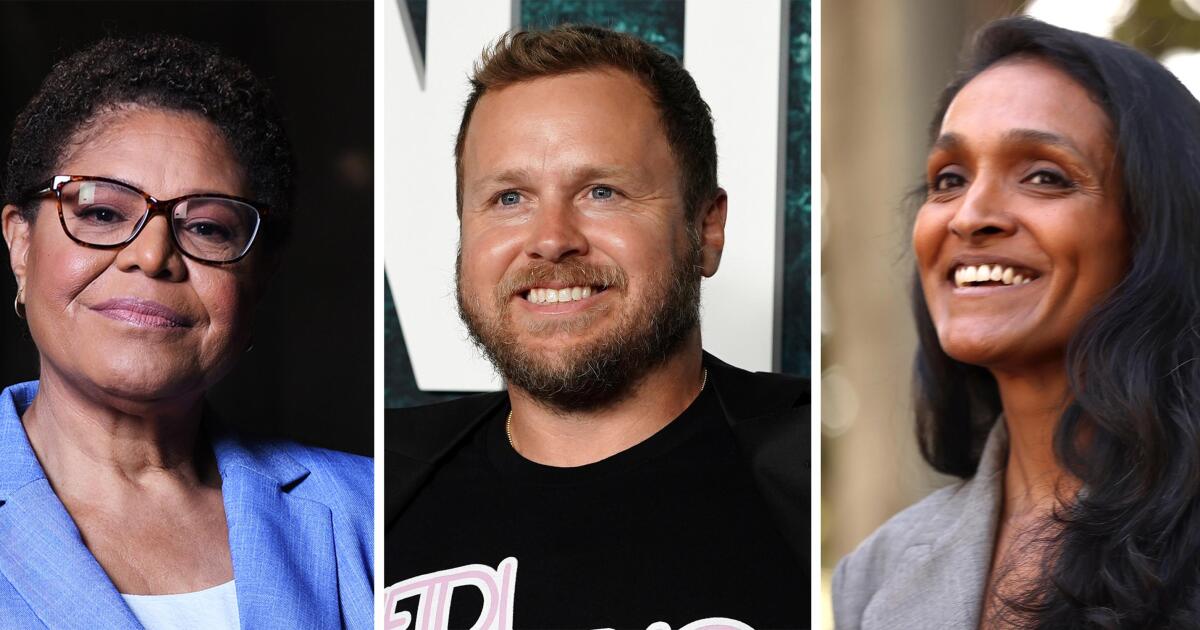
An energized Mayor Karen Bass galvanized crowds of labor union workers sporting union merch Saturday. “Four more years!” crowds chanted as a slew of local and state Democratic heavyweights joined the incumbent.
City Councilmember Nithya Raman spent the day dashing between local restaurants and bars in an old-school yellow Scout convertible to meet with business owners and her supporters.
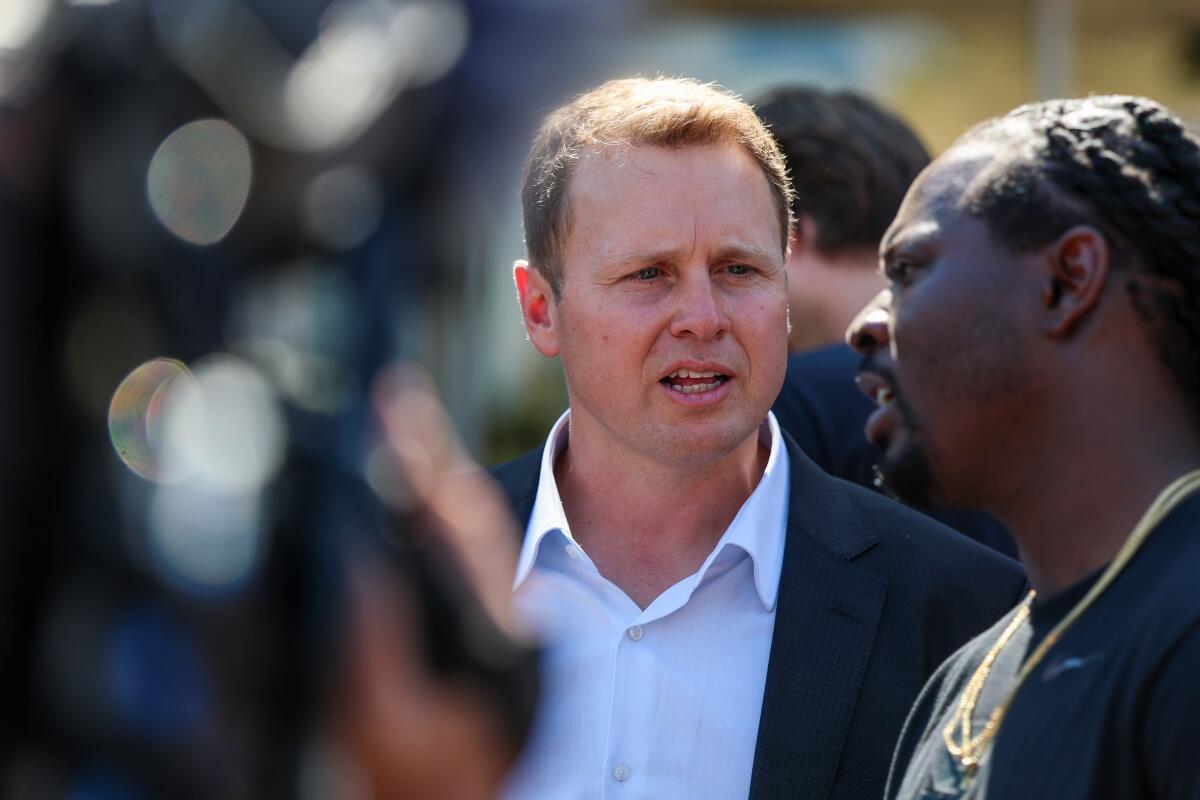
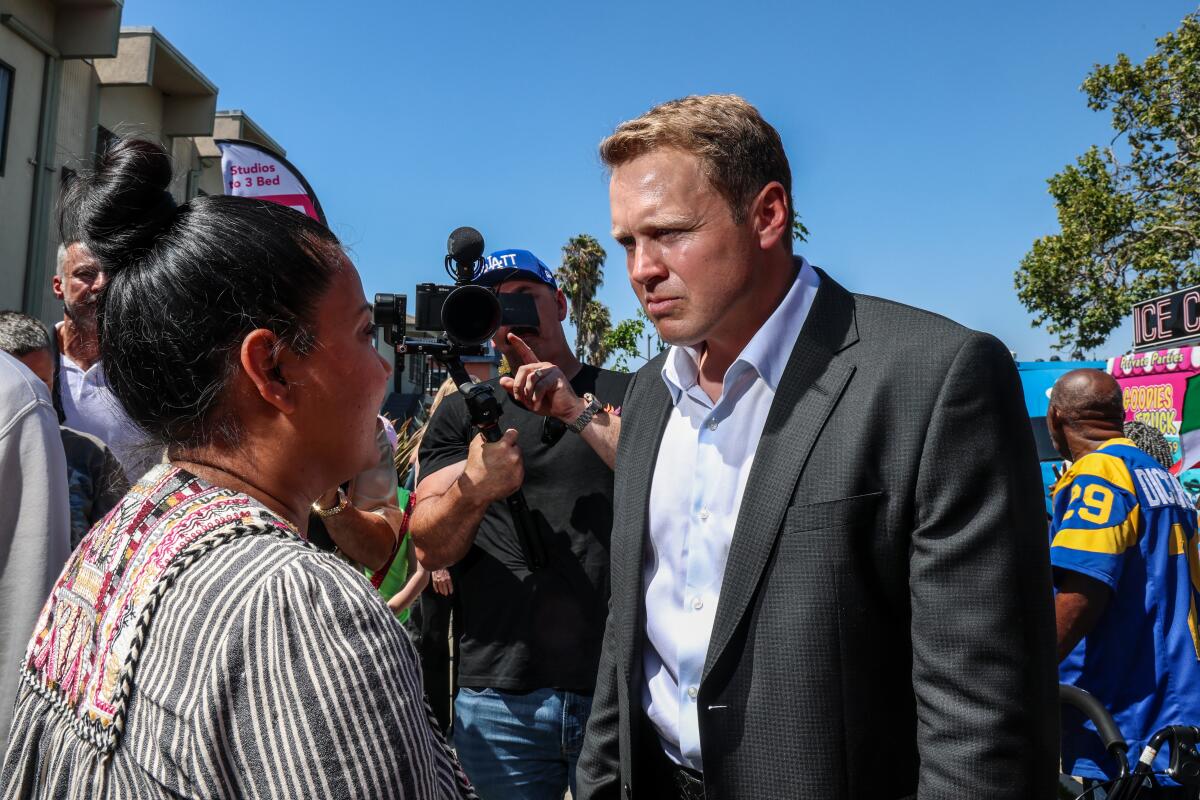
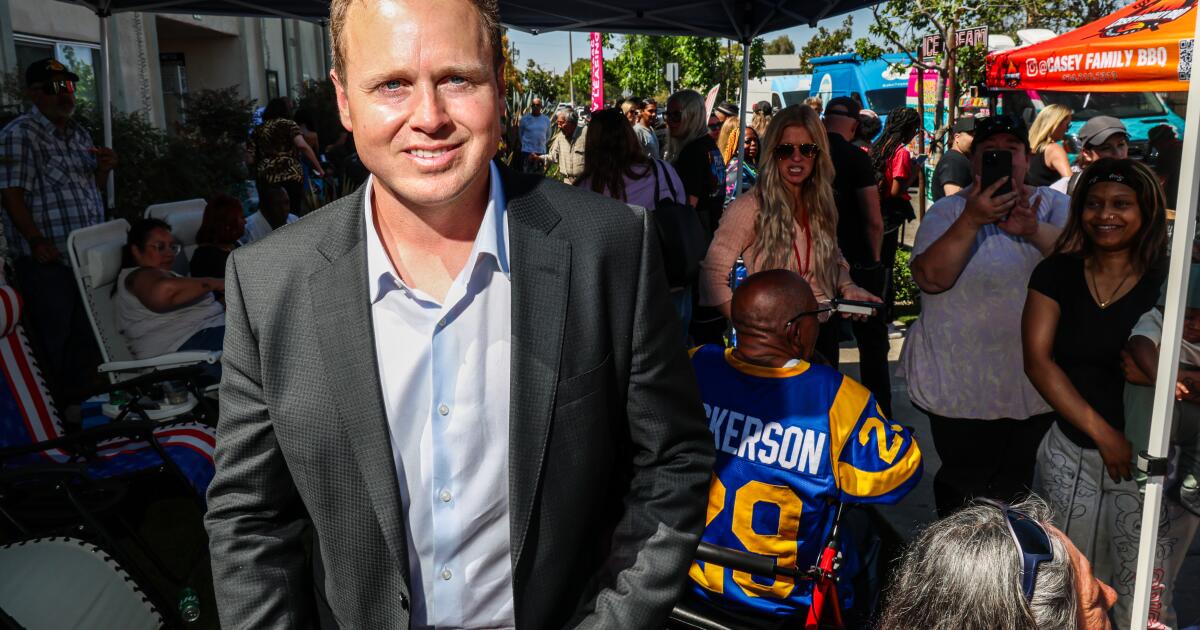
Meanwhile, former reality TV personality Spencer Pratt hosted a block party in Baldwin Village with barbecue food, free merch and American-flag lawn chairs — although he spent much of the event off to the side, listening to the concerns of Black residents.
Recent polls have placed Pratt and Raman within striking distance of Bass, who had enjoyed a comfortable lead for much of the campaign. A recent survey, co-sponsored by The Times, had Bass at 26%, Raman at 25% and Pratt at 22% — with a roughly 3% margin of error in either direction and 10% of voters undecided.
The top two candidates in Tuesday’s jungle primary will advance to a November runoff, unless one candidate manages to garner over 50% of the vote.
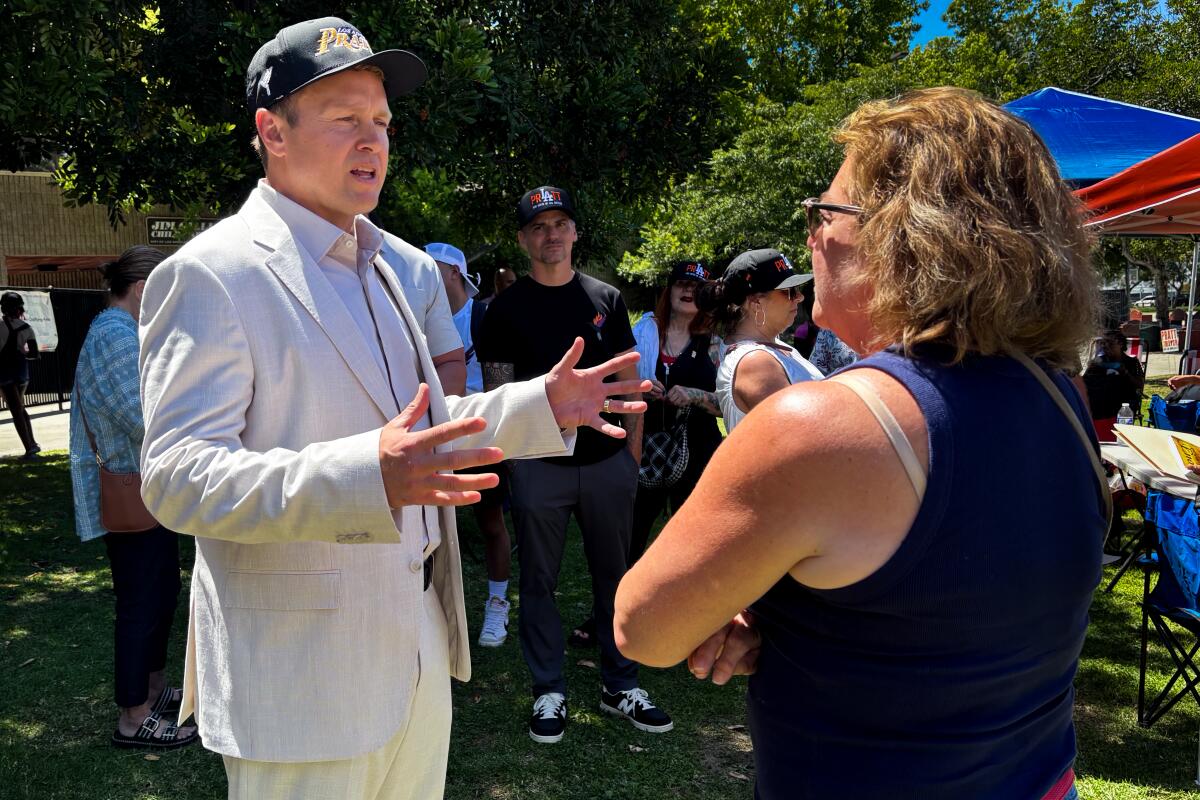
Mayoral candidate Spencer Pratt speaks with Diane Waterhouse, a caregiver and Westchester native, about homelessness and drug addiction at a campaign event Saturday in Baldwin Village. “We just talk about it like, ‘oh it’s Skid Row, that’s just where the drug addicts are.’ No, there’s communities, there’s kids, there’s people that work there, businesses,” Pratt said.
(Noah Haggerty / Los Angeles Times)
“I believe God moves mountains; I believe that you can get that 51% on that Tuesday,” Diane Waterhouse, a 60-year-old caregiver, told Pratt at his Baldwin Village event.
On the lawn of Jim Gilliam Park on Saturday, supporters from across the city chanted Pratt’s name, took selfies in front of black campaign vans with his hummingbird logo and ate cookies decorated with his face as kids raced around on scooters and played with the handful of dogs attending.
But Pratt — who had spent the morning at the West Los Angeles Animal Shelter speaking with animal welfare advocates — headed toward the nearby recreation center to talk with residents away from the cameras.
“Most people that come here and want our vote — we give y’all our vote; we’re still living like this. Nothing changes,” Erica Helon, a 40-year-old bus driver, told Pratt in one of the most tense moments of the event.
Pratt, wearing a beige suit and a hat with his name stylized like the L.A. Lakers logo, emphasized he was in South Los Angeles to listen and wasn’t even asking residents for their votes. He pulled Helon aside and gave her his personal phone number so they could talk more.
“I’m here because I want to be a voice for the community,” he said at one point. “I’m here because I don’t know what I don’t know.”
Helon, who is still undecided, left the event open-minded on Pratt.
“I would love to see what he’s going to do for this city,” she said.
Los Angeles mayoral candidate Nithya Raman joins a group photograph during a campaign stop Sunday with SevaSphere volunteers after preparing meals for people experiencing homelessness at Oaks Kitchens.
(Kayla Bartkowski / Los Angeles Times)
Raman, who has made publishing detailed policy plans a staple of her campaign, spent Saturday meeting with local restaurant owners after recently dropping a policy plan for small businesses.
Around sunset, the yellow convertible pulled up to Lowboy Bar, an Echo Park staple. Raman, sporting a Japanese Dodgers hat and a rainbow City Council fanny pack, joined campaign staff for drinks at tables covered in “Nithya Raman for Mayor” pins.
A few young Angelenos, starting out their nights in trendy getups, recognized Raman and stopped by to chat and take pictures.
“I’ve lived in L.A. for 12 years. It’s a very, very important city to me,” said Ryan Bergeron, a 35-year-old who works in marketing and does art on the side.
Bergeron, who is on the Echo Park neighborhood council, hopes Los Angeles can serve as a “beacon in an otherwise scary time in the country” as it tackles affordability, the housing crisis and sustainability issues.
As for Raman, “I’ve seen her as a councilmember and been really proud of that,” Bergeron said. When she announced her candidacy for mayor, “It felt like everything really clicked.”
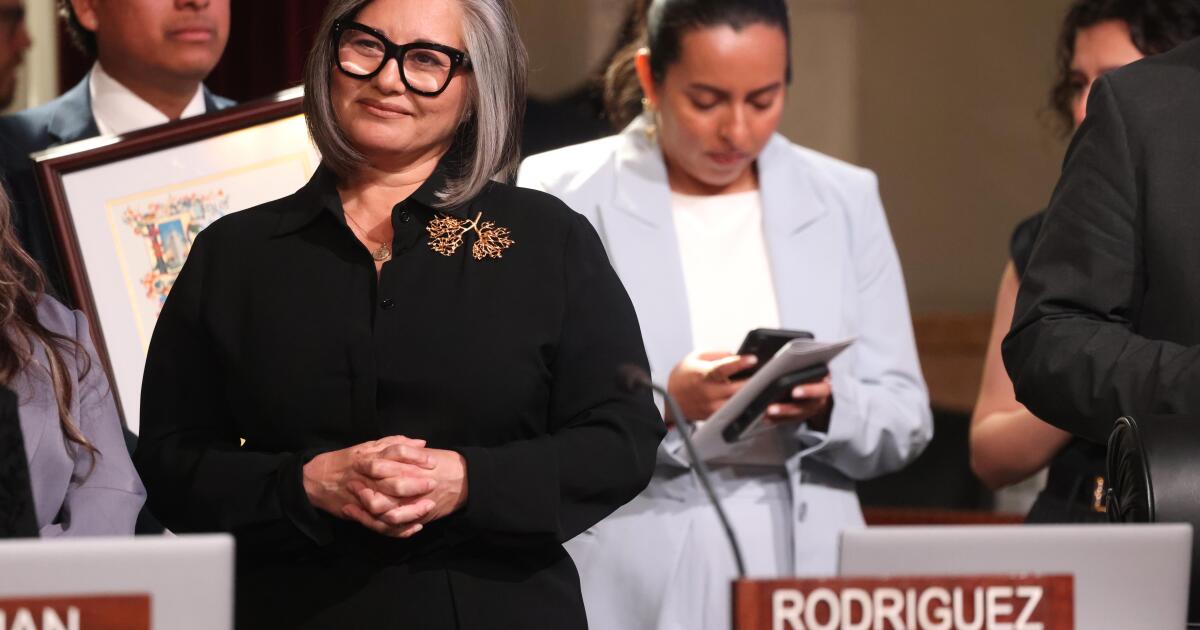
Mayor Karen Bass and Councilmember Monica Rodriguez attend the Los Angeles Democratic Party and Avance Democratic Club Carne Asada Tour, a community event held Saturday at the Yosemite Recreation Center. Avanceis one of the country’s largest Latino Democratic clubs.
(Karla Gachet / For The Times)
Bass, conversely, wound down after a day of union rallies by eating tacos at the Yosemite Recreation Center’s picnic tables in Eagle Rock with several local politicians, including Councilmember Monica Rodriguez and county Democratic Party Chair Mark Ramos.
California Atty. Gen. Rob Bonta and L.A. County Sheriff Robert Luna had joined Bass earlier in the day. Although Luna missed out on the picnic, he still enjoyed several tacos in his car.
Come Sunday, Raman, wearing jeans and a chartreuse cardigan, was greeting bike riders at a Sawtelle coffee shop and speaking to a phone bank group at UCLA.
“It is absolutely essential to making sure that our little campaign, without all the political machine behind us, without MAGA millions behind us, that our vision of Los Angeles still manages to get out to the people, and your work today is an essential part of that,” Raman told a group of United Auto Workers-represented graduate students from multiple nearby universities.
She had several other appearances scheduled for the rest of the day, including lunch with a group of Korean American Democrats in Koreatown, Encinofest, a block party in Silver Lake and a visit to Boyle Heights.
“There seems to be increasing awareness about the race and excitement about the issues,” Raman told The Times. “It’s been really exciting to see people engaging and feeling positive about the city’s future.”
About two dozen students spoke to potential voters associated with UAW and urged them to mark Raman’s name on their ballots by Tuesday.
Stephanie Wert, a 30-year-old psychology graduate student at UCLA and head steward for UAW, said the phone bank could determine whether Raman’s campaign would survive the week.
“This vote is going to be decided on the margins, and so I think we could really make the difference that pushes her to the runoff,” Wert said.
Bass peeked around the back doors of a supporter’s Venice home Sunday afternoon to cheers from several dozen supporters at an intimate event. Speaking over small snack plates and beverages, many said they saw real improvements in the homeless populations around their neighborhood during Bass’ tenure as mayor.
Tatiana Barhar, a Venice resident for over 30 years, said she saw in real-time an “extreme” homelessness problem get better during Bass’ term, thanks to her Inside Safe program. “I want to support her,” she said. “I think there’s a lot more she can do.”
Bass spoke of 1960s-level crime rates, thousands of unhoused people pulled off the street into housing and efforts to build up Hollywood during her time as mayor. “We got a lot to do,” Bass said. “We have such a bright future in the nation’s second-largest city, and I hope that you will continue to be there with me as we win.”
Pratt’s moves on Sunday remained more elusive. His campaign emphasized he was hoping to have intimate moments with L.A. communities, instead of a media and influencer frenzy like some of his previous, more widely publicized events.
One of those more intimate moments was a community event in a Latino neighborhood near downtown L.A. on Sunday morning. Pratt had spent Thursday in New York for some national media interviews to “get the message to as many people as possible.”
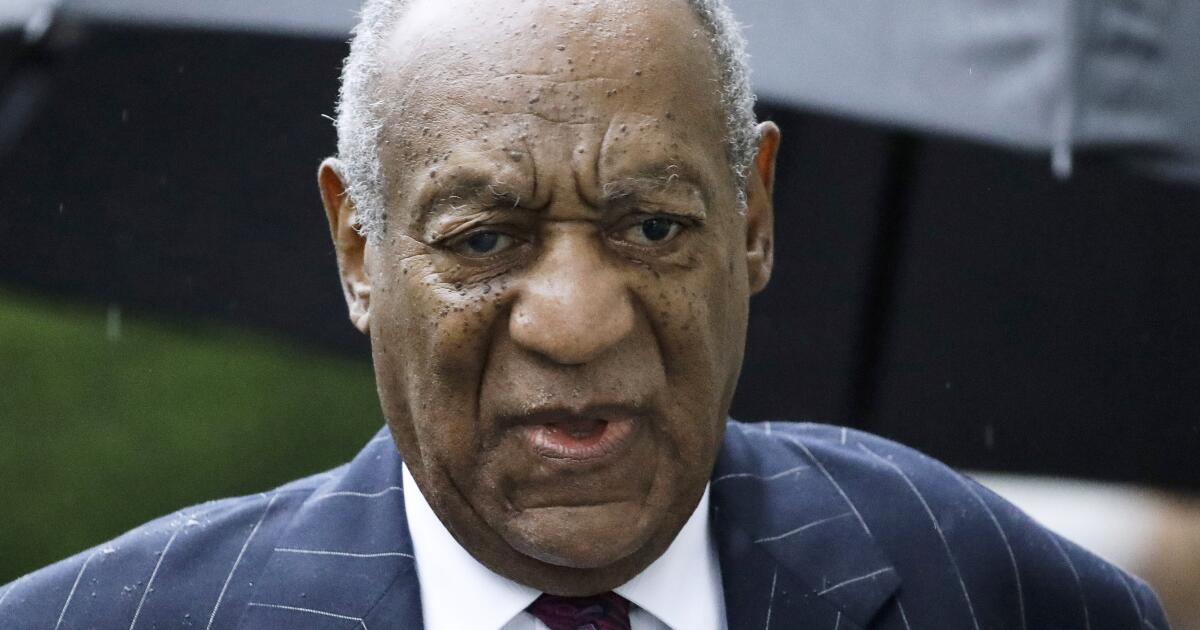
A Los Angeles County Superior Court judge has denied Bill Cosby’s request for a new trial after a civil jury recently found he was liable for $19 million in damages in a sexual assault case.
Judge Bradley S. Phillips ruled Friday that Cosby did not prove there was “any irregularity” in the court proceedings that would have prevented him from getting a fair trial and that the damages awarded to his accuser were not “excessive.”
“The Court finds that there was sufficient evidence … to support the jury’s finding that defendant’s conduct caused plaintiff’s damages,” Phillips wrote in Friday’s order.
In March, a jury awarded former waitress Donna Motsinger $19.25 million in damages after she sued Cosby in 2023, alleging that the disgraced comedian drugged and sexually assaulted her in 1972 after escorting her to one of his shows.
Motsinger, now 84, claimed Cosby picked her up at her home and gave her wine and a pill she thought was aspirin on the way to the venue.
“Next thing she knew, she was going in and out of consciousness while two men attending to Mr. Cosby were putting her in the limousine,” the original complaint said. “The last thing Ms. Motsinger recalls were flashes of light,” before waking up in her house in nothing but underwear.
Cosby has denied Motsinger’s allegations, as well as those brought by dozens of other women who said they had been drugged and sexually assaulted by the former actor. Cosby served about three years in a Pennsylvania prison on sexual assault charges before that case was overturned in 2021.
Cosby had filed a motion for a new trial in the Motsinger case in early April. Attorneys for Cosby did not immediately respond to a request for comment about Friday’s ruling.
Times staff writer Fedor Zarkhin contributed to this report.
A pair of nesting bald eagles has been spotted in Los Angeles County, according to a recent Instagram post from the L.A. County Department of Parks and Recreation.
In the video posted Friday, the two eagles are perched on a high tree branch in an undisclosed location. Native nesting birds, like bald eagles, are protected under federal law, and disturbing active nests can “disrupt breeding and impact their success,” the department said in the post.
The department did not immediately respond to a request Sunday for comment about where the eagles took up refuge.
Southern California residents should give nesting birds plenty of space and avoid lingering near nest sites, the post said.
If possible, residents should hold off on tree trimming or vegetation clearing during nesting season. Dogs should also remain leashed and under control around trees and shrubs where birds may be nesting, and residents also should not fly drones near wildlife.
If a nestling is in distress, the department said to contact the San Dimas Raptor Rescue Center for advice at (626) 559-5732.
In 1973, Tom Bradley became L.A.’s. first Black mayor by assembling Black, Jewish, white and Latino liberals into a coalition that ended decades of conservative white rule at City Hall.
Bradley’s election transformed Los Angeles politics and began what has been, for the most part, a 50-year reign of moderate Democrats. Year after year, the election map has changed, but liberal centrists have usually remained on top.
But as Mayor Karen Bass seeks reelection, she is struggling to unite her traditional base as she faces attacks from Democratic Socialists of America Councilwoman Nithya Raman on the left and Republican reality TV star Spencer Pratt on the right.
Some political experts in L.A. say mainstream Democrats are floundering as they try to patch together their coalitions in an era when poll after poll shows the city’s residents frustrated with the status quo.
“Overwhelmingly, Angelenos feel Los Angeles doesn’t work,” said Fernando Guerra, founding director of the Center for the Study of Los Angeles at Loyola Marymount University. “You have this liberal regime that has dominated from ‘73 to ‘26 and it’s stagnant.”
Traditional voting patterns, political experts agree, are unraveling as L.A.’s mounting housing costs create new political fault lines in this city of 3.9 million. The devastating 2025 wildfires, along with enduring problems of homelessness, declining city infrastructure and traffic, have exacerbated discontent.
It’s still possible Bass can pull off reelection in the nonpartisan mayoral race and some coalition of centrist Democrats can survive. But the fact that she is unlikely to avoid a runoff when U.S. incumbents typically win at a 90% rate, Guerra said, shows that L.A.’s mainstream Democratic institutions are hollowing out.
“The problem is not Bass,” Guerra said, adding: “Any regime that lasts for that long begins to fall upon itself. … It stagnates and stops being innovative, and just becomes protective of the ingrained interests that have nurtured that coalition.”
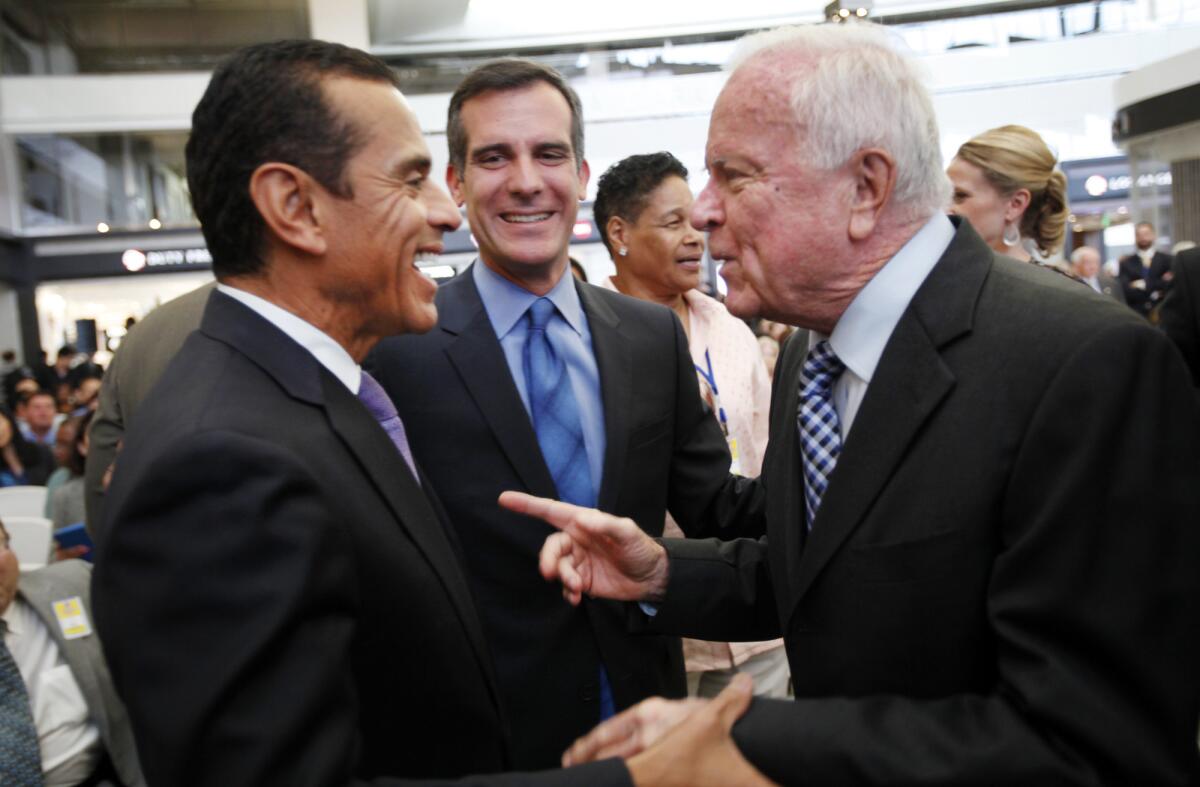
Former L.A. Mayors Antonio Villaraigosa, Eric Garcetti and Richard Riordan.
Most political observers in L.A., however, are confident that the city’s future is not conservative.
The DSA, a decentralized anti-capitalist group, has made inroads in L.A. as it advocates for rental protections, defunding the police and a Green New Deal. Over the last six years, Angelenos have elected four DSA-backed City Council members and a DSA-recommended city controller.
“L.A. is clearly a city that is steadily moving to the left,” said Jim Newton, executive director of UCLA Blueprint magazine and a veteran political journalist who worked for the L.A. Times for 25 years.
“People are unhappy, but they’re not unhappy enough to vote for a Republican,” Guerra agreed. “They have been looking at the other alternatives: the Democratic Socialist party that is the challenge to the establishment.”
Some caution, however, that it is too early to map out Los Angeles’ political future.
“I think everything is up for grabs,” Sonenshein said, noting that he expected more competition for Latino and Asian voters, young voters and even older Democrats. “Certainly, younger voters are completely up for grabs. It’s just hard to know where they’re going to end up. … Small shifts in the primary can make a very big difference.”
L.A. rose as the Republican stronghold of California.
As a massive influx of white Midwesterners descended on L.A. after the 1885 opening of the Santa Fe railroad, conservative white civic leaders — including the owners of the L.A. Times — touted the city as the GOP counterpart to progressive, union-friendly San Francisco. Liberal Black and white Angelenos were shut out of citywide power.
The purpose of the Bradley coalition, Sonenshein said, was to “break open the stranglehold of a city establishment that was … unresponsive to the diversity of the community.”
Bradley, an even-keeled attorney and former police officer, was well positioned to bridge L.A.’s racial divides. As a police community relations officer, he had cultivated relationships with Jewish business owners. He was an early supporter of L.A.’s first Latino City Council member, Edward Roybal, and had already united Black and Jewish Angelenos in the 10th District as the city’s first Black City Council member.
L.A. City Councilman Tom Bradley and Mayor Sam Yorty in a TV studio just before the start of a debate during their 1973 campaign for mayor.
(Los Angeles Times)
After his 1973 win, as waves of new immigrants moved to L.A., Bradley brought more Latinos and Asian Americans into the fold. A conscious alliance of minority communities reelected Bradley, helping him become the longest-serving mayor in L.A. history.
But by the 1990s, frustration had swelled over L.A.’s crime, pollution and poverty. Bradley’s popularity plummeted after Black motorist Rodney King was brutally beaten by LAPD officers in 1991 and riots erupted across the city the next year when a largely white jury acquitted the officers. More than 60 people were killed.
As Bradley prepared to step down, Democrats struggled to find a successor who could unite liberal Black, white, Latino and Asian Angelenos.
Still, some were skeptical that Richard Riordan, a Republican venture capitalist, would win. Riordan was a moderate, easygoing philanthropist, Newton said, and Republicans at the time made up 30% of L.A.’s registered voters, double their number now. Even so, he noted, “there were people who thought this is just not what this city is, the city doesn’t need a multimillionaire white guy Republican.”
Voters thought differently. After securing the support of San Fernando Valley Republicans and Democratic centrists and making small inroads among Latinos, Riordan became the first Republican L.A. mayor elected in 36 years.
The Bradley coalition was “a spent force,” Sonenshein said. “But new players were emerging in prominent roles, working to forge new types of alliances and, at times, temporary coalitions.”
When California voters in 1994 passed the anti-immigrant Proposition 187, which barred undocumented immigrants from receiving many public services, Latino participation in L.A. politics surged. Asian Americans also began to rise.
But after Bradley, there was no single Democratic coalition in the city.
When Antonio Villaraigosa challenged James Hahn in 2001 and 2005, Sonenshein said, Hahn drew support from the Black community and the Valley, Villaraigosa from Latinos and liberals. When Eric Garcetti defeated Wendy Greuel in 2013, Greuel had strong support in Black South L.A., but Garcetti managed to win with the white and Latino vote.
“People have to piece it together, because the Democrats have such a larger edge in L.A. than they did in Bradley’s age,” he said. “It’s almost a kind of entrepreneurial thing: You’ve got to go out and build a majority each time, and those alliances shift.”
There were still challenges from the right. But in 2022, when billionaire real estate developer Rick Caruso ran against Bass on a centrist law-and-order platform, he switched his party affiliation from Republican to Democratic. Some saw that as a recognition that a Republican could not win in L.A.
Like Bradley, Bass is a pragmatic politician with a long record of forging relationships behind the scenes.
In the 1990s, she founded the grassroots Community Coalition to combat the public health crises that plagued South L.A. amid the crack-cocaine epidemic.
But as Bass presides over a City Hall that is almost entirely dominated by Democrats, discontent is spreading. Polls show a substantial portion of the electorate views her unfavorably because of her handling of the Palisades fire.
Guerra said the lack of affordable housing had created a unique moment: Even after the King riots, the Northridge earthquake and the O.J. Simpson trial, he said, Angelenos were still invested in living in the city.
“You could still buy a home. You could still see yourself nurturing L.A., but also L.A. nurturing you,” Guerra said.
For Guerra, centrist Democrats have been so successful at inclusion they have struggled to identify priorities.
“There are too many members of the coalition and there are too many of the members who have veto power, which then leads to paralysis,” Guerra said. “The paralysis is what’s led to the lack of innovation, the failure to pursue policies that make sense for the greater good.”
The dysfunction, he said, is particularly clear on housing.
“Every NIMBY in every neighborhood, in every council district, is like, ‘We want housing, but not here,’” Guerra said. “That, replicated everywhere, leads to paralysis and no housing.”
It has also led to renters becoming a rising political constituency — a big shift from the Bradley era, when homeowners were the city’s dominant voters.
But that doesn’t mean working-class Angelenos have a bigger voice now in L.A. politics. Instead, the middle class is splintering along generational lines.
“Middle-class young folks graduating from college, who have extraordinary amounts of debt, cannot buy homes,” said Sara Sadhwani, a politics professor at Pomona College. “The city still has issues with food insecurity and low-wage worker protections, but those are not the issues dominating anymore.”
While L.A. Democrats have long focused on assembling coalitions of Black, Latino, Asian American and other minority activists, Sadhwani said, what was often not spoken about was the role of the city’s “nonprofit industrial complex.”
“Nonprofits have a huge role,” she said, noting that Bass came of that world. “Their politics are shifting.” Before 2020, she said, progressives focused on racial justice, immigration reform, and creating an economy that respects the work of immigrants; now, the focus is largely on homelessness and policing.
“What it means to be a progressive today,” Sadhwani said, “is actually quite different from what it was to be a progressive even just five years ago.”
Even as L.A. is clearly still a Democratic stronghold, Republicans say there are signs that some Angelenos are not in lockstep with liberal activists.
Donald Trump’s share of the vote in L.A. in the last three presidential elections, they note, climbed from 16% in 2016 to 21% in 2020 and 27% in 2024. And there is evidence that voters, at least at the county level, are questioning some criminal justice reforms.
Los Angeles Mayor Antonio Villaraigosa, pictured here on the cover of Newsweek, helped reshape the city’s Democratic coalition
(David McNew / Getty Images)
With Republicans making up about 15% of L.A.’s registered voters, Rob Stutzman, a GOP strategist, said Pratt might win enough independent voters and disaffected Democrats to make it past the primary. But he would then struggle to get more than 50% in the runoff.
“The math just isn’t there, but in addition to that it’s the stink of Trump,” Stutzman said. “The tribal politics of today make a Republican victory in L.A. very difficult.”
Raman stunned L.A.’s political establishment in 2020 when she was elected L.A.’s first DSA-backed City Council member.
As she runs for mayor, the Los Angeles chapter of the DSA hopes to expand its power as it endorses a new slate of 2026 candidates for City Council, city attorney and L.A. school board.
Richard Riordan, the last elected Republican mayor of Los Angeles.
(Los Angeles Times)
Raman is clearly betting that a big, viable part of the electorate is to Bass’ left, Newton said.
The DSA, Newton said, had done a good job in recent years of identifying renters’ interests and advancing them to usher in a “newer, younger, probably more progressive edge to the city’s politics.”
But so far, Raman, who has aligned herself with the DSA on issues such as renter protections but deviated on police spending, is struggling to unite the organization.
The Harvard and MIT graduate caught the DSA and her fellow City Council members off guard when she entered the mayoral race just before the filing deadline.
After building momentum, the DSA’s failure to rally around a 2026 mayoral candidate could hurt the movement for several election cycles, Guerra said.
“This dissension is setting them back,“ Guerra said. “They really do have an opportunity to elect a DSA mayor.”
Bass has seized on Raman’s lack of support in City Hall to critique her coalition-building skills.
“If you want to be the mayor and you can’t get along with people who are your colleagues on council,” Bass said recently, “I don’t know how you’re supposed to govern at all.”
In the end, the outcome of L.A.’s mayoral race may not depend so much on Bass’ ability to inspire her traditional Democratic coalition. The question is whether a new generation can find a way to represent a mass of Angelenos with bold new visions and coalitions of their own.
Good morning, and welcome to L.A. on the Record — our City Hall newsletter. It’s David Zahniser, with an assist from Noah Goldberg, Melissa Gomez and Sandra McDonald, giving you the latest on city and county government.
Los Angeles City Councilmember Monica Rodriguez has had some pretty tough words over the years for Mayor Karen Bass and her administration.
Rodriguez, who is running unopposed in Tuesday’s election, repeatedly criticized Bass’ Inside Safe program, which moves homeless people indoors, saying it lacked financial oversight. She voted against the mayor’s budget last year, saying too much was going to Inside Safe. She was especially harsh in the wake of the Palisades fire, saying that Bass’ team botched the first few months of the recovery.
That might make her an ideal person to endorse Councilmember Nithya Raman, who is running to unseat Bass in Tuesday’s primary and has leveled similar critiques. Instead, Rodriguez has emerged as an unexpected ally of the incumbent.
During the campaign, Rodriguez has appeared with Bass at events in Eagle Rock, Pacoima and even Sherman Oaks, located in Raman’s district. She popped up in a campaign flier from Latinos Por Karen Bass. And she’s been dinging Raman over everything from economic development to policies around outdoor barbecues.
Rodriguez explained her decision to support Bass in an interview, saying she views the incumbent as being far more willing to entertain opposing views than Raman — and understands that “not everyone thinks the same way.” Bass also is more consistent on the issues, Rodriguez said.
You’re reading the L.A. on the Record newsletter
Sign up to make sense of the often unexplained world of L.A. politics.
By continuing, you agree to our Terms of Service, which include arbitration and a class action waiver. You agree that we and our third-party vendors may collect and use your information, including through cookies, pixels and similar technologies, for the purposes set forth in our Privacy Policy such as personalizing your experience and ads.
Raman, by contrast, has shifted her positions on police spending, the tax hike known as Measure ULA and even who should be the next mayor, jumping into the race after she endorsed Bass, Rodriguez said.
“I don’t know what she stands for,” she said.
Raman’s campaign declined to comment on Rodriguez’s remarks. But former former Deputy Mayor Rick Cole, a Raman supporter, said he is surprised to see Rodriguez line up behind Bass, given how critical she has been over the years.
“Monica is a self-described maverick, so it’s ironic that she’s thrown in with the establishment on this. But sometimes personalities play a role,” he said.
Rodriguez had been talked up at one point as a possible opponent of Bass in this year’s election. If Bass wins a second and final term, the mayor’s race would be wide open in 2030.
Pratt accuses Bass of electioneering
It was a small yet upbeat event staged by Bass’ reelection campaign: The mayor, accompanied by supporters chanting “four more years,” walking up to an official drop box and putting in her ballot.
That miniature rally, staged last weekend near the city’s Memorial Branch Library, was captured on video and circulated by Bass’ campaign. But it has drawn a complaint from mayoral candidate Spencer Pratt, who accused the mayor of violating a state law prohibiting electioneering near a polling place or voter drop box.
In a complaint filed with the city clerk, Pratt attorney Peter McNulty said Bass and her supporters improperly solicited votes, waved campaigns signs and “engaged in blatant electioneering” near a voting location.
“Such clear violations of electioneering restrictions show a reckless disregard for the rule of law and an apparent belief that she need not comply with relevant restrictions that apply to all other candidates,” he wrote.
The Bass campaign pushed back on those allegations, saying the video features footage from two locations near the drop box. The portion that featured the Bass campaign signs was filmed 200 feet away — twice the distance required by law, said Alex Stack, a Bass spokesperson.
“Spencer is just mad that his supporters are AI cartoons and we have real Angelenos,” he said. “We follow the rules.”
Pratt’s lawyer said in his letter that he wants the city to investigate. He also filed a complaint with the state, citing the state election law that prohibits the dissemination of “visible or audible electioneering information” near a polling place or drop box.
Feldstein Soto flames Airbnb
City Atty. Hydee Feldstein Soto has been getting hit from both directions over the last few weeks.
On one side, a committee with at least $450,000 in funding from the Consumer Attorneys of California has been pumping out campaign ads promoting her opponent, Deputy Atty. Gen. Marissa Roy. On the other, a campaign committee heavily bankrolled by Airbnb is running ads for Deputy Dist. Atty. John McKinney, another opponent in the race.
Feldstein Soto has countered with a television ad that highlights her office’s lawsuit against Airbnb, which accuses the company of engaging in price gouging after the Palisades fire. Staring into the camera, Feldstein Soto said Airbnb and other special interests “are spending millions to try and get rid of me.”
“They think L.A. belongs to them,” she says. “I know it belongs to you.”
Feldstein Soto had raised about $860,000 for her campaign through May 16, compared with about $680,000 for Roy and about $122,000 for McKinney. But those fundraising efforts, which face strict limits under the city’s ethics laws, have been overshadowed by the unlimited spending from Airbnb and the others.
Justin Wesson, senior public policy manager for Airbnb in California, said in a statement that McKinney’s campaign platform is “focused on keeping Los Angeles communities safe and vibrant, including for Angelenos who share their home and their guests that contribute to the local economy.”
In recent weeks, Airbnb has been pushing the city’s elected officials to loosen L.A.’s home-sharing regulations, by allowing owners of second homes to lease their properties on short-term rental platforms.
Airbnb has put big money into other committees, including those that support Tim Gaspar, who is running to replace Councilmember Bob Blumenfield, and Jose Ugarte, who is running to replace Councilmember Curren Price.
Team Raman woos Huang, without success
We mentioned a few weeks back that Raman supporters have been noisily demanding that mayoral candidate Rae Huang drop out of the race, saying she was siphoning left-of-center votes away Raman. Turns out Raman’s campaign was trying to persuade her to pull the plug as well.
Raman campaign strategist Jeff Millman reached out to Huang advisor Bill Przylucki earlier this month about getting the community organizer to drop her mayoral bid, according to Huang spokesperson Emel Shaikh.
The overture from the Raman camp, first reported by LA Material, took place after the May 6 NBC LA debate but before a Fox debate planned for the next week, Shaikh said.
“She never really entertained the idea,” Shaikh said.
Raman, speaking with reporters on Friday, said she knew that people from both campaigns were conferring.
“I’m sure [Huang] was aware of it as well,” she said. “And I think we were really talking about how to achieve a bold, progressive vision for Los Angeles. Both of us got into this race because we felt a deep sense of dissatisfaction with the status quo.”
Millman, a veteran of L.A. politics, worked for former Mayor Eric Garcetti and was a spokesperson for Austin Beutner’s mayoral bid before his campaign ended in January. After Beutner dropped out, he moved to the Raman campaign. Przylucki is the former executive director of the progressive nonprofit Ground Game LA.
Supporters of Raman contend that Huang doesn’t have a path to victory — and could deprive Raman of a chance to compete in the Nov. 3 runoff. Asked whether she feels the same way, Raman said she is focused on getting her voters to the polls.
At this point, Raman is neck and neck with Bass and slightly ahead of Pratt, according to a poll from the UC Berkeley Institute of Governmental Studies, which was co-sponsored by The Times.
State of play
— A THREE-WAY RACE: Bass, Raman and Pratt are locked in a tight three-way contest, with the mayor holding a statistically insignificant lead in the run-up to Tuesday, the latest UC Berkeley-L.A. Times poll found. Bass had 26% support from likely voters, followed by Raman with 25% support and Pratt at 22%.
Bass, appearing at City Hall Thursday, said she’s not worried about failing to make the top two, telling an audience there are many polls that show different results. “I feel confident about Tuesday,” she said.
— AN EMBATTLED MAYOR: The Times took a look at Bass’ first term and the events that have put her political future in peril. Although some point to the city’s handling of the massively destructive Palisades fire, others say her troubles go much deeper.
— READING THE ROOM: While Bass has had difficulty managing the city, Raman faces a different issue: her struggle to forge working relationships with colleagues and allies. No one on the council, including those backed by the DSA, have endorsed her. Raman allies downplayed the issue, saying her strength is her independence.
— CUTTING CRIME: Even with L.A. experiencing fewer murders than at any point in 60 years, crime remains a potent issue in the mayor’s race. Pratt has been portraying the city as a lethal hellscape. Meanwhile, even some of Bass’ supporters have been shocked by how “aggressively pro-police she has been,” said former Councilmember Mike Bonin, who heads the Pat Brown Institute at Cal State, LA.
— DOWNTOWN IN THE DUMPS: Meanwhile, downtown business owners say they are struggling with crime, homelessness and aging infrastructure — all issues that have become central to the mayor’s race.
— LOVE, MOM: The mother of city controller candidate Zach Sokoloff has pumped at least $7.5 million into an independent expenditure campaign supporting him as he seeks to unseat City Controller Kenneth Mejia. The incumbent has accused the Sokoloff family of trying to buy the seat. Sheryl Sokoloff has declined to comment.
— SHERIFF SHOWDOWN: Los Angeles County Sheriff Robert Lunais in a rematch against former Sheriff Alex Villanueva, while also facing six other opponents. (Villanueva was unseated by Luna in 2022.) The top two vote getters will head to the Nov. 3 runoff.
— WAITING FOR THE WAGE: The council finalized its plan to delay a series of minimum wage hikes for hotel and airport workers this week, ensuring that the wage won’t reach $30 until January 2030 instead of July 2028.
— D&D AND DSA: Democratic Socialists of America, whose L.A. chapter is campaigning for five candidates in the city election, took in $30,000 at a Dungeons & Dragons-themed fundraiser. The candidates took part in the action, playing fantasy characters who still keep one foot in the political world.
— CALLING THE COPS: Looking to prevent copper wire theft, the Department of Water and Power is seeking to create its own police force.
— OUT OF THE FRYING PAN: The council on Wednesday confirmed Gabrielle Amster as the latest general manager for the animal services department, which oversees the city’s network of animal shelters. Amster had been serving as vice president of shelter engagement for DocuPet, a national pet registration business, according to her resume.
QUICK HITS
Where is Inside Safe? Bass’ signature initiative to tackle homelessness did not launch any new encampment operations this week.
On the docket next week: The election, obviously! If you haven’t cast a ballot by mail, make sure you show up at a voting center!
Stay in touch
That’s it for this week! Send your questions, comments and gossip to LAontheRecord@latimes.com. Did a friend forward you this email? Sign up here to get it in your inbox every Saturday morning.
In a few days, Los Angeles voters will be casting ballots for city attorney — and in a few months, they could be voting to sharply diminish the city attorney’s authority.
The city’s Charter Reform Commission has proposed splitting the city attorney’s office into two parts — an elected city prosecutor, charged with handling criminal misdemeanors, and a mayor-appointed and City Council-confirmed city attorney who would represent the city in civil cases and advise the mayor, city council and city departments.
The City Council is reviewing the recommendation as part of sweeping changes to city government, including expanding the council from 15 to 25 seats, which could go before voters in the Nov. 3 general election.
The proposed changes to the city attorney’ office, however, come in the midst of a heated primary campaign, where incumbent Hydee Feldstein Soto is up against three challengers, including a state deputy attorney general and a deputy district attorney.
Both of those challengers say plans to bifurcate the city attorney’s office are rooted in longstanding conflicts between Feldstein Soto and the City Council.
And last year, City Council took a 12-0 vote to direct Feldstein Soto to withdraw an effort to halt a federal judge’s order prohibiting LAPD officers from targeting journalists with crowd control weapons.
“When I first heard about this idea, I thought it was probably the greatest indictment of the current city attorney that I’ve heard yet,” said John McKinney, a Los Angeles County deputy district attorney who is running for city attorney in Tuesday’s primary.
McKinney opposes the bifurcation, saying it will cause overlap and confusion. “If she was doing a good job … we wouldn’t even be having this discussion,” he said.
Marissa Roy, another candidate in the race, hasn’t taken a position on bifurcation but said Feldstein Soto’s actions triggered the proposed change.
“The only reason that bifurcation, or splitting the city attorney’s office, is even going to be going before voters is because we’ve had an incumbent city attorney who has gone so rogue to politicize the role,” said Roy, a deputy state attorney general.
Roy said accused Feldstein Soto of inappropriately blocking an affordable housing project in Venice. And in her office’s role of drafting ordinance language, Roy said, Feldstein Soto has returned to city council ordinance language that isn’t “faithful to the intent of the drafter.”
Feldstein Soto said the proposal to bifurcate the office has nothing to do with her performance.
“This issue comes up every single time charter reform comes up,” Feldstein Soto said. “To me this is all political opportunism.”
Feldstein Soto has opposed the split, and former city attorneys have also come out against it, saying an appointed position threatens the independence of the city attorney’s office, takes away from voters the right to elect a city attorney and could cost taxpayers money in order to split the office.
In a March letter to the Charter Reform Commission, Feldstein Soto said an attorney “serving at the pleasure” of the mayor and city council would face an “innate, human pressure to harmonize legal advice with the political goals of the appointing officials.”
“I have been able to provide honest, accurate legal advice to the Mayor, City Council, Controller and departments — even when that advice is unwelcome — precisely because I am an independently elected officeholder with an ultimate duty to the public,” she wrote. “An appointed City Attorney, serving at the pleasure of the Mayor and City Council, faces enormous political pressure on all of these issues, behind closed doors, cloaked in privilege without an independent voice.”
Burt Pines, a former city attorney who served from 1973 to 1981, deeply opposes the bifurcation proposal, citing the threat to independence as the largest issue at stake. As city attorney, he said, he was empowered to tell city officials when a proposed action was unlawful and refuse to support it.
“You want to be able to call the shots as you see them, true to the law,” Pines said in an interview.
Advocates say other cities have bifurcated offices, and splitting it could reduce conflict and provide a clear delineation of roles.
After consulting with experts and good governance groups, the commission agreed the benefits of bifurcation outweighed the negatives, and it passed unanimously by the commission.
“It was easy to get consensus on this,” said Raymond Meza, chair of the commission. The commission’s proposal calls for the city attorney to be nominated by the mayor, and confirmed by the City Council.
In its report, the commission said that “the current structure creates conflicts when the same office advises the city and prosecutes cases. Separation provides clearer roles, reduces conflicts, and allows each function to be performed effectively.”
Other cities have different models for the city attorney’s office: Long Beach has a similar model with bifurcated duties, while New York City has legal representation split up several ways. The San Francisco City Attorney provides legal representation for the city and county of San Francisco, and the San Francisco District Attorney’s Office handles criminal cases in the city and county.
Mike Bonin, executive director of the Pat Brown Institute, said he has seen the question of splitting the office come up with at least three different city attorneys to varying degrees.
“Given that the city attorney is an elected position, there’s always going to be somebody who doesn’t like them,” Bonin, a former city council member, said. “You need to divorce the question from the occupant and focus on the role — the charter is not about a particular person, the charter is about the function of the office.”
I was willing to give the young novice a primer on what a mayor can and can’t do, and let him know City Hall is a reality show like no other he’s been on. But Spencer Pratt didn’t call me in response to my column last week.
I did, however, hear from a slew of his most ardent supporters.
Steven C. had this to say: “You’re a left-wing idiot, and … it’s time for you to retire. You’re a joke!!! You always have been!!! God bless Spencer Pratt and the 45th and 47th President of the United States Donald Trump!!!!!”
You may be onto something, Steven!!! I’ve been thinking about retiring!!!! But then a former reality TV star like Pratt comes along and tells Vanity Fair he had a chat with God, who told him He wants Pratt to be mayor of L.A!!!!! With people like this running for office, how can I retire?!!!!!
R.W. wrote to say: “You say Spencer has never done anything in his life…What credentials do you have? From what I’ve read about you, you are a lousy commie journalist who has never accomplished anything in your life!!”
Just recently, R.W., I replaced a broken toilet tank flush valve and I learned two Willie Nelson songs on the guitar. That’s not nothing.
Peter did not mince words: “Your piece on Pratt is a hit piece filled with bull— . You should go f— yourself before someone takes you out, which is the appropriate response to a s—bag like yourself. So please f— off and drop dead, which is exactly what you deserve.”
Peter, I did drop dead once. Cardiac arrest. While on the other side, I saw God, who told me to snap out of it because He was going to tell Spencer Pratt to run for mayor. Who knew God had a defibrillator?
All of these, by the way, were actual emails, and there were many more just like them. But it’s only fair to note that despite the fulminating knucklehead wing of Pratt’s posse, he’s tapped into a justifiable sense of frustration with City Hall, given homelessness, the Palisades inferno and budget issues that squeeze all manner of basic city services.
That’s why Mayor Karen Bass is paddling furiously, trying to keep her political career afloat. In the latest UC Berkeley-L.A. Times poll, Bass is at 26%, Nithya Raman at 25% and Pratt at 22%. That’s so tight, it appears that no one will get the 50% needed to win outright, and if we get a top-two runoff, it’s not clear who will go to the dance.
So as we close out the primary, with the election on Tuesday, five talking points come to mind.
Which candidate knows the city best?
Los Angeles has 114 distinct neighborhoods spread across 470 square miles (that’s 10 times the size of San Francisco), with an estimated 220 languages spoken. Diversity is a defining characteristic, and roughly half the population is Latino, which makes it a shame there’s no Latino candidate for mayor, especially given the raids and roundups by President Trump.
A mayor doesn’t have to speak six languages and know every corner of the city, but residents want to be seen and heard, and feel like they’re understood and represented.
Raman is well-versed on homelessness policy, and she’s spot-on about the need for greater urgency in problem-solving, but as my colleague Noah Goldberg reported, constituents in her district complain that they haven’t seen enough of her.
As I said, Pratt has wisely targeted municipal failure. But in the realm of outsider candidates with Republican credentials, Rick Caruso, who ran against Bass last time, was comfortable whether he was in the Valley, South L.A. or anywhere in between. And he easily connected with people. Would Pratt be a tourist in his own city?
By virtue of her job the last four years, Bass — who raised a blended Black and Latino family — knows the city best, although her unfavorability rating is a big problem.
What about the other candidates?
In the aforementioned poll, minister and housing activist Rae Huang had 9% and former educational technology businessman Adam Miller had 5%. Virtual unknowns, neither had a legit chance of winning, but they could be spoilers for one of the top three candidates.
If only I had a nickel for every time a reader suggested that.
By 101 measures, Los Angeles is one of the great cities of the world and California has built the world’s fourth-largest economy while leading on climate change, so apocalyptic diagnoses are a bit off the mark.
Also, local elections are nonpartisan. You don’t run for mayor as a D or an R.
And yet it’s true that Democrats and their policies and sensibilities rule the day, and they have a lot to answer for in Los Angeles and in California.
But would the same critics suggest that in conservative cities like Fresno and Bakersfield, which have their own homelessness and other problems, Republicans are to blame?
When it comes to housing, poverty, healthcare and streets occupied by people who are addicted or mentally ill, the failures go back decades, touch all levels of government, and cross party lines.
Have I given up on Los Angeles?
When I pointed out that Pratt seemed unaware of these complexities, and of the structural limits of mayoral power, readers suggested he was rising to the challenge while I was giving up on L.A.
Not at all. I care about L.A. enough to hold its leaders to a higher accountability, and to scrutinize posers and pretenders who think they can do a better job.
My advice for the next mayor.
Fix what’s broken, celebrate what works and take responsibility for what doesn’t.
Now let me try one more time:
Spencer, give me a call.
You can’t tell us you had a conversation with God about running for mayor and not share more details.
Did God scold you for referring to the mayor as Karen “Basura,” which means trash in Spanish?
Did He say we should pull out of the ‘28 Olympics, or have any advice on how to fill potholes and fix sidewalks?
If you’re having regular conversations about City Hall with the Father, the Son and the Holy Spirit, we’re dying to know:
For thieves looking to strip Los Angeles for parts, copper has become a fast-moving currency.
The problem has become so persistent that the Los Angeles Department of Water and Power is now asking for its own armed police force to protect vulnerable utility equipment, street lighting and critical infrastructure, insisting that the department’s contracted and unarmed security guards aren’t cutting it.
“They lack the authority to detain or arrest suspects, intervene in crimes in progress, conduct searches, or carry firearms for enforcement purposes,” according to a May 21 report from the city agency. “Delays hinder timely intervention, reduce investigative effectiveness, and contribute to repeat victimization of LADWP facilities.”
Under DWP’s current “observe and report” security model, an officer who sees someone cutting a fence or stripping copper from a transformer has little authority apart from yelling a warning or making a 911 call, according to the department report.
The proposal asks for 20 to 50 sworn officers to start, hired over a five-year period, along with support staff. If approved, the force would give the agency’s officers the authority to carry a firearm, make arrests and investigate thefts. The plan was scheduled to be discussed Thursday by the City Council.
The push comes as citywide service requests for streetlight repairs have surged over the last several years.
L.A.’s historic streetlights outside the Bureau of Street Lighting near Virgil Avenue and Santa Monica Boulevard.
(Jason Armond/Los Angeles Times)
The city logged 14,328 electronic streetlight service requests in 2018, according to data from the Bureau of Street Lighting. Requests have tripled since then, reaching an all-time high of 46,079 in 2024, the last full year of available data.
Mayor Karen Bass’ office said in March that copper thefts are a leading cause of streetlight outages. Repairs have been backlogged for months.
Prices for the metal are at an all-time high, driven by major supply disruptions in Indonesia and Chile, and soaring demand from artificial intelligence data centers and electric grid infrastructure. Thieves typically exchange the metal for cash at recycling centers, where it can fetch up to $5.30 per pound. The City Council last year approved a program offering up to $5,000 for information in metal and wire theft cases.
Theft losses alone exceed $1 million annually, according to DWP.
Establishing a new police force would require changing the city charter, meaning voters will have a say come the November midterm elections. Authorities will also need to obtain state legislative approval for the plan.
Officials said rolling out the police department would cost $9.7 million over three years, plus up to $6 million annually to pay for staffing. They maintain those costs are less than the $46 million combined DWP spends each year on private security contractors and unarmed staff security.
On Hill Street in downtown L.A., streetlights have been targeted by thieves and vandals.
(Jason Armond/Los Angeles Times)
Any cost overflows would be paid for by DWP customers.
Timothy O’Connor, executive director for the Los Angeles Office of Public Accountability, a spending watchdog, said his office is not convinced that the agency could minimize long-term cost creep, or that the new force would offset enough costs to justify the program. The proposed force of a few dozen officers, he said, would be too small to get the job done.
“Theft losses at DWP are real and are increasing. However, eliminating these losses is not enough to offset the proposed costs,” he said. “Furthermore, DWP will be unable to fully eliminate theft given the diffuse nature of the DWP system.”
But O’Connor also said the department is faced with real security risks like those posed by drone attacks or terrorism threats, which he said “appear to justify the proposal at some level.”
In February, a man shot himself after he drove his car through the perimeter fence of a power substation while carrying explosives and several firearms. Dubbing the incident an attempted terrorist attack, officials said the episode could have caused catastrophic infrastructure damage.
David Levitus, executive director of the advocacy group LA Forward, said he was surprised to learn of the proposal so late in Los Angeles’ ongoing charter reform process, which his organization has monitored closely.
“The fact that this is being dumped in late May — what’s the rush?” Levitus said. “I think we really need to be wary of creating new police departments in general, but especially without a clear case and clear constraints and accountability mechanisms.”
Cary Elwes may not have been born in Los Angeles, but it’s probably fair to consider the native Brit an honorary Angeleno. The “Princess Bride” star was born in and spent his formative years kicking around London; he moved to L.A. in 1990, on his brother’s recommendation. He met his wife, photographer Lisa Marie Kurbikoff, at a cookoff in Malibu about a year later and the two married in 2000. A daughter, Dominique, arrived in 2007.
In Sunday Funday, L.A. people give us a play-by-play of their ideal Sunday around town. Find ideas and inspiration on where to go, what to eat and how to enjoy life on the weekends.
Elwes has spent his years in California not just establishing his family life, but also further enmeshing himself in Hollywood. He’s appeared in everything from “Saw” to “Ella Enchanted,” and played a corrupt government agent in a couple of “Mission Impossible” movies. His latest role is as a former cop turned private detective in Peacock’s new crime thriller, “M.I.A.,” streaming now.
“I’ve been out here for quite a bit now and while [2025’s] fires were pretty devastating — changing a lot of the landscape and people’s lives in ways that none of us could have imagined — I’m hopeful,” Elwes says. “I feel like we’re going to build back stronger and better. Things can seem dark sometimes, but I still have a spark of hope in my heart.”
Here’s how Elwes would spend his perfect, hopeful Sunday in Los Angeles.
This interview has been edited for length and clarity.
10 a.m.: Coffee and a chat
We wake up around 10 a.m., which is kind of late for me. Then we’ll have our coffee. I tend to lean toward Gelson’s beans, which I find have a particular flavor I tend to like. I do like my coffee. It’s probably the only addiction I really have.
Anyway, after I finish up my coffee, I’ll typically ask my wife and daughter what they’d like to do for the day. My daughter is 19, and she’s terrific. I always tell my wife she’s the best production we’ll ever do together.
Noon: Leisurely lunch
My wife is very fond of this Italian restaurant in Woodland Hills called Casaléna. It’s right off Ventura Boulevard and it’s terrific. Even their salads are extraordinary. It’s fairly new, too, but it’s always booked out solid so you really have to make a reservation in advance. Luckily, my wife and daughter are organized, so if they want to go there, they’ll have planned ahead.
2 p.m.: Head to the movies
We like to go see movies at the Imax at Universal CityWalk. The quality of that theater is very, very good and seeing films on the biggest screen possible is important to us.
My wife and I went on a date to see “Michael” in Imax, which was sold out and it was phenomenal. Antoine Fuqua did a great job and our friend Colman [Domingo] was honestly transformative as Joe Jackson. And Jaafar Jackson, who’s Michael’s nephew, is remarkable. It’s an extraordinary film, but sold out with people cheering and dancing? That made it a phenomenon. People were interacting with the movie as it played and it was remarkable.
If we’re not interested in whatever’s playing at the time, we might go for a hike in Tapia Park. I grew up watching “MASH” as a kid and when I realized they filmed there, I thought “How blessed am I to be living just a few miles from where such an iconic series was made?”
It’s a really beautiful park too. If you take a long hike, you’ll see waterfalls and lots of wildlife. On a nice afternoon, taking the dog out there for a walk? You can’t beat it.
There’s so much rich history here. I remember going on the Universal Studio Tour for the first time when I visited L.A. as a kid. They had a thing where they’d pick a couple of tour guests and the guide would put you on camera in front of a blue screen and you’d reenact a scene from a movie. The tour also took you by the “Jaws” shark coming out of the water and through an old western town, and I found out years later that a director friend of mine had been making westerns there when I was a kid and I didn’t even know it.
That tour was fantastic. With parting the sea for “The Ten Commandments” and then the boulders coming down the hill during the rockslide? Absolutely magnificent.
5 p.m.: Pick a Getty, any Getty
Depending on what time our movie ends or if we just end up going for a walk instead, we might go over to the Getty Center. We love it there. Usually we’ll go in the afternoon — maybe we’ll have a late lunch up there — and sometimes we’ll go to the Getty Villa instead, which luckily survived the Palisades fire.
We just love being around art. We’ll walk through the entire collection, plus whatever exhibit they have on at the time. We’ll go to LACMA sometimes, too, or even the Academy Museum to see whatever new exhibits they have.
Culturally, we really try to keep busy. Sometimes we’ll want to sit at home and play Spite and Malice or watch a show on TV, but mostly I try to go out and encourage my family to do the same, especially because we live in such a wonderfully diverse, cultural city.
7 p.m.: Taco time
I always leave meal decisions up to the girls, and sometimes they like to go out and get tacos. We like the fish tacos at Escuela. It’s pretty close to Quentin Tarantino’s movie theater, the New Beverly Cinema, which we like to go to as well. I took my daughter to see “Jaws” there, in fact, which she loved.
9 p.m.: More movies
I’m trying to educate my daughter in the films and TV shows that I watched growing up. She’s taking a film history class in school. She wants to be an actor as well, so I want her to have an understanding of the history of film and history of performance, so I show her the great performances that inspired me as a kid and encourage her in that way.
When I grew up in England, we literally had two channels, both in black and white. Young people can’t quite wrap their heads around that now, but it really did make you pay attention because you had to be sitting in front of the television to catch a show or movie you wanted to watch.
I remember that the BBC, particularly on weekends, would have matinee screenings of movies. We actually had pretty good quality TV in England growing up, but they’d also heavily focus on British films from the ‘40s all the way through to the ‘60s so I got my education from that particular style of films, like the postwar films, ‘50s films, and the Ealing comedies. David Lean and Laurence Olivier, Ralph Richardson … a lot of the films they were in or directed really helped shape who I am today.
Alec Guinness and Peter Sellers had a very strong influence on me as a kid, too, so I really want to try to share with my daughter why these films meant so much to me.
10:30 p.m.: Books in bed
I’m not really a late-night person anymore. I used to be when I was a kid, but now, unless we’re out on a date, my wife and I are homebodies.
The prodigal “Daughter From Hell” returns: Gracie Abrams just announced her upcoming tour, and it includes four nights in her hometown of Los Angeles.
The 64-date Look at My Life tour hits arenas across North America and Europe starting Dec. 2 in Denver, before the singer lands in L.A. later that month. Abrams will take the stage at Inglewood’s Kia Forum for four nights: Dec. 14, 18, 19 and 20. The North American leg of the tour concludes in Brooklyn in March, and she kicks off the European leg in April.
The tour will follow the release of Abrams’ third studio album, “Daughter From Hell,” which drops July 17 via Interscope Records. Abrams took to Instagram to share her upcoming tour dates, teasing fans with the caption, “we’re baaaaaack.”
At the Kia Forum, Abrams will be supported by openers Rachel Chinouriri and Holly Humberstone, both popular British singer-songwriters. Fans can sign up on Abrams’ website for access to the June 2 pre-sale for all dates before tickets go on sale to the general public June 5.
Abrams most recently played in L.A. as part of a three-night residency at the Kia Forum in August 2025 for the Secret of Us Deluxe tour. There, she brought out surprise guest Audrey Hobert, Abrams’ longtime best friend and collaborator. Abrams’ other frequent collaborator, musician and producer Aaron Dessner, co-wrote and produced her latest single, “Hit the Wall,” which dropped in mid-May in advance of her new album.
“There’s nothing I wouldn’t tell either of them, so it makes it easy to be completely open when writing,” Abrams told The Times of Hobart and Dessner in 2024.
Her September 2024 shows at L.A.’s Greek Theater sold out so quickly that the singer-songwriter had to add two additional dates to meet demand. At the time, Abrams told The Times that she would keep performing if the fan support continued.
“As long as they’ll have me, I’ll do this,” she said.
In the age of Ozempic, the buzziest hardcovers are getting smaller — and slip right into your Baggu. At Book Soup in West Hollywood, the bestselling hardcover fiction display is marked with laminated cards that denote the book’s place in the top 10, with each one cut snugly into the popular hardcover frame of 6-by-9 inches. But lately, more of the books rising to the top wear the placard noticeably looser.
I should know, I work at Book Soup so I spend a lot of time staring at this display and can tell you, the answer to this problem is definitely to print out smaller cards cut to the little sister “trim size” of 5-by-8 inches — or 5½-by-8¼ to be specific.
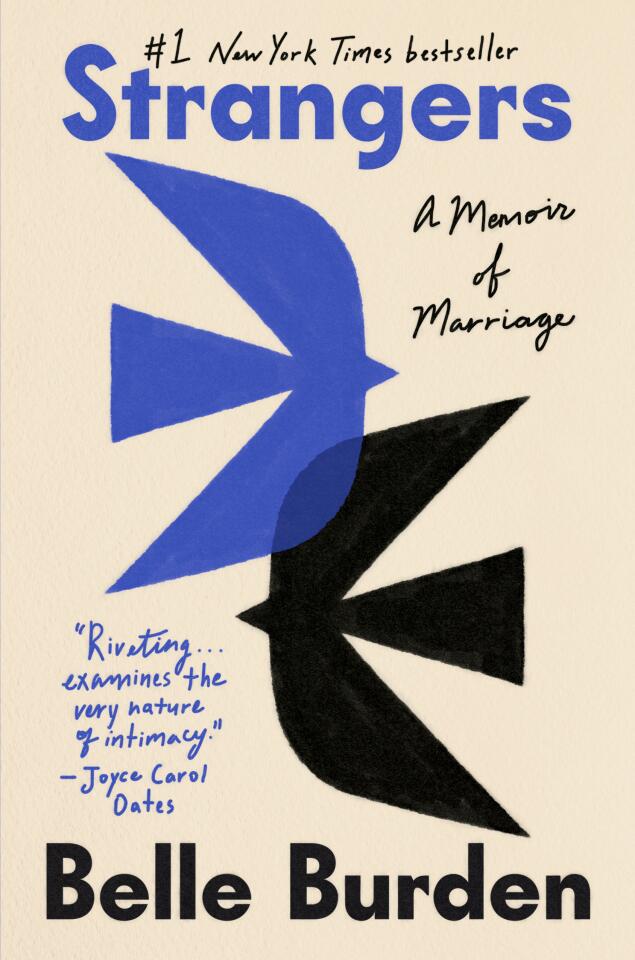
While the New York Times bestsellers from 2025 skew in favor of the 6-by-9 trim, the popularity of 5-by-8 books appears to be on the rise. Current utilizers of the smaller cut include the buzzy Vanderbilt heir Belle Burden’s “Strangers,” George Saunders’ darkly humorous “Vigil” Lena Dunham’s millennial-tinged tell-all “Famesick” and the infamously tablet-sized “Transcription” from Ben Lerner.
1/5
“Strangers: A Memoir of Marriage” by Belle Burden (The Dial Press)
2/5
“Famesick: A Memoir” by Lena Dunham (Random House)
3/5
“Vigil: A Novel” by George Saunders (Random House)
4/5
“Transcription: A Novel” by Ben Lerner (Farrar, Straus and Giroux)
5/5
“Lost Lambs” by author Madeline Cash (Farrar, Straus and Giroux)
Gretchen Achilles is the director of interior design at Farrar, Straus and Giroux. Achilles recently implemented the 5-by-8 cut for one of this year’s breakout hits, “Lost Lambs” by Madeline Cash. “It’s a tone,” she says. “Smaller trim sizes have an intimacy. … You want to echo what’s going on in the text as an experience for the reader.”
According to Achilles, FSG frequently implements the 5-by-8 trim size. She said that length is the No. 1 factor when deciding to employ it, followed by genre. She listed literary fiction, memoir, biography, and essay collections as the defining genres of the smaller size books.
Caroline Mason is a writer in New York whose debut novel “An Endless Cycle of Evenings” from Hyperion Avenue is slated for 2027; she runs the Instagram account @literarycrushes. Mason described a 5-by-8 hardcover as shorthand for a specific book she seeks out when she is in a bookstore because it often signals a character-driven novel. “It’s my favorite kind of book,” Mason says. She adds that it’s also Instagram-friendly.
“Holding the book up to take a photo of it is easier,” she says with a laugh. “Although I do sometimes still drop it.”
Dahlia de la Vega is an L.A.-based Bookstagrammer who runs the page @ofpagesandprint. According to De la Vega, she finds the shrunken books more approachable. “When I sit down to read a small hardcover, it almost feels like I’m reading a journal,” she says. “Whereas when I read a large hardcover, it almost feels like I need a journal to jot down notes about what’s happening.”
Ethan Mann, my colleague and a supervisor at Book Soup, told me he remembers the place he was both mentally and physically when he purchased a 5-by-8 hardcover copy of “The Parade” by Dave Eggers. (Right before the pandemic struck at CSUN campus store at Cal-State Northridge). “It’s easier to attach relevance to the specific feel of [the book] because it seems one of a kind,” he says.
Mann adds that hardcovers are sometimes a tough sell on the floor. They are often derided for their cost, and customers declare they will wait till the paperback comes out. But the smaller hardcover has the benefit of fitting into nearly any bag.
Esther Margolis is a publishing veteran and the founder of Newmarket Press. She says that the 5-by-8 hardcover is nothing new. According to Margolis, the smaller trim size was previously the industry standard for U.S.-based publishing houses, and any fluctuation is due to the evolution of printing technology.
“Unlike for mass-market paperbacks, hardcover books were shelved, so it didn’t matter that the books were different sizes,” Margolis says. “They didn’t have to fit into a pocket.”
The popularity of the 5-by-8 hardcover is, at the very least, indicative of a shift in what I witness consumers at Book Soup seeking out. With social media making it easier than ever to connect over the act of reading, or looking like you are reading, cover design and presentation — and how it cuts through the noise of the attention economy— is perhaps a factor too.
“A small hardback is like a Labubu,” my co-worker Mann says. “ The feeling in your hands isn’t just about books — it’s about all cute things. … We like small things we can control.”
The success of the publishing industry could never rest on the tiny shoulders of the small hardcover. It may not even represent any changes in production. But on the bestsellers display at your favorite local indie, it represents the small pleasure of palming a near-pocket-size book in your hands.
And, yes, maybe Instagrammability too.
Messinger is a writer in L.A. who runs the Substackadumbmessinger.
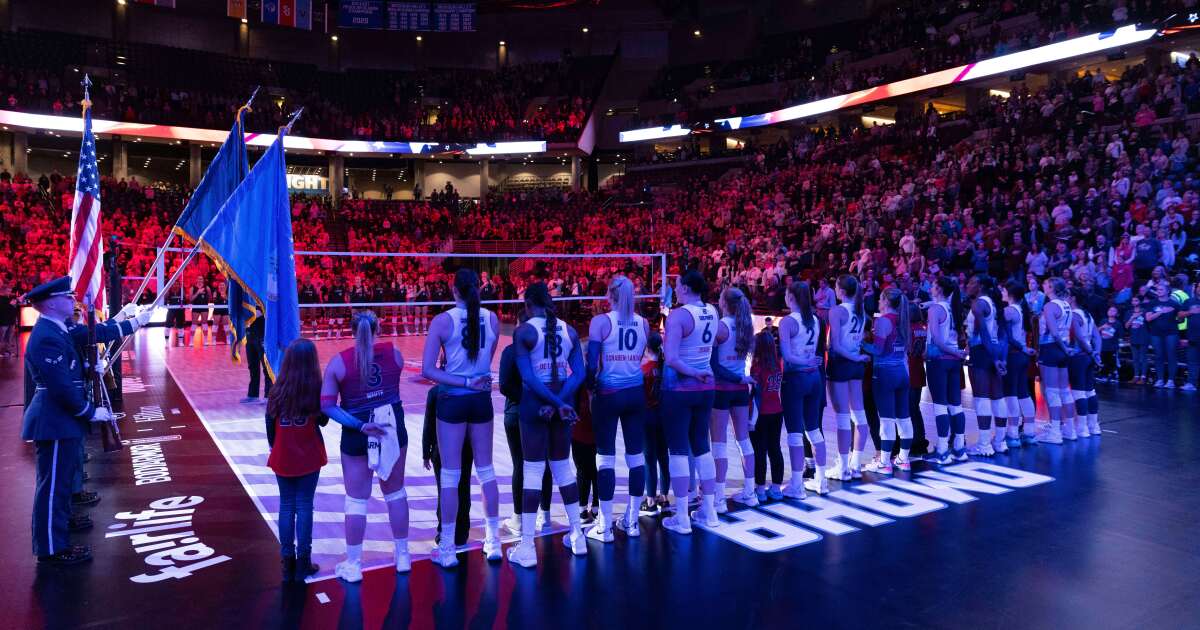
Los Angeles is getting another pro women’s volleyball team.
Major League Volleyball announced it will expand to L.A. in 2027, adding another team to the growing professional volleyball market.
The team will be co-owned by billionaire Dr. Patrick Soon-Shiong, who also owns the Los Angeles Times and is a minority owner of the Lakers. He will operate the team alongside Ben Priest, a former investor of MLV’s Omaha Supernovas, one of the league’s first teams.
Sportico reported the duo are paying an expansion fee around $15 million-$20 million to join the five-year-old operation.
The L.A. team will be the 11th franchise in MLV, which merged with the Pro Volleyball Federation before last season to consolidate the competition. However, League One Volleyball, known as LOVB, is still operating and has nine teams, including one joining the L.A. market in 2027.
MLV will also expand to Northern California, Minnesota and Washington D.C. in 2027.
Soon-Shiong joins a contingent of billionaire investors in MLV. Several NBA, NHL and MLS owners have ownership stakes in teams across the startup.
“From my perspective, this is really a feeling like when the Lakers started many, many decades ago,” Soon-Shiong told Sportico. “The opportunity in women’s sports is growing, and Los Angeles is obviously a very important market.”
The two volleyball leagues have vastly different models. MLV is looking to establish itself in the fabric of the pro sports markets like other leagues, while LOVB has ties to youth volleyball clubs and feeder teams.
MLV and PVF merged after sharing a similar vision and joining forces to avoid cannibalizing the market. LOVB has teams in or projected to be in six markets. MLV lost its San Diego franchise, which ceased operations after the 2026 season.
The two volleyball teams coming to L.A. will join the WNBA’s Sparks and NWSL’s Angel City FC as local pro women’s sports teams. Los Angeles also has a team in the upstart Women’s Pro Baseball League, but it will play the entire 2026 season in Springfield, Ill.
The idea grew as organically as the purple cauliflower at Erewhon. One day, I walked from my place in Los Feliz to the beach. I stopped at two Erewhon locations on the way to refuel. I made a reel about my journey and posted it to Instagram. My friend Fish saw it and said, “You should walk to all the Erewhons.”
I thought: I don’t have time to do that. I’m a very serious person who needs to write her novel.
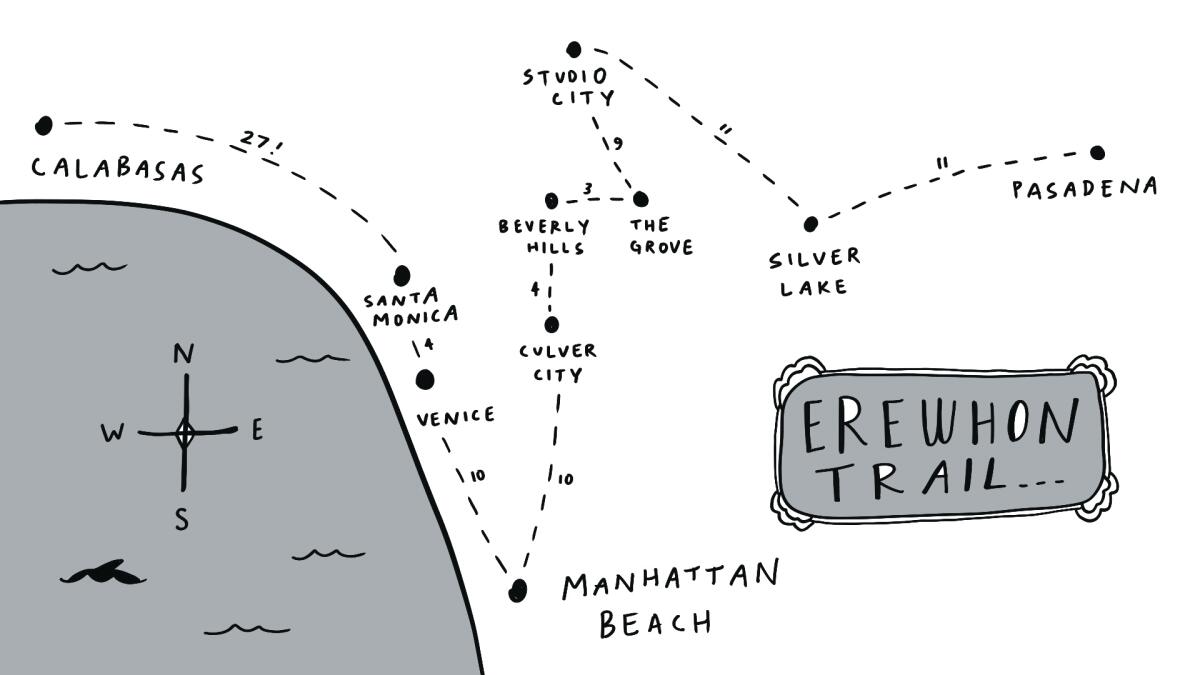
But later I found myself mapping out an 89-mile hike in my Notes App, starting in Pasadena and ending in Calabasas, stopping at all 10 Erewhon locations on the way. (My route did not include the Palisades, which is closed because of the fires; nor did it include LACMA or the new Glendale locale.)
“I need to write my novel” is a thought I have a lot. I usually heed this thought and sit at the desk like a soldier, imagining the wonderful day when I’ll sell said novel — for an amount that would probably be comparable to a fraction of an Erewhon employee’s yearly salary.
Erewhon Trail map illustration by Swan Huntley.
(Erewhon Trail map illustration by Swan Huntley. )
I really wasn’t in the mood to write the novel, though. When I imagined myself pecking away at the keyboard, I felt bad. When I imagined myself walking around L.A. in my Home Depot gardening hat, I felt good. So, I put on my hat, got into an Uber headed for Pasadena, and texted my sister, “Carpe diem, bitch.” Or at least that was my intention. What I actually sent was, “Carpet diem hitch.”
Over the summer, I hiked a little bit of the Pacific Crest Trail. A few years ago, I biked the Camino in Spain. I’ve walked from Los Feliz to the beach a handful of times. I’ve traversed the length of Manhattan thrice. Before that, when I was a teenager, I used to trek from La Jolla to Del Mar while drinking beer (I carried a cooler; yes, I’m sober now) and listening to Sarah McLachlan on my Discman. I’ve always been drawn to activities that many people find tedious. Like walking forever. Or writing a novel.
Starting in the fourth century, pilgrimages were served up by the church as a way for Christians to pay penance for their sins. They were hard and dangerous and a lot of people died. Fast-forward to now: Such treks have taken on an “Eat, Pray, Love” aura. Or a “Wild “ aura. They live in the realm of self-help and of sport. They’re a way to create friction in an increasingly frictionless world. By walking from Mexico to Canada, or from Erewhon to Erewhon, I wonder whether we’re trying to get back to the part of ourselves that wants to try harder.
Or we just want to become more valuable dinner party guests.
What do you do?
I do really long walks.
I ordered a Goddess Smoothie in Pasadena, and then I repeated this tradition at every store thereafter. The smoothie costs $19, tastes like heaven, and it’s green, which my brain reads as “good for me.”
It took me a little over three hours to walk 11 miles to Silver Lake. I got a Vegan Avocado Sandwich for lunch, took an Uber home and posted a reel on Instagram about my first day on the trail. A lot of people liked it. Some of them called me a genius.
In the last 10 years, I’ve published four novels and two illustrated books for adults. I was naïve and just totally blindly happy about the publishing process in the beginning. People wanted to buy my work? Other people wanted to read it? Cool.
The first book, “We Could Be Beautiful,” did well because the publisher put real money into the marketing of it. Then that stopped happening. At a certain point, I realized that expecting too much was unwise. It was up to me to market my books myself. Which meant: social media.
They say you have to see a book cover six times before you buy the book — or consider buying it. There are a lot of book covers on Instagram. Actually, there’s a lot of everything on Instagram, and out of all the everything, is a book cover that exciting?
No.
My second reel, which depicted my journey from Silver Lake to Studio City, went a little bit viral. To date, almost 10,000 people have shared it with their friends. Why? I think the answer has something to do with a desire for levity.
If the atmosphere of the world could be depicted by an Erewhon beverage, it wouldn’t be a vibrant, cheerful one, like the bright magenta Pitaya Smoothie. It would be the dark and brooding Germ Warfare Shot. I find it perplexing that people talk about the apocalypse as if it’s happening later. It’s happening now. If we were really thinking about how climate change is affecting us, we’d be out in the streets screaming. All the time. But we’re not doing that. We’re carrying on with our usual lives. Apparently, for me, that includes walking to Erewhons.
Any long-distance trek is as much an internal journey as it is external. As I continued the trail, I started to think that maybe my endeavor was a reaction to my feeling of total powerlessness. I can’t save the polar bears. I can’t force the president to go to therapy. But I can add some levity to the brooding atmosphere.
Recently, someone commented on one of the reels, “Transplants make LA locals look bad.” This person, and many others, hear the name Erewhon and assume I’m poking fun at it. Erewhon has become a joke about L.A. — a joke that was amplified after Hailey Bieber invented her smoothie in 2022 that Erewhon dubs the “Strawberry Glaze Skin Smoothie.” I’ve never had it, but I can tell you that it looks like a sky full of strawberry clouds. According to an Erewhon employee I spoke to, this smoothie was a turning point. It aligned the brand with wealth and power. Now, Erewhon evokes the image of smooth-skinned, health-conscious Angelenos with money to burn.
The Erewhon Trail, then, inevitably becomes a conversation about privilege, my own included. Instagram hid my two favorite comments, because it was worried they’d be too rude to show, but I think they’re the funniest ones.
This is what white people do on Prozac.
This is what happens when a liberal arts teacher gets fired.
To both of these comments, I say: Yes.
I’m not on Prozac yet, but maybe after I get fired, I will be.
In order to get fired, though, I’d have to get an actual job, which might never happen.
The most intense leg of the trail was from Santa Monica to Calabasas. My friend Fish joined me. Google said it would take 27 miles. After marching through the mountains, I decided to use my own intelligence to make the route shorter. This cut out four miles, bringing the total to 23. For long stretches, Fish and I walked in the bike lane, or in the bramble by the side of the road. That’s the penalty for straying from Google. Your sidewalks disappear and your chances of getting hit by a car go way up.
My legs were noodles by the time we got to Calabasas. I crawled across the parking lot to show my viewers how weak they’d become. The employee at the door smiled at me and handed me a basket, and I thought about the pain of my legs, which no one could see, and about all the secret battles people are fighting all the time, and I wished that we cared about each other as much as Erewhon cares about us. Multiple employees were perfecting the already-perfect plateaus of bell peppers and apples in the produce section. Their thoughtfulness was the opposite of the vibe I encounter in most public restrooms, which is that the strangers who were there before me didn’t have many thoughts about my experience. As lame as the fact that an Erewhon smoothie costs $19 is that so many of us need to be paid to be nice to each other.
When I tell people about my love for Erewhon, they either say, “Duh, I know,” or something along the lines of, “That place is ridiculous, right?” This is almost always followed by the mention of a food item and some amount of money. Like, “Doesn’t a carrot cost $12,000?”
Actually, I tell them, no. Although sometimes, yes. There is a Japanese strawberry that’s famously expensive ($20), but that’s avoidable. I then explain that contrary to popular thought, there is a way to shop at Erewhon on a budget. A jar of soup, for example, costs $15.50. If you return the bottle, you get $3 back. In my opinion, the soup can be two meals, so that’s $6.25 per meal. A lot of the produce is either the same price or only a little bit more expensive than at other health food stores, and it’s in consistently better shape. The most important piece of making Erewhon more affordable, though, is becoming a member. You get 10% off, a free drink of the month and discounts on a bunch of items.
You might be wondering: How many Erewhon memberships has she personally sold?
She’s lost count.
The other reason to go to Erewhon is the environment. It’s visually appealing and the employee-to-customer ratio is notable, and the result is that you feel like you’re at a resort. And frankly, these simple things — a nice environment, high quality food — should be available to everyone.
Back to the question of whether or not Erewhon is ridiculous — yes, of course it is. If you sit at any of the locations and listen to the conversations around you, you’ll probably feel like you’re an extra in a satirical movie. At Studio City, I overheard two moms in white pants and cashmere sweaters talking about how, based on their Instagram recon, they figured out that so-and-so was sitting next to so-and-so at a benefit dinner. Another snippet I overheard in Studio City: “You gotta make music from the heart, man, and the label will feel it.”
It didn’t occur to me to ask for free merch until after I’d finished the trail. Armando at the Santa Monica location was the lucky recipient of my request. I explained my uniquely heroic feat to him, and then wondered aloud if perhaps I could get a sweatshirt, or at least a hat.
Sadly, Armando was unauthorized to give me merch, but he did offer me a gift card in a tiny envelope. I was very grateful. I assumed the card was worth $50 at least.
After we parted ways, I opened the envelope.
Ten dollars.
Enough to put a down payment on a smoothie.
My dreams now are so different from when I was younger. Back in grad school, I imagined that maybe I’d write a bestselling novel, and maybe it would be adapted for the screen, and maybe my tombstone would read: She contributed very serious literature to civilization.
What I never accounted for was, of course, the unknown. Maybe one day, over a decade after school ended, I’d get a lot of attention for making performance art about walking to grocery stores.
Huntley’s novels include “I Want You More,” “Getting Clean With Stevie Green,” “The Goddesses” and “We Could Be Beautiful.” She’s also the writer/illustrator of the darkly humorous “The Bad Mood Book” and “You’re Grounded: An Anti-Self-Help Book to Calm You the F— Down.” She lives in Los Angeles.
Ryan Porter, the acclaimed trombonist and fixture of the West Coast Get Down jazz ensemble, has died. He was 46.
Porter died Saturday from injuries sustained in a “severe” car crash on April 28, Porter’s bandmate Tony Austin wrote on Instagram. “Despite the best medical care, his condition deteriorated,” Austin wrote, noting that Porter “took his last breath, peacefully surrounded by his loved ones.”
Porter was a pivotal figure in contemporary Los Angeles jazz, beginning with his studies under legendary educator Reggie Andrews in the Multi-School Jazz Band in Watts. Porter formed close friendships and musical connections with saxophonist Kamasi Washington, multi-instrumentalist Terrace Martin, bassist Thundercat and the key players that would later form the West Coast Get Down.
“When it comes to keeping the lineage of jazz in L.A. alive, there have been people who were selfless and sacrificed a lot,” Porter told The Times in 2024. “For me back then, it was hard to understand why they cared so much. But it was because they saw potential in all of us so early, so we could see it for ourselves.”
That group cultivated a following at Leimert Park’s beloved venue the World Stage. They would go on to craft dense, experimental and spiritually yearning compositions for Kendrick Lamar’s 2015 LP “To Pimp a Butterfly,” among countless other LPs in the L.A. jazz scene, including Washington’s 2015 breakthrough “The Epic.”
Porter released four solo albums in his career — 2018’s “The Optimist,” 2019’s “Force for Good,” and 2022’s “Resilience,” along with his 2017 children’s album “Spangle-Lang Lane” — each featuring arrangements from his lifelong bandmates. In 2024, he released a documentary film, “Resilience,” focused on the impact of free music education programs in Los Angeles and how they helped build the city’s modern jazz scene.
“In the inner city, you can be a gang member or drug dealer, but most kids want to take their best steps,” Porter said in 2024. “Friends and music teachers inspired me through their work ethic, giving us a place to perform where we could take advantage of that expertise. Now it’s our turn to take care of them for the next generation.”
Washington, Porter’s frequent collaborator, remembered Porter in a poignant statement on Instagram. “I love you Ryan Porter, I miss you, and you will always have a space in my heart and soul. I will cherish the many years we had together, I thought we would have more, but I am thankful for what we had,” he wrote, adding, “You have been my friend for most of my life. I’ve looked up to you since I was 11 years old. We learned from each other, we supported each other, we created beautiful music together and shared it with people all over the world.”
“You would always tell me that you wanted more than anything else to be a FORCE FOR GOOD and you did it, you are the complete embodiment of that,” Washington continued. “You did so much good Ryan, your life made this world better.”
Porter is survived by two daughters, both of whom are preparing for college, according to a GoFundMe page set up by his friends to contribute to funeral costs and support his children. “Beyond the stage and beyond the music, Ryan’s greatest pride was being a father and provider for his family,” the fundraiser states.
Homicides in Los Angeles are down to levels not seen since the 1960s. Neighborhoods once awash in gang violence now sometimes go weeks, even months, without a shooting. And the follow-home robberies and street takeovers that captured the public’s attention in recent years have largely subsided.
By many measures, the city is safer than it has been in generations — and yet voters following L.A.’s hotly contested mayoral race might think the opposite.
The challengers to Mayor Karen Bass have zeroed in on homelessness and public drug use to argue she hasn’t delivered on public safety, while also criticizing how the Police Department has operated and been funded during her tenure.
Mike Bonin, a former L.A. City Council member, said the fact that Spencer Pratt — the former reality TV star who has been attacking Bass from the right — has gained so much traction in the race is proof of how Bass and other candidates to the left have failed to change “prevailing narratives that the city is unsafe.”
Mayoral candidate Spencer Pratt hosts a campaign block party on 10th Avenue in Los Angeles on May 20, 2026.
(Robert Gauthier / Los Angeles Times)
Pratt has been particularly active on social media, where he has shared artificial-intelligence videos created by fans depicting him as various superheroes coming to the rescue of a city that, under Democratic rule, has turned into a dystopian hellscape.
In a March 26 post on Substack, Pratt railed against the thousands of drug-related calls that emergency officials respond to every month. He has said that if elected mayor, he would order the police and fire chiefs and the county health director to “treat every encampment as a grave-disability zone.”
“No new laws needed,” he wrote. “No endless task forces.”
Flanking Bass on the left is Nithya Raman, a progressive City Council member who was once the mayor’s political ally.
Raman has argued that Bass has thrown too much money at the LAPD, with raises for police officers coming at the expense of other basic services such as park maintenance and street paving. Raman said the LAPD pay increases have “bankrupted” the city, depriving other services of much-needed funding. In campaign ads, Raman has cast herself as a more sensible alternative to Bass. Raman has said she would work to reduce traffic deaths and prioritize safety on the city’s buses and trains.
When she first ran for office in 2020, Raman called for defunding the police, saying the Los Angeles Police Department should be a “much smaller, specialized armed force.” Since then, however, she has voted for some budgets that increased spending on law enforcement.
In response to questions from The Times, Raman said she would work to find ways to overhaul public safety.
“I’ll propose budgets that expand unarmed response, work with LAPD to improve 911 response to more quickly answer calls for help that don’t require armed officers, and will appoint leadership at the Police Commission who will actively partner with the City Council to work on reform,” she said.
Representatives for Pratt and Bass didn’t respond to requests for interviews with the candidates.
Bonin said Bass — who supported various police reform measures while Congress — has shocked some of her supporters with how “aggressively pro-police she has been.”
When she ran for mayor in 2022, Bass vowed to retool the recruitment and hiring process in order to restore LAPD staffing to 9,500 officers. That hasn’t happened. The number of sworn officers recently fell below 8,600, despite Bass striking a deal with the police union to offer higher starting salaries and new retention bonuses.
Mayor Karen Bass takes part in a candidate forum on May 5, 2026, in Sherman Oaks.
(Eric Thayer / Los Angeles Times)
On Thursday, the City Council approved a $15-billion budget for the upcoming fiscal year, which included funds to hire 510 new officers — just enough to offset turnover and maintain current staffing levels.
Raman has said the LAPD should not shrink any further because there aren’t enough officers to respond to 911 calls “in a timely fashion.”
Samantha Stevens, a Los Angeles political consultant and former legislative staffer, said people seem willing to back Pratt because he acknowledges that their sense of safety has been shaken — even if he has offered few concrete details about how to tackle crime beyond cracking down on homelessness.
Pratt’s critics say that his plan relies on funneling homeless people into a shelter system that doesn’t have the capacity to handle them all. Others have noted that the aggressive tactics he has proposed would probably face legal challenges.
L.A. City Councilmember Nithya Raman, who is running for mayor, makes a campaign stop at the site of a home burned in the Palisades fire.
(Eric Thayer / Los Angeles Times)
“He’s kind of a case study in somebody who has a lot of opinions but has no idea of how the city is run,” Stevens said.
Fernando Guerra, a political science professor at Loyola Marymount University, said Pratt seems to have tapped into a deep well of discontent among Angelenos who believe that crime and homeless have spiraled out of control. The challenge for Bass, he added, is that although the numbers suggest that crime has decreased, many people associate the sight of encampments spilling onto public sidewalks as “a breakdown” that indicates the city is becoming less safe.
“You want to go back to the days of Daryl Gates, you’ve got Pratt,” he said, referencing the former LAPD chief whose controversial police sweeps in the late 1980s yielded thousands of arrests while alienating large segments of South L.A.
“If you want more of the same from the past 20 years, you’ve got Bass,” Guerra added. “And if you want something new, then you’ve got Raman, but she has to explain what exactly she wants to do.”
Although Pratt and Raman appear to be the strongest challengers to Bass, several long-shot candidates have also made public safety a key issue in their campaigns. Some have gone after Bass for her support of LAPD Chief Jim McDonnell. Hired by Bass in 2024, McDonnell has touted the impressive drop in crime under his leadership, but also faced criticism over an uptick in shootings by police and aggressive crowd control tactics during protests against the Trump administration’s immigration policies.
Police Chief Jim McDonnell attends a news conference at LAPD headquarters on May 21, 2026.
(Genaro Molina / Los Angeles Times)
Rae Huang, a minister and housing rights advocate, said if elected mayor she would immediately replace McDonnell with someone who has the “ability to really reimagine what public safety really looks like.”
“I’m the only one with the guts to say that out loud,” Huang told The Times during a recent campaign stop at a bookstore in the West Adams neighborhood.
In social media posts and interviews, Huang has frequently referred to the LAPD as “one of the biggest legal gangs in the world,” and said she would work on diverting money from the police budget to scale up programs that have shown promise in sending unarmed specialists to deal with emergencies that involve people experiencing mental health crises.
The city is already running two such pilot programs, but under Bass they have remained underfunded, Huang said. Last week, the City Council signed off on expanding one of the programs.
Huang said she would also invest more heavily in addressing the city’s lack of affordable housing, which she said is an underlying cause of crime and homelessness.
The Los Angeles Police Protective League has poured hundreds of thousands of dollars into attack ads against Huang and Raman.
Adam Miller, a tech entrepreneur, has tried to strike a balance in his mayoral campaign, advocating for changes while acknowledging that many people still feel unsafe despite the historic drop in violent crime.
He criticized a recent vote by the L.A. City Council to limit so-called pretextual stops, in which officers pull people over for minor traffic infractions in order to investigate more serious offenses. The stops have been blamed for enabling racial discrimination.
Miller said that “constraining the Police Department is the opposite of what we should be doing.” He called for “leveraging” AI and modernizing the department’s archaic computer systems, which he said could allow the LAPD to catch up to other agencies that have embraced new technology.
Miller told The Times that he recently went on a ride-along with officers from the Rampart Division, which he said was eye-opening.
“At the highest level I think Angelenos don’t feel safe anymore,” he said. “They don’t feel safe in their neighborhoods, but more recently they don’t feel safe even in their own homes.”
Statistically speaking, the city might be safer than it’s been in decades, he said — but that doesn’t necessarily matter to voters.
“I don’t think it’s just perception,” he said. “I think it’s reality that crime has spread.”
Los Angeles voters will cast ballots in eight City Council district elections next week, including for two open seats where incumbents are leaving because of term limits.
The contests for the seats being vacated by Councilmembers Bob Blumenfield and Curren Price have drawn large fields of candidates, but the biggest spending has been in the Westside’s District 11, where incumbent Traci Park is facing challenger Faizah Malik, a public interest attorney and one of four council candidates backed by the local chapter of Democratic Socialists of America.
Park has raised $1.3 million, according to the latest campaign finance reports filed Friday, while challenger Faizah Malik reported about $520,000 in contributions. In addition, more than $3 million has been spent in the race by so-called independent expenditure committees that spend money to elect or defeat candidates but which are barred from coordinating their activities with the campaigns.
The district includes Venice, Mar Vista, Brentwood and Pacific Palisades, which was devastated by wildfire in January 2025.
Malik said Friday she is confident heading into the primary election, saying most of her donations are under $100 each, and that she hasn’t taken money from corporations.
Los Angeles City Council candidate Faizah Malik attends a canvassing event March 15 in Westchester.
(Eric Thayer / Los Angeles Times)
“This is what it means to be a grassroots candidate, and it is just more evidence that the people of CD11 believe in our vision for a Westside that is affordable for everyday people,” Malik said.
A Park campaign aide said Park’s haul is indicative of the councilmember’s record of getting results.
“But no one is taking anything for granted,” the aide said in a statement. “We’re working until the final vote is cast because this election will determine whether the Westside keeps moving forward or gets pulled backward into the same failed ideological politics Angelenos are exhausted by.”
Los Angeles City Councilmember Traci Park, center, with members of United Firefighters of Los Angeles City on May 12.
(Genaro Molina / Los Angeles Times)
Park has emphasized her advocacy for fire recovery efforts, including pushing for permit fee waivers for residents wanting to rebuild. Malik has said Park has been too focused on single-family homeowners and said she would focus more energy on renters.
They have contrasting views on policing: Malik said she opposes expanding the size of the Los Angeles Police Department and instead supports shifting more resources to the city’s unarmed crisis response program. Park said the Police Department should have about 10,000 sworn officers, up from about 8,700 currently. She voted in favor of a 2023 LAPD contract that gave raises to officers and increased salaries to new hires.
They stand in contrast of each other on the Venice Dell housing development project, which would turn a city lot into 120 housing units for low-income and homeless people. Park opposed the completion and instead wants to turn it into a “mobility hub” and move the housing project to an adjacent lot. Malik, who represented the developer that filed a suit against the city claiming Park and others sought to kill the project, said the project was a motivating factor for her campaign.
District 9
Six candidates are vying to replace Councilman Curren Price, who hit the 12-year limit, in District 9. The district includes the Convention Center, USC and communities along the Harbor Freeway.
The candidates vary on key issues, including policing and housing. Estuardo Mazariegos, co-director of the Alliance of Californians for Community Empowerment Los Angeles, is backed by the Democratic Socialists of America. He has called for reducing the LAPD budget and redirecting funds to other city departments.
Two other candidates — Jorge Hernandez Rosas, an educator, and Jose Ugarte, who previously worked for Price — said they support hiring more police officers. Another hopeful, Elmer Roldan, executive director of Communities in Schools of Los Angeles, said he believes in keeping the LAPD at its current size.
Ugarte, Roldan, Rosas and Martha Sánchez, a therapist, all support enforcing Municipal Code 41.18, which bars homeless encampments near schools and daycare centers. Mazariegos and Jorge Nuño, an entrepreneur, say the code doesn’t solve homelessness and instead just moves people around.
Ugarte has raised the most in contributions of any candidate and has been endorsed by the Los Angeles County Democratic Party in the nonpartisan race.
District 3
Three candidates are competing for an open seat in District 3, where Councilmember Bob Blumenfield has termed out of office. The district encompasses Woodland Hills, Canoga Park, Reseda, Winnetka and Tarzana.
The candidates are Tim Gaspar, who founded an insurance company, Barri Worth Girvan, district director for Los Angeles County Supervisor Lindsey Horvath, and Christopher Robert “C.R.” Celona, a tech entrepreneur.
The three candidates are similarly positioned on public safety, backing Mayor Karen Bass’ long-term goal to increase the LAPD ranks to at least 9,500 officers. All three also support enforcing Municipal Code section 41.18.
Gaspar and Worth Girvan have both scored key endorsements. Gaspar is backed by Blumenfield, billionaire developer Rick Caruso and Councilmembers Monica Rodriguez, Tim McOsker and John Lee and billionaire developer Rick Caruso. Worth Girvan has endorsements from a long list of state Democratic lawmakers, the county Democratic Party, the Sierra Club and labor unions.
Gaspar leads in campaign contributions, followed by Worth Girvan. Celona, who has promised to resuscitate the city’s entertainment industry by fast-tracking film permits and cutting red tape, trails far behind.
District 1
Councilmember Eunisses Hernandez faces four challengers in District 1, which stretches from Highland Park on the northeast to University Park on the southwest. She is backed by the local Democratic Socialists of America, and her challengers claim the district has suffered under under her leadership, pointing to MacArthur Park as emblematic of the homelessness and drug addiction crisis plaguing the city.
Hernandez counters with a list of accomplishments, including helping secure a $6.3-million state grant to house homeless individuals near the Arroyo Seco riverbed and advocating for a citywide network of unarmed crisis response teams.
She faces challenges from Maria Lou Calanche, a former Los Angeles police commissioner and founder of the nonprofit Legacy LA; Nelson Grande, an executive consultant and former president of Avenida Entertainment Group; Raul Claros, founder of California Rising; and Sylvia Robledo, a small-business owner and former council aide.
Incumbent Katy Yaroslavsky faces two challengers for her District 5 seat, both of whom oppose her stance on housing and public safety spending. The district includes some of the city’s wealthiest neighborhoods, including Bel-Air, Westwood, Cheviot Hills and Hancock Park.
Challengers Henry Mantel, a tenants’ rights lawyer, and Morgan Oyler, an accountant, say Yaroslavsky hasn’t done enough to increase the district’s housing supply. Yaroslavsky, who holds a wide lead in fundraising, has said she supports increasing housing density near transit centers but cautioned against building more than the city can sustain.
District 13
Councilmember Hugo Soto-Martínez, who is also backed by the Democratic Socialists of America’s L.A. chapter, faces three challengers in District 13, which includes Atwater Village, Glassell Park, Elysian Valley, Echo Park, Silver Lake and East Hollywood.
The list of challengers includes Colter Carlisle, vice president of the East Hollywood Neighborhood Council, Dylan Kendall, who runs Grow Hollywood, and Rich Sarian, vice president of strategic initiatives for downtown’s South Park Social District.
While Soto-Martínez supports expanding the city’s unarmed personnel program, Carlisle and Kendall would like to expand the police force. Sarian has said he supports the unarmed personnel program and wants to examine the LAPD’s current size and resources.
District 15
Incumbent Tim McOsker is facing off against community organizer Jordan River in District 15, which covers Harbor City, Harbor Gateway, San Pedro, Watts and Wilmington. McOsker has decades of experience in the political world, having worked in the mayor’s office, and the city attorney’s office before joining the City Council in 2022. Rivers, who is unemployed, is a member of the Green Party.
District 7
Monica Rodriguez is running unopposed for the District 7 seat in the northeast San Fernando Valley.
Times staff writers David Zahniser, Noah Goldberg and Sandra McDonald contributed to this report.
There is just over one week remaining before the June 2 primary for Los Angeles mayor, city attorney, city controller and eight of the 15 City Council seats.
As of Friday morning, 333,000 mail-in ballots had been cast in the race, up from 321,000 at the same time in 2022, according to the L.A. County Registrar/Recorder.
The Trump card
Spencer Pratt’s foes in the Los Angeles mayor’s race like to say that the former reality television star lacks the experience needed to run a big city.
But Pratt might have an even bigger liability — any sense that he may be aligned with President Trump.
Cygnal, a national polling group that has worked for Republican candidates, found that tying Pratt to Trump and the MAGA movement is a bigger turnoff to Democrats than his reality television past.
According to its poll of 500 likely Los Angeles voters, Pratt’s reality TV resume made 59% of overall Democrats less likely to vote for him. By comparison, tying Pratt to MAGA and Trump made 65% of Democrats less likely to vote for him, Cygnal said.
Pratt is a registered Republican and on Wednesday, Trump signaled support for Pratt in the mayoral race. On Thursday, former Trump advisor Steve Bannon said the president didn’t formally endorse Pratt out of fears it would hurt Pratt’s chances in Democrat-dominant Los Angeles.
Spencer Pratt at a recent campaign block party in South Los Angeles.
(Robert Gauthier / Los Angeles Times)
Overall, including Democrats and Republicans, 24% of voters said tying Pratt to Trump made them more likely to vote for him while 50% of voters were less likely to vote for him because of it.
“Karen Bass is a fairly reserved individual, but you have to believe that backstage she was doing a happy dance after she heard Donald Trump’s comments,” said Dan Schnur, a professor of politics at USC, UC Berkeley and Pepperdine University.
The strongest pro-Pratt argument is a public safety argument that Pratt will reject “defund the police” policies and hold repeat offenders accountable.
The poll showed Bass at 25% support, Pratt at 22% and Councilmember Nithya Raman at 18%.
You’re reading the L.A. on the Record newsletter
Sign up to make sense of the often unexplained world of L.A. politics.
By continuing, you agree to our Terms of Service, which include arbitration and a class action waiver. You agree that we and our third-party vendors may collect and use your information, including through cookies, pixels and similar technologies, for the purposes set forth in our Privacy Policy such as personalizing your experience and ads.
Big money for Blumenfield seat
It hasn’t had the same sizzle as the mayor’s race, or been as pricey as the acrimonious campaign for city controller. But the battle to replace City Councilmember Bob Blumenfield in the west San Fernando Valley is turning into yet another high-stakes, big-money contest.
In that three-way race, a handful of special interests have now put more than $1 million into various efforts to elect businessman Tim Gaspar.
The Central City Assn., a downtown-based business group, has spent the most so far, pouring more than $400,000 into mail pieces, web videos and other campaign expenses, according to Ethics Commission filings. Most of its money has been coming from Airbnb, which is looking to loosen the city’s rules on homesharing platforms, by allowing second homes to be used as short-term rentals in the run-up to the 2028 Olympic Games.
Political aide Barri Worth Girvan, who is running to replace Blumenfield, criticized Gaspar over the influx of money, saying the “West Valley is not for sale.”
“Airbnb has destroyed countless neighborhoods around Los Angeles, and they clearly believe that my opponent will allow them to do that in the San Fernando Valley,” said Worth Girvan, who works for county Supervisor Lindsey Horvath. “Let me be clear — I will not allow that in our neighborhoods.”
Gaspar, in a statement, said he’s proud of the coalition supporting him.
“Like so many Angelenos, they are ready for change and new ideas that will actually get something done. Barri is offering nothing but the same tired excuses, empty promises, and failed ideas,” he said.
Under the city’s campaign finance rules, donors cannot give more than $1,000 to the campaign of a council candidate. However, independent expenditure groups can spend unlimited amounts, as long as they do not coordinate with the campaigns of their favored candidate.
Some of the other Gaspar backers who are spending large sums include the California Alliance of Family Owned Businesses, which represents McDonald’s franchisees, the California Apartment Assn. and Working Californians, a committee sponsored by International Brotherhood of Electrical Workers Local Union 18, which represents employees of the Department of Water and Power.
That committee is also partly funded by Airbnb, according to the Ethics Commission website.
Ethical supes
The Los Angeles County Board of Supervisors voted this week to establish its first ethics commission.
The creation of the new body aimed at preventing and eliminating corruption in county government was mandated by Measure G, which voters approved about 18 months ago.
That measure overhauled the county charter to create an elected county executive position and increase the number of supervisors from five to nine.
It also stipulated the establishment of an ethics commission and an office of ethics compliance, helmed by an ethics compliance officer.
Polling shows the effort has broad public support, according to Sara Sadhwani, a political science professor at Pomona College who served on a task force that made recommendations to the supervisors.
But there was still controversy before the Board of Supervisors voted 5-0 Tuesday to support to approve the plan.
Supervisor Janice Hahn said the ethics commission was intended to be an independent body whose members were not directly selected and appointed by elected officials.
She proposed an amendment that would have made it so commissioners were chosen from a list of qualified and interested people via a lottery system.
Hahn lost that battle and the county approved the plan without the change. The county assessor, the chair of the Board of Supervisors and starting in 2028, the newly minted county executive, will each appoint one ethics commissioner.
Those three commissioners will then select the other four members of the commission, who are subject to the approval of the supervisors.
State of play
— “THE HILLS” ARE ALIVE: The Times dived deep on Spencer Pratt’s history as well as his campaign, showing how he rose from reality television villain on “The Hills” to become a leading contender for L.A. mayor.
— TRUMP BUMP?: President Trump signaled support for Los Angeles mayoral candidate Spencer Pratt on Wednesday, wading into the local election less than two weeks before the primary.
— FRESH PRINCE: Spencer Pratt’s campaign for Los Angeles mayor has paid the Hotel Bel-Air more than $15,000 since April 7, according to Pratt’s latest campaign finance filings.
— PROGRESSIVE BLOCK: Three members of the L.A. City Council’s progressive bloc endorsed Mayor Bass for reelection, snubbing fellow progressive Nithya Raman in the June 2 primary. The endorsements from Eunisses Hernandez, Ysabel Jurado and Hugo Soto-Martínez underscore fractures on L.A.’s left. All three are members of the Democratic Socialists of America, as is Raman.
— HOLLYWOOD HOPEFULS: In campaign ads, interviews and the recent televised debate, the top three contenders: incumbent Mayor Bass, former reality TV villain Spencer Pratt and Raman, have made the ongoing production slump a pivotal topic, highlighting their plans to revitalize the industry while deploying the issue to undercut one another.
— WHITHER LATINOS?: Latinos make up nearly 37% of the L.A. electorate, making their votes crucial for anyone with mayoral ambitions. That has campaigns putting out ads and social media posts in Spanish, hitting the ground in Latino majority neighborhoods and rallying for key endorsements.
— HUNGRY FOR MORE: It’s the biggest slate of democratic socialists Los Angeles has ever seen. The L.A. chapter of Democratic Socialists of America is looking to push City Hall further left by backing candidates for city attorney and four City Council seats in the June 2 primary.
— OH, AND A BUDGET: The Los Angeles City Council signed off on a $15-billion budget for 2026-27 on Thursday, preserving Mayor Karen Bass’ police hiring plan while socking away more money for potential emergencies.
— AIRPORT DELAYS?: A $30 minimum wage for hotel and airport workers will be delayed after Los Angeles elected officials persuaded a group of business leaders to drop a ballot measure that would have devastated the city budget.
QUICK HITS
Where is Inside Safe? The mayor’s signature program moved 69 people indoors near Chinatown this week in Jurado and Hernandez’s council districts.
On the docket next week: The City Council will vote to approve a formal letter to remove the gross tax repeal from the November ballot.
Stay in touch
That’s it for this week! Send your questions, comments and gossip to LAontheRecord@latimes.com. Did a friend forward you this email? Sign up here to get it in your inbox every Saturday morning.
You say you want to be mayor of Los Angeles, but do you really?
I know that being a candidate has rescued you from anonymity after your career in reality TV went off a cliff. You’ve got CEOs backing you, and fans raving, and you’ve managed to milk social media attention.
But at some point you might have to answer questions from the reporters you’ve been avoiding.
And if you win, you’re going to have to drive to City Hall five, six, seven days a week, and I don’t know if you saw my column a few weeks ago, but the fountain on the south lawn hasn’t worked in about 60 years. If you get elected, you better put a wrench in your lunch box, because nobody has figured out how to fix it.
So that’s the reality, pretty much. And the unions will want what they want, and the socialists on the City Council will be lying in wait, especially after President Trump blew you a cross-country air kiss and certified your MAGA credentials.
More than 30,000 people are waiting for their broken sidewalks to get fixed (I’m not exaggerating) but there’s no money, and if you hire several thousand more police officers as you’ve pledged, the city would be bankrupt for the next decade or so and you’d need to take out a loan to buy a doughnut.
So call me, like I say, because I think there’s still time to change your mind.
If you choose to proceed, and if you actually win, it might feel like you’re in a sequel to that reality show you did called “I’m a Celebrity … Get Me Out of Here,” and you may end up praying the show gets canceled. The mayor’s hours are long, and everywhere you go, someone will want you to fix this problem or that, and as you wander the halls of power you’ll think back on your campaign pledges and hear the constant echo of a line from H.L. Mencken:
“For every complex problem there is an answer that is clear, simple, and wrong.”
Can I confess something?
I’m feeling guilty about all of this.
Not to sound presumptuous, but I feel partly responsible for the fact that you’re in contention for the job.
Like you, I’ve been calling out issues with the management of L.A., and I’ve been doing it for years. But I had the good sense not to run for mayor.
Why’s that?
Because unlike you, I know the fixes aren’t as easy as we’d like them to be.
When Karen Bass was running the first time, I had a long talk with her about her homelessness plan, among other things. At the end of the day, she asked for my input.
I reminded her that as much as people would like for the city’s top elected official to immediately clear the streets, a mayor is limited by shared power with the City Council.
By drug epidemics and untreated mental illness that are largely under county authority.
By uncertain funding from the nation’s capital.
By global forces that transformed the economy and created staggering levels of inequality that are made all the worse by the high cost of housing.
Bass was aware of all that, but said that having worked in Sacramento and D.C., and having built relationships with county supervisors, she’d be able to build better systems and get better outcomes.
So how has she done?
Not great. And then there’s the fire.
As I’ve said before, leaving the country despite forecasts of elevated wildfire risk was probably the worst mistake of her political career.
I don’t need to remind you of that. Having lost your house in the Palisades, you know that Bass badly underreacted, then stumbled on the rebuilding, and then had a hand in downplaying the Fire Department’s failure to adequately deploy and extinguish the fire that became an inferno.
To summarize, she’s left herself wide open to a challenge.
And she probably can’t believe how lucky she is that you might be her November competition, if the two of you bounce out Councilmember Nithya Raman and the other candidates in the June 2 primary.
I don’t hold it against you that you haven’t worked in government or politics before. These days, a lot of voters prefer outsiders. But it might have helped if you’d done something of purpose at some point in your life, like run a successful business or volunteer at a food bank. Were you junior high class president, or were you in the Boy Scouts? Anything could help.
Not that being the boyfriend and later the husband of someone on an MTV reality show called “The Hills,” which chronicled the work of a woman who went from “Laguna Beach: The Real Orange County” to an internship at Teen Vogue, can’t prepare a young man for statesmanship.
In this culture, you could ride that all the way to the White House.
But the flimsy resume could explain, Spencer, why you’ve been taking so many social media-fueled potshots at Bass without offering anything of substance.
Let’s arrest drug zombies.
OK, then what?
I’d advise you to study the primer by my colleagues Doug Smith and Andrew Khouri on what you can and can’t do about homelessness as a mayor in L.A. Clearly, you’ve got a lot of boning up to do. In fact, I’m reminded of a line by a Philadelphia columnist years ago, when he said of a politician who wasn’t up to the job: He’s been standing in shallow water for so long, he doesn’t realize he can’t swim.
If I were you, I’d consider the fact that President Trump made the mistake of promising easy fixes. He was going to deliver a massive infrastructure program. He was going to deliver healthcare reform that was better and cheaper for everyone. He was going to lower consumer prices on Day One, and here we are, with millions of people wondering how they’re going to pay their bills while Trump rigs it so he doesn’t have to pay the IRS.
All that being said, I’m glad you decided to run, because elected officials need constant reminders that their jobs are not secure, even when the challengers are way in over their heads. I’d almost like to see you win, because that’s one reality show I’d be sure to watch.
And I say this despite the fact that you once told your talk show buddy Alex Jones — who insisted that 9/11 was an inside job and that the Sandy Hook massacre of 20 children was a hoax — that melting ice caps are overrated. Or, as you explained it to Jones, “we’ve all seen footage of the polar bears swimming to new pieces of ice.”
When the general election rolls around, and the ice begins to break, will you know how to swim?
Hotel rooms in Los Angeles and other FIFA World Cup host cities could sit empty, despite high expectations that the global sporting event would be a boon to the city.
The soccer tournament, which has sold more than 5 million tickets so far, has historically triggered a surge of international and domestic tourism and infused host cities with an economic boost.
This year, however, 80% of hotels surveyed by the American Hotel and Lodging Assn. said bookings are lagging behind initial forecasts. The hotel association partly blames FIFA for the slowdown, saying the organization overbooked blocks of hotel rooms that did not reflect true demand.
Travel also is being hampered by higher airfares and gas prices due to the conflict in Iran. Visa barriers and broader geopolitical concerns are suppressing international travel demand, the report said.
“With just two months until kickoff, indicators suggest the anticipated economic lift may fall short of expectations,” the report said. The number of tickets sold for the tournament “has not yet translated into strong hotel bookings.”
In L.A., where World Cup games will be played next month at SoFi stadium, more than 65% of hotel respondents said room bookings were below estimated demand.
Many respondents said bookings were even lagging behind that of a typical summer.
Hotels in Los Angeles cited visa complications and long distances from the venue as obstacles to bookings. According to the report, FIFA booked thousands of rooms in downtown Los Angeles that it canceled.
Ahead of all World Cup tournaments, FIFA places large blocks of rooms on hold across various properties for FIFA staff, mediaand other stakeholders. As the tournament draws closer, FIFA will adjust its plans based on demand.
“All room releases were conducted in line with contractually agreed timelines with hotel partners, a standard practice for an event of this scale,” a FIFA spokesperson said in a statement. “Throughout the planning process, FIFA’s Accommodations team maintained consistent discussions with hotel stakeholders.”
The spokesperson added that global demand for the 2026 World Cup is unprecedented.
“FIFA room block over-commitment created an artificial early demand signal that has since unraveled,” the hotel association report said. “Many hotels indicate that early booking signals overstated true demand.”
About half of hotel respondents reported cancellations or releases of previously booked blocks of rooms, the report said.
The staggering price of World Cup tickets this year could also be keeping away fans, said journalist and author Simon Kuper, who writes about soccer economics. Face values for tickets have climbed as high as $7,875.
“All the ticket prices in this World Cup are inconceivable for previous World Cups,” Kuper said. “It’s very much a new phenomenon.”
FIFA is projecting revenue between $11 billion and $13 billion for the four-year World Cup cycle, which ends when the tournament does.
Nonetheless, L.A. is expecting a major jump in tourism for the World Cup in June and the 2028 Olympic Games.
That would be welcome for an industry that is coming off some tough times.
Last year, tourist spending in L.A. fell for the first time since the pandemic began as wildfires, raids by Immigration and Customs Enforcement agents and trade tensions discouraged people from visiting, including tourists from Canada who traditionally flock to Palm Springs and other cities in Southern California during the winter months.
International air arrivals to L.A. County fell more than 30% from August to November of 2025. In Los Angeles, current international arrivals are fewer than in previous months, though the state saw an overall 3% increase last year.
The L.A. market “faces several challenges that are tempering hotel performance expectations,” said Ralph Posner, chief communications officer for the American Hotel and Lodging Assn.
“L.A.’s purported hotel underperformance is compounded by a unique combination of early FIFA block over-commitment creating artificial demand, concerns about visa barriers and operating costs,” he said. “The market was positioned as a flagship host city but is now absorbing a gap between expectation and reality.”
Surging hotel room costs in host cities are also a deterrent. For example, the Renaissance Hotel in Seattle, within walking distance of Lumen Field, is renting a King guest room for less than $300 the weekend before the World Cup. For the weekend of the U.S. game there, the rate is more than $1,000 for the same room.
To save costs, some fans are choosing to stay farther from the venues or opting for alternative lodgings such as Airbnbs. Airbnb’s chief financial officer said the World Cup is expected to be the largest event in the company’s history.
The hotel association said that even though initial indications are bad, things could still get better.
“We are hopeful that momentum will build over the next few weeks in the lead up to the games,” Posner said.
Times staff writer Kevin Baxter contributed to this report.
The Los Angeles city attorney is often described as the most powerful elected official almost no one’s ever heard of.
The office prosecutes most misdemeanor crimes, defends the city against costly lawsuits and serves as the public’s chief lawyer at a time when L.A. faces frequent attacks from a hostile White House. Races for the office tend to be sleepy affairs, but this year’s contest has featured last-minute entrants, a whopping influx of cash and defections among the incumbent’s key supporters.
The race began to heat up last month after a data breach that saw a massive trove of LAPD records leaked onto the internet. That spurred the city’s police union to withdraw its endorsement of Feldstein Soto and tell its members to vote instead for John McKinney, a Los Angeles County prosecutor who has received a massive influx of corporate cash to support his campaign in recent weeks.
The progressive challenger is Marissa Roy, a deputy attorney general in the California Department of Justice. Roy, 34, has said she would run the office as a sprawling “public interest law firm” that sues to fight wage theft and renter harassment, champions a care-first approach to homelessness and stands as a legal bulwark against the Trump administration.
Roy Behr, a veteran political consultant in the city, said Roy and McKinney have clear brands and target audiences, whereas Feldstein Soto may now be a candidate without a constituency.
“It wouldn’t surprise me at all if she didn’t make the runoff. What she’s facing are two people with pretty clear critiques from different directions,” he said of the incumbent. “All she’s left with is ‘I did an OK job in an office that people don’t really understand.’”
Feldstein Soto, 67, says she’s the steady hand the city needs as it faces a budget crisis and gears up to host the Olympics in two years. She scoffed at her opponents’ lack of experience in a recent interview, dismissing Roy’s campaign promises as “insane,” and noting that McKinney’s history as a felony trial prosecutor has little overlap with the city attorney’s job.
“This is not the time for on-the-job training,” she said.
A former corporate lawyer, Feldstein Soto squeaked through the primary before sailing to victory in her bid for the position in 2022. She has since taken heat for defending aggressive LAPD crowd control tactics, and also for her refusal to prosecute hundreds involved in 2024 campus protests against the war in Gaza.
Although Feldstein Soto has received endorsements from Mayor Karen Bass and Sen. Adam Schiff (D-Calif.), critics say frequent personality clashes have alienated her from the city’s Democratic kingmakers. McKinney called her a “bully” in a recent interview and said her behavior has demoralized her staff.
Feldstein Soto pushed back on those criticisms, touting steps she has taken to modernize the office and enhance public safety. She argued many of the allegations against her stem from a 2024 lawsuit filed by a disgruntled employee, who claimed they were subjected to a “barrage of retaliatory actions” after reporting issues within the office, including mishandling of grant funds, discriminatory treatment of co-workers and “inappropriate alcohol consumption” in the workplace. The case remains pending. Feldstein Soto said the employee was fired for having improper outside employment.
Los Angeles City Atty. Hydee Feldstein Soto hosts a May 12 news conference to discuss the recent prosecution and conviction of a UCLA early childhood teacher charged with sexual abuse.
(Carlin Stiehl / Los Angeles Times)
Explaining her decision to drop most charges in the campus protest cases, Feldstein Soto pointed out many lacked enough evidence for prosecution.
The city’s legal payouts have exploded under her watch — jumping from $64 million in the mid-2010s to $294 million in the last fiscal year. Feldstein Soto said the rising costs reflect an increase in “nuclear verdicts” in civil courts nationwide.
Feldstein Soto noted the city’s payouts were inflated by a “cascade of horrible” cases that were pending when she took office. She said she could only mitigate the damages, citing as examples cases that involved the city’s misuse of federal housing grants and a massive sewage spill.
“I’ve protected the city at every turn,” she said. “I’m the only candidate in my race who has the receipts to prove that I can do this.”
Roy said the biggest challenge may be convincing Angelenos to cast a vote at all in what has historically been a low-turnout, down-ballot contest.
“It’s where we always start, to be honest,” she said. “It is one of the most important, least understood positions.”
In a city where 60% of residents are renters and many feel under siege by the Trump administration, Roy has campaigned as a civil rights avenger ready to spar with landlords or the White House on behalf of working-class Angelenos.
She recently hit the streets sporting a crisp purple blazer, violet chrome manicure and a battered pair of black Rothy’s flats, evidence of the shoe-leather she and her army of volunteers have already invested in the race.
Roy typically starts her pitch by explaining what the city attorney actually does, then delivers her vision for the post.
“Of course it’s the lawyer for the city, but what people don’t realize is it’s also the lawyer for the people,” she said to one would-be voter in Silver Lake.
John McKinney, a county prosecutor running for L.A. city attorney, speaks at a May 5 news conference where he received endorsements from Dist. Atty. Nathan Hochman and the Los Angeles Police Protective League, the union for rank-and-file LAPD officers.
(Kayla Bartkowski / Los Angeles Times)
McKinney, 58, said he wants more “aggressive” prosecutions for misdemeanor gun crimes, and believes the city attorney has the power to “leverage” homeless people into mental health or addiction treatment after they’ve been arrested.
Despite having no experience as a civil litigator, the deputy L.A. County district attorney also thinks he can help drive down lawsuit costs for the city.
McKinney told The Times he envisions himself as “a protector, as the local prosecutor, and a defender, as the general counsel of the city.”
“I think public safety is the number one priority, or should be, of all elected officials,” he said.
While Feldstein Soto and Roy have raised considerable war chests, McKinney has received just $72,000 in direct contributions, according to campaign finance records. But independent expenditures supporting his bid have supercharged his finances in the last two weeks, pouring $1.7 million into the race.
The vast majority of those funds have come from a political action committee backed by Airbnb, which Feldstein Soto sued last year for violating price-gouging laws in the wake of the wildfires. The city attorney has aggressively prosecuted and sued those seeking to profit off wildfire victims, winning a $1.2-million settlement against another rental company in a price-gouging suit this week.
Feldstein Soto said both of her challengers are financially beholden to special interests, pointing to McKinney’s Airbnb windfall money Roy has taken from a political action committee bankrolled by an organization whose attorneys often sue the city.
“They’re not investing millions of dollars for fun and for free because they think these candidates are going to be great city attorneys … they are expecting a return on investment,” Feldstein Soto said.
McKinney said Airbnb simply believes in his campaign to clean up the city, which would improve tourism and the company’s profits in the city.
Roy said she has received broad support from across the legal profession and is committed to reducing lawsuit payouts that have “spiraled out of control.”
Dan Schnur, a USC professor and former advisor to Republican politicians in California, said Feldstein Soto’s biggest obstacle might not be her opponents, but voters themselves fed up with elected officials citywide.
“The challenges she faces are very similar to what Bass is going on in the mayor’s race,” he said. “This is a very impatient and angry electorate that wants change now.”
When San Juan native Rafael Rodriguez opened Señor Big Ed in Cypress in the mid-90s, there were few Puerto Rican restaurants in Southern California.
“A lot of customers were driving long ways to come to eat at Señor Big Ed,” said restaurant manager Veronica Coronado. “They would get very emotional when they would eat the food, because it reminded them so much of their childhood.”
While cities like New York and Miami have come to be veritable hubs for Puerto Rican cuisine, the food community here in Los Angeles — more than 3,000 miles away from the island — still remains relatively small.
“His whole movement and everything that he’s been doing for the island … has really been this big boost for global awareness of the Puerto Rican identity and culture,” said Carmen DeLeon, the actor and chef behind Capicu, a Puerto Rican pop-up in L.A.
While longstanding restaurants like Señor Big Ed have anchored communities for decades, newer spots like Taínos in Woodland Hills and La Casa de Iris in Long Beach are expanding the Boricua food landscape in L.A.
“Everyone comes to look for this food because this is like gold,” said Edwin Torres, chef at Taínos in Woodland Hills.
In addition to traditional guisados, mofongo (mashed green plantains) and banana-leaf-wrapped pasteles, Taínos shares Puerto Rican dishes rarely seen outside of home kitchens. Soon, co-owner Odessa Rodriguez plans to add guanimes con bacalao, boiled flour dumplings with salted cod, a Taíno dish that traces back centuries.
“We’re not trying to reinvent the wheel. We are just trying to bring back essential plates that our ancestors ate,” Rodriguez said.
DeLeon, known as the Not Starving Artist on Instagram, started her pop-up in 2023 with her sister Anabel, serving small bites at bars, farmers markets and local events. The siblings grew up in Arizona cooking Puerto Rican food with their island-born parents, and DeLeon said she’s passionate about making the cuisine accessible to others.
“I want to attract people first, and then I can talk about where these dishes derive from and where the inspiration comes from,” she said.
The current menu features pizza empanadillas, vegan arroz con gandules (rice with pigeon peas), vegan tostones and gazpacho, and mini sandwiches with ham, cheese and sweet pimiento peppers.
DeLeon hopes more people will grow excited about Puerto Rican food as they discover the culture and meaning behind the cuisine.
“There’s so much history and structure and love behind this group of people, this environment, this culture, this food, this identity,” she said. “I hope that when people eat this food … I want your belly to feel full, I want you to feel as if you’re sitting at my house with my family.”
Similarly, Rodriguez hopes Taínos will become a cultural hub for Boricuas in L.A.
“It fulfills me to feel that I am providing a sense of comfort, nostalgia, home,” she said. “It’s bigger than food.”
Whether you’re craving nostalgic flavors from home or looking to experience L.A.’s small but growing Puerto Rican food scene, here are four restaurants serving up a taste of the Isla del Encanto. — Angela Osorio