A savvy shopper has shared the travel essentials she found in Poundland, including 100ml travel-size suncreams and shampoos that are perfect for those travelling with only hand luggage
08:03, 27 Jun 2026Updated 08:03, 27 Jun 2026
She shared what she’d managed to find that would make life a lot easier when travelling (stock image)(Image: Ray Orton via Getty Images)
The prospect of travelling with only hand luggage can fill many holidaymakers with anxiety, prompting them to fork out for hold luggage when their liquids won’t fit in a carry-on bag. The reason, of course, is that when passing through airport security, liquids are restricted to 100ml — which can be a real headache, given that many suncreams come in 250ml bottles, or, even more frustratingly, 125ml — just over the limit.
However, a savvy traveller named Sham has flagged that Poundland stocks “100ml suncreams,” meaning you’ll have “no stress at security” as your liquids will be fully compliant with rules and regulations. Getting through airport security with hand luggage only can actually be a doddle with the right products in tow — and also spares you the nail-biting wait at the baggage carousel, desperately hoping your suitcase has made it to your destination in one piece.
She noted that the mini products are priced at £2, quipping: “We know Poundland’s not all a pound anymore.” Sham revealed that the store stocks suncream, sprays, and even travel-sized shampoos and conditioners — ideal for those heading away long enough to need a hair wash.
She also spotted towel clips for just £1, so you needn’t worry about your towel taking flight if your destination turns out to be a touch on the breezy side. Rounding things off, there was a Malibu fake tan that Sham said she was keen to try before her holiday, adding that she’d heard great things about it — and at just £2, it seemed well worth a go.
In the comments section, one user wrote: “Ah, I need to get to Poundland! Going away soon, so these would be perfect.”
Content cannot be displayed without consent
A second chimed in: “Buying s**** to take on holiday is the most British thing ever. You don’t need half that s***, it will be left in the bag in the hotel the whole holiday.”
However, Sham hit back: “It saves a right packet taking the small ones, perfect amount for your hol.” And there’s no denying that SPF is absolutely essential.
NHS advice on keeping yourself safe in the sun
Sunburn increases your risk of skin cancer. And it does not just happen on holiday. You can burn in the UK, even when it’s cloudy.
There’s no safe or healthy way to get a tan. A tan does not protect your skin from the sun’s harmful effects. Aim to strike a balance between protecting yourself from the sun and getting enough vitamin D from sunlight.
Spend time in the shade when the sun is strongest. In the UK, this is between 11am and 3pm from March to October.
You can also check the UV index on a weather app or website. If it’s three or higher, consider protecting your skin.
Make sure you:
spend time in the shade between 11am and 3pm
never burn
cover up with suitable clothing and sunglasses
take extra care with children
keep babies under six months out of direct sunlight
use at least factor 30 sunscreen – make sure to use enough and re-apply frequently
Do not rely on sunscreen alone to protect yourself from the sun. Wear suitable clothing and spend time in the shade when the sun’s at its hottest.
When buying sunscreen, the label should have:
a sun protection factor (SPF) of at least 30 to protect against UVB
at least four-star UVA protection
UVA protection can also be indicated by the letters “UVA” in a circle, which indicates that it meets the EU standard.
Make sure the sunscreen is not past its expiry date. This is marked by a symbol of an open jar, an M and a number, which shows how many months the sunscreen will last once it’s been opened. Do not spend any longer in the sun than you would without sunscreen.
The US Federal Aviation Administration recorded 644 lithium battery fires onboard flights in the past 20 years, with the global figure stretching into the thousands
EasyJet pilot and head of flight operations at the Civil Aviation Authority, Glenn Bradley(Image: Supplied)
A pilot has urged passengers not to pack an electrical item in their luggage, to avoid potentially disastrous consequences.
Eleven days ago, passengers aboard a British Airways Boeing 787-9 Dreamliner flying from London Heathrow Airport to Harry Reid International Airport in Las Vegas noticed an acrid smell.
A blaze had broken out in the cabin, triggered – it would later become clear – by a lithium battery. The fire scorched the inside of the jet before crew could extinguish it. Clark County Fire Department responders rushed to meet the singed plane on the tarmac.
The fire was one of 644 such incidents on planes recorded by the US Federal Aviation Administration in the past 20 years, with the global figure stretching into the thousands.
Other incidents are much scarier.
Do you have a story to share? Email webtravel@reachplc.com
On January 28 last year, 176 passengers were evacuated from Air Busan Flight 391 when a battery blaze completely destroyed the plane as it taxied for take-off at Gimhae International Airport. Three were injured.
Lithium batteries are used six times more now than in 2020, raising the risk of fire with them. They can ignite due to a process called thermal runaway, where a damaged or short-circuited cell rapidly generates heat. This creates a chain reaction that releases extreme heat, and can be triggered by being crushed and overcharged.
Many of us know of the dangers of lithium batteries on flights and that items containing them such as phones, power banks and vapes must only be stored in hand luggage. However, it’s easy to let less obvious gadgets slip into hold luggage, according to easyJet pilot and head of flight operations at the Civil Aviation Authority (CAA), Glenn Bradley.
“The batteries are in everything, including portable fans. Lithium batteries in the hold are the most dangerous thing,” Glenn explained.
While flight attendants are trained to put out cabin fires, accessing luggage in the hold is impossible during a flight, which is why the prospect of a lithium battery fire is taken extremely seriously.
“We all carry about four of these batteries when we fly, so on a plane there could be a thousand. The fact is, they don’t explode on a daily basis, but if they do, we want to be able to manage them,” he added.
If a passenger realises they’ve left a battery-containing item in their hold luggage, they should immediately tell crew.
When that happened on a UK-bound easyJet flight in May, it was diverted to Rome. The captain judged the power bank charging in a passenger’s luggage to be too dangerous to ignore.
Glenn spoke with the Mirror as part of a CAA safety campaign. Passengers are urged to “pack right for a safe flight” by taking their batteries in the cabin with them.
Passengers should:
Take items like mobile phones, vapes and power banks on board with you.
Never charge a power bank on a flight.
Turn off laptops completely if they’re going to be put in check-in bags.
Getting it wrong could lead to your bags being removed from the flight, causing significant delays or, even worse, result in a fire that may be impossible to contain.
Giancarlo Buono, director of aviation safety at the CAA, said: “Flying is by far the safest way to travel and we want to keep it that way. Pack right for a safe flight, and that means don’t put your batteries in your checked bag. Take them into the cabin with you. This simple tip will make your flight safer for you, and the other passengers you’re flying with.”
CAA figures show reports of overheating or malfunctioning passenger devices nearly doubled between 2024 and 2025, following a 98% year-on-year increase. Cases of lithium battery-powered devices being incorrectly packed in checked baggage also rose by 91% in 2025.
Shoppers can improve their travel days with the £20 B&M product that’s ‘brilliant’ for holidays
B&M shoppers can upgrade their travel experience (stock photo)(Image: Getty)
B&M is selling a ‘noise-cancelling’ travel product that could be ideal for noisy trains, planes, and buses. Popular for selling budget-friendly essentials, the bargain store could have a new crowd-pleaser for holidaymakers.
The retailer is selling £20 Bluetooth headphones that help shoppers “tune in and block the world out.” Showcasing the Goodmans Noise-Cancelling Metallic Bluetooth Headphones online, B&M told shoppers the headphones are a “brilliant companion for commutes, travel, or working from home.” In recent years, many travellers have started using noise-cancelling headphones to relax and block out background noise.
Prices often range from around £20 to £400 across different brands. However, you don’t have to pay hundreds. Shoppers might be just as happy with the £20 B&M option, which offers 30 hours of playtime when using Active Noise Cancelling and up to 18dB noise reduction, according to B&M. The headphones are available in four colours: blue, pink, black, and silver. The tech also has a two-year manufacturer’s warranty.
B&M’s full product description states: “Tune in and block the world out with the Goodmans Noise Cancelling Metallic Headphones. Bluetooth connectivity and Active Noise Cancelling (ANC) technology make these a brilliant companion for commutes, travel, or working from home.
“ANC reduces unwanted background noise by up to 18dB, so you can focus on your music, calls, or podcasts without interruptions. With 30 hours of playtime with ANC active, you won’t be reaching for a charger anytime soon.
“The metallic-coated earcups give a sleek, stylish finish, while the extra soft cushions and premium padding keep things comfortable over long listening sessions. Earcup controls put volume, ANC mode, track navigation, and power on/off right at your fingertips.”
For shoppers looking for more headphones, B&M also sells SONY Wireless Bluetooth Headphones, on sale for £30. The product description said: “Enjoy immersive and high-quality listening experiences with the WH-CH520 SONY Wireless Bluetooth Headphones.
“Featuring an adjustable headband, soft ear pads, and a lightweight design, the SONY Wireless Bluetooth Headphones can be connected to two devices simultaneously with Multipoint Connection plus Fast Pair and Swift Pair. You can even personalise your sound settings and EQ settings for a personalised listening experience with the Sony Headphones Connect app!”
The description continued: “With up to 50 hours of battery life, you can listen to all your favourite music without worrying about running out of charge, and if your battery is running low, a three-minute quick charge can give you 1.5 hours of listening time.
“The WH-CH520 also has easy button operations, and can even be controlled with your voice, and since connection is easy with Swift Pair and Fast pair, these Sony Headphones are ideal for everyday use.”
A travel agent warned holidaymakers the item must always be kept in hand luggage after the Civil Aviation Authority (CAA) launched an awareness campaign following a rise in flight disruptions
A travel agent has warned against packing one thing in your large suitcase (stock)(Image: J_art via Getty Images)
Anyone who has ever travelled by plane will be familiar with the restrictions on hand luggage items at airport security – from liquids exceeding 100ml to batteries, tools and frozen goods. Security staff will refuse to allow anything they deem hazardous to pass through, meaning any attempt to do so could hold up your travels or result in the item being confiscated.
There are certain items, such as vapes, however, which must be packed in hand luggage rather than in larger suitcases stowed in the hold. Jake Cullum-Hollins took to TikTok to warn his 50,000 followers that another such item – power banks – are frequently “ruining” people’s holidays.
Content cannot be displayed without consent
These are portable chargers that enable their owners to top up mobile phones, tablets and laptops while on the move – without requiring access to a mains socket.
“People still aren’t following the rules when it comes to packing these correctly,” Jake began in a video. “Due to the rising number of cases where flights are having to be delayed, diverted or even to make an emergency landing because of power banks, the Civil Aviation Authority (CAA) is launching a massive awareness campaign.”
Jake clarified the guidance is straightforward – any item containing a lithium battery must be carried in hand luggage. This includes laptops, tablets, vapes and, indeed, power banks.
“It is really important to check your airline’s rules when it comes to things like power banks,” the travel agent reiterated. “Because some of them are now saying you cannot charge your items while you are on the flight.”
Earlier this year, the International Civil Aviation Organisation (ICAO) published an addendum to its Technical Instructions for the Safe Transport of Dangerous goods by Air, which read: “The operator must adhere to for lithium cells or batteries (including power banks) carried aboard the aircraft for use or sale on the aircraft by the operator (such as electronic flight bags (EFBs), personal entertainment devices, card readers etc).”
The guidance continued: “Spare lithium batteries and power banks must be individually protected to prevent short circuits when not in use. For example:
Keep them in original retail packaging
Cover terminals with tape
Place each battery in a separate plastic bag or protective pouch
Power banks:
Must be carried in carry‑on baggage
Must be individually protected when not in use
Must not be recharged on board the aircraft
Should not be used to charge other portable electronic devices on board the aircraft
Maximum of two power banks per person
The ICAO also advised: “The conditions for the carriage and use of these electronic devices and spare batteries (including power banks) must be provided in the operations manual and/or other appropriate manuals by the operators to enable flight crew, cabin crew and other employees to carry out the functions for which they are responsible.”
Responding to Jake in the comments, one TikTok user noted: “Airlines then need to have more adequate charging facilities on planes. Even when there is a port on the plain to plug into, it’s either outdated or doesn’t have a strong enough current to actually charge the phone.”
Jake later pointed out: “You can charge your devices at airports before boarding the planes – usually plenty of charging points around. When your device is in airplane mode it uses hardly and battery. Most long haul flights also have plugs to charge things like phones and laptops.”
You can now make our guides your own by saving individual recommendations for later — mixing and matching from food to fun and everything in between — with the confidence that your choices are backed by L.A. Times experts.
Saving is simple. Visit any of our local guides, find something that interests you and look for the “Save” button. From there, you can choose a category in which to save your item, such as Food & Drink or Things to Do.
Not an L.A. Times subscriber? Don’t worry. You can register for a free account to get saving on many of our guides. Once you’ve saved a few items, check out your personalized save dashboard at latimes.com/saved/guides. You can also find it in the site account dropdown menu.
Call it a wish list, bucket list or checklist — the dashboard is all yours. Revisit your saves, remove ones you don’t want and even see your items on a personal map.
A NUMBER of airlines, including several to a popular long-haul destination, are the latest in updating rules on a popular travel item.
Portable power banks have caused a number of issues on flights in recent months.
Sign up for the Travel newsletter
Thank you!
More airlines are updating their rules and guidance on portable power banksCredit: Getty
And as a result, rules regarding travelling with them on planes have been updated for all flights heading to, within and from Thailand.
The Civil Aviation Authority of Thailand (CAAT) has stated that power banks must now be stored in hand luggage, when previously they were allowed in checked luggage.
Passengers will be allowed up to two power banks but they cannot be used during flights.
The updated rules apply to all airlines that fly to, within and from Thailand such as Thai Airways, Thai AirAsia, Bangkok Airways and Singapore Airlines.
And it isn’t just the airlines flying to Thailand that are issuing updated power bank guidance.
This week Aer Lingus changed its policy as well, with passengers now only able to carry up to two power banks in their cabin baggage.
A spokesperson for the airline told The Irish Times that the change is “in line with guidance from the International Civil Aviation Organisation and the European Union Aviation Safety Agency”.
Airlines changing their rules and guidance on travelling with power banks comes as a number of incidents caused by lithium batteries – which are found inside power banks – have occurred on flights in recent months.
Including updated advice to all airlines flying to, from and within ThailandCredit: Getty
The batteries are prone to overheating and in a number of cases have even caught fire.
For example, on May 19, an easyJet flight travelling from Egypt to the UK was forced to divert to Rome after a passenger revealed they had left a phone connected and charging via a power bank in their checked luggage.
And back in July last year, a power bank caught fire on a Bangkok Airways flight from Samui to Hong Kong.
According to power bank brand Anker, “for those traveling to, from, or within the United Kingdom, you must adhere to Civil Aviation Authority (CAA) guidelines.
“When it comes to carrying power banks on planes, UK regulations are very specific about how these items are stored.
“The CAA emphasises that terminals must be protected from short circuits.
“Major airlines like British Airways, EasyJet, and Virgin Atlantic all enforce the 100Wh limit for automatic acceptance.”
An airline pilot has shared advice for anyone who deals with anxiety on flights
A pilot shared advice for passengers in a popular video (stock photo)(Image: Getty)
Anxious travellers could enjoy calmer travel days by following three pilot-approved tips. An airline pilot has revealed several steps nervous passengers can take to calm their nerves before boarding.
The advice was shared by Simon Belmont, who describes himself as an airline pilot, Airbus A350 Captain and a fear-of-flying coach. With over 130,000 followers on TikTok, Simon regularly shares tips and tricks for passengers on social media as @Flyman_simon. In a recent video, the pilot shared his top recommendations for holidaymakers feeling anxious about upcoming trips.
He wrote: “Holiday travel can feel extra intense when you are already a nervous flyer. Crowded airports, delays, noise and rushing around can make anxiety feel even bigger.” Fortunately, the pilot identified three steps passengers can take to help alleviate their stress.
In the post, Simon urged passengers to give themselves plenty of time on travel days, be polite to staff, and ensure they’ve packed properly. As he explained, making sure you “keep fed, watered, and entertained” is key to a good flight. “A calmer flight often starts before you even board. Small changes really do help,” the expert pointed out.
In his video, Simon told viewers: “I’ll give you three top tips to try and make it de-stressed. If you’re a fearful flyer, de-stressing that journey really does lower your levels, and it stops you peaking, maybe overthinking, and doing all that doom thinking that gets you worried about flying.”
Content cannot be displayed without consent
Simon said: “Number one, give yourself plenty of time. That is one of the biggest things. If you’re up against the clock, wondering whether that gate’s going to close and you’re going to make the flight, it’s stress from the second you leave your home or the hotel, sat in traffic. So give yourself that extra bit of time.”
He continued: “When you get to the airport, be really courteous, really nice and friendly. Remember all of those staff, all the security staff, and everyone else, they’re not trying to hold you up. They’re trying to do their job. They’re not going to cut corners on safety, and they are going to try to get you through as soon as possible.”
The pilot also advised people to pack entertainment. He explained: “Keep entertained and keep fed and watered. So keep things to keep you busy when you are sat around waiting.”
“Make sure that you have got some snacks, you’ve got some things to eat to keep that blood sugar level up, and that will again de-stress you, put you in a much happier mood, and give you a much better chance,” Simon explained.
He continued: “Keep hydrated because at the other end you want to be able to enjoy the holiday, the business trip, seeing family and friends. Dehydrated, you’re going to feel groggy and crappy.
“So yeah, give yourself plenty of time. Be courteous, remember the people are working hard, and keep yourself fed, watered, and entertained. So download those videos, take little games, card games, whatever you can.”
A passenger revealed that the tip ‘really helped’ when they encountered a common travel problem
Plane passengers can benefit from the travel tip (stock photo)(Image: Getty)
Passengers have been advised to pack an extra item in their hold luggage before travelling. The ‘helpful’ travel tip was shared by an airline passenger who swears by the method. The recommendation was shared on Reddit’s r/airport forum. Sharing a question for social media users, a travel fan asked: “What are the best airport tips?”
The post read: “My trick is to always carry an empty bottle. After passing through security at every airport, I look for a drinking fountain. Most airports have a couple of them. I discovered a nice website called Water at Airport. If I can’t find one, I just do a quick search on the website.
“This is just a recommendation. Let me know if you have any other trips to the airport. I’m planning some new trips and will definitely need them!” In response, passengers shared several recommendations, including a tip that could be useful for anyone flying with hold luggage.
A traveller wrote: “I might be old school, but I not only tag my bag on the outside but I also put my name and address identification on the inside.” They explained: “This really became helpful when my bag was delayed and then the exterior luggage tag somehow got ripped off.
“I was able to describe the bag, its contents, as well as the additional tag information in the bag – it really helped! This can be as simple as writing your name, address and phone number on a piece of paper and then putting it inside a Ziploc bag and then putting it somewhere inside your checked luggage.”
Most airlines recommend that passengers include a label inside and outside their luggage. While the inner label is not often needed, it could be helpful if the exterior label falls off.
For instance, easyJet advises customers to add a luggage label to their bags and leave contact information inside the luggage. Recommending the idea to passengers, easyJet’s website says: “Make sure your bags stand out from the crowd on the carousel!
“We advise attaching something noticeable and unique to your luggage like a colourful ribbon, eye-catching sticker or personalised tag. This will make it easier for you to spot your luggage on the carousel at arrivals and avoid any confusion with similar bags.
“We also recommend adding a label to your luggage with your name and contact details such as address, email and phone number and put a copy of these details inside your bag too! This would really help us reunite you with your bag in the unlikely event of the exterior tags falling off.”
British Airways offers similar advice. The airline’s website says: “Label your bags inside and out with your name, destination address, email address and mobile number.”
POWER banks have been banned from hold luggage for a decade – but some passengers are still not following the rules.
In one case, a plane was recently diverted when a power bank was found charging in the hold, and experts say these problems are ‘on the rise’.
Sign up for the Travel newsletter
Thank you!
Portable power banks are a common travel item – but there are strict airline rulesCredit: GettySince 2016 power banks have been banned from hold luggageCredit: Alamy
Follow The Sun’s award-winning travel team on Instagram and Tiktok for top holiday tips and inspiration @thesuntravel.
While they’re ideal for travellers to charge phones and devices – battery powered charging banks are causing chaos for airlines.
The lithium in portable chargers mean that they pose a risk of overheating and even catching fire.
As a result, there has been a ban on having power banks in hold luggage since 2016.
Just a few days ago, an easyJet flight was forced to divert when a passenger informed crew during the flight that the portable charger was in the hold of the aircraft.
The flight had been heading to London Luton from Hurghada in Egypt but had to land in Rome as a ‘precaution’.
The airline said the captain had decided to divert “in line with safety regulations”.
The flight touched down safely at Rome Fiumicino and was rescheduled to the following day.
Power banks must be in hand luggage only and not used in-flightCredit: Alamy
Sadly, travel experts say the situation is likely to get worse.
Jonathan Nicholson from the Civil Aviation Authority (CAA) said that incidents involving power banks are “certainly on the rise” as portable chargers grow in popularity.
The CAA said “more awareness” was needed as portable chargers carry “serious risks” of overheating or catching fire.
Jonathan Nicholson urged travellers to follow a “basic set of international rules” when it comes to power banks.
The first is to always take them with you on board the aircraft, not in checked luggage.
The other is to only take a maximum of two power banks per passenger.
When on board the aircraft, don’t use them and “absolutely do not charge the power bank itself because that’s when they become really hot and most susceptible to having an issue”.
A plane recently had to be diverted after a passenger forget their electronics in their hold luggage
Ash Bhardwaj recalled almost being caught out by this important rule himself(Image: BBC)
Air travel comes with a long list of things people can and can’t take with them depending on how it’s packed. However, one travel expert is urging people to pay more attention to an often overlooked electronic that can’t be packed into your big suitcases going in the hold of the plane.
Travel journalist Ash Bhardwaj warned people to take any electronics with lithium batteries into the cabin in their hand luggage and not to stow it away in the hold. He explained that this is due to a serious fire risk and while fires in the cabin can be handled, fires in the luggage hold could prove to be a far greater issue.
Ash joined Helen Skelton and Gethin Jones on the rooftop of BBC’s Morning Live studio to soak in some sunshine as the hot temperatures continuing rolling out across the country.
He highlighted one recent easyJet flight bound for the UK actually had to be diverted to Rome because a passenger realised they had left one of their lithium batteries in the hold.
Ash revealed he’d had to make this lithium battery check himself at the airport once: “We were in Vietnam, flying back home, and I saw these signs about not being allowed lithium batteries in your hold luggage. I was checking everything; ‘Is this one a lithium battery, like the fan for the baby carrier’.”
To be sure, Ash opted to put everything he suspected of maybe having a lithium battery into his hand luggage.
He continued: “Basically, it’s a fear of the batteries catching fire. If you’ve got it on you, in the cabin, in your hand luggage, that’s fine because if anything does happen the crew can deal with it.
“The key thing don’t put power banks in your checked luggage they need to come with you.”
Each airline may have different rules around what batteries and electronics must be kept in the cabin with you so it’s best to check with your airline before flying.
In general, spare batteries and power banks should only go into carry-on baggage. You may need to carefully pack these to prevent the circuit from shorting out, for example by putting it back in the retail packaging or placing each battery into a separate protective pouch according to the Civil Aviation Authority.
This protection must also prevent the item from being accidentally turned on or damaged during the flight. Some power banks may also require approval from the airline operator to be taken onboard.
The rule reminder comes after a flight was forced to divert and deal with the issue
The flight was forced to make an emergency landing(Image: Adam Klis via Getty Images)
An EasyJet plane had to make an emergency landing in Rome over the weekend because there was a potential fire risk linked to a passenger’s luggage. The captain told all 180 passengers that a restricted item in the cargo hold posed a serious danger and had to be dealt with on the ground.
Reports suggest that a passenger had left their phone charging in their checked baggage using a power bank. It is claimed that a woman told a flight attendant the location of her power bank, prompting the aircraft to be diverted due to a possible fire risk.
The emergency landing happened at 11.30pm on Saturday, May 23. Passengers were reportedly provided with hotel rooms, though some chose to sleep in the airport terminals, as the next EasyJet flight back to the UK wasn’t available until 2pm the following day (May 24).
On EasyJet’s website, the airline sets out its regulations regarding lithium batteries, including what is classed as “prohibited”. It said: “Power banks are accepted on EasyJet aircraft with a Wh rating not exceeding 160Wh for lithium batteries. Power banks are prohibited from use on EasyJet aircraft and must not be used to charge other devices.
“Power banks must be carried in carry-on baggage only. It is recommended that power banks be carried where they can be monitored (i.e. on your person)”
The airline also restricts people to bringing no more than two power banks per person. All power banks “must be individually protected”, according to EasyJet, such as placing them back in original retail packaging or a plastic bag.
These power bank regulations apply to virtually all major airlines, including Ryanair, Jet2, TUI and British Airways. Travellers should check with their individual airline for any specific rules and requirements concerning travelling with a power bank, reports the Express.
Why are power banks considered such a risk?
Power banks are forbidden from use or storage in specific areas on aircraft because they contain lithium-ion batteries. These batteries are extremely combustible and can suffer “thermal runaway,” a chain reaction that may cause them to overheat or ignite.
While they aren’t completely ‘banned’, power banks must be stored in hand luggage and cannot be used while airborne. This is because, should a battery overheat, cabin crew can quickly reach, identify, and put out the flames.
Charging gadgets through them generates additional heat, increasing the fire risk. Some carriers have rules stating that power banks cannot be placed in overhead lockers and must remain visible (such as in the seatback pocket or beneath the seat ahead of you) so that passengers and crew can immediately notice if smoke or flames appear.
Your entitlements if an aircraft is forced to make an emergency landing
If your aircraft makes an emergency landing or diversion, your entitlement to compensation, a refund, or an alternative booking depends entirely on the cause of the emergency. You are legally entitled to specific help during the delay, whatever the reason for the diversion.
Regardless of whether the emergency came from an airline problem or an unforeseeable circumstance, the carrier is legally required to care for you while you wait. This includes vouchers or reimbursement for reasonable meals and beverages, hotel accommodation and transport (if delayed overnight).
If your flight experiences substantial delays or is eventually cancelled, you have the right to select between alternative travel under similar conditions at the earliest opportunity or a refund. Check specific refund entitlements with your selected airline.
The Civil Aviation Authority today said ‘more awareness’ was needed as travellers ‘not aware’
The Civil Aviation Authority said portable chargers carry ‘serious risks’ of overheating or catching fire in luggage(Image: Getty)
Airlines have banned very common electrical items from flights – as news emerged of a surge in problems on flights caused by the items. Some carriers have begun to completely ban power banks that people use to charge their phones and tablets due to safety concerns. Generally, power banks are only permitted in carry-on, not checked luggage, amid fears they could explode and catch fire mid-flight.
The Civil Aviation Authority (CAA) today said ‘more awareness’ was needed as portable chargers carry ‘serious risks’ of overheating or catching fire. Jonathan Nicholson from the CAA told BBC News that restrictions such as not putting the devices in checked luggage were not “somebody being pedantic” or “for the sake of it”, with passengers urged “to do the right thing”.
Concerns are rising that people are ignoring the bans and simply taking the devices on board. Power banks have become popular because they offer essential, portable, and fast-charging power for smartphones and other devices while on the move, easing battery anxiety. They are affordable, compact, and versatile, enabling users to remain connected without needing a wall outlet, making them perfect for travel.
It comes after a UK-bound easyJet flight was diverted to Rome last week because a passenger had packed a charging power bank in hold luggage. The airline said the captain had decided to divert “in line with safety regulations” after a passenger informed crew during the flight that the portable charger was in the hold of the aircraft. Many airlines have toughened rules on power banks, often requiring that they be stored in hand luggage because of the risk of lithium-ion batteries catching fire.
The flight touched down safely at Rome Fiumicino and was rescheduled to the next day. A survey by the CAA of 1,000 UK passengers in November 2025 suggested more than a third know what lithium batteries are and are aware rules exist, but are unsure what the rules involve. Over-55s typically knew the rules better.
Mr Nicholson said the “basic set of international rules” all passengers must follow on power banks are:
Take them with you on board the aircraft, not in checked luggage
A maximum of two power banks per passenger
When on board the aircraft, don’t use them and “absolutely do not charge the power bank itself because that’s when they become really hot and most susceptible to having an issue”
Mr Nicholson said incidents involving power banks were “certainly on the rise” as portable chargers grow in popularity, alongside vapes which are not allowed in checked luggage either.
Vietnam Airlines, Vietjet Air and now Emirates have banned the batteries. Emirates states, like many airlines, the devices cannot be used during flight. In certain circumstances, they will be permitted on planes provided they are switched off and stored under your seat – not in the overhead cabin – with these rules coming into effect in October.
According to UK Civil Aviation Authority (CAA) safety experts, lithium batteries pose a danger on planes primarily because of their potential to enter “thermal runaway,” a phenomenon where a battery undergoes a rapid, uncontrollable rise in temperature, leading to fire, explosion, and the release of toxic fumes. Ryanair, easyJet and TUI all have regulations in place concerning power banks, batteries and electrical devices.
Ryanair
You may carry up to 15 personal electronic devices (this includes but not limited to: smartphones, tablets, laptops, cameras, handheld game consoles, headphones, power banks). Spare lithium batteries (including power banks) must be individually protected to prevent short circuits by placement in the original retail packaging or by otherwise insulating terminals by taping over exposed terminals or placing each battery in a separate plastic bag or protective pouch and carried in carry-on luggage only.
You may also carry up to 20 spare lithium batteries, provided they do not exceed 100Wh each.
Spare lithium batteries including power banks brought into the cabin should not be used to charge or power other portable electronic devices during taxi, take-off, or landing, not exceed 100Wh. They should not be placed in the cabin baggage loaded in the overhead storage locker. Be placed in cabin baggage under the seat in front, or on your person. Devices or batteries over 100Wh are not permitted in the cabin or the hold with the exception of Electric Wheelchair batteries.
Spare batteries, including power banks are not permitted in checked baggage.
EasyJet strictly requires all lithium-ion batteries, spare batteries, and power banks to be carried in cabin hand luggage only, prohibited in hold luggage due to fire risks. Power banks under 100Wh (roughly 27,000mAh) are allowed without approval; items between 100-160Wh require airline approval. Batteries contained in portable electronic devices should be carried as carry-on baggage.
Should these items be packed in checked baggage, steps must be taken to prevent accidental activation and to safeguard the devices against damage; all devices must be completely switched off (not in sleep or hibernation mode). EasyJet imposes a limit of 15 portable electronic devices per passenger. Portable electronic devices containing non-spillable batteries must not exceed 12V or 100Wh, and passengers may carry no more than 2 spare batteries.
Where Smart Baggage is being brought into the cabin, the customer must be able to easily disconnect and remove the lithium battery / power bank, but it can remain in the bag. Smart baggage must not be accepted for travel if the lithium battery / power bank cannot be readily disconnected and removed by the customer. If smart luggage is to be checked in and placed in the hold, the lithium battery/power bank must be disconnected from the smart luggage at Bag Drop and taken into the cabin. Any exposed terminals should be protected from short circuit. The lithium battery/power bank needs to be disconnected, so if you are unable to remove it from your luggage, we won’t be able to accept the bag on board.
TUI’s regulations forbid passengers from carrying loose lithium batteries, power banks, or spare batteries in checked-in luggage. These items must be kept in hand luggage only. Power banks must generally not exceed 100Wh, and terminals must be shielded from short circuits. Devices should not be recharged while on board. Dry AA(A) batteries (type Alkaline, NiMh, NiC) for small personal items such as a pocket torch or a radio are permitted, provided they are inside the device or enclosed in sturdy packaging.
Where devices are stored in hold baggage, precautions must be taken to safeguard the device from damage and to prevent accidental activation; the device must also be completely switched off (not in sleep or hibernation mode). Loose batteries and power banks should be individually protected against short circuits by storing them in their original packaging, with terminals taped or placed in a plastic bag in hand luggage.
Airline permission is always required for medical devices. For further details, see section Baggage – Medical baggage. TUI fly requires all power banks to be carried in hand luggage, never in checked baggage. They must be packed to prevent short circuits (original packaging or taped terminals). Generally, capacity is limited to 100 Watt-hours (Wh) per battery, with power banks not permitted to be used for charging devices or recharged onboard.
Hand Luggage Only: Due to fire risk, all lithium-powered battery packs must be in the cabin. Capacity Limits: Power banks up to 100 Wh (roughly 27,000 mAh at 3.7V) are generally permitted.
Safety Requirements: Terminals must be protected against short circuits, such as by taping them or keeping them in individual plastic bags.
In-flight Usage: Power banks cannot be used to charge phones or laptops during flight, nor should they be recharged using aircraft power outlets.
Storage: Keep them in your seat pocket or under your seat, not in overhead bins
FOR years, I’ve had a personal vendetta against bed runners in hotel rooms.
Upon entering the room, I’d have whipped it off and stuffed it in the wardrobe faster than you could say ‘late check out.’
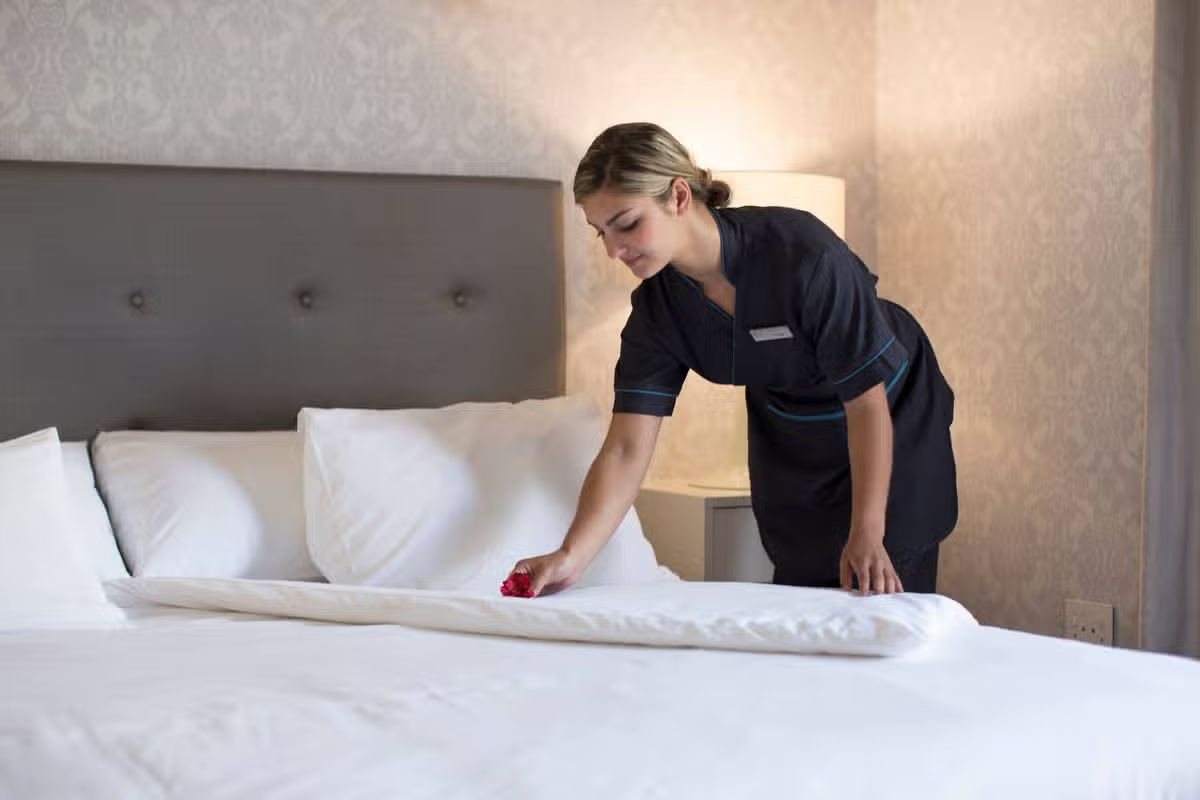
The Sun’s Head Of Travel (Digital) has waged a war against hotel bed runners for years – but she’s recently done a u-turnIt turns out that the runners on hotel beds actually have an important useCredit: Alamy
Because while I love a crisp, white, freshly-laundered hotel bed, I am fully aware that the runners at the end of the bed see the inside of a washing machine far less than the sheets.
And I really don’t want to think about how many sweaty, bare bottoms have been pressed up against them before I checked in.
But… it turns out the random, possibly quite dirty piece of fabric actually has an important use – it’s to protect the bed sheets while you unpack.
So your bags, which have scraped the underbellies of aircraft, been dragged along airport floors and left to stand on grubby pavements, usually get spread across the duvet once you’ve checked in, so you can unpack.
The bed runner is there to stop any of that suitcase grime coming off onto the sheets.
Once you’ve hung up all your clothes, the runner can then take its rightful place at the back of the wardrobe.
The humble bed runner isn’t the only little-known travel hack provided by hotels, planes and attractions either – here are nine more that have the power to transform your holiday.
Ryanair’s in-flight trolley service usually starts at row 1 and works its way towards the back of the plane.
EasyJet usually starts at row 1 and row 30, at the back of the plane. They work towards each other, with rows 17 and 18 being served last.
British Airways usually starts at the front of each cabin, then works towards the back.
So, if you’re hoping to be the first to get served, keep this in mind when reserving your seats.
Request a ‘special meal’ to get served first on a long-haul flight
Speaking from experience, if you opt for one of the speciality meals when making your flight booking, you’ll almost definitely get served first at mealtimes.
You can usually opt for a whole range of food, from veggie and vegan to religious restrictions.
Reserving sun loungers
There are ways to beat the rush for the sun beds by the hotel pool – but they only work in certain locationsCredit: Alamy
We’ve all been there. You’ve enjoyed a lie-in and a leisurely breakfast, as is your right on holiday, then you get to the pool, for a perfectly respectable 10.30 am… and all of the sun loungers have been bagged.
But there are some unicorn hotels where they will actually let you reserve your sun loungers for the week, so that you can skip the early morning race for the beds.
Cyprus is leading the charge on this front, with the Sunrise chain in Protaras and the Kanika Hotels group both offering the service.
Alternatively, if you’re willing to tip the pool staff on the first day, in destinations like Hurghada in Egypt, many of them will get your sunbeds ready every day.
Some of them even bring your drink over as soon as you’ve arrived and settled in.
Free toothbrushes, razors and other bathroom items
Fancy hotels often come with bathroom amenity kits as standard, with everything from razors and toothbrushes to shower caps and toothpaste included.
But many lower-tier hotels also keep these items stocked behind reception, in case guests have forgotten something.
So next time you’ve left your toothbrush at home by mistake, have a friendly word with the receptionist before you pop out to the shops, as they may already have what you’re looking for, free of charge.
Free magazines at the airport
Magazines that we’ve got free from complimentary stands at UK airports before
One of the most common items to buy at the airport is magazines and newspapers, especially when you have to kill time.
However, this can quickly rack up in price when many of the glossy mags cost as much as £4.99.
But did you know that many airports have free magazine stands?
They can often be found in the corridors when you are travelling to your gate, or even after you have gone through the gate agent and are waiting to board.
But the best are often found near the posh airport lounge exit.
They vary depending on which ones they have, so you can’t always be fussy.
On flights from London Gatwick, we’ve managed to pick up Wallpaper* magazine, as well as Escapism, Conde Nast Traveller and Stylist.
Freebies at Duty Free
Duty Free shops at airports are like Marmite – you either love them and spend a good half hour browsing, or dash through as quickly as possible.
But by skipping it, you could be missing out on some great freebies.
Many of the counters have samples of products to give away – everything from face serums and perfume to hand cream.
A lot of the larger airports often offer mini makeovers at certain high-end makeup counters, too.
Free airport lounge
If you’ve ever wandered past the easyJet Lounge before a flight after spending a small fortune on Pret, more fool you.
EasyJet passengers who book an Inclusive Plus fare automatically receive up to three hours of access to several airport lounges across the UK.
They include lounges at the following airports: Birmingham, Bristol, Edinburgh, Jersey, Gatwick, Luton, Manchester and Stansted.
Visitors can get tea, coffee and soft drinks, as well as beer and alcohol, plus hot and cold food.
The Inclusive Plus fareis more expensive than the standard fare, but it comes with a bunch of extras like fast track security and free meal deals onboard.
Max out the free hot water
This one might seem trivial, but you could save at least £15 on a flight by asking cabin crew for hot water fill-ups.
Bring your reusable cup and some teabags on a flight and have tea for the whole journey.
Alternatively, you can also bring an instant noodle cup and ask them to fill it with hot water for a very affordable and hot in-flight meal.
Loyalty perks
Plenty of hotel chains offer free perks for customers who sign up to their loyalty programmes – and many of those programmes are either free or cost very little to join.
Hyatt, Hilton, Marriott Bonvoy and IHG all have loyalty schemes that give you little extras like late check-outs, free wifi, booking discounts and even ‘extra night free’ offers.
As technology becomes more and more advanced and accessible to people, cruise ships have to put rules in place to make sure passengers are safe, and their privacy is protected
Having one item onboard could leave you in lots of trouble (stock)(Image: Getty Images)
People are being warned that they could be fined or kicked off a cruise ship they’re a passenger on for wearing 1 luxury item when onboard. Several cruise companies have introduced a number of new rules in 2026 to ensure the safety of passengers travelling on board.
As technology continues to advance and people snap up the latest gadgets, cruise operators are keeping their policies up to date to safeguard holidaymakers and protect their privacy while travelling at sea. Whether you’re sailing with Disney, Virgin, P&O or Fred. Olsen., each cruise liner has their own set of rules that could land passengers in trouble.
Don and Heidi, a couple who have clocked up 100 cruises between them, regularly share updates and handy tips on TikTok, and have been keeping a close watch on shifting cruise policies over recent months.
With the rise of people wearing smart glasses, such as the very popular Meta Glasses, cruise ships have been forced to take steps to protect their passenger’s privacy when they’re traveling on cruise liners.
Don said: “Cruise lines are instituting new policies and in 2026, these behaviours will get you fined, banned, or removed from the ship entirely.
Content cannot be displayed without consent
“One, recording other passengers without their consent using technology like Meta Glasses is a serious violation of privacy policies and fellow cruisers are reporting it.”
One of the cruise companies who has banned the items is Royal Caribbean who quietly updated its prohibited items list to tighten onboard safety and cybersecurity.
Recently, Royal Caribbean updated the verbiage on its prohibited items list to read: “‘Smart’ glasses from any of several manufacturers that can record video and audio are not allowed to be used in certain areas onboard the ship, including, but not limited to, public restrooms, Youth Program areas, medical areas, as well as the casino.”
Royal Carrabian’s app confirmed that if a guest fails to abide by the policy, the chief security officer and captain are authorized to confiscate the smart glasses.
Don continued: “Two, flying a drone from the ship is banned on nearly every cruise line. Get caught launching one and you’ll be escorted off at the next port.
“Three, fights on cruise ships are all over the news and lines are done looking the other way. Passengers involved in physical altercations are now being banned from certain cruise lines for life.
“Four, getting caught with prohibited items in checked luggage and you get escorted to a security meeting. Try to bring something more serious on board and you could be handed over to authorities at the next port.
“Five, this isn’t optional. It’s international maritime law. Skip the muster drill and crew will track you down to complete it. Refuse entirely and you’ll be removed from the ship before a set sail.
“Six, lighting up on your balcony, in your cabin, or anywhere else outside the designated smoking areas can get you fined and repeat violations can get you escorted off the ship.
“This includes vaping. Don’t forget to share this one with your cruise mates for your next sailing.”
P&O Cruises says bring ‘mandatory’ item or risk being denied boarding – The Mirror
Need to know
P&O Cruises tells all passengers they must bring proof or they will be ‘denied boarding’ at their own expense
The cruise line has a reminder for passengers on its website (Image: Getty )
P&O Cruises has a crucial requirement: all passengers must be aware that they could be denied boarding without it – what you need to know.
P&O Cruises says all passengers must bring crucial item with them or face being denied boarding. The cruise line has everything people need to know about the key document on its website.
The UK cruise operator states it is “mandatory for all guests to have suitable cruise travel insurance cover in order to sail with us.” Passengers who cannot provide proof of insurance will be turned away “at your own expense,” the company warns.
The policy applies across P&O’s entire fleet of seven ships, including family-friendly vessels like Arvia, Iona and Britannia, as well as adult-only ships Arcadia and Aurora. All vessels depart year-round from Southampton.
P&O emphasises that standard travel insurance may not be sufficient for cruise holidays. The company states: “A cruise holiday requires more specialist cover, for example if there was a need to be medically evacuated at sea.”
Passengers must bring either printed or digital copies of their insurance documentation. The cruise line warns that failing to declare pre-existing medical conditions could result in “extremely costly” medical bills or even refused treatment.
The insurance requirement comes as peak travel season approaches, with many Brits having already booked their cruise holidays.
P&O Cruises urges all passengers with trips booked to bring proof or risk being ‘denied boarding’ at their own expense
The cruise line has a reminder for passengers on its website (Image: Getty )
P&O Cruises says all passengers must bring a particular item with them or risk being ‘denied boarding’. The popular cruise operator states that packing the item is compulsory for all guests who wish to sail on the ship, or their holiday could be ruined if they fail to do so.
P&O Cruises is among the largest and most popular cruise operators in the UK, and as the peak travel season approaches, many people will have trips booked. The vessels are designed specifically for the British market and depart year-round directly from Southampton.
P&O Cruises operates a fleet of seven ships, divided into family-friendly vessels such as Arvia, Iona, Britannia, Azura and Ventura, and adult-only ships such as Arcadia and Aurora, reports the Liverpool Echo. Irrespective of which vessel people embark upon, all guests must bring a crucial item with them. Should customers fail to present the item, P&O Cruises warns: “Unfortunately, you will be denied boarding”.
On the P&O Cruises website, the cruise operator clarifies what passengers need to pack and explains the rationale. A statement reads: “We’re delighted that you’ve chosen to set sail with us, and we cannot wait to welcome you on board. Before we get there, it is mandatory for all guests to have suitable cruise travel insurance cover in order to sail with us.”
It adds: “It is your responsibility to ensure you have appropriate cover in place for the duration of your holiday. Unfortunately, you will be denied boarding, at your own expense, if you’re unable to confirm you have arranged insurance.
“You may be asked for proof of your cruise travel insurance. So, please be sure to bring either a printed or digital copy of your insurance documentation that confirms cover for the named travellers over the dates of travel.”
Outlining the main reason why travel insurance is crucial to arrange before setting sail, P&O Cruises stated: “For many significant purchases in your life, insurance is essential. And holidays are no different.
“Travel insurance ensures you can relax and enjoy your holiday with peace of mind that you’re covered in the event something should go wrong. This includes unforeseen incidents before your holiday, while travelling or while you’re away.”
P&O Cruises provides a checklist for selecting the appropriate level of cruise insurance protection. It includes:
Ensure your insurance covers a cruise holiday
Covers the full length of the trip
Includes all destinations – choose worldwide cover if unsure
Includes medical and repatriation cover of £2 million minimum
You’ll need to declare any pre-existing medical conditions
We would also recommend that you have adequate cancellation cover to cover the cost of your trip
I’ve got travel insurance already. Do I need cruise insurance?
P&O Cruises states: “You will need to look into the level of cover your travel insurance provides. Some bank accounts include travel insurance but the policies often offer limited amounts of cover.
“Standard travel insurance is generally meant for a land-based holiday and as such, won’t cover many of the elements of a cruise holiday. A cruise holiday requires more specialist cover, for example if there was a need to be medically evacuated at sea. The most important thing is to make sure you’ve told your insurer you are going on a cruise holiday.”
What happens if I don’t declare pre-existing medical conditions?
P&O Cruises warns: “You run the risk of not being fully covered and having to pay for medical treatment which can be extremely costly. Emergency medical treatment can even be refused if you do not have the correct insurance, this includes failing to declare pre-existing conditions.”
If I cancel my holiday, will I get my money back?
P&O Cruises states: “If you cancel your holiday, the cancellation policy in our Booking Conditions applies. If you are cancelling due to a medical reason and you have declared the medical condition, your insurer should refund any monies paid less the relevant policy excess.”
Little you may know, passengers travelling with Ryanair should obey by a certain rule when on planes. As soon as you board, it’s wise to remove a key item of clothing
09:32, 19 May 2026Updated 09:33, 19 May 2026
Ryanair passengers should remove the item of clothing (stock image)(Image: Jakub Porzycki/Getty Images)
Thetravel tip was recently shared online by a woman known as Sarah Geissler who alluded to the rule in a light-hearted way. Even so, she drew attention to something a lot of people may not be aware of when they’re jetting off onholidays, and this is that a certain item of clothing should be removed on flights.
She shared a clip of a sign on a plane seat, which seemed to show that heels are not permitted to be worn. Over the top of the clip, she wrote: “No heels allowed on your Ryanair flight.”
Sarah also teased that this was “bad news for baddies”, but it actually put a spotlight on something important. When it comes toair travel, there are some important things you need to be clued up on, but it’s not as simple as it seems.
Content cannot be displayed without consent
Indeed, while there are rules you need to follow about wearing heels when flying with Ryanair, this doesn’t mean you can’t wear them when at the airport. There are actually vital guidelines you should follow, especially in case of an emergency.
What you need to know
Even though people aren’t banned from wearing heels when travelling with the airline, it is highly recommended that they avoid doing so. Heels significantly increase your risk of tripping in the cabin and can puncture the inflatable emergency evacuation slides.
For safety reasons, cabin crew will instruct you to remove your heels prior to going down an escape slide in an emergency. This is why it’s best to remove them before boarding a plane, and perhaps slip into something more comfortable.
Even better, you could avoid wearing them in the first place. During an emergency, you must remove all high heels before going down the slide.
To ensure a swift escape, flight attendants suggest slipping them off before sliding, should an emergency ever occur. If one took place, passengers are also advised to leave their hand luggage behind.
In the footage shared online, the video also showed you shouldn’t wear glasses or smoke in such an emergency either. It’s a topic that’s got people talking on Reddit in the past.
One person said: “Heels can damage an escape slide, and I’d guess that glasses, ear rings and false teeth could be ripped out during impact. Hence, get them off before the event.”
Another noted: “My theory. Remove glasses, dentures. They may come loose and become lost (so, put them in a pocket).
“Remove high heels (especially important if you leave the plane via slide). Remove ear buds or headsets (so you can hear emergency instructions).”
A third also suggested: “The point is not to wear pointy things when coming down the inflatable slide in order not to make holes in it.”
The BBC programme visited an antiques fair at Belfast’s Botanic Gardens, with Fiona Bruce presenting as usual while guests brought along cherished possessions to discover their worth.
The opening valuation featured a guest clutching a genuine piece of rock and roll history. Expert Raj Bisram was clearly impressed when presented with three autographs from The Jimi Hendrix Experience members, reports the LiverpoolEcho.
Scrawled on the reverse of three ordinary-looking tickets were the signatures of the legendary guitarist alongside bandmates Noel Redding and Mitch Mitchell. The guest revealed how she managed to obtain press passes for the Northern Ireland gig back in 1967.
She explained: “I had a friend whose name was Jerry Fox. She was a great Hendrix fan because he had a song called Foxy Lady. She had a friend, who managed to get us backstage press passes for the concert.
“It was part of Queens University Festival Belfast. We were up at the very front. It was very loud. But it was a great concert and he did all his usual of playing his guitar with his teeth. I can’t remember, but I think he smashed his guitar at the end.”
The guest recalled the gig coincided with the All Along The Watchtower musician’s 25th birthday. She added: “The organisers at the festival had arranged to have a birthday cake for him and they presented it to him backstage.
“Because we had press passes, we were allowed to go backstage and he was there. The cake was on a table. “I don’t think he was eating the cake. From what I remember, he was drinking a bottle of whisky.””
Seizing her chance in the presence of music royalty, the guest recalled: “We only had these tickets so we got the three band members to sign the back of the tickets.”
The concert took place in 1967, and the guest revealed the signed tickets had been tucked away in an envelope ever since. Expert Raj explained that the memorabilia had soared in value following Jimi Hendrix’s death at just 27 in January 1969.
Items linked to Jimi command a hefty price tag, thanks to the legendary musician’s enduring and devoted fanbase.
The expert explained: “People do that but then they forget where they put the envelope. To remember it and to keep it is absolutely lovely, because, unfortunately, he died very young, which makes some of this memorabilia that he’s left behind, even more valuable.
“As far as valuation is concerned, obviously Jimi Hendrix is the one that’s the most valuable. But putting all three together, if these went to auction, they would make somewhere between £5,000 – £7,000.”
Stunned by the staggering figure, the guest exclaimed: “What? You’re joking. That’s crazy.”
You can catch up on Antiques Roadshow on BBC iPlayer
As we edge closer to summer, camping holidays are even more appealing, whether that’s by the coast or amongst woodland, and an expert has said there’s one item everyone needs to pack
07:17, 17 May 2026Updated 07:18, 17 May 2026
This article contains affiliate links, we will receive a commission on any sales we generate from it. Learn more
There’s an essential item to pack if you’re heading on a camping holiday(Image: Getty Images/Stock Image)
It’s that time of year again when I’m thinking about packing up the car and pitching up the tent for a weekend camping escape, but there’s one item that canvas enthusiasts shouldn’t forget.
While the British weather is somewhat unpredictable, when it does bless us with sun-soaked rays and warm temperatures, it’s the perfect time to head out on a camping trip. After all, what’s better than waking up to coastal vistas or the backdrop of enchanting forests and exploring the nearby surroundings before dining al fresco with a BBQ?
Yet before heading out on any camping adventure, there’s one packing essential.
Forest Ranger for Forest Holidays, Gerry O’Brien, told the Mirror: “My number one tip for everyone is to pack comfortable socks. If your feet get cold, the rest of you is going to be cold as well. So bring appropriate clothing for the time of year, but as we know, we can get all sorts of weather in Britain. Be prepared for all weather.”
As a forest ranger based at the Forest of Dean, Gerry has a wealth of knowledge about the otherworldly scenes of ancient woodland, rustic bridges, snowdrops, and spiralling rivers that make up the UK’s area of enchanting landscapes. There’s even an abundance of campsites in and around the Forest of Dean, which make for an ideal weekend escape or half-term break.
For those looking to spend time in the woodland, Gerry advised not to pack too much into one itinerary. “It’s great to pre-plan activities or to visit certain areas you’d like to see and do, but it’s good to weave in some non-scripted time because that’s often when you find the magic.
“So have a bit of time where you can tune into yourself and do what you feel in the moment, be spontaneous.” For those who might opt for a stay with Forest Holidays in one of their woodland cabins, rather than camping nearby, the expert added: “You might want to relax on your decking with a cup of tea and a good book.
“Or you might fancy a walk in the woods or something more high-energy, you can read off that if you have unplanned time. We’re so wired to be so busy all the time, but it’s good to take it back a bit and slow down.”
The forest ranger added: “One of the most magical things is just stopping. Maybe sitting in the forest for a while, we’re always going from A to B, so just stop and sit somewhere. Having a little sit mat with you is always handy, and just put your phone on do not disturb.”
In another piece of advice for people looking to appreciate the great outdoors, Gerry said: “It sounds a little corny, but tap into your inner child. You can create a little scavenger hunt with the children, go on a mini-beast hunt together, or make a den or fairy house in the woods. There are lots of hands-on, immersive experiences you can do together.”
To discover a magical corner of the country, you might want to book a stay at Forest Holidays in the Forest of Dean, which provides an array of lodges, cabins and treehouses, some boasting outdoor hot tubs for relaxing beneath the towering canopy. Meanwhile, accommodation providers such as Sykes Holiday Cottages and Holidaycottages.co.uk also offer various properties throughout the area, not forgetting the camp sites nearby and those trusty cosy socks for any UK trip!
Do you have a travel story to share? Email webtravel@reachplc.com
easyJet passengers are being warned they could face serious consequences if they don’t completely switch off certain electronic devices
EasyJet customers must make sure of one thing while on board(Image: BrasilNut1 via Getty Images)
Holidaymakers travelling with easyJet this summer are being warned that they could unknowingly fall foul of strict cabin rules unless they fully switch off a commonly used electronic device before stepping on board. The trouble is that many passengers only discover the rule once they’ve already reached the airport or are on the verge of boarding, where last-minute slip-ups could spell serious problems.
According to EasyJet, the warning relates to e-cigarettes and vaping devices, which must be carried in hand luggage only and are strictly forbidden from being stowed in hold baggage under any circumstances. The airline’s official policy states: “All electronic cigarettes and vaping devices must be carried in the cabin, re-charging is strictly prohibited and the device must be completely switched off.”
It also advises passengers to keep their devices on their person where they can be kept an eye on throughout the flight, reducing the risk of accidental activation. These rules are in place due to concerns over lithium-ion batteries, which are used to power vaping devices and are well known for posing a fire risk if they become damaged or overheat.
The UK Civil Aviation Authority categorises lithium batteries as a significant safety risk in aviation due to their potential for ‘thermal runaway’, producing intense heat and flames that are notoriously difficult to extinguish in confined spaces. The International Air Transport Association has highlighted a worldwide rise in lithium battery-related incidents, which has gone hand in hand with the increasing prevalence of portable electronic devices, prompting airlines across the globe to tighten their rules considerably.
EasyJet also warns that passengers must take precautions to prevent their vaping devices from being switched on accidentally during flights, including ensuring they are fully powered down before boarding. The airline stipulates that travellers may carry no more than two spare batteries in their hand luggage, and that these must be properly protected to prevent them from coming into contact with metal objects.
Under UK aviation rules, vaping devices must be kept in hand luggage at all times. Official government guidance states that e-cigarettes are strictly prohibited from hold baggage.
Industry experts point out that confusion often arises because rules can vary between airlines and destinations, which can leave passengers unknowingly packing the wrong items before they even reach airport security. Aviation safety specialists also warn that using or charging vaping devices while on board flights is strictly prohibited by all major airlines, with penalties ranging from confiscation to fines or even travel bans in severe cases.
As summer travel demand picks up, holidaymakers are being urged to check airline regulations before they set off to avoid delays, confiscations, or being refused entry at the boarding gate.
For Vince Gervasi, chief executive of Triscenic Production Services, it was yet another body blow.
His company, a leading supplier of set and scenery storage and transportation for the film industry, was poised for a turnaround after nearly three years of losing money.
Then, last week, he said a line producer on “Shark Tank,” one of his long-standing clients, called him to say the hit ABC reality show was relocating production from the Sony Pictures Studios lot in Culver City to Atlanta.
“They said it was too expensive here to do anything,” Gervasi recalled being told. “I said, ‘Are you kidding me?’ This show has money.’”
For the last six years, Triscenic had dedicated a 70,000-square-foot warehouse at its Santa Clarita facility to store the show’s items, transporting them in 30 custom made semitrucks between seasons.
Battered by the pandemic, the dual labor strikes, economic downturns and consolidations, Gervasi told The Times in 2024 that he had laid off 78 of his 85 employees and winnowed down his once-buzzing operations that housed sets and scenery across 2 million square feet in 41 buildings to half that, with the expectation that things would bounce back.
Like many other local film industry veterans, he is still waiting.
Vince Gervasi, at Triscenic Production Services, in Santa Clarita.
(Bob Doyle)
“I’ve been doing this for 41 years. I’ve seen the good and the bad — this is a complete decimation. It’s unprecedented.”
From florists to prop rentals to catering and beyond, production services and craft businesses are the hub and spoke of L.A.’s film and TV industry. But many of these businesses — some of which have been family-operated for generations — are struggling to weather a post-pandemic slump in film activity deepened by runaway production, media consolidation and the end of the streaming boom.
Film shoot days in the Los Angeles region have fallen nearly 50% since 2019, according to FilmLA data reviewed by The Times. Employment in Los Angeles County’s motion picture and sound recording industry has similarly plummeted, with a loss of some 57,000 jobs in the last four years, federal labor data show.
The slowdown has become a major issue in the L.A. mayoral race as evidence mounts of the economic toll on the city.
Just last month major industry vendor Quixote — whose Star Waggons trailers were once ubiquitous on the streets of L.A. — announced that it was winding down most of its sound stage business in Los Angeles, closing its operations in Atlanta and laying off 70 employees.
In a note to its clients and partners, Hudson Pacific Properties Inc., Quixote’s parent company, said that “we have persisted through the prolonged and ongoing slowdown in commercial, television and film production. But ultimately, industry conditions have forced difficult decisions.”
Between 2022 and 2025, more than 80 such businesses across Los Angeles have closed down, according to a list compiled by the ACME Directory, a production resource that connects TV and film professionals with specialized products and services.
“It’s, in many ways, a much bigger reflection of the contraction we’re seeing in the industry right now,” said Kevin Klowden, a senior fellow at the Milken Institute, focused on entertainment and technology. “The surge in demand for streaming and the consequential demand to catch up on content hid the fact that the industry was shrinking.”
Last October, the family-run Costume Rentals Corp. began liquidating its inventory after dressing film and television characters for 50 years. The North Hollywood firm provided costumes for “Forrest Gump,” “Apocalypse Now,” “Fast and Furious” and, more recently, the 2024 Bob Dylan biopic, “A Complete Unknown.”
A year earlier, Valentino’s Costume Group closed its doors after two decades in business and sold off its 400,000 items. At the time, Shon LeBlanc, the North Hollywood shop’s last owner standing, said he had endured a “perfect storm” of calamities and was drowning in debt following the cancellation of 15 shows in a single week.
Even the legendary Western Costume, which has been in business since 1912, has been hurt by the slowdown. During the 2023 strikes by writers and actors, Western Costume furloughed 43 employees, or about two-thirds of its staff. Recently, the North Hollywood costume mecca, which has supplied such classic films as “Gone with the Wind,” “The Wizard of Oz,” “The Sound of Music” and the TV series “Mad Men,” furloughed an unspecified number of its workers, said two people familiar with the matter who were not authorized to speak publicly.
A representative of Western Costume did not respond to a request for comment.
Marc Meyer, the owner of Faux Library Studio Props, had strained to stay in business through the pandemic shutdown and the 2023 labor strikes — laying off 11 of his 13 employees.
By the start of 2024, Meyer, a set decorator who was credited with inventing the fake movie book, was drastically behind on rent, owing $500,000, he said.
Marc Meyer, closed the doors on Faux Library Studio Props in North Hollywood after almost 25 years in business.
(Mel Melcon/Los Angeles Times)
Meyer’s landlord had given him a week to come up with more than $100,000 in unpaid rent or vacate the 89,000-square-foot warehouse in North Hollywood filled with props, books, antique furniture and other items that have decorated such film and TV sets as “Angels & Demons” and “The X-Files” for almost a quarter-century.
Meyer came up with $45,000 to mollify his landlord, garnering a month’s reprieve. A GoFundMe was set up during the strikes and a host of industry colleagues such as “Top Gun: Maverick” set decorator Jan Pascale stepped up, buying props to help fill his coffers.
“The change in our city is palpable,” said writer and director Sarah Adina Smith, a co-founder of Stay in LA’s, a grassroots campaign aimed at increasing film and television production in Los Angeles. “It’s not just that so many crafts and artists are out of work, but you see small businesses, too. In L.A., we’re an ecosystem fed in large part by creative jobs, and that is quickly vanishing.”
Marlon Gilbert still waxes nostalgic about the days his Commerce-based company, Gilbert Production Service, stored and transported scenery and props for TV shows including “Dancing with the Stars” and feature films like “Batman.” At one time, he said, he was handling seven active TV shows in a single season.
“When it was still on Fox, the ‘American Idol’ finale, we had like 20 semitrucks going in and out. Money was flowing like crazy,” he said. “But eventually times got hard for them, and they cut back on their production stuff.”
By last year, Gilbert was down to just three clients. “It wasn’t sustainable,” he said.
In December, after three decades, the family-owned business filed for Chapter 11 bankruptcy and shut down too.
“I couldn’t pay rent on our warehouse lease, I blew through my savings and my 401(k),” he said. After his wife was hospitalized following multiple strokes in 2023, he said, “I didn’t have the energy to beat the bush for new business.”
“I would’ve liked to have gone out with more panache and made a big splash and money selling the business. But there was nothing left to sell.”
Scott Niner, president and owner of Dangling Carrot Creative, checks on a robotic machine as it fabricates at his shop in North Hollywood.
(Jason Armond/Los Angeles Times)
Scott Niner, president and owner of Dangling Carrot Creative, offers a case study in how production service businesses have navigated the tidal wave of upheavals.
After 18 years in business creating graphic signage, custom flooring and wallpaper to make sets look exactly as art directors dreamed up, the company filed for Chapter 11 bankruptcy last April.
Before the pandemic, Niner’s Valencia-based business was thriving.
In 2014, he opened a Georgia satellite office to service the film and TV productions that had migrated to take advantage of the state’s generous tax credits. He steadily expanded his workforce to 32 employees in L.A. and Georgia.
Production was so plentiful that he even branched into the bakery business in 2018, delivering graphics and cupcakes in the same order. At its peak, Dangling Carrot generated $800,000 a month.
When the pandemic shutdown hit, Niner’s monthly revenue dropped to $50,000, he said. He kept his workers employed by making face shields that he donated to hospitals.
“I hung in there, and it was painful,” said Niner, who received some government assistance.
During the strikes in 2023, he drained his 401(k) and his union pension to keep his shop open and his workers employed.
Niner said he deployed a strategy of “pivoting and praying.” He shifted his business to focus more on fabrication, making giant 3-D-printed items for movie premieres, 25-foot-long, 8-foot-tall and 8-foot-deep ammo chests for a “Call of Duty” promotion and even graphics at airports.
Last last month, Niner sold off his Georgia business as filming in that state shifted to the U.K. He downsized his home and moved his business from Valencia to a much smaller building in North Hollywood. He is now down to 11 employees.
“I have a very bright outlook on the future, especially because we’re getting phone calls from people who never would have called us because all the other guys are out of business,” he said. “There’s something to be said about the last man standing. But I’m the last man standing on $2 million in debt. I’m more like lying down.”
The industry got a reprieve last week when CBS announced that it was relocating its hit drama “Tracker” to Los Angeles from Vancouver, Canada, after receiving a $48-million tax credit. Many view such moves, however, as small wins over comprehensive ones.
“There’s been a fundamental change happening here over the past five years,” said Cale Thomas, a makeup artist who has worked on “Guardians of the Galaxy 3” and the recent biopic “Michael.”
Thomas, who is a member of Stay in LA, acknowledges that California’s step last year to double its tax incentives has helped to spur an uptick in local production, but that has not stopped the outflow of productions or resolved a host of restrictions and costs that have hampered the industry.
He worked on “The Mandalorian” and other Lucasfilm series that stream on Disney+ for five years. “We shot in Manhattan Beach Studios,” he said, but noted that Lucasfilm has since moved one show to the U.K. and produced two others there.
“This has been devastating for our industry,” he said. “Hundreds of generational family businesses aren’t being used anymore.”
The pain points are not confined to Hollywood.
Last year, Marvel Studios — which had made Georgia, known as Hollywood of the South, its primary filming center for such major franchises as “Avengers: Infinity War” — relocated much of its production to the U.K.
The impact has meant even fewer domestic productions causing an even bigger ripple effect.
Among the high-profile casualties was Hackman Capital Partners, which aggressively snapped up studios, acquiring $10 billion in assets under management before production activity plummeted nationwide.
In January, the company defaulted on its $1.1-billion mortgage on Radford Studio Center, the historic lot where “Seinfeld” and “Gunsmoke” were filmed and which gave Studio City its name.
Earlier this year, Hackman Capital Partners defaulted on its $1.1-billion mortgage on Radford Studio Center, the historic lot where “Seinfeld” and “Gunsmoke” were filmed.
(Gary Coronado/Los Angeles Times)
Three months later, lender Deutsche Bank filed a foreclosure complaint on the also-historic Kaufman Astoria Studios in Queens, N.Y., home to “Sesame Street” and “Succession.”
Gregg Bilson sold ISS Props, the Sunland-based company his father founded in 1977, to Manhattan Beach Studios, part of Hackman Capital Partners, five years ago, staying on as CEO to help run and expand the company.
After 40 years in the business, he retired last August with a little more than a year and a half left on his contract.
Bilson now sees himself as a Hollywood relic.
“Many of my contemporaries and I have had conversations where we say we saw the best of the film and TV industry when it was an art form,” Bilson said. “It will never be the same.”
Jet2 customers are being reminded of a rule the airline has that does not allow passengers to bring on board an item that is commonly available in airports. The popular airline reiterated its blanket ban for customers this week – and there are no exceptions.
Holidaymakers are advised not to bring the item with them beyond the gate leading to the aircraft. Most airlines have their own rules, which vary depending on which one you fly with, though many share the same for health and safety reasons.
Jet2 has a strict rule in place about bringing hot drinks on board, including teas, coffees and hot chocolates. The rule also applies to any hot food – even if it was purchased from a shop, cafe or restaurant in the airport terminal.
Jet2 reiterated the rule online to a passenger who asked whether they could bring a drink with them. The airline said: “You are able to bring any snacks or soft drinks on board bought in the terminal (after security).” However, it added: “Hot drinks are not permitted to be brought on board.”
People who are due to board flights will need to finish their hot food or drinks before being allowed on board. This rule applies to other airlines as well, like Ryanair, but some are more relaxed, like easyJet.
Content cannot be displayed without consent
What is the reason for this Jet2 rule?
On its website, Jet2 states: “You can’t bring hot food or hot drinks onboard our planes for safety reasons.” The Jet2 ban applies only to drinks customers bring on board.
Usually, passengers can purchase a variety of hot foods, as well as teas, coffees, and hot chocolates, on board Jet2 flights. Customers must remember the payment rule that applies to all flights.
Elsewhere, certain airlines, like easyJet, will allow hot drinks bought in the airport on board. This is provided the cup has a secure lid.
In other Jet2 news, the airline announced two new routes to a ‘stunning’ island with ‘sandy beaches‘, ‘aquamarine waters’, ‘cobbled streets’ and ‘rolling hills’. The new routes follow Jet2’s claims of continued customer demand and independent travel agents booking holidays for the short hop to the island.
Jet2 has confirmed significant expansion to its Jersey programme for summer 2027, by putting two new routes and additional capacity on sale, as well as extending the season. The airline has introduced flights and holidays from Birmingham and Bristol for Summer 2027.
In addition to the new routes, extra capacity to Jersey has been added from Manchester, and the summer season to the destination has been extended. It means Jet2 will operate to Jersey right through to the end of October.