
issues

Foreign Office issues Greece travel update as holiday hotspot suspends EU rule

Following a major change made by Greece, the Foreign, Commonwealth & Development Office (FCDO) has updated the country’s travel advice for British holidaymakers

The Foreign Office has issued an update on travel to Greece for Brits, and it’s good news.

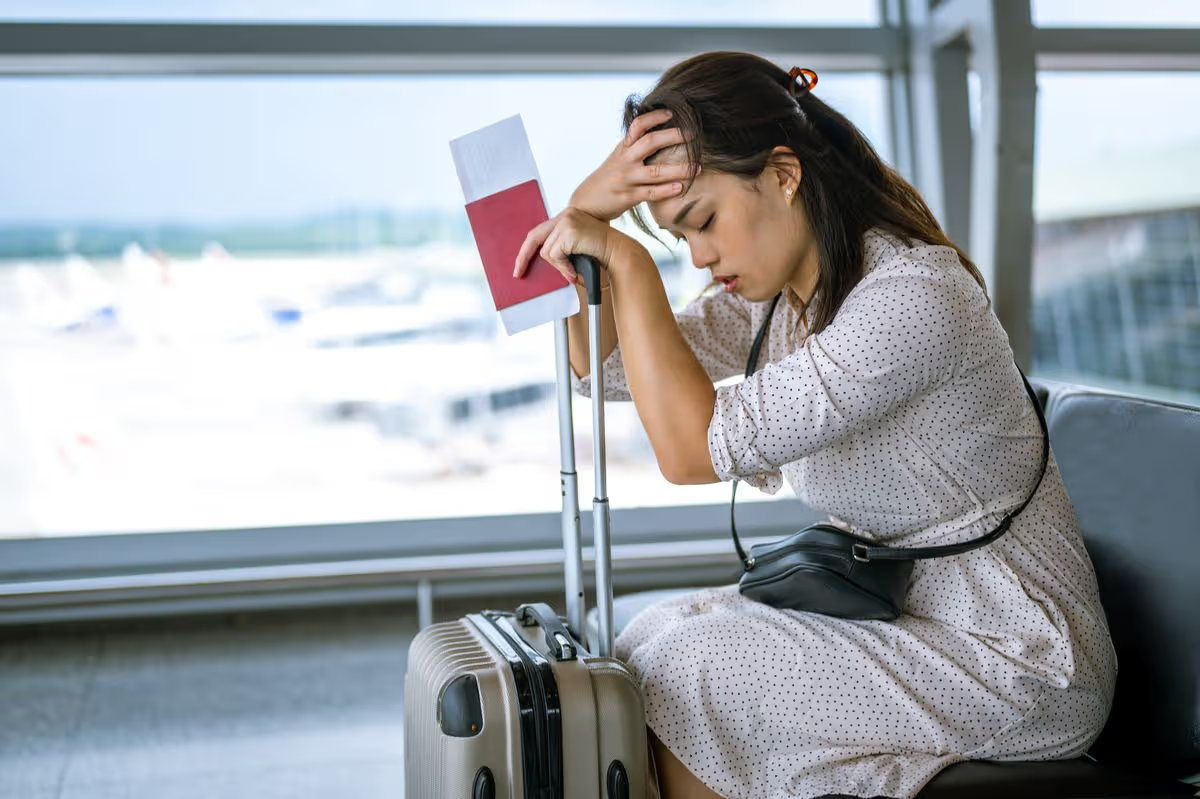
Since the European Union’s (EU) Entry/Exit System (EES) was fully rolled out earlier this month, there have been major travel disruptions. Holidaymakers have reported substantial queues and delays at airports across Europe, with some lasting up to four hours, while hundreds have missed flights as they try to pass through the new digital border system.

In a bid to ease travel chaos, Greece has chosen to waive the EU requirement for Brits to submit fingerprints and facial scans at airport border controls. In a statement from the Greek Embassy, they announced: “Update for British passport holders travelling to Greece.

READ MORE: Ryanair issues warning to customers – and it’s not down to fuel crisisREAD MORE: Major EU travel rule change from Wednesday could see UK travellers denied entry

“In the framework of the implementation of the Entry/Exit System, as of 10 April 2026, British passport holders are exempt from biometric registration at Greek border crossing points.” There was no suggestion of how long the exemption would remain in place, but soon after, the Foreign, Commonwealth & Development Office (FCDO) revised its travel guidance for Greece.

In an update on Monday, 20 April, the FCDO stated: “Greek authorities have indicated that they will not collect biometric data (fingerprints and photos) for UK travellers as part of EES. Follow the advice of authorities on the ground. If you are a resident in Greece, make sure to show your residence documentation at passport control to ensure you are not registered in EES.”

Greece opted to ditch the new biometric security measures amid concerns about the significant travel chaos they were causing at airports, severely impacting holidaymakers. The relaxed EU rules from Greece are now hoped to improve travel for Brits into the country, allowing for a smoother journey without gruelling wait times and unnecessary delays.

Noting the impact of the EES, Luke Petherbridge, director of public affairs at ABTA, said: “While for many the travel experience remains smooth, we’re disappointed and frustrated to see some passengers being caught up in delays due to EES.

“Abta has been warning destinations and the (European) Commission for some time about the need for proactive steps to be taken to avoid delays, including the full use of contingency measures to stand down biometric checks at busier times, and adequate staffing, especially at peak times.”

The EES was fully implemented across European airports on April 10, 2026, and requires all Brits travelling to the Schengen area to “create a digital record” and register their biometric details, such as fingerprints and a photograph. It’s needed for their first arrival at the airport border in the Schengen area, and after the initial registration, the EES remains valid for three years.

Countries in the Schengen area include: Austria, Belgium, Bulgaria, Croatia, Czechia, Denmark, Estonia, Finland, France, Germany, Greece, Hungary, Iceland, Italy, Latvia, Liechtenstein, Lithuania, Luxembourg, Malta, Netherlands, Norway, Poland, Portugal, Romania, Slovakia, Slovenia, Spain, Sweden, and Switzerland.

However, as it stands, Greece is the only country to relax the EU requirements for Brits. The EES system is not required for travel into the Republic of Ireland and Cyprus, as they are not within the Schengen area.

For more information on the new EES system, visit the government website.

Do you have a travel story to share? Email webtravel@reachplc.com

Source link

Ryanair issues warning to customers – and it’s not down to fuel crisis

The warning comes at a time of global turmoil

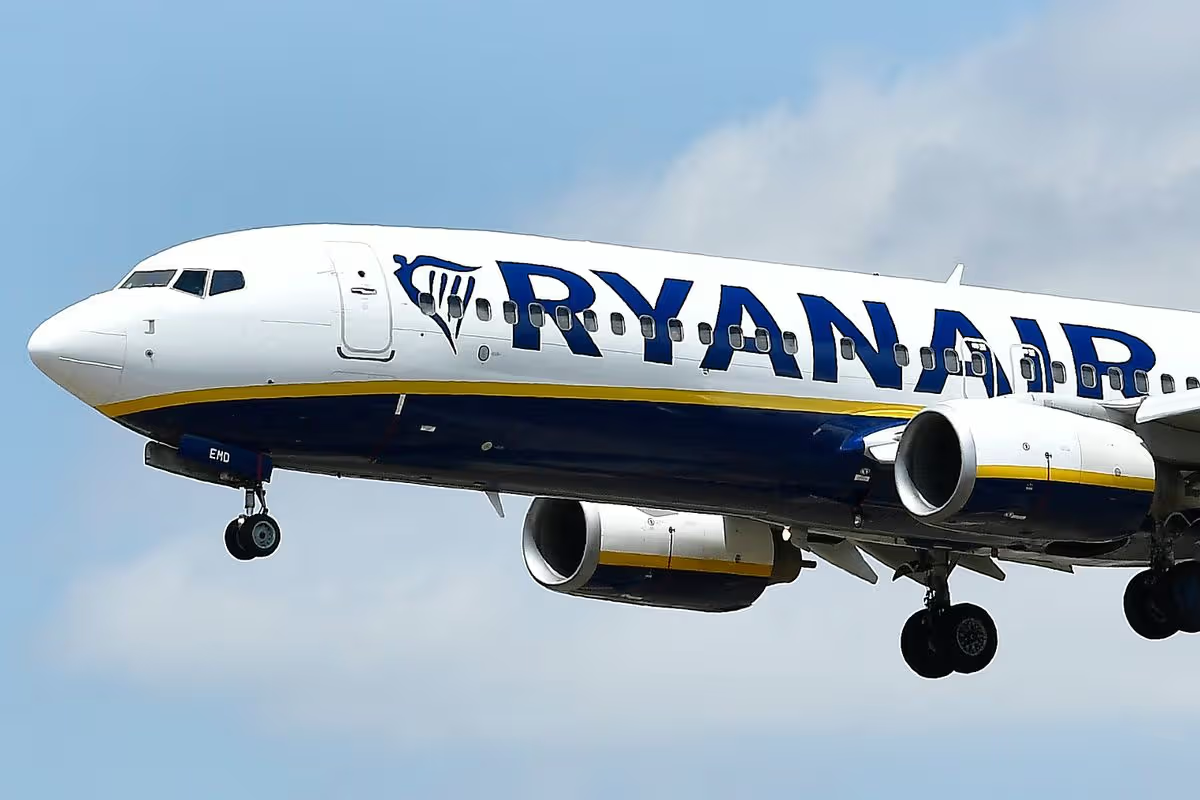
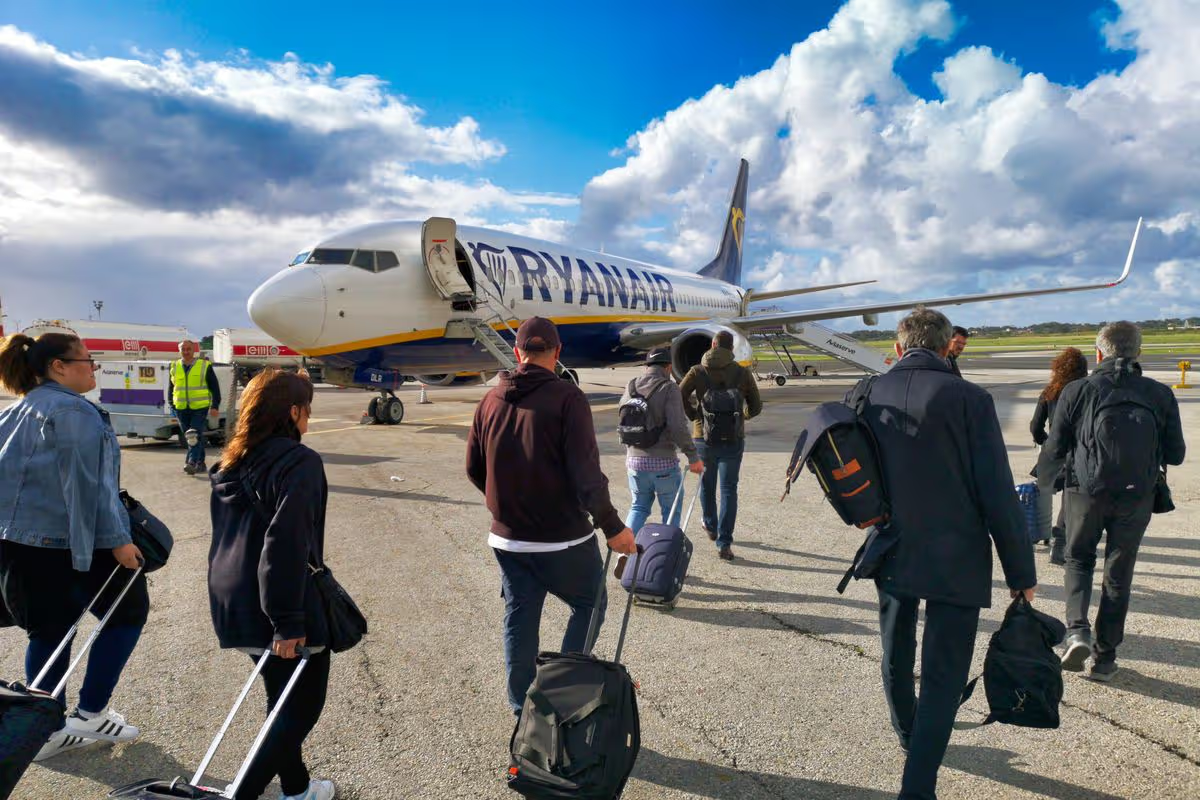
Ryanair has issued a warning to passengers hoping to fly in the days ahead. The budget airline has sent emails to travellers flying from the UK to large parts of Europe.

It cautions of ‘longer queues, particularly at busy airports’. The reason is the new Entry and Exit System (EES), which has been rolled out by the European Union (EU). It requires all travellers from the UK and other non-EU nations to be photographed and fingerprinted at EU airports and border crossings.

The objective is for the new system to replace manual passport stamping and more efficiently track the 90-day visa-free limit, but there have been accounts of it causing delays stretching to several hours at busy airports. It has even been temporarily suspended at times to clear the backlog.

In a message to customers titled ‘Important: Changes to Passport Control’, Ryanair says: “From 10 April 2026, the EU’s Entry/Exit System (EES) is in place at all Schengen Area external borders. As a result, passport control may take longer for some passengers.

“You are affected if you hold a non‐EU / non‐EEA / non‐Swiss passport (e.g. UK, USA, Canada, Australia), and are flying into or out of the Schengen Area.

“Commonly affected routes include flights between the Schengen Area and countries such as: UK, Ireland, Cyprus, Albania, Montenegro, Serbia, Türkiye, Egypt, Israel and others.

“At passport control you may need to:

  • Scan your passport
  • Provide fingerprints
  • Have a facial image taken

These checks may cause longer queues, particularly at busy airports. Queues may form before security.

If affected, please:

  • Arrive at the airport early to allow for queues
  • Have your travel documents ready
  • Follow signs marked EES / Passport Control

Those who are not affected:

  • EU, EEA and Swiss passport holders
  • Flights within the Schengen Area (e.g. Spain–Italy, France–Germany)

“If you are denied entry, this will be due to EU policy, not Ryanair’s rules.”

Greece has reportedly opted to pause the EES rollout following considerable delays. A statement on the Greek Embassy website and posts across official social media channels said: “In the framework of the implementation of the Entry/Exit System, as of 10 April 2026, British passport holders are exempt from biometric registration at Greek border crossing points.”

Airport representatives and the European Commission convened a meeting on Tuesday to address issues surrounding the system. Approximately 122 passengers were left stranded and unable to board their flight from Milan Linate to Manchester on Sunday, following severe hold-ups at passport control linked to the introduction of the EES.

The Foreign, Commonwealth and Development Office has confirmed that your details will need to be re-registered every three years. A statement also warned that travellers may face longer waiting times when entering or departing a country. It states: “The European Union’s (EU) Entry/Exit System (EES) started on 12 October 2025 This is a new digital border system that has changed requirements for British citizens travelling to the Schengen area.

The countries in the Schengen area are: Austria, Belgium, Bulgaria, Croatia, Czechia, Denmark, Estonia, Finland, France, Germany, Greece, Hungary, Iceland, Italy, Latvia, Liechtenstein, Lithuania, Luxembourg, Malta, Netherlands, Norway, Poland, Portugal, Romania, Slovakia, Slovenia, Spain, Sweden, and Switzerland.

READ MORE: ‘Our home burned down after moving in – we didn’t even have time to unpack’READ MORE: Brits flying to EU issued Defra warning after foot and mouth disease outbreak

The Republic of Ireland and Cyprus are not within the Schengen area, and therefore EES is not applicable when travelling to either of these countries. If you are travelling to a country in the Schengen area for a short stay using a UK passport, you may be required to register your biometric details, such as fingerprints and a photo, when you arrive. You do not need to take any action before you arrive at the border, and there is no cost for EES registration.

EES registration is replacing the current system of manually stamping passports when visitors arrive in the EU. EES may take each passenger extra time to complete so be prepared to wait longer than usual at the border.
“On your first visit to the Schengen area, you may be asked to create a digital record at the port or airport on arrival. You may be asked to submit your fingerprints and have your photo taken at dedicated booths. You don’t need to provide any information before travelling to a Schengen area country. The checks may take slightly longer than previously, so be prepared to wait during busy times.”
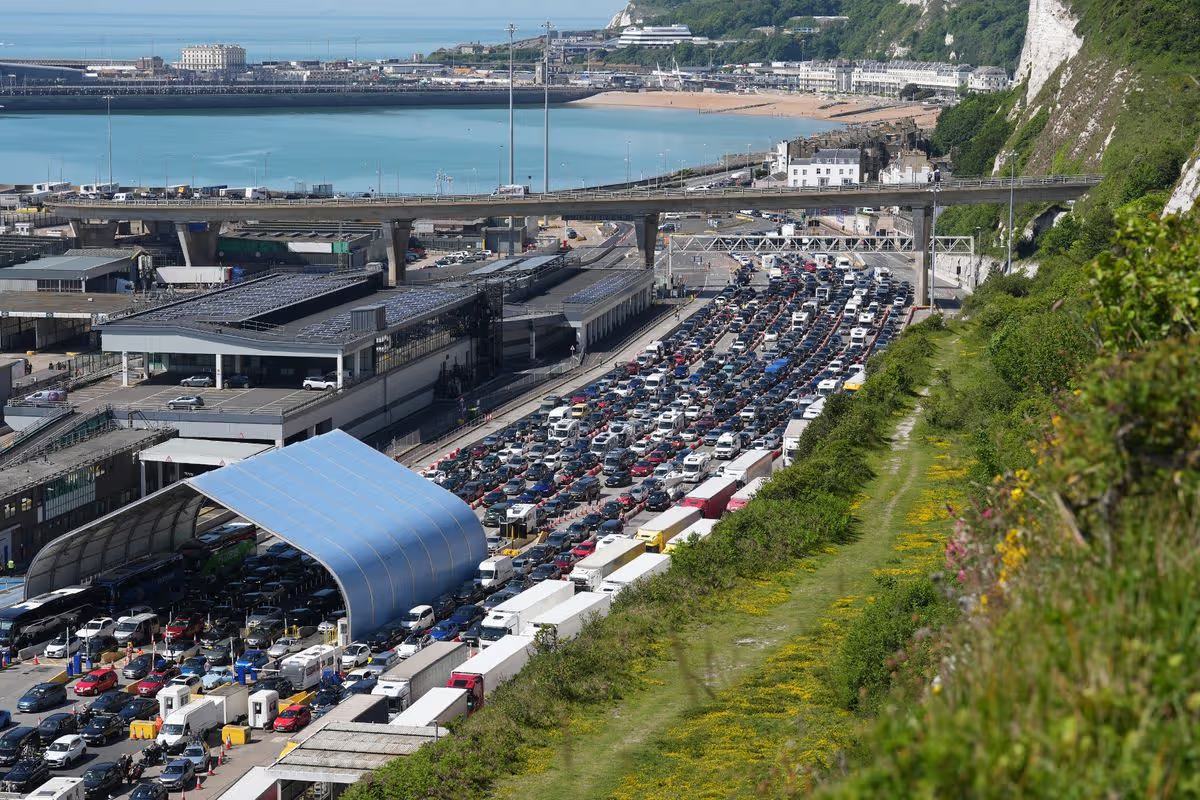
“If you enter the Schengen area through the Port of Dover, Eurotunnel Le Shuttle at Folkestone or Eurostar, St Pancras International, any EES checks will be completed at the border, before you leave the UK. You may also be asked to provide either your fingerprint or photo when you exit the Schengen area.”

“If you frequently travel to the Schengen area for work and/or leisure purposes, you must ensure that your total stay in the Schengen area is no more than 90 days in every 180 days. You must be aware of the penalty and enforcement approach for exceeding the immigration limit in any individual Member State you plan to travel to, or through.”

Source link

Britain’s Got Talent viewers ‘can’t watch’ as ITV issues urgent warning

Britain’s Got Talent viewers complained about one act tonight, calling it inappropriate for family viewing

Britain’s Got Talent viewers have voiced the same grievance, urging ITV bosses to “do better” following an “utterly inappropriate” act.

The beloved ITV talent programme has returned to screens once again with a brand new series, featuring BGT judges Simon Cowell, Amanda Holden, Alesha Dixon and KSI, alongside legendary hosts Ant and Dec.

Tonight (April 18) marked the final round of auditions, but one particular act left viewers at home feeling “sick” and outraged. Fakir Testa, 45, was welcomed onto the stage, leaving both the audience and judges curious about what his performance might involve – and no-one could have guessed.

Viewers at home were quickly horrified to witness him standing on blades while having them pressed against his neck, prompting ITV to issue a ‘do not try at home’ warning.

Admitting she was “stressed”, judge Alesha pressed her red button, joined by Simon, who appeared distinctly unimpressed by the performance, reports Wales Online.

Members of the audience were also spotted turning away and peeking through their fingers, while judge Amanda buried her face in her hands.

Nevertheless, Fakir proceeded to invite Simon onto the stage, requesting he take a seat in a waiting car, before hauling it with a blade pressed against his neck.

The audience seemed to watch on in sheer horror, yet the act proved popular with the Blackpool crowd, as KSI was overheard exclaiming: “You madman, you crazy madman.”

However, viewers at home remained thoroughly unimpressed, as they directed their frustration squarely at ITV bosses. Taking to X, one person wrote: “WHAT THE ACTUAL HECK IS THIS? #BGT.” Another said: “This is NOT a family show #bgt.”

A third fumed: “F***s sake. This is on pre watershed. Do better #itv.” A fourth commented: “This is NOT talent! This is f***** lunacy.”

A fifth echoed: “I can’t watch! Why are they showing this for family entertainment #BGT ?!!?”

One viewer admitted they felt “sick” while another confessed they “can’t watch”. One person labelled it as “utterly inappropriate” as another added: “There are far too many of these Don’t try this at home stunts on #bgt . How about don’t show them on the Tele?”

However, one impressed viewer enthused: “Faki Testa – oh my days that was strange so hard to watch but b****y brilliant entertainment.”

Another offered an explanation: “The blade has to move sideways to cut or use a large amount of energy to chop My Kung Fu teacher had us do this, including spears in our throats, back in the day #BGT.”

Judge Alesha also appeared to reverse her earlier red buzzer decision as Fakir successfully made it through his audition.

Britain’s Got Talent can be streamed on ITVX

Source link

Jet2 issues two-day warning to passengers

Jet2 issued a new alert on Friday morning

Jet2 has issued a warning to many passengers who are soon due to fly abroad.

One of the UK’s largest airlines, Jet2 now flies from some 14 airports across the country, including London Gatwick, Manchester, and Birmingham. Jet2 also flies from East Midlands Airport, and passengers due to travel from here over the weekend have been urged to plan wisely ahead of their trips. On Friday morning (April 16) Jet2 issued a new alert ahead of an expected “increase in traffic”.

Jet2 said at 10am on Friday: “We wanted to let you know there may be an increase in traffic over this weekend due to the British Touring Car Championship event at Donington Park on Saturday 18th April 2026 and Sunday 19th April 2026. If you’re affected, please allow extra time for your journey to the airport as we’re operating all our flights as scheduled.

“Please arrive at the airport at least two hours before your departure time. Check-in closes 40 minutes before a flight’s departure time.”

The announcement comes after Jet2 also updated passengers travelling to parts of Spain on Friday. The airline warned there may be some delays on flights to Lanzarote, Fuerteventura, Jerez, and La Palma, due to strike action by Spanish Air Traffic Control company Saerco.

All passengers travelling with Jet2 are advised to check the travel information section of its website at least 12 hours before their flight is due to depart.

Source link

Venezuela: Trump Administration Issues Banking Licenses as Rodríguez Eyes ‘Long-Term’ US Energy Ties

Rodríguez hosted US Energy Assistant Secretary Kyle Haustveit at Miraflores Palace. (Presidential Press)

Caracas, April 15, 2026 (venezuelanalysis.com) – The US Treasury Department’s Office of Foreign Assets Control (OFAC) issued two new general licenses on Tuesday facilitating transactions with Venezuelan state institutions.

 for Venezuela on Tuesday: a commercial license (No. 56) and a financial license (No. 57), signaling a partial easing of restrictions while maintaining key controls.

General License 56 (GL56) authorizes US entities to negotiate and sign “contingent contracts” for future commercial operations in Venezuela. This allows firms to move forward with agreements, investments, or projects, though their final execution remains subject to separate OFAC approval.

The waiver maintains important restrictions, including a ban on payments in gold or cryptocurrencies, as well as prohibitions on transactions involving China, Russia, Iran, North Korea, and Cuba. It likewise forbids transactions involving Venezuelan debt and does not unblock currently frozen Venezuelan assets.

For its part, General License 57 (GL57) permits a broad range of financial operations with the Venezuelan Central Bank (BCV), as well as Venezuela’s public banks: Banco de Venezuela, Banco Digital de los Trabajadores, Banco del Tesoro, and entities in which these institutions hold a 50 percent or greater stake.

The allowed transactions include opening and managing accounts, conducting US dollar transfers, issuing loans, and providing banking services. The BCV was sanctioned in April 2019, effectively isolating Venezuela from international financial circuits and increasing costs for basic transactions.

The latest sanctions waivers are expected to facilitate financial flows to the Venezuelan economy, including the transfer of Venezuelan oil revenues that are currently controlled by the Trump administration. US authorities have returned a confirmed US $500 million out of an initial deal estimated at $2 billion, while US and Venezuelan officials have confirmed the purchase of US-manufactured medicines and hospital equipment using Venezuelan funds.

Analyst Hermes Pérez warned that reincorporation into the SWIFT system and establishment of US-based accounts could take several months due to security and technological requirements. Other economists argued that GL57 could allow the Central Bank to stabilize the Venezuelan foreign exchange system.

For several years, a parallel exchange rate between the US dollar and the Venezuelan bolívar has coexisted with the official one set by the Central Bank, often with a gap above 50 percent that fueled distortions in retail activities and currency speculation.

Since the January 3 military strikes and kidnapping of Venezuelan President Nicolás Maduro, the Trump administration has issued several licenses to expand US influence in the Caribbean nation, particularly in key economic sectors such as hydrocarbons and mining.

In parallel, Venezuelan authorities have promoted several pro-business reforms, while multiple Trump officials and corporate executives have come the South American country and held meetings with the acting government led by Delcy Rodríguez.

The latest waivers coincided with the visit to Caracas of a US Department of Energy delegation led by Assistant Secretary Kyle Haustveit. Rodríguez hosted the official on Wednesday in a work meeting at the presidential palace.

During a short, televised intervention, Rodríguez argued that OFAC licenses do not provide sufficient “legal certainty” and reiterated calls for Trump to lift unilateral coercive measures against the country.

“An investor requires greater legal certainty. A license does not provide long-term legal guarantees because it is subject to temporality,” she argued. Rodríguez claimed Washington and Caracas have “enough maturity” to establish “long-term” energy cooperation ties.

“We are working very hard on changes that can attract investment, and which can build an energy cooperation agenda with the United States,” she said.

Rodríguez additionally disclosed recent meetings with representatives from ExxonMobil and ConocoPhillips, stating that authorities have “taken into account recommendations” from oil majors in recent legislative overhauls. Both ExxonMobil and ConocoPhillips refused to accept hydrocarbon reforms under former President Hugo Chávez in the 2000s, later securing multi-billion-dollar arbitration awards against the Caracas as compensation for the nationalization of their assets.

Haustveit and the Energy Department delegation were also present on Monday during the signing of agreements with Chevron that granted the Texas-based conglomerate an increased stake in the Petroindependencia joint venture and awarded an additional extra-heavy crude bloc for exploration to the Petropiar mixed company. Chevron owns minority stakes in both joint enterprises with Venezuelan state oil company PDVSA.

Shell, Eni and Repsol are among the other energy giants to have recently advanced in deals with the Venezuelan government under the improved conditions of the new Hydrocarbon Law.

US Chargé d’Affaires in Venezuela Laura Dogu was also present at the Chevron deal-signing ceremony and the meeting with Haustveit’s delegation. However, the White House announced Wednesday that her post will be taken over by veteran diplomat John Barrett.

Barrett, who previously served as chargé d’affaires at the US Embassy in Guatemala since January 21, 2026, was recently accused by Guatemalan President Bernardo Arévalo of interference during judicial elections for the Constitutional Court held in March.

Edited by Ricardo Vaz in Caracas.

Source link

easyJet Portugal update as airline issues warning over new ‘allowance’ rule

EasyJet’s general manager in Portugal has issued a warning over new government proposals the carrier says will artificially inflate prices

easyJet is weighing up plans to cut back operations in Portugal, according to reports emerging from the country. The airline’s general manager there has issued the warning amid a dispute over government proposals which easyJet claims will drive up costs for passengers.

José Lopes, easyJet’s general manager in Portugal, announced on Monday that the carrier may cut back its domestic services following the scrapping of caps on something called the social mobility allowance for air travel. This caps maximum fares for some local passengers – but the changes are set to affect the airline more widely.

“Removing the upper limit will artificially inflate prices,” José Lopes said. He argued that the measure will deliver “zero benefits” for island residents while helping to deter tourists, who makeup the bulk of passengers on domestic routes.

The airline says it will not return to operate Azores routes due to the changes. It had already confirmed its departure from the region from March 29, 2026, blaming a 35 per cent increase in airport fees and what it describes as government inaction.

The easyJet representative was addressing journalists at a press conference in Funchal, held in partnership with the Regional Secretariat for Tourism, to outline the company’s operations and long-term pledges in the Madeira archipelago, SIC Noticias reports. Portuguese media outlets report that at Porto Santo airport, the two existing routes to Lisbon and Porto will be retained, albeit with a reduction to Lisbon owing to constraints at that airport, he indicated.

He warned that if the measure to alter the social mobility subsidy regime – which would remove the maximum limits for air travel for residents of Madeira and the Azores – is implemented, there will be implications for Easyjet’s operations. “I hope that an analysis will be carried out and a way will be found to be more rational and less emotional in dealing with the matter,” he said.

When asked about the possibility of abandoning the route to Madeira, the official ruled out this scenario. Yet reports say he highlighted the possibility of “a reduction in market capacity.”

The changes were given the green light on Friday in the Assembly of the Republic, but have yet to come into force. The amendments stem from two initiatives to revise the legislation put forward by the Socialist Party and Chega.

What is the social mobility subsidy?

The social mobility subsidy set a maximum fare of €79 for residents and €59 for students travelling between Madeira and the mainland (round trip), with an overall cap of €400. In the Azores, residents travelling to the mainland pay no more than €119, while students are capped at €89, with a recently introduced maximum ceiling of €600.

The Portugal Post reports that Portugal Parliament’s recent decision to abolish price caps has placed island connectivity under serious threat, with easyJet warning of capacity reductions to Madeira and confirming it will not operate Azores routes under the new framework.

Ryanair has also revealed plans to cease all operations in the Azores on March 29, 2026, citing cost pressures.

Source link