Islamic Relief calls for international action as Gaza endures deadly Israeli attacks and worsening humanitarian conditions.
Published On 8 Oct 20268 Oct 2026
Israeli attacks have killed or wounded a Palestinian in Gaza every 90 minutes on average since the ceasefire was announced in October last year, the aid group Islamic Relief says.
Islamic Relief, a United Kingdom-based charity, said on Thursday that at least 1,454 Palestinians were killed and more than 5,000 wounded over the year. At least 320 of those killed were children, close to one a day.
Recommended Stories
list of 3 itemsend of list
Gaza’s Health Ministry reported that 1,471 Palestinians have been killed and 5,189 wounded since the ceasefire, including four killed and 28 wounded in the past 24 hours.
Israel has killed at least 74,254 people since October 2023, the ministry added.
On Thursday, Israeli forces killed a Palestinian southeast of Deir el-Balah, in central Gaza, and an Israeli air strike on a house in central Khan Younis wounded several people, the Palestinian news agency Wafa reported.
In the occupied West Bank, a 13-year-old boy was shot in the foot during an Israeli raid on Yamoun, west of Jenin, the Palestinian Red Crescent said.
Islamic Relief said Israel has used the so-called Yellow Line, which marks the area under Israeli military control, to push Palestinians out of 65 percent of Gaza, crowding its nearly 2.1 million people into the remaining 35 percent.
According to the report, an Islamic Relief aid worker in Gaza whose name is withheld for their safety said: “There is no ceasefire in reality. They target displacement camps and crowded areas, so there is still a lot of fear.”
Israel continues to block shelter materials, fuel and medical supplies, the group said.
About 82 percent of Gaza’s structures are damaged or destroyed, more than half of health services have shut down and more than 20,000 severely ill patients are denied permission to leave for treatment.
The charity urged world leaders to increase pressure to protect civilians and uphold international law.
“A ceasefire in name only cannot be an excuse for international inaction,” it said.
Colombian President Abelardo De la Espriella had promised closer ties with Israel on the campaign trail.
Published On 8 Oct 20268 Oct 2026
Israel has announced that Colombia will open an embassy in Jerusalem, becoming the latest country to establish a diplomatic mission in the disputed city claimed as a capital by Israelis and Palestinians. Most countries have their embassies in Israel in Tel Aviv.
Israeli Foreign Minister Gideon Saar said Thursday the Latin American country’s embassy would open next week as he touted expanding relations with the region.
Recommended Stories
list of 3 itemsend of list
“Next Wednesday, we are going to inaugurate … the Colombian embassy,” Saar told attendees at a conference in Jerusalem.
An official at the Colombian Foreign Ministry in Bogota told AFP news agency the country’s Foreign Minister Omar Bula Escobar would travel to Jerusalem on Sunday ahead of the opening.
Colombian President Abelardo De la Espriella, who was sworn in as president in August, promised close relations with Israel during his election campaign. When he came into office, he restored diplomatic ties between Colombia and Israel. Colombia had previously severed ties with the country over Israel’s genocidal war in Gaza.
The announcement comes as a small but growing list of countries has opted to route their diplomatic ties with Israel through Jerusalem.
Since 2018, the US, Guatemala, Paraguay, Kosovo, Honduras, Papua New Guinea, Fiji, Nauru and Somaliland, which has been recognised as an independent entity only by Israel, have opened embassies in the city.
Other countries that have diplomatic relations with Israel have located their embassies in Tel Aviv, as Jerusalem is not recognised by the international community as Israel’s capital.
“We will work hard because this is the diplomatic battle over the truth. And the truth is, Jerusalem was always the capital of one nation,” Saar said, dismissing Palestinian claims to the capital.
The Israeli minister said the Democratic Republic of the Congo would open its embassy in Jerusalem “very soon” and hinted at another opening.
“I think that with the possible results in Brazil, they might have the same move,” he said after right-wing Senator Flavio Bolsonaro won the first round in the country’s presidential election.
Protesters in Colombia took to the streets of Bogota on Wednesday to rally against the new far-right government’s policy towards Israel, including the decision to open the Jerusalem embassy.
“When diplomatic relations with Israel were broken off, the message was that we would not be a nation complicit in their atrocities,” Nicolas Isaza, who took part in the protest, told Al Jazeera.
“Today our government is no longer drawing a line against the atrocities being committed in Palestine,” he added.
Israel opened its first national pavilion at Morocco’s Marrakech Air Show, joined by Israel’s top military contractors.
Published On 8 Oct 20268 Oct 2026
Israel’s Ministry of Defence says it is participating for the first time in a defence exhibition in Morocco, as it announced its first-ever national pavilion at the Marrakesh Air Show 2026.
“This marks Israel’s first official participation in the defence exhibition held in Morocco since the signing of the Abraham Accords”, Israel’s Defence Ministry said in a statement on Thursday.
The ministry said eight Israeli defence companies exhibited “advanced, combat-proven technologies at the show” in Marrakesh, which runs until Saturday.
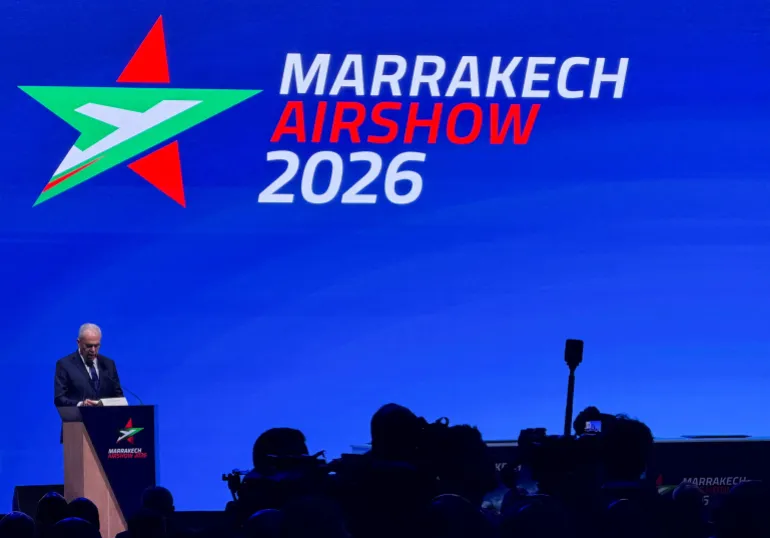
Abdellatif Loudiyi, Morocco’s defence administration minister, speaks at the Marrakech Airshow in Marrakesh, Morocco, October 7, 2026 [Ahmed El Jechtimi/Reuters]
The Marrakech Air Show, taking place from October 7 to October 10 this year at the Marrakech Royal Moroccan Air Force Base, is organised every two years and is meant for civil and military aeronautics and space industries to highlight their latest offerings.
“Israel’s three major defence industries, Elbit Systems, IAI, and Rafael, also exhibited, presenting solutions across the air, land, sea, space, intelligence, cyber, and digital domains,” it said.
Munition exhibited by Israel’s Elbit Systems at the Marrakech Air Show in Marrakesh, Morocco, October 7, 2026 [Ahmed El Jechtimi/Reuters]
The announcement is the latest sign of increasing ties between the Arabic-speaking North African country and Israel, since the two established ties in 2020 as part of the US-backed Abraham Accords.
Last month, Israel and Morocco agreed to upgrade their diplomatic ties, including elevating their respective missions to embassies and appointing ambassadors to both countries.
The move followed a meeting between the two countries’ foreign ministers, hosted by the US ambassador to the United Nations, Mike Waltz, on the sidelines of the United Nations General Assembly in New York.
They also agreed to expand air travel, including by reinstating direct flights operated by carriers from both nations, and confirmed plans for high-level bilateral visits in the coming months.
Morocco is also one of the five countries that have pledged to send troops to Gaza, under the US-backed International Stabilization Force (ISF) as part of US President Donald Trump’s so-called Board of Peace.
In the past three years, following the October 7 attacks and the start of Israel’s genocidal war on Gaza, the wider region has been marked by conflict, economic turmoil, and a shattering of the balance of power.
The network of alliances maintained by Iran, long central to its regional power, has been hit hard and severely weakened. Yemen’s Houthi rebels remain one notable exception.
Recommended Stories
list of 4 itemsend of list
Israel has made gains. Many of the leaders of the Lebanese group Hezbollah and the Palestinian group Hamas have been killed, while Iranian Supreme Leader Ayatollah Ali Khamenei was also assassinated in February. Israel occupies most of Gaza, where it has also killed more than 74,000 Palestinians and reduced much of the enclave to rubble.
Its military aggression has come at a cost, isolating it from its traditional allies and making it globally unpopular, including in the United States. The potential for more normalisation deals with Arab countries seems unlikely, at least in the short term.
Instead, Israel continues to launch attacks across the region, crossing previously held red lines – such as the 2025 attack on Doha, Qatar – and making many governments around the world view it as the primary source of unrest in the Middle East.
US not a protector
“Before October 7, the US’s entire policy in the Middle East rested on normalising Israel’s presence in the region through its so-called Abraham Accords,” HA Hellyer of the Royal United Services Institute said, referring to the normalisation deals with several Arab states, including the United Arab Emirates. “Israel’s response to the October 7 attack ended that.”
Instead, rather than a stable Middle East with Israel at its centre, the US entered into a war with Iran this year, and has since looked on as Tehran targeted US allies across the Gulf, shattering the perceived security of the US security umbrella.
Drones and missiles hit Qatar’s Ras Laffan gas hub and started fires near Dubai airport and at Fujairah’s oil zone. In September, the Houthis surged down Yemen’s Red Sea coast, taking the port of Mocha and nearby islands. Their gains tightened their grip on the Bab al-Mandeb strait, threatening a key route for global trade and energy supplies that had become even more important amid disruption in the Strait of Hormuz.
“There’s been a loss of faith in the US as a singularly sufficient security guarantor,” Hellyer continued.
“This is why you’re seeing many in the region talk to other external actors, in addition to continuing, and in some cases deepening their US ties, as well as initiatives such as the Mecca security pact as states in the region look elsewhere for ways to safeguard their security,” he said, referring to the defence agreement between Saudi Arabia, Turkiye and Pakistan, signed in August, agreeing that an attack on one was to be regarded as an attack on all.
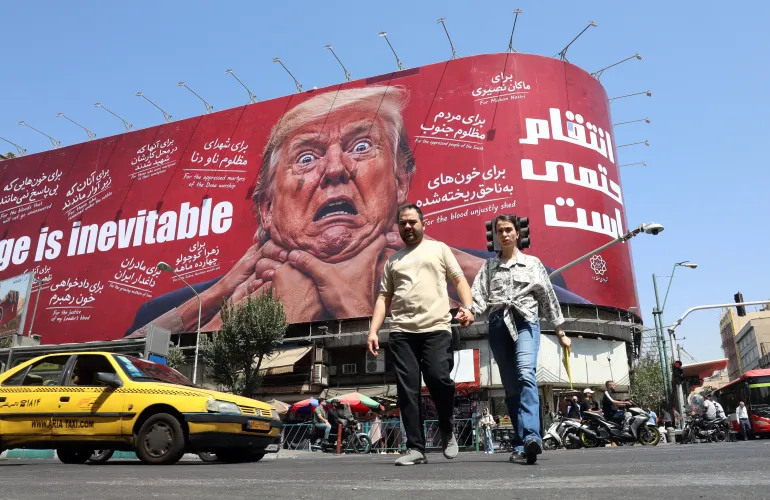
Iranians walk near an anti-Trump billboard in Tehran, Iran, August 19, 2026 [Abedin Taherkenareh/EPA]
Alliances
Alongside the loss of confidence in the US as a security guarantor has come a dramatic reordering of alliances and rivalries. Much of Iran’s network – most notably Hezbollah, whose reputation had long served as a deterrent against Israeli attack – appeared to buckle under Israeli pressure.
“The Middle East has always been multi-aligned. However, now it’s even more so,” Sanam Vakil, the director of the Middle East and North Africa Programme at Chatham House, said of the increased leverage given to external actors, such as Turkiye in Syria and China’s involvement in negotiations over the end to war on Iran, as Beijing finds its own energy supplies under threat.
“It’s ironic, since October 7, it’s Israel that has emerged as the revisionist power and Iran almost as the status quo power,” she said of the apparent reversal in status of the two belligerents, with Tehran seemingly more focused on regaining the ground it has lost in the last three years rather than advancing beyond them.
However, none of this was to overstate Israeli influence, or liken it to a regional superpower, Vakil cautioned. “Israel may currently be the preponderant military power in the Middle East, but real power is typically classed as being able to project stability, which Israel hasn’t shown itself able or willing to do,” she said.
Clogged arteries
While Israel and the US hoped February’s attacks would swiftly topple Iran’s government, they have instead opened a new front. Tehran now wields economic leverage over Israel, the US and their partners through the Strait of Hormuz, which borders Iran and typically carries about a fifth of the world’s oil and gas, and through Bab al-Mandeb, which is now threatened by its Houthi allies.
Whatever Tehran’s intentions, the economic pain has been uneven. The West, cushioned by emergency reserves, record US oil production and supplies from countries such as Norway, has so far avoided the turmoil of the 1970s oil shocks, when US drivers queued for petrol, even though the current disruption is on a greater scale. In April, the International Monetary Fund trimmed its 2026 global growth forecast only slightly, to 3.1 percent from 3.3 percent.
Gulf exporters, in contrast, have fared far worse. The same assessment cut its forecast for Saudi Arabia from 4.5 to 3.1 percent, and turned Qatar’s from growth of 6.1 percent into a contraction of 8.6 percent.
“It’s curious, in many ways the West’s reduced need for Gulf oil has increased the degree to which Israel has become a liability for the US,” Israeli political economist Shir Hever told Al Jazeera, referring to a diplomatic alliance between the two states long underpinned by Israel’s strategic position in an oil-rich region central to US interests.
“There’s a train of thought in Israel that the current crises may push the Gulf states into allying with it,” he said, while noting the irony that Israel had been the main aggressor in the conflicts that followed October 7. “Though that seems fairly unlikely.”
Thursday marks 30 days since Israel’s foreign minister ordered the closure of the UK consulate in occupied East Jerusalem.
Published On 8 Oct 20268 Oct 2026
Workers at the UK consulate in occupied East Jerusalem have removed its signage as the Israeli shutdown deadline arrives, further damaging strained ties between allies.
Journalists from the Reuters news agency saw workers remove a plaque reading “British Consulate General” from the building on Thursday, as well as another sign for its consular section. The UK flag was still flying over the building.
Recommended Stories
list of 3 itemsend of list
Thursday marks 30 days since Israeli Foreign Minister Gideon Saar ordered the closure of the consulate in occupied East Jerusalem. The move was in response to the UK’s wave of sanctions on illegal Israeli settlements, including a ban on importing goods made there.
The United Nations and most countries consider the settlements illegal under international law. Israel disputes this.
The United Kingdom threatened to expel 27 Israeli diplomats if Israel proceeded to close the consulate in occupied East Jerusalem, according to unverified Israeli media reports.
The consulate has not responded to an immediate request for comment.
Israel has been adamant the consulate will close even as the UK has sought to keep it open, including sending the country’s top national security adviser to Israel last week for talks.
The UK’s presence in the city dates back almost 200 years, long before the state of Israel was established in 1948. The closure order does not affect the UK’s embassy in Tel Aviv, which handles diplomatic relations with Israel’s government.
The consulate, in the Sheikh Jarrah neighbourhood of occupied East Jerusalem, handles the UK’s relations with Palestinians in Jerusalem, as well as in the occupied West Bank and Gaza. It also provides consular services to Palestinians.
The UK Foreign Office on Wednesday declined to comment when asked whether the consulate was still operating or if diplomats working there had returned to the UK.
Despite the current strains, the UK and Israel are close economic, security and intelligence partners.
Hundreds took to the streets of Bogota to protest the ongoing genocide in Gaza.
Published On 8 Oct 20268 Oct 2026
Protesters have rallied in Colombia’s capital opposing the new far-right government’s policy towards Israel.
Hundreds took to the streets of Bogota on Wednesday to protest against the ongoing genocide in Gaza and the Colombian government’s decision to restore diplomatic and economic relations with Israel.
Recommended Stories
list of 3 itemsend of list
The protesters, who began their rally in front of the Israeli embassy in Bogota, criticised President Abelardo de la Espriella’s decision to open a new Colombian embassy in Jerusalem.
The rally marked three years since the Hamas-led attacks of October 7, 2023, which were followed by Israel launching a genocidal war on Gaza.
“When diplomatic relations with Israel were broken off, the message was that we would not be a nation complicit in their atrocities,” Nicolas Isaza, who took part in the protest, told Al Jazeera.
“Today our government is no longer drawing a line against the atrocities being committed in Palestine,” he added.
De la Espriella, who was sworn in as president in August, promised close relations with the US and Israel during his election campaign as a way to combat armed groups in his country.
Colombia’s government has since restored relations with Israel after former President Gustavo Petro, who criticised Israel’s genocidal war on Gaza, severed diplomatic relations and halted Israeli arms imports.
The Colombian government also recognised Israel’s claim of sovereignty over the occupied Syrian Golan Heights, just days after the new president took power.
Saudi civil aviation authorities say Houthi attacks on Abha and King Khalid International airports have killed three civilians, including two women, and injured 36 others.
The United Nations Interim Force in Lebanon said there were no casualties after small arms fire targeted a border post.
Published On 7 Oct 20267 Oct 2026
The United Nations Interim Force in Lebanon (UNIFIL) says one of its posts on the Lebanon-Israel border was targeted by small arms fire, with no casualties reported.
The UN force said the incident occurred on Wednesday morning with several rounds of small arms fire targeting a UNIFIL position near Kfar Shouba along the UN-drawn border with Israel, known as the Blue Line.
Recommended Stories
list of 3 itemsend of list
“Such deliberate attacks gravely endanger the lives of peacekeepers,” UNIFIL said in a statement, adding that it was investigating the incident.
Under pressure from the United States and Israel, the UN Security Council decided earlier this year to set December 31 as the end of the mandate for the UN peacekeeping force in Lebanon.
UNIFIL was initially created to oversee the withdrawal of Israeli troops from southern Lebanon after Israel’s 1978 invasion, and its mandate has been renewed annually since then.
The mission was expanded after the 2006 war between Israel and Hezbollah. Proponents say it remains important to maintaining a demilitarised buffer between the two sides along the volatile Israeli and Lebanese border.
Israel has long accused UNIFIL of failing to prevent threats posed by Hezbollah and has increasingly pushed for the end of its mission since cross-border fighting escalated in the wake of the October 7, 2023, Hamas-led attacks on Israel and the start of Israel’s war on Gaza.
UNIFIL currently has 7,500 peacekeepers from around 50 countries operating in Southern Lebanon.
Last month, Lebanon’s Prime Minister Nawaf Salam pressed the UN on the need to “avert the vacuum” that would be caused by withdrawing the mission from the country’s south without a viable replacement.
Violence has decreased since a ceasefire following a June memorandum of understanding in the US-Iran war. Lebanon and Israel concluded a US-sponsored framework agreement later that month.
The Israel-Lebanon deal involves the disarmament of Hezbollah, a gradual withdrawal of Israeli forces from Lebanon’s south and the deployment of the Lebanese army to the region, starting in test areas known as “pilot zones”.
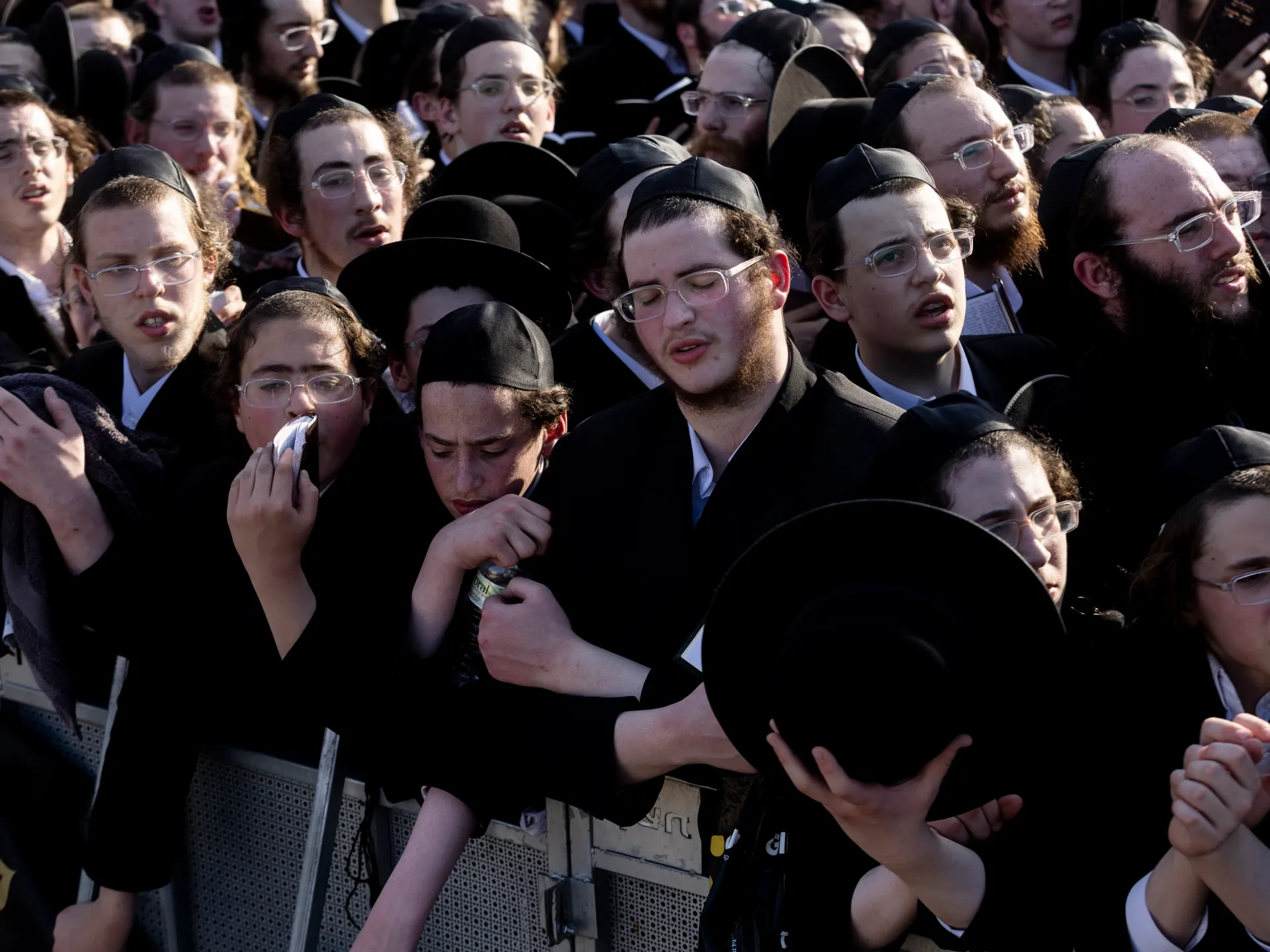
Comments by one of Israel’s most senior ultra-Orthodox rabbis postulating that Jews may have been better off without a state have prompted controversy in the country.
In footage broadcast by Channel 12 on Monday, the 96-year-old Rabbi Dov Lando, the spiritual leader of the Degel HaTorah party, also said that soldiers adhering to “Religious Zionism” killed in Israel’s wars were dying because of what their rabbis had taught them. The remarks, made at a closed meeting at his home in Bnei Brak, have set off a political storm three weeks before Israel’s October 27 parliamentary election.
Recommended Stories
list of 3 itemsend of list
“They are killed because their rabbis teach them a distorted Torah,” Lando said, adding that many military operations are carried out “not for saving lives, but for the honour of the state”.
Lando’s comment came in response to a question about admiration among some ultra-Orthodox Jewish men – who have traditionally refused the military draft – for religious Zionists who combine Torah study with military service.
His comments aren’t new – they were first published in February 2025. However, their reemergence this week comes amid an election campaign in which ultra-Orthodox military service has become one of the sharpest fault lines in Israeli politics.
The Israeli Supreme Court ruled in 2024 that there was no legal basis for ultra-Orthodox seminary students to have exemptions from military service, and the government has since not been able to pass legislation restoring the exemptions. The issue has led to large protests on both sides of the divide.
“The question is not what he said, but why this discourse has been placed at the heart of the Israeli debate three weeks before the election,” Ehab Jabareen, a researcher on Israeli affairs, told Al Jazeera.
Better ‘without a state’
Lando’s party is one of the two factions of the United Torah Judaism (UTJ) alliance, which won seven seats during the last election in 2022, and had been part of Israeli Prime Minister Benjamin Netanyahu’s government before its ministers resigned last year.
The bloc did continue to intermittently support the coalition government, however, and Netanyahu has been wary of removing the military exemption – despite widespread opposition to it from many in Israel – out of fear that the UTJ and similar parties would remove their support completely.
Along with his role within Degel HaTorah, Lando is also one of the spiritual leaders of Israel’s Lithuanian ultra-Orthodox community, which makes up roughly a third of the country’s estimated 1.45 million ultra-Orthodox Jews, also known as Haredim.
In the footage, he goes further. “It is possible to live well with the Arabs without a state,” he says, adding that international or Palestinian rule would have been “the best situation”.
Zionism, he argues, “caused the Arabs to hate us” and brought physical as well as spiritual disaster on the Jewish people. He describes secular Israelis as having built “a state of apostasy and heresy”.
The comments reflect non-Zionist and anti-Zionist positions that used to be dominant within ultra-Orthodox Judaism, but take on an overt reference to the possibility of living within a non-Zionist state, something that is even more controversial in Israel.
Ibrahim Khatib, a conflict studies scholar at the Doha Institute for Graduate Studies, said Lando’s remarks drew a line between Zionism and Judaism “from inside the Jewish community itself”, at a time when the official Israeli establishment “tries to bind them together”.
They also put to the test the narrative that Jewish communities in Arab societies were in danger and threatened, and that the Zionist movement came to “save them” at the formation of the state of Israel in 1948, he told Al Jazeera. However, Khatib cautioned that the ultra-Orthodox polity in Israel “is right-wing, its leaders hold right-wing positions, and some of them have made clearly offensive statements about Arabs and Palestinians”.
Political ammunition
Israeli opposition leaders moved quickly after the footage of Lando emerged this week, taking it as an opportunity to attack a figure from a party within Netanyahu’s electoral bloc.
Former Prime Minister Naftali Bennett – one of Netanyahu’s main challengers in the upcoming elections – called the remarks “anti-Semitic, anti-Zionist and anti-[Israeli military]”, but aimed his fire at Netanyahu and Finance Minister Bezalel Smotrich, who he said “back [Lando] and funnel tens of billions of shekels to him and his friends”.
Gadi Eisenkot, another opposition leader whose Yashar party has campaigned on enforcing the military draft, urged every Zionist party to pledge not to sit with Lando’s party.
Netanyahu, who publicly rejected Lando’s remarks in July when the rabbi accused the Religious Zionism movement of “incitement to murder” for its support of the drafting of religious seminary students to the military, has not yet commented.
Yair Golan, leader of the Democrats, put it bluntly: “Netanyahu is silent because without Rabbi Lando and his emissaries, he has no government.”
Jabareen sees Netanyahu’s silence as “calculated”.
“If Netanyahu attacks Lando forcefully, he pays a price with the Haredim he needs to form a government,” he said. “If he stays silent, he hands his rivals material to tell right-wing voters that the man who speaks of Zionism and security depends on a religious leadership that doubts Zionism itself.”
Who fights and who dies
The military draft of the ultra-Orthodox, Jabareen added, has turned “from an old dispute over religion and state into a question about the Israeli [social] contract itself: Who fights? Who dies? And who gets the exemptions, the budgets and the political influence in return?”
Mohammad Abu Rumman, an academic adviser at the Politics and Society Institute in Amman, said the significance of Lando’s remarks lay in the question that prompted them. The example of a young religious man who combines Torah study with military service, he said, “raises a question inside the ultra-Orthodox world itself: Why don’t we do the same?”
“When Lando describes their teaching as a distorted Torah, he is trying to close the door on emulating them,” Abu Rumman told Al Jazeera. “His words are aimed at his own audience as much as at his opponents.”
But Jabareen argued that the row exposes a rift more dangerous for Netanyahu than the familiar clash between secular and religious Israelis, because it runs through the right itself. Religious Zionists have paid a heavy human price in the war, while the ultra-Orthodox leadership still rejects conscription. Caught between those who pay the price of war and those who refuse to, Netanyahu needs both, and cannot satisfy them at once.
Whether the outrage over Lando’s comments translates into votes is less clear. Abu Rumman expects the remarks to “reinforce existing positions more than change voters’ choices”. The space where they could matter, he said, lies among right-wing voters who serve in the army and resent Netanyahu’s protection of ultra-Orthodox demands.
“If Netanyahu needs these parties to build a majority, that need will not disappear because of a rabbi’s remarks, however shocking,” Abu Rumman said. Netanyahu is also not the UTJ’s only suitor: Channel 12 reported that, frustrated by his failure to secure a law exempting ultra-Orthodox men from military service, the party would not rule out or oppose a government led by Eisenkot.
“The Israeli right has managed to bring under one political roof two currents with almost contradictory visions of the Jewish state,” Jabareen said. “One sanctifies the state and the expansion of its sovereignty. In the other, one of its most important rabbis can say it might have been better had the state never been founded.”
Paramount Skydance has completed its takeover of Warner Bros Discovery, bringing CNN and CBS News under the same corporate ownership, in a deal that has raised concerns about editorial independence and freedom of speech.
The acquisition, worth about $110bn including debt, combines two of Hollywood’s biggest studios after months of legal challenges lodged by state attorneys general and unions.
Recommended Stories
list of 4 itemsend of list
The new company, Skydance Corporation, brings together HBO, CBS, Nickelodeon, Showtime, Comedy Central, DC Studios and Food Network, alongside streaming services Paramount plus and HBO Max.
But its control of two major US news organisations has drawn particular scrutiny. David Ellison, Skydance’s chairman and chief executive, has promised to preserve their editorial independence, but his father, Oracle cofounder Larry Ellison is a major financial backer of the deal, and has previously donated funds to US President Donald Trump and Israel.
Asked about the takeover on Tuesday, Trump welcomed it. “They’re terrific people, and it’s going to be a great company,” he said.
Why was the merger challenged?
The takeover faced initial opposition from Hollywood workers, politicians and state prosecutors concerned about the mounting concentration of power in an industry already dominated by a handful of companies.
Netflix initially reached an agreement to buy part of Warner Bros Discovery. Paramount then launched a competing bid, prompting a bidding war before Netflix walked away.
A California-led coalition of 12 state attorneys general sued to block the deal, saying that it would reduce competition and raise prices. The Writers Guild of America brought a separate challenge.
Both cases were settled in September when Paramount agreed to commitments relating to film production, support for displaced workers and protections for the news networks, including the creation of a new editorial independence board.
But the settlement did not end opposition to the deal. “This merger will stifle creativity, weaken free speech and cost people their jobs,” actor and activist Mark Ruffalo has said.
Democratic Senator Elizabeth Warren linked the takeover to Trump’s efforts to restrict media access. “As Trump tries to ban CNN from the White House, it would be a massive mistake to cave on the Paramount merger,” she said, referring to the US president’s so-far thwarted attempt last month to bar reporters from several news organisations, including CNN, from accessing the White House.
Can an editorial independence board protect CNN and CBS?
One condition of the settlement requires Skydance to establish a “News Editorial Independence Board” within 180 days of completing the takeover.
The five-member body is to include active or retired journalists with at least 10 years of experience. It is intended to establish editorial principles and address disputes involving the news networks and corporate management.
However, its members will be appointed by, and will report to, Skydance’s board of directors, which Ellison chairs. Two members can belong to the same political party, and there is no requirement to publish its findings.
The condition has left critics with a multitude of questions, including: How can a member of an independent editorial board be a member of a political party? How can there be scrutiny if its findings are not public? How can it be independent if it is appointed by a board of directors, themselves appointed by the CEO of the company?
Seth Stern, chief of advocacy at the Freedom of the Press Foundation, said, “A Paramount-appointed editorial independence board for CNN and CBS is worthless. The fish rots from the head, and this particular fish is headed by a compromised oligarch with a history of throwing journalists under the bus to advance his business interests.”
Stern also questioned whether government enforcement of the settlement could itself threaten press freedom. “The editorial board creates the same First Amendment problems it’s supposed to solve – the government meddling in the news.”
The First Amendment provides constitutional protection for freedom of speech and the press.
Ellison argues that the two networks will continue to operate independently. “We’re going to make sure that CNN and CBS News are completely editorially independent,” he said on Tuesday.
On Monday, Skydance announced that Mark Thompson would remain CNN’s chairman and editor-in-chief, while Bari Weiss will continue as CBS News’s editor-in-chief, easing previous fears that Weiss would immediately take charge of both networks.
Why are there fears for editorial independence?
The takeover gives the Ellison family control of CNN less than a month before the November 3 US midterm elections, and follows Trump’s repeated attacks on the network as it seeks to hold the US president to account.
Shortly after Paramount launched its bid in December, Trump accused CNN of spreading “poison and lies” and said it was “imperative” that it be sold, while the Trump administration has moved to bar CNN from reporting in certain areas of the White House.
Ellison donated roughly $45m to a political nonprofit group supporting Trump’s election efforts in 2024, while he donated $16.6m to Friends of the Israel Defense Forces, a charity supporting Israeli soldiers – its largest single donation at the time.
Earlier this year, the White House criticised CNN’s coverage of the US-Israeli war on Iran, while Defence Secretary Pete Hegseth told reporters that “the sooner David Ellison takes over that network, the better.”
Sovereign wealth funds from Saudi Arabia, Qatar and the United Arab Emirates also hold indirect financial interests in the combined company. They have no voting stakes, although their involvement adds another layer of scrutiny over its funding.
Concerns about the future for editorial integrity, however, intensified after Skydance acquired Paramount in 2025, and layoffs followed, alongside the closure of CBS News Radio and changes to CBS News flagship investigative programme 60 Minutes.
High-profile firings enacted under CBS News Editor-in-Chief Bari Weiss and Skydance Media CEO David Ellison included correspondents Sharyn Alfonsi and Cecilia Vega, as well as 60 Minutes executive producer Tanya Simon.
The programme’s September season premiere attracted about 21 percent fewer viewers than a year earlier.
In 2025, Paramount also agreed to pay Trump $16m to settle a lawsuit over the editing of a 60 Minutes interview with then-presidential candidate Kamala Harris.
In a June 2 letter, nine advocacy groups, including Reporters Without Borders, the Freedom of the Press Foundation and the Committee for the First Amendment, warned that CNN could face similar upheaval and firings.
“Bari Weiss’ shameless actions fulfil the Ellisons’ commitment to President Trump to remake CBS to his liking,” they alleged, referring to the firings and changes at 60 Minutes.
“Larry Ellison has reportedly promised to do the same at CNN if allowed to take control through the pending Paramount-Warner Bros. Discovery merger. Not because it makes any business sense, but because they seek to control the public discourse.”
The groups described the proposed takeover as an “existential threat to the free press, independent media, and free speech in this country and beyond”.
Israeli air strike kills Palestinian Civil Defence rescue volunteer as he was travelling to help wounded people near Kamal Adwan Hospital in Beit Lahiya, northern Gaza, a medical source says.
Published On 7 Oct 20267 Oct 2026
Israeli attacks have killed at least four Palestinians, including a rescue worker, and wounded several others across Gaza.
The Palestinian Civil Defence rescue volunteer was killed in an air strike as he was travelling to help wounded people near Kamal Adwan Hospital in Beit Lahiya, northern Gaza, a medical source said on Wednesday.
Recommended Stories
list of 3 itemsend of list
The Civil Defence identified the victim as Mohamed Tamous.
Meanwhile, an Israeli drone strike in the southern city of Khan Younis killed Hisham Ibrahim Abu Mustafa, 60, and injured several others, Nasser Hospital said.
The body of a 17-year-old Palestinian was also brought to Nasser Hospital after he was killed in an Israeli drone strike in the Qizan Abu Rashwan area south of Khan Younis, Turkiye’s state news agency Anadolu reported, citing a medical source.
A teenage boy died from wounds sustained last month when Israeli forces opened fire east of Khan Younis, Anadolu reported, citing a medical source.
Also on Wednesday, a girl was injured by Israeli gunfire directed at displaced Palestinians’ tents in the Al-Amal neighbourhood, Anadolu reported.
Additionally, in Khan Younis, the Israeli military carried out two demolitions in the northeastern and eastern parts of the city.
The military also carried out demolitions east of Gaza City’s Tuffah neighbourhood.
Israel has killed more than 74,245 Palestinians since it launched its genocidal war on Gaza in response to the Hamas-led October 7, 2023, attack on Israel.
Al-Awsaj, occupied West Bank – On September 23, weeks before Israel’s parliamentary elections, ministers and lawmakers gathered on an occupied West Bank hilltop to inaugurate a new settlement, Metzoke Eretz, illegal under international law. Finance Minister Bezalel Smotrich used the ceremony to salute the settler outpost that made the eventual settlement possible.
“The first pioneering settlers who were here on the farm… we will lift them up as our greatest joy,” Smotrich said. “It shows that the method works: establish a farm, seize the land, prepare it, turn it into a community, move to the next point. There are many, many such heroes – those who prove they are not doing real estate. They are doing Zionism.”
Recommended Stories
list of 3 itemsend of list
Metzoke Eretz was previously an outpost – the name given to the Jewish settlements illegal even under Israeli law – called Netzah Harel, established in 2023 in the middle of al-Muarrajat, a Bedouin community on private Palestinian land east of Ramallah. Alia Mleihat, 29, and others from the community remember those settlers well. “Of course, this outpost played a major role in displacing the Palestinian Bedouin communities in al-Muarrajat and the areas east of Ramallah,” said Alia, now living in a tent in al-Awsaj, a few kilometres away, after her forced displacement in July 2025. “[The Netzah Harel settlers] took part in every attack the settlers carried out on families, and confiscated sheep, under the protection of the Israeli police and army.”
Dror Etkes, founder of Israeli NGO Kerem Navot, said Smotrich’s description of his “method” was spot-on – except for one omission. “The political discourse skips the [Palestinian] expulsion chapter,” said Etkes, suggesting Smotrich and other politicians avoid doing so explicitly to avoid potential scrutiny from international criminal courts. “They want it to happen, and they know that it happens, and they let it happen.”
Haaretz reported that Metzoke Eretz is one of 19 outposts legalised by the Netanyahu government after nearby Palestinians were violently expelled.
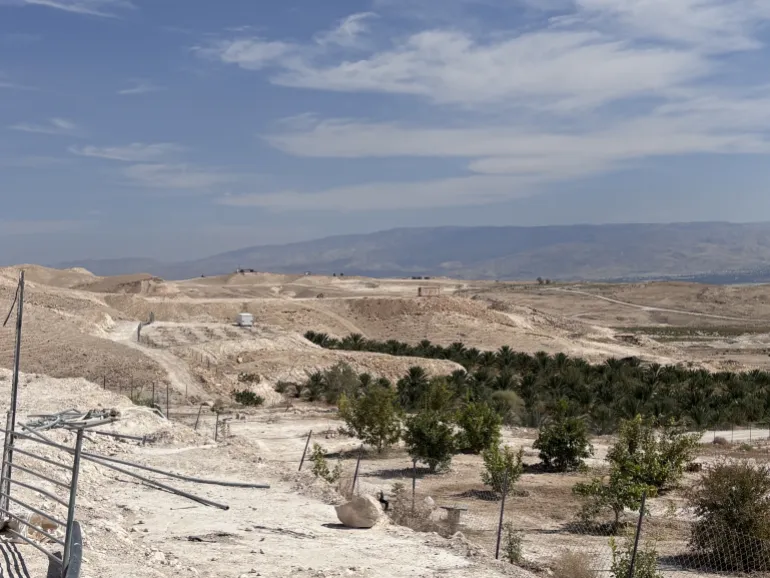
The view from Muhammad Ghawanmeh’s home in al-Awsaj, looking out towards an Israeli outpost on a hill in the background [Al Jazeera]
‘Not a single moment of joy’
Jamal Mleihat, Alia’s 45-year-old uncle, sits with eight relatives nestled inside a bare concrete-block house on the ridge in al-Awsaj, with his daughter Sewar hanging off his lap.
Below the ridge, rows of young trees climb a cultivated slope towards a factory at the foot of the hills. The ridge itself is rock and dust, now home to about 25 families from al-Muarrajat, among others forcibly displaced in the past three years.
“Before October 7 [2023 Hamas attack on Israel, and Israel’s subsequent genocidal war on Gaza], we were in the pastures – no harassment, we moved around freely,” said Jamal, a father of seven. “We had healthcare. We had a school. We had water in the same encampment. Life was a million times better than this.”
Since October 7, the Israeli government has stepped up its raids on the occupied West Bank, while settlers have largely been given free rein to pursue a pogrom against Palestinians, with little pushback from within Israel.
Just below Jamal’s shelter, alone on a slope, Muhammad Ghawanmeh lives with his wife and seven children. His toilet does not work; he relies on water tanks and has almost no electricity. The rocky track to the Mleihats’ area is too steep to drive. He built a fence around the house after recent settler attacks, and now faces constant drone surveillance from Israeli settlers.
Ghawanmeh is from Ras Ein al-Auja, which had been the largest Bedouin community in the central Jordan Valley – so robust that humanitarian coordinators told Al Jazeera in October 2023 that the village’s displacement was unlikely. Instead, its more than 600 Palestinian inhabitants experienced the largest single-community expulsion of Bedouins in the last three years, after repeated attacks by settlers from four surrounding outposts.
“From my childhood, the land was open. The water was open. We were living happily. We’d graze 10 kilometres, 15 kilometres with the sheep, and come back,” he said. “Today we can’t go 500 metres from the house.”
His flock has shrunk from about 300 to roughly 100 physically thinning sheep, which he now must buy fodder for, instead of letting them graze on the land, which he now says is largely forbidden by Israeli settlers and the army.
Jamal Mleihat with his daughter Sewar in al-Awsaj in the occupied West Bank [Al Jazeera]
‘Nothing was left except this’
A few hundred metres beyond Ghawanmeh’s fence, a white trailer and a few containers mark an Israeli outpost, established about six months ago on a hill overlooking Highway 90 and the displaced families along the ridge. Two months ago, Ghawanmeh said, soldiers came to his house and told him he could no longer pass to the highway. The settlers, he said, “are with the army”.
“You leave this place, go to another one, and it follows you – the same problem, unsolved,” Ghawanmeh said. “Every three months, there’s a displacement operation.”
Al-Awsaj barely existed as an inhabited place before, but Bedouin from different depopulated communities have now converged on this barren ridge, overlooking land largely declared – again – off-limits to grazing.
Allegra Pacheco, head of the West Bank Protection Consortium, calls al-Awsaj “basically a refugee camp, an internally displaced camp, that we see in other countries. But here, there’s no safe space. Wherever people like in al-Awsaj go, they’re chased by settlers or their tents are demolished by the Israelis.”
“It’s been very painful to get the authorities, the Palestinian authorities, the international leaders, to recognise that this is a mass displacement happening in front of us, and people have nowhere to go,” she said.
Project of forced transfer
In the West Bank, the United Nations Office for the Coordination of Humanitarian Affairs (OCHA) counts at least 130 Palestinian communities fully or partly displaced by settler attacks and related restrictions since January 2023, and more than 6,400 people uprooted. According to the Palestinian Colonization and Wall Resistance Commission, since October 7, 2023 there have been almost 15,000 attacks by settlers, with 66 Palestinians killed by settlers. OCHA says the rate of settler attacks increased from about three a day before October 7, 2023, to almost seven per day this year.
The increase in displacement after October 2023 can also be seen in the numbers for that year. Nearly 80 percent of all Palestinians displaced by settler violence in 2023 were uprooted after October 7.
A report by Peace Now and Kerem Navot found that Israeli farm outposts had seized roughly 18 percent of the West Bank by the end of 2025. “We’re talking about a land area bigger than the size of the Gaza Strip altogether,” Pacheco said.
“What we’re seeing is a continuous, sustained project of forced transfer and mass destruction,” she said. “Israeli authority demolitions and destructions by the Israeli army, and Israeli civilians – armed groups – carrying out destructions and sowing fear to push people out.”
Israeli NGO B’Tselem’s September report, “The Elimination Project”, links this to Smotrich’s 2017 “Decisive Plan”, which offers Palestinians three choices: live under Jewish supremacy, leave, or face violent repression.
“The Smotrich Plan has been implemented,” Pacheco said. “He laid out exactly what is going on now, and he’s very proud of his success. He now wants to transfer that success to [other areas of the West Bank], and also in the Galilee [an area in Israel with a large population of Palestinian citizens of Israel]. Wherever there are Palestinians living, he wants to make life so difficult that they will leave.”
With Smotrich exercising broad powers over the West Bank through the Settlement Administration within the Ministry of Defence, and leaders in the Israeli West Bank military command increasingly coming from far-right, settler backgrounds themselves, Palestinians across the West Bank describe a deepening symbiosis of military, police, administration and settlers in exacting Palestinian dispossession. “They all work together, like a cell, one completing the other,” said Jamal Mleihat. “The army, the police, the settlers – they’re the ones who displace, they’re the ones who establish the settlement, they’re the ones who take part in the thefts, in everything. And the army covers for them.”
Al Jazeera has reached out to the Israeli authorities for comment on this piece, but has yet to receive a response.
Worse future
Smotrich has withheld part or all of the tax revenues Israel collects for the Palestinian Authority – roughly 60 percent of its income – for much of the past three years. The PA now struggles to provide the most basic of services. In al-Awsaj and elsewhere, that means classrooms that do not open. “The government school is shut down today, no salaries,” Ghawanmeh said.
There is no school bus; families pay for private transport, and “one day they study, one day they don’t, depending on the mood of the driver,” Jamal said. It has left the displaced alone on an inhospitable patch of rock.
“Palestinians have no protection in the West Bank,” said Pacheco. “They are completely vulnerable to assault, attempted murder, arson, invasion of their homes. The Israeli army is supposed to protect them and doesn’t. The Palestinian Authority can’t come in, and the international community is not protecting them.”
“We started to feel there’s no safety anywhere,” Ghawanmeh said. “Fear. Terror. Persecution. Ethnic cleansing. That’s what we feel.”
Amid the dispossession, Ghawanmeh looks out at the unwelcoming land he knows will not be his family’s refuge – only another transient stop. He sees his own brother now only once every month and a half or two. “The threats to Bedouin life have almost become extinction,” he said. “We now live in enclaves, separated.”
“For three years now, the day that’s passing is better than the one that’s coming,” Ghawanmeh said. “Yesterday is better than today. Today is better than tomorrow.”
Three years after the October 7 attacks, the politics of Israeli society has shifted further right, sidelining voices calling for a political settlement with Palestinians. But as Al Jazeera’s Nour Odeh explains, the shift began years before October 7.
Letter from progressive US representatives brings attention to Israeli abuse and detention of Palestinian medical workers.
Published On 6 Oct 20266 Oct 2026
A group of six progressive Congress members in the United States have released a statement condemning Israel’s abuse of Palestinian healthcare workers, including the Gaza doctor Hussam Abu Safia, who has been held in Israeli detention since 2024.
The Tuesday statement draws attention to Israeli attacks on Palestinian medical workers, who have been targeted and detained during the country’s genocidal war on Gaza.
Recommended Stories
list of 3 itemsend of list
It was signed by Representatives Rashida Tlaib, Ilhan Omar, Jesus “Chuy” Garcia, Summer Lee, Pramila Jayapal and Delia Ramirez.
“Over the last three years, the Israeli government has systematically destroyed the health system in Palestine, murdering at least 1,700 Palestinian doctors, nurses, paramedics, and other healthcare workers and destroying dozens of hospitals,” the statement reads.
“It has arrested and arbitrarily detained hundreds of Palestinian healthcare workers, including at least 16 physicians who continue to be held in inhumane conditions.”
Among those detained is Abu Safia, who lawyers say was subjected to abuses such as torture, sleep deprivation and beatings during his detention.
Israeli soldiers arrested Abu Safia in December 2024, after he and other medical workers reportedly refused to evacuate from Kamal Adwan Hospital, where they worked.
No charges have been filed against Abu Safia, and he has not had a trial.
Israeli attacks on health infrastructure in Gaza, including the destruction of nearly all of the strip’s hospitals and medical centres, are one component of what rights groups have depicted as an effort to deprive Palestinians of essential services such as food, water and medical treatment.
Tuesday’s statement argues that such efforts are part of an “intentional policy designed to further occupation, apartheid, and genocide against the Palestinian people”.
That assessment is shared by a growing number of rights organisations, scholars and United Nations officials, who have denounced Israeli actions in the Palestinian strip.
Israeli officials have stated that they target hospitals and medical facilities as part of an effort to attack the Palestinian armed groups that allegedly use such facilities to carry out and coordinate operations.
Such claims have often failed to withstand scrutiny. Israel admitted that its soldiers killed a group of 15 emergency workers in southern Gaza in March 2025, after initially stating that the ambulance convoy had approached soldiers “suspiciously” and claiming, without evidence, that several of those killed were linked to Hamas.
A report by the group Forensic Architecture and Earshot found that Israeli soldiers fired more than 900 bullets as they opened fire on a clearly marked ambulance convoy and killed some of the medics “execution-style” before burying their bodies and their vehicles.
After Israeli soldiers stormed Birzeit University near Ramallah to demolish a stone memorial dedicated to dead students, Rania Washaha, 47, felt the pain of bereavement again.
Her brother, Fadi, 34, was shot in the head by an Israeli soldier near the northern entrance to el-Bireh in the central West Bank in May 2021.
Recommended Stories
list of 4 itemsend of list
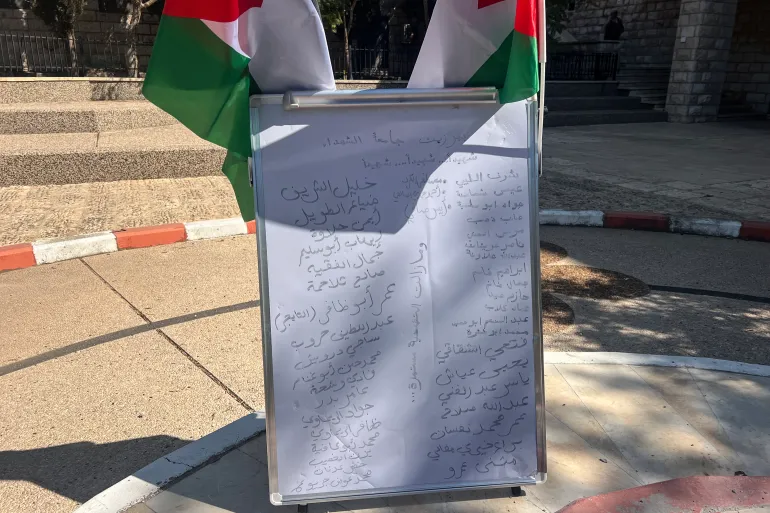
His name was among the 38 students from the university killed by Israel and listed on the stone pillar known as the Martyrs’ Monument.
Israeli soldiers raided the university campus at dawn on Monday, accompanied by 10 military vehicles. A bulldozer demolished the pillar, and soldiers took away the marble stone. In its place, the Israelis left a planter containing a fig sapling, bearing the inscription: “Water it twice.”
Targeting the University
This raid marks the fifth Israeli incursion into the campus since the beginning of 2026 and the 28th since 2002.
Birzeit University’s administration condemned the recent raid, describing the destruction of the Martyrs’ Monument as a violation of international law and an attack on education and national memory.
“Bulldozers won’t erase the memory of the martyrs, military vehicles won’t extinguish the light of knowledge, and these assaults won’t break the university’s resolve to pursue its academic and national mission,” a statement by the university pledged.
Birzeit University students again wrote the names of martyrs that were inscribed on the memorial [Mohamad Turkman/Al Jazeera]
It came 10 days after another incursion by Israeli forces during the daytime, a day before the start of the new fall semester.
Nardeen al-Memi, the university’s public relations and media officer, told Al Jazeera in the brief minutes of their incursion, Israeli soldiers approached the monument for the first time and photographed it.
The Martyrs’ Monument was erected between 1994 and 1996, bearing the names of students and alumni at Birzeit killed by Israeli forces. The list starts with Sharaf al-Tayyibi, who was shot dead by Israeli forces on the campus in 1984. The names of other students and alumni were added during the years that followed.
“The last name inscribed on the monument was that of student Omar al-Naasan, whom soldiers killed in al-Mughayyir east of Ramallah on September 2 while he was confronting settler incursions,” said Nardeen. “Days after his death, his father came and personally wrote his son’s name on the monument.”
University students organised a protest at the site of the destroyed memorial on Tuesday afternoon, most viewing it as an Israeli attempt to intimidate them.
Sami Adel, a Birzeit student who wanted to use a pseudonym due to his fear of being detained, told Al Jazeera the memorial holds a place in the heart of everyone who has attended the university since the 1990s.
In recent years, Israel has tried to suppress any student activity dedicated to commemorating the martyrs, he said.
“Soldiers detained me for several hours three weeks ago and threatened that if I participated in any political student activity on campus, I would face a long and harsh detention,” he added.
Erasing memory
The removal of the memorial is part of a broader Israeli policy targeting memorials dedicated to Palestinians killed by Israel in the occupied West Bank.
The Israeli far-right has made the issue part of its campaign to erase markers of Palestinian identity.
Zvi Sukkot, a member of the Knesset from the Religious Zionism Party, destroyed one such memorial in the village of Madama, south of Nablus, with a sledgehammer in August. The Israeli military later said that it routinely removes “symbols of incitement”.
The location of the demolished memorial in Birzeit University [Mohamad Turkman/Al Jazeera]
Israeli Finance Minister Bezalel Smotrich submitted a list of approximately 40 Palestinian memorials, proposing their destruction, to Prime Minister Benjamin Netanyahu.
There has been a wider targeting of civic and cultural symbols across the West Bank, particularly in Jenin, by Israeli authorities.
“Jenin Horse”, a monument constructed from the wreckage left behind by an Israeli incursion into the city, was removed. A memorial dedicated to Al Jazeera journalist Shireen Abu Akleh in Jenin was also targeted in 2023.
A cemetery containing the bodies of Iraqi soldiers killed during the 1948 war, also located in Jenin, has been raided by Israelis from illegal settlements.
Other landmarks embedded in the city’s collective memory, including the “Watermelon Roundabout”, have also been targeted.
Crushing resistance
Israel’s targeting of Palestine’s collective memory has coincided with a wider campaign of suppression in the occupied West Bank.
Palestinian universities have been a particular target in this pressure campaign, with campuses raided, students detained, and strict restrictions on activities and events within university grounds.
Israeli authorities are likely focusing on Palestinian universities because they hold a special significance for Palestinian resistance. They historically served as spaces for anti-occupation activism and have been an integral part of the Palestinian political landscape for decades.
Rania Washaha looks at her brother’s photo in her office inside Birzeit University [Mohamad Turkman/Al Jazeera]
Political analyst Mohammed al-Qeeq, who served as president of the Birzeit University Student Council between 2006 and 2007, told Al Jazeera that Israel has targeted writers, influencers, and activists, along with students, to deter any resistance to the occupation.
Universities have historically served as a “fundamental pillar” of Palestinian resilience and identity.
“Israel had also sought to weaken Palestinian political and social cohesion inside universities by deepening divisions between factions and creating chaos”, he said.
Remembering Fadi
For Rania, the memorial served to cement the names of the martyred students in the minds of the next generation of Berzeit students, including her brother’s.
“I cannot deny that I felt a pang of anguish when the memorial was demolished,” she told Al Jazeera. “I realised the goal wasn’t simply to uproot a physical object; I felt the suppressed violence Israel inflicts upon us.”
The memorial, constructed in 1996, stood on the campus when Fadi studied at Birzeit University. He had been arrested multiple times, spending a total of eight years in detention, and Israel denied Fadi the chance to wear a graduation gown.
“He didn’t even complete two years of study due to repeated arrests and injuries from soldiers’ gunfire,” Rania said. “Yet, he loved Birzeit University dearly and would stand by the memorial, contemplating the names of the student martyrs, never knowing that his own name would one day be added to theirs.”
This year, Rania’s son enrolled at Birzeit University as a first-year student. Shortly before classes started last September, an Israeli officer phoned him, threatening him if he participated in any student activities on campus. “Remember what we did to your uncle,” they warned him.
Israel ordered East Jerusalem consulate to be closed in retaliation for British sanctioning of settlements in the occupied West Bank.
Published On 5 Oct 20265 Oct 2026
The United Kingdom has threatened to expel 27 Israeli diplomats should Israel proceed with plans to close the British consulate in occupied East Jerusalem, according to unverified Israeli media reports.
The Ynet outlet reported on Monday that the British Ambassador to Israel, Simon Walters, had conveyed the warning to Israeli officials. Israel ordered the closure of the consulate by October 8 in retaliation for the British decision to sanction illegal settlements in the occupied West Bank.
According to the report, the British government has threatened to expel one Israeli diplomat for each of the 27 British diplomats whose diplomatic status at the consulate would be terminated in the event that it is shut.
Israel ordered the consulate’s closure after Britain imposed sanctions targeting illegal Israeli settlements in the West Bank, including a ban on imports.
The consulate operates separately from the British Embassy in Israel and handles relations with Palestinians in East Jerusalem, the occupied West Bank and Gaza, including political and consular affairs.
Britain’s National Security Adviser, Jonathan Powell, travelled to Israel last week in an undisclosed attempt to persuade Israeli officials to reverse the closure, the Reuters news agency reported on Monday. The talks did not produce an agreement, although discussions are continuing.
The British embassy in Israel has declined to comment on the reported threat, according to Ynet.
The United Kingdom’s Green Party has voted to define Zionism as a form of racism, drawing condemnation from the Israeli government.
In a binding vote held at the party’s conference over the weekend, members voted to usher in the new definition as well as a series of other strongly pro-Palestine policies.
Recommended Stories
list of 4 itemsend of list
However, just as the resolution has drawn international criticism, it has also proved internally controversial with four of the party’s five members in parliament opposing it.
Israel on Monday banned party leader Zack Polanski from the country just a day before the politician faces a by-election as he runs in the London constituency that former Prime Minister Keir Starmer represented.
Zionism emerged as a political ideology in the late 19th century. It called for the creation of a Jewish homeland at a time of rising anti-Semitism and persecution of Jews in Europe. Theodore Herzl, an Austro-Hungarian journalist considered the father of political Zionism, originally proposed an independent and colonial Jewish state in either Palestine or Argentina.
Here’s what we know about what the Greens have said:
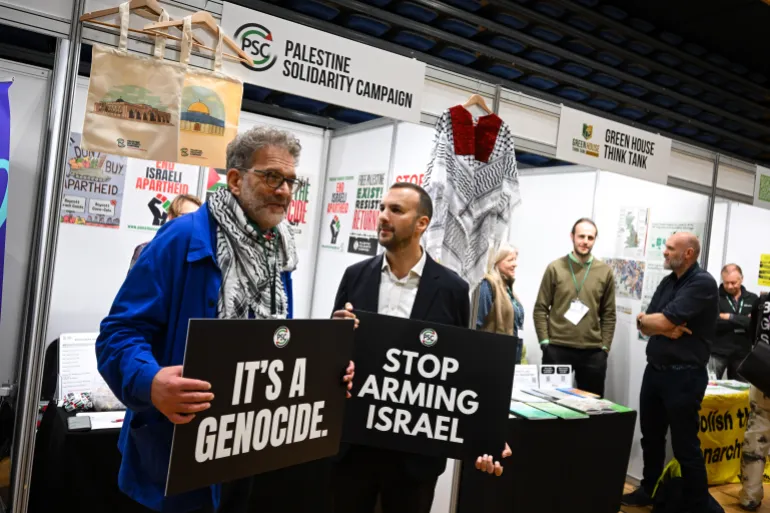
Green Party leader Zack Polanski, right, chats with Ben Jamal, director of the Palestine Solidarity Campaign, at the 2025 Green Party conference in Bournemouth, England [File: Getty Images]
What is the resolution?
The Greens endorsed the motion to equate Zionism with racism by a vote of 1,022 to 813.
In addition, the party restated its “commitment to Palestinian liberation” and called for the “establishment of a single democratic state throughout historic Palestine”.
The party also recommitted to its support of Palestinians’ right of return as well as to the Boycott, Divestment, Sanctions movement against Israel.
“The real, material, manifestation of Zionism has been the historic and ongoing dehumanisation, displacement, dispossession, disenfranchisement and destruction of Palestinians,” a Green Party statement said.
A significant number of party members, including four of its five MPs, were against parts of the resolution, exposing divisions within the party.
Codeputy leader Rachel Millward said in a post on X that while the party is committed to “stop the genocide”, the term Zionism means “different things to different people, … so I personally do not think the policy helps us do the work we all want to”.
Meanwhile, Polanski, who is Jewish and was away campaigning during the vote, told journalists afterwards that if Zionism equates to the displacement of Palestinians, “that is clearly racist.”
Polanski said he, however, did not support the reference to a single Palestinian state and external entities should not decide what a future state would look like.
How has Israel responded?
Israel has accused the party of legitimising “terrorism”, and senior officials equated it to anti-Semitism.
“The Greens have adopted not only the green of Hamas, but also its ideology: the elimination of the State of Israel through armed struggle,” the Israeli Ministry of Foreign Affairs wrote on social media.
Israeli President Isaac Herzog said it would “deliberately endanger Jews and Israelis everywhere”. Opposition leader Yair Lapid said the party was “racist”.
The Green Party has rejected equating criticism of Israel with anti-Semitism and reiterated its stance against “any form of discrimination or harassment”.
“We know there is no conflict between supporting the rights of Palestinians and the rights of Jewish people,” Polanski and other senior party members said in a statement on Sunday.
Has Zionism been equated to racism before?
Yes. In 1975, the UN General Assembly passed a resolution that “determines that Zionism is a form of racism and racial discrimination”.
The vote was sponsored by the Soviet bloc and the Arab League. It passed after 72 countries, largely from the Middle East and Africa, voted for it. Israel and 34 other countries – chiefly from the West – were against it. Thirty-two other countries abstained.
Just a year before, at the 1974 General Assembly, Palestinian leader Yasser Arafat had given his “olive branch” speech at the General Assembly.
About the same time, African countries opposing the apartheid regime in South Africa, which was increasingly allying with Israel, had resolved separately that the Israeli government was “racist” and both had an “imperialist origin.”
Also, in 1975, at the first international women’s conference, held in Mexico City, attendees decided there would be no international peace outside the “elimination of foreign occupation, Zionism, apartheid” and all other forms of “racial discrimination”.
However, the General Assembly vote proved controversial. Chaim Herzog, then-Israeli ambassador to the UN and later president, told the assembly in a speech that it was “based on hatred, falsehood and arrogance” and proceeded to rip up copies of the resolution in front of the audience.
The US too accused the UN of making “anti-Semitism international law”.
In December 1991, the US, under President George HW Bush, stepped up a campaign to revoke the resolution with Bush declaring at the UN that equating Zionism with racism “is to reject Israel itself” and to “challenge its right to exist”.
Israel also insisted it would not participate in the Madrid Peace Process to continue negotiations between Israel and Palestinian leaders if the resolution was not cancelled.
After much pressure from the US, an overwhelming majority of countries voted for its revocation – 111 to 25, including European and African countries.
Who else equates Zionism with racism?
Jewish Voice for Peace, the American anti-Zionist and pro-Palestinian advocacy group, has also named Zionism as a movement that creates a “racist hierarchy with European Jews at the top”.
In a February statement, the group reiterated its stance against what it called the “colonial ideology” of Zionism’s founders.
Similarly, in the United Kingdom, an employment tribunal in 2024 backed anti-Zionist activist and professor David Miller, who was earlier sacked from his post at the University of Bristol in 2021 for his views that the movement was “inherently racist”.
More than 1,700 healthcare workers have been killed during the genocide in Gaza. Israel has detained hundreds more without charges. Doctors, nurses and paramedics who stayed to treat the wounded have themselves become casualties of this war.
When medical staff are killed, imprisoned or disappeared, it is not only they who pay the price. Patients lose the people they rely on to keep them alive.
This is something delegates who gather in Rotterdam this week for the General Assembly of the World Medical Association (WMA) must remember. The fate of their Palestinian colleagues should be put on the table, not as a debating point, but as a test of whether the world’s governing body of medical ethics still means what it says.
The WMA already recognised the seriousness of these issues last year by adopting a resolution on the protection of healthcare in conflict. That was an important step and a welcome reaffirmation of the principles of medical neutrality. The challenge now is to ensure this is followed by the commitment of every medical association to explicitly support it and to use its influence to pressure governments to act.
If the WMA Assembly needs a single face for this file, it could be the one of Dr Hussam Abu Safia, the paediatrician who was the head of Kamal Adwan Hospital, the last functioning hospital in northern Gaza until Israeli forces stormed it in December 2024.
He’s been held now for more than 22 months without charge under Israel’s Incarceration of Unlawful Combatants Law, which permits indefinite detentions. He reportedly continues to endure prolonged solitary confinement, beatings, severe weight loss and untreated pre-existing conditions. An international petition for his release has drawn the signatures of more than 970 medical professionals from 41 countries.
Alongside him stands Dr Mazen al-Rantisi, the 71-year-old family physician from Ramallah in the occupied West Bank, known as the “doctor of the poor”. He was arrested in June in a predawn raid on his home.
In addition, our longtime Doctors Without Borders (MSF) colleague, Dr Mohammed Hassan Ali Obeid, a respected 43-year-old Palestinian orthopaedic surgeon and father of three children, has been detained under the Unlawful Combatants Law in Israel for more than 600 days without charge.
Although detained health workers have been released, more than 80 remain in Israeli custody alongside at least a dozen arrested from the West Bank.
The World Health Organization (WHO) has recorded 1,000 attacks on healthcare, which have resulted in more than 1,000 deaths and 1,700 injuries in Gaza since October 7, 2023. Roughly 90 percent of Gaza’s health infrastructure has been destroyed or damaged. In August 2025, United Nations experts stated that the systematic destruction of the health system amounts to “medicide”.
In the West Bank, where no wartime emergency provides cover, the WHO also documented more than 1,000 attacks on healthcare since October 7, 2023, with 42 deaths and at least 218 injuries.
Ambulances are stopped at checkpoints and their crews taken. Medics trying to reach people injured in settler attacks have themselves been obstructed. Dialysis and oncologic patients stay home because the checkpoints make the journey to treatment impossible. Healthcare workers have been shot, detained and killed during Israeli military raids.
All of this represents Israel’s deliberate and systematic endeavour to dismantle Palestinians’ capacity to provide care. This is consistent with its clear and blatant disregard for Palestinian life.
The WMA Assembly should speak plainly about what is happening. It should call publicly for the release of detained Palestinian doctors, including Abu Safia, al-Rantisi and Obeid. It should press for independent access to those still being held. And it should back independent investigations into attacks on healthcare in Gaza and the West Bank with the findings made public regardless of where they lead.
This is an opportunity to collectively pressure fellow medical associations, political authorities and any relevant bodies to take action.
What lies before the Rotterdam assembly is a duty. One that reaffirms loudly, structurally, universally the founding proposition of the WMA: that membership carries an ethical responsibility, which does not flex with geography or alliances.
Healthcare workers are not targets. Either a white coat is worth protecting everywhere, or it is protected nowhere. The test is not simply whether we affirm these principles, but whether we uphold them when it matters most.
The views expressed in this article are the author’s own and do not necessarily reflect Al Jazeera’s editorial stance.
Ireland and Israel drew 1-1 in a second ill-tempered Nations League match. Irish and Israeli players wore black armbands to commemorate lives lost in Gaza and in the October 7 attacks, before tensions flared at half time over allegations of spitting.





![The view from Muhammad Ghawanmeh’s home in al-Awsaj, looking out towards an Israeli outpost on a hill in the background [Al Jazeera]](https://i0.wp.com/www.aljazeera.com/wp-content/uploads/2026/10/View-from-Muhammads-looking-out-towards-the-outpost-seen-on-hill-in-background-1791321948.jpeg?w=640&ssl=1)
![Jamal Mleihat with his daughter Sewar in al-Awsaj in the occupied West Bank [Al Jazeera]](https://i0.wp.com/www.aljazeera.com/wp-content/uploads/2026/10/Jamal-Mleihat-with-his-daughter-Sewar-1791322462.jpeg?w=640&ssl=1)