Israel

People in Beirut wary of trusting Israel will uphold Lebanon ceasefire | Newsfeed

NewsFeed

Lebanon’s residents say they are wary of trusting that Israel will abide by the ceasefire agreement announced by US President Donald Trump. Al Jazeera’s Justin Salhani reports from Beirut where residents tell him they are not celebrating.

Source link

Israel, Lebanon agree to 10-day cease-fire

April 16 (UPI) — President Donald Trump announced that Israel and Lebanon agreed to a 10-day cease-fire starting at 5:00 p.m., pausing Israel’s six-week war on Hezbollah in that country.

Trump spoke with Lebanese President Joseph Aoun and Israeli Prime Minister Benjamin Netanyahu on Thursday, both leaders confirmed, and agreed to the cease-fire and to work toward a more permanent peace between their countries.

Aoun and Netanyahu spoke to each other separately because Aoun declined to participate in a call with the Israeli leader because Israel was still bombing Lebanon, CNN reported.

“These two Leaders have agreed that in order to achieve PEACE between their Countries, they will formally begin a 10 Day CEASEFIRE,” he said in a post on Truth Social.

Vice President J.D. Vance, Secretary of State Marco Rubio and Joint Chiefs of Staff Chairman Dan Caine have been directed to work with officials of both countries to achieve a more lasting peace.

Lebanese Prime Minister Nawaf Salam in a statement thanked the United States, France, the European Union, Saudi Arabia, Egypt, Qatar and Jordan for helping to accomplish the cease-fire he had pursued “since the first day of the way,” NBC News reported.

After the United States and Israel launched the Iran war, Israel also launched offensives against the Iran-backed militia Hezbollah in Lebanon, from which it often launches attacks at Israel.

This week, delegates from the neighboring countries conducted diplomatic talks for the first time since 1993, meeting in Washington, D.C., to discuss a cease-fire and the larger issue of Hezbollah’s hijacking of Lebanese lands in order to target Israel.

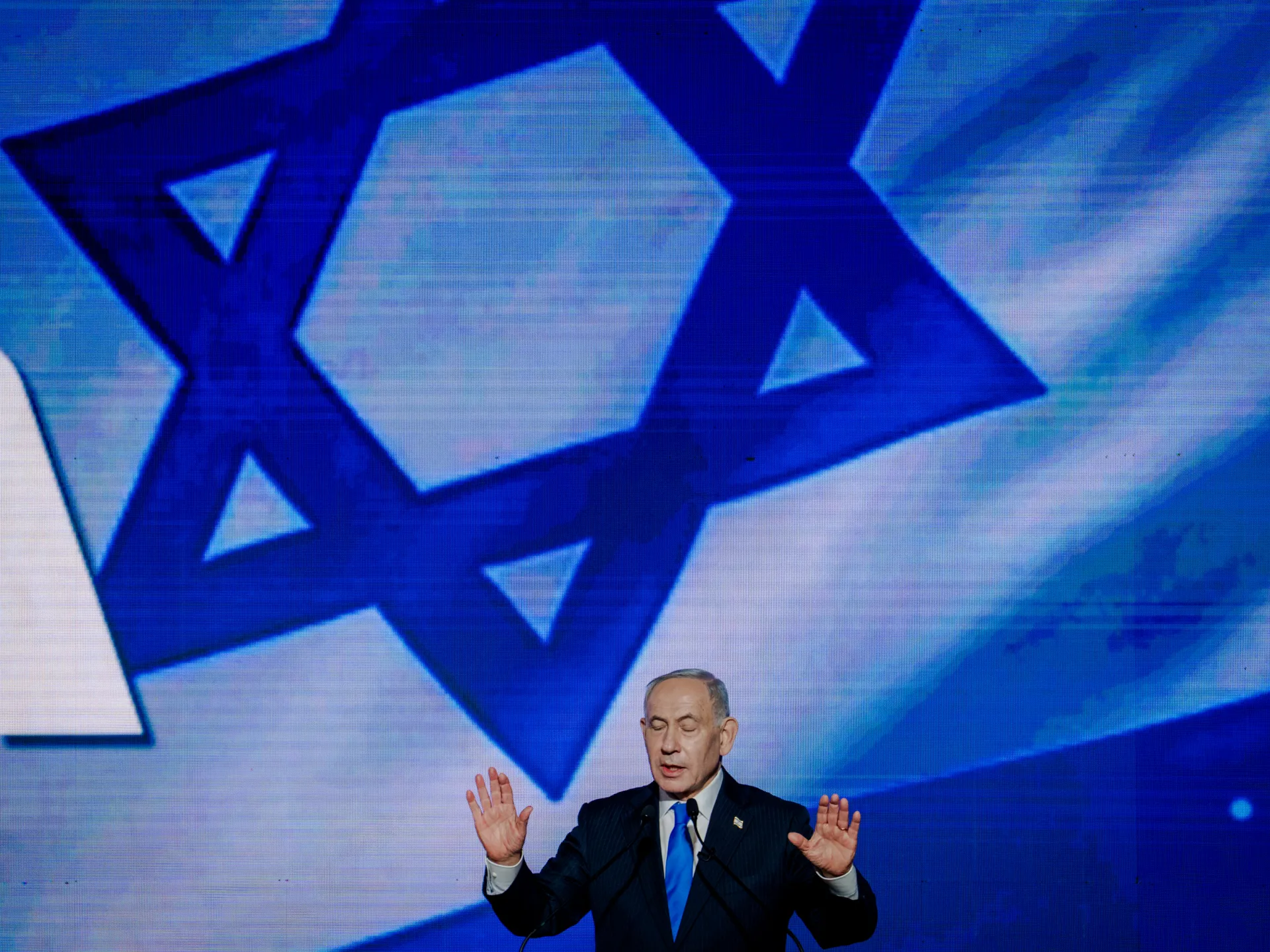
Netanayhu said Thursday in a video statement that Israeli forces would “remain in a 10-kilometer security zone, which will allow us to prevent infiltration into communities and anti-tank missile fire.”

Calling the negotiations potentially historic, Netanyahu said that Israel’s chief goal is to disarm Hezbollah and its ability to invade or launch weapons across the Lebanese border into Israel.

“That is where we will remain,” he said. “We are not leaving.”

After the diplomatic talks on Wednesday, Rubio reinforced that a key part of the meeting and now peace talks between the two nations is to end Hezbollah’s destabilizing influence in Lebanon and the wider Middle East.

“We have to remember the Lebanese people are victims of Hezbollah,” Rubio said, also noting that accomplishing a lasting peace “will take time.”

First lady Melania Trump speaks during a House Ways and Means Committee roundtable discussion on protecting children in America’s foster care system in the Longworth House Office Building near the U.S. Capitol on Wednesday. The bipartisan group of lawmakers are looking to address challenges children in foster care face, including barriers to education and educational advocacy, housing, employment opportunities, financial independence, and technology. Photo by Bonnie Cash/UPI | License Photo

Source link

How Coachella grew from a small desert festival into a global cultural behemoth

Commenters who never have been — and never will go — complain about the cost, the influencers, the hype. Purists wax poetic about the days when they disappeared into three days of music and the field wasn’t overtaken by brands like Barbie and e.l.f. cosmetics. Defenders claim they can camp their way to an affordable weekend, and others spend the whole time posting. A select few even talk about great performances they saw — it’s still a music festival.

You’re reading the Essential California newsletter

Sign up to start every day with California’s most important stories.

But one thing everybody can agree on: Coachella has changed. I should know. I’ve been covering it as a journalist since 2007.

Rapid advancements in technology and mass adoption of social media have brought out the best and worst of the festival — not just on screens thousands of miles away, but to those of us trying not to trip over the makeshift photoshoot you might have seen on Instagram.

Coachella pre-2010 was a purist’s paradise

Some of Coachella’s most iconic moments happened before smartphones: The Flaming Lips in a human hamster ball in 2004; Daft Punk’s 2006 pyramid set; Rage Against the Machine reuniting and calling for the George W. Bush administration to be tried for war crimes in 2007. If you even had a cellphone when Coachella started in 1999 it was probably a Nokia brick or a flip phone with an antenna that had limited talk and text options.

In the early years, there were no brand activations on the field; nobody knew what an influencer was and the only corporate sign you saw was for Heineken in the beer gardens. (There was no Heineken House with its own stage, just signs advertising the beer.)

The grounds were also considerably smaller, making it easier to explore the different stages and discover new music. You didn’t have fancy food options, but a slice of Spicy Pie was less than $10. (Coachella upgraded its food options from festival staples to weekend outposts of L.A. restaurants in 2014.)

The music was the draw. The festival’s track record includes artists like the Killers, the Black Keys, Childish Gambino and Kendrick Lamar climbing up from small type to headliner on the lineup poster.

Livestreams and influencers made Coachella’s reach global

The vibes started to shift in 2010 as smartphones grew in popularity, although the service on the field was spotty. It was the first year Coachella offered a livestream — available via Facebook and MySpace. The next year, the stream moved to YouTube, where it remains and draws millions of viewers.

As Coachella expanded to twin weekends due to popular demand on the ground in 2012, it also had the first viral moment fans could enjoy from thousands of miles away: Dr. Dre and Snoop Dogg brought 2Pac back to life via a hologram.

Celebrities were always at Coachella (I spotted Ryan Seacrest, Corbin Bernsen, David Hasselhoff and Danny DeVito in my early years), but the rise of social media made celebrity culture a key part of the event. By 2011, TMZ was posting about stars like Lindsay Lohan. Clips from Coachella went viral and ended up on shows like “Tosh.0” and referenced in “Community.”

The art, which was always part of the festival, became bigger and more iconic. On the growing photo app Instagram, larger-than-life sculptures of astronauts started appearing in selfies.

Brands saw an opportunity. American Express, H&M and Samsung launched activations on-site in 2015. The party scene outside the festival, with non-affiliated events that were timed because everyone was in town for Coachella, became marketing vehicles. Brands are still cashing in more than a decade later.

The next watershed moment was Beyoncé in 2018. Today, most headlining sets at the fest feel as if they are designed for the viewing experience on the livestream rather than the fans on the field (ahem, Justin Bieber and his laptop). But Beyoncé’s spectacle was just as mind-blowing on-site as it was at home. A year later, the “Homecoming” special debuted on Netflix, widening the reach.

Coachella became a key part of the pop culture landscape, and then it became a cornerstone of the influencer economy.

Behind all the hype, there’s still a music festival hiding

I inadvertently photobombed approximately 500 people just trying to go to and from the press tent last weekend and my inbox is overflowing with requests for coverage of off-site events with brands, celebs and TikTok influencers, including social media clips.

But at the end of the day, Coachella is still a music festival, and a really good one at that. The Strokes, David Byrne, Jack White, Iggy Pop, Turnstile, Wet Leg, Fujii Kaze and even Less Than Jake in the Heineken House were some of the best performances I had seen in years.

Coachella is what you make of it. And besides, everyone knows there are fewer influencers on Weekend 2.

Today’s top stories

A health worker administers a measles test.

A health worker administers a measles test on Fernando Tarin, of Seagraves, Texas, at a mobile testing site outside Seminole Hospital District on Feb. 21, 2025.

(Julio Cortez / Associated Press)

Increasing measles cases in California

  • California in 2026 has already seen its highest number of annual measles cases in seven years amid an ongoing resurgence of a disease once considered effectively eradicated in the U.S.
  • The re-emergence comes as vaccination rates have tumbled nationwide in recent years.

Testing LAX’s long-awaited train

  • LAX’s 2.25-mile electric train system will begin running without passengers next week as testing advances following a series of delays.
  • The Automated People Mover system began construction in 2019 and was initially slated to open to the public in 2023.
  • Specific bottles of Xanax, one of the most widely prescribed medications to treat anxiety and panic disorders, has been recalled due to its failure to dissolve at a standard rate.
  • FDA officials are not warning against consuming the product at this time.

What else is going on

Commentary and opinions

This morning’s must-read

Another must-read

For your downtime

A reporter lies on an AI massage table.

Reporter Deborah Vankin gets a massage by an “Aescape” robot at Pause Wellness Studio.

(Christina House / Los Angeles Times)

Going out

Staying in

A question for you: Are you planning on leaving California for another state? If so, tell us why.

Laura says, “I left California during the pandemic. Part of the push factor for me was politics, but not blue politics. I had been living in OC since 2018 and was surprised it was so Conservative (and conservative). That became a bigger source of discomfort for me as the vaccine question demonstrated how our neighbors’ decisions can impact us directly. Rather than moving elsewhere in California, which would have sorted out the political discomfort nicely, I moved to a much more affordable state where I had family.”

Email us at essentialcalifornia@latimes.com, and your response might appear in the newsletter this week.

And finally … from our archives

Kendrick Lamar rapping into a microphone on a dark smoky stage with a dark red backdrop

Kendrick Lamar performs at Coachella Music & Arts Festival at the Empire Polo Club on April 16, 2017.

(Amy Harris / Invision / AP)

On April 16, 2018, Compton’s own Kendrick Lamar became the first hip-hop artist to win the Pulitzer Prize for music.

He won for his album “Damn.,” which the Times’ Mikael Wood heralded as Lamar’s graduation to pop superstardom.

Have a great day, from the Essential California team

Jim Rainey, staff reporter
Hugo Martín, assistant editor, fast break desk
Kevinisha Walker, multiplatform editor
Andrew Campa, weekend writer
Karim Doumar, head of newsletters

How can we make this newsletter more useful? Send comments to essentialcalifornia@latimes.com. Check our top stories, topics and the latest articles on latimes.com.

Source link

Turkiye’s Roketsan eyes top 10 exporter rank amid Middle East conflict | Business and Economy News

Modern warfare has dramatically changed as we have seen from the Russia-Ukraine war, conflicts involving Gaza, India and Pakistan, and the recent US-Israeli strikes on Iran. At the centre of this shift is a surging global reliance on drone and missile technology as well as advanced air defence systems.

Turkiye, one of the largest military powers in the Middle East, is increasingly positioning itself as a major supplier in the global defence sector. Central to this effort is Roketsan, a company founded in 1988 to supply the Turkish Armed Forces, which has since evolved into the country’s primary manufacturer of missile and rocket systems.

Recommended Stories

list of 3 itemsend of list

Currently exporting to approximately 50 countries, the firm is one of the fastest-growing defence companies globally.

So how did Roketsan secure a large share of the global arms trade?

Bypassing Western embargoes

Turkiye’s defence expansion was largely accelerated by restrictions placed upon it. Western embargoes aimed at halting its military advancement meant Ankara could not acquire the necessary technical systems or components.

In 2020, the United States imposed Countering America’s Adversaries Through Sanctions Act (CAATSA) restrictions on Turkiye – a key member of the transatlantic military alliance NATO. These sanctions targeted Turkiye’s military procurement agency, its chief Ismail Demir, and three other senior officials. Washington also ejected Ankara from the F-35 stealth jet programme in July 2019.

The measures came after Ankara purchased Russia’s S-400 missile defence system, which was seen as a potential threat to NATO security. The European Union also prepared limited sanctions and discussed restricting arms exports following energy exploration disputes in the Eastern Mediterranean.

To circumvent this, the country built an integrated, domestic defence ecosystem. Today, Turkiye relies on a vast supply chain of nearly 4,000 small and medium-sized enterprises (SMEs) scattered across the country. As a result, the Turkish defence industry now operates with a local production rate exceeding 90 percent.

Türkiye's defense industry now operates with a local production rate exceeding 90 percent, bypassing long-standing Western embargoes. [Al Jazeera]
Türkiye’s defence industry now operates with a local production rate exceeding 90 percent, bypassing long-standing Western embargoes [Al Jazeera]

This shift has yielded significant financial returns for Ankara. In 2025, Turkiye’s defence industry reported $10bn in exports. Roketsan’s General Manager Murat Ikinci told Al Jazeera that the company currently ranks 71st among global defence firms, with ambitions to break into the top 50, then the top 20, and ultimately the top 10.

To support this expansion, Turkish President Recep Tayyip Erdogan inaugurated several large-scale facilities last week, including:

  • Europe’s largest warhead facility.
  • new research and development (R&D) centre housing 1,000 engineers.
  • the “Kirikkale” facility dedicated to rocket fuel technology.
  • new infrastructure for the mass production of ballistic and cruise missiles.

These projects represent a $1bn investment, with the company planning to inject an additional $2bn to expand mass production capabilities.

The ‘Tayfun’ and modern warfare

Roketsan’s R&D strategy – which employs 3,200 engineers and makes the company the third-largest R&D institution in Turkiye – is heavily influenced by data gathered from ongoing global conflicts.

According to Ikinci, the war in Ukraine highlighted the impact of cheap, first-person view (FPV) and kamikaze drones supported by artificial intelligence. In response, Roketsan developed air defence systems like “ALKA” and “BURC,” alongside the “CIRIT” laser-guided missile.

The regional landscape was further complicated during the US-Israel war on Iran, as cheap Iranian-designed Shahed drones – recently upgraded by Russia with “Kometa-B” anti-jamming modules – overwhelmed defences and even struck a British base in Cyprus in March 2026. During the same month, NATO air defences were forced to intercept three Iranian ballistic missiles that entered Turkish airspace.

Meanwhile, the recent conflict between Israel and Iran showcased the use of complex attacks combining ballistic missiles with “swarms” of kamikaze drones designed to overwhelm air defences. This environment makes hypersonic technology a critical asset.

This brings the Tayfun (Typhoon) project into focus. Tayfun is a developing family of long-range ballistic missiles. Its most advanced iteration, the Tayfun Block 4, is a hypersonic missile engineered to penetrate advanced air defence systems by travelling at extreme speeds.

When Al Jazeera asked for specific details regarding the Tayfun’s exact operational range, Ikinci was elusive. “We avoid mentioning its range; we just say its range is sufficient,” he noted.

Similarly, historical Western sanctions have pushed Turkiye to form new cooperation initiatives, effectively accelerating an “Eastern shift” away from Western defence dependence. Turkish drones are now being used by a growing number of countries, including by Pakistan during its war against India last May.

Based on these threat assessments, Roketsan has prioritised five key areas of production:

  1. long-range ballistic and cruise missiles.
  2. air defence systems, including the “Steel Dome”, Hisar-A, Hisar-O, and Siper.
  3. submarine-launched cruise missiles, utilising the AKYA system to leverage Turkiye’s large submarine fleet.
  4. smart micro-munitions designed specifically for armed drones.
  5. long-range air-to-air missiles, a need highlighted by the brief India-Pakistan skirmish.

A strategic export model

Unlike traditional arms procurement, Turkiye is marketing its defence industry to international buyers as a strategic partnership.

“Our offer to our partners… is as follows: Let’s produce together, let’s develop technology together,” Ikinci stated.

İkinci emphasizes that Roketsan's international strategy is based on "partnership models" rather than simple sales. [Al Jazeera]
Rokestan’s General Manager Murat İkinci, right, emphasises that Roketsan’s international strategy is based on ‘partnership models’ rather than simple sales [Al Jazeera]


By establishing joint facilities and R&D centres in allied nations across the Middle East, the Far East, and Europe, Turkiye is attempting to secure long-term geopolitical alliances rather than purely transactional sales. Ikinci highlighted Qatar as a prime example of this model, describing it as a benchmark for technological, military, and security cooperation in the region.

Filling the global stockpile gap

This rapid expansion comes at a critical time for the global arms trade. Ongoing wars have severely depleted the stockpiles of advanced weapon systems worldwide.

During the recent US-Israel war on Iran, Washington relied heavily on multimillion-dollar Patriot and Terminal High Altitude Area Defense (THAAD) systems to intercept cheap Iranian drones targeting US assets across Qatar, Kuwait, Bahrain, Saudi Arabia, and the United Arab Emirates. With growing concerns that US interceptor supplies could run low, Gulf states – which have collectively detected over 1,000 drones in their airspace – are actively seeking alternative defence technologies, creating a highly lucrative opening for Turkiye’s missile industry.

Defence analyses indicate that even military superpowers like the US will require significant time to replenish their current air defence inventories due to the complexity and massive infrastructure required to build them.

Turkish defence officials view this shortage as a strategic opening. Having localised its supply chain, Turkiye claims it can manufacture and export these highly sought-after complex systems independently.

As global demand for air defence and ballistic technologies rises, Roketsan is aggressively reinvesting its revenues into production infrastructure to expand its footprint in the international arms market.

Source link

Hegseth says US blockade to continue, ready for new attacks on Iran energy | Donald Trump News

United States Pentagon Chief Pete Hegseth has said the military blockade of Iran’s ports will continue “as long as it takes”, saying Washington remained “locked and loaded” to attack Iran’s energy facilities.

The US Pentagon chief spoke on Thursday as a tenuous pause in fighting agreed to last week has continued. On Monday, President Donald Trump announced the military would blockade Iran’s ports in the Strait of Hormuz and the Persian Gulf after US-Iran talks in Pakistan failed to reach a breakthrough.

Recommended Stories

list of 3 itemsend of list

Hegseth struck an aggressive tone as he maintained the US military was monitoring Iran’s military movements during the pause in fighting, which currently is meant to extend through early next week.

“We are reloading with more power than ever before…even more importantly, better intelligence than ever before,” Hegseth said.

“As you expose yourself with your movement to our watchful eye, we are locked and loaded on your critical dual-use infrastructure, on your remaining power generation and on your energy industry,” he said.

Still, the Pentagon chief said the US prefers to resolve the conflict, which began with US-Israeli attacks on Iran on February 28, through diplomacy.

“You, Iran, can choose a prosperous future, a golden bridge, and we hope that you do for the people of Iran,” he said. “In the meantime and for as long as it takes, we will maintain this blockade, successful blockade, but if Iran chooses poorly, then they will have a blockade and bombs dropping on infrastructure, power and energy.”

On Wednesday, a Pakistani delegation arrived in Tehran to coordinate a new round of talks. While both sides have indicated they remained open to further negotiations, Major-General Ali Abdollahi, the commander of the Khatam al-Anbiya Central Headquarters of the Islamic Revolutionary Guard Corps (IRGC), warned that the US blockade could end the current pause in fighting.

White House spokesperson Karoline Leavitt, meanwhile, indicated the US maintained a positive outlook on future talks.

“At this moment, we remain very much engaged in these negotiations, in these talks,” she said.

But reporting from Tehran on Thursday, Al Jazeera’s Ali Hashem says deep-seated distrust remains. The US under Trump twice attacked Iran amid ongoing indirect talks over Iran’s nuclear programme, a fact that has cast a long shadow over the most recent bout of diplomacy.

“Clearly, there have been several messages conveyed to the Iranians. But rather than consolidating a feeling of trust and optimism, it seems that it’s already shaken,” he said.

“We saw a platform closely associated with the foreign ministry tweeting today, quoting a source saying that whatever is being demonstrated or said in the media regarding the optimism is just hype, and this is used for PR and it’s for President Trump to use in the markets,” he said.

Iran’s speaker of parliament, Mohammad Bagher Ghalibaf, who led the Iranian delegation in the talks with Iran, told his Lebanese counterpart on Thursday that a ceasefire in Israel’s invasion and ongoing bombardment of Lebanon is “as important” as the pause in fighting in Iran.

A Lebanon ceasefire has emerged as one of the main sticking points in talks, which also include control of the Strait of Hormuz and the future of Iran’s nuclear programme.

‘We will use force’

Speaking during the news conference on Thursday, General Dan Caine, the chairman of the Joint Chiefs of Staff, said so far, 13 ships leaving Iranian ports have turned around in response to US military warnings.

“If you do not comply with this blockade, we will use force,” Caine said.

Admiral Brad Cooper, the head of US Central Command (CENTCOM), meanwhile, said the US is using the wear to rearm and reposition its forces.

“We’re rearming, we’re retooling, and we’re adjusting our tactics, techniques and procedures. There’s no military in the world that adjusts like we do, and that’s exactly what we’re doing right now during the ceasefire,” said.

During questions with reporters, Hegseth also shot down reports that China was planning to send weapons to Iran amid the pause in fighting. Hegseth said Washington had received assurances from Beijing that this was not the case.

Hegseth also used a large portion of the news conference to attack US press coverage of the war, which the Trump administration is receiving criticism for its shifting objectives and justifications for launching the conflict.

Hegseth called the coverage “incredibly unpatriotic”.

Source link

Israeli army says soldiers accused of abusing Palestinian to return to duty | Israel-Palestine conflict News

Some of the reservists accused of sexually assaulting a detainee have already started combat roles, reports Israeli Army Radio.

Israeli military chief Eyal Zamir has authorised five soldiers accused of sexually assaulting a Palestinian inmate in the notorious Sde Teiman detention camp to return to reserve service after charges against them were dropped, according to Israeli media reports.

The soldiers, all from the Force 100 unit assigned to guard military prisons, are being reinstated despite an ongoing, internal military inquiry into their conduct.

Recommended Stories

list of 3 itemsend of list

Israeli Army Radio reported that some of the reservists have already returned to active duty, including deployment to combat roles.

An Israeli army statement, cited by Israel’s Haaretz newspaper, said: “The investigation does not prevent them from continuing to serve … the command-level investigation will be completed as soon as possible.”

The reinstatement comes after Israel’s top military lawyer dropped all charges against the soldiers last month, closing a case that had been among the most divisive in Israel’s recent history.

The soldiers had been charged with aggravated assault and causing severe injury, after footage broadcast by Israeli television showed them abusing a Palestinian man in Sde Teiman. The military’s own indictment described soldiers stabbing the detainee with a sharp object near his rectum, causing cracked ribs, a punctured lung and an internal tear.

A doctor at the facility, Yoel Donchin, told Haaretz he was so shocked by the Palestinian inmate’s condition that he initially assumed it was the work of a rival armed group.

Military Advocate General Itay Offir said the indictments were scrapped partly because of “complexities in the evidentiary structure” and “difficulties” arising from the detainee’s release to the Gaza Strip.

Rights groups condemned the decision as a legal injustice, with Amnesty International calling it “yet another unconscionable chapter in the Israeli legal system’s long-standing history of granting impunity to perpetrators of grave crimes against Palestinians”.

“Since the start of Israel’s genocide against Palestinians in the occupied Gaza Strip, and despite overwhelming evidence of widespread torture and abuse, including sexual violence, against Palestinians in Israeli detention centers, only one Israeli soldier has so far been sentenced over torturing a Palestinian detainee,” said the rights group in a statement.

Palestinians released from Israeli detention have reported suffering widespread abuse while in custody.

A February report by the Committee to Protect Journalists also cited dozens of formerly detained Palestinian journalists describing “routine beatings, starvation and sexual assault” in Israeli custody.

Source link

Is Iran’s economy buckling under war pressure or holding up? | US-Israel war on Iran

The Iran war has deepened the damage to its sanctions-hit economy, but oil revenues have provided a crucial cushion.

The US has spent decades trying to squeeze Iran economically.
Six weeks into the Middle East conflict, Tehran is still standing.
US and Israeli attacks on infrastructure, industry and trade have damaged Iran’s sanctioned economy even further.

But oil revenues have kept flowing, giving the regime a financial cushion.

The Strait of Hormuz is now at the centre of this economic battle; whoever controls it controls the pressure.

At the negotiating table, sanctions relief, billions in frozen assets and war reparations are all at stake.

Meanwhile, millions of Iranians are bearing the brunt of inflation, shortages and a collapsing currency.

Source link

Iran war: What is happening on day 48 of the US-Iran conflict? | US-Israel war on Iran News

US–Iran talks gain pace as Pakistan mediates, with fresh optimism for a new round of talks in Islamabad.

Efforts to revive US-Iran negotiations are gathering pace, with Pakistan again having an important mediating role as its leaders hold high-level talks in Tehran and the Gulf.

Amid a renewed push to end the war, a Pakistani delegation, led by army chief Field Marshal Asim Munir is in Tehran. He is expected to relay messages from the United States, while Pakistan’s Prime Minister, Shehbaz Sharif, arrived in Saudi Arabia as part of a regional tour that includes Qatar and Turkiye.

Recommended Stories

list of 4 itemsend of list

Iran’s Foreign Ministry spokesman, Esmael Baghaei, said Tehran and Washington have remained in contact since talks in Islamabad ended on Sunday. On Wednesday, Washington signalled optimism about a new round of talks in the Pakistani capital.

But the diplomatic push comes amid increasing tension, as Iran warns it could expand its response to the US naval blockade beyond its own waters.

Divisions in Washington persist, with the US Senate rejecting a measure to limit the war without congressional approval.

Here is what we know:

In Iran

  • Hormuz tensions remain high: Adviser Mohsen Rezaei warned that Iran could target US ships, if Washington continues to enforce its naval blockade in the Strait of Hormuz. The warning comes as the US tightens restrictions on vessels linked to Iranian ports, with ships already being turned back amid the standoff.
  • Nuclear issue shows potential breakthrough: Analyst Abas Aslani says Tehran is open to nuclear transparency if Washington is serious about a deal, but new US sanctions and the blockade of Iranian ports are fuelling distrust.
  • “There is a sense of distrust, and at the moment, Iran is ready for every possible scenario, either progress in the negotiations or returning to the military conflict,” he told Al Jazeera.
  • Iran’s Foreign Minister Abbas Araghchi warned of consequences over US “provocative actions” in the Gulf and the Strait of Hormuz during a call with his Chinese counterpart Wang Yi.

War diplomacy

  • Round two of talks: The US is discussing holding a second round of peace talks with Iran and is optimistic about reaching a deal, the White House said.
  • China supports ‘momentum’ of peace talks: China’s Foreign Minister, Wang Yi, told his Iranian counterpart that Beijing “supports maintaining the momentum of the ceasefire and peace talks”.
  • Saudi crown prince, Pakistan PM meet: Crown Prince Mohammed bin Salman and Shehbaz Sharif met in Jeddah to discuss regional issues, including US-Iran negotiations. Talks hosted by Pakistan were a key focus, said the Saudi Press Agency.
  • US and Qatar: US President Trump discussed regional developments and energy concerns, specifically regarding the oil market and gas prices, with Qatari Emir Sheikh Tamim bin Hamad Al Thani.
Saudi Crown Prince Mohammed bin Salman meets with Pakistan's Prime Minister Shehbaz Sharif in Jeddah
Saudi Crown Prince Mohammed bin Salman and Pakistan’s Prime Minister Shehbaz Sharif in Jeddah, Saudi Arabia [Saudi Press Agency/Reuters]

In the US

  • US President Donald Trump has announced that Israeli and Lebanese leaders will hold direct talks later today – their first such contact in 34 years.
  • New oil sanctions: US officials targeted more than two dozen individuals, along with companies and vessels linked to the oil transport network of Iranian shipping magnate Mohammad Hossein Shamkhani.
  • US says 10 vessels blocked from Iranian ports: The US military’s Middle East command (CENTCOM) said 10 ships were stopped or redirected within the first 48 hours of a naval blockade, with none leaving Iranian ports.
  • US Congress divisions: The Senate rejected efforts to limit US involvement in the war and blocked measures targeting arms sales to Israel, though growing opposition signals shifting political pressure.

In Israel

  • ‘Identical’ goals: Israeli Prime Minister Benjamin Netanyahu said that Israel and the US are fully aligned in their objectives to contain Iran.
  • Ceasefire pressure, no halt in fighting: Despite pressure, Netanyahu said Israel would continue military operations.
  • End of Hezbollah: The Israeli prime minister said the country’s top priority in Lebanon was to secure the “dismantling” of Hezbollah, in its first direct talks with the country in decades.
  • “There are two central objectives: first, the dismantling of Hezbollah; second, a sustainable peace… achieved through strength,” he said.

In Lebanon

  • Relentless strikes continue: Air raids and shelling hit southern and eastern Lebanon, including Kafr Sir and Nabatieh, while a “triple-tap” strike in Mayfadoun killed four paramedics. Israeli vehicles and bulldozers remain active.
  • Lebanon’s Minister for Administrative Reform Fadi Makki said an Israeli attack that killed four paramedics in southern Lebanon was “a new war crime”.
  • Rising toll: Israeli strikes have killed at least 2,167 and injured more than 7,000 people, according to the Lebanese Health Ministry. About 1.2 million people have been displaced since March 2. Israel has been accused of destroying homes in southern Lebanon, as happened in Gaza.
  • ‘Homes that no longer exist’: “Even if a ceasefire is reached, the reality on the ground is devastating.. entire communities along the border have been destroyed,” Al Jazeera’s Malcolm Webb reported from Beirut. He added that Israel has yet to secure its objective of controlling territory up to the Litani River.
  • Balakrishnan Rajagopal, the UN special rapporteur on the right to housing, has joined other UN human rights experts, calling for Israel to immediately stop its bombing of Lebanon. Rajagopal wrote on social media that the Israeli military is using the “same strategy” in southern Lebanon as in Gaza or the occupied West Bank.
  • Diplomatic tensions grow: Hezbollah has condemned US-hosted Israel-Lebanon talks as “shameful,” while a failed Senate vote to block bulldozer sales to Israel highlights increasing concern over civilian harm.
An armoured Israeli military vehicle operates inside Israel, near the Israel-Lebanon border
An armoured Israeli military vehicle near the Lebanon border [Florion Goga/Reuters]

Global economy

  • Growing hunger fears: The war could push millions more towards hunger as its economic fallout reverberates around the globe, the World Bank’s chief economist told AFP.
  • “You have about 300 million people who suffer from acute food insecurity already,” Indermit Gill said.  “That’ll go up by about 20 percent very, very quickly,” as knock-on effects grow.
  • Wall Street records: Major Wall Street stock indices finished at record highs on Wednesday following optimism about an accord in the US-Iran conflict.

Source link

Trump says Israel and Lebanon’s leaders will speak on Thursday | Israel attacks Lebanon News

DEVELOPING STORY,

US president says the leaders of the two countries will speak for the first time in 34 years on Thursday.

United States President Donald Trump says the leaders of Israel and Lebanon will speak for the first time in 34 years on Thursday.

The announcement on Wednesday came a day after Israel and Lebanon’s envoys to the US held direct talks in Washington, DC, to discuss an end to Israeli attacks on its neighbour.

Recommended Stories

list of 4 itemsend of list

“Trying to get a little breathing room between Israel and Lebanon,” Trump wrote on his Truth Social platform.

“It has been a long time since the two leaders have spoken, like 34 years. It will happen tomorrow. Nice!”

The US president did not specify who will be involved in the talks.

Lebanon was drawn into the US and Israel’s war on Iran on March 2 after Tehran-aligned Hezbollah resumed attacks on Israel.

Hezbollah said the attacks were in retaliation for Israel’s killing of Iran’s Supreme Leader Ayatollah Ali Khamenei on the first day of the war, on February 28, as well as Israel’s near-daily violations of a ceasefire it agreed to in Lebanon in November 2024.

Israeli attacks since March 2 have killed more than 2,000 people in Lebanon and displaced more than 1.2 million others. The Israeli military has also launched a ground invasion in southern Lebanon, seeking to seize more territory and create what it calls a “buffer zone”.

Israeli Prime Minister Benjamin Netanyahu on Wednesday ordered the military to expand the invasion in southern Lebanon towards the east.

He said that Israel was pursuing negotiations with the Lebanese government alongside its military campaign against Hezbollah in hopes of disarming the armed group and achieving a “sustainable peace” with its northern neighbour.

The Lebanese government, which is not a party to the conflict between Israel and Hezbollah, is seeking a ceasefire and a withdrawal of Israeli troops from southern Lebanon.


Source link

Democrats clash with US Energy Secretary over Iran war and gas prices | US-Israel war on Iran News

Watch the moment a Democratic congresswoman tells the US Energy Secretary he is ‘living in a different world’ after his response to whether he’d adequately warned the White House that a war on Iran would have global consequences.

Source link

UN experts urge member states to suspend Israel arms transfers | United Nations News

The experts call Israel’s bombardment of Lebanon on April 8 ‘a blatant violation of the UN Charter’.

A group of United Nations experts has denounced Israel’s attack on Lebanon a day after the United States and Iran agreed a ceasefire as illegal and urged UN member states to halt all arms transfers to Israel.

The 19 experts – including special rapporteurs and independent experts across a range of human rights mandates – issued the condemnation on Wednesday as Israel continued to pound areas of southern Lebanon, killing at least 16 people, including four paramedics, Lebanese state media reported.

Recommended Stories

list of 3 itemsend of list

Referring to a devastating wave of Israeli attacks across Lebanon on April 8, which Lebanese authorities said killed more than 350 people, including 30 children, the experts said: “This is not self-defence. It is a blatant violation of the UN Charter, a deliberate ‌destruction of prospects for peace, and an affront to multilateralism and the UN-based international order.”

They called for Israel to “cease all military operations in Lebanon” and urged UN member states to halt arms transfers to Israel while “there is credible evidence of serious violations of international humanitarian and human rights law”, according to the UN Human Rights Council.

Israel escalated its attacks on Lebanon on March 2 after the Lebanese armed group Hezbollah fired rockets into Israel in response to the US-Israel killing of Iranian Supreme Leader Ali Khamenei two days earlier, the first day of their war on Iran.

Israel has carried out a devastating bombardment across Lebanon and a ground invasion in the south, killing more than 2,000 people and forcibly displacing more than 1.2 million.

The UN experts said such forced displacement “of a civilian population constitutes crimes against humanity”. They also condemned Israel’s targeted “destruction of homes”, particularly in predominantly Shia areas of the south, as “a form of collective punishment” that “points to ethnic cleansing”.

Israel’s continuing bombardment of Lebanon has been a point of tension in US-Iran negotiations. Tehran said Lebanon should be covered in the ongoing ceasefire. Israeli Prime Minister Benjamin Netanyahu said Lebanon is ‌not ‌part of the ceasefire with Iran and Israel will continue to target Hezbollah “wherever required”.

On Saturday, days before Israel and Lebanon held rare, high-level diplomatic talks in the US, Netanyahu said Israel wanted long-term peace with Lebanon but on the condition that Hezbollah is disarmed.

The Reuters news agency quoted a senior Israeli official as saying ⁠Israel’s security cabinet planned to convene on Wednesday evening to discuss a possible ceasefire in Lebanon. It also quoted several senior ⁠Lebanese officials as saying ceasefire efforts were under way.

Source link

Why has Italy’s Giorgia Meloni suspended a defence pact with Israel? | US-Israel war on Iran News

Italy’s decision to suspend a defence agreement with Israel has more symbolic value than concrete consequences, but it is an unprecedented move by the Italian government and reflects deep unease over its longtime ally’s actions in the Middle East, analysts say.

On Monday, Prime Minister Giorgia Meloni said Italy would not renew a memorandum of understanding – signed in 2003 and ratified in 2005 – between the two countries’ ministries of defence. The accord provided a framework for cooperation in “defence industry and procurement policy” and “import, export and transit of defence and military equipment”, among other things.

Recommended Stories

list of 3 itemsend of list

The memorandum was set to automatically renew every five years “unless a written notice of intention to denounce is given” by one of the two countries to the other.

That notice arrived on Monday in a letter written by Italian Defence Minister Guido Crosetto to his Israeli counterpart, Israel Katz.

The Israeli government has downplayed the move. Foreign Minister Gideon Saar said it was a deal that “never materialised” and did not have “substantial content”. “Israel’s security will not be harmed,” he wrote on X.

It is true that the Italy-Israel agreement constituted more of a political framework than a series of operational commitments between the two countries. Furthermore, the Italian government’s decision does not cancel it outright, as opposition parties and human rights advocates have long demanded, but merely suspends it.

Still, the move is a sharp reversal for a right-wing government that has been one of Europe’s staunchest allies of Israel.

Along with Germany, Italy has been one of the strongest opponents of calls to suspend a trade agreement between Israel and the European Union. Italy has largely supported Israel’s war on Gaza, which a United Nations inquiry says amounts to genocide, and it has refused to recognise Palestinian statehood. 

But relations between Israel and Italy have soured recently.

On Monday, the Italian ambassador to Tel Aviv, Luca Ferrari, was summoned after Italy’s Foreign Minister Antonio Tajani condemned Israel for its “unacceptable attacks against the civilian population” in Lebanon during a visit there. And last week, the Italian government accused Israeli forces of firing warning shots at a convoy of Italian peacekeepers in southern Lebanon, prompting Tajani to summon the Israeli ambassador.

Israel also launched a massive attack across Lebanon last week, bombing 100 targets in 10 minutes on Wednesday, shortly after a two-week truce between Iran and the US was called. That series of strikes killed hundreds of people in one of the country’s worst mass slaughters since the end of the country’s civil war in 1990. Observers say the attack on Lebanon was an unwelcome disruptor to efforts to de-escalate tensions in the region.

De-escalating Middle East tensions

The Italian government’s decision to suspend its defence agreement with Israel “must be seen within a broader effort to progressively stabilise the region, including by reducing tensions in Lebanon”, said Michele Valensise, president of the Institute for International Affairs and former secretary-general of Italy’s Ministry of Foreign Affairs.

“Israel’s military operation there objectively constitutes an irritant, complicating negotiations with the Iranians,” said Valensise. “If the Lebanese front can be part of a deal with Iran, then everyone has an interest in de-escalation there.”

European governments, including Italy, have been watching nervously as the United States-Israeli war on Iran has unfolded. Following initial joint Israel-US strikes on Tehran on February 28, Iranian forces brought shipping traffic in the Strait of Hormuz to a near-total halt, causing the paralysis of the one-fifth of global oil and liquefied natural gas (LNG) exports that pass through the narrow waterway in peacetime.

Following a first failed round of high-stakes Iran-US talks in Islamabad last weekend – amid a fragile two-week truce – Washington imposed a naval blockade on Iranian ports, further aggravating fears of a protracted energy crisis. Italy heavily relies on gas imports.

‘Stop the genocide’

Possibly more importantly, Italy’s government and prime minister are preparing for elections next year.

“There is a general discontent over the war in Iran and the crisis in the Strait of Hormuz – a crisis that’s impacting Italian growth and, if it continues, could have a significant impact on citizens, something Meloni worries about in a pre-election year,” said Arturo Varvelli, a political scientist and senior policy fellow at the European Council on Foreign Relations.

Italian public opinion also has a strong pro-Palestinian component. Last October, more than two million Italians took to the streets as part of a general strike in solidarity with the Global Sumud Flotilla, which was intercepted by Israel while trying to bring aid to Palestinians in Gaza. The flotilla had been carrying 40 Italians among its passengers, calling on Israel to “stop the genocide”.

“There’s a concern that this will be a long agony, between an increasingly unmanageable Trump and the economic problems he and Netanyahu have caused with the war in the Middle East,” Varvelli said.

After years of efforts to emerge as US President Donald Trump’s “whisperer” in Europe, Meloni has been pushed by the war in Iran to put some distance between herself and Trump. Rome refused the US president’s request to join a naval coalition to force the opening of the Strait of Hormuz and to allow US bombers to refuel at a military base in southern Italy.

Trump had not commented on those decisions until yesterday, when, in an interview with Italian newspaper Corriere della Sera, he took aim at Meloni. The Italian PM had leapt to defend Pope Leo XIV after he became embroiled in a feud with Trump. Pope Leo had condemned the US president’s threat that Iran’s “civilisation will die” if it didn’t re-open the Strait of Hormuz. In response to that, Trump unleashed a storm of criticism at Leo, calling him “weak on crime” and “terrible for foreign policy”. He said he does not “want a Pope who criticises the President of the United States”.

Trump also posted a bizarre image of himself as a Christ-like figure healing the sick on social media. He has since claimed it was meant to depict him as a doctor, following widespread criticism.

Of Meloni, who he once affectionately called “a real live wire”, Trump said, “I’m shocked at her” during an interview with Corriere della Sera on Tuesday.

“Do people like her? I can’t believe it,” he said in the interview, adding, “I thought she had courage. I was wrong.”

Source link

As world focuses on Iran, Israel ‘engineering starvation policy’ in Gaza | Gaza News

With the global attention fixated on the diplomatic efforts to end the war on Iran, Israel has systematically escalated its attacks on Gaza and choked off vital aid, plunging the besieged enclave into what economic experts are now calling an “engineered, compounded famine”.

The number of aid trucks entering Gaza has dropped drastically in violation of the October 2025 ceasefire with Hamas. Since then, the Government Media Office in Gaza has recorded 2,400 military violations by Israeli forces, resulting in the killing of more than 700 Palestinians.

Recommended Stories

list of 4 itemsend of list

On Tuesday, Israel’s military killed at least 11 Palestinians, including two children, in separate attacks across the war-torn Strip.

The intensity of these attacks spiked during peak regional tensions. Between February 28 and April 8, while Israel and the US were engaged in a bombing campaign against Iran, Israeli forces bombed Gaza on 36 out of those 40 days.

In the last five weeks alone, more than 100 people have been killed, including Al Jazeera journalist Mohammed Wishah. Israel has killed more than 72,336 people since launching the brutal military offensive on October 7, 2023.

Interactive_40Days_Gaza_US-ISRAEL-WAR-APRIL8_2026-FOOD_SECURITY

The ‘truck deception’

While Israel frequently claims it is allowing hundreds of aid trucks into Gaza, Palestinian officials and economic experts argue these figures are a deliberate mathematical deception.

According to the Government Media Office, only 41,714 aid and commercial trucks have entered Gaza over the past six months. This represents a mere 37 percent of the 110,400 trucks stipulated under the ceasefire agreement. The fuel situation is even more critical, with only 1,366 fuel trucks entering out of a promised 9,200 – an abysmal 14 percent compliance rate.

Recent daily logs highlight the severity of the bottleneck. On April 13, a total of only 102 aid trucks and 7 fuel trucks were allowed into the entire Strip, alongside 216 commercial trucks – a fraction of the more than 600 total trucks required daily under the “ceasefire” deal. By April 14, the numbers remained critically low with 122 aid trucks and 12 fuel trucks entering.

Crucially, Israeli authorities entirely shut down additional entry points like the Zikim and Kissufim crossings, which had processed dozens of commercial and aid trucks just a day prior, bottlenecking all limited traffic exclusively through Karem Abu Salem.

Mohammed Abu Jayyab, a Palestinian economic expert based in Gaza, told Al Jazeera that Israel utilises a “technical and commercial deception” to inflate these numbers.

“An Israeli truck carries up to 32 or 34 pallets… which are then unloaded into two or three smaller, dilapidated Palestinian trucks on the Gaza side,” Abu Jayyab explained. “Consequently, the UN and Israel count double or triple the actual number of Israeli trucks entering.” One pallet holds roughly 1 tonne of goods or food items.

Furthermore, Israel recently banned mixed-load shipments. If a merchant brings in 20 pallets of sugar, the remaining 12 pallet spaces on the truck must remain empty, yet it is still registered as a full commercial truck.

“The political agreement stipulated a ‘truck’ but did not specify quantities, weights, or the number of pallets,” Abu Jayyab noted, allowing Israel to weaponise logistics to restrict aid while appearing compliant.

Engineering starvation

This logistical strangulation is part of a broader strategy. Hassan Abu Riyala, undersecretary of the Ministry of National Economy in Gaza, stated in a meeting published on the ministry’s official Telegram channel that Israel is “engineering a policy of starvation”.

To ensure chaos in the local markets and sky-high prices, Israel has deliberately dismantled civil regulatory bodies. “The occupation targeted the majority of the crews that monitored prices, and assassinated the [former] undersecretary of the Ministry of Economy and five directors general during the war,” Abu Riyala said.

The results have been devastating, basic commodities have become scarce, and bread production has plummeted to 200 tonnes daily, far below the 450 tonnes required to feed the population.

“We manage this structural deficit under exceptional and coercive conditions,” Ismail Al-Thawabteh, director general of the Government Media Office, told Al Jazeera.

He described the ongoing reduction of supplies despite the truce as a “systematic restriction of basic supplies” that pushes the population towards dangerous levels of food insecurity. Fresh produce has skyrocketed, with 1kg (2.2lb) of tomatoes jumping from $1.50 to nearly $4 in a matter of weeks.

Moreover, the humanitarian catastrophe is being accelerated by the withdrawal of major aid groups. Al-Thawabteh noted that the scaling back or suspension of operations by key international institutions, most notably the World Food Programme (WFP), due to Israeli restrictions, represents a “highly dangerous development” that threatens the complete collapse of Gaza’s relief system.

“We issue an urgent appeal to the international community and the guarantors of the agreement to immediately pressure Israel to open the crossings… before reaching a point of no return and an imminent human explosion,” he said.

A ‘compounded famine’

The crisis has evolved beyond a simple lack of food; it is now a complete collapse of the Palestinian economy.

Abu Jayyab described the current situation as a “compounded famine”. With unemployment soaring to 80 percent and the destruction of more than 160,000 jobs across industrial, agricultural, and commercial sectors, the population has entirely lost its purchasing power.

“It has become illogical to link the entry of food supplies from the crossings to their availability to Palestinian citizens,” Abu Jayyab told Al Jazeera. Even when goods reach the market, between 70 to 80 percent of families simply cannot afford to buy them due to the total absence of income.

This extreme deprivation is forcing civilians into life-threatening alternatives. “The return of long queues for bakeries, and citizens resorting to burning plastic and waste in the absence of cooking gas, are dangerous field indicators of an unprecedented deterioration,” Al-Thawabteh warned, noting that government health facilities are currently struggling to treat respiratory and skin diseases resulting from this toxic pollution.

The medical blockade

Meanwhile, the stranglehold extends to Gaza’s most vulnerable patients. While the ceasefire agreement mandated the opening of the Rafah crossing for medical evacuations, Israel has kept the borders tightly restricted.

Over the past six months, only 2,703 people have been allowed to cross through Rafah out of an expected 36,800 – a compliance rate of just 7 percent. Consequently, only 8 percent of the severely wounded and chronically ill patients slated for urgent medical evacuation have been permitted to leave. According to the World Health Organization, roughly 18,000 people are still trapped in Gaza waiting for life-saving treatment abroad.

INTERACTIVE - Israel’s closure of the Rafah crossing - OCT 15, 2025 copy 2-1775738950
(Al Jazeera)

Source link

Italy suspends long-standing defence agreement with Israel | Israel attacks Lebanon

NewsFeed

Italy has suspended the renewal of a 20-year-long defence agreement with Israel, following recent tensions between the two countries after the Italian government accused Israeli forces of firing warning shots at a convoy of Italian peacekeepers in Lebanon.

Source link

Israel and Lebanon hold direct talks for first time in decades | Israel attacks Lebanon

NewsFeed

After the first direct talks in decades, Israel and Lebanon have agreed to begin ongoing negotiations for the ‘security of both countries’. Al Jazeera’s Mike Hanna explains why US Secretary of State Marco Rubio sees this ‘milestone’ meeting as just the ‘start of the process’.

Source link

Palestinian-Israeli conflict critical for BRICS

Long before South African President Cyril Ramaphosa chaired a video summit with BRICS leaders (Brazil, Russia, India and China) with participation of new members on November 21 to discuss the Israel-Hamas conflict, there have been some differences in perceptions and approaches among them, so it was not surprising that the BRICS bloc did not agree on issuing a joint declaration.

Last August when BRICS held its 15th summit, South Africa’s position was entirely different on the International Criminal Court arrest warrant for President Vladimir Putin. But today, South Africa has vehemently called to an arrest warrant to be issued, without further delay, for Prime Minister Benjamin Netanyahu, in the ongoing bombardment and ground invasion of the Gaza Strip.

On November 20, South Africa urged the International Criminal Court (ICC) to issue an arrest warrant for Prime Minister Benjamin Netanyahu by mid-December. Minister in the Presidency Khumbudzo Ntshavheni said failure to do so would signal a “total failure” of global governance.

Some experts think Israel’s approach and strategy should be a lot more targeted and tactical to avoid civilian casualties, South Africa should be critical of their buddy Putin who has been supporting Hamas and facilitating the initial attack. The hypocrisy is suffocating. Having Putin there especially, is hypocrisy in the extreme. They do not want to meet about Ukraine, a sovereign nation that was attacked without cause nor do they want to meet about conflicts in Africa (Sudan, DRC, Somalia, S. Sudan, Nigeria, Ethiopia, et cetera.)

At the end of their lengthy discussions on November 21, leaders of the BRICS bloc, despite their comprehensive analysis of the Palestinian-Israeli conflict that began October 7, were not keen on issuing any joint declaration. It has already been interpreted as a weakness on the part of BRICS. Understandably BRICS is not a political group, as it has often been explained previously during several of its summits. But there must be stern collective decisions from such blocs as BRICS to support United Nations’ efforts toward finding resolution to the conflict has affected millions of civilians, and children in the Gaza Strip.

The virtual talks organized by current BRICS chair South Africa were the first between the group’s leaders since Israel invaded Gaza in retaliation for a deadly raid by militant group Hamas on Israel on October 7. BRICS comprises Brazil, Russia, India, China and South Africa. In August, the grouping agreed to admit Saudi Arabia, Iran, Ethiopia, Egypt, Argentina and the United Arab Emirates from January, in a move aimed at accelerating its push to reshuffle a Western-dominated world order it sees as outdated.

South African President Cyril Ramaphosa has condemned Hamas for its attack on Israeli civilians that sparked the conflict and said both sides were guilty of violating international law. “The collective punishment of Palestinian civilians through the unlawful use of force by Israel is a war crime. The deliberate denial of medicine, fuel, food and water to the residents of Gaza is tantamount to genocide. In its attacks on civilians and by taking hostages, Hamas has also violated international law and must be held accountable for these actions,” Ramaphosa said.

He, however, explained during his discussions that the diplomats did not have sufficient time to draft a declaration. “We’ve called upon all parties to exercise maximum restraint,” Ramaphosa said in his summary of the discussions. “We affirmed … that a just and lasting solution to the Palestinian-Israeli conflict can be achieved by peaceful means.”

Among the BRICS, South Africa has for years compared Israel’s policies in Gaza and the West Bank with its own past apartheid regime of racial segregation. South Africa recalled its ambassador to Israel and withdrew all its diplomatic staff. It has absolutely severed diplomatic ties over the war, taking the lead over Israel who only recalled its Ambassador Eliav Belotserkovsky to South Africa for discussions. Our monitoring shows that apart from South Africa, no other from the BRICS bloc torn down diplomatic relations with Israel.

While South African leader accuses Israel of war crimes, Putin and Xi strike more cautious note at meeting attended by Saudi Arabia, Argentina, Egypt, Ethiopia, Iran and the United Arab Emirates, which are set to join the bloc in January 2024, calling for a cease-fire and the release of civilian hostages but not launching the same level of criticism of either side as Ramaphosa.

Russian President Vladimir Putin blamed the crisis on the failure of U.S. diplomacy in the Middle East. “We call for joint efforts of the international community aimed at de-escalating the situation, a ceasefire and finding a political solution to the Palestinian-Israeli conflict. And the BRICS states… could play a key role in this work,” Putin said, and commended colleagues from the Middle East in the meeting, particularly by holding the Peace Summit in Egypt and the extraordinary Arab-Islamic Summit in Saudi Arabia.

Putin also mentioned there was a “humanitarian catastrophe” unfolding in Gaza and it was “shocking to watch how surgeries are performed on children without anesthesia.” He again blamed the crisis on what he called failed diplomacy by the United States.

“All these events, in fact, are a direct consequence of the U.S. desire to monopolize mediation functions in the Palestinian-Israeli settlement,” Putin said while appearing on teleconference from the Kremlin. He called for a cease-fire in Gaza, the freeing of hostages and the evacuation of civilians from the Gaza Strip.

Putin’s comments were in line with Russia’s careful approach to the Israel-Hamas war, which may present an opportunity for it to advance its role as a global power broker. Putin proposed last month that Moscow could mediate in the conflict due to its relationships with both Israel and the Palestinians. He said that the BRICS bloc could play “a key role” in finding a political settlement.

Different leaders emphasized different points in their remarks. Argentina’s Foreign Minister Santiago Cafiero said his country recognised Israel’s right “to legitimate self-defence while strictly respecting humanitarian international law”, while China’s Xi Jinping appeared to show more sympathy for the Palestinians.

Chinese Jinping called for the release of all civilians detained during the Israel-Hamas war and reiterated his call for an immediate cease-fire. “China believes that the following is urgent and imperative: first, all the parties to the conflict must end hostilities and achieve a cease-fire immediately,” Xi said, addressing leaders from countries including Brazil, Russia, India, South Africa and Iran by video. “All the parties must stop all violence and attacks against civilians, release civilians held captive, and act to prevent loss of more lives and spare people from more miseries.”

“The root cause of the Palestinian-Israeli situation is the fact that the right of the Palestinian people to statehood, their right to existence, and their right of return have long been ignored,” Xi said. China has historically been sympathetic to the Palestinians and supportive of a two-state solution to the Israeli-Palestinian conflict.

In his speech, Xi finally urged the international community to take concrete measures to prevent the escalation of the conflicts and the impact on the stability of the entire Middle East. He also called for a prompt convening of an international peace conference to build consensus for peace and work toward an early comprehensive, just and sustainable solution.

Russia and China are leading voices in BRICS, which has largely cast itself in recent years as standing against the perceived dominance of the West in global affairs. But it has struggled to adopt united policies or positions on many issues because of the differing priorities of the five current members. India, which also wants to be seen as a leader of the developing world, has long walked a tightrope between Israel and the Palestinians and historically has close ties to both.

Many foreign leaders have called on on the International Criminal Court to institute investigations into the military operations of the Israeli Army. The Spokesperson of the Palestinian Government, Ibrahim Milhem, said that the International Criminal Court should take an action on the genocide as it pertains by the international standard.

As confirmed by ICC chief prosecutor Karim Khan, countries such as South Africa, Bangladesh, Bolivia, Comoros, and Djibouti, which are all ICC members. Five nations are calling on the International Criminal Court to launch an investigation into Israel’s indiscriminate war and genocide on Gaza and the situation in the state of Palestine.

Turkey has also filed a case against Netanyahu with the ICC, accusing him of committing genocide against the Palestinians. Turkish President Recep Tayyip Erdogan confirmed to reporters on November 4 that Turkey is no longer considering Netanyahu as its interlocutor, but the head of the Turkish National Intelligence Organization, Ibrahim Kalin, remains in contact with Israel.

In addition, for instance, the President of Algeria called the lawyers of the Arab world and human rights groups to file a claim against Israel in the International Criminal Court for the war crimes in the Gaza Strip. Colombian President Gustavo Petro said Bogota would support Algeria’s case at the International Criminal Court (ICC) over war crimes committed by Israel, led by the Israeli occupation Prime Minister Benjamin Netanyahu, in the ongoing bombardment and ground invasion of the Gaza Strip.

According reports, more than 12,700 Palestinians have been killed in Gaza, according to the Palestinian Health Ministry in the West Bank. Officials there say another 4,000 are missing. Around 1,200 people have been killed on the Israeli side, mainly civilians during the Hamas attack.

The foreign ministers of Saudi Arabia, Jordan, Egypt, Indonesia and Palestine, as well as OIC Secretary General Hissein Brahim Taja, also discussed the situation around Gaza with Russian Foreign Minister Sergey Lavrov on the same day, November 21 and jointly concluded that self-defense is not a justification for what the Israeli military is doing in Gaza. The US and European Union have designated Hamas as a terrorist organization. According to Turkey’s Anadolu news agency, the delegation would also travel to the United Kingdom, France and the United States. 

Source link