
Iraq

Saudi Arabia defends against drone strikes from ‘Iran-backed’ groups | Conflict News

Drones launched at Saudi, Jordan and Iraq suggest Iran, or linked groups, may be testing US as it mulls new strategy.

Saudi Arabia has reported intercepting drones that targeted oil facilities in its eastern province and Riyadh.

Saudi’s Foreign Ministry said it “reserves the right to respond” to the attack, which it attributed to Iran-backed armed groups in Iraq.

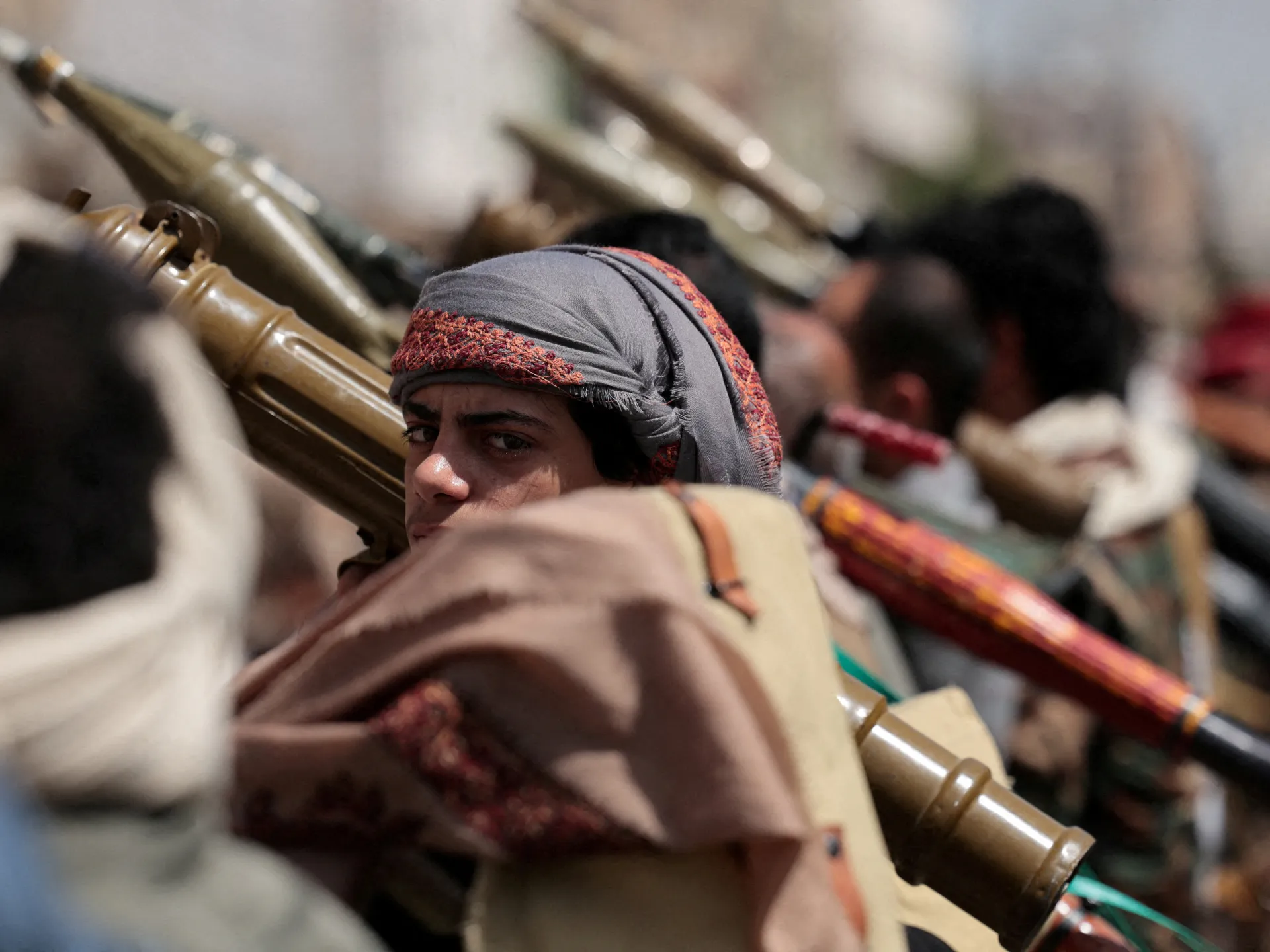
Separately, Yemen’s Houthi rebels said in a statement on Monday that they had targeted Saudi crude oil transport infrastructure.

It remains unclear whether the two incidents were coordinated or separate.

The attack comes amid a lull in hostilities between the United States and Iran, with mediators suggesting the chances of a return to negotiations have risen.

Following two weeks of intense hostilities, US officials have spoken of a change in strategy, and Washington has paused strikes on Iran.

Iran has said it has also paused its attacks on US allies across the Gulf region.

However, the drone attacks on Saudi and elsewhere suggest that Tehran may be testing the new US stance, and that the armed groups believed to be linked to Iran are not ready to follow suit.

Aside from Saudi Arabia, Jordan and Iraq also reported drone attacks on Monday. Amman said it shot down two drones, while Iraqi security sources reported strikes on camps housing Iranian-Kurdish opposition fighters in the country’s north.

The officials did not identify the source of either attack, but Jordan and northern Iraq were locations in which four US service members were killed over the past fortnight of conflict.

The Houthis announced later on Monday that nine of its fighters had been killed amid escalating military confrontations with Yemeni government forces backed by the Saudi-led coalition in recent days.

Source link

New front in US-Iran war escalates as Houthis fire at Saudi oil facilities | Conflict News

Tehran-backed Houthi forces in Yemen have fired missiles and drones at two of Saudi Arabia’s most strategically important oil facilities on the Red Sea, in a major escalation of the latest simmering regional conflict to be reignited by the war launched by the United States and Israel against Iran.

But the skies over the country at the epicentre of the widening war were quiet for a second successive night, with no new US attacks on Iran reported by Sunday morning.

Recommended Stories

list of 3 itemsend of list

Iran had been pounded by 13 consecutive waves of overnight US air strikes since July 11, after the Islamic Revolutionary Guard Corps (IRGC) attacked tankers trying to transit the Strait of Hormuz. As hostilities escalated, both sides declared that an interim peace agreement signed in June was dead, and a second phase of talks to finalise a comprehensive peace deal appeared doomed.

But there have been no US air strikes since Friday, and tentative signs are emerging that Washington and Tehran are still talking via mediators and might return to more meaningful discussions.

Even if another fragile truce is agreed, however, the cascade of consequences unleashed by the war is still stoking conflict and confrontation elsewhere.

Iran’s attacks on shipping in the Strait of Hormuz have put a stranglehold on exports of oil and raw materials for fertiliser, sending energy prices soaring and raising the risk of a food security crisis in some of the world’s most vulnerable countries.

In March, in response to attacks on Iran, the Tehran-backed Hezbollah movement in Lebanon resumed missile attacks on Israel, which then launched a devastating invasion of southern Lebanon that has displaced 1.2 million people.

Now, another smouldering regional conflict has erupted again, between US-allied Saudi Arabia and the Houthi movement which controls most of northern and western Yemen, including the capital, Sanaa. Saudi Arabia and its regional allies joined a brutal civil war against the Houthis in 2015, until a truce was agreed in 2022.

Risk of global crisis

The truce collapsed this month after an attack on Sanaa airport to stop an Iranian plane landing provoked the Houthis to fire ballistic missiles at Saudi Arabia. Last Monday, the Houthis declared a naval blockade of Saudi Arabia, and late on Friday the Saudis launched air strikes on the Houthi-held city of Hodeidah.

In retaliation, Houthi forces launched Sunday’s attacks on facilities belonging to Saudi state oil giant Aramco in the coastal cities of Jizan and Yanbu, Houthi military spokesman Yahya Saree said.

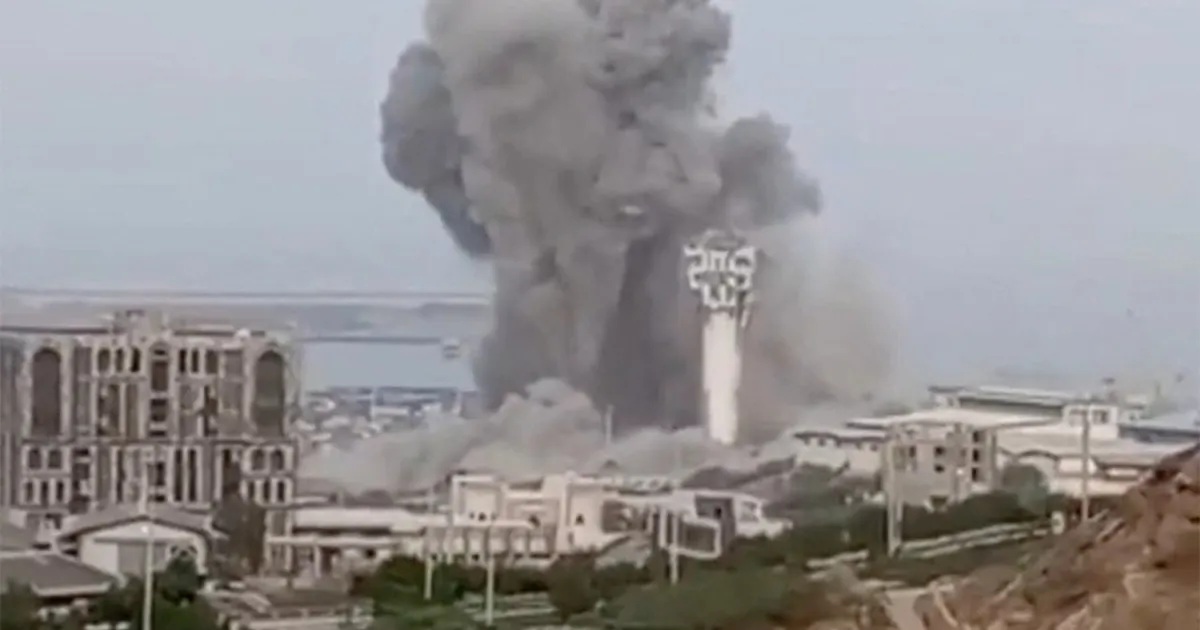
There has been no comment from Saudi Arabia on the extent of any damage to Aramco’s refinery in Jizan, but a large column of smoke was seen rising after the attack.

In Yanbu, Saudi Arabia’s principal west coast export gateway, two ballistic missiles aimed at oil installations were intercepted by a Patriot battery operated in Saudi Arabia by the Greek military under an agreement ‌with Riyadh.

The escalating conflict has raised fears that the Houthis could block the Bab al-Mandeb Strait, which connects the Red Sea to the Gulf of Aden. If both the Bab al-Mandeb and Hormuz straits were blocked, the resulting supply chain crisis would cause major economic damage across the world.

Entangled wars

Besides spreading to the Red Sea, the US-Iran war has become entangled with the deadliest active conflict in the world – Russia’s attempted conquest of Ukraine.

A long-range strike on an Iranian vessel in the Caspian Sea on Saturday caused an explosion that killed one sailor and wounded another, according to Iran’s Ministry of Foreign Affairs, which blamed the attack on Ukraine and summoned Kyiv’s charge d’affaires in Tehran to convey its condemnation of the “hostile and criminal” act.

Ukrainian President Volodymyr Zelenskyy said in a post on X that Kyiv had achieved “very strong results” with long-range strikes in the Caspian Sea, hitting “vessels used in military cargo shipments involving Iran, as well as a warship”.

Zelenskyy claimed in further comments on X on Saturday that since the start of July, Kyiv had detected “active Russian satellite ⁠surveillance of the Gulf states and US military facilities located there”. He said the satellite images were passed to Tehran to help the IRGC identify targets for ballistic missile and drone attacks.

US President Donald Trump has not given a reason for the sudden cessation in air strikes on Iran, but a senior administration official told the Reuters news agency that Trump “has always been clear that his preference is diplomacy, but he has shown Iran what will happen if they fail to come to the table in a serious way”.

Trump said on Friday that there was still some communication with Iran.

“They are talking to us right now; they’d love to make a deal,” he said. “I don’t think they’re ready to … but I’m willing to listen.”

Al Jazeera’s Resul Serdar, reporting from Tehran, said Iranian officials had confirmed the two sides were exchanging messages.

“There have been proposals conveyed by the mediators, and Tehran is still reviewing them,” Serdar said, adding there was “not much progress yet” due to “fundamental differences” in their positions and deep mistrust.

Source link

Iraqi PM makes first official visit to Iran in bid to deepen ties | Politics News

Ali al-Zaidi will hold talks with senior Iranian officials on bilateral cooperation, shared interests and security.

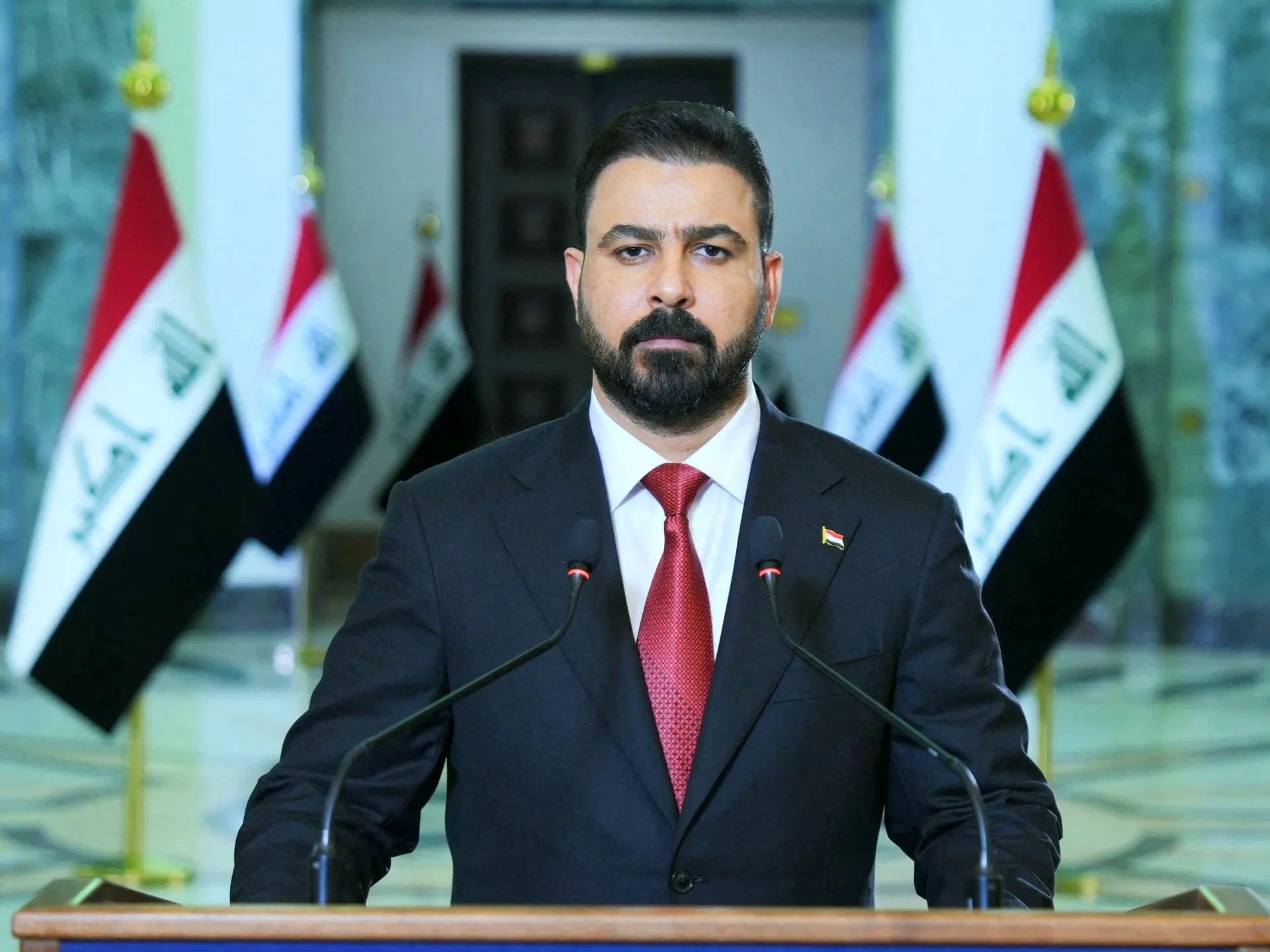
Iraqi Prime Minister Ali al-Zaidi is in Iran on his first official visit since assuming office in May.

The Iraqi News Agency (INA) on Thursday said al-Zaidi and Iranian President Masoud Pezeshkian oversaw the signing of several agreements and memoranda of understanding (MoUs) pertaining to foreign affairs, finance, the economy and energy in Tehran.

Recommended Stories

list of 4 itemsend of list

Speaking at a joint meeting of senior Iranian and Iraqi delegations in Tehran, al-Zaidi thanked Iran for helping Iraq in its fight against the ISIL (ISIS) group, and reaffirmed his country’s commitment to security cooperation with Tehran, saying that Iraq would not accept hostile action against Iran by any party.

“Iraq will never forget Iran’s support in the fight against the [ISIL/ISIL] terrorist group,” he said, according to Pezeshkian’s office.

Pezeshkian said a comprehensive strategic cooperation plan would serve as a roadmap for expanding relations between Tehran and Baghdad, stressing that the security of the two neighbouring countries was closely linked.

Over the course of the two-day visit, al-Zaidi will hold talks with other senior Iranian officials on bilateral cooperation, shared interests and regional security, he said on X.

“We will meet with senior officials of the Islamic Republic of Iran to discuss issues of mutual interest, bilateral cooperation, regional developments, and ongoing efforts to consolidate security and stability across the region,” he said.

“Iraq and Iran are bound by historic and civilizational ties, shared borders, and common interests. These enduring bonds call for continued engagement in a spirit of dialogue, cooperation, and mutual respect in a manner that promotes sustainable development and prosperity for the peoples of both countries, while contributing to security and stability at the regional and international levels.”

Iraq remains heavily reliant on Iranian natural gas and electricity, while bilateral trade exceeds $12bn annually, making it one of Iran’s largest trading partners.

A deep religious bond also exists between the two countries, as millions of Iranian Shia pilgrims cross the border to visit Iraq’s holy sites every year. During the week-long funeral held for Iran’s slain Supreme Leader Ayatollah Ali Khamenei earlier this month, the procession travelled through the Iraqi Shia pilgrimage cities of Najaf and Karbala.

The Iranian government has also cultivated close ties with influential Shia parties and armed groups in Iraq that form the backbone of Iraq’s security forces.

Political analyst Ghaleb Al-Daami told Al Jazeera that al-Zaidi’s visit came as Baghdad tries the difficult task of maintaining relations with both the warring parties, the United States and Iran.

Al-Daami said the main objectives of al-Zaidi’s visit were to tell Iran to stop its support for armed groups in Iraq and to deliver a message from the US, which has expressed support for Iraq acting as a mediator amid the US war on Iran.

Source link

Trump, long a critic of ‘forever wars,’ may be stumbling into one with Iran

President Trump long railed against forever wars.

For years, whether as president or candidate, he flayed electoral opponents and previous presidents with his signature barbs, calling their entanglements a “complete waste of time” (Afghanistan), “the worst single mistake ever made in the history of our country” (Iraq) and “stupid” (Ukraine).

Yet he now appears to be stumbling into a forever war of his own.

From the first days of the U.S.-Israeli campaign against Iran, Trump and his officials insisted their adventure abroad would be the exception, that the conflict would end in a matter of weeks.

Now, 4½ months later, after a torturous, start-stop vacillation between truce and war, the U.S. is pressing on with a fight that has no end in sight — or even a clear definition of what an acceptable end would be.

In the last week, the ceasefire collapsed, with the U.S. and Iran trading daily waves of strikes, leading to the deaths of two American servicemen on Friday when Iranian ballistic missiles struck Muwaffaq Salti Air Base in Jordan, where U.S. assets and personnel are stationed.

On Sunday, as the U.S. and Iran launched more air assaults, the U.S. announced that a service member was killed Saturday in Iraq during the controlled detonation of unexploded ordnance from a downed Iranian one-way attack drone.

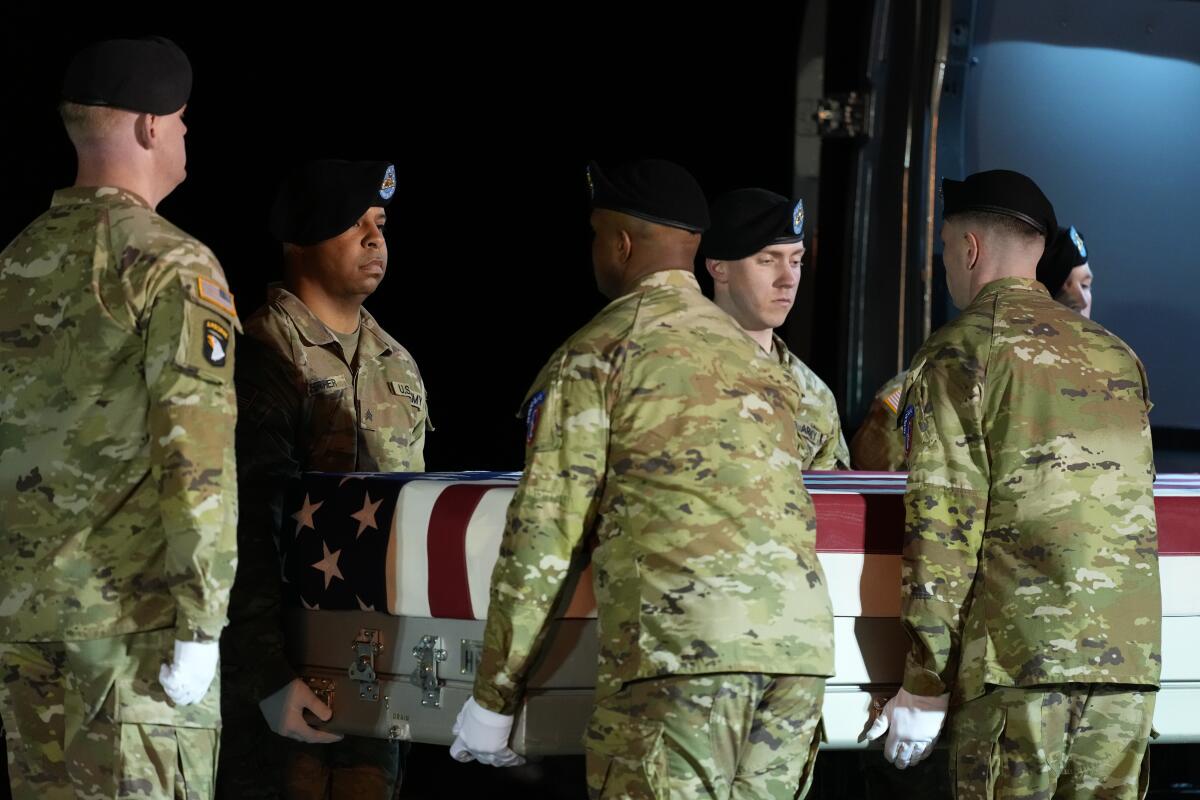
The remains of U.S. Army Sgt. Benjamin N. Pennington, the seventh U.S. service member to die in combat during the Iran war.

On March 9, the remains of U.S. Army Sgt. Benjamin N. Pennington, 26, of Glendale, Ky., then the seventh U.S. service member to die in combat during the Iran war, are transferred at Dover Air Force Base, Del.

(Julia Demaree Nikhinson / Associated Press)

The deaths in Jordan were the first combat fatalities since the U.S. and Iran agreed to a ceasefire. One soldier remains missing, according to a statement from U.S. Central Command.

Including the most recent casualties, 17 U.S. service members have been killed and more than 430 wounded since the war began, the Pentagon says.

In Iran, at least 57 people have been killed and more than 517 injured in U.S. attacks in the last three weeks, according to Iranian health authorities. The death toll since the beginning of the war has surpassed 3,500, and more than 27,000 have been wounded.

The U.S. and Israeli militaries have — in the telling of Trump and various officials — decimated Iran’s navy and air defenses, eviscerated multiple layers of its leadership and bombed tens of thousands of targets across the country.

Despite that military pressure, and Trump’s insistence that members of Iran’s leadership “want to make a deal” (he’s said that an accord was on hand no less than 46 times since the start of the war), Tehran has refused to surrender its nuclear and missile arsenals and continues to support its regional militia allies.

Iran has also created a new pressure point to use against adversaries by blockading the Strait of Hormuz, the vital waterway through which a fifth of the world’s oil and natural gas flowed before the war. And it has widened the war’s footprint by targeting countries hosting American military assets.

Trump has vowed to expand bombings to include civilian infrastructure such as power plants and bridges in what he says is a bid to force Iran into negotiations once more.

Trump thought wars in the Middle East would be like Venezuela: a big in-and-out without a prolonged war. And the reality is that it’s backfired

— Vali Nasr, Middle East expert

He has also brought additional forces to the Middle East. According to Centcom, there are now 50,000 troops in the region, along with 20 naval warships and hundreds of warplanes.

U.S. Central Command, which oversees operations in the region, declined to comment on the deployments, though on Sunday the New York Times reported that the U.S. was sending to the region F-16 fighter jets from Germany and stealthy F-35 jets from Britain.

For observers, those moves signal that Trump is falling into an escalation trap.

“From Trump’s perspective, the easiest way to demonstrate resolve and power is by just bombing Iran and seeing what that brings about,” said Andreas Boehm, a Middle East expert and lecturer on international law at University of St. Gallen in Switzerland. Although those strikes seem tactically impressive, they have not helped him strategically, he said.

“In reality, it doesn’t change the situation because the Iranians won’t budge. And if you confuse tactical and strategic success, then you’re not going anywhere in any kind of war,” Boehm said.

An escalation on Washington’s part is also certain to spark a similar reaction from Tehran, said Vali Nasr, professor at the Johns Hopkins University School of Advanced International Studies.

“Iran gets a vote here,” Nasr said, adding Iran could up the ante by closing Bab al Mandab, the vital strait connecting the Red Sea to the Indian Ocean. It could also widen attacks on infrastructure in Persian Gulf countries — moves that would trigger an even bigger ripple effect across global markets.

“Trump thought wars in the Middle East would be like Venezuela: a big in-and-out without a prolonged war,” Nasr said, referring to the Trump administration’s strike that saw U.S. forces abduct Venezuelan leader Nicholás Maduro and force the remaining members of his government to submit to U.S. control.

“And the reality is that it’s backfired,” he said.

Trump is not the first American president to think a foreign engagement wouldn’t last long. Whether in Vietnam, Afghanistan or Iraq, U.S. leaders dispatched troops on operations they thought would last weeks or months, dismissing warnings that they would be bogged down in years-long occupations.

Iran would be an especially sticky quagmire if Trump were to commit ground troops.

The country’s area — about 636,000 square miles — is more than double the size of Afghanistan, almost four times the size of Iraq, and five times the size of Vietnam — all nations where the U.S. struggled to prevail against adversaries not as well equipped and arguably less ideologically motivated than its adversaries in Iran.

Meanwhile, for a president whose central foreign policy campaign promise was no more wars, the growing number of casualties, along with the escalating damage inflicted by Iran on U.S. assets and allies, has exposed cracks in the support the Teflon-like Trump has enjoyed from his advocates.

Onetime MAGA acolytes, including flagship conservative figures such as Tucker Carlson, Megyn Kelly and Alex Jones, have already turned on the president over the war and other issues. And Republican figures who had tied their star to Trump fear a drubbing in the midterms so long as the war continues.

If negotiations were to resume, it’s unclear whether Trump and his coterie of negotiators have the stamina or the foreign service expertise to bring about an accord.

After all, the 2015 Obama-era deal aimed at reining in Tehran’s nuclear program took 600 days and hundreds of diplomats and technical experts to negotiate.

With Trump relying on unconventional fixers such as his son-in-law Jared Kushner and real estate investor Steve Witkoff, not to mention his evisceration of the diplomatic corps, an agreement of that scale appears unlikely.

“Everything is dependent on the mood of one man,” Nasr said.

“It’s not the system that’s making the decision; it’s not the country making the decision,” he said. “It’s one man, and it depends how he feels like at one particular point in time.”

Tehran too may be less amenable to negotiations with Trump, given his history: During his first term, he pulled out of the nuclear deal and ordered the assassination of Qassem Suleimani, a leading Iranian general.

In his second term, he launched bombing campaigns on Iran during negotiations — twice. And Iran accused the U.S. of repeatedly violating the April ceasefire and the memorandum of understanding signed in June.

Asked on NewsNation on Sunday about Iran’s announcement that it would no longer abide by the memorandum, Trump said, “I couldn’t care less.”

Such factors, said Ali Vaez, the Iran project director for the International Crisis Group, lead to a formula for prolonged conflict.

“It’s a forever war in the making, and the reason why is that Trump has proven he’s impossible to negotiate with,” Vaez said.

If an agreement as superficial as the memorandum of understanding — which deferred thornier issues for late negotiations — was derailed, then there’s little option other than repeated cycles of violence.

“Once you’ve proven that diplomacy doesn’t work,” he said, “then there’s only war.”

Source link

US renews attacks on Iran after US soldier killed: What’s the latest? | US-Israel war on Iran News

The United States has attacked Iran for a ninth consecutive night after the US military’s Central Command (CENTCOM) announced a US soldier had died in northern Iraq in a controlled detonation of unexploded ordnance from a downed Iranian drone.

Here is what happened over Sunday night and Monday morning and what officials on both sides have said:

Where was Iran attacked?

CENTCOM announced in a statement on X that it completed the ninth wave of attacks against Iran at 02:00 GMT on Monday.

It said it “targeted Iranian military command centers, air defense and coastal surveillance sites, maritime capabilities, missile and drone launch sites, and communications networks to further diminish Iran’s ability to attack commercial vessels and civilian mariners transiting the Strait of Hormuz”.

The US military did not provide details about the actual sites hit in Iran.

Iran’s Islamic Revolutionary Guard Corps (IRGC) said two oil tankers “exploded” and were halted in the southern Strait of Hormuz late on Sunday, according to a report by the semiofficial Tasnim News Agency on Monday.

The IRGC stated the vessels were trying to transit through the strategic waterway under what it described as US coercion.

“This passage is unsafe for the transport of chemical fertiliser or even a single drop of oil and gas,” the group warned, adding that the corridor would remain unsafe as long as US military operations in the region continue.

An MQ-9 drone was intercepted and shot down over Eslamabad-e Gharb in western Iran’s Kermanshah province, according to the Mehr News Agency on Monday.

Mehr said the drone was targeted by an advanced air defence system operated by the IRGC aerospace force.

Iran’s semiofficial Tasnim News Agency reported on Monday that US strikes targeted an area in the town of Khormoj in southwestern Iran. It quoted a local official.

Where did Iran strike, and where were warnings issued?

Jordan: The IRGC said on Monday that it launched ballistic missiles at US C-17 transport planes and P-8 aircraft at Aqaba airport, claiming several were heavily damaged. In a statement carried by the state-controlled IRIB broadcaster, the IRGC also said 20 hangars housing US forces in the Muwaffaq Salti Air Base in Azraq were destroyed.

Bahrain: The US embassy in Bahrain said it has information suggesting Iran may seek to target unspecified locations in central Manama. It urged Americans to remain vigilant, follow instructions from local authorities and immediately seek shelter if warning sirens sound or explosions are heard.

US soldier in Iraq: A US service member was killed in northern Iraq on Saturday during the controlled detonation of unexploded ordnance from an Iranian drone, CENTCOM said.

What happened in the Strait of Hormuz?

The United Kingdom Maritime Trade Operations (UKMTO) agency reported late on Sunday that a vessel about 8 nautical miles (15km) northwest of Kumzar, Oman, had caught fire.

It is unclear whether this happened due to an attack by Iran. The UKMTO said the cause of the fire had not been verified and advised vessels in the area to transit with caution and report any suspicious activity while authorities investigate.

What have Iranian and American leaders said?

US President Donald Trump said on Sunday that the US is hitting Iran to honour American service members who have been killed.

“We hit them very hard again tonight, and we did that in honour of the, probably three, it’s probably three great patriots,” Trump told reporters as he returned to Washington, DC, after the World Cup final in New Jersey. At least two US soldiers were killed in Jordan last week after Iranian missiles struck a US base there, and the third soldier Trump referred to was killed in Iraq during the detonation of the Iranian drone.

“We feel very badly,” he said when asked about the military fatalities, adding that those who died were fighting so “Iran cannot have a nuclear weapon.”

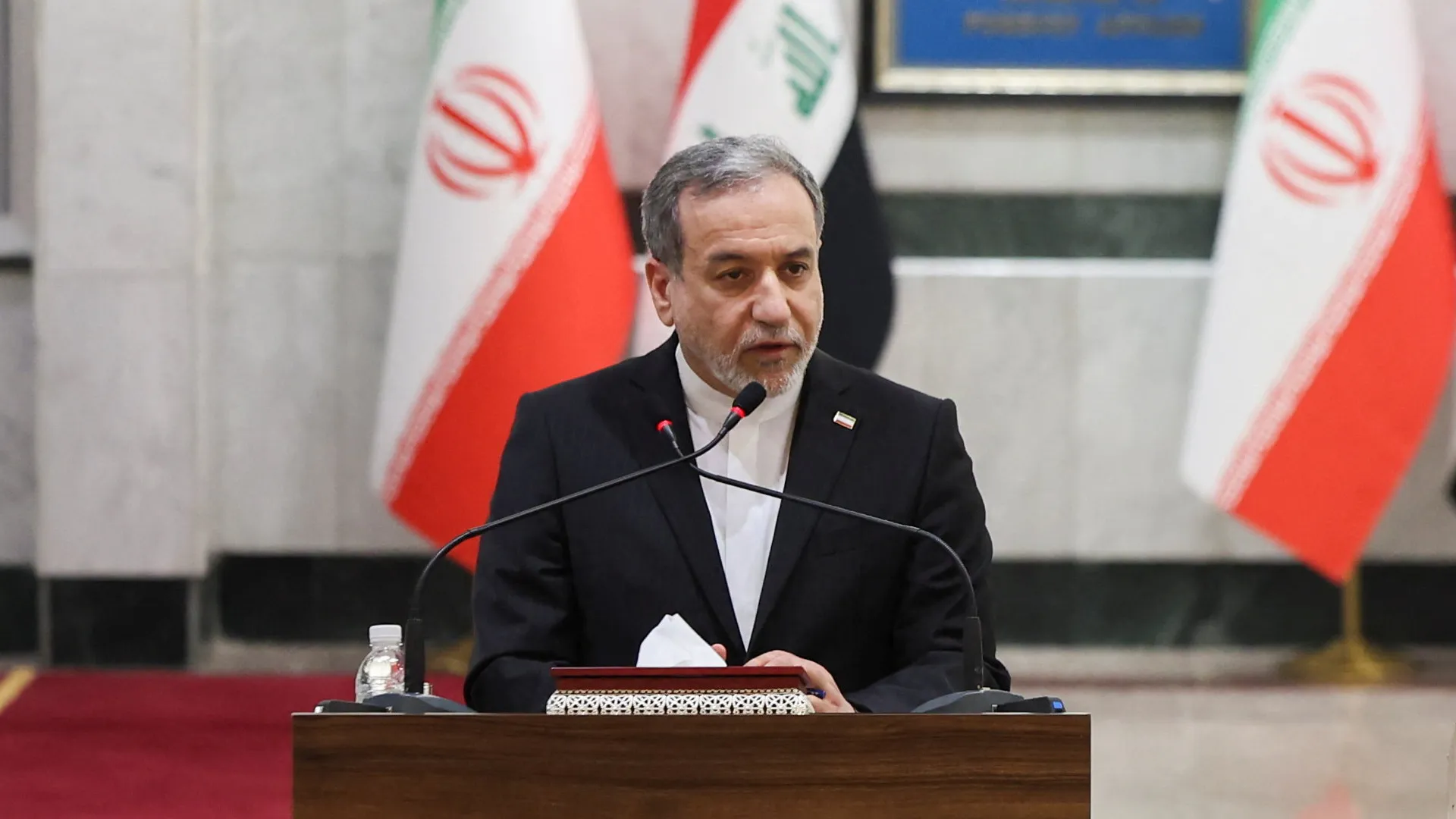
Iranian Foreign Minister Abbas Araghchi said in an interview with state media that Tehran would end the war with the US when it had “the upper hand in the field”, local news reported on Monday.

Talking with the IRNA news agency, Araghchi said the most critical decision in crisis management was identifying the precise moment to halt hostilities and begin negotiations.

“The end of the war is possible either through absolute military victory or through negotiations. The right time to negotiate is precisely when you have achieved a reliable field and strategic achievement on the military front,” Araghchi said.

“You cannot take risks with the lives of the people and the fate of the entire country. Decisions must be made based on accurate and complete calculations,” Araghchi said.

Source link

Iraqi-born singer Emmanuel Kelly among World Cup half-time show headliners | World Cup 2026 News

Abandoned as a baby with severely underdeveloped limbs and brought up by nuns in Baghdad, Kelly will be performing at the World Cup final alongside some of the biggest global stars.

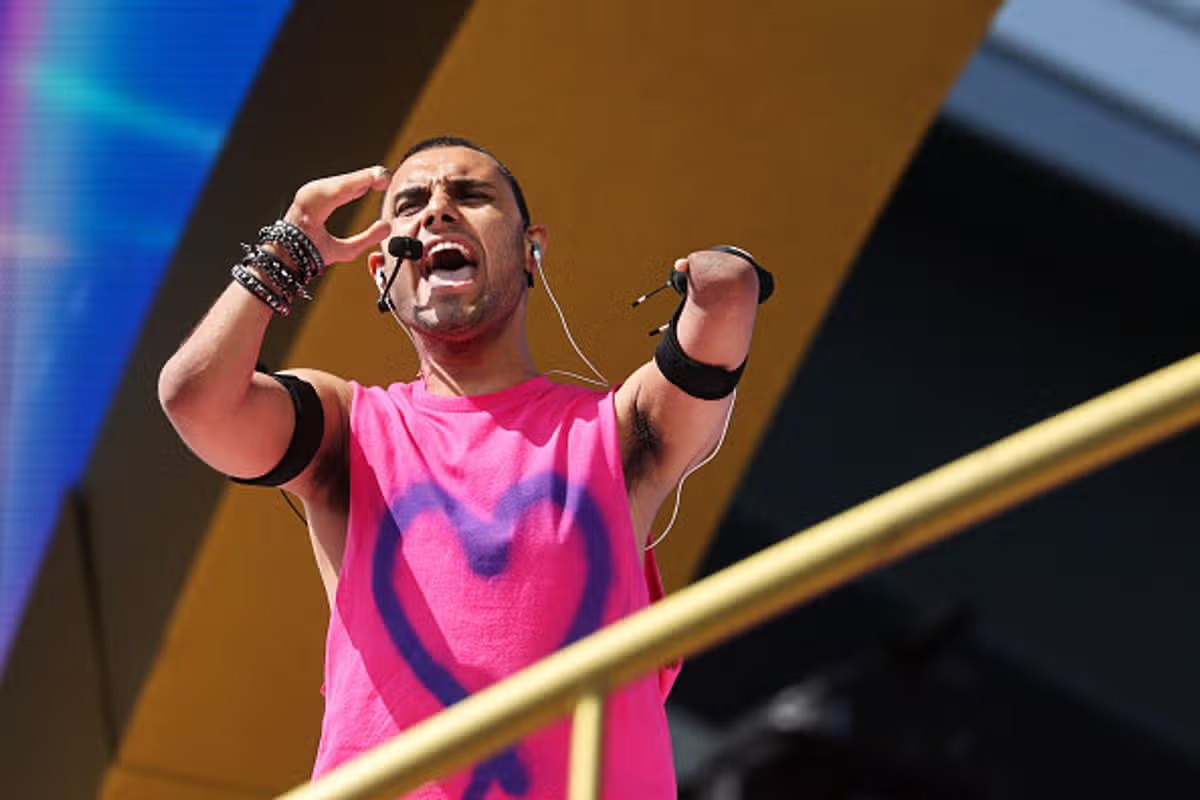
Among the headline performers at the first-ever FIFA World Cup half-time show alongside Shakira, BTS, Justin Bieber and Madonna is a man with a remarkable life story – Iraqi-born singer Emmanuel Kelly.

Kelly says he was found abandoned in a box as a baby, and was brought up by nuns at Mother Teresa’s orphanage in Baghdad. Some of his limbs were severely underdeveloped, and at the orphanage he became friends with another boy called Ahmed, who had a similar condition.

Recommended Stories

list of 3 itemsend of list

In 1998, when Emmanuel was around four years old, the Australian Catholic humanitarian worker Moira Kelly visited the orphanage and witnessed the plight of Emmanuel and Ahmed.

She was determined to bring the boys to Australia for medical treatment, and after two years, she succeeded.

Emmanuel and Ahmed arrived in Australia in 2000, and both underwent multiple surgeries to enable them to wear prosthetic limbs. They were adopted by Moira the same year, and in 2009 they officially became Australian citizens.

In an interview published on the FIFA website in 2025, Emmanuel said the surgery and prostheses enabled him and his brother to be self-reliant for the first time.

“We learned all the basic things I think that humans take for granted sometimes, like walking and feeding themselves and things like that,” he said. “Eventually I decided I wanted to pursue entertainment and music.”

Emmanuel Kelly attends the Variety Club Showbusiness Awards 2025 October 19, 2025 in London, England
Emmanuel Kelly attends the Variety Club Showbusiness Awards 2025 October 19, 2025 in London, England [Shane Anthony Sinclair/Getty Images]

In 2011, at the age of 17, Emmanuel was a contestant in the Australian version of television talent show The X Factor. His rendition of John Lennon’s song Imagine captivated the live audience and was viewed millions of times online. Although he was eliminated relatively early in the series after forgetting the words to a song he was performing, this was the start of his musical career.

His brother Ahmed, meanwhile, became a competitive swimmer, representing Australia multiple times and winning the silver medal in the men’s 150-metre individual medley at the 2020 Tokyo Paralympics.

In 2016, as the band Coldplay were preparing for concerts in Australia, lead singer Chris Martin saw a video of Emmanuel Kelly performing and resolved to meet him. Kelly was invited onto the stage at the Coldplay concert in Melbourne and sang Imagine in a duet with Martin.

The two became friends, and in 2024 Kelly was invited to be the headline opening act for Coldplay for their four concerts in Australia during their Music of the Spheres tour.

“Chris has been my brother, Chris Martin, for eight years or so, and he said to me, ‘Hey, come on tour with me and join me on a stadium tour.’ I did that, and that was pretty epic,” Kelly said in his FIFA interview.

Last year, Martin was asked by FIFA to curate the half-time show at the Club World Cup final at the MetLife Stadium in New Jersey. Kelly was one of the singers Martin asked to take part in the performance. He was described by organisers as “the first differently abled artist to headline a FIFA half-time show”.

Sunday’s World Cup final between Spain and Argentina is taking place in the same stadium. Once again, Martin is curating the musical performance, and Kelly will be one of those on stage for what FIFA hopes will be the most viewed half-time show in history.

“What an exciting opportunity to get to represent true full-scale global unity,” Kelly said in a video on Instagram ahead of the show. “No matter how different you are, you will still be seen.”

Source link

Emmanuel Kelly’s harrowing journey from war torn Iraq to World Cup final halftime show

Not many people would even think of getting a chance to come face to face with Madonna, but for singer and activist Emmanuel Kelly, he will be one of the very few sharing the stage with her at the first of its kind World Cup Half Time Show.

Alongside the Confessions singer, Justin Bieber, Shakira, BTS, Burna Boy and more, in a special show curated by Coldplay’s Chris Martin, Emmanuel will join some of his musical heroes for the performance of a lifetime.

As he prepares to meet Madonna – whom he describes as an artist who has created a whole “generation of music” – he just has one question on his mind. “I’m just going to embrace the moment. I’m going to ask every one of them, ‘Hey, listen, can you please just put me on your songs?'” he tells us in an exclusive chat ahead of the Half Time show.

Just four weeks ago, Emmanuel heard from Chris with an offer he couldn’t refuse. The pair have been friends for some time now, with Emmanuel having joined the band of their iconic Music of the Spheres World Tour. He was also part of the Club World Cup Half Time show last year, curated by Chris too – but having starred in the other, he didn’t think there would be any chance of doing this one too.

“About four weeks ago, it wasn’t even gonna happen. I sent Chris a text and said, ‘Hey, congratulations.’ And he wrote back saying, ‘Do you wanna join?’ I didn’t tell anyone but my partner and then suddenly we got this email from FIFA and Global Citizen confirming it all, as if it was planned all along,” he recalls.

Emmanuel’s current predicament is a far cry from the start of his life. He had a devastating and tough childhood, being found as an infant, abandoned on a battlefield in Iraq, before being taken in by those at Mother Teresa Orphanage in Baghdad where he met his now-brother Ahmed. Because of his birth mother’s exposure to chemical warfare, he was born with underdeveloped limbs.

When found by his future adoptive mother, Australian humanitarian Moira Kelly, in 1998, him and Ahmed moved to Australia two years later and following surgery, which allowed him to be fitted with prosthetic limbs, he became a citizen of Australia in 2009.

A viral appearance on Australia’s X Factor in 2011, where he was voted off before getting into the top 24, and it wasn’t long after that he came to meet the Coldplay star. They were introduced several years ago through a mutual friend, with Chris quickly giving Emmanuel the nickname “natural antidepressant”. The pair’s bond has only grown over the years, with Emmanuel describing his friend as more like a “brother”.

“I grew up in Iraq and I was a brother to a lot of people in that orphanage where I had to take care of these kids. I always say the only thing thicker than blood is love,” he tells us,

“In an entertainment industry that sometimes focuses too much on the superficial, Chris was there for me. For the first time in a long time, I was in a very dark place. It was then I met Chris.

“He became a brother to me. He became a mentor. He became a guide. He became the shining light. He feels his purpose is spreading love and happiness and joy and he has been doing that for so many years. He gave love and joy to me in a time of darkness and in a time I really needed it.”

As Emmanuel’s fiancé Joanne so wonderfully puts it: “In Chris’s mind, Emmanuel just has the secret to joy. He values him as someone that, despite everything he’s gone through, he approaches everything from a perspective of joy.”

Summing up the half time show for us in just a few sentences, Emmanuel didn’t want to give anything away but he did tell us the focus was on unity and love.

“There’s more good in this world than there is bad. We see the bad more so we just need to start focusing on the good more. Focus on the good, love yourself and global unity. That’s the message of the show.”

As well as his musical endeavours, Emmanuel co-founded 0utlyer, which has a mission to employ 1,200 differently abled people in the entertainment industry across film and television production and music and live events curation company.

“Our goal as a company is to help the world and reshape the question. It’s not about what this community needs or necessarily what can we do for this community; but it’s how do we repay the favour of what the community’s already done. There’s two billion people that have already done, but done it in the shadows and we need to shine a light of what this community is actually doing,” he says.

Emmanuel has also just released a new song called Hello. “Hello just sends a message about loving yourself. When things are down and out, just smile to yourself. Smile in the mirror. Tell yourself you love yourself.

“Go up to some random individual on the street and just say hello to them. It brings joy. Sometimes the simple thing of just saying hello to somebody, you don’t know what that does to that person.”

*In further news Kelly has now signed with UK-based Champions Speakers the UK and Europe’s leading keynote speaker agency , and will share his story via a series of inspirational public speaking events, bringing his message of resilience and inclusion to audiences across business, education and beyond.

Like this story? For more of the latest showbiz news and gossip, follow Mirror Celebs on TikTok, Snapchat, Instagram, Twitter, Facebook, YouTube and Threads.
Source link

Iraq signs 48 deals with US companies during PM’s visit to Washington | Business and Economy News

The deals include rebuilding the long-defunct Iraq-Syria crude oil pipeline, which could bypass the Strait of Hormuz.

Iraq has struck dozens of agreements and partnerships with American companies, many in the oil sector, during a visit to the United States by Prime Minister Ali al-Zaidi.

“A total of 48 agreements, memoranda of understanding, cooperation agreements and partnership declarations were signed between public and private sector entities in Iraq and the United States,” the Iraqi leader’s media office said on Saturday.

Recommended Stories

list of 3 itemsend of list

They include “cooperation and partnerships involving the ministries of oil and electricity … with ExxonMobil, KBR, GE Vernova, Shell and Halliburton”, as well as several deals related to the construction of a major crude oil pipeline between Iraq and Syria.

Iraq also signed a deal with Starlink, which dominates the global satellite communications sector, to introduce services to the country.

The preliminary deals, signed at a US-Iraq business summit at the US Chamber of Commerce in Washington on Friday, come as Baghdad seeks to move away from dependence on the Strait of Hormuz, where shipping and oil exports have been heavily disrupted due to the US-Israel war against Iran.

Iraq and Syria signed a cooperation agreement to reconstruct the long-defunct Iraq-Syria oil pipeline, which runs from the oil-rich Kirkuk region in northern Iraq to Syria’s Mediterranean port of Baniyas.

Iraq’s state news agency reported that major US energy company Chevron would carry out the project under the agreement.

The US Department of State said it welcomed Iraq and Syria’s plan to rehabilitate the pipeline, for which a “US-led international consortium” would “execute the technical and financial aspects”.

“Upon rehabilitation, this groundbreaking project will have an initial transport capacity of two million barrels per day of crude oil,” the department’s statement said. It described the pipeline as “a critical energy corridor linking Iraqi oil production to Mediterranean export markets and beyond”.

‘Make Hormuz an afterthought’

The US ambassador to Turkiye, Tom Barrack, said Iraq’s latest oil pipeline agreements would lead to a programme “that will make the Strait of Hormuz an afterthought”.

In addition to the Syria pipeline project, Chevron signed two other agreements with Iraq focused on boosting oil production, according to the company’s president of corporate business development, Jake Spiering.

In total, Iraq’s initial agreements with US firms, spanning the energy, healthcare and technology sectors are worth more than $60 billion, Reuters reported.

“We are using an open-door policy,” al-Zaidi ⁠⁠said at the business summit. “Everybody who has a project can come and talk to us. We will not make it difficult for anyone.”

Source link

Gulf states come under Iranian fire as US strikes intensify | US-Israel war on Iran News

Tehran launched strikes against several countries across the Gulf and wider region overnight as the United States military raised its attacks on Iran.

Reports on Friday morning said that Bahrain, Iraq, Kuwait, Oman and Qatar, as well as Jordan and Syria, had been forced to take defensive action against Iranian missiles and drones, amid a sixth night of US strikes on Iran.

Recommended Stories

list of 3 itemsend of list

The escalating US air campaign targeted civilian infrastructure in the south of the country, including telecommunications networks, railway systems, and the Bandar-e Khamir bridge in Hormozgan province, where local media reported on Thursday night that at least seven people were killed.

Tehran has justified its strikes against Gulf and other states by saying it is targeting US facilities in the region, insisting that Washington has used its bases there as launchpads to strike Iran.

In Qatar, which hosts major US military facilities, the security threat level was elevated as loud explosions were heard across parts of the capital, Doha, early on Friday morning.

Warning sirens sounded as residents received security alerts on their mobile phones. Qatar’s security threat level was raised again after the initial alert, but the situation later returned to “normal” after the threats were cleared.

The Qatari Ministry of Interior confirmed on Friday morning that a child who was injured by falling shrapnel during the assault is now receiving medical care. Earlier, Qatar rejected Israeli reports that it was planning to join military action against Iran.

Iran’s army said it targeted US helicopters and reconnaissance aircraft at the Sakhir airbase in Bahrain, according to a report from the country’s semi-official Tasnim news agency.

The Islamic Revolutionary Guard Corps (IRGC) claimed early on Friday to have successfully targeted US monitoring assets in Oman.

In a statement, the military said it destroyed a US air control radar in the northern Ghanim region and a maritime surveillance radar positioned on rocks in the Strait of Hormuz.

The IRGC declared that the critical shipping waterway – which has become the key issue in the latest outburst of conflict between the US and Iran – “remains in the hands of the IRGC Navy’s admirals”.

The IRGC also reported that it hit a US military base in Kuwait early on Friday. It said that the attack targeted a missile defence radar, several key weapons depots and two HIMARS surface-to-surface missile launchers.

In northern Iraq, Kurdish counterterrorism forces reported that US coalition forces shot down eight explosive drones over the city of Erbil, according to the Iraqi News Agency (INA). No casualties were reported.

The Jordanian army announced its air defence systems shot down three Iranian missiles transiting its airspace on Friday morning. No casualties were reported as engineering teams dealt with falling debris.

The IRGC also claimed to have attacked a US special operations command centre at the al-Tanf military base in Syria, according to a Tasnim news agency report.

Call to return to ‘hard-won’ deal

As hostilities between the US and Iran continue to escalate, threatening to spread across the region and curb the global economy, efforts to convince Washington and Tehran to return to negotiations are accelerating.

China’s Foreign Minister Wang Yi and Pakistani counterpart Ishaq Dar called on Friday for an immediate ceasefire and the resumption of dialogue, hoping to save the tentative ceasefire agreed upon last month.

Both countries have sought to mediate in the months-long conflict, which rekindled with renewed fighting over the Strait of Hormuz a month after the signing of a preliminary deal aiming to end the war.

That agreement was “hard-won”, Wang said, adding: “Peace is before our eyes, [we] cannot fall at the last hurdle and even more so cannot lose what we have gained.”

Iran has said 38 people have been killed, and more than 400 injured, in the US attacks since the two sides met in Switzerland on June 22 for talks to end the war through a 60-day negotiation period, the AFP news agency reported.

Source link

Falling debris from intercepted Iranian strikes sparks fires in Kuwait | US-Israel war on Iran News

NewsFeed

Moment a projectile struck a border area between Kuwait and Iraq, sparking a fire and sending thick smoke into the sky. The scenes emerged after Kuwait said it intercepted 32 hostile drones since dawn as Iran announced strikes targeting US assets in the country.

Source link

US strikes Iran, tanker, as Tehran hits Kuwait, Jordan: What’s the latest | US-Israel war on Iran News

The US military has continued strikes against Iran, hitting targets further to the country’s north as well as close to capital Tehran for the first time in the latest round of violence.

US Central Command (CENTCOM) said early on Thursday it struck several military sites and assets in a bid to “further degrade Iran’s ability to threaten innocent mariners” in the Strait of Hormuz. The unit also said it disabled an oil tanker in the passageway.

Recommended Stories

list of 4 itemsend of list

At least 35 people have died, and more than 300 have been wounded in the latest wave of attacks that began last Wednesday after CENTCOM launched strikes on Iranian port cities close to the Strait of Hormuz. The US says the attacks are in retaliation for Iran hitting three commercial ships in the Strait.

Iran’s Islamic Revolutionary Guard Corps (IRGC) said it targeted US military assets in neighbouring Gulf countries.

Here’s what has happened in Iran and the US on Wednesday and Thursday and what both sides are saying:

Where did the US hit?

CENTCOM said in a statement early on Thursday that US air strikes targeted Iranian command centres, air defence sites, missile and drone capabilities as well as coastal surveillance facilities.

Multiple locations were hit, CENTCOM said, including Bandar Abbas on Thursday.

An earlier wave of strikes late on Wednesday hit coastal defence and cruise missile sites on Greater Tunb Island in a 90-minute bombing wave, CENTCOM added. The small, strategically located island sits near the Strait of Hormuz and is believed to hold a naval base, although details are not publicly available. It is also believed to be a point from which the Iranian military has disrupted shipping routes.

Meanwhile, Iranian media reported attacks in Bandar Abbas, Qeshm Island, Sirik, Chabahar, Konarak, Rask, Khondab, Khorramabad and Semnan.

A hospital in Ahvaz was forced to evacuate 211 patients after reportedly being hit in the strikes.

Air defences were activated in Tehran and neighbouring Pakdasht and Parchin on Thursday.  The Iranian military said an MQ-9 drone was downed over the city of Andimeshk.

CENTCOM, in a separate statement on Thursday, said it was enforcing a naval blockade reimposed on Tuesday by disabling a “non-compliant” oil tanker that was attempting to sail towards Iran’s Kharg Island using Hellfire missiles.

How has Iran responded?

Iran’s army claimed retaliatory attacks on US military assets in Kuwait and Bahrain on Thursday.

Kuwait: The Iranian army said in a statement it targeted radar systems, the Patriot defence system and fuel tanks belonging to US forces at the Ali Al Salem airbase in Kuwait. In an earlier statement, it said it hit a radar and gathering point for US soldiers in Kuwait, as well as US communications systems and fuel depots in Jordan’s al-Azraq airbase.

Bahrain: Drones also targeted US Super Hawk radars and Patriot defence systems at the Sheikh Isa airbase in Bahrain, the army added.

Jordan: Meanwhile, Jordan said it intercepted eight Iranian missiles on Thursday.

Iraq: Iraqi authorities said five drones attacked the city of Erbil, with two crashing near a US base and one shot down near the US consulate. Iran’s army has not claimed the attacks.

What are both sides saying?

Iran’s parliament speaker and lead negotiator, Mohammad Ghalibaf, said on Wednesday Iran is prepared for a fuller military confrontation if the US does not live up to the terms of the interim deal. The country is fighting an “existential” battle, he added.

The IRGC has, meanwhile, threatened to halt all energy exports from the Middle East over the US’s naval blockade, which was reimposed on Tuesday.

“The export of oil and gas from the region will be either for everyone or for no one,” it said in a statement.

Speaking at the US Army War College in Pennsylvania on Wednesday, President Donald Trump reiterated his claims that Iran was pushing to strike a peace deal behind the scenes but did not provide details.

“They don’t like what we’re doing, and they do want to settle. We’ll find out whether or not we settle with them, or we just finish it off,” he said.

However, in a rare show of gratitude on Wednesday, Trump thanked Iran via his Truth Social platform for the release of Dena Karari, an American citizen the US says was “wrongfully” jailed in the country since 2024.

Meanwhile, US Vice President JD Vance, in an interview with podcaster Joe Rogan released on Wednesday, defended the war on Iran but added that an agreement was needed between the two sides to end the conflict.

Source link

Iraq’s prime minister carries the title, but not the power | Opinions

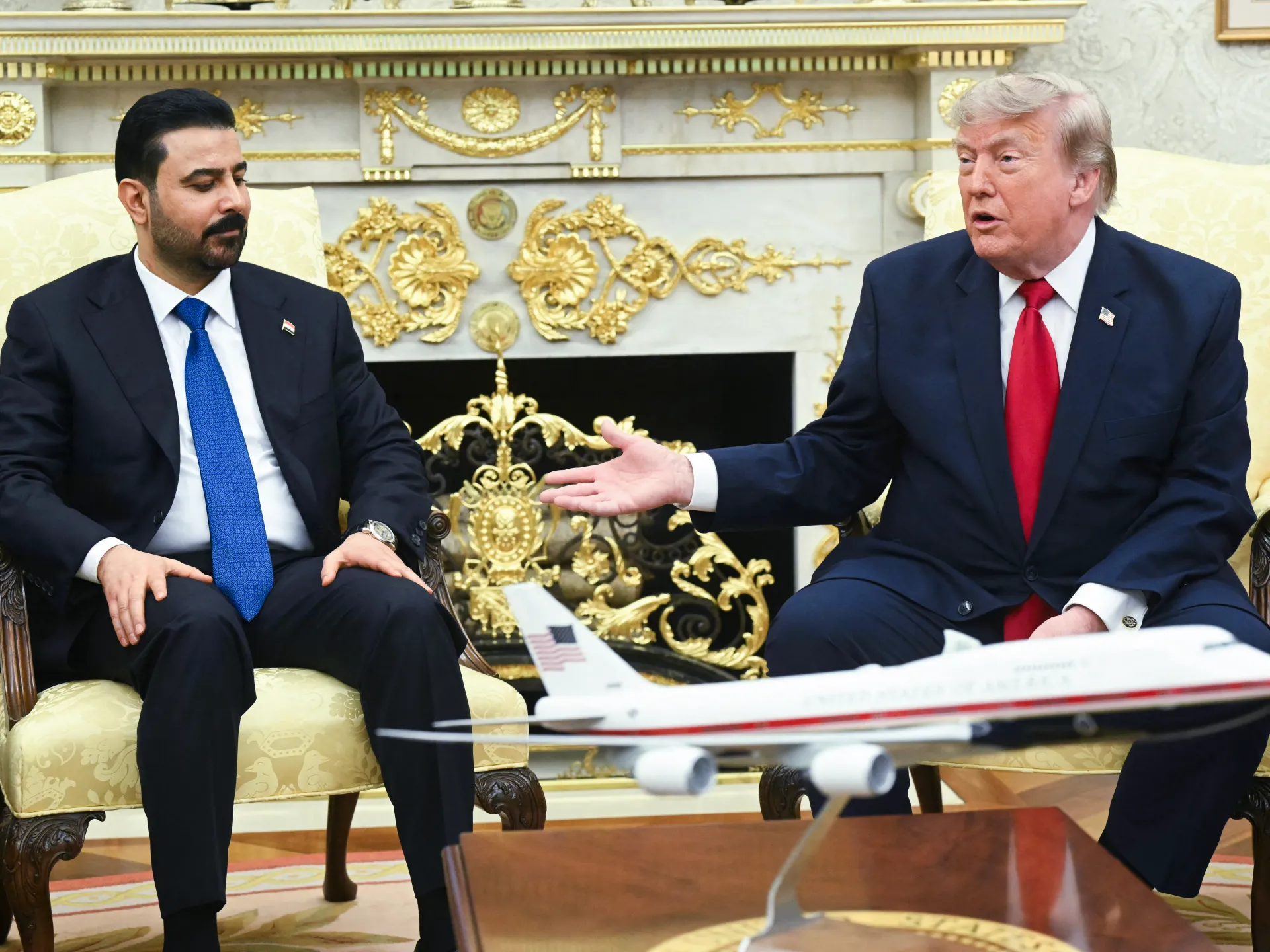
Ali al-Zaidi met US President Donald Trump in the Oval Office on Tuesday as Iraq’s prime minister. He carried the title. The power was another matter.

Eleven weeks earlier, after months of paralysis, the Shia alliance which is known as the Coordination Framework had taken just 25 minutes to choose him. That sudden consensus was forged under intense pressure from Washington DC.

The United States Treasury had frozen Iraq’s dollar lifeline, the cash shipments that fly from New Jersey to the Central Bank of Iraq. Nouri al-Maliki, a former prime minister, and the top contender to return to the premiership had to abandon his plans because of Washington’s veto.

Al-Zaidi, a 40-year-old banker with no political base, was the man left standing.His lack of an established political base is part of his usefulness. He owes his position less to Baghdad’s ballot box than to the pressure exerted by Trump’s Treasury.The banker’s own ledger is not clear.

In 2024, Iraq’s Central Bank barred al-Zaidi’s own institution, Al-Janoob Islamic Bank, from US-dollar transactions as part of a wider crackdown intended to curb illicit dollar flows to Iran. He was never charged. Neither the bank nor the man is currently sanctioned. But the file exists. Its existence could give Washington another source of leverage should al-Zaidi drag his feet.

The real power in Baghdad now sits in one man’s portfolio. Tom Barrack holds three titles at once: ambassador to Turkiye, envoy to Syria, and now envoy to Iraq. His influence rests less on diplomacy than on Washington’s financial leverage over Baghdad. Iraq’s oil revenue sits in an account at the Federal Reserve Bank of New York. In April, Washington blocked a cash shipment of nearly $500m drawn from those revenues and suspended parts of its security cooperation. Oil funds roughly 90 percent of Iraq’s budget. Barrack does not need to threaten military force when the administration he represents can reach directly into the financial system on which the Iraqi state depends.

Washington’s demand that Iraq bring all armed factions under state control remains far from resolved. Shia Cleric Muqtada al-Sadr dissolved his Saraya al-Salam militia in late May. Other militias such as Asa’ib Ahl al-Haq and Kataib Imam Ali have announced steps towards handing over their weapons or placing them under fuller state control. That is real movement. But Kataib Hezbollah and Harakat al-Nujaba, the two factions most tightly bound to Tehran, have rejected full disarmament. In their own words, their weapons are not for bargaining. Washington has answered in kind. US strikes killed dozens of Iranian-backed Popular Mobilization Forces (PMF) fighters this spring; the Treasury has sanctioned seven militia commanders by name. Baghdad has set September 30 as its disarmament deadline, the same date on which the remaining US forces are expected to leave Iraq. Whether the hardest factions bend by then remains the open question that Washington has yet to answer honestly.

Even Grand Ayatollah Ali al-Sistani’s authority has limits here, as it always has. Al-Sistani’s 2014 fatwa built the PMF’s founding myth. But his call was for men to defend Iraq under the state’s command, not to form independent militias. The hardline factions never answered to Najaf. They answer to Tehran. al-Sistani’s own representative in Karbala has also pressed publicly for exclusive state control of weapons. His influence remains significant, but it has never extended to full control over these factions, and the current standoff is making that reality harder to ignore.

The prize Washington actually wants, however, lies underground. Chevron is negotiating an expanded role in Iraq’s oil sector, while other US companies are pursuing contracts in gas, electricity and export infrastructure. Baghdad wants production up from 4.5 million barrels a day to 7 million within three years, though doing so would require a substantially larger OPEC quota. Western Iraq’s gas reserves, largely untapped, could one day elevate the country into a dominant regional energy player and exporter. This is the potential bonanza al-Zaidi is being asked to unlock in exchange for the loyalty Washington is seeking.

Kurdistan’s place in this emerging arrangement is still unclear. Barrack has called the old Baghdad-Erbil federal model outright “Balkanization”, a structure he blames for letting Iran fill the vacuum. Yet the same envoy spent much of June pressing the prime minister of the Kurdish region, Masrour Barzani, to reactivate the Kurdistan parliament and form a new cabinet, not dissolve it. Read together, these positions suggest a clear message: Washington wants a functioning, cooperative Kurdistan region, firmly inside Washington’s orbit, not an autonomous wildcard and not a vassal of Baghdad’s sectarian blocs either.

Stripped of diplomatic varnish, Washington’s vision for Iraq is this: no militias operating outside the state; no Iranian veto over Iraqi policy; no single sect running the table from Baghdad; a Western economic orientation locked in by contracts, not sentiment; American energy firms as the primary beneficiaries; and a prime minister who answers, in practice, to Tom Barrack before he answers to his own parliament. Whether Iraq is pressured towards the Abraham Accords, whether the old nationalist and Ba’athist-adjacent currents find any oxygen again, whether sectarian parties actually lose their seats at the ballot box, these remain predictions, not settled facts.

What is clear is simpler and starker. Iraq spent two decades as the ground on which Iran and America fought indirectly, through proxies and sanctions. It is now becoming something else: a state whose oil, banking system and militias are all being renegotiated at once under intense US pressure. At the centre of this transformation is a banker-premier chosen in twenty-five minutes and now expected to deliver by September 30.

The Gulf model, from Riyadh and Abu Dhabi to Manama, Kuwait, Doha and Muscat, took decades to lock in. Trump’s Washington wants to compress Iraq’s version into a single presidential term. Whether Baghdad survives that compression intact, or merely changes which capital it answers to, is the question al-Zaidi’s visit left unresolved.

The views expressed in this article are the author’s own and do not necessarily reflect Al Jazeera’s editorial policy.

Source link

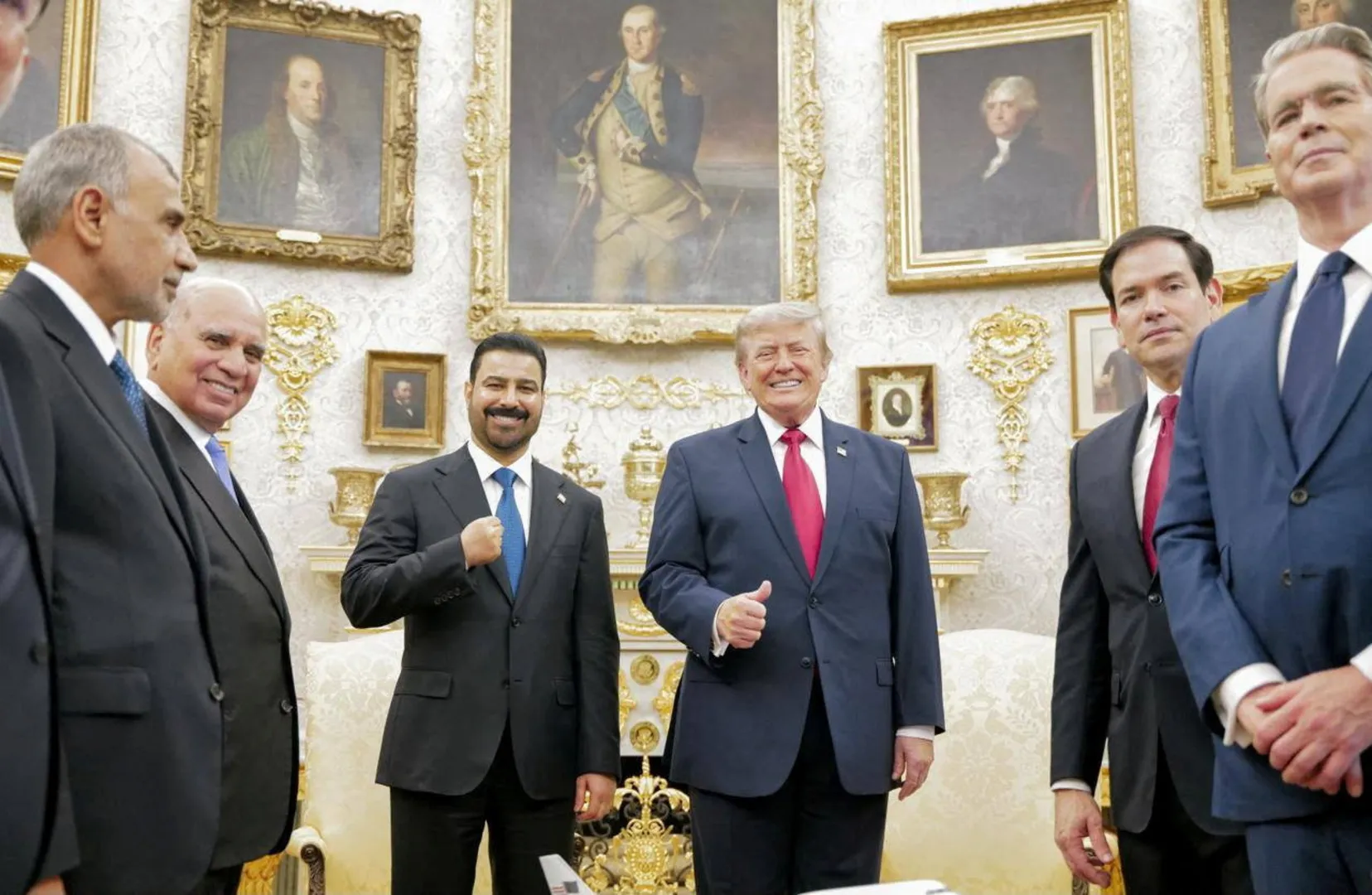
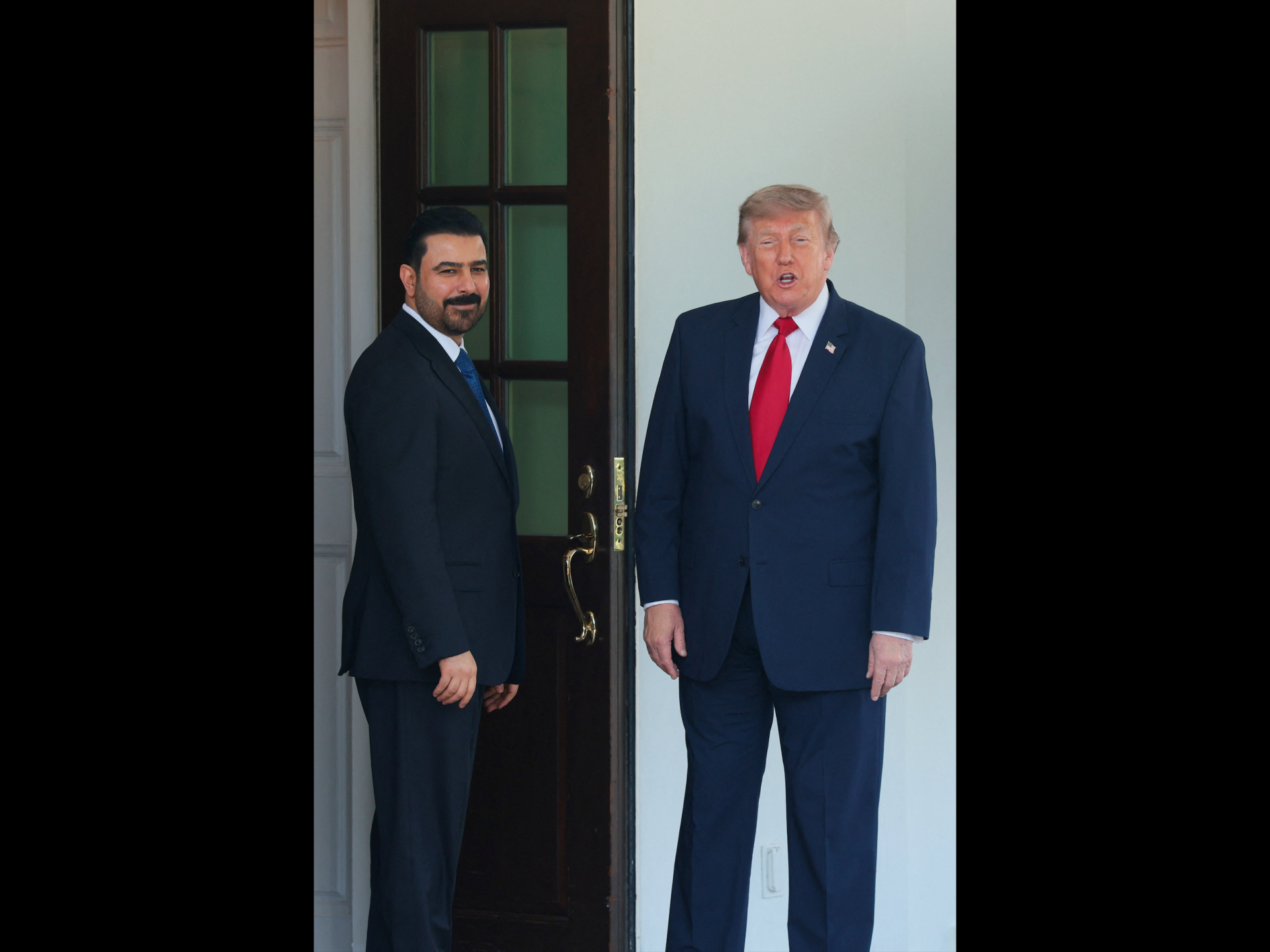
Trump welcomes Iraqi PM to White House, vows ‘a lot of deals’ | The Iraq War: 20 years on

NewsFeed

US President Donald Trump and Iraqi Prime Minister Ali al-Zaidi have met at the White House in Washington, DC, with both leaders pledging to deepen economic ties and boost Iraq’s oil output. The meeting comes as the US prepares to reduce its military presence in Iraq. Al Jazeera’s Tanya Noury has the latest.

Source link

US President Trump meets with ‘fan of America’ Iraqi PM Ali al-Zaidi | Donald Trump

NewsFeed

US President Donald Trump welcomed Iraqi Prime Minister Ali al-Zaidi to the White House. Trump praised the ‘tremendous chemistry’ between him and the PM and said the countries will be announcing a new ‘massive’ oil partnership.

Source link

Iraqi PM heads to US seeking balance between security and economy | Oil and Gas News

Iraqi Prime Minister Ali al-Zaidi is travelling to the United States for talks with President Donald Trump, in what will be his first foreign trip since taking office in May.

During this week’s meetings, al-Zaidi is expected to sign agreements in energy and trade while also boosting investment with US companies.

Iraqi government spokesman Haider al-Aboudi told reporters on Sunday the visit to Washington, DC, will mark a shift in the countries’ relations “from a framework of crisis management to a strategic economic partnership”.

The focus, he said, would not be about striking a “temporary” agreement but about establishing “a durable, long-term partnership that serves the shared interests of both countries”.

Al-Aboudi said oil would be “a top priority” during the visit as the Iraqi government seeks to increase production and find alternative export hubs to lessen the consequences of any future closure of the Strait of Hormuz.

Iraq was one of the countries badly hit by the shutting down of the critical waterway in recent months due to the US-Israel war on Iran, as about 90 percent of its 3.4 million barrels per day (bpd) of exports passes through it.

Al-Aboudi said Iraq’s proposal to establish an energy and development fund with the US would be on the table to finance any projects that would be agreed upon, especially in the energy sector.

Al-Zaidi had previously said the fund would initially be structured in oil exports of 500,000 bpd with the goal of increasing to as much as two million bpd.

The prime minister has also said Iraq seeks to increase oil production to seven million bpd over the next three years, up from its current output of about 4.5 million bpd.

“Iraq is in need of such kind of cooperation, especially with a partner like the United States to enhance and strengthen its capacity, particularly in the energy, oil, gas, electricity, and petrochemicals sectors,” said Abdulrahman Almashhadani, an Iraqi economic expert and professor.

“However, the critical question remains whether Iraq can provide a safe and stable environment that would encourage US companies to come to Iraq,” he said. “This issue is sensitive and unresolved; it largely depends on the government’s ability to deliver on its commitments to restrict weapons to state control.”

Large delegation

Sources told Al Jazeera the Iraqi delegation to the US comprises more than 70 people, including key ministers, the head of the central bank, the national security adviser, lawmakers and businessmen.

A well-informed source said meetings with US administration officials and the International Monetary Fund (IMF) have also been planned. According to the source, who asked not to be named, Iraq is seeking to secure an IMF loan of up to $8bn.

A separate well-informed source told Al Jazeera that the disarming of pro-Iran Iraqi armed factions and restricting weapons under state authority, as well as Baghdad’s relationship with Tehran, are expected to be among the issues the US side will raise during the visit.

In his first speech in parliament as prime minister, al-Zaidi had promised that the state would have control over weapons in a country where paramilitary groups, including many supported by Iran, have been powerful since the 2003 US-led war on Iraq.

Some armed factions said they would abide by the prime minister’s declaration, but others – particularly the powerful ones that launched missiles and drones at US facilities during the war on Iran – rejected it.

In a statement released hours before al-Zaidi’s trip to Washington, the Islamic Resistance in Iraq, an umbrella group of Iran-backed armed groups in the region, including Iraq, rejected the prime minister’s visit and its outcomes.

“We will not give a blank cheque for all government policies. We warn against replacing military occupation with an economic occupation that is even more dangerous,” the statement said.

“The option of defending Iraq and its legitimate interests will remain on the table,” it added.

Al-Zaidi has said his government is eager to implement a 2024 deal made with the US-led coalition’s military mission in Iraq to end its presence as combat forces by the end of September.

Some of the factions that rejected the prime minister’s disarmament statement said they would wait to see what happens on September 30 and then act accordingly.

Ehsan al-Shammary, a professor of international studies at Baghdad University, said the economic initiatives and the backing that al-Zaidi is seeking from Trump during Monday’s talks would inevitably be overshadowed by the issue of Iran’s influence in Iraq.

Ultimately, he added, it is the issue that will determine the success or failure of a “very important” visit that could “redefine” bilateral relations and “give it a push”.

“Al-Zaidi has little room for manoeuvre. He should choose either to align with the United States or move closer to Iran,” said al-Shammary. “I do not believe Washington is willing to accept a divided sphere of influence in Iraq alongside Tehran. That is why the prime minister’s task appears to be almost impossible.”

Source link

What’s behind the anti-corruption crackdown in Iraq? | Corruption News

A number of senior politicians have been detained in a wave of arrests.

For more than two decades, corruption has been a serious issue in Iraq.

The oil-rich nation has consistently been ranked as one of the most corrupt in the world.

Recommended Stories

list of 4 itemsend of list

But this week, its new government has embarked on an unprecedented anti-corruption crackdown.

It’s targeting many high-profile politicians and other senior figures accused of making illicit wealth and abuse of office.

Iraqis have repeatedly protested against what they say is rampant corruption in their nation.

Now, they hope the new government keeps this promise to eradicate what they call a ‘pandemic of fraudulent activities’ at the highest echelons of power.

But what are the challenges ahead in this battle?

Presenter: Imran Khan

Guests:

Ahmed Rushdi – President of the think-tank, House of Iraqi Expertise Foundation.

Renad Mansour – Deputy Director of the Middle East and North Africa Programme at Chatham House.

Manuel Pirino – Regional Advisor for Middle East and North Africa at Transparency International.

Source link

Iraq arrests senior officials in anti-corruption raids | Corruption

NewsFeed

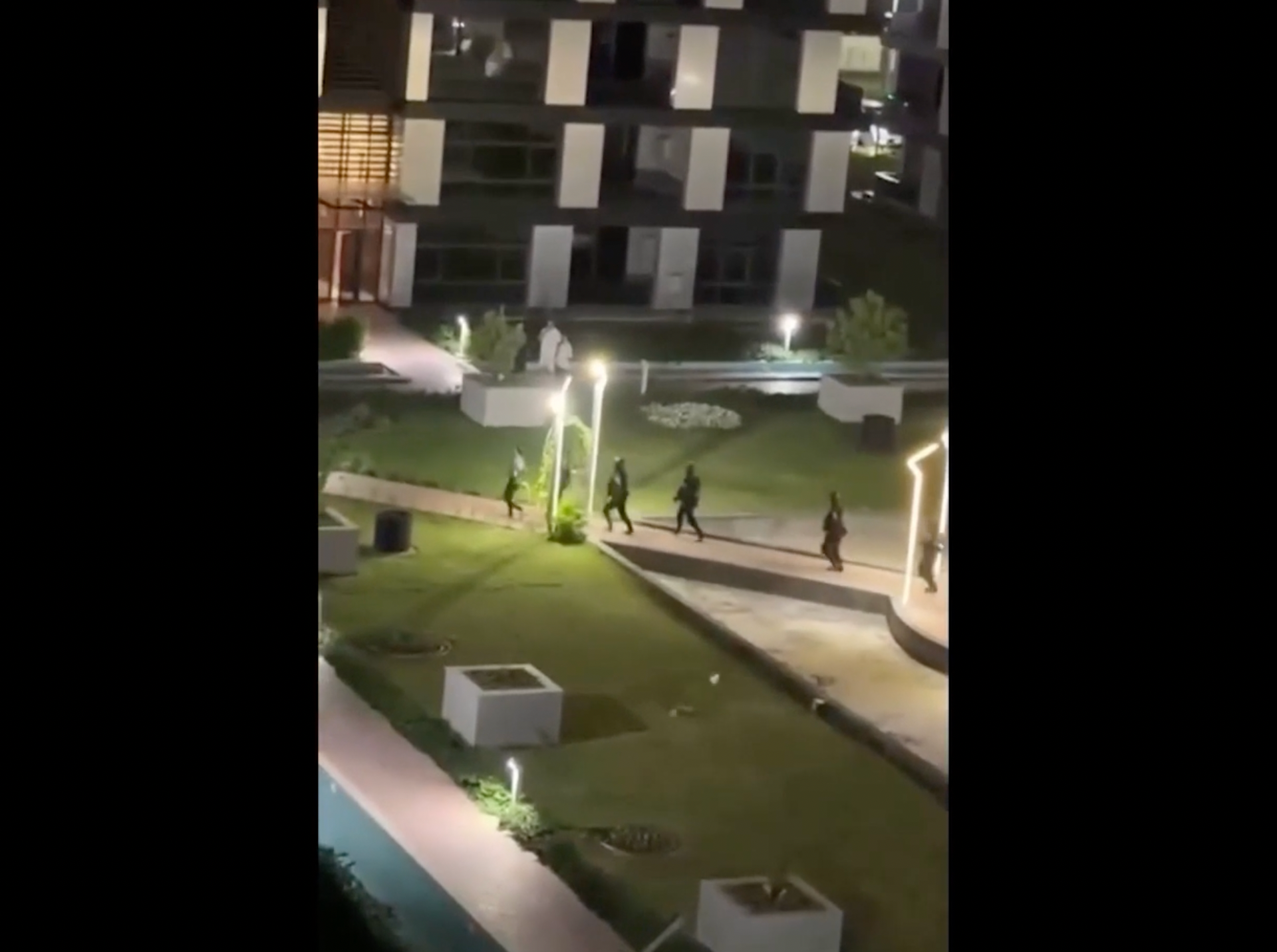
Iraqi security forces arrested several politicians, lawmakers and senior officials in dawn raids across Baghdad as part of a sweeping anti-corruption campaign ordered by Iraq’s new prime minister, Ali al-Zaidi. Elite Counter Terrorism Service units carried out operations in the Green Zone.

Source link

Araghchi: Strait of Hormuz remains under Iranian control for 30 days | Politics

NewsFeed

Iran’s foreign minister has urged ‘all parties not to interfere’ in the management of the Strait of Hormuz, after the US bombed Iran for a second day following a drone attack on a vessel. Abbas Araghchi says the MoU gives Tehran control of the waterway, during a press conference with his Iraqi counterpart in Baghdad.

Source link

Iraq security forces arrest several officials in anticorruption crackdown | Corruption News

Elite security personnel carry out a large-scale operation at dawn in the Green Zone and several neighbourhoods in Baghdad, security source says.

Several Iraqi politicians, lawmakers and officials have been arrested on corruption charges, Iraqi state-run media report.

Several people, including members of parliament “whose immunity had been lifted and officials whose names appeared in … confessions”, were arrested early on Sunday in the capital, Baghdad, the Iraqi News Agency reported, quoting a security source.

Recommended Stories

list of 3 itemsend of list

It was not immediately clear who had been arrested. There was no immediate official statement on the arrests from the Iraqi government or security forces.

A security source told Al Jazeera that elite Iraqi security forces carried out a large-scale arrest operation at dawn in the fortified International Zone (Green Zone) and several neighbourhoods in Baghdad.

The source said the arrests were carried out by the Counter Terrorism Service and were based on statements provided by Adnan al-Jumaili, deputy oil minister, after his arrest last month on corruption charges.

Iraq’s new prime minister, Ali al-Zaidi, has pledged to fight corruption and mismanagement that have plagued Iraq for decades.

Authorities seized about $86m in cash this month that was allegedly part of the corruption case against al-Jumaili.

The Associated Press news agency reported that seven people were arrested on Sunday, including five members of parliament. It cited a security agency report it obtained. The AP said some of those arrested were from the political bloc of former Prime Minister Mohammed Shia al-Sudani.

During November’s parliamentary elections, al-Sudani’s bloc won the largest share of seats, but he did not return as prime minister. He stepped aside amid a deadlock in the Coordination Framework, a group of Shia parties allied with Iran that brought al-Sudani to power. They disagreed for months over their preferred candidate for the post.

Source link