Iraq

Zidane Iqbal: The footballer who gave Pakistan its first World Cup moment | World Cup 2026

Islamabad, Pakistan – The scoreline read 4-1 to Norway. Iraq had been heavily beaten in their first World Cup match in 40 years. Manchester City striker Erling Haaland scored twice in his World Cup debut as Norway cruised to victory in Group I.

But for Pakistan, the result barely mattered.

Recommended Stories

list of 4 itemsend of list

When Zidane Iqbal crossed the touchline for Iraq at Boston Stadium in Foxborough, Massachusetts, in the 59th minute on Tuesday, history was made. He became the first player of Pakistani heritage to appear in a FIFA World Cup.

Pakistan’s national team has never qualified for the tournament. It sits 198th in FIFA’s rankings. For decades, more than 250 million Pakistanis have watched football’s biggest event from the outside.

That changed, in its own complicated way, through a 23-year-old born in Manchester, England.

Between three nations

Zidane Ammar Iqbal was born on April 27, 2003, to a Pakistani father and an Iraqi mother. His father, Aamar, is from the city of Sahiwal in Punjab while his mother, Ayat, was born in southern Iraq.

Growing up in Manchester, Iqbal was eligible to represent England, Pakistan or Iraq. The decision he eventually made was not a calculated one.

Iraq found him the way many things happen now: through social media.

A large Instagram page tracking Iraqis around the world contacted him to ask whether rumours about his heritage were true.

Word eventually reached the Iraq Football Association, which pursued him through a series of video calls with Iqbal and his parents.

Asked by the sports news outlet The Athletic why he chose Iraq, Iqbal said: “All the love and support from the fans in Iraq and across the world and how hard the FA tried to bring me. When someone shows so much love, it’s only right that you feel it.”

He had never visited Iraq before receiving an under-23 call-up in 2021.

The culture shock, he admitted, was real. But he kept returning. Gradually, a country that had once been only part of his heritage began to feel like home.

The road not taken

Iqbal joined Manchester United’s academy at the age of eight and spent 12 years at the club. In December 2021 at 18, he became the first British South Asian player in nearly two decades to appear for United in the UEFA Champions League.

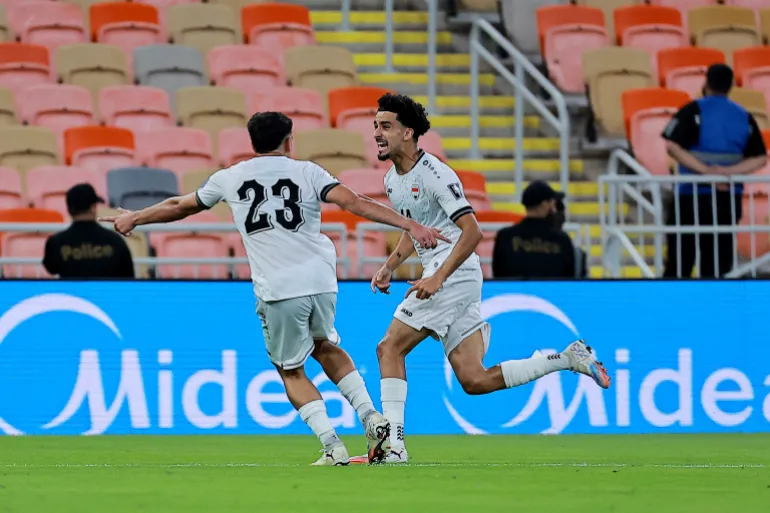
Soccer Football - FIFA World Cup - AFC Qualifiers - Group B - Iraq v Indonesia - King Abdullah Sport City, Jeddah, Saudi Arabia - October 11, 2025 Iraq's Zidane Iqbal celebrates scoring their first goal with Merchas Doski REUTERS/Stringer
Iraq’s Zidane Iqbal celebrates scoring in a World Cup qualifying match against Indonesia in October 2025 [File: Reuters]

But regular first-team football never followed. He eventually moved to FC Utrecht in the Dutch Eredivisie for about 1 million euros ($1.1m).

His performances during Iraq’s gruelling 21-match qualification campaign, including a winning goal against Indonesia, kept him central to the team’s plans throughout.

The Pakistan Football Federation (PFF) had monitored his progress. But it was never truly a contest.

Ali Ahsan, editor of FootballPakistan.com, said the structural gap between the two football systems was simply too wide.

“We are struggling to attract players from bigger clubs, our ranking, the lack of a professional set-up. The PFF still has no technical director or dedicated national team recruitment staff,” Ahsan told Al Jazeera.

“For Zidane, he picked Iraq to be able to play major tournaments, which he probably wouldn’t have gotten with Pakistan,” Ahsan said.

“Had he chosen Pakistan, he could have had a big impact on raising Pakistani football’s profile internationally. He was still at United at the time. He could have started a serious conversation about how football needs to be improved, inspired kids to take it more seriously. Iraq is already a well-established team with a dedicated history, structure and fanbase.”

For Iqbal, the path led elsewhere. But for Pakistan, the moment still mattered.

“I hope there are children – whether Asian, Arab, whatever you are – who watch that and think they can do it,” Iqbal told The Athletic. “It’s definitely possible. And if I’ve done it, why can’t they?”

Iraq next face France on Monday before taking on Senegal in their final group match on June 26. Few expect them to advance. But few expected them to be there at all.

Against Norway, Iraq lost. For Pakistan, history was made anyway.

Source link

Haaland scores two goals as Norway beat Iraq 4-1 on World Cup return | World Cup 2026 News

The Manchester City striker scored his first goals at a major international tournament as Norway powered past Iraq.

Erling Haaland scored twice in his World Cup debut as Norway powered past Iraq to win 4-1 in their Group I opener in Boston.

The Manchester City striker scored his first goals at a major international tournament on Tuesday as Norway returned to the World Cup for the first time in 28 years.

Recommended Stories

list of 4 itemsend of list

Haaland turned in from close range to give Norway the lead on 29 minutes, but Aymen Hussein’s header brought Iraq level.

Haaland then pounced on an error at the back to put Norway ahead again before half-time and take his goal tally at international level to 57 in just 51 matches.

Leo Ostigard headed in a third for Norway moments after coming off the bench to effectively wrap up the victory. Norway then got a fourth deep into stoppage time through a Hussein own goal.

The win left Norway on top of Group I on goal difference, level with France on three points after Les Bleus overcame Senegal 3-1 earlier in the day. The Norwegians face the African powerhouses in their next game in New Jersey on June 22 .

No team has endured a longer or more perilous road to the World Cup than Iraq, who secured their place as the 48th and final qualifiers in March after a 21-match campaign that stretched across 867 days.

Hussein, the scorer of the decisive goal in the play-off win over Bolivia, was held and questioned for hours by US immigration officials after arriving with the squad ahead of Iraq’s first World Cup since 1986.

Norway’s impressive return

Norway last played at the tournament in 1998, when coach Stale Solbakken was a member of the squad that famously beat Brazil in the group stage before exiting in the last 16. He also featured at Euro 2000.

After breezing impressively through qualifying, twice thrashing Italy, they are hoping a golden generation of players – led by Haaland and Arsenal midfielder Martin Odegaard – can break new ground in North America.

Solbakken predicted that Haaland would make a “very big impact” at his first major finals, and the Manchester City star was quick to deliver on that promise.

Antonio Nusa’s trickery was a problem for Iraq, and his incisive pass released the overlapping David Moller Wolfe clear before Haaland stretched to steer in the low cross from the left.

Iraq, who lost all of their group games in their only previous appearance, did not let that get to them as they equalised 10 minutes later.

Amir Alammari found space just inside the area and clipped in a cross, with Hussein rising brilliantly to power a header past Orjan Nyland.

But Iraq only had themselves to blame as they gift-wrapped Haaland’s second of the contest.

Goalkeeper Jalal Hassan was slow to react to a softly hit back pass, his attempted clearance smacking off Haaland’s shin and ricocheting into the net.

Iraq again responded well with Ibrahim Bayesh denied by a desperation block, Ali Alhamadi dribbling an effort wide, and centre-back Akam Hashim lashing a spectacular volley just over the bar.

Ostigard nodded in Odegaard’s corner on 76 minutes to seal the points for Norway, before Haaland was thwarted by Hassan when another loose pass sent him clean through and seeking his hat-trick.

Haaland, nonetheless, had a hand in Norway’s late fourth, his looping header back across goal deflecting off Hussein before trickling over the line.

Source link

World Cup: Can Senegal stun France again? Predictions, schedule on Day 6 | World Cup 2026

The World Cup on Tuesday features tournament heavyweights Argentina and France, who are beginning their campaigns.

France, the 2018 World Cup winners, take on Senegal in East Rutherford, New Jersey, in a repeat of their famous opener in the 2002 edition while Lionel Messi’s reigning champions Argentina face Algeria in Kansas City, Missouri. In Tuesday’s other matches, Norway return to the World Cup for the first time in 28 years against Iraq, and Austria meet Jordan in the day’s final fixture.

Away from the games, Cape Verde are still celebrating their historic draw with Spain while Iraq’s return to the tournament has sparked both happiness and frustration among their supporters.

Here’s what to watch on Day 6 of the World Cup:

What is the schedule for Tuesday?

Four more teams begin their campaigns on Tuesday.

France vs Senegal at New York New Jersey Stadium is scheduled to kick off at 3pm (19:00 GMT).

Later, Norway return to the World Cup for the first time since 1998 when they take on Iraq at Boston Stadium in Massachusetts with kickoff at 6pm (22:00 GMT).

And Argentina will also play against Algeria at Kansas City Stadium at 8pm (01:00 GMT on Wednesday) before Austria meet Jordan at San Francisco Bay Area Stadium in California at 9pm (04:00 GMT on Wednesday).

What are the predictions for France vs Senegal?

France head into the tournament as one of the favourites, sitting third in FIFA’s world rankings. But African powerhouse Senegal, ranked 16th, are expected to provide a stern early test in their opening match.

The teams’ only previous World Cup meeting came in the opening match of the 2002 tournament when tournament debutants Senegal stunned defending champions France 1-0. Papa Bouba Diop’s memorable winner sparked celebrations across Dakar, and then-President Abdoulaye Wade declared a national holiday. Senegal went on to reach the quarterfinals while France exited without winning a game.

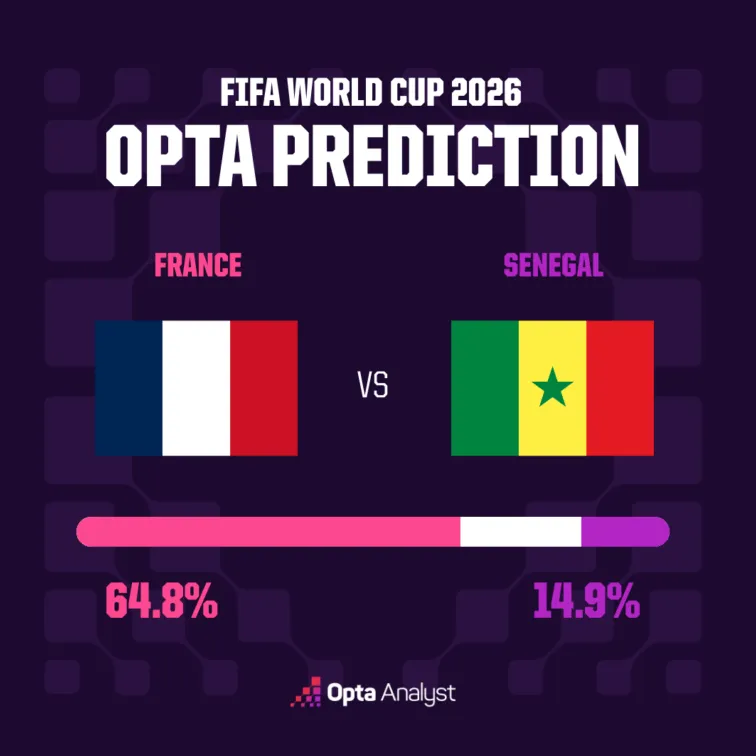
Opta’s supercomputer still gives France a clear edge at New York New Jersey Stadium, assigning Les Bleus a 64.8 percent chance of victory. Senegal’s chances of pulling off another upset stand at 14.9 percent while the probability of a draw is put at 20.3 percent.

France vs Senegal

What are the predictions for Iraq vs Norway?

Tuesday’s Group I clash will be the first meeting between Iraq and Norway, and it will be the Nordic country’s first World Cup match against a team from the Asian Football Confederation.

Norway have relished their return to the World Cup after a long hiatus from the tournament. Fans have drawn attention with their synchronised “Viking row” celebrations while Erling Haaland shared a Viking-themed team photo on social media, describing the tournament as “a dream 28 years in the making”. Led by Haaland and Martin Odegaard, the Norwegians arrive with high hopes.

Opta’s supercomputer expects Norway to start strongly, giving them a 77.4 percent chance of victory. A draw is rated at 14 percent while Iraq have an 8.6 percent chance of pulling off an upset.

Iraq vs Norway

What are the predictions for Argentina vs Algeria?

Argentina and Algeria have never faced each other at the World Cup although they did meet in a friendly in 2007 when Argentina came from behind to secure a thrilling 4-3 win at Barcelona’s Camp Nou. A teenager by the name of Lionel Messi scored the first two goals of his international career that day.

History also favours the South Americans. Argentina have won each of their last six World Cup matches against African opponents, rebounding from their shock 1-0 defeat to Cameroon in 1990. Algeria, meanwhile, have enjoyed mixed fortunes against South American sides at the tournament, beating Chile in 1982 before losing to Brazil four years later.

Opta’s supercomputer expects Argentina to make a winning start in Group J. After 25,000 simulations, Lionel Scaloni’s side emerged victorious 68.2 percent of the time. Algeria were given a 13.2 percent chance of causing an upset while a draw was the outcome in 18.6 percent of the projections.

Argentina vs Algeria

What are the predictions for Austria vs Jordan?

Austria enter the match as the clear favourites on paper. Ranked 25th in the world, they sit 39 places above Jordan, who are 64th in FIFA’s standings, and the Europeans are widely expected to challenge for a place in the knockout rounds.

Opta’s supercomputer strongly backs Austria to open their campaign with a victory in San Francisco, giving them a 70.3 percent chance of taking all three points. Jordan have been assigned a 12.9 percent probability of pulling off an upset while the likelihood of a draw stands at 16.9 percent.

Looking beyond this match, Austria are considered Argentina’s main challengers in Group J. They have an 18 percent chance of finishing top of the group, compared with just 2.9 percent for Jordan.

Austria vs Jordan

What else is shaping the World Cup?

Cape Verde celebrate historic point

Cape Verde’s 0-0 draw with Spain led to wild celebrations among fans, including in Boston, home to a large Cape Verdean community. Supporters said they were proud to see their country shine on the World Cup stage.

“Everyone thought Spain would beat us,” one fan said. “We’re a small country, but we have a big heart.”

According to a report on the NBC TV network, goalkeeper Vozinha also became an overnight social media sensation with his Instagram following soaring after the game. NBC said the goalkeeper went from 50,000 followers on Instagram to 4.9 million.

Cape Verde national soccer team fans react as they watch a World Cup group stage match against Spain, in Praia, Cape Verde, June 15, 2026. REUTERS/Danilson Sequeira
Cape Verde fans watch the World Cup group stage match against Spain from Praia, Cape Verde, on June 15, 2026 [Danilson Sequeira/Reuters]

Saudi Arabia deny Uruguay victory

Saudi Arabia looked set for another famous World Cup upset after Abdulelah Alamri gave the Green Falcons the lead against Uruguay, four years on from their shock win over Argentina.

But Uruguay’s Maximiliano Araujo struck 10 minutes from time to earn Uruguay a 1-1 draw. Saudi goalkeeper Mohammed Alowais then made several key saves to preserve the point, leaving Group H finely balanced after the opening round of matches.

Abdulelah Al-Amri in action.
Abdulelah Al-Amri #4 of Saudi Arabia scores his team’s first goal against Uruguay during the FIFA World Cup 2026 Group H match at Miami Stadium on June 15, 2026 [Lars Baron/Getty Images/Getty Images via AFP]

Tunisia sack coach after heavy defeat

Tunisia have dismissed Sabri Lamouchi after their 5-1 loss to Sweden in their World Cup opener. Mondher Kebaier is set to take over on an interim basis as Tunisia try to revive their campaign before matches against Japan and the Netherlands.

Meet Merlin, Mexico’s unlikely mascot

A duck named Merlin became one of the World Cup’s first viral stars after appearing in Mexico City celebrations dressed in the national team’s colours. Fans on social media called the two-year-old a “national treasure” and even called for him to attend matches as the tournament’s unofficial mascot.

Norway embrace their Viking roots

Norway have brought Viking fever to the tournament. Fans have debuted a synchronised “Viking row” celebration in the stands while the team posed for a Viking-themed photoshoot that sparked both excitement and debate back home. The images, shared by Erling Haaland, have become one of the tournament’s early talking points.

FIFA clears VAR official Shaun Evans

FIFA said it found “no evidence” to support allegations that video assistant referee Shaun Evans breached its disciplinary code after he was accused of making a white supremacist hand gesture during Germany’s World Cup opener against Curacao. Evans, an Australian, said the gesture was an involuntary movement and denied any intent to communicate a racist message.

For many Iraqis, qualifying for the World Cup has brought a rare moment of joy after decades of conflict and hardship.

Fans said the team’s return to football’s biggest stage after more than 40 years offers people a chance to unite and move away, even briefly, from the tensions in the region.

“We haven’t felt this happy in a long time,” Ahmed Salman, an Iraqi fan, told Al Jazeera.

“This is a chance for people to come together and move away from the atmosphere of war, especially given the tense situation in the region.”

But the celebrations have also been mixed with frustration over restrictions that some said have prevented Iraqi supporters from attending the tournament in the United States.

“Banning the fans is a very negative step because sports have nothing to do with politics,” Salman said. “People are coming to celebrate.”

Another Iraq supporter described the emotions as bittersweet.

“As Iraqis, after more than 40 years, we have qualified for the World Cup,” Taha Mohamed said. “It brings a feeling of joy and comfort, … but regarding the fans, it is frustrating.”

Source link

‘Trapped’: Gaza patients flown to Iraq stuck in administrative limbo | Gaza

More than two years ago, Gaza resident Hanin Muhammad accompanied by her 39-year-old sister Sabreen, a kidney transplant recipient, was flown to the Iraqi capital Baghdad for medical treatment. But Muhammad has since been confined to the Private Nursing Home Hospital inside Baghdad’s Medical City complex, thousands of miles away from her home in Gaza, as her travel documents have been confiscated by Iraqi authorities.

“My six children are in Gaza, and I am entering my third year without seeing them,” 40-year-old Muhammad told Al Jazeera.

Recommended Stories

list of 4 itemsend of list

Her family home in Rafah was destroyed by Israeli forces, forcing her children to be displaced into makeshift tents located between Rafah and Khan Younis.

“I check on them through other people because they lack internet connection. I am begging anyone to intervene so we can get back to Egypt, register, and see our children,” she said. Currently, Palestinians can go in and out of Gaza only using the Rafah crossing, which opens into Egypt.

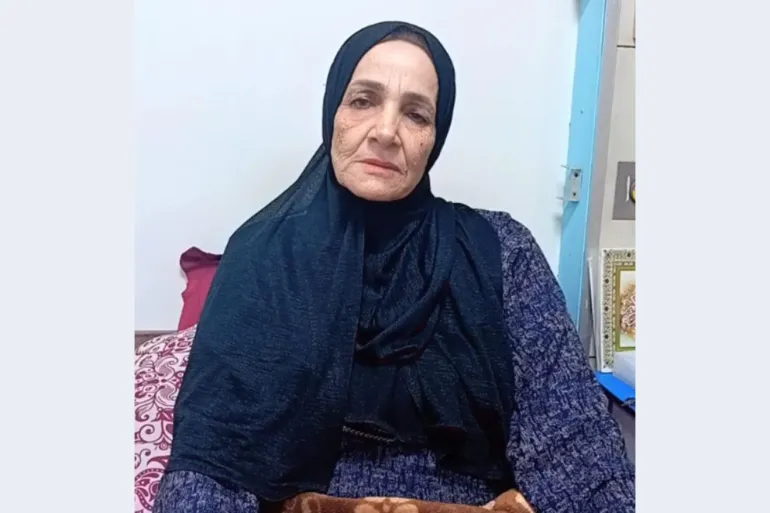
Samah Abdul Moati, 65, an oncology patient stranded in Baghdad, lost two sons in the war and says she no longer cares about her treatment, wishing only to return to her family. [Courtesy of Samah Abdul Moati]
Samah Abdul Moati, 65, an oncology patient stranded in Baghdad, lost two sons in the war and says she no longer cares about her treatment, wishing only to return to her family [Courtesy of Samah Abdul Moati]

Muhammad, who travelled to Iraq as a medical companion to her sister, is part of a forgotten cohort of 46 Palestinians evacuated to Iraq, comprising 21 patients and 25 family escorts.

According to health authorities tracking the group, the clinical breakdown of the patients highlights the severity of their conditions, which include five oncology patients, four suffering from blood disorders, one cardiac patient, one kidney disease patient, and 10 patients wounded in the ongoing genocidal war that has killed nearly 73,000 Palestinians and wounded more than 172,000.

The group was flown to Baghdad in March 2024 on a military aircraft in coordination with the Iraqi and Egyptian governments, with a symbolic presence from the Palestinian Embassy in Cairo.

These rare evacuations highlight a much broader medical crisis back home. According to Gaza’s Health Ministry, more than 20,000 patients and wounded people are currently waiting to travel abroad for medical treatment.

Zaher al-Waheidi, head of the ministry’s Information Unit, reported that 1,200 children in Gaza now suffer from spinal cord injuries and paralysis directly resulting from Israeli attacks, while some 4,000 children require urgent treatment abroad.

Despite the overwhelming need, official data provided by al-Waheidi shows that only 154 children have been allowed to leave Gaza since the Rafah crossing, the enclave’s only gateway to the outside world, partially reopened in February amid heavy Israeli restrictions.

The crisis is equally dire for newborns: in 2025, more than 4,000 women had premature deliveries, and at least 4,800 babies were born with low birth weights – double the pre-war figure. Last year alone, 457 infants died in their first week of life.

For the handful who made it out, like the group in Iraq, the promised sanctuary quickly devolved into a cage defined by confiscated documents, restricted movements, and systemic neglect.

Confiscated documents and suspended lives

Upon their arrival from Egypt’s Heliopolis Hospital, the promised short-term recovery windows evaporated. Evacuees state that their primary identification and travel documents were immediately seized.

“When we left Egypt for Iraq, the Iraqi authorities took our identification papers from the Egyptians, and we haven’t seen them since,” Muhammad told Al Jazeera.

“When we asked for them, they told us they were held by Iraqi Intelligence and the Ministry of Foreign Affairs. We demand them back, but no one answers us.”

The Palestinian Embassy in Baghdad issued new passports for those lacking them, but according to Muhammad, these documents remain unstamped by the Iraqi government and are functionally useless. She noted that without the official stamps, they cannot travel anywhere.

This administrative vacuum has completely frozen the lives of the companions. Noor Ibrahim, a pseudonym for a young woman who arrived as an escort for her cancer-stricken aunt, is stranded along with four of her aunt’s children.

“I have been engaged for four years, and my fiancé and family are in Gaza,” Ibrahim told Al Jazeera. “We left on the promise that it would be a temporary six-month treatment trip, but now, two years have passed.”

She expressed deep frustration as she is stuck inside the medical complex, emphasising that she just wants to return to Egypt, from where she can travel to Gaza to complete her marriage and start her life.

The stress of the confinement has also severely exacerbated underlying health conditions. Ibrahim noted that while her aunt received the necessary cancer treatment, she has developed various other undisclosed health complications in Iraq, and her psychological state is exhausted from leaving her husband and family behind in war-ravaged Gaza.

Retaliation and dire conditions

For the Palestinians living inside Baghdad’s Medical City complex, daily life has become a grind of material deprivation and psychological distress. The evacuees are completely cut off from any monetary stipends, leaving them entirely dependent on the hospital for basic shelter and local citizens for additional charity.

This picture taken on December 24, 2023 shows a view of the Baghdad Medical City hospital complex overlooking the Tigris river in the centre of Baghdad. Stricken by drought, Iraq's already-dwindling rivers are suffocating under medical waste and sewage contamination. (Photo by AHMAD AL-RUBAYE / AFP)
This picture taken on December 24, 2023, shows a view of the Baghdad Medical City hospital complex overlooking the Tigris river in the centre of Baghdad [File: Ahmad Al-Rubaye/AFP]

Samah Abdul Moati, 65, who battles leukaemia, liver cancer, and an arm injury, is accompanied by her injured 43-year-old son and her daughter-in-law. She painted a grim picture of their daily life.

“The hospital brings food every day, but no one can eat it because it is unfit for consumption,” Abdul Moati told Al Jazeera. “We are surviving on the grace of local well-wishers who don’t fail us. But we don’t care about the treatment any more – we just want to return to our children.”

Abdul Moati’s situation is compounded by unfathomable grief: two of her sons were killed in the war, two others have platinum implants from injuries, her husband is fighting cancer in a Gaza intensive care unit with no one to care for him, and her daughters and orphaned grandchildren are living in tents for displaced people.

“The hardest feeling is that I am trapped between the hospital walls while my heart is outside with my family and my people,” Abdul Moati said. “My husband is in the intensive care unit alone, and my children and grandchildren are in tents under the cold and fear.”

Compounding their alienation, evacuees who have tried to protest or publicise their predicament faced swift administrative blowback. When they demanded their right to travel five months ago and spoke to the media, hospital management retaliated by locking down the ward and banning them from even visiting the hospital garden.

Muhammad revealed that they were only allowed out after journalists wrote about their situation, adding that officials continuously throw them from one department to another without providing any straightforward answers.

Bureaucratic runaround

The spokesperson for the Iraqi Ministry of Health, Saif Albadr, did not answer repeated calls from Al Jazeera.

While the head of public relations at the Health Ministry, Ruba Falah Hassan, told Al Jazeera that the case is “political.”

“Frankly, this is a political issue, not health-related.. I’m not authorised to talk about it,” she stated.

The newly appointed Iraqi government spokesperson, Haidar Al-Aboudi, told Al Jazeera that he “will look into the matter”.

For the Palestinians stranded in the Medical City, they maintain that they lack the financial means to buy commercial airline tickets even if their papers are returned, meaning they desperately need a coordinated effort by a charity or government body to facilitate their travel back to Egypt.

“I am not asking for a luxury or an exception,” Abdul Moati pleaded in her final remarks.

“I am asking for a simple human right: that my family does not remain divided between life and death. Open a safe path, facilitate our family reunification, and let me return to my family before it is too late.”

Source link