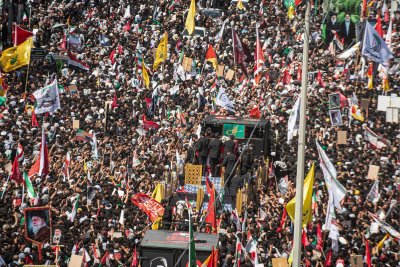
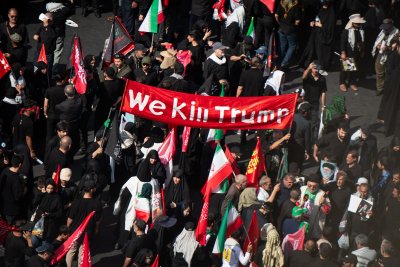
A crowd of mourners gathered around an vehicle carrying the coffin of Iran’s late Supreme Leader Ali Khamenei during the funeral procession Wednesday from Iran to Najaf, Iraq. The funeral convoys bearing Khamenei’s coffin will pass through the holy Iraqi cities of Najaf and Karbala amid renewed U.S. military strikes on Iran. Photo by Behnam Tofighi/UPI | License Photo
July 8 (UPI) — The U.S. military resumed attacks against Iran on Wednesday afternoon “to further degrade their ability to threaten freedom of navigation in the Strait of Hormuz,” U.S. Central Command said.
“The United States is holding Iran accountable for recent unjustified aggression against commercial shipping and civilian crews freely navigating a vital international waterway,” the statement continued.
Iranian Foreign Minister Abbas Araghchi said that addressing Iran with “derogatory language” does not diminish it.
“Iranians are known for their civility, culture and strong moral values,” he said in a social media post. “We do not answer vulgarity with vulgarity, but with action: fearlessly and with great valor.”
Tuesday’s attacks lasted about four hours and struck more than 80 targets, U.S. Central Command said. The attacks came after Iran attacked three commercial ships in the Strait of Hormuz.
The United States also reimposed sanctions on Iranian oil sales in retaliation for the attacks. Iran said the sanctions were “in clear violation” of the memorandum of understanding to end the conflict between Iran and the United States that was signed in June.
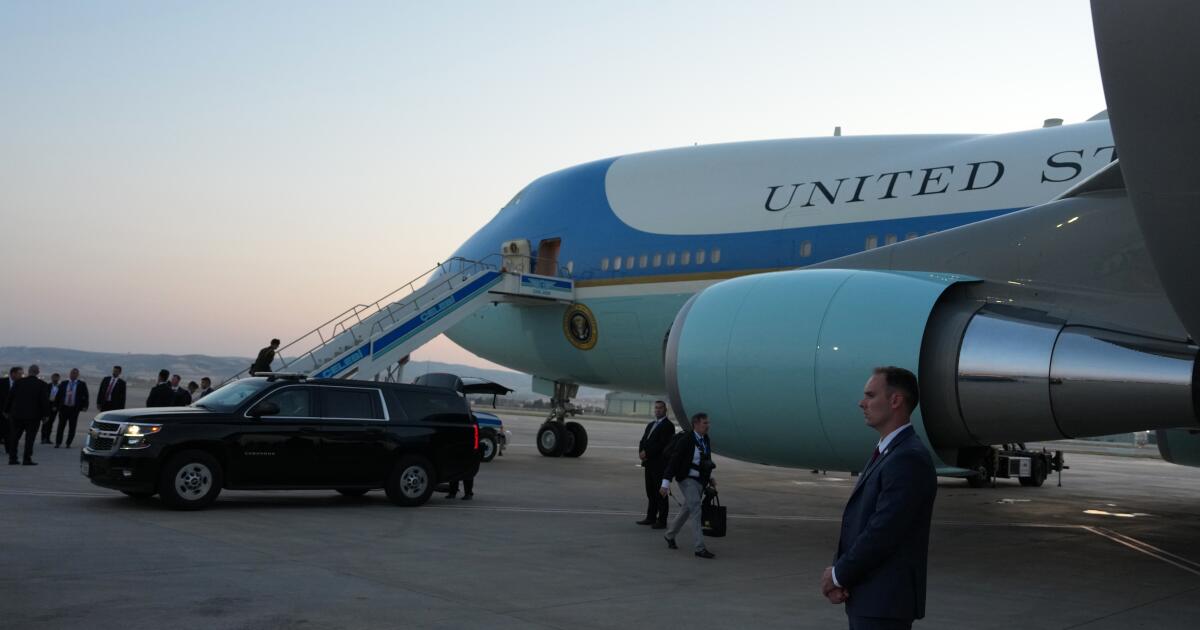
WASHINGTON — President Trump flew home from a NATO summit in Turkey on an old baby blue Air Force One plane instead of the new Qatari-gifted and retrofitted red, white and navy blue jet he arrived in, a surprise swap that came as the U.S. and Iran once again began trading strikes.
Trump offered little clarity on the swap, instead saying he would fly on the legacy aircraft “for old time’s sake,” and indicating that both aircraft would make a previously unscheduled stop on the way back to the U.S. at Royal Air Force Mildenhall, a base used by U.S. troops.
The travel switch raised fresh security questions about the new aircraft that the U.S. spent $400 million to retrofit. Images of the Qatari-gifted jet captured since its unveiling show it is not equipped with some of the same missile detection and countermeasure systems as the older jets.
The swap was also announced less than a day after the U.S. military conducted a series of large strikes in Iran in retaliation for its attacks on merchant shipping in the region. Iran shares a border with Turkey.
Trump first announced in a social media post that the gleaming new plane he had proudly shown off a day earlier would instead visit the U.K. base on the way home so military members could “tour the Aircraft.” Trump said he instead would be flying home in an older plane previously used as Air Force One.
When asked later during a news conference if security concerns had played a role in the switch, Trump didn’t directly answer but said that when it came to Iran, he was “No. 1 on the list for killing.”
When another reporter followed up, Trump said he’d be “going home by normal methods” while the new plane would be shown off to troops.
When asked if the missing countermeasures systems played a role in the jet being swapped out, the U.S. Air Force directed questions to the White House.
“The new Air Force One is a state-of-the-art aircraft that has been fitted with high-level security protocols that ensure the safety of the President and his staff,” spokesman Steven Cheung said in a statement. “As the President has said recently, there are many enemies of America who have their sights on him, and we use every tool at our disposal— including distraction and misdirection— to address those threats.”
Trump departed Turkey aboard one of the older Boeing VC-25As that have carried presidents for three and a half decades. Consumer flight trackers were unable to monitor its transponder early in the flight after takeoff, suggesting it had been temporarily disabled by the crew — a security measure used when ferrying the president to and from high-risk environments like war zones, not a major NATO ally hosting a long-scheduled summit.
Other world leaders’ flights departed with trackable transponders, including those from Germany and the U.K.
The luxurious Boeing 747-800 gifted by Qatar, that was modified to carry Trump, departed earlier Wednesday from Turkey and landed at RAF Mildenhall on Wednesday afternoon, flight trackers showed.
Iran has several missiles and drones in its inventory with enough range to make the roughly 800-mile flight from its own borders to Turkey, including some of its Shahed drones and Shahab ballistic missiles.
However, according to the Center for Strategic and International Studies, Iran does not possess weaponry that would be capable of effectively striking England at a range of roughly 2,500 miles.
The U.S. Air Force, which oversees the running of the fleet of aircraft used by every president, had previously said that they had to prioritize making only some of the necessary upgrades and changes in order to deliver the Qatari jet — also known as the “bridge” aircraft — into service.
The Air Force argued that the rapid conversion of the jet was done “without accepting any risk regarding security, safety, or secure communications,” but did concede that “several highly complex engineering modifications required for the final (Air Force One aircraft) were intentionally excluded from the Bridge aircraft.”
Jeremiah Gertler, a senior analyst for Teal Group, an aviation and defense consulting firm, previously told The Associated Press that the absence of countermeasure systems, as well as a seemingly smaller number of communications antennas, suggested that the Qatari jet was better suited to only work as a domestic aircraft.
Trump’s first flight on the new Qatari jet was to North Dakota last week.
The original Air Force One planes were built from scratch near the end of the Cold War and they were hardened against the effects of a nuclear blast and included a range of security features, such as anti-missile countermeasures and an onboard operating room.
The jets are also equipped with air-to-air refueling capabilities for contingencies, though it has never been utilized with a president on board.
The pair of Boeing jets that are currently being modified to act as the permanent upgrades to the Air Force One jets have been delayed, and are expected to be delivered in 2028.
Price and Toropin write for the Associated Press. AP writer Zeke Miller contributed to this report.
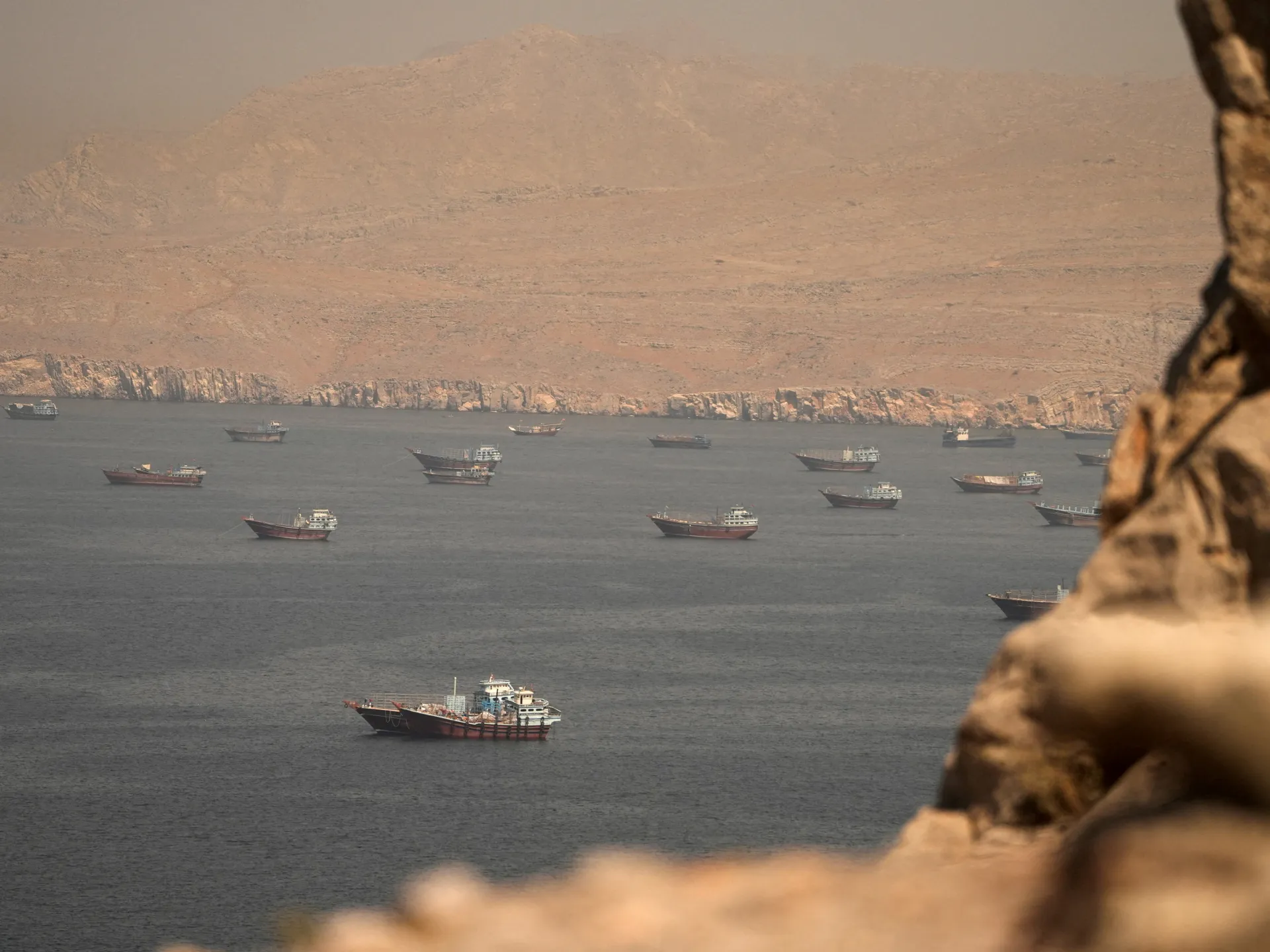
On Tuesday, two tankers were attacked as they transited the Strait of Hormuz via a passage in Omani waters. Gulf countries responded by sharply condemning the attacks and blaming Iran. The United States then launched attacks on Iranian territory, to which Tehran responded by striking Bahrain and Kuwait. US President Donald Trump has now said the memorandum of understanding (MoU) that Iran and the US signed is void.
This latest escalation illustrates how the Strait of Hormuz has become the central issue in the US-Israel war with Iran that began on February 28. Disagreements over the strait’s future have proven to be the hardest to resolve in the US-Iranian negotiations, as questions about Iran’s nuclear programme have been put to the side.
The disruption of traffic in the Strait of Hormuz has an immediate and costly price tag attached, for Iran, for its Gulf neighbours, and for a global economy that has spent four and a half months absorbing the largest oil supply shock in the history of the modern market.
Iran’s leverage is also its liability
For Tehran, the strait is its strongest card – one that is also incredibly costly. Since the war began, Iranian forces have mined the strait, attacked vessels and cut traffic through the passage by roughly 95 percent. This has led to what the International Energy Agency’s Fatih Birol has called “the largest supply disruption in the history of the global oil market”.
That leverage is real: about a fifth of the world’s oil and a fifth of its liquefied natural gas (LNG) normally move through Hormuz, and no amount of Gulf pipeline capacity can fully replace it.
But Iran has effectively been strangling its own lifeline along with everyone else’s. Iranian crude, once sold for $3 a barrel less than international benchmarks, is now selling at a 20 percent discount. The country’s oil exports collapsed by more than 90 percent in May as US naval enforcement squeezed its shadow fleet.
Even before the war, the World Bank projected that Iran’s economy would contract in 2026. The impact of the collapse of oil sales will be far-reaching because of the closure.
A 60-day US Treasury waiver issued on June 22, permitting Iran to sell oil at full market rates through August 21, but has now been renounced following the attacks on Tuesday.
This is the economic backdrop to Iran’s insistence on asserting joint authority over the strait and floating a system of transit fees or “service charges” for passing ships. Washington has made clear that Iran cannot charge tolls in international waters governed by the right of transit passage under the Law of the Sea.
For Tehran, the dispute is not really about toll revenue, which would be rather modest when compared to its oil income; it is about establishing precedent and sovereignty over a chokepoint that is its only real point of leverage once sanctions relief and frozen-asset release are negotiated.
The latter is itself contested: Iran wants half of an estimated $25bn in frozen assets released immediately, while the US has resisted. A separate $300bn reconstruction fund floated in the MoU has already become a political flashpoint in Washington.
The Gulf is paying for a crisis it didn’t start
For the Gulf states, the Strait of Hormuz crisis has meant improvising around geography. Saudi Arabia has redirected crude through its roughly 1,200km (746-mile) East-West pipeline to the Red Sea port of Yanbu, and the UAE has leaned on the Habshan-to-Fujairah line to the Gulf of Oman.
Together, though, these pipelines carry a fraction of what Hormuz once did, at best 7 million barrels a day of design capacity for the Saudi line and under 1.8 million for the Emirati one, against roughly 20 million barrels a day that transited the strait before the war.
Both alternatives have themselves come under attack: Iranian strikes cut the East-West pipeline’s throughput by an estimated 700,000 barrels a day in April, and drone attacks disrupted loading at Fujairah. Seaborne crude exports from Gulf states excluding Iran fell by roughly half between February and March.
Qatar, host to the talks between Iran and the US, has its own acute stake: its entire LNG export industry depends on the Strait of Hormuz, and it has been pushing the hardest for a settlement.
Oman, drawn into Iran’s sovereignty claim as co-owner of the strait’s territorial waters, is caught between commercial interest in a resolution and a legal position, as a signatory to the United Nations Convention on the Law of the Sea (UNCLOS) that publicly rejects Iranian tolls. Iraq, highly dependent on its Gulf terminals, has quietly explored an export route north through Turkiye.
None of these workarounds are cheap, and all of them are political as well as commercial, tying Gulf capitals’ economic fortunes to a settlement between the US and Iran.
The rest of the world: Insurance bills and inflation
Beyond the region, the crisis has been transmitted mainly through two channels: price and insurance. Higher oil prices are passed on to various consumer goods down supply chains and suppress growth. According to estimates, the global economy can slow down to 2.8 percent in 2026 from 3.4 percent last year due to the closure of the strait.
Insurance for Hormuz transit, which cost roughly 0.25 percent of a vessel’s value before the war, has spiked as high as 8 percent, turning a single large tanker’s coverage into a $3m-to-$8m expense. Shipping lines including CMA CGM and Hapag-Lloyd have layered on conflict surcharges of $1,500 to $2,000 per twenty-foot equivalent unit (TEU). Washington’s own International Development Finance Corporation has had to step in as, in effect, an insurer of last resort, offering up to $40bn in reinsurance capacity to keep vessels moving.
China has absorbed the largest share of this pain: It takes close to 40 percent of its crude imports through the Strait of Hormuz and buys more than 80 percent of Iran’s oil exports outright, making it simultaneously Tehran’s most important customer and one of the war’s most exposed bystanders. Japan, which sources 70 percent of its Middle Eastern crude via the strait, has already tapped strategic reserves.
For import-dependent economies across Asia and Europe, the strait’s fate is not an abstraction of Middle East diplomacy; it shows up directly in fuel, freight and fertiliser prices.
Oil and gas dominate the headlines, but roughly 30 percent of the world’s seaborne fertiliser trade also passes through Hormuz.
The World Bank’s fertiliser price index has risen more than 12 percent in the first quarter of 2026 and has since climbed to its highest level since October 2022, driven largely by the closure. The Food and Agriculture Organization has warned that the resulting scarcity of urea and other nitrogen products will show up as lower yields through the 2026–2027 growing season, hitting import-dependent and already food-insecure countries in Africa and Asia the hardest.
Unlike an oil-price spike, which mainly stings at the pump, a fertiliser shortfall reaches into next year’s harvest, meaning an unresolved Hormuz standoff carries a slower-moving but longer tail of economic damage than crude prices alone suggest.
That is the arithmetic weighing on both sides. A deal that reopens the Strait of Hormuz without resolving who controls it risks recreating the same instability that shut it in the first place; one that concedes Iranian toll authority risks a precedent Washington and shipping nations will not accept. Until that circle is squared, the global economy is left pricing in a chokepoint that neither side can fully afford to keep closed, nor fully agree how to reopen.
The views expressed in this article are the author’s own and do not necessarily reflect Al Jazeera’s editorial policy.
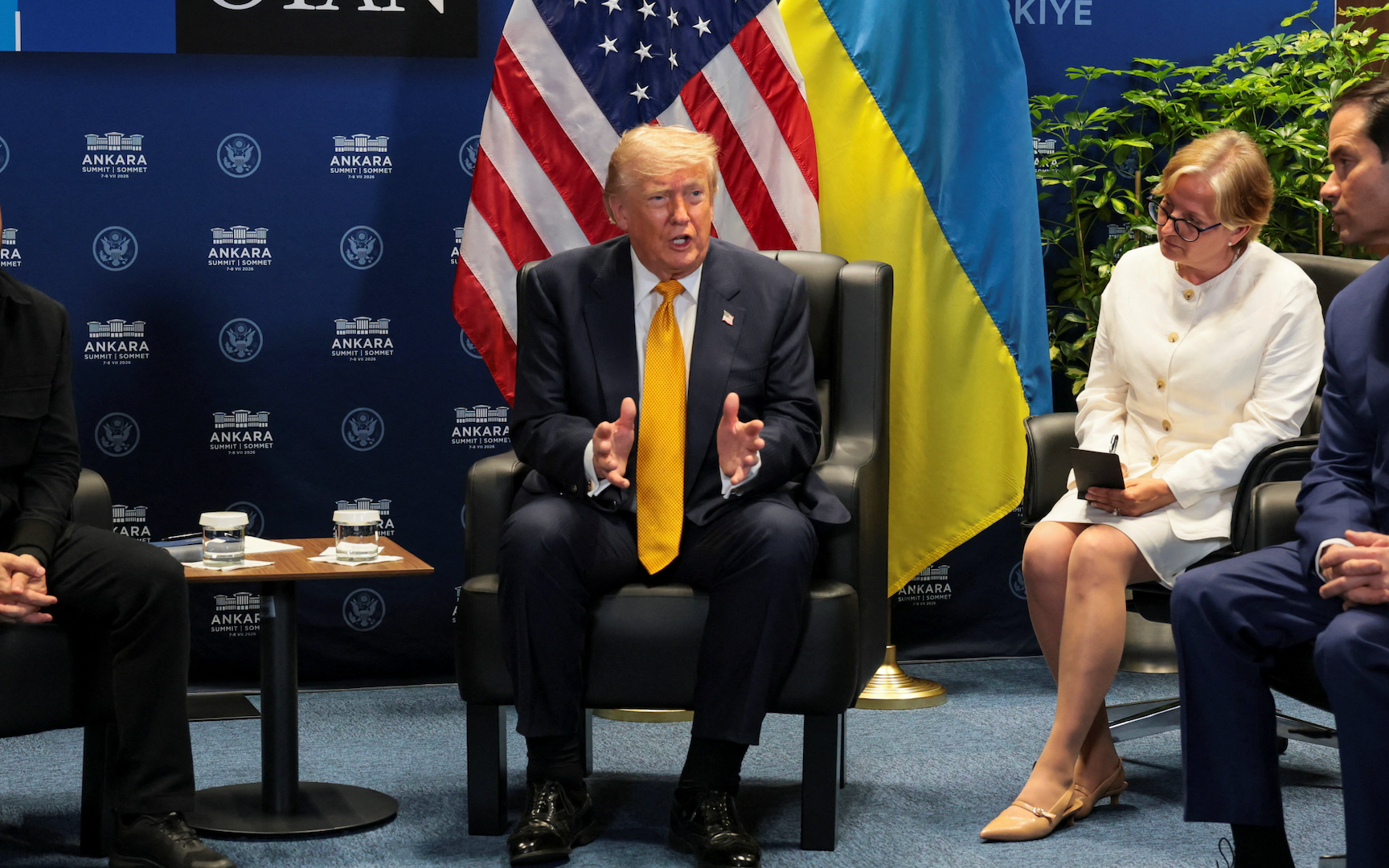
ANKARA, Turkey — President Trump said Wednesday that the U.S. will give a license to Ukraine to manufacture Patriot air defense systems to help counter Russian missile attacks, a huge coup for Ukraine which has badly needed the technology for the war now in its fifth year.
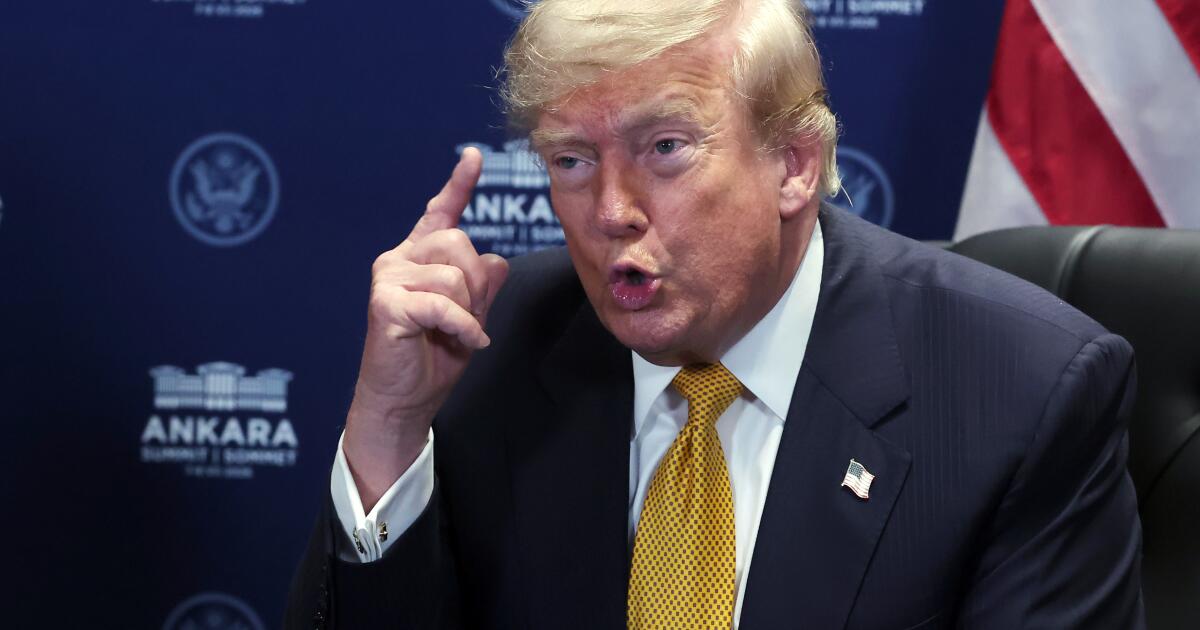
“We’ll give them the right to make Patriots. We’ll show them how to do it,” Trump said as he met with Ukrainian President Volodymyr Zelensky at a NATO summit in Turkey. “I think they can produce them pretty quickly.”
Patriots are expensive, in high demand and take a long time to produce. Zelensky has for years been asking for more of them, and more recently for a license so that Ukraine can manufacture its own.
The tone of Trump’s meeting with the Ukrainian leader was a break from earlier encounters which ended in acrimony, and Trump praised Zelensky’s willingness to reach a deal on ending the fighting in Ukraine.
He said the Ukrainian president has “done an amazing job” and “been very effective” in the war.
“We’ve actually developed a good relationship. It’s hard to believe,” Trump said, adding he believed a deal on ending the war was on the horizon and that the U.S. would “work on some kind of security package” to provide to Ukraine.
Trump takes aim at NATO partners
Trump wasn’t as friendly, however, with some his NATO partners, saying he was unhappy with the alliance for pushing back against his efforts to take control of Greenland and for not supporting his war in Iran.
NATO’s European members plus Canada have scrambled to meet the increased defense spending targets Trump has demanded, as the U.S. draws down the number of troops it has in Europe and insists that the continent take more responsibility for its own security.
But Trump reopened old wounds as he arrived at the meeting of 32 NATO leaders by insisting again that the United States should control Greenland, a semiautonomous Danish territory. He blasted some European countries for refusing to participate in the Iran campaign, singling out Spain as “a terrible partner in NATO” and renewing his threats to cut off trade.
Ahead of the summit, Trump said Greenland “is very important” for the U.S. but not for Denmark, declaring, “We need it for protection of the world, not just the United States.”
But Denmark’s Prime Minister Mette Frederiksen said her country is “ready to defend every inch of NATO including our own territory” in the event of an attack, and would rely on NATO allies to honor their commitment to defend each other.
Trump’s criticisms have in the past drawn European countries closer together as they confront wars in Ukraine and Iran, a ballooning trade deficit with China, and threats from Russia.
The president’s renewed interest in Greenland could put at risk the entire future of NATO, which was founded in 1949 to counter the threat to European security posed by the Soviet Union during the Cold War.
NATO Secretary-General Mark Rutte sought to tamp down the president’s ire by giving him credit for recent increases in defense spending from NATO allies.
“Grab the win. It’s there,” Rutte told Trump on Wednesday.
NATO chief backs latest U.S. strikes on Iran
Ahead of the summit, Rutte praised Trump for the series of U.S. strikes on Iran overnight, after Tehran struck three merchant ships in the Strait of Hormuz.
“I think what you did last night was absolutely necessary,” Rutte said to Trump. “It was a very strong response, and I’m with you on this.”
The U.S. strikes, as well as the revoking of a license allowing Iran to sell its oil on global markets, underscored the fragility of an interim deal to end months of fighting.
Trump said of the interim agreement with Iran: “For me, I think it’s over” — but added he will allow talks to continue.
“It’s just a waste of time dealing with them,” he said.
NATO leaders sought to show Trump they were boosting defense
Rutte has dedicated a huge amount of energy to keeping Trump’s support for NATO and to holding the summit together.
The NATO chief pointed to countries including Estonia, Latvia, Poland and Denmark that are investing more in defense, but noted the Trump administration expects “the Europeans and Canadians will equalize their spending with the United States.”
Last month Rutte went to Washington to hail the “Trump Trillion” — the $1.2 trillion that European allies and Canada have added to defense spending since Trump came to power in 2017.
As leaders converged on Ankara, Rutte hosted a “big reveal” event to showcase the many deals planned for the increased spending — much of it to be spent on U.S. companies, creating thousands of jobs for Americans.
At last year’s summit, the allies agreed to invest 5% of their gross domestic product on defense — 3.5% on their defense budgets and 1.5% on infrastructure so troops and equipment can move faster in times of conflict.
Yet figures released by NATO on Tuesday showed that Slovenia, Belgium, Spain and the Czech Republic have struggled to meet the alliance’s old spending target of 2% of GDP.
The Trump administration wants to see a leaner “NATO 3.0,” with Europe taking responsibility for its own security, including Ukraine, with conventional weapons while America would continue to provide its nuclear umbrella.
The Pentagon has launched a six-month review of U.S. military presence in Europe, leaving allies to seek clarity on just how deeply Trump intends to cut U.S. force numbers.
Ukraine’s Zelensky pushes for NATO entry
Zelensky made a fresh appeal Tuesday for Ukraine to be allowed to join the alliance, saying Ukrainian armed forces are highly experienced and would only boost NATO’s defense capabilities.
He’s highlighted Ukraine’s adaptability and its ability to strike deep inside Russia. He said Ukraine’s armed forces are “eliminating” on average 30,000 Russian troops every month.
Concern has been mounting among some countries with borders near Russia that Moscow might be preparing a hybrid attack — a combination of conventional warfare with tactics like cyberattacks — on the continent as President Vladimir Putin struggles to secure victory in Ukraine.
Trump will also meet with Syrian President Ahmad al-Sharaa, a former insurgent who led the offensive that unseated autocrat Bashar Assad in December 2024. Despite having once been an al-Qaida fighter, al-Sharaa has won Trump’s backing as he seeks to rebuild Syria and restore its shattered ties with the West.
Cook, Kim and Fraser write for the Associated Press. AP journalists Collin Binkley and Michelle L. Price in Washington contributed to this report.
US President Donald Trump says the US will ‘probably’ carry out another round of strikes on Iran on Wednesday night, following overnight strikes he said were launched in response to Iranian attacks on ships in the Strait of Hormuz.
Weekly insights and analysis on the latest developments in military technology, strategy, and foreign policy.
U.S. Central Command (CENTCOM) announced that its forces have launched “a series of powerful strikes against Iran to impose heavy costs for targeting and attacking commercial shipping crewed by innocent civilians in an international waterway.” The U.S. strikes “are in response to Iranian attacks on three commercial vessels that were transiting the Strait of Hormuz,” CENTCOM stated on X. “Iran’s demonstrated aggression was unwarranted, dangerous, and a clear violation of the ceasefire.”
The official Iranian state media outlet IRIB reported 13 explosions in southern Iran.
The CENTCOM attacks follow the U.S. Treasury Department revoking a general license authorizing the sale of Iranian oil. That abrogates a key part of the Memorandum of Understanding (MoU) signed by Washington and Tehran on June 18.
Here’s the new Treasury license on Iran: “Revocation and Wind Down of June 21, 2026 Authorization for the Production, Delivery and Sale of Crude Oil, Petrochemical Products, and Petroleum Products of Iranian Origin” pic.twitter.com/2jgRRTQudu
While the future of Iran’s nuclear ambitions and its stockpile of enriched uranium are among other key issues addressed in the document, the Strait of Hormuz continues to be a flashpoint.
The latest attacks on shipping all involved tankers.
“A LNG tanker reported being hit by an unknown projectile on the port side engine room causing a fire, whilst travelling southbound through the SOH,” UKMTO reported. That incident took place about eight nautical miles east of Limah, Oman.
Before that, a “VLCC reported being hit by an unknown projectile on the port side upon exiting the SOH” about 16 nautical miles east of Khor Fakkan, UAE, UKMTO added. “Vessel was able to proceed to NPOC [nearest point of call] and no crew injuries were reported.”
The first of the three vessels struck today was a tanker that reported being attacked six nautical miles east of Musandam Peninsula, Oman “by an unknown projectile and has sustained minor structural damage,” UKMTO stated. “No casualties or environmental impact reported and vessel is proceeding to NPOC.”
These attacks all took place along the southern-most route in the Strait, which is controlled by the U.S. and Oman. Iran controls the northern route and the mid-section of the body of water is considered too dangerous to transit due to the threat of mines.
Last Thursday, Iran’s military warned that all oil tankers moving through the Strait must use its approved routes. It also said that interference by U.S. forces in the strait “will be met with a rapid and decisive reaction.”
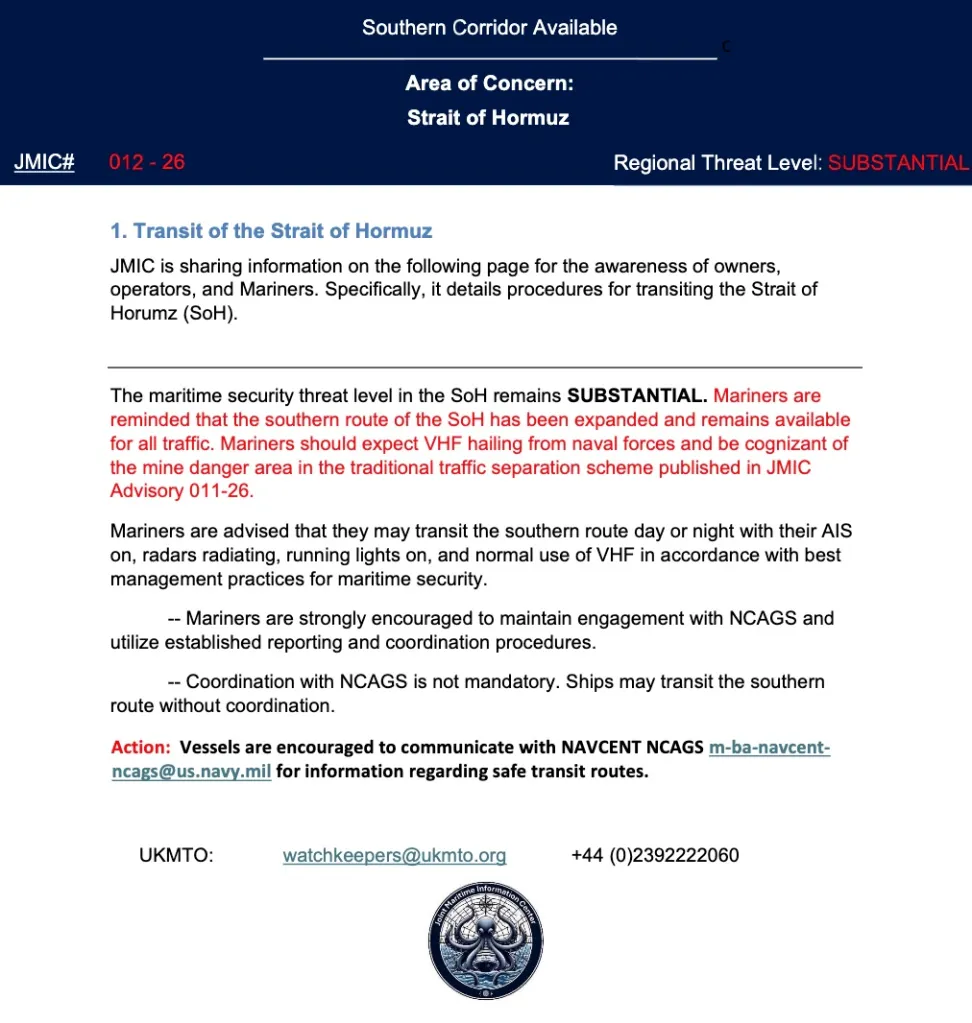
But the Joint Maritime Information Center (JMIC), a multinational body overseen by the U.S. Navy, told shippers Monday that the route around Oman “has been expanded and remains available for all traffic.”
The most recent attacks on shipping came after that JMIC notification and about a week after Iran and the U.S. promised to stop striking each other.
JMIC
What happens next is unknown. The peace talks were paused while Iran holds a weeklong funeral for former Supreme Leader Ayatollah Ali Khamenei, who was killed on the first day of the war in an airstrike.
In an interview with Iranian media posted on X, Iranian Maj. Gen. Mohsen Rezaei, advisor to Iran’s supreme leader Mojtaba Khamenei, seemed to appeal to Iranian hardliners who want to resume fighting.
“Friends who oppose negotiations, be patient; the Americans themselves will derail these talks,” he posited.
This is a developing story.
UPDATE: 6:22 PM EDT –
Video and still images purporting to show the U.S. attacks on Iran are emerging on social media. Bandar Abbas, site of Iran’s key naval base on the Strait of Hormuz, appears to be one of the targets. Bandar Abbas has come under attack several times during this conflict.
Fires seen burning at the Port of Shahid Haqqani in Bandar Abbas, Southern Iran, following tonight’s wave of retaliatory strikes against Iranian military and infrastructure sites by the U.S. Air Force and Navy. pic.twitter.com/ccZPuZvDPG
Bandar Abbas Airport was a major target tonight, where a senior figure in the Islamic regime was present and from where the regime has launched missiles and drones toward neighboring countries. This regime only understands Hebrew and Arabic; it does not understand American… pic.twitter.com/RdDPTgR87T
In a post on X, Axios reporter Barak Ravid said the U.S. strikes on Iran today were “four or five times bigger in scope and power than the previous strikes 10 days ago.”
The U.S. strikes in Iran on Tuesday were four or five times bigger in scope and power than the previous strikes 10 days ago, the U.S. official told me https://t.co/TiDTGTxMTV
Authorities “have launched a search effort for K2 Airways Cargo 737 AP-BOI after the flight did not land as scheduled in Karachi,” FlightRadar24 reported. “KTA1732 was en route from Sharjah to Karachi when contact was lost with the aircraft. Preliminary ADS-B data indicate a loss of altitude, followed by a climb, and then a second, sudden and dramatic loss of altitude. The final received data point from the aircraft was at 16:21 UTC, placing the aircraft at 1,100 ft AMSL with a reported vertical rate of -22,400 feet per minute.”
According to FlightRadar24’s data, the cargo jet flew east over the Strait of Hormuz and the Gulf of Oman when it disappeared from radar screens at about 12:20 PM EDT.
The Pakistan Airports Authority reported on X that the aircraft was suffering a “navigational system issue” before contact was lost. There were five people onboard at the time.
However; at time 2121PST aircraft was observed on RADAR rapidly descending and with rapid heading change, subsequently RADAR contact and communication was lost approximately 155 NM west of Karachi.
— Pakistan Airports Authority (@Pk_PAA_Official) July 7, 2026
The exact cause of this incident is unknown at this time. While there are no indications that the aircraft was lost due to hostile activity, the area is extremely tense.
UPDATE: 947 PM EDT –
CENTCOM says it has “completed its strikes against Iran, July 7, hitting over 80 targets with precision munitions as an immediate response to Iran’s latest attacks on commercial vessels transiting the Strait of Hormuz.”
“U.S. forces struck Iranian air defense systems, command and control networks, coastal radar sites, anti-ship missile capabilities, and more than 60 Islamic Revolutionary Guard Corps small boats in and near the strait to degrade Iran’s ability to continue attacking international commerce flowing through the international trade corridor,” the command said in a statement.
“Iran recently attacked three commercial vessels transiting the strait including Marshall Islands-flagged M/T Al Rekayyat, Saudi Arabia-flagged M/T Wedyan, and Liberian-flagged M/T Cyprus Prosperity,” CENTCOM added. “The unwarranted aggression by Iranian forces is a clear and dangerous violation of the ceasefire and undermines freedom of navigation. CENTCOM forces remain postured and prepared to hold Iran accountable when the agreement is not adhered to or obeyed.”
Chief executive Steve Heapy said a ‘massive amount of people still want to go away’
12:11, 08 Jul 2026Updated 12:59, 08 Jul 2026
Jet2 issued an update to its customers
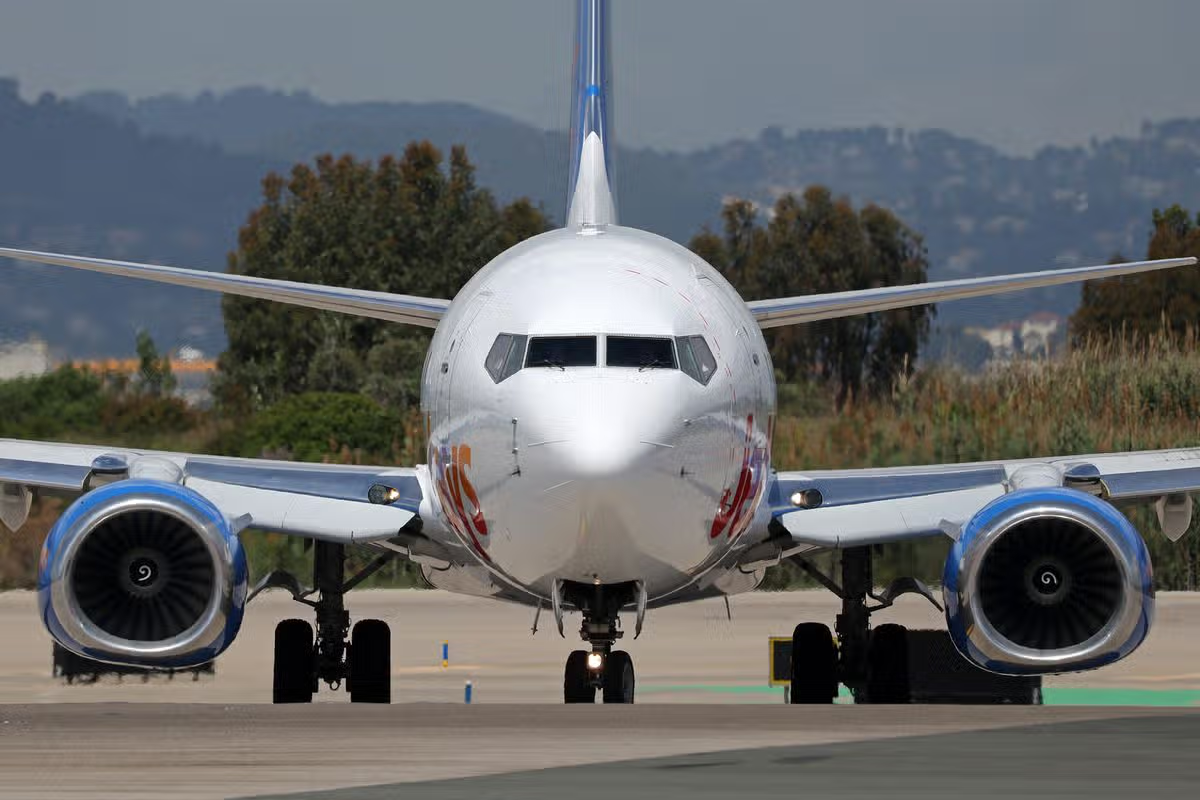
Airline and package holiday provider Jet2 released an update today (Wednesday, July 8), revealing that the company has experienced a surge in demand in recent weeks on the back of US-Iran peace talks.
The firm posted a pre-tax profit of £551 million for the year ending March, a 7% drop from £593 million the previous year. Summer bookings are up 7% compared with the same period last year, while the average proportion of seats filled on its flights for the four months to the end of July are 1.2 percentage points up year-on-year.
US President Donald Trump announced he signed a peace deal with Iran last month, though this has been called into question following overnight strikes.
Publishing its full-year financial results, Jet2 said: “Reduced geopolitical uncertainty has led to strong booking momentum in recent weeks.”
Speaking to reporters, chief executive Steve Heapy said demand has risen across all of Jet2’s destinations, with the biggest recoveries in percentage terms seen in those areas hardest hit by the conflict, including Turkey, Cyprus, some of the eastern Greek islands, Bulgaria and parts of north Africa.
“I think confidence has improved,” he said. “People perhaps don’t like to commit to travelling when there is a conflict, even though from one of our Turkish resorts to Tehran it was 2,000 kilometres, that’s like from Edinburgh to the Canary Islands, that’s a hell of a long way.
“But people don’t like to commit, particularly perhaps families with younger children.
“But we are seeing a bounce-back across all our destinations, and I think people are now realising ‘I feel a little more confident, we’re going to go on holiday and get away’.
“We speak to our customers a lot and try and understand their booking intentions,” he added. “A massive amount of people still want to go away.”
Jet2 announced record annual passenger figures of 20.8 million, representing a 5% rise from the previous year. The company said its performance at Gatwick Airport – where it began flights and holidays in March – is “ahead of initial expectations” and further expansion is planned for summer 2027.
Julie Palmer, partner at consultancy firm Begbies Traynor, said: “Investors will be pleased to see strong profitability has been delivered alongside evidence of investment”.
She added: “Jet2 will be hoping a peace deal holds and stabilises the market as it eyes further growth.
“Signs that this is bringing back confidence in spending for holidaymakers during the crucial summer season will be welcomed by the operator too, and it will be hoping it can continue to tempt customers into spending on holidays.”
Shares fell on Wednesday in Europe and Asia, and oil prices surged nearly 6% after US President Donald Trump said the tentative ceasefire with Iran was over, raising the prospect of renewed military conflict between the two countries.
ADVERTISEMENT
ADVERTISEMENT
Asked whether the memorandum of understanding with Iran was over, Trump told reporters at the NATO summit in Ankara: “To me, I think it’s over. I don’t want to deal with them,” according to Reuters.
This came after US Central Command said its forces struck more than 80 targets in Iran overnight, including command-and-control networks, coastal radar installations, anti-ship missile capabilities and vessels operated by the Islamic Revolutionary Guard Corps (IRGC). Washington also revoked a waiver that had allowed Iran to restart oil exports.
Brent crude, the international standard, jumped more than 6% by 10:45 CEST to $78.79 a barrel, while US benchmark crude rose 6.3% to $74.88 a barrel. Both had declined recently to around the levels seen before the war with Iran began in late February.
The latest flare-up, despite commitments to seek a peaceful resolution to the conflict, has added to uncertainty over oil prices after they fell from their peak well above $100 during the war. It also comes amid worries that the craze for artificial intelligence-related shares has pushed prices beyond the productivity gains and profits likely to result from massive investments in computer chip production capacity and data centres.
“As such, geopolitical headlines will likely determine market sentiment over the coming hours. A further deterioration in the situation could weigh further on equity valuations along with rising stress in technology,” Ipek Ozkardeskaya of Swissquote said in a commentary.
Stock markets fall
In share trading, Germany’s DAX shed more than 2.2%, at around 11 CEST, while the FTSE 100 in London lost 1.5%, and France’s CAC 40 fell more than 2%.
US stock futures were down about 1% at the same time.
In Asia, Tokyo’s Nikkei 225 lost 2.1% to 66,819.05, while South Korea’s Kospi shed 5.4% to 7,246.79.
The South Korean index has soared and then fallen back, briefly surpassing the 9,000 level last month before succumbing to heavy selling in AI-related technology shares such as Samsung Electronics and SK Hynix. Samsung fell 6.3% early Wednesday after dropping about 7% the day before. SK Hynix reversed early gains to fall 5.7%.
Taiwan’s Taiex rose 0.6%. In Hong Kong, the Hang Seng rose 3% to 24,193.56.
Shares in Chinese AI model start-up Zhipu, also known as Z.ai and traded as Knowledge Atlas Technology, rose nearly 14% on Wednesday.
The Shanghai Composite index declined 0.5% to 3,970.88.
On Tuesday, the roller-coaster ride for AI stocks turned lower again, dragging Wall Street down. The S&P 500 fell 0.4%, though the majority of stocks within the index rose.
Losses among AI-related stocks dragged the Nasdaq Composite 1.2% lower, while the Dow Jones Industrial Average fell 0.2%.
Advanced Micro Devices sank 6.5%, Intel shed 9.7%, and Micron Technology lost 4.7%.
SpaceX, which owns the xAI business, fell 6.8% on its first day of trading in the Nasdaq-100 index.
Rivian Automotive dropped 18.1% after the electric vehicle company said it would sell 75 million shares, diluting existing shareholders’ stakes.
In currency trading early Wednesday, the US dollar rose to 162.26 Japanese yen from 162.11 yen. The euro climbed to $1.1426 from $1.1414.
The Iranian Striker: Mehdi Taremi offers a rare personal portrait of one of Iran’s most celebrated footballers during the 2026 FIFA World Cup.
Iranian team striker Mehdi Taremi reflects on the journey that shaped him – from growing up in Bushehr, to representing millions of Iranians at the World Cup.
In this Al Jazeera Originals short documentary, Taremi speaks about childhood, compulsory military service, sacrifice, criticism, national identity and why football means far more than the game itself. He also shares what it means to represent Iran before a global audience, and why he hopes football can help people better understand his country.
July 8 (UPI) — Iran’s military said Wednesday it conducted retaliatory strikes against the United States, targeting dozens of U.S. assets in Bahrain and Kuwait, as the fight over control of the Strait of Hormuz threatened to escalate the war.
In a statement carried by state-run Islamic Republic of Iran Broadcasting, Iran’s Armed Forces said they had attacked 85 “key U.S. military installations” at Salman Port and the 5th Fleet, both in Bahrain, and Ali Al Salem Air Base in Kuwait.
The statement was followed by a second one announcing a “new wave” of missiles targeting U.S. bases in Bahrain.
The extent of the damage, if any, was not immediately clear, but the Kuwait Army confirmed in a statement that its air defenses were confronting “hostile missile and drone attacks.”
“We will not allow U.S. interference in the affairs of the Strait of Hormuz,” Khatam al-Anbiya Central Headquarters, Iran’s top military command body, said in a statement. “Transit through the SoH is only permitted via the routes designated by Iran.”
The strikes came hours after the U.S. military announced late Tuesday the completion of its attacks in Iran, a response to three commercial vessels being struck while transiting the Strait of Hormuz.
The maritime chokepoint has become a dangerous fault line in the war between the United States and Iran.
Washington is seeking to re-establish navigational freedom within the strait, while Iran is attempting to exert and maintain control of the waterway it has sought to exercise since the war began. Neither side appears to be budging, threatening the end of cease-fire negotiations and a return to all-out war.
Both sides accuse the other of violating conditions of the memorandum of understanding they agreed to implement last month to halt the fighting. Indirect negotiations held early this month in Doha produced little to no progress and the renewed fighting may upend the process altogether.
After three commercial vessels were recently struck while transiting the Strait of Hormuz, the U.S. military said it hit more than 80 targets inside Iran.
Before launching its retaliatory attacks early Wednesday, Khatam al-Anbiya Central Headquarters vowed in a statement carried by state-run Fars News Agency that it would “give a crushing response to America’s aggression and terrorist action.”
It said that “under no circumstances” would it allow U.S. interference in the affairs or management of the Strait of Hormuz.
Tehran, Iran – Three weeks after Iran and the United States signed a memorandum of understanding to extend their ceasefire, their truce remains fragile.
Three tankers have been hit in the Strait of Hormuz over the past two days, even as Iran and the US are expected to restart mediated negotiations to end the war next week, after the funeral of Iran’s Supreme Leader Ayatollah Ali Khamenei.
The US military on Wednesday launched large air attacks on Iran’s southern provinces, which prompted the Islamic Revolutionary Guard Corps (IRGC) and Iran’s regular army to fire missiles and drones on US interests in Bahrain and Kuwait. Both sides accused each other of violating the understanding signed last month.
But even if a long-term resolution is eventually reached and Western sanctions on Iran are lifted, analysts say that it will take time for the country’s economy to recover.
The economy has been strained by years of local mismanagement and corruption; stringent Western and United Nations sanctions; and, more recently, damage sustained from two wars in a year with the US and Israel, deadly nationwide protests in January, and internet shutdowns.
When numbers tell a story
A falling purchasing power has pushed millions into poverty. Inflation has recently climbed to levels not seen since World War II, when Allied forces occupied Iran, took over railways and food supplies, and contributed to a deadly famine.
The latest report by the Statistical Center of Iran for Khordad, the third month of the Persian calendar that ended on June 21, showed inflation increasing by 88.6 percent compared to the same month of the year before. Inflation was up by nearly 6 percent compared to the second month of the current year.
Food inflation was skyrocketing at almost 134 percent in Khordad compared to the corresponding month a year earlier, with oils and fats surging by more than 278 percent, red meat and poultry by over 178 percent, and bread and cereals by nearly 139 percent.
Unemployment is at 7.5 percent during the current calendar year, according to the latest report by the statistical centre released at the end of June. But labour participation is at just 40 percent, meaning that most working-age people are operating outside the official labour force – including students, retirees, those engaged in irregular informal work, and those not seeking paid work.
The job-quality picture is also grim, as salaries are perennially falling behind expenses, as over 38 percent of officially employed people work more than 49 hours a week, and as youth unemployment is at over 20 percent, the centre reports.
The base monthly minimum wage equals only about $95 using the current open market exchange rate of the US dollar in Tehran. The rate has climbed to 1.75 million rials per greenback over recent days, not far from its all-time low of 1.9 million in May.
The damage — and the road to recovery
Due to a heavy budget crunch, the only relief the government is able to offer amounts to a few dollars’ worth of monthly cash subsidy and electronic coupons for purchasing essential goods.
A late June report by the Central Bank of Iran for the previous calendar year that ended on March 20 showed that gross domestic product (GDP) growth for the year stood at minus 0.7 percent, and gross fixed capital formation, a primary indicator of productive capacity and economic growth, was at nearly minus 12 percent. Imports were down 16.6 percent, as were exports by close to 5 percent.
The damage from nearly 40 days of heavy bombardment during the war, the longest nationwide state-imposed internet shutdown in any country, and a US naval blockade of Iran’s southern ports — the full extent of which remains undisclosed to the public — has only exacerbated Iran’s economic woes. The International Monetary Fund has projected that Iran’s real GDP will shrink by 6.1 percent in 2026.
Still, Mahdi Ghodsi, a senior economist at the Vienna Institute for International Economic Studies, said that part of the recent job losses could be recoverable if there is a credible halt to military escalation, restoration of transport and logistics links, more predictable access to energy and fuel, and functioning internet and payment systems.
“In that case, some temporary layoffs in services, retail, transport, construction and small businesses could be reversed relatively quickly, because these activities are highly sensitive to uncertainty and disruptions rather than necessarily destroyed productive capacity,” he told Al Jazeera.
Longer-term challenges
But Ghodsi cautioned that part of the damage is likely to be more persistent.
“Where factories have lost machinery, inventories, imported inputs, workers, working capital, or access to energy, reopening is not simply a matter of returning to normal,” he said, adding that in some cases, full recovery may take years and require large investments, including foreign financing.
Last week, leading satellite imaging provider Planet Labs restored access to imagery for nearly 800 sites across Iran impacted during the war, after lifting earlier restrictions it had placed in response to a US government request to delay or suspend access.
Some Iranians on social media highlighted massive damage done to Iran Electronics Industries (SAIran), a state-owned defence industry heavyweight specialising in optics, communications, semiconductors and medical equipment, among other things.
But along with numerous military-linked sites and assets, and nuclear facilities built over decades now reduced to rubble, Iran’s industrial capacity and civilian infrastructure were also extensively targeted by US and Israeli warplanes and vessels during the war.
Oil and gas facilities, petrochemical and steel giants, electricity outposts, as well as maritime ports, airports, roads, bridges and residential units were significantly damaged.
Work on rebuilding facilities and recovering lost capacities has begun during the period of reduced military hostility over recent weeks, with some airports and industrial units restarting operations.
But a full recovery still appears distant and more destruction could still lay ahead. US President Donald Trump has repeatedly threatened extensive attacks against Iran’s electricity grid and infrastructure like bridges if the war resumes.
Economist Ghodsi said the government’s limited fiscal capacity remains one of the central problems, since the state has already faced struggles in financing not only regular expenditures and salaries, but also obligations across public and semi-public sectors. “This fiscal weakness has been one of the drivers of inflation, as budgetary pressures are partly shifted onto the banking system and the central bank through monetary financing,” he said.
Domestic fissures
Speaking at a state-organised event in Tehran last month, Iran’s President Masoud Pezeshkian expressed concerns about another nationwide protest as public discontent remains high.
“Our most important strength is our unity, and the unity of our people. What I fear is that we fail to serve the people right and they are dissatisfied and come to the streets to protest. Then our might collapses,” he said.
Senior officials spearheading the mediated talks with Washington have backed the process as the viable path to delivering a better economy to the suffering Iranian population.
But hardliners within the system, who perceive Iran to have attained a major victory against superior military powers during the war, continue to vociferously reject giving any concessions.
During Khamenei’s funeral procession in Tehran on Monday, Pezeshkian was filmed getting heckled by anti-deal mourners who demanded blood vengeance for the slain supreme leader and shouted “Death to the compromiser” and “Death to the traitorous homeland-seller”.
Brent crude rises above $76 a barrel for the first time in two weeks amid renewed violence in Strait of Hormuz.
Published On 8 Jul 20268 Jul 2026
Oil prices have surged as renewed hostilities between the United States and Iran threaten to derail a fragile ceasefire that had brought some relief to global energy markets.
Brent crude, the main international benchmark, rose as much as 3 percent on Wednesday, reversing a slide that had seen prices return to pre-war levels.
Recommended Stories
list of 4 itemsend of list
Brent futures for September stood at $76.07 a barrel as of 04:00 GMT, the highest since June 23.
The jump came after the US launched strikes on Iran and revoked a temporary waiver of sanctions on Iranian oil, following attacks on three commercial vessels in the Strait of Hormuz.
US, Qatari and Saudi officials blamed Iran for the attacks on the vessels.
US Central Command said on X that it had begun “launching a series of powerful strikes against Iran to impose heavy costs for targeting and attacking commercial shipping crewed by innocent civilians in an international waterway”.
Tehran has not directly claimed responsibility for the attacks, but has repeatedly warned vessels against attempting to transit the waterway on routes it has not approved.
Iranian Deputy Foreign Minister Kazem Gharibabadi said earlier that Tehran would take “decisive actions to safeguard its national interests and security” in response to the revocation of the sanctions waiver, describing the move as a “blatant violation” of the memorandum of understanding (MoU) signed by Washington and Tehran on June 17.
Tony Sycamore, a senior market analyst at IG Australia, said the MoU’s language was deliberately vague regarding control of the strait and traffic management.
Disagreement between the US and Iran over whether the strait is an international waterway or partly Iran’s territorial waters was never fully resolved, Sycamore said.
“It remains to be seen whether this morning’s US strikes bring a swift end to the latest escalation or Iran elects to continue flexing its leverage over the Strait with actions that fall short of triggering a broader conflict,” Sycamore said in a note to clients on Wednesday.
“At the very least, it will keep markets on edge and does suggest crude oil prices have based for now.”
The US strikes followed a separate move by the US Treasury Department late on Tuesday to revoke its 60-day waiver on sanctions on Iranian oil.
The Treasury Department last month authorised the sale of Iranian oil until August 21 as part of broader negotiations with Tehran, but transactions will now no longer be allowed after 12:01am EDT (04:01 GMT) on July 17, according to a statement on the department’s website.
The new order also rescinds authorisation for any new transactions, including purchases or loading, after Tuesday.
Saul Kavonic, head of energy research at MST Marquee, said he expects oil prices to remain elevated as hazardous conditions persist in the strait and the release of emergency oil stockpiles wind down.
“Iran fully intends to cement its control over the Strait of Hormuz in the coming weeks, which is unacceptable to the US, many Gulf states and global customers, and could result in passage through the strait remaining below 50 percent of pre-war levels for many months with periodic flare-ups in hostilities,” Kavonic told Al Jazeera.
July 7 (UPI) — The U.S. military said late Tuesday that it struck dozens of targets in Iran in response to Iran attacking three ships in the Strait of Hormuz.
The attacks were “to impose heavy costs for targeting and attacking commercial shipping crewed by innocent civilians in an international waterway,” U.S. Central Command said in a social media post. “Iran’s demonstrated aggression was unwarranted, dangerous and a clear violation of the cease-fire.”
It announced the end of the offensive hours later, saying more than 80 targets were hit with precision munitions, including air defense systems, command-and-control networks, coastal radar sites and more than 60 small boats of the Islamic Revolutionary Guard Corps used to attack commercial vessels transiting the strait.
“The unwarranted aggression by Iranian forces is a clear and dangerous violation of the cease-fire and undermines freedom of navigation,” CENTCOM said in a statement.
“CENTCOM forces remain postured and prepared to hold Iran accountable when the agreement is not adhered to or obeyed by.”
The attack comes amid seemingly stalled negotiations between Iran and the United States on implementing a previously agreed to memorandum of understanding that could pave the way to ending the war.
The Strait of Hormuz, however, has been a sticking point. Washington is seeking freedom of navigation, while Iran is attempting to hold onto control of the important energy shipping route that it seized in late February with a military blockade in response to the U.S.-Israel attack that started the war.
After the three commercial vessels were struck in the Strait of Hormuz, the United States also reimposed sanctions on Iranian oil sales in retaliation for the attacks. The Treasury Department revoked waivers allowing Iran to sell oil and petrochemicals, CBS News reported.
Iran said the sanctions were “in clear violation” of the memorandum of understanding to end the conflict between Iran and the United States that was signed in June. Iran’s Foreign Ministry said it “holds the U.S. government responsible for this breach of commitment,” CNN reported.
The ministry said the United States “has repeatedly committed both minor and major violations of various provisions of the” agreement over the past 20 days.
Following the completion of the U.S. strikes, Iranian Parliament Speaker Mohammad Bagher Ghalibaf accused the Trump administration of committing “major MOU violations,” including its adjustments in the strait, making threats, reinstating sanctions and attacking Iran.
“The era of bullying and extortion is over,” he said in an online statement.
“It leads nowhere. We don’t fold.”
Iranian state media earlier reported explosions in Bandar Abbas and Sirik. Iran had previously warned the United States and Israel not to launch any strikes during the funeral for Ayatollah Ali Khamenei, who was killed by U.S. attacks in February. The funeral is expected to last throughout this week.
The earlier strikes by Iran were on tankers that were allegedly trying to travel the strait by a route Iran has warned against, CBS News reported. While Iran did not claim the attacks, state media said at least one ship ignored warnings.
Qatar and Saudi Arabia also denounced the attacks, each saying a tanker from its country had been hit while transiting in or near the strait, and blaming Iran.
Qatar’s foreign ministry spokesperson Majed Al Ansari said it held Iran “fully responsible” for an apparent targeted attack on a vessel called Al-Rekayyat as it transited near the strait.
Qatar demanded that Iran “immediately cease all practices that undermine regional security” and “refrain from endangering global energy supplies & the resources of the countries of the region in pursuit of narrow interests”, he added in a post on X.
In a separate social media post, Saudi Arabia’s foreign ministry said Iran had targeted the Saudi tanker Wadyan as it crossed the strait.
It added that the assaults were “an attack on the security and safety of international navigation, and the security of global energy supplies”.
Iran’s foreign ministry spokesman Esmail Baghaei described Qatar’s accusations as “contrary to the principle of good neighbourliness”.
In a statement, posted to Telegram, he added that commercial vessels using routes not co-ordinated with Iran or tampering with the ship’s tracking face a risk of collision and disrupt Iran’s efforts to “facilitate safe transit” in the strait.
The UKMTO said a tanker travelling through the strait had reported a fire after an unknown projectile hit an engine room on Monday.
In two separate incidents on Tuesday, a tanker reported being hit as it exited the strait but was able to proceed to its next port of call, while another tanker reported sustaining minor structural damage after being struck, the organisation said.
The 14-point agreement would put an end to all conflict “on all fronts”, says that Iran will never have a nuclear weapon, and also commits a $300bn (£220bn) fund for the “reconstruction and economic development” of the country – although the US is not required to contribute.
As part of the agreement Iran and Oman, which both border Hormuz, must hold talks “to define the future administration and maritime services” in the waterway with other Gulf states.
Tehran effectively closed the Strait of Hormuz, through which about a fifth of the world’s oil and gas supplies are usually transported, following US and Israeli strikes on 28 February.
During the conflict Iran sought to assert its sovereignty over the strait, including by establishing the “Persian Gulf Strait Authority” which it said would manage “safe passage permits”.
Iran’s Fars news agency has reported that under the new deal with the US the strait would ultimately be managed by Iran in co-ordination with Oman, including possible “service fees” for ships to transit the waterway.
The US military says it has launched airstrikes against Iran as explosions were reported in several locations in the south of the country.
The US Central Command (CENTCOM) said the strikes began on Tuesday, and are being conducted “in response to Iranian attacks on three commercial vessels that were transiting the Strait of Hormuz”.
Iranian media have reported several explosions in the southern port city of Sirik, as well as Qeshm Island and Bandar Abbas.
Recommended Stories
list of 3 itemsend of list
“According to state TV, six explosions have been heard on the island of Qeshm which is the largest island in the vicinity of the Strait of Hormuz, with very geostrategic significance when it comes to Iran’s control and authority over the Strait of Hormuz,” Al Jazeera’s Tohid Asadi reported from Tehran.
“The state TV also says that at least seven explosions have been heard in the areas close to Sirik Port which is very important because it oversees the Strait of Hormuz, another strategic point from which Iran imposes its control and authority over the Strait of Hormuz,” Asadi said.
Starting from the time after the signing of the [memorandum of understanding], we have been witnessing limited confrontation and escalation in this highly escalated situation at the Strait of Hormuz,” he added.
Following the blasts, Iran’s foreign ministry said it held the US government responsible for the consequences of breaching the memorandum of understanding (MoU) agreed between the two countries in June, which was supposed to put to an end to the war the US and Israel began against Iran in late February. The MoU mandated lifting the US naval blockade on Iran in exchange for Tehran reopening the vital Strait of Hormuz.
The US also agreed at the end of June to waive sanctions on Iranian oil for 60 days.
However, the US Treasury Department on Tuesday moved to revoke the temporary suspension of sanctions on Iranian oil, less than 20 days sales after the MoU was signed. The department cancelled a licence announced in June that had allowed Iran to produce, sell and deliver crude oil and related products through August 21.
The move by the Treasury Department comes after tankers in the Strait of Hormuz were attacked. A Qatari tanker caught fire off the coast of Oman Monday after being struck by an “unknown projectile” in the Strait of Hormuz, according to the United Kingdom Maritime Trade Operations (UKMTO).
Iranian television reported claims that the LNG tanker came under attack after ignoring warnings, but Tehran did not directly claim the assault. Neither the US Central Command (CENTCOM) nor the IRGC commented on the incident.
A second ship, a Saudi-flagged crude oil tanker, was also damaged in the Strait of Hormuz when the IRGC fired missiles, sources told Reuters news agency.
A US official warned that Iran’s attacks on vessels in the Strait of Hormuz were “wholly unacceptable” and would be met with consequences, Reuters reported Tuesday.
In response, Iran’s foreign ministry said it would take any measure it deemed necessary to safeguard the country’s interests and national security.
“The United States’ action in revoking the waiver for the exemption of sanctions on Iran’s oil sales constitutes a blatant violation of Article 10, and the subsequent military operations of this country against Iran also constitute a serious violation of Articles 1 and 2 of the Islamabad Memorandum of Understanding.” Kazem Gharibabadi, Iran’s deputy foreign minister, said in a post on social media.
Gharibabadi said the US has “repeatedly” violated the MoU, citing Israeli attacks in Lebanon and threatening statements made against Iran.
LOS ANGELES — A lawsuit filed Tuesday alleges that the Trump administration’s immigration agencies have been sharing confidential information about Iranian asylum seekers with the Iranian government, violating national immigration regulations and endangering countless Iranians, court filings argue.
The lawsuit depicts a coordinated campaign between the U.S. and Iranian governments to identify Iranians in Immigration and Customs Enforcement custody and pressure them to return to Iran — a marked departure from decades of diplomatic hostility between the two governments and an ongoing war.
Roughly 600 Iranians were put in immigration detention last year, according to public records obtained by the National Iranian American Council. In June, an Iranian woman was among the two dozen migrants the U.S. deported to the Central African Republic — in a marked departure from a decades-long practice by the U.S. of welcoming Iranian dissidents, exiles and others since the 1979 Islamic Revolution forced a large number of Iranians to flee.
The U.S. government is allowed to work with government officials of foreign countries to coordinate deportation logistics. However, federal regulations passed in the late 1990s prohibit the government from sharing information that could reveal that the individual getting deported applied for asylum.
“Congress made these confidentiality protections mandatory precisely because lives depend on them, and no agency and no administration, of either party, may set them aside,” said Ali Rahnama, the interim executive director of Iranian American Legal Defense Fund.
Starting in March 2025, the U.S. State Department arranged monthly meetings with Iranian officials, using the Pakistani embassy as an intermediary, in which U.S. officials shared detailed, sensitive information about detained Iranian immigrants who the U.S. government hoped to deport, lawyers for the Iranian American Legal Defense Fund and the Public Citizen Litigation Group wrote in a complaint.
The information included details about asylum applications filed by people who say they were persecuted for converting to Christianity, for their sexuality or for participating in the Women, Life, Freedom protests against the Iranian government in 2022, according to the lawsuit, which was filed in U.S. District Court in Washington, D.C.
ICE forced Iranian asylum applicants who had been detained in numerous facilities, mostly southern states, to meet with an Iranian government official who had extensive and specific knowledge about their applications, according to the complaint. The information was shared even after the joint U.S.-Israeli strikes on Iran started the Iran war in February 2026.
The lawsuit is seeking to halt sharing information about asylum seekers with the Iranian government and appoint an independent monitor to prevent future disclosures.
“Despite the U.S.’s ongoing war with Iran, the administration seems more committed to mass deportation than protecting human lives,” Michael Kirkpatrick, attorney at Public Citizen Litigation Group said in a statement.
The complaint names the Department of Homeland Security, Secretary of State Marco Rubio, Secretary of Homeland Security Markwayne Mullin and the Department of State as some of the defendants. The Department of Homeland Security and the State Department didn’t respond to an emailed request for comment on Tuesday morning.
The allegations come amid President Trump’s ambitious and aggressive immigration crackdown that involved over 600,000 deportations and causing roughly 1.9 million immigrants to voluntarily leave in 2025 alone, according to an announcement made by DHS.
Iranian officials acknowledged in September 2025 that as many as 400 Iranians could be returned under an agreement with the Trump’s administration. That month, the first of three deportation flights brought dozens of Iranians back to Iran. The second deportation flight was in December 2025, and the final recorded deportation flight departed at the end of January 2026, roughly a month before the war on Iran started, and just weeks after the Iranian government killed thousands of citizens as part of a brutal crackdown on protests. The New York Times reported at the time that some of those deported in the flights in September, December and January were asylum seekers.
The United States-Israel war on Iran has inflicted the greatest disruption to merchant shipping since the back-to-back shocks of the COVID-19 pandemic and Russia’s invasion of Ukraine.
Since the start of the war in late February, shipping lines have faced attacks on their vessels, lengthy delays and steep rises in operating costs.
Recommended Stories
list of 4 itemsend of list
Yet even after more than four months of turmoil for the industry, the most enduring legacy of the war for shipping may end up being just how little it ultimately changes.
While shipping firms are expected to more explicitly factor risk into their expenses and diversify supply chains where possible in the future, the indispensable nature of seaborne trade means the industry is likely to continue much as before over the long term, analysts say.
That is likely to be especially the case for the container shipping industry, which, unlike the operators of the oil and gas tankers whose dislocation has roiled energy markets, is not heavily reliant on the Strait of Hormuz to transport its cargoes, which range from agricultural produce to apparel and consumer electronics.
While there is no alternative to the strait to access oil-producing Gulf nations by sea, container shipping firms have had the option of redirecting their vessels along longer alternative routes to avoid conflict in the region, including attacks by the Iran-aligned Houthis in the Red Sea.
The global shipping industry has long stood apart for its resilience in the face of crises, bouncing back from major upheaval at remarkable speed.
In 2020, the first year of the COVID pandemic, global container shipping volumes fell by just 1.2 percent compared with the previous year, according to the Baltic and International Maritime Council (BIMCO), one of the world’s largest associations for shipowners.
By January 2021, the volume of cargo handled at ports worldwide had already surpassed pre-pandemic levels, rising 6.4 percent year-on-year, according to data from the Institute of Shipping Economics and Logistics.
By contrast, it took more than four years for global air travel to fully recover from the shock of COVID-19.
While the Iran war and Houthi attacks in the Red Sea since 2023 scrambled regional supply chains, shipping companies have been rapidly adding capacity since Washington and Tehran signed their memorandum of understanding on ending the conflict on June 17.
After plummeting from 3.2 million TEU (Twenty-foot Equivalent Unit of cargo) to 74,000 TEU as of mid-June, container capacity in the region has already rebounded to pre-war levels on some routes, according to Xeneta, an ocean and air freight rate market analytics platform.
Capacity between Asia and the United States’ West Coast last week surpassed its pre-conflict record, hitting 350,000 TEU, according to Xeneta.
On Monday, Maersk and Hapag-Lloyd, the second- and fifth-largest container shipping firms, respectively, announced that they would begin sailing through the Suez Canal again for the first time since February, following an assessment of the security situation in the Red Sea.
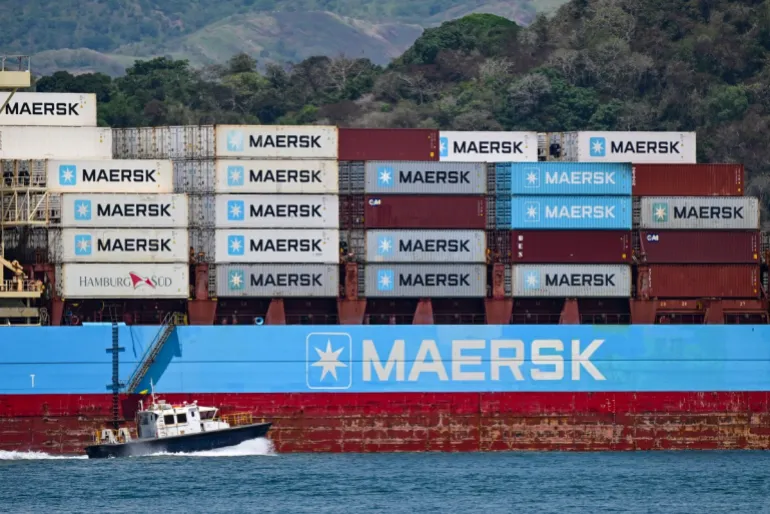
A cargo ship carrying containers from the Danish company Maersk sails into the Pacific entrance of the Panama Canal in Panama City on April 21, 2026 [Martin Bernetti/AFP]
Shipping is indispensable to global trade, in large part because no other mode of transport comes close in terms of capacity and cost-effectiveness.
The world’s largest container ships have capacities exceeding 24,000 TEU – the equivalent of roughly 12,000 trucks, 2,240 cargo planes, or 360 freight trains.
Lacking genuine competition in the transport of goods in huge volumes, shipping facilitates about 90 percent of global trade.
Shipping will look “remarkably familiar” in five years from now because it is an industry driven by demand, said Punit Oza, the head of the consultancy Maritime NXT and the former executive director of the Singapore Chamber of Maritime Arbitration.
Even the most severe conflict cannot change the “physics or the economics” of seaborne trade, he said.
“Ships do not sail because shipowners want them to; they sail because consumers somewhere want grain, iron ore, gas, or televisions,” Oza told Al Jazeera.
“It is the consumers of shipping – the cargo interests, the economies, the households – who ultimately shape the industry, and their demand will endure long after the headlines fade.”
Judah Levine, head of research at freight booking company Freightos, said container shipping in the future is likely to look “quite similar” to how it did before the war, with Dubai’s Port of Jebel Ali continuing to serve as the region’s main hub for both Gulf-bound goods and cargoes destined for Asia, Europe, Africa, and the Americas.
But Levine said diversion of cargoes to smaller hubs – such as the UAE’s Port of Fujairah and Khor Fakkan Port, and Port Sultan Qaboos in Oman – during the war offers a preview of the contingencies shipping firms are likely to deploy in future crises.
“All of a sudden, they were handling much larger volumes, and then creating these land bridges, usually to go on to Jebel Ali,” Levine told Al Jazeera.
“Containers find a way,” Levine said.
“It’s kind of like water. They’ll trickle, you know, to where they need to go by other paths.”
International Maritime Organization Secretary-General Arsenio Dominguez holds a news conference after an Extraordinary Session meeting, in London, UK, on March 19, 2026 [Alberto Pezzali/AP]
Another lasting impact of the war could be greater international cooperation on maritime security and safety.
The International Maritime Organization, the UN body responsible for shipping and seafarers, has listed the protection of shipping lanes as one of its top agenda items for discussion at its biannual meeting taking place from Monday to Friday.
“Seafarers have tragically lost their lives in connection with this conflict, and the impact has been felt well beyond the region, with real consequences for global trade, energy and food security,” IMO Secretary-General Arsenio Dominguez said in opening remarks to the session on Monday.
Ruth Banomyong, a professor of logistics and supply chain management at Thammasat Business School in Bangkok, Thailand, said he expects to see international coordination to strengthen trade routes that integrate both land and sea even as shipping networks remain “largely the same”.
“This means ensuring that maritime transport, ports, inland logistics, customs procedures and alternative land transport options work together as an integrated system when disruptions occur,” Banomyong told Al Jazeera.
“Maritime freedom is no longer just about freedom of navigation. It is about ensuring the continuity of global trade.
“The long-term lesson is not to replace the Strait of Hormuz, but to reduce overdependence on any single transport corridor,” Banomyong added.
Oza, the head of Maritime NXT, said the ad hoc naval coalitions deployed to ensure freedom of navigation during times of conflict could ultimately be succeeded by a multilateral security framework with “regional ownership rather than purely external enforcement”.
“Freedom of navigation is too important to be left to improvisation,” Oza said.
“If there is one consistent lesson from shipping’s long history, it is that human ingenuity always finds a way – pipelines get built, reserves get repositioned, technologies emerge, and trade, like water, finds its path. It will do so again,” Oza added.
“The innovations that follow this war will be a tribute to human resilience; the tragedy is that it took a war to summon them.”
Iran’s TV claims the tanker ignored warnings, but no direct responsibility for the attack has been declared.
Published On 7 Jul 20267 Jul 2026
A tanker travelling off the coast of Oman in the Strait of Hormuz has caught fire after being struck by a projectile, according to the United Kingdom’s military.
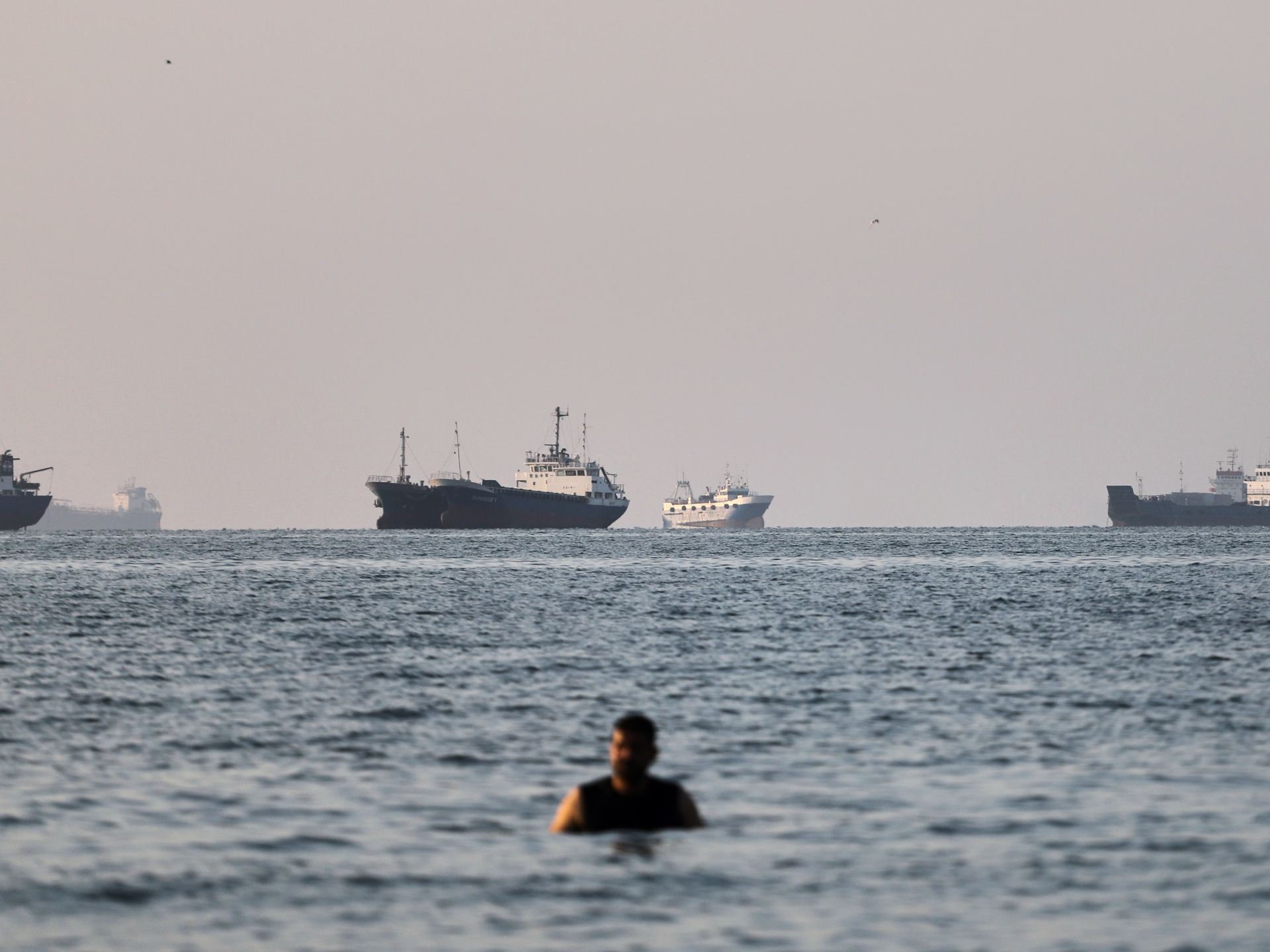
The attack early on Tuesday was the latest targeting a vessel moving through the Gulf’s critical waterway, through which a fifth of the world’s oil and natural gas passed before the US-Israel war on Iran began in late February.
Recommended Stories
list of 3 itemsend of list
Iranian television said the liquefied natural gas tanker came under attack after ignoring warnings, but Tehran did not directly claim the assault.
Tehran has repeatedly declared that only its approved route through the Strait of Hormuz is safe, and it is suspected of attacking other ships that have used another route close to the Omani shore.
The UK Maritime Trade Operations (UKMTO) centre said the tanker had been hit near Limah, Oman, in the strait. The projectile hit the port side of the vessel while it was trying to travel south out of the strait towards the Gulf of Oman, the UKMTO said.
Talks between Iran and the United States on a permanent end to the war appear to be on hold until after the burial of Iran’s former Supreme Leader Ayatollah Ali Khamenei, who was killed at the beginning of the US-Israel war on Iran on February 28.
Authorities flew Khamenei’s body to the Shia seminary city of Qom overnight, where mourners honoured him on Tuesday.
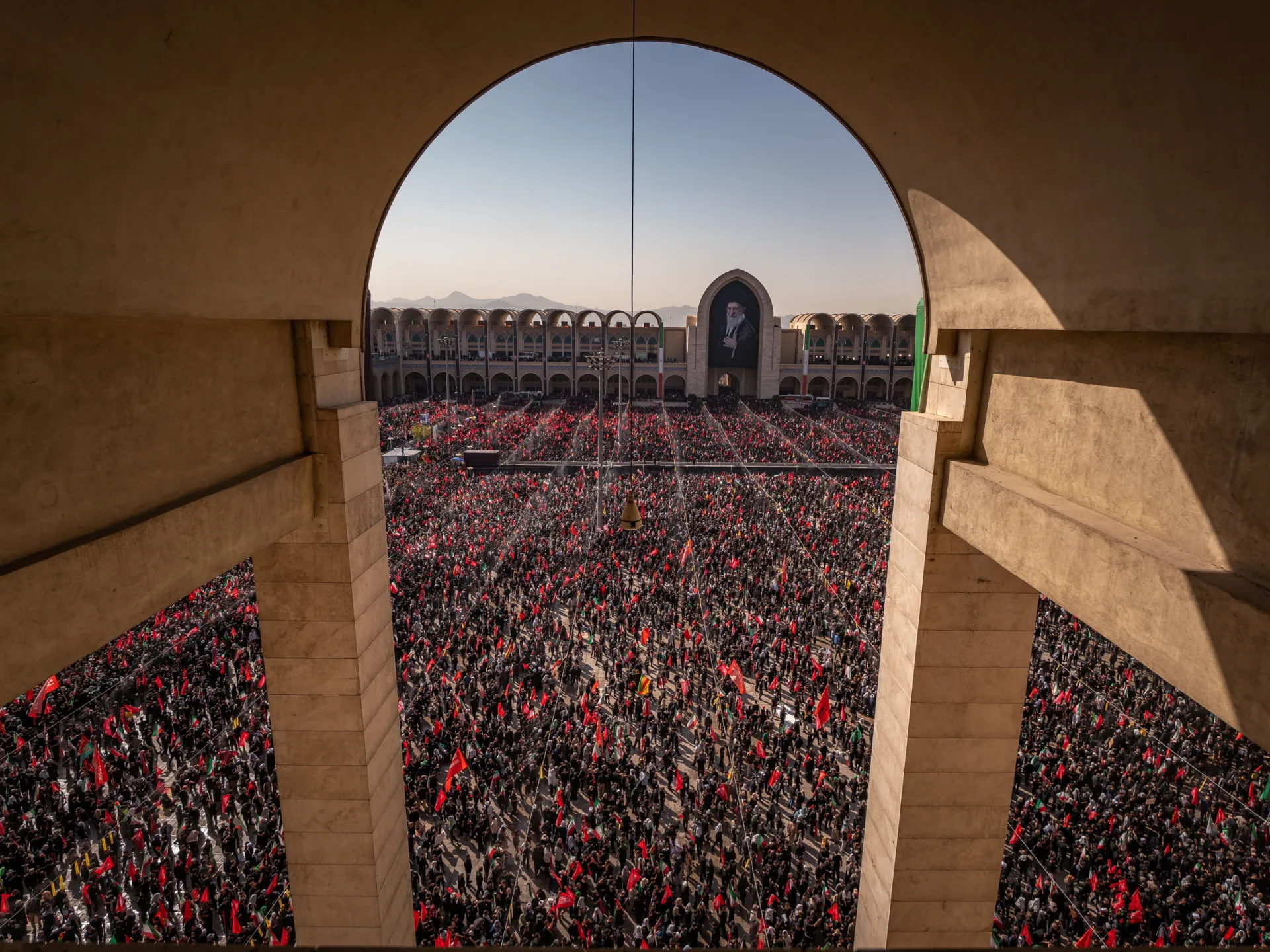
Millions of people have attended funeral prayers in Tehran for Iran’s late Supreme Leader Ayatollah Ali Khamenei who was killed in a joint US-Israeli strike on February 28. Aerial video reveals the scale of the crowd.
You turned 250 on Saturday and, honestly, you don’t look a day over 249. (Ha ha.)
Seriously, it’s perfectly understandable why there’s more gray on your scalp and deeper worry lines on your face. This last year has been another challenging one, to say the least. (And we thought the one cataloged 12 months ago in this space was rough.)
The country is caught up in an unpopular, on-again, off-again war with Iran that was recklessly launched by President Trump with far more swagger than foresight. In an utterly predictable move, Iran choked off the the Strait of Hormuz, a vital passageway for the world’s oil, sending gasoline prices skyrocketing. Though they’ve fallen since the announcement of a shaky ceasefire agreement, the cost of filling up is still significantly higher than a year ago.
The ground beef served up at many July 4 cookouts costs 75 cents a pound more than it did a year ago. A package of hamburger buns is up 15 cents. The price of hot dogs and other picnic staples have also increased, along with just about every other item at the grocery store.
Chew that over with your corn on the cob. (Up roughly 2.5% from July 2025.)
Meanwhile, Trump enriched himself to the tune of $2.2 billion during his first year in office alone. Treating the U.S. treasury like his personal cash cow, the president has lavished hundreds of millions of taxpayer dollars on vanity projects such as a personally kitted out Air Force One — a “gift” from Qatar that Trump plans to keep after retirement — and a gilded White House ballroom, rising where the demolished East Wing used to stand. Plans are underway for a grand, marble arch in Washington celebrating, well, you know who.
But, heck, if it’s any consolation on this star-spangled holiday weekend, the country has been through worse. Much worse. And you, America, have not only survived but in many ways grown stronger by surmounting obstacles, facing down your flaws and overcoming some knee-buckling, soul-crushing challenges.
But it’s worth noting that earlier court majorities held that Black Americans — “beings of an inferior order,” in the words of the wretched Dred Scott decision — could be denied citizenship, that racial segregation was constitutional and that compulsory sterilization based on eugenics was perfectly fine from a legal standpoint.
That ugly, sordid history won’t necessarily make anyone feel better about the current state of affairs, nor should it. But it does offer some perspective and, with it, hope.
This weekend is best celebrated honoring the country’s many good things and the bright, shining place that America aspires to be, with liberty and justice for all. So chin up! Have another slice of birthday cake, America, and don’t worry about the calories — you really do look terrific for 250!
Going forward it’s up to us, your citizens, to keep working toward that more perfect union mentioned in the preamble to the Constitution. Whatever ails you, America, the remedy resides with we the people and the power we hold, particularly at the ballot box.
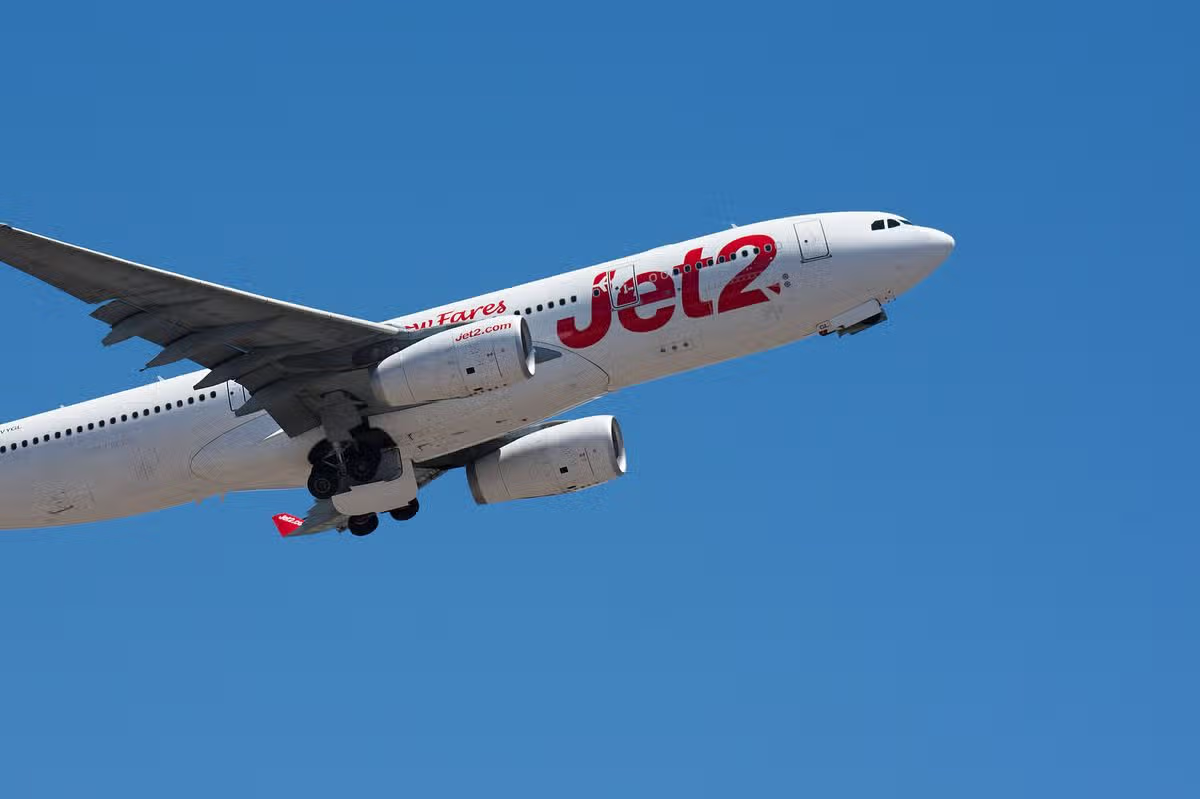
There will be an update from Jet2 this week(Image: Pavel1964 via Getty Images)
Jet2 is set to make a key announcement on Wednesday.
Shareholders in what is one of Britain’s largest package holiday operators will be eagerly awaiting news on whether US-Iran peace negotiations have helped boost travel demand and stabilise jet fuel supplies as the summer booking season gets under way. Jet2 is set to unveil its full-year financial results on Wednesday, following a turbulent period for the travel sector.
The airline and package holiday giant informed investors it was anticipating an operating profit of between £435 million and £440 million for the year ending March. Passenger bookings for the summer were up in April compared with the same period last year, across both package holidays and flights, fuelling hopes of a bumper season ahead.
Jet2 disclosed that holidaymakers were increasingly leaving it later to book their trips, suggesting that anxiety surrounding the Middle East conflict was pushing travellers towards last-minute decisions.
AJ Bell analysts Russ Mould and Dan Coatsworth said shareholders will be keen to learn how travel demand has held up since US President Donald Trump announced he had struck a peace deal with Iran last month.
“Jet2’s commentary on current trading will be much more important than its full-year numbers to March 31,” they said. “Reports suggest holiday companies have enjoyed a strong bounce in trading since Donald Trump said a peace deal had been agreed with Iran.
“We’ve already seen oil prices return to pre-Iran war levels and there are reports from various holiday companies of a surge in bookings to Cyprus and Turkey.”
Jet2 offers holidays to both destinations and throughout the Mediterranean. The effective closure of the Strait of Hormuz, which had severely restricted shipping since the outbreak of the Iran war, resulted in a drop in the global supply of jet fuel, prompting some airlines to scale back their summer travel schedules.
However, Jet2 moved to reassure holidaymakers in May that its flight schedule would run as normal throughout the summer, and pledged not to impose surcharges on any pre-booked trips to offset the increased costs.
In addition, the company launched its first flights from a brand new base at London Gatwick airport earlier this year, which it hopes will unlock bookings from an extra 15 million potential customers.