



housing

Tech leaders funding Matt Mahan’s campaign for California governor say it’s not about tech

San José Mayor Matt Mahan’s run for California governor has been defined from the start by his donor list.

Mahan entered the race late and with little statewide name recognition, but catapulted into contention thanks to massive funding from billionaire tech titans, venture capitalists, cryptocurrency investors and other Silicon Valley elites. In a state with more than 23 million voters and hugely expensive media markets, the money signaled Mahan would be a contender.

It also spurred accusations from his more liberal Democratic competitors and powerful labor leaders that Mahan is beholden to Big Tech, including forces aligned with President Trump.

California Labor Federation President Lorena Gonzalez Fletcher recently described Mahan as “funded by Trump’s big tech billionaires,” while fellow Democratic candidate Tom Steyer — a billionaire running against corporate interests — called him “MAGA Matt Mahan.”

That framing has persisted, despite Mahan being a centrist Democrat who has publicly criticized Trump.

On Thursday, Mahan released a four-page “Plan to Hold Big Tech Accountable and Ensure AI Works for All Californians.” The proposal called for AI and data centers to pay for their power and water needs, fund workforce stability initiatives and ensure human oversight of AI tools in critical sectors such as healthcare. It also called for the state to use AI to become more efficient, to bar cellphones in schools and to require parental consent for kids 15 and under joining social media.

In an interview with The Times, Mahan, 43, said AI is “one of the most significant trends in society” and needs to be addressed.

He also rejected the notion that he would do Big Tech’s bidding, and the idea that his support from tech leaders is entirely or even largely premised on his plans for their industry.

“I’ve spoken very little about tech with any of my donors,” he said.

Mahan said his fundraising has instead been “centered on how we get California on a better path in terms of building housing, improving the quality of our public schools, solving our biggest problems,” which “just resonates with people in the tech industry.”

A ‘digital native’

Mahan, the son of a teacher and a mailman, grew up in the farming community of Watsonville but commuted to San José to attend high school at Bellarmine College Prep on scholarship as a low-income student. He went on to Harvard University, where he was student body president and classmates with Facebook founder Mark Zuckerberg, spent a year in Bolivia building irrigation systems, and then taught for two years in Alum Rock as part of the Teach for America program.

He then joined Causes, an early Facebook application that allowed nonprofits to build grassroots support online, and rose to become chief executive. In 2014, he co-founded Brigade, a nonpartisan platform where voters could advocate for issues, which was acquired in 2019. He won a San José City Council seat in 2020, and was elected mayor in 2022.

An early mayoral profile described Mahan as painting a whiteboard behind his desk to “write on the wall as I did in my tech days.” Another noted he used ChatGPT to write speeches. A third recounted how he’d used AI to make city buses run faster.

Mahan said he learned as a startup leader and a classroom teacher that metrics matter — that “when we take our precious tax dollars and invest them in public services, we should measure our performance.”

He said he has always believed government should take the best tech has to offer while being vigilant about the risks it poses, which maybe comes naturally to him as a millennial who remembers “the world before the internet” but is also something of a “digital native.”

Donors explain

Between Jan. 1 and April 18, Mahan’s campaign raised nearly $13.5 million, according to state campaign finance filings. During the same period, an independent expenditure backing Mahan called Back to Basics raised about $22.7 million, while another launched by the group Deliver for California raised nearly $3.3 million.

The donors are a who’s who of tech leaders, venture capitalists and other leaders in the gig, gaming, digital media and AI defense fields.

Sergey Brin, the co-founder of Google, gave the maximum individual contribution of $39,200 to Mahan directly, and $1 million to the Deliver for California committee. Reed Hastings, the co-founder and chairman of Netflix, gave the maximum contribution to Mahan, plus $1 million to the Back to Basics committee.

Some donors, such as LinkedIn co-founder Reid Hoffman, who gave the maximum to Mahan, are well-known supporters of progressive causes. Others, such as Palantir co-founder Joe Lonsdale and crypto founder David Marcus, who maxed out to Mahan, are also Trump backers.

Brin, a friend of Gov. Gavin Newsom since the Democrat was mayor of San Francisco, has been moving rightward recently. He has donated to the Republican National Committee and in March was appointed to the White House tech advisory council. He’s also a major donor to the nonprofit opposing the ballot measure for a new tax on California billionaires — which Mahan also is against.

Brin, Lonsdale and Marcus did not respond to a request for comment. Hastings and Hoffman declined to comment.

Several other tech donors did speak with The Times — and universally described their support for Mahan as less to do with his tech policies, and more to do with issues important to all Californians.

Jamie Siminoff, who sold his home security startup Ring to Amazon for $1 billion and gave the maximum donation to Mahan, said he thinks L.A., where he lives, is the “greatest city in the world” and California is the “best state in the world.” But he sees Mahan as someone who could make improvements by bringing the state toward the political middle on public safety, housing and homelessness.

“He’s just like a nice, pragmatic, sort of centrist person, from what I can see, [who] wants to make California better, and I’m 100% behind that.”

Siminoff said it doesn’t hurt that Mahan speaks the same language as many tech leaders, who are mostly just “pragmatic inventors and entrepreneurs” who want California’s leader to be “principled in thinking about fixing things.”

Ruchi Sanghvi, the first female engineer at Facebook and a former Dropbox executive who state records show donated $25,000 to Mahan, said she has known Mahan since he was leading Causes but fell out of touch. When he entered the governor’s race, and she “got all these emails from people that I respect” saying they were supporting him, she asked for a meeting.

At that meeting, she said, Mahan “really dug in on some of the core issues that I care about,” including housing, homelessness and education.

The San Francisco resident, political independent and mother of three said the idea that tech leaders are backing Mahan because they believe he will scratch their back in business is wrong. Referring to his tech plan’s restrictions on social media for youth, she said, “I don’t think of that as scratching my back.”

Instead, “what really resonates with me and my peers is that, yes, he is pragmatic,” Sanghvi said. “He cares about measurable outcomes, which I think is very critical.”

Marc Merrill, co-founder, co-chairman and chief product officer of L.A.-based video game developer and e-sports company Riot Games, gave the maximum to Mahan, as did his wife, Ashley, founder of the sleepwear brand Lunya. In a statement to The Times, Merrill said he and his wife are lifelong Californians who love the state and support Mahan because of his record “addressing California’s most pressing challenges with practical, results-oriented solutions” in San José.

Merrill said Mahan brought down violent crime, reduced homelessness with “data-driven programs that address root causes rather than just managing the problem,” and “fostered an environment where businesses are choosing to invest and grow in the city.”

Tech vs. labor?

Gonzalez Fletcher said tech leaders have long “been very clear about their desire to support candidates who won’t regulate AI, to support candidates who will go after organized labor” — and their support for Mahan is no different.

She pointed as an example to a March event attended by Mahan and hosted by one of his most vocal backers: Garry Tan, a venture capitalist and chief executive of Y Combinator, a startup incubator in San Francisco.

At the event — which was part of Tan’s launch of a new statewide group called Garry’s List, which he has described as a “Rotary Club for radical centrism” — Chris Larsen, the co-founder of the cryptocurrency network Ripple, railed against the influence of unions in California politics and the “weak” response from business leaders, according to video.

“We’ve got to fight on par with the unions when they’re proposing stupid, job-killing ideas like the San Francisco CEO tax,” Larsen said. He noted that several other candidates for governor, including former Orange County Rep. Katie Porter, whom he’d donated to, had backed the measure to tax companies that pay their chief executive 100 times more than their average employee.

Neither Tan nor Larsen responded to a request for comment.

Gonzalez Fletcher, a former state legislator, said the argument that California Democrats have caused the state’s biggest problems by bowing to unions is false, and that what is more true is that “ruling class” Democrats such as Newsom “acquiesce to business interests” driving the state’s affordability and homelessness crises.

She said employers get away with underpaying workers and big landlords are allowed to take advantage of renters. She said Airbnb, as a tech example, has gone unchecked despite causing “a lot of the removal of housing stock.”

She said one reason she opposes Mahan is that he “suffers from the same love affair with Big Tech” as Newsom.

Steyer — who has funded his own campaign to the tune of nearly $200 million — has repeatedly struck a similar note.

Earlier this month, his campaign wrote that “Mahan continues to fail working Californians by catering to tech billionaires and wealthy special interest groups.” In February, it wrote that although Mahan had the support of “powerful special interests hellbent on keeping California a playground for the rich,” Steyer had the backing of “bus drivers, cafeteria workers, and custodians.”

Airbnb declined to comment but in the past has denied claims its platform substantially contributes to housing affordability issues, and has donated to housing initiatives. Airbnb co-founder Nathan Blecharczyk, a Mahan donor, did not respond to a request for comment.

Mahan said he values unions, in part because he grew up in a union household and benefited from the high-quality healthcare that provided, included when he was hospitalized for a collapsed lung as a teenager.

He said he has also worked with tech employers who “are inventing the future, quite literally,” and “creating a lot of jobs and opportunity.”

Mahan said the idea the two are inherently at odds is false, because “business needs labor, and labor needs business,” and the real question is “how to balance everyone’s needs.”

“If we don’t have a strong enough regulatory environment, and business has too much power, workers can be exploited, the environment can be exploited and we can see really negative social outcomes,” he said. “But the flip side is also true. If labor in our politics has too much power, you can also see distortions, you can see investment flow elsewhere, you can see less housing get built.”

Mahan said that “neither side has a monopoly on the truth,” and that government has to “bring people together and strike the right balance.”

He also defended Airbnb, which in San José pays taxes just like hotels, he said.

“We don’t see Airbnb as an antagonistic thing. We don’t let them take over the market, we regulate them, we charge them, and we use their tax revenue to provide services to people.”

He said the state’s housing crisis is due to over-regulation slowing new building to the point where it cannot keep up with job growth — which he called “fundamentally unsustainable and unfair” to low-income folks pushed out of job centers as a result.

The answer is building more homes, more quickly, he said, including by reducing building fees and streamlining permitting processes — which he said he has done in San José and would replicate statewide as governor.

“I am, first and foremost, focused on making government deliver results that make a real difference in people’s lives,” he said. “That’s my North Star.”

Source link

Top takeaways from fiery, at times ugly, California governor debate

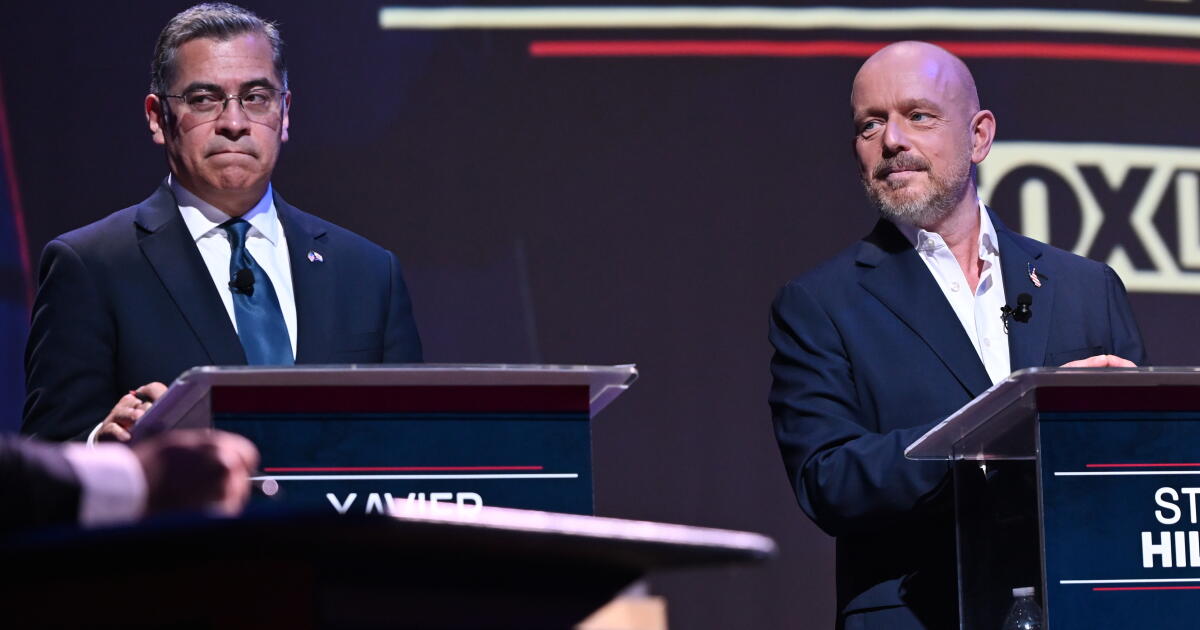
Democrat Xavier Becerra’s rapid rise in California’s race for governor made him a ripe and constant target during a combative nationally televised debate Tuesday evening, his first real test in a high-stakes election that remains highly volatile.

Becerra was ripped throughout the two-hour CNN debate, primarily by his Democratic rivals, who accused him of dodging questions about his stance on single-payer healthcare, falling short as a Biden Cabinet secretary and pocketing a campaign donation from Chevron.

“I think everyone’s invoking my name. It’s nice to hear my name quite a bit,” said Becerra, who served as the U.S. secretary of Health and Human Services during the Biden administration. “I will tell you this: Distorting the facts in your quest to be governor is never good, but using Trump lies to try to damage your opponents is worse, and that’s what we see happening.”

As ballots land in California voters’ mailboxes, the state’s seven top gubernatorial candidates clashed over immigration, President Trump, tax policy, political temperament and a hodgepodge of scandals, mudslinging and other unsavory actions that have risen to the forefront of the hotly contested race.

The snarky, sometimes petulant exchanges reflect how unsettled the race to replace termed-out Gov. Gavin Newsom is, as well as California’s outsize economic and political gravitas on the national and international stage.

Shortly after the debate began, former Orange County Rep. Katie Porter chastised her fellow candidates for their unceasing attacks.

“I can’t believe [the] interrupting and bickering and name calling and shouting and disrespect for everyone up here who’s stepping into public service that anyone wants to talk about my temperament,” said the former Democratic Congress member from Irvine.

Here are the top takeaways from a two-hour debate that somehow seemed even longer:

Becerra takes his lumps

Beccera, who has surged in the weeks before the June 2 primary, faced a barrage of attacks from his Republican and Democratic rivals about his oversight of unaccompanied immigrant minors during his tenure at the Health and Human Services Department and his relationship with a longtime adviser who, along with other consultants, skimmed about $225,000 from one of Becerra’s dormant campaign accounts.

Becerra is not accused of wrongdoing and has been painted as a victim in the prosecutor’s court filings. Still, conservative commentator Steve Hilton, a Republican, suggested Becerra knew about the scheme, and former Los Angeles Mayor Antonio Villaraigosa, a Democrat, questioned why Becerra paid an unusually high fee to one of the consultants named in the indictment.

“It doesn’t pass the smell test,” Villaraigosa said.

Becerra also was accused of changing his position on single-payer healthcare, a top priority of liberal voters that aims to create a healthcare system run and funded by the federal government.

Though Becerra has long supported single-payer healthcare, he recently assured members of the California Medical Assn. — one of the most influential medical lobbyinggroups in California, which has endorsed him — that he would not support it as governor, according to a KQED report.

When asked directly about this, Becerra said “those reports were inaccurate. I continue to be for Medicare for all.”

Becerra sidestepped repeated questions from Porter about whether he supported a state-sponsored single-payer healthcare system in California, saying that he wants to cover “everyone with something like Medicare for all.”

“Covering everyone with something is not single-payer. It’s not even federal Medicare for all. But you won’t say whether you support California having its own state-run single-payer system,” Porter said.

Single-payer healthcare is a telling issue

Democratic billionaire Tom Steyer also has taken heat for changing his position on the issue. The hedge fund founder turned environmental warrior opposed single-payer healthcare during his 2020 presidential bid and now supports a statewide single-payer system called CalCare. He is endorsed by the California Nurses Assn., one of CalCare’s biggest supporters.

A recent analysis by UC researchers estimates CalCare would cost $731 billion to implement in 2027 — a price tag that’s $14 billion larger than all anticipated healthcare spending in California next year.

Villaraigosa said creating a state-sponsored single-payer healthcare system — with a price tag larger than the entire state budget — is a “pie in the sky” proposal. He said he considers healthcare a human right but said a system such as CalCare would require approval from the Trump administration — and that’s not going to happen.

As a former British citizen, Hilton said he is the only candidate who has experienced government-run healthcare.

“As a patient, it nearly killed me,” he said. “That’s another story we don’t have time for. As a policymaker, you end up with the worst patient satisfaction, costs that you can’t afford, taxes, sky-high to pay for it. It is a total disaster.”

Race remains a toss-up

The 2026 gubernatorial contest has been an undulating, unpredictable whirlwind. Unlike every governor’s race for more than a quarter of a century, there is no clear frontrunner, leading to a sprawling field of candidates with notable resumes but little recognition among California’s 23.1 million registered voters.

On Monday, the state Democratic Party released its latest voter survey, which found Hilton and Becerra tied at 18%, and Bianco with 14%. Steyer received the backing of 12%, while support for the other top Democrats in the race — Porter, San José Mayor Matt Mahan, Villaraigosa and State Supt. of Public Instruction Tony Thurmond — was in the single digits. Thurmond did not meet the polling threshold to qualify for Tuesday’s debate or an NBC/Telemundo face-off taking place on Wednesday.

Tuesday’s debate with the leading candidates took place at East Los Angeles College and was hosted by CNN, the first time national media has paid such attention to a California statewide contest since 2010.

Partisan divide on immigration

On the debate stage in Los Angeles, a city that was targeted by Trump administration immigration raids, Bianco criticized California’s sanctuary state laws, which prevent local law enforcement from assisting with federal immigration enforcement.

Villaraigosa defended the undocumented immigrants residing in California, saying they are vital to the economic success of the state. He also accused Bianco of not understanding how California’s sanctuary state policy works — with the former Los Angeles mayor telling him that California has turned over thousands of undocumented immigrants convicted of crimes to federal immigration officials.

Bianco dismissed Villaraigosa’s comment immediately.

“I want Mr. Villaraigosa to tell the mother of the 14-year-old in my county that is dead because of an illegal immigrant that had been deported three times because of DUIs that sanctuary state policy keeps us safe. I don’t think she’s going to agree with you,” Bianco said.

Democrats Porter, Steyer, Mahan and Becerra accused the Trump administration of “terrorizing” Latino communities and targeting people for deportation based on the color of their skin.

Steyer said he would prosecute ICE agents “and the people who send them,” including former Homeland Security Secretary Kristi Noem and Trump advisor Stephen Miller, for illegal racial profiling.

Agreement on need for housing

On the issue of housing, the candidates agreed that California has fallen short of providing enough homes to make the state affordable. Mahan, the mayor of San José, said he has reduced the city’s homeless population by making it easier to build ADUs in people’s backyards, and by reducing red tape for additional types of housing.

Villaraigosa said he built more market-rate, affordable and workforce housing when he was mayor of Los Angeles than anyone else on the stage.

Hilton pressed for building single-family homes in areas of the state with space, rather than forcing more housing into places where residents don’t want them.

Steyer said, “Californians can’t afford to live here,” and there has to be a greater conversation about building more housing, and faster. He also said that cities and counties “do not want new housing” because they can’t afford to pay the health and education costs associated with more residents, and he will solve that issue by closing tax loopholes for big businesses.

Still, housing, homelessness and affordability — top-of-mind issues for California voters — overall received scant attention during the debate, even though CNN debate moderators Kaitlan Collins and Los Angeles-native Elex Michaelson pressed the candidates on the state’s incessant problems with affordability.

Steyer did use the affordability issue to criticize Becerra, currently his greatest political threat, for taking a campaign contribution from Chevron.

“Being in bed with oil companies is a mistake,” Steyer said. “Xavier Becerra has taken the max amount of money from Chevron, and he has said they’re good guys that we need. The truth of the matter is the oil companies are ripping us off at the pump. They’re polluting our air and they’re burning up the climate.”

Becerra responded that it was “a rich response from a guy who made his billions investing in fossil fuels and oil companies, in coal companies.”

“Now he makes the billions, and he has spent more than every other candidate combined in this campaign, using those profits to now try to buy his seat in the governor’s office,” Becerra said.

Where they stand on the proposed billionaire tax

A notable area of policy disagreement among Democrats is a proposal to levy a one-time 5% tax on the wealth and assets of billionaires. Supporters of the measure say they have gathered enough signatures to qualify it for the November ballot.

If approved, the funds would mostly pay for healthcare cuts approved by the Trump administration last year.

Porter said that, although she wants to increase taxes on the state’s wealthiest residents, she doesn’t support the proposal because it is a “one-time tax” that won’t solve the state’s underlying budget issues.

“Yes to a progressive tax code, yes to the wealthy paying more, but this tax is about cheap political points,” Porter said.

Steyer said he would vote for the tax, but he agreed that state leaders ought to go further, including by taxing corporate interests more.

Bianco agreed with Porter that the billionaire tax is a bad idea.

Villaraigosa said California relies too much on the its wealthiest residents to fill state coffers, which leads to “feast and famine” in its budgets. He said businesses and high-earners are leaving the state, and that a plan to tax the wealthiest Americans needs to be enacted at the federal level.

Republican vs. Republican

The two Republicans on stage appeared content to spend their time blasting the Democrats rather than each other.

Bianco was asked if he thought that Republican voters could trust Hilton.

“You’ve called Hilton unethical and dishonest and said that he swindled his way into the Republican side,” Collins said, citing an article from the Atlantic.

“I would never use the word swindled, but the context — yes, I have said that,” Bianco said after some back-and-forth about the particulars of his criticisms. “Have Steve and I disagreed? Absolutely we have.”

He avoided directly criticizing Hilton but said he was the only person on the stage “that their entire existence in their job revolves around honesty, integrity.”

Hilton swerved, saying voters cannot keep voting for the same thing — Democratic leadership — if they want to see change in the state.”

Times staff writers Dakota Smith and Doug Smith contributed to this report.

Source link