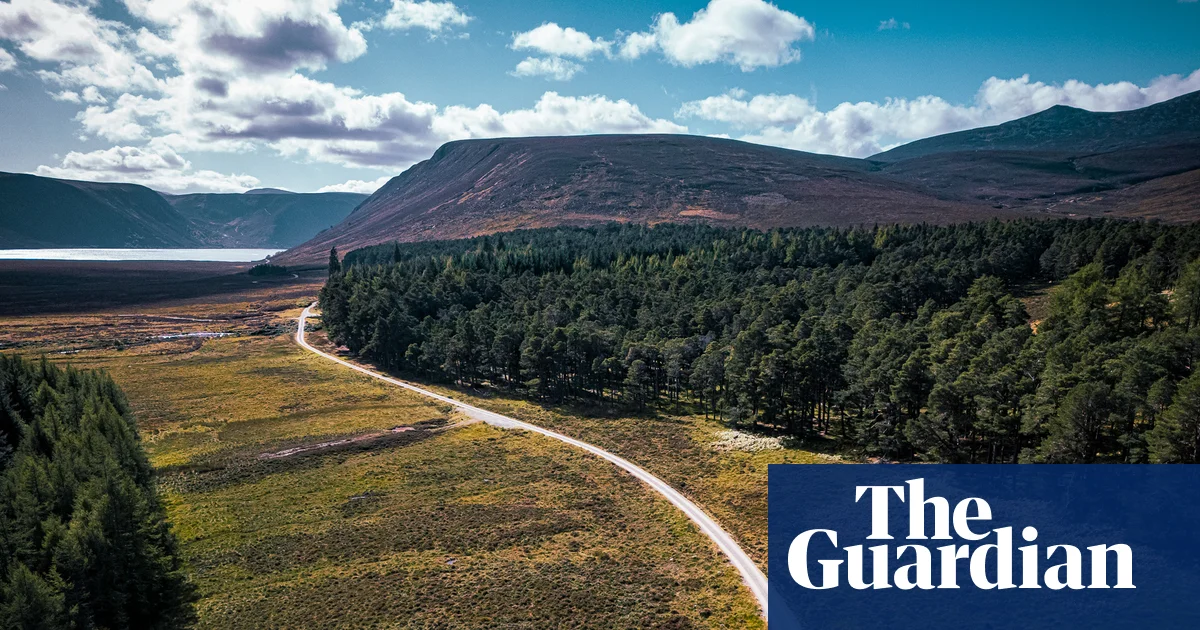
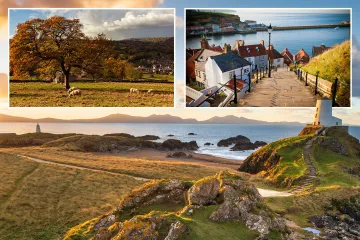
In the Cairngorms national park, the bracken is changing from dark green to russet and umber. Birch leaves are lined with gold, while the Scots pines remain proudly green. Autumn is arriving with a little sigh of relief here, after a summer few will forget.
The wildfire that began near Glenmore and Abernethy on 15 July burned more than 33 sq km (13 sq miles) of moorland and forest. More than 500 firefighters were involved; homes and businesses were evacuated; and the emergency response lasted over a month. Visiting now, it’s hard to see, or even imagine, the damage. Much of the burned area is high on the hill and far from the roads. It’s a huge loss but, in a national park stretching 4,528 sq km (1,748 sq miles), surprisingly easy to miss.
I have come with a gravel bike to retest new bikepacking routes with Kees Wouters and Yannick Ferbeek from Legendary Rides, which offers self-guided tours, and Bikepacking Scotland founder Markus Stitz, who helped develop the routes.
Ailsa Sheldon on the trail
I arrive in Aviemore from Edinburgh on an electric Ember bus, which allows bikes to be booked on board, a welcome development in Scottish public transport. Soon I’m heading out of town through heather and Scots pines, my bike bags stuffed with everything I need for the next few days.
The original route would have taken us through Glenmore, past Loch Morlich and Ryvoan bothy, but there are still path closures. Instead, we take a new line towards Nethy Bridge. Sunlight falls through birch and rowan and the track is soft with pine needles. At Loch Garten, where ospreys nest in spring and summer, it is hard to imagine the smoke and helicopters of July.
Graham Niven lives in Nethy Bridge with his wife, Amy, and runs the self-catering business Arbor Nethy beside the forest. He joined the local volunteer firefighting effort coordinated by the RSPB, part of a huge community response. “We see the forest as an extension of our home,” Graham says. The Abernethy forest is ecologically rich, filled with ancient Caledonian pine trees that are hundreds of years old. “It’s a unique and special habitat, and it’s very fragile. We were all just grieving for the forest,” he tells me.
Cycling by the River Avon
The news cycle has long moved on, but locals are still dealing with the effects of the wildfire. “Only in the last few weeks have we been able to look back on it as something that’s come to an end,” Graham says. Peat smouldered underground for months, meaning firefighters had to keep returning to hotspots.
While business has largely returned to usual, Graham has noticed a dip in bookings for photography workshops and holiday lets. “What is less measurable is people’s confidence in booking or coming back. The buzzwords were ‘apocalyptic fire’ and Abernethy and Nethy Bridge, Cairngorms, and that does stick in people’s minds. People think of Abernethy and say: ‘Oh, it’s been burned down.’ I think it’s less than 10% of the old forest affected.” Nearby, Polly Cameron at The Dell of Abernethy has seen the same effect: “Bookings wise, we certainly experienced a dip, and October has still been much slower to fill.” That matters in a landscape where tourism is a vital part of the local economy.
We ride on along the Speyside Way, following the river through woods and farmland. Then the landscape opens. The Cairngorms change character as you head east: deep forests give way to sheep, grouse moors, abandoned crofts and long gravel roads. This is whisky country too, and we ride through the grounds of Glenlivet Distillery. It’s after hours, or the smell of malted barley would have tempted me to stop.
By late afternoon the hills have turned heather-purple. We started late and by the time we reach Hotel Square in Tomintoul, darkness has settled. Our bikes go into a storage room and, happily, hot curry and cold beer are still available.
The next day is shorter but steeper, taking us on to sections of the old military roads built in the 18th century after the Jacobite risings. I’m reminded of that history later at Corgarff, a white fortress on the crest of a hill. Built in the 16th century and later converted into a barracks, it was used to suppress Jacobite sympathisers and, later, the illicit whisky trade.
Cairngorm Bothies near Ballater
We spend the second night at Cairngorm Bothies, off-grid cabins surrounded by Scots pines. In each, there’s a little nature journal and I leaf through pages of children’s handwriting with tales of red squirrels and deer. When the rain starts, any disappointment about missing out on seeing the dark skies is replaced by relief not to be camping.
With a flexible route we stop often, for photos, snacks and whenever the fancy takes us. We walk through woodland to visit Burn O’Vat, a huge glacial pothole in the Muir of Dinnet national nature reserve. At Ballater we stop for coffee and morning rolls at The Bothy while one of our group gets a quick bike repair. The route is deliberately forgiving, and Legendary Rides provides shorter alternatives for challenging weather or tired legs, with prebooked accommodation, a personalised plan, GPX routes and WhatsApp support. “It allows you to relax and just enjoy the ride,” says Yannick.
From Ballater we wind towards Loch Muick, through the Balmoral estate. After a long, winding ascent over Capel Mounth the riding becomes rougher, with a rocky descent. The gentle undulating roads that follow to Glen Clova are a welcome contrast as we roll to Alyth.
I’ve visited the Cairngorms region often in the past, but this trip broadens my awareness of the diversity of landscapes it holds. To mountain peaks and forest trails I add river valleys, whisky country, high moorland, farmland and roads so empty that the only sound is the freewheel of a bicycle.
A waterfall at Burn O’Vat
But this is not untouched wilderness. We cross private estates managed for deer stalking and grouse shooting, as well as national nature reserves. Debates over the right ways to manage this land span centuries, with wildfire prevention now a key part of that conversation. Scotland’s right to responsible access allows us to pass through this landscape, provided we leave no trace, close gates and avoid disturbing livestock and wildlife.
Autumn is an ideal time for this kind of journey. The midges have retreated, the roads are emptier and there is still plenty of golden light in the days. Cycling through the area helps to support local cafes, shops and accommodation providers, and there’s never been a better time to do so. “We want people to know we’re still here, we’re still awesome,” says Graham.
My tired legs power me to a final Pitlochry cafe stop before my Ember bus back to Edinburgh.
The trip was provided by Legendary Rides and Bikepacking Scotland. Legendary Rides offers four-day bikepacking trips from £759pp, including detailed route planning, accommodation, breakfast and personal support via WhatsApp
Mum of two Hannah Britt shares her top tips for family road trip success, from choosing the right sized rental car to arming yourself with equipment-free games. Bon voyage!
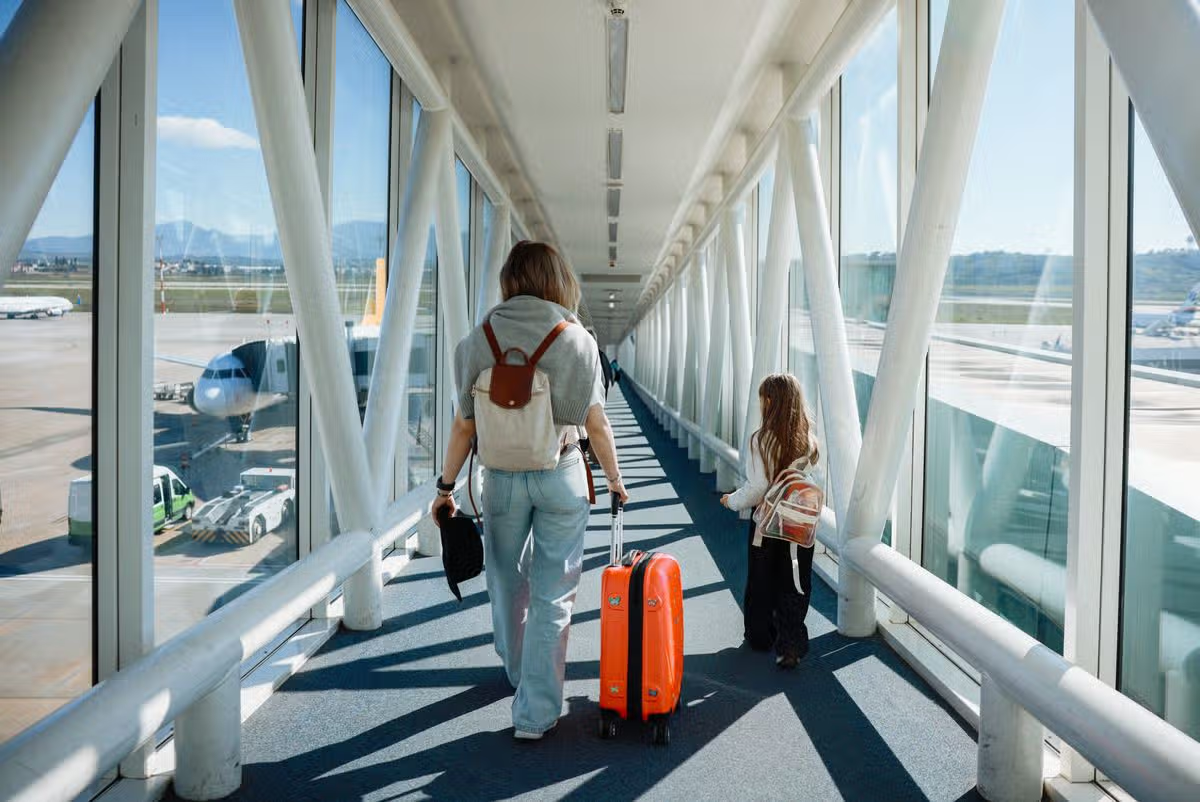
A family road trip needn’t be stressful with a little bit of prep beforehand(Image: Getty)
Planning a successful road trip with children requires smart packing, strategic timing, and easy entertainment to keep everyone happy. And as a mum of two young children, I’ve got it down to a fine art. This summer we hired a car with Sixt and drove through the south of France, often for long periods at a time. But armed with a bit of knowhow, it was child’s play for all the family. Here’s how it’s done…
Pack the essentials
Mess-free snacks: Pack dry foods like crackers or popcorn in separate plastic containers or use silicone cupcake liners for easy, spill-proof portions.
Plenty of wipes: Bring an abundance of antibacterial wipes and tissues for sticky fingers and unexpected juice spills.
Comfortable clothes: Dress children in soft, loose, and easy-to-wash clothes or let them travel in pyjamas if you leave early or late.
First-aid and emergency gear: Keep sickness bags, a small first-aid kit with child-friendly medicine like Calpol, and bin bags for daily rubbish within easy reach.
Keep kids entertained
Activity bags: Give each child a small bag filled with rotating toys, colouring books, or magnetic games, and allow them to explore each one at a time.
Audio and music: Create a shared family playlist or queue up engaging audiobooks and children’s podcasts to pass the hours.
Screens with headphones: Download movies or games onto tablets ahead of time and pack backup chargers and headphones for each child.
Manage the journey
Time drives with sleep: Depart right before nap times or early in the evening so young children sleep through a major portion of the drive.
Plan active stops: Stop every two to three hours at parks, playgrounds, or open fields so kids can run around and burn off extra energy.
Pre-emptive breaks: Pull over for a toilet break whenever you approach a service station, even if nobody asks yet.
Game time
20 Questions: One person thinks of a secret person, place, or thing. Everyone else takes turns asking up to 20 yes-or-no questions to guess the answer.
I Spy: One player says, “I spy with my little eye something beginning with…” and names a letter of an object seen inside or outside the car. The others guess the object.
The Animal Name Game: The first player names an animal. The next player names a new animal that starts with the last letter of the previous animal (for example: lion ends in N, so the next player says newt).
I’m Going on a Picnic: The leader states an item they are bringing on a picnic based on a secret rule (like starting with the letters of the alphabet in order, or items that spell their name). Other players guess items to figure out the rule.
Rainbow Cars: Players look out the windows and spot cars matching the colours of the rainbow in order—from red and orange through pink.
The Alphabet Game: Passengers look at roadside signs, billboards, and license plates to find every letter of the alphabet in order from A to Z.
License Plate Game: Work together or compete to spot license plates from different regions, states, or countries.
Choose the right car for the family
Choosing the right hire car depends on matching vehicle categories to your passenger count, luggage volume, and driving environment. Because rental companies assign vehicle classes rather than exact makes or models, focus on size segments and practical constraints. For our road trip through France, I chose a BMW X5, which was roomy enough for all of us – plus a mountain of luggage. And snacks.
Small and economy cars
Best for: Solo travellers or couples on city breaks with light luggage.
Capacity: 1–2 adults, 1 small cabin bag.
Pros: Highly fuel-efficient and simple to park on narrow streets.
Cons: Very limited boot space and minimal highway power.
Compact and intermediate (hatchbacks etc)
Best for: Small families or longer road trips balancing comfort and versatility.
Capacity: 2–4 adults, 2–3 medium bags.
Pros: Better highway stability and easier fuel economy than large vehicles.
Cons: Tight rear seating for three adults on extended journeys.
SUVs & full-size estates
Best for: Rural touring, mountainous terrain, or bulky gear.
Capacity: 4–5 adults, robust luggage capacity.
Pros: Elevated driving position and generous cargo room.
Cons: Difficult navigation and parking in tight historic European garages.
People carriers & MPVs
Best for: Large families or groups travelling together.
Capacity: 6–9 passengers.
Pros: Maximum seating flexibility and vast interior volume.
Cons: Height restrictions in underground parking and high fuel consumption; note that using all seats in a 7-seater often eliminates boot space.
It’s an annual fall tradition that Disneyland increase its prices — and stealthily in the night. Starting Tuesday, guests will pay more to experience the Happiest Place on Earth.
But the increases are relatively light. For the eighth year in a row, Disneyland did not raise the cost of the lowest-priced ticket, which is $104. And its highest-priced ticket, which is $224, also did not change. The increases were felt primarily on mid-level tiers for single-day, single-park tickets, and were limited to $5 apiece.
You’re reading Mr. Todd’s Wild Ride newsletter
Todd Martens’ newsletter delivers news and commentary on the past, present and future of theme parks, right from the theme park capital of the world — Southern California.
By continuing, you agree to our Terms of Service, which include arbitration and a class action waiver. You agree that we and our third-party vendors may collect and use your information, including through cookies, pixels and similar technologies, for the purposes set forth in our Privacy Policy such as personalizing your experience and ads.
Other prices also remain unchanged. The cost of Disneyland’s popular annual pass program, the Magic Key, did not increase. The top-tiered Magic Keys have been subject to hefty yearly spikes over the last decade. Parking remains fixed at $40, and multiday tickets have not been affected.
Collectively, this is one of the smallest overall increases made by the Disneyland Resort in recent history, as last year, its highest-priced single-day ticket jumped in cost $18. At a time when leisure costs are rising and forcing Americans to stay home, it comes as somewhat of a relief that Disneyland is not asking its fans to pony up substantially more cash to get through the gates.
While the Walt Disney Co. provided no official statement on the increases, Disneyland Resort officials noted in an email that it is aware guests are more closely watching their wallets in 2026. Thomas Mazloum, chairman of Disney Experiences, in a comment given to CNN, said, “Our goal is to put guests at the center of our decision making, and that starts by listening to them. That matters more now when families are watching every dollar, and we see it in the choices they make every day — in how they plan, in how far ahead.”
It’s also an indication that, at least for the time being, the Disneyland Resort has pushed its prices as far as they can go. Disneyland is blessed with an in-demand product, but every commodity has its limits.
In May, the Walt Disney Co. reported a 1% decline in attendance at its U.S.-based parks compared with the prior year, which the company attributed to “continued softness” in international visitors. In August, however, Disney bounced back, and noted, especially at Florida’s Walt Disney World, that attendance had perked up. Overall, visitation at its U.S.-based theme parks was 3% higher than in the previous year’s third quarter, the company said. This boost was largely attributed to a variety of summer deals.
As someone who is at Disneyland nearly every week, I can report that summer crowds were relatively manageable. There have been some asterisks, such as the World Cup and high heat, both likely keeping guests away, but anecdotally, Disneyland crowding hasn’t been nearly as extreme this year. I simply believe that people do not currently have the excess funds that they once had.
And Disney seems to be responding to the economic climate, especially in making it easier for its biggest fans to visit the resort. In conjunction with the price increases, Disneyland President Jill Estorino announced Tuesday that the company would be removing its no-show penalty on annual passholders. Additionally, passholders can now cancel their reservations up to 11:59 p.m. on the day of their reservations.
These are welcome changes, as previously guests were allowed three no-show penalties before their ability to make reservations was restricted, and had to cancel the night before. But plans change, and the reservation system restrictions, initially put in place to manage crowding during the COVID-19 pandemic, had increasingly felt like an impediment. While reservations are still required, which Disneyland has stated helps the resort plan its crowd-forecasting and staffing, the system is more lax and user-friendly than it has been.
Digging deeper into Disneyland’s pricing, there have been some small changes elsewhere. The cost of the line-skipping feature Lightning Lane, which can fluctuate based on crowding levels, now has a top price of $38, an increase of $1. And the park-hopper add-on for single-day tickets, which can also fluctuate, increased $5-$10, depending on the day. And earlier this year Disneyland did increase its prices on a number of food items.
The Disneyland Resort, to be sure, is not cheap. In the world of entertainment, it remains a luxury good on par with postseason Dodgers tickets (albeit with cheaper parking than Dodger Stadium). But I credit the Disneyland Resort for reading the cultural room. Pulling the plug on its recent steady and hefty price increases, especially on annual passes, shows the company can occasionally listen to its audience as much as it does Wall Street. Sure, a price decrease would be nice, but we don’t live in a fantasyland.
This week in SoCal theme parks
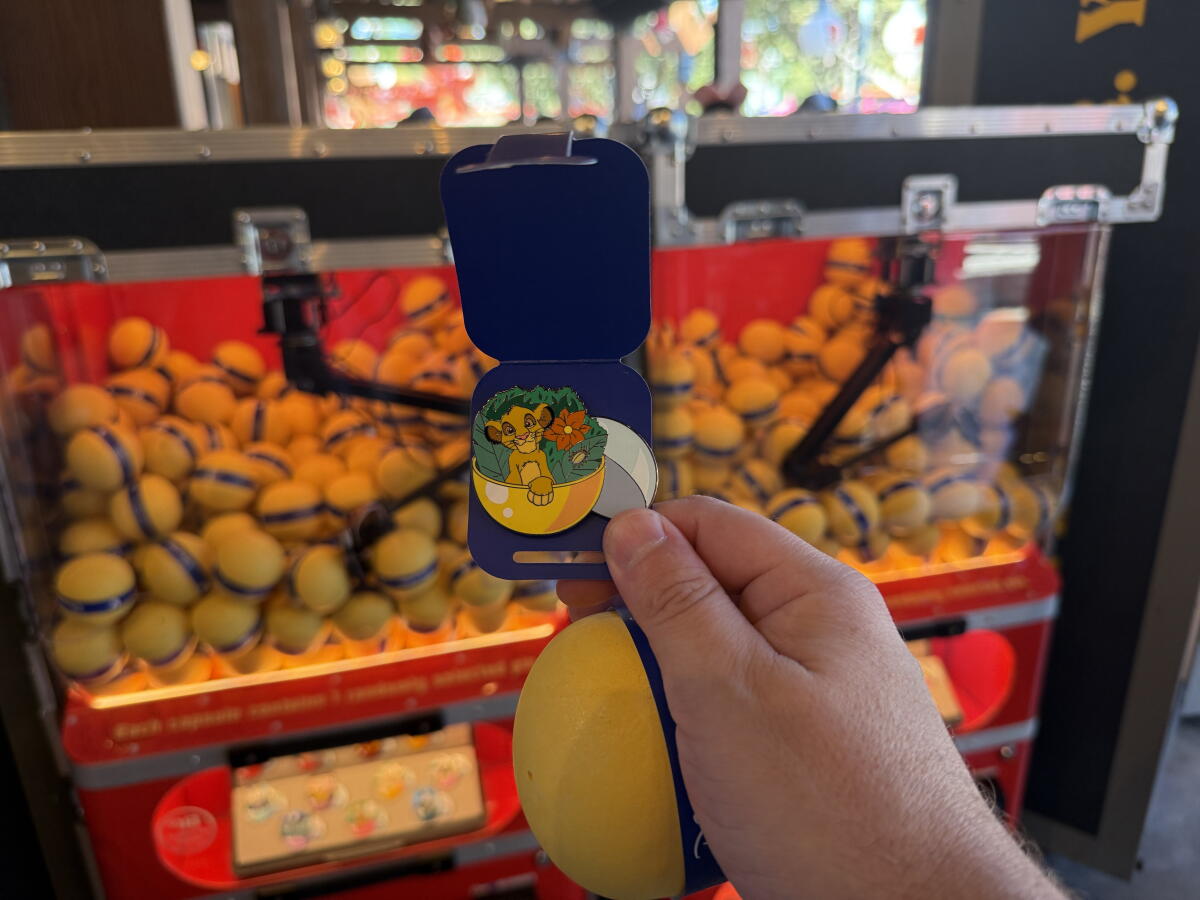
The Disneyland Resort has added new collectible pin trading vending machines.
(Todd Martens / Los Angeles Times)
Attention Disneyland pin traders! The Disneyland Resort has added a new pin line available in select vending machines throughout the property— look for them in San Fransokyo Square and Pixar Pier in Disney California Adventure and at the Star Wars Trading Post in Downtown Disney. Each pin is $18, and one buy gets you one egg-like orb with a mystery pin. There are 15 in the set — I got Simba, as seen above — and offerings include park staples such as the Hatbox Ghost as well as classic characters such as Princess Aurora and Dumbo. Some are marked limited edition — “chasers,” in Disney pin trading speak — so be on the lookout. Thanks to Mr. Daps for the heads-up.
A Disneyland ticket deal. With life constantly getting more expensive (see above), it’s a good time to hunt for a deal. If you’re a Costco member, reports are that there’s a pretty good one happening right now. Valid through Dec. 18, Costco is said to be selling a two-day Disneyland park hopper ticket with the line-skipping feature Lightning Lane already added in for $329.99. The offer includes a $60 dining card, and works out to a savings of a couple hundred. Disney Tourist Blog has more details on the limited deal.
An applaudable energy project. Six Flags Magic Mountain has announced the completion of its solar carport project, the largest solar carport in California. Covering 4,315 parking spaces, the project was designed to offset 100% of the energy consumption of Magic Mountain and Hurricane Harbor (while also providing some shade and sun protection for its parked cars). The project is interconnected with the Southern California Edison grid, meaning excess energy may be exported as well as allowing the parks to draw energy from the project when needed. The carport also offers 109 electric vehicle charging stations.
A pause at Castle Park. Riverside’s long-standing Castle Park is beginning the creation of what it says is a“reimagined experience.” As such, on Nov. 1 its Ride Park will halt operations for the foreseeable future. “We’re taking the time to plan the right rebuild and will share updates as plans take shape,” the company says in an FAQ on its site. Its mini golf and arcade areas will continue to welcome guests.
More on the noise issues around the ‘Fast & Furious’ coaster
Riders on Universal’s new Fast & Furious: Hollywood Drift.
(Ronaldo Bolanos / Los Angeles Times)
There will be no shortage of updates and news on Universal’s new Fast & Furious: Hollywood Drift coaster in the coming weeks, months and maybe even years, especially as the attraction continues todraw the ire of the park’s neighbors in Toluca Lake. Universal Studios Hollywood held a meeting with nearby residents on its studio lot last Wednesday. The session was closed to the media but was said to attract more than 350 neighbors. I spoke with a number of residents, as well as Universal, after the session, and indications are that the two sides still haven’t settled on a compromise. The issue, of course, stems from the sound of rider screams from the coaster drifting into the residential area.
Universal has promised, through the end of the year, to not begin operating the coaster before 9 a.m., and has also, in response to community feedback, installed a new sound barrier featuring an additional 1,900 square feet of sound absorbing material. The new barrier includes a sail that’s about 63 feet tall and 31 feet wide. But residents I spoke to feel it’s not yet enough. I’ve heard many stories from neighbors in recent weeks regarding the disruption caused to their lives. They range in extremes. A neighbor without air conditioning says they can no longer open their windows. A resident who offers meditation services from their home says their business is now potentially forever impacted. A teen was unable to complete a SAT prep test due to the incessant screaming. Many report insomnia from the rise in anxiety levels. There’s plenty more.
The meeting was said to grow contentious near its end. Residents provided data on how the effects of noise, specifically screams, can cause stress-related responses. Universal is said to have discussed the challenges in further mitigating the sound. County supervisor Kathryn Barger was in attendance and is calling for additional communication between the two sides. “The meeting’s dialogue made clear that the lives of surrounding residents are being impacted and disrupted,” Barger said via a statement. “I respect Universal’s decision to host this forum and listen to the concerns being raised. I encourage all stakeholders to maintain an ongoing honest dialogue.”
Tell us your stories. Ask us your questions.
Have a theme park tale to share? Whether it was a good day or less-than-perfect day, I would love to hear about it. Have a question? A tip? A fun photo from the parks to share? Email me at todd.martens@latimes.com. I may feature your note in an upcoming newsletter.
Ride on,
Todd Martens
—
This newsletter is free thanks to the support of L.A. Times subscribers. If you’re not yet a subscriber, explore subscription packages to unlock unlimited digital access and support award-winning local reporting.
Was this newsletter forwarded to you? Sign up here to get it in your inbox.
NOT a lot beats the feeling of having that first pint on holiday – but it would taste even better if it was a fraction of the cost too.
Jet2 has found the cheapest holiday destinations for a beer where the average pint costs less than £3.
Jet2 has found the cheapest destinations with pints as little as £1.27Credit: Getty Tunisia comes in the cheapest – and it has incredible beaches tooCredit: Alamy Stock Photo
At the very top of the list for cheapest pints is Tunisia, which comes in at £1.27 – this is £3.74 less than that of the UK where an average pint stands at £5.01.
From the UK, Tunisia is around three hours away and it’s a great autumn and winter sun option for Brits too as in October temperatures can reach 25C.
Sign up for the Travel newsletter
Thank you!
In November, temperatures in Tunisia can be as high as 20C and even in December it can be 16C – at that time in UK, highs only reach 8C.
Return flights in December can be as cheap as £48 too.
Lisa said: “Relatively undiscovered by us Brits, Djerba is a great-value option for those looking to explore beyond the Med favourites.
“Sizzling in summer, temperatures remain high all the way through to November and rarely dip below the 20Cs, even in the depths of winter, making it ideal for out-of-season sunshine.”
Jet2Holidays has a break to the 3-star Les Orangers Beach Resort which is seven-nights all-inclusive departing from Manchester on May 25 2027 from £839pp.
The resort has an outdoor pool with lots of activities and it’s close to a sandy beach and Hammamet’s Old Town.
Both Bulgaria and the Czech Republic which both have an average beer cost of £1.74Credit: Getty
The next spot is shared by Bulgaria and the Czech Republic which both have an average beer cost of £1.74.
Bulgariahas everything you need for a great holiday from vibrant cities likeSofiato coastal resorts like Sunny Beach, Golden Sands and Albena.
One-way flights to Sofia can be as little as £14 – and returns can cost under £30.
Czech Republic is the perfect city break for Brits thanks to being two hours away and it has one-way flights from £17.
The city’s capital of Prague is filled with history with a huge Cathedral , old town squares and beer culture – which is easier to get involved with when pints cost less than £2.
3-star Comfort Hotel Prague City East, 3 nights bed and breakfast departing from Leeds Bradford on November 2, 2026 from £497pp.
Bulgaria is known for having cheap coastal resorts and affordable pintsCredit: AlamyThe Silver Coast in Portugal is a great alternative to the AlgarveCredit: Getty
The American-style hotel has a huge lobby and restaurant area – and the nearest tram shops is right outside the entrance.
Other top spots include Hungary which has an average beer price of £2.08.
The capital, Budapest, is also known for having lots of thermal baths – it has 123 natural hot springs and 50 thermal bathhouses.
Coming in fifth on the list is Portugal where beer is an average of £2.14 per pint.
Brits can easily head to the Algarve, known for its beautiful beaches, or the Silver Coast which is much less crowded but still has an incredible coastline.
David Hills, Chief Customer Officer at Jet2, said: “We know that value matters to our customers, and that doesn’t just mean getting a great deal when booking their holiday. It’s about how far their spending money goes once they arrive too.
“With destinations including Portugal, Spain, Turkey and Croatia offering beers for considerably less than the UK average, there are plenty of places where customers can enjoy some sunshine or a city break and make their holiday money stretch that little bit further.”
Here are the 10 destinations where your beer money goes further…
NO signal, no all-you-can-eat buffet and your bed is next to hundreds of shipping containers – it’s certainly not your average cruise.
Yet this didn’t stop passenger Pieter Stroop Van Renen from shelling out £850 to travel for a week on board the shipping boat.
Pieter Stroop Van Renen took a cruise on a shipping container – he was the only passengerCredit: Pieter Stroop Van RenenThere’s no luxury additions – no buffet, infinity pool or casinoCredit: Pieter Stroop Van Renen
Pieter, 59,said he was stunned to realise you could pay to travel onboard the ships that are usually for cargo rather than leisure.
Talking to The Sun, he said he jumped at the chance to go on one and loved the idea of being the “only passenger onboard.”
Sign up for the Travel newsletter
Thank you!
Paying around €1,000 (£848) to travel aboard the Elbcarrier, the 140m-long vessel sailing was from Rotterdam to Dublin and back again.
It’s safe to say that the ship is the opposite of a luxury liner – there’s no infinity pool, no cocktail-fuelled small talk with fellow tourists and no breakfast buffet.
The first major difference from a commercial cruise was before the journey even began – as nobody could tell Pieter exactly when the ship would leave.
Even in the week before his holiday, he did not know whether he would depart on the Friday, Saturday or Sunday.
Pieter eventually boarded the Elbcarrier at 4pm on Saturday – but the ship did not set sail until 12 hours later, at four in the morning.
As he waited, confined to his cabin while loading was completed, the reality of spending several days aboard a working cargo ship began to sink in.
Peter said: “I thought, will I get bored, or will I get seasick, or what happens there? Where can I walk? Who are these guys, and do they know I’m coming?”
But that wasn’t a problem for Pieter, who instead spent hours on the bridge watching the captain and officers navigate, studying the ship’s radar screens, chatting to the crew and touring the engine room.
The rooms were very simple with a small bed – and it’s not easy to sleep either
Pieter continued: “The bridge was beautiful at night. They keep the lights off, so it’s pitch black outside and all you can see are the navigation lights and the equipment glowing in the darkness. It was magical.”
At the invitation of the captain, Pieter had one of the best seats in the house as the vessel headed out towards the North Sea.
The journey to Dublin usually takes at least 48 hours by sea, but Pieter’s crossing lasted around 52 hours.
Pieter also couldn’t wander about as he pleased on deck – passengers aren’t allowed to walk between the stacks of containers, which can tower four or five containers high.
Pieter explained: “If something happens [and one falls], then you’re crushed and you’re dead.”
Mealtimes gave him another taste of life aboard a working ship.
Included in the ticket was three meals a day – and a snack and beer from the captainCredit: UnknownPieter warned anyone who struggled with seasickness to think twice about the tripCredit: Unknown
Pieter’s ticket included three hot meals a day – there were fried eggs for breakfast and hearty dinners of meat and vegetables in the evening.
What Pieter had not prepared for was getting peckish between meals – but luckily the captain sold chocolate bars and cans of beer.
Sleeping was another challenge altogether because while daytime conditions were relatively calm, it’s a different story at night.
Pieter explained: “You’re just rolling in your bed from left to right continuously. I didn’t get seasick. But I didn’t sleep at all at night.”
He warned that anyone particularly prone to seasickness should think carefully before following his lead – especially as there’s no getting off the boat for excursions like on a usual cruise.
Anyone expecting to spend the voyage scrolling TikTok will also be disappointed as on the Irish Sea, there’s no connection whatsoever.
Pieter had to wait until he was back on dry land before posting about his experience on social media – where clips from the trip unexpectedly took off.
While the internet is impressed with his thirst for adventure, his family, however, were less enthusiastic about joining him on board a working ship.
He said: “I couldn’t get them to come. They would never do this. So, time for myself.”
To see more of Pieter’s container ship holiday, head here.
The December closures will affect the two Sundays before Christmas, so travellers are being warned to plan ahead.
This will then follow a huge 38-day closure from Christmas Eve (December 24, 2026) to January 31, 2027.
Liam O’Shaughnessy, TRU programme delivery lead for Northern, said: “The work that has been completed over the last 16 days in the Huddersfield area is another crucial step towards delivering the benefits that the Transpennine Route Upgrade will bring for customers across the north.
“We have worked closely with our industry partners to keep customers on the move, and these works have continued, and we would like to thank customers and local communities for their patience and cooperation, whilst these improvement works have been taking place.”
Upgrades include two new track lines through Huddersfield, restoration of the station’s roof and platforms, as well as upgrades at Deighton Station, and nearby road upgrades.
The station dates back to 1850, and named one of the most beautiful by Lonely Planet.
Now, it welcomes 3.1million passengers a year with routes across Yorkshire.
Along with its cosy caravans and lodges, there are some very exciting additions coming its way.
The park has announced it is undergoing a huge £4million upgrade with work starting this November.
Sign up for the Travel newsletter
Thank you!
One of the largest upgrades will be to its existing indoor swimming pool which will be expanded to become 18-metres long.
It will also add a new toddler splash area, designed specifically for little children – and for adults, there will be a new jacuzzi, steam room and sauna.
The pre-existing gym facilities will also be upgraded.
Its entertainment complex is set to be revamped too with new activities and facilities both indoors and outdoors.
Outside will be a new pirate-themed 9-hole adventure golf course, giant chess and lots of things to do like table tennis, curling – and it will install a padel court.
Inside will be a new soft play area with an upgraded games arcade including interactive darts.
The Hunter’s Bar and Restaurant is being refurbished, and will have a brand-new sports bar, as well as a transformed showbar where there will be entertainment for guests.
A new outdoor terrace will be a new spot that guests can enjoy throughout the year with open-air seating through the summer and covered for when the weather doesn’t play ball.
For those wanting sweet treats, there will also be a brand-new ice cream parlour.
When it comes to accommodation, holiday homes and pitches will be added to the site too.
Currently, guests can stay in basic caravans, to luxury lodges including The Hideout and The Hideaway which have outdoor decks and lots of inside space.
Work is due to start in November of this year with a Grand Opening event planned for Easter 2027.
For those who want to book a break that coincides with the new additions, three-night breaks on April 23 start from £219 – or £18.25pppn.
With this break, a family of four can stay in an Essential Clover Caravan which has two bedrooms (one double, one twin), kitchen and living area.
Simon Lane, CEO of Verdant Parks, said: “This is an incredibly exciting time for Verdant Parks, our employees, our owners and our holidaymakers.
“We’re committing our biggest investment to date to Thurston Manor Holiday Park and completely transforming what guests can see, do and experience when they visit.
“From the extended swimming pool and new toddler splash area to the new padel court, pirate-themed adventure golf and transformed entertainment offering, there will be something for everyone to enjoy.
“We’re delighted to reveal our plans for the next chapter of Thurston Manor and we can’t wait to share more details and sneak peeks as the transformation takes shape over the next six months.”
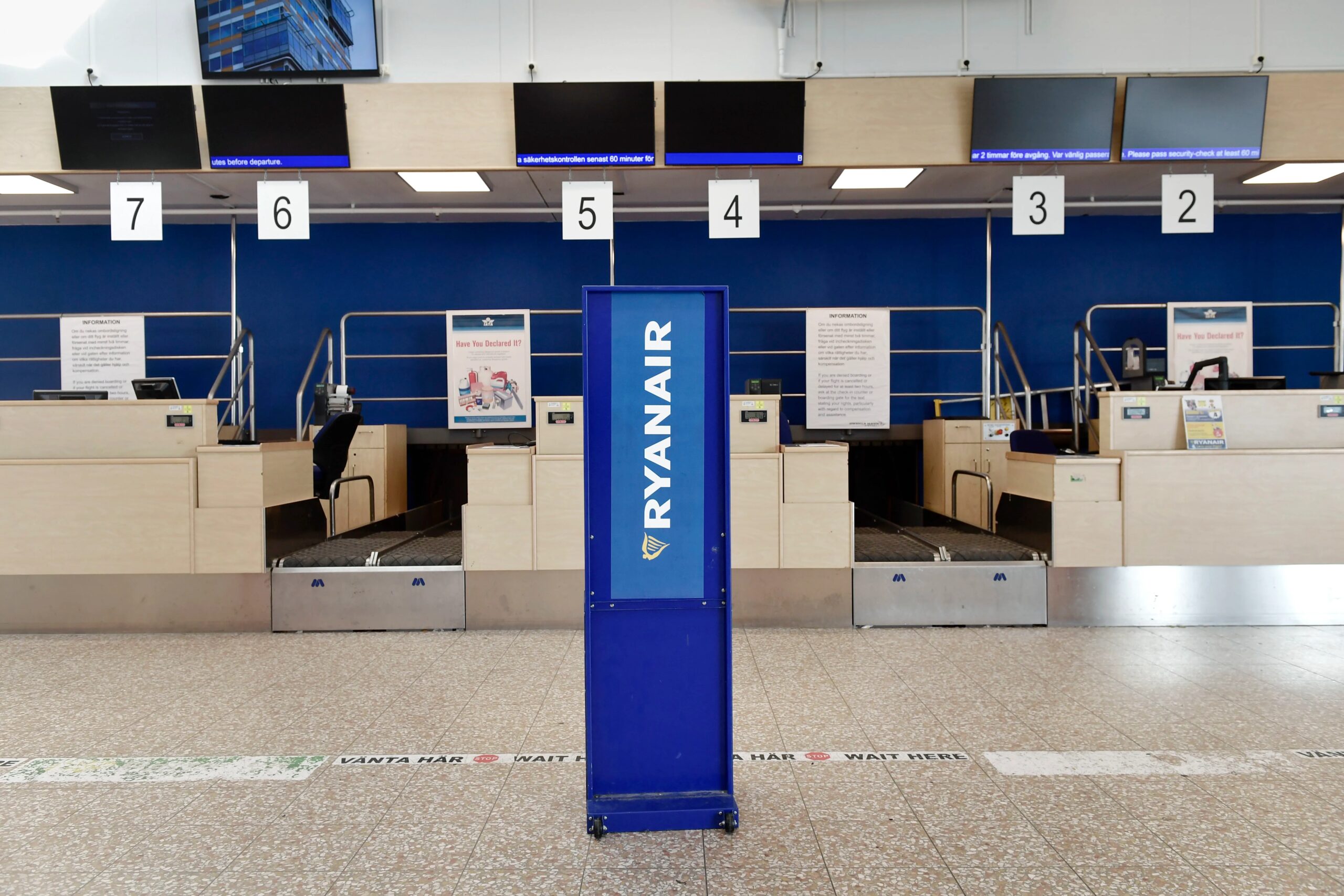
Anyone travelling with just hand luggage won’t be affected.
The airline claims this is as many as 80 per cent of passengers who don’t ever have checked bags.
But anyone who likes to rock up to their flight and still check a suitcase at the last minute will be in for a shock.
Ryanair CMO, Dara Brady, said: “This will allow these 20% of our customers (who check in a bag) more time to clear through airport security and passport queues, and get to their departure gate on-time, especially during busy travel periods when some of these airport queues can be longer.”
More self-check in machines have since been rolled out as well in a bid to speed up the process.
The spot is particularly loved for paddling thanks to its shallow waters and that it has lifeguards in the summer season.
There are parking and toilets close to the beach.
14. Rhossili Bay, Gower Peninsula, Wales
Rhossili Bay in Wales, followed closely behindCredit: Getty
Over in Wales, scoring a slightly higher 74.73, the three-mile- long Rhossili Bay beach often sits on Wales’ top 10 beaches list.
It has even previously been described as the ‘supermodel of British Beaches’ by The Independent.
The beach is ideal for having a picnic or heading into the water for a surf.
You can also visit Worms Head, where you may see seals basking in the water below.
13. Luskentyre Beach, Isle of Harris, Outer Hebrides
Luskentyre Beach scored 75.56 overallCredit: Andrew Barr
Scoring 75.56, Luskentyre Beach on the Isle of Harris in Scotland came in at 13th place.
Luskentyre Beach features rolling dunes, turquoise waters and miles of white shell sand.
What makes the spot even more special is that it is often visited by free-roaming white Highland ponies.
There is a small car park not too far from the beach.
12. Bournemouth Beach, Dorset, England
Bournemouth Beach is loved by families and has lifeguards based at the beach between April and SeptemberCredit: Getty
Bournemouth Beach managed to score slightly higher, securing 75.83 out of 100.
The beach is a great family-friendly spot as it is known as one of the safest beaches in the UK, with lifeguards based at the beach between April and September.
Between April and the end of October there is also a land train that runs along the promenade.
For a small charge, you can hop on it between Bournemouth Pier and either Boscombe Pier or Branksome Chine.
11. Barafundle Bay, Pembrokeshire, Wales
According to Visit Pembrokeshire, Barafundle Bay is often compared to a Caribbean beachCredit: Getty
This golden beach is backed by dunes covered with long grass and pine trees.
According to Visit Pembrokeshire, it is even often compared to a Caribbean beach.
It is worth noting though that the beach has no facilities and is a half- mile walk over cliffs from the closest car park.
10. Woolacombe Beach, North Devon, England
Woolacombe Beach was the only beach in Devon to feature on the listCredit: Getty
Taking 10th place with a score of 78.48 is Woolacombe Beach in North Devon.
Often ranked among the best beaches in the UK, Woolacombe Beach stretches for three miles and is known for its golden sand and great surfing conditions.
It is great for a family day out as well, with large car parks close to the beach, public toilets, shops and restaurants.
Travel Reporter Cyann Fielding, who has visited the beach several times, said: “Woolacombe Beach is so big you will always find a spot in the sun to relax but make sure to go for a swim too as the water has shallow entry making it ideal for paddling with the little ones.”
9. Durdle Door Beach, Dorset, England
The famous Durdle Door Beach came in ninth placeCredit: Getty
Scoring 80, Durdle Door Beach – home to the famous landmark – came in at ninth.
The beach sits on the Jurassic Coast which is made of natural limestone.
Along the shingle beach you will find limestone caves too, though you cannot enter them.
It is also worth noting that there is a steep 15-to-20-minute walk from the car park to the beach including more than 140 steps.
8. Porthmeor Beach, St Ives, Cornwall, England
Porthmeor beach is ideal for surfing as well as swimmingCredit: Getty
The pale yellow, soft- sand beach is backed by the picturesque buildings.
The beach is ideal for surfing as well as a swim when the wind is calmer – and there are several rock pools ideal for the little ones wanting to investigate.
Porthcurno Beach came in seventh place with a score of 83.11Credit: Getty
Another Cornish beach – Porthcurno Beach – came in seventh place with a score of 83.11.
Boasting soft white sand, the beach is ideal for families with little kids as there is a stream down one side of the beach ideal for splashing and paddling in.
Thanks to a towering headland around the beach, it is quite sheltered from the wind too.
From the beach, you can also head off on a walk to other coves or even to Treryn Dinas – a headland home to a fort dating back to the Iron Age.
6. Newborough Beach, Anglesey, Wales
Newborough Beach stretches for 3.5 milesCredit: Alamy
Just missing out on the top five with a score of 83.33 is Newborough Beach in Wales.
This golden beach stretches for 3.5 miles and is backed by Newborough Forest.
The beach is also known for its connections to Llanddwyn Island – a tidal island with a striking lighthouse.
You can walk to the island at low tide and see views across the sea.
5. West Wittering Beach, West Sussex, England
West Wittering in West Sussex is a much-loved spot for windsurfing, kitesurfing and stand-up paddleboardingCredit: Getty
The family-friendly beach stretches between Penally and Castle Beach with views of Caldey and St Margaret’s Islands.
The beach is also popular with gentler watersports, thanks to calm waters.
There is also a car park and a cafe at the beach.
3. Perranporth Beach, St Agnes, Cornwall, England
Perranporth Beach in Cornwall secured third placeCredit: Getty
Scoring 93.33, Perranporth Beach in Cornwall came in third place.
This Cornish gem is loved for both swimming and surfing, as well as snorkelling.
And it is accessible, making it great for visiting with little ones.
When the tide heads out, you can walk to Ligger Point which is around two miles.
2.Camusdarach Beach, West Highlands, Scotland
A Scottish spot with clear waters came in second placeCredit: Getty
Coming in second place and just missing out on the top spot is Camusdarach beach in Scotland with a score of 95.13.
Camusdarach Beach boasts white shell sand and also has crystal- clear turquoise waters.
From the beach you are also able to see the islands of Rum, Eigg, Muck, and Skye.
From the car park, it is only a three-to-five minute walk to the beach.
1. Llanddwyn Beach, Anglesey, Wales
Llanddwyn Beach, located in Anglesey, North wales came out on topCredit: Getty
The 3.5-mile beach that then came out on top as the best in the country is Llanddwyn Beach in Wales, scoring 96.67.
With views over Eryri National Park, Llanddwyn Beach has large sand dunes and soft sand.
At the western end of the beach is a tidal peninsula with Twr Mawr lighthouse, old pilots’ cottages and the ruins of a 16th- century church.
At low tide you can cross to the island and explore the buildings.
Though if you want to spend your time on the beach, there is still plenty to see and do with the spot being a prime location for windsurfing and kitesurfing.
AN island in the UK is soon to close for the season – and won’t reopen until next year.
Ulva is home to just 16 people – but saw an ‘unprecedented’ increase in visitors over the summer thanks to its beautiful landscape, wildlife, and a new TV show.
Ulva has been described like ‘looking like another world’Credit: AlamyUlva is reached via a tiny passenger ferry from the Isle of MullCredit: Alamy
Found in the Inner Hebrides of Scotland, you can only reach it via a small passenger ferry from the Isle of Mull which has daily crossings.
However, Ulva will close to visitors completely on October 31.
Sign up for the Travel newsletter
Thank you!
The island is open seasonally with people able to visit between Easter and the October – however it did have a change in its schedule this year.
The show followed interior designer Banjo Beale and his husband Ro Christopher who are in the process of redeveloping a stately manor into a boutique hotel – which is set to open next year.
As a result, the island became significantly busier during spring and summer.
The Ulva Ferry team said: “If you’ve visited us already this year, you’ll have noticed how much busier things have been.”
It added: “None of us could have predicted how significant the increase in the numbers of visitors would be.”
Due to the sudden demand, the ferry announced it would close on Sundays over the summer to give islanders “the chance to recharge.”
Banjo and Ro already run The Boathouse on Ulva, a restaurant where visitors can pick up a coffee or local fish dishes.
The island saw a surge in popularity after Banjo and Ro’s TV seriesCredit: BBC
The island is car-free island with cliffs, moorlands, woodland as well as quiet beaches and bays.
Banjo told us: “We’ve got otters, dolphins and seals swimming by, and one ferry you can take from Ulva is called Turus Mara which goes to the Treshnish Isles, it’s home to puffins.
“Often we go there for a puffin picnic just to sit with them, that’s one of our favourite things to do.
“There are more cows than people too so you’re likely to see a lot of them. And you’ve got a great chance of seeing the Northern Lights when the sun goes down.”
MINI bars at your seat, fancy amenity kits and the ‘world’s biggest business class’ – British Airways’ latest announcement is transforming the way Brits will fly with the flag carrier.
The airline’s huge new upgrades are part of the A380 retrofit programme.
First look at British Airways’ huge new A380 retrofitCredit: British Airways
Set to cost millions, it will see new seats in every single cabin, including in World Traveller – economy – and its premium economy, World Traveller Plus.
It will also have what they are calling the world’s biggest business class as well, with 106 Club Suite seats which will be on the upper deck.
Sign up for the Travel newsletter
Thank you!
This is alongside 12 seats in First, 84 in World Traveller Plus and 215 in World Traveller.
The new amenity kits have been rolled out as well – First Class passengers will get bags designed by Swaine with Wildsmith toiletries, and Business Class will get unique patterned bags with anatome products.
First passengers will be getting a few other upgrades as well.
This includes new pyjamas with a bespoke tartan pattern design, along with slippers and blankets.
A built in mini bar will also mean First passengers can get their own snacks without having to go to the galley, with chocolates, mints and even electrolytes.
A new dining experience will include onboard Bollinger, and a wide cocktail menu. Even racks of lamb and grilled salmon will be on the menu.
A new food and snack menu is being rolled outCredit: British AirwaysIt will have the world’s biggest business class with the most seats onboardCredit: British AirwaysNew seats are being rolled out across all classesCredit: British AirwaysThere’s new amenity kits tooCredit: British Airways
British Airways boss Sean Doyle said: “This is a major milestone for British Airways and the future of our A380 fleet, marking one of the most significant transformations we’ve ever undertaken on any aircraft.
‘We’ve completely reimagined the customer experience, introducing new and updated seats in every cabin, all carefully considered to deliver greater comfort and an elevated customer experience.
“From redesigned interiors and upgraded dining to new amenities and service delivery, every detail has been thoughtfully designed with our customers front and centre, helping them to have a more seamless and memorable experience when they fly with us.”
Off the plane, new airport lounges are also being introduced.
First class passengers get an in-seat mini barThe airline has teamed up with Swaine and Wildsmith for First Class amenity kits
A new lounge at Heathrow Terminal 5 C will open by the end of 2028, while the Heathrow Arrivals lounge is being redesigned.
Lounges across the US including Boston, Newark and San Francisco are being updated, along with Geneva.
Another rule change has come in(Image: Oscar Wong via Getty Images)
Brits are being urged to check their passports before travelling, with a new rule now in effect.
Experts said the changes highlighted the risk of simple travel document mistakes. They have explained the rule change and given advice on wider passport checks to make before travelling.
From September 28, passengers travelling on Irish Ferries’ Dublin-Holyhead and Rosslare-Pembroke routes, in both directions, are required to present a valid passport or Irish passport card before boarding. But new research from Saga Travel Insurance suggests many Brits could still be caught out by basic passport and travel document rules.
It said 16% admitted they didn’t know when their passport expires, with a 8% currently holding an expired passport. Further, 10% had less than a year remaining on their passport and one in 14 (7%) had previously been denied entry to a country because they didn’t have enough time left on their passport.
Saga said there was also widespread confusion around post-Brexit travel rules, with half (50%) of holidaymakers saying they were not confident they understood the visa and travel requirements for visiting Europe.
Michelle Cooper, director of Travel Insurance at Saga, said: “Nobody should have their holidays ruined because of a simple passport error. A few quick checks can help people avoid unnecessary stress, unexpected costs and disruption at the airport.”
The travel insurance provider surveyed 500 people in the UK and found that Brits could be at risk of avoidable disruption when travelling overseas due to simple oversights.
The passport rules catching Brits out after Brexit
Half (50%) of holidaymakers are still not confident they understand the visa and travel requirements for visiting Europe after Brexit, the survey found.
Michelle said: “If you’re travelling to Europe for an extended period, you may now be required to apply for a new visa type. Travellers can spend up to 90 days in the Schengen area within any rolling 180‐day period, but it’s not as simple as it sounds.
“The 180 days are counted backwards from each day you’re in the EU or a Schengen country, so every trip adds up. That means even frequent short breaks can push you over the limit without realising.
“If you go beyond 90 days, you could face fines or even a ban from re-entering. Anyone planning to stay longer will need to apply for the new Schengen Visa.”
What is the Schengen area?
The Schengen area is a group of 29 European countries where travellers can move between countries without routine passport checks. It includes popular holiday destinations such as France, Spain, Italy, Greece and Portugal.
Confusion around the ‘10-year passport rule’ is the most widely discussed passport concern online, according to the analysis from Saga Travel Insurance, with Reddit discussions on the issue amassing 35,417 upvotes.
Michelle explained: “EU and Schengen countries require passports to be less than 10 years old on the day of entry. While all new passports last exactly ten years, passports issued before 2018 remain valid for 10 years and nine months. If you have an older passport, make sure you check both the issue date and expiry date before travelling to avoid problems at the border.”
Brits warned over new ETIAS travel checks for Europe
From late 2026, British travellers visiting most European countries will need to apply for a new European Travel Information and Authorisation System (ETIAS) before travelling. The new system is similar to the UK’s Electronic Travel Authorisation (ETA) scheme and will apply to visa-exempt travellers visiting 30 European countries for short stays of up to 90 days within a 180-day period.
Michelle said: “Travellers may not realise that visiting Europe will soon involve an additional pre-travel authorisation step. From late 2026, British holidaymakers will need to apply for ETIAS approval before travelling to many popular European destinations.
“The authorisation will be linked directly to your passport, meaning travellers could be denied boarding if their ETIAS details don’t match their travel document or if the authorisation has expired. Most ETIAS applications are expected to be processed within minutes, but it could take longer if additional checks are required. Holidaymakers should apply well in advance of departure to avoid last-minute disruptions.
“Similar systems already exist elsewhere. For example, UK travellers visiting the United States must apply for an Electronic System for Travel Authorisation (ESTA) before departure. These systems are becoming more common globally, so it’s important to check requirements for each destination well ahead of travel.
“As with passport validity rules, people are responsible for making sure they have the correct travel authorisation before they leave the country. If someone is unable to travel because they failed to obtain valid ETIAS or ESTA approval, travel insurance is unlikely to cover costs associated with denied boarding or cancelled trips.”
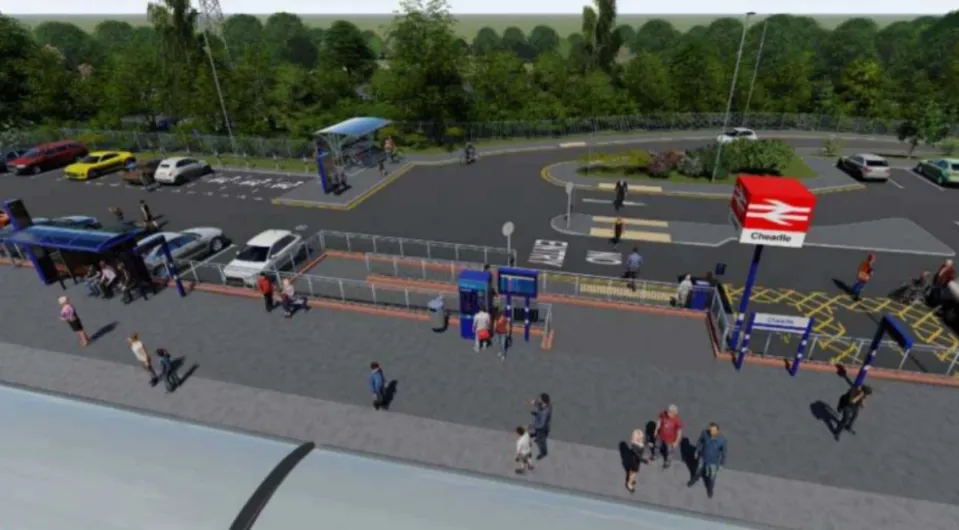
A TRAIN station is set to return to the centre of a tiny UK village after more than 100 years.
Work has started on bringing the station back following a “major breakthrough” on issues that delayed the scheme.
An artist’s impression of how the new station in the village of Cheadle will lookCredit: PELL FRISCHMANNAn aerial view of the new station, which will serve Manchester city centreCredit: PELL FRISCHMANN
Villagers in Cheadle, Stockport, last had the use of a train station in 1917, when it was located near to the high street.
Since then, residents have been forced to use public transport and cars when travelling to nearby areas, including Manchester city centre.
Sign up for the Travel newsletter
Thank you!
Stockport Metropolitan Borough Council said concerns that other trains on the rail network might be delayed had stalled progress of the scheme.
However, in what has been described as a “hugely significant” move, council officials said work had now started on bringing back the station, which will be built near The Alexandra Hospital.
Funding for the station was approved in 2022, with planning permission granted in 2023, but concerns over timetabling led to delays.
In a statement, Cllr Mark Roberts, leader of Stockport Council, said: “This is a hugely significant moment for Cheadle and for Stockport.
“For years we’ve fought for this station because we know the difference it will make to residents, businesses and the future prosperity of the area.
“Cheadle Station has always been about improving connections, creating opportunities and making it easier for people to travel for work, education and leisure and I am delighted that the highways work can now start on site later this month thanks to the persistence and partnership of all involved.”
Services are expected to run from Cheadle into Stockport town, Manchester Piccadilly and Chester.
It remains unclear when the station will open to the public.
Many of us own one of these common colours for a suitcase but it is worth following simple advice that will stop any problems from arising
09:56, 06 Oct 2026Updated 09:56, 06 Oct 2026
This article contains affiliate links, we will receive a commission on any sales we generate from it. Learn more
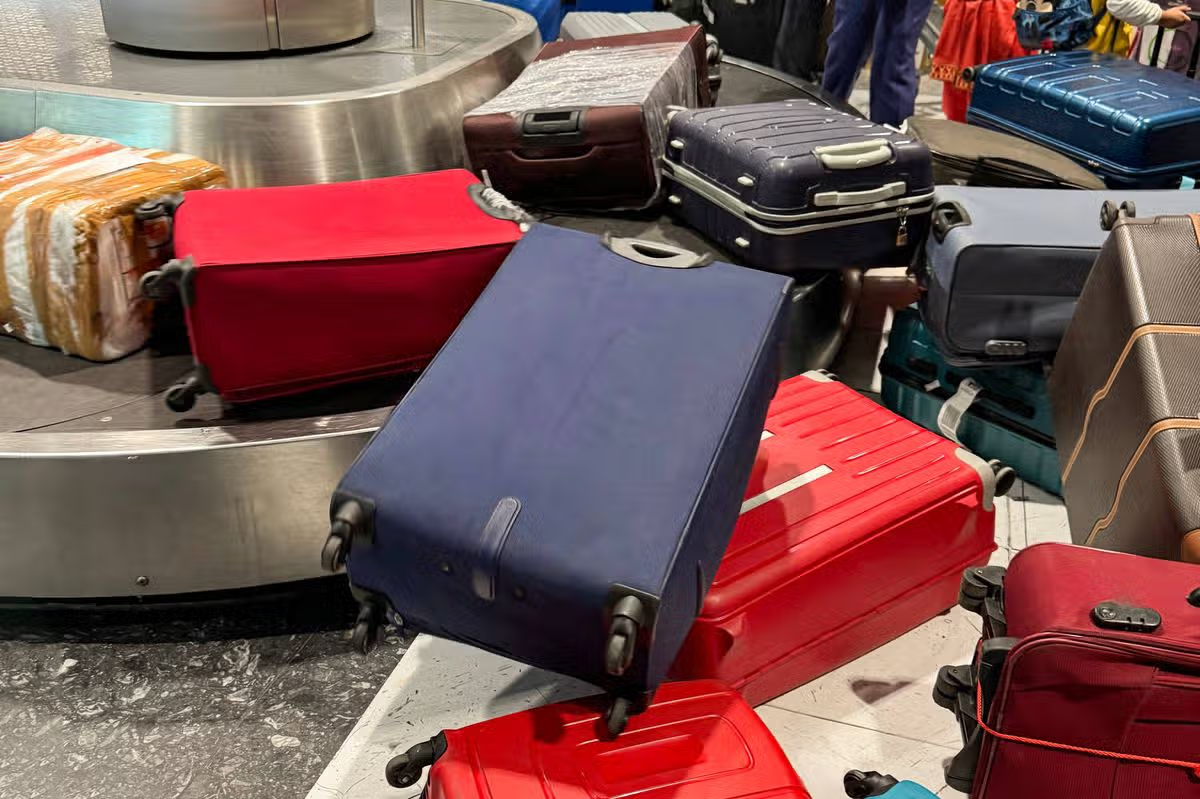
Many of us think they can spot their suitcase when it is on a baggage carousel(Image: mtreasure via Getty Images)
Ryanair continues to grow, with the airline carrying a record 208.4 million passengers in its latest full financial year – a four per cent increase on the previous year. However, the budget airline has also been cutting back at some European airports, with Ryanair withdrawing or reducing flights in certain locations.
The airline has pointed to factors including aviation taxes and airport charges. Despite this, the UK remains a key part of Ryanair’s expansion plans.
Its winter 2026 schedule includes 435 routes, with three new services from London Stansted and a new route between London Luton and Venice. A further 18 new routes have also been added from other UK airports.
As Brits gear up to the October half term holidays and winter, Ryanair has issued a warning to passengers who typically fly with black, navy or grey suitcases, urging them to ‘change’ their luggage to avoid any confusion when they land.
The budget carrier advised travellers to make their checked-in bags more distinctive on the carousel given the prevalence of these colours.
What Ryanair says
As reports the Express, Ryanair said: “Make it easier to spot your checked-in luggage on the carousel, especially if your luggage is black, navy or grey (like 99.9 percent of the population). Add a colourful luggage tag or ribbon to the handle so that there’s no confusion on arrival.”
Ryanair also recommends passengers create copies of their passport, driving licence, and/or ID card and email them to themselves.
It’s also suggested to photograph these documents and store them on your phone for offline access at your destination,
The well-known budget carrier transports an impressive 52 million passengers to and from the UK annually with its fleet of 107 UK-based aircraft.
In June, Ryanair experienced a spike in passenger numbers with 19.3 million people opting to fly with them across one of their 106,000 flights. This marked the first occasion the airline transported more than 19 million travellers and an 11 per cent rise compared to June 2023.
The airline also pulled out all the stops for England fans during the Three Lions’ Euro 2024 run, laying on over 1,500 extra seats to and from Berlin for the cup final.
On a separate note, if you’re on the hunt for stylish cabin bags and suitcases, Antler is well worth a look. Their Iconic Stripe Case, retailing at £175, is available in seven gorgeous colours, including mist blue.
Few pubs boast a more idyllic setting. As I emerge from the woods after a 15-mile hike, The Bridges, on the banks of the Onny River, in the rolling south Shropshire hills, glistens in the late afternoon sun. Inside it’s all wooden beams, with light streaming through stained glass and huge bunches of homegrown flowers adding splashes of colour. There’s time for a pint before general manager Sam Thompson shows me to my room in the recently converted stables.
I’m here exploring part of the 185-mile (297km) Shropshire Way, on a two-day Heart of the Hills hike – one of the county tourist board’s new Rail-Ready Short Breaks. Designed for people who don’t have time to tackle the whole route, the itineraries focus on loops that are easy to access by train, with illustrated PDF downloads, GPX files, accommodation suggestions and highlights of what to do along the way. My route will take me from Shrewsbury to Bishop’s Castle via Ratlinghope – about 27 miles, perfect for a weekend.
The Bridges pub in Ratlinghope.
Shrewsbury itself is worth lingering in – the historic market town is crammed with independent shops and restaurants (I loved Csons for its creative small plates) and impressive Tudor architecture. But I’m most intrigued to learn that beavers have been reintroduced here by the council and the Shropshire Wildlife Trust. The first kit in the county in 400 years was born late last year and the Trust’s Tom Freeland shows me around the site, the Old River Bed nature reserve, just two miles north of the town centre. A boardwalk crossing wetlands allows an up-close view of the rewilding project. Although we don’t spy the elusive creatures (we see heron and plenty of moorhen), there’s still lots to learn. “It’s been a great success in inspiring the community to find out more about our local wildlife,” says Tom. Nature talks and guided tours of the beaver enclosure are in the pipeline, too.
Back at my base, the 16th-century Lion + Pheasant townhouse hotel, I dine on pan-roasted trout in the beamed restaurant (there’s a popular wine and tapas bar on site too) and the next morning set off to walk the first leg to Ratlinghope. Crossing the River Severn, the city soon peters out and quiet country lanes lead to Lyth Hill Country Park where expansive views open up across Shropshire.
It’s a steady climb to Wilderley Hill, past fields of rape, bright patches of yellow in a sea of green, and I stop under an oak tree to picnic. There’s no one around, just the songs of wren and chaffinch filling the air. The landscape changes on the approach to Ratlinghope as the route traces a brook, crosses wooden bridges and winds through pretty woodland. Just off the path lies the 12th-century St Margaret’s Church, the burial place of 19th-century farmer Richard Munslow, the last known “sin-eater”, whose job it was to eat bread and drink ale over corpses to absorb their sins.
I enjoy a drink instead in the pretty beer garden at The Bridges. The seven immaculate, minimalist rooms are round an adjacent courtyard – and guests have access to a lounge above the pub, too. The food in the bar includes Guinness rarebit and duck terrine, while the light-filled restaurant focuses on organic fare from the owners’ regenerative farm on the Linley Estate and the Welsh Marches. I feast on huge radishes with anchoïade, and hake with fennel, capers and crispy polenta. Breakfast the next morning – homemade granola and poached rhubarb – is equally delicious. It’s such a lively, friendly place I’m tempted to move nearby for the pub alone. They’ll even drive locals home if they’ve had one too many, Sam tells me.
Blue skies and gentle sunshine greet me for day two of the hike, a 12-mile yomp across rugged moorland and pastures to Bishop’s Castle. The pub lies on the edge of the Long Mynd, a heath and moorland plateau, but I’m heading north to the Stiperstones, a national nature reserve with a wild, dramatic ridge of quartzite rock formations that pierce the ground. I climb higher, passing Devil’s Chair tor, watching skylarks and buzzards soar overhead.
The Devil’s Chair on the Stiperstones Ridge, Shropshire. Photograph: Vincent Lowe/Alamy
It’s a beautiful walk. After several hours, a magnificent avenue of Linley Beeches line the descent into Bishop’s Castle, a pretty town of half-timbered houses. Bank House B&B, a Georgian renovation with an oak-panelled drawing room and five antique-filled rooms, is my home for the night. I pop into the Poetry Pharmacy where prescriptions are poems chosen to spark specific emotions, to be “taken” when required (I leave with a bottle of Joy). Although little remains of the medieval castle that once stood here and gives the town its name, the grand Castle Hotel, with its pretty gardens and welcoming restaurant, is worth a visit.
With more time, I could, of course, carry on and add another loop of the trail. But the train back home beckons – Craven Arms station is a short bus or taxi ride away – and I leave feeling pleased to have dipped my toe into a small segment of the Shropshire Way. As far as rambling weekends go, it’s ticked all the right boxes, and whetted my appetite to discover more.
IT’S out with the old and in with the new, as holiday-makers seek out less visited destinations.
This year will see growing interest in “Cinderella destinations”, previously overshadowed by more heralded neighbours, finds research for operator Riviera Travel.
Romania’s Bran Castle, inspiration for the Dracula taleCredit: GettyDracula, played by Christopher Lee in 1958Credit: Alamy
Bookings for South Korea are up 167 per cent, year on year, while those for Uzbekistan have risen by 42 per cent.
So, before securing next year’s getaway, take a look at Sophie Swietochowski’s alternative suggestions . . .
Sign up for the Travel newsletter
Thank you!
TRANSYLVANIA
You might think Transylvania, a Romanian region strongly linked to vampires, should only be visited at this time of year as we approach the spooky season.
But there’s so much culture and fascinating history to be explored, beyond the Dracula myths.
Glorious hiking trails make it a rambler’s paradise while animal lovers should keep their eyes peeled for brown bears, which are highly concentrated in this area of Romania.
GO: The eight-day trip costs from £1,749pp based on two people sharing and including return flights and transfers, accommodation in four-star hotels, daily breakfast, two lunches and two dinners, and 12 experiences. For details, check out rivieratravel.co.uk.
SRI LANKA
Go Bananas and spot monkeys in Sri LankaCredit: Getty
While Sri Lanka is not exactly an undiscovered destination, it has become more popular in recent years as more and more travellers favour it over the much-visited Thailand.
Tourist numbers are lower than for other nearby destinations, meaning prices are still cheaper and travellers can get more bang for their buck.
Also, you won’t be dealing with mega crowds and tourist traps.
Instead, you can expect high-end accommodation and loads of wildlife (a half-day safari trip should be top of your list of things to do).
If wildlife is what you’re after then a stay at the 5H Sun Siyam Pasikudah offers great value for money — and you’re likely to spot monkeys and cows strolling the beach or elephants in the backstreets nearby.
GO: Seven nights’ half-board at the 5H Sun Siyam Pasikudah is from £1,379pp including flights from Gatwick and transfers on April 13. Book by October 15. See travelbag.co.uk or call 0203 393 9620.
SLOVENIA
Peak time viewing in the Slovenian AlpsCredit: Getty
Those on the hunt for glorious alpine views and vast lakes tend to make a beeline for Switzerland or Austria.
These destinations can make a heavy dent in the wallet, though.
Its glacial rivers and snow-drenched peaks could rival those in the fanciest resort towns of popular holiday countries, with the dramatic Lake Bled offering the most glorious backdrop for tourist snaps.
Make sure to visit the Vipava Valley, too.
It’s Slovenia’s answer to Tuscany and home to some unique white wines that you won’t find anywhere else.
GO: Seven nights’ room-only at the 4H Triglav Bled is from £459pp including flights from Luton on February 22. See loveholidays.com.
UZBEKISTAN
The Shah-i-Zinda in Samarkand, which was built between the 11th and 15th CenturiesCredit: Getty
Brits can visit Uzbekistan visa-free for up to 30 days, which is more than enough time to indulge in the country’s fascinating architecture.
Turquoise domes and colourful mosaics are a key feature of many notable buildings, including the Shah-i-Zinda in Samarkand, which was built between the 11th and 15th Centuries.
The ancient trading route that makes up the Silk Road passes through the heart of the country and, if you have got cash to splash, you can soak up the best of it on an 11-day adventure.
The trip starts in Tashkent before heading to the Ayaz-Qala desert fortress, Khiva (a Unesco World Heritage city), Bukhara and Samarkand.
GO: The Silk Road trip is from £3,249pp based on two people sharing, including return flights and transfers, nine nights in three to four-star accommodation, daily breakfast and nine meals, plus ten experiences. For details, check out rivieratravel.co.uk.
SOUTH KOREA
The wondrous Gyeongbokgung Palace in South KoreaCredit: thianchai sitthikongsak
Forget Japan, South Korea’s K-pop music, quality beauty products and fascinating culinary scene have the younger generations hooked.
And with the recent launch of direct Virgin Atlantic flights from Heathrow to South Korean capital Seoul, the country is now easier than ever to reach.
So if this sounds like your cup of tea (or bowl of kimchi), book now before visitor numbers skyrocket.
Seoul, in particular, blends history and culture with modern-day living — palaces sit between skyscrapers, and traditional markets are close to contemporary shopping areas.
GO: Eight nights’ room-only at the 5H Grand Hyatt Incheon is from £1,458pp including flights from Heathrow on May 12. Check out virginatlantic.com/holidays.
TEENAGE years were often consumed by the excitement of planning which festival to go to, met by the disappointment of not being able to afford (or even able to get) a ticket.
Fortunately, there is a way to get free festival tickets even as a now-adult.
I’ve attended loads of festivals for freeCredit: Cyann Fielding
Volunteering might remind you of litter picking in parks, but it looks a whole lot different at festivals.
With Oxfam, you can volunteer across a number of different roles while getting a free ticket to the festival.
Sign up for the Travel newsletter
Thank you!
Having done a number of festivals with the charity I can safely say that it is a lot more fun than you’d think, AND you get other great perks as well.
The role with the most positions available is to be a steward – you’ll carry out a range of roles across three eight-and-a-quarter- hour shifts including checking tickets on the gate, patrolling campsites or the arena and staffing accessibility platforms.
You will get all the training you need, as well as a meal voucher for every shift, free tea and coffee, crew camping (read, quieter campsites), hot showers and free phone charging.
Applications for the positions open in the new year and are served on a first-come first-served basis.
You will need to fork out the ticket price upfront but this essentially acts as a deposit to ensure you show up to your shifts – you will then get it back four weeks after the festival.
You will also need to be 18-years-old or over to volunteer by the time you arrive onsite.
Other roles include campaigning, which requires four, six-hour shifts ending before headline acts, and shop volunteers to run festival shops, with one six hour shift a day.
For the latter role, you will need to be a current shop volunteer, intern or member of Oxfam staff with at least three months of experience.
And you can as well via OxfamCredit: Getty
But in reality what does the work actually look like?
For my first festival, I volunteered at NASS although this sadly no longer runs.
As a smaller festival in the UK, I was only required to do two shifts and these both consisted of checking tickets into the festival – one on arrival day and another for second day arrivals.
It meant I missed NOTHING – not a single act.
Both my shifts were finished before music even started, which meant I had enough time to nip back to the spacious campsite with hot showers and freshen up before going and singing my heart out as Loyle Carner performed just metres from me.
The other festivals I volunteered at were much bigger and are household names – Boardmasters in Cornwall and Reading Festival.
Staff camping at Reading was a decent walk from the main arena and while that meant it was a bit of a pain to just ‘nip’ back to your tent, it did mean that I was away from ALL noise.
The campsite is spacious, peaceful, empty of drunken festivalgoers and has its own toilet block – which were actual toilets with no stench.
All you need to do is volunteer with the charityCredit: GettyFor weekend festivals you will need to do three eight hour shiftsCredit: Alamy
When I saw the toilets in the main campsites, I realised how appreciative I was of swapping some hours of my time for a free festival ticket.
I slept soundly each night with no thumping music or rowdy people around me.
As for my shifts at Reading, one of my three, eight-hour shifts was spent checking tickets on the first arrival day – before the festival had even properly started.
My second shift was patrolling campsites during the daytime, before any major acts were on.
And my third shift? Being right in the pit as Sea Girls played, handing out water to festival-goers.
None of these tasks, other than perhaps standing in the blazing sun, are strenuous and shift leaders are great at constantly making sure you have water as well as regular time in the shade if your shift involves being in the direct sun.
But you’ll get to camp in a separate area and get free meals as wellCredit: Getty
What is volunteering at Glastonbury like?
DEPUTY Travel Editor, Kara Godfrey has previously volunteered at Glastonbury Festival with Oxfam and here are her thoughts:
I am not a festival-goer – camping on the cold hard ground, traipsing through the inevitable mud and don’t get me started on refusing to use anything other than a standard, private bathroom.
And then being made to pay at least £400 just to be allowed in the gates? I never saw the appeal.
However, when I did work Glastonbury with Oxfam, I was very much converted.
Early access, so a more laidback first day without the huge crowds, three meals a day without having to pay extortionate amounts, and, of course, much nicer toilets and showers.
Being able to charge my phone and have a much quieter campsite – it felt like glamping without the cost.
The only downside was the shift patterns. I was on ticket checking duty, and you had to do a day, afternoon and overnight shift.
You in theory could swap with people, but good luck trying when there was a big performer (I was there the year of Dolly Parton).
But as long as you aren’t going just for one act, I had the best time hanging with my fellow Oxfam crew as we played our own party tunes at the entrance, shared snacks – and laughed our heads off at all the men dressed up as good ol’ Dolly herself.
Oh, and it barely cost me a penny once my ticket costs rolled back into my bank account. Win win!
Across these three shifts I only missed one act I wanted to see.
And last but not least, Boardmasters was a similar story – one of my three eight-hour shifts was spent checking tickets before the festival began, another was a day shift campsite patrolling and the third was an overnight campsite shift.
Again, with these I missed no acts I wanted to see and while the final overnight shift was tiring (and cold), it involved standing and sitting at the entrance to a campsite answering questions… hardly hard work.
Across all shifts you get a half hour break as well as a meal token which you can use at selected vendors across the festival.
These often include gourmet burger joints and pizza vans, so there is plenty of choice.
Depending on what festival you are at, you might get actual shower and toilet blocks too, a communal area on your campsite and quite often other goodies like free Coca-Cola from brand sponsors walking the festival ground.
There are other companies and charities you can go through for festivals too, such as Hotbox Events, My Cause UK and Festaff.
Though, I wouldn’t look further than Oxfam – everyone is there to have a good time and thanks to not having to pay a penny and camping with more space, I’d say I was happier than most paying festivalgoers each time I volunteered.
ANTIGUA, Florida and the Caribbean… what do they all have in common? Obviously they’re all beautiful, exotic destinations that typically cost thousands to visit.
They’re also some of the amazing locations currently being offered as prizes in some incredible competitions. We’ve rounded up all of the best ones to enter right now…
There are tonnes of competitions open at the moment where you could win a once-in-a-lifetime opportunityCredit: supplied
There’s something for everyone, from luxury staycations to five-star escapes abroad – plus all are free to enter.
So whatever your ideal holiday is, here are some of the best competitions currently taking entries offering a wide range of prizes…
Europe
Live like royalty on a family trip to Versailles
Le Shuttle is giving away a trip to Versailles for a family of four, with access to the Palace of Versailles, the Trianon Estate, Queen’s Hamlet and Gardens, plus a guided tour of the special Marie-Antoinette by Sofia Coppola exhibition.
You’d stay at the Le Louis Versailles Château MGallery and get a VIP shopping experience with One Nation Paris.
There are some competitions for trips to Europe as well including to VersaillesCredit: GettyAlternatively, you could enter to win a short break to Croatia and get a £250 Ellis Brigham voucher as wellCredit: Getty
Travel in style on aCroatia long weekend
Win a short break on the Dubrovnik Riviera in Croatia, plus an Osprey backpack and a £250 Ellis Brigham voucher.
The winner gets a four-night trip and can choose between either a men’s Farpoint 55 or women’s Fairview 55 pack.
Just answer the question ‘what is the capital city of Croatia?’ along with your details by December 15 – click to enter.
Live in luxury on a French Alps family ski trip
Family Ski is offering a seven-night family ski holiday for four to the French Alps.
Included in the prize is £500 of Roarsome Ski Wear for Kids, accommodation in a luxury catered chalet at either Ardent, Portes du Soleil or Reberty, Les Trois Vallées (depending on availability), childcare and airport transfers.
You’ll need to book your own travel from the UK to Geneva, plus lift passes, ski hire and travel insurance.
To enter, fill out the entry form and follow Roarsome and Family Ski Company on Instagram by October 31 – click to enter.
Take the family to the alternative Lapland
Win a family trip to Swedish Lapland worth £4,648.
On Instagram, Letsgofaraway is offering a round-trip (flights up to a maximum of £1,033.09) to Grand Lodge at Blueberry Lodge Lapland for up to eight people.
One activity at the lodge for all guests in included, plus a private session in the relaxation area, which has a sauna, Nordic hot tub and a homemade fika.
To enter, follow @letsgofaraway_, @hospitality.guide, @danieltravl and @blueberry_lodge_lapland on Instagram, then like the competition post, tag two friends and repost/share.
Ever heard of Swedish Lapland? Well, there’s a competition to win a trip thereCredit: AlamyOr you could explore Austria more with a trip to InnsbruckCredit: Getty
Snowy holiday to Innsbruck
Monster energy drinks is offering a snow trip for two people to Innsbruck in Austria.
If you don’t have a card, that’s fine, you can sign up for free.
There’s competitions with long-haul prizes as well such as a trip to AntiguaCredit: GettyOr you could be in with a chance of heading to Saint LuciaCredit: Getty
Luxury Saint Lucia holiday and Arsenal tickets
Windjammer Landing Resort & Residences is offering a seven-night round-trip to Saint Lucia from London.
You’ll also get two tickets to an Arsenal game hosted by the Saint Lucia Tourism Authority and two Arsenal t-shirts.
Answer the questions ‘what is the name of Saint Lucia’s famous national landmark?’ and ‘which Arsenal legend has just visited Saint Lucia?’ by December 15 – click to enter.
Fabulous, personalised holiday toOrlando
Tripadvisor and Visit Orlando are offering an eight-night holiday to Orlando, Florida for two people, plus a free holiday planning session.
Tripadvisor and Visit Orlando have also teamed up to give away an eight-night holiday to Orlando in FloridaCredit: GettyOr perhaps you’ll win a trip to Grand Cayman in the Cayman Islands…Credit: Getty
Cruise
14-night all-inclusive cruise to the Canaries
Saga is giving away a 14-night all-inclusive cruise to the Canaries and Casablanca.
You’d set sail from Portsmouth on January 6, 2027 in a Twin Standard Balcony cabin, stopping at La Palma, Tenerife, Madeira and Gran Canaria.
If you have always dreamt on going on a cruise, there are plenty of cruise competitions as wellCredit: AlamyIncluding ones sailing to the Canaries and to GreeceCredit: Supplied
14-night Caribbean cruise with food and drink included
Win a river cruise through Europe on the Danube or Rhine with Scenic worth £7,000.
The prize includes suite accommodation, excursions, five dining venues, premium drinks, butler service, return flights and transfers and complimentary e-bikes to explore the destinations you stop at.
Five star trip for two at Old Course Hotel, St Andrews
Old Course Hotel in Scotland is a five-star spot boasting views of the Fife coastline and a large golf course.
Win a one-night stay at the hotel for two people with a two-course dinner and a full Scottish breakfast – worth £700.
You’ll get a full day to spend at Kohler Waters Spa, with a spa pool, hydrotherapy suite with a thermal pool, steam room, sauna and plunge pool and the UK’s first Espuro Foam Steam Rooms.
Each guest will get a 50-minute treatment, from a custom massage, hot stone massage, classic prescription facial, reflexology session or a 25-minute facial and 25-minute massage combo.
You need to have a Muddy Stilettos account to enter (free to sign up) and click here to answer ‘what town is Old Course Hotel in?’ by October 14.
You could win a hotel stay and tickets to see Wicked on the West End in LondonCredit: PAOr you could win a stay at a Harbour Hotel and a Salcombe Gin experienceCredit: Alamy
West End show and a 4-star London hotel stay
The Royal Mint recently launched a coin dedicated to the musical Wicked to celebrate 20 years of the West End show.
To celebrate they are giving away a one-night stay at The Clermont Hotel, a silver Proof Colour edition of the Wicked UK coin and two tickets to the London show.
Five-star countryside retreat and year’s supply of popcorn
Popcorn brand Jo & Sephs are offering a luxury trip to Devon, to celebrate the release of the new Sense and Sensibility movie.
The prize includes a three-night stay in a five-star hotel, a private horse-drawn carriage ride and afternoon tea, plus a year’s supply of popcorn.
Click here to answer the question: ‘in Sense and Sensibility, what are the names of the two Dashwood sisters at the heart of the story?’ by November 30.
In another competition, you could be lucky enough to win a stay at Andy Murray’s hotel in ScotlandCredit: Verena SplettOr you could win a luxury trip to Devon with Jo & Sephs
A luxury stay at Andy Murray’s Scottish country house hotel
Discover Britain is running a competition to win a luxury stay at ‘Cromlix’ – Sir Andy Murray‘s country hotel in Scotland.
It includes dinner in the hotel’s new restaurant – The Garden Room.
New rules have been introduced at some UK airports, and holidaymakers have been issued a warning ahead of the busy October half-term, as thousands are expected to jet off abroad
A travel warning has been issued to Brits jetting off abroad(Image: Getty Images/Stock Image)
Airports across the nation will be bracing for another busy travel season as we head towards the October half-term, with thousands of families set to jet off abroad on a sun-soaked getaway. But amid the excitement, holidaymakers have been issued a warning and advised to be well prepared for the new rules.
Some UK airports have upgraded their security scanners, meaning that travellers can carry up to 2 litres of liquid through security and no longer need to remove liquids from their hand luggage. Additional rules have also been introduced for security checks, which can vary from airport to airport, making it even more confusing when travelling abroad.
To ensure that holidaymakers are fully prepared before jetting off abroad in the coming weeks, Heathrow Airport issued an update to all travellers. Taking to X, formerly Twitter, the UK’s largest airport shared its “top tips” for going through security and warned: “Security requirements may vary by destination, both within and outside the UK.”
It comes as Heathrow has upgraded its security scanners. On the airport website, they confirmed: “You can now keep liquids and large electronic items in your cabin bag, so getting through security is quicker and easier”. They then outlined that passengers passing through Heathrow should:
Keep liquids in your cabin bag
Carry liquids in containers of up to 2 litres each
Empty metal and insulated bottles before security. You can refill them after security
Keep laptops, tablets and other large electronic items in your bag
The change is thanks to new CT scanners that provide security staff with detailed 3D images of bags, allowing travellers to keep their two-litre liquids in their hand luggage when passing through airport security. However, it’s important to understand that “not all airports use the same security equipment”, as Heathrow warned.
They said: “If you’re flying from another UK or international airport, check the local security rules before you travel. Liquid limits and security checks may be different.” They further explained that “many airports outside Heathrow still have a 100ml liquids limit” and it’s best to check the rules before travelling. This also applies to UK airports, with many still obtaining the 100ml rule.
UK airports that have ditched 100ml rule
Belfast International
Belfast City
Birmingham
Bournemouth
Bristol
Edinburgh
London Gatwick
London Heathrow
UK airports that still have 100ml liquid rule
Aberdeen
Bournemouth
Cardiff
East Midlands
Glasgow International
Glasgow Prestwick
Inverness
Isle of Man
Leeds Bradford
Liverpool
London City
London Stansted
London Luton
Manchester
Newcastle
Norwich
Southampton
Teesside
While many UK airports still have the 100ml liquid rule in place, some have relaxed measures. A number of airports no longer require travellers to store their liquids in a clear plastic bag, and they can also be kept in their hand luggage when going through security. However, as specific rules can vary, it’s best to check directly with the airport you’re flying from, especially in the run-up to the October half-term.
Do you have a travel story to share? Email webtravel@reachplc.com
SEVERE storms have caused flooding on a popular Greek holiday island.
Crete in Greece is currently suffering from mass flooding causing widespread disruption across the island including some tourists being evacuated from coastal accommodation.
Severe storms have caused mass flooding in CreteCredit: ReutersThe popular holiday island has even had to evacuate some resortsCredit: Reuters
Some cars and trees have even been washed into the sea.
Here is the current advice for travel to or from Crete right now:
Sign up for the Travel newsletter
Thank you!
Where is the flooding?
Flooding in Greece right now is mainly impacting the island of Crete.
Massive storms have been battering the island since October 1 and resulted in torrential rainfall with bad flooding and mudslides.
Worst hit areas include the Milopotamos district and the village of Zoniana, as well as Kato Gouves, Finikia, and Heraklion city.
In Chania, there have been big waves as well which have damaged seafront restaurants.
Is it safe to travel to Crete right now?
There is currently a Red Alert warning in Crete, which has been issued by the local authorities and the Hellenic National Meteorological Service (EMY).
Emergency services are still currently clearing mudslides and damage caused by the flooding.
There is currently a Red Alert in place for weatherCredit: AP
“Greece can experience extreme natural phenomena such as earthquakes, wildfires, extreme heat and flash floods.
“To be alerted to events near where you are located in Greece, make sure your mobile phone is set to allow emergency alerts.
“For instructions on how to do this see:
for iPhones go to Settings > Notifications and enable the ‘Emergency Alerts’ option at the bottom
for Android 11 and higher go to Settings > Notifications > Advanced Settings > Wireless Emergency Alerts
for Samsung devices go to Settings > Apps > Messages > Notifications > Emergency Notifications and enable the ‘Emergency Alerts’ option
“This will allow the Greek government’s Emergency Communication Service alerts to reach you. Always keep your phone with you as you will receive alerts according to the location of your phone.
“Adverse weather conditions, including floods, can happen quickly. Register for Emergency alerts and follow ‘112 Greece’ on X for official updates.”
Are flights still going to Crete?
Currently, flights are not impacted to or from Crete.
However, if you are already in Crete and need to get to the airport you may want to allow for more extra time.
If you are due to fly in and have concerns, it may be worth contacting your airline to check if they are operating normally.
Though flights are not being cancelledCredit: EPAIf you have a holiday to Crete booked, it is worth checking with your travel insurance if you wish to cancel itCredit: EPA
What if I have a holiday to Crete booked?
As the Foreign Office has not warned against travel to Greece, there are no special circumstances in place for holidaymakers to cancel their trip and receive a full refund.
Depending on what travel insurance you have, your policy might include natural disaster cover.
If so, your insurance policy should cover you for when you are unable to reach your holiday destination due to natural disasters, like wildfires.
So it is worth checking your travel insurance policy.
Can I cancel my trip?
If you do choose to cancel your trip, it is best to contact your airline or holiday provider.
There is no obligation for companies to refund bookings unless government advice changes.
This winter thousands of holidaymakers will be packing their thermals and heading for the ski slopes. We’d love to hear about your favourite smaller ski resort, one which has managed to hang on to its local character and charm, whether it’s in the Alps, the Pyrenees, Scandinavia or eastern Europe.
The best tip of the week, chosen by Tom Hall of Lonely Planetwins a £200 voucher to stay at a Coolstays property – the company has more than 3,000 worldwide. The best tips will appear in the Guardian Travel section and website.
Keep your tip to about 100 words
If you have a relevant photo, do send it in – but it’s your words we will be judgingfor the competition.
We’re sorry, but for legal reasons you must be a UK resident to enter this competition.
The competition closes on Monday 12 October at 10am BST
Your responses, which can be anonymous, are secure as the form is encrypted and only the Guardian has access to your contributions. We will only use the data you provide us for the purpose of the feature and we will delete any personal data when we no longer require it for this purpose. For alternative ways to get in touch securely please see our tips guide.
If you’re having trouble using the form click here. Read terms of service here and privacy policy here.
Unite general secretary Sharon Graham said: “Leeds Bradford Airport is very profitable and can more than afford to come back to the table with an offer that doesn’t fall short of our members’ expectations.
“Our hardworking members should not be paid less than those doing the same jobs at other airports.
“Workers taking action at Leeds Bradford Airport have Unite’s full support in their fight for fairer pay.”
It also previously revealed plans to one day launch long-haul flights, with most routes being to Europe including Spain.
Although the airport is losing all of it’s easyJet flights next year, which will be axed by January 2027.
Unite regional officer Neil Whitaker said they had “no choice but to strike,” citing a “fair pay rise” needed to call it off.
A Leeds Bradford Airport spokesperson told Sun Travel: “Leeds Bradford Airport acknowledges the proposed industrial action due to take place between 16-18 October involving a group of operational colleagues.
“We respect the right of employees to participate in lawful industrial action. However, we are disappointed by this and do not believe strike action is the right way to resolve the issues still under discussion.
“The airport has made what we believe is a fair and responsible offer that is significantly above inflation and reflects both current economic conditions and the need to ensure the long-term sustainability of the business.
“Our priority now is to minimise disruption for customers, many of whom have worked hard and saved for important holidays, family visits and business travel. At this stage we anticipate running near-normal operations during the period.
“Leeds Bradford Airport plays a vital role in connecting Yorkshire to the world. Industrial action has the potential to cause inconvenience for thousands of customers and local businesses who rely on those connections.
“We remain committed to constructive dialogue with Unite and would welcome continued discussions aimed at reaching a resolution.
“It is important to recognise that any profits generated by Leeds Bradford Airport are reinvested back into the airport and has been for a number of years. Those funds support improvements to facilities, infrastructure, operations and customer experience including the ongoing LBA:REGEN project which saw the opening of a new central search zone and staff welfare facilities this week.”