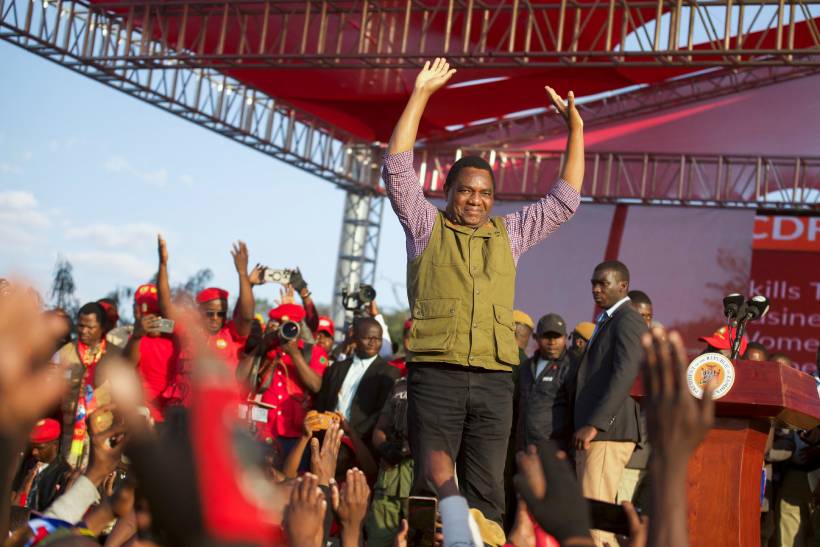
Zambians will vote on August 13 in presidential and parliamentary elections, with polls and investors widely expecting President Hakainde Hichilema to defeat a fragmented opposition led by Brian Mundubile.
For investors, however, the central question extends beyond the election outcome. The focus is on whether a second Hichilema administration can transform Zambia’s post-default economic stabilisation into stronger, broad-based growth while maintaining fiscal discipline.
IMF Programme Seen as Key Test
One of the first issues investors will monitor is whether Zambia secures a new programme with the International Monetary Fund (IMF) after its previous $1.7 billion arrangement ended in January.
The earlier programme helped underpin Zambia’s sovereign debt restructuring after the country became Africa’s first pandemic-era sovereign default. Markets now view a successor agreement as an important indicator of policy continuity.
Stay ahead of the geopolitical week.
MD Briefing delivers expert analysis across five global fronts — the Indo-Pacific, energy, geoeconomics, European security, and the Middle East — every Monday morning. Free.
Investors will closely watch how quickly negotiations conclude and whether any new programme shifts its focus from crisis management toward promoting long-term economic growth while preserving fiscal discipline.
Copper Industry Remains the Economic Backbone
Copper continues to dominate Zambia’s economy, accounting for about 70% of export earnings while serving as a major source of government revenue, foreign investment and employment.
Investors are watching whether planned investments can translate into higher production. Major projects include Vedanta’s return, continued expansion by Barrick Gold, and First Quantum Minerals’ ongoing investments.
The government has maintained that mining tax rates will remain unchanged, providing policy stability. However, investors are paying close attention to a proposed local-content law that would require mining companies to increase domestic procurement to around 40% over the next three to four years from roughly 20% today.
Mining companies have warned that many local suppliers currently lack sufficient financing and technical capacity, potentially creating supply chain challenges during a period of major expansion.
Among the priorities are increasing exploration spending to discover new mines, improving tax collection efficiency, and reforming Zambia’s grain market to reduce the government’s role in purchasing maize harvests.
A record maize crop is expected this year, but analysts warn that government purchases of surplus grain could increase fiscal pressure, particularly alongside election-related spending.
Some forecasts suggest Zambia’s fiscal deficit could exceed official government targets if these pressures continue.
Reliable Power Critical for Mining Expansion
Electricity supply has become another major concern following drought-induced power shortages that exposed Zambia’s heavy dependence on hydropower.
Although investment in solar energy is increasing, investors say expanding copper production will depend on creating a more reliable and diversified electricity system capable of supporting future mining operations.
Election and Climate Risks
While most observers expect a relatively orderly election, monitoring groups have highlighted concerns including alleged voter card confiscation, vote buying and the possibility of localized unrest if results are disputed.
Weather also remains a significant economic risk. Zambia remains highly dependent on rain-fed agriculture and hydropower, leaving the economy vulnerable to future droughts similar to the severe 2023–24 El Niño event that caused widespread crop failures and electricity shortages.
Analysis
The election itself is unlikely to unsettle investors if Hichilema secures the expected victory. Instead, markets will judge whether his government can move beyond economic stabilization toward sustained, private sector-led growth. A new IMF programme, continued mining investment, reforms to agriculture and tax collection, and a more resilient energy sector will be the key indicators of success. While Zambia has made notable progress since its debt default, structural challenges and climate risks continue to test the country’s long-term economic outlook.
NEW YORK — The WNBA has grown at an exponential rate during Cathy Engelbert’s tenure as commissioner, a stewardship that at times has been tumultuous during her nearly seven years at the helm.
Engelbert, the second-longest tenured WNBA president or commissioner, helped negotiate a transformative collective bargaining agreement this past spring that gives the WNBA its first core of million-dollar player salaries.
“There’s not a lot of jobs where you can make over 30-plus millionaires instantly, right?” Engelbert said in a phone interview with the Associated Press heading into this weekend’s WNBA All-Star festivities in Chicago. “It just doesn’t exist in most companies, except if you’re like a stock-option company, and your stock does really well. Most of them are under the age of 30 and there are more to come.”
Even with the financial gains, the WNBA’s growth has come amid a strained partnership between the commissioner and players. Engelbert has been criticized for how she has handled various situations, including for being out of touch or not doing enough to help combat social media vitriol.
New York Liberty All-Star Breanna Stewart, vice president of the WNBA players’ union executive committee, said there is a respect for Engelbert among the players, just not much of a relationship.
Her Liberty teammate, Sabrina Ionescu, said she talks more to NBA commissioner Adam Silver than Engelbert.
WNBA business is booming
While the commissioner continues to try and strengthen her relationship with players, the business of the WNBA has thrived.
Engelbert was involved in talks that led to a record media rights deal worth over $3 billion. The league has had record ratings, attendance and team valuations, and will expand to a record 18 teams by 2030.
“We’ve been in hypergrowth mode now for two or three years and companies, if you look back in time, you are not in hypergrowth mode forever,” Engelbert said. “We’re preparing ourselves now for the next version of ourselves, which probably isn’t as hypergrowth.”
From a business standpoint, though, the league has grown, including navigating the coronavirus pandemic that could have crippled the WNBA.
“Give Cathy credit, as she advocated for the season,” Seattle Storm owner Ginny Gilder said. “We had no idea what was going to happen. People had to make decisions. Cathy pushed the Board of Governors to not only have a shortened season, but to fully pay the players. Don’t bicker. We were going to figure out the finances.”
Expansion fees have gone up five-fold over the past few seasons. Golden State paid $50 million to join the league and Cleveland, Detroit and Philadelphia — all joining the league over the next four years — each paid $250 million.
“Look at the financial side in such a short period of time — Cathy with all the work she did and the staff she hired deserves a tremendous amount of credit for that,” Gilder said. “If you look around the league from 2015 to 2020 to now, you know it is a completely new day.”
Valuations of teams were around $5 million to $10 million a decade ago and now the average is around $460 million, Engelbert said.
“When you’re CEO, when you’re commissioner, you’re going to have good days and bad days. But if you just looked at the overall scorecard, you’d have to say we’re doing great,” Washington Mystics owner Ted Leonsis said.
More endorsements for WNBA players
It’s nearly impossible to turn on a major sporting event over the past few years without seeing a WNBA player featured in a commercial. From Gatorade to State Farm, Nike and CarMax, product ads feature some of the league’s top newsmakers, including Caitlin Clark, Angel Reese, A’ja Wilson and Sabrina Ionescu.
Engelbert said when Clark was drafted, it created a “domino effect, because they started seeing the value of putting players in their ads and then separately endorsing the players. I’m really proud of that because when I came to the league, absent a few sneakers ads, I don’t remember any players in spots. Maybe there were a few.”
The commissioner has seen the trend continue with younger players coming into the league, including Paige Bueckers, Azzi Fudd and Olivia Miles.
“Everybody sees the W is here to stay,” the commissioner said.
The commissioner’s future and what’s next for the WNBA
Engelbert deflected questions about her future other than to say she’s turning 62 this year and that was the mandatory retirement age at her old job at Deloitte, where she was the president.
“I haven’t given it a ton of thought. We’ll think about it,” Engelbert said of how long she will stay in her current role, adding she is “focused on the whack-a-mole that is our season. I always tell people don’t focus on me, focus on the rest of my team.
“You always want to leave an organization better than you found it. Internally we’re proud of the team we’ve built.”
Silver said in Las Vegas that he supports what Engelbert is doing.
“I think Cathy continues to do a strong job building that league,” the NBA commissioner said. “We’ll have ongoing discussions about what the future looks like.”
With media rights stable for the next decade as well as labor peace achieved and expansion finished for the immediate future, Engelbert said her list of priorities includes a look at officiating, with WNBA referees finding themselves at the center of questions from frustrated players, coaches and fans. She also wants to help teams with lower attendance improve those numbers, and expand the league’s international footprint.
Earnings Call Insights: East West Bancorp (EWBC) Q2 2026
Management View
“I’m pleased to report that East West earned record total revenue, net interest income and non-interest income in the second quarter. These results were driven by new record levels of loans
Seeking Alpha’s Disclaimer:This article was automatically generated by an AI tool based on content available on the Seeking Alpha website, and has not been curated or reviewed by humans. Due to inherent limitations in using AI-based tools, the accuracy, completeness, or timeliness of such articles cannot be guaranteed. This article is intended for informational purposes only. Seeking Alpha does not take account of your objectives or your financial situation and does not offer any personalized investment advice. Seeking Alpha is not a licensed securities dealer, broker or US investment adviser or investment bank.
“Hanmi delivered another quarter of a strong financial performance, driven by solid earnings growth, expanding customer relationships, disciplined execution and excellent credit quality.” (President, CEO & Director Bonita Lee)
Seeking Alpha’s Disclaimer:This article was automatically generated by an AI tool based on content available on the Seeking Alpha website, and has not been curated or reviewed by humans. Due to inherent limitations in using AI-based tools, the accuracy, completeness, or timeliness of such articles cannot be guaranteed. This article is intended for informational purposes only. Seeking Alpha does not take account of your objectives or your financial situation and does not offer any personalized investment advice. Seeking Alpha is not a licensed securities dealer, broker or US investment adviser or investment bank.
“Second quarter results were solid and reflect the progress we’ve made over the past several years to build a more focused, higher performing company.” (CEO & Director Michael Rhodes)
“For
Seeking Alpha’s Disclaimer:This article was automatically generated by an AI tool based on content available on the Seeking Alpha website, and has not been curated or reviewed by humans. Due to inherent limitations in using AI-based tools, the accuracy, completeness, or timeliness of such articles cannot be guaranteed. This article is intended for informational purposes only. Seeking Alpha does not take account of your objectives or your financial situation and does not offer any personalized investment advice. Seeking Alpha is not a licensed securities dealer, broker or US investment adviser or investment bank.
Andy Burnham has officially begun his tenure as Britain’s prime minister with something few of his recent predecessors enjoyed: breathing room. After replacing Keir Starmer as Labour leader and becoming the United Kingdom’s seventh prime minister in just a decade, Burnham inherits an economy burdened by weak growth, strained public services and persistent cost-of-living pressures. Yet, unlike the turbulent starts experienced by previous leaders, financial markets have greeted his arrival with surprising calm.
That early confidence may prove one of Burnham’s greatest assets—or one of his greatest tests.
A Different Kind of Labour Leader
Burnham enters Downing Street with a political identity distinct from his predecessor. During his time as Mayor of Greater Manchester, he cultivated an image as a champion of regional development and public investment, earning the nickname “King of the North.”
Unlike Starmer’s cautious approach to fiscal management, Burnham has promised to “rewire Britain” through greater devolution, investment in public services, re-industrialisation and stronger local government.
Stay ahead of the geopolitical week.
MD Briefing delivers expert analysis across five global fronts — the Indo-Pacific, energy, geoeconomics, European security, and the Middle East — every Monday morning. Free.
Such promises normally raise concerns among investors wary of higher public spending. Yet markets have remained remarkably composed.
British government bond yields have stayed close to 5%, while sterling has strengthened against the euro since Burnham emerged as Labour’s preferred successor. Investors appear reassured by his commitment to maintaining Britain’s existing fiscal rules rather than pursuing aggressive borrowing.
Why Markets Are Staying Calm
Several factors explain why investors have not reacted negatively.
First, Burnham has avoided announcing sweeping fiscal changes during his first days in office. Instead, he has focused on politically popular issues such as healthcare, homelessness, defence and regional economic development.
Second, his appointment of former Defence Secretary John Healey as Chancellor suggests continuity rather than confrontation with financial markets.
More importantly, many economists believe economic policy will remain closely directed by Downing Street rather than being driven independently by the Treasury, reducing uncertainty over Britain’s fiscal direction.
This perception matters because markets today are extremely sensitive to fiscal credibility.
The Shadow of Liz Truss
Any discussion of British economic policy inevitably returns to September 2022.
Former Prime Minister Liz Truss’s unfunded tax-cutting budget triggered one of the worst government bond sell-offs in modern British history. Pension funds came under severe pressure, forcing the Bank of England to intervene to stabilise markets.
That episode fundamentally changed how investors assess UK fiscal policy.
The International Monetary Fund recently concluded that the crisis permanently increased the risk premium investors demand for holding British government debt. In other words, markets now react far more aggressively to any sign of fiscal irresponsibility.
Burnham understands this reality.
His repeated commitment to existing borrowing rules appears designed to reassure investors that Labour will not repeat past mistakes.
The Economic Tailwinds
Burnham also benefits from several favourable developments that could buy his government valuable time.
Inflation has moderated compared with previous years, reducing immediate pressure on the Bank of England to tighten monetary policy further.
Energy prices have also eased relative to their crisis peaks, while upcoming regulatory adjustments may further reduce household energy costs.
Another important advantage comes from the fiscal restraint maintained under former Chancellor Rachel Reeves.
Her adherence to strict borrowing limits has substantially reduced planned government debt issuance this year, giving Burnham more flexibility to adjust spending priorities without immediately alarming financial markets.
In effect, Burnham inherits a stronger fiscal starting position than many expected.
The Difficult Choices Ahead
Those advantages, however, are unlikely to last indefinitely.
Britain still faces sluggish productivity, weak investment, deteriorating public infrastructure and mounting demands for higher defence spending.
Burnham has also hinted at broader reforms that could eventually test investor confidence, including:
Greater public control over utilities.
Property tax reform.
Increased defence spending.
Adjustments to frozen income tax thresholds.
Possible changes to National Insurance contributions.
Expanded regional investment programmes.
Each proposal carries fiscal implications.
Delivering meaningful improvements in living standards while maintaining market confidence will require careful balancing.
The Reform UK Factor
Politics may ultimately shape economic policy more than economics itself.
Although Labour has changed leaders, Nigel Farage’s Reform UK continues to perform strongly in opinion polls.
If Burnham adopts an overly cautious approach that fails to improve public services or living standards, Reform could continue gaining political momentum.
That creates a dilemma.
Markets generally favour fiscal discipline, but voters increasingly demand visible economic change.
Burnham must therefore find a middle ground: ambitious enough to convince voters Labour can improve daily life, yet disciplined enough to convince investors Britain’s finances remain under control.
Why It Matters
Burnham’s premiership begins at a pivotal moment for Britain.
Economic growth remains weak, public confidence in government is fragile, and geopolitical uncertainty—from rising defence commitments to global trade disruptions—continues to weigh on the outlook.
Unlike many of his predecessors, Burnham enjoys a brief window of goodwill from financial markets. Whether he can convert that goodwill into lasting economic reform without unsettling investors may determine not only Labour’s electoral fortunes but also Britain’s broader economic trajectory.
Analysis
The first major test will come with Burnham’s autumn budget.
Investors will closely examine whether his government maintains fiscal discipline while introducing the reforms needed to revive growth and address Britain’s long-standing structural problems.
Markets will also monitor whether Labour can improve economic conditions quickly enough to halt the rise of Reform UK. If opinion polls continue shifting toward Nigel Farage’s party, investors may begin pricing in greater political uncertainty, reviving memories of the volatility seen during the Liz Truss government.
For now, Burnham has been handed two valuable gifts: investor patience and fiscal breathing space. Whether those advantages become the foundation of a successful premiership or simply a temporary reprieve will depend on the difficult choices his government makes over the coming months.
Netflix on Thursday reported higher revenues and profit in the second quarter as it sought to assure investors about its growth prospects.
The streaming giant reported revenue of $12.6 billion in the second quarter, up 13% from a year ago. Net income during the period rose 9% to $3.4 billion.
Netflix said it expects revenue to grow 12% in the third quarter, but lowered its 2026 revenue forecast to $51 billion from $51.4 billion.
The results were roughly in line with what analysts had predicted and were driven by recent price increase and growth in advertising revenue. The latter is expected to reach $3 billion this year, the company said.
In a presentation with analysts, Netflix executives touted global expansion plans.
“We’re entertaining an audience approaching a billion people with still lots of room to grow into our addressable market on every measure,” said Spencer Neumann, Netflix’s chief financial officer, in the earnings presentation. “We believe we’ve got lots and lots of runway for solid growth ahead of us.”
Those comments appeared intended to assuage investors who’ve grown concerned that people could be spending less time on the streaming service as rivals like YouTube gain market share.
Netflix’s share of TV viewing time in the U.S. has steadily declined in recent months as rivals have gained market share, according to Nielsen data.
The streamer represented 7.8% of all TV viewing in the U.S. in April — the lowest percentage since May 2025. It was 7.5% in April 2025, Nielsen said.
By comparison, YouTube has seen its share of the streaming audience grow. YouTube’s TV viewing share in April rose to 13.4%, up from 12.4% a year earlier, Nielsen said.
Some investors fear that if viewership is down, subscribers could cancel the service, which would negatively affect the platform’s growing advertising business. It could also undercut Netflix’s ability to raise prices in the U.S. and other countries.
Those worries have caused Netflix’s stock price to plummet 41% in the last year. The stock closed on Thursday at $74.35 a share, up 1%. In after hours trading, the stock fell 8%.
“The engagement elephant continues to rear its head and investors are on edge that an earlier price hike in a seasonally tough period and lighter content slate could have driven more churn than usual,” wrote Morgan Stanley Research analysts in a research note.
On Thursday, Netflix said in a letter to shareholders it has a sophisticated understanding of its consumers and “we know not all hours are equal” and that engagement on its platform is “healthy.”
“The entertainment industry remains dynamic and competitive,” Netflix told shareholders. “We aim to stay ahead by executing against our three areas of focus: delivering more entertainment value, leveraging technology to improve every aspect of our service, and improving monetization.”
The Los Gatos-based company said it plans to allocate more than 5% of its content spend on live programming this year. Live content has been a key driver for subscriptions, accounting for six of the top 10 new member sign-up days over the last five years, the company said.
In the first half of 2026, Netflix said members watched more than 97 billion hours, up 2% from a year ago. Among the most popular shows: the crime thriller “I Will Find You,” which had 87 million views; and the romantic comedy film “Voicemails for Isabelle,” which garnered 71 million views.
Netflix has been adding new types of content to its platform, including video podcasts to help increase engagement with subscribers during the day.
As part of the diversification efforts, the platform has expanded its portfolio of live programming over the years, including adding NFL games and streaming Major League Baseball’s opening day game.
“Our performance in Q2 was solid,” said CEO David Rosa, reporting that “total procedures increased 16% driven by 15% growth in da Vinci procedures and 36% growth in Ion procedures,” and adding that the company “exited the quarter
Seeking Alpha’s Disclaimer:This article was automatically generated by an AI tool based on content available on the Seeking Alpha website, and has not been curated or reviewed by humans. Due to inherent limitations in using AI-based tools, the accuracy, completeness, or timeliness of such articles cannot be guaranteed. This article is intended for informational purposes only. Seeking Alpha does not take account of your objectives or your financial situation and does not offer any personalized investment advice. Seeking Alpha is not a licensed securities dealer, broker or US investment adviser or investment bank.
“Today, we issued second quarter results that included sales growth of 4.8%… and adjusted earnings per share of $1.31” (Executive Chairman, President & CEO Robert Ford), adding Abbott is “reaffirming our full year guidance for comparable sales growth of
Seeking Alpha’s Disclaimer:This article was automatically generated by an AI tool based on content available on the Seeking Alpha website, and has not been curated or reviewed by humans. Due to inherent limitations in using AI-based tools, the accuracy, completeness, or timeliness of such articles cannot be guaranteed. This article is intended for informational purposes only. Seeking Alpha does not take account of your objectives or your financial situation and does not offer any personalized investment advice. Seeking Alpha is not a licensed securities dealer, broker or US investment adviser or investment bank.
South Korea revised its 2026 growth projection to 3 percent based on strong exports and a semiconductor boom, officials said Tuesday. This July 1 photo shows containers stacked at a port in Pyeongtaek. File Photo by Yonhap
The South Korean government on Tuesday revised up its economic growth projection for 2026 to 3 percent, up 1 percentage point from its previous outlook, citing a semiconductor supercycle and easing uncertainties surrounding the Middle East.
The Ministry of Finance and Economy released its economic policy plan for the second half of 2026, presenting a forecast above the 2.6 percent estimates issued by the International Monetary Fund (IMF), the Organization for Economic Cooperation and Development (OECD) and the Asian Development Bank (ADB).
“This is the first year in which the Lee Jae Myung administration is taking full responsibility for the country’s economic management,” First Vice Finance Minister Lee Hyoung-il said during a press conference held in the central city of Sejong.
“On the back of the government’s prompt response to the Middle East war and robust export performance, the economy is maintaining a stable growth trend,” the first vice finance minister said, adding that the revised 3 percent growth forecast reflects those developments.
Lee said the revised growth forecast, which is significantly higher than those presented by major international institutions, remains achievable because it reflects the latest data.
“I think the outlooks from other organizations were based on data from March and April,” Lee said. “We made our assessment based on the latest data, with the major changes including stronger exports driven by the semiconductor boom. Tensions in the Middle East have eased further since then.”
“We believe such developments will exert downward pressure on consumer prices and inflation, positively affecting both exports and consumption,” he added.
In the report, the finance ministry said the policy vision for the remainder of 2026 is to mark the first year of a major economic leap toward establishing an “irreplaceable Republic of Korea,” referring to South Korea’s official name.
Seoul also unveiled the so-called 3-4-5 vision, under which the country will seek to achieve a potential growth rate of 3 percent, become one of the world’s top four exporters, and raise gross national income (GNI) per capita to US$50,000. The GNI per capita came to US$36,850 in 2025.
The finance ministry said the growth momentum, which began to expand in the second half of 2025, is expected to further accelerate this year on the back of the continuing semiconductor boom, along with policy measures, including an extra budget aimed at shielding the country from the impact of the Middle East war.
The country will also seek to successfully implement three mega projects aimed at fostering the semiconductor, AI data center and physical AI industries, the report said.
South Korea will additionally focus on maintaining an unwavering supply chain based on lessons learned from the Middle East war, including offering tax benefits for the domestic production of strategically important items.
On exports, the finance ministry said South Korea’s outbound shipments are expected to jump a whopping 40 percent on-year in 2026 on the back of the global artificial intelligence (AI) boom.
Non-IT products, such as ships, biohealth and secondary batteries, are also expected to remain robust, it added.
South Korea’s monthly exports reached a record $102.25 billion in June, surpassing the $100 billion mark for the first time after jumping 70.9 percent on-year.
The current account for 2026 was expected to reach a $290 billion surplus, marking a record high, buoyed by the surge in overseas demand and an increase in the number of foreign tourists.
In 2027, however, the current account surplus was expected to narrow to $245 billion following a rise in imports on the back of increasing domestic consumption.
Facility investment for 2026 could expand 5 percent on-year due to the robust performance of semiconductor manufacturing equipment, although growth will be limited by sluggish machinery and petrochemical sectors.
The policy report also projected inflation of 2.6 percent in 2026, up from the previous 2.1 percent estimate, citing the lingering impact of the Middle East war, which led to higher petroleum prices.
Core inflation, which excludes volatile food and energy prices, is expected to remain at around 2 percent.
“In the second half of 2026, as tensions surrounding the Middle East war ease and global crude oil prices decline, consumer price growth is expected to slow,” the ministry said.
“However, uncertainties also linger amid the progress of Middle East war negotiations and weather conditions, which could lead to volatility in energy and agricultural product prices,” it added.
Looking ahead to 2027, the ministry projected annual inflation to reach 2.2 percent despite lower global crude oil prices due to demand-led inflationary pressure.
The government said it will continue to focus on rolling out a post-Middle East war strategy by pursuing stable macroeconomic policies while maintaining a stable supply chain.
“In response to the changing economic environment, we plan to establish a comprehensive response system to maintain market stability across the macroeconomy, financial markets, the foreign exchange market and the real estate market,” the first vice finance minister said. “Based on favorable tax revenue conditions, we will continue active fiscal management.”
Copyright (c) Yonhap News Agency prohibits its content from being redistributed or reprinted without consent, and forbids the content from being learned and used by artificial intelligence systems.
The Ethiopia-Djibouti corridor sits at the centre of this transformation, serving as the primary gateway for Ethiopia’s import and export flows.
For financial institutions such as iibGroup, the role of banking extends well beyond liquidity provision. It is about deploying capital to support economic resilience, strengthen trade ecosystems, and deliver measurable social and environmental impact.
Embedding Sustainability at Scale
Unlike traditional ESG approaches that operate as standalone initiatives, iib East Africa integrates sustainability directly into its core financing model. As of 2025, over 80% of the bank’s loan portfolio was aligned with ESG-related financing, reflecting a deliberate shift towards impact-driven banking.
This represents a 20% increase in ESG-aligned financing since January 2025, driven by growth in renewable energy, infrastructure financing and trade finance solutions for ESG-compliant businesses. This scale of integration positions iib as the leading ESG-focused financial institution in Djibouti.
Supporting Trade Through ESG-Aligned Finance
Trade finance remains central to East Africa’s economy, yet many SMEs in essential sectors continue to face limited access to structured financing.
iib East Africa has expanded its dedicated trade finance facilities for ESG-compliant SMEs, particularly those involved in food import/export and essential goods. These facilities support regional food security, responsible supply chains and cross-border trade resilience.
By aligning trade finance with ESG principles, the bank ensures capital supports not only commercial growth, but also broader economic stability and sustainability.
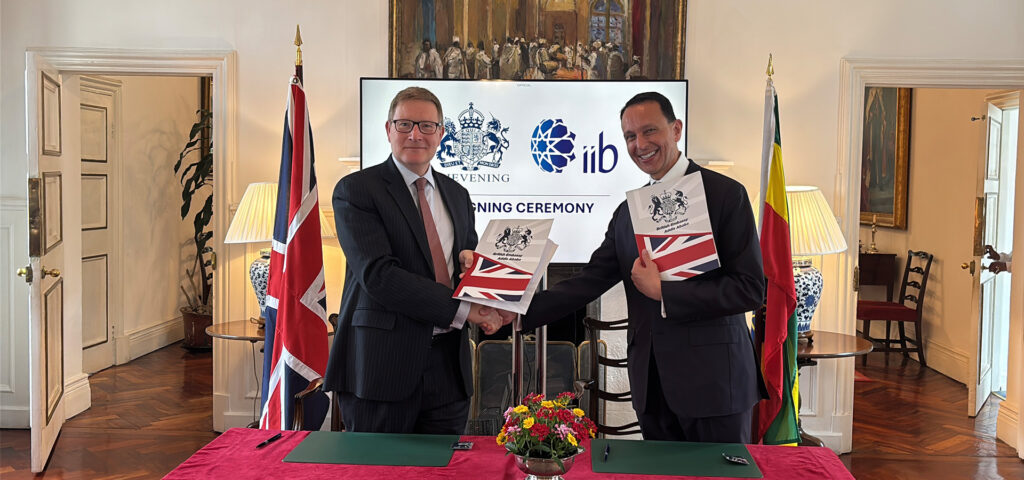
H.E. Darren Welch, UK Ambassador to Ethiopia & Permanent Representative to the African Union, and Sohail Sultan, Chairman of iibGroup at the signing ceremony for the Chevening Scholarship partnership in Addis Ababa.
Mobilising Capital for High-Impact Projects
Beyond trade finance, iib is mobilising capital at scale through structured sustainable finance initiatives.
A significant development is a pipeline of approximately US$72.5 million, comprising a planned US$30 million social bond programme, a US$25 million Green Bond, and a US$17.5 million Blue Carbon programme.
The social bond programme is designed to finance high-impact projects including affordable housing, regional food security, essential infrastructure for telecommunications, education and healthcare, and capital for ESG-aligned SMEs.
The Green Bond will improve the energy efficiency of industrial and logistics SMEs.
Meanwhile, the Blue Carbon programme will restore 1,675 hectares of mangroves, preserve a further 780 hectares, establish a 400-hectare protective green barrier and target the sequestration of 2 million tonnes of CO₂. And with a projected investment of US$17.5 million and an expected IRR exceeding 20%, it demonstrates how sustainable finance can generate both commercial returns and measurable environmental outcomes.
Expanding into Ethiopia
By establishing a Representative Office in Addis Ababa, iibGroup has taken an important step in extending this model into one of Africa’s largest and most promising markets.
This expansion supports iib’s strategy of operating as a regional financial intermediary, facilitating cross-border trade, investment and capital flows between East Africa and international markets.
Backed by a robust correspondent banking network of more than 30 relationships across Ethiopia and the wider region, the bank provides trade finance, structured trade, cross-border payments, foreign exchange settlement, liquidity management and risk participation solutions.
Through its presence in Djibouti and Ethiopia, iib is positioned to connect local businesses with international capital while supporting trade, infrastructure and private-sector growth across the corridor, reinforcing its role as a regional connector.
Driving Social Impact Beyond Financing
In frontier markets, sustainable finance extends beyond balance sheet activity. iib East Africa complements its financing activities with direct community engagement that promote inclusive growth.
In 2025, this included:
Food distribution initiatives targeting vulnerable communities.
Literacy programmes and education support.
Environmental campaigns including beach clean-ups and tree planting.
Health awareness initiatives, including breast cancer awareness programmes.
Additionally, the bank is financing a housing project in partnership with Qatar Charity, involving the construction of 79 houses, plus a mosque and Islamic academic centre, representing a total investment of approximately US$500,000.
These initiatives reinforce the principle that sustainable finance should create both institutional and community impact.
A Model for Sustainable Banking in Frontier Markets
As East Africa’s financial systems continue to evolve, banks are becoming active enablers of economic development rather than just financial intermediaries.
iibGroup’s approach – anchored in ESG integration, trade facilitation and capital mobilisation – demonstrates how sustainable banking can be implemented effectively in frontier markets. By aligning financial performance with measurable impact, the bank is contributing to the development of a more resilient, inclusive and interconnected regional economy. Along the Ethiopia–Djibouti corridor, this model is not only relevant; it is essential.
There’s this idea in social media that you’re supposed to choose a lane. Either you grow “purely organic”, patiently waiting for the algorithm to reward you, or you automate everything and turn your account into some kind of growth machine that runs without you.
In reality, nobody who actually tries to grow an account long-term sticks to either extreme.
Pure organic growth is slow enough to make you question whether anything is happening at all. Pure automation without real content is just noise with extra steps.
Most accounts that survive past the first few months end up somewhere in between, even if nobody says it out loud.
Stay ahead of the geopolitical week.
MD Briefing delivers expert analysis across five global fronts — the Indo-Pacific, energy, geoeconomics, European security, and the Middle East — every Monday morning. Free.
Where automation actually fits in
When people hear “automation”, they still imagine spam bots or engagement farms from years ago. That’s not really what we’re talking about anymore.
Used properly, automation isn’t about replacing activity. It’s about smoothing out the worst part of it – posting something decent and watching it sit at zero for hours because the algorithm didn’t pick it up.
That initial silence is where a lot of good content dies. Not because it’s bad, but because nothing happens around it early enough.
Automation in this context is just early support. A bit of initial visibility, some signal that the post isn’t completely invisible, enough to get it into circulation instead of letting it sink immediately.
Why organic alone stops scaling
Organic-only accounts usually hit the same pattern. At the beginning, everything feels like progress. A few posts perform, you get your first audience, and there’s a sense that things are starting to move.
Then it slows down. Not dramatically, just quietly. You keep posting, improving, adjusting – but the results stay in the same range. It’s not that the content gets worse. It’s that platforms don’t scale reach in a predictable way.
That’s usually where frustration starts. Not failure, just repetition. You’re doing the same work, but the outcome doesn’t change much. And that’s a difficult place to stay in for long.
Why automation alone also fails
On the other side, accounts that rely only on automated promotion usually run into a different problem. They can create activity, they can push numbers, they can make a profile look alive. But without real content behind it, there’s nothing for people to actually connect to.
No point of view, consistency and reason to follow.
People notice that, even if they don’t consciously analyze it. An account can look active and still feel empty. Automation can amplify reach, but it can’t replace identity.
The middle layer: where growth actually happens
The more stable setups usually combine both sides. Organic content is responsible for the actual message – what the account stands for, what it’s trying to say, why it exists in the first place.
Automation supports distribution – making sure that message doesn’t get lost immediately after it’s published. They solve different problems:
organic answers what is being communicated;
automation answers whether anyone is actually seeing it.
Most accounts struggle because they only solve one of those properly.
The psychology of perceived activity
There’s also a simpler factor that often gets ignored: perception. People don’t evaluate accounts in isolation. They compare them instantly to everything else in their feed.
An account with visible engagement feels more established. Not because people sit and analyze metrics, but because inactivity is noticeable.
Good content with no traction creates hesitation. Not rejection – just a pause. And on social media, hesitation is usually enough for someone to move on.
Adding early visibility reduces that friction. It makes the account feel like it already exists in circulation, not like it’s still trying to get noticed.
How teams actually use this mix
In practice, most teams don’t frame this as theory. They just build a workflow.
Organic content is used for messaging, storytelling, positioning. That part doesn’t change.
Promotion, including automated support, is used when something deserves more reach than it would naturally get in the first hour or two.
Some posts are left alone, some are boosted, while others are tested and dropped. It’s less about forcing outcomes and more about not letting good content disappear by default.
Services like Top4SMM are often used in that layer – not as a replacement for marketing, but as a way to stabilize visibility when organic reach is unpredictable. If you want to compare options, you can see details.
Why consistency beats intensity
A common mistake is treating growth like a short-term push. People post more, experiment harder, try to “fix” the algorithm in a week or two – and then step back when nothing changes immediately.
What actually works is much less dramatic. Steady output. Steady distribution. No spikes needed.
When both sides are consistent, results start compounding. Slowly at first, then more noticeably over time.
Final thoughts
There isn’t really a pure way to grow on social media anymore. Organic alone struggles with reach. Automation alone struggles with meaning.
The accounts that keep growing are the ones that combine both – content that actually says something, and distribution that makes sure it doesn’t disappear on impact.
Everything else mostly comes down to hoping for timing to behave like a strategy.
Chinese stocks advanced after fresh manufacturing data pointed to sustained factory expansion and President Xi Jinping reaffirmed his commitment to promoting high-quality economic development. The upbeat market reaction reflected growing optimism over the resilience of China’s industrial sector and the continued strength of technology and innovation-driven industries.
However, investor sentiment remains tempered by concerns over uneven economic growth, with persistent weakness in consumer confidence, the labour market and the property sector continuing to weigh on the broader recovery.
Strong factory activity boosts market confidence
China’s manufacturing sector expanded for a seventh consecutive month, marking its strongest quarterly performance since late 2020. The data reinforced expectations that industrial production remains a key pillar of economic growth despite ongoing challenges in other parts of the economy.
Stay ahead of the geopolitical week.
MD Briefing delivers expert analysis across five global fronts — the Indo-Pacific, energy, geoeconomics, European security, and the Middle East — every Monday morning. Free.
The stronger-than-expected factory activity provided investors with reassurance that export-oriented manufacturing and industrial output continue to support China’s recovery.
Xi reiterates commitment to high-quality growth
President Xi Jinping renewed his pledge to pursue high-quality development, signalling that Beijing remains committed to an economic strategy centred on technological innovation, industrial upgrading and sustainable long-term growth.
The remarks reinforced expectations that policymakers will continue prioritising advanced manufacturing, strategic industries and innovation rather than relying solely on traditional stimulus measures to support the economy.
Technology sectors continue to outperform
Technology-related stocks led gains as investors increased exposure to sectors expected to benefit from China’s industrial and technological ambitions. Chipmaking equipment, biotechnology and software companies posted strong advances, reflecting continued confidence in industries viewed as central to China’s long-term economic transformation.
The rally highlights investors’ preference for sectors with stronger earnings potential and policy support.
Traditional sectors show signs of broader participation
Alongside technology stocks, gains also spread to agriculture and property-related shares, suggesting investor optimism is gradually broadening beyond high-growth industries.
Although these sectors continue to face structural challenges, their recovery indicates improving market sentiment and expectations that policy support could help stabilise weaker areas of the economy.
Economic recovery remains uneven
Despite encouraging manufacturing data, investors remain cautious about China’s broader economic outlook. Consumer spending continues to be constrained by weak confidence, labour market pressures and the prolonged downturn in the property sector, creating an uneven recovery across different parts of the economy.
The divergence between strong industrial performance and softer domestic demand continues to shape investment strategies and policy expectations.
Future Outlook
Chinese markets are likely to remain supported by resilient manufacturing activity, continued policy backing for innovation and expectations of further measures to sustain economic growth. However, the durability of the rally will depend on whether improvements in industrial production translate into stronger domestic consumption and broader economic recovery.
Investors will closely monitor upcoming economic data and government policy announcements for signs that Beijing can address persistent weaknesses in the property market, employment and consumer confidence while maintaining momentum in high-value manufacturing and technology sectors.
The S&P Global Japan Manufacturing PMI was revised slightly lower to 54.8 in June 2026 from 54.9 in the preliminary estimate. However, the reading comfortably beat May’s 54.5 and marked the sixth consecutive month of expansion, driven by accelerating output and new orders.
Hyunjoon Kwon, director general for aerospace policy at the Korea AeroSpace Administration, speaks during an interview with Asia Today on Friday. Photo by Asia Today
June 30 (Asia Today) — South Korea is seeking to connect the growth of its commercial space industry with stronger national security capabilities as emerging technologies blur the boundaries between the private and public sectors.
The expansion of security concerns into space, drones and artificial intelligence has increased the importance of the Korea AeroSpace Administration, which is responsible for developing the country’s aerospace industry.
The agency is working with the National Intelligence Service and other government organizations on satellite cybersecurity and broader aerospace security policies.
Hyunjoon Kwon, director general for aerospace policy at the agency, told Asia Today in an interview Friday that space is no longer solely a scientific field.
“Space has moved beyond science to become a domain that can affect both security and industry,” Kwon said. “We need a mutually reinforcing relationship between the market and the public sector.”
Asked how the global space security environment is changing, Kwon said competition is no longer limited to the number of satellites a country possesses.
“The key question is how reliably a country can use and protect satellite communications and satellite imagery,” he said.
Space-based services have been used directly in military operations and critical national infrastructure since the start of the Russia-Ukraine war, Kwon said.
Countries also face increasingly complex threats, including GPS jamming and spoofing, disruptions to satellite communications, cyberattacks and the collision or uncontrolled reentry of objects in space.
Kwon said the agency is developing a national space situational awareness system to strengthen South Korea’s ability to monitor and predict space-related risks.
It is also preparing a cybersecurity response framework to protect space-based services used by the private sector, government and military.
South Korea has rapidly accumulated capabilities in launch vehicles, satellite development and satellite data applications, Kwon said. Its military space capabilities have also expanded.
However, the country still needs to strengthen its domestic production of critical materials, components and software, he said.
Other areas requiring improvement include space situational awareness, satellite cybersecurity and the creation of a sustainable commercial market for space services.
“That is why the growth of private space companies and greater independence in core technologies are becoming even more important,” Kwon said.
Cooperation among the private sector, government and military has entered a stage of institutional development since the establishment of the Korea AeroSpace Administration, he said.
The cooperative channels include a future defense science and technology policy council with the Defense Ministry, an aerospace project memorandum with the Defense Acquisition Program Administration and a satellite cybersecurity consultative body with the National Intelligence Service.
Kwon said the cooperation now extends beyond individual projects to include policy, technology and security.
The agency is seeking to create a structure in which private-sector technology is connected to government and national security requirements, while public and defense demand supports the growth of commercial companies.
Kwon also discussed the government’s recently announced strategy to foster innovative companies in emerging security industries.
“Aerospace is a strategic field that influences both security and industry, extending beyond the boundaries of science and technology,” he said.
Satellite communications, satellite data, unmanned aircraft and space materials and components have significant commercial growth potential while also meeting direct security needs, Kwon said.
The agency plans to focus on establishing a cycle in which the creation of new industries strengthens national security capabilities and security demand encourages further technological innovation.
The plans include developing core technologies for a space data center under the K-Moonshot initiative and building a national platform that will make satellite information available for broader use.
The agency also plans to develop artificial intelligence-powered unmanned aircraft and electric or hybrid vertical takeoff and landing aircraft.
MANCHESTER, England — Andy Burnham, likely the next U.K. prime minister, pledged Monday to give away a chunk of his power by handing greater autonomy to local leaders in a “circuit-breaker” for the sclerotic British state.
The former mayor of Greater Manchester also said he would move part of the prime minister’s office from London’s 10 Downing St. to northwest England as part of “the biggest rebalancing of power our country has seen.”
“Growth cannot be ordered from the top down. Instead, it can only be nurtured from the bottom up,” Burnham said in a speech aimed at bringing voters, Labour Party colleagues and financial markets up to speed with his economic vision.
Burnham is the strong favorite to replace Prime Minister Keir Starmer, who announced his resignation last week.
“If councils can’t fix potholes, what chance do they have of bringing forward major regeneration schemes to get growth going?” Burnham said. He set out a 10-year plan to get “good growth in every postcode,” in a country where wealth and power are concentrated in London and the south of England.
He said he would reverse almost two decades of low growth since the 2008 financial crisis through an approach dubbed “Manchesterism” — harnessing private and public money to invest in areas like transport, housing and infrastructure. He also pledged to create new industrial jobs and better educational opportunities, and to reform the U.K.’s inefficient and expensive privatized water and energy utilities.
Moving the new ‘No. 10 North’ to Manchester
During the speech at the People’s History Museum in the city where he spent nine years as mayor, Burnham said a new government office in Manchester – dubbed “No. 10 North” — would oversee regional development and become “the nerve center of a rewired Britain,” tasked with equalizing living standards across the country. Regional mayors would get more power over housing, welfare and education as part of his planned reforms.
Burnham’s rousing speech was short on specifics about where the government would find more money, and he didn’t take questions from journalists.
Burnham won praise for his role in revitalizing and regenerating Manchester, but he has not served in a U.K. government for almost two decades, and may struggle to replicate “Manchesterism” on a U.K.-wide scale.
The Institute for Public Policy Research, a left-leaning think tank, said Burnham is right to focus on “rebalancing Britain.”
“The U.K.’s concentration of power and opportunity in Westminster has held back growth, productivity and living standards for too long,” said IPPR Executive Director Harry Quilter-Pinner. “The real test now is delivery.”
Matthew Flinders, a politics professor at the University of Sheffield, said replicating Burnham’s Manchester approach on a national level would require “a fundamental shift” in the way politics is done in Britain.
“And at the heart of that would be moving from a very traditional, elitist, centralized model of politics toward something that is in many ways far more European, far more based on power-sharing in order to develop long-term policymaking capacity,” he said.
Burnham is likely to inherit Starmer’s challenges
Burnham will be aware that Starmer also announced a 10-year mission — the equivalent of two full terms in government —- to transform Britain soon after he was elected in a landslide in July 2024. Starmer is leaving after two years in office marred by missteps and judgment errors that eroded his standing with his party and the public.
Burnham won a special election for a seat in Parliament on June 18 and was sworn in as a lawmaker on June 22, the same day Starmer announced that he will resign as soon as a successor is chosen.
Burnham is so far the only contender in the Labour Party leadership contest. If no one challenges him, he will become prime minister by July 20.
While Burnham is considered more charismatic than the stolid Starmer, he will face many of the same political and economic challenges, including a sluggish economy, tattered public services and a cost-of-living squeeze. He will also be constrained by the platform the center-left Labour Party was elected on in 2024, with its pledges not to increase taxes on working people.
And like other NATO countries, the U.K. is under pressure to dramatically increase defense spending to counter a more aggressive Russia and less reliable United States.
The government’s long-awaited defense investment plan — which sparked the resignation of Defense Secretary John Healey on June 11 — is expected to be published before a NATO summit in Turkey on July 7 and 8. Starmer’s successor will be expected to stick to the commitments in the plan.
“Andy Burnham’s big idea is to shuffle power between politicians,” said opposition Conservative Party Chairman Kevin Hollinrake. “Not fix the welfare system. Not cut the taxes strangling working families and British business. Not fund the defense our country desperately needs.”
Grant and Lawless write for the Associated Press. Lawless reported from London. AP writer Brian Melley contributed to this report.
Consumer discretionary stocks remain in focus as companies navigate shifting consumer spending, travel demand, e-commerce growth, and evolving economic conditions across retail and leisure markets.
In light of this, below is a list of the top S&P 500 Consumer Discretionary holdings
“We successfully launched as a stand-alone LTL carrier,” and “on June 1, we proudly rang the opening bell at the New York Stock Exchange, officially marking our debut as a
Seeking Alpha’s Disclaimer:This article was automatically generated by an AI tool based on content available on the Seeking Alpha website, and has not been curated or reviewed by humans. Due to inherent limitations in using AI-based tools, the accuracy, completeness, or timeliness of such articles cannot be guaranteed. This article is intended for informational purposes only. Seeking Alpha does not take account of your objectives or your financial situation and does not offer any personalized investment advice. Seeking Alpha is not a licensed securities dealer, broker or US investment adviser or investment bank.
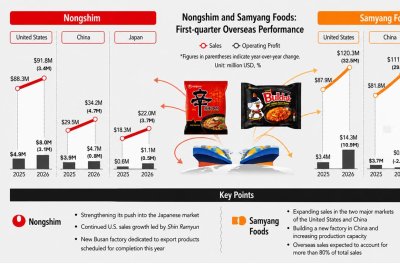
An infographic compares Nongshim and Samyang Foods’ first-quarter sales and operating profits in the United States, China and Japan, highlighting the companies’ differing overseas growth strategies. Data from Financial Supervisory Service and the companies. Infographic by Asia Today and translated by UPI
June 23 (Asia Today) — South Korea’s two leading instant-noodle makers posted sharply different results across major overseas markets during the first quarter, with Samyang Foods growing rapidly in the United States and Nongshim generating steadier profits in China and Japan.
Samyang Foods recorded U.S. sales of 185.3 billion won ($120.3 million) during the first three months of the year, up 37% from the same period in 2025, according to industry data released Tuesday.
Its U.S. operating profit jumped 325% to 22 billion won ($14.3 million).
Nongshim posted U.S. sales of 141.3 billion won ($91.8 million) and an operating profit of 12.3 billion won ($8 million) during the same period.
Samyang’s growth was driven primarily by the continued popularity of its spicy Buldak brand and the expansion of its distribution network.
The company has increased the number of its products sold through Walmart, Costco and other major U.S. retailers. Sales of products tailored to local preferences, including Buldak Mac and Cheese and Buldak Ramen Habanero Lime, have also increased.
“The distinctive flavor and concept of the Buldak brand are giving us a competitive advantage in the U.S. market,” a Samyang Foods representative said.
The company plans to expand its presence in North America by strengthening the brand and increasing distribution through large retailers, the representative said.
Nongshim is also seeking a larger share of the North American market through Shin Ramyun and its expanding line of stir-fried noodles.
The company has improved its production and logistics efficiency by raising operating rates at its factories near Los Angeles. Its products also continue to generate steady sales through Walmart, Costco and other major retailers.
The competitive picture was different in China, where Nongshim recorded more stable profitability despite generating considerably less revenue than Samyang.
Nongshim’s Chinese operations reported first-quarter sales of 52.7 billion won ($34.2 million), up 16% from a year earlier. Operating profit rose 20% to 7.2 billion won ($4.7 million).
The results were supported by continued demand for Shin Ramyun, Chapagetti and Neoguri.
Samyang generated much higher sales in China but experienced a steep decline in profit.
Its first-quarter Chinese sales rose 36% to 171.3 billion won ($111.2 million), while operating profit fell 77% to 1.3 billion won ($844,000).
Industry analysts attributed the decline to Samyang’s reorganization of its distribution partners and inventory remaining after weaker-than-expected sales during China’s Singles’ Day shopping festival last year.
Samyang said it remains committed to long-term growth in China.
The company plans to strengthen Buldak’s brand position while expanding beyond instant noodles into products such as sauces and air-dried noodles.
Samyang is also constructing a factory in Jiaxing, Zhejiang province. It recently expanded the planned number of production lines at the plant from six to eight.
The Jiaxing factory is scheduled to begin operating in 2027. Samyang expects local production to improve manufacturing and distribution efficiency in China.
Nongshim also delivered stronger profitability in Japan.
Its Japanese subsidiary recorded first-quarter sales of 33.9 billion won ($22 million), up 20% from a year earlier. Operating profit increased 75% to 1.66 billion won ($1.1 million).
The company’s performance was supported by growing recognition of Shin Ramyun and improved bargaining power in price negotiations with retailers.
Samyang’s Japanese business recorded sales of 9.9 billion won ($6.4 million), an increase of 34%, but operating profit fell 31% to 240 million won ($156,000).
Marketing expenses and initial investments associated with expansion into convenience stores, Don Quijote and Costco weighed on profitability, according to industry analysts.
The results suggest that the rivalry between the two companies is developing differently in each region.
Samyang is using the global recognition of Buldak to drive rapid growth in North America, while Nongshim is building a more stable earnings base in China and Japan through established products led by Shin Ramyun.
Both companies are expanding production capacity as global demand for Korean instant noodles continues to grow.
In addition to Samyang’s Jiaxing factory, Nongshim is constructing an export-only plant at the Noksan National Industrial Complex in Busan.
Nongshim plans to complete the factory and begin production during the second half of the year. The facility is expected to become a major base for expanding the company’s global supply capacity.
“Success in overseas food markets depends not only on brand strength but also on production capacity, distribution networks and a stable supply system,” a retail industry official said.
“Samyang is currently showing strong growth in North America, but Nongshim is also expanding production and strengthening its localization strategy,” the official said. “Competition in the global market will become more intense.”
In contrast to heat pumps, continuing record sales of electric cars indicate they are all but set to replace their petrol and diesel counterparts in the coming years on UK roads.
Emma Pinchbeck, CEO of the Climate Change Committee, praised the improvement in greener transport.
“We’ve made big progress on things like electric vehicles, where one in four cars being bought in the UK today is now an EV.”
She said the growth had been accelerated by the Iran fuel crisis, which has seen significant increases in petrol and diesel prices at the pump pushing people to seek out other options.
“We can see in the numbers what people want – cheap cars and cars that will save them money, particularly as fossil fuels are volatile,” she said.
But the industry body, Society of Motor Manufacturers (SMMT), said most of this demand had been brought about by huge discounts offered by car manufacturers.
“This has cost the industry more than £10 billion since 2024 – an unsustainable amount when that money should be going into R&D, manufacturing and the workforce,” said Mike Hawes, CEO of SMMT.
It supported the government’s plan to weaken its Zero Emission Vehicles (ZEV) mandate – which sets a target for number of EVs manufacturers produce and a penalty for failing to meet that target.
The UKCCC disagreed and urged the government to keep the policy.