Germany

‘Clearly stronger’: Germany’s Merz says Iran ‘humiliated’ US in its war | Conflict News

German chancellor warns the US risks becoming bogged down in another quagmire similar to Iraq and Afghanistan.

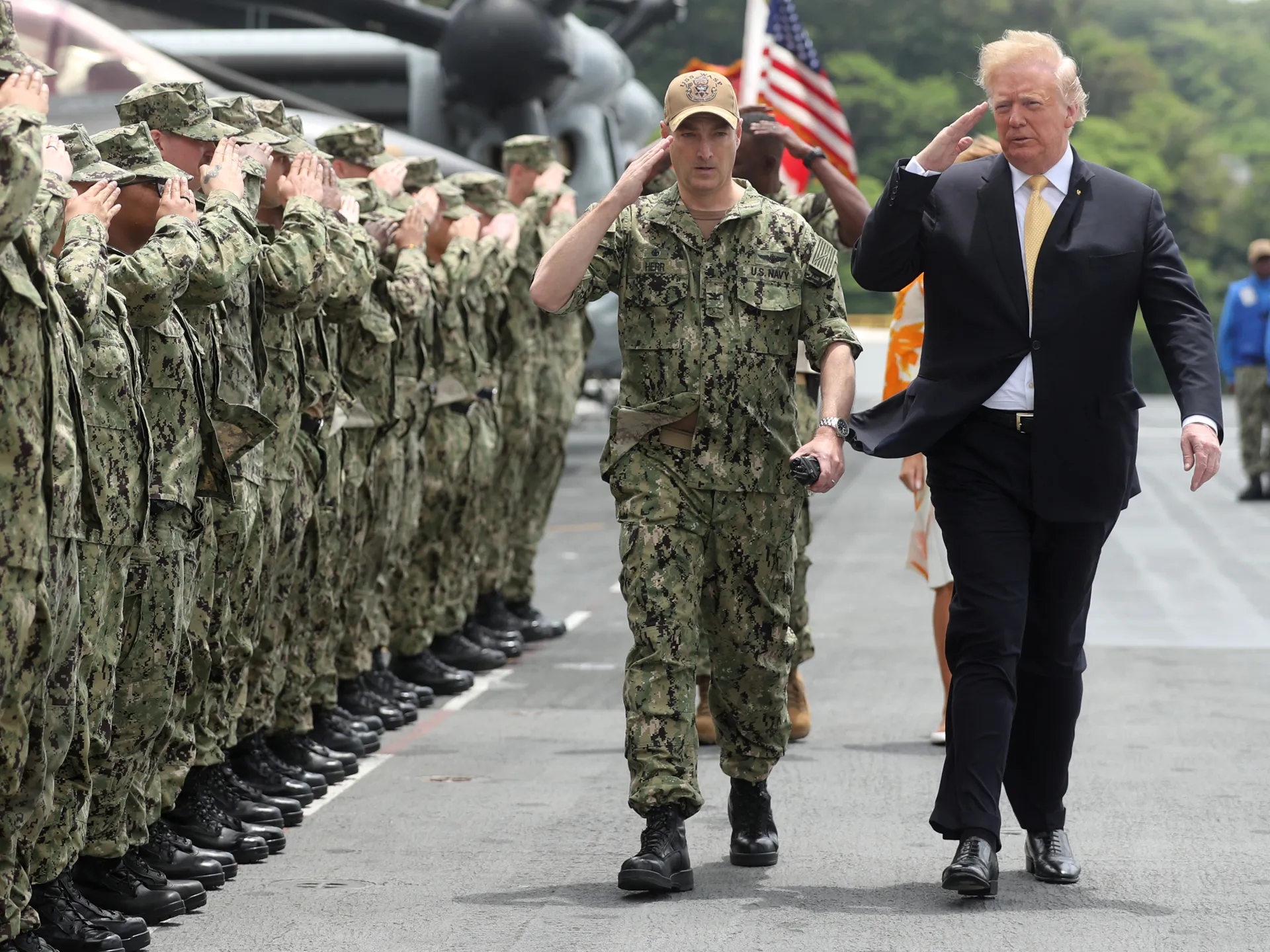
German Chancellor Friedrich Merz says the United States is being “humiliated” in its war with Iran, warning that Washington lacks a clear path out of the conflict as Tehran gains the upper hand.

Speaking to students in the German town of Marsberg on Monday, Merz said the situation has exposed a deeper strategic problem for the US as he drew comparisons with past military debacles.

Recommended Stories

list of 3 itemsend of list

“The problem with conflicts like this is always you don’t just have to get in – you have to get out again. We saw that very painfully in Afghanistan for 20 years. We saw it in Iraq,” he said.

Merz said Iranian officials were “obviously negotiating very skilfully” and appeared “clearly stronger than one thought”, adding that “an entire nation is being humiliated by the Iranian leadership”, particularly by the Islamic Revolutionary Guard Corps.

Merz urged a rapid end to the war, warning that the fallout was already hitting Germany’s economy.

“It is, at the moment, a pretty tangled situation,” he said. “And it is costing us a great deal of money. This conflict, this war against Iran, has a direct impact on our economic output.”

The German leader said Berlin remains ready to deploy minesweepers to help secure shipping routes through the Strait of Hormuz, a vital artery for global petroleum supplies, but stressed that such steps depend on a cessation of hostilities.

Merz made the comments as concerns are growing across Europe over the wider impact of the conflict, including energy disruptions and economic instability.

Earlier, German Foreign Minister Johann Wadephul warned that nuclear threats continue to shape the security environment, even as Berlin reaffirmed its commitment to nonproliferation.

“As long as nuclear threats against us and our partners continue, we will need a credible deterrent,” he said before meetings at the United Nations on the Treaty on the Non-Proliferation of Nuclear Weapons.

France and Germany have recently moved to deepen cooperation on nuclear deterrence, reflecting mounting anxiety in Europe over both the Iran war and broader regional instability.

Source link

‘Amrum’ review: Director Fatih Akin delivers complex coming-of-age tale

The best coming-of-age stories derive their power from being endings as much as beginnings. There’s often a clarifying, poignant harshness in the losses they depict. That applies — with sobering grace — to the memory ballad “Amrum,” set on Germany’s titular North Sea island in 1945, when the winds of a world war’s conclusion blow into a 12-year-old boy’s life with unexpected consequences.

The movie bears a curious credit: “A Hark Bohm film by Fatih Akin.” Bohm, who died last year at 86, was a highly respected film writer, actor and academic, a veteran of Germany’s New Wave. Realizing he’d be unable to direct his fictionalized childhood remembrance, he entrusted it to his mentee Akin, the firebrand behind modern German classics such as “Head-On” and “In the Fade.” The project became, according to Akin, like “adopting a child.”

In story terms, that child, a stand-in for Bohm himself, is wide-eyed, sensitive Nanning (well-cast newcomer Jasper Billerbeck), who works in the potato fields of local farmer Tessa (Diane Kruger, in a small but key role). At home, he has a pregnant mother, Hille (Laura Tonke), aunt Ena (Lisa Hagmeister) and two younger siblings, but not the high-ranking Nazi officer patriarch who relocated them from bombed-out Hamburg to an ancestral house on this tiny, beachy outpost. Pejoratively dubbed a mainlander by even the friendliest neighbors and generally viewed with suspicion for his family’s Nazi ties, Nanning is assured by his ideology-soaked mom that their roots, their “bloodline,” make them real Amlumers.

The boy’s first real lesson in the shifting sands comes when, at dinner, he remarks that the war will soon be over, intending it as good news — Dad could come home. Yet his mother reacts as if he’d sided with the enemy by wishing defeat. Later, with the news of Hitler’s demise, she sinks into a depression, refusing food unless it’s white bread, butter and honey, all in scarce supply. So Nanning sets out to secure her the necessary ingredients, as if the fabric of his world depends on it.

What follows is a tightly told fable-like journey built around the war-battered realities of survival when everyone’s tired, hungry and irritated. There are brutal truths in store for Nanning about what his family represents. It’s an evolving boyhood, framed with unshowy elegance by cinematographer Karl Walter Lindenlaub against the island’s flat, grassy, weather-rich horizons. “Amrum” avoids the sentimentality baked into so many childhood-during-wartime stories. Akin, as if inspired by the unfussy youthfulness that marked Italian neorealism and the New Waves in both France and Iran (there are shout-outs to “Bicycle Thieves” and “The 400 Blows”), zeroes in on the steady accumulation of detail rather than the trappings of cuteness or melodrama.

That measured approach, exemplified in star Billerbeck’s arresting simplicity and the many fine supporting turns around him, allows us to clock Nanning’s growing awareness of what matters to others, what’s impossible to ignore and how to interpret an unjust world that’s still full of beauty and kindness if you know where to look. Which, of course, includes inside himself.

Near the end, “Amrum” serves up a wonderfully understated moment: Nanning is invited to celebrate the war’s end with a small group of dancing, drinking islanders. He hangs back, though, as if not quite ready to choose their joyous relief over obediently tending to his broken family. But you can see this dutiful son’s wish to be one of them. For all of us wondering when an ugly time will fade, the moment will resonate like a cautious, dawning hope.

‘Amrum’

In German, with subtitles

Not rated

Running time: 1 hour, 33 minutes

Playing: Opens Friday, April 24 at Laemmle Royal and Laemmle Town Center, Encino

Source link

Spain airport delays update as one group hit with longest waits over April ‘change’

Many passengers are facing waits of up to three hours at Spanish airports due to the new controls

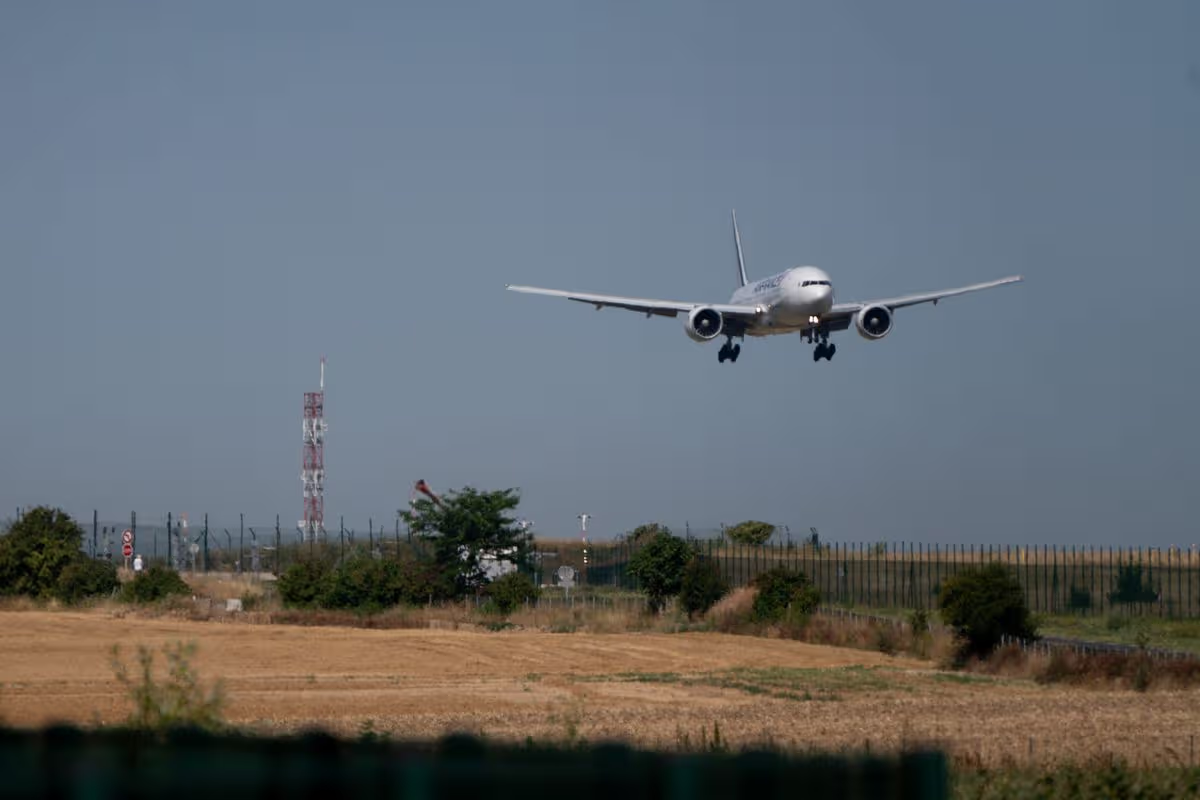
Travellers in Spain are experiencing significant delays at airports. And experts are warning that one particular group is bearing the brunt of new border controls, according to a Spanish travel organisation.

There have been widespread reports of waiting times of up to three hours. New regulations have been introduced, with some passengers in particular facing very long waits.

Spanish media reports indicate waiting times of up to three hours at Palma airport alone, with similar delays reported in France, Greece, Italy and beyond. Travel group Aviba is now calling for urgent measures to prevent chaos this coming summer.

Pedro Fiol, president of the travel association, is demanding immediate action to avert disruption this summer, and has revealed he has been pushing for such measures for months, according to Ultimata Hora. The new system has only just been introduced, having fully launched on April 10, following a trial period that began late last year.

The EU’s new Entry/Exit System (EES) initially began operations on 12 October 2025, with a phased rollout across 29 European countries. Now it is fully in place.

The system replaces passport stamping with digitally recorded entries, exits or refusals of entry of non-EU nationals arriving for short stays. Travellers’ facial images, fingerprints and personal data from the travel document will also be recorded.

Mr Fiol said: “The implementation of the new European Border and Security System (EES) is already beginning to be felt at the Balearic airports, especially at Son Sant Joan, the main gateway to Mallorca, where we are still operating with a hybrid model. At certain times, it is causing some slowdowns in the controls, particularly for non-EU passengers.”

He warned that “we are facing a structural change in how borders are managed across Europe: biometric registration is replacing manual passport stamping, and this means more time for the passenger’s first contact with their destination.” In his view, so far “the experience has been inconsistent: some days the operation runs relatively smoothly, while others, according to agencies and tour operators, can take more than two hours from the moment the plane lands until the traveller collects their luggage, and even nearly three hours in some specific cases.”

Ultima Hora reports that the National Police have acknowledged the delays, though they say they have seen no evidence of prolonged hold-ups. Sources close to the security forces have told Spanish media that additional staff have been deployed during peak hours in a bid to ease any difficulties that may occur during periods of heavy passenger congestion at checkpoints.

Travellers passing through airports in countries including France, Germany, Belgium, Italy, Spain and Greece are facing waits of several hours at border controls, according to the Airports Council International (ACI). Olivier Jankovec, the director of the ACI European division, told the Financial Times: “This situation, in the coming weeks and certainly over the peak summer months, is going to be simply unmanageable.

“We are seeing those queueing times now, at peak times, when traffic is just starting to build up.” A spokesperson for the European Commission told the Guardian: “What we can see from the first days of full operation is that the system is working very well. In the overwhelming majority of member states there are no issues.”

The commission said that the average registration of a passenger was 70 seconds, although the ACI has claimed that it can take up to five minutes. The spokesperson said there were a “few member states where technical issues have been detected” but that they “are being addressed”.

They said: “It is up to member states to ensure the proper implementation of the EES on the ground.” Luke Fitzpatrick, from independent travel agency Perfect Getaways, told the BBC this week that travellers should plan ahead to make border checks as smooth as possible.

“It’s about being as prepared as you can be,” Fitzpatrick told BBC Radio Merseyside. “There is a lot of uncertainty at the moment as people are getting used to the new system.”

While he said the advice was to arrive at the airport “at least three hours early”, he said it could be more difficult for people booked on a package holiday. “If you’re on a shared transfer back, everyone’s coming together at the same time,” he said.

EES changes and the impact on transfer and pick-ups

Pedro Fiol told Ultima Hora that “this situation is forcing a restructuring of transfer and pick-up operations at destinations to better co-ordinate exact times, avoid additional downtime, and guarantee the smoothest possible service.” Given this situation, he says that “travel agencies are concerned that if resources are not properly allocated at airports with such high tourist pressure as those in the Balearic Islands, significant queues and a negative first experience for visitors are possible.”

What do Brit tourists need to do with EES rules?

The govuk website states that “if you are travelling to a country in the Schengen area for a short stay using a UK passport, you may be required to register your biometric details, such as fingerprints and a photo, when you arrive. You do not need to take any action before you arrive at the border, and there is no cost for EES registration.

“EES registration is replacing the current system of manually stamping passports when visitors arrive in the EU. EES may take each passenger extra time to complete so be prepared to wait longer than usual at the border.”

The countries in the Schengen area are: Austria, Belgium, Bulgaria, Croatia, Czechia, Denmark, Estonia, Finland, France, Germany, Greece, Hungary, Iceland, Italy, Latvia, Liechtenstein, Lithuania, Luxembourg, Malta, Netherlands, Norway, Poland, Portugal, Romania, Slovakia, Slovenia, Spain, Sweden, and Switzerland.

Source link

Germany Is Now Airdropping Its Tiny Wiesel ‘Tankettes’

The German military has revealed details of tests in which its tiny Wiesel armored personnel carrier has been airdropped under parachutes from A400M transport aircraft. While the diminutive Wiesel (German for weasel) is already notably mobile, including fitting into a CH-53 helicopter, this appears to be the first time that it has been airdropped, marking an initial step toward a significant new capability for Germany’s airborne forces.

The German Army posted a video showing the airdrop trials, which involved, among others, the German Armed Forces’ Technical and Airworthiness Center for Aircraft (WTD 61) and the 1st Airborne Brigade (Luftlandebrigade 1).

The video shows the tracked Wiesel first being loaded into the hold of an A400M within its ‘cage,’ the ATAX parachute system from the British manufacturer IrvinGQ. The load is then rolled off the aircraft’s rear ramp and descends under three parachutes. Reusable shock-attenuating airbags under the cage provide a softer touchdown. Soldiers then drive the vehicle directly off the pallet, without any significant preparation.

According to the German Army, the aim is to deliver the vehicle within 200 meters (650 feet) of the designated landing zone.

As for the Wiesel, as you can read about here, this vehicle already offers some unique capabilities.

60 Sekunden Bundeswehr: Wiesel thumbnail

60 Sekunden Bundeswehr: Wiesel


The German Army first began development of the vehicle in the 1970s to give added firepower to its airborne units. Initially led by Porsche, work on the project continued after the German Army abandoned its plans for the vehicle in 1975.

Ultimately, the German Army returned to the Wiesel and bought its first batch in 1985, becoming the only country to adopt the type. Rheinmetall took over series production and built more than 340 examples up until 1993. In 2001, Germany purchased around 180 lengthened Wiesel 2s.

In a drive toward simplicity, the Wiesel uses a standard four-cylinder diesel car engine from Volkswagen. The vehicle can reach a top speed of over 40 miles per hour and travel around 120 miles on one tank of gas, which is relatively impressive when you consider its diminutive size.

The Wiesel 1A5 MK vehicle is equipped with a 20mm MK 20 DM 6 A1 autocannon. Bundeswehr

Perhaps the most remarkable feature of the Wiesel is its weight. There are more than a dozen variants in total, and the heaviest of them weighs less than five tons. For comparison, the latest examples of up-armored Humvees weigh around six tons.

The Wiesel’s modest size means two of the standard variants fit inside a CH-53 series helicopter and at least one into a CH-47. Heavy helicopters can carry more slung below their fuselages, too. An A400M typically carries four of the vehicles, but it’s unclear how many can be airdropped by a single A400M, after they have been rigged up.

Considering its capabilities, it is perhaps surprising that Germany has waited so long to test the airdropping of the Wiesel. In fact, until now, the modern German Army has had no means of airdropping vehicles into the theater of operations.

Instead, airborne operations have required paratroopers to first secure landing strips before vehicles can be delivered by tactical transport or heavy-lift helicopter. Until those vehicles arrive, the troops have only limited direct tactical fire support.

With the ability to airdrop the Wiesel, paratroopers and their combat vehicles can be delivered directly to their objective, without the need for any supporting infrastructure. While the Wiesel doesn’t offer the highest level of armor protection, it does at least shield its occupants against shrapnel, rifle, and light machine gun fire. On the other hand, since it was first fielded, it now faces the threat of battlefield drones and loitering munitions, although its small size and maneuverability could help mitigate that threat in some respects. Overall, like all armored vehicles, it would still be vulnerable.

Once on the ground, the Wiesel offers a significant amount of capability for its size. The most common version is a reconnaissance vehicle with a 20mm automatic cannon and a 7.62mm machine gun, more firepower than many American light armored vehicles. Another type packs a Spike anti-tank missile launcher, the Israeli weapon having replaced the earlier TOW anti-tank missile.

The Wiesel 1 MELLS is the version armed with the Spike anti-tank missile and is used by the German Army’s light infantry, mountain infantry, and paratrooper units. Bundeswehr

There is also the Leichtes Flugabwehr System, or Light Air Defense System, which includes a command post Wiesel 2 variant and another one of the vehicles with a small radar. This last component of the system is known as Ozelot, or ocelot, and features a launcher containing four FIM-92 Stinger heat-seeking surface-to-air missiles. This is a level of small, mobile, but still somewhat protected short-range air defense capability that few nations have.

Soldiers reloading an Ozelot vehicle with Stinger missiles. Bundeswehr

Other Wiesel ‘families’ include a mobile mortar section, including a vehicle with a computerized 120mm mortar. There are also different command post versions for unit headquarters, along with ambulances and engineering support types. In the past, there have also been studies for an uncrewed ground combat vehicle variant.

Once again, it’s not clear which of these versions might be cleared for airdropping, considering their different weights, dimensions, and the relative resilience of their equipment.

Should the trials prove successful, the ATAX parachute system would also allow the German Army to airdrop other vehicles. According to the German-language hartpunkt defense publication, these could include the airmobile Caracal, other light utility vehicles as used by both regular forces and special operations units, and uncrewed ground vehicles. Ultimately, airdropping with ATAX would also extend to the Wiesel’s designated successor, now being developed under the Luftbeweglicher Waffenträger, or Airmobile Weapon Carrier program.

These tests come as the German Armed Forces undergo their biggest transformation since the Cold War in response to Russia’s 2022 invasion of Ukraine. As well as increased defense spending, there is a broader attempt to move from a low-readiness, expeditionary force to a high-readiness, territorial military focused on operations on NATO’s eastern flank. With that in mind, these latest airdrop tests for the Wiesel could be the start of a significant new phase for the airborne troops and their capabilities.

Contact the author: thomas@thewarzone.com

Thomas is a defense writer and editor with over 20 years of experience covering military aerospace topics and conflicts. He’s written a number of books, edited many more, and has contributed to many of the world’s leading aviation publications. Before joining The War Zone in 2020, he was the editor of AirForces Monthly.


Source link