The airline has confirmed that the route will be axed at the end of May despite running since 2018, as the price of jet fuel leads to cancellations of a number of flight routes across Europe
15:08, 01 May 2026Updated 15:32, 01 May 2026
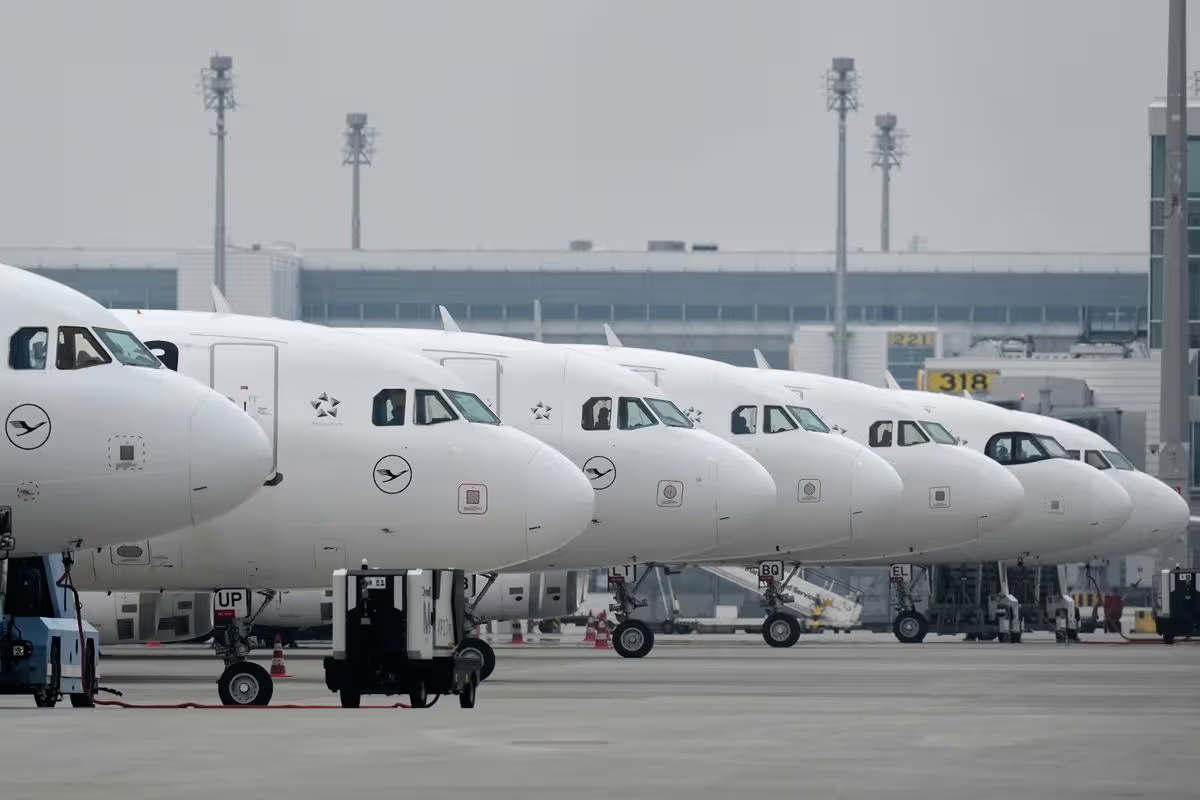
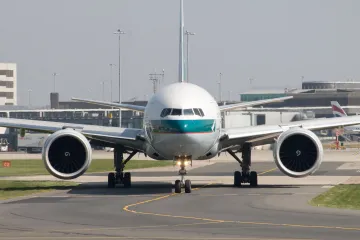
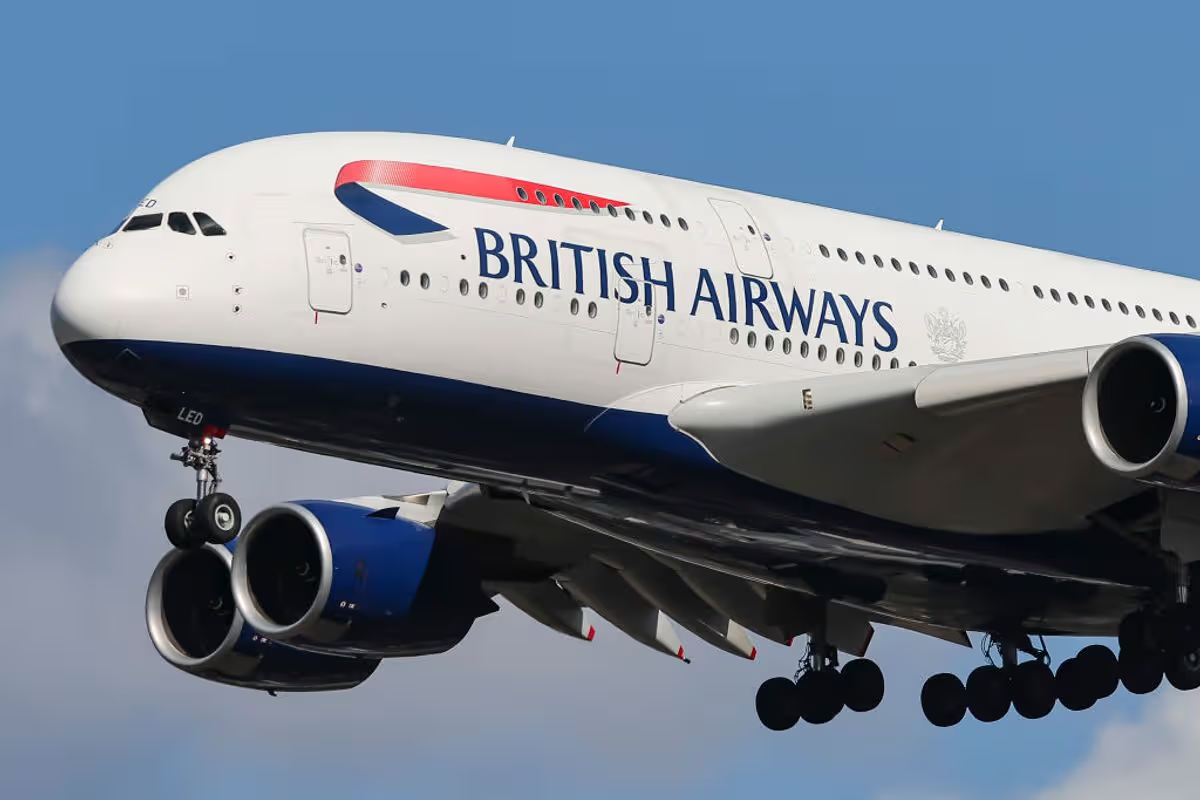
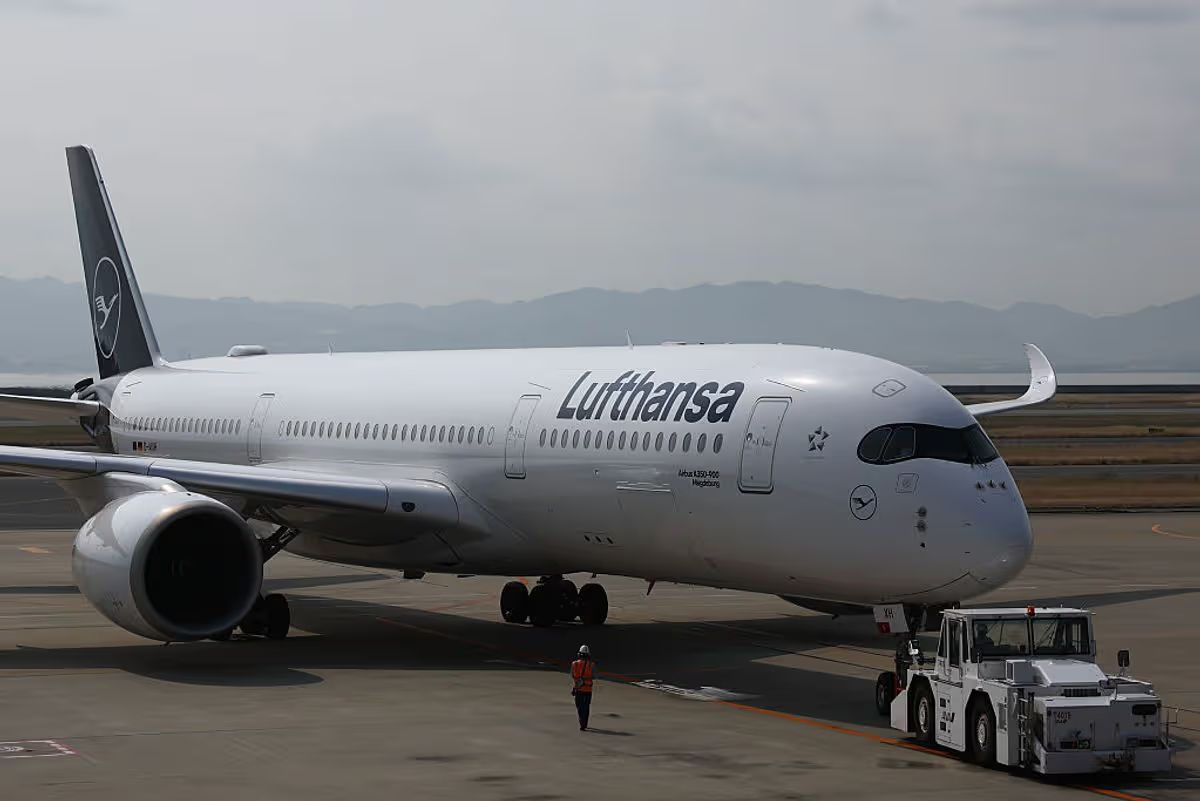
The route was first launched back in 2018(Image: AP Photo/Matthias Schrader)
A major European airline has cancelled a route from the UK that has been running since 2018, and confirmed that it’ll no longer be available to book as of the end of the month.
The move comes as the German airline, one of the largest in Europe, also announced plans to cut 20,000 short-haul flights over the summer as conflict in the Middle East drives up jet fuel prices and has led to fears of shortages.
Lufthansa, the flag carrier airline for Germany, has announced it’ll no longer run its service between Glasgow and Frankfurt, and the last flight between the two cities available to book is on May 31.
A Lufthansa Group spokesman told the Scottish Sun: “Following the decision to discontinue Lufthansa CityLine flights effective immediately and to reduce unprofitable flights in the future due to high kerosene prices, the Lufthansa Group’s summer schedule will be reduced by just under one percent of available seat-kilometers.
“To compensate for this, Lufthansa has taken immediate action and will consolidate the flight schedules of all Lufthansa Group airlines, cancelling 20,000 flights by the end of October. As a result of these decisions, flights to Glasgow will no longer be operated by Lufthansa via Frankfurt, but for the time being, by Edelweiss via Zurich offering access to the Swiss International Air Lines network.”
Lufthansa isn’t the only European airline to cancel flights. Scandinavian airline SAS confirmed it’s cancelling over 1,000 flights after the cost of jet fuel doubled. In the USA, United Airlines announced it would be cancelling 5% of flights in the short term, aiming to restore its full schedule by autumn.
Other airlines are raising prices to try to cover the soaring costs. Virgin Atlantic has said the aviation sector “cannot absorb” jet‑fuel costs at their current levels, forcing them to increase ticket prices.
Corneel Koster, Virgin Atlantic’s chief executive, told the Telegraph: “I was looking at improving our financial results by a really significant chunk. And then this happens. We have never seen jet fuel at these levels, with prices more than doubling. The industry cannot absorb increases like this.”
The airline has added a surcharge of £50 to its economy class tickets, while those in premium economy will need to pay another £180, and business class passengers will be faced with an additional £360 cost. However, the airline says these surcharges still don’t cover the rising costs.
After labour costs, fuel is the second-highest expense for airlines, and accounts for around 27% of its operating expenses. Prices for jet fuel have doubled since the conflict began, rising from $85 to $90 per barrel to $150 to $200 per barrel in recent weeks.
Have a story you want to share? Email us at webtravel@reachplc.com
A MAJOR airline has scrapped one of its routes from the UK due to rising fuel costs.
Lufthansa has announced that it is axing its route between Glasgow and Frankfurt, Germany, this winter as the Iran War continues to affect fuel prices.
Sign up for the Travel newsletter
Thank you!
Follow The Sun’s award-winning travel team on Instagram and Tiktok for top holiday tips and inspiration @thesuntravel.
The German flag carrier has already stopped selling flights on the route, with the last direct flight between Glasgow and Frankfurt scheduled for May 31.
A Lufthansa Group spokesman told The Herald: “Following the decision to discontinue Lufthansa CityLine flights effective immediately and to reduce unprofitable flights in the future due to high kerosene prices, the Lufthansa Group’s summer schedule will be reduced by just under one percent of available seat-kilometers.
“To compensate for this, Lufthansa has taken immediate action and will consolidate the flight schedules of all Lufthansa Group airlines, cancelling 20,000 flights by the end of October.
“As a result of these decisions, flights to Glasgow will no longer be operated by Lufthansa via Frankfurt, but for the time being, by Edelweiss via Zurich offering access to the Swiss International Air Lines network.”
Flights between Glasgow and Frankfurt were first launched back in 2018 and currently there are 13 flights a week.
Lufthansa usually uses an Airbus A320 for this route, with between 168 and 180 seats.
As a result, this would mean the route carries as many as 2,340 passengers a week or 9,360 passengers over a month.
The airline previously announced that it plans to cancel more than 20,000 flights this summer as a result of rising fuel costs.
Most of the routes impacted will be short haul, with the airline also shutting down its subsidiary airline, CityLine.
A NUMBER of smaller European airports could face closure due to both the Iran war crisis and new entry rules being rolled out.
Experts have warned that regional airports are under threat due to mass cancellations and delays as a result of the fuel crisis and new European travel rules.
Sign up for the Travel newsletter
Thank you!
Follow The Sun’s award-winning travel team on Instagram and Tiktok for top holiday tips and inspiration @thesuntravel.
In a release, ACI Europe stated: “The dramatic increase in jet fuel prices in Europe – peaking at more than $1800/ton (£1332/ton) earlier this month – is resulting in air fare increases and tight capacity management by airlines.
“Regional airports are the most exposed to the fallout of these adjustments, as demand on their routes is typically much more price-sensitive and price-elastic – and thus less profitable for airlines.
“This means that when considering where to cut capacity, airlines are more likely to do so on routes serving regional airports, as shown by the recent decision by Lufthansa to shut down its regional subsidiary, CityLine.”
Olivier Jankovec, the director general of ACI Europe, added: “The current levels of jet fuel prices and the prospect of a new cost of living crisis mean that many regional airports across our continent are likely to face both a supply and demand shock.”
ACI Europe also revealed that issues could be made worse by the new Entry/Exit System (EES) that is now in place across Europe and “is set to wreak havoc at regional airports serving popular tourist destinations this summer“.
The body added that airports should be allowed to suspend the new system at any point, if airport queues become too long.
It also shared that “regional airports are part of Europe’s critical infrastructure” as they are responsible for 35 per cent of flights.
In order to ease the threat on regional airports, ACI Europe is calling to scrap national aviation taxes as well as keeping a safety net of air for smaller airports.
This has meant a shortage in fuel, including jet fuel, which has resulted in prices per barrel doubling in price.
Wizz Air chief executive József Váradi has since warned that airlines will be forced into closing if the prices remain high.
He told the Telegraph: “Airlines go bust two times a year, in September and February [and] airlines with weak liquidity positions will come under immense pressure in September time.
“At the moment, all airlines are selling against summer demand, which is the highest-priced capacity during the year – but you run out of steam by the end of June.”
A booking trick can help ensure you are covered as many UK airlines face chance of disruption or cancellation this summer due to Middle East conflict impacting air travel
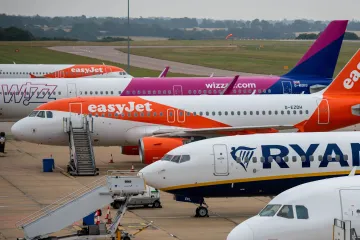
Jet2, Ryanair and easyJet £100 flight booking warning(Image: Getty Images)
Due to ongoing conflict in the Middle East, Europe is facing a fuel crisis, causing concern about the likelihood of summer holidays going ahead.
The International Energy Agency has warned that supply issues could kick in in the next five to six weeks with the owner of British Airways commenting that flight tickets may increase in line with skyrocketing fuel costs.
The fuel crisis comes as the Strait of Hormuz has been blocked throughout the conflict, meaning energy is not able to be distributed at a normal rate.
The strait is the shipping passage for 20 per cent of the world’s fuel and has seen the costs of petrol rapidly increase since the outbreak of war.
For travel, this has caused disruption to many flights, with prices changing and traveller’s fearing cancellations.
According to EU energy commissioner Dan Jorgensen it’s “very likely that many people’s holidays will be affected, either by flight cancellations or very, very expensive tickets”.
If your flight is cancelled it is covered by UK law if it was set to depart or arrive at a UK airport on a UK or EU airline, or arrive at an EU airport on a UK or EU airline.
Popular UK airlines Jet2, Ryanair and easyJet are all covered by this rule.
If you are covered and your flight is cancelled, the airline you are travelling with must provide you with a refund or book you on an alternative flight.
The Civil Aviation Authority (CAA) says that you can get all of your money back for your tickets or for the parts you haven’t used.
With return flights, if outward travel is cancelled, you are entitled to a full refund.
The CAA added: “If you are a transfer passenger and you have already completed part of your journey, you are also entitled to a flight back to your original departure point when your connecting flight is cancelled and you decide not to continue your journey.”
Experts gave a £100 flight booking warning, advising to pay via credit card as this gives you Section 75 protection under the Consumer Credit Act, legally protecting you for purchases costing between £100 and £30,000.
The situation is currently so unpredictable that travellers should be aware of all the cover they are entitled to, as flights may be cut at any point.
Global aviation expert Geoffrey Thomas told the Daily Mail that flights could be cut at the last minute.
Thomas highlighted that Europe is particularly impacted, especially when it comes to long haul travel.
“Europe is more exposed at the moment than Asia is, which means trips from Australia are obviously a challenge.
“For airlines like Qantas, who operate the Perth to London service, at the moment, they have to fly additional distance to refuel in Singapore.
“Any airline that operates through the Middle East is also exposed if the conflict widens or the Iranians decide to resume random drone attacks.”
Amid the conflict, travel experts reiterated the importance of travel insurance.
“To not travel with insurance these days is pretty crazy,” Dr David Beirman told the Daily Mail.
“Most policies will cover cancellation or major changes to an itinerary from a number of causes.
“If your airline is being difficult about a changed flight, and they’re only prepared to give you a credit or something like that, the travel insurance company will usually come to the party and help financially.”
September 2024 came with water. It moved through Maiduguri, in Nigeria’s North East, in fast, stubborn currents, destroying homes and property, and displacing thousands.
In many affected areas, like London Ciki, where Khadija Usman lives, it washed away firewood and charcoal, a critical source of cooking fuel for many homes. She was home alone one afternoon when that absence settled into something practical. Khadija wanted to cook, but there was nothing to burn.
“The water destroyed almost everything,” she said. “It became difficult to find firewood and charcoal.” Moving out to search for fuel was not easy, as she uses a wheelchair. And like for most people here, the expectation did not shift with the flood. Meals still had to be prepared.
So, Khadija turned her attention to what was left behind: charcoal residue, bits of waste, and a technique she had once seen. “I decided to come up with a solution,” she stated. She gathered what she could, shaping it into compact pieces that might hold a flame. When it finally caught, it was small, steady, and enough.
Not yet a long-term solution, but a way through that day.
In the weeks that followed, that small flame evolved into something more substantial. The turning point came when she visited a friend, Zara Tijjani, who also has a disability and was cooking over firewood. The smoke stung Zara’s eyes as she struggled to keep the fire alive. Inspired, Khadija went home, made briquettes, and then returned to show her friend how to make them as well.
From there, the knowledge began to spread among women, particularly those for whom gathering firewood posed significant risks or challenges. What Khadija started in the aftermath of the flood has since contributed to a broader shift in Borno, where biochar is gradually being adopted. However, her focus remains shaped by those around her: women navigating limited mobility, daily cooking demands, the risks of gathering firewood in terror-controlled territories, and a changing climate.
When cooking depends on the forest
Across Maiduguri and much of northeastern Nigeria, cooking still depends heavily on firewood and charcoal. For many households, especially in low-income and displaced communities, these remain the most accessible and affordable sources of energy.
National data reflects this dependence. The 2024 Nigeria Residential Energy Demand-Side Survey by the National Bureau of Statistics (NBS) shows that about 67 per cent of households rely on firewood, 22 per cent on charcoal, and only 19.4 per cent on liquefied petroleum gas (LPG). In the North East, the pattern is even more pronounced.
The report shows that wood use rises to 93.4 per cent in the region, the highest in the country, while LPG remains limited, particularly outside urban centres. Electricity and kerosene play only marginal roles in cooking.
In Borno State, reliance is near-total. A 2019 joint assessment by the Food and Agriculture Organisation (FAO), the United Nations High Commissioner for Refugees (UNHCR), and the World Food Programme (WFP) found that 98.7 per cent of households rely on firewood and charcoal, with only a small fraction using cleaner fuels. Even access to these traditional sources is constrained. Many households purchase firewood rather than gather it, reflecting both scarcity and restrictions on movement in conflict-affected areas. This aligns with humanitarian reporting that “firewood is the primary source of cooking energy” in Borno.
This dependence carries layered costs. Trees are cut steadily to meet demand, placing pressure on already fragile ecosystems. For women in these communities, who are primarily responsible for cooking, the burden extends beyond the home. Finding fuel often means travelling to the outskirts of town or into nearby bush areas, where risks of harassment and violence persist.
The September 2024 flooding deepened these pressures. Supply chains were disrupted, stored firewood was washed away, and charcoal became scarce and more expensive. In homes already navigating scarcity, cooking became uncertain.
Beyond immediate access, the environmental toll is significant. The NBS 2024 General Household Survey shows that Nigeria consumes an estimated 30 billion kilogrammes of fuelwood annually, driving deforestation. In regions like Borno, where vegetation is already sparse, this accelerates land degradation and desertification, reinforcing a cycle of environmental stress and energy poverty.
Health and safety risks are also closely tied to this dependence. Smoke from firewood and charcoal contributes to indoor air pollution, which is linked to respiratory illnesses, particularly among women and children. In the North East, these risks extend further. Women who gather firewood often face threats of harassment, violence, and abduction, making the simple act of cooking fuel collection a dangerous task.
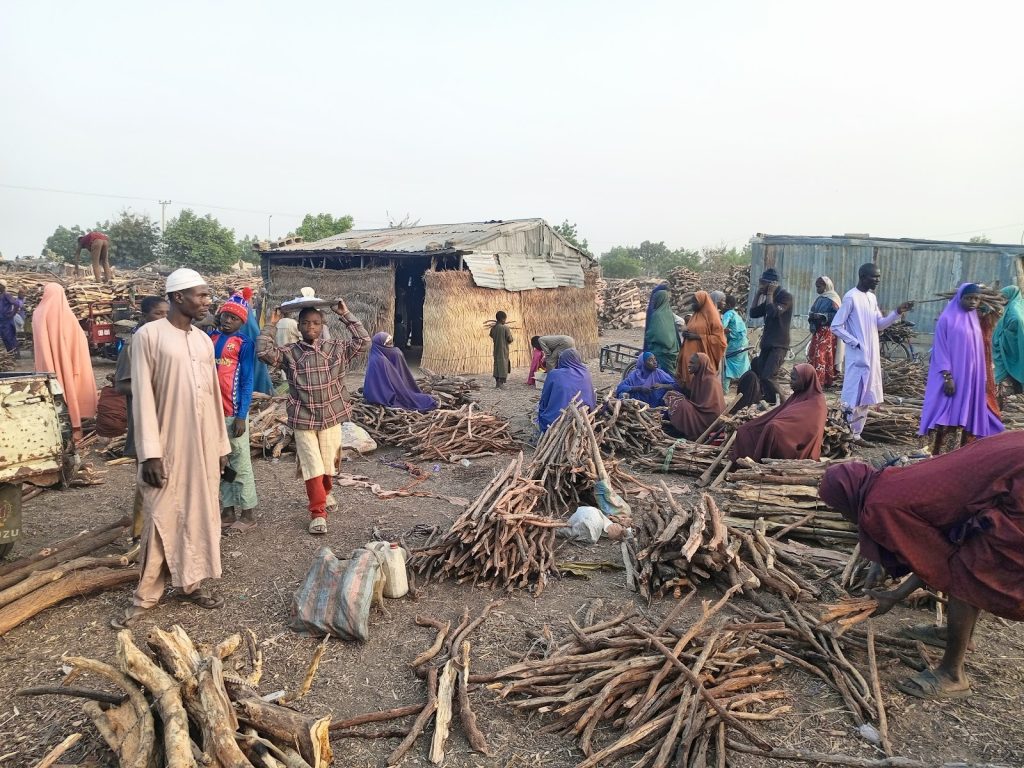
Women in Borno, especially in displaced communities, often trek into the bush to gather firewood for household use, risking abduction and harassment from terrorists. Others gather to sell in order to buy food items with the proceeds. Photo: Al’amin Umar/HumAngle.
Within this system, energy, environment, and security are tightly bound. It is this reality that shapes both the problem Khadija is responding to and the limits of the solutions emerging around it.
Improvising in the aftermath of the flood
Khadija’s first attempts were small, almost tentative, as though she was testing not just the materials in her hands but the possibility that something useful could still be made from what the flood had left behind.
Without equipment or formal training, she worked with what was available: charcoal residue, scraps of household waste, fragments others might have discarded without a second thought. She burned them, pressed them, broke them apart again when they failed — testing what held, what crumbled, and what caught fire and stayed lit. The process was slow.
There was no machine then. No structured method. Only a need that could not be postponed.
Khadija Usman at the Faaby Global Services briquettes production facility in Maiduguri. Beside her, two women manually mould biochar into briquettes. Photo: Al’amin Umar/HumAngle.
The knowledge has since gone from one woman to another: Women with limited mobility. Women navigating spaces where stepping out to collect fuel is not always safe.
Get our in-depth, creative coverage of conflict and development delivered to you every weekend.
Subscribe now to our newsletter!
Within the disability community, the effort did not go unnoticed.
“We rallied behind her,” said Hassana Mohammed Bunu, women’s leader of the Association of Persons with Physical Disabilities in Borno State.
“I have stopped using charcoal and firewood ever since I began using her briquettes,” Zara said. Although Zara has been taught how to make them, she prefers to buy them from Khadija. “She uses a machine to make them. And they are more compressed than handmade,” she added. “It is smokeless, and they burn longer.”
Climate shocks uniquely affect persons with disabilities in Nigeria and other parts of the world. These disasters deepen already existing barriers. Mobility becomes more difficult. Access to resources narrows. In conflict-affected settings like Borno and much of the North East, those constraints are often sharper, less visible, and rarely addressed directly.
In energy access, the gaps are even more pronounced. Clean cooking programmes, where they exist, are not always designed with accessibility in mind. Physical barriers, cost, and social exclusion often limit participation. Nigeria’s legal framework, including the Discrimination Against Persons with Disabilities (Prohibition) Act, exists, but its translation into everyday interventions, particularly in climate and energy responses, remains uneven.
Scaling a local idea
To sustain what she had started, Khadija began to think bigger.
She raised her first capital in small, deliberate ways, selling caps and setting aside the earnings. With that, she bought sawdust, Arabic gum, and starch, enough to stabilise her production and move from improvisation to something more consistent. What began at home remained modest but steady, supported by family, friends, and members of the disability community who saw the value in what she was building.
In 2025, her work drew the attention of the United Nations Development Programme (UNDP). After three months of training at the Abdul Samad Rabiu Centre for Innovation and Entrepreneurship at the University of Maiduguri, she received a grant that marked a turning point. With it, she purchased a briquette-making machine.
With the machine, she could produce up to 100 bags of briquettes per day, each sold at ₦6,500.
To deepen her technical knowledge, she partnered with Faaby Global Services, a Maiduguri-based environmental organisation, where she now works closely with a production team. There, she contributes not only as a learner but as a practitioner.
“She shares her ideas in production and on tackling some challenges,” said Heriju Samuel John, an assistant manager at the organisation. “She is also a native of this town, so she helps us in sourcing raw materials.”
Two Faaby Global Services workers mould briquettes with a machine at their production facility in Maiduguri. The organisation operates three machines, one of which belongs to Khadija, whom the UNDP supported in buying. Photo: Al’amin Umar/HumAngle.
Her machine is now one of three in the facility, a small but significant marker of how far the work has moved from its starting point.
Yet, the broader briquette ecosystem in the region remains uneven. Programmes led by organisations such as FAO have introduced briquettes and fuel-efficient stoves to thousands of households across Borno, Adamawa, and Yobe, often linking energy access to protection concerns.
But outside these interventions, the market is still thin. Production is limited. Adoption is inconsistent. Many initiatives remain tied to donor funding rather than sustained commercial demand.
In that landscape, Khadija’s work sits somewhere in between, not fully independent of institutional support, but not entirely defined by it either.
A block of briquette moulded at the Faaby facility in Maiduguri. Photo: Al’amin Umar/HumAngle.
Can briquettes change the equation?
The briquettes Khadija produces are made largely from what others leave behind. Charcoal residue. Sawdust. Rice husks. Groundnut stalks. Agricultural waste is sourced from farmers and traders who would otherwise discard it. Coconut shells, when available, add density, though they are harder to find in places like Maiduguri and are more expensive.
The materials are burned in a low-oxygen environment, then converted into biochar, and finally ground into fine particles and bound together using eco-friendly binders such as gum arabic or starch. What emerges is a compact fuel that holds its shape and, according to Khadija, burns longer and with less smoke.
“We are recycling,” she said, describing a system that pulls from multiple points in the local economy.
A stock of groundnut stalk at the Faaby production facility in Maiduguri. Photo: Al’amin Umar/HumAngle.
Farmers sell their waste. They also source leftover charcoal and firewood particles from traders. Additionally, waste management actors like the Borno State Environmental Protection Agency (BOSEPA) deliver degradable materials.
To manage fluctuations, especially during the rainy season when materials become scarce, Khadija stores raw inputs in bulk in a rented facility in the Abbaganaram area of Maiduguri.
Her briquettes now move through different layers of the market; restaurants, bakeries, and roadside food vendors buy in bulk. Households purchase for daily use. Some consignments travel beyond Maiduguri, to nearby towns like Bama, and even across borders into Cameroon, with up to two trucks dispatched weekly.
For women, particularly those with disabilities, the impact is measured less in scale than in use. Khadija sells at discounted rates within the community and has trained more than 20 women to produce their own briquettes. “She taught some of our members,” Hassana said.
In some households, Khadija told HumAngle, the shift is already complete. Firewood has been replaced. “This gives me joy,” she said, adding that the transition could extend further. “If people fully understand the benefits, they would stop using charcoal and firewood.”
But the shift is not without constraints.
Raw materials fluctuate. Storage remains limited. Transport is still a challenge. And beyond logistics, there are social barriers that do not disappear with production. “People say I am doing what able-bodied people should be doing,” she said. “Being a woman makes it even worse.”
Still, she continues to plan, looking toward a larger production facility that could employ more women and stabilise supply.
Rhetoric dehumanizing immigrant and Latino communities may appear more open and in-your-face in the current political climate. But that has not been a barrier for Latinos seeking elective office or high-level roles in government.
Voters are choosing an increasing number of nonwhite Hispanic leaders to local elective office — and many of the leaders are the first Latinos to hold their seats. Some political science experts attribute the rise of Latino leadership to years of grassroots organizing, coupled with ongoing demonization of their communities by Trump administration officials and conservative activists.
“That’s the difference now, is that there’s this extra incentive of an unrelenting attack on Latinos across the country,” said Anna Sampaio, an ethnic studies professor at Santa Clara University who specializes in race and gender politics.
There are currently an estimated 7,700 Latino elected officials nationwide, according to data from the National Association of Latino Elected and Appointed Officials. That’s up from 6,883 officials in 2020.
Estimated to number as many as 55 million people — 16% of the U.S. population — Latinos are the largest ethnic minority in the country, with politics, interests and priorities as diverse as the national origins represented within their population. But Latinos also are underrepresented as a demographic across elective offices.
Since the beginning of President Trump’s second term, Latino communities have been a target of his hard-line immigration tactics. The feeling of attack doesn’t stop there. From memes shared from the official White House page perpetuating Hispanic stereotypes, a federally led English-only initiative and an anti-diversity, equity and inclusion push have painted a target on Latinos across the country.
It’s all led to more Latinos seeking office to defend their communities and give voice to those who may be afraid to speak out in the current political climate. As a result, legislators have proposed measures that include providing community members with protections against the U.S. Immigration and Customs Enforcement, halting the approval of ICE detention centers in their cities, and calling for a stop to ICE funding, among other actions.
Pennsylvania Latino mayor makes history
Lancaster, Pennsylvania, with a roughly 40% Hispanic population, recently elected Jaime Arroyo their first Latino mayor. Arroyo took office in January, after being elected with 85% of the vote.
“I think being the first Latino to be in this role and the first person of color to be mayor of Lancaster City has been exciting,” Arroyo told The Associated Press, adding that he finds it “extremely exciting to lead and represent our community in this role.”
With rhetoric and national policies — such as heightened immigration enforcement — hurting the Latino communities, Arroyo said, diverse representation in government is more important than ever. He also believes that the rise of elected Latino officials over the last couple of years is the result of generations of Latinos being politically active fighting for civil rights.
“We’re starting to see a lot of the fruits of that labor come to fruition,” Arroyo said. “There’s never a perfect time to serve your community, there’s the right time. And I think right now is the right time for a lot of Latinos to step up into these roles, especially with everything that is going on.”
Latino representation expanding in city councils
Many more Latinos made history when they took office in earlier this year.
In Iowa, Rob Barron was sworn in Jan. 12 as the first Latino representative on the Des Moines City Council. Antonio Pacheco was sworn on Jan. 7 to be the first Latino member of the city council in Conyers, Georgia. In Ohio, Eileen Torres became the first Mexican American women to win a city council seat in Lorain. Sabrina Gonzalez also took office there as the first Puerto Rican women to serve.
And in Michigan, Clara Martinez and Deyanira Nevarez Martinez were sworn in Jan. 1 to the Lansing City Council, making the city the first in the U.S. to have a council with majority Latino representation.
Martinez said her election, and that of Nevarez Martinez, makes a bit statement about “what people are truly open to despite the national rhetoric.”
“I think because of the rhetoric that we are having to face and some of the backlash on the national stage, I think that’s just fueled the fire for so many people,” she said.
The Salt Lake City Council also has a Latino majority, with four of seven seats, after Erika Carlsen, the granddaughter of Mexican immigrants, was sworn in on Jan. 5. Carlsen said her success is possible because of current and previous generations that put in the work to create spaces where Latinas were encouraged to take leadership positions.
“I feel like I’m building on early generations of leadership,” Carlsen said. “That’s both an honor and responsibility to improve Salt Lake City for the people who live here.”
Carlsen said even if representation at the federal level is not high or visible she said having representation at the local level can have a huge impact.
“I think that it’s critically important that we continue to build on this momentum,” Carlsen said. “The majority of change that can happen starts locally, it doesn’t start in Washington but in City Hall, school boards and neighborhoods conversations. That’s the kind of momentum I’d love to see all across the United States.”
Carolina Welles, executive director of The First Ask, an organization that supports first-time female candidates at the state level, said the reason why Latino representation is more visible at the local level is because those leaders are able to built trust with their community much easier given their proximity.
“They actually know what people care about,” Welles said. “They have a stake because they are facing similar things.”
Local level Latino leadership builds on state and federal representation
It’s not just at the local level. Latinos are making inroads at the federal level too.
The 119th Congress has 56 Hispanic or Latino members. That shakes out to 10.35% of total membership, according to the Congressional Research Service.
For comparison, there were only 14 Hispanic or Latino members and all were male in the 99th Congress, 40 years ago.
At the start of 2025, there were seven Hispanic U.S. senators. That number decreased to six when then Sen. Marco Rubio resigned to become the Secretary of State, the first Latino to hold the position.
Last year also marked a record for Latinas at the state level. Latinas held 214, or 2.9%, of seats in state legislatures, according to the Center for American Women and Politics. That was up from 192 seats in 2024.
Currently, New Mexico Gov. Michelle Lujan Grisham is the only active Latina governor in the U.S. Only two Latinas have been elected governor in U.S. history, and both were in New Mexico.
In March, Gina Hinojosa won the Democratic nomination for governor, making her the second Latina to win a major party gubernatorial nomination in Texas.
Latinos saw the biggest rise in elected officials during the Trump administration in response to attacks on their fundamental rights, said Sampaio, the Santa Clara University professor. She said that trend is likely to continue as the administration continues its attacks on immigrant communities.
“We’re likely to see more Latinos run for office at the local level, at the state level and even at the national level in response to the attack on simply their existence,” Sampaio said. “It is unwittingly both terrorizing the Latino community as well as mobilizing communities.”
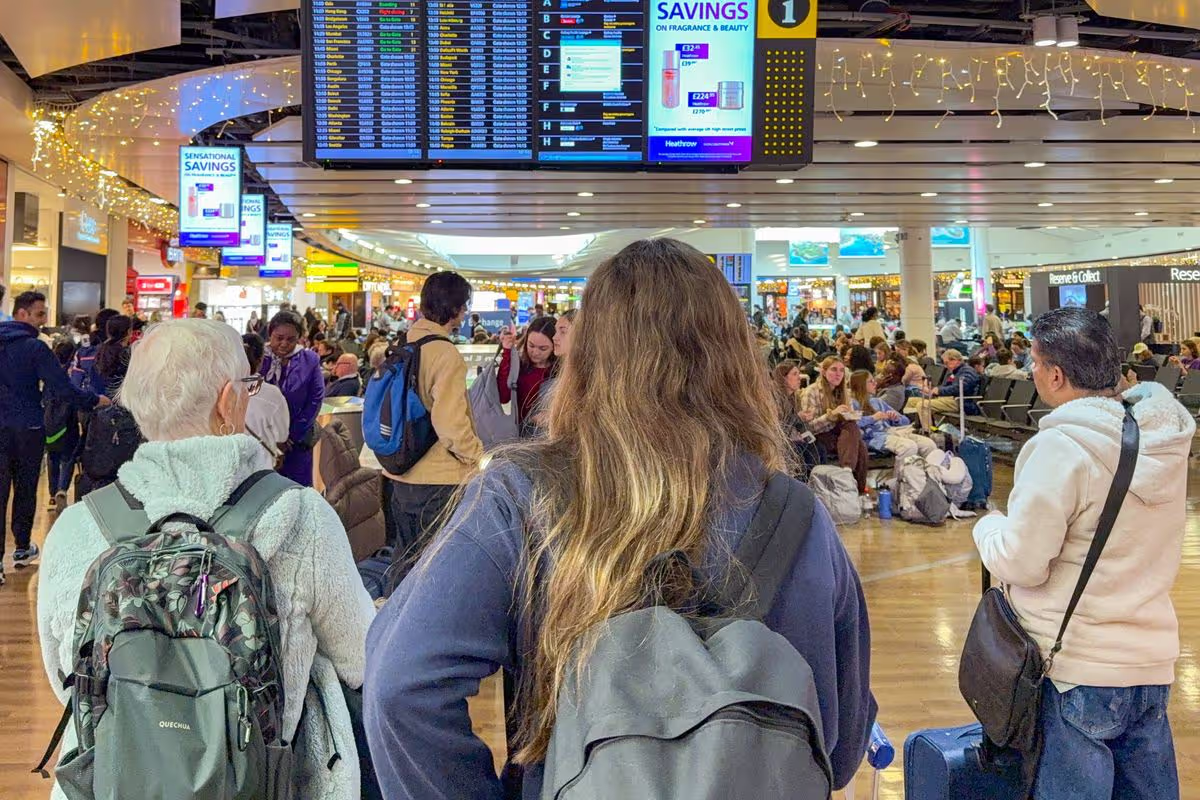
Passengers have been advised to check with their airlines before they travel
The Department for Transport has said ‘we recognise that families may be concerned’ amid jet fuel worries(Image: Getty)
The Government has said it is “closely monitoring” UK jet fuel stocks as airlines prepare for a potential shortage. UK airlines have insisted they are “not currently seeing a shortage of jet fuel” as they buy it in advance and airports maintain stocks, the Department for Transport (DfT) said in an update published on Friday evening.
But airports will also make it easier for airlines to cancel flights without running the risk of losing their allocated “slots” – scheduled times for take-off or landing which some UK airports assign to airlines – if fuel shortages prevent them from flying.
Passengers have been advised to check with their airlines before they travel – and ensure they have appropriate travel insurance, according to the DfT.
This comes as oil prices continue to soar on the back of the US-Israel war on Iran and the closure of the Strait of Hormuz.
“There is no current need to change upcoming travel plans,” the DfT statement said.
“Since the closure of the Strait of Hormuz, we have been closely monitoring UK jet fuel stocks and working with airlines, airports and fuel suppliers to ensure passengers keep moving and businesses are supported.
“Government regularly meets with industry to monitor risks, understand pressures and ensure clear communication with passengers, should circumstances change.”
It added: “We recognise that families may be concerned, and that aviation and tourism businesses are operating in challenging global conditions.
“We are working hand in hand with industry to help flights keep operating.”
The DfT said airlines will also no longer be required to follow the “use it or lose it” rule at UK airports, whereby airlines must use at least 80% of their allocated slots during a season to keep them for the following year.
“Airport Coordination Limited, the independent body that manages slot allocation at UK airports, has updated its guidance so that airlines will not lose their slots if fuel shortages prevent them from flying,” the DfT update said.
“Airlines can now apply for an exemption from the ‘use it or lose it’ rule in these circumstances.” A spokesperson for Jet2 said its flight schedule remains unaffected for the foreseeable future.
“We remain in continual dialogue with our fuel suppliers, as is standard practice,” the spokesperson said. “Based on the conversations we have been having, we see no reason not to look forward to operating our scheduled programme of flights and holidays as normal.”
The airline also confirmed there will be no surcharge on any booked flights or holidays to cover cost increases, including those linked to jet fuel.
“Amidst speculation that some airlines and travel companies may introduce such surcharges, which would mean their customers facing additional costs after making a booking, Jet2 has removed the surcharge provision across all flights and holidays, even though the company has never previously applied them,” the airline announced on Friday.
Steve Heapy, CEO of Jet2, said: “Holidaymakers should have every right to book their hard-earned break in the sun, without worrying about being hit with additional costs, and they can have that complete assurance when they book a flight or holiday with Jet2.
“As a result of today’s announcement, customers booking with Jet2 know that they are locking in their price without additional cost surprises later and we strongly believe that is the right thing to do by them.”
It is understood that Virgin Atlantic and easyJet are also expecting to operate as normal.
The comment from the owner of BA comes after Jet2 said it would not introduce surcharges on any booked flights or holidays to cover cost increases
08:33, 25 Apr 2026Updated 08:37, 25 Apr 2026
British Airways’ fully-funded programme has been running for the last three years(Image: GETTY)
The parent company of British Airways has cautioned that airfares are set to climb as the closure of the Strait of Hormuz, triggered by the Iran conflict, has caused oil prices to surge dramatically.
International Airlines Group (IAG) announced on Friday that the ongoing Middle East crisis will push up the cost of flights to account for soaring jet fuel prices.
Airlines routinely purchase a portion of their fuel in advance at fixed rates to shield themselves from price fluctuations, a strategy commonly referred to as “hedging”.
Despite this, IAG warned that it remained “not immune” to the wider consequences of the Middle East conflict. The group insisted it had yet to experience any disruption to its jet fuel supply, amid growing concerns over potential future shortages as a result of the ongoing hostilities.
The government is “closely monitoring” fuel stocks as airlines brace themselves for possible shortages, with oil tankers still unable to navigate the Strait of Hormuz. It has also emerged that airports are set to make it simpler for airlines to cancel flights without jeopardising their allocated take-off and landing slots, should fuel shortages prevent them from operating. The Department for Transport (DfT) announced that airlines will no longer be obliged to adhere to the “use it or lose it” rule at UK airports, whereby carriers must utilise at least 80% of their allocated slots during a season in order to retain them for the following year. “Airport Coordination Limited, the independent body that manages slot allocation at UK airports, has updated its guidance so that airlines will not lose their slots if fuel shortages prevent them from flying,” the DfT statement confirmed.
“Airlines can now apply for an exemption from the ‘use it or lose it’ rule in these circumstances.”
Meanwhile, Jet2 has revealed it will not be imposing surcharges on any previously booked flights or holidays to offset rising costs, reassuring customers that the price they book is the price they will pay.
The policy covers all flights and holidays booked through any channel, whether online, via the mobile app, contact centre or through an independent travel agent. Steve Heapy, CEO of Jet2 said: “Holidaymakers should have every right to book their hard-earned break in the sun, without worrying about being hit with additional costs, and they can have that complete assurance when they book a flight or holiday with Jet2. As a result of today’s announcement, customers booking with Jet2 know that they are locking in their price without additional cost surprises later and we strongly believe that is the right thing to do by them. Ahead of a busy summer this is yet more evidence of why, on top of our incredible holidays and award-winning customer service, nothing beats a Jet2holiday.”
Government spoke out to passengers booked with carriers like Ryanair, easyJet, Jet2 and Wizz Airs amid fears of fuel supply disruption and potential flight cancellations
Amidst fears of holiday meltdown the UK Government this afternoon issued statement and check sheet(Image: Getty Images)
The Government this afternoon issued a statement to passengers across the UK amid growing concerns over jet fuel shortages and the prospect of flight cancellations. The Department for Transport stepped in to respond following warnings from the European Union.
EU energy commissioner Dan Jorgensen said this week: “Unfortunately, it’s very likely that many people’s holidays will be affected, either by flight cancellations or very, very expensive tickets.”
He added: “Even if we do everything we can do, if the jet fuel is not there, then it’s not there. [Currently] it is primarily a crisis of prices and not yet a crisis of supply, but unfortunately we cannot be sure to prevent a crisis of supply, especially on jet fuel in the future, if the crisis continues.”
Earlier today, President Trump suggested the Iran situation could drag on for weeks, stating he ‘wouldn’t rush’ a deal. The DfT then issued direct guidance to passengers booked with carriers including Jet2, Ryanair, Wizz, easyJet and British Airways.
It said: “There is no current need for passengers to change their travel plans. UK airlines buy jet fuel in advance, and airports maintain stocks to support their resilience. The government is working closely with the aviation industry to monitor risks and minimise disruption to passengers.”
“If your flight is cancelled, you have clear legal rights, including the right to a full refund or re-routing. Read this factsheet for the full picture on the current situation and what it means for you.”
Is there a shortage of jet fuel in the UK?
DtT said: “UK airlines are clear that they are not currently seeing a shortage of jet fuel. It is typically bought in advance, with airports and their suppliers keeping stocks of bunkered fuel to support their resilience.”
Do you need to change your travel plans?
Officials explained: “There is no current need to change upcoming travel plans. Government regularly meets with industry to monitor risks, understand pressures and ensure clear communication with passengers, should circumstances change.
“We recognise that families may be concerned, and that aviation and tourism businesses are operating in challenging global conditions. We are working hand‑in‑hand with industry to help flights keep operating.
“We advise passengers to continue checking with their airlines before they travel, and to check the FCDO travel advice for the latest updates. You should also ensure you have appropriate travel insurance.”
How is the government protecting passengers?
Under UK law, if your flight is cancelled, you are entitled to either a full refund or to be booked onto an alternative flight if you:
depart from an airport in the UK on any airline
arrive at an airport in the UK on an EU or UK airline
arrive at an airport in the EU on a UK airline
For more information about your rights, you can:
What is government doing?
The UK Government said: “Since the closure of the Strait of Hormuz, we have been closely monitoring UK jet fuel stocks and working with airlines, airports and fuel suppliers to ensure passengers keep moving and businesses are supported.
“We continue to plan for a range of contingencies, while focusing on securing a long lasting and workable solution to get shipping flowing freely again through the Strait of Hormuz.”
How are airlines being supported?
In terms of carriers the DfT said: “At some UK airports, airlines are given scheduled times known as ‘slots’ in which to take off or land.
“Under normal rules, airlines must use at least 80% of their allocated slots during a season to keep them for the following year. If they fall below this threshold, those slots can be reassigned to another airline. This is known as the ‘use it or lose it’ rule.
“Airport Coordination Limited, the independent body that manages slot allocation at UK airports, has updated its guidance so that airlines will not lose their slots if fuel shortages prevent them from flying. Airlines can now apply for an exemption from the ‘use it or lose it’ rule in these circumstances.
“This means airlines can focus on minimising disruption for passengers, rather than feeling pressure to operate flights purely to protect their slots.”
JET2 has issued an update to all travellers about increasing flight fares and holiday prices.
The UK’s biggest tour operator has confirmed that it will not be raising flights or holidays prices to cover increased costs caused by the fuel crisis.
Sign up for the Travel newsletter
Thank you!
Jet2 have issued an update about increasing flight and holiday pricesCredit: Alamy
The announcement comes as the ongoing fuel crisis has resulted in a number of airlines increasing their flight prices, including Virgin Atlantic.
The update applies to all flights and holidays with the provider, booked through any channel – whether that be online, via the app or via an independent travel agent.
It means that when passengers book with Jet2, the price that is shown for their holiday or flight, will be the price they pay.
Holidaymakers will still need to pay tourist taxes, which is usually done once you are on holiday at the resort or directly to your accommodation provider.
Steve Heapy, CEO of Jet2 said: “Holidaymakers should have every right to book their hard-earned break in the sun, without worrying about being hit with additional costs, and they can have that complete assurance when they book a flight or holiday with Jet2.
“As a result of today’s announcement, customers booking with Jet2 know that they are locking in their price without additional cost surprises later and we strongly believe that is the right thing to do by them.
“Ahead of a busy summer this is yet more evidence of why, on top of our incredible holidays and award-winning customer service, nothing beats a Jet2holiday.”
In a previous statement, a Jet2 spokesperson also told Sun Travel: “We remain in continual dialogue with our fuel suppliers, as is standard practice.
“Based on the conversations we have been having, we see no reason not to look forward to operating our scheduled programme of flights and holidays as normal.
“We understand that our customers work and save very hard for their holidays, and we are looking forward to making sure that they enjoy their award-winning Jet2holidays.”
The announcement comes as a number of other airlines have issued statements regarding upcoming flights and holidays.
TUI holidays confirmed that bookings have not been impacted or cancelled by the fuel crisis.
A TUI spokesperson told Sun Travel: “We’re closely monitoring the developing situation in the Middle East and its potential impact on global aviation fuel supplies.
“At present, we’re not anticipating disruption to our flight schedules or holiday programmes from fuel shortages.”
It comes as other airlines such as TUI have also commented on fuel crisis concernsCredit: Alamy
Budget airline easyJet has also said that flights are currently not impacted by the fuel crisis.
A spokesperson for the airline told Sun Travel that there was “no disruption to flights” and “no plans to make any changes to our flying schedule”.
However, earlier this week, easyJet’s CEO for Spain and Portugal did comment that it was “difficult to see” what would happen in the next few weeks.
Here’s a full rundown of what all the UK airlines have said about fuel crisis concerns.
IT’S fair to say that there is a sense of nervousness when it comes to a holiday abroad this year.
What with warnings of summer holiday cancellations and airlines cancelling thousands of flights – it’s no wonder Brits are booking more staycations than ever.
Sign up for the Travel newsletter
Thank you!
Forget flights – you can still explore Europe and the Caribbean thanks to cruises and trainsCredit: Alamy
But there is still a way to have a foreign holiday without hopping on a flight, thanks to a number of cruises, ferries, trains and car tunnels going from the UK.
Brittany Ferries, who operate a number of sailings across the UK, said that maritime fuels are not being affected, and prices won’t be going up either.
Brittany Ferries boss Christophe Mathieu said: “If you have booked with us, or are considering doing so, we will get you to a beautiful and safe holiday destination this year. Period.
“We will play no part in profiteering or seeking to recover losses from a gamble gone wrong, as some appear to be doing.
“The cost of our holidays rose by inflation earlier this year, and by inflation alone. There will be no further rises in the weeks or months ahead.”
So we’ve done the hard work for you and rounded up some of the best places to go from the UK where you can avoid the having to go to the airport entirely.
Seven nights around Spain and Portugal by cruise
You don’t have to hop on a plane to explore Spain and Lisbon.
Royal Caribbean have week-long sailings from Southampton which stop at Bilbao, Lisbon and Vigo, before returning to Southampton.
Prices start from £743pp.
Eurostar train to Lille and Paris
Why not have a two city break with Eurostar, stopping at both of their French cities.
The closest city to the UK by train is Lille, taking less than two hours to get to.
You could then hope on a train the next day to explore Paris, just one stop over.
Prices from £39pp.
You could do Lille and Paris in one weekend via train, thanks to EurostarCredit: Alamy
Eurostar train to Amsterdam and Rotterdam
In a similar vein of Paris and Lille, Eurostar also have direct trains to Amsterdam and Rotterdam.
They take slightly longer – Rotterdam is around 3hr15 while Amsterdam is just over four hours – but can easily make for a long weekend break.
Prices from £39pp.
Eurotunnel to French seaside towns
The Eurotunnel in Folkestone opens up all of Europe as long as you’re happy to travel by car.
Entering via Calais, why not explore some of France‘s best seaside towns such as Boulogne-sur-Mer and picturesque Wimereux?
Prices from £59pp.
Eurostar runs to a number of cities by train such as Amsterdam as wellCredit: AlamyThe Eurotunnel is perfect for exploring the French seaside towns by carCredit: Alamy
35 days around Caribbean by cruise
If you have the time, you could explore the Caribbean for a month without having to get on a flight.
P&O will take you to St Kitts, Barbados, Grenada, St Lucia, Antigua and Barbuda, while sailing from Southampton – it even includes all your food and tips.
Prices from £2,999pp.
Seven nights around Norwegian Fjords by cruise
Also sailing from Southampton, the Celebrity Cruises trip lets you go around some of the beautiful fjords.
Stops include Haugesund, Ålesund, Nordfjordeid and Zeebrugge.
ONE of the world’s biggest airlines has said they could soon increase the cost of flights due to ongoing conflict.
United Airlines has warned that fares could go up by as much as 20 per cent because of soaring jet fuel prices.
Sign up for the Travel newsletter
Thank you!
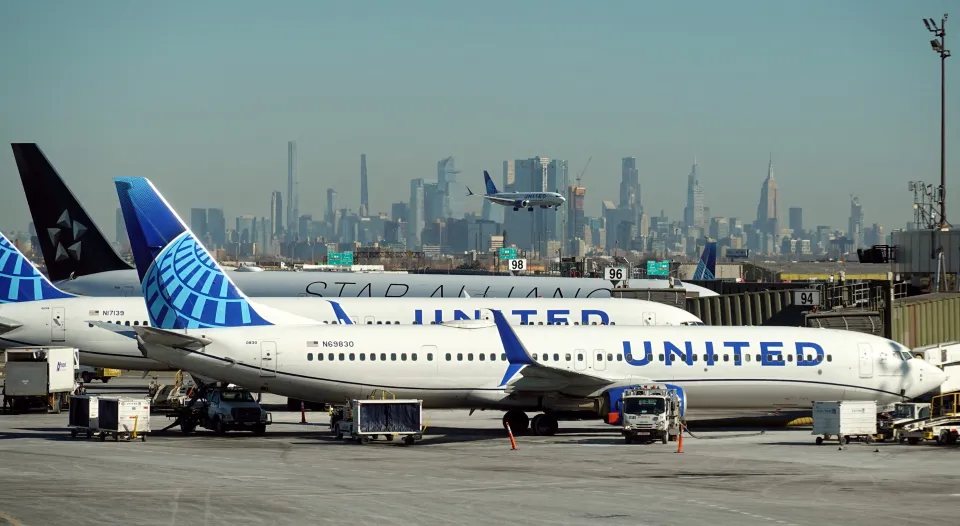
United Airlines has said it might need to increase flight faresCredit: Reuters
The airline flies mainly to America from a number of UK airports including Edinburgh, Manchester and London Heathrow.
According to Reuters, the airline’s CEO Scott Kirby said on Wednesday that the airline could increase flight prices by between 15 and 20 per cent to offset the surge in fuel costs.
For example, if a flight was £500 before, after the price rise it could be as much as £600.
The airline added that it has already begun raising some prices, as well as higher baggage fees – all to offset increased fuel costs.
Kirby added that the airline has not yet seen a drop in demand, despite prices rising.
However, he also accepted that if the airline does introduce higher prices, it may test and put off travellers.
United Airlines has also already confirmed that five per cent of flights would be cancelled – or around 250 flights a month – because of rising fuel cost fears.
This news follows data released by The Transport & Environment (T&E) that disruption to jet fuel supplies has added as much as $100 (£77) per person to the price of long-haul flights from Europe.
As such, for a family of four heading on a long-haul holiday it would cost them an extra £308.
For short-haul flights within Europe, prices have increased by £25.26 per passenger – which would be more than £100 per family heading on holiday.
And a number of airlines have already raised their prices to offset the increasing cost of jet fuel.
For example, on Virgin Atlantic flights economy fares have been increased by £50.
Anyone flying in premium economy will pay an extra £180 and those in business class will pay an extra £360.
What does this mean for your upcoming holiday?
1. How will this affect my holiday?
Getaways should not be seriously impacted immediately as airlines bought fuel far in advance at a fixed rate.
But if the crisis continues into June, operators may start adding a surcharge to holiday prices.
A limited number of flights may be cancelled, but mostly on well-served routes with alternatives.
If supplies start to dry up, cancellations would increase.
2. Am I entitled to a refund?
IF some or all of your holiday is cancelled by the provider, your refund depends on whether you booked your trip as a package holiday, or individually.
Your money tends to be much better protected with a package deal.
3. Is now a bad time to book?
There are some great deals, but book with caution.
You must take out travel insurance as, if your flight is cancelled, you may have protection against the cost of other elements of your holiday, such as accommodation.
Air France and KLM, which are part of the same company, are also increasing round-trip fares by €100 (£87) on most of their long-haul flights.
Some airlines have cancelled flights as well.
For example, Lufthansa has cancelled 20,000 flights up to September, Air New Zealand and Scandinavian Airlines have cancelled around 1,000 flights, KLM has cancelled 160 flights and Cathay Pacific has cancelled two per cent of flights up to June.
“It is primarily a crisis of prices and not yet a crisis of supply, but unfortunately we cannot be sure to prevent a crisis of supply, especially on jet fuel in the future, if the crisis continues.”
ACI Europe backed this up, saying: “If the passage through the Strait of Hormuz does not resume in any significant and stable way within the next three weeks, systemic jet fuel shortage is set to become a reality.”
Mr Jorgensen added that even if the Strait of Hormuz opened tomorrow, the “price crisis will still last for quite some time”.
It could even be years, he warned, to get down to price levels seen before the crisis.
UK airlines are yet to be affected by the fuel crisis, as many have ‘hedged’ fuel, meaning paying a set fee.
But Airlines UK, which represents a number of carriers, including BA, Virgin, easyJet, Jet2 and Ryanair, are now calling on the government for support to protect flights and holidays.
This would include temporary use of fuel type Jet A (not currently allowed in the UK) as well as relaxing the strict airport slot rules that would see airlines lose them if they don’t operate flights.
Easing night flight bans and “relieving the burden of Air Passenger Duty” have also been put forward.
A huge number of airlines have already cancelled flights in response to fears of jet fuel running out.
This includes:
Lufthansa – 20,000 cancelled up to September
United – around 250 a month cancelled
Air New Zealand – around 1,000 cancelled
Scandinavian Airlines – around 1,000 cancelled
KLM – 160 cancelled
Cathay Pacific – two per cent of flights up to June 30
Which airlines have already increased the cost of flights?
Rather than axing routes – other airlines have added surcharges or baggage fees…
Air France and KLM have have increased their round-trip fares by €100 (£87) on most of their long-haul flights– with an additional charge of €10 (£8.69) for a round trip in economy.
Virgin Atlantic confirmed it would do the same earlier this week – passengers in economy will pay an extra £50, in premium economy passengers will pay an extra £180 and anyone in business class will see flights cost an extra £360.
JetBlue has increased baggage fees by $4 (£3) for off peak, economy travellers. This will now be $39 (£30) – the cost peak economy travellers will be $49 (£37).
The low-cost Spanish Airline Volotea is adding maximum surcharge of €14 (£12.20) per person to flight bookings.
For anyone worrying about their holiday, families are better to book package holidays rather than separate flight and hotels, as most packages offer ATOL protection (meaning you will get your money back if your trip is cancelled).
It is also worth checking your travel insurance, although most policies do not cover anything related to war.
Airlines are already cancelling flights and hiking pricesCredit: Alamy
The German airline is one of the biggest in Europe
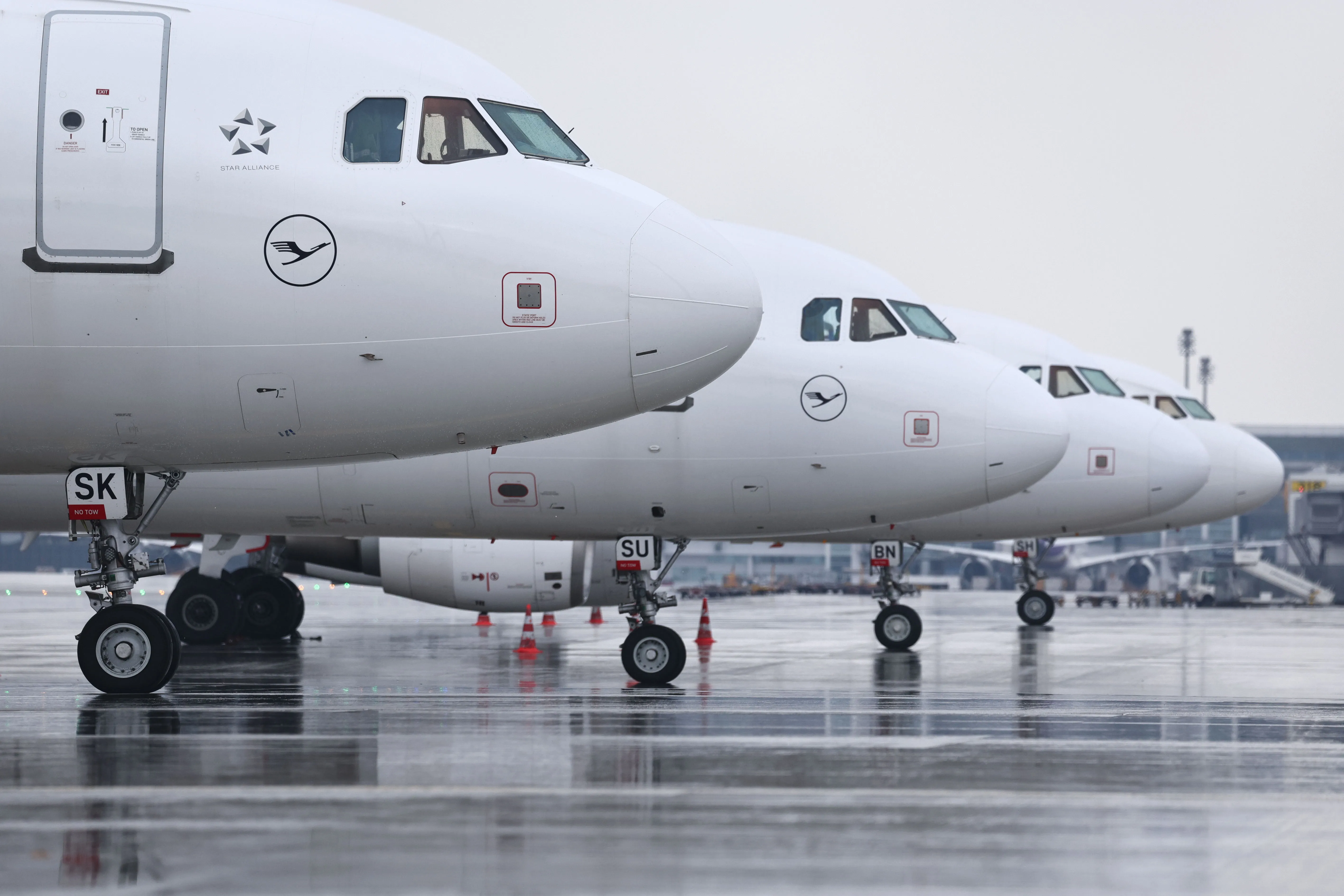
Lufthansa has announced it is cutting 20,000 flights (Image: Getty )
Lufthansa has issued a statement after energy bosses claimed Europe has six weeks’ supply of jet fuel left. Fatih Birol, executive director of the International Energy Agency (IEA), warned there could be flight cancellations ”soon” if oil supplies remain restricted by the Iran war.
When approached for comment, Lufthansa told the Mirror that it claims to be in a better position than most competitors regarding its kerosene requirements. A spokesperson for the airline said: “The Lufthansa Group has secured (‘hedged’) approximately 80 per cent of its kerosene requirements for 2026.
“And approximately 40 per cent for 2027 based, among other things, on the price of crude oil – both at pre-crisis price levels. With this level of hedging, we are in a better position than most competitors.”
It comes as the airline announced it will cut 20,000 short-haul flights from its schedule this summer to save money amid rising jet fuel costs. Most of these cuts are due to the shutdown of its unprofitable CityLine fleet and the retirement of its 27 planes. The airline pointed out that jet fuel prices have more than doubled and noted labour disputes involving its employees.
A statement on the Lufthansa Group website reads: “In total, 20,000 short-haul flights will be removed from the schedule through October, equivalent to approximately 40,000 metric tons of jet fuel, the price of which has doubled since the outbreak of the Iran conflict. The schedule adjustments reduce the number of unprofitable short-haul flights across the Lufthansa Group network.
“The planned consolidation of the European network is being carried out across Lufthansa Group’s six hubs in Frankfurt, Munich, Zurich, Vienna, Brussels, and Rome. Passengers will therefore continue to have access to the global route network, particularly long-haul connections. However, due to the increase in jet fuel prices, this will be achieved significantly more efficiently than before.”
On Tuesday, April 21, the Prime Minister discussed the Government’s work to ease pressures caused by the Iran conflict with ministers and officials at a meeting of the Middle East Response Committee. A government spokesperson said: “The discussion focused on the Government’s ongoing work to ease pressures being felt here in the UK.
“This included the diplomatic activity to promote progress on negotiations, and bring back security and stability for the region, and the military planning to restore freedom of navigation in the Strait of Hormuz. The Prime Minister acknowledged that the impact of the war in the Middle East will be felt beyond the end of the conflict, and stressed the importance of protecting British families.
“They discussed a range of ongoing contingency planning, such as our work with fuel suppliers, airlines and international counterparts, to ensure people keep moving and businesses are supported. UK airlines are clear that they are currently not seeing a shortage of jet fuel, and it is right that the Government continues to work with industry to ensure we closely monitor the situation.
“They said it was right that this Government is introducing wider measures to strengthen long-term resilience, including measures announced today to accelerate breaking the link between gas and electricity prices to support families and businesses under pressure and exposed to volatile gas prices.”
April 21 (UPI) — European airline Lufthansa announced Tuesday that it will chop 20,000 “unprofitable” short-haul flights through October, a move the company says will save more than 40,000 metric tons of jet fuel.
The company, which is based in Germany, said fuel costs have doubled since the start of the conflict in Iran. This follows a move last week to retire the 27-plane fleet of its CityLine subsidiary ahead of schedule, Politico reported.
Lufthansa canceled the first 120 flights, which were to take place through the end of May, on Monday and said it had alerted affected passengers.The 20,000 cancelations include the former CityLine flights and affect the airline’s hubs in Frankfurt, Munich, Zurich, Vienna, Brussels and Rome.
“Passengers will therefore continue to have access to the global route network, particularly long-haul connections,” Lufthansa said in its announcement. “However, due to the increase in jet fuel prices, this will be achieved significantly more efficiently than before.”
The airline said that it will post the schedule “optimizations” from June onward in late April.
Politico reported that other airlines, including SAS Scandinavian Airlines and Air France- KLM, have turned to similar measures to deal with fuel costs.
The sharp rise in the cost of jet fuel, driven by escalating tensions in the US-Israel war with Iran, has forced several airlines to hike fares, cut routes and reassess their financial forecasts
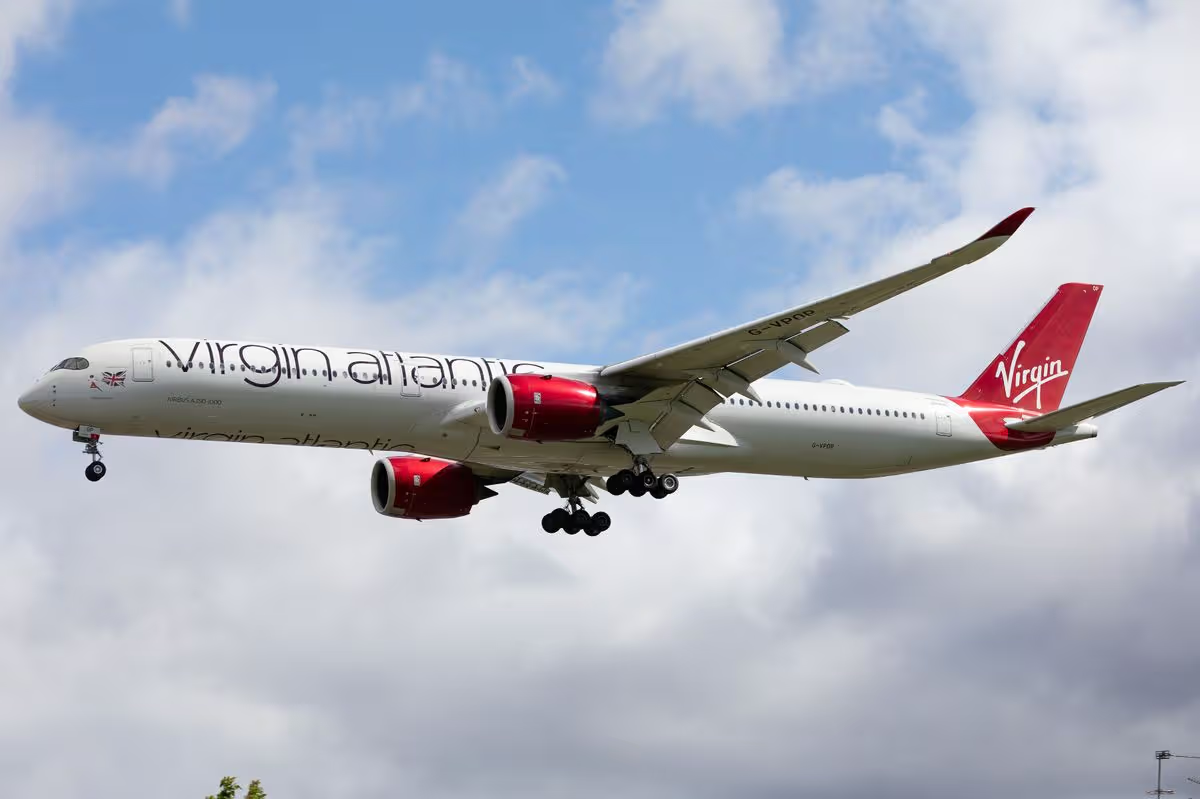
Virgin Atlantic is adding fuel charges to fares(Image: NurPhoto via Getty Images)
Multiple airlines are cancelling flights and introducing new charges as a deepening jet fuel crisis sends shockwaves through the global aviation industry.
Prices have surged dramatically in recent weeks, climbing from roughly $85-$90 per barrel to as high as $150-$200, driven by escalating tensions in the US-Israeli war with Iran.
The sharp rise in costs has now forced carriers to hike fares, cut routes and reassess their financial forecasts. The spike has triggered warnings of major disruption, with International Energy chief Fatih Birol cautioning that Europe could have as little as six weeks of jet fuel supply remaining if the Strait of Hormuz stays closed.
There are more than 30 airlines around the world who say they have been forced to cancel flights or add charges:
AirAsia X – Cut around 10% of flights and introduced a fuel surcharge of roughly 20%.
Air France-KLM – Raising long-haul fares, plus cabin fares by 50 euros per round trip, as well as cancelling flights. KLM, the group’s Dutch arm, is set to scrap 160 European services in the coming months.
Air India – Switching to distance-based fuel surcharges, warning current pricing does not cover rising costs, reports the Independent.
Air New Zealand – Reducing flights through May and June, increasing fares and suspending its full-year earnings forecast.
Akasa Air – Introducing fuel surcharges ranging between 199 and 1,300 Indian rupees ($2 to $14) on both domestic and international routes.
Alaska Air – Increasing checked baggage fees by up to $150 on North American routes, as well as for its Hawaiian Airlines unit.
American Airlines – Raising baggage fees by $10 each for the first and second checked bags and by $150 for the third checked bag, while cutting some economy benefits.
Asiana Airlines – Cutting 22 flightsbetween April and July due to fuel costs.
Cathay Pacific – Cancelling a small portion of flights from mid-May until the end of June and increasing fuel surcharges.
China Eastern Airlines – The airline said it would raise fuel surcharges for domestic flights from April 5, with flights of 800km and below hit with a 60 yuan ($9) surcharge and a 120 yuan surcharge for flights over 800km.
Delta Airlines – Delta said it would cut capacity by around 3.5 percentage points from its original plan and raise fees for checked bags.
Easyjet – CEO Kenton Jarvis previously said European consumers should expect higher ticket prices towards the end of summer, when existing fuel hedges come to an end.
Greater Bay Airlines – Said it would raise fuel surcharges on most routes from April 1, while keeping them unchanged on mainland China and Japan routes. Its surcharge for flights between Hong Kong and the Philippines will more than double, the carrier said.
Hong Kong Airlines – The airline said it would raise fuel surcharges by up to 35% from March 12, with the sharpest increase on flights between Hong Kong and the Maldives, Bangladesh and Nepal
Indigo – India’s biggest airline said it would introduce fuel charges on domestic and international flights from March 14.
Jetblue Airways – The US-based low-cost carrier said it was increasing fees for optional services such as checked baggage as it experiences “rising operating costs”. Baggage prices will rise by either $4 or $9, it said.
Lufthansa – Grounding 27 planes early and cutting more aircraft from its fleet.
Norse Atlantic Airways – Axed its London Gatwick to Los Angeles route because of fuel costs.
Pakistan International Airlines – Raising domestic fares by $20 and international fares by up to $100.
SAS – Will cancel 1,000 flights in April after already hiking fares.
Spring Airlines – The airline will raise domestic fuel surcharges from April 5.
Southwest Airlines – Hiking baggage fees to $45 for a first bag and $55 for a second.
SunExpress – The airline will add a temporary 10-euro fuel surcharge on Turkey-Europe routes.
TAP Air Portugal – Said fare rises would soften the blow from higher fuel prices.
Thai Airways – Increasing fares by up to 15%.
United Airlines – United Airlines is scaling back loss-making routes over the next six months. It has also been able to push up fares without seeing a major impact on bookings, chief commercial officer Andrew Nocella said, despite the sharp rise in oil and jet fuel costs.
United is also increasing first and second checked baggage fees by $10 for customers travelling within the US, Mexico, Canada and Latin America, according to Reuters.
VietJet Air – Cut flights on some routes because of fuel shortages.
Vietnam Airlines – plans to cancel 23 domestic flights a week from April. The airline reportedly requested government assistance to remove an environmental tax on jet fuel.
Virgin Atlantic – The airline is adding fuel surcharges to fares and will still struggle to return to profitability this year, its CEO Corneel Koster told the Financial Times.
Volotea – Introduced a pricing policy that could add fuel surcharges of up to 14 euros per passenger.
WestJet – Cutting seats, combining flights and adding a C$60 fuel surcharge on some bookings, according to the Canadian press
MOUNTING fears of jet fuel shortages have US travelers on edge ahead of summer vacations.
The holiday industry is bracing for a major fallout due to the Iran war’s impact on global travel.
Sign up for the Travel newsletter
Thank you!
Will US travelers end up stuck in an overseas airport over summer due to huge jet fuel shortages amid the Iran war?Credit: GettyExperts have warned travelers to be braced for chaos if flying to Asia or Europe over summerCredit: Getty
“Anxious” Americans are worrying about whether they can return home if they travel to Europe or Asia for their summer vacation, said one expert.
For example, will their their long haul-flight end up suddenly being chopped due to a lack of fuel while overseas?
Alternatively, “will my short-haul domestic flight to the international airport be canceled?” Patrick De Haan, GasBuddy’s head of petroleum analysis, told Forbes.
“It’s a level of anxiety that travelers have never really had to worry about, and absolutely it could worsen.”
People across the world are keen for the Strait of Hormuz to reopen to shipping, because of spiraling costs hitting everything from grocery shopping to global fertilizer supplies.
But, even if this vital, narrow corridor was to permanently reopen today, it’ll be too late to salvage this year’s summer holidays, experts have warned.
That’s because airlines have now got to stick to a hurriedly rejigged schedule with airports – which must be booked months in advance.
It comes as the global jet fuel shortage is ramping up fuel prices for US carriers, which in turn are axing cheap airfares and some flights to save money.
Some airlines are already passing on extra costs to travelers by increasing fees for baggage and other add-ons, via steeper ticket prices, and fuel surcharges.
It’s the largest energy crisis the world has ever facedCredit: Getty
And, unfortunately, it will take months for vital supplies of oil and jet fuel to return to normal, according to Kpler, an energy consulting firm.
“It’s going to take until at least July,” Matt Smith, head US analyst, warned CNN.
“And even that may be optimistic at this point.”
United, American, Delta and Southwest airlines spent about $100 million a day on average among them on fuel in 2025.
But jet fuel prices have roughly doubled since the war began, when the United States and Israel started bombing Iran on February 28.
Delta Air Lines — which frequently flies to destinations across Europe — said it was aware of the continent’s “potential jet fuel supply issue.”
The carrier has already slashed some flights this summer.
United Airlines announced in March that it was “tactically pruning flying that’s temporarily unprofitable in the face of high oil prices.”
It’s the “largest energy crisis we have ever faced,” IEA executive director Fatih Birol told Associated Press last Thursday.
“If we are not able to open the Strait of Hormuz… I can tell you soon we will hear the news that some of the flights from city A to city B might be canceled as a result of lack of jet fuel,” he warned.
It will take an estimated two years for the world to recover from energy shortages caused by the war in Iran, Birol added.
More than 110 oil-laden tankers and over 15 carriers loaded with liquefied natural gas are still waiting in the Persian Gulf.
In Europe, there are about six weeks of jet fuel leftCredit: Getty
America’s own jet fuel supplies aren’t currently a huge concern, as local carriers are insulated to a certain extent.
The US produces 13 million barrels of oil a day and imports some four million barrels a day from Canada, De Haan told Forbes on April 16.
However, it’s a different situation in Europe and Asia, both of which are facing a potential shortage because of the ongoing conflict.
In Europe, multiple countries are now relying on less than 20 days of coverage in their fuel supplies, warned the International Energy Agency (IEA).
Asia-Pacific countries are the most reliant on oil and jet fuel from the Middle East, followed by Europe.
“The strait accounts for around 40% of Europe’s jet fuel imports, but no jet fuel has passed the strait since the war broke out,” said Amaar Khan, head of European jet fuel pricing at Argus Media, last Friday.
America has this month come to Europe’s aid to help bolster jet fuel supplies due to the war, sending about 150,000 barrels per day in April.
This is about six times the normal level, according to Jacques Rousseau, managing director at financial firm Clearview Energy Partners.
Airlines chop flights and increase fees amid the Middle East crisis
Here are just some of the impacts on travelers due to the Iran war…
Air Canada:
From June 1 to October 25, 2026, Canada’s largest carrier will chop back flights to New York due to rocketing fuel prices.
Alaska Air:
Fees for the first checked bag have risen by $5 and by $10 for the second on its North American flights. A third checked bag has increased considerably, from $50 to $200.
American Airlines:
Baggage fees have risen by $10 for the first and second checked bags, and by $150 for the third checked bag on domestic and short-haul international flights.
Delta Air Lines:
The carrier is charging an increase of $10 on passengers’ first and second checked bags and a $50 increase on the third.
Frontier Airlines:
This carrier is reviewing its full-year forecast due to rising fuel prices.
Jetblue Airways:
Baggage prices will rise by either $4 or $9.
Spirit Airlines:
This budget US carrier has begged Donald Trump’s administration for hundreds of millions of dollars in emergency funding to offset rising fuel prices.
Southwest Airlines:
Checked baggage fees will rise by $10 for the first and second bags.
United Airlines:
The airline is slashing unprofitable flights.
Also, first and second checked bag fees will spike by $10 for customers travelling in the US, Mexico and Canada and Latin America.
Virgin Atlantic:
This carrier is reducing flights and raising fares.
Westjet:
The Canadian airline has chopped seat capacity for June.
A C$60 ($43) fuel surcharge will be slugged on some bookings.
THE closure of the Strait of Hormuz has resulted in the soaring price of jet fuel, which had led to fears of shortages across Europe.
Now, easyJet has issued an update for its passengers with growing fears that holidays could be affected from mid-May.
Sign up for the Travel newsletter
Thank you!
easyJet has issued a warning for its passengers due to fuel shortagesCredit: Getty TUI has also issued an update saying it will monitor flights from May 1Credit: Alamy
Javier Gándara, easyJetCEO for Spain and Portugal, has said that while the airline is continuing to operate as planned now, beyond three or four weeks and it’s “difficult to see” what will happen.
The three-week warning means easyJet passengers could face disruption from as soon as May 12.
However, Mr Gándara then added: “In Spain, we are in a comparatively better situation than neighbouring countries for two reasons.
“Firstly, because of all the crude oil that is imported and then refined here, only 11 per cent comes from the Middle East, which is the percentage affected by the closure of the Strait of Hormuz; the remaining 89 per cent comes from elsewhere.”
The travel giant said it is “monitoring” jet fuel shortages as a result of the Iran war, for all passengers flying from May 1.
On social media, one worried traveller asked the airline: “With the reported jet fuel shortages are you expecting holidays from May 1 to be affected?”
TUI responded: “We’re closely monitoring the developing situation in the Middle East and its potential impact on global aviation fuel supplies.
“At present, we’re not anticipating any immediate disruption to our flight schedules or holiday programmes from fuel shortages.“
The holiday chaos is caused from the ongoing Iran-US conflict with warnings that Europe could face jet fuel shortages due to the Strait of Hormuz remaining closed.
Getaways should not be seriously impacted immediately as airlines bought fuel far in advance at a fixed rate.
But if the crisis continues into June, operators may start adding a surcharge to holiday prices.
A limited number of flights may be cancelled, but mostly on well-served routes with alternatives.
If supplies start to dry up, cancellations would increase.
2. Am I entitled to a refund?
IF some or all of your holiday is cancelled by the provider, your refund depends on whether you booked your trip as a package holiday, or individually.
Your money tends to be much better protected with a package deal.
3. Is now a bad time to book?
There are some great deals, but book with caution.
You must take out travel insurance as, if your flight is cancelled, you may have protection against the cost of other elements of your holiday, such as accommodation.
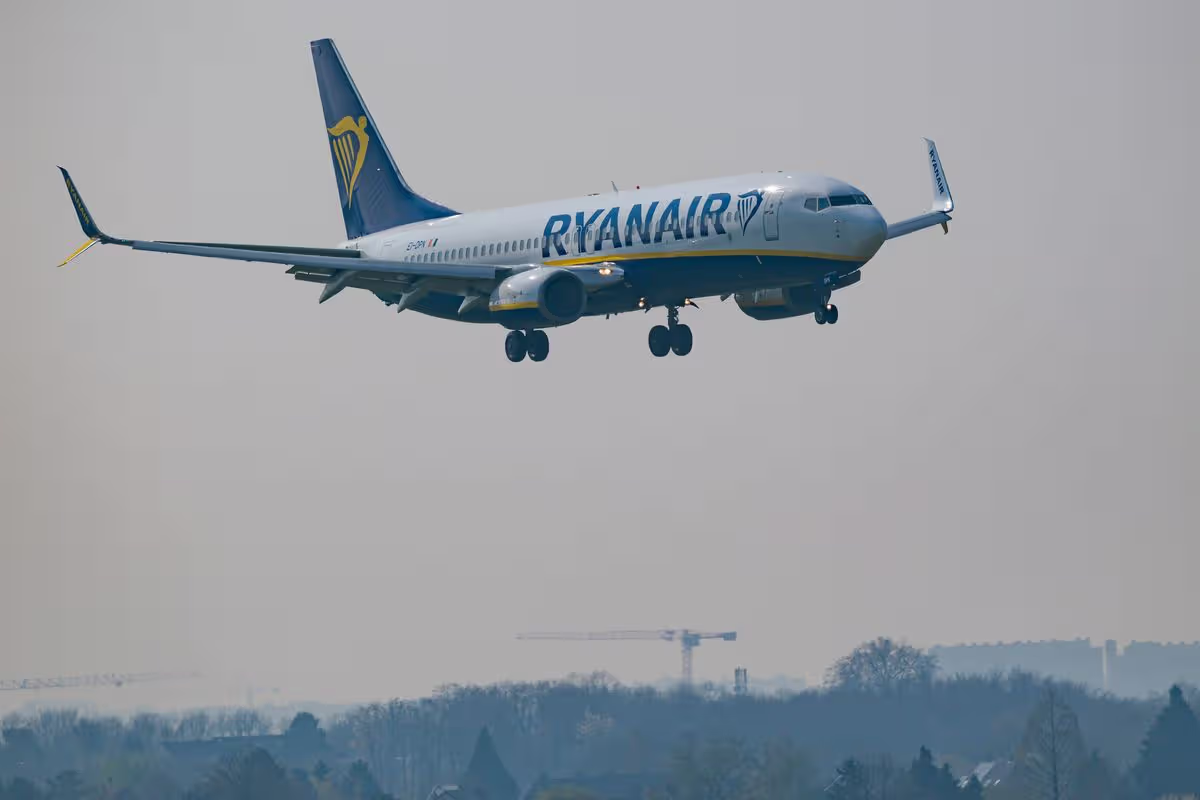
Ryanair has issued a warning to its customers(Image: Getty)
Ryanair has issued a warning to passengers hoping to fly in the days ahead. The budget airline has sent emails to travellers flying from the UK to large parts of Europe.
It cautions of ‘longer queues, particularly at busy airports’. The reason is the new Entry and Exit System (EES), which has been rolled out by the European Union (EU). It requires all travellers from the UK and other non-EU nations to be photographed and fingerprinted at EU airports and border crossings.
The objective is for the new system to replace manual passport stamping and more efficiently track the 90-day visa-free limit, but there have been accounts of it causing delays stretching to several hours at busy airports. It has even been temporarily suspended at times to clear the backlog.
In a message to customers titled ‘Important: Changes to Passport Control’, Ryanair says: “From 10 April 2026, the EU’s Entry/Exit System (EES) is in place at all Schengen Area external borders. As a result, passport control may take longer for some passengers.
“You are affected if you hold a non‐EU / non‐EEA / non‐Swiss passport (e.g. UK, USA, Canada, Australia), and are flying into or out of the Schengen Area.
“Commonly affected routes include flights between the Schengen Area and countries such as: UK, Ireland, Cyprus, Albania, Montenegro, Serbia, Türkiye, Egypt, Israel and others.
“At passport control you may need to:
Scan your passport
Provide fingerprints
Have a facial image taken
These checks may cause longer queues, particularly at busy airports. Queues may form before security.
If affected, please:
Arrive at the airport early to allow for queues
Have your travel documents ready
Follow signs marked EES / Passport Control
Those who are not affected:
EU, EEA and Swiss passport holders
Flights within the Schengen Area (e.g. Spain–Italy, France–Germany)
“If you are denied entry, this will be due to EU policy, not Ryanair’s rules.”
Greece has reportedly opted to pause the EES rollout following considerable delays. A statement on the Greek Embassy website and posts across official social media channels said: “In the framework of the implementation of the Entry/Exit System, as of 10 April 2026, British passport holders are exempt from biometric registration at Greek border crossing points.”
Airport representatives and the European Commission convened a meeting on Tuesday to address issues surrounding the system. Approximately 122 passengers were left stranded and unable to board their flight from Milan Linate to Manchester on Sunday, following severe hold-ups at passport control linked to the introduction of the EES.
The Foreign, Commonwealth and Development Office has confirmed that your details will need to be re-registered every three years. A statement also warned that travellers may face longer waiting times when entering or departing a country. It states: “The European Union’s (EU) Entry/Exit System (EES) started on 12 October 2025 This is a new digital border system that has changed requirements for British citizens travelling to the Schengen area.
The countries in the Schengen area are: Austria, Belgium, Bulgaria, Croatia, Czechia, Denmark, Estonia, Finland, France, Germany, Greece, Hungary, Iceland, Italy, Latvia, Liechtenstein, Lithuania, Luxembourg, Malta, Netherlands, Norway, Poland, Portugal, Romania, Slovakia, Slovenia, Spain, Sweden, and Switzerland.
The Republic of Ireland and Cyprus are not within the Schengen area, and therefore EES is not applicable when travelling to either of these countries. If you are travelling to a country in the Schengen area for a short stay using a UK passport, you may be required to register your biometric details, such as fingerprints and a photo, when you arrive. You do not need to take any action before you arrive at the border, and there is no cost for EES registration.
EES registration is replacing the current system of manually stamping passports when visitors arrive in the EU. EES may take each passenger extra time to complete so be prepared to wait longer than usual at the border.
“On your first visit to the Schengen area, you may be asked to create a digital record at the port or airport on arrival. You may be asked to submit your fingerprints and have your photo taken at dedicated booths. You don’t need to provide any information before travelling to a Schengen area country. The checks may take slightly longer than previously, so be prepared to wait during busy times.”
“If you enter the Schengen area through the Port of Dover, Eurotunnel Le Shuttle at Folkestone or Eurostar, St Pancras International, any EES checks will be completed at the border, before you leave the UK. You may also be asked to provide either your fingerprint or photo when you exit the Schengen area.”
“If you frequently travel to the Schengen area for work and/or leisure purposes, you must ensure that your total stay in the Schengen area is no more than 90 days in every 180 days. You must be aware of the penalty and enforcement approach for exceeding the immigration limit in any individual Member State you plan to travel to, or through.”