Get exclusive awards season news, in-depth interviews and columnist Glenn Whipp’s must-read analysis straight to your inbox.
By continuing, you agree to our Terms of Service, which include arbitration and a class action waiver. You agree that we and our third-party vendors may collect and use your information, including through cookies, pixels and similar technologies, for the purposes set forth in our Privacy Policy such as personalizing your experience and ads.
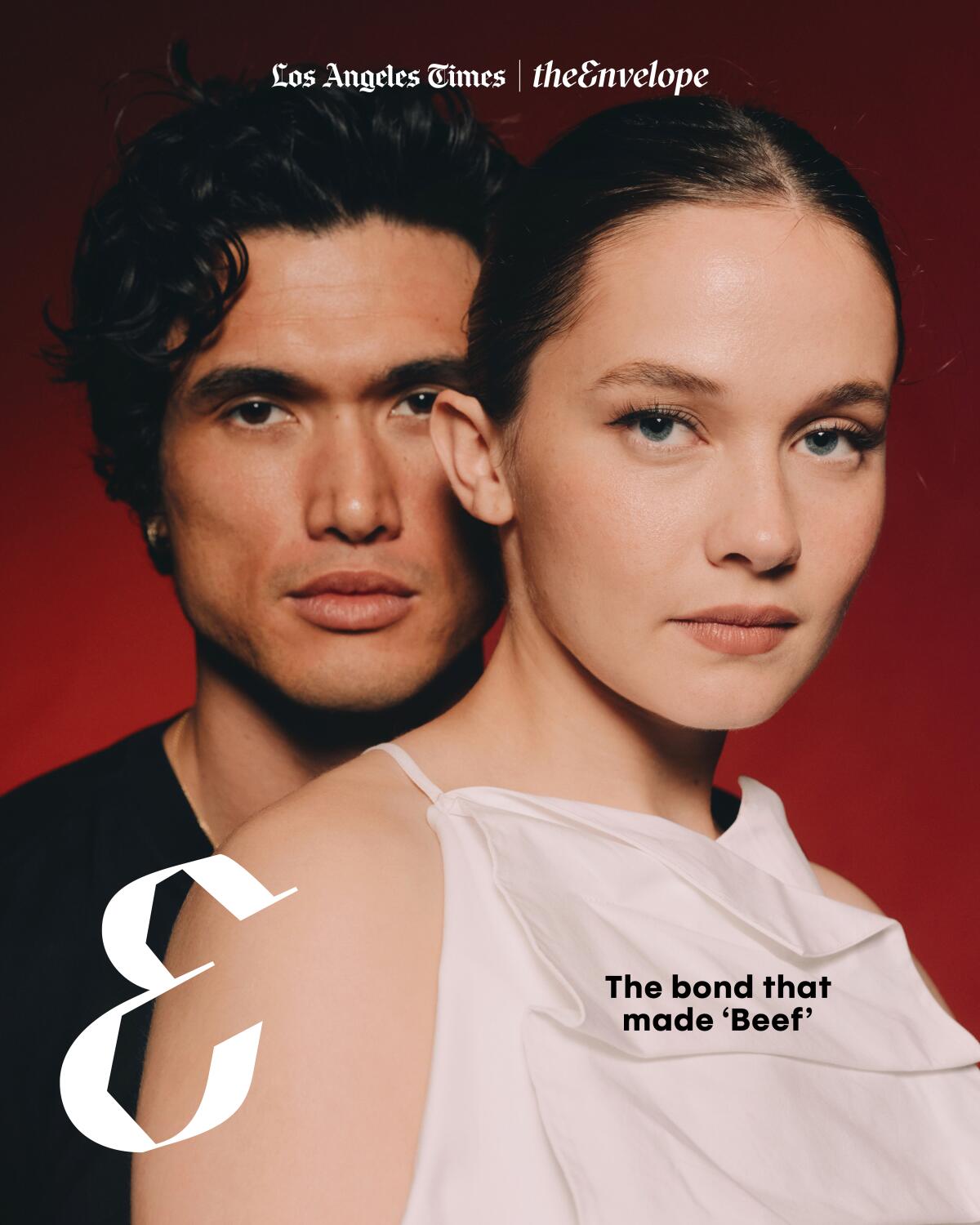
That Super Bowl in question was Super Bowl LIX, pitting the Philadelphia Eagles against the Kansas City Chiefs. Melton hosted a watch party, and since he considers Kansas home and played football for Kansas State University, you might think he’d be rooting for the Chiefs.
Nope.
“When I was living in Germany, I fell in love with Donovan McNabb,” Melton, an army brat, tells me, name-checking the longtime Eagles quarterback.
Spaeny, it turns out, was the only Chiefs fan at the party. To enter Melton’s home, she had to step on a doormat that was fitted with a red-and-white Chiefs jersey. (“It got real dirty,” Melton says with pride.)
Melton and Spaeny enjoy a relaxed and playful give-and-take, borne from the months they spent preparing to play Austin and Ashley, a Gen-Z couple working at a Montecito country club, dreaming and scheming toward upward mobility in “Beef.”
(Erik Carter / For The Times)
The most memorable episode they shared found the couple in an overcrowded, ninth-circle-of-hell emergency room with Ashley, uninsured, experiencing severe ovarian torsion. Her concerns are dismissed and she begs for someone to save her.
“Unfortunately, it’s an all-too-common experience,” Spaeny says. “I probably have a conversation once a month with female friends who go to the doctor’s office and are gaslit by the system, just being made to feel like what they’re experiencing isn’t really happening or they’re making it up. It’s scary.”
Still, being “Beef,” the episode has its share of mordant humor, like the scene where a nurse asks Ashley to rate her pain, zero being pain-free and 10 being excruciating.
“Oh, I thought it was like Letterboxd,” Ashley replies, referring to the movie review social platform. “Two-and-a-half stars out of five is average.”
“My whole life I’ve been a six or seven,” Melton says, noting his own personal pain scale. “I’ll have a cold and I’ll be like, ‘Six or seven.’”
“That sounds like you,” Spaeny says.
“I can get pretty dramatic,” Melton says. “It’s really like the end of the world when I’m sick.”
Spaeny deleted her Letterboxd account because she gets anxious about anything online containing reviews.
“It takes two buttons to click on a movie that I’ve been in and see what people say about me,” Spaeny says. “So I forgot my password and left it that way.”
Melton is an enthusiastic adopter and says he has twice shared his four favorite films, a feature where actors, usually on the red carpet, list a quartet of beloved movies. (Here’s one at the “May December” premiere where Melton enthuses over “The Matrix,” “In the Mood for Love,” “Brokeback Mountain” and “Persona.”)
“I saw them at another event and they were like, ‘Charles, so good to see you.’ And I was like, ‘Do you want my four favorite films?’ And they said, ‘No, you’ve already done it enough,’” Melton laughs. “What can I say? I love movies!”
The U.S. Justice Department has cleared the way for Paramount Skydance’s $111-billion purchase of Warner Bros. Discovery — a major milestone that moves David Ellison closer to his goal.
After a months-long review, Justice Department antitrust regulators on Friday concluded the combination would not violate federal anticompetition laws. Approval had been expected because President Trump — who has friendly ties with Ellison and his father, tech billionaire Larry Ellison — favors the deal.
The government stopped short of asking Paramount to make concessions or divestitures.
Buying Warner Bros. would allow Paramount — Hollywood’s smallest major company — to bulk up with such prestigious properties as HBO, CNN, HGTV and Food Network. Those would be combined with properties Paramount already owns, including CBS, Comedy Central, Nickelodeon and MTV.
The deal would put two historic film studios and two prominent news organizations under the same roof. It would give Paramount four streaming services, including HBO Max, and dozens of cable channels.
In its four-page closing statement, the Justice Department emphasized that career antitrust regulators — not political appointees — had performed a rigorous review, sifting through some two million documents the government received from dozens of sources, including third-party organizations.
They conducted meetings and deposed senior-level executives and other witnesses.
“These investigative efforts all led to the same conclusion: the film and television industry is highly dynamic, and the proposed transaction is not likely to harm competition or American consumers,” Justice Department regulators wrote in their summary.
Regulators zeroed in on three potential areas of concern. They looked at whether the merger would give Paramount too much power in the streaming video-on-demand market; the traditional linear television channel space; as well as in “studio development, production, or distribution of films for theatrical release,” the Justice Department said.
Competition in streaming would not be crimped, according to the regulators.
“To the contrary, the combined firm is likely to increase competition by offering consumers a more robust competitive alternative to the larger [streaming] offerings,” they wrote.
The antitrust division also found that theatrical distribution and opportunities for creators, including writers and actors, would not be harmed as long as the combined company maintained current production levels.
Ellison has promised to continue releasing 30 films a year with a combined Warner Bros.-Paramount studio. He also has said he would protect the HBO brand.
The proposed merger is controversial because many in Hollywood fear it will bring thousands of job losses, which was the result of past consolidations, including Walt Disney Co.’s 2019 takeover of Fox entertainment properties. More than 5,000 entertainment industry workers, including Jane Fonda, J.J. Abrams,Javier Bardem and Mark Ruffalo, have signed an open letter calling for the merger to be blocked.
There’s a political dimension as well. Paramount’s standing with the Trump administration (Paramount+ is set to televise Sunday’s UFC fight spectacle at the White House to celebrate Trump’s birthday as part of the company’s relationship with the UFC) has given left-leaning groups pause.
They worry about collapsing CNN and CBS News into one unit, particularly after all the turmoil that has ensued at CBS News since the Ellison family bought Paramount in August and installed Bari Weiss as CBS News editor in chief.
This month witnessed a dramatic shakeup at the iconic “60 Minutes,” with top executives and three well-known correspondents tossed out.
“We’ve already seen how far Paramount and the Ellison family are willing to go to diminish a once-proud network and news organization like CBS,” Craig Aaron, co-chief executive of the progressive group Free Press, said in a statement. His group fears the Ellisons would “do worse if they get their hands on Warner Bros., HBO, CNN and all the rest.”
Paramount, for its part, said it was grateful for “the Department of Justice’s thorough review of this transaction, as well as the work of the other agencies that have completed their reviews and provided clearance to date.”
“This deal is pro-competitive, resulting in a stronger company better positioned to compete against dominant technology platforms in an industry increasingly defined by intense competition for audiences, talent, technology, and investment,” Paramount said. “We remain focused on completing the transaction as soon as possible and delivering its benefits to consumers, creators, and the entertainment industry as a whole.”
Paramount wants to finalize its purchase by September.
With Friday’s victory, Paramount is staying on that timetable, but regulators in Europe and Britain have opened their own regulatory investigations and are expected to make their own determinations in the coming months.
In its statement, the Justice Department said it began its review last fall when it was clear Warner Bros. was in play. Regulators said they were familiar with Warner’s businesses, because the division had scrutinized four other mergers involving the company, dating back to the disastrous AOL-Time Warner merger in 2001.
Paramount’s deal would mark the third time Warner has changed hands in the last decade. AT&T bought the company in 2018 and then sold it to the smaller Discovery four years later. That deal left Warner Bros. burdened by debt, setting the stage for the Ellison takeover.
Justice Department approval could complicate efforts by Bonta and other state attorneys general to block the deal. Should Bonta or others sue, they would have to convince a judge that the nation’s top antitrust regulators failed to make a proper finding despite their lengthy review.
That may pose a high bar for the state officials, who are facing political pressure to stop the deal.
“State AGs must block this merger,” U.S. Sen. Elizabeth Warren (D-Mass.) said in a statement Friday, adding that the Justice Department’s approval was “terrible news for every American who doesn’t want Trump-aligned billionaires to control what they watch and how much they pay.”
The Justice Department said state attorney general offices had participated in its investigation, which allowed federal and state officials “to share information with each other and for the States to attend and participate in the [antitrust] Division’s depositions.”
Last month, David Ellison appeared before the regulators in a two-hour session.
Paramount’s Chief Legal Officer Makan Delrahim, who previously served as the nation’s top antitrust regulator during the first Trump administration, also was busy quarterbacking Paramount’s outreach with regulators.
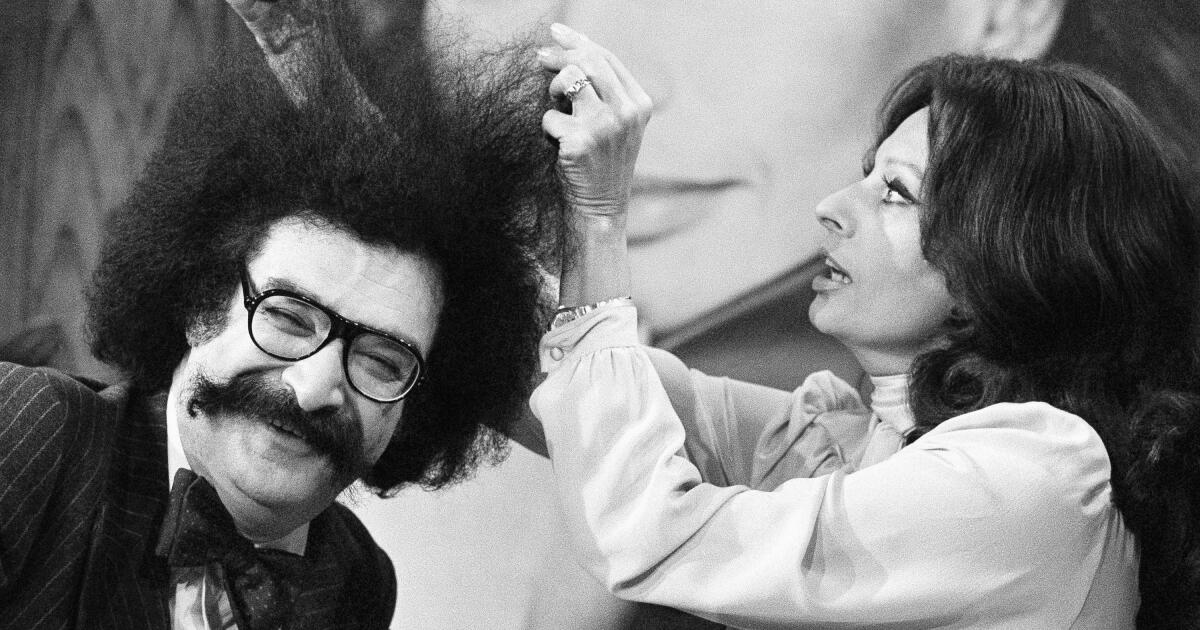
Gene Shalit, the fast-talking funnyman who reviewed films, plays and books for NBC’s “Today” show has died. He was 100.
Shalit’s family confirmed the longtime critic’s death Friday, telling NBC that he “passed away peacefully after 100 years of an amazing life.”
According to a 2010 interview with Guy Ludwig, Shalit’s producer for more than 20 years, Shalit was hired as a contributor at “Today” in 1968. He reviewed books once a month or so, but audiences were so fascinated by his eccentric personality and equally unconventional looks that NBC ramped up the critic’s on-air appearances.
In January 1973, on the same day he was promoted to arts editor, Shalit debuted “Critic’s Corner,” the segment that would ultimately make him a household name. In 2010, Shalit retired as one of the last regular film critics on a major network.
Ludwig referred to Shalit as the “foxy grandpa” of the “Today” show.
Shalit cut his teeth in media as an entertainment columnist for McCall’s magazine, eventually landing the role of senior film critic for Look magazine in 1968 and writing a humor column for Ladies’ Home Journal. His quick wit, punchy puns and unique voice came through even on the page, and NBC took notice.
“No one at NBC had seen him. They’d only read his stuff. So he walked into this executive’s office and the executive took one look at him and said, ‘Mr. Shalit, have you ever thought of radio?’” Ludwig told “Today.”
“They didn’t know how the public would react to someone who looked so different from people who were typically on TV in 1967.”
On “Critics Corner,” Shalit favored humor over the highfalutin. He was an everyman’s critic. Of 1997’s action-thriller “Face/Off,” he said, “Now, ‘Face/Off’ is a literal title, because both of their faces are taken off. Then each face is put onto the other’s head. Even their voices are switched with microchip implants. In other words, this is an entirely reasonable, rational movie!”
“Many critics will give so much of the plot of a movie away that they destroy the movie for the viewer … I just don’t give away the story,” he told the Associated Press in 1993.
During his tenure, he was known to bust up his colleagues, and “Today” anchors ranging from Edwin Newman, Barbara Walters and Jane Pauley to Tom Brokaw, Bryant Gumbel, Katie Couric, Al Roker and Meredith Vieira.
But not everyone appreciated Shalit’s style. In 1989, a leaked in-house memo from “Today” show co-host Bryant Gumbel to Marty Ryan, the former executive producer of the NBC program, complained that Shalit’s film reviews “are often late and his interviews aren’t very good.”
Eugene Shalit was born March 25, 1926, in New York City and grew up in Morristown, N.J. He launched his elementary school’s first newspaper, “The Spotlight,” and purchased a fedora to seal his fate as a journalist. In Morristown High School he wrote the school newspaper’s humor column “The Broadcaster.” In 1949, he graduated from the University of Illinois at Urbana-Champaign.
Shalit was married to Nancy Lewis for 28 years until her death in 1978 and never remarried. The couple had six children: Peter, Willa, Emily, Amanda, Nevin and Andrew. Emily died from ovarian cancer in 2012.
Obsession is maybe too hard-edged; interest too soft. But from “Close Encounters of the Third Kind” and “E.T” to his new sci-fi thriller “Disclosure Day,” Steven Spielberg has spent nearly the entire length of his career returning to the possibility that we are not alone in the universe. Even “Firelight,” the amateur movie he made as an Arizona teenager in 1964, revolved around extraterrestrial visitors.
That recurring fascination stands out partly because Spielberg has never been a filmmaker who stays in one lane. Across 36 features as a director, he has pivoted between science fiction, war films, historical dramas, adventure movies, thrillers, comedies and even a musical while somehow retaining the same famed Spielbergian sense of emotional wonder that defined his earliest work.
Which makes “Disclosure Day” — opening Friday and built around mysterious transmissions, buried government secrets and the possibility of alien contact — feel less like a detour than a return to one of Spielberg’s oldest creative preoccupations. Speaking about the film in March at SXSW, Spielberg admitted that while he has no special knowledge about extraterrestrial life, he nevertheless has “a very strong, sneaking suspicion that we are not alone here on Earth right now. And I made a movie about that.”
So with Spielberg once again looking skyward, we decided to revisit the director’s long cinematic relationship with aliens, as figures of astonishment, terror, transcendence and, occasionally, giant crystal skulls from another dimension.
Melinda Dillon and Cary Guffey in 1977’s “Close Encounters of the Third Kind.”
(Columbia Pictures)
Josh Rottenberg: I don’t really remember a world without Spielberg’s aliens. I was 6 when “Close Encounters of the Third Kind” arrived in 1977, not much older than the little boy played by Cary Guffey who is carried off by visitors from another world after his toys mysteriously come to life. Five years later, I was exactly Elliott’s age when “E.T. the Extra-Terrestrial” landed in theaters in 1982.
“Close Encounters” made aliens feel weirdly plausible, not just creatures in a “Star Wars” cantina or rubber-suited monsters from old sci-fi movies but something that might turn up in ordinary American life through blinking kitchen appliances, strange lights in the sky and suburban middle-class dads who can’t explain why they suddenly need to drive to Wyoming.
What surprises me now is how hopeful the movie feels. It came out of the post-Watergate ’70s, when distrust of institutions was running high, but Spielberg directed most of that suspicion toward the government, not the alien visitors. Richard Dreyfuss sculpting Devils Tower out of mashed potatoes should seem completely insane — and it kind of is. But Spielberg somehow makes you understand why Dreyfuss’ Roy Neary is willing to walk away from his entire life and family over something he can’t explain.
With “E.T.,” Spielberg scaled that cosmic yearning down to a California cul-de-sac. I recently watched the movie again at Hollywood Forever Cemetery with my wife and younger daughter, who’s in college now. I’d seen it several times since 1982 but not on a big screen, and I was startled by how much of it I still knew by heart: E.T. shuffling through the kitchen drinking cans of Coors, Elliott freeing the frogs in science class, Drew Barrymore introducing the alien to her dolls like he’s a new kid who just moved in next door. Somewhere along the way, “E.T.” became less a movie to me than part of the background texture of childhood itself.
Spielberg turned one of science fiction’s grandest ideas — first contact with alien life — into the story of a boy and his weird little space-faring goblin best friend. Mark, we’re of the same Gen X vintage. Did Spielberg permanently convince you that aliens were basically on our side?
A scene from the 1982 movie “E.T. the Extra-Terrestrial.”
(Universal Pictures / Photofest)
Mark Olsen: I didn’t see “Close Encounters” when it was first in theaters, but I remember any kid with a piano learning those five notes of John Williams’ alien theme music and then the movie becoming a staple rental of the early VHS era.
When I revisited the film for its 2017 re-release — an overwhelming experience in the sorely missed Cinerama Dome, where the movie also played when it first opened — I was struck by how homespun and handmade it felt, grounded in a naturalistic sense of realism. For as much as Spielberg may be fascinated by aliens and whatever could be out there, he always uses them as a way to reconsider what is going on down here: to reconnect with the elemental aspects of humanity and our common bonds.
I’ll be honest and say that “E.T.” is a movie I have always struggled with. I clearly remember seeing the movie when I was young and being very disturbed by the scene when the government arrives and drapes the family’s house in plastic sheets and tubing. I distinctly recall recognizing that the film itself wanted me to feel bad — I didn’t like that. (Perhaps thus was a young critic born.) Spielberg is often so proud of his mechanics, he lets them show, which is why even then I was resistant to moments when he wants the relationship between Elliott and his new friend to truly take flight.
Tom Cruise in Steven Spielberg’s 2005 sci-fi thriller “War of the Worlds.”
(Paramount Pictures)
Rottenberg: By 2005 and “War of the Worlds,” the wonderment was gone. Spielberg took H.G. Wells’ downbeat vision of extraterrestrials as exterminators and updated it for post-9/11 America: nightmarish scenes of alien tripods clawing their way up through the pavement, blaring air-raid horns, entire crowds vaporized into clouds of dust.
This time, nobody is trying to communicate through music or empathy. Tom Cruise spends the movie running through New Jersey with two terrified kids while ash drifts through the streets and giant alien war machines scoop humans into dangling metal cages. “E.T.” had turned aliens into plush toys and breakfast cereal. “War of the Worlds” turned them back into the menacing aggressors of 1950s sci-fi films like “Earth vs. the Flying Saucers” and “Invaders From Mars.”
Which made it all the more jarring when, three years later, Spielberg suddenly swerved back toward old-school flying-saucer mythology with 2008’s “Indiana Jones and the Kingdom of the Crystal Skull,” shoehorning an extraterrestrial plot into one of his most beloved series. Seeing Cate Blanchett march into a glowing alien chamber to commune with giant crystal skeletons from another dimension, I could understand why some fans reacted like they’d just watched someone spray-paint a UFO on the Ark of the Covenant.
But looking back, the inclusion seems almost inevitable. Spielberg keeps circling back to aliens no matter what genre or franchise he’s working in. Even 2001’s “A.I. Artificial Intelligence” eventually reveals itself as a kind of inverted first-contact story, with humanity becoming the vanished civilization studied by synthetic descendants of the machines.
Mark, were you able to roll with Indy suddenly colliding with Area 51 mythology, or did Spielberg lose you at that point?
Harrison Ford and Shia LaBeouf in the 2008 movie “Indiana Jones and the Kingdom of the Crystal Skull.”
(David James / Paramount Pictures / Lucasfilm)
Olsen: There was something so eye-rollingly whatever about the finale of “Kingdom of the Crystal Skull” that you couldn’t even really be mad about it. On a storytelling scale of Spielbergian preposterousness, the moment lands somewhere between the Wrath of God sequence in “Raiders of the Lost Ark” (totally legit) and the time traveling of “Dial of Destiny” (throws hands in the air).
“War of the Worlds” remains a fascinating film within the director’s space alien canon because it has an anxiety and uncertainty that isn’t often found elsewhere. Even his core interest in creatures, so often a well of amazement and positivity, couldn’t pull him up. Much has been made of the film as a response to the aftermath of 9/11 and Spielberg followed it up with the existential thriller “Munich,” a further exploration of the darker aspects of the national mood, before the year was even up.
This seemed to be a moment of malaise for Spielberg, one he worked his way out of with an unpredictably wide-ranging series of films including “Lincoln,” “Bridge of Spies” and “The Post.” It was as if he were left reeling from cynicism and was trying to reclaim some youthful confidence that he would eventually rediscover with the autobiographical “The Fabelmans.” Josh, do you feel that “Disclosure Day” serves as the final word on Spielberg’s alien interests?
Emily Blunt and Josh O’Connor in the movie “Disclosure Day.”
(Niko Tavernise / Universal Pictures)
Rottenberg: What makes “Disclosure Day” interesting to me — even though I wasn’t fully sold on it — is that Spielberg is returning to these ideas at a moment when UFO culture has already evolved far beyond him.
Screenwriter David Koepp has cited “Three Days of the Condor” as a touchstone, and for long and often gripping stretches, the movie really does play like a paranoid 1970s conspiracy thriller: cryptic transmissions, shadowy government programs, Josh O’Connor racing to expose buried secrets, Colin Firth strapped into a chair using alien technology to manipulate people from afar.
But while “Close Encounters” arrived at a time when UFOs still occupied this hazy space between science fiction, Cold War anxiety and New Age mysticism, “Disclosure Day” lands in a world where self-described UFO abductees have their own support groups and Congress has held multiple hearings about “unidentified anomalous phenomena.” Meanwhile, earlier this spring, the U.S. government declassified another batch of UFO files and the response was roughly equivalent to a collective shrug.
In recent interviews, Spielberg has said he now considers the circumstantial evidence for UFOs “overwhelming” and no longer views “Disclosure Day” as science fiction at all. In his earlier alien films, extraterrestrials represented mystery and escape. Here they feel more like vaguely benevolent interstellar therapists trying to help humanity get its act together. The film’s climax reaches for the same sense of civilizational awe as the mothership landing in “Close Encounters.” For me it didn’t quite get there.
But maybe that’s partly because it’s harder now to experience these ideas with the same innocence they carried in 1977 or 1982. Rewatching “E.T.” at the Hollywood Forever Cemetery, I still wanted to believe that an encounter with an alien intelligence could elevate us. But we’re a long way from Reese’s Pieces and flying bicycles. Mark, did “Disclosure Day” manage to pull you back into Spielberg’s orbit this time?
Olsen: I have to just get it out of the way that as someone from Kansas City, I will be eternally annoyed that Emily Blunt plays a TV weatherperson in KC and Spielberg did not actually shoot there. Having said that, for me the movie is at its best as a chase thriller — a sequence in which O’Connor escapes a remote farmhouse is particularly well-executed.
“Disclosure Day” is first and foremost just a lot of fun, a showcase for Spielberg’s gifts as a filmmaker and his longstanding collaborations with cinematographer Janusz Kaminski and composer John Williams. The film is deeply interested in who knows what. There are longtime tightly held secrets being kept from the rest of us for whatever reason. Though the film is framed as a conspiracy thriller, Spielberg’s essential goodheartedness continually peeks out, as if he can only play at being hard-bitten for so long.
Where the film becomes less sure-footed is when it grabs for its bigger meaning, attempting to render something deeper from Spielberg’s longstanding fascination with aliens and what they might have to teach us.
The real disclosure of “Disclosure Day” turns out to be our own inability to listen: how everyone gets so wrapped up in themselves they often miss the larger picture. But the idea that the entire world could latch onto something together feels too far-fetched in our own current fractured news environment. That is likely less the fault of Spielberg and more one of ourselves. His career-spanning interest in aliens always brings him back to trying to better understand us.
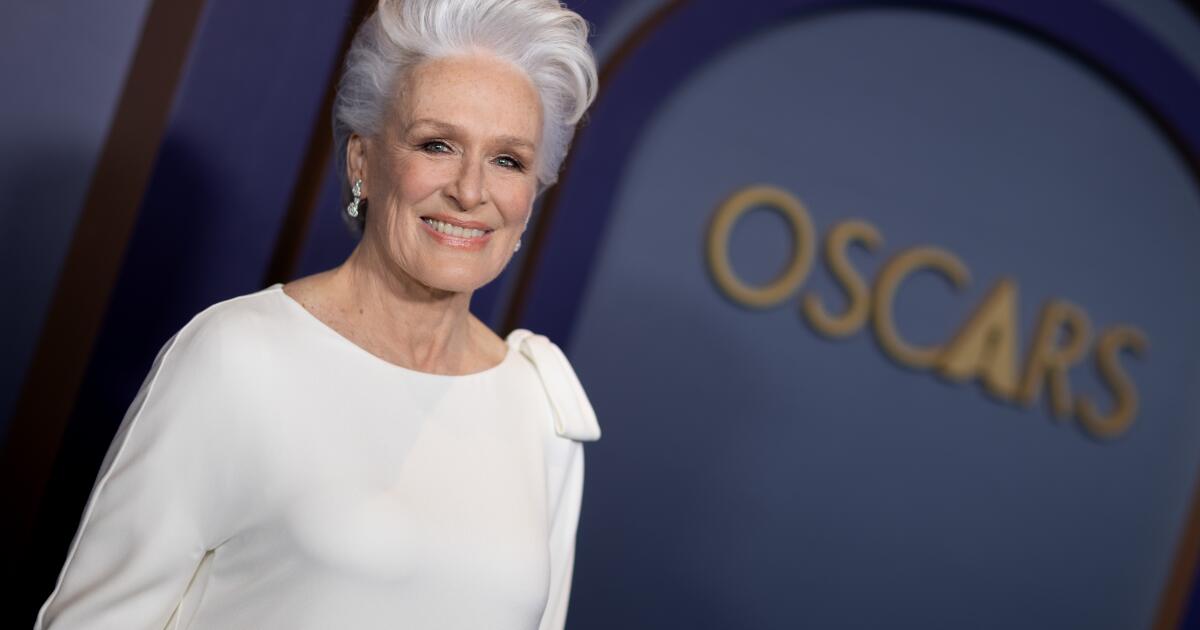
After decades spent shaping modern movies without ever taking home a competitive Oscar, actor Glenn Close and director Ridley Scott will finally receive statuettes from the Academy of Motion Picture Arts and Sciences this fall.
The academy announced Wednesday that Close and Scott will receive honorary Oscars at this year’s Governors Awards alongside pioneering animator Floyd Norman, while producers Christine Vachon and Pamela Koffler, co-founders of Killer Films, will receive the Irving G. Thalberg Memorial Award.
The annual Governors Awards, launched in 2009, recognize lifetime achievement and significant contributions to filmmaking and the motion picture industry. The Thalberg Award honors producers whose bodies of work reflect consistently high-quality motion picture production.
Unlike the competitive Oscars handed out during the telecast, the honorary prizes are presented at a separate ceremony attended by film industry figures, academy members and awards season contenders.
Close, 79, one of the most acclaimed actors of her generation, has received eight Oscar nominations over her career, including for “Fatal Attraction,” “Dangerous Liaisons,” “Albert Nobbs” and “The Wife.”
Scott, 88, the architect of “Alien” and “Blade Runner,” whose striking visual style helped define modern blockbuster filmmaking, has scored nominations for directing “Thelma & Louise,” “Gladiator” and “Black Hawk Down,” while also earning a best picture nomination for “The Martian.”
The 90-year-old Norman, who began working at Disney in the 1950s, became the studio’s first Black animator, contributing to films including “Sleeping Beauty,” “The Jungle Book” and “Robin Hood.” His career has spanned more than six decades.
Vachon and Koffler have been central figures in American independent cinema for decades, backing such films as “Boys Don’t Cry,” “Far From Heaven,” “Carol,” “First Reformed” and “Past Lives,” the last of which earned them their first best picture nomination in 2024.
The honors will be presented Nov. 15 at the Ray Dolby Ballroom at Ovation Hollywood during the academy’s 17th Governors Awards ceremony.
Anticipation. Rumors. Anxiously scanning the horizon, hoping that a brilliant force will leave the masses forever changed. Yes, a new Steven Spielberg movie about close encounters with extraterrestrials is landing — and misses the mark.
“Disclosure Day” is a story of truth and feared consequences. A personality-free cybersecurity expert, Daniel (Josh O’Connor), is on the run with evidence of little gray men arriving on our planet to a rude reception. The aliens are kind. Our species is barbaric. Wittily bruising us with that fact, Spielberg opens with a POV of a wrestler kicking the audience in the face. Welcome to Earth.
Elsewhere in America, a weathergirl named Margaret (Emily Blunt) breezes into her Kansas City studio, babbling up until the minute the news camera turns on, a bravura sequence that channels her restlessness, the station’s tempo and the film’s alarm that this ditz has just this morning been stricken with preternatural powers. (The cinematography and editing are by Janusz Kaminski and Sarah Broshar.) Locally, Margaret is known for announcing hailstorms with a sexy shimmy. Suddenly, she’s fluent in Russian, Korean and telepathy. Although she and her boyfriend, Jackson (Wyatt Russell), are a bad match, she’s giving everyone else life advice like an intergalactic Dear Abby.
When Margaret starts spouting alien-ese — spasms of gutteral clicks — on live TV, she and Jackson rush to the hospital for a brain scan followed by several suspicious men who claim to be with the FBI. Russell’s befuddled Jackson is as useless as a traffic cone but Blunt’s Margaret is a gas before the movie makes her go all glassy-eyed and solemn. Yet, the movie is less inspired by why she was chosen or how she feels about it than in dragging us back in time to the moment when it happened, which isn’t that interesting except for its resemblance to a Disney princess having a psychotic break. The CG animals and aliens look stiff, other than a nifty close-up of an eyeball. (Later, I did like how one alien appears to be wearing sportswear.)
Chasing both Daniel and Margaret around the Midwest is a deep-state company called Wardex that wants to steal back the proof in Daniel’s backpack, a heap of hard drives with footage of 70-plus years of extraterrestrial visitations. It’s a treat to see Spielberg enjoying staging this conspiratorial gossip in different film stocks, from the black-and-white noir of 1947 Roswell to the clinical security-camera look of today. Whatever Wardex does on a day-to-day basis is unclear (we just see video screens and lab equipment). But it acts all-powerful, seeming to know more about outer-space tech than its overseers at the Department of Defense.
The script is by David Koepp of the paranoid thriller “Black Bag” and Spielberg’s 2005 version of “War of the Worlds,” yet, this plot strand about private enterprise isn’t science fiction. Last year, in the unrelated UFO documentary “The Age of Disclosure,” current Secretary of State Marco Rubio admitted that companies have a stronger institutional memory of “exotic materials” than any presidential administration: “The people in government who know where it came from originally — they’re long gone and their successors have no idea that it was there at all.” To add nationalistic insult to injury, the head of Wardex isn’t even American. He’s a Brit played by Colin Firth.
If anything, “Disclosure Day” isn’t paranoid enough. Clutching a mysterious tool the shape of a mouse coffin, Firth’s villain tracks Daniel’s location by mentally transplanting himself into another person’s body, changing the color of their pupils to his own icy blue. His gadget also makes his targets super sweaty. This laborious alien tactic leads to a few fun scenes but frankly feels old-fashioned when the omnipresent surveillance that Spielberg himself warned about nearly 25 years ago in “Minority Report” is now here with recording devices constantly tracking our faces, voices and movements just so we don’t have to dial phones, fetch sandwiches or talk to human drivers. Although his movie urged us against this 24/7 spyware future, we have since embraced the convenience.
I bring this up because “Disclosure Day’s” driving question is how humanity will react to life-altering information. (Not that the plot has much momentum — too many scenes end with the belief that ducking 10 feet out of view makes you invisible, with an antagonist simply giving up.) Daniel insists on total honesty: “People have a right to know the truth,” he says. His girlfriend Jane (Eve Hewson) doubts 8 billion people can handle his alien revelations. A Catholic, she’s alarmed that extraterrestrial intelligence could replace the concept of God, naively claiming that “religion holds society together.” Since when?
There’s some wan comedy in an early scene where these new-ish lovers debate the ethics of secrecy while revealing the skeletons they’ve been hiding from each other. Both have pasts you wouldn’t put on a Tinder profile. The script is glancingly empathetic to Jane’s moral turmoil but like Daniel, the film has made up its mind before the movie started. Narratively and logistically, Daniel’s whistleblowing escape limps along with a lack of suspense. Wardex doesn’t even bother to preemptively discredit Daniel in the public’s eye, which, given the two sentences of backstory we know about his character, would be easy.
Nattering in the background are broadcasts about the impending threat of global war at the hands of the United States, Russia and North Korea. Given that scary possibility, the risk that Daniel’s reveal could tip over the world order doesn’t seem that bad. Honestly, I’m dubious of the film’s certainty that folks even have the bandwidth to care about such news, let alone agree on what they’re seeing. The serious journalism Margaret aspires to do is splintering under our distrust of who controls the megaphones. Last month’s infodump of an Armed Forces report listing 209 sightings of unidentified objects was announced with a presidential tweet that “the people can decide for themselves.” I didn’t bother to click. Did you?
Getting information about these space invaders out leaves no time for taking the marvel of their existence in. Decades after Spielberg unveiled his signature shot — a face amazed at wonders we can’t see — he seems wearied by his awareness that today’s moment of revelation would look like a person staring down at their phone. When lens flares continually beam right at the screen, the whole movie feels like enlightenment under duress.
Where are the aliens from and why are they here? Who knows. “Disclosure Day” speeds around frantically, talking constantly and explaining little. Back in 1977, Spielberg’s “Close Encounters of the Third Kind” was a popcorn masterpiece of withheld information. Its quiet assurance that experts had a handle on flying saucers and a plan to meet them felt comforting. Here, Colman Domingo’s renegade intelligence operative also refuses to tell anyone anything, but all the unspoken beats just feel like plot holes. Mostly, his character builds what looks like a Hollywood set to reveal a truth he already suspects. That’s what Spielberg is doing too, but a film needs a sense of curiosity.
Instead, the wows come from good stagings of ordinary action: a car crash, a gripped crucifix, a hideout crowded with jostling, thrumming musical instruments. There’s a great train-track crossing sequence that’s also a vicious callback to Richard Dreyfuss’ epiphany in “Close Encounters.” Yet, I wanted to see more of the old Spielberg, the one who expressed awe in moments of silence rather than relentless motion.
That Spielberg has come full circle to his lifelong obsession with the sky had me convinced that this might be a secret sequel to “Close Encounters” beyond the droll joke that both Dreyfuss’ Roy and Blunt’s Margaret are shacked up with unsupportive blonds. They do share a universe; you’ll see a glimpse of what could pass for an outtake from Devils Tower, a.k.a. Mashed Potato Mountain, on one of Daniel’s hard drives. Still, I left underwhelmed. I didn’t need Dreyfuss to step off a spaceship gangplank and say, “I’m back.” I just needed “Disclosure Day” to have the same spark of intelligent life.
‘Disclosure Day’
Rated: PG-13, for action/violence, some bloody images and strong language
Bill Cody, the Grand Ole Opry and longtime WSM Radio host who woke up listeners with his velvet voice and country music lore, has died. He was 67.
The Tennessee radio station confirmed Cody’s death on social media on Tuesday, writing, “It is with heavy hearts that we share the passing of our dear friend and beloved WSM voice, Bill Cody.
“A singular presence on WSM-AM Nashville for more than three decades, Bill welcomed listeners each morning on Coffee, Country & Cody with a broad smile, a conversational ease, and an unerring ability to make both artists and audiences feel at home. He joined WSM in 1994 and had Charlie Daniels as his first in-studio guest. He built more than a morning show; he created a gathering place rooted in his deep love for country music and the people behind it.”
In late May, Cody’s daughter Hannah Davis shared that the radio host had been admitted to the intensive care unit with heart and kidney failure. “After weeks of being on a roller coaster of emotions, tests, dialysis, medications, steps forwards and steps backwards, it was determined earlier this week that his only option for survival would be a double transplant, heart and kidney,” she wrote on Facebook. “We need a miracle and we know God is able.”
On Tuesday, she wrote that Cody had died peacefully surrounded by family and “was welcomed into heaven as thunder bellowed outside, and we laughed because we knew it was a band of angels rejoicing.”
With nearly 50 years on the airwaves across syndicated radio, television and film, Cody was honored with a star on the Music City Walk of Fame in the fall of 2024. His credits included the film “American Saturday Night: Live From the Grand Ole Opry,” the television show “Tennessee’s Wild Side” on PBS, “Ray Stevens’ Nashville” on RFD-TV, and GAC TV’s “Master Series.”
In 2008, the beloved Nashville host was inducted into the Country Radio Hall of Fame, and across his career, he earned multiple nominations from the Country Music Assn., the Academy of Country Music and Billboard for his contributions to broadcasting.
Born Trent Clutts on Dec. 16, 1958, in Huntsville, Ala., Cody was inspired to pursue a career in broadcasting during visits to a Kentucky radio station with his dad. His father was a Southern Baptist minister, and his Sunday morning sermons were broadcast on the radio in the afternoons. Cody couldn’t get enough of the goings-on at the station when the two would stop by to drop off cassettes.
In 1971, when the radio host was 17, he was hired as a night deejay at WVLK in Lexington, Ky., but the program director didn’t think “Trent Clutts” had the right ring for radio. Cody named himself after “Buffalo Bill,” one of the most famous showmen of the American Old West, and used the moniker for the rest of his career.
As a teenager, Cody noticed a girl named Rebecca during study hall and, according to Davis, winked at her from across the room. The wink sealed the deal and the two spent more than 50 years as a couple, welcomed three children — Luke, Hannah, and Levi, who died in 2025 — and eventually grandchildren, who called him PoPo. The family lived in Cross Plains, Tenn.
“Like so many of us at the Opry, Bill Cody lived out his dreams on the Opry stage. More times than I could count he and I would look at each other as if to say, ‘Can you believe we get to do this?’” Dan Rogers, executive producer at the Grand Ole Opry, wrote on social media.
“Even better, he made Opry audiences tuned in from around the world feel like they were here too, themselves a part of country music’s most famous show. Then, he’d get up early the next morning and — with that signature smile in his voice — tell everybody about it on his show.
“He was the best of friends to country music and to everyone who was a part of it. We’re sure going to miss him.”
In a statement, AMC said due to the “robust lineup of upcoming films and strong advance ticket sales in the weeks ahead,” it needed to make some programming adjustments. Some of the major upcoming releases for June include Disney’s “Toy Story 5” and Steven Spielberg’s “Disclosure Day.”
Acts like Bebe Rexha, Paris Hilton, Kim Petras and Marren Morris were lined up to test out the new format next week, as a part of the Girls Night Live concert series.
The chain is partnering with live entertainment company Arena One to bring new technology to theaters. This tech would allow artists on a remote stage to see, hear and respond to the theater audience, in effect turning your local cinema into a stadium, the companies said. Fans who already purchased tickets have received refunds.
The series was initially marketed as a new draw to get customers to the theaters, but given the strong box office numbers so far this year, it’s clear the demand for theaters is already growing
Focus Features’ “Obsession” is now nearing $230 million in global box office revenue, according to Box Office Mojo, and is the studio’s highest-grossing movie at the domestic box office.
Most recently, “Scary Movie” topped the box office last weekend with a $105.5-million worldwide debut, ranking among the top five biggest R-rated comedy openings of all time.
AMC said it would announce new dates and additional artists for the interactive concert series in the coming months.
The first film by Canadian filmmaker David Cronenberg to be shot partly in the U.S. is, perhaps not surprisingly, a freaky satire of Hollywood. Its take on fame has only grown more accurate in the years since its premiere in 2014. Julianne Moore, Mia Wasikowska and Robert Pattinson star in a demented tale of family, celebrity, ambition, ego and limousines. Funny and perverse, the film captures the uncanny cocktail of mean-spirited malignancy, self-obsessed delusion and just plain obliviousness that runs rampant around town. Presented by the screening series Mezzanine and the local literary magazine the Big One, the evening will be introduced by the film’s screenwriter, Bruce Wagner, a longtime chronicler of Los Angeles.
“Maps to the Stars” is playing June 14 at Brain Dead Studios. Tickets here.
With the Wayans brothers firmly back in the driver’s seat, horror parody “Scary Movie” muscled its way past He-Man for the top spot at the box office this weekend.
The reboot of the 2000s-era franchise — or “rebootiquel,” as the movie calls itself — brought in $55 million in the U.S. and Canada for a worldwide total of $105.5 million, according to studio estimates. The movie, which had a production budget of $30 million, beat studio expectations and marks the return of the Wayans brothers to “Scary Movie.”
The franchise was developed by Marlon Wayans, Shawn Wayans and Keenen Ivory Wayans. But after 2001’s “Scary Movie 2,” the Wayans got in a pay dispute with former Miramax executives Bob and Harvey Weinstein. The Wayans have said the Weinsteins did not tell them that 2003’s “Scary Movie 3” would be made without them. The franchise then continued with fourth and fifth installments.
After former MGM film executive Jonathan Glickman was named chief executive of Miramax in 2024, he reached out to Marlon Wayans to see if he’d be interested in reviving “Scary Movie.”
“Always dreamt of having this moment again,” Wayans said, while thanking Glickman and executive producer Marc Weinstock during a short speech at the movie’s premiere. “I thank you guys for having the vision to go, there’s only one way to do the next ‘Scary Movie,’ and that’s to bring the Wayans family back.”
Miramax led the production and financing of the film, while Paramount Pictures was the distributor.
Amazon MGM Studios’ “Masters of the Universe” came in second at the domestic box office with $29.3 million, in Mattel Studios’ first film in theaters since the 2023 smash hit “Barbie.” Globally, the movie made $54 million.
The action adventure movie had a production budget of about $170 million and aimed to reintroduce the ‘80s-era action hero “He-Man” to a new audience, while also driving the nostalgia of adults who played with the franchise toys or watched the original film and series. The movie is part of Mattel Inc.’s strategy to continue extending its toy brands into the entertainment arena.
Mattel Chief Executive Ynon Kreiz said last week that “Masters of the Universe” didn’t need to match the success of “Barbie” “to have a meaningful economic impact on the company.”
A24’s runaway hit “Backrooms” came in third at the box office this weekend, continuing its strong performance with a haul of $25.9 million. Focus Features’ “Obsession” ($25.6 million) and another YouTube-native property, “The Amazing Digital Circus: The Last Act,” ($12.7 million) rounded out the top five at the box office, according to Comscore data.
What was the moment from the season finale of “The Pitt” that finally broke you?
Was it the shot of the day-shift staff watching the Fourth of July fireworks from the hospital roof, the sound of “America the Beautiful” playing in the distance? Maybe it was Dr. Al-Hashimi (Sepideh Moafi) crying in her car, realizing she can’t work around the seizure disorder that makes her a liability in the ER. Or perhaps it came when Noah Wyle’s Dr. Robinavitch (a.k.a. Dr. Robby) swaddled Baby Jane Doe, telling her that “everything’s gonna be just fine,” because she has “so many wonderful things to see and so many people to love.”
But what opened the floodgates for me, after the last half-hour of the episode left me completely dazed and dumbfounded, was Drs. Santos (Isa Briones) and King (Taylor Dearden) exorcising the day’s demons by belting out Alanis Morissette’s “You Oughta Know” at a karaoke bar and demonstrating that primal scream therapy is alive and well three decades into the 21st century.
Sign up for The Envelope
Get exclusive awards season news, in-depth interviews and columnist Glenn Whipp’s must-read analysis straight to your inbox.
By continuing, you agree to our Terms of Service, which include arbitration and a class action waiver. You agree that we and our third-party vendors may collect and use your information, including through cookies, pixels and similar technologies, for the purposes set forth in our Privacy Policy such as personalizing your experience and ads.
Which is all to say: “The Pitt” is the only television show I’ve watched that gives me the same feeling I have when I read a great, immersive novel. When the end is near, I’m bereft. I’m Al-Hashimi in her car, wanting to pound the dashboard. I do not want to let these characters go. They’ve given me 15 hours and I still crave more. I would devour a series of short films about odd couple Santos and Whitaker (Gerran Howell) sharing an apartment or a summer spinoff showing Dr. Abbot (Shawn Hatosy) working off-hours as a SWAT medic. Anything to fill the long, “Pitt”-less weeks between seasons.
“The Pitt” won five Emmys from 13 nominations, including best drama series, for its celebrated first season, a 15-episode run that began with Dr. Robby up on the hospital roof talking down Dr. Abbot after an intense shift. The season ended with Dr. Abbot returning the favor after Robby and his staff ground their way through a day that included a mass shooting, a child drowning and a patient assaulting LaNasa’s no-nonsense charge nurse.
How do you follow that?
For a few episodes this new season, it looked like “The Pitt” wasn’t up to the task. We watched the ER staff dealing with a series of bloody, messy (the disimpaction!) medical maladies, an avert-your-eyes spectacle that felt like the writers were trying to one-up themselves and find the worst possible affliction to make viewers double over. Worse, the thrill of discovery that kept us invested throughout the first season, the slow drip of information about the characters, wasn’t quite there. Something was missing, and it wasn’t just Dr. Robby’s motorcycle helmet.
But the luxury of having 15 episodes is that the writers can take their time laying the groundwork for the story they want to tell.
And what a story it was.
Over the course of the season, we watched Dr. Robby disintegrate, his mental health more precarious than ever because he has done nothing to address his apparent PTSD. “You need help,” Dr. Langdon (Patrick Ball) tells Robby, confronting him in the finale. “Be honest with yourself.”
Robby isn’t the only one struggling, as Dr. Abbot puts it, to “dance through the darkness.” Langdon is back, managing his sobriety. Dr. Mohan (Supriya Ganesh) is having panic attacks. Santos is still dealing with self-harm. Dana remains haunted by that Season 1 patient assault and now carries a syringe containing a heavy sedative just in case somebody emerging from that overcrowded waiting room crosses the line again.
“I’ve seen so many people die that I feel like it’s leaching something from my soul,” Robby says. “I’m tired of feeling like I’m drowning every day.”
And there you have it, the subject of Season 2 of “The Pitt.” Medical professionals are gasping for air, and the American healthcare system, with its focus on profit above all else, is failing them and the patients they treat.
Remember Orlando, the patient with severe diabetic ketoacidosis who arrives at the ER after fainting? Orlando had to ration his insulin because he lacked insurance and felt he had to cut corners. He ends up leaving the hospital early, fearing the cost of treatment. Later he returns, having fallen (jumped) from a catwalk at his construction job, fracturing his skull. But good news: He now qualifies for Medicare and Medicaid due to long-term disability.
It’s a tragedy, one of many reasons the season finale shot of the ER staff holding back tears as they watched the Fourth of July fireworks felt like a body blow. “America the Beautiful”? How can that be true when the current administration is seeking $1.5 trillion for defense spending — nearly 50% more than this year — while cutting healthcare and social safety nets? How can that be true when an act known as the “Big, Beautiful Bill” removed funding from an already frayed healthcare system and exacerbated the shortage of care in rural areas of the country?
That one scene, the culmination of hours of careful, patient storytelling, said more about the disconnect between American ideals and America’s reality than anything else I’ve read or watched this year.
Give “The Pitt” all the Emmys. It has more than earned them.
A US influencer and actor have caused outrage after mocking Palestinians subject to rape and beastiality in Israeli prisons. Elon Gold and Lizzy Savetsky made the comments at the Tribeca Film Festival as they promoted a new film made in Israel.
Call “Scary Movie” lazy, dumb and offensive. It would enthusiastically agree. The lowbrow horror parody thrives on shtick about weed, race and genitalia. The only thing that scares it is high expectations.
But amid the rampant stupidity of the first “Scary Movie,” released in 2000, original director Keenen Ivory Wayans discovered two major talents: Regina Hall and Anna Faris. As heroines Brenda and Cindy, respectively, Hall and Faris were daffy, dopey and committed. Alongside a cast of Playmates (Carmen Electra, Shannon Elizabeth) and family members (Wayans brothers Marlon and Shawn), they played stupid like Shakespeare. In two decades since, both gave up the Ghostface to do better things: Hall in “Girls Trip” and “One Battle After Another,” and Faris in “Smiley Face” and “The House Bunny.” (Frankly, Faris deserves to be doing more.) If a sixth “Scary Movie” is going to lure them back for what the ensemble openly frets is a rebooquel — as in a reboot-sequel, here pronounced “re-booty call” — it better be good.
Fine, good is a stretch. The latest “Scary Movie,” which simply recycles the title “Scary Movie,” is as lazy, dumb and offensive as the others. But Hall and Faris, now playing the dotty mothers of the next generation of victims, are hilarious, romping about like their Brenda and Cindy have clearly been knocked on the head too often. (Brenda, fans of the franchise know, has technically already died twice.) I laughed 10 times, which makes this “Scary Movie” the best of the bunch — a pallid compliment.
Directing duties have shuffled to Michael Tiddes, a longtime Wayans collaborator, who gets gutsy performances from three of this entry’s newbies: Olivia Rose Keegan and Savannah Lee Nassif as Cindy’s estranged daughters, a pill-popper and a Wednesday Addams clone, and Ruby Snowber, maximizing every second of her feature debut as a high school tramp.
The Wayans clan left the series early on due to a contract dispute with Harvey and Bob Weinstein. Now seven have returned. Four Wayans (Craig, Keenan Ivory, Marlon and Shawn) co-wrote the script with Rick Alvarez; three more (Kim, Damon Jr., and Gregg) act in the film alongside Marlon and Shawn, who revive their characters Shorty, a stoner with a shrill cackle, and Ray, whose only personality trait is being gay. In one of many homages to “Sinners,” Ray promises a church he’ll act straight. Then he mimes tucking his manhood between his legs and dancing like Buffalo Bill in “The Silence of the Lambs.”
Yes, Shorty and Ray were also murdered in the first movie. No, it doesn’t matter. “Scary Movie’s” one genuinely ingenious move is to resurrect actors without shame. Jon Abrahams’ bad boyfriend (stabbed), Lochlyn Munro’s lout (slit throat), and Electra’s eye candy (pierced through the breast implant) are back, too, as are a pair of erotically linked survivors, Cheri Oteri’s news anchor and Dave Sheridan’s moronic cop, whose spittle-flecked chin is the grossest thing in a film that has a mall Santa costumed like “Terrifier’s” Art the Clown gifting a child a set of severed testicles.
“The Silence of the Lambs” remains the only horror film to win best picture at the Academy Awards. This “Scary Movie” has no delusions of that. Yet in the years since the last installment, 2013’s “Scary Movie 5” — a sequel so awful that even its own director, Malcolm D. Lee, later admitted, “It’s not worth your time” — the horror genre at-large has become ambitious, with “Sinners,” “The Substance,” and “Get Out” earning Oscar nominations and “Weapons’” witchy Amy Madigan seizing the supporting actress prize.
This “Scary Movie” makes fun of all four of those newer hits, as well as the recent rebooquels of “Halloween,” which was earnest, and “Scream,” which couldn’t decide what tone to hit. Each send-up is funny for at least an entire minute, a lifetime when you’re watching Marlon’s Shorty mug for the camera. Either Shorty has the most screen time or he’s just so excruciating that it feels like it.
I cannot make the straight-faced argument that the worst “Scary Movies” were held back by their source material. Still, it’s true that when the series was at its nadir, so few vibrant horror films were being made that it was stuck lampooning the now-forgotten Jessica Chastain chiller “Mama.” Likewise, when this “Scary Movie” takes a jab at Nicolas Cage’s more-kooky-than-tedious “Longlegs,” the limp gag of the creepy Shorthand (Chris Elliot), underscores that the movie itself just isn’t that interesting.
“Scary Movie” inserts two political jokes that earn a solid gasp-giggle-groan. Yet, the most grating new addition is a self-righteous student named Dei Meeks (Sydney Park), who polices the humor. The movie relishes killing the killjoy. A whole mob does her in; it’s the one death that feels angry. I’d have been happy to see her die in her first scene. Not that I empathize with canceled comics who posture as if they’re victims under attack, but it would do this country good if it could occasionally share a laugh.
Don’t waste one brain cell trying to deduce the assassin. The answer is surprising and satisfying. While the script’s hasty nods to “KPop Demon Hunters” and the biopic “Michael” make it feel like it was written on yesterday’s Kleenex, the immediacy allows “One Battle After Another’s” Teyana Taylor to acknowledge that Madigan’s Aunt Gladys stole her Oscar. Swilling tequila shots and hollering “Viva la revolución!,” she’s hysterical in the cleverest opening slasher scene since Drew Barrymore answered the phone in the 1996 “Scream.” I’d watch six more “Scary Movies” if Taylor starred in them. But like Hall and Faris, she deserves better.
‘Scary Movie’
Rated: R, for crude sexual content, graphic nudity, strong violence, and drug content and language throughout
An acclaimed biopic about Israeli lawyer Lea Tsemel, who has dedicated her life to representing Palestinian defendants charged by Israeli authorities, has been shortlisted for an Oscar.
“Advocate” is one of 15 films shortlisted in the Documentary Feature category, out of an original 159 submissions. The final five contenders will be announced next month.
The award-winning documentary, co-directed by Rachel Leah Jones and Philippe Bellaiche, has been vociferously attacked by right-wing Israeli groups and Israel’s Culture Minister Miri Regev.
When “Advocate” won Best Picture at the DocAviv festival in Tel Aviv, Regev condemned “the choice to make a movie focusing on a lawyer who represents, supports and speaks in the name of many who undermine the State of Israel’s existence, [and] use terrorism against its soldiers and people”.
In awarding the film, DocAviv judges wrote that “Advocate” is “a thought-provoking project that addresses an important subject and demonstrates impressive cinematic skills, especially the innovative and intelligent use of animation… [It] sketches out a complex portrait of a strong and inspiring woman who believes in the justness of her path with all her heart.”
The award was greeted with outrage, and following an organised campaign, Israel’s state lottery company subsequently announced “it would be pulling its funding for future grants given to best picture winners at Tel Aviv’s documentary film festival”.
Japanese filmmaker Chie Hayakawa isn’t afraid to look death in the eye. The writer-director’s 2022 feature debut, “Plan 75,” imagined an unsettling future in which the elderly are offered a subsidy by the government to be euthanized. For her follow-up, she travels into her own past, drawing from memories of her father’s battle with cancer.
But while “Renoir” features no sci-fi elements, the nearness of oblivion remains just as prominent. Shorn of sentimentality, this gentle drama follows a quietly observant fifth-grader who feels the grim shadow of mortality all around her. How the character will absorb that realization is anyone’s guess — including Hayakawa’s.
Newcomer Yui Suzuki stars as Fuki, who lives in a nondescript Tokyo suburb in 1987. Her soft-spoken dad, Keiji (Lily Franky), is suffering with terminal cancer in its final stages, the emaciated man spending as much time in the hospital as he does at home. Fuki’s mother, Utako (Hikari Ishida), doesn’t seem very despondent, though: One senses an emotional exhaustion that comes from preparing so long for the inevitable that she’s now mostly numb, her anticipatory grief having given way to frayed nerves.
Fuki’s pre-mourning process is equally complicated. Outwardly, she shows no signs of being devastated by her dad’s imminent passing, happily playing with him, almost in denial of his fate. But “Renoir” subtly suggests the impressionable girl is more aware than she lets on, surrounding her with random reminders of death. Local news breathlessly reports on random domestic murders. Even when Fuki gets away from the city, the camera lingers on her watching a campfire’s dying embers. The film derives its title from the girl’s interest in “Little Irène,” a painting by influential French impressionist Pierre-Auguste Renoir. She asks if Renoir is still alive. No, he’s dead too.
Hayakawa pulls from her childhood in multiple ways for her sophomore feature, which premiered in competition at Cannes last year. “Renoir” takes place in 1987 specifically because that’s the year she turned 11, and, like her protagonist, she was infatuated with “Little Irène.” But there’s a refreshing absence of nostalgia in Hayakawa’s conception of Fuki and her quizzical processing of her father’s fatal illness.
For school, Fuki writes an essay about her wish to be an orphan. She becomes obsessed with hypnotism and mind-reading, an unorthodox strategy to create a sense of control. And, occasionally, she wanders into daydreams that Hayakawa presents so matter-of-factly that viewers may sometimes be unsure if what they’re seeing is actually happening. In “Renoir,” Fuki’s flights of fancy are as naturalistic as her everyday life — a sharp reminder that, for children, imagination and reality are often indistinguishable.
If death has been integral to Hayakawa’s two features, it’s society’s callous reaction to aging that is her primary focus. “Plan 75” eschewed dystopian-thriller conventions to ponder how Japan might one day treat its senior citizens, viewing them as little more than a drain on resources. “Renoir” makes a similar point within a memory piece. Keiji is the one dying, but it’s telling that Hayakawa centers the story on Fuki and Utako, who each, in their own way, seem more concerned about their own personal dramas.
As Keiji’s situation grows more dire, Utako enters the orbit of Toru (Ayumu Nakajima), a workplace advisor with whom she’s instantly smitten, pondering pursuing him romantically. Ironically, Toru preaches the importance of good communication skills in the office, a lesson the film’s guarded family would be wise to heed. While Utako hides her feelings for Toru, Fuki begins a secret odyssey in which she impulsively joins a phone dating service, engaging in conversations with a creepy college student (Ryota Bando) who pushes her to meet in person. This potentially traumatic subplot is the closest “Renoir” gets to traditional suspense, but even here Hayakawa adopts a muted approach, sidestepping shock value for bittersweet commentary about young people’s confusion around love. Both Utako and Fuki chase after human connections fraught with danger, each trying to insulate themselves from the tragedy waiting at home.
“Renoir” may be a delicate wisp of a film, but it’s flecked with thoughtful questioning about whether childhood’s sorrows leave permanent scars on us as adults. Suzuki exudes the fragility and buoyancy of adolescence, playing Fuki as someone constantly imbibing the world, rarely revealing what she’s doing with that stimulus. The simplest moments resonate the strongest, such as when the moody 11-year-old holds a balloon over the balcony of her family’s high-rise apartment, casually releasing her grip so that it tumbles to the ground far below. Does it speak to a desire to jump herself? “Renoir” won’t say, but the character is so poised you feel confident she’ll survive her father’s death. Who knows: Maybe years from now, she’ll even make a touching, emotionally astute movie about it.
‘Renoir’
In Japanese, with subtitles
Not rated
Running time: 1 hour, 56 minutes
Playing: Opens Friday, June 5 at Landmark’s Nuart Theatre
Three years ago, Mattel Inc. struck box-office gold — or rather, pink — with the billion-dollar success of “Barbie.”
In its first return to theaters since the female-forward phenomenon, the El Segundo toymaker is turning to the brawny He-Man for another box-office lift.
Its latest film, “Masters of the Universe,” opens this weekend, as Mattel looks to build on that previous success and continue extending its signature toy brands into the entertainment arena.
“The movie is very much in tune with culture,” said Mattel Chief Executive Ynon Kreiz. “Everything is much more contemporary relative to what was created more than 40 years ago, but it’s still very true to the origin story and to the DNA of the brand.”
The new film arrives at a pivotal time for Mattel, which is facing pressure from investors to grow its business. The maker of Hot Wheels, American Girl and Uno has recently confronted a challenging market for toys, beset by tariffs on goods produced overseas and weaker-than-expected demand for Barbie dolls and Fisher-Price preschool products.
Amid uncertainty in the toy market and the fallout from tariffs, Mattel’s net income dropped 25% to $398 million in 2025. And since the company announced disappointing holiday sales totals in February, its stock has dropped more than 30%, closing at $14.34 on Wednesday.
“Masters of the Universe” toys at Mattel headquarters in El Segundo.
(Myung J. Chun / Los Angeles Times)
The share price slide prompted investor Southeastern Asset Management to send a letter last month to Mattel leadership suggesting the toy maker should sell itself and go private. Southeastern manages about 4% of the company’s stock on behalf of its clients.
“The frustration among investors has been the fact that if you look at the business from 2021 through 2025 and even this year … the business really hasn’t grown,” said Eric Handler, a Roth Capital senior media and entertainment analyst, referring to Mattel. “This is a company that needed something fresh in the portfolio, and there’s a wide range of investments being made, of which ‘Masters of the Universe’ is one part.”
Kreiz pushed back on the idea that the company is not growing. In the fourth quarter of 2025, net sales were up 7% to $1.8 billion, though the result was not as strong as the company expected.
Mattel has spent $1.2 billion in the last three years to buy back shares, with an additional $1.5-billion share repurchase planned for the next three years.
“We’re investing in our own stock because we believe it is undervalued,” he told The Times in an interview at his office, which has floor-to-ceiling windows that give an expansive view of El Segundo. “We absolutely agree that the share price doesn’t reflect the progress that we’ve achieved over the last few years financially, operationally, our place in culture, the strength of our brands, and the continued expansion of the business. And more importantly, the potential that we have down the road.”
“Masters of the Universe” is a key variable in that equation.
Ynon Kreiz, chief executive of Mattel.
(Myung J. Chun / Los Angeles Times)
The movie, which had a budget of roughly $170 million, is expected to bring in $25 million to $35 million in the U.S. and Canada during its debut weekend. That’s a far cry from the $162-million opening haul of “Barbie,” but box-office analysts say that film captured the cultural zeitgeist in a way that’s hard to replicate.
The ‘80s-era “Masters of the Universe” is “a property that was famous with a certain group of fans, but it hasn’t had much of a pop culture presence,” said Shawn Robbins, who directs movie analytics at Fandango and founded the forecasting site Box Office Theory. The movie has notched a respectable 74% approval rating from critics on aggregator Rotten Tomatoes.
“There’s been so many callbacks to nostalgic franchises,” he said. “Some people are always on board for them, and maybe the positive reviews bring people in who were on the fence. But people are also ready for something fresh and new and exciting.”
Kreiz said he’s often asked how the company will match the success of “Barbie.”
“The answer is, we don’t need to match ‘Barbie’s’ success for movies to have a meaningful economic impact on the company,” he said. “Not every movie will be ‘Barbie.’ If we create quality content that people want to watch and create quality experiences that people are engaged with, good things happen, and these brands will resonate and will be here for years to come.”
While theatrical revenue is important, the measure of success for “Masters of the Universe” could also include its eventual reception on streaming platforms and, of course, toy sales, analysts said.
There are hundreds of products tied to the movie, from collectible action figures of Nicholas Galitzine’s He-Man and Camila Mendes’ Teela, to branded Uno decks, Legos, clothing and skateboards.
Skeletor from “Masters of the Universe.”
(Myung J. Chun / Los Angeles Times)
“For us, it’s a huge win already,” said Robbie Brenner, president of Mattel Studios and chief content officer, who also served as a producer on the film. “We have reinvigorated and relaunched this brand that has been around for decades … and done it in a way with just the best-in-class toys. Obviously that’s our bread and butter. And then to have made an epic, incredible movie … is a huge win.”
While Mattel does not yet have sales totals for its “Masters of the Universe” toys, executives said during an earnings call in late April that product sales were “growing double digits” amid strong customer demand, particularly from adults.
When Kreiz was named CEO in 2018, he saw the potential for Mattel to expand beyond toys. In an entertainment landscape dominated by known franchises and intellectual property, the former TV and media executive wanted to leverage the company’s IP in new ways to attract consumers.
Hence, Mattel has expanded into real-world experiences such as a Barbie pop-up at Coachella or a traveling Hot Wheels monster truck show. In February, the company fully acquired Mattel163 mobile game studio after buying out a stake held by Chinese tech firm NetEase. The studio has released games based on Uno, Skip-Bo and other Mattel intellectual property.
And on the film and television front, the Mattel Studios division now has 51 people — most of whom are based in El Segundo — focused on projects across platforms.
After “Masters of the Universe,” Mattel Studios plans to release a “Matchbox” streaming movie in October. The division has more than a dozen films in development that have been announced, including an American Girl movie with Paramount, Polly Pocket with Amazon MGM Studios, as well as a live-action Magic 8 Ball series from M. Night Shyamalan.
“The journey for the company was to evolve from being a toy manufacturer that was making items to become an IP company that is managing franchises,” Kreiz said. “It’s not that we’re not creating toys — it’s obviously a big part of our business — but the opportunity is to expand so much more than the physical product.”
“Masters of the Universe” was in development for years at several different studios before it was picked up by Amazon MGM.
That partnership stemmed from Mattel’s work on the “Barbie” movie with Courtenay Valenti, then president of production and development at Warner Bros. Pictures who is now head of film at Amazon MGM.
“Masters of the Universe” felt like a good property for Mattel to bet on because of its nostalgia factor and deep bench of colorful characters, from the green tiger Battle Cat to the heavily armored Ram Man and ever meme-able Skeletor, which the company hopes will attract new audiences, Brenner said.
The movie is directed by Travis Knight — chief executive of stop-motion studio Laika who also led the 2018 “Transformers” spin-off “Bumblebee” — who Brenner said “nailed” the narrative’s tone. (It didn’t hurt that Knight was already a fan of the franchise and had sported the He-Man haircut as a child.)
“It’s a property that’s kind of out there,” said Brenner, who grew up watching He-Man and his twin sister She-Ra. “It’s got all these crazy characters. But just riding that line between what is funny and kind of irreverent and then kind of heartfelt, that is a very hard thing to put in a blender and to get right.”
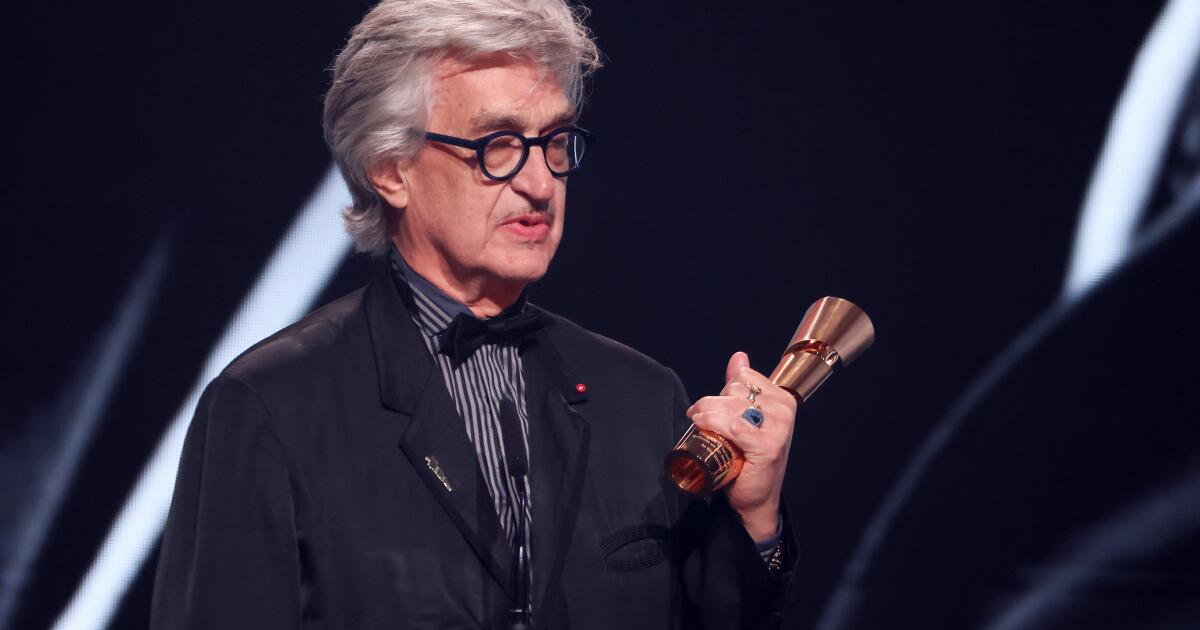
Acclaimed German director Wim Wenders announced he was withdrawing his 1975 film, “Wrong Move,” from distribution due to a scene featuring then-13-year-old actor Nastassja Kinski topless.
Kinski played Mignon, a mute acrobat and street performer, in the film. In the controversial scene, she is featured lying on the bed topless as she tries to seduce her 30-something co-star Rüdiger Vogler, who plays Wilhelm.
Wilhelm enters the room, removes most of his clothing and gets into bed with her, slaps her, pushes her away and then caresses her face and cradles her.
In a 1997 USA TV interview, she was candid about wishing some of her work could be scrubbed from the screen permanently, saying, “I’ve done quite a lot of movies, a lot of movies that I want to just go and burn someplace. You always calculate ‘how much would that cost? How would I do that?’ and just know it’ll exist forever. It won’t be showing all that much, but just the fact that it’s there and it’ll exist.”
She told W Magazine the same year, “If I had had somebody to protect me or if I had felt more secure about myself, I would not have accepted certain things. Nudity things,” Kinski said. “And inside it was just tearing me apart.”
Per the Hollywood Reporter, Wenders received a lifetime achievement award at the German Film Awards last week and addressed the “Wrong Move” issue in his speech, saying that he would not shoot the scene today. He also said that he knew that keeping it in the film had continued to cause Kinski pain.
“I can’t blame the 29-year-old young man I was then, 50 years ago, who made a film of his time; wanting, in a way, to capture the zeitgeist,” he added before calling on the members of the German Film Academy to debate the issue and aid him in finding a resolution.
On Wednesday, the “Perfect Days” director issued a statement that was posted on social media saying that he would withdraw the film from all current forms of distribution.
“As the only person responsible at the time for Wrong Move who is still here, I recognize that Nastassja Kinski should have been better protected back then. For that, I apologize to you, Nastassja, unreservedly, no ifs and buts.”
Wender said that “the many reactions, comments, and conversations of recent days” had a played role in shifting his perception of the issue but that society must find appropriate ways of dealing with controversial film works from the 20th century.
“Only after that process has taken place — even if it takes considerable time — and once we have been able to present a mutually agreed solution, which will include Nastassja Kinski, will we make the film available again.”
Kinski commented on Wenders’ statement on Wednesday. The following has been translated from German:
“Wim, after all that, all those years, only because the public has now commented in so many newspapers, as well as colleagues, and now because thousands — even though I asked for so long — only now because of the public, do I read THESE words from you, W. Wenders: ‘Nastassja, back then 13 in the first film, Wrong Move.’ ”
Charli XCX announced Monday that her new album, “Music, Fashion, Film,” drops July 24, and it already looks iconic.
That’s because the cover art, which Charli shared on Instagram, features three icons within their fields. The Velvet Underground’s John Cale represents music, Marc Jacobs stands for fashion and beloved director Martin Scorsese symbolizes film.
“My new album Music, Fashion, Film is out july 24th,” Charli wrote on Instagram. “11 songs, 30 minutes, 5 seconds. available to pre order now, love you xx.”
She released the first two singles, “Rock Music” and “SS26,” in May. The latter, a shorthand for the fashion industry’s current “Spring, Summer ‘26” season, has an accompanying video that features the artist strutting down an X-shaped runway, singing, “We’re walking on a runway that goes straight to hell / Nothing’s gonna save us, not music, fashion or film.”
“Rock Music,” the album’s first single, was met with mixed reactions from critics and fans. The song telegraphs Charli’s genre switch from electronic pop to the titular rock music, announcing, “I think the dance floor is dead” over heavily distorted guitar.
“If I’d made another album that felt more dance-leaning, it would have felt really hard, really sad,” Charli told British Vogue in April. “What’s interesting for me is to bend the possibilities of what my perspective on [rock music] could be.” She later clarified on Instagram, “I never said i was making a rock album.”
“Music, Fashion, Film” is not the artist’s first album in 2026. She released “Wuthering Heights,” the soundtrack to Emerald Fennel’s movie of the same name, in February. Cale is featured on “House,” the soundtrack album’s lead single.
Charli has added acting and producing to her repertoire in recent years. She produced and played a somewhat fictionalized version of herself in Aidan Zamiri’s mockumentary “The Moment,” based on the “Brat” album cycle, which Times film critic Amy Nicholson called “ ‘Spinal Tap’ for the era of stan culture.”
She also co-starred in Daniel Goldhaber’s “Faces of Death” remake, released in April, and is set to appear in Gregg Araki’s upcoming erotic comedy “I Want Your Sex” and Cathy Yan’s art-world thriller “The Gallerist” by year’s end.
“I’ve always been really inspired by cinema when making my music, more so than listening to music, to be honest,” Charli told The Times at the Sundance Film Festival in January. “It’s an honor to be able to be acting, working on projects and writing and producing films. It’s kind of my dream.”
Maybe you can use a laugh this morning. Maybe you’re still deep in your feelings, thinking about the “Hacks” series finale and that shot of Hannah Einbinder looking at Jean Smart on the dance floor, grief seeping into her eyes. Maybe you’re lamenting the chaos at our treasured national parks. Hell … maybe you took out a loan to buy a tomato over the weekend.
If you’re feeling down, Gary Oldman would like a word. And that word is: Hufflepuff.
I’m Glenn Whipp, columnist for the Los Angeles Times and host of The Envelope newsletter, back in your inbox for the next few weeks as we navigate our way through Emmy season.
Sign up for The Envelope
Get exclusive awards season news, in-depth interviews and columnist Glenn Whipp’s must-read analysis straight to your inbox.
By continuing, you agree to our Terms of Service, which include arbitration and a class action waiver. You agree that we and our third-party vendors may collect and use your information, including through cookies, pixels and similar technologies, for the purposes set forth in our Privacy Policy such as personalizing your experience and ads.
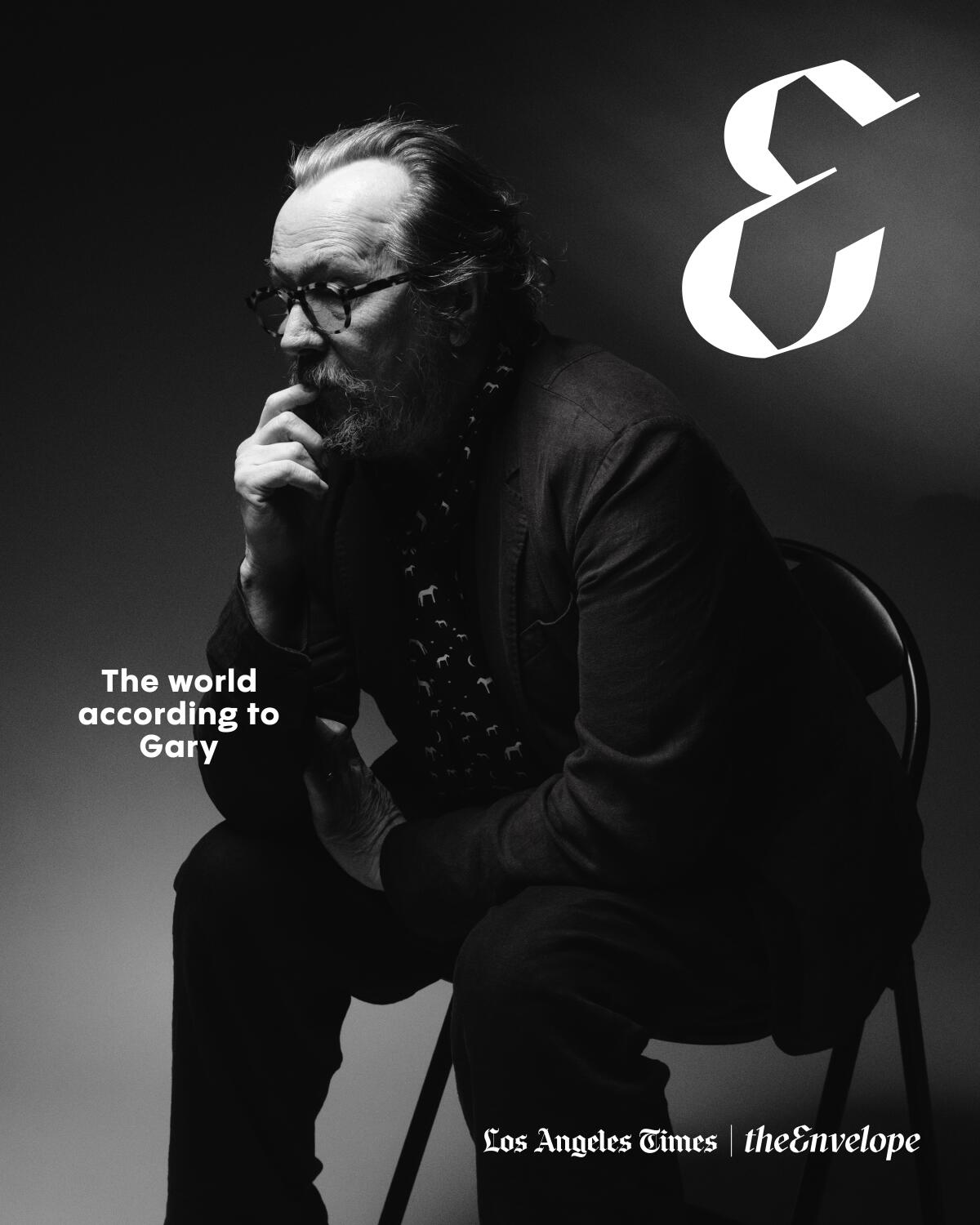
Digital cover story: The world according to Gary
(Jennifer McCord / For The Times)
Gary Oldman is a Hufflepuff.
Never mind that the 68-year-old actor, who played the rebellious, impulsive wizard Sirius Black in the Harry Potter film franchise, couldn’t tell you the difference between a Hufflepuff and, say, a Gryffindor.
When journalist Josh Horowitz reads a list of core personality qualities — loyalty, hard work, patience, fairness, dedication — and asks Oldman if that describes him, he nods his head.
You’re a Hufflepuff.
“I’m a Hufflepuff?” Oldman says, trying the word on for size. He likes it. “I’m a Hufflepuff!”
This video clip is a favorite of mine, one I could watch on a loop for the sheer delight Oldman takes in pronouncing the word Hufflepuff.
It’s easy to see why Oldman takes such pleasure in being a granddad these days, one of the things we talked about at length not long ago for an Envelope digital cover story. He can access his silly side with ease.
I asked Oldman about the upcoming HBO “Harry Potter” television series, a decade-spanning endeavor that will spend a season adapting each of J.K. Rowling’s seven fantasy books.
“I’ve seen a trailer for it, and I think it’s a great idea,” Oldman says. “They’re doing the whole book, which I love, because there were a lot of wonderful things, fabric and character detail, we had to lose for the sake of telling the story in two hours.”
Would Oldman be keen to don a distressed velvet overcoat again and participate in the reboot?
“I don’t think they want any of us from the movies contaminating or muddying the waters,” Oldman says, pleasantly. “Besides, I’m too old.”
But with AI, is anyone too old now? Oldman could drop into “Harry Potter and the Prisoner of Azkaban” and look like he hasn’t aged a day since the movie was released 22 years ago.
“I don’t know where we’re going with it because it seems to advance every week,” Oldman says. He ponders the advances made since Martin Scorsese used digital deaging in his 2019 film “The Irishman.”
“I think that was the least successful thing about it,” Oldman says of the technology, “and I’ve been a huge Martin Scorsese fan forever. Ultimately, I don’t know why they wanted to make [Robert] De Niro’s eyes blue.” He pauses, considering the change and why it bothered him. “I guess it’s a blue-eyed Irishman. If I had one negative takeaway, it would be that.”
Oldman prefers directors like Christopher Nolan, whom he worked with on the “Dark Knight” movies and “Oppenheimer,” who think technology should be used sparingly to enhance the storytelling.
“Otherwise it leaves me a bit cold,” he says. “You’re just looking at ones and zeroes.”
“I don’t want to be replaced entirely,” Oldman continues, shaking his head. “I don’t think anyone does.”
Internet culture is showing up in a big way in theaters, as low-budget horror films “Backrooms” and “Obsession” led this weekend’s box office and beat out big franchise films like “Star Wars: The Mandalorian and Grogu.”
A24’s “Backrooms” topped the charts with $81.5 million in the U.S. and Canada in its opening weekend, according to studio estimates. The film is directed by 20-year-old YouTuber Kane Parsons, who based it on his internet series of the same name.
“Backrooms,” which reportedly had a production budget of about $10 million, stars Chiwetel Ejiofor as a furniture store owner who finds a mysterious portal in his basement. The film made a total of $118 million worldwide.
In second place was Focus Features’ “Obsession,” which hauled in $26.4 million in its third weekend in theaters, up 10% from the previous weekend’s total. The film, which had a production budget of less than $1 million, has now grossed $104.7 million domestically for a global total of $148 million.
“Obsession” director Curry Barker is also known for his YouTube sketch comedy channel.
The success of two YouTube-native filmmakers at the box office indicates the growing power of the platform — and online culture as a whole — in attracting audiences to cinemas.
Walt Disney Co. and Lucasfilm’s “The Mandalorian and Grogu” fell to third place this weekend with a domestic gross of $25 million. Lionsgate’s musical biopic “Michael” ($11.7 million) and Sony Pictures’ family comedy “The Breadwinner” ($7.5 million) rounded out the top five at the box office, according to Comscore data.
At this year’s Sundance Film Festival, filmmaker William D. Caballero won the NEXT Special Jury Award for Creative Expression for his intensely personal, multimedia feature debut, “TheyDream.” During his acceptance speech, he made a powerful statement.
“In case ICE were ever to harm me or kill me, this film will serve as the truth of who I am, and who my family is, before Fox News or this administration ever makes us out to be the villain[s],” he recalls paraphrasing during a recent interview.
Blending live action footage with different animation techniques — as well as the 3-D-printed miniatures that have been a fixture of Caballero’s work for more than a decade — “TheyDream” honors the filmmaker’s Puerto Rican loved ones, particularly his mother, Milly.
She collaborated with him in the making of this one-of-a-kind portrait of loss, resilience and shared healing. Their heartfelt exchanges throughout this process are also shared on-screen.
“Seeing her light up and become transformed throughout was just invigorating, because it allowed us to talk about heavy things and bond throughout the process of creating a story that’s personal [for us] both,” Caballero says. “It’s like, ‘Let’s guide each other and instead of me taking your stories and making magic with them, let’s make this magic together.’”
The brilliantly unconventional piece of autobiographical storytelling will screen as the closing night film of the Los Angeles Latino International Film Festival (LALIFF) on Sunday. Recently, John Leguizamo and Ben DeJesus joined the film as executive producers.
Starting with his 2013 short film “How You Doin,’ Boy? Voicemails From Gran’pa,” Caballero has used miniatures to immortalize his loved ones. That bite-sized introduction to his Boricua grandfather’s humorous wisdom evolved into the HBO Latino show, “Gran’pa Knows Best.”
“When I started working on ‘Gran’pa Knows Best,’ I knew that 3-D printing was this new technique,” he says. “But I’d never seen anyone that looked or sounded like my grandfather in it. I realized that it could be a really creative method to preserve his voice and his story. “
Then came the 2017 short “Victor & Isolina” about his grandparents’ relationship, and more recently in 2022, he debuted “Chilly and Milly,” which focused on his parents. Some of the sets from these shorts, tiny replicas of places familiar to Caballero, and a few of the miniature characters were reused in “TheyDream.”
“Being able to create these things in miniature is almost like getting back in touch with the idea of play,” Caballero explains. “As a child, you invent lots of stories all the time. But now as an artist, I’m able to tell stories that touch upon reality and painful memories, but also hopes and dreams in a way that hearkens back to the innocence of childhood.”
Filmmaker William D. Caballero will screen “TheyDream” on Sunday at the Los Angeles Latino International Film Festival (LALIFF).
(William D. Caballero)
“TheyDream” is a culmination of the eclectic and nimble artistic practice that Caballero has developed since he studied digital art at the Pratt Institute in Brooklyn.
“I’d always just been attracted to new ways of expressing myself and expressing stories. And I say this both in a way that brings me pride, but also brings me a bit of a headache, because I don’t think I’ll ever be a conventional filmmaker,” he says, laughing.
Still, working outside the margins of traditional moviemaking requires great adaptability.
When Caballero received funding for “TheyDream” in 2021, the money wasn’t enough to conceive it as he had originally envisioned it: entirely told with 3-D-printed figures in physical sets. The lack of resources forced him to rethink his approach, and he opted for hiring two Puerto Rican animators, Julisse Tinoco and Frank Martinez, each of whom animate in distinct styles, to help him create some of the sequences needed.
“This all goes back to the resourcefulness that I learned when I was young,” Caballero says. “When you’re born Latino and low-income in this society, you can’t let yourself be written off or you’re already defeated before you even begin.”
Caballero grew up in housing projects in New York City, and later in a trailer in his grandmother’s backyard in Fayetteville, N.C. Both of his parents were disabled.
Filmmaker William D. Caballero poses as his father for a reference shot in the making of his 2026 film “TheyDream.”
For Caballero, he says the arts have provided an escape that he “needed in order to survive and not feel weighed down by American consumerism, by poverty and by feeling trapped.” Whenever grief has perturbed him, Caballero has processed it through creativity.
With “TheyDream,” he wished to extend that vehicle for self-reflection to his mother. The film addresses complicated familial bonds and his mother’s experience caring for others.
“Throughout the years, we’ve lost several of my family members that we were both close to, but my mother especially,” he says. “She feels their absence much stronger than I do. I live in Los Angeles, my mother still lives in North Carolina. Knowing that she was alone in the mobile home, it just made me feel like, ‘That can’t be good for her.’”
His mother, he says, deals with self-esteem issues because her identity has for so long been reduced to being a caretaker for elderly relatives, who, inevitably, pass away — leaving her feeling like a failure. In reality, it was thanks to her devotion that they added years of life.
Caballero’s mother was at the Sundance premiere of “TheyDream,” where she witnessed how others saw her through the film she helped her son craft.
“I wanted her to feel like, ‘Mom, look at all these people that are clapping for you. They’re clapping for you because you are a hero. You deserve to hold yourself high and be strong and know that there’s something incredible in your story that’s indicative of the stories of many low-income Americans, regardless of race,’” Caballero says, visibly moved.
A prolific and highly regarded artist (he is a 2018 Guggenheim Fellow), Caballero has several other projects in the works that he’s trying to shop around. One of them is an episodic series titled “Second Fiddle,” about a 15-year-old Latino boy who gets accepted to a prestigious summer youth orchestra camp — and whose overbearing mother decides she’s going to stay in the camp with him.
Caballero’s mother, Milly, got the animated treatment in “TheyDream.”
“I never saw a Latino playing violin on TV or the big screen. I didn’t see any quirky, nerdy, artsy Latino kids like I was,” he says. “And I felt in my core that [it] was just wrong and something that I could change.”
Another project, “Raúl Playing Game,” is “an adult version of Pixar’s ‘Inside Out,’ ” that takes place in the mind of a closeted bisexual man. Caballero himself is bisexual. In 2022, “Raúl Playing Game” was selected for the LALIFF Inclusion Fellowship, which provided support for a short film version that serves as proof of concept for a potential TV show.
“I always wanted to make sure that I was telling authentic stories even if not necessarily always positive stories,” he says. “I’m very happy that I never lost track of that. Because I do believe that we need to tell our own stories, in our own unique voices, before someone else does it for us.”
“Pressure,” the new World War II movie from director Anthony Maras and writer David Haig, is a hyperfocused look at the days leading up to D-day with a special focus on the weather. It’s a one-setting thriller that unspools in the pressure-cooker environment of General Dwight D. Eisenhower’s war room at an English country estate. The movie works backward from a famous 1961 Eisenhower quip to JFK that attributed his success in Normandy, France, to the Allies having “better meteorologists than the Germans.”
If you’re skeptical about how exciting a movie about the weather on D-day might be, “Pressure” takes that as a creative challenge, an argumentative stance from which to start. For the next hour and 40 minutes, Maras and co-writer Haig, who also wrote the 2014 play from which the film is adapted, explain to us exactly how important the meteorologists of D-day were, beginning with the disastrous D-day rehearsal Exercise Tiger.
With the weather app at our fingertips these days, it can be hard to imagine just how difficult it was to forecast the weather in the 1940s, especially in Northern Europe. That was the predicament facing Eisenhower (Brendan Fraser) just 72 hours before the planned D-day launch of June 5, 1944. But we know that D-day happened on June 6, so the arrival at that date is part of the film’s narrative intrigue.
After a devastating glimpse of Exercise Tiger, red blood mixing with blue ocean waves and white sandy beaches, we’re quickly introduced to our protagonist, Group Capt. Chief Meteorologist James Stagg (Andrew Scott), in his cozy home with his pregnant wife before he’s swept into critical war planning.
He’s stern, terse and no-nonsense. Stagg is the kind of person who wants to be correct more than he wants to be liked and he insists on a careful collection of live data, using weather balloons, phone calls and mathematical charting. His foil is Col. Irving Krick (Chris Messina), a charming American meteorologist and Eisenhower’s chosen weather guru, a yes man who relies on selective historical data and a persuasive speaker whose approach rankles the fastidious Stagg. Eisenhower instructs the two men to come to an agreement and “Pressure” follows the ups and downs of their working relationship over the course of several days.
The movie becomes a two-hander between Scott’s Stagg and Fraser’s Eisenhower, the former convinced that a storm on June 5 will make conditions less than ideal, the latter raging at the uncertainty while simultaneously attempting to placate a phalanx of military personnel. The troops are requisitioned, the destroyers in place, the full moon just right, the secrecy of the invasion delicate. Fraser’s explosive performance underlines the immensity of the stakes, balancing every precarious element of this enormous mission.
Maras, who is known for another terrific one-setting thriller based on a true story, 2018’s “Hotel Mumbai,” both directs and edits and his films are put together like precision clockwork: propulsive and relentless, the pace italicized by Volker Bertelmann’s scores. “Pressure” is skillfully directed, sweeping us into this world with a kind of addictive immediacy, and is also beautifully lensed by cinematographer Jamie Ramsay. Maras and Ramsay make the wise choice to shoot the film with richly saturated color instead of the usual grayish, desaturated look often assigned to period pieces set in this era. It’s not gritty and harsh, but rather stunning and lovely — an eerie contrast to the terror and bloodshed of the day itself.
While Fraser delivers an external performance as the tough American general, Scott offers a restrained, mostly tamped-down depiction of the repressed and methodical Stagg. But when he finally bursts with a cathartic eleventh-hour speech about the inaccuracy of Krick’s historical forecast, Eisenhower listens. Scott, as seen in “All of Us Strangers” and “Blue Moon,” is so good at this kind of acting, processing every emotion internally but allowing just enough to show to let the audience into his character’s emotional state. It’s wildly compelling to watch.
In a quiet conversation with Eisenhower’s close confidant and aide, Kay Summersby (Kerry Condon), she jokes that weathermen are boring. Stagg reminds her that the weather itself isn’t. Weather feeds us, it can destroy us — it rules our existence, he says. “People ask, ‘When will the wind stop blowing?’ No one ever asks, ‘Why does the wind blow? What is the wind?,’ ” revealing himself as a sort of philosophical poet of the weather. His forecast was the crucial edge in D-day and the volatility of the weather is increasingly relevant in our lives, especially with our changing climate.
Boring? Never. Thrilling and history-making? Indeed.
Katie Walsh is a Tribune News Service film critic.
‘Pressure’
Rated: PG-13, for war violence, bloody images, some strong language, and smoking