fellowship

HumAngle SCOJA Fellowship Alumni Reflect on a Year of Learnings at Book Launch

HumAngle Foundation gathered students, professors, and community journalists on Tuesday, June 21, at the University of Maiduguri in northeastern Nigeria to hold timely conversations around ways to strengthen community journalism in Nigeria.

The event, which also featured the launch of a guide to community journalism, is part of the Strengthening Community Journalism and Human Rights Advocacy in Northern Nigeria (SCOJA) project, implemented with support from the Embassy of the Kingdom of the Netherlands in Nigeria. Through a fellowship, the project has trained 90 journalists and human rights defenders in the past year. 

During the event, three SCOJA Fellowship alumni reflected on the journey so far and called on relevant organisations to commit to similar projects. The session had Yahuza Bawage, Faiza Jibrin, and Nathaniel Ishaya in attendance. 

“There aren’t many trainings that focus on the ethics of journalism in a very practical way,” Yahuza said. “One of the sessions we treated during the three-day workshop in Plateau State was Journalism Ethics and Standards, and that taught me a lot. I was able to learn about minimising harm.”

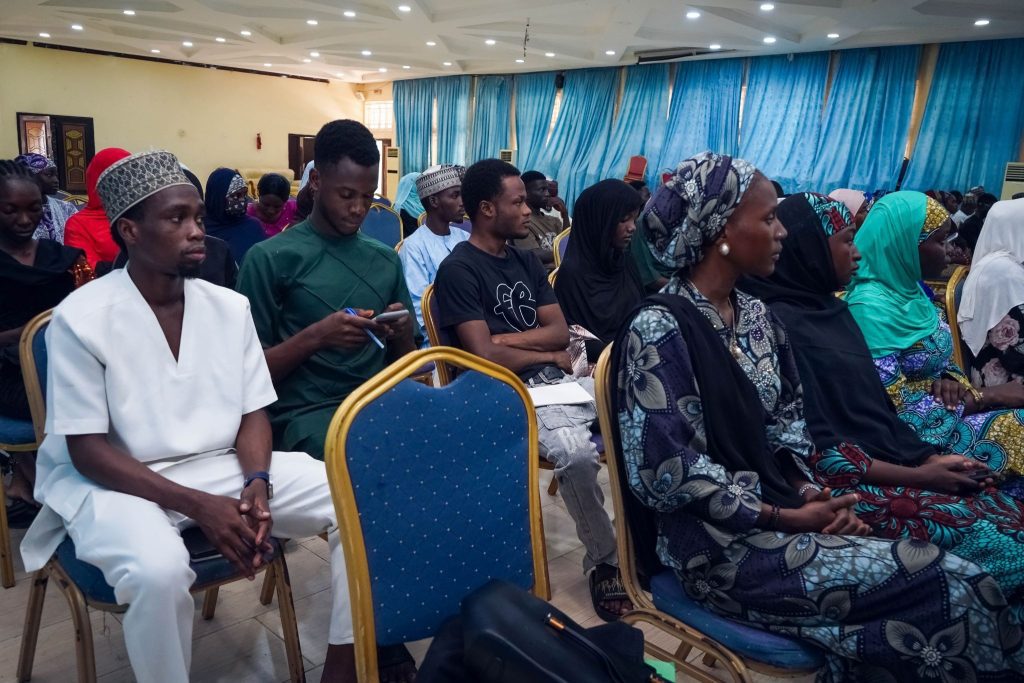
People seated in rows at an indoor event, wearing colorful traditional attire, with blue curtains in the background.
Cross-section of the audience at the event. Photo: Al’amin Umar/HumAngle.

The same sentiment was echoed by the other fellows. They highlighted that interviewing vulnerable people is a delicate skill that not many journalism training programmes cover in depth, and that they were happy to have learned it during the fellowship.

“One skill I sharpened during the fellowship was my interview skills. I learned about building connections with the subjects first, and I practised it. It really works because instead of sticking strictly to my interview guide, I connected first, and the person became eager to share [their] experience with me. I also learned about not re-traumatising my sources through the questions I ask,” said Faiza. 

They also offered some advice and encouragement for fellow young journalists trying to find their feet.

“One thing I will tell student-journalists is that they should not allow fear to hold them back. They should try out new opportunities, and with mentorship, they can do so much,” Nathaniel added. 

Four people pose together indoors in front of a projection screen, dressed in formal attire.
(L-R): Angela Umoru-David, Programme Director, HumAngle Foundation; and SCOJA Fellowship alumni; Yahuza Bawage, Faiza Jibrin, and Nathaniel Ishaya. Photo: Al’amin Umar/HumAngle.

During another session at the event, Hassana Danyerwa, a SCOJA Fellowship alumnus, talked about the elevation she experienced as a result of the fellowship.

“Although I am not a journalist and I joined the SCOJA Fellowship as an advocate, my experiences from the fellowship set me up for a global experience where I was the only Nigerian selected. The mentorship aspect of the fellowship helped me and opened a new professional pathway for me.”

She offered some words of advice on the conditions necessary for journalists to do their work.

“Sometimes, we do not know what we need until we are given it, but one thing community journalists need is mentorship. Also, trust and avoiding micromanagement so journalists can express themselves and explore different topics is important.”

During the six-month fellowship, the fellows produced several investigative reports and carried out advocacy activities on various issues, including human rights, gender-based violence, and climate change. In Kano, northwestern Nigeria, some of the fellows launched the Kano Climate Change Journalists’ Network as a direct result of their fellowship.
Source link

Dad’s Link Golf Club helps busy dads with fellowship

To understand the gravitational pull toward golf, consider the sport as a sequence of problems. Aaron Singleton, a skilled player in the Dads Link Golf Club, is playing particularly well today at Palos Verdes Golf Course, having just hit two back-to-back birdies. But even on the shots that fly into a grassy oblivion, he smiles.

  • Share via

“Golf is 18 different holes. 18 different chances to solve a problem,” he says. “Each hole presents a different problem. Each shot is a different problem.” According to Singleton, this wisdom that players inherit on the golf course — especially resilience and patience — translates to fatherhood.

Singleton, who has a 3-year-old son, is part of a growing group of fathers who participate in the Dads Link Golf Club. The club is part of the region’s golf boom; Southern California Golf Assn. is estimated to have one of the largest memberships in the country, with over 200,000 golfers.

Ian Davis watches his drive on 9th hole

Ian Davis, the founder of Dads Link and Golf Club, watches his drive.

Ian Davis is the founder of Los Angeles’ Dads Link Golf Club. Each month, he invites fathers to enjoy golf together to focus on fellowship, fatherhood and their well-being.

“This has grown in a way that I couldn’t have imagined,” says Davis, who works as a wellness coach with an emphasis in mindfulness and meditation. He started the club in 2023 on the East Coast before relocating it to Los Angeles in January 2024, where the club hosts an annual Father’s Day tournament and various golf clinics.

At the driving range, Davis leads the group through “a grounding practice” that involves stretching and deep breathing. Member Ose Akhile, a personal trainer, follows up with stretching and other warm-up exercises. For many of the men, golf has become a rediscovered hobby. Singleton returned to the sport after playing it as a teenager. “I’m looking forward to getting better,” he says.

Club member Darius Ingram, father of 3-year-old daughter, says that reconnecting with the game has allowed him to prioritize his own well-being.

“I used to play golf recreationally. Now, I do it for mental stability,” he says.

Ian Davis (right) greets Ose Akhile as Darius Ingram stands nearby

Ian Davis greets Ose Akhile as Darius Ingram stands nearby.

Ian Monteilh, who is new to the group and has two daughters ages 11 and 15, says the outing provides camaraderie that was missing from his life.

“It’s a community that I didn’t have. I’m blessed to be around like-minded men with no pressure,” he says. “Even if we’re having a rough day on a golf course, there’s camaraderie.”

Once considered a predominantly white sport, golf is now being reshaped by a new generation of Black players and other players of color, including many of the fathers in Dads Link Golf Club. In 2024, 25% of golfers across courses nationally were Black, Asian and Latino, marking the most diverse era in the sport’s history, according to the National Golf Foundation.

“It’s a lot less pretentious — more diverse, more access for all different types of people,” says Ingram, who noticed a shift in golfing culture in recent years. Despite Tiger Woods’ storied career as one of the sport’s most impactful athletes, Black men remain underrepresented in top tournaments.

Darius Ingram (left) reacts to barely missing a putt on the 18th green

Darius Ingram reacts to barely missing a putt on the 18th green as Ian Davis watches.

Ingram partly attributes Black men’s interest in golf to renewed interest from other professional athletes. Star athletes like Michael Jordan and Steph Curry — who also happen to be dads — are skilled golfers.

“There are a lot of people who play their main sport, and they play golf when they retire,” says Ingram.

Ose Akhile smiles before teeing off

Ose Akhile smiles before teeing off.

Rappers like Schoolboy Q and DJ Khalid have also become interested in the sport, adding to its cachet.

The benefits of the groups are apparent, explains Akhile, who has three daughters, ages 6, 7 and 9.

“I’m outside — fresh air, sunshine, a break for my family. I get to decompress,” he says. Describing himself as a “Caribbean baby,” he explains that the ocean waves have a hypnotic effect on him. As the golfers move along the Palos Verdes course, the ocean stretches beyond them.

“Nature helps a lot with stress relief. There’s a lot of green grass and quiet out here. I love my child, but it’s hard to hear her yell, ‘Dad!’ every three seconds,” says Singleton. During the game, he stays calm while a squirrel approaches him. “Me and nature are one with each other,” he says. Behind him, a baby coyote prances into the fog.

Singleton adds that in the chaos of fatherhood, friendships occasionally fall to the wayside.

“There’s so much to do. Everyone separated. It’s beneficial to have a group text, a fellowship like this, where you can hear someone going through the same thing as you,” Singleton says.

Akhile agrees. “These are probably the only guys that understand the day-to-day stressors and pressures of my life,” he says.

men have breakfast after Dads Link and Golf Club

Ose Akhile, Darius Ingram, Ian Monteilh, Ian Davis, Aaron Singleton and other Dads Link and Golf members have breakfast together.

After finishing nine holes, the men enjoy breakfast burritos. They joke that they will begin ranking the golf courses in the L.A. area by the quality of their breakfast burritos. Meanwhile, Davis leads the group through a conversation about fatherhood. Each month he chooses one dad to be the focus. This morning that’s Ingram. He speaks on being a father and how it relates to golf.

“I’m not as good as I want to be, so there’s frustration there,” Ingram says, referring to the challenges of parenting. He adds that to “right things” he doesn’t like about himself, he focuses on how his efforts could result in his daughter becoming a better version of him. The men offer encouragement as birds circle above. The sun pierces through the fog.

Monteilh looks up and jokes: “The only birdies I saw today were in the sky.”


Source link