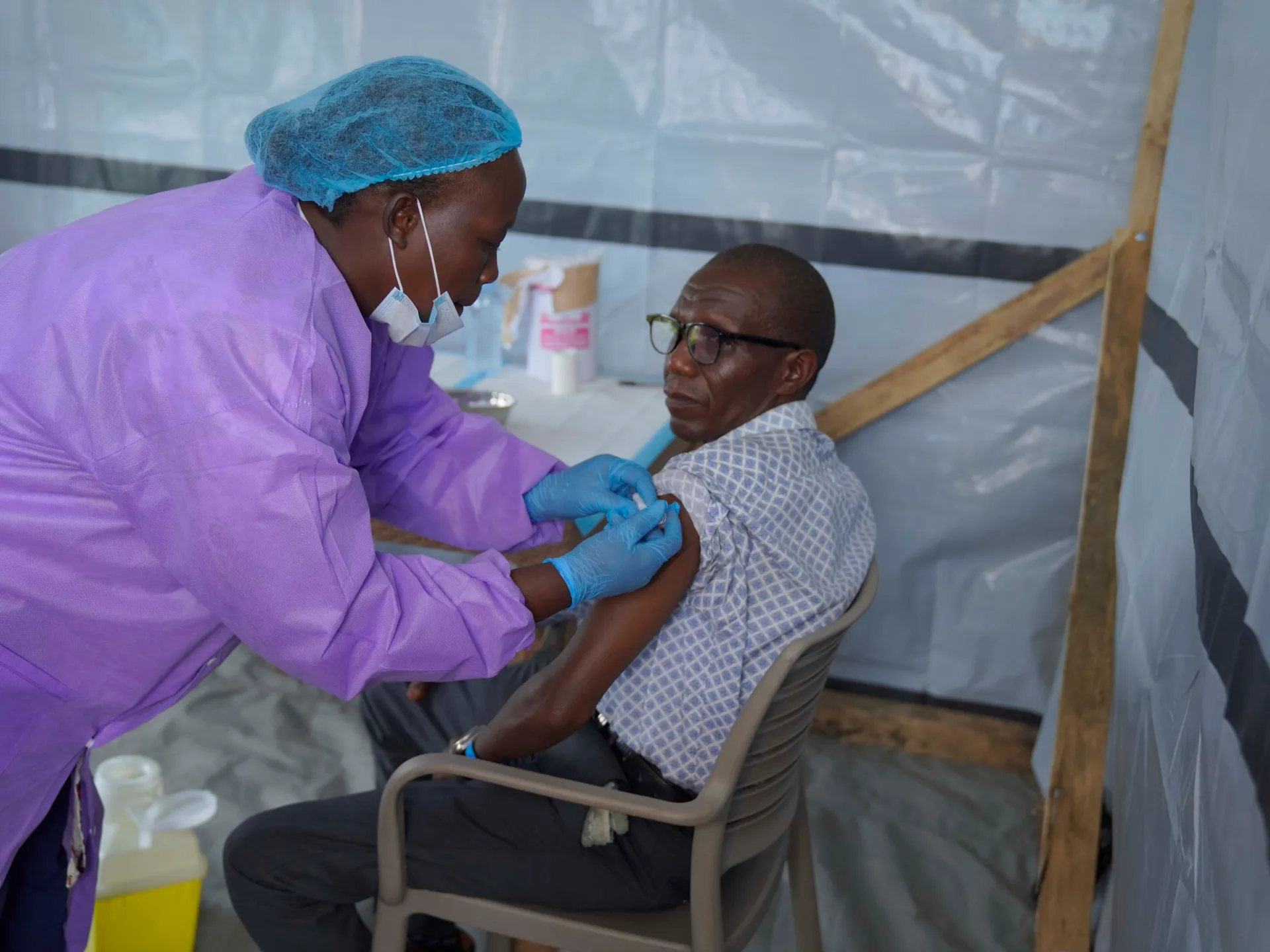
The World Health Organization (WHO) has announced the beginning of the first clinical trial of an Ebola vaccine in the outbreak that started in the Democratic Republic of Congo (DRC).
WHO’s director-general, Tedros Adhanom Ghebreyesus, said in a social media post on Friday that participants in the trial were vaccinated with the Ervebo vaccine in Bunia, the capital of the DRC’s northeastern Ituri province, which is the epicentre of the Ebola outbreak.
Recommended Stories
list of 3 itemsend of list
Ervebo, a vaccine approved for use against the more common Zaire strain of Ebola, will be put through a full-scale human trial to see if it offers any cross-protection against the Bundibugyo species of Ebola that is behind the epidemic.
“This trial will help us understand whether any of the vaccine candidates designed for Bundibugyo virus work,” the WHO chief said on X.
“WHO is supporting this DRC-led effort to find answers and save lives,” he added.
The DRC declared its 17th and worst-ever Ebola outbreak in May and has since reported more than 9,700 cases, with the number of deaths exceeding 4,600.
The WHO, in response, triggered a public health emergency of international concern, its second-highest alert level.
The current outbreak has now been reported in four countries across eastern, central and western Africa, giving it the widest geographic spread of any Ebola outbreak on the continent to date.
Vaccines in the pipeline
The so-called Tumaini trial is a single trial framework that can test the safety, efficacy and immunogenicity of multiple vaccines.
The trial will use a ring vaccination approach: immunising contacts deemed to be at high risk of infection.
The trial is set to incorporate two Bundibugyo-specific candidate vaccines, which are currently advancing through earlier-stage, smaller-scale clinical trials.
One is a ChAdOx1 adenoviral vector jab being developed by the University of Oxford; the other, by the US-based Moderna group, uses mRNA technology.
Both have received funding from the Coalition for Epidemic Preparedness Innovations and are expected to enter the trial “shortly”, CEPI said in a statement.
The trial will include pregnant women and children aged 12 years and older, generating evidence for populations that are often excluded from clinical trials.
WHO emergencies director Chikwe Ihekweazu said the trial was set up to generate the rigorous evidence needed to determine whether the participating vaccines could protect people at risk.
A 24-year-old man, who was already being held in quarantine, is the latest to test positive, according to the Health Ministry.
Published On 20 Oct 202620 Oct 2026
Kenya has confirmed a new Ebola case, bringing the total number of infections in the country to nine, amid an outbreak in the Democratic Republic of Congo (DRC), raising concerns about a regional spread.
A 24-year-old man, who was already being held in quarantine, is the latest to test positive, Kenya’s Ministry of Health said in a statement on Tuesday.
Recommended Stories
list of 3 itemsend of list
“He was isolated at the first sign of illness, tested and started on treatment immediately upon confirmation of his positive test result,” it said, adding he “was already in quarantine when he fell ill”.
The man was a close family member of Kenya’s first Ebola patient, who had travelled from the DRC, through Uganda and before arriving in Kenya and dying at a Nairobi hospital on October 5.
“All nine cases belong to one cluster, and as of today there is no evidence of transmission outside this group,” Director-General for Health Patrick Amoth said in a statement on Tuesday.
“Eight patients are stable and responding well to treatment, while 134 of 135 contacts have been traced and quarantined,” Amoth said.
Amoth said a milestone was in sight for the majority of the contacts in quarantine as they had remained well for the 21-day monitoring period and could return home from October 25.
It appealed to communities to welcome them back, saying they “pose no risk of infection”.
The ministry said no infections had occurred within quarantine facilities and that it was continuously monitoring infection-prevention measures to protect health workers.
Kenyan Ebola cases are linked to an outbreak in the Democratic Republic of Congo where 9,000 cases have been reported and more than 4,000 deaths since May [File: Sebastien Kitsa Musayi/AP Photo]
Despite the nine infections, Kenya has not imposed restrictions on travel, trade or public gatherings, with authorities saying the country remains open for business.
In the DRC, there have been more than 9,000 Ebola cases and 4,000 deaths since May.
The European Centre for Disease Prevention and Control says it’s the second-largest epidemic on record.
It has been difficult to contain because there is no licensed vaccine or specific treatment for the Bundibugyo strain of the virus.
Kenyan health authorities say latest patient was likely exposed to the country’s first Ebola case.
Published On 19 Oct 202619 Oct 2026
Kenyan health authorities say an eighth Ebola case has been detected, bringing the total number of known infections in the East African nation to eight.
Director-General for Health Patrick Amoth told Kenya’s Citizen TV that of the 38 people tested on Sunday, one had returned a positive result.
Recommended Stories
list of 3 itemsend of list
“He is a 49-year-old man who is not a healthcare worker. He developed fever, headache and muscle pain,” he said.
Amoth said the man, who worked as a patient attendant cleaning utensils and linens, was likely exposed to Kenya’s first Ebola case, discovered earlier this month.
He developed symptoms on Saturday, was quarantined and tested for the virus, a Ministry of Health source said.
The ministry reported four new cases on Saturday, three of whom were health workers who treated the country’s first Ebola patient, a man who travelled from the Democratic Republic of the Congo (DRC) to Nairobi and died at a Nairobi hospital on October 5.
In a post on X, the ministry said the fourth person was related to the deceased patient.
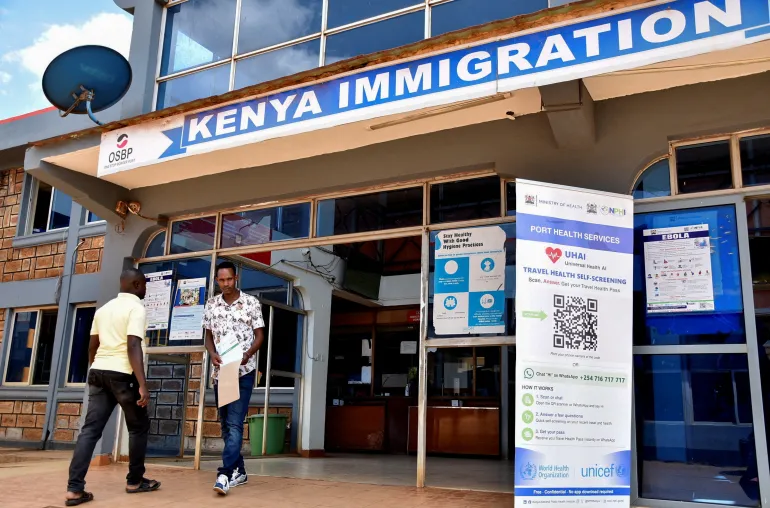
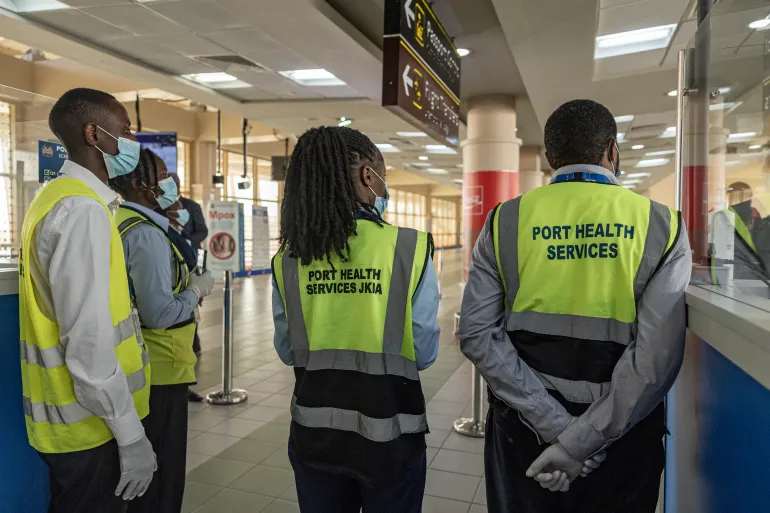
Travellers enter Kenya’s immigration services to access port health services at the Busia One Stop Border Post, a crossing point between Kenya and Uganda, in Busia, Kenya, on October 8, 2026 [James Keyi/Reuters]
Kenya has been on heightened alert, as the Ebola outbreak has spilled across the border from the DRC. The current outbreak is of the Bundibugyo strain of the virus, for which there is no vaccine or specific treatment.
The DRC has recorded at least 9,400 cases, including more than 4,500 deaths, in the deadliest outbreak in the country’s history, which started in May.
Ituri province in eastern DRC remains the disease’s epicentre, accounting for almost three quarters of confirmed cases, according to the government’s most recent data. It announced on Sunday that the virus has reached an eighth province, North Ubangi.
State-run news agency ACP reported on Sunday that authorities in North Kivu province, where the World Health Organization said substantial transmission continues, are introducing a one-week ban from Monday on people entering the province from Ituri in an effort to slow the spread.
Other measures set to be introduced include restrictions on passenger numbers in cars and on motorbikes and suspension of large public gatherings.
Neighbouring Uganda recorded 20 confirmed cases, including 15 imported from the DRC, and two deaths, before it was declared Ebola-free in August.
Nairobi, Kenya – Kenya’s response to an imported Ebola case has demonstrated its ability to mobilise a national response in the capital.
But a suspected case in the northeastern county of Wajir has raised a critical question: whether the country’s preparedness measures can protect communities far from major hospitals, laboratories and transport hubs.
The suspected case in Wajir tested negative, according to county officials, easing fears of wider transmission. Yet the incident highlighted the importance of local health facilities being able to recognise suspected infections, isolate patients safely and communicate reliable information to residents.
For communities near Kenya’s borders, preparedness requires more than screening travellers at airports and official crossings.
It also depends on trained health workers, appropriate protective equipment, functioning isolation facilities and clear referral procedures. Residents must know where to seek care and how to respond when health authorities raise the alarm.
Wajir’s readiness under scrutiny
Garad Saney Mohamed, communications director for Wajir county, told Al Jazeera that the county had established an isolation centre in Wajir town and formed a rapid response team to strengthen its preparedness.
He said the county was also using radio campaigns, community health promoters, school health programmes and posters to raise awareness about Ebola. A preparedness plan and budget had been put in place, he added.
However, the county did not provide details on the isolation centre’s capacity, the number of health workers trained specifically in Ebola response or the budget allocated to these efforts. Without that information, it is difficult to assess whether the county has the personnel and resources needed to manage suspected infections safely or respond to a wider outbreak.
The suspected case involved a 20-year-old man who had travelled from the Democratic Republic of the Congo through Uganda before reaching his home in Wajir on September 20. He was assessed at Habaswein Subcounty Hospital in Wajir South after presenting with a severe febrile illness.
His sample tested negative for Ebola, according to county officials. He was to remain under observation while receiving medical care.
The case prompted precautionary action, but it does not establish whether Wajir’s wider preparedness systems would be sufficient during an outbreak. That would depend on factors including the availability of protective equipment, staff trained in infection prevention and control, safe sample transport and reliable links between local facilities and designated testing laboratories.
Wajir’s proximity to Somalia, which lies 110km (70 miles) to the east, and the movement of people and goods across the border make surveillance and public communication particularly important. Screening at formal entry points remains essential, but it cannot replace the ability of local health facilities and community health workers to recognise warning signs and guide people towards appropriate care.
National screening, local challenges
Kenya’s national response intensified after an Ebola case was linked to a Kenyan travelling from the Democratic Republic of the Congo through Uganda. The patient arrived in Nairobi on October 3, was diagnosed with Bundibugyo virus of the disease and died on October 5, according to the World Health Organization (WHO). Kenya notified the WHO on October 6.
The patient had fallen ill while living in the Democratic Republic of the Congo and travelled by road to Kampala before flying to Nairobi. Laboratory tests at the National Virology Reference Laboratory and the Kenya Medical Research Institute confirmed the infection, according to the Ministry of Health.
On October 14, Kenya confirmed a second case of Bundibugyo virus disease involving a 39-year-old man who was a close family member of the first patient. He was already in quarantine and under daily monitoring when he developed symptoms, including fever, fatigue and joint pains, on October 13.
Laboratory tests confirmed the infection, and he was transferred to a designated treatment centre for supportive care. The Ministry of Health said the two cases were linked and there was no evidence of transmission in the wider community.
Authorities subsequently intensified surveillance at points of entry, contact tracing and public communication. The negative test result in Wajir underscored the importance of investigating suspected infections promptly and using laboratory testing to establish whether the virus is present.
As of October 6, Kenya had screened 652,584 travellers, tested 267 samples and trained 4,971 healthcare workers in Ebola prevention and management, according to the Ministry of Health.
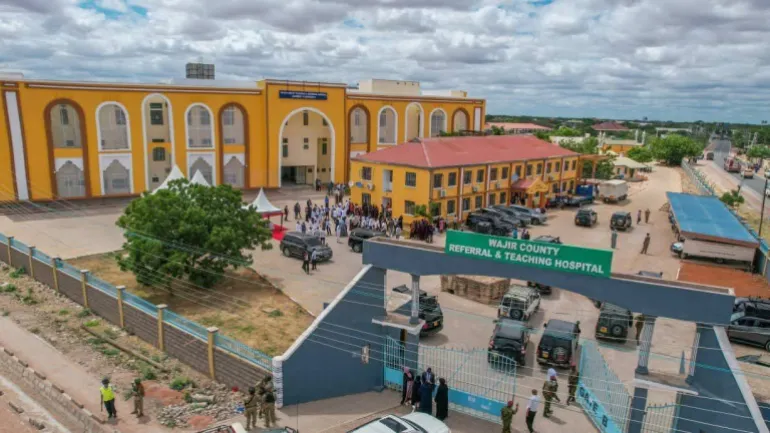
Wajir’s health facilities are on the front line of detecting and responding to suspected infectious disease cases [File: Hafsa Sheikh/Al Jazeera]
By October 12, the WHO reported that more than 665,000 travellers had been screened and 127 contacts had been listed, with 94 in quarantine. Five laboratories had been designated to test for the disease, and nearly 5,000 health workers had received training.
These figures demonstrate the scale of the national response. But the number of travellers screened or health workers trained does not, on its own, establish how effectively those resources are distributed or whether individual counties can manage suspected infections.
For Wajir, the key questions concern the readiness of local facilities, the availability of trained personnel and protective equipment, and the speed with which samples can be transported for testing. The county has outlined the measures it has taken, but the available information does not provide a complete picture of its operational capacity.
Preparedness means more than the numbers
Health workers need to recognise suspected cases, follow infection-prevention protocols, collect and transport samples safely, and refer patients without exposing others. Facilities must also have appropriate protective equipment and clear procedures for managing suspected infections.
The WHO reported that Kenya’s national preparedness score rose from 66 percent in May to 82 percent in July. The assessment covered measures including surveillance, laboratory testing, isolation and treatment facilities, and trained response teams.
The improvement suggests that preparedness measures had advanced before the imported case was confirmed. However, a national score cannot establish whether every county has the equipment, staffing and referral arrangements needed to respond effectively. Assessments of local capacity are essential to identifying gaps that national figures may not reveal.
The Kenya Red Cross has also supported preparedness and public awareness efforts. Dr Paul Olale, a representative of the organisation, told Al Jazeera about a preparedness assessment. However, the basis of the separate figure attributed to the organisation was not established in the information available for this report, making it difficult to determine what it measured or whether it identified county-level weaknesses.
The organisation has highlighted the need to counter misinformation. During an outbreak, rumours can leave people uncertain about symptoms, how the virus spreads and whether they should seek medical attention.
For residents, information needs to be practical. People should know where to seek care, how to report a suspected illness and what to do while awaiting medical advice. Communication must also address stigma and reassure people that reporting a suspected illness can help protect their families and communities.
Community health promoters, local radio stations, schools and trusted community leaders can help deliver information in languages and formats residents understand. But awareness campaigns are most effective when they are consistent and backed by health services capable of responding promptly to concerns.
Wajir’s experience illustrates why Kenya’s Ebola preparedness must be measured not only by national screening figures and training totals, but also by the ability of individual counties to respond safely when a suspected case emerges.
An isolation centre, a rapid response team and public awareness campaigns are important components of an effective response. Their existence alone, however, does not establish whether facilities have adequate equipment, staff can follow established protocols or residents can access reliable information when they need it.
Questions remain over how prepared remote communities such as Wajir county are to respond to a potential Ebola outbreak [File: Hafsa Sheikh/Al Jazeera]
Kenya has demonstrated its ability to mobilise a national response, expand screening and undertake laboratory testing. The challenge is ensuring that these measures translate into effective protection beyond major transport hubs, including in remote communities where access to healthcare and timely information may be more difficult.
Dr Mary Muthoni, Kenya’s principal secretary for public health and professional standards, underscored the importance of protecting frontline staff in remarks delivered on behalf of Health Cabinet Secretary Aden Duale, according to a WHO statement released on October 12.
“No health worker in this country should be asked to attend to a suspected Ebola case without the right protective equipment.”
Beni, Democratic Republic of Congo – The Ebola outbreak in the Democratic Republic of the Congo (DRC) has spread to another health zone in the east, while a fatal imported case in Kenya has underscored the risk of cross-border transmission.
The World Health Organization (WHO) said in an October 8 update that Alimbongo health zone in North Kivu province had reported cases for the first time. As of October 6, four confirmed cases, including two deaths, had been recorded there.
The outbreak is caused by the Bundibugyo virus, a species of Ebola virus. According to the WHO, cases had been reported in 64 health zones across seven provinces in the DRC. Ituri remained the worst-affected province in cumulative cases, while North Kivu was accounting for a growing share of newly confirmed infections.
As of October 6, the WHO had recorded 8,728 confirmed cases and 4,205 confirmed deaths in the DRC. A further 2,269 people had recovered, and the crude case fatality ratio stood at 48.2 percent.
Kenya confirms imported case
Kenya confirmed its first imported case of Bundibugyo virus disease on October 6, according to the WHO. The patient, a Kenyan citizen who had been living in the DRC, fell ill there and received treatment at several health facilities before travelling to Kenya through Uganda.
The patient travelled by road to Kampala, Uganda, before flying to Nairobi, arriving on October 3. The patient was isolated in hospital and tested positive for the virus. Despite supportive treatment, the patient died on October 5, the WHO said.
Kenyan authorities identified 28 contacts, including family members and healthcare workers. The WHO also reported efforts to trace passengers and crew members from the flight to Nairobi.
Kenyan Ministry of Health officials screen arriving passengers at Jomo Kenyatta International Airport in Nairobi amid Ebola-related health precautions [AFP]
Public health measures have been initiated in Kenya and Uganda, including contact tracing and enhanced surveillance.
On October 8, preliminary laboratory results for a suspected Ebola case in Kenya’s Wajir County came back negative, according to the county governor. The result eased concerns about a possible second case, although monitoring continued.
The imported infection has underscored the importance of surveillance and coordination between neighbouring countries. Identifying exposed people and monitoring them for symptoms are central to detecting infections early and interrupting further transmission.
Treatment capacity under pressure
In the DRC, the response is facing mounting pressure from limited treatment capacity, insecurity and difficulties securing cooperation from some communities.
Daniel Makasi Levergénois, founder of Watoto Radio, said insecurity and misinformation were undermining efforts to contain the outbreak. In Beni and Butembo, both in North Kivu, rumours and misconceptions about Ebola had contributed to reluctance among some residents to cooperate with response teams, he said.
In an October 5 update, medical charity Doctors Without Borders, known by its French initials MSF, said North Kivu accounted for nearly 40 percent of newly confirmed cases nationwide, up from 24 percent at the end of August.
MSF also reported that, as of September 28, 34 percent of confirmed Ebola patients were being treated in non-specialised health facilities. Dedicated treatment centres lacked sufficient beds, while delays in diagnosis meant some patients were being treated outside facilities equipped to manage Ebola.
The organisation warned that many of these facilities lacked the resources and expertise needed to manage the disease, increasing the risk of transmission among patients and healthcare workers.
“For weeks, treatment capacity has stretched to its limit,” said Stephanie Hoffmann, coordinator of MSF’s Ebola treatment centre in Butembo.
“Because there are not enough beds available, we are sometimes forced to refer confirmed Ebola patients elsewhere, despite the significant risk this poses to the wider community. In addition, standards of care in some peripheral facilities do not always meet the requirements for Ebola treatment. This is extremely concerning.”
Mistrust threatens containment efforts
Alberto Lusenge, a community leader in Beni, said the failure to stop transmission early in Ituri province, followed by new cases and attacks on response workers in Beni and Butembo, had deepened public concern.
Lusenge warned that mistrust could discourage residents from reporting symptoms or cooperating with health workers. He said North Kivu could become a greater focus of the outbreak if authorities failed to secure stronger cooperation from local communities.
A worker in protective gear handles sanitary basins at an Ebola treatment centre run by MSF in Butembo, eastern DRC [Gradel Muyisa Mumbere/Reuters]
The WHO said response teams were following up 23,741 of the 29,535 identified contacts as of October 4, equivalent to 80.4 percent – below the response target of at least 85 percent.
Contact tracing allows health authorities to identify people who may have been exposed, monitor them for symptoms and detect infections early. Gaps in follow-up can make it harder to identify and interrupt chains of transmission.
The Africa Centres for Disease Control and Prevention (Africa CDC) has called for a community-centred response, including active case finding, systematic contact tracing, daily follow-up of exposed people and sustained engagement with local communities.
A history of deadly outbreaks
The DRC’s 2018–2020 Ebola outbreak, caused by a different virus species, killed nearly 2,300 people. The current outbreak presents distinct challenges: According to the WHO, there are no approved vaccines or specific treatments for Bundibugyo virus disease.
Early detection, supportive care and infection prevention therefore remain central to the response. But as infections spread into additional health zones and treatment facilities struggle to accommodate patients, health authorities face the dual challenge of containing transmission and maintaining public trust.
Jean Kaseya, director-general of Africa CDC, has stressed the importance of rapidly identifying and monitoring people exposed to the virus.
“To bring this outbreak under control, we need to know where every contact is, track them and quickly identify anyone showing symptoms before they pass the virus on to their family, their community or across borders. We will only bring this outbreak under control once the last chain of transmission has been broken,” Kaseya said in a news release seen by Al Jazeera.
The first imported case of Ebola has been recorded in Kenya. The health minister said a Kenyan citizen who had been living in the Democratic Republic of the Congo, arrived in Nairobi on Saturday and died from the disease.
Burning of a Ebola-hit transit camp sends 19,000 fleeing, illustrating the difficulties of controlling epidemic.
Published On 2 Oct 20262 Oct 2026
The Democratic Republic of Congo’s Ebola outbreak has now killed more than 4,000 people, according to government data, making it the worst epidemic in the country’s history.
Figures released on Friday showed that the death toll has risen to 4,018, and confirmed cases had reached 8,300 across seven provinces, as the government continues to struggle to contain the outbreak.
Recommended Stories
list of 4 itemsend of list
Weak infrastructure, the remoteness of the region in eastern DRC, and ongoing conflict with armed groups near the borders with South Sudan, Uganda, and Rwanda have hindered efforts to respond to cases quickly and effectively.
The United Nations reported on Friday that an Ebola-hit camp housing a transit centre for infected patients was burned by soldiers earlier this week as they were looking for weapons on the outskirts of Bunia, capital city of Ituri Province, which is at the epicentre of the outbreak.
The incident forced 19,000 people to flee the camp.
“The enormous challenge of halting the spread of Ebola in the Democratic Republic of the Congo (DRC) just became even harder after a key transit centre for patients requiring treatment burned down in Ituri province,” the UN said.
People’s mistrust and anger towards health workers and authorities have also contributed to the obstacles the government faces in its efforts to contain the outbreak.
A senior member of DRC’s governing Union for Democracy and Social Progress (UDPS) party was beaten to death days ago after taking part in a radio programme to raise awareness about the epidemic.
The attack on Marie-Celestin Karondwa, a local official with UDPS, took place last Sunday at his home in Butembo, an Ebola hotspot in the eastern North Kivu province. His house was set on fire afterwards, and he died at hospital from his injuries.
The World Health Organization has warned that the epidemic is “far from over” and on track to surpass the regional 2014-2016 West Africa Ebola outbreak, which killed more than 11,000 people, primarily in Guinea, Liberia, and Sierra Leone.
Caused by the Bundibugyo strain of Ebola, the current epidemic became the largest and deadliest in the DRC after surpassing the 2018-2020 epidemic.
Several treatments and vaccines are being trialled against Bundibugyo, but currently, there is no approved vaccine or treatment.
The current outbreak, which is the DRC’s 17th, has spread rapidly since it was officially declared on May 15.
More than 2,000 patients have recovered from the Ebola epidemic so far. The Africa Centres for Disease Control and Prevention said in its latest news conference that the number of confirmed cases is falling, although that could be attributed to insecurity and challenges in getting communities to cooperate in some of the hotspots.
Fatalities reached 3,901 across the DRC as health workers battle community anger and a vaccine-resistant strain.
Published On 28 Sep 202628 Sep 2026
The Democratic Republic of the Congo (DRC) has recorded over 8,000 cases of Ebola, including almost 4,000 deaths, amid the worst outbreak in the country’s history, according to government data.
The latest report, published on Monday by the DRC’s public health institute, put the number of cases at 8,067 and deaths at 3,901, representing a fatality rate of 48.4 percent.
Recommended Stories
list of 4 itemsend of list
People’s mistrust and anger towards government policies have become a major obstacle in limiting the outbreak since it was officially declared on May 15. A senior member of the ruling UDPS party was beaten to death after raising awareness about the epidemic on radio, a party representative said on Monday. The killing happened on Sunday in Butembo in North Kivu province, which has become a hotspot in the ongoing Ebola outbreak.
The number of cases has levelled off after a rapid increase, according to the African Union’s health agency, Africa CDC, though it still considers the outbreak “not under control”.
Several treatments and vaccines are being trialled against the Bundibugyo strain of the Ebola virus, for which there is no approved vaccine or treatment.
The current outbreak, which is the DRC’s 17th, has spread rapidly. Experts say that weak health infrastructure, the region’s remoteness and ongoing conflict near the DRC’s borders with South Sudan, Uganda and Rwanda have damaged efforts to respond to cases quickly and effectively.
Those issues have also hindered the government’s efforts to fight the outbreak, increasing public mistrust and anger towards its suggested prevention measures.
Marie-Celestin Karondwa, acting president of the UDPS party’s federal executive committee in Butembo, was attacked by local residents after appearing on a radio show where he discussed Ebola prevention measures, according to the Congolese health authorities.
In their latest case report, authorities highlighted a “low capacity” to treat cases at health centres in Ituri province and described a “complete shortage” of stocks of an experimental vaccine against the Bundibugyo strain in the northeastern province of Tshopo, where cases have been recorded.
The World Health Organization has said the outbreak is “far from over” and on track to surpass the regional 2014-2016 West Africa Ebola outbreak. It killed more than 11,000 people, primarily in Guinea, Liberia and Sierra Leone.
The United States announced last week that it was releasing a further $267 million to help fight Ebola. It is hoping for pledges from other countries to meet a target of $2 billion to fight the disease, mainly found in the DRC.


![Travellers walk at the Kenya immigration services to access port health services at the Busia One Stop Border Post, crossing-point between Kenya and Uganda, after a man who had been living in the Democratic Republic of Congo travelled and died of a new Ebola outbreak involving the Bundibugyo species at the Nairobi Hospital, in Busia, Kenya October 8, 2026 [James Keyi/Reuters]](https://i0.wp.com/occasionaldigest.com/wp-content/uploads/2026/10/2026-10-14T155735Z_34711835_RC22ZNATTZD9_RTRMADP_3_HEALTH-EBOLA-KENYA-1792367033.jpg?w=640&ssl=1)


![Kenyan Ministry of Health officials screen arriving passengers at Jomo Kenyatta International Airport in Nairobi amid Ebola-related health precautions [AFP]](https://i0.wp.com/occasionaldigest.com/wp-content/uploads/2026/10/afp_6ac66094d7af-1791385748.jpg?w=640&ssl=1)
![A worker in protective gear handles sanitary basins at an Ebola treatment centre run by Médecins Sans Frontières in Butembo, eastern DRC [Gradel Muyisa Mumbere/Reuters]](https://i0.wp.com/occasionaldigest.com/wp-content/uploads/2026/10/reuters_6ab6e4f3-1790371059.jpg?w=640&ssl=1)