Ukraine claims it has recently regained about 125 sq. km. of territory near the town of Lyman in the eastern Donetsk region during what has been dubbed Operation Vivaldi. Rodion Kudryashov, a Ukrainian colonel and deputy commander of the Third Army Corps, offered some insights into this offensive and what made it different.
Though the operation is still ongoing, the success of Vivaldi began long before any troop movements, Kudryashov explained in an editorial he published in Ukrainian Pravda.
Ukraine is making advances near the town of Lyman, located in the Donetsk region. (Google Earth)
“After the Third Army Corps was formed, we changed the command system of its subordinate units,” he noted. “Some brigades came to the corps after very heavy fighting, with losses, manning problems and, most importantly, eroded trust in their leadership.”
Third Army Corps Commander Brig. Gen. Andriy Biletsky “then set out one of our key principles: a commander must be responsible for the entire cycle, from training a soldier to the result on the battlefield,” Kudryashov pointed out. “In some places that meant replacing a commander. In others it meant restructuring a staff or strengthening the NCO chain. In some cases we had to build, almost from scratch, processes that on paper should have been working long ago.”
At issue was changing the culture from a more rigid Soviet-era model, with a cumbersome chain of command, to a modern, more flexible one better suited for the current conflict.
“A modern commander has to handle an enormous flow of information and make decisions quickly,” the deputy commander proffered. “He has to understand what unmanned systems, logistics, reconnaissance and adjacent units can do, while not smothering initiative at lower levels with endless approvals. An army where every decision takes hours to travel up and down the chain loses to an army that makes the same trip in minutes.”
Once those changes were put in place, the Third Army Corps had to first stop Russian advances in the sector before it could move forward.
VIVALDI 🎼🎶
GoPro footage from Ukrainian assault troops who took part in the Vivaldi counteroffensive, which resulted in the liberation of five settlements in the Lyman direction. pic.twitter.com/2SVXSKlEX0
“When the corps took over its area of responsibility, our first task was not an offensive,” the officer said. “We had to stop the situation from deteriorating and stabilize the forward edge.”
“The enemy was pressing. In some sectors our combat formations were losing cohesion,” he underscored. “The Russians were actively using infiltration tactics: small groups seeped between positions, massed in our rear, threatened logistics and gradually eroded the defensive line.”
“We had to stabilize the forward edge and stop the infiltration,” Kudryashov said. “We had to rebuild command, put in commanders capable of making decisions, form new teams and reconstitute units. We had to set up the surveillance-and-strike system and sustain the front line. We had to stockpile ammunition, drones and other resources, understand the enemy, and plan the next step before the previous one was finished. Only after that could we move forward.”
By June, the corps was able to secure the front “in the sector from Borova to Lyman and eliminate the enemy’s infiltration zones,” Kudryashov continued. “That sounds less impressive than the word ‘offensive,’ but no offensive ever happens without it.”
“You cannot plan a complex operation if you don’t know where your forward edge will be tomorrow,” the deputy commander extrapolated. “You cannot build up forces if your logistics are constantly under threat. And you cannot form a strike group if your units are always forced to patch new breaches. So the first phase of ‘Vivaldi’ was not an advance at all. It was creating the conditions that made an advance possible in the first place.”
Once the front was stabilized, the next step was shaping the battlefield for the offensive. The corps’ unmanned systems units went to work against Russian logistics, striking a pipeline and depots. That forced the enemy to change its fuel and lubricant supply routes.
Ukraine’s 3rd Army Corps released new footage of search-and-strike operations on the Lyman front. FPV drone operators from the 60th Mechanized Brigade’s FATUM unit targeted Russian armored vehicles, a Grad multiple rocket launcher and personnel. #Ukrainepic.twitter.com/1iNG7z2N1c
“The operation also involved the corps’ brigades, its reconnaissance and unmanned units, and attached forces from the SSO (Special Operations Forces), GUR (Defense Intelligence) and DPSU (State Border Guard Service),” the deputy commander said. “To counter infiltration, a joint headquarters was set up to coordinate special and reconnaissance units at the tactical level under a single concept.”
“In my view, this is one of the main characteristics of modern war,” he further stated. “It is not 10 strong units that each fight well on their own. It is 10 different elements that start working as one system at the right moment.”
An interesting new detail from Ukraine’s 3rd Army Corps about Operation Vivaldi on the Lyman axis.
The Corps says Ukrainian forces carried out a flanking maneuver and, for the first time, airlifted unmanned ground vehicles behind Russian lines, while also suppressing Russian… https://t.co/ZEq8C75bN4pic.twitter.com/KgKcZ0Zs2P
The influential, Kremlin-connected Rybar Telegram channel has acknowledged Ukrainian gains in this sector.
“In the first half of summer, Russian units gradually advanced in Lyman,” Rybar wrote this morning. “However, in August, the enemy launched counterattacks and, by the first week of September, regained some positions, and also began attempts to recapture Shandryholovo and Zarechnoye.”
“The enemy did not inflict significant losses on Russian troops, as the concentration of units of the West group of forces in the salient remained relatively low,” Rybar added. “However, later, the UAF deployed reserves to launch an offensive towards Zherebets in order to align the front along the water barrier and return it to the configuration of the end of 2025.”
rybar now saying the 144th division is still falling back. the 3rd corps is still advancing and destroying an entire army group as they move. this is historic. pic.twitter.com/2jOa8KR9oA
Though the battle is still in flux, Kudryashov said there are lessons the rest of the Ukrainian military should heed.
“Winning one battle is not yet winning the war,” he said. “The enemy is learning too. He changes tactics, looks for weak spots and tries to scale what works for him.”
“So our task is to be faster, not only in physically moving forward but also in our ability to see, think, decide and put into practice what delivers results,” the deputy commander avowed. “And to do everything possible so that our soldiers pay the lowest possible price for every next kilometer of Ukrainian land.”
The Latest
On the battlefield, in addition to the gains Ukraine has made near Lyman, it has also largely been able to hold off Russian advances across the front lines. Here are some key takeaways from the latest Institute for the Study of War assessment of frontline operations:
Sumy: Russian forces recently conducted an infiltration mission east of Sumy City, and they continue to conduct glide bomb strikes against frontline settlements in northern Sumy Oblast to set conditions for future offensives.
Kharkiv: Russian forces continued offensive operations in northern Kharkiv Oblast and in the Borova, Kupyansk and Velykyi Burluk directions on Sept. 21 and 22 but did not advance.
Donetsk: Ukrainian forces reportedly continue counterattacks in the Lyman direction, including southeast of Lyman, as Russian forces are attempting to use redeployments to stabilize the area. Russian forces continued offensive operations east and southeast of Slovyansk near Rai-Oleksandrivka and toward Mykolaivka and Fedorivka Druha on Sept. 21 and 22 but did not advance. During this period, they also tried to advance in the Novopavlivka and Oleksandrivka directions but made no gains, as Ukrainian forces counterattacked in both areas.
Zaporizhia: Ukrainian forces recently advanced or maintained positions in western Zaporizhia Oblast.
Kherson: Neither Russian nor Ukrainian forces reported ground activity in the Kherson direction on September 22.
Russian Offensive Campaign Assessment, September 22, 2026: The Russian Ministry of Defense (MoD) falsely claimed that Russian forces have encircled Dobropillya — an intensification of the Kremlin’s cognitive warfare campaign alleging encirclements across various sectors of the… pic.twitter.com/yMoAcyVIme
In his speech to the U.N. General Assembly this afternoon, Ukrainian President Volodymyr Zelensky called for Russia to end its war and said it was paying a heavy price — and exacting a terrible toll — for little territorial gain.
“This ridiculous and never-ending war with Ukraine must be ended,” the Ukrainian leader urged. “I do not know a single world leader who would say otherwise. I do not know anyone who is openly for this war, except one man.”
He was referring to Russian President Vladimir Putin.
“Ladies and gentlemen, for almost five years now, Russian generals have been trying to carry out Putin’s crazy order to seize our eastern land, the Donetsk region,” Zelensky continued. “And just this year, from January through August, the Russian army lost 248,964 people on the battlefield in Ukraine in eight months. Twenty-one countries in the world have smaller populations… than the number of Russian troops lost in just eight months.”
‘Patient Zero’ Putin, Russia-Ukraine war & Trump: Zelensky addresses UN
“It’s madness, but they still keep going there to die because that is what Putin wants,” Zelensky suggested. “After losing so many people, Russia managed to capture just over 1,000 square kilometers of our land this year, and we have already liberated a significant part of it. Russia is a country that already has 17 million square kilometers of its own land without any Ukrainian territory, by the way. So to add another 1,000 square kilometers, Putin is paying with 248 people for every kilometer. Does anyone still think that he is reasonable? And moderate?”
“Russia’s leader, Patient Zero, the man from whom this war began and spread into the world, becoming the largest war in Europe since World War II, will inevitably leave this war,” Zelensky proffered. “But the longer Putin is able to wage war, the more evil he will leave behind in this world. Today, nothing in war works the same way it did, by the way, in 2022, except the courage of people.”
Russian missile and drone barrages have “caused damage, but they didn’t break us,” the president proclaimed. “We build our defense. What is really difficult for us now is Russian ballistic missiles and their new jet-powered Shaheds — Iranian technologies.”
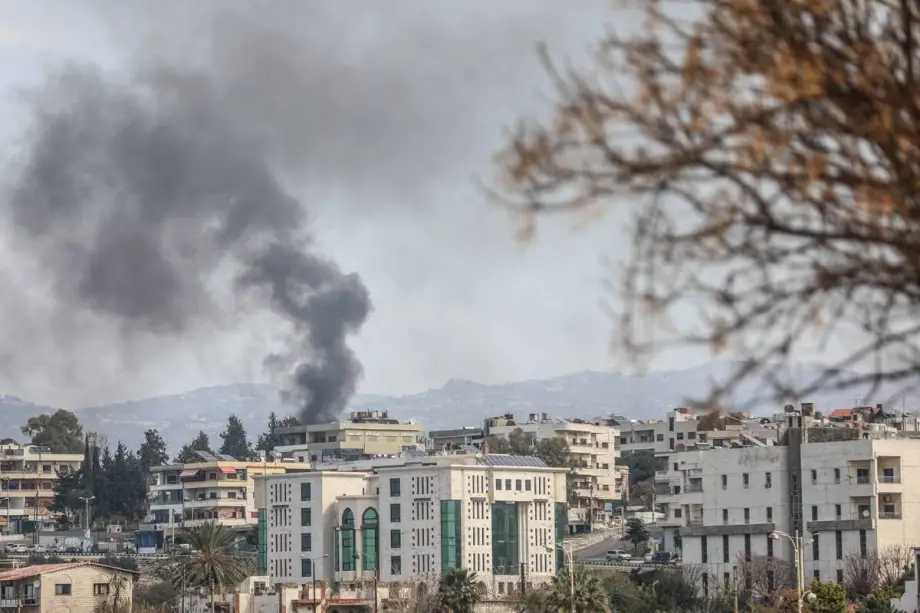
Residential buildings stand against the backdrop of smoke from a Russian attack on Kyiv. (Photo by Bohdan Diev/Global Images Ukraine via Getty Images) Tatyana Kudel’s’ka
“Just imagine this: since the beginning of this year, Russia has already used more than 2,100 missiles of different types again against us, against Ukraine, our people and our children,” Zelensky stated. “More than 950 of them were ballistic missiles. In eight months of this year, Russia used 63,000 attack drones of different types against Ukraine, our people, and more than 7,700 of them were jet-powered Shaheds, truly destructive and very dangerous weapons. Just think about it. The Russians launch jet-powered Shaheds every hour, every hour, against our cities, our economy, our infrastructure. Our combat aircraft are fighting them 24/7, and this is part of Russia’s strategy to create a new threat every hour, to make life harder for the economy and to disrupt people’s lives, and to stop children from being able to study, to study at school.”
Speaking at the Sixth Summit of the International Crimea Platform in New York on Wednesday, Zelensky said the return of Crimea is a condition for any return to normal relations with Russia.
“Disrespect for international law began in 2014, when Russia entered Crimea,” the Ukrainian leader stated. “There can be no full return to normality without Crimea, the restoration of security, the protection of people and lives, the release of prisoners held by Russia, and a return to the fundamental principles of international law. Territorial integrity matters, state sovereignty matters, and human lives matter. And Russia must learn this.”
Участь Володимира Зеленського в шостому саміті міжнародної Кримської платформи
Tuesday, Zelensky met with U.S. President Donald Trump.
Among the topics of their three-hour meeting were a path to end the war and a renewed discussion about the licensing of Patriot air defense interceptors so they can be built in Ukraine. The country is struggling to defend against Russian ballistic missiles because of the dearth of these munitions.
“Just had a positive and productive meeting with President Trump on the sidelines of the UN General Assembly,” the Ukrainian leader stated on X. “Both the United States and Ukraine want this senseless Russian war to end before winter. We discussed possible de-escalation steps that could pave the way to diplomacy.”
“I am grateful that, in parallel with this, our teams continue to work on launching the production of Patriot interceptor missiles in Ukraine,” Zelensky noted. “This is exactly what will help protect lives if Russia rejects negotiations and continues to rely on ballistic terror against our people this winter and beyond. We also discussed other bilateral and multilateral issues, including the winter air defense package for Ukraine. Thank you to President Trump, his team, and all the American people for their support.”
I just had a positive and productive meeting with President Trump @POTUS at UNGA. Both the U.S. and Ukraine want to see this senseless Russian war ended before winter. We discussed potential de-escalatory steps that can open up the way to diplomacy. I am grateful that in the… pic.twitter.com/Ayvsj9It3m
— Volodymyr Zelenskyy / Володимир Зеленський (@ZelenskyyUa) September 22, 2026
For his part, Trump said negotiations about Patriots are ongoing but offered no commitments.
“We’re talking about that,” Trump stated. “We’ll be talking about that now. If you would have come in at the end, we would have had an answer. But we’ll be talking about that. I mean, we talk about it all the time. Very capable people, really amazingly capable people.”
This isn’t the first time the two leaders have talked about a Patriot licensing deal. The issue came up back in July. As we noted at the time, such a deal faces big challenges.
First of all, it could face bureaucratic and regulatory hurdles, like getting congressional approval. Major security concerns exist, not just by having license production of a very sensitive weapon in Ukraine but also having to do with whatever facility will perform the work, which would become a top target for Russia. Even if they got the clearance to move forward, delivery of new weapons will still take years due to the time it takes to build the facility and to source long-lead components.
Even Lockheed Martin, one of the world’s biggest arms makers, currently produces only about 650 PAC-3 MSE interceptors a year, or just shy of two per day. However, under a contract with the Pentagon inked in January, Lockheed is committed to boosting Patriot PAC-3 MSE annual production to 2,000 in the years to come.
You can read more about the headwinds a Patriot licensing deal would face, even if it were to come to fruition, in our initial story here.
A Patriot interceptor. (DOW) Department of Defense
Ukraine’s president also confirmed that “Kyiv is ready to agree to an energy truce on the condition that Russia does not attack its energy, electricity and heating infrastructure as well as its water supplies,” CNBC reported. “Trump has previously called on Ukraine to stop targeting Russian oil refineries with drone strikes, which he says are ‘hurting the world’ as fuel supply disruptions from the Ukraine and Iran wars propel U.S. diesel prices to a record high.”
Ukraine’s repeated attacks on Russian oil infrastructure is having a major impact.
“Russian refinery throughput fell to 3.8 mb/d, its lowest level in more than 20 years and roughly 30% below a year earlier,” according to a recent report by the International Energy Agency (IEA). “Reported gasoline output is down by 20% compared with 2025 levels, while diesel production is estimated to have fallen by nearly 30%, prompting the government to restrict fuel exports to protect domestic supplies.”
Amid the U.N. General Assembly meeting, strikes by both sides continued.
“At least 16 people were killed and 59 others injured in Russian attacks across Ukraine over the past day, as Russia launched several waves of ballistic missiles at Kyiv overnight,” the Kyiv Independent reported, citing local authorities.
“Two people were killed and eight others injured in Kyiv, where Russian ballistic missiles struck the capital in three waves overnight,” the publication added. “Residential buildings, a maternity hospital, energy, and logistics infrastructure were among the sites damaged, according to President Volodymyr Zelensky.”
“Russia launched 282 attack drones of various types overnight, including jet-powered drones, as well as Zircon anti-ship missiles and Iskander-M, S-400, and KN-23 ballistic missiles,” the news outlet stated, citing the Ukrainian Air Force. “Ukrainian air defenses shot down 227 aerial targets, including 219 drones, four Zircon missiles, three ballistic missiles, and one Banderol munition. Strikes were recorded at 13 locations, while debris from downed targets fell at 10 locations.”
A difficult night for Ukraine as Russia continued attacking our civilians, launching a ballistic missile attack on Kyiv, and attacking Kyiv and other Ukrainian regions with drones. The air raid alert in Kyiv was turned on at 3:28 a.m. and hasn’t turned off since.
Ukraine’s strikes on Russian energy infrastructure continued.
“Over the past 24 hours, two oil refineries were hit – one in Bashkortostan and one in the Samara region. There were also strikes in the Black Sea,” the Ukrainian Defense Ministry stated on X. “We are taking the war back to where it came from. We are bringing peace closer for Ukraine. I thank the units involved for their precision.”
I thank our warriors for the results they achieve every day in carrying out Ukraine’s long-range sanctions. Over the past 24 hours, two oil refineries were hit – one in Bashkortostan and one in the Samara region. There were also strikes in the Black Sea.
In an effort to defend against Ukrainian attacks, Russia continues to use netting to protect its energy facilities. You can see a recent example in the video below.
After more frequent Ukrainian strikes on Russian oil refineries and fuel depots, Moscow and the Moscow region decided to cover potential targets with anti-drone nets.
Finland’s President Alexander Stubband Zelensky this morning “signed an Agreement on Enhanced Defense and Security Cooperation under the Drone Deal format,” the Finnish Defense Ministry said in a statement. “It will enable defense materiel cooperation between the two countries.”
“The agreement will enable Finland and Ukraine to transfer technology and knowledge, pursue research, development and innovation cooperation and promote joint manufacturing and drone technology development between their industries,” the MoD stated. “Another objective is to simplify administrative processes, for example regarding the granting of export authorizations, to make the transfer of defense materiel and technologies between the two countries as efficient as possible.”
Finland and Ukraine take their defence cooperation to the next level
Today, we signed a drone deal with @ZelenskyyUa. The agreement enables, among other things, the joint production of defence materiel. Defence sector companies in Finland are ready, and the joint effort can now… pic.twitter.com/UUh2kZPPpk
With electronic warfare interfering with how drones controlled by radio frequencies operate, Ukraine is testing a new system of small radio beacons placed on the ground that allow drones to navigate without GNSS — including missions deep inside Russia. While many systems might not need this fix, some of the lower-end drones might.
Ukraine is testing and scaling this technology as part of a layered navigation system designed to keep drones autonomous in heavily jammed environments.
“The concept is quite simple,” the BBC wrote. “If the enemy jams the signal coming from above—specifically from GNSS (Global Navigation Satellite System) satellites, which determine the precise coordinates, speed, and time of any object on Earth—then specific points must be created to provide that same signal from below.”
The idea is to guide the drones by triangulating their location.
“To achieve this, special small devices—radio beacons—are either installed on the ground or air-dropped across a specific area. Their coordinates are known; thus, when a drone flies through the area, it receives coordinate data and signal transmission timing from several beacons. From there, it is a matter of basic geometry: the UAV calculates its own spatial position using data on the distance to the beacon and its altitude above the ground.”
GPS can be jammed. Ukrainian drones still need to fly.
A new beacon network is helping solve that problem.
Small radio beacons placed on the ground allow drones to navigate without GNSS or a constant communications link — including missions deep inside russia.
In the age of robots, uncrewed ground vehicles (UGVs) are playing a larger role in combat. The following video shows one UGV rescuing another one by pushing it back on its wheels.
A Ukrainian logistics UGV comes to the rescue of its overturned teammate, helping get the stranded ground robot back on its wheels. pic.twitter.com/q7d5I2tyOe
The Trump administration has proposed investing $5B in a new fund that would help Middle Eastern countries rebuild energy infrastructure battered in the Iran war and reduce their reliance on the Strait of Hormuz to transport oil and gas, according to U.S. and Middle
FAA halts East Coast flights due to equipment outage, affecting major US airports in New York, Newark, and Philadelphia.
Published On 21 Sep 202621 Sep 2026
The United States Federal Aviation Administration (FAA) has halted flights to several busy East Coast airports amid an equipment outage, snarling more than 1,000 flights.
On Monday, the FAA issued ground stops at large commercial airports, including New York’s John F Kennedy International (JFK) and LaGuardia; Newark Liberty International in New Jersey, as well as Boston Logan and Philadelphia International Airport.
Recommended Stories
list of 4 itemsend of list
The flights were halted on the day that 130 world leaders and dozens of ministers were arriving in New York for the annual high-level meeting of the United Nations General Assembly.
US Transportation Secretary Sean Duffy said in a post on social media platform X that flights have resumed into New York’s LaGuardia and into Philadelphia, but that ground stops are still in effect at Newark, JFK, and Teterboro Airport in New Jersey. The ground stop has also been lifted in Boston.
FAA Administrator Bryan Bedford told reporters on Monday that it had “lost the primary circuit” at what is called Philadelphia TRACON, or Terminal Radar Approach Control, which controls air traffic into Philadelphia and airports across the busy northeast US airspace.
Bedford said that the backup fibre had a break and told reporters that it could take up to 13 hours to repair. He said the cut was between the city of New Brunswick, New Jersey, and Newark, New Jersey, which is home to Newark Liberty International Airport.
“An Amtrak construction crew accidentally cut into a fiber line in New Jersey which caused a telecom outage and forced FAA to pause flights in the Northeast,” Duffy said in a post on X.
Newark delays
At Newark alone, more than 1,000 flights had been delayed or cancelled. Throughout the US, there were nearly 4,000 delayed flights and 500 cancelled.
United Airlines said it would waive change fees for impacted travellers. Newark serves as a major hub for the airline.
“Flights that had been destined for Newark have either been held at their departure airport or diverted to alternative airports. Once the FAA outage is resolved, we will work to safely get our customers to their destinations and have issued a travel waiver to give our customers flexibility to manage their travel plans,” a representative for United Airlines said in a statement provided to Al Jazeera.
Newark has recorded the highest levels of delays and cancellations of any airport, according to FlightAware, which tracks flight disruptions in real time. As of 3pm Eastern Time in the US (19:00 GMT), 31 percent of departing flights from Newark had been cancelled, along with 29 percent of inbound flights. Meanwhile, 17 percent of departing flights from the United hub had been delayed, as had 17 percent of inbound flights.
A ground stop was also issued at Teterboro Airport in New Jersey, a private airport neighbouring New York City.
Israeli settlers have stormed the Al-Aqsa Mosque compound in occupied East Jerusalem again and performed Jewish prayers in the courtyard.
The weekend witnessed a series of provocative acts by Israeli politicians and settlers in the build-up to Yom Kippur, the holiest day in the Jewish calendar, and next month’s Israeli election.
Recommended Stories
list of 4 itemsend of list
On Thursday, National Security Minister Itamar Ben-Gvir and others again stormed the Al-Aqsa Mosque compound for Yom Kippur. Israeli Prime Minister Benjamin Netanyahu also visited a labyrinth of tunnels below occupied East Jerusalem on Saturday.
Early on Sunday morning, Netanyahu released videos and photographs on his official Instagram account documenting his participation in Jewish “Selichot” prayers at the Western Wall, known as the al-Buraq Wall to Muslims.
The tunnels lie underneath occupied East Jerusalem’s bustling Old City and the Al-Aqsa Mosque compound, making the incursions particularly sensitive for the occupied territory’s Palestinian population.
Translation: Happy New Year and a good final signature to all Israelis from the Western Wall.
Under the protection of security forces, Netanyahu, accompanied by several government ministers and thousands of Israeli settlers, made his way onto the plaza of the wall in occupied East Jerusalem on Saturday evening, ahead of Yom Kippur.
Footage shared by the prime minister showed him performing the rituals from behind bulletproof glass. In another video, Netanyahu and his wife, Sara, passed through one of the excavation tunnels running beneath the Western Wall while Jewish prayers took place.
“Well, we are in the tunnels at the al-Buraq Wall. It is moving to touch the rock of our existence. We are here very close to the Holy of Holies. We are here, and we will always remain here,” Netanyahu stated in the video.
Translation: Prime Minister Benjamin Netanyahu and his wife in prayer for the safety of Israeli soldiers tonight at the Western Wall.
Yom Kippur incursions
The prime minister’s subterranean visit unfolded alongside a wave of settler incursions into the holy site above ground.
On its official Facebook page, the Palestinian Jerusalem governorate reported that about 570 settlers had stormed the courtyards of the Al-Aqsa Mosque by 10am local time on Sunday. According to the governorate, the settlers performed Talmudic rituals and “epic prostrations” to mark Yom Kippur.
The Palestinian group Hamas strongly condemned the incursions in a press statement published on its official Telegram channel.
“The storming by Benjamin Netanyahu, against whom an arrest warrant has been issued by the International Criminal Court, of the tunnels and excavations beneath the blessed Al-Aqsa Mosque and the al-Buraq Wall, and the provocative statements and false claims accompanying it about the so-called Holy of Holies, represents a blatant attack on the identity of the Al-Aqsa Mosque and its status, and a provocation to the feelings of our Palestinian people and the Arab and Islamic nations,” the statement in Arabic said.
The group emphasised Al-Aqsa’s exclusively Islamic heritage and rejected Israel’s ongoing excavations under the holy site.
Religious or political?
Israel has been digging beneath occupied East Jerusalem for years, a move that has been condemned by archaeologists and the United Nations. The works are believed to be intended to find proof of the rampart wall of the Second Temple, but experts say there is no proof of this claim. Others view these measures as an attempt by Israel to cement its rule over occupied Palestinian land.
In 2022, Netanyahu led a cabinet meeting in the labyrinth, describing Israel as the “landlords of Jerusalem”. East Jerusalem has been earmarked as the capital of a future Palestinian state by Palestinians.
The timing of Saturday’s visit not only comes on the eve of Yom Kippur but also at a time of huge political significance for the Israeli leader, who trails in the polls against his rival Gadi Eisenkot, leader of the Yashar party.
Ahmed al-Hila, a political analyst specialising in Middle East affairs and the Arab-Israeli conflict, told Al Jazeera that Netanyahu is using religious symbolism to try to secure his political survival ahead of October’s general election.
“Benjamin Netanyahu wanted, through this visit … creating this symbolism for himself as a leader spearheading the right wing to consolidate the Israeli political and religious narrative in the Al-Aqsa Mosque, to attempt to gather the largest possible number of votes to serve as an electoral lever for him,” said al-Hila.
“As for the intense security mobilisation and Benjamin Netanyahu’s appearance behind a bulletproof glass shield [during a speech above ground], this is a direct indication that this city has not, up to this moment, submitted to Israeli security control, despite the repeated and frequent talk that Jerusalem is ‘the capital of the State of Israel’.”
The visit could also be a message to the wider world, amid global criticism of the controversial illegal settlement project E1, which the Israeli government has issued tenders for, and which appears designed to sever East Jerusalem from the occupied West Bank.
“What further confirms this conclusion is that initiating the settlement project called E1 does not only isolate the northern West Bank from its south … but this settlement project completes the isolation of the city of Jerusalem from its Palestinian surroundings,” Al-Hila said. “Therefore, this visit with its political symbolism confirms the idea of Israeli sovereignty over the city of Jerusalem.”
101 East meets innovators across East Asia using digital technology to transform how we grieve those we love.
East Asia is facing a demographic reckoning, with societies in Japan, South Korea and Taiwan ageing rapidly.
With a drastic shortage of burial space, a lucrative new market is emerging.
From AI avatars to DNA gems, technology is bringing loved ones back to life – in digital forms – raising questions about whether it will help heal or hinder the grieving process.
101 East investigates how new technology is transforming the way we bid farewell to those we love.
SUPERSTAR Ed Sheeran quietly donated £1.5million to aid in the Middle East ongoing conflict amid the fallout from Macklemore being removed from his Loop tour.
Ed Sheeran quietly donated £1.5 million ($2 million) to aid in the Middle East ongoing conflict amid the fallout from Macklemore being removed from his Loop tourCredit: GettyUS stadium owner Robert Kraft took the unprecedented move to ban Ed’s support act Macklemore, pictured, for his pro-Palestine stanceCredit: AP
Rather than publicize the generous move himself, Ed’s donation has come to light after Macklemore publicly challenged Robert to match his own £750,000 ($1 million) donation to Palestinian organizations.
Taking to Instagram, Robert wrote: “Earlier today, before Macklemore challenged me to match his donation, Ed called me and asked me to commit $2 million to match his donation to aid in the region to fight this humanitarian crisis.
Sign up for the Showbiz newsletter
Thank you!
“Ed now plans to reach out to other venue owners and our goal is to continue to work together to build bridges.”
Ed’s huge donation comes after 15 years of supporting countless charities around the globe.
He teamed up with Médecins Sans Frontières across both his Mathematics and Divide tours to help raise money for some of the world’s most conflict-torn states.
The charity provides humanitarian medical care—focusing on projects in conflict zones and in countries affected by endemic diseases.
The rapper had used previous support slots to call for a “Free Palestine” on stage and flashed up images of Gaza.
As well as referring to the war as “genocide,” Macklemore also dedicated a song to pro-Palestinian protesters.
Macklemore took to social media to slam the move, prompting a global backlash.
In his statement on Tuesday, Ed, who has tried to keep out of politics all his career, said: “I am appalled by the conflict between Israel and Palestine.
“The suffering and pain caused on both sides is a human tragedy. There are too many wars across the world causing immeasurable pain, none of which should be tolerated.”
He added: “Macklemore coming off tour was the promoter’s decision, it was not mine. I would never let down the fans who had made plans, nor would I abandon the touring crew and the other support acts and musicians who rely on me for work and to make a living.”
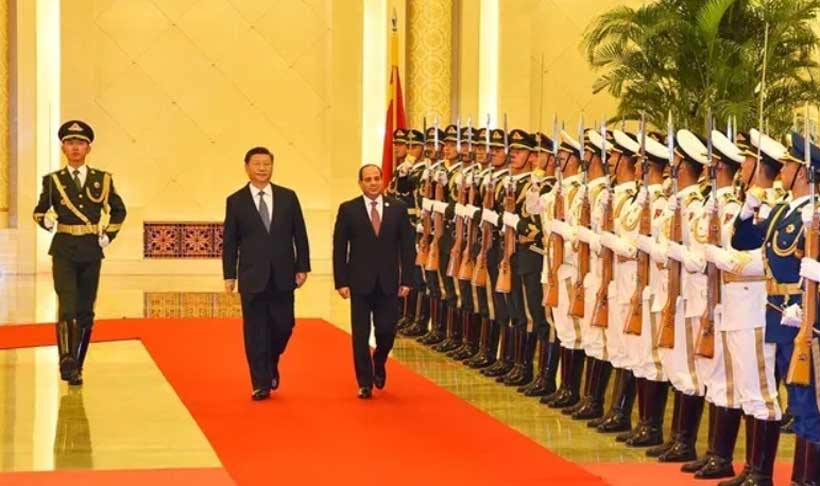
The People’s Republic of China achieved a historic and unprecedented participation in the second edition of the El Alamein International Aerospace Exhibition (EIAS 2026), which was held at El Alamein International Airport from September 8 to 10, 2026. The Chinese participation came just days after the conclusion of the joint Egyptian-Chinese air force exercises Eagles of Civilization 2026. The significance of this Chinese military presence lay in the display of a fully integrated and realistic combat air system, not merely models. In this context, the Egyptian researcher will attempt to divide the significance of China’s participation in the El Alamein Air Show into several key areas, including:
– First: China’s prominent participation in the El Alamein International Air and Space Show in Egypt as a strategic shift in the regional arms market
Here, China’s extensive participation in the El Alamein International Air and Space Show constitutes a significant strategic shift in the regional arms market. Beijing has moved beyond the traditional approach of selling individual military components to present itself as a supplier of comprehensive and integrated air combat systems, competing with Western and American powers in the Middle East and Africa. China’s participation in the El Alamein International Air and Space Exhibition focused on several strategic axes to promote and analyze the concept of a full-suite solution. This was achieved by emphasizing that China does not simply sell aircraft but rather offers a comprehensive defense solution, encompassing attack fighters, logistics support aircraft, aerial refueling, and command and control systems, known as C4ISR.
The People’s Liberation Army of China sought to highlight China’s military and defense role and promote the Chinese model as a ready-made competitive alternative. This was done by showcasing the competitive advantages of Chinese defense industries, such as the absence of complex political conditions, rapid delivery, and comprehensive technology transfer to Middle Eastern and African markets. Furthermore, the focus was on the geopolitical depth, linking the Chinese presence in El Alamein to Beijing’s broader vision of strengthening security and economic partnerships with countries in the region.
Stay ahead of the geopolitical week.
MD Briefing delivers expert analysis across five global fronts — the Indo-Pacific, energy, geoeconomics, European security, and the Middle East — every Monday morning. Free.
– Second: Showcasing the most prominent Chinese aircraft platforms participating for the first time outside of China at the El Alamein exhibition
As for the most prominent Chinese aircraft platforms participating for the first time outside of China, for the first time in its history, the People’s Liberation Army Air Force (PLAAF) showcased four of its latest operational aircraft models at an air show outside of China. The most prominent of these were
– The Chinese J-16 multirole fighter (J-16)
This air superiority and heavy ground attack fighter garnered widespread international attention.
– The Chinese YY-20A aerial refueling tanker (YY-20A)
This Chinese heavy transport aircraft provides refueling to extend the operational range of fighter jets.
– The Chinese KJ-500 airborne early warning and control aircraft (KJ-500)
This represents an airborne command and control system.
– The Chinese Z-20K military helicopter (Z-20K)
This is a multi-role helicopter designed for search and rescue and tactical operations.
Regarding the Chinese weapons and drones on display at the El Alamein International Air and Space Exhibition, the AVIC (Aerospace Industries of China) showcased its advanced defense capabilities in the outdoor exhibition area through:
– A demonstration of the Chinese Wing Loong-10B stealth drone (Wing Loong-10B):
This is a high-altitude, long-range unmanned aerial vehicle (UAV) designed for reconnaissance and precision strikes.
– A demonstration of Chinese smart munitions and missiles:
The Chinese drone was displayed surrounded by advanced air-to-air missiles, such as the PL-108 & PL-12AE. In addition to a demonstration of the Chinese anti-radar and anti-radiation missile (YJ-9ER1).
– Third: The Chinese People’s Liberation Army (PLA) showcased its capabilities through a technical display (capability integration), dividing its export-available air systems into functional groups for attack, others for support and refueling, and a third group for command and control, during China’s extensive participation in the El Alamein Air Show in Egypt.
In this context, the PLA sought to leverage China’s extensive participation in the El Alamein Air Show in Egypt as a new and strategic launchpad for China in North Africa. This included showcasing the size of the Chinese pavilion and the equipment on display, such as aerobatic aircraft and unmanned combat aerobatics. The Chinese Ministry of Defense emphasized the technical aspects of this capability integration display, highlighting the division of its export-available air systems into functional groups for attack, others for support and refueling, and a third group for command and control. As follows:
■ The offensive functional groups were represented by a display of China’s modern fighter jets and attack drones, such as the Wing Loong family.
■ As for the support and refueling functional groups, China’s strategic transport and aerial refueling aircraft, such as the Y-20, were showcased.
■ The third functional group focused on (command and control), with China displaying its early warning aircraft and airborne command centers.
– Fourth: Analyzing and understanding the strategic dimensions of China’s participation in the El Alamein International Air and Space Exhibition, aimed at attracting more interest in the Chinese aerospace sector and promoting widespread military sales of Chinese military, defense, and armament equipment
Thus, we can analyze and understand the strategic dimensions of China’s participation in the El Alamein International Air and Space Exhibition, which aimed to attract more interest in the Chinese aerospace sector and promote widespread military sales of Chinese military, defense, and armament equipment. Therefore, we find that the extensive Chinese presence at the El Alamein International Air and Space Exhibition constitutes a genuine breakthrough. Beijing did not aim to promote individual pieces but rather to demonstrate its ability to provide a comprehensive and integrated air combat system, encompassing attack, support, refueling, and command, as a competitive alternative in the Middle Eastern and African markets.
Analyzing the economic and strategic dimensions of China’s extensive participation in the El Alamein exhibition, we observe the extent to which the Chinese People’s Liberation Army focused on achieving broad military exposure for its participation during the exhibition. This included showcasing how these Chinese defense, military, and air systems can reduce operating costs for purchasing countries while ensuring their independence in defense decision-making, without imposing political conditions or prior operational restrictions, unlike many Western and American systems.
US President Donald Trump suggested Thursday that the war with Iran could end before the Nov. 3 midterm elections, a day after predicting it would conclude immediately afterward.
“I don’t know that they’re gonna be able to hold out. But it’ll get settled after the elections. Or maybe sooner,” Trump reportedly told broadcaster NewsNation over the phone, referring to mounting US economic pressure on Iran.
Trump also denied reports that Iran’s latest retaliatory strikes on a US base in Jordan damaged US aircraft in the region. “Nope… None whatsoever. No damage. No nothing.”
On Wednesday, Trump had said the war would “end immediately” after the midterms.
“I think the war will end immediately after the election because they can’t hold out any longer,” he told reporters ahead of a trip to Dallas, Texas.
His comments contrast with a Wall Street Journal report hours later that senior White House advisers have privately warned the conflict could continue through the remainder of his term.
The war, now in its seventh month, has killed 18 US servicemembers and raised concerns over military resources and disruptions to global energy markets.
US gasoline prices averaged $4.22 a gallon Wednesday, up from $4.01 a month earlier and $3.19 a year ago, according to the American Automobile Association (AAA).
Trump has repeatedly expressed a desire for a quick resolution while supporting a broader economic campaign against Tehran.
Treasury Secretary Scott Bessent has described the strategy, dubbed “Operation Economic Outcast,” as an alternative to major combat operations.
Last week, a prominent Saudi Sheikh, Mohammed Al-Issa, visited the Auschwitz concentration camp in Poland to commemorate the 75th anniversary of its liberation, which signalled the end of the Nazi Holocaust. Although dozens of Muslim scholars have visited the site, where about one million Jews were killed during World War Two, according to the Auschwitz Memorial Centre’s press office, Al-Issa is the most senior Muslim religious leader to do so.
Visiting Auschwitz is not a problem for a Muslim; Islam orders Muslims to reject unjustified killing of any human being, no matter what their faith is. Al-Issa is a senior ally of Saudi Crown Prince Mohammad bin Salman (MBS), who apparently cares little for the sanctity of human life, though, and the visit to Auschwitz has very definite political connotations beyond any Islamic context.
By sending Al-Issa to the camp, Bin Salman wanted to show his support for Israel, which exploits the Holocaust for geopolitical colonial purposes. “The Israeli government decided that it alone was permitted to mark the 75th anniversary of the Allied liberation of Auschwitz [in modern day Poland] in 1945,” wrote journalist Richard Silverstein recently when he commented on the gathering of world leaders in Jerusalem for Benjamin Netanyahu’s Holocaust event.
Bin Salman uses Al Issa for such purposes, as if to demonstrate his own Zionist credentials. For example, the head of the Makkah-based Muslim World League is leading rapprochement efforts with Evangelical Christians who are, in the US at least, firm Zionists in their backing for the state of Israel. Al-Issa has called for a Muslim-Christian-Jewish interfaith delegation to travel to Jerusalem in what would, in effect, be a Zionist troika.
Zionism is not a religion, and there are many non-Jewish Zionists who desire or support the establishment of a Jewish state in occupied Palestine. The definition of Zionism does not mention the religion of its supporters, and Israeli writer Sheri Oz, is just one author who insists that non-Jews can be Zionists.
Mohammad Bin Salman and Netanyahu – Cartoon [Tasnimnews.com/Wikipedia]
We should not be shocked, therefore, to see a Zionist Muslim leader in these trying times. It is reasonable to say that Bin Salman’s grandfather and father were Zionists, as close friends of Zionist leaders. Logic suggests that Bin Salman comes from a Zionist dynasty.
This has been evident from his close relationship with Zionists and positive approaches to the Israeli occupation and establishment of a Jewish state in Palestine, calling it “[the Jews’] ancestral homeland”. This means that he has no issue with the ethnic cleansing of almost 800,000 Palestinians in 1948, during which thousands were killed and their homes demolished in order to establish the Zionist state of Israel.
“The ‘Jewish state’ claim is how Zionism has tried to mask its intrinsic Apartheid, under the veil of a supposed ‘self-determination of the Jewish people’,” wrote Israeli blogger Jonathan Ofir in Mondoweiss in 2018, “and for the Palestinians it has meant their dispossession.”
As the de facto ruler of Saudi Arabia, Crown Prince Bin Salman has imprisoned dozens of Palestinians, including representatives of Hamas. In doing so he is serving Israel’s interests. Moreover, he has blamed the Palestinians for not making peace with the occupation state. Bin Salman “excoriated the Palestinians for missing key opportunities,” wrote Danial Benjamin in Moment magazine. He pointed out that the prince’s father, King Salman, has played the role of counterweight by saying that Saudi Arabia “permanently stands by Palestine and its people’s right to an independent state with occupied East Jerusalem as its capital.”
Israeli journalist Barak Ravid of Israel’s Channel 13News reported Bin Salman as saying: “In the last several decades the Palestinian leadership has missed one opportunity after the other and rejected all the peace proposals it was given. It is about time the Palestinians take the proposals and agree to come to the negotiations table or shut up and stop complaining.” This is reminiscent of the words of the late Israeli Foreign Minister Abba Eban, one of the Zionist founders of Israel, that the Palestinians “never miss an opportunity to miss an opportunity.”
Bin Salman’s Zionism is also very clear in his bold support for US President Donald Trump’s deal of the century, which achieves Zionist goals in Palestine at the expense of Palestinian rights. He participated in the Bahrain conference, the forum where the economic side of the US deal was announced, where he gave “cover to several other Arab countries to attend the event and infuriated the Palestinians.”
US President Donald Trump looks over at Crown Prince of Saudi Arabia Mohammad bin Salman al-Saud as they line up for the family photo during the opening day of Argentina G20 Leaders’ Summit 2018 at Costa Salguero on 30 November 2018 in Buenos Aires, Argentina [Daniel Jayo/Getty Images]
While discussing the issue of the current Saudi support for Israeli policies and practices in Palestine with a credible Palestinian official last week, he told me that the Palestinians had contacted the Brazilian President Jair Bolsonaro to ask him not to relocate his country’s embassy to Jerusalem. “The Saudis have been putting pressure on us in order to relocate our embassy to Jerusalem,” replied the Brazilian leader. What more evidence of Mohammad Bin Salman’s Zionism do we need?
The founder of Friends of Zion Museum is American Evangelical Christian Mike Evans. He said, after visiting a number of the Gulf States, that, “The leaders [there] are more pro-Israel than a lot of Jews.” This was a specific reference to Saudi Arabia’s Crown Prince, and his counterpart in the UAE, Mohammed Bin Zayed.
“All versions of Zionism lead to the same reactionary end of unbridled expansionism and continued settler colonial genocide of [the] Palestinian people,” Israeli-American writer and photographer Yoav Litvin wrote for Al Jazeera. We may well see an Israeli Embassy opened in Riyadh in the near future, and a Saudi Embassy in Tel Aviv or, more likely, Jerusalem. Is Mohammad Bin Salman a Zionist? There’s no doubt about it.
The views expressed in this article belong to the author and do not necessarily reflect the editorial policy of Middle East Monitor.
George Orwell’s dystopian foresight could easily find new expressions in the ongoing Israeli wars of genocide in Gaza and Lebanon. Much like “war is peace”, the Biden administration and the European Union have contributed to creating phrases such as “aggression is self-defence,” “murder is collateral damage”, “safe areas are death traps” and “humanitarian aid is a starvation diet.”
After enduring a full year of Israeli terror, extreme torment and military occupation, fear never conquered Gazans. Despite the complete Israeli blockade – abetted with the help of the Egyptian regime – and the stark imbalance in military power, Gaza’s collective resistance, by all means necessary, remained steadfast and resilient.
Notwithstanding the above, Benjamin Netanyahu has not succeeded in achieving any of his declared objectives. For instance, less than seven per cent of the freed Israeli captives were recovered by force. Perhaps because the Israeli prime minister’s undeclared Zionist objectives, such as land grabs in the West Bank under the shadow of the Gaza genocide, took precedence over pursuing a proven venue for the release of Israeli prisoners.
Netanyahu’s war success can be only measured by Israel’s scale of vengeance, as the toll of the murdered and injured has reached 150,000. Gaza has been turned into a living hell. A war that pervasively and systematically diminished Gaza’s economic capacity, following an 18-year blockade that crippled the economy and forced upon it an ever-increasing sense of dependency.
Yet, Israel failed to bring any part of Gaza into submission. As a result, several Israeli generals, led by former national security adviser Israeli Maj-General Giora Eiland, contrived a new approach, the “General’s Plan”, to ethnically cleanse northern Gaza.
The General’s Plan is not exclusively a military strategy but rather an orchestrated noncombatant action, euphemistically termed to mask its true intention: genocide and ethnic cleansing through starvation. It calls first for the complete isolation of northern Gaza from the rest of the Gaza Strip. Second: compartmentalise northern Gaza into separate quarters and declare each section a war zone, forcing civilians to leave or become legitimate military targets.
The initial phase, which began in early October, blocked aid trucks from reaching the north and then segregated the Jabalia camp from its surroundings. In other words, genocide by attrition, one quarter at a time, in a slow motion.
As part of the General’s Starvation Plan, Israel bombed the only UN distribution center in Jabalia camp on Monday, murdering ten civilians queuing to receive food aid. Since last October, around 400,000 civilians remain in northern Gaza out of the original 1.2 million. Many refuse to evacuate despite the unbearable conditions. They know from historical experience that evacuation is an Israeli alias for ethnic cleansing. Once they leave, they may never return, as happened in 1948. They also saw what happened to those who evacuated, many were killed as they “moved south”, while others were murdered in the Israeli death traps, otherwise known as designated “safe areas.”
The Biden administration has been whitewashing Israeli use of starvation as a method of warfare since 9 October, 2023 when the Israeli minister of war declared “no electricity, no food, no fuel, everything is closed.” However, on Tuesday, a little over a year after the minister’s declaration, the American secretaries of state and defence sent Israeli officials a letter giving them another grace period of 30 days to allow food aid into north Gaza or risk a restriction of US military assistance to Israel.
The new warning feels like a classic case of a déjà vu. In April 2024, the Biden administration issued a similar warning to Israel ahead of a report that was being prepared by American officials examining Israel’s violation of the Leahy Law, particularly subsection 6201(a). The law stipulates that the US should not provide assistance to any country that “prohibits or otherwise restricts, directly or indirectly, the transport or delivery of United States humanitarian assistance.”
Following that warning, US government agencies and officials concluded that Israel was blocking American humanitarian aid to Gaza. The US Agency for International Development (USAID) notified the State Department of Israel’s “arbitrary denial, restriction and impediments” of American aid to Gaza residents. In addition, the State Department’s refugee bureau issued a similar opinion stating that “facts on the ground indicate US humanitarian assistance is being restricted.”
Even after those palpable reports from the two US agencies, the Israeli Sayanim and American Secretary of State, told Congress on 10 May that Israel does not restrict “the transport or delivery of US humanitarian assistance” in Gaza.
Empowered by Washington, the General’s Starvation Plan aims to block the delivery of medical aid, food, fuel and water to the besieged quarter, currently Jabalia camp where more than 20,000 people live. This is part of what appears to be a gradual genocide, while creating the illusion of allowing aid trucks into the northern area, as the US ambassador informed the UN Security Council on Wednesday.
The entry of aid trucks does not guarantee the delivery of food to the starving population. It means that Israel retains complete control over what section is fed and who is left to starve. It also confirms that American officials continue to be Israel’s willing enablers to carry on with its General’s Starvation Plan in a systematic and phased mini-genocide.
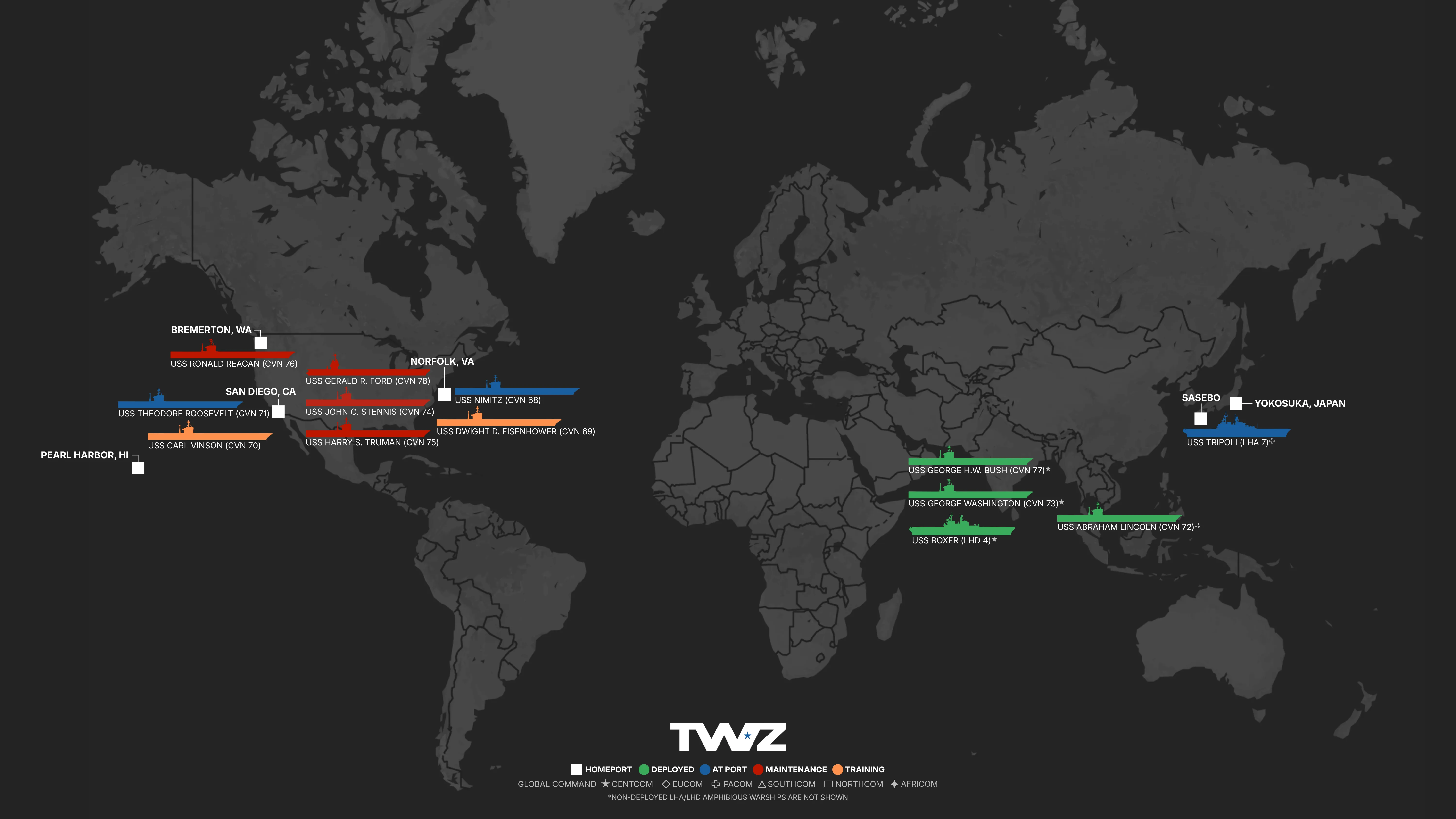
Under heavy escort, the USS Abraham Lincoln transited the Strait of Malacca and Singapore Strait over the weekend, en route to Thailand for a highly publicized and much-needed liberty port call. Guided-missile cruiser USS Robert Smalls led the three-ship column, with guided-missile destroyer USS Frank E. Petersen Jr. following astern of the supercarrier as she entered the South China Sea. Multiple Thai officials have confirmed the upcoming port visit since it was first reported by USA Today last week, with the flattop expected to pull into port at Laem Chabang in the coming days. Meanwhile, America’s other two deployed carrier groups are in the Middle East enforcing the ongoing blockade as the U.S. and Iran exchange fire for the first time since July.
Here’s TWZ’s weekly carrier tracker monitoring America’s flattop fleet, including deployed Carrier Strike Groups (CSG) and Amphibious Ready Groups (ARG), using publicly available open-source information. Check out last week’s report here.
TWZ/IAN ELLIS-JONES (HIGH RESOLUTION)
Lincoln Enters The South China Sea, Again, En Route To Thailand For Liberty
Abraham Lincoln flipped her Automatic Identification System (AIS) transponder on ahead of the transit, broadcasting the flattop’s position publicly for the first time since January 28, 2026, when the CSG made the transit in the opposite direction prior to Operation Epic Fury. Lincoln has now been deployed for 285 days without a liberty call, but that streak is set to end this week.
For friends and family, we anticipate an arrival back home in late September or early October, depending on how long the crew stays in Thailand and whether any other stops are made along the way. When all is said and done, Abraham Lincoln’s deployment will likely become the second-longest in the modern carrier era behind the historic 326 days logged by the USS Gerald R. Ford earlier this year.
Time-lapse of USS Abraham Lincoln transiting the Strait of Malacca. Source: @CVN_72 on X.
While the composition of the Abraham Lincoln CSG has shifted over the nine-plus-month deployment, Frank E. Petersen Jr., a Flight IIA Technology Insertion (TI) Arleigh Burke class destroyer and one of the newest in the fleet, embarked the commander of Integrated Air and Missile Defense (IAMD) throughout the six months of almost nonstop combat operations against Iran. The IAMD commander is responsible for coordinating the detection, response, and interception of inbound aerial threats, and Petersen Jr. is equipped with the world’s foremost integrated naval combat system – the Aegis Combat System Baseline 9 – which delivers quick reaction times, concentrated and networked firepower, and advanced electronic countermeasure capabilities for anti-air warfare.
The unannounced addition of Ticonderoga class cruiser USS Robert Smalls, which has historically served as the IAMD commander for the carriers forward-deployed out of Yokosuka, Japan, adds 122 Vertical Launch System (VLS) cells packed with missiles for protection and firepower. The rationale for the additional Tico cruiser, an iconic class that will be completely retired over the coming years without a comparable replacement, is unclear. TWZ has not received an on-the-record response from the U.S. Central Command (CENTCOM) or U.S. Naval Forces Central Command (NAVCENT) public affairs explaining the redirection.
Robert Smalls was part of the George Washington CSG as recently as August 18, making the northwest-bound Malacca Strait transit with the strike group the week prior, before peeling off to escort the Abraham Lincoln back through.
Guided-missile destroyer USS Frank E. Petersen Jr. transiting the Arabian Sea in June 2026. U.S. Central Command Public AffaUSS Robert Smalls transiting the South China Sea in July 2026. U.S. Navy photo by Petty Officer 3rd Class Nicolas Quezada
U.S. Launches Another Round of Strikes Against Iran Today As Tensions Escalate
Ahead of publication on Tuesday, CENTCOM announced a fresh round of strikes against targets in Iran that began at noon Eastern Time. “The strikes follow recent attempted attacks by the IRGC against commercial shipping in the Strait of Hormuz and against American service members deployed to the region,” the command posted in a statement on social media.
George Washington, which is currently accompanied by a single destroyer, USS Shoup, relieved the Abraham Lincoln in the Middle East earlier this month. Other U.S. 5th Fleet ships are reportedly moving in and out of the CSG, but the situation is fluid and TWZ cannot confirm the current, complete composition of the group. It’s unknown which warship, if any, is currently serving as IAMD commander for the CSG, which chopped into the CENTCOM area of responsibility (AOR) on or around August 19.
Flight ops on the flight deck of USS George Washington in the Middle East. U.S. Naval Forces Central CommanAn F-35C Lightning II, attached to Strike Fighter Squadron (VFA) 147, aboard Washington. Petty Officer 3rd Class Nicolas QuezadaAn MH-60R Seahawk readies for takeoff on the deck of Washington. U.S. Naval Forces Central Comman
Also operating in the Middle East, the four-ship George H.W. Bush CSG is underway at an undisclosed location in the Arabian Sea. Alongside USS George H.W. Bush is Tico cruiser USS Princeton, the IAMD commander, and two Burke destroyers, USS Ross and USS Donald Cook.
The carriers are enforcing the ongoing blockade of Iran – and presumably participating in the latest round of airstrikes – although they are both officially on station to “support maritime security and stability in the Middle East,” according to DVIDS, the military’s content-sharing platform. CENTCOM forces have redirected 84 commercial vessels, disabled three using kinetic force, and boarded another two since the blockade resumed, as of September 1.
USS George H.W. Bush conducts flight ops in U.S. Central Command. U.S. Navy video.
Over the weekend, the United States and Iran traded blows for the first time in over a month. CENTCOM opened the tit-for-tat exchange on Sunday by targeting rocket systems on Larak Island, located in the Strait of Hormuz on the Iranian side of the northern corridor, that are fitted to launch naval mines, after the Islamic Revolutionary Guard Corps (IRGC) was observed making preparations to fire into the contested waterway.
“I can confirm that earlier today U.S. forces struck two Iranian launchers on Larak Island,” Navy Capt. Tim Hawkins, CENTCOM’s spokesman, told TWZ. “Islamic Revolutionary Guard Corps forces were observed preparing to launch rockets with sea mines into the Strait of Hormuz,” he added. The IRGC retaliated by launching a salvo of ballistic missiles at Muwaffaq Salti Air Base, a Jordanian installation the U.S. military operates from. Jordan’s military said it successfully intercepted eight missiles.
The preemptive strikes to prevent Iran from deploying additional mines came just days after CENTCOM commander Adm. Brad Cooper said U.S. forces “successfully cleared” Iranian sea mines from international shipping lanes in the Strait of Hormuz. Commercial traffic through the strait is slowly recovering but still well below pre-war levels.
CENTCOM commander Adm. Brad Cooper provides an update on mine clearing efforts in the Strait of Hormuz. Source: @CENTCOM on X
On the other side of the world, in the United States, three carriers are active: two are underway training while one is in homeport getting ready for an upcoming deployment. USS Dwight D. Eisenhower, which left Norfolk on August 21, transited south in the Atlantic Ocean and was last operating approximately 70 nautical miles off the coast of Florida, well into East Coast Fleet Replacement Squadron (FRS) and Training Command (TRACOM) Carrier Qualifications (CQ). After departing San Diego on August 10, USS Carl Vinson was spotted on satellite imagery off the California coast by ship-tracker MT Anderson, in the process of completing Tailored Ship’s Training Availability (TSTA) and Final Evaluation Period (FEP) training.
USS Theodore Roosevelt, the next carrier slated to deploy from the continental U.S., is pierside at Naval Air Station North Island in San Diego, based on commercial satellite imagery. Speculation is rampant about where Theodore Roosevelt will deploy, but as the Navy has told us many times, “we do not discuss future operations or timelines.”
The balance of America’s carriers (excluding USS Nimitz, which will begin deactivation in 2027) is either in maintenance or scheduled to begin an availability in the future.
The next flattop that will re-enter service, USS Ronald Reagan, is expected to finish a roughly 17-month Docking Planned Incremental Availability (DPIA) soon. “The docking planned incremental availability for Ronald Reagan is on track for its scheduled completion at the end of August 2026,” Catherine Norton, the Public Affairs Officer (PAO) for Puget Sound Naval Shipyard and Intermediate Maintenance Facility, told Stars and Stripes earlier this month. However, the ship has not gotten underway as of publication, even though yesterday was the end of the month, and it appears the DPIA will stretch into September. TWZ reached out to Puget Sound’s PAO but has not received a response yet. For the latest status of the other three carriers in current or upcoming maintenance, marked in red on the map above, check out our recent deep-dive here.
USS Ronald Reagan in Bremerton, Washington, as of August 29, 2026. Source: @BulletOneOneTwo via @WarshipCam on X
Current Big Deck Force Posture At A Glance
Overall carrier force posture is unchanged compared to our previous report on August 24. Three U.S. carriers are deployed (although one is on the tail end of her deployment and heading home to San Diego), one is preparing to deploy in the near term, two are working up in various states of readiness, four are in maintenance, and another, the USS Nimitz, is being used primarily for training before deactivating next year. One amphibious ready group is deployed, one is forward-deployed and at homeport, four are working up or in port, and three are in maintenance.
Note: Positions are general approximations. Non-deployed LHA/LHD amphibious warships are not shown.
Syria has suffered its worst bloodshed since Bashar Al-Assad was ousted in December, with more than 1,000 people reported killed in violence that has swept the coastal region of the country since Thursday. The violence has pitted the Islamist-led government’s security forces against fighters from Assad’s Alawite minority.
The dead include hundreds of Alawite civilians, whom the a British-based organisation that reports on the conflict, the Syrian Observatory for Human Rights, reported were killed in reprisals after attacks on security forces.
What has driven the violence; how has interim President Ahmed Al-Sharaa reacted; and what have world powers said?
The violence began to spiral on Thursday, when the authorities said that their forces in the coastal region came under attack from fighters aligned with the ousted Assad regime. The interim government poured reinforcements into the area, which is heavily populated by Alawites, to crush what it described as a deadly, well-planned and premeditated assault by remnants of the previous regime.
As government reinforcements deployed, mosques in regions loyal to the new administration began calling on people to wage jihad, or holy struggle, in support of security forces.
By Friday afternoon, reports began emerging of scores of civilians being killed in sectarian reprisals in Alawite towns and villages. As of Sunday evening, the Syrian Observatory for Human Rights said that 973 civilians were killed in reprisal attacks carried out by government forces or fighters aligned with them. More than 250 Alawite fighters were killed and more than 230 members of government security forces were also killed, it added. Reuters has not been able to independently verify the tolls.
The Alawites are the second-largest religious group in Syria after Sunni Muslims. Their faith is an offshoot of Shia Islam. The Assad regime recruited heavily from the Alawite community for its army and security apparatus, which was notorious for its brutality during more than five decades of the family’s rule.
This put many Alawites on the front lines of the civil war that erupted out of protests against Assad’s rule in 2011. The conflict took on a sectarian dimension as Sunni Muslim rebel groups sought to topple the Assad government which was backed by Shia Iran, Lebanon’s Shia Hezbollah movement and others.
Al-Sharaa led the most powerful Sunni group fighting Assad. Known as the Nusra Front, the group was part of Al-Qaeda until he severed ties with the jihadist network in 2016 and renamed his organisation. In a 2015 interview with Al Jazeera, Al-Sharaa described the Alawites as part of a sect that “moved outside the religion of God and of Islam” and urged them to renounce Assad and change their beliefs to remain safe.
Since Assad was ousted, the interim president has pledged to run Syria in an inclusive way. But while he has publicly engaged Kurds, Christians and Druze, there have been no declared meetings between him and senior Alawite figures. Many Alawites say that they suffered like other Syrians under the rule of Assad and his father, both of whom came from the sect.
Prior to Thursday’s escalation, Alawite activists had reported violence and attacks on their community following Assad’s ouster, particularly in rural Homs and Latakia.
In a speech on Sunday, Al-Sharaa said that remnants of the Assad government, supported by external parties, were seeking to create strife and drag Syria back into civil war with the aim of dividing it. He promised to form a fact-finding committee and said its findings would be made public, vowing to bring to account anyone involved “in the bloodshed of civilians” or mistreating them.
He has also announced the formation of a committee aimed at preserving civil peace, which would be tasked with communicating with the people on the coast and providing them with the support they needed to guarantee their protection.
The violence has prompted international alarm.
The United States, which imposes sanctions on Damascus, urged the Syrian authorities to hold accountable the “radical Islamist terrorists” [sic] that had killed people in Syria and said it stood with Syria’s religious and ethnic minorities.
Israeli Defence Minister Israel Katz said on social media that atrocities committed against the Alawites showed that Al-Sharaa had revealed his “true face” as a jihadist.
However, Saudi Arabia and Turkey, allies of Damascus, both signalled their backing for the interim administration as violence was escalating last week. Riyadh condemned “crimes being undertaken by outlaw groups” in Syria and their targeting of security forces.
Turkish Foreign Minister Hakan Fidan, whose country has forces on the ground in north-west Syria, has urged calm and said unnamed foreign elements were partly to blame.
Iran, which backed Assad through the war, has warned that the violence in Syria could cause regional instability.
At the start of Israel’s genocide in Gaza, the Israeli government made no secret of its intention to forcibly transfer Palestinians from the enclave and urged the international community to support its plans for what it called ‘resettlement’.
“Europe has a long history of assisting refugees fleeing conflicts,” Danny Danon and Ram Ben Barak wrote in 2023 in an op-ed for the Wall Street Journal. Describing participation in forced transfer as “a moral imperative”, Danon and Ben Barak suggested that countries accept as much as 10,000 people each to “alleviate the crisis”.
Had the suggestion been accepted by enough countries, Israel would have been granted its current greatest wish – to ethnically cleanse Gaza in full complicity with the international community. As things stand, the international community refused the Israel suggestion on grounds of breaking international law, while getting on board with Israel committing genocide. The real reason behind the stance, however, was that governments would rather witness large-scale massacres of Palestinians from a distance than accept refugees.
US President Donald Trump is now promoting Israel’s strategy. “You’re talking about probably a million and half people, and we just clean out that whole thing. You know, over the centuries it’s had many, many conflicts, that site. And I don’t know, something has to happen,” Trump said during a 20-minute meeting with reporters on Air Force One.
“It’s literally a demolition site right now. Almost everything is demolished and people are dying there,” Trump added, in his usual vague rhetoric. “So I’d rather get involved with some of the Arab nations and build housing at a different location where they can maybe live in peace for a change.”
Trump raised the idea with Jordan’s King Abdullah II and Egypt’s President Abdel Fatah Al-Sisi. Gaza was deemed “interesting” – for real investment purposes, of course. One must not forget Jared Kushner’s plans for Gaza – beachfront properties. And, while the Biden administration dragged its feet on forced displacement, the genocide happened under its watch and with full collaboration. Which means that the previous administration paved the way for Trump to echo what Israel insisted upon since the start of the genocide – Palestinians are slated for displacement, one way or another.
Israeli Finance Minister, Bezalel Smotrich, stated he will be working “to prepare an operational plan and ensure the realisation of President Trump’s vision.” But it’s best to call it the Israel vision, even if Trump is the President promoting forced transfer as a humanitarian necessity. The Israeli vision is colonial, fits in with genocide and the concept of Zionism’s Greater Israel. Real estate investments facilitate the Zionist concept. And what better way to promote rebuilding Gaza, even if for Palestinians, rebuilding Gaza means the total opposite?
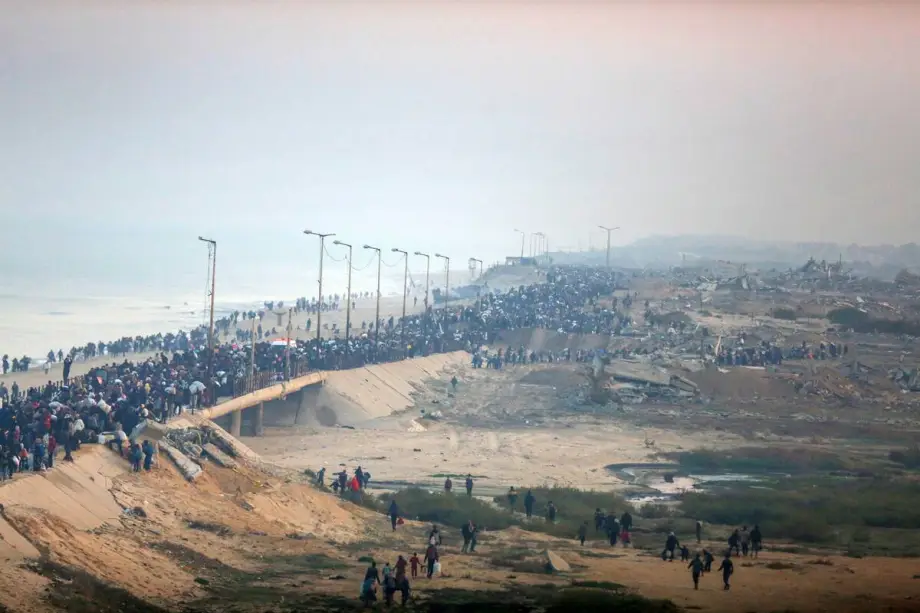
As Palestinians return to their homes, Trump’s suggestion of forced transfer should be considered incitement to ethnic cleansing. The world is obliged to heed what is happening right after the ceasefire and the gradual return of Palestinian refugees to Gaza. Palestinians want to remain – it is their right – and that is all that matters.
After oohing and aahing over “The Odyssey,” it’s time for the hot summer splash to make way for an intriguing fall lineup.
At the movies, Alexander Skarsgård plays a sexy wicker husband. Tom Cruise, a bizarro oil man. Jenna Ortega, a robot friend, and Kendall Roy, ahem, Jeremy Strong, is Mark Zuckerberg. Then we revisit classics of various stripes on the small screen, from a further-future “Blade Runner” to “A Different World” relaunch to “East of Eden” to “Pride and Prejudice.”
For new books, it’s an Emily fest. Emily St. John Mandel’s “Exit Party,” based in Los Angeles, is being called her best work since “Station Eleven.” And Emily Wilson, “The Odyssey” translator who launched 1,000 hot takes, lets us inside her process. As for arts, directors steal the spotlight: the Lucas Museum of Narrative Art opens with 20 inaugural exhibitions and a collection of David Lynch’s L.A. photography fills a local gallery.
Bookmark this page and come back daily this week as we share even more of the best of fall. — Brittany Levine Beckman
Aug. 31 (UPI) — Oil prices surged early Monday after fighting flared in the U.S.-Iran conflict for the first time in four weeks since U.S. President Donald Trump announced a “pause” in U.S. military strikes on Aug. 1.
The contract for the benchmark Brent crude for November delivery jumped by 3.4% to $91.09 a barrel and the October contract for American crude saw a similar-sized increase to $86.22 after U.S. forces hit rocket launchers on Larak Island in the Hormuz Strait on Sunday night and Iran’s military retaliated, targeting American bases in Jordan.
The hikes were driven by the renewed hostilities stoking fears ongoing supply disruption caused by a drastic curtailment of tankers traffic transiting the Strait of Hormuz would be made worse and persist for longer, according to experts.
“Supply risk will persist and oil inventories will continue to deplete in the coming weeks and months. The Iranian crisis has likely changed the security status quo in the Middle East,” said PVM Oil Associates’ London-based analyst Tamas Varga.
Investment bank Goldman Sachs, the impact of destructive attacks on refining capacity was responsible for upward pressure on margins.
“Rising strikes on refineries in the Middle East and Russia have further constrained already-stretched global refining capacity, pushing refined products margins to new highs,” the bank said in a note.
Prices at the pump in the United States on Monday remained broadly flat from the previous day, with the average price of a gallon of regular unleaded up 0.2 cents at 4.08 a gallon, and diesel down by a little over 0.3 cents at $5.60 a gallon, according to the American Automobile Association.
The developments came as the United States’ Strategic Petroleum Reserve has fallen to its lowest level since 1982.
President Trump said Sunday he would restock it with oil from his Venezuela deal giving the United States secure a stake in more than 65 billion barrels of oil despite the fact it could to produce take many years to before the agreements yields any significant volumes because the oil is reserves, as yet to be drilled.
The price of oil has seesawed over the past two weeks after rising in response to Trump’s Aug. 19 threat to wage a “crushing economic operation” against Iran that his officials said would cause the regime to collapse, and then retreating again in the hours before the mainly-sanctions package of measures were unveiled on Aug. 24.
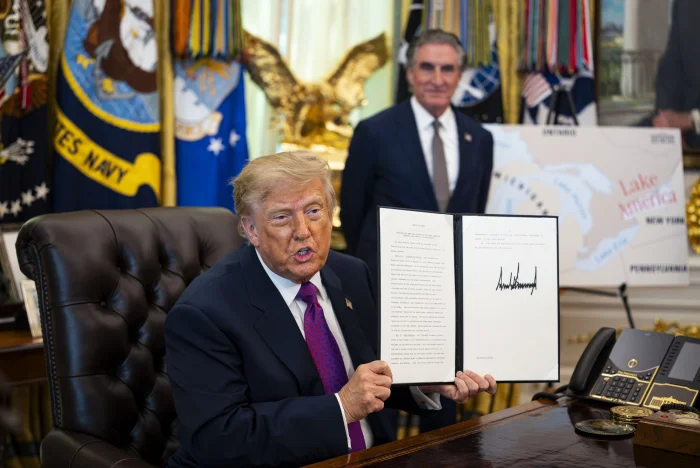
President Donald Trump signs an executive order to rename Lake Ontario as Lake America in the Oval Office of the White House on Thursday. Photo by Al Drago/UPI | License Photo
Reporting from ORANGE CITY, Iowa — They met decades ago, when they were first married, and the three sisters-in-law still gather each week at the Dutch Bakery to catch up amid the sweet smell of flour and sugar floating through the air.
Despite the cozy setting here on the state’s western edge, they can feel the country beneath their feet slipping away, eroding under the threats of immorality and terrorism.
“I never thought we would live in so much fear,” said Joanne Niezen, as her coffee sat cooling before her in a Styrofoam cup.
There’s fear on the other side of the state as well, though for different reasons.
In the college town of Iowa City, with its hip music scene and pita restaurant advertising “fresh thinking and healthy eating,” Veronica Tessler worries about the harsh rhetoric directed at immigrants and the economic inequality that lingers years after the Great Recession.
“I really fear for our country,” said Tessler, who left her job at a foreign policy foundation to open a frozen yogurt shop near the University of Iowa campus.
A sense of dread is about the only thing that unites Orange City, a bastion of religious conservatism, and Iowa City, known for its blue-sky liberalism. Together they bookend not only the state’s geography but its political spectrum as Iowa prepares to kick off the presidential selection process Monday night with its closely watched caucuses.
The two communities, located in the most lopsidedly partisan counties in the state, reflect the vast political chasm here and across the country, a divide that President Obama was unable to heal and which may prove insurmountable for whomever takes his place.
“Republicans see an America where the government is too big at home and too feeble abroad. Democrats see an America where the economy is out of whack,” said David Nagle, a Democratic attorney who used to represent Iowa City and surrounding Johnson County in Congress. “It’s like two trains in the night, passing in opposite directions.”
Republicans see an America where the government is too big at home and too feeble abroad. Democrats see an America where the economy is out of whack.
— David Nagle, a Democratic attorney who used to represent the Iowa City area in Congress
But the division goes far beyond a profound disagreement on issues. While partisan tensions are nothing new, they have deepened and intensified during the presidencies of George W. Bush and Barack Obama as the parties have splintered along the lines of age, race and culture. The result is a separation of America into mutually estranged and suspicious tribes.
Today, as conversations at opposite poles of Iowa show, voters on each side often get their news from different sources, worry about different problems and view political adversaries with mistrust and even contempt. One voter’s vision for America is nothing less than another’s nightmare; it’s common to hear candidates of the opposing party described as “concerning” or “scary” or “crazy.”
In 2014, a major study released by the nonpartisan Pew Research Center found that more than one-third of Republicans and just over a quarter of Democrats — especially those most engaged in politics — go as far seeing the other party as a “threat to the nation’s well-being.”
In Johnson County, known both affectionately and derisively as the “People’s Republic,” life in Iowa City revolves around the university, with young people constantly hustling between classes or hunkered down in coffee shops with headphones and homework.
Obama is largely viewed with gratitude or, at worst, disappointment for failing to deliver an even more liberal agenda.
The city’s leanings are evident at the Hamburg Inn, where jars labeled with the names of presidential candidates are lined up in the window. Diners drop in coffee beans to show their preferences; some of the Republican jars are nearly empty, while a second container was added for Bernie Sanders, a democratic socialist, because the first overflowed.
Tessler, 30, is volunteering with the Sanders campaign, and she’s been alarmed by what she hears coming from the mouths of Republican contenders.
In response to Donald Trump’s proposal to ban Muslims from entering the U.S., she helped make T-shirts to protest his Iowa City visit last Wednesday. “I stand with my Muslim neighbors,” they read.
She doesn’t dismiss the threat of terrorism — in fact, she was visiting family near San Bernardino on the day of the attack there that killed 14 people in December. But she’s also the daughter of a Soviet Jew who escaped to Los Angeles in 1973, and she thinks Republicans are scapegoating immigrants and refugees.
“They are not American ideals,” she said.
For many in Iowa City, issues like economic inequality and student debt feel most urgent, not fears of terrorist attack.
“ISIS could do something terrible anywhere,” said Chuck Michaelson, 61, a piano instructor who lives in nearby Coralville, using an acronym for the militant group Islamic State. He paused while flipping through a biography of writer Joan Didion at a bookstore near campus. “But the likelihood of it being personally affecting is slim. It’s like being struck by lightning.”
About 300 miles away in Orange City, across a vast expanse of fertile farmland, the fears of terrorism seem more immediate despite the area’s isolation and outward serenity.
“The whole thing of ISIS scares me,” said Bob Hulstein, 64, who publishes the Orange City newspaper and owns a printing business with his brother-in-law, Dave Pluim, 51.
After attacks in Paris and San Bernardino, Hulstein said, “I’m afraid we’re going to see that closer and closer. I guess I want that stopped before it comes to my front door.”
Pluim agreed. “In fact, it would be real easy to do something horrible in Orange City,” he said. “Come to a high school basketball game.”
Settled largely by Dutch immigrants, this region proudly promotes its heritage; Orange City, the seat of Sioux County, was named after a Dutch prince, and decorative windmills, wooden shoes and tulip-themed businesses abound.
The area was hardly touched by the Great Recession — strong commodity prices and a boom in farm values helped see to that — and now there is something close to full employment. “Help wanted” signs are everywhere: at the florist, the bakery, restaurants, the post office.
So it is not economics that drives the anxiety here so much as concerns about the country’s place in the world.
“Are we willing to back our allies?” said Tony Vande Brake, 25, a financial advisor and newly elected member of the Orange City Council. “Are we willing to stand behind our military prowess, show strength if we had to?”
Back at the Dutch Bakery, Niezen and her sisters-in-law describe the election as a chance to reclaim the moral authority and military strength that, in their opinion, has withered under Obama and fueled a rise in Islamic extremism.
“He’s taken our military way down,” said Niezen, who is in her 70s. “When they were cutting our people’s heads off, he should have gotten in there right then.”
Leona Noteboom, an 83-year-old retiree, agreed. “I don’t trust him for taking care of my country,” she said.
“We’re just losing all our Christian values,” piped in Carol Noteboom, 74, who lives on a nearby farm.
Amid all the anxieties, there were glimmers of optimism.
Morgan Brittain, a political science student, crosses the ideological fault line every time he travels from his family’s home in Winterset, a small town outside Des Moines, to school in Iowa City. When he last got his hair cut back home, the woman holding the shears confided she planned to support Trump.
“I was like, ‘Oh my gosh, Heidi, you’re killing me,’” Brittain said.
At the barbershop close to campus, everyone seems bewildered by Trump’s popularity.
Asked if any candidate could bridge the divide, Brittain laughed and said, “I’m going to say absolutely, anybody can unify us.”
But he’s just 22, Brittain said, and still an idealist.
Twitter: @ChrisMegerian
Twitter: @markzbarabak
Megerian reported from Iowa City and Barabak from Orange City.
The upcoming official visit of Chinese President Xi Jinping to Egypt, scheduled for August 30 to September 3, 2026, coincides with the Shanghai Cooperation Organisation (SCO) summit. The visit will address economic and technological cooperation, as well as regional and international issues, and marks the 70th anniversary of diplomatic relations between Egypt and China. The visit aims to strengthen the comprehensive strategic partnership between the two countries and expand Beijing’s economic and political influence in the Middle East amidst escalating regional and international tensions, while also bolstering China’s role in the Global South.
As an Egyptian academic specializing in Chinese politics and the policies of the ruling Communist Party of China, I can analyze and summarize the significance of President Xi Jinping’s visit to Cairo and his meeting with his Egyptian counterpart, President Abdel Fattah El-Sisi, and its importance to China’s influence in the Middle East and the Global South through the following points:
– First: What does China hope to achieve with Xi Jinping’s visit to Egypt at this particular time?
This visit of President Xi Jinping to Cairo (the first by a Chinese president to Cairo in nearly a decade) coincides with the 70th anniversary of the establishment of diplomatic relations between the two countries. It carries several key objectives, including political and international dimensions related to Chinese coordination with Egypt on Middle Eastern issues. The visit comes at a sensitive time, as the region is experiencing tensions linked to the conflict between Iran and the United States and its repercussions on maritime security in the Strait of Hormuz and global energy markets. Beijing also seeks to strengthen its strategic balance and reaffirm its diplomatic presence as an international power that supports diplomatic solutions and cooperates with pivotal countries like Egypt to achieve stability. This follows President Xi Jinping’s participation in the Shanghai Cooperation Organisation summit. President Xi Jinping’s visit to Cairo also carries several economic and trade dimensions, such as expanding the economic partnership and capitalizing on the significant increase in trade between the two countries to deepen cooperation. Furthermore, China will support infrastructure and energy projects in Egypt by boosting Chinese investments in Cairo, including renewable energy sectors such as wind turbine manufacturing plants, transportation deals, and electric trains, in addition to extending currency swap agreements between the two central banks.
Stay ahead of the geopolitical week.
MD Briefing delivers expert analysis across five global fronts — the Indo-Pacific, energy, geoeconomics, European security, and the Middle East — every Monday morning. Free.
The visit also aims to discuss the technological and artificial intelligence file in China’s relations with Cairo, particularly major technological offers, most notably the offer from the Chinese company Huawei to build data and artificial intelligence centers in Egypt. This project is viewed with apprehension by intelligence, military, political, and strategic circles in Washington, which are attempting to offer Cairo alternatives from major American technology companies such as Microsoft, Nvidia, and AMD.
– Second: Does the visit carry political messages that extend beyond bilateral relations, especially regarding the Middle East and Africa?
Yes, Chinese President Xi Jinping’s visit carries major strategic political messages that transcend the framework of bilateral cooperation. It aims to reshape the international order and build a multipolar world, starting with the Global South. The visit also carries messages that go beyond bilateral relations, pushing for a Global South leadership role. Beijing seeks to garner African and Arab support to assert its position as a major power, offering an alternative to Western and American competition and influence. China also aims to promote multilateralism by urging countries in the region to adopt common positions that support international stability and security, moving away from the unilateral polarization of the United States. Furthermore, President Xi Jinping’s visit signals China’s desire to secure its economic interests. Chinese actions are focused on ensuring the security of maritime routes and the stability of energy and trade markets within the framework of the Belt and Road Initiative. Here, President Xi’s visit to Cairo coincides with the launch of the second iteration of the massive joint air exercises, Eagles of Civilization, in August 2026 at Egyptian air bases. These exercises, which follow the first iteration in May 2025, will involve advanced fighter jets from both sides. This sends political and strategic messages to Washington and Tel Aviv about the new military partnership between Egypt and China, the diversification of arms sources, and the independence of Egyptian military and political decision-making in diversifying its partnerships.
Furthermore, the Chinese president’s visit to Cairo carries support for Egypt’s regional role in the Middle East and Africa, reaffirming the pivotal role of Egypt. Choosing Egypt as a starting point reflects Beijing’s understanding of its geopolitical importance as a key link between the Arab world and the African continent and its commitment to addressing regional repercussions. China is also demonstrating its readiness to cooperate with its African and Arab partners to contain the economic crises resulting from conflicts in the Middle East. In addition to China’s anticipated plan to expand alliances by strengthening the integration of Chinese development projects with major economic blocs such as BRICS, the Shanghai Cooperation Organisation (SCO), and the Asian Infrastructure Investment Bank, this visit also aims to coordinate common positions on de-escalation and maintaining peace and security in the Middle East and to discuss regional conflicts, particularly in the wake of the Gaza and Iran wars.
– Third: What economic files could witness new agreements or steps between Cairo and Beijing?
Economic relations between Cairo and Beijing are increasingly moving towards signing new agreements and taking new steps focused on strengthening joint investments and supporting financial stability. The most prominent joint economic and investment files between Egypt and China are based on supporting financial partnership and currency diversification. This involves renewing and strengthening local currency swap agreements between the Central Bank of Egypt and its Chinese counterpart to facilitate trade and support monetary stability, independent of international currencies. Economic cooperation and currency swaps will be among the top economic priorities of the visit through monitoring the surge in trade and extending the local currency swap agreement to enhance economic partnership within the BRICS framework.
Furthermore, there is a shared Chinese-Egyptian desire to localize industry and technology in Cairo by attracting substantial Chinese investments in electric vehicle manufacturing, new and renewable energy sectors, and advanced technology industries. With the expansion of Chinese projects in the Suez Canal Economic Zone, through the expansion of Chinese industrial and logistical projects within the Suez Canal Corridor, a major value-added production base is being established. China is also supporting Egypt in achieving food security and agricultural development by preparing joint Egyptian-Chinese alliances targeting large-scale agricultural land reclamation projects to enhance food security. This is happening concurrently with Chinese support for infrastructure and smart cities in Egypt through cooperation in urban development projects and modern smart cities.
– Fourth: Can China strengthen Egypt’s role as a key hub for its projects in the Middle East and Africa?
Yes, China is already strengthening Egypt’s role as a key and central hub for its strategic projects in the Middle East and Africa. The pillars of Chinese strategic cooperation with Egypt are based on China’s projects and investments within the Belt and Road Initiative. China considers Egypt a strategic gateway and a vital corridor for the maritime and land Silk Road, given the Suez Canal’s role as a global trade artery. With the diversification of Chinese partnerships and investments in the Suez Canal Economic Zone, given the concentration of major industrial projects by Chinese companies in the zone, such as the China-Egypt Economic and Trade Cooperation Zone (TEDA). China aims to access African markets through Egypt. Chinese companies utilize Egyptian land and ports as a joint manufacturing base and a launchpad for exporting products and services to markets across Africa and the Middle East. China also seeks to achieve developmental and security integration with Egypt, aligning its five-year development plans with Egypt’s Vision 2030. This is further evidenced by the development of joint military cooperation and air exercises between Egypt and China, such as the Eagles of Civilization exercises between the Egyptian and Chinese air forces, the first iteration of which took place in May 2025 and the second in August 2026.
Beijing also seeks to disseminate artificial intelligence and innovation technologies through Egypt to the African continent, the Middle East, and the Global South. Especially since Egypt hosts a number of Chinese companies across various sectors, particularly technology, such as Huawei, Xiaomi, Oppo, ZTE, Midea, and Haier. Furthermore, a $300 million investment fund has been established with Tsinghua University in China, focusing on artificial intelligence and semiconductor design.
– Fifth: To what extent can the Egyptian-Chinese partnership affect the balance of American influence in the region?
The Egyptian-Chinese partnership significantly impacts American influence in the Middle East by diversifying China’s economic and political alliances in the region. However, it does not eliminate the strategic alliances between the United States and several countries in the region, particularly the Gulf states. The partnership between Egypt and China is based on the economic and financial dimension, including major Chinese investments in Egypt. China is pouring billions of dollars into infrastructure projects and the Suez Canal region. China also supports Egypt’s bid to join the BRICS group, led by China and Russia, to reduce its dependence on the dollar and the Western and American financial system. Furthermore, China is keen to closely integrate its Belt and Road Initiative projects with the Egyptian economy. The partnership between Egypt and China also rests on the diplomatic and strategic dimension as well as the diversification of alliances. Egypt pursues a balanced foreign policy that is not limited to a single ally. Here, the partnership with China grants Egypt greater freedom of movement and a wider margin to maneuver, free from American political conditions and pressures, particularly in the areas of armament and military deals. This creates a delicate balance for Egypt, as it refuses to fully align itself with one power against another, maintaining its security partnership with Washington alongside its relationship with Beijing.
In this context, Beijing does not view Egypt merely as an economic partner, but rather as a strategic gateway and a pivotal pillar of its geopolitical influence in the Middle East and Africa, countering American penetration. This approach stems from China’s desire to fill the political and military vacuums resulting from the decline or fluctuation of the Western and American presence in the region. To this end, China leverages Cairo’s historical and political weight as a platform to expand its diplomatic influence and build partnerships with other countries in Africa and the Arab world. China’s support for Egypt’s membership in the BRICS bloc has provided Beijing with a strong regional ally, bolstering its vision for reshaping the global financial system into a multipolar order in the face of the United States’ unilateral hegemony in the region. This is especially significant given that Egypt represents a crucial land and sea crossroads for China’s Belt and Road Initiative via the Maritime Silk Road, considering the strategic and vital importance of the Suez Canal.
– Sixth: Does Beijing want Egypt merely as an economic partner, or does it see it as a strategic gateway for its influence in the Middle East and Africa?
Beijing views Egypt as a major strategic gateway for its influence, not just an ordinary economic partner. The relationship combines commercial interests with broad geopolitical ties. The economic dimension is based on the importance of the Suez Canal. China considers the Suez Canal a key artery for its trade with Europe and the rest of the world, and it is investing heavily to connect Egyptian ports and roads to its major commercial projects related to its Belt and Road Initiative. In addition to China’s role as a major logistics hub in the Suez Canal Economic Zone, numerous Chinese companies have established factories there to export goods. This is further compounded by Egypt’s strategic and political importance, as well as its sensitive geographical location, which is crucial to China’s interests. Egypt’s position at the crossroads of Africa, Asia, and Europe serves China’s regional influence. This coincided with China’s support for Egypt’s formal accession to the BRICS group, a move fully backed by China to bolster both countries’ political and economic weight globally.
Beijing also focuses on the growing security and military dimension of its relationship with Cairo to secure investments and international maritime routes. Chinese ambitions extend beyond simply selling goods; it seeks a greater role in protecting its interests and citizens by strengthening military cooperation with Cairo and diversifying defense partnerships with countries in the Middle East, Africa, and the Global South through Egypt. Beijing sees the growing military cooperation and arms sales to Egypt and the region as an opportunity to undermine Western and American military influence and to forge closer ties with the Egyptian army, one of the largest armies on the African continent. This is the true objective of China in transforming Egypt into a political and military hub that guarantees Beijing’s vital interests in the Middle East, Africa, and the Global South.
Accordingly, Chinese President Xi Jinping’s visit to Cairo comes at a time when Beijing seeks to strengthen its engagement in the Middle East and expand its relations with developing countries and the Global South, coinciding with escalating competition with the United States for economic and technological influence. Xi’s visit to Cairo also carries significance that transcends bilateral relations, given the ongoing repercussions of a potential US war with Iran and the instability in global energy markets. Therefore, China seeks to leverage Egypt’s pivotal role in achieving regional stability, mitigating crises, and protecting its interests in the Middle East and Africa.
Iranian President Masoud Pezeshkian on Saturday urged US President Donald Trump to avoid creating turmoil, saying problems could be resolved through dialogue and implementation of a memorandum of understanding, Anadolu reports.
“If we proceed through dialogue and on the basis of the memorandum of understanding, we will resolve the problems and secure our rights,” Pezeshkian said in a ceremony in Tehran, as cited by Mehr News Agency.
“It is in the interest of the country, the region and the world that Trump does not create turmoil and that Israel does not cause insecurity and aggression,” he added.
Pezeshkian said Iran does not favor war but would respond firmly to any assaults.
“We do not like war, but we will stand with strength against aggression and defend ourselves,” he said, adding that no power could force a united nation determined to defend its territory to surrender.
He said Tehran was seeking to resolve problems through dialogue, but stressed that the Iranian people, officials and military commanders would “never surrender” in the face of threats and aggression.
The president also accused Israel of seeking to sow divisions among Muslim countries, saying greater unity among Islamic nations could thwart such efforts.
Turning to domestic issues, Pezeshkian said maintaining industrial production during the coming winter was a “red line,” stressing that supplies of gas, electricity and water to production facilities should not be interrupted.
He said the government would manage consumption of water, electricity, gas and fuel and, if restrictions became necessary, would first impose them on government offices and public buildings rather than shift the burden onto the public.
Pezeshkian called on the public to cooperate with the government to maintain stability, saying Iran’s adversaries should not believe that pressure would force the country to surrender.
The US-Israeli war against Iran began on Feb. 28, with attacks targeting military, nuclear and infrastructure sites across the country. Iran responded with missile and drone strikes against Israel and US military facilities across the region.
Iran and the US reached a 14-point memorandum of understanding in June, mediated by Pakistan and Qatar, aimed at ending hostilities and opening a 60-day window for negotiations toward a broader agreement.
The memorandum also addressed the reopening of the Strait of Hormuz and lifting of the US naval blockade, as well as sanctions and Iran’s frozen assets.
Tehran has maintained that further progress in talks depends on Washington fulfilling its commitments under the memorandum, while Iranian officials have said the Strait of Hormuz will not fully reopen until those obligations are implemented.
The administration of former US President, Joe Biden, knowingly allowed Israel’s genocide in Gaza to continue long after it had lost any clear military objective, with senior officials in Washington privately admitting it amounted to “killing and destroying for the sake of killing and destroying”. This damning assessment, along with revelations of political manipulation, diplomatic cover-ups and sabotaged peace efforts, comes from a bombshell investigation aired by Israel’s Channel 13. Details of the investigation have been translated by Drop Site News and shared on X.
The Biden administration allowed Israel unprecedented leeway to carry out its military offensive, despite the enormous death and devastation it inflicted on Gaza. Former Israeli ambassador, Michael Herzog, made a startling admission about Biden’s support: “God did the State of Israel a favour that Biden was the president during this period. We fought [in Gaza] for over a year and the administration never came to us and said, ‘ceasefire now.’ It never did. And that’s not to be taken for granted.” His remarks encapsulated a broader sentiment that the White House gave Benjamin Netanyahu all the political space he needed to execute the military offensive, which has claimed the lives of more than 52,000 Palestinians, mainly women and children.
The investigation, which included interviews with nine current and former US officials, reveals a deeply troubling portrait of US complicity in Israel’s genocide in Gaza. Former national security aide, Ilan Goldenberg, stated that the war amounted to “killing and destroying for the sake of killing and destroying”, with no viable political alternative ever established. Despite the White House’s public messaging about restraining Israel, the internal consensus appeared to be that the administration had no intention of exerting real pressure on the Occupation state.
The Biden administration also shielded Israel from allegations of war crimes, prompting a major backlash from staffers in the State Department. Lawyer Stacy Gilbert, for example, resigned in protest after being excluded from a key report that falsely claimed Israel had not violated US arms laws. Gilbert described the report as “shocking in its mendacity”, pointing out that aid obstruction and settler attacks were well documented, yet ignored. Meanwhile, Washington continued to certify Israeli compliance with US law, ensuring the uninterrupted flow of weapons.
The investigation also revealed that Israeli Prime Minister, Benjamin Netanyahu, deliberately sabotaged hostage negotiations in order to prevent a ceasefire. US officials confirmed that Netanyahu tanked talks out of fear that a deal would compel him to halt the war.
Despite public backlash, Biden’s private approach remained deferential. Even after reportedly telling Netanyahu he was “full of shit” and hanging up mid-call, Biden ultimately maintained support. After briefly halting a shipment of 2,000-lb bombs due to concerns about their use in densely populated areas of Gaza, Netanyahu publicly accused Washington of broader arms delays. Biden, rather than escalating pressure, resumed the shipment process shortly thereafter.
The Channel 13 exposé further confirms that Biden’s reluctance to push Israel was deeply tied to a failed diplomatic initiative with Saudi Arabia. A landmark normalisation deal was in sight, but it required Israeli recognition of Palestinian statehood. These were flatly rejected by Netanyahu’s far-right coalition. Former US ambassador, Jack Lew, said he found Israel’s refusal “shocking”, while Amos Hochstein expressed disbelief that such a strategic opportunity was squandered. Sources confirmed that Netanyahu deliberately stalled negotiations in hopes that President Trump would return to office and claim the diplomatic win for himself.
These revelations lend significant weight to long-standing accusations that the Biden administration has not only provided diplomatic cover for Israel’s propaganda by repeating lies, but also actively enabled what many view as a campaign of ethnic cleansing. Critics note that Biden himself amplified false Israeli claims, such as the widely discredited allegations of Hamas beheading babies, rhetoric that helped to dehumanise a population in order to carry out genocide.






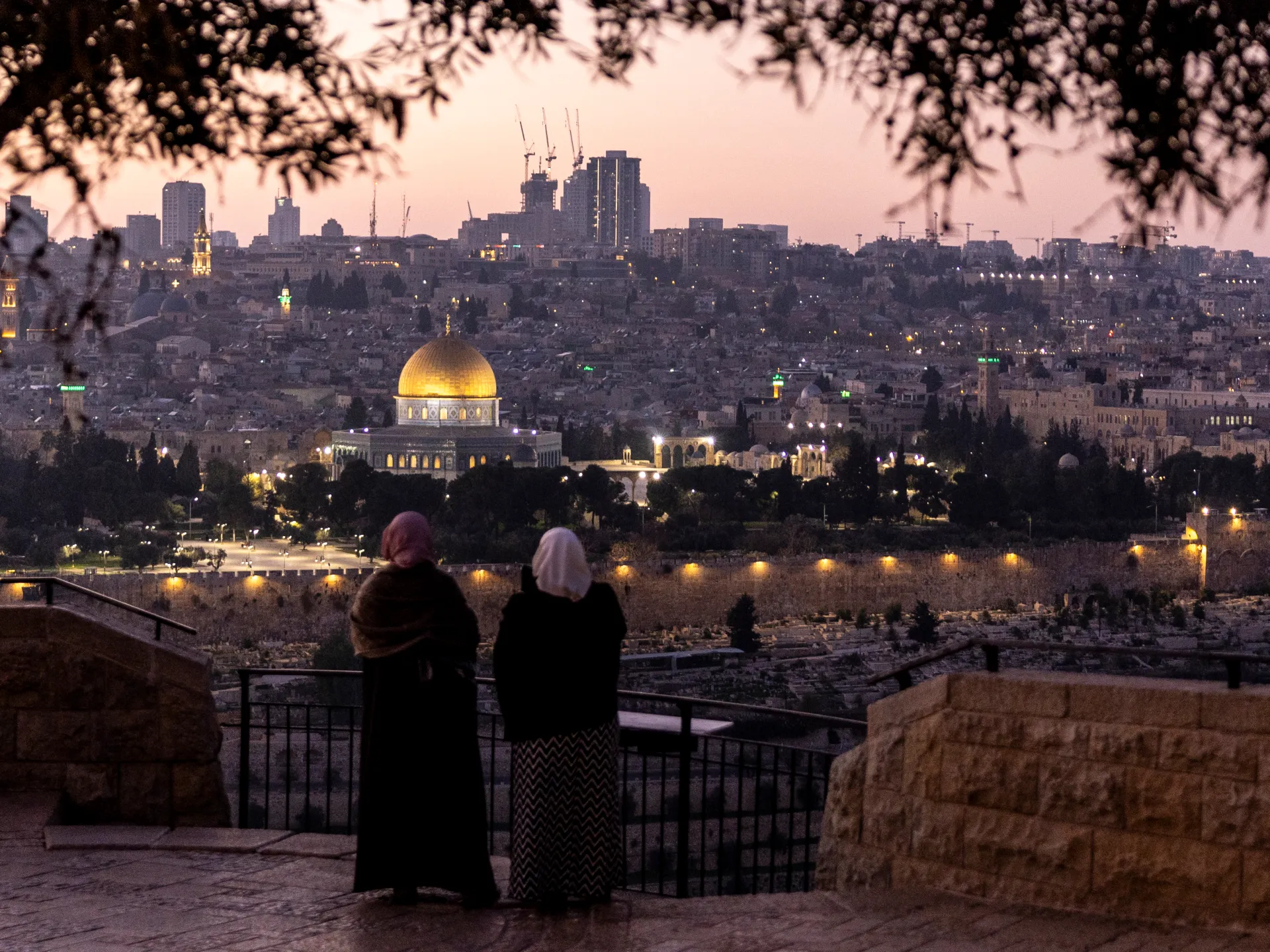




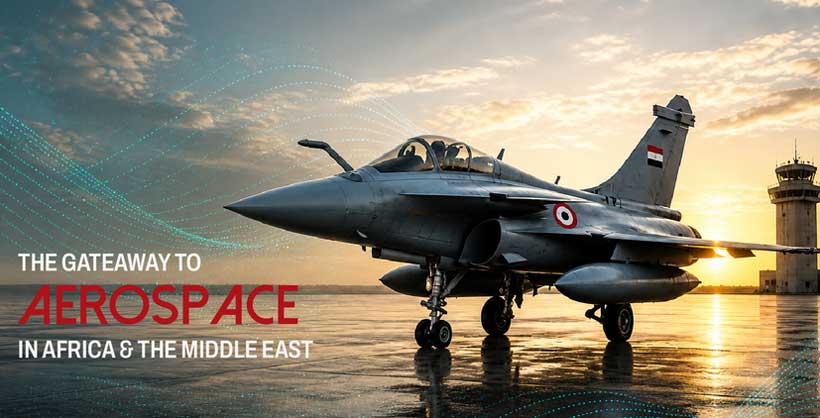

![Mohammad Bin Salman and Netanyahu - Cartoon [Tasnimnews.com/Wikipedia]](https://i0.wp.com/www.middleeastmonitor.com/wp-content/uploads/2018/01/2017_11-29-Mohammad-Bin-Salman-and-NetanyahuCaricature_of_Mohammad_Bin_Salman_03.jpg?w=1200&ssl=1)
![U.S. President Donald Trump looks over at Crown Prince of Saudi Arabia Mohammad bin Salman al-Saud as they line up for the family photo during the opening day of Argentina G20 Leaders' Summit 2018 at Costa Salguero on 30 November 2018 in Buenos Aires, Argentina. [Daniel Jayo/Getty Images]](https://i0.wp.com/www.middleeastmonitor.com/wp-content/uploads/2018/12/2018-12-3_trump-and-bin-salmanbin-salman-g20-trump.jpg?w=1200&ssl=1)