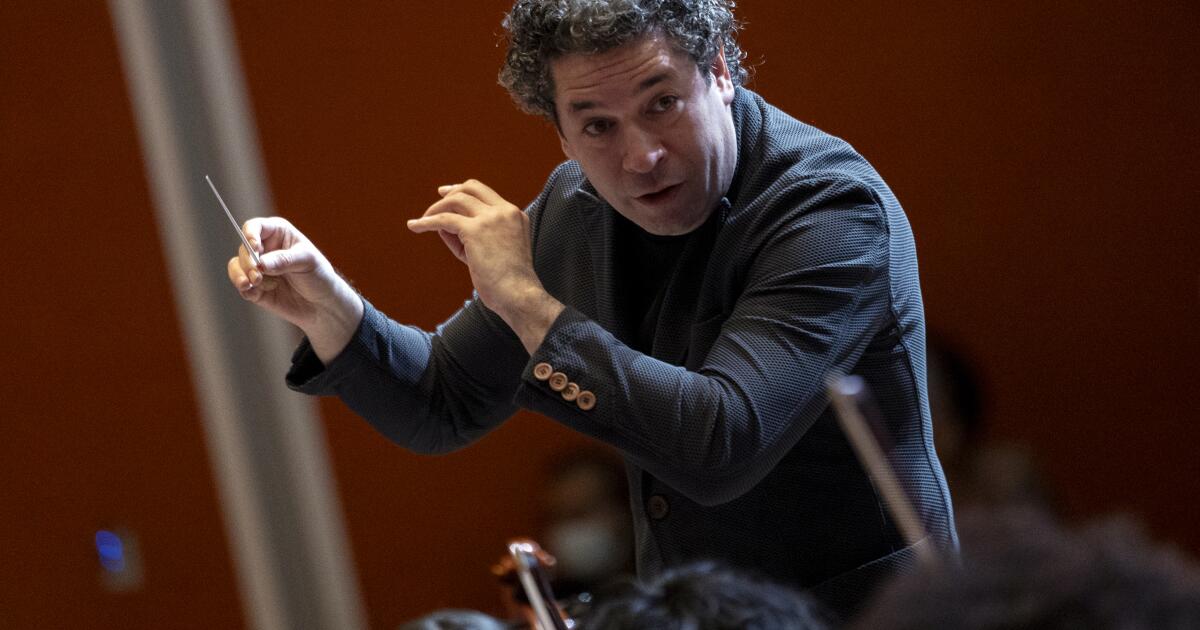
Gustavo Dudamel’s farewell to Los Angeles will also function as a benefit for his homeland of Venezuela, which suffered catastrophic losses from twin earthquakes in late June.
Dudamel and the Los Angeles Philharmonic announced Monday that the beloved composer’s final Hollywood Bowl performance as the orchestra’s music and artistic director, originally programmed as “Celebrating Gustavo at the Bowl: A Musical Legacy,” will instead be called “A Concert for Venezuela.” Still scheduled for Aug. 23, the show will raise funds for communities affected by the earthquakes.
“Venezuela will always be my home, and every moment, my thoughts are with the families whose lives have been forever changed by this tragedy,” Dudamel said in a statement. “The suffering is immense, but so is the strength and resilience of our people. This concert at the Hollywood Bowl is an invitation to stand together and transform our compassion into action.”
A full program and special guests will be announced later. Dudamel and the musicians will contribute their time and services free of charge.
Donations will benefit Dudamel’s Earthquake Recovery to Support Venezuelan Communities fund, in partnership with the United Nations Development Programme and the Development Bank of Latin America and the Caribbean fund. The L.A. Phil will contribute $50,000 to the fund, announced President and Chief Executive Kim Noltemy.
“In moments of profound need, our responsibility as an institution extends beyond the stage,” she said. “We are grateful for the opportunity to provide direct financial support to relief efforts for communities in Venezuela with a $50,000 charitable donation and to stand alongside Gustavo in bringing this concert to life at the Bowl.”
Twin earthquakes on June 24 devastated Venezuela, with more than 3,300 deaths and more than 30,000 people reported missing. As international rescue teams depart and locals are left to search through rubble, Venezuelans abroad, including L.A. restaurants, have looked for ways to send support.
Dudamel, who was born and raised in Barquisimeto, Venezuela, wrote in a 2015 op-ed for The Times that he is a “product” of El Sistema, the country’s government-funded youth music program. He has been the music director of the Simón Bolívar Symphony Orchestra since 1999.
Cristiano Ronaldo has sent a message to a young Venezuelan earthquake survivor, who is recovering in hospital after having his leg amputated. Andres Mieles, who was also orphaned in the June 24 disaster, had requested a Ronaldo trading card to keep his spirits up – but the superstar himself had other ideas.
For nearly six months, Delcy Rodríguez’s interim government has tried to project a different image: less ideological, more administrative; less revolutionary, more technocratic. The earthquakes became the first real test of whether that transformation ran deeper than economic policy. It didn’t. Faced with the country’s worst humanitarian disaster in decades, the Venezuelan state reverted almost instinctively to the habits it had spent 25 years learning.
The earthquake handed Delcy Rodríguez something politics rarely does: a chance, however limited, to soften public perceptions of her government. Nobody expected it to prevent the earthquake or even manage it flawlessly. The bar was much lower than that. Venezuelans expected a government that communicated at least somewhat honestly, remained visible, welcomed help wherever it came from, and, above all, stayed out of the way of those trying to help. Instead, many of its decisions seemed almost designed to produce the opposite effect, leaving an already angry public even angrier.
For the crucial first hours after the earthquake, Venezuelan civil society largely filled the vacuum left by the state. By the time the government moved to reclaim the space it had forfeited, the nature of its response had become clear. The emphasis was no longer on expanding the rescue effort, but on reasserting control over it. The government’s administrative response had been slow. Its political reflexes were anything but that.
Why?
The obvious explanation is incompetence. Of which there was certainly plenty. But incompetence alone cannot explain why a government whose political identity has been built on the appearance of public support repeatedly embraced decisions that seemed to generate even greater public anger. Something deeper appears to have been at work.
Responding to earthquakes requires a very particular kind of approach. Unlike ordinary governance, disaster response cannot be centralized for long. Every collapsed building becomes its own command center. Every neighborhood develops different priorities. Every rescue team faces different engineering challenges. Governments do not succeed because they directly coordinate thousands of decisions. They succeed because they remove obstacles that allow thousands of other people to make good decisions simultaneously.
As civil society increasingly assumed functions the state could not perform, it also threatened to accumulate visibility, legitimacy, and influence outside government control.
During normal times, governments can afford to centralize decisions and insist that major initiatives pass through official channels. Earthquakes punish those instincts. Rescue operations cannot wait for permission, and civil society and the private sector suddenly become indispensable partners in the state’s response. The democratic governments (like the one overseeing Venezuela’s “transition”) that perform best recognize this early, spending the first critical hours empowering society rather than attempting to direct every aspect of the response themselves. For twenty-five years, chavismo taught its institutions almost the opposite lessons.
The government could not lead the humanitarian response with the effectiveness the moment demanded. Society therefore began leading significant parts of it instead. Volunteers organized rescue brigades. Churches became shelters. Journalists became emergency information networks. Engineers inspected damaged buildings. Diaspora organizations coordinated donations. Foreign rescue teams rapidly became the public face of many rescue operations. None of this was unusual. This is how major disasters are managed around the world.
What was unusual was the kind of state confronting the disaster.
Every major political crisis reinforced the same institutional lesson: autonomous organization reduced the state’s control over society. Independent organization was rarely viewed as something to harness, but was something to supervise. NGOs are suspected of serving foreign interests, until proven innocent. Independent journalists and universities are seen as political adversaries. Neighborhood networks are just three doritos away from becoming opposition structures. Enemies abound in the schizophrenic chavista view of societal organization. Because for a chavista state that has banked its continuous survival on complete, centralized control, such a degree of civil organization represents an extinction level threat.
Those lessons make sense for a political system primarily concerned with its own survival. They become profoundly maladaptive during natural disasters. Thus, the humanitarian response itself gradually became part of the government’s problem. As civil society increasingly assumed functions the state could not perform, it also threatened to accumulate visibility, legitimacy, and influence outside government control. Administratively, this strengthened Venezuela’s response. Politically, it displaced the government from the center of its own national emergency. Most democratic governments would welcome that trade-off.
What authoritarian systems find difficult to tolerate is not civilian participation itself, but civilian participation they neither direct nor control. The rescue volunteers were not political activists. The churches distributing food were not organizing protests. The programmers building databases of missing persons were not preparing electoral campaigns. Yet institutions do not respond only to intentions; they respond to patterns. For a security apparatus that had spent years dismantling decentralized civic networks, from the humanitarian aid operation of 2019 to the comanditos of 2024, the potential may have mattered more than the differences.
Search-and-rescue operations have become increasingly militarized, with rescue crews at the Tahití building reportedly prevented by the military from reaching survivors for hours.
Seen through that lens, what initially looked like a series of political blunders begins to look more like institutional habit. Faced with a humanitarian emergency it lacked the capacity to fully manage, the government fell back on the institutions it trusted most: those responsible for regulating information, supervising autonomous actors, and maintaining political control. Much of the administrative state had long ceased to be valued primarily for its capacity to govern, functioning instead as an instrument of patronage and political management, while the coercive apparatus remained the regime’s principal institutional investment.
Faced with the limitations of both its own incompetence and the state it had spent decades constructing, havismo has increasingly resorted to the tactics with which it is most familiar. Survivors who expressed their anger at the government’s lackluster response, such as Wilmer Cruz, have reportedly been arrested. Search-and-rescue operations have become increasingly militarized, with rescue crews at the Tahití building (Caraballeda, La Guaira) reportedly prevented by the military from reaching survivors for hours. Intelligence agencies such as the DGCIM have been deployed to intimidate the families of victims, while, as the Sky News Trump 100 podcast reported, authorities have obstructed reporting from Caracas.
For months, the debate surrounding Venezuela’s transition has centered on whether chavismo was truly changing or merely adapting. The earthquake suggests the answer is both. Markets can be liberalized. Diplomatic priorities can shift. Revolutionary rhetoric can soften. Institutional instincts are far more resistant to change because they are built over decades of incentives, routines, promotions, and crises.
The earthquake did not create those instincts. It merely forced the government into a situation where it could no longer avoid relying on them.
Every state becomes good at what it repeatedly practices. The chavista regime spent twenty-five years investing in political control rather than disaster response; in supervising society rather than empowering it; in preserving power rather than preparing for catastrophe. When the country’s greatest humanitarian emergency in decades arrived, society responded with the institutions it had built to save lives. The state responded with the institutions it had built to preserve power. The earthquake did not force the Venezuelan state to choose between control and effective governance. That choice had been made long before the ground began to shake.
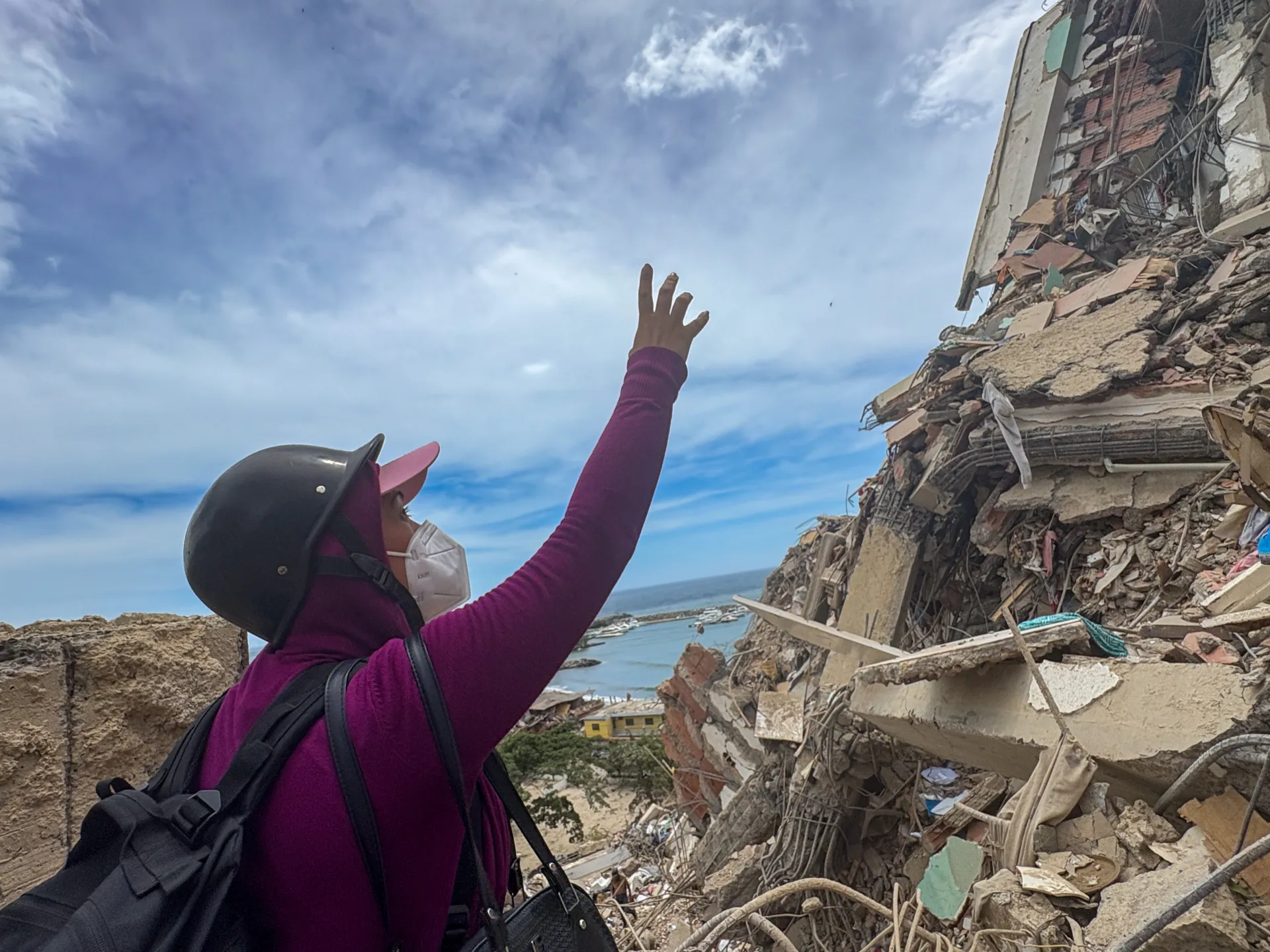
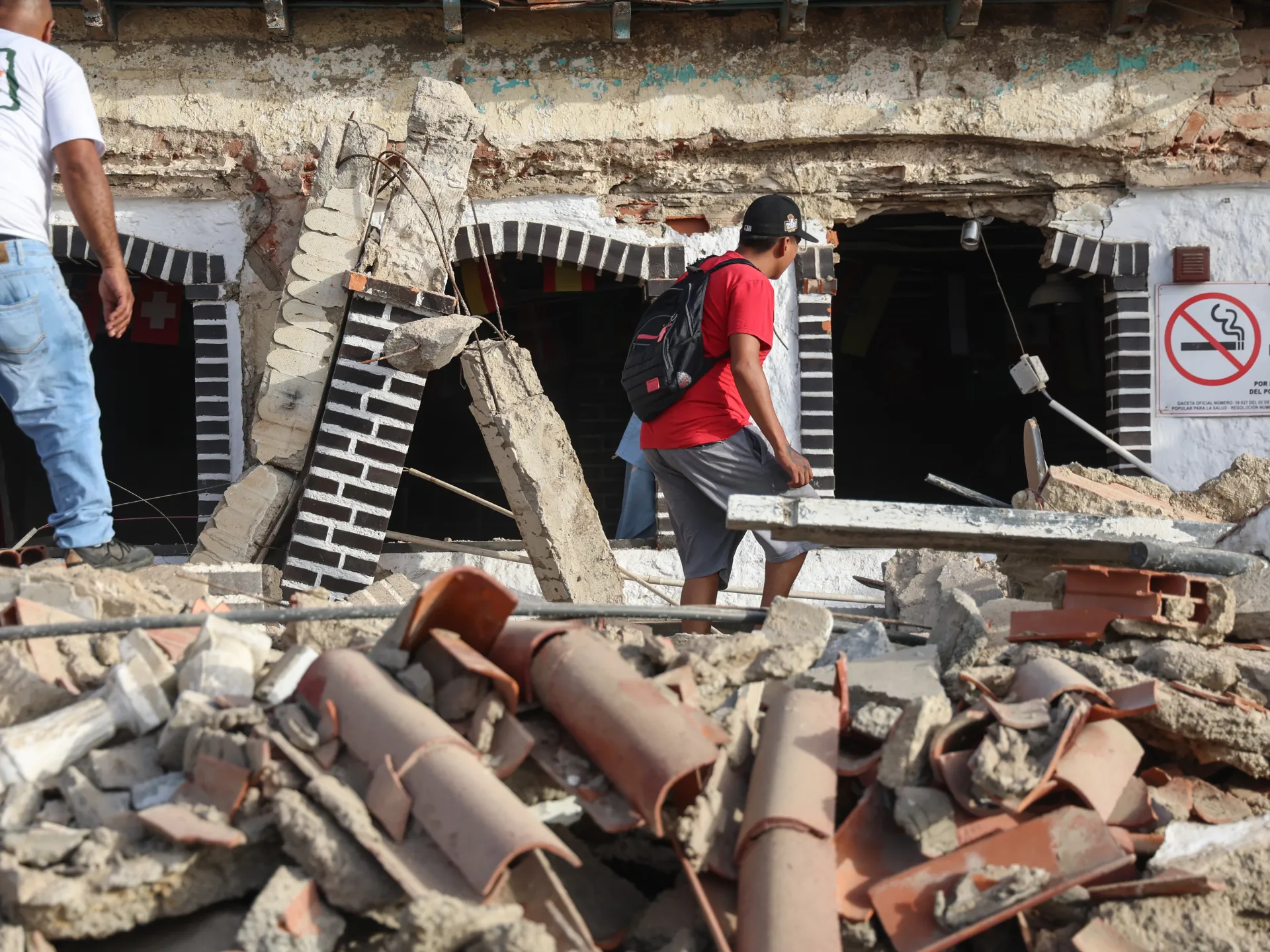
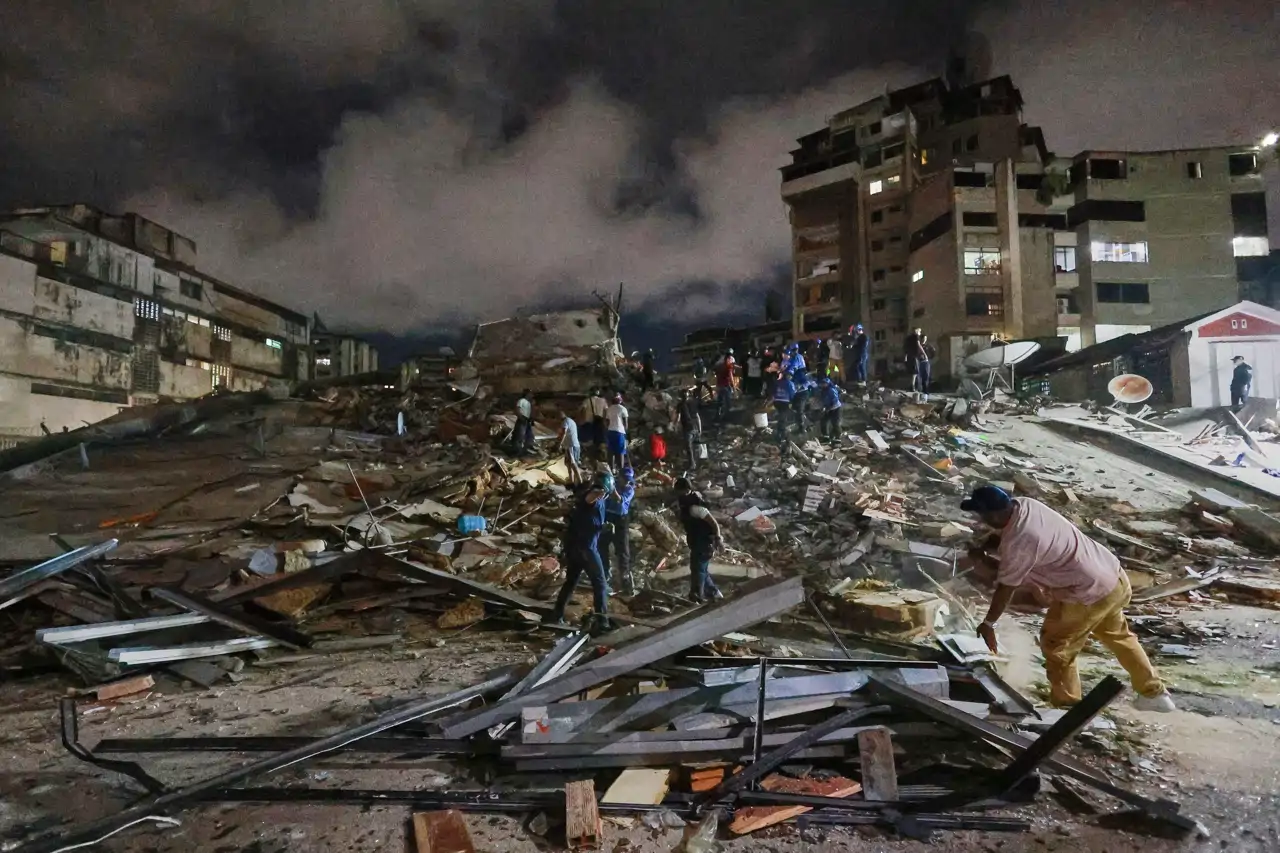
Catia la Mar, Venezuela – Andreina Velasquez looks up at her multistorey apartment block overlooking Catia la Mar, a coastal city in the Venezuelan state of La Guaira. The concrete slabs that once separated each floor are now stacked on top of each other.
“They fell like a pack of cards,” she said, pointing to where she used to live on the sixth floor.
Velasquez feels lucky. She left her apartment a couple of hours before a pair of deadly earthquakes shook Venezuela on June 24, reaching magnitudes of 7.2 and 7.5, respectively.
She had gone to get a new key cut and was at the beach when the first quake struck.
Her neighbours did not make it. She remembers one as a gentle, retired man, another as a woman with a young daughter who had just moved in. They had been overjoyed with their view of the sea.
Velasquez is still struggling to process what she has lost. Her state was among the hardest hit by the earthquakes.
But despite her grief, she has started to hand out face masks to passersby, hoping to shield them from the gusts of dust drifting from the collapsed buildings and the stench rising from the rubble.
“I’ve been here every day. Other people came to help, but they don’t have helmets, they don’t have gloves, they don’t have masks. That’s why I’m helping,” she said.
More than 2,295 people have been killed and 11,000 injured in the twin earthquakes, according to Venezuela’s National Assembly. The United Nations has warned the death toll could rise to 10,000.
As Venezuela continues to confront the destruction, experts say recovery efforts have been driven largely by volunteers and neighbours like Velasquez.
Hospitals are overwhelmed, and government aid has been slow to reach some of the worst-affected areas.
Carolina Jimenez, the president of the Washington Office on Latin America (WOLA), a research and advocacy group, told Al Jazeera that the result has been growing anger towards the state.
“In a government in any other country, the first responder should be the state,” she said. “In the case of Venezuela, the state has been the last responder.”
In places like Catia la Mar, north of Caracas, authorities still haven’t arrived or are lacking.
Velasquez and other locals say that help from the federal government only arrived on Sunday — three days after the earthquakes hit the country. In some parts of La Guaira, such assistance has yet to arrive at all.
“[The] response has come from citizens, from civil society, from humanitarian workers, from volunteers — but not from the government,” Jimenez said.
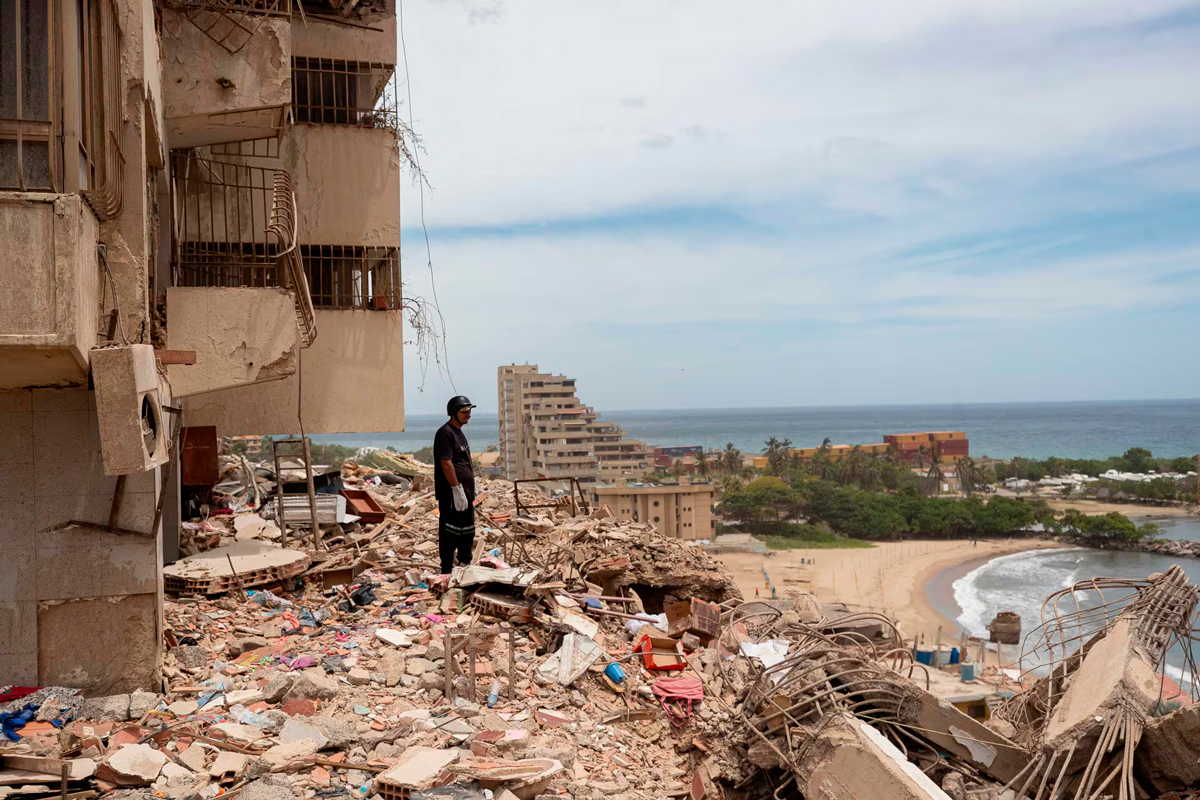
The earthquake flattened more than 100 buildings in La Guaira. (Agencia Zero)
Mérida, June 29, 2026 (venezuelanalysis.com) – Venezuelan and international rescue teams continue to search for survivors under collapsed buildings following last Wednesday’s back-to-back earthquakes.
The 7.2- and 7.5-magnitude tremors caused widespread destruction, primarily in the coastal state of La Guaira, which has been described as “ground zero.” Geological services have registered more than 500 aftershocks since the original earthquakes.
On Monday, Venezuelan officials reported that there have been 1,719 people killed, 5,034 injured, and more than 15 thousand displaced. According to the country’s authorities, 855 buildings have been damaged, including 189 totally collapsed, along with damage to 38 hospitals and 1,645 road structures.
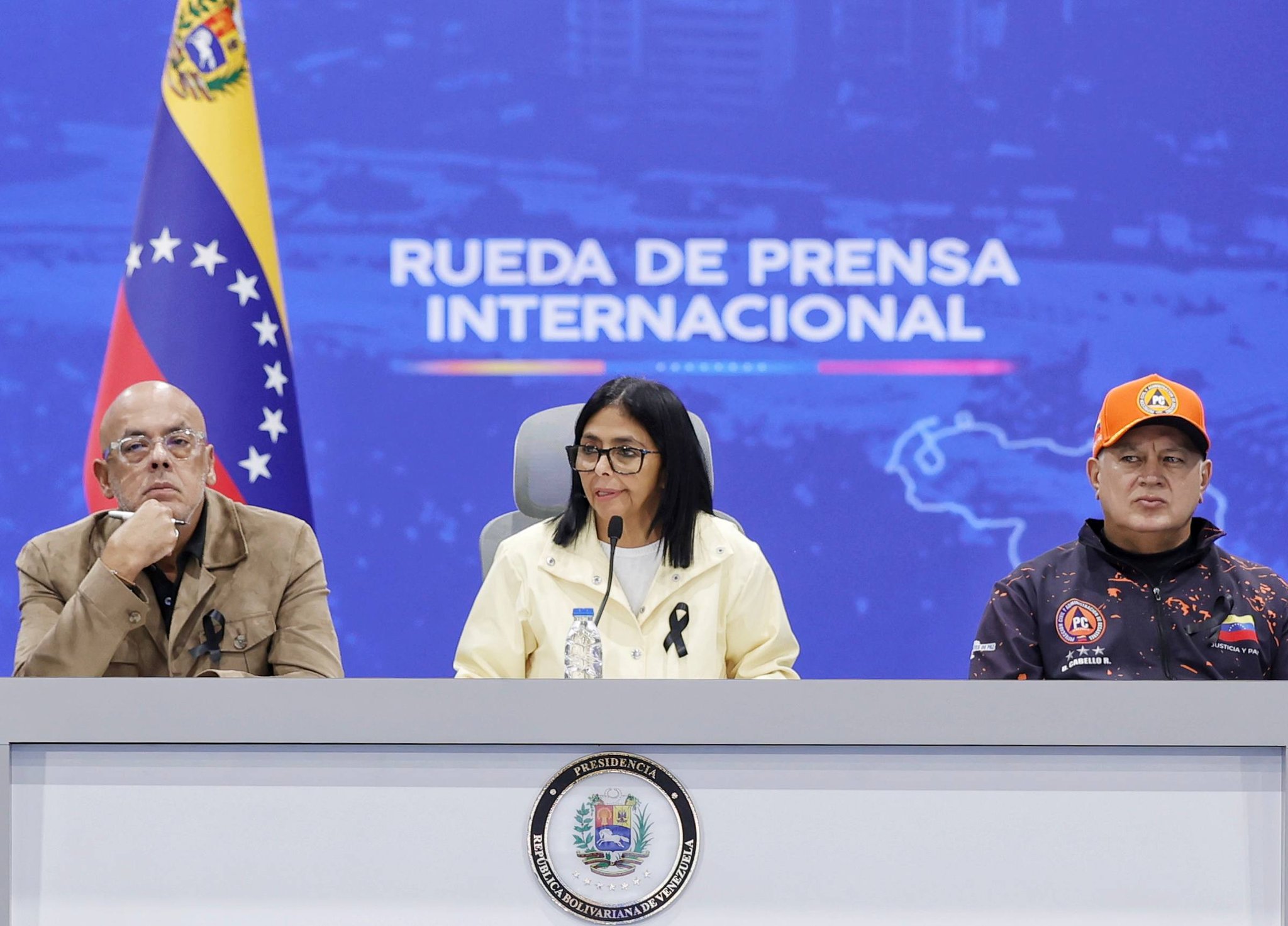
“We are in critical and crucial hours to continue saving lives,” National Assembly President Jorge Rodríguez stated during a Monday press conference. He confirmed that over 25,000 rescue workers, including military personnel, police, firefighters, and civil protection units, are currently deployed, supported by 3,319 international rescuers from 25 nations and 137 specialized canines.
Rodríguez added that 90% of electricity service has been restored in La Guaira State, and that a special hotline remains active to provide psychological support to relatives of the victims, displaced people, and those suffering from post-traumatic stress following the earthquakes.
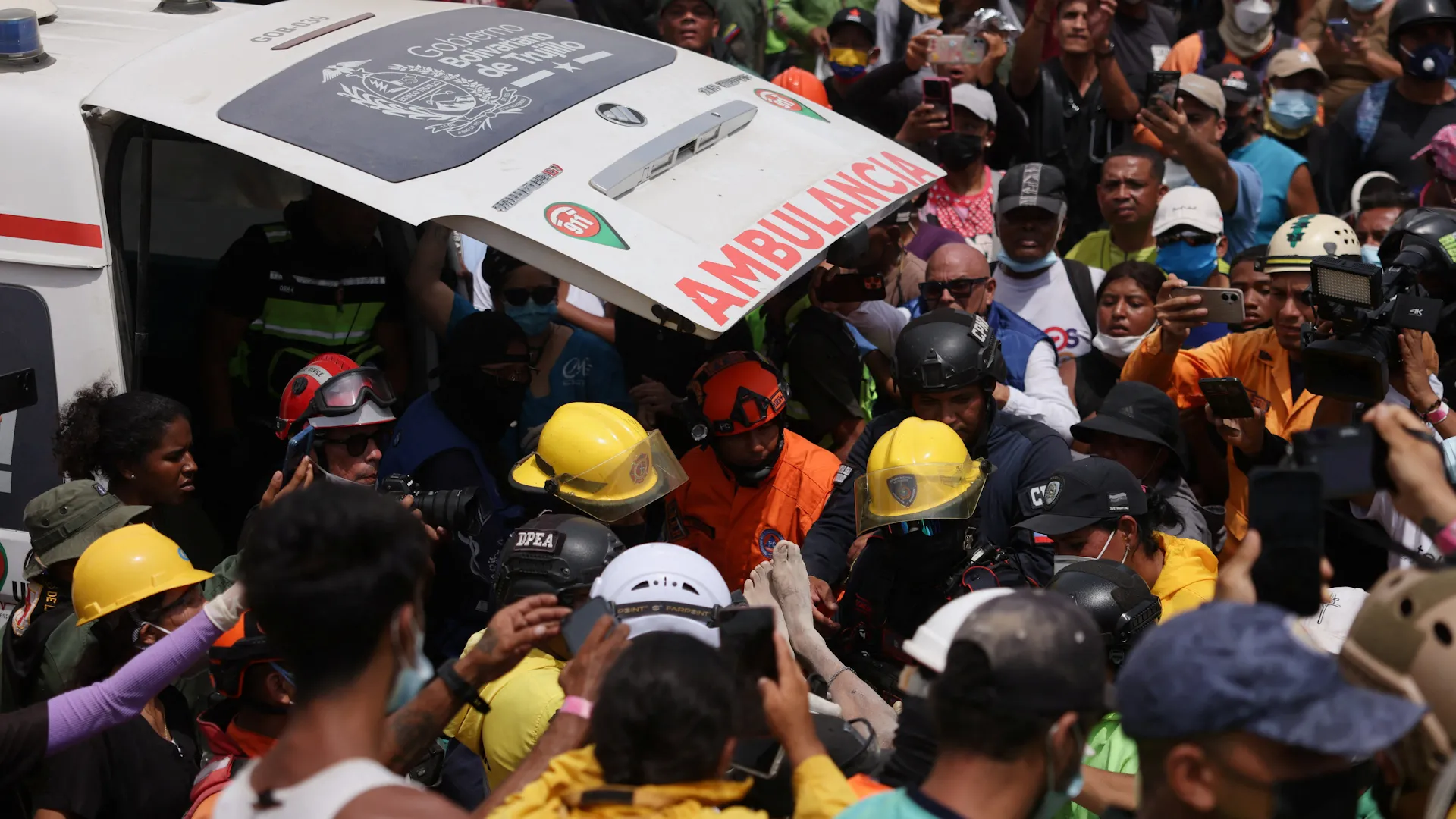
Earlier on Monday, Acting President Delcy Rodríguez celebrated the rescue of 21-year-old Aaron Levi Cantillo, who was pulled alive from the rubble in La Guaira after being trapped for 106 hours. The rescue was the result of 43 hours of intense, coordinated work by Venezuelan Civil Protection and brigades from Mexico, Chile, and Argentina. Emergency workers have warned that, as time passes, the probability of still finding survivors drastically decreases.
Over the weekend, the Venezuelan government has likewise ramped up efforts to tend to displaced families, with 15 temporary shelters set up in La Guaira and a further 50 in Caracas.
Other areas beyond La Guaira have also been severely impacted. Local residents reported structural damage and service failures in Morón, Carabobo state, close to the earthquakes’ epicenters. Similarly, in Tucacas, Falcón state, residents called for assistance from authorities as they face interrupted electricity or water services.
As part of its response to the crisis, the acting Rodríguez government restricted access to the state of La Guaira, the hardest-hit area. The measure aims to prevent traffic congestion and prioritize the movement of emergency vehicles and heavy machinery. Venezuelan officials have urged the public to avoid traveling to the area to ensure that rescue efforts are not impeded.
At the same time, authorities have sought to organize volunteer brigades, both for search and rescue operations and to tend to temporary shelters, via a registration center at the Poliedro complex in Caracas.
As of June 29, 10,834 volunteers had registered, and they have been categorized according to their area of expertise: survivor rescue, medical care, logistics at temporary camps, and other essential tasks.
Following the double earthquake, the United States government has ramped up its presence in the Caribbean nation. The US Department of State has deployed a Disaster Assistance Response Team (DART) and specialized urban search and rescue units.
The Department of War has sent an expeditionary airfield management team to repair and reopen the damaged Simón Bolívar International Airport, which is now serving as the primary hub for international relief flights. The US Southern Command (SOUTHCOM) has stated that it is currently “managing tower and ground operations” at the country’s most important airport.
SOUTHCOM is also assessing conditions at the port of La Guaira and has docked the USS Fort Lauderdale warship to coordinate maritime deliveries. Various aircraft, including C-17 Globemaster, C-130 Hercules, MV-22 Ospreys, and helicopters, have conducted aerial surveys and transported rescue teams and supplies.
Acting President Delcy Rodríguez personally thanked President Trump and Secretary of State Marco Rubio for US support following the natural disaster. In a social media message, the acting president said she was “deeply grateful for this gesture of friendship and cooperation.”
The Trump administration announced that humanitarian assistance to Venezuela has been increased to over $300 million. However, Washington has not offered any relief from widespread economic sanctions, only issuing a time-limited license allowing earthquake relief-related transactions.
The White House also retains control over Venezuelan oil export revenues, with the disbursement timings and amounts left at US officials’ discretion.
The search for survivors continues in Venezuela after a powerful earthquake left hundreds dead and thousands missing. Al Jazeera’s Teresa Bo reports from one of the country’s worst-hit areas where many residents have lost their homes and are now sleeping outdoors.
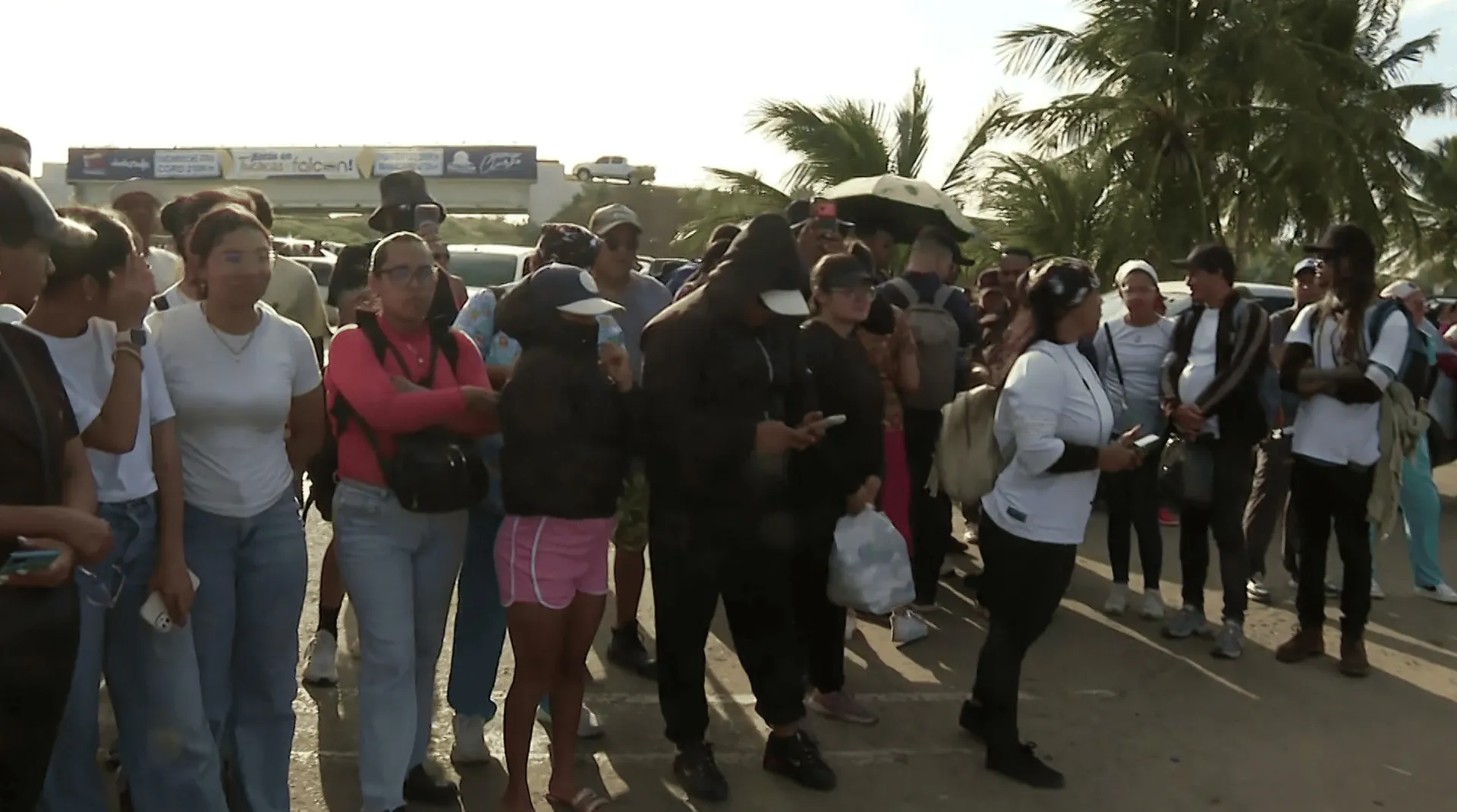
Anger is mounting in Venezuela after the military barred citizens from entering zones devastated by Wednesday’s twin earthquakes. As Teresa Bo explains, thousands of people have travelled to help rescue victims, not trusting the government to save survivors in time.
Weekly insights and analysis on the latest developments in military technology, strategy, and foreign policy.
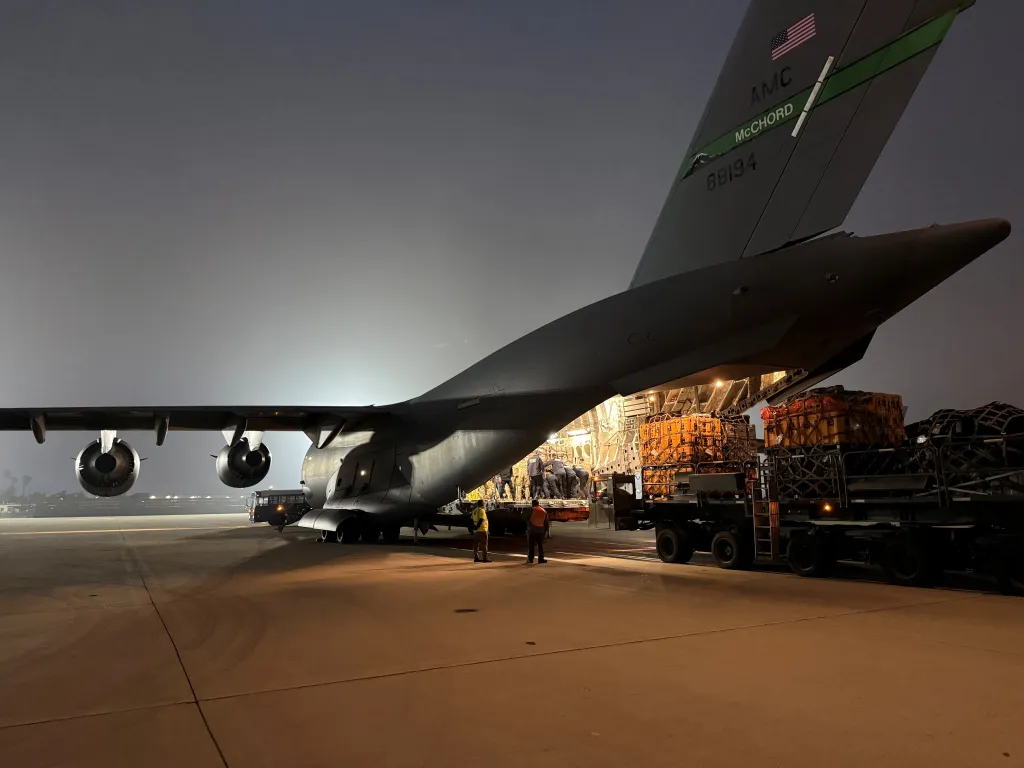
U.S. Air Force C-17 Globemaster III cargo jets have arrived in Venezuela, packed with personnel and equipment for the ongoing earthquake relief efforts. The aircraft are joining U.S. forces already in the country as well as on the amphibious transport ship USS Fort Lauderdale, the littoral combat ship USS Billings and at American bases around the region.
The flights are part of a growing U.S. military presence being run by U.S. Southern Command (SOUTHCOM) in support of the U.S. State Department. The movements are in response to 7.2- and 7.5-magnitude earthquakes Wednesday night that Venezuelan authorities say devastated much of the northern part of the country and have killed more than 900.
Utter devastation seen across the Northern Venezuelan coastal city of La Guaira, following tonight’s pair of major earthquakes, measuring 7.2 and 7.5 magnitude with an epicenter just to the west of Caracas. pic.twitter.com/BQv4YixUiB
WATCH: Inside Caracas Simon Bolivar International Airport during a powerful earthquake that struck Venezuela.
The first 7.2-magnitude quake was followed just 39 seconds later by a stronger 7.5-magnitude quake, according to the US Geological Survey (USGS), with witnesses… pic.twitter.com/3eZk7RV86h
— Breaking Aviation News & Videos (@aviationbrk) June 25, 2026
The first C-17 arrived in Venezuela this morning. Online flight trackers show that at least four of the cargo jets have left the U.S.
“The first air shipment of equipment has arrived to support the two specialized U.S. search and rescue teams, which are arriving in Venezuela to join ground operations as soon as possible,” the U.S. Embassy in Caracas said in a post on X. “With nearly 80 experts per team—firefighters, doctors, structural engineers—12 canines trained for detection in rubble, these groups bring advanced capabilities to locate survivors and assist in complex emergencies. Their personnel and specialized equipment are being positioned to head to the hardest-hit areas and begin operations when conditions allow.”
La primera carga aérea de equipamiento ha llegado para apoyar a los dos equipos especializados de búsqueda y rescate de los EE.UU., que están llegando a Venezuela para integrarse lo antes posible a las operaciones en el terreno. Con cerca de 80 expertos por equipo – bomberos,… pic.twitter.com/ZCaQMcBM6J
— Embajada de los EE.UU. en Caracas (@usembassyve) June 26, 2026
A second one reportedly landed in the stricken nation as well.
A second USAF C-17 carrying humanitarian aid and search and rescue teams has landed at El Libertador airbase in Maracay, also seen in the background are two Mexican air force planes that delivered aid this morning #Venezuelapic.twitter.com/LR9WuSbOh2
“A C-17 Globemaster III was loaded overnight at Dover AFB with Urban Search and Rescue personnel and equipment for transport to Venezuela in support of State Department-led humanitarian response efforts,” SOUTHCOM said in a post on X Friday morning. “America’s military is delivering the people and capabilities needed to save lives.”
When called, the @DeptofWar moves. A C-17 Globemaster III was loaded overnight at Dover AFB with Urban Search and Rescue personnel and equipment for transport to Venezuela in support of @StateDept-led humanitarian response efforts.
A C-17 Globemaster loaded specialized U.S. search and rescue teams overnight bound for Venezuela. (SOUTHCOM)
When disaster strikes, we answer the call. USA-01 is enroute to #Venezuela following the devastating earthquakes, w/ 79 personnel, six K9s, and 70k lbs of equipment. We are honored to represent the US, bringing our expertise, compassion, & unwavering dedication to those affected. pic.twitter.com/8snA89Qwae
— VA-TF1 / USA-01 – Urban Search and Rescue (@VATF1) June 26, 2026
Another C-17 landed in Curaçao. The island is serving as one staging area for international efforts to search for survivors and victims and bring in much-needed humanitarian aid.
The US response to the earthquake disaster in Venezuela is well underway. 📍The first related C-17, #AE1449 as RCH234, arrived in Curacao overnight. 📍#AE2FA6 as RCH525 is en route with members of USA-02 urban search & rescue team. 📍#AE07F8 as RCH421 is en route with members of… pic.twitter.com/4mznPCySI7
U.S. Marine Corps Maj. Gen. Kevin J. Jarrard arrived in Caracas on Thursday to oversee the Pentagon’s Venezuela earthquake relief efforts, SOUTHCOM stated.
“Jarrard is serving as the senior U.S. Southern Command (SOUTHCOM) official on the ground and is working closely with partners to plan, coordinate, and direct the U.S. military’s unparalleled logistical and operational capabilities to support the rapid, life-saving movement of response personnel, equipment, and humanitarian assistance into affected areas,” the command said in a media release.
RELEASE: SOUTHCOM Leadership Arrives in Venezuela to Coordinate Earthquake Relief Support
U.S. Marine Corps Maj. Gen. Kevin J. Jarrard arrived in Caracas, Venezuela, today, to oversee Department of War support to Venezuela earthquake relief efforts.
In another post on X, SOUTHCOM included a photograph of a USMC MV-22B Osprey tiltrotor aircraft. The Osprey is part of an array of fixed- and rotary-wing assets deployed for the relief effort around the region.
A U.S. Marine Corps MV-22 Osprey tiltrotor aircraft landed in Venezuela Thursday as part of U.S. humanitarian relief efforts. (SOUTHCOM)
Jarrard is leading SOUTHCOM Commander Gen. Francis L. Donovan’s deployment of “significant forces to the effort,” according to the command. This includes the aforementioned cargo jets and Navy vessels, as well as C-130 Hercules transports, unspecified reconnaissance platforms and rotary-wing aircraft.
“These forces will provide specialized mobility services and support to U.S. government personnel, search and rescue teams, and U.S. interagency partners as they assess damage, locate the injured, and deliver critical, life-saving assistance,” SOUTHCOM said in a statement.
The Pentagon released images of a U.S. Army CH-47 Chinook transport helicopter loading up personnel and supplies in Honduras for potential participation in this mission.
A 1st Battalion 228th Aviation Regiment CH-47 Chinook is prepped for potential support for Venezuela’s disaster relief response at Soto Cano Air Base, Honduras, June 25, 2026. (U.S. Air Force photo by Staff Sgt. Ethan Sherwood) Staff Sgt. Ethan SherwoodMembers of Joint Task Force-Bravo load equipment into a CH-47 Chinook in preparation for potential support to Venezuela’s disaster relief response at Soto Cano Air Base, Honduras, June 25, 2026. (U.S. Air Force photo by Staff Sgt. Ethan Sherwood) Staff Sgt. Ethan Sherwood
All this is being anchored by the two Navy vessels, which have been in the region for months.
Earthquake relief support from the sea: The @USNavy has a proud legacy of providing disaster relief directly from the sea.#SOUTHCOM has directed USS Fort Lauderdale (LPD 28) and USS Billings (LCS 15) to Venezuela to support @DeptofState-led U.S. government relief operations in… pic.twitter.com/z1JJ0aLjSl
Of the two, Fort Lauderdale has been in the Caribbean the longest and took part in the counternarcotics operation that led to the capture of former Venezuelan dictator Nicolás Maduro, now in custody in the U.S. The rest of the ships assigned to that mission left the region months ago.
Fort Lauderdale can embark multiple types of rotary wing aircraft, including Marine MV-22B Ospreys and UH-1Y Venoms. Other helicopters can use their large deck area for resupply and refueling, as well. The vessel could be used as a staging area to deliver aid and extract wounded from a nearby port or off the coast of Venezuela. Hundreds of sailors and Marines aboard could assist with humanitarian efforts, from the ship or on the ground.
The San Antonio class amphibious transport dock USS Fort Lauderdale (LPD 28) is taking part in the U.S. military’s humanitarian aid response to the Venezuelan earthquakes. (U.S. Navy photo by Mass Communication Specialist 2nd Class Savannah L. Hardesty) Petty Officer 2nd Class Savannah Hardesty
The flight deck of Billings, which arrived in the Caribbean in March, is much smaller and supports the ship’s MH-60 Seahawk helicopter and drones. It can also be used by other helicopters.
If needed, there are additional Navy assets operating off the East Coast that could be re-tasked to SOUTHCOM.
The amphibious assault ship USS Iwo Jima recently returned to Norfolk from a 10-month deployment in the Caribbean. If it has not yet entered its planned maintenance availability, the vessel could be redeployed if called upon.
The Wasp class amphibious assault ship USS Iwo Jima (LHD 7). (U.S. Navy photo by Mass Communication Specialist Seaman Logan Goins) Seaman Logan Goins
Much less likely is moving the aircraft carrier USS Nimitz. The fleet’s oldest carrier left Mayport, FL, on Wednesday and is now participating in large-scale FLEETEX before a planned transit to New York for America 250 events.
Rolling deep ⚓💪🌊
Twenty-six ships from 13 partner and allied nations steam in formation with Nimitz-class aircraft carrier USS Nimitz (CVN 68) during a multinational maritime exercise as part of Fleet Exercise (FLEETEX) 250 in the Atlantic Ocean, June 25, 2026. Nimitz is… pic.twitter.com/0p0yyvm0QV
Meanwhile, America’s unique array of ISR assets can be critical to Venezuela’s relief efforts.
Platforms like MQ-9 Reaper and MQ-4C Triton drones and piloted aircraft like P-8 Poseidon maritime patrol craft and even U-2 Dragon Lady spy planes could bring a lot of sensor power to bear to help with search and rescue, mapping and provide other geospatial intelligence benefits to develop a clearer picture of the situation.
U.S. Navy P-8 Posiedon martime patrol jet. (USN)
This relief effort is still unfolding and the full extent of the damage is still coming to light. As we previously noted, the disaster offers an opportunity for the U.S. military to foster improving relations with Venezuela almost half a year after Maduro was snatched out of Caracas.
This is where the US military can broadly impact the relationship with Venezuela again. They are now our friends? Go big helping them here. We are prepared and ready for this mission. Huge opportunity here. https://t.co/pu8RSRMjUK
U.S. President Donald Trump appears to have seized on this chance, at least to some degree, announcing America would play a key role in helping Venezuela in a post on his Truth Social site.
“The two major earthquakes that just hit the great people of Venezuela are both massive in scale and have left a devastating number of deaths,” Trump proclaimed. “The U.S.A. stands ready, willing, and able to help! I have instructed all agencies of our government to get ready to move quickly. We will be there for our new and great friends. Early reports are not good!!!”
We thank U.S. President Donald Trump and his administration, who have been in constant contact with Venezuelan authorities, offering support and solidarity to the people of Venezuela in the face of this tragedy that has plunged us into mourning. https://t.co/nw2bupuN7C
It is unclear how much larger the U.S. military presence will grow for this mission. Several other countries are taking part as well and China has pledged to. Trump has made keeping the Caribbean under the control of the U.S. a major part of his administration’s plans and a top reason for removing Maduro was to stem the influence of China and Russia there.
MOFA: China to provide humanitarian assistance to Venezuela
China will provide emergency humanitarian assistance to Venezuela, Chinese Foreign Ministry spokesperson Guo Jiakun said on Friday. He added that China is prepared to provide further support as the disaster situation… pic.twitter.com/zpge2sGNXb
We will continue to monitor the situation and provide updates when warranted.
UPDATE: 3:28 PM EDT –
SOUTHCOM provided an update on the assets being deployed:
Two U.S. Air Force C-17 Globemaster aircraft are transporting U.S. Urban Search and Rescue teams based in Los Angeles and Fairfax, Virginia, and one U.S. Air Force C-17 will deliver load-movement equipment to Caracas.
U.S. Marine Corps MV-22 Ospreys will transport an airfield assessment team to Venezuela to support airport operations that were impacted near the earthquake epicenter.
The U.S. Navy’s San Antonio-class amphibious transport dock USS Fort Lauderdale (LPD 28) and Freedom-variant littoral combat ship USS Billings (LCS 15) have arrived in waters near Venezuela and will begin supporting relief and live-saving efforts.
Three U.S. Army CH-47 Chinooks and crews from Joint Task Force-Bravo will depart Soto Cano Air Base in Honduras en route to support the transport of key personnel and supplies aiding impacted Venezuelan communities.
The command’s U.S. Space Force component is providing satellite imagery of devastated areas to disaster relief planners in Venezuela to aid them in assessing where immediate live-saving and aid efforts are needed most and identifying what capability requests to prioritize.
This is the moment rescuers pulled a newborn baby from beneath the rubble of a collapsed building, after two deadly earthquakes hit Venezuela.
Videos shared on social media show rescuers in the city of La Guaira moving the baby away from the rubble and handing it over to a man, who appears to be the father. The mother was also pulled alive from the rubble a while later, AFP reports.
Rescue efforts are continuing in the country, after back-to-back quakes struck the country, killing at least 920 people and injuring more than 3,360.
At least 920 people are confirmed dead and more than 51,000 missing after two earthquakes struck Venezuela on Wednesday.
By Al Jazeera Staff and AP
Published On 27 Jun 202627 Jun 2026
Rescuers are racing against time in Venezuela, three days after two powerful earthquakes struck, with at least 920 people confirmed dead and more than 51,000 still missing.
The twin, magnitude 7.2 and 7.5 quakes hit on Wednesday, devastating the coastal area around La Guaira, where authorities moved on Friday night to restrict access as traffic chaos began to hamper search efforts.
Recommended Stories
list of 4 itemsend of list
With a scarcity of government rescue teams, Venezuelans have become desperate in the hardest-hit areas, digging through rubble with their hands, with aid agencies warning the critical 72-hour survival window is closing fast.
Officials said anyone who wants to enter the area around La Guaira would now have to seek official permits, but provided few details of who would be allowed in.
People reported seeing few state rescue teams in the hardest-hit areas, despite authorities projecting an image of a robust government response.
“Each person saved is a miracle,” said Jorge Rodriguez, president of the National Assembly.
“We are not going to hide absolutely anything about the magnitude of this tragedy.”
Government forces distributed food and water to survivors in La Guaira, and Acting President Delcy Rodriguez said her government was mounting a full response during these “critical hours for rescuing people alive”.
She welcomed the arrival of international rescuers and humanitarian aid.
Rodriguez said La Guaira had been “militarised” and more help was on the way, even as residents said it was just a fraction of what they needed.
Rodriguez, the former vice president, took office in January after the United States captured and removed then-President Nicolas Maduro.
Venezuela has been facing economic disarray for more than a decade, and many people reject the legitimacy of the political movement Rodriguez represents.
‘People are still terrified to re-enter what were their homes’
The number of dead was expected to climb, as people reported tens of thousands of missing on independent digital databases.
Those figures likely included people who have been incommunicado due to the lack of phone signals, and some reports may be duplicates.
The number of injured was more than 3,300 as of midday Friday, and authorities said they had rescued 243 people.
The International Organization for Migration said up to 6.76 million people could be affected, some two million of them in Caracas alone.
The destruction was amplified by the quick succession of shallow quakes, experts said.
Loyce Pace, the International Red Cross regional director for the Americas, said “people are still terrified to re-enter what were their homes.”
Venezuelan authorities said 861 volunteers from Mexico, the US, El Salvador, Switzerland, Colombia and beyond were in the country, and more were coming from elsewhere.
Venezuela woke up this morning to scenes of destruction and grief that not even three decades of political and economic collapse could have prepared us for. On June 24, two of the strongest earthquakes ever recorded in Venezuelan history struck the country’s northern coastline.
At the time of writing, over 39,000 people have been reported missing, and the interim government of Delcy Rodríguez has confirmed at least 164 deaths. Yet images of flattened residential buildings across Caracas and La Guaira suggest that this number will continue to rise in the days ahead.
The aftermath is even more devastating when one considers how profoundly unprepared Venezuela is to respond to a disaster of this magnitude. Natural disasters are catastrophic by definition, posing immense challenges even for wealthy countries with competent institutions. For the battered nation that is post-Maduro Venezuela, responding to a crisis of this scale may prove overwhelming.
Venezuela has faced what the United Nations defines as a complex humanitarian emergency, a prolonged and multidimensional collapse of the state’s ability to perform its core functions. This has been the status since at least 2016. Few sectors have suffered more than healthcare. Years of mismanagement, systemic corruption, and chronic underinvestment have devastated the country’s health system, compounding the deterioration of the electrical grid and other essential public services.
Since at least 2022, the Venezuelan state has increasingly adopted a hands-off approach to governance. This shift, shaped by a post-socialist form of laissez-faire economic policy, reduced state control over large parts of the economy and contributed to a modest but visible revival in business activity. In many ways, the tate appeared to retreat from major areas of public administration while preserving absolute control over others, particularly the security apparatus and the machinery of censorship and political repression.
The corruption and mismanagement that destroyed Venezuela’s health system, combined with the dangerous belief that the state could simply step aside, help explain why the country now lacks even minimally functional search-and-rescue capacity.
These dynamics, though somewhat altered, have largely persisted after January 3. Following Operation Absolute Resolve, which culminated in the arrest of Nicolás Maduro, the interim administration of Delcy Rodríguez (with the backing of the United States) introduced reforms aimed at attracting American investment in the oil and mining sectors, fueling cautious optimism about eventual economic recovery.
From a public health perspective, however, the economic liberalization first embraced under Maduro and now continued by Rodríguez marks the culmination of a much longer process: the gradual withdrawal of the state from its responsibility to protect the health and welfare of Venezuelans.
The liberalization of recent years also triggered a rapid expansion of private health insurance. For those able to afford plans, often costing thousands of dollars, private coverage has offered an attractive alternative to Venezuela’s chronically underfunded and dysfunctional public hospitals. This produced a deeply unequal arrangement: those with resources could secure healthcare privately, while most Venezuelans remained dependent on a system that had largely ceased to function.
But this model can only take a country so far.
The private sector (particularly one as small and fragile as Venezuela’s) cannot replace the functions of a public health system. Private clinics in Caracas, however modern, cannot conduct nationwide vaccination campaigns, build epidemiological surveillance networks, or address child malnutrition at scale.
Nor can private healthcare alone care for the thousands of victims created by disasters such as these earthquakes. It cannot train sufficient first responders, coordinate nationwide rescue efforts, or provide the ambulances, heavy equipment, and emergency infrastructure required in the immediate aftermath of a catastrophe.
This may become the clearest test yet of how committed the Trump administration truly is to supporting Venezuelans, not merely safeguarding its economic interests in the country.
The corruption and mismanagement that destroyed Venezuela’s health system, combined with the dangerous belief that the state could simply step aside, help explain why the country now lacks even minimally functional search-and-rescue capacity. They also explain its overwhelming dependence on foreign aid.
For that reason, many Venezuelans are watching statements from Marco Rubio as closely as those from Rodríguez. All signs suggest that meaningful large-scale assistance will need to come from Washington rather than Miraflores. Rubio has already promised a “big, fast, and effective whole-of-government response,” offering a measure of hope to an exhausted and grieving population.
This disaster may become the clearest test yet of how committed the Trump administration truly is to supporting Venezuelans, not merely safeguarding its economic interests in the country. Recovery without explicit and substantial American support appears highly unlikely.
Other countries across the globe and the ideological spectrum—including Mexico, El Salvador, Cuba, Iran, France, Germany, Italy, and Spain—have also offered assistance. All such support is welcome. In these first critical hours, every resource matters if lives are to be saved.
The images circulating on social media, people trapped beneath rubble in La Guaira, surrounded by exhausted neighbors refusing to abandon them, or volunteers searching debris with only the flashlights of their mobile phones, amount to a testimony of the solidarity of the Venezuelan people and an urgent plea for help, one that both Venezuelan authorities and the international community must answer.
They also serve as a painful reminder that public health and disaster preparedness are responsibilities that governments simply cannot outsource.
If you want to know more about ways to help, or need information on missing people, please visit the following link.
Thousands have been reported missing following the collapse of dozens of buildings in La Guaira. (Archive)
Caracas, June 26, 2026 (venezuelanalysis.com) – Venezuelan casualties from Thursday’s double earthquake continue to rise amid ongoing search and rescue efforts to remove survivors from flattened buildings.
On Thursday night, Venezuelan authorities reported 235 people dead and over 4,300 injured. There are 250 buildings with serious damage or completely collapsed.
The death toll is expected to rise sharply with unofficial missing people databases compiling more than 40,000 unaccounted persons. However, the figure has steadily decreased in recent hours, while organizers have also pledged to remove duplicate filings.
Social media channels have been flooded with reports of missing friends and relatives.
The Caribbean nation was struck by 7.2 and 7.5-magnitude earthquakes in quick succession on Wednesday. The tremors were concentrated in central and northern states, including the capital. Coastal La Guaira State was the worst affected, with government officials reporting over 100 collapsed buildings.
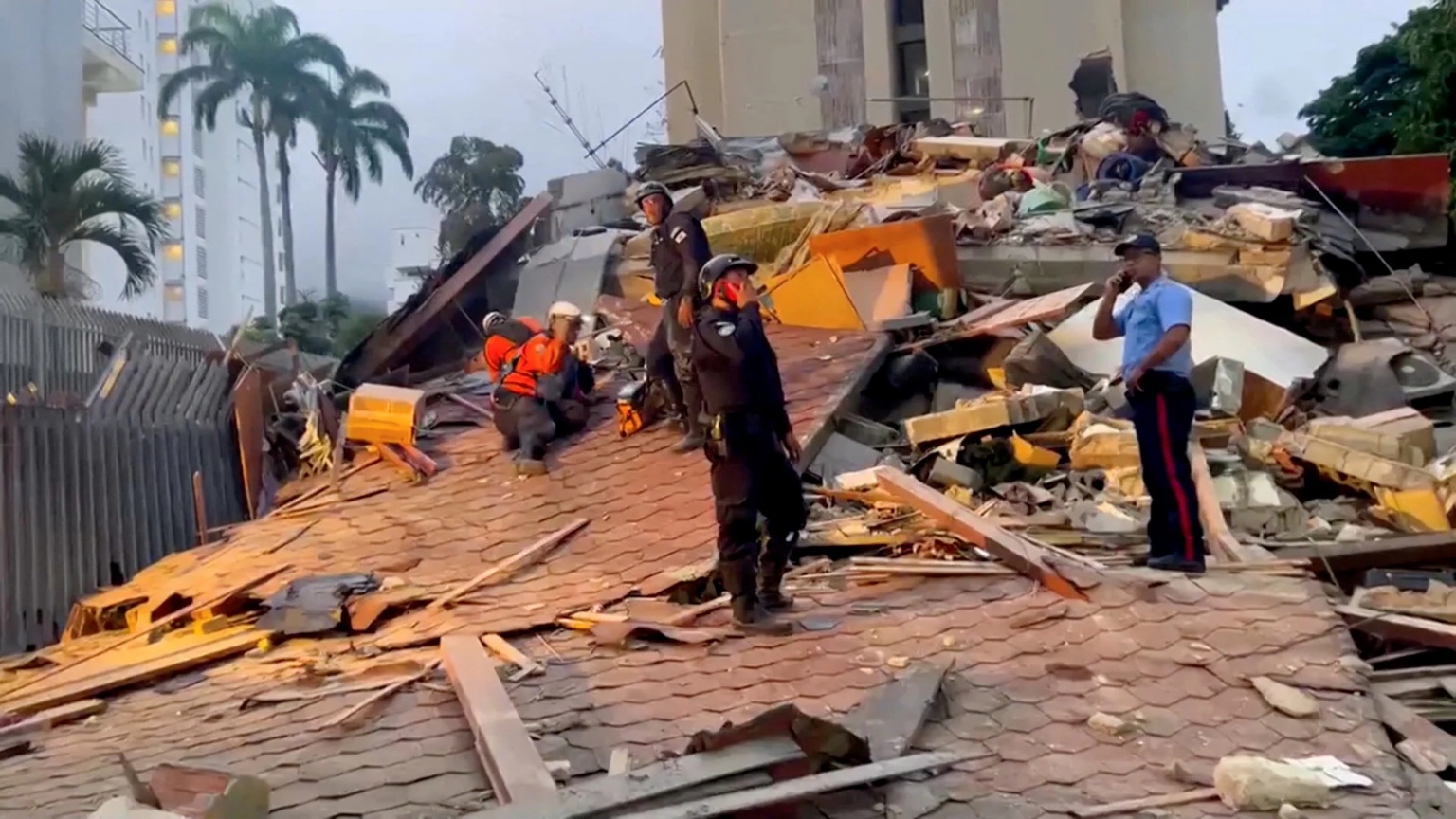
Search and rescue efforts continued on Thursday as civil protection teams and volunteers rushed to locate survivors and remove them from under the rubble. The Venezuelan government called on the private sector to collaborate with heavy machinery. Several areas of La Guaira are also hard to reach.
Venezuelan grassroots organizations also mobilized, organizing the collection of food, clothes and medicines for displaced families and setting up makeshift shelters.
Videos on social media showed the Venezuelan armed forces likewise moving equipment and mobile surgical units to the coastal area. Commercial flights to and from Simón Bolívar International Airport airport in La Guaira, the main air hub serving Caracas, have been temporarily suspended following damage to a major runway and the air traffic control tower.
Acting President Delcy Rodríguez visited the most affected areas on Thursday afternoon and oversaw ongoing efforts to deploy heavy machinery and provide food and shelter for displaced families.
“We express our support and solidarity to all those affected and we hope to find as many survivors as possible,” she told reporters. “We are working around the clock and we have called for international assistance.”
Venezuelan efforts were reinforced on Thursday night with the arrival of emergency teams from Mexico, the Dominican Republic, and El Salvador. Additional brigades are reportedly on the way from Colombia, Brazil, and the US, among others.
Alongside search and rescue teams, the US Department of War announced a deployment of logistical support assets.
In a statement, the US Southern Command (SOUTHCOM) announced the deployment of the amphibious transport ship USS Fort Lauderdale and the littoral combat ship USS Billings alongside Hercules transport aircraft. Marine Corps Major General Kevin J. Jarrard landed on Thursday night and will reportedly oversee the efforts.
The Trump administration is providing $150 million in humanitarian aid to be channeled through “assistance” partners including Catholic Relief Services and multiple UN agencies.
Washington has, however, opted to maintain its punishing economic sanctions regime against the South American country. On Thursday, the US Treasury Department issued General License 60 (GL60) authorizing transactions related to earthquake relief efforts. However, Venezuelan assets abroad, including bank accounts, remain frozen, meaning that aid efforts will still face hurdles or require US approval.
Caracas has also been unable to access around $4.8 billion in gold held by the Bank of England as well as nearly $5 billion in IMF Special Drawing Rights issued during the Covid-19 pandemic.
Since January, the Trump administration has issued multiple sanctions waivers to allow Western corporations to secure favorable energy and mining agreements with the acting Rodríguez government. Transactions between Caracas and its historic allies in China, Russia, Cuba, and Iran continue to be prohibited by the waivers and subject to secondary sanctions. The White House has likewise seized control of Venezuelan export revenues, disbursing a portion back to Caracas at US officials’ discretion.
Edited and with additional reporting by Lucas Koerner in Caracas.
Coastal La Guaira state showed widespread infrastructure damage. (Reuters)
Caracas, June 25, 2026 (venezuelanalysis.com) – Venezuela suffered two successive major earthquakes on Thursday afternoon that caused devastating damage.
Authorities reported that 7.2 and 7.5 magnitude earthquakes struck 39 seconds apart just after 6 pm. The epicenters were close to San Felipe, Yaracuy State, some 120 kilometers west of Caracas.
The tremors strongly shook central and northern Venezuela and were felt as far as Brazil and Colombia. Geological services registered 20 aftershocks in the following hours.
Emergency services, firefighters, and civil protection brigades were immediately deployed. Videos circulated on social media showed collapsed infrastructure in parts of the capital and nearby towns and rescue teams removing rubble to reach survivors.
Reports from the coastal of La Guaira showed completely devastated areas with rows of destroyed buildings.
Acting President Delcy Rodríguez addressed the nation on Thursday night and again in the early hours of Friday, calling for calm and unity in the wake of the natural disaster and declaring a state of emergency.
Rodríguez decreed a suspension of educational and “non-essential” activities, as well as the Caracas metro and suburban trains. The Simón Bolívar airport in nearby Maiquetía was likewise temporarily shut down.
“The priority right now is to save lives,” the acting president told press. “Later we will address the material reconstruction.” Rodríguez gave a preliminary figure of 32 dead and over 700 injured.
The acting president called the situation in La Guaira “a real tragedy” and a “disaster zone” with dozens of collapsed buildings. She expressed condolences to relatives of victims and urged Venezuelans to report missing people or damaged infrastructure via a dedicated phone app.
Rodríguez went on to call on people to evacuate buildings with visible structural damage and urged medical personnel to report to their stations as soon as possible.
During her press conference, Rodríguez thanked multiple countries for expressing solidarity and offering support, and announced the imminent arrival of rescue teams from the US, the Dominican Republic, El Salvador, and Qatar.
US Secretary of State Marco Rubio stated on social media that Washington is “immediately deploying search and rescue teams, medical resources, and humanitarian assistance to Venezuela.”
Caracas additionally received support from Bolivia, Brazil, Cuba, and a host of other nations. Mexican President Claudia Sheinbaum reported that specialized rescue teams are being prepared and that her government is in contact with Venezuelan counterparts.
Some areas of the capital and nearby states remained without electricity hours after the earthquakes. Authorities temporarily disconnected the direct supply of cooking gas to avoid secondary fires.
An offshore earthquake with a magnitude of 7.8 has struck the southern Philippines, killing at least 35 people and injuring more than 200.
The quake on Monday is the strongest to hit the country this year, according to Teresito Bacolcol, director of the Philippine Institute of Volcanology and Seismology.
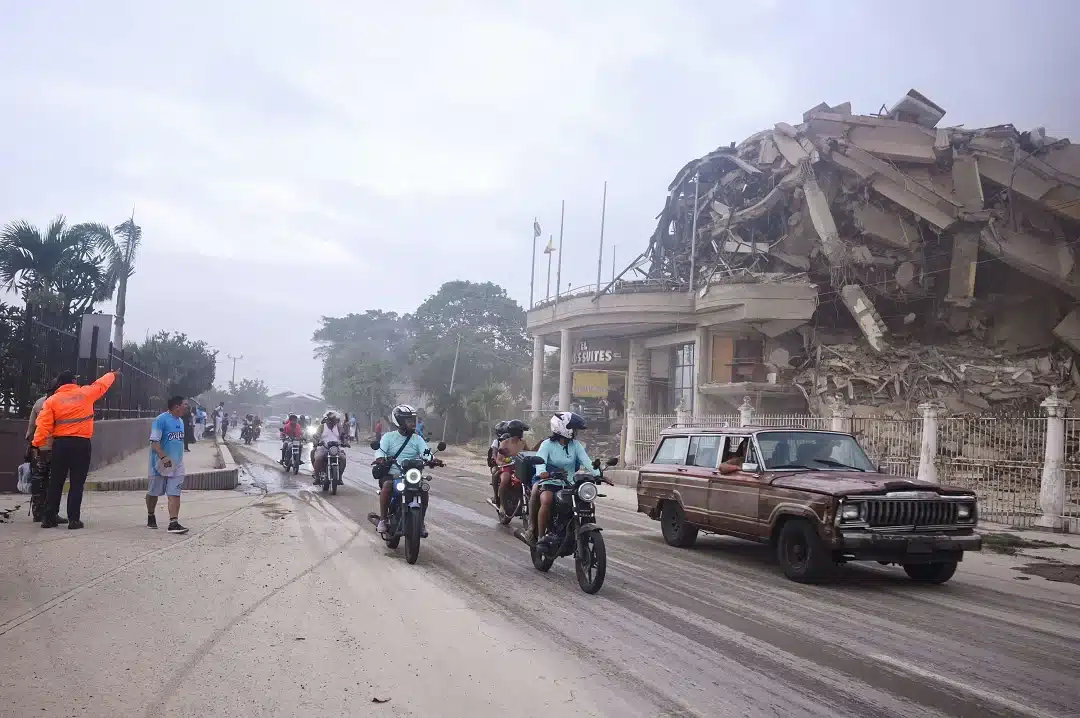
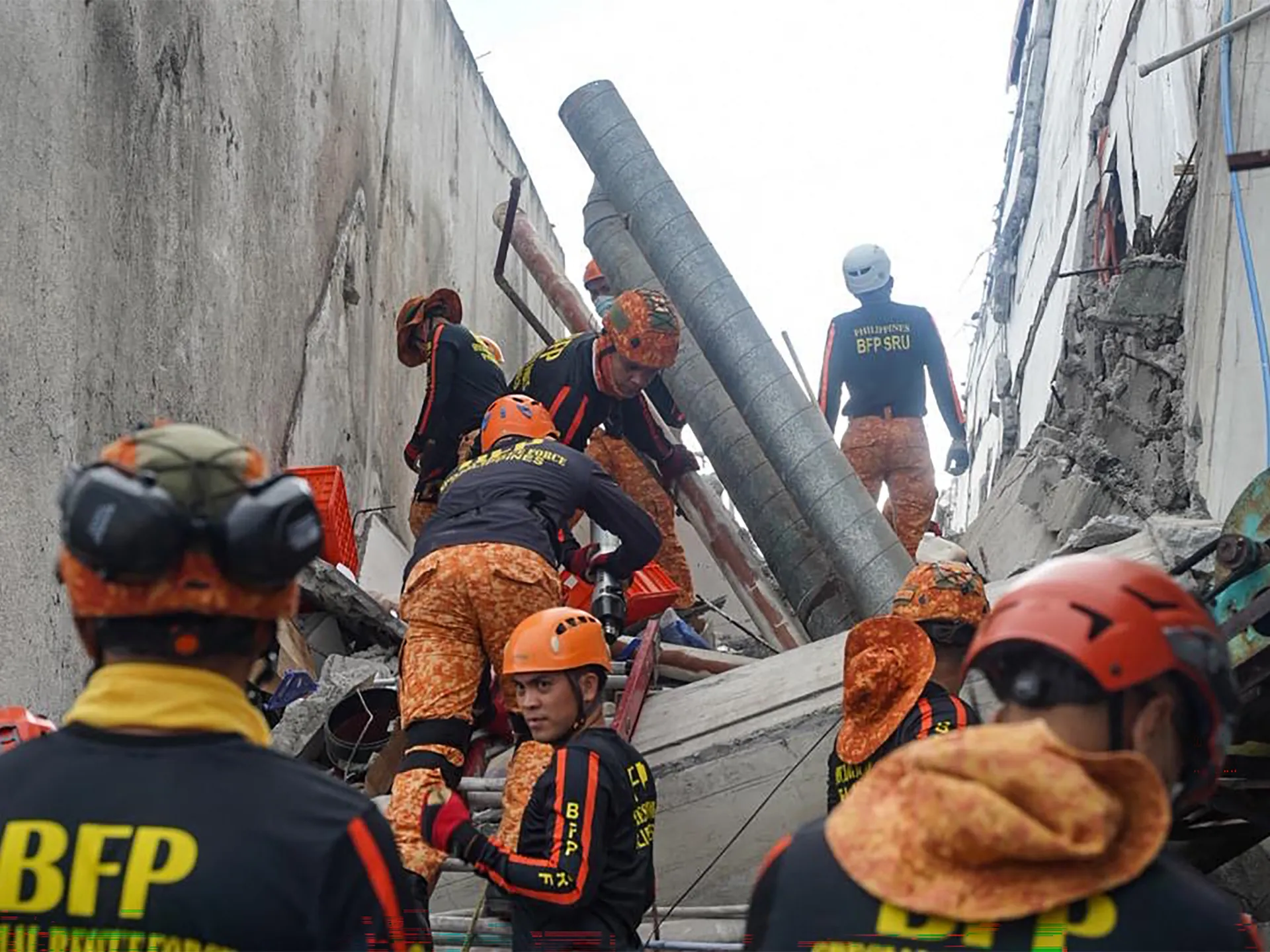
Several low-rise buildings collapsed or sustained heavy damage in the hard-hit city of General Santos.
Tsunami damage was reported in at least one southern coastal village, while smaller waves were recorded in Indonesia, Palau and as far away as southern Japan.
The quake also triggered a landslide in Glan, a municipality in the province of Sarangani, that killed 13 villagers, provincial disaster-mitigation official Rene Punzalan told the DZBB radio network. Four other villagers died in Sarangani, he added.
The United States, an ally of the Philippines, said it was coordinating with Manila and was ready to support Philippine response efforts. France, Japan and New Zealand also expressed support.
The epicentre was offshore near Mindanao, the second most populous island in the Philippine archipelago. Bacolcol said the quake struck at a depth of 33km (20 miles), about 32km (20 miles) southwest of Maasim town in Sarangani province.
President Ferdinand Marcos Jr ordered the cancellation of classes and directed disaster-response agencies to immediately get to work in quake-hit provinces, saying “the national government is moving and we will not leave Mindanao behind”.
The Pacific Tsunami Warning Center said the threat of a tsunami had largely passed about five hours after the quake. Philippine officials also lifted a tsunami warning by mid-afternoon. Six shanties on stilts were damaged in a coastal village in Zamboanga del Sur province due to the quake and higher waves, officials said.
Aside from the Sarangani landslide, most of the other deaths were caused by collapsing buildings and falling debris, including in a damaged mosque, in the southern provinces of South Cotabato and Davao Occidental and on Balut Island, according to disaster-mitigation official Ednar Dayanghirang.
The Philippines frequently experiences earthquakes and volcanic eruptions because it lies on the Pacific “Ring of Fire,” an arc of seismic faults encircling the ocean.