
early

Ryanair boss Michael O’Leary wants to BAN early morning pints before boarding flights

Michael O’Leary, who has served as Ryanair CEO since 1993, said his airline is being forced to divert flights almost daily because of drunken, aggressive passengers

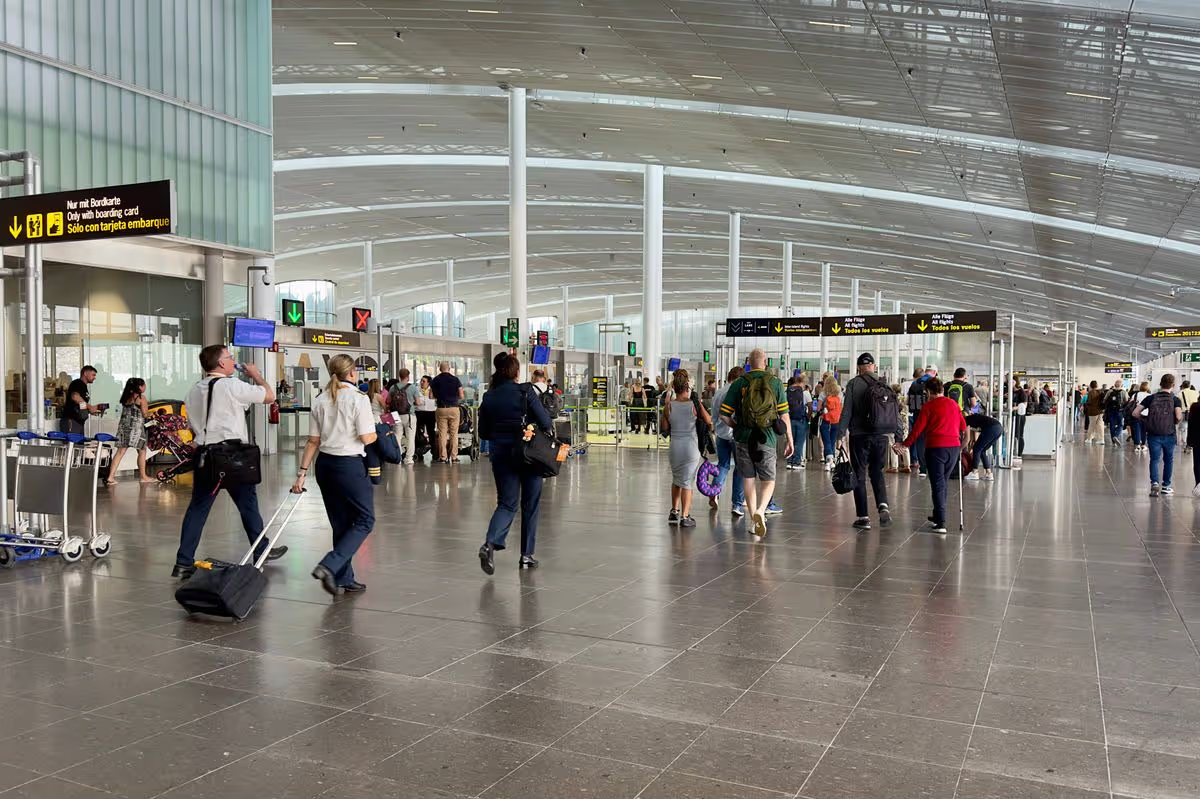
Airport bars should stop serving alcohol early in the morning, the boss of Ryanair says.

Michael O’Leary, who has served as Ryanair CEO for more than 30 years, claimed his airline is being forced to divert flights almost daily because of drunken, aggressive passengers. He said these tourists often drink in bars at airports for hours before they board their planes.

Pubs in airports do not currently need to follow the same licensing rules as bars outside these environments do. Mr O’Leary, 65, believes changing this will support his airline and others because it would help cut out aggressive behaviour in the skies.

The businessman said: “I fail to understand why anybody in airport bars is serving people at five or six o’clock in the morning. Who needs to be drinking beer at that time? There should be no alcohol served at airports outside [those] licensing hours.”

READ MORE: Ryanair passenger jailed for mid-air tirade after downing doublesREAD MORE: Drunk teacher attacked easyJet flight attendant on plane in front of his kids

A man was recently jailed for becoming abusive, causing widespread alarm throughout the Ryanair aircraft on which he was travelling from Poland to Bristol. Stephen Blofield’s case is one of several recent examples of passengers behaving aggressively after consuming alcohol.

According to The Times, Mr O’Leary has been calling for a two-drink per-person limit “for many years” and accused airports of “profiteering” off the troublesome travel ritual and “exporting the problem to the airlines”.

But father-of-four Mr O’Leary, from Kanturk, County Cork, stressed Ryanair is “reasonably responsible” with their drinks, rarely serving a passenger more than two drinks onboard. He insisted, though, drug use has entered the alcoholic mix too, worsening the issue as passengers then “want to fight”.

Footage recently emerged of a “shocking and frightening” brawl which broke out aboard a Jet2 flight from Antalya, Turkey to Manchester. The dramatic exchange, during which two people were seen grabbing at the phone and another passenger’s face culminated in airline bans for two of the people involved.

Mr O’Leary says he takes a similarly strict approach with his company, and has reminded passengers it is a criminal offence to be drunk on an aeroplane anyway, punishable by up to two years in prison and a hefty fine. Threatening and abusive passengers can be further prosecuted, as well as facing large compensation fees and prosecution in the country where the aircraft is forced to land.

It is reported flights from Britain to Ibiza, Alicante and Tenerife have been particularly problematic. Last year, a former soldier who sexually assaulted four Jet2 cabin crew during a flight to Tenerife was jailed. Joseph McCabe groped and slapped the buttocks of two flight attendants before grabbing a third around the waist and attempting to hug a fourth. The dad of two, from Glasgow, had been given for his drunken conduct on the plane.

Source link

Argentina sees early results from investment incentive plan

Argentina’s incentive program designed to attract large-scale investments is a key pillar of President Javier Milei economic agenda, File Photo by Juan Ignacio Roncoroni/EPA

BUENOS AIRES, April 27 (UPI) — Argentina’s incentive program designed to attract large-scale investments, a key pillar of President Javier Milei economic agenda, is showing early signs of success through increased foreign currency flowing into the country.

In an economy in which hard currency shortages often shape government policy and financial stability, early results from the Large Investment Incentive Regime, known by its Spanish acronym RIGI, are being closely watched by government officials and financial markets.

According to figures from Argentina’s central bank, projects approved under the program generated a net inflow of $762 million through March. The funds entered the country directly and helped provide some stability to the exchange rate.

Gonzalo Brest, a legal partner at KPMG Argentina, told UPI the progress of the investment regime sends a positive signal for the country’s economy.

“In concrete terms, this could translate into more private-sector jobs, especially in areas such as construction, transportation, metalworking, logistics, energy and mining, along with greater economic activity in the provinces where the investments are established,” Brest said.

He added that the program’s impact could extend beyond employment and affect Argentina’s external accounts.

“If these projects move forward, Argentina could increase exports and generate greater foreign currency inflows — something that is critical for an economy that has historically faced external constraints and balance-of-payments pressures,” he said.

Brest said the RIGI program is also intended to address Argentina’s long-standing difficulty in attracting large-scale investment in capital-intensive industries that require stable rules over long periods.

“In the government’s view, the regime functions as a kind of ‘island of stability’ aimed at accelerating investment decisions that, without a special framework, would likely be postponed or relocated to other countries,” he said.

The program is primarily focused on sectors such as oil and gas, mining, renewable energy, ports and heavy industry, all with strong export potential. Brest said the initiative’s main goals are to boost exports, increase foreign currency inflows and create jobs.

Many of the proposed projects are tied to lithium, copper, gold, silver, liquefied natural gas and oil development in Vaca Muerta, one of Argentina’s largest shale oil and gas formations.

“These are sectors where Argentina has abundant resources, but needed greater certainty to turn them into production and exports,” Brest said.

He cautioned, however, that the program’s long-term success will depend on factors beyond the design of the regime itself, including macroeconomic stability, infrastructure, access to financing and public support for large-scale projects.

“Even so, the RIGI is already functioning as a strong signal to international markets that Argentina wants to compete for major investment capital,” he said.

The program has received more than 35 project proposals totaling more than $80 billion. Of those, 13 projects have received government approval, representing combined investments of more than $18 billion.

Among the latest proposals under review is the “Fértil Pampa” project led by Pampa Energía. The initiative calls for a nearly $2.4 billion investment to produce fertilizers in the industrial hub of Bahía Blanca in Buenos Aires province.

With these developments, the RIGI program is moving beyond its initial phase of announcements and expectations.

The next challenge will be determining whether the promised investments can be sustained over time and translated into real economic activity, jobs and a stable flow of foreign currency for a country seeking relief from one of its most persistent economic constraints.

Source link

TUI, easyJet, Jet2 and BA update on how early to get to airport with EU rules chaos

As the European Union’s (EU) new Entry/Exit System (EES) is fully introduced, airlines have issued advice on what time Brits should arrive at the airport to avoid disruptions

Airlines including TUI, easyJet and Jet2 have issued updates and travel advice amid the rollout of the European Union’s (EU) new Entry/Exit System (EES), urging travellers to arrive at the airport as ‘early as possible’.

Brits heading abroad have been hit with major travel disruptions following the rollout of the European Union’s (EU) new Entry/Exit System (EES). There have been reports of lengthy border control queues at European and UK airports, along with missed flights, as thousands of holidaymakers pass through the new digital border system for the first time.

The EES, which was fully implemented on Friday, 10 April, requires all Brits travelling to the Schengen area to “create a digital record” and register their biometric details, such as fingerprints and a photograph. It is required for their first arrival at the airport border in the Schengen area, and after the initial registration, the EES remains valid for three years.

READ MORE: Travel expert’s passport warning as Brits risk £160 fee or being denied boardingREAD MORE: 5 travel changes Brits should be aware of before summer

The government noted that the EES “may take each passenger extra time to complete, so be prepared to wait longer than usual at the border.” Yet, travellers have reported gruelling delays of up to three hours and missed flights, and airlines have issued key advice to passengers as they grapple with the new digital border system.

TUI

In a travel alert on the EES, TUI advised passengers: “At some airports, you might still find longer queues, particularly at busy travel periods. We know this isn’t the travel experience you want before, or after your holiday – and it’s certainly not the one we want for you – so please know we’re doing all we can to support.

“To help your journey run as smoothly as possible, please allow a little extra time when passing through border control. Keep any essential medication in your hand luggage in case of delays, and when departing the EU, head straight to passport control after dropping your bags to avoid hold‑ups. Bringing some extra water for comfort is also a good idea.”

easyJet

In an “important update” released earlier this month, easyJet warned: “Airports across Europe may experience longer queues at passport control whilst the new European Entry /Exit System (EES) border checks are being completed.

“This will mean you may need to have your biometrics taken, including your face and fingerprints scanned.” They advised passengers to plan their travel to and through the airport as they may “experience longer queues”.

Travellers who need to drop off their bags should “go there as soon as it opens”, and then make their way through “security as early as possible”. They further cautioned that there could be additional checks at passport control before the gate, and that passengers should go to the gate or boarding area “as soon as it’s announced”.

easyJet added that travellers should ensure they have all the correct documents required for travel, although Brits do not need to do anything before arriving at the border for the EES. They further warned that there could be “longer queues” at their arrival airport.

Jet2

On expected delays from the EES, and how it could impact holidaymakers, Jet2 said: “There may be longer wait times at Border Control at some EU Airports, especially at busy times. Once you start your EES registration, it should take around 1-2 minutes per person to complete.

“There may be longer wait times than usual when you arrive in destination and before your flight back to the UK. Unfortunately, this is outside of our control. But remember, there’s nothing you can prep before you travel.”

Meanwhile, in response to a traveller following delays at Faro Airport, Jet2 advised on X: “We kindly recommend customers arrive to the airport as early as possible, to allow plenty of time to make it through.”

For travel back into the UK, Jet2 said: “You’ll also need to pass through EES when leaving the EU in the same way you do on arrival. Depending on how busy the airport is, this may result in longer wait times at passport control before boarding your flight to the UK. After checking in for your flight, please head straight to security and passport control in order to arrive at your gate in plenty of time.”

British Airways

On general information about the new digital system, British Airways explained on their website: “You should allow extra time to register your biometric details, such as fingerprints and a photo, the first time you enter the EU. There is no cost for EES registration, and your digital record will last three years before you need to register again.”

In response to a question on X about arrival times at the airport, a member of British Airways said: “Hi there. We ask customers travelling on our European short-haul flights to be there two hours prior to departure. It would be three hours if you’re travelling on a long-haul flight and one if you’re travelling on a domestic flight within the UK.”

For more information on the new EES system, visit the government website.

Do you have a travel story to share? Email webtravel@reachplc.com

Source link