Dover

A Canterbury trail: my pilgrimage from the cathedral to the white cliffs of Dover | Canterbury holidays

Canterbury for Evensong. Is there a more delightful cluster of syllables in the English language? Old English, I should say, as æfensang comes from that tongue, an update on the Latin-derived “vespers”. But whatever you call the service, Canterbury Cathedral does it in style. How beautiful the singing from the choristers in their white and purple. How beautiful the light as it honeys the stone of the quire. I had been in the city only an hour or so, and considered this early evening worship a sort of overture for my stay.

What a relief to get inside the great stone building. The lovely old city was horrible with heat. A statue of Chaucer on High Street appeared overdressed in robe, cloak and hat. He held out a page inscribed with the opening lines of The Canterbury Tales: “When in April the sweet showers fall … Then people long to go on pilgrimages.” The bronze had been hot to the touch and I began to suspect that I’d made a mistake starting my own pilgrimage at midsummer.

Walking to the cathedral, I had passed the former site of the Royal Fountain, where the travel writer HV Morton stayed in 1939. Morton chose the inn because it was quiet, Canterbury being very noisy in his experience, forever busy with tourist traffic. “And who can deny,” he wrote, “that the mobility given to masses of people by the cheap motor-car and the motor-bus has revived a wave of secular pilgrimage in Protestant England within the past 20 years and multiplied relics in a way unparalleled since the heyday of the Middle Ages?”

‘Medieval air’ … the nave of Canterbury Cathedral Photograph: Alamy

One could voice similar sentiments now. Pilgrimage is having a moment and has been for a while. According to YouGov research for the British Pilgrimage Trust in 2025, 3.7 million British adults have already made a pilgrimage, and almost one in five are considering making one. What is going on?

Torin Brown is the man to ask. The pilgrim officer at the cathedral meets many arriving in the city on foot and others for whom it is the start of a long, challenging walk. “We’ve seen a resurgence in pilgrimage in the last 10 years, especially since Covid. People are looking back to the old ways in their search for meaning. Even those who declare themselves atheists are engaging in this ancient religious ritual of walking to sacred spaces.”

Canterbury’s popularity as a pilgrimage site was accelerated by the murder in the cathedral of archbishop Thomas Becket in 1170 and his speedy elevation to sainthood. His shrine was among the most popular in Europe.

There are a number of historic routes to Canterbury, among them the Pilgrims’ Way from Winchester, the Old Way from Southampton, and the Augustine Camino from Rochester. Sarah Mullally, the new archbishop, spent six days walking from St Paul’s Cathedral ahead of her installation in March this year. My plan was to walk the English leg of the Via Francigena, which links Canterbury with Rome. This would mean reaching Dover in a day – about 20 miles. I had an OS map, the Via Francigena app, and a pilgrim passport, which Torin stamped before my departure. “You are now part of this wonderful history and tradition of pilgrimage,” he said.

I wouldn’t be leaving until the following day, so there was time for a proper look around the cathedral. They were tuning the organ, the building echoing with eerie drones and groans, which somehow gave a medieval air. I sat in the nave, beneath a vault built during the reign of Henry IV, and watched as a woman with a silver bob worked her way down the south aisle, cleaning memorials and tombs. She had a feather duster in one hand, a yellow cloth in the other and carried a pale blue handbag in the crook of her left arm. Her name, she told me, was Cilla.

The Geoffrey Chaucer statue in Canterbury. Photograph: Slawek Staszczuk /Alamy

“I’m one of the Holy Dusters! We’re the lowest of the low!” In the cathedral hierarchy, she said, the volunteer cleaners were below the florists and the welcomers. “And the older I get, the more that suits me.”

Cilla didn’t seem the sort of lady whose age one asks, so I contented myself with observing that the building was beautiful. “Isn’t it! I grew up in Salisbury, so I’m used to a more modern cathedral, but this is growing on me. Well, it would after 47 years.”

And she went on her way up the north aisle, dusting recumbent effigies of archbishops and deans, not neglecting to wipe beneath the ruff of Sir John Boys, who died in 1612. Forget memento mori, here was the true equality of the grave, every great man coming to the same humble pass – his stone face tickled by the feathers of the Holy Duster.

Next morning, I was out at first light. The heatwave was intensifying and I wanted to get ahead of the sun. A gull sat high on the cathedral gate, looking down as I touched the scallop shell, symbol of pilgrimage, carved into the wooden door.

skip past newsletter promotion


The route is waymarked with the logo of the Via Francigena: a pilgrim carrying a staff. It follows the North Downs Way, so you can also look for the acorn sign.

Mist lay in the fields, working its alchemy. Copses became floating islands. Pylons were robot ramblers; I envied the length of their stride. Still, despite my shorter pace, I reached Shepherdswell by 8am and refilled my water bottle from a tap set into the church wall.

I had thought of stopping at this village and catching the train to Dover. To press on meant another 10 miles. But I was too much in love with the idea of walking to the coast – until the land, not my legs, gave out.

The Via Francigena walk follows the route of the North Downs Way. Photograph: Kay Roxby/Alamy

Over the next hours, I had cause to regret that decision. The sun, so gentle at rising, turned vicious. Nine felt like noon. What would noon feel like? The earth in field paths was hard and cracked. Nodules of flint lay around like bones. I considered lying down and adding my own. Pilgrimage? More like an act of atonement. Henry II, in penance for Becket’s murder, walked barefoot into Canterbury and was whipped by the monks. That was my whole vibe now.

Once in a while, I’d pass a garden and someone would look up from watering their roses and say good morning. I said it back, but wondered: “How can it still be morning?” Worst of all was a man floating in his pool, happy as a hippo in a mudhole. I was too Scottish and reserved to ask if I could join him.

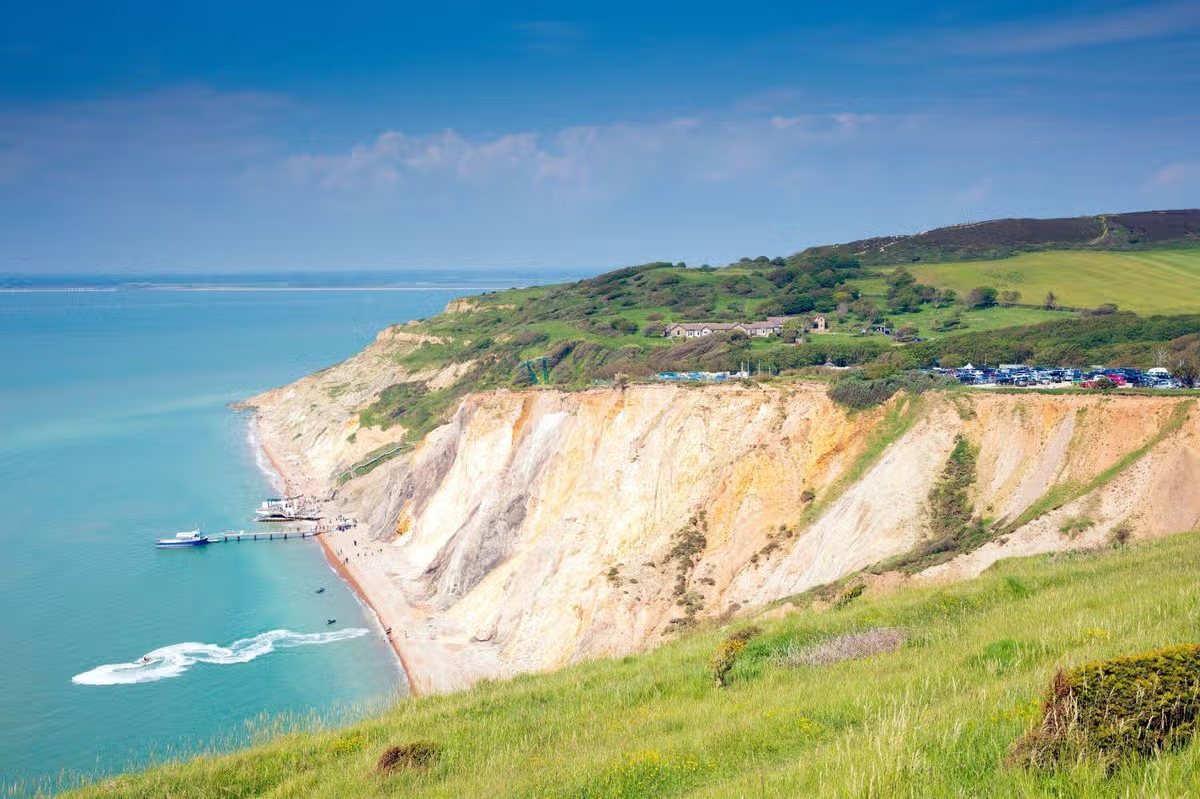
Arriving in Dover at midday, I went to the museum to get my pilgrim passport stamped. If continuing the Via Francigena, I’d catch a ferry to Calais. But I had another destination in mind. I passed a sign saying Welcome to England and another for Dame Vera Lynn Way and then there they were – the White Cliffs. So bright, so beautiful. The Channel was a blue haze; France a shadow.

I hope one day, before long, to be on the other side of that water, exploring the cathedrals of Europe. But, for now, this footsore pilgrim was on a more humdrum quest: ice-cream and a pack of blister plasters.

Source link

Dover issues warning as holidaymakers stuck in near five-hour delays for ferries in heatwave

Shocking images caught the hours long queues bank holiday travellers faced in Dover and Folkestone on the hottest days of the year so far

Bank holiday travellers have been plunged into chaos as some drivers were forced to wait nearly five hours for ferries at Dover.

Brits looking to escape the UK for the long weekend and hot weather were dealt with a massive blow as thousands of cars were kept waiting in sweltering temperatures. Shocking images showed massive queues at the Port of Dover as people tried to catch ferries over to mainland Europe.

The port issued a warning to travellers and the new EU border checks were suspended to help ease the massive congestion on one of the hottest days of the year so far.

Motorists heading to the Eurotunnel for the LeShuttle railway reported delays of an hour or more to check-in in Folkestone.

READ MORE: UK weather live: Heatwave maps forecast 35C surge with 15 counties at 33C – listREAD MORE: Canary Islands issues heatwave weather alert and warns ‘don’t get too drunk’

Motorists, on Saturday morning, faced delays of up to two hours to reach the port then a wait of up to two and a half hours to complete immigration and processing before getting on their ferries.

The news entry/exit system (EES) involves people from third-party countries, like the UK, having their fingerprints registered and photograph taken to enter the Schengen Area.

The port, in a statement to holidaymakers amid the travel chaos, warned this bank holiday was the first major period it has faced with the new EES system in place.

It said: “We recognise that the border process is slower with the current EES system, and this May Half Term is the first peak period since its introduction.

“French border teams are doing their best within the parameters given and are working with the highest available resources. We are continuing to work hard with them and our other partners to reduce wait times and get you on your way as quickly as possible. It is extremely important to stick to main routes on your journey to the Port, as not doing so causes extra delays and access issues for our local community.”

‘Are you caught up in the Dover queues? Contact us at webnews@trinitymirror.com

In a desperate bid to ease congestion, the French authorities suspended extra EU border checks under the EES, the port announced. It also said anyone who has missed their ferry crossing because of queues can travel on the next available slot free of charge.

Holidaymakers also faced hours long waits at Dover on Friday, but the congestion has appeared to ease on Saturday afternoon. In an update around 1.15pm on Saturday, the port said the processing time for tourist traffic had dropped to 50 minutes.

Despite this, the port said there were “still queues in the check-in plaza for tourist traffic and approach lanes for all ferry operators”. More than 8,000 travellers are expected at the port on Saturday.

The travel nightmare comes on a long weekend where multiple temperature records could be broken – with parts of the UK possibly hotter than the Seychelles on Saturday. Records could be broken for the the hottest May day in the UK and England, currently 32.8C; the hottest May day in Wales, currently 30.6C ; as well as the UK and England’s hottest bank holiday, which sits for now at 33.3C, according to the Met Office.

Highs of 30C are likely to be seen in the south of England on Saturday after the UK saw the hottest day of the year so far when temperatures hit 28.4C in Heathrow, Cambridge and Cranwell in Lincolnshire on Friday afternoon. This would be hotter than the temperatures forecast for popular holiday spots like Split in Croatia and even Victoria in the Seychelles.

The UK Health Security Agency (UKHSA) issued amber heat health alerts on Friday morning for the East Midlands, West Midlands, the east of England, London and the South East. They will remain in place until 5pm on Wednesday and replace less severe yellow alerts which were previously issued.

The alerts mean there is likely to be “a rise in deaths, particularly among those aged 65 and over or with health conditions” and increased demand on all health and social care services, according to the UKHSA website. Yellow alerts have been issued for the north-east and north-west of England, Yorkshire and Humber, and the South West.

Source link

Dover queues, rail chaos, traffic jams – welcome to the bank holiday getaway

Families heading to France from Dover are enduring a two hour wait, while train services out of London have been hit by cancellations ahead of weekend of route closures

Drivers arriving at the port of Dover have been warned of two hour waits as millions of others elsewhere face bank holiday travel chaos.

Authorities at Dover have alerted customers to a “120 minute processing time for tourist traffic in the buffer zone” before reaching French border control on this side of the Channel. It added: “Please note there is external congestion on the port approach roads.”

Writing on social media, the Port of Dover said: “Thank you for your patience. Our teams are working hard to get everyone through border control and check-in as quickly as possible.” The go-slow comes as Brits flying to Europe also fear lengthy waits to get through border control after the implementation of new passport checks.

READ MORE: UK heatwave 2026 live: Five urgent amber heat health alerts issued for parts of UKREAD MORE: Andy Burnham live: Labour PM hopeful launches Makerfield campaign

Doug Bannister, Port of Dover chief executive, warned Saturday would be even busier: “We’re looking at about 8,000 cars on Saturday, so that is going to be the busiest of the three days. Our busy time for cars tends to be about 5am till until 1pm. If you’re arriving for a sailing during that period of time, we ask people not to arrive more than two hours before their sailing so that we can keep everybody flowing through.”

It is not much better for those staying at home and enjoying the forecast heatwave, with temperatures of over 30C predicted in some areas over the weekend.

National Rail warned the hot weather can “cause overhead lines to expand and sag”, rails to buckle and pose a risk of track-side fires. “Speed restrictions may be imposed,” it added.

Tens of thousands or rail passengers suffered cancellations even before a weekend of disruption due to engineering work and strikes.

Operator LNER said northbound services between London King’s Cross and Peterborough were disrupted due to a fault with the overhead power lines in the New Barnet area. Delays of up to 50 minutes were expected. And southbound, services between York and Doncaster were disrupted due to a fault with the signalling system.

The East Coast Main Line is expected to be one of the worst routes affected in the coming days because of a closure for works in North Yorkshire. A rail replacement bus service will operate but, as a result, will add more than more than an hour and a half to a normal three hour journey.

The closure has impact thousands Middlesborough fans travelling to London for the Championship play-off final against Hull City at Wembley.

Industrial action is also planned on London Northwestern Railway and West Midlands Railway on Friday and Saturday, with passengers advised to “only travel if necessary” as trains will only run on a small number of routes.

Elsewhere, the Transpennine route will also be impacted, including a rail replacement service between Manchester Piccadilly and Huddersfield over the whole weekend, and between Huddersfield and Leeds, Dewsbury and Wakefield Kirkgate on Sunday.

Buses will replace trains on the Great Western main line between Newport and Bristol Parkway, while one train an hour will operate between south Wales and London via Gloucester from Saturday right through to Monday June 8.

Passengers using part of the Thameslink line in London and South Western Railway between Havant, Fareham and Portsmouth Harbour will also be disrupted.

Anit Chandarana, from Network Rail, said: “Bank holidays are still among the least busy times for us in terms of passengers, so it makes sense to plan these major improvements for those days.

“I know it can be frustrating to have to check before you travel, but this investment is about making everyday journeys better – improving reliability, reducing future disruption and helping the railway work better for passengers.”

So much rail disruption will inevitably mean even more people take to roads already predicted to be busy due to the weather and the start of the half term school break.

Adding to the risk of jams is the fact it is the final weekend of the Premier League season, with hundreds of thousands of fans travelling to cheer on their teams.

Motoring group the AA is forecasting Friday will be the busiest day, with around 23.4 million journeys taken, then 2.8 million on Saturday, and 22.4 million on both Sunday and bank holiday Monday.

If you have been disrupted by the travel disruption, email graham.hiscott@mirror.co.uk

Source link