The states claim the new levies are a pretext to re-impose tariffs that were ruled illegal by the US Supreme Court.
Published On 4 Aug 20264 Aug 2026
A group of 25 Democratic-led states has sued Donald Trump’s administration over its latest tariffs, claiming that the US president has exceeded his legal authority to implement the levies.
The lawsuit, filed in the US Court of International Trade on Monday, targets new double-digit tariffs imposed on 60 trading partners last month over allegations they were not doing enough to stop the importation of goods produced with forced labour.
Recommended Stories
list of 3 itemsend of list
These latest tariffs took effect just as the clock ran out on temporary tariffs that Trump had turned to after the Supreme Court struck down his flagship “liberation day” levies in a February ruling.
“After losing at the Supreme Court, the administration is once again trying to illegally raise taxes on families and businesses with a new round of tariffs,” said New York Attorney General Letitia James.
The states that sued over the new tariffs, including Oregon and New York, all have Democratic attorneys general or governors.
In response, White House spokesman Kush Desai said the levies were an appropriate and legal response to unfair trade practices in other nations.
“A foreign country’s failure to impose and effectively enforce a prohibition on the importation of goods produced with forced labor is unreasonable and burdens US commerce, including American workers, and must be addressed,” Desai said.
Revive US manufacturing
Trump, who argues that high tariffs will revive US manufacturing, last year overturned decades of Washington policy that favoured lower tariffs and ever-freer trade.
Invoking the 1977 International Emergency Economic Powers Act (IEEPA), he imposed double-digit tariffs on imports from almost every country, saying the US’s longstanding trade deficit amounted to a national emergency.
But the Supreme Court ruled that IEEPA did not authorise tariffs. The decision forced the administration to establish a refund process for importers who had paid the tariffs.
Eager to make up the lost revenue, Trump turned to temporary 10 percent worldwide tariffs, but they expired at midnight on July 24.
The latest round of global tariffs was imposed under Section 301 of the Trade Act of 1974, meant to combat unfair or discriminatory economic practices by other nations. The tariffs imposed in July affect more than 99 percent of US imports.
The states’ complaint, like two previous lawsuits filed by small businesses over the tariffs, argued that the new tariffs used “forced labor” as a pretext to re-impose the tariffs that had already been ruled illegal in court. They said that a sweeping tax on imports would do nothing to address the real problems of forced labour around the world.
United States President Donald Trump has lambasted the nation’s biggest oil and gas giants as Houston, Texas-based Chevron reported record earnings while consumers struggle with soaring petrol prices.
“I don’t like it,” Trump told reporters on Monday in reference to the blockbuster second-quarter earnings, as his war on Iran has kept oil prices high for months.
Recommended Stories
list of 3 itemsend of list
“Chevron, too much money. ExxonMobil, too much. Too much money.”
Trump’s comments came on the heels of an interview Chevron CEO Mike Wirth gave on the Fox News programme Sunday Morning Futures with Maria Bartiromo. Writing on his Truth Social platform, the US president berated Wirth for not crediting his administration’s efforts to help the oil industry.
“The only thing he [Wirth] conveniently forgot to mention is that, without the genius, foresight, strength, and stability of the TRUMP Administration, the Oil Industry, and our Country itself, would be DEAD!”
Chevron reported its highest quarterly profits in six years on Friday. Adjusted earnings per share came to $6.06, or $12bn, as tensions between the US and Iran strained global oil supply chains in the strategically vital Strait of Hormuz, where roughly one-fifth of the world’s energy supply travelled through before the war, sending prices soaring.
Chevron rewarded its employees. Wirth praised them for their work and said in an email that most workers would receive a bonus equivalent to half their monthly base pay, the Reuters news agency reported, citing an internal email.
Al Jazeera has not been able to independently confirm Reuters’ reporting.
Chevron’s strong earnings come as the company is less reliant on Middle Eastern production operations than its competitors, allowing it to reap the benefits of higher global oil prices during the quarter. Brent crude, the global benchmark for oil prices, was 23 percent higher than in the first three months of the year.
“Being less dependent on the Strait of Hormuz is definitely helping them. It’s also the refining they’re able to do here. The fact that Chevron has less than 5 percent exposure there gives it some protection,” Bill Drolet, executive director, mergers & acquisitions at The Post Oak Group investment bank, told Al Jazeera.
“More than 70 percent of Chevron’s production is concentrated in America, and that’s where it’s making its biggest margins right now.”
Chevron also benefitted from the president’s move to open up oil production in Venezuela after US special forces abducted the country’s president, Nicolas Maduro, in January. Chevron had stayed on in the South American nation even after former President Hugo Chavez nationalised oil production.
Chevron did not respond to Al Jazeera’s request for comment.
Competitors also performed well. ExxonMobil on Friday posted its best quarterly profits in four years, but they fell short of analysts’ expectations. Earnings raked in $9.2bn.
Exxon did not respond to a request for comment.
On Thursday, Valero Energy reported its highest ever second-quarter profit, with net income coming in at $3.7bn as US refiners reap the benefits of tensions choking oil production across the Middle East.
But those benefits have not reached consumers, who are feeling the strain at the petrol pump. Petrol prices are above $4 a gallon (3.78 litres) across the US. The average price for a gallon of petrol is $4.09, down from $4.11 this time last week, but up from $3.82 a month ago, according to the American Automobile Association (AAA), which tracks daily petrol prices.
By comparison, when the US and Israel first struck Iran in late February, the average price was $2.98.
An analysis from Bank of America published in April showed consumers spending as much as 4.2 percent of their income on petrol in March, up from 3.9 percent in 2019. Lower-income earners are hit much harder, with more than 10 percent of households spending more than 10 percent of their monthly income on petrol.
This comes as pressure on the US Strategic Petroleum Reserve continues. The reserves hit their lowest level since 1983 this week, according to the Department of Energy. They fell by 2.8 million barrels over the week to 304.8 million barrels.
Political pushback
The condemnation of the oil industry has come from across the political spectrum.
“A decent industry would say, ‘this was money we didn’t earn, it’s a windfall we get from our cartel pricing scheme.’ Not these corrupt, greedy and grasping rogues,” Democratic Senator Sheldon Whitehouse of Rhode Island wrote in a post on X on Sunday.
But lowering prices might not be as easy. Beyond pressure from consumers, companies across the corporate United States are beholden to a concept called shareholder supremacy. This means that while lowering prices might be in the best interest of pinched consumers, it may not be possible given the legal framework and companies’ fiduciary responsibility to shareholders.
“They’ve [oil companies] got shareholders they’re responsible for. They could reduce share buybacks or dividend payouts, but right now, I don’t see oil companies doing much,” Post Oak Group’s Drolet said.
He said if he were advising a member of Congress or the president, providing relief to consumers might be easiest by suspending the so-called gas tax, which varies by state. In Texas, for example, the gas tax accounts for 20 cents per gallon, while in California, it is 63 cents per gallon.
“From a political standpoint, the best thing our government can do is suspend gas taxes, especially in California. If they put a temporary hold on taxes, that would help everybody get through this challenging time.”
Al Jazeera asked the White House if that policy is on the table, but the press office did not respond.
Heading into the US midterm elections, cost of living remains among the highest concerns for consumers. In a Washington Post/Ipsos poll last month, 54 percent of respondents said that high prices and the economy were a chief concern heading into November.
“They see the price of fuel and net profit for Exxon and Chevron and feel that they are abusing US consumers, especially as US consumers have access to the correct fuel, whereas other areas around the world have shortages [such as Germany, Philippines],” Babak Hafezi, professor of international business at American University, told Al Jazeera.
“The reality is that as the war [On Iran] progresses, the impacts of the lack of supply will create full price and supply shocks.”
Amid Trump’s comments, Chevron’s stock is on the downturn in midday trading, tumbling more than 2 percent from the market open. However, it is up more than 1.1 percent over the last five days.
ExxonMobil is down 0.5 percent for the day and 0.1 percent over the last five days.
Dearborn, Michigan – Yemeni-American activist Samraa Luqman has no regrets about voting for President Donald Trump in 2024.
While the United States president has been a disappointment to Arab Americans in Michigan with his pro-war and anti-immigration policies, she stressed that it was untenable for the community to vote for Democrats as Israel’s genocide unfolded in Gaza.
Recommended Stories
list of 3 itemsend of list
“There had to be accountability for the genocide. We’re OK with what we voted for,” Luqman told Al Jazeera.
“I said from the beginning, I’m willing to live through another four years of Trump, that we expected him to be bad on our issues, but it was a pill we were willing to swallow in order to hold the Democratic Party accountable.”
Luqman is not alone.
Despite Trump’s staunchly pro-Israel policies and unpopular war on Iran, many say supporting Democratic nominee Kamala Harris in 2024 was out of the question, and it was the right choice for the community to break with the Democratic Party.
“I could not – with a good heart, good conscience – tell someone to vote for Kamala Harris or Donald Trump”, but the approach of “lesser of two evils” no longer works to sway Arab voters, Hussein Dabajeh, a prominent political strategist in the Detroit area, home to large Arab and Muslim communities, told Al Jazeera.
Democrats’ popularity amongst Arab Americans nosedived in 2024 as President Joe Biden ignored calls to compel a ceasefire in Gaza and continued to provide Israel with weapons and military aid as it killed tens of thousands in Palestine and Lebanon.
Then, Vice President Harris refused even to consider an arms embargo against Israel.
As a result of these policies, many Arab Americans, who had been reliable Democratic voters for years, ditched the party and refused to support Harris in her presidential bid.
Trump swept in, presented himself as a “peace” candidate, and his campaign forged ties with Arab community advocates.
Trump’s policies
At a rally in Michigan ahead of the 2024 vote, Trump brought local Muslim imams to the stage and praised the community.
The Republican leader also visited the predominantly Arab and Muslim Detroit suburb of Dearborn ahead of the election.
Trump ended up winning Michigan as many Arab voters in the Dearborn area refused to back Harris. Some voted for him, while others voted for a third party, left the top of the ticket blank, or skipped the election altogether.
According to an Al Jazeera analysis of election results in heavily Arab precincts in east Dearborn, about 45 percent of the votes went to Trump, 29 percent to Green Party candidate Jill Stein, and 16 percent to Harris.
As president, Trump allowed Israel to continue its attacks on Gaza and Lebanon and launched an unprovoked war against Iran that has sent petrol prices soaring.
He has also intensified the crackdown on Palestinian rights advocacy at home with a campaign to deport noncitizen student activists critical of Israel.
In February, he also terminated immigration protections for Yemeni nationals, sowing fear and uncertainty in a community where many leaders had endorsed him in 2024.
Asked how Arab Americans feel about Trump now, Dabajeh said: “They hate him. There’s no other way of putting it. I don’t think there is a single person I know that voted for Trump from the Arab and Muslim community specifically that looks at what Trump is doing and is happy with what he’s doing, or what he’s done.”
‘The genocide matured us’
Many Arab Americans stress that withholding support for Harris in 2024 was not out of love for Trump.
“No one understands the horrors of Trump’s policy more than us. We were his first victims in 2017,” said Amer Zahr, a comedian and Dearborn Board of Education trustee.
Shortly after starting his first term in 2017, Trump implemented a travel ban on several Muslim-majority countries.
“No one is more aware of the harm that Trump can cause than we are,” Zahr added. “But the genocide matured us in a way that we finally got to the point where we were willing to tell politicians ‘no’.”
As the election season returns to Michigan, Arab Americans once again find themselves at a political crossroads.
The community is rallying behind Democratic Senate candidate Abdul El-Sayed – who had previously endorsed Harris – but some are keeping their political options open.
Luqman, the Yemeni activist, said she will certainly vote for El-Sayed and Congresswoman Rashida Tlaib – who are outspoken critics of Israel – in the Democratic primary on Tuesday and in the general elections in November.
Luqman said Democratic voters’ support for progressive candidates will help the party regain credibility with Arab voters.
“Those are things that do bring the Democratic Party a little bit of relevance and credibility within our community,” Luqman told Al Jazeera.
“It has kind of brought the community back to centre, whereas they were kind of swinging to the right by a large margin.”
Political strategist Hussein Dabajeh says many Arab Americans in Michigan ‘hate’ Trump and his policies [Ali Harb/Al Jazeera]
Palestine or bust
While some political commentators have been questioning why US support for Israel has become a decisive issue in US politics, particularly Democratic primaries, the answer in the Arab community is clear.
Advocates say domestic policy takes a backseat when their loved ones are being killed, and their hometowns are being wiped out by their own tax dollars via military aid to Israel.
“Gaza and Palestine and Middle Eastern issues have now become the forefront, the top of everybody’s issues, and it’s become a red line for my community,” Luqman said.
“So if you’re a Republican or Democrat and you hate AIPAC and you value Palestinians’ rights to self-determination, then you’re going to be getting our vote, regardless of what party you’re in,” she said, referencing the powerful American Israel Public Affairs Committee lobby group.
Zahr echoed that message.
“People want us not to be single-issue voters. In other words, they want us to forgo our main issue, get screwed on it, watch our families die because Trump’s bad, and accept all that,” he said.
“Well, we said ‘no’. The blood of the children of Gaza had to mean something.”
Zahr emphasised that Arab Americans are not alone in centring Palestine in their electoral choices, pointing to the defeats that pro-Israel incumbents have suffered across the map in this primary season.
“You’ve gotten to a point where if somebody says, ‘Stop bombing hospitals’, everyone knows you’re talking about Israel. That’s because of Israel. That’s not because of us. That’s because of what Israel did,” he told Al Jazeera.
“And so, people are keying into the truth. And when you learn the truth, something that comes along with that is you learn that you’ve been lied to, and you get angry. A lot of righteous anger is pushing a lot of this.”
Dabajeh, the political strategist, said that while Arab voters care about the economy, affordability and infrastructure – like all Americans – they cannot overlook US policy on Israel.
“Are we supposed to call our family members overseas and be like, ‘Listen, khalto [auntie], this guy over here that’s running for office might kill some of your neighbours, might kill some of your kids, but don’t worry about it, he’s going to take care of the flooding in our homes’?”
“It’s not going to work. We can’t do that.”
Islamophobia and racism
Republicans tried to court Arab and Muslim voters in 2024 and capitalise on the discontent over Gaza policies, but now, many conservatives have returned to demonising the community as an electoral strategy.
Weeks after he was elected, Trump endorsed Randy Fine, a Florida politician with a history of anti-Muslim statements, for Congress. Fine would go on to win and call for the “destruction” of all Muslims.
Meanwhile, Republican governors in Florida and Texas have designated the Council on American-Islamic Relations (CAIR) as a “terrorist” group.
In Michigan, Republican Congressman John James, who is running for governor, has also pledged to blacklist the group.
Luqman said James had spoken to community members and promised to engage voters in Dearborn before that announcement.
“There was a really big opportunity for the Republican Party to solidify the swing of the pendulum, if you will, and they lost that option. They really missed that opportunity,” she said.
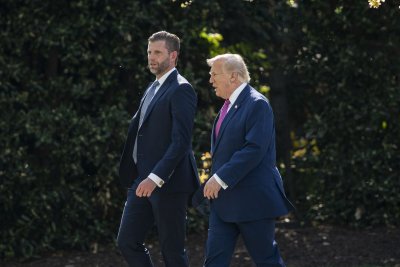
President Donald Trump and his son Eric Trump, walk to Marine One on the South Lawn of the White House, on April 10 in Washington, D.C. Capital One attorneys said in court documents that the bank closed the Trump Organization’s accounts over concerns about money laundering. File Photo by Al Drago/UPI | License Photo
Aug. 3 (UPI) — Capital One attorneys said in court documents that the bank closed the Trump Organization’s accounts over concerns about money laundering.
Attorneys for the bank have asked a federal judge to dismiss a lawsuit brought by President Donald Trump over it closing hundreds of Trump Organization accounts in 2021. The motion filed by Capital One on Friday clarifies that money laundering concerns were the reason the accounts were closed.
“The closures were the result of months of analysis and a careful review by Capital One’s [anti-money-laundering] team in accordance with bank policies and regulatory guidance,” the court files read.
Trump argues that banks have “debanked” him and other conservatives for their political views. This followed the Jan. 6, 2021, riot at the U.S. Capitol. He has also filed a lawsuit against JPMorgan Chase for the same allegations and sought $5 billion in damages.
Capital One argues that the Trump Organization’s accounts were closed in a lawful manner.
“Instead, Plaintiffs attempt to keep their misguided allegations of political discrimination alive by speculating that Capital One’s anti-money laundering concerns were pretextual and claiming that Plaintiffs were somehow ‘misled’ by the contractually permitted closure decision,” the court filings read.
The bank adds that its contracts with clients give it the discretion to close any account “at any time, for any reason or no reason and without notice.”
About 385 accounts with ties to the Trump Organization, Executive Vice President Eric Trump and other affiliated businesses were closed in total.
In March, U.S. District Judge Roy Altman granted a previous motion by Capital One to dismiss the initial lawsuit that allowed Trump a limited window to refile. Trump and plaintiffs since filed an amended complaint that Capital One says suffer from “the same fundamental flaws as their prior two pleadings.”
If Capital One’s latest motion for dismissal is granted, the Trump Organization will be barred from filing another lawsuit.
The US president says Gulf allies and Tehran urged him to delay planned strikes.
By Al Jazeera Staff, AFP and Reuters
Published On 2 Aug 20262 Aug 2026
United States President Donald Trump has said that negotiations with Tehran are set to begin on Monday after he decided to hold off on new strikes on Iran in pursuit of a deal.
Trump said on Sunday that a plan was in place for the US to launch “the biggest attack since World War II” against Iran but that he halted it to give diplomacy a chance.
Recommended Stories
list of 3 itemsend of list
“Obviously, they don’t want to be attacked. They knew the extent of the attack because they saw it forming,” Trump told reporters on board Air Force One on Sunday.
“Now what we’re doing is talking to them in the form of a negotiation. It begins tomorrow afternoon.”
He gave no details about the venue or participants in the talks.
Trump pulled back from threats of an attack on Saturday after saying the “perimeter” of a deal was in place.
In his latest comments, Trump said Iran and US partners Saudi Arabia, the United Arab Emirates and Qatar had urged him to hold off on the strikes.
“When the allies asked to call it off, you’ve got to sort of say, ‘Well, let’s see.’ And the reason they ask is they think there’s a deal,” he said.
“There’s a deal on [the Strait of] Hormuz, and then there will be a deal on the nuclear, or you might call it the denuclearisation of Iran.”
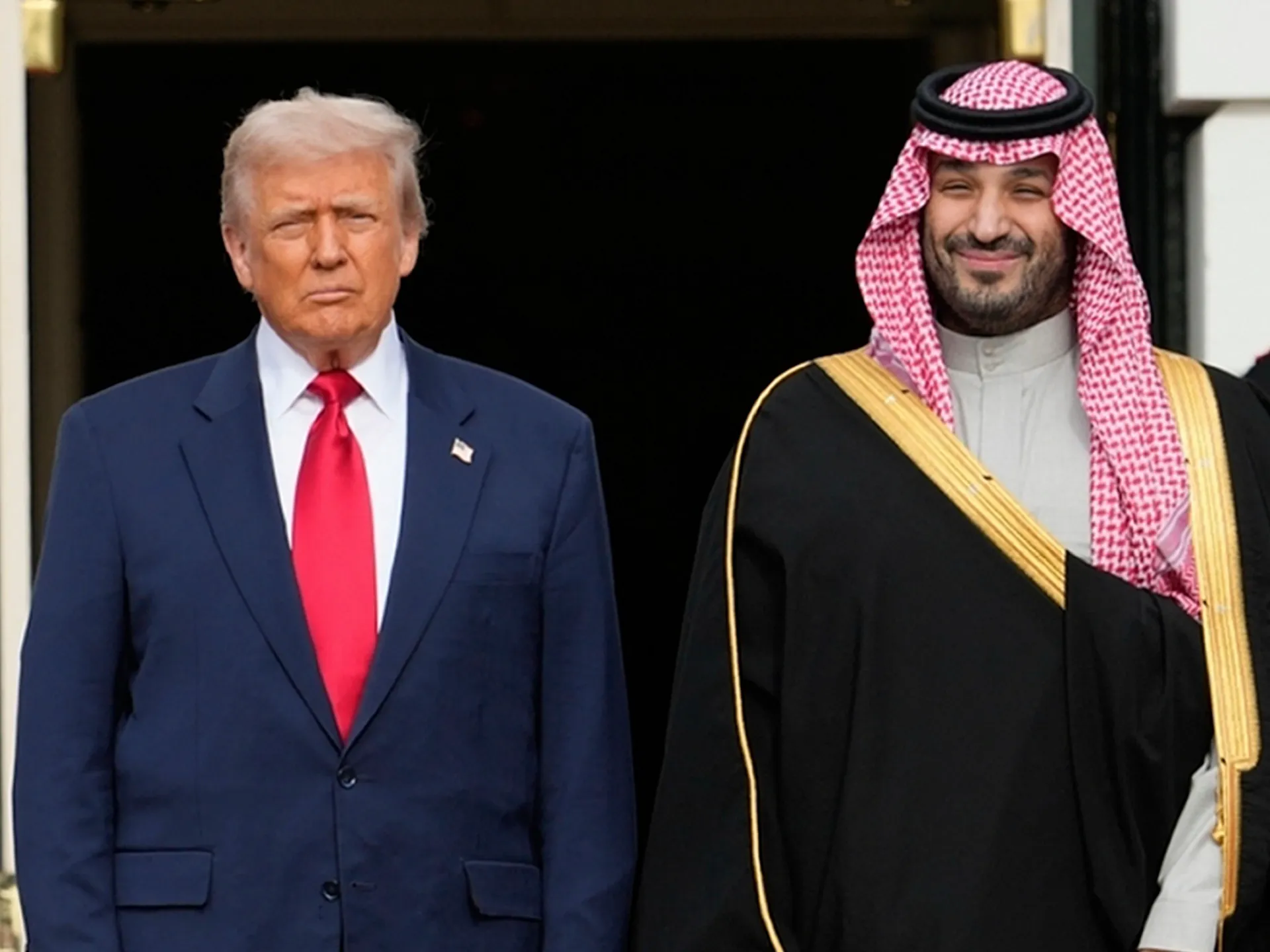
He said Saudi Arabia’s Crown Prince Mohammed bin Salman had also urged against the strikes, warning of possible unintended consequences.
“I mean, will they be flooded with people pouring into their country and disaster? A lot of bad things can happen,” Trump said.
Regional diplomacy intensifies
Trump’s announcement came hours after Iranian Minister of Foreign Affairs Abbas Araghchi held a second phone call with Saudi Foreign Minister Prince Faisal bin Farhan Al Saud, joined by Pakistani Army Commander Asim Munir, to discuss recent diplomatic efforts.
The officials exchanged views on the current situation and on “initiatives aimed at maintaining and strengthening security and stability” in West Asia, Araghchi said in a Telegram post. They also stressed the need to use regional cooperation and political solutions, he added.
Earlier on Sunday, Iran’s official news agency IRNA reported that negotiations between Tehran and Oman over the Strait of Hormuz were in their final stages, citing Araghchi.
Iranian Ministry of Foreign Affairs spokesperson Esmaeil Baghaei said the negotiations focused on agreeing to a new route through the strait, adding that this had “no link to the Strait of Hormuz being opened or closed. That is a separate discussion”.
The war began on February 28, when the US and Israel launched surprise strikes against Iran, although months of on-and-off diplomacy have led to periods of relative calm.
A previous ceasefire deal, which included the reopening of the Strait of Hormuz, a vital conduit for global energy supplies, fell through. Iran has since tightened its control over the waterway as the two countries resumed attacks against each other in recent weeks.
Oil prices fall as escalation fears ease
Oil prices dropped sharply in early trading after Trump abandoned plans for a new military operation against Iran, easing fears of further disruption to Gulf energy supplies.
Brent futures were down $4.08, or 4.64 percent, at $83.85 a barrel on Sunday. West Texas Intermediate lost $4.01, or 4.74 percent, to trade at $80.66, according to the Reuters news agency.
The decline reversed part of last month’s surge, when both benchmarks gained more than 20 percent as renewed US-Iran fighting and attacks on commercial vessels near Oman intensified concerns over shipping through the region.
Japan and the United States have confirmed a rare, coordinated yen-buying intervention to halt the Japanese currency’s slide to 40-year lows, with Tokyo signalling it is willing to take further action if needed.
The Japanese Ministry of Finance confirmed the joint intervention after a statement by US President Donald Trump on Sunday announced that Washington was helping to prop up the yen as a sign of friendship and to support the global economy.
“They have a weakening yen, and they wanted a little bit of help. And we’re always there for Japan,” Trump said in response to a reporter’s query about why the US is helping to support the currency.
The yen leapt after the announcement, leaving traders on high alert for further intervention from authorities. The Japanese currency gained as much as 1.4 percent to hit a nearly three-month high of 155.20 per US dollar, compounding a 3.8 percent surge over the previous two sessions. The yen also advanced broadly against other major currencies, including the euro and sterling.
The latest bout of aggressive yen-buying heavily pressured the US dollar. In early Asian trading on Monday, the euro climbed to a 1.5-month high of $1.1559, while sterling hovered near a two-week top at $1.3476.
However, the rapid appreciation of the currency immediately weighed on the equity market. The Nikkei share average tumbled, reversing course from the one-week high it had achieved in the previous session.
Analysts say the intervention underscores both countries’ resolve to prevent global spillovers from a sell-off in the yen and Japanese government bonds, including by adding pressure on already rising US Treasury yields.
Japan has been struggling to curb a relentless drop in its currency that has pushed up import prices and stoked broader inflation, hitting household wallets and Prime Minister Sanae Takaichi’s approval ratings.
In its statement, Japan’s Finance Ministry said Friday’s yen-buying intervention with the US Treasury Department “countered excessive volatility and disorderly movements in the Japanese yen in recent months”.
“The Japanese Ministry of Finance remains attentive and in close communication with our counterparts at the U.S. Treasury,” it added. “We will not hesitate to conduct further joint intervention.”
The joint intervention is the first since a 2011 coordinated action to weaken the yen after the devastating earthquake in eastern Japan.
Tokyo may have sold as much as $58.97bn to buy yen when it intervened in New York markets on Thursday, Bank of Japan data indicated, before Friday’s confirmed joint intervention with Washington.
US Treasury Secretary Scott Bessent also confirmed Friday’s effort, noting on Sunday that Washington “will not hesitate to participate in further joint intervention”.
“We strongly support Japan’s decisive market and monetary steps to correct the substantial undervaluation of the yen,” Bessent said in a separate statement on X, repeating his calls for further interest rate hikes by the Bank of Japan.
In line with Bessent’s repeated calls for higher Japanese interest rates, the Bank of Japan on Friday offered its most explicit signal to date of an early rate hike, even as it kept monetary policy steady.
In a sign of broader policy coordination, South Korea also stepped in to buy its won currency on Thursday.
Japan intervened in April and May, buying yen, but the move triggered only a brief rebound. The Bank of Japan’s June rate hike to a 31-year high of 1 percent also gave the struggling currency little lasting boost.
Aug. 2 (UPI) — President Donald Trump said Sunday night that negotiations with Iran toward ending the war will resume Monday, about a month after formal talks between the two unraveled and preceded a return to open conflict.
Speaking to reporters aboard Air Force One en route to Washington after spending a weekend at his Bedminster, N.J., golf club, Trump said talks with Iran will begin Monday afternoon, claiming, as he has repeatedly throughout the war, that Iran wants “to make a deal.”
“We’ll see if it’s true,” he said. “I’d love to do that. Save a lot of lives. Save a lot of unnecessary power, to be honest with you.”
Trump had called off what he advertised as a massive attack on Iran over the weekend, stating it was at the request of allies and Tehran, which he said had agreed to “the parameters of a deal.”
Aboard his plane, he identified Saudi Arabia, the United Arab Emirates and Qatar as the nations that had asked him to hold off.
“It would have been a massive attack. We were all set to go. But when the allies ask to call it off, you go to sort of say, ‘well, let’s see,'” he said. “And the reason they asked they think there’s a deal.”
Trump has long sought a deal with Iran to constrain its nuclear program, going back to his first administration when in 2018 he unilaterally pulled the United States from an Obama-era multinational accord in order to fashion a new one, and imposed sanctions on Tehran to force it to the negotiating table.
In late February, the United States and Israel attacked Iran with the aims of destroying its remaining nuclear capabilities and inciting regime change, instead igniting the five-month-long war, during which Tehran has laid military claims to the vital Strait of Hormuz.
An April cease-fire created conditions for a memorandum of understanding to be signed in mid-June that was to lay the foundation for ending the war. Amid negotiations on implementing the MOU, disagreements arose over its stance on the vital energy route, which led to a resumption in fighting last month.
Monday’s negotiations would be the first publicly acknowledged since early last month. Trump said the discussions will concern the Strait of Hormuz and led into nuclear talks.
He said that the three allies believe “a deal is imminent.”
Trump called off the attack after speaking with Saudi Crown Prince Mohammad bin Salman over the phone. Trump said Sunday that bin Salman warned him that the consequences of the attack would be unpredictable.
“I mean, will they be flooded with people pouring into their country,” he said. “A lot of bad things can happen.”
Trump said it would have been “the biggest attack since World War II” and “disastrous” for Iran.
The United States is seeking to restore freedom of navigation through the strait, while Iran is trying to maintain some form of control over commercial vessels that pass through it.
According to the nonpartisan, Washington-based Institute for the Study of War, Iranian negotiators may be willing to make what it called “limited compromises” with the United States over Tehran’s control of the strait, though what those concessions may be were not entirely clear.
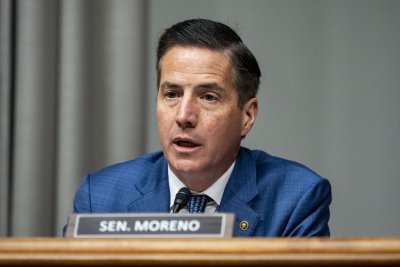
Aug. 2 (UPI) — Sen. Bernie Moreno on Sunday said his former son-in-law, Rep. Max Miller, should not be serving in the U.S. House of Representatives amid mounting allegations of domestic abuse made by Miller’s ex-wife.
Moreno, R-Ohio, broke his silence on the subject of Miller, R-Ohio., in a statement issued on social media in which he said his daughter Emily’s former husband “should not serve in the House of Representatives.
“I believe Max Miller needs to seek professional help to end the clear pattern of abuse he has left in his wake,” Moreno wrote. “I believe he should not be free to continue endangering others until he does.”
Miller, the Republican incumbent from a district in northeastern Ohio and a staunch ally of President Donald Trump, has been locked in a bitter custody battle with Emily Moreno over their 2-year-old daughter following the finalization of their divorce last year.
During their legal fight, Emily Moreno, a conservative policy adviser, has accused Miller of incidents of domestic violence such as scalding her with hot water and hitting and threatening her while they were married.
While those claims were previously known, they came back into the foreground last month when new court filings and police reports released by Mother Jones magazine detailed new information that their daughter had suffered a broken collarbone.
Miller has denied all of Emily Moreno’s allegations and on Sunday again pleaded his innocence and reiterated he would not withdraw as a GOP congressional candidate in the upcoming midterm election.
In a video posted on X, he blamed the “left-wing media” for his predicament and called his ex-wife a woman with “mental health challenges” while linking to a cache of documents he claimed refute all of her charges.
However, his former father-in-law — another vocal supporter of President Trump — nonetheless ended his strategy of avoiding comment on the situation, instead calling Miller unfit to hold office.
“As he has admitted privately, Max Miller needs serious psychological help,” Bernie Moreno said. “He is a danger to my daughter, and I hold my breath every minute he has custody of my granddaughter.”
The GOP senator asserted that “If there are any basic standards of character required to hold elected office, Max Miller fails them. He should not serve in the House of Representatives.
“I believe Max Miller needs to seek professional help to end the clear pattern of abuse he has left in his wake. I believe he should not be free to continue endangering others until he does.”
His remarks came after some Democratic House members called on the Ethics Committee to investigate Miller over what they called “deeply disturbing” reports of “domestic violence and child abuse.”
The deadline for Ohio Republicans to replace Miller on the November general election ballot is Wednesday, and his troubles are leading some Democratic strategists to view his seat as a possible political opportunity.
A 10-foot-tall golden trophy mocking US President Donald Trump for his ‘enthusiastic involvement in the Iran war’ appeared in New York’s Foley Square. The statue was created by anonymous art collective Secret Handshake.
Saudi Arabia’s crown prince spoke to Donald Trump about the deepening crisis between Washington and Tehran, urging a renewed push for dialogue over further military escalation, hours before the United States president halted his latest attacks on Iran.
The Saudi Press Agency (SPA) reported on Sunday that Crown Prince Mohammed bin Salman (MBS) spoke to Trump by phone and “stressed the need to prioritise dialogue to reduce escalation and the importance of making every possible effort to achieve calm that paves the way for diplomatic solutions”.
Recommended Stories
list of 3 itemsend of list
MBS also highlighted the need to preserve the Gulf’s security and stability and prevent a wider conflict “whose repercussions would affect regional and international security and stability”, SPA added.
Trump announced on his Truth Social platform early on Sunday that he would hold off on new strikes against Iran, citing the outline of a deal to end five months of war.
On Saturday, he had struck a very different note, declaring the US “locked and loaded and ready to go against the Islamic Republic of Iran”, at levels of force not seen “since World War II”.
The reversal capped a day of dramatic swings in tone from Washington, after weeks in which the conflict has repeatedly threatened to widen into a broader Gulf confrontation.
Trump said he was calling off the planned attack only because Iran and other Middle Eastern governments had asked Washington to hold back, insisting “the perimeters of a deal has been agreed to”.
That deal, he wrote, would involve reopening the Strait of Hormuz and ending Iran’s “nuclear threat,” with Israel joining the US “in this commitment”.
Iranian state media quoted military officials dismissing Trump’s claim that Tehran had sought a pause as “nothing but a new lie”, insisting Iranian forces remained on high alert.
‘Keep the dialogue going’
The Saudi crown prince’s intervention, according to a person familiar with the call cited by US media, centred on concern that a major US strike on Iran’s energy infrastructure could trigger Iranian retaliation against Gulf oil and gas facilities.
The kingdom has already faced direct attacks in recent weeks, intercepting drones aimed at its eastern oil facilities and at Riyadh, while Iran-aligned Houthi rebels in Yemen have separately struck Saudi crude infrastructure and threatened a Red Sea naval blockade.
The war began on February 28, when the US and Israel launched strikes aimed at destroying Iran’s missile programme, preventing a nuclear weapon and cutting off support for allied armed groups.
A June ceasefire collapsed within weeks in a dispute over shipping routes through the Strait of Hormuz, a waterway carrying roughly a fifth of the world’s oil and gas exports, reigniting the fighting in July.
US Secretary of State Marco Rubio said US strikes had destroyed much of Iran’s navy, air force and missile defences, leaving it without the “conventional shield” it once relied on. “That’s changed the whole dynamic,” he told Fox News, arguing that the US was now approaching negotiations with Iran “from a position of strength, not from a position of weakness.”
Marlin Hardinger, a professor at the University of Wisconsin-Eau Claire, said direct Saudi involvement in mediation, alongside Qatar, Pakistan and Oman, appeared to have pushed Trump to reconsider, “letting some of the senior leaders in the region step forward and take charge of this”, as he put it.
Diplomats’ central task now, Hardinger told Al Jazeera, was simply to “keep the dialogue going”.
Mediators in Islamabad and Doha say they are cautiously optimistic that stalled talks could resume within days.
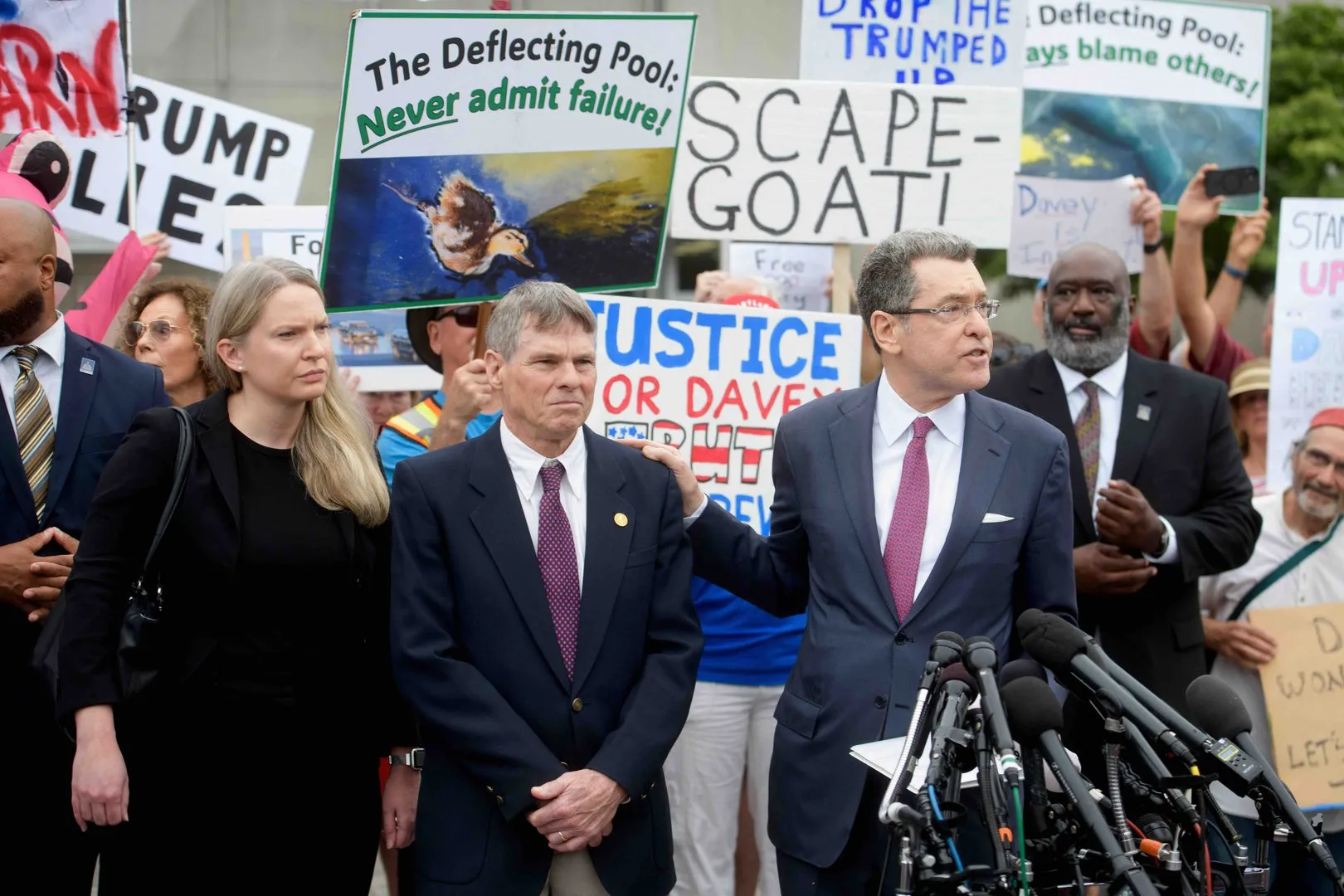
Olympic canoeist David Hearn departs the Moultrie Courthouse with his attorneys, Norm Eisen (not pictured) and Mary Dohrmann, after pleading not guilty to damaging the Lincoln Memorial Reflecting Pool in Washington, D.C., on July 9. Charges against Hearn were dropped Friday. Photo by Bonnie Cash/UPI | License Photo
Aug. 1 (UPI) — President Donald Trump has called out District Attorney Jeanine Pirro after her office moved to dismiss charges against an Olympic canoeist for vandalism.
Prosecutors on Friday made the motion to dismiss charges against David Hearn, 67, and admitted that the damage to the Lincoln Memorial Reflecting Pool was due to a “botched installation and not vandalism.” Hearn was indicted in early July for purposely ripping up a piece of the blue sealant from the bottom of the pool.
The filing in D.C Superior Court lists documents and evidence showing the contracting work was rushed to finish in time for the America 250 celebrations and was not done properly.
“I disagree 100% with Jeanine Pirro, the U.S. Attorney for the District of Columbia, on the Reflecting Pool,” Trump posted on Truth Social Saturday. “I don’t know what she was thinking? To me, it was a pure case of VANDALISM, that included the grass, which had a big 86 47 emblazoned in giant letters on it, and other elements of the surrounding area. There may have been some contractor difficulty, but the major damage was caused by VANDALS!”
Soon after, he posted again, saying, “Look for yourselves at the VANDALISM that took place at The Reflecting Pool. The material is being cut with a knife or a box cutter, for all to see!”
President Donald Trump announces a program to allow veterans to expedite a career in commercial trucking on Thursday. Known as the Freedom Haulers program, the initiative would allow any veterans who drove heavy equipment to be automatically eligible for a commercial trucking license. Photo by Jim Lo Scalzo/UPI | License Photo
A Pacific island has become one of the biggest economic success stories of the year so far.
Taiwan has witnessed a dramatic boom in recent months driven by the mania for artificial intelligence (AI). Earlier this year, its stock exchange soared to become the fifth largest in the world based on market capitalisation, the value of its publicly traded shares, overtaking the United Kingdom, Canada and India.
Recommended Stories
list of 3 itemsend of list
Much of that upward momentum has been driven by AI and other technology exports highly sought after by the United States.
Last year, the US imported $201bn worth of goods from Taiwan, nearly double its rate from 2024, when it acquired $116bn in imports. In May, Taiwan eclipsed China to become the third-largest source of US imports, after Mexico and Canada.
Experts have described Taiwan’s market acceleration as a return to its status as a “tiger economy” — a term used to capture surging growth in East Asia. Much of the credit, they say, falls to its flourishing technology sector.
“Artificial intelligence helps explain the rising importance of Taiwan,” said Chad Bown, a senior fellow at the Peterson Institute for International Economics.
But critics warn that, while Taiwan’s market remains strong, factors like tumultuous international relations, as well as demographic concerns, could complicate the island’s long-term outlook.
“It seems to be a win-win for now,” said Reza Hasmath, an academic faculty adviser at The China Institute at the University of Alberta. “But Taiwan is just postponing a reality that’s not sustainable.”
An economic boom
Taiwan’s thriving export market helped boost its gross domestic product (GDP) to 8.63 percent in 2025.
That rocket-ship trajectory continued into the first quarter of this year, when the GDP saw an exhilarating 13.69 percent rise.
Government data released on Friday showed that the island is continuing that momentum, with its economy growing an impressive 12.92 percent in the second quarter of the year, which ended in June.
“The GDP growth is going like gangbusters,” said Dexter Tiff Roberts, nonresident senior fellow at the Atlantic Council’s Global China Hub.
Roberts expects the trend to be “long term”, as Taiwan produces about 90 percent of the advanced chips used to power leading AI models.
“That’s not going to go away. We know the world, and the US, needs this,” he added.
While the AI boom is a global phenomenon, the US has become a major market for such chips, with billions of dollars flowing into the industry each year.
US President Donald Trump, meanwhile, has pledged to bolster his country’s status as “the world leader in artificial intelligence”. His administration has claimed to attract more than $2.7 trillion in tech and AI investments since the start of his second term.
To secure US access to Taiwan’s cutting-edge semiconductor technology, the Trump administration signed an agreement under which Taiwan will invest $500bn in the US.
Half of that amount is expected to come in the form of direct investments by Taiwanese semiconductor and tech firms, including through the development of onshore tech manufacturing.
The rest is largely comprised of credit guarantees for additional investments from Taiwan in the US.
Under the agreement, Taiwanese firms would be allowed to import 2.5 times the capacity of their US factories, without fear of steep tariffs.
In a subsequent trade agreement, Taiwan agreed to reduce its tariffs on 99 percent of US exports.
Taiwan has also boosted its tech exports to the US through investments in nearby Mexico, with cross-border plants manufacturing inputs for data centres in Texas.
‘Unbalanced relationship’
But Hasmath, the faculty adviser at the University of Alberta, warns that there are troubling signs on the horizon for Taiwan-US relations.
Trump has long sought to eliminate trade deficits with US economic allies, and he has lashed out at countries that export more to the US than they import.
Hasmath pointed out that Taiwan is building a robust trade surplus with the US, close to $200bn and counting. That could spark a backlash.
“This is an unbalanced relationship and not conducive to Taiwan in the long term,” Hasmath warned.
Trump will not tolerate a hefty trade surplus for long, he added. Hasmath believes the US president will soon look to renegotiate his country’s deals with Taipei.
Roberts at the Atlantic Council, meanwhile, warned that Trump is “mercurial” — and with such a temperament comes “uncertainty”.
Then there’s the question of political upheaval in the US. Trump’s approval ratings are low, and he is ineligible under US law to run for a third term as president.
Demographic problems
While Taiwan’s economic boom is “very real” and “very obvious”, Roberts said there are clear vulnerabilities even on the domestic front.
Taiwan’s traditional export sectors like plastics and textiles are underperforming. Plus, Roberts pointed out that only a small fraction of the Taiwanese population is involved in the AI sector.
“A majority of the younger population is not in hi tech, so that’s a real problem,” he said.
While the booming stock market has sparked a “wealth effect” — those with rising portfolios feel richer and are more inclined to spend — that helps the wider population only to an extent.
With most of Taiwan’s employment concentrated outside of the AI sector, economists have warned that the island could develop what’s called a K-shaped economy, where the wealthy see growth, while the poorer segments of society stagnate or decline.
The chip industry employs up to 350,000 people at most, experts say.
Meanwhile, TSMC, Taiwan’s biggest chip company, makes up to 40 percent of the stock market and provides four percent of the island’s GDP growth. That lopsided proportion is “unsustainable”, according to Hasmath.
Plus, Taiwan has a rapidly ageing population, with roughly a fifth of its population over the age of 65.
The island also has other vulnerabilities. For example, it relies heavily on foreign imports of energy products, particularly oil, and has struggled with water scarcity.
Then, there’s the superpower next door: China. The government in Beijing considers Taiwan, a self-governing island, as its own territory, and it has taken aggressive measures to limit the island’s ability to establish diplomatic relations of its own.
That conflict has added fuel to the debate around Taiwan’s growth, with a spokesperson for the Chinese government reportedly saying the island’s growing proximity to the US tech sector will “drain Taiwan’s economic interests” and “hollow out” the country’s major industry.
Hasmath said that, if the AI boom backfires on Taiwan, all of that ultimately adds up to a “recipe for electoral change, a shift in government” in Taipei.
Cyberattacks have hit water systems in seven states. Photo by Sascha Steinbach/EPA
Aug. 1 (UPI) — At least seven states have suffered cyberattacks on water systems as cities and states work to keep the water supplies safe.
There has been no indication that any water supply is unsafe to drink, the New York Times reported. Minnesota first reported a cyberattack and now Michigan has also reported attacks.
The Cybersecurity & Infrastructure Security Agency said in a release that it’s “observing a significant increase in cyber threat actors targeting programmable logic controllers in the Water and Wastewater Systems sector. CISA urges critical infrastructure owners, operators, and integrators to remove publicly exposed PLCs and other operational technology from the Internet as soon as possible. Threat actors targeting exposed PLCs have modified passwords to lock out operators and disconnected the PLCs by changing their IP addresses. This activity has resulted in boil-water notices and sustained manual operations.”
Officials told The Times that Iran has increased cyberattacks on American systems, but that the water attacks haven’t been definitively declared to have come from Iran. But Iran has targeted water systems in the United States in the past. Because there’s no financial motive, an attack by hacking criminals is less likely, The Times said.
Michigan had “a small number of reports from Michigan communities indicating activity consistent with what federal agencies described,” Dale George, director of communications for Michigan’s Department of Environment, Great Lakes and Energy, told CBS News.
“All systems continued to operate safely, issues were addressed by local operators, and there are no known impacts that posed a public health concern,” George added.
CBS reported that more than 30 community water systems in Minnesota were affected.
On Friday, President Donald Trump blamed Minnesota and Gov. Tim Walz for the attacks.
“I think that Minnesota is behind it,” Trump said during a televised Cabinet meeting at Camp David. “You know who’s behind it? Minnesota. Because they’re grossly incompetent. I think the governor’s behind it. I don’t think there was an Iranian cyberattack. I think that Minnesota ought to get its act together.”
“They like to say, ‘Oh, it was Iran.’ Iran should be so lucky. Iran’s got bigger problems than worrying about Minnesota,” the president said.
“DOGE took an ax to CISA and left the U.S. exposed to cyber attacks. Thankfully, our experts in Minnesota were able to identify the vulnerability quickly and work with local communities to stop it,” Walz said.
Braham, Minn., Mayor Nate George said federal and local officials don’t doubt the source.
“We’re getting bits and pieces of information from the state of Minnesota and the FBI,” George told The Times. “They are pretty sure it’s Iranian actors” but are reluctant to say so publicly.
President Donald Trump announces a program to allow veterans to expedite a career in commercial trucking on Thursday. Known as the Freedom Haulers program, the initiative would allow any veterans who drove heavy equipment to be automatically eligible for a commercial trucking license. Photo by Jim Lo Scalzo/UPI | License Photo
No culprit has been identified in any of the attacks, which comes after authorities warned of a possible Iranian plot.
Published On 1 Aug 20261 Aug 2026
Michigan has reported cyberattacks on nine of its water systems, days after Minnesota reported similar breaches across the state.
The United States Federal Bureau of Investigation (FBI) said it was investigating both of the attacks on Saturday. In an advisory earlier this week, it said that at least seven states have reported incidents, but so far only Minnesota and Michigan have been identified.
Recommended Stories
list of 3 itemsend of list
No culprit has yet been pinpointed. However, the breaches came after the FBI, Cybersecurity and Infrastructure Security Agency (CISA) and other agencies warned in an advisory last week that Iranian hackers have been targeting water and wastewater systems and the operational controls of other critical infrastructure sectors.
“The FBI is aware of recent public reporting around Water and Wastewater (WWS) sectors,” the agency said in a statement on Saturday. “The FBI and our interagency partners are fully engaged to protect critical infrastructure, and we remain well-equipped to protect against cyber threats of all varieties.”
Dale George, the director of communications for Michigan’s Department of Environment, Great Lakes and Energy, meanwhile, said that “all systems continued to operate safely” following the attacks.
He said Michigan received a federal cyber alert on Tuesday about attempts to tamper with operational technology in water systems.
Soon after, the state received “a small number of reports from Michigan communities indicating activity consistent with what federal agencies described”, said George.
Minnesota had earlier in the week reported attacks on 30 sites. Minnesota IT Services, the state information technology agency, said most of the confirmed attacks involved technology that water systems use to remotely monitor and control equipment.
The agency has said that impacted systems did not necessarily equate to water disruptions, noting that as of Thursday, there were no active requests for residents to modify their water usage. Some modifications had been requested earlier in the week.
Local water plants are generally more vulnerable than other infrastructure because they are more likely to have out-of-date cybersecurity. Federal law enforcement has previously indicted Iranian hackers for allegedly targeting water infrastructure.
Throughout the war, US President Donald Trump has repeatedly threatened to attack civilian infrastructure in Iran, including power and water desalination plants.
When asked about the Minnesota attacks on Friday, Trump instead pivoted to criticise the Democrat-led state government in Minnesota.
“I think Minnesota is behind it,” Trump said, without providing further evidence or clarification. “I don’t think there was an Iranian cyberattack.”
Minnesota Governor Tim Walz, meanwhile, indicated his belief that Iran was behind the attack. He further blamed Trump’s cuts to federal government employees for making the US more vulnerable to cyberattacks.
“Trump knows exactly who is responsible for this attack, and knows that other states were hit too,” Walz said.
Aug. 1 (UPI) — President Donald Trump on Saturday said he would push to codify into law his controversial $1.776 billion anti-weaponization fund if two senators continue to block the confirmation of his nominee for attorney general.
Sens. John Cornyn, R-Texas, and Thom Tillis, R-N.C., have opposed the confirmation of Acting Attorney General Todd Blanche for a permanent role in opposition to the fund.
Speaking to reporters at Camp David on Friday, Trump had admitted the fund was “dead” — but flip flopped in a statement the following day.
“If Senators Cornyn and Tillis, both upset because I wouldn’t Endorse them (they lost, and quit, respectively!), aren’t going to approve Todd Blanche, one of the most respected professionals, according to everybody, in the Country, to be the United States Attorney General, then I will keep Todd as Acting A.G., and push hard to get the Anti-Weaponization Bill, which takes care of those who have been so badly treated by the Crooked Joe Biden (and Obuma!) Administration (I get nothing, although I was treated horribly!), PASSED,” Trump said in a statement on Truth Social.
“Todd Blanche was a voice of reason!” he added. “It will immediately be back on the table, and I will get it done.”
The fund comes from a settlement, negotiated between Trump’s private attorneys and his Department of Justice, that would compensate people who feel they were unfairly targeted by the government, including Jan. 6 rioters.
The settlement would also include a provision that would shield Trump and businesses from IRS audits.
Blanche has said, at times, the anti-weaponization fund would not be moving forward.
But Cornyn and Tillis have asked Blanche for written assurances from the DOJ that the fund was gone for good, which he has failed to produce.
“Despite comments as late as yesterday that the fund is dead, President Trump clearly intends to resurrect the payout pot for punks either by inappropriately establishing another bogus fund or pushing Congress to vote for a bill that the majority of Republicans in the Senate would be against,” Tillis said in a statement on X.
“It’s unfortunate that Todd Blanche, who I consider qualified for the job, will not be confirmed because of this reversal,” the senator added. “Hopefully, we can resolve this by Tuesday.”
United States President Donald Trump has criticised his own Department of Justice after it decided to drop criminal charges against a former Olympic athlete for the alleged vandalism of the Lincoln Memorial Reflecting Pool in Washington, DC.
Trump voiced his opposition to the decision on Saturday, a day after US Attorney Jeanine Pirro announced she was dismissing the charges against 67-year-old competitive canoeist David Hearn.
Recommended Stories
list of 3 itemsend of list
Pirro said the damage was the result of “a botched installation and not vandalism”, contradicting both her own previous statements and claims made following Hearn’s June 19 arrest.
On Saturday, Trump wrote on his Truth Social page that he disagreed “100 percent” with Pirro, although he did not directly reference Hearn. Instead, he maintained that vandalism had been committed at the Reflecting Pool.
“To me, it was a pure case of VANDALISM,” Trump wrote. “There may have been some contractor difficulty, but the major damage was caused by VANDALS!”
He followed his statement by posting a video showing an individual, though not Hearn, sticking a hand into the Reflecting Pool.
He also shared a photo of the numbers “86 47” etched into the lawn of the nearby National Mall, which has been interpreted as a call to “86” — or “nix” — the 47th president by removing him from his office.
There is no evidence that the numbers on the lawn are related to the Reflecting Pool, which has become a major political flashpoint for Trump.
Through a series of controversial renovation projects, Trump has sought to physically transform Washington, DC, including by resurfacing the pool.
He initially used the pool’s condition and previous renovation projects to criticise past presidents.
But his own attempt to fix the Reflecting Pool instantly attracted scrutiny, particularly after Trump hand-picked a company he had previously used in a private capacity.
It had never before received a government contract, and the multimillion-dollar deal was awarded without a competitive bidding process, as is standard.
Upon the renovation’s completion, problems soon emerged. The Reflecting Pool’s new lining quickly appeared to peel, and algae blooms sprouted in early June.
Trump repeatedly blamed the situation on “vandals”. The announcement of at least seven arrests connected to the pool sparked accusations of political scapegoating.
Hearn, who represented the US three times at the Olympics, emerged as the most high-profile case.
The athlete said he was bicycling past the Reflecting Pool when he stopped, reached in and felt the peeling sealant. He has denied committing any vandalism, with his lawyers calling his arrest an attempt to distract from the shoddy renovation work.
Pirro, a former Fox News host and Trump loyalist, had initially accused Hearn of “forcefully and violently” ripping the pool’s liner, decrying his actions as “an affront to the dignity of our shared history”.
In their court filings, federal prosecutors alleged that the damage Hearn caused exceeded $1,000, justifying federal charges.
They further claimed that all of the damage done to the Reflecting Pool had been caused by vandals.
Pirro struck a far different tone in her filing on Friday. She claimed she had received new information, leading her to dramatically pivot.
“It was not until after the return of the indictment, that the [Department of Interior] provided additional documents to the [US Attorney’s Office for Washington, DC] indicating that damage to the Lincoln Memorial Reflecting Pool in June 2026 was the result of flawed installation by the contractor,” Pirro wrote.
The Department of the Interior’s documents, she continued, showed “that the damage was the result of a botched installation and not vandalism”.
Pirro further blamed the damage on pressure to finish the project by July 4, a date that coincides with US Independence Day and the country’s 250th anniversary.
“The rush to complete the project led to hasty and botched work that was not remediated before the project was finished and the fencing removed,” Pirro wrote.
July 31 (UPI) — The United States military is preparing to launch a fresh wave of airstrikes on Iran as early as this weekend, unnamed sources told several news outlets Friday.
Sources told CBS News the attacks are likely to target energy infrastructure, but President Donald Trump is yet to give the final order to begin the assault.
The Israeli military might also be included in attacking Iran for the first time in weeks, Axios reported.
“We will be hitting them very hard,” Trump told reporters at Camp David on Friday. “At some point, they’re going to say, ‘We just can’t take it anymore.'”
Striking civilian infrastructure is a war crime under international humanitarian law.
Israeli Defense Minister Israel Katz on Tuesday said, “We very much want to strike Iran’s energy targets.”
“The United States is not approving it at the moment because of the concern that Iran would attack neighboring countries, causing a global oil crisis,” he told the country’s Channel 14, as reported by The Times of Israel.
“As far as we’re concerned, we’re prepared to set [Iran] back 40 years,” Katz added.
Pentagon spokesperson Sean Parnell would not comment on specific targets before the strikes.
“The Department of War is locked and loaded, ready to execute the President’s directives at a moment’s notice,” Parnell said in a statement to CBS News.
One senior Iranian official was quoted as saying attacks against infrastructure are a form of “madness” and the country was prepared to retaliate, Al-Jazeera reported.
The official added Iran’s response would include “the vital infrastructure of the Zionist regime and the energy infrastructure of the US in the region.”
United States President Donald Trump has been triumphal since the announcement that Palestinian group Hamas had agreed to hand over its weaponry in Gaza.
But the terms of Thursday’s disarmament agreement also stipulate that Israel should withdraw from the Palestinian enclave, and gradually transfer power to a Palestinian administration – conditions that have been met with a frosty reception by Israeli politicians and in the Israeli press.
Recommended Stories
list of 4 itemsend of list
The Israeli government has yet to officially comment, but one unnamed senior Israeli official told reporters on Friday that, despite “various publications” reporting “diplomatic progress in the Gaza Strip”, there would be no withdrawal from Israel’s current positions within Gaza before what it determines to be “the genuine disarmament of Hamas”.
Trump, for his part, has said that Israel was “very happy” with the deal.
Electoral suicide
Many Israelis continue to espouse a hard line towards Palestinians in Gaza after the October 7, 2023, Hamas-led attack on Israel, which was launched from the territory. That is despite Israel subsequently conducting a genocidal war on Gaza, killing more than 73,000 Palestinians and destroying the enclave.
A May poll found that 82 percent of Jewish Israeli respondents supported the forcible expulsion of Palestinians from their homes in Gaza – the same poll found that 56 percent of respondents supported the expulsion of Palestinian citizens of Israel from their homes too.
Another poll, a month later, found that 64 percent of those surveyed believed there were “no innocents” among the Palestinians in Gaza.
And many Israeli politicians – including government ministers – have said that illegal Jewish settlements, akin to the ones dividing the occupied West Bank, will soon come to Gaza.
The prospect, therefore, of an Israeli withdrawal from Gaza and steps towards the enclave’s reconstruction are unpalatable to many Israelis, with politicians quick to condemn the disarmament agreement.
Israel’s far-right National Security Minister Itamar Ben-Gvir denounced it as “unacceptable”.
“A commitment to stop the assassinations of [Hamas’s] murderers is tantamount to agreeing to Hamas organising for the next massacre,” Ben-Gvir wrote on social media. “The assassinations in Gaza must continue, the encouragement of emigration must happen. Israel must win.”
The term “encouragement of emigration” is widely regarded as referring to ethnic cleansing.
Politicians regarded as centrists, such as former chief of staff and Prime Minister Benjamin Netanyahu’s leading rival in the coming election, Gadi Eisenkot, were equally sceptical. He said that any deal that stopped short of the war’s objectives – the destruction of Hamas’s military-political power – was a total failure.
“Nearly three years have passed since the morning of October 7,” Eisenkot wrote, “and Hamas has renewed its strength with a number of terrorists similar to the evening of October 6.”
Politics of peace
Netanyahu has yet to comment, but US-Israeli pollster and consultant Dahlia Scheindlin suggested the stakes are high for the prime minister with an election only a few months away.
Netanyahu’s likely best chance of avoiding a jail sentence if he is found guilty of numerous corruption charges rests on him winning the October elections.
But the opposition are currently leading in many polls, and may be able to gain enough seats to form a government.
Former Israeli chief of staff and Netanyahu rival Gadi Eisenkot has called any agreement that stops short of Hamas’s destruction a ‘total failure’ [File: Clodagh Kilcoyne/Reuters]
“Netanyahu’s considerations have nothing to do with public trauma [from the October 7 attack],” Scheindlin said, and everything to do with politics. “He will care primarily – probably exclusively – about what his current coalition partners think.”
Withdrawing from Gaza was out of the question, Scheindlin said, adding that whatever gambit Netanyahu undertook to maintain his coalition and encourage right-wing voters to support him had to be accomplished without further alienating his allies in the US, who appear to have grown increasingly frustrated with him.
“[Netanyahu] will not want to be seen by Trump and the Americans as undermining any possible moves towards implementing this agreement. And so, therefore, he might manage some very symbolic moving of the Israeli army within Gaza,” she said.
One tactic, Scheindlin suggested, could be for the Israeli military to withdraw back to the positions it was supposed to be in as part of the October 2025 ceasefire agreement. Israel has killed more than 1,200 Palestinians since that agreement, and also repeatedly expanded the territory under its control, ignoring the deal.
Keeping Trump happy
Managing US expectations of Israel is likely to be a problem, not just for Netanyahu, but for all of the politicians vying for leadership of the country.
One anonymous US official has already said that Trump would be “very, very disappointed” if Israel did not adhere to the disarmament agreement.
“Netanyahu already faces an uphill battle in forming any government, more so if he agrees to this,” said Dov Waxman, professor of Israel studies at the University of California, Los Angeles.
Israeli Prime Minister Benjamin Netanyahu arrives at the White House in Washington earlier this week [Elizabeth Frantz/Reuters]
Netanyahu has previously been able to sidestep requirements placed on Israel when it comes to Gaza, maintaining unity within his far-right coalition, with some members repeatedly threatening to bring the government down if the war ended without Hamas’s total defeat.
He may be silent on the latest deal for now, but he will eventually have to speak.
“That could be a real problem,” Waxman said, “because, if he criticises the deal, he risks angering Trump who – though he hasn’t endorsed him [in the Israeli election] yet – he must be hoping will deliver him some kind of present during the election cycle, whether that’s a further call for his pardon or normalisation with Saudi Arabia, maybe both. But he has to keep Trump on his side.”
And while the Israeli public has grown sceptical that Israeli security remains at the forefront of the Trump administration’s priorities, the need for the US security umbrella is accepted by the vast majority of the public and political establishment, elements of which have seized upon any potential fracturing in it as a means to criticise Netanyahu.
“Netanyahu has shown himself to be very good in the past at handling these kinds of things,” Nimrod Goren, president and founder of Mitvim – The Israeli Institute for Regional Foreign Policies, said.
“He’ll make sure Trump gets his announcement, his signing ceremony and all the optics are in place, but I don’t see him withdrawing from Gaza,” Goren said.
“I think the idea of him withdrawing goes further than just public opinion,” the Israeli analyst added. “It goes against his whole philosophy, ideology and worldview: that Israel needs to be present beyond its borders and everywhere bad intentions could be turned into action. If anything, I see him escalating in the build-up to the election rather than discussing withdrawal.”
The US Department of Justice has moved to dismiss its case against Olympian David Hearn over damage to the Reflecting Pool in Washington DC. The DOJ says new evidence points to flawed installation by the contractor, not vandalism.
President Donald Trump claimed the Lincoln Memorial Reflecting Pool, which cost nearly $15 million to renovate, had been damaged by vandals.
But in a court filing Friday evening, U.S. Attorney Jeanine Pirro said the damage was caused by a “botched installation.” Photo by Jemal Countess/UPI. | License Photo
July 31 (UPI) — Trump administration prosecutors on Friday moved to dismiss the felony case against U.S. Olympian David Hearn, admitting that damage to the Lincoln Memorial Reflecting Pool was due to a “botched installation and not vandalism.”
Hearn, 67, was indicted by a federal grand jury early July on accusations that he purposefully ripped up a piece of the recently-installed blue sealant from the pool’s bottom.
President Donald Trump claimed the pool, which cost nearly $15 million to renovate, had been damaged by Hearn and other vandals.
But in a court filing Friday evening, U.S. Attorney Jeanine Pirro said she had been misled by the Interior Department into believing “nearly all of the damage” was done by vandals.
In charging Hearn, Pirro had said she had “tremendous evidence” that he committed a felony that could have landed him in prison for 10 years.
“Given all of this newly discovered information, it is difficult to attribute the widespread damage to the Reflecting Pool to vandalism,” Pirro wrote in court papers, The New York Times reported.
Pirro added the “botched” renovation “was the result of a flawed installation by the contractor, Atlantic Industrial Coatings, and the rush to complete the project prior to events associated with the America 250 celebration.”
In a statement, Hearn’s attorneys said, “The Trump administration’s case against Davey Hearn should have never been brought.”
“Its dismissal today does not erase the abuse of government power in arresting and charging a patriotic American who did nothing wrong,” the attorneys added. “The government’s approach was ready, fire, aim.
The administration of United States President Donald Trump has moved to drop a criminal charge against former Olympic athlete David Hearn, in a remarkable about-face.
In a motion filed on Friday afternoon, US Attorney Jeanine Pirro acknowledged that the accusations levelled against Hearn — blaming him for vandalising the Lincoln Memorial Reflecting Pool — did not appear to be substantiated.
Recommended Stories
list of 3 itemsend of list
“The damage was the result of a botched installation and not vandalism, as initially represented by [the Department of the Interior],” Pirro wrote.
Earlier this month, the prosecutor had accused Hearn, an Olympic canoeist, of “forcefully and violently” ripping the newly installed liner of the Reflecting Pool, part of a renovation project Trump had championed.
She described his actions as “an affront to the dignity of our shared history” and warned that Hearn could face up to 10 years in prison for the destruction of government property.
But in Friday’s court filings, a different narrative emerged.
Pirro repeatedly emphasised she did not receive the new information until after the criminal indictment against Hearn had been returned. She blamed, in part, the “barebones police reports” her office had received.
“It was not until after the return of the indictment, that the DOI provided additional documents to the [US Attorney’s Office for Washington, DC] indicating that damage to the Lincoln Memorial Reflecting Pool in June 2026 was the result of flawed installation by the contractor,” Pirro wrote.
She added that the pressure to finish the Reflecting Pool renovation project before the Independence Day holiday — marking the 250th anniversary of the US — contributed to the renovation’s failure. Trump had planned several events for the occasion.
“The rush to complete the project led to hasty and botched work that was not remediated before the project was finished and the fencing removed,” Pirro explained, citing delayed installation work, inclement weather and repeated testing failures.
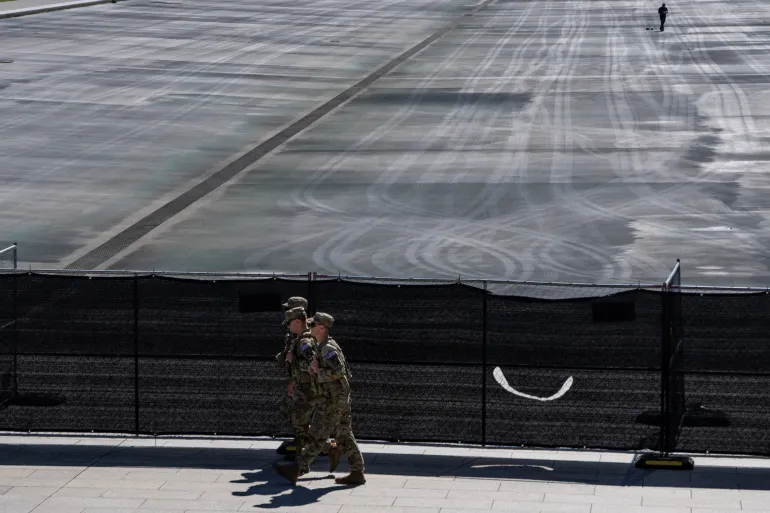
Members of the National Guard walk past the drained Lincoln Memorial Reflecting Pool on July 30 [Nathan Howard/Reuters]
Reshaping Washington, DC
The Reflecting Pool project is one of several changes to the landscape of Washington, DC, that Trump has pursued during his second term in office.
In seeking to leave his mark on the US capital, the Republican leader has torn down the East Wing of the White House, gilded statues with a fresh coat of gold leaf, and proposed to build a large triumphal arch on the road to the Arlington National Cemetery.
Just this week, he unveiled a $22.5bn project to revamp the Dulles international airport, the main air terminal for the capital region.
Several of his public works projects have been challenged in court, including an attempt to affix his name to the John F Kennedy Center for the Performing Arts.
The Reflecting Pool renovation was among Trump’s most controversial.
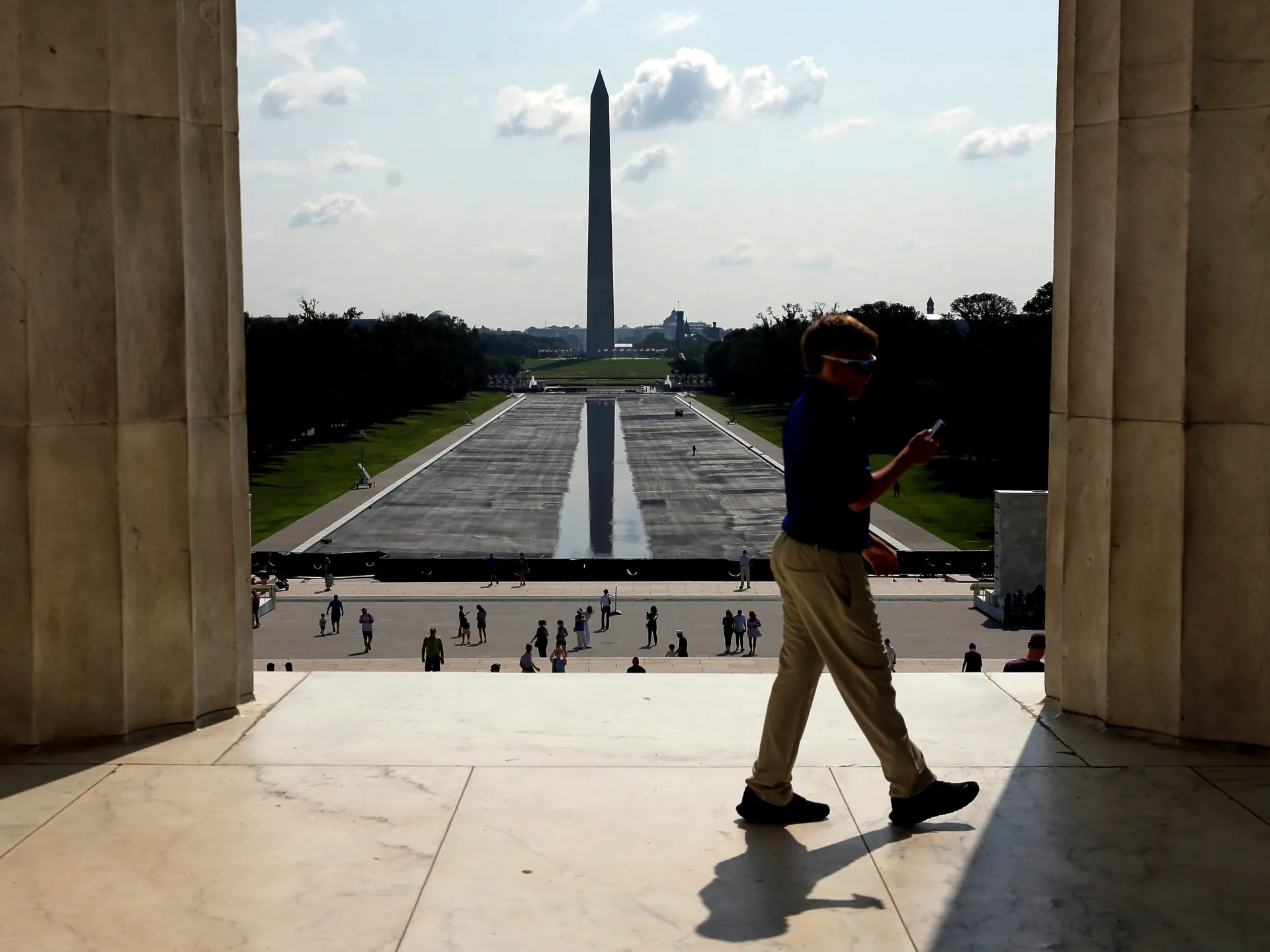
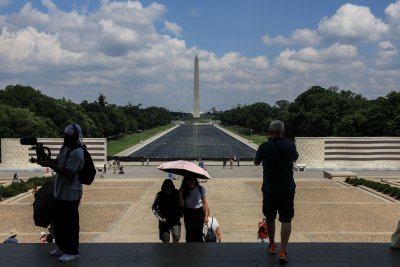
The 618-metre (2,028-foot) pool has served as the backdrop for many iconic moments in US history, including the 1963 March on Washington, when civil rights leader Martin Luther King Jr delivered his “I Have a Dream” speech.
It sits between the Washington Monument, a large obelisk, and the Lincoln Memorial, two popular tourist sites mere blocks from the White House. But the pool had long struggled with leaks along its granite edge and concrete bottom.
In April, Trump abruptly announced he would address the problem by resurfacing the Reflecting Pool’s bottom with swimming pool coating in a shade of “American Flag Blue”.
The project, he added, would be finished “long before July 4” and at relatively little cost to the government.
By early June, Trump had announced the project was complete. But within days, a thick layer of green algae appeared on the surface of the pool, and the blue coating appeared cracked, with sheets of paint flapping in the water.
The project also attracted criticism for how the government contract for the renovations was awarded.
The Trump administration granted a $13.1m contract to Atlantic Industrial Coatings, a company he claimed to have worked with as a real estate developer, led by one of his donors. The deal was struck without taking competitive bids, as is standard, on the basis that the renovation was necessary immediately.
Within two days of the site’s final inspection, on June 11, a National Park Service engineer observed that the Reflecting Pool’s new lining had begun to peel, according to Pirro.
Citing the engineer’s report, Pirro wrote that the damage to the pool appeared to have been caused by “over spraying and delamination”.
US Attorney for the District of Columbia Jeanine Pirro announces charges against Olympic athlete David Hearn on July 2 [Anna Moneymaker/Getty Images via AFP]
Accusations of vandalism
But Trump had aggressively pushed accusations that the algae and tears in the Reflecting Pool’s new bottom had been the result of vandalism.
“We caught some people vandalising our beautiful Reflecting Pool,” Trump said at a news conference in June. “They took a cutter, a box cutter, or something very sharp. Can you imagine? Where do these people come up with this? And they threw a little fertiliser in the water.”
Separately, he suggested those responsible should face “years in jail” for their alleged crimes.
Hearn, a three-time Olympian representing the US, has said he was among the members of the public drawn to the hullabaloo surrounding the Reflecting Pool’s controversial renovation.
In media interviews, he admitted he bicycled past the pool, reached in and felt the peeling sealant, out of curiosity. He has adamantly denied, however, damaging any property.
Hearn was among at least seven people arrested or cited over alleged damage to the Reflecting Pool. His indictment was announced at a news conference held by Pirro on July 2.
Friday’s motion to dismiss arrived just four weeks later. In it, Pirro acknowledged the peeling was not caused by vandalism.
She wrote that the revelation came around July 17, when her office inspected the Reflecting Pool site, which had once again been drained for repairs.
“It was at that time that [the US Attorney’s Office] first became aware of the significant damage throughout the pool and accordingly requested all documents from [the Department of the Interior] concerning how the pool was lined,” Pirro said.
Her office received “695 megabytes of additional documents” in return, revealing “a rushed and flawed installation process”.
Since indicting Hearn, Pirro’s office has faced questions about whether it was pursuing justice — or simply doing Trump’s political bidding, as he seeks to save face after the botched renovation.
The withdrawn indictment also comes as courts have repeatedly pressed the Department of Justice about prosecutions that appear to be hastily submitted and lacking in evidence.
“ Did you ultimately decide to charge this so harshly at the president’s direction?” one reporter asked Pirro at the outset of Hearn’s case.
“I didn’t charge anything harshly. I charge according to the evidence,” she replied at the time.
In a statement, Hearn’s legal team called the case an “abuse of government power”. They added that the Trump administration owes their client an apology.
Washington, DC – A Senate committee hearing this week has once again shone a spotlight on the political divisions over the United States government’s response to the COVID-19 pandemic.
Wednesday’s hearing, held by the Senate Homeland Security and Governmental Affairs Committee, continued years of criticism, mainly from Republicans, against immunologist Anthony Fauci, who led the government’s response to the pandemic.
Recommended Stories
list of 3 itemsend of list
Spearheaded by committee chair Rand Paul, several Republicans rehashed claims that the virus that causes COVID-19, SARS-CoV-2, emerged from an infectious disease lab in Wuhan, China, and did not naturally transfer from animals to humans.
Stephen Morrison, the director of the Global Health Policy Center at the Center for Strategic and International Studies, said the hearing was a reflection of the deep, enduring partisan divides over the issue.
But he added that the meeting with Fauci did little to shed new light on the pandemic after years of investigation, hearings and political posturing.
“There’s no space for any civil discussion around any of these issues. There’s no desire really,” Morrison told Al Jazeera.
“So, what’s the lasting impact of this? I mean, it continues to impose unconscionable pain and suffering on [Fauci] and his family. It doesn’t advance the debate one inch on the whole question of COVID origins and what was past US policy and what should US policy be going forward.”
Wuhan lab leak theory
Wednesday’s hearing was based largely on a previous 520-page report from 2024, created by the Republican-led Select Subcommittee on the Coronavirus Pandemic.
That report claimed it was likely that SARS-CoV-2 emerged from the Wuhan Institute of Virology, a Chinese research facility. Senator Paul has embraced this viewpoint, as has President Donald Trump.
In April of last year, shortly after Trump took office for his second term, the White House launched a webpage purporting to reveal “the true origins of COVID-19”, largely based on the report.
The site highlighted several claims that experts say pave over the nuanced scientific debate about the origins of the virus.
Drawing on the 2024 report, the White House asserts that SARS-CoV-2 “possesses a biological characteristic that is not found in nature” and that “data shows that all COVID-19 cases stem from a single introduction into humans”, setting it apart from previous natural pandemics.
Joel Wertheim, a professor of medicine at the University of California San Diego, told Factcheck.org that both claims were false.
Senator Rand Paul questions Anthony Fauci during a Senate Homeland Security and Governmental Affairs Committee hearing on Capitol Hill in Washington, DC, on Wednesday [AFP]
While COVID does contain a characteristic to enter cells that is not found in its closest coronavirus relatives, that quality does exist in other coronaviruses more broadly. As Wertheim put it, “It is most certainly found in nature.”
Meanwhile, a pair of studies released in 2022 found at least two unique paths through which initial human infection occurred, contradicting the White House’s claim that the pandemic arose from a “single introduction into humans”.
The White House webpage also focuses on Fauci, who led the National Institute of Allergy and Infectious Diseases (NIAID) until 2022 and served as the chief medical adviser to former US President Joe Biden, Trump’s election rival.
Biden pre-emptively pardoned him in January 2025, fearing the physician might be arrested under the second Trump administration.
Ahead of Wednesday’s hearing, Trump took the opportunity to renew his derision of Fauci, writing on Truth Social that the medical expert’s “ideas were CRAZY”.
Trump also accused Fauci, without evidence, of orchestrating a cover-up for China, where COVID was first documented. The Republican leader was serving his first term as president when the pandemic began.
Ongoing debate
To be sure, there has been criticism from within the international scientific community that the lab leak theory was discounted too swiftly in the early days of the pandemic, as it became seen as political.
Trump and other world leaders had been quick to use anti-China rhetoric when discussing the virus.
There currently remains no conclusive evidence proving either the lab leak theory or that the virus had a natural origin. The vast majority of infectious disease scientists, including Fauci, have said neither possibility can be ruled out.
Still, a preponderance of experts say evidence indicates that the virus was most likely transferred from an animal, likely a bat, to humans, in a process called zoonotic spillover.
A 2024 survey of virologists and other scientists, conducted by the Global Catastrophic Risk Institute (GCRI), found most respondents believed natural transmission was considerably more likely than a lab leak, although most acknowledged it was impossible to definitively dismiss the theory.
Following three years of research, a World Health Organization (WHO) advisory board released a report in 2025 that also concluded “the weight of available evidence … suggests zoonotic spillover”.
Still, WHO director Tedros Adhanom Ghebreyesus cautioned, “As things stand, all hypotheses must remain on the table, including zoonotic spillover and lab leak.”
Inside Fauci’s diary
Fauci has long argued the scientific evidence indicates that the virus emerged from natural animal transmission, but he has repeatedly rejected the notion that he has outright dismissed the lab leak theory.
In a 2024 letter to the House Subcommittee on the Coronavirus Pandemic, his lawyers maintained (PDF) it was “completely wrong” to say that Fauci had ever called the possibility a “conspiracy theory”.
Instead, they said Fauci and his allies rejected an array of conspiracy theories that have been tied to the lab leak theory, including the idea that he had “sneaked unnoticed into the CIA headquarters to try to convince CIA officials to debunk the lab leak theory”.
Wednesday’s hearing was preceded by the release of entries from Fauci’s private diary, stored on a government computer drive.
They were obtained through Health and Human Services Secretary Robert F Kennedy Jr, a vaccine sceptic and Fauci critic, who passed them along to Senator Paul.
In one entry, Fauci described a claim that he “deliberately” worked with the Chinese to create the virus as a “way-out conspiracy theory”.
He and his legal team have also repeatedly rejected Republican claims that he leveraged millions in grant money to compel scientists to change their views about COVID’s origins.
The White House website, for instance, asserts that Fauci “prompted” an early study on COVID origins to downplay the lab leak theory. No evidence has been presented to support those claims, which have also been rejected by the scientists involved.
Anthony Fauci, director of the National Institute of Allergy and Infectious Diseases, talks with President Donald Trump in March 2020 [Evan Vucci/AP Photo]
Did Fauci mislead?
On Wednesday, several Senate Republicans charged that Fauci’s diary entries showed he had intentionally misled the public by downplaying the possibility the virus had emerged from the Wuhan lab.
Fauci’s supporters, however, have said the diary fails to prove any deliberate attempt to mislead. They argue his public and private statements were consistent in the early days of the pandemic, when scientists’ understanding of the virus was shifting daily.
Fauci’s diary entries indicated he met with a group of experts in February 2020, noting “there was not total agreement” on the likelihood the virus had been created via human manipulation. Senator Paul and others said Fauci did not adequately reflect that view in his public statements.
Republicans also seized on a January 26, 2020, entry in which Fauci wrote that initial data suggests “the first infection was in early December and was not connected” to the wet market in Wuhan.
“Now we know the market was not the source but the amplifier,” he wrote.
During the hearing, Senator Paul said the diary revealed that Fauci was “repeatedly saying in public something different than what he believes in private”.
Fauci’s defenders have pointed to a USA Today interview he gave shortly after the diary entry, floating the idea that the market could have been an “amplifier”. Others have argued the diary entries do not contradict the view that the virus was of natural origins.
Public restrictions
Republicans on Wednesday also focused heavily on Fauci’s role in issuing public guidance about how to slow the spread of the COVID virus.
Several states saw schools close and businesses shutter amid social-distancing recommendations.
But those closures became a political lightning rod and featured prominently in the 2020 presidential elections and 2022 midterm races.
Indeed, new studies have cast doubt on the effectiveness of social distancing rules. Others indicate mask mandates may have been less effective than previously presented, although research still generally supports that masks may slow the spread of the disease.
As NIAID director, Fauci had no direct authority to impose public health mandates, which were typically introduced by state and local officials. While he had a role in issuing federal guidance, his work was part of a wider government effort involving other agencies and officials.
Speaking on Wednesday, Gary Peters, the top Democrat on the Senate panel, accused Republicans of “relitigating history” and seeking to “turn one person into a scapegoat for a crisis that hundreds of officials across the Biden and Trump administrations were responsible for handling”.
Still, Fauci’s diary does contain uncomfortable revelations about how he wielded his high-profile position. In one instance, he recounted how he offered then-New York City Mayor Bill de Blasio encouragement to close city schools. He did the same with an aide to California Governor Gavin Newsom.
“I advised De Blasio to go ahead and do it,” he recounted. “I went on to tell him he should close the bars and restaurants in NYC… He said that he would base this on my recommendation.”
Why now?
During the Wednesday hearing, Fauci invoked his constitutional right to remain silent roughly 100 times, drawing significant public scrutiny.
The 85-year-old Fauci, who enjoyed bipartisan support as NIAID director throughout much of his 38 years in the role, decried the hearing as an attempt to entrap him with perjury.
Critics, including several Democrats on the committee, have also questioned the timing of Wednesday’s hearing, which comes just three months before November’s midterm elections.
Republicans are expected to face an uphill battle in maintaining control of the House of Representatives, and they also risk losing their slim control of the Senate in the vote. A defeat in either chamber would serve as a major setback to Trump in his final two years in office.
The party has struggled to find a defining issue to campaign on, amid affordability woes fuelled by the ongoing US-Israeli war with Iran.
The hearing also comes at a time when polls have shown public trust in federal health agencies has plummeted since Trump took office.
For instance, a June poll conducted by the Harvard TH Chan School of Public Health and the de Beaumont Foundation’s Public Health Listening Lab suggests that just 50 percent of respondents said they trusted recommendations from the Centers for Disease Control and Prevention (CDC).
That marks a decline from 77 percent in the spring of 2025.
About 69 percent also felt that federal health agencies’ recommendations were too influenced by their leaders’ public opinions.
But Morrison, the health policy expert, saw the hearing as a personal attack on Fauci, with Senator Paul and Secretary Kennedy pursuing an ideological “vendetta”.
Fauci, he said, has come to represent for some Republicans the “iconic embodiment of everything that they have come to believe is craven and corrupt in the US government response” to COVID.
He warned that their approach, though, could chill any desire for top scientists to wade into government.
“People will say Tony Fauci could have done things a little differently, he made a few mistakes, and he could have admitted those,” Morrison said.
“But the ‘big but’ is certainly none of that warrants what’s happening here.”