Legal groups in Uganda have announced that a dozen deportees from the United States are expected to land in the country, following a deal with President Donald Trump.
On Thursday, the Uganda Law Society and the East Africa Law Society announced they had gone to court to challenge the deportation, which they called “an undignified, harrowing and dehumanising process”.
Recommended Stories
list of 3 itemsend of list
“We have approached the Courts of Law in Uganda and the region, seeking bespoke reliefs designed to arrest this patent international illegality,” Asiimwe Anthony, the vice president of the Uganda Law Society, wrote in a statement.
“Our perspective of the matter is broader than a single act of deportation. We view it as but one gust from the ill winds of transnational repression that are blowing across our world.”
Thursday’s deportation marks the first confirmed instance of deportees being transferred from the US to Uganda.
The 12 people reportedly landed at the Entebbe International Airport, some 40 kilometres (25 miles) from Kampala, by private aircraft. No identifying information was provided about the deportees.
But the deportation is the latest example of Trump’s far-reaching efforts to offload immigrants to “third countries”, where they have no personal connections — and may not even know the language.
Scrutiny of third country deportations
So far, Trump has struck deals with a number of countries to accept deported foreigners. They include at least six African countries, among them Equatorial Guinea, Ghana, Rwanda, Eswatini and South Sudan.
The deal with Uganda came to light last August. The country’s Ministry of Foreign Affairs confirmed that the agreement was a “temporary arrangement” and that priority would be given to deportees from other African countries.
Unaccompanied children and people with criminal records would not be allowed under the deal, according to the ministry’s statement at the time.
It is unclear whether Uganda received payment for its decision to accept third-country deportations.
Other countries, though, have signed multimillion-dollar deals. El Salvador was given nearly $6m to imprison deportees from the US, Equatorial Guinea got $7.5m, and Eswatini nabbed $5.1m.
There is no official estimate about the total cost of these third-country deals, but Senate Democrats in the US have estimated that at least $40m in funding has been given as incentives for countries to accept deportations.
Most of those funds, the Democrats added, were disbursed in lump sums before any deportees arrived. They also note that those funds are separate from the additional costs of the deportation flights: US military aircraft can cost $32,000 per hour to operate.
“Through its third country deportation deals, the Trump Administration is putting millions of taxpayer dollars into the hands of foreign governments, while turning a blind eye to the human costs,” Democratic Senator Jeanne Shaheen said in a February statement.
“For an Administration that claims to be reigning in fraud, waste and abuse, this policy is the epitome of all three.”
Critics have also questioned whether the countries receiving US deportees are adequately safe.
In the past, the US has criticised Uganda for “significant human rights abuses”, citing reports of extrajudicial killings, life-threatening prison conditions, and torture and other degrading treatment from government agencies.
It also noted that Uganda had government restrictions against human rights and civil society organisations, and that consensual same-sex conduct was outlawed.
According to the United Nations, Uganda already plays host to nearly 1.7 million refugees and asylum seekers, as people flee violence in neighbouring countries like the Democratic Republic of Congo (DRC) and South Sudan.
An ‘authoritarian project’?
In his letter on Thursday, Anthony, the vice president of the Uganda Law Society, called the US deportations part of a “broader authoritarian project” that his group felt compelled to oppose.
“This development and the attendant illegalities that accompany it are reminiscent of a dark past that the global family of humanity supposedly put behind itself in the pursuit of the ideal that every human being is born equal,” Anthony wrote.
He added that US actions under Trump were paving the way for similar policies elsewhere.
“In the United States, the militarisation of society has given carte blanche to captured democracies in Africa to carry on with despotism unchecked,” he said.
Still, the Trump administration has defended the deportations as legal under the US Immigration and Nationality Act, which has loopholes for removals to “safe third countries”.
The Trump administration has also pointed to diplomatic assurances from the “third countries” in question that US deportees would not face persecution.
The “third-country” policy has, however, faced numerous legal challenges. While the US Supreme Court has largely let such removals proceed, a lower court once again ruled in February that the policy could infringe upon immigrants’ due process rights.
In the case of Salvadoran immigrant Kilmar Abrego Garcia, lawyers have even argued that his deportation to a country far from home was evidence of “vindictiveness” on the part of the Trump administration.
Uganda has been floated as one of the destinations for Garcia, who was wrongfully deported in March 2025 and then returned to the US in June, only to face deportation proceedings once more.
Trump has pushed an aggressive programme of mass deportation since returning to the White House for a second term in 2025.
At least 675,000 people have been removed under his administration as of January, according to US government statistics.
April 2 (UPI) — A Colorado appeals court on Thursday threw out the sentence of Tina Peters, a former elections clerk, who was convicted in an election data case.
Peters was sentenced to nine years in prison in August 2024 on seven of the 10 counts for which she was charged.
She allowed an unauthorized person to make copies of voting machine hard drives that included classified information. The data from those drives was then leaked online by conspiracy theorists who falsely said it proved President Donald Trump correct in his assertion that the 2020 election was “stolen.”
Trump later pardoned Peters, but Colorado officials said he has no power to do so because she was convicted by the state. He has since pressured Colorado Gov. Jared Polis to pardon her.
The judges of the Colorado Court of Appeals ruled that District Judge Matthew Barrett wrongfully used Peters’ beliefs and promotion of election fraud conspiracy theories in his sentencing.
“We reverse her sentence because it was based in part on improper consideration of her exercise of her right to free speech,” the court wrote, sending her case back to the trial judge. Now Barrett must re-sentence Peters without using her beliefs to make the decision, the appeals judges said.
At the sentencing, Barrett said Peters had no remorse and called her a “charlatan” who abused her position to “peddle snake oil.”
“I am convinced you would do it all over again if you could,” The Hill reported Barrett said. “You’re as defiant as any defendant this court has ever seen.”
In its decision, the appeals court said her beliefs shouldn’t color the sentencing.
“Her offense was not her belief, however misguided the trial court deemed it to be, in the existence of such election fraud; it was her deceitful actions in her attempt to gather evidence of such fraud. Indeed, under these circumstances, just as her purported beliefs underlying her motive for her actions were not relevant to her defense, the trial court should not have considered those beliefs relevant when imposing sentence.”
The appeals court did not overturn Peters’ conviction and formally said Trump doesn’t have the power to pardon a person for state law offenses.
“The crux of Peters’ argument is that the phrase ‘Offences against the United States’ includes an offense against any of the states in the union,” the court wrote. “We join what appears to us to be every other appellate court that has addressed the issue and reject such an expansive reading of the phrase.”
Peters served as a clerk in Mesa County, Colo., whose county seat is Grand Junction, in western Colorado.
She was convicted on three counts of attempting to influence a public servant and one count each of conspiracy to commit criminal impersonation, first-degree misconduct, violation of duty and failure to comply with the requirements of the secretary of state.
As the war enters day 34, US President Donald Trump said Washington was close to achieving its objectives.
Published On 2 Apr 20262 Apr 2026
Iran has launched a new wave of missiles at Israel after United States President Donald Trump said Washington had “destroyed the Iranian military” and was close to achieving its war objectives.
Trump’s address to the nation came hours after he said Tehran had asked for a ceasefire, a claim Iran denied.
Meanwhile, Iran’s President Masoud Pezeshkian said his country held no hostility towards the people of the United States, Europe or neighbouring countries.
Here is what we know:
In Iran
War intensifies: The US-Israel war on Iran continues to escalate, with US-Israeli bombing campaigns causing casualties and damage across the country, while Iranian forces continue missile and drone counterattacks.
Stalled diplomacy: Iranian Foreign Minister Abbas Araghchi said that while Iran has received messages from the US, trust remains “at zero” for any potential negotiations.
Appeals to Americans: Iran’s President Masoud Pezeshkian has called on the US public to question Washington’s motives for continuing the war. In an open letter shared by state broadcaster PressTV, he asked whether Trump’s “America First” policy was “truly among the priorities of the US government today”.
Iran calls US demands ‘irrational’: Iran said on Thursday that Washington’s demands were “maximalist and irrational” and denied any negotiations were under way on a ceasefire to end the war.
Senior Iranian politician wounded in strike: Former Iranian foreign minister Kamal Kharazi was seriously wounded when a strike hit his Tehran home, killing his wife, Iranian media reported. Kharazi has reportedly been involved in the back-channel communication involving Pakistan, aimed at bringing Tehran and Washington back to the negotiating table.
In the Gulf
Intercepted missiles: The United Arab Emirates said it has been intercepting incoming missiles and drones launched by Iran.
Trump thanks Gulf allies: During his speech, Trump specifically thanked the Gulf states, acknowledging that they have come under fire from Iran in retaliation for the strikes. He praised their support and pledged that the US “will not let them get hurt or fail in any way, shape or form”.
Tanker struck off Qatar: A tanker has been hit by a projectile off the coast of Qatar’s capital Doha, a British maritime security agency said, reporting damage but no casualties.
In the US
Trump’s address to the US: Trump gave a speech claiming that the core strategic objectives of the US in the war are “nearing completion” and pledged to “finish the job”.
Disputed ceasefire claims: The US president said that Iran requested a ceasefire, a statement that Tehran was quick to deny.
Trump speech shows ‘no clear plan’: Trita Parsi of the Quincy Institute for Responsible Statecraft said Trump’s primetime address offered little new and largely repeated his recent statements. “It was essentially a summary of all the tweets he has issued over the last 30 days,” Parsi said, adding that the lack of new details suggests the president does not have a clear plan.
In Israel
Israel says Iran launches more missiles: Israel’s military said early on Thursday its air defences were operating to down missiles fired from Iran. “Defensive systems are operating to intercept the threat,” the Israeli military said on its official Telegram account.
Israel medics say 14 wounded: Israel’s emergency services said 14 people, including an 11-year-old girl, were wounded near Tel Aviv during a missile attack that the military blamed on Iran.
Trump speech welcomed in Israel: According to Al Jazeera’s Rob McBride in Amman, Trump’s timeline for the war appears to align closely with Israel’s PM Benjamin Netanyahu’s own assessment of the campaign, after the US president said in a televised address that Washington was close to achieving its objectives and that the conflict could end within weeks.
In Lebanon, Iraq
Strike on Beirut: Israel killed a senior Hezbollah commander in an attack on Beirut that killed at least seven people, according to Lebanon’s Ministry of Public Health.
Air strike on Iraq base kills seven fighters: An aerial attack on a military base in Iraq’s western Anbar province killed seven fighters and wounded 13 others, according to the country’s Ministry of Defence. The strikes on Wednesday hit a military healthcare clinic at the Habbaniyah base.
World economy
World Bank raises alarm: The World Bank is “extremely concerned” about the impact the conflict will have on inflation, jobs and food security, and is in talks with member states on how to address immediate needs in the crisis, a top official told AFP on Wednesday.
Stocks rally, oil falls: Global stocks rallied on Wednesday and oil prices fell after Trump said the war could be over within weeks, despite Tehran pushing back against his comments.
April 1 (UPI) — President Donald Trump told the nation Wednesday night that the U.S. military was close to achieving its goals in the war against Iran and would bomb the nation “back to the stone ages where they belong” over the next two weeks to finish the job.
In the nearly 20-minute, prime-time address to the nation, Trump repeated claims of military successes in the war, while offering little new information about the progress of Operation Epic Fury.
He said U.S. forces “have delivered swift, decisive, overwhelming victories on the battlefield” and “never in the history of warfare has an enemy suffered such clear and devastating large-scale losses in a matter of weeks.”
“Our enemies are losing and America, as it has been for the five years under my presidency, is winning and now winning bigger than ever before,” he said.
Trump offered no specifics on how or precisely when the war will end, while claiming the military objectives he announced shortly after the war began in late February were “nearing completion.”
“We’re going to finish the job. And we’re going to finish it very fast. We’re getting very close,” he said.
In his early Feb. 28 address, he said the military goals were to defend the American people by eliminating threats posed by Iran; ensure its proxy militias no longer destabilize the region and attack U.S. forces; destroy its missile capabilities, missile industry and navy; and ensure the Iranian regime does not obtain a nuclear weapon.
His first address notably encouraged regime change, urging Iranians to “take over your government.”
In his address Wednesday night, Trump claimed regime change had occurred, though there has been no clear indication Iran is under fundamentally different leadership.
Democrats were quick to criticize Trump over what they called shifting military objectives and for failing to lay out an exit plan.
“This war of impulse & illusion is plagued by confused, chaotic & contradictory objectives — none seem to have been achieved,” Sen. Richard Blumenthal of Connecticut said in a statement.
Trump also said the U.S. military was fighting the war to help its allies, while calling on those who receive oil that transits through the important Strait of Hormuz chokepoint to “take care of that passage.”
Iran has been maintaining a blockade of the important trade route through which 20% of global oil and liquefied natural gas flow by attacking tankers that attempt passage.
The near halt in energy deliveries through the route has drive up gas prices at pumps in the United States and across the world but also the price of oil on the markets to $106.05 a barrel for Brent crude, compared to about $72 before the war.
He instructed those nations reliant on the Hormuz Strait to seize it from Iran.
“They must cherish it. They must grab it and cherish it,” he said. “They can do it easily. We will be helpful, but they should take the lead in protecting the oil that they so desperately depend on.”
But even if they do not act, “when this conflict is over, the strait will open up naturally,” he said. “It’ll just open up naturally.”
While briefly touching on the economic effects of the war on Americans, he blamed Iran for attacking tankers and Persian Gulf countries while assuring them that the economic situation would have been worse if they hadn’t attacked Iran and allowed it to secure a nuclear weapon.
“This is yet more proof that Iran can never be trusted with nuclear weapons. They will use them and they will use them quickly,” he said. “It would lead to decades of extortion, economic pain and instability worse than you can ever imagine.”
Threats against Iran were also made. Despite ssaying the U.S. military will “hit them extremely hard over the next two weeks,” American forces will attack key oil and electric generating plants if Iran does not reach an agreement with the United States, seemingly to end the war.
Trump late last month offered Iran an ultimatum to reach an agreement with the United States to reopen the Strait of Hormuz or have its energy facilities obliterated. He gave them an April 6 deadline.
On Tuesday, the president told reporters that a deal with Iran was unnecessary.
In concluding his address Wednesday night, he referred to the war as “a true investment in your children and grandchildren’s future.”
“Tonight, every American can look forward to a day when we are finally free from the wickedness of Iranian aggression and the specter of nuclear blackmail,” he said.
April 1 (UPI) — A federal judge ruled that a civil suit against President Donald Trump for his actions on Jan. 6, 2021, can continue.
District Court Judge Amit Mehta ruled Tuesday that Trump’s speech on the Ellipse in Washington, D.C., on Jan. 6 was not covered by the Supreme Court‘s immunity ruling, meaning it could not be considered a core presidential act.
The suit was brought by several Democratic lawmakers and Oakland, Calif., Mayor Barbara J. Lee. The American Civil Liberties Union is also helping with the case.
“President Trump has not shown that the Speech reasonably can be understood as falling within the outer perimeter of his Presidential duties,” Mehta wrote in his decision. “The content of the Ellipse Speech confirms that it is not covered by official-acts immunity.”
Trump has tried to get the case thrown out by claiming presidential immunity for his actions on that day and in the weeks before it.
But Mehta said, “Nearly all the individuals who ran the nuts and bolts of the operation [the Jan. 6 rally] were former Campaign officials, paid staff or consultants, who had concluded their formal work for the Campaign within the 60 days prior to January 6. In fact, on January 4, the President met with [Katrina] Pierson, still a senior campaign advisor only four days prior, in the White House to discuss the Rally’s production elements and speaker list. She — not White House officials — communicated the President’s wishes back to Rally organizers.”
Mehta also declared that Trump’s phone call to Georgia Secretary of State Brad Raffensperger asking him to “find” more votes “can only reasonably be viewed as the act of an office-seeker” and was an effort “to alter the outcome of Georgia’s election, not those of an incumbent President acting in his official capacity.”
Joseph Sellers, an attorney for the plaintiffs, said he welcomed the ruling.
“We’re very pleased that the court recognized that President Trump cannot avoid accountability for his conduct on Jan. 6, 2021,” Sellers said in an interview with Politico. “This decision, if it holds up, is going to pave the way to a trial in federal district court on these claims.”
In a statement, Trump’s legal team disputed the judge’s conclusion.
“The facts show that on January 6, 2021, President Trump was acting on behalf of the American people, carrying out his official duties as President of the United States,” Politico reported the statement said. “President Trump will continue to fight back against the Democrat Witch Hoaxes and keep delivering historic results for the American People.”
“This lawsuit is long overdue for his hand in the destruction of our Capitol and the attack on our democracy on January 6. This case is for my colleagues, the brave Capitol Police officers, Americans everywhere, and the future of our nation. Those who incited and fueled the violence must be held responsible. I’m thankful that we will get some accountability and some measure of closure from that dark day. And that finally, the truth will come to light. We deserve it,” Swalwell said.
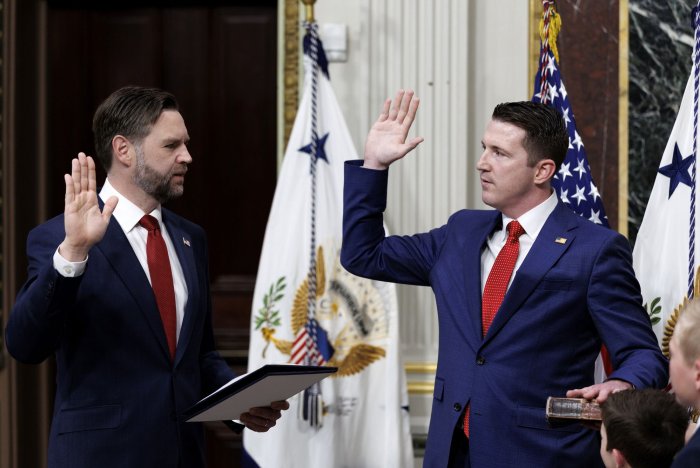
Vice President JD Vance swears in Colin McDonald as assistant attorney general for national fraud enforcement in the Eisenhower Executive Office Building on Wednesday. Pool Photo by Will Oliver/UPI | License Photo
A senior Iranian official has laughed in response to US President Donald Trump’s claim that Iran’s president has asked for a ceasefire, Al Jazeera’s Ali Hashem says Trump’s comments come a day after Iran’s foreign minister said his country was not looking for a ceasefire.
War, tariff volatility, and shifting capital flows challenge the global currency order—even as markets prove resilient.
When Japan’s largest automaker reported 2025 results last May, it said its earnings were hit by $4.6 billion in foreign-exchange losses due to the US dollar’s decline. This month, Toyota has a new concern: the war in Iran that has spread throughout the Persian Gulf. The company sold 325,000 cars to the region in 2025, but the fighting and the closure of shipping lanes through the Strait of Hormuz could further decrease earnings.
Even more damaging, the company is forecasting a roughly $9.6 billion drag on earnings in 2026 due to President Trump’s on-again, off-again tariffs. “The impact of US tariffs,” Toyota CFO Kenta Kon said, “is a significant rise from our initial forecasts.”
The global economy entered 2026 already on shaky ground. The Trump administration’s sweeping tariff policies weakened the dollar and heightened trade fears, while a Supreme Court decision on those tariffs added fresh uncertainty, even as inflation was slowly easing. Then, on February 28, US and Israeli forces launched strikes on Iran, oil prices surged, and the dollar bounced higher in a flight to safety.
The Strait of Hormuz, which carries about 20% of global oil and LNG exports, effectively closed after Iranian threats and tanker attacks, sending oil prices from about $70 to more than $110 a barrel within days. Oil-import-dependent economies such as Japan, South Korea and China were especially vulnerable to the war’s aftershocks.
Higher oil prices. Uncertainty about tariffs. The dollar boomerang. Corporate finance executives face a new series of challenges: Higher oil prices, etc. However, despite short-term headwinds for business, global analysts remain relatively optimistic about the long-term economic outlook, even with the war’s sudden shadow over markets.
While energy concerns increased as war clouds gathered over the Persian Gulf, analysts largely believed that the global economy would revert to a pattern similar to the pre-war period: a gradually declining dollar, reduced foreign investment in US assets, and inflation that persistently prevents central banks from lowering interest rates. A key sign of market consensus was that, by mid-March, the forward price of oil for October delivery was $79 per barrel, compared to its temporary $110 spike after the war began. But the uncertainty surrounding the objectives and duration of the attacks on Iran by the US and Israel has kept oil prices bouncing around $100 per barrel.
Aside from the currency issue, several factors have contributed to relatively positive economic forecasts despite the fighting in the Gulf. The Trump administration maintains, despite its forecast having been extended, that the disruption to energy supplies will be relatively short-lived. “You’re seeing a little bit of a fear premium in the marketplace, but the world is not short of oil or natural gas,” said Energy Secretary Chris Wright on CNBC in early March. “Worst case is a few weeks, not months.”
As Dollar Falters, China Moves In
The dollar had a tough year in 2025, dropping about 12% against a basket of other major currencies. Although US administrations usually support a strong dollar, President Donald Trump broke that tradition and said it was “great” that the dollar was falling on global markets, which caused it to tumble even more.
The dollar’s decline triggered a significant shift into gold, which increased in value by 60% in 2025, reaching a record price of $5,110 per ounce. European stocks saw their largest inflows ever in February as investors moved away from the United States.
Marc Chandler, Bannockburn Global Forex
Marc Chandler, chief market strategist at Bannockburn Global Forex, said that for much of 2025, foreign investors had been buying US equities while shorting the dollar as a hedge. “Now that US equities are declining, they have to buy back their short-dollar hedge,” Chandler said. “I’m not convinced that what we’re seeing in the dollar is much more than unwinding positions, rather than people flocking to the US as a safe haven.”
Mark Sobel, former head of international finance at the US Treasury, wrote in a March 2025 op-ed for the Financial Times that the dollar’s dominance was slowly eroding. “Like termites eating away at a house’s woodwork, Trump’s dysfunctional policies are eating away at its support and rendering the US currency acutely vulnerable to future shocks,” Sobel said.
A weaker dollar is not just a market story—it is reshaping currency dynamics globally, with China at the center. The Chinese government intervened on February 27 to stop the renminbi’s appreciation against the dollar, which had increased by 7% since last April. The People’s Bank of China (PBOC) announced it would eliminate the 20% reserve requirement on foreign exchange forward contracts and stated it would keep the renminbi’s exchange rate at a “reasonable and balanced level.” The higher value of the renminbi did not hurt Chinese exports—the country recorded a $1.2 trillion trade surplus in 2025.
China’s government has used the weaker dollar to strengthen the renminbi’s role in trade finance and payments, with officials claiming the currency is now the world’s largest trade-finance currency. Chinese companies have been gradually decreasing dollar transactions. The dollar’s share of cross-border transfers has dropped from 80% in 2010 to about 40% in 2025, mainly due to increased renminbi flows. The renminbi’s share of global trade has grown from 2% in 2021 to over 7%, a notable rise but still not enough to threaten the dollar’s dominant position in world trade.
In Japan, as inflation rises, the Bank of Japan is expected to increase interest rates, according to Mitsubishi UFJ Financial Group. While the Federal Reserve in the US has kept rates steady through its mid-March meeting. The BOJ’s move to tighten policy after ending its negative interest rate policy is seen as a factor aiding yen appreciation.
Europe has been significantly affected by the rise of the euro, which appreciated nearly 12% against the dollar in 2025. “I have watched the dollar rate with concern for some time,” German Chancellor Friedrich Merz said. “The dollar course is a considerable extra burden for the German export economy.” Dirk Jandura, head of the BGA, Germany’s wholesale and foreign trade association, said the strength of the euro was causing exporters “great concern.” The dollar’s easing, though, has softened some of that impact.
Economy Shows Resilience
Supporting the Trump administration’s more optimistic oil outlook, the International Energy Agency agreed in early March to release 400 million barrels of oil to address the supply disruption—the largest such action in the organization’s history. The move reinforced officials’ view that any price spike would likely be short-lived, lasting weeks rather than months. The 32 member countries still have about 1.4 billion barrels of emergency reserves that can be tapped if the shortage worsens.
“The rise in crude oil prices to date does not represent a shock of the magnitude seen in earlier episodes,” said J.P. Morgan analysts Bruce Kasman and Nora Szentivanyi. “At [about] $100 a barrel, Brent crude is less than 35% above its two-year trailing average. To deliver a shock similar in size to the Russian invasion, crude oil prices would need to move close to $150 and remain at this elevated level for several months.”
Joe DeLaura, an energy analyst at Rabobank in the Netherlands, urged companies to have a plan in place to make quick decisions involving their energy supplies. “Start assessing your supply chains and your access to capital markets,” DeLuca told a webinar in March. “Are you shoring up relationships? Are you able to have critical redundancy in your supply chains, especially for key inputs like energy? One of the ways to take advantage of this is by looking further out on the curve and take advantage of volatility when it swings in your favor.”
Daniel Moseley, Oxford Economics
Unlike in 1973, when a Middle East oil embargo caused inflation to soar, the United States now exports both petroleum and liquefied natural gas. Therefore, the war is unlikely to significantly impact the US economy in 2026, as it would require a “very severe scenario” for US economic growth to contract, according to Oxford Economics. “We have a view that the US dollar is going to broadly continue to somewhat weaken,” said Daniel Moseley, associate director for scenarios and macro modeling, at Oxford Economics.
Asia Hit Hard
The Iran War most heavily affects Asia. According to the US Energy Information Administration, 84% of crude oil and 83% of LNG travels to the region. I would also say war in Iran. China, India, Japan, and South Korea are the leading destinations for Persian Gulf crude oil, but Thailand and Vietnam also rely heavily on imported energy.
Companies like Toyota have limited options but to cut costs. One strategy is localizing their supply chains. The company announced in February that it plans to invest $10 billion in the US over the next five years to increase production of its most valuable hybrids. It is also reducing production of lower-value models and stated it will implement three price hikes in 2026 to compensate for the “double whammy” of a weaker dollar and US tariffs.
Rajiv Biswas, CEO of Asia-Pacific Economics in Singapore, states that a major concern in Asia is that a prolonged energy shortage could lead to a surge in inflation, prompting central banks to increase interest rates. China’s government, for instance, ordered refiners to halt diesel exports, seemingly worried that supplies could run low during a lengthy conflict.
Biswas stated that the Persian Gulf is also a major shipping route for urea and sulfur used in fertilizer production. This means “the agricultural sectors of many Asian developing countries could also be hit by lack of essential inputs,” as well as the US, right as the Spring planting season begins. Additionally, Brazil, the world’s leading soybean producer, imports most of its urea from Qatar and Iran. India depends on Saudi phosphate exports.
Europe Needs To Urgently Use AI
No European industry was more affected by the dollar’s rise than automobile manufacturing. At luxury carmaker BMW, for instance, revenues fell 5.9%, with half of the decline attributable to the strength of the euro, which created a $670 million headwind. Additionally, US tariffs reduced earnings and imports from China and limited sales to Europe.
“If you take all these elements together, the headwind is bigger than the tailwind, which we’re working on,” BMW CFO Walter Mertl said. He added that the company had cut costs by $2.6 billion to boost profitability. “We are working on all cost elements,” Mertl said, including capital expenditures, research and development spending, and sales and general expenses.
To hedge against a weakened dollar that makes their exports more expensive, European companies need to do more than cut costs. These companies need to invest urgently in cutting-edge technologies, such as artificial intelligence, to make them more competitive in the global marketplace, says Marcello Messori, a professor at the Schuman Centre of the European University Institute in Milan.
“Europe needs to look at artificial intelligence and how it is compatible with the green transition and try to exploit these specific sectors,” Messori says. “Between the current European specialization in mature technologies and the technological frontier, there are a lot of opportunities that you can exploit between those extremes.”
One company leading this approach is Siemens, once known for low-profit industrial machinery. CEO Roland Busch stated that the company has strong growth prospects because it has focused on adopting new technology. “We are in a good place because we are offering what the world needs,” Busch said. “We are positioned along secular growth drivers: automation, digitalization, electrification, sustainability, and artificial intelligence.”
Messori emphasizes that the European Union must speed up efforts to unify financial markets to create a larger pool of venture capital. He notes that Sweden boasts a thriving startup economy. However, established companies often relocate quickly to the US, where capital markets are more accessible.
While the results of wars rarely match initial predictions, the consensus among analysts is that by year’s end, the Iran war may be seen as an economic distraction rather than a strategic turning point. The forces that defined markets before the conflict—moderating inflation, steady demand, and resilient consumer spending—are expected to keep the global economy on track. The dollar, meanwhile, is likely to remain volatile but broadly weaker over time, as structural pressures and shifting capital flows continue to test its dominance.
April 1 (UPI) — The U.S. Supreme Court is hearing oral arguments in a case on Wednesday that could reshape what it means to be a U.S. citizen.
The case, Trump vs. Barbara, is over President Donald Trump‘s Jan. 20, 2025, executive order “Protecting the meaning and value of American citizenship,” which seeks to change the application of the Citizenship Clause, ending birthright citizenship.
In his executive order, Trump argued that the 14th Amendment of the U.S. Constitution “has never been interpreted to extend citizenship universally to everyone born within the United States.”
The law of the land, as it has been recognized since the ratification of the 14th Amendment in 1868, has been that “all persons born or naturalized in the United States, and subject to the jurisdiction thereof, are citizens of the United States and of the State wherein they reside.”
Trump’s executive order remains blocked from taking effect, with lower courts affirming that his attempt to end birthright citizenship is unconstitutional. In December, the Supreme Court agreed to take up the case, beginning with oral arguments starting on Wednesday.
U.S. Solicitor General John Sauer will argue on behalf of the Trump administration.
“If the Trump executive order is upheld, it would mark an enormous change in how the United States understands who is a citizen and who is not,” Kate Masur, John D. MacArthur Professor of History at Northwestern University, told UPI.
Masur filed an amicus brief supporting a challenge to Trump’s executive order.
“There’s certainly never been a president who issued an executive order trying to undermine birthright citizenship in this way,” Masur said. “Congress has repeatedly, through legislation, affirmed birthright citizenship and the Supreme Court has also affirmed birthright citizenship.”
The Trump administration’s argument against birthright citizenship hinges on its interpretation of the term “jurisdiction” in the context of the clause “subject to the jurisdiction thereof.”
In an amicus brief by Sen. Ted Cruz, R-Texas, Sen. Lindsey Graham, R-S.C., and other Republican lawmakers, they contest that the authors of the 14th Amendment could have written “subject to the laws.” Instead, the use of the term “jurisdiction” requires “allegiance” to the United States.
“Allegiance is also a reciprocal relationship. The person must be present with the consent of the sovereign, a factor on which this Court extensively relied in United States v. Wong Kim Ark,” the Republican lawmakers argue. “But illegal aliens and their children are present in the United States without consent, i.e., only by defying its laws.”
The lawmakers also argue that their interpretation of total allegiance looks to “early English caselaw.”
The challenges to birthright citizenship by Republicans are not new, Masur said.
The Wong Kim Ark case that the Republican lawmakers referred to affirmed birthright citizenship under the 14th Amendment. The case was brought on when the U.S. government denied the son of Chinese Immigrants, Wong Kim Ark, re-entry into the United States.
Ark, who was born in San Francisco, had taken a trip to China and was detained upon his return to the United States. The case took place in 1898, more than a decade after the passage of the Chinese Exclusion Act, which prohibited Chinese workers from seeking citizenship in the United States.
Since Wong Kim Ark, there have continued to be opponents of birthright citizenship, though the immigrant groups their movements targeted have changed. Since the 1990s, immigrants from Spanish-speaking countries have largely been the central focus of those seeking to end birthright citizenship.
Former Sen. Steve King, R-Iowa, repeatedly introduced legislation on Capitol Hill trying to end birthright citizenship. His most recent effort was in 2015. In 2019, King was removed from all committee assignments after defending white supremacy and white nationalism, following years of racist comments throughout his 17-year career.
“The thing that these movements have in common over time is their desire to limit who among people born in the United States gets to be a citizen,” Masur said. “Usually it is driven by various anti-immigrant sentiments.”
Daisy Hernandez, author of Citizenship: Notes on an American Myth, told UPI that there are modern examples of what happens when birthright citizenship is taken away.
The Dominican Republic amended its constitution in 2010 to remove birthright citizenship for Haitians in the country. In 2013, it made the law retroactive to 1929, removing the citizenship of an estimated 200,000 people overnight.
“That is an example of what would happen in the United States. However, for us it would happen in terms of millions of people,” Hernandez said.
Children of immigrants who have their citizenship revoked become stateless, Hernandez explained. With no country to call home, they are left adrift without the right to exist anywhere.
“Statelessness means that you have no government which you can turn to in any way,” she said. “It means you do not have any documentation of any kind. You don’t have documentation that you have a right to be anywhere. The philosopher Hannah Arendt said ‘citizenship is the right to have rights.’ You need a government to recognize that you have rights.”
There are more than 4 million children in the United States who have parents who are undocumented immigrants.
If Trump’s executive order is allowed to stand by the Supreme Court, Hernandez and Masur said the United States could return to an era of the 19th century when citizenship varied from state to state.
“It is really jarring to remember once upon a time certain states within the United States recognized the citizenship and humanity of Black Americans and we had other states that did not,” Hernandez said. “So are we going to end up in a situation where a child born to an undocumented parent is recognized as a citizen as long as they stay within the state of New York or of Massachusetts but would then become stateless if they crossed into Connecticut or further south or further west?”
Most countries in the Western Hemisphere recognize birthright citizenship. The Dominican Republic and Colombia are rare exceptions.
“We have always understood being American as being very closely tied with birthright citizenship,” Hernandez said. “It would be a collapse of how we understand American identity in the United States.”
President Donald Trump stands with U.S. Secretary of Agriculture Brooke Rollins during an event celebrating farmers on the South Lawn of the White House on Friday. Photo by Aaron Schwartz/UPI | License Photo
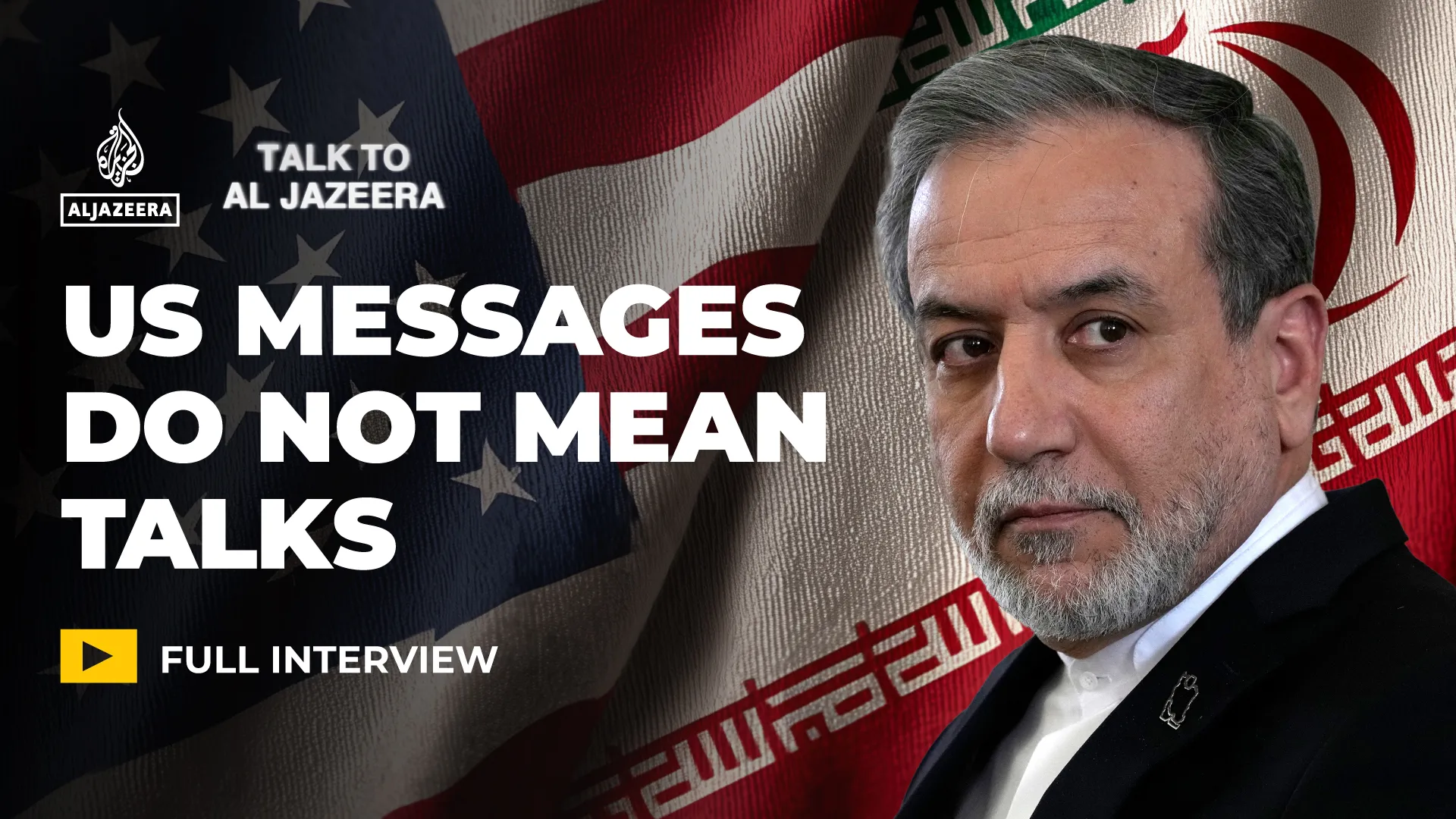
Iran’s foreign minister says message exchanges continue with Washington, but insists there are no negotiations, and no trust.
Iran’s Foreign Minister Abbas Araghchi tells Talk to Al Jazeera that Iran is not negotiating with the United States, despite ongoing exchanges of messages, including direct communication from US envoy Steve Witkoff.
Araghchi says talks lack trust, adding that no response has been given to US proposals, and that there is no basis for negotiations. Araghchi outlines Iran’s conditions for ending the war, warns against threats and deadlines, and signals a readiness to continue defending the country as regional tensions escalate.
April 1 (UPI) — A federal judge has blocked construction of President Donald Trump‘s $400 million White House ballroom, ruling the New York real estate developer does not have congressional authorization to continue the project.
“The President of the United States is the steward of the White House for future generations of First Families. He is not, however, the owner!” U.S. District Judge Richard Leon for the District of Columbia wrote in the ruling.
Trump has said building a White House ballroom had been a dream of his since before he was president. Construction of the 90,000-square-foot building began with the demolition of the East Wing of the White House in October. Initially said to cost $200 million, the ballroom’s price tag has since doubled. Trump has said it will be financed by private donors.
In December, the National Trust for Historic Preservation sued the Trump administration to halt construction, arguing the project has not been authorized by Congress as required by U.S. law.
In response, the Trump administration has claimed Congress has already given him authority to construct the project, pointing to a statute that Leon, a President George W. Bush appointee, said only permits the president “to conduct ordinary maintenance and repair of the White House.”
Leon said the Trump administration’s understanding of the law assumes Congress has granted “nearly unlimited power to the President to construct anything, anywhere on federal land in the District of Columbia, regardless of the source of funds.”
“This clearly is not how Congress and former Presidents have managed the White House for centuries, and this Court will not be the first to hold that Congress has ceded its powers in such a significant fashion,” he said in the 35-page ruling.
For Trump to continue with the project, he can ask Congress to either appropriate the funds or approve of another funding scheme, he said.
“Unfortunately for Defendants, unless and until Congress blesses this project through statutory authorization, construction has to stop!”
In awarding the National Trust for Historic Preservation an injunction, Leon delayed its enforcement for 14 days in acknowledgment that the Trump administration intends to appeal his decision and that stopping an ongoing construction project may raise logistical issues.
“We are pleased with Judge Leon’s ruling today to order a halt to any further ballroom construction until the Administration complies with the law and obtains express authorization to go forward,” Carol Quillen, president and CEO of the nonprofit organization, said in a statement.
“This is a win for the American people on a project that forever impacts one of the most beloved and iconic places in our nation.”
Trump lambasted the decision on his Truth Social platform.
“He is WRONG! Congressional approval has never been given on anything in these circumstances, big or small, having to do with construction at the White House,” he said in a statement.
In an earlier statement issued after the ruling was made, Trump insulted the National Trust for Historic Preservation as “a Radical Left Group of Lunatics.”
According to the White House Historical Association, Congress has long been responsible for appropriating funds for the care, repair, refurnishing and maintenance of the White House, and Congress approved the Truman-era reconstruction project from 1948 to 1952.
Demolition equipment continues to break up the East Wing of the White House in Washington on October 22, 2025. Photo by Pat Benic/UPI | License Photo
March 31 (UPI) — Secretary of Defense Pete Hegseth announced Tuesday that helicopter pilots who conducted a flyby of musician Kid Rock‘s Nashville estate over the weekend would not be punished, an abrupt reversal of the U.S. Army’s decision to suspend the Apache helicopter crews amid review of their conduct.
“@USArmy pilots suspension LIFTED,” Hegseth said on X. “No punishment. No investigation.
“You’re a disgrace,” Adam Kinzinger, a former Republican House of Representative from Illinois and a retired U.S. Air Force and Air National Guard officer, said in an expletive-laced statement responding to Hegseth’s announcement, in which he called the defense secretary an “unqualified clown.”
Rock published a pair of videos to social media on Saturday showing him cheering on a pair of Apache helicopters flying by and hovering near his Nashville estate, which he has called “The Southern White House.”
“This is a level of respect that [expletive] for brains Governor of California will never know,” Rock wrote in the caption to the videos. “God bless America and all those who have made the ultimate sacrifice to defend her.”
After the videos went viral, the U.S. Army announced Monday that it was conducting an administrative review of the incident.
Army spokesman Maj. Montrell Russell confirmed Tuesday that two Apache helicopters from the 101st Combat Aviation Brigade at Fort Campbell, Ky., located about 60 miles north of Nashville, had conducted a flight in the Nashville area that has attracted media and the public’s attention.
“The personnel involved have been suspended from flight duties while the Army reviews the circumstances surrounding the mission, including compliance with relevant [Federal Aviation Administration] regulations, aviation safety protocols and approval requirements,” Russell said in a statement.
Hegseth offered no explanation for the reversal, which came not long after Trump told reporters at the White House that he had not seen the video.
Asked what he thought of the crews’ suspension, Trump said, “Well, they probably shouldn’t have been doing it.”
“Yes, you’re not supposed to be playing games, right? I’d take a look at it,” he said.
“They like Kid Rock. I like Kid Rock. Maybe they were trying to defend him. I don’t know.”
Rock has long been a vocal supporter of Trump and has appeared at the White House and in a recent Health and Human Services Department promotional video where he is seen working out bare-chested with HHS Secretary Robert F. Kennedy.
He has also lashed out at Trump’s critics, notably California Gov. Gavin Newsom.
WASHINGTON — Democrats’ hopes of reclaiming the U.S. Senate are colliding with a fight within their own party.
In Maine, Senate Minority Leader Chuck Schumer has thrown his weight behind Gov. Janet Mills in a crucial race, but some of his Senate colleagues are backing insurgent candidate Graham Platner in a rebuke of his strategic vision. A similar dynamic is playing out in other battlegrounds, including Michigan and Minnesota, where progressive senators are endorsing non-establishment candidates.
At stake is more than any single race. Democrats are fighting over whether the party’s traditional playbook still works in a country that elected Donald Trump for a second time — and whether leaders like Schumer should remain in charge.
“Clearly there’s a disagreement of strategy here,” said New Mexico Sen. Martin Heinrich, who has endorsed Platner.
He added that “the business-as-usual calculation for what is going to be successful in a given election cycle does not necessarily, in my view, meet the moment.”
The divide reflects a Democratic base frustrated after the last presidential election, when President Biden ran for a second term despite widespread concerns about his age. He dropped out and endorsed Vice President Kamala Harris, who lost to Trump.
Nan Whaley, a Democratic strategist in Ohio who ran for governor four years ago, said the debate is no longer about progressive or moderate.
“It’s really about, who do you trust? Establishment or not establishment?” she said. “And frankly, the establishment hasn’t given us a lot to trust these past few years.”
‘A rebuke of Schumer’
In Maine, Schumer and the Democratic Senatorial Campaign Committee have backed Mills, a 78-year-old moderate in her second term.
Platner, a veteran and oyster farmer, quickly won the backing of Sen. Bernie Sanders (I-Vt.), just days after launching his campaign. His bid has since gained momentum despite scrutiny over past controversial comments and a tattoo resembling a Nazi symbol.
In recent weeks, Heinrich, Arizona Sen. Ruben Gallego and Massachusetts Sen. Elizabeth Warren have endorsed Platner as he builds support on Capitol Hill. Heinrich and Rhode Island Sen. Sheldon Whitehouse held a fundraiser for him, too.
Gallego, a first-term senator who won a battleground race in 2024, downplayed the endorsements as a broader critique of party leadership.
“Senate leadership didn’t back me at the beginning. So I didn’t take that as a critique,” Gallego said.
Michigan also has a contentious primary, with three high-profile candidates. State Sen. Mallory McMorrow has said she would not support Schumer as the caucus leader if Democrats regain the majority, and she’s been endorsed by four senators.
Abdul El-Sayed, running further to the left, has been endorsed by Sanders and has also run on an anti-establishment platform.
U.S. Rep. Haley Stevens has aligned with establishment figures, working with a former executive director of the Democratic campaign committee and securing support from two senators.
Democratic strategist Lis Smith said the endorsements in races like Maine and Michigan are “as much as a rebuke of Schumer as it is an endorsement of these candidates.”
“It’s pretty uncommon for sitting senators to endorse against the Senate leader,” Smith said. “Senators are reading the tea leaves and are getting feedback from the grassroots that they are dissatisfied with Schumer’s performance as leader.”
In Minnesota, an open-seat race has similarly emerged as a test of the party’s direction. Rep. Angie Craig is seen as the centrist candidate in the primary, with endorsements from House Democratic Leader Hakeem Jeffries and Rep. Nancy Pelosi. Lt. Gov. Peggy Flanagan, the more progressive candidate, has been backed by Sanders, Warren and others, including Minnesota Sen. Tina Smith, who is vacating the seat.
“She understands that right now what we need are fierce fighters, people who are willing to stand up to the status quo,” Smith said in her endorsement.
‘The election may impact’ Schumer’s time as leader
Some tensions trace to March 2025, when Schumer voted with Republicans to end a government shutdown, drawing backlash from Democrats who argued he did not push hard enough against Trump’s agenda.
Later that year, Democrats held firm in a record-long shutdown fight, helping regain some ground with activists and progressives. But divisions resurfaced when a group of moderates ultimately sided with Republicans, fueling renewed frustration with party leadership even as Schumer opposed the move.
Since he became Senate leader in 2017, Schumer’s record in elections has been mixed. He led Democrats back to the majority in 2020 and expanded it in 2022 but lost ground in both 2018 and 2024.
“Leader Schumer’s North Star is taking back the Senate and is pursuing a path to do just that,” said Allison Biasotti, a spokesperson for Schumer.
He’s recruited high-profile candidates this year in tough Senate races, such as Alaska, Ohio and North Carolina. Maeve Coyle, communications director for the campaign committee, said Schumer “created a path to win a Democratic Senate majority this cycle” with the recruitment.
“Senate Democrats overperformed in the last four election cycles and in 2026, we will win seats and flip the majority,” she added.
David Axelrod, who served as a top strategist for President Obama, said that being Senate leader is never easy, and that Schumer “has been under fire for some time, particularly from progressives in the party.”
Schumer’s time as leader, Axelrod added, is likely directly linked to the outcome of the 2026 midterms.
“There’s questions as to whether he’ll run in 2028. There’s even questions as to whether he might be challenged as leader,” he said. “I think the results of this election may impact that.”
For now, Schumer’s caucus is tentatively standing behind him. None have explicitly called for him to step aside. But discontent has lingered, with some openly questioning whether the party needs a new direction.
“How people did politics in the 1990s is going to feel different than in the 2020s,” said Heinrich.
District Judge Richard Leon says construction has to stop until Congress provides statutory authorisation.
Published On 1 Apr 20261 Apr 2026
A judge has ruled that US President Donald Trump cannot proceed with his planned $400m ballroom on the site of the White House’s demolished East Wing without approval from Congress.
District Judge Richard Leon on Tuesday granted a request for a preliminary injunction filed by the National Trust for Historic Preservation, which sued after alleging Trump had exceeded his authority by razing the historic East Wing and launching construction on the new building.
Recommended Stories
list of 2 itemsend of list
“I have concluded that the National Trust is likely to succeed on the merits because no statute comes close to giving the President the authority he claims to have,” Leon, an appointee of former Republican President George W Bush, wrote in the ruling.
“The President of the United States is the steward of the White House for future generations of First Families. He is not, however, the owner!” he said. “Unless and until Congress blesses this project through statutory authorization, construction has to stop!”
Leon said the order does not affect “construction necessary to ensure the safety and security of the White House”.
His ruling keeps the 90,000 square-foot (8,360 square-metre) ballroom project on hold while the lawsuit continues.
The judge said he was pausing his order for 14 days to allow the Trump administration to appeal. Hours later, the Justice Department filed an appeal at the Washington, DC-based US Court of Appeals for the District of Columbia Circuit.
Artist renderings of the new White House East Wing and Ballroom [Jon Elswick/AP]
Carol Quillen, president and CEO of the National Trust, welcomed Leon’s ruling.
“This is a win for the American people on a project that forever impacts one of the most beloved and iconic places in our nation,” Quillen said in a statement.
In a social media post, Trump called the National Trust a group of left-wing “lunatics” and said his ballroom is “under budget, ahead of schedule, being built at no cost to the Taxpayer, and will be the finest Building of its kind anywhere in the World”.
The Republican has championed the ballroom as a defining addition to the White House and a lasting symbol of his presidency.
The headquarters for National Public Radio is seen in Washington, D.C., on May 27. A federal judge sided with NPR’s lawsuit saying Trump’s cut to federal funding was a violation of the First Amendment. File Photo by Bonnie Cash/UPI | License Photo
March 31 (UPI) — A federal judge in Washington, D.C., ruled Tuesday that President Donald Trump‘s executive order cutting funding to NPR and the PBS was a violation of their First Amendment rights.
U.S. District Judge Randolph Moss said the executive order signed in May violated the companies’ constitutional rights to a free press because Trump targeted for what he described as liberal views. He described the cut to funding as “viewpoint discrimination.”
“The message is clear: NPR and PBS need not apply for any federal benefit because the president disapproves of their ‘left-wing’ coverage of the news,” Moss said in his ruling.
“It is difficult to conceive of clearer evidence that a government action is targeted at viewpoints that the president does not like and seeks to squelch,” he added.
“To be sure, the president is entitled to criticize this or any other reporting, and he can express his own views as he sees fit. He may not, however, use his governmental power to direct federal agencies to exclude plaintiffs from receiving federal grants or other funding in retaliation for saying things that he does not like.”
Trump’s executive order, called Ending Taxpayer Subsidization of Biased Media, ordered the Corporation for Public Broadcasting to stop funding National Public Radio and the Public Broadcasting Service to the maximum extent allowed by law.
At the time, more than 70% of CPB’s congressionally approved $535 million budget went directly to public media stations through grants.
According to NPR, about 1% of its annual operating budget came in the form of grants from CPB and federal agencies and departments, excluding CPB funding for the Public Radio Satellite System. Its largest funding stream — about 36% — comes from sponsorships, donations, memberships and licensing fees.
According to PBS, federal funding covered about 15% of its revenue.
CPB was founded in 1967 as a private nonprofit corporation to fund public television and radio stations and their programs.
NPR sued the Trump administration later in the month, citing First Amendment and 1967 Public Broadcasting Act violations.
President Donald Trump stands with U.S. Secretary of Agriculture Brooke Rollins during an event celebrating farmers on the South Lawn of the White House on Friday. Photo by Aaron Schwartz/UPI | License Photo
A Russian tanker has delivered enough fuel to meet Cuba’s energy needs for up to 10 days, following a three-month blockade.
Published On 31 Mar 202631 Mar 2026
A Russia-flagged tanker carrying 730,000 barrels of oil has docked in Cuba, marking the first time in three months that an oil tanker has reached the island nation.
The administration of United States President Donald Trump allowed the Anatoly Kolodkin to proceed despite an ongoing US energy blockade. The Aframax tanker entered the Bay of Matanzas – the country’s largest supertanker and fuel storage port – on Tuesday at daybreak.
Recommended Stories
list of 4 itemsend of list
The vessel, under US sanctions, entered Cuban territorial waters late on Sunday, not far from the US Navy base at Guantanamo Bay. The United States said it was allowing the tanker to deliver fuel for humanitarian reasons.
The Anatoly Kolodkin entered the Bay of Matanzas under clear skies and light winds at sunrise. Much of the nearby city – and the majority of Cuba – was without power when the tanker arrived at the port area.
Cuba has not received an oil tanker in three months, according to President Miguel Diaz-Canel, exacerbating an energy crisis that has led to seemingly endless blackouts across the country of 10 million people and brought hospitals, public transportation, and farm production to the brink of collapse.
Cubans, including Energy and Mines Minister Vicente de la O Levy, cheered the ship’s arrival. A shortage of petroleum has exacerbated a deep economic crisis, leaving the population mired in long blackouts and facing severe shortages of food and medicine.
“Our gratitude to the Government and People of Russia for all the support we are receiving. A valuable shipment that arrives amidst the complex energy situation we are facing,” de la O Levy wrote on X.
The fuel, if delivered, would give Cuba’s communist-run government breathing room amid growing pressure from the Trump administration, which has promised change in Cuba.
It will take days before the crude on board the Anatoly Kolodkin can be processed domestically and turned into motor fuel and refined products, such as diesel and fuel oil for power generation.
The ship is carrying Russian Urals, a medium sour crude, which is a good fit for Cuba’s ageing refineries.
Cuba produces barely 40 percent of its required fuel and relies on imports to sustain its energy grid. Experts say the anticipated shipment could produce about 180,000 barrels of diesel, enough to feed Cuba’s daily demand for nine or 10 days.
Cuba used to receive most of its oil from Venezuela, but those shipments have been halted ever since the US attacked the South American country and abducted its leader, Nicolas Maduro, in early January.
This photo shows moments before a boat suspected of carrying narcotics is struck in the Eastern Pacific on March 8. Photo by U.S. Southern Command
March 31 (UPI) — Increased military pressure by the United States on drug trafficking routes in the Pacific Ocean has forced criminal groups to sharply raise payments to those willing to transport narcotics by sea, a police official said.
In Ecuador’s coastal provinces of Manabí and Santa Elena, recruitment costs for local fishermen tasked with moving cocaine to Central America on speedboats have surged to unprecedented levels.
According to Ecuadorian outlet Primicias, in 2023 and 2024 criminal organizations paid up to $20,000 per trip to boat operators and about $5,000 to their assistants.
However, a large-scale deployment of U.S. and Ecuadorian forces under Operation Southern Spear, launched in October, has increased the risks of these journeys and driven up payments offered by traffickers.
Col. William Calle, head of Ecuador’s National Police in Zone 4, said operators piloting speedboats or semi-submersibles can now earn around $40,000 per trip. Assistants receive about $20,000, while those handling mid-sea refueling earn roughly $15,000.
Local reports, including from El Diario de Manabí, indicate payments can reach as high as $90,000 for high-risk missions or large shipments.
Since 2024, U.S. and Ecuadorian maritime authorities have conducted patrol flights and interdiction operations to monitor and intercept drug trafficking vessels in Ecuadorian waters.
President Daniel Noboa ratified two military cooperation agreements in February. The risk for traffickers has shifted from capture to potential airstrikes in international waters if vessels fail to stop.
Despite arrests and international warnings, criminal groups continue to rely on fishing vessels to transport drugs.
According to El Diario, fishermen detained after operations in Manta and Salinas on Thursday told courts that successful trips carrying one to two tons of drugs can yield payments of up to $90,000. Military intelligence has described these sums as the “price of silence” and compensation for the risk of attack.
Ecuador’s Navy said traffickers increasingly use so-called “mother ships” to extend range and cargo capacity, while smaller fiberglass boats serve as logistical support or for transfers at sea. This tactic complicates interdiction efforts, though shared intelligence has enabled several recent seizures.
Ecuador has become a primary departure point for cocaine produced in the region, with about 80% of shipments moving through the Pacific corridor.
For artisanal fishermen facing economic hardship due to declining catches and piracy targeting boat engines, a $40,000 payment can equal up to a decade of legal earnings.
However, many fishermen say participation is not voluntary but enforced under threats. Organized crime groups such as Los Lobos and Los Choneros control ports, extorting and forcibly recruiting experienced navigators whose knowledge of ocean currents helps evade detection.
The escalation of U.S. military actions under Operation Southern Spear has included at least 47 airstrikes against suspected vessels in the Caribbean Sea and Pacific Ocean. These operations, described President Donald Trump‘s administration as part of a fight against “narco-terrorism,” have resulted in at least 150 deaths.
Authorities have also reported significant seizures, including more than 2.9 tons of drugs near the Galápagos Islands and an additional 2 tons intercepted at sea in March
This month, the U.S. government also launched military and intelligence operations in Ecuadorian territory with authorization from Noboa.
The White House said the operations are aimed at dismantling Los Lobos and Los Choneros, which the U.S. State Department designated as foreign terrorist organizations in late 2025.
According to U.S. Southern Command, these groups are no longer treated solely as criminal organizations, but as threats to hemispheric national security.
March 31 (UPI) — Three former FBI agents filed a lawsuit against FBI Director Kash Patel, Attorney General Pam Bondi and their departments Tuesday for firing them, claiming it was for political retribution.
The suit includes a proposed class-action of all FBI employees already fired or potentially fired in the future for political reasons. It was filed in the Federal District Court in Washington, D.C.
Former FBI agents Jamie Garman, Blaire Toleman and Michelle Ball served on a public corruption squad at the FBI that investigated President Donald Trump‘s efforts to overturn the 2020 election. Special counsel Jack Smith eventually took over the investigation code named Arctic Frost. He dropped the charges against Trump after he was elected in 2024.
The three agents were fired last fall.
“Our removal from federal service — without due process and based on a false perception of political bias — is a profound injustice that raises serious concerns about political interference in federal law enforcement,” they said in a statement released by their lawyer, Daniel M. Eisenberg. “We bring this lawsuit to protect the rule of law and to allow our former colleagues to do their jobs without fear of retaliation.”
A federal judge will have to decide if the case can be a class-action suit. The three agents are seeking to include more than 50 FBI employees who have been fired since Trump took office.
Since taking control of the FBI in February 2025, Patel and the other defendants “have summarily terminated members of the proposed class because of their perceived political affiliation, without legitimate investigation, finding of misconduct, pre-termination notice of charges to the employees, an opportunity for the employees to present a defense, and/or any compelling or exigent circumstances,” the suit said.
At the Conservative Political Action Conference in Texas Thursday, Deputy Attorney General Todd Blanche said in a speech that Patel had “cleaned house” at the FBI.
“There isn’t a single man or woman with a gun, federal agent, still in that organization that had anything to do with the prosecution of President Trump,” the lawsuit alleges Blanche said.
President Donald Trump stands with U.S. Secretary of Agriculture Brooke Rollins during an event celebrating farmers on the South Lawn of the White House on Friday. Photo by Aaron Schwartz/UPI | License Photo
US President Donald Trump has released a series of posts attacking NATO countries including France, Spain and the UK over their role in securing the Strait of Hormuz. Al Jazeera’s Alan Fisher explains what Trump’s latest criticism of US allies means.
Libertad Velasco, a Chavista who grew up in the 23 de Enero neighbourhood, was only a teenager when Chavez came to power.
She went on to become one of the founding members of the youth wing of Chavez’s party, the United Socialist Party of Venezuela (PSUV). Eventually, she became the head of a government agency to expand access to higher education to members of vulnerable communities.
Still, Velasco described the period after Maduro’s abduction as a sort of awakening.
“It’s like we’re looking at ourselves without makeup,” Velasco said. “Now, everything is laid bare, revealed in its purest state, and we are beginning to recognise ourselves again.”
Since the US attack and Maduro’s removal, Velasco has thought deeply about her “red lines”: the ideals she feels should not be violated under the new government.
Standing up against invasive foreign powers remains one of her top priorities.
“I refuse to be colonised,” Velasco said. “For me, we shouldn’t have relations with Israel, and abandoning anti-imperialism is non-negotiable.”
Yet Velasco does not believe that the Venezuelan government has crossed that line yet. Rather, she is open to the prospect of the US as a trading partner to Venezuela, paying for access to its natural resources.
“It is a customer who should pay market price for the product they need. If Venezuela must act as a market player to lift people out of suffering, I can go along with that,” Velasco said.
Delia Bracho of Caricuao, Venezuela, says she has grown disillusioned with the Chavismo movement [Catherine Ellis/Al Jazeera]
But it is unclear whether that is happening. Critics point out that the Trump administration has demanded greater control over Venezuela’s natural resources. It has even claimed that Chavez stole Venezuelan oil from US hands.
Already, Venezuela has surrendered nearly 50 million barrels of oil to the US, with the Trump administration splitting the proceeds between the two countries.
Rodriguez, Venezuela’s interim president, has also agreed to submit a monthly budget to the US for approval.
Among Chavistas, there remains debate about whether the relationship with the US is beneficial or exploitative.
But economic recovery is an overwhelming priority for many Venezuelans of all political leanings. Under Maduro, Venezuela entered one of its worst economic crises in history. Inflation is currently at 600 percent, and living standards remain low.
Many Chavista loyalists blame US sanctions for their economic woes. Yet, analysts credit a combination of factors, including declining oil prices, economic mismanagement and pervasive corruption.
Delia Bracho, 68, lives in a district of Caracas called Caricuao, where water is delivered just once a week. Once a committed Chavista, she said her faith in the movement has faded.
Today’s movement, she explained, has been “ruined”, and she no longer wants anything to do with it.
“It’s like when you put on a pair of shoes,” she said. “They break, and you throw them away. Are you going to pick them up again, knowing they are no longer useful?”
Despite her initial fear after the US intervention, Bracho said she now feels cautiously optimistic that Venezuela might change for the better.
“It’s not that everything is fixed, but there is a different atmosphere — one of hope.”
Britain’s King Charles III has been asked by Democratic Congressman Ro Khanna to meet survivors of the crimes of the Jeffrey Epstein during a state visit to the United States in late April. File Photo by Tolga Akmen/EPA-EFE
March 31 (UPI) — Democratic lawmaker Ro Khanna, D-Calif., the author of the law that forced the government to release the Epstein files, wrote King Charles III requesting he meet with survivors of the late convicted sex offender during his upcoming state visit in April.
In his letter Monday, Khanna told the king he wanted him to meet with the women because of Epstein’s “significant” links to Britain via his accomplice, Ghislaine Maxwell, and his connections with high-profile political and establishment figures.
He stressed that survivors also “want this meeting.”
“I respectfully ask that you privately meet with survivors of Jeffrey Epstein‘s and Ghislaine Maxwell’s abuse, so they may speak to you directly about the ways powerful individuals and institutions failed them.
“I make this request in light of recent developments in the United Kingdom, including renewed scrutiny of individuals and institutions with ties to Epstein and his network. These developments have raised serious questions about conduct, access, and whether positions of public trust were misused or whether public institutions helped shield wrongdoing,” wrote Khanna.
“Your call for a ‘full, fair and proper’ investigation, and for the law to take its course, recognizes the seriousness of these concerns,” he added, referring to the king’s response to the arrest in February of his brother, the former Prince Andrew, on suspicion of passing confidential information to Epstein when he was Britain’s trade envoy.
Former U.K. Ambassador to the United States, Peter Mandelson, is also under investigation on suspicion of misconduct in public office over allegations he passed confidential government information to Epstein when he was business secretary in 2009.
Following their arrests on Feb. 19 and Feb. 24, both men were released “under investigation” by British police. Neither has been charged.
Mandelson was fired from his ambassadorship in September for allegedly concealing the extent, depth and duration of his friendship with Epstein from Prime Minister Keir Starmer when he was considering him for the role.
Buckingham Palace has previously stressed that the king’s “sympathies have been, and remain with, the victims of any and all forms of abuse.”
Buckingham Palace did not immediately comment on Khanna’s letter.
However, Khanna’s suggestion the meeting might yield “additional information that British institutions and individuals may be able to share and open a dialogue about whether there will be a full accounting of how Epstein’s and Maxwell’s network operated” in Britain as well as ensuring the matter was addressed with “transparency, seriousness, and accountability,” could prove very tricky for the king.
The king is head of state but his role is mostly ceremonial. He acts on the advice of government ministers, not the other way around, while the constitution places him above politics, if not the law.
The monarch’s legal and political powers are constitutionally limited to approving bills before they become law, dissolving parliament prior to elections and inviting the winning party to form a government — all rubber-stamp conventions over which they have no say.
He or she is not even allowed to publicly express their political views.
As such, the king is not in a position to grant any assurances or make anything happen regarding Britain’s handling of the Epstein scandal.
The visit by Charles and Queen Camilla, in reciprocation of President Donald Trump‘s unprecedented second state visit to Britain in September, has yet to be confirmed by Buckingham Palace and the White House, but U.S. Ambassador to Britain Warren Stephens said last week that he was confident it would go ahead.
The trip in the last week in April will see the royal couple welcomed to the White House complete with a Guard of Honor and a state banquet.
Charles was also expected to address both houses of congress. The last time that happened was in 1991 when Charles’ mother, the late Queen Elizabeth II was in Washington as a guest of the late President George H W Bush.
President Donald Trump stands with U.S. Secretary of Agriculture Brooke Rollins during an event celebrating farmers on the South Lawn of the White House on Friday. Photo by Aaron Schwartz/UPI | License Photo
1 of 2 | Joseph Allen Maldonado-Passage, better known by his stage name “Joe Exotic,” poses with a tiger. He appeared in Netflix’s “Tiger King.” He requested a new trial for his murder-for-hire plot against animal rights activist Carole Baskin but was denied. Photo courtesy of Netflix
March 30 (UPI) — The Supreme Court on Monday denied an appeal from Joe Exotic, the former Tiger King star who is serving time for trying to have an animal rights activist killed.
The court declined to consider tossing the 2019 conviction of Joe Exotic for a murder-for-hire plot to kill animal rights activist Carole Baskin. Joe Exotic, whose real name is Joseph Maldonado-Passage, is serving 21 years for the plot. He was also convicted of falsifying wildlife records and violating the Endangered Species Act.
Baskin was also part of the Tiger King series. She founded Florida rescue center Big Cat Rescue and was an advocate of the Big Cat Public Safety Act, which limited owning big cats and cross-breeds to wildlife sanctuaries, state universities and certified zoos. Former President Joe Bidensigned the law in 2022.
Maldonado-Passage’s lawyer, Alexander Roots, told the court that the case arose out of an “intense personal, litigation, operational, and even political, rivalry between two of America’s two largest big cat exhibitors,” The Hill reported.
“By denying any hearing and by refusing to evaluate the evidence as a whole, the lower courts departed from principles that safeguard every criminal prosecution in the nation,” he wrote in the petition to the court.
At the trial in 2019, prosecutors said Maldonado-Passage, 63, hired two men to kill Baskin, one of whom was an FBI agent. They also said he shot and killed five tigers in October 2017 and sold and offered to sell tiger cubs.
Maldonado-Passage has asked President Donald Trump for a pardon. He also asked Biden while he was in office.
In his feud with Baskin, Maldonado-Passage alleged without evidence that she killed her second husband, who disappeared in 1997, and he rebranded his traveling show Big Cat Rescue Entertainment, for which she sued him for trademark infringement. He settled with her for $1 million.
In his petition to the Supreme Court, Maldonado-Passage argued that the lower courts “shrugged off” evidence that three witnesses had recanted their trial testimony, including Allen Glover, a zoo employee and the other hired hitman, and Florida businessman James Garretson.
He also alleged federal prosecutors failed to tell the defense that the witnesses were promised immunity for testifying.
But the 10th U.S. Circuit Court of Appeals said the new evidence wasn’t likely to change the trial’s result.
In July, Bhagavan “Doc” Antle, 65, another Tiger King alum, was sentenced to federal prison for crimes related to trafficking exotic animals. He was given 12 months and one day, plus a $55,000 fine and three years of supervised release for violating the Lacey Act, which bans the sale of illegally acquired wildlife, fish or plants, including those designated as protected species by the federal government.