The Cuban government is pushing ahead with its plans to transition to renewable energy, amid a de facto oil blockade from the United States that has strangled the island’s economy.
In an interview with the Reuters news agency on Monday, Cuban Minister of Energy and Mines Vicente de la O Levy explained that the blockade has forced Cuba to explore domestic alternatives to foreign fuel imports.
Recommended Stories
list of 4 itemsend of list
“We are seeking our own alternative solutions, using our own resources, our sun, wind, tides, fuel, Cuban crude oil and the gas produced in our wells,” de la O Levy said.
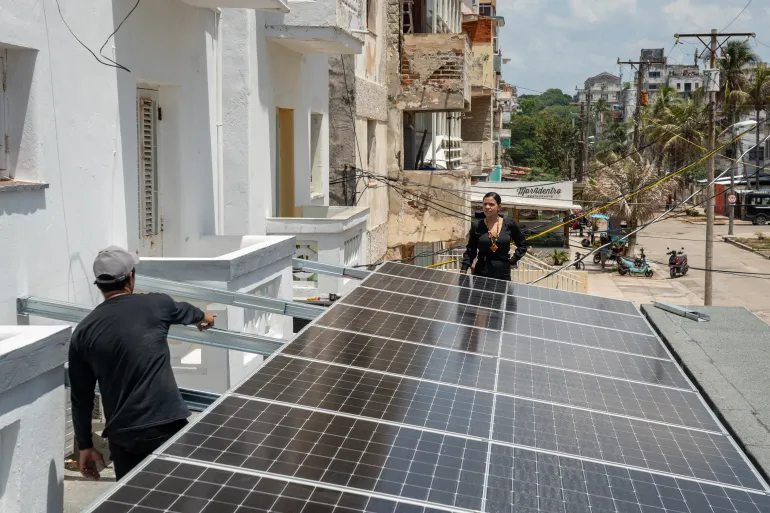
He said 144 solar farms with a combined capacity of about 1,418 megawatts have been installed on the island in recent years.
China has been the largest supplier of solar panels to the island, and shipments have increased since the blockade began in early January.
At the time, US President Donald Trump halted all oil shipments from Venezuela, a close ally of the Cuban government.
Later that month, Trump also announced he would impose heavy tariffs on any country that exported oil to Cuba, justifying the threat by calling the island’s government a “national security” threat.
Since then, only a single oil tanker from Russia has reached Havana. The US has increased its shipments of oil to Cuba’s private sector, but it has largely barred fuel exports for nationalised industries on the communist-led island.
The government-run electrical grid, widely considered to be antiquated, relies heavily on fossil fuels. Only 40 percent of Cuba’s electricity comes from domestic oil production, according to the International Energy Agency.
As of 2023, only nine percent of the country’s energy consumption was covered by renewable sources.
De la O Levy admitted in his interview with Reuters that the country was facing difficulties. The blockade has caused shortages of medicine, water and fuel, pushing Cuba to the brink of a humanitarian crisis.
“We are surviving and moving forward, little by little, even if not at the pace we would like,” he said.
“We face long hours of blackouts and lack fuel for cooking and transportation. We lack fuel, but we are gradually making headway through our own solutions and our people.”
Cuba’s production of domestic crude oil remains stable, he added, but is almost entirely allocated to power plants.
Aris Lopez Torres, owner of the Fuego Lento restaurant, speaks with technician Josecal Duarte during the installation of solar panels on the roof of her business along Havana’s waterfront [File: Lucien Migne/Al Jazeera]
The United Nations and human rights watchdogs have criticised the oil blockade as a violation of international law.
Cuban Foreign Minister Bruno Rodriguez Parrilla also condemned the oil blockade in his speech at the UN General Assembly last month.
“It is an unusual and unprecedented action,” Rodriguez said of the blockade.
“A superpower unilaterally deprives all states of their right to export the commodities that they wish to the country that they wish.”
The US has maintained an economic embargo on Cuba for more than 60 years, since the Cold War era.
But since taking office for a second term as president, Trump has sought to squeeze Cuba’s economy further, as part of a “maximum pressure” campaign. His administration has indicated that it wants to topple Cuba’s government.
On October 7, US authorities announced they had seized 90 biodiesel fuel shipments valued at over $2.8m destined for Cuba.
“These shipments were part of an attempt to unlawfully export fuel to Cuba in violation of federal export laws,” US Immigration and Customs Enforcement (ICE) said in a statement.
But in his interview with Reuters, de la O Levy denied the Cuban government had any link to the shipments.
“No Cuban state-owned company has managed to secure a fuel contract, whether for small or large quantities,” he said.
He added that any US oil shipments to private firms fall far short of the country’s requirements.
“I would venture to say that the amount entering the country doesn’t even cover 3 percent of its fuel needs,” de la O Levy said.
An ICE supervisor seen brandishing a rifle after the high-profile shooting in New York on Oct 8 was also involved in a controversial arrest in Minneapolis in December in which agents knelt on and dragged a pregnant woman through the street.
Department of Justice says it’s investigating whether the White House press pool’s decision violated antitrust laws.
Published On 11 Oct 202611 Oct 2026
The United States Department of Justice has opened an investigation into television networks’ decision to halt coverage of President Donald Trump last month.
A spokesperson said on Saturday that the department was investigating whether the networks violated federal antitrust laws by their boycott, which followed a White House decision to pull the credentials of reporters from three news organisations, including CNN.
Recommended Stories
list of 4 itemsend of list
The networks under investigation are ABC, CBS, CNN, NBC and Fox News, said Emily Convington, the Justice Department spokesperson.
“Group boycotts among commercial competitors can violate the Sherman Act,” she said of the antitrust legislation.
“The Antitrust Division is simply investigating to determine whether these news organizations have violated the antitrust laws.”
The investigation is the latest in a series of clashes between the Trump administration and major news organisations. Trump has repeatedly called the mainstream media “fake news” and frequently clashes with reporters during encounters with the press.
The action also puts legal and potentially financial pressure on the media to continue coverage of the president even when they disagree with how the White House handles them.
The networks did not immediately comment on the announcement.
The Justice Department’s move came after the television pool of five broadcasters last month ceased presidential coverage after the administration barred CNN, MS NOW and Politico from the White House.
The White House said on September 19 that covering the president was a “privilege – not a right”. The outlets sued the administration, alleging the exclusions violated the First Amendment and that the White House was retaliating over their coverage.
CNN is one of the five news organisations – along with ABC, CBS, Fox News and NBC – that make up the primary White House television pool.
They share the costs of covering the president, take turns organising coverage, and share the footage with outlets around the country.
All of the five television networks that cover the White House, including Fox News, suspended coverage in solidarity and refused to provide replacement coverage.
The White House reinstated the credentials on September 24 after US District Judge Timothy Kelly ruled that the ban was likely unconstitutional and ordered the administration to “immediately return, reinstate, and restore” their access.
However, disputes over access to specific presidential events and pool assignments continued.
Jose Zamora, the Committee to Protect Journalists’ Americas director, on Saturday criticised the administration’s decision to investigate.
“The government should not use antitrust investigations to intimidate news outlets defending press access,” Zamora said on X. “The public’s right to know depends on that access.”
US military jet strikes stern of commercial cargo ship in the Gulf of Oman ‘without harming the crew’, CENTCOM says.
Published On 11 Oct 202611 Oct 2026
United States forces have disabled a commercial cargo vessel in the Gulf of Oman after its crew “ignored repeated warnings and attempted to run the ongoing naval blockade against Iran”, according to US Central Command (CENTCOM).
A US military fighter jet struck the stern of the Panama-flagged M/V Ocean Molica, also known as the Arika Sun, with a precision munition on Saturday, “fully disabling the ship’s propulsion without harming the crew”, CENTCOM said in a statement. The vessel was attempting to transit regional waters after “having previously departed an Iranian port”.
Recommended Stories
list of 3 itemsend of list
CENTCOM said its forces resumed their blockade against all ships “entering or departing Iranian ports on July 14”, disabling four commercial vessels and turning around 135 ships during “three months of strict enforcement”.
US forces also destroyed 10 tankers linked to the Islamic Revolutionary Guard Corps’ (IRGC’s) “multibillion-dollar shadow network” over the same period, CENTCOM said.
Meanwhile, Iran’s IRGC said it struck a vessel in the Strait of Hormuz for attempting to take an “illegal route”, as Tehran seeks to enforce its own blockade on the vital waterway.
In a statement carried by official Iranian media, the IRGC claimed Iranian forces “have taken control of the administration of the strait”.
“In carrying out this mission, a few hours ago, a giant LPG carrier named NV Sunshine, owned by NatWit, which was attempting to transit via the illegal route south of the Strait of Hormuz, was struck,” the statement said.
Vessels in the Strait of Hormuz near the beach of Bandar Abbas, Iran, October 6, 2026 [Amirhosein Khorgooi/ISNA via WANA/Reuters]
The United Kingdom Maritime Trade Operations (UKMTO) agency said on Sunday that an outbound tanker in the strait was struck on the port side by an unknown projectile, causing a fire on board. The UK agency said crew members were reported safe, while the damage and environmental impact remained unknown at the time of the report.
Tehran has attempted to enforce control over the Strait of Hormuz during the US-Israel war on Iran, insisting that ships obtain permission to cross via its preferred routes. However, vessels have increasingly risked taking an alternative route hugging the strait’s southern coast.
The UKMTO said on Thursday that a vessel sailing 94km (58 miles) north of Madinat ash Shamal, off the north coast of Qatar, was struck by multiple projectiles, resulting in a number of casualties.
The agency did not specify the origin of the ship or the number of people killed or injured, adding that authorities were investigating the incident amid a recent rise in attacks on vessels near the Strait of Hormuz.
Ships in the Gulf attempting to cross the strait, which is the sole maritime route in or out of the oil-rich region, have faced repeated attacks since the US and Israel began the war in late February.
The Strait of Hormuz remains vital to the global economy, with about a fifth of the world’s oil and liquefied natural gas passing through the passage before the war began.
Is there anything more worrisome about today’s tech titans than the fact that they present as abundance-minded optimists but in actuality are gluttonous, scorched-earth pessimists? Documentarian Alex Gibney is no stranger to dissections of corrupting power — from his feature dives into Enron, Elizabeth Holmes and Scientology. He frames his deeply researched four-hour psych eval “Musk” as the reality check we all need when the world’s richest, most cult-powerful human keeps pushing migration to Mars. Musk might need Earth to become uninhabitable to justify the trip.
Musk’s Tesla cars, SpaceX rockets and Starlink satellites have inspired awe while his “dark MAGA” politics, limited knowledge and petty ego have made him plutocrat Enemy No. 1. Other behavior-coded prisms through which to view Musk — an immigrant whom American fascists love — include his oft-stated belief that we’re living in a simulation. He also loves video games. Gibney sporadically complements his archival materials and many interviews with the metaphoric imagery of player-one gaming: toggling between identities, first-person shooter modes. He also shrewdly compares Musk to the protagonist of a 1930s film adapted from an H.G. Wells story, “The Man Who Could Work Miracles,” about an ordinary guy bestowed with world-altering powers by the gods. (It doesn’t go well.)
There’s even a computer-generated Elon, a by-product of Gibney not securing a face-to-face interview with the tycoon himself. Avatar Musk, meant to appear like AI slop and spouting commentary culled from the totality of his recorded interviews, is pretty gimmicky. But its strangeness also seems appropriate, considering the epic oddity of the South African’s ascension from mistrusted Silicon Valley wannabe to ever-confident cheerleader for space dreams and electric vehicles. Musk is savvy at securing investment, whether his shiny pronouncements about the future prove real or not. It’s why Gibney’s surest, most clear-eyed take is that Musk is less a visionary than a self-promoter — selling Autopilot in Teslas when it led to deaths, being recklessly bullish about AI — and the greatest artificial stock-pumper of all time.
Musk’s forthright, crusty dad Errol sounds almost proud that something was bullied out of his son, but the movie avoids filling out that traumatic childhood. More heartbreaking is ex-wife Justine Musk’s well-articulated experience of Musk’s cruel domestic side — especially where trans daughter Jenna was involved. Ashley St. Clair, the right-wing influencer and one of Musk’s many baby mamas, chillingly completes the portrait of someone who sees fatherhood as an NDA arrangement to help facilitate a genetic army. She watched him up close as he cozied up to Donald Trump, grew his online fandom after taking over Twitter and consolidated his data power. St. Clair simply calls him a “nuke,” one that might readily self-detonate at the slightest bruising of his self-image.
With a built-in intermission dividing his rise (SpaceX, Tesla) from his rightward shift (Twitter, Trump), it’s wild how much the documentary’s second half makes you long for the garden variety tech-bro obnoxiousness of the first. The running time seems a lot for one’s tolerance of a supervillain story and not enough, since the story of DOGE, a venal propaganda folly with a human cost, really needs its own separate feature.
Even a four-hour “Musk” can’t keep up with the unelected trillionaire’s financially self-serving governmental meddling, considering the recent news of his involvement in a Department of Defense AI warfare study. Maybe his conning can be curtailed someday, but the thought there’d ever be enough distracting chaos for a similarly lengthy follow-up is almost too much to bear.
‘I think it’s time for Ukraine to get a new president’.
US President Trump criticised Ukraine’s Volodymyr Zelenskyy as he called for new leadership in Ukraine and pressed Zelenskyy to stop hitting Russian oil Refineries.
Trump Accounts promise children a financial head start. Al Jazeera’s Emma Withrow spoke with one parent asking why he can’t opt out, or choose investments that align with his beliefs. Here’s what the rules actually say.
New footage shows the moment ICE agents opened fire on a man as he drove his car with his child in the backseat. The shooting in New York has sparked outrage and protests with more demands for immigration authorities to leave the city.
Iran’s IRGC says it struck a “giant LPG gas carrier named NV Sunshine” that was “attempting to pass through the illegal route” south of the Strait of Hormuz.
A federal judge ruled against the Justice Department’s use of voter data to cross-reference an immigration database.
Published On 9 Oct 20269 Oct 2026
A United States judge has ruled that the Justice Department unlawfully sought state voter rolls to cross-check against a federal immigration database and identify voters it considered ineligible.
US District Judge Sparkle Sooknanan’s decision on Friday marks another setback for President Donald Trump’s efforts to expand federal oversight of elections ahead of the midterms, as Republicans seek to retain control of Congress.
Recommended Stories
list of 3 itemsend of list
In a 78-page ruling siding with watchdog group Common Cause, Sooknanan said the administration had understated the risk of wrongly removing eligible citizens from voter rolls because of inaccuracies in the Systematic Alien Verification for Entitlements (SAVE) database.
“The challenged policy represents the federal government’s attempt to decide who gets to vote,” Sooknanan wrote, adding that Congress had left that authority to the states.
The Justice Department said it was reviewing the ruling.
Ming Cheung, a senior staff attorney with the American Civil Liberties Union’s Voting Rights Project, said the ruling made clear that the administration could not use the federal government to disrupt elections or put voters’ rights at risk.
“The Trump administration has repeatedly taken extreme measures to interfere with how elections are run, undermine confidence in the results, and create confusion,” Cheung said in a statement.
Last year, Trump directed the department to crack down on voting by ineligible people, despite research showing voter fraud is rare. The department subsequently demanded unredacted voter rolls from nearly all 50 states, including sensitive personal information.
Eighteen states, mostly Republican-led, complied. The department cross-checked their data against SAVE and flagged people identified as noncitizens for potential removal from voter rolls.
Sooknanan said the database could contain outdated citizenship records, potentially misidentifying naturalised US citizens.
The department has also sued 30 states and Washington, DC, over their refusal to provide voter data. Twenty-six cases have been dismissed.
In a separate case in June, Sooknanan blocked the expanded use of the SAVE database for voter roll checks, an order the US Supreme Court temporarily paused last month.
Federal law bars systematic voter roll purges in the 90 days before a federal election, which could limit the ruling’s practical effect before the November 3 vote.
The Pentagon said the firing squad execution of Fort Hood shooter Nidal Malik Hasan will be public and livestreamed. Hasan, an Army psychiatrist, killed 13 people and wounded more than 30 others at the Texas base in 2009. The White House hasn’t confirmed the Pentagon’s comments.
Russia to supply 300,000 tonnes of diesel immediately, followed by 1.5 million more, as prices soar amid the Iran war.
Published On 9 Oct 20269 Oct 2026
United States President Donald Trump said that Russia has agreed to supply 300,000 tonnes of diesel fuel to global markets amid discussions with Russian President Vladimir Putin.
“I have just concluded a highly successful discussion with President Vladimir Putin, of Russia, wherein it was agreed that Russia will immediately supply over 300,000 Tons of Diesel Fuel to the American and Global Marketplace, another 500,000 Tons during the month of November, and 1,000,000 Tons immediately thereafter,” Trump said in a post on his Truth Social platform.
Recommended Stories
list of 4 itemsend of list
The president added that Russia would deliver an additional 3 million tonnes of fuel “within a short period of time”. He said that the country would supply 500,000 tonnes in November.
An envoy for Russian President Vladimir Putin, Kirill Dmitriev, praised cooperation between Russia and the United States on diesel and energy in a post on X shortly after.
“Russia-US cooperation on diesel and energy will benefit the world,” Dmitriev wrote on X.
Petrol price pressures
The deal comes despite Ukrainian air strikes, which have taken more than half of the country’s oil refining capacity offline, according to claims made by Ukraine’s Ministry of Defence on Sunday.
The move also comes as prices of diesel, used in agriculture, heating homes and trucking goods, are near record highs ahead of the November 3 congressional elections that will determine control of Congress.
Diesel prices have been elevated in recent months but have started to decline. The average price for a gallon is $6.27 ($1.66 per litre), according to the American Automobile Association (AAA), which tracks daily petrol prices. That’s down $0.10 from this time last week, but up $5.94 from this time one month ago.
Diesel prices, which can drive inflation, are up 70 percent since the US and Israel’s war on Iran began this year, despite two high-profile recent moves by Trump to boost supplies of the fuel: pressuring allies to release emergency reserves and expanding access to tax-exempt red-dyed diesel, which is normally used for farm equipment.
The wars in Iran and Ukraine have triggered an unprecedented global fuel supply crunch.
United States President Donald Trump has said that he does not intend to bomb Iran again until the November midterm elections, even though several US media outlets have reported that the Pentagon has drawn up plans to relaunch attacks before that vote.
Trump has been accused of misdirection on the issue in the past. The US launched its initial attacks on Iran on February 28, as talks with Iran were ongoing and despite Trump saying just the day before that he had not made any decision. One year previously, the US struck Iran towards the end of Israel’s June 2025 12-day war, despite Trump saying he would announce a decision about attacks “in two weeks”.
Recommended Stories
list of 4 itemsend of list
Still, striking Iran ahead of the midterm elections would be risky for the administration as the war remains deeply unpopular with Americans.
Resuming the war afterwards may have less of a negative impact on Trump, who is not eligible to run for another term as US president anyway.
Here’s what we know about Trump’s plans.
In the past two days, The New York Times, The Wall Street Journal and other publications have reported claims by unnamed officials that the Pentagon has drawn up plans to attack Iran before the midterms, if authorised to do so.
On Wednesday, US publication Axios cited US and Israeli officials saying the Pentagon has instructed US Central Command (CENTCOM) to prepare for imminent major combat operations. The Atlantic also reported along similar lines.
What has Trump said?
On Thursday, Trump posted on his Truth Social media platform that he will not order a resumption of strikes on Iran before November 3, when the US midterm elections will be held.
“I want to make it clear to everybody that, while Iran is in very bad condition…we will not be attacking Iran at any time prior to the Midterm Elections to be held in the United States on November 3rd,” he said.
The president added that the US is presently “having productive discussions” with the Iranian side. However, that was also the case on February 28, the day the US and Israel first struck Iran, triggering the war.
Trump did not make any reference to preparing for potential military operations, nor did he provide more details on the state of talks.
Why might Trump be hesitant about resuming bombing before the midterms?
Trump and Republicans are worried about a voter backlash against the war at the polls. The US war on Iran is intensely unpopular domestically as Americans have had to grapple with surging prices of gas, food and other basic commodities because of the crisis in the Middle East.
Since the start of the war, surveys have shown that large numbers of Americans did not approve of striking Iran.
Now, about 65 percent of Americans say they “disapprove” of the way in which Trump has handled the Iran war overall, according to a Pew Research Center poll released on Thursday. Trump stated at the start of the war that it would go on for just a few weeks, however, it is now into its eighth month.
According to Pew, most Americans now believe the war will continue for at least another year. Even Republican or more conservative-leaning voters are growing more negative about the war, its poll found.
The conflict has also severely affected Trump’s personal ratings and eroded support for Republicans. A Reuters/Ipsos poll on Thursday found that only 30 percent of his supporters were enthusiastic about voting in the midterms, compared with 48 percent of Democratic voters.
About 13 percent of those who voted for Trump in 2024 say they are not sure who to vote for in the congressional elections.
Delaying attacks until after the elections could potentially shield Republican candidates from voter backlash, analysts say.
While analysts say Trump will see a good performance at the polls as approval for renewed strikes, a Republican defeat at the polls could equally further incentivise him to hit Iran again as he will calculate that he has little to lose at that point.
While that could further affect Trump’s ratings, the president is not eligible to run in the next presidential election in any case.
Will the US restart the war after the midterms?
In recent weeks, the US president has threatened to “end” the war with force after the elections as talks with Iran have dragged on.
At a Republican convention in September, he accused Iran of trying to affect the outcome of the midterms and said that conflict “is going to end immediately after the elections”.
In an interview with Time magazine two weeks ago, he also said it would be “possible” to ramp up bombing in Iran after the elections, but declined to elaborate. Analysts say his comments were designed to calm voters, while at the same time warning Iran of potential aggression after the vote.
Last week, the US military dispatched about 7,000 sailors and 2,000 Marines aboard several ships now sailing to the Middle East amid threats of new attacks from Trump. The vessel formation included the USS Theodore Roosevelt carrier strike group.
The deployment increases the number of US troops in the region to 20,000, alongside hundreds of aircraft and at least three carrier strike groups.
In the past, US troop build-up in the Middle East and the Caribbean has subsequently resulted in military action.
In June, Washington and Iran signed a ceasefire agreement that quickly broke down over control of the Strait of Hormuz.
Trump has repeatedly said that the US has the upper hand in the strait, citing more oil exports and Iran’s weakened economy. He has also voiced aversion to a deal with Tehran over management of Hormuz, but said he might consider it because “they’re willing to offer us anything to stop”.
Washington rejected a recent proposal from Iran to reopen the strait based on certain conditions it wants the US to meet, including the lifting of sanctions, unfreezing Iranian assets and guaranteeing an end to attacks. Last week, Foreign Minister Abbas Araghchi said Iran was considering a counterproposal from the US.
Oil prices drop as Trump dismisses speculation of pre-midterm military action against Iran.
Published On 9 Oct 20269 Oct 2026
United States President Donald Trump has said the US will not attack Iran before the November 3 midterm elections.
The US president said late on Thursday: “we are having productive discussions with the Islamic Republic of Iran,” in a post on Truth Social. “We will not be attacking Iran at any time prior to the midterm elections to be held in the United States on November 3rd.”
Recommended Stories
list of 3 itemsend of list
Oil prices fell early on Friday as Middle East supply concerns eased somewhat after tensions in the energy-rich Gulf region had mounted in recent weeks.
The possibility of renewed fighting had appeared to drive up oil prices in trading on Thursday. Some analysts believe Trump’s comments were an attempt to try and bring prices back down.
Iran’s Foreign Minister Abbas Araghchi said Tehran is reviewing the US response to its seven-day plan to reopen the Strait of Hormuz, and that Iran will respond within the “next few days”.
He added that negotiations are continuing through mediators, Iran’s Tasnim news agency reported.
Hormuz explosions
Iranian media reported “massive explosions” in the southern Strait of Hormuz on Friday, with Fars citing unnamed military sources as saying tankers using “unauthorised” routes may have struck sea mines.
On Tuesday, US Vice President JD Vance said Iran must make a “meaningful” reduction in its uranium enrichment capacity as part of an agreement to end the war. Experts say this demand may signal a softening of Washington’s earlier insistence that Tehran abandon enrichment altogether.
On Monday, Iranian President Masoud Pezeshkian said negotiations with Washington were “futile”, accusing the US of using negotiations to attack Iran.
Russian President Vladimir Putin told Pezeshkian that Russia will “do everything” to help end the US-led war on Iran, Russian news agencies reported on Thursday.
Iranian media reported “massive explosions” in the southern Strait of Hormuz, with Fars citing unnamed military sources as Trump says US won’t strike Iran before midterms.
The leading candidates in Michigan’s heated Senate race have faced off in their first televised debate, with less than a month remaining before the United States midterm elections.
Thursday’s hour-long debate was a microcosm of how tense the toss-up race has become.
Recommended Stories
list of 3 itemsend of list
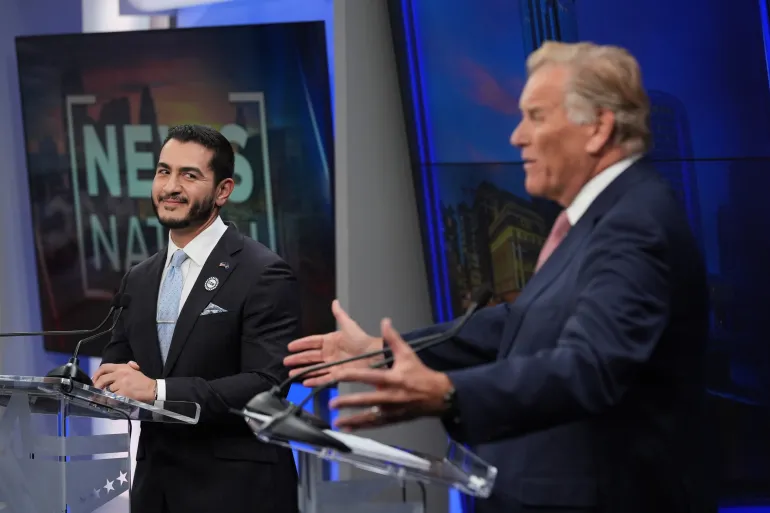
Democratic nominee Abdul El-Sayed, formerly the health director for Wayne County, repeatedly sought to paint his Republican adversary Mike Rogers as a yacht-owning millionaire out of touch with ordinary voters.
For his part, Rogers, a former member of the US House of Representatives, lobbed accusations at El-Sayed that he was soft on “terrorism” and had foreign sympathies.
The Michigan-born El-Sayed has repeatedly faced Islamophobic attacks while on the campaign trail, with Republican President Donald Trump labelling him an “extremist, terrorist sympathizer” whose history “goes back to the days of the Jihad”. If elected, El-Sayed would be the first Muslim member of the US Senate.
The two candidates spent much of their hour onstage together speaking over one another, as they exchanged pointed barbs.
“He can’t condemn a terrorist act that happened on our soil in the state of Michigan. He can’t bring himself to condemn –,” Rogers began, referencing a March attack on a synagogue.
“I did condemn it,” El-Sayed said, jumping in. “No, you did not,” Rogers replied, with El-Sayed quickly responding, “You make stuff up. You make stuff up.”
The Senate race in Michigan is considered key to the battle for control of the US Senate. Democrats are seeking to flip both chambers of Congress, but shifting control of the Senate will be a tougher prospect, given that only a third of its 100 seats are on the November 3 ballot.
Host Rick Albin at times struggled to keep the debate on track, as tensions rose.
“We’ve got dozens of questions we want to get to. You can’t litigate all of these with 14 different rebuttals, so please work with me,” Albin told the two candidates at one point.
Here are the key takeaways from the evening’s debate.
Republican nominee Mike Rogers, right, speaks during a televised debate with Democratic nominee Abdul El-Sayed [Paul Sancya/Pool via AP Photo]
Rogers insinuates El-Sayed family ties to ‘terrorism watch list’
The ferocity of the debate was underscored by the high volume of ad hominem attacks the candidates deployed against each other.
But Rogers repeatedly pushed a series of attacks that seemed to centre on El-Sayed’s identity as a Muslim.
In response to a question about healthcare, Rogers said that El-Sayed has “taken money from individuals on his campaign who openly support Hamas, Hezbollah, al-Qaeda”.
Later, when asked about his position on surveillance by Flock cameras, Rogers argued that such technology has helped catch people suspected of terrorism. He then implied that El-Sayed’s concerns about the cameras were suggestive.
“Why would that bother you?” Rogers asked El-Sayed. “Well, if you have somebody in your family that might be on the terrorism watch list …”
El-Sayed interjected, seeming to dare Rogers to continue his thought.
“Are you going to go ahead and say that I’m a – go ahead and say it,” El-Sayed said. “You’ve been tiptoeing about it the whole time. Just say it. Just say it. Go ahead and say it.”
Muslim and Arab candidates in the US have frequently been subjected to Islamophobic attacks on the campaign trail, accusing them of support for “terrorism” and Islamic fundamentalism.
Republican Mike Rogers insinuated El-Sayed may have family on the ‘terrorism watch list’ [Paul Sancya/Pool via AP Photo]
Both sides agree on ending the Iran war
There were issues, however, on which both candidates found a measure of common ground.
Both Rogers and El-Sayed agreed the US-Israeli war against Iran should end, but they had opposite views on Washington’s relationship with Israel and its role in the conflict.
High gasoline prices and inflation, El-Sayed said, were directly caused by the Iran war, and he blamed the Trump administration for Iran’s decision to shut down the Strait of Hormuz, a critical trade route.
“This is what happens when you start wars you never should be fighting,” El-Sayed said. “We literally taught the Iranian regime that they have a choke on the Strait of Hormuz, and now we’re living in that reality.”
Rogers agreed that “we need [the war] to come to an end”, but he also justified the conflict, saying that Iran’s uranium enrichment programme had been “set back twenty years”, echoing a frequent White House talking point.
The Trump administration has argued that the war was necessary to prevent Iran from creating a nuclear weapon, a goal Tehran has long denied.
Rogers’s position led El-Sayed to accuse him of “cheerleading” for the war and the Trump administration.
Democratic nominee Abdul El-Sayed pushed for an end to unconditional support for Israel [Paul Sancya/Pool via AP Photo]
Rogers backs continued Israel aid, El-Sayed calls for end
As part of the debate about US foreign policy, the candidates were also pressed on their positions about the US alliance with Israel.
The country is considered the largest overall recipient of US aid since World War II. From the start of Israel’s genocidal war on Gaza in October 2023 through September 2025, experts estimate that Israel received nearly $21.7bn in military aid.
El-Sayed has openly called for ending aid to Israel, and he has repeatedly denounced the conflict in Gaza as a genocide, in line with evaluations from United Nations experts and human rights watchdogs.
During the debate, he indicated he preferred US taxpayer dollars to be spent on domestic concerns like education and healthcare, rather than Israeli aid.
“He wants unconditional support for a foreign government,” El-Sayed said of Rogers. “I want unconditional support for kids in our schools, unconditional support for our healthcare, childcare.”
He also blamed Israel for the US military action in Iran. “I don’t want to be pushed into war by Israel, and I don’t want to be in war with Iran,” El-Sayed said.
Rogers, meanwhile, has joined most of his fellow Republicans in continuing to support aid for Israel. He argued that the country had “the right to defend itself in a very difficult neighbourhood”.
“Is there anything Israel could do that would lose your support?” the debate host asked.
“Listen, if they’re talking about using nuclear weapons, they would definitely lose my support,” Rogers replied.
Abdul El-Sayed, right, and Mike Rogers shake hands prior to their debate [Paul Sancya/Pool via AP Photo]
Another hot-button issue during the debate was Trump’s crackdown on immigration.
The Republican leader has pledged to carry out the largest mass deportation effort in US history, and his campaign has spurred human rights concerns.
When asked how they would approach the crackdown, both Rogers and El-Sayed agreed on tempering the militarised nature of the campaign.
In several cities, including Minneapolis, Minnesota, immigration authorities have been accused of racial profiling and using excessive force against immigrants and protesters, as well as violating their rights to due process.
Multiple fatal shootings have occurred during immigration enforcement operations, including the deaths of Renee Good and Alex Pretti in January.
Rogers indicated he would not have supported such confrontational operations, but he repeated a Trump claim that the raids were taking dangerous criminals off the streets.
“I think the public efforts in Minnesota were probably not appropriate,” Rogers said. “You always want to go in quiet, get the bad guy, get out of the neighbourhood for less problems. So that, to me, was something that they could have done differently.”
He later claimed that, under Trump, the country had seen “the largest decrease in murders ever recorded”.
El-Sayed, meanwhile, has previously voiced support for abolishing Immigration and Customs Enforcement (ICE), a key agency in Trump’s deportation campaign. He defended that stance on the debate stage.
“ICE right now is not about immigration enforcement. ICE is about terrorising our streets,” he said.
Mike Rogers speaks to reporters in the spin room after the debate on October 8, 2026 [Jim Vondruska/Reuters]
Candidates debate Canada trade war and tariffs
Donald Trump’s trade war with Canada, felt acutely in neighbouring Michigan, was another key topic of conversation.
El-Sayed depicted Rogers as an uncritical backer of Trump and his tariffs and tied him to past free trade deals such as the North American Free Trade Agreement (NAFTA), which paved the way for companies to shift manufacturing facilities out of the US – though Rogers did not enter Congress until 2001, eight years after NAFTA passed.
“You did that, man. That was your policy. NAFTA, that was your policy,” said El-Sayed.
Rogers sought to distance himself from the current trade war but expressed support for a deal with Canada that would loosen some of Ottawa’s tariffs on US goods.
“I would like to see the deal made,” said Rogers, adding that high Canadian tariffs for US goods “should be eliminated”.
Both candidates tried to strike a balance between criticism of the economic fallout of the trade war and qualifying their support for more selective tariffs, favoured by some industries and labour unions as a means of protecting domestic jobs.
Crew members express relief upon return from record-breaking deployment of 265 days that strained conditions on board.
Published On 9 Oct 20269 Oct 2026
The United States aircraft carrier USS Abraham Lincoln has returned to its home port after a 322-day deployment, including a record 265 consecutive days at sea, during which it helped wage the US-Israel war on Iran.
The vessel returned to Naval Air Station North Island in San Diego, California, on Thursday, where members of its crew were greeted by family and friends.
Recommended Stories
list of 3 itemsend of list
“It feels amazing,” 20-year-old Abel Ramirez told The Associated Press news agency, adding that his parents had driven from Texas to meet him. “There was a certain point when I never thought I would come off.”
The record-setting deployment of the USS Lincoln became a symbol for larger criticisms of the US war effort, which has dragged on since February with no clear end in sight and has strained US military stockpiles.
The prolonged deployment prompted a series of news reports calling attention to deteriorating conditions, food shortages and a series of reported suicide attempts by crew members.
Pentagon chief Pete Hegseth praised the sailors on Wednesday in remarks that accused the media of trying to turn the ship into “a symbol of dysfunction or a symbol of low morale or a symbol of a failed mission”.
President Donald Trump and members of his administration have frequently lashed out at the news media for critical reporting on the war on Iran. Trump himself has called the reporting about the USS Lincoln “fake news”.
“The Lincoln has been out there for a period of time, a good period of time,” he said at an Oval Office meeting on August 17. “I know people on the Lincoln, and they say it’s beautifully maintained and beautifully taken care of.”
Earlier that month, when confronted with the amount of time the USS Lincoln had spent at sea without a port stop, Trump quipped that its deployment was “not nearly long enough“.
The reports of mental health strain on the USS Lincoln come as public opinion polls show low approval ratings among US voters for the war against Iran.
On Thursday, the Pew Research Center released a poll that found 65 percent of Americans disapproved of Trump’s handling of the war, compared with 33 percent who approved.
The war has also fuelled concerns about the cost of living ahead of the upcoming midterm elections. Since the war began, Iran has hindered commercial traffic through the Strait of Hormuz, a critical waterway for the trade of fuel, fertiliser and other goods.
Sailors returning home on the USS Lincoln said that they were looking forward to fresh meals and spending time with their families.
Alma Solano Velez said that her husband, one of the US service members on board, shared a list of foods he had been craving over his 10-month deployment: oxtail, barbecue chicken, broccoli and shrimp empanadas, among others.
She added that he had spoken about “the lack of food and showers” and was looking forward to seeing their four-year-old daughter.
The Democratic National Committee has filed a lawsuit against United States President Donald Trump over television advertisements that were publicly funded and allegedly used to promote his political policies.
Ken Martin, who heads the Democratic Party’s leadership body, suggested in a statement on Wednesday that the ads were designed to bolster Republican odds in the upcoming November 3 midterm elections.
Recommended Stories
list of 3 itemsend of list
“Donald Trump is misusing millions of taxpayer dollars to fund pure propaganda ads in a last-ditch attempt to save Republicans in November,” Martin said.
Later that day, Common Cause, a democracy watchdog group, filed a second lawsuit over the same set of ads.
It argued that the ads were “overtly political” and therefore ran afoul of laws that bar public funds from being used for political propaganda.
“These ads are not public-service announcements,” Common Cause said in its lawsuit, citing a justification Trump has offered for the television spots. “They are personal publicity and political propaganda through and through.”
Both lawsuits argue that, to create the ad campaign, Trump directed the White House to repurpose $20m in funds that Congress allocated for commemorative activities related to border security, including for those killed in the line of duty.
That manoeuvre, they argue, violates the separation of powers established in the US Constitution.
“The founders made clear more than 200 years ago that the executive can spend money only according to Congress’s direction,” Common Cause’s lawsuit said.
The two lawsuits also point to a provision Congress includes in its appropriations bills barring the use of taxpayer funds for “publicity or propaganda purposes”.
Both complaints seek to have the ads declared illegal, and the expenditures stopped. They also call for steps to be taken to recover any money already spent on the ads.
The Democrats’ lawsuit was filed in Washington, DC, while the Common Cause complaint will be heard in the Southern District of New York.
Trump has faced mounting criticism over the ads, which began airing in September.
So far, the advertising campaign has cost more than $12m to run, according to the media tracking firm AdImpact.
The $20m Trump tapped for the ads comes from a $175m package Congress assigned to the Department of Homeland Security as part of Trump’s immigration enforcement agenda.
Critics have pointed out that one of the ads appears nearly identical to a television spot Trump used in his 2024 re-election campaign.
Three ads have aired so far. In one, a choir sings “love me” over a montage of Trump as he declares the US will “never be a communist country”. Another uses images of Mount Rushmore as Trump heralds a new “golden age of America”.
The third is darker: Trump walks towards the camera in black and white, warning of a “final battle” against the “deep state” and other perceived enemies.
On Wednesday, the news agency Reuters and the research firm Ipsos released a poll showing the ads are highly unpopular. Some 86 percent of the Americans surveyed, including four out of five Republicans, said it was inappropriate for Trump to have used public money for them.
Trump has defended the ads as “promotion for the country”, and he has argued they were similar to public outreach campaigns put out by previous administrations.
But after a bipartisan backlash, Trump said on Monday that taxpayer funds would no longer be used for future ads.
He did not, however, commit to paying back the money already spent on the existing ads.
Members of Trump’s Republican Party have been among those speaking out against the ad campaign.
Senator Thom Tillis, a Republican from North Carolina, said the advertisements resembled something former Hungarian leader Viktor Orban would put out.
Senate Majority Leader John Thune, meanwhile, indicated he agreed with the message in one of the advertisements, but he emphasised that “it shouldn’t be paid for with taxpayer dollars”.
Saudi civil aviation authorities say Houthi attacks on Abha and King Khalid International airports have killed three civilians, including two women, and injured 36 others.
A Gallup survey highlights a deep – and historic – partisan divide over confidence in the country’s elections.
Published On 7 Oct 20267 Oct 2026
With less than a month to go before the United States’ pivotal midterms, a new survey found that most independent voters and supporters of President Donald Trump’s Republican Party do not believe the elections will be honest.
Polling from Gallup, released on Wednesday, found 37 percent of Republicans and 35 percent of independents have confidence in the country’s electoral system, significantly lower than US Democrats (63 percent).
Recommended Stories
list of 3 itemsend of list
Overall, 49 percent of Americans said they were confident in the honesty of elections, while 51 percent said they were not. Those figures are unchanged from the country’s last midterm election in 2022.
This “marks a change from 2025, the first year of Trump’s second term, when confidence was nominally higher among approvers (51 percent) than disapprovers (45 percent)”, Gallup wrote in a statement highlighting the results of the survey.
The numbers highlight a deep, historic partisan divide over confidence in US elections.
“Since 2025 and Trump’s return to the White House, the relationship between leadership approval and confidence in elections has disappeared,” Gallup wrote.
Gallup said that the US is the only country out of more than 100 polled annually over the past 15 years to show this pattern – trust in US election integrity is markedly higher among those who disapprove of the country’s leadership under Trump (52 percent) than those who approve (41 percent).
In more than 100 countries where the polling organisation tracks views of national leadership and confidence in elections, people who approve of their governments have generally been more likely to trust their country’s elections.
In 2025, 70 percent of people globally who approved of their national leadership expressed confidence in the honesty of their elections, compared with 30 percent among those who disapproved.
“The current US pattern is highly unusual compared with the rest of the world,” Gallup wrote.
Under former US President Joe Biden, 81 percent of Americans who approved of the government expressed confidence in elections, compared with just 30 percent of those who disapproved, according to Gallup.
Gallup said the unusual divide could have implications for the November elections, raising questions about whether some voters will view the results as legitimate.
The White House did not respond to a request for comment.
Rising borrowing costs have pushed mortgage applications to lowest level since February 2025.
Published On 7 Oct 20267 Oct 2026
Mortgage rates in the United States have hit their highest level in nearly three years, as cost-of-living concerns weigh on Americans less than a month before the midterm elections.
The average cost for a 30-year fixed-rate mortgage jumped 19 basis points to 7.49 percent for the week ending October 2 , according to the Mortgage Bankers Association’s weekly report released on Wednesday.
Recommended Stories
list of 4 itemsend of list
Meanwhile, applications for mortgages tumbled 4.2 percent from the previous week, according to the report. Applications are at their lowest level since February 2025 and have fallen by almost half since the beginning of the year.
“Very few homeowners have an incentive to refinance at these rates, and the jump in borrowing costs has caused many potential borrowers to step back from the purchase market,” Joel Kan, vice president and deputy chief economist at the Mortgage Bankers Association, said in a press release.
Mortgage rates are closely tied to US 10-year Treasury notes. Earlier this week, those hit a 24-year high of 5.3 percent amid surging oil prices tied to ongoing tensions with Iran.
Meanwhile, the yield on 30-year Treasury bonds rose to its highest level since 2002, at 5.7 percent on Wednesday.
Mortgage rates have jumped since late February, when the US and Israel first struck Iran. Since the strikes, mortgage rates have climbed 1.4 percent. Inflation, which has risen by 3.4 percent from a year ago, is also putting pressure on mortgage rates.
It comes as the cost of living is top of mind for voters as they approach the congressional midterm elections that could decide the balance of power in Washington, DC. According to a Reuters/Ipsos poll in late August, 47 percent of voters said that the cost of living was the single most important issue ahead of the midterms.
In a separate Reuters/Ipsos poll in September, 17 percent of voters said they approved of US President Donald Trump’s handling of cost of living-related issues.