
NFL Week 3 picks: Ravens defeat Cowboys; Rams beat Broncos
Sam Farmer makes his picks and predictions for each game in Week 3 of the NFL season, with the Chargers falling to the Bills and the Rams winning again.
Source link
Sam Farmer makes his picks and predictions for each game in Week 3 of the NFL season, with the Chargers falling to the Bills and the Rams winning again.
Source link

Palo Alto Networks equips OpenAI, Anthropic frontier models into AI defense products
Source link

The Los Angeles freeway system has its downsides, especially during traffic-jammed weekdays, but the Rams are absolutely looking forward to commuting from their Woodland Hills facility to SoFi Stadium for Monday night’s game against the New York Giants.
After traveling about 16,000 air miles round trip for their season-opener in Australia — and suffering a humiliating loss to the San Francisco 49ers — the home opener requires only a 28-mile journey and offers a chance for a reboot.
And the embarrassed-but-still-Super-Bowl-favorite Rams are eager for the opportunity.

Share via
Aaron Donald will play for the Rams against the New York Giants on Monday, but will Puka Nacua be on the field?
“An eternity,” coach Sean McVay said when asked about the 11-day wait between games. “It has been forever. We’re excited to compete again.”
In the 27-7 defeat by the 49ers, the Rams’ offense never established a rhythm, the defense gave up three touchdown passes and special teams gave up a long kickoff return.
Veteran receiver Davante Adams cautioned about overreaction.
“Everybody’s freaking out, which I understand,” he said. “We didn’t put together the greatest showing out there. But you’re a fool if you think that that’s what it’s going to look like every single week.”
The Rams will be without edge rusher Myles Garrett, who is on injured reserve for at least four games following knee surgery. Star receiver Puka Nacua is listed as questionable because of a hip injury.
But defensive lineman Aaron Donald is expected to give Rams a much-needed boost.
Donald, 35, ended a two-year retirement when he returned to the team a few weeks ago. The three-time NFL defensive player of the year did not travel to Australia for the opener, but McVay is happy to have him available for the first time since 2023.
“Aaron is a stud, and he’s been at the forefront of setting the foundation of everything that we’re about here,” said McVay, who is in his 10th season as Rams coach. “I remember my interview process included meeting with him and he’s looking at me like, ‘This is the guy that they’re thinking about hiring?’”
One of the reasons Donald returned was to play alongside Garrett, a two time NFL defensive player of the year who amassed an NFL season-record 23 sacks last season.
Now that combination — which boasts a combined 236½ sacks — is on hold.
The double- and triple-team schemes Donald thought he had put behind might once again be in full effect.
“You think they’re going to double/triple team me [after] not playing for two years?” Donald quipped when asked about the prospect. “They ain’t worried about me, man. They don’t have to be worried about me.
“They don’t have to worry about me at all. No man, they don’t have to worry about me.”
But does he anticipate getting that kind of attention?
“I don’t know what they’re going to do out there,” he said of opponents. “I don’t know what I’m going to get. All I can know is I got a game plan. I’m going to go out there, execute it, and just try to play ball. That’s it.”
The Giants, under new coach John Harbaugh, are coming off a 28-20 victory over the Dallas Cowboys.
Second-year quarterback Jaxson Dart, receiver Malik Nabers, tight end Isaiah Likely and running back Cam Skattebo lead the offense, outside linebacker Brian Burns the defense.
Rams players have said that they quickly put their performance against the 49ers behind and were focused on the Giants.
Quarterback Matthew Stafford, the reigning NFL most valuable player, passed for only 155 yards, with an interception, against the 49ers.
“You get trained, whether it’s a game or a play. Good, bad, and different, move on to the next,” said Stafford, an 18th-year pro. “Don’t think too much about it. Don’t harp too much about it. Just be honest with yourself, play in and play out, game in and game out.”
That next game is here.
The Rams will be “primed and ready,” Adams said, “at the right time.”

Welcome back to the Times of Troy newsletter, where we’ve reached a critical fork in the road for the Lincoln Riley era.
The soft part of the schedule is behind USC. Oregon awaits next Saturday. The time is now for Riley and USC, just like the billboards around L.A. have been insisting for months.
That this moment arrives after Saturday’s uninspiring escape from Rutgers only amplifies the pressure on USC’s coach. Against arguably the worst team in the Big Ten, the Trojans were once again plagued by many of the same road woes that Riley has failed for four years to solve. USC’s defense, now on its third coordinator under Riley, was largely a disaster. Even the offense, with another Heisman Trophy candidate at quarterback, looked clunky and out of sync.
Get our Times of Troy newsletter for USC insights, news and much more — exclusive to L.A. Times subscribers. Free Members receive a partial preview of each edition.
By continuing, you agree to our Terms of Service, which include arbitration and a class action waiver. You agree that we and our third-party vendors may collect and use your information, including through cookies, pixels and similar technologies, for the purposes set forth in our Privacy Policy such as personalizing your experience and ads.
Now, Riley is out of time to iron out these issues. Because there is no more important game for USC this season than next Saturday. Outside of the 2022 Pac-12 title game, which went quite poorly for him, I’d argue it’s the most important game of Riley’s entire tenure to date.
Riley has yet to beat Oregon as USC’s coach, while Dan Lanning and the Ducks have run circles around the Trojans, on and off the field, during the four-plus years they’ve both been coaching out West. Oregon may have never won a national title, but has been to the College Football Playoff in three out of those four years. USC has never been to the Playoff. The two teams have become legitimate rivals over that time. But in two meetings with Oregon under Riley, there’s never been any doubt about who’s the better team.
For a brief moment, early in this season, it seemed like that might be shifting. Oregon was stunned by Oklahoma State, just two weeks ago, leading to real questions about whether the Ducks are the Playoff contender they were made out to be.
That loss, though, actually ratcheted up the importance for Riley. With Oregon appearing this vulnerable, there are no excuses for USC or its coach if they don’t win this game. No matter the situation that Riley inherited, the Trojans should have what it takes, by Year 5, to compete with Oregon. Full stop.
That’s the standard that USC was expecting in shelling out over $11 million per year to its football coach. But in four-plus seasons under Riley, the Trojans have just six wins against ranked opponents and have consistently blown their biggest games.
Think, for a moment, of Riley’s biggest win at USC. Are you having a hard time conjuring it? That’s because of the six ranked teams that USC has beaten under Riley, all of them finished with four losses that season.
Clay Helton had three top-five wins at USC through his first 18 games as head coach. Meanwhile, in almost five years and 57 games, I’d argue Riley still doesn’t have a single great win.
He can change that Saturday. But if Riley can’t lead USC past Oregon now, after all this time, who’s to say he ever will?

Pete Carroll when he was coaching USC.
(Getty Images)
Twenty five years ago, USC’s football program was in a bad spot.
The Trojans hadn’t been relevant in over a decade, and Paul Hackett had just been fired as head coach. USC needed a new direction. But its search for Hackett’s replacement was going poorly. Two coaches — from Oregon and Oregon State, no less — had already turned them down. That’s when Daryl Gross, the USC official in charge of the search, turned his attention to a twice-failed NFL coach.
Pete Carroll.
His hire would turn out to be a seminal moment in the history of Trojan football. But that was not how folks saw it at the time.
“There’s legendary stories of fax machines just blowing up and paper after paper coming through,” said Rocky Seto, who was a grad assistant at the time. “People weren’t happy.”
Bill Plaschke, The Times columnist, wrote a column at the time ripping the hire. Carroll himself called Plaschke after that, begging for a shot.
“All he kept saying,” Plaschke said, “was just gimme a chance.”
Well, it turned out OK for Carroll and the Trojans. They won back-to-back national titles and nearly won a third during his tenure as coach.
It’s what came after that, as USC tried to cling on to the Carroll era, that’s the subject of a new narrative podcast series from LA Times and LA Times Studios, House of Troy. Starting with Carroll’s hire a quarter-century ago, we’ll walk you through how USC rose to college football prominence and how it all came crashing down once Carroll left.
The first chapter of House of Troy drops on Sept. 22, with new episodes coming every week after that. Before then, be sure to subscribe wherever you get your podcasts.

King Miller runs past Rutgers defensive lineman Farell Gnago in the first half.
(Adam Hunger / AP)
—King Miller is the clear RB1 at the moment. USC may view Miller and Waymond Jordan as starting running backs, but there’s no doubting who has taken the reins at the top of that rotation. Both are averaging over five yards per carry. But Miller has at least 15 carries in all four games, while Jordan hasn’t eclipsed 11. Personally, I’m a bit surprised by that divide given how great Jordan looked before his injury last season. It makes me wonder if he’s all the way back from his ankle surgeries.
—The receiver rotation is still up in the air right now. With Trent Mosley out indefinitely, USC opened the game with Kayden Dixon-Wyatt, Corey Simms and Zacharyus Williams as its top three wideouts. Dixon-Wyatt is deservedly locked in that spot, while Simms balled it in his 20 snaps, catching four passes for 72 yards despite missing some time during the game due to injury. Hines ended up playing more snaps, but had a key drop on third down that we’d be talking much more about if USC hadn’t gone for it and converted on fourth. Williams played in the slot, but had just one catch. The real mystery here is Terrell Anderson, who was dressed and not on the injury report, but didn’t play a single snap on offense. Anderson was viewed, at one point, as a key contributor, so it’s not clear what happened.
—Kaylon Miller replaced Hayden Treter as the starting left guard. The move was a bit unexpected, given how Treter played through three games. Treter still played 28 snaps to Miller’s 40 against Rutgers, but with a very good Oregon defensive line on tap, the offensive line will be tested next week unlike it has all season. Miller has always had the respect of offensive line coach Zach Hanson. We’ll know at the start of the game next week whom he trusts the most in that spot.
—USC isn’t built to withstand injuries in the secondary. No unit on the entire roster has more doubts about its depth, and against Rutgers, USC had to test that depth more than it would like. Top corner Jontez Williams only played 22 snaps, while slot corner Alex Graham only played 15. Kennedy Urlacher and Rock Hill took their places, and while they did a fine job, the ripple effects of one injury on the position could be significant. Behind those players are a lot of question marks. So USC better hope that they’re all healthy heading into Oregon.
—USC men’s hoops will play four Big Ten road games in 10 days to start 2027. Which, on its face, seems patently insane. But after a screwy start to the Big Ten schedule a year ago, coach Eric Musselman actually asked for a slate exactly like this. The reason? His team doesn’t have to travel back and forth twice to the East Coast. In this case, they will have to travel from Bloomington, Ind. to College Park, Md. But that’s much more doable than an extra 10 hours of flying.
After hosting College Gameday and beating No. 19 Nebraska at home, USC opens its Pac-10 season on the road with a dominant defensive performance at Arizona, winning 20-3.
Led by new inside linebacker Rey Maualuga, the Trojans didn’t allow a single point until the fourth quarter. The offense, meanwhile, finally found a running back to lean on. With Reggie Bush and LenDale White both off to the NFL and USC still waiting for someone to step up in their place, Emmanuel Moody heeded the call. He rushed for 130 yards and a score as the Trojans stood pat at No. 3 in the AP poll.
We asked, “After three comfortable wins in the non-conference schedule, do you feel better about the Trojans’ trajectory than you did at the start of the season?”
After 1,523 votes:
Nothing has changed, 47.4%
Yes, I feel better, 45.8%
No, I feel worse, 6.8%
A brutal start to the season isn’t getting much better in Big Ten play for USC’s women’s soccer team. After starting the conference slate by being shut out, 5-0, by Michigan State, USC was shut out again by Purdue, 2-0, and then managed a tie against Oregon, 1-1.
The Trojans have scored one or fewer goals in seven of their nine matches this season and are 0-5-2 in those scenarios. They need to produce more offense — and stat.

Domhnall Gleeson as Ned in “The Paper.”
(Aaron Epstein/Peacock)
It tends to take at least a season for a sitcom to really find its rhythm, and so far, that’s been the case for “The Paper,” the spinoff of The Office which dropped its second season on Peacock recently. The first season got the journalism right, but the narrative was a bit clunky, as it sorted out who of its characters should be leading the way.
Fortunately, it seems like they’ve figured it out. Especially in the case of Domnhall Gleeson’s lead editor character, Ned Sampson, who I find far more likable in Season 2.
No. 12 USC defeats Rutgers in Big Ten opener, but defensive woes detract from win
USC freshman star Luke Wafle’s football roots date back nearly a century
USC freshman star receiver Trent Mosley to miss Rutgers game
Chad Baker-Mazara sues USC, accuses Eric Musselman of ‘racially charged’ tirade
That concludes today’s newsletter. If you have any feedback, ideas for improvement or things you’d like to see, email me at ryan.kartje@latimes.com, and follow me on X at @Ryan_Kartje. To get this newsletter in your inbox, click here.
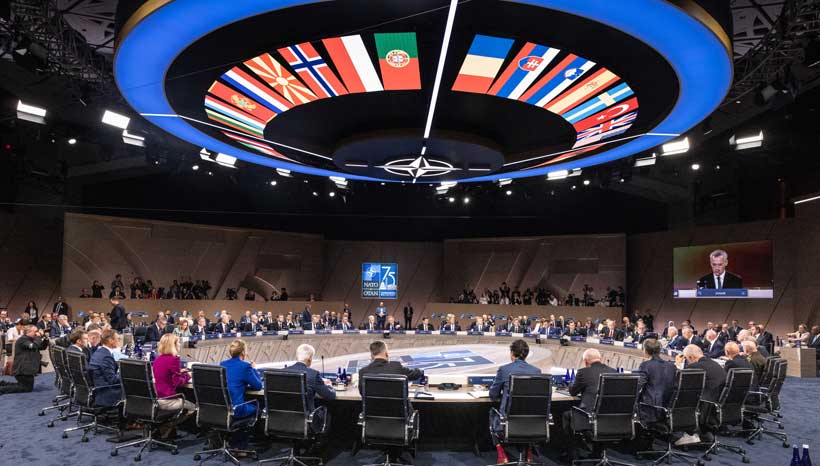
Denmark, Greenland and the United States are set to sign a security agreement that Copenhagen says will give NATO a larger role in protecting the Arctic, potentially shifting responsibility beyond the United States and Denmark alone.
The agreement is expected to be signed at the United Nations General Assembly in New York on Tuesday. Its full contents have not been made public, although US President Donald Trump has described it as giving Washington “permanent control” over Greenland’s security.
Denmark and Greenland have not endorsed Trump’s description. Both have said the agreement will benefit Greenland while respecting the island’s sovereignty.
The deal follows months of pressure from Trump, who has repeatedly argued that the United States should control Greenland and at times declined to rule out military or economic measures to acquire the semi autonomous Danish territory.
Stay ahead of the geopolitical week.
MD Briefing delivers expert analysis across five global fronts — the Indo-Pacific, energy, geoeconomics, European security, and the Middle East — every Monday morning. Free.
His demands triggered a diplomatic crisis within NATO and pushed Copenhagen and Nuuk into negotiations with Washington to address US security concerns while maintaining Greenland’s status within the Kingdom of Denmark.
Danish Foreign Minister Lars Lokke Rasmussen said the agreement would change the way Arctic security is handled.
“It will be in a form where responsibility for security in the Arctic is not only Danish or American,” Rasmussen told Danish broadcaster TV2 on Sunday. He added that NATO would play a major role in protecting the region.
A NATO spokesperson said the alliance welcomed the agreement, describing it as a step that could advance security, stability and cooperation in the Arctic.
Rasmussen travelled to New York for the signing but has declined to disclose the agreement’s details.
He said Denmark had been open from the beginning to addressing what he described as legitimate US security interests.
The negotiations therefore appear to have focused on finding a framework that can accommodate Washington’s strategic concerns without formally transferring Greenland’s sovereignty to the United States.
Trump has offered a different description of what the agreement means.
In a post on Truth Social on Friday, he said the deal gives the United States “permanent control over security, and all other needs” in Greenland. He also said no US adversary would be able to establish a base or military presence on the island without Washington’s written approval.
Copenhagen has not publicly responded to that characterization.
The difference between Washington’s description and Denmark and Greenland’s public statements leaves important questions about the agreement unresolved.
Among the most significant is whether it changes the 1951 US Denmark defence agreement, which provides the legal basis for the American military presence in Greenland.
The document’s provisions on US access, military infrastructure and the role of NATO have not been made public.
The agreement comes as Denmark acknowledges that it underinvested in Greenland’s defence for decades.
Copenhagen has since pledged to increase its military presence on the island and strengthen Arctic surveillance, including through greater NATO involvement.
Greenland’s government has sought to reassure residents that the negotiations do not compromise the island’s sovereignty.
Erik Jensen, an opposition lawmaker in Greenland, said on Facebook that he had read the draft agreement and felt reassured by its contents. He also praised Greenland’s foreign minister for handling the negotiations.
For Greenland, the issue is particularly sensitive because the island has extensive autonomy within the Kingdom of Denmark and has long maintained a political debate over eventual independence.
The deal could mark a significant change in the security architecture of the Arctic.
Greenland occupies a strategically important position between North America and Europe, making it valuable to the United States and NATO as competition over the Arctic increases.
A larger NATO role could provide a multilateral framework for responding to concerns about military activity and strategic infrastructure in the region. At the same time, the agreement’s precise legal and operational arrangements will determine how far that shift actually goes.
Until the text is released, it remains unclear whether the agreement represents a substantial restructuring of Greenland’s defence arrangements or primarily a political framework for closer cooperation.
What is clear is that the negotiations have moved Arctic security from a dispute centred on US ambitions for Greenland toward a broader discussion about NATO’s collective role in one of the world’s increasingly contested strategic regions.
With information from Reuters.
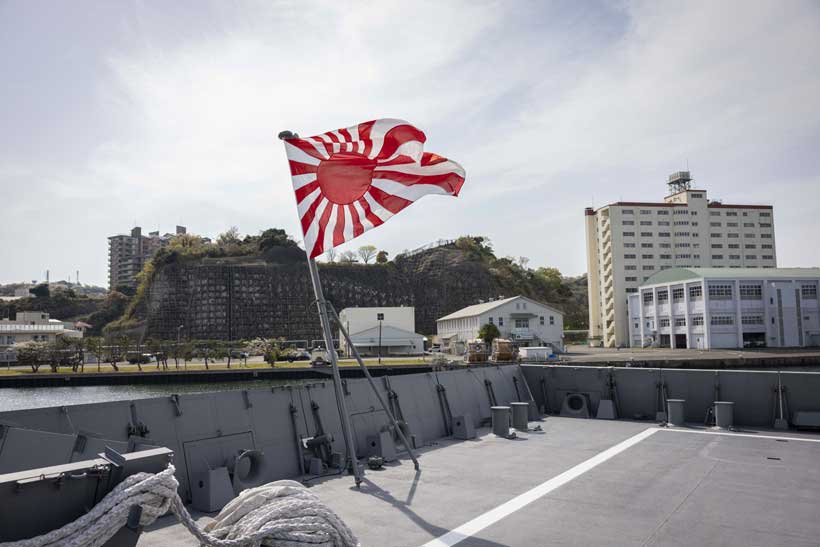
The NATO Response Force (NRF) and EU Battlegroups have demonstrated that placing multinational forces on standby does not automatically make them immediately operational. German-Dutch military integration, in contrast, has generated a different outcome since cooperation was internalized within permanent command structures, units, training, and capability planning before a crisis occurred.
Such a comparison is becoming increasingly relevant to Northeast Asia. A Taiwan contingency could absorb American military assets at the very moment when North Korea embarks upon a serious provocation towards South Korea. Continued US commitments in Europe and the Middle East could further complicate the allocation of finite resources.
Why Standby Forces Encountered Problems
The NRF was established after the 2002 Prague Summit as a rapidly deployable multinational joint force of roughly 25,000 troops. Yet the NRF was heavily dependent on the member countries assigning their respective forces to particular rotations, while these governments had the final say over whether the forces could ultimately be employed. During the Afghanistan and Iraq wars—when operational demand was high—each government had strong disincentives in introducing scarce high-readiness units and specialized enablers to NRF rotational deployment.
Stay ahead of the geopolitical week.
MD Briefing delivers expert analysis across five global fronts — the Indo-Pacific, energy, geoeconomics, European security, and the Middle East — every Monday morning. Free.
This created a gap between designated readiness and actual availability. Strategic transportation, logistics, specialized support units, and communication capacity could still be subject to competing national demands. Eventually, in 2024, NATO replaced the NRF with the NATO Force Model, which emphasized a substantially larger pool of high-readiness forces that is closely aligned with specific defense plans.
Meanwhile, the EU Battlegroup was faced with an even clearer problem. Although the multinational battlegroups had been maintained on rotational standby since 2007, they had never been deployed. While acknowledging that the battlegroups enhanced interoperability and military transformation, the European Parliament attributed the shortcoming largely to insufficient political will, difficulties in decision-making, implementation problems, and the financing arrangements.
What Germany and the Netherlands Did Differently
German-Dutch cooperation developed according to a different institutional logic. Although the 1st German-Netherlands Corps was created in Münster in 1995, the integration later expanded deep into both militaries’ force structures. The Dutch 11th Airmobile Brigade was incorporated into the German Division Schnelle Kräfte (DSK) in 2014, while the Dutch 43rd Mechanized Brigade was integrated into Germany’s 1st Panzer Division in 2016, and the Dutch 13th Light Armoured Brigade joined Germany’s 10th Panzer Division in 2023.
The relationship was extended below the brigade level. Germany’s Panzerbataillon 414 is operated under the Dutch 43rd Mechanized Brigade, and Dutch personnel operate Germany’s Leopard 2A6MA2 tanks while serving within the battalion. Moreover, German officers serve in Dutch command headquarters and vice versa, turning multinational command into a routine organizational reality instead of a stopgap measure that is only activated during major exercises.
Needless to say, such an arrangement does not eliminate national sovereignty. Both Germany and the Netherlands preserve the political prerogative over whether and where their forces are deployed. Meanwhile, the benefits of integration would become observable once a crisis necessitates the deployment. Staff are already well-versed in each other’s procedures, and units have repeatedly conducted joint exercises, while command and logistics relations do not need to be newly constructed during mobilization.
The distinctions were visibly observable during training. For example, approximately 7,000 German and Dutch personnel participated in the 2026 Fighter Lion—the largest military exercise conducted by the Netherlands in two decades—ten years after the Dutch 43rd Mechanized Brigade was integrated into Germany’s 1st Panzer Division. These types of exercises strengthen existing command relations rather than creating temporary interoperability for a single event.
What Japan and South Korea Can Apply
It is quite obvious that Japan and South Korea cannot replicate the German-Dutch model. Neither country has a formal mutual defense pact nor a NATO-style integrated command structure. Therefore, the directly applicable lessons are more limited. Nonetheless, selected operational relationships can and should be institutionalized before multiple simultaneous contingencies make such coordination necessary.
The practical first step could be a standing bilateral adjustment mechanism that links Japan’s Joint Operations Command (JJOC) with relevant South Korean joint headquarters. Instead of exercising command authority, the mechanism could maintain procedures for intelligence exchange, deconfliction in the air and at sea, movement of US reinforcements, logistics coordination, and the use of Japanese facilities that support a Korean contingency. This would be especially crucial when Japan has to assist US operations related to Taiwan while installations across Japan—including Yokota, Yokosuka, Sasebo, Iwakuni, and other United Nations Command (UNC)-Rear facilities—play a pivotal role in US reinforcement to the Korean Peninsula in accordance with Operational Plan (OPLAN) 5055.
Under this mechanism, small-scale functional cells could concentrate on specific missions. Missile warning would be the most obvious starting point since the United States, Japan, and South Korea have conducted North Korean missile-warning data-sharing since December 2023. Additional cells could treat maritime domain awareness (MDA), anti-submarine warfare (ASW), cyber defense, transportation, medical evacuation, and logistics.
The exchange of officers should accompany the aforementioned measures. Japanese officers could participate in South Korean command posts, while South Korean officers could join Japanese operational staff who deal with naval operations, air defense, logistics, or reinforcement coordination. The goal is to get familiar with each country’s procedures, communications, command relations, and other miscellaneous constraints before wartime pressure markedly shortens the timeframe for decision-making.
Exercise Scarcity Rather Than Ideal Conditions
The most notable changes should be related to exercise design. Trilateral exercises should not be premised on the assumption that the full inventory of United States support capabilities will always be available. A more pessimistic scenario would begin with a Taiwan scenario that is already consuming a substantial amount of US assets—including its ISR capacity, strategic transportation, and precision-guided munitions—when North Korea embarks upon a serious horizontal or vertical military escalation on the Korean Peninsula.
In this particular situation, elaborated by the Atlantic Council report, South Korean military planners should determine which missions could be conducted independently and which can be addressed bilaterally. South Korea may assume greater responsibility for ISR, missile defense, logistics, and conventional firepower on the Korean Peninsula—yet this would be affected by the tempo of wartime operational control (OPCON) transition—while Japan could take on additional maritime surveillance, ASW, sea lines of communication (SLOC) protection, base defense, and logistics. The primary aim is not to divide the Taiwan and Korean Peninsula theaters between Seoul and Tokyo but to identify how both countries could most effectively conduct missions that complement US military operations across the two regions.
Logistics should be placed at the center of these exercises. A dual contingency could impose on the Japanese government the need to support both US operations on Taiwan and USFJ reinforcement to the Korean Peninsula, which inevitably involves Japanese ports and airfields. It could cause competition for fuel, maintenance, transportation, ammunition depots, runways, and port capacity. Thus, Tokyo and Seoul should develop procedures concerning reciprocal servicing, immediate repair, medical support, transportation, and selected supplies before the bottleneck transmogrifies into wartime problems.
Functional Integration Without a Bilateral Alliance
The German-Dutch case illustrates that political authority is not necessarily the same thing as operational preparedness. A government can maintain full authority over whether its forces enter conflicts and can also prepare in advance to cooperate effectively if that decision is made. These distinctions are highly relevant to Japan and South Korea since they enable a considerable level of operational preparedness without a formal defense pact. For instance, South Korea could discuss target allocations for North Korean TELs with its Japanese counterparts in order to effectively use the finite weapons available to Japan’s enemy base strike capability and South Korea’s Kill Chain and Korea Massive Punishment and Retaliation (KMPR).
Naturally, the primary objective should be functional integration in fields where both governments already have overlapping interests. A large set of measures—spanning from ISR coordination to cyber defense—can be institutionalized without creating either an integrated force or an Asian version of NATO.
Both the NRF and EU Battlegroups revealed the limits of formations that remained dependent on political and operational arrangements being assembled only when crises occur. German-Dutch cooperation worked better since many of those arrangements already existed.
Given the historical baggage that Japan and South Korea carry, it would undoubtedly be a Herculean task for them to take novel steps. Nonetheless, the emerging regional security environment is rapidly narrowing down the available options.

The fourth China-Africa Peace and Security Forum was held in Beijing, China, from September 15 to 17, 2026, coinciding with the 13th Xiangshan Forum and the 70th anniversary of the establishment of diplomatic relations between China and African countries. Military representatives and defense officials from the African Union and 41 African nations participated. This expansion of bilateral military relations between Beijing and African countries comes at a time when Beijing and Washington are vying for influence on the African continent, while African nations seek to diversify their partners and strengthen their security capabilities, particularly in regions facing escalating threats, such as the Horn of Africa. The fourth China-Africa Peace and Security Forum, held in Beijing, represents a pivotal milestone reflecting the growing military and defense cooperation between China and 41 African countries, along with the African Union, as Beijing seeks to solidify its security presence on the African continent. The most prominent theme of the forum and defense cooperation was the speech by Chinese Defense Minister Admiral Dong Jun, who called for deepening strategic coordination and developing mechanisms for defense exchange and maritime security based on equality and mutual benefit, without political dictates or conditions, between China and African countries. This reflects the growing African interest in partnership with China, driven by a desire to diversify military options and avoid the pressures and conditions associated with Western and American partnerships. The China-Africa Peace and Security Forum witnessed the signing of bilateral memoranda of understanding to enhance military capabilities, training, and the exchange of expertise between China and some participating countries, such as Mauritania.
The fourth session of the China-Africa Peace and Security Forum, held in Beijing, China, witnessed a significant deepening of bilateral military cooperation between China and Africa. On the sidelines of the forum, the Islamic Republic of Mauritania and the People’s Republic of China signed two memoranda of understanding to strengthen and develop military cooperation between the two countries. This signing took place during a meeting between Mauritanian Defense Minister Hanan Ould Sidi and his Chinese counterpart, Admiral Dong Jun. The most prominent areas of the memoranda of understanding included strengthening military and security capabilities to address challenges in the Sahel region and Africa, particularly combating terrorism and organized crime. They also focused on military education and training for African military personnel and the exchange of expertise, intelligence, and security experiences between the two sides. This move is part of a broader Chinese strategy to enhance defense partnerships with African countries (with representatives from 41 nations participating), emphasizing joint military training and coordination.
In this context, cooperation between the Chinese People’s Liberation Army and African armies is steadily increasing, encompassing training, counter-terrorism exercises, and peacekeeping operations. The most prominent forms and areas of military cooperation between China and Africa include joint military exercises, where the Chinese army conducts joint drills with African countries, such as the Peace Unit exercises with Tanzania and Mozambique to combat terrorism on land and at sea. This cooperation also encompasses peacekeeping and assistance efforts, with China participating in numerous UN peacekeeping missions in Africa and deploying warships to combat piracy off the coast of Somalia. Simultaneously, there is an increase in military education and training programs, with Chinese military academies hosting African leaders, defense ministers, and officers to enhance professional exchanges and build long-term strategic relationships. To this end, China regularly organizes the China-Africa Peace and Security Forum to strengthen defense coordination and consultation with various countries on the continent. The objectives of the Chinese military presence in Africa include modernizing African military expertise, providing the People’s Liberation Army with field operational experience in diverse and complex security environments, and protecting Chinese interests and securing massive Chinese investments and economic projects related to the Belt and Road Initiative. With increasing practical cooperation between China and Africa, Beijing is bolstering its diplomatic and strategic influence on the African continent in the face of international competition with Washington.
China’s military presence in Africa can be summarized as achieving three major strategic objectives, such as modernizing African military expertise, providing the Chinese People’s Liberation Army with field experience, and protecting the substantial investment interests of China’s Belt and Road Initiative. These three objectives and their shared benefits can be detailed as follows:
Stay ahead of the geopolitical week.
MD Briefing delivers expert analysis across five global fronts — the Indo-Pacific, energy, geoeconomics, European security, and the Middle East — every Monday morning. Free.
1) Modernizing African Military Expertise:
China seeks to present itself as a reliable and alternative security partner for African countries through various modernization mechanisms, including:
– Technology Transfer and Training: By providing advanced training programs for African officers at Chinese military academies and transferring modern tactical and operational knowledge.
– Defense Infrastructure Development: By contributing to the construction of bases, logistics centers, and training facilities for African armies.
– Arms and Equipment Sales: By supplying African countries with modern weapons systems at competitive prices, such as drones, armored vehicles, and communication systems, thereby enhancing the combat effectiveness of these armies.
– Counterterrorism and Counter-Piracy: By building joint capabilities between the Chinese People’s Liberation Army (PLA) and local African armies to counter unconventional security threats in conflict zones and maritime piracy areas, such as the Gulf of Aden.
2) Gaining Field Operational Experience for the PLA
The diverse and complex African security environment represents an important real-world testing ground for the Chinese military, which lacks modern field combat experience outside its borders. This benefit is achieved through:
– Testing Chinese weapons, military equipment, and armaments: By experiencing the effectiveness and quality of Chinese weapons and military equipment in harsh climatic and geographical environments (desert, tropical).
– Remote Operations Management: Developing the ability to command and control forces across vast geographical distances and testing the effectiveness of cross-border supply and logistics.
– Participation in peacekeeping forces: China’s extensive involvement in UN peacekeeping missions in Africa, such as in Mali, South Sudan, and the Central African Republic, provides Chinese officers with experience interacting with international militaries and managing complex security crises.
– Naval and operational presence: Utilizing the Chinese military base in Djibouti as a launchpad for evacuation operations, counter-piracy efforts, and protecting shipping lanes enhances the flexibility of the Chinese navy.
3) Protecting interests and securing investments under China’s Belt and Road Initiative
Africa is a key pillar of China’s Belt and Road Initiative, and the military role in protecting these massive Chinese investments is complemented by:
– Securing critical infrastructure: Protecting ports, railways, mines, and energy fields financed and operated by Chinese companies against any political instability or terrorist attacks.
– Securing Maritime Routes: Ensuring the safety of vital maritime trade routes for transporting raw materials from Africa to China and Chinese goods to global markets via the Red Sea and the Bab el-Mandeb Strait.
– Protecting Chinese Communities: Providing security and rapid intervention capabilities to evacuate thousands of Chinese workers and citizens from African conflict zones when necessary.
From the preceding presentation and analysis, we understand the importance of the China-Africa Peace and Security Forum in strengthening defense exchange mechanisms, defining and deepening regional cooperation in maritime security, combating terrorism and extremism, and building defense capabilities in emerging areas to address escalating security risks on the African continent, such as the Sahel region. The Forum provides an opportunity to enhance consultation and exchange views between China and African countries on various peace and security issues and to develop prospects for cooperation between China and African countries in related fields. China-Africa cooperation encompasses military training, naval exercises and patrols, counter-terrorism, mine clearance, and securing shipping lanes, as well as the transfer of expertise and technology and the marketing of Chinese weapons.

The top U.S. Air Force officer in Europe, who also serves as the NATO Allied Air Command leader, said he has been tasked with enacting new alliance plans to defend against cruise missiles and drones. He was responding to questions about a drone that NATO had to shoot down after it entered Lithuanian airspace overnight. European Commission President Ursula von der Leyen said Tuesday morning that the incident was “part of a broader pattern of Russian aggression and provocation against Europe, testing our readiness and our resolve.”
The drone incursion into Lithuania took place against the backdrop of the ongoing Russian war on Ukraine and amid a spate of so-called ‘hybrid’ or ‘gray zone’ actions Moscow has been accused of carrying out throughout Europe, including a recent attempted drone attack on the Leipzig-Halle airport in Germany.
We now know that Russia is responsible for the attempted explosive attack at Leipzig airport. Russia’s repeated hybrid attacks on Germany and Europe are unacceptable. (1/4) pic.twitter.com/o3vBjgpeb1
— German Embassy Washington (@GermanyinUSA) September 1, 2026
“I don’t know what’s in the mind of Putin or his fielded forces about those one-way attack drones or even cruise missiles, like we’ve seen enter Polish airspace just a few months ago. In July, we had an AS-23 cruise missile enter Poland,” Lt. Gen. Jason T. Hinds, Commander, U.S. Air Forces in Europe/U.S. Air Forces Africa (USAFE), and Commander of the Allied Air Command, said in response to a question about the drone shootdown over Lithuania. He was speaking during a media roundtable at the Air & Space Forces Air, Space and Cyber Conference that TWZ is attending.

Hinds added that while he doesn’t “know the why behind” the drone incursion into Lithuania, he has been tasked by U.S. Air Force Gen. Alexus G. Grynkewich, who serves as NATO Supreme Allied Commander Europe (SACEUR), “to fully implement EVA [Enhanced Vigilance Activity] Eastern Sentry and now its Standing Defense Plan 12000, which gives the nations the capabilities that they need to defend their airspace against either one-way attack drones like the one that you described last night, or a cruise missile.”
EVA Eastern Sentry is a mission NATO stood up in September 2025 after “an unprecedented number of Russian drones and planes violated the airspace of several NATO Allies,” according to the alliance. “Allies are contributing additional capabilities and assets to NATO’s deterrence and defense – for instance, more fighter jets, helicopters, transport aircraft, air defense systems, surveillance aircraft and frigates – and improving the coordination of these assets through NATO.”

Is the Kremlin testing Europe’s defenses with drone incursions? | DW News
Standing Defense Plan 12000 is a new plan for integrated air and missile defense across the alliance. Grynkewich introduced the concept during testimony to Congress in March.
Hinds acknowledged that Russia could be testing the alliance.
“It’s not about the small UASs; that’s typically a national responsibility, and it could be probing,” the Air Force general noted. “Regardless of the intent behind it, what we want to be prepared for is the second that a one-way attack drone or a cruise missile is first and foremost detected – hopefully well before it enters NATO territory – we want to know it. We want to know where it’s coming from. We want to have the capability to sense it. We want to be able to have the C2 [command and control] systems to be able to decide what to do about it, and then have the right kit to be able to act.”
Despite an integrated air and missile defense system that includes Patriot surface-to-air missile batteries, NATO currently is primarily “using air power” against drones and cruise missiles “and that’s not putting us on the right side of the cost curve,” Hinds stated. “But we want to get there.”
Using NATO jets to take down drones “is very effective, just like what you saw last night, and many other times,” but not necessarily efficient, Hinds explained.

Video shows debris after NATO jets shoot down a drone over Lithuania
“I think there’s been at least five other cases of allied nations providing air power to shoot down one-way attack drones,” he proffered. “I want to get to the point where we’re doing it efficiently, using lower-cost interceptors, hopefully ground-based, and in some cases air-based that are cheaper to use, so we’ll see what the intent may be. Intelligence organizations are going to provide us with that intelligence later on, but I just don’t know yet.”
You can see one of those NATO jet engagements with drones in the following video.
It should be noted that Europe is starting to follow the American lead in using less expensive laser-guided, air-to-air rockets as drone-killing weapons. TWZ was the first to report about the use of 70mm Advanced Precision Kill Weapon System (APKWS) rockets by the U.S. The U.K. Royal Air Force announced in May of this year that its Typhoons were now equipped with APKWS rockets while the French recently tested their own 68mm laser-guided rockets from Rafale fighters.
The Defence Procurement Agency has successfully completed integration testing of 68 mm laser-guided rockets on the Rafale fighter jet. The time between the contract being awarded for this new capability and initial operational capability being achieved was less than 8 months. pic.twitter.com/rR2Nij9EzY
— French Aid to Europe 🇨🇵 🇪🇺 (@aidefranceukr) July 13, 2026
As the threats have evolved, NATO has “transitioned away from air policing, and we’ve transitioned to air defense for some specific reasons,” the general pointed out. “One is readiness. Air policing is a readiness decrementing mission that the alliance has done for years. There’s also an assurance mission that we did for 32 nations. That’s transitioned to air defense now. Air defense means we have the right kit, multi-domain, to be able to be put in the right place based on indications, warnings, or real threats, like you saw last night, inside of the Baltic nations, to be able to respond decisively and quickly.”
“There’s also a deterrence value there,” Hinds added. “So if Russia does fly a one-way attack drone or a cruise missile, they know that we’re going to be in the right spot to be able to detect it and then defend against it.”
“These are limited incursions, right? Small numbers. Here’s what I see: hybrid activities may, in fact, only be one of the few levers that Putin has available to him, because he sees that he does not have an advantage in geography, domain, or readiness,” Hinds suggested.
“Think about that,” he urged. “So what are we seeing? We’re not seeing a massing of forces across the opposite side of Finland, a new NATO nation. We’re not seeing a massing of forces whatsoever in any domain opposite of Poland, Latvia, Lithuania, or Estonia. You’re seeing a significant number of one-way attack drones in the Black Sea targeting Ukraine. Some of them are entering Romania. What you’re not seeing is a direct confrontation in geography. We’re not seeing direct competition in domains. And I think Putin knows that we are ready. I know he knows that we’re a defensive alliance. I know he knows that we have an advantage in every domain against them, and I think that’s likely why you’re seeing things like what you’re seeing with hybrid activity.”

Though below the level of armed conflict, these Russian activities raise the potential for something worse, Hinds posited.
“The risk about hybrid activity, from my perspective, is it could lead to escalation, and that’s where I hope that we get back towards deterrence again, and that the nations they’re going to decide to do what they want to do when it comes to these hybrid activities,” the general said. “Some of them are law enforcement. Some of them are military responses, and that’s up to the nations to decide how they’re going to deal with that. Not me.”
“But what I owe General Grynkewich is to ensure that we are demonstrating our deterrence each and every day, and we’re doing that effectively across all domains,” Hinds added. “And to ensure that Putin knows that if he tries something against the alliance, that we will be there, and we’re ready to win decisively if challenged.”
Contact the author: howard@twz.com
UCLA offensive coordinator Dean Kennedy stressed that his offense needed to come out swinging Saturday against Purdue after going scoreless in the first half against San Diego State last week.
And the Bruins heeded the advice, scoring 21 first-quarter points before pulling away in the second half to take a 52-38 win in their Big Ten opener Saturday night at the Rose Bowl.
UCLA improved to 3-0 and matched its 2025 win total with its first 50-point game against a Power Four program since November 2022. Bob Chesney joined Terry Donahue and Jim Mora as the only coaches to start their UCLA tenures 3-0.
Fifth-year tailback Wayne Knight spearheaded the offensive outburst, rushing for 177 yards and two touchdowns for a Bruins team that had 369 yards and four touchdowns on the ground via an average of 7.7 yards per carry. Knight has eight touchdowns in three games, matching the Bruins’ total output for rushing touchdowns last season.
“The biggest thing for us was to just put it all together. And I think that we stepped up to that challenge — what we did on the ground, in the air,” Knight said. “But the guys up front, no matter who is in there as guys are rotating all the time, whoever is in there is going to put up front. They are working as a team.”
While Chesney made sure to acknowledge his running backs — with all three starters reaching the end zone — he made a point to recognize the man under center, highlighting senior quarterback Nico Iamaleava’s resiliency.
After posting two interceptions to zero passing touchdowns through the first two weeks of the season, Iamaleava completed 19 of 31 passes for 276 yards and three touchdowns while rushing for 55 more. Iamaleava looked much more comfortable and confident in the pocket, despite playing through multiple injuries.

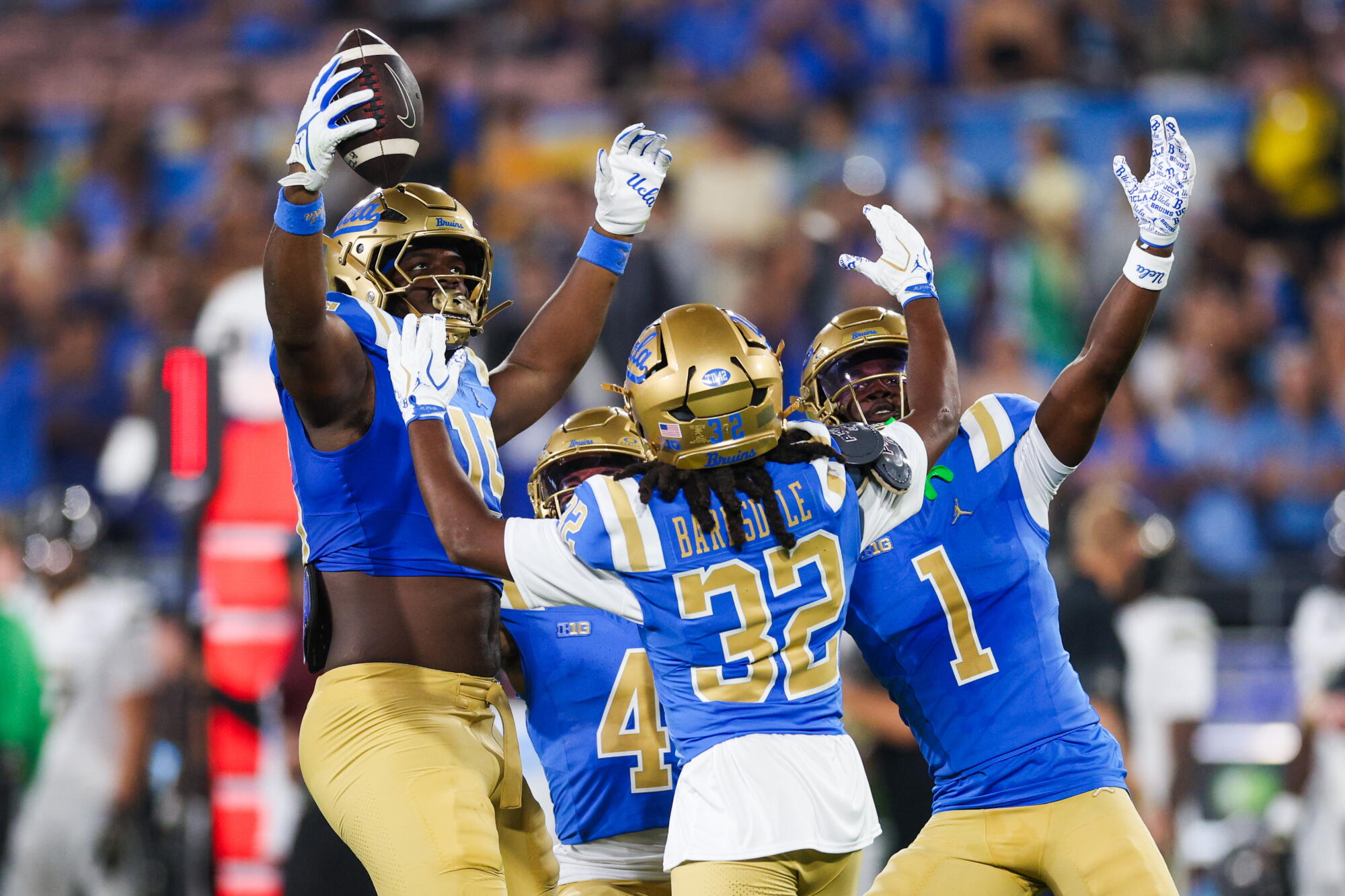
UCLA defensive players celebrate after defensive lineman Sahir West (15) recovers a fumble against Purdue Saturday at the Rose Bowl.
(Ronaldo Bolanos/Los Angeles Times)
“Last week, I told you it wasn’t his greatest game. We watched him go out here today, and I think he was near perfect for a stretch in the beginning of that game, finding all kinds of different receivers and being able to carry the ball himself a little bit,” Chesney said. “And just what a warrior, because he was pretty nicked up out there in moments, and he just wanted to keep fighting.”
Iamaleava found security in senior wideout Semaj Morgan, who hauled in four passes for 72 yards and two touchdowns. In three years at Michigan, Morgan had just four receiving touchdowns. Outside of Morgan, fifth-year wide receiver Leland Smith caught three passes for 59 yards despite playing just one snap across the previous two weeks, potentially giving Iamaleava and Kennedy a big target to look to going forward.
James Madison transfer Landon Ellis, who returned to the field for the first time since going down with a head injury in the beginning of the second half against California, scored his first touchdown as a Bruin. And South Carolina transfer Brian Rowe Jr. caught two passes for 65 yards despite getting targeted eight times, including a deep shot from Iamaleava in the end zone that bounced off his chest.
Although UCLA’s offense turned in 645 yards of total offense, its defense struggled to hold back a Purdue team that lost its 19th consecutive conference game.

UCLA quarterback Nico Iamaleava passes during the first quarter Saturday against Purdue.
(Ronaldo Bolanos / Los Angeles Times)
While the Bruins held Aztec signal caller Jayden Denegal to just 45 passing yards, the secondary found itself facing a different beast in Boilermaker quarterback Ryan Browne, who completed 19 of 30 passes for 378 of Purdue’s 488 total yards, with a touchdown and an interception. Xavier Townsend had 162 yards receiving and two touchdowns.
“I felt like the pressure mounted a little bit and we were not as clean in our technique as we needed to be,” Chesney said. “We can’t put ourselves in panic mode, which might have hit us a little bit throughout today. But when we needed it the most, we were able to get a stop.”
Chesney said the UCLA defense has the personnel and ability to compete with anyone, but penalties and a fake punt that resulted in a first down allowed the Boilermakers to get within one score and added unnecessary pressure.
Fortunately for the UCLA secondary, linebacker Sammy Omosigho put the defense on his back.
Omosigho led the team in tackles with 12, but more important, he had two sacks and two forced fumbles. He has four forced fumbles in three games.
“That’s his third game in a row forcing a fumble. There’s other things he’s going to want to clean up in there too and other schematic things that he can do better,” Chesney said of Omosigho. “But at the same point in time, the one play that stuck out to me was a running back, and it looked like he was going to go and get the edge, and Sam just put out one arm and just crumbled this kid with one arm. The strength he has, the poise he plays with, the toughness he plays with and the strength to be able to execute and finish on those tackles, are things that are pretty impressive.”

UCLA running back Anthony Woods is hoisted up by offensive lineman Julian Armella after scoring a touchdown against Purdue at the Rose Bowl on Saturday.
(Ronaldo Bolanos/Los Angeles Times)
James Madison transfer Sahir West recovered both of Omosigho’s takeaways — the Boilermakers’ first two giveaways this season — and they set up UCLA touchdowns.
While Purdue (1-2) kept up with UCLA for most of the game, its hopes of a comeback ended when senior defensive back Rodrick Pleasant picked off Purdue quarterback Ryan Browne with less than six minutes left.
Despite the Bruins’ difficulty thriving on both sides of the ball during the same game, Chesney said he is confident in his team’s ability to compete going forward.
“We heard the guys on defense saying thanks for getting our back,” Chesney said. “The offense struggled last week, we’re going to need them at some point. The defense is going to need that at some point, and then we’re all going to need the special teams at some point. We haven’t played the perfect complementary game yet, but there’s one in there and I’m looking forward to seeing that day because it exists. There’s fibers in here of a really high level football team.”

JSerra converted on three fourth downs in the second half Friday, allowing the Lions to battle back from a seven-point, first-half deficit to beat host Bishop Amat 37-28.
With the nonleague victory, JSerra improves to 4-1, while Bishop Amat falls to 4-1.
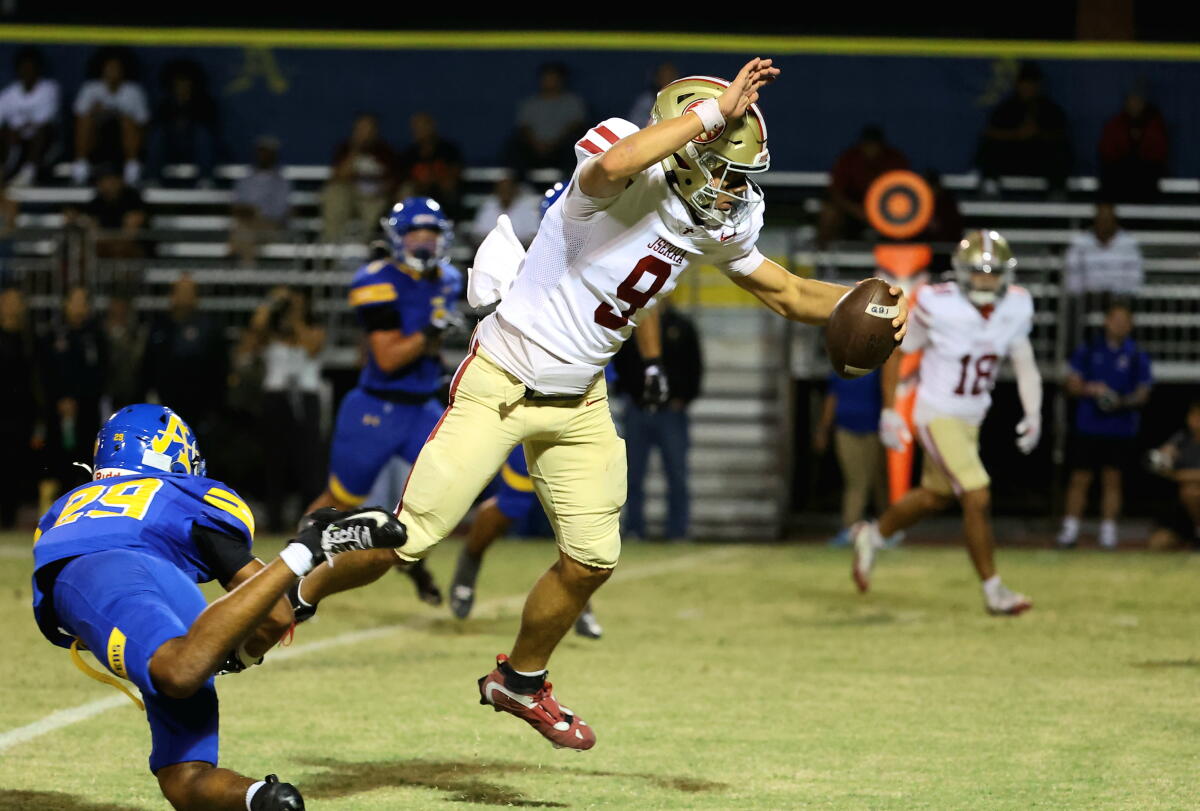
JSerra quarterback Hayes Cloutier, who threw for two touchdowns and rushed for three, engineered all three second-half conversions, two with his legs and one with his arm.
The first, and most impressive, came on the Lions’ first possession of the half. Trailing 28-21 and facing fourth and three on the Bishop Amat 27-yard line, Cloutier zigged and zagged across the field, eluding most of the defense.
After the Lions tied the score, sophomore defensive back Sean Veritch snagged a deflected pass by Bishop Amat quarterback Domenico Doran, and the Lions drove to the Lancers’ 16-yard line. On fourth and 10, Evan Leddy kicked a 33-yard field goal to give JSerra an apparent 31-28 lead, but the Lions accepted a penalty on Bishop Amat that moved the ball to the 11-yard line.
JSerra coach Hardy Nickerson opted to go for it on fourth down, and Cloutier rewarded his gamble, scoring on an 11-yard run. Leddy’s extra point was blocked, and JSerra settled for a 34-28 lead.

JSerra High quarterback Hayes Cloutier leaps as he tries to evade a tackle by a Bishop Amat defenders.
(Nick Koza)
The Lions’ defense, which had given up scores on four of Bishop Amat’s five first-half possessions, then stiffened, forcing the Lancers to punt. With about two minutes remaining in the third quarter, the Lions reeled off a 23-play drive, which included four JSerra penalties and ate up more than 10 minutes.
A 22-yard run by Cloutier was key, as was his four-yard completion to Clark Cokely on a fourth-and-two play. The drive ended with a 44-yard field goal by Leddy that gave JSerra a 37-28 lead.
After surrendering 28 first-half points, JSerra held Bishop Amat scoreless, and running back Justin Clinton, who rushed for more than 130 yards, including a 67-yard burst and a 43-yard touchdown, in check in the second half.
“It was a heavyweight fight,” Nickerson said of the first half. “But my defensive staff just put it together in the second. We turned things up and made adjustments.
“We knew that if we could get in the throwing lanes and forced them to have to pass the football … we felt we would have a chance. And those guys went out and executed the second half and it was beautiful.”

The People’s Republic of China achieved a historic and unprecedented participation in the second edition of the El Alamein International Aerospace Exhibition (EIAS 2026), which was held at El Alamein International Airport from September 8 to 10, 2026. The Chinese participation came just days after the conclusion of the joint Egyptian-Chinese air force exercises Eagles of Civilization 2026. The significance of this Chinese military presence lay in the display of a fully integrated and realistic combat air system, not merely models. In this context, the Egyptian researcher will attempt to divide the significance of China’s participation in the El Alamein Air Show into several key areas, including:
– First: China’s prominent participation in the El Alamein International Air and Space Show in Egypt as a strategic shift in the regional arms market
Here, China’s extensive participation in the El Alamein International Air and Space Show constitutes a significant strategic shift in the regional arms market. Beijing has moved beyond the traditional approach of selling individual military components to present itself as a supplier of comprehensive and integrated air combat systems, competing with Western and American powers in the Middle East and Africa. China’s participation in the El Alamein International Air and Space Exhibition focused on several strategic axes to promote and analyze the concept of a full-suite solution. This was achieved by emphasizing that China does not simply sell aircraft but rather offers a comprehensive defense solution, encompassing attack fighters, logistics support aircraft, aerial refueling, and command and control systems, known as C4ISR.
The People’s Liberation Army of China sought to highlight China’s military and defense role and promote the Chinese model as a ready-made competitive alternative. This was done by showcasing the competitive advantages of Chinese defense industries, such as the absence of complex political conditions, rapid delivery, and comprehensive technology transfer to Middle Eastern and African markets. Furthermore, the focus was on the geopolitical depth, linking the Chinese presence in El Alamein to Beijing’s broader vision of strengthening security and economic partnerships with countries in the region.
Stay ahead of the geopolitical week.
MD Briefing delivers expert analysis across five global fronts — the Indo-Pacific, energy, geoeconomics, European security, and the Middle East — every Monday morning. Free.
– Second: Showcasing the most prominent Chinese aircraft platforms participating for the first time outside of China at the El Alamein exhibition
As for the most prominent Chinese aircraft platforms participating for the first time outside of China, for the first time in its history, the People’s Liberation Army Air Force (PLAAF) showcased four of its latest operational aircraft models at an air show outside of China. The most prominent of these were
– The Chinese J-16 multirole fighter (J-16)
This air superiority and heavy ground attack fighter garnered widespread international attention.
– The Chinese YY-20A aerial refueling tanker (YY-20A)
This Chinese heavy transport aircraft provides refueling to extend the operational range of fighter jets.
– The Chinese KJ-500 airborne early warning and control aircraft (KJ-500)
This represents an airborne command and control system.
– The Chinese Z-20K military helicopter (Z-20K)
This is a multi-role helicopter designed for search and rescue and tactical operations.
Regarding the Chinese weapons and drones on display at the El Alamein International Air and Space Exhibition, the AVIC (Aerospace Industries of China) showcased its advanced defense capabilities in the outdoor exhibition area through:
– A demonstration of the Chinese Wing Loong-10B stealth drone (Wing Loong-10B):
This is a high-altitude, long-range unmanned aerial vehicle (UAV) designed for reconnaissance and precision strikes.
– A demonstration of Chinese smart munitions and missiles:
The Chinese drone was displayed surrounded by advanced air-to-air missiles, such as the PL-108 & PL-12AE. In addition to a demonstration of the Chinese anti-radar and anti-radiation missile (YJ-9ER1).
– Third: The Chinese People’s Liberation Army (PLA) showcased its capabilities through a technical display (capability integration), dividing its export-available air systems into functional groups for attack, others for support and refueling, and a third group for command and control, during China’s extensive participation in the El Alamein Air Show in Egypt.
In this context, the PLA sought to leverage China’s extensive participation in the El Alamein Air Show in Egypt as a new and strategic launchpad for China in North Africa. This included showcasing the size of the Chinese pavilion and the equipment on display, such as aerobatic aircraft and unmanned combat aerobatics. The Chinese Ministry of Defense emphasized the technical aspects of this capability integration display, highlighting the division of its export-available air systems into functional groups for attack, others for support and refueling, and a third group for command and control. As follows:
■ The offensive functional groups were represented by a display of China’s modern fighter jets and attack drones, such as the Wing Loong family.
■ As for the support and refueling functional groups, China’s strategic transport and aerial refueling aircraft, such as the Y-20, were showcased.
■ The third functional group focused on (command and control), with China displaying its early warning aircraft and airborne command centers.
– Fourth: Analyzing and understanding the strategic dimensions of China’s participation in the El Alamein International Air and Space Exhibition, aimed at attracting more interest in the Chinese aerospace sector and promoting widespread military sales of Chinese military, defense, and armament equipment
Thus, we can analyze and understand the strategic dimensions of China’s participation in the El Alamein International Air and Space Exhibition, which aimed to attract more interest in the Chinese aerospace sector and promote widespread military sales of Chinese military, defense, and armament equipment. Therefore, we find that the extensive Chinese presence at the El Alamein International Air and Space Exhibition constitutes a genuine breakthrough. Beijing did not aim to promote individual pieces but rather to demonstrate its ability to provide a comprehensive and integrated air combat system, encompassing attack, support, refueling, and command, as a competitive alternative in the Middle Eastern and African markets.
Analyzing the economic and strategic dimensions of China’s extensive participation in the El Alamein exhibition, we observe the extent to which the Chinese People’s Liberation Army focused on achieving broad military exposure for its participation during the exhibition. This included showcasing how these Chinese defense, military, and air systems can reduce operating costs for purchasing countries while ensuring their independence in defense decision-making, without imposing political conditions or prior operational restrictions, unlike many Western and American systems.

That was a strange game. There were 22 accepted flags for 211 yards in penalties, fumbles galore and three turnovers in total. There was a safety and a missed field goal. Ultimately, Mater Dei (4-0) won 10-9 over Corona Centennial (1-2) in a game where it only converted two out of 10 third down attempts.
Beyond the weirdness, however, a solution at the quarterback position might have emerged for the Monarchs — in the form of a freshman, no less. Head coach Raul Lara has cycled through three players in the position so far this season, and the standout against Corona Centennial on Friday was Paytyn Guess.
“The young kid is dynamic, no doubt,” Lara said before the game. “But he’s young and he’s still learning the program and playbook. Once he learns, we’ll get him in the game a little bit more.”
Friday night’s game showed that Guess might be ready to be the starter.
Santa Ana Stadium has played host to Mater Dei football games for many decades, but the fans in its stands might not have seen a better pass than what the freshman conjured during the second quarter. Running away from oncoming rushers, Guess threw the ball back against his body — something most coaches advise against — and found heavily recruited senior wideout Gavin Honore at the one-yard line.
It was a dot. Right on the money. Professional players 10 years Guess’ senior would be excited to make that kind of play.

Mater Dei High freshman quarterback Paytyn Guess.
(Caleb Otte / For The Times)
The only hesitation to not start Guess was shown on the very next snap. Under center, Guess fumbled the snap and Centennial recovered the ball in the end zone. It was an unfortunate low after such a triumphant high.
Ultimately, though, Guess made the key throw after being entrusted to lead the final drive. With Mater Dei in their own half of the field on a third down, he found Honore along the sideline to pick up a first down and effectively end the contest.
That came after Mater Dei junior quarterback Russell Sekona tied the score, 9-9, midway through the fourth quarter with a one-yard touchdown plunge. Jerry Shifman converted the point-after kick for the winning margin.
Centennial had a chance to reclaim the lead with 2:30 left in the game, when its last drive ended in a missed field goal.
As far as Guess, he can make plays and had multiple downfield passes that fell just incomplete. But in that moment, the kid showed true composure. There might be growing pains, but the raw talent is on display.
Guess finished the nightcompleting four of nine passes for 56 yards, while rushing for 19. Lara had no worries about putting the freshman in the fire and letting him secure the victory.
“Coach Lara’s trust in me means everything,” Guess said after the win. “It shows me what I can accomplish on the field.”
He has a lot of time to develop, but aGuess said he needs to acclimate to this new stage.
“High school football moves quicker,” Guess said “I also need to be louder in my cadence because this was my first game in front of a big crowd.”
His skills directly resembled that of his counterpart on the night, senior Jaden Jefferson. The Hawaii commit might be ending his high school career just as Guess is starting, but both have a slippery and slinking style of play that excites fans just as much as it moves their teams down the field.
Jefferson had a solid game, going 14 for 23 through the air with 205 yards and tacked on 65 on the ground. The play that defined the night, however, was a blemish on his record. Backed behind its own 10-yard line, Centennial looked to Jefferson for another magic moment. His flip pass to a running back bounced off his teammate and into the waiting arms of a Mater Dei defender, setting up Sekona’s run.
Centennial’s defense was top notch all night, only allowing two third-down conversions. Mater Dei’s run game was shut down, gaining less than 100 yards, and it looked like the Monarchs would be stifled for the entire four quarters.
The game started out with a jet sweep touchdown from Kennie Leggett, a former Mater Dei player, and it seemed as though Centennial would beat the Monarchs as it did twice last season when building a 9-0 lead in the first quarter. The home team’s defense ratcheted up the pressure, however, not giving up another score. The Huskies only scored again on the freak safety in the first quarter.
Centennial has dealt with a lot of injuries to the offensive line this season, which allowed Mater Dei to get multiple sacks and hurries on Jefferson. Before the game, head coach Matt Logan said that his team has been treating every game in the same way regardless of the opponent. Three tough Trinity League matchups to start the season, however, have left them with a losing record.
Centennial played better, and Logan was right by saying it can go toe-to-toe with any opponent, but the scoreboard favored Lara’s men on a weird night in Santa Ana.


RIYADH: Saudi civil defense issued an emergency alert for the south western province of Khamis Mushait to warn of potential danger for the fourth time in 24 hours.
The civil defense posted on X shortly after saying the danger has passed.
The General Directorate of Saudi Civil Defense said: “The danger has been lifted from Khamis Mushayt Governorate. For your safety, continue to follow the instructions of the Civil Defense and completely avoid gatherings and photography. In case of emergencies, call the number (998).”
Yemen’s Houthis said on Tuesday they had attacked an airbase in the area, which lies in the south of the Kingdom.
Houthis attacks have left more than 70 people injured, including women and children, a military spokesman said on Tuesday, adding that the Kingdom would take measures to counter the militia.
The spokesperson for the Coalition to Support Legitimacy in Yemen, Maj. Gen. Turki Al-Maliki, described the Houthi escalation and attempts to target Saudi territory and infrastructure as “dangerous,” saying they demonstrated the group’s “hostile and irresponsible” approach.
Al-Maliki said the latest attacks targeted civilian and economic sites in the Saudi cities of Abha, Khamis Mushayt, Jazan and Najran, resulting in 73 civilian injuries.
The spokesperson added that the coalition’s joint forces would take all necessary operational measures to deter the Houthis and confront what he described as their hostile approach.
The Saudi Cabinet on Tuesday said the Houthis had committed a heinous act of aggression against civilian and economic targets, and directed that the highest level of medical care and attention be provided to those injured in the terrorist attacks.
The Saudi Foreign Ministry condemned the attacks, stating the Kingdom will not tolerate any attack targeting its territory and resources, as it reserves the legitimate right to take the necessary measures to defend its sovereignty.
The UN also condemned the cross-border attacks by the Houthis.
“We condemn the Houthi cross-border attacks against multiple sites in southern Saudi Arabia, which affected civilian and energy infrastructure, and express deep concern over reports of civilian injuries,” UN spokesperson Stephane Dujarric told reporters, citing an escalation in hostilities in recent days.
The EU also urged the Houthis to “end all attacks” after strikes on Saudi Arabia.
GCC Secretary-General Jasem Al-Budaiwi condemned the Houthis for targeting southern Saudi cities.
Pakistan also condemned the strikes, with Prime Minister Shehbaz Sharif writing on X: “I condemn in the strongest terms the cowardly attack by Houthis targeting civilian and energy facilities in the Kingdom of Saudi Arabia, which left many people injured. Pakistan stands in unwavering solidarity with the Custodian of the Two Holy Mosques His Majesty King Salman bin Abdulaziz Al-Saud, His Royal Highness Crown Prince Mohammed bin Salman and the brotherly people of Saudi Arabia.
“Such dastardly attacks threaten innocent lives as well as regional peace and security. We reaffirm our steadfast support for the Kingdom’s sovereignty, security and territorial integrity, and pray for the swift recovery of all those injured,” he added.
Joining the condemnation, Algeria criticized the attacks — which injured civilians, including women and children — and expressed its full solidarity with Saudi Arabia.
In a statement, the Algerian Ministry of Foreign Affairs affirmed Algeria’s strong condemnation and described the attacks as a violation of the Kingdom’s sovereignty and a threat to its security and stability.
Somalia also strongly condemned the attacks. In a statement, its Ministry of Foreign Affairs and International Cooperation said that the deliberate targeting of civilians and civilian infrastructure constitutes a dangerous escalation and a grave violation of international law, expressing its full solidarity with Saudi Arabia.

Sam Farmer makes his picks and score predictions for Week 1 of the 2026 season, with the Rams winning in Australia and the Chargers beating the Cardinals.
Source link

The US judicial system’s history of deferring to the White House on foreign policy matters makes the immunity case an uphill battle. (EFE)
Mérida, September 7, 2026 (venezuelanalysis.com) – Defense attorneys representing Venezuelan President Nicolás Maduro and First Lady Cilia Flores have formally requested the dismissal of criminal charges against them in the United States, invoking head-of-state and diplomatic immunity under international law.
In a motion filed before the US District Court for the Southern District of New York on September 2, defense counsel argued that domestic courts lack jurisdiction to indict, prosecute, or detain sitting foreign leaders.
Maduro and Flores’ legal teams emphasized that international treaties and long-standing legal principles shield active heads of state and high-ranking government officials from foreign criminal jurisdiction, regardless of the status of bilateral relations between countries.
Lead defense attorney Barry Pollack asserted that the Justice Department’s indictment constitutes an unprecedented overreach of foreign judicial authority.
“Under settled international law and long-standing diplomatic practice, foreign courts cannot exercise criminal jurisdiction over a sitting head of state,” he stated in court filings.
Pollack underscored that Maduro is facing charges for acts that would have been part of his official duties and that he “vehemently denies” the US prosecutors’ allegations.
The Venezuelan leader is facing charges of “narcoterrorism,” drug trafficking conspiracy, and weapons possession offenses. Flores has been accused of the same alleged crimes except “narcoterrorism.” Maduro and Flores were kidnapped by US special forces on January 3 following military strikes in Caracas and surrounding states.
Under the established trial schedule, federal prosecutors have several weeks to respond to the immunity case and the motion to dismiss.
Subsequently, US District Judge Alvin Hellerstein is expected to evaluate written arguments and hold an evidentiary hearing on November 17 to decide whether to grant the defense’s request or proceed to trial. In the latter case, the trial would begin in June 2027.
Legal analysts have argued that the sovereign immunity case is unlikely to succeed given the US judicial system’s tradition of deferring to the executive branch on foreign policy matters. Under the “one voice” doctrine, domestic courts follow the White House and the Department of State regarding which authorities are formally recognized as representing a foreign country.
The first Trump administration refused to recognize Maduro as Venezuela’s legitimate head of state following his 2018 reelection, instead backing the self-proclaimed “interim government” headed by Juan Guaidó. In 2023, Washington transferred its recognition to the defunct, opposition-majority parliament despite its term expiring two years earlier.
In March, the Trump administration recognized Delcy Rodríguez as Venezuela’s “sole leader.” As Maduro’s vice president, Rodríguez took over as acting president in January and has overhauled the Caribbean nation’s foreign policy in the months since. Caracas has reestablished diplomatic relations with Washington and strengthened ties with its global partners, including Israel, while distancing itself from historic allies such as China, Cuba, and Iran.
In his motion to dismiss, Pollack called it “incongruous” for the White House to recognize Rodríguez but not Maduro, who appointed her as vice president.
Venezuelan officials have not commented on the latest developments in Maduro and Flores’ case. After holding multiple rallies in the weeks following the January 3 kidnapping, Venezuelan authorities have significantly scaled back the public backing for the pair.
In a June interview, Rodríguez said that Maduro remains Venezuela’s legitimate president but stopped short of demanding his liberation, instead claiming that he has the right to “demonstrate the truth” before the US justice system.
In recent weeks, the Venezuelan government, through its official communications, as well as state-owned media channels, has increasingly dropped the “acting” label, referring to Rodríguez simply as “president.”
For their part, US-based international solidarity movements have staged monthly mobilizations demanding Maduro and Flores’ immediate release, including outside the federal detention center in Brooklyn where the pair is presently detained.
Edited by Ricardo Vaz in Caracas.
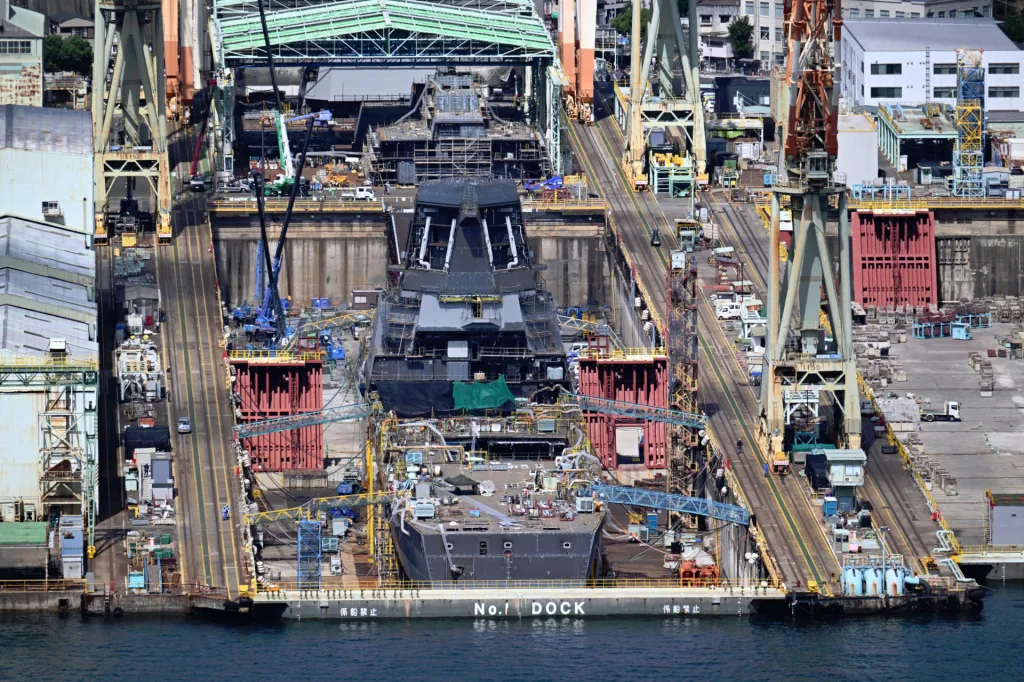
The first of Japan’s two new cruiser-sized Aegis System Equipped Vessels (ASEV) is continuing to take shape, recently receiving its huge main integrated mast, giving the vessel a new and remarkably imposing silhouette. The four very large fixed arrays for the ship’s powerful AN/SPY-7(V)1 radar will eventually be integrated onto this structure. The ASEV’s stated primary mission is missile defense, but Japanese authorities plan to give the vessels additional counter-drone, anti-ship, and land attack capabilities in the future. Tomahawk cruise missiles are notably set to be added to the ship’s arsenal down the line.
The ASEVs are large surface combatants, set to be some 620 feet long, have a beam (the widest point of the hull) of some 82 feet, and a standard displacement of 12,000 tons. For comparison, Japan’s largest surface combatants today, its Maya class destroyers, are just over 557 feet long, have a beam of some 73 feet, and a standard displacement of around 8,200 tons. It is worth noting here that the size of new and advanced destroyers, often optimized for anti-air warfare missions, has been trending upward globally in recent years. This, in turn, has caused the line between destroyers and what have more historically been categorized as cruisers in certain cases.

The first ASEV was laid down at Mitsubishi Heavy Industries’ (MHI) shipyard in Nagasaki in July 2025. The second was laid down in February of this year at Japan Marine United Isogo shipyard, which is situated in Yokohama City near Tokyo, according to a past report from Naval News. The Japanese Ministry of Defense is currently aiming to have the first of these vessels in service before the end of the country’s 2027 Fiscal Year, which runs from April 2027 to March 2028. The second is expected to follow in the 2028 fiscal cycle, which extends into 2029.


Significant progress in the overall construction of the first ship has been made just this year. The addition of the main mast structure, installed on top of the main superstructure, as seen in pictures at the top of this story and below, has drawn particular attention in recent weeks.
Japanese are very fast with ship building.
March 26 and today. ASEV-class destroyer.
190 m hull, SPY-7 Aegis, 128cell Mk 41 VLS. SM-3 for ballistic missiles, SM-6, plus Japan’s long range Type 12 SSM. pic.twitter.com/RQZixtqWwe
— 信濃 Æýà (@Shinano_AEya) August 30, 2026
The especially large size of the ASEV’s integrated mast is driven by that of the AN/SPY-7(V)1 active electronically-scanned array (AESA) radar from Lockheed Martin. Each one of the radar’s four rectangular arrays is reportedly around 14 feet (nearly 4.3 meters) tall. This would put them in the same general size category as the arrays for Raytheon’s AN/SPY-6(V)1 Air and Missile Defense Radar (AMDR) found on U.S. Navy Flight III Arleigh Burke class destroyers. That being said, the pictures we have now raise the question of whether the AN/SPY-7(V)1 arrays are bigger than previously assessed. The AMDR is another notably large design heavily optimized for missile defense.

The size and location of the mast provide a centralized, elevated position for the AN/SPY-7(V)1’s large arrays, which will also require significant power generation capacity and thermal management to keep everything cool. This is a notable departure from the placement of the arrays on the main superstructure on existing Japanese destroyers, as well as the U.S. Arleigh Burke class, and offers an unobstructed, elevated line-of-sight to the horizon. Beyond the ballistic missile defense mission, this view farther out over the horizon would be important for tracking and engaging low-flying drones and cruise missiles, which might be targeting the ship itself. This is something we will come back to later on.
“With five times the tracking capability of the SPY-1, it [the AN/SPY-7(V)1] counters lofted trajectories and simultaneous multiple ballistic missile threats,” according to a machine translation of a section of the Japanese Ministry of Defense’s 2026 defense policy white paper, which was released earlier this month.
The passive electronically-scanned array (PESA) AN/SPY-1 was the first radar to be paired with the Aegis Combat System, and both were first introduced in the 1970s. Variants of the SPY-1 are still found on a variety of U.S. and foreign Aegis-equipped warships, including Japan’s Kongo, Atago, and Maya class destroyers.

The AN/SPY-7(V)1 is also a derivative of the U.S. military’s static, land-based Long Range Discrimination Radar (LRDR) in Alaska. Japan also originally planned to employ the AN/SPY-7(V)1 on land at a pair of Aegis Ashore missile defense sites. However, that effort was subsequently cancelled, with the ASEV emerging to fill the resulting gap.
Additional versions of the AN/SPY-7 with much smaller arrays are also being integrated onto new F110 Bonifaz class frigates for the Spanish Navy and the Royal Canadian Navy’s forthcoming River class destroyers (also known as the Canadian Surface Combatant). The use of the AN/SPY-7(V)1 on the ASEV could impact decisions regarding new radars for other future and existing Japanese warships. Raytheon is also pitching versions of its increasingly popular AN/SPY-6 family for use on a successor to the Kongo class and for refit on the Maya class, according to a recent report from Naval News.
When it comes to the ASEV, as already noted, the AN/SPY-7(V)1 is central to the ship’s main stated missile defense mission. As the name makes clear, the ship will also feature the Aegis Combat System. The vessel will be capable of “remote engagement and guidance against anti-air targets tracked by other vessels” via a “Cooperative Engagement Capability (CEC),” per the Japanese Ministry of Defense’s most recent annual defense white paper.
The video below provides details about the U.S. Navy’s Cooperative Engagement Capability (CEC) developments, which are likely very similar to what Japan has planned for the ASEV.

Cooperative Engagement Capability
In terms of armament, when the ASEVs first enter service, their main weaponry is expected to be a mix of variants of the Standard Missile-3 and -6 (SM-3 and SM-6). The SM-3 family is designed to engage ballistic missile threats during the mid-course portion of their flights while they are traveling outside of the Earth’s atmosphere. The SM-3 also has a demonstrated anti-satellite capability. The SM-6 is a multi-purpose missile that was originally designed with an anti-air focus. It can be used to target incoming ballistic missiles in the terminal phase of flight and also has at least a degree of capability for engaging hypersonic weapons. SM-6 can be used in a surface-to-surface mode, including against ships, as well. Japan is also a partner in the U.S.-led development of a new Glide Phase Interceptor (GPI), which is being designed specifically to intercept unpowered, but highly maneuverable hypersonic boost-glide vehicles.


SM-3, SM-6, and future GPIs will be loaded into either of the ASEV’s two Vertical Launch System (VLS) arrays, one at the bow end and another toward the stern. Each one of the ships will have a total of 128 VLS cells. For comparison, Japan’s Maya class destroyers, as well as the U.S. Navy’s Flight IIA and III Arleigh Burke class destroyers, have 96 VLS cells apiece. The U.S. Navy’s Ticonderoga class cruisers each have 122 VLS cells, and 128 is also the number of VLSs currently expected to be found on the future Trump class battleships.
At the time of writing, Japanese authorities do not appear to have explicitly mentioned plans to arm the ASEVs with other missiles when they first enter service. That being said, any VLS array capable of accommodating SM-3s and SM-6s should be able to fire a variety of other weapons, including shorter-ranged SM-2s and Evolved Sea Sparrow Missiles (ESSM), which the ship could use for more localized air and missile defense, as well as protecting the ship itself.
Renderings and models of the ASEV do show the design also armed with a five-inch naval gun in a turret on the bow, along with two Phalanx Close-in Weapon Systems (CIWS) and other automatic cannons for point defense.

As mentioned, while missile defense is the immediate focus for the ASEVs, there are already plans to significantly expand their capability to engage other ships and targets on land. Tomahawk cruise missiles and a new, extended-range version of the Type 12 anti-ship cruise missile are set to be added to the arsenal of these vessels in the 2032 timeframe, according to the latest official Japanese defense white paper.
Japanese authorities want the ASEVs to eventually be able to help fend off waves of enemy drones, too. High-energy laser-directed energy weapons are set to be integrated onto the ships down the line to help address those threats. The overall size and other general characteristics of the ships would leave the door open to the possible addition of high-power microwaves and other capabilities in the future.
TWZ has long noted that the ASEVs will bring huge new boosts in naval air and missile defense and long-strike capability to the Japan Maritime Self-Defense Forces. The vessels also reflect a significant evolution in post-World War II Japanese doctrine, toward what officials currently frame as a “stand-off defense” construct that remains within the bounds of the country’s current pacifist constitution.
Just with SM-3, SM-6, and GPI, the ASEVs will offer an important addition to the air and missile defense bubbles around Japan’s home islands and outlying territories in the face of growing geopolitical friction with China and Russia, two countries that are increasingly cooperating militarily. The vessels will also add to Japan’s deterrent against long-standing and still evolving threats posed by the regime in North Korea, which has its own close ties to the Chinese and Russian governments. All three of these nations continue to expand their arsenals of ever-more capable ballistic, cruise, and hypersonic missiles. Long-range one-way-attack drones are another growing part of the equation, with the ongoing conflict in Ukraine and fighting in the Middle East in recent years underscoring just how real a threat they pose.
With the addition of Tomahawks, the ASEVs, along with other Japanese warships, will gain the additional ability to threaten counterstrikes against targets on land (and potentially at sea) at least around 1,000 miles in any direction. As part of the broader stand-off defense strategy, the Japan Self Defense Forces is developing new land-based long-range strike capabilities, including hypersonic missiles, as well.

It is worth noting that with current plans to acquire only two ASEVs, these will be high-value but also low-density assets, which will have to be very deliberately deployed for maximum effect. They will also stand out as top-priority targets in any future conflict, and will need to be protected as such.
It is possible that the roles and missions of the ASEVs, just like their designs, could evolve further as time goes on. The threat ecosystem facing Japan will continue to evolve, likely more rapidly, in the coming years. The country is also expanding its naval capabilities in other ways, and with an eye toward more blue water operations. This includes expanded light carrier capabilities through refits of existing Izumo class ships. Anti-ship ballistic missiles and hypersonic cruise missiles, among large volumes of more traditional threats, could see the ASEVs used as escorts, even if experimentally. While just two hulls are barely enough to keep one on patrol to protect Japan, more could be built for expeditionary applications.
Regardless, the ASEVs are set to be a major addition to the Japan Maritime Self Defense Force’s fleets that will have big ramifications. From the progress that is visible at the shipyard in Nagasaki, MHI looks to be well on track to deliver the first of these ships next year or two.
Special thanks to @kensakai9310 on X, who also goes by “Sakai,” for sharing recently taken pictures of the first ASEV under construction at MHI’s yard in Nagasaki with us.
Contact the author: joe@twz.com
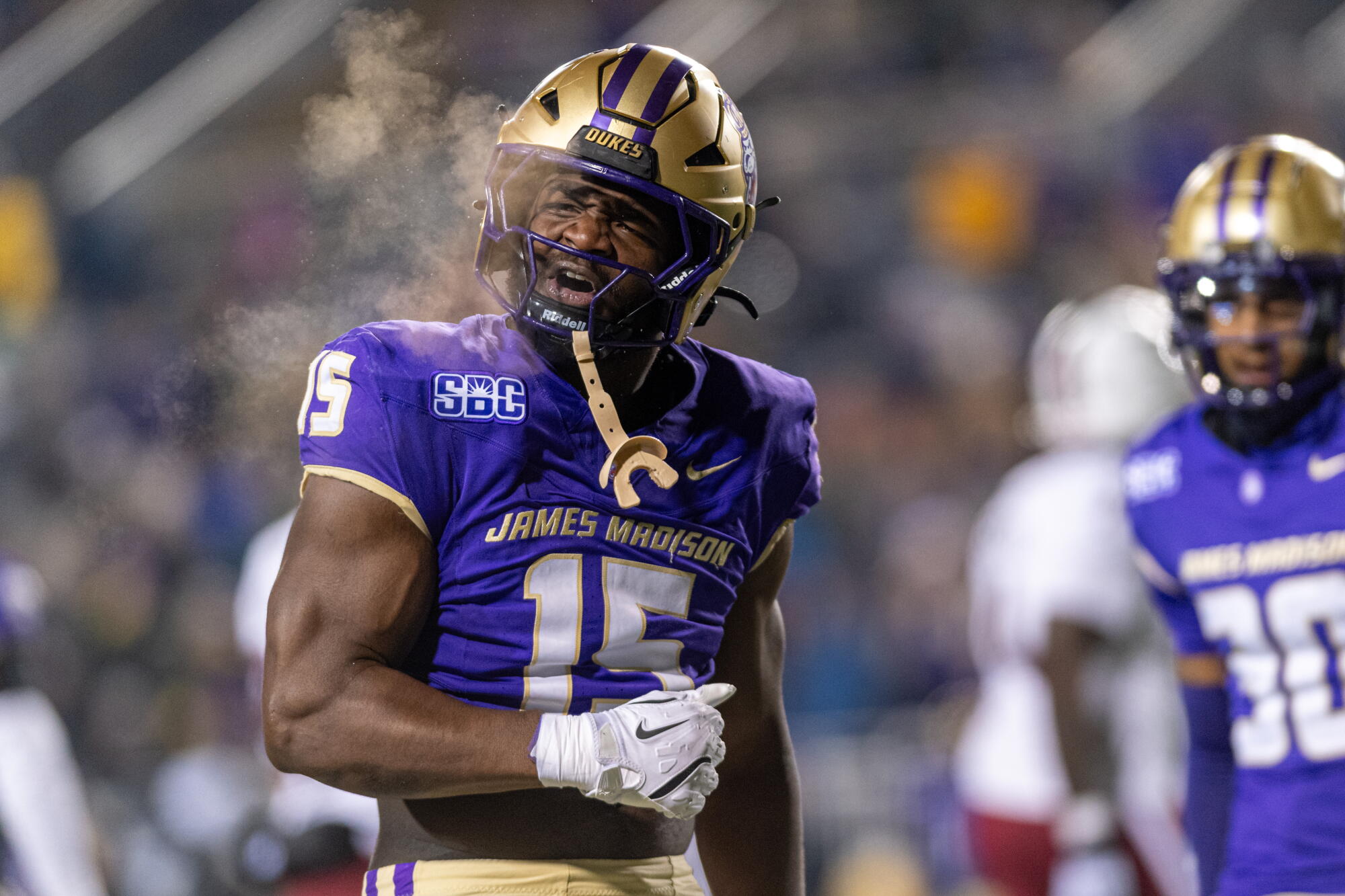
The crux to defeating California is clear.
At least, UCLA coach Bob Chesney made it so on Monday.
“We have a chance to put it together against another opponent, a really good opponent, very well-coached, phenomenal talent on this team, but it all starts with No. 3,” Chesney said.
And while No. 3, Cal quarterback Jaron Keawe-Sagapolutele, may be familiar with UCLA’s defensive scheme and personnel — telling reporters Tuesday that the offense has been studying film from James Madison’s 2025 unit for the past few weeks — he may not be as accustomed with the defense’s new identity.

Defensive lineman Sahir West, who transferred to from James Madison to UCLA, says the Bruins have embraced their coach’s emphasis on toughness and attention to detail.
(Robert Simmons / Associated Press)
UCLA defensive coordinator Colin Hitschler, who has made stops as defensive coordinator and safeties coach at JMU, Alabama, Wisconsin and Cincinnati during the past six years, wanted his defense to enter 2026 with a brand — a reputation to describe the team’s play.
And after presenting his team with different options, the defense settled on the “Bruin Bullies,” a name based on the 1970s Philadelphia Flyers “Broad Street Bullies” — an homage to Hitschler’s home city.
“It’s a lifestyle, it’s a mentality more than anything,” Hitschler said. “It’s what we need to do to win the next play. That toughness, that internal belief. That’s what it’s about.”
Since arriving in Westwood, Hitschler has consistently been touted for his toughness and encouraging his players to compete with an unwavering belief — values he developed as a wrestler.
Hitschler, who won a national prep championship at William Penn Charter School and then wrestled at the University of Pennsylvania from 2005 to 2010, grew up in Philadelphia surrounded by the sport, with his older brother, father and grandfather all lettering at his alma mater, and his father working as a longtime football and wrestling coach at his high school.
“Wrestling is a unique sport in that it’s an individual sport, and you walk out on a mat and you win or lose, and it’s all about just you,” Hitschler said. “It’s a glorified fight with rules. Winning your individual battle in football is what leads to team success, and when those guys really buy into that toughness that it takes to beat the guy across from you, then you’re going to have a really good defense.”
Beyond toughness, Hitschler wanted the Bruins to show intensity and relentless attention to detail, emphasizing the importance of “being intentional in everything you do.”
“The first fundamental is effort and attitude, which is four to six, A to B, and nasty intentions,” UCLA sophomore linebacker Scott Taylor said. “He won’t tolerate low effort or low intensity, and it could be on any play. … We might do all the things we want to do, and then we’re going to come back to meeting that night, and he’s going to pull up the three bad clips from practice and go, ‘This is unacceptable. We better fix it tomorrow.’”
Hitschler’s emphasis on attacking extends to the secondary.
“All 11 guys want to tackle the ball. We have some really tough kids playing [defensive back.] … Those guys love hitting,” Hitschler said.
Hitschler’s track record developing elite defensive backs — such as the Indianapolis Colts’ Ahmad “Sauce” Gardner, Chicago Bears’ Coby Bryant and San Francisco 49ers’ Darrick Forest — drew players such as Derrick Barksdale to UCLA.
“His intensity level, the way he approaches the game, is something that inspires a player to even play even harder, play with even more technique, or play with more detail,” Barksdale said.

James Madison’s Derrick Barksdale said UCLA defensive coordinator Colin Hitschler’s history of developing players inspired him to join the Bruins.
(Carmen Mandato / Getty Images)
Hitschler’s revitalized defense will have to create splash plays — something the Bruins lacked last season, finishing last in the nation in sacks and tying for third worst in interceptions — if it wants to stop the potent Cal offense.
“Takeaways are all about playing longer and harder than the offense does, and our job doesn’t stop till somebody or the ball is on the ground,” Taylor said. “Personnel aside, the way we’re going to attack offenses, and the way we’re going to play on defense, is going to create stress and chaos for every team we play. Inherently, with how we play, there’s going to be a lot of big plays, and we’re not going to sit back and hope that the offense messes up.”
Junior defensive lineman Sahir West said the UCLA defense has fully embraced the challenge of being “Bruin Bullies” all season.
“That’s who we truly want to be. That’s not just a moniker. That’s what we live by. That’s basically the brand of football that we want to play,” West said. “Be bullies on the field. Be dominant. Take play by play. Just play hard. That’s who we are.”
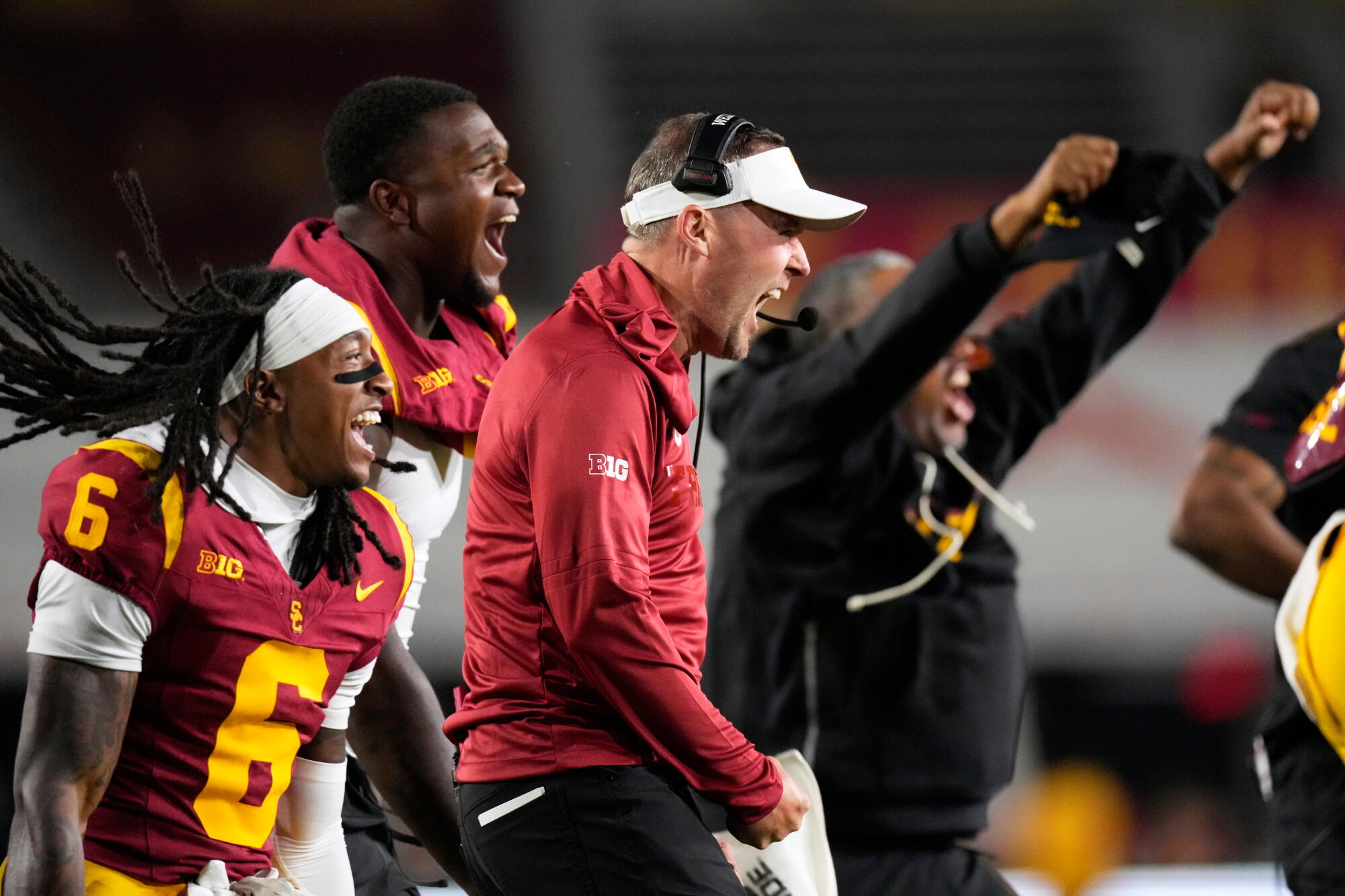
The sun hadn’t even set yet over the Coliseum, and already Trent Mosley had broken free, with nary a defender within 15 yards on either side.
It was the start of the second quarter on Friday night, when USC quarterback Jayden Maiava spotted his budding star freshman soaring on a slot post through the wide-open center of the field. And a split-second later the crowd saw it, too — their quiet rumbles rising to a thrilling roar, as if they knew what was coming next.
One ankle-twisting stutter-step is all it took for the true freshman to take off, once again. And it didn’t take much after that for USC to stick a fork in Fresno State.
But while Mosley captivated once again and Maiava came alive, it was Gary Patterson and the Trojans’ defense that really twisted the knife in a dominant 39-0 win for USC.
A week ago, it was Patterson who took the Trojans’ poor finish the hardest after they gave up 23 points in the fourth quarter to San José State. But a week spent looking in the mirror seemed to make a major difference as USC (2-0) managed its first shutout since Week 2 of the 2024 season.
“He loves shutouts,” sophomore defensive back Alex Graham said of the Trojans’ defensive coordinator. “He thinks shutouts are the best thing in the world.”
Patterson must have felt particularly thrilled Friday, considering how thoroughly USC’s defense dismantled Fresno State. The Bulldogs had just 56 yards heading into their final drive, 52 of which they accumulated in the first quarter.
“I told you guys,” USC coach Lincoln Riley said, “he makes it challenging on the other side.”
That was an understatement, given what happened after Mosley’s tide-turning touchdown. With the Bulldogs backed up against their goal line, Patterson dialed up a nickel blitz — and Fresno State didn’t account for it. So defensive back Kennedy Urlacher came flying into the backfield and collided into Bulldogs quarterback Jayden Mandal, who fell out of the back of the end zone for a safety.
“That’s just great coaching,” Urlacher said. “Coach knows what to call in certain situations.”

USC coach Lincoln Riley, center, celebrates during the Trojans’ 39-0 win over Fresno State at the Coliseum on Friday night.
(Mark J. Terrill / Associated Press)
Patterson had no problem pouring it on, as it didn’t get any less demoralizing for Fresno State (0-1) after that. USC’s defense didn’t give up a single yard or a first down in the second and third quarters. And over that stretch, the Trojans gave up just one completed pass.
USC’s defense actually tallied more safeties (two) during that same stretch.
The second, from defensive back Alex Graham, came a quarter later, and it looked quite familiar. This time, Graham came screaming out of the slot on the same blitz and leveled Mandal in the end zone. It was one of three sacks that USC registered off the nickel blitz — and one of four overall.
The combination of an all-around dominant defensive effort, with the Trojans’ usual offensive mastery, offered a glimpse of what USC hopes it can be this season. The question is whether it can actually do it again moving forward.
Maiava might have a hard time staying quite this perfect. The USC quarterback had one of the most precise performances of his Trojans tenure, completing 23 of 25 passes for 349 yards and three touchdowns. Through two games, just six of his 54 passes have ended up incomplete.

“It’s more than perfect,” wideout Corey Simms said. “It’s amazing playing with a quarterback like Jayden Maiava.”
It certainly doesn’t hurt to have Mosley, who notched his second consecutive 100-yard game, tallying all of his 104 yards and two touchdowns in the second quarter. Or what about Kayden Dixon-Wyatt, his freshman counterpart? He had 102 yards on six catches.
USC was all but unstoppable through the air. But on a night where there was little to nitpick, the Trojans weren’t exactly efficient on the ground. Their ballcarriers averaged under four yards per carry, and Waymond Jordan, USC’s leading rusher with 67 yards, lost a fumble.
But with Maiava doing most of the heavy lifting, USC barely needed its backfield.
Maiava completed 19 of his first 20 passes, picking up where he left off last week when he connected on 25 of 29 in the opener. Faced with an early fourth down, he heaved a pass deep down the sideline for Dixon-Wyatt, who leaped over a defender to reel in a 31-yard reception. Three plays later, he found sophomore wideout Tanook Hines streaking across the end zone, uncovered, and hit him for an opening score.

USC running back Deshonne Redeaux scores a touchdown after Fresno State defensive back Taylor Powell, left, fails to tackle him during the second half of the Trojans’ 39-0 win Friday night at the Coliseum.
(Mark J. Terrill / Associated Press)
He didn’t take his foot off the gas. After Jordan fumbled away a screen pass, Maiava later found Mosley for that 68-yard score. Then he didn’t miss a single pass for another two quarters.
By that point, USC’s defense had found another level.
It wasn’t until the final drive that Fresno State managed to move the ball. The Bulldogs tallied more yards on that possession (60) than they had the rest of the game combined, and they managed to march to the Trojans’ eight-yard line.
But that was as far as Fresno State would go. This time, on fourth down, a pack of Trojan defenders descended. They piled on Mandal for a game-ending sack.
On the sideline, players crowded around Patterson, jumping for joy. And in the center of the chaos, the Trojans’ new defensive coordinator cracked a smile.


Sept. 4 (UPI) — President Donald Trump has named Adam Telle, current assistant secretary for the Army for Civil Works, acting secretary of the Army amid an ongoing shakeup of the U.S. military.
In a brief statement posted on his Truth Social media platform, Trump announced that Telle would be assuming the position immediately, while describing him only as “a Great Patriot, who is respected by all.”
Trump named Telle days after his predecessor, Dan Driscoll, reportedly submitted his resignation following months of reported tension with Defense Secretary Pete Hegseth, an exit that has raised concern among some as there has been a steady stream of resignations, early retirements and firings among Pentagon leadership during the second Trump administration.
On Tuesday evening, Driscoll made his resignation public, saying in an online statement Wednesday would be his last day.
“As a third-generation Army veteran, it has been the honor of a lifetime to serve as the secretary of the Army under President Trump and Secretary Hegseth,” he said.
“Our soldiers, civilians and their families are our nation’s very best, and they have inspired me every day. I am sincerely thankful for their service and sacrifice.”
On Wednesday, Sen. Thom Tillis, a Republican from North Carolina, called on Trump to fire Hegseth, a former Army National Guard major who took office with less senior government and military leadership experience than any other secretary of Defense, saying he has “never witnessed more inept management of the brave men and women who serve our country.”
Hegseth has overseen a sweeping overhaul of the department, including a purge of two dozen generals, admirals and senior civilian defense officials who have either resigned, announced early retirement or been fired. Several left following reported clashes with the secretary, who has plunged into culture-war issues, eliminating policies he has characterized as “woke.”
“Huge congrats to Adam,” Hegseth said online.
“He is indeed a great Patriot — and will be an immediate asset to the @USArmy.”
Sen. Bill Hagerty, R-Tenn., was among Republicans quick to congratulate Telle for being chosen to lead the Army and Trump for picking him.
“This is a critical position for our nation’s defense, and I can’t imagine a better leader for the world’s greatest warriors,” Hagerty said in a social media statement.
“He knows how to inspire, lead and equip the Army for success. Given the challenges we face today, Adam is the ‘man for the moment.'”
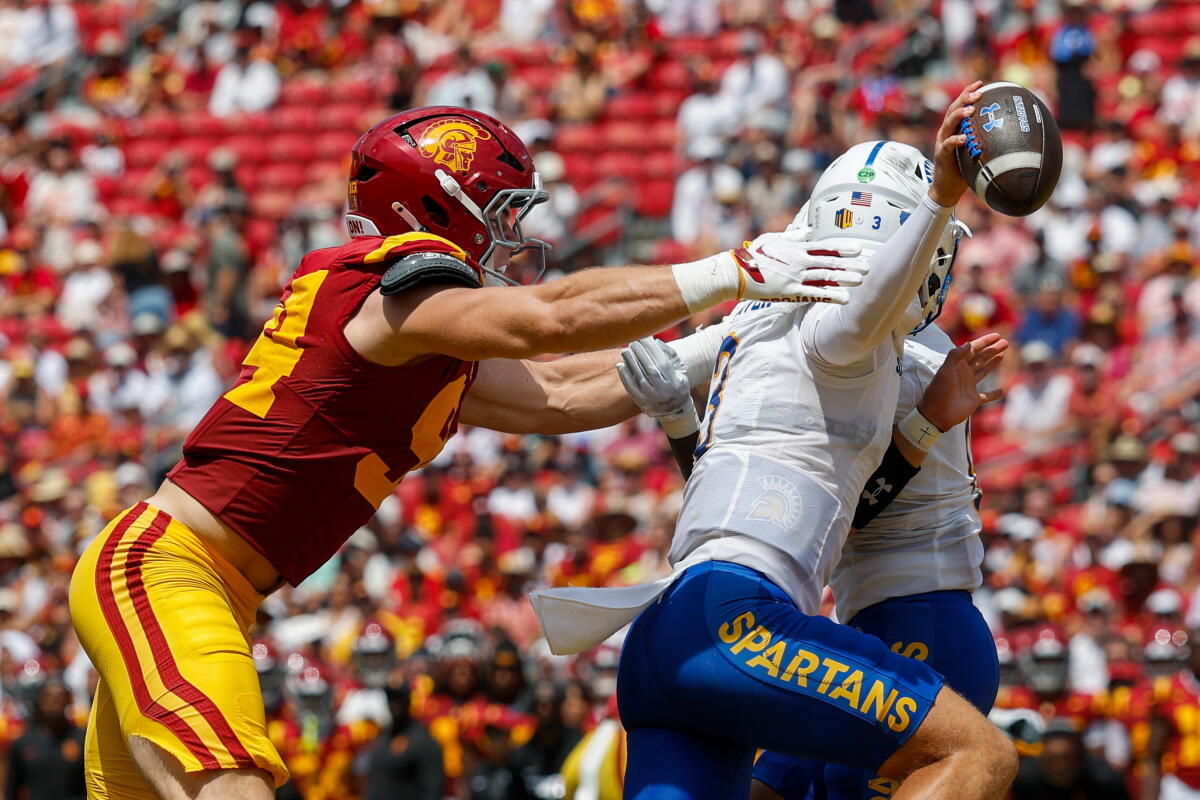
It was still just the first quarter of his first college football game at USC when Luke Wafle offered a first glimpse of his staggering potential. The freshman defensive end tossed aside a San Jose State tackle with one swift move, then steamrolled a running back standing in his way. In the process, San Jose State’s quarterback was forced from the pocket and Wafle, now sprinting from the other direction, nearly forced a safety.
It would’ve been an eye-opening sequence for any pass rusher, let alone a true freshman. But at USC, those who have watched Wafle for months now say it’s basically what they’ve come to expect from the Trojans’ top defensive prospect.
“He’s a very special player,” said linebacker Desman Stephens II.
“Probably the most talented freshman I’ve gone against in my time here at USC,” said left tackle Elijah Paige.
“Just a beast on the field,” added defensive tackle Floyd Boucard. “He doesn’t play like a freshman.”
Wafle played just 23 snaps in his first game, but he made the most of them. He was the Trojans’ highest-graded defender, according to Pro Football Focus, with two pressures on 13 pass rushes and two stops on the other 10 in the victory.
And when USC takes on Fresno State on Friday night, chances are he’ll get even more reps to wreak havoc.
“A young man like that brings a lot of excitement on the other side of the field,” defensive tackle Kameryn Crawford said with a smile.
He called it “a crazy feeling” just to play along the defensive front with Wafle.
The freshman’s presence alone should help change the trajectory of a Trojan defensive line that’s fallen short of expectations the last few seasons under coach Lincoln Riley. USC’s top pass rusher from a year ago (Crawford) had 5 1/2 sacks last season, while no one outside of Tuli Tuipulotu has had more than 6 1/2 in a single season under Riley at USC.
Wafle might change that this season. That certainly looked like the case last Saturday.
“The thing I liked most about him Saturday is he didn’t hesitate,” Riley said. “He was around the ball. He was around the quarterback. He made some plays for us, obviously, and he was really close to making a bunch of others. And I think that’s just scratching the surface of how good this guy can be.”

USC defensive end Luke Wafle (94) pressures San Jose State quarterback Luke Weaver (3) during the first quarter of the season-opening game last Saturday at the Coliseum.
(Ronaldo Bolanos / Los Angeles Times)
Even beyond Wafle, Riley has reason to feel good about his defensive line. Namely because it’s as deep as it’s been in his five seasons at USC. Two of the Trojans’ better linemen — Jahkeem Stewart and Braylan Shelby — didn’t play in the win, and the unit still looked like the strength of the defense.
Whether those reinforcements will be back Friday remains to be seen. Both were listed on USC’s second depth chart of the season after being absent from the first, suggesting they could suit up.
The reviews coming out of last week’s debut for USC’s defense were less glowing for the secondary, which gave up three pass plays of 20 yards or more in the second half.
Most of those coverage busts came from USC’s backups at the position, but it does beg questions about the depth in the Trojans’ defensive backfield.
Riley acknowledged that the Trojans “need a couple of those guys to play a little sharper” at the safety position, primarily. Redshirt senior safety Prophet Brown said that he tried to put his arm around those young players this week.
“Nobody is perfect,” Brown said. “The greats aren’t perfect. But they do learn from their mistakes.”
How much USC’s secondary will be tested this week by Fresno State remains to be seen. The Bulldogs are breaking in a new quarterback, junior Jayden Mandal.

Santa Margarita’s Southern Section Division 1 championship football team lost some impressive players to graduation in the spring, but the Eagles (2-0) have already showed off two impressive freshmen to help overcome the loss of Trent Mosley (USC) and Dash Fifita (Arizona).
Kiyan Callis, a receiver, started his high school career with nine catches for 105 yards and one touchdown, then came back with three receptions against Corona Centennial. Aydan Steen, a linebacker, delivered seven solo tackles in a opening win, followed by four more solo tackles against Corona Centennial.
Santa Maragarita is back to No. 1 in The Times’ top 25 rankings after finding players to replace nine of 11 starters on defense, including several more freshmen besides Steen. It’s important to know the best days for the Eagles are ahead as their young replacements receive early-season experience in anticipation of becoming much better later in the season.
Sana Margarita wasn’t the state’s best team to start last season, but by the end, no one had a chance to beat the Eagles as their defense and offense reached another level under first-year coach Carson Palmer and his staff.
This is a daily look at the positive happenings in high school sports. To submit any news, please email eric.sondheimer@latimes.com.


Workers weld at Okpo Shipyard of Daewoo Shipbuilding & Marine Engineering Co. in Geoje, South Korea, in 2022. File Photo by Yonhap/EPA
Sept. 3 (UPI) — South Korean shipbuilders are pouring investment, technology and expertise into a U.S. maritime industry struggling with shrinking capacity, worker shortages and competition from China, offering Washington a potential path to rebuild American shipyards without sending ship construction overseas.
The growing partnership also raises a difficult question: How much foreign participation is the United States prepared to accept in an industry considered essential to national security?
The issue has gained urgency following a White House directive aimed at increasing competition and capacity in the U.S. maritime industrial base. The administration’s plan allows greater use of foreign shipbuilding expertise under certain conditions, including investment in American shipyards, training U.S. workers, transferring production technologies and developing domestic supply chains.
Limited shipyard capacity and a shortage of skilled workers remain major obstacles to expanding the U.S. Navy fleet, according to Shelby S. Oakley, director of Contracting and National Security Acquisitions at the U.S. Government Accountability Office.
“The capacity of the existing yards and the size and skill level of the current workforce are certainly a limiting factor when it comes to the U.S. Navy’s ability to increase the size of the fleet,” Oakley told UPI.
Oakley said meeting Navy shipbuilding goals will require expanding existing yards or adding new ones, increasing the skilled workforce and making greater use of technology and automation. Without those changes, she said, the Navy will struggle to meet its fleet targets.
South Korea could provide part of that capacity.
Under a broader $350 billion U.S.-South Korea investment framework, Seoul has committed $150 billion specifically to shipbuilding cooperation, with another $200 billion intended for strategic investments in other sectors.
South Korea moved toward implementing the maritime portion in June when the Korea-U.S. Strategic Investment Corporation, Korean policy finance institutions and shipbuilders HD Hyundai Heavy Industries, Hanwha Ocean and Samsung Heavy Industries agreed to identify projects and coordinate financing.
The arrangement combines something Washington needs: capital and industrial expertise.
For decades, U.S. commercial shipbuilding has lost ground to Asian competitors. China now dominates global commercial ship construction, while South Korea and Japan retain substantial production capacity. The United States accounts for only a fraction of global commercial output.
President Donald Trump recently elevated shipbuilding capacity to a national security priority, directing his administration to look abroad for models that could help rebuild the U.S. maritime industrial base.
“I have determined that it is in the national security interest of the United States to increase domestic shipbuilding capacity,” Trump said in the memorandum, pointing to the October 2025 U.S. Finland Agreement on icebreaker construction as a model for cooperation with foreign companies.
China adds urgency to that effort.
China’s enormous civilian shipbuilding industry supports an expanding naval industrial base, allowing shipyards, suppliers and skilled workers to serve both commercial and military production. That industrial scale has made shipbuilding an increasingly important element of U.S.-China strategic competition.
The United States faces a different reality. The Government Accountability Office reported this year that Navy and Coast Guard shipbuilding programs have repeatedly exceeded budgets and fallen years behind schedule, while yards face skilled-worker shortages, capacity constraints and fragile supplier networks.
South Korea offers an alternative source of expertise. Its yards have decades of experience with modular construction, automation, digital design and high-volume production. Korean companies also build sophisticated naval vessels, including Aegis-equipped destroyers and submarines.
Hanwha has moved furthest into the U.S. market.
Hanwha Ocean and Hanwha Systems acquired Philly Shipyard for $100 million in 2024, giving the conglomerate a direct U.S. manufacturing foothold. Hanwha subsequently announced plans for billions of dollars in additional investment to expand the yard and introduce Korean shipbuilding technology.
Hanwha employs nearly 30,000 workers at Hanwha Ocean’s Geoje Shipyard in South Korea, where advanced manufacturing and automation help produce more than 40 ships a year.
“In the coming years, we will continue to bring trainers to develop our workforce at the Hanwha Philadelphia Shipyard as well as transfer technology to expand commercial and naval shipbuilding capacity,” Hanwha Defense USA spokesman James Hewitt told UPI.
Hanwha Ocean also completed a major overhaul of the Military Sealift Command dry cargo ship USNS Wally Schirra at Geoje in March 2025. The seven-month project was the first large-scale regular overhaul of a Military Sealift Command vessel awarded to a South Korean yard.
HD Hyundai Heavy Industries is pursuing a different route.
Rather than acquiring a U.S. yard, HD Hyundai has developed partnerships with American shipbuilders. The company and Huntington Ingalls Industries are cooperating on shipbuilding technology and production, including an August pilot program to expand automated welding at HII’s Ingalls Shipbuilding yard in Mississippi.
“The United States is a strong ally and a key business partner for us,” said Hannae Choi, Executive Vice President at HD Hyundai Shipbuilding and Offshore Engineering.
Such arrangements offer Washington a possible compromise: Korean companies can bring capital, technology, automation and production methods into American yards while training U.S. workers and developing domestic supply chains.
That distinction — foreign investment in U.S. shipbuilding rather than shifting construction overseas — has emerged as a key dividing line for the domestic industry.
The Shipbuilders Council of America supports foreign investment when it expands U.S. shipyard capacity but opposes sending construction abroad, said Danielle Hagen, the council’s executive vice president for communications.
“If South Korean capital and automation expertise flow into American facilities, employ American workers and produce American-built hulls, that model is consistent with our longstanding position,” Hagen told UPI.
“The SCA’s concern has never been the nationality of capital, but whether the work, the workforce and the industrial capability remain here in the U.S.,” she said.
Federal law has long restricted construction of U.S. naval vessels in foreign shipyards, while the Jones Act requires vessels operating in U.S. coastwise trade to be U.S.-built, U.S.-owned and U.S.-crewed.
“Any foreign partner needs to operate their U.S. yard as a genuinely American enterprise, with real decision-making authority here,” the council said, adding that foreign acquisitions should face national security scrutiny and continued congressional oversight.
Despite the backlog at U.S. yards, bipartisan opposition remains strong in Congress to building Navy vessels overseas. Rep. Jared Golden, D-Maine, a member of the House Armed Services Committee, has been among lawmakers seeking to preserve domestic construction requirements and prevent naval shipbuilding from migrating to foreign yards, including South Korea and Japan.
Those concerns extend beyond jobs. Modern warships contain classified systems, sensitive designs and specialized supply chains. Greater participation by even close allies raises questions about intellectual property, cybersecurity and control over technologies considered essential to U.S. military power.
Few U.S. allies, however, can match South Korea’s shipbuilding scale, speed and technical expertise. The emerging model seeks to use those capabilities to increase production in the United States rather than substitute foreign yards for American ones.
Whether that approach succeeds will depend not only on transferring Korean technology and manufacturing expertise into U.S. yards, but also on Washington’s ability to integrate those investments into a broader shipbuilding strategy.
Managing competing demands for Navy ship construction and repair requires such an approach, Oakley told UPI. A 2025 GAO report found that the Navy lacked a comprehensive strategy for managing the private shipbuilding and repair industry on which it depends, complicating efforts to coordinate investment, yard capacity and workforce needs.
The challenge is magnified by China. Its dominance of commercial shipbuilding has created a vast network of yards, suppliers and skilled workers that the United States cannot quickly replicate. South Korea cannot close that gap alone, but its capital, technology and expertise could help expand U.S. capacity as American yards modernize, train workers and rebuild supply chains.
For Washington, the central policy question is whether greater South Korean participation can strengthen U.S. shipbuilding capacity without creating a new dependence on foreign production.