At least 11 people were killed on Sunday during clashes between police and protesters in Pakistan-administered Kashmir’s Rawalakot city, capital of Poonch district, before a major demonstration scheduled by a banned civil society group for Tuesday.
Authorities in Pakistan-administered Kashmir deployed federal paramilitary troops and issued a strict travel advisory before the Tuesday protest, which has gone ahead despite the restrictions.
Recommended Stories
list of 4 itemsend of list
Here is what we know about the latest unrest.
What’s happening in Pakistan-administered Kashmir?
Eleven people have been killed in clashes between the police and protesters, while more than 70 have been injured. The ban on the organisation, alongside regional grievances, set off the protests.
On Tuesday, Sardar Waheed Khan, commissioner of the Pakistan side of the Poonch district, a militarised region shared between Indian-administered and Pakistani-administered Kashmir, told the news agency Reuters that four police officers and a passer-by died “after miscreants shot at them”. Six protesters were killed, he said.
Police Chief Liaqat Malik said 23 security officials and 50 protesters were among those injured in Sunday’s clashes.
On Friday, local authorities issued an advisory urging visitors to avoid travelling to the area.
“The measure is advised to save intending visitors from any unexpected situation or inconvenience,” an unnamed official said in a statement issued by the region’s Press Information Department (PID).
“The government also requests those already in the territory for sightseeing or any other purpose to leave by Friday evening so that they do not confront any unpleasant situation,” the statement added.
Kashmir is a disputed Himalayan region which is claimed in full by both India and Pakistan, with China also controlling a portion of the territory. Pakistan-administered Kashmir – known locally as Azad Jammu and Kashmir (AJK) – is governed under a semi-autonomous system, with its own prime minister and legislative assembly, but ultimate authority resting with Islamabad. Its population exceeds four million people, according to the 2017 census. It is separated from India-administered Kashmir by what is known as the Line of Control (LoC).
The LoC is the 740km (459-mile) military border dividing the disputed Kashmir region between Indian-administered and Pakistan-administered territories.
Who is behind the protests?
The Jammu Kashmir Joint Awami Action Committee (JAAC) is a grassroots umbrella organisation that emerged in 2023 as the leader of a protest movement across the Pakistani-administered part of the region. The JAAC, led by activist Shaukat Nawaz Mir, represents traders and civil society groups.
On Friday, the local government proscribed the JAAC under a regional legislative framework in Pakistan-administered Kashmir called the Anti-Terrorism Act of 2014.
In a circular, the government’s home department claimed the JAAC “is engaged in terrorism, acted in a manner prejudicial to the peace & security of the State, involved in creating anarchy in the State by intimidating public, promoting hatred & creating sense of insecurity in society and public at large, etc”.
In the past, protests organised by the JAAC have led to violent clashes between protesters and security forces, leading to casualties.
In a video message on X responding to Sunday’s incident, Mir accused the authorities of unleashing violence in Rawalakot, saying, “The state has begun a massacre of our people in Rawalakot.”
In response, Khan, the commissioner of Pakistani Poonch, said, “The JAAC leadership is misleading the masses by terming it a massacre. The state’s action was meant to restore law and order.”
On Tuesday, the internet monitoring group NetBlocks said that its data showed that access to the web remained severely restricted in Pakistan-administered Kashmir for a third day in a row.
What is the trigger behind these protests?
These protests are against the reservation of 12 seats in Pakistan-administered Kashmir’s legislature for refugees from Indian-administered Kashmir who now live in other parts of Pakistan. If the refugees live in Pakistan-administered Kashmir, they are not eligible to contest for these reserved seats.
The region votes on July 27 to elect its next legislature, which has 45 seats in all — including the 12 reserved ones.
The JAAC is calling for the abolition of the reserved seats, arguing that all seats in the legislature must go to those who actually reside in Pakistan-administered Kashmir, and not those living in other constituencies scattered across Pakistan.
Abdul Jabbar Nasir, a journalist currently based in Karachi, but originally from a village near the LoC in the Gilgit Baltistan area, which is the majority of the Pakistan-administered Kashmir region, told Al Jazeera that the seats are reserved for those who migrated from Indian-administered Kashmir to Karachi or any other part of Pakistan in 1947.
Nasir explained that the reserved seats have existed in various forms since the late 1940s and were formalised in Pakistan-administered Kashmir’s 1974 interim constitution, which treats the region as a self-governing, autonomous state, with its own prime minister, president and courts, while defence, foreign affairs, currency and communications remain under Pakistan’s control.
“If the constitutional protection provided begins to be changed by these protesters, then I don’t think things can function,” Nasir said.
“It is essential for these seats to exist. If we abolish them, on one hand, Pakistan’s own case for Kashmiri statehood in the United Nations will be weakened, and India’s case will be strengthened,” he added.
He drew a parallel with India, noting that New Delhi historically kept a number of seats vacant in its parliament and the former Jammu and Kashmir assembly as a way of asserting that those bodies represented the entire former princely state, including areas under Pakistani control. If Pakistan now dismantles refugee representation in Pakistan-administered Kashmir, he warned, India could argue that both countries have effectively “regularised” their control over their respective portions of the disputed region.
Marathon talks between a federal ministerial team, including leaders from Pakistan and Pakistan-administered Kashmir, and JAAC leadership in late May failed to yield a breakthrough. This resulted in the JAAC announcing that the protest on Tuesday would proceed as planned.
On Sunday, a top court in Pakistan-administered Kashmir, called the Supreme Court of Azad Jammu and Kashmir, ruled that the 12 reserved seats are constitutionally protected, and a constitutional amendment would be needed to abolish the reservation.
“This ruling effectively closed the legal route for groups seeking to challenge the existing arrangement and intensified calls for protest by the [JAAC],” Raja Qaiser Ahmed, director for the Area Study Centre for Africa, North and South America at the Islamabad-based Quaid-i-Azam University, told Al Jazeera.
What are the deeper issues?
Experts say the current crisis is part of a deeper, long-running debate about governance, political representation, resource allocation and regional autonomy in Pakistan-administered Kashmir. The protest on Tuesday is the fourth such protest led by the JAAC.
“The current crisis reflects a broader and longer-term debate about governance, political representation, resource distribution, and regional autonomy in AJK,” Ahmed said.
“While the refugee-seat issue has become the focal point of the present mobilisation, it is intertwined with wider grievances that have surfaced repeatedly over the past several years.”
In September and October 2025, the JAAC officially released a comprehensive 38-point charter of demands and initiated a lockdown. The government, in response to a lockdown initiated by JAAC, imposed a complete communications blackout.
The protests had their roots in May 2023, when residents first protested skyrocketing electricity bills alongside widespread flour smuggling and acute shortages in subsidised wheat supplies. The movement hit its first major flashpoint in May 2024, when protesters set off on a long march towards Muzaffarabad. The ensuing violent clashes left at least five people dead, among them a police officer.
The 38-point charter remains the focal point of current tensions. The demands of the charter include economic subsidies, investigation of corrupt officials, social welfare and infrastructure, as well as the abolition of the 12 reserved seats.
Bilawal Bhutto-Zardari, chairman of the Pakistan Peoples’ Party (PPP), the party with the most seats in Pakistan-administered Kashmir’s Legislative Assembly, said on Sunday that he would meet Prime Minister Shehbaz Sharif to discuss the ongoing tensions in the region.
“Thirty-five out of 38 demands have been implemented,” Bhutto-Zardari said during a news conference in Islamabad, explaining that the rest of the demands are not feasible or have court orders barring their implementation.
“More fundamentally, the protests reveal an ongoing tension between constitutional arrangements linked to the broader Kashmir dispute and growing demands for greater local accountability and political participation,” Ahmed said.
“The debate is therefore not only about a specific set of assembly seats but also about competing visions of representation, governance, and the future political trajectory of the region.”
Kenyan President William Ruto said allowing the US to build an Ebola quarantine facility in Kenya was the “right thing”. At least two people were killed this week in protests against the facility, which is being built on a US air force base for Americans exposed to the virus.
Harare, Zimbabwe – Precious Mvundura woke up with joint pain, a high fever and a pounding headache on a chilly autumn morning in eastern Zimbabwe.
The 37-year-old initially thought it was just the flu. But when the headache persisted for three days, she became worried.
Her five-year-old son had also fallen ill and was sweating heavily.
In early May, the pair sought help from a village health worker in Chishakwe, a rural farming community outside Zimbabwe’s third-largest city, Mutare. Both tested positive for malaria.
“I felt relieved,” Mvundura told Al Jazeera.
“From the moment I took that medication, I started getting better.”
Her son has also recovered and is back in school.
Their ordeal comes as malaria cases and deaths surge across Zimbabwe after US funding cuts disrupted key malaria control programmes.
Shortly after returning to office for a second term in 2025, US President Donald Trump slashed foreign aid funding, including programmes backed by the United States Agency for International Development (USAID). In Zimbabwe, the cuts disrupted tuberculosis, HIV/AIDS and malaria research, prevention and treatment programmes.
Among the affected initiatives were the Zimbabwe Entomological Support Programme in Malaria (ZENTO) at Africa University in Mutare, which provided scientific research to support the country’s National Malaria Control Programme, and the Zimbabwe Assistance Programme in Malaria II (ZAPIM II), which helped strengthen malaria diagnosis, treatment and prevention in high-burden districts.
USAID had disbursed $270m for health and agriculture programmes in Zimbabwe in 2024.
Malaria cases jumped to 65,399 between January and April 2026, up from 36,000 recorded during the same period in 2025 and 17,000 in 2024, according to Zimbabwe’s Ministry of Health National Malaria Control Programme weekly surveillance report.
Deaths have also risen sharply, reaching 174 between January and April 2026, compared with 85 during the same period last year and 34 in 2024.
Mvundura and her son survived because they sought treatment early. In many other cases, the disease has been fatal.
Shortages of mosquito nets, test kits
Thomas Chuchu, the health programme lead at Save the Children Zimbabwe, said several malaria elimination activities previously supported by ZAPIM II had been disrupted.
“In practice, elimination has continued through government and other partners, but with weaker operational capacity and slower implementation,” Chuchu told Al Jazeera.
Zimbabwe’s dependence on donor funding for essential medicines, diagnostic kits and mosquito-control supplies has left the country vulnerable [Farai Shawn Matiashe/Al Jazeera]
The ZAPIM II programme ran through Zimbabwe’s Ministry of Health system in 11 districts across the provinces of Central and East Mashonaland and the province of Matabeleland North.
Before falling ill, Mvundura said she had not been using mosquito nets or repellents.
“I only started using a mosquito net a friend shared when I fell sick,” she said.
In December 2025, Caroline Mawombedzi was diagnosed with malaria while living in Burma Valley, a farming community about an hour’s drive from Mutare.
She had last contracted the disease in the late 2000s while still a child.
In mid-May, her five-year-old daughter was also diagnosed with malaria by a village health worker in Chishakwe after suffering severe headaches and stomach problems.
Although her daughter received treatment, Mawombedzi said she could not afford preventive measures such as mosquito nets.
“I am unemployed. I cannot afford to buy a mosquito net. We have not been sleeping under a mosquito net for years,” she said.
Virginia Chakandinakira, a village health worker serving Chishakwe, said malaria diagnostic kits and drugs are now in short supply.
“I used to get plenty of malaria test kits and drugs. But in 2025, they did not give me. I referred everyone showing malaria to a nearby Chitakatira clinic,” she said. Chitakatira is a rural settlement about an hour’s drive from Chishakwe.
“I only received test kits and drugs in February. However, the supplies are limited. The authorities told us they were only distributing them to hotspot communities.”
Research programmes crippled
Professor Sungano Mharakurwa, the director of Africa University’s Malaria Institute, said the abrupt withdrawal of US support had worsened the malaria outbreak by affecting the programme.
ZENTO was contributing data from the surveillance of malaria-carrying mosquitoes, which guided strategies employed by the National Malaria Control Programme to control malaria transmission, he said.
The Trump administration’s funding cuts have also effectively put a stop to the US President’s Malaria Initiative (PMI), launched in 2005 by former President George W Bush to control and eliminate malaria worldwide. Mharakurwa said the PMI had played a major role in funding malaria medications, and communities had been left exposed without it.
He said the Malaria Institute later secured funding from the United Methodist Church General Board of Global Ministry, but it fell far short of previous US assistance.
Zimbabwe’s dependence on donor funding for essential medicines, diagnostic kits and mosquito-control supplies has left the country vulnerable.
Itai Rusike, the director of Zimbabwe’s Community Working Group on Health, said the government needed to strengthen domestic health financing to reduce dependence on foreign donors.
“It is risky for a country to depend substantially on external partners, as donors can withdraw financial support anytime should their interests shift,” he said.
Climate change fuels spread
Experts say climate change is also driving the spread of malaria and other vector-borne diseases across Africa.
Rising temperatures are allowing malaria to spread into higher-altitude areas, which were once less vulnerable to outbreaks.
Zimbabwe experienced El Niño between 2023 and 2024, a climate phenomenon marked by unusually warm temperatures in the Pacific Ocean, which typically disrupts rainfall patterns across Southern Africa.
Heavy rainfall followed in 2025 and 2026, creating ideal breeding conditions for mosquitoes.
Chuchu, from Save the Children Zimbabwe, said that the current spike in malaria cases was closely linked to the heavy rains during the 2025–2026 season.
“The rains created favourable breeding conditions for mosquitoes, particularly in already endemic provinces such as Mashonaland Central, Manicaland, Mashonaland East and Mashonaland West,” he said.
Health workers say malaria diagnostic kits and medicines are now in short supply in rural Zimbabwe [Farai Shawn Matiashe/Al Jazeera]
“The effect of heavy rains is likely being amplified by weakened prevention systems, including reduced mosquito-net coverage, delayed vector-control activities, reduced community surveillance, and challenges with timely testing and treatment following the discontinuation of ZAPIM,” he added.
Professor Mharakurwa, meanwhile, said that above-normal rainfall required equally strong preparation and resources to contain malaria transmission.
Government efforts
Zimbabwe aims to eliminate malaria by 2030, in line with the target set by the African Union.
Over the years, the government, working with international donors and aid organisations, has relied on indoor residual spraying, mosquito-net distribution, mass testing and public awareness campaigns to contain outbreaks, particularly in rural communities.
Health workers continue to carry out indoor spraying campaigns in malaria-prone areas, while village health educators use community meetings and radio programmes to encourage early testing and treatment. Authorities have also expanded surveillance and rapid-response systems in high-risk districts.
But some of these efforts have weakened following the disruption of donor-funded programmes. Key malaria elimination activities previously supported by ZAPIM II included active case tracking, targeted distribution of long-lasting insecticidal nets and district rapid-response systems.
For years, the government and aid organisations distributed mosquito nets annually to vulnerable communities, such as Chishakwe. But since the US funding cuts, shortages have become increasingly common.
Village health workers say malaria diagnostic kits and treatment drugs are also running low in some rural areas, forcing suspected malaria patients to travel long distances to clinics for testing and treatment.
Health experts warn that unless funding gaps are urgently addressed, Zimbabwe risks losing years of progress made in reducing malaria infections and deaths.
For Mvundura and her son, surviving malaria still feels like escaping death.
New videos show widespread destruction in Maarakeh following deadly Israeli strikes across southern Lebanon. On Tuesday, the Israeli military issued forced displacement orders for more than a dozen towns and villages, expanding its ground operation beyond its new, so-called ‘yellow line’.
Russia provided a rare look at damage caused by a Ukrainian strike on a college in occupied Luhansk. Moscow claimed that 21 people were killed in the targeted attack, Ukraine denied the claims saying it struck an elite Russian drone command unit operating in the area.
Survivors of Indonesia’s deadly Sumatra floods are suing the government over what they say was an inadequate disaster response. As Al Jazeera’s Jessica Washington reports, they’re seeking a court order to declare the floods a national disaster and improve recovery efforts.
A nationwide transport strike in Kenya over surging fuel prices, blamed on the United States-Israeli war on Iran, has been suspended for a week after four people were killed in mass protests against the increases.
Kenya, one of many African countries heavily reliant on fuel imports from the Gulf, has raised petrol prices by 20 percent and diesel by almost 40 percent since Iran in effect blocked traffic through the Strait of Hormuz, a key chokepoint that normally handles about a fifth of the world’s oil.
The strike was launched on Monday by transport operators, particularly the “matatu” bus operators who provide most of Kenya’s public transport, in response to the latest sharp fuel price hike.
“The strike that is going on is suspended for a period of one week to provide an avenue for consultations and negotiations between the government and stakeholders,” interior minister Kipchumba Murkomen told reporters on Tuesday.
Albert Karakacha, the president of Matatu Owners Association, confirmed the suspension.
Authorities said four people were killed and more than 30 were injured nationwide on Monday. Police said on Tuesday that more than 700 people had been arrested in connection with the protests over fuel price increases.
Rights groups condemned the use of lethal force by security forces, with Amnesty International calling for “maximum restraint”.
The unrest also disrupted Kenya’s main trade corridor, with local media reporting that truck drivers had refused to move cargo amid fears their vehicles could be attacked and set alight by demonstrators.
The national energy regulator said last week the government had spent $38.5m to cushion consumers from rising diesel and kerosene costs.
In a further emergency measure, Kenyan authorities last month temporarily suspended fuel quality standards in a bid to maintain supplies amid growing shortages.
Despite being one of East Africa’s most dynamic economies, Kenya still has deep structural inequalities: about a third of its roughly 50 million people live in poverty and unemployment remains high.
“I am afraid of dying.” From Bukavu to Kinshasa, concern is spreading among residents and street vendors as Ebola cases rise. In cities hundreds of miles apart, people are wearing face masks and calling for stronger protections from the latest outbreak in DR Congo.
At least seven Palestinians were killed when Israeli air strikes hit a residential building and a civilian vehicle in Gaza City Friday night. Israel says it was targeting the head of the armed wing of Hamas in Gaza. Al Jazeera has not independently verified Israel’s claims.
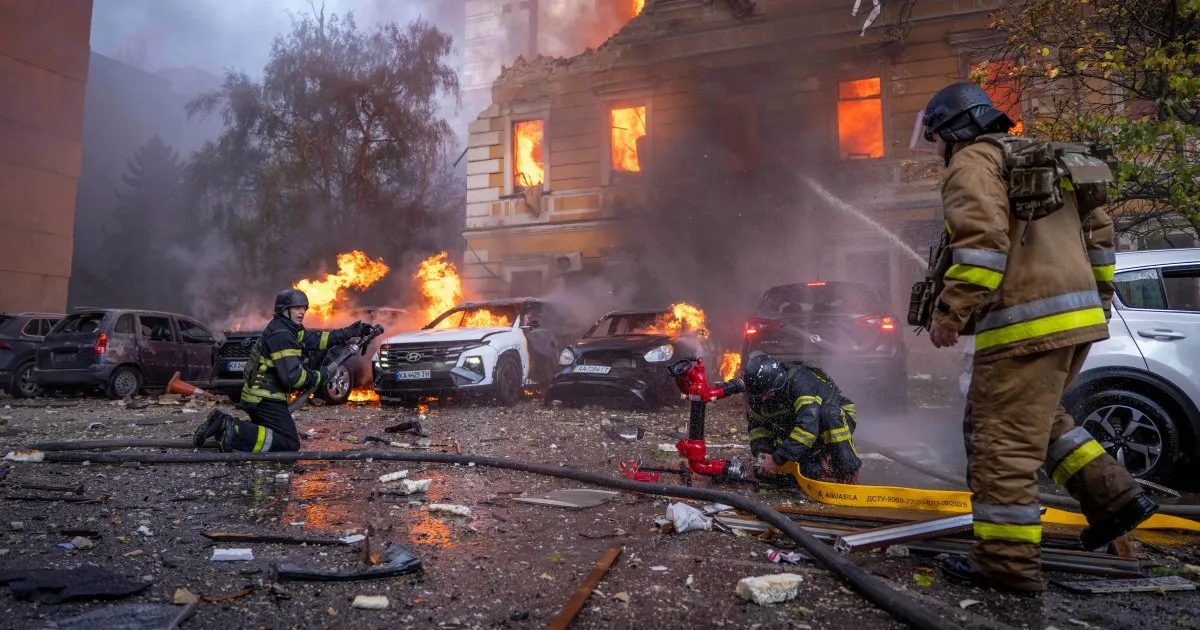
Ukrainian President Volodymyr Zelenskiy strongly condemned Russia after a missile strike on a residential apartment building in Kyiv killed at least 24 people, including three children.
The attack occurred during one of the heaviest aerial bombardments on the Ukrainian capital this year and further intensified international concern over the continuing war between Russia and Ukraine. Rescue operations continued for more than a full day before emergency workers completed searches through the destroyed structure in Kyiv’s Darnytskyi district.
The strike formed part of a broader wave of Russian drone and missile attacks across Ukraine that officials say targeted multiple regions over consecutive days.
Zelenskiy Visits the Site of the Attack
Zelenskiy visited the destroyed apartment building on Friday, laying red roses at the site and meeting rescue workers who had spent more than twenty eight hours searching for survivors beneath the rubble.
In remarks shared through social media, the Ukrainian president praised emergency responders for their continuous efforts and accused Russia of deliberately destroying civilian lives.
According to Zelenskiy, the missile strike effectively destroyed an entire section of the residential building. Ukrainian officials stated that initial analysis suggested the attack involved a recently manufactured Russian Kh 101 cruise missile.
The Ukrainian leader once again appealed to international allies for stronger air defence support and increased pressure on Moscow.
Heavy Civilian Casualties
Kyiv authorities declared Friday a day of mourning in memory of the victims. Flags across the capital were lowered to half mast, and public entertainment events were cancelled or postponed.
The Interior Ministry reported that rescue teams removed approximately 3,000 cubic meters of rubble during the operation. Hundreds of emergency personnel participated in the search efforts.
Officials confirmed that 24 bodies were recovered from the site, while approximately 30 people were rescued alive. Nearly 50 individuals were injured, and hundreds required psychological support following the attack.
The deaths of children among the victims further intensified public grief and anger across Ukraine.
Russia Intensifies Air Campaign
Ukrainian authorities stated that Russia launched more than 1,500 drones along with dozens of missiles during attacks carried out over two consecutive days this week.
The strikes extended beyond Kyiv and affected western regions of Ukraine located far from active frontline combat zones. Officials reported that six people were killed during attacks in western Ukraine on Wednesday.
The scale of the aerial assault highlights Russia’s continuing ability to conduct large coordinated attacks despite prolonged international sanctions and battlefield losses.
Moscow did not immediately comment specifically on the apartment building strike. Russia consistently denies deliberately targeting civilians, although residential buildings, hospitals, schools, and energy infrastructure have repeatedly been damaged throughout the conflict.
Ukraine Also Conducts Cross Border Attacks
The conflict has increasingly involved reciprocal long range attacks by both sides.
Russian regional officials stated that Ukrainian drone strikes killed four people, including a child, in the Russian city of Ryazan. Authorities reported damage to apartment buildings and an industrial facility during the incident.
Ukraine has expanded drone operations against targets inside Russia over the course of the war, aiming to disrupt military infrastructure, industrial production, and logistical operations linked to Moscow’s military campaign.
These developments reflect the increasingly transnational nature of the conflict, with civilian populations on both sides facing growing security risks.
The Continuing Humanitarian Crisis
The attack on Kyiv underscores the severe humanitarian consequences of the war, which began with Russia’s full scale invasion of Ukraine in February 2022.
Millions of Ukrainians have been displaced since the start of the conflict, while repeated strikes on civilian infrastructure have damaged homes, hospitals, schools, transportation systems, and energy networks across the country.
International organizations and human rights groups have repeatedly raised concerns about civilian casualties and the destruction of non military targets during the war.
At the same time, the prolonged conflict has placed enormous economic and psychological pressure on Ukrainian society as cities continue to face the threat of missile and drone attacks.
Analysis
The deadly strike on Kyiv demonstrates how the war between Russia and Ukraine continues to evolve into a prolonged campaign involving large scale aerial warfare and attacks far beyond frontline battle zones.
For Ukraine, the attack reinforces the urgent need for stronger air defence systems capable of intercepting missiles and drones before they reach urban areas. Zelenskiy’s renewed appeals to allies reflect growing concerns that Ukraine’s defensive capabilities remain under intense strain as Russia increases the scale and frequency of aerial assaults.
For Russia, sustained missile and drone attacks appear aimed at weakening Ukrainian morale, exhausting defence systems, and increasing pressure on the government through continued civilian disruption.
However, such attacks also carry significant international consequences. Civilian casualties, especially involving children and residential buildings, strengthen global criticism of Moscow and may encourage additional military and financial support for Ukraine from Western allies.
The conflict additionally illustrates the changing character of modern warfare, where advanced missiles, drones, and long range strikes allow both sides to target infrastructure and urban centers far from traditional battlefields.
Despite ongoing diplomatic discussions in various international forums, there remains little indication of a near term political settlement. Instead, the war increasingly appears locked in a prolonged phase of escalation, attrition, and humanitarian suffering.
The strike on Kyiv therefore stands not only as a tragic individual event but also as a broader symbol of the continuing devastation caused by one of the most consequential conflicts in modern Europe.
Khadeejat Mohammed was only two years old when Mokwa’s gully erosion claimed her life in the Eti-Sheshi community of Niger State, North Central Nigeria. Bright, playful, and already piecing sentences together, she had just been registered for creche. “She was very smart,” Isa Sheshi, her grandfather, told HumAngle. “Even at two, she played around and was able to put sentences together. I loved her so much.”
Khadeejat’s grandfather, Isa Shehsi, holds onto her only picture as he sits in front of his house in the Eti-Sheshi area of Mokwa. Photo: Isah Ismaila/HumAngle.
On the day she passed away, Khadeejat had asked her grandfather for money to buy tofu, locally called awara. The tofu seller was just across the same bridge that the family had carved from felled trees. The erosion had long cut through their community, forcing residents to improvise crossings.
“When the erosion began, we used wood to build a makeshift bridge,” Sheshi said. “But with time it got bigger, so we went to the bush to cut down 15 longer trees to create another bridge.”
That makeshift bridge became Khadeejat’s final path. On her way back, holding the tofu in a transparent plastic bag with her elder brother, who was three years older, she slipped into the gully.
“Her head went directly into a hollow hole filled with water in the gully,” Sheshi recounted, holding onto her picture. “She gulped that water before we could rush to the scene. When we brought her out and rushed her to the hospital, we were told she had a fractured skull.”
Isa Shehsi, Khadeejat’s grandfather, looks at the gully erosion site while narrating how the ordeal unfolded. Photo: Isah Ismaila/HumAngle.
She was rushed to the Mokwa General Hospital and later referred to the Federal Medical Centre, Bida. Unfortunately, Khadeejat died before the family could leave the motor park to travel to Bida.
“It’s been four years since the incident, but whenever I pass through that hole caused by gully erosion, my granddaughter’s thoughts always come to mind,” the man said.
Khadeejat’s death in 2022 was not just a family tragedy; it was a warning of what unchecked erosion has continued to do in Mokwa.
Isa Shehsi showing Khadeejat’s date of birth on a jotter where he documents all of his grandchildren’s D.O.B. Photo: Isah Ismaila/HumAngle.
Yet, years later, the gully remains, widening with each rainy season. Although figures of lives lost in these gullies are not publicly available, residents confirmed to HumAngle that a significant number of people have lost their loved ones in them, with some sustaining life-threatening injuries.
Despite the clear threats posed by the widening and deepening gullies, HumAngle’s investigation reveals that state and local authorities have failed to take effective action. The problem worsens with each rainy season, raising concerns among local communities. In 2024, the Niger State government secured World Bank ecological funds, specifically earmarked for erosion control projects. However, these resources have not translated into tangible solutions.
A segment of the gully that has already destroyed homes halfway and is still expanding. Photo: Isah Ismaila/HumAngle.
The Federal Ministry of Information and National Orientation, led by Mohammed Idris from the Mokwa Senatorial District, announced in December 2024 that the Niger State government had secured a $10 million intervention from the World Bank. This funding is aimed at addressing gully erosion in Mokwa, an area increasingly susceptible to environmental disasters.
During his visit to the affected communities in Mokwa, Umar Bago, the state governor, confirmed that the gully erosion had posed serious threats to the communities and that “competent contractors with track records have been identified to handle the project, which will commence soon.”
The state secured World Bank funding after years of neglect to address the root causes of erosion, particularly in communities such as Eti-Sheshi, Kpege, and Anguwan Hausa.
In May 2025, just five months after receiving funding from the World Bank, Mokwa was hit by a devastating flood that resulted in the loss of hundreds of lives. This tragedy raised serious questions about why the government had not started the project, especially since they had already identified “competent contractors” for the job.
Once competent contractors have been identified, the process of publishing the contract bid is governed by law. At the state level, this is regulated by procurement laws specific to each state, which are based on the federal Public Procurement Act of 2007. Section 18 (1b and d) of the Niger State Public Procurement Law of 2020 states that, subject to exemptions allowed by this law, all public procurement shall be conducted by open competitive bidding in a manner that is transparent, timely, and equitable, to ensure accountability and conformity with the law. Based on the above, a national invitation to bid shall be advertised on “the notice board of the procuring entity, any official website of the procuring entity, at least two national newspapers, and in the procurement journal,” according to section 27(2b) of the same law.
HumAngle did not find any instance of the state government publishing any contract bid for the $10 million World Bank ecological funds project in Mokwa regarding the gully erosion project. However, a contract bid was published in May 2025 by the state’s Ministry of Environment and Climate Change under the Agro Climatic Resilience in Semi-Arid Landscapes (ACReSAL) project, with the contract title: Construction of Storm Water Drainage Structures for Mokwa and Babban Rami Gully Erosion sites in Niger State.
They invited bidders for two contracts: construction of water-stormwater drainage structures for both Mokwa and Babban Rami, with bid security of ₦150 million and ₦200 million, respectively, for a 28-month construction period.
A gully erosion site in the Yafu area of Mokwa Local Government Area of Niger State. Residents confirmed that it wasn’t this size two years ago. Photo: Isah Ismaila/HumAngle.
Further investigations by HumAngle revealed that the ACReSAL project (Agro-Climatic Resilience in Semi-Arid Landscapes) is a separate initiative from the World Bank Ecological Funds, which are commonly referred to as the Ecological and Natural Disasters Management Fund in Nigeria. Although both are World Bank projects, they serve different purposes.
While ACReSAL is a targeted World Bank loan facility for northern ecological resilience, the other is a national funding mechanism aimed at addressing nationwide disasters.
HumAngle confirmed, through field visits in February, that both the World Bank and the ACReSAL projects have not been executed. The bridge and culvert along the Mokwa-Jebba axis, damaged by last year’s deadly flood, are currently undergoing reconstruction.
Get our in-depth, creative coverage of conflict and development delivered to you every weekend.
Subscribe now to our newsletter!
The Mokwa-Jebba bridge, destroyed by flooding last year, is currently under construction. Experts say this is more of a box culvert. Photo: Isah Ismaila/HumAngle.
When HumAngle visited the Eti‑Sheshi and Anguwan Hausawa areas in February, two of the three most devastating gully-erosion sites in Mokwa had deepened and widened, some plunging about 15 feet. Houses and even a mosque sat precariously on the edge, half‑collapsed into the earth.
A deep gully-erosion site extending below 10 feet sits behind Khadeejat’s house in Mokwa. Photo: Isah Ismaila/HumAngle.
Abbas Idris, the president of the Risk Managers Society of Nigeria (RIMSON), revealed that communities affected by gullies face the loss of arable land, damage to infrastructure, degradation of water quality, biodiversity loss, food insecurity, and displacement. More dangerously, erosion increases the risk of flooding, threatening lives and livelihoods.
“At the end of the day, this could give rise to conflict as a result of scarcity of land and resources, as people will be fighting over the land not affected by gully erosion,” he warned.
In March, after reviewing World Bank records for details on the Mokwa project, HumAngle submitted a request through the Bank’s information platform seeking clarification on the project and its operations.
The World Bank responded by asking us to provide “a direct link to, or full citation of, the specific document or public reporting you referenced in your request.” We explained that the inability to locate the specific document on its website—even after conducting a Boolean search—necessitated our request. We nonetheless provided links to public reports that referenced the funding.
On May 4, a month after its initial response, the World Bank sent what seemed to be a generic status update, stating that the request was still being processed.
“In most cases, we can respond within twenty (20) working days from receipt of a request for information. However, we may need additional time in special circumstances, for example, if the request is complex or voluminous or if it requires review…,” they wrote.
Erosion tears school walls apart
Aisha Mohammed Kolo, the proprietor of Gbastif Global Academy, which has been destroyed by gully erosion. Photo: Isah Ismaila/HumAngle.
Gully erosion in Mokwa is severely impacting the community by destroying homes and livelihoods and depriving children of the opportunity to attend school. Aisha Muhammad-Kolo, the founder of Gbastif Global Academy, the only affordable private school in the area, witnessed firsthand how erosion stripped the school bare.
“There is nobody in this house, and school is closed due to the impact of the gully erosion that has been affecting our community,” she told HumAngle. Each rainy season brought chaos. When the gullies filled with water, they burst into her compound, flooding classrooms and frightening parents.
Before now, here lies Gbastif Global Academy, but the gully erosion has reduced it to a barren land. Photo: Isah Ismaila/HumAngle.
“People were afraid that their children were at risk, so they started removing their children from the school, which affected us greatly but also deprived the students of schooling,” she said. “This is the only private school in our community, and most parents prefer to enrol their children here because it is not only affordable but we ensure quality education as compared to our government schools.”
The collapse of Gbastif Global Academy is emblematic of how erosion has altered schooling in many Mokwa communities. Teachers struggled to keep children safe during storms, sometimes moving them into private rooms until the rains subsided.
“Whenever it rained, and we were in session, I would have to take all the children inside my room to ensure they were safe. By the time the rain receded, it had washed off a significant part of our structures,” Aisha recounted.
Aisha’s kitchen was destroyed by the gully erosion during last year’s rainy season. Photo: Isah Ismaila/HumAngle.
Although the school was later relocated to a safer site, the arrangement is temporary, and parents are concerned about the distance. Aisha told HumAngle that the landowner could reclaim the property at any time, leaving the school stranded.
“I believe the impact of the gully erosion is enormous, especially on education. Also, we have been robbed of our source of livelihood and have not been able to recover,” she said.
Her fears extend beyond the school to her own family. “I also have children, and the rainy season will soon be here. You can’t be everywhere at every time to monitor your kids. They are very young and do not understand the dangers in areas affected by gully erosion. I am afraid to lose any of my children and my house because of gully erosion,” she added.
While there are no publicly available data specific to Mokwa or Niger State, a 2024 UNICEF report reveals the scale of climate‑induced disruptions to education across Nigeria. The report found that 2.2 million Nigerian students experienced interruptions to their schooling due to disasters such as flooding and erosion, underscoring how environmental crises directly undermine learning.
These disruptions compound existing vulnerabilities, leaving communities like Mokwa even more exposed when erosion destroys classrooms and forces children out of school. This data situates Mokwa’s erosion crisis within a broader pattern of climate‑driven educational instability, showing that the loss of Gbastif Global Academy is not an isolated tragedy but part of a systemic emergency threatening children’s futures.
A hospital in ruin
The entrance of Mokwa General Hospital in the magistrate area. Photo: Isah Ismaila/HumAngle.
Mokwa General Hospital, intended to serve as an important resource for the community, is collapsing due to gully erosion and inadequate maintenance. The hospital’s buildings show clear signs of decay, including peeling paint, broken windows, and walls damaged by erosion. Some parts of the structures have already collapsed, creating unsafe areas within the compound.
Drainage channels around the hospital have fallen into deep gullies and are now clogged with waste and debris. Instead of carrying water safely away, they have become dumping grounds, worsening waterlogging and exposing patients and staff to health risks.
Segment of the Mokwa General Hospital affected by gully erosion. Photo: Isah Ismaila/HumAngle.
The erosion has transformed the hospital environment into a hazardous zone. HumAngle observed that foundations are exposed, certain sections of the compound are unsafe to cross, and the surrounding land has eroded away. What should be a place of healing now mirrors the environmental collapse outside its walls, threatening public health and undermining confidence in essential services.
The situation at Mokwa General Hospital shows how unchecked erosion and poor ecological management are crippling critical infrastructure.
This mosque was destroyed by floodwater at Mokwa General Hospital. Photo: Isah Ismaila/HumAngle.
When infrastructure such as roads, schools, and hospitals is destroyed, the consequences become catastrophic, said Abbas Idris, a risk and disaster expert, who also noted that the collapse of a hospital due to erosion could leave communities without access to healthcare, leading to preventable deaths. He stressed the importance of proactive disaster management through risk assessment and hazard categorisation.
“If there are no risk assessments, the coping capacity of the community will be very low when disaster hits them,” he warned. “Without urgent intervention, the hospital risks becoming unusable, leaving thousands of residents without access to healthcare.”
Mokwa’s deadly deluge
In May 2025, Mokwa experienced a catastrophic flood that devastated the area, displacing over 3,000 people and resulting in more than 160 fatalities. This tragic event became the deadliest flood incident in the country that year. Entire families were wiped out as homes, schools, and farmlands vanished under torrents of muddy water. Hajara Malam Abba is one of those affected by this disastrous flooding.
Hajara Malam Abba lost 17 family members from last year’s deadly flood that hit Mokwa in May. Photo: Isah Ismaila/HumAngle.
For Hajara’s family, the devastation was deeply personal. “The things we lost from the flood incident in 2025 can never be recovered because we lost both lives and property,” she said.
In their family, her elder sister bore the heaviest burden, losing 17 members of her household – 16 grandchildren and her child – in a single night of flooding. Alongside the lives lost, the family’s livelihood was swept away: six refrigerators, five grinding machines, rams, clothes, and appliances all destroyed.
The aftermath forced them into precarious living conditions. Hajara’s sister rented another place to manage, while other family members who could not afford rent built makeshift tents on the same land where their homes once stood.
“It’s been almost a year now, but they still sleep there in vulnerable conditions, hoping that the government will eventually intervene,” Hajara said. “We can’t sleep in peace again because of the fear of the unknown, since the rainy season is almost here again.”
Alhaji Umar Sani, one of the flood victims, vividly remembers the morning the floodwaters came.
Alhaji Umar Sani’s house was destroyed by last year’s devastating flood that killed hundreds of residents in Mokwa. Photo: Isah Ismaila/HumAngle.
“It was around 6 a.m., after we had just finished praying the Subhi [dawn] prayer, then we heard people shouting,” he recounted. “My son told us he saw people drowning in the massive flood waters sweeping through homes.”
“Before we could act, the water had reached my house. My wife, my children, and I couldn’t take anything. I was only wearing a jalabiya and trousers, while my wife wore a hijab and trousers – everything else was washed away. The water covered my house. I am grateful it didn’t claim any of our lives,” he said.
In the wake of the disaster, President Bola Tinubu approved the release of ₦16.7 billion for the immediate reconstruction of the Mokwa Bridge, which was destroyed by flooding. The Minister of Information and National Orientation, Mohammed Idris, stated this after a meeting with the Minister of Works, Senator Dave Umahi. He said the project would involve constructing a bridge with 10 spans.
As families cling to faith and resilience, scepticism lingers over government efforts as the drainage system under construction is seen as inadequate. “When the floodwater came, it was enormous. How then can this drainage contain the next flood? It ought to be bigger than this,” Hajara said.
Alhaji Umar, another victim of the gully erosion, echoed the same concern, noting that the project underway is “a culvert, not a bridge” and does not match the scale of the destruction. With over 250 people killed in Mokwa alone, residents fear the rainy season could bring another catastrophe. Idris, the risk and disaster expert, criticised the government’s reconstruction of the bridge in Mokwa, which was downgraded to a box culvert without a proper scientific assessment.
“Even in the reconstruction of the said bridge, the government failed to use experts to analyse the risk factors. The facility engineers were supposed to consider the disaster and suggest a suitable bridge model that can manage the floodwater. Instead, it was just constructed haphazardly,” he lamented.
Communities under siege
Each rainy season, the community around Mokwa General Hospital experiences severe erosion, causing families to lose their homes, crops, and peace of mind. Residents report that last year’s floods were particularly destructive, as water surged into the gullies and dangerously approached their homes. Several houses have suffered partial damage due to the erosion.
“We are not happy that this gully erosion has not been fixed,” Isa complained. “When there is heavy rainfall, the water finds its way to fill up these gullies, leaving us and our homes at risk. If the rainy season comes now, we don’t even know what will happen.”
Ruqayyah Ismail, a resident of the Yafu area of Mokwa, revealed how the gully erosion is affecting her family. Photo: Isah Ismaila/HumAngle.
Ruqayyah Ismail, another resident, described how the rainy season signals fear for her and other families. “When the rain falls, the front of our house turns into a river. Everywhere is filled with water as we have to stay indoors for days with our children without crossing over to the other side of our house,” she said.
The erosion has already destroyed her gate, and each year the water pushes further inside. Recounting a near-miss ordeal, she added: “An Okada rider had once fallen into the hole. On his way home, he slipped and fell into a ditch. He almost lost his life, but his motorcycle was found at the other end of the gully.”
Ruqayyah’s house is almost destroyed by the gully erosion. During the rainy season, it gets filled with water. Photo: Isah Ismaila/HumAngle.
Muhammed Jibril, whose family moved into their new house in 2006, told HumAngle that the erosion gradually worsened as the population grew. “From about five years ago, it became massive. Last year’s rainy season was the worst of all. We lost everything due to erosion. For more than six months, our neighbours were the ones feeding us,” he said.
Stored food supplies, including 13 bags of maize, were destroyed alongside clothing, electronic appliances, and money.
“Till today, we have not recovered from the disaster. I had to sell my motorcycle to build a buffer zone behind my fence to minimise the destruction,” he added.
Mohammed Jibril has lost about ₦4 million worth of harvest, appliances, and cash during last year’s flood that hit his community. Photo: Isah Ismaila/HumAngle.
Over the years, the persistent erosion has reshaped the community’s daily life. For most communities, the rainy season serves as a source of growth and prosperity, but for this community in Mokwa, it signals fear and disaster.
He described climbing to the overhead tank to monitor water levels, warning his family to evacuate if the flooding became too severe. The erosion even brought down his main gate, forcing him to relocate it onto a neighbour’s property.
“Fortunately, my neighbours understand that’s why they’ve been patient with us. Until they [government] construct a proper channel for the water to pass through, we have no choice but to remain like this,” he said.
Jibril told HumAngle that beyond psychological trauma, the financial toll has been staggering.
“Last year alone, if I recall the losses, it could make me cry. All of my harvests were destroyed, including sesame seeds, which were expensive in the market. In total, we lost about ₦4 million. But we were lucky not to lose any lives,” Jibril noted.
After every flood incident, residents say people who identify as World Bank officials visited the community to take measurements and collect their details, only to remain silent afterwards. “We need assistance before the rains start. They should fix it so that we can have peace of mind. That is all we ask for now,” Jibril pleaded.
According to the disaster expert Idris, the absence of adequate land management practices and unchecked deforestation are driving the crisis.
“Addressing gully erosion requires adequate land management practices, and if you look at Mokwa, that is absent,” Idris explained. “Deforestation has been thriving in the environment due to abject poverty, as people cut down trees for charcoal. Also, there has been little to no effort from the government to educate the community on erosion control measures.”
He called for accountability and a shift in leadership priorities.
“Unless we address corruption, unless our leaders change from their personal interests to that of the people, and unless they value the lives of those communities they are governing, we are not going to get it right.”
On April 7, HumAngle submitted a Freedom of Information (FOI) request to the Niger State government through the Commissioner for Environment and Climate Change, Hon. Alhaji Abubakar Musa. The request sought clarification regarding the $10 million World Bank-assisted fund earmarked for the Mokwa gully erosion control and also some ACReSAL projects in the LGA.
The government has not responded to that request. This lack of response comes despite the stipulated timeframe (7 days, with an extension of another 7 days) for a reply, as outlined in Nigeria’s FOI Act of 2011.
Emmerdale’s Moira Dingle actress Natalie J Robb has hinted her character could take a deadly revenge on evil Joe Tate in a gun showdown, and she ‘could kill him’
Emmerdale’s Moira Dingle actress Natalie J Robb has hinted her character could take a deadly revenge on evil Joe Tate(Image: ITV)
There’s dramatic scenes on the way on Emmerdale as Joe Tate is finally rumbled by Moira Dingle.
Robert Sugden confesses his part in Moira being arrested over Celia Daniels’ drugs and human trafficking crimes. When he explains what really happened, Moira finds out Joe was blackmailing him and Victoria Sugden.
But she’s left even more rage-filled when she realises Joe is a huge part of the reason she’s been in prison over a double murder she did not commit. Preparing to take revenge, it all leads to a gun showdown at Home Farm.
Will Moira end up in prison again though if she takes a deadly revenge on Joe? Actress Natalie J Robb has revealed what fans can expect from the moment, and what the future holds for Joe…
Robert tells Moira the truth about planting the documents. How does she react?
Robert starts to feel guilty because he finds out that it’s Moira’s birthday and everybody has kind of forgotten about it. She says that it doesn’t matter and then he gets really guilty about it.
Moira starts to get a little bit suspicious and thinks: ‘What’s going on here? This is odd’. He gives her some pictures that Holly did, and things like that, which he found in the attic.
And then he just says something and she says: ‘How did you know about that?’ Because he wouldn’t have known where the documents were hidden. Then of course she gets it out of him and he confesses that it was him and she goes ballistic.
She’s really hurt actually, because she doesn’t expect that of him. She actually thought he’d turned a corner and changed as a person. Then he admits that it was down to Joe Tate – that he forced him – and why he had to protect Victoria and it was down to Joe Tate.
Moira plots revenge doesn’t she…
I’m fuming then, so I go back to the house to tell Cain but he’s having a bit of an argument with Sam. He’s just not in the mood so I think, good old Moira style, she gets her shotgun and goes to visit Joe Tate.
And literally at that point, she’s going round there to kill him. She has the shotgun, she makes him sit down and try to confess. He’s trying to play dumb but she knows it’s down to him.
Then more people get involved. Obviously she doesn’t kill him. But she swears to him at this point that she will make it her priority to make his life a living hell. Or a non-living one…
Why does she decide not to tell Cain about Robert?
She thinks if he finds out, he’s going to go ballistic and do something stupid. She’s just got out of prison, the last thing she wants is for him to go to prison.
But that’s going to eat him up because he knows what she’s been doing for Robert as well. And the fact that he’s in my farm, it’s just a hard pill to swallow. But I’m trying to prevent something terrible happening and protect the marriage as well, because we’re dealing with something that’s a lot bigger than money.
When she has the shotgun, does it not enter her head that she might end up back in prison?
I don’t think she cares at that point. In that split second, she’s so angry because he’s [Cain] had to deal with the cancer on his own. He’s [Joe] kept me away from my children and she thinks: ‘Really? Are you really that horrible and that cruel? Are you really that greedy? It’s all about power’.
It’s a bit like the world we’re living in now, all about power and it’s not actually about being humane to people. And at that point she’s definitely going there to kill him and she nearly does.
Can you tease what’s to come for Joe?
Well I think he’s going to be under her radar, it might just be quietly. He might try to worm her round. But we don’t know how that’s going to pan out with the writing and which route they’re going to go.
But when I was filming the scenes, it was pretty certain that she was going to get him back in some way or another. And she does, she does team up with people to get him to suffer in a similar way, but that would be by him losing everything, so that he has no power. So we’ll see.
Would you like Moira and Kim to become friends after their recent heart-to-heart at the prison?
It’s nice that they don’t get on but they have that mutual respect for each other. You really see how Kim knows what that farm meant to Moira. And for her to do that for him, it really opens Kim’s eyes. Like: ‘Oh right, okay, it’s a proper love’.
She really respects that and it’s about family roots and values. So there’s that respect for each other. I think that’ll always be there in the background now but they’ll still have fights – probably because of Joe to be honest, he’ll be the main factor!