court

U.S. troops may sue military contractors for their injuries, Supreme Court rules

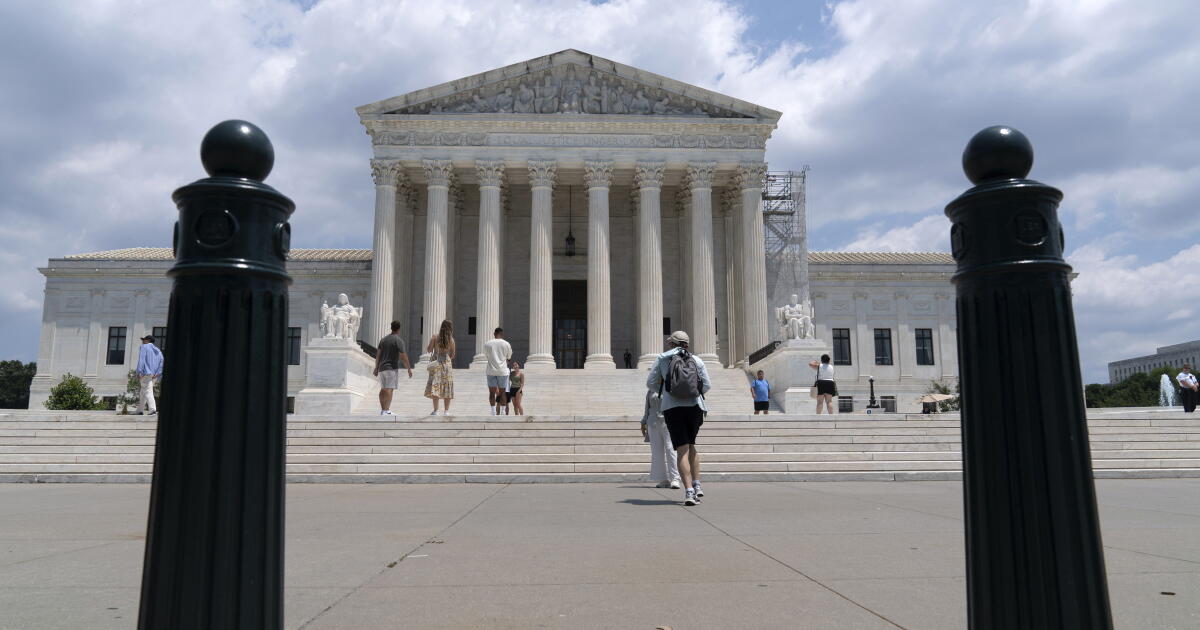
The Supreme Court ruled Wednesday that U.S. troops may sue military contractors for their injuries, siding with a soldier who was badly injured when a Taliban operative working at the Bagram Airfield detonated a suicide bomb.

Five soldiers were killed and 17 were wounded, including 20-year-old Winston Henceley, who suffered a fractured skull and brain injuries and is permanently disabled.

In a 6-3 decision, the court ruled that neither federal law nor the Constitution shields military contractors if their mistakes or negligence result in solders being injured in a combat zone.

Justice Clarence Thomas wrote the court’s opinion for an unusual majority that included Justices Sonia Sotomayor, Elena Kagan, Neil M. Gorsuch, Amy Coney Barrett and Ketanji Brown Jackson.

In the past, Thomas has objected to court precedents that prevented troops from suing the U.S. government for their injuries, including from medical practice.

And he said that rule should not be expanded to shield military contractors.

Justice Samuel A. Alito Jr. dissented, along with Chief Justice John G. Roberts and Justice Brett M. Kavanaugh.

“Because the Constitution gives the federal government exclusive authority over foreign affairs and the conduct of wars, federal law preempts all state law that substantially interferes with the Government’s exercise of those powers,” Alito wrote.

Hencely had tried to stop and question Ahmad Nayeb, an Afghan employee, as he walked toward soldiers who had gathered for a Veteran’s Day 5K race in 2016.

The Army concluded that Hencely’s intervention “likely prevented a far greater tragedy,” and its investigation concluded that the Fluor Corporation that had a contract to run operations at the base was primarily responsible for the attack.

The report said Fluor was negligent in hiring an Afghan who had been a Taliban operative, and it failed to closely supervise him.

But Henceley sued Fluor for his injuries; a federal judge in South Carolina and the 4th Circuit threw out his suit.

“During wartime, where a private service contractor is integrated into combatant activities over which the military retains command authority, a tort claim arising out of the contractor’s engagement in such activities shall be preempted,” the 4th Circuit said.

The court agreed to hear his appeal and overturn the 4th Circuit, clearing his suit to proceed.

Source link

Appeals court rules Texas can require Ten Commandments in school

Texas Attorney General Ken Paxton, seen here in April 2024, celebrated an appeals court ruling on Tuesday in favor of Senate Bill 10, which mandates public schools to display the Ten Commandments in all classrooms. Pool File Photo by Justin Lane/UPI | License Photo

April 22 (UPI) — A U.S. appeals court has ruled that Texas can require schools to display a copy of the Ten Commandments, finding the legislation that mandates the Decalogue in classrooms does not require students to believe in the religious teachings.

The Tuesday ruling from the Fifth Circuit Court of Appeals is a victory for Texas conservatives and Christians who have fought to further include religion in public spaces. The decision is expected to be appealed to the Supreme Court.

“This is a major victory for Texas and our moral values,” the state’s Republican attorney general, Ken Paxton, said in a statement.

“The Ten Commandments have had a profound impact on our nation, and it’s important that students learn from them every single day.”

Texas Gov. Greg Abbott signed Senate Bill 10 into law June 10, directing every classroom in all Texas public schools to display the Ten Commandments starting Sept. 1, but has been tied up in litigation since.

While proponents argue the Decalogue is foundational to American life, opponents state that mandating it in schools is an unconstitutional violation of the separation of church and state.

The American Civil Liberties Union, which represented multi-faith Texas families in the case, said it was “extremely disappointed” by the decision and expects the Supreme Court to reverse it.

“The court’s ruling goes against fundamental First Amendment principles and binding U.S. Supreme Court authority,” the ACLU of Texas said in a statement.

“The First Amendment safeguards the separation of church and state, and the freedom of families to choose how, when and if to provide their children with religious instruction. This decision tramples those rights.”

The appeals court on Tuesday ruled 9-7 to overturn a lower court’s preliminary injunction that found S.B. 10 likely unconstitutional.

In its ruling, the appeals court found S.B. 10 “looks nothing like a historical religious establishment.”

“S.B. 10 authorizes no religious instruction and gives teachers no license to contradict children’s religious beliefs (or their parents’). No child is made to recite the Commandments, believe them or affirm their divine origin,” the court said.

Source link

High court to examine rights of green-card holders charged with crime

WASHINGTON, April 22 (UPI) — The Supreme Court will hear arguments Wednesday whether immigration officers can place permanent residents charged with a crime on parole if they leave and then re-enter the country.

In immigration, parole is a temporary, discretionary permission granted by the Department of Homeland Security that allows a person to enter or remain in the United States, even though they are not formally admitted.

Parole does not cancel a person’s green card, but essentially gives the Department of Homeland Security time to decide whether the person should be admitted or deported based on how the issue is resolved.

The court is poised to hear oral arguments in Blanche vs. Lau, which would determine when immigration officers can demote a permanent resident’s status to parole, a temporary status that can be revoked and result in deportation.

Lau is Chinese immigrant Muk Lau, a permanent resident with a green card. Blanche is Todd Blanche, the acting U.S. attorney general and named defendant in the case.

Typically, permanent residents are allowed to leave and re-enter the United States as they wish, with a few exceptions. If these immigrants have committed certain kinds of crimes, for example, officers can have them placed on parole when they return to the country after going abroad.

The case stems from an event on June 15, 2012, when 69-year-old Lau, who had gained permanent residency five years earlier, landed in a New York-area airport after traveling to China.

He presented his green card and passport to border control. His entry triggered an FBI match because a month earlier, Lau was charged with third-degree trademark counterfeiting for selling nearly $300,000 of fake designer shorts.

“I was arrested at a warehouse that contained some merchandise I had stored there,” Lau told the Customs and Border Protection agent, according to court documents. “I went to the warehouse to retrieve the merchandise because I had not paid rent, and when I got there, the cops were there and arrested me.”

The agent declared Lau inadmissible as a returning permanent resident due to the crime exception, and decided to let him in on parole, instead. A year later, Lau pled guilty to the counterfeiting, and in 2014, the Department of Homeland Security began deportation proceedings against him.

At the time, the Customs and Border Patrol agent did not know whether Lau was guilty — just that he had been charged with a crime. The crux of Lau’s case is whether the CBP agent needed “clear and convincing” evidence of a crime when placing him on parole or whether just charges were enough without such evidence.

Immigrant advocates argue the agent erred.

“Mr. Lau was absolutely, unequivocally, at that time, admissible,” said Jonathan Weinberg, who worked on the American Immigration Lawyers Association’s brief to the court. “He just was. He hadn’t been convicted of a crime. There was nothing else that would render him inadmissible.”

After an immigration judge and the Board of Immigration Appeals sided with the government, Lau appealed to the U.S. 2nd Circuit Court of Appeals. The appellate court, agreeing with Weinberg’s reasoning, granted Lau’s petition in March 2025.

The Federation for American Immigration Reform, a nonprofit advocating for lower immigration rates, also submitted a brief to the court. It argued that the border patrol officer did the right thing by paroling Lau into the country, and that the clear and convincing standard was too high.

“If you’re going to say that the officer in an airport is supposed to have all this information, you’re assigning that individual with an impossible task,” FAIR spokesman Ira Mehlman said. “You have thousands of people coming through the airports every day, and these are decisions that have to be made on the spot.”

Mehlman also said that the decision “shouldn’t be a problem” for green-card holders without any criminal history.

“When you come to the United States as a non-citizen, you are here on a conditional basis,” Mehlman said. “Even if you’re a green card holder, you’re subject to removal if you violate the terms of your presence here in the United States.”

There are nearly 13 million legal permanent residents in the United States. Legal immigrants, including green card holders, commit crimes at lower rates than natural-born citizens, according to research by the Migration Policy Institute. However, Weinberg said the ultimate decision would impact all legal permanent residents, including those who have not been convicted of any crime.

“If the government can admit Lau on parole, then the government can basically admit any returning green card holder on parole if it chooses to,” Weinberg said.

Lau’s case joins several immigration-related issues, including birthright citizenship and temporary protected status, which have made their way to the Supreme Court this spring.

“The immigrant advocacy community is, I think, fighting an uphill battle,” Weinberg said. “But that doesn’t mean you don’t give it your best shot.”

Source link

Supreme Court weighs phone searches to find criminals amid complaints of ‘digital dragnets’

A man carrying a gun and a cellphone entered a federal credit union in a small town in central Virginia in May 2019 and demanded cash.

He left with $195,000 in a bag and no clue to his identity. But his smartphone was keeping track of him.

What happened next could yield a landmark ruling from the Supreme Court on the 4th Amendment and its restrictions against “unreasonable searches.”

Typically, police use tips or leads to find suspects, then seek a search warrant from a judge to enter a house or other private area to seize the evidence that can prove a crime.

Civil libertarians say the new “digital dragnets” work in reverse.

“It’s grab the data and search first. Suspicion later. That’s opposite of how our system has worked, and it’s really dangerous,” said Jake Laperruque, an attorney for the Center for Democracy & Technology.

But these new data scans can be effective in finding criminals.

Lacking leads in the Virginia bank robbery, a police detective turned to what one judge in the case called a “groundbreaking investigative tool … enabling the relentless collection of eerily precise location data.”

Cellphones can be tracked through towers, and Google stored this location history data for hundreds of millions of users. The detective sent Google a demand for information known as a “geofence warrant,” referring to a virtual fence around a particular geographic area at a specific time.

The officer sought phones that were within 150 yards of the bank during the hour of the robbery. He used that data to locate Okello Chatrie, then obtained a search warrant of his home where the cash and the holdup notes were found.

Chatrie entered a conditional guilty plea, but the Supreme Court will hear his appeal on April 27.

The justices agreed to decide whether geofence warrants violate the 4th Amendment.

The outcome may go beyond location tracking. At issue more broadly is the legal status of the vast amount of privately stored data that can be easily scanned.

This may include words or phrases found in Google searches or in emails. For example, investigators may want to know who searched for a particular address in the weeks before an arson or a murder took place there or who searched for information on making a particular type of bomb.

Judges are deeply divided on how this fits with the 4th Amendment.

Two years ago, the conservative U.S. Court of Appeals for the 5th Circuit in New Orleans ruled “geofence warrants are general warrants categorically prohibited by the 4th Amendment.”

Chief Justice John Roberts poses for an official portrait at the Supreme Court building in 2022.

Chief Justice John Roberts sided with the court’s liberals in a 4th Amendment privacy case in 2018.

(Alex Wong / Getty Images)

Historians of the 4th Amendment say the constitutional ban on “unreasonable searches and seizures” arose from the anger in the American colonies over British officers using general warrants to search homes and stores even when they had no reason to suspect any particular person of wrongdoing.

The National Assn. of Criminal Defense Lawyers relies on that contention in opposing geofence warrants.

Its lawyers argued the government obtained Chatrie’s “private location information … with an unconstitutional general warrant that compelled Google to conduct a fishing expedition through millions of Google accounts, without any basis for believing that any one of them would contain incriminating evidence.”

Meanwhile, the more liberal 4th Circuit in Virginia divided 7-7 to reject Chatrie’s appeal. Several judges explained the law was not clear, and the police officer had done nothing wrong.

“There was no search here,” Judge J. Harvie Wilkinson wrote in a concurring opinion that defended the use of this tracking data.

He pointed to Supreme Court rulings in the 1970s declaring that check records held by a bank or dialing records held by a phone company were not private and could be searched by investigators without a warrant.

Chatrie had agreed to having his location records held by Google. If financial records for several months are not private, the judge wrote, “surely this request for a two-hour snapshot of one’s public movements” is not private either.

Google changed its policy in 2023 and no longer stores location history data for all of its users. But cellphone carriers continue to receive warrants that seek tracking data.

Wilkinson, a prominent conservative from the Reagan era, also argued it would be a mistake for the courts to “frustrate law enforcement’s ability to keep pace with tech-savvy criminals” or cause “more cold cases to go unsolved. Think of a murder where the culprit leaves behind his encrypted phone and nothing else. No fingerprints, no witnesses, no murder weapon. But because the killer allowed Google to track his location, a geofence warrant can crack the case,” he wrote.

Judges in Los Angeles upheld the use of a geofence warrant to find and convict two men for a robbery and murder in a bank parking lot in Paramount.

The victim, Adbadalla Thabet, collected cash from gas stations in Downey, Bellflower, Compton and Lynwood early in the morning before driving to the bank.

After he was robbed and shot, a Los Angeles County sheriff’s detective found video surveillance that showed he had been followed by two cars whose license plates could not be seen.

The detective then sought a geofence warrant from a Superior Court judge that asked Google for location data for six designated spots on the morning of the murder.

That led to the identification of Daniel Meza and Walter Meneses, who pleaded guilty to the crimes. A California Court of Appeal rejected their 4th Amendment claim in 2023, even though the judges said they had legal doubts about the “novelty of the particular surveillance technique at issue.”

The Supreme Court has also been split on how to apply the 4th Amendment to new types of surveillance.

By a 5-4 vote, the court in 2018 ruled the FBI should have obtained a search warrant before it required a cellphone company to turn over 127 days of records for Timothy Carpenter, a suspect in a series of store robberies in Michigan.

The data confirmed Carpenter was nearby when four of the stores were robbed.

Chief Justice John G. Roberts, joined by four liberal justices, said this lengthy surveillance violated privacy rights protected by the 4th Amendment.

The “seismic shifts in technology” could permit total surveillance of the public, Roberts wrote, and “we decline to grant the state unrestricted access” to these databases.

But he described the Carpenter decision as “narrow” because it turned on the many weeks of surveillance data.

In dissent, four conservatives questioned how tracking someone’s driving violates their privacy. Surveillance cameras and license plate readers are commonly used by investigators and have rarely been challenged.

Solicitor Gen. D. John Sauer relies on that argument in his defense of Chatrie’s conviction. “An individual has no reasonable expectation of privacy in movements that anyone could see,” he wrote.

The justices will issue a decision by the end of June.

Source link

Shorthanded Lakers knock off Durant-less Rockets in Game 1

Above all else, the Lakers were committed to being resilient in Game 1 of the playoffs.

Even if they were missing their starting backcourt, the Lakers were committed to being resilient against the rugged and physical Houston Rockets, who were playing without Kevin Durant after the star suffered a bruised knee in practice.

And as a group the Lakers were resilient, following the lead of LeBron James and a career-best outing from Luke Kennard to pull out a gritty 107-98 win over the Rockets Saturday at Crypto.com Arena.

James was magnificent, collecting a near triple-double with 19 points on nine-for-15 shooting, 13 assists and eight rebounds.

Kennard was outstanding in his new role as facilitator and a main hub of the offense, scoring a playoff career-high 27 points. His three three-pointers in the fourth quarter gave the Lakers the separation they needed to take a 1-0 lead in the best-of-seven series. He was nine-for-13 shooting from the field and five for five from three-point range.

But James tied Hall of Famers Karl Malone and John Stockton by appearing in his 19th postseason, and Kennard had plenty of help from the rest of their starting mates.

Deande Ayton had a double-double with 19 points and 11 rebounds, Marcus Smart had 15 points and eight assists and Rui Hachimura scored 14.

Game 2 is Tuesday night here.

James had eight assists in the first quarter, his career-high for assists in any quarter of a playoff game.

The Lakers followed his lead.

They started the game with a purpose, making their first four shots, missing the next and then making their next four in a row to finish the first quarter shooting 15 of 19 from the field— 78.9%.

Kennard was the best in the group, shooting five for six in the first quarter and scoring 11 points to help the Lakers open a 33-29 lead by the end of the first 12 minutes.

Injured Rockets star Kevin Durant, third from left on bench, watches LeBron James inbound the basketball during Game 1.

Injured Rockets star Kevin Durant, third from left on bench, watches Lakers star LeBron James inbound the basketball during Game 1.

(Allen J. Schaben / Los Angeles Times)

But the game slowed down in the second quarter when the Lakers scored just 17 points while the Rockets could muster 19.

Forty minutes before the Lakers tipped off against the Rockets, Luka Doncic was seen walking down the hallway with his bodyguard toward L.A.’s locker room. Doncic was not playing because of a Grade 2 left hamstring strain, joining teammate Austin Reaves (Grade 2 left oblique muscle train) on the bench dressed in street clothes.

The Rockets announced that Durant was out for the first game because of a right knee contusion that occurred during practice Wednesday. Durant, the Rockets’ leading scorer (26.0 points per game), worked about before the game but was unable to play because of “soreness and tenderness.” The Rockets hope he’ll be available for Game 2.

“Bumped a knee in practice one of our days, on Wednesday,” Rockets coach Ime Udoka said. “Hopefully it’s a one-game thing, but [he] tried it out just shortly ago and didn’t feel good enough.”

For the Lakers, there was an element of shock they had to deal with when Doncic and Reaves were injured at Oklahoma City on April 2.

They eventually got past that, winning their last three games to end the regular season.

“Ten days ago, when our guys get hurt, I think it’s easy to look at adversity and the ups and downs of an NBA season as like some form of the basketball gods punishing you,” Lakers coach JJ Redick said. “The reality is it’s opportunities to build resilience. … Smart said it after our last regular-season game: ‘We’re right where we’re supposed to be.’ I think the whole season for the staff, our players, our team, our group, it’s been about building resiliency, and that’s what you need in the playoffs.”

Source link

Civil case against Alec Baldwin, ‘Rust’ movie producers advances toward a trial

Nearly two years after actor Alec Baldwin was cleared of criminal charges in the “Rust” movie shooting death, a long simmering civil negligence case is inching toward a trial this fall.

On Friday, a Los Angeles Superior Court judge denied a summary judgment motion requested by the film producers Rust Movie Productions LLC, as well as actor-producer Baldwin and his firm El Dorado Pictures to dismiss the case.

During a hearing, Superior Court Judge Maurice Leiter set an Oct. 12 trial date.

The negligence suit was brought more than four years ago by Serge Svetnoy, who served as the chief lighting technician on the problem-plagued western film. Svetnoy was close friends with cinematographer Halyna Hutchins and held her in his arms as she lay dying on the floor of the New Mexico movie set. Baldwin’s firearm had discharged, launching a .45 caliber bullet, which struck and killed her.

An aerial shot of an old, wooden church building surrounded by people, equipment and trucks

The Bonanza Creek Ranch in Santa Fe, N.M. in 2021.

(Jae C. Hong / Associated Press)

Svetnoy was the first crew member of the ill-fated western to bring a lawsuit against the producers, alleging they were negligent in Hutchins’ October 2021 death. He maintains he has suffered trauma in the years since. In addition to negligence, his lawsuit also accuses the producers of intentional infliction of emotional distress.

Prosecutors dropped criminal charges against Baldwin, who has long maintained he was not responsible for Hutchins’ death.

“We are pleased with the Court’s decision denying the motions for summary judgment filed by Rust Movie Productions and Mr. Baldwin,” lawyers Gary Dordick and John Upton, who represent Svetnoy, said in a statement following the hearing. “He looks forward to finally having his day in court on this long-pending matter.”

The judge denied the defendants’ request to dismiss the negligence, emotional distress and punitive damages claims. One count directed at Baldwin, alleging assault, was dropped.

Svetnoy has said the bullet whizzed past his head and “narrowly missed him,” according to the gaffer’s suit.

Attorneys representing Baldwin and the producers were not immediately available for comment.

Svetnoy and Hutchins had been friends for more than five years and worked together on nine film productions. Both were immigrants from Ukraine, and they spent holidays together with their families.

On Oct. 21, 2021, he was helping prepare for an afternoon of filming in a wooden church on Bonanza Creek Ranch. Hutchins was conversing with Baldwin to set up a camera angle that Hutchins wanted to depict: a close-up image of the barrel of Baldwin’s revolver.

The day had been chaotic because Hutchins’ union camera crew had walked off the set to protest the lack of nearby housing and previous alleged safety violations with the firearms on the set.

Instead of postponing filming to resolve the labor dispute, producers pushed forward, crew members alleged.

New Mexico prosecutors prevailed in a criminal case against the armorer, Hannah Gutierrez, in March 2024. She served more than a year in a state women’s prison for her involuntary manslaughter conviction before being released last year.

Baldwin faced a similar charge, but the case against him unraveled spectacularly.

On the second day of his July 2024 trial, his criminal defense attorneys — Luke Nikas and Alex Spiro — presented evidence that prosecutors and sheriff’s deputies withheld evidence that may have helped his defense . The judge was furious, setting Baldwin free.

Variety first reported on Friday’s court action.

Source link

Supreme Court rules for Chevron in Louisiana wetlands damage case

April 17 (UPI) — The Supreme Court ruled unanimously in favor of Chevron in a case related to damage to wetlands in Louisiana that dates to World War II.

The case was brought more than a decade ago and relates to damage allegedly done when Chevron’s corporate predecessors were refining aviation gas on behalf of the federal government during the war, Scotusblog and The Washington Post reported.

The 8-0 ruling sent the federal lawsuit back to a lower court in a move that could jeopardize a $745 million ruling against the company to restore the wetlands, as well as other similar cases with fossil fuel companies before courts in the United States.

Parishes in Louisiana filed the case with the help of state officials against oil and gas companies refining crude oil along the coast during the war, claiming that proper permits were never obtained for their work and that they had not followed “prudent industry practices.”

The previous decision on the $745 million ruling was made by a state court, which Chevron contended does not have the jurisdiction to rule because it was working under the auspices of the federal government.

After the state court judgement was handed down, the company’s lawyers asked the U.S. Supreme Court to move the case to a federal court, where it may be able to have the ruling thrown out.

U.S. President Donald Trump departs the White House en route to Davos, Switzerland on Wednesday. Photo by Olivier Douliery/UPI | License Photo

Source link

Trump rails against court decision that once again stalls his White House ballroom project

President Trump railed against a federal judge’s decision on Thursday that continues to block above-ground construction of a $400-million White House ballroom, allowing only below-ground work on a bunker and other “national security facilities” at the site.

U.S. District Judge Richard Leon’s latest ruling comes in response to an appeals court’s instruction to clarify an earlier decision on the 90,000-square-foot ballroom planned for the site where the East Wing of the White House once stood.

Trump on social media called Leon, who was nominated to the bench by Republican President George W. Bush, a “Trump Hating” judge who “has gone out of his way to undermine National Security, and to make sure that this Great Gift to America gets delayed, or doesn’t get built.”

The administration filed a notice that it will ask the U.S. Court of Appeals for the District of Columbia Circuit to review Leon’s latest decision, too.

Carol Quillen, president and chief executive of National Trust for Historic Preservation, whose group sued to challenge the project, said in a statement that the group is pleased with the court’s ruling.

Leon said that below-ground work on security measures is exempt from his order suspending above-ground construction. Government lawyers have argued that the project includes critical security features to guard against a range of possible threats, such as drones, ballistic missiles and biohazards.

Leon’s latest ruling comes several days after a three-judge panel from the D.C. appeals court instructed him to reconsider the possible national security implications of stopping construction.

In his previous order, Leon barred above-ground work on the ballroom from proceeding without congressional approval. The judge also ruled on March 31 that any construction work that’s necessary to ensure the safety and security of the White House is exempt from the scope of the injunction. Leon said he reviewed material that the government privately submitted to him before concluding that halting construction wouldn’t jeopardize national security.

Leon had suspended his March 31 order for two weeks. He stayed his latest decision for another week, which gives the administration more time to seek Supreme Court review.

Leon said he is ordering a stop only to the above-ground construction of the planned ballroom, apart from any work needed to cover or secure that part of the project. Otherwise, the Trump administration is free to proceed with the construction of any excavations, bunkers, military installations, and medical facilities below the ballroom.

“Defendants argue that the entire ballroom construction project, from tip to tail, falls within the safety-and-security exception and therefore may proceed unabated,” the judge wrote. “That is neither a reasonable nor a correct reading of my Order!”

On Saturday, the appeals court panel said it didn’t have enough information to decide how much of the project can be suspended without jeopardizing the safety of the president, his family or the White House staff.

Leon said he recognizes the safety implications of the case, but stressed that “national security is not a blank check to proceed with otherwise unlawful activity.” He also said he has “no desire or intention to be dragooned into the role of construction manager.”

On April 2, two days after Leon’s previous ruling, Trump’s ballroom won final approval from the 12-member National Capital Planning Commission, which is charged with approving construction on federal property in the Washington region.

The preservation group sued in December, a week after the White House finished demolishing the East Wing to make way for a ballroom that Trump said would fit 999 people. Trump says the project is funded by private donations, although public money is paying for the bunker construction and security upgrades.

Kunzelman writes for the Associated Press.

Source link

Justice Department asks court to dismiss Jan. 6 convictions of Proud Boys, Oath Keepers members

1 of 3 | Stewart Rhodes, founder of the far-right extremist group the Oath Keepers, is among those Jan. 6, 2021-related convictions the Justice Department is seeking to dismiss. File Photo by Bonnie Cash/UPI | License Photo

April 14 (UPI) — The Justice Department on Tuesday asked a federal court to dismiss the convictions of Proud Boys and Oath Keepers members who were found guilty of leading and organizing the Jan. 6, 2021, riot and attack on the U.S. Capitol.

The request includes 12 former members of the groups, all of whom prosecutors said were ringleaders of the attack. After his return to office in 2025, President Donald Trump pardoned most of those who were convicted for their parts in the riot, a move affecting more than 1,000 people. However, the sentences of some, including these 12, were commuted to time served instead, freeing them from prison though the convictions remained.

The group involved in the Justice Department request on Tuesday includes Stewart Rhodes, a leader of the Oath Keepers who was sentenced to 18 years in prison for seditious conspiracy and other charges. Prosecutors said Rhodes and other Oath Keepers “began plotting to oppose by force the lawful transfer of presidential power” after the 2020 election, CBS News reported.

Others whose sentences were commuted are Proud Boys leaders Ethan Nordean, Zachary Rehl, Dominic Pezzola and Joseph Biggs, who were also convicted of seditious conspiracy for their role.

Appeals involving this group have continued, and the Justice Department requested Tuesday that federal appeals panels vacate the earlier convictions and drop the cases in whole.

“The United States has determined in its prosecutorial discretion that dismissal of this criminal case is in the interests of justice,” wrote Assistant U.S. Attorney Daniel Lenerz in the filing, Politico reported.

Greg Rosen, former chief of the Justice Department’s Capitol Siege Section, criticized the move, CBS News reported.

“It’s a reminder of what drove the pardons in the first place-the political violence is acceptable as long as your politics align,” he told CBS News. “And it’s a continuing and sad commentary on the current state of the department.”

Source link

Appeals court orders judge to end contempt investigation of Trump administration deportation flights

A federal judge must end his “intrusive” contempt investigation of the Trump administration for failing to comply with an order to turn around planes carrying Venezuelan migrants to El Salvador last year, a divided appeals court panel ruled Tuesday.

Chief Judge James Boasberg abused his discretion in forging ahead with criminal contempt proceedings over the March 2025 deportation flights, according to the majority opinion by a three-judge panel from U.S. Court of Appeals for the District of Columbia Circuit.

President Trump’s administration has a “clear and indisputable” right to the termination of the contempt proceedings, Circuit Judge Neomi Rao wrote in the court’s majority opinion.

“The legal error at the heart of these criminal contempt proceedings demonstrates why further investigation by the district court is an abuse of discretion,” Rao wrote. “Criminal contempt is available only for the violation of an order that is clear and specific. (Boasberg’s March 2025 order) did not clearly and specifically bar the government from transferring plaintiffs into Salvadoran custody.”

Rao was nominated by Trump, a Republican. Boasberg, chief judge of the district court in Washington, D.C., was nominated by Democratic President Barack Obama.

On March 15, 2025, two planes transporting Venezuelan migrants from the U.S. to El Salvador were in the air when Boasberg ordered the administration to turn them around.

Administration officials claim Boasberg is biased and overstepped his authority.

Boasberg has said the Trump administration may have acted in bad faith by trying to rush Venezuelan migrants out of the country in defiance of his order blocking their deportations to El Salvador. In an April 16, 2025 order, the judge said he gave the administration “ample opportunity to rectify or explain their actions” but concluded that “none of their responses has been satisfactory.”

Trump has called for impeaching Boasberg. Last year, the Justice Department filed a misconduct complaint accusing Boasberg of making improper public comments about Trump and his administration. Supreme Court Chief Justice John Roberts publicly rejected calls for Boasberg’s impeachment.

The case is assigned to Rao and Circuit Judges Justin Walker and J. Michelle Childs. Walker, also a Trump nominee, wrote a separate opinion concurring with Roa’s. Childs, who was nominated by Democratic President Joe Biden, dissented from the majority.

Kunzelman writes for the Associated Press.

Source link

Little Rascals star ‘Bug’ Hall arrested after missing court hearing over traffic dispute

An image collage containing 2 images, Image 1 shows Bug Hall as Alfalfa singing into a microphone in the movie "The Little Rascals.", Image 2 shows Bug Hall, actor, in an orange jumpsuit

FORMER child star Brandon “Bug” Hall has reportedly been arrested after allegedly skipping a court date tied to a traffic dispute.

The 41-year-old actor – best known for playing Alfalfa in the 1994 hit The Little Rascals – was picked up in Ohio.

Bug Hall was arrested in Ohio for failing to appear at a court hearingCredit: Bull Shoals Police Department
The actor, now 41, is best known for playing Alfalfa in the 1994 hit The Little RascalsCredit: Alamy

According to documents obtained by TMZ, he was charged with failure to appear after he allegedly missed a court hearing on December 31, 2024.

The case stems from a prior incident on October 29, 2024, when he was reportedly hit with a traffic citation for not having liability insurance.

The former Hollywood child favourite shot to fame as the lovable cowlick-haired Alfalfa in The Little Rascals, a role that made him a household name in the 90s.

He later appeared in films including Honey, We Shrunk Ourselves, The Stupids, and American Pie Presents: The Book of Love.

ALL GROWN UP

What do the Little Rascals cast look like now? Bug Hall & others today

In more recent years, Hall has popped up in TV shows such as Castle, Masters of Sex, and CSI: Crime Scene Investigation.

It comes after Bug Hall was arrested after allegedly inhaling air duster back in 2020.

A police report seen by The Sun states the then-35-year-old was taken into custody in Weatherford, Texas, after he was allegedly spotted near a hotel dumpster “huffing”.

He was later booked at Parker County Jail on suspicion of “possession use inhale/ingest volatile chemical”.

Most read in Entertainment

According to People magazine, the substance involved was reportedly “air duster”.

Huffing is a form of substance abuse where household chemicals are inhaled to produce a high.

Hall posted a $1,500 bond the next day and was later released.

The actor was charged but never sentenced for the 2020 air duster incident.

While he was initially arrested and booked on a misdemeanor charge, he later stated that he faced no formal charges in the end.

The arrest stems from a December 31, 2024, court hearing that Hall reportedly failed to attendCredit: Getty
Hall pictured in Little RascalsCredit: Alamy

Source link

Trump administration’s volume of emergency docket appeals ‘unprecedented,’ Sotomayor says

President Trump has notched a string of wins on the Supreme Court ’s emergency docket, in part because the conservative justices believe that blocking executive policies is a blow that can’t be easily fixed, Justice Sonia Sotomayor said Thursday.

The increase in emergency appeals by the Trump administration is “unprecedented in the court’s history,” she said in a speech at the University of Alabama School of Law.

The high court sided with the Trump administration in about two dozen decisions last year, often lifting the orders of lower court judges who found their policies were likely illegal on topics as diverse as immigration and steep federal funding cuts.

While designed to be short-term, those orders have largely allowed Trump to move ahead for now with key parts of his sweeping agenda.

The emergency docket, which is made up of appeals seeking quick intervention from the justices in cases that are still playing out in lower courts, is itself a source of disagreement among the justices. That spilled into public view when two other justices, liberal Ketanji Brown Jackson and conservative Brett M. Kavanaugh, publicly sparred over the emergency docket in an unusual exchange last month.

Sotomayor has disagreed with many of the decisions in Trump’s favor, but the conservatives who form the court’s majority often reason that blocking those policies — or laws passed by Congress — causes legal harm that can’t be easily fixed, she said. It’s a bar that’s tough for the other side to overcome, even for plaintiffs like immigrants who could be newly exposed to deportation or states where schools are losing teacher-training funding.

“If you start with the presumption that there is irreparable harm to one side, then you’re going to have more grants of emergency relief. Because the other side is going to have a much harder time,” she said. “It has changed the paradigm on the court.”

Her comments provided a window into the Supreme Court decisions that are often released with little explanation. While many emergency docket orders have gone Trump’s way, the court also struck down his sweeping tariffs, a central plank of his economic platform, after a longer process of full briefing and oral arguments.

Whitehurst writes for the Associated Press.

Source link

Challenge to Trump’s 10% global tariffs goes to court

April 10 (UPI) — President Donald Trump‘s tariffs are back in court Friday to decide on their legality.

The U.S. Court of International Trade will consider the president’s 10% global tariff that he created on Feb. 20 after the U.S. Supreme Court struck down his previous tariffs over his use of emergency powers. The new tariffs are based on Section 122 of the Trade Act of 1974.

That law allows the president to unilaterally surcharge imports up to 15% for up to 150 days “to deal with large and serious United States balance-of-payments deficits.”

Challenging the new levies are Democratic-led states and small businesses.

“This is another case where the president invokes a statute to impose whatever tariffs he wants, its limits be damned,” the states wrote in court filings.

Timothy C. Brightbill, a trade lawyer for the Washington law firm Wiley Rein, told The New York Times that he expects the court to be “skeptical of President Trump’s ability to impose broad tariffs,” including the global 10% rate.

Brightbill said it could be months before the legal system can give a full verdict.

“By then, there will most likely be a new tariff regime in place,” Brightbill said.

The White House said in a statement that Trump was “lawfully using the executive powers granted to him” and the administration was “committed to robustly defending the legality of the president’s actions in court.”

“For over a century, Congress has supplemented the president’s constitutional power over foreign affairs and national security by delegating to him the authority to manage foreign trade in response to international conditions, including by imposing tariffs,” the administration said.

But critics say Trump’s position only includes the U.S trade deficit. They argue that the president is ignoring inflows of foreign capital and financial investment. Those help “balance” the deficit.

They argue that a balance-of-payments crisis is impossible because the United States stopped using the gold standard and a fixed exchange rate system in the 1970s.

“A balance-of-payments crisis is a currency crisis that was of great concern when Congress enacted Section 122, but which can no longer exist,” the states wrote in court filings.

There are 24 states in the suit, along with two small businesses: spice and e-commerce business Burlap & Barrel and Basic Fun!, a toy company that designs and markets Tonka, Lincoln Logs, K’nex and others. They filed separate suits against the tariffs, but the cases will be heard together.

“When these tariffs were first announced last April, we made two promises: we would not raise our prices, and we would not ask our partner farmers to absorb the costs,” Burlap & Barrel wrote on its website. “A year later, we’re proud to say we’ve kept those promises. This lawsuit is about protecting our ability to continue doing that.”

The plaintiffs are represented by the Liberty Justice Center, a libertarian firm that worked on the tariff case that the administration lost at the Supreme Court. The three-judge panel is made up of different judges from the previous panel at the Court of International Trade.

Secretary of Defense Pete Hegseth speaks during a press briefing at the Pentagon on Wednesday. Yesterday, the United States and Iran agreed to a two-week ceasefire, with the U.S. suspending bombing in Iran for two weeks if the country reopens the Straight of Hormuz. Photo by Bonnie Cash/UPI | License Photo

Source link

U.S. still wants to deport Kilmar Abrego Garcia to Liberia, despite new agreement with Costa Rica

U.S. government attorneys on Tuesday told a federal judge the Department of Homeland Security still intends to deport Kilmar Abrego Garcia to Liberia, despite a new agreement with Costa Rica to accept deportees who cannot legally be returned to their home countries.

The Salvadoran national’s case has become a focal point in the immigration debate after he was mistakenly deported to El Salvador last year. Since his return, he has been fighting a second deportation to a series of African countries proposed by Homeland Security officials.

U.S. District Judge Paula Xinis, of Maryland, previously barred U.S. Immigration and Customs Enforcement from deporting him or detaining him. She has written that the agency has no viable plan to actually deport Abrego Garcia, referring in February to “one empty threat after another to remove him to countries in Africa with no real chance of success.”

Abrego Garcia has argued that if he is going to be deported, it should be to Costa Rica, which previously agreed to accept him. But Todd Lyons, the acting head of U.S. Customs and Immigration Enforcement, said in a March memo that deporting Abrego Garcia to Costa Rica would be “prejudicial to the United States.” Abrego Garcia should be sent to Liberia because the U.S. has spent government resources and political capital negotiating with the West African nation to accept third-country nationals, Lyons wrote.

At a Tuesday hearing in Xinis’ court, Ernesto Molina, director of the Department of Justice’s Office of Immigration Litigation, suggested that Abrego Garcia could “remove himself” to Costa Rica.

Xinis pointed out that the Justice Department is prosecuting him in Tennessee on human smuggling charges. She called it a “fantasy” to say that he can remove himself anywhere while the criminal case is pending. Xinis set a schedule for a briefing on the matter and scheduled a new hearing for April 28.

Abrego Garcia, 30, has an American wife and child and has lived in Maryland for years, but he immigrated to the U.S. illegally as a teenager. In 2019, an immigration judge ruled that he could not be deported to El Salvador because he faced danger there from a gang that had threatened his family. By mistake, he was deported there anyway last year.

Facing public pressure and a court order, President Trump’s administration brought him back in June, but only after securing an indictment charging him with human smuggling in Tennessee. He has pleaded not guilty and asked the judge to dismiss that case.

Loller writes for the Associated Press.

Source link

Fuller wins Greene’s House seat; Taylor wins Wis. Supreme Court

April 8 (UPI) — Republican Clay Fuller has claimed victory in Marjorie Taylor Greene‘s former House seat as Democrat Chris Taylor won a seat on Wisconsin’s Supreme Court.

The two contests were closely watched Tuesday as voters in Georgia and Wisconsin cast ballots in races Democrats hoped would help them regain ground ahead of November’s midterms.

Fuller, a district attorney in northwest Georgia, had secured President Donald Trump‘s endorsement and ran on a platform supporting many of the president’s key priorities: an America First economy, mass deportations, conservatism founded on Christianity and being tough on crime.

The District 14 runoff between Fuller and Democrat Shawn Harris was held after neither candidate won a majority in the March 10 special election, when Fuller trailed Harris by about 2 points.

During his victory speech Tuesday night, the former U.S. Air Force lieutenant thanked Trump for elevating his campaign with his endorsement.

“So much of what the story has been when this race started and so much of what you’re going to hear from the fake news media is that President Trump doesn’t mean anything to Georgia 14 anymore,” he told supporters.

“Well, you can see with the results on March 10 and you can see the results of what we’re seeing here today that President Trump is the most critical factor in our election, and he has made sure that we were going to win. He made sure that he was the ultimate trump card.”

With all 10 localities reporting late Tuesday, Fuller had secured about 72,304 votes for nearly 56% of the vote share compared to Harris’ 57,000 votes for 44.1%, according to unofficial results from the office of Georgia’s secretary of state.

The district is solidly Republican, with Greene winning District 14 with about 64.4% of the vote in 2024, the same year Trump carried the state.

Harris framed Tuesday’s election loss as a victory in the fight against Trump during his speech Tuesday night, noting that he had cut the GOP margin in the district to far fewer votes than the more than 108,000-vote margin Greene had won by in 2024.

“Donald Trump came right here to Rome, Ga., and didn’t do a damn thing,” he told supporters.

“We have absolutely no fear because we have Democrats, independents and, yes, Republicans voting for us because they are ready for change.”

The District 14 seat became available after Greene, a firebrand politician and former staunch Trump supporter, resigned in November as she sparred with the president, whom she accuses of distancing himself from his America First policies.

Harris had campaigned on supporting farmers, protecting SNAP benefits, defending Medicaid and Medicare, cutting the cost of living and fixing the U.S. immigration system.

The American Israel Public Affairs Committee, the U.S.-based pro-Israel lobby, congratulated Fuller on his victory.

“Fuller replaces Marjorie Taylor Greene, whose tenure was marked by repeated efforts to undermine the U.S.-Israel relationship and disparage millions of pro-Israel Americans engaged in the democratic process,” AIPAC said in a statement.

Georgia Gov. Brian Kemp, a Republican, also congratulated Fuller.

“I was proud to have appointed Clay as District Attorney and even more proud to now see him take that same fighting spirit to Congress,” Kemp said online.

“Keep Chopping, Clay!”

In Wisconsin, Taylor, a Democrat-backed appeals judge, claimed victory in a seat on the state’s Supreme Court left vacant by retiring conservative Justice Rebecca Bradley.

“Tonight, the people of Wisconsin stood up for our rights and freedoms, our democracy, our elections and a strong state Supreme Court that will protect the independence of our beloved state,” she said in her victory speech Tuesday night in Madison, Wis.

“Once again, Wisconsin showed the entire nation that we believe that the people should be at the center of government and the priority of our judiciary — not the billionaires, not the most powerful and privileged, but the people.”

With Taylor’s victory over Maria Lazar, a Republican-backed appeals judge, Wisconsin’s Supreme Court tilts even more heavily to the left, now with a 5-2 liberal majority.

During her speech, Taylor said Lazar had called her to concede the race.

Lazar confirmed the phone call in her own speech before supporters in Pewaukee on Tuesday night.

“I think that this race was run so that people in this state from now on will know that judicial races are not political races, and the next race and the next race and the next race we will keep fighting to put judges — good, talented judges with experience — on the bench and we will not take that status quo,” she said.

Justices serve a 10-year term on the bench, with no term limits.

Voters on Tuesday cast ballots to fill a state Supreme Court seat left vacant by retiring conservative Justice Rebecca Bradley.

Last year, Democrat-endorsed Susan Crawford was elected to the court despite Elon Musk pouring millions into the race.

Democratic gubernatorial candidate and State Rep. Francesca Hong congratulated Taylor on her victory.

“Wisconsinites voted for a Supreme Court that will protect their rights and freedoms,” she said on social media.

“This shows voters are ready for leadership that represents our state motto — Forward.”

Source link

L.A. election shadow hearing: Democrats, experts defend voting systems

House Democrats and a panel of elections experts expressed unwavering confidence in state voting systems and dismissed Trump administration claims of widespread fraud and other vulnerabilities during a special “shadow hearing” in Los Angeles on Tuesday.

They accused President Trump and his Republican allies of pushing sweeping federal reforms — including stricter voter ID laws and new restrictions on voting by mail — that would disenfranchise millions of eligible Americans, especially low-income, rural and elderly voters, as well as voters of color and those with disabilities.

“They are taking us backward, and not to a good place,” said Rep. Nancy Pelosi (D-San Francisco), who helped lead the hearing at the Daniel K. Inouye National Center for the Preservation of Democracy in Little Tokyo.

They also stressed that they and their allies were working hard to prevent such backsliding.

“While Republicans are expecting Democrats to just sit idly by as they attempt to steal yet another election, Democrats are getting out in the community, raising the alarm bells about the GOP’s efforts to rig these elections and fighting back in the courts, in Congress and in our communities,” said Rep. Pete Aguilar (D-Redlands), chair of the Democratic Caucus. “We won’t let Republicans get away with their anti-democratic and un-American schemes.”

Such “shadow hearings” allow Democrats to highlight issues their majority-Republican counterparts won’t schedule for formal hearings in Washington. This week’s discussions — a second is scheduled Thursday in San Francisco — follow others in California in recent months, including on Trump’s immigration raids.

Pelosi, the former House speaker, led the hearing alongside Aguilar and Rep. Joseph Morelle of New York, the ranking Democrat on the House Administration Committee, which has oversight of elections. Joining them were fellow Democratic Reps. Nanette Barragán of San Pedro, Judy Chu of Monterey Park, Gil Cisneros of Covina, Laura Friedman of Glendale, Luz Rivas of North Hollywood, Linda Sánchez of Whittier, Norma Torres of Pomona and Maxine Waters of L.A.

Pelosi noted the setting on the grounds of the Japanese American National Museum, where Japanese Americans were detained before being unconstitutionally stripped of their belongings and taken to internment camps during World War II.

“To be here on a day when the president of the United States has talked about destroying the civilization of a country is so appalling. It’s so appalling, and I don’t think we can ignore comments like that, especially in a setting like this,” Pelosi said.

She also said that securing the nation’s elections against Trump’s threats and getting out the Democratic vote was the surest way of restoring order to U.S. relations abroad — and far more likely than getting Trump’s Cabinet to remove him from office by invoking the 25th Amendment.

“We have to make sure that the mentality that would obliterate a civilization, undermine a democracy by fighting free and fair elections, just cannot prevail,” she said.

The hearings were designed to challenge a narrative Trump has pushed for years — that U.S. elections are badly compromised by widespread fraud, that mail ballots such as those used in California are a particularly large source of abuse, and that noncitizens are voting in large numbers — none of which he has supported with evidence.

Trump tried unsuccessfully to challenge his 2020 loss to Joe Biden using similar arguments. When he returned to the White House, he immediately directed his administration to pursue the claims anew, including under executive orders he issued asserting new and sweeping federal authority over elections, which by law are controlled by the states.

The Justice Department in September sued California and other states for their voter rolls, which courts rejected. The FBI in January raided and seized 2020 election records from an elections office in Fulton County, Ga., where Trump rejected 2020 results. Trump in February said Republicans “ought to nationalize the voting.” Last week, he issued an executive order purporting to give federal agencies control over ballot processing by the U.S. Postal Service, which followed a previous order seeking to place new federal requirements on voter identification and proof of citizenship.

Trump has said his efforts are “common sense” steps average Americans support to secure elections against noncitizens voting and other threats.

Experts who provided testimony at Tuesday’s hearing roundly rejected that argument, saying the measures address problems that don’t existand are more geared toward securing wins for Republicans than ensuring election safety.

Jenny Farrell, executive director of the League of Women Voters of California, said that Americans are “more likely to be struck by lightning” than to commit voter fraud, and that many recent proposals framed around election integrity are really designed to narrow access to voting for certain groups. She also said California’s elections are particularly strong.

“We’re like the Dodgers of elections,” she said.

Darius Kemp, executive director of Common Cause California, said the state’s elections “are safe and secure,” and the Trump administration is threatening democratic participation in novel and alarming ways that his organization is watching carefully.

Justin Levitt, a Loyola Law School professor, said Trump is trying to project power over elections “that he simply does not have,” and if local and state officials, the courts and pro-democracy groups stand their ground, he will fail.

“If we keep calm and carry on, we can make our voices heard loud and clear,” he said.

Hector Villagra, vice president of policy advocacy and community education at MALDEF, or the Mexican American Legal Defense and Educational Fund, said “the evidence could not be more clear — noncitizen voting is exceedingly rare,” and Trump’s proposals would simply “raise the cost of lawful voting” for groups already underrepresented at the polls.

“The question is not whether we can verify eligibility. We already do that,” he said. “The question is whether we will impose new barriers that will prevent eligible citizens from participating at all.”

Sonni Waknin, senior staff attorney at the UCLA Voting Rights Project, said “democracy is under attack” across the nation, and that the photo identification requirement Trump and other Republicans are pushing would disenfranchise a million eligible voters in California alone.

When Cisneros asked about what could be done to prepare for the inevitable claims of fraud from Trump and other Republicans after the midterms, Levitt said that such claims must be called out for what they are.

“We call those lies, because they are lies,” he said.

When Waters asked the experts about the effect of federal immigration agents being deployed to polling places, as some in Trump’s orbit have suggested, Villagra said damage was already being done just from the rumors of such action — whether agents show up or not.

“It’s the threat that’s really what’s powerful here,” he said, as people — especially Latino voters — are already intimidated, and leaders should do more to reassure voters and offer alternatives to showing up to polls, such as voting by mail.

Source link

Environmental groups urge appeals court panel to lift halt on closing Florida’s ‘Alligator Alcatraz’

Environmental groups on Tuesday asked a federal appellate court panel to drop its temporary halt of a lower court’s order instructing state officials to close an immigration detention center in the heart of the Florida Everglades known as “Alligator Alcatraz.”

The Everglades facility remains open, still holding detainees, because the appellate court in early September relied on arguments by Florida and the Trump administration that the state had not yet applied for federal reimbursement, and therefore wasn’t required to follow federal environmental law. State officials opened the detention center last summer to support President Trump’s immigration crackdown.

Questions by the three appellate judges during oral arguments in a Miami courtroom focused on how much control the federal government had over the state-built facility and under what circumstances an environmental review was required to be in compliance with federal law. The judges did not indicate when they would rule.

Jesse Panuccio, an attorney for the Florida Department of Emergency Management, told the judges federal funding and federal control of the facility were the two criteria for determining if the federal environmental law would apply and the federal agencies had no control over the state-run detention center.

Florida was notified in late September that FEMA had approved $608 million in federal funding to support the center’s construction and operation.

“You need both,” Panuccio said. “Even with funding, I don’t think that would follow because they don’t have federal control.”

An attorney for the environmental groups said the law requiring a review applied to the facility because the Department of Homeland Security had authorized the funding and immigration was a responsibility of the federal government, not the state.

“What is different about this property is that immigration is constitutionally a federal function,” said Paul Schwiep,” an attorney representing the Friends of the Everglades and the Center for Biological Diversity. “The state has no role.”

The federal district judge in Miami in mid-August ordered the facility to wind down operations over two months because officials had failed to do a review of the detention center’s environmental impact according to federal law. That judge concluded that a reimbursement decision already had been made. The appellate court halted the order on an appeal.

The environmental lawsuit was one of three federal court challenges to the Everglades facility since it opened. In the others, a detainee said Florida agencies and private contractors hired by the state had no authority to operate the center under federal law. The challenge ended after the immigrant detainee who filed the lawsuit agreed to be removed from the United States.

In the third lawsuit, a federal judge in Fort Myers, Fla., ruled the Everglades facility must provide detainees there with better access to their attorneys, as well as confidential, unmonitored, unrecorded outgoing legal calls.

Schneider writes for the Associated Press.

Source link

Democrats hope to increase liberal control of battleground Wisconsin’s Supreme Court

Democrats hoped to increase liberal control of the state Supreme Court in Wisconsin on Tuesday in an election that has focused largely on abortion rights as cases affecting congressional redistricting, union rights and other hot button issues also await in the perennial battleground state.

This year’s Supreme Court election stands in stark contrast to the swing state’s previous two, where national spending records were set in battles over majority control. Spending and national attention is down dramatically this year without control of the court at stake.

Democrats are looking to tighten their control of the court just months before a November election in which they seek to keep the governor’s office and flip the state Legislature, where Republicans have held the majority since 2011. Democrats aspire to undo a host of Republican-enacted laws that made Wisconsin a focal point for the nation’s conservative movement in the 2010s.

In Tuesday’s Supreme Court race, Democratic-backed Chris Taylor, a former state lawmaker who also worked for Planned Parenthood, faces Republican-supported Maria Lazar. Both Taylor and Lazar are state Appeals Court judges.

Liberals would increase their majority on the court to 5-2 from 4-3 with a Taylor win. That would lock in the liberal majority until at least 2030.

Liberals took control of the state’s top court in 2023, ending 15 years under a conservative majority. They held onto their majority with last year’s victory in a race that drew involvement from President Trump and billionaires George Soros and Elon Musk, who personally handed out $1 million checks to voters in the state.

Liberals argued that democracy was at stake in the 2025 election, noting that when the court was controlled by conservative justices in 2020 it came just one vote shy of siding with Trump in his attempt to invalidate enough votes to overturn his loss in that year’s presidential election.

Since liberals took control, the court has reversed several election-related rulings, including one that overturned a ban on absentee ballot drop boxes, and it is poised to once again be in the spotlight around the 2028 presidential election.

Races for the court are officially nonpartisan, but support for candidates breaks down mostly along partisan lines.

Taylor has focused much of her campaign on abortion rights, with one TV ad saying that “abortion is on the ballot.” In another ad, she criticized Lazar for calling the U.S. Supreme Court’s overturning of Roe v. Wade in 2022 “very wise.”

Lazar, who was supported by anti-abortion groups in her run for the appeals court, tried to brand Taylor as nothing more than a politician who will push a partisan agenda on the court.

They sparred over each other’s partisanship during the campaign’s sole debate last week.

Lazar accused Taylor of being a “radical, extreme legislator” and a “judicial activist.” Taylor said that Lazar would bring “an extreme, right-wing political agenda to the bench.”

Lazar has had a much harder time getting her message out. Taylor had a large fundraising advantage and spent about nine times as much as Lazar on television ads, based on a tally by the Brennan Center for Justice.

The liberal-controlled court has already struck down a state law banning abortion and ordered new legislative maps, fueling Democrats’ hopes of capturing a majority this November.

Taylor has been a judge since 2020 and before that she spent 10 years as a Democrat representing the liberal capital city of Madison in the state Assembly.

Lazar, a judge since 2015, previously worked four years under a Republican attorney general in the state Department of Justice. In that role, she defended a law enacted under former Republican Gov. Scott Walker that effectively ended collective bargaining for most public workers.

A circuit court judge ruled in December that the law is unconstitutional, a decision expected to ultimately land before the state Supreme Court.

Lazar also defended laws passed by Republicans and signed by Walker implementing a voter ID requirement and restricting abortion access.

Democrats are optimistic given the past two Supreme Court elections, which saw candidates they backed winning by double digits.

The seat is open due to the retirement of a conservative justice. Another conservative justice is retiring next year, giving liberals a chance to take 6-1 control of the court if they win on Tuesday.

Bauer writes for the Associated Press.

Source link

Steve Bannon wins Supreme Court order likely to lead to dismissal of contempt of Congress conviction

Steve Bannon, a longtime ally of President Trump, on Monday won a Supreme Court order that is expected to lead to the dismissal of his criminal conviction for refusing to testify to Congress.

Prodded by the Trump administration, the justices threw out an appellate ruling upholding Bannon’s conviction for defying a subpoena from the House committee that investigated the Jan. 6, 2021, attack by a mob of Trump supporters on the U.S. Capitol.

The move frees a trial judge to act on the Republican administration’s pending request to dismiss Bannon’s conviction and indictment “in the interests of justice.”

The dismissal would be largely symbolic. Bannon served a four-month prison term after a jury convicted him of contempt of Congress in 2022. A federal appeals court in Washington had upheld the conviction.

The justices also issued a similar order in the case of former Cincinnati Councilman P.G. Sittenfeld, who was pardoned by Trump last year.

Sittenfeld had served 16 months in federal prison after a jury convicted him of bribery and attempted extortion in 2022. The high court order allows a lower court to consider dismissing his indictment.

The Justice Department brought the case against Bannon during Democrat Joe Biden’s presidency, but it changed course after Trump took office again last year.

Bannon had initially argued that his testimony was protected by Trump’s claim of executive privilege. But the House panel and the Justice Department contended such a claim was dubious because Trump had fired Bannon from the White House in 2017 and Bannon was thus a private citizen when he was consulting with the then-president in the run-up to the Capitol riot.

Bannon separately has pleaded guilty in a New York state court to defrauding donors to a private effort to build a wall on the U.S. southern border, as part of a plea deal that allowed him to avoid jail time. That conviction is unaffected by the Supreme Court action.

Sherman writes for the Associated Press.

Source link