A travel and food content creator called George Kimm has shared his experience of taking an overnight sleeper train from London to Cornwall – but the price left people shocked
15:46, 12 Jun 2026Updated 15:46, 12 Jun 2026
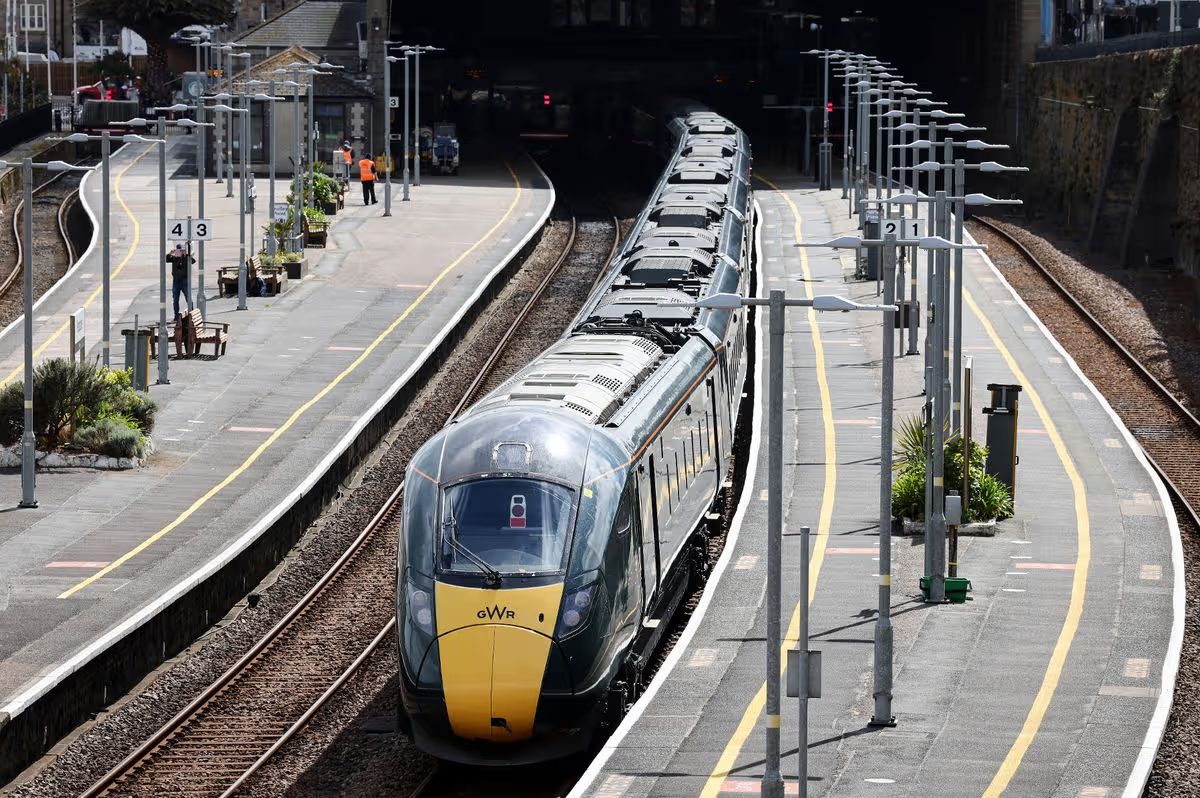
A man shared his experience travelling on an overnight sleeper train from London to Cornwall (stock photo)(Image: Greg Martin / Cornwall Live)
Cornwall is widely regarded as one of the most breathtaking counties in the UK, boasting golden sandy beaches, a spectacular sweeping coastline, world-class surfing spots and jaw-dropping clifftop scenery. And it’s not just locals who are smitten with this South West gem — visitors from across the country regularly make the journey down.
One such traveller is George Kimm, a UK-based travel and food content creator. George made the trip from London to Cornwall aboard an overnight sleeper train, documenting his experience on Instagram. He hopped on the Great Western Railway (GWR) Night Riviera, which departs from London Paddington and pulls into Penzance the following morning, with the entire journey clocking in at just over eight hours.
The travel enthusiast gave his candid verdict on the experience, though one particular detail caught his Instagram followers off guard — the price. George booked a “very cosy” solo cabin, which came equipped with a single bed, a table that doubled up as a sink, a wardrobe and handy storage space beneath the bed, which he described as “very useful”. GWR also provided a selection of amenities, including soap.
George did point out that the toilets are located outside the cabins. However, aside from that, the train operator “really had thought of everything else”.
The London-based creator went on to say: “Before we left London Paddington I had a look in the onboard bar where you can sit down, relax. They also provide free tea and coffee with biscuits and when it comes to going to sleep, I actually had a really good experience.”
After getting settled and having a look around, George watched the train depart the station before heading off to bed. He revealed that he relished the sounds and motion of the train, as they lulled him off to sleep.
When George stirred the following morning, he tucked into breakfast, which came as part of his cabin fare. He opted for a cup of tea and a sausage bap, noting that it was “very delicious”.
The travel enthusiast added: “And it was so lovely to have my breakfast whilst watching the countryside whizz by.”
He wrapped up his Instagram reel by revealing what his trip and cabin had set him back, saying: “My ticket cost £119 and an additional £149 for the cabin.” George reckoned it was “such a cool experience” nodding off in London and coming round in Cornwall. He believed it was “honestly so worth it” and something he’d gladly repeat.
One commenter observed: “£75 return to Paris, just saying.” George responded: “Totally get it. This was a bucket list trip.” Another remarked: “Looks fun but the price is insane.”
Content cannot be displayed without consent
A third astonished viewer queried: “Omg… how much?” Someone else went as far as branding the price “criminal.”
Despite the hefty price tag, some viewers still managed to see the bright side, with one commenting: “This looks like a great experience but it’s very costly for a return journey. I guess the benefit is both journeys are during the night so you aren’t losing out on any holiday time.”
A second chimed in: “Would love to do this!! Honestly would see the cost as part of the holiday, so special.”
For those travelling with Great Western Railway’s Night Riviera service, an airline-style seat is available at no additional cost when booking a ticket, with prices for a private cabin starting from £49 per person.
Robert decided to leave the UK after spending over £3,000 a month just to get by – and he loves his new life
Robert Hoadley has started a new life abroad(Image: Jam Press/@seaturkeyadventures)
A Brit has ditched life in the UK to live well for just £800 a month – and he’s loving it. Now he drinks £2 pints on the beach and saves thousands on bills.
Robert Hoadley decided to up sticks after realising he was stuck in a cycle of working long hours just to cover rising costs. The 45-year-old had barely travelled and spent years grafting in construction before deciding enough was enough.
Now he’s living more than 6,000 miles away in Chiang Mai, Thailand, to work as a content creator, and says life couldn’t be more different. “I felt like I was just working to cover bills with no real freedom,” Robert, from Portsmouth, said.
“The cost of living in the UK kept going up, and I wanted a different lifestyle – less stress and more control of my time. I got to a point where I didn’t want to wait until retirement to actually start living life, so I decided to take the leap, sell everything I owned, and move out here.
“It’s definitely been a big change, but the lifestyle and day-to-day life here feels a lot better.” Since relocating in 2025, Robert has been working online, creating content about the cost of living and relocating abroad.
He’s currently building various online income streams so he can work remotely. His social media platform, Sea Turkey Adventures, already boasts over 6,000 followers with some of his clips racking up over 200,000 views.
Robert says he’s happier, more active and finally enjoying a proper work-life balance. And despite pints costing just £2, he insists he’s actually drinking less – although the one thing he misses most about UK is the sarcastic sense of humour.
Robert said: “I enjoyed going out in the UK, but these days it’s more balanced. I drink socially now rather than out of habit. There are more lifestyle options here like gyms, cafés, pools and being outdoors. I’m much more focused on health and routine now. I wake up earlier, train regularly, spend more time outdoors, and I’m more conscious of how I spend my time and money.
“In the evenings I’m nearly always out doing something social, even if it’s just meeting people for food or coffee rather than drinking.” The UK’s cost-of-living crunch was a major factor behind his move. Robert says he was spending more than £3,000 a month back home but now lives comfortably on just £800.
‘Money goes so far abroad’
He said: “That’s the biggest difference – you’re not constantly under financial pressure. A lot of people don’t realise how far your money can go abroad, and how different life can feel when you’re not constantly stressed about bills. I did look at other countries, but Thailand just made sense – good food, friendly people, strong expat community, and you can live well here for a fraction of UK costs.”
He also says the slower pace of life has made a huge difference. He said: “In the UK, people can seem stressed, the weather can be grey for long periods, and it often feels like everyone is rushing through life. Here, the climate is better, the people are generally more relaxed, and there’s a friendlier vibe overall. A lot of people are either on holiday or choosing to be here, so the energy feels more positive.
“It just suits me more at this stage of life.” But it’s not all perfect – and Robert admits he still misses some things from home. He added: “I miss friends and family, obviously. Also the humour – that UK sarcasm and banter is hard to replace. I miss certain foods and the traditional pub atmosphere. Every country has things you appreciate once you leave.”
THE Traitors star Diane Carson has revealed she suffered a nasty fall on holiday that resulted in a £280 trip to the dentist.
The keen runner, 65, is on holiday in Lisbon with her son and his girlfriend, Rima.
Sign up for the Showbiz newsletter
Thank you!
The Traitors star Diane Carson injured her tooth in a jogging accidentCredit: Instagram/dianeakamumDiane is one of the best-loved Traitors starsCredit: BBC
While exploring the sunny Portuguese city, Diane came a cropper on a jog and it needed a pricey resolution.
She shared a video of her happily bounding through a park before the accident and wrote over the top: “Today’s amazing run — before the £280 worth of dental treatment.”
In the caption she gave more detail, explaining she had two scraped knees, a staved thumb, a severely swollen lip and two chipped teeth; one was so far back she couldn’t close her mouth.
Showing true grit, she completed another 1.5miles after the incident to finish her route.
Diane and her son Ross kept their familial connection a secret in series twoCredit: BBC
She wrote: “My tooth was masterfully maneuvered back into place and treatment completed with an orthodontic wire.”
Her followers were quick to comment, wishing her well and praising her strength for returning to exercise so soon after the accident.
One wrote: “Yikes! Not sure I would have carried on after that…”
Diane replied: “I’m a tad bloody minded – matching my face this morning!”
Another said: “Ouch!!!! But obviously finish the run! hope you’re ok.”
The reality star responded: “I’ll live, thank u. Tooth mightn’t though!”
In another exchange, a fan posted: “Poor you! Sounds painful… hope it doesn’t impede the rose enjoyment.”
Diane said: “Rarely impeded – even if I have to use a straw to accommodate a swollen mouth!!!”
The previous day, the retired teacher shared a picture with her son Ross, with whom she appeared in The Traitors with.
She wrote: “Lovely meeting up with Ross and Rima and what a great holiday destination – Lisbon!”
“Plenty of sunshine, running, exploring, shopping, Padel AND the discovery of natural wines! We arrived just in time for the start of Festas de Lisboa – so lots of craic!”
The series two pair were responsible for one of the series’ biggest twists and were both a big hit with viewers.
Their co-stars had no idea they were related until Ross delivered the news after being eliminated at the round table in episode 10.
His parting words were: “I am a Faithful… oh wait, no, I’m a Traitor. But I was a Faithful for most of it. And I do have one more secret… Diane is my mum.”
The incredible lift ascends 153 metres (502 feet) in under a minute
Europe’s highest outdoor lift is used by 40,000 people a year
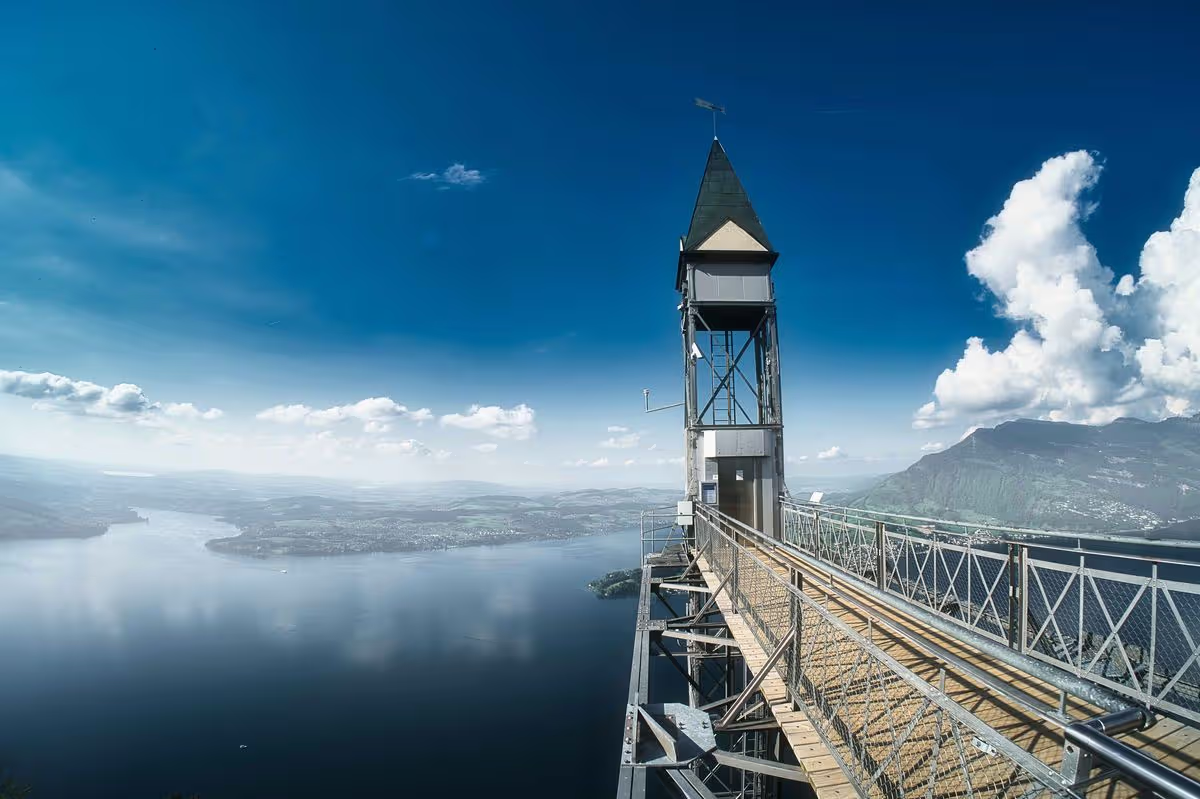
Some of the world’s most jaw-dropping lifts can be found in luxury hotels, including the highest outdoor lift in Europe, nestled in Lucerne, Switzerland. The Bürgenstock Resort is home to the remarkable Hammetschwand lift, offering stunning views of Lake Lucerne.
The Hammetschwand lift was built between 1900 and 1905 by pioneering hotelier Franz Josef Bucher, at a cost of 500,000 Swiss francs (around £470,000). It remains the quickest route up to the viewpoint, climbing 153 metres (502 feet) in under a minute.
Those planning a visit should bear in mind that to reach the foot of the lift, you’ll need to walk the breathtaking Felsenweg cliff path.
It is estimated that over 40,000 people use the Hammetschwand lift annually, and around 200 to 250 riders per day.
On Tripadvisor, one visitor advised choosing “the perfect sunny day to enjoy the view.” They went on to say: “This is a fantastic view, the elevator is just too quick, but still worth a visit.”
Another said: “You do the Burgenstock track to the lift and it is already by itself stunning!!! Nobody talks about it. It’s a hidden gem in Switzerland!
“Then you arrive at that special spit where the lakes of the four cantons connect, and it’s breathtaking. A bit ahead, there’s the lift and the adventure to one of the most beautiful views ever. It’s easy, it’s accessible, it’s unbelievably beautiful. I will do it again.”
Among other remarkable examples is the Hotel Santa Caterina’s lift in Amalfi, Italy, which boasts breathtaking views. Carved into the rugged cliffside, the glass-fronted elevator takes guests down to the exclusive Beach Club and the hotel’s Italian seafood restaurant.
In Greece, the Corfu Holiday Palace features a stunning lift that transports guests down the cliffside to the beach in just moments, treating them to gorgeous views across the bay while providing far easier access to the white sands below.
The Luxor Hotel in Las Vegas, United States, is home to one of the most iconic lifts on the planet. Given the hotel’s striking pyramid shape, the lifts travel between floors at a diagonal 39-degree angle, treating guests to a spectacular outlook over the atrium as they make their way to one of the hotel’s 4,407 rooms.
Travel insurance for Turkey has jumped almost 50 per cent in just a year, according to new data
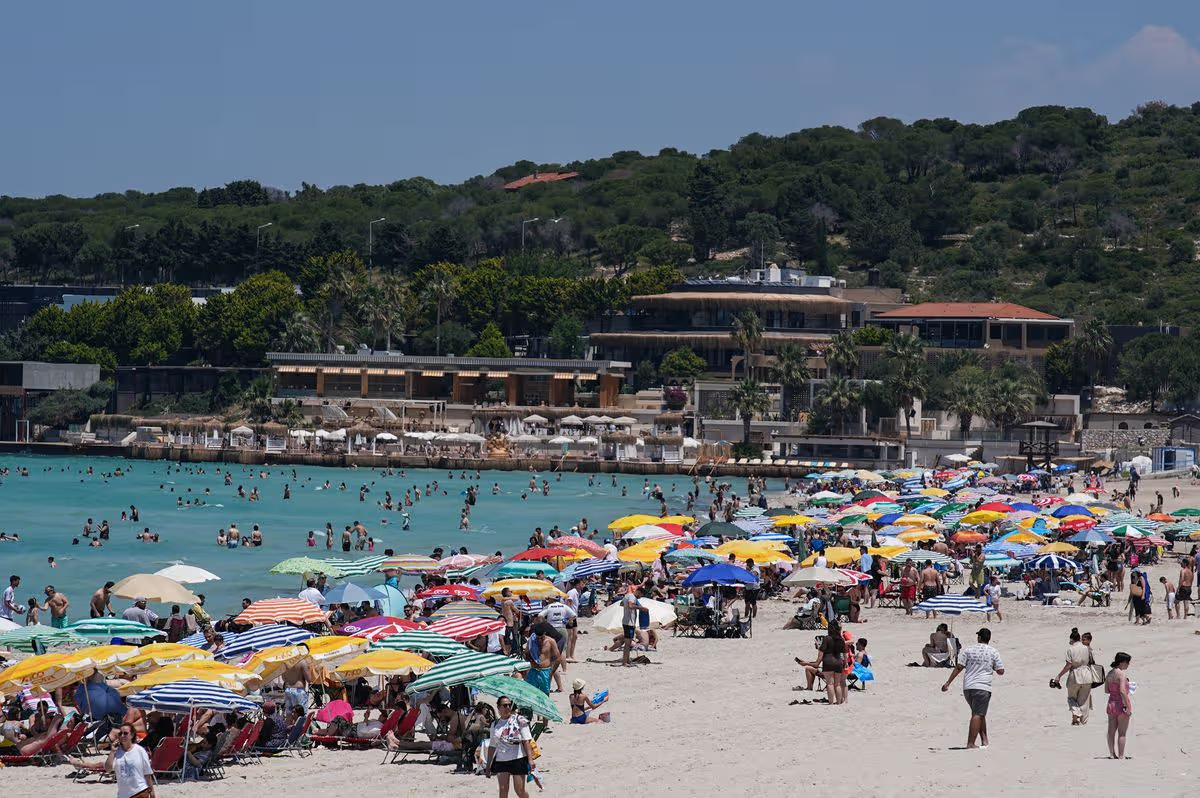
Izmir, Turkiye. UK tourists are facing higher insurance premiums, one travel expert said(Image: Getty Images)
Five European and Mediterranean destinations including some hotspots much loved by British tourists have been named as having seen big rises in insurance costs, directly caused by the Middle East crisis. Travel insurance for Turkey has jumped 46% in just a year, according to new data analysing 5,000 policies across popular destinations near conflict zones.
There is no sign of the Middle East conflict calming down – today Iran fired ballistic missiles and drones towards Bahrain and Kuwait, Bahrain’s government said, adding that they were intercepted.
Bahrain’s government called on Tehran to immediately cease attacks on Gulf neighbours that it deemed a “serious escalation”. Iran’s Foreign Ministry said the US early Saturday attacked surveillance facilities on Qeshm Island and near Sirik that it said were used to protect borders and “ensure the security of navigation in international waters”.
The latest exchange of fire came as the Trump administration pressed Iran to make a deal to end the war that has strained the global economy and threatened a hunger crisis in some of the world’s most vulnerable countries.
The US military earlier said it shot down several Iranian missiles and drones launched towards the Strait of Hormuz and Gulf Arab allies, and struck some of the Islamic Republic’s coastal surveillance radar sites in response.
It has had a big impact on the region with some popular destinations seeing big rises in premiums. Quotezone travel insurance expert Helen Rolph warned travellers not to assume last year’s prices still apply and urges holidaymakers to compare policies carefully, buy cover as soon as they book, and check Foreign Office advice before travelling.
Industry experts compared 5,000 travel insurance premiums across five popular tourist destinations close to conflict zones, revealing which countries have seen the biggest price increases over the past year.
Prices in Turkey have been affected the most despite it traditionally being considered one of the most popular and cost-effective destinations for UK holidaymakers over recent years.
Standard travel insurance premiums to the country have jumped from £40.56 in early 2025 to £59.19 just a year later – a rise of 46% or almost £20 per trip – which may be due to the fact it shares a border with Iran.
Holidaymakers travelling to Bulgaria are also seeing a sharp rise with prices up 19%, possibly down to its proximity to Ukraine.
Premiums for Cyprus have increased by 6%, Egypt by 4% and Poland by 8%. To gather the data, popular holiday destinations for British tourists were cross-referenced with countries geographically close to conflict zones, namely Ukraine and Iran, creating a dataset of major holiday hotspots in relative proximity to areas of geopolitical tension.
Insurers regularly reassess risk when global tensions rise, particularly in destinations close to areas where travel complications might become more likely.
Destinations situated close to areas experiencing heightened tensions – such as Iran and Ukraine – could see premiums shift as insurers reassess the likelihood of travel disruption, delays or emergency evacuation should issues escalate.
Helen Rolph, travel insurance expert at Quotezone.co.uk said: “Travel insurance prices change constantly as insurers respond to global events, the number of claims made and healthcare costs.
“Even if a destination remains popular despite its proximity to ongoing conflict, premiums can rise when the wider region becomes more uncertain.
“Travellers and holidaymakers shouldn’t assume last year’s prices will still apply and make sure they’re comparing policies carefully rather than opting for the cheapest option, as cover can vary significantly.
“It’s also sensible to arrange insurance as soon as a trip is booked, check government travel advice before departure, and ensure any medical conditions are fully declared.
“Travel disruption insurance can also be useful as it covers a wider range of issues while travelling but it’s important to remember that travel insurance won’t provide cover if the foreign office advises against travel to that region and most travel insurance policies won’t cover war related incidents. It’s crucial for holidaymakers to check what is and isn’t covered on their policy and add any extras or specialised cover they might need.”
Travel Insurance Premiums
Country // Average 2025 // Average 2026 // Average Price Change // % Change
WASHINGTON — The U.S. military is waiting for clarity from the Pentagon following President Trump’s back-and-forth on troop levels in Europe, upending the lives of military personnel and potentially costing taxpayers millions of dollars, two U.S. defense officials told the Associated Press.
NATO allies were bewildered in May when Trump said he would send 5,000 U.S. troops to Poland just weeks after ordering the same number pulled from Europe, following a spat with Germany’s Chancellor Friedrich Merz over the Iran war. The Trump administration says troop reductions in Europe have long been planned and coordinated with allies.
The Republican president announced on social media two weeks ago that he was sending troops to Poland — the same day the Pentagon had officially ordered the cancellation of a rotation of soldiers heading there, one of the defense officials said.
The unit’s equipment was already on the way. Sending it cost the military $32 million, said U.S. Transportation Command, the military agency largely responsible for moving troops and gear across the globe.
The abrupt changes are forcing the military to “retroactively engineer” a policy in line with the president’s latest pronouncement, the official said. Both officials were briefed on the decisions and, along with others, spoke on the condition of anonymity to discuss sensitive military matters.
The uncertainty is not only rattling European allies worried about the message being sent to Russia, but it also risks hurting morale among American troops — some of whom had their rotations canceled shortly before departure — and comes as the Army budget is already strained.
Changes to troop deployments to Poland add up
The rotational deployment to Poland of 4,000 troops from the Army’s 2nd Armored Brigade Combat Team, 1st Cavalry Division, based in Fort Hood, Texas, was canceled in a memo sent to the military at the beginning of May. European allies found out mid-month.
Some of those troops were told shortly before traveling not to get on a flight to Poland, while those who had been sent ahead — initially around 1,000 troops — are still waiting for confirmation they are being sent back, a U.S. military official said.
The military also is still waiting for details from the Pentagon on how to satisfy Trump’s order to send 5,000 troops to Poland, that official said. The working assumption is that they will come from units already in Europe, rather than an additional deployment from the U.S., the official said.
U.S. Transportation Command had chartered a ship to take the team’s equipment from Texas to Poland and transport a departing unit’s gear back to America. The incoming team’s portion of the cost was $32 million, including chartering the ship and loading and unloading the gear.
Because the ship was chartered to take one unit to Europe and bring another back, it is hard to say if that amount would have been saved had the decision to halt the deployment been made before the new team had already begun moving overseas.
However, the military official said the unscheduled move of personnel and equipment back from Europe is most likely not a cost the Pentagon budgeted for and would be an additional expense.
Total costs of canceling the rotation are hard to quantify because of many factors, said Joe Costa, a former senior Pentagon official who now focuses on challenges faced by the U.S. military as director of the Atlantic Council’s Forward Defense program.
They most likely stem from returning equipment and troops sent ahead of the deployment and would probably be on the low end of the rotation’s overall cost, Costa said. The greater impact is on the readiness of troops who were trained for one mission and may be deployed on another, he said.
U.S. military contracts with private companies to transport troops and equipment contain cancellation clauses that often add extra fees if a deployment is called off, said John Deni, a senior nonresident fellow at the Atlantic Council who has studied such costs.
“The question is what additional costs were incurred by deciding to send them back prematurely, changing the arrangements, changing the plan?” said Deni, a former U.S. military advisor and planner who focused on forces in Europe.
It is not clear if the Pentagon can recoup those costs or those associated with moving the unit to Europe. The Defense Department did not answer questions about the costs of changing the deployment plans, and the White House referred a request for comment to the department.
Pentagon officials have repeatedly said they planned to lower troop levels to have Europe shoulder more of its own defense and that the decision was part of a “comprehensive, multilayered process.”
Last month’s memo also led to the cancellation of a deployment to Germany of a battalion trained in firing long-range rockets and missiles.
Pulling troops stationed in Germany would be more expensive
When Trump first threatened to remove 5,000 troops from Europe, Pentagon officials initially suggested pulling back the 2nd Cavalry Regiment, which is based permanently in Germany, the defense official said.
Instead, officials decided to cancel the rotation of the other unit to Poland. Then Trump threw that plan into confusion as well.
Pulling the troops stationed in Germany could cost in the low billions because there is no dedicated space and infrastructure in the U.S. to accommodate them and their families, Costa said.
“The other option is basically breaking up the unit,” Costa said. “They move the equipment in different places. They move the people to different places. That carries significant readiness costs because now you’re artificially jamming pieces of units into places where they don’t necessarily belong.”
Pulling or pausing deployments also can hurt morale among soldiers and families because they plan for them months and years in advance, Deni said. The uncertainty can be disruptive.
“That’s often the last thing you want to do to military families,” Deni said.
It is still unclear what will happen to U.S. troops stationed in Europe, the two officials said. Options include moving military units assigned to Germany to Poland, but that could take several years and cost more, the military official said.
Troop changes happen during an Army budget shortfall
The moves come as the Army is facing a budget shortfall, which the service’s top uniformed officer, Gen. Christopher LaNeve, recently acknowledged to Congress.
Estimates put the deficit somewhere between $2 billion and $6 billion, according to an Army official who also spoke on condition of anonymity to discuss sensitive defense matters. One impact has been cutting training courses for soldiers nationwide, which ABC News earlier reported.
In a statement, the Army said it has issued guidance to its commands to “make tough and sound resource decisions that optimize and prioritize resources toward their most critical requirements, to include major training and readiness events.”
The Army official also noted that the service has been tasked with missions like the National Guard deployment in Washington, a bolstered presence along the U.S.-Mexico border and its part in the Iran war — all of which have strained its budget.
The Department of Homeland Security expects to reimburse the Army for its role in the border mission.
Army Secretary Dan Driscoll told lawmakers at a May 15 hearing that he was “optimistic” there would progress on those payments “within a week or two.” But to date, the Army has not been reimbursed.
“We want those backfilled payments,” Driscoll said then.
The U.S. military in Europe also is scaling back support for non-combat related training and ruthlessly prioritizing critical functions, the military official said.
Burrows, Finley and Toropin write for the Associated Press. Burrows reported from London.
One savvy traveller has found an alternative way to jet off abroad that not only saves money, but also allows her to visit a plethora of destinations throughout the year
Helen Dalling is often jetting off with pals for an extreme day trip(Image: Jam Press/Helen Dalling)
A woman has remarkably been able to visit seven countries in a year for less than £2,000.
Flights can be notoriously expensive, especially to those sought-after destinations. Even flights that are just for a few hours can quickly cost hundreds of pounds, leaving holidaymakers questioning their getaway to Europe.
Yet, that wasn’t going to stop Helen Dalling, 55, from travelling last year. Instead, she looked for alternative ways to travel that not only saved money but also ticked off a plethora of holiday destinations.
In a bid to travel as much as possible and to keep costs considerably low, Helen, from Milton Keynes, swapped longer getaways for short escapes. Some were extreme day trips flying to and from the destination within 24 hours, while others offered an overnight stay.
“I’ve always loved travelling, but as I’m getting older and I’ve got kids and I work full-time, I thought ‘I’m not going to see enough countries in the world’,” Helen told creatorzine.com. “‘If I don’t start going to see a few of them, I need to do them quick and cheap’. That’s really why I started doing it.”
While it’s certainly a little more hectic than a week-long beach getaway, the change in travel meant that the 55-year-old was able to visit seven countries last year for around £1,600. This included the costs of flights, airport parking, hotels, sightseeing, food and drink, and spending money.
In 2025, Helen travelled to Paris, Budapest, Alicante, Malaga, Split, Prague, Amsterdam, and Geneva twice. It varied how long she would stay in each destination, from just a few hours to an overnight stay.
“I went to seven brand new countries”, Helen said. “That’s what I really wanted to do, I thought, ‘I’ve never been to Hungary, so let’s go to Budapest’.”
To help keep costs as low as possible, Helen regularly looks out for deals from different airlines that fly from her nearest airport, London Luton. “When I went to Paris, I was basically just browsing on New Year’s Day, not doing much else, and I spotted that you could get a flight to Paris for £13, one way and £12 the other”, she revealed. “I just booked it – and then when I told a friend, she booked it too and came with me.”
Helen continued: “The Budapest flights were about £8.99 each way; you can’t even get them that cheap anymore. I’ve done others that were £15-£20 return; I just book them – when I see the price, I just go for it.”
While she sometimes travels solo, it’s often a great chance to catch up with friends on an extreme day trip. “Instead of going to London for lunch, let’s go somewhere for the day,” Helen said.
“I did Geneva twice last year, but the second one I did at Christmas was with a real old friend of mine who is really into her food. So we went and did a foodie trip to the Christmas markets in Geneva and just went for the day – she’d never done one.
“Everybody that I’ve done one with has said ‘Oh my God, that was amazing’. I’ve got a bit of a queue of people wanting to go as well, but only so much money.”
After visiting seven countries last year, Budapest, which cost £191 for an overnight stay, stood out for Helen. “We just fell in love with Budapest,” she said. “Every time we did something else afterwards, I just said to my friend, ‘It’s not Budapest, though, is it? It’s not Budapest.’
“It was February when we did that, but the sky was blue, and we had the best time.
“It was super cheap, and everything just worked.” She added: “It was so lush. We were just sitting in these massive pools of boiling hot water with the cold air on our skin, just going, ‘This is amazing.'”
Following her extreme trips last year, Helen is determined to do the same this year. She’s already travelled to Palma in Mallorca with a friend for under £120, spent the night in Lithuania, and ventured to Albania for the day.
She confessed: “I’m always buzzing after a day trip. I would definitely do it again, it’s a great way to visit countries you’d never visit by going on one holiday a year.
“Last year I visited seven new countries, and it’s liberating.”
Price breakdown of Helen’s 2025 trips
Paris – £139 (extreme day trip)
Budapest – £191 (overnight)
Alicante – £62 (extreme day trip)
Malaga – £118 (extreme day trip)
Geneva – £182 (extreme day trip)
Split – £315 (overnight)
Prague – £165.11 (overnight)
Amsterdam – £290 (overnight)
Geneva – £138 (extreme day trip)
Total – £1,600.11
Do you have a travel story to share? Email webtravel@reachplc.com
A video showing a test launch of an FP-7.X missile was published yesterday by its manufacturer, Fire Point, also responsible for the FP-5 Flamingo cruise missile and a series of long-range one-way attack drones. Fire Point’s chief technology officer Iryna Terekh described the depicted test as a “fully controlled maneuvering flight” conducted “just the other day.” The pink-painted missile recalls the early Flamingoes, and now seems to have been adopted as something of a company trademark.
Держави програють війни на полі бою значно рідше, ніж вони програють їх у інститутах, лабораторіях та на виробництві за десять років до їх початку.
Коли країна роками недофінансовує інженерну освіту, скорочує дослідження, втрачає виробничі компетенції або звикає покладатися на… pic.twitter.com/Ti1Ayn4INf
The FP-7.X missile is planned as the stepping-stone toward the productionized Freyja missile, which is primarily intended to provide Ukraine with its first homegrown anti-ballistic missile defense system. While ballistic missile threats are being prioritized here, the system would be equally able to defend against a variety of crewed aircraft threats, as well as drones and cruise missiles.
“No matter how unrealistic and ambitious this goal may sound today, we are exerting all possible and impossible efforts to make it a reality as soon as possible, so that Ukraine can close its skies on its own,” Terekh wrote.
Back in April, Fire Point’s co-founder and chief designer Denys Shtilierman toldReuters that the company was aiming to develop an anti-ballistic missile with a unit cost of less than $1 million.
A rendering of the FP-7 surface-to-surface ballistic missile on which the FP-7.X missile is based. Fire Point
“If we can decrease it to less than $1 million, it will be … a game changer in air defense solutions,” Shtilierman said. “We plan to intercept the first ballistic missile at the end of 2027,” he added, apparently referring to the aim to field the Freyja system by that date.
This compares to a unit price of approximately $5.3 million for each example of the most modern and highly capable PAC-3 MSE variant, which is one of the types provided to Ukraine. This figure comes from the Army’s latest proposed budget for the 2027 Fiscal Year. This is up from a historical average of around $4 million for each one of these missiles. These munitions also take years of lead time to produce, meaning that managing limited stocks is a big challenge.
Fire Point has developed the FP-7.X missile on the basis of the previous FP-7 surface-to-surface ballistic missile, a weapon with a range of around 124 miles, and a warhead of approximately 331 pounds. Deriving an anti-ballistic missile from a ballistic missile is an unusual move, but Fire Point will hope that the commonality should accelerate the process.
As it stands, Ukraine’s anti-ballistic missile capabilities are strictly limited. It relies heavily upon the Patriot, batteries and components of which have been provided by Germany, the Netherlands, and the United States.
When the Patriot began to arrive in 2023, it provided Ukraine with an enhanced long-range, high-altitude engagement capability that was previously only offered, to a lesser degree, by Ukraine’s S-300s, with their depleting stocks of missiles. Importantly, the Patriot also brought an anti-ballistic missile capability, something that was previously only provided by the small number of Ukrainian S-300V1 systems, and even those don’t come anywhere close to the Patriot in this regard.
And another S-300V engagement, released as part of the same video.
From what I have seen, these are the third and fourth Ukrainian S-300V engagement videos released since the start of the war. pic.twitter.com/wPHnYbCQKP
Providing somewhat similar capabilities to the Patriot is the SAMP/T, a joint Franco-Italian SAM system, which has also been supplied to Ukraine, but only in limited numbers. Overall, the SAMP/T is limited simply by the fact that it is produced in relatively small numbers.
As for the Patriot, this has claimed notable successes and high-profile victims in Ukrainian hands. However, as Russia has adapted its ballistic missiles, specifically adding enhanced maneuvering capabilities, the effectiveness of the U.S.-made system has been reduced.
A screen capture of a Ukrainian Air Force video shows images of three Russian helicopters and two Russian fighters painted on the side of a Patriot air defense battery. Defense Industry of Ukraine image
According to Shtilierman, the Patriot system often requires two or three air defence missiles, each costing several million dollars, to bring down a ballistic projectile. This is a mismatch that Fire Point also hopes to address with the Freyja.
It is notable that the U.S. Army is currently also pressing defense contractors to come up with proposals for a new interceptor for the Patriot system with a unit cost under $1 million, as you can read more about here. Whether by design or coincidence, U.S. Army Maj. Gen. Frank Lozano, the Army’s Portfolio Acquisition Executive for Fires (PAE Fires), included a rendering of the FP-7.X in a recent LinkedIn post, as seen below, to illustrate a notional low-cost interceptor.
The latest development comes as Ukraine’s political and military leaders continue to warn about critical shortcomings in the country’s air defense capabilities. As well as expending the missiles it already has, the United States has reportedly suspended further Patriot deliveries to Ukraine because of concerns over the state of its own stockpile.
Ukrainian President Volodymyr Zelensky has repeatedly urged U.S. President Donald Trump and members of Congress to provide additional missiles for its Patriot systems, warning that Ukraine faces a severe air defense shortfall.
We were receiving PAC-3 missiles from our partners in certain quantities, but later that monthly volume was cut several times over. It wasn’t due to a lack of funding, but because of the war in the Middle East. This affected different types of weapons. Whatever we could, we… pic.twitter.com/qwPFydwAzC
— Volodymyr Zelenskyy / Володимир Зеленський (@ZelenskyyUa) June 3, 2026
Yesterday, Zelensky said that Ukrainian officials have one week to finalize outstanding legal, financial, and technical issues related to the purchase of additional Patriot systems.
Zelensky said that a political agreement to buy the systems has already been reached, but the process has stalled.
Ukraine’s ambassador to the United States, Olha Stefanishyna, added that Kyiv is prepared to finance additional Patriot systems and interceptor missiles if Washington agrees to deliver them.
Ukrainian personnel remove camouflage netting from a Patriot launcher, which is loaded with missile canisters associated with older interceptors like the PAC-2-series. Ukrainian Air Force
Commander-in-Chief of the Armed Forces of Ukraine Oleksandr Syrsky also recently pointed to Ukraine’s lack of sufficient modern air defense systems and interceptor missiles.
Clearly, continued Russian missile and drone strikes are putting a heavy strain on Ukraine’s air defenses.
Plugging the gaps with the Freyja system would make a lot of sense, providing a locally developed and manufactured solution to the problem, provided that the technical hurdles can be overcome.
Even so, the deadline of the end of 2027 is very ambitious for such a project.
With that in mind, Ukraine is also looking to foreign support for the Freyja program.
Earlier this year, Fire Point confirmed it was in talks to get European and Middle Eastern companies onboard the program. With various nations struggling to meet their air defense needs amid the demands of the conflicts in Ukraine and the Middle East, investing here could also bring dividends.
Parts of long-range drones stored in a workshop of the Fire Point company at an undisclosed location in Ukraine on January 29, 2026. Photo by Serhii Okunev / AFP SERHII OKUNEV
Shtilierman told Reuters in April that he was awaiting government approval for an investment in Fire Point by a Middle Eastern conglomerate, which would provide a major boost to Freyja and other programs, including longer-reaching ballistic missiles.
In terms of European companies, Shtilierman mentioned his interest in collaborating on radar, missile target-seeking, and communications systems. He named Hensoldt, Saab, and Thales as potential suppliers of radar solutions, an area where Fire Point lacks expertise.
Fire Point has also previously described the Freyja interceptor being fitted with an infrared imaging seeker for the terminal phase, as well as a semi-active radar homing seeker from Diehl Defence of Germany.
Few details are available about the launch system, other than reports of a lightweight, mobile launcher of domestic origin.
Globally, there is a clear demand for alternatives to the increasingly hard-to-source Patriot, especially for anti-ballistic missile defense.
A video shows a PAC-2 in a test against a Lance ballistic missile:
MIM-104C Patriot PAC-2 vs. Lance TBM
Ukraine’s combination of battlefield experience, rapid innovation, and low-cost defense technologies could put it in a good position to fill the gap. Even if the Freyja ends up with a significantly lower kill rate per missile than the Patriot, if it is far cheaper, that would be less of a problem.
At the same time, it remains unclear if Fire Point is able to fulfil the promises it has made in terms of output. In the past, the company has said it aims to build at least seven of its Flamingo cruise missiles per day, for a total of 2,555 built annually. To reach this target, the firm might need to call upon foreign partnerships to help expand its production capacity. The same would likely be the case for Freyja. By way of comparison, in 2024, Lockheed Martin produced more than 500 PAC-3 MSEs, with a plan to increase this to 600 in 2025.
A video of the Flamingo cruise missile in action:
Випробувальний пуск ракети “Фламінго”
One unknown factor in this is the possibility that Ukraine and/or NATO allies in Europe might obtain additional licenses for local production of Patriot missiles. Zelensky wants Patriot production in Ukraine and has said he has been discussing it with the United States. Still, while these might address the production capacity issues for the weapons, it would still be a more expensive solution than what Fire Point is proposing and it would take years to realize any output.
For now, the FP-7.X appears to be an early-stage technology demonstrator, and turning it into the operational Freyja interceptor by 2027 will require overcoming massive technical and logistical hurdles — as well as holding off Russian air attacks in the meantime.
However, the program reflects a broader trend in Ukraine’s wartime defense sector: rapidly developing indigenous capabilities to fill critical gaps left by limited and/or unreliable foreign supplies. If Fire Point can translate its ambitions into a viable anti-ballistic missile system, Ukraine could gain not only a more sustainable means of defending its skies, but also a potentially attractive export alternative in a global market increasingly hungry for affordable air defense solutions.
Reuters first reported on the price increase to connect the datalinks on LUCAS drones to SpaceX’s space-based networks earlier today. The story cites anonymous sources, as well as Pentagon documents the outlet says it reviewed. This follows the recent announcement that the Pentagon is working to make LUCAS more autonomous with new artificial intelligence (AI) driven swarming capabilities, which could impact future connectivity demands.
In the video in the social media post below, the satellite communications terminal can be seen hanging from a cord on a LUCAS drone said to have been recovered largely intact in Iraq.
Local Iraqi residents are taking the newly deployed, nearly intact American LUCAS drone for themselves. pic.twitter.com/fbx411iAYU
— Special Kherson Cat 🐈🇺🇦 (@bayraktar_1love) March 2, 2026
What we know about SpaceX’s reported upcharge for LUCAS
“Within weeks of the United States launching its bombing campaign, SpaceX executives met Pentagon officials and argued the military had been paying about $5,000 for connection per terminal while effectively using a higher tier of service worth closer to $25,000,” according to Reuters. “SpaceX argued the LUCAS drones were operating under conditions that aligned more closely with its aviation tier subscription rather than a lower priced land or mobility service. Pentagon officials argued that the $25,000 price tag – a monthly fee – was designed for aircraft, not kamikaze drones that used Starlink connection for a matter of minutes or hours.”
“The Pentagon, which was ramping up strikes on Iran, ultimately agreed to pay SpaceX’s proposed price increase,” Reuters‘ report added.
The story also said this reflected broader “tensions” between the Pentagon and SpaceX that have been growing recently over Starlink fees.
“The Fake News media has the story wrong, again,” top Pentagon spokesperson Sean Parnell subsequently wrote in a post on X. “The claims in this article are simply not based in reality and do not reflect the close, effective collaboration between our teams.”
The Fake News media has the story wrong, again. @SpaceX remains a strong and valued partner to the Department of War.
The claims in this article are simply not based in reality and do not reflect the close, effective collaboration between our teams. https://t.co/872Maa5FX2
When reached for comment by TWZ earlier today before Parnell’s post, the Pentagon did not directly address Reuters‘ report.
“The Department of War is committed to fostering a competitive environment for commercial satellite communications and is conducting comprehensive market research to continuously monitor commercial offerings that align with government requirements,” a Pentagon official told us. “We are actively engaging with industry to identify innovative solutions and new entrants, ensuring acquisitions are inclusive of a diverse range of capable vendors.”
“The Commercial Satellite Communications Office is working on additional options with other proliferated low earth orbit partners as part of its strategy to leverage the unprecedented capabilities provided by the commercial SATCOM industry,” that same official added. “The U.S. Space Force is operating in accordance with the terms and conditions of its contracts.”
TWZ has also reached out to SpaceX for more information.
“It is a violation of commercial Starlink terms of service to use the terminal for weapon systems. This applies to all users and is shut down when discovered,” Elon Musk, who is the founder and CEO of SpaceX among his other endeavors, had written on X on March 1 in response to a post about LUCAS making use of Starlink. “There is a separate network called Starshield, which is operated by the US government. This is not under SpaceX control.”
It is a violation of commercial Starlink terms of service to use the terminal for weapon systems. This applies to all users and is shut down when discovered.
There is a separate network called Starshield, which is operated by the US government. This is not under SpaceX control.
Though described as a “monthly fee,” Reuters‘ report indicates that the U.S. military pays the $25,000 only once to employ a LUCAS drone. As the piece points out, the Pentagon reportedly argued that it should get to pay the lower $5,000 rate because it was only using the network to support LUCAS in timeframes measured in “minutes or hours.” This is also in line with Reuters describing the added cost as effectively approaching doubling the LUCAS drone’s $35,000 unit price.
The entire point of these one-way-attack drones is to offer a lower-cost complement to traditional exquisite long-range strike munitions. The Tomahawk cruise missile, the unit cost of a current-generation version of which is generally said to be in the $2 to $2.5 million range, is often used as a point of comparison, although they are far from equal in many ways. The underlying argument for LUCAS also relies on the drone being relatively cheap and easy to produce, as well as employ in large volumes. TWZ laid all of this out in a detailed case for the Pentagon acquiring exactly these kinds of drones in mass, which we published just three months before LUCAS was confirmed to be in operational service.
A combined price tag of some $60,000 (the unit cost plus one month’s fee to connect to Starshield, as reported by Reuters) would still be far less expensive than the cost of a single Tomahawk. Using Starlink/Starshield terminals to begin with, beyond their connectivity advantages, offers the benefit of miniaturized high-bandwidth hardware that is being produced at a commercial scale.
A close-up look at a LUCAS drone, with its square-shaped satellite communications antenna seen at the rear of the main body. CENTCOM
Plans to make LUCAS more autonomous through the addition of new swarming capabilities could affect future network connectivity requirements for the drones. This will be enabled by the integration of Shield AI’s Hivemind autonomy software, as you can read more about here.
Shield AI flies Hivemind AI Pilot on 6th Aircraft
As TWZ recently wrote:
“For the time being, the U.S. military demands a human operator is ‘in or on the loop’ for kinetic or otherwise potentially deadly actions, as opposed to letting autonomous weapons choose what targets to attack on their own without any extra authorization. While less controversial morally, this can also be a tactical hindrance, slowing the swarm’s potential and adding complexity and vulnerabilities to its operations. The debate around this choice will only get more heated as adversaries bypass this elected restriction in order to get an upper hand in future combat scenarios.”
“As we pointed out in our initial reporting on LUCAS’s emergence, the fact that some of the LUCAS drones already include miniature SATCOM terminals is very noteworthy. After all, ‘human in the loop’ swarming would not be possible without this form of communications at the beyond line-of-sight ranges these drones fly. At the same time, an entire swarm can be controlled in this manner, even if just a handful are equipped with SATCOM terminals. While a swarm can be mesh networked within line-of-sight, it has to relay all the important information back to an operator. By using some of the drones as SATCOM relay nodes, the entire swarm can be controlled remotely from most places on the planet.”
“Regardless, the Hivemind AI pilot will allow appropriately equipped LUCAS drones to perceive their environment, make decisions, and act autonomously without continuous human input. Unlike conventional autopilots tied to fixed flight paths, Hivemind is designed to dynamically adjust mission plans, react to unforeseen conditions, avoid obstacles, and carry out complex tasks with minimal operator oversight.”
A LUCAS drone seen being tested at the Yuma Proving Ground in Arizona. Mark Schauer/US Army
An increase in fees to connect individual SATCOM terminals to SpaceX’s networks, as well as cost savings on hardware, might further push the Pentagon toward a hub-and-spoke mesh-like networking arrangement like the one described above. LUCAS drones could also be employed in other contexts where satellite connectivity throughout the course of a mission might not be required, including if used essentially as fire-and-forget missiles aimed at fixed target coordinates. A SATCOM terminal would not be necessary at all for this kind of mission set, although it would be beneficial.
There is also a question about the total bandwidth that might be required to support swarms of LUCAS drones. From Reuters‘ reporting today, the increased load on its networks was a central factor in SpaceX’s demands for higher fees after strikes on Iran began. That being said, as already mentioned, Starlink/Starshield terminals are already designed with relatively high bandwidth use in mind.
These same considerations will apply to current and future programs that rely heavily on SpaceX’s satellite communications networks.
Dependence on SpaceX and U.S. national security
Specific cost figures aside, the LUCAS drone’s reliance on Starlink/Starshield underscores SpaceX’s dominance in the satellite communications market globally. It also highlights how essential the company’s space-based networks have already become for the U.S. military. TWZ explored this reality in detail amid open feuding between President Donald Trump and Elon Musk last year. The relationship between Trump and Musk has since rebounded, with the latter accompanying the President on his recent state visit to China.
Reuters reported today that there are some 10,000 satellites in SpaceX’s constellation supporting Starlink and Starshield, and that this represents more than 60 percent of all satellites currently in orbit. The company’s space-based networks, far and away, dominate the commercial satellite communications space globally. Offerings from competitors like OneWeb and Amazon Leo are more limited in scale and scope.
Watch SpaceX deploy Starlink satellites into space
This is reflected in the U.S. government’s ever-growing use of Starlink/Starshield on aircraft, ships, and in settings on land. This includes integration on some very high-value assets, including the U.S. Marine Corps’ VH-92 Patriot presidential helicopters and U.S. Navy aircraft carriers. There has also been a steadily growing push to use these networks to support tactical operations, as now highlighted by the link to LUCAS. The U.S. military had first demonstrated the ability to use Starlink to transmit targeting data years ago.
The U.S. government’s increasing use of Starlink/Starshield has already prompted operational security questions, even just in the context of supporting day-to-day peacetime operations, as you can read more about here. Starshield is designed to be more secure to help address these concerns for government customers.
At the same time, heavy use of Starlink on both sides of the conflict in Ukraine, including as a means of guiding one-way attackers in the air and at sea, has further underscored potential risks associated with the use of the networks in tactical scenarios. SpaceX and CEO Musk have faced particularly significant criticism in the past over limiting some Ukrainian use of the network. Actions SpaceX took earlier this year to block unregistered Starlink terminals also had major consequences for Russian forces, which were sent scrambling to find alternatives to fill the massive resulting communications gaps.
The very first Ukrainian kamikaze uncrewed surface vessel to emerge in 2022, seen here, very prominently had a Starlink antenna mounted toward the stern. via X
What SpaceX might have been prepared to do if the Pentagon did not agree to pay increased fees to support LUCAS is unknown. We also do not know what kind of protections are currently baked into U.S. contracts with SpaceX to prevent government users from being suddenly disconnected without warning. Regardless, as noted earlier, the Pentagon could deploy LUCAS swarms with just a handful of drones equipped with terminals to relay the critical info needed to control the rest of the formation, and LUCAS can still be used as a fire-and-forget weapon without any beyond line-of-sight connectivity, although this would greatly curtail its flexibility and, in some cases, its efficacy.
A LUCAS drone is prepared for launch from the Independence class Littoral Combat Ship (LCS) USS Santa Barbara during a test. Courtesy photo/Naval Air Warfare Center Weapons Division
As the Pentagon official noted to TWZ today, there is a push to explore commercial alternatives to Starlink/Starshield and promote further competition in this space. At the same time, part of the attractiveness of Starlink/Starshield for the U.S. government has been the relatively low costs and other benefits associated with leveraging such well-established networks, as well as the knowledge base that comes along with that pedigree. Just today, the U.S. Space Force announced it had finalized a new Other Transaction Authority (OTA) agreement with SpaceX, valued at $2.29 billion, for work on the Space Data Network (SDN) Backbone program. The SDN is tied to work on new space-based sensing and targeting capabilities, particularly for missile defense, which could now feed into the Golden Dome initiative.
On top of all this, SpaceX is also by far the top provider of space launch services globally, as well as other space-related services, including for the U.S. government. The core elements of Golden Dome, including the sustainment of planned batteries of space-based interceptors, require reliable, routine access to space at a frequency that only SpaceX can provide within budget constraints.
SpaceX looks set to remain a dominant force in this market space worldwide for the foreseeable future, and it continues to expand its presence, driven heavily by commercial demand. The company’s government contracts, though substantial, only account for around a fifth of its annual revenue, according to Reuters.
Despite the Pentagon’s response to the particulars of Reuters’ story today, being so heavily reliant on one provider for critical technologies still raises important questions not just for LUCAS, but for other efforts across the U.S. military that rely on robust and secure satellite communications connectivity.
For thieves looking to strip Los Angeles for parts, copper has become a fast-moving currency.
The problem has become so persistent that the Los Angeles Department of Water and Power is now asking for its own armed police force to protect vulnerable utility equipment, street lighting and critical infrastructure, insisting that the department’s contracted and unarmed security guards aren’t cutting it.
“They lack the authority to detain or arrest suspects, intervene in crimes in progress, conduct searches, or carry firearms for enforcement purposes,” according to a May 21 report from the city agency. “Delays hinder timely intervention, reduce investigative effectiveness, and contribute to repeat victimization of LADWP facilities.”
Under DWP’s current “observe and report” security model, an officer who sees someone cutting a fence or stripping copper from a transformer has little authority apart from yelling a warning or making a 911 call, according to the department report.
The proposal asks for 20 to 50 sworn officers to start, hired over a five-year period, along with support staff. If approved, the force would give the agency’s officers the authority to carry a firearm, make arrests and investigate thefts. The plan was scheduled to be discussed Thursday by the City Council.
The push comes as citywide service requests for streetlight repairs have surged over the last several years.
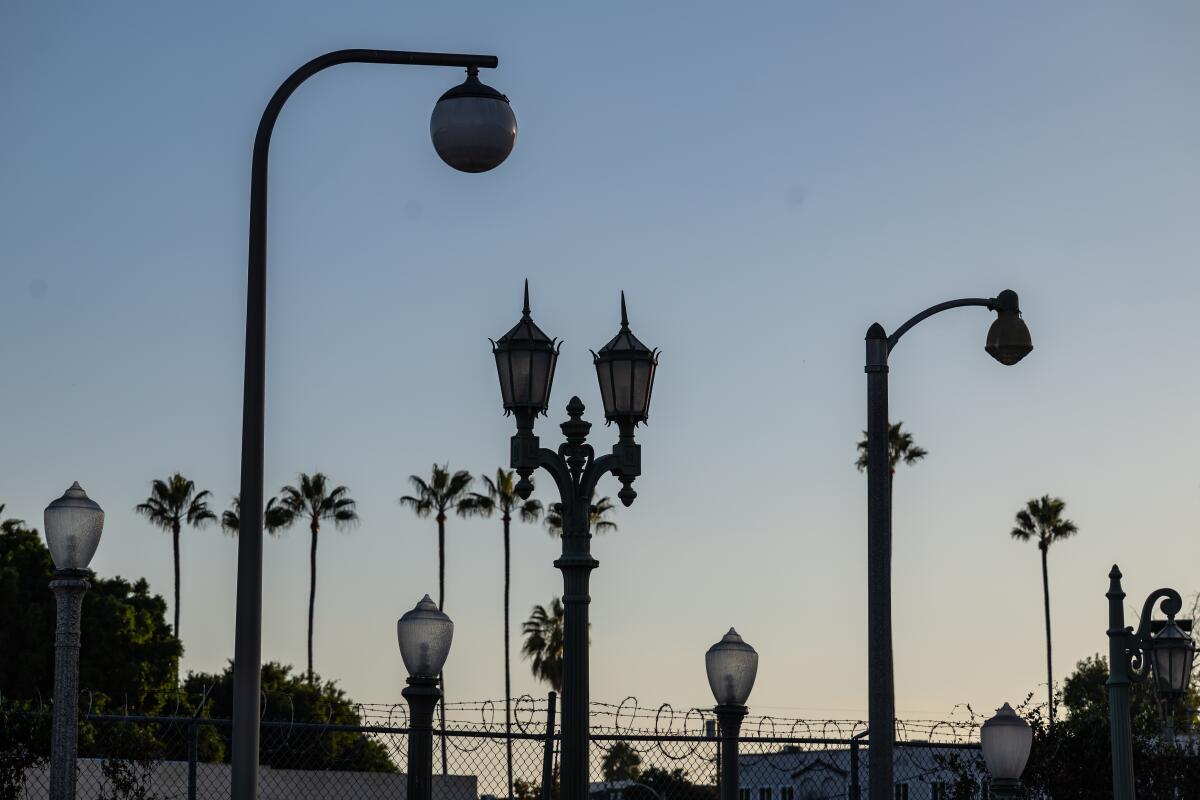
L.A.’s historic streetlights outside the Bureau of Street Lighting near Virgil Avenue and Santa Monica Boulevard.
(Jason Armond/Los Angeles Times)
The city logged 14,328 electronic streetlight service requests in 2018, according to data from the Bureau of Street Lighting. Requests have tripled since then, reaching an all-time high of 46,079 in 2024, the last full year of available data.
Mayor Karen Bass’ office said in March that copper thefts are a leading cause of streetlight outages. Repairs have been backlogged for months.
Prices for the metal are at an all-time high, driven by major supply disruptions in Indonesia and Chile, and soaring demand from artificial intelligence data centers and electric grid infrastructure. Thieves typically exchange the metal for cash at recycling centers, where it can fetch up to $5.30 per pound. The City Council last year approved a program offering up to $5,000 for information in metal and wire theft cases.
Theft losses alone exceed $1 million annually, according to DWP.
Establishing a new police force would require changing the city charter, meaning voters will have a say come the November midterm elections. Authorities will also need to obtain state legislative approval for the plan.
Officials said rolling out the police department would cost $9.7 million over three years, plus up to $6 million annually to pay for staffing. They maintain those costs are less than the $46 million combined DWP spends each year on private security contractors and unarmed staff security.
On Hill Street in downtown L.A., streetlights have been targeted by thieves and vandals.
(Jason Armond/Los Angeles Times)
Any cost overflows would be paid for by DWP customers.
Timothy O’Connor, executive director for the Los Angeles Office of Public Accountability, a spending watchdog, said his office is not convinced that the agency could minimize long-term cost creep, or that the new force would offset enough costs to justify the program. The proposed force of a few dozen officers, he said, would be too small to get the job done.
“Theft losses at DWP are real and are increasing. However, eliminating these losses is not enough to offset the proposed costs,” he said. “Furthermore, DWP will be unable to fully eliminate theft given the diffuse nature of the DWP system.”
But O’Connor also said the department is faced with real security risks like those posed by drone attacks or terrorism threats, which he said “appear to justify the proposal at some level.”
In February, a man shot himself after he drove his car through the perimeter fence of a power substation while carrying explosives and several firearms. Dubbing the incident an attempted terrorist attack, officials said the episode could have caused catastrophic infrastructure damage.
David Levitus, executive director of the advocacy group LA Forward, said he was surprised to learn of the proposal so late in Los Angeles’ ongoing charter reform process, which his organization has monitored closely.
“The fact that this is being dumped in late May — what’s the rush?” Levitus said. “I think we really need to be wary of creating new police departments in general, but especially without a clear case and clear constraints and accountability mechanisms.”
If you’re heading off on a staycation or a day trip this summer, beware of hidden costs on UK toll roads
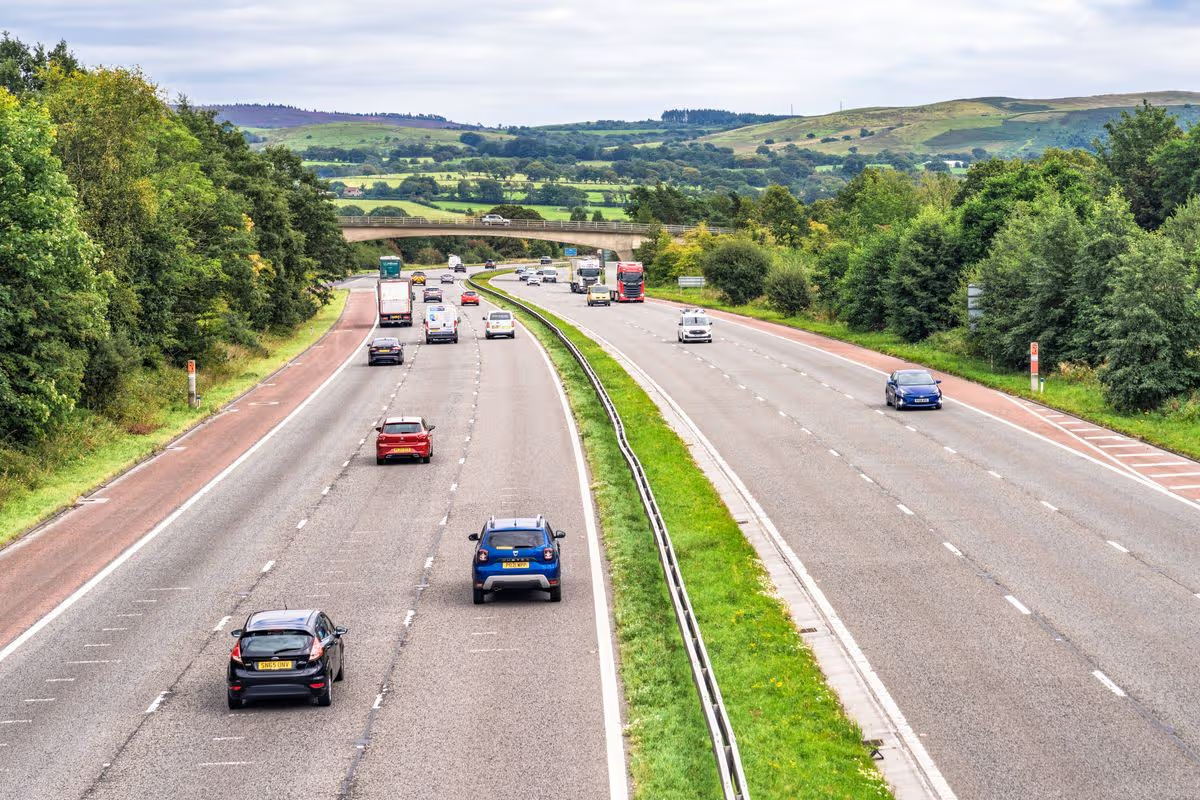
This is the UK’s most expensive motorway(Image: georgeclerk via Getty Images)
Those setting off on a staycation or enjoyable day out should bear in mind that their journey might come with some unexpected expenses. There are multiple toll roads scattered across the UK, with some potentially costing over £15 for a return journey.
Branded the UK’s priciest motorway, the M6 in the Midlands, which stretches over 230 miles, can set drivers back more than £10 for a return trip – while not a massive sum, it could quickly chip away at your lunch money or similar. The M6 Toll, the 27-mile route between Cannock and Coleshill, cost £900million to build.
Discussing the M6, they note that for a standard family car, a return journey runs to approximately £10.50.
Meanwhile, those behind the wheel of a heavy goods vehicle could face a bill of £20.20 for just a single journey, while a motorhome costs £19.20 one-way.
The M6 connects drivers to major tourist destinations during the summer months, including Drayton Manor Resort, and reportedly saw 45,749 vehicles per day in 2025.
Spencer Davi, Sales and Marketing Director at Northgate Vehicle Hire, offered some insight on toll roads: “Toll charges are a real consideration, especially for those making regular cross-border trips.
“What surprised us most about this research is how much variation there is across roads within the UK.”
However, while the M6 may hold the title of the most expensive motorway and toll road, experts have warned that there is another UK route that will set drivers back considerably more.
Specialists at Northgate Vehicle Hire revealed that the London Congestion Charge is in fact the UK’s most expensive crossing for cars.
Costing drivers £15.00, the crossing is a key route for anyone planning a trip to the capital this summer, with the charge applicable to drivers entering the Congestion Charge Zone between 7am – 6pm Monday to Friday, and 12pm to 6pm on Saturdays, Sundays, and bank holidays.
The UK’s most expensive toll roads for cars
London Congestion Charge, London – £15.00
M6, Midlands – £10.50
Durham Road User Charge Zone, Durham – £5
Mersey Tunnels – Queensway: Liverpool – Birkenhead and Mersey Tunnels – Kingsway: Liverpool – Wallasey – £4.60
For those considering a staycation this year, it’s well worth doing your homework on your route beforehand, as some roads can come with a surprisingly hefty price tag.