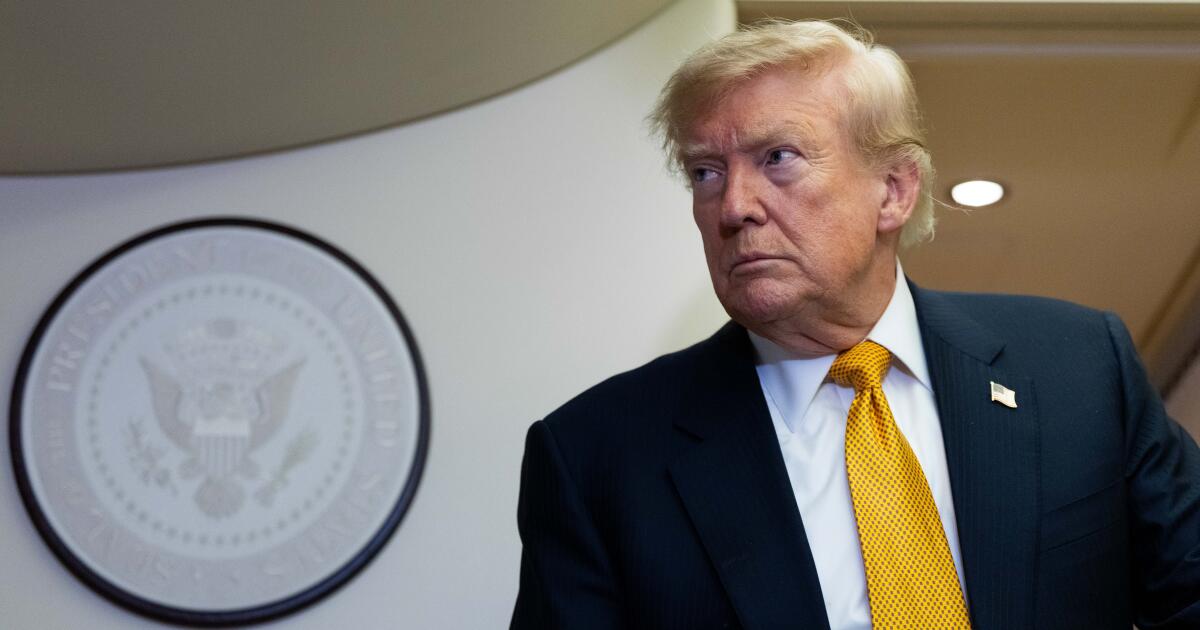
The facade of Terminal 3 at Jose Marti International Airport in Havana is shown on Saturday. Cuban artist and dissident Luis Manuel Otero Alcantara departed for the United States after being granted humanitarian parole following a five-year prison sentence on the island, Photo by Ernesto Mastrascusa/EPA
July 20 (UPI) — Cuban artist and dissident Luis Manuel Otero Alcántara said he cannot return home after arriving in exile in the United States this weekend.
Meanwhile, Secretary of State Marco Rubio renewed his call Monday for the Cuban government to release more than 700 political prisoners amid rising tensions between Washington and Havana.
Otero Alcántara, 38, arrived in Miami on Saturday after spending five years imprisoned in Cuba on charges of desecrating national symbols, contempt and public disorder.
His arrival was confirmed by Rubio, who said the artist had been imprisoned for challenging the Cuban government.
After years of unjust imprisonment for challenging the Marxist tyranny of the Cuban regime, Luis Manuel Otero Alcántara has arrived in the United States. The Cuban government’s brutal crackdown against its own people five years ago is yet another reminder of the unique misery and…— Secretary Marco Rubio (@SecRubio) July 18, 2026
In his first public remarks since arriving in the United States, the founder of the San Isidro Movement said prison changed the way he sees people, but acknowledged that exile carries a high personal cost.
“Five years later, I am more human. Prison is a place where you can look into the eyes of people who, even after committing the worst crimes, are still human beings,” he said in videos published by Caraota Digital.
However, he said that being forced to leave Cuba does not represent true freedom.
“I have been expelled from Cuba. This is not right. … I can’t see my son. I can’t return to my home. It’s just not right,” he said.
Otero Alcántara gained international prominence via a collective of artists and intellectuals that called for greater freedom of expression in Cuba and that, according to Amnesty International, has been the target of constant persecution by Cuban authorities.
He was arrested while attempting to join the anti-government protests of July 11, 2021, and was sentenced to five years in prison a year later.
After confirming Otero Alcántara’s arrival in the United States, Rubio said on X that the artist’s imprisonment was the result of challenging “the Marxist tyranny of the Cuban regime,” and he demanded the immediate release of “the more than 700 political prisoners unjustly detained” on the island.
Rubio said President Donald Trump‘s administration will continue to support those seeking greater political freedoms in Cuba.
Employers are bracing for what could be the highest rise in health insurance premiums in 16 years in 2027, driving up the average cost of family coverage in California to more than $30,000 — the price of a new compact car.
Health insurance companies expect the cost of medical services and prescription drugs to soar by 9% in 2027, according to a new survey by PwC, the highest rise the researchers have found since 2011. Insurers use those expected medical costs to calculate the price of premiums in the coming year. Many employers require workers to pay part of that cost.
Experts say the escalating costs of employers’ premiums are reducing workers’ wages and take-home pay, while raising the prices of goods and services in California and across the country.
“It’s going to erode the standard of living for lots of California families,” said Glenn Melnick, a USC professor of healthcare finance.
Melnick said when employers are forced to spend more on health insurance, there is less money available for wages. The skyrocketing premiums, he said, are like a hidden pay cut for working families.
The higher cost also has small-business owners wondering whether they can continue paying for their workers’ health insurance.
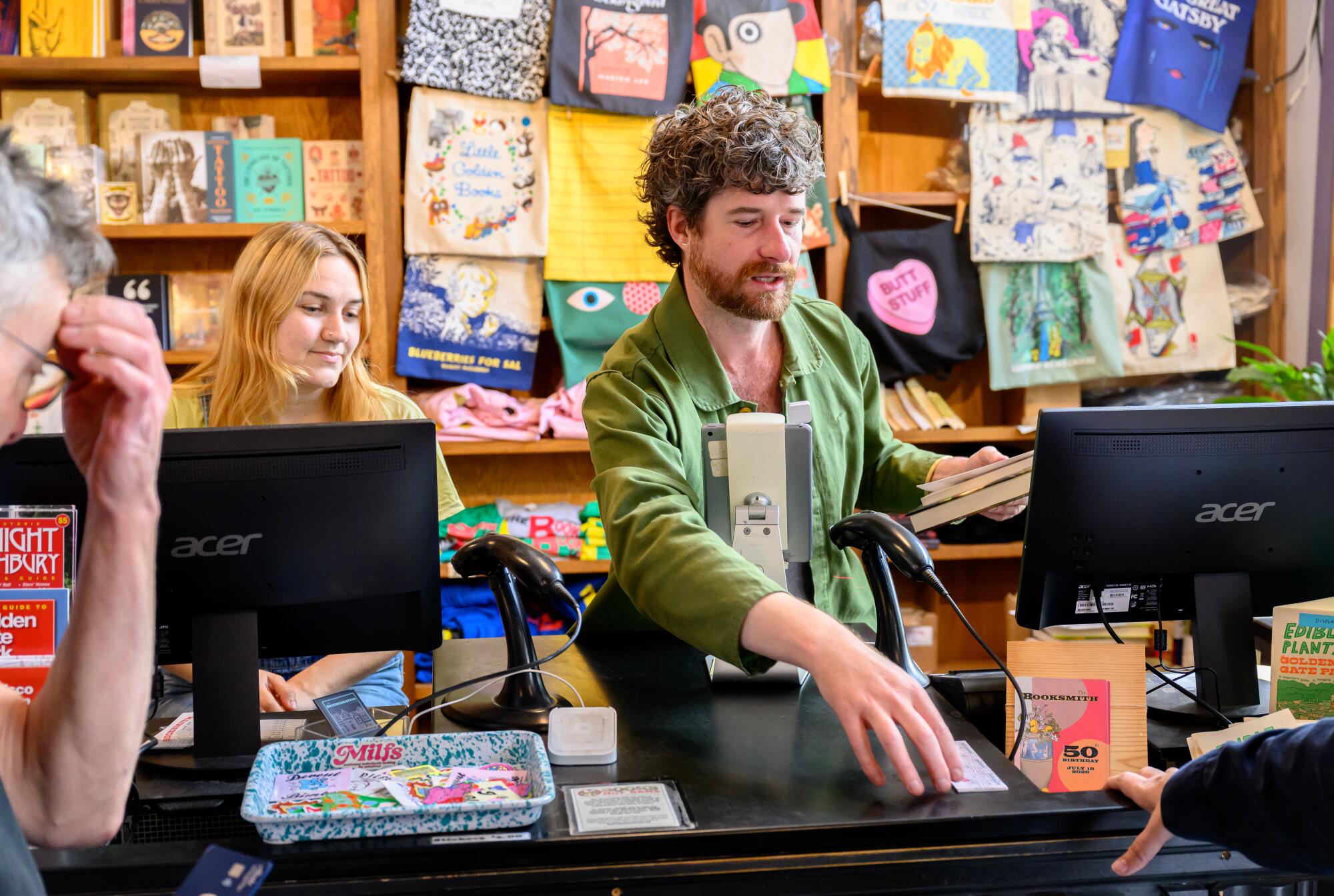
Co-owner Camden Avery makes a sale at the Booksmith in San Francisco.
(Josh Edelson / For The Times)
This year, premiums for staff at the Booksmith, an independent bookstore on Haight Street in San Francisco, leaped by 17%, said Christin Evans, the store’s owner. Next year could bring even more pain. The monthly premium for four employees is $3,250.
To try to cope, Evans said, she has reduced staff hours by closing the store earlier.
“We have to absorb it,” she said. “We’re not paying the wages we want to pay or delivering the customer service we’d like to deliver.”
Seventeen million Californians receive health benefits from an employer. Those premiums have been rising faster in California than the national average.
Between 2022 and 2025, the average family premium for employers in the state rose by 24% to $28,397, according to a survey by KFF and the California Healthcare Foundation. That was nearly double the 12.2% increase in consumer prices during those years.
Hospital, pharmaceutical and other medical costs escalated even faster after 2025.
PwC’s annual survey of insurers last year found an expected rise of 8.5% in 2026, which its researchers later revised to 9%.
A key driver of the rising medical costs, according to experts, is prices charged by hospitals. In recent years, some health systems, including UCLA and Cedars-Sinai, have grown larger by buying nearby hospitals and expanding their clinics, becoming more dominant in the community and reducing competition.
Melnick said the expansion of some health systems into giant organizations means that they can “tell insurance companies what the price will be.”
A Cedars-Sinai spokesperson pointed to a 2022 paper that found that for-profit health system prices had escalated faster than those at nonprofit systems like Cedars. The paper was partly funded by Cedars.
“Cedars-Sinai Health System’s growth in recent years has expanded access to the highest levels of patient care and medical innovation across the Los Angeles region,” the spokesperson said.
UCLA did not respond to requests for comment.
Another factor is the rising cost of prescription drugs. Spending on cancer drugs, the most costly category, reached $143 billion in 2025, an annual increase of 12%, the PwC survey found.
The nation’s spending on obesity medicines, including GLP-1 drugs such as Ozempic and Wegovy, soared by 81% last year, PwC said. A 30-day supply of the drugs lists for more than $1,000.
The obesity drug manufacturers say the medicines can reduce medical expenses by preventing other costly conditions such as diabetes and heart disease, but data don’t yet show such reductions, PwC said.
Researchers at the California Healthcare Foundation say a large part of the problem is that hospital operating costs, prescription drug prices and doctor fees have been allowed to grow unchecked for decades.
The foundation estimated in a report last year that 25 cents of every dollar spent in California — more than $73 billion each year — does nothing to help patients. Instead it goes to excessive profits for providers, administrative red tape and other waste, the foundation found.
California employer premiums are expected to rise next year for another reason: Gov. Gavin Newsom and lawmakers agreed in June to raise taxes on the private plans to help pay for the cost of Medi-Cal, which covers the medical costs for the poor, and to help balance the state budget.
The California Assn. of Health Plans said insurers will add the tax to next year’s premiums. The trade group estimates the higher tax will cost each insured person $100 next year or $400 for a family of four.
The higher tax must still be approved by the Trump administration. Republicans in the state Assembly wrote a letter to the administration this month, asking officials to deny the request.
Researchers also expect a jump in premiums for families without employer insurance who purchase policies on state marketplaces such as Covered California. Some of those families faced double-digit increases this year because of rising medical costs and the end of enhanced federal subsidies that Congress had approved as a temporary measure during the pandemic. Almost 400,000 Californians dropped their Obamacare plans this year as prices soared.
To deal with the higher premiums, some employers are changing the design of their health plans to shift more of the cost to workers by raising deductibles and co-pays.
Those higher out-of-pocket costs are just the beginning of the fallout. Twenty-two percent of chief financial officers surveyed by Mercer in February said the high price of health benefits had forced them to stop hiring or led to layoffs. Thirty-six percent of those executives said the rising premium costs have harmed workers’ wages and raises.
Candice Elliott, a human resources consultant in Santa Cruz, said smaller businesses such as restaurants struggle to find ways to cover the higher costs.
Many restaurants, Elliott said, already have a slim margin between their revenues and expenses. When premiums rise, she said, some restaurants have added a fee to the customer bill to help cover workers’ health costs. Others have hiked menu prices.
“That impacts affordability for the consumer,” Elliott said. “It makes inflation greater.”
Some small businesses have moved from so-called silver plans to the lower-priced bronze plans, she said, which cover less of the employee’s monthly premium. “It’s effectively a decrease in pay for the employee,” she said.
Others are hiring employees overseas, Elliott said. “You can pay someone in the global south half of what you pay an American and still afford them a good standard of living and benefits that are unaffordable in the U.S.,” she said.
Melnick, the USC professor, said many workers don’t realize how much they are losing as their employers’ premiums rise. He tells people to look at their W-2 tax form from last year, where employers are required to report the cost of the employee’s premium in box 12, under “Code DD.”
He said USC’s premium for his family of four is $45,000.
“The base is so high that even a small increase has a big impact,” he said. The continuing annual increases, he said, are “bad news for everybody.”
England have showed character at this World Cup, coming from behind to defeat both DR Congo at the last-32 stage and Norway in the quarter-finals.
“The difference is hanging on against Norway or Mexico [in the last 16], they have not got the quality this Argentina team have got in terms of the ability on the ball and the ability they have to punish you,” former England captain Alan Shearer told BBC Sport.
“Tuchel played his cards very, very early and it has backfired.”
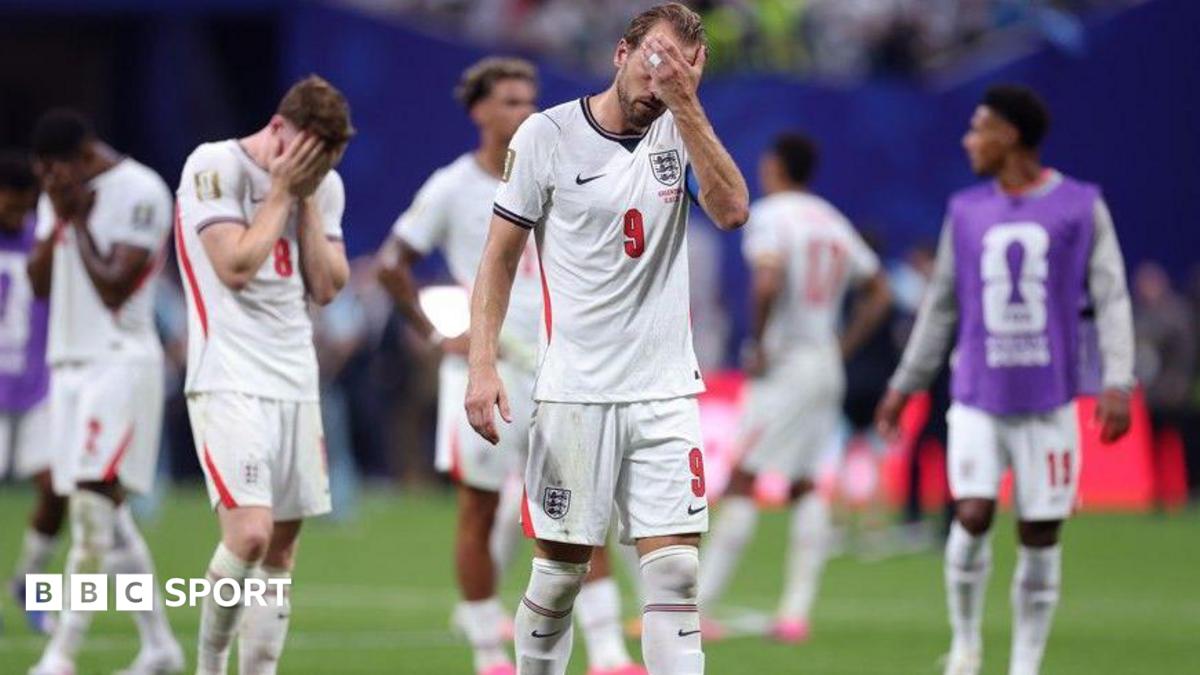
England looked to have taken full control of the semi-final against their old foes when Gordon put them ahead 10 minutes into the second half.
England’s fans celebrated wildly – but then the Three Lions opted to sit back and defend.
“The fact that England got themselves in front and then basically handed Argentina the initiative… that was a coaching catastrophe from Thomas Tuchel,” Chris Sutton, a Premier League winner with Blackburn in 1994-95, told BBC Radio 5 Live.
“You can’t expect to defend for 30 minutes against the quality Argentina had.
“It’s all on the coach where I am concerned. He made the changes. He was negative, so the question which I’m going to ask is ‘how can you trust Thomas Tuchel to take this team forward?'”
England have come undone against Argentina in the past.
Who can forget Diego Maradona’s infamous ‘Hand of God’ goal at the 1986 World Cup or the 1998 World Cup defeat that burns so deep.
England, however, have no-one but themselves to blame for Wednesday’s loss.
“Norway and Mexico panicked against England,” former England goalkeeper Joe Hart told BBC Sport.
“I didn’t see one bit of panic from that Argentina side. I saw belief, I saw the realising they could free up the great man Lionel Messi in the pocket, and they were running all over England.
“Gareth Southgate took a lot of criticism for the big moments with England, when they had the lead in big games and shut up shop. I don’t see that anything has changed in that big moment out there.”
So what were the changes that frustrated England fans so much?
Leading 1-0, many expected Tuchel to go for another goal – but instead the German made three defensive changes.
He brought Konsa on for Gordon in the 72nd minute – switching to a back five – before bringing on further defensive reinforcements 10 minutes later in Burn and O’Reilly.
Tuchel sent on forwards Rashford and Toney in added time, but it proved too little too late.
“I felt the changes we made at 1-0, that if Argentina scored we wouldn’t make extra time,” added Rooney.
Former England defender Micah Richards told BBC Sport: “When England scored that first goal they should have gone for the second.
“Yes, you respect their quality, but dropping deep allowed Argentina to get into their flow.”
Former England goalkeeper Paul Robinson, speaking to BBC Radio 5 Live, said Tuchel went too deep too soon.
“I think he has got that wrong,” added Robinson, who won 41 caps for England between 2003 and 2007.
“He has got a lot of decisions right, but I think trying to defend a lead against this team was a wrong choice.”
This tunnel is famous for its beautiful lighting and top air quality.
13:13, 07 Jul 2026Updated 08:05, 12 Jul 2026
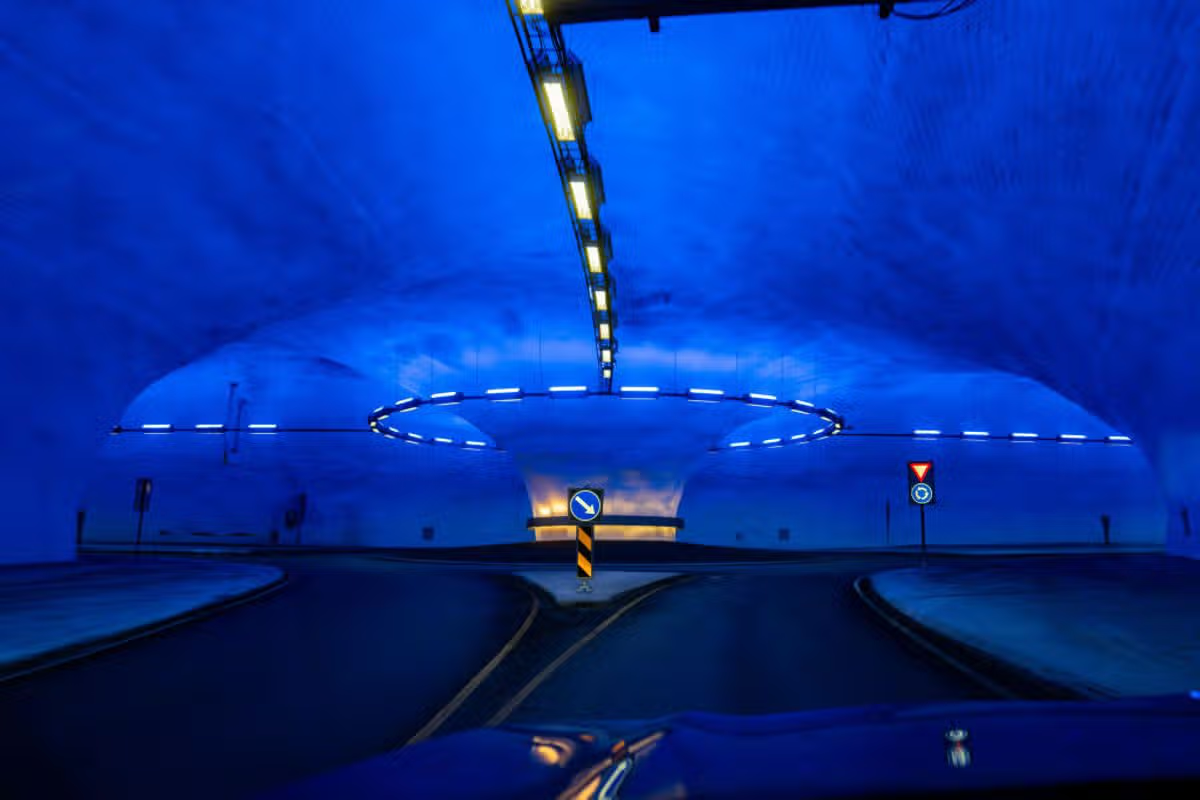
The blue-lit roundabout inside the 7.5 km Laerdal Tunnel(Image: Getty)
Norway has no shortage of beautiful roads. From snow capped mountains to glacial passes, a road trip through this gorgeous country means you will never be bored. It’s not just open road though – Norway is also home to one of the most beautiful tunnels in the world.
The Lærdal tunnel in West Norway is the longest road tunnel in the world, stretching 24.5 kilometres (15 miles) beneath a mountain range. It connects Aurland and Lærdal, in the heart of Sogn, and provides a ferry-free connection between Oslo and Bergen.
Construction of the tunnel began in 1995 and finished in 2000 and during construction an incredible 2,500,000 cubic meters of rock were extracted from the tunnel.
It cost a whopping £75million to construct. The tunnel is divided into four sections separated by three large caves.
The tunnel is known as one of the most beautiful in the world due to the way it has been designed to prevent driver fatigue and claustrophobia.
The main section of the tunnel is brightly lit with white lights, but each cave is lit with blue and yellow lighting around the edges to create the illusion of a sunrise.
These caves were lit with the idea of breaking up the monotony of the tunnel and allow drivers a short break.
The caves also work as turnaround points during the 20-minute journey.
There is also a rumble strip in each lane which stops drivers becoming inattentive and drifting.
At every kilometre, a sign lets you know how far you have travelled through the cave and how much further you have to go.
One of the other impressive things about the Lærdal Tunnel is that it is the first in the world to be equipped with an air treatment plant.
This plant can be found in a cavern 100 metres wide and it removes both dust and nitrogen dioxide from the tunnel air.
It even has special features to ensure drivers don’t feel like they’re ‘floating’
05:40, 12 Jul 2026Updated 08:05, 12 Jul 2026
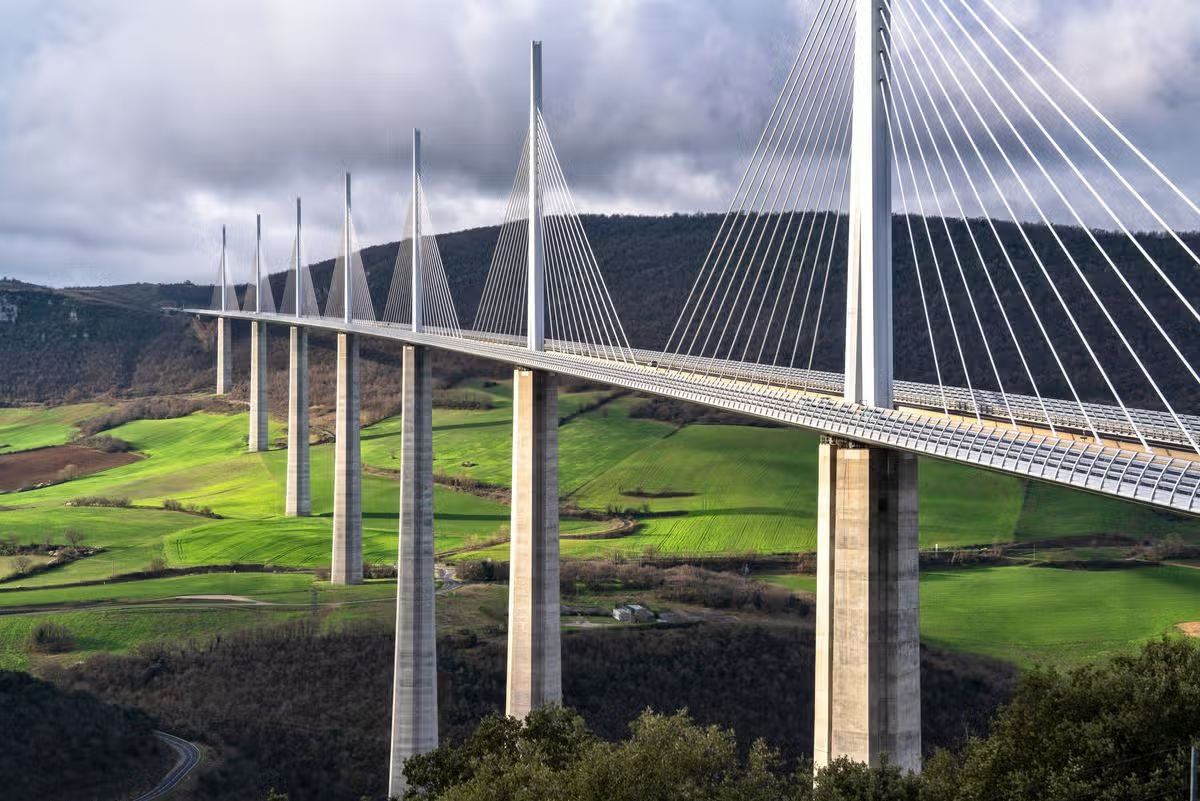
The bridge is the tallest in the world(Image: Achim Thomae/Getty)
The world’s tallest bridge is so high that an entire skyscraper could fit underneath it. While many would expect the highest bridge to be in the likes of China or the US, it is actually in France.
The Millau Viaduct is part of a motorway that connects Paris to the Mediterranean. It was designed by British architect Norman Foster and is in Southern France.
Work completed in 2004 and the cost of construction was approximately €394 million (£345 million). It has an impressive height of height of 343 metres (1,125 ft), which is higher than the iconic Eiffel Tower.
The Paris skyscraper stands at 330 metres (1,083 feet). Millau Viaduct is 2460 metres long and touches the bottom of the Tarn valley just nine times along its length.
Le Shuttle said: “Plans for a road crossing to alleviate the traffic through the town of Millau date from the 1980s.
“British architect Sir Norman Foster was among the team that designed the viaduct, which was considered the most viable solution to cross the valley and river, with the least ecological impact on the area. Construction of the viaduct began in 2001.”
There is no pedestrian access to the viaduct as it is a high-speed motorway. However, it does attract tourism and there are guided informational tours.
Tours include taking a designated nature path to a viewing platform below the bridge and even inside one of the tallest pylons. A marathon takes place every year over the viaduct, and the Tour de France has passed under the viaduct a number of times.
The viaduct features a slight curve that extends up to 20km on the road on either side. It helps drivers settle the feeling of “floating” when driving on a long, straight bridge.
Enjoy Travel explained: “It has two lanes in each direction and interestingly, the bridge is not straight as this could induce a sensation of floating for drivers.
“To remedy this, the architects designed the bridge to have a slight curve, which is 20km in range. Another design feature that improves safety, is the road’s slight incline of 3%, which improves visibility and reassures the driver.
“The bridge is exposed to strong gusts of up to 151km/h, so designers installed side screens that cut the wind’s impact by 50 per cent.”
Visitors have left positive reviews about their experience of the viaduct on TripAdvisor. One said: “Love bridges. This is one not to be missed. Be sure to take a look at it from below to get a real sense of it. Real engineering feat.”
Another added: “An absolutely superb place! The viaduct and the surrounding landscape are so beautiful that you feel like you are part of a painting or drawing! It is truly a work of engineering of the highest level.”
Someone else commented: “Visited today after it been on my bucket list. Great visitors centre, cafe and toilets. Parking is free and you can walk up a 470m path to an awesome view point. You can see the viaduct and surrounding areas. Drove over the bridge with stunning views.”
WASHINGTON — President Trump will let the bipartisan housing bill approved by Congress become law without his signature, saying Friday that he was refusing to put his name on it because of the little progress made in passing a strict voter ID bill that he has been pushing.
“I will not sign the Housing Bill, which has been fully approved by Congress and sent to the White House, in PROTEST over the fact that the United States Senate is not capable of passing THE SAVE AMERICA ACT,” Trump posted on social media.
Trump had 10 days until the Friday deadline to sign the bill, issue a veto, or allow the measure to take effect without his signature. He has chosen to let the measure become law without his express approval, undercutting his administration’s claims that he considers it a priority to combat inflation.
Trump’s rejection of the bipartisan housing legislation exacerbates tensions with his own party in a midterm election year and cuts short their efforts to address a key voter concern about rising costs. His post comes more than a week after he canceled plans to sign the bipartisan legislation, announcing he was using it as leverage in his push for a strict voter ID bill.
The 21st Century ROAD to Housing Act aims to lower the cost of housing and spur more home construction. It’s the broadest federal effort in decades to address America’s housing affordability problems, as state and local regulations have made it difficult to build in many of the communities that are also sources of job growth and economic opportunity. White House economists estimated earlier this year a national shortage of 10 million homes and the bill could help to close a portion of that gap.
But Trump called the bill “a yawn” and “so unimportant” compared to legislation that would require proof of citizenship for all voters.
He surprised Republican lawmakers on June 24, when, shortly before a planned signing ceremony at the Capitol, he announced he would not approve the bill until lawmakers first passed the voting legislation.
That bill, the SAVE America Act, doesn’t have enough Republican support to pass.
House Speaker Mike Johnson, R-La., said after submitting the housing bill to the White House that he told Trump he should get the “fattest black marker you have, and sign your name really big on that.”
“I hope he does sign it,” Johnson told reporters at the time. “If he doesn’t, it’s still law. We’ll still celebrate it.”
He said he also understood Trump was trying to make a point that the elections bill is the top priority. “And I think he’s making it very effectively,” Johnson said.
Still, Trump’s decision not to sign the bill gave Democrats an opening to criticize him on the issue of affordability.
“His priorities couldn’t be clearer: higher cost for families and more power for himself,” Senate Democratic leader Chuck Schumer said on X.
The housing bill passed the Senate on an 85-5 vote and the House approved it with an 358-32 vote.
That legislation seeks to cut federal housing rules, slim-down environmental reviews, make it faster to build homes and limit the ability of corporations to buy single-family homes.
The bill does not address all of the causes of the country’s housing woes, including a shortage of construction workers, climbing insurance costs and wages that have not risen fast enough for renters and buyers.
But the bill has drawn support from the real estate industry and housing advocates.
The U.S. housing market has been a driver of recent affordability challenges as skyrocketing prices have kept aspiring buyers out of the market. The National Association of Realtors said Thursday that the median sales price increased 1.8% in June from a year earlier to $440,600, an all-time high on data going back to 1999.
Price and Boak write for the Associated Press. AP reporter Kevin Freking contributed to this report.
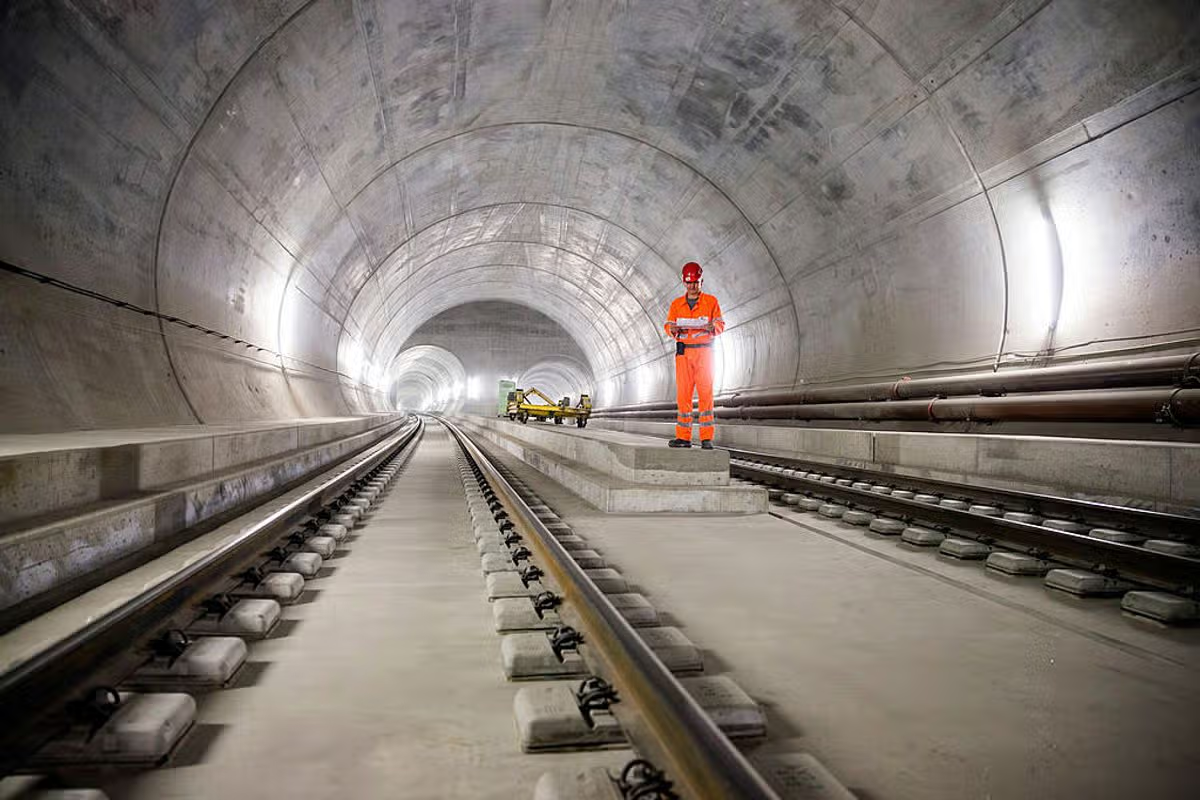
This incredible feat of engineering took 17 years of continuous construction to finish.
This tunnel is an incredible feat of engineering(Image: Getty)
Ten years ago this month, construction finished on one of the most impressive feats of engineering in the world. The Gotthard Base Tunnel – a railway tunnel below the Lepontine Alps in Switzerland – is the longest and deepest transport tunnel in the world.
It opened in June 2016 and has provided a high-speed rail link between northern and southern Europe. Specifically, the train runs between Rotterdam in the Netherlands and Genoa in Italy.
It’s called a Base Tunnel as it travels through the base of the mountain, rather than trying to snake over the ranges.
This means that the journey on this train is by and large straight and flat.
The high speed trains that travel through it can reach speeds of 250km/h, slicing the journey time significantly.
Construction of this incredible tunnel took a whopping 17 years of continuous labour, and approximately CHF 12.2 billion (£11.2billion) to build.
Engineers and construction crews excavated more than 28 million tonnes of rock using massive boring machines to dig it out, as well as precious blasting to clear the way for the tunnel.
Before its construction, trains had to carefully traverse the winding mountain routes which meant travel speed and cargo capacity was significantly hampered.
Now, trains can whip through the solid rock mountain and travel between Erstfeld in the north to Bodio in the south in just 20 minutes.
This incredible tunnel runs for 57km and at its deepest point it is thousands of feet deep.
At the deepest point, trains are travelling at 7,546 feet below the surface.
Since its construction, the train has carried thousands of people with data showing that the number of people travelling through the Gotthard by train has almost doubled in 10 years
In 2025 the average was 16,400 a day, compared with 9,000 in 2015, according to the Swiss Federal Railways.
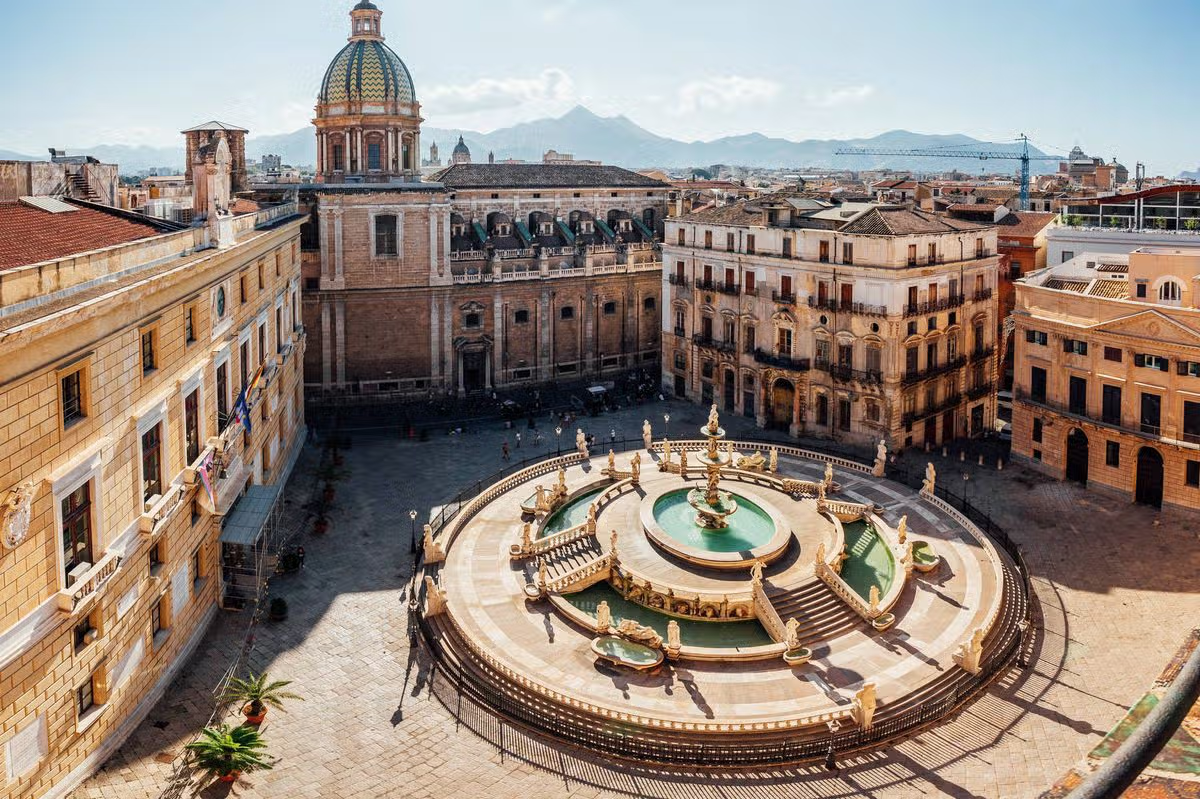
This city break is one of those places where you can do everything on foot – perfect for soaking up the history, incredible food and affordable drinks
This city break is one of those places where you can do everything on foot – perfect for soaking up the history, incredible food and affordable drinks(Image: FilippoBacci via Getty Images)
When it comes to holiday destinations, we in the UK are truly spoilt for choice, with continental Europe practically on our doorstep. It’s precisely why people travel from the far corners of the globe to settle here – drawn by the unrivalled access to a continent they might otherwise never explore.
Each year, my mum and I jet off together for a blissful and adventurous getaway, with me desperate to return to Italy while Mum was keen to add a fresh destination to her ever-growing list. After minimal deliberation, we agreed on Sicily as our next adventure – a magnificent fusion of rich history, sweeping coastline and an irresistible array of regional dishes we’d yet to sample.
Just over half of our trip was spent in the island’s second largest city, Catania, while the remaining days were whiled away exploring the capital, Palermo. It was the perfect blend of relaxation and excitement, indulgence and discovery – precisely what we both needed.
I’m a huge fan of a city break, and Palermo delivers on every front, while also offering easy access to the rest of the island – ideal for those seeking respite from the tourist crowds. The Sicilian capital is one of those rare cities where public transport becomes completely unnecessary, as virtually everything is within comfortable walking distance.
Just be prepared to dart between buildings for shade from the blazing sun. If you’re fond of impressive churches, atmospheric theatres and magnificent palazzos, Palermo has them in abundance, reports the Express.
Cattedrale di Palermo, Palazzo dei Normanni, and Teatro Massimo di Palermo are traditional must-sees, but the authentic city reveals itself amongst the twisting side streets and cobblestone lanes.
Architectural treasures are plentiful, though some might suggest they merely mask the island’s more recent violent past. We’d been advised beforehand against mentioning the mafia while in the city, yet one of the most compelling aspects of my visit was exploring the No Mafia Memorial.
While the activities and offences of the mafia and criminal gangs are portrayed in films and television, nothing truly prepares you for the overwhelming number of photographs documenting the harsh reality. The connection between the corrupt powerbrokers and sinister underworld was undeniable.
You’re left bewildered by just how much violence occurred. Nevertheless, this free museum provides a perspective you simply won’t discover on screen.
Naturally, all the architecture and heritage makes Palermo undeniably striking, yet the primary attraction for us was the regional food. Endless servings and dishes of fresh seafood and handmade pasta represents my gastronomic paradise.
You absolutely cannot skip a visit to Mercato Ballarò, a hidden alleyway brimming with stall after stall of meat, fish, vegetables, cheese, and fruit; whatever you’re after, Mercato Ballarò stocks it. The market is definitely not for the faint-hearted.
It’s a feast for all the senses, with a dazzling array of colours, aromas and sounds. It can be incredibly overwhelming, with vendors desperately trying to hawk their wares or entice you into their eatery.
Instead, try a comforting bowl of Zuppe Di Mare at Osteria Villena on Via Maqueda, a seafood stew generously packed with calamari, prawns, mussels and cod, all brought together with a San Marzano sauce. It’s salty, warming, satisfying and absolutely divine. I could have happily devoured several bowls.
For pasta lovers who still crave that seafood fix, the Tonnarelli Mare Mare is an absolute must. Yes, it may appear to be packed with tourists, but Osteria Villena is clearly doing something right, as every lunch and dinner sitting was completely full.
However, no visit to Sicily is truly complete without sampling one of its most abundant fish: swordfish.
Think of it as a white fish with the texture of a tuna steak when cooked, but with a distinctive flavour you simply won’t get from eating the likes of cod or haddock. Best enjoyed served with caponata.
If you enjoy a spot of people watching, my favourite haunt was Enotequa, a dark and atmospheric wine bar serving up crisp Sicilian wines in all varieties, €7 (£5.99) Aperol spritzes, and a meat and cheese board to round it all off for just €30 (approximately £25) for two people. If spritzes aren’t your cup of tea, a bottle or pint of beer will set you back between €4 to €5 (£3.42 to £4.28), according to Numbeo. London could never!
And make sure you sample a cannolo, packed with fresh ricotta cream and topped with as many nuts, chocolates and glace fruit as your heart desires.
Palermo is a paradise for anyone seeking a getaway that’s not too far from home. It boasts glorious weather, stunning architecture, and incredible food to match. Despite only spending two days there, I could quite easily have stayed far longer.
I’m still daydreaming about that seafood stew… and the spritzes, naturally.
Budget conscious Brits are swapping Center Parcs for European park breaks that are considerably cheaper. But is it worth the faff of travelling abroad? We gave it a try
This article contains affiliate links, we will receive a commission on any sales we generate from it. Learn more
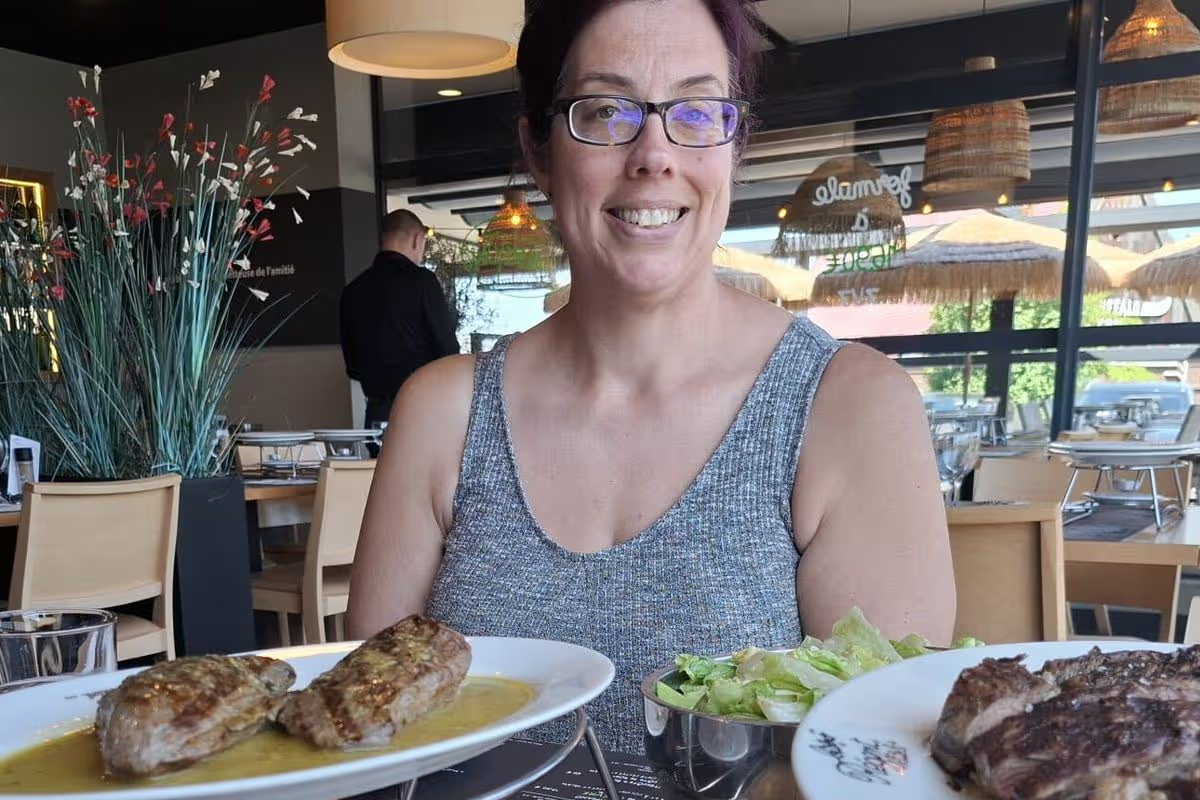
Our idyllic French family holiday included a stop for classic steak frites – and it was one of the best steaks any of us had ever eaten(Image: Narin Flanders)
I remember the exact moment we realised we weren’t a Center Parcs family anymore. The kids were having one last run round the playground before we stuffed everything in the car to come home after an idyllic weekend away and my husband nipped off to buy drinks.
He returned ashen-faced: “I just paid five quid for two Fruit Shoots.”
It turns out we have a line and that was it. Despite half a dozen fun-packed stays, those Fruit Shoots were the moment we knew we couldn’t justify Center Parcs prices anymore.
If my hours spent browsing parenting groups online are anything to go by, we’re not alone. Initially we branched out, exploring Haven and Parkdean resorts around the UK. But as an avid bargain hunter I’d seen plenty of chat everywhere from Mumsnet to Reddit about the savings to be made on European holiday camp breaks. After ChatGPTing the practicalities of driving in France, we swapped Center Parcs for Eurocamp this May bank holiday and it was so amazing we’re already plotting a return visit.
Eurocamp has built a reputation for the ultimate activity-led park holidays, with 400 options across 11 countries. We booked into Domaine des Ormes, set in 400 acres of lush French countryside, complete with a forest, lakes, golf course and a medieval castle at its heart. It has a variety of different types of accommodation for all budgets ranging from traditional camping to modern lodges, a luxury hotel and even floating cabins and treehouses. We went for a lodge and were pleasantly surprised when we unlocked our home from home.
Inside the lodge
The lodge had everything we needed for a five night stay and several perks that brought joy to our 10- and 12-year-old children, notably a bedroom each for when family time got a bit much and free (and largely reliable) wifi for all, perfect for some down time.
The main living space included a well-stocked kitchen with a full size fridge freezer, L-shaped sofa and dining table. The inside felt slightly smaller than Center Parcs lodges we’ve stayed in and there was no TV but neither of these things bothered us, thanks in part to the biggest difference we found with the swap.
In a nod to the consistently better weather on the continent, our lodge was very much optimised for outdoor living. It had a huge covered decking area with another, even larger, L-shaped sofa, alongside a second outdoor dining table and chairs. With temperatures soaring to up to 30 degrees during our stay we spent most of our time outside, either eating meals or on the sofa.
It was the perfect place to relax as a family, playing card games, with wine for the grown ups and iced drinks for the kids (it’d be rude not to), or enjoying outdoor movie nights courtesy of Netflix on a tablet balanced on the coffee table. Bliss.
Things to do
Domaine des Ormes’ jewel in the crown is a huge aquapark with slides, lazy river, wave pool and indoor and outdoor swimming options aplenty. If you’re looking for an alternative to the iconic Center Parcs Subtropical Swimming Paradise this is it in spades. Available at no extra cost, we spent hours there every day. The kids loved using the zip line over the pool, launching themselves across the water before jumping in at speed.
Zip lines were a recurring theme of the resort, with holidaymakers of all ages queuing up to soar over the lake. It only cost 6 Euros a person for two goes across the zipline – much cheaper than any Center Parcs activity we’d ever done – and it was another huge hit with the kids who, it turns out given half a chance, are real daredevils (see also a 20ft high climbing frame in one of the outdoor playgrounds which my son made his mission to scale through the week, while I stood at the bottom with my heart in my mouth).
There were plenty of other things to do, including kids clubs, archery, horse riding and even a circus (10 Euro per adult, 9 per child) but we found the mix of pool, down time and eating out was plenty to keep everyone occupied without racking up much extra cost.
Eating and drinking
Domaine des Ormes had two restaurants and two bars on-site as well as a well-stocked convenience store. Our top pick was Chez Madeline, which had stone baked pizzas, juicy rotisserie chicken and a 10 Euro kids menu with portions big enough that we took leftovers home.
Having a car meant we could also explore so we nipped to the local Carrefour supermarket in Dol-de-Bretagne to fill the fridge with cheese, smoked meat, fruit and salad. We also discovered the best steak frites any of us had ever had on the way home, in another holiday highlight.
Final verdict
I’m so glad we took the plunge. Driving in France was nowhere near as stressful as we’d feared. Minimal language barriers were easily overcome and with about half the families at Eurocamp English the kids had plenty of new friends to play with.
The highlights were the small moments: my 12-year-old being able to walk to the resort shop to buy breakfast croissants for us to eat together on the deck as the sun rose and excitedly haggling to buy some hair clips from the market that came to the resort one sunny afternoon; my son’s confidence growing every day he got higher up that climbing frame.
Domaine des Ormes was large enough to keep everyone busy and entertained but still compact enough that we could have a little bubble of time as a family together. Overall it was well worth the effort stepping outside of our comfort zone.
How do Eurocamp prices compare with Center Parcs?
There are still some savings for anyone booking at Domaine des Ormes this summer, although some of the most popular accommodation types are sold out. Currently, a four night stay for a two bedroom lodge through Eurocamp starting on Monday, July 20 is £975. A similar two-room lodge at our nearest Center Parcs – Woburn Forest just outside of Milton Keynes – would be £1,449 for the same time.
There are even chunkier savings available if you’re planning ahead. For October half term Eurocamp is £289.64 for four nights, compared to £1,699 for Center Parcs. Meanwhile, May half term 2027 is £786 for Eurocamp and £1,599 for Center Parcs.
While, of course, you have to factor in travel costs for a trip to France, for us the cheaper activities and idyllic surroundings make it worth the effort.
Book it
Narin stayed at the Domaine des Ormes Eurocamp. Currently, a four night stay for a two bedroom lodge through Eurocamp starting on Monday, July 20 is £975. For the October half term, Eurocamp is £289.64 for four nights.
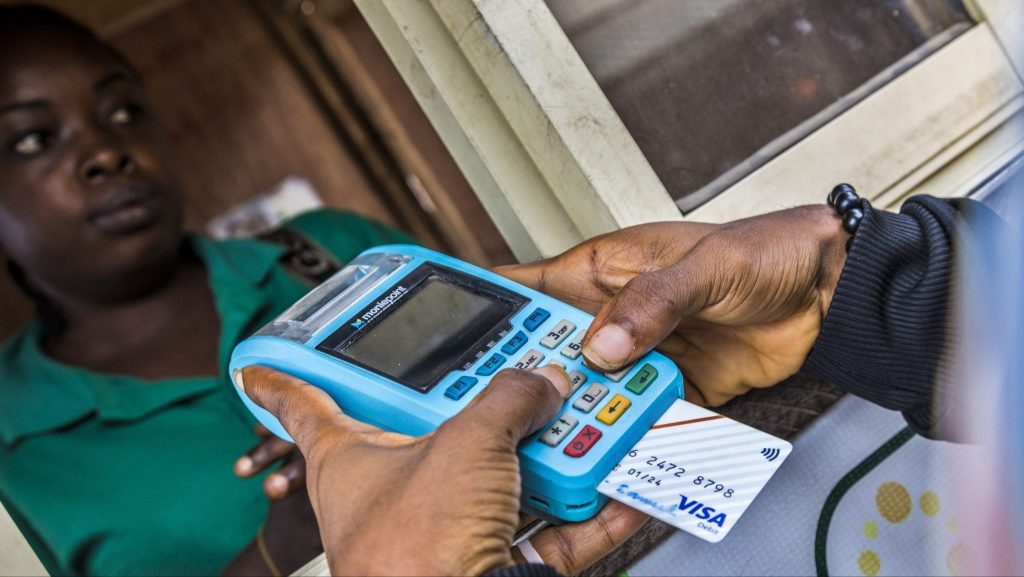
On a hot Tuesday afternoon in Yola, Adamawa State, in northeastern Nigeria, 32-year-old Fidelis Mbai walked to a point-of-sale (POS) stand to withdraw ₦35,000. The POS operator, Abu Sani, collected his Automated Teller Machine (ATM) card and inserted it into a POS terminal. Fidelis entered his Personal Identification Number (PIN). Within seconds, he received a debit alert. The money had left Fidelis’ account, but Abu’s terminal showed that the transaction had not been completed successfully.
The two men stared at their screens. One had seen ₦35,000 withdrawn from his account; the other had received nothing. For nearly 30 minutes, they kept refreshing their mobile bank apps. “I was angry because the money had left my account immediately,” Fidelis said. “As far as I was concerned, the transaction was successful.”
Abu understood the frustration, but he had a problem of his own. “The customer was debited, but I didn’t receive the money,” he said. “If I gave him cash and the transaction eventually failed completely, the loss would be mine.”
Eventually, Fidelis left without cash. His money would later be reversed. But for several hours, ₦35,000 simply disappeared into Nigeria’s digital payment infrastructure.
This experience has become familiar to many Nigerian residents. As digital payments increasingly replace cash, it is ordinary citizens, not institutions, who bear the cost of failed transactions. The consequences often extend beyond the value of the failed transaction itself. Delayed payments can prevent traders from restocking goods, force customers to borrow money while waiting for reversals, disrupt access to healthcare, transport, or other essential services, and erode trust in digital financial systems. For small businesses and low-income households that depend on immediate access to funds, even a short delay can translate into lost income, missed opportunities, and significant financial stress.
Nigeria’s digital payment revolution
Nigeria’s digital payment ecosystem has expanded rapidly over the past decade. According to data from the Nigeria Inter-Bank Settlement System (NIBSS) – which operates the core infrastructure that processes and settles electronic payments and fund transfers between banks, discount houses, and card companies in Nigeria, and is jointly owned by the Central Bank of Nigeria and all licensed banks – the value of instant digital payments reached ₦1.07 quadrillion in 2024, up from ₦600.36 trillion in 2023. The data also showed that Nigerians conducted 1.38 billion POS transactions worth ₦18.32 trillion during the same period.
These numbers reflect one of the most successful examples of digital public infrastructure (DPI) in Africa. At its core, DPI refers to the digital rails that allow citizens to identify themselves, make payments, and access services. In Nigeria, these rails include bank transfer systems, mobile money platforms, POS networks, identity systems such as BVN and NIN, and shared payment infrastructure.
Photo: Andrew Eseibo/Rest of World.
Together, these systems enable millions of transactions every day. For most users, the process appears simple: send money, receive money, and move on. But when something goes wrong, the burden often shifts away from the infrastructure and onto the people who rely on it.
While there is no official national estimate of the total amount Nigerians lose annually to failed digital payment transactions, the scale is substantial. During the 2023 cashless transition, industry reports indicated that as many as 40 per cent of failed e-payment complaints remained unresolved for extended periods, with affected transactions running into millions of naira.
Given that Nigerians processed over ₦1.07 quadrillion in instant payments in 2024 alone, experts say that even a failure rate of less than one per cent could leave billions of naira temporarily trapped in failed, delayed, or disputed transactions each year.
The last mile bankers of Nigeria
Every morning, Abu begins work with a few simple calculations. How much cash does he have? How much electronic value is in his account? And how much of that money is trapped in pending transactions?
“Almost every week, we experience failed transactions,” he said. “Sometimes two or three times. During network problems, it can happen many times in one day.”
Officially, Abu’s role is to provide financial services. Unofficially, he has become something else: a lender, a mediator, and a shock absorber. He is one of an estimated 1,600 POS operators per square kilometre in Nigeria, according to the International Monetary Fund (IMF). As banks have reduced their physical footprint in some communities, these agents have become the last-mile providers of financial services, connecting millions of Nigerian residents to the formal financial system.
One afternoon, a regular customer named Musa Ibrahim arrived to withdraw ₦50,000. The debit alert arrived immediately, but Abu’s account was not credited. Musa needed the money urgently for a hospital bill, and Abu had to choose between trusting the system and trusting the customer. “I knew him very well,” Abu said. “So I gave him the money from my own cash.”
The confirmation took two days to arrive. For 48 hours, Abu had effectively given Musa an interest-free loan. Nobody paid him for the risk. Nobody compensated him for the anxiety. Yet this informal lending happens every day across Nigeria. Thousands of POS operators use their own money to bridge gaps created by delayed transactions.
At Jimeta Modern Market in Yola, 38-year-old Aisha Mohammed sells food items. More than half of her customers now pay by bank transfer. Like many traders, she has adapted to Nigeria’s cash-light economy, but that adaptation comes at a cost. Several months ago, a customer purchased a bag of rice worth ₦80,000. He presented a transfer receipt. The money did not arrive.
File: A grocery store attendant operating a POS terminal. Photo: Opay
“The customer looked genuine,” Aisha said. “He showed me everything on his phone.”
She released the goods. The payment did not arrive until the following day. That night, she barely slept. “You start asking yourself whether you have been scammed,” she said.
Delayed transactions create a dilemma for traders like Aisha. If they reject digital payments, they risk losing customers; if they accept them, they risk losing money. Many solve the problem through selective trust. “If I know the customer, I may release the goods,” she explained. “If I don’t know them, I wait until I see the money myself.”
This has created a parallel trust economy operating beneath Nigeria’s digital economy. In theory, transactions are guaranteed by technology; in practice, they are often guaranteed by relationships.
Get our in-depth, creative coverage of conflict and development delivered to you every weekend.
Subscribe now to our newsletter!
Dr Ibrahim Sule, a financial inclusion expert at the Adamawa State Ministry of Finance described it as a hidden feature of Nigeria’s digital economy. “It shows that people are finding ways to compensate for weaknesses in the system. Personal trust often fills the gaps where technology falls short,” he said.
Borrowing money while waiting
For Ibrahim Yusuf, a resident of Damilu, a community in Jimeta, the consequences were far more serious. In October 2025, he transferred ₦43,000 to a shop owner as payment for foodstuffs he had purchased. The money left his account instantly, but the shop owner never received it.
One day passed, then two, three, four, five, and six. During that period, Ibrahim had no extra money with him. “The money was meant for foodstuffs, but I couldn’t leave the market with what I bought because the shop owner didn’t receive an alert,” Ibrahim said.
By the third day, Ibrahim borrowed ₦20,000 from a friend. The irony was difficult to ignore. His own money existed somewhere inside the banking system, yet he needed someone else’s money to survive. “It wasn’t even the financial loss that hurt the most,” he said. “It was the uncertainty. Nobody could tell me exactly where the money was.”
His experience illustrates a hidden cost rarely captured in transaction statistics. When payments fail, people do not simply lose access to money. They lose opportunities, business deals collapse, and relationships become strained.
The financial system eventually restores the funds. But it rarely restores the time, trust, or opportunities lost along the way.
How the money moves
While a bank transfer feels like a simple process for customers, financial experts say that transactions often travel through multiple systems. According to Hakeem Abdulkareem, a tech expert at NIBSS, “When you initiate a transfer on your bank app or through your bank, your bank first authenticates the transaction and verifies the beneficiary’s account details. The payment instruction is then routed through the NIBSS Instant Payment (NIP) platform to the receiving bank, which validates the request before crediting the beneficiary’s account. For the transfer to succeed, each of these systems – the sending institution, the NIP switch, and the receiving institution – must exchange information correctly and in real time,” he explained. “Each stage must communicate properly for the transaction to be completed.”
Any disruption along that chain can create problems. Not every failed transfer originates from NIBSS. Payment experts note that delays can occur at the sending bank, the receiving bank, a fintech platform, telecommunications networks, or the central payment switch. One way to determine where a transaction stalled is through the unique ‘Session ID’ generated for every transfer, which allows institutions to trace the payment through the system.
“Delays often occur when there are network issues, system outages, or communication problems between institutions involved in the transaction,” Hakeem added, noting that NIBSS continues to work with banks and fintech companies to improve transaction monitoring, automate reconciliation processes, and strengthen the resilience of the NIBSS Instant Payment (NIP) platform as transaction volumes continue to grow.
In the first quarter of 2025, electronic payment transactions reached ₦284.99 trillion, a 17.7 percent increase from ₦234.49 trillion recorded during the same period in 2024. POS transactions alone rose to ₦10.45 trillion during the same period, more than double the ₦3.62 trillion recorded in the first quarter of 2024.
While these figures highlight growth, Hakeem noted that “as transaction volumes increase, maintaining system efficiency becomes even more important.”
The institutions behind Nigeria’s digital payment system agree on one point: public confidence depends on reliability. As transaction volumes continue to grow, banks, fintech companies, and regulators say they are investing in infrastructure, monitoring systems, and consumer protection to reduce delays and strengthen trust.
Adi Dansanda, Customer Protection Officer at the Central Bank of Nigeria, Yola branch, told HumAngle that “Consumer confidence is critical to the success of Nigeria’s digital payment ecosystem. We continue to work with financial institutions and payment service providers to strengthen compliance, improve service quality, and ensure that customer complaints are resolved within established timelines.”
CBN Yola Branch Office. Photo: Obidah Habila Albert/HumAngle.
Despite these commitments, the experiences of everyday Nigerian residents suggest that the gap between policy and practice remains significant. For them, confidence is built every time a transfer arrives on time, every time a complaint is resolved quickly, and every time money moves when it is needed most.
Lessons from elsewhere
Building a reliable real-time payment system is not unique to Nigeria. Countries with some of the world’s most advanced digital payment platforms have also experienced outages and technical failures as transaction volumes increased.
In India, the Unified Payments Interface (UPI), which processes more than 18 billion transactions each month, experienced several nationwide outages in 2025. An investigation by the National Payments Corporation of India (NPCI) traced one of the largest disruptions to excessive transaction-status requests from participating banks that overwhelmed the system. In response, the regulator tightened technical protocols, limited repeated status checks, and strengthened monitoring to reduce the risk of similar failures.
Brazil’s Pix platform has also experienced periodic service disruptions linked to participating financial institutions and network issues. Rather than eliminating failures entirely, authorities have continued to improve interoperability, operational resilience, and incident response as usage has expanded.
Nigeria has already built one of Africa’s largest real-time payment systems through the NIBSS Instant Payment platform. Experts who spoke to HumAngle say the lesson from other countries is not that payment systems can avoid failures altogether, but that maintaining public trust depends on continuously strengthening infrastructure, improving coordination among participants, and responding quickly and transparently to disruptions.
This report is produced under the DPI Africa Journalism Fellowship Programme of the Media Foundation for West Africa and Co-Develop.
Research published in the British Medical Journal (BMJ) has found that a United Kingdom-United States pharmaceutical deal could cause 229,000 excess deaths as a result of the diversion of billions of pounds away from Britain’s National Health Service (NHS).
In December, the UK and US signed a pharmaceutical trade deal, under which the US government agreed not to impose tariffs on UK pharmaceutical and medical technology exports for the next three years.
Recommended Stories
list of 3 itemsend of list
In return, the British government committed to increasing NHS spending on new US medicines from 0.3 percent in 2026 to at least 0.6 percent of its gross domestic product (GDP) by 2036. This means that medicine spending overall should increase from 10 percent to 12 percent of the NHS budget.
UK politicians defended the deal with Science Minister Patrick Vallance saying in April that the arrangement gives patients across the NHS access to “life-changing new medicines that they previously would have been denied”.
“Not only this, but as the first country in the world to benefit from a zero percent tariff on pharmaceuticals to the US, Britain’s life sciences sector will be further boosted,” Vallance argued.
But the research published in the BMJ found that the commitment to spend so much more on new branded medicines over the next decade without any increase in NHS funding will “create substantial opportunity costs elsewhere, having a direct effect on population health”.
Samuel Cross, a professor in the department of pharmacology and therapeutics at the University of Liverpool, who coauthored the report, said the agreement “benefits pharmaceutical companies and comes at a cost of NHS patients”.
“There’s really no way to sugar-coat that. The numbers speak for themselves,” Cross told Al Jazeera.
Here’s what we know about the report:
What is in the US-UK deal?
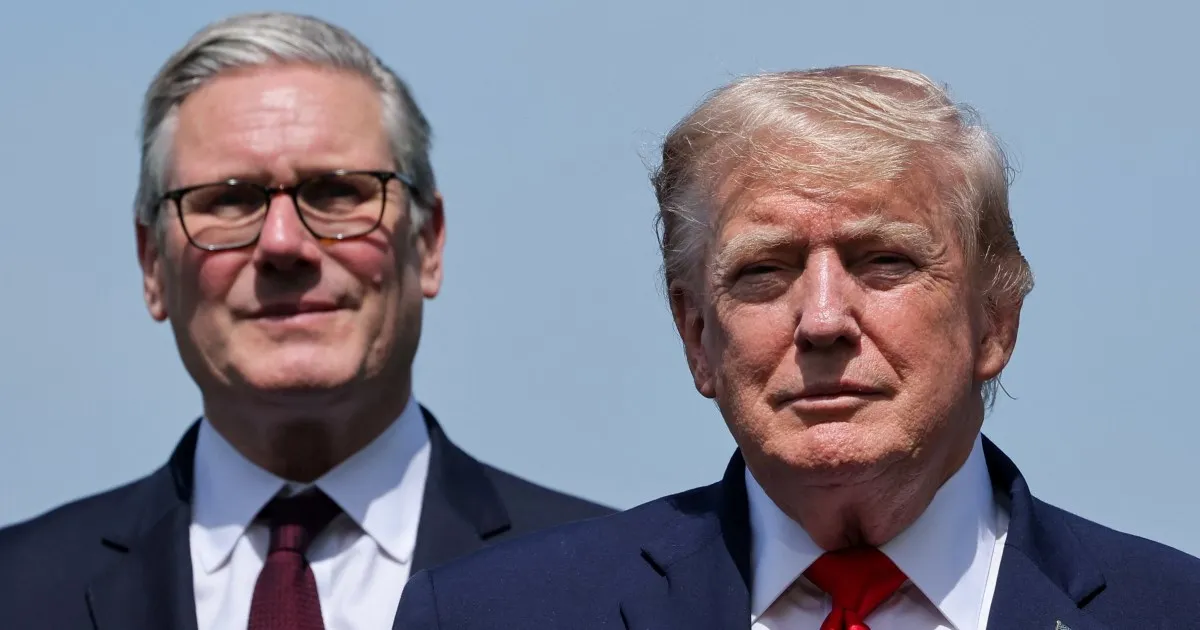
The agreement signed on December 1 was hailed as a landmark deal between British Prime Minister Keir Starmer and US President Donald Trump on pharmaceutical trade and pricing.
The US agreed not to impose tariffs on UK pharmaceutical and medical exports for the following three years – until January 19, 2029.
According to a policy paper published by the British government, the preliminary understanding of the agreement recognised that the US and UK shared a “mutual interest in developing a global medicines system that supports development and commercialisation of new innovations”.
What did the research find?
In February, Vallance disclosed that funding for the increased spending on medicines would come from the Department of Health and Social Care, which funds the NHS in England, rather than the Treasury.
The study in the BMJ forecast that if spending targets are met and the economy grows as forecast by the Office for Budget Responsibility, the NHS would need to spend an extra 1.3 billion pounds ($1.73bn) a year by 2028 – about 25 million pounds ($33.4m) a week. By 2036, this would rise to an extra 8.8 billion pounds ($11.74bn) a year – about 170 million pounds ($227m) a week). Over the course of the agreement, that would add up to about 44.7 billion pounds ($59.7bn) by the end of 2036.
“Costs are even higher if the impact on publicly funded adult social care is also considered – modelling of English local authority data indicates that every £1bn [$1.33bn] the NHS must find to fund this deal will increase the costs of adult social care by £118m [$157.5m] because of increases in morbidity and mortality,” the report found.
Ultimately, the study predicted, excess deaths are likely as a result.
“Even if we restrict attention to the direct effect of reductions in available NHS expenditure, by 2036 this deal is likely to result in roughly 229,000 excess deaths – more than during the COVID-19 pandemic between March 2020 and June 2022 (137,000). If the indirect effect on adult social care is also included, the increase in excess deaths is even greater (291,000),” the report stated.
The report added that the findings are “unsurprising” given the existing pressures on the NHS and the “large burden of unmet need in highly cost-effective areas of care”.
It also referred to shortfalls in NHS funding and pharmaceutical pricing as “opportunity costs”.
Cross said that in health economics, opportunity costs are the “key to all of this”.
“In the NHS, we have a finite budget – we’re not made of money – and if you take money away to pay for, in this case, more medicines. then that comes at an opportunity cost of the places that the money has been diverted away from,” he explained.
Which health sectors will be worst affected?
The research predicted that the greatest number of deaths would occur in cardiovascular, respiratory, gastrointestinal and cancer patients.
It added that there will also be broader harm caused to quality of life for patients in those sectors as well as “neurological, endocrine, musculoskeletal, and mental health problems”.
“Despite this evidence and reassurances that ‘frontline services’ will be protected, the NHS will need to fund this deal from allocations made six months before the deal was agreed. The evidence suggests that if additional public expenditure was available, it could be more effectively deployed within the NHS itself,” it added.
The report also called the government’s claims that the US-UK agreement would encourage pharmaceutical innovation in the country “uncertain”.
“Pharmaceutical research and development operate within a global market, of which the UK represents a relatively small share. As such, there is limited evidence that UK domestic pricing materially influences global investment decisions,” the report stated.
“Even so, evidence suggests in most cases the UK is already paying more than 100 percent of the long-term value of new medicines; incentivising production of new medicines under this deal will do long-term harm to the public health objective of the NHS,” it added.
Cross added that because money has in effect been diverted away from the NHS, there is no way for the government to offset the impact on the service.
“If the funds are used to pay for new medicines, we will lose positive health outcomes elsewhere, and that is as simple as that,” he said.
He called for the government to release an impact assessment to trigger a public discussion about how good the US-UK deal really is for Britain.
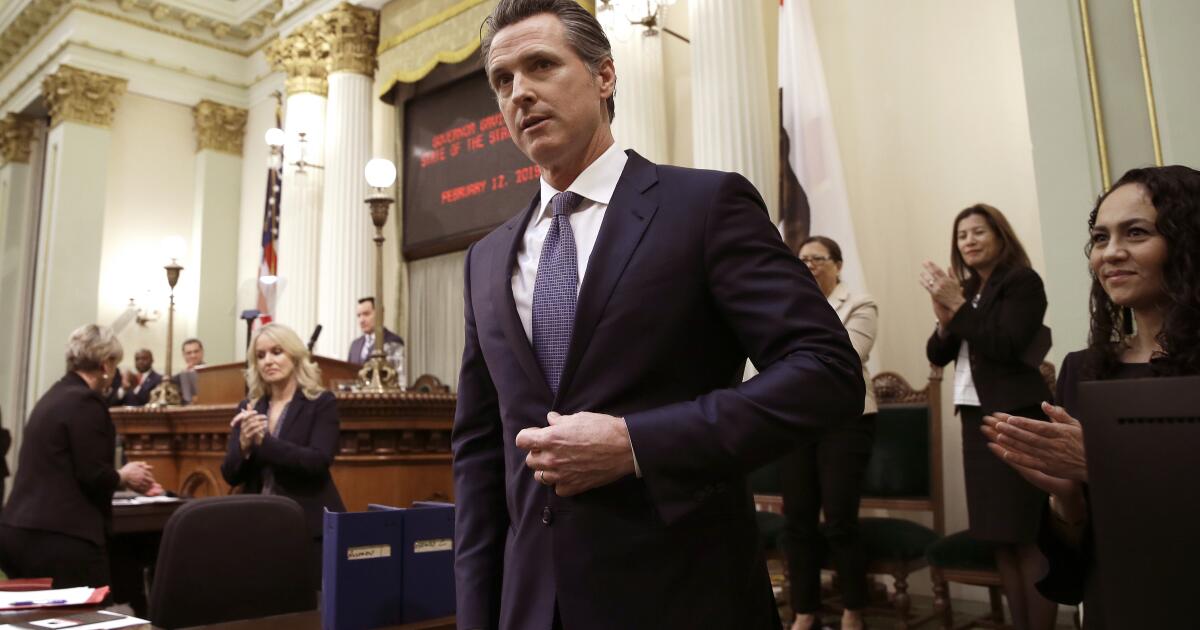
SACRAMENTO — Gov. Gavin Newsom on Monday signed his final state budget as governor, a $351.7-billion spending plan that seeks to uplift the poorest Californians through a tax system reliant on the stock market gains of the wealthy.
In a video message, Newsom extolled free school meals, universal transitional kindergarten, 130,000 subsidized childcare slots and other accomplishments in his tenure at the state Capitol, a period in state history marked by a dramatic expansion of state government and over $100 billion in increased spending.
“Over the past eight years, we built great things for the people of California — some of the boldest actions any government in this country has taken in a generation,” Newsom said. “And we did this without breaking the bank. We did this by design.”
The agreement ends weeks of lobbying by outside interests and negotiations among lawmakers and the governor at the state Capitol about how to handle a surge of income tax collected on stock market gains related to artificial intelligence.
Economists have warned that the revenue bump is potentially temporary and analysts say the growth in state spending could leave California in a challenging position if the economy declines.
Assemblymember David Tangipa (R-Fresno) agreed with Democrats that the budget is “compassionate.”
“My fear is that it’s not too much of a competent budget, and the budget continues a pattern that Californians know all too well: Spend now, justify it later, and hope somebody else pays the bill,” he said during a floor debate Monday.
Here’s what you need to know about the spending plan, which takes effect July 1.
Who decides the state budget?
The simplest answer is: Democrats. California voters have elected Democrats to represent 30 of the 40 seats in the Senate and 60 seats of the 80 seats in the Assembly. The budget was passed through a majority vote in each house of the Legislature and signed by Gov. Gavin Newsom, also a Democrat.
A more complex answer is that the budget is a product of dozens of legislative hearings, millions of dollars spent on lobbying by outside interests, talks among lawmakers and the governor and ultimately subject to the same political dynamics that rule the Democratic party.
Senate President Pro Tem Monique Limón (D-Goleta) and Assembly Speaker Robert Rivas (D-Hollister), in consultation with the chairs of the budget committees, represent their Democratic caucuses and reach a final agreement on the details of the spending plan with Newsom. In reality, staff members for the three parties handle most, if not all, of the back of forth negotiations to get there.
Union leaders seeking better pay, working conditions, benefits for workers and opportunities to expand their ranks are often brought in to consult or hammer out thorny deals as business groups try to fight off more regulations, taxes and costs, and support policies that increase their financial performance.
Democrats are spending more than ever before. How is that possible?
The Legislative Analyst’s Office, the nonpartisan fiscal advisor for lawmakers, recently examined the increase in state spending since 2019-20, Newsom’s first full year in office.
Between the budget approved that year and the spending proposal Newsom unveiled in January, spending from the state’s main operating fund had grown by over $100 billion, or 70%. That was largely by a 60% increase in revenue during that time. California typically operates with a spending deficit because Democrats spend more money than the state brings in.
The LAO found that the increase in spending stemmed from the growing cost of sustaining programs and services that were already in place when Newsom took office. About 30% of the remaining spending growth was categorized as new, either by newly created programs or the expansion of existing services.
Among the report’s conclusions: California could not afford the programs that predated Newsom and the ones he and the Legislature adopted.
To balance the budget over the last few years, Newsom and lawmakers have dipped into the state’s reserves at a time when California is experiencing strong revenue growth, which the LAO has cautioned against. Democrats have also increased taxes on businesses, paid for programs out of other funds and suspended reserve deposits among other solutions.
This year, the state budget places $6.4 billion in higher than expected revenue into a temporary holding account to knock down a deficit and balance the budget through 2027-28.
Democrats are pursuing a change to the state constitution on the November ballot that would allow them to set aside more money in years of good revenue growth to prevent cuts in future downturns.
Where is the money going?
Education and Medi-Cal are the two largest costs for the state.
Medi-Cal is the state’s version of subsidized health insurance for low-income Californians and provides medical, dental and vision care for an estimated 14.5 million people, or about one-third of the state population.
The federal government pays for more than half of the cost of the program. California is expected to spend about $50 billion from the general fund next year out of a total estimated at more than $220 billion in costs shared between the state and federal government, according to the LAO. State taxes and fees on providers also help fund Medi-Cal.
Overall, Medi-Cal costs more than any other state program and takes up about 40% of total spending, including federal funds the state receives, according to the LAO.
Spending on Medi-Cal has more than doubled over the last 10 years, which the LAO attributes to an increase in costs per enrollee, more enrollees and a greater share of seniors seeking care, among other factors.
Under Newsom, California has expanded Medi-Cal, including offering coverage to include all immigrants regardless of their immigration status, which the governor said has dropped the state’s uninsured rate down to 5.9%
The cost of Medi-Cal has grown beyond what Democrats expected and resulted in Newsom suggesting spending cuts.
The final budget agreement rejects a call by Newsom to lower the asset limit to $2,000 now and instead lowers it to $21,000 in 2027-28 to be eligible for Medi-Cal. The Legislature also delayed the governor’s proposal to reduce dental coverage and shift asylum seekers and other immigrants to restricted scope Medi-Cal, according to Jason Sisney, the lead budget advisor for the Assembly who posts about the budget on Substack.
The budget includes Newsom’s proposal to shift enrollees with unsatisfactory immigration status, a term that includes undocumented immigrants and others, from managed care to fee-for-service to save costs.
Under Proposition 98, approved by voters in 1988, California has a minimum funding guarantee for schools and community colleges and dedicates roughly 40% of general fund revenue to education.
Sisney said the budget increases the Local Control Funding Formula by $2.2 billion and provides historic general fund per pupil spending of $21,148. Support for special education also grew by $1.8 billion.
The California Community Schools Partnership Program received a $1-billion boost and Democrats directed $2.8 million in additional funding to the program that provides free meals for school children.
The budget also establishes 22,770 new slots for free or reduced childcare, which Newsom had proposed decreasing.
WASHINGTON — A spectacular economic upturn is on its way, President Trump promised Americans last week, galvanized in part by a deal brokered this month to end his war with Iran.
“Very soon you’ll be at $2.50 a gallon for gasoline,” Trump told a crowd Wednesday night on the National Mall. The next year, he said, “is set for an economic boom the likes of which no nation has ever seen before.”
Economists are skeptical. The effects of the war and other factors driving inflation are likely to stick around for months, experts say, presenting an ongoing challenge to American households — and to Trump’s party as it seeks to retain control of Congress in November’s midterm elections.
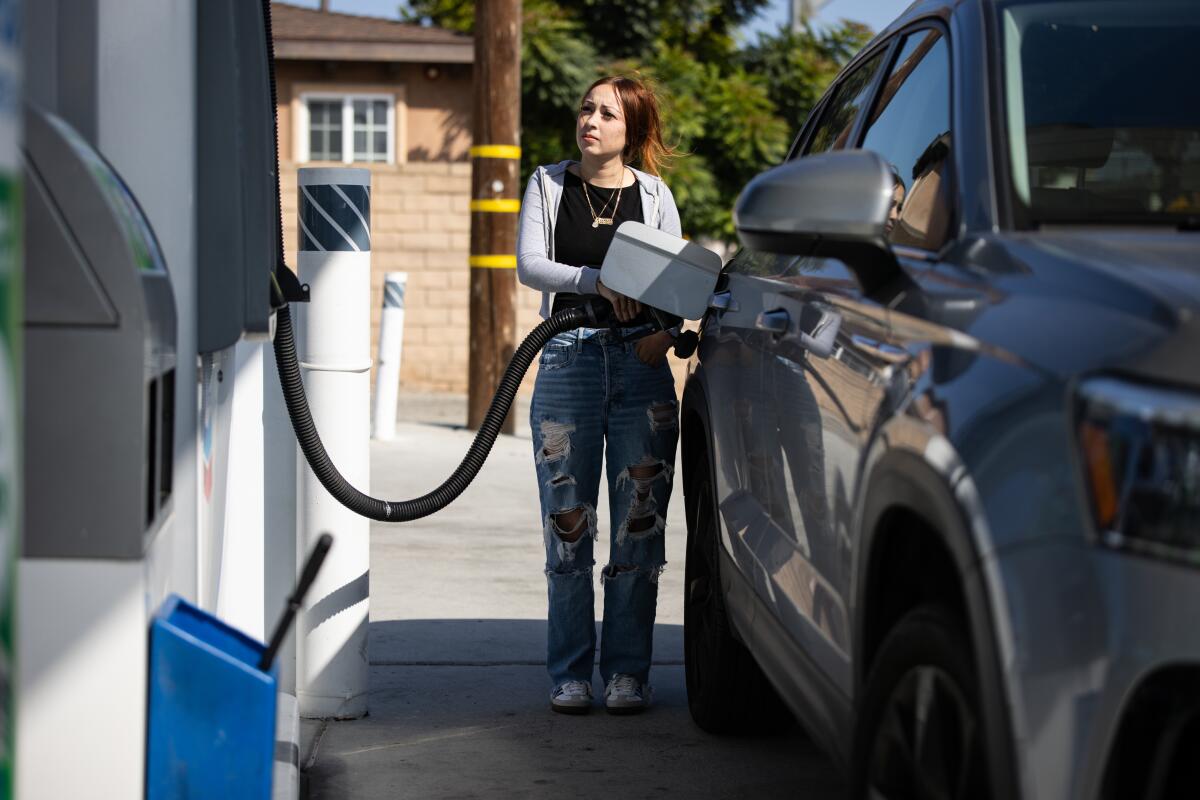
Yesenia De La Torre, 24, from Culver City pumps gas at the Chevron gas station on Sawtelle Boulevard and Culver Boulevard on June 15. Despite an agreement announced Sunday to end the Iran war and open the Strait of Hormuz, high oil, gasoline prices and energy supply problems won’t be solved overnight.
(Kayla Bartkowski / Los Angeles Times)
The war’s end will not create “a complete snap-back,” said Patrick Harker, professor at the University of Pennsylvania Wharton School and former president of the Federal Reserve Bank of Philadelphia.
“Markets are still cautious, and the infrastructure that’s been destroyed [in the Middle East] is going to take a while to re-create,” Harker said. “Inflation’s going to stay elevated for a while.”
Oil prices were dropping last week — falling to their prewar level Friday — and average gas prices fell by 7 cents per gallon over a week ago. But it will take significant time for oil shipping to ramp up through the Strait of Hormuz, infrastructure to be rebuilt and gas prices to drop, said Michael Negron, senior fellow for economic opportunity at the Center for American Progress.
“I would expect there to be a continued inching downward,” Negron said, but “we’re not going to just go back within weeks to $2.90 per gallon.”
That means the prices of gas and of other essentials aren’t likely to improve dramatically before the midterms, in which affordability has become a driving issue. It could heighten challenges for Republicans, who are defending their majorities in the U.S. House and Senate, as Democrats seek to leverage the issue to gain ground.
Positive messaging about the economy from Trump and other officials “doesn’t really resonate” with Americans who are struggling to make ends meet, said Gina Plata-Nino of the Food Research and Action Center, a national anti-hunger advocacy organization.
“When you’re still making the same amount of money but there’s less for you to be able to pay [for] your basic needs — gas is more expensive, food is more expensive — it doesn’t really add up,” she said.
A fruit stand on West 7th Street sells bananas for $2 per bunch.
(Carlin Stiehl / For The Times)
Americans question the costs
The Iran war has cost the average American household between $775 and $1,300 so far in fuel and taxpayer costs, according to an analysis by Roger Pielke, a senior fellow at the American Enterprise Institute.
The national average gas price sat at $3.90 on Friday, according to AAA, and California’s average was $5.48 per gallon, down 13 cents from a week earlier.
The increase in oil prices has also affected diesel and fertilizer prices, creating a ripple effect through several sectors, including agriculture. Consumer prices rose 4.1% in May from a year earlier, putting the inflation gauge at a three-year high.
Trump has leaned on a bullish message about the economy, but he has largely dismissed Americans’ worries about affordability, calling it a “fake word” and a “hoax.” Last week, he undermined the first major progress by Congress on the issue, refusing to sign a bipartisan housing affordability bill after both chambers passed it.
President Donald Trump closes his eyes as Dr. Ben Carson, left, speaks during an event with the White House Religious Liberty Commission in the Oval Office on Friday.
(Anna Moneymaker / Getty Images)
Meanwhile, the president’s approval rating on the economy dropped to 33% last week in an NPR/PBS News/Marist Poll — his lowest ever for that poll and 3 points below former President Biden’s worst reading on the question during his term.
Nearly four-fifths of respondents said that gas prices present some sort of strain, with 34% categorizing it as a major strain and 44% calling it a minor strain. Half of respondents who said they were not vacationing this summer said cost was the reason.
And only 23% of Americans say the war was worth the costs, according to a Reuters/Ipsos poll conducted days after the Trump administration announced the framework agreement to end the conflict earlier this month.
“People [are] just feeling like they’re getting left behind,” Harker said. “That’s a very real, palpable feeling when you go out and talk to people. They’re worried.”
The president and his party need a midterms message that “real economic change” is coming, said Brian Reisinger, a rural policy analyst in Wisconsin and a former GOP strategist.
“It has to be substance behind the sell,” Reisinger said.
Senate Majority Leader John Thune (R-S.D.) speaks to reporters after the weekly Senate policy luncheons at the U.S. Capitol on Tuesday in Washington, D.C. Thune spoke on a meeting with President Trump on the Iran deal.
(Kevin Dietsch / Getty Images)
U.S.-Iran talks on shaky ground
Trump’s boosters have hailed the Iran deal as a victory for the president. And Trump has justified the shock to gas prices as “worth it not to have a nuclear weapon” in Iran, though the war has not achieved the president’s stated aims, which included the elimination of its nuclear program.
“President Trump was clear all along that there would be short-term, temporary disruptions to energy markets, and that oil and gas prices will quickly fall as soon as the Iran situation is resolved,” White House spokesperson Taylor Rogers said Friday.
How rapidly the conflict will be resolved is not yet clear. The U.S.-Iran negotiations were on shaky ground by week’s end, with each country offering diametrically opposed messaging on the status of key points of negotiation.
Analysts say much of the increase in traffic through the strait has been driven by the return of Iranian oil to global markets. Trump agreed in the controversial deal with Iran to lift sanctions on Iranian oil, allowing Tehran to resume trading its most valuable export and breaking with decades of U.S. policy.
The unpredictability of the talks is another factor keeping energy companies, shippers and insurers cautious for now, Negron said.
“Everything is to be negotiated in the next nearly two months,” he said. “It is natural to expect there to be additional risk priced into each barrel of oil, into the insurance people are paying, just because of the volatility and uncertainty of where we are.”
WASHINGTON — The Democratic National Committee is organizing hundreds of community events across the country this weekend in hopes of harnessing the same concerns about affordability that President Trump capitalized on to return to the White House.
The events include school supply giveaways, food bank drives, neighborhood door knockings and organizer trainings.
“Everything costs too damn much under Donald Trump and the Republicans,” Democratic National Committee Chair Ken Martin said in a statement.
Martin said party members planned “to reach, engage, register, and mobilize voters who will make the difference in races up and down the ballot.”
Two years ago, Democrats were the ones accused of being indifferent to Americans’ anger about rising prices. Now they’re pointing the finger at Trump, who has downplayed the effect of lingering inflation.
He has described affordability concerns as a “hoax” and recently said, “I love the inflation” because he expects costs to drop as he tries to resolve his war with Iran.
About one-third of U.S. adults approve of how Trump is handling the economy, according to an AP-NORC poll from June. That’s down from the start of his second term, when 40% approved.
About 7 in 10 U.S. adults say the country’s economy is “poor,” according to an AP-NORC poll from June. That’s up from 65% in March, and underscores Americans’ ongoing unhappiness with the cost of living, which is being compounded by high gas prices because of the war in Iran.
Slightly more U.S. adults say the Democratic Party would do a better job than the Republican Party in handling inflation and the cost of living, according to a Marquette Law School/SSRS poll from May. Roughly one-third of U.S. adults — 35% — said the Democrats would do a better job, while 28% believe the Republicans would. Roughly one-third say the parties would be the same, or neither would be good.
This weekend’s events vary by region.
In New Mexico, Gov. Michelle Luján Grisham will convene a training for 150 potential campaign staffers. Nevada’s statewide campaigns will knock on doors in rural and working class neighborhoods. Others will call voters in swing districts with competitive U.S. House races to talk about the rising price of gas.
Some events are geared toward directly helping voters to persuade them that Democrats are concerned about affordability.
For instance, the local party in Kenosha County, Wis., plans to collect and distribute school supplies to poor families. And canvassers will fan out to discuss affordability issues in Arizona, Pennsylvania and Wisconsin.
The Republican National Committee dismissed the weekend’s events.
“Despite being millions of dollars in debt, the DNC is choosing to throw pitiful pep rallies to distract from the fact they created the inflation crisis,” said Delanie Bomar, an RNC spokeswoman. “Meanwhile, Republicans are hard at work fixing the economic mess Joe Biden and the Democrats created.”
Democrats hope that the events will show that their time in the political wilderness has made them more serious and effective at tackling kitchen table issues. But some fear their agenda may not be heard by voters in an increasingly fractured media environment.
“One of Donald Trump’s greatest strengths is that he’s so loud,” said Brian Derrick, a Democratic strategist. He said that events like the weekend’s itinerary help Democrats focus on an “Achilles’ heel” issue for Trump, “which right now is his lack of interest in addressing everyday costs for people.”
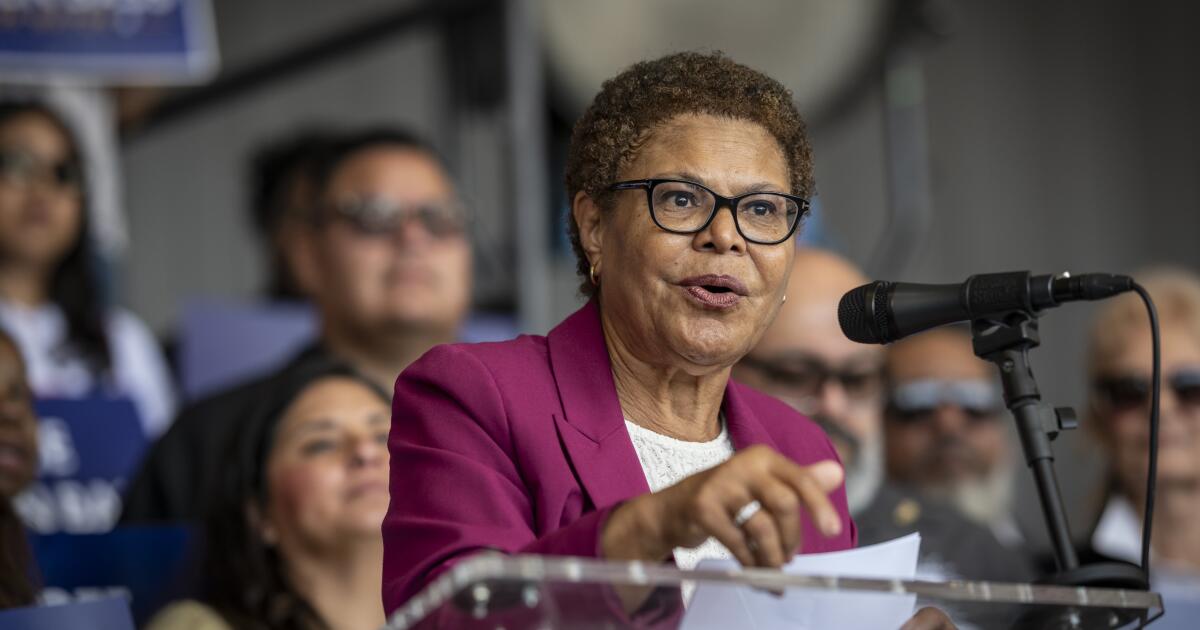
Los Angeles Mayor Karen Bass is once again dealing with blowback for being out of town when a massive fire ignited.
The fire at a cold storage facility in Boyle Heights began burning Wednesday, hours after Bass departed for the dedication of the Barack Obama Presidential Center in Chicago.
Since arriving back in Los Angeles around 6 p.m. Thursday, Bass has been to the scene of the fire numerous times, declared a local emergency, hosted five press conferences, met with local leaders and families affected by the fire, and distributed masks and air purifiers.
But her quick return and public appearances have not stopped some from drawing parallels to last year’s Palisades fire. Bass was in Ghana on a diplomatic trip when the deadly inferno spread amid extraordinarily high Santa Ana winds that forecasters had warned about for days.
While the scale of the destruction in Boyle Heights doesn’t compare to the 12 lives and thousands of homes lost in the Palisades fire, Angelenos are having flashbacks as toxic smoke hovers over parts of the region.
Bass, who is running for reelection, said in an interview that she rarely travels and always worries about what could happen when she does — whether it’s a fire or a big car accident. She also said she chose Chief Jaime Moore to lead the Los Angeles Fire Department because she trusts him to handle a crisis like this fire.
“I was in Chicago three hours away, and I was there 24 hours,” Bass said, noting that she was in constant communication with the chief during her brief trip.
A May poll by the UC Berkeley Institute of Governmental Studies, which was co-sponsored by The Times, found that 57% of likely Los Angeles voters had unfavorable views of Bass, while 35% had favorable views.
Bass, who served in Congress for more than a decade, was designated by then-President Biden to be part of his official delegation to attend the inauguration of Ghanaian President John Dramani Mahama. She was captured in photos at an embassy cocktail party in Accra as the Palisades fire exploded Jan. 7, 2025.
Last week, there was no warning that anything was amiss when she left the city. But any echoes of the Palisades fire could damage Bass’ image as she campaigns against City Councilmember Nithya Raman in the November runoff election.
“We’re talking about a fire, and she’s out of town, so it completely and totally reinforces that narrative of January 2025, and that’s not helpful,” said Fernando Guerra, director of the Center for the Study of Los Angeles at Loyola Marymount University.
Guerra said while Bass can do much of her job from another city for a day, a mayor is often faulted for not being front and center during an emergency.
“With today’s tech and instant communication, is it really that different that she’s in Chicago making calls than at City Hall?” he said. “But it has always been the case for executives that, symbolically, it is their job to be at the point of the crisis to assure those that are impacted directly, and the city as a whole, that they have the situation under control.”
Guerra said it didn’t help that Kevin Marchetti, the owner of the cold storage facility operating in the burning building, contributed the maximum, $1,800, to Bass’ reelection campaign last year.
Raman declined to comment on Bass’ handling of the Boyle Heights fire.
The blaze ignited Wednesday at the nearly 500,000-square-foot cold storage facility run by a company called Lineage, beginning on the roof, which caused a partial collapse and moved the flames into the building, where 85 million pounds of food are stored.
Firefighters have been battling the flames for seven days now, and smoke has made air dangerous to breathe in neighborhoods across the Los Angeles region.
Bass’ absence from the city soon caught the eye of right-wingers, with Spencer Pratt, who ran against her in the nonpartisan primary election, and Steve Hilton, who is running for governor, among those critiquing her.
“I don’t know what’s wrong with Karen Bass that she seems to keep leaving the city every time something happens,” Hilton said at a Monday press conference in Boyle Heights.
Pratt, who lost his house in the Palisades fire and came in third in the primary, drew the comparison directly.
“Karen was sipping cocktails in Chicago when the Boyle Heights Fire erupted, just as she was sipping cocktails in Ghana when our Palisades Fire erupted. I warned you all … what happened to us will happen to all of LA,” he posted on X on Sunday.
As she flew back to L.A. from Ghana, Bass repeatedly reminded her staff that she could make calls from the military flight, her text messages showed. But during one call or Zoom with her staffers, she had technical problems, texting, “I am listening don’t know why you can’t [hear] me.”
Moore, the new chief, has appeared to be in lockstep with the mayor during the Boyle Heights fire, saying she has been an active partner.
About 30 minutes after the fire began, Moore was on the scene. Ten minutes after he arrived, he was on the phone with Bass, he said.
Over the next day, while Bass was in Chicago, Moore estimated that they spoke six times over the phone.
Moore said her absence was a non-issue.
“Until Mayor Bass goes through our 20-week drill tower, and she learns to fight a fire and she can stand next to me on a hose line, I don’t need her in this city,” Moore told The Times on Tuesday.
“She’s our mayor. She was doing exactly what she needed to do,” he added. “She answered the phone. She provided me exactly what I needed, and that was, ‘Whatever you need to do, you do it.’”
Yes, you should visit Mexico City. Don’t overthink it and don’t delay. Despite excessive tourism and rising gentrification fears, the seething capital of Mexico — 25 million souls strong — remains a top-tier international destination for any committed food lover. And the intensity of its dining scene seems to be only growing.
Sure, a wave of privileged remote workers oozing dollars and euros may have dampened the vibe for Mexico City natives, leading to protests. The post-pandemic issues of housing displacement and rising costs for locals are serious challenges that political leaders must address. Yet time and again, on every visit, the resiliency and passion that original defeños have for their gastronomical paradise proves to be boundless.
Use these handy dining guides for all of your summer travel, near and far.
I have traveled to Mexico City regularly since 2002 and lived there for nearly a decade. I won’t feel slighted if you prefer the dining advice of current residents, or from any of the numerous local dining guides online. But one thing about me, I have an aversion to hype, and tend to avoid the city’s contemporaneous food magnets where the ratio of foreigners to locals is too out of whack. (No, the Michelin-starred taqueria was never extraordinarily better than any others in its bracket.) Where my native friends go, I go.
Here are highlights of my top, top, top recommendations from my L.A. Times restaurant guides on Mexico City, plus a few more favorites. My goal here is to distill down your options for a concentrated, food-centric visit, from nostalgic jewels beloved by hardscrabble chilangos to the celebrated shrines of high-end chefs reaping the bounties of the Valley of Mexico.
WASHINGTON — The Pentagon has told senators it needs roughly $80 billion, mostly to cover the cost of the U.S. war against Iran, adding to what is already a sizable military spending boost being sought by President Trump.
Meanwhile, the Senate for the first time approved a war powers resolution Tuesday seeking to block U.S. military action against Iran, as lawmakers warily watch President Trump’s efforts to resolve a conflict that the administration launched on its own and now needs Congress to fund.
It was the 10th time the Senate has tried to stop the war, and the outcome, on a vote of 50-48, was a stunning turnaround from past efforts. Although the resolution is largely symbolic, and does not fully carry the force of law, it reflects the growing concerns from a number of Republican lawmakers in the House and Senate over the war and the deal Trump struck with Iran to end it. The House approved the resolution earlier this month.
The White House Office of Management and Budget has yet to make a formal request to Congress for more money for the war. But Defense Secretary Pete Hegseth has been making the rounds on Capitol Hill, including Monday evening. A top deputy Defense secretary told senators about the Iran funding request last week, according to two people familiar with the situation but not authorized to discuss it publicly.
The Wall Street Journal first reported on the developments.
The push for billions of dollars in Iran war funding comes at a fraught political moment. Lawmakers are not only skeptical of the deal Trump struck with Iran to bring an end to the war, but also wary of next steps. The White House has requested a remarkable $1.5 trillion for the Pentagon — a nearly 50% increase over the current fiscal year’s funding levels.
Senate Majority Leader John Thune said he’s expecting a supplemental spending request from the administration for the war, and when it arrives, “we’ll work through it and see where the votes are.”
“We need to make sure we’re doing everything we can to replenish, resupply a lot our munitions that have been depleted — not only just with what’s happening with Iran, but prior to that,” said Thune (R-S.D.).
Deputy Defense Secretary Stephen Feinberg spoke to several senators about the proposal in calls last week and he notified congressional committees that the $80-billion request had been sent to the Office of Management and Budget. The Pentagon did not immediately respond to a request for comment.
However, the funding package will almost certainly run into trouble from lawmakers who refuse to support Trump’s decision to go to war and are reluctant to give the Pentagon more money at a time of high costs of living for Americans at home.
“You’re spending families’ hard-earned tax dollars on a war that many strongly oppose,” Democratic Sen. Patty Murray of Washington told Hegseth in a hearing last month.
In addition to the Iran funding, Republicans hope to secure about $1.1 trillion through the regular appropriations process, which typically requires support from both parties for approval. Then, they hope to secure an additional $350 billion through a mostly party-line vote later this summer.
The amount being sought by the Pentagon is far higher than the $29-billion estimate of war costs that Hegseth gave Congress during his testimony last month. The bulk of that amount was related to replacing munitions and repairing equipment but also included operational costs to keep forces deployed. That estimate did not include the cost to repair or rebuild U.S. military sites damaged in the region.
It’s also far lower than the initial $200 billion the Pentagon floated as the costs at the start of the war. An early estimate put the cost of the first week of the war at $11.3 billion.
Sen. Brian Schatz of Hawaii, a member of Democratic party leadership, said he expects the actual price tag could be much higher than the $80 billion being proposed.
Schatz said he hasn’t done any counting of Democrats about whether there is support for an Iran-focused bill, “but I haven’t found anyone who wants to do this.”
But Republican Sen. Jim Banks of Indiana said, “To me it’s less about the war, it’s more about the stockpiles.”
Banks said, “I would sell it to my state as an investment in our defense industrial base, reshoring defense production to Indiana.”
Sen. Jack Reed of Rhode Island, the top Democrat on the Senate Armed Services Committee, said funding for an Iran supplemental can’t be done in isolation. It has to be done after lawmakers from both parties have agreed to a total spending amount for both defense and non-defense programs, “then the rest of this would follow pretty quickly,” Reed said.
And Sen. John Hoeven of North Dakota, a member of the Appropriations subcommittee on Defense, said he has been working with the administration to broaden the package to include funds for disaster aid for California, Hawaii and other states hard hit by fires and weather problems, as well as agricultural aid for farmers.
“I think that’s the kind of combination that could pass,” Hoeven said.
Hegseth declined to answer questions from reporters late Monday as he strode around the Capitol.
But on the issue of the cost of the war, Hegseth responded rhetorically during a Senate hearing last month, asking, “What is the cost of Iran obtaining a nuclear weapon?”
He acknowledged the president’s decision to confront the threat of a nuclear Iran “comes with cost — and we recognize that.”
Freking and Mascaro write for the Associated Press. AP writers Konstantin Toropin and Ben Finley contributed to this report.
A travel journalist who travelled to Italy said they were nearly caught out by a rule introduced in the city of Venice to improve cleanliness
A journalist has talked about what happened when they visited Venice(Image: Emanuele Cremaschi/Getty Images)
A travel journalist who visited Venice said they nearly lost £86 after breaking a rule they didn’t know about. Joey Handler, a travel journalist, spent six days in Italy travelling around the iconic European country, visiting various popular cities en route.
However, in one of their latest pieces, they admitted they had five regrets from their time in Italy which formed part of a two week trip around Europe.
Reflecting on the trip, back in October 2022, the Joey touched on how at one point in Venice they were stopped by the authorities for doing an act they thought was innocuous.
Joey said the incident occurred after she had completed a walking tour and went for some lunch. Eventually, after passing full restaurant after full restaurant she said she cut her losses and bought an ice cream before deciding to sit down.
However, it was the sitting down that was the problem. The Business Insider journalist explained: “I eventually cut my losses and stood in line for gelato before sitting on a shaded step to enjoy it.
“As I was about to take my first bite, the nearby authorities waved their hands up and down at me — a gesture I could only take to mean ‘get up’. And there I was, committing an etiquette violation that, according to the City of Venice, may result in a fine of 100 to 200 euros.”
As well as being informed by the local authorities about the rule, tourists and others can also be informed by the local government website. On this rule, they said: “Do not consume food and drink sitting on the ground, do not sit or lie down on banks and foundations, monuments, bridges, steps, puteals and high-water walkways
“Fine: 100 to 200 euros DASPO – Urban banning order (offenders will be immediately banned from the place where the offence was committed).”
This means that offenders could be fined anywhere between £86.74 and £173.48 if they’re caught. On why such rules, which include not swimming in the canals, dumping rubbish, walking around in a swimsuit, feeding pigeons and seagulls, not cycling, and not bivouacking in public areas, are in place, the local authority say is to preserve the environment.
They explained: “Current regulations enforced by the Venice City Council Municipal Police forbid certain behaviour, in order to preserve urban cleanliness and landscape, and also for reasons of safety and public hygiene.
“The violation of such regulations involves the application of administrative fines – from €25 to €500.”
This isn’t the only charge people can face if they travel to Venice with tourists als facing an entrance fee which was introduced in 2024 by the city. This fee is around €5 (£4.34) and originally applied on peak days between April and July before being expanded.
However, the new mayor of Venice Simone Venturini, has talked about the possibility of increasing this to €50 (£43.37). He told Corrier della Sera: “If today it ranges from €5 to €10, my proposal is to increase it to €30 to €50.”
Whilst move was in part a reaction to the sheer number of tourists, opponents have warned it risks not being true to the city itself. Former mayor Massimo Cacciari went further and called for the scheme to be removed altogether: “There is no other city in Italy or Europe where you have to enter with a ticket, as though it was a museum.
“It is barbarous, uncivilised and, in my opinion, against the constitution. It is simply obscene. I thought that Venturini would be more intelligent than his predecessor and would scrap the fee.”
Sipping coffee in a grand square at one of Europe’s oldest cafe’s, Lucy Williamson discovers a Mediterranean escape that manages to be a city break, beach holiday, and history lesson all at once
09:30, 17 Jun 2026Updated 09:30, 17 Jun 2026
Malta: The Ultimate Lazy Traveler’s Weekend Guide
A spa day in the UK can easily set you back £150 before you’ve even ordered lunch. So when I found myself sipping coffee in a grand Maltese square at one of Europe’s oldest cafes, watching the morning sun bounce off honey-coloured limestone buildings after a £40 flight from London, I couldn’t help feeling I’d stumbled across one of Europe’s best-value city breaks.
Malta has long been a favourite with British travellers. Yet somehow it still feels slightly overlooked when conversations turn to weekend escapes. People talk about Lisbon, Barcelona and Rome. Meanwhile, sitting in the middle of the Mediterranean, Malta quietly enjoys more than 300 days of sunshine a year; making it one of the sunniest in Europe.
I spent three days there for a spontaneous solo trip and quickly realised Malta has cracked something many destinations haven’t. It manages to be a city break, a beach break and a history lesson all at once, without requiring military-grade holiday planning.
The first thing working in Malta’s favour is its size. This is not a destination where you’ll spend half your holiday staring at Google Maps, wondering whether the slightly disappointing mural is really worth a 45-minute metro journey and an existential crisis in the heat. Most places are close together. The capital city, Valletta, is wonderfully walkable.
Do you have a travel story to share? Email webtravel@reachplc.com
Things to do
If you stay in neighbouring Sliema, as I did at the Preluna Hotel (about £200 for two nights, includes its own beach club) accommodation is often cheaper than inside the capital itself. And the short ferry across to Valetta costs just a few euros. It glides over the water toward a city that looks like an enormous sandcastle built by a giant child who grew up to become an architect.
Many of the highlights cost nothing. The Upper Barrakka Gardens offer some of the finest views in the Mediterranean. Down below, crowds gather for the Saluting Battery (every day at 12pm and 4pm) where cannons are still fired in a tradition dating back centuries. Men in historical uniforms are responsible for the blasts which are to let everyone know what time it is. I loved it, but it seems an incredibly loud and dramatic alternative to just looking at your phone.
Jokes aside, it is an impressive tradition, although you only need to forget it’s happening once to understand why locals still flinch.
You also cannot miss the staggering Baroque interior of St John’s Co-Cathedral (€15 for adults) a church so violently covered in 24-carat gold leaf that it looks like the inside of a divine Ferrero Rocher.
Elsewhere, the city’s streets themselves do much of the heavy lifting. Ornate balconies lean over narrow lanes while laundry flutters overhead on washing lines. It is a deeply moving reminder that even though Valletta was built by the Knights of St John to defend European civilization from the Ottoman Empire, your romantic view of a historic fortress city is occasionally interrupted by a pair of massive beige knickers blowing in the wind.
Locals treat the sea like a public swimming pool that happens to have excellent views. Rocky platforms replace sand. Towels appear. People jump straight into the Mediterranean without the usual British negotiation involving sunbeds, parasols and passive aggressive towel placement.
No one seems to be running a system. It works anyway.
British nostalgia with better weather
Malta occasionally feels like Britain left something behind and never quite bothered to come back for it.
The island was part of the British Empire for more than 150 years, and the influence is still visible in ways that feel slightly surreal. English is an official language. Red phone boxes still stand in corners like they are waiting for a call that will never come.
I wandered into the local branch of Marks and Spencer to check on the progress of British civilization. I can confirm they did not have any picky bits in the Malta store; the traditional British tapas. But they did have tinnies – the traditional fuel for a British explorer. A Monsoon sits nearby. Even a copy of that day’s Daily Mirror at the local newsagent’s.
Where to eat
That blend of influences extends to the food scene. Malta borrows happily from Italy, North Africa and Britain, creating a character all of its own.
One street that perfectly captures the atmosphere is St Lucia Street. By day, it’s an attractive stepped lane. By night, it transforms into one of Valletta’s most buzzy dining spots, with tables cascading down the stone steps like a very tasty avalanche. I spent my second evening at Taste nursing an Aperol Spritz and a plate of rigatoni, which seemed to accidentally on purpose precede a huge tiramisu (€25 bill).
One of Europe’s oldest cafes
For a deeper glimpse into Malta’s past, I found myself at Caffe Cordina, one of Europe’s oldest cafés and one of Valletta’s most enduring institutions.
You will have to resist the temptation to just wander into the air-conditioned void of Starbucks just down the road for some whipped cream and regret. Keep walking, because you will be rewarded with an establishment that has spent nearly two centuries serving Maltese society.
The family’s story began in 1837, when their ancestors arrived from Italy and sold nougat from a donkey cart. They eventually opened a small shop that was destroyed by a German bomb during the Second World War. Yet, as the current owner, Luca Cordina, told me, that bomb was ironically “the best thing that ever happened to us”. It forced his grandfather, Cesare, to take out a bank loan, pivot, and establish the café in its current Valletta location in 1944.
It was a massive gamble. “My grandfather’s friends actually questioned him about the decision, calling him crazy,” Luca explained, noting that the bustling square we see today was little more than a garden at the time. But Cesare believed in the location when very few people did. His response to the doubters was simple: “When the sun rises, it warms everyone”.
That warmth has since attracted a staggering mix of patrons, hosting everyone from Queen Elizabeth II and King Charles to the 1984 Italian national football team. The café inspires just as much loyalty from its staff as its customers, with one employee noted to still be working the floor at 76 years old.
I had a coffee and a traditional ricotta pastizzi (€5.70 bill) and watched the world go by – stunning.
‘The Silent City’
My other favourite lunch spot was in Mdina, the former capital and one of the most atmospheric places on the island.
Game of Thrones fans will recognise parts of it immediately. Everyone else will spend the visit walking past groups who are absolutely certain they are standing exactly where something important happened and are more than willing to explain it in detail whether you asked or not.
It is known as the Silent City because it is incredibly quiet, which is a nice change from London, where the soundtrack is the incessant beeping of a stolen Lime bike.
That wonderful silence was much enjoyed on the roof terrace of the family-run cafe – Fontanella Tea Garden – which is built into the city wall and offers one of the best panoramic views around (Pizza + coffee came to €19).
Mdina is completely enclosed within ancient walls to stop medieval enemies from entering, though it seems they let any old person in these days – especially if you are wearing shorts and carrying a bottle of Fanta Lemon.
The verdict
Three days felt about right. Long enough to see Valletta, Mdina and the coastline without rushing. Short enough that it never drifted into routine. May was an ideal time to go – still warm, not baking, and a little quieter.
Malta works best for couples or solo travellers (like me on this occasion!) who like variety without effort. You get history, sea swims, good food and a walkable city without needing to plan your day around transport logistics or opening times.
Flights from London can be found for around £40 one way. I flew from Luton and returned to Gatwick using Avios points via British Airways, which made the trip back feel particularly smug.
By the time I got home, I’d spent less than many people pay for a day wrapped in a fluffy robe somewhere in the Home Counties.
The cost
Flight from London to Malta (one-way): £40
Preluna Hotel, Sliema (2 nights): £200
St John’s Co-Cathedral entry: €15
Dinner at Taste (Aperol Spritz, rigatoni, tiramisu): €25
Coffee and ricotta pastizzi at Caffe Cordina: €5.70
Pizza and coffee at Fontanella Tea Garden: €19
Sliema–Valletta ferry: €5
Return flight: Not included (paid using Avios points via British Airways) – would have been about £80
Amazon.com (AMZN) is facing a possible lawsuit from the US Federal Trade Commission that may lead to billions of dollars in civil penalties, over claims the e-commerce giant misled advertisers, Bloomberg reported, citing sources.