conflict

How are killer drones reshaping the conflict in Sudan | News

Sudan enters Ramadan as Civil War intensifies, famine spreads, and drone strikes hit civilian markets.

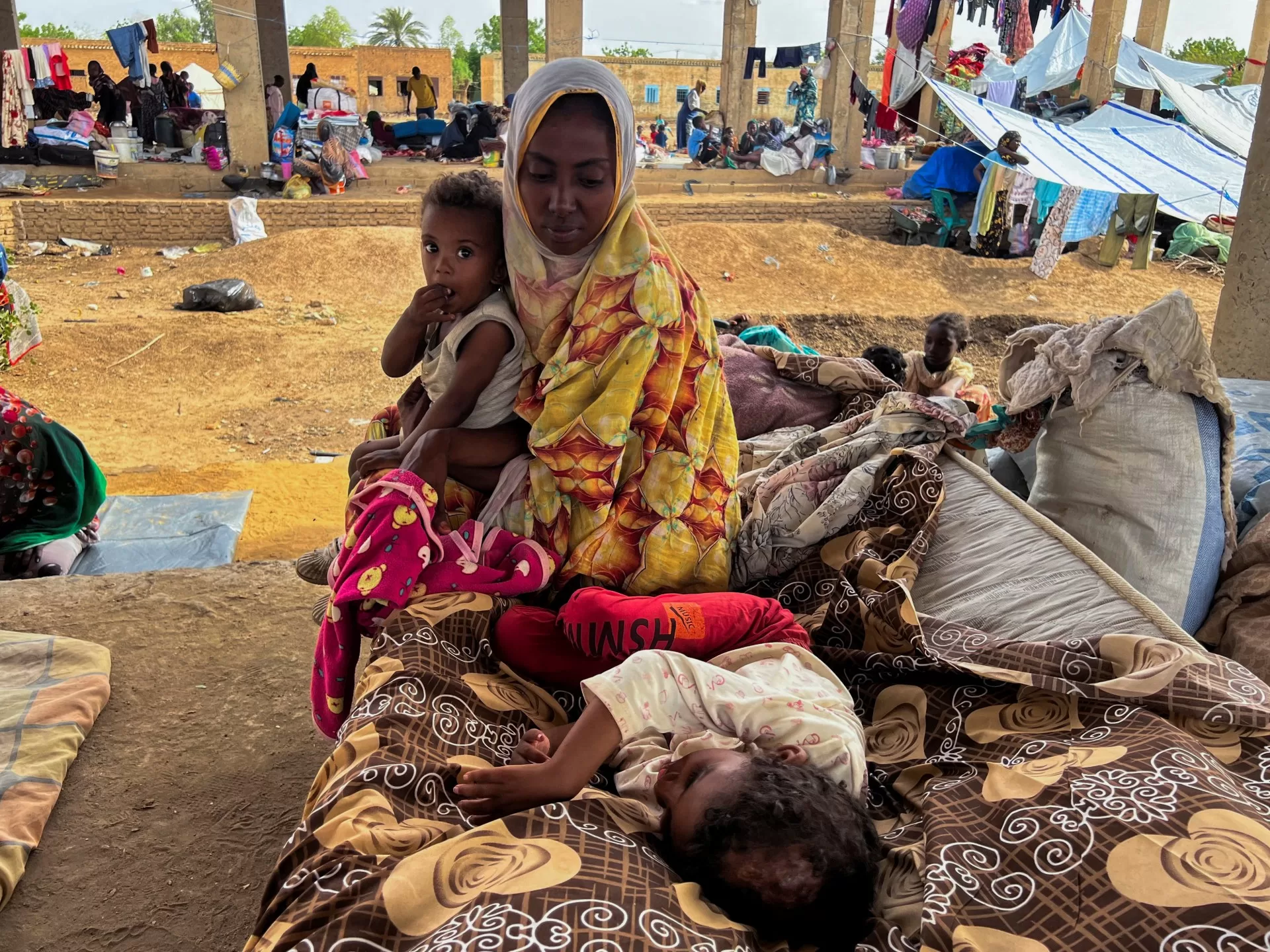
Sudan’s civil war is shifting into a drone-driven phase, erasing the lines between battlefield and civilian life. As Ramadan begins under famine conditions, how do the people of Sudan mark the holy month in the midst of war?

In this episode: 

Episode credits:

This episode was produced by Sarí el-Khalili and Melanie Marich with Maya Hamadeh, Tuleen Barakat and our guest host, Tamara Khandaker. It was edited by Ney Alvarez. 

Our sound designer is Alex Roldan. Our video editors are Hisham Abu Salah and Mohannad al-Melhemm. Alexandra Locke is The Take’s executive producer. Ney Alvarez is Al Jazeera’s head of audio. 

Connect with us:

@AJEPodcasts on TwitterInstagram, Facebook


Source link

Ukraine’s patience with US peace push wears thin as Russia skirts pressure | Russia-Ukraine war News

Ukraine expressed frustration with its ongoing peace talks with Russia and the United States this week, saying US pressure was too one-sided against it.

“As of today, we cannot say that the outcome is sufficient,” Zelenskyy told Ukrainians in a Wednesday evening video address.

Before Wednesday’s talks in Geneva had begun, Zelenskyy told Axios news service that ceding the remaining one-fifth of the eastern Donetsk region that Russia doesn’t control, as Moscow has demanded, would not be accepted by Ukrainians.

“Emotionally, people will never forgive this. Never. They will not forgive … me, they will not forgive [the US],” Zelenskyy said, adding that Ukrainians “can’t understand why” they would be asked to give up additional land.

Russia currently controls about 19 percent of Ukraine, down from 26 percent in March 2022.

INTERACTIVE-WHO CONTROLS WHAT IN UKRAINE-1771420401

Last month, 54 percent of surveyed Ukrainians told the Kyiv International Institute of Sociology they categorically reject transferring the whole of the Donetsk region to Russian control, even in return for strong security guarantees, with only 39 percent accepting the proposal.

Two-thirds of respondents also said they did not believe the current US-sponsored peace negotiations would lead to lasting peace.

Instead of ceding land now, Zelenskyy favours freezing the current line of contact as a pretext for a ceasefire and territorial negotiations.

“I think that if we will put in the document … that we stay where we stay on the contact line, I think that people will support this [in a] referendum. That is my opinion,” he told Axios.

Blaming Ukraine

US President Donald Trump told Reuters last month that Ukraine, not Russia, was holding up a peace deal.

But Zelenskyy said it was “not fair” that Trump was putting public pressure on Ukraine to accept Russian terms, adding, “I hope it is just his tactics.”

US senators visiting Odesa last week agreed with him, saying they want their government to put more pressure on Russia.

“Nobody, literally nobody, believes that Russia is acting in good faith in the negotiations with our government and with the Ukrainians. And so pressure becomes the key,” said Senator Sheldon Whitehouse of Rhode Island.

Russia unleashed a barrage of 396 attack drones and 29 missiles on Ukraine’s energy infrastructure on the day of the Geneva talks, its second large-scale blow in six days. On February 12, another attack had left 100,000 families without electricity, and 3,500 apartment buildings without heat in Kyiv alone.

“Russia greets with a strike even the very day new formats begin in Geneva – trilateral and bilateral with the United States,” said Zelenskyy in a video address. “This very clearly shows what Russia wants and what it is truly intent on.”

Zelenskyy has repeatedly asked Western allies to stop Russian energy sales that circumvent sanctions, and to stop exporting components to third countries, which re-export them to Russia’s armaments industry.

Russia is believed to be using a shadow fleet estimated at between 400 and 1,000 oil tankers to carry and sell its crude oil. France has seized two of those tankers, and the US seized a second tanker on Monday.

The US Senate has held off voting on a sanctions bill that has 85 percent support because of opposition from Trump. The bill would impose secondary sanctions on buyers of Russian oil – notably India and China.

Kyiv
Workers repair a pipe at a compound of Darnytsia Thermal Power Plant, which was heavily damaged by Russian missile and drone strikes in Kyiv, Ukraine, on February 4, 2026 [File: Valentyn Ogirenko/Reuters]

Can Russia take Donetsk anyway?

Russia has fought since 2014 to seize the two eastern regions of Ukraine, which triggered its invasion – Luhansk and Donetsk – where it claimed a Russian-speaking population was being persecuted by the government in Kyiv.

Late last year, Russia managed to seize all of Luhansk, but analysts believe it is doubtful that it could take the remainder of Donetsk without serious losses, because Ukraine has heavily fortified a series of cities in the western part of the region.

That task has now become even harder, according to observers, since Russia this month lost access to Starlink terminals, which helped it communicate, fly its drones and coordinate accurate counter-battery fire.

As Russian ground assaults have faltered, Ukraine has seized the initiative to make gains in Dnipropetrovsk, said Ukrainian military observer Konstantyn Mashovets.

Ukrainian forces gained 201sq km of territory from Russian occupation forces between February 11 and 15, according to observers, reportedly their fastest advance since a 2023 counteroffensive.

INTERACTIVE-WHO CONTROLS WHAT IN EASTERN UKRAINE copy-1771420406

Russia has been trying to replace Starlink using stratospheric balloons, reported Ukrainian Defence Ministry adviser Serhiy “Flash” Beskrestnov.

Russia would likely take six months to replace Starlink, said a Ukrainian unmanned systems commander, offering Ukrainian forces a window to roll back Russian advances.

It also suffered 31,680 casualties in January, estimated Ukraine’s General Staff – a sustainable number given Russian recruitment levels of about 40,000 a month. But those numbers would rise in the event of a major assault on the remainder of Donetsk, experts say.

“Our goal is to have at least 50,000 confirmed enemy losses every month,” said Ukrainian Minister of Defence Mykhailo Fedorov on February 12, echoing a goal set by Zelenskyy last month.

Fedorov has set out to increase the production of remote-control FPV drones used on the front lines, which Ukraine says are now responsible for 60 percent of all Russian casualties.

As part of that effort, joint drone production facilities are planned in several European countries. The first started operating on February 13 in Germany, Zelenskyy told the Munich Security Conference, and nine more are planned.

In addition, Ukraine’s European allies pledged 38 billion euros ($44.7bn) in military aid this year during a Ramstein format meeting – the alliance of more than 50 countries which plans military aid for Ukraine – including 2.5 billion euros ($2.9bn) for Ukrainian drones – “one of the most successful ‘Ramsteins’,” Fedorov said.

The European Union has additionally voted to borrow 90 billion euros ($106bn) to give to Ukraine in financial aid this year and next.

The US stopped being a donor of military and financial aid to Ukraine after Trump was sworn in as president in January 2025.

Against Trump’s wishes, the US Senate voted to spend $400m in each of the next two years as part of the Ukraine Security Assistance Initiative, which pays US companies for weapons for Ukraine’s military. Europeans have pledged to spend at least 5 billion euros ($5.8bn) on US weapons this year.

Europe would also be the main contributor to a “reassurance force” policing the line of contact after a ceasefire, and on Ukraine’s insistence, US representatives also met with British, French, German, Italian and Swiss representatives before the talks in Geneva.

INTERACTIVE-WHO CONTROLS WHAT IN SOUTHERN UKRAINE-1771420404

Source link

No Ramadan joy, respite for families in Gaza City destroyed by Israel | Israel-Palestine conflict News

Nisreen Nassar and her family, like many other Palestinians, continue to live in schools and makeshift shelters.

Just before sunset on Thursday, Nisreen Nassar crouched over her makeshift oven, burning wood and scraps of plastic to bake bread for her family so they could break their fast.

Four months after the United States-brokered “ceasefire” came into effect in October, and as US President Donald Trump convened the first meeting of his Board of Peace on Thursday, she wasn’t expecting to be sheltering with her family in an abandoned school and cooking on an open fire during the Muslim holy month of Ramadan.

Recommended Stories

list of 3 itemsend of list

“Our preparations and expectations for Ramadan this month were that it would be better than previous ones during the war. Unfortunately, it is worse,” Nassar told Al Jazeera’s Hani Mahmoud, reporting from Gaza City.

Nassar’s family is one of many still living in schools and makeshift shelters throughout northern Gaza, relying on humanitarian aid for their basic needs and barely able to prepare a meal to break their fast, known as Iftar, due to gas shortages.

Nassar, her husband Thaer, and their seven children lived in Beit Hanoon, in the northeast, before Israel’s genocidal war on Gaza began in October 2023, which has killed more than 72,000 people, according to Gaza’s Ministry of Health statistics.

They have since been displaced several times, from Beit Hanoon to Rafah and Khan Younis in the south.

The Nassar family is still waiting for a decision that would allow them to return home – or to what remains of it. This marks the third Ramadan that they have been living in a school, which, apart from the concrete walls, offers little shelter.

The children sleep not in beds, but directly on a classroom floor. The Nassar family’s only possessions comprise a few bags of clothes and some thin blankets.

Thaer said his children are afraid to go outside due to Israeli gunfire, in violation of the “ceasefire” agreement.

“My children live in fear, whether they go out into the street or stay here in the shelter. In the past, in better days, they had better times, playing ball, going to school, and then returning home.”

According to Gaza’s Ministry of Health, more than 600 Palestinians have been killed in Israeli attacks since the “ceasefire” came into effect.

While Palestinians have had little respite this Ramadan, Mahmoud said Palestinians remain steadfast.

“For many of the Palestinians sheltering inside this school, Iftar is a celebration of spiritual resilience, unbroken by Israel’s genocide and a future that is far from certain.”

Source link

Tracking the rapid US military build-up near Iran | Military News

The United States administration is intensifying its build-up of a vast array of military assets in the Middle East, as President Donald Trump says Iran has “10 to 15 days at most” to agree a deal over its nuclear programme and stock of ballistic missiles.

As well as the world’s largest aircraft carrier, the USS Gerald R Ford, which is reportedly joining the Abraham Lincoln carrier strike group in the Arabian Sea, key force multipliers such as E-3 Sentry Airborne Warning and Control System (AWACS) aircraft have been deployed.

Recommended Stories

list of 1 itemend of list

In a letter to the United Nations Security Council, Iran said that while the country does not seek “tension or war and will not initiate a war”, any US aggression will be responded to “decisively and proportionately”.

“The United States would bear full and direct responsibility for any unpredictable and uncontrolled consequences,” it said.

Here is what we know about the recent US deployment of military assets in the Middle East – which has also led to a dispute with the United Kingdom over the use of its joint military base in Diego Garcia.

What air power assets has the US deployed to the Middle East?

According to open-source intelligence analysts and military flight-tracking data, the US appears to have deployed more than 120 aircraft to the region within the past few days – the largest surge in US airpower in the Middle East since the 2003 Iraq war.

The reported deployments include E-3 Sentry Airborne Warning and Control System (AWACS) aircraft, F-35 stealth strike fighters and F-22 air superiority jets, alongside F-15s and F-16s. Flight-tracking data shows many departing bases in the US and Europe, supported by cargo aircraft and aerial refuelling tankers, a sign of sustained operational planning rather than routine rotations.

F-22s and F-35s previously escorted B-2 stealth bombers during Operation Midnight Hammer, the US military strikes on Iranian nuclear sites Trump ordered in June 2025 during the 12-day conflict between Iran and Israel.

“Watch any movement by B-2s. That would indicate a possible replay of ‘Midnight Hammer’,” Mark Cancian, a retired Marine Corps colonel and senior adviser with the Washington-based Center for Strategic and International Studies think tank, told Al Jazeera.

This latest wave was preceded several weeks ago by the arrival of Air Force F-15E Strike Eagles. US Central Command said on social media at the time that the fighter jet “enhances combat readiness and promotes regional security and stability”.

What role could Diego Garcia and the UK play?

Attention has also focused on Diego Garcia, the joint UK-US military base in the Indian Ocean’s Chagos Islands, which is capable of hosting long-range US strategic bombers, including B-2 aircraft.

The remote base has historically served as a launch point for major US air campaigns in the region.

However, Diego Garcia is a British sovereign territory leased to Washington, meaning London must approve its use for offensive operations. According to reports in UK media, Prime Minister Keir Starmer has indicated to Trump that the US cannot use British airbases – including Diego Garcia and RAF Fairford in the UK, which is home to the US’s heavy bomber fleet in Europe – for strikes on Iran, as this would be in breach of international law.

Trump retaliated by withdrawing US support for the UK’s decision to transfer the Chagos Islands to Mauritius, announced last year.

On Wednesday, the US president said Starmer was “making a big mistake” in the agreement to transfer sovereignty of the archipelago.

“DO NOT GIVE AWAY DIEGO GARCIA!” Trump wrote in a post on Truth Social, saying the base could be called upon in any future military operation to counter a potential attack from Iran.

 This image realeased by the U.S. Navy shows an aerial view of Diego Garcia
This image released by the US Navy shows an aerial view of Diego Garcia [File: US Navy/AP]

What do we know about US warships in the Arabian Sea?

The USS Gerald R Ford, the world’s largest aircraft carrier, is currently being redeployed from the Caribbean to the Middle East.

The carrier and its accompanying strike group are expected to arrive in the region in the coming weeks.

On Wednesday, it briefly transmitted its location off the coast of Morocco, suggesting it is transiting the Atlantic towards the Strait of Gibraltar and will then go into the Mediterranean.

This is the same vessel that previously supported US military operations in Venezuela, including missions conducted under Operation Southern Spear.

INTERACTIVE - FORD (1)-1701179927

The USS Gerald R Ford will join the USS Abraham Lincoln carrier strike group, which recent satellite imagery shows is operating in the Arabian Sea off the coast of Oman, positioning US naval power within striking distance of Iran.

The US Navy also has multiple guided-missile destroyers in the region equipped with advanced air defence and ballistic missile interception systems. These multi-role vessels can carry and launch Tomahawk cruise missiles capable of striking land targets deep inside Iran, alongside their anti-submarine and fleet defence missions.

INTERACTIVE - USS Abraham Lincoln - JAN 26, 2025-1769422995
(Al Jazeera)

How is Iran responding?

Iran has publicly warned that it will view any military strike by the US as a serious provocation.

Tehran has also moved ahead with its own planned military activities. It announced and began joint naval exercises with Russia in the Sea of Oman and northern Indian Ocean on Thursday. These are intended to enhance maritime cooperation and signal deterrence amid rising US pressure.

As part of these manoeuvres, Iranian authorities issued a Notice to Airmen (NOTAM) for rocket launches over southern Iran on Thursday from 03:30 to 13:30 GMT and temporarily closed parts of the Strait of Hormuz, a strategically vital shipping route, during live-fire drills.

Meanwhile, Russian Foreign Minister Sergey Lavrov also warned that a US strike on Iran would have serious repercussions, underscoring the risk of escalation if hostilities spread.

Satellite images published by the Reuters news agency on Thursday showed that Iran has recently built a concrete shield over a new facility at a sensitive military site and covered it in soil, experts say, advancing work at a location reportedly bombed by Israel in 2024.

Images also show that Iran has buried tunnel entrances at a nuclear site bombed by the US during Israel’s 12-day war with Iran last year, fortified tunnel entrances near another, and has repaired missile bases struck in the conflict.

A combination picture of satellite images show the Parchin military complex before the Israeli strikes of October, 2024, in Parchin, Iran in this handout image dated October 20, 2024, (left), and concrete over the site at the Parchin military complex, in Parchin, Iran in this handout image dated January, 24, 2026,
A combination picture of satellite images show the Parchin military complex before the Israeli strikes of October, 2024, in Parchin, Iran, in this handout image dated October 20, 2024 (left), and concrete over the site at the Parchin military complex, in Parchin, Iran in this handout image dated January, 24, 2026 [Reuters]

Analytical reports also suggest that Iran has built a multilayered defence centred on mines, missiles, submarines and drones with the intent of slowing down the US forces.

Some analysts say Iran may seek to avoid an immediate full-scale confrontation, but this may be difficult.

“The Iranians have, over the past six months, quietly taken additional steps to move critical assets further underground,” Vali Nasr, a professor of international affairs and Middle East Studies at Johns Hopkins University, said during a roundtable discussion hosted by the CSIS Middle East Program this week

“They are going to be unpredictable,” he said. “But I think they could go big at the beginning, or they might want to drag the United States into a protracted situation.

“You hit a tanker, or you hit an oil facility, or you hit an American ship, and then it’s up to President Trump to decide whether to escalate further. And it can go beyond that.

“We are in a scenario where this might get out of control very quickly,” Nasr added.

Is the US likely to attack Iran?

According to experts, it is a very real possibility.

“The United States is doing all the things that it would do if it were going to conduct some sort of attack,” Cancian told Al Jazeera. “It has moved aircraft into the area, two aircraft carriers, plus enablers like AWACS.”

Barbara Slavi, distinguished fellow at Stimson Center, agreed with this assessment. “It seems that the Trump administration has decided that it is going to attack Iran again, and I presume in conjunction with the Israelis,” she said.

“What the objectives are, we have yet to see. Can it be contained? Will others be drawn in? These are all really important questions, and we don’t have answers.”

Is this a similar situation to what we saw earlier this year in Venezuela?

A build-up of US military assets in the Caribbean, close to Venezuela, which began in September 2025, led to multiple strikes on Venezuelan boats that the US claimed – without proof – were carrying drugs. It culminated in the dramatic January 3 raid on Caracas by US forces and the abduction of then-President Nicolas Maduro, who now faces trial on guns and drugs charges in New York.

“The build-up [in the Arabian Sea] has similarities, but one key difference is the strategic context,” Cancian said.

“Unlike the Venezuela raid, there hasn’t been a large deployment of Special Operations Forces, and Iran’s geography, far inland and heavily defended, makes a quick ground raid unlikely.

“If there are strikes, I would expect long-range missile attacks against security forces such as the Islamic Revolutionary Guard Corps. Strikes against nuclear facilities are also possible, but missiles like Tomahawk can only damage above-ground facilities,” he added.

Secretary of State Marco Rubio is reportedly planning to travel to Israel on February 28 to meet with Israeli Prime Minister Benjamin Netanyahu, a State Department official said.

Last summer, the US carried out air strikes on Iran’s nuclear facilities even as senior American diplomats were scheduled to meet with their Iranian counterparts in ongoing talks.

Source link

Russia-Ukraine war: List of key events, day 1,457 | Russia-Ukraine war News

These are the key developments from day 1,457 of Russia’s war on Ukraine.

Here is where things stand on Friday, February 20:

Fighting

  • Russian forces launched 448 attacks on 34 settlements in Ukraine’s front-line Zaporizhia region in a single day, injuring a six-year-old child and damaging homes, cars and other infrastructure, regional governor Ivan Fedorov wrote on the Telegram app.
  • Russian drone, missile and artillery attacks on Ukraine’s Kherson region injured five people and damaged homes, including seven high-rise buildings, the local military administration said on Telegram.
  • Russian attacks also continued in Ukraine’s Dnipropetrovsk and Sumy regions, but local officials there noted that “fortunately, no people were injured”. According to the Kyiv Independent news outlet, overnight was “unusually quiet” following weeks of “heavy fire” in the two regions.
  • A man was killed by shrapnel from a Ukrainian drone attack on Sevastopol, in Russian-occupied Crimea, Governor Mikhail Razvozhayev said on Telegram.
  • A Ukrainian drone attack caused a fire at an oil depot in Velikiye Luki in Russia’s Pskov region, local official Mikhail Vedernikov said, according to Russia’s state TASS news agency.
  • Russian forces shot down 301 Ukrainian drones, 10 missiles and two guided bombs in a 24-hour period, Russia’s Ministry of Defence said, according to TASS.

Peace process

  • United States President Donald Trump’s Board of Peace held its first meeting in Washington, DC, without Belarus participating, despite Trump extending an invitation to the Russian ally.
  • Belarus’s Ministry of Foreign Affairs said in a statement that its delegation to the meeting did not receive the necessary visas to enter the US “despite carrying out all the required procedures”.
  • The Foreign Ministry questioned, “What kind of peace and what kind of sequence of steps are we talking about if the organisers cannot even complete basic formalities for us to take part?”
  • France’s Ministry of Foreign Affairs spokesperson Pascal Confavreux expressed surprise to see the European Commission had sent a commissioner to participate in Trump’s meeting, noting that it “does not have a mandate from the [European] Council to go and participate”.

  • Confavreux also said France would not take part in Trump’s initiative until the Board of Peace returned its focus to Gaza in line with a United Nations Security Council resolution.
  • Several European Union member states have said they will not participate in the peace board after Trump extended an invitation to Russian President Vladimir Putin, who launched the invasion of Ukraine in 2022 and is subject to an arrest warrant by the International Criminal Court.

Regional Security

  • Dutch intelligence services AIVD and MIVD said on Thursday that European countries, including the Netherlands, were facing increased hybrid threats from Russia, including cyberattacks, sabotage, influence campaigns and disinformation.

Energy

  • Ukraine’s Russian-held Zaporizhzhia nuclear power plant is operating on its sole remaining main power line after losing its only backup power line more than a week ago, head of the International Atomic Energy Agency, Rafael Grossi, said in a statement.
  • Hungary is considering halting power and gas exports to Ukraine and will take such steps unless Ukraine resumes the flow of crude oil shipments via the Druzhba pipeline, Prime Minister Viktor Orban’s chief of staff told a briefing.
  • The Druzhba pipeline, parts of which run through Ukraine, is crucial for the transfer of Russian crude oil to Hungary and Slovakia. Oil flows have reportedly halted since an attack on the pipeline in January, which Kyiv has blamed on Russia.
  • France’s Minister of the Economy, Finance and Industry Roland Lescure said his country would provide 71 million euros ($83.5m) in additional funding for Ukraine for services including energy, health and clearing land mines.

Politics and diplomacy

  • The head of Russia’s FSB security service accused Telegram messaging app founder Pavel Durov of condoning criminal activity on the platform, in an escalation of Moscow’s rhetoric as it moved to restrict the service that is used by many Russians and Ukrainians to communicate about the war.
  •  Dismissing a Russian government allegation that foreign intelligence services are able to see messages sent by Russian soldiers on Telegram, the popular platform said it had not found any breaches of its encryption codes and called Russia’s claims a “deliberate fabrication”, according to the Reuters news agency.

Military aid

  • Sweden announced a 12.9 billion crown ($1.42bn) military aid package for Ukraine that will include air defences, drones, long-range missiles and ammunition.

Source link

UN says Israel is stoking ‘ethnic cleansing’ fears in Gaza, West Bank | Israel-Palestine conflict News

A new United Nations Human Rights Office report says Israel’s military campaign and blockade of Gaza have created living conditions “increasingly incompatible with Palestinians’ continued existence as a group in Gaza” as it presses its genocidal war on the enclave.

The report released on Thursday states that “intensified attacks, the methodical destruction of entire neighbourhoods and the denial of humanitarian assistance appeared to aim at a permanent demographic shift in Gaza”.

Recommended Stories

list of 3 itemsend of list

“This, together with forcible transfers, which appear to aim at a permanent displacement, raise concerns over ethnic cleansing in Gaza and the West Bank.”

Covering the period from November 1, 2024 to October 31, 2025, the report documents Israel’s security forces’ “systematic use of unlawful force” in the occupied West Bank and occupied East Jerusalem.

It highlights “widespread” arbitrary detention and the “extensive unlawful demolition” of Palestinian homes, stating that the measures seek to “systematically discriminate, oppress, control and dominate the Palestinian people”.

These policies are altering “the character, status and demographic composition of the occupied West Bank, raising serious concerns of ethnic cleansing”.

In Gaza, the report condemns the killing and maiming of “unprecedented numbers of civilians”, the spread of famine and the destruction of the “remaining civilian infrastructure”.

At least 463 Palestinians, including 157 children, starved to death during the 12-month period, according to the findings.

“Palestinians faced the inhumane choice of either starving to death or risking being killed while trying to get food,” it says, adding that the famine and “foreseeable and repeatedly foretold” deaths directly resulted from actions taken by the Israeli government.

Israel’s ongoing attacks on Gaza

Israeli forces launched new air strikes and artillery attacks across the Gaza Strip, as families in the besieged enclave woke to begin their Ramadan fast under bombardment.

Shelling struck areas east of Khan Younis in southern Gaza at dawn on Thursday, where Israeli troops remain deployed. Warplanes also hit Rafah and areas east of Gaza City, according to Al Jazeera’s correspondent.

A day earlier, medical officials at Nasser Medical Complex confirmed that two Palestinians were killed by Israeli fire near the so-called “yellow line” in Bani Suheila, east of Khan Younis.

Israeli forces continue to demolish homes and infrastructure in areas they control, flattening entire neighbourhoods and entrenching displacement.

The attacks form part of Israel’s repeated breaches of the ceasefire that began on October 10, 2025.

Gaza’s Ministry of Health says those violations have killed 603 Palestinians and wounded 1,618 others as of Monday.

‘Partnership between settlers and the occupation forces’

Violence has also intensified in the occupied West Bank.

On Wednesday evening, the Palestinian Ministry of Health announced the death of 19-year-old Nasrallah Mohammad Jamal Abu Siam, who succumbed to wounds sustained during a settler assault on Mukhmas, northeast of occupied East Jerusalem.

Settlers, operating under the protection of Israeli forces, opened fire and stole dozens of sheep from Palestinian farmers. Three of the wounded were shot with live ammunition.

With Abu Siam’s killing, the number of Palestinians shot dead by settlers alone since October 7, 2023 has risen to 37, according to the Wall and Settlement Resistance Commission.

Moayad Shaaban, head of the commission, described events in Mukhmas as a “dangerous escalation in organised settler terrorism”, citing a “full partnership between settlers and the occupation forces”.

Israeli troops also raided the town of Arraba, south of Jenin, wounding two young men with live fire, one critically. Soldiers detained several others during the incursion.

In Jerusalem, Ramadan has brought further restrictions at Al-Aqsa Mosque. The mosque’s imam, Sheikh Akrama Sabri, said Israeli authorities are “imposing a reality by force” by limiting worshippers while allowing extremist Jewish incursions into the compound.

Occupation authorities have issued more than 100 deportation orders barring young Jerusalemites from entering the mosque and restricted West Bank worshippers to 10,000 permits under strict age and security conditions. Al-Aqsa can hold up to half a million people.

Sheikh Sabri said Israeli forces question worshippers during tarawih prayers in what he described as “provocation upon provocation”.

Source link

Iran builds concrete shield at military site amid acute US tensions | Israel-Iran conflict News

Newly released satellite images show that Iran has recently built a concrete ‌shield over a new facility at a sensitive military site and covered it in soil, advancing work at a location reportedly bombed by Israel in 2024 amid soaring tensions with ⁠the United States and the threat of regional war.

The images also show that Iran has ⁠buried tunnel entrances at a nuclear site bombed by Washington during Israel’s 12-day war with Iran last year – which the US joined on Israel’s behalf – fortified tunnel entrances near another, and has repaired missile bases struck in the conflict.

Recommended Stories

list of 4 itemsend of list

They offer a rare glimpse of Iranian activities at some of the sites at the centre of tensions with Israel and the US.

Some 30km (20 miles) southeast of Tehran, the Parchin complex is one of Iran’s most sensitive military sites. Western intelligence has suggested Tehran carried out tests relevant to nuclear bomb detonations there more than 20 years ago. Iran has always denied seeking ⁠atomic weapons and says its nuclear programme is purely for civilian purposes.

Neither US intelligence nor the UN nuclear watchdog found any evidence last year that Iran was pursuing nuclear weapons.

Israel reportedly struck Parchin in October 2024. Satellite imagery taken before and after that attack shows extensive damage to a rectangular building at Parchin, and apparent reconstruction in images from November 6, 2024. Imagery from October 12, 2025, shows development at the site, with the skeleton of a new structure visible and two smaller structures adjacent to it.

Progress is apparent in imagery from November 14, with what appears to be a metallic roof covering the large structure. By February 16, it cannot be seen at all, hidden by what experts say is a concrete structure.

The Institute for ‌Science and International Security (ISIS), in a January 22 analysis of satellite imagery, pointed to progress in the construction of a “concrete sarcophagus” around a newly built facility at the site, which it identified as Taleghan 2.

ISIS founder David Albright wrote on X: “Stalling the negotiations has its benefits: Over the last two to three weeks, Iran has been busy burying the new Taleghan 2 facility … More soil is available and the facility ⁠may soon become a fully unrecognizable bunker, providing significant protection from aerial strikes.”

The institute also reported in late January that satellite images showed new efforts to bury two tunnel entrances at the Isfahan complex – one of the three ⁠Iranian uranium-enrichment plants bombed by the US in June during the war. By early February, ISIS said all entrances to the tunnel complex were ⁠”completely buried”.

Other images point to ongoing efforts since February 10 to “harden and defensively ⁠strengthen” two entrances to a tunnel complex under a mountain some 2km (1.2 miles) from Natanz – the site that holds Iran’s other two uranium enrichment plants.

This comes as Washington seeks to negotiate a deal with Tehran on its nuclear programme while threatening military action if talks fail.

On Tuesday, US and Iranian representatives reached an understanding on main “guiding principles” during a meeting in Geneva, but felt short of achieving any breakthrough. The meeting in the Swiss city came after a first round of talks in Oman on February 6.

Reports suggest that Tehran would make detailed proposals in the next two weeks to close gaps. Among the many hurdles in the negotiations is the US push to widen the scope of the deal to include restrictions on Iran’s ballistic arsenal and support for its allies in the region.

That is fuelled by Israel’s demands and regional narrative, with Israeli Prime Minister Benjamin Netanyahu repeatedly pressing US President Donald Trump to shift from nuclear-only parameters.

Tehran has insisted that these provisions are non-negotiable but that it is open to discuss curbs on its nuclear programme in exchange for sanctions relief.

A previous negotiating effort collapsed last year when Israel launched attacks on Iran, triggering the 12-day war that Washington joined in by bombing key Iranian nuclear sites.

As diplomacy forges a path, both parties are ramping up military pressure.

The Islamic Revolutionary Guard Corps (IRGC) held a series of war games on Monday and Tuesday in the Strait of Hormuz to prepare for “potential security and military threats”.

On Wednesday, Tehran announced new joint naval drills with Russia in the Sea of Oman. Rear Admiral Hassan Maqsoudlou said the exercises were aimed at preventing any unilateral action in the region, and enhancing coordination against threats to maritime security, including risks to commercial vessels and oil tankers.

The US has also escalated its military build-up in the region. Trump has ordered a second aircraft carrier to the region, with the first, the USS Abraham Lincoln and its nearly 80 aircraft, positioned about 700 kilometres (435 miles) from the Iranian coast as of Sunday, according to satellite imagery.

The Trump administration also issued new threats against Tehran with White House press secretary Karoline Leavitt saying on Wednesday that “Iran would be very wise to make a deal” with the US. Trump escalated his rhetoric on social media.

“Should Iran decide not to make a Deal,” the US may need to use an Indian Ocean airbase in the Chagos Islands, “in order to eradicate a potential attack by a highly unstable and dangerous Regime”, he wrote on his Truth Social platform.

Source link

Houthi threats and US-Iran conflict escalate Ramadan fears in Yemen | Conflict News

Sanaa, Yemen – Ahmed Abdu, 28, parked his motorbike near a hall under construction in the al-Jiraf neighbourhood of Sanaa. He walked some metres to deliver a food parcel to a customer.

Nearly a minute later, an air strike hit the hall, setting off a thunderous explosion.

Recommended Stories

list of 3 itemsend of list

Fire erupted, and smoke rose on the dark street at night. Passersby screamed and fled in panic. The attack happened last Ramadan, on March 19, 2025, in the Yemeni capital.

Ahmed, who survived, said he will never forget that moment of horror. He escaped unscathed, but his motorbike was charred, and nine civilians sustained injuries.

As Yemen enters this new Ramadan, memories of last year’s United States-led aerial campaign, Operation Rough Rider, are resurfacing in Sanaa.

The two-month operation, which Washington said targeted Houthi military infrastructure, killed at least 224 civilians, many of them in Ramadan last year.

Today, the country remains in tumult amid rising tensions in the region. Ahmed and thousands of people like him fear a repeat of the violence that shattered the holiest month of the year.

“I do not know whether this calm will continue in this Ramadan, or we will relive the intimidating war surprises we endured last year. Such an uncertainty is worrisome,” Ahmed told Al Jazeera.

People gather around girls learning to recite the Holy Quran, ahead of the Muslim fasting month of Ramadan, at the Grand Mosque in Sanaa, Yemen February 3, 2026. REUTERS/Khaled Abdullah
People gather around girls learning to recite the Quran at the Grand Mosque in Sanaa, Yemen [File: Khaled Abdullah/Reuters]

Ready for the second round

About 10 days before this Ramadan, the Houthis, who control northwest Yemen, including Sanaa, staged a mass protest in the capital under the slogan “Steadfast and ready for the next round”, referring to a possible confrontation with local or foreign adversaries.

The protest expressed solidarity with and support for Houthi allies, Iran and Lebanon’s Hezbollah, against the US and Israel. Houthi leaders said their hands were on the trigger and that any US attacks on Iran would prompt them to intervene.

Mohammed al-Bukhaiti, a member of the political bureau of the Houthi movement, warned the US against launching any “military aggression” against Iran, saying that attacking Iran would amount to a full-scale war in the region.

“We are men of action, not words,” al-Bukhaiti told Iranian television.

With the Houthi threats to support Iran militarily against Washington, the fear for many regular Yemenis is that their country could soon find itself a target of US warplanes once again.

epa12751633 People walk through a market ahead of the fasting month of Ramadan in Sana'a, Yemen, 17 February 2026. Ramadan is expected to begin on 18 February 2026, depending on the sighting of the new crescent moon. Muslims around the world celebrate the holy month of Ramadan by praying during the nighttime and abstaining from eating, drinking, and sexual acts during the period between sunrise and sunset. EPA/YAHYA ARHAB
People walk through a market ahead of the fasting month of Ramadan in Sanaa, Yemen, February 17, 2026 [Yahya Arhab/EPA]

The missile in the kitchen

The scars from previous US-Houthi attack exchanges still linger in war-ravaged Yemen.

The US said the strikes last year were carried out in retaliation for Houthi attacks on Israeli-linked vessels passing through the Red Sea, in solidarity with Gaza.

Construction worker Faisal Abdulkareem, 35, welcomes the arrival of Ramadan, but memories of the last one remain painful. He prays this month will pass peacefully without the horror of warplanes, missiles, and explosions.

“On a Ramadan night last year, I was lying in my room, facing the street. I heard the roar of a warplane. I was worried but did not panic. I reassured myself: This is a residential area with no military facilities, and it would not be targeted,” Faisal recalled.

About a minute later, an explosion rocked the area. The aluminium window frames were blown outwards, and shards of glass flew into Faisal’s room.

“The glass fragments struck parts of my body, including my head and hands. I wiped the blood away with a tissue as I tried to process happened. It was terrifying,” he said.

Faisal went outside to see exactly where the rocket had hit. “The missile landed in my neighbour’s kitchen. His house is about 20 metres [66 feet] away from my first-floor apartment. That spiritual Ramadan night turned into a moment of terror,” he told Al Jazeera.

Fortunately, no one was killed or seriously injured. But Faisal’s neighbour’s house sustained damage.

“People in the neighbourhood rushed to the house. Some said it was an American missile. Others suggested the Houthis launched the missile to intercept the US plane over Sanaa, but it fell on the house accidentally.”

Faisal said his neighbour had to bear the financial burden of repairing the damage to his house alone.

“We fasted from food and drink last Ramadan, but not from fear and grief,” Faisal said.

Peace vs solidarity

In a speech on preparations for Ramadan on February 13, Houthi chief Abdel-Malik al-Houthi said Israel and the US have sought to dominate the Middle East.

“This is why [the US and Israel] focus on removing [Iran], because they consider it to be at the forefront of the major obstacles that stand in the way of achieving that goal,” he added.

Such a goal is unacceptable, he said. “This is something that no human being with even a shred of humanity or human dignity left can accept.”

While the Houthi leader views engaging in the war as a duty, others consider it “unfair” to risk peace in Sanaa for the sake of solidarity with Iran.

Ammar Ahmed, a law student in Sanaa, keeps abreast of the regional news and views the US-Iran military clash as catastrophic for northern Yemen.

“The Houthi leadership is defiant, and it will not hesitate to hit American military assets in the region. So, we [civilians in northern Yemen] will again face US strikes,” said Ammar.

He argued that peace in Yemen should be prioritised over solidarity with Iran.

“Iran is a powerful country, and it can defend its interests. Even if the Houthis intervened, their missiles or drones would not cripple the US military. They will only bring us trouble,” Ammar told Al Jazeera.

Legitimate concerns

The future of Yemen’s Houthis is tied to Iran, and civilian worry over what lies ahead during Ramadan and in the months following is legitimate, Abulsalam Mohammed, the head of the Yemeni Abaad Studies and Research Center, told Al Jazeera.

“A war against the Houthis in northern Yemen remains an option [for anti-Houthi forces]. This option will be scrapped should the group come to talks and recognise the legitimacy of the UN-recognised Yemeni government,” said Mohammed.

He indicated that Houthi involvement in any US-Iran military conflict would only accelerate the launch of anti-Houthi operations by Saudi Arabia and the Yemeni government in Yemen’s north.

The Yemeni government has been emboldened by a recent campaign against the separatist Southern Transitional Council, forcing them out of much of southern Yemen with the backing of Saudi Arabia.

“The coming military operations against the rebel group, in my view, will not be limited to air strikes. There will be advances by local ground forces, coupled with foreign aerial cover. We witnessed how the separatists collapsed in the north, and the fall of the Houthis in the north is also possible,” Mohammed said.

The United Nations’s special envoy to Yemen, Hans Grundberg, warned that stabilisation in any part of the country will not be durable if the broader conflict in Yemen is not addressed comprehensively.

“It is high time to take decisive steps in this regard. Without a wider negotiated political settlement to the conflict, gains will continue to remain vulnerable to reversal,” said Grundberg in a briefing delivered to the UN Security Council on February 12.

For Sanaa resident Ahmed Abdu, it does not matter who wins any future conflict in the country. His priority is staying safe from the direct consequences of hostilities.

“During Ramadan last year, I lost my source of income, the motorbike, in an air strike. That loss could be replaced. I only wish a peaceful Ramadan this year and a lasting end to the war,” said Ahmed.

Source link

Gaza death toll exceeds 75,000 as independent data verify loss | Israel-Palestine conflict

The true human cost of Israel’s genocidal war on the Gaza Strip has far exceeded previous official estimates, with independent research published in the world’s leading medical journals verifying more than 75,000 “violent deaths” by early 2025.

The findings, emerging from a landmark series of scientific papers, suggest that administrative records from the Gaza Ministry of Health (MoH) represent a conservative “floor” rather than an overcount, and provide a rigorous bedrock to the scale of Palestinian loss.

The Gaza Mortality Survey (GMS), a population-representative household study published in The Lancet Global Health, estimated 75,200 “violent deaths” between October 7, 2023 and January 5, 2025. This figure represents approximately 3.4 percent of Gaza’s pre-conflict 2.2 million population and sits 34.7 percent higher than the 49,090 “violent deaths” reported by the MoH for the same period.

The Gaza Health Ministry estimates that as of January 27 this year, at least 71,662 people have been killed since the start of the war. Of those, 488 people have been killed since the declaration of a ceasefire in the Gaza Strip on October 10, 2025.

Israel has consistently questioned the ministry’s figures, but an Israeli army official told journalists in the country in January that the army accepted that about 70,000 people had been killed in Gaza during the war.

Despite the higher figure, researchers noted that the demographic composition of casualties – where women, children, and the elderly comprise 56.2 percent of those killed – remains remarkably consistent with official Palestinian reporting.

INTERACTIVE - Gaza death toll exceeds 75000 Lancet study-1771400778
(Al Jazeera)

Scientific validation of the toll

The GMS, which interviewed 2,000 households representing 9,729 individuals, provides a rigorous empirical foundation for a death toll.

Michael Spagat, a professor of economics at Royal Holloway University of London and the study’s lead author, found that while MoH reporting remains reliable, it is inherently conservative due to the collapse of the very infrastructure required to document death.

Notably, this research advances upon findings published in The Lancet in January 2025, which used statistical “capture-recapture” modelling to estimate 64,260 deaths during the war’s first nine months.

While that earlier study relied on probability to flag undercounts, this report shifts from mathematical estimation to empirical verification through direct household interviews. It extends the timeline through January 2025, confirming a violent toll exceeding 75,000 and quantifying, for the first time, the burden of “non-violent excess mortality”.

According to a separate commentary in the same publication, the systematic destruction of hospitals and administrative centres has created a “central paradox” where the more devastating the harm to the health system, the more difficult it becomes to analyse the total death toll.

Verification is further hindered by thousands of bodies still buried under rubble or mutilated beyond recognition. Beyond direct violence, the survey estimated 16,300 “non-violent deaths”, including 8,540 “excess” deaths caused directly by the deterioration of living conditions and the blockade-induced collapse of the medical sector.

Researchers highlighted that the MoH figures appear to be conservative and reliable, dispelling misinformation campaigns aimed at discrediting Palestinian casualty data. “The validation of MoH reporting through multiple independent methodologies supports the reliability of its administrative casualty recording systems even under extreme conditions,” the study concluded.

A decade of reconstructive backlogs

While the death toll continues to mount, survivors face an unprecedented burden of complex injury that Gaza’s decimated healthcare system is no longer equipped to manage. A predictive, multi-source model published in eClinicalMedicine quantified 116,020 cumulative injuries as of April 30, 2025.

The study, led by researchers from Duke University and Gaza’s al-Shifa Hospital, estimated that between 29,000 and 46,000 of these injuries require complex reconstructive surgery. More than 80 percent of these injuries resulted from explosions, primarily air attacks and shelling in densely populated urban zones.

The scale of the backlog is staggering. Ash Patel, a surgeon and co-author of the study, noted that even if surgical capacity were miraculously restored to pre-war levels, it would take approximately another decade to work through the estimated backlog of predicted reconstructive cases. Before the escalation, Gaza had only eight board-certified plastic and reconstructive surgeons for a population exceeding 2.2 million people.

The collapse of the health system

The disparity between reconstructive need and capacity is exacerbated by what researchers describe as the “systematic destruction” of medical infrastructure. By May 2025, only 12 of Gaza’s 36 hospitals remained capable of providing care beyond basic emergency triage, with approximately 2,000 hospital beds available for the entire population, down from more than 3,000 beds before the war.

“There is little to no reconstructive surgery capacity left within Gaza,” the research concluded, warning that specialised expertise like microsurgery is almost absent. The clinical challenge is further compounded by Israel’s use of incendiary weapons, which produce severe burns alongside blast-related fractures.

The long-term effect of these injuries is often irreversible. Without prompt medical treatment, patients face high risks of wound infection, sepsis, and permanent disability. The data indicate that tens of thousands of Palestinians will remain with surgically addressable disabilities for life unless there is a huge international increase in reconstructive capacity and aid.

Interactive_TwoYearofGaza_HOSPITALS_DESTROYED_DAMAGED

The ‘grey zone’ of mortality

Writing in The Lancet Global Health, authors Belal Aldabbour and Bilal Irfan observed a growing “grey zone” in mortality where the distinction between direct and indirect death becomes blurred. Patients who die of sepsis months after a blast, or from renal failure after a crushing injury because they cannot access clean water or surgery, occupy a space that risks understating the true lethality of military attacks.

Conditions have only deteriorated since the data collection periods. By late 2025, forced evacuations covered more than 80 percent of Gaza’s area, with northern Gaza and Rafah governorates facing full razing by Israeli forces. Famine was declared in northern Gaza in August 2025, further reducing the physiological reserve of injured survivors and complicating any surgical recovery.

This series of independent studies serves as an urgent call for accountability and an immediate cessation of hostilities. “The healthcare infrastructure in Gaza is being repeatedly decimated by attacks despite protection by international humanitarian law,” researchers stated. They underscored that the only way to prevent the reconstructive burden from growing further is an immediate end to attacks against civilians and vital infrastructure.

Source link

Russia-Ukraine talks: All the mediation efforts, and where they stand | Explainer News

One week ahead of the fourth anniversary of Moscow’s full-scale invasion of Ukraine, United States-led peace talks in Geneva ended for the day earlier than scheduled on Wednesday.

The talks, which are being mediated by Steve Witkoff, US President Donald Trump’s special envoy, and Jared Kushner, Trump’s son-in-law, are just the latest of a number of attempts to end the deadliest fighting in Europe since World War II – and none have reached a breakthrough.

During his presidential campaign in 2024, Trump claimed repeatedly that he would broker a ceasefire in Ukraine within “24 hours”. However, he has been unable to fulfil this promise.

Here is a timeline of the mediation efforts to end the Russia-Ukraine war, which has killed more than a million people, as it heads towards its fifth year.

epa12734009 Ukrainian rescuers work at the site of a Russian strike on a private residential building in Kramatorsk, Donetsk region, eastern Ukraine, late 12 February 2026, amid the ongoing Russian invasion. At least four people died, including one child, and four others were injured as a result of that strike, according to the State Emergency Service. EPA/TOMMASO FUMAGALLI
Ukrainian rescuers work at the site of a Russian strike on a private residential building in Kramatorsk, Donetsk region, eastern Ukraine, on February 12, 2026, amid the ongoing Russian invasion [Tommaso Fumagalli/EPA]

February 28, 2022 – direct talks

The first ceasefire talks between Russia and Ukraine took place just four days after Moscow’s full-scale invasion in February 2022.

The meeting lasted about five hours, and featured high-level officials, but with diametrically opposing goals. Nothing came of their talks.

Then, the two sides held three rounds of direct talks in Belarus, ending on March 7, but, again, nothing was agreed.

March-April 2022 – regional talks in Antalya

On March 10, the foreign ministers of Ukraine and Russia, Dmytro Kuleba and Sergey Lavrov, met for the first time since the war started, on the sidelines of the Antalya Diplomacy Forum in Turkiye.

A second meeting between senior leaders in Istanbul towards the end of the month failed to secure a ceasefire.

Then, the withdrawal of Russian forces in early April from parts of Ukraine revealed evidence of massacres committed against the Ukrainian civilian population in Bucha and Irpin near Kyiv, in northern Ukraine.

Ukraine’s President Volodymyr Zelenskyy said this would make negotiations much more difficult, but that it was necessary to persist with the dialogue. Russian President Vladimir Putin later declared the negotiations were at a “dead end” as a result of Ukraine’s allegations of war crimes.

Ukrainian soldier with machine gun
A serviceman of Ukraine’s coast guard mans a gun on a patrol boat as a cargo ship passes by in the Black Sea, amid Russia’s attack on Ukraine, February 7, 2024 [Thomas Peter/Reuters]

July 2022 – Black Sea Grain Initiative, Istanbul

In July 2022, the Black Sea Grain Initiative was signed by Ukraine and Russia with Turkiye and the United Nations in Istanbul. It was the most significant diplomatic breakthrough for the first year of the war.

The agreement aimed to prevent a global food crisis by designating a safe maritime humanitarian corridor through the Black Sea for cargoes of millions of tons of grain stuck in Ukrainian ports.

November 2022 – Ukraine’s peace plan

Ukraine’s Zelenskyy presented a 10-point peace proposal at the Group of 20 (G20) summit in Indonesia, within which he called for Russia’s withdrawal from all Ukrainian territory as well as measures to ensure radiation and nuclear safety, food security, and protection for Ukraine’s grain exports.

He also demanded energy security and the release of all Ukrainian prisoners and deportees, including war prisoners and children deported to Russia.

Russia rejected Zelenskyy’s peace proposal, reiterating that it would not give up any territory it had taken by force, which stood at about one-fifth of Ukraine by then.

February 2023 – China’s peace plan

China proposed a 12-point peace plan calling for a ceasefire and the end of “unilateral sanctions” that had been imposed by Western nations on Russia. Beijing urged both sides to resume talks on the basis that “the sovereignty, independence and territorial integrity of all countries must be effectively upheld”.

The proposal was criticised by Western allies of Kyiv for not acknowledging “Russia’s violation of Ukrainian sovereignty”.

Ukraine's President Volodymyr Zelenskyy addresses the audience during a session at the Munich Security Conference in Munich, Germany, Saturday, Feb. 14, 2026. (AP Photo/Michael Probst)
Ukraine’s President Volodymyr Zelenskyy addresses the audience during a session at the Munich Security Conference in Munich, Germany, Saturday, February 14, 2026 [File: Michael Probst/AP]

June 2023 – Africa’s peace plan

In June 2023, a high-level delegation of African leaders, led by South African President Cyril Ramaphosa and including the presidents of Senegal and Zambia, visited both Kyiv and St Petersburg to present a 10-point plan focusing on de-escalation and grain exports.

Analysts said it was driven largely by the war’s impact on African food security and fertiliser prices.

But Ukrainian President Zelenskyy rejected the call for “de-escalation”, arguing that a ceasefire without a Russian withdrawal would simply “freeze” the war.

The following month, President Putin pulled Russia out of the Black Sea Grain Initiative.

August 2023 – Jeddah summit

Saudi Arabia hosted representatives from 40 countries to discuss Zelenskyy’s “Peace Formula”, but no final agreement or joint statement was reached.

In a major surprise, Beijing sent its special envoy, Li Hui, to the talks. But Russia was not invited, and the Kremlin said the efforts would fail.

People walk among debris of a local market close to damaged residential building at the site of a Russian attack in Odesa on February 12, 2026, amid the Russian invasion of Ukraine. (Photo by Oleksandr GIMANOV / AFP)
People walk among debris of a local market close to damaged residential buildings at the site of a Russian attack in Odesa, Ukraine on February 12, 2026 [File: Oleksandr Gimanov/AFP]

June 2024 – Switzerland peace summit

The June 2024 Summit on Peace in Ukraine, held at Switzerland’s Burgenstock resort, brought together more than 90 nations to discuss a framework for ending the conflict in Ukraine. The summit focused on nuclear safety, food security and prisoner exchanges, though Russia was not invited, and several nations, including India and Saudi Arabia, did not sign the final joint communique.

February 2025 – Trump-Putin call

A month after beginning his second term as US president, Trump posted on his Truth Social platform that he held a long phone call with his Russian counterpart, Putin, in a bid to restart direct negotiations aimed at ending the war.

On February 18, delegations from Washington and the Kremlin, including US Secretary of State Marco Rubio and Russian Foreign Minister Lavrov, met in Saudi Arabia.

They laid the groundwork for future negotiations, but the talks raised significant concerns in Kyiv and Brussels, as both Ukraine and the European Union had been sidelined from the meeting.

February 2025 – Zelenskyy goes to the White House

Ten days later, on February 28, there came a saturation point at the White House.

In one of the most confrontational moments in modern diplomacy, President Trump and Vice President JD Vance berated President Zelenskyy in a televised meeting in the Oval Office.

Zelenskyy – called out for not wearing a suit and not expressing enough gratitude to the US – found himself cornered.

Zelenskyy and Trump in the Oval Office surrounded by cameras
President Donald Trump, right, meets with Ukrainian President Volodymyr Zelenskyy in the Oval Office at the White House, Friday, February 28, 2025, in Washington, DC [File: Mystyslav Chernov/AP]

August 2025 – Witkoff goes to Moscow

Trump envoy Steve Witkoff travelled to Moscow to meet Putin on August 6. It was his third trip to Moscow and came amid renewed Western threats of sanctions on Russian oil exports and US threats of “secondary” trade tariffs.

Trump said afterwards that the meeting was “highly productive” and that “everyone agrees this war must come to a close”. Nothing more concrete came out of this meeting, however.

August 15, 2025 – Alaska summit

Trump dropped his sanctions threat and met Putin in person on August 15, 2025, at Joint Base Elmendorf-Richardson in Alaska.

But no deal was reached.

Week in Pictures
US President Donald Trump stands with Russian President Vladimir Putin as they meet to negotiate an end to the war in Ukraine, at Joint Base Elmendorf-Richardson in Anchorage, Alaska, on August 15, 2025 [File: Kevin Lamarque/Reuters]

August 18, 2025

Trump hosted Zelenskyy and other European leaders in Washington and said he would ask Putin to agree to a trilateral summit.

But nothing came out of this visit, either.

November 2025 – Geneva talks

In November 2025, the Geneva talks became a flashpoint for Western unity, as the Trump administration’s controversial 28-point plan leaked to the press, reportedly involving a cap on Ukraine’s military and a freeze on NATO membership. It also suggested that Ukraine should cede territory to Russia.

Reportedly authored by US envoy Witkoff along with Russian envoy Kirill Dmitriev, the draft sparked accusations that the US was drafting a “capitulation” for Ukraine.

No deal was reached after revisions were made to the draft proposal.

Servicemen of the 13th Operative Purpose Brigade 'Khartiia' of the National Guard of Ukraine prepare targets with images depicting Russian President Vladimir Putin during shooting practice between combat missions, amid Russia's attack on Ukraine, in Kharkiv region, Ukraine December 10, 2025. REUTERS/Sofia Gatilova TPX IMAGES OF THE DAY
Servicemen of the 13th Operative Purpose Brigade ‘Khartiia’ of the National Guard of Ukraine prepare targets with images depicting Russian President Vladimir Putin during shooting practice between combat missions in the Kharkiv region, Ukraine, on December 10, 2025 [File: Sofia Gatilova/Reuters]

December 2025 – Berlin and Miami talks

On December 14 and 15 last year, President Zelenskyy travelled to Berlin to meet US envoys Witkoff and Kushner, alongside a powerful group of European leaders, including Germany’s Chancellor Friedrich Merz, the United Kingdom’s Prime Minister Keir Starmer, and France’s President Emmanuel Macron.

Following this, US negotiators optimistically claimed that 90 percent of the issues between the two sides had been resolved.

Then, later in the month, Witkoff and Kushner hosted another session of talks in Miami, Florida in the US. But the issues around sovereignty over Ukraine’s Donbas region and the exact line of demarcation proved impossible to bridge.

And no deal was reached.

January 2026 – Abu Dhabi talks

On January 23, high-level delegations from the US, Ukraine and Russia sat face to face to hold trilateral talks for the first time since the 2022 invasion.

Hosted at the Al Shati Palace in Abu Dhabi, talks were mediated by the United Arab Emirates.

Another round of talks was held on February 4, reaching an agreement on a major prisoner exchange but leaving key political and security issues unresolved.

The delegations agreed to exchange 314 prisoners of war – 157 each – the first such swap in five months.

INTERACTIVE-WHO CONTROLS WHAT IN UKRAINE-1771420401

February 17-18, 2026: Geneva talks

Talks in Geneva are currently under way.

Senior military figures from both Ukraine and Russia have attended the second three-way effort, along with the US, to end the war in Ukraine. These have largely stalled so far due to Russia’s insistence on keeping territory it has seized from Ukraine.

Source link

Israel kills two in Gaza, blocks thousands from medical exit through Rafah | Israel-Palestine conflict News

The latest deaths come as just 260 people, out of 18,500 in urgent need, have been allowed to seek medical care via the crossing to Egypt, the United Nations says.

Israeli fire has killed at least two Palestinians in separate incidents across the Gaza Strip on Wednesday, as Israel continues to block thousands of Palestinians from seeking urgent medical attention through the partially-reopened Rafah crossing in its ongoing, more than two-year genocidal war on the enclave.

Al Jazeera’s correspondent on the ground reported that one child was killed in the northern Strip when an Israeli drone targeted children on their way to check their destroyed homes in the area.

Recommended Stories

list of 4 itemsend of list

Meanwhile, soldiers opened fire on and killed Muhand Jamal al-Najjar, 20, near the Bani Suheila roundabout east of the city of Khan Younis, Palestinian news agency Wafa reported.

Gaza hospital sources told Al Jazeera that Israeli fire also wounded three Palestinians in al-Mughraqa in the central Strip and the al-Mawasi area of Rafah to the south. 

Since the “ceasefire”, which Israel has violated on a near-daily basis, took effect in mid-October, more than 600 Palestinians have been killed and more than 1,600 wounded, according to the latest figures released by the Palestinian Ministry of Health earlier this week.

Limited reopening

The latest deaths come as the Israeli military maintains its blockade on Palestinians looking to exit Gaza via the Rafah crossing to Egypt for medical care.

The United Nations Office for the Coordination of Humanitarian Affairs (OCHA) has tallied a total of 260 patients leaving Gaza since the first day of reopening two and a half weeks ago, the office told Al Jazeera on Wednesday – a small fraction of the roughly 18,500 people who desperately require evacuation.

The figure even falls short of an earlier promise from an Egyptian border official that at least 50 Palestinians would cross in each direction starting from the first day. Instead, just five patients were permitted to leave.

Human rights and medical groups, including the World Health Organization (WHO), have repeatedly called for Palestinians to be able to access critical care outside Gaza.

WHO chief Tedros Adhanom Ghebreyesus wrote on social media earlier this month that the body wanted to see an “immediate reopening of the medical referral route to the West Bank, including East Jerusalem”, and for more countries to accept patients for specialised care not available in the Strip.

But Gaza’s health system – which Israel has largely decimated since starting its war on the embattled enclave in October 2023 – must look to “reduce reliance on medical evacuations”, he added.

“This is now the top priority,” Tedros said, ticking off necessities including scaling up health services inside Gaza, stocking fresh medical supplies, and repairing damaged facilities.

The rate of return to Gaza through the checkpoint has also been slow: 269 people had passed into Gaza as of February 11, OCHA said in its latest report.

One recent batch – made up of 41 people who were transported to Nasser Medical Complex – said Israeli soldiers subjected them to humiliating physical searches and intense interrogations, an Al Jazeera team reported.

Returnees have previously recounted being blindfolded during hours of political interrogations and psychological pressure before being allowed to re-enter Gaza.

Source link

Fears of ‘slow, certain death’ stalk Tigray amid rumblings of renewed war | Conflict News

Tigray, Ethiopia – Saba Gedion was 17 when the peace deal that ended the conflict in her homeland of Tigray in northern Ethiopia was signed in 2022.

She hoped then that fighting would be a thing of the past, but the last few months have convinced her that strife is once again looming, and she feels paralysed with despair.

Recommended Stories

list of 3 itemsend of list

“Many people are leaving the region in droves,” Gedion told Al Jazeera as she sat under the shade of a tree, selling coffee to the occasional customer in an area frequented by internally displaced people (IDPs) in Tigray’s capital, Mekelle.

Gedion – herself a displaced person – is from the town of Humera, a now-disputed area with the Amhara region that witnessed heavy clashes during the 2020-2022 war between Ethiopia’s federal government and the Tigray People’s Liberation Front (TPLF).

The now-21-year-old remembers the horrors she witnessed. Some of her family were killed, while others were abducted into neighbouring Eritrea, she says. She has not heard from them since.

Though she made it out alive, her life was turned upside-down when she was forced to flee to Mekelle for safety.

Years later, Gedion sees similar patterns as people leave Tigray – most headed to the neighbouring Afar region – once again looking for the safety that has become elusive at home.

“Recurring conflict and civil war have made us zombies rather than citizens,” she told Al Jazeera.

In recent weeks, enmity between Ethiopia and Eritrea has escalated amid separate accusations by both sides.

Speaking to Ethiopia’s parliament in early February, Prime Minister Abiy Ahmed addressed his landlocked country’s access to the sea, saying “the Red Sea and Ethiopia cannot remain separated forever”. This has led to accusations by Eritrea that Addis Ababa is seeking to invade its country and trying to reclaim the Red Sea Assab seaport, which it lost in 1993 with the independence of Eritrea.

Ethiopia, meanwhile, has accused Eritrean troops of occupying its territory along parts of their shared border, and called for the immediate withdrawal of soldiers from the towns of Sheraro and Gulomakada, among others. Addis Ababa also accuses Eritrea of arming rebels in the vast Horn of Africa country.

Observers say the heightening tensions point to an impending war between the two countries – one that could once again involve Tigray.

Tigray
Saba Gedion, 21, sells coffee on a street in Tigray [Zantana Gebru/Al Jazeera]

Unhealed scars of war

In Tigray’s capital, a once-booming city of tourism and business, most streets are quiet.

The young people who previously frequented cafes are now often seen applying for visas and speaking with smugglers in the hope of leaving Tigray.

Helen Gessese, 36, lives in a makeshift IDP camp on the outskirts of Mekelle. She worries about what will become of the already struggling region should another conflict erupt.

Gessese is an ethnic Irob, a persecuted Catholic minority group from the border town of Dewhan in the northeastern part of Tigray.

During the Tigray war, several of her family members were kidnapped, she said, as Eritrean troops expanded their hold of the area.

As the war intensified, she fled to Mekelle, about 150km away, looking for safety. Her elderly parents were too frail to join her on foot, so she was forced to leave them behind. Like Gedion, she has not heard from them or the rest of her family since 2022.

“My life has been held back, not knowing if my elderly parents are still alive,” she told Al Jazeera, the stress of the last few years making her seem much older than she is.

In Mekelle, it is not uncommon to meet people who are anguished or frustrated – some by the renewed tensions, and many by the trauma of the previous conflict.

More than 80 percent of hospitals were left in ruins in Tigray during the war, according to humanitarian organisations, while sexual violence that defined the two-year conflict is still a recurring issue. Hundreds of thousands of young people are still out of school, foreign investment that created jobs in the past has in large part evaporated, and the economy remains crippled after years of war.

Meanwhile, nearly four years later, the federal government’s decision to withhold foreign funds meant for the region is deepening a humanitarian crisis. The bulk of the public service in the region, for instance, has not been paid for months.

The Ethiopia-Eritrea relationship has also deteriorated in recent years.

The longstanding foes had waged war against each other between 1998 and 2000, but in 2018, they signed a peace deal. They then became allies during the 2020-2022 civil war in Tigray against common enemy, the TPLF.

But the relationship between Ethiopia and Eritrea has been in sharp decline since the signing of the 2022 accord that ended the Tigray war – an agreement that Asmara was not party to.

FILE - A destroyed tank is seen by the side of the road south of Humera, in an area of western Tigray, annexed by the Amhara region during the ongoing conflict, in Ethiopia, May 1, 2021. (AP Photo/Ben Curtis, File)
A destroyed tank is seen by the side of the road south of Humera, in an area of western Tigray, annexed by the Amhara region during the Tigray war [File: Ben Curtis/AP]

‘Acts of outright aggression’

Earlier this month, Ethiopia’s Minister of Foreign Affairs Gedion Timothewos wrote an open letter acknowledging the presence of Eritrean troops loitering on the Ethiopian side of the border and calling for them to leave.

“The incursion of Eritrean troops …” he wrote, “is not just provocations but acts of outright aggression.”

Asmara continues to deny the presence of its troops on the Ethiopian side, and Eritrean Minister of Information Yemane Gebremeskel has called such accusations “an agenda of war against Eritrea”.

As a sign of the worsening of the relationship between the two neighbours, Ethiopia’s Abiy, in his address to lawmakers early in February, also accused Eritrean troops of committing atrocities during the Tigray war. The accusation was a first from the prime minister, following repeated denials by his government about reported mass killings, looting and the destruction of factories by Eritrean troops during the Tigray conflict.

Eritrea’s government rejected Abiy’s claims about atrocities, with Gebremeskel calling them “cheap and despicable lies”, noting that Abiy’s government had until recently been “showering praises and state medals” on Eritrean army officers.

As the tensions escalate, many observers say war between the two is now inevitable and have called for dialogue and the de-escalation of the situation.

“The situation remains highly volatile and we fear that it will deteriorate, worsening the region’s already precarious human rights and humanitarian situation,” the United Nations Human Rights spokesperson, Ravina Shamdasani, said this month.

Kjetil Tronvoll, a professor of peace and conflict studies at Oslo New University College, told Al Jazeera a new war would have “wide-reaching implications for the region” – regardless of the outcome.

He believes the looming conflict between Ethiopia and Eritrea could take the shape of a new civil war, positioning Addis Ababa against Tigray’s leadership yet again.

From Ethiopia’s side, he argues the objective would be regime change in both Asmara and Mekelle, noting that “regime change in Eritrea may lead to Ethiopia gaining control of Assab”. For Asmara and Mekelle, the aim would also be regime change in Addis Ababa, he suggests.

“If it erupts, it will be devastating for Tigray,” Tronvoll said. “The outcome of such a war will likely fundamentally alter the political landscape of Ethiopia and the Horn [of Africa],” he warned, pointing out that regional states could also be pulled into a proxy war.

Tigray
People in Tigray are afraid renewed tensions may bring another war [Zantana Gebru/Al Jazeera]

Fears for the future

For many in Tigray, memories of massacres committed during the 2020-2022 war are still fresh.

Axum, a UNESCO World Heritage site in the central zone of the Tigray region, is known for its tall obelisk relics of an ancient kingdom. But for 24 hours in November 2020, the city was the site of killings carried out by the Eritrean army. “Many hundreds of civilians” were killed, rights group Amnesty International said.

While the killings were denied by both the Eritrean and Ethiopian governments for many years, this month Abiy acknowledged they had taken place.

However, despite speaking of “mass killings” in Axum, he has been silent about the fact that the Ethiopian and Eritrean armies worked together openly as allies during that war.

Marta Keberom, a resident in her forties who hails from Axum, says very few people in her hometown have not been touched by violence in the last five years.

“The killings that happened during the war wasn’t just a conflict, it had the hallmark of a genocide where whole families were murdered without a cause,” she said of the killings that targeted Tigrayans.

“To relive that,” Keberom said, speaking at an IDP centre in Mekelle, would be “something I can’t begin to comprehend.”

Waiting for customers at her coffee stand in the city, Gedion is also afraid of what might come next.

She once aspired to be an engineer, but since being uprooted from her village, she now dreams of a future far away from Ethiopia.

She has already contacted a smuggler to help her leave, she says, through Libya and on towards the Mediterranean Sea – despite the extreme risks of such a journey.

“I would rather take a chance than die a slow, certain death with little future prospects,” she said.

Source link

Over 80 film workers slam Berlin festival’s silence on Israel’s Gaza war | Israel-Palestine conflict News

Dozens of actors and directors, including Javier Bardem and Tilda Swinton, have condemned the Berlin International Film Festival for its “anti-Palestinian racism” and urged organisers to clearly state their opposition to “Israel’s genocide” in Gaza.

In an open letter published in Variety on Tuesday, the 81 film workers also denounced comments by this year’s president of the awards jury, Wim Winders who – when asked about Gaza – said, “We should stay out of politics”.

Recommended Stories

list of 4 itemsend of list

They noted that the festival’s stance stands in direct contrast to its policy on Russia’s war on Ukraine and on the situation in Iran.

All of the signatories are alumni of the festival, which is also known as the Berlinale, and include actors Cherien Dabis and Brian Cox, as well as directors Adam McKay, Mike Leigh, Lukas Dhont, Nan Goldin, and Avi Mograbi.

In their letter, the film workers expressed dismay at the Berlinale’s “involvement in censoring artists who oppose Israel’s ongoing genocide against Palestinians in Gaza” and the German government’s key role in enabling the atrocities.

They said the festival has been policing filmmakers, and listed several examples from last year’s Berlinale.

“Last year, filmmakers who spoke out for Palestinian life and liberty from the Berlinale stage reported being aggressively reprimanded by senior festival programmers. One filmmaker was reported to have been investigated by police, and Berlinale leadership falsely implied that the filmmaker’s moving speech – rooted in international law and solidarity – was ‘discriminatory’,’ they wrote.

“We stand with our colleagues in rejecting this institutional repression and anti-Palestinian racism,” they added.

The film workers said they “fervently disagree” with Wenders’s statement that filmmaking is the “opposite of politics”, saying, “You cannot separate one from the other.”

Their letter comes days after Indian author Arundhati Roy said she was withdrawing from this year’s festival after what she called “unconscionable statements” by jury members, including Wenders.

This year’s festival runs from February 12 to 22.

The film workers noted that the Berlinale’s actions come at a time when the world is learning “horrifying new details about the 2,842 Palestinians ‘evaporated’ by Israeli forces” in Gaza through thermobaric weapons made by the United States.

An Al Jazeera investigation, published last week, documented how these weapons – which are capable of generating temperatures exceeding 3,500 degrees Celsius (6,332 degrees Fahrenheit) – leave behind no remains other than blood or small fragments of flesh.

Germany, too, has been one of the biggest exporters of weapons to Israel despite the evidence of Israel’s atrocities. It has also introduced repressive measures to discourage people from speaking out in solidarity with Palestinians, including in the arts.

In their letter, the Berlinale alumni noted that the international film world is increasingly taking a stance against Israel’s genocidal actions.

Last year, major international film festivals – including the world’s largest documentary festival in Amsterdam – endorsed a cultural boycott of Israel, while more than 5,000 film workers have pledged to refuse work with Israeli film companies and institutions.

Yet, the film works said, the Berlinale “has so far not even met the demands of its community to issue a statement that affirms the Palestinian right to life, dignity, and freedom”.

This is the least it can and should do, they said.

“Just as the festival has made clear statements in the past about atrocities carried out against people in Iran and Ukraine, we call on the Berlinale to fulfil its moral duty and clearly state its opposition to Israel’s genocide, crimes against humanity and war crimes against Palestinians, and completely end its involvement in shielding Israel from criticism and calls for accountability,” they added.

Source link

Colombia to resume peace talks with ECG after temporary suspension | Conflict News

Colombia’s largest criminal group paused talks after President Gustavo Petro pledged to target its leader, Chiquito Malo.

Colombia’s government has announced it will resume peace talks with the powerful Gulf Clan, also known as the Gaitanist Self-Defence Forces (ECG), after the criminal group expressed concern about a recent deal with the United States.

Tuesday’s announcement addresses a temporary suspension the Gulf Clan announced earlier this month, in the wake of a meeting between Colombian President Gustavo Petro and his US counterpart, Donald Trump.

Recommended Stories

list of 3 itemsend of list

Faced with US pressure to crack down on drug cartels, Petro agreed to prioritise three “kingpins” his government considered “high-level targets”.

One of those targets was the leader of the Gulf Clan, Jobanis de Jesus Avila Villadiego, known as Chiquito Malo.

The Gulf Clan responded by pausing talks with the Petro government until it received clarity on the scope of the government’s actions.

In a joint statement on Tuesday, the two parties said they had “overcome” any hurdles to the talks.

They also explained that the ongoing talks would be mediated by the Catholic Church and the governments of Qatar, Spain, Norway and Switzerland.

The Gulf Clan is one of several armed groups that have jostled for control of territory as part of Colombia’s six-decade-long internal conflict, which has pitted criminal groups, left-wing rebels, government forces and right-wing paramilitaries against each other.

With approximately 9,000 fighters, the Gulf Clan is considered one of the country’s largest cartels. The US designated it a “foreign terrorist organisation” in December.

Trump has pushed the Petro government to take more aggressive action against drug trafficking overall. In January, he even threatened to attack Colombia, saying that Petro needed to “watch his a**”.

But relations between the two leaders have warmed in recent weeks, particularly since Petro’s visit to the White House on February 3.

Previously, Colombian governments had taken a more militarised approach to addressing the country’s internal conflict. Colombia has long been considered a top ally in the US’s worldwide “war on drugs”.

But upon taking office in 2022, Petro sought to take a different approach, bringing armed groups and criminal networks to the table for negotiations under a programme called “Total Peace”.

The peace talks, however, have faced a series of setbacks, particularly in the wake of new bursts of violence.

In January, for example, Petro granted himself emergency powers following an outbreak of violence near the border with Venezuela between various armed groups, including the National Liberation Army (ELN).

That violence resulted in the suspension of peace talks with the ELN.

Petro, the country’s first left-wing president, has also faced pressure from the right to assure justice is carried out on behalf of the victims of drug trafficking.

His government has repeatedly rejected allegations that it has not done enough to stem drug trafficking in Colombia, which has historically been the world’s largest producer of cocaine.

Petro has pointed to historic drug busts, including one in November that resulted in the seizure of 14 tonnes of cocaine, as evidence of his government’s efficacy.

Criminal networks and other groups have long jostled to gain control of drug-trafficking routes.

Those clashes saw a spike after a peace deal with the Revolutionary Armed Forces of Colombia (FARC), a leftist rebel group that agreed to disarm in 2016.

The group’s dissolution left a power vacuum that other drug-trafficking organisations have sought to fill.

How to address Colombia’s ongoing internal conflict is set to be a major election issue in May, when the country chooses a new president. Petro is limited by law to a single consecutive term and will therefore not be on the ballot.

Source link

Mapping forced displacements and settler attacks by Israel in the West Bank | Israel-Palestine conflict News

This week, the Israeli government approved a plan to designate large areas of the occupied West Bank as “state property”, shifting the burden of proof to Palestinians to establish ownership of their land.

The decision, which undermines the Palestinian people’s right to self-determination, has prompted regional condemnation, with many describing it as a de facto annexation which is illegal under international law.

In recent years, Israel has intensified its military incursions, expanded illegal settlements, and demolished Palestinian homes, all as part of a series of aggressive actions to steal more Palestinian land.

In total, at least 37,135 Palestinians were displaced across the occupied West Bank in 2025, a record high amid Israeli military incursions and settler attacks, according to figures compiled by the United Nations Office for the Coordination of Humanitarian Affairs (OCHA).

INTERACTIVE - Displacemnt across the occupied West Bank -west bank - February 17, 2026 copy-1771321245
(Al Jazeera)

According to UNRWA, Israeli military incursions have forcibly displaced at least 33,362 Palestinians from three northern refugee camps: Jenin (12,557), Tulkarem(11,862) and Nur Shams (8,943).

In addition to those displaced during Israeli operations, at least 3,773 have been forced from their homes due to Israeli home demolitions, settler violence, and access restrictions.

The West Bank governorates with the largest number of forced displacements include:

  • Ramallah and el-Bireh: 870
  • Jerusalem: 841
  • Hebron: 446
  • Nablus: 407
  • Bethlehem: 397
  • Tubas: 292
  • Salfit: 150
  • Jericho: 135
  • Jenin: 110
  • Tulkarem: 65
  • Qalqilya: 60

Why most demolitions and attacks are in Area C

As part of the 1993 Oslo Accords, signed by the Palestine Liberation Organization (PLO) and Israel, the occupied West Bank was divided into three areas – A, B and C.

This led to the formation of the Palestinian Authority (PA) – an administrative body that would govern Palestinian internal security, administration and civilian affairs in areas of self-rule, for a five-year interim period.

Area A initially comprised 3 percent of the West Bank and grew to 18 percent by 1999. In Area A, the PA controls most affairs.

Area B represents about 22 percent of the West Bank. In both areas, while the PA is in charge of education, health and the economy, the Israelis have full control of external security, meaning they retain the right to enter at any time.

Area C represents 60 percent of the West Bank. Under the Oslo Accords, control of this area was supposed to be handed over to the PA. Instead, Israel retains total control over all matters, including security, planning and construction. The transfer of control to the PA never happened.

Although Area C is the least populated part of the West Bank, with about 300,000 Palestinians compared with about 3 million in Areas A and B, the vast majority of home demolitions and settler attacks occur there, due to it being under full Israeli military and administrative control.

The Israeli Civil Administration rarely grants building permits to Palestinians in this area, so nearly all construction is considered illegal and subject to demolition.

INTERACTIVE - Occupied West Bank - Area A B C - 5 - Palestine-1726465625
(Al Jazeera)

Record number of Israeli settler attacks

Since Israel’s genocidal war on Gaza began in October 2023, violence by Israeli settlers in the occupied West Bank has steadily risen.

According to data from OCHA, settlers have attacked Palestinians more than 3,700 times in the occupied West Bank over the past 28 months.

The number of settler attacks has risen sharply since 2016, with 852 recorded in 2022, 1,291 in 2023, 1,449 in 2024 and 1,828 in 2025 – an average of five attacks per day, according to data from OCHA.

Every West Bank governorate has faced settler attacks over the past year.

Data from OCHA shows that between January 1, 2025 and December 31, 2025, the Ramallah and el-Bireh governorate recorded the highest number of settler attacks with 523 incidents, followed by Nablus with 349 and Hebron with 309.

INTERACTIVE - Settler attacks across theoccupied West Bank (2024-2025)-west bank - October 14, 2025-1771321248
(Al Jazeera)

Who are Israeli settlers?

Settlers are Israeli citizens living in illegal, Jewish-only communities, known as Israeli settlements, built on Palestinian-owned land that Israel occupied in 1967.

Benjamin Netanyahu – Israel’s longest-serving prime minister – has bolstered settlement expansions since he first came to power in 1996, undermining the 1993 Oslo Accords, which called for the freezing of settlements and a mutually negotiated two-state solution.

Today, roughly 10 percent of Israel’s Jewish population, totalling between 600,000 and 750,000 people, live in about 250 settlements and outposts dispersed throughout the occupied West Bank and East Jerusalem.

Many of these settlements are located near Palestinian population centres, often leading to increased tensions and restrictions on movement for Palestinians.

INTERACTIVE - Occupied West Bank - settlement expansion-1743158479

Source link

Drone attack on busy market in Sudan kills at least 28 | Conflict News

Drone-fired missiles have hit a market in central Sudan’s Kordofan region, killing at least 28 people and wounding dozens of others, a rights group says.

Emergency Lawyers, a group tracking violence against civilians, said in a statement on Monday that drones bombed the al-Safiya market in the town of Sodari in North Kordofan state.

Recommended Stories

list of 4 itemsend of list

The bombing on Sunday occurred when the market was packed with people, “exacerbating the humanitarian tragedy”, it said, adding that the number of casualties is likely to rise.

“The attack occurred when the market was bustling with civilians, including women, children and the elderly,” the group said.

“The repeated use of drones to target populated areas shows a grave disregard for civilian lives and signals an escalation that threatens what remains of daily life in the province. Therefore, we demand an immediate halt to drone attacks by both sides of the conflict,” the statement said.

The area is currently the fiercest front line in the three-year-old war between the Sudanese army and the paramilitary Rapid Support Forces (RSF).

Sodari, a remote town where desert trade routes cross, is 230km (132 miles) northwest of el-Obeid, the capital of North Kordofan, which the RSF has been trying to encircle for months.

The Kordofan region has seen a surge in deadly drone attacks as both sides fight over the country’s vital east-west axis, which links the western RSF-held Darfur region, through el-Obeid, to the army-controlled capital, Khartoum, and the rest of Sudan.

After consolidating its hold on Darfur last year, the RSF has pushed east through the oil- and gold-rich Kordofan in an attempt to seize Sudan’s central corridor.

Emergency Lawyers said on X that the drones targeting the market on Sunday belonged to the army.

Two military officials, who spoke on condition of anonymity as they were not authorised to brief the media, told The Associated Press news agency that the army does not target civilian infrastructure and denied the attack.

A week ago, a drone close to the city of Rahad in North Kordofan hit a vehicle carrying displaced families, killing at least 24 people, including eight children. A day before the attack, a World Food Programme aid convoy was also hit by drones.

Violence ‘shocking in scale and brutality’

Fighting between the RSF and the Sudanese military erupted into a full-blown war across the country in April 2023. So far, at least 40,000 people have been killed and 12 million displaced, according to the World Health Organization.

Aid groups say the true death toll could be many times higher, as the fighting in vast and remote areas impedes access.

The United Nations human rights chief recently said that the Kordofan region remains “volatile and a focus of hostilities” as the warring parties vie for control of strategic areas.

Both sides have been accused of atrocities.

The UN Human Rights Office issued a report on Friday saying that more than 6,000 people were killed over three days when the RSF unleashed “a wave of intense violence… shocking in its scale and brutality” in Darfur in late October.

The RSF’s offensive to capture the city of el-Fasher, which used to be a military stronghold, in late October included widespread atrocities that amounted to war crimes and possible crimes against humanity, according to the UN.

The war has created the world’s largest hunger and displacement crisis. It has also effectively split the country in two, with the army holding the centre, north and east, while the RSF controls the west and, with its allies, parts of the south.

FILE - Gen. Mohammed Hamdan Dagalo, center, greets the crowd during a military-backed tribes' rally in the Nile River State of Sudan, on Saturday, July 13, 2019. (AP Photo/Mahmoud Hjaj,File)
RSF General Mohammed Hamdan Dagalo, centre, greets a crowd during a rally in Nile River state in 2019 [Mahmoud Hjaj/AP]

Source link

One year on, No Other Land co-director says Israeli attacks intensifying | Israel-Palestine conflict News

Nearly a year since the Palestinian-Israeli film No Other Land won an Academy Award, its co-director, Hamdan Ballal, says Israeli settler attacks on the cluster of occupied West Bank villages known as Masafer Yatta have only gotten worse, as those involved in the documentary bear the brunt of Israeli reprisals.

The latest bout of violence came on Sunday, when Israeli settlers stormed Ballal’s hometown of Susya, despite an Israeli court ruling designating the area around his home as closed to non-residents. Israeli army officers called by the family to enforce the ruling, issued two weeks prior, sided with the attackers.

Recommended Stories

list of 3 itemsend of list

“The ruling was supposed to make things better for us, but the opposite happened,” Ballal told Al Jazeera on Monday. “Israeli authorities did nothing to enforce the decision, but joined the settlers in the attack.”

One of his brothers was held in a chokehold by an army officer and later hospitalised with breathing difficulties. Four other relatives – two brothers, a nephew, and a cousin – were detained for several hours as they arrived at the scene. They have all since been released.

The Palestinian film director said his family was ambushed by the same Israeli settler who led an attack against him as he returned from the Oscar ceremony in Los Angeles last March. Then, he had been taken away in a blindfold by a group of Israeli settlers and army officers and released a day later with injuries to his head and stomach, leading to global condemnation.

Ballal said the retaliation for the documentary has since been directed against his family, rather than himself, to avoid media attention. His relatives have been routinely prevented from grazing sheep and ploughing the land. At times, they have been arrested, questioned about his work and whereabouts, or intimidated to vacate their homes.

“My family is paying because of me; because I shared the movie and I shared the truth,” he said.

The film, which won the Oscar for best documentary on March 2, follows Palestinian journalist Basel Adra and Israeli journalist Yuval Abraham as they try to protect Palestinian homes amid tensions with settlers in Masafer Yatta in the South Hebron Hills. Israeli filmmaker Rachel Szor also shares directing credits.

Israeli settlers in the area often graze their animals on Palestinian land to assert control, signal unrestricted access, and lay the groundwork for establishing illegal outposts, cutting Palestinians off from their farms and livestock.

The Israeli army argues that it has to demolish the Palestinian villages to convert the area into a military “firing” or training zone. It did not respond to Al Jazeera’s request for comment on Sunday’s incident.

Across the occupied West Bank, Israel’s far-right coalition government, led by Prime Minister Benjamin Netanyahu, has been openly promoting new measures to expand Israeli control over the Palestinian territory.

Most recently, it announced the resumption of the land registration processes for the first time since 1967, which Israeli rights groups say will accelerate the dispossession and displacement of Palestinians in violation of international law.

‘Right to live’

Ballal’s family has not been the only one to pay the price for the acclaimed documentary.

Adra, the Palestinian protagonist in the film, had his home in at-Tawani raided by the Israeli army in September, after clashes broke out with a group of Israeli settlers that trespassed in his olive grove.

In July, Awdah Hathaleen, an activist, football player and a consultant for No Other Land, was shot dead, in the chest, in the village of Umm al-Khair. The father of three was a key figure in non-violent resistance against settler violence in Masafer Yatta. His assailant, Israeli settler Yinon Levi, later said, “I’m glad I did it,” according to witnesses.

Ballal said he does not hesitate to describe these attacks as being “terrorist”, as they leave the Palestinian community in Masafer Yatta constantly fearing for their safety.

“It’s a simple right for Palestinians to feel safe in their homes,” he told Al Jazeera. “We are scared; we are in danger, and it’s been like this for a long time.”

“International law doesn’t work for Palestinians,” he continued. “But we are human, and we have a right to live.”

Source link

Europe’s Israel policy faces a democratic test | Israel-Palestine conflict

More than 457,000 European citizens have signed a petition calling for the full suspension of the European Union’s partnership agreement with Israel within the initiative’s first month.

Launched on January 13 as a formally registered European citizens’ initiative, the petition must reach 1 million signatures from at least seven EU member states by January 13 next year to trigger formal consideration by the European Commission. It is not a symbolic appeal. It is a mechanism embedded within the EU’s democratic framework, designed to translate public will into institutional review.

The speed and geographic spread of this mobilisation matter. The demand to suspend the EU-Israel Association Agreement is no longer confined to street demonstrations or activist circles. It has entered the EU’s formal democratic architecture.

The petition calls for suspension on the grounds that Israel is in breach of Article 2 of the association agreement, which conditions the partnership on respect for human rights and international law. As the initiative states, “EU citizens cannot tolerate that the EU maintains an agreement that contributes to legitimize and finance a State that commits crimes against humanity and war crimes.” The text further cites large-scale civilian killings, displacement, destruction of hospitals and medical infrastructure in Gaza, the blockade of humanitarian aid and the failure to comply with orders of the International Court of Justice.

As of Monday, the initiative had gathered 457,950 signatures, more than 45 percent of the required total in just one month. Signatories come from all 27 EU member states without exception. This is not a regional surge. It is continental.

The distribution of signatures reveals more than raw numbers. France alone accounts for 203,182 signatories, nearly 45 percent of the total. That figure reflects the country’s longstanding tradition of solidarity mobilisation, sustained mass demonstrations throughout the genocidal war on Gaza and the clear positioning of major political actors, such as La France Insoumise. France has emerged as the principal engine of this institutional push.

Spain follows with 60,087 signatures while Italy stands at 54,821, a particularly striking figure given the presence of a right-wing government that openly supports Israel. Belgium has registered 20,330 signatures from a population of roughly 12 million, reflecting high relative engagement. In the Nordic region, Finland with 12,649 signatures, Sweden with 15,267 and Denmark with 8,295 show sustained participation. Ireland has reached 11,281 signatures from a population of just over five million.

Several of these countries have already exceeded their required national thresholds under EU rules. France, Spain, Belgium, Finland, Ireland, Italy and Sweden have all surpassed the minimum number needed for their signatures to count towards the seven-member-state requirement. This is a critical development. It means the initiative is not merely accumulating volume but is also already satisfying the geographic legitimacy criteria built into the European citizens’ initiative mechanism.

The Netherlands, with 20,304 signatures, is approaching its national threshold. Poland, at 22,308 signatures, reflects engagement that extends beyond Western Europe. Even in smaller states such as Slovenia with 1,703 signatures, Luxembourg with 900 and Portugal with 4,945, participation is visible and measurable.

Germany presents a revealing contrast. Despite being the EU’s most populous member state and the site of some of the largest demonstrations against Israel’s genocidal campaign in Gaza, the petition has gathered 11,461 German signatures, only 17 percent of Germany’s national threshold of 69,120. This gap between visible street mobilisation and formal institutional participation highlights the particular political and legal environment in Germany, where pro-Palestinian expression has faced restrictions and where successive governments have maintained near-unconditional support for Israel as a matter of state policy. The relatively low percentage does not signal absence of dissent. Rather, it illustrates the structural constraints within which dissent operates. That more than 11,000 citizens have nevertheless formally registered their support indicates that institutional engagement is occurring even under conditions of political pressure.

Taken together, these patterns reveal something deeper than a petition’s momentum. Over more than two years of genocidal war, ethnic cleansing and the systematic destruction of civilian life in Gaza, solidarity across Europe has not dissipated. It has moved from protest slogans and street mobilisation into a formal democratic instrument that demands institutional response.

Petitions do not automatically change policy. The European Commission is not legally bound to suspend the association agreement even if the initiative ultimately reaches 1 million signatures. But the political implications are significant. A successful initiative would formally compel the commission to respond to a demand grounded in the EU’s own human rights clause. It would demonstrate that the call for suspension is rooted in broad and measurable public support across multiple member states.

The European Union has long presented itself as a normative power committed to international law and human rights. Article 2 of its partnership agreements is foundational. If hundreds of thousands, and potentially more than a million, European citizens insist that this principle be applied consistently, EU institutions will face a credibility test.

This petition is not merely a count of signatures. It is an index of political will. It shows that across France, Spain, Belgium, Italy, Ireland, the Nordic states and beyond, citizens are invoking the EU’s own democratic mechanisms to demand accountability.

Whether the initiative ultimately reaches 1 million, one reality is already established. The demand to suspend the EU-Israel partnership has entered Europe’s institutional bloodstream. It can no longer be dismissed as marginal rhetoric. It is embedded within the union’s formal democratic process, and that marks a significant development in Europe’s response to the genocide in Gaza.

The views expressed in this article are the author’s own and do not necessarily reflect Al Jazeera’s editorial stance.

Source link

Israel to restart land registration in West Bank. What that means | Israel-Palestine conflict News

The Israeli government has approved a plan to begin land registration in the occupied West Bank, meaning it will be able to seize land from Palestinians who cannot prove ownership.

For the first time since Israel’s occupation of the West Bank in 1967, it will register such land as property of the state – also known as settlement of land title – in Area C of the occupied West Bank.

Recommended Stories

list of 3 itemsend of list

Area C is the part of the West Bank that remains under direct Israeli control. It covers about 60 percent of the West Bank.

According to Israeli media, Israeli Minister of Finance Bezalel Smotrich, who submitted the proposal to restart land registration with Minister of Justice Yariv Levin and Minister of Defence Israel Katz, said the move was a continuation of “the settlement revolution to control all our lands”.

The Palestinian Authority presidency said the decision amounts to “de facto annexation” of the West Bank. It is the formalisation of the ongoing process of building settlements in the West Bank in violation of international law over the past several decades.

Here’s what we know about how this could be implemented:

What does the land registration process mean?

During Jordanian control of the West Bank from 1949 to 1967, the administration primarily followed the British Mandate of land ownership, under which land was registered as state or private property.

But only about one-third of the land in the West Bank was formally registered under this process. Large numbers of Palestinians living in the region had no documentation or other means of proving they owned their own land. Many of them had also lost documents or they had been destroyed during the 1967 six-day Arab-Israeli war, which resulted in the Israeli occupation of the West Bank.

When Israel took control of the West Bank, it discontinued the process of land registration.

Now, the government has decided to restart the land registration, a move that many Israeli human rights groups and political analysts have condemned.

Xavier Abu Eid, a political analyst based in the West Bank, described the Israeli government’s move as a “de facto annexation of Palestinian territory”.

“What they are doing is the implementation of annexation, packaging it as a mere bureaucratic process,” he told Al Jazeera.

He added that it reaffirms the idea that “there is a colonial power that sets two different sets of legislation depending on ethnic and religious identity, defined also as apartheid.”

Where will land registration be implemented?

In 1993 and 1995, the Oslo Accords were signed between Israel and the Palestine Liberation Organization. They laid out administrative control of the West Bank and Gaza and divided the occupied West Bank into three areas – Area A, Area B and Area C.

The new Palestinian Authority (PA) was granted full administrative control of 18 percent of the land – Area A – and joint control with Israel over 22 percent – Area B. Area C remained under complete Israeli military control. These areas were meant to be in place for five years, after which full administrative control would be handed to the PA. However, this transfer never took place.

The land registration that will now be restarted will apply to Area C, which is home to more than 300,000 Palestinian people.

INTERACTIVE - Occupied West Bank - Area A B C - 5 - Palestine-1726465625
(Al Jazeera)

According to the Israeli anti-settlement group Peace Now, in Area C, about 58 percent of the land remains unregistered. In a statement on Sunday, the group warned that the Israeli government’s land settlement process will now facilitate full Israeli control of this unregistered land.

How will land registration work?

Israeli authorities have provided few details about how the process will unfold, but essentially, it will likely involve transferring legal ownership of land to the Israeli state and issuing evictions to Palestinian communities, as has been happening in East Jerusalem in recent years, experts told Al Jazeera.

Michal Braier, an architect and the head of research at Bimkom, an Israeli human rights organisation that focuses on land and housing rights, said it is likely Israeli authorities will take the same approach in the West Bank as they have taken in East Jerusalem since 2018. In East Jerusalem, only 1 percent of settled land has been registered to Palestinians from 2018 to 2024, according to Bimkom.

Braier said Israel will begin by selecting the areas of land it wants to register. The government has set a goal of registering about 15 percent of the unregistered land within the next four years, she added.

“Now we can pretty clearly guess that this 15 percent will be lands where they assume that they can prove the state ownership easily or they can easily reject Palestinian ownership claims because a lot of these unregistered lands don’t have clear records and the records go a very, very long time back. So it will be very hard to prove Palestinian ownership,” she told Al Jazeera.

In theory, she said, Palestinians will be able to file land claims as part of the new process, but in practice, it is likely that they will be prevented from successfully doing so.

“Even if they do file claims, the legal bars they need to meet are very difficult to obtain. On top of this, there is the problem of Absentee Property Law, which moves land into the state’s hands and is yet unclear how exactly it will be practised in the occupied West Bank. So Palestinians are highly likely to lose their individual property rights,” she said.

The Absentee Property Law is an Israeli law enacted in 1950 that states that Israel has the right to seize property of “absentees” – people who were expelled, fled or who left the country after November 29, 1947, the day the United Nations General Assembly passed a resolution to end the British Mandate and recommend the creation of a Palestinian and a Jewish state. Israel was founded less than six months later.

Braier said land registration “will be used as another mechanism to grab land that they could not grab until now for different reasons and to build more settlements and push out Palestinians from Area C”.

According to a Times of Israel report, an Israeli government resolution linked to the land registration bill has allowed for an initial budget of $79m for the land registration process in Area C from 2026 to 2030. The report added that during this process, Israel, which already has civilian and military control of the area, will establish 35 ministerial positions and set up state agencies to begin the process of registering land.

What does this mean for Palestinian communities?

Peace Now described the Israeli government’s decision to restart land registration in the West Bank as “a mega land grab of Palestinian property”.

“Land registration will result in the transfer of ownership of the vast majority of Area C to the state, leaving Palestinians with no practical ability to realise their ownership rights,” the group said in a statement on Sunday.

Abu Eid said the land registration process the government intends to undertake amounts to a “full-fledged ethnic cleansing policy” and added that it is a moment that will be “remembered as a turning point in Israeli attempts at erasing the Palestinian cause”.

But he noted that the Israeli government’s decision has not arisen in a vacuum as Israel has “allowed for a wave of terror attacks by Israeli settlers and the expansion of colonial settlements all over the West Bank” for years.

“Palestinians in general are not just dispossessed of their land and natural resources but come under attacks that are dealt with utter impunity both by the Israeli regime and by the international community,” he said.

“In al-Auja, for example, near Jericho, from 100 Palestinian families that used to live in the place a few months ago, now there is not a single family left,” he added.

He said it is likely that Israel will expect thousands of displaced people from the West Bank to go to Jordan.

“You should not forget the incitement coming out from members of the Israeli government claiming that Jordan should be turned into Palestine while Palestine should be left for the Zionist project,” Abu Eid said.

INTERACTIVE - Occupied West Bank population-1743158487
(Al Jazeera)

How have Palestinian land rights been eroded before this?

The West Bank is home to about 3.3 million Palestinians. It is divided into 11 governorates with Hebron being the most populous at 842,000 residents. Jerusalem follows with 500,000, Nablus with 440,000, Ramallah and el-Bireh with 377,000 and Jenin with 360,000.

Since the Israeli occupation in 1967, the Palestinian people have been subject to  land seizures and illegal settlement expansion.

Today, about 700,000 Israelis live in the West Bank and East Jerusalem in settlements and outposts that are Jewish-only communities built on Palestinian land. These range in size from a single dwelling to a collection of high rises. Last year, the Israeli government approved the construction of new settlements in the region, seeking to advance “de facto sovereignty” in the region.

In all, the number of settlements and outposts in the West Bank and East Jerusalem has risen by nearly 50 percent since 2022 – from 141 to 210 now.

Besides eroding Palestinian people’s land rights, Israel has also carried out frequent raids in the West Bank, where Palestinians are also subject to checkpoints, arbitrary arrests, home demolitions and settler attacks.

The Israeli human rights organisation B’Tselem estimated that settler attacks against Palestinians have forcibly displaced 44 communities across the West Bank in recent years. These attacks have also resulted in the deaths of Palestinian people. Since Israel’s genocidal war on Gaza began on October 7, 2023, settler attacks have also intensified.

At least 1,054 Palestinians were killed in the West Bank by Israeli soldiers and settlers from October 7, 2023, to February 5 of this year, according to the latest United Nations figures.

Braier said Sunday’s approval of Israel’s land registration in the West Bank will result in a rise in violence in the region.

“Area C is being cleared out by what is usually regarded as settler violence, but this violence is actually state violence, backed by state mechanisms, so this is all working together to expand Israeli control over Area C and expand settlement in Area C,” she said.

INTERACTIVE - Occupied West Bank - settlement expansion-1743158479
(Al Jazeera)

In 2024, the International Court of Justice (ICJ) ruled that Israel’s “expropriation of land and properties, transfer of populations, and legislation aimed at the incorporation of the occupied section are totally invalid and cannot change that status”.

The ICJ has also ruled that Israel’s long-term occupation of Palestinian territory is illegal and must be terminated “as rapidly as possible”.

Braier said the Israeli government’s latest decision on land registration also contravenes international law.

“International law is clear: As an occupying power, Israel cannot exercise sovereign powers, including final determination of land ownership, in an occupied territory,” she told Al Jazeera.

“This position was reinforced by the International Court of Justice’s 2024 advisory opinion, which found that similar settlement of land title proceedings in East Jerusalem violate the laws of occupation,” she said.

“Furthermore, the decision to authorise Israeli civilian authorities to manage the land registration procedures likewise constitutes a clear indication of the annexation of the area,” she added.

What does this mean for Israel’s peace treaty with Jordan?

On October 26, 1994, Israel and Jordan signed the Wadi Araba Treaty, which formally ended the state of war between the two nations that had existed since the creation of Israel in 1948.

Under the agreement, Israel and Jordan established diplomatic ties, agreed to exchange territory and opened the way for cooperation in trade, tourism, transport links, water resources and environmental protection. Jordan also signed the agreement seeking to ensure a two-state solution between Israel and Palestine would be established.

But the public in Jordan, opposition groups and human rights groups have repeatedly called on the government to sever relations with Israel due to its continuing aggression in Palestine.

In 2014, many Jordanians took to the streets, calling on the government to scrap its peace treaty with Israel after clashes between Israeli police and Palestinians at Al-Aqsa Mosque in Jerusalem.

In 2024, a similar call was issued by Jordanian activists as Israel conducted its genocidal war in Gaza, which has killed more than 70,000 Palestinians.

On Sunday, Jordan, which shares a 482km (300-mile) border with Israel and the West Bank, condemned Israel’s decision to reinstate land registration in the West Bank. Jordan’s Ministry of Foreign Affairs described Israel’s move as a “flagrant violation of international law”.

While Jordan’s peace treaty with Israel still holds, Abu Eid said Sunday’s decision by the Israeli cabinet is a serious and sensitive matter for Jordan, particularly if thousands of people are forcibly displaced from the West Bank.

Furthermore, he said, Israel has been acting against the principles of the Jordan-Israel peace agreement for years.

“If peace agreements are aimed at creating the conditions to enhance cooperation and establish a two-state solution, Israel goes against all of such principles, seeking the expansionist ‘Greater Israel’ agenda,” he said.

“Jordan takes such matters seriously and will certainly seek to have collective action with other regional and international allies,” he added.

Source link