In a draft regulation obtained by Euronews and due to be presented in September, the European Commission plans to tighten access to the EU market by allowing public authorities to exclude foreign companies that present risks of interference from public procurement.
ADVERTISEMENT
ADVERTISEMENT
The draft proposal comes amid heightened geopolitical tensions, with concerns over data leaks from sensitive public services to Beijing and Washington and as well as the weaponisation of the EU’s dependence on rare earths and technology products from China.
The draft document proposes that “public buyers shall take appropriate measures, where relevant at any stage of the procurement procedure, from planning and market consultation to contract award and execution, to ensure the protection of the security and public safety interests of the Union.”
The document adds that risks to security or public safety in a public contract may arise from firms whose “ownership, control, or financing structure” bears “risks of undue interference or influence over it,” as well as companies whose “exposure to third-country legislation […] may compel disclosure of sensitive information or interference with contract performance.”
Finally, public buyers would be allowed to introduce a European preference in public procurement, although the draft regulation would not make it compulsory.
Such provisions could confirm the EU’s protectionist shift towards a “Made in Europe” strategy, which the EU executive already proposed last March for strategic sectors such as clean technologies, the automotive industry and energy-intensive industries.
The risks of foreign interference and data transfer have become more acute in recent years, with the US and China both adopting legislation allowing them to request that companies under their jurisdiction transfer data stored in the EU.
Some European governments are already taking steps to mitigate these risks. In April, the French government ended its contract with Microsoft to protect French health data, and in June, it replaced US tech company Palantir with French company ChapsVision for the processing of sensitive information held by the the country’s domestic intelligence service, the Directorate General for Internal Security.
Over the last few years, several EU countries, including Germany, France, Italy and Denmark, have also cancelled or denied public contracts to the Chinese telecoms giant Huawei over security concerns.
The draft regulation also seeks to protect “critical infrastructure, critical supply chains, critical technologies or essential services, resilience against physical, cyber, or hybrid threats, and prevention and protection against risks of their disruption including due to harmful strategic dependencies on third-country suppliers.”
Last year, China cut off the EU from exports of rare earth minerals, which are essential for green technologies and the defence sector. It also stopped the Dutch-based Nexperia, owned by China’s Wingtech, from importing Chinese chips essential to the EU’s car industry.
Weekly insights and analysis on the latest developments in military technology, strategy, and foreign policy.
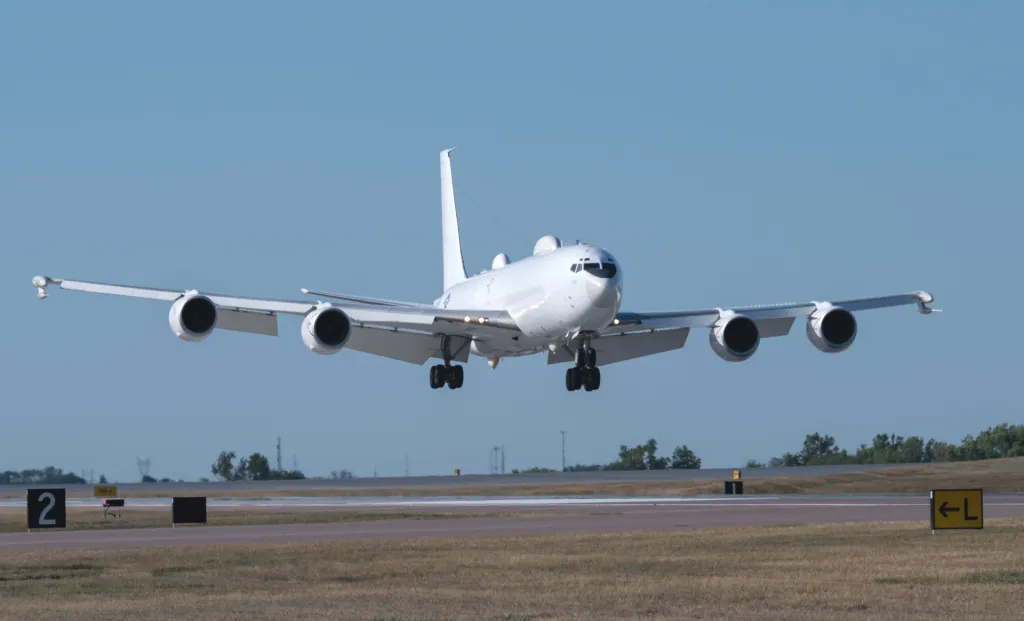
The U.S. Government Accountability Office (GAO) says concerns it raised last year about the U.S. Navy’s E-130J Phoenix II program “have morphed into realities.” The timeline for moving from the development of the aircraft to putting it into actual production has already slipped by approximately one year. The E-130Js are set to supplant aging E-6B Mercury jets in support of the Take Charge And Move Out (TACAMO) mission. This involves providing aerial command and control support for nuclear ballistic missile submarines, including the ability to send them orders to launch strikes while they are submerged. Platforms tasked with nuclear support missions like TACAMO are commonly called ‘doomsday planes.’
GAO has provided a new update on the E-130J effort in its latest annual assessment of multiple high-profile U.S. military procurement programs. The Congressional watchdog released this report earlier today.
In last year’s iteration of this report, GAO explicitly called into question the choice of C-130J-30 Hercules aircraft, a four-engine turboprop transport plane, as the basis for the E-130J, warning that it might “not meet operational availability requirements.” The existing 16 E-6B aircraft are based on the larger, jet-engined Boeing 707 airliner, which is now long out of production. It is important to note that the Mercury fleet also supports a U.S. Air Force nuclear mission set called the Airborne Command Post (ABNCP), and more commonly known by the nickname Looking Glass. In that role, the planes provide aerial command and control support to nuclear-capable bombers and silo-based Minuteman III intercontinental ballistic missiles. They are equipped to initiate the launch of Minuteman IIIs while in flight. The forthcoming Phoenix IIs will only be tasked with the TACAMO mission, something we will come back to later on.
An E-6B Mercury ‘doomsday plane.’ USAF
“As we reported in last year’s assessment, the Navy awarded its contract despite significant technical risks it acknowledged the E-130J program faced. A September 2024 independent technical risk assessment highlighted the complexity associated with the program’s planned integration effort, which officials acknowledged could increase as they integrate additional technologies,” per GAO’s latest assessment. “Since our 2024 report, the program has delayed its low-rate production decision by approximately a year as these system integration risks have morphed into realities.”
“For example, program officials said that contractors are now focused on modifying already-existing mission systems to reduce their weight, which the independent assessment anticipated would be necessary to accommodate them on the C-130J-30 airframe,” the report released today adds.
The first C-130J-30 Hercules airframe destined to be converted into a pre-production E-130J is rolled out in 2025. USN
“The program office stated that the E-130J program remains on track to recapitalize TACAMO capability through developing an MVP [minimum viable product], iterating system capabilities through software improvements, and establishing digital frameworks,” according to GAO. “The program office also stated that it is aligned with Secretary of Defense guidance through an acquisition approach that allows for tradeoffs and implementation of a modular open systems approach. The program office did not provide any documentation to substantiate any of these claims, which run counter to our own analyses of E-130J program documentation.”
In its annual assessment last year, GAO said the Navy “acknowledges technical risk,” but also that the service had highlighted “risk reduction contracts with subcontractors to address obsolescence and size, weight, and power-cooling risks.”
The Navy’s Fiscal Year 2027 budget request provides some additional context about the suite of systems the E-130J will need to perform the TACAMO mission.
“A dedicated communications platform, TACAMO aircraft features the ability to communicate on virtually every radio frequency band from very low frequency (VLF) up through Advanced Extremely High Frequency (AEHF) using a variety of modulations, encryptions and networks, maximizing the likelihood an emergency message is received by U.S. strategic forces,” per the Navy’s budget documents. “Included in these efforts are Government and Contractor Systems Integration Laboratories, Contractor System Test Integration Laboratory, Government Furnished Property (National Security Agency approved encryption devices, Ultra High Frequency modems), High Frequency and the Advanced Extremely High Frequency solutions, Top Secret network development and building required infrastructure includes power generation systems, cooling, flight deck avionics, Electric Magnetic Pulse (EMP) hardening, cyber hardening, and structural modifications to support integration of E-130J mission system equipment.”
A particularly notable and critical capability found on the existing E-6Bs is the ability to extend a five-mile-long antenna to communicate with submerged submarines. The E-130J will have a very similar, if not identical, antenna system to support the TACAMO mission.
A rendering of an E-130J Phoenix II. Note the antennas trailing behind. Northrop Grumman
As it stands now, the Navy plans to acquire six pre-production E-130Js in Fiscal Year 2027 to support different aspects of the aircraft’s ongoing development. At least one initial example is already being built. Some portion of those test aircraft might eventually take on operational roles. In its latest report, GAO says a critical design review is expected to come at the end of next year. With the aforementioned delay, the decision to then move into low-rate initial production (LRIP) is now projected to occur in April 2029. The initial LRIP lot is expected to be between three and six aircraft, but the total expected size of the E-130J fleet is unclear.
It is worth remembering that the Navy did previously operate modified C-130s in the TACAMO role before the first E-6A arrived in 1989. The Navy subsequently upgraded those aircraft in the late 1990s and early 2000s to the E-6B standard.
The US Navy operated a fleet of EC-130Q TACAMO aircraft like the one seen here before the arrival of the E-6As. USN
TWZ has previously explored the pros and cons of going back to a C-130-based platform for this critical Navy mission set, writing:
“It’s certainly worth pointing out that the E-6Bs, conversions of what were some of the last and most modern 707 airliners built, were larger and higher performance platforms than the EC-130Qs. The C-130J-30 is certainly a more capable aircraft than the C-130H on which the EC-130Q was based, but it won’t have the base speed and altitude capabilities of an airliner-sized multi-engine jet. Compared to the Mercuries, any TACAMO-configured C-130J-30 would not be able to get on station as quickly, or fly as high, limiting its ability to get above bad weather or establish a better line of sight for its communications systems.”
“At the same time, as the Navy itself has noted, the C-130J-30 platform does immediately open up the ability to use a larger number of air bases, airports, and airfields, including austere ones that the E-6B cannot operate from. This could be very useful in a contingency scenario where an opponent may have destroyed or otherwise rendered unusable many well-established bases, as well as larger secondary dispersal sites, which include large commercial airports. Being able to fly from smaller, tertiary locations could help to ensure that the TACAMO mission continues without significant disruption under such circumstances. This is also true during peacetime as targeting the TACAMOs on the ground would be much harder if they could easily operate from and sit alert at a much larger number of airports.”
“A C-130J-30 configured for the TACAMO mission would certainly have a mid-air refueling capability and the Hercules is already a platform that has demonstrated the ability to loiter over particular areas for long periods of time. Unlike the Boeing 707, the C-130J is still in production, as well, meaning that TACAMO aircraft based on this plane would be inherently easier to maintain and support logistically, and may also be easier to convert to this specialized configuration begin with. As time goes on, the J looks set to increasingly become the default base C-130 model across the U.S. military, as well. Compared to the long out of production 707-based E-6, support for the C-130J is already distributed across the U.S., and beyond. Training C-130J crews is even an easier proposition.”
Another look at one of the current E-6B Mercury aircraft. USN An E-6B Mercury. USN
The issue increasingly looming now is the age of the existing E-6Bs, which are becoming increasingly more challenging to operate and sustain. As noted, the Mercury fleet represents some of the very last 707s ever built before Boeing shuttered that line for good in 1991. The Navy’s plans to phase out the E-6Bs as the E-130Js arrive to help avoid any capacity gaps, which means the Mercury fleet will have to soldier on until that happens.
Last year, the Navy confirmed that it had scrapped plans to convert an ex-Royal Air Force E-3D Sentry airborne early warning and control aircraft, another Boeing 707-based type, into a dedicated TE-6B crew trainer, something TWZ was first to report. The TE-6B was explicitly intended to help relieve strain on operational E-6Bs. The Navy is now utilizing a contractor-owned, but government-operated (COGO) Boeing 737NG airliner to help meet pilot training demands.
The ex-Royal Air Force E-3D seen in the proess of being converted into the TE-6B trainer before that effort was abandoned. USN
To reiterate, the current plan is also for the E-130J to only perform the TACAMO mission. The Air Force is now in the very early stages of a separate effort to acquire what it is currently calling Looking Glass-Next (LG-N) to take over that mission from the E-6B fleet.
Part of that solution may entail integrating ABNCP-specific capabilities onto its future Boeing 747-based E-4C Survivable Airborne Operations Center (SAOC) jets. The E-4Cs are set to replace the service’s four E-4B Nightwatch aircraft, as you can read more about here. The existing E-4Bs already have a ‘doomsday plane’ role, but do not have the exact same mix of capabilities as the E-6B. The Nightwatch jets notably lack the ability to order launches of Minuteman III IBCMs while in flight.
For the Air Force, the LG-N program is tied to larger nuclear command and control modernization plans, which might see more of these functions move to space-based assets, as well. All of this is also heavily intertwined with the ongoing development of the new LGM-35A Sentinel ICBM. Sentinel suffered huge setbacks, delays, and cost overruns, but primarily with the infrastructure side of the program, not the missile, as you can read more about here.
Enabling Peace Through Deterrence
When it comes to the Navy’s TACAMO modernization plans, challenges in integrating the necessary capabilities onto the C-130J-30 platform have now set back these efforts at least by a year.
WASHINGTON — The Democratic National Committee is organizing hundreds of community events across the country this weekend in hopes of harnessing the same concerns about affordability that President Trump capitalized on to return to the White House.
The events include school supply giveaways, food bank drives, neighborhood door knockings and organizer trainings.
“Everything costs too damn much under Donald Trump and the Republicans,” Democratic National Committee Chair Ken Martin said in a statement.
Martin said party members planned “to reach, engage, register, and mobilize voters who will make the difference in races up and down the ballot.”
Two years ago, Democrats were the ones accused of being indifferent to Americans’ anger about rising prices. Now they’re pointing the finger at Trump, who has downplayed the effect of lingering inflation.
He has described affordability concerns as a “hoax” and recently said, “I love the inflation” because he expects costs to drop as he tries to resolve his war with Iran.
About one-third of U.S. adults approve of how Trump is handling the economy, according to an AP-NORC poll from June. That’s down from the start of his second term, when 40% approved.
About 7 in 10 U.S. adults say the country’s economy is “poor,” according to an AP-NORC poll from June. That’s up from 65% in March, and underscores Americans’ ongoing unhappiness with the cost of living, which is being compounded by high gas prices because of the war in Iran.
Slightly more U.S. adults say the Democratic Party would do a better job than the Republican Party in handling inflation and the cost of living, according to a Marquette Law School/SSRS poll from May. Roughly one-third of U.S. adults — 35% — said the Democrats would do a better job, while 28% believe the Republicans would. Roughly one-third say the parties would be the same, or neither would be good.
This weekend’s events vary by region.
In New Mexico, Gov. Michelle Luján Grisham will convene a training for 150 potential campaign staffers. Nevada’s statewide campaigns will knock on doors in rural and working class neighborhoods. Others will call voters in swing districts with competitive U.S. House races to talk about the rising price of gas.
Some events are geared toward directly helping voters to persuade them that Democrats are concerned about affordability.
For instance, the local party in Kenosha County, Wis., plans to collect and distribute school supplies to poor families. And canvassers will fan out to discuss affordability issues in Arizona, Pennsylvania and Wisconsin.
The Republican National Committee dismissed the weekend’s events.
“Despite being millions of dollars in debt, the DNC is choosing to throw pitiful pep rallies to distract from the fact they created the inflation crisis,” said Delanie Bomar, an RNC spokeswoman. “Meanwhile, Republicans are hard at work fixing the economic mess Joe Biden and the Democrats created.”
Democrats hope that the events will show that their time in the political wilderness has made them more serious and effective at tackling kitchen table issues. But some fear their agenda may not be heard by voters in an increasingly fractured media environment.
“One of Donald Trump’s greatest strengths is that he’s so loud,” said Brian Derrick, a Democratic strategist. He said that events like the weekend’s itinerary help Democrats focus on an “Achilles’ heel” issue for Trump, “which right now is his lack of interest in addressing everyday costs for people.”
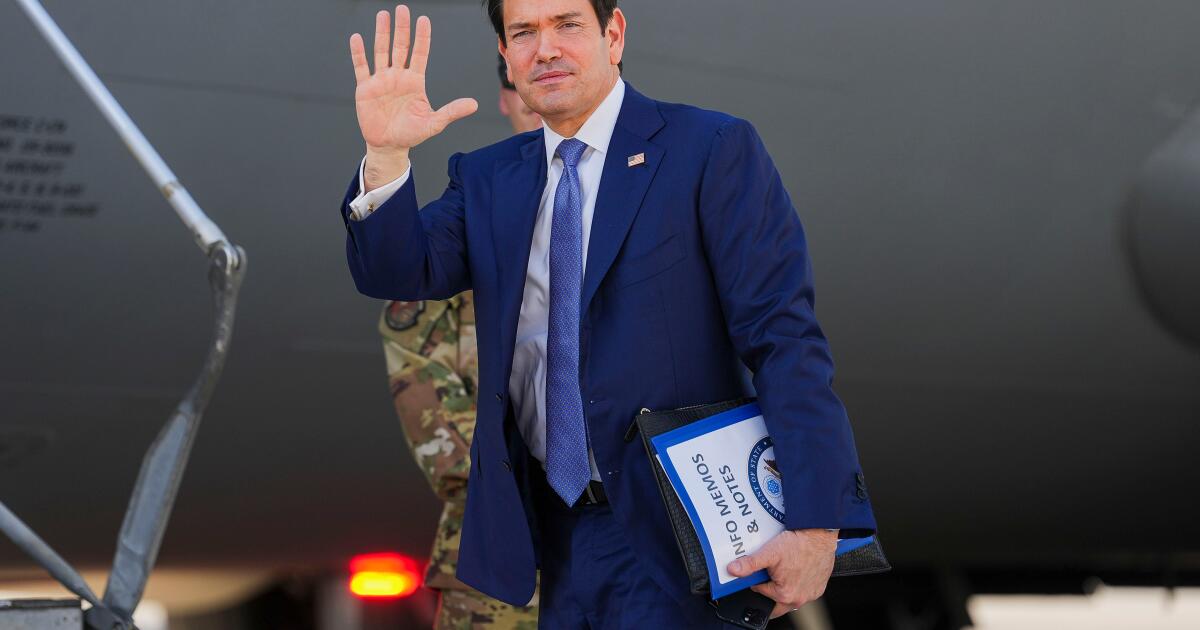
MANAMA, Bahrain — U.S. Secretary of State Marco Rubio said Thursday that relations between the United States and its gulf Arab partners are rock solid, despite fears by some of them that they might be left out of discussions aimed at ending the war with Iran.
Rubio used a three-day, three-nation trip to the United Arab Emirates, Kuwait and Bahrain this week to try to convince all the members of the Gulf Cooperation Council that the Trump administration does indeed have their backs in negotiations to end the war President Trump and Israel launched on Feb. 28.
That conflict sharply curtailed the region’s oil exports and saw several gulf countries take direct retaliatory Iranian missile and drone hits.
“They’ve shared with us some very concrete concerns, ideas,” Rubio said in Bahrain, the last stop on the trip. “And when I say concern, the biggest concern is that they really just want to be informed every step along the way as we enter these negotiations at both the technical and political levels.
“We want them to be involved and we want the views of all these countries to be reflected,” he said. “We don’t want to and will not be making any decisions or commitments that in any way undermines the prosperity, stability or security of our gulf partners.”
Although the U.S. and the gulf council members — Bahrain, Kuwait, Oman, Qatar, Saudi Arabia and the United Arab Emirates — eventually released a joint statement after the meeting that extolled areas of agreement about the end goals of the Iran deal, there were small signs of potential discontent.
The joint statement said the two sides “stressed the need to maintain momentum and unity as negotiations proceed toward a more permanent end to hostilities and the shared objective of preventing Iran from ever developing or otherwise acquiring a nuclear weapon.”
They also expressed opposition to any attempt by Iran to impose tolls or fees, or assert control over the Strait of Hormuz. They welcomed an Omani initiative to create a safe lane to evacuate stranded sailors from the waterway and stressed that any economic benefit Iran might realize “is conditional and reversible, contingent on Iran’s compliance” with the temporary agreement and a final deal.
The joint statement painted a rosy picture, yet the council secretary, Gen. Jasem Mohamed Albudaiwi, suggested in a statement that doubts remain.
He said it was emphasized during the meeting that any future understandings or arrangements must incorporate the requirements of the gulf council countries to safeguard their interests and ensure “their security and stability.” His statement, released by the group, hinted that the gulf council members felt snubbed in the earlier talks.
“Such arrangements must be based on the principles of international law, respect for state sovereignty, good neighborliness, and non-interference in internal affairs, thereby contributing to the consolidation of regional security and stability,” he said.
Before Rubio spoke to the group, the meeting host, Bahraini Foreign Minister Abdullatif bin Rashid Al Zayani, said that although the memorandum of understanding is welcome, many questions remain outstanding.
“While this progress is encouraging, it is critically important that Iran fully adheres to its obligations,” including under the memorandum, he said.
He said that means preventing Iran from getting a nuclear weapon, preserving freedom of navigation, ending all missile and drone attacks, halting support for proxy groups and abandoning attempts to interfere with Iran’s neighbors.
At the time of writing, Brent crude was down 0.91% at $79.12 a barrel, while US West Texas Intermediate (WTI) crude had fallen 0.70% to $75.32 a barrel.
ADVERTISEMENT
ADVERTISEMENT
Lower crude prices reflected broader investor sentiment in early trading after Qatari and Pakistani mediators said the first round of negotiations between the US and Iran aimed at securing a final agreement to end the conflict had concluded with “encouraging progress”.
A memorandum of understanding signed last week includes a commitment to reach a final agreement within 60 days, an end to fighting on “all fronts” – including in Lebanon – and the reopening of the Strait of Hormuz.
Markets mixed as analysts monitor US-Iran negotiations
Meanwhile, Asian stocks were mixed on Monday, with markets in Japan and South Korea trading higher, while US futures traded lower.
Tokyo’s Nikkei 225 jumped 1.6% to 72,364.82 after reaching a new all-time high of 72,831.73 during intraday trading, helped by technology stocks fuelled by enthusiasm over the global artificial intelligence boom.
Japan’s SoftBank Group, the multinational investment holding company with a strong AI focus, rose 2.4%, while chip equipment maker Tokyo Electron gained 2.3%.
South Korea’s Kospi added 0.4% to 9,084.37 and was trading near record highs, led by AI-related shares. Memory chip maker SK Hynix surged 4.7%.
“We’re seeing another strong market today,” Neil Newman, managing director and head of strategy at Astris Advisory Japan, said. He cautioned that the Japanese market was “probably getting a little stretched” from an investor’s point of view, “especially with what’s going on in the Middle East”.
Hong Kong’s Hang Seng fell 1% to 23,690.86, while the Shanghai Composite Index edged 0.2% higher to 4,098.01.
A viral youth satirical protest movement, the Cockroach Janta Party, has emerged following exam cancellations last month.
Published On 16 Jun 202616 Jun 2026
India has blocked the Telegram messaging app until Monday and ordered the platform to disable the editing feature on messages already posted, saying the platform has been used to “defraud candidates” and for “paper leaks” regarding upcoming national student examinations.
The restriction was issued on Tuesday under a stringent provision of the IT law, which empowers the government to block access to online sites in the interest of India’s “sovereignty and integrity”.
Recommended Stories
list of 4 itemsend of list
Activists said the provision is used to curb free speech although Prime Minister Narendra Modi’s government said it acts in compliance with the law and in the public interest.
Last month, the government cancelled a key undergraduate entrance exam for medical schools known as the National Eligibility-cum-Entrance Test (NEET) after authorities discovered the questions had been leaked beforehand.
The leaks led to a series of student protests across the country, including the emergence of a satirical viral movement, the Cockroach Janta Party, that demanded the resignation of Education Minister Dharmendra Pradhan.
The government has scheduled a new examination for Sunday.
The restrictions on Telegram were imposed “in response to the organised use of the platform by cheating rackets to defraud candidates appearing for the NEET 2026 re-examination scheduled on 21 June 2026”, the Ministry of Education’s National Testing Agency said in a statement.
Telegram has grown rapidly in India, and the country is its biggest market for downloads although WhatsApp remains the dominant messaging platform.
The government said it “regrets the inconvenience caused” due to the blocking of the application, which will affect hundreds of thousands of people, but it said it is a measure of “last resort” as earlier attempts to take down content from the platform had not produced results.
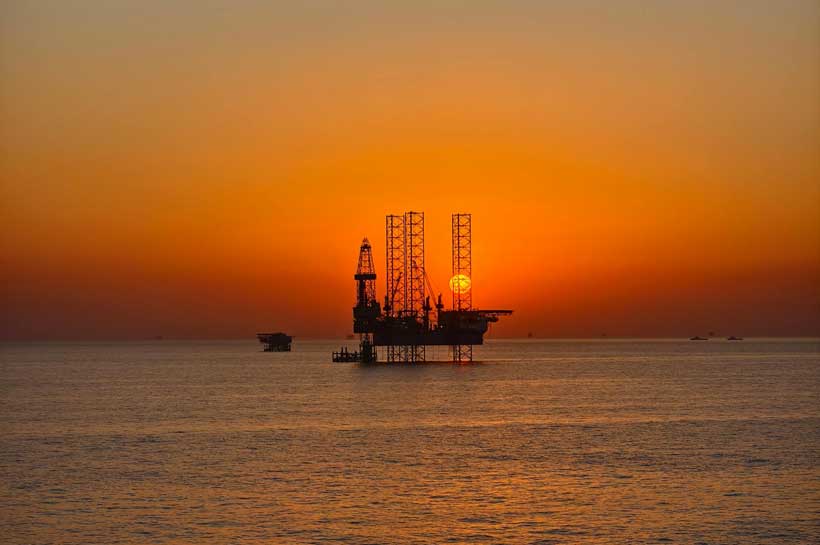
Kazakhstan’s Energy Minister Yerlan Akkenzhenov said international partners are urging the country to increase oil exports as concerns grow over disruptions to energy supplies linked to tensions around the Strait of Hormuz.
According to Akkenzhenov, buyers are seeking the maximum possible increase in Kazakh oil shipments due to uncertainty surrounding one of the world’s most important energy transit routes. However, he noted that Kazakhstan faces infrastructure and production constraints that limit how quickly exports can be expanded.
To support higher output, Kazakhstan has postponed planned maintenance work at the Kashagan Oil Field until 2027. The country is also considering increasing crude shipments through the Baku Tbilisi Ceyhan Pipeline, potentially raising volumes from 1.5 million tons to 2.2 million tons annually and beyond.
The development comes as global energy markets remain sensitive to geopolitical tensions involving Iran and the Strait of Hormuz, a key route for international oil and gas exports.
Why It Matters
Kazakhstan’s growing importance highlights how global energy markets are seeking alternative supply sources amid rising geopolitical risks in the Middle East.
Any disruption in the Strait of Hormuz could affect a significant share of global oil shipments, prompting importers to diversify supply chains and reduce dependence on vulnerable routes. Kazakhstan, one of the world’s major oil producers, is increasingly viewed as a reliable alternative supplier.
The decision to delay maintenance at Kashagan signals that Kazakhstan is prioritizing production stability and export capacity at a time when energy security has become a major concern for consuming nations.
The move could also strengthen Kazakhstan’s strategic position in global energy markets, giving it greater influence as countries seek dependable suppliers outside conflict affected regions.
Key Stakeholders
Kazakhstan – Seeking to expand exports while balancing OPEC+ commitments.
Yerlan Akkenzhenov – Overseeing the country’s energy strategy.
Kashagan Oil Field – One of the world’s largest oil fields and a key source of future production growth.
OPEC+ members monitoring compliance with production agreements.
Energy importing countries seeking alternative crude supplies.
Oil traders and global energy markets responding to supply risks.
Countries along the Baku Tbilisi Ceyhan Pipeline route that facilitate exports to international markets.
Future Outlook
Kazakhstan is likely to face increasing pressure from international buyers if instability around the Strait of Hormuz persists. While production constraints may limit immediate gains, the postponement of Kashagan maintenance suggests authorities are positioning the country to maximize output over the coming years.
The expansion of exports through the Baku Tbilisi Ceyhan pipeline could become increasingly important as energy consumers seek routes that bypass geopolitical hotspots. This would further enhance Kazakhstan’s role in global energy diversification efforts.
However, Kazakhstan must also balance market demand with its commitments under the OPEC+ framework. Any significant increase in production could attract scrutiny from fellow producers seeking to maintain supply discipline and price stability.
If Middle East tensions remain elevated, Kazakhstan is likely to emerge as one of the key beneficiaries of the global search for secure and reliable oil supplies.
Two separate incidents of violence have left nine people injured in World Cup host cities in the United States, raising concerns over the safety and security of fans attending the tournament that starts in three days.
Six people were wounded in a stabbing on Sunday at New York’s Penn Station, the city’s mayor said, as the metropolitan area geared up to host two major sporting events, the NBA Finals and the FIFA World Cup.
Recommended Stories
list of 4 itemsend of list
Meanwhile, nine people sustained non-life-threatening injuries in a shooting near England’s World Cup base camp in Kansas City, Missouri, on Saturday.
The New York City Fire Department said a suspect was detained and the victims, including one with serious injuries, were taken to hospital.
Fire Department officials initially reported five wounded, but Mayor Zohran Mamdani said on X that “based on the information available right now, six people were stabbed and the alleged perpetrator is in custody.”
Circumstances of the attack were not immediately clear, but city Comptroller Mark Levine said on X that the suspect is “said to be an emotionally disturbed homeless person”.
All victims are expected to survive, he added.
State Governor Kathy Hochul described the attack as “an act of horrific violence”.
“New Yorkers deserve to feel safe wherever they go, and we will never stop working to make that a reality,” she said in a statement.
The incident occurred at one of the nation’s busiest rail and subway transport centres as the city prepares for two huge sporting spectacles.
Madison Square Garden, located directly above Penn Station in downtown Manhattan, will host games three and four of the NBA Finals on Monday and Wednesday between the New York Knicks and the San Antonio Spurs.
MetLife Stadium, outside the city in neighbouring New Jersey state, will host its first match of the World Cup on Saturday.
[Al Jazeera]
US President Donald Trump is scheduled to attend Monday’s NBA game at Madison Square Garden, saying recently that he accepted an invitation from Knicks owner James Dolan.
Security has been enhanced in the city before the two events.
New York’s official emergency notification system did not describe the incident but said people should avoid the area and “expect traffic delays, road closures, mass transit disruptions & emergency personnel near Penn Station”.
Before the stabbing, New York officials had already cancelled an outdoor watch party set for Monday outside the Garden.
Thousands of spectators descended onto the streets outside the venue on Friday for a game two watch party. New York authorities said a police officer was assaulted and 26 people were arrested as a number of fans turned rowdy.
Meanwhile, Kansas City police said there were no suspects in custody and that at least three of the shooting victims were taken to local hospitals.
The incident occurred about 6.5km (4 miles) from where England are set to train at the Swope Soccer Village. England have not arrived in Kansas City and are due to play a friendly against Costa Rica in Orlando, Florida, on Wednesday.
The Arrowhead Stadium, rebranded as Kansas City Stadium, will host World Cup games [Charlie Riedel/AP]
What security measures has the US put in place for the World Cup?
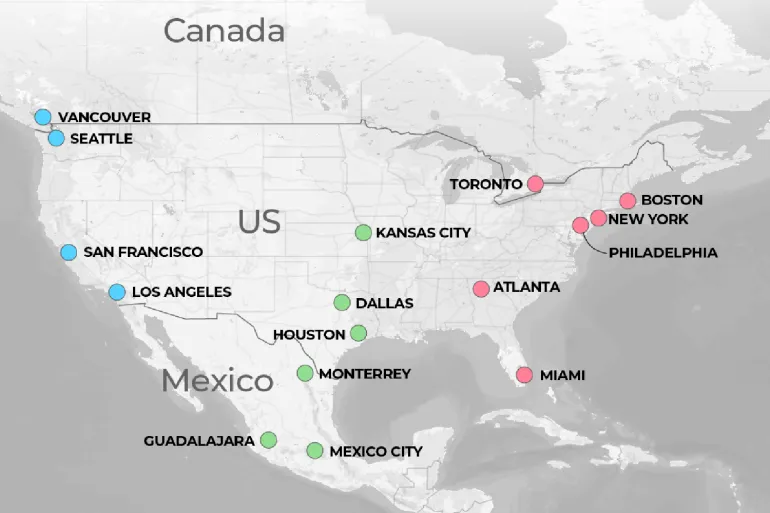
The 48-team, 104-match World Cup comes with an unprecedented security challenge for the host nations, particularly the US, which is hosting 78 matches across 11 cities.
Overseeing the sprawling security apparatus is a legion of federal agencies, state and local police departments and private entities. Their responsibilities range from securing stadiums and fan zones to escorting teams and protecting dignitaries.
Their tools include hunter drones that can shoot nets over objects in restricted airspace, bag-inspecting robot dogs, giant X-ray trucks and thousands of AI-powered cameras trained on public spaces soon to be thronged by fans.
Drones are prohibited over stadiums and fan zones, and the FBI has a “full suite of options” to thwart incursions, according to FBI Special Agent in Charge Amit Kachhia-Patel.
On match days, the FBI will activate joint operations centres in each host city, bringing together local, state and federal law enforcement agencies to monitor and investigate threats.
The tournament has the same high-level federal security designation as the Super Bowl, just below a presidential inauguration or a national political convention, ensuring federal, state and local coordination. It coincides with other major events linked to the 250th anniversary of the US’s founding.
So far, there are no credible threats, according to Andrew Giuliani, executive director of Trump’s World Cup task force, which is overseeing the multiagency effort.
The Department of Homeland Security, focused on Trump’s immigration enforcement crackdown and hit by a funding lapse only recently resolved, estimates that up to seven million people will visit the US for the World Cup.
The US Secret Service, under scrutiny after security breaches and attempts on Trump’s life, is in charge of protecting world leaders who show up to cheer on their countries. Trump has expressed interest in attending a match.
Gun violence is common in the US, where there were more than 400 mass shootings in 2025, according to the Gun Violence Archive.
The administration of US President Donald Trump has proposed new tariffs of up to 12.5 percent on imports from 60 economies after determining they had failed to curb trade in goods made with forced labour, an assertion that was rejected by US trading partners.
The proposal from the Office of the United States Trade Representative (USTR), issued late on Tuesday, comes from a Section 301 unfair trade practices investigation designed to help rebuild US President Donald Trump’s emergency tariffs, struck down by a US Supreme Court decision in February.
Recommended Stories
list of 4 itemsend of list
Despite laws banning them, the products of forced labour are deeply embedded in supply chains across the world. European lawmakers bristle at the accusation that the region is less effective than the US at curbing the trade in such goods, with one describing the US findings as “utterly absurd”. Business leaders said the US move created more confusion for companies.
The USTR proposed 10 percent additional duties on imports from Canada, Ecuador, the European Union, Indonesia, Mexico, Pakistan, Argentina, Bangladesh, Cambodia, El Salvador, Guatemala, Malaysia, Taiwan and Britain. The USTR said all had plans or partial schemes in place.
The trade agency said it would impose additional duties of 12.5 percent on the remaining 45 countries that it investigated. These include China, India, Nigeria, Japan, South Korea, Vietnam, Australia and New Zealand.
“The failure of our most important trading partners to address the importation of goods made with forced labour is unacceptable,” US Trade Representative Jamieson Greer said in a statement. “This creates a dynamic where American workers are forced to compete globally on an unlevel playing field.”
The USTR said it would accept public comments on the proposed tariffs and other remedies through July 6, with a public hearing scheduled for July 7.
The announcement comes ahead of the July 24 expiration of a 10 percent temporary tariff imposed by the Trump administration on February 20, the day the Supreme Court struck down Trump’s tariffs under the International Emergency Economic Powers Act. It also shows how determined the Trump administration is about building a wall of tariffs around the US economy, the world’s largest, despite repeated setbacks in court.
After the loss in the Supreme Court, Trump turned to another law to impose temporary 10 percent tariffs globally. But those stopgap levies expire July 24. And a specialised trade court ruled last month that they, too, were illegal – though the government can continue collecting them while that case works its way through the courts.
Unjustified tariffs
The European Commission said the tariffs were unjustified and reiterated its commitment to the trade deal sealed with Washington last year.
Bernd Lange, the chair of the European Parliament’s trade committee, which voted on Tuesday to accept that trade deal, said the new tariffs were expected, but said the results of the US investigation were still “utterly absurd” given a 2024 EU law to ban imports of forced labour products.
“The impression is increasingly emerging that a tariff measure is sought first, and only then is a suitable legal justification found,” he said. However, he added that the key question would be whether the additional tariffs would exceed those agreed between both sides last July.
The US’s largest trading partner, the EU, agreed last July to accept tariffs of 15 percent on a broad range of its exports. In its report, the USTR said the EU anti-forced labour measures only came into force in December 2027 and lacked key elements.
It was unclear whether the proposed tariffs – which the US release described as “additional duties” – would come on top of levies agreed in bilateral deals signed with the US.
Britain said it was in regular talks with the US and was taking action to tackle forced labour. It added that the preferential access to US markets that it had negotiated for UK businesses remained in place.
Mexico said that goods that were compliant under the United States-Mexico-Canada Agreement (USMCA) would be exempt from the new tariffs.
Taiwan said it was “hopeful and confident” that the final results would reflect agreements already reached, securing relatively preferential treatment.
Beijing, facing 12.5 percent tariffs, said that it opposed all forms of unilateral tariffs and that there was no forced labour in China. India, confronted with the same rate, said it was engaged with Washington on the Section 301 proceedings, noting the proposed tariffs were not final.
“There will be deep concerns in the international business community that the US [forced labour law could] become a global template,” said Andrew Wilson, deputy secretary general of the International Chamber of Commerce.
“Anyone can make a claim, get a shipment impounded and the company has to prove no forced labour in supply chain.”
Certain exemptions
The USTR said it would exempt from tariffs products including energy, rare earths and some other metals, beef, coffee, certain fruits and vegetables, pharmaceuticals, organic chemicals and aircraft parts.
It also said it was proposing a textile mechanism that would allow for a certain volume of apparel and textile imports to enter the US at a reduced tariff rate, without giving details.
The ICC’s Wilson said the list of exemptions, stretching for more than 76 pages, suggested sensitivities over the potential cost-of-living hit to food and other goods with known forced-labour risks.
“It doesn’t make sense if the object of this is to enhance controls on modern slavery,” he said.
1 of 2 | Florida is suing OpenAI and its CEO and founder Sam Altman over safety and design concerns about ChatGPT. File photo by Wu Hao/EPA-EFE
June 1 (UPI) — Florida’s attorney general announced Monday that the state is suing OpenAI and its founder and CEO, Sam Altman, saying the company chose “profits over public safety” in creating a dangerous product in the form of ChatGPT. It is the first state to sue the company over these design and safety concerns.
“The rise of OpenAI is attributable to a web of deceit and the exploitation of users (including Floridians), leveraging their data and safety to boost OpenAI’s market value at unacceptable costs,” the complaint filed by Attorney General James Uthmeier said, NBC News reported.
The lawsuit claims that OpenAI violated Florida’s rules on deceptive business practices and knew that its chatbot could be dangerous to children and others through actions such as providing “harmful information such as tips on eating disorders, self-harm and mass murder,” The New York Times reported. It says OpenAI presents “a great danger of addiction, cognitive decline, suicide, violence and related harms.”
The civil suit is separate from Florida’s ongoing criminal investigation into OpenAI, which Uthmeier openedin April. It includes multiple counts of deceptive and unfair trade practices, negligence, violations of product liability laws, fraudulent misrepresentation and causing a public nuisance.
OpenAI representatives have not yet commented on this lawsuit. Representatives have said in response to past claims that the company designs its systems with safety in mind and that there are “safeguards in placeto help people, especially teens, when conversations turn sensitive.”
“We continue improving ChatGPT’s training to recognize and respond to signs of mental and emotional distress, de-escalate conversations and guide people toward real-world support,” the company said in a prior statement.
The lawsuits also mentions OpenAI’s connections to a mass shooting at Florida State University and killings at the University of South Florida. In both cases, suspects asked ChatGPT for information connected to the attacks.
The Spanish fashion giant behind Zara, Inditex, posted net income of €1.4 billion in the first quarter, up 5.4% year-on-year and ahead of market expectations.
ADVERTISEMENT
ADVERTISEMENT
Sales rose 5.8% to €8.7bn, or 8.8% at constant exchange rates, ahead of the roughly 8% analysts had anticipated.
Gross profit rose 6.9% to €5.4bn, helped by an improvement in profit margins, meaning the company kept a larger share of revenue as profit. EBITDA, a measure of underlying earnings, increased 7.3% to €2.6bn.
Inditex shares rose more than 5% on Wednesday after the company reported a strong start to the second quarter, with sales increasing 11.5% between 1 May and 1 June, reassuring investors that the Zara owner remains resilient despite signs of weakening consumer spending.
“Inditex continued its strong momentum with its latest results beating first quarter expectations, and also seen a strong start to the second quarter too, as sales grew more or less in line with the rate the company exited with in the previous quarter,” said Mamta Valechha, consumer discretionary analyst at Quilter Cheviot.
The revenue jump from one of the world’s largest listed clothing retailers points to solid consumer appetite heading into the summer, despite concerns that a more uncertain economic and geopolitical backdrop could weigh on spending in the months ahead.
Navigating geopolitical risks
The results come as businesses around the world face growing uncertainty over the global economy and concerns that consumers may cut back on spending.
Inditex said its wide-ranging supply chain and flexible transport network had helped it keep products flowing to stores around the world despite recent disruptions.
“Ultimately, Inditex continues to have a resilient business model that can withstand significant economic pressures and currency headwinds,” said Mamta Valechha, consumer discretionary analyst at Quilter Cheviot.
Valechha said strong customer demand and the company’s ability to source products close to its key markets had helped it keep collections up to date while limiting the need for discounts. Productivity improvements had also helped protect profitability.
Inditex also said that the current “geopolitical challenges” had an impact on the sales in the Middle East, a region that Barclays estimates accounts for about 5% of its revenue.
The company also warned that ongoing instability in the region could affect its performance in the months ahead.
Inditex faces a number of other challenges, including higher shipping costs and rising prices for raw materials such as cotton and polyester. Currency movements are also expected to weigh on results this year.
Inditex ended the quarter with 5,456 stores and a net cash position of €10.8bn.
The board has proposed a dividend of €1.75 per share for the last fiscal year, comprising an ordinary component of €1.20 and a bonus of €0.55, payable in two instalments in May and November 2026.
Despite the strong start to the year, Inditex left its outlook unchanged. It said it expects sales growth to continue into the second quarter, supported by strong demand for its spring and summer collections and ongoing improvements to its stores and operations.
However, the company said currency fluctuations are likely to reduce sales growth by around 1% over the full year. It also expects to invest about €2.3bn in the business during the current financial year.