company

‘Fortnite’ maker Epic Games lays off 1,000 employees

Epic Games, the developer of the popular video game “Fortnite,” is laying off more than 1,000 employees and cutting $500 million in costs.

Chief Executive Tim Sweeney announced the cuts Tuesday morning in a message to employees. He said it has nothing to do with AI and instead pointed to what he said was a lack of “Fortnite” engagement last year.

“Despite Fortnite remaining one of the most successful games in the world, we’ve had challenges delivering consistent Fortnite magic with every season,” said Sweeney in a statement.

The company’s flagship game was first released in 2017. Since then, it’s been a key part of internet culture — where character-specific dances became widespread trends and major musicians, like Travis Scott and Ariana Grande, have hosted concerts in the virtual realm.

But Epic has been slow to optimize the computer game for mobile play. A “Fortnite” app was first introduced in 2018, but soon removed due to a legal battle against Apple and Google over app store practices. Sweeney said the company is still in the “early stages of returning to mobile and optimizing Fortnite for the world’s billions of smartphones.”

Many of Epic’s woes also come from industry-wide challenges, like “slower growth, weaker spending, and tougher cost economics,” Sweeney wrote. And Epic isn’t the only one suffering. In recent years, gaming companies like Electronic Arts and Microsoft’s Xbox division have all cut down their workforces.

Earlier this year, the State of the Game Industry Report from the Game Developers Conference found roughly one-third of U.S. video game industry workers were laid off in the past two years.

Epic Games was founded in 1991 and is headquartered in Cary, North Carolina. It has dozens of offices around the world, including in Los Angeles. Beyond “Fortnite,” the company is known as a leader in 3D engine technology and interactive entertainment.

Over the years, Epic Games has steadily built itself into a major Hollywood player. Its 3D creation tool, the Unreal Engine, has been used to produce visual effects and virtual worlds for shows like Walt Disney Co. and Lucasfilm’s “The Mandalorian” and HBO’s “Westworld.”

In 2024, Disney inked a deal with Epic Games to create a games and entertainment universe with the company’s brands, including Star Wars, Marvel and Pixar. Disney invested $1.5 billion in Epic Games for a minority stake in the company. Newly minted Disney Chief Executive Josh D’Amaro managed the collaboration with Epic Games in his previous role as parks chief to create a Disney world within the popular “Fortnite” game.

Looking ahead, Sweeney plans to focus the company on building “awesome Fortnite experiences” with fresh content and continue to accelerate its developer tools like the Unreal Engine.

Source link

What happens to KNX and other stations when CBS News Radio goes away?

The announcement of the end of CBS News Radio last Friday was met with elegiac tributes to the service that built the foundation of William Paley’s company nearly 100 years ago and brought the heroic work of journalists such as Edward R. Murrow to millions of listeners.

But for the 700 affiliates carrying CBS News Radio, the concerns are more practical as they are faced with finding new national programming that will replace it. CBS Radio News will go silent on May 22.

The shutdown of the historic radio division was part of a division-wide staff cut that will affect 6% of the CBS News workforce. Affiliate stations learned of the decision only minutes before it was released to the press.

The local all-news radio stations carrying the service had to post messages on social media to assure listeners that they were not disappearing — only the national newscasts that were provided by CBS.

KNX, the all-news station in Los Angeles that has carried CBS programming since 1936, posted a lengthy segment on the impending closure and explained how “KNX News is not going anywhere.”

KNX was owned by CBS until 2017. The New York-based Audacy, under its previous name Entercom, acquired the CBS radio stations in 2017. KNX and the other Audacy news stations such as WBBM in Chicago, KCBS in San Francisco and WWJ in Detroit remained CBS affiliates, carrying the hourly CBS newscasts.

The Audacy all-news outlets, which reach around 9 million listeners a month, provided about one-third of U.S. coverage for CBS News Radio, the most of any station group carrying the service.

Audacy said it will find a replacement for CBS News Radio to provide national and international coverage, noting that the mission of its all-news stations will not be affected.

“The vast majority of our news and talk programming remains original and locally-produced, and we are beginning conversations with other national news providers to ensure our listeners continue to have access to world-class programming they value and trust.” said Chris Oliviero, chief business officer for Audacy.

Educating the listening public and advertisers that the stations will be fundamentally the same once CBS is gone will require some effort. KNX and the other Audacy all-news stations have a long association with CBS, which launched their formats starting in the late 1960s.

Along with the hourly newscasts, the stations carried “The Osgood Files,” a massively popular commentary segment hosted by the late former “CBS Sunday Morning” host Charles Osgood, for 46 years until 2017. The jingles and sounders used to identify CBS News network programming heard on the stations for decades have also been part of the listening experience.

Among the possible replacements for CBS News Radio is ABC News Audio, which is the largest network radio news service in the U.S. with 1,500 affiliates. The Audacy stations currently use ABC News content outside of its hourly newscasts.

KFI-AM currently carries the ABC News Audio newscasts in Los Angeles. Exclusivity of the ABC News Audio affiliations are determined on a market-by-market basis, according to a representative at the network.

Fox News Media, the home of the conservative-leaning cable channel, also offers a radio service with hourly newscasts and dedicated reporters, which airs on several hundred stations (the company does not supply a specific number).

While Fox News Radio delivers straight reporting, the service is likely to find a home on some of the conservative talk stations that are currently CBS News affiliates.

Source link

Netflix doubles down on original storytelling in 2026

Rather than chasing sequels and reboots, Netflix is betting its 2026 film strategy on a massive investment in original storytelling and a renewed focus on the theatrical comedy.

The streaming giant’s need for original content is one of the main reasons Netflix fought fiercely to acquire Warner Bros. But even after losing the bid to Paramount earlier this month, the priority remains.

“We’re zigging where legacy studios are zagging,” Dan Lin, Netflix’s film chairman, said Wednesday at Netflix’s slate event in Hollywood.

Last year, 18 of the top 20 theatrical films were based on already established intellectual property, like with sequels and remakes. The only two original ideas to break through were Ryan Coogler’s “Sinners” and Zach Cregger’s “Weapons.” Both of these films were received well by audiences and earned golden statues at this year’s Oscars.

Lin said that at Netflix, 2025’s slate was the “exact opposite,” where half of the films it released last year were based on original storytelling.

“We have a very healthy content budget. So if there’s a great movie out there, we’ll go out and either build it or acquire it,” Lin said.

Bela Bajaria, the company’s chief content officer, said the company isn’t too concerned with the theatrical element that other studios can offer when hunting for these original stories, as Netflix is a streaming-first company.

“We’ve always had competition. This isn’t really any different,” said Bajaria. “It’s to understand what the competition is, not head in the sand at all. [We have] to understand what the market is and continue to look ahead.”

It’s not just original ideas that Netflix is scouting; the streamer’s also looking to fill gaps in genres. In recent years, comedies have fallen out of favor with major studios — leaving room for streamers like Netflix to expand. This year, Netflix is looking to break through with upcoming comedy productions like Kevin Hart’s bachelor party-driven “72 Hours,” John Cena and Eric André’s buddy comedy “Little Brother” and Eva Longoria’s “Fifth Wheel,” which Lin describes as “our version of ‘Bridesmaids.’”

“We’re taking the chance, and we’re making the movies,” Lin said. “It’s what we’re delivering, I hope, [it’s] what audiences want and what they’re craving. There are a lot of genres that you just can’t find in theaters anymore. So, we’re making those kinds of movies.”

In addition to emphasizing comedies, there’s a lot of opportunity to develop young adult films, Lin said. Netflix has upcoming titles such as “Voicemails for Isabelle,” starring Zoey Deutch and Nick Robinson, and “Roommates,” with Sadie Sandler, to draw in younger movie watchers.

One genre in which Netflix doesn’t see much success is live musical adaptations, so it’s “not an area that I’m leaning into,” Lin said. He first joined the company in 2024 and has since green-lighted 88 films.

Netflix subscribers watch about seven movies a month, according to the streamer’s data. So, with the push for original stories, the streamer is hoping to meet its consumers’ demands.

The current strategy is to release up to four “event films” a year. For 2026, Netflix is looking at Greta Gerwig’s “Narnia” adaptation and David Fincher’s follow-up to “Once Upon a Time … in Hollywood” as its big hitters.

“It’s all very under wraps right now, but it’s something that I’m just so thrilled about because it was the book of my childhood. It was the book series that I loved, and I lived through, and I spent so much time imagining myself inside of Narnia,” Gerwig said in a video message during the Netflix event. “It’s been a joy and an honor to be the person who gets to imagine this universe.”

Gerwig’s “Narnia” is set to hit Imax this Thanksgiving and start streaming on Netflix come Christmas.

Source link

CBS News shuts down radio unit amid division-wide cuts

In a stunning move, CBS News is shutting down its radio division, getting out of the medium where its storied history began nearly 100 years ago.

CBS News Radio will stop offering its service to its 700 affiliate stations on May 22.

“While this was a necessary decision, it was not an easy one,” the company said in a memo obtained by The Times. “A shift in radio station programming strategies, coupled with challenging economic realities, has made it impossible to continue the service.”

CBS sold its own radio stations in 2017, but continued to offer hourly network newscasts to affiliate stations, including “World News Roundup,” which has been on the air since 1938. Legendary CBS News journalist Edward R. Murrow delivered his first report on the program.

The news of the shutdown comes as dozens of CBS News employees are learning Friday if they have a future at the struggling news division.

A morning email from CBS News President Tom Cibrowski and editor-in-chief Bari Weiss that was obtained by The Times said staff affected by a new round of job reductions will be notified by the end of the day. About 6% of the 1,000 CBS News employees will be affected.

The cuts had been hinted at earlier this year by Weiss, when she said her business goal for the division is to expand its reach on digital platforms. Weiss and Cibrowski raised the same issue in their note informing employees of the cuts.

“It’s no secret that the news business is changing radically, and that we need to change along with it,” they wrote. “New audiences are burgeoning in new places and we are pressing forward with ambitious plans to grow and invest so that we can be there for them.”

CBS News has been dealing with a decline in revenue for its TV programs, as viewers have gravitated toward streaming platforms and social media.

The network’s daily programs “CBS Evening News with Tony Dokoupil” and “CBS Mornings,” both run well behind their competition in the ratings. It does have two strong weekend franchises in “60 Minutes” and “CBS Sunday Morning.”

CBS News is expected to be under the same corporate ownership as CNN once parent company Paramount closes its $111 billion deal to acquire Warner Bros. Discovery. The two divisions are likely to share news gathering costs, which could lead to the closure of bureaus and a reduction of personnel.

CBS News lost about 100 employees in October as part of a massive round of cuts enacted at Paramount after the company was acquired by Skydance Media.

Weiss had joined CBS News earlier that month and was not directly involved in the staff reductions. She is said to be more personally involved in the cuts occurring Friday.

Source link

Who is in the cast of Jury Duty Season 2 Presents Company Retreat on Prime Video?

Despite the show’s approach to make their actors unrecognisable you might remember some from big series

Content cannot be displayed without consent

A Prime Video series that was dubbed ‘best show ever’ is finally returning with a whole new cast and approach, although there are still some faces that you might recognise.

Jury Duty is returning with a second season and a new set up, with the first episodes available to stream from March 20. Part social experiment, part reality series and part sitcom, the show is unlike most of what you’ve seen before.

According to its synopsis, Jury Duty Presents: Company Retreat is a comedy series that captures a corporate offsite event at a family-owned hot sauce company from the perspective of Anthony, a recently hired temporary worker.

Unbeknownst to Anthony, the entire experience is staged. Every colleague around him is performing a role and each moment whether in conference rooms or during downtime has been meticulously orchestrated. As the founder prepares to step down, the getaway transforms into a clash between big corproate ambitions and small business values, with control of the company hanging in the balance.

While the premise of the show means that all the actors involved have to be unrecognisable to the one non-actor, there are actually a few faces you may have seen before. But who are they and what have they starred in that you may remember them from? Here’s all you need to know.

Jerry Hauck plays Doug, the CEO of Rockin Grandma’s Hot Sauce. He’s described as “a lovable papa bear with Big Dad Energy who cares deeply about the company he’s built and the people that work for it.” Hauck has had memorable small roles on huge shows including ER, Seinfeld, It’s Always Sunny in Philadelphia and Paradise.

Alex Bonifer stars as Doug’s son and heir apparent to the business, Dougie Jr. He is “well-meaning but directionless” who is suddenly handed huge responsibilities. Eagle-eyed viewers will recognise Bonifer from Kevin Can F*** Himself where he played the role of Neil.

Amy, of customer relations is played by Emily Pendergast who has a lot of experience in comedy TV. She starred in multiple episodes of Veep and Netflix sitcom Leanne. Meanwhile the eventually nicknamed Other Anthony, who is he company’s Assistant Sourcing Manager, is played by Rob Lathan who previously appeared in Inside Amy Schumer and has served as a writer on other sketch shows.

Comedian Rachel Kaly plays remote worker and web designer Claire. While her character might be obsessed with the series Bones, she herself has appeared on animated comedy Digman! and High Maintenance.

Straight talking Helen, from accounting who has been at the business from the very beginning alongside Doug, is played by Stephanie Hodge. She is one of the most experienced cast members with past credits including NCIS, Young Sheldon and Scandal. She also had starring roles in the 90s on Nurses and Unhappily Ever After.

Jackie, who works in distribution and logistics when not taking charge of her kids at home, is played by LaNisa Renee Frederick. She’s previously appeared in smaller roles on Brooklyn Nine Nine, The Goldbergs and Mom.

Jim Woods, who was a writer on The Last O.G. starring Tracy Morgan, and starred on Reno 911!. takes on the role of warehouse manager Jimmy. He may have once been the non P.C. employee but he’s working maybe a bit too hard to be a better version of himself.

Erica Hernandez plays Kate from sales and marketing, who often gives the impression she should have a leadership role herself. Hernandez previously starred in the drama series True Lies, based on the 1994 Arnold Schwarzenegger film as well as New Amsterdam.

The other half of Team Skate (Steve & Kate), Steve is a “confident salesman that plays the calmer yin to Kate’s high-strung yang.” He is played by Warren Burke who has appeared in 13 episodes of Family Reunion and eight episodes of Bigger.

Snack obsessed receptionist PJ, is played by Marc-Sully Saint-Fleur who you may have seen before in Steve Carrell starring Netflix comedy Space Force or his brief appearances in Curb Your Enthusiasm and The Good Place. There’s also HR manager Kevin who is the one who seemingly hires Anthony to be his assistant.

He is played by Ryan Perez. Perez is actually a seasoned comedy actor, writer and director. He has written for Saturday Night Live and The Tonight Show with Jimmy Fallon while he has also directed Funny or Die shorts with Will Ferrell and Kevin Hart.

Ranch manager Marjorie who is looking after the company workers while on retreat is played by Blair Beeken. She most recently appeared in Apple’s hit sci-fi series Pluribus.

Jury Duty Presents Company Retreat is streaming on Prime Video.

For the latest showbiz, TV, movie and streaming news, go to the new ** Everything Gossip ** website

Source link

Rep. Swalwell, candidate for California governor, has an AI side gig

During the Los Angeles writers’ strike in 2023, Democratic Rep. Eric Swalwell wanted to reach out to his donors in Hollywood and ask what he could do to help them. But he didn’t have an easy way to find the screenwriters who backed his many campaigns.

So Swalwell and his congressional chief of staff launched an AI technology company that sifts and analyzes campaign fundraising data.

The company has since been used by dozens of political campaigns, including by Sen. Adam Schiff (D-Calif.) and Rep. Jimmy Gomez (D-Los Angeles). Even Swalwell’s current campaign for California governor hired the artificial intelligence company, called Findraiser.

But some details of Swalwell’s private venture remain unclear, including the company’s investors.

Craig Holman, a governmental ethics expert with the nonprofit consumer advocacy organization Public Citizen, said it’s common and legal for candidates to use their own businesses to promote their campaigns or the campaigns of others, as long as all business interactions are charged at market value.

He said Swalwell can talk about his business privately but cannot do so in relation to his role in Congress, to avoid running afoul of ethics rules barring using one’s position for personal monetary gain.

Holman called it “odd and politically unwise” that Swalwell’s business will not publicly disclose all of its investors.

Swalwell, who has represented Northern California in Congress since 2013, is among the top Democrats in the governor’s race, according to a recent poll, but thus far none of the candidates has a breakaway lead.

Findraiser is close to profitability, his onetime chief of staff, current campaign manager and Findraiser CEO Yardena Wolf said in a podcast interview that aired in October.

The company received more than $67,400 from congressional campaigns in the 2025-26 cycle, according to filings with the federal government.

Members of Congress are not barred from owning outside companies or accepting a small outside salary, with exceptions. Swalwell makes no income from the company, according to filings he has made with the state of California, though he could benefit if the company was ever sold.

“Findraiser is a platform like hundreds of other tools in the market that helps Democratic campaigns communicate more efficiently,” a Swalwell spokesperson said. “Congressman Swalwell and the Findraiser team consulted the House Committee on Ethics on the conception and implementation of the tool every step of the way.”

Still, it highlights how mixing public service and private business can raise ethics questions.

Wolf told The Times that none of Findraiser’s investors have business before Congress, but she declined to reveal the names of the backers.

The fair market value of Findraiser is between $100,001 and $1 million, according to campaign finance documents filed with the state this month.

Swalwell stated on the documents that he is a part owner. Besides the Congress member and Wolf, the other member of the company listed with the state is Paul Mandell, who runs an event business.

The company’s website boasts that it provides a “straightforward AI-powered chatbot that supercharges your fundraising database searches. This first-of-its-kind tool sits on top of your political fundraising database, allowing you to ask simple, intuitive questions and receive the results you need instantly.”

The website also contains testimonials, including from former Democratic National Committee Chair Jaime Harrison, who says Findraiser provides the AI technology that makes it “easier than ever for campaigns to connect with the right donors and raise what they need to win.”

The amount of money campaigns are paying to use Findraiser is nominal, federal campaign finance records show. During the 2025-26 cycle, Swalwell’s campaign for Congress reported paying Findraiser $6,630. His campaign for governor paid the company $975.

Wolf, in an interview with The Times, declined to provide details about the company’s staff or how much it charges customers.

In her interview with the political podcast “The Great Battlefield,” she recounted that the writers’ strike was the impetus for Findraiser and said Swalwell came up with the name.

She conceded that it is “pretty unusual” for a member of Congress to start a company with his chief of staff. She also said there was “a lot of ethics back and forth — of lawyers and all of that, to make sure that we were aboveboard and that everything is kosher.”

Among other things, Findraiser has helped Swalwell’s campaigns pull in more money, she said. For example, the campaign could identify donors who gave small amounts to Swalwell but larger checks to other politicians, Wolf said.

“We’ve been able to set up meetings with people like that, and they’ve increased their contributions.”

Aside from Wolf, one other staff member who works for both Swalwell’s campaign and his government office is also being paid via a contract to do digital work for Findraiser, Wolf confirmed.

Michael Beckel, director of money in politics reform at Issue One, a bipartisan advocacy group, said that although there is no prohibition on a member of Congress hiring his own company, voters may perceive an issue.

“Voters may see self-dealing as evidence that a candidate is prioritizing personal enrichment over public service, which damages confidence in elections and governmental institutions,” he said.

“If donors give money knowing it will personally benefit the candidate, that undermines the integrity of the political system.”

Swalwell’s campaign declined to respond to Beckel’s statements.

Wolf in her podcast interview last year said the business was “going really well.”

“We have PACs that use it. We have first-time candidates, as well as 20-year incumbents who are using it. We have congressional races and Senate races,” Wolf said.

Around 2024, the company began offering beta testing, she said.

“Obviously, both Eric’s and my network are people who are in the political space and just in our day to day, as we were talking to people, we had people say, ‘Well, I want to use it,’” Wolf said. “And so we had a group of people who ended up beta testing.”

A spokesperson for Swalwell’s campaign said that “Findraiser spread through word of mouth among campaigns across the country. Any decision by a campaign or candidate to utilize the tool is based on their choice and their organization’s strategic prioritization.”

The Times contacted 16 congressional campaigns that reported using Findraiser in recent federal filings. None would tell The Times how they came to hire the company.

Both Schiff and Gomez have endorsed Swalwell in his campaign for governor.

Schiff’s paid about $2,000 for two months of Findraiser services last year. However, Wolf, in her podcast interview, said Findraiser works with Schiff “a lot.”

Ian Mariani, a spokesperson for Schiff’s campaign, said the company “is one of many campaign vendors used by our team, and it helped us engage with several people.”

Source link

Disney’s Josh D’Amaro era begins following Bob Iger handoff

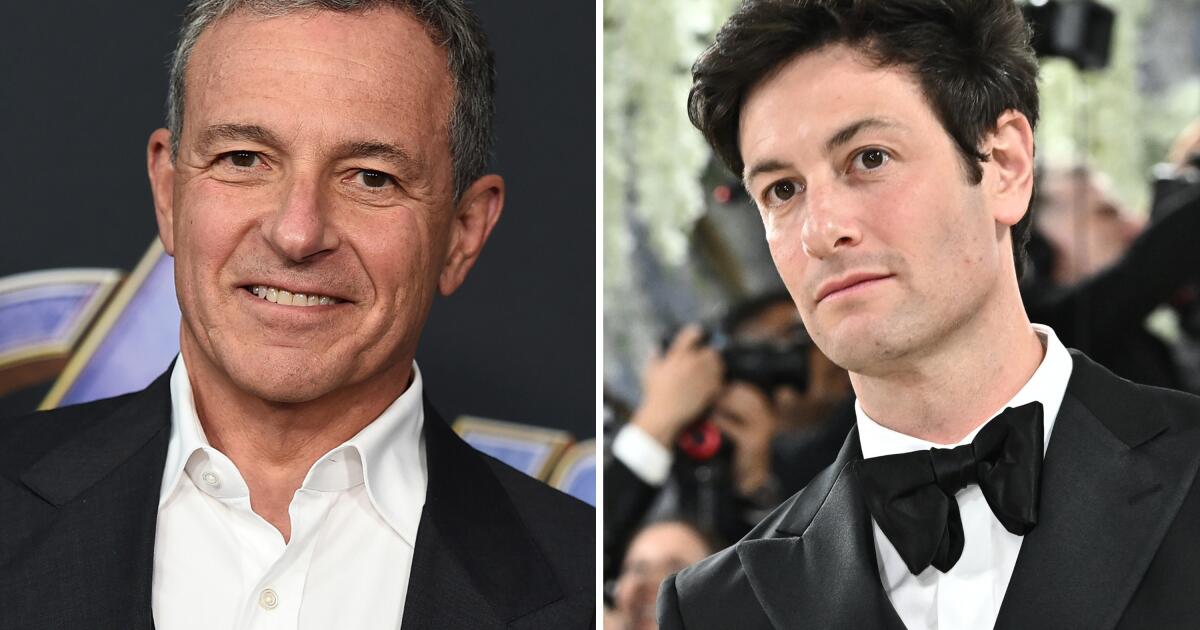
Walt Disney Co. installed Josh D’Amaro as chief executive Wednesday, beginning a new chapter for the storied Burbank entertainment giant.

Bob Iger passed the reins during Disney’s virtual annual meeting of shareholders, completing the company’s high-stakes and tightly choreographed changing of the guard. After spending two decades molding Disney into a media colossus, Iger segued into a senior advisory role, which will run through December when he officially retires.

The leadership shift comes amid an upheaval in Hollywood as traditional companies wage a desperate battle for survival.

D’Amaro, in his first address to shareholders, pointed to Disney’s signature storytelling as its competitive edge.

“While others in our industry are consolidating just to compete, or struggling to be relevant in a fragmented and disrupted world, Disney is in a category of one,” D’Amaro said during a video segment at the meeting. “This next chapter will be driven by staying focused on world-class creativity, enhanced by technology, bringing unforgettable stories to audiences wherever they are.”

D’Amaro, 55, becomes the ninth leader in Disney’s 102-year history. He was selected last month by Disney board members after a two-year internal bake-off among high-ranking division leaders. Board members were impressed with his business acumen, charisma and his deep love for Disney and its fabled history.

D’Amaro inherits a company that is beloved by millions. It generates $94 billion a year in revenue and employs 230,000 people.

He faces enormous challenges as he steers the ship through a turbulent media environment and tense geopolitics. The war in Iran prompted a sharp increase in fuel costs, which could become a drag on Disney’s critically important tourism business. Executives already have signaled “headwinds” in international visitation at its U.S. theme parks this year.

Lingering Middle East tensions also could weigh on Disney’s plans for a new Persian Gulf waterfront theme park and resort near Abu Dhabi.

D’Amaro, who served as parks and experiences chief until Wednesday, got his corporate start at Disneyland 28 years ago.

“Like so many of you, my connection to Disney goes back to my childhood, long before I began my career here,” D’Amaro told shareholders. “I grew up in a Disney family. We watched ‘The Wonderful World of Disney’ on Sunday nights. I was 10 years old when my family visited Disneyland for the first time. … Disney has always been a place of imagination, innovation and infinite potential.”
Disney previously announced a $60-billion, 10-year expansion program, which D’Amaro has led. But executives must strike a balance by keeping attractions true to their nostalgic core. In Anaheim, the expansion could result in at least $1.9 billion of development.

Disney also must continue to grow its animation business and manage revenue declines from its traditional linear television channels, including ESPN and ABC. It needs to turbocharge its streaming services with compelling movies and TV shows to remain competitive with Netflix and other leaders in the field.

Disney teased upcoming fan favorites, including the May release of Lucasfilm’s “Star Wars: The Mandalorian & Grogu,” a “Bluey” feature film (the kids show featuring an animated puppy, a blue heeler) and a sequel to a “Lilo & Stitch” film for 2028.

Streaming is key to Disney’s future, D’Amaro said.

“Disney+ will continue to evolve beyond a traditional streaming service to become the digital centerpiece of our company,” D’Amaro said, calling the service “a portal that connects our stories, experiences, games, films, and more in entirely new ways.”

The company plans to unify Disney+ and Hulu later this year.

Disney also must continue to incorporate technology while safeguarding its characters and franchises.

“We will continue to develop and embrace new technologies to empower our storytellers — but never at the expense of our characters and worlds, our creative partners, or the trust people place in us,” D’Amaro said. “Because Disney at its core is a company that celebrates human creativity.”

Wednesday also marked a reorganization of the company, configured by Iger, D’Amaro and Disney’s board.

Board members recognized that D’Amaro, who has spent most of his career in the parks division, lacks deep connections among Hollywood’s writers and producers. They elevated longtime television executive Dana Walden, who had been vying for the top job, to the newly formed role of chief creative officer and the company’s first woman president.

ESPN will continue to be managed by Jimmy Pitaro and Disney Entertainment, Studios chairman Alan Bergman will remain in his influential role overseeing film studios including production, marketing and distribution, and sharing oversight for streaming programming with Walden.

D’Amaro’s total compensation package is valued at about $40 million a year, including a $2-million annual base salary, $26.2 million in annual long-term stock incentives, a cash bonus and a one-time promotion award of $9.7 million.

“Josh is a wonderful choice to lead the Walt Disney Co.,” Iger said in a pre-recorded video. “He has passion for our businesses and brands, respect for our people, and he appreciates what makes this company so unique.”

Iger is wrapping up an unprecedented 52-year career at ABC and Disney.

He first stepped into the CEO role in 2005; his first 15 years were almost magical.

Iger led acquisitions of Pixar Animation, Marvel Entertainment and Lucasfilm, the studio behind “Star Wars,” that turned Disney into a blockbuster machine. Sports king ESPN spawned staggering profits, and Disney’s theme parks set industry standards.

Disney C.E.O. Bob Iger in 2023 at the Oscars.  (Jay L. Clendenin / Los Angeles Times)

Disney’s former Chief Executive Bob Iger will stay on through the end of the year as a senior advisor.

(Jay L. Clendenin / Los Angeles Times)

His decision to buy much of Rupert Murdoch’s 21st Century Fox, a $71-billion deal that closed in 2019, boosted Disney’s television production, refreshed its TV executive bench, and provided a controlling stake in general entertainment streaming service Hulu. The acquisition also gave Disney access to fan-favorite franchises, including “Deadpool,” “The Simpsons,” and James Cameron’s “Avatar.”

But the purchase left Disney saddled with debt just as the COVID-19 pandemic prompted production shutdowns and closures at theme parks and sports venues. It would take several years for Disney to recover.

Iger initially passed the CEO baton to Bob Chapek in February 2020. Iger, then chairman, retired the following year but came back in November 2022 to a mess. At the time, the company was losing billions of dollars on its shift to streaming but that unit is now profitable.

Iger spent the next three years focusing on four business pillars, including improving the quality and profitability of its film studios.

During the last two years, Disney has produced five franchise films that racked up more than $1 billion in worldwide ticket sales, including “Inside Out 2,” “Zootopia 2,” and “Avatar: Fire and Ash.”

Disney and Pixar’s latest animated film “Hoppers” has hauled in $46 million at the domestic box office in its opening weekend, marking the highest theatrical debut for an original animated film since Disney’s 2017 success “Coco.”

The company is banking this year on several other films with blockbuster potential, including Disney and Pixar’s “Toy Story 5,” “Star Wars: The Mandalorian & Grogu” and Marvel Studios’ “Avengers: Doomsday.”

“I would want to be known as someone who was given the keys to this kingdom and brought it to a place that even Walt would be proud of — more storytelling, more innovation, more risk‑taking, and more creation of happiness,” Iger said during a “The Rest is History” podcast last year.

During the meeting, Iger appeared in a prerecorded video that celebrated his numerous career highlights. Shown were clips from his cub years when Iger was a newscaster with bushy black hair. His journey was depicted, including his orchestration of multi-billion-dollar acquisitions that strengthened Disney with more characters and franchises.

Iger, 75 and now gray, ended by thanking shareholders “for the trust you placed in me, for the memories we created together, and for allowing me the honor of serving,” he said. “It has meant more to me than I can say.”

Animated pixie dust twinkled on the screen, courtesy of the fairy, Tinker Bell.

“Bob, on behalf of our employees, cast members, shareholders, and fans around the world, thank you so much for your tremendous leadership, your steadfast support, and your countless contributions to The Walt Disney Co.,” D’Amaro said, as the hand-off was complete.

“You’ve set an incredible example for all of us. … You will be missed,” D’Amaro said.

There was little fanfare during the business portion of the investor meeting.

The company’s slate of board directors were elected with 93% of the vote. Shareholders also approved executive compensation packages with about 85% of votes.

Shareholder-led proposals to compel reports on charities eligible for Disney’s gift-matching program, a review of the company’s accessibility practices in its theme parks for disabled guests, and a push for cumulative voting at future meetings all failed to muster support.

Disney shares closed at $99.41, down roughly 1% on the day.

Source link

Disney’s new CEO says his focus is on storytelling and creativity

Disney has a new captain, and his eyes are on the stars.

Taking over the reins from Bob Iger on Wednesday, new chief executive Josh D’Amaro signaled a bold shift for the entertainment giant: a future where emotional storytelling remains the “North Star,” but cutting-edge technology provides the fuel.

From ESPN to the Magic Kingdom, D’Amaro said in his first letter to employees as the top boss that his mission is to turn a century of nostalgia into a more personal, high-tech reality for fans worldwide.

“Used thoughtfully, it can empower our storytellers, strengthen our capabilities, and help us create more immersive, interactive and personal ways for people to experience Disney,” he wrote in the Wednesday morning note.

D’Amaro also said he wants the sprawling company, which includes film and TV studios, a tourism division, streaming services and live sports programming, to operate as “one Disney,” saying the global businesses all play a role in deepening consumers’ relationship with the Mouse House.

That connection people have with Disney’s brand is key to the company’s future. Consumers have more film, TV and experiences to choose from than ever, meaning Disney needs to distinguish itself among competitors.

To do that, D’Amaro plans to focus on the emotions consumers feel when they encounter Disney. As an example, he reminisced about his own first visit to Disneyland more than 40 years ago.

He recalled the joy on his father’s face as the two rode Peter Pan’s Flight together. And when they soared over the miniature version of London on the ride, he remembered his father leaning in and saying, “See, I told you. It feels like we’re flying!”

“That feeling of flying I had on Peter Pan all those years ago is still real to me,” he wrote in the Wednesday morning note. “And today, I am honored to move forward with all of you — with ambition, optimism, and absolute confidence in what we can build together.”

That new era also included a goodbye to Bob Iger, who handed over the reins Wednesday and now moves into a senior advisory role for the rest of the year before his planned retirement.

The company paid tribute to Iger in a video during Disney’s annual shareholders meeting Wednesday morning.

With clips from his earliest public appearances as Disney’s CEO, a highlight reel of the acquisitions the company made under his tenure and even a nod to his previous career behind the anchor desk, the video highlighted Iger’s legacy at the company and the role he played in bulking up Disney’s franchises, global theme parks, sports and streaming platforms.

When asked in the video about where he’ll go from here, Iger laughed and replied, “To Disneyland.”

In a pre-recorded speech, Iger said his time at Disney has spanned much of his life and that he never expected to become CEO of the company — much less twice.

“Over the years, we experienced extraordinary change and faced real challenges that were particularly profound in the last three years,” Iger said. “It was daunting at times, but through it all, what sustained me was the passion I saw every day from great storytellers, innovators, leaders and people around the world.”

In his parting remarks during that speech, he expressed confidence in the new leadership team of D’Amaro and Dana Walden, who is now president and chief creative officer of the company.

“I will be cheering on Josh, Dana and all of you as I sail off into the sunset,” he said. “So thank you for the trust you placed in me, for the memories we created together, and for allowing me the honor of serving. It has meant more to me than I can say.”

Source link

Edison executive pay soars despite devastating Eaton fire

Edison International boosted the pay of its top executives last year despite their responsibility for the safety of the company’s power lines before the devastating Eaton fire, which destroyed a wide swath of Altadena and killed 19 people.

Although the company cut cash bonuses for its senior executives, citing the wildfires, their overall compensation went up substantially as the utility’s profit soared in 2025.

Pedro Pizarro, chief executive of the parent company of Southern California Edison, received $16.6 million in cash, stock and other compensation last year, up 20% from 2024, according to a new company filing.

Steven Powell, president of Southern California Edison, received compensation totaling $6.5 million last year, up from $3.9 million in 2024 — a jump of more than 65%.

The utility’s transmission equipment is suspected of igniting two wildfires on Jan. 7, 2025, including the Eaton fire, which left thousands of families homeless.

The Times earlier detailed how Edison fell behind in performing maintenance on its aging transmission lines — work that it had told state utility regulators was needed. County prosecutors are investigating whether Edison should be criminally charged for its actions before the fire.

The government investigation into the cause of the fire has not been released and Edison has denied that it acted negligently. Pizarro has said a leading theory is that a century-old transmission line, which the company had not used for 50 years, may have briefly reenergized, igniting the fire.

A state law championed by Gov. Gavin Newsom in 2019 protects utilities from paying for the damage due to fires sparked by their equipment. When it passed, Newsom touted the law’s requirement that utilities must tie executive compensation to their safety record, saying it would keep them accountable.

The law said that a utility “may” consider tying 100% of executive bonuses to safety performance and “denying all incentive compensation in the event the electrical corporation causes a catastrophic wildfire that results in one or more fatalities.”

Edison said in the new filing that the company’s board members who determine executive compensation decided to decrease the cash bonuses of Pizarro, Powell and Jill Anderson, the utility’s chief operating officer, because of the 2025 wildfires.

Pizarro’s cash bonus was cut by more than $1 million while Powell’s was trimmed by $442,000, according to the filing. Anderson lost out on $244,000.

The company, based in Rosemead, said its decision to cut the three executives’ cash bonuses “was not a reflection of the performance of the company or these executives.”

Despite those cuts, the executives’ total pay of salary, bonuses, stock and other compensation rose, according to the filing. That’s because Edison ties most executive compensation not to safety, but to the company’s financial performance.

And last year, Edison’s profit jumped more than 200% — from $1.3 billion in 2024 to $4.5 billion — despite the Eaton disaster.

The profit increase resulted from the protections from wildfire damage provided to Edison by the 2019 law, as well as a 13% hike in customer electricity rates in October.

The utility attributed the higher electric bills to several increases that it successfully lobbied the California Public Utilities Commission to approve. All five members of the commission were appointed by Newsom.

Scott Johnson, an Edison spokesman, said Tuesday that Pizarro and other company executives holding stock took a financial hit after the fires when the price plummeted.

Before the January fires, Edison International’s stock price was about $80. It fell to $50 the next month. It has recovered much of its value, closing on Tuesday at $72.92.

Edison is facing hundreds of lawsuits by victims of the fire. The suits claim it acted negligently, including by failing to remove the old, dormant transmission line in Eaton Canyon.

The lawsuits also blame Edison for not preventatively shutting down its transmission lines Jan. 7, 2025, despite the dangerous Santa Ana winds.

Pizarro has said the winds didn’t meet the company’s threshold in place at the time for turning off those high-voltage wires.

“Our deepest sympathies remain with all those affected, and this loss reinforces our commitment to public safety and wildfire risk mitigation,” Pizarro and Peter Taylor, chairman of the parent company’s board, wrote in a letter to shareholders that was released with the details on executive compensation.

The two executives added that the company’s “long-term objective remains unchanged: to significantly reduce wildfire risk while improving safety, reliability and affordability of electric service.”

Edison is now offering to compensate Eaton fire victims, including those who lost their homes, family members, businesses and apartments. The offer requires the victims to give up their right to sue the utility. Many survivors say the utility’s offer falls short of what they lost.

Pizarro and Taylor wrote that as of March 4, more than 2,500 claims had been submitted through the program. So far, Edison has extended offers to roughly 600 victims submitting claims and made payments totaling $31 million to 212 of those people, they wrote.

The utility also has begun settling claims of property insurers that covered Altadena homes that were destroyed or damaged, paying out hundreds of millions of dollars. The settlements will help cover the insurance companies’ losses.

Edison has told its shareholders that it expects most or all of those payments to victims and insurers to be covered by a $21-billion state wildfire fund that Newsom and lawmakers created as part of Assembly Bill 1054, which became law in 2019.

Critics say the law went too far, allowing a utility to allegedly spark a deadly wildfire without financial consequences to the company or its executives.

“The predictable outcome of continuing to protect shareholders and executives from the consequences of their own negligence is not theoretical. It is observable. More catastrophic fires,” Joy Chen, executive director of the Eaton Fire Survivors Network, wrote in an email to state wildfire fund administrators this year.

Johnson responded, saying,”Our motivation to prevent fires and any incidents is to be good neighbors and provide affordable and resilient energy. There is nothing more important than safety.”

Taylor was on the board committee that approved the compensation package for Pizarro and other top executives. For his work chairing the board, Taylor received cash and stock compensation of more than $500,000.

Johnson said Taylor’s compensation was based on “typical board chair pay” at other utilities.

The new filing said Pizarro’s total compensation of $16.6 million was 75 times the median Edison employee’s total compensation of $220,000.

The present value of Pizarro’s pension is more than $19 million, the report said.

The company is facing a challenge from one of its shareholders — John Chevedden of Redondo Beach, according to the filing.

Chevedden is asking the company’s shareholders to vote to approve his proposal that would require Pizarro and other Edison executives to hold at least 25% of the stock they had received as compensation until they reach retirement age.

He said that requiring utility executives to hold a significant portion of their stock until retirement would focus their efforts on the company’s long-term success.

Chevedden pointed to “unfavorable news reports,” including the U.S. Department of Justice’s lawsuits against Edison for the Eaton fire and 2022 Fairview blaze, which killed two people in Riverside County.

Edison’s board urged shareholders to vote against Chevedden’s proposal before the company’s annual meeting April 23.

The board said the company already had guidelines that “closely align the interests of officers with the long-term interests of our shareholders.”

Source link

Live Nation trial resumes, as 32 states proceed with trial

Live Nation, the ticketing giant that reached a tentative settlement with the Department of Justice last week, remains under fire.

A coalition of more than 30 states that had joined the original lawsuit filed in 2024 is refusing to accept the $200-million settlement, causing the trial to resume this week in Manhattan’s Federal Court.

The settlement with the Justice Department requires Beverly Hills-based Live Nation to open Ticketmaster to rival ticket sellers, force the company to open select venues to competing promoters and cap service fees at 15%. California is one of the key states still involved in the trial.

But those steps fall short, critics say.

“It’s clear that Live Nation has manipulated the market and made itself untouchable by competitors, hurting artists, hurting fans, hurting venues, all the while, raking in the cash,” said California Atty. Gen. Rob Bonta at the Capitol Forum conference last week. “Not because it’s a better service or product, because it acted illegally and created a monopoly.”

U.S. senators have also chimed in. Minnesota’s Amy Klobuchar recently introduced the Antitrust Accountability and Transparency Act to strengthen the review of antitrust settlements. Klobuchar said in a release that it’s “clear the American people got the raw end of the deal.”

And Connecticut’s Richard Blumenthal released a report that provides new details into the inner workings of Ticketmaster and urges attorneys general across the nation to reject the settlement.

Blumenthal said that the Trump administration’s settlement with Live Nation will keep consumers vulnerable to Ticketmaster’s “anticompetitive practices” and ultimately push “concert tickets farther out of reach for fans.”

The senator’s report, entitled “So Casually Cruel: How Ticketmaster’s Monopoly Supercharges Prices and Fees,” examined over 100,000 documents and Ticketmaster’s revenue data. The report argues that the company leveraged its market control to make tickets available on the resale market before they were available to the general public in an effort to hike prices and boost profits.

“The ticketing market is broken,” Blumenthal said in a statement.

In its own statement, Ticketmaster said Blumenthal’s report “misrepresents how the live events industry works” and that the problem lies in the secondary ticketing industry.

“This is why we’ve long called for industry resale reform, including price caps, while also developing tools to empower artists and protect fans,” Ticketmaster said in a statement.

Recently, Ticketmaster has backed ticketing bills like AB-1349 and advocated to Congress for an industry-wide resale cap.

Sens. Blumenthal and Klobuchar are among many industry experts who say the settlement doesn’t adequately address anticompetitive practices and falls short of protecting consumers from high ticket prices.

Under Klobuchar’s new bill, courts could have 90 days to review public comments and government responses.

“When the government prosecutes antitrust violations, the goal should be to uphold the law, lower prices, and protect consumers and small businesses,” Klobuchar said in the statement.

Lindsay Owens, the executive director of the economic policy nonprofit Groundwork Collaborative, said the settlement will end up being “incredibly costly for concertgoers, performers, and independent venues.”

“California and 35 other states are standing up for Americans who are sick and tired of being ripped off and having to scrimp and save to enjoy a night out,” Owens said in a statement.

This ongoing trial is one of several major legal battles the ticketing giant is facing. The company is also being sued by the Federal Trade Commission and is dealing with a handful of class-action lawsuits from groups of concertgoers.

Times staff writer Meg James contributed to this report.

Source link

Disney’s Dana Walden sets leadership team

Walt Disney Co.’s incoming president and chief creative officer, Dana Walden, has unveiled her leadership team, which includes several familiar faces from the company’s film, television and marketing units.

Walden will become Disney’s first woman president on Wednesday. She will report to Josh D’Amaro, who will succeed Bob Iger as Disney’s chief executive, following the company’s annual meeting with shareholders and its high-profile leadership handoff.

Walden’s senior team includes her longtime creative partner, Alan Bergman. As chairman of Disney Entertainment and Studios, Bergman will continue to oversee Disney’s film studios, including production, marketing and distribution.

Bergman also will retain oversight of Disney’s streaming programming in concert with Walden.

Disney executives Joe Earley and Adam Smith were named co-presidents of Disney’s entertainment direct to consumer offerings — Disney+ and Hulu. Both executives will be responsible for strategy and financial performance and report to Walden and Bergman.

Earley and Walden worked together when they were Fox executives; Earley will also serve as head of content strategy.

Smith continues in his role as Disney Entertainment chief product and technology officer. He also will continue to collaborate with ESPN Chairman Jimmy Pitaro on matters related to ESPN and ESPN+.

Debra OConnell will step into a newly-formed role as chairman of Disney Entertainment Television.

She will have a broad TV portfolio that includes ABC Entertainment, Disney-branded cable channels, Hulu Originals as well as programming from National Geographic, 20th Television and 20th Television Animation.

OConnell will continue to oversee ABC News and the ABC-owned television stations, including KABC-TV Channel 7 in Los Angeles.

Dana Walden. (Photo by Richard Shotwell/Invision/AP)

Disney’s incoming president Dana Walden has established her senior leadership team.

(Richard Shotwell/Richard Shotwell/Invision/AP)

Sean Shoptaw, who serves as executive vice president for games and digital entertainment, and his organization, will shift from Disney Experiences and into Walden’s division.

Shoptaw oversees Disney’s games business and its collaboration with Epic Games to develop a Disney universe connected to Fortnite.

John Landgraf remains chairman of FX and will continue to report directly to Walden.

Asad Ayaz, who is chief marketing and brand officer, has an influential remit across Disney’s various business segments. He will report to D’Amaro and Walden.

“The strength of Disney has always been the emotional connection between our stories and the people who love them,” Walden said in a statement. “As fans engage with Disney across more formats and platforms than ever before, we are bringing together the full power of our creative businesses to build an even more connected experience for audiences.”

Source link

NBC’s ‘Access Hollywood’ is canceled as daytime TV audiences shrink

NBCUniversal is cutting “Access Hollywood” and several other of its daytime talk shows, effectively ending its first-run syndication business as daytime television atrophies.

The company confirmed that “Access Hollywood,” and its counterpart “Access Live,” will be coming to an end in September. The shows, produced in Los Angeles, are currently hosted by Mario Lopez, Kit Hoover, Scott Evans and Zuri Hall.

Talk shows “Karamo” and “The Steve Wilkos Show,” produced out of NBC’s facility in Stamford, Conn., are also shutting down. The programs have already completed their production for the season and will run through the summer.

NBC previously announced that “The Kelly Clarkson Show” is also ending later this year after seven seasons.

“The Steve Wilkos Show” ran for 19 seasons. The host is a former bouncer for “The Jerry Springer Show.”

Francis Berwick, chairman of Bravo and Peacock unscripted, said in a statement that the company will continue to distribute library episodes of its talk programs and network shows such as “Law & Order.” But NBCU’s days of launching series for daytime and the hour before prime time are over.

“NBCUniversal is making changes to our first-run syndication division to better align with the programming preferences of local stations,” Berwick said. “The company will remain active in the distribution of our existing program library and other off-network titles, while winding down production of our first-run shows.”

“Access Hollywood” was first launched by NBC in 1996 as a competitor to CBS Media Ventures’ “Entertainment Tonight.”

First-run syndication allows producers to sell TV shows to stations on a market-by-market basis, instead of distributing them through a single network. This model was a major success for talk show staples such as Oprah Winfrey and Ellen DeGeneres.

But streaming has pulled viewers away from traditional television, as viewers can watch their favorite shows and movies anytime on demand. The audience levels needed to generate enough ad revenue to support first-run programming in daytime no longer exists.

Many TV stations are filling their hours with more local news as daytime talk goes away.

Source link

Writers Guild brace for tough negotiations with major studios

It has been nearly three years since Hollywood writers went on a historic strike that lasted 148 days and ushered in an extraordinary period of labor unrest that virtually shut down the film and TV business.

Now, writers are poised to commence another round of bargaining with the major studios on a new three-year film and TV contract. Few observers think the union is girding for another showdown, especially at a time when many of its members are struggling to find work amid media consolidation and belt-tightening.

But in advance of negotiations that begin on Monday , union leaders are eager to dispel any perception that they might have scaled back their demands.

“Our members have shown many times that they’re willing to fight for what we need as a collective group,” WGA West President Michele Mulroney said in an interview. “And there’s no exception here.”

With its current contract expiring on May 1, the WGA hopes to improve its members’ healthcare plans, increase streaming residuals and expand AI protections.

Michele Mulroney speaks

Michele Mulroney speaks as the Screen Actors Guild (SAG-AFTRA) and Writers Guild of America (WGA) join GLAAD in releasing the 11TH Annual GLAAD Studio Responsibility Index at The Village at Ed Gould Plaza Los Angeles LGBT Center in Los Angeles, California, on September 14, 2023.

(Michael Tran/AFP via Getty Images)

Ellen Stutzman, the union’s executive director, said despite popular belief, the studios have weathered the transition from cable television to streaming “very well,” citing their efforts to maximize revenue with streaming bundling, rising subscription fees and advertising revenue.

“Writers are watching as Netflix and Paramount are fighting it out to acquire Warner Bros… Paramount is spending $81 billion,” said Stutzman. “There’s money for a fair deal for writers.”

The union leaders agree that this year’s negotiations are all focused on the sustainability of a writer’s career.

A spokesperson from the Alliance of Motion Picture and Television Producers, which represents the major studios in negotiations, said in a statement that they look forward “to engaging in a constructive and collaborative bargaining process with the WGA. Through continued good-faith dialogue, we are confident we can reach balanced solutions that support talented writers while sustaining the long-term success and stability of our industry and its workforce.”

A top priority for the WGA is to increase the caps that companies contribute to the union’s healthcare plan. Union officials say the current cap has remain unchanged for two decades as healthcare contributions have steadily declined due to fewer writers working.

AI is also top of mind for the WGA.

In 2023, the guild secured various AI protections by establishing that AI isn’t a writer and nothing it produces is considered literary material.

But as major studios start to make deals with AI companies, like Disney’s $1 billion investment into OpenAI’s Sora platform, many writers are concerned about how their work could be used.

“AI is using [studios’] IP, which is stuff that we wrote to license these models,” said John August, the co-host of the “Scriptnotes” podcast and WGA’s negotiating committee co-chair. “With the Sora deal, it seems clear that the companies intend to monetize this IP for use with AI.”

August says the union will be skeptical toward arguments that it’s still too early to seek more safeguards around such a nascent industry, citing the union’s past history with the rise of DVDs and the internet and how profoundly those technologies changed the compensation for writers.

“If you’re taking the work that we created to generate AI outputs, we are owed money. They’re using our work to do something down the road,” added August.

WGA’s negotiating committee also is looking to boost streaming residuals, expand the minimum number of people allowed in a writers’ room and add protections for scribes working on pilots.

“We very much hope that lessons were learned in 2023 and that the AMPTP will come to the table ready to take our proposal seriously and to make a fair deal, and to do that quickly,” Mulroney said. “It provides stability for the companies and for our membership. It’s better for everybody.”

WGA is entering contract negotiations nearly a month after the actors’ union, SAG-AFTRA, began its bargaining sessions. Last week,
the AMPTP said it was extending negotiations another seven days.

Source link

Disneyland Resort President Thomas Mazloum named parks chief

Disneyland Resort President Thomas Mazloum has been named chairman of Walt Disney Co.’s experiences division, the company said Tuesday.

Mazloum succeeds soon-to-be Disney Chief Executive Josh D’Amaro as the head of the Mouse House’s vital parks portfolio, which has become the economic engine for the Burbank media and entertainment giant. His purview includes Disney’s theme parks, famed Imagineering division, merchandise, cruise line, as well as the Aulani Resort and Spa in Hawaii.

Jill Estorino will become the head of Disneyland Resort in Anaheim. She previously served as president and managing director of Disney Parks International and oversaw the company’s theme parks and resorts in Europe and Asia.

Estorino and Mazloum will assume their new roles on March 18, the same day as D’Amaro and incoming Disney President and Chief Creative Officer Dana Walden.

“Thomas Mazloum is an exceptional leader with a genuine appreciation for our cast members and a proven track record of delivering growth,” D’Amaro said in a statement. “His focus on service excellence, broad international leadership and strong connection to the creativity that brings our stories to life make him the right leader to guide Disney Experiences into its next chapter.”

Mazloum had been about a year into his tenure at Disneyland. Prior to that, he was head of Disney Signature Experiences, which includes the cruise line. He was trained in hospitality in Europe.

In his time at Disneyland, Mazloum oversaw the park’s 70th anniversary celebration and recently pledged to eliminate time limitations for park-hopping, which are designed to manage foot traffic at Disneyland and California Adventure.

Mazloum will now oversee a 10-year, $60-billion investment plan for Disney’s overall experiences business, which includes new themed lands in Disneyland Resort and Walt Disney World. At Disneyland, that expansion could result in at least $1.9 billion of development.

The size of that investment indicates how important the parks are to Disney’s bottom line. Last year, the experiences business brought in nearly 57% of the company’s operating income. Maintaining that momentum, as well as fending off competitors such as Universal Studios, is key to Disney’s continued growth.

In his new role, Mazloum will have to keep an eye on “international visitation headwinds” at its U.S.-based parks, which the company has said will likely factor into its earnings for the fiscal second quarter. At Disneyland Resort, that dip was mitigated by the park’s high percentage of California-based visitors.

Times staff writer Todd Martens contributed to this report.

Source link