claim

Democratic voters confident California election is secure, Republicans less so, poll finds

California voters are deeply divided over the trustworthiness of state elections heading into Tuesday’s primary, with most Democrats but less than half of Republicans expressing confidence in the electoral process, according to a new poll.

The polarized view follows a years-long campaign by President Trump and his Republican allies to question the legitimacy of American elections, especially in California and other blue states. It also follows robust efforts from liberal leaders, elections officials and voting rights experts to denounce Trump’s claims as baseless.

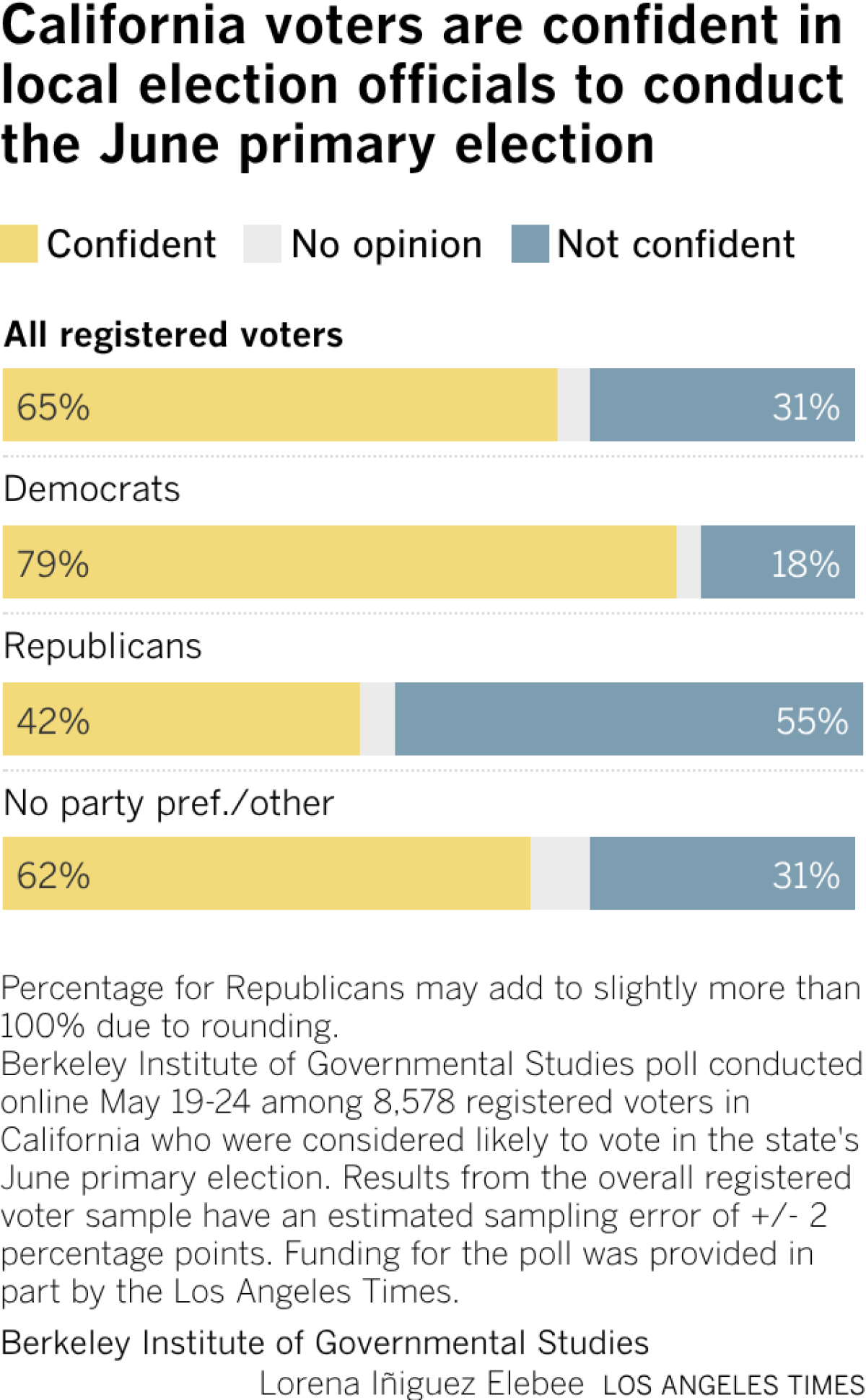
Overall, registered voters in the state — which skews heavily Democratic — expressed confidence in local election officials by a 2-to-1 margin, with 65% expressing confidence and 31% expressing a lack of confidence, according to the poll released Tuesday by the UC Berkeley Institute of Governmental Studies and co-sponsored by The Times.

However, those figures shift dramatically when sorted by political party, and even more when parsed by partisan leaning.

For example, 79% of Democratic voters expressed confidence in local officials running a secure and fair election, compared to 62% of independent voters and 42% of Republican voters, the poll found.

While 82% of voters who identified as strongly liberal expressed confidence, just 38% of voters who identified as strongly conservative did so.

A volunteer assists a voter at a polling site.

A volunteer assists Melani Hurwitz at a polling location Monday at the Cal State Long Beach Walter Pyramid.

(Eric Thayer / Los Angeles Times)

“It’s clearly a partisan issue, and it is being promoted by the president and others who are his followers,” said Mark DiCamillo, the director of Berkeley IGS polls. “Strong conservatives and the Republicans are the least confident, and a lot of them are saying [they are] not at all confident. That’s a pretty extreme statement.”

Rick Hasen, an election law expert and director of the Safeguarding Democracy Project at UCLA Law, said he expected Republican confidence to be even lower given Trump’s decade of undermining trust in elections, especially in liberal, diverse states such as California. But he said neither Trump’s narrative nor public sentiment about election security — which generally shows voters are more confident “when their side wins” — reflects reality, which is that “our elections are administered well.”

“There’s very little evidence of manipulation or of fraud or even of incompetence,” Hasen said. “Anyone who looks objectively would see that there are numerous safeguards to ensure we have free and fair elections in California.”

Trump has long contended without evidence that voter fraud is pervasive among undocumented immigrants and in states, such as California, that use mail ballots, and blamed his 2020 loss to Joe Biden on such fraud despite experts rejecting the claim and Trump’s own allies and lawyers being unable to prove it.

A voter's feet in a poll booth.

A voter casts their vote inside the Westchester Family YMCA Annex on Monday.

(Kayla Bartkowski / Los Angeles Times)

Since returning to the White House last year, Trump has tried to implement strict new requirements for voter ID and proof of citizenship and to limit or bar mail-in voting, and called for greater federal or Republican Party control over state-run elections. In February, he said that “Republicans ought to nationalize the voting” in “at least 15 places” where they lose.

On Saturday, Trump falsely claimed that California doesn’t have any voting booths and only accepts mail ballots.

Democratic leaders, elections experts and voting rights advocates have all pushed back. They’ve backed their assurances that the state’s elections are safe with lawsuits to block Trump’s efforts to assert federal control. They also warn that his administration may try to intervene anyway, including by sending federal immigration agents to polling locations or intercepting or invalidating mailed ballots.

When Trump issued an executive order in March 2025 purporting to require voters to provide proof of citizenship, California sued, with a court blocking the policy while the litigation continues. When the Justice Department sued California Secretary of State Shirley Weber in September for refusing to hand over the state’s voter rolls, California won a dismissal in court. When Trump issued another executive order this March directing the U.S. Postal Service to take control of mail balloting, California sued again. That litigation is ongoing.

Last week Gov. Gavin Newsom signed a bill barring federal agents and other law enforcement from interfering with local and state elections officials or confiscating ballots, voter rolls or voting machines without a warrant. Newsom said California voters were experiencing “legitimate anxiety” over election integrity given the threats from the Trump administration and the recent actions of Riverside County Sheriff Chad Bianco — a MAGA-backed Republican candidate for governor who recently seized hundreds of thousands of ballots as part of what he said was an investigation into potential fraud in last year’s election.

An election worker carries a bin of ballots.

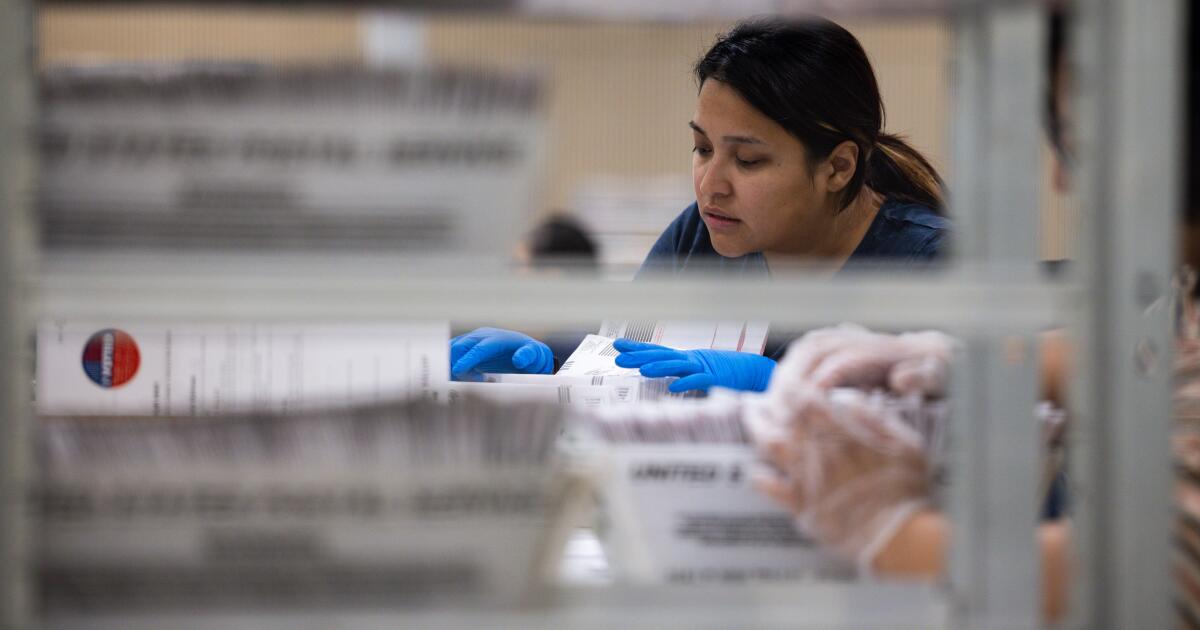
An election worker collects extracted vote by mail ballots to be tallied at the Los Angeles County Registrar-Recorder/County Clerk Ballot Processing Center in City of Industry.

(Gary Coronado / For The Times)

Newsom said he expects Trump to interfere with the upcoming election as well because “every single thing that Donald Trump is saying only suggests that he will do more, not less, to intimidate and to impact the outcome of this election,” but that the state stands ready to respond.

California Atty. Gen. Rob Bonta last week said that his office is preparing for “all different types of scenarios” involving federal interference, from ballots being seized to immigration agents showing up at polling locations.

“We are currently monitoring any potential risks or threats, and we’re ready for any possibility,” he said.

Sen. Alex Padilla (D-Calif.) last week blasted the U.S. Postal Service for issuing a proposed rule to implement Trump’s mail ballot changes, despite the ongoing litigation. In April, Rep. Nancy Pelosi (D-San Francisco) helped convene a pair of “shadow hearings” in California where fellow House Democrats and a panel of experts shot down Trump’s claims about widespread fraud and expressed confidence in state elections.

A Berkeley IGS Poll from a year ago found that California voters support requiring first-time voters to show ID to prove citizenship in order to register, and that most supported requiring a government ID every time a voter casts a ballot. However, another Berkeley IGS Poll from last month found that strong majorities of California voters believe American democracy is under attack or being “tested.”

Dean Logan, head of the L.A. County registrar-recorder/county clerk’s office, said that overall confidence, “despite a sometimes volatile state and national narrative,” was “gratifying.”

“Election officials take connection to their community seriously. We recognize that our job is to facilitate their voting experience, and that voter participation is key to election security,” Logan said. “Regardless of party affiliation, our role as election officials focuses on the function and process of ensuring the voice of the electorate is heard and that compliance with the election laws adopted in our state is achieved.”

Jesse Salinas, president of the California Assn. of Clerks and Elections Officials and the registrar of voters in Yolo County, said local elections officials are “proud to be a steady source of trust at a consequential moment,” and stand ready to “open our doors to any voter who wants to see firsthand how our elections work and to answer any questions they may have.”

Times staff writer Iris Kwok contributed to this report.

Source link

Despite Trump’s insistence, in-person voting does exist in Los Angeles

Yes, voting centers will be open across Los Angeles this week. And no, you don’t have to cast your ballot by mail.

With days left before the June 2 primary, President Trump made a round of misleading claims about the electoral process, this time falsely suggesting that the city was holding elections only by mail.

Trump’s comments came Saturday during an appearance on Fox News when he was asked by host Lara Trump — the president’s daughter-in-law — about his predictions for the upcoming primary.

“You know, they don’t have voting booths; everything’s by mail,” Trump responded. “I don’t think a Republican can win in California unless you pass the Save America Act — then they’re gonna have to show proof of citizenship, they’re going to have to get rid of mail-in voting.”

The L.A. County registrar-recorder moved to set the record straight in a tweet posted Sunday morning that read “MISINFORMATION ALERT.”

Noting that in-person voting was in fact allowed, the agency announced that it had 646 vote centers across the county — each with multiple voting booths. The centers will be open from 10 a.m. to 7 p.m. on Monday and Tuesday, the agency said in the posting, while tagging Fox News and the White House.

A map of polling locations featured on the agency’s website shows that there are dozens of voter centers available countywide. Mobile vote centers also were made available at various sites in the county. Mobile voting runs for the 10 days before election day and will not be available on June 2, according to the county registrar-recorder.

As of Friday morning, 333,000 mail-in votes had been cast in the June 2 primary for Los Angeles mayor, city attorney, city controller and eight of the 15 City Council seats. This was up from 321,000 at the same time in 2022, according to registrar-recorder.

Registered voters already should have received a ballot in the mail. Those who choose to vote in person can take their mail-in ballot to a vote center and ask to vote in person instead. Residents who haven’t yet registered to vote can still do so by requesting a conditional voter registration application at any voter center and filling out their ballot as they normally would.

Recent polling suggests that, ahead of Tuesday’s primary, incumbent Los Angeles Mayor Karen Bass has what pollsters deem a statistically insignificant lead in her bid for reelection as the city’s top executive. Bass is locked in a tight race with councilmember and former ally Nithya Raman and Spencer Pratt.

Trump has signaled his support for Pratt but hasn’t formally endorsed the former reality TV star and registered Republican. Former Trump advisor Steve Bannon said the president hadn’t done so out of the fear it would hurt Pratt’s chances in Democrat-dominant Los Angeles.

In 2020, during the outbreak of the COVID-19 pandemic, Gov. Gavin Newsom took the unprecedented step of issuing a statewide order for voting by mail for that year’s election in what he described as a necessary step to limit the virus’ spread.

A handful of rural counties had no in-person voting locations that March.

In 1979, the state eliminated the need for an excuse to receive an absentee ballot, and an option to choose permanent absentee voting was created in 2002. In the decades since, Californians have embraced the flexibility that voting away from a polling place offers. In nearly every statewide election since 2008, the majority of votes have not been cast at a traditional polling place.

Fourteen more counties — including Orange, Sacramento and Santa Clara — have adopted the state Voter’s Choice Act, an optional state law that requires them to mail every voter a ballot and to replace traditional neighborhood polling places with multipurpose vote centers. Those in-person locations offer multiple election services for up to 10 days before election day.

Los Angeles, the 15th county to adopt the new state law, was initially given special permission by the Legislature to implement it without mailing every voter a ballot.

Trump has for years repeated baseless claims that the 2020 election was stolen and that undocumented immigrants were swaying elections by voting illegally.

In light of these claims, Trump and some Republicans have pushed for new restrictions on voters. A federal proposal known as the Save America Act — which would require Americans to prove they are U.S. citizens before they register to vote and to show identification at the polls, among other things — cleared the U.S. House but stalled out in the Senate.

In November, California voters will weigh in on a similarly contentious ballot measure pushed by Republicans that would require all voters in future elections to show identification every time they vote in person or provide a special PIN when submitting mail-in ballots.

Under current state law, Californians are required to provide identification when registering to vote and must swear under penalty of perjury, a felony, that they are eligible to vote and are U.S. citizens. They are not required to show or provide identification when casting a ballot in person or by mail.

If passed, the California ballot measure would require voters to present government-issued identification, such as a state driver’s license, every time they vote. Voters mailing ballots would be required to write a four-digit number, essentially a PIN, on their ballot envelopes matching the one generated when they registered to vote.

Critics of California’s voter ID initiative, including many legal scholars, say the ballot measure addresses a problem that does not exist.

In May, a federal judge handed Trump a victory by declining to halt the president’s executive order creating a federal list of eligible voters and then directed the U.S. Postal Service to deliver mail ballots only to those on the list. Observers say the decision opens the door for potential sweeping changes in how American elections are run shortly before this year’s midterm elections.

The Associated Press contributed to this report.

Source link

Capitol rioters clamor for payouts from Trump’s new ‘anti-weaponization’ fund despite backlash

David Johnston was a licensed attorney when he illegally entered the U.S. Capitol with a mob of President Trump’s supporters on Jan. 6, 2021. More than five years later, the South Carolina man is offering to help fellow “J6ers” apply for payouts from the Trump administration’s nearly $1.8-billion fund for people claiming to be victims of a “weaponized” government.

He’ll do it for a 10% cut of any award, capped at $5,000 apiece.

“I think the narrative is changing” about how the history of that day is being told, Johnston said in a video he posted to social media. “I think good things are happening for us.”

Hundreds of Trump loyalists pleaded guilty to storming the Capitol, admitting under oath that they broke the law. Some were convicted of sedition, and many attacked police officers while trying to overturn Trump’s election loss. Now pardoned by Trump, many hope to capitalize on their crimes by tapping into the $1.776-billion settlement fund designed to compensate the president’s allies who claim they were politically prosecuted.

A bipartisan backlash to the fund and a legal roadblock have not dimmed the celebratory response from Jan. 6 rioters clamoring for a share of the taxpayer money. Some are staking claims even though the government has not established an application process and a judge has frozen the fund’s formation, at least temporarily.

Seeking payouts

The fund’s critics see it as another vehicle for Trump and his allies to whitewash the events of Jan. 6, retroactively justify the mob’s assault on a pillar of American democracy and reward some of Trump’s most loyal followers.

Jason Riddle, a military veteran from New Hampshire who was sentenced to 90 days behind bars after pleading guilty to riot charges, publicly rejected a pardon from Trump. Likewise, he said it would be “ridiculous” for him or any other Jan. 6 rioter to get government compensation.

“I’d love money, but I can’t accept that. That would bother me for the rest of my life,” he said. “We weren’t innocently persecuted just because of who we are or who we vote for. We were persecuted for committing criminal behavior in the Capitol of the United States.”

Plenty of other “J6ers” do not share Riddle’s reluctance.

A Florida man who posed for photos with then-House Speaker Nancy Pelosi’s stolen lectern argued on social media that he deserves to be compensated for the cost of his infamy. A rioter from New Jersey described by prosecutors as a Nazi sympathizer hailed the fund as “good news not just for J6ers but all victims of weaponization.” A Texas man who received a seven-year prison sentence for storming the Capitol with a metal tomahawk celebrated the fund as “payback” for “victims of Biden’s tyranny,” referring to President Biden.

Oregon resident Pamela Hemphill, sentenced to 60 days in jail for her conviction, rejected a pardon from Trump but has drafted a written claim for compensation from the fund. Unlike scores of rioters who claim to be victims of a government weaponized by Democrats, Hemphill blames Trump for her legal troubles. Her claims letter says she is seeking $5 million in compensation.

“I wouldn’t have been through all of this if Trump hadn’t lied about the election being stolen,” she said during a telephone interview. “It’s a direct result of his lies that I was even there that day.”

It is an open question whether anyone convicted of a Capitol riot-related crime could be eligible for payments from a fund created to resolve Trump’s lawsuit against the IRS over the leak of his tax returns.

Acting Atty. Gen. Todd Blanche has not ruled out that possibility. Blanche said there are no limits on who can apply, but he noted that the fund’s five commissioners — all yet to be named — will decide who deserves to be compensated and why, based on factors such as “what the person did, his sentence, how much time he was in jail.”

“That’s up to the commissioners,” Blanche told the Associated Press on Thursday when asked about his position on whether violent Jan. 6 defendants should be eligible for payments.

“You have to define something and then stick to it. That’s something I’ve been hesitant to try to do, because it’s very fact-intensive,” Blanche said. ”Me sitting here and talking in hypotheticals is something that I don’t think is fair to the process.”

It is unclear whether Congress would block payments to Jan. 6 defendants. Senate Republicans who are angry about the settlement have said they want to place parameters on the fund as part of a Department of Homeland Security spending bill. They abruptly left town this month after a tense meeting with Blanche and will return Monday with the situation unresolved.

A federal judge in Virginia has frozen the fund’s establishment and temporarily blocked any processing or paying of claims. The judge issued that ruling Friday in one of at least three lawsuits challenging the fund.

Brendan Ballou, a former prosecutor who tried several Jan. 6 cases before leaving the Department of Justice last year, sued on behalf of two police officers who helped defend the Capitol from the mob. Ballou views the fund’s creation as part of a broader Trump campaign to undermine democratic institutions and rewrite the history of Jan. 6.

“And if the president is successful in that effort, if he’s able to get people to either forget or condone that day, he knows that he can get people to accept any attack on democracy,” Ballou said.

‘I want vengeance’

Nearly 1,600 people were charged with Capitol riot-related federal crimes. More than 1,200 were convicted and sentenced before Trump issued mass pardons and ordered the dismissal of all pending Jan. 6 cases upon his return to the White House last year. Trump also freed far-right extremist group members who were imprisoned for plotting to attack the Capitol to keep Trump in office after he lost the 2020 presidential election to Biden.

The self-described “J6 community” isn’t the only pro-Trump constituency angling for cuts of the money after being charged with or convicted of crimes.

Meshawn Maddock, who was charged as being a fake elector for Trump in Michigan before a judge dismissed the case last year, said she and her husband, state Rep. Matt Maddock, “absolutely” plan on making a claim. She believes the fund’s use of taxpayer money is justified because it “paid for the prosecution and investigation of the years that I was being hunted down.”

“I want vengeance and I want retribution,” Maddock said.

Trump’s campaign to recast the violence of Jan. 6 as a peaceful protest seems to have emboldened many convicted rioters.

Johnston’s eagerness to help other Capitol rioters with claims contrasts with his remorse he expressed at his sentencing in 2022. He apologized for his “terrible lapse in judgment” before a judge sentenced him to three weeks in jail and three months of home detention. He pleaded guilty to a misdemeanor trespassing charge.

“It was a dumb, dumb thing to do,” Johnston told the judge. “I am 100% responsible for what I did that day.”

Kunzelman writes for the Associated Press. AP writers Jamie Stengle, Mary Claire Jalonick and Joey Cappelletti contributed to this report.

Source link

Real reason Katie Price’s husband Lee Andrews was arrested as conman’s claim he was held for spying is debunked

KATIE Price has found hubby Lee Andrews after two weeks — and he claims he was detained on suspicion of spying.

She spoke to conman Lee, 43, for two minutes this morning after his dad put her in touch. Katie, 48, says the call came from Dubai’s Al Awir jail.

Katie Price says she got a call from missing hubby Lee Andrews in prison Credit: Backgrid/Instagram
Their emotional two-minute chat was the first time she had heard from conman Lee in two weeks Credit: BackGrid

She said: “It was very rushed but he said the authorities out there thought he was a spy.”

Relieved Katie added: “I told him how worried I’d been and that I loved him.”

Panicked Katie raised the alarm on May 13, telling fans Lee had been tied up, put in a van and taken to a “black site” after being “arrested”.

Now she says Lee has told her he was detained on suspicion of spying, and is being held at Dubai’s Al Awir prison.

LONG LOST LEE

Katie Price reveals first chat with husband Lee after he’s ‘arrested’


HE’S BACK!

Katie Price reveals she’s FOUND ‘missing’ husband Lee after ‘call from prison’

Katie’s contact with her husband came after his dad Peter texted her to explain his whereabouts.

She said: “I have found him. He is alive, and he is OK. I told him how worried I had been and told him I loved him.

“It was very rushed, but he said the authorities out there thought he was a spy. I don’t know much more than that right now.”

Lee, who lives full-time in Dubai, is believed to have been arrested on May 14.

Katie says Lee has told her he was detained on suspicion of spying, and is being held at Dubai’s Al Awir prison Credit: AFP
Katie’s contact with her husband came after his dad Peter texted her to explain his whereabouts Credit: Getty

The Sun, however, understands he has been detained over claims relating to a private civil matter. Authorities have confirmed to us he was NOT held over spying charges.

He is due for release on Monday, but must pay a four-figure fine.

Lee once reposted an Instagram post suggesting he should be the next James Bond.

And he is seen “acting” in an excruciating 2016 video on his YouTube channel titled “Charity TV show: The Agent”.

A comment adds: “Featuring billionaire defense (sic) contractor H.E Weslee Peter John Andrews.”

Espionage is one of the most serious crimes in the United Arab Emirates.

In 2018 Brit PhD student Matthew Hedges was held at Dubai airport on suspicion of spying.

He was jailed for life but pardoned and released following intense international pressure.

In the days before Lee’s arrest he had moved belongings out of his rental apartment, and had moved in briefly with his father, staying in his run-down villa.

It is not known where he disappeared to after this, and his family filed a missing person’s report at the British embassy in Dubai.

On May 19, The Sun told how Lee duped our Clemmie Moodie into investing £1,000 on the promise of quadrupling her investment. It was a bogus scheme, seemingly using documents made using AI.

Before our front-page revelations, two of Lee’s exes shared horror stories involving the fraudster.

The Sun understands Lee has been detained over claims relating to a private civil matter, as authorities confirm he was NOT held over spying charges Credit: wesleeeandrews/instagram

Cell floor sleeps at Alcatraz of Dubai

By Amir Razavi

AL Awir Central Prison is a notorious hellhole dubbed the “Dubai Alcatraz”.

Inmates include Irish gangster Daniel Kinahan, boss of the Kinahan Cartel, who was nicked in April.

The jail has been repeatedly slammed by human rights groups due to the grim conditions.

Prisoners have had to sleep on cell floors due to overcrowding.

Male inmates have their heads shaved, and are punished if hair gets long.

Others have previously been denied HIV treatment while imprisoned, according to Human Rights Watch.

Those caught spying in the UAE face a life sentence, which is capped at 25 years.

Non-Emiratis are deported immediately after completing their term.

PhD student Matthew Hedges, then 31, received the maximum penalty in 2018 after an Abu Dhabi court found him guilty of “spying for or on behalf of” the British government.

Matthew, who studied at Durham University, was left with PTSD after being tortured in solitary confinement for six months.

He was kept in handcuffs and plied with drugs.

Matthew was pardoned by the country’s president in 2018, days after his sentencing.

Texan nurse Crystal Janke said she had put £123,000 into one of his schemes on the promise of getting £1million, only to lose it all.

Lee’s ex-fiancée Alana Percival — who he proposed to over rose petals and champagne five weeks before rehashing the method with Katie — branded him a manipulative narcissist who feigned a heart condition for sympathy.

Alana claimed he was a swindler and told Katie to “run for the hills”.

Mum-of-five Katie and Lee wed in Dubai in January, days after meeting in person for the first time. He is said to be subject to a travel ban there following imprisonment for fraud last October.

Lee has been exposed for faking his CV, claiming he had worked for the King’s Trust and had a doctorate from Cambridge university.

He has never worked for the Labour Party — as he had claimed on his LinkedIn page.

Last week Katie admitted she was “giving up the search” for Lee after deleting an update about his situation.

She told podcast The Katie Price Show she was “leaving it to the police”, adding: “There’s nothing more I can do, that I can say.

“I’m just staying quiet because it’s getting ridiculous now, people taking the p**s out of everything.”

Katie added: “The police are now handling it, the British police, British consulate, the Foreign Office, Interpol they’re looking for Lee. All I can do is just get on with my life. I’ve got lots of exciting things coming up, and I’m just waiting for a call. What am I supposed to do, sit here and cry and do nothing, stay in bed? For my own sanity, I am taking a step back.”

Last weekend Lee’s dad Peter told the Daily Mail: “Lee is OK. He has not been kidnapped but is under arrest. I don’t know on what charge. I’m not sure where he is being held.”

Katie wrote: “This is fake news. Lee is still missing. Me and his family know what’s going on and are working with the authorities.”

The drama started earlier this month when Lee was due to fly to the UK for an interview with Katie on ITV’s Good Morning Britain.

He failed to turn up, leaving her to face the music on her own, humiliating her in the process.

  • IN tomorrow’s Sun, we reveal how HSBC investigated Clemmie’s payment to Lee, and within 24 hours her money had been returned — vindicating allegations of him being a scammer. The bank’s head of fraud reveals the steps you can take to avoid getting swindled and how to claim back your money, step by step, should you have fallen victim to a similar scam.

Source link

Asa Tribe: Glamorgan batter staking England claim with Lions share

If Tribe does realise his ambition and become the first Glamorgan player since Simon Jones in 2005 to play for England, it will have come off the back of a willingness to pack his bags and head for wherever there were opportunities to play and improve.

He had never played a game outside of Jersey until he left the island to study in Cardiff when he was 18, but joined Glamorgan on a rookie contract in 2023 before signing an improved deal last year.

Since then, his travels have taken Tribe to the National Cricket League in Texas, a stint in Adelaide playing Grade cricket, then onto a Nepalese T20 competition, before he was picked up by Paarl Royals to play in the South African T20 tournament last winter – as well as getting a deal to play grade cricket in Australia.

His stint with Paarl Royals in particular is bearing fruit, with Tribe having been able to tweak his technique ahead of this tour in South Africa.

“I have made a couple of technical changes and they have served me well here,” he said.

“I am now more side on and added a little trigger in there and made sure I have added a few other shots.

“So if the lads are missing slightly short on the off-side I can still punch that, and I’m trying to narrow the margin for error on the bowler’s side.

“My movement is a bit more precise and accurate as well.

“It has given me the ability to know what their bowlers do with the ball.

“It has definitely helped me against their skilful bowlers and has given me a clue on what they do.

“The reason we have this type of cricket where we play against the second team of other countries is that it is going to be a better standard that what we potentially face in the County Championship.

“In the Championship you talk about slightly slower bowling whereas on this wicket it has had more pace and bounce. It is different challenges.

“I like the idea we get the opportunity to play in these because if you are then exposed to Test cricket then it will be faster.”

Whether Tribe is on the fast track to an England cap remains to be seen, but the already much-travelled young player continues to do all he can to make his dream a reality.

Source link

Cruise lines can be held liable for using docks seized under Castro, Supreme Court rules

The Supreme Court on Thursday broadly upheld lawsuits by U.S. companies whose property was seized in Cuba prior to 1960, including claims against cruise ship lines that docked there in the past decade.

These suits do not seek compensation from Cubans but from those who “traffic in property which was confiscated by the Cuban government.”

In a 8-1 decision, the justices revived a $400-million judgment against four cruise lines whose ships stopped in Havana between 2016 and 2019.

All of them used docks that were built early in the 20th century by the Havana Docks Corporation, an American company.

Justice Clarence Thomas pointed to a rarely enforced 1996 law that authorized suits against those who “use property tainted by a past confiscation.”

Past presidents had suspended enforcement of the law, but President Trump allowed such claims to go forward.

That change in policy exposed “traffickers in confiscated property of United States nationals” to brings claims in federal courts, Thomas said.

The four cruise line companies — Caribbean Cruises, Norwegian Cruise Line Holdings, Carnival Corporation, and MSC Cruises — transported nearly a million paid passengers to Cuba, he wrote.

They paid the Cuban government tens of millions of dollars to do business in Cuba. They collectively earned hundreds of millions of dollars in revenue from voyages that included a stop in Havana, he said.

A federal judge in Florida ordered each of the cruise lines to pay $100 million in damages, but the U.S. appeals court in Atlanta blocked the decision by a 2-1 vote. It said Havana Docks Corporation had a contract to run the docks had expired in 2004.

Justice Elena Kagan made the same argument in dissent.

She said “the docks belonged to the Cuban Government — not Havana Docks — all along. What Havana Docks owned was only a property interest allowing it to use those docks for a specified time. And that time-limited interest expired in 2004 — more than a decade before the cruise lines ever used the docks.”

Still pending before the court is a similar claim from Exxon Mobil Corp., which was argued on the day in late February.

Source link

Memphis residents claim harassment, arrest and abuse by Trump-ordered Memphis Safe Task Force

Four Memphis residents are suing U.S. and Tennessee officials, saying they have been harassed, arrested and physically mistreated for engaging in First Amendment protected activities by observing and recording law enforcement agents in their city.

A lawsuit filed Wednesday in federal court targets the Memphis Safe Task Force, comprising agents from 13 federal agencies that President Trump ordered to the city to fight crime alongside Tennessee State Troopers and the Tennessee National Guard.

Since late September, hundreds of federal, state and local law enforcement personnel tied to the task force have made traffic stops, served warrants and searched for fugitives in the majority Black city of about 610,000 people. The lawsuit says the task force has conducted over 120,000 traffic stops.

“In the professed name of crime control, Task Force agents have stopped, menaced, and arrested Memphians engaging in routine, day-to-day activities,” the lawsuit states. “In response, Memphians encountering Task Force agents in public, including Plaintiffs, have stopped to gather information about and record Task Force activities.”

Emails from the Associated Press to the U.S. Department of Justice and a spokesperson for the task force were not returned on Wednesday morning.

Federal officials including Defense Secretary Pete Hegseth, former Atty. Gen. Pam Bondi and White House Deputy Chief of Staff Stephen Miller, have visited Memphis to praise the task force. Miller in October predicted the surge in law enforcement would make the city “safer than any of you could ever possibly imagine” and that “businesses and investment are going to pour in, and Memphis will be richer than ever before.”

The task force is part of a larger effort by Trump to use National Guard troops and surge federal law enforcement in cities, particularly ones controlled by Democrats. Following troop deployments in the District of Columbia and Los Angeles, he referred to Portland, Ore., as “war-ravaged” and threatened apocalyptic force in Chicago. Speaking last year to U.S. military leaders in Virginia, Trump proposed using cities as training grounds for the armed forces.

The lawsuit accuses task force agents of systematically retaliating against the four plaintiffs and other members of the public engaged in similar observations. It claims the threats and harassment are the “direct result of federal policy” that views observing federal agents performing their duties in public as a threat of harm to those agents. The lawsuit also claims that federal and state officials have failed to train their agents not to retaliate against citizens engaged in First Amendment protected activities.

The lawsuit asks the court to declare that retaliation against the plaintiffs for observing and recording law enforcement activity is unconstitutional and to prohibit the agents from further retaliation. It also targets a Tennessee law that requires observers to stand at least 25 feet away from law enforcement officers, if they are warned to do so, or face arrest. The suit asks the court to declare unconstitutional the use of the “Halo Law” against defendants who are not interfering with agents or impeding their duties.

Loller writes for the Associated Press.

Source link

Venezuela Reasserts Essequibo Sovereignty Claim at ICJ Hearing

Foreign Minister Yván Gil (left) and former UN Ambassador Samuel Moncada (right) reiterated Venezuela’s longstanding position on the Essequibo dispute. (Archive)

Caracas, May 8, 2026 (venezuelanalysis.com) – The Venezuelan government reasserted its sovereignty claim over the Essequibo Strip during an International Court of Justice (ICJ) hearing aimed at resolving the long-standing territorial dispute with Guyana.

Venezuelan representative Samuel Moncada, defended the country’s “inalienable right” over the 160,000 square kilometer resource-rich territory during his intervention on Wednesday.

The ICJ is holding a week of hearings in The Hague between the two South American nations over the controversy, which in recent years has raised fears of a possible military confrontation. Venezuela has repeatedly stated that it does not recognize the court’s jurisdiction over the matter. However, Guyana unilaterally brought the dispute before the ICJ in 2018.

In this context, Moncada argued that the only valid legal instrument governing the dispute is the 1966 Geneva Agreement, which calls for a practical and mutually satisfactory solution between Caracas and Georgetown.

“Venezuela is here today because it cannot remain silent in the face of a process in which Guyana seeks to use the Court to unilaterally redefine the nature of the controversy,” Moncada said. He added that Venezuelans rejected the ICJ’s jurisdiction over the issue in the December 2023 referendum

For his part, Guyanese Foreign Minister Hugh Hilton Todd told the judges that the case has “existential importance for Guyana” because it affects more than 70 percent of the country’s territory.

“For Guyanese people, the very idea that our country could be dismembered is a true tragedy because we would lose the vast majority of our land and population. Guyana would cease to be Guyana without them,” Todd argued during Guyana’s hearing session on Monday.

Moncada responded by saying that Guyana’s position implied that decades of mediation efforts by United Nations officials and Good Offices processes were attempts to “dismember” Guyanese territory, when in reality they sought the negotiated settlement that Guyana is now attempting to avoid.

The Guyanese government intends to have the ICJ uphold an 1899 arbitration ruling that awarded the Essequibo to the United Kingdom. However, in 1962 Venezuela filed a complaint before the United Nations seeking to nullify the award after evidence emerged suggesting that the decision had been reached fraudulently.

As a result, in 1966, while Guyana was negotiating its independence from the United Kingdom, the parties signed the Geneva Agreement, establishing that the Essequibo region would remain administered by Guyana while its sovereignty claim by Venezuela remained unresolved until a mutually agreed settlement could be reached.

The accord effectively superseded the Paris ruling and established a four-year framework to resolve the dispute in a “practical, peaceful and satisfactory” manner for both sides. Although no final resolution has been achieved, the agreement is still considered to be in force.

Tensions between the two countries escalated significantly in 2015 after ExxonMobil discovered massive offshore oil reserves in the disputed area, giving Guyana access to one of the world’s highest per capita oil reserves. Though the Essequibo is under Guyanese administration, Venezuela includes the territory in its official map and recently established administrative structures for its eventual 24th state.

The court at The Hague is scheduled to hold four hearings in total, during which both countries will present their legal arguments.

Guyana presented its first round of arguments on Monday, May 4, while Venezuela did so on Wednesday, May 6. Guyana’s second round took place on Friday, May 8, and Venezuela is scheduled to respond again on Monday, May 11.

Although the hearings will conclude that day, a final ruling could take months or even years. While ICJ rulings are legally binding, the court has no direct mechanism to enforce compliance.

According to Venezuelan Foreign Minister Yván Gil, regardless of the judicial proceedings, “the inevitable outcome will be Guyana’s return to the negotiating table to definitively resolve the territorial controversy under the framework of the 1966 agreement.”

Edited by Ricardo Vaz in Caracas.

Source link

California county discovers trove of unopened ballots in locked box

The Humboldt County Office of Elections made an unnerving discovery Monday: a stack of 596 sealed ballots from the most recent election left at the bottom of a locked voting drop box.

The uncounted ballots would not have affected the outcome of the November statewide special election for Proposition 50, the county office said in a news release Wednesday. However, officials said they’re working hard to have all the votes legally counted.

The office discovered that the ballots were uncounted because of a staff error. When workers checked the drop box, there was a miscommunication about whether it had been fully emptied, the office said.

“That outcome is unacceptable and runs counter to the core of what this office stands for,” Juan Pablo Cervantes, county clerk-recorder and registrar of voters, said in a statement. “While the mistake occurred after an election worker did not follow proper procedures, the responsibility for what happened ultimately sits with me.”

After the ballots were discovered, elections staff confirmed that the sealed ballots had not been tampered with, and they worked with the California secretary of state to determine next steps. Under California law, the ballots should have been counted before the election was certified on Dec. 5 and destroyed six months later.

The Office of Elections said it had altered its protocols to ensure such a mistake does not take place again, implementing a new “lock out, tag out” procedure to ensure each drop box is empty and secured before election results are finalized.

“I promise you that we are taking this seriously,” Cervantes said. “We will strengthen our processes and continue pushing toward the standard our community expects and deserves.”

The discovery comes as California continues to be under a microscope for allegations of voter fraud.

Within minutes of polls opening for California’s special election in November, President Trump took to Truth Social to claim that the Proposition 50 vote — which redrew several congressional districts to favor Democratic candidates — was rigged.

“The Unconstitutional Redistricting Vote in California is a GIANT SCAM in that the entire process, in particular the Voting itself, is RIGGED,” Trump wrote.

When asked later that day to explain Trump’s claims on how the election was allegedly rigged, White House Press Secretary Karoline Leavitt said California has “a universal mail-in voting system, which we know is ripe for fraud.” She also accused the state of counting ballots from undocumented immigrants.

Elections officials and Democratic leaders including Gov. Gavin Newsom decried those claims as baseless. “The bottom line is California elections have been validated by the courts,” California Secretary of State Shirley Weber said in a November statement.

More recently, Republican gubernatorial candidate Chad Bianco has drawn scrutiny for using his position as Riverside County sheriff to seize some 650,000 ballots in the county to determine whether they were fraudulently counted. Critics decried the move as another attempt by Republican election deniers to disenfranchise voters.

Humboldt County, which encompasses 4,052 square miles of rural California below the Oregon border, has largely avoided election-related turmoil in recent years. In 2008, however, Humboldt election officials discovered that software they used to tally votes had failed to count 197 ballots from one precinct.

More recently, nearby Shasta County has become a hotbed of election denialism and MAGA politics, with its Board of Supervisors voting in 2023 to end the use of Dominion Voting Systems machines in favor of pursuing a hand-counting system.

Times staff writers Hailey Branson-Potts, Jenny Jarvie and Ana Ceballos contributed to this report.

Source link