A huge, waning moon glimmered over Los Angeles on election night, a metaphor for a trend that emerged in early returns.
The city’s political establishment seemed to be on the retreat in favor of populist insurgents from both the left and the right.
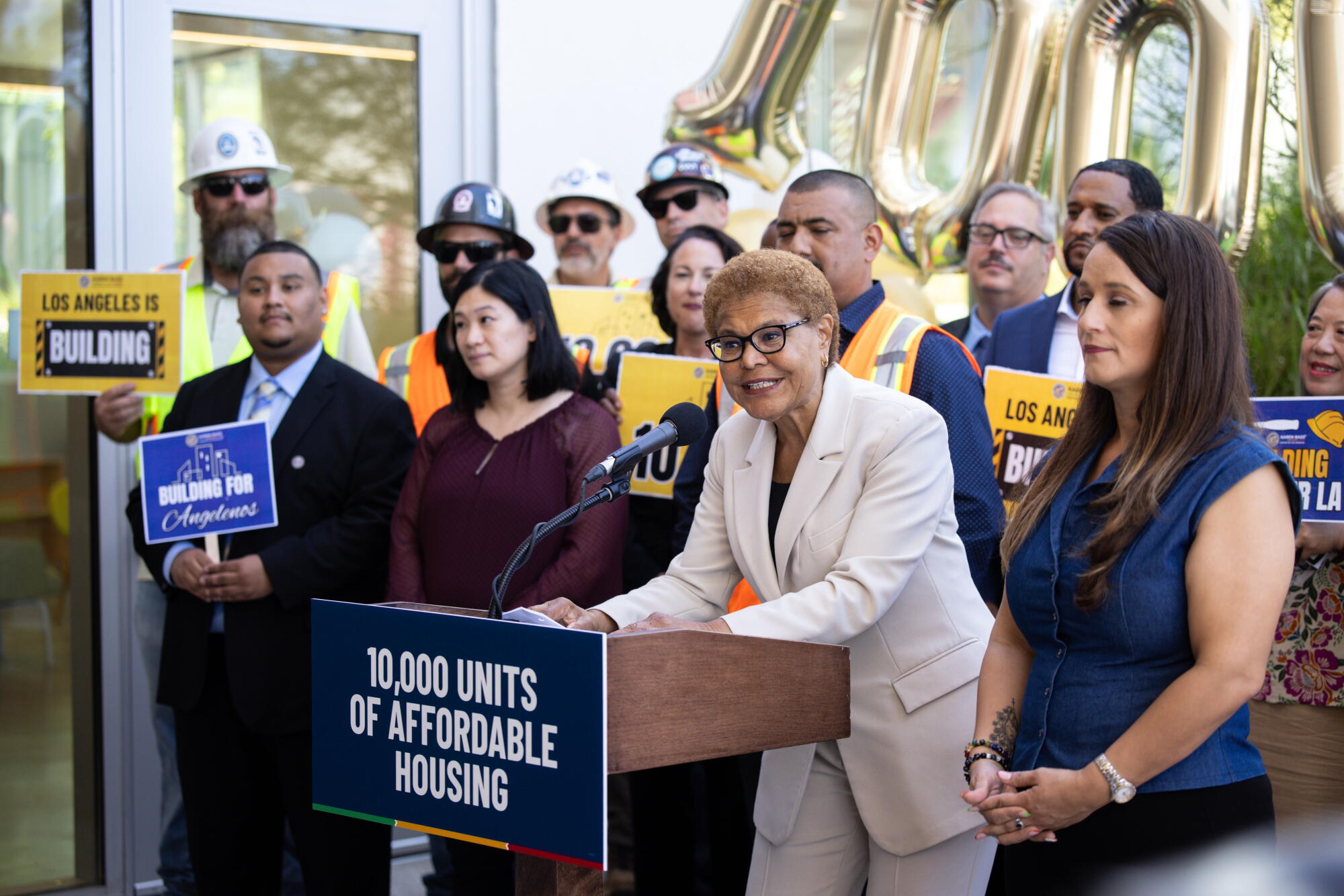
Mayor Karen Bass held a cushy lead in her bid for a second term, and the Associated Press declared that she had made it into the November runoff election. But the underwhelming amount of support she got thus far showed that many voters in a super-blue city didn’t have enough confidence in a Democratic stalwart to return her to office. Instead, many chose self-proclaimed upstarts from opposite ends of the political spectrum: Republican reality TV star Spencer Pratt and democratic socialist City Councilmember Nithya Raman.
Raman launched her campaign at the last moment, just weeks after endorsing her longtime ally Bass, figuring that enough Angelenos were tired of the incumbent and would join her message of change from inside City Hall.
Raman’s instincts were half right. Voters did want change. But they didn’t view her as a challenge to the status quo — to many, she is the status quo.
The mayoral hopeful didn’t articulate a platform that radically departed from Bass’, and voter antipathy to her muddled messaging showed: she ended the night in third place. If the current results hold, Bass would face Pratt in the runoff.
At Raman’s election-night party at Boomtown Brewery on the outskirts of Little Tokyo, I saw why her chances of becoming L.A.’s next mayor were slim from the start. The gathering felt like happy hour at a Silver Lake bar: far whiter than the city overall, with few Latinos. Her address to a packed house was a grab bag of platitudes mixed with a broadside against MAGA, which is a political nothing in L.A. politics. It was an uninspiring cri de coeur and reflective of a campaign that wasn’t apocalyptic enough for those, such as Pratt’s people, who want radical change, while offering nothing new for Bass supporters.
Yet Raman still insisted she had unlocked something transformative.
“Together, we built something extraordinary,” she said to cheers. “And it gives me so much inspiration to be a part of it, a movement powered not by cynicism or political insiders, but by ordinary people who still believe Los Angeles is worth fighting for.”
Raman then went on the dance floor to greet well-wishers, pumping her fist while a DJ blasted Daft Punk’s “Lose Yourself to Dance.”
A billboard for L.A. mayoral candidate Spencer Pratt near MacArthur Park on June 2, 2026.
(Ronaldo Bolanos / Los Angeles Times)
Across town in West Los Angeles, Pratt reveled in his second-place position, enjoying a Mexican dinner with friends and family. It was a peaceful conclusion to a spring of fulminations against Bass (“Karen Basura”), nonprofits, homeless people (“zombies”) and anything that reeked of Democratic pieties, even as the Republican swore he was campaigning for all ideologies in a nonpartisan race.
Long dismissed as a has-been joke, Pratt correctly judged that Angelenos are angry and don’t want to be polite about it anymore. He and his supporters will take his unlikely rise as a mandate to double down against liberal L.A.
But if Pratt, who lost his house in the Palisades fire, does move on to the general election and is serious about winning, he needs to learn from the political revolution successfully pursued by his polar opposites, the local chapter of the Democratic Socialists of America.
Six years ago this spring, L.A.’s political establishment wrote off DSA-LA as wokoso upstarts in their long-shot quest to get a political novice named Nithya Raman elected to the city council. Even as Raman and three other DSA members joined the council, skeptics dismissed them and their progressive policies as anomalies that didn’t reflect how Angelenos actually wanted the city to work.
Tuesday night, four of the six DSA-endorsed candidates in L.A. city elections were in first place by large margins and another was comfortably in second, reflecting DSA’s multicultural, citywide reach. In a telling sign of its newfound king-making status, the local chapter declined to endorse Raman or any other mayoral candidate. Without that powerful backing, their trailblazer, along with DSA member Rae Huang, withered on their L.A. revolutionary vine.
Councilmember Hugo Soto-Martínez and L.A. Unified school board member Rocío Rivas looked to be coasting to outright victories. Marissa Roy was on her way to a runoff that would exclude the incumbent city attorney, Hydee Feldstein Soto, who was a distant third in the early returns. In District 9, where Curren Price is terming out, Estuardo Mazariegos stood comfortably in second place and looked to headed to a runoff against a fellow Latino candidate in a race that will see South Los Angeles elect its first non-Black council member in 63 years.
The most surprising outcome involved Councilmember Eunisses Hernandez, who became a punching bag, along with Bass, for people who thought L.A. had transformed into a hellhole. So-called dark money groups, which don’t have to reveal where their funding comes from, poured hundreds of thousands of dollars into negative mailers. Opponents vying for her seat cast federal raids against drug dealers and gangs in the MacArthur Park area as an indictment of her leadership, berating her during debates and on social media.
Even Hernandez’s supporters were fretting about what might happen on election night. But by the time I arrived at her raucous soirée in Highland Park, early returns showed her way ahead of the field and perhaps avoiding a runoff.
“It’s reassuring to see [DSA’s success],” she said as jubilant supporters lined up beside her to get tattoos — real ink, not temporary — of hummingbirds, her campaign’s logo. “That means people see us. That means people want more.”
Hernandez pointed to her fellow DSA member, New York City Mayor Zohran Mamdani.
“What happened with DSA over there didn’t happen overnight,” she said. “In L.A., we’re getting there.”
A table filled with campaign buttons for Council Memer Hugo Soto-Martinez, who ran for reelection this year and is expected to win outright.
But anyone who wants to win in Los Angeles needs to realize that antiestablishment sentiment is in the air.
At the same time, I would remind the victorious populists to look up in the sky and remember their Shakespeare.
“O, swear not by the moon, th’ inconstant moon / That monthly changes in her circle orb / Lest that thy love prove likewise variable,” Juliet warned Romeo.
Politics, like la luna, waxes and wanes whether we like it or not, and anyone who bets on a permanent transformation at City Hall will probably lose.
Angelenos have declared that they want dramatic change. But how will they feel in November?
L.A. Mayor Karen Bass made what sounded like a victory speech Tuesday night.
Councilmember Nithya Raman made what sounded almost like a concession speech.
And former reality TV star Spencer Pratt relayed a message from the heavens.
“Well, obviously God wanted five more months of me exposing all the failures of our mayor, so it’s gonna be a fun ride,” Pratt said. “I hope she’s ready.”
Assuming Pratt holds on to one of the two spots in the Nov. 3 general election as the final votes are tallied in the next few days, the smart money will be on Bass, for reasons I’ll get into in a moment.
But the supreme being and patron of all pontiffs has to be considered a wild card. This is the first time, to my knowledge, that an incumbent mayor in the City of Angels would be running against a challenger whose campaign manager is God Almighty.
So here we go. We could be in for one of the more remarkable electoral adventures in city history, with a complete novice and MAGA conservative going up against a liberal career politician in a deep-blue city and state full of people who are tired of hearing excuses from Democrats. (If Raman ends up ousting Pratt, my apologies for jumping to conclusions. But it’s not my fault. The devil made me do it.)
If you intend to follow closely, as of course you should, maybe you can help me count the number of times Pratt plays the faith card. I went to St. Peter Martyr School and attended the church by the same name, and I don’t recall ever hearing a nun or a priest drop God’s name as often as Pratt does.
In fact, I just watched a clip of Pratt talking to Fox News TV host and Donald Trump disciple Kayleigh McEnany, and over the course of 1 minute and 52 seconds, he mentioned God or Jesus 10 times.
“Thankfully, I married an angel who was very connected with Jesus and has brought me to the light,” Pratt said of his wife and former reality TV co-star Heidi Montag. “It’s been very empowering to just pray and just be on his path and just say, ‘God, if you want me to save these animals, save these humans and protect my city, just keep putting me in the place where I can do that.’”
Is he running for mayor or cardinal?
Look, I totally respect your average true believer. But I’m not entirely comfortable with a mayor who might be sitting around City Hall waiting for signs and smoke signals rather than knowing what to do on his own.
God has a lot on his plate. He might be busy multiplying fishes and loaves so people don’t go hungry thanks to the president’s tariffs and warmongering. Is he going to rush to answer a prayer for guidance about underfunded parks or broken sidewalks in Los Angeles?
How did we get here, you ask?
Well, Pratt is an AI creation, in a way. A composite of sorts. You combine the forces of social media, political rebellion, second-rate celebrity obsession and the Peter Principle, and here’s a little Trump puppet walking around L.A. like he’s the chosen one.
Add to that the very real essence of his appeal to some voters:
Los Angeles has problems. Big problems that don’t get fixed quickly enough or at all, and Pratt represents the angry voter who wants to know why City Hall can’t do better and where all the money went. He’s absolutely right when he says we shouldn’t have people living on the streets, using drugs on the streets and dying on the streets.
But if Pratt is in the general election rather than Raman, we’re in for a national media circus rather than a summit on solutions. Raman is well-versed on matters of relevance and could have pushed back against Bass in substantive, detailed ways. On the other hand, as Pratt has fairly argued, Raman headed City Council’s homelessness committee, so isn’t she partly to blame for the failures she tried to pin on Bass?
As for Pratt’s policy chops, he has not responded to my offers of a get-together. Absent that, and given his careful avoidance of local reporters who know their stuff, I read his platform on his campaign website and I can tell you that while he touches on many of the right issues — public safety, fiscal integrity, homelessness — attention to detail and depth of knowledge are not God-given strengths.
Maybe Pratt can actually deliver on his promise of a “treatment-led recovery model that addresses mental illness and addiction as the primary drivers of chronic homelessness.” But that would require an act of God (which I suppose is possible given their relationship), because those matters are primarily under the direction of the county, not the city.
This is the main problem here. Bass was beatable, and could have been pushed by a serious challenger to do better.
In the last election, Rick Caruso gave her a scare. That was partly because he had some depth on the issues, he was a successful businessman and philanthropist, he had served on the police commission and the water and power board, he had built relationships across the city and, along with his family, he had poured time and millions of dollars into underserved communities.
In this election, it looks as though Bass could get lucky and face off against a guy who lost his house in the Palisades fire, saw a few homeless encampments through his car window, and decided he wanted to be mayor. Some might have questioned his hubris, but only before learning that he was on a mission from God.
If you’re keeping count, that’s nine mentions of God so far in this column.
One more for the tie, with an eye toward five more months of campaign fodder.
City have long been admirers of Newcastle academy graduate Anderson. The player is currently preparing for the tournament in the US, Canada and Mexico, but club-to-club talks can continue to take place.
Captain Bernardo Silva’s exit means City are looking to bolster their midfield and Anderson tops the list of potential targets.
Newcastle midfielder Sandro Tonali is another player understood to be highly rated by City, with reports, external suggesting the Italy international has been monitored as a long-term target.
Nico Gonzalez, who missed out on a place in the Spain squad for the World Cup and also fell out of favour under Pep Guardiola last season, may depart if the right offer comes in.
Sources indicate City are also looking to sign a right-back to supplement Matheus Nunes, 28, who excelled in the position this season after being converted from midfield.
City are eyeing the profile of a young full-back and one who is a natural in that position that can grow into the role in the future.
The artist who painted a giant mural on a building in downtown Dallas of life-sized swimming whales has filed a $25 million lawsuit against soccer’s international governing body and others, saying they illegally painted over his work to promote the city’s upcoming World Cup matches.
The artist Wyland says he hand-painted the sprawling mural that covered roughly 17,000 square feet across two of the building’s walls.
The mural stood for nearly three decades before workers began painting over it last month, causing an uproar among residents who admired the mural’s grand scale and message of ocean conservation.
The area’s World Cup organizing committee said in a statement that, in place of Wyland’s mural, new artwork is planned “that captures this current historical moment and reflects the energy, unity, and global spirit surrounding the World Cup 2026.” It said a portion of Wyland’s mural would be preserved.
Wyland filed suit Monday in U.S District Court in Dallas saying that World Cup organizers, along with the building’s owner and management company, painted over his mural without his consent or even notifying him. He says their actions violated a 1990 federal law passed to protect visual artists from destruction of publicly displayed works.
Wyland is seeking at least $25 million in damages. His lawsuit says world soccer’s governing body, FIFA, and other defendants “hastily and irrevocably destroyed a civic landmark” to promote the World Cup.
“Though FIFA claims they were working to develop art for the host city, in truth, they defaced an historic fixture of the host city,” the artist’s lawsuit says.
A FIFA spokesperson said Tuesday the federation “has no involvement in this whatsoever” and referred a reporter to the tournament’s local organizing committee.
A spokesperson for the North Texas FWC Organizing Committee declined to comment. The committee isn’t named as a defendant in the lawsuit.
A spokesperson for Slate Asset Management, which manages the building where the mural was painted over, said in a statement that local World Cup organizers asked Slate in March to donate the mural space for “a new public art installation.”
“Slate is not being compensated in any way for the use of the wall space and was told by the local groups that Mr. Wyland had been notified,” the management company’s spokesperson said in an email.
Dallas is hosting more World Cup matches than any of the other sites in the event co-hosted by the U.S., Canada and Mexico, with nine matches set to be played at AT&T Stadium in suburban Arlington, home of the Dallas Cowboys.
Wyland’s Dallas mural, titled “Whaling Wall 82,” was finished in 1999 and is among more than 100 similar murals known as Whaling Walls the artist painted around the world to promote the conservation of ocean life.
An online petition protesting the mural’s destruction and calling for protecting of public artwork in Dallas has received more than 2,600 signatures.
Wyland’s lawsuit alleges violations of the Visual Artists Rights Act, a 1990 federal law that protects artwork of “recognized stature” even if someone else owns the physical artwork.
A judge cited that law in 2018 when he ordered a property owner to pay a group of New York graffiti artists $6.7 million for whitewashing dozens of their spray-painted murals on buildings that once housed a factory in Queens. The ruling was upheld on appeal.
Bynum writes for the Associated Press. Bynum reported from Savannah, Ga.
To apply the existing cannabis business tax to unlicensed cannabis businesses.
Los Angeles Measure TC
To apply the transient occupancy tax to online and other travel companies.
Los Angeles Measure TT
To increase the transient occupancy tax to fund general city services.
Bell Measure BB
To establish a sales tax to fund city services such as emergency services, prevent crime, maintain streets and after-school and anti-gang programs.
Bell Gardens Measure BG
To raise sales tax to fund city services such as police and emergency response, street repairs, park maintainence and youth and senior programs.
Beverly Hills City Treasurer
Beverly Hills City Council
Carson Measure FW
To allow the sale of “safe and sane” fireworks from up to 12 permitted temporary stands within the city around Fourth of July.
Commerce Measure PC
To enact a sales tax to fund police services, 911, youth and senior programs, library services, parks, streets and infrastructure.
Compton City Council, District 2
Compton City Council, District 3
Covina City Council, District 1
Covina City Council, District 3
Covina City Council, District 5
Covina Measure CC
To enact a sales tax to fund emergency services, clean up encampments, address homelessness, improve parks, repair streets and provide senior and youth programs.
Gardena Measure GG
To enact a sales tax to fund city services such as emergency response, hiring police officers, keeping parks clean, repairing streets and maintaining after-school and senior services.
Inglewood Measure I
To repeal the city’s ban on the public’s use of “safe and sane” fireworks, permit their sale under a regulated framework and establish rules and penalties for violations.
La Cañada Flintridge City Council
La Puente Measure LP
To raise the sales tax to fund public safety, street and sidewalk maintenance, park maintenance, youth and senior programs and other services.
Lakewood City Council, District 2
Lomita Measure LW
To enact a sales tax to fund services such as emergency response, property crime prevention, maintain parks, repair streets and sewers, maintain gang prevention efforts and address homelessness.
Long Beach City Council, District 1
Long Beach City Council, District 3
Long Beach City Council, District 5
Long Beach City Council, District 7
Long Beach City Council, District 9
Monterey Park Measure NDC
To prohibit data centers in the city.
Palos Verdes Estates Measure PF
To extend the parcel tax for 10 years to fund emergency services and prepare for wildfires.
Pasadena City Council, District 3
Pasadena City Council, District 5
Pasadena City Council, District 7
Pasadena Glen Community Services District Measure B
To enact an special parcel tax to maintain and improve roads and culverts within the district.
Pomona City Council, District 2
Pomona City Council, District 3
Pomona City Council, District 5
Pomona Measure Z
To restructure funding for the Pomona Children and Youth Fund using city sales tax rather than the general fund.
San Fernando City Council
San Marino Measure S
To enact a transaction and use tax to fund street and infrastructure repairs, improve public safety, provide youth and senior programs and library and parks maintenance.
Sierra Madre Measure GL
To increase the city’s spending limit to fund general governmental services for four years.
The Times’ results pages reveal how Californians voted for governor, U.S. House seats and in local city, school board and ballot measure races.
Every registered voter in the state receives a ballot by mail. Polls close at 8 p.m. on June 2, and mailed ballots need to be postmarked on or before that day. Winners may not be known on election night due to the high volume of mail-in ballots arriving after election day.
The vote counts on these pages update periodically as results are reported by the Associated Press and the L.A. County registrar. On election day, those results include in-person voting as well as any mail-in ballots already received. In the days and weeks following, votes will be reported approximately once a day, as they are processed by county registrars. Voters can track their own cast ballot here.
The Associated Press surveys the numbers posted by local election officials. The AP projects the winner for all statewide and federal races using vote returns and other data. A race may be called before all expected votes are in. Results can change as more ballots are counted.
These pages will update until the secretary of state certifies results on July 10.
Los Angeles City Councilmember Traci Park opened up a commanding lead over public interest attorney Faizah Malik in the race to represent the city’s coastal neighborhoods, according to early election returns Tuesday night.
Park has been a close ally of the police and fire unions in the city, calling for more cops and firefighters. Malik has been endorsed by the Democratic Socialists of America and also is backed by the Los Angeles County Federation of Labor and Unite Here Local 11, which represents hotel and airport workers.
L.A. City Council candidate Faizah Malik, left, and incumbent Traci Park.
(Eric Thayer and Francine Orr / Los Angeles Times)
Park reported raising $1.3 million in campaign contributions, according to the latest campaign finance reports filed with the city, compared with about $540,000 for Malik.
Park said she felt good about the early returns.
“It confirms that we have been right on the priorities and the results have spoken for themselves,” she said. “I have been writing a comeback story for the Westside for the last three years, and I’m super excited to finish it.”
In a speech to supporters at the Lincoln, a bar on the Westside, Malik remained upbeat.
“This campaign has demonstrated that we can chart a new course for a sustainable future and we can lead the way here on the Westside,” Malik said.
Los Angeles voters cast ballots for eight of the 15 City Council seats in Tuesday’s election, including races in two districts where the incumbents are leaving because of term limits.
In races with more than two candidates, the top two vote-getters will compete in a Nov. 3 runoff unless a candidate gets a majority vote in the primary.
Jose Ugarte was leading Estuardo Mazariegos in the field of six candidates in the District 9 race held by termed-out Councilmember Curren Price.
District 9 candidates Jose Ugarte, left and Estuardo Mazariegos.
(Genaro Molina / Los Angeles Times)
Ugarte is a former deputy chief of staff for Price, and Mazariegos is co-director of the Alliance of Californians for Community Empowerment Los Angeles and is backed by the Democratic Socialists of America.
Mazariegos said he felt confident he would make it into the Nov. 3 runoff against Ugarte.
“I feel a sense of relief and accomplishment,” he said.
The other candidates in the race were trailing Ugarte and Mazariegos in early returns. They are Elmer Roldan, executive director of Communities in Schools of Los Angeles; Martha Sánchez, a therapist; Jorge Nuño, an entrepreneur; and Jorge Hernandez Rosas, an educator.
The district includes the Convention Center, USC and communities along the Harbor Freeway.
In the San Fernando Valley’s District 3, Tim Gaspar and Barri Worth Girvan were leading the field of three candidates vying for the seat being vacated by Bob Blumenfield.
Christopher “C.R.” Celona, left, Barri Worth Girvan, center, and Tim Gaspar are running for L.A. City Council District 3.
(Stephanie Lorens, Yauma Olstead and Tim Sullens)
Gaspar is the founder of an insurance company, and Worth Girvan is a district director for Los Angeles County Supervisor Lindsey Horvath.
Worth Girvan said she was confident she would face Gaspar in a runoff in November.
“[The campaign] has been about ensuring the West Valley gets its fair share of resources,” Worth Girvan said.
In a statement, Gaspar said he was feeling “incredibly optimistic” about the coalition of business owners and community leaders he built during his campaign.
“They are showing they want a fresh perspective in City Hall,” he said.
The third candidate, tech entrepreneur Christopher Robert “C.R.” Celona, trailed behind.
In District 13, Councilmember Hugo Soto-Martínez was leading three challengers — Dylan Kendall, who runs Grow Hollywood, an economic development corporation; Rich Sarian, vice president of strategic initiatives for downtown’s South Park Social District; and Colter Carlisle, vice president of the East Hollywood Neighborhood Council.
City Council District 13 candidates, clockwise from top left: Councilmember Hugo Soto-Martinez; Colter Carlisle; Rich Sarian; and Dylan Kendall.
(Los Angeles Times)
Soto-Martínez also was backed by the Los Angeles chapter of the Democratic Socialists of America for the district that includes Atwater Village, Glassell Park, Elysian Valley, Echo Park, Silver Lake and Hollywood and East Hollywood.
Soto-Martínez said in a statement he was feeling optimistic about the early returns.
In District 1, which covers Highland Park in the northeast to University Park in the southwest, Councilmember Eunisses Hernandez was leading a pack of four challengers in the race, according to early returns.
Maria Lou Calanche, executive director of the nonprofit Expanded Learning Alliance, trailed Hernandez, according to early returns. They were followed by Raul Claros, chief executive of UNO Partners; Nelson Grande, president of Grande Enterprises; and Sylvia Robledo, who worked as an aide to several elected L.A. officials and who has fallen into last place.
Hernandez was grateful for the support that put her far ahead on the first night of results.
“I just feel reassured that all these fights we’ve been taking on for the last 3½ years have been worth it and people have been watching,” Hernandez said.
In other races, Councilmember Tim McOsker had a wide lead over Green Party member Jordan Rivers for the 15th District seat, which includes Harbor City, San Pedro, Watts and Wilmington. But the incumbent said while the early returns were encouraging, it was too early to declare victory before 9:30 p.m.
“I’ll be back in City Hall early tomorrow morning to get back to work,” McOsker said from his campaign party at the Dalmatian-American Club in San Pedro.
His campaign, he said, was focused on moving forward projects “past the point of no return” to make real change in the district that encompasses Watts, Wilmington, Harbor Gateway, Harbor City and San Pedro.
In the 5th District, which includes Bel-Air, Westwood, Cheviot Hills and Hancock Park, Councilmember Katy Yaroslavsky declared victory in her race around 9 p.m. after early ballots pushed her far ahead of the two challengers.
“Across the spectrum, people are looking for lights to be fixed and sidewalks to be usable,” she said.
In the north San Fernando Valley’s 7th District, Monica Rodriguez was running unopposed.
Los Angeles City Atty. Hydee Feldstein Soto lagged behind her two well-funded challengers based on early returns Tuesday night. But her incumbent colleague, City Controller Kenneth Mejia, appeared to be faring better in his bid to stay in office, holding a double-digit lead over finance executive Zach Sokoloff.
Progressive Marissa Roy led the field vying to serve as Los Angeles’ top lawyer in the first batch of returns surfacing around 8:20 p.m.
L.A. County Deputy Dist. Atty. John McKinney sat in second, while Feldstein Soto was positioned third. The top two finishers will advance to November’s general election. It could be days before the outcome of the race is clear. Mail-in ballots with a Tuesday postmark will be accepted by county election officials for another week.
With only two candidates running, the controller’s race will be decided this month and will not go to a runoff in November.
The city attorney’s race transformed suddenly this spring after the Los Angeles Police Department’s largest union broke with Feldstein Soto and backed McKinney. Independent expenditure campaigns have thrown $3 million behind McKinney in recent weeks, with much of that money coming from a political action committee controlled by Airbnb.
Feldstein Soto sued the rental giant for violating price gouging laws in the wake of the Palisades fire last year and has openly questioned whether McKinney would shy from aggressive litigation against Airbnb if elected.
“Special interests have gotten really accustomed to special treatment at City Hall. They get special treatment all the time,” Feldstein Soto said in a recent interview, suggesting that both McKinney and Roy had been compromised by outside spending. Independent expenditure campaigns supporting Roy also received roughly $725,000.
McKinney told The Times that if elected, he would “absolutely” sue Airbnb if necessary.
A representative for Feldstein Soto’s campaign declined to comment on the early returns late Tuesday night.
The three leading candidates often sounded like they were campaigning for different jobs.
Roy said she would run the city attorney’s office as L.A.’s “largest public interest law firm,” focusing on tenants’ rights, wage theft and other issues affecting working-class Angelenos. A deputy attorney general in the California Department of Justice, she also vowed to sue the Trump administration, linking arms with the attorney general’s office and other city attorneys in aggressive litigation to curb what many Californians see as targeted abuses of power.
McKinney talked more like he was running for city prosecutor, leaning heavily on his experience winning high-profile felony trials in the downtown courthouse. He said he would improve the way the city attorney prosecutes gun crimes and animal abusers. Despite his lack of experience as a civil litigator, McKinney also said he could bring down the city’s litigation costs, which exploded under Feldstein Soto.
“While all votes have not yet been fully counted, we feel optimistic about qualifying for the General Election in November. People want political courage. They want leadership,” McKinney said in a statement Tuesday night. “What is already clear, is that this election has been shaped by the pressing and undeniable concerns of the people of Los Angeles.”
She said she improved public safety by repairing her office’s relationship with the LAPD and filed more misdemeanors than her predecessor. Although legal costs surged, Feldstein Soto said she did her best to mitigate damage on a number of difficult cases she inherited when taking office in 2022. The rise of so-called “nuclear verdicts” in civil claims reflects a nationwide trend rather than a fault of her leadership, she said.
Feldstein Soto was endorsed by Mayor Karen Bass and U.S. Sen. Adam Schiff (D-Calif.). Roy had the support of the L.A. County Democratic Party, the city chapter of the Democratic Socialists of America and U.S. Sen. Bernie Sanders (I-Vt.). In addition to the police union, McKinney was backed by his boss, L.A. County Dist. Atty. Nathan Hochman.
The city controller’s race, normally a fairly sleepy affair, has turned into the second-highest-spending race in the city.
Mejia, 35, known for his two corgis that he often features on billboards across Los Angeles, sought to retain his seat as the city’s accountant and auditor.
His only challenger was Sokoloff, a senior vice president for asset management at Hackman Capital Partners. Sokoloff, 37, alleged Mejia did not properly utilize the controller’s office to run audits on city departments and failed to keep up the auditing pace of his predecessor.
Sokoloff’s mother, Sheryl, has spent $7.5 million on independent expenditures in the race, mostly on attack ads and mailers against Mejia. Often, the ads point to allegations that Mejia in 2023 fostered a toxic workplace and made inappropriate sexual remarks to female subordinates.
A woman who identified herself as Sheryl Sokoloff hung up on a Times reporter last week when asked about the race expenditures.
Mejia said Sokoloff’s mother — married to Jonathan Sokoloff, managing partner of private equity firm Leonard Green & Partners — was trying to bankroll the seat for her son.
Mejia has long run on accountability and transparency for the city’s budget and made public-facing databases across dozens of topics on the controller’s website in his first term.
A licensed certified public accountant, Mejia is a member of the Green Party and does not accept endorsements from political parties or politicians. He was endorsed by the Los Angeles Daily News and multiple labor unions, including the United Teachers of Los Angeles and United Auto Workers.
Sokoloff, a Democrat, was endorsed by multiple former controllers, notable Democrats — including Schiff — and the L.A. County Democratic Party, along with other business advocacy groups.
As primary voters head to the polls Tuesday to determine which candidates will face off in November to become California’s governor and Los Angeles’ mayor, both races are wide open, with a new crop of candidates challenging the Democratic status quo.
For Democrats, little clear consensus has emerged so far on who should lead the city and state into the future.
In California’s crowded gubernatorial race, Democrats have struggled in recent months to settle on a candidate to succeed term-limited Gov. Gavin Newsom.
In L.A., experience seems to be as much a liability as an advantage.
Mayor Karen Bass finds herself in the extraordinary position, as an incumbent, of fighting to make the runoff as she is assailed from the left and the right. The latestUC Berkeley-L.A. Times poll shows Bass leading with just 26% of the vote, one point ahead of City Councilmember Nithya Raman, a wonkish Democratic socialist, and four points ahead of Republican Spencer Pratt, a former reality TV star.
“There’s a clear sense of frustration with the Democratic Party,” said Sara Sadhwani, a professor of politics at Pomona College. The reason a wave of conservative outsiders like Pratt and Hilton are doing so well in such a solidly liberal city and state, Sadhwani said, is that they’re more willing to spell out the challenges that L.A. and California face.
“Democrats tend to be very concerned about not upsetting one coalition or another, so it’s politics as usual with many of the Democratic candidates,” Sadhwani said. “Spencer Pratt has blown a hole in that by just naming the problems that everyday residents and voters are seeing and feeling on the ground.”
On homelessness, many Angelenos are frustrated Bass hasn’t significantly moved the needle.
“We can point to facts and figures that might suggest that things have changed,” Sadhwani said. “But when you walk down the streets of Los Angeles, it doesn’t feel like it, so she hasn’t passed the field test. That’s the problem.”
A growing segment of Angelenos also chafe at the city’s high cost of living. And many are angry about the Bass administration’s lack of preparation and response to the 2025 Palisades fire.
“The Democrats have to account for those challenges,” Sadhwani said. “They have been in power for all of this time.”
California, of course, remains a Democratic stronghold, and polls show state voters are overwhelmingly opposed to President Trump. His second-term agenda — including a sweeping immigration crackdown, tariffs and the war in Iran — only seems to have cemented California’s status as a resistance state.
But after so many years of Democratic dominance, in Sacramento and at Los Angeles City Hall, leaders have to answer for voter frustrations.
The top two vote-getters in California’s nonpartisan primaries will advance to theNovember runoff, unless one candidate manages to pick up more than 50% of the vote.
Republicans have turned out at higher rates than Democrats in early voting. Paul Mitchell, vice president of the Sacramento-based bipartisan firm Political Data Inc., said that older Democrats who reliably turn in their ballots were slower to vote this year, likely because two Republicans were on the gubernatorial ballot and the Democratic field was fractured.
“That has caused them to dive into a lot more strategic voting,” Mitchell said, noting many seemed to be waiting to cast their ballots for the Democrat who looks to have the best chance of moving on to November.
For the GOP, getting a candidate on the November ballot for governor means more than just demonstrating Republicans are players in California. A GOP candidate would bring out more Republicans to vote in the general election, raising the party’s prospects of winning down-ballot races and passing a GOP-led ballot initiative on voter ID.
For Democrats, the midterm races offer the party its first major chance to chart a new path for the future.
As polls show Trump cratering in popularity, Democrats in California and beyond are struggling a year and a half after Kamala Harris’ bruising 2024 defeat to agree on what went wrong.
The Democratic National Committee’s long-awaited autopsy of that election — which said Harris “wrote off rural America,” wrongly assumed identity politics would win over voters of color and failed to develop “defined or consistent” strategy against Trump — has only generated more hand-wringing.
“There is not a clear vision, there is not a clear policy agenda, and the Donald Trump presidency upended the policy world as we knew it,” Sadhwani said. “It’s unclear how any Democrat, including any of the individuals in these two races, is going to navigate the waters into the future. One thing is for certain: We aren’t going back. So, which of these candidates is going to lead us into an uncertain future?”
Referendum on Bass
In L.A., the election is a referendum on Bass, who pledged in 2022 to solve homelessness, cut crime and make the city more affordable.
“How has L.A. changed in four years?” said Christian Grose, a professor of political science and public policy at USC. “The Bass campaign is saying it has changed for the better and she still needs more time. All the other candidates, from very different perspectives, are saying that it’s much worse than it was four years ago, and it’s time for new leadership.”
Bass told The Times she plans to win in November by demonstrating her administration’s progress in clearing homeless encampments and accelerating the building of affordable housing. She has also noted that data shows homicides in the city are at their lowest since 1966.
Challenging Bass from the left is Raman, who was elected in 2020 as the first DSA-backed L.A. City Council member. Pitching herself as the viable progressive in the race, Raman has accused Bass of not doing enough to make the city affordable and critiqued Bass’ spending on Inside Safe, her program to move unhoused people into stable housing. Although Raman presents herself as an outsider, she is a former Bass ally who has chaired the council’s Housing and Homelessness Committee for more than three years.
“She’s absolutely a part of the establishment,” Sadhwani said. “She’s been in City Hall longer than Karen Bass.”
Pratt is challenging Bass and the entire Democratic status quo.
A former star of “The Hills” who lost his home in the Palisades fire, he has surprised many political observers with his success assailing the city’s handling of the 2025 firestorms. He has called unhoused people drug-addled “zombies” and argued that L.A.’s housing crisis requires heavy-handed policing.
Still, most political experts agree that Bass has the most viable path to victory, starting with a solid base of Black voters and a large share of Latino voters, plus support from powerful unions.
“Under normal circumstances, or at least under historic circumstances, that would be plenty to get her over the finish line,“ said Jim Newton, executive director of UCLA Blueprint magazine and a former political journalist for The Times. “What’s problematic for her is that there are people who are angry with her.”
A reset in California
Newsom has emerged in recent years as the national face of Democratic resistance to Trump, bolstering California’s status through a barrage of lawsuits and all-caps trolling against Trump.
Whatever candidate replaces Newsom, things are going to be different.
The emerging front-runner, Becerra, is a safe-bet career politician who has served as California attorney general and U.S. secretary of Health and Human Services. Asked recently why he had climbed in the polls, Bercerra said he thought voters wanted experience, not “glitz and sizzle.”
He has pledged to issue executive orders declaring California’s housing shortage a state of emergency and directing state agencies to maintain coverage for every Californian affected by federal or Medi-Cal cuts. He also touts his record, as the state’s attorney general, of suing Trump 122 times.
Steyer, a hedge-fund billionaire, calls himself “the most progressive candidate on the ballot.” He has pledged to build one million affordable homes, make the wealthy pay more taxes, and defend the environment — stances that are certain to unsettle Sacramento lobbyists and test the limits of California’s progressivism. But his past investments in coal plants and ICE prisons raise questions for some voters.
“His wealth is in one way his Achilles heel in the election,” Grose said. “Voters think of him as a billionaire more than progressive.”
Hilton has pledged to cut government spending, make housing more affordable and bring gas prices down. But to achieve some of his goals he would scale back public services and environmental regulations and ramp up domestic production of oil and natural gas — strategies that many Californians might hesitate to get behind.
“Clearly, the party itself has lost its way in California,” Sadhwani said. “I would not be surprised if the California Democratic Party looks for new leadership after this election.”
If Republicans make it to the runoff, they face steep odds of being elected in November in a state where Democratic registered voters outnumber Republicans bymore than 20 percentage points.
Rob Stutzman, a GOP strategist, said neither Hilton nor Pratt was likely to win. But if they made the runoff they could have a huge impact on the political environment by advancing “grievance issues that really put up a spotlight on what I call the blue state incompetence.”
Of all the candidates, Mitchell said, Pratt as an outsider adept at Instagram and TikTok has the greatest opportunity to create a new surge electorate. But he’s also going after the hardest voters to get to turn out: disaffected voters who are upset at the system.
Pratt had more retweets and viral videos than any other candidate, Mitchell said. “But that doesn’t buy him the vote of the disaffected DoorDash driver who believes that the system is broken, and who hasn’t voted in the last five elections.”
If Republicans don’t make it past the primary, Mitchell said, Democrats would likely hit the reset button.
“Pratt running has kind of obfuscated the differences between Raman and Bass,” Mitchell said. “It’s like a WWE match versus a chess match. I think Raman versus Bass would be more of a strategic and nuanced election than Spencer Pratt trying to hit Karen Bass over the head with a chair.”
Elections in the city of Los Angeles include mayor, City Council, three ballot measures and Los Angeles Unified School District board seats and, if you live in the city, you’ve maybe seen an ad about them.
The high-profile competition between incumbent Mayor Karen Bass, City Councilmember Nithya Raman and conservative reality star Spencer Pratt has been tumultuous. And that is to say nothing of Rae Huang, Adam Miller and the nine others contenders.
A candidate can win by getting a majority of the vote. If no one receives 50% + 1 vote, the top two advance to the November election.
twitter
facebook
envelope
angle-double-right
angle-down
angle-up
long-arrow-right
Jump to:
Mayor
The Associated Press, which surveys the numbers posted by local election officials and projects the winner using vote returns and other data, will call a winner (or a runoff) for L.A. mayor.
As the voters deliver their ballots to neighborhood drop-off sites and others wait to vote in person Tuesday, Times reporters fanned out across the city to ask residents whom they planned to support for mayor.
Here is a sample of what voters said about their preferred candidate.
‘The other choices were not worth my vote’
Steven Travers 57 Glassell Park Self-employed
Voter Steven Travers told The Times that he didn’t feel like there were many options for him in the mayoral election this year, except for the incumbent Karen Bass.
Shopping at Vons in Echo Park, Travers said, “Just what I’ve seen of her, and you know, the way she speaks, she seems to be OK.”
“I guess she’s done an OK job since she’s been the mayor,” Travers said. “The people she’s running against, I mean, there’s really nobody else that I think I would want to be in that position.”
This decision to vote for Bass, despite the wide field of options, came down to how she had handled homelessness in the city and Travers’ neighborhood of Glassell Park, where there had been homelessness issues “for a period of time.”
The issue, Travers said, has been lessened and “certain areas things are getting a little bit cleaned up. And I’m assuming that she’s, you know, part of that whole thing.”
Travers also said that “anybody involved in politics in Los Angeles” seems to always talk about homelessness “more than anything else” and that Bass “seems to be trying to maybe do something about it.”
Simply put, “The other choices were not worth my vote,” Travers said.
Looking for a more humane L.A.
Zorah Archie-Winston 22 View Park Recent USC graduate
Zorah Archie-Winston said that she’s probably voting for Nithya Raman for mayor.
“If I had to choose, like, right now, I think I’m leaning more towards Raman,” Archie-Winston said.
One of the main reasons for that, she said, is Raman’s personality and the humanity she brings to the table.
The 22-year-old View Park resident said that the unhoused population is something she feels very passionately about, and she believes Raman shares that.
“We could have, like, a lot more of a compassionate view on the unhoused population and those adjacent,” Archie-Winston said.
She said she’s been following along with Raman’s journey on the L.A. City Council and looks forward to seeing what the candidate could do as mayor, especially for tenancy rights.
“I think there are a lot of resources and things that are really inaccessible to those who are struggling to live in L.A. for one reason or another, and I think that’s something Raman will be able to help with,” Archie-Winston said.
‘He might be our only saving grace’
Ann Raljevich 66 Westchester Medical biller
Ann Raljevich, a 66-year-old medical biller, says Spencer Pratt could be the city’s hero in the mayoral race.
“I think he might be our only saving grace,” said Raljevich, of Westchester.
Under the city’s current leadership, Raljevich tells The Times, she said she hasn’t seen change in the city. She said she still sees the same unkempt streets, drug addicts around town and high sales taxes.
“Being in the medical field — the drugs bring on the schizophrenia and bring on all the other things, and I mean, I see it when I drive in and out of town,” Raljevich said. “I see it everywhere.”
Raljevich said she also admired that Pratt was from Southern California and graduated from USC.
She said the fact that he hasn’t directly declared a political party affiliation shows that he doesn’t care what people think and is just here to do the job.
“He never really came out to say whether he’s a Republican or a Democrat,” Raljevich said. “He’s just for the people.”
Swansea City midfielder Ethan Galbraith said his calf injury is “all good” after being included in Northern Ireland’s squad for friendlies with Guinea and France.
Galbraith had not played since the friendly draw with Wales at the end of March, which came after Northern Ireland’s World Cup play-off defeat by Italy.
In April, Swansea boss Victor Matos said he would prefer the 24-year-old was rested for June’s international window, but Galbraith said he had conversations with his club manager and the medical team.
Having missed the remainder of Swansea’s Championship campaign, Galbraith said he had been “ticked off” by the club’s medical team to link up with Northern Ireland.
Northern Ireland face Guinea in Spain on Thursday before facing France in Les Bleus’ World Cup send-off in Lille on 8 June.
“I’m happy to able to come to camp”, Galbraith said.
“I spent six or seven weeks just with a physio, so that was quite long just training by myself but it is all good now.
“When you spend time off the pitch it’s obviously frustrating. So having these games is absolutely brilliant for everyone, but coming off the back of an injury, it’ll be good to get back out there.”
After an impressive first season at Swansea, where he has been deployed at right back as well as in midfield, Galbaith has been linked with a move to the Premier League, as well as Championship rivals Wrexham, but he says his focus is on his current club.
“It’s nice when you see people are saying that you are doing good things, but at the moment I’m a Swansea player and will just try and focus on Swansea.”
Wales international Hannah Cain is leaving Leicester City following the club’s relegation from the Women’s Super League (WSL).
The 27-year-old forward is one of three players, external who will leave the Midlands club when their contracts expire at the end of the month, but Leicester have confirmed Wales goalkeeper Olivia Clark will remain with the Foxes for 2026-27.
Cain joined Leicester from Everton in 2020 and helped the club gain promotion to the WSL in her first season.
“After six unforgettable years, I feel that now is the right time for me to say goodbye, ” Cain said on social media.
“This club has been so much more than just a place to play football. It’s been a place where I’ve grown, learned, created lifelong friendships, and made memories that I’ll cherish forever.”
Cain is currently with the Wales squad preparing to face Montenegro and Czech Republic in their final Women’s World Cup qualifying fixtures and is yet to indicate where she will play next season.
“While it was always going to be difficult to leave, I’m incredibly grateful for everything this club has given me,” she added.
“I’ll always look back on these years with pride and appreciation.”
A BEAUTIFUL city in Germany has been named one of the best hidden gems in Europe.
European Best Destinations has announced its list of ‘Best Treasure Destinations in Europe 2026’, naming any that have ‘rare beauty, timeless charm and extraordinary places still preserved from mass tourism’.
Sign up for the Travel newsletter
Thank you!
Tübingen has been named one of the ‘Best Treasure Destinations in Europe’Credit: AlamyOn Neckar River, locals and tourists can go on punting toursCredit: Alamy
At the very top of its list is Tübingen in Germany.
The publication called the city an “amazingtreasure destination in Europe“.
It added that it’s “a traditional university town; about one in three people living there is a student.
“From its historical sites to its beautiful green spaces, there are so many unique things to do in Tübingen.“
The city in southwest Germany has a very pretty Old Town, translated to Altstadt.
Tübingen is considered ‘untouched’ as unlike other German cities as it avoided being bombed in World War Two.
So it still has it’s pastel-coloured 15th-century half-timbered houses and cobblestone roads filled with independent and boutique shops, pubs, cafés, and restaurants.
One visitor said: “We went there in the middle of summer and the view was really beautiful. Between the alleys, typically German, colorful houses and flower railings.”
Tübingen has pretty colourful houses by the waterfrontCredit: Alamy
Another said the Old Town is “definitely the most beautiful place in the city. The square is plenty of restaurants and terrasses. It’s a good place to drink something and enjoy the atmosphere, especially in summer.”
One of the most famous sites in the city is the Hölderlin Tower, the former home of the poet Friedrich Hölderlin.
The tower was built in the late 18th century and sits on the Neckar River.
It’s now a museum with a permanent exhibition dedicated to Friedrich Hölderlin during the time that he lived in the tower.
Another popular activity is getting on Neckar River for Oxford-style punting.
Public punting along the Neckar River runs seasonally from May to September.
Hölderlin Tower is the former residence of the poet Friedrich HölderlinCredit: Alamy
One of the tour operators offers sessions from €70 (£60.54) per hour – this price is for a whole boat seating up to 16 people.
There are different tours available, some along the riverfront, others head to Neckar Island and sunset tours during the evening.
There are some food specialities to enjoy while visiting Tübingen including Maultaschen – pasta filled with minced meat, spinach, bread crumbs and onions.
There’s also Käsespätzle which are cheese noodles, the region is also known for its wines like Trollinger and Lemberger.
For Brits, the easiest way to get to Tübingen is to fly to Stuttgart, and then drive 40-minutes south of the airport.
A GuruWalk study found the world’s most walkable destination for travellers fascinated by ancient history
There’s nothing better than exploring a city on foot(Image: andresr via Getty Images)
The old adage that the best things in life are free rings particularly true when it comes to travel. Exploring a city on foot, rather than wrestling with bewildering public transport networks or splashing out on car hire, is one of the finest ways to immerse yourself in unfamiliar surroundings — and it won’t cost you a penny.
Free walking tours are a firm favourite amongst seasoned travellers as a brilliant way to get acquainted with a new city while soaking up a bit of local history.
Europe is brimming with historic cities where you can stroll between landmarks in just a few minutes, including Cordoba in Spain, whose magnificent Old Town has even earned UNESCO World Heritage status.
The ability to simply wander up to a World Heritage Site is a remarkable privilege that’s easy to overlook, yet far from an everyday occurrence. But when it comes to exploring your surroundings on foot, one European city — dubbed an “open-air museum” — stands head and shoulders above the rest as the ultimate walkable destination.
A study by GuruWalk, the world’s largest platform for free walking tours, has crowned Rome the most walkable destination on the planet for “travellers fascinated by ancient history”, drawing on the preferences of more than four million users of the platform.
The city’s historic centre is packed with unmissable sights, while its surrounding streets and winding cobblestone alleyways are frequently too narrow for traffic to navigate, making it an absolute must for exploring on foot.
Many of Rome’s most iconic attractions, including The Colosseum, the Pantheon and the Trevi Fountain are within a mere 20-minute stroll of one another, with countless stunning Baroque piazzas to pause at along the way.
The oldest surviving structure in Rome, the present-day Pantheon — which originally functioned as a temple dedicated to Roman deities — was finished in 126 AD and sits encircled by three of the city’s most cherished squares: Piazza Navona, Piazza di Spagna, and Campo de Fiori, reports the Express.
Reflecting on the awe-inspiring monument, one Tripadvisor reviewer remarked: “We didn’t get to go in so this review is only in regards to the outside. I thought it was so cool to see. You’re walking through a city and suddenly walk right next to this beautiful ancient structure. There’s so much history to it!”
Indeed, there’s no finer method of immersing yourself in Ancient Rome than by meandering through its storied streets. A visit to the Vatican — the heart of the Roman Catholic Church and location of one of the world’s grandest churches, St Peter’s Basilica — wouldn’t be complete without popping into the nearby Pizzarium.
This beloved Roman establishment, famed for its pizza al taglio (by the slice), is adored by both residents and tourists, and there’s an abundance more to discover while exploring — from velvety gelato and piping hot bowls of pasta to a crisp Aperol Spritz to round things off.
If you find yourself worn out from all that strolling, there’s plenty of coffee bars to choose from, but be aware that milky coffees are only deemed acceptable before 11am, with tradition suggesting it’s wise to order an espresso after that time.
According to GuruWalk’s 2026 top ranking for Rome, it stated: “Rome has captivated travellers for over 2,700 years thanks to its unparalleled historical legacy. Walking through its cobblestone alleyways reveals one treasure after another: the Colosseum, where gladiators battled before 50,000 spectators, the Pantheon with its unreinforced concrete dome that remains the largest in the world, and the baroque fountains that spring up at every corner. Every step transports you through empires, popes, and renaissances.”
I live in Santa Barbara and I’m interested in photography. Where are some historical places to take pictures in Los Angeles? I’m interested in old movie palaces, movie and TV show locations, historic homes and buildings, World War II–related sites and airplane museums. — William Lemons
Looking for things to do in L.A.? Ask us your questions and our expert guides will share highly specific recommendations.
Here’s what we suggest:
It’s cool to hear that you’re interested in capturing the beauty and history of Los Angeles through your camera lens, William. Given that you’ll be traveling from out of town, I am recommending spots that you can visit in a single day, if you’d like. They’re mostly in and around Downtown L.A.
First off, if you don’t feel like driving and paying for parking all over town, I’d suggest taking Amtrak from Santa Barbara to L.A. You can take take photos of the gorgeous view along the way and once you step off the train, you’ll already be at the first historic site on the list: the true stunner that is Union Station.
Open since 1939, it’s one of the country’s last great train stations and considered to be the largest railroad passenger terminal on the West Coast. Designed by father-and-son architect team John and Donald Parkinson, it blends Art Deco, Spanish Colonial and Streamline Moderne styles. Travel writer Christopher Reynolds, a.k.a. the person in the newsroom that everyone goes to for trip advice, tells me, “With its clock tower, big arches and high ceilings, Union Station feels like a secular church.” He notes that security guards will often shoo you off if you use a tripod without advance approval, so it’s best to bring a handheld camera instead.
Next, walk across the road to Olvera Street, one of the oldest streets in L.A. It’s part of El Pueblo de Los Angeles Historic Monument that’s been fighting to stay open since the pandemic. As you stroll through the area and take pictures, check out the Mexican marketplace, capturing the pottery, clothing and art along the way, and grab some authentic cuisine. Times food editor Daniel Hernandez swears by Cielito Lindo, a taquería that’s been around since the 1934, and still makes the most “perfectly rolled taquitos.” (The family-owned restaurant is currently raising funds to stay open due to economic hardship.)
Next, hop on an e-scooter or take a quick bus ride to the Historic Broadway Theater District, which has 12 stunning movie theaters — all of which were built between 1910 and 1931. The Los Angeles Conservancy even hosts walking tours of the famous district. You can register online for the next ones on June 6, 13, 20 and 27.
You’ll probably be hungry after the tour, so you might as well visit Grand Central Market, the city’s largest and oldest public market. Open since 1917, the market has more than 40 food stalls including China Cafe (open since 1959), Villa’s Tacos, Egg Slut and more. Afterward, take a brisk walk to L.A.’s most beautiful library, the L.A. Central Library, which turns 100 this year. Grab your camera and marvel at the exterior of the Art Deco-style building, which draws inspiration from Egyptian and Mediterranean Revival architecture. Then head inside on the second floor rotunda to see the marvelous California history mural and the breathtaking globe chandelier.
Now for some rapid-fire suggestions across L.A.: There’s Frank Lloyd Wright’s 1920s-era Hollyhock House at Barnsdall Art Park in East Hollywood. (If you go here, I suggest stopping by nearby Ululani’s Hawaiian Shave Ice for a delicious sweet treat.) Or check out any one of L.A.’s most iconic TV houses including “The Brady Bunch” home in Studio City, “The Golden Girls” residence in Brentwood and the “Seinfield” Koreatown apartment building. (These are private residencies, so you won’t be able to go inside but you can snap a photo of the exterior.) If it’s architecture you’re into, peruse this guide to L.A.’s iconic homes that you can tour IRL, including the Adamson House in Malibu, the Eames House in Pacific Palisades and the Lummis Home (El Alisal) near Mount Washington. Finally, if you’re open to joining a group of fellow photographers, I suggest following Instagram pages for collectives like L.A. Photo Club and the 85 Mil Photo Walk Series, which host meetups and walking tours regularly.
L.A. is filled with so many beautiful historical sites, so I hope that these suggestions help get you started, and most importantly, that you continue taking awesome pictures. Have a great time!
Manaka Matsukubo finished with a goal and an assist to lead the North Carolina Courage to a 2-1 win over Angel City at BMO Stadium on Sunday.
Matsukubo slipped a ball through to Evelyn Ijeh, who calmly finished to give the Courage a 1-0 lead in the 48th minute. With the goal, Ijeh has landed on the scoresheet in three straight matches.
Three minutes later, Evelyn Shores’ pinpoint cross into the box found the head of Maiara Niehues for the equalizer.
North Carolina retook the lead for good in the 79th with Riley Jackson’s perfectly weighted pass to Matsukubo, who scored her fifth goal of the season.
The most important California stories and recommendations in your inbox every morning.
By continuing, you agree to our Terms of Service, which include arbitration and a class action waiver. You agree that we and our third-party vendors may collect and use your information, including through cookies, pixels and similar technologies, for the purposes set forth in our Privacy Policy such as personalizing your experience and ads.
Yes, voting centers will be open across Los Angeles this week. And no, you don’t have to cast your ballot by mail.
With days left before the June 2 primary, President Trump made a round of misleading claims about the electoral process, this time falsely suggesting that the city was holding elections only by mail.
Trump’s comments came Saturday during an appearance on Fox News when he was asked by host Lara Trump — the president’s daughter-in-law — about his predictions for the upcoming primary.
“You know, they don’t have voting booths; everything’s by mail,” Trump responded. “I don’t think a Republican can win in California unless you pass the Save America Act — then they’re gonna have to show proof of citizenship, they’re going to have to get rid of mail-in voting.”
The L.A. County registrar-recorder moved to set the record straight in a tweet posted Sunday morning that read “MISINFORMATION ALERT.”
MISINFORMATION ALERT: There are 646 Vote Centers open in Los Angeles County — all with multiple voting booths, open today and tomorrow 10AM to 7PM & Tuesday (Election Day) 7AM to 8PM. https://t.co/suHN4efyXJ…. In-person options available in all elections. /@FoxNews@WhiteHousehttps://t.co/vH4VAGfdp9
— Los Angeles County Registrar-Recorder/County Clerk (@LACountyRRCC) May 31, 2026
Noting that in-person voting was in fact allowed, the agency announced that it had 646 vote centers across the county — each with multiple voting booths. The centers will be open from 10 a.m. to 7 p.m. on Monday and Tuesday, the agency said in the posting, while tagging Fox News and the White House.
A map of polling locations featured on the agency’s website shows that there are dozens of voter centers available countywide. Mobile vote centers also were made available at various sites in the county. Mobile voting runs for the 10 days before election day and will not be available on June 2, according to the county registrar-recorder.
As of Friday morning, 333,000 mail-in votes had been cast in the June 2 primary for Los Angeles mayor, city attorney, city controller and eight of the 15 City Council seats. This was up from 321,000 at the same time in 2022, according to registrar-recorder.
Registered voters already should have received a ballot in the mail. Those who choose to vote in person can take their mail-in ballot to a vote center and ask to vote in person instead. Residents who haven’t yet registered to vote can still do so by requesting a conditional voter registration application at any voter center and filling out their ballot as they normally would.
Recent polling suggests that, ahead of Tuesday’s primary, incumbent Los Angeles Mayor Karen Bass has what pollsters deem a statistically insignificant lead in her bid for reelection as the city’s top executive. Bass is locked in a tight race with councilmember and former ally Nithya Raman and Spencer Pratt.
Trump has signaled his support for Pratt but hasn’t formally endorsed the former reality TV star and registered Republican. Former Trump advisor Steve Bannon said the president hadn’t done so out of the fear it would hurt Pratt’s chances in Democrat-dominant Los Angeles.
In 2020, during the outbreak of the COVID-19 pandemic, Gov. Gavin Newsom took the unprecedented step of issuing a statewide order for voting by mail for that year’s election in what he described as a necessary step to limit the virus’ spread.
A handful of rural counties had no in-person voting locations that March.
In 1979, the state eliminated the need for an excuse to receive an absentee ballot, and an option to choose permanent absentee voting was created in 2002. In the decades since, Californians have embraced the flexibility that voting away from a polling place offers. In nearly every statewide election since 2008, the majority of votes have not been cast at a traditional polling place.
Fourteen more counties — including Orange, Sacramento and Santa Clara — have adopted the state Voter’s Choice Act, an optional state law that requires them to mail every voter a ballot and to replace traditional neighborhood polling places with multipurpose vote centers. Those in-person locations offer multiple election services for up to 10 days before election day.
Los Angeles, the 15th county to adopt the new state law, was initially given special permission by the Legislature to implement it without mailing every voter a ballot.
Trump has for years repeated baseless claims that the 2020 election was stolen and that undocumented immigrants were swaying elections by voting illegally.
In light of these claims, Trump and some Republicans have pushed for new restrictions on voters. A federal proposal known as the Save America Act — which would require Americans to prove they are U.S. citizens before they register to vote and to show identification at the polls, among other things — cleared the U.S. House but stalled out in the Senate.
In November, California voters will weigh in on a similarly contentious ballot measure pushed by Republicans that would require all voters in future elections to show identification every time they vote in person or provide a special PIN when submitting mail-in ballots.
Under current state law, Californians are required to provide identification when registering to vote and must swear under penalty of perjury, a felony, that they are eligible to vote and are U.S. citizens. They are not required to show or provide identification when casting a ballot in person or by mail.
If passed, the California ballot measure would require voters to present government-issued identification, such as a state driver’s license, every time they vote. Voters mailing ballots would be required to write a four-digit number, essentially a PIN, on their ballot envelopes matching the one generated when they registered to vote.
Critics of California’s voter ID initiative, including many legal scholars, say the ballot measure addresses a problem that does not exist.
In May, a federal judge handed Trump a victory by declining to halt the president’s executive order creating a federal list of eligible voters and then directed the U.S. Postal Service to deliver mail ballots only to those on the list. Observers say the decision opens the door for potential sweeping changes in how American elections are run shortly before this year’s midterm elections.
The leading candidates for mayor fanned out across Los Angeles this weekend to make their final cases to voters ahead of Tuesday’s hotly contested primary election.
An energized Mayor Karen Bass galvanized crowds of labor union workers sporting union merch Saturday. “Four more years!” crowds chanted as a slew of local and state Democratic heavyweights joined the incumbent.
City Councilmember Nithya Raman spent the day dashing between local restaurants and bars in an old-school yellow Scout convertible to meet with business owners and her supporters.
Meanwhile, former reality TV personality Spencer Pratt hosted a block party in Baldwin Village with barbecue food, free merch and American-flag lawn chairs — although he spent much of the event off to the side, listening to the concerns of Black residents.
Recent polls have placed Pratt and Raman within striking distance of Bass, who had enjoyed a comfortable lead for much of the campaign. A recent survey, co-sponsored by The Times, had Bass at 26%, Raman at 25% and Pratt at 22% — with a roughly 3% margin of error in either direction and 10% of voters undecided.
The top two candidates in Tuesday’s jungle primary will advance to a November runoff, unless one candidate manages to garner over 50% of the vote.
Mayoral candidate Spencer Pratt speaks with Diane Waterhouse, a caregiver and Westchester native, about homelessness and drug addiction at a campaign event Saturday in Baldwin Village. “We just talk about it like, ‘oh it’s Skid Row, that’s just where the drug addicts are.’ No, there’s communities, there’s kids, there’s people that work there, businesses,” Pratt said.
(Noah Haggerty / Los Angeles Times)
“I believe God moves mountains; I believe that you can get that 51% on that Tuesday,” Diane Waterhouse, a 60-year-old caregiver, told Pratt at his Baldwin Village event.
On the lawn of Jim Gilliam Park on Saturday, supporters from across the city chanted Pratt’s name, took selfies in front of black campaign vans with his hummingbird logo and ate cookies decorated with his face as kids raced around on scooters and played with the handful of dogs attending.
But Pratt — who had spent the morning at the West Los Angeles Animal Shelter speaking with animal welfare advocates — headed toward the nearby recreation center to talk with residents away from the cameras.
“Most people that come here and want our vote — we give y’all our vote; we’re still living like this. Nothing changes,” Erica Helon, a 40-year-old bus driver, told Pratt in one of the most tense moments of the event.
Pratt, wearing a beige suit and a hat with his name stylized like the L.A. Lakers logo, emphasized he was in South Los Angeles to listen and wasn’t even asking residents for their votes. He pulled Helon aside and gave her his personal phone number so they could talk more.
“I’m here because I want to be a voice for the community,” he said at one point. “I’m here because I don’t know what I don’t know.”
Helon, who is still undecided, left the event open-minded on Pratt.
“I would love to see what he’s going to do for this city,” she said.
Los Angeles mayoral candidate Nithya Raman joins a group photograph during a campaign stop Sunday with SevaSphere volunteers after preparing meals for people experiencing homelessness at Oaks Kitchens.
(Kayla Bartkowski / Los Angeles Times)
Raman, who has made publishing detailed policy plans a staple of her campaign, spent Saturday meeting with local restaurant owners after recently dropping a policy plan for small businesses.
Around sunset, the yellow convertible pulled up to Lowboy Bar, an Echo Park staple. Raman, sporting a Japanese Dodgers hat and a rainbow City Council fanny pack, joined campaign staff for drinks at tables covered in “Nithya Raman for Mayor” pins.
A few young Angelenos, starting out their nights in trendy getups, recognized Raman and stopped by to chat and take pictures.
“I’ve lived in L.A. for 12 years. It’s a very, very important city to me,” said Ryan Bergeron, a 35-year-old who works in marketing and does art on the side.
Bergeron, who is on the Echo Park neighborhood council, hopes Los Angeles can serve as a “beacon in an otherwise scary time in the country” as it tackles affordability, the housing crisis and sustainability issues.
As for Raman, “I’ve seen her as a councilmember and been really proud of that,” Bergeron said. When she announced her candidacy for mayor, “It felt like everything really clicked.”
Mayor Karen Bass and Councilmember Monica Rodriguez attend the Los Angeles Democratic Party and Avance Democratic Club Carne Asada Tour, a community event held Saturday at the Yosemite Recreation Center. Avanceis one of the country’s largest Latino Democratic clubs.
(Karla Gachet / For The Times)
Bass, conversely, wound down after a day of union rallies by eating tacos at the Yosemite Recreation Center’s picnic tables in Eagle Rock with several local politicians, including Councilmember Monica Rodriguez and county Democratic Party Chair Mark Ramos.
California Atty. Gen. Rob Bonta and L.A. County Sheriff Robert Luna had joined Bass earlier in the day. Although Luna missed out on the picnic, he still enjoyed several tacos in his car.
Come Sunday, Raman, wearing jeans and a chartreuse cardigan, was greeting bike riders at a Sawtelle coffee shop and speaking to a phone bank group at UCLA.
“It is absolutely essential to making sure that our little campaign, without all the political machine behind us, without MAGA millions behind us, that our vision of Los Angeles still manages to get out to the people, and your work today is an essential part of that,” Raman told a group of United Auto Workers-represented graduate students from multiple nearby universities.
She had several other appearances scheduled for the rest of the day, including lunch with a group of Korean American Democrats in Koreatown, Encinofest, a block party in Silver Lake and a visit to Boyle Heights.
“There seems to be increasing awareness about the race and excitement about the issues,” Raman told The Times. “It’s been really exciting to see people engaging and feeling positive about the city’s future.”
About two dozen students spoke to potential voters associated with UAW and urged them to mark Raman’s name on their ballots by Tuesday.
Stephanie Wert, a 30-year-old psychology graduate student at UCLA and head steward for UAW, said the phone bank could determine whether Raman’s campaign would survive the week.
“This vote is going to be decided on the margins, and so I think we could really make the difference that pushes her to the runoff,” Wert said.
Bass peeked around the back doors of a supporter’s Venice home Sunday afternoon to cheers from several dozen supporters at an intimate event. Speaking over small snack plates and beverages, many said they saw real improvements in the homeless populations around their neighborhood during Bass’ tenure as mayor.
Tatiana Barhar, a Venice resident for over 30 years, said she saw in real-time an “extreme” homelessness problem get better during Bass’ term, thanks to her Inside Safe program. “I want to support her,” she said. “I think there’s a lot more she can do.”
Bass spoke of 1960s-level crime rates, thousands of unhoused people pulled off the street into housing and efforts to build up Hollywood during her time as mayor. “We got a lot to do,” Bass said. “We have such a bright future in the nation’s second-largest city, and I hope that you will continue to be there with me as we win.”
Pratt’s moves on Sunday remained more elusive. His campaign emphasized he was hoping to have intimate moments with L.A. communities, instead of a media and influencer frenzy like some of his previous, more widely publicized events.
One of those more intimate moments was a community event in a Latino neighborhood near downtown L.A. on Sunday morning. Pratt had spent Thursday in New York for some national media interviews to “get the message to as many people as possible.”
Pitcher Violet Ascencio struck out 13 to lead Venice High to a 7-2 win over Eagle Rock in the City Section Division I softball championship game on Saturday.
Abilgail Ascencio had two doubles and finished with three hits.
Players held up a photo of the late Angelo Gasca, Venice’s football coach who also helped coach softball.
Division II
Arleta 11, Marshall 0: Naomi Tachin struck out four, walked none and led Arleta to the Division II title. Adriana Vasquez went four for four and Brenda Aguilar hit two doubles and finished with three RBIs.
Division IV
Franklin 17, Huntington Park 5: The Panthers, seeded No. 14, used their bats to become Division IV champions. Kamila Sanchez had three hits and five RBIs, including two doubles and a triple.
Southern Section
Division 4
Oxnard 3, Mission Viejo 1: Rachel Godoy hit a dramatic three-run home run in the fifth inning to lead Oxnard. Destinee Herrera threw a complete game.
Division 5
Irvine Northwood 11, Grace Brethren 1: Freshman Olivia Chen threw a two-hitter for Northwood, which went from missing the playoffs last season to Division 5 champions.
Division 3
Riverside Prep 4, Great Oak 3: Lila Morris threw a complete game, and Riverside Prep took advantage of two errors in the fifth inning to win the Division 3 title. Graclyn Necochea struck out 10 for Great Oak.
Division 8
Arroyo Valley 8, San Bernardino 5: Jaylin Casillas contributed three hits and two RBIs for Arroyo Valley. Aylssa Arredondo had four RBIs for San Bernardino.
In 1973, Tom Bradley became L.A.’s. first Black mayor by assembling Black, Jewish, white and Latino liberals into a coalition that ended decades of conservative white rule at City Hall.
Bradley’s election transformed Los Angeles politics and began what has been, for the most part, a 50-year reign of moderate Democrats. Year after year, the election map has changed, but liberal centrists have usually remained on top.
But as Mayor Karen Bass seeks reelection, she is struggling to unite her traditional base as she faces attacks from Democratic Socialists of America Councilwoman Nithya Raman on the left and Republican reality TV star Spencer Pratt on the right.
Some political experts in L.A. say mainstream Democrats are floundering as they try to patch together their coalitions in an era when poll after poll shows the city’s residents frustrated with the status quo.
“Overwhelmingly, Angelenos feel Los Angeles doesn’t work,” said Fernando Guerra, founding director of the Center for the Study of Los Angeles at Loyola Marymount University. “You have this liberal regime that has dominated from ‘73 to ‘26 and it’s stagnant.”
Traditional voting patterns, political experts agree, are unraveling as L.A.’s mounting housing costs create new political fault lines in this city of 3.9 million. The devastating 2025 wildfires, along with enduring problems of homelessness, declining city infrastructure and traffic, have exacerbated discontent.
It’s still possible Bass can pull off reelection in the nonpartisan mayoral race and some coalition of centrist Democrats can survive. But the fact that she is unlikely to avoid a runoff when U.S. incumbents typically win at a 90% rate, Guerra said, shows that L.A.’s mainstream Democratic institutions are hollowing out.
“The problem is not Bass,” Guerra said, adding: “Any regime that lasts for that long begins to fall upon itself. … It stagnates and stops being innovative, and just becomes protective of the ingrained interests that have nurtured that coalition.”
Former L.A. Mayors Antonio Villaraigosa, Eric Garcetti and Richard Riordan.
Most political observers in L.A., however, are confident that the city’s future is not conservative.
The DSA, a decentralized anti-capitalist group, has made inroads in L.A. as it advocates for rental protections, defunding the police and a Green New Deal. Over the last six years, Angelenos have elected four DSA-backed City Council members and a DSA-recommended city controller.
“L.A. is clearly a city that is steadily moving to the left,” said Jim Newton, executive director of UCLA Blueprint magazine and a veteran political journalist who worked for the L.A. Times for 25 years.
“People are unhappy, but they’re not unhappy enough to vote for a Republican,” Guerra agreed. “They have been looking at the other alternatives: the Democratic Socialist party that is the challenge to the establishment.”
Some caution, however, that it is too early to map out Los Angeles’ political future.
“I think everything is up for grabs,” Sonenshein said, noting that he expected more competition for Latino and Asian voters, young voters and even older Democrats. “Certainly, younger voters are completely up for grabs. It’s just hard to know where they’re going to end up. … Small shifts in the primary can make a very big difference.”
L.A. rose as the Republican stronghold of California.
As a massive influx of white Midwesterners descended on L.A. after the 1885 opening of the Santa Fe railroad, conservative white civic leaders — including the owners of the L.A. Times — touted the city as the GOP counterpart to progressive, union-friendly San Francisco. Liberal Black and white Angelenos were shut out of citywide power.
The purpose of the Bradley coalition, Sonenshein said, was to “break open the stranglehold of a city establishment that was … unresponsive to the diversity of the community.”
Bradley, an even-keeled attorney and former police officer, was well positioned to bridge L.A.’s racial divides. As a police community relations officer, he had cultivated relationships with Jewish business owners. He was an early supporter of L.A.’s first Latino City Council member, Edward Roybal, and had already united Black and Jewish Angelenos in the 10th District as the city’s first Black City Council member.
L.A. City Councilman Tom Bradley and Mayor Sam Yorty in a TV studio just before the start of a debate during their 1973 campaign for mayor.
(Los Angeles Times)
After his 1973 win, as waves of new immigrants moved to L.A., Bradley brought more Latinos and Asian Americans into the fold. A conscious alliance of minority communities reelected Bradley, helping him become the longest-serving mayor in L.A. history.
But by the 1990s, frustration had swelled over L.A.’s crime, pollution and poverty. Bradley’s popularity plummeted after Black motorist Rodney King was brutally beaten by LAPD officers in 1991 and riots erupted across the city the next year when a largely white jury acquitted the officers. More than 60 people were killed.
As Bradley prepared to step down, Democrats struggled to find a successor who could unite liberal Black, white, Latino and Asian Angelenos.
Still, some were skeptical that Richard Riordan, a Republican venture capitalist, would win. Riordan was a moderate, easygoing philanthropist, Newton said, and Republicans at the time made up 30% of L.A.’s registered voters, double their number now. Even so, he noted, “there were people who thought this is just not what this city is, the city doesn’t need a multimillionaire white guy Republican.”
Voters thought differently. After securing the support of San Fernando Valley Republicans and Democratic centrists and making small inroads among Latinos, Riordan became the first Republican L.A. mayor elected in 36 years.
The Bradley coalition was “a spent force,” Sonenshein said. “But new players were emerging in prominent roles, working to forge new types of alliances and, at times, temporary coalitions.”
When California voters in 1994 passed the anti-immigrant Proposition 187, which barred undocumented immigrants from receiving many public services, Latino participation in L.A. politics surged. Asian Americans also began to rise.
But after Bradley, there was no single Democratic coalition in the city.
When Antonio Villaraigosa challenged James Hahn in 2001 and 2005, Sonenshein said, Hahn drew support from the Black community and the Valley, Villaraigosa from Latinos and liberals. When Eric Garcetti defeated Wendy Greuel in 2013, Greuel had strong support in Black South L.A., but Garcetti managed to win with the white and Latino vote.
“People have to piece it together, because the Democrats have such a larger edge in L.A. than they did in Bradley’s age,” he said. “It’s almost a kind of entrepreneurial thing: You’ve got to go out and build a majority each time, and those alliances shift.”
There were still challenges from the right. But in 2022, when billionaire real estate developer Rick Caruso ran against Bass on a centrist law-and-order platform, he switched his party affiliation from Republican to Democratic. Some saw that as a recognition that a Republican could not win in L.A.
Like Bradley, Bass is a pragmatic politician with a long record of forging relationships behind the scenes.
In the 1990s, she founded the grassroots Community Coalition to combat the public health crises that plagued South L.A. amid the crack-cocaine epidemic.
But as Bass presides over a City Hall that is almost entirely dominated by Democrats, discontent is spreading. Polls show a substantial portion of the electorate views her unfavorably because of her handling of the Palisades fire.
Guerra said the lack of affordable housing had created a unique moment: Even after the King riots, the Northridge earthquake and the O.J. Simpson trial, he said, Angelenos were still invested in living in the city.
“You could still buy a home. You could still see yourself nurturing L.A., but also L.A. nurturing you,” Guerra said.
For Guerra, centrist Democrats have been so successful at inclusion they have struggled to identify priorities.
“There are too many members of the coalition and there are too many of the members who have veto power, which then leads to paralysis,” Guerra said. “The paralysis is what’s led to the lack of innovation, the failure to pursue policies that make sense for the greater good.”
The dysfunction, he said, is particularly clear on housing.
“Every NIMBY in every neighborhood, in every council district, is like, ‘We want housing, but not here,’” Guerra said. “That, replicated everywhere, leads to paralysis and no housing.”
It has also led to renters becoming a rising political constituency — a big shift from the Bradley era, when homeowners were the city’s dominant voters.
But that doesn’t mean working-class Angelenos have a bigger voice now in L.A. politics. Instead, the middle class is splintering along generational lines.
“Middle-class young folks graduating from college, who have extraordinary amounts of debt, cannot buy homes,” said Sara Sadhwani, a politics professor at Pomona College. “The city still has issues with food insecurity and low-wage worker protections, but those are not the issues dominating anymore.”
While L.A. Democrats have long focused on assembling coalitions of Black, Latino, Asian American and other minority activists, Sadhwani said, what was often not spoken about was the role of the city’s “nonprofit industrial complex.”
“Nonprofits have a huge role,” she said, noting that Bass came of that world. “Their politics are shifting.” Before 2020, she said, progressives focused on racial justice, immigration reform, and creating an economy that respects the work of immigrants; now, the focus is largely on homelessness and policing.
“What it means to be a progressive today,” Sadhwani said, “is actually quite different from what it was to be a progressive even just five years ago.”
Even as L.A. is clearly still a Democratic stronghold, Republicans say there are signs that some Angelenos are not in lockstep with liberal activists.
Donald Trump’s share of the vote in L.A. in the last three presidential elections, they note, climbed from 16% in 2016 to 21% in 2020 and 27% in 2024. And there is evidence that voters, at least at the county level, are questioning some criminal justice reforms.
Los Angeles Mayor Antonio Villaraigosa, pictured here on the cover of Newsweek, helped reshape the city’s Democratic coalition
(David McNew / Getty Images)
With Republicans making up about 15% of L.A.’s registered voters, Rob Stutzman, a GOP strategist, said Pratt might win enough independent voters and disaffected Democrats to make it past the primary. But he would then struggle to get more than 50% in the runoff.
“The math just isn’t there, but in addition to that it’s the stink of Trump,” Stutzman said. “The tribal politics of today make a Republican victory in L.A. very difficult.”
Raman stunned L.A.’s political establishment in 2020 when she was elected L.A.’s first DSA-backed City Council member.
As she runs for mayor, the Los Angeles chapter of the DSA hopes to expand its power as it endorses a new slate of 2026 candidates for City Council, city attorney and L.A. school board.
Richard Riordan, the last elected Republican mayor of Los Angeles.
(Los Angeles Times)
Raman is clearly betting that a big, viable part of the electorate is to Bass’ left, Newton said.
The DSA, Newton said, had done a good job in recent years of identifying renters’ interests and advancing them to usher in a “newer, younger, probably more progressive edge to the city’s politics.”
But so far, Raman, who has aligned herself with the DSA on issues such as renter protections but deviated on police spending, is struggling to unite the organization.
The Harvard and MIT graduate caught the DSA and her fellow City Council members off guard when she entered the mayoral race just before the filing deadline.
After building momentum, the DSA’s failure to rally around a 2026 mayoral candidate could hurt the movement for several election cycles, Guerra said.
“This dissension is setting them back,“ Guerra said. “They really do have an opportunity to elect a DSA mayor.”
Bass has seized on Raman’s lack of support in City Hall to critique her coalition-building skills.
“If you want to be the mayor and you can’t get along with people who are your colleagues on council,” Bass said recently, “I don’t know how you’re supposed to govern at all.”
In the end, the outcome of L.A.’s mayoral race may not depend so much on Bass’ ability to inspire her traditional Democratic coalition. The question is whether a new generation can find a way to represent a mass of Angelenos with bold new visions and coalitions of their own.