There’s nothing like taking a cool dip after a hot day, especially in L.A. summer weather. As peak swimming season kicks off, the Hansen Dam Aquatic Center pool in Lake View Terrace reopened Memorial Day on weekends after being closed for the season. It will be open daily for swim and play starting Saturday.
The popular San Fernando Valley aquatic center spans 40 acres that include a massive 1.5-acre pool lined with sand like a beach. There’s also a nine-acre lake used for fishing and nonmotorized boat activities.
1
2
3
1.Jaylia Martinez, 5, left, is splashed with water by Elijah Santillana, 6.2.The height chart for the water slide at the Hansen Dam Aquatic Center.3.Visitors enjoy the pool at the Hansen Dam Aquatic Center.(Kayla Bartkowski / Los Angeles Times)
“As one of the largest pools in the U.S., capacity [being] 3,500, we get so many people from all over the city, all over the county, people coming from out of state to this place,” Edwin Realegeno, aquatic facility manager of the center, said.
Along the pool’s sandy shores, individuals can use the volleyball courts and teqball table. There are also different levels of shallow water for young swimmers and toddlers.
Share via
Paty Santillana, a Van Nuys resident, has visited the Hansen Dam Aquatic Center for the last 15 years. “It’s perfect for little kids. I have a 5-year-old and also a 21-year-old, who we used to come here with,” Santillana said. She adds that her grandchildren are ecstatic every time she mentions a visit to the pool.
Idalia Fraga, a 12-year-old swimmer who has been to the pool twice since its reopening on Memorial Day weekend, said she enjoys the pool for its affordability.
“Prices are very cheap … it really helps those families who struggle,” Fraga said.
After some renovations to its large water slide that will be reopening Saturday, the pool is open to swimmers for an admission fee of $4 for adults and children 17 and under for $1. The center takes cash only.
The recreational lake is open year-round and is restocked with fish from the California Department of Fish and Wildlife.
Christopher Lopez relaxes by regularly fishing at the Hansen Dam Recreation Lake on the weekends.
(Kayla Bartkowski / Los Angeles Times)
Along the lake, people enjoy walking the surrounding grassy pathway and fishing. Christopher Lopez, a Pacoima resident, who also goes by the nickname Squid, goes to the lake for the latter.
Lopez started fishing nearly two months ago with his longtime friend from elementary school. “[It’s about] getting out of the house and having something to do on the weekends and being able to enjoy the day,” he said. “Spending our time out here I think is just a great addition.”
For Lopez, catching bass or trout and enjoying the occasional breeze is a perfect day to absorb the beauty of nature.
Lifeguards Israel Orozco, left, and Ian Zabel, right, watch the pool as visitors cool off at the Hansen Dam Aquatic Center.
(Kayla Bartkowski / Los Angeles Times)
The recreational center is hosting fundraising 1K and 5K runs on Sunday followed by a party with free access to the pool. Realegeno said the fundraiser is to help fund public pool centers across L.A. County and to promote swimming safety lessons.
Weekly insights and analysis on the latest developments in military technology, strategy, and foreign policy.
Airbus has pulled the wraps off the U760 Ravenstorm, a combat drone designed to operate alongside fighter aircraft in air-to-air combat, strike missions, and electronic warfare roles. The new uncrewed aircraft is part of a revamped drone portfolio from the company, which also includes a Europeanized version of the stealthy XQ-58A Valkyrie, a medium-altitude long-endurance (MALE) platform, various tactical solutions, counter-drone systems, as well as the U145 uncrewed helicopter that you can read more about here.
The timing of the announcement — and the unveiling of the Ravenstorm, in particular — is especially notable given the recent collapse of the Franco-German-led plan to build a crewed New Generation Fighter (NGF) aircraft, as part of the broader, pan-European Future Combat Air System (FCAS) initiative. You can read more about this development here.
Concept artwork of the NGF, the crewed combat jet once intended to operate alongside various classes of drones. Dassault Aviation
On the eve of the ILA Berlin airshow, starting in the German capital tomorrow, Airbus showcased what it describes as “Europe’s most versatile drone portfolio.” The various products have been newly assigned a “U” prefix for uncrewed systems. This reflects the company’s policy of prefixing with an “A” for crewed fixed-wing aircraft, and an “H” for crewed helicopters.
“Whatever uncrewed or ‘drone’ capability our customers need to strengthen sovereign air power, we deliver,” said Mike Schoellhorn, CEO of Airbus Defence and Space, in a company press release. “Our portfolio ranges from rapid-response drone interceptors and various tactical drones, autonomous cargo helicopters to uncrewed fighter aircraft UCCAs (uncrewed collaborative combat aircraft) operating co-operatively with crewed fighter jets.”
A graphic showing the new Airbus drone portfolio includes a Eurofighter (at far left) controlling examples of the U740 Valkyrie and U760 Ravenstorm. Airbus
“On the other side of the spectrum we have the Eurodrone, our very high payload and very long endurance ISTAR (intelligence, surveillance, target acquisition, and reconnaissance) platform,” Schoellhorn continued. “Airbus provides the entire envelope of uncrewed capabilities required for modern multi-domain warfare. All our systems come with open architectures and a European mission system compatible with the wider European and international defence ecosystem.”
The most significant new arrival in the “U”-product line is the Ravenstorm combat drone, or U760.
A 1:1 model of the Ravenstorm will be on display at ILA. The drone is approximately 43 feet long and has a wingspan of 33 feet. In terms of rough size and general appearance, the drone strongly recalls General Atomics’ YFQ-42A ‘fighter drone’ prototype, now flying under the first phase of the U.S. Air Force’s Collaborative Combat Aircraft (CCA) program. Like the U.S. drone, the Ravenstorm features a swept, mid-wing configuration optimized for stealth and maneuverability. It also has the same twin-tail configuration. Like the YFQ-42, the Ravenstorm has a dorsal inlet, although this is closer to that which appeared on the EADS Barracuda demonstrator that flew for the first time 20 years ago. The drone is clearly optimized with low-observable (stealthy) characteristics, although the inlet is notably large and lacks the trapezoidal shape found on the YFQ-42.
Ground crew working on the Barracuda technology demonstrator. Airbus
At the same time, it should be noted that, when it comes to combat drones in general, many of them take on a relatively familiar form driven by similar requirements.
Airbus describes the Ravenstorm as “the next evolution” in its “roadmap towards a scalable family of uncrewed collaborative combat aircraft.” It is not clear how many related designs might be planned, and in what kinds of sizes they may come, but the company has highlighted the kinds of missions they will be expected to fly. These include air-to-surface strikes using precision-guided munitions, air-to-air defense with long and medium-range air-to-air missiles, and electronic warfare for suppressing enemy air defenses. Further offensive counter-air missions will involve UCCAs providing non-kinetic jamming.
Ravenstorm will be available in the early 2030s, according to the manufacturer, which is, interestingly, offering the new design alongside a version of the XQ-58. In Airbus parlance, the Valkyrie is designated U740 and combines the Kratos-designed airframe with Airbus’ proprietary Multiplatform Autonomous Reconfigurable and Secure (MARS) Mission System.
A U.S. Air Force XQ-58A deploying an ALTIUS-600 UAV from a Common Launch Tube. U.S. Air Force
For the U740, Airbus provides a notably precise planned date of service entry: 2029, with the German Air Force. This would appear to reflect a specific Luftwaffe requirement for a drone in this class, although it remains unclear if the Valkyrie has been formally selected by the German military. Airbus furthermore expects the U740 to be used in operational experimentation teamed with the Luftwaffe’s Eurofighter combat jet, including demonstrating initial air-to-ground capabilities.
The U740 Valkyrie on its launcher. Airbus
Returning to MARS, this is Airbus’ sovereign mission system, consisting of an AI-supported software core to enable platform autonomy. The system is scalable so that it can be used across the entire Airbus drone portfolio. It is also planned for use on the U950 Eurodrone — the new designation for the Eurodrone MALE platform. This twin-turboprop drone is now in development for missions including ISTAR, early warning, and anti-submarine warfare, and is planned to make its first flight in 2029.
A rendering of the Eurodrone MALE conducting a maritime mission. Airbus
As for Airbus’s two-track approach to UCCAs — U740 Valkyrie and U760 Ravenstorm — the thinking behind the two offerings, also of broadly similar sizes, likely reflects different cost points. The Valkyrie was designed from the ground up as a lower-cost aircraft and is runway-independent in its original form (since then, Kratos has announced a version with wheeled landing gear and there also exists the ability to launch the Valkyrie from a wheeled launch trolley, if required). Meanwhile, the Ravenstorm appears to be a more capable and costly platform, making it a closer match to Increment 1, the first phase of the U.S. Air Force’s CCA program.
The Anduril YFQ-44, produced for Increment 1, the first phase of the U.S. Air Force’s CCA program. U.S. Air Force
It could be that the company has already identified specific national or service requirements (such as the Valkyrie for the Luftwaffe) that it aims to capitalize on. There could also be a plan to use the Valkyrie more for operational experimentation of the UCCA concept before focusing more on the fully sovereign Ravenstorm, including potentially scaling it up or incorporating other significant airframe changes — like higher performance, larger payload, improved low-observable characteristics.
Also unclear is the status of Airbus’s stealthy Wingman, a CCA-like concept that was unveiled at the last ILA Berlin airshow in 2024. This was also presented in the form of a 1:1 model, with a length of 51 feet and a wingspan of 39 feet. The drone was planned to be powered by the same Eurojet EJ200 turbofan as the Eurofighter, providing a proven powerplant and useful commonality.
The Airbus Wingman concept aircraft, which Airbus leadership said should provide a unit cost that’s equivalent to one-third that of a modern crewed fighter. Thomas Newdick
At the time, Airbus noted that the German Air Force had “expressed a clear need” for a drone that would be able to operate in conjunction with crewed fighters before the arrival in service of the NGF, which was then slated for some time in the 2040s.
Whether the Wingman has now been abandoned entirely is unclear, but the Luftwaffe still has a requirement for an uncrewed companion that can work alongside its forthcoming Eurofighter EK electronic warfare jets. This is a role for which Airbus is earmarking the Ravenstorm, in particular, although it should be noted that the U.S. Marine Corps is also focusing heavily on the electronic warfare mission for the Valkyrie drone.
A rendering of a Eurofighter EK for the German Air Force. Airbus
All of these Airbus efforts are being informed by experience testing the Barracuda, work on which began in 2003, initially as a ‘black program.’ After six test campaigns, the Barracuda was retired.
The company will also be leveraging prior work from the Airbus Low Observable UAV Testbed (LOUT) program. A stealthy demonstrator, LOUT was not flown but was run by the company in strict secrecy until finally it was publicly disclosed in 2019, as you can read about here.
A four-ton LOUT model used for aerodynamic and anechoic chamber testing. Airbus
Undoubtedly, the significance of Airbus’s new-look drone roster, and above all the appearance of the U760 Ravenstorm alongside the U740 Valkyrie, is greater now that the FCAS program’s crewed New Generation Fighter is seemingly defunct.
It was always anticipated that the NGF would be operated as part of a wider ecosystem that also included CCA-like drones — what Airbus now refers to as UCCAs. Indeed, there were already efforts in place to start integrating combat drones with crewed fourth-generation-plus fighters like the Eurofighter and Rafale. Now that FCAS, or at least the NGF component of it, has been thwarted, Ravenstorm and Valkyrie offer a glimpse of where Europe’s combat aviation ambitions may be headed instead.
Collaborative combat aircraft like these emerged as a higher-mass, force-multiplying capability for current and future crewed fighters. In the interim, at least, the demise of the NGF means that these kinds of combat drones could be in even greater demand within Europe, where there is already a pressing need for larger tactical air combat fleets, while resources are limited. At the same time, CCA-like drones promise to make existing fourth- and fifth-generation fighters even more potent, further driving demand both in Europe and elsewhere.
Attorneys for musician Chuck Redd say a D.C. Superior Court judge dismissed a breach of contract lawsuit filed against the artist after he canceled a Christmas Eve performance at the Kennedy Center in protest of President Trump’s influence over the venue.
The dismissal was granted Friday under Washington’s Anti-SLAPP laws, which are designed to prevent meritless lawsuits intended to silence opposing points of view on matters of public interest.
Redd, a drummer and vibraphone player who has toured with Dizzy Gillespie, Ray Brown and others, had presided over holiday “Jazz Jams” at the Kennedy Center since 2006. He called off last year’s performance shortly after Trump’s handpicked board for the Kennedy Center voted to add the president’s name to the venue, which Congress named for President Kennedy after his assassination.
“The Center sued Mr. Redd because he publicly and rightly objected to adding Donald Trump’s name to the Kennedy Center, a living memorial to former President John F. Kennedy,” Lisa J. Banks, one of Redd’s lawyers, said in a statement. “The lawsuit against Mr. Redd was political retribution, pure and simple, by the Trump Kennedy Center, and the Court correctly saw it as such in dismissing the case with prejudice.”
Redd told the Associated Press in an email Saturday that he is “very pleased with the judge’s ruling.”
The motion to dismiss, filed in March, argued that Redd wasn’t contractually obligated to perform. It included the contract provided by the Kennedy Center, which the artist never signed.
Representatives for the Kennedy Center did not immediately respond to a request for comment on the suit’s dismissal.
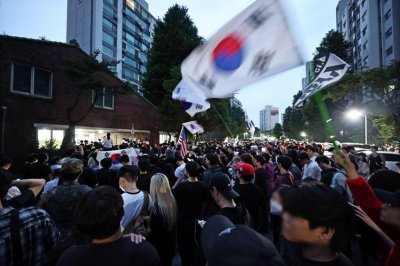
Protesters demonstrate in front of a polling station in Songpa District, Seoul, South Korea, 04 June 2026, to call for the suspension of ballot counting. A shortage of ballot papers forced an extension of voting at several polling stations in the area during the local elections held the previous day. Photo by YONHAP / EPA
June 5 (Asia Today) — Protesters who had blocked a polling station in Seoul’s Songpa district for two nights and three days moved Friday to a vote-counting center, demanding a new election after ballot shortages disrupted voting in the June 3 local elections.
The ballot boxes from the No. 2 polling station in Jamsil 7-dong were transferred and counted after about 1,000 police officers were deployed. But protesters said they could not accept the result and effectively occupied the entrance area of the counting center, calling for a revote.
About 300 people, including citizens and conservative YouTubers, gathered near the entrance of the Olympic Park handball arena, according to an unofficial police estimate.
Even after the counting was completed, protesters chanted slogans including “revote” and “invalidate the vote.” Some protesters have alleged election fraud, but election authorities have attributed the disruption to a shortage of ballot papers during voting.
The atmosphere grew tense as access for election workers and arena employees was effectively blocked. Some arena employees who tried to leave were reportedly stopped by protesters and remained inside.
Police continued to guard the area around the arena after the vote count ended. Officials at the scene were considering sending election commission workers home first and removing vote-counting materials separately.
The protest followed a broader ballot shortage controversy in South Korea’s local elections. The National Election Commission said ballot shortages occurred at 50 polling stations nationwide and temporarily halted voting at 22 sites. The disruption drew public criticism and led the commission’s chairman, Roh Tae-ak, to announce his resignation Friday.
Earlier, protesters blocked the removal of ballot boxes from Jamsil 7-dong’s No. 2 polling station after a ballot shortage left voters waiting for hours. Police later escorted officials to retrieve the remaining ballot boxes, and the final count ended Friday afternoon.
Data center developer Switch is said to be in talks to raise billions of dollars at a valuation of at least $50B. Brookfield Asset Management (BAM), KKR (KKR), and other private equity and institutional investors have been in talks
June 4 (UPI) — The Kennedy Center ordered its staff Thursday to remove President Donald Trump‘s name from the center by June 12.
A memo was sent out from the center’s general counsel that said they must remove all references from signs, brochures, websites, furniture and more, and that they must update email signatures and letterhead immediately.
On Friday, U.S. District Judge Christopher Cooper ruled that the center’s board had overstepped its authority when it voted to add Trump’s name to the center. The memo was the first sign that the center plans to comply with the order.
“Congress gave the Kennedy Center its name, and only Congress can change it,” Cooper said.
Trump claimed that naming the center after him was a surprise, but the name was added to the sign the next day.
Justice Department lawyers representing Trump later said the speed of the move showed it had been “prepared and/or purchased prior to the Board’s vote the day before,” The Washington Post reported.
Thursday’s memo also said officials were “considering their options and will provide further guidance shortly” on whether the center will close after July 5. The center was scheduled for two years of closure for a $257 million renovation.
In his decision, Cooper said the renovations are “sorely needed,” and his ruling doesn’t bar the board from closing “should it come to this decision anew after independently balancing its multiple obligations to the Center in a prudent fashion,” CBS News reported.
“By way of this opinion, the Court does not purport to dictate how the Center should be run, nor does it prescribe any particular plan for the institution — construction, closure or otherwise — moving forward,” he wrote. “It simply holds the Kennedy Center Board to certain minimum requirements imposed by law. Beyond that, the Court will let the parties play on.”
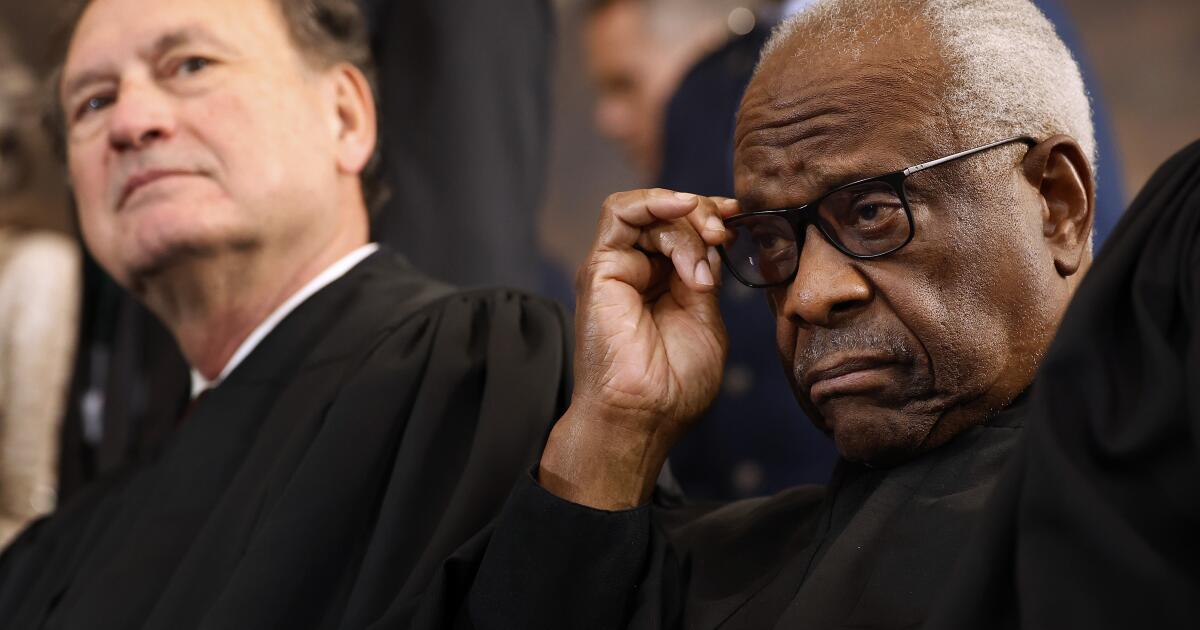
WASHINGTON — The Supreme Court ruled Tuesday night that Alabama Republican leaders may redraw their congressional voting districts to oust a Black Democrat and elect a white Republican.
The court’s conservatives, who ruled for Louisiana Republicans in a redistricting dispute, extended that decision to Alabama. The three liberals dissented.
The decision clears the way for the governor and state lawmakers to redraw their congressional voting map with six districts that favor Republicans and one that favors a Democrat.
“Weeks ago, I warned that vacating the District Court’s injunction in these cases would ‘unleash chaos and … confuse voters,’ ” Justice Sonia Sotomayor wrote in dissent. “Yet just as Alabama doubled down on racial discrimination, the Court today doubles down on chaos. Because I choose to defend the rule of law and the right of all Alabamians to participate equally in democracy, I respectfully dissent.”
The justices granted an emergency appeal that was backed by the Trump administration and set aside the decision of a three-judge panel in Alabama.
The court in a brief opinion said the three judges should not have blocked Alabama’s new map.
“While federal courts should not impose changes close to an election, states are free to decide for themselves whether last-minute changes to an election are in their best interests,” the court said.
Alabama’s emergency appeal went to Justice Clarence Thomas, who referred it to the full court.
Those three judges, two of them Trump appointees, ruled that Alabama’s state lawmakers discriminated against Black voters, who made up a near majority in the center of the state.
Three years ago, the Supreme Court agreed.
In a 5-4 decision written by Chief Justice John Roberts, the justices upheld the creation of a second district in the center of the state where Black voters had a near majority.
The result then was an Alabama state voting map that favored five Republicans and two Democrats for the House of Representatives.
But last month, in the wake of the Louisiana decision, Alabama’s lawmakers went back to court, arguing that the state may return to the voting map with only a single Black majority district.
In his appeal to the Supreme Court, Alabama’s Atty. Gen. Steven Marshall argued that the high court’s decision in favor of Louisiana “vindicates Alabama position on the lawfulness” of its earlier voting map. He said the state should not be penalized for “refusing to intentionally discriminate” to favor Black voters.
The court’s decision has cleared the way for Republican-led states in the South to flip congressional districts in Louisiana, Tennessee, Florida and now Alabama.
NEWARK, N.J. — New Jersey state police set up designated protest zones and vehicle checkpoints outside an immigration detention center in Newark on Friday, replacing federal immigration enforcement agents who have been clashing with protesters for days.
Gov. Mikie Sherrill said she sent in state police to bring order outside Delaney Hall as the demonstrations have intensified, with violence and arrests increasing as night falls.
“It has grown unsafe, and that’s completely unacceptable,” the Democratic governor said at a news conference announcing the new measures. “We need to take this opportunity to lower the temperature.”
As police erected protest barriers, U.S. Immigration and Customs Enforcement agents who had formed a line in front of protesters moved inside the building’s perimeter fence.
New Jersey State Police Lt. Col. David Sierotowicz said ICE officers agreed to stand down with state police assuming responsibility.
Demonstrators had mixed reactions. Some staged a sit-in and refused to move into one of the new protest areas police set up using metal barriers and concrete blocks.
Rachel Cohen worried that demonstrators exercising their 1st Amendment rights were being silenced.
“It is not helpful to quell protest for the sake of a false peace,” she said. “There is no peace while we are torturing our neighbors on [the] government dime inside this facility.”
U.S. Homeland Security Secretary Markwayne Mullin, on social media, called the measures a “win for law and order” and noted that Sherrill had resisted sending state police for days.
The protests began a week earlier after immigrant advocates said detainees inside launched a hunger strike over poor living conditions at the 1,000-bed facility, which opened last May.
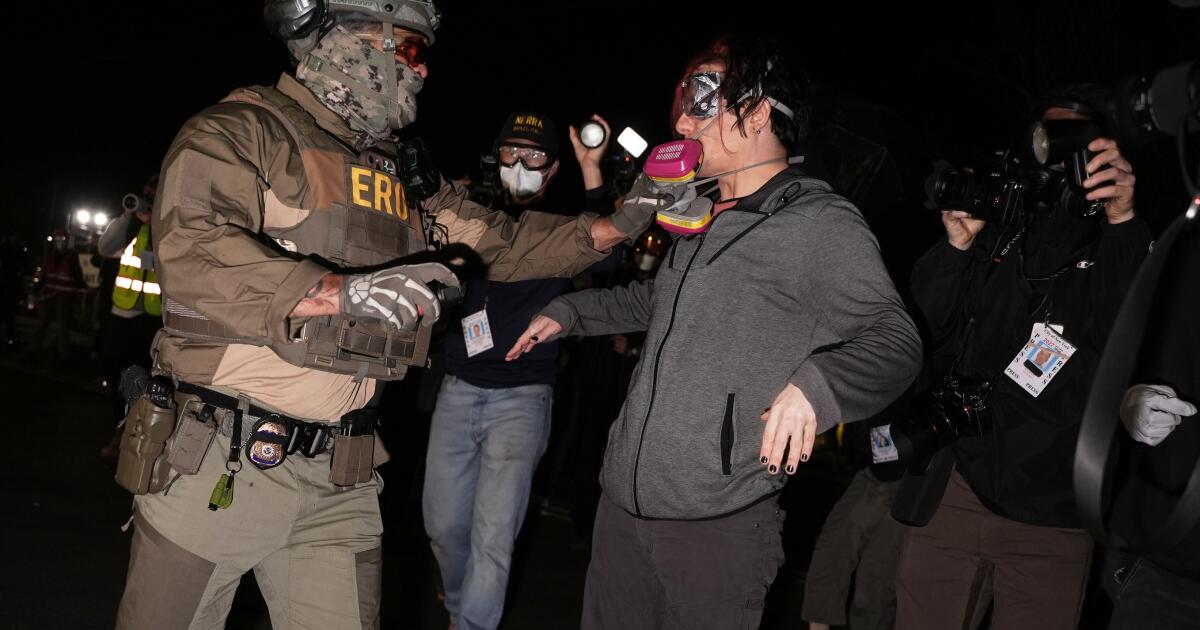
Demonstrators have been attempting to block people and vehicles from entering and exiting, linking their arms in a human chain and using trash cans, umbrellas and other items as makeshift shields and barricades.
ICE officers wearing helmets and tactical vests have used pepper spray and batons to try to disperse the protesters and clear the roadway for vehicles.
At least six demonstrators were arrested and accused of assaulting law enforcement officers Wednesday night, and more have been arrested on other nights, according to the Department of Homeland Security.
Acting U.S. Atty. Gen. Todd Blanche shared images online Friday of bloody wounds and bruises sustained by ICE officers.
“These riots are clearly not ‘peaceful protests’ as you can see from the photos of these horrific wounds,” he said. “Assault a federal officer, you’ll be held accountable.”
Another demonstrator, Lisa O’Dwyer, said she was fine with the designated protest areas.
“I like to get my point across and stay safe at the same time,” the Westfield resident said.
Eyesha Marable, pastor at Mt. Zion AME Church in Millburn, agreed, even while acknowledging that there were “different schools of thought” among protesters.
“There are people here who are angry. Their family members are inside. Their friends are inside. People have been taken off the streets, out of their communities,” she said.
“We have to keep the peace,” Marable said. “The goal is to get our people free, to get them liberated, and we cannot do that if we’re fighting out here.”
State Atty. Gen. Jennifer Davenport said it was important to “de-escalate” the situation as “violence, either against protesters or by protesters, is unacceptable.”
Sherrill said she did not want to give ICE a pretext to expand operations in the state, noting that federal immigration officers around the country have killed and injured protesters in recent months.
“We all need to do everything we can to cool things down now,” she said.
The governor and other Democratic officials tried to visit detainees Monday but were denied entry.
Democratic members of Congress from New York City, however, were able to tour Delaney Hall the day after that. They reported dire conditions, with detainees being fed small portions of often spoiled food and their varied medical needs going ignored.
Families and supporters of detainees also say their loved ones have also been subjected to pepper spray and physical force in retaliation for their hunger strike and the protests outside.
Marcelo and Shaffrey write for the Associated Press and reported from New York and Newark, respectively.
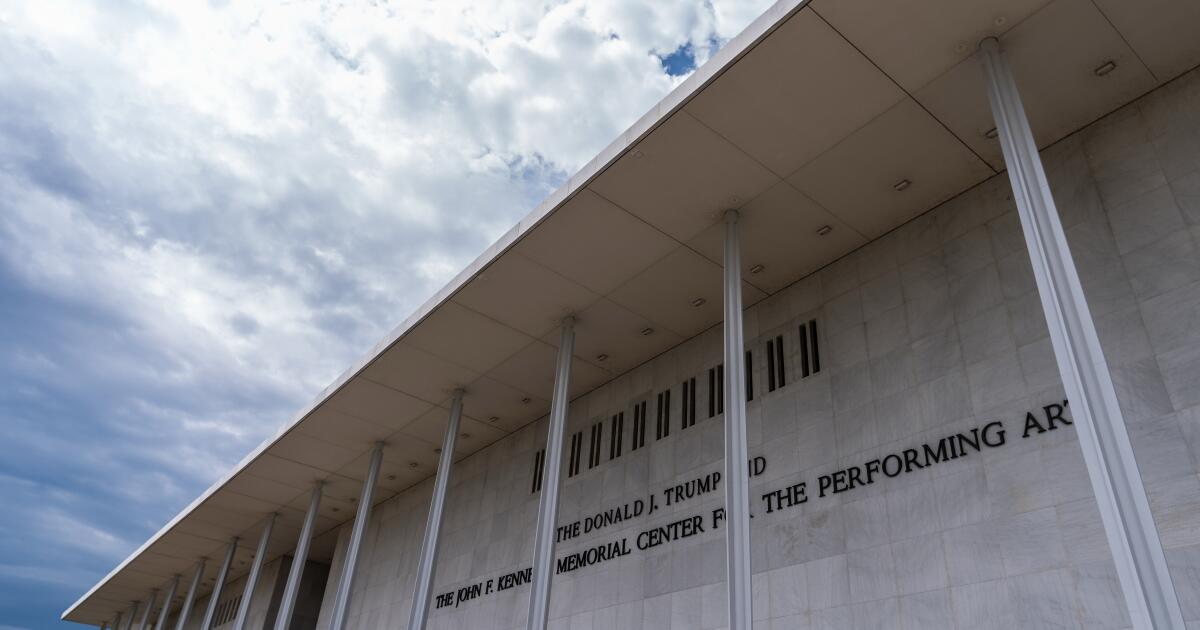
1 of 2 | The Donald J. Trump and John F. Kennedy Center for the Performing Arts appears in Washington, D.C., on Friday. A federal judge ruled that President Trump overstepped his authority by renaming the Kennedy Center after himself, ordering Trump’s name to be removed and reversing a decision to close the performing arts center for renovations. Photo by Aaron Schwartz/UPI | License Photo
May 29 (UPI) — A federal judge on Friday said President Donald Trump‘s name must be removed from the John F. Kennedy Memorial Center for the Performing Arts in a ruling that also blocked plans to shutter the facility for two years for renovations.
U.S. District Judge Christopher Cooper for the District of Columbia handed down the decisions halting Trump’s plans to impose sweeping changes at the historic venue.
The Kennedy Center’s board of trustees voted in December to add Trump’s name to the building. The decision came less than a year after Trump dismissed the entire board and named new board members, who in turn elected him chairman.
“Congress gave the Kennedy Center its name, and only Congress can change it,” Cooper wrote.
Rep. Joyce Beatty, D-Ohio, sued in response to the name change. Meanwhile, a coalition launched a separate lawsuit in March asking the court to stop the administration from shuttering the facility for two years and carrying out its quarter-billion-dollar reconstruction project.
Trump said the decision to close the facility came after a yearlong review in consultation with contractors, musical experts, arts institutions, and advisers and consultants. He had initially considered a partial project that would permit shows to continue, but decided the best option for the venue was a temporary closure.
Rep. Joyce Beatty, D-Ohio, an ex officio member of the board who sued to have access about the details of renovations, said she believes Trump wants to shutter the Kennedy Center in response to dozens of individuals and cultural organizations who have canceled appearances there in response to Trump trying to rename the center after himself. Beatty said the documents she received about the renovations were “inadequate.”
She said “the documents prove that there is absolutely no basis to shutter this precious living memorial and beloved institution,” she said in a statement. “It certainly looks like President Trump is shutting down the center because he is embarrassed that ticket sales are down and artists are fleeing since his illegal renaming.”
Beatty’s lawyers said she was concerned Trump might use his hand-selected board to push through wholesale changes at the Kennedy Center to design a facility more to his liking. In October, Trump had the East Wing of the White House demolished to make room for a $250 million ballroom.
In a post on Truth Social in March, Trump shared renderings of what he expected the center to look like after the renovations. He said he’s not planning to rip out the facade.
A Washington Post analysis of the renderings show very few changes to the exterior of the building, including altered cornices, updated roof and some windows, painted columns, new signage and landscaping changes.
Secretary of State Marco Rubio and President Donald Trump participate in a Cabinet meeting in the Cabinet Room of the White House on Wednesday. Photo by Samuel Corum/UPI | License Photo
US President Donald Trump has announced he plans to withdraw his leadership from the John F Kennedy Center for the Performing Arts, after a federal judge ruled he could no longer have his name on the building.
On Friday, in a 580-word post, Trump blasted Judge Christopher Cooper as reckless. He also painted the performing arts centre as a dilapidated structure only he could restore.
Recommended Stories
list of 3 itemsend of list
“Unfortunately, Judge Cooper and the Radical Left would rather see it DIE than have President Trump transform it into something that everyone could be proud of,” Trump wrote, referring to himself in third person.
But Trump’s interventions at the Kennedy Center, a national performing arts centre in Washington, DC, have been controversial from the start.
Construction on the building began in 1964, shortly after President John F Kennedy was assassinated.
That year, his successor, Lyndon B Johnson, signed into law an act of Congress that established the site as a “living memorial” to the slain leader.
But since starting his second term, Trump has sought to reshape Washington, DC, in his own image, undertaking construction projects and erecting banners with his photograph.
Within weeks of his inauguration, in February 2025, he fired Democratic members of the Kennedy Center’s bipartisan board and replaced them with his picks.
He also terminated the leadership of the centre’s longtime president, Deborah Rutter. The board quickly elected Trump as chair instead.
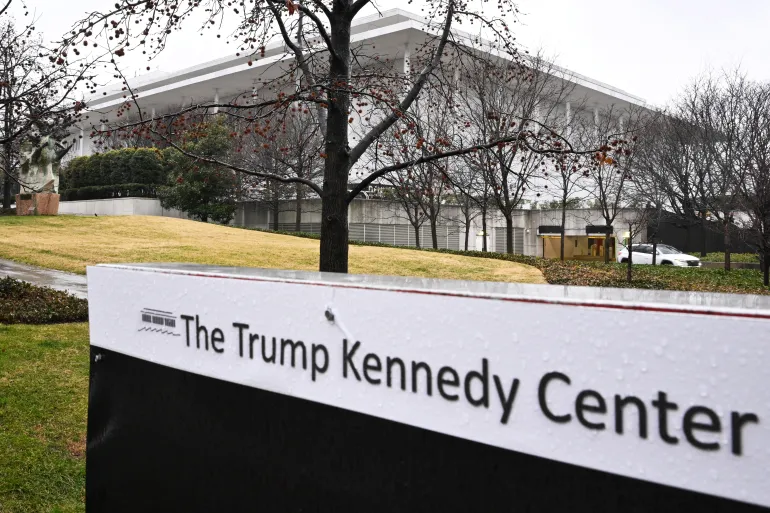
But some of the biggest backlash came in December, when the board went a step further and voted to rename the building “The Donald J Trump and the John F Kennedy Memorial Center for the Performing Arts”.
Within a day, construction crews were seen outside the arts centre, adding Trump’s name to the outside of the edifice.
Critics immediately denounced the effort as a violation of the 1964 law, not to mention a sign of disrespect towards the late Kennedy.
Amid public pressure and a string of cancellations from performers, Trump announced in February he would shutter the arts centre for two years, starting in July. He cited renovations as his rationale for the sudden closure.
US Representative Joyce Beatty, a Kennedy Center trustee, sued to stop the closure from happening. She also sought the removal of Trump’s name.
Friday’s court ruling requires Trump to remove his name from all Kennedy Center signage and materials within 14 days [File: AFP]
Inside the court’s ruling
In Friday’s ruling, Judge Cooper — an appointee of former President Barack Obama — sided with Beatty’s requests.
He ordered that Trump’s name must be removed from the theatre’s facade, as well as any other signage or official materials, within 14 days, citing the 1964 law.
“The Kennedy Center’s organic statute makes crystal clear that the Center is to be named for President Kennedy, and it cannot bear any other formal name or public memorial based on the Board’s unilateral say-so,” Cooper wrote.
“Congress gave the Kennedy Center its name, and only Congress can change it.”
Cooper also overturned the Trump-led board’s decision to strip trustees like Beatty of the right to vote on Kennedy Center matters. Beatty is one of several bipartisan trustees who have a seat on the board by virtue of an act of Congress.
“If trustees presumptively possess the right to vote, what, if anything, authorizes the Board to unilaterally strip certain trustees of voting rights?” Cooper asked in his decision, striking down the Trump-era policy.
“Absent Congressional authorization, the Board may not deprive a duly-appointed Kennedy Center trustee of her right to vote on Board matters on which all other trustees are entitled to vote.”
In the last part of his 94-page decision, Cooper turned his attention to the Kennedy Center’s imminent closure.
He pointed to statements and plans from Trump administration officials touting the use of the performing arts facility before the July closure date, saying they undermined the assertion that the building was somehow hazardous.
“Former Kennedy Center President [Richard] Grenell emphasized that the Center would be one of the ‘premiere spots’ for America’s 250th celebration — quite a concerning idea if the Center is as dangerous as the Defendants now represent,” Cooper wrote, alluding to events scheduled for the coming weeks.
He later added, “Up until February 1, the Center was planning to proceed apace with some form of phased construction and cited no safety concerns about that plan.”
While closing the Kennedy Center is within the board’s powers, Cooper concluded that the board had likely violated its duty to administer the centre “as a prudent person would” under the law.
He therefore issued a temporary injunction against the centre’s closure. “The trustees might have assessed the propriety of closure in a number of prudent ways. This was not one,” he wrote.
Representative Joyce Beatty sued the Trump administration over its planned closure of the arts facility [File: Paul Sancya/AP Photo]
Reactions to the ruling
The ruling prompted an incensed rebuttal from Trump on his Truth Social platform. The president pledged to transfer oversight of the facility to Congress, under whose mandate the centre already operates.
“We are going to be working with Congress to transfer this failing Institution back to them so they can make a determination as to what to do with it,” Trump wrote.
He also blasted Cooper as a partisan actor who had treated him “unfairly”, echoing similar criticisms he had levied against other judges.
“Judge Cooper should be ashamed of himself! I cannot be involved with a situation where danger to the Public is allowed to flourish in plain and open sight,” Trump said.
“Unless I am free to do what I do better than anyone else, bring this Institution back, physically, financially, and artistically, I have no interest in continuing what could only be a hopeless journey into ‘NEVER NEVER LAND.’”
Beatty, meanwhile, applauded the ruling as a victory against unchecked power, unfettered by the law.
“The Kennedy Center is an institution that belongs to the American people, not to Donald Trump,” she wrote.
“He has desecrated this sacred memorial for his own vanity. I am proud to have fought for the rule of law and to protect this sacred institution.”
WASHINGTON — A federal judge ruled Friday that President Trump’s name was illegally added to the Kennedy Center and blocked the administration from closing the cultural and arts venue for major renovations.
U.S. District Judge Christopher Cooper in Washington, D.C., ruled that the Kennedy Center board’s March 16 vote to close the facility was “ill-informed and seemingly preordained” with no regard for its legal obligations.
“The trustees might have assessed the propriety of closure in a number of prudent ways. This was not one,” he wrote.
Cooper also concluded that the board “overstepped its statutory bounds” by unilaterally adding Trump’s name to the center. Congress gave the Kennedy Center its name, and only Congress can change it, he said.
Roma Daravi, the Kennedy Center’s vice president of public relations, said Friday the institution is “confident that on appeal the court will uphold the Board’s will to recognize President Trump’s historic contributions to our nation’s cultural center.” She said the decision would be reviewed “carefully.”
“Though the reality remains — the Center requires an urgent and significant restoration – a truth that even the plaintiff acknowledges,” Daravi said. “With $257 million secured by President Trump and approved by Congress, the resources are in place and we remain committed to pursuing every lawful avenue to ensure the Trump Kennedy Center is restored as a national cultural landmark for all Americans to enjoy.”
Cooper held hearings in late April for parallel lawsuits challenging the project. One was filed by a group of cultural and historic preservation organizations. The other was brought Rep. Joyce Beatty, an Ohio Democrat who serves as an ex-officio member of the Kennedy Center’s board. He ruled in favor of Beatty’s request but rejected the other challenge.
Justice Department attorneys said renovation plans for the building are limited in scope and well within the board’s authority to make without needing outside approvals.
The plaintiffs worry the president and his board allies will flout preservation rules designed to maintain the building’s historic fabric. In earlier statements in court hearings, attorneys for Beatty and the preservation groups raised doubts about the limited scope of the project, pointing to Trump’s statements that he would “fully expose” the building’s steel skeleton. Beatty has said she was “very fearful that we’ll see what happened with the East Wing and what happened with the Rose Garden” if the center is closed and the renovations allowed unsupervised, referring to major changes the president has made at the White House.
Trump, a Republican, has taken a keen interest in the Kennedy Center’s operations since he returned to White House last year. He installed a handpicked board that named him chairman. His name was added to the facade of a building that is considered a living monument to President John F. Kennedy.
The Kennedy Center has kept up performances ahead of the closure, though at a much slower pace than in previous years. Trump attended the premiere of the musical “Chicago” in March and other shows, including “Moulin Rouge” are slated for June.
Bill Maher, the comedian who has had an up and down relationship with Trump, is expected to be awarded the Mark Twain Prize for American Humor on June 28, an event that was anticipated to be one of the final big moments at the Kennedy Center before the closure.
Cooper was nominated to the bench by Democratic President Obama.
Kunzelman and Sloan write for the Associated Press.
NEWARK, N.J. — Protesters clashed with armed federal immigration officers in front of a New Jersey detention center where advocates have demonstrated for days while asserting that people detained there are staging a hunger strike over poor living conditions.
Groups of demonstrators, many wearing gas masks and other face coverings, linked arms in a human chain in front of Delaney Hall in Newark on Wednesday night, videos and photos posted on social media show.
Some used trash cans, old mattresses, umbrellas and other materials as makeshift shields and barricades as they confronted U.S. Immigration and Customs Enforcement officers. Others attempted to block people and vehicles from entering and exiting the building or threw orange traffic cones and other objects in the direction of the ICE officers lined at the entry gate.
The group chanted, “You will hang!” and, “Every cop, every fed, shoot yourself in the head,” and other taunts at the officers, many of whom wore helmets and tactical vests.
The ICE officers used pepper spray to try to disperse the protesters, according to videos posted to social media. Some used their batons to beat and push back protesters as the officers attempted to clear the roadway for vehicles.
At least one truck driver got out of his vehicle to vent his frustration when some protesters tried to block vehicles driving on the road in front of the detention center. People detained inside could at times be seen waving to protesters from Delaney Hall’s windows.
The U.S. Department of Homeland Security, which oversees ICE, said about six demonstrators were arrested for assaulting law enforcement officers.
“Assaulting and obstructing ICE law enforcement is a crime and felony,” the agency said in a statement. “Anyone who assaults law enforcement will be prosecuted to the fullest extent of the law.”
On Thursday, demonstrators again returned to Delaney Hall.
New Jersey Gov. Mikie Sherrill also said state health department officials were “denied full access” to the facility for a health inspection. The Democrat said the officials were only allowed to inspect a limited part of the facility as she called on ICE to “de-escalate” the situation.
“As I’ve said repeatedly, refusing to provide full access raises serious questions about what ICE is trying to hide from public view,” Sherrill said in a statement that also repeated her calls to shut down the facility outright.
Earlier Wednesday, Democratic members of Congress from New York City toured the facility as part of an oversight visit. A private prison company runs the detention center, which sits along an industrial stretch of Newark Bay.
Reps. Jerry Nadler, Daniel Goldman and Adriano Espaillat, who all represent Manhattan, described dire conditions where people held in the facility are fed small portions of often spoiled food and their varied medical needs are ignored.
Homeland Security spokespersons have denied any hunger strike, abuse or poor conditions inside the center and dismissed criticism from opponents as political posturing.
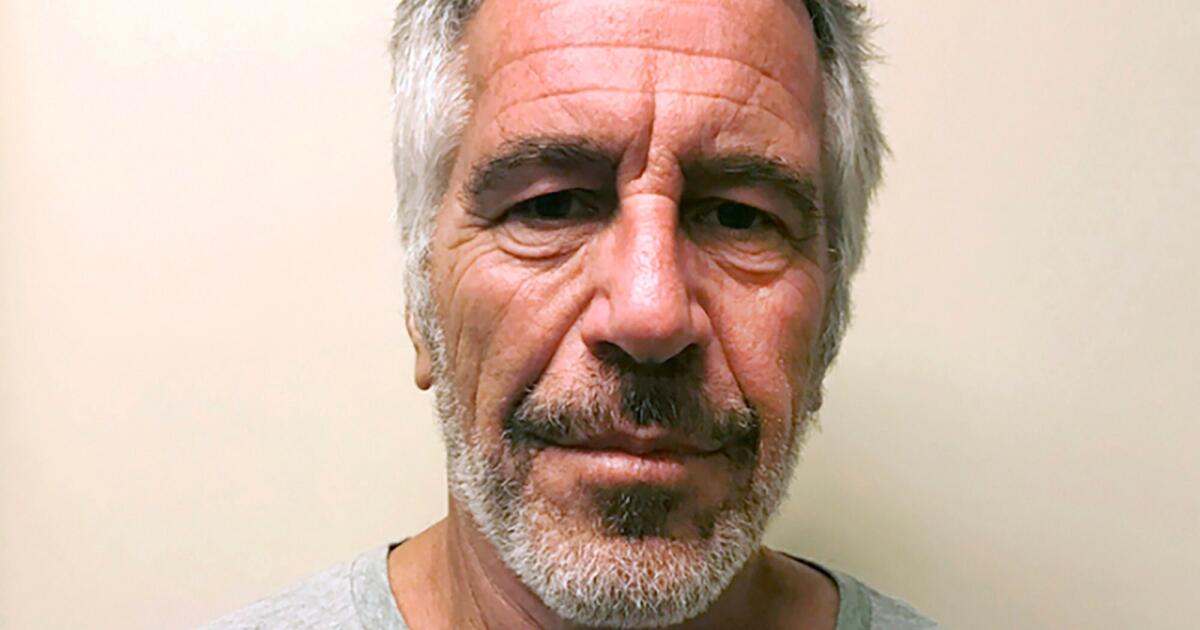
INTERLOCHEN, Mich. — A Michigan summer arts camp and boarding school where Jeffrey Epstein has been accused of meeting at least two of his victims will tear down a lodge that once bore his name.
The Interlochen Center for the Arts said this week that its board of trustees has approved a plan to demolish the Green Lake Lodge, which had been known as Jeffrey E. Epstein Scholarship Lodge until the school cut ties and scrubbed references to the late millionaire sex offender after his first conviction in 2008.
Epstein attended the Interlochen Arts Camp in 1967 as a teenager, and donated more than $400,000 to the school between 1990 to 2003, including $200,000 for the construction of the lodge.
“The lodge has, over time, come to carry associations that are not reflective of who we are as an institution or the values we strive to uphold,” Interlochen said in a statement. “After careful consideration, the Board determined that removing this structure in a safe and timely manner is the right step for Interlochen at this time.”
A world-renowned destination for young artists, actors and musicians, Interlochen’s alumni include Grammy winners Chappell Roan and Norah Jones and Oscar winner Da’Vine Joy Randolph.
At least two of Epstein’s accusers have said they met him at Interlochen in the 1990s.
The school said it was aware of news reports about the women’s claims and said it has invited them to speak with an independent investigator as part of an external investigation into reports of historical misconduct at Interlochen.
A pair of internal reviews, most recently after Epstein’s sex trafficking arrest in 2019, found no reports of misconduct at Interlochen involving Epstein in its records, the school said.
Epstein visited Interlochen periodically, often with his confidante and former girlfriend Ghislaine Maxwell, and stayed in the lodge now marked for demolition.
According to correspondence included in the Justice Department’s recent release of Epstein-related records, he directed that tuition for at least one student be paid out of his donations and once flew violinist Itzhak Perlman to the school on his private jet.
Epstein killed himself in a federal jail in Manhattan in August 2019, a month after being indicted on federal sex trafficking charges. In 2008 and 2009, he served jail time in Florida after pleading guilty to soliciting prostitution from someone under the age of 18.
Maxwell was convicted in 2021 of sex trafficking for helping to recruit some of Epstein’s underage victims, and is serving a 20-year prison sentence.