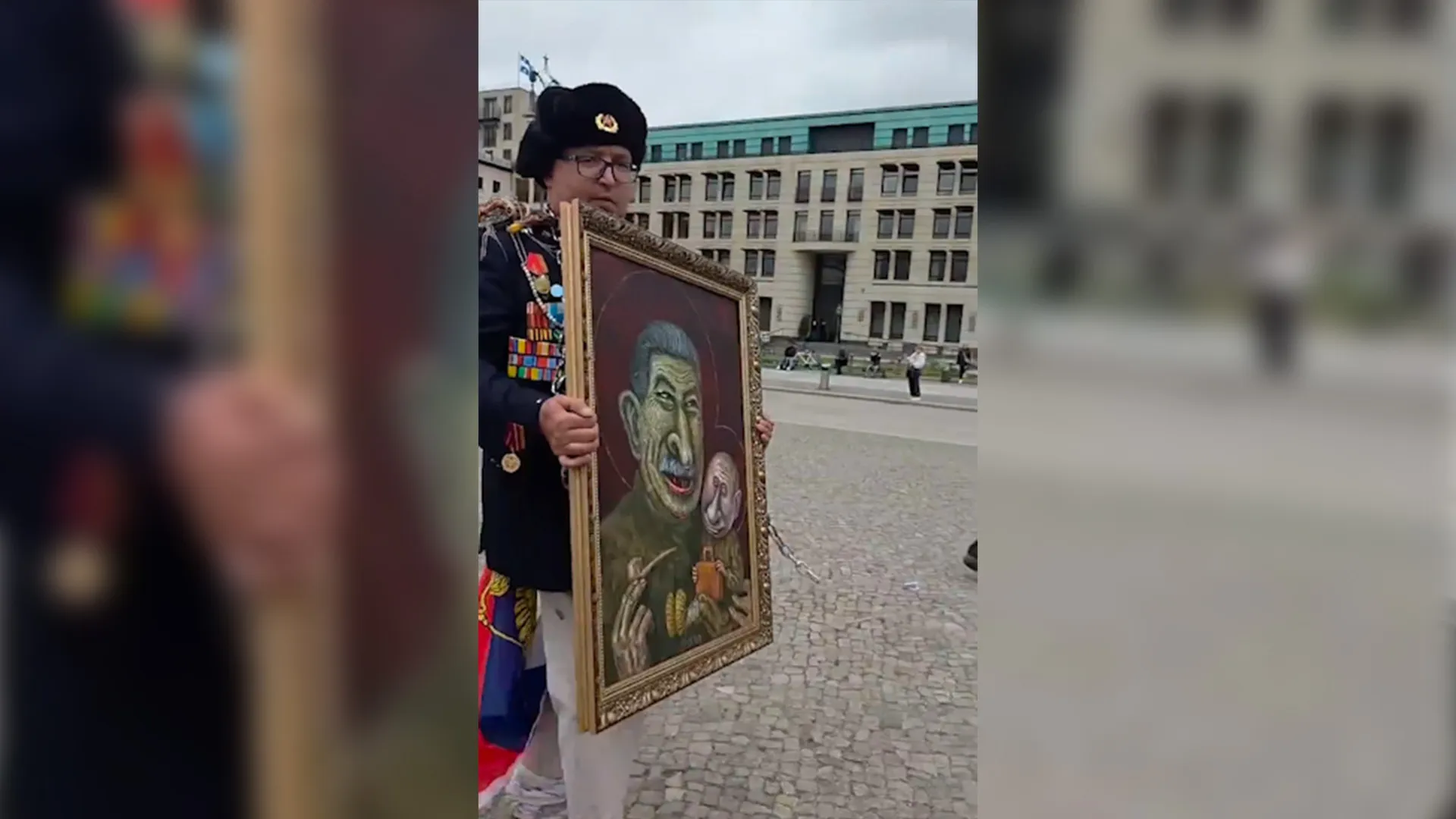
Russian artist Robert Kuzakov, known as Semyon Skrepetsky, was shot dead in Poland just three days after a performance protest in Berlin near the Russian embassy. He was known for his caricatures of politicians including Vladimir Putin and Alexei Navalny.
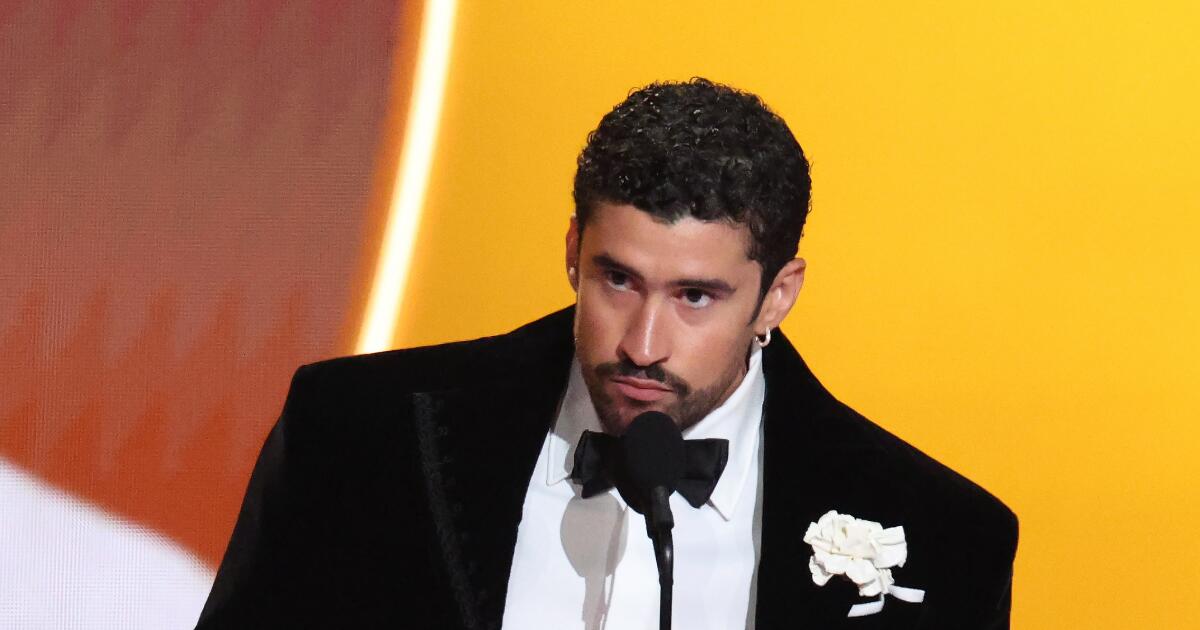
The Recording Academy announced significant changes for the 2027 Grammys, introducing several new genre categories and updating eligibility rules for two of its top awards.
The rule changes will most prominently affect the new artist and album categories.
A change to allow for four submissions for new artist instead of three “establishes more specific language surrounding prominence,” the academy said in a statement. The change updates the famously confusing criteria for new artist, in which acts familiar to some fans for years can suddenly break through and earn new consideration for the category.
It’s likely to benefit an artist such as Ella Langley, who had previously submitted several times for new artist but finally had a commercial and critical breakthrough with her single “Choosin’ Texas” and LP “Dandelion.”
“We’ve heard from the music community that the way artists are being developed is changing, and the time it’s taking to find success or recognition can take longer than it once did. Artists are often releasing more music before they actually break through the consciousness of consumers or of our voters, and that evolution directly impacts this Category,” Recording Academy Chief Executive Harvey Mason Jr. said in a statement announcing the changes. The changes “reflect the reality that artist development looks different than it did even a few years ago.”
In the album category, new rules state that “the threshold of new recordings required on an eligible album is lowered from 75% to 66% to reduce the exclusion of entries that are widely recognized throughout the music industry as new albums.” Given the fast streaming-centric release cycle of new singles, remixes and live cuts, the rule changes reflect that a new album may have a significant amount material released earlier.
Additionally, the academy announced five new genre categories, most significantly a dedicated award for Asian pop — a late but welcome acknowledgment of the commercial reach, artistic accomplishments and deep fan culture of K-pop and other scenes in Japan, the Philippines and China.
Other new categories include Latin song, a songwriting-specific award for Latin music in an era when Bad Bunny and Karol G make some of pop’s most salient political and creative statements; distinct awards for R&B collaboration or duo/group performance and R&B solo performance; a new traditional pop vocal performance award; and the replacement of folk album with categories for contemporary folk album and traditional folk album.
Additionally, a new “ballot plus” option will allow for voting members working across genres to vote in more categories, and songwriting contributors to winning albums in most genre categories will receive Grammy statuettes and achievement certificates, as producers and engineers currently receive.
“These changes and expansions give even more people a place for their music to be respected, heard and evaluated. With more Categories, we can represent more music creators, artists, writers, and producers, and it gives us a great opportunity to be more inclusive,” Mason said in his statement. “Now more than ever, we have to keep pace because things are changing and evolving so quickly. These changes are a reflection of that fast-paced evolution.”
If you buy books linked on our site, The Times may earn a commission from Bookshop.org, whose fees support independent bookstores.
What does it mean to lack ambition in a country that worships wealth? It means you are a capitalist wallflower, a laggard with a serious character flaw. No field of endeavor is immune from this attitude, the art world least of all. But artists with a desire for riches and fame must not declare their intentions so brazenly. At a time when the plastic arts are about as marginalized as they ever have been, and media buzz is generated by dead painters whose works sell for enormous sums at auction, creation in and of itself has little value unless it is lashed to something marketable.
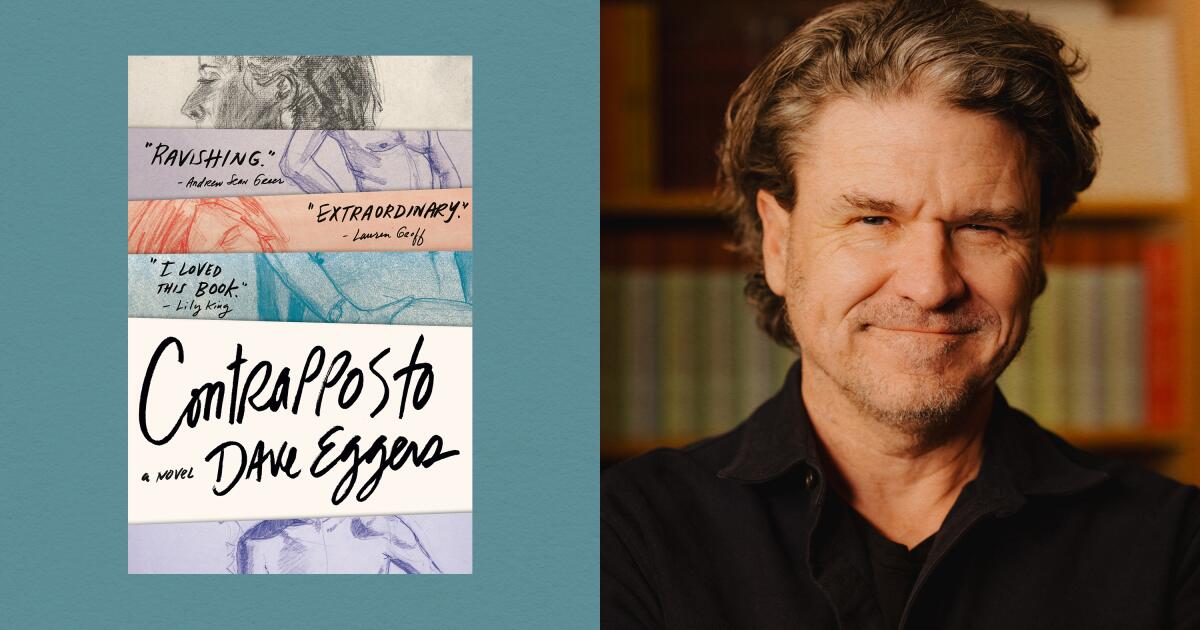
With his new novel “Contrapposto,” Dave Eggers has written a big-hearted, deeply moving story about the choices artists make, or don’t make, to square up their own notions of success and happiness. The book is dual bildungsroman, following two friends across the long span of their lives from adolescence to their 70s, as they fall in and out of each other’s lives, make their way in the world, and fumble around for meaning and purpose in their art.
The protagonist in “Contrapposto” is Rob “Cricket” Dibb, an underclass Midwestern kid, raised by a single mother in a North Indiana suburb that’s about as nowheresville as it gets for budding artists with dreams of glory. Cricket doesn’t dream big. He’s just trying to endure without bodily harm, seeking refuge from his mother’s abusive boyfriend in the basement with his grandfather Silas, who teaches him about jazz and the beauty of a glorious sunset. He draws so he doesn’t have to think. Immersion in art is his escape hatch from the dreariness of his pinched world: “The drawing meant nothing, would never mean anything to anyone, but it was true to how he saw it. His hand had recorded what he saw and felt about this thing. He was an ugly, common creature who could occasionally freeze time. That was enough.”
Cricket’s apprenticeship is decidedly informal. No full scholarship rides to Bard or Pratt for him; instead he saves up to enroll himself in a life drawing class in Chicago, where he discovers the beauty of applying rigor and rules to his work, how to break down pictures into the geometry of circles and squares, planes and angles. “He measured proportions and improved,” writes Eggers. “He grew more confident with each pass on his drawing, and realized … that much of the rightness of the drawing, of any drawing, came through time and diligence and discernment.”
He meets his slightly older schoolmate Olympia, one of Eggers’ most beguiling creations, when she implores him to scrawl scatological bathroom graffiti on a playground structure in Old-English typography. Unlike Cricket, Olympia is earnest and sincere about her art in the way that only a young person untainted by cynicism can be. She claims to inhabit the soul of Albert Camus, and flings around aphorisms about art that fly over Cricket’s head. She is an aesthete, someone who likes to go to the race track just to revel in the colors on display there. She wants to create an art scene in their little world. “You know all the great art movements have friends at their core, right?,” she tells Cricket. “A lot of time they’re jammed together by some critics and the artists reject the name and the association. But think about Patti Smith and Sam Shepard. Did you know they dated for a while?”
Cricket is beguiled by her, and Olympia in turn is taken in by Cricket’s talent. When the local library pulls a few of Cricket’s semi-nude life drawing portraits down for fear of offending their patrons, Olympia becomes his advocate and champion. In contrast to Cricket, who skates along with no end plan, Olympia is a committed careerist, an artist who insists on a captive audience to justify her work. She wants to earn money as an artist; Cricket just wants to be left alone. This push and pull between the two frame Eggers’ novel across the six decades of his narrative.
One of many joys of “Contrapposto” is observing Cricket’s artistic awakening via the mentors who guide him into his artistic consciousness. Marcus Carpenter, a wizened sage in battered work boots (one imagines him as the art world analogue to the late novelist Jim Harrison), is the moral conscience of the novel, fighting the good fight for personal expression and railing against the “new, paradoxical tyranny wherein those without technical skill terrorize those who possess it.” Carpenter plucks Cricket from arts college and its meaningless pontificating to his “atelier in the corn,” a ramshackle Victorian where Cricket learns how to transmute what he sees with color and light. “The talented have talent,” Carpenter tells Cricket during one of his endearing rants. “The untalented have theories.”
From there, Cicket’s life is a crooked line. He doesn’t abandon art, but he can’t summon the urge to sell himself or his work, to graft his joy in making things onto the caprices of the marketplace. As Eggers jumps through time, we find Cricket working as an intern in an art gallery, an arid, lifeless space where nothing inspiring can possibly exist. As a young man he works as a ship-breaker in Turkey; in middle-age, we find him in a coastal town in Cambodia, making replicas of great paintings for tourists. Olympia, his elusive love and sporadic muse, flits in and out of his life as she works her way up the tiers of the art world’s ziggurat. She gently berates him for his timidity: “This is how artists have power. We sell work. You’re implying there’s nobility in powerlessness. That’s been an idiotic trope for too long — that participating in the business side of it taints you. Do you know how dumb that is? That artists have to be these fragile little wood nymphs that are too precious to touch the money?”
As “Contrapposto” arrives at its beautiful, life-affirming conclusion, we are left pondering the significance of artistic endeavor in a world that commodifies everything, including our bodies and brains. At a time when even the greatest achievements are debased in a culture that gives equal weight to meretricious novelty, is it even worth the trouble? Eggers’ brilliant novel has the answer: Follow your bliss. In the final analysis, it is all that matters.
David Hockney, the innovative and prolific British artist who arrived in Los Angeles in 1964, soon celebrating its sun-drenched life and landscapes in colorful, wildly popular paintings, has died.
He was 88.
Calling himself “an English Los Angeleno,” Hockney immortalized the city’s sparkling swimming pools, palm trees and beautiful young men, then went on to experiment with intricate photo collages, portrait suites, painted and filmed images of Yorkshire landscapes, iPad drawings and more.
Since his Pop Art paintings in the early ‘60s at London’s Royal College of Art, Hockney was rarely out of the limelight and, more important, rarely out of fresh ideas for how to draw, paint, film, print, photograph or otherwise express his creativity. The David Hockney Foundation owns more than 8,000 of his works, including about 200 sketchbooks, more than 230 self-portraits, opera designs and portraits of family and friends.
Hockney loved Hollywood — the people and the place — and liked to say he was brought up in England and Hollywood because of the time he spent at the movies. His peroxide blonde hair reportedly was inspired when he was a student and saw Clairol TV ads claiming “blondes have more fun.” But it was his interest in everything from Elvis Presley to the Hubble Space Telescope and his sense of humor that set him apart. Time Magazine art critic Robert Hughes once called him “the Cole Porter of modern art.”
He was open about being gay, even when homosexuality was outlawed in Britain. His early love affair with artist Peter Schlesinger, a younger man he met when teaching a summer drawing class at UCLA in 1966, inspired Hockney’s monumental 1972 painting “Portrait of an Artist (Pool with Two Figures),” a centerpiece of Jack Hazan’s 1974 film “A Bigger Splash.” The painting’s 2018 auction at Christie’s drew a record $90 million for a living artist.
He was a dedicated reader and student of art, paying homage in his work to Picasso and Cubism as well as to Monet, Matisse, Van Gogh and Cezanne. A lover of opera, he often had it playing loudly in the studio and enjoyed taking visitors on curated car trips through the Hollywood Hills or Malibu while listening to Wagner. He designed sets for major companies in Los Angeles, Chicago, New York, London and elsewhere over the years, and some of his set models were later shown in museums.
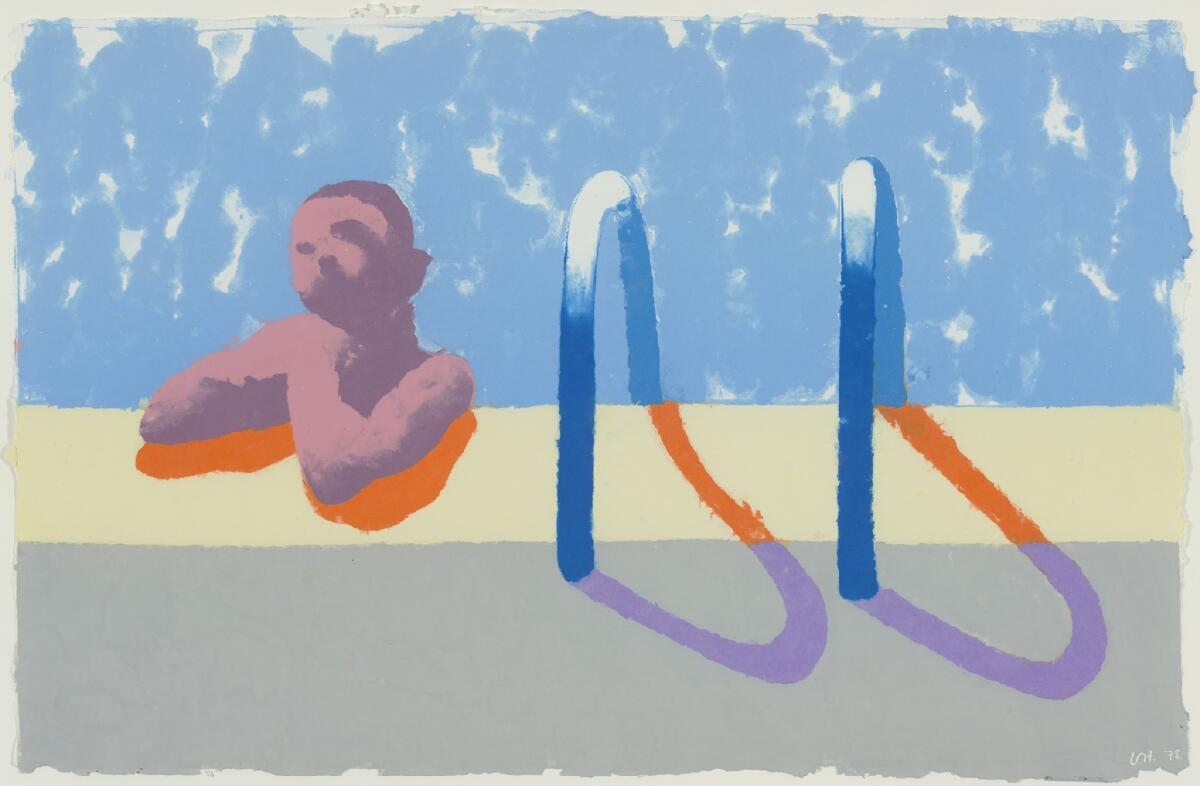
David Hockney’s work “Gregory in the Pool (Paper Pool 4)” is part of his solo exhibition “David Hockney: Perspective Should Be Reversed” at the Palm Springs Art Museum in Palm Springs. (Courtesy of the Palm Springs Art Museum)
(Courtesy of the Palm Springs Art Museum)
His solo shows drew enormous crowds to the Los Angeles County Museum of Art as early as 1988. In 2017 a major retrospective of his work, keyed to his 80th birthday, was presented at New York’s Metropolitan Museum of Art, Paris’ Centre Pompidou and London’s Tate Modern. Chronicling Hockney’s arrival as an important artist in the “ravishing” Met retrospective, the New Yorker writer Andrea K. Scott called it “a revelation.” It was, she wrote, “a retort to all the eye-rollers,” including herself, who dismissed his work “as, at best, a guilty pleasure.”
In 2012 he received the coveted Order of Merit, which Queen Elizabeth II presented to him at Buckingham Palace.
David Hockney was born the fourth of five children to a working-class family in Bradford, Yorkshire, on July 9, 1937. He has said he started “making marks on paper” at 8 and received private painting lessons before moving on to Bradford School of Art in 1953. The first painting he sold was a portrait of his father in 1955. He attended the Royal College of Art in London from 1959 until his graduation in 1962 and received the school’s Gold Medal.
After college he did not slack off, noted his biographer Christopher Simon Sykes. In his 2014 book, “Hockney: The Biography,” Sykes pointed out that the artist’s first flat had a chest of drawers near the bed on which he had painted, in large capital letters, the words “get up and work immediately.”
David Hockney in 2017.
(Catherine Opie, Courtesy of Regen Projects, Los Angeles and Lehmann Maupin, New York, Hong Kong and Seoul.)
Hockney lived by that command for the rest of his life, turning out canvas after canvas, photo after photo. In the ‘80s came his extraordinary multi-image photographic collages of friends including writer Christopher Isherwood and artist Don Bachardy and such landmarks as the Brooklyn Bridge, Grand Canyon and Pearblossom Highway.
“The Polaroids started oddly enough when I’d just finished a long period of work in the theater, which is of course playing with perspective and illusion,” he once told The Times. “People say, ‘You are a painter, and photography is a sideline.’ But nothing is a sideline for me.”
That included his continuing fascination with technology. The artist’s long career swept in artworks made not only on cameras and canvases, but on such things as fax machines and photocopiers. Hockney liked to experiment, whether it was with state-of-the-art printing devices or centuries old painting techniques. He went several times to a show of portraits by Jean Auguste Dominique Ingres at London’s National Gallery in 1999 and was greatly taken with the photographic’ quality of Ingres’ 19th century drawings. Certain that Ingres had used something optical to achieve that quality, Hockney bought himself a camera lucida, a small device that works like a prism. He then applied Ingres’ methods–as Hockney imagined them–to his own portraits of friends and family, and in 2001, he published “Secret Knowledge,” exploring his theories on early artistic uses of optical devices.
His death was confirmed by the Associated Press and New York Times.
Ariana Grande was crystal clear in the White House’s comments section on TikTok.
The “We Can’t Be Friends” hitmaker didn’t mince words on Thursday when she commented on a White House TikTok: “Please do not ever use my music in relation to this barbaric, inhumane, heinous nonsense. F— ice,” she wrote in her comment.
The TikTok in question, posted by the White House on Tuesday, promoted the administration’s crackdown on immigration and featured Immigration and Customs Enforcement officers handcuffing various people to the tune of the Grammy-winner’s song “Bye.”
“Bye-bye 👋 President Trump has delivered the most secure border in history,” the caption on the video read. Grande’s comment has since been deleted or hidden from the video’s replies, and the sound on the TikTok has been disabled.
White House spokeswoman Abigail Jackson responded to Grande’s comment in an emailed statement to The Times, writing, “We’ll say this one last time: what’s actually barbaric, inhumane, and heinous are the criminal illegal aliens who have injured and murdered innocent American citizens.”
Grande joins a slew of prominent musicians and artists who have told the Trump administration to cease using their tunes to promote his agenda.
On the 2024 presidential campaign trail, Beyoncé endorsed former Vice President Kamala Harris, who used Queen Bey’s song “Freedom” as a rally anthem. When a spokesman for Trump used the same song in a social media post, the mega star’s team responded swiftly with a cease-and-desist.
During a 2024 Montana rally, Trump’s team played a video clip using “My Heart Will Go On,” the theme song from the 1997 film “Titanic.” Celine Dion’s management team and record label responded with a statement shooting down the song’s use: “In no way is this use authorized, and Celine Dion does not endorse this or any similar use. … And really, THAT song?”
And then, of course, when Trump used Bruce Springsteen’s “Born in the U.S.A.” on the 2016 campaign trail without the artist’s permission, the American rocker responded by endorsing Hillary Clinton and calling Trump a “moron.”
Add to the list Nancy Sinatra, who posted that Trump’s nod to Frank Sinatra’s song “My Way” was “sacrilege”; the Smiths’ former guitarist Johnny Marr, who said, “Consider this s— shut right down right now,” when the band’s song was used at a 2023 Trump rally; Sabrina Carpenter, who slammed the use of her song in a video, calling it “evil”; and many, many, many more.
In a statement, AMC said due to the “robust lineup of upcoming films and strong advance ticket sales in the weeks ahead,” it needed to make some programming adjustments. Some of the major upcoming releases for June include Disney’s “Toy Story 5” and Steven Spielberg’s “Disclosure Day.”
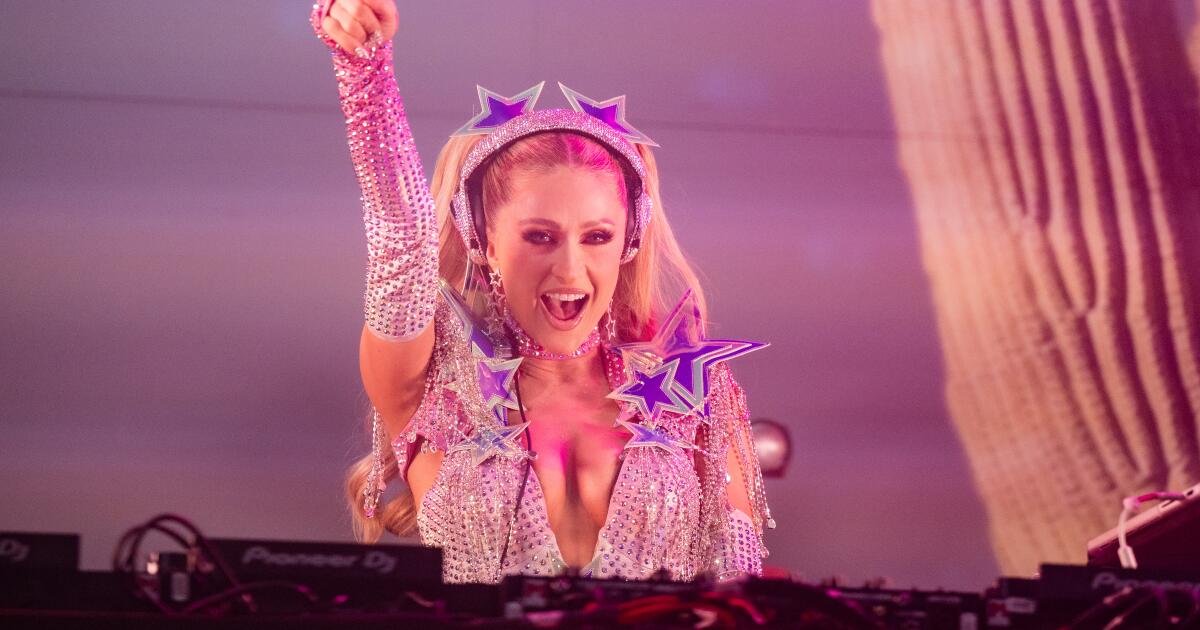
Acts like Bebe Rexha, Paris Hilton, Kim Petras and Marren Morris were lined up to test out the new format next week, as a part of the Girls Night Live concert series.
The chain is partnering with live entertainment company Arena One to bring new technology to theaters. This tech would allow artists on a remote stage to see, hear and respond to the theater audience, in effect turning your local cinema into a stadium, the companies said. Fans who already purchased tickets have received refunds.
The series was initially marketed as a new draw to get customers to the theaters, but given the strong box office numbers so far this year, it’s clear the demand for theaters is already growing
Focus Features’ “Obsession” is now nearing $230 million in global box office revenue, according to Box Office Mojo, and is the studio’s highest-grossing movie at the domestic box office.
Most recently, “Scary Movie” topped the box office last weekend with a $105.5-million worldwide debut, ranking among the top five biggest R-rated comedy openings of all time.
AMC said it would announce new dates and additional artists for the interactive concert series in the coming months.
Martin Mull was best known to audiences for playing comedic characters like Col. Mustard in “Clue” and Gene Parmesan in “Arrested Development,” but a new exhibit opening next year at the Santa Barbara Museum of Art seeks to elevate the role Mull was most proud to inhabit: a respected painter.
“Martin Mull: The Joys of Indoor/Outdoor Living,” co-curated by comedian Steve Martin and Hammer Museum Director Emerita Ann Philbin, comes to SBMA next June and runs through October. It will be the first major museum exhibition of Mull’s artwork in 20 years.
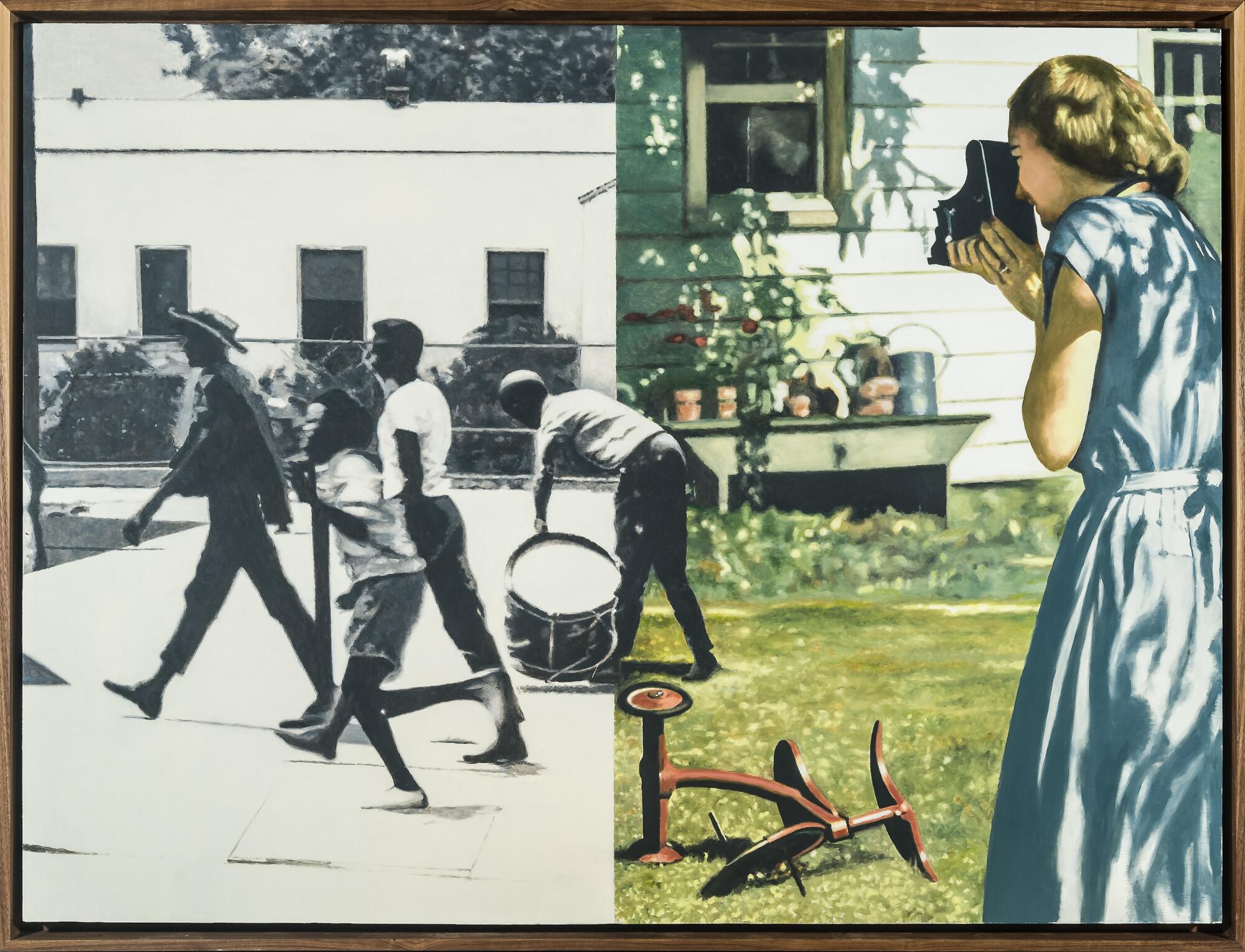
The paintings featured include scenes of unassuming houses visited by otherworldly guests, dead-eyed office workers, gravity-defying displays and lambs being led to the slaughter. They play with perspective, color, space and time to illuminate postwar American tensions, be they racial, political or existential.
“Martin Mull’s work as an artist will certainly be his primary legacy,” Martin said in a statement. “After a full-time career in painting, in the last 20 years of his life with his technical gifts fully developed, Martin’s art coalesced into tight, narrative paintings of a peculiar nature. Combining surreal elements with family idioms, he formed his own worried portrayal of American life.”
Martin Mull’s “Band on the Run,” 2014. Oil on panel.
(Estate of Martin Mull)
The exhibit, which will take over the museum’s 6,000 square feet of main galleries, will feature more than 50 paintings and drawings by Mull, most of which come from the artist’s estate and the private collections of Mull’s entertainment industry colleagues, including Steve Martin, Jennifer Tilly, and Ted and Nicole Sarandos .
“Steve talked about how Mull’s painting practice was his deepest passion, despite the fact that his fame was as an actor and comedian. It prompted me to do a little research, and I became very intrigued by his body of work. I wrote to Steve, ‘Martin Mull. There’s something there.’ That’s how the project began,” she said.
Along with Martin and Philbin, the upcoming exhibition is led by SBMA Chief Curator James Glisson and Amada Cruz, the museum’s director and CEO. In a news release, a museum spokesperson said Mull’s work “upsets any storybook picture of perfection” and resists nostalgia while acknowledging its allure.
Martin Mull’s “Envy,” 2008, from the series “Seven Deadly Sins.” Oil on linen.
(Estate of Martin Mull)
“It’s so deeply strange — dark and funny, hopeful and menacing all at once,” Philbin said. “The paintings are about the smoldering tensions that underlie the American dream, so I think it’s a particularly apt moment to bring them back into the public eye.”
Mull, who died in 2024, received his master of fine arts degree in painting from the Rhode Island School of Design in 1967. Though he went on to craft a career in the public eye as a musician, comedian and actor, painting remained his “true vocation.”
Martin, a longtime friend of the multidisciplinary artist, echoed this sentiment in an email to The Times.
“If a comedian says he is also a painter, run. Except this once.”
Musicians have been left out of settlements between major record labels and AI companies, a new lawsuit alleges.
The American Federation of Musicians of the United States and Canada (AFM), which has 70,000 members, said Universal Music Group and Warner Music Group “received significant compensation” from the AI companies for past copyright violations and licensed “substantial” portions of their music catalogs to them, but haven’t shared that with the musicians.
UMG and WMG sued AI companies Udio and Suno in 2024, accusing them of copyright infringement. Both companies settled with Udio last year. In November, WMG announced a partnership with Suno, but Universal Music Group’s lawsuit against Suno is pending.
“While the Defendants protected their own interests and created a significant source of new revenue with the retrospective settlements and prospective licenses, they have refused to compensate the musicians whose work — created with their own instruments and through their talent, creativity, and hard work — is fed into AI machines for profit,” AFM said in its lawsuit, filed in U.S. District Court in New York on Friday.
AFM said it believes the AI settlements fall under the “new use” provision of its collective bargaining agreements, which requires music companies to notify the union of new licenses for purposes not covered by the contract and to compensate musicians, whose work was used to train AI models.
UMG and WMG said in statements that they are in negotiations on a collective bargaining agreement with AFM.
“Warner Music Group is growing the value of music by establishing guardrails and architecting a healthy AI ecosystem on behalf of artists everywhere,” the company said in a statement.
Universal Music Group said it will continue to work to resolve issues during the negotiations.
“Universal Music Group has been at the forefront of protecting the rights and advancing the interests of artists and songwriters in the age of AI — striking responsible AI licensing agreements to ensure they are compensated, leading the charge for legislation to further protect them and taking legal action against bad actors,” the company said in a statement. “We expect to continue our strong working relationship with the AFM built on mutual respect for the talented musicians in our industry.”
AI has become more popular among consumers, dramatically changing the landscape in the entertainment industry. Many startups have popped up allowing users to type text prompts into AI systems to generate original songs, video clips and stories.
Some creatives say the AI tools help them brainstorm or illustrate bold ideas on a budget. But critics have raised concerns about whether AI systems are trained on copyrighted works without permission or payment to artists. Others are worried AI could eliminate their livelihoods.
Udio said it would create a new platform that would train on licensed and authorized music with artists having the ability to opt-in. Suno agreed to change its platform, launching new licensed models, and place download restrictions.
Bradford Auerbach, a partner at law firm OGC, said he expects to see more of these types of lawsuits filed by unions.
“You’ve got the unions always protecting the status quo, so you’ve got this invariable conflict of new technology coming in, and moving the cheese for a lot of people that were accustomed to having their business set up the way it was,” Auerbach said.
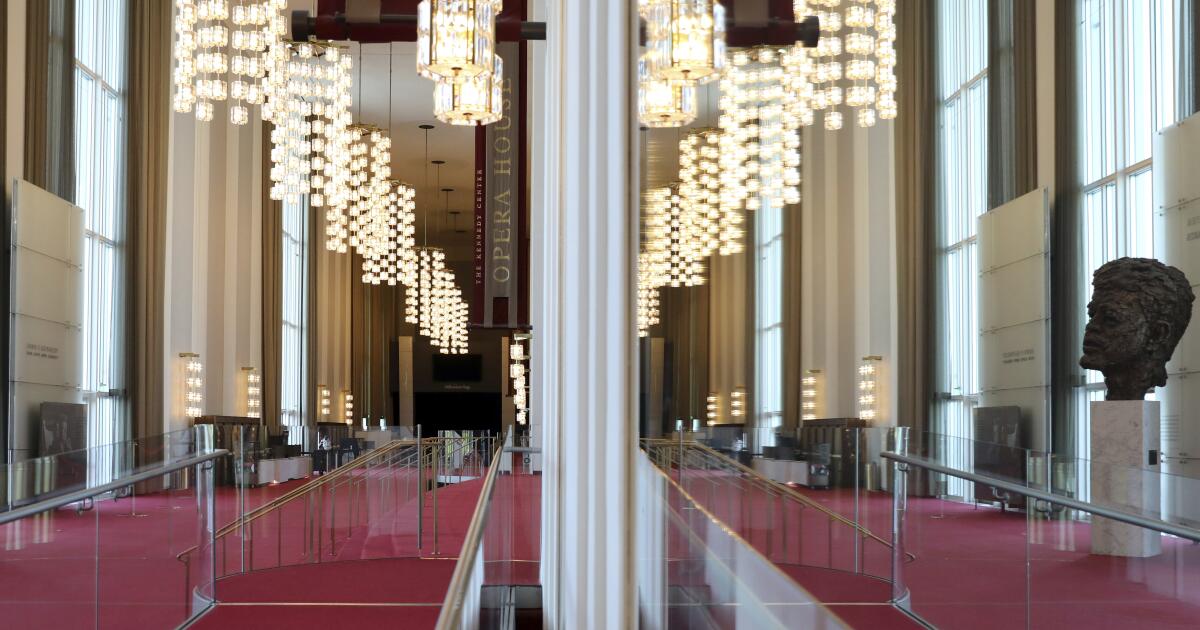
Attorneys for musician Chuck Redd say a D.C. Superior Court judge dismissed a breach of contract lawsuit filed against the artist after he canceled a Christmas Eve performance at the Kennedy Center in protest of President Trump’s influence over the venue.
The dismissal was granted Friday under Washington’s Anti-SLAPP laws, which are designed to prevent meritless lawsuits intended to silence opposing points of view on matters of public interest.
Redd, a drummer and vibraphone player who has toured with Dizzy Gillespie, Ray Brown and others, had presided over holiday “Jazz Jams” at the Kennedy Center since 2006. He called off last year’s performance shortly after Trump’s handpicked board for the Kennedy Center voted to add the president’s name to the venue, which Congress named for President Kennedy after his assassination.
“The Center sued Mr. Redd because he publicly and rightly objected to adding Donald Trump’s name to the Kennedy Center, a living memorial to former President John F. Kennedy,” Lisa J. Banks, one of Redd’s lawyers, said in a statement. “The lawsuit against Mr. Redd was political retribution, pure and simple, by the Trump Kennedy Center, and the Court correctly saw it as such in dismissing the case with prejudice.”
Redd told the Associated Press in an email Saturday that he is “very pleased with the judge’s ruling.”
The motion to dismiss, filed in March, argued that Redd wasn’t contractually obligated to perform. It included the contract provided by the Kennedy Center, which the artist never signed.
Representatives for the Kennedy Center did not immediately respond to a request for comment on the suit’s dismissal.
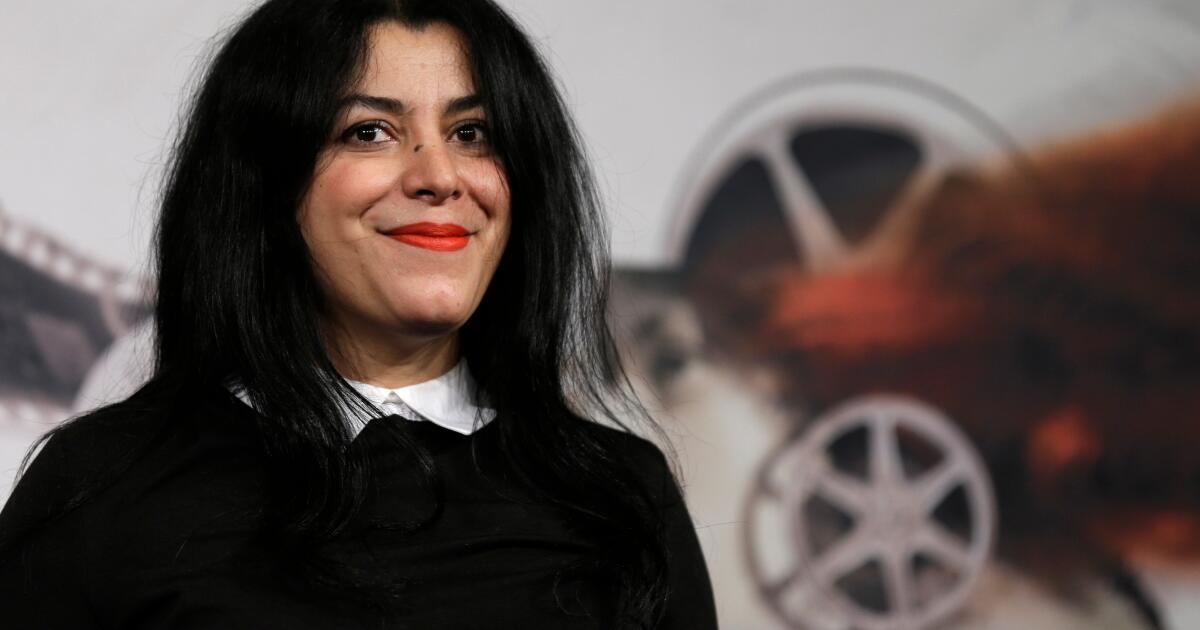
PARIS — Acclaimed Iranian-French cartoonist and filmmaker Marjane Satrapi, a prominent advocate for women’s rights, has died at 56, the French presidency said Thursday.
“Her passing marks the loss of a leading figure of French culture and an artist devoted to freedom, whose work carried a universal message and earned her immense international acclaim,” the French presidency said in a statement.
President Emmanuel Macron and his wife “pay tribute to a remarkable artist who transformed an Iranian childhood into a universal fable,” the statement said.
News broadcaster BFM TV and other French media reported Satrapi has “died of sadness” a little over a year after the death of her husband, Swedish film producer and actor Mattias Ripa, according to a statement from people close to the artist.
The French Academy of Fine Arts, of which she was a member, expressed its deep sadness in a social media statement, paying tribute to “a passionate advocate for cinema and film education” who earlier this year created a foundation to help international students come to Paris to study film.
Satrapi is best-known for her monochrome autobiographical comic book and film “Persepolis,” a coming-of-age tale set against the Islamic Revolution in her native Iran.
“Persepolis” won the Film Critics Grand Prix at the Cannes Festival in 2007 and the César Award for adapted screenplay in 2008, in addition to being nominated for animated feature at the 2008 Oscars.
The film, which details her life in Tehran as the willful daughter of intellectual Marxists, is a reminder that Iranians are just like everyone else, Satrapi told The Associated Press in a 2007 interview in Cannes.
“What we wanted to say is, if these people scare you, look closer: They have parents, they have lovers, they have hope, they have stories,” she said.
Iranian authorities at the time protested the movie’s inclusion at Cannes, sending a letter to the French Embassy in Tehran.
Satrapi was born on Nov. 22, 1969, in Rasht, Iran, but her parents sent her to Vienna, Austria, in 1983 to finish her studies because of the extremism in their country following the 1979 Revolution that brought Ayatollah Khomeini to power.
But Satrapi, who found Austria hostile and who desperately missed her parents, returned to Iran in 1989 to attend Tehran University, where she earned a degree in visual communications.
By the time she graduated, Satrapi decided she finally was ready to leave Iran and accept the opportunities her parents had been so desperate to give her a decade before. In 1994 she moved to France. She studied in Strasbourg and later moved to Paris.
Her graphic novels also include “Broderies” (“Embroideries”) and “Poulet aux prunes” (“Chicken with plums”), which also was adapted into a film. As a filmmaker, she has directed several works including “La Bande des Jotas” (“The Gang of Jotas”) and “Radioactive” (“Madame Curie”), a biography about the Polish physicist Marie Curie.
Satrapi in 2023 coordinated the book “Femme, vie, liberté” (“Woman, Life, Freedom”) together with a group of artists and academics to illustrate the revolts that occurred in Iran after the death of Mahsa Amini in 2022 at the hands of the so-called “morality police.” The work denounces the repression and lack of human rights that Iranian society, especially women, suffers at the hands of the Iranian regime, the foundation said.
Satrapi was elected member of the French Academy of Fine Arts in 2024. She also was offered France’s highest award, the Legion of Honor, that same year but declined it, arguing France was not doing enough to support Iranian people fighting for democracy.
“Supporting the women’s revolution in Iran cannot be reduced to photos or speeches,” she wrote in a January 2025 letter to French authorities. “When people are fighting for democracy, we should support them.”
In 2024, Satrapi won the Princess of Asturias Foundation award in Spain for communication and humanities. The organization said she was “an essential voice in the defense of human rights and freedom.” The judges described her as “a symbol of civic engagement led by women.”
Satrapi’s husband, Ripa, died in April 2025 at 53. On her Instagram page, only one message was left in a series of posts: “Because I have lost the love of my life.”
The artist who painted a giant mural on a building in downtown Dallas of life-sized swimming whales has filed a $25 million lawsuit against soccer’s international governing body and others, saying they illegally painted over his work to promote the city’s upcoming World Cup matches.
The artist Wyland says he hand-painted the sprawling mural that covered roughly 17,000 square feet across two of the building’s walls.
The mural stood for nearly three decades before workers began painting over it last month, causing an uproar among residents who admired the mural’s grand scale and message of ocean conservation.
The area’s World Cup organizing committee said in a statement that, in place of Wyland’s mural, new artwork is planned “that captures this current historical moment and reflects the energy, unity, and global spirit surrounding the World Cup 2026.” It said a portion of Wyland’s mural would be preserved.
Wyland filed suit Monday in U.S District Court in Dallas saying that World Cup organizers, along with the building’s owner and management company, painted over his mural without his consent or even notifying him. He says their actions violated a 1990 federal law passed to protect visual artists from destruction of publicly displayed works.
Wyland is seeking at least $25 million in damages. His lawsuit says world soccer’s governing body, FIFA, and other defendants “hastily and irrevocably destroyed a civic landmark” to promote the World Cup.
“Though FIFA claims they were working to develop art for the host city, in truth, they defaced an historic fixture of the host city,” the artist’s lawsuit says.
A FIFA spokesperson said Tuesday the federation “has no involvement in this whatsoever” and referred a reporter to the tournament’s local organizing committee.
A spokesperson for the North Texas FWC Organizing Committee declined to comment. The committee isn’t named as a defendant in the lawsuit.
A spokesperson for Slate Asset Management, which manages the building where the mural was painted over, said in a statement that local World Cup organizers asked Slate in March to donate the mural space for “a new public art installation.”
“Slate is not being compensated in any way for the use of the wall space and was told by the local groups that Mr. Wyland had been notified,” the management company’s spokesperson said in an email.
Dallas is hosting more World Cup matches than any of the other sites in the event co-hosted by the U.S., Canada and Mexico, with nine matches set to be played at AT&T Stadium in suburban Arlington, home of the Dallas Cowboys.
Wyland’s Dallas mural, titled “Whaling Wall 82,” was finished in 1999 and is among more than 100 similar murals known as Whaling Walls the artist painted around the world to promote the conservation of ocean life.
An online petition protesting the mural’s destruction and calling for protecting of public artwork in Dallas has received more than 2,600 signatures.
Wyland’s lawsuit alleges violations of the Visual Artists Rights Act, a 1990 federal law that protects artwork of “recognized stature” even if someone else owns the physical artwork.
A judge cited that law in 2018 when he ordered a property owner to pay a group of New York graffiti artists $6.7 million for whitewashing dozens of their spray-painted murals on buildings that once housed a factory in Queens. The ruling was upheld on appeal.
Bynum writes for the Associated Press. Bynum reported from Savannah, Ga.
WASHINGTON — An upcoming celebration of the nation’s 250th anniversary, “The Great American State Fair,” recently had several musical guests back out, partly over the event’s ties to President Trump. Now, Trump himself is slated to headline the festivities.
“I understand Artists are getting ‘the yips’ having to do with their performance,” Trump posted on his social media platform Saturday. With a boastful and derisive flourish, he adding that he was thinking of bringing “the man who some say is the Greatest President in History (THE GOAT!), DONALD J. TRUMP, to take the place of these highly paid, Third Rate ‘Artists.’”
The group organizing the June fair on Washington’s National Mall, Freedom 250, confirmed the billing in a statement Saturday, writing, “We are excited to announce that President Trump will personally kick off this historic celebration on Wednesday, June 24.”
Danielle Alvarez, a spokesperson for Freedom 250, said the fair that is officially scheduled from June 25 through July 10 will feature exhibits, family friendly attractions, flyovers and musical performances — by those still remaining on the program.
Trump was dismissive of the acts that backed out, insulting them and suggesting in a follow-up post that the solution is to “Cancel it.”
“We should have a giant MAKE AMERICA GREAT AGAIN RALLY, for 250, instead of having overpriced singers, who nobody wants to hear, whose music is boring, and yet who do nothing but complain,” he wrote.
Freedom 250 is billed as nonpartisan, but it was launched last year by Trump and is led by a former State Department appointee from the president’s first term. Several artists, including Bret Michaels, the Commodores and Martina McBride dropped out last week.
Michaels and other artists have said that they were misled about the theme of the shows or were otherwise wary of being caught up in a political fight. McBride, in a statement on Instagram, said she had been “presented with an opportunity to perform at a nonpartisan event but that turned out to be misleading.”
Other artists plan to attend, including Flo Rida, Fab Morvan of Milli Vanilli and Vanilla Ice. The latter’s representative previously said that the “Ice Ice Baby” rapper was “proud to help celebrate America’s 250th Anniversary!”
Bedayn and Binkley write for the Associated Press. AP writer Eric Tucker contributed to this report.
It was announced Wednesday that Young MC, the Commodores and Martina McBride were among the music artists slated to play the upcoming Great American State Fair. They swiftly dropped out after discovering the event is part of a larger Trump White House initiative. On Wednesday, Bruce Springsteen also announced an upcoming music event, the Power to the People festival, featuring the Foo Fighters and more. To date, no one has dropped off its roster.
It was a busy week in music.
The announcement Wednesday of a concert series honoring the country’s 250th anniversary prompted a swift reaction, and it wasn’t from zealous fans. Within hours of the lineup reveal, multiple music acts slated to play the Great American State Fair declared they were dropping out of the 16-day event after discovering it was part of an initiative out of the Trump White House.
Young MC, Morris Day and Martina McBride were among those who said they would not perform at the concert series scheduled for June and July on the National Mall.
“I have informed my agents that I will not be performing at the Freedom 250 event,” “Bust a Move” rapper Young MC, a.k.a. Marvin Young, posted Wednesday. “The artists were never told about any political involvement with the event.”
Day, frontman of the Prince-affiliated funk/soul group Time, also bowed out. He simply wrote, “It’s a No for Me.”
And country singer McBride described the opportunity as “misleading” in a post on Thursday.
Acts who announced they would not take part in the event were still listed as part of the lineup on Freedom 250’s website as of Friday morning. Described on the website as a “World Fair-style celebration of America’’s [sic] 250th birthday…,” the organization positions itself as “non-partisan” but “working together with the White House Task Force 250.”
The organization also says that it acts as “the official public-private partnership that connects, aligns, and amplifies national and local efforts to deliver the defining presidential moments of this anniversary year.”
I’ll give you a minute to parse that jumble of words …
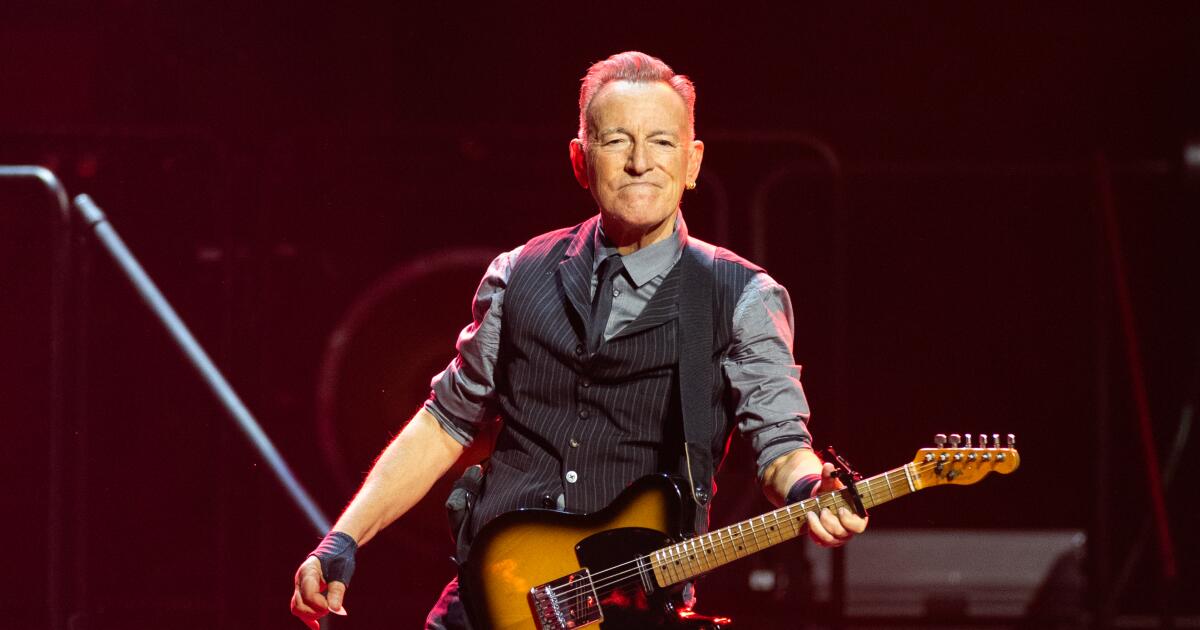
Meanwhile, another major music concert with more transparent political leanings was announced on Wednesday. Trump critics Bruce Springsteen and Rage Against the Machine guitarist Tom Morello revealed they’re launching a Power to the People festival set for Oct. 3 at Merriweather Post Pavilion in Columbia, Md. And as of Friday, no one had dropped off its roster.
Springsteen and Morello are slated to headline, as are the Foo Fighters, Brittany Howard, Joan Baez and Dave Matthews.
Morello, who is currently on tour with Springsteen, announced the festival on-stage at Nationals Park on Wednesday night. “The Power to the People festival is about freedom, justice, equality and rock and roll,” he said. “It’s about the power everyday human beings have when they come together through music, art, community and action. We’re honored to bring this incredible lineup to the D.C. area for a day that celebrates the spirit of activism, creativity and hope.”
Springsteen was more direct in his indictment of the White House and the fight to preserve democracy. “This American tragedy can only be stopped by the American people: you. There is no one coming to save us. We’ve got to do it ourselves,” said Springsteen on Wednesday during the sold-out tour stop in Washington, D.C. “So join us and let’s fight for the America that we love. Do you hear me, Washington?”
Power to the People is scheduled a month before the November midterms, and includes Dropkick Murphys, Jack Black, Serj Tankian, Cypress Hill, Killer Mike, Taylor Momsen and the Linda Lindas. A portion of the proceeds from ticket sales will benefit the organizations VoteRiders, whose mission is to eliminate ID barriers to the ballot box so eligible voters can cast a ballot, and HeadCount, who help register voters at concerts, festivals, sports and community events.
Artists who had committed to playing the Freedom 250, Great American State Fair — or just pick a name already — and who swiftly dropped out when they saw it was touched by Trump, were busy this week distancing themselves from the event.
“Our music has always been our voice and we choose not to publicly affiliate with any single political party,” the Commodores said in a statement on social media.
Poison frontman Bret Michaels and ‘80s sensation Milli Vanilli were also among the acts who announced they would not be playing the event. (New incarnation of) Milli Vanilli singer Jodie Rocco said the group had not been asked to perform, despite being announced in the lineup.
Artists who still appear to be part of the lineup for the curiously titled national state fair are rapper Flo-Rida and 1980s MTV staples C+C Music Factory and Vanilla Ice. The last appeared at Trump’s New Year’s Eve party at Mar-a-Lago.
Freedom 250 was reminded this week that artists have freedom too. To do or not.