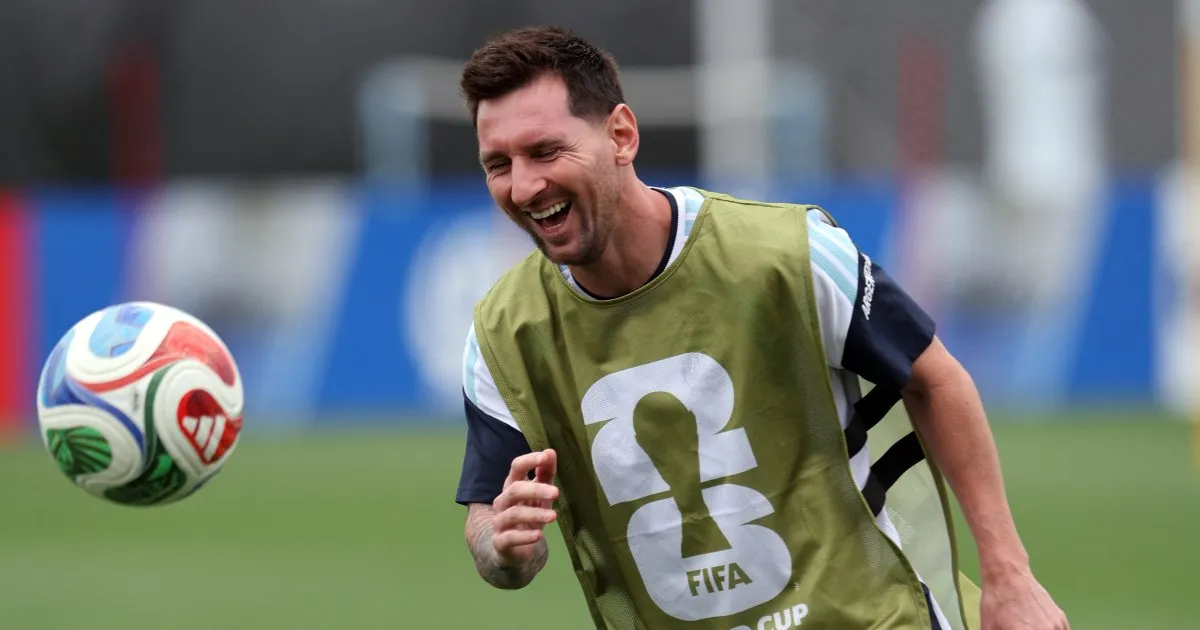
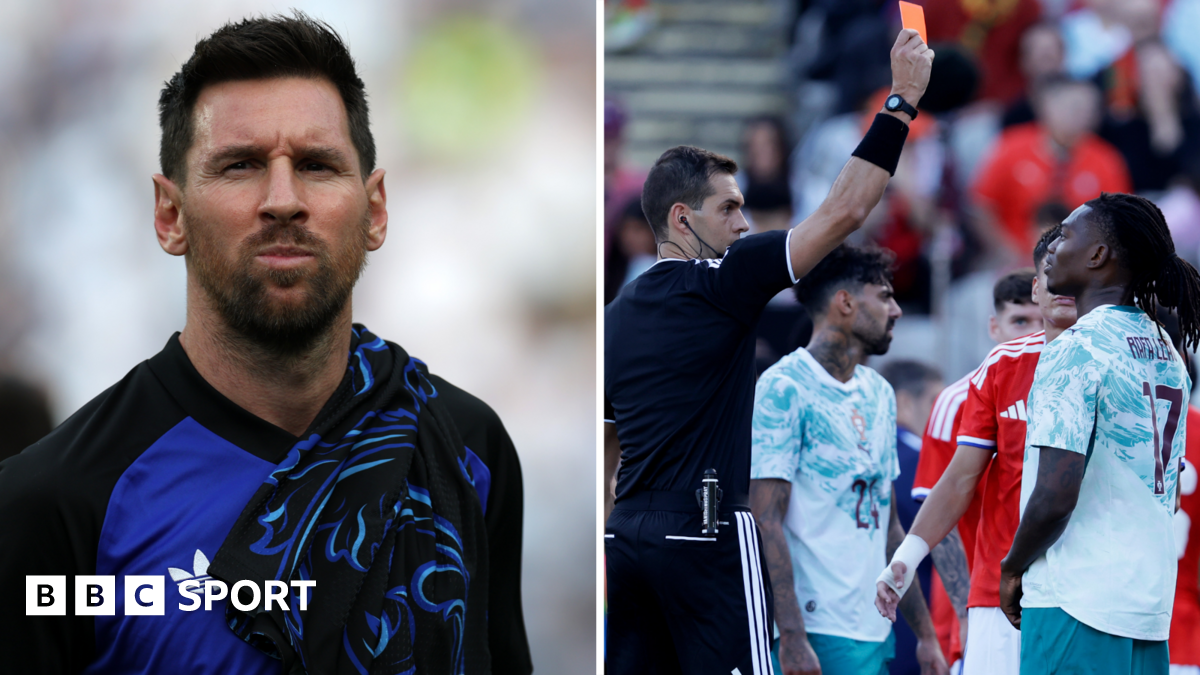
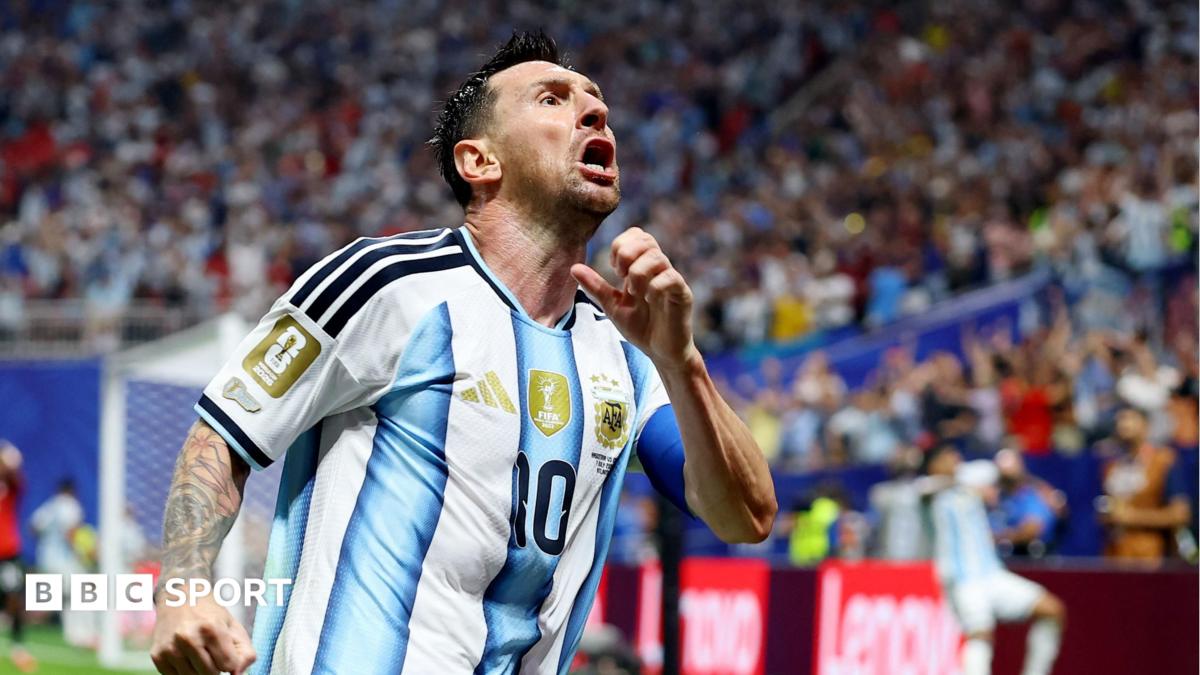
Would Messi have been lost to the World Cup forever had Argentina lost?
He would be 43 – the oldest outfield player to play at a World Cup – if he carried on to the next, though the lure of games being played in his home country may have sustained him.
Instead, Messi can look forward to a quarter-final here against either Switzerland or Colombia.
Former England goalkeeper Paul Robinson, watching in Atlanta for BBC Radio 5 Live, said: “That was incredible. Spectacular. Argentina were down and out. They were out of the tournament at one point.
“Egypt are so frustrated with the refereeing decisions that have gone against them. They had a second goal disallowed before they got their second goal for an infringement that was almost on their own touchline.
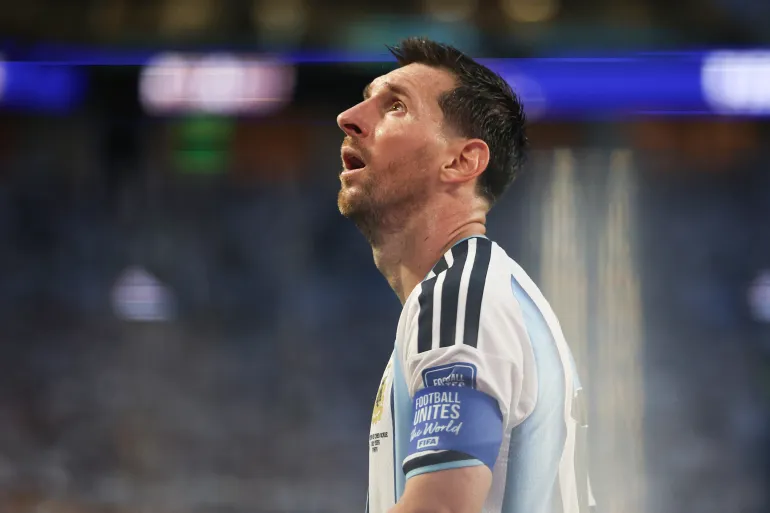
“Then Lionel Messi just stepped in and took over. Beautiful assist, great finish for his goal, and then the substitutions worked for Argentina.”
Argentina’s recovery, and this was not simply the Messi show it should be said, also had implications for England who, when Egypt led, might just have believed it was a ‘now or never’ moment for reaching their first men’s World Cup final since 1966.
England’s path to the final was shaping up as Norway in the quarter-finals, then Egypt, Switzerland or Colombia in the last four if they got through.
Instead, there remains the shadow of Messi and Argentina as the potential obstacle should they overcome the dangerous Norwegians.
And Messi, even in advancing years, casts a giant shadow over any opponents, as Egypt found to their cost.
Messi became the first player in World Cup history to score in six consecutive knockout-phase games and now has eight goals in this one. It is the most by a player in the opening five games since West Germany’s Gerd Muller scored 10 in Mexico in 1970.
He has also contributed to 16 goals in his past nine World Cup games, with 13 goals and three assists.
England’s concern will be he still has the power to add more. And looks in the mood to do so.
Four wins to go. How can your team reach the final and win the World Cup 2026? Click here to find out.
Who: Argentina vs Egypt What: FIFA World Cup 2026 – Round of 16 Where: Atlanta Stadium, Atlanta, Georgia, the United States When: Tuesday, July 7, at 12pm (16:00 GMT) How to follow: We will have all the build-up on Al Jazeera Sport from 12:30 GMT before our live text commentary stream.
Recommended Stories
list of 4 itemsend of list
Get ready for a spicy battle of the number 10s – a dazzling duel between Lionel Messi and Mohamed Salah, two of the greatest forwards in world football, as Argentina face Egypt in the World Cup round of 16.
Argentina have been the clear favourites in every game they’ve played at the tournament, but after being made to work for victory in the last tie, the presumption that the reigning champions are unbeatable has been broken.
Egypt, on the other hand, are on a historic run of their own, gearing up to chase a first-ever quarterfinal berth. One of only two African sides remaining at the tournament, they carry the hopes of the continent and have gone toe-to-toe with the world’s best.
Al Jazeera tells you everything about Argentina vs Egypt:
How did Argentina and Egypt reach the round of 16?
Argentina topped Group J with a perfect record of nine points, winning against Austria, Algeria and Jordan. In the round of 32, they were pushed to extra time by a resilient Cape Verde team before edging past the tournament debutants 3-2 in a thrilling contest.
Egypt came second in Group G with five points, drawing with Belgium and Iran and winning against New Zealand. They defeated Australia 4-2 on penalties in the round of 32 after the game was tied 1-1 following extra time. It marked the first-ever World Cup knockout for Egypt, who made their tournament debut in 1934.
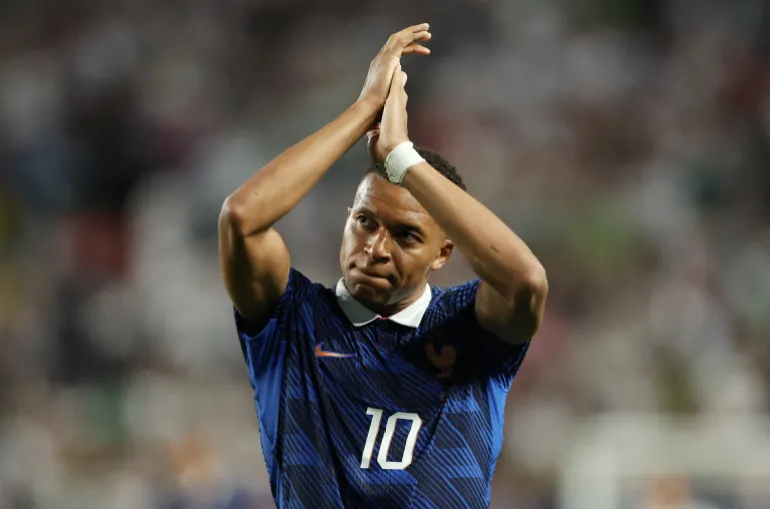
Argentina legend Messi, France’s Kylian Mbappe and Norway’s Erling Haaland are all tied at seven goals, with Mbappe leading the list, his two assists breaking the tie.
If Messi – who has scored in each of Argentina’s four games so far – finds the net against Egypt, not only will he become the Golden Boot leader, but he will also join Guillermo Stabile (1930) as the only Argentina player to score eight goals in a single World Cup.
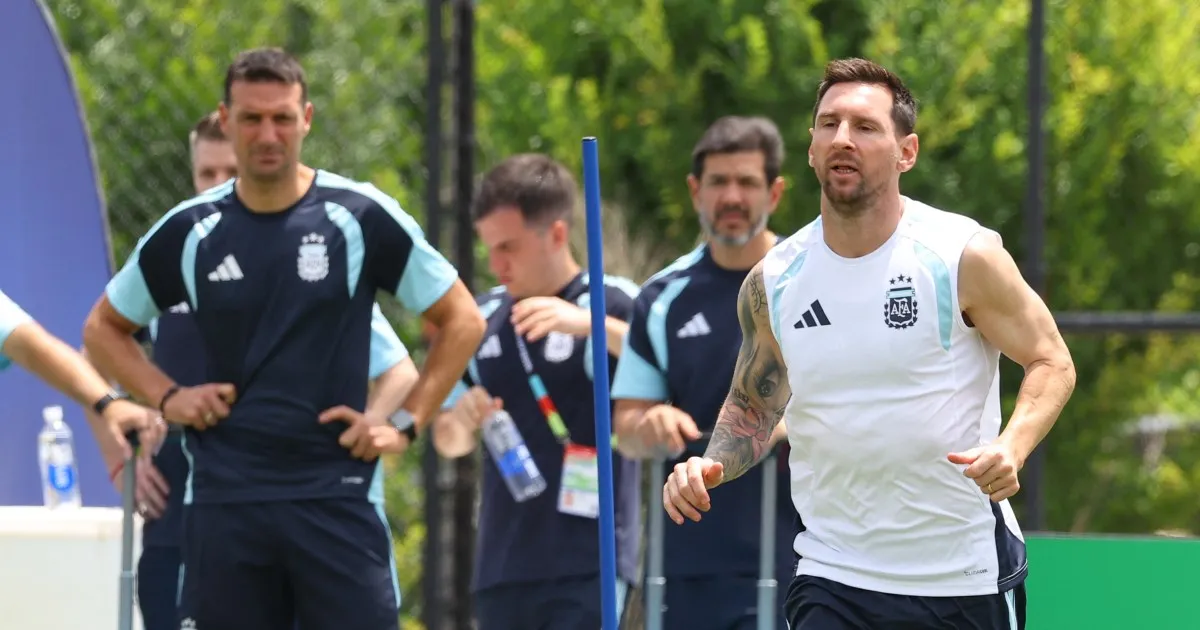
But ahead of Tuesday’s last-16 tie, there have been concerns about fatigue, and it’s not just limited to Messi.
Argentina were forced to play extra time by Cape Verde in the heat in Miami in the US on Friday, while Egypt-Australia went all the way to penalties on the same day. Those gruelling knockout games left both teams with little time for rest and recovery.
Argentina’s 39-year-old forward Lionel Messi played the full 120 minutes against Cape Verde [AFP]
Messi admitted after the last match that he was tired, and he lamented Argentina’s inability to press their opponents high up the pitch.
Meanwhile, Egypt relied heavily on their defensive organisation and looked to Salah and Manchester City forward Omar Marmoush to launch counterattacks against Australia, an approach they could employ again against Argentina.
For Egypt, a fully fit Salah could be crucial after the attacking winger entered the Australia match with a hamstring concern and at times appeared reluctant to sprint at full speed during a draining 120-minute contest.
If Egypt stun Argentina, they will become the fifth African nation to reach the World Cup quarterfinals after Cameroon (1990), Senegal (2002), Ghana (2010) and Morocco (2022 and 2026).
Argentina vs Egypt prediction
The Opta supercomputer gives Argentina a 69.1 percent likelihood of winning in regulation time, while Egypt’s chances of winning are 12.3 percent.
The model estimates a 18.5 percent probability of the game going to extra time.
Argentina vs Egypt: Kickoff, TV schedule
Argentina: TyC Sports, TyC Sports Play (1pm, Argentina Standard Time)
United Kingdom: BBC One, BBC iPlayer (5pm, British Summer Time)
To check the TV listings for your country, head to FIFA’s TV listing schedule here.
Argentina supporters are hoping for a back-to-back World Cup triumph [Roberto Schmidt/AFP]
Who will the winner face in the quarterfinals?
The winner of the Argentina vs Egypt match will play either Switzerland or Colombia in the quarterfinals in Kansas City in the US on Saturday, July 11.
Argentina vs Egypt: Head-to-head
This will be the first World Cup match between Argentina and Egypt.
Their last meeting was a friendly in Cairo in 2008, which Argentina won 2-0.
Argentina are on an eight-game winning run against African nations at the World Cup, with two of those coming in this edition (3-0 vs Algeria, 3-2 vs Cape Verde). No side in the competition’s history has won three games against African opponents in a single edition before.
Argentina vs Egypt: Team news
Argentina’s Gonzalez (ankle injury) and Medina (physical discomfort) are doubtful, while Egypt’s Fatouh (muscle) and El Fotouh (hamstring) are out injured.
Argentina’s predicted lineup
(4-4-2): E Martinez (goalkeeper); Molina, Romero, L Martinez, Tagliafico; De Paul, Mac Allister, Fernandez, Almada; Messi, Lautaro
Lionel Messi opens scoring but Argentina taken to extra time by Cape Verde, which threatened greatest World Cup upset.
Published On 4 Jul 20264 Jul 2026
Reigning champions Argentina needed an extra-time own goal to overcome a Cape Verde side with incredible levels of resilience 3-2 in a thrilling contest and secure their spot in the last 16 of the World Cup.
The Africans, playing in their first World Cup, had twice come from a goal down on Friday to silence the vast majority of the crowd of 64,478 packed into a hot and humid Miami Stadium.
Recommended Stories
list of 4 itemsend of list
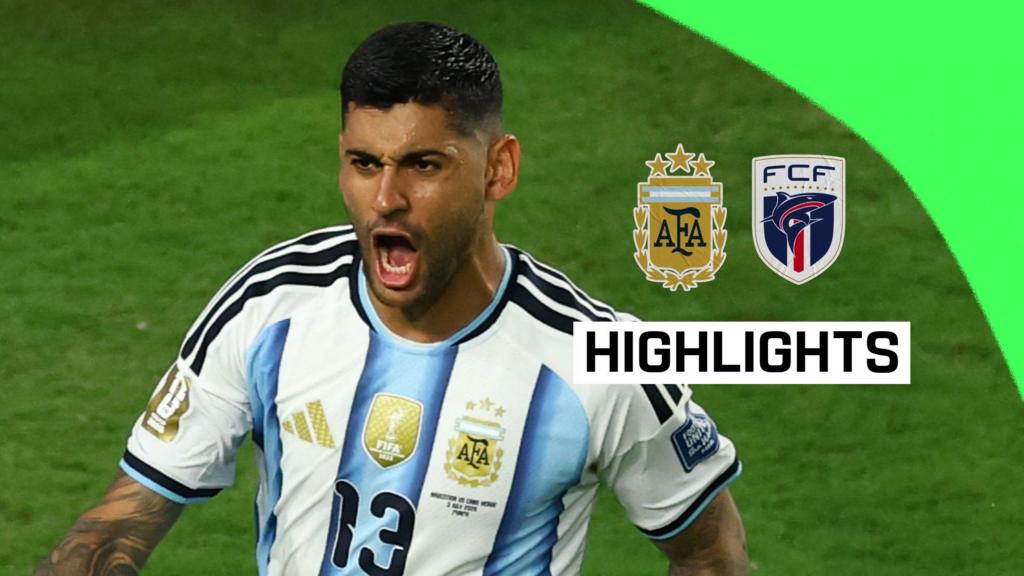
Six minutes into the second period of extra time, Lionel Messi swung a corner into the box, and Cristian Romero rose to head home off the arm of Cape Verde centre-back Diney Borges and finally set up a date with Egypt in Atlanta next Tuesday.
Messi had, almost inevitably, given Argentina the lead in the 29th minute with his seventh goal of the tournament, but Deroy Duarte equalised just before the hour mark.
The Blue Sharks held on to send the match into an additional half hour before Lisandro Martinez lashed a sumptuous shot into the roof of the net in the second minute of the first period of extra time to put Argentina ahead again.
Cape Verde were not done yet, however, and left back Sidny Lopes Cabral curled a beautiful shot into the top corner of the net in the 103rd minute of the contest to put the scores back on level terms at 2-2.
Lopes Cabral could have equalised again after Romero’s goal, but his finely struck free kick was saved by Argentina goalkeeper Emiliano Martinez, who had to be at his best to deny Cape Verde in the dying minutes.
Cape Verde were beaten but far from outclassed by the three-times world champions as they put in a fourth magnificent display of teamwork and grit at their first World Cup.
The only one of the four World Cup debutants to make it to the last 32 and ranked 67th in the world coming into the tournament, Cape Verde had hoped to frustrate Argentina as they did Spain, Uruguay and Saudi Arabia in group-stage draws.
They succeeded, while showing no shortage of quality of their own, for much of the game with a never-say-die desperation and a neat pass-and-move game.
Cape Verde’s Sidny Lopes Cabral scores their second goal past Argentina’s Emiliano Martinez [Paul Childs/Reuters]
Messi aside, Argentina were largely bereft of ideas against an obdurate defence and Cape Verde libero Kevin Pina was the most impressive player on the park for long periods of the contest.
It was Argentina who made the breakthrough in the 29th minute, however, when Lisandro Martinez lofted a long ball over the top of the defence to the feet of Messi.
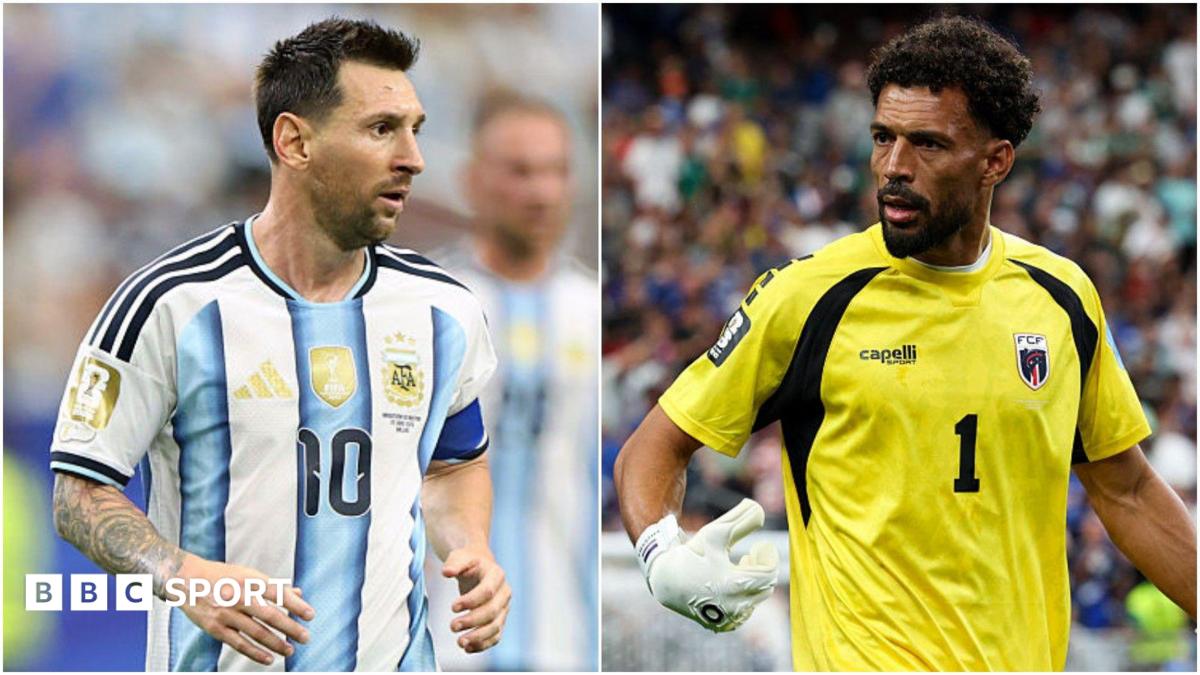
The 39-year-old maestro took a touch with the outside of his left boot and buried it in the roof of Vozinha’s net for his 20th goal over six editions of football’s global showpiece.
Cape Verde knew they would need to score to keep their World Cup campaign alive and Duarte fired a shot at goal soon after half-time that drew a diving save out of Martinez.
Just before the hour mark, captain Ryan Mendes was freed down the right, and his pass into the box found the Dutch-born midfielder, who controlled the ball with his left foot before drilling it past Martinez with his right.
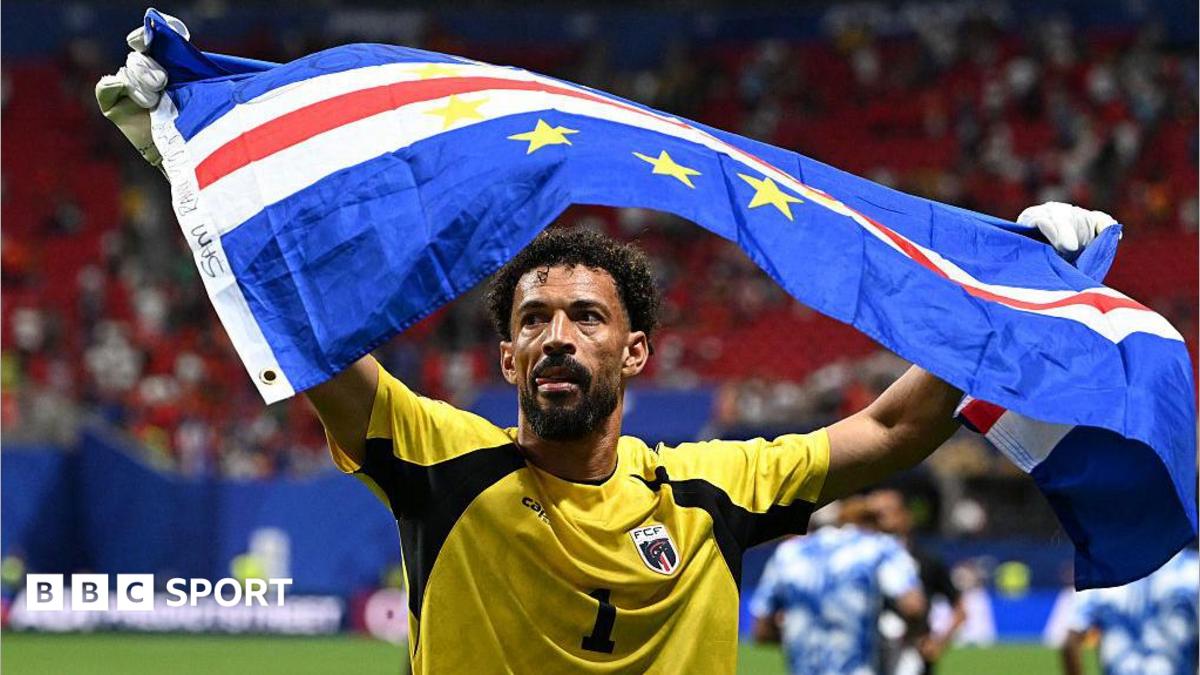
Messi had a chance to put Argentina back in front four minutes later when he was played through on goal, but Vozinha stood up well to keep his shot out of the net.
One of Messi’s trademark free kicks was tipped away by Vozinha in the 72nd minute, and Cape Verde defender Pico Lopes had to intervene to prevent Enzo Fernandez from scoring 10 minutes later.
Cape Verde held on to force the dramatic period of extra time, and they will now return home heroes having put their tiny island-nation firmly on the footballing map.
Cape Verde may have been the World Cup’s smallest nation, but they have certainly made a big impact.
Forget Lionel Messi, Cristiano Ronaldo, Erling Haaland and Harry Kane – it is the tournament debutants who have become the centre of attention.
There were the heroics of goalkeeper Vozinha as they earned their first World Cup point against Spain. There were the thrills as they scored their first World Cup goals against Uruguay. There was Sidny Lopes Cabral’s wonder goal as they almost causing the competition’s biggest shock against Argentina. Cape Verde’s World Cup journey had it all.
When the whistle blew to bring extra time to an end in Miami, the Blue Sharks players slumped to the turf after a heartbreaking 3-2 defeat by reigning champions Argentina but they can leave the United States knowing they have won many hearts.
“Cape Verde have lost, but they’ve won,” said former Scotland international James McFadden on BBC Radio 5 Live.
“They have shown courage, togetherness, unity and unwavering belief in what they are and what they can do.
“The story of this tournament is Cape Verde. That is what you want to see in a football side.”
They came into the tournament ranked 67th in the world, but three group-stage draws – holding European champions Spain 0-0 in their opening game – set up the monumental task of trying to cause one of the biggest upsets the World Cup has ever seen.
Against Argentina, they went behind to a Messi goal, but came back to level at 1-1 and take the game to extra time. Then they went behind again – before a stunning strike from Cabral levelled again. It was not to be though, with a cruel deflection off Diney Borges from Cristian Romero’s header seeing Argentina through.
But former England right-back Gary Neville told ITV it was “one of the greatest performances” he had ever seen from an underdog”.
“They are crying because they are going home,” he added. “They don’t want to go home. They want to be here for the rest of their lives.
“They want to be here forever. This is a moment that’s probably not going to come back for some of these players. It’s magical but also upsetting.”
One of the most-storied national teams – and the current world champions – face opponents who only first qualified for the Africa Cup of Nations in 2013.
Cape Verde was a colony of Portugal when Argentina took part in the first World Cup in 1930, finishing runners-up to Uruguay.
La Albiceleste have only failed to qualify for one World Cup, in Mexico in 1970, though withdrew from the three tournaments either side of World War Two.
Argentina’s first World Cup success came in 1978, beating the Netherlands 3-1. In 1986, a 3-2 victory over West Germany took the trophy back to South America.
A third World Cup trophy was secured in Qatar four years ago, with France beaten on penalties after a 3-3 draw.
Argentina have enjoyed extensive continental success, too, winning the Copa America a record 16 times – including the past two tournaments.
They have not been out of the top three of the Fifa world ranking since March 2022, and spent two years in the number one spot before being dethroned by France last year.
The Cape Verdean Football Federation was only formed in 1982, and accepted as a Fifa member in 1986 – just as Argentina were winning the World Cup for a second time.
The Blue Sharks first entered World Cup qualifying in 2002 but did not have a realistic chance of qualifying until 2022.
Four years ago they only just lost out to Nigeria, drawing the final group game 1-1 in Lagos when a win would have sent them to Qatar.
For the 2026 finals, despite being drawn in a group with eight-time qualifiers Cameroon, Cape Verde finished top with one defeat in 10 matches.
Such has been their recent development they only played at their first Africa Cup of Nations 13 years ago, reaching the quarter-finals before losing to Ghana.
They have now played at the Afcon four times, reaching the last eight again in 2023.
But they failed to reach the 2025 Afcon, despite qualifying for the World Cup.
Cape Verde broke in the Fifa top 100 in 2006, and climbed to 36th on the back of the first Afcon outing. In 2014, after qualifying for the 2015 tournament, they achieved their highest-ever ranking of 27th.
For the last nine years, Cape Verde have hovered around the 60-80 bracket, and will go into Friday’s game ranked 64th.
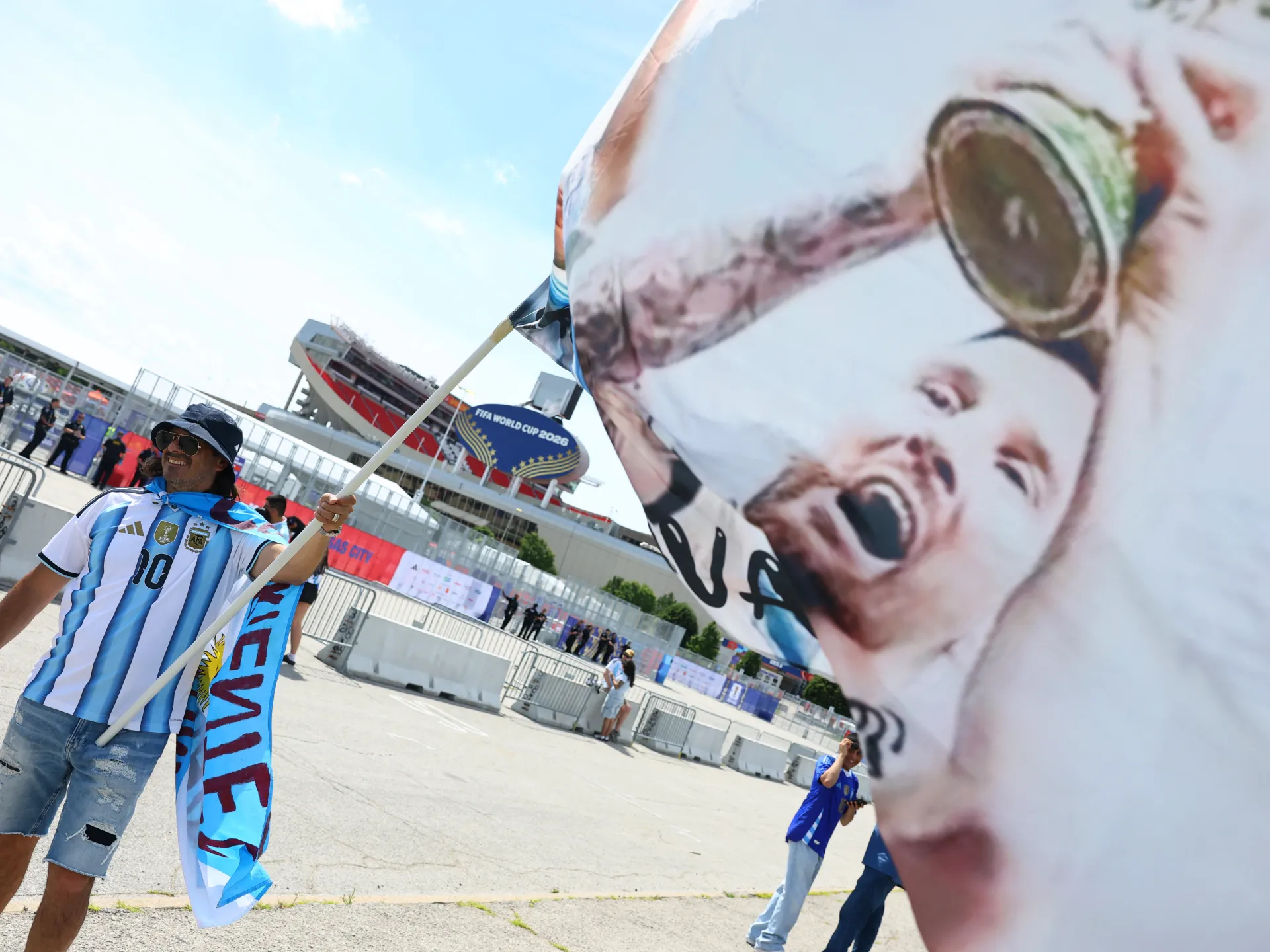
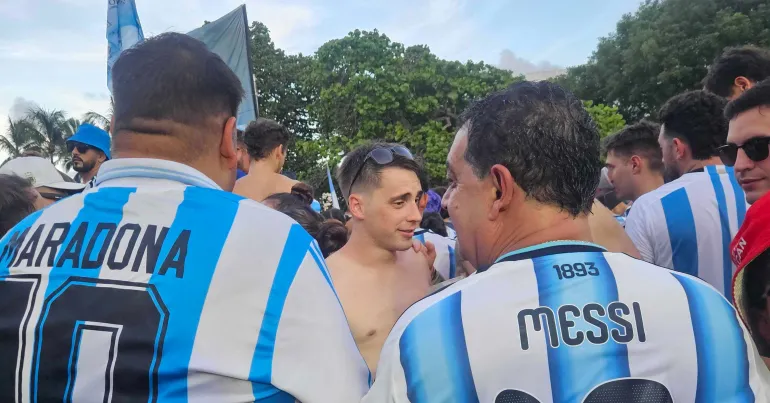
Miami, United States – Singing to the beat of the drum, jumping and dancing with joyful abandon, sporting their famous light blue and white shirts, and waving large flags bearing images of their heroes, Argentinian football fans have announced their team’s arrival in Miami in grand fashion.
A day before Argentina’s first knockout match of the FIFA World Cup 2026 – and their first fixture in the Sunshine State – the portion of Miami Beach known as Little Buenos Aires came to life as close to a thousand revellers geared up for Lionel Messi’s “homecoming” on Friday.
The defending champions and one of the pre-tournament favourites will take on the fairytale team of the World Cup – the small African island nation of Cape Verde.
The match at Miami Stadium will pit a team supported by one of the largest travelling fan bases of the tournament against an outfit that may not have strong backing in the stands but has endeared itself to the neutrals with its heroic performances.
Among Argentinian supporters, though, there’s no room for sympathy for the team punching above its weight.
For Adrian Elizondo, the logic is simple: “Messi deserves to win another World Cup.”
“It’s Messi’s last World Cup and since he’s the greatest player of all time, he deserves to walk away with another trophy,” Elizondo told Al Jazeera.
Elizondo believes there’s more to Argentina’s success than Messi.
“We have good players, a great coach and tens of thousands of people supporting the team. We make a big difference.”
A quick glance at the party-like atmosphere in Miami Beach reinforced Elizondo’s claim.
Miami, where Messi has been playing his club football since 2023, is home to at least 30,000 Argentinians, according to local census data.
Add to this mix another 20,000 fans following the team on their quest to defend the title in the United States and it becomes evident that Miami is “Messi Country”.
Argentina fans gather in Miami before their team’s World Cup match against Cape Verde, on July 2, 2026 [Hafsa Adil/Al Jazeera]
The crowd in North Beach, which is home to several decades-old Argentinian restaurants and cafes, started building more than 24 hours before kickoff and showed no sign of letting up as the evening went on.
Fans, from toddlers to supporters in their 70s, were seen walking towards the central area in Little Buenos Aires.
A small pocket of enthusiasts would begin singing “Muchachos” – the famous Argentinian football anthem – and hundreds of others would soon join in.
While the lyrics speak to the heartbreak of lost World Cup finals and past heroes, the mood among fans was festive, especially as Messi and Co broke a 36-year title drought four years ago in Qatar and emulated his hero Diego Maradona in leading them to a World Cup trophy.
For Argentina fans, Maradona and Messi are commonly considered the master and the protege. It’s part of their footballing folklore which is reinforced at every opportunity.
In Miami, as men, women and children danced on the streets, a group of supporters dressed in the shirts of Argentinian football club Newell’s Old Boys proudly stood in front of a banner connecting the two national heroes with the club.
Jorge Martinelli, second left, and other Argentina fans from Newell’s Old Boys club [Hafsa Adil/Al Jazeera]
Jorge Martinelli travelled to Miami from Rosario, the club’s base, with his friends and proudly shared some facts about his hometown.
“Messi was born in Rosario and played in Newell’s youth teams before joining Barcelona, while Maradona came to the club in 1993,” he tells Al Jazeera.
Is there any other connection between the two iconic captains? Martinelli said: “Yes, it’s a cosmic connection.
“Many here believe Maradona is guiding the team from the heavens above,” he quipped.
Amid Martinelli’s explanation of the spiritual connection between the two, fans let off crackers to celebrate Miami’s favourite footballing son’s return to his adopted home.
The Rosario resident said he does not want to contemplate a future after Messi retires from international football.
“It will create a big hole in the national team, the same as what happened after Maradona,” he said.
For now, though, he believes Messi is the favourite to do what even the great Maradona couldn’t achieve: successfully defend the title.
“He [Messi] is here. He’s playing. Maradona is watching.”
In an era hallmarked by what experts call a “sexrecession,” Six Sex is a symbol of liberation.
The Argentine baddie fashions herself as a baby-voiced, bikini-clad fembot, beamed in from the clubs of Buenos Aires — and has become known for cheeky, instructive celebrations of desire. Her songs are designed to galvanize like-minded club rats into Dionysian revelry, or, in the case of the song “How to Make Your Ass Bigger,” squats.
To a certain subset of the Latine underground, she represents a pure-hearted hypersexuality. Yet, for the artist behind the persona, Francisca Agustina Cuello, this wasn’t always the intention.
“I don’t know if it was because I still had to keep my innocence or what, but I didn’t envision the project that way,” she said, calling from a hotel room in Barcelona. “That response sort of came about from the people, towards me. So, I said OK, I’m making it my own.”
In doing so, Cuello has churned out six thumping EPs as Six Sex, a campy character that she describes as a “fable” — a mix of “fantasía y hedonismo.”
That dynamic is taken to extremes on her debut album, “Ultra”, released June 6. It’s a dark and propulsive journey through decades of electronic dance music, best described by its own opening words portending “ultra terrorific fantasy.” (The phrase conjures up images of grandeur, but really, it evokes that “Blades of Glory” quote: “no one knows what it means, but it’s provocative.”)
“I feel like nothing I say is all that serious,” she said about her lyrics. “It’s a thing about my personality to be silly and goof around.”
“Ultra” centers Cuello’s winking, suggestive sense of humor. “Not Your Mom” features a conversation with a garbled, omnipotent voice akin to the parents in Charlie Brown; “FUchi!” features schoolyard taunts about “low dickie energy;” the album ends with “No More Porn,” a playful yet powerful subversion of sexual expectations.
“At the same time, for me, that acts as a filter,” she added with a laugh. “Weeding out the people who get scandalized by it, and identifying the people who get it and say: ‘Yas, yo también quiero tener cuatro novios.’”
Earlier this year, Cuello took the stage at Don Quixote, performing in front of a sold-out crowd for her Los Angeles debut. The smell of sweat permeated the air as she ripped through several of her hits — including collaborations with Reysha Rami and German producer MCR-T. Every single one of her signature ponytail flips sent the room into hysterics. The audience screamed every word at the top of their lungs; it was the loudest, most raucous show I’d been to in years.
Cuello took a breather in the middle of her world tour to chat with De Los over Zoom about all things Six Sex: her new record, her writing style and how it feels to connect with fans spun into febrile intensity.
This interview has been condensed for clarity and was translated from Spanish to English.
“[I’m] weeding out the people who get scandalized,” says Six Sex of her provocative music.
(Catalina Jacobo)
I was really taken by the “Ultra” album cover. You’re wearing a white bikini and in this “come to Jesus” pose. What was the goal? [laughs] It was hard, because I wanted the cover to represent what the entire journey of the album meant to me. I was looking for something strong and heavy in visual terms, because with “Ultra”, this is the first time I’ve finished a long, heavy project and I see the start of something. It’s like something new was unlocked. I found a new way to convey feelings, and a new way to create as well. It’s not like I just finished, and it is what it is. Rather, it is the beginning of something bigger.
Is there an element of separation at all between the artistry and you as a person? I think they’re pretty close. It’s as if Six Sex was sort of a fable, or like a hentai or comic [version of] my life. It’s also happened that things I wrote as a joke later became reality. But generally, I draw inspiration from things that actually happened to me.
Is it weird to put those intimate experiences on an album? No, not for me. Because I’m not speaking so seriously, I don’t feel exposed. Even though my persona and my character are very close to one another, I don’t have to prove anything to anyone. I’m not trying to make you believe in something. The songs stop being about me as soon as someone else listens to them. There are certain things we can all see ourselves represented in, and I think my music aims for that, too.
I want to ask about your performance style. I saw you live in Los Angeles and was really taken by the energy exchange between yourself and the crowd. How do you approach live performance? Nowadays, I’m in a balance between performance and being a human being that connects with people and can pause to look in the eyes of the audience to register how they feel. I like being in a showgirl role, and at the same time, knowing when to step out of it.
Sometimes I go up there after having a crappy day, thinking that I’m gonna screw it up. And when I get up there and connect with the people, everything flows in a perfect way.
Does the music transform when it’s performed live, versus on a record? A lot of your music seems designed to be played in the club. I think it’s very personal. For me, I’m a bit autistic; sometimes when I’m at a show, I get different sensations. It really depends on the person. I like seeing people’s reactions live when I start playing these songs for the first time. People were super hyped. They were enjoying them and jumping around a lot. It feels really fresh.
You reference ‘90s club classics all over “Ultra,” including by U.K. band the Prodigy on “Bitch Up.” How did these sounds come into your life? These sounds evoke a special kind of nostalgia for me. Even though I hadn’t been listening to them lately, they sounded like something I wanted to bring back to the table — songs my uncle used to listen to when I was really young. Like a CD [of] pirated songs that somehow ended up at my house, and at the time I was like, “Wow, what is this music?”
There’s an element of Six Sex that gives “fembot,” like a female, sexy robot. I’m curious if you feel that playing out in your work. [laughs] I didn’t know about the fembot thing. I don’t use Twitter. I [keep] a bubble… against some things that I don’t know. But I’ve always liked the idea that people have that perception of me, to some extent.
How do you feel about the rise of AI as a musician, especially considering your persona adopts that perception? I mean… I don’t have a formed opinion on the matter. I do think that, I don’t know, it’s all very relative. For one thing, I obviously feel like it strips away the human value, but at the same time, it’s also a tool for humans. So it’s kind of contradictory. I feel weird about it…. I don’t know.
Zooming out, I’ve noticed Argentina has been having a musical moment over the last few years between yourself, Ca7riel y Paco Amoroso, Juana Rozas… How do you feel Argentina being represented or even challenged in your music? I feel that culturally, Argentina is a very rich country. However, I do feel like, over generations, a paradigm was broken, and new sounds have been created that don’t necessarily abandon the roots of our music, but were created out of counterculture.
That same kind of counterculture is what makes Argentina be in such turmoil. It’s also the context of our country. Economic, political, social. The key Argentinian figures we refer to nowadays are constantly changing. And that allows you to listen to a variety of genres from Argentina, from people doing different things, and at the same time raising the flag and saying: “Yo soy argentino.” And we love that.
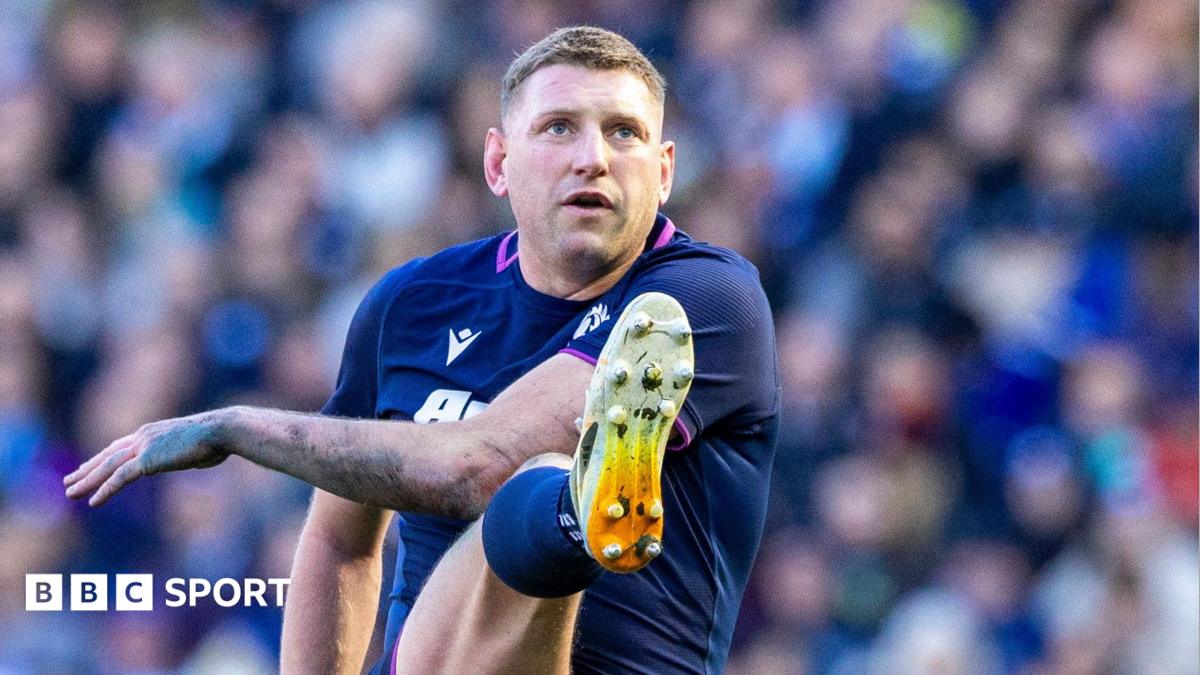
Finn Russell will not feature in Scotland’s opening Nations Championship match of the summer series but could feature against South Africa, says head coach Gregor Townsend, who welcomes back Jonny Gray.
Fly-half Russell, 33, has not fully recovered from the calf injury that kept him out of the latter part of Bath’s domestic campaign and was not considered for the match at Estadio Mario Alberto Kempes in Cordoba on Saturday (20:10 BST). The Scots face the Springboks in Pretoria on 11 July then Fiji at Murrayfield on 18 July.
Tom Jordan starts at 10 in Russell’s absence, with Fergus Burke among the replacements.
Gray returns against the Pumas, having missed this year’s Six Nations, while fellow lock Scott Cummings, 29, and prop Pierre Schoeman, 32, will win their 50th caps.
“Great for [Jonny Gray] to be back in the squad,” said Townsend. “Since his move to Perpignan, he’s played very well so his form’s been rewarded with this opportunity. It’s nice obviously nice that him and Scott Cummings are playing together.
“Jonny was at Glasgow when Scott came through as an 18-year-old. It will be great to see them both back int he second row again.”
Overall, the XV in Cordoba shows eight personnel changes to the team that finished the Six Nations with defeat to Ireland in Dublin in mid-March.
Full-back Kyle Rowe, centre Rory Hutchinson, wing Jamie Dobie, fly-half Tom Jordan, hooker George Turner, prop Elliot Millar-Mills and Cummings are the players joining Gray in coming in to the side.
Kyle Steyn moves from left to right wing to accommodate Dobie. Prop Zander Fagerson and wing Darcy Graham, who started in Dublin, drop to the bench.
Gregor Hiddleston could make his Scotland debut off the bench.
“We’ll have to gel quickly,” Townsend said.
“It’s our first game since we played in Dublin. We’ve got a lot of evidence in the Six Nations and November that when we get our game in place in attack and defence, we can cause problems to any team in world rugby and do more than that, convert opportunities.
“I believe that our squad now is much deeper and we use that bench to continue what the starters are doing or actually raise the energy.”
The race for the Golden Boot at World Cup 2026 is shaping up to be one for the history books.
After just two games, Argentina talisman Lionel Messi leads the way with five goals, followed by France’s Kylian Mbappe and Erling Haaland of Norway with four goals each.
Recommended Stories
list of 4 itemsend of list
Germany’s Deniz Undav has three with Jonathan David of Canada on the same mark after a hat-trick against Qatar.
A further 20 players have scored twice in their opening two games, including 2018 Golden Boot winner Harry Kane of England, Cristiano Ronaldo of Portugal, Vinicius Jr of Brazil and Mikel Oyarzabal of Spain.
The stars are all shining and, given the rate of scoring so far, it seems possible double figures might be needed to win the Golden Boot, something done only three times in history – by Hungary’s Sandor Kocsis in 1954, Just Fontaine of France four years later and Gerd Muller of Germany in 1970.
Fontaine holds the record of 13 goals in one World Cup in just six matches in Sweden, but the expanded 48-team format in 2026 means the nations qualifying for the semifinals in July will play an unprecedented eight games in this edition.
At the 2006 World Cup in Germany and in South Africa four years later, only five goals were needed to claim the Golden Boot while nobody has scored more than eight in the past 13 editions, a feat achieved only by Brazil’s Ronaldo in 2002 and Mbappe four years ago in Qatar.
Kylian Mbappe followed his double against Senegal with another against Iraq in this year’s World Cup [Siphiwe Sibeko/Reuters]
Why have so many goals been scored at World Cup 2026?
It took just 33 matches for a century of goals to be racked up in this edition, second only to 1954 in terms of pace.
After Portugal’s 5-0 win over Uzbekistan on Tuesday, 139 goals had been scored across the first 45 games – the most in the group stages of a single edition of the finals, overtaking the 136 scored in 2014 in three fewer matches.
The record number of goals in one edition came in Qatar 2022 with 172 from 64 games. With an extra 40 matches in the new expanded format that went into effect this year, it was always likely to be broken, but the rate of scoring suggests the old mark will be obliterated.
The Adidas Trionda ball used in World Cup 2026 [Simon Fearn/Imagn Images]
One reason for the increase in goals might be the Adidas Trionda ball, which FIFA commissioned for this World Cup.
Before the tournament, FIFA said it boasts several key performance innovations, including intentionally deep seams designed to produce optimal in-flight stability by ensuring sufficient and evenly distributed drag as the ball travels through the air – in short, it flies through the air – while the surface of the ball is designed to increase grip when striking or dribbling in wet or humid conditions, which we have seen plenty of in the opening matches.
Austria head coach Ralf Rangnick said: “This ball is as fast as a cannonball. If you kick the ball in the right position, it’s extremely difficult to save.”
The controversial addition of hydration breaks to each half may also mean players are performing at their peak for longer, leading to the glut of late goals so far. Of course, the fact that 48 teams are taking part, drawn from the world’s leading 85 teams in the rankings, means there are some mismatches in the first phase.
Colombia coach Nestor Lorenzo also said attackers are more protected by officials than they used to be, which may contribute to the increased scoring, adding: “They didn’t have this protection some 20, 30 years ago when they were hit a lot more, when rough play was a lot more common.
“Today, any team that defends well and uses counterattacks and tries to play can manage to do well.”
Erling Haaland has scored two goals in each of his first two World Cup appearances. [John Sibley/Reuters]
Who is likely to win the Golden Boot?
Much will depend on fitness and, of course, how deep a country goes in the tournament, but Messi has to be considered the favourite to win his first accolade.
The 38-year-old scored seven goals at the last World Cup and has now scored in six straight tournament matches, having netted in every knockout round in Qatar and the first two games of this edition. He even missed a penalty against Austria, which would have made it back-to-back hat-tricks.
Argentina’s final group game on Sunday is against already eliminated Jordan although Messi’s inclusion from the start in that one is by no means a given as his side have already secured the top spot in Group J.
They look set for favourable knockout fixtures, though, with the potential for Uruguay or Cape Verde in the last 32, potentially Australia or Iran in the round of 16 and the possibility of Croatia or Colombia in the quarterfinals, should they make it.
Only in the semifinal might they come up against a powerhouse nation, likely in the form of England or Brazil or dark horses Japan, Norway or Mexico.
Mbappe also looks likely to have a favourable run and is likely to feature against Norway on Friday in the group finale, which will decide the top spot in Group I.
Winning the group could mean a round of 32 meeting with Sweden, Germany the potential opponents in the last 16 and the Netherlands or Morocco awaiting in the last eight.
Whoever finishes second out of France and Norway could face a tricky task against the Ivory Coast in the last 32 with Brazil or Japan awaiting the winners and the possibility of England lurking in the quarterfinals, which might put a ceiling on Haaland’s prospects, despite having scored 59 goals in 52 international games for Norway.
Kane will seek to enter the conversation with England facing a must-win Group L finale on Sunday against Panama with the prospect of a last-32 meeting with Cape Verde to follow and Mexico likely lying in wait in the Azteca (known during the World Cup as Mexico City Stadium) in the round of 16.
Cristiano Ronaldo may have left it too late to begin a real quest, given Portugal face Colombia on Sunday in their final Group K game and could face resolute Ghana in the last 32 with Spain potential opponents in the last 16.
But Vinicius Jr could add to his two goals when Brazil face Scotland on Thursday in their final Group C game although the knockout rounds would appear a stiffer test.
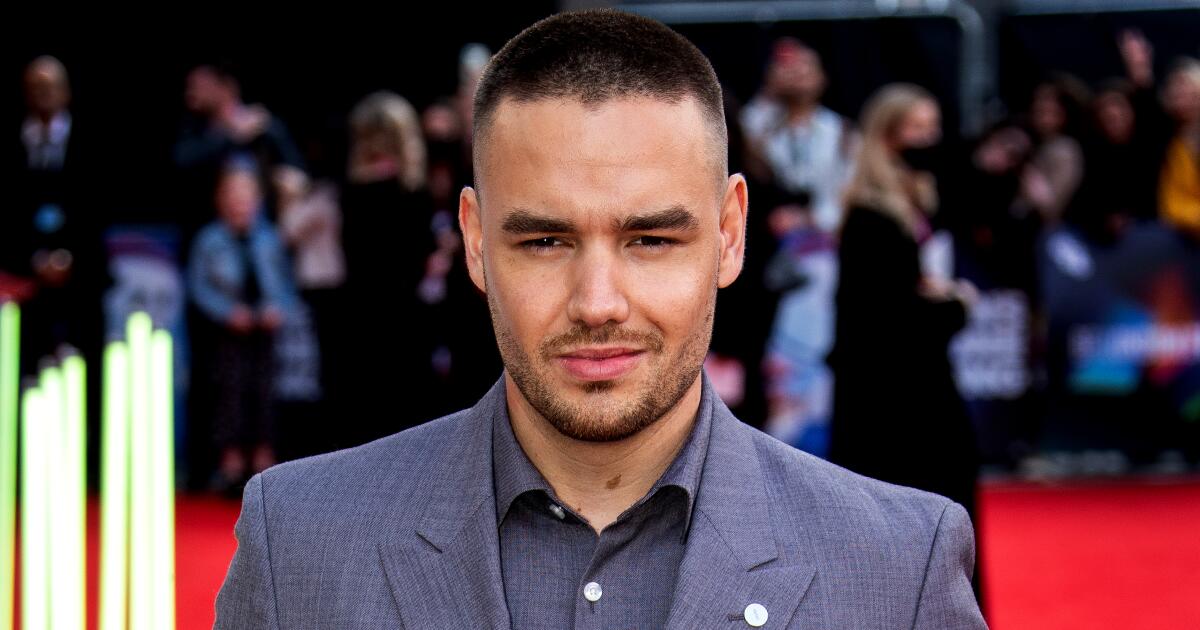
Liam Payne’s 9-year-old son has inherited the late singer’s fortune.
Bear Grey Payne, the only child of Payne and British singer and former “X-Factor” judge Cheryl Cole, has been named the sole beneficiary of the former One Direction star’s estate, according to court documents reviewed by People.
Bear now has more than $29 million to his name. According to the filing, a portion of the inheritance can be accessed now, but the majority will be held in a trust for another nine years, until Bear turns 18.
During a 2019 appearance on “The Jonathan Ross Show,” Payne opened up about fatherhood and spending time with Bear after the singer and Cole had called it quits.
“He comes over to my house every so often, and we just hang out and do whatever,” Payne said of his then-2-year-old son. “I think you put pressure on yourself as a dad sometimes. It’s hard to connect with it with a 2-year-old … but they literally will laugh at anything. We put this Batman costume on him in the house, and it was a little bit slidey on the floor, and he kept falling off the sofa. And if I said ‘Whoopsie-daisy!’ and it was like the best thing ever.”
Payne, who was one-fifth of the global boy-band sensation One Direction, died Oct. 16, 2024, after falling from a balcony at the CasaSur Palermo Hotel. Officials determined the 31-year-old singer died from multiple traumas caused by the fall. He had traces of alcohol, several narcotics and a prescription antidepressant in his system when died, according to officials.
The boy-band star turned solo artist had been open about his battle with addiction and mental health and shared updates on his sobriety journey on social media.
After Payne’s death, the National Criminal and Correctional Prosecutor’s Office of Argentina charged five people for alleged involvement in the pop singer’s death, including a representative for Payne and the manager and the head of reception of the Buenos Aires hotel where the British singer fell to his death.
Another hotel employee and a waiter whom Payne met in a restaurant were charged with supplying the singer with narcotics.
Times staff writers Alexandra Del Rosario and Karen Garcia contributed to this report.
Messi scores twice to become all-time leading scorer in men’s World Cup history as Argentina reach knockout rounds.
Published On 22 Jun 202622 Jun 2026
Lionel Messi became the leading scorer in World Cup history as the captain struck twice to give Argentina a 2-0 win over Austria and send the champions into the last 32.
The player widely regarded as the greatest of all time pounced late in the first half in Texas on Monday with a trademark left-footed finish after neat build-up play.
Recommended Stories
list of 4 itemsend of list
The predatory goal added to his hat-trick in Argentina’s opening match to make it 17 in total at the World Cup.
The 38-year-old then sealed the match deep in injury time after a scramble in the box, as he outfoxed four defenders who lined up to keep the ball out.
It should have been even better for Messi, who missed a penalty early on, stunning a fiercely pro-Argentina 70,649 crowd at the air-conditioned home of the Dallas Cowboys.
With both sides knowing a win would put them into the knockout rounds with a game to spare, Lautaro Martinez was brought down in the box, sandwiched by two Austrian players.
Referee Amin Mohamed gave a penalty after a VAR intervention, and a wall of noise went up as Messi stepped forward on nine minutes.
But his run-up was slow and his weak effort off target, dragging it wide.
For all his brilliance, Messi – who turns 39 on Wednesday – is surprisingly poor from the penalty spot by his standards.
He also saw his spot-kick saved by Wojciech Szczesny in a 2-0 win over Poland at the 2022 World Cup, where Argentina went on to be champions, and missed at the 2018 tournament.
In the 19th minute Messi had a clear sniff at goal, only for Austria captain David Alaba to steal the ball off his toes at the last moment as he danced through on goal.
Alaba denied Messi again just after the half-hour mark, blocking his goalbound shot with goalkeeper Alexander Schlager stranded.
Ralf Rangnick’s Austria, who beat debutants Jordan 3-1 in their opener, were content to sit back. They did not have a shot on target in the first half.
Messi celebrates scoring Argentina’s first goal [Troy Taormina/Reuters]
Messi makes history
And then the came the big moment, Messi sweeping in on 38 minutes after being set up by Facundo Medina, with Thiago Almada cleverly letting the ball run through his legs to leave Argentina’s talisman all on his own and the goal gaping.
The Argentina fans, who greatly outnumbered their Austrian counterparts, rose to acclaim their hero.
Messi had equalled Miroslav Klose’s all-time mark of 16 World Cup goals when hitting a hat-trick in a 3-0 win over Algeria in the holders’ opening game.
Lionel Scaloni’s side failed to build on their lead, and the second half drifted, neither side creating much.
If anything, Austria threatened slightly more, but Argentina goalkeeper Emiliano Martinez was only once seriously troubled.
And then up popped Messi to have the last word at the death.
Julian Alvarez’s initial attempt was saved by Schlager but the rebound was worked to Messi who, after seeing his first shot blocked, pounced to drive in a low strike from six yards out that confirmed the points.
WASHINGTON — Colombian presidential candidate Abelardo de la Espriella has vowed to crush criminal groups and slash government programs. He promises to bomb “narco-terrorist” camps and build sprawling mega prisons if he wins Sunday’s runoff election.
De la Espriella’s views have earned him the vociferous backing of President Trump, who has broken with White House tradition by publicly seeking to tip the scales in foreign elections — particularly in Latin America.
After Trump gave his “complete and total endorsement” to De la Espriella, whom he referred to by his nickname, “El Tigre,” the candidate posted an AI-generated image of a bald eagle and a tiger, with American and Colombian flags waving side by side.
“You have paved the way for the people to defeat the entrenched powers that have long held sway,” he wrote to Trump. “In Colombia, we have now begun to follow the same path.”
De la Espriella, a political newcomer who built his campaign around gym workout videos and vows to “disembowel” the left, is part of a new wave of far-right, MAGA-aligned politicians in Latin America openly borrowing from Trump’s playbook, presenting themselves as outsiders who will trim the government, curtail immigration and militarize law enforcement.
In a region that remains plagued by high crime and inequality after a decades-long period of leftist domination known as the “Pink Tide,” the playbook appears working.
More Latin Americans now identify with the right than at any time over the last two decades, according to polling firm Latinobarómetro. A series of conservatives have won presidential elections in recent years, giving Trump a slate of willing partners as he seeks to expand U.S. power in the region, combat drug cartels and counter growing Chinese influence.
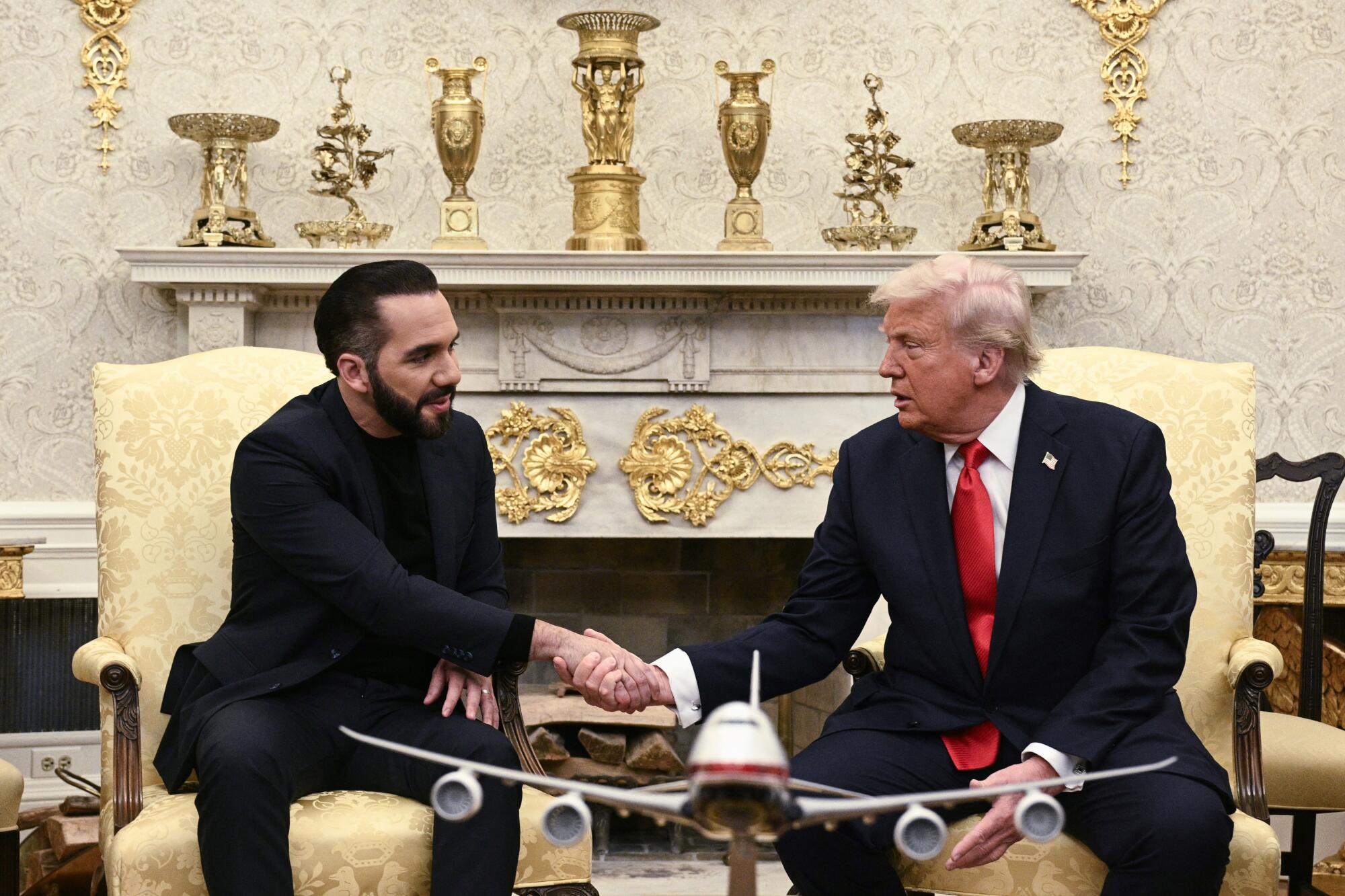
President Trump meets with El Salvador’s president, Nayib Bukele, in the Oval Office of the White House on April 14, 2025.
(Brendan Smialowski / AFP via Getty Images)
Among Trump’s many allies are Argentina’s Javier Milei, a libertarian firebrand whose dramatic cuts to state services were a blueprint for Elon Musk’s so-called Department of Government Efficiency, known as DOGE; and El Salvador’s Nayib Bukele, a mano dura autocrat who housed U.S. deportees in his notorious prisons to assist Trump’s immigration crackdown.
Ecuador’s Daniel Noboa has welcomed U.S. Special Forces, who are attacking drug traffickers in his country, and Chile’s José Antonio Kast has pledged a border wall along his country’s frontier with Peru and Bolivia in his quest to “make Chile great again.”
Trump might soon gain another ideological bedfellow in Peru with the election of Keiko Fujimori, the daughter of late autocrat Alberto Fujimori. With ballots still being counted, Fujimori was on track for a narrow victory
In a sea of nations led by conservatives, the left now retains power in just three key countries: Mexico, Colombia and Brazil.
It faces serious challenges in two of them.
Ahead of October’s presidential election in Brazil, incumbent Luiz Inácio Lula da Silva, a leftist stalwart and one of the last vestiges of the Pink Tide, has been polling even with Flávio Bolsonaro, the son of former President Jair Bolsonaro, a Trump ally convicted of convening a Jan. 6-style insurrection.
Brazil’s President Jair Bolsonaro, right, with President Trump during a dinner at Trump’s Mar-a-Lago estate in Palm Beach, Fla., on March 7, 2020.
(Alan Santos / Associated Press)
And then there’s Colombia, where De la Espriella, a criminal defense attorney, surged ahead in the first round of voting and this weekend faces off against Sen. Iván Cepeda, an ally of leftist President Gustavo Petro.
Petro drew Trump’s ire by denouncing the U.S. military campaign to oust leftist President Nicolás Maduro of Venezuela and a spate of lethal U.S. attacks on alleged drug boats.
Petro slammed Trump’s endorsement of De la Espriella, calling on Colombians to “vote freely and not allow ourselves to become either slaves or anyone’s colony.”
Mexican President Claudia Sheinbaum also accused Trump of electoral interference after the U.S. announced drug trafficking charges against several members of her ruling Morena party and The Times revealed that two more sitting governors are under investigation.
“Is it truly a legitimate interest to combat organized crime?” Sheinbaum asked of the U.S. investigations. “Or are we perhaps witnessing how sectors of the American far right … intend to influence the 2027 election in our country?”
President Trump meets with Argentine President Javier Milei during the United Nations General Assembly on Sept. 23, 2025, in New York.
(Evan Vucci / Associated Press)
The White House has declined to comment on Sheinbaum’s criticism. But Trump earlier this month warned Mexico that his administration is “focused on coming in by land” to deter drug trafficking.
“President Trump has been clear that Mexico must do more to combat the drug cartels running rampant in their country,” a White House official told The Times when asked whether Trump is planning a military operation there.
Trump, who publicly backed Kast and President Nasry Asfura of Honduras, as well as Milei’s political party ahead of Argentina’s midterm elections last fall, has openly mused that he should charge money for endorsement of leaders in foreign countries.
Guillaume Long, who served as foreign minister in Ecuador under leftist President Rafael Correa and who is now a fellow at the Center for Economic and Policy Research, criticized Trump’s “unprecedented, unabashed interventionism in Latin American politics.”
“There are a number of taboos that have been broken,” he said.
Long added that Latin America is mirroring the United States in its political divisions. “I think we’re likely to see in the coming decades a very polarized politics,” he said. “And that doesn’t bode very well for political stability.”
Much of Trump’s activity in the region, including the deposing of Maduro, has been presented as part of a war on drug cartels, which the White House has formally declared terrorist organizations. Long described that rationale as a “pretext” for expanding U.S. political and economic influence in the region.
Nicolás Maduro and his wife, Cilia Flores, are escorted by federal agents as they make their way to an armored car for a trip to a federal courthouse in Manhattan on Jan. 5.
(XNY/Star Max/GC Images)
He said he believed that focus on cartels had pushed some Latin American politicians to the right “because they think being security hawks will make them popular with the Trump administration.”
But James Bosworth, the founder of Hxagon, a company that provides political risk analysis in Latin America, said many leaders in the region have come to tough-on-crime policies on their own.
“I think that some of the hemisphere is willing to play along with it because the hemisphere has issues, including security issues, where the U.S. can be of assistance,” Bosworth said. “Many Latin Americans do want a greater military focus, so there’s certain alignment that’s occurred.”
Conversely, Mexican journalist Alex González Ormerod said he believes Trump has been influenced by Latin American leaders, including Bukele, who suspended civil liberties and began locking up alleged gang members en masse in 2021.
“I think there’s a lot of cross-pollination going on,” he said, crediting groups like the Conservative Political Action Conference, a gathering of right-wing activists and elected officials that has hosted events in Brazil and Argentina.
Many analysts cautioned that Latin America operates on a pendulum, swinging every few years between right and left.
“There’s a lot of evidence that voters are just unhappy and voting for the opposition, and then losing patience very quickly with whoever is in office,” said Benjamin Gedan, director of the Latin America Program at the Stimson Center.
Voters dissatisfied with the status quo so often vote out incumbents there is a phrase for it: voto castigo, or “the punishment vote.”
Ceballos reported from Washington and Linthicum from Mexico City.
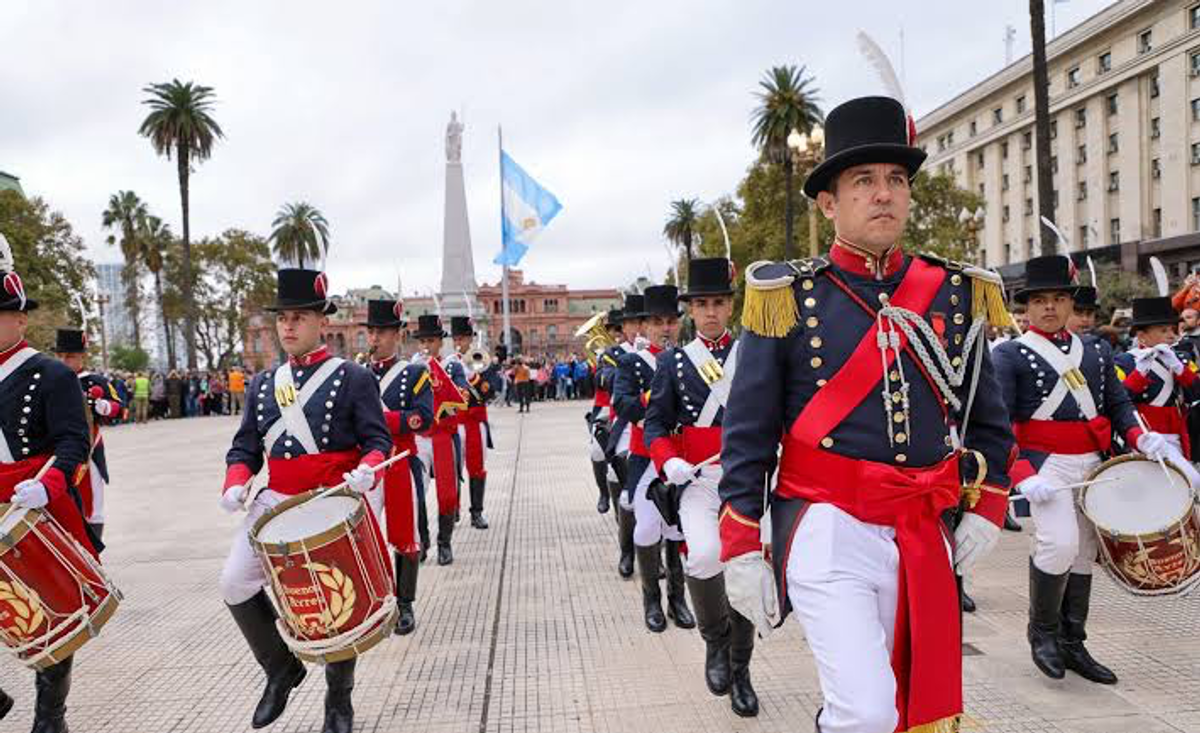
The national flag of Argentina dates from 1812. It is a triband, with three equally wide horizontal bands of light blue, white and light blue. In 1818, a ‘ Sun of May’ was added to the center.
The flag with the sun is the Official Ceremonial Flag. The flag without the sun is considered to be the Ornamental Flag. While both versions can be said to be the national flag, the ornamental version must always be hoisted below the Official Ceremony Flag.
During the Argentine War of Independence General Belgrano was leading a battle near Rosario. He noticed that both the Crown’s forces and the independence forces were using the same colors (Spain’s yellow and red).
After realizing this, Belgrano created a new flag using the colors that were used by the Criollos during the May Revolution in 1810.
Though Argentina has one of the most recognizable national flags, the original flag was quite different from the current one: it had two vertical stripes, one blue and the other one white.
The flag was first flown, on February 27th 1812, on the Batería Libertad, by the Paraná River.
Oliver Tree, a genre-defying singer-songwriter and Santa Cruz native, was one of six people killed when two helicopters collided Sunday morning in Brazil, according to the Associated Press. He was 32.
Tree, a quirky artist known for his highly theatrical music videos and crisp bowl cut, had been traveling through South America as a part of his world tour. CNN Brazil reported Argentinian YouTuber Gaspar Prim, also known as Gaspi, was among those killed in the crash.
The mid-air collision occurred in Rio de Janeiro, with one of the helicopters landing in the parking lot of a car dealership, the AP reports. Local authorities have launched an investigation into the cause of the crash.
Tree, born Oliver Tree Nickell, broke out in the electronic music world first performing as, simply, Tree. He released an e.p., “Demons,” in 2013, which included a cover of Radiohead’s “Karma Police.” He later attended CalArts north of Los Angeles, and signed to Atlantic Records for his major-label debut e.p. “Alien Boy” in 2018.
To find his distinct look, he told the Santa Cruz Sentinel that “I was making a statement with it. Everybody’s trying to look so beautiful and sexy nowadays. It was my way of rebelling against that. So, I tried to make myself look as silly and ridiculous as possible.”
Tree was an instant hit on the festival circuit for his outlandish stage productions and outsider charisma, performing at Lollapalooza, Coachella and Outside Lands. He collaborated with Skrillex, David Guetta and Zeds Dead, and was fiercely protective of his meticulously weird visual identity and video concepts, telling Rolling Stone that “That’s kind of my signature. The people who do f- with me know me because of my videos..Music is my day job but my real dream is to be making feature films.
He released his major label debut LP, “Ugly Is Beautiful,” in 2020. His hit song “Life Goes On” and collaboration “Miss You” with German DJ Robin Schulz earned him international recognition and climbed onto the Billboard Hot 100. He released four full length albums as Oliver Tree, most recently April’s independent LP “Love You Madly Hate You Badly.”
Tree had performed in Buenos Aires on June 4.
From July to October, he had shows scheduled throughout Europe, Australia and China. This year, he performed at the Coachella Valley Music and Arts Festival this year as a special guest of electronic producer Subtronics. In one of his last social media posts, he made a point to spotlight an upcoming show on Aug. 9 in his hometown at the Quarry Amphitheater at UC Santa Cruz.
“I can’t believe Oliver is gone,” Schulz posted on Instagram. “You were such a lovely soul and a one of a kind character. Working with you on ‘Miss You’ was an honor. My deepest condolences to his family, friends and everyone who loved him.”
Many of Argentina’s country’s leading shopping mall operators to expand capacity to meet growing demand for retail space. File Photo by Juan Ignacio Roncoroni/EPA
BUENOS AIRES, June 9 (UPI) — International fashion, luxury and sports brands are accelerating expansion into Argentina after years of absence, driving multimillion-dollar investments and prompting the country’s leading shopping mall operators to expand capacity to meet growing demand for retail space.
The renewed interest from foreign companies reflects Argentina’s changing economic environment since President Javier Milei took office.
Looser import restrictions and other market-opening measures have revived the appeal of a market that for years had been left out of the expansion plans of many international firms.
The expansion comes despite a challenging consumer environment. According to consulting firm Scentia, sales of mass-market consumer goods fell 3.8% year over year in April 2026 and were down 3.3% during the first four months of the year.
Federico Vaccarezza, an economist and professor in Austral University’s Faculty of Business Sciences, told UPI that international brands closely monitor sales data from Argentina’s leading shopping malls because they reflect the behavior of the consumers targeted by their products.
He noted that many of these brands are not seeking to reach the broader population, but rather higher-income consumers — a segment that has shown greater resilience in maintaining spending levels despite economic difficulties.
Vaccarezza said those groups represent roughly the top 10% to 20% of income earners in Argentina.
The international chains that have announced plans to enter Argentina are focusing their projects on Buenos Aires’ most exclusive shopping centers and key cities across the country. The trend includes companies entering the market for the first time, brands returning after years away and firms expanding existing operations.
International companies view Argentina as a long-term opportunity because of its market size, with more than 45 million residents, and expectations surrounding recent economic changes.
The influx of brands is already affecting the commercial real estate sector. Shopping mall operators report growing demand for retail space from foreign companies.
To meet that demand, several groups have accelerated expansion and construction projects. Chilean retailer Cencosud, one of Latin America’s largest retail groups, will invest $60 million to expand Unicenter, Argentina’s largest shopping mall, betting on rising demand for commercial space from international brands.
The project will add more than 215,000 square feet of space and 85 new stores by 2027.
“This expansion represents a concrete long-term commitment to Argentina,” Dolores Fernández Lobbe, country manager of Cencosud Argentina, told La Nación.
Meanwhile, IRSA, Argentina’s largest shopping mall operator and owner of some of the country’s most valuable retail assets, including Alto Palermo, Patio Bullrich, Alcorta Shopping and DOT, is moving forward with three new developments in the Buenos Aires area and the cities of La Plata and Mar del Plata. The company has not opened a new shopping center since 2015, when it inaugurated a project in the Patagonian province of Neuquén.
“Shopping mall customers are still there. What has changed is that competition on prices is now more intense,” IRSA President Eduardo Elsztain told La Nación.
According to business news outlet iProfesional, the expansion spans multiple sectors. Fashion, beauty, sports equipment, accessories and luxury goods are among the industries seeking to capitalize on Argentina’s new economic environment.
June is expected to be one of the busiest months for store openings. U.S.-based Skechers will open a new location, while Dolce & Gabbana will launch its first store in Argentina.
In July, Bullpadel, a company specializing in padel equipment, will enter the market. Padel has experienced rapid growth across Latin America in recent years.
U.S. apparel company Lucky Brand will enter Argentina through a partnership with local group Oxford. According to La Nación, the company plans an initial $1 million investment, will open its first store in July and aims to develop a network of 30 standalone stores across the country.
The company also plans to align prices with those in the U.S. market to compete with other brands in the segment.
Spanish fashion retailer Mango confirmed its return to Argentina through a franchise agreement with local group Grimoldi. The company plans to open five stores over the next five years, including a first location at Alto Palermo scheduled for September.
Vaccarezza said 2025 was a favorable year for Argentina’s shopping malls, although the trend began to weaken in 2026, with sales declining about 5% in the first quarter compared with the same period a year earlier.
The economist said looser import regulations and previously unmet demand help explain foreign companies’ interest in Argentina. He added that investment decisions by international brands are driven primarily by market-specific studies rather than broader economic indicators.
“It is a calculated risk. Companies have a clear understanding of the consumers they want to reach. The results will become evident later,” he said.
Economist and consultant Néstor Requelme expressed a similar view, saying the arrival of new international brands reflects recent economic changes and the presence of consumers with strong purchasing power.
Martín Burgos, an economist and researcher at the Latin American Faculty of Social Sciences, or Flacso, said the arrival of new companies could increase competition and help lower clothing prices in Argentina, a market that has historically been more expensive than many others.
“There is a policy aimed at reducing clothing prices. For years, apparel prices in Argentina were above international levels, and the easing of import restrictions is facilitating the arrival of these brands,” he told UPI.
However, Burgos agreed that many of the companies entering the country are primarily targeting higher-income consumers, one of the segments that has best withstood recent economic changes.
“The data show that overall consumption remains weak, but these brands are targeting consumers with greater purchasing power. For that reason, their expansion does not necessarily reflect a broad recovery in consumer spending,” he said.
Germany earned a 2-1 victory against World Cup co-hosts United States in the final warm-up game for both teams.
Kai Havertz had an early goal for Germany cancelled out by Antonee Robinson’s stunning volley before Leroy Sane’s winner for Julian Nagelsmann’s side.
“I’m happy with the performance of everyone,” said US coach Mauricio Pochettino, who believed his side were “unlucky” to lose.
“We played one of the most important teams in the world. I think we need to be happy with that.”
The US will start their World Cup campaign against Paraguay on 12 June, while Germany, who have won nine games in a row, begin with a game against Curacao on 14 June.
Germany coach Julian Nagelsmann said his side’s win against the US had been a “perfect test for us, both in terms of the weather and the opponent”.
Brazil beat Egypt 2-1 in the final warm-up game for both countries, with Newcastle United midfielder Bruno Guimaraes scoring early on for the winners.
Mostafa Zico equalised for Egypt but Raphinha set up Endrick to win it for the South American side, who had to take defender Wesley off after 17 minutes.
Egypt forward Mohamed Salah, who recovered from a “minor muscle injury” to play for Liverpool towards the end of the season, came on for the second half against Brazil.
“Salah underwent a rehabilitation program with Liverpool and then with the national team, and he is now ready for matches,” said Egypt coach Hossam Hassan.
Egypt’s opening game of the World Cup on Monday, 15 June will be against Belgium, who thrashed Tunisia 5-0.
Leandro Trossard, Charles de Ketelaere, Kevin de Bruyne, Dodi Lukebakio and Nicolas Raskin each scored against a Tunisia side reduced to 10 men following the dismissal of Ismael Gharbi after 62 minutes.
Belgium boss Rudi Garcia brought Romelu Lukaku on after 66 minutes as he manages the striker’s return to action.
“It is a good preparation for the World Cup, we know this team can do great things,” said Garcia, whose side were beaten 2-0 by Croatia in their previous game.
Previous World Cup appearances: 0 Player to watch: Mousa Tamari FIFA world ranking: 63
Jordan are appearing at the World Cup finals for the first time, with their Moroccan coach Jamal Sellami hoping that his players can emulate the heroics of The Atlas Lions four years ago.
Recommended Stories
list of 4 itemsend of list
“In big competitions, many teams can surprise. My country, Morocco, reached the semifinals in the last World Cup,” the Reuters news agency quoted him as saying during a training camp in Antalya, Turkiye, in late March.
“That gives us belief.”
While a run to the semifinals might be a little bit optimistic, Jordan are coming into the tournament on a good run of form.
The Middle East nation reached the final of the 2023 Asian Cup, losing to hosts Qatar, and also played Morocco in the final of the 2025 Arab Cup, agonisingly falling short in a 3-2 defeat after extra time.
Jordan also scored 32 goals in World Cup qualifying, marking their highest tally in a single qualification campaign. But eight of those goals were scored by Yazan Alnemat, who will miss this summer’s tournament due to injury.
Sellami takes Jordan into the big time
The Al-Nashama, or the “noble ones”, have developed into a significant force in Arab football since Sellami took over as coach in June 2024 and built on the work of his predecessor, compatriot Hussein Ammouta.
Sellami believes the team he has built can deliver a shock similar to Algeria beating Germany in 1982, Cameroon stunning reigning champions Argentina in 1990, and Senegal repeating the feat against holders France in 2002.
“These results open horizons of hope and ambition for the fans, so they can dream,” Sellami, who played for Morocco at the 1998 World Cup, told Arabic sports channel TFK.
“And we too have the right to dream and to strive to be a strong team and present ourselves well,” he added.
The 55-year-old former midfielder has built a well-structured, disciplined team that utilises their wealth of creative forward talent to hit opponents on the break with lightning-quick transitions.
Star striker misses out
While Jordan’s qualifying campaign gives them plenty of hope for this summer’s tournament, their team in North America will be missing a big part of what made them such a force in Asian qualifying.
Forward Yazan Alnemat contributed eight goals, but will miss the World Cup finals after suffering an ACL injury in the Arab Cup quarterfinals last December.
“Yazan is a player who cannot be replaced,” conceded Sellami. “But we will find a combination for the team that can still be dangerous to the opponent, and that also gives us balance in our defensive performance.”
Alnemat’s likely replacement, Ali Olwan, has recovered from an Achilles injury sufficiently to take his place in Sellami’s extended squad. He contributed nine goals in qualifying, highlighting Jordan’s depth in attacking options.
Mousa Tamari and Nizar al-Rashdan take part in a training session in preparation for the World Cup [Alaa Al Sukhni/Reuters]
‘Jordan’s Messi’ hopes to shine
Captain Mousa Tamari is one of Jordan’s biggest attacking threats and will be looking to torment defenders on the right wing.
The 28-year-old Rennes midfielder is the only Jordan player who competes in one of Europe’s top five leagues and has enjoyed a strong season in France, scoring seven goals and grabbing 11 assists in 36 appearances for the Ligue 1 outfit.
He’s also been a key player at international level, scoring 23 goals in 76 appearances for the Jordan national team.
If Jordan are to upset the odd’s at this summer’s World Cup, they will need to rely heavily on the man known as “Jordan’s Messi”.
How does Jordan’s group look?
Defending champions Argentina provide formidable opposition in Jordan’s final game in Group J, with the real Messi squaring up against his Jordanian counterpart.
Sellami’s side will face Austria in their opening match in San Francisco, with the European nation making their first appearance at the World Cup since 1998.
Jordan are the lowest-ranked team in their group, but perhaps their best opportunity of success will come against the second-lowest-ranked side, Algeria.
The African side recorded eight wins in World Cup qualifying and will look to Riyad Mahrez to provide goals and assists.
Jordan’s group stage match dates and kickoff times:
⚽ June 16: Austria v Jordan (San Francisco Bay Area, US), 9pm (04:00 GMT on June 17).
⚽ June 22: Jordan v Algeria (San Francisco Bay Area, US), 8pm (03:00 GMT on June 23).
⚽ June 27: Jordan v Argentina (Dallas, Texas, US), 9pm (02:00 GMT on June 28).
Al Jazeera’s prediction:
A fight for third in their group, but ultimately, qualification for the knockouts may be a stretch for Jordan.
Full squad
Goalkeepers: Yazeed Abulaila (Al-Hussein), Abdullah al-Fakhouri (Al-Wehdat), Noor Bani Attiah (Al-Faisaly).
Defenders: Abdallah Nasib (Al-Zawraa), Ehsan Haddad, Saed al-Rosan, Saleem Obaid (Al-Hussein), Yazan al-Arab (FC Seoul), Mohammad Abualnadi (Selangor), Husam Abu Dahab, Anas Banawi (Al-Faisaly), Mohannad Abu Taha (Al-Quwa Al-Jawiya), Mohammad Abu Hasheesh (Al-Karma).
Midfielders: Noor Al-Rawabdeh (Selangor), Nizar al-Rashdan (Qatar), Ibrahim Saadeh (Al-Karma), Rajaei Ayed, Mahmoud Al-Mardi (Al-Hussein), Amer Jamous (Al-Zawraa), Mohammad al-Dawoud (Al-Wehdat).
Forwards: Mousa Tamari (Rennes), Odeh al-Fakhouri (Pyramids), Mohammad Abu Zrayq (Raja Casablanca), Ali Azaizeh (Al-Shabab), Ibrahim Sabra (Lokomotiva Zagreb), Ali Olwan (Al-Sailiya).





![Argentina fans gather in Miami before their team's World Cup match against Cape Verde, on July 2 [Hafsa Adil/Al Jazeera]](https://i0.wp.com/occasionaldigest.com/wp-content/uploads/2026/07/argentina-fans-in-miami-world-cup-1783064472.jpeg?w=640&ssl=1)
![Argentina fans gather in Miami before their team's World Cup match against Cape Verde, on July 2 [Hafsa Adil/Al Jazeera]](https://i0.wp.com/occasionaldigest.com/wp-content/uploads/2026/07/20260702_201113-1-1783064477.jpg?w=640&ssl=1)